
TSCO 10-K
Tractor Supply Co /De/ (TSCO)
10-K
2026-02-19
For: 2025-12-27
View Original
Added on
April 08, 2026
UNITED STATES
SECURITIES AND EXCHANGE COMMISSION
WASHINGTON, D.C. 20549
FORM 10-K
(Mark One)
| ANNUAL REPORT PURSUANT TO SECTION 13 OR 15(d) OF THE SECURITIES EXCHANGE ACT OF 1934 | |||||
For the fiscal year ended December 27 , 2025
or
| TRANSITION REPORT PURSUANT TO SECTION 13 OR 15(d) OF THE SECURITIES EXCHANGE ACT OF 1934 | |||||
For the transition period from________to________.
Commission file number 000-23314

TRACTOR SUPPLY COMPANY
(Exact name of registrant as specified in its charter)
(State or Other Jurisdiction of Incorporation or Organization) | (I.R.S. Employer Identification No.) | |||||||
| (Address of Principal Executive Offices) | (Zip Code) | |||||||
| Registrant’s Telephone Number, Including Area Code: | ( | |||||||
Securities Registered Pursuant to Section 12(b) of the Act:
| Title of each class | Trading Symbol(s) | Name of each exchange on which registered | ||||||||||||
Securities Registered Pursuant to Section 12(g) of the Act: None
Indicate by check mark if the registrant is a well-known seasoned issuer, as defined in Rule 405 of the Securities Act.
Indicate by check mark if the registrant is not required to file reports pursuant to Section 13 or Section 15(d) of the Act.
Yes ☐ No ☑
Indicate by check mark whether the registrant (1) has filed all reports required to be filed by Section 13 or 15(d) of the Securities Exchange Act of 1934 during the preceding 12 months (or for such shorter period that the registrant was required to file such reports), and (2) has been subject to such filing requirements for the past 90 days.
Indicate by check mark whether the registrant has submitted electronically every Interactive Data File required to be submitted pursuant to Rule 405 of Regulation S-T (§232.405 of this chapter) during the preceding 12 months (or for such shorter period that the registrant was required to submit such files).
Indicate by check mark whether the registrant is a large accelerated filer, an accelerated filer, a non-accelerated filer, a smaller reporting company, or an emerging growth company. See the definitions of “large accelerated filer,” “accelerated filer,” “smaller reporting company” and “emerging growth company” in Rule 12b-2 of the Exchange Act:
| ☑ | Accelerated filer | ☐ | ||||||||||||
| Non-accelerated filer | ☐ | Smaller reporting company | ||||||||||||
| Emerging growth company | ||||||||||||||
If an emerging growth company, indicate by check mark if the registrant has elected not to use the extended transition period for complying with any new or revised financial accounting standards provided pursuant to Section 13(a) of the Exchange Act. ☐
Indicate by check mark whether the registrant has filed a report on and attestation to its management’s assessment of effectiveness of its internal control over financial reporting under section 404(b) of Sarbanes-Oxley Act (15 U.S.C. 7262(b)) by the registered public accounting firm that prepared or issued its audit report. ☑
If securities are registered pursuant to Section 12(b) of the Act, indicate by check mark whether the financial statements of the registrant included in the filing reflect the correction of an error to previously issued financial statements. ☐
Indicate by check mark whether any of those error corrections are restatements that required a recovery analysis of incentive-based compensation received by any of the registrant’s executive officers during the relevant recovery period pursuant to §240.10D-1(b). ☐
Indicate by check mark whether the registrant is a shell company (as defined in Rule 12b-2 of the Act.)
Yes ☐ No ☑
The aggregate market value of the Common Stock held by non-affiliates of the registrant, based on the closing price of the Common Stock on The NASDAQ Global Select Market on June 28, 2025, the last business day of the registrant’s most recently completed second fiscal quarter, was approximately $22.0 billion. For purposes of this response, the registrant has assumed that its directors, executive officers, and beneficial owners of 5% or more of its Common Stock are affiliates of the registrant.
Indicate the number of shares outstanding of each of the registrant’s classes of common stock as of the latest practicable date.
| Class | Outstanding at January 24, 2026 | |||||||
| Common Stock, $.008 par value | ||||||||
Documents Incorporated by Reference:
Portions of the Registrant’s definitive Proxy Statement for its 2026 Annual Meeting of Stockholders are incorporated by reference into Part III hereof.
| TABLE OF CONTENTS | ||||||||
| Page Number | ||||||||
i.
FORWARD-LOOKING STATEMENTS OR INFORMATION
This Annual Report on Form 10-K and statements included or incorporated by reference in this Annual Report on Form 10-K include certain forward-looking statements, which are made pursuant to the safe harbor provisions of the Private Securities Litigation Reform Act of 1995 (the “Act”). All statements, other than statements of historical facts, which address activities, events, or developments that we expect or anticipate will or may occur in the future, including such things as sales and earnings growth, new store growth, estimated results of operations in future periods (including, but not limited to, net sales, comparable store sales, operating margins or operating margin rates, net income, and earnings per diluted share), the declaration and payment of dividends, the timing and amount of share repurchases, future capital expenditures (including their amount and nature) and acquisitions, business strategy, expansion and growth of our business operations, and other such matters are forward-looking statements. Forward-looking statements are usually identified by or are associated with such words as “will,” “intend,” “would,” “expect,” “continue,” “believe,” “anticipate,” “optimistic,” “forecasted,” and similar terminology. To take advantage of the safe harbor provided by the Act, we have identified certain factors, in Item 1A. “Risk Factors” in this Annual Report on Form 10-K which may cause actual results to differ materially from those expressed in any forward-looking statements. These “Risk Factors” may be updated from time to time in our quarterly reports on Form 10-Q or other subsequent filings with the SEC.
Forward-looking statements made by or on behalf of the Company are based on our knowledge of our business and the environments in which we operate and currently available information and are based on our current expectations and projections about future events. We undertake no obligation to release publicly any revisions to these forward-looking statements to reflect events or circumstances after the date hereof or to reflect the occurrence of unanticipated events, except as required by law.
ii.
PART I
Item 1. Business
Overview
Tractor Supply Company (the “Company” or “Tractor Supply” or “we” or “our” or “us”) is the largest rural lifestyle retailer in the United States (“U.S.”). The Company is focused on supplying the needs of recreational farmers, ranchers, and all those who enjoy living the rural lifestyle (which we refer to as the “Out Here” lifestyle). We operate retail stores under the names Tractor Supply Company and Petsense by Tractor Supply. Our stores are located primarily in towns outlying major metropolitan markets and in rural communities. We also offer an expanded assortment of products through the Tractor Supply mobile application and online at TractorSupply.com, Petsense.com, and Allivet.com.
On December 30, 2024, the Company completed its acquisition of Allivet, an online pet pharmacy. Pursuant to the agreement governing the transaction, the Company acquired 100% of the equity interest in Allivet for a purchase price of $135.0 million. The acquisition was financed with cash on hand from the balance sheet.
The Company has one reportable industry segment which is the retail sale of products that support the rural lifestyle. At December 27, 2025, we operated 2,602 retail stores in 49 states (2,395 Tractor Supply retail stores and 207 Petsense by Tractor Supply retail stores). Our Tractor Supply stores typically range in size from 15,000 to 20,000 square feet of inside selling space, along with additional outside selling space (“Side Lot” or “Garden Centers”), and our Petsense by Tractor Supply stores have approximately 5,500 square feet of inside selling space. Our online selling websites and our mobile application offer an extended assortment of products beyond those offered in-store and drive traffic into our stores through our buy online and pickup in-store and ship to store programs. Our retail store locations and digital capabilities provide the convenience to allow our customers to engage with us anytime, anywhere, and in any way they choose.
Business Strategy for Tractor Supply Company
We believe our sales and earnings growth is the result of executing our multi-year strategy, which includes the following key components:
Target Market
We are dedicated to fulfilling the lifestyle needs of recreational farmers, ranchers, homesteaders, animal and pet owners, and all those who enjoy living the rural lifestyle. Our distinct approach differentiates us from other retailers by concentrating our product assortment and services on these core customers. We provide a convenient shopping experience both in-store and online, focusing on needs-based, demand-driven product categories. Serving the rural lifestyle market, we act as a trip consolidator for numerous needs-based requirements of farm, ranch, and rural customers. Additionally, we extend our legendary customer service to address the “Out Here” business-to-business market including larger farms, small to medium businesses and event spaces through our direct sales program.
Customers
Our target customers are home, land, pet, animal and livestock owners who generally have above average income and below average cost of living. We seek to serve a customer base that primarily lives in towns outlying major metropolitan markets and in rural communities. This customer base includes recreational farmers, ranchers, and all those who enjoy living a rural inspired lifestyle.
 | 1 | |||||||
Customer Service
We are committed to providing our customers reliable product availability and a convenient, customer-centric experience across shopping channels. In our stores, we believe the ability of our motivated, well-trained team members to provide friendly, responsive and seasoned advice helps our customers find the right products to satisfy their everyday needs, as well as the specialty items needed to complete their rural lifestyle projects. We also engage with our customers through our e-commerce websites and mobile application, which provide the opportunity to allow customers to shop anytime, anywhere, and in any way they choose, while delivering enhanced product information, research, and decision tools that support product selection and informational needs in specific subject areas. Additionally, we maintain a Customer Solutions Center at our Store Support Center located in Brentwood, Tennessee, to support our in-store and online customers, as well as our store team members. We believe this commitment to customer service promotes strong customer loyalty through personalized experiences and provides convenience that our customers expect, which drives repeat shopping experiences.
We use a third-party provider to survey and measure our level of customer service. This process allows customers to provide feedback on their shopping experience. Based on the third-party provider’s data, we believe our customer satisfaction scores are among the best-in-class. We carefully evaluate the feedback we receive from our customers and implement improvements at both the Company and the individual store level based on that feedback.
Store Environment
Our stores are designed and managed to make shopping an enjoyable experience and to maximize sales and operating efficiencies. Stores are strategically arranged to provide an open environment for optimal product placement and visual display. In addition, these layouts allow for departmental space to be easily reallocated and visual displays to be changed for seasonal products and promotions. Display and product placement information is routinely sent to stores to ensure quality and uniformity among the stores, and our Field Activity Support Teams (“FAST”) are dedicated to support the stores in creating an enhanced in-store experience for our customers through best-in-class merchandising execution. Our store layouts and visual displays are designed to provide our customers a feeling of familiarity and convenience to enhance the shopping experience. Informative signs are located in key product categories to conveniently assist customers with purchasing decisions and merchandise location. These signs provide customers with a comparison of product qualities, clear pricing, useful information regarding product benefits, and suggestions for appropriate accessories. Also, our store team members wear highly visible red vests or aprons with name tags, and our customer service and checkout counters are conveniently located near the front of the store. Our stores have been equipped with tools such as team member communication devices and mobile point-of-sale devices that enable our team members to provide an enhanced shopping experience to our customers. In addition, our buy online and pickup in-store and ship to store programs, including curbside pickup, provide convenient access for customers to pick up merchandise from our store locations. We also offer store delivery in all of our Tractor Supply stores to meet our customers’ needs.
We are in the midst of a multi-year project that began in 2020 to remodel our existing store base, bringing programs to life with new fixtures, layouts, and products that truly enhance the customer shopping experience. The site-level space is analyzed category by category and reallocated as needed to align with current merchandising strategies and to drive space productivity. Another space productivity initiative is to transform our Side Lot with an expanded product offering and an enhanced shopping experience. With this investment, the Side Lot space is leveraged to offer a wider product offering in the lawn and garden categories and new categories within the garden center, and offer greater convenience through the expansion of our buy online and pickup in-store and ship to store capabilities for drive-thru pickup.
Merchandising and Purchasing
We offer an extensive assortment of products for all those seeking to enjoy the “Out Here” lifestyle. Our product assortment is tailored to meet the needs of our customers in various geographic markets. Our full line of product offerings includes approximately 17,000 to 25,000 products per store as well as over 300,000 products online. No single product accounted for more than 10% of our sales during fiscal 2025. Our comprehensive selection of merchandise is comprised of the following major product categories:
•Livestock, Equine & Agriculture: livestock and equine feed & equipment, poultry, fencing, and sprayers & chemicals;
•Companion Animal: food, treats and equipment for dogs, cats, and other small animals as well as dog wellness;
•Seasonal & Recreation: tractor & rider, lawn & garden, bird feeding, power equipment, and other recreational products;
•Truck, Tool, & Hardware: truck accessories, trailers, generators, lubricants, batteries, and hardware and tools; and
•Clothing, Gift, & Décor: clothing, footwear, toys, snacks, and decorative merchandise.
| 2 | |||||||
The following table indicates the percent of net sales represented by each of our major product categories during fiscal 2025, 2024, and 2023:
| Percent of Net Sales | |||||||||||||||||
| Fiscal Year | |||||||||||||||||
| Product Category: | 2025 | 2024 | 2023 | ||||||||||||||
| Livestock, Equine & Agriculture | 27 | % | 26 | % | 27 | % | |||||||||||
| Companion Animal | 24 | 24 | 25 | ||||||||||||||
| Seasonal & Recreation | 24 | 24 | 22 | ||||||||||||||
| Truck, Tool & Hardware | 15 | 16 | 16 | ||||||||||||||
| Clothing, Gift & Décor | 10 | 10 | 10 | ||||||||||||||
| Total | 100 | % | 100 | % | 100 | % | |||||||||||
| Note: Net sales by major product categories for prior periods have been reclassified to conform to the current year presentation. | |||||||||||||||||
Our buying team continuously reviews and updates our product assortment as necessary to respond to customer needs and to offer new, relevant products. We are focused on providing key products that our customers use on a regular basis for their lifestyle and maintenance needs with emphasis on consumable, usable, and edible (“C.U.E.”) products. Examples of C.U.E. product categories include, but are not limited to, livestock feed and bedding, pet food, bird seed, lubricants, propane, and various seasonal products, such as fertilizer, weed control, mulch, pest control, and twine.
Our products are sourced through both domestic and international vendors, each of whom are expected to adhere to a code of conduct that guides our relationship. Our business is not dependent upon any single vendor or particular group of vendors. We purchase our products from a group of over 1,100 vendors, with no one vendor representing more than 10% of our purchases during fiscal 2025. Approximately 425 core vendors accounted for 90% of our merchandise purchases during fiscal 2025. We have not experienced any significant difficulty in obtaining satisfactory alternative sources of supply for our products to meet customer demands despite the changes in tax and trade policies, tariffs, and other regulations affecting trade between the U.S. and other countries. We believe that adequate sources of supply exist, but they may cost more or require us to incur higher transportation costs.
Our buying teams focus on merchandise procurement, vendor line reviews, and testing of new products and programs. We also employ a dedicated inventory management team that focuses exclusively on forecasting and inventory replenishment, a committed merchandise planning team that concentrates on assortment planning, and a specialized pricing team that seeks to optimize market-specific pricing for our products. Through the combined efforts of these teams, we continue to focus on improving our overall inventory productivity and in-stock inventory position.
Intellectual Property
Our subsidiary, Tractor Supply Co. of Texas, LP (“TSCT”), owns registrations with the U.S. Patent and Trademark Office (“USPTO”) for various service marks including TSC®, Tractor Supply Co.®, TSC Tractor Supply Co.®, Petsense by Tractor Supply®, and the trapezium design for retail services. We consider these service marks, and the accompanying goodwill and name recognition, to be valuable assets of our business. TSCT also owns several other service marks for retail services, some of which have been registered with the USPTO and some of which are the subject of applications for registration pending before the USPTO.
In addition to selling products that bear high quality, nationally-known manufacturer brands, we also sell products under a number of brands owned by the Company (“Owned Brands”) as well as exclusively licensed product categories per licensing agreements with third parties (“Exclusive Product Categories”) that we consider to be important to our business. These Owned Brands are manufactured for us by a number of vendors and provide an alternative to the national brands, which helps provide value for our customers and positions us as a destination retailer.
Beginning in the fiscal year ended December 27, 2025, we revised the metric of exclusive brands as a percentage of total sales, which historically included only our Owned Brands, to include both our Owned Brands and Exclusive Product Categories as a percent of total sales. Prior period amounts have been recast to conform to the current year presentation. Our Owned Brands and Exclusive Product Categories, collectively, represented approximately 30%, 29%, and 29% of our total sales in fiscal 2025, fiscal 2024 and fiscal 2023, respectively.
| 3 | |||||||
Our Owned Brands identified below have been registered as trademarks with the USPTO for certain products and some are the subject of additional applications for registration pending before the USPTO for other products.
4health® (pet foods and supplies) | Paws & Claws® (pet foods and supplies) | ||||
American Farmworks® (livestock, farm and ranch equipment) | Producer’s Pride® (livestock and horse feed and supplies) | ||||
Bit & Bridle® (apparel and footwear) | Red Shed® (gifts, collectibles, and outdoor furniture) | ||||
Blue Mountain® (apparel) | Redstone® (heating products) | ||||
C.E. Schmidt® (apparel and footwear) | Retriever® (pet foods and supplies) | ||||
Country Lane® (grooming preparations, animal feed and feed supplements) | Ridgecut® (apparel) | ||||
Countyline® (livestock, farm and ranch equipment) | Royal Wing® (bird feed and supplies) | ||||
Country Tuff® (lubricants, fluids and oil treatments) | Royal Wing Total Care® (bird feed and supplies) | ||||
Dumor® (livestock and horse feed and supplies) | Strive® (pet foods) | ||||
Farm Table® (pet food and treats) | Traveller® (truck and automotive products) | ||||
Groundwork® (lawn and garden supplies) | TravellerX® (truck and automotive products) | ||||
Huskee® (outdoor power equipment) | Treeline® (hunting gear and accessories) | ||||
Impeckables® (poultry feed, poultry kits and egg incubators) | TSC Tractor Supply Co® (trailers, truck tool boxes and animal bedding) | ||||
JobSmart® (tools) | Untamed® (pet foods) | ||||
Our trademark and service mark registrations have various expiration dates; however, provided that we continue to use the marks and file appropriate maintenance and renewal documentation with the USPTO in a timely manner, the registrations are potentially perpetual in duration. Our patents (United States) have expiration dates ranging from March 31, 2030 to January 18, 2044 and protect various elements, designs or functions of farm and ranch equipment, as well as light systems for trucks and other vehicles.
We believe our intellectual property, which includes the trademarks and service marks identified above, together with certain trade names, domain names, patents, and copyrights, has significant value and is an important component of our merchandising and marketing strategies.
Distribution
We currently operate a distribution facility network for supplying stores with merchandise and delivering product ordered through our websites and mobile application. In fiscal 2025, our Tractor Supply stores received approximately 81% of their merchandise through this network while the remaining merchandise shipped directly from our vendors to our stores or customers. We believe this flow facilitates the prompt and efficient distribution of merchandise that allows us to be a dependable supplier to our customers for their “Out Here” lifestyle solutions by enhancing in-stock inventory positions, while minimizing freight expense and improving the inventory turn rate. Our distribution facilities, located in Arizona, Arkansas, Georgia, Indiana, Kentucky, Maryland, Nebraska, New York, Ohio and Texas represent a total distribution center capacity of approximately 7.8 million square feet. We also use third-party operated import centers, mixing centers, and pop-up distribution facilities which provide additional distribution capacity. In addition, the Company is building a new distribution center located in Nampa, Idaho. This new facility will expand the Company’s distribution center capacity by approximately 865,000 square feet and is anticipated to begin operations in the fourth quarter of 2026.
We select the locations of our distribution facilities in an effort to minimize logistics costs and optimize the distance from distribution facilities to our stores. Our distribution centers utilize warehouse and labor management tools that support the planning, control, and processing of inventory. We manage our inbound and outbound transportation activity in-house through the use of a transportation management system. We utilize multiple common carriers for store and direct to customer deliveries. We manage our transportation costs through carrier negotiations, monitoring of transportation routes, and scheduling of deliveries. Additionally, our comprehensive Final Mile delivery solution (“Final Mile”) provides greater order visibility and delivery reliability to our customers and is a key initiative for driving our direct sales business and our digital sales.
| 4 | |||||||
Marketing
Leveraging our value-driving offerings from our Neighbor’s Club loyalty program, we employ an “everyday low price” philosophy to consistently offer our products at competitive prices complemented by limited and strategically planned promotions throughout the year. To drive store and online traffic, build brand consideration, and position ourselves as a destination retailer, we promote a broad selection of merchandise and our “Life Out Here” brand messaging through digital and social media initiatives, targeted digital video (connected TV and streaming programming), and e-mail. In addition, our Neighbor’s Club loyalty program continues to drive strong customer engagement and enhances our ability to engage with our customers, recognize and reward our best customers, drive desired purchase behaviors, and create brand advocacy. Vendors frequently support these specific programs by offering temporary cost reductions, additional funding, and honoring coupons. Our vendors also provide assistance with product presentation and fixture design, support for in-store events, point-of-purchase materials for customer education, and product knowledge training for our team members.
Digital
Ensuring that our customers can engage with us through a seamless, digital experience that supports their “Life Out Here” needs whether in our stores, on our website, on our mobile application, or via our Customer Solutions Center, is a high priority for us. Our approach is to make our products, expertise, and services accessible whenever and however customers choose to engage with Tractor Supply. We provide our customers the opportunity to shop in a manner that fits their lifestyle. Through our Neighbor’s Club loyalty program, we use customer insights to strengthen engagement and personalize experiences across channels. We offer buy online, pickup in-store, curbside pickup, delivery to a local store, and delivery to home, farm, or business. Our digital platform offers an extended assortment, including direct to consumer items not carried in stores, allowing us to expand our “endless aisle” to meet a broader range of customer needs. For select products, we offer same day delivery. Our distribution facilities and our nationwide store network operate together as an integrated fulfillment capability supporting our omnichannel capabilities. Our digital platforms, stores, and supply chain are increasingly connected through digital capabilities, enabling a seamless shopping experience and supporting the fulfillment of a significant portion of digital orders through our stores. We continue to invest in technologies that enhance both customer and team member experiences, including data analytics, automation, and the responsible use of artificial intelligence. These tools support operational efficiency, strengthen our digital platforms, and improve fulfillment capabilities across our integrated network.
Continuous Improvement
We are committed to a continuous improvement program that enhances productivity and operational effectiveness. Using the Tractor Value System, our internal continuous improvement framework along with data analytics and team member engagement, we assess processes and identify opportunities to reduce costs and support innovation. We establish annual goals for productivity and cost improvement and provide training to expand our team’s understanding and application of continuous improvement principles. We have implemented various continuous improvement projects across the business. Team members are empowered to challenge existing processes and improve operations. Management regularly seeks input from team members and incorporates their feedback into improvement initiatives.
Management Information and Control Systems
We have invested resources in management information and control systems to support our operations, manage merchandise flow, and provide a consistent customer experience across our stores, supply chain, and digital platforms. This investment includes use of digital technologies that support the “Life Out Here” lifestyle and integrate the customer experience in-store, online, and through our Customer Solutions Center, which connects multiple customer engagement channels. Our key platforms include:
•Point-of-sale system;
•In-store mobility;
•E-commerce platform;
•Consumer mobile app;
•Replenishment and allocation systems;
•Merchandising presentation and inventory management tools;
•Warehouse and transportation management systems;
•Labor management tools for stores and supply chain;
•Price and promotion management system;
•Vendor purchase order control system;
| 5 | |||||||
•Human resource information systems;
•Business intelligence and analytics tools; and
•Customer loyalty and campaign management system.
These systems are integrated through an enterprise resource planning (“ERP”) system. This ERP system tracks merchandise from initial order through final sale and interfaces with our financial systems.
We invest in technology to maintain the reliability, scalability, and security of our systems and to support our strategic priorities. We also continue to evaluate and improve the functionality of our systems to maximize their effectiveness. Such efforts include ongoing hardware and software updates, modernization of core platforms, and upgrades to support stable and efficient system performance. We also invest in information technology and implement and assess capabilities such as computer vision, automation, advanced analytics, and the responsible use of artificial intelligence. We evaluate additional emerging technologies, including robotics, robotic process automation, and edge computing, as potential tools to improve operational efficiency. We also maintain and regularly strengthen the security of our information systems to help protect personal information and other confidential Company data. We continue to adapt to evolving industry privacy laws and standards, as well as governance standards related to artificial intelligence. Critical areas of focus include cloud, endpoint protection, identity access management, and privacy. Collectively, these efforts are designed to support secure, efficient, and stable systems throughout our organization.
Petsense by Tractor Supply
Petsense by Tractor Supply is a small-box pet specialty supply retailer focused on meeting the needs of pet owners, primarily in small and mid-sized communities, and offering a variety of pet products and services. At December 27, 2025, we operated a total of 207 Petsense by Tractor Supply stores in 23 states and an e-commerce website (Petsense.com). The Petsense name is registered with the USPTO.
Allivet
Allivet is an online pet and animal pharmacy fully licensed in all 50 states with three distribution centers that allow it to efficiently serve the needs of its customers and reach a large majority of the U.S. with next day delivery. We operate the Allivet pharmacy through both Tractorsupply.com and Allivet.com. Allivet has a proven platform to make pet parenting easier by providing convenient access to brand-name medications, expert pharmacy advice, and automatic delivery with its auto-ship program.
Human Capital
We believe that our team members are the foundation of our business and that their hard work, passion, commitment, and experience drive our success. As a result of our commitment to our team members, we have been recognized by the Great Place to Work Institute as a “Great Place to Work-Certified” company for six consecutive years. Additionally, we earned a spot on national lists including Computerworld’s Best Places to Work in IT (2025), Newsweek’s America's Most Admired Companies (2025), and Forbes’ America's Best Large Employers (2024). Below are further descriptions of our Company and our focus on the development and support of our team members:
Management and Team Members
As of December 27, 2025, we employed approximately 26,000 full-time and 26,000 part-time team members and use contractors on an as-needed basis. We typically employ additional part-time team members throughout the year during high sales volume periods. We are not party to any collective bargaining agreements.
Eligible team members participate in one of our various bonus incentive programs, which provide the opportunity to receive additional compensation based upon individual, team, and/or Company performance. In addition to bonus incentive programs, we provide our eligible team members with the opportunity to participate in an employee stock purchase plan and a 401(k) retirement savings plan. We offer health insurance for which we share a significant portion of the cost of premiums. We additionally provide our eligible team members with a tuition reimbursement program, paid time off and a six-week parental leave policy for new parents. Our team members also receive a discount on merchandise purchased from the Company.
We encourage a promote-from-within environment when internal resources permit. We also provide internal leadership development programs designed to prepare our high-potential team members for greater responsibility. Our current team of district managers and store managers has an average tenure of approximately ten and seven years, respectively. We believe
| 6 | |||||||
internal promotions, coupled with the hiring of individuals with previous retail experience, provide the management structure necessary to support our long-term strategic growth initiatives.
Store Team Member Learning & Development
We seek to hire store team members who live and appreciate the “Out Here” lifestyle, including recreational farmers, ranchers, homesteaders, animal and pet owners, and all those who enjoy living the rural lifestyle. We endeavor to staff our stores with courteous, highly motivated team members and devote considerable resources to training store team members, often in cooperation with our vendors. Our learning & development programs include:
•A thorough on-boarding process to prepare new team members for their new role;
•Productive workplace environment training that is intended to educate team members on Company policies and procedures covering topics such as harassment, discrimination, and retaliation;
•New store opening training that prepares our store managers to open new stores to Company standards;
•A management training program which covers all aspects of our store operations, including delivering superior service and managing the team member experience;
•Structured training on customer service and selling skills;
•Online product knowledge training produced in conjunction with key vendors;
•Leadership development programs that prepare leaders to expand their current contributions;
•Periodic all store team member meetings; and
•An annual store manager meeting with vendor product presentations.
Workplace Health and Safety
At Tractor Supply, maintaining a healthy, safe environment for our team members and customers is embedded in our mission and values. Team members are empowered to do the “right thing” and encourage the same of others. We are committed to driving a culture of safety for our team members, customers and communities through role-based training specific to Tractor Supply’s operations, the use of technology to deliver training, and an attitude of continuous improvement.
Respectful Workplace Initiatives
At Tractor Supply, we foster a safe, dynamic and productive work environment free of discrimination, harassment and retaliation, supported by our Mission and Values, where everyone is treated with respect and which fosters different perspectives, ideas and innovative thinking. Our Mission and Values have been the foundation of our culture for more than 85 years. All of our team members and customers are highly valued, and we place high importance on considering different viewpoints and caring for and supporting one another.
Growth Strategy
Tractor Supply believes we can grow our business by being an integral part of our customers’ lives as the dependable supplier of “Out Here” lifestyle solutions, creating customer loyalty through personalized experiences, our Neighbor's Club loyalty program and providing convenience that our customers expect at anytime, anywhere, and in any way they choose. Our long-term growth strategy is to: (1) expand and deepen our customer base by providing personal, localized, and memorable customer engagements by leveraging content, social media, and digital shopping experiences, attracting new customers and driving loyalty, (2) evolve customer experiences by digitizing our business processes and furthering our Digital capabilities, (3) offer relevant assortments and services across all channels through exclusive and national brands and continue to grow our total addressable market by introducing new products and services through our test and learn strategy, (4) drive operational excellence and productivity through continuous improvement, increasing space utilization, and implementing advanced supply chain capabilities to support growth, scale and agility, and (5) expand through selective acquisitions, as such opportunities arise, to add complementary businesses and to enhance penetration into new and existing markets to supplement organic growth.
Achieving this strategy will require a foundational focus on: (1) connecting, empowering and growing our team to enhance our team members' lives and the communities in which they live, enabling them to provide legendary service to our customers, and (2) allocating resources in a disciplined and efficient manner to drive profitable growth and build stockholder value, including leveraging technology and automation, to align our cost structure to support new business capabilities for margin improvement and cost reductions.
| 7 | |||||||
Over the past five years, we have experienced considerable sales growth, resulting in a compounded annual growth rate of approximately 7.9%. We plan to open approximately 100 new Tractor Supply stores in fiscal 2026, a selling square footage increase of approximately 4%. In fiscal 2025, we opened 99 new Tractor Supply stores and five new Petsense by Tractor Supply stores. In fiscal 2024, we opened 80 new Tractor Supply stores and 11 new Petsense by Tractor Supply stores. This represents a selling square footage increase of approximately 4% during fiscal 2025 and 2% during fiscal 2024.
At December 27, 2025, we operated 2,602 retail stores in 49 states (2,395 Tractor Supply retail stores and 207 Petsense by Tractor Supply retail stores). Given the size of the communities that we target, we believe there is ample opportunity for new store growth in many existing and new markets. We believe we have developed a proven method for selecting store sites and have significant additional opportunities for new Tractor Supply stores. We also believe that there is opportunity for continued growth for Petsense by Tractor Supply stores.
Approximately 61% of our stores are in freestanding buildings and 39% are located in shopping centers. We lease approximately 97% of our stores and own the remaining 3%.
In addition to new store expansion, we will continue to support our strategic growth through expansion of our distribution network and initiatives including, among others, space productivity and Side Lot improvements to include Garden Centers in certain existing stores as well as continued improvements in technology and infrastructure at our existing stores, and ongoing investments to enhance our Digital capabilities to better serve our customers.
Competition
We operate in a competitive retail industry. We believe the principal competitive factors include location of stores, fulfillment options, price, quality of merchandise, in-stock inventory consistency, merchandise assortment and presentation, product knowledge, and customer service. We compete with general merchandise retailers, home center retailers, pet retailers, specialty and discount retailers, independently owned retail farm and ranch stores, numerous privately-held regional farm store chains and farm cooperatives, as well as internet-based retailers. However, we believe we successfully differentiate ourselves from many of these retailers by focusing on our specialized market niche for customers living the rural lifestyle. See further discussion of competition in Item 1A. “Risk Factors” of this Annual Report on Form 10-K.
Seasonality and Weather
Our business is seasonal. Historically, our sales and profits are the highest in the second and fourth fiscal quarters due to the sale of seasonal products. We usually experience our highest inventory and accounts payable balances during our first fiscal quarter for purchases of seasonal products to support the higher sales volume of the spring selling season, and again during our third fiscal quarter to support the higher sales volume of the cold-weather selling season. We believe that our business can be more accurately assessed by focusing on the performance of the halves, not the quarters, due to the fact that different weather patterns from year-to-year can shift the timing of sales and profits between quarters, particularly between the first and second fiscal quarters and the third and fourth fiscal quarters.
Historically, weather conditions, including unseasonably warm weather in the fall and winter months and unseasonably cool weather in the spring and summer months, have unfavorably affected the timing and volume of our sales and results of operations. In addition, extreme weather conditions, including snow and ice storms, flood and wind damage, hurricanes, tornadoes, extreme rain, and droughts have impacted operating results both negatively and positively, depending on the severity and duration of these conditions. See further discussion in Item 1A. “Risk Factors — Weather and Climate Risks” of this Annual Report on Form 10-K. Our strategy is to manage product flow and adjust merchandise assortments and depth of inventory to capitalize on seasonal demand trends.
Information about our Executive Officers
Pursuant to General Instruction G(3) of Form 10-K, the following list is included in Part I of this Report in lieu of being included in the Proxy Statement for the Annual Meeting of Stockholders to be held on May 14, 2026.
| 8 | |||||||
The following is a list of the names and ages of all executive officers of the registrant, indicating all positions and offices with the registrant held by each such person and each person’s principal occupations and employment during at least the past five years:
| Name | Position | Age | ||||||
| Harry A. Lawton, III | President and Chief Executive Officer | 51 | ||||||
| Kurt D. Barton | Executive Vice President – Chief Financial Officer and Treasurer | 54 | ||||||
| J. Seth Estep | Executive Vice President – Chief Merchandising Officer | 46 | ||||||
| Kimberley S. Gardiner | Senior Vice President – Chief Marketing Officer | 57 | ||||||
| Melissa D. Kersey | Executive Vice President – Chief Human Resources Officer | 51 | ||||||
| Robert D. Mills | Executive Vice President – Chief Technology, Digital Commerce and Strategy Officer | 53 | ||||||
| John P. Ordus | Executive Vice President – Chief Stores Officer | 50 | ||||||
| Colin W. Yankee | Executive Vice President – Chief Supply Chain Officer | 48 | ||||||
Harry A. Lawton, III has served as President and Chief Executive Officer since January 2020. Mr. Lawton served as President of Macy's, Inc. from September 2017 to December 2019. Prior to that time, Mr. Lawton served as Senior Vice President, North America at eBay, Inc. since May 2015. Mr. Lawton previously held a number of leadership positions at Home Depot, Inc. from 2005 to 2015, including Senior Vice President of Merchandising and head of Home Depot's online business. Since January 2019, Mr. Lawton has served as a director of Sealed Air Corporation and was appointed as a director of Wayfair Inc. in November 2025. Mr. Lawton also previously served as a director of Buffalo Wild Wings, Inc. from October 2016 to February 2018.
Kurt D. Barton has served as Executive Vice President – Chief Financial Officer and Treasurer since February 2019, after having served as the Company’s Senior Vice President – Chief Financial Officer and Treasurer since March 2017. Prior to that time, Mr. Barton served as Senior Vice President – Controller of the Company since February 2016. Mr. Barton previously served as Vice President – Controller of the Company from February 2009, after having served as the Company's Director, Internal Audit from July 2002 to February 2009. Mr. Barton has served in various other leadership roles in accounting since he joined the Company in 1999. Mr. Barton, a Certified Public Accountant, began his career in public accounting in 1993, spending six years at Ernst & Young, LLP. Since October 2024, Mr. Barton has served as a director of KeHE Distributors, LLC.
J. Seth Estep has served as Executive Vice President – Chief Merchandising Officer since February 2020, after having served as the Company's Senior Vice President, General Merchandising since April 2017. Prior to that time, Mr. Estep served the Company as a Vice President, Divisional Merchandise Manager from February 2014. Mr. Estep also previously served in various other leadership roles in merchandising since he re-joined the Company in January 2008. Since October 2023, Mr. Estep has served as a director at Leslie’s, Inc.
Kimberley S. Gardiner has served as Senior Vice President - Chief Marketing Officer since July 2022. Ms. Gardiner was previously Chief Marketing Officer and Senior Vice President at Volkswagen Group of America from November 2020 until July 2022. Prior to that time, Ms. Gardiner served as the Chief Marketing Officer for Mitsubishi Motors North America from January 2019 to November 2020 and as Director of Marketing for Kia Motors America from March 2016 to January 2019. Prior to 2019, Ms. Gardiner held various marketing and strategy roles with increasing responsibility at 5th Kind and Toyota North America.
Melissa D. Kersey has served as Executive Vice President – Chief Human Resources Officer since July 2020. Ms. Kersey was previously Senior Vice President and Chief People Officer for McDonald's USA, LLC from 2017 until July 2020. Ms. Kersey also previously held a number of executive level roles with Walmart Inc. (previously Wal-Mart Stores, Inc.) from 2008 to 2017, including Senior Vice President of Global Human Resource Transformation and People Services, Senior Vice President and Chief Human Resources Officer for U.S. Stores, and Senior Vice President of Learning and Human Resources Strategy. Prior to that time, Ms. Kersey spent eight years with Alltel Wireless and four years with the Target Corporation in Operations, Distribution, Human Resources and Technology roles. Since May 2023, Ms. Kersey has served as a director at Floor & Décor Holdings, Inc.
| 9 | |||||||
Robert D. Mills has served as Executive Vice President – Chief Technology, Digital Commerce and Strategy Officer since August 2018, prior to which he served as the Company's Senior Vice President – Chief Information Officer since February 2014. Mr. Mills previously served as Chief Information Officer for Ulta Beauty, Inc. from October 2011 until he joined the Company. From 2005 to 2011, Mr. Mills was Vice President, Chief Information Officer for the online business unit at Sears Holdings Corporation where he began as an Information Technology Customer Relationship Leader in 2001. Prior to 2001, Mr. Mills held roles at The Allstate Corporation, Rockwell International, Telecommunications Division, and Household Finance Corporation. Since March 2018, Mr. Mills has served as a director of B&G Foods, Inc. Mr. Mills also serves as an Independent Director of OneSight and is a former Chairman for the NRG CIO Council.
John P. Ordus has served as Executive Vice President – Chief Stores Officer since February 2020, after having served as the Company's Senior Vice President - Store Operations since August 2015. Prior to that time, Mr. Ordus served as Regional Vice President from June 2010 and as a Regional Director for the Company from September 2008. Mr. Ordus joined the Company as a District Manager in February 2002 after the acquisition of Quality Farm & Fleet, Inc. with which Mr. Ordus held roles since January 1998.
Colin W. Yankee has served as Executive Vice President - Chief Supply Chain Officer since February 2020, after having served as the Company's Senior Vice President, Supply Chain since November 2015 when he joined the Company. Mr. Yankee was previously Vice President of Logistics for Neiman Marcus Group LLC from 2013 to 2015. Prior to that time, Mr. Yankee held various leadership roles in logistics and supply chain with the Target Corporation since 2004. He began his career as a Cavalry Officer, Captain in the United States Army.
Additional Information
We file reports with the Securities and Exchange Commission (“SEC”), including Annual Reports on Form 10-K, quarterly reports on Form 10-Q, current reports on Form 8-K and other reports as required. We are an electronic filer and the SEC maintains a website at sec.gov that contains the reports, proxy and information statements, and other information we file.
We make available, free of charge through our website, TractorSupply.com, our Annual Report on Form 10-K, quarterly reports on Form 10-Q, current reports on Form 8-K, and all amendments to those reports as soon as reasonably practicable after such material is electronically filed with or furnished to the SEC. The information provided on our website is not part of this report, and is therefore not incorporated by reference unless such information is otherwise specifically referenced elsewhere in this report.
Item 1A. Risk Factors
Our business faces many risks. Certain risks of which we are currently aware and deem to be material are described below. If any of the events or circumstances described in the following risk factors occur, our business, financial condition or results of operations may significantly suffer, and the trading price of our common stock could decline. These risk factors should be read in conjunction with the other information in this Annual Report on Form 10-K.
Strategic and Competitive Risks
We may be unable to increase sales at our existing stores.
We experience fluctuations in our comparable store sales at our existing stores, defined as sales in stores which have been open for at least twelve months. See Item 7. “Management's Discussion and Analysis of Financial Condition and Results of Operations” for a further discussion of comparable store sales. Various factors affect the comparable store sales at our existing stores, including, among others, the general retail sales environment, our ability to efficiently source and distribute products, global supply chain disruptions, changes in our merchandise assortment, competition, proximity of our locations to one another or to the locations of other competing retailers, increased presence of online retailers, current economic conditions, customer satisfaction with our products, retail pricing, the timing of promotional events, the release of new merchandise, the success of marketing programs, weather conditions, and our ability to attract and retain qualified team members. These factors may cause the comparable store sales results at our existing stores to differ materially from prior periods and from expectations. Past comparable store sales are not an indication of future results, and there can be no assurance that our comparable store sales will not decrease in the future.
| 10 | |||||||
Our merchandising and marketing initiatives may not provide expected results.
We believe our past performance has been based upon, and future success will depend in part upon, the ability to develop and execute merchandising initiatives with effective marketing programs. These merchandising initiatives and marketing programs may not deliver expected results, and there is no assurance that we will correctly identify and respond in a timely manner to evolving trends and consumer preferences and expectations. If we misjudge the market or our marketing programs are not successful, we may overstock unpopular products and be forced to take inventory impairment or retail price reductions that have a material adverse effect on our profitability. Failure to execute and promote such initiatives in a timely manner could harm our ability to grow the business and could have a material adverse effect on our results of operations and financial condition. Shortages of key merchandise could also have a material adverse effect on our financial condition and results of operations.
We may not timely identify or effectively respond to consumer needs, expectations, or trends, which could adversely affect our relationship with customers, the demand for our products and services, and our market share.
The success of our business depends in part on our ability to identify and respond promptly to evolving trends in demographics; consumer preferences, expectations and needs; and unexpected weather conditions, public health issues (including pandemics and quarantines and related shut-downs, re-openings, or other actions by the government) or natural disasters, while also managing appropriate inventory levels in our stores and distribution or fulfillment centers and managing an excellent customer experience. It is difficult to successfully predict the products and services our customer will demand. As our customers increasingly expect a more personalized experience, our ability to collect, use, and protect relevant customer data is important to our ability to effectively meet their expectations. Our ability to collect and use that data, however, is subject to a number of external factors, including the impact of legislation or regulations governing data privacy and security. In addition, each of our primary customer groups has different needs and expectations, many of which evolve as the demographics in a particular customer group change. We also need to offer more localized assortments of our merchandise to appeal to local cultural and demographic tastes within each customer group. If we do not successfully differentiate the shopping experience to meet the individual needs and expectations of or within a customer group, we may lose market share with respect to those customers.
Customer expectations about the methods by which they purchase and receive products or services are also becoming more demanding. Customers routinely use technology and a variety of electronic devices and digital platforms to rapidly compare products and prices, read product reviews, determine real-time product availability, and purchase products. Once products are purchased, customers are seeking alternate options for delivery of those products, and they often expect quick, timely, and low-price or free delivery and/or convenient pickup options. We must continually anticipate and adapt to these changes in the purchasing process. There is no guarantee that measures we take to address this, such as our store localization, direct sales, and Final Mile initiatives, will be successful or sufficient to address our customer’s needs.
In addition, a greater concentration of online sales with direct fulfillment or curbside pickup could result in a reduction in the amount of traffic in our stores, which would, in turn, reduce the opportunities for cross-selling of merchandise that such traffic creates and could reduce our overall sales and adversely affect our financial performance.
Failure to provide a compelling online presence; to timely identify or respond to changing consumer preferences, expectations and home improvement needs; to maintain appropriate inventory; to provide quick and low-price or free delivery alternatives and convenient pickup options; to differentiate the customer experience for our primary customer groups; to effectively implement an increasingly localized merchandising assortment; and to ensure we have the correct processes and framework to monitor other necessary changes so we may continue to respond in a timely manner could adversely affect our relationship with customers, the demand for our products and services, and our market share.
Failure to open and manage new stores in the number and manner currently contemplated could adversely affect our financial performance.
An integral part of our business strategy includes the expansion of our store base through new store openings. Our expansion strategy is dependent on our ability to find suitable locations, and we face competition from many retailers and other businesses for such sites. If we are unable to implement this strategy, our ability to increase our sales, profitability, and cash flow could be impaired. To the extent that we are unable to open new stores in the manner we anticipate (due to, among other reasons, site approval or unforeseen delays in construction), our sales growth may be impeded.
There can be no assurance that our new store openings will be successful or result in incremental sales and profitability for the Company. New stores build their sales volumes and refine their merchandise selection over time and, as a result, generally have
| 11 | |||||||
lower gross margins and higher operating expenses as a percentage of net sales than our more mature stores. As we continue to open new stores, there may be a negative impact on our results from a lower contribution margin of these new stores until their sales levels ramp to chain average, if at all, as well as from the impact of related pre-opening costs. Additionally, new stores can also impact the sales and contribution margins of existing stores located in close proximity.
As we execute this expansion strategy, we may also experience managerial or operational challenges which may prevent any expected increase in sales, profitability, or cash flow. Our ability to manage our planned expansion depends on the adequacy of our existing information systems, the efficiency and expansion of our distribution systems, the adequacy of the hiring and training process for new personnel (especially store managers), the effectiveness of our controls and procedures, and the ability to identify customer demand and build market awareness in different geographic areas. There can be no assurance that we will be able to achieve our planned expansion, that the new stores will be effectively integrated into our existing operations or that such stores will be profitable.
Competition may hinder our ability to execute our business strategy and adversely affect our operations.
We operate in the highly competitive retail merchandise sector with numerous competitors. These competitors include general merchandise retailers, home center retailers, pet retailers, specialty and discount retailers, independently-owned retail farm and ranch stores, numerous privately-held regional farm store chains, and farm cooperatives, as well as internet-based retailers. We compete for customers, merchandise, real estate locations, and team members. This competitive environment subjects us to various other risks, including the inability to continue our store and sales growth and to provide attractive merchandise to our customers at competitive prices that allow us to maintain our profitability. Our failure to compete effectively in this environment could adversely impact our financial performance.
We may pursue strategic acquisitions and the failure of an acquisition to produce the anticipated results or the inability to fully integrate the acquired companies could have an adverse impact on our business.
We may, from time to time, acquire businesses we believe to be complementary to our business, such as the acquisition of Allivet, Inc. (“Allivet”) in December 2024. The success of an acquisition is based on our ability to make accurate assumptions regarding the valuation, operations, growth potential, integration, and other factors relating to the target business. Acquisitions may result in difficulties in assimilating acquired companies and may result in the diversion of our capital and our management’s attention from other business issues and opportunities. We may not be able to successfully integrate an organization that we acquire, including their personnel, financial systems, distribution, operations, and general operating procedures. If we fail to successfully integrate acquisitions, we could experience increased costs associated with operating inefficiencies which could have an adverse effect on our financial condition and results of operations. Acquired businesses may not achieve desired profitability objectives or other expectations, causing lower than expected earnings and cash flows which could adversely affect our financial performance and subsequently require impairment of long-lived assets, goodwill and other intangible assets.
| 12 | |||||||
Failure to protect our reputation could have a material adverse effect on our brand name or any of our Owned Brands.
Our success depends in part on the value and strength of the Tractor Supply name, including our Owned Brands. The Tractor Supply name is integral to our business, as well as to the implementation of our strategies for expanding our business. Maintaining, promoting, and positioning our brand will depend largely on the success of our marketing and merchandising efforts and our ability to provide high quality merchandise and a consistent, high quality customer experience. Our brand could be adversely affected if we fail to achieve these objectives or if our public image or reputation were to be tarnished by negative publicity, whether or not based on fact. Any failure to comply or accusation of our failure to comply with data privacy, environmental, ethical, labor, product, social, and other regulatory and industry standards could also jeopardize our reputation and potentially lead to various adverse consumer actions. Customers are also increasingly using social media to provide feedback and information about our Company, including our products and services, in a manner that can be quickly and broadly disseminated. We have been, and in the future may be, subject to criticism in the media and on social media regarding our company and management, as well as our stewardship strategies and changes in those strategies, which may be considered to be overreaching by some stakeholders and inadequate by other stakeholders. Widespread dissemination of such criticism at times has impacted our relationships with our customers and investors, and may do so in the future. Further, adverse publicity about our merchandise products or company, whether valid or not, may discourage customers from buying the products we offer. Additionally, our proprietary rights in our trademarks, trade names, service marks, domain names, copyrights, patents, trade secrets and other intellectual property rights are valuable assets of our business. We may not be able to prevent or even discover every instance of unauthorized third party uses of our intellectual property or dilution of our brand names, such as when a third party uses trademarks that are identical or similar to our own. Any of these events could result in decreased revenue or otherwise adversely affect our business.
Weather and Climate Risks
Unseasonal and extreme weather conditions, natural disasters, and climate change may have a significant impact on our financial condition and results of operations.
Weather conditions affect the demand for, timing of demand for, and in some cases the supply of, products, which in turn has an impact on prices. Historically, weather conditions, including unseasonably warm weather in the fall and winter months and unseasonably cool weather in the spring and summer months, have affected the timing and volume of our sales and results of operations. In addition, extreme weather conditions, such as more frequent or intense hurricanes and tropical storms, thunderstorms, tornadoes, flood, fires, droughts, earthquakes, and snow or ice storms, as well as rising sea levels, have impacted operating results both positively and negatively and may positively or negatively impact our business in the future. While extreme weather conditions can positively impact our operating results by increasing demand in affected locations for products needed to cope with the weather condition and its effects, they can also negatively affect our business depending on the severity and length of these conditions, as a result of store closings, damage to our stores or merchandise, or the inability of customers to shop at our stores due to weather conditions. Our strategy is to manage product flow and adjust merchandise assortments and depth of inventory to capitalize on seasonal demand trends. Should such a strategy not be effective, the weather may have a material adverse effect on our financial condition and results of operations.
Furthermore, the long-term impacts of climate change, whether involving physical risks (such as extreme weather conditions or rising sea levels) or transition risks (such as regulatory or technology changes, including the risk of evolving or diverging regulatory requirements and investor and consumer expectations in different jurisdictions) are expected to be widespread and unpredictable. These changes over time could affect, for example, consumer behavior and preferences, the availability and cost of certain consumer products and commodities, and energy (including utilities), which, in turn, may impact our ability to procure certain goods or services required for the operation of our business at the quantities and levels we or our customers require.
As a consequence of these or other catastrophic or uncharacteristic events, we may experience interruption to our operations, increased costs, or losses of property, equipment or inventory, which would adversely affect our revenue and profitability.
Weather conditions may cause a disruption in our distribution and transportation network that would adversely affect our ability to conduct our operations.
We rely on our distribution and transportation network, including third-party logistics providers, to provide goods to our stores and to our customers in a timely and cost-effective manner through deliveries to our distribution facilities from vendors and then from the distribution facilities or direct ship vendors to our stores or customers by various means of transportation, including shipments by sea, air, rail, and truck. Disruptions due to extreme weather conditions, including snow and ice storms, flood and wind damage, hurricanes, tornadoes, extreme rain, fires and droughts have at times resulted and may in the future
| 13 | |||||||
result in delays in the transportation and delivery of merchandise to our distribution centers, our stores, or our customers. Significant disruptions or delays in our distribution and transportation network could adversely affect sales and the satisfaction of our customers which could have a material adverse impact on our financial condition and results of operations.
We may be adversely affected by legal, regulatory, or market responses to global climate change.
Growing concern over climate change has led policy makers in the U.S. and elsewhere to consider the enactment of legislative and regulatory proposals that would impose mandatory requirements on greenhouse gas emissions. Such laws, if enacted, are likely to impact our business in a number of ways. For example, we use natural gas, diesel fuel, gasoline and electricity in conducting our operations. Increased government regulations to limit carbon dioxide and other greenhouse gas emissions may result in increased compliance costs and legislation or regulation affecting energy inputs, which could materially affect our profitability. We may also be subject to additional and more complex reporting requirements in the future. For example, the State of California recently amended the Climate Corporate Data Accountability Act and the Climate-Related Financial Risk Act that will impose broad climate-related disclosure obligations on companies doing business in California. The implementation of certain of these requirements was paused in November 2025 and remains subject to litigation, with the result that the timing and outcomes of such court proceedings are currently unclear. If enacted, the disclosure rules could significantly increase compliance burdens and associated regulatory costs and complexity. Compliance with any new or more stringent laws or requirements, or stricter interpretations of existing laws, could require additional expenditures by us or our suppliers. In addition, regulatory uncertainty, changes in applicable rules and regulations, and regulations in different jurisdictions that may conflict with each other may make compliance more costly or difficult to achieve. Our inability to appropriately respond to such changes could adversely impact our business, financial condition, results of operations or cash flows. Additionally, we could suffer adverse reputational impacts if we are not able to respond to any new regulatory or market changes in a timely fashion, on the same timeline as our peers, or at all.
Our investors, other stakeholders, and regulators may not be satisfied with our ESG efforts including DE&I.
In July 2024, we announced a change in our goals relating to our carbon emissions goals and DE&I efforts. In addition, in 2025, we determined not to adopt climate targets in line with the Science Based Targets initiative. Our stakeholders may not be satisfied with our efforts or the changes in our goals, which could adversely affect public perception of our business, team member morale, customer or stockholder support as well as business and/or financial performance. For example, certain of our investors, as well as shareholder advocates, are placing an emphasis on how corporations address ESG including DE&I issues in their business strategy when making investment decisions and when developing their investment theses and proxy recommendations. Additionally, certain stock indices consider ESG factors in determining which companies qualify for inclusion. If our investors, shareholder advocates, or indices in which we are included react negatively to future changes in our goals, it could have a negative impact on our stock price. Future changes to our ESG goals and strategies may further adversely impact our relationship with our team members, customers, stockholders, and other stakeholders, which could result in a reduction in sales, a negative impact on our stock price, and erosion of stockholder trust or consumer perception. In addition, we may be subject to regulatory scrutiny, including potential enforcement action, if any of our regulators has a negative reaction to the changes in our goals or perceives our goals to conflict with regulatory requirements.
Macroeconomic Risks
General economic and geopolitical conditions may adversely affect our financial performance.
Our results of operations may be sensitive to changes in overall economic and geopolitical conditions that impact consumer spending, including discretionary spending. A weakening of economic conditions affecting disposable consumer income such as lower employment levels, negative consumer outlook, uncertainty, instability or changes in business or political conditions, social and political causes and movements, including government shutdowns, changes in interest rates, inflation/deflation, higher tax rates or tariffs, changes in the value of the U.S. dollar relative to other currencies, higher fuel and energy costs, higher labor and healthcare costs, and other economic matters could reduce consumer spending or cause consumers to shift their spending to competitors. A general reduction in the level of discretionary spending, shifts in consumer discretionary spending to our competitors or shifts in discretionary spending to less profitable products sold by us could result in lower net sales, slower inventory turnover, greater markdowns on inventory, and a reduction in profitability due to lower margins. Furthermore, natural disasters or acts of terrorism, public health epidemics or pandemics, and geopolitical tensions or incidents such as war, civil unrest, terrorist attacks or other acts of violence in the United States or in other areas of the world could adversely affect consumer spending or our operations, which could have a negative effect on our results of operations and financial condition.
| 14 | |||||||
Purchase price volatility, including inflationary and deflationary pressures, may adversely affect our financial performance.
Although we cannot determine the full effect of inflation and deflation on our operations, we believe our sales and results of operations are affected by both. We are subject to market risk with respect to the pricing of certain products and services, which include, among other items, grain, corn, steel, petroleum, cotton, and other commodities, as well as duties, tariffs, diesel fuel, and transportation services. Therefore, we may experience both inflationary and deflationary pressure on product cost, which may impact consumer demand and, as a result, sales and gross margin. Our strategy is to reduce or mitigate the effects of purchase price volatility principally by taking advantage of vendor incentive programs, economies of scale from increased volume of purchases, adjusting retail prices, and selectively buying from the most competitive vendors while maintaining product quality. Should our strategy to mitigate purchase price volatility be ineffective, our financial performance could be adversely impacted.
Team Member Risks
Our failure to attract and retain qualified team members, increases in wage and labor costs, and changes in laws and other labor issues could adversely affect our financial performance.
Our ability to maintain and continue expanding operations depends on our ability to attract and retain a large and growing number of qualified team members. Our ability to meet labor needs while controlling wage and related labor costs is subject to numerous external factors, including the availability of a sufficient number of qualified persons in the work force, unemployment levels, prevailing wage rates, increases in legally required minimum wage rates, changing demographics, health and other insurance costs, changes in employment legislation and the potential for changes in local labor practices or union activities. If we are unable to locate, attract or retain qualified personnel, or if costs of labor or related costs increase significantly, our financial performance could be adversely affected.
We are subject to federal, state, and local laws governing employment practices and working conditions. These laws cover wage and hour practices, labor relations, paid and family leave, workplace safety and immigration, among others. The laws and regulations being passed at the state and local level create unique challenges for a multi-state employer. We must continue to monitor and adapt our employment practices to comply with these various laws and regulations. If our costs of labor or related costs increase significantly as new or revised labor laws, rules or regulations or healthcare laws are adopted or implemented, our financial performance could be adversely affected.
The loss of current members of our senior management team and other key team members or the failure to successfully manage an executive officer transition may adversely affect our operating results.
Our success depends in large part on the continued availability and service of our executive officers, senior management, and other key team members. Competition for senior management and key team members in our industry is strong and we may not be able to retain our key team members or attract new qualified team members. We must continue to recruit, retain, and motivate management and other team members sufficiently, both to maintain our current business and to execute our long-term strategic growth initiatives. The loss of any of our executive officers or other key senior management without sufficient advance notice could prevent or delay the implementation and completion of our strategic initiatives or divert management’s attention to seeking qualified replacements. Additionally, any failure by us to manage a successful leadership transition of an executive officer and to timely identify a qualified permanent replacement could harm our business and have a material adverse effect on our results of operations.
Supply Chain and Third-Party Vendor Risks
We face risks associated with vendors from whom our products are sourced.
The products we sell are sourced from a variety of domestic and international vendors. We have agreements with our vendors in which the vendors agree to comply with applicable laws, including labor and environmental laws, and to indemnify us against certain liabilities and costs. Our ability to recover liabilities and costs under these vendor agreements is dependent upon the financial condition and integrity of the vendors. We rely on long-term relationships with our suppliers but have no significant long-term contracts with such suppliers. Our future success will depend in large measure upon our ability to maintain our existing supplier relationships or to develop new ones. This reliance exposes us to the risk of inadequate and untimely supplies of various products due to political, economic, social, global health, or environmental conditions, transportation delays, or changes in laws and regulations affecting distribution, including the imposition of higher tariffs or other changes in trade policies. Our vendors may be forced to reduce their production, shut down their operations or file for
| 15 | |||||||
bankruptcy protection, which could make it difficult for us to serve the market’s needs and could have a material adverse effect on our business.
The Company does not control third party vendors’ actions or the components or manufacture of their products. Any problems caused by these third-parties, or issues associated with their products or workforce, including customer or governmental complaints, breakdowns or other disruptions in communication services provided by a vendor, failure of a vendor to handle current or higher volumes, and cyber-attacks or security breaches at a vendor could subject the Company to litigation and adversely affect the Company’s ability to deliver products and services to its customers and have a material adverse effect on our results of operations and financial condition.
We rely on foreign manufacturers for various products that we sell. In addition, many of our domestic suppliers purchase a portion of their products from foreign sources. As an importer, our business is subject to the risks generally associated with doing business internationally, such as domestic and foreign governmental regulations, economic disruptions, global or regional health epidemics, delays in shipments, transportation capacity and costs, currency exchange rates, and changes in political or economic conditions in countries from which we purchase products. If any such factors were to render the conduct of business in particular countries undesirable or impractical or if additional U.S. quotas, duties, tariffs, taxes, or other charges or restrictions were imposed upon the importation of our products in the future, our financial condition and results of operations could be materially adversely affected.
The economic landscape in the U.S. contains uncertainty with respect to tax and trade policies, tariffs and regulations, and other geopolitical considerations affecting trade between the U.S. and other countries. We source a portion of our merchandise from manufacturers located outside the U.S., primarily in Asia and Central America. Major developments in tax policy, trade relations, or diplomatic relationships, such as the disallowance of tax deductions for imported merchandise, the imposition of tariffs on imported products or retaliatory actions by countries affected by changes in U.S. tax and trade policies, could have a material adverse effect on our business, results of operations, and financial condition.
We rely on manufacturers located in foreign countries, including China, for merchandise. Additionally, a portion of our domestically purchased merchandise is manufactured abroad. Our business may be materially adversely affected by risks associated with international trade, including the impact of current or potential tariffs by the U.S. with respect to certain consumer goods imported from China.
We source a portion of our merchandise from manufacturers located outside the U.S., primarily in Asia and Central America, and many of our domestic vendors have a global supply chain. The U.S. has recently imposed new or higher tariffs on certain products imported into the U.S. from China and other countries and could propose additional tariffs. The imposition of tariffs on imported products has increased our costs and could result in reduced sales and profits. The changes in certain tax and trade policies, tariffs and other regulations affecting trade between the U.S. and other countries enacted under the prior U.S. administration increased the cost of our merchandise sourced from outside of the U.S., which represents a large percentage of our overall merchandise. It remains unclear how tax or trade policies, tariffs or trade relations may change under the current U.S. administration, which could adversely affect our business, results of operations, effective income tax rate, liquidity and net income.
In addition, the imposition of tariffs by the U.S. has resulted in the adoption of tariffs by China and other countries on U.S. exports and could result in the adoption of additional tariffs by other countries as well. A resulting trade war or increasing trade tensions could have a significant adverse effect on world trade and the world economy. Further, the imposition of tariffs or other changes in world trade could have an impact on certain U.S. industries and consumers, could cause us to raise our prices and re-evaluate the sourcing of our products, and could consequently negatively impact the consumer demand for products that we sell.
Through our enterprise risk management, we continue to evaluate the impact of the effective and potential tariffs on our supply chain, costs, sales, and profitability as well as our strategies to mitigate any negative impact, including negotiating with our vendors, seeking alternative sourcing options, and adjusting retail selling prices. Increased tariffs have impacted our costs and margins, and given the uncertainty regarding the scope and duration of the current and potential tariffs, as well as the potential for additional trade actions by the U.S. or other countries, the future impact on our business, results of operations, and financial condition is uncertain but could be significant. Thus, we can provide no assurance that any strategies we implement to mitigate the impact of such tariffs or other trade actions will be successful in whole or in part. To the extent that our supply chain, costs, sales, or profitability are negatively affected by the tariffs or other trade actions, our business, financial condition, and results of operations may be materially adversely affected.
| 16 | |||||||
A significant disruption to our distribution network or to the timely receipt of inventory could adversely impact sales or increase our transportation costs, which would decrease our profits.
We rely on our distribution and transportation network, including third-party logistics providers, to provide goods to our stores in a timely and cost-effective manner through deliveries to our distribution facilities from vendors and then from the distribution facilities or direct ship vendors to our stores or customers by various means of transportation, including shipments by sea, air, rail, and truck. Any disruption, unanticipated expense, or operational failure related to this process could negatively affect our operations. For example, unexpected delivery delays (including delays due to weather, fuel shortages, work stoppages, global or regional health epidemics, product shortages from vendors, or other reasons) or increases in transportation costs (including increased fuel costs or a decrease in transportation capacity for overseas shipments) could significantly decrease our ability to provide adequate products to meet increased customer demand for certain products, or products at a desired price, resulting in lower sales and profitability. In addition, labor shortages or work stoppages in the transportation industry or long-term disruptions to the national and international transportation infrastructure that lead to delays or interruptions of deliveries could negatively affect our business. Also, a fire, tornado, snow or ice storm, or other disaster at one of our distribution facilities could disrupt our timely receiving, processing, and shipment of merchandise to our stores which could adversely affect our business. Shortages or interruptions in the receipt or supply of products caused by unanticipated demand, such as occurred during the COVID-19 pandemic, problems in production or distribution, financial or other difficulties of supplies, inclement weather or other economic conditions, including the availability of qualified drivers and distribution center team members, could adversely affect the availability, quality and cost of products, and our operating results.
The implementation of our supply chain initiatives could disrupt our operations in the near term, and these initiatives might not provide the anticipated benefits or might fail.
We maintain a network of distribution facilities and have plans to build new distribution facilities and expand existing facilities to support our long-term strategic growth initiatives. Delays in opening new or expanded distribution facilities could adversely affect our future operations by slowing store growth or negatively impacting our fulfillment capabilities, which may in turn reduce revenue growth. In addition, distribution-related construction or expansion projects, such as our Final Mile initiatives, entail risks which could cause delays and cost overruns, such as: shortages of materials; shortages of skilled labor or work stoppages; unforeseen construction, scheduling, engineering, environmental, or geological problems; weather interference; fires or other casualty losses; and unanticipated cost increases. The completion date and ultimate cost of future projects could differ significantly from initial expectations due to construction-related or other reasons. We cannot guarantee that all projects will be completed on time or within established budgets.
We continue to make significant technology investments in our supply chain. These initiatives are designed to streamline our distribution process so that we can optimize the delivery of goods and services to our stores, distribution facilities, and customers in a timely manner and at a reasonable cost. The cost and potential problems and interruptions associated with the implementation of these initiatives, including those associated with managing third-party service providers and employing new web-based tools and services, could disrupt or reduce the efficiency of our operations in the near term. In addition, our improved supply chain technology might not provide the anticipated benefits, it might take longer than expected to realize the anticipated benefits, or the initiatives might fail altogether.
Technology, Data Security, Cybersecurity, Business Continuity, and Disaster Recovery Risks
Any failure to maintain the security of the information relating to our business, customers, team members, and vendors that we hold, whether as a result of cybersecurity attacks or otherwise, could damage our reputation with customers, team members, and vendors. Such a failure could also cause us to incur substantial additional costs and to become subject to litigation, and could materially affect our results of operations, financial condition, and liquidity.
We depend on information systems and technology, some of which are managed or provided by third-parties, for many activities important to our business. As do most retailers, we receive and store in our information systems certain personal and other sensitive information about our business, customers, team members, and vendors. Additionally, we also receive and process information permitting cashless payments as part of our in-store and online operations at TractorSupply.com, Petsense.com, and Allivet.com, and on our mobile application, some of which depend upon the secure transmission of confidential information over public networks. The information that we receive and store makes us subject to cybersecurity attacks and cyber incidents, which are occurring more frequently, are constantly evolving in nature, are becoming more sophisticated, and are being made by groups and individuals with a wide range of expertise and motives. We are the target of attempted cyber and other security threats and we continuously monitor our information technology networks and infrastructure in an effort to prevent, detect, address and mitigate the risk of unauthorized access, misuse, computer viruses and other events that could have a security impact. We have enhanced our cybersecurity processes and procedures in response to the general cybersecurity threat environment in recent years. We are not aware of any discrete cybersecurity threat, including as a result of
| 17 | |||||||
any previous cybersecurity incidents, that has materially affected or is reasonably likely to materially affect us, including our business strategy, results of operations, or financial condition. However, these security measures cannot provide absolute assurance or guarantee that we will be successful in preventing, detecting, or responding to every such breach or disruption and/or preventing the misuse of confidential information of our business, customers, team members, or vendors. Similar risks exist with respect to the third-party vendors on which we rely for aspects of our information technology support services and administrative functions, even if the attack or breach does not directly impact our systems or information.
A compromise of our information security and privacy controls, or those of businesses and vendors with whom we interact, which results in confidential information being accessed, obtained, damaged, or used by unauthorized or improper parties; loss or unavailability of data; disruptions to our business activities; or any other outcome stemming from a cybersecurity incident could materially adversely affect our reputation with our customers, team members, and vendors, as well as our operations, results of operations, financial condition, and liquidity, and could result in significant legal and financial exposure beyond the scope or limits of insurance coverage. Moreover, a security breach could require that we expend significant additional resources to respond to the attack or breach and could result in a disruption of our operations.
In addition, states and the federal government have enacted laws and regulations relating to privacy, data breaches, and theft of team member and customer data. These laws have increased the costs of doing business and, if we fail to comply with these laws and regulations to implement appropriate safeguards or to detect and provide prompt notice of unauthorized access as required by some of these new laws, we could be subject to potential claims for damages and other remedies, which could harm our business.
We are subject to payments-related risks that could increase our operating costs, expose us to fraud, subject us to potential liability, and potentially disrupt our business.
We accept payments using a variety of methods, including credit cards, debit cards, credit accounts, our private label credit cards, gift cards, direct debit from a customer’s bank account, consumer invoicing, and physical bank checks, and we may offer different payment options over time. These payment options subject us to many compliance requirements, including, but not limited to, compliance with payment card association operating rules, including data security rules, certification requirements, rules governing electronic funds transfers, and Payment Card Industry Data Security Standards. They also subject us to potential fraud by criminal elements seeking to discover and take advantage of security vulnerabilities that may exist in some of these payment systems. For certain payment methods, including credit and debit cards, we pay interchange and other fees, which may increase over time and raise our operating costs and lower profitability. We rely on third parties to provide payment processing services, including the processing of credit cards, debit cards, electronic checks, gift cards and promotional financing, and it could disrupt our business if these companies become unwilling or unable to provide these services to us. If we fail to comply with these rules or requirements, adequately encrypt payment transaction data, or if our data security systems are breached or compromised, we may be liable for card issuing banks’ costs, subject to fines and higher transaction fees, and lose our ability to accept credit and debit card payments from our customers, process electronic funds transfers, or facilitate other types of online payments, and our business and operating results could be adversely affected.
Our business and operations could suffer material losses in the event of system interruptions or failures.
Our information technology systems, some of which are dependent on services managed or provided by third-parties, serve an important role in the operation and administration of our business. These systems are vulnerable to damages from any number of sources, including, but not limited to, human error, cybersecurity attacks, computer viruses, unauthorized access, fire, flood, power outages, telecommunication failures, facility or equipment damage, natural disasters, terrorism, and war. In addition, we continually make investments in technology to implement new processes and systems, as well as to maintain and update our existing processes and systems. Implementing process and system changes increases the risk of disruption. If our information technology systems are interrupted or fail and our redundant systems or recovery plans are not adequate to address such interruptions or failures on a timely basis, our revenues and profits could be reduced and the reputation of our brand and our business could be materially adversely affected. Additionally, remediation of any problems with our systems could result in significant, unplanned expenses.
| 18 | |||||||
Customer-facing technology systems are an important part of our sales and marketing strategy and the failure of those systems to perform effectively and reliably could keep us from delivering positive customer experiences.
Through our continued information technology enhancements, including the use of artificial intelligence, we believe we are able to provide an improved overall shopping environment and a Digital experience that empowers our customers to shop and interact with us from computers, tablets, smart phones, and other mobile communication devices. We use our websites, TractorSupply.com, Petsense.com, and Allivet.com, and our mobile application as both a sales channel for our products and as a method of providing product, project, and other relevant information to our customers to drive in-store and online sales. Digital retailing is continually evolving and expanding, and we must effectively respond to changing customer expectations and new developments. The portion of total consumer expenditures with retailers occurring online and through mobile applications has continued to increase. The pace of this increase could further accelerate in the future. Our business has evolved from an in-store experience to interaction with customers across numerous channels, including in-store, online, mobile and social media, among others. Digital retailing is rapidly evolving, and we must keep pace with changing customer expectations and new developments by our competitors. Our customers are increasingly using mobile phones, tablets, computers, and other devices to shop and to interact with us through social media. We are making investments in our websites and mobile applications. If we are unable to make, improve, or develop relevant customer-facing technology in a timely manner, our ability to compete and our results of operations could be adversely affected. Disruptions, failures, or other performance issues with these customer-facing technology systems, including any artificial intelligence or machine learning systems we use now or may use in the future, could impair the benefits that they provide to our in-store and online business and negatively affect our relationship with our customers.
If we are unable to maintain or upgrade our management information systems and software programs or if we are unable to convert to alternate systems in an efficient and timely manner, our operations may be disrupted or become less efficient and our long-term strategic growth initiatives may not be successful.
We depend on management information systems for many aspects of our business. We rely on certain software vendors to maintain and periodically upgrade many of these systems so that we can continue to support our business. We could be materially adversely affected if we experienced a disruption or data loss relating to our management information systems and are unable to recover timely. We could also be adversely impacted if we are unable to improve, upgrade, maintain, and expand our management information systems, particularly in light of the contemplated continued store growth.
The success of our long-term strategic growth initiatives designed to increase our sales and improve margin are dependent in varying degrees on the timely delivery and the functionality of information technology systems to support them. Extended delays or cost overruns in securing, developing, and otherwise implementing technology solutions to support the long-term strategic growth initiatives would delay and possibly even prevent us from realizing the projected benefits of those initiatives.
Our increasing use of and investment in artificial intelligence and other emerging technologies could adversely affect our business, financial condition, and reputation.
We use internally developed and third-party artificial intelligence and machine learning technology systems to operate our retail business more efficiently and to enhance the experiences of our customers and team members. Our integrated use of these technology systems is intended to support more personalized customer experiences and improve forecasting, sourcing, inventory planning, labor planning, and fulfillment for seasonal and weather-sensitive demand. We are investing, and expect to continue to invest, in expanding our artificial intelligence capabilities and to consider the adoption of other emerging technologies. There can be no assurance, however, that our development or use of these technologies will achieve their intended benefits, operate as expected, be cost-effective, or not result in unintended consequences. Further, the rapidly evolving legal and regulatory environment relating to artificial intelligence and privacy could impact our implementation of these and other emerging technologies and increase compliance costs and the risk of non-compliance. Flaws, breaches, or malfunctions in these systems could lead to operational disruptions, data loss, erroneous decision-making, regulatory scrutiny, reputational harm, or legal liability that could adversely affect our business, reputation, and financial condition. In addition, we face risk of competitive disadvantage if our competitors more effectively use emerging technologies to better serve customers, drive internal efficiencies, and create new or enhanced products or services.
| 19 | |||||||
Financial Risks
Changes in market conditions or in our credit rating could restrict capital and adversely affect our business operations and growth initiatives.
We rely on the positive cash flow we generate from our operating activities and our access to the credit and capital markets to fund our operations, growth strategy, capital expenditures, and return of cash to our stockholders through share repurchases and dividends. Changes in the credit and capital markets, including market disruptions, limited liquidity and interest rate fluctuations, may increase the cost of financing or restrict our access to these potential sources of future liquidity. Our continued access to liquidity sources on favorable terms depends on multiple factors, including our operating performance and credit ratings. There can be no assurance that we will be able to maintain and/or improve our current credit ratings. A rating organization may lower our rating, or change our ratings’ outlook, or decide not to rate our securities, temporarily or permanently, in its sole discretion. In the event that our current credit ratings are downgraded or removed, we would most likely incur higher borrowing costs and experience greater difficulty in obtaining additional financing, which in turn would have a material adverse impact on our financial condition, results of operations, cash flows, and liquidity. We can make no assurances that our ability to obtain additional financing through the debt and equity markets will not be adversely affected by economic conditions or that we will be able to maintain or improve our current credit ratings.
In addition, tight lending practices may make it difficult for our real estate developers to obtain financing under acceptable loan terms and conditions. Unfavorable lending conditions could impact the timing of our store openings and materially adversely affect our ability to open new stores in desirable locations.
Longer-term disruptions in the capital and credit markets as a result of uncertainty, changing or increased regulation, reduced funding alternatives, or failures of significant financial institutions could adversely affect our access to liquidity needed for our business. Any disruption could require us to take measures to conserve cash until the markets stabilize or until alternative credit arrangements or other funding for our business needs can be arranged. Such measures could include deferring capital expenditures and reducing or eliminating future share repurchases, cash dividends, or other discretionary uses of cash.
Our level of indebtedness could limit our cash flow available for operations and could adversely affect our ability to service our debt or obtain additional financing.
As of December 27, 2025, our total outstanding consolidated debt was approximately $1.77 billion. Our level of indebtedness could restrict our operations and make it more difficult for us to satisfy our debt obligations. Our ability to make payments on our indebtedness, to refinance our indebtedness, and to fund planned capital expenditures will depend on our ability to generate cash in the future. This ability, to a certain extent, is subject to general economic, financial, competitive, legislative, regulatory, and other factors that are beyond our control. Our business may not be able to generate sufficient cash flow from operations, and future borrowings may not be available to us in an amount sufficient to enable us to pay our indebtedness or to fund our other liquidity needs. We may need to refinance all or a portion of our indebtedness on or before maturity. Our ability to refinance all or a portion of our indebtedness on acceptable terms, or at all, will be dependent upon a number of factors, including our degree of leverage, the value of our assets, borrowing and other financial restrictions imposed by lenders and conditions in the credit markets at the time we refinance. If we are unable to refinance our indebtedness on acceptable terms, we may be forced to agree to otherwise unfavorable financing terms. This could have a material adverse effect on our business, financial condition and results of operations.
In addition, so long as we comply with any existing limitations in our credit and debt agreements while they are in effect, we may issue an indeterminate amount of debt securities from time to time. If new debt is added to our and our subsidiaries' current debt levels, the related risks that we and they now face could intensify.
Our credit facilities, the indenture related to our 1.75% Senior Notes, 5.25% Senior Notes, and other debt instruments have restrictive covenants and change of control provisions that could limit our financial and business flexibility.
Our credit agreement governing our senior credit facilities and our note purchase and private shelf agreement governing our senior unsecured notes due August 14, 2029 (the “3.70% Senior Notes”) each contain financial, operative and other restrictive covenants in addition to the restrictive covenants contained in the indentures governing our 1.75% Senior Notes and 5.25% Senior Notes (as defined in the Notes to the Consolidated Financial Statements). Our failure to comply with those covenants could result in an event of default which, if not cured or waived, could result in the acceleration of all of our debt, which would have a material adverse effect on our financial condition. In addition, upon certain events constituting a change of control, as that term is defined in the indenture for our 1.75% Senior Notes, 5.25% Senior Notes, and in our note purchase and private shelf
| 20 | |||||||
agreement for our 3.70% Senior Notes, we are required to make an offer in cash to repurchase all or any part of each holder's 1.75% Senior Notes as well as 5.25% Senior Notes at a repurchase price equal to 101% of the principal thereof, plus accrued interest, and to prepay all of each holder’s 3.70% Senior Notes at a prepayment price equal to 100% of the principal thereof, plus accrued interest. Sufficient funds may not be available to us, however, at the time of any change of control event to repurchase and prepay, as applicable, all or a portion of the tendered notes pursuant to these requirements. Our failure to offer to repurchase the 1.75% Senior Notes and the 5.25% Senior Notes and prepay 3.70% Senior Notes, or to repurchase and prepay, as applicable, notes tendered, following a change of control will result in a default under the indentures for our 1.75% Senior Notes, 5.25% Senior Notes, and the note purchase and private shelf agreement for our 3.70% Senior Notes, which could lead to a cross-default under our credit agreement for our senior credit facilities.
We cannot provide any guaranty of future dividend payments or any guaranty that we will continue to repurchase our common stock pursuant to our stock repurchase program.
Although our Board of Directors has indicated an intention to pay future quarterly cash dividends on our common stock, any determination to pay or increase cash dividends on our common stock in the future will be based primarily upon our financial condition, results of operations, business requirements, and our Board of Directors’ continuing determination that the declaration of dividends is in the best interests of our stockholders and is in compliance with all laws and agreements applicable to the dividend. Furthermore, although our Board of Directors has authorized a share repurchase program of up to $7.50 billion, we may temporarily pause or permanently discontinue this program at any time or significantly reduce the amount of repurchases under the program. The share repurchase program does not have an expiration date. As of December 27, 2025, the Company had remaining authorization under the share repurchase program of $1.13 billion, exclusive of any fees, commissions or other expenses.
The market price for our common stock might be volatile and could result in a decline in value.
The price at which our common stock trades may be volatile and could be subject to significant fluctuations in response to our operating results, general trends and prospects for the retail industry, announcements by our competitors, analyst recommendations, our ability to meet or exceed analysts’ or investors’ expectations, the condition of the financial markets, and other factors. The Company’s stock price is dependent in part on the multiple of earnings that investors are willing to pay. That multiple is in part dependent on investors’ perception of the Company’s future earnings growth prospects. If investors’ perception of the Company’s earnings growth prospects change, the Company’s earnings multiple may decline and its stock price could be adversely affected.
In addition, the stock market has at times experienced extreme price and volume fluctuations that often have been unrelated or disproportionate to the operating performance of companies. These fluctuations, as well as general economic and market conditions, may adversely affect the market price of our common stock notwithstanding our actual operating performance.
Impairment of the carrying value of our goodwill or other intangible assets could adversely affect our financial condition and results of operations.
Goodwill represents the difference between the purchase price of an acquired company and the related fair value of net assets acquired. A significant amount of judgment is involved in determining if an indication of impairment of goodwill exists. As with goodwill, we also test our indefinite-lived intangible assets for impairment annually and whenever events or changes in circumstances indicate that their carrying value may not be recoverable. Factors indicating impairment of goodwill or other intangible assets may include, among others: a significant decline in our expected future cash flows; a sustained, significant decline in our stock price and market capitalization; a significant adverse change in legal factors or in the business climate; unanticipated or changing competition; the testing for recoverability of a significant asset group within a reporting unit; and reduced growth rates. Any adverse change in these factors could have a significant impact on the recoverability of these assets and negatively affect our financial condition and results of operations. To the extent that business conditions deteriorate or if changes in key assumptions and estimates differ significantly from management's expectations, it may be necessary to record additional impairment charges in the future which could have an adverse effect on our financial condition and results of operations.
| 21 | |||||||
Legal, Regulatory, and Compliance Risks
We are subject to personal injury, workers’ compensation, product liability, discrimination, harassment, wrongful termination, wage and hour, and other claims in the ordinary course of business.
Our business involves a risk of personal injury, workers’ compensation, product liability, discrimination, harassment, wrongful termination, wage and hour, and other claims in the ordinary course of business. Product liability claims from customers and product recalls for merchandise alleged to be defective or harmful could lead to the disposal or write-off of merchandise inventories, the incurrence of fines or penalties, and damage to our reputation. We maintain general liability with a self-insured retention and workers’ compensation insurance with a deductible for each occurrence. We also maintain umbrella limits above the primary general liability and product liability coverage. In many cases, we have indemnification rights against the manufacturers of the products and their products liability insurance, as well as the property owners of our leased buildings. Our ability to recover costs and damages under such insurance or indemnification arrangements is subject to the financial viability of the insurers, manufacturers, and landlords and the specific allegations of a claim. No assurance can be given that our insurance coverage or the manufacturers’ or landlords’ indemnity will be available or sufficient in any claims brought against us.
Additionally, we are subject to U.S. federal, state, and local employment laws that expose us to potential liability if we are determined to have violated such employment laws, including but not limited to, laws pertaining to minimum wage rates, overtime pay, discrimination, harassment, and wrongful termination. Compliance with these laws, including the remediation of any alleged violation, may have a material adverse effect on our business or results of operations
Our business could be negatively impacted as a result of federal, state, local, or foreign laws and regulations.
We are subject to numerous federal, state, local, and foreign laws and governmental regulations including those relating to competition, environmental protection, personal injury, intellectual property, consumer product safety, building, land use and zoning requirements, workplace regulations, wage and hour, privacy and information security, pricing, record management, and employment law matters, as well as laws, regulations and licensing requirements governing animal health products and services and pet pharmacy activities.
Our operations, including our outsourced exclusive brand manufacturing partners, are subject to regulation by the Occupational Safety and Health Administration (“OSHA”), the Food and Drug Administration (the “FDA”), the Department of Agriculture (the “USDA”), the Environmental Protection Agency (the “EPA”) and by various other federal, state, local and foreign authorities regarding the processing, packaging, storage, distribution, advertising, labeling and export of our products, including food and drug safety standards.
If we fail to comply with existing or future laws or regulations, or if these laws or regulations are violated by importers, manufacturers or distributors, we may be subject to governmental or judicial fines or sanctions, while incurring substantial legal fees and costs. In addition, our capital expenditures could increase due to remediation measures that may be required if we are found to be noncompliant with any existing or future laws or regulations.
We are also subject to the Foreign Corrupt Practices Act (the “FCPA”), which prohibits U.S. companies and their intermediaries from making improper payments to foreign officials for the purposes of obtaining or retaining business, and the anti-bribery laws of other jurisdictions. Failure to comply with the FCPA and similar laws could subject us to, among other things, penalties and legal expenses that could harm our reputation and have a material adverse effect on our business, financial condition, and results of operations.
Potential noncompliance with environmental regulations could materially impact our results of operations, financial condition, or reputation.
Our business is subject to various federal, state, and local laws, regulations, and other requirements pertaining to protection of the environment and public health, including, for example, regulations governing the management of waste materials and waste waters. Governmental agencies on the federal, state, and local levels have, in recent years, increasingly focused on the retail sector’s compliance with such laws and regulations, and have at times pursued enforcement activities. We periodically receive information requests and notices of potential noncompliance with environmental laws and regulations from governmental agencies, which are addressed on a case-by-case basis with the relevant agency. Any of these events could have a material adverse effect on our results of operations, financial condition, or reputation.
| 22 | |||||||
Failure to maintain an effective system of internal control over financial reporting could materially impact our business and results.
The Company’s management is responsible for establishing and maintaining adequate internal control over financial reporting. An internal control system, no matter how well designed and operated, can provide only reasonable, not absolute, assurance that the objectives of the control system are met. Further, the design of a control system must reflect the fact that there are resource constraints, and the benefits of controls must be considered relative to their costs. Because of the inherent limitations in all internal control systems, internal control over financial reporting may not prevent or detect misstatements. Any failure to maintain an effective system of internal control over financial reporting could limit our ability to report our financial results accurately and timely or to detect and prevent fraud, and could expose us to litigation or adversely affect the market price of our common stock.
Effective tax rate changes and results of examinations by taxing authorities could materially impact our results.
Our future effective tax rates could be adversely affected by legislative tax reform, changes in statutory rates or changes in tax laws, or interpretations thereof. Additionally, our future effective tax rates could be adversely affected by the earnings mix being lower than historical results in states where we have lower statutory rates and higher than historical results in states where we have higher statutory rates or by changes in the measurement of our deferred tax assets and liabilities.
We are subject to periodic audits and examinations by the Internal Revenue Service (“IRS”), as well as state and local taxing authorities. Like many retailers, a portion of our sales are to tax-exempt customers. The business activities of our customers and the intended use of the unique products sold by us create a challenging and complex compliance environment. These circumstances create risk that we could be challenged as to the propriety of our sales tax compliance. Our results could be materially impacted by the determinations and expenses related to these and other proceedings by the IRS and other state and local taxing authorities.
Item 1B. Unresolved Staff Comments
None.
Item 1C. Cybersecurity
Cybersecurity Risk Management Program
Cybersecurity is among the most critical risks to the Company. For many activities important to its business, the Company depends on the confidentiality, integrity, and availability of information systems and data, some of which are provided or managed by third parties .
Internal and third-party risks are reviewed, monitored, and managed by the Company’s Cybersecurity and Privacy teams, audited by an Internal Audit team and various external experts, and tracked within an Enterprise Risk Management framework. The Company regularly engages third-party experts to assess the effectiveness of its cybersecurity programs. Biennially, an external independent consultancy team conducts a comprehensive review of the Company’s cybersecurity program using the NIST Cybersecurity Framework. Targeted assessments are conducted regularly by internal and third-party experts to ensure compliance with specific federal and state laws and regulations. Additionally, the Company is assessed annually by an independent third party for compliance with the PCI-DSS standard, for which the Company receives an attestation of compliance.
•Continuous monitoring of the Company’s systems and network for cybersecurity events;
•Regular testing of the Company’s Security Incident Response Plan, Business Continuity plans, and Disaster Recovery plans;
•Required annual security training for team members with access to Company email, as well as tailored training for team members in more sensitive roles (and periodic testing to ensure the security training is effective).
| 23 | |||||||
The Company’s security awareness program seeks to create a culture of shared responsibility for the security of sensitive data and systems. This is accomplished through mandatory annual security training for team members with access to Company email as well as tailored training for team members in more sensitive roles. Periodic testing ensures the training is effective. In addition, all team members have access to a variety of training materials on security topics through the Company’s training management system.
Governance
On behalf of the Board, the Audit Committee provides oversight of the Company’s management of cybersecurity risk. The Audit Committee regularly reviews the Company’s cybersecurity risks, incidents, audits, assessments, crisis readiness, awareness activities, and compliance with cybersecurity and privacy laws and regulations. The Company’s Vice President, Information Security and Privacy, briefs the Audit Committee quarterly , and more often, if necessary, on active and emerging cybersecurity threats and efforts to strengthen the Company’s defenses against these threats. The Audit Committee reports regularly on cybersecurity matters to the Board.
The Company’s Information Security and Privacy program and teams are managed by the Vice President, Information Security and Privacy, who reports to the Executive Vice President, Chief Technology, Digital Commerce, and Strategy Officer. The Company’s cybersecurity leaders have more than 25 years of relevant experience and multiple professional certifications.
| 24 | |||||||
Item 2. Properties
As of December 27, 2025, the Company operated 2,602 stores in 49 states (2,395 Tractor Supply retail stores and 207 Petsense by Tractor Supply retail stores.) The Company leases approximately 97% of its stores. Store leases typically have initial terms of between 10 and 20 years, with two to four optional renewal periods of five years each, exercisable at our option. No single lease is material to the Company’s operations. Approximately 61% of our stores are in freestanding buildings and 39% are located in shopping centers. The following is a count of store locations by state:
| State | Number of Stores | State | Number of Stores | |||||||||||||||||
| Texas | 269 | New Mexico | 33 | |||||||||||||||||
| North Carolina | 130 | Washington | 31 | |||||||||||||||||
| Georgia | 125 | West Virginia | 31 | |||||||||||||||||
| Florida | 118 | Colorado | 28 | |||||||||||||||||
| Pennsylvania | 117 | Maryland | 27 | |||||||||||||||||
| Michigan | 113 | Massachusetts | 27 | |||||||||||||||||
| Ohio | 108 | Nebraska | 27 | |||||||||||||||||
| Tennessee | 108 | New Hampshire | 25 | |||||||||||||||||
| New York | 100 | Maine | 23 | |||||||||||||||||
| California | 98 | Connecticut | 22 | |||||||||||||||||
| Alabama | 82 | Iowa | 22 | |||||||||||||||||
| Virginia | 80 | Minnesota | 20 | |||||||||||||||||
| Missouri | 75 | Utah | 18 | |||||||||||||||||
| Kentucky | 74 | Idaho | 15 | |||||||||||||||||
| Louisiana | 69 | Oregon | 15 | |||||||||||||||||
| South Carolina | 69 | North Dakota | 14 | |||||||||||||||||
| Indiana | 67 | Montana | 11 | |||||||||||||||||
| Oklahoma | 63 | Vermont | 10 | |||||||||||||||||
| Mississippi | 61 | Wyoming | 10 | |||||||||||||||||
| Arkansas | 48 | Nevada | 9 | |||||||||||||||||
| Kansas | 44 | South Dakota | 9 | |||||||||||||||||
| Arizona | 41 | Delaware | 7 | |||||||||||||||||
| Illinois | 35 | Rhode Island | 4 | |||||||||||||||||
| Wisconsin | 35 | Hawaii | 2 | |||||||||||||||||
| New Jersey | 33 | |||||||||||||||||||
| 2,602 | ||||||||||||||||||||
| 25 | |||||||
The following is a list of distribution facility locations and approximate square footage. All locations are owned as of December 27, 2025:
| Distribution Facility Location | Approximate Square Footage | |||||||
| Maumelle, Arkansas | 1,150,000 | |||||||
| Frankfort, New York | 924,000 | |||||||
| Navarre, Ohio | 898,000 | |||||||
| Franklin, Kentucky | 833,000 | |||||||
| Pendleton, Indiana | 764,000 | |||||||
| Macon, Georgia | 684,000 | |||||||
| Waco, Texas | 666,000 | |||||||
| Casa Grande, Arizona | 650,000 | |||||||
| Hagerstown, Maryland | 623,000 | |||||||
| Waverly, Nebraska | 592,000 | |||||||
The Company’s Store Support Center occupies approximately 260,000 square feet of owned building space in Brentwood, Tennessee, and the Company’s Merchandising Innovation Center occupies approximately 32,000 square feet of leased building space in Nashville, Tennessee.
In addition, the Company is building a new distribution center in Nampa, Idaho and anticipates that the new facility will begin operations in the fourth quarter of 2026.
The Company also uses third-party operated import centers, mixing centers, bulk centers, and other distribution facilities which provide additional distribution capacity.
While the Company believes its properties are suitable and adequate for its current business operations, it remains focused on new store growth in many existing and new markets and regularly evaluates its portfolio to determine if new or different properties would be beneficial to the Company.
Item 3. Legal Proceedings
For a description of the Company's legal proceedings, refer to Note 12 to the Consolidated Financial Statements included under Part II, Item 8 of this Annual Report on Form 10-K.
Item 4. Mine Safety Disclosures
Not applicable.
| 26 | |||||||
PART II
Item 5. Market for Registrant’s Common Equity, Related Stockholder Matters and Issuer Purchases of Equity Securities
Common Stock
The Company’s common stock trades on the NASDAQ Global Select Market under the symbol “TSCO.”
On December 5, 2024, the Company’s Board of Directors authorized a five-for-one forward split (the “Stock Split”) of the Company’s outstanding shares of common stock, par value $0.008 per share. On December 20, 2024, stockholders of record at the close of business on December 16, 2024, received four additional shares of common stock for each share owned by such stockholder. The Certificate of Amendment to the Company’s Restated Certificate of Incorporation filed on December 19, 2024 effected the Stock Split and also proportionately increased the number of authorized common shares from 400.0 million to 2.00 billion. The par value of each share was not changed. All share and per-share information in this Annual Report on Form 10-K has been retroactively restated to reflect the Stock Split.
As of January 24, 2026, the number of record holders of our common stock was 837 (excluding individual participants in nominee security position listings).
Dividends
We paid cash dividends totaling $487.7 million and $472.5 million in fiscal 2025 and 2024, respectively. In fiscal 2025, we declared and paid cash dividends to stockholders of $0.92 per common share outstanding as compared to $0.88 per common share outstanding in fiscal 2024. These payments reflect an increase in the quarterly dividend to $0.23 in all four quarters of fiscal 2025 from $0.22 per share in all four quarters of fiscal 2024.
On February 10, 2026, the Company’s Board of Directors declared a quarterly cash dividend of $0.24 per share of the Company’s outstanding common stock. The dividend will be paid on March 10, 2026, to stockholders of record as of the close of business on February 24, 2026.
It is the present intention of the Company’s Board of Directors to continue to pay a quarterly cash dividend; however, the declaration and payment amount of future dividends will be determined by the Company’s Board of Directors in its sole discretion and will depend upon the earnings, financial condition, and capital needs of the Company, along with any other factors which the Company’s Board of Directors deem relevant.
| 27 | |||||||
Issuer Purchases of Equity Securities
The Company’s Board of Directors has authorized common stock repurchases under a share repurchase program, which was most recently increased by $1.00 billion on February 12, 2025. The total amount authorized under the program, which has been increased from time to time, is currently $7.50 billion, exclusive of any fees, commissions or other expenses related to such repurchases. The share repurchase program does not have an expiration date. As of December 27, 2025, the Company had remaining authorization under the share repurchase program of $1.13 billion, exclusive of any fees, commissions or other expenses. Additionally, the Company withholds shares from vested restricted stock units and performance-based restricted share units to satisfy employees’ minimum statutory tax withholding requirements. Stock purchase activity during fiscal 2025 is set forth in the table below:
| Period | Total Number of Shares Purchased | Average Price Paid Per Share | Total Number of Shares Purchased as Part of Publicly Announced Plans or Programs | Maximum Dollar Value of Shares That May Yet Be Purchased Under the Plans or Programs (b) | ||||||||||||||||||||||
First Quarter (a) | 1,987,824 | $ | 54.29 | 1,727,207 | $ | 1,393,397,825 | ||||||||||||||||||||
Second Quarter (a) | 1,457,093 | $ | 51.10 | 1,446,917 | $ | 1,319,474,084 | ||||||||||||||||||||
Third Quarter (a) | 1,291,103 | $ | 59.31 | 1,270,392 | $ | 1,244,131,945 | ||||||||||||||||||||
Fourth Quarter: (a) | ||||||||||||||||||||||||||
| September 28, 2025 - October 25, 2025 | 700,000 | $ | 55.40 | 700,000 | $ | 1,205,362,627 | ||||||||||||||||||||
| October 26, 2025 - November 22, 2025 | 683,747 | $ | 54.36 | 680,367 | $ | 1,168,383,697 | ||||||||||||||||||||
| November 23, 2025 - December 27, 2025 | 792,085 | $ | 52.80 | 792,085 | $ | 1,126,572,889 | ||||||||||||||||||||
| 2,175,832 | $ | 54.13 | 2,172,452 | $ | 1,126,572,889 | |||||||||||||||||||||
As of and for the year ended December 27, 2025 | 6,911,852 | $ | 54.50 | 6,616,968 | $ | 1,126,572,889 | ||||||||||||||||||||
(a) The total number of shares purchased and average price paid per share include shares withheld from vested stock awards to satisfy employees’ minimum statutory tax withholding requirements of 260,617 during the first quarter, 10,176 during the second quarter, 20,711 during the third quarter, and 3,380 during the fourth quarter.
(b) Excludes excise taxes incurred on share repurchases.
We expect to implement the balance of the repurchase program through purchases made from time to time either in the open market or through private transactions, in accordance with regulations of the SEC and other applicable legal requirements. The timing and amount of any common stock repurchased under the program will depend on a variety of factors including price, corporate and regulatory requirements, capital availability, and other market conditions.
Any additional stock repurchase programs will be subject to the discretion of our Board of Directors and will depend upon earnings, financial condition, and capital needs of the Company, along with any other factors which the Board of Directors deem relevant. The program may be limited, temporarily paused, or terminated at any time, without prior notice.
| 28 | |||||||
STOCK PERFORMANCE GRAPH
This performance graph shall not be deemed “filed” for purposes of Section 18 of the Securities Exchange Act of 1934, as amended (the “Exchange Act”) or otherwise subject to the liabilities under that Section and shall not be deemed to be incorporated by reference into any filing of Tractor Supply Company under the Securities Act of 1933, as amended, or the Exchange Act.
The following graph compares the cumulative total stockholder return on our common stock from December 26, 2020 to December 27, 2025 (the Company’s fiscal year-ends), with the cumulative total returns of the S&P 500 Index and the S&P Retail Index over the same period. The comparison assumes that $100 was invested on December 26, 2020, in our common stock and in each of the foregoing indices and in each case assumes reinvestment of dividends. The historical stock price performance shown on this graph is not indicative of future performance.
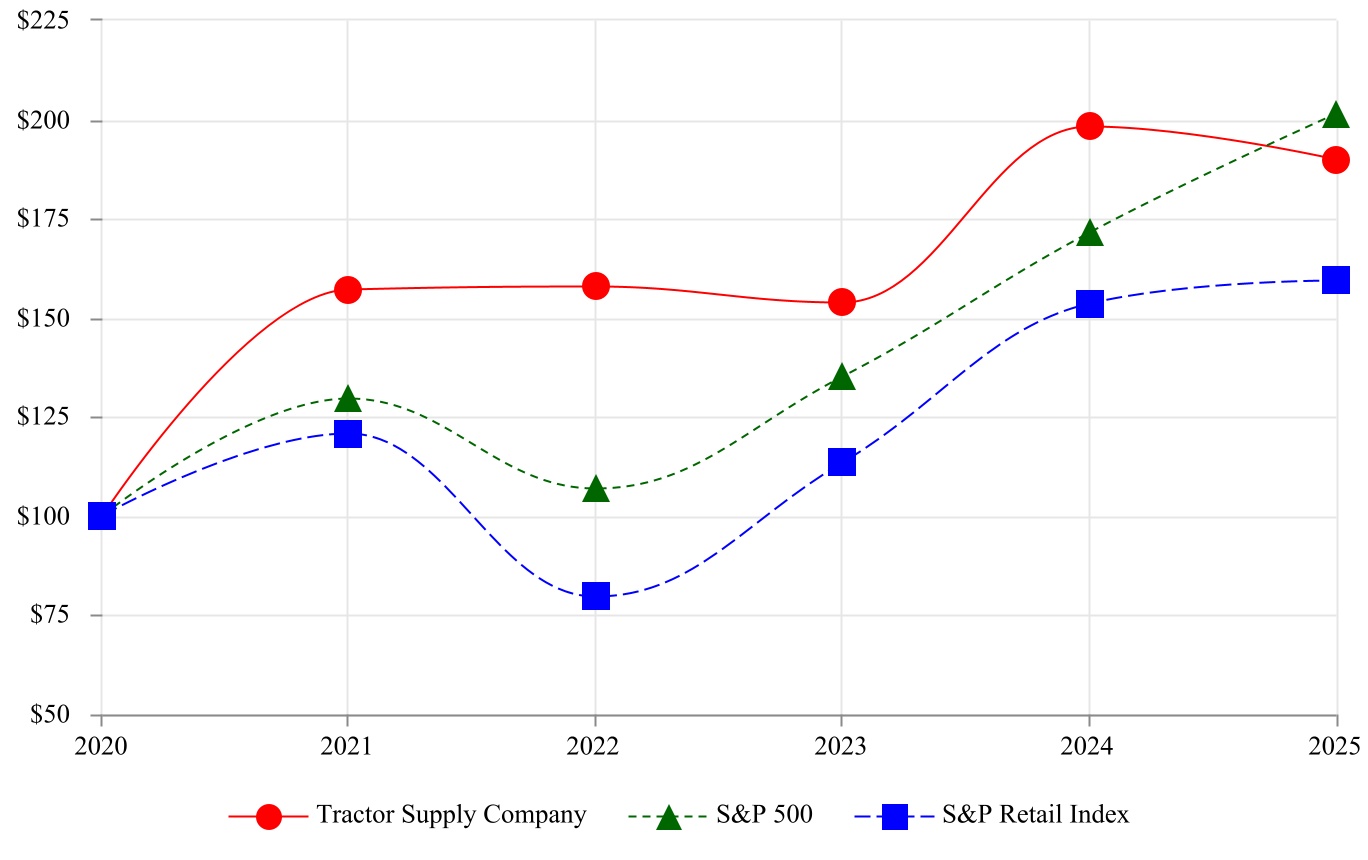
| 12/26/2020 | 12/25/2021 | 12/31/2022 | 12/30/2023 | 12/28/2024 | 12/27/2025 | |||||||||||||||||||||||||||||||||
| Tractor Supply Company | $ | 100.00 | $ | 157.10 | $ | 157.69 | $ | 153.66 | $ | 198.19 | $ | 189.82 | ||||||||||||||||||||||||||
| S&P 500 | $ | 100.00 | $ | 129.44 | $ | 106.92 | $ | 135.03 | $ | 171.36 | $ | 201.43 | ||||||||||||||||||||||||||
| S&P Retail Index | $ | 100.00 | $ | 120.64 | $ | 79.56 | $ | 113.30 | $ | 153.49 | $ | 159.33 | ||||||||||||||||||||||||||
Item 6. Reserved
| 29 | |||||||
Item 7. Management’s Discussion and Analysis of Financial Condition and Results of Operations
The following discussion and analysis is intended to provide the reader with information that will assist in understanding the significant factors affecting our consolidated operating results, financial condition, liquidity, and capital resources during the two-year period ended December 27, 2025 (our fiscal years 2025 and 2024). For a comparison of our results of operations for fiscal year December 28, 2024 and December 30, 2023, see “Part II, Item 7. Management’s Discussion and Analysis of Financial Condition and Results of Operations” of our Annual Report on Form 10-K for the fiscal year ended December 28, 2024, filed with the SEC on February 20, 2025. This discussion should be read in conjunction with our Consolidated Financial Statements and Notes to the Consolidated Financial Statements included elsewhere in this report. This discussion contains forward-looking statements and information. See “Forward-Looking Statements and Information” and “Risk Factors” included elsewhere in this report.
Tractor Supply reports its financial results in accordance with accounting principles generally accepted in the United States of America (“U.S. GAAP”). Tractor Supply also uses certain non-GAAP measures that fall within the meaning of Securities and Exchange Commission Regulation G and Regulation S-K Item 10(e), which may provide users of the financial information with additional meaningful comparison to prior reported results. Non-GAAP measures do not have standardized definitions and are not defined by U.S. GAAP. Therefore, Tractor Supply’s non-GAAP measures are unlikely to be comparable to similar measures presented by other companies. The presentation of these non-GAAP measures should not be considered in isolation from, as a substitute for, or as superior to the financial information presented in accordance with U.S. GAAP. We believe this information is useful in providing period-to-period comparisons of the results of our continuing operations.
Overview
Founded in 1938, Tractor Supply Company (the “Company” or “Tractor Supply” or “we” or “our” or “us”) is the largest rural lifestyle retailer in the United States (“U.S.”). The Company is focused on supplying the needs of recreational farmers, ranchers, and all those who enjoy living the rural lifestyle (which we refer to as the “Out Here” lifestyle). As of December 27, 2025, we operated 2,602 retail stores in 49 states under the names Tractor Supply Company and Petsense by Tractor Supply. Our stores are located primarily in towns outlying major metropolitan markets and in rural communities. We also operate websites under the names TractorSupply.com, Petsense.com, and Allivet.com as well as a Tractor Supply Company mobile application. Through our stores and e-commerce channels, we offer the following comprehensive selection of merchandise:
•Livestock, Equine & Agriculture: livestock and equine feed & equipment, poultry, fencing, and sprayers & chemicals;
•Companion Animal: food, treats and equipment for dogs, cats, and other small animals as well as dog wellness;
•Seasonal & Recreation: tractor & rider, lawn & garden, bird feeding, power equipment, and other recreational products;
•Truck, Tool, & Hardware: truck accessories, trailers, generators, lubricants, batteries, and hardware and tools; and
•Clothing, Gift, & Décor: clothing, footwear, toys, snacks, and decorative merchandise.
Tractor Supply Company believes we can grow our business by being a more integral part of our customers’ lives as the dependable supplier of “Out Here” lifestyle solutions, creating customer loyalty through personalized experiences, and providing convenience that our customers expect anytime, anywhere, and in any way they choose. Our long-term growth strategy is to: (1) expand and deepen our customer base by providing personal, localized, and memorable customer engagements by leveraging content, social media, and digital shopping experiences, attracting new customers and driving loyalty, (2) evolve customer experiences by digitizing our business processes and furthering our digital capabilities, (3) offer relevant assortments and services across all channels through exclusive and national brands and continue to grow our total addressable market by introducing new products and services through our test and learn strategy, (4) drive operational excellence and productivity through continuous improvement, increasing space utilization, and implementing advanced supply chain capabilities to support growth, scale and agility, and (5) expand through selective acquisitions, as such opportunities arise, to add complementary businesses and to enhance penetration into new and existing markets to supplement organic growth.
Achieving this strategy will require a foundational focus on: (1) connecting, empowering and growing our team to enhance their lives and the communities we call home, enabling them to provide legendary service to our customers, and (2) allocating resources in a disciplined and efficient manner to drive profitable growth and build stockholder value, including leveraging technology and automation, to align our cost structure to support new business capabilities for margin improvement and cost reductions.
Over the past five years, we have experienced considerable growth in stores, growing from 2,105 stores (1,923 Tractor Supply retail stores and 182 Petsense by Tractor Supply retail stores) at the end of fiscal 2020 to 2,602 stores (2,395 Tractor Supply
| 30 | |||||||
retail stores and 207 Petsense by Tractor Supply retail stores) at the end of fiscal 2025, and in net sales, with a compounded annual growth rate of approximately 7.9%. Given the size of the communities that we target, we believe that there is ample opportunity for new store growth in many existing and new markets. We have developed a proven method for selecting store sites, and we believe we have significant additional opportunities for new Tractor Supply stores. We also believe that there is opportunity for continued growth for Petsense by Tractor Supply stores.
Stock Split
On December 5, 2024, the Company’s Board of Directors authorized a five-for-one forward split (the “Stock Split”) of the Company’s outstanding shares of common stock, par value $0.008 per share. On December 20, 2024, stockholders of record at the close of business on December 16, 2024, received four additional shares of common stock for each share owned by such stockholder. The Certificate of Amendment to the Company’s Restated Certificate of Incorporation filed on December 19, 2024 effected the Stock Split and also proportionately increased the number of authorized common shares from 400.0 million to 2.00 billion. The par value of each share was not changed. All share and per-share information in this Annual Report on Form 10-K has been retroactively restated to reflect the Stock Split.
Executive Summary
In fiscal 2025, we opened 99 new Tractor Supply stores in 36 states and five new Petsense by Tractor Supply stores in four states and closed four Petsense by Tractor Supply stores. In fiscal 2024, we opened 80 new Tractor Supply stores in 34 states and 11 new Petsense by Tractor Supply stores in seven states and closed three Petsense by Tractor Supply stores. This resulted in a selling square footage increase of approximately 4% in fiscal 2025 and 2% in fiscal 2024.
Net sales increased 4.3% to $15.52 billion in fiscal 2025 from $14.88 billion in fiscal 2024. Comparable store sales increased 1.2% in fiscal 2025 as compared to an increase of 0.2% in fiscal 2024. Gross profit increased 4.8% to $5.65 billion in fiscal 2025 from $5.40 billion in fiscal 2024, and gross margin increased 16 basis points to 36.4% of net sales in fiscal 2025 from 36.3% of net sales in fiscal 2024. Operating margin decreased 41 basis points to 9.5% of net sales in fiscal 2025 from 9.9% of net sales in fiscal 2024. For fiscal 2025, net income was $1.10 billion, or $2.06 per diluted share, compared to $1.10 billion, or $2.04 per diluted share, in fiscal 2024.
We ended fiscal 2025 with $194.1 million in cash and cash equivalents and outstanding long-term debt of $1.77 billion, after returning $848.5 million to our stockholders through stock repurchases and quarterly cash dividends.
Performance Metrics
Comparable Store Metrics
Comparable store metrics are a key performance indicator used in the retail industry and by the Company to measure the performance of the underlying business. Our comparable store metrics are calculated on an annual basis using sales generated from all stores open at least one year and all online sales and exclude certain adjustments to net sales. Stores closed during either of the years being compared are removed from our comparable store metrics calculations. Stores relocated during either of the years being compared are not removed from our comparable store metrics calculations. If the effect of relocated stores on our comparable store metrics calculations became material, we would remove relocated stores from the calculations. Allivet sales will be considered comparable store sales one year after the transaction close date of December 30, 2024. Comparable store sales are intended only as supplemental information and are not a substitute for net sales presented in accordance with U.S. GAAP.
Transaction Count and Transaction Value
Transaction count and transaction value metrics are used by the Company to measure sales performance. Transaction count represents the number of customer transactions during a given period. Transaction value represents the average amount paid per transaction and is calculated as net sales divided by the total number of customer transactions during a given period.
Critical Accounting Estimates
Management’s discussion and analysis of our financial position and results of operations are based upon our Consolidated Financial Statements, which have been prepared in accordance with U.S. GAAP. The preparation of these financial statements requires management to make informed estimates and judgments that affect the reported amounts of assets, liabilities, revenues
| 31 | |||||||
and expenses, and related disclosure of contingent assets and liabilities. Our financial position and/or results of operations may be materially different when reported under different conditions or when using different assumptions in the application of such policies. In the event estimates or assumptions prove to be different from actual amounts, adjustments are made in subsequent periods to reflect more current information. Our significant accounting policies are disclosed in Note 1 to the Consolidated Financial Statements. The following discussion addresses our most critical accounting policies and estimates, which are those that are both important to the portrayal of our financial condition and results of operations and that require significant judgment or use of complex estimates.
Merchandise Inventory:
We have established a reserve for estimating inventory shrinkage between physical inventory counts. The reserve is established by assessing the chain-wide average shrinkage experience rate, applied to the related periods’ sales volumes. Such assessments are updated on a regular basis for the most recent individual store experiences. Our general policy is to perform physical inventories at least once a year for each store that has been open more than twelve months.
The estimated store inventory shrink rate is based on historical experience. We believe historical rates are a reasonably accurate reflection of future trends. Our shrinkage reserve contains uncertainties because the calculation requires management to make assumptions and to apply judgment regarding future shrinkage trends, the effect of loss prevention measures, and merchandising strategies.
We have not made any material changes in the accounting methodology used to recognize shrinkage in the financial periods presented. We do not believe there is a reasonable likelihood that there will be a material change in the future estimates or assumptions we use to calculate shrinkage. However, if assumptions regarding inventory loss for certain products are inaccurate, we may be exposed to losses or gains that could be material. A 10% change in our shrinkage reserve as of December 27, 2025 would have affected net income by approximately $4.7 million in fiscal 2025.
Self-Insurance Reserves:
We self-insure a significant portion of our workers’ compensation insurance and general liability (including product liability) insurance plans. We have stop-loss insurance policies to protect from individual losses over specified dollar values. Provisions for losses related to our self-insured liabilities are based upon periodic, independent, actuarially determined estimates that consider a number of factors including historical claims experience, loss development factors, and severity factors.
The full extent of certain workers’ compensation and general liability claims may not become fully determined for several years. Our self-insured liabilities contain uncertainties because management is required to make assumptions and to apply judgment to estimate the ultimate cost to settle reported claims and claims incurred but not reported as of the balance sheet date based upon historical data and experience, including actuarial calculations.
We have not made any material changes in the accounting methodology used to establish our self-insurance reserves in the financial periods presented. We do not believe there is a reasonable likelihood that there will be a material change in the assumptions we use to calculate insurance reserves. However, if we experience a significant increase in the number of claims or the cost associated with these claims, we may be exposed to losses that could be material. A 10% change in our self-insurance reserves as of December 27, 2025 would have affected net income by approximately $12.0 million in fiscal 2025.
Impairment of Long-Lived Assets:
Long-lived assets, including lease right-of-use assets, are evaluated for impairment whenever events or changes in circumstances indicate that the carrying value may not be recoverable. When evaluating long-lived assets for potential impairment, we first compare the carrying value of the asset or asset group to its estimated undiscounted future cash flows. The evaluation for long-lived assets is performed at the lowest level of identifiable cash flows, which is generally the individual store level. The significant assumptions used to determine estimated undiscounted cash flows include cash inflows and outflows directly resulting from the use of those assets in operations, including margin on net sales, payroll and related items, occupancy costs, insurance allocations, and other costs to operate a store. If the estimated future cash flows are less than the carrying value of the related asset, we calculate an impairment loss. The impairment loss calculation compares the carrying value of the related asset or asset group to its estimated fair value, which may be based on an estimated future cash flow model, market valuation, or other valuation technique, as appropriate. We recognize an impairment loss if the amount of the asset’s carrying value exceeds the asset’s estimated fair value. If we recognize an impairment loss, the adjusted carrying amount of the asset becomes
| 32 | |||||||
its new cost basis. For a depreciable long-lived asset, the new cost basis will be depreciated (amortized) over the remaining estimated useful life of that asset.
Our impairment loss calculations contain uncertainties because they require management to make assumptions and to apply judgment to estimate future cash flows and asset fair values.
We have not made any material changes in our impairment loss assessment methodology in the financial periods presented.
We do not believe there is a reasonable likelihood that there will be a material change in the estimates or assumptions we use to calculate long-lived asset impairment losses. None of these estimates and assumptions are significantly sensitive, and a 10% change in any of these estimates would not have a material impact on our analysis. However, if actual results are not consistent with our estimates and assumptions used in estimating future cash flows and asset fair values, we may be exposed to losses that could be material.
There were no significant long-lived assets impairment charges recognized in fiscal 2025.
Impairment of Goodwill and Other Indefinite-Lived Intangible Assets:
Goodwill and other indefinite-lived intangible assets are evaluated for impairment annually, or whenever events or changes in circumstances indicate that the carrying value may not be recoverable. In accordance with the accounting standards, an entity has the option first to assess qualitative factors to determine whether events and circumstances indicate that it is more likely than not that goodwill or an indefinite-lived intangible asset is impaired. If after such assessment an entity concludes that the asset is not impaired, then the entity is not required to take further action. However, if an entity concludes otherwise, then it is required to determine the fair value of the asset using a quantitative impairment test, and if impaired, the associated assets must be written down to fair value.
The quantitative impairment test for goodwill compares the fair value of a reporting unit with the carrying value of its net assets, including goodwill. If the fair value of the reporting unit is less than the carrying value of the reporting unit, an impairment charge would be recorded to the Company’s operations, for the amount in which the carrying amount exceeds the reporting unit’s fair value. We determine fair values for each reporting unit using the market approach, when available and appropriate, the income approach, or a combination of both. The income approach involves forecasting projected financial information (such as revenue growth rates, profit margins, tax rates, and capital expenditures) and selecting a discount rate that reflects the risk inherent in estimated future cash flows. Under the market approach, the fair value is based on observed market data. If multiple valuation methodologies are used, the results are weighted appropriately.
The quantitative impairment test for other indefinite-lived intangible assets involves comparing the carrying amount of the asset to the sum of the discounted cash flows expected to be generated by the asset. If the implied fair value of the indefinite-lived intangible asset is less than the carrying value, an impairment charge would be recorded to the Company’s operations.
Our impairment loss calculations contain uncertainties because they require management to make assumptions and to apply judgment to qualitative factors as well as estimate future cash flows and asset fair values, including forecasting projected financial information and selecting the discount rate that reflects the risk inherent in future cash flows.
The valuation approaches utilized to estimate fair value for the purposes of the impairment tests of goodwill and other indefinite-lived intangible assets require the use of assumptions and estimates, which involve a degree of uncertainty. If actual results are not consistent with our estimates and assumptions used in estimating future cash flows and asset fair values, we may be exposed to non-cash impairment losses that could be material.
There were no goodwill or other indefinite-lived intangible assets impairment charges recognized in fiscal 2025.
| 33 | |||||||
Results of Operations
The following table sets forth, for the periods indicated, certain items in the Consolidated Statements of Income expressed as a percent of net sales.
| Fiscal Year | |||||||||||||||||
| 2025 | 2024 | ||||||||||||||||
| Net sales | 100.00 | % | 100.00 | % | |||||||||||||
Cost of merchandise sold (a) | 63.58 | 63.74 | |||||||||||||||
Gross margin (a) | 36.42 | 36.26 | |||||||||||||||
Selling, general and administrative expenses (a) | 23.79 | 23.39 | |||||||||||||||
| Depreciation and amortization | 3.18 | 3.00 | |||||||||||||||
| Operating income | 9.45 | 9.86 | |||||||||||||||
| Interest expense, net | 0.45 | 0.37 | |||||||||||||||
| Income before income taxes | 9.01 | 9.49 | |||||||||||||||
| Income tax expense | 1.95 | 2.09 | |||||||||||||||
| Net income | 7.06 | % | 7.40 | % | |||||||||||||
(a) Our gross margin amounts may not be comparable to those of other retailers since some retailers include all of the costs related to their distribution facility network in cost of merchandise sold and others (like our Company) exclude a portion of these distribution facility network costs from gross margin and instead include them in Selling, general, and administrative expenses; refer to Note 1 – Significant Accounting Policies of the Notes to the Consolidated Financial Statements, included in Item 8 Financial Statements and Supplementary Data, of this Annual Report on Form 10-K.
Fiscal 2025 Compared to Fiscal 2024
Net sales increased 4.3% to $15.52 billion in fiscal 2025 from $14.88 billion in fiscal 2024. The increase in net sales was driven by new store openings, the contribution from Allivet, and the 1.2% increase in comparable store sales. Comparable store sales increased 1.2% from the prior year and represented $15.04 billion in sales. The comparable store average transaction value decreased 0.2% and comparable store average transaction count increased 1.4% for fiscal 2025, as compared to a decrease of 0.6% and increase of 0.8% in fiscal 2024, respectively. Comparable store sales growth was driven by strength in both C.U.E. and seasonal categories, partially offset by softness in emergency response and discretionary categories including big ticket products.
Sales from stores opened less than one year, including Allivet sales, were $467.0 million in fiscal 2025, which contributed a net 3.1 percentage points of the 4.3% increase over fiscal 2024 net sales. Sales from stores opened less than one year were $426.2 million in fiscal 2024, which represented 2.1 percentage points of the 2.2% increase over fiscal 2023 net sales.
The following table summarizes our store growth during fiscal 2025 and 2024:
| Fiscal Year | ||||||||||||||
| Store Count Information: | 2025 | 2024 | ||||||||||||
| Tractor Supply | ||||||||||||||
| Beginning of period | 2,296 | 2,216 | ||||||||||||
| New stores opened | 99 | 80 | ||||||||||||
| Stores closed | — | — | ||||||||||||
| End of period | 2,395 | 2,296 | ||||||||||||
| Petsense by Tractor Supply | ||||||||||||||
| Beginning of period | 206 | 198 | ||||||||||||
| New stores opened | 5 | 11 | ||||||||||||
| Stores closed | (4) | (3) | ||||||||||||
| End of period | 207 | 206 | ||||||||||||
| Consolidated end of period | 2,602 | 2,502 | ||||||||||||
| Stores relocated | 7 | 5 | ||||||||||||
| 34 | |||||||
The following table indicates the percent of net sales represented by each of our major product categories during fiscal 2025 and 2024:
| Percent of Net Sales | |||||||||||
| Fiscal Year | |||||||||||
| Product Category: | 2025 | 2024 | |||||||||
| Livestock, Equine & Agriculture | 27 | % | 26 | % | |||||||
| Companion Animal | 24 | 24 | |||||||||
| Seasonal & Recreation | 24 | 24 | |||||||||
| Truck, Tool & Hardware | 15 | 16 | |||||||||
| Clothing, Gift & Décor | 10 | 10 | |||||||||
| Total | 100 | % | 100 | % | |||||||
| Note: Net sales by major product categories for prior periods have been reclassified to conform to the current year presentation. | |||||||||||
Gross profit increased 4.8% to $5.65 billion in fiscal 2025 compared to $5.40 billion in fiscal 2024. As a percent of net sales, gross margin increased 16 basis points to 36.4% for fiscal 2025 compared to 36.3% for fiscal 2024. The gross margin rate increase was primarily attributable to cost management initiatives and the continued execution of an everyday low price strategy, partially offset by higher tariffs and increased delivery-related transportation costs.
Total selling, general and administrative (“SG&A”) expenses, including depreciation and amortization, increased 6.6% to $4.19 billion in fiscal 2025 from $3.93 billion in fiscal 2024. As a percent of net sales, SG&A expenses increased 57 basis points to 27.0% from 26.4%. The increase in SG&A as a percent of net sales was primarily attributable to planned investments and fixed cost deleverage given the level of comparable store sales growth. These factors were partially offset by both a disciplined focus on productivity and ongoing cost control, as well as a modest benefit from the Company’s ongoing sale-leaseback strategy.
Our effective income tax rate decreased to 21.6% for fiscal 2025 compared to 22.1% in fiscal 2024. The decrease was driven primarily by the benefit associated with the purchase of transferable federal tax credits, partially offset by a reduction in the benefit from annual stock compensation activity.
Net income in fiscal 2025 was $1.10 billion, or $2.06 per diluted share, compared to $1.10 billion, or $2.04 per diluted share, in fiscal 2024.
During fiscal 2025, we repurchased approximately 6.6 million shares of the Company’s common stock at a total cost of $361.0 million, including the 1% excise tax, as part of our share repurchase program. In fiscal 2024, we repurchased approximately 10.6 million shares at a total cost of $566.4 million.
Liquidity and Capital Resources
In addition to normal operating expenses, our primary ongoing cash requirements are for new store expansion, existing store remodeling and improvements, store relocations, distribution facility capacity and improvements, information technology, inventory purchases, repayment of existing borrowings under our debt facilities, share repurchases, cash dividends, and selective acquisitions as opportunities arise.
Our primary ongoing sources of liquidity are existing cash balances, cash provided from operations, remaining funds available under our debt facilities, operating and finance leases, and normal trade credit. Our inventory and accounts payable levels typically build in the first and third fiscal quarters to support the higher sales volume of the spring and cold-weather selling seasons, respectively.
We plan to continue to leverage our sale-leaseback program on both existing owned stores and future new store openings in order to help fund our planned owned store development over the next several years.
We believe that our existing cash balances, expected cash flow from future operations, funds available under our debt facilities, operating and finance leases, normal trade credit, and access to the long-term debt capital markets will be sufficient to fund our operations and our capital expenditure needs, including new store openings, existing store remodeling and improvements, store relocations, distribution facility capacity and improvements, and information technology improvements, for the next 12 months and the foreseeable future.
| 35 | |||||||
Debt
The following table summarizes the Company’s outstanding debt as of the dates indicated (in millions):
| December 27, 2025 | December 28, 2024 | |||||||||||||||||||
| 5.25% Senior Notes | $ | 750.0 | $ | 750.0 | ||||||||||||||||
| 1.75% Senior Notes | 650.0 | 650.0 | ||||||||||||||||||
| 3.70% Senior Notes | 150.0 | 150.0 | ||||||||||||||||||
| Senior Credit Facility: | ||||||||||||||||||||
| Revolving Credit Facility | 230.00 | 300.00 | ||||||||||||||||||
| Total outstanding borrowings | 1,780.0 | 1,850.0 | ||||||||||||||||||
| Less: unamortized debt discounts and issuance costs | (15.0) | (18.0) | ||||||||||||||||||
| Total debt | 1,765.0 | 1,832.0 | ||||||||||||||||||
| Less: current portion of long-term debt | — | — | ||||||||||||||||||
| Long-term debt | $ | 1,765.0 | $ | 1,832.0 | ||||||||||||||||
| Outstanding letters of credit | $ | 78.6 | $ | 74.1 | ||||||||||||||||
We manage our business and financial ratios to target an investment-grade credit rating, which has historically allowed flexible access to financing at reasonable market costs. As of December 27, 2025, and the date of this filing, February 19, 2026, the Company's senior unsecured debt is rated “Baa1,” by Moody’s Investor Services with a stable outlook and “BBB” by Standard & Poor’s with a stable outlook. These ratings have been obtained with the understanding that Moody’s Investors Services and Standard & Poor’s will continue to monitor our credit and make future adjustments to these ratings to the extent warranted. The ratings are not a recommendation to buy, sell or hold our securities, may be changed, superseded or withdrawn at any time, and should be evaluated independently of any other rating.
For additional information about the Company’s debt and credit facilities, refer to Note 5 to the Consolidated Financial Statements.
Operating Activities
Operating activities provided net cash of $1.64 billion and $1.42 billion in fiscal 2025 and 2024, respectively. The $214.5 million increase in net cash provided by operating activities in fiscal 2025 compared to fiscal 2024 was due to changes in the following (in millions):
| Fiscal Year | |||||||||||||||||
| 2025 | 2024 | Variance | |||||||||||||||
| (52 weeks) | (52 weeks) | ||||||||||||||||
Net income | $ | 1,096.1 | $ | 1,101.2 | $ | (5.1) | |||||||||||
| Depreciation and amortization | 494.0 | 447.2 | 46.8 | ||||||||||||||
Gain on disposition of property and equipment | (93.1) | (62.5) | (30.6) | ||||||||||||||
| Share-based compensation expense | 57.1 | 48.4 | 8.7 | ||||||||||||||
| Deferred income taxes | 61.3 | (22.6) | 83.9 | ||||||||||||||
| Inventories and accounts payable | (82.3) | (137.9) | 55.6 | ||||||||||||||
| Prepaid expenses and other current assets | (1.3) | 11.5 | (12.8) | ||||||||||||||
| Accrued expenses | 38.8 | 30.3 | 8.5 | ||||||||||||||
| Income taxes | (5.9) | (19.2) | 13.3 | ||||||||||||||
| Other, net | 70.6 | 24.4 | 46.2 | ||||||||||||||
Net cash provided by operating activities | $ | 1,635.3 | $ | 1,420.8 | $ | 214.5 | |||||||||||
Note: Amounts may not sum to totals due to rounding.
| 36 | |||||||
The $214.5 million increase in net cash provided by operating activities is driven by both the increase in deferred income taxes, primarily attributable to the impact of the One Big Beautiful Bill Act (the “OBBBA”), and the effective management of our inventory and accounts payable.
Investing Activities
Investing activities used net cash of $778.6 million and $643.9 million in fiscal 2025 and 2024, respectively. The $134.7 million increase in net cash used in investing activities in fiscal 2025 compared to fiscal 2024 was due to changes in the following (in millions):
| Fiscal Year | |||||||||||||||||
| 2025 | 2024 | ||||||||||||||||
| (52 weeks) | (52 weeks) | Variance | |||||||||||||||
| New stores, relocated stores and stores not yet opened | $ | (376.0) | $ | (241.2) | $ | (134.8) | |||||||||||
| Existing stores | (223.9) | (284.0) | 60.1 | ||||||||||||||
| Information technology | (158.1) | (153.5) | (4.6) | ||||||||||||||
| Distribution center capacity and improvements | (127.8) | (95.8) | (32.0) | ||||||||||||||
| Corporate and other | (9.0) | (9.5) | 0.5 | ||||||||||||||
| Total capital expenditures | $ | (894.8) | $ | (784.0) | $ | (110.8) | |||||||||||
| Proceeds from sale of property and equipment | 256.1 | 140.1 | 116.0 | ||||||||||||||
| Acquisition of Allivet, net of cash acquired | (139.9) | — | (139.9) | ||||||||||||||
Net cash used in investing activities | $ | (778.6) | $ | (643.9) | $ | (134.7) | |||||||||||
Note: Amounts may not sum to totals due to rounding.
The increase in capital expenditures for new stores, relocated stores and stores not yet opened in fiscal 2025 is primarily driven by the increase in new store openings and the construction of owned, fixed-fee development stores. Capital expenditures for fiscal 2025 included the opening of 99 new Tractor Supply stores compared to 80 new Tractor Supply stores during fiscal 2024. Partially offsetting the increase in total capital expenditures, proceeds from the sale of property and equipment increased in fiscal 2025 primarily driven by the sale of both new, fixed-fee development stores and existing stores as part of our sale-leaseback program.
The decrease in capital expenditures for existing stores in fiscal 2025 primarily reflects a reallocation of funds to construction of the new distribution center in Nampa, Idaho, as well efficiencies and lower average costs related to our continued Project Fusion remodels and side lot garden center transformations.
Capital expenditures for information technology represent continued support of our store growth, improvements in mobility in our stores, our digital initiatives, increased security and compliance, and other Company-wide strategic initiatives.
The increase in capital expenditures for distribution center capacity and improvements in fiscal 2025 is primarily driven by the land development and ongoing construction of our newest distribution center in Nampa, Idaho. Spend in fiscal 2024 reflects activities associated with construction of the Maumelle, Arkansas distribution center which opened during the second quarter of fiscal 2024.
On December 30, 2024, the Company completed its acquisition of Allivet, an online pet pharmacy. Net cash used in investing activities includes the cash used for the acquisition of Allivet, net of cash acquired as part of the transaction.
Our projected capital expenditures, net of sale-leaseback proceeds, for fiscal 2026 are currently estimated to be in the range of approximately $675.0 million to $725.0 million. The capital expenditures include a plan to open approximately 100 Tractor Supply stores, continue Project Fusion remodels and side lot garden center transformations, complete construction on our Nampa, Idaho distribution center, and continue investing in store and digital technology.
| 37 | |||||||
Financing Activities
Financing activities used cash of $914.1 million and $922.5 million in fiscal 2025 and 2024, respectively. The $8.4 million decrease in net cash used in financing activities in fiscal 2025 compared to fiscal 2024 was due to changes in the following (in millions):
| Fiscal Year | |||||||||||||||||
| 2025 | 2024 | Variance | |||||||||||||||
| (52 weeks) | (52 weeks) | ||||||||||||||||
| Net borrowings and repayments under debt facilities | $ | (70.0) | $ | 100.0 | $ | (170.0) | |||||||||||
| Repurchase of common stock | (361.3) | (560.6) | 199.3 | ||||||||||||||
| Cash dividends paid to stockholders | (487.7) | (472.5) | (15.2) | ||||||||||||||
| Net proceeds from issuance of common stock | 23.6 | 39.4 | (15.8) | ||||||||||||||
| Other, net | (18.7) | (28.8) | 10.1 | ||||||||||||||
Net cash used in financing activities | $ | (914.1) | $ | (922.5) | $ | 8.4 | |||||||||||
The $8.4 million decrease in net cash used in financing activities is primarily due to a decrease in the repurchase of common stock, partially offset by repayments under the Company’s Revolving Credit Facility in the current period compared to incremental borrowings under the Company’s Revolving Credit Facility in the prior period.
Repurchase of Common Stock
The Company’s Board of Directors has authorized common stock repurchases under a share repurchase program which was most recently increased by $1.00 billion on February 12, 2025. The total amount authorized under the program, which has been increased from time to time, is currently $7.50 billion, exclusive of any fees, commissions or other expenses related to such repurchases. The share repurchase program does not have an expiration date. The repurchases may be made from time to time on the open market or in privately negotiated transactions. The timing and amount of any shares repurchased under the program will depend on a variety of factors, including price, corporate and regulatory requirements, capital availability, and other market conditions. Repurchased shares are accounted for at cost and will be held in treasury for future issuance. The program may be limited, temporarily paused, or terminated at any time without prior notice. As of December 27, 2025, the Company had remaining authorization under the share repurchase program of $1.13 billion, exclusive of any fees, commissions or other expenses.
We repurchased approximately 6.6 million and 10.6 million shares of common stock under the share repurchase program and paid cash totaling $361.3 million and $560.6 million in fiscal 2025 and 2024, respectively. Our projected share repurchases for fiscal 2026 are currently estimated to be in a range of approximately $375.0 million to $450.0 million.
Cash Dividends Paid to Stockholders
We paid cash dividends totaling $487.7 million and $472.5 million in fiscal 2025 and 2024, respectively. In fiscal 2025, we declared and paid cash dividends to stockholders of $0.92 per common share outstanding as compared to $0.88 per common share outstanding in fiscal 2024. These payments reflect an increase in the quarterly dividend in all four quarters of fiscal 2025 to $0.23 per share from $0.22 per share in all four quarters of fiscal 2024.
On February 10, 2026, the Company’s Board of Directors declared a quarterly cash dividend of $0.24 per share of the Company’s outstanding common stock. The dividend will be paid on March 10, 2026, to stockholders of record as of the close of business on February 24, 2026.
It is the present intention of the Company’s Board of Directors to continue to pay a quarterly cash dividend; however, the declaration and payment amount of future dividends will be determined by the Company’s Board of Directors in its sole discretion and will depend upon the earnings, financial condition, and capital needs of the Company, along with any other factors which the Company’s Board of Directors deem relevant.
| 38 | |||||||
New Accounting Pronouncements
Refer to Note 1 to the Consolidated Financial Statements for recently adopted accounting pronouncements and recently issued pronouncements not yet adopted as of December 27, 2025.
Item 7A. Quantitative and Qualitative Disclosures About Market Risk
Interest Rate Risk
We are exposed to interest rate changes, primarily as a result of borrowings under our 2022 Senior Credit Facility (as discussed in Note 5 to the Consolidated Financial Statements) which bear interest based on variable rates. We previously entered into an interest rate swap agreement to manage our exposure to the impact of interest rate changes. The interest rate swap agreement matured in the first quarter of fiscal 2025. The fluctuations in interest rates after maturation of this agreement did not have a material impact on our financial condition or results of operations.
Purchase Price Volatility
Although we cannot determine the full effect of inflation and deflation on our operations, we believe our sales and results of operations are affected by both. We are subject to market risk with respect to the pricing of certain products and services, which include, among other items, grain, corn, steel, petroleum, cotton, and other commodities, as well as duties, tariffs, diesel fuel, and transportation services. Therefore, we may experience both inflationary and deflationary pressure on product cost, which may impact consumer demand and, as a result, sales and gross margin. Our strategy is to reduce or mitigate the effects of purchase price volatility, principally by taking advantage of vendor incentive programs, leveraging economies of scale from increased volume of purchases, adjusting retail prices, and selectively buying from the most competitive vendors without sacrificing quality.
| 39 | |||||||
Item 8. Financial Statements and Supplementary Data
INDEX TO CONSOLIDATED FINANCIAL STATEMENTS
Page No. | |||||
Reports of | |||||
| 40 | |||||||
Report of Independent Registered Public Accounting Firm
To the Shareholders and the Board of Directors of Tractor Supply Company
Opinion on Internal Control Over Financial Reporting
We have audited Tractor Supply Company’s internal control over financial reporting as of December 27, 2025, based on criteria established in Internal Control—Integrated Framework issued by the Committee of Sponsoring Organizations of the Treadway Commission (2013 framework) (the COSO criteria). In our opinion, Tractor Supply Company (the Company) maintained, in all material respects, effective internal control over financial reporting as of December 27, 2025, based on the COSO criteria.
We also have audited, in accordance with the standards of the Public Company Accounting Oversight Board (United States) (PCAOB), the consolidated balance sheets of the Company as of December 27, 2025 and December 28, 2024, the related consolidated statements of income, comprehensive income, stockholders’ equity and cash flows for each of the three years in the period ended December 27, 2025, and the related notes and our report dated February 19, 2026 expressed an unqualified opinion thereon.
Basis for Opinion
The Company’s management is responsible for maintaining effective internal control over financial reporting and for its assessment of the effectiveness of internal control over financial reporting included in the accompanying Management’s Report on Internal Control Over Financial Reporting. Our responsibility is to express an opinion on the Company’s internal control over financial reporting based on our audit. We are a public accounting firm registered with the PCAOB and are required to be independent with respect to the Company in accordance with the U.S. federal securities laws and the applicable rules and regulations of the Securities and Exchange Commission and the PCAOB.
We conducted our audit in accordance with the standards of the PCAOB. Those standards require that we plan and perform the audit to obtain reasonable assurance about whether effective internal control over financial reporting was maintained in all material respects.
Our audit included obtaining an understanding of internal control over financial reporting, assessing the risk that a material weakness exists, testing and evaluating the design and operating effectiveness of internal control based on the assessed risk, and performing such other procedures as we considered necessary in the circumstances. We believe that our audit provides a reasonable basis for our opinion.
Definition and Limitations of Internal Control Over Financial Reporting
A company’s internal control over financial reporting is a process designed to provide reasonable assurance regarding the reliability of financial reporting and the preparation of financial statements for external purposes in accordance with generally accepted accounting principles. A company’s internal control over financial reporting includes those policies and procedures that (1) pertain to the maintenance of records that, in reasonable detail, accurately and fairly reflect the transactions and dispositions of the assets of the company; (2) provide reasonable assurance that transactions are recorded as necessary to permit preparation of financial statements in accordance with generally accepted accounting principles, and that receipts and expenditures of the company are being made only in accordance with authorizations of management and directors of the company; and (3) provide reasonable assurance regarding prevention or timely detection of unauthorized acquisition, use, or disposition of the company’s assets that could have a material effect on the financial statements.
Because of its inherent limitations, internal control over financial reporting may not prevent or detect misstatements. Also, projections of any evaluation of effectiveness to future periods are subject to the risk that controls may become inadequate because of changes in conditions, or that the degree of compliance with the policies or procedures may deteriorate.
/s/ Ernst & Young LLP
Nashville, Tennessee
February 19, 2026
| 41 | |||||||
Report of Independent Registered Public Accounting Firm
To the Shareholders and the Board of Directors of Tractor Supply Company
Opinion on the Financial Statements
We have audited the accompanying consolidated balance sheets of Tractor Supply Company (the Company) as of December 27, 2025 and December 28, 2024, the related consolidated statements of income, comprehensive income, stockholders’ equity and cash flows for each of the three years in the period ended December 27, 2025, and the related notes (collectively referred to as the “consolidated financial statements”). In our opinion, the consolidated financial statements present fairly, in all material respects, the financial position of the Company at December 27, 2025 and December 28, 2024, and the results of its operations and its cash flows for each of the three years in the period ended December 27, 2025, in conformity with U.S. generally accepted accounting principles.
We also have audited, in accordance with the standards of the Public Company Accounting Oversight Board (United States) (PCAOB), the Company’s internal control over financial reporting as of December 27, 2025, based on criteria established in Internal Control-Integrated Framework issued by the Committee of Sponsoring Organizations of the Treadway Commission (2013 framework), and our report dated February 19, 2026 expressed an unqualified opinion thereon.
Basis for Opinion
These financial statements are the responsibility of the Company’s management. Our responsibility is to express an opinion on the Company’s financial statements based on our audits. We are a public accounting firm registered with the PCAOB and are required to be independent with respect to the Company in accordance with the U.S. federal securities laws and the applicable rules and regulations of the Securities and Exchange Commission and the PCAOB.
We conducted our audits in accordance with the standards of the PCAOB. Those standards require that we plan and perform the audit to obtain reasonable assurance about whether the financial statements are free of material misstatement, whether due to error or fraud. Our audits included performing procedures to assess the risks of material misstatement of the financial statements, whether due to error or fraud, and performing procedures that respond to those risks. Such procedures included examining, on a test basis, evidence regarding the amounts and disclosures in the financial statements. Our audits also included evaluating the accounting principles used and significant estimates made by management, as well as evaluating the overall presentation of the financial statements. We believe that our audits provide a reasonable basis for our opinion.
Critical Audit Matter
The critical audit matter communicated below is a matter arising from the current period audit of the financial statements that was communicated or required to be communicated to the audit committee and that: (1) relates to accounts or disclosures that are material to the financial statements and (2) involved our especially challenging, subjective or complex judgments. The communication of the critical audit matter does not alter in any way our opinion on the consolidated financial statements, taken as a whole, and we are not, by communicating the critical audit matter below, providing a separate opinion on the critical audit matter or on the account or disclosure to which it relates.
| Workers’ Compensation and General Liability Self-Insurance Reserves | ||||||||
| Description of the Matter | At December 27, 2025, the Company’s reserve for workers’ compensation and general liability self-insurance risks were $ | |||||||
Auditing management’s estimate of the recorded workers’ compensation and general liability self-insurance reserves was complex and judgmental due to the significant assumptions and judgments required by management to project the exposure on incurred claims that remain unresolved, including those which have not yet been reported to the Company. | ||||||||
| 42 | |||||||
| How We Addressed the Matter in Our Audit | We obtained an understanding, evaluated the design, and tested the operating effectiveness of controls over the Company’s accounting for workers’ compensation and general liability self-insurance exposures. For example, we tested controls over management’s review of the significant assumptions described above, including the completeness and accuracy of the underlying data, as well as management’s review of the actuarial calculations. | |||||||
| To test the Company’s estimate of the workers’ compensation and general liability self-insurance reserves, we performed audit procedures that included, among others, assessing the appropriateness of the actuarial valuation methodologies utilized by management and the significant assumptions within, testing the related underlying data used by the Company in its evaluation for completeness and accuracy, and testing the mathematical accuracy of the calculations. Our audit procedures also included, among others, comparing the significant assumptions used by management to industry accepted actuarial assumptions and assessing the accuracy of management’s historical estimates utilized in prior period evaluations. We involved our actuarial valuation specialists to assist in assessing the valuation methodologies and significant assumptions noted above and to develop an independent range of estimates for the workers’ compensation and general liability self-insurance reserves which were then compared to management’s estimates. | ||||||||
/s/ Ernst & Young LLP
We have served as the Company’s auditor since 2001.
February 19, 2026
| 43 | |||||||
TRACTOR SUPPLY COMPANY
CONSOLIDATED STATEMENTS OF INCOME
(in thousands, except per share amounts)
| Fiscal Year | |||||||||||||||||
| 2025 | 2024 | 2023 | |||||||||||||||
| (52 weeks) | (52 weeks) | (52 weeks) | |||||||||||||||
| Net sales | $ | $ | $ | ||||||||||||||
| Cost of merchandise sold | |||||||||||||||||
Gross profit | |||||||||||||||||
| Selling, general and administrative expenses | |||||||||||||||||
| Depreciation and amortization | |||||||||||||||||
Operating income | |||||||||||||||||
Interest expense, net | |||||||||||||||||
Income before income taxes | |||||||||||||||||
Income tax expense | |||||||||||||||||
Net income | $ | $ | $ | ||||||||||||||
Net income per share – basic (a) | $ | $ | $ | ||||||||||||||
Net income per share – diluted (a) | $ | $ | $ | ||||||||||||||
Weighted average shares outstanding (a) | |||||||||||||||||
| Basic | |||||||||||||||||
| Diluted | |||||||||||||||||
Dividends declared per common share outstanding (a) | $ | $ | $ | ||||||||||||||
(a) All share and per share information has been adjusted to reflect the five-for-one Stock Split effective December 20, 2024 as discussed in Note 1.
The accompanying notes are an integral part of these Consolidated Financial Statements.
| 44 | |||||||
TRACTOR SUPPLY COMPANY
CONSOLIDATED STATEMENTS OF COMPREHENSIVE INCOME
(in thousands)
| Fiscal Year | |||||||||||||||||
| 2025 | 2024 | 2023 | |||||||||||||||
| (52 weeks) | (52 weeks) | (52 weeks) | |||||||||||||||
| Net income | $ | $ | $ | ||||||||||||||
| Other comprehensive loss: | |||||||||||||||||
| Change in fair value of interest rate swaps, net of taxes | ( | ( | ( | ||||||||||||||
| Total other comprehensive loss | ( | ( | ( | ||||||||||||||
| Total comprehensive income | $ | $ | $ | ||||||||||||||
The accompanying notes are an integral part of these Consolidated Financial Statements.
| 45 | |||||||
TRACTOR SUPPLY COMPANY
CONSOLIDATED BALANCE SHEETS
(in thousands, except per share amounts)
| December 27, 2025 | December 28, 2024 | ||||||||||
| ASSETS | |||||||||||
| Current assets: | |||||||||||
| Cash and cash equivalents | |||||||||||
| Inventories | |||||||||||
| Prepaid expenses and other current assets | |||||||||||
| Income taxes receivable | |||||||||||
| Total current assets | |||||||||||
| Property and equipment, net | |||||||||||
| Operating lease right-of-use assets | |||||||||||
| Goodwill and other intangible assets | |||||||||||
| Other assets | |||||||||||
| Total assets | $ | $ | |||||||||
| LIABILITIES AND STOCKHOLDERS’ EQUITY | |||||||||||
| Current liabilities: | |||||||||||
| Accounts payable | $ | $ | |||||||||
| Accrued employee compensation | |||||||||||
| Other accrued expenses | |||||||||||
| Current portion of finance lease liabilities | |||||||||||
| Current portion of operating lease liabilities | |||||||||||
| Total current liabilities | |||||||||||
| Long-term debt | |||||||||||
| Finance lease liabilities, less current portion | |||||||||||
| Operating lease liabilities, less current portion | |||||||||||
| Deferred income taxes | |||||||||||
| Other long-term liabilities | |||||||||||
| Total liabilities | |||||||||||
| Stockholders’ equity: | |||||||||||
Common stock | |||||||||||
| Additional paid-in capital | |||||||||||
| Treasury stock | ( | ( | |||||||||
Accumulated other comprehensive income | |||||||||||
| Retained earnings | |||||||||||
| Total stockholders’ equity | |||||||||||
| Total liabilities and stockholders’ equity | $ | $ | |||||||||
Preferred Stock (shares in thousands): $1.00 40 no
Common Stock (shares in thousands): $0.008 2,000,000 890,991 and 889,548 shares issued; 527,017 and 532,191 shares outstanding at December 27, 2025 and December 28, 2024, respectively.
Treasury Stock (at cost, shares in thousands): 363,974 and 357,357 shares at December 27, 2025 and December 28, 2024, respectively.
The accompanying notes are an integral part of these Consolidated Financial Statements.
| 46 | |||||||
TRACTOR SUPPLY COMPANY
CONSOLIDATED STATEMENTS OF STOCKHOLDERS’ EQUITY
(in thousands)
Common Stock (a) | Additional Paid-in Capital (a) | Treasury Stock | Accum. Other Comp. Income | Retained Earnings | Total Stockholders’ Equity | ||||||||||||||||||||||||||||||||||||
| Shares | Dollars | ||||||||||||||||||||||||||||||||||||||||
| Stockholders' equity at December 31, 2022 | $ | $ | $ | ( | $ | $ | $ | ||||||||||||||||||||||||||||||||||
| Common stock issuance under stock award plans & ESPP | — | — | — | ||||||||||||||||||||||||||||||||||||||
| Share-based compensation expense | — | — | — | — | — | ||||||||||||||||||||||||||||||||||||
| Repurchase of shares to satisfy tax obligations | — | — | ( | — | — | — | ( | ||||||||||||||||||||||||||||||||||
| Repurchase of common stock | ( | — | — | ( | — | — | ( | ||||||||||||||||||||||||||||||||||
| Cash dividends paid to stockholders | — | — | — | — | — | ( | ( | ||||||||||||||||||||||||||||||||||
| Change in fair value of interest rate swaps, net of taxes | — | — | — | — | ( | — | ( | ||||||||||||||||||||||||||||||||||
| Net income | — | — | — | — | — | ||||||||||||||||||||||||||||||||||||
| Stockholders' equity at December 30, 2023 | ( | ||||||||||||||||||||||||||||||||||||||||
| Common stock issuance under stock award plans & ESPP | — | — | — | ||||||||||||||||||||||||||||||||||||||
| Share-based compensation expense | — | — | — | — | — | ||||||||||||||||||||||||||||||||||||
| Repurchase of shares to satisfy tax obligations | — | — | ( | — | — | — | ( | ||||||||||||||||||||||||||||||||||
| Repurchase of common stock | ( | — | — | ( | — | — | ( | ||||||||||||||||||||||||||||||||||
| Cash dividends paid to stockholders | — | — | — | — | — | ( | ( | ||||||||||||||||||||||||||||||||||
| Change in fair value of interest rate swaps, net of taxes | — | — | — | — | ( | — | ( | ||||||||||||||||||||||||||||||||||
| Net income | — | — | — | — | — | ||||||||||||||||||||||||||||||||||||
| Stockholders' equity at December 28, 2024 | ( | ||||||||||||||||||||||||||||||||||||||||
| Common stock issuance under stock award plans & ESPP | — | — | — | ||||||||||||||||||||||||||||||||||||||
| Share-based compensation expense | — | — | — | — | — | ||||||||||||||||||||||||||||||||||||
| Repurchase of shares to satisfy tax obligations | — | — | ( | — | — | — | ( | ||||||||||||||||||||||||||||||||||
| Repurchase of common stock | ( | — | — | ( | — | — | ( | ||||||||||||||||||||||||||||||||||
| Cash dividends paid to stockholders | — | — | — | — | — | ( | ( | ||||||||||||||||||||||||||||||||||
| Change in fair value of interest rate swaps, net of taxes | — | — | — | — | ( | — | ( | ||||||||||||||||||||||||||||||||||
| Net income | — | — | — | — | — | ||||||||||||||||||||||||||||||||||||
| Stockholders' equity at December 27, 2025 | $ | $ | $ | ( | $ | $ | $ | ||||||||||||||||||||||||||||||||||
(a) All Common Stock share and related dollar information as well as Additional Paid-in Capital have been adjusted to reflect the five-for-one Stock Split effective December 20, 2024 as discussed in Note 1.
The accompanying notes are an integral part of these Consolidated Financial Statements.
| 47 | |||||||
TRACTOR SUPPLY COMPANY
CONSOLIDATED STATEMENTS OF CASH FLOWS
(in thousands)
| Fiscal Year | |||||||||||||||||
| 2025 | 2024 | 2023 | |||||||||||||||
| (52 weeks) | (52 weeks) | (52 weeks) | |||||||||||||||
| Cash flows from operating activities: | |||||||||||||||||
Net income | $ | $ | $ | ||||||||||||||
| Adjustments to reconcile net income to net cash provided by operating activities: | |||||||||||||||||
| Depreciation and amortization | |||||||||||||||||
Gain on disposition of property and equipment | ( | ( | ( | ||||||||||||||
| Share-based compensation expense | |||||||||||||||||
| Deferred income taxes | ( | ||||||||||||||||
| Change in assets and liabilities: | |||||||||||||||||
| Inventories | ( | ( | |||||||||||||||
| Prepaid expenses and other current assets | ( | ||||||||||||||||
| Accounts payable | ( | ||||||||||||||||
| Accrued employee compensation | ( | ||||||||||||||||
| Other accrued expenses | ( | ||||||||||||||||
| Income taxes | ( | ( | ( | ||||||||||||||
| Other | |||||||||||||||||
Net cash provided by operating activities | |||||||||||||||||
| Cash flows from investing activities: | |||||||||||||||||
| Capital expenditures | ( | ( | ( | ||||||||||||||
| Proceeds from sale of property and equipment | |||||||||||||||||
| Acquisition of Allivet, net of cash acquired | ( | ||||||||||||||||
| Proceeds from sale of business assets | |||||||||||||||||
Net cash used in investing activities | ( | ( | ( | ||||||||||||||
| Cash flows from financing activities: | |||||||||||||||||
| Borrowings under debt facilities | |||||||||||||||||
| Repayments under debt facilities | ( | ( | ( | ||||||||||||||
| Debt discounts and issuance costs | ( | ||||||||||||||||
| Principal payments under finance lease liabilities | ( | ( | ( | ||||||||||||||
| Repurchase of shares to satisfy tax obligations | ( | ( | ( | ||||||||||||||
| Repurchase of common stock | ( | ( | ( | ||||||||||||||
| Net proceeds from issuance of common stock | |||||||||||||||||
| Cash dividends paid to stockholders | ( | ( | ( | ||||||||||||||
Net cash used in financing activities | ( | ( | ( | ||||||||||||||
Net (decrease) increase in cash and cash equivalents | ( | ( | |||||||||||||||
| Cash and cash equivalents at beginning of period | |||||||||||||||||
| Cash and cash equivalents at end of period | $ | $ | $ | ||||||||||||||
| Supplemental disclosures of cash flow information: | |||||||||||||||||
| Cash paid for interest, net of amounts capitalized | $ | $ | $ | ||||||||||||||
Cash paid for federal income taxes (a) | |||||||||||||||||
| Cash paid for state income taxes | |||||||||||||||||
| Supplemental disclosures of non-cash activities: | |||||||||||||||||
| Non-cash accruals for property and equipment | $ | $ | $ | ||||||||||||||
Increase in operating lease liabilities resulting from new or modified right-of-use assets | |||||||||||||||||
Increase in finance lease liabilities resulting from new or modified right-of-use assets | |||||||||||||||||
(a) Cash paid for federal income taxes for the fiscal year ended December 27, 2025 included $168.9 million of cash paid for the purchase of transferable federal tax credits.
The accompanying notes are an integral part of these Consolidated Financial Statements.
| 48 | |||||||
TRACTOR SUPPLY COMPANY
NOTES TO CONSOLIDATED FINANCIAL STATEMENTS
Note 1 – Significant Accounting Policies
Nature of Business
Founded in 1938, Tractor Supply Company (the “Company” or “Tractor Supply” or “we” or “our” or “us”) is the largest rural lifestyle retailer in the United States (“U.S.”). The Company is focused on supplying the needs of recreational farmers, ranchers, and all those who enjoy living the rural lifestyle (which we refer to as the “Out Here” lifestyle). The Company's stores are located primarily in towns outlying major metropolitan markets and in rural communities. The Company also owns and operates Petsense, LLC (“Petsense by Tractor Supply”), a small-box pet specialty supply retailer focused on meeting the needs of pet owners, primarily in small and mid-sized communities, and offering a variety of pet products and services. At December 27, 2025, the Company operated a total of 2,602 retail stores in 49 states (2,395 Tractor Supply retail stores and 207 Petsense by Tractor Supply retail stores) and also offered an expanded assortment of products through the Tractor Supply Company mobile application and online at TractorSupply.com and Petsense.com.
On December 30, 2024, the Company completed its acquisition of Allivet, an online pet pharmacy. Pursuant to the agreement governing the transaction, the Company acquired 100 % of the equity interest in Allivet for a purchase price of $135.0 million. The acquisition was financed with cash on hand from the balance sheet.
Basis of Presentation
Fiscal Year
Principles of Consolidation
The accompanying Consolidated Financial Statements include the accounts of the Company and its subsidiaries. All intercompany accounts and transactions have been eliminated.
Stock Split
On December 5, 2024, the Company’s Board of Directors authorized a five -for-one forward split (the “Stock Split”) of the Company’s outstanding shares of common stock, par value $0.008 per share. On December 20, 2024, stockholders of record at the close of business on December 16, 2024, received four additional shares of common stock for each share owned by such stockholder. The Certificate of Amendment to the Company’s Restated Certificate of Incorporation filed on December 19, 2024 effected the Stock Split and also proportionately increased the number of authorized common shares from 400.0 million to 2.00 billion. The par value of each share was not changed. All share and per-share information herein has been retroactively restated to reflect the Stock Split.
Management Estimates
The preparation of Consolidated Financial Statements in conformity with U.S. GAAP inherently requires estimates and assumptions by management of the Company that affect the reported amounts of assets and liabilities, revenues and expenses and related disclosures. Actual results could differ from those estimates.
| 49 | |||||||
Significant estimates and assumptions by management primarily impact the following key financial statement areas:
Inventory Valuation
Inventory Impairment Risk
The Company identifies potentially excess and slow-moving inventory by evaluating turn rates, historical and expected future sales trends, age of merchandise, overall inventory levels, current cost of inventory, and other benchmarks. The Company has established an inventory valuation reserve to recognize the estimated impairment in value (i.e., an inability to realize the full carrying value) based on the Company’s aggregate assessment of these valuation indicators under prevailing market conditions and current merchandising strategies. The Company does not believe its merchandise inventories are subject to significant risk of obsolescence in the near term; however, changes in market conditions or consumer purchasing patterns could result in the need for additional reserves.
Shrinkage
The Company typically performs physical inventories at least once a year for each store that has been open more than 12 months, and the Company has established a reserve for estimating inventory shrinkage between physical inventory counts. The reserve is established by assessing the chain-wide average shrinkage experience rate, applied to the related periods’ sales volumes. Such assessments are updated on a regular basis for the most recent individual store experiences. The estimated store inventory shrink rate is based on historical experience. The Company believes historical rates are a reasonably accurate reflection of future trends.
Vendor Funding
The Company receives funding from substantially all of its significant merchandise vendors, in support of its business initiatives, through a variety of programs and arrangements including guaranteed vendor support funds (“vendor support”) and volume-based rebate funds (“volume rebates”). The amounts received are subject to terms of vendor agreements, most of which are “evergreen,” reflecting the on-going relationship with our significant merchandise vendors. Certain of the Company’s agreements, primarily volume rebates, are renegotiated annually based on expected annual purchases of the vendor’s product. Vendor funding is initially deferred as a reduction of the purchase price of inventory, and then recognized as a reduction of the cost of merchandise sold as the related inventory is sold.
During interim periods, the amount of vendor support and volume rebates is estimated based upon initial commitments and anticipated purchase levels with applicable vendors. The estimated purchase volume (and related vendor funding) is based on the Company’s current knowledge of inventory levels, sales trends, and expected customer demand, as well as planned new store openings and relocations. The amounts accrued and the related inventory valuation effects are adjusted at fiscal year-end based on actual purchase volumes coinciding with calendar year vendor agreements. Such adjustments are not significant.
Self-Insurance Reserves
The Company self-insures a significant portion of its workers’ compensation and general liability (including product liability) insurance plans. The Company has stop-loss insurance policies to protect it from individual losses over specified dollar values. Our deductible or self-insured retention, as applicable, for each claim involving general liability insurance is limited to $1,000,000 . Our deductible for self-insured retention, as applicable, for each claim involving workers’ compensation insurance and our Texas Work Injury Policy is limited to $500,000 . Further, we maintain a commercially reasonable umbrella/excess policy that covers liabilities in excess of the primary insurance policy limits.
The full extent of certain workers’ compensation and general liability claims may not become fully determined for several years. Therefore, the Company estimates potential obligations based upon historical claims experience, loss development factors, severity factors, and other actuarial assumptions. Any significant change in the number of claims or costs associated with claims made under these plans could have a material effect on the Company’s financial results. Insurance reserves for workers' compensation were $89.7 million and $85.1 million as of December 27, 2025 and December 28, 2024, respectively. Insurance reserves for general liability plans were $63.5 million and $61.4 million as of December 27, 2025 and December 28, 2024, respectively. In addition, insurance receivables recorded in Other assets on the Consolidated Balance Sheets for claims greater than our insurance stop-loss limits were $27.3 million and $26.2 million as of December 27, 2025 and December 28, 2024, respectively.
| 50 | |||||||
Impairment of Long-Lived Assets
Long-lived assets, including lease right-of-use assets, are evaluated for impairment whenever events or changes in circumstances indicate that the carrying value may not be recoverable.
When evaluating long-lived assets for potential impairment, the Company first compares the carrying value of the asset or asset group to its estimated undiscounted future cash flows. The evaluation for long-lived assets is performed at the lowest level of identifiable cash flows, which is generally the individual store level. The significant assumptions used to determine estimated undiscounted cash flows include cash inflows and outflows directly resulting from the use of those assets in operations, including margin on net sales, payroll and related items, occupancy costs, insurance allocations, and other costs to operate a store. If the estimated future cash flows are less than the carrying value of the related asset, the Company calculates an impairment loss. The impairment loss calculation compares the carrying value of the related asset or asset group to its estimated fair value, which may be based on an estimated future cash flow model, market valuation, or other valuation technique as appropriate. The Company recognizes an impairment loss if the amount of the asset’s carrying value exceeds the asset’s estimated fair value. If the Company recognizes an impairment loss, the adjusted carrying amount of the asset becomes its new cost basis. For a depreciable long-lived asset, the new cost basis will be depreciated (amortized) over the remaining estimated useful life of that asset.
Impairment of Goodwill and Indefinite-Lived Intangible Assets
Goodwill and other indefinite-lived intangible assets are evaluated for impairment annually, or whenever events or changes in circumstances indicate that the carrying value may not be recoverable. Our annual impairment evaluation is conducted on the first day of our fiscal fourth quarter.
In accordance with the accounting standards, an entity has the option first to assess qualitative factors to determine whether events and circumstances indicate that it is more likely than not that goodwill or an indefinite-lived intangible asset is impaired. If after such assessment an entity concludes that the asset is not impaired, then the entity is not required to take further action. However, if an entity concludes otherwise, then it is required to determine the fair value of the asset using a quantitative impairment test, and if impaired, the associated assets must be written down to fair value.
The quantitative impairment test for goodwill compares the fair value of a reporting unit with the carrying value of its net assets, including goodwill. If the fair value of the reporting unit is less than the carrying value of the reporting unit, an impairment charge would be recorded to the Company’s operations for the amount in which the carrying amount exceeds the reporting unit’s fair value. We determine fair values for each reporting unit using the market approach (when available and appropriate), the income approach, or a combination of both. The income approach involves forecasting projected financial information (such as revenue growth rates, profit margins, tax rates, and capital expenditures) and selecting a discount rate that reflects the risk inherent in estimated future cash flows. Under the market approach, the fair value is based on observed market data. If multiple valuation methodologies are used, the results are weighted appropriately.
The quantitative impairment test for other indefinite-lived intangible assets involves comparing the carrying amount of the asset to the sum of the discounted cash flows expected to be generated by the asset. If the implied fair value of the indefinite-lived intangible asset is less than the carrying value, an impairment charge would be recorded to the Company’s operations.
Revenue Recognition and Sales Returns
The Company recognizes revenue at the time the customer takes possession of merchandise. If the Company receives payment before completion of its customer obligations (as per the Company’s special order and layaway programs), the revenue is deferred until the customer takes possession of the merchandise and the sale is complete.
The Company is required to collect certain taxes and fees from customers on behalf of government agencies and remit such collections to the applicable governmental agency on a periodic basis. These taxes and fees are collected from customers at the time of purchase but are not included in net sales. The Company records a liability upon collection from the customer and relieves the liability when payments are remitted to the applicable governmental agency.
| 51 | |||||||
The Company estimates a liability for sales returns based on a rolling average of historical return trends, and the Company believes that its estimate for sales returns is an accurate reflection of future returns associated with past sales. However, as with any estimate, refund activity may vary from estimated amounts. The Company had a liability for sales returns of $18.2 million and $18.9 million as of December 27, 2025 and December 28, 2024, respectively.
The Company recognizes revenue when a gift card or merchandise return card is redeemed by the customer and recognizes income when the likelihood of the gift card or merchandise return card being redeemed by the customer is remote (referred to as “breakage”). The gift cards and merchandise return cards breakage rate is based upon historical redemption patterns and income is recognized for unredeemed gift cards and merchandise return cards over time in proportion to actual gift card redemptions. The Company recognized breakage income of $12.2 million, $8.2 million, and $4.6 million in fiscal 2025, 2024, and 2023, respectively.
The Company offers a points-based Neighbor’s Club loyalty program to its customers. The points earned by customers can be redeemed for free services or discounts on future purchases. The Company defers the estimated standalone selling price of points related to the loyalty program as a reduction to revenue and establishes a corresponding liability in deferred revenue on the Consolidated Balance Sheets. The estimated selling price of each point is based on the standard value per point (1 point is equivalent to $0.01), net of points not expected to be redeemed, based on historical redemption. When points are relieved (redeemed, expired, cancelled, etc.), revenue is recognized with a corresponding reduction to the program liability. The Company had a liability for the loyalty program of $24.3 million and $17.9 million as of December 27, 2025 and December 28, 2024, respectively.
Cost of Merchandise Sold
Cost of merchandise sold includes the total cost of products sold; freight and duty expenses associated with moving merchandise inventories from vendors to distribution facilities, from distribution facilities to retail stores, from one distribution facility to another, and directly to our customers; tariffs on imported products; vendor support; damaged, junked or defective product; cash discounts from payments to merchandise vendors; and adjustments for shrinkage (physical inventory losses), lower of cost or net realizable value, slow moving product, and excess inventory quantities.
Selling, General and Administrative Expenses
SG&A expenses include payroll and benefit costs for retail, distribution facility, and corporate team members; share-based compensation expenses; occupancy costs of retail, distribution, and corporate facilities; advertising costs; tender costs, including bank charges and costs associated with credit and debit card interchange fees; outside service fees; and other administrative costs such as computer maintenance, supplies, travel, and lodging.
Advertising Costs
Warehousing and Distribution Facility Costs
Costs incurred at the Company’s distribution facilities for receiving, warehousing, and preparing product for delivery are expensed as incurred and are included in SG&A expenses in the Consolidated Statements of Income. Because the Company does not include these costs in cost of sales, the Company’s gross margin may not be comparable to other retailers that include these costs in the calculation of gross margin. Distribution facility costs including depreciation were approximately $502.8 million, $479.4 million, and $450.6 million for fiscal 2025, 2024, and 2023, respectively.
Pre-Opening Costs
Non-capital expenditures incurred in connection with opening new stores, primarily payroll and rent, are expensed as incurred. Pre-opening costs were approximately $17.8 million, $9.7 million, and $13.2 million for fiscal 2025, 2024, and 2023, respectively.
| 52 | |||||||
Share-Based Compensation
The Company has share-based compensation plans covering certain members of management and non-employee directors, which include non-qualified stock options, restricted stock units, and performance-based restricted share units. Performance-based restricted share units are subject to performance conditions that include both Company and market performance. In addition, the Company offers an Employee Stock Purchase Plan (“ESPP”) to eligible team members.
The Company estimates the fair value of its stock option awards at the date of grant utilizing a Black-Scholes option pricing model. The Black-Scholes option valuation model was developed for use in estimating the fair value of short-term traded options that have no vesting restrictions and are fully transferable. However, key assumptions used in the Black-Scholes model are adjusted to incorporate the unique characteristics of the Company’s stock option awards. Option pricing models and generally accepted valuation techniques require management to make subjective assumptions including expected stock price volatility, expected dividend yield, risk-free interest rate, expected term, and forfeiture rates. The Company relies on historical volatility trends to estimate future volatility assumptions. The risk-free interest rates used were actual U.S. Treasury Constant Maturity rates for bonds matching the expected term of the option on the date of grant. The expected term of the option on the date of grant was estimated based on the Company’s historical experience for similar options.
The forfeiture rate at the time of valuation was estimated based on historical experience for similar options and reduces expense ratably over the vesting period. The Company adjusts this estimate periodically, based on the extent to which actual forfeitures differ, or are expected to differ, from the previous estimate.
The fair value of the Company’s restricted stock units is the closing stock price of the Company’s common stock the day preceding the grant date, discounted for the expected dividend yield over the term of the award. The fair value of the Company's performance-based restricted share units is estimated using a Monte Carlo simulation model on the grant date. Key assumptions used in the Monte Carlo simulation include expected volatility, dividend yield and risk-free interest rate.
The Company believes its estimates are reasonable in the context of historical experience. Future results will depend on, among other matters, levels of share-based compensation granted in the future, actual forfeiture rates, and the timing of option exercises.
Depreciation and Amortization
Depreciation includes expenses related to all retail, distribution facility, and corporate assets. Amortization includes expenses related to finance lease assets and definite-lived identifiable intangible assets.
Income Taxes
The Company uses the asset and liability method to account for income taxes whereby deferred tax assets and liabilities are determined based on differences between the financial carrying amounts of assets and liabilities and their tax bases. Deferred tax assets and liabilities are measured using the enacted tax rates and laws that are anticipated to be in effect when temporary differences reverse or are settled. The effect of a tax rate change is recognized in the period in which the law is enacted in the provision for income taxes. The Company records a valuation allowance when it is more likely than not that a deferred tax asset will not be realized.
Tax Contingencies
The Company’s income tax returns are periodically audited by U.S. federal and state tax authorities. These audits include questions regarding tax filing positions, including the timing and amount of deductions and the allocation of income among various tax jurisdictions. At any time, multiple tax years are subject to audit by the various tax authorities. In evaluating the exposures associated with the Company’s various tax filing positions, the Company records a liability for uncertain tax positions taken or expected to be taken in a tax return. A number of years may elapse before a particular matter, for which the Company has established a reserve, is audited and fully resolved or clarified. The Company recognizes the effect of income tax positions only if those positions are more likely than not of being sustained. Recognized income tax positions are measured at the largest amount that is greater than 50% likely of being realized. Changes in recognition or measurement are reflected in the period in which the change in judgment occurs. The Company adjusts its tax contingencies reserve and income tax provision in the period in which actual results of a settlement with tax authorities differs from the established reserve, the statute of limitations expires for the relevant tax authority to examine the tax position, or when more information becomes available.
| 53 | |||||||
Sales Tax Audit Reserve
A portion of the Company’s sales are to tax-exempt customers, predominantly agricultural-based. The Company obtains exemption information as a necessary part of each tax-exempt transaction. Many of the states in which the Company conducts business will perform audits to verify the Company’s compliance with applicable sales tax laws. The business activities of the Company’s customers and the intended use of the unique products sold by the Company create a challenging and complex tax compliance environment. These circumstances also create some risk that the Company could be challenged as to the accuracy of the Company’s sales tax compliance.
The Company reviews past audit experience and assessments with applicable states to continually determine if it has potential exposure for non-compliance. Any estimated liability is based on an initial assessment of compliance risk and historical experience with each state. The Company continually reassesses the exposure based on historical audit results, changes in policies, preliminary and final assessments made by state sales tax auditors, and additional documentation that may be provided to reduce the assessment. The reserve for these tax audits can fluctuate depending on numerous factors, including the complexity of agricultural-based exemptions, the ambiguity in state tax regulations, the number of ongoing audits, and the length of time required to settle with the state taxing authorities.
Net Income Per Share
Cash and Cash Equivalents
Temporary cash investments, with a maturity of three months or less when purchased, are considered to be cash equivalents. The majority of payments due from banks for customer credit cards are classified as cash and cash equivalents, as they generally settle within 24 - 48 hours.
Sales generated through the Company’s private label credit cards are not reflected as accounts receivable. Under an agreement with Citi Cards, a division of Citigroup, consumer and business credit is extended directly to customers by Citigroup. All credit program and related services are performed and controlled directly by Citigroup. Payments due from Citigroup are classified as cash and cash equivalents as they generally settle within 24 - 48 hours.
Fair Value of Financial Instruments
Fair value is defined as the price that would be received to sell an asset or paid to transfer a liability (an exit price) in an orderly transaction between market participants on the measurement date. The Company uses a three-tier fair value hierarchy, which prioritizes the inputs used in measuring fair value. These tiers include:
•Level 1 - defined as observable inputs such as quoted prices in active markets;
•Level 2 - defined as inputs other than quoted prices in active markets that are either directly or indirectly observable; and
•Level 3 - defined as unobservable inputs in which little or no market data exists, therefore requiring an entity to develop its own assumptions.
The Company’s financial instruments consist of cash and cash equivalents, short-term credit card receivables, trade payables, and debt instruments. Due to their short-term nature, the carrying values of cash and cash equivalents, short-term credit card receivables, and trade payables approximate current fair value at each balance sheet date.
As described in further detail in Note 5 to the Consolidated Financial Statements, the Company had $1.78 billion and $1.85 billion in borrowings under its debt facilities at December 27, 2025 and December 28, 2024, respectively. The fair value of the Company’s $150 million 3.70% Senior Notes due 2029 (the “3.70% Senior Notes”) and the borrowings under the Company’s revolving credit facility (the “Revolving Credit Facility”) were determined based on market interest rates (Level 2
| 54 | |||||||
inputs). The carrying value of borrowings in the 3.70% Senior Notes and the Revolving Credit Facility approximate fair value for each period reported.
The fair value of the Company’s $650 million 1.750 % Senior Notes due 2030 (the “1.75% Senior Notes”) and $750 million 5.250% Senior Notes due 2033 (the “5.25% Senior Notes”) are determined based on quoted prices in active markets, which are considered Level 1 inputs. The carrying value and the fair value of the 1.75% Senior Notes and the 5.25% Senior Notes, net of discounts, were as follows (in thousands):
| December 27, 2025 | December 28, 2024 | |||||||||||||||||||
| Carrying Value | Fair Value | Carrying Value | Fair Value | |||||||||||||||||
| 1.75% Senior Notes | $ | $ | $ | $ | ||||||||||||||||
| 5.25% Senior Notes | $ | $ | $ | $ | ||||||||||||||||
The Company's interest rate swap is carried at fair value, which is determined based on the present value of expected future cash flows using forward rate curves, which is considered a Level 2 input. In accordance with hedge accounting, the gains and losses on interest rate swaps that are designated and qualify as cash flow hedges are recorded as a component of Other Comprehensive Income, net of related income taxes, and reclassified into earnings in the same income statement line and period in which the hedged transactions affect earnings. The interest rate swap agreement matured in the first quarter of fiscal 2025. The fair value of the interest rate swap, excluding accrued interest, was as follows (in thousands):
| Fair Value Measurements at | ||||||||||||||
| December 27, 2025 | December 28, 2024 | |||||||||||||
| Interest rate swap assets (Level 2), excluding accrued interest | $ | $ | ||||||||||||
Derivative Financial Instruments
The Company accounts for derivative financial instruments in accordance with applicable accounting standards for such instruments and hedging activities, which require that all derivatives are recorded on the balance sheet at fair value. The accounting for changes in the fair value of derivatives depends on the intended use of the derivative, whether the Company has elected to designate a derivative in a hedging relationship and apply hedge accounting and whether the hedging relationship has satisfied the criteria necessary to apply hedge accounting.
Derivatives designated and qualifying as a hedge of the exposure to changes in the fair value of an asset, liability, or firm commitment attributable to a particular risk are considered fair value hedges. Derivatives designated and qualifying as a hedge of the exposure to variability in expected future cash flows, or other types of forecasted transactions, are considered cash flow hedges. Hedge accounting generally provides for the matching of the timing of gain or loss recognition on the hedging instrument with the recognition of the changes in the fair value of the hedged asset or liability that are attributable to the hedged risk in a fair value hedge or the earnings effect of the hedged forecasted transactions in a cash flow hedge. The Company may enter into derivative contracts that are intended to economically hedge a certain portion of its risk, even though hedge accounting does not apply or the Company elects not to apply the hedge accounting standards.
The Company’s interest rate swap agreement matured in the first quarter of fiscal 2025. The Company has no outstanding derivative financial instruments as of December 27, 2025.
Inventories
Inventories are stated at the lower of cost, as determined by the moving average cost method, or net realizable value. Inventory cost consists of the direct cost of merchandise including freight, duties, and tariffs. Inventories are net of shrinkage, obsolescence, other valuations, and vendor allowances.
| 55 | |||||||
Property and Equipment
Property and equipment are initially recorded at cost. Depreciation is recorded using the straight-line method over the estimated useful lives of the assets. Improvements to leased premises are amortized using the straight-line method over the remaining term of the lease or the useful life of the improvement, whichever is less. The following table summarizes the Company's property and equipment balances and includes the estimated useful lives which are generally applied (in thousands, except estimated useful lives):
| Estimated Useful Lives | December 27, 2025 | December 28, 2024 | |||||||||||||||
| Land | $ | $ | |||||||||||||||
| Buildings and improvements | |||||||||||||||||
| Furniture, fixtures and equipment | |||||||||||||||||
| Computer software and hardware | |||||||||||||||||
| Construction in progress | |||||||||||||||||
| Property and equipment, gross | |||||||||||||||||
| Accumulated depreciation and amortization | ( | ( | |||||||||||||||
| Property and equipment, net | $ | $ | |||||||||||||||
Capitalized Software Costs
The Company capitalizes certain costs related to the acquisition and development of software and amortizes these costs using the straight-line method over the estimated useful life of the software, which is to seven years . Computer software consists of software developed for internal-use and third-party software purchased for internal-use. A subsequent addition, modification, or upgrade to internal-use software is capitalized to the extent that it enhances the software’s functionality or extends its useful life. These costs are included in property and equipment in the accompanying Consolidated Balance Sheets. Certain software costs not meeting the criteria for capitalization are expensed as incurred.
Store Closing Costs
The Company regularly evaluates the performance of its stores and periodically closes those stores that are underperforming. The Company records a liability for costs associated with an exit or disposal activity when the liability is incurred, usually in the period the store closes. Store closing costs were not significant to the results of operations for any of the fiscal years presented.
Leases
Operating lease assets and liabilities are recognized at the lease commencement date. Operating lease liabilities represent the present value of lease payments not yet paid. Operating lease assets represent our right to use an underlying asset and are based upon the operating lease liabilities adjusted for prepayments or accrued lease payments, initial direct costs, lease incentives, and impairment, if any, of operating lease assets. To determine the present value of lease payments not yet paid, we estimate incremental borrowing rates corresponding to the reasonably certain lease term. As substantially all of our leases do not provide an implicit rate, we estimate our collateralized incremental borrowing rate based upon a Company specific credit rating and yield curve analysis at commencement or modification date in determining the present value of lease payments.
Assets under finance leases are amortized in accordance with the Company’s normal depreciation policy for owned assets or over the lease term, if shorter, and the related charge to operations is included in depreciation expense in the Consolidated Statements of Income.
Supplier Finance Program
The Company has an agreement with a third-party financial institution that allows certain participating suppliers the ability to finance payment obligations from the Company. The third-party financial institution has separate arrangements with the Company’s suppliers and provides them with the option to request early payment for invoices confirmed by the Company. The Company does not determine the terms or conditions of the arrangement between the third-party and its suppliers and receives no compensation from the third-party financial institution. The Company’s obligation to its suppliers, including amounts due and scheduled payment dates, are not impacted by the suppliers’ decisions to finance amounts under the arrangement. The
| 56 | |||||||
Company’s outstanding payment obligations under the supplier finance program, which are included in on the Company’s Consolidated Balance Sheets, were $30.6 million and $34.8 million at December 27, 2025 and December 28, 2024, respectively.
A reconciliation of the beginning and ending payment obligations under the supplier finance program is as follows (in thousands):
| Fiscal Year | ||||||||||||||
| 2025 | 2024 | |||||||||||||
| Balance at beginning of year | $ | $ | ||||||||||||
| Invoices confirmed during the year | ||||||||||||||
| Confirmed invoices paid during the year | ( | ( | ||||||||||||
| Balance at end of year | $ | $ | ||||||||||||
Recently Adopted Accounting Pronouncements
In December 2023, the Financial Accounting Standards Board (“FASB”) issued Accounting Standards Update (“ASU”) 2023-09, “Income Taxes (Topic 740): Improvements to Income Tax Disclosures.” The ASU requires that an entity disclose specific categories in the effective tax rate reconciliation as well as provide additional information for reconciling items that meet a quantitative threshold. Further, the ASU requires certain disclosures of state versus federal income tax expense and taxes paid. The Company adopted this ASU in fiscal 2025.
New Accounting Pronouncements Not Yet Adopted
In September 2025, the FASB issued ASU 2025-06, “Intangibles — Goodwill and Other — Internal-Use Software (Subtopic 350-40).” The ASU is intended to improve and modernize the accounting for software costs to better align with the evolution of software development. The ASU is required to be adopted for fiscal years beginning after December 15, 2027 and interim reporting periods beginning after December 15, 2027. Early adoption is permitted as of the beginning of an annual reporting period. The amendments should be applied on a prospective transition basis to financial statements issued for reporting periods after the effective date of the update, on a modified transition approach that is based on the status of the project and whether software costs were capitalized before the date of adoption, or on a retrospective transition basis to any or all prior periods presented in the financial statements. The Company is currently evaluating the impact of adoption on its financial statements.
In November 2024, the FASB issued ASU 2024-03, “Income Statement - Reporting Comprehensive Income - Expense Disaggregation Disclosures (Subtopic 220-40): Disaggregation of Income Statement Expenses.” The ASU is intended to improve the disclosures about a public business entity’s expenses and address requests from investors for more detailed information about the types of expenses in commonly presented expense captions. The ASU is required to be adopted for fiscal years beginning after December 15, 2026 and interim reporting periods beginning after December 15, 2027. Early adoption is permitted. The amendments should be applied on either a prospective basis to financial statements issued for reporting periods after the effective date of the update, or on a retrospective basis to any or all prior periods presented in the financial statements. The Company is currently evaluating the impact of adoption on its financial disclosures.
Note 2 – Share-Based Compensation
Share-based compensation includes stock options, restricted stock units, performance-based restricted share units, and certain transactions under the Company’s ESPP. Share-based compensation expense is recognized based on the grant date fair value of all stock options, restricted stock units, and performance-based restricted share units. Share based compensation expense is also recognized for the value of the 15 % discount on shares purchased by employees as a part of the ESPP. The discount under the ESPP represents the difference between the market value on the first day of the purchase period or the market value on the purchase date, whichever is lower, and the employee’s purchase price.
There were no significant modifications to the Company's share-based compensation plans since the adoption of the 2018 Omnibus Incentive Plan (the “2018 Plan”) on May 10, 2018, which replaced the 2009 Stock Incentive Plan. Following the adoption of the 2018 Plan, no further grants may be made under the 2009 Stock Incentive Plan.
Under our share-based compensation plans, awards may be granted to officers, non-employee directors, and other employees. The per share exercise price of options granted shall not be less than the fair market value of the stock on the date of grant and
| 57 | |||||||
such awards will expire no later than years from the date of grant. Vesting of awards commences at various anniversary dates following the dates of each grant. Performance-based awards will vest if established performance conditions are met subject to continued employment. Certain performance-based awards are also subject to a market condition such that the actual number of shares vesting are further modified based on the achievement of a relative stockholder return modifier. At December 27, 2025, the Company had approximately 35.3 million shares available for future equity awards under the Company’s 2018 Plan.
Share-based compensation expense of awards was $57.1 million, $48.4 million, and $57.0 million for fiscal 2025, 2024, and 2023, respectively.
Stock Options
The fair value is separately estimated for each option grant. The fair value of each option is recognized as compensation expense ratably over the vesting period. The Company has estimated the fair value of all stock option awards as of the date of the grant by applying a Black-Scholes pricing valuation model. The application of this valuation model involves assumptions that are judgmental and highly sensitive in the determination of compensation expense. The ranges of key assumptions used in determining the fair value of options granted during fiscal 2025, 2024, and 2023, as well as a summary of the methodology applied to develop each assumption, are as follows:
| Fiscal Year | |||||||||||||||||
| 2025 | 2024 | 2023 | |||||||||||||||
| Expected price volatility | |||||||||||||||||
| Risk-free interest rate | |||||||||||||||||
| Weighted average expected lives | |||||||||||||||||
| Forfeiture rate | % | % | % | ||||||||||||||
| Dividend yield | % | % | % | ||||||||||||||
Expected Price Volatility — This is a measure of the amount by which a price has fluctuated or is expected to fluctuate. The Company calculates the expected price volatility based on the historical volatility of the Company’s stock price, as well as implied volatility. To calculate historical changes in market value, the Company uses daily market value changes from the date of grant over a past period generally representative of the expected life of the options to determine volatility. The Company believes the use of a blended volatility provides an appropriate indicator of future volatility. An increase in the expected volatility will increase compensation expense.
Risk-Free Interest Rate — This is the U.S. Treasury Constant Maturity rate over a term equal to the expected term of the option. An increase in the risk-free interest rate will increase compensation expense.
Weighted Average Expected Term — This is the period of time over which the options granted are expected to remain outstanding and is based on historical experience. Options granted generally have a maximum term of years. An increase in the expected term will increase compensation expense.
Forfeiture Rate — This is the estimated percentage of options granted that are expected to be forfeited or canceled before becoming fully vested. This estimate is based on historical experience. An increase in the forfeiture rate will decrease compensation expense.
Dividend Yield — This is the estimated dividend yield for the weighted average expected term of the option granted. An increase in the dividend yield will decrease compensation expense.
| 58 | |||||||
The Company issues shares for options when exercised. A summary of stock option activity is as follows:
| Stock Option Activity | Options | Weighted Average Exercise Price | Weighted Average Fair Value | Weighted Average Remaining Contractual Term | Aggregate Intrinsic Value (in thousands) | |||||||||||||||||||||||||||
| Outstanding at December 28, 2024 | $ | |||||||||||||||||||||||||||||||
| Granted | $ | |||||||||||||||||||||||||||||||
| Exercised | ( | |||||||||||||||||||||||||||||||
| Canceled | ( | |||||||||||||||||||||||||||||||
| Outstanding at December 27, 2025 | $ | $ | ||||||||||||||||||||||||||||||
| Exercisable at December 27, 2025 | $ | $ | ||||||||||||||||||||||||||||||
The aggregate intrinsic values in the table above represent the total difference between the Company’s closing stock price at each year-end and the option exercise price, multiplied by the number of in-the-money options at each year-end. As of December 27, 2025, total unrecognized compensation expense related to non-vested stock options was approximately $8.7 million with a weighted average expense recognition period of 1.8 years.
There were no material modifications to options in fiscal 2025, 2024, or 2023.
Other information relative to options activity during fiscal 2025, 2024, and 2023 is as follows (in thousands):
| Fiscal Year | |||||||||||||||||
| 2025 | 2024 | 2023 | |||||||||||||||
| Total fair value of stock options vested | $ | $ | $ | ||||||||||||||
| Total intrinsic value of stock options exercised | $ | $ | $ | ||||||||||||||
Restricted Stock Units
The Company issues shares for restricted stock units once vesting occurs and related restrictions lapse. The fair value of the restricted stock units is the closing price of the Company’s common stock the day preceding the grant date, discounted for the expected dividend yield over the term of the award. The units generally vest over a to -year term. Some plan participants have elected to defer receipt of shares of common stock upon vesting of restricted stock units, and as a result, those shares are not issued until a later date. A summary of restricted stock unit activity is presented below:
| Restricted Stock Unit Activity | Restricted Stock Units | Weighted Average Grant Date Fair Value | ||||||||||||
| Restricted at December 28, 2024 | $ | |||||||||||||
| Granted | ||||||||||||||
| Vested | ( | |||||||||||||
| Forfeited | ( | |||||||||||||
| Restricted at December 27, 2025 | $ | |||||||||||||
As of December 27, 2025, total unrecognized compensation expense related to non-vested restricted stock units was approximately $65.4 million with a weighted average expense recognition period of 2.2 years.
There were no material modifications to restricted stock units in fiscal 2025, 2024, or 2023.
| 59 | |||||||
Other information relative to restricted stock unit activity during fiscal 2025, 2024, and 2023 is as follows (in thousands):
| Fiscal Year | |||||||||||||||||
| 2025 | 2024 | 2023 | |||||||||||||||
| Total grant date fair value of restricted stock units vested and issued | $ | $ | $ | ||||||||||||||
| Total intrinsic value of restricted stock units vested and issued | $ | $ | $ | ||||||||||||||
Performance-Based Restricted Share Units
We issue performance-based restricted share units to senior executives that represent shares potentially issuable in the future, subject to the achievement of specified performance goals. The performance metrics for the units are growth in net sales and growth in earnings per diluted share over a specified performance period. The performance metrics for the performance-based restricted share units also include a relative total shareholder return (“TSR”) modifier such that the actual number of shares that vest at the end of the respective three-year period is determined based on the Company's TSR performance relative to the constituents of the S&P 500 as well as the level of achievement of the performance goals. If the performance targets are achieved, the performance-based restricted share units will be issued based on the achievement level, inclusive of the relative TSR modifier and the grant date fair value, and will cliff vest in full on the third anniversary of the date of the grant. The fair value of the performance-based restricted share units is estimated using a Monte Carlo simulation model on the grant date. Key assumptions used in the Monte Carlo simulation for the performance shares with a TSR modifier granted during fiscal 2025 and during fiscal 2024 are presented below:
| Fiscal Year | ||||||||||||||
| Assumption | 2025 | 2024 | ||||||||||||
| Expected volatility | % | % | ||||||||||||
| Risk-free interest rate | % | % | ||||||||||||
| Compounded dividend yield | % | % | ||||||||||||
A summary of performance-based restricted share unit activity is presented below:
| Performance-Based Restricted Share Unit Activity | Performance-Based Restricted Share Units | Weighted Average Grant Date Fair Value | |||||||||||||||||||||
| Restricted at December 28, 2024 | $ | ||||||||||||||||||||||
Granted (a) | |||||||||||||||||||||||
Performance Adjustment (b) | ( | ||||||||||||||||||||||
| Vested | ( | ||||||||||||||||||||||
| Forfeited | ( | ||||||||||||||||||||||
| Restricted at December 27, 2025 | $ | ||||||||||||||||||||||
(a) Assumes 100% target level achievement of the relative performance targets. The actual number of shares that will be issued, which may be higher or lower than the target, will be determined by the level of achievement of the relative performance targets, inclusive of the TSR modifier.
As of December 27, 2025, total unrecognized compensation expense related to non-vested performance-based restricted share units was approximately $26.7 million with a weighted average expense recognition period of 3.3 years.
There were no material modifications to performance-based restricted share units in fiscal 2025, 2024, or 2023.
| 60 | |||||||
Other information relative to performance-based restricted share unit activity during fiscal 2025 is as follows (in thousands):
| Fiscal Year | |||||||||||||||||
| 2025 | 2024 | 2023 | |||||||||||||||
| Total grant date fair value of performance-based restricted share units vested and issued | $ | $ | $ | ||||||||||||||
| Total intrinsic value of performance-based restricted share units vested and issued | $ | $ | $ | ||||||||||||||
Shares Withheld to Satisfy Tax Withholding Requirements
For the majority of restricted stock units and performance-based restricted share units and certain stock options granted, the number of shares issued on the date the stock awards vest or the number of stock options being exercised is net of shares withheld by the Company to satisfy the minimum statutory tax withholding requirements, which the Company pays on behalf of its employees. The Company issued 686,655 , 1,180,731 , and 1,134,940 shares as a result of vested restricted stock units and performance-based restricted share units, as well as exercised stock options during fiscal 2025, 2024, and 2023, respectively. Although shares withheld are not issued, they are treated similar to common stock repurchases as they reduce the number of shares that would have been issued upon vesting. The amounts are net of 298,147 , 524,204 , and 531,365 shares withheld to satisfy $16.1 million, $24.6 million, and $24.4 million of employees’ tax obligations during fiscal 2025, 2024, and 2023, respectively.
Employee Stock Purchase Plan
The ESPP provides Company employees the opportunity to purchase, through payroll deductions, shares of common stock at a 15 % discount. Pursuant to the terms of the ESPP, the Company issued 241,415 , 219,330 , and 225,790 shares of common stock during fiscal 2025, 2024, and 2023, respectively. The total cost related to the ESPP, including the compensation expense calculations, was approximately $2.7 million, $2.0 million, and $1.9 million in fiscal 2025, 2024, and 2023, respectively. There is a maximum of 16.0 million shares of common stock that are reserved under the ESPP. At December 27, 2025, there were approximately 11.2 million remaining shares of common stock reserved for future issuance under the ESPP.
Note 3 - Acquisition of Allivet
On December 30, 2024, the Company completed its acquisition of Allivet, an online pet pharmacy. Pursuant to the agreement governing the transaction, the Company acquired 100 % of the equity interest in Allivet for a purchase price of $135.0 million, which excludes adjustments for working capital, acquired cash, and other transaction related payments. The acquisition was financed with cash on hand from the balance sheet.
Allocation of the Purchase Price
The Company has applied the acquisition method of accounting for the Allivet acquisition, in accordance with Accounting Standards Codification 805 “Business Combinations,” with respect to the identifiable assets and liabilities of Allivet which have been measured at estimated fair value as of the date of the business combination.
The aggregate purchase price noted above was allocated to the identifiable assets acquired and liabilities assumed based upon their estimated fair values at the acquisition date, primarily using Level 2 and Level 3 inputs. Level 2 and Level 3 inputs are described in further detail in Note 1 - Significant Accounting Policies. These fair value estimates represent management’s best estimate of future cash flows (including sales, cost of sales, income taxes, etc.), discount rates, competitive trends, market comparables, and other factors. Inputs used were generally determined from historical data supplemented by current and anticipated market conditions and growth rates.
The amount of consideration transferred that exceeds the fair value of the identifiable assets, net of liabilities, is recorded as goodwill, which is indicative of the expected synergies the acquisition of Allivet will bring to the Company’s portfolio offering for companion animal, equestrian, and livestock customers, and the additional growth opportunities expected to open up as a result of acquiring Allivet.
| 61 | |||||||
The final fair value determination of the identifiable assets acquired and liabilities assumed was completed in the third quarter of fiscal 2025. The following table sets forth the final purchase price allocation of Allivet’s net assets acquired on December 30, 2024.
| Final Allocation of the Purchase Price | ||||||||
| Fair value of assets acquired | ||||||||
| Cash and cash equivalents | $ | |||||||
| Inventories | ||||||||
| Prepaid expenses and other current assets | ||||||||
| Property and equipment | ||||||||
| Operating lease right-of-use assets | ||||||||
| Identifiable intangible assets | ||||||||
| Total assets acquired | ||||||||
| Less: Fair value of liabilities assumed | ||||||||
| Accounts payable | ||||||||
| Other accrued expenses | ||||||||
| Current portion of operating lease liabilities | ||||||||
| Deferred income taxes | ||||||||
| Operating lease liabilities, less current portion | ||||||||
| Other long-term liabilities | ||||||||
| Total liabilities assumed | ||||||||
| Goodwill | ||||||||
| Total fair value of consideration transferred | $ | |||||||
Transaction costs related to the Allivet acquisition were expensed as incurred and are included in selling, general, and administrative expenses in the Consolidated Statements of Income.
The results of operations of Allivet have been included in the Consolidated Financial Statements since the date of acquisition.
| 62 | |||||||
Note 4 – Goodwill and Other Intangible Assets
Goodwill
The changes in the carrying amount of goodwill for the years ended December 27, 2025, December 28, 2024 and December 30, 2023 are as follows (in thousands):
| Consolidated | |||||
Balance as of December 27, 2025 | |||||
| Gross goodwill | $ | ||||
| Accumulated impairment losses | ( | ||||
| Acquisition | |||||
| Net goodwill | $ | ||||
Balance as of December 28, 2024 | |||||
| Gross goodwill | $ | ||||
| Accumulated impairment losses | ( | ||||
| Net goodwill | $ | ||||
Balance as of December 30, 2023 | |||||
| Gross goodwill | $ | ||||
| Accumulated impairment losses | ( | ||||
| Purchase price accounting adjustment | |||||
| Net goodwill | $ | ||||
Goodwill is allocated to each identified reporting unit, which is defined as an operating segment or one level below the operating segment. Goodwill is not amortized but is evaluated for impairment annually and whenever events or changes in circumstances indicate the carrying value of goodwill may not be recoverable. The Company's annual impairment evaluation is conducted on the first day of the fiscal fourth quarter.
In the fourth quarter of fiscal 2025, 2024 and 2023, the Company completed its annual impairment assessment of goodwill for all reporting units. As part of this analysis, the Company assessed the current environment to determine if there were any indicators of impairment and concluded that while there have been events and circumstances in the macro-environment that have impacted the Company's business, there were not any entity-specific indicators of impairment of goodwill that would require the Company to perform a quantitative impairment assessment. Therefore, there were no impairment charges related to goodwill being recognized in fiscal 2025, 2024 or 2023.
Other Intangible Assets
The Company had approximately $52.0 million and $23.1 million of intangible assets other than goodwill at December 27, 2025, and both December 28, 2024 and December 30, 2023, respectively. The intangible asset balance represents the carrying value of certain indefinite-lived assets, which are not subject to amortization as they have an indefinite useful life on the basis that they are expected to contribute cash flows beyond the foreseeable horizon, and certain definite-lived assets. These assets are evaluated for impairment annually and whenever events or changes in circumstances indicate the carrying value of the asset may not be recoverable. The Company's annual impairment evaluation is conducted on the first day of the fiscal fourth quarter.
In the fourth quarter of fiscal 2025, 2024 and 2023, the Company completed its annual impairment assessment of intangible assets. As part of this analysis, the Company assessed the current environment to determine if there were any indicators of impairment and concluded there were no no
| 63 | |||||||
Note 5 – Debt
The following table summarizes the Company’s outstanding debt as of the dates indicated (in millions):
| December 27, 2025 | December 28, 2024 | ||||||||||
| 5.25% Senior Notes | $ | $ | |||||||||
| 1.75% Senior Notes | |||||||||||
| 3.70% Senior Notes | |||||||||||
| Senior Credit Facility: | |||||||||||
| Revolving Credit Facility | |||||||||||
| Total outstanding borrowings | |||||||||||
| Less: unamortized debt discounts and issuance costs | ( | ( | |||||||||
| Total debt | |||||||||||
| Less: current portion of long-term debt | |||||||||||
| Long-term debt | $ | $ | |||||||||
| Outstanding letters of credit | $ | $ | |||||||||
5.25% Senior Notes due 2033
On May 5, 2023, the Company completed the sale of $750 million aggregate principal amount of its 5.25% Senior Notes. The entire principal amount of the 5.25% Senior Notes is due in full on May 15, 2033. Interest is payable semi-annually in arrears on each May 15 and November 15. The terms of the 5.25% Senior Notes are governed by an indenture dated as of October 30, 2020 between the Company and Regions Bank, as trustee, as amended and supplemented by a second supplemental indenture dated as of May 5, 2023 (the “Second Supplemental Indenture”) between the Company and Regions Bank, as trustee.
The 5.25% Senior Notes are senior unsecured debt obligations of the Company and rank equally with the Company’s other senior unsecured liabilities and senior to any future subordinated indebtedness of the Company. The 5.25% Senior Notes are subject to customary covenants restricting the Company’s ability, subject to certain exceptions, to incur debt secured by liens, to enter into sale and leaseback transactions or to merge or consolidate with another entity or sell substantially all of its assets to another person.
At any time prior to February 15, 2033 (three months prior to the maturity date of the 5.25% Senior Notes), the Company has the right, at its option, to redeem the 5.25% Senior Notes, in whole or in part, at any time and from time to time, by paying the greater of 100% of the principal amount of the 5.25% Senior Notes to be redeemed, or the sum of the present values of the remaining scheduled payments of principal and interest through the par call date, plus, in each case, accrued and unpaid interest to, but not including, the date of redemption. In addition, on or after February 15, 2033, the Company has the right, at its option, to redeem the 5.25% Senior Notes, in whole or in part, at any time and from time to time, at a redemption price equal to 100 % of the principal amount of the 5.25% Senior Notes to be redeemed, plus accrued and unpaid interest to, but not including, the date of redemption.
If a Change of Control Triggering Event (as defined in the Second Supplemental Indenture) occurs, unless the Company has exercised its right to redeem the 5.25% Senior Notes, holders of the 5.25% Senior Notes may require the Company to repurchase all or any part of such holder’s 5.25% Senior Notes at a purchase price of 101 % of the principal amount, plus accrued and unpaid interest, if any, on such 5.25% Senior Notes to, but not including, the purchase date. Upon the occurrence of an event of default with respect to the 5.25% Senior Notes, which includes payment defaults, defaults in the performance of certain covenants, cross defaults, and bankruptcy and insolvency related defaults, the Company’s obligations under the 5.25% Senior Notes may be accelerated, in which case the entire principal amount of the 5.25% Senior Notes would be due and payable immediately.
1.75% Senior Notes due 2030
On October 30, 2020 , the Company issued and sold, in a public offering, $650 million in aggregate principal amount of senior unsecured notes due November 1, 2030 bearing interest at 1.75 % per annum (the “1.75% Senior Notes”). The entire principal
| 64 | |||||||
amount of the 1.75% Senior Notes is due in full on November 1, 2030. Interest is payable semi-annually in arrears on each November 1 and May 1. The terms of the 1.750% Notes are governed by an indenture dated as of October 30, 2020 (the “Base Indenture”) between the Company and Regions Bank, as trustee, as amended and supplemented by a first supplemental indenture dated as of October 30, 2020 (the “First Supplemental Indenture”) between the Company and Regions Bank, as trustee.
The 1.75% Senior Notes are senior unsecured debt obligations of the Company and will rank equally with the Company’s other senior unsecured liabilities and senior to any future subordinated indebtedness of the Company. The 1.75% Senior Notes are subject to customary covenants restricting the Company’s ability, subject to certain exceptions, to incur debt secured by liens, to enter into sale and leaseback transactions or to merge or consolidate with another entity or sell substantially all of its assets to another person.
At any time prior to August 1, 2030, the Company will have the right, at its option, to redeem the 1.75% Senior Notes, in whole or in part, at any time and from time to time, by paying the greater of 100% of the principal amount of the 1.75% Senior Notes to be redeemed, or the sum of the present values of the remaining scheduled payments of principal and interest through the par call date, plus, in each case, accrued and unpaid interest to, but not including, the date of redemption. In addition, on or after August 1, 2030, the Company will have the right, at its option, to redeem the 1.75% Senior Notes, in whole or in part, at any time and from time to time, at a redemption price equal to 100 % of the principal amount of the 1.75% Senior Notes to be redeemed, plus accrued and unpaid interest to, but not including, the date of redemption.
If a Change of Control Triggering Event (as defined in the First Supplemental Indenture) occurs, unless the Company has exercised its right to redeem the 1.75% Senior Notes, holders of the 1.75% Senior Notes may require the Company to repurchase all or any part of such holder’s 1.75% Senior Notes at a purchase price of 101 % of the principal amount, plus accrued and unpaid interest, if any, on such 1.75% Senior Notes to, but not including, the purchase date. Upon the occurrence of an event of default with respect to the 1.75% Senior Notes, which includes payment defaults, defaults in the performance of certain covenants, cross defaults, and bankruptcy and insolvency related defaults, the Company’s obligations under the 1.75% Senior Notes may be accelerated, in which case the entire principal amount of the 1.75% Senior Notes would be due and payable immediately.
Senior Note Facility (including 3.70% Senior Notes due 2029)
On August 14, 2017 , the Company entered into a note purchase and private shelf agreement, by and among the Company, PGIM, Inc. (“Prudential”), and other holders of the notes (the “Note Purchase Agreement” and collectively as amended through November 2, 2022, the “Note Purchase Facility”), pursuant to which the Company agreed to sell, in a private placement, $150 million aggregate principal amount of senior unsecured notes due August 14, 2029 bearing interest at 3.70 % per annum (the “3.70% Senior Notes”). The entire principal amount of the 3.70% Senior Notes is due in full on August 14, 2029 . Interest is payable semi-annually in arrears on each annual and semi-annual anniversary of the issuance date. The obligations under the Note Purchase Facility are unsecured.
The Company may from time to time issue and sell additional senior unsecured notes (the “Shelf Notes”) pursuant to the Note Purchase Facility, in an aggregate principal amount of up to $300 million minus the aggregate principal amount of all notes outstanding and issued under the Note Purchase Facility.
Pursuant to the Note Purchase Facility, the 3.70% Senior Notes and any Shelf Notes (collectively, the “Senior Note Facility”) are redeemable by the Company, in whole at any time or in part from time to time, at 100 % of the principal amount of the Senior Note Facility being redeemed, together with accrued and unpaid interest thereon and a make whole amount calculated by discounting all remaining scheduled payments on the Senior Note Facility by the yield on the U.S. Treasury security with a maturity equal to the remaining average life of the Senior Note Facility plus 0.50 %.
2022 Senior Credit Facility
On September 30, 2022 the Company entered into a new credit agreement, providing for a credit facility (the “2022 Senior Credit Facility”), consisting of a revolving credit facility (the “Revolving Credit Facility”) in the maximum principal amount of $1.20 billion (with a sublimit of $50.0 million for swingline loans and a sublimit of $150.0 million for letters of credit). In addition, the Company has an option to increase the Revolving Credit Facility or establish term loans in an amount not to exceed $500.0 million in the aggregate, subject to, among other things, the receipt of commitments for the increased amount. The 2022 Senior Credit Facility is unsecured and has a five-year term with two options to request that the lenders extend the maturity date of the obligations owed to each lender for one year (and the right to replace any lenders electing not to extend).
| 65 | |||||||
Borrowings for the Revolving Credit Facility will bear interest at either the bank’s base rate (6.750% at December 27, 2025) plus an additional margin ranging from 0.000 % to 0.250 % (0.000 % at December 27, 2025) or adjusted Security Overnight Financing Rate (“SOFR”) (3.721% at December 27, 2025) plus an additional margin ranging from 0.750 % to 1.250 % (1.000 % at December 27, 2025) adjusted based on the Company's public credit ratings. SOFR is a broad measure of the cost of borrowing cash overnight collateralized by treasury securities. The Company is also required to pay, quarterly in arrears, a commitment fee related to unused capacity ranging from 0.080 % to 0.150 % (0.100 % at December 27, 2025) per annum, adjusted based on the Company's public credit ratings.
The 2022 Senior Credit Facility replaced the Company’s previous senior credit facility (the “Senior Credit Facility”). Proceeds from borrowings under the 2022 Senior Credit Facility were used to pay off the Senior Credit Facility.
In connection with the prior debt refinancing, the Company amended its interest rate swap agreement to convert the reference rate from one-month LIBOR to one-month term SOFR and elected the optional expedients offered under the Accounting Standards Codification 848, Reference Rate Reform, which allows the cash flow hedge to be recognized under hedge accounting without designation. The Company’s interest rate swap agreement matured in the first quarter of fiscal 2025.
Covenants and Default Provisions of the Debt Agreements
The 2022 Senior Credit Facility and the Note Purchase Facility (collectively, the “Debt Agreements”) require quarterly compliance with respect to two material covenants: a fixed charge coverage ratio and a leverage ratio. Both ratios are calculated on a trailing twelve-month basis at the end of each fiscal quarter. The fixed charge coverage ratio compares earnings before interest, taxes, depreciation, amortization, share-based compensation and rent expense (“consolidated EBITDAR”) to the sum of interest paid and rental expense (excluding any straight-line rent adjustments). The fixed charge coverage ratio shall be greater than or equal to 2.00 to 1.00 as of the last day of each fiscal quarter. The leverage ratio compares total funded debt to consolidated EBITDAR. The leverage ratio shall be less than or equal to 4.00 to 1.00 as of the last day of each fiscal quarter. The Debt Agreements also contain certain other restrictions regarding additional subsidiary indebtedness, business operations, subsidiary guarantees, mergers, consolidations and sales of assets, transactions with subsidiaries or affiliates, and liens. As of December 27, 2025, the Company was in compliance with all debt covenants.
The Debt Agreements contain customary events of default, including payment defaults, breaches of representations and warranties, covenant defaults, cross-defaults to other material indebtedness, certain events of bankruptcy and insolvency, material judgments, certain ERISA events and invalidity of loan documents. Upon certain changes of control, payment under the Debt Agreements could become due and payable. In addition, under the Note Purchase Facility, upon an event of default or change of control, the make whole payment described above may become due and payable.
The Note Purchase Facility also requires that, in the event the Company amends its Senior Credit Facility, or any subsequent credit facility of $100 million or greater, such that it contains covenant or default provisions that are not provided in the Note Purchase Facility or that are similar to those contained in the Note Purchase Facility but which contain percentages, amounts, formulas or grace periods that are more restrictive than those set forth in the Note Purchase Facility or are otherwise more beneficial to the lenders thereunder, the Note Purchase Facility shall be automatically amended to include such additional or amended covenants and/or default provisions.
Note 6 – Leases
The Company leases the majority of its retail store locations, certain distribution sites, its Merchandise Innovation Center, and certain equipment. The leases have varying terms and expire at various dates through 2046 . Store leases typically have initial terms of between 10 years and 20 years, with two to four optional renewal periods of five years each. The exercise of lease renewal options is at our sole discretion. The Company has included lease renewal options in the lease term for calculations of its right-of-use assets and liabilities when it is reasonably certain that the Company plans to renew these leases. Our lease agreements do not contain any material residual value guarantees or material restrictive covenants.
The Company accounts for lease components (e.g., fixed payments including rent, real estate taxes, and insurance costs) together with non-lease components (e.g., fixed payment common-area maintenance) as a single component for all classes of underlying assets. Certain lease agreements require variable payments based upon actual costs of common-area maintenance, real estate taxes, and insurance. Further, certain lease agreements require variable payments based upon store sales above agreed-upon sales levels for the year and others require payments adjusted periodically for inflation. Variable lease costs are expensed as incurred. As substantially all of our leases do not provide an implicit rate, we estimate our collateralized incremental borrowing rate based upon a Company specific credit rating and yield curve analysis at commencement or modification date in determining the present value of lease payments.
| 66 | |||||||
The Company has elected not to recognize leases with an original term of one year or less on the balance sheet. Short-term lease costs during the periods presented were immaterial.
In addition to the operating lease right-of-use assets presented on the Consolidated Balance Sheets, assets, net of accumulated amortization, under finance leases of $31.4 million and $25.8 million are recorded within the line on the Consolidated Balance Sheets as of December 27, 2025 and December 28, 2024, respectively.
The following table summarizes the Company’s classification of lease costs (in thousands):
| Fiscal Year Ended | ||||||||||||||||||||||||||
| Statement of Income Location | December 27, 2025 | December 28, 2024 | December 30, 2023 | |||||||||||||||||||||||
| Finance lease cost: | ||||||||||||||||||||||||||
| Amortization of lease assets | Depreciation and amortization | $ | $ | $ | ||||||||||||||||||||||
| Interest on lease liabilities | Interest expense, net | |||||||||||||||||||||||||
| Operating lease cost | Selling, general and administrative expenses | |||||||||||||||||||||||||
| Variable lease cost | Selling, general and administrative expenses | |||||||||||||||||||||||||
| Net lease cost | $ | $ | $ | |||||||||||||||||||||||
The following table summarizes the future maturities of the Company’s lease liabilities (in thousands):
Operating Leases (a) | Finance Leases | Total | ||||||||||||||||||
| 2026 | $ | $ | $ | |||||||||||||||||
| 2027 | ||||||||||||||||||||
| 2028 | ||||||||||||||||||||
| 2029 | ||||||||||||||||||||
| 2030 | ||||||||||||||||||||
| After 2030 | ||||||||||||||||||||
| Total lease payments | ||||||||||||||||||||
| Less: Interest | ( | ( | ( | |||||||||||||||||
| Present value of lease liabilities | $ | $ | $ | |||||||||||||||||
(a) Operating lease payments exclude $293.7 million of legally binding minimum lease payments for leases signed, but not yet commenced.
The following table summarizes the Company’s lease terms and discount rates:
| December 27, 2025 | December 28, 2024 | |||||||||||||
| Weighted-average remaining lease term: | ||||||||||||||
| Finance leases | ||||||||||||||
| Operating leases | ||||||||||||||
| Weighted-average discount rate: | ||||||||||||||
| Finance leases | % | % | ||||||||||||
| Operating leases | % | % | ||||||||||||
| 67 | |||||||
The following table summarizes the other information related to the Company’s lease liabilities (in thousands):
| Fiscal Year Ended | ||||||||||||||||||||
| December 27, 2025 | December 28, 2024 | December 30, 2023 | ||||||||||||||||||
| Cash paid for amounts included in the measurement of lease liabilities: | ||||||||||||||||||||
| Financing cash flows used for finance leases | $ | $ | ||||||||||||||||||
| Operating cash flows used for finance leases | ||||||||||||||||||||
| Operating cash flows for operating leases | ||||||||||||||||||||
Sale-leaseback Transactions
During fiscal 2025, the Company completed its strategically planned sale-leaseback of 41 Tractor Supply store locations, resulting in proceeds of $252.6 million and a gain of $91.7 million, which is included in Selling, general, and administrative expenses. During fiscal 2024, the Company completed its strategically planned sale-leaseback of 20 Tractor Supply store locations, resulting in proceeds of $130.8 million and a gain of $62.2 million, which is included in Selling, general, and administrative expenses. During fiscal 2023, the Company completed its strategically planned sale-leaseback of 15 Tractor Supply store locations, resulting in proceeds of $82.0 million and a gain of $41.7 million, which is included in Selling, general, and administrative expenses. The transactions met the accounting criteria for sale-leaseback treatment, and the resulting leases were accounted for as operating leases.
Note 7 – Capital Stock and Dividends
Capital Stock
The authorized capital stock of the Company consists of common stock and preferred stock. The Company is authorized to issue 2.00 40
Dividends
During fiscal 2025 and 2024, the Company’s Board of Directors declared the following cash dividends:
| Date Declared | Dividend Amount Per Share of Common Stock (a) | Record Date | Date Paid | |||||||||||||||||
| November 5, 2025 | $ | November 24, 2025 | December 9, 2025 | |||||||||||||||||
| August 6, 2025 | $ | August 25, 2025 | September 9, 2025 | |||||||||||||||||
| May 14, 2025 | $ | May 28, 2025 | June 10, 2025 | |||||||||||||||||
| February 12, 2025 | $ | February 26, 2025 | March 11, 2025 | |||||||||||||||||
| November 6, 2024 | $ | November 25, 2024 | December 10, 2024 | |||||||||||||||||
| August 7, 2024 | $ | August 26, 2024 | September 10, 2024 | |||||||||||||||||
| May 8, 2024 | $ | May 28, 2024 | June 11, 2024 | |||||||||||||||||
| February 5, 2024 | $ | February 26, 2024 | March 12, 2024 | |||||||||||||||||
| 68 | |||||||
Note 8 – Treasury Stock
The Company’s Board of Directors has authorized common stock repurchases under a share repurchase program, which was most recently increased by $1.00 billion on February 12, 2025. The total amount authorized under the program, which has been increased from time to time, was authorized for up to $7.50 billion, exclusive of any fees, commissions or other expenses related to such repurchases. The share repurchase program does not have an expiration date. The repurchases may be made from time to time on the open market or in privately negotiated transactions. The timing and amount of any shares repurchased under the program will depend on a variety of factors including price, corporate and regulatory requirements, capital availability and other market conditions. Repurchased shares are accounted for at cost and will be held in treasury for future issuance. The program may be limited, temporarily paused, or terminated at any time without prior notice. As of December 27, 2025, the Company had remaining authorization under the share repurchase program of $1.13 billion, exclusive of any fees, commissions or other expenses.
The following table provides the number of shares repurchased, average price paid per share, and total costs of share repurchases in fiscal 2025, 2024, and 2023, respectively (in thousands, except per share amounts):
| Fiscal Year | |||||||||||||||||
| 2025 | 2024 | 2023 | |||||||||||||||
Total number of shares repurchased (a) | |||||||||||||||||
Average price paid per share (a) | $ | $ | $ | ||||||||||||||
Total costs of share repurchases (b) | $ | $ | $ | ||||||||||||||
(a) All share and per share amounts have been adjusted to reflect the five-for-one Stock Split effective December 20, 2024 as discussed in Note 1.
(b) Effective January 1, 2023, the Company’s share repurchases are subject to a 1% excise tax as a result of the Inflation Reduction Act of 2022. Excise taxes incurred on share repurchases represent direct costs of the repurchase and are recorded as a part of the cost basis of the shares within treasury stock. The cost of shares repurchased may differ from the repurchases of common stock amounts in the consolidated statements of cash flows due to unsettled share repurchases at the end of a period and excise taxes incurred on share repurchases.
Note 9 – Net Income Per Share
Net income per share is calculated as follows (in thousands, except per share amounts):
| Fiscal Year | |||||||||||||||||
| 2025 | |||||||||||||||||
Net Income | Shares | Per Share Amount | |||||||||||||||
Basic net income per share: | $ | $ | |||||||||||||||
| Dilutive effect of share-based awards | ( | ||||||||||||||||
Diluted net income per share: | $ | $ | |||||||||||||||
| Fiscal Year | |||||||||||||||||
| 2024 | |||||||||||||||||
Net Income | Shares | Per Share Amount | |||||||||||||||
Basic net income per share: | $ | $ | |||||||||||||||
| Dilutive effect of share-based awards | ( | ||||||||||||||||
Diluted net income per share: | $ | $ | |||||||||||||||
| 69 | |||||||
| Fiscal Year | |||||||||||||||||
| 2023 | |||||||||||||||||
Net Income | Shares (a) | Per Share Amount (a) | |||||||||||||||
Basic net income per share: | $ | $ | |||||||||||||||
| Dilutive effect of share-based awards | ( | ||||||||||||||||
Diluted net income per share: | $ | $ | |||||||||||||||
(a) All share and per share amounts have been adjusted to reflect the five-for-one Stock Split effective December 20, 2024 as discussed in Note 1.
Note 10 – Income Taxes
The provision for income taxes consists of the following (in thousands):
| Fiscal Year | |||||||||||||||||
| 2025 | 2024 | 2023 | |||||||||||||||
Current tax expense: | |||||||||||||||||
| Federal | $ | $ | $ | ||||||||||||||
| State | |||||||||||||||||
| Total current tax expense | |||||||||||||||||
Deferred tax expense (benefit): | |||||||||||||||||
| Federal | ( | ||||||||||||||||
| State | ( | ( | |||||||||||||||
| Total deferred tax expense (benefit) | ( | ||||||||||||||||
| Total provision for income taxes | $ | $ | $ | ||||||||||||||
| 70 | |||||||
Deferred income taxes reflect the net tax effects of temporary differences between the carrying amounts of assets and liabilities for financial reporting purposes and the amounts used for income tax purposes. Significant components of the deferred tax assets and liabilities are as follows (in thousands):
| December 27, 2025 | December 28, 2024 | ||||||||||
| Tax assets: | |||||||||||
| Inventory valuation | $ | $ | |||||||||
| Accrued employee benefits costs | |||||||||||
| Operating lease liabilities | |||||||||||
| Deferred compensation | |||||||||||
| Workers' compensation insurance | |||||||||||
| Income tax credits | |||||||||||
| Amortization | |||||||||||
| Depreciation | |||||||||||
| Other | |||||||||||
| Total deferred tax asset | |||||||||||
| Tax liabilities: | |||||||||||
| Operating lease right-of-use assets | ( | ( | |||||||||
| Depreciation | ( | ( | |||||||||
| Amortization | ( | ||||||||||
| Other | ( | ( | |||||||||
| Total deferred tax liability | ( | ( | |||||||||
Net deferred tax liability | $ | ( | $ | ( | |||||||
The Company has evaluated the need for a valuation allowance for all or a portion of the deferred tax assets. The Company believes that all of the deferred tax assets will more likely than not be realized through future earnings. The Company had state tax credit carryforwards of $18.2 million and $23.3 million as of December 27, 2025 and December 28, 2024, respectively, with varying dates of expiration through 2050. The Company provided no
A reconciliation of the provision for income taxes to the amounts computed at the federal statutory rate is as follows (in thousands):
| Fiscal Year | |||||||||||||||||||||||||||||||||||
| 2025 | 2024 | 2023 | |||||||||||||||||||||||||||||||||
| $ | % | $ | % | $ | % | ||||||||||||||||||||||||||||||
State and local income taxes, net of federal income tax effects (a) | |||||||||||||||||||||||||||||||||||
| Tax credits | ( | ( | ( | ( | ( | ( | |||||||||||||||||||||||||||||
| Nontaxable or nondeductible items | ( | ( | ( | ( | |||||||||||||||||||||||||||||||
| Changes in unrecognized tax benefits | |||||||||||||||||||||||||||||||||||
| Other adjustments | ( | ( | |||||||||||||||||||||||||||||||||
| Total income tax expense | $ | % | $ | % | $ | % | |||||||||||||||||||||||||||||
(a) For each respective fiscal year, state taxes in the following states contributed to the majority of the tax effect in this category:
2025: Tennessee, California, New York, Michigan, New Jersey, and Texas
2024: California, New York, Michigan, New Jersey, Texas, Maine, and Arizona
2023: California, New York, Michigan, New Jersey, Pennsylvania, Tennessee, Texas, and Kansas
The Company and its affiliates file income tax returns in the U.S. and various state and local jurisdictions. With few exceptions, the Company is no longer subject to federal, state and local income tax examinations by tax authorities for years before
| 71 | |||||||
2022. Various states have completed an examination of our income tax returns for 2017 through 2021 with minimal adjustments.
The total amount of unrecognized tax positions that, if recognized, would increase the effective tax rate, is $10.6 million at December 27, 2025. In addition, the Company recognizes current interest and penalties accrued related to these uncertain tax positions as interest expense, and the amount is not material to the Consolidated Statements of Income.
A reconciliation of the beginning and ending gross amount of unrecognized tax benefits (exclusive of interest and penalties) is as follows (in thousands):
| Fiscal Year | |||||||||||||||||
| 2025 | 2024 | 2023 | |||||||||||||||
| Balance at beginning of year | $ | $ | $ | ||||||||||||||
| Additions based on tax positions related to the current year | |||||||||||||||||
| Additions for tax positions of prior years | |||||||||||||||||
| Reductions for tax positions of prior years | ( | ( | ( | ||||||||||||||
| Balance at end of year | $ | $ | $ | ||||||||||||||
Note 11 – Retirement Benefit Plans
The Company has a defined contribution benefit plan, the Tractor Supply Company 401(k) Retirement Savings Plan (the “401(k) Plan”), which provides retirement benefits for eligible employees. The Company matches (in cash) 100 % of the employee’s elective contributions up to 3 % of eligible compensation plus 50 % of the employee’s elective contributions from 3 % to 6 % of eligible compensation. In no event shall the total Company match made on behalf of the employee exceed 4.5 % of the employee’s eligible compensation. All current contributions are immediately vested. Company contributions to the 401(k) Plan were approximately $22.1 million, $20.1 million, and $18.8 million during fiscal 2025, 2024, and 2023, respectively.
Note 12 – Commitments and Contingencies
Contractual Commitments
At December 27, 2025, the Company had contractual commitments of approximately $198.2 million. Of this amount, $71.4 million relates to the construction of our distribution center in Nampa, Idaho and $37.5 million relates to the construction of new stores under the Company’s fee development program. Commitments related to new stores are generally due as construction progresses, with obligations extending through 2026.
The remaining $89.3 million in obligations is related to strategic investments related to information technology systems and advertising. The majority of these agreements are due within 3 years and are recorded as liabilities when the goods are received or the services are rendered.
In addition, the Company had $293.7 million legally binding minimum lease payments for leases signed, but not yet commenced.
Letters of Credit
At December 27, 2025, there were $78.6 million outstanding letters of credit.
Litigation
| 72 | |||||||
Note 13 – Segment Reporting
The Company has one reportable segment which is the retail sale of products that support the rural lifestyle. The following table indicates the percentage of net sales represented by each major product category during fiscal 2025, 2024, and 2023:
| Percent of Net Sales | ||||||||||||||||||||
| Fiscal Year | ||||||||||||||||||||
| Product Category: | 2025 | 2024 | 2023 | |||||||||||||||||
Livestock, Equine & Agriculture (a) | % | |||||||||||||||||||
Companion Animal (b) | ||||||||||||||||||||
Seasonal & Recreation (c) | ||||||||||||||||||||
Truck, Tool & Hardware (d) | ||||||||||||||||||||
Clothing, Gift & Décor (e) | ||||||||||||||||||||
| Total | % | % | % | |||||||||||||||||
| Note: Net sales by major product categories for prior periods have been reclassified to conform to the current year presentation. | ||||||||||||||||||||
| (a) | Includes livestock and equine feed & equipment, poultry, fencing, and sprayer & chemicals. | |||||||||||||||||||
| (b) | Includes food, treats and equipment for dogs, cats, and other small animals as well as dog wellness. | |||||||||||||||||||
| (c) | Includes tractor & rider, lawn & garden, bird feeding, power equipment, and other recreational products. | |||||||||||||||||||
| (d) | Includes truck accessories, trailers, generators, lubricants, batteries, and hardware and tools. | |||||||||||||||||||
| (e) | Includes clothing, footwear, toys, snacks, and decorative merchandise. | |||||||||||||||||||
The accounting policies of the retail segment are the same as those described in the Summary of Significant Accounting Policies included in Note 1 - Significant Accounting Policies.
The Company’s Chief Operating Decision Maker (“CODM”) is identified as the President and Chief Executive Officer. The CODM assesses performance for the retail segment based on Net income as reported on the Company’s Consolidated Statements of Income. The CODM considers net income on a monthly basis when assessing performance of the segment. Net income is also used in competitive analysis by benchmarking to the Company’s competitors and establishing management’s compensation.
| 73 | |||||||
The measure of segment assets is reported on the Company’s Consolidated Balance Sheets as total consolidated assets.
Within the reportable segment, there are significant expense categories regularly provided to the CODM and included in the measure of the segment’s net income as shown below (in thousands):
| Fiscal Year | |||||||||||||||||
| 2025 | 2024 | 2023 | |||||||||||||||
| Net sales | $ | $ | $ | ||||||||||||||
| Less: | |||||||||||||||||
| Cost of merchandise sold | |||||||||||||||||
Personnel expense (a) | |||||||||||||||||
| Depreciation and amortization | |||||||||||||||||
Other segment expenses (b) | |||||||||||||||||
Interest expense, net | |||||||||||||||||
Income tax expense | |||||||||||||||||
Segment net income | $ | $ | $ | ||||||||||||||
| Reconciliation of segment profit: | |||||||||||||||||
| Adjustments and reconciling items | |||||||||||||||||
Consolidated net income | $ | $ | $ | ||||||||||||||
(a) Personnel expense includes wages, salaries, and other forms of compensation related to personnel.
(b) Other segment expenses include occupancy expenses (including $675.0 million, $611.8 million, and $564.9 million, respectively, in rent expenses as disclosed in Note 6), advertising expenses, and other operating expenses within Selling, General, and Administrative expenses as described in Note 1.
Item 9. Changes in and Disagreements with Accountants on Accounting and Financial Disclosure
None.
Item 9A. Controls and Procedures
Disclosure Controls and Procedures
We carried out an evaluation required by the Securities Exchange Act of 1934, as amended (the “1934 Act”), under the supervision and with the participation of our principal executive officer and principal financial officer, of the effectiveness of the design and operation of our disclosure controls and procedures (as defined in Rule 13a-15(e) and 15d-15(e) under the 1934 Act) as of December 27, 2025. Based on this evaluation, our principal executive officer and principal financial officer concluded that, as of December 27, 2025, our disclosure controls and procedures were effective.
Internal Control Over Financial Reporting
Management is responsible for establishing and maintaining adequate internal control over financial reporting (as defined in Rules 13a-15(f) under the Securities Exchange Act of 1934, as amended). The Company’s internal control over financial reporting is a process designed to provide reasonable assurance regarding the reliability of financial reporting and the preparation of financial statements for external purposes in accordance with generally accepted accounting principles.
Because of its inherent limitations, internal control over financial reporting may not prevent or detect misstatements. Therefore, even those systems determined to be effective can provide only reasonable assurance with respect to financial statement preparation and presentation.
Management assessed the effectiveness of the Company’s internal control over financial reporting as of December 27, 2025. In making this assessment, management used the criteria established in Internal Control-Integrated Framework issued by the Committee of Sponsoring Organizations of the Treadway Commission (2013 framework) (the COSO criteria). Based on this assessment, management believes that, as of December 27, 2025, the Company’s internal control over financial reporting is effective based on those criteria.
| 74 | |||||||
A report of Ernst & Young LLP, the Company’s independent registered public accounting firm, on the effectiveness of the Company’s internal control over financial reporting is included in Item 8 of this Annual Report on Form 10-K.
There were no changes in our internal control over financial reporting that occurred during our last fiscal quarter that have materially affected or are reasonably likely to materially affect our internal control over financial reporting.
Item 9B. Other Information
During the Company’s three fiscal months ended December 27, 2025, none of the Company’s directors or officers adopted, modified or terminated any “Rule 10b5-1 trading arrangement” or any “non-Rule 10b5-1 trading arrangement,” as each term is defined in Item 408 of Regulation S-K.
Item 9C. Disclosure Regarding Foreign Jurisdictions that Prevent Inspections
Not applicable.
PART III
Item 10. Directors, Executive Officers and Corporate Governance
The information set forth under the caption “Information about our Executive Officers” in Part I of this Form 10-K is incorporated herein by reference.
The Company has a Code of Ethics which covers all exempt employees, officers and directors of the Company, including the principal executive officer, principal financial officer, principal accounting officer and controller. The Code of Ethics is available in the “Governance” section of the Company’s website at ir.tractorsupply.com. A copy of the Code of Ethics can also be obtained, free of charge, upon written request to the Corporate Secretary, Tractor Supply Company, 5401 Virginia Way, Brentwood, TN 37027. The Company intends to post amendments to or waivers, if any, from its Code of Ethics (to the extent applicable to its principal executive officer, principal financial officer, principal accounting officer or controller) on its website.
The Company has an Insider Trading , Anti-Hedging and Pledging Policy governing the purchase, sale, and disposition of the Company’s securities by directors and team members, including officers, that is reasonably designed to promote compliance with U.S. insider trading laws, rules and regulations, and applicable listing standards. For more information, please refer to the Insider Trading, Anti-Hedging and Pledging Policy filed herewith as Exhibit 19.
The remaining disclosures required by this Item are incorporated herein by reference to our Proxy Statement for our Annual Meeting of Stockholders to be held on May 14, 2026.
Item 11. Executive Compensation
The disclosures required by this Item are incorporated herein by reference to our Proxy Statement for our Annual Meeting of Stockholders to be held on May 14, 2026.
Item 12. Security Ownership of Certain Beneficial Owners and Management and Related Stockholder Matters
The information set forth under the caption “Security Ownership of Certain Beneficial Owners and Management” in our Proxy Statement for our Annual Meeting of Stockholders to be held on May 14, 2026, is incorporated herein by reference.
| 75 | |||||||
The following is a summary of our equity compensation plans as of December 27, 2025, under which equity securities are authorized for issuance, aggregated as follows:
| Plan Category | Number of Securities to be Issued Upon Exercise of Outstanding Options, Warrants, and Rights | Weighted Average Exercise Price of Outstanding Options, Warrants and Rights | Number of Securities Remaining Available for Future Issuance | |||||||||||||||||
| Equity compensation plans approved by security holders: | ||||||||||||||||||||
| Stock Incentive Plans | 7,308,718 | (a) | $ | 35.89 | (b) | 35,310,421 | ||||||||||||||
| Employee Stock Purchase Plan | — | — | 11,209,253 | |||||||||||||||||
| Equity compensation plans not approved by security holders | — | — | — | |||||||||||||||||
| Total | 7,308,718 | $ | 35.89 | 46,519,674 | ||||||||||||||||
(a) Includes 4,162,897 outstanding stock options, 2,074,959 unvested restricted stock units and 111,646 restricted stock units which have vested but the receipt of which have been deferred by the recipient, and 959,216 unvested performance-based restricted share units. The 2006 Stock Incentive Plan was superseded in May 2009 by the 2009 Stock Incentive Plan. The 2009 Stock Incentive Plan was superseded in May 2018 by the 2018 Omnibus Incentive Plan. Shares available under the 2018 Omnibus Incentive Plan are reduced by one share for each share issued pursuant to the exercise of a stock option and by two shares for each share issued pursuant to a full-value award (e.g., restricted stock unit or performance-based restricted share unit).
(b) Excludes restricted stock units and performance-based restricted share units which have a weighted average exercise price of zero.
The information set forth in Note 2 to the Consolidated Financial Statements contained in this Form 10-K provides further information with respect to the material features of each plan.
Item 13. Certain Relationships and Related Transactions, and Director Independence
The information set forth under the captions “Corporate Governance – Director Independence and Board Operations” and “Related Party Transactions” in our Proxy Statement for our Annual Meeting of Stockholders to be held on May 14, 2026, is incorporated herein by reference.
Item 14. Principal Accountant Fees and Services
The information set forth under the caption “Item 2 – Ratification of Reappointment of Independent Registered Public Accounting Firm” in our Proxy Statement for our Annual Meeting of Stockholders to be held on May 14, 2026, is incorporated herein by reference.
PART IV
| 76 | |||||||
Item 15. Exhibits and Financial Statement Schedules
| a) | 1.Financial Statements | ||||
2. Financial Statement Schedules | |||||
All schedules for which provision is made in the applicable accounting regulations of the SEC are not required under the related instructions, are inapplicable or the information is included in the Consolidated Financial Statements and, therefore, have been omitted. | |||||
3. Exhibits | |||||
Item 16. Form 10-K Summary
None.
| 77 | |||||||
SIGNATURES
Pursuant to the requirements of Section 13 or 15(d) of the Securities Exchange Act of 1934, the Registrant has duly caused this report to be signed on its behalf by the undersigned, thereunto duly authorized.
| TRACTOR SUPPLY COMPANY | |||||||||||
| Date: | February 19, 2026 | By: | /s/ Kurt D. Barton Executive Vice President – Chief Financial Officer and Treasurer | ||||||||
Pursuant to the requirements of the Securities Exchange Act of 1934, this report has been signed below by the following persons on behalf of the Registrant in the capacities and on the dates indicated.
Signature | Title | Date | |||||||||
/s/ Kurt D. Barton Kurt D. Barton | Executive Vice President – Chief Financial Officer and Treasurer (Principal Financial and Accounting Officer) | February 19, 2026 | |||||||||
/s/ Harry A. Lawton III Harry A. Lawton III | President, Chief Executive Officer, and Director (Principal Executive Officer) | February 19, 2026 | |||||||||
/s/ Edna K. Morris Edna K. Morris | Chairman of the Board | February 19, 2026 | |||||||||
/s/ Joy Brown Joy Brown | Director | February 19, 2026 | |||||||||
/s/ Ricardo Cardenas Ricardo Cardenas | Director | February 19, 2026 | |||||||||
/s/ Meg Ham Meg Ham | Director | February 19, 2026 | |||||||||
/s/ Andre J. Hawaux Andre J. Hawaux | Director | February 19, 2026 | |||||||||
/s/ Denise L. Jackson Denise L. Jackson | Director | February 19, 2026 | |||||||||
/s/ Ramkumar Krishnan Ramkumar Krishnan | Director | February 19, 2026 | |||||||||
/s/ Sonia Syngal Sonia Syngal | Director | February 19, 2026 | |||||||||
/s/ Mark J. Weikel Mark J. Weikel | Director | February 19, 2026 | |||||||||
| 78 | |||||||
EXHIBIT INDEX
| 3.1 | ||||||||
| 3.2 | ||||||||
| 4.1 | Form of Specimen Certificate representing the Company’s Common Stock, par value $.008 per share (filed as Exhibit 4.2 to Amendment No. 1 to Registrant’s Registration Statement on Form S-1, Registration No. 33-73028, filed in paper form with the Commission on January 31, 1994, and incorporated herein by reference). | |||||||
| 4.2 | ||||||||
| 4.3 | ||||||||
| 4.4 | ||||||||
| 4.5 | ||||||||
| 4.6 | ||||||||
| 4.7 | ||||||||
| 4.8* | ||||||||
| 10.1 | ||||||||
| 10.2 | ||||||||
| 10.3 | ||||||||
| 10.4 | ||||||||
| 10.5 | ||||||||
| 10.6 | ||||||||
| 10.7 | ||||||||
| 10.8 | ||||||||
| 10.9 | ||||||||
| 79 | |||||||
| 10.10 | ||||||||
| 10.11 | ||||||||
| 10.12 | ||||||||
| 10.13 | ||||||||
| 10.14 | ||||||||
| 10.15 | ||||||||
| 10.16 | ||||||||
| 10.17 | ||||||||
| 10.18 | ||||||||
| 10.19 | ||||||||
| 10.20 | ||||||||
| 10.21 | ||||||||
| 10.22 | ||||||||
| 10.23 | ||||||||
| 10.24 | ||||||||
| 10.25 | ||||||||
| 10.26 | ||||||||
| 10.27 | ||||||||
| 80 | |||||||
| 10.28 | ||||||||
| 10.29 | ||||||||
| 10.30 | ||||||||
| 10.31 | ||||||||
| 10.32 | ||||||||
| 10.33 | ||||||||
| 10.34 | ||||||||
| 10.35 | ||||||||
| 10.36 | ||||||||
| 10.37 | ||||||||
| 10.38 | ||||||||
| 10.39 | ||||||||
| 10.40* | ||||||||
| 10.41* | ||||||||
| 10.42* | ||||||||
| 10.43* | ||||||||
| 10.44* | ||||||||
| 10.45* | ||||||||
| 19 | ||||||||
| 81 | |||||||
| 21* | ||||||||
| 23* | ||||||||
| 31.1* | ||||||||
| 31.2* | ||||||||
| 32** | ||||||||
| 97.1 | ||||||||
| 101* | The following financial information from our Annual Report on Form 10-K for fiscal 2025, filed with the SEC on February 19, 2026, formatted in Extensible Business Reporting Language (XBRL): (i) the Consolidated Balance Sheets at December 27, 2025 and December 28, 2024, (ii) the Consolidated Statements of Income for the fiscal years ended December 27, 2025, December 28, 2024, and December 30, 2023, (iii) the Consolidated Statements of Comprehensive Income for the fiscal years ended December 27, 2025, December 28, 2024, and December 30, 2023, (iv) the Consolidated Statements of Stockholders’ Equity for the fiscal years ended December 27, 2025, December 28, 2024, and December 30, 2023, (v) the Consolidated Statements of Cash Flows for the fiscal years ended December 27, 2025, December 28, 2024, and December 30, 2023, and (vi) the Notes to Consolidated Financial Statements. | |||||||
| 104 | The cover page from the Company's Annual Report on Form 10-K for the year ended December 27, 2025, formatted in Inline XBRL (included in Exhibit 101). | |||||||
* Filed herewith
** Furnished herewith
+ Management contract or compensatory plan or arrangement
| 82 | |||||||
DESCRIPTION OF THE REGISTRANT’S SECURITIES
REGISTERED PURSUANT TO SECTION 12 OF THE
SECURITIES EXCHANGE ACT OF 1934
As of December 27, 2025, Tractor Supply Company had one class of securities registered under Section 12 of the Securities Exchange Act of 1934, as amended: our common stock.
In this Exhibit 4.8, when we refer to the “Company,” “we,” “us” or “our” or when we otherwise refer to ourselves, we mean Tractor Supply Company, excluding, unless otherwise expressly stated, our subsidiaries and affiliates.
The following description is a summary of the material terms of our Restated Certificate of Incorporation, as amended (the “Certificate of Incorporation”) and our Seventh Amended and Restated By-laws (the “By-laws”), as currently in effect. This description is subject to, and qualified in its entirety by reference to, our Certificate of Incorporation and our By-laws, both of which are exhibits to the Annual Report on Form 10-K of which this Exhibit 4.8 is a part. We encourage you to read our Certificate of Incorporation, our By-laws and the applicable provisions of the Delaware General Corporation Law (“DGCL”), for additional information.
Authorized Capital
As of December 27, 2025, our authorized capital stock consisted of 2,000,000,000 shares of common stock, par value $.008 per share, and 40,000 shares of preferred stock, par value $1.00 per share, of which 20,000 shares are designated Series B Preferred Stock. As of December 27, 2025, there were no shares of Series B Preferred Stock outstanding.
Common Stock
Voting Rights. Under the terms of the Certificate of Incorporation, each holder of common stock is entitled to one vote for each share on all matters submitted to a vote of the stockholders, including the election of directors. Our stockholders do not have cumulative voting rights. Because of this, the holders of a majority of the shares of common stock entitled to vote and present in person or by proxy at any annual meeting of stockholders are able to elect all of the directors standing for election, if they should so choose.
Dividends. Subject to preferences that may be applicable to any then outstanding preferred stock, holders of common stock are entitled to receive ratably those dividends, if any, as may be declared from time to time by the Board of Directors out of legally available assets or funds.
Liquidation. In the event of our liquidation, dissolution, or winding up, holders of common stock are entitled to share ratably in the net assets legally available for distribution to stockholders after the payment of all of our debts and other liabilities and the satisfaction of any liquidation preference granted to the holders of any outstanding shares of preferred stock.
Rights and Preferences. Holders of common stock have no preemptive or conversion rights, and there are no redemption or sinking fund provisions applicable to the common stock. The rights, preferences, and privileges of the holders of common stock are subject to, and may be adversely affected by, the rights of the holders of shares of any series of preferred stock, which we may designate in the future.
Board of Directors
The By-laws provide for a Board of Directors of not less than one member, the exact number to be determined from time to time by resolution adopted by the affirmative vote of a majority of the total number of directors then in office. The By-laws provide that directors will be elected to hold office for a term expiring at the next annual meeting of stockholders or until a successor is duly elected and qualified or until his or her earlier resignation or removal. In uncontested director elections each director is elected by the vote of the majority of the votes cast;
provided, however, that in a contested election, the directors shall be elected by a plurality of the votes of the shares present in person or represented by proxy at the meeting and entitled to vote on the election of directors. An incumbent nominee not receiving a majority of the votes cast in an uncontested election shall promptly tender his or her offer of resignation to the Board of Directors for its consideration if such director has not previously submitted a conditional offer of resignation. A recommendation on whether or not to accept such resignation offer shall be made by a committee of independent directors that has been delegated the responsibility of recommending nominees for director for appointment or election to the Board of Directors, or (1) if each member of such committee did not receive the required majority vote or (2) if no such committee has been appointed, a majority of the Board of Directors shall appoint a special committee of independent directors for such purpose of making a recommendation to the Board of Directors. If no independent directors received the required majority vote, the Board of Directors shall act on the resignation offers.
Amendment to By-laws
The Certificate of Incorporation and By-laws provide that the Board of Directors is expressly authorized to alter, amend or repeal the By-laws by the affirmative vote of a majority of the total number of directors then in office. Any amendment, alteration, change, addition or repeal of the By-laws by our stockholders shall require the affirmative vote of the holders of at least a majority of our outstanding shares, voting together as a class, entitled to vote on such amendment, alteration, change, addition or repeal.
Amendment to Certificate of Incorporation
The Certificate of Incorporation provides that the affirmative vote of the holders of at least a majority of the outstanding stock entitled to vote thereon, voting together in a single class, is required to amend or repeal any provision of, or to adopt a bylaw inconsistent with, the Certificate of Incorporation.
Special Meetings of Stockholders
The By-laws provide that special meetings of our stockholders may be called by the Chairman of the Board of Directors, the Chief Executive Officer or the President. In addition, the By-laws also provide that the Secretary shall call a special meeting of stockholders upon the written request of one or more stockholders who Net Long Beneficially Own (as such term is defined in the By-Laws), in the aggregate, not less than twenty percent (20%) of our outstanding shares of common stock, subject to specified conditions and procedural, notice and information requirements in connection with the advance notice of stockholder business and director nominations, with which requesting stockholders must comply.
Action on Written Consent
Pursuant to the Certificate of Incorporation and the By-laws, any action required by law or the By-laws to be taken at any annual or special meeting of stockholders may be taken without a meeting, without prior notice and without a vote if a consent or consents in writing, setting forth the action so taken, are signed by the holders of outstanding stock having not less than the minimum number of votes that would be necessary to authorize or take such action at a meeting at which all shares entitled to vote thereon were present and voted and are delivered to us as required by law. Prompt notice of the taking of the corporate action without a meeting by less than unanimous written consent shall be given to those stockholders who have not so consented in writing.
Advance Notice Requirements for Stockholder Proposals and Director Nominations
Our By-laws provide that stockholders seeking to nominate candidates for election as directors or to bring business before an annual or special meeting of stockholders must provide timely advance notice to us, and specify requirements as to the form and content of a stockholder’s notice, which may preclude stockholders from bringing matters before a meeting of stockholders or from making nominations for directors at a meeting of stockholders.
Proxy Access
Our By-laws provide that, in certain circumstances, a stockholder, or a group of up to 20 stockholders, owning continuously for at least three years shares of our stock representing an aggregate of at least three percent (3%) of the outstanding shares of common stock, may include director candidates that they have nominated in our annual meeting proxy materials, provided that the stockholder(s) and the nominee(s) satisfy the requirements in our By-laws. The number of director nominees appearing in any of our annual meeting proxy materials cannot exceed the greater of (i) twenty percent (20%) of the total number of members of the Board of Directors on the last day on which a nomination notice may be submitted pursuant to Section 1.2 of the Certificate of Incorporation (rounded down to the nearest whole number) and (ii) two nominees. The nominating stockholder or group of stockholders is also required to timely deliver certain information and undertakings, and each nominee is required to meet certain qualifications, as described in more detail in our By-laws.
Authorized but Unissued Capital Stock
Our Certificate of Incorporation authorizes our Board of Directors, without further action by the stockholders and subject to any limitations imposed by the listing standards of The Nasdaq Global Select Market, to issue up to 40,000 shares of preferred stock, par value $1.00 per share, in one or more classes or series, to establish from time to time the number of shares to be included in each such class or series, to fix the rights, powers and preferences of the shares of each such class or series and any qualifications, limitations, or restrictions thereon.
Delaware law does not require stockholder approval for any issuance of authorized shares. These additional shares may be used for a variety of corporate purposes, including future public offerings, to raise additional capital or to facilitate acquisitions.
One of the effects of the existence of unissued and unreserved common stock or preferred stock may be to enable our Board of Directors to issue shares to persons friendly to current management, which issuance could render more difficult or discourage an attempt to obtain control of our company by means of a merger, tender offer, proxy contest or otherwise. Such an issuance may protect the continuity of our management and possibly deprive the stockholders of opportunities to sell their shares of common stock at prices higher than prevailing market prices.
Limitation on Directors’ Liability and Indemnification
Section 145(a) of the DGCL grants each corporation organized thereunder the power to indemnify any person who was or is a party or is threatened to be made a party to any threatened, pending or completed action, suit or proceeding, whether civil, criminal, administrative or investigative (other than an action by or in the right of the corporation) by reason of the fact that the person is or was a director, officer, employee or agent of the corporation, or is or was serving at the request of the corporation as a director, officer, employee or agent of another corporation, partnership, joint venture, trust or other enterprise, against expenses (including attorneys’ fees), judgments, fines and amounts paid in settlement that were actually and reasonably incurred by the person in connection with such action, suit or proceeding if the person acted in good faith and in a manner the person reasonably believed to be in or not opposed to the best interests of the corporation, and, with respect to any criminal action or proceeding, had no reasonable cause to believe the person’s conduct was unlawful. The termination of any action, suit or proceeding by judgment, order, settlement, conviction, or upon a plea of nolo contendere or its equivalent, shall not, of itself, create a presumption that the person did not act in good faith and in a manner which the person reasonably believed to be in or not opposed to the best interests of the corporation, and, with respect to any criminal action or proceeding, had reasonable cause to believe that the person’s conduct was unlawful.
Section 145(b) of the DGCL grants each corporation organized thereunder the power to indemnify any person who was or is a party or is threatened to be made a party to any threatened, pending or completed action or suit by or in the right of the corporation to procure a judgment in its favor by reason of the fact that the person is or was a director, officer, employee or agent of the corporation, or is or was serving at the request of the corporation as a director, officer, employee or agent of another corporation, partnership, joint venture, trust or other enterprise against expenses (including attorneys’ fees) actually and reasonably incurred by the person in connection with the defense or settlement of such action or suit if the person acted in good faith and in a manner the person reasonably
believed to be in or not opposed to the best interests of the corporation and except that no indemnification shall be made pursuant to Section 145(b) of the DGCL in respect of any claim, issue or matter as to which such person shall have been adjudged to be liable to the corporation unless and only to the extent that the Delaware Court of Chancery or the court in which such action or suit was brought shall determine upon application that, despite the adjudication of liability but in view of all the circumstances of the case, such person is fairly and reasonably entitled to indemnity for such expenses which the Delaware Court of Chancery or such other court shall deem proper.
Section 145(c) of the DGCL provides that to the extent that a present or former director or officer of a corporation has been successful on the merits or otherwise in defense of any action, suit or proceeding referred to in Sections 145(a) and (b) of the DGCL, as described in the preceding paragraphs, or in defense of any claim, issue or matter therein, such person shall be indemnified against expenses (including attorneys’ fees) actually and reasonably incurred by such person in connection therewith.
Section 145(g) of the DGCL provides, in general, that a corporation shall have the power to purchase and maintain insurance on behalf of any person who is or was a director, officer, employee or agent of the corporation against any liability asserted against the person in any such capacity, or arising out of the person’s status as such, regardless of whether the corporation would have the power to indemnify the person against such liability under the provisions of the DGCL.
Section 102(b)(7) of the DGCL enables a corporation in its certificate of incorporation, or an amendment thereto, to eliminate or limit the personal liability of a director to the corporation or its stockholders of monetary damages for violations of the directors’ fiduciary duty of care as a director, except (i) for any breach of the director’s duty of loyalty to the corporation or its stockholders, (ii) for acts or omissions not in good faith or that involve intentional misconduct or a knowing violation of law, (iii) pursuant to Section 174 of the DGCL (providing for director liability in the event of unlawful payment of dividends or unlawful stock purchases or redemptions) or (iv) for any transaction from which a director derived an improper personal benefit. Our Certificate of Incorporation indemnifies the directors and officers to the full extent of the DGCL and also allows the Board of Directors to indemnify all other employees. Such right of indemnification is not exclusive of any right to which such officer or director may be entitled as a matter of law and shall extend and apply to the estates, heirs, executors and administrators of such persons.
We maintain a directors’ and officers’ insurance policy. The policy insures directors and officers against losses arising from certain wrongful acts in their capacities as directors and officers and reimburses us for those losses for which we have lawfully indemnified the directors and officers. The policy contains various exclusions that are normal and customary for policies of this type.
We believe that our Certificate of Incorporation, By-laws and insurance policies are necessary to attract and retain qualified persons to serve as our directors and officers.
The limitation of liability and indemnification provisions in our Certificate of Incorporation and By-laws may discourage stockholders from bringing a lawsuit against directors for breach of their fiduciary duty. They may also reduce the likelihood of derivative litigation against directors and officers, even though an action, if successful, might benefit us and other stockholders. Furthermore, a stockholder’s investment may be adversely affected to the extent we pay the costs of settlement and damage awards against directors and officers as required or allowed by these indemnification provisions.
Insofar as indemnification for liabilities arising under the Securities Act of 1933, as amended (the “Securities Act”) may be permitted to directors, officers or persons controlling us pursuant to the foregoing provisions, we have been informed that in the opinion of the Securities and Exchange Commission such indemnification is against public policy as expressed in the Securities Act and is therefore unenforceable.
Delaware Anti-Takeover Statute
Certain Delaware law provisions may make it more difficult for someone to acquire us through a tender offer, proxy contest or otherwise.
Section 203 of the DGCL provides that, subject to certain stated exceptions, an “interested stockholder” is any person (other than the corporation and any direct or indirect majority-owned subsidiary) who owns 15% or more of the outstanding voting stock of the corporation or is an affiliate or associate of the corporation and was the owner of 15% or more of the outstanding voting stock of the corporation at any time within the three-year period immediately prior to the date of determination, and the affiliates and associates of such person. A corporation may not engage in a business combination with any interested stockholder for a period of three years following the time that such stockholder became an interested stockholder unless:
•prior to such time the board of directors of the corporation approved either the business combination or transaction which resulted in the stockholder becoming an interested stockholder;
•upon consummation of the transaction which resulted in the stockholder becoming an interested stockholder, the interested stockholder owned at least 85% of the voting stock of the corporation outstanding at the time the transaction commenced, excluding shares owned by (i) persons who are directors and also officers and (ii) employee stock plans in which participants do not have the right to determine confidentially whether shares held subject to the plan will be tendered in a tender or exchange offer; or
•at or subsequent to such time, the business combination is approved by the board of directors and authorized at an annual or special meeting of stockholders, and not by written consent, by the affirmative vote of at least sixty-six and two-thirds percent (66 2/3%) of the outstanding voting stock which is not owned by the interested stockholder.
The effect of these provisions may make a change in control of our business more difficult by delaying, deferring or preventing a tender offer or other takeover attempt that a stockholder might consider in its best interest. This includes attempts that might result in the payment of a premium to stockholders over the market price for their shares. These provisions also may promote the continuity of our management by making it more difficult for a person to remove or change the incumbent members of the board of directors.
Exclusive Forum
Under our By-laws, unless we consent in writing to the selection of an alternative forum, the Court of Chancery of the State of Delaware (or, if the Court of Chancery of the State of Delaware lacks subject matter jurisdiction, any state court located within the State of Delaware) shall be, to the fullest extent permitted by law, the sole and exclusive forum for: (a) any derivative action or proceeding brought on our behalf; (b) any action asserting a claim for or based on a breach of a fiduciary duty owed by any of our current or former directors, officers, or other employees to the Company or our stockholders, including a claim alleging the aiding and abetting of such a breach of fiduciary duty; (c) any action asserting a claim against the Company or any of our current or former directors, officers, or other employees arising pursuant to any provision of the DGCL, the Certificate of Incorporation, or the By-laws; (d) any action asserting a claim related to or involving the Company that is governed by the internal affairs doctrine; or (e) any action asserting an “internal corporate claim” as that term is defined in Section 115 of the DGCL.
In addition, unless we consent in writing to the selection of an alternative forum, the federal district courts of the United States of America shall be, to the fullest extent permitted by law, the sole and exclusive forum for the resolution of any action asserting a claim arising under the Securities Act against any person in connection with any offering of our securities, including, without limitation and for the avoidance of doubt, any auditor, underwriter, expert, control person, or other defendant.
Transfer Agent and Registrar
Computershare Trust Company, N.A. is the transfer agent and registrar for our common stock.
Listing
Our common stock is listed on the Nasdaq Global Select Market under the symbol “TSCO.”
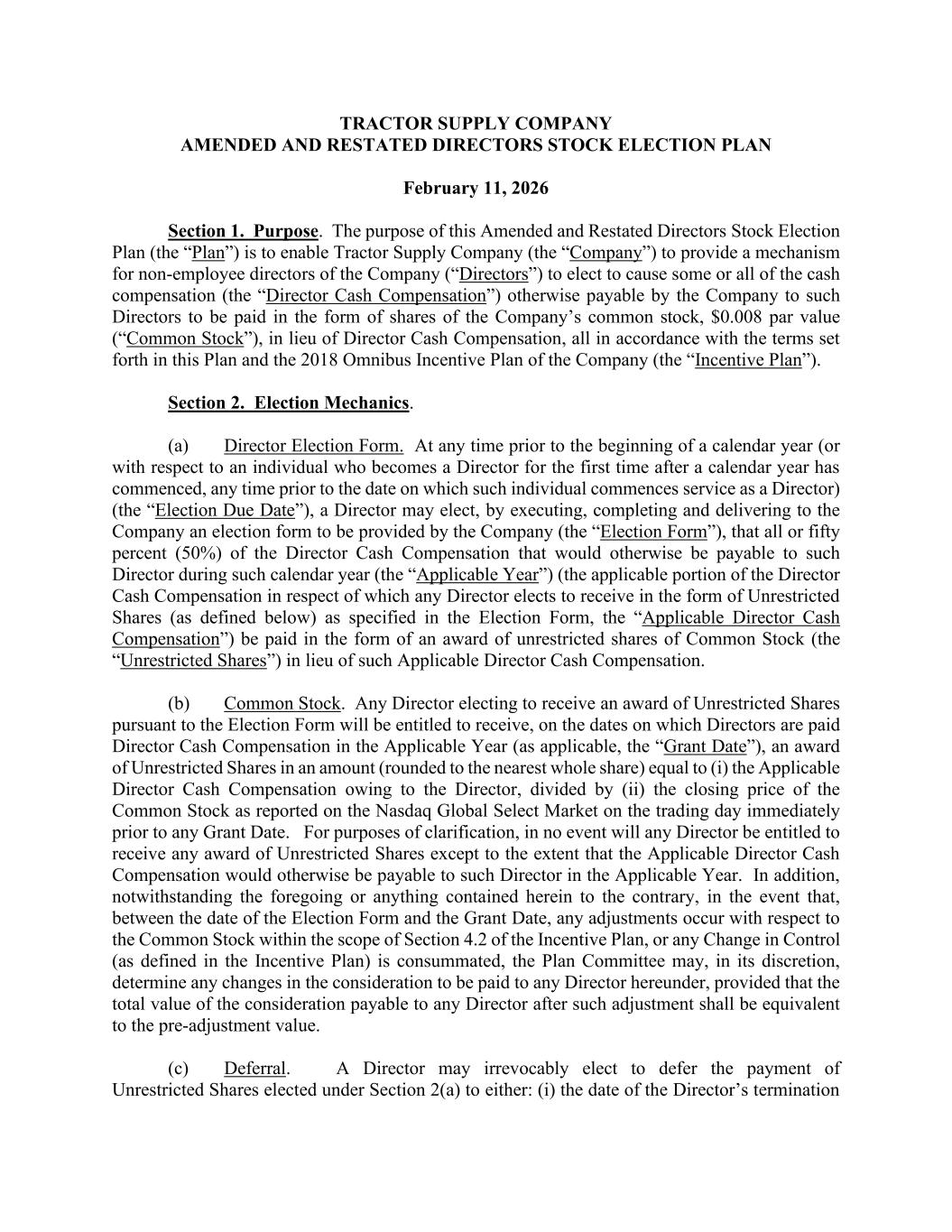
TRACTOR SUPPLY COMPANY AMENDED AND RESTATED DIRECTORS STOCK ELECTION PLAN February 11, 2026 Section 1. Purpose. The purpose of this Amended and Restated Directors Stock Election Plan (the “Plan”) is to enable Tractor Supply Company (the “Company”) to provide a mechanism for non-employee directors of the Company (“Directors”) to elect to cause some or all of the cash compensation (the “Director Cash Compensation”) otherwise payable by the Company to such Directors to be paid in the form of shares of the Company’s common stock, $0.008 par value (“Common Stock”), in lieu of Director Cash Compensation, all in accordance with the terms set forth in this Plan and the 2018 Omnibus Incentive Plan of the Company (the “Incentive Plan”). Section 2. Election Mechanics. (a) Director Election Form. At any time prior to the beginning of a calendar year (or with respect to an individual who becomes a Director for the first time after a calendar year has commenced, any time prior to the date on which such individual commences service as a Director) (the “Election Due Date”), a Director may elect, by executing, completing and delivering to the Company an election form to be provided by the Company (the “Election Form”), that all or fifty percent (50%) of the Director Cash Compensation that would otherwise be payable to such Director during such calendar year (the “Applicable Year”) (the applicable portion of the Director Cash Compensation in respect of which any Director elects to receive in the form of Unrestricted Shares (as defined below) as specified in the Election Form, the “Applicable Director Cash Compensation”) be paid in the form of an award of unrestricted shares of Common Stock (the “Unrestricted Shares”) in lieu of such Applicable Director Cash Compensation. (b) Common Stock. Any Director electing to receive an award of Unrestricted Shares pursuant to the Election Form will be entitled to receive, on the dates on which Directors are paid Director Cash Compensation in the Applicable Year (as applicable, the “Grant Date”), an award of Unrestricted Shares in an amount (rounded to the nearest whole share) equal to (i) the Applicable Director Cash Compensation owing to the Director, divided by (ii) the closing price of the Common Stock as reported on the Nasdaq Global Select Market on the trading day immediately prior to any Grant Date. For purposes of clarification, in no event will any Director be entitled to receive any award of Unrestricted Shares except to the extent that the Applicable Director Cash Compensation would otherwise be payable to such Director in the Applicable Year. In addition, notwithstanding the foregoing or anything contained herein to the contrary, in the event that, between the date of the Election Form and the Grant Date, any adjustments occur with respect to the Common Stock within the scope of Section 4.2 of the Incentive Plan, or any Change in Control (as defined in the Incentive Plan) is consummated, the Plan Committee may, in its discretion, determine any changes in the consideration to be paid to any Director hereunder, provided that the total value of the consideration payable to any Director after such adjustment shall be equivalent to the pre-adjustment value. (c) Deferral. A Director may irrevocably elect to defer the payment of Unrestricted Shares elected under Section 2(a) to either: (i) the date of the Director’s termination
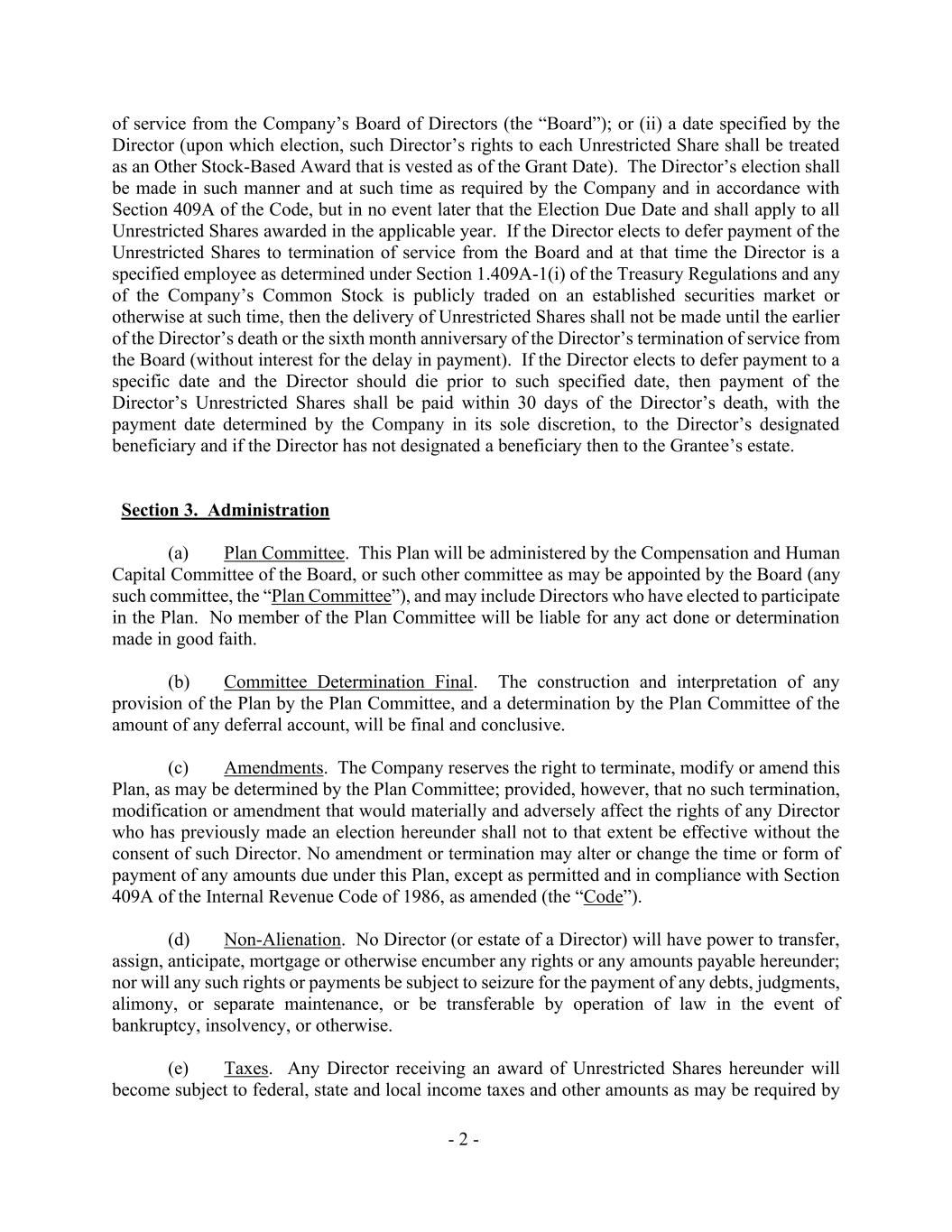
- 2 - of service from the Company’s Board of Directors (the “Board”); or (ii) a date specified by the Director (upon which election, such Director’s rights to each Unrestricted Share shall be treated as an Other Stock-Based Award that is vested as of the Grant Date). The Director’s election shall be made in such manner and at such time as required by the Company and in accordance with Section 409A of the Code, but in no event later that the Election Due Date and shall apply to all Unrestricted Shares awarded in the applicable year. If the Director elects to defer payment of the Unrestricted Shares to termination of service from the Board and at that time the Director is a specified employee as determined under Section 1.409A-1(i) of the Treasury Regulations and any of the Company’s Common Stock is publicly traded on an established securities market or otherwise at such time, then the delivery of Unrestricted Shares shall not be made until the earlier of the Director’s death or the sixth month anniversary of the Director’s termination of service from the Board (without interest for the delay in payment). If the Director elects to defer payment to a specific date and the Director should die prior to such specified date, then payment of the Director’s Unrestricted Shares shall be paid within 30 days of the Director’s death, with the payment date determined by the Company in its sole discretion, to the Director’s designated beneficiary and if the Director has not designated a beneficiary then to the Grantee’s estate. Section 3. Administration (a) Plan Committee. This Plan will be administered by the Compensation and Human Capital Committee of the Board, or such other committee as may be appointed by the Board (any such committee, the “Plan Committee”), and may include Directors who have elected to participate in the Plan. No member of the Plan Committee will be liable for any act done or determination made in good faith. (b) Committee Determination Final. The construction and interpretation of any provision of the Plan by the Plan Committee, and a determination by the Plan Committee of the amount of any deferral account, will be final and conclusive. (c) Amendments. The Company reserves the right to terminate, modify or amend this Plan, as may be determined by the Plan Committee; provided, however, that no such termination, modification or amendment that would materially and adversely affect the rights of any Director who has previously made an election hereunder shall not to that extent be effective without the consent of such Director. No amendment or termination may alter or change the time or form of payment of any amounts due under this Plan, except as permitted and in compliance with Section 409A of the Internal Revenue Code of 1986, as amended (the “Code”). (d) Non-Alienation. No Director (or estate of a Director) will have power to transfer, assign, anticipate, mortgage or otherwise encumber any rights or any amounts payable hereunder; nor will any such rights or payments be subject to seizure for the payment of any debts, judgments, alimony, or separate maintenance, or be transferable by operation of law in the event of bankruptcy, insolvency, or otherwise. (e) Taxes. Any Director receiving an award of Unrestricted Shares hereunder will become subject to federal, state and local income taxes and other amounts as may be required by
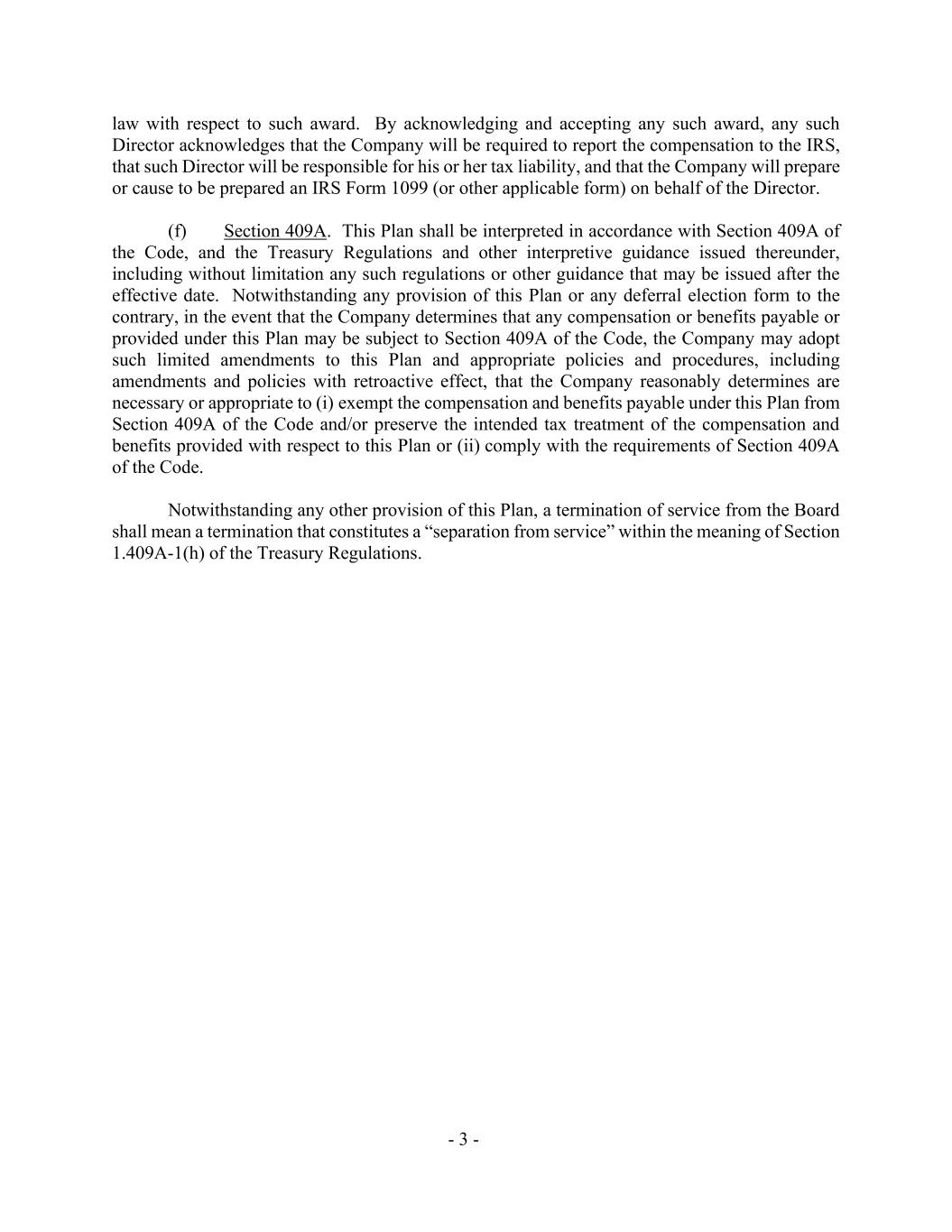
- 3 - law with respect to such award. By acknowledging and accepting any such award, any such Director acknowledges that the Company will be required to report the compensation to the IRS, that such Director will be responsible for his or her tax liability, and that the Company will prepare or cause to be prepared an IRS Form 1099 (or other applicable form) on behalf of the Director. (f) Section 409A. This Plan shall be interpreted in accordance with Section 409A of the Code, and the Treasury Regulations and other interpretive guidance issued thereunder, including without limitation any such regulations or other guidance that may be issued after the effective date. Notwithstanding any provision of this Plan or any deferral election form to the contrary, in the event that the Company determines that any compensation or benefits payable or provided under this Plan may be subject to Section 409A of the Code, the Company may adopt such limited amendments to this Plan and appropriate policies and procedures, including amendments and policies with retroactive effect, that the Company reasonably determines are necessary or appropriate to (i) exempt the compensation and benefits payable under this Plan from Section 409A of the Code and/or preserve the intended tax treatment of the compensation and benefits provided with respect to this Plan or (ii) comply with the requirements of Section 409A of the Code. Notwithstanding any other provision of this Plan, a termination of service from the Board shall mean a termination that constitutes a “separation from service” within the meaning of Section 1.409A-1(h) of the Treasury Regulations.
Tractor Supply Company Performance Share Unit Agreement This PERFORMANCE SHARE UNIT AGREEMENT (this “Agreement”) is made and entered into as of November 5, 2025 (the “Grant Date”), between Tractor Supply Company, a Delaware corporation (together with its Subsidiaries and Affiliates, as applicable, the “Company”), and Harry A. Lawton III (the “Grantee”). Capitalized terms not otherwise defined herein shall have the meaning ascribed to such terms in the Company’s 2018 Omnibus Incentive Plan (the “Plan”). WHEREAS, the Company has adopted the Plan, which permits the issuance of Performance Awards, including an award that provides the right to receive Shares upon the satisfaction of performance objectives or other conditions (a “Performance Share Unit”); and WHEREAS, the Compensation and Human Capital Committee of the Board of Directors of the Company or a subcommittee thereof (or if no such committee is appointed, the Board of Directors of the Company) (each, the “Committee”) has determined that Grantee is entitled to an award of Performance Share Units under the Plan; NOW, THEREFORE, the parties hereto agree as follows: PERFORMANCE SHARE UNIT GRANT Grantee: Harry A. Lawton III [Employee ID] Target Number of Performance Share Units Granted Hereunder (“Target Award”): [# of Award Units Granted] Grant Date: November 5, 2025 1. Grant of Performance Share Unit Award. 1.1 The Company hereby grants to the Grantee the award (“Award”) of Performance Share Units (“PSUs”) set forth above on the terms and conditions set forth in this Agreement and as otherwise provided in the Plan. A bookkeeping account will be maintained by the Company to keep track of the PSUs. 1.2 The Grantee’s rights with respect to the Award shall remain forfeitable at all times prior to the dates on which the PSUs shall vest in accordance with Section 2 hereof. Except as otherwise determined by the Committee, this Award may not be assigned, alienated, pledged, attached, sold or otherwise transferred or encumbered by Grantee other than by will or the laws of descent and distribution. Any sale, assignment, transfer, pledge, hypothecation, loan or other disposition other than in accordance with this Section 1.2 shall be null and void.
2 1.3 Notwithstanding anything herein to the contrary, Grantee acknowledges and understands that the Award granted hereby is contingent upon Grantee’s execution of the Protective Agreement attached hereto as Exhibit B, which Grantee is executing contemporaneously with this Agreement. In the event Grantee breaches any provisions of the Protective Agreement (including, for the avoidance of doubt, following a termination of employment under Section 2.2), the PSUs shall be automatically forfeited without consideration effective as of the date on which such breach first occurs. The foregoing rights and remedies are in addition to any other rights and remedies that may be available to the Company and shall not prevent (and Grantee shall not assert that they shall prevent) the Company from bringing one or more actions in any applicable jurisdiction to recover damages as a result of Grantee’s breach of the Protective Agreement. Without limiting the foregoing, to the extent permitted under applicable law, any Shares that have previously been delivered to Grantee or Grantee’s beneficiaries or heirs on vesting of the PSUs, and which are still held by Grantee or Grantee’s beneficiaries or heirs as of the date of such breach, shall immediately be forfeited without consideration. 2. Vesting and Payment. 2.1 General. Except as provided in Section 2.2, Section 2.3 or Section 2.4, the Award shall vest, if at all, 100% on February 5, 2031 (the “Vesting Date”), but only if and to the extent: (x) the Company has achieved the performance targets over the period (the “Performance Period”) set forth on Exhibit A attached hereto, and (y) the Grantee has remained in service with the Company continuously until the Vesting Date. The number of PSUs that vest may be greater than or less than the Target Award, as more specifically set forth on Exhibit A. 2.2 Death; Disability; Without Cause; Good Reason; Retirement. (a) Notwithstanding Section 2.1, in the event the Grantee’s employment with the Company is terminated (i) by the Company without Cause, (ii) on account of the Grantee’s death or Permanent Disability or (iii) by the Grantee due to Good Reason prior to the Executive achieving the age and service requirements for Retirement, Grantee (or the Grantee’s estate or other legal representative) shall become vested as of such termination of employment in the number of PSUs based on the Company’s achievement of the performance targets set forth on Exhibit A attached hereto, measured as of such date of the Grantee’s termination of employment, multiplied by a fraction, the numerator of which is the number of days that the Grantee was employed by the Company from the Grant Date through the date of Grantee’s termination of employment and the denominator of which is the number of days from the Grant Date through the Vesting Date. Any PSUs that vest pursuant to this Section 2.2(a) shall, subject to Section 8, be released to the Grantee (or Grantee’s estate or other legal representative) upon the Grantee’s termination of employment; provided, that the PSUs shall not be settled until the Committee determines the number of PSUs that should vest based on the extent to which the performance targets will have been achieved in accordance with Exhibit A attached hereto. For purposes of this Agreement, “Permanent Disability” shall have the meaning set forth in the long-term disability plan of the Company.
3 (b) Notwithstanding Section 2.1, in the event the Grantee’s employment with the Company is terminated prior to the Vesting Date on account of Grantee’s Retirement, Grantee shall become vested in the number of PSUs that would have vested had Grantee remained employed with the Company continuously until the Vesting Date, multiplied by a fraction, the numerator of which is the number of days that the Grantee was employed by the Company from the Grant Date through the date of Grantee’s Retirement and the denominator of which is the number of days from the Grant Date through the Vesting Date; provided, that any PSUs that vest pursuant to this Section 2.2(b) shall not be settled until the Committee determines the number of PSUs that should vest based on the extent to which the performance targets will have been achieved in accordance with Exhibit A attached hereto; provided, further, that in the event of a Change in Control following the Grantee’s Retirement, the Grantee shall vest in a pro rata portion of the Target Award upon such Change in Control; provided, further, that in the event of the Grantee’s Retirement more than 12 months following a Change in Control, the Grantee shall vest in a pro rata portion of the Target Award upon such Retirement. 2.3 Termination of Employment. Except as provided in Section 2.2, Section 2.4 or as otherwise provided by the Committee, if the Grantee’s service as an employee of the Company terminates for any reason, the Grantee shall forfeit all rights with respect to all PSUs that are not vested on such date. 2.4 Change in Control. Upon the occurrence of a Change in Control, (a) In the event the entity surviving the Change in Control (together with its Affiliates, the “Successor”) assumes the Award granted hereby, (1) the Performance Period shall end upon the date immediately preceding the Change in Control, (2) the number of PSUs that shall be eligible to vest shall be the Target Award, if the Change in Control occurs prior to the end of the Performance Period, (3) any PSUs that are eligible to vest pursuant to (2) above shall vest on the Vesting Date, provided the Grantee remains employed with the Successor until the Vesting Date, and (4) notwithstanding Section 2.3 or the immediately preceding clause (3) of this paragraph, in the event the Grantee’s employment with the Successor is terminated without Cause by the Successor, by the Grantee due to Good Reason, on account of Grantee’s death, Permanent Disability, or Retirement, in each case, within 12 months following a Change in Control and prior to the Vesting Date, the number of PSUs otherwise eligible to vest pursuant to this paragraph shall immediately vest and, subject to Section 8, be released to the Grantee (or Grantee’s estate or other legal representative) upon the Grantee’s termination of employment. (b) In the event the Successor does not assume the Award granted hereby, a number of PSUs equal to the Target Award, if the Performance Period has not ended prior to the Change in Control, shall vest as of the effective date of the Change in Control and the appropriate number of Shares shall be released in accordance with Section 2.5, provided, however, if the Award constitutes a “deferral of compensation” subject to Section 409A of the Code and the Change in Control is not a “change in the ownership of the Company,” a “change in the effective control of the Company,” or a “change in the ownership of a substantial portion of the assets of the Company” as such terms are defined in Section 1.409A-3(i)(5) of the U.S. Treasury Regulations or if such settlement shall be prohibited under Section 409A of the Code, then such
4 Target Award shall vest and shall be settled upon the earlier to occur of (i) the Vesting Date and (ii) the Grantee’s termination of employment or death, in each case, to the extent required to comply with Section 409A of the Code. (c) For purposes of this Agreement the following terms shall have the meaning set forth below: (i) “Cause” shall have the meaning set forth in the Grantee’s employment agreement with the Company (or, if the Grantee’s employment is terminated under circumstances in which the Grantee’s change in control agreement with the Company governs, then such change in control agreement). (ii) “Change in Control” shall have the meaning provided in the Plan. (iii) “Good Reason” shall have the meaning set forth in the Grantee’s employment agreement with the Company (or, if the Grantee’s employment is terminated under circumstances in which the Grantee’s change in control agreement with the Company governs, then such change in control agreement). (iv) “Retirement” shall mean, the voluntary resignation of Grantee from active employment with the Company or any of its Subsidiaries or Affiliates on or after such Grantee having reached the age of 54 and five years of service with the Company; provided, that (i) Grantee provides advanced written notice of such resignation to the Company at least (A) three months following the Grant Date and (B) six months prior to the effective date of such resignation, (ii) at the time of such resignation, the Grantee’s successor as Chief Executive Officer has been appointed by the Board and publicly disclosed, (iii) if requested by the Board, Grantee agrees to provide reasonable transition services for up to six months following the appointment of a successor to the Chief Executive Officer position, and (iv) at the time of Grantee’s written notice of Retirement and subsequent resignation, there are no circumstances that would entitle the Company to terminate Grantee’s employment for Cause. 2.5 Settlement. Grantee shall be entitled to settlement of the PSUs covered by this Agreement at the time that such PSUs vest pursuant to Section 2.1, Section 2.2 or Section 2.4, as applicable. Subject to Section 8, such settlement shall be made as promptly as practicable thereafter (but in no event after the thirtieth (30th) day following the date on which the PSUs vest (including upon an earlier termination of employment in accordance with this Agreement) and, in any event, no later than March 15th following the conclusion of the Performance Period), through the issuance to the Grantee (or to the executors or administrators of Grantee’s estate in the event of the Grantee’s death) of a stock certificate (or evidence such Shares have been registered in the name of the Grantee with the relevant stock agent) for a number of Shares equal to the number of such vested PSUs. Notwithstanding anything in this Agreement to the contrary, if Grantee’s employment terminates for Cause prior to the date on which Shares are delivered, Grantee shall forfeit all of the PSUs.
5 2.6 Withholding Obligations. Except as otherwise provided by the Committee, upon the settlement of any PSUs subject to this Award, the Company shall reduce the number of Shares that would otherwise be issued to the Grantee upon settlement of the Award by a number of Shares having an aggregate Fair Market Value on the date of such issuance equal to the payment to satisfy the withholding tax obligation of the Company with respect to which the Award is being settled, as determined by the Committee (but in no event greater than the maximum withholding rate applicable to wages of the Grantee). 3. Dividend Rights. The Grantee shall not be entitled to any dividend equivalent rights in respect of the PSUs covered by this Award. 4. No Right to Continued Service; Limitation of Rights. Nothing in this Agreement or the Plan shall be interpreted or construed to confer upon the Grantee any right to continue service an officer or employee of the Company. In addition, the granting of the PSUs will not give Grantee any rights to similar grants in future years. 5. Adjustments. The provisions of Section 4.2 of the Plan are hereby incorporated by reference, and the PSUs are subject to such provisions. Any determination made by the Committee or the Board pursuant to such provisions shall be made in accordance with the provisions of the Plan and shall be final and binding for all purposes of the Plan and this Agreement. 6. Administration Subject to Plan. The Grantee hereby acknowledges receipt of a copy of the Plan and agrees to be bound by all the terms and provisions thereof. The terms of this Agreement are governed by the terms of the Plan, and in the case of any inconsistency between the terms of this Agreement and the terms of the Plan, the terms of the Plan shall govern. The Committee shall have the sole power to interpret and administer the Plan and this Agreement and to adopt such rules for the administration, interpretation and application of the Plan as are consistent therewith and to interpret or revoke any such rules. All actions taken and all interpretations and determinations made by the Committee shall be final and binding upon the Grantee, the Company and all other interested persons. No member of the Committee shall be personally liable for any action, determination or interpretation made in good faith with respect to the Plan or this Award. 7. Modification of Agreement. Subject to the restrictions contained in the Plan, the Committee may waive any conditions or rights under, amend any terms of, or alter, suspend, discontinue, cancel or terminate, the Award, prospectively or retroactively; provided that any such waiver, amendment, alteration, suspension, discontinuance, cancellation or termination that would materially and adversely affect the rights
6 of the Grantee or any holder or beneficiary of the Award shall not to that extent be effective without the consent of the Grantee, holder or beneficiary affected. 8. Section 409A. Notwithstanding anything herein to the contrary, to the maximum extent permitted by applicable law, the settlement of the PSUs to be made to the Grantee pursuant to this Agreement is intended to qualify as a “short-term deferral” pursuant to Section 1.409A-1(b)(4) of the Regulations and this Agreement shall be interpreted consistently therewith. However, under certain circumstances, settlement of the PSUs may not so qualify, and in that case, the Committee shall administer the grant and settlement of such PSUs in strict compliance with Section 409A of the Code. Further, notwithstanding anything herein to the contrary, if at the time of Grantee’s termination of employment with the Company and all Service Recipients, the Grantee is a “specified employee” as defined in Section 409A of the Code, and the deferral of the commencement of any payments or benefits otherwise payable hereunder as a result of such termination of service is necessary in order to prevent the imposition of any accelerated or additional tax under Section 409A of the Code, then the Company will defer the commencement of the payment of any such payments or benefits hereunder (without any reduction in such payments or benefits ultimately paid or provided to the Grantee) to the minimum extent necessary to satisfy Section 409A of the Code until the date that is six months and one day following the Grantee’s termination of employment with the Company (or the earliest date as is permitted under Section 409A of the Code), if such payment or benefit is payable upon a termination of employment. For purposes of this Agreement, a “termination of employment” and “Retirement” shall have the same meaning as “separation from service” under Section 409A of the Code and Grantee shall be deemed to have remained employed so long as Grantee has not “separated from service” with the Company or Successor. Each payment of PSUs constitutes a “separate payment” for purposes of Section 409A of the Code. Although the Company intends to administer this Performance Share Unit Agreement so that the Award will be exempt from, or will be interpreted and comply with, the requirements of Section 409A of the Code, the Company does not warrant that the Award made under this Performance Share Unit Agreement will qualify for favorable tax treatment under Section 409A of the Code or any other provision of federal, state, local or foreign law. The Company shall not be liable to the Grantee for any tax, interest, or penalties that Grantee might owe as a result of the Award made under this Performance Share Unit Agreement. 9. Severability. If any provision of this Agreement is, or becomes, or is deemed to be invalid, illegal, or unenforceable in any jurisdiction or as to any Person or the Award, or would disqualify the Plan or Award under any laws deemed applicable by the Committee, such provision shall be construed or deemed amended to conform to the applicable laws, or if it cannot be construed or deemed amended without, in the determination of the Committee, materially altering the intent of the Plan or the Award, such provision shall be stricken as to such jurisdiction, Person or Award, and the remainder of the Plan and Award shall remain in full force and effect.
7 10. Governing Law. The validity, interpretation, construction and performance of this Agreement shall be governed by the laws of the State of Tennessee without giving effect to the conflicts of law principles thereof, except to the extent that such laws are preempted by Federal law. 11. Successors in Interest. This Agreement shall inure to the benefit of and be binding upon any successor to the Company. This Agreement shall inure to the benefit of the Grantee’s legal representatives. All obligations imposed upon the Grantee and all rights granted to the Company under this Agreement shall be binding upon the Grantee’s heirs, executors, administrators and successors. 12. Resolution of Disputes. Any dispute or disagreement which may arise under, or as a result of, or in any way related to, the interpretation, construction or application of this Agreement shall be determined by the Committee. Any determination made hereunder shall be final, binding and conclusive on the Grantee and the Company for all purposes. 13. Notices. Any notice to be given under the terms of this Agreement to the Company shall be addressed to the Company in care of its Secretary or its designee, and any notice to be given to the Grantee shall be addressed to Grantee at the address (including an electronic address) then reflected in the Company’s books and records. By a notice given pursuant to this Section 13, either party may hereafter designate a different address for notices to be given to the Company or Grantee. Any notice, which is required to be given to the Grantee, shall, if the Grantee is then deceased, be given to the Grantee’s personal representative if such representative has previously informed the Company of the representative’s status and address by written notice under this Section 13. Any notice shall have been deemed duly given when (i) delivered in person, (ii) delivered in an electronic form approved by the Company, (iii) enclosed in a properly sealed envelope or wrapper addressed as aforesaid, deposited (with postage prepaid) in a post office or branch post office regularly maintained by the United States Postal Service, or (iv) enclosed in a properly sealed envelope or wrapper addressed as aforesaid, deposited (with fees prepaid) in an office regularly maintained by FedEx, UPS, or comparable non-public mail carrier. 14. Clawback. The Award and any Shares delivered pursuant to the Award are subject to forfeiture, recovery by the Company or other action pursuant to the Tractor Supply Company Compensation
8 Clawback Policy or any other clawback or recoupment policy which the Company may adopt from time to time to comply with applicable law or applicable listing standards. 15. Acceptance of this Award. If you agree to all of the terms of this Agreement, and would like to accept this Award, you must sign and date this Agreement where indicated below. For this Award to remain effective, you must accept it on or before the date that is 90 calendar days after the date of this Agreement (the “Acceptance Date”). If you do not accept the Award by 5:00 p.m. Eastern Time on the Acceptance Date, the Award and this Agreement will become void and of no further effect (unless otherwise agreed to by the Company).
[Signature Page] IN WITNESS WHEREOF, the parties have caused this Performance Share Unit Agreement to be duly executed effective as of the day and year first above written. Tractor Supply Company By: Grantee: (electronically accepted)

Ex. A-1 EXHIBIT A [Performance Share Unit Award Performance Targets]
Ex. B-1 EXHIBIT B PROTECTIVE AGREEMENT This Protective Agreement (“Agreement”) is made by and between Tractor Supply Company and its subsidiaries, affiliates, successors and assigns (the “Company”) and the undersigned individual (“Executive”). WHEREAS, the Company and Executive agree that the Company has a legitimate business interest in, among other things, its Confidential Information (defined below) and Trade Secrets (defined below), and in the significant time, money, training, team building and other efforts it expends to develop Executive’s skills to assist Executive in performing Executive’s duties for the Company, including with respect to establishing, developing and maintaining the goodwill and business relationships with the Company’s customers, vendors and employees, all of which Executive agrees are valuable assets of the Company to which it has devoted substantial resources; WHEREAS, the Company and Executive agree that the Company’s Confidential Information and Trade Secrets, including key information about, and goodwill in, its customers, vendors and employees are not generally known to the public, were developed over time and at significant cost to the Company, and are the subject of reasonable efforts of protection by the Company against disclosure to unauthorized parties; and WHEREAS, as part of performing Executive’s duties for the Company, Executive will have access to and/or will use the Company’s Confidential Information and Trade Secrets and will work with customers, vendors and Employees; and WHEREAS, the Company and Executive agree that this Agreement is reasonable to protect the Company against the irreparable harm it would suffer if Executive left the Company’s employment (for any reason) and used or disclosed its Confidential Information and Trade Secrets, and/or interfered with the goodwill and relationships the Company has in its customers, vendors and employees. NOW, THEREFORE, for good and valuable consideration, to which Executive would not otherwise be entitled without entering into this Agreement, including: (a) the promises and covenants contained in this Agreement; (b) Executive’s employment or continued employment with the Company; (c) Executive’s access to and use of the Company’s Confidential Information and Trade Secrets, including key information about, and goodwill in, its customers, vendors and employees; and (d) the opportunity to receive an equity grant from the Company pursuant to the Tractor Supply Company Performance Share Unit Agreement, the Company and Executive agree as follows (including the foregoing recitals which are expressly incorporated in this Agreement): 1. Disclosures. In order to maintain Executive’s confidentiality obligations and to avoid conflicts of interest which may arise, Executive will disclose (and allow the Company to disclose) to any future prospective employers the existence of this Agreement and the nature of Executive’s confidentiality and restrictive covenant obligations arising from it before Executive accepts any new position of employment.
Ex. B-2 2. Definitions. 2.1 “Confidential Information” means information that is created and used in the Company’s business and which is not generally known by the public, including but not limited to: trade secrets proprietary or customized software and databases; manufacturing processes and methods, product formulas, research and development; new product plans; the Company’s confidential records pertaining to its existing or potential customers, including key customer contact information, contract terms and related information; confidential business opportunities; merger or acquisition activity (including targets, opportunities, or prospects); confidential information regarding suppliers or vendors, including key supplier or vendor contact information, contract terms and related information; strategies for advertising and marketing; confidential business processes and strategies, including training, policies and procedures; personnel composition (wages, specialization, etc.); financial and revenue data and reports, including pricing, quoting and billing methods; and any other business information that the Company maintains as confidential. Executive specifically understands and agrees that the term Confidential Information also includes all confidential information of a third party that may be communicated to, acquired by, learned of, or developed by Executive in the course of or as a result of Executive’s employment with the Company. Confidential Information does not include information that is or may become known to Executive or to the public from sources outside the Company and through means other than a breach of this Agreement or disclosed by Executive after written approval from the Company. 2.2 “Competitive Product or Service” means any product, process, system or service (in existence or under development) of any person or organization other than the Company that is the same as, similar to, or competes with, a product, process, system or service (in existence or under development) upon which Executive worked or had responsibilities at the Company during the twenty-four (24) months prior to the Last Day (as defined below). 2.3 “Competitor” means Executive or any other person or organization engaged in or about to become engaged in, research or development, production, marketing, leasing, selling, or servicing of a Competitive Product or Service. Executive and the Company agree that the definition of “Competitor” specifically includes, but is not limited to, Lowe’s, Home Depot, Ace Hardware, True Value, PetSmart, Petco, Chewy’s and their respective organizations, partnerships, ventures, sister companies, franchisees, affiliates or any organization in which they have an interest and which are involved in the farm and ranch, pet, and/or hardware industry, or which otherwise compete with the Company. For purposes of this Agreement, “Competitor” is further limited to any general or specialty retail, wholesale membership club, or merchandising business, inclusive of its respective parent companies, subsidiaries and/or affiliates, that: (a) (i) sells farm and ranch, pet and/or hardware goods or merchandise at retail to consumers and/or businesses (whether through physical locations, via the internet or combined), or (ii) has plans to sell
Ex. B-3 such goods or merchandise at retail to consumers and/or businesses (whether through physical locations, via the internet or combined) within twenty-four (24) months following Executive’s Last Day; and (b) has gross annual consolidated sales volume or revenues attributable to its retail operations (whether through physical locations, via the internet or combined) equal to or in excess of $100 million. Prior to accepting a position with a Company who could reasonably be considered a Competitor under this Section, Executive agrees to consult with the Executive Vice President of Human Resources, or his/her successor, for clarification as to whether or not the Company views a prospective employer, consulting client or other business relationship as a Competitor. 2.4 “Customer” means any person(s) or entity(ies) whom, within twenty-four (24) months prior to the Last Day, Executive, directly or Indirectly (e.g., through Executives whom Executive supervised): (a) provided products or services in connection with the Company’s business; or (b) provided written proposals concerning receiving products or services from the Company. 2.5 “Indirectly” means (including as defined in Section 2.4) that Executive will not assist others in performing business activities that Executive is prohibited from engaging in directly under this Agreement. 2.6 “Last Day” means Executive’s last day of employment with the Company regardless of the reason for Executive’s separation, including voluntary and involuntary. 2.7 “Restricted Geographic Area” means the territory (i.e.: (i) state(s), (ii) county(ies), or (iii) city(ies)) in which, during the twenty-four (24) months prior to the Last Day, Executive: (a) provided Material services on behalf of the Company (or in which Executive supervised, directly or Indirectly, the servicing activities), and/or (b) solicited Customers or otherwise sold services on behalf of the Company (or in which Executive supervised, directly or Indirectly, the solicitation or servicing activities related to such Customers). “Material” means the Executive’s primary job duties and responsibilities in connection with working with Customers or directly supervising individuals who work with Customers. 2.8 “Restricted Period” means the period of Executive’s employment with the Company and a period of months after the Last Day as set forth below based upon Executive’s job position with the Company. Executive recognizes that this durational term is reasonably and narrowly tailored to the Company’s legitimate business interest and need for protection with each position Executive holds at the Company. i. CEO 24 months ii. President 24 months iii. EVP 18 months
Ex. B-4 iv. SVP 12 months v. VP 6 months 2.9 “Trade Secret” means information defined as a trade secret under applicable state law or the Defend Trade Secrets Act of 2016. 3. Restrictive Covenants. To protect the Company’s legitimate business interests, including with respect to Executive’s access to and use of the Company’s Confidential Information and Trade Secrets, including key information about, and goodwill in, its customers and employees, Executive agrees that: 3.1 Non-Competition. During the Restricted Period and within the Restricted Geographic Area, Executive will not, directly or Indirectly, perform the same or similar responsibilities Executive performed for the Company for a Competitor in connection with a Competitive Product or Service. Notwithstanding the foregoing, Executive may accept employment with a Competitor whose business is diversified, provided that: (a) Executive will not be engaged in working on or providing Competitive Products or Services or otherwise use or disclose Confidential Information or Trade Secrets; and (b) the Company receives prior written assurances from the Competitor and Executive that are satisfactory to the Company that Executive will not work on or provide Competitive Products or Services, or otherwise use or disclose Confidential Information or Trade Secrets. In addition, nothing in this Agreement is intended to prevent Executive from investing Executive’s funds in securities of a person engaged in a business that is directly competitive with the Company if the securities of such a person are listed for trading on a registered securities exchange or actively traded in an over-the-counter market and Executive’s holdings represent less than one percent (1%) of the total number of outstanding shares or principal amount of the securities of such a person. 3.2 Non-Solicitation, Non-Inducement and Non-Hire of Employees. During the Restricted Period, Executive shall not directly or Indirectly: (a) solicit, recruit, encourage (or attempt to solicit, recruit or encourage), or by assisting others in soliciting, recruiting or encouraging, any Company employees or former employees with whom Executive worked, had business contact, or about whom Executive gained non-public or Confidential Information (“Employees or Former Employees”); (b) contact or communicate with Employees or Former Employees for the purpose of inducing, assisting, encouraging and/or facilitating them to terminate their employment with the Company or find employment or work with another person or entity; (c) provide or pass along to any person or entity the name, contact and/or background information about any Employees or Former Employees or provide references or any other information about them; (d) provide or pass along to Employees or Former Employees any information regarding potential jobs or entities or persons for which to work, including but not limited to job openings, job postings, or the names or contact information of individuals or companies hiring people or accepting job applications; (e) offer employment or work to any Employees or Former Employees; and/or (f) hire, employ, or engage in a business venture with, or attempt to hire or engage in a business with, any person then employed by the Company as a manager or
Ex. B-5 executive or who has left the employment of the Company within the preceding three (3) months. 3.3 For purposes of this covenant, “Former Employees” shall refer to employees who are not employed by the Company at the time of the attempted recruiting or hiring, but were employed by, or working for the Company in the three (3) months prior to the time of the attempted recruiting or hiring and/or interference. 3.4 Non-interference of Vendors and Suppliers. During the Restricted Period, Executive will not directly or Indirectly interfere with the Company’s relationships with its vendors or suppliers in any way that would impair the Company’s relationship with such vendors or suppliers, including by reducing, diminishing or otherwise restricting the flow of supplies, services or goods from the vendors or suppliers to the Company. 3.5 Covenants are Reasonable. Executive acknowledges and agrees that: the covenants in this section are necessary and essential to protect the Company’s Confidential Information, Trade Secrets and the goodwill in its customers and Executives; the area, duration and scope of the covenants in this section are reasonable and necessary to protect the Company; they do not unduly oppress or restrict Executive’s ability to earn a livelihood in Executive’s chosen profession; they are not an undue restraint on Executive’s trade or any of the public interests that may be involved; good and valuable consideration exists for Executive’s agreement to be bound by such covenants; and the Company has a legitimate business purpose in requiring Executive to abide by the covenants set forth in this section. 3.6 Certain Prohibitions on Non-competes. Employee understands that Employee’s restrictive covenant obligations in this Section shall not apply to Employee if Employee is covered under applicable state statute or local ordinance/rule prohibiting non- competes or non-solicits, including on the basis of Employee’s income at the time of enforcement. Current examples of states/jurisdictions with such prohibitions include, but are not limited to: Alabama; California; District of Columbia; Illinois; Maine; Maryland; Massachusetts; Nevada; New Hampshire; Oklahoma; Oregon; North Dakota; Rhode Island; Virginia; and Washington. 4. Confidential Information and Trade Secrets. 4.1 Access and Use. Executive expressly acknowledges and agrees that, by virtue of Executive’s employment with the Company and exercise of Executive’s duties for the Company, Executive will have access to and will use certain Confidential Information and Trade Secrets, and that such Confidential Information and Trade Secrets constitute confidential and proprietary business information and/or Trade Secrets of the Company, all of which is the Company’s exclusive property. Accordingly, Executive agrees that Executive will not, and will not permit any other person or entity to, directly or Indirectly, without the prior written consent of the Company: (a) use Confidential Information or Trade Secrets for the benefit of any person or entity other than the Company; (b) remove, copy, duplicate or otherwise reproduce any document or tangible item embodying or pertaining to any of the Confidential Information or Trade Secrets,
Ex. B-6 except as required to perform responsibilities for Company; and (c) while employed and thereafter, publish, release, disclose, deliver or otherwise make available to any third party any Confidential Information or Trade Secrets by any communication, including oral, documentary, electronic or magnetic information transmittal device or media. 4.2 Duration of Confidential Information and Trade Secrets. This obligation of non-disclosure and non-use shall last so long as the information remains confidential. Executive, however, understands that, if Executive primarily lives and works in any state requiring a temporal limit on non-disclosure clauses, Confidential Information that is not a Trade Secret shall be protected for no less than two (2) years following the Last Day. Executive also understands that Trade Secrets are protected by statute and are not subject to any time limits. Executive also agrees to contact the Company before using, disclosing, or distributing any Confidential Information or Trade Secrets if Executive has any questions about whether such information is protected information. 4.3 Immunity under the Defend Trade Secrets Act of 2016. Executive shall not be held criminally or civilly liable under any Federal or State trade secret law for the disclosure of a Trade Secret that: (a) is made (i) in confidence to a Federal, State, or local government official, either directly or Indirectly, or to an attorney, and (ii) solely for the purpose of reporting or investigating a suspected violation of law; or (b) is made in a complaint or other document filed in a lawsuit or other proceeding, if such filing is made under seal. Disclosures to attorneys, made under seal, or pursuant to court order are also protected in certain circumstances under said Act. 4.4 Non-Disparagement: Executive agrees that, except in the good faith performance of Executive’s duties for the Company and subject to the exceptions in Section 4.3 and 4.5, Executive will not at any time after the date hereof, disparage, criticize or make any negative remarks or comments, orally or in writing, to any third party, via media or otherwise, about the Company, an affiliate of the Company, or about any director, officer, employee or agent of any of the above, which remarks or comments reasonably could be expected to harm, injure, or potentially harm, or injure the goodwill or reputation of the Company. The term “media” as used herein includes, without limitation, radio, television, film, internet, and social media, such as Twitter and Facebook. 4.5 Additional Legal Exceptions to Non-Disclosure Obligations. Nothing in this Agreement shall be construed to prevent disclosure of Confidential Information as may be required by applicable law or regulation; especially with respect to a federal or state administrative agency (e.g., EEOC, equivalent state employment agency, etc.), or pursuant to the valid order of a court of competent jurisdiction or an authorized government agency, provided that the disclosure does not exceed the extent of disclosure required by such law, regulation, or order. In addition, nothing in this Agreement in any way prohibits or is intended to restrict or impede, and shall not be interpreted or understood as restricting or impeding, Executive from exercising Executive’s rights under Section 7 of the National Labor Relations Act (NLRA) or otherwise disclosing information as permitted by law.
Ex. B-7 5. Return of Company Property and Information. Executive agrees that upon the Last Day (or earlier if requested by the Company) to immediately return to the Company all property and information belonging to the Company (in electronic or hard-copy form). Executive shall also disclose to Company any passwords for Executive’s computer or other access codes for anything associated with Executive’s employment with the Company, and shall not delete or modify or alter any property prior to its return to the Company. 6. Assignment of Inventions and Original Works. 6.1 Prior Inventions and Creative Works. Executive understands Executive’s obligation (on or before the date Executive executes this Agreement) to identify to the Company in writing any of Executive’s Prior Inventions or Creative Works. Executive’s failure to do so means that no such Prior Inventions or Creative Works exist. Executive agrees not to incorporate, or permit to be incorporated, any Prior Invention or Creative Works owned by Executive, or in which Executive has an interest, into a Company product, process, program, or machine, including any software code created or developed on the Company’s behalf or in which the Company has an ownership interest pursuant to the terms of this Agreement, without the Company’s prior written consent. “Prior Inventions” means all Inventions that were made by Executive prior to Executive’s employment with the Company, that belong to Executive and which relate to the Company’s current or proposed business, products, services, or research and development, and are not presently assigned by Executive under this Agreement. “Creative Works” means any and all works of authorship including, for example, written documents, spreadsheets, graphics, designs, trademarks, service marks, algorithms, computer programs and code, protocols, formulas, mask works, brochures, presentations, photographs, music or compositions, manuals, reports, and compilations of various elements. 6.2 Assignment of Inventions. Executive agrees to promptly make full written disclosure to the Company of, to hold in trust for the sole right and benefit of the Company, and presently assign to the Company (or its designees), without any additional consideration, all of Executive’s right, title, and interest in and to any and all Inventions that Executive Invents during Executive’s employment or for a period of one (1) year following the Last Day. Executive understands that the obligations under this Section do not apply to any Invention for which no equipment, supplies, facility, or Confidential Information or Trade Secrets of the Company was used and which was developed entirely on Executive’s own time, unless (a) the Invention relates (i) to the business of the Company, or (ii) to the Company’s actual or demonstrably anticipated research or development, or (b) the Invention results from any work performed by Executive for the Company. “Invention(s)” means inventions, developments, concepts, improvements, designs, discoveries, devices, apparatus, processes, practices, compositions, formulas, machines, articles of manufacture, methods (including business methods), inventive ideas, algorithms, computer software code and programs, protocols, formulas, mask works, compositions, trademarks, service marks, or trade secrets, whether or not reduced to practice, patentable, or registrable under patent, copyright, trademark, or similar laws, which Executive Invents, either solely or jointly, during normal working hours or when Executive is expected to be working, or that relate to the business of the Company or to the
Ex. B-8 Company’s actual or demonstrably anticipated research or development, or that are substantially aided by Executive’s use of the Company’s equipment, supplies, facilities, or Confidential Information or Trade Secrets, or contains any of the Company’s Confidential Information or Trade Secrets, or that are the direct or substantial result of any work performed by Executive for the Company. “Invent,” “Invents,” and “Invented” means to conceive of, develop, reduce to practice, or otherwise invent (as that term is commonly understood) and is not limited to its general usage under U.S. or foreign patent law. 6.3 Works Made for Hire. Executive acknowledges that all Creative Works that are made by Executive (solely or jointly with others) within the scope of and during the period of Executive’s employment with the Company and which are protectable by copyright are “works made for hire,” as that term is defined in the United States Copyright Act (17 U.S.C. § 101) and are deemed specially ordered by the Company under the U.S. Copyright law. In the event that any Creative Work is determined not to be a “work made for hire,” this Agreement shall operate as an irrevocable assignment by Executive to the Company of all applicable state, federal, and international copyrights, trademarks, service marks, or other similar rights in the Creative Work, including all right, title, and interest. 6.4 Patent and Copyright Registrations. Executive agrees (both during and after employment) to: assist the Company (or its designees), at the Company’s expense, but without additional compensation to Executive, to secure the Company’s rights, as well as the rights of any government entities or third parties to which the Company directs any assignment, in any Inventions, copyrights, or other intellectual property rights in any and all countries. If the Company is unable for any reason whatsoever, including the Company’s inability after expending reasonable efforts to locate Executive or the Executive’s mental or physical incapacity, to secure Executive’s signature to apply for or to pursue any application for any United States or foreign patents or copyright registrations or other intellectual property rights (or on any document transferring ownership thereof) covering Inventions, Prior Inventions, or Creative Works assigned to the Company under this Agreement, Executive hereby irrevocably designates and appoints the Company and its duly authorized officers and agents as Executive’s agent and attorney-in-fact to act for and on Executive’s behalf and in Executive’s stead to execute and file any such applications and documents and to do all other lawfully permitted acts to further the prosecution and issuance of patents or copyright registrations or transfers thereof with the same legal force and effect as if executed by Executive. This appointment is coupled with an interest in and to the Inventions and Creative Works and shall survive Executive’s death or disability. 6.5 Duty to Disclose Information and Maintain Records. Executive agrees that while employed and for two (2) years following the Last Day, to promptly disclose to the Company in writing all Inventions and Creative Works authored or conceived by Executive, alone or jointly with others, along with all attempts to register, patent, or otherwise claim ownership over or alienate such Inventions and Creative Works. 6.6 Moral Rights. To the maximum extent allowed by law, the assignment of rights in this Section 6 includes all rights of paternity, integrity, disclosure, and withdrawal
Ex. B-9 and any other rights that may be known as or referred to as “moral rights,” “artist’s rights,” “droit moral” or the like (collectively, “Moral Rights”). To the extent that Executive retains any such Moral Rights under applicable law, Executive hereby ratifies and consents to (and provides all necessary ratifications and consents to) any action that may be taken with respect to such Moral Rights by (or authorized by) the Company, and Executive agrees not to assert any Moral Rights with respect thereto. Executive will confirm any such ratifications, consents and agreements from time to time as requested by the Company. 6.7 Exceptions to Assignments. Executive understands that the obligations under this Section 6 do not apply to any Invention for which no equipment, supplies, facility, or Confidential Information or Trade Secrets of the Company was used and which was developed entirely on Executive’s own time, unless (a) the Invention relates (i) to the business of the Company, or (ii) to the Company’s actual or demonstrably anticipated research or development, or (b) the Invention results from any work performed by Executive for the Company. 7. At-Will. Executive acknowledges and agrees that nothing in this Agreement is a guarantee or assurance of employment for any specific period of time. Executive understands that Executive is an at-will employee and that either Executive or Company may terminate this at-will employment relationship at any time for any reason not prohibited by law. 8. Severability and Reformation. The covenants in each section of this Agreement are independent of any other provisions of this Agreement. Each term in this Agreement constitutes a separate covenant between the parties, and each term is fully severable from any other term. Executive and the Company agree if any particular paragraphs, subparagraphs, phrases, words, or other portions of this Agreement are determined by an appropriate court to be invalid or unenforceable as written, they shall be modified as necessary to comport with the reasonable intent and expectations of the parties and in favor of providing reasonable protection to all of the Company’s legitimate business interests, and such modification shall not affect the remaining provisions of this Agreement, or if they cannot be modified to be made valid or enforceable, then they shall be severed from this Agreement, and all remaining terms and provisions shall remain enforceable. 9. Tolling. Where permitted by law, the Company reserves the right to request, and Executive will not object, that a court of competent jurisdiction extend the Restricted Period for any period of time that Executive is in breach of this Agreement as a form of equitable relief so that the Company receives the full benefit of Executive’s promises in the restrictive covenants. 10. Relief, Remedies and Enforcement. Executive acknowledges and agrees that a breach of any provision of this Agreement by Executive will cause serious and irreparable injury to the Company that will be difficult to quantify and that money damages alone will not adequately compensate the Company. In the event of a breach or threatened or intended breach of this Agreement by Executive, the Company shall be entitled to injunctive relief, both temporary and final, enjoining and restraining such breach or threatened or intended breach. Executive further agrees that should Executive breach this Agreement, the Company will be entitled to any and all other legal or equitable remedies available to it, including the recovery and return of any amount
Ex. B-10 paid to Executive to enter into this Agreement, the disgorgement of any profits, commissions, or fees realized by Executive, any subsequent employers, any business owned or operated by Executive, or any of Executive’s agents, heirs, or assigns. Executive further agrees that should Executive breach this Agreement, the Performance Share Units (“PSUs”) granted to Executive shall be automatically forfeited without consideration effective as of the date on which such breach first occurs. The foregoing rights and remedies are in addition to any other rights and remedies that may be available to the Company and shall not prevent (and Executive shall not assert that they shall prevent) the Company from bringing one or more actions in any applicable jurisdiction to seek injunctive relief or recover damages as a result of Executive’s breach of this Agreement. Without limiting the foregoing, to the extent permitted under applicable law, any shares that have previously been delivered to Executive or Executive’s beneficiaries or heirs on vesting of the PSUs, and which are still held by Executive or Executive’s beneficiaries or heirs as of the date of such breach, shall immediately be forfeited without consideration. Executive shall also pay the Company all reasonable costs and attorneys’ fees the Company incurred because of Executive’s breach of any provisions of this Agreement. 11. Entire Agreement, Amendments. Executive agrees that this Agreement constitutes the entire agreement and understanding between the parties and supersedes any prior agreements, either oral or in writing, between Executive and the Company with respect to all matters within the scope of this Agreement, including but not limited to any restrictive covenants contained in Executive prior employment agreements (if any). No provision of this Agreement may be modified, waived, or discharged unless such waiver, modification, or discharge is agreed to in writing and signed by Executive and the President of the Company. This Agreement shall be enforced in accordance with its terms and shall not be construed against either party. 12. No Conflicts. Executive represents and warrants that Executive’s performance of all the terms of this Agreement, and the performance of Executive’s duties as an Executive of the Company or the fact of Executive’s employment with the Company, do not and will not breach any agreement between Executive and any other person, including any prior employer. 13. Survival. The obligations Executive has undertaken in this Agreement shall survive the Last Day and no dispute regarding any other provisions of this Agreement or regarding Executive’s employment or the termination of Executive’s employment shall prevent the operation and enforcement of these obligations. 14. Counterparts. This Agreement may be executed in one or more counterparts, each of which shall constitute an original, and all of which shall constitute one instrument. A signature made on a .PDF or facsimile copy of this Agreement or a signature to this Agreement transmitted by .PDF or facsimile shall have the same effect as an original signature. 15. Successors and Assigns. This Agreement shall be binding upon, and inure to the benefit of, the parties and their respective successors and permitted assigns. Executive may not assign Executive’s rights and obligations under this Agreement without prior written consent of the Company. The Company may assign this Agreement and/or its rights or obligations under this Agreement. Any and all rights and remedies of the Company under this Agreement shall inure to the benefit of and be enforceable by any successor or assignee of the Company.
Ex. B-11 16. Governing Law/Venue/Waiver. This Agreement shall be construed and enforced in accordance with the laws of the State of Tennessee without reference to principles of conflicts of laws. 17. Restrictive Covenant Addenda. Executive acknowledges and agrees that different restrictive covenant obligations than those set forth in Section 3 above may apply to Executive if Executive resides or works in certain jurisdictions. While Executive resides or works in such a state, including on the Last Day, Executive agrees that the restricted activities set forth in Section 3, as well as any other applicable obligations set forth in this Agreement, shall be superseded only as set forth in the Addendum attached hereto as Appendix A. 18. Electronic Signature. Executive agrees that the Company may enforce this Agreement with a copy for which Executive has provided an electronic signature, and that such electronic signature may be satisfied by procedures that the Company or a third party designated by the Company has established or may establish for an electronic signature system, and Executive’s electronic signature shall be the same as, and shall have the same force and effect as, Executive’s written signature. By electronically accepting this Agreement, Executive agrees to the following: “This electronic contract contains my electronic signature, which I have executed with the intent to sign this Agreement.” IN WITNESS WHEREOF, the undersigned have executed this Agreement freely and voluntarily with the intention of being legally bound by it. EXECUTIVE By: Name: Dated: TRACTOR SUPPLY COMPANY By: Name: Dated:
A-1 APPENDIX A ADDENDA TO THE PROTECTIVE AGREEMENT As set forth in Section 17 of the Protective Agreement, Executive acknowledges and agrees that different restrictive covenant obligations than those set forth in Section 3 above may apply to Executive if Executive resides or works in any of the following jurisdictions: California Louisiana Massachusetts Nebraska North Dakota Oklahoma Virginia Washington Wisconsin
A-2 CALIFORNIA ADDENDUM Capitalized terms used but not defined in this Addendum shall have the respective meanings ascribed to such terms in the Protective Agreement (“Agreement”). In connection with my new or continuing employment with Tractor Supply Company (or one of its subsidiaries or affiliated companies) (the “Company”) and for other good and valuable consideration (the receipt and sufficiency all of which I acknowledge), to the extent that California law applies, my signature to the Agreement is my agreement to the modifications set forth below in this California Addendum. No. 1: Section 2.8 “Restricted Period” is amended such that the following language solely applies: “Restricted Period” means the period of Employee’s employment with the Company. Employee recognizes that these durational terms are reasonably and narrowly tailored to the Company’s legitimate business interest and need for protection with each administrative position Employee holds at the Company. No. 2: Section 4.5 “Additional Legal Exceptions to Non-Disclosure Obligations” is amended such that the following language is added immediately following the last sentence therein: Further, notwithstanding the foregoing or anything to the contrary in this Agreement or any other agreement between the Company and Executive, nothing in this Agreement shall prevent Executive from: (a) discussing or disclosing information about unlawful acts in the workplace, such as harassment or discrimination or any other conduct that Executive has reason to believe is unlawful; or (b) reporting possible violations of law or regulation with any federal government agency or similar state or local agency, including but not limited to “whistleblower” statutes or other similar provisions that protect such disclosure. No. 3: Section 6.7 “Exceptions to Assignments” is amended such that the following language solely applies: Executive understands that the obligations under this Section 6 do not apply to any Invention that fully qualifies under California Labor Code Section 2870. Executive further understands that the provisions of California Labor Code Section 2870 do not require Executive to assign or offer to assign to the Company any Invention other than in accordance with California law, as follows:
A-3 (a) Any provision in an employment agreement which provides that an employee shall assign, or offer to assign, any of his or her rights in an invention to his or her employer shall not apply to an invention that the employee developed entirely on his or her own time without using the employer's equipment, supplies, facilities, or trade secret information except for those inventions that either: (i) relate at the time of conception or reduction to practice of the invention to the employer's business, or actual or demonstrably anticipated research or development of the employer; or (ii) result from any work performed by the employee for the employer. (b) To the extent a provision in this Agreement purports to require an employee to assign an invention otherwise excluded from being required to be assigned under subdivision (a), the provision is against the public policy of this state and is unenforceable. Executive will advise the Company promptly in writing of any inventions that Executive believes meets the criteria of Labor Code Section 2870 and are not otherwise previously disclosed to permit a determination of ownership by the Company. Any such disclosure will be received in confidence. No. 4: Section 8 “Severability and Reformation” is amended such that the following language solely applies: Should any one or more of the parts or subparts of a provision contained in this Agreement, for any reason, be held to be invalid, illegal or unenforceable in any respect in any jurisdiction, such invalidity, illegality or unenforceability shall not affect any other part or subpart of a provision of this Agreement or any other jurisdiction, but the parties agree that a court shall reform and construe this Agreement as if such invalid, illegal or unenforceable part or subpart of a provision had never been contained in this Agreement, and a court shall reform such part or subpart so that it would be valid, legal and enforceable to the maximum extent permitted in such jurisdiction Without limiting the foregoing, the parties intend that the parts and subparts in this Agreement shall be deemed a series of separate covenants and agreements. If, in any legal proceeding, a court shall refuse to enforce all the parts and subparts, that part or subpart shall be severed from this Agreement. It is the intention of the parties that the remaining non-eliminated separate parts and subparts be enforced in such a proceeding. No. 5: Section 16 “Governing Law/Venue/Waiver” is amended such that the following language solely applies: This Agreement shall be construed and enforced in accordance with the laws of the State of California without reference to principles of conflicts of laws.

A-4
RESTRICTED SHARE UNIT AGREEMENT THIS RESTRICTED SHARE UNIT AGREEMENT, is made by and between Tractor Supply Company, a Delaware corporation hereinafter referred to as “Company,” and the above- referenced Participant (“Grantee”): WHEREAS, the Company wishes to afford the Grantee the opportunity to acquire shares of Common Stock or their economic equivalent; and WHEREAS, the Company wishes to carry out the Company’s 2018 Omnibus Incentive Plan (the “Plan”) (the terms of which are hereby incorporated by reference and made a part of this Restricted Share Unit Agreement); and WHEREAS, the Compensation and Human Capital Committee of the Board of Directors (the “Committee”), appointed to administer the Plan, has determined that it would be to the advantage and best interest of the Company and its shareholders to grant Restricted Share Units, as defined in Section 2(x) of the Plan, provided for herein to the Grantee as an inducement to remain in the service of the Company or its Subsidiaries and as an incentive for increased efforts during such service, and has advised the Company thereof and instructed the undersigned officer to issue said Restricted Share Units; NOW, THEREFORE, in consideration of the mutual covenants herein contained and other good and valuable consideration, receipt of which is hereby acknowledged, the parties hereto hereby agree as follows: Section 1. Grant of Restricted Share Units 1.1 Grant of Restricted Share Units. In consideration of the Grantee`s agreement to provide services to the Company or its Subsidiaries, and for other good and valuable consideration, on the date listed hereof the Company grants to the Grantee the number of Restricted Share Units set forth above (the “Award”), subject to the conditions described in Section 2 as well as the other provisions of this Restricted Share Unit Agreement and the terms of the Plan. 1.2 Adjustments in Restricted Share Units. The Committee shall make adjustments with respect to this Restricted Share Units grant in accordance with the provisions of Section 4.2 of the Plan. 1.3 Protective Agreement. Notwithstanding anything herein to the contrary, Grantee acknowledges and understands that the Award granted hereby is contingent upon Grantee’s execution of the Protective Agreement attached hereto as Exhibit A, which Grantee is executing contemporaneously with this Agreement. In the event Grantee breaches any provisions of the Protective Agreement (including, for the avoidance of doubt, following a termination of employment under Section 2.2), the Restricted Share Units shall be automatically forfeited without consideration effective as of the date on which such breach first occurs. The foregoing rights and remedies are in addition to any other rights and remedies that may be available to the Company and shall not prevent (and Grantee shall not assert that they shall prevent) the Company from bringing one or more actions in any applicable jurisdiction to recover damages as a result of Grantee’s breach of the Protective Agreement. Without limiting the foregoing, to the extent permitted under applicable law, any Shares that have previously been delivered to Grantee or Grantee’s beneficiaries or heirs on vesting of the Restricted Share Units, and which are still held
2 by Grantee or Grantee’s beneficiaries or heirs as of the date of such breach, shall immediately be forfeited without consideration. Section 2. Vesting 2.1 Vesting of Restricted Share Units. Subject to Sections 2.2 and 2.3, one-third of the Restricted Share Units awarded under this Restricted Share Unit Agreement shall vest on the third anniversary of the date of this Restricted Share Unit Agreement and on each anniversary thereafter such that 100% of the Restricted Share Units granted under this Restricted Share Unit Agreement shall be vested in full on the fifth anniversary of the date of this Restricted Share Unit Agreement (each, a “Normal Vesting Date”). 2.2 Acceleration of Vesting. (a) Notwithstanding Section 2.1, if the Grantee’s employment with the Company is terminated on account of Grantee’s Retirement, then Grantee shall vest in the number of Restricted Share Units that would have vested if the Grantee had remained employed with the Company through the end of the calendar year in which such termination occurs and any remaining Restricted Share Units shall be forfeited. (b) Notwithstanding Section 2.1, unless otherwise provided in another contractual agreement between the Company and Grantee, if within one year following a Change in Control, the Grantee’s employment with the Company (or its successor) is terminated by reason of (i) for Good Reason by the Grantee or (ii) involuntary termination by the Company for any reason other than for Cause, all Restricted Share Units granted hereunder shall vest in full as of the date of such termination. 2.3 Risk of Forfeiture. Subject to Sections 2.1 and 2.2, upon a termination of employment with the Company, Grantee shall forfeit any non-vested Restricted Share Units. 2.4 Conditions to Issuance of Stock Certificates. Any shares of Company Stock deliverable upon the settlement of Restricted Share Units may be either previously authorized but unissued shares of Common Stock or issued shares of Common Stock which have then been reacquired by the Company. Such shares of Common Stock shall be fully paid and nonassessable. The Company shall not be required to issue or deliver any certificate or certificates for shares of Common Stock upon the settlement of Restricted Share Units or portion thereof prior to fulfillment of all of the following conditions: (a) The admission of such shares to listing on all stock exchanges on which such class of stock is then listed; and (b) The completion of any registration or other qualification of such shares under any state or federal law or under rulings or regulations of the Securities and Exchange Commission or of any other governmental regulatory body, which the Committee shall, in its sole discretion, deem necessary or advisable; and
3 (c) The obtaining of any approval or other clearance from any state or federal governmental agency which the Committee shall, in its sole discretion, determine to be necessary or advisable; and (d) The receipt by the Company of full payment of all amounts which, under federal, state or local tax law, the Company (or Subsidiary) is required to withhold upon the settlement of the Restricted Share Units. Section 3. Payment of Restricted Share Units 3.1 Timing of Payment of Restricted Share Units. Restricted Share Units shall be paid in accordance with the following: (a) To the extent Restricted Share Units vest under Sections 2.1, such Restricted Share Units shall be paid upon such Normal Vesting Date. (b) To the extent Restricted Share Units vest under Sections 2.2, such Restricted Share Units shall be paid upon termination of employment. 3.2 Form of Payment. Vested Restricted Share Units shall be paid in shares of Company Stock. Section 4. Other Provisions 4.1 Administration. The Committee shall have the power to interpret the Plan and this Restricted Share Unit Agreement and to adopt such rules for the administration, interpretation, and application of the Plan as are consistent therewith and to interpret, amend, or revoke any such rules. All actions taken and all interpretations and determinations made by the Committee in good faith shall be final and binding upon the Grantee, the Company, and all other interested persons. No member of the Committee shall be personally liable for any action, determination, or interpretation made in good faith with respect to the Plan or the Restricted Share Units. In its sole discretion, the Board may at any time and from time to time exercise any and all rights and duties of the Committee under the Plan and this Restricted Share Unit Agreement except with respect to matters which under Rule 16b−3 or any regulations or rules issued thereunder, are required to be determined in the sole discretion of the Committee. 4.2 Restricted Share Units Not Transferable. Neither the Restricted Share Units nor any interest or right therein or part thereof shall be sold, pledged, alienated, assigned, or otherwise transferred or encumbered other than by will or the laws of descent and distribution, unless and until the shares underlying such Restricted Share Units have been issued, and all restrictions applicable to such shares have lapsed. Neither the Restricted Share Units nor any interest or right therein or part thereof shall be liable for the debts, contracts, or engagements of the Grantee or Grantee’s successors in interest or shall be subject to disposition by transfer, alienation, anticipation, pledge, encumbrance, assignment or any other means whether such disposition be voluntary or involuntary or by operation of law by judgment, levy, attachment, garnishment, or any other legal or equitable proceedings (including bankruptcy), and any attempted disposition thereof shall be null and void and of no effect.
4 4.3 Shares to Be Reserved. The Company shall at all times during the term of the Restricted Share Units reserve and keep available such number of shares of Common Stock as will be sufficient to satisfy the requirements of this Restricted Share Unit Agreement. 4.4 Notices. Any notice to be given under the terms of this Restricted Share Unit Agreement to the Company shall be addressed to the Company in care of its Secretary, and any notice to be given to the Grantee shall be addressed to Grantee at the address (including an electronic address) then reflected in the Company’s books and records. By a notice given pursuant to this Section 4.4, either party may hereafter designate a different address for notices to be given to the Company or Grantee. Any notice which is required to be given to the Grantee shall, if the Grantee is then deceased, be given to the Grantee`s personal representative if such representative has previously informed the Company of the representative’s status and address by written notice under this Section 4.4. Any notice shall have been deemed duly given when (i) delivered in person, (ii) delivered in an electronic form approved by the Company, (iii) enclosed in a properly sealed envelope or wrapper addressed as aforesaid, deposited (with postage prepaid) in a post office or branch post office regularly maintained by the United States Postal Service, or (iv) enclosed in a properly sealed envelope or wrapper addressed as aforesaid, deposited (with fees prepaid) in an office regularly maintained by FedEx, UPS, or comparable non-public mail carrier. 4.5 Titles. Titles are provided herein for convenience only and are not to serve as a basis for interpretation or construction of this Restricted Share Unit Agreement. 4.6 Construction. This Restricted Share Unit Agreement shall be administered, interpreted, and enforced under the internal laws of the State of Tennessee without regard to conflicts of laws thereof. 4.7 Severability. In the event that any provision of this Restricted Share Unit Agreement shall be held illegal, invalid, or unenforceable for any reason, such provision shall be fully severable, but shall not affect the remaining provisions of this Restricted Share Unit Agreement and this Restricted Share Unit Agreement shall be construed and enforced as if the illegal, invalid, or unenforceable provision had never been included herein. 4.8 Conformity to Securities Laws. The Grantee acknowledges that the Plan is intended to conform to the extent necessary with all provisions of the Securities Act and the Exchange Act and any and all regulations and rules promulgated by the Securities and Exchange Commission thereunder, including, without limitation, the applicable exemptive conditions of Rule 16b-3. Notwithstanding anything herein to the contrary, the Plan shall be administered, and the Restricted Share Units are granted, only in such a manner as to conform to such laws, rules and regulations. To the extent permitted by applicable law, the Plan and this Restricted Share Unit Agreement shall be deemed amended to the extent necessary to conform to such laws, rules and regulations. 4.9 Withholding of Taxes. Company shall have the right to (i) make deductions from the number of shares of Common Stock otherwise deliverable to the Grantee under this Restricted Share Unit Agreement in an amount sufficient to satisfy withholding of any federal, state or local taxes required by law provided; that, such amount shall not exceed the applicable maximum
5 statutory withholding requirements, or (ii) take such other action as may be necessary or appropriate to satisfy any such tax withholding obligations. 4.10 Electronic Delivery and Electronic Signature. Grantee hereby consents and agrees to electronic delivery of any Plan documents, proxy materials, annual reports, and other related documents. If the Company establishes procedures for an electronic signature system for delivery and acceptance of Plan documents (including documents relating to any programs adopted under the Plan), Grantee hereby consents to such procedures and agrees that Grantee’s electronic signature is the same as, and shall have the same force and effect as, Grantee’s manual signature. Grantee consents and agrees that any such procedures and delivery may be effected by a third party engaged by the Company to provide administrative services related to the Plan, including any program adopted under the Plan. 4.11 Inconsistencies between Plan Terms and Terms of Restricted Share Unit Agreement. If there is any inconsistency between the terms of this Restricted Share Unit Agreement and the terms of the Plan, the Plan’s terms shall completely supersede and replace the conflicting terms of this Restricted Share Unit Agreement. 4.12 Acceptance of this Award. If you agree to all of the terms of this Restricted Share Unit Agreement, and would like to accept the Restricted Share Units subject to this Restricted Share Unit Agreement, you must sign and date this Restricted Share Unit Agreement where indicated below. For this Award to remain effective, you must accept it on or before the date that is 90 calendar days after the date of this Restricted Share Unit Agreement (the “Acceptance Date”). If you do not accept the Award by 5:00 p.m. Eastern Time on the Acceptance Date, the Award and this Restricted Share Unit Agreement will become void and of no further effect (unless otherwise agreed to by the Company). 4.13 No Guarantee of Employment; Limitation of Rights. Nothing in this Restricted Share Unit Agreement or in the Plan shall confer upon the Grantee any right to continue in the employ of the Company or any Subsidiary, or shall interfere with or restrict in any way the rights of the Company and its Subsidiaries, which are hereby expressly reserved, to discharge the Grantee at any time for any reason whatsoever, with or without cause. In addition, the granting of the Restricted Share Units will not give Grantee any rights to similar grants in future years. 4.14 Amendments or Termination. Subject to the restrictions contained in the Plan, the Committee may waive any conditions or rights under, amend any terms of, or alter, suspend, discontinue, cancel or terminate, the Restricted Share Unit Agreement, prospectively or retroactively; provided that any such waiver, amendment, alteration, suspension, discontinuance, cancellation or termination that would adversely affect the rights of the Grantee or any holder or beneficiary of the Restricted Share Units shall not to that extent be effective without the consent of the Grantee, holder or beneficiary affected. Notwithstanding any other provision of the Plan or this Restricted Share Unit Agreement, the Company may terminate this Restricted Share Unit Agreement and either issue shares of Common Stock deliverable upon vesting hereunder or pay the Grantee cash for the Restricted Share Units based upon the Fair Market Value of the shares of Common Stock subject hereto at the time of such termination in accordance with Section 1.409A- 3(j)(4)(ix) of the Treasury Regulations.
6 4.15 Section 409A. The parties acknowledge and agree that, to the extent applicable, this Restricted Share Unit Agreement shall be interpreted in accordance with, and the parties agree to use their best efforts to achieve timely compliance with, Section 409A of the Internal Revenue Code of 1986, as amended (the “Code”), and the Treasury Regulations and other interpretive guidance issued thereunder, including without limitation any such regulations or other guidance that may be issued after the Grant Date. Notwithstanding any provision of this Restricted Share Unit Agreement to the contrary, in the event that the Company determines that any compensation or benefits payable or provided under this Restricted Share Unit Agreement may be subject to Section 409A of the Code, the Company, with the Grantee’s consent, may adopt such limited amendments to this Restricted Share Unit Agreement and appropriate policies and procedures, including amendments and policies with retroactive effect, that the Company reasonably determines are necessary or appropriate to (i) exempt the compensation and benefits payable under this Restricted Share Unit Agreement from Section 409A of the Code and/or preserve the intended tax treatment of the compensation and benefits provided with respect to this Restricted Share Unit Agreement or (ii) comply with the requirements of Section 409A of the Code. In furtherance of the foregoing, to the maximum extent permitted by applicable law, the settlement of the Restricted Share Units (including any dividend equivalent rights) to be made to the Grantee pursuant to this Agreement is intended to qualify as a “short-term deferral” pursuant to Section 1.409A-1(b)(4) of the Regulations and this Agreement shall be interpreted consistently therewith. However, under certain circumstances, settlement of the Restricted Share Units or any dividend equivalent rights may not so qualify, and in that case, the Company shall administer the grant and settlement of such Restricted Share Units and any dividend equivalent rights in strict compliance with Section 409A of the Code. Further, notwithstanding anything herein to the contrary, if at the time of the Grantee’s termination of employment with the Company, the Grantee is a “specified employee” as defined in Section 409A of the Code, and the deferral of the commencement of any payments or benefits otherwise payable hereunder as a result of such termination of service is necessary in order to prevent the imposition of any accelerated or additional tax under Section 409A of the Code, then the Company will defer the commencement of the payment of any such payments or benefits hereunder (without any reduction in such payments or benefits ultimately paid or provided to the Grantee) to the minimum extent necessary to satisfy Section 409A of the Code until the date that is six months and one day following the Grantee’s termination of employment with the Company (or the earliest date as is permitted under Section 409A of the Code), if such payment or benefit is payable upon a termination of employment. Each payment under this Restricted Share Unit Agreement shall be considered a separate payment for purposes of Section 409A of the Code. Notwithstanding any other provision of this Restricted Share Unit Agreement, to the extent the delivery of the shares represented by this Restricted Share Unit Agreement is treated as non- qualified deferred compensation subject to Section 409A of the Code, then no delivery of such shares shall be made upon the Grantee’s termination of employment unless such termination of employment constitutes a “separation from service” within the meaning of Section 1.409A-1(h) of the Treasury Regulations. Although the Company intends to administer this Restricted Share Unit Agreement so that the Award will be exempt from, or will be interpreted and comply with, the requirements of Section 409A of the Code, the Company does not warrant that the Award made under this Restricted Share Unit Agreement will qualify for favorable tax treatment under Section 409A of the Code or any other provision of federal, state, local or foreign law. The Company shall not be liable to the
7 Grantee for any tax, interest, or penalties that Grantee might owe as a result of the Award made under this Restricted Share Unit Agreement. 4.16 Definitions. As used in this Restricted Share Unit Agreement the following terms shall have the meaning set forth below: (a) “Cause” shall have the meaning set forth in the Grantee’s employment agreement with the Company (or, if the Grantee’s employment is terminated under circumstances in which the Grantee’s change in control agreement with the Company governs, then such change in control agreement). (b) “Good Reason” shall have the meaning set forth in the Grantee’s employment agreement with the Company (or, if the Grantee’s employment is terminated under circumstances in which the Grantee’s change in control agreement with the Company governs, then such change in control agreement). (c) “Permanent Disability” shall have the meaning set forth in the long-term disability plan of the Company. (d) “Retirement” shall mean the termination of Grantee’s active employment with the Company or any of its Subsidiaries or Affiliates other than by the Company for Cause or due to Grantee’s death or Permanent Disability and on or after such Grantee having reached the age of 54 and five years of service with the Company; provided, that (i) in the case of a voluntary resignation by Grantee, Grantee provides advanced written notice of such resignation to the Company at least (A) three months following the Grant Date and (B) six months prior to the effective date of such resignation, (ii) at the time of such resignation, the Grantee’s successor as Chief Executive Officer has been appointed by the Board and publicly disclosed, (iii) if requested by the Board, Grantee agrees to provide reasonable transition services for up to six months following the appointment of a successor to the Chief Executive Officer position, and (iv) at the time of Grantee’s written notice of Retirement and subsequent resignation, there are no circumstances that would entitle the Company to terminate Grantee’s employment for Cause. IN WITNESS WHEREOF, the parties hereto have executed this Agreement as of the day and year first above written. GRANTEE: ______________________________________ _____________________________ Name Date Signed
A-1 EXHIBIT A PROTECTIVE AGREEMENT This Protective Agreement (“Agreement”) is made by and between Tractor Supply Company and its subsidiaries, affiliates, successors and assigns (the “Company”) and the undersigned individual (“Executive”). WHEREAS, the Company and Executive agree that the Company has a legitimate business interest in, among other things, its Confidential Information (defined below) and Trade Secrets (defined below), and in the significant time, money, training, team building and other efforts it expends to develop Executive’s skills to assist Executive in performing Executive’s duties for the Company, including with respect to establishing, developing and maintaining the goodwill and business relationships with the Company’s customers, vendors and employees, all of which Executive agrees are valuable assets of the Company to which it has devoted substantial resources; WHEREAS, the Company and Executive agree that the Company’s Confidential Information and Trade Secrets, including key information about, and goodwill in, its customers, vendors and employees are not generally known to the public, were developed over time and at significant cost to the Company, and are the subject of reasonable efforts of protection by the Company against disclosure to unauthorized parties; and WHEREAS, as part of performing Executive’s duties for the Company, Executive will have access to and/or will use the Company’s Confidential Information and Trade Secrets and will work with customers, vendors and Employees; and WHEREAS, the Company and Executive agree that this Agreement is reasonable to protect the Company against the irreparable harm it would suffer if Executive left the Company’s employment (for any reason) and used or disclosed its Confidential Information and Trade Secrets, and/or interfered with the goodwill and relationships the Company has in its customers, vendors and employees. NOW, THEREFORE, for good and valuable consideration, to which Executive would not otherwise be entitled without entering into this Agreement, including: (a) the promises and covenants contained in this Agreement; (b) Executive’s employment or continued employment with the Company; (c) Executive’s access to and use of the Company’s Confidential Information and Trade Secrets, including key information about, and goodwill in, its customers, vendors and employees; and (d) the opportunity to receive an equity grant from the Company pursuant to the Tractor Supply Company Restricted Share Unit Agreement, the Company and Executive agree as follows (including the foregoing recitals which are expressly incorporated in this Agreement): 1. Disclosures. In order to maintain Executive’s confidentiality obligations and to avoid conflicts of interest which may arise, Executive will disclose (and allow the Company to disclose) to any future prospective employers the existence of this Agreement and the nature of Executive’s confidentiality and restrictive covenant obligations arising from it before Executive accepts any new position of employment.
A-2 2. Definitions. 2.1. “Confidential Information” means information that is created and used in the Company’s business and which is not generally known by the public, including but not limited to: trade secrets proprietary or customized software and databases; manufacturing processes and methods, product formulas, research and development; new product plans; the Company’s confidential records pertaining to its existing or potential customers, including key customer contact information, contract terms and related information; confidential business opportunities; merger or acquisition activity (including targets, opportunities, or prospects); confidential information regarding suppliers or vendors, including key supplier or vendor contact information, contract terms and related information; strategies for advertising and marketing; confidential business processes and strategies, including training, policies and procedures; personnel composition (wages, specialization, etc.); financial and revenue data and reports, including pricing, quoting and billing methods; and any other business information that the Company maintains as confidential. Executive specifically understands and agrees that the term Confidential Information also includes all confidential information of a third party that may be communicated to, acquired by, learned of, or developed by Executive in the course of or as a result of Executive’s employment with the Company. Confidential Information does not include information that is or may become known to Executive or to the public from sources outside the Company and through means other than a breach of this Agreement or disclosed by Executive after written approval from the Company. 2.2. “Competitive Product or Service” means any product, process, system or service (in existence or under development) of any person or organization other than the Company that is the same as, similar to, or competes with, a product, process, system or service (in existence or under development) upon which Executive worked or had responsibilities at the Company during the twenty-four (24) months prior to the Last Day (as defined below). 2.3. “Competitor” means Executive or any other person or organization engaged in or about to become engaged in, research or development, production, marketing, leasing, selling, or servicing of a Competitive Product or Service. Executive and the Company agree that the definition of “Competitor” specifically includes, but is not limited to, Lowe’s, Home Depot, Ace Hardware, True Value, PetSmart, Petco, Chewy’s and their respective organizations, partnerships, ventures, sister companies, franchisees, affiliates or any organization in which they have an interest and which are involved in the farm and ranch, pet, and/or hardware industry, or which otherwise compete with the Company. For purposes of this Agreement, “Competitor” is further limited to any general or specialty retail, wholesale membership club, or merchandising business, inclusive of its respective parent companies, subsidiaries and/or affiliates, that: (a) (i) sells farm and ranch, pet and/or hardware goods or merchandise at retail to consumers and/or businesses (whether through physical locations, via the internet or combined), or (ii) has plans to sell such goods or merchandise at retail to consumers and/or businesses (whether through
A-3 physical locations, via the internet or combined) within twenty-four (24) months following Executive’s Last Day; and (b) has gross annual consolidated sales volume or revenues attributable to its retail operations (whether through physical locations, via the internet or combined) equal to or in excess of $100 million. Prior to accepting a position with a Company who could reasonably be considered a Competitor under this Section, Executive agrees to consult with the Executive Vice President of Human Resources, or his/her successor, for clarification as to whether or not the Company views a prospective employer, consulting client or other business relationship as a Competitor. 2.4. “Customer” means any person(s) or entity(ies) whom, within twenty-four (24) months prior to the Last Day, Executive, directly or Indirectly (e.g., through Executives whom Executive supervised): (a) provided products or services in connection with the Company’s business; or (b) provided written proposals concerning receiving products or services from the Company. 2.5. “Indirectly” means (including as defined in Section 2.4) that Executive will not assist others in performing business activities that Executive is prohibited from engaging in directly under this Agreement. 2.6. “Last Day” means Executive’s last day of employment with the Company regardless of the reason for Executive’s separation, including voluntary and involuntary. 2.7. “Restricted Geographic Area” means the territory (i.e.: (i) state(s), (ii) county(ies), or (iii) city(ies)) in which, during the twenty-four (24) months prior to the Last Day, Executive: (a) provided Material services on behalf of the Company (or in which Executive supervised, directly or Indirectly, the servicing activities), and/or (b) solicited Customers or otherwise sold services on behalf of the Company (or in which Executive supervised, directly or Indirectly, the solicitation or servicing activities related to such Customers). “Material” means the Executive’s primary job duties and responsibilities in connection with working with Customers or directly supervising individuals who work with Customers. 2.8. “Restricted Period” means the period of Executive’s employment with the Company and a period of months after the Last Day as set forth below based upon Executive’s job position with the Company. Executive recognizes that this durational term is reasonably and narrowly tailored to the Company’s legitimate business interest and need for protection with each position Executive holds at the Company. i. CEO 24 months ii. President 24 months iii. EVP 18 months iv. SVP 12 months
A-4 v. VP 6 months 2.9. “Trade Secret” means information defined as a trade secret under applicable state law or the Defend Trade Secrets Act of 2016. 3. Restrictive Covenants. To protect the Company’s legitimate business interests, including with respect to Executive’s access to and use of the Company’s Confidential Information and Trade Secrets, including key information about, and goodwill in, its customers and employees, Executive agrees that: 3.1. Non-Competition. During the Restricted Period and within the Restricted Geographic Area, Executive will not, directly or Indirectly, perform the same or similar responsibilities Executive performed for the Company for a Competitor in connection with a Competitive Product or Service. Notwithstanding the foregoing, Executive may accept employment with a Competitor whose business is diversified, provided that: (a) Executive will not be engaged in working on or providing Competitive Products or Services or otherwise use or disclose Confidential Information or Trade Secrets; and (b) the Company receives prior written assurances from the Competitor and Executive that are satisfactory to the Company that Executive will not work on or provide Competitive Products or Services, or otherwise use or disclose Confidential Information or Trade Secrets. In addition, nothing in this Agreement is intended to prevent Executive from investing Executive’s funds in securities of a person engaged in a business that is directly competitive with the Company if the securities of such a person are listed for trading on a registered securities exchange or actively traded in an over-the-counter market and Executive’s holdings represent less than one percent (1%) of the total number of outstanding shares or principal amount of the securities of such a person. 3.2. Non-Solicitation, Non-Inducement and Non-Hire of Employees. During the Restricted Period, Executive shall not directly or Indirectly: (a) solicit, recruit, encourage (or attempt to solicit, recruit or encourage), or by assisting others in soliciting, recruiting or encouraging, any Company employees or former employees with whom Executive worked, had business contact, or about whom Executive gained non-public or Confidential Information (“Employees or Former Employees”); (b) contact or communicate with Employees or Former Employees for the purpose of inducing, assisting, encouraging and/or facilitating them to terminate their employment with the Company or find employment or work with another person or entity; (c) provide or pass along to any person or entity the name, contact and/or background information about any Employees or Former Employees or provide references or any other information about them; (d) provide or pass along to Employees or Former Employees any information regarding potential jobs or entities or persons for which to work, including but not limited to job openings, job postings, or the names or contact information of individuals or companies hiring people or accepting job applications; (e) offer employment or work to any Employees or Former Employees; and/or (f) hire, employ, or engage in a business venture with, or attempt to hire or engage in a business with, any person then employed by the Company as a manager or executive or who has left the employment of the Company within the preceding three (3) months.
A-5 3.3. For purposes of this covenant, “Former Employees” shall refer to employees who are not employed by the Company at the time of the attempted recruiting or hiring, but were employed by, or working for the Company in the three (3) months prior to the time of the attempted recruiting or hiring and/or interference. 3.4. Non-interference of Vendors and Suppliers. During the Restricted Period, Executive will not directly or Indirectly interfere with the Company’s relationships with its vendors or suppliers in any way that would impair the Company’s relationship with such vendors or suppliers, including by reducing, diminishing or otherwise restricting the flow of supplies, services or goods from the vendors or suppliers to the Company. 3.5. Covenants are Reasonable. Executive acknowledges and agrees that: the covenants in this section are necessary and essential to protect the Company’s Confidential Information, Trade Secrets and the goodwill in its customers and Executives; the area, duration and scope of the covenants in this section are reasonable and necessary to protect the Company; they do not unduly oppress or restrict Executive’s ability to earn a livelihood in Executive’s chosen profession; they are not an undue restraint on Executive’s trade or any of the public interests that may be involved; good and valuable consideration exists for Executive’s agreement to be bound by such covenants; and the Company has a legitimate business purpose in requiring Executive to abide by the covenants set forth in this section. 3.6. Certain Prohibitions on Non-competes. Employee understands that Employee’s restrictive covenant obligations in this Section shall not apply to Employee if Employee is covered under applicable state statute or local ordinance/rule prohibiting non- competes or non-solicits, including on the basis of Employee’s income at the time of enforcement. Current examples of states/jurisdictions with such prohibitions include, but are not limited to: Alabama; California; District of Columbia; Illinois; Maine; Maryland; Massachusetts; Nevada; New Hampshire; Oklahoma; Oregon; North Dakota; Rhode Island; Virginia; and Washington. 4. Confidential Information and Trade Secrets. 4.1. Access and Use. Executive expressly acknowledges and agrees that, by virtue of Executive’s employment with the Company and exercise of Executive’s duties for the Company, Executive will have access to and will use certain Confidential Information and Trade Secrets, and that such Confidential Information and Trade Secrets constitute confidential and proprietary business information and/or Trade Secrets of the Company, all of which is the Company’s exclusive property. Accordingly, Executive agrees that Executive will not, and will not permit any other person or entity to, directly or Indirectly, without the prior written consent of the Company: (a) use Confidential Information or Trade Secrets for the benefit of any person or entity other than the Company; (b) remove, copy, duplicate or otherwise reproduce any document or tangible item embodying or pertaining to any of the Confidential Information or Trade Secrets, except as required to perform responsibilities for Company; and (c) while employed and thereafter, publish, release, disclose, deliver or otherwise make available to any third party any Confidential Information or Trade Secrets by any communication, including oral, documentary, electronic or magnetic information transmittal device or media.
A-6 4.2. Duration of Confidential Information and Trade Secrets. This obligation of non-disclosure and non-use shall last so long as the information remains confidential. Executive, however, understands that, if Executive primarily lives and works in any state requiring a temporal limit on non-disclosure clauses, Confidential Information that is not a Trade Secret shall be protected for no less than two (2) years following the Last Day. Executive also understands that Trade Secrets are protected by statute and are not subject to any time limits. Executive also agrees to contact the Company before using, disclosing, or distributing any Confidential Information or Trade Secrets if Executive has any questions about whether such information is protected information. 4.3. Immunity under the Defend Trade Secrets Act of 2016. Executive shall not be held criminally or civilly liable under any Federal or State trade secret law for the disclosure of a Trade Secret that: (a) is made (i) in confidence to a Federal, State, or local government official, either directly or Indirectly, or to an attorney, and (ii) solely for the purpose of reporting or investigating a suspected violation of law; or (b) is made in a complaint or other document filed in a lawsuit or other proceeding, if such filing is made under seal. Disclosures to attorneys, made under seal, or pursuant to court order are also protected in certain circumstances under said Act. 4.4. Non-Disparagement: Executive agrees that, except in the good faith performance of Executive’s duties for the Company and subject to the exceptions in Section 4.3 and 4.5, Executive will not at any time after the date hereof, disparage, criticize or make any negative remarks or comments, orally or in writing, to any third party, via media or otherwise, about the Company, an affiliate of the Company, or about any director, officer, employee or agent of any of the above, which remarks or comments reasonably could be expected to harm, injure, or potentially harm, or injure the goodwill or reputation of the Company. The term “media” as used herein includes, without limitation, radio, television, film, internet, and social media, such as Twitter and Facebook. 4.5. Additional Legal Exceptions to Non-Disclosure Obligations. Nothing in this Agreement shall be construed to prevent disclosure of Confidential Information as may be required by applicable law or regulation; especially with respect to a federal or state administrative agency (e.g., EEOC, equivalent state employment agency, etc.), or pursuant to the valid order of a court of competent jurisdiction or an authorized government agency, provided that the disclosure does not exceed the extent of disclosure required by such law, regulation, or order. In addition, nothing in this Agreement in any way prohibits or is intended to restrict or impede, and shall not be interpreted or understood as restricting or impeding, Executive from exercising Executive’s rights under Section 7 of the National Labor Relations Act (NLRA) or otherwise disclosing information as permitted by law. 5. Return of Company Property and Information. Executive agrees that upon the Last Day (or earlier if requested by the Company) to immediately return to the Company all property and information belonging to the Company (in electronic or hard-copy form). Executive shall also disclose to Company any passwords for Executive’s computer or other access codes for anything associated with Executive’s employment with the Company, and shall not delete or modify or alter any property prior to its return to the Company.
A-7 6. Assignment of Inventions and Original Works. 6.1. Prior Inventions and Creative Works. Executive understands Executive’s obligation (on or before the date Executive executes this Agreement) to identify to the Company in writing any of Executive’s Prior Inventions or Creative Works. Executive’s failure to do so means that no such Prior Inventions or Creative Works exist. Executive agrees not to incorporate, or permit to be incorporated, any Prior Invention or Creative Works owned by Executive, or in which Executive has an interest, into a Company product, process, program, or machine, including any software code created or developed on the Company’s behalf or in which the Company has an ownership interest pursuant to the terms of this Agreement, without the Company’s prior written consent. “Prior Inventions” means all Inventions that were made by Executive prior to Executive’s employment with the Company, that belong to Executive and which relate to the Company’s current or proposed business, products, services, or research and development, and are not presently assigned by Executive under this Agreement. “Creative Works” means any and all works of authorship including, for example, written documents, spreadsheets, graphics, designs, trademarks, service marks, algorithms, computer programs and code, protocols, formulas, mask works, brochures, presentations, photographs, music or compositions, manuals, reports, and compilations of various elements. 6.2. Assignment of Inventions. Executive agrees to promptly make full written disclosure to the Company of, to hold in trust for the sole right and benefit of the Company, and presently assign to the Company (or its designees), without any additional consideration, all of Executive’s right, title, and interest in and to any and all Inventions that Executive Invents during Executive’s employment or for a period of one (1) year following the Last Day. Executive understands that the obligations under this Section do not apply to any Invention for which no equipment, supplies, facility, or Confidential Information or Trade Secrets of the Company was used and which was developed entirely on Executive’s own time, unless (a) the Invention relates (i) to the business of the Company, or (ii) to the Company’s actual or demonstrably anticipated research or development, or (b) the Invention results from any work performed by Executive for the Company. “Invention(s)” means inventions, developments, concepts, improvements, designs, discoveries, devices, apparatus, processes, practices, compositions, formulas, machines, articles of manufacture, methods (including business methods), inventive ideas, algorithms, computer software code and programs, protocols, formulas, mask works, compositions, trademarks, service marks, or trade secrets, whether or not reduced to practice, patentable, or registrable under patent, copyright, trademark, or similar laws, which Executive Invents, either solely or jointly, during normal working hours or when Executive is expected to be working, or that relate to the business of the Company or to the Company’s actual or demonstrably anticipated research or development, or that are substantially aided by Executive’s use of the Company’s equipment, supplies, facilities, or Confidential Information or Trade Secrets, or contains any of the Company’s Confidential Information or Trade Secrets, or that are the direct or substantial result of any work performed by Executive for the Company. “Invent,” “Invents,” and “Invented” means to conceive of, develop, reduce to practice, or otherwise invent (as that term is commonly understood) and is not limited to its general usage under U.S. or foreign patent law.
A-8 6.3. Works Made for Hire. Executive acknowledges that all Creative Works that are made by Executive (solely or jointly with others) within the scope of and during the period of Executive’s employment with the Company and which are protectable by copyright are “works made for hire,” as that term is defined in the United States Copyright Act (17 U.S.C. § 101) and are deemed specially ordered by the Company under the U.S. Copyright law. In the event that any Creative Work is determined not to be a “work made for hire,” this Agreement shall operate as an irrevocable assignment by Executive to the Company of all applicable state, federal, and international copyrights, trademarks, service marks, or other similar rights in the Creative Work, including all right, title, and interest. 6.4. Patent and Copyright Registrations. Executive agrees (both during and after employment) to: assist the Company (or its designees), at the Company’s expense, but without additional compensation to Executive, to secure the Company’s rights, as well as the rights of any government entities or third parties to which the Company directs any assignment, in any Inventions, copyrights, or other intellectual property rights in any and all countries. If the Company is unable for any reason whatsoever, including the Company’s inability after expending reasonable efforts to locate Executive or the Executive’s mental or physical incapacity, to secure Executive’s signature to apply for or to pursue any application for any United States or foreign patents or copyright registrations or other intellectual property rights (or on any document transferring ownership thereof) covering Inventions, Prior Inventions, or Creative Works assigned to the Company under this Agreement, Executive hereby irrevocably designates and appoints the Company and its duly authorized officers and agents as Executive’s agent and attorney-in-fact to act for and on Executive’s behalf and in Executive’s stead to execute and file any such applications and documents and to do all other lawfully permitted acts to further the prosecution and issuance of patents or copyright registrations or transfers thereof with the same legal force and effect as if executed by Executive. This appointment is coupled with an interest in and to the Inventions and Creative Works and shall survive Executive’s death or disability. 6.5. Duty to Disclose Information and Maintain Records. Executive agrees that while employed and for two (2) years following the Last Day, to promptly disclose to the Company in writing all Inventions and Creative Works authored or conceived by Executive, alone or jointly with others, along with all attempts to register, patent, or otherwise claim ownership over or alienate such Inventions and Creative Works. 6.6. Moral Rights. To the maximum extent allowed by law, the assignment of rights in this Section 6 includes all rights of paternity, integrity, disclosure, and withdrawal and any other rights that may be known as or referred to as “moral rights,” “artist’s rights,” “droit moral” or the like (collectively, “Moral Rights”). To the extent that Executive retains any such Moral Rights under applicable law, Executive hereby ratifies and consents to (and provides all necessary ratifications and consents to) any action that may be taken with respect to such Moral Rights by (or authorized by) the Company, and Executive agrees not to assert any Moral Rights with respect thereto. Executive will confirm any such ratifications, consents and agreements from time to time as requested by the Company.
A-9 6.7. Exceptions to Assignments. Executive understands that the obligations under this Section 6 do not apply to any Invention for which no equipment, supplies, facility, or Confidential Information or Trade Secrets of the Company was used and which was developed entirely on Executive’s own time, unless (a) the Invention relates (i) to the business of the Company, or (ii) to the Company’s actual or demonstrably anticipated research or development, or (b) the Invention results from any work performed by Executive for the Company. 7. At-Will. Executive acknowledges and agrees that nothing in this Agreement is a guarantee or assurance of employment for any specific period of time. Executive understands that Executive is an at-will employee and that either Executive or Company may terminate this at-will employment relationship at any time for any reason not prohibited by law. 8. Severability and Reformation. The covenants in each section of this Agreement are independent of any other provisions of this Agreement. Each term in this Agreement constitutes a separate covenant between the parties, and each term is fully severable from any other term. Executive and the Company agree if any particular paragraphs, subparagraphs, phrases, words, or other portions of this Agreement are determined by an appropriate court to be invalid or unenforceable as written, they shall be modified as necessary to comport with the reasonable intent and expectations of the parties and in favor of providing reasonable protection to all of the Company’s legitimate business interests, and such modification shall not affect the remaining provisions of this Agreement, or if they cannot be modified to be made valid or enforceable, then they shall be severed from this Agreement, and all remaining terms and provisions shall remain enforceable. 9. Tolling. Where permitted by law, the Company reserves the right to request, and Executive will not object, that a court of competent jurisdiction extend the Restricted Period for any period of time that Executive is in breach of this Agreement as a form of equitable relief so that the Company receives the full benefit of Executive’s promises in the restrictive covenants. 10. Relief, Remedies and Enforcement. Executive acknowledges and agrees that a breach of any provision of this Agreement by Executive will cause serious and irreparable injury to the Company that will be difficult to quantify and that money damages alone will not adequately compensate the Company. In the event of a breach or threatened or intended breach of this Agreement by Executive, the Company shall be entitled to injunctive relief, both temporary and final, enjoining and restraining such breach or threatened or intended breach. Executive further agrees that should Executive breach this Agreement, the Company will be entitled to any and all other legal or equitable remedies available to it, including the recovery and return of any amount paid to Executive to enter into this Agreement, the disgorgement of any profits, commissions, or fees realized by Executive, any subsequent employers, any business owned or operated by Executive, or any of Executive’s agents, heirs, or assigns. Executive further agrees that should Executive breach this Agreement, the Restricted Share Units (“RSUs”) granted to Executive shall be automatically forfeited without consideration effective as of the date on which such breach first occurs. The foregoing rights and remedies are in addition to any other rights and remedies that may be available to the Company and shall not prevent (and Executive shall not assert that they shall prevent) the Company from bringing one or more actions in any applicable jurisdiction to seek injunctive relief or recover damages as a result of Executive’s breach of this Agreement.
A-10 Without limiting the foregoing, to the extent permitted under applicable law, any shares that have previously been delivered to Executive or Executive’s beneficiaries or heirs on vesting of the RSUs, and which are still held by Executive or Executive’s beneficiaries or heirs as of the date of such breach, shall immediately be forfeited without consideration. Executive shall also pay the Company all reasonable costs and attorneys’ fees the Company incurred because of Executive’s breach of any provisions of this Agreement. 11. Entire Agreement, Amendments. Executive agrees that this Agreement constitutes the entire agreement and understanding between the parties and supersedes any prior agreements, either oral or in writing, between Executive and the Company with respect to all matters within the scope of this Agreement, including but not limited to any restrictive covenants contained in Executive prior employment agreements (if any). No provision of this Agreement may be modified, waived, or discharged unless such waiver, modification, or discharge is agreed to in writing and signed by Executive and the President of the Company. This Agreement shall be enforced in accordance with its terms and shall not be construed against either party. 12. No Conflicts. Executive represents and warrants that Executive’s performance of all the terms of this Agreement, and the performance of Executive’s duties as an Executive of the Company or the fact of Executive’s employment with the Company, do not and will not breach any agreement between Executive and any other person, including any prior employer. 13. Survival. The obligations Executive has undertaken in this Agreement shall survive the Last Day and no dispute regarding any other provisions of this Agreement or regarding Executive’s employment or the termination of Executive’s employment shall prevent the operation and enforcement of these obligations. 14. Counterparts. This Agreement may be executed in one or more counterparts, each of which shall constitute an original, and all of which shall constitute one instrument. A signature made on a .PDF or facsimile copy of this Agreement or a signature to this Agreement transmitted by .PDF or facsimile shall have the same effect as an original signature. 15. Successors and Assigns. This Agreement shall be binding upon, and inure to the benefit of, the parties and their respective successors and permitted assigns. Executive may not assign Executive’s rights and obligations under this Agreement without prior written consent of the Company. The Company may assign this Agreement and/or its rights or obligations under this Agreement. Any and all rights and remedies of the Company under this Agreement shall inure to the benefit of and be enforceable by any successor or assignee of the Company. 16. Governing Law/Venue/Waiver. This Agreement shall be construed and enforced in accordance with the laws of the State of Tennessee without reference to principles of conflicts of laws. 17. Restrictive Covenant Addenda. Executive acknowledges and agrees that different restrictive covenant obligations than those set forth in Section 3 above may apply to Executive if Executive resides or works in certain jurisdictions. While Executive resides or works in such a state, including on the Last Day, Executive agrees that the restricted activities set forth
A-11 in Section 3, as well as any other applicable obligations set forth in this Agreement, shall be superseded only as set forth in the Addendum attached hereto as Appendix A. 18. Electronic Signature. Executive agrees that the Company may enforce this Agreement with a copy for which Executive has provided an electronic signature, and that such electronic signature may be satisfied by procedures that the Company or a third party designated by the Company has established or may establish for an electronic signature system, and Executive’s electronic signature shall be the same as, and shall have the same force and effect as, Executive’s written signature. By electronically accepting this Agreement, Executive agrees to the following: “This electronic contract contains my electronic signature, which I have executed with the intent to sign this Agreement.” IN WITNESS WHEREOF, the undersigned have executed this Agreement freely and voluntarily with the intention of being legally bound by it. EXECUTIVE By: Name: Dated: TRACTOR SUPPLY COMPANY By: Name: Dated:
APPENDIX A ADDENDA TO THE PROTECTIVE AGREEMENT As set forth in Section 17 of the Protective Agreement, Executive acknowledges and agrees that different restrictive covenant obligations than those set forth in Section 3 above may apply to Executive if Executive resides or works in any of the following jurisdictions: California Louisiana Massachusetts Nebraska North Dakota Oklahoma Virginia Washington Wisconsin
CALIFORNIA ADDENDUM Capitalized terms used but not defined in this Addendum shall have the respective meanings ascribed to such terms in the Protective Agreement (“Agreement”). In connection with my new or continuing employment with Tractor Supply Company (or one of its subsidiaries or affiliated companies) (the “Company”) and for other good and valuable consideration (the receipt and sufficiency all of which I acknowledge), to the extent that California law applies, my signature to the Agreement is my agreement to the modifications set forth below in this California Addendum. No. 1: Section 2.8 “Restricted Period” is amended such that the following language solely applies: “Restricted Period” means the period of Employee’s employment with the Company. Employee recognizes that these durational terms are reasonably and narrowly tailored to the Company’s legitimate business interest and need for protection with each administrative position Employee holds at the Company. No. 2: Section 4.5 “Additional Legal Exceptions to Non-Disclosure Obligations” is amended such that the following language is added immediately following the last sentence therein: Further, notwithstanding the foregoing or anything to the contrary in this Agreement or any other agreement between the Company and Executive, nothing in this Agreement shall prevent Executive from: (a) discussing or disclosing information about unlawful acts in the workplace, such as harassment or discrimination or any other conduct that Executive has reason to believe is unlawful; or (b) reporting possible violations of law or regulation with any federal government agency or similar state or local agency, including but not limited to “whistleblower” statutes or other similar provisions that protect such disclosure. No. 3: Section 6.7 “Exceptions to Assignments” is amended such that the following language solely applies: Executive understands that the obligations under this Section 6 do not apply to any Invention that fully qualifies under California Labor Code Section 2870. Executive further understands that the provisions of California Labor Code Section 2870 do not require
Executive to assign or offer to assign to the Company any Invention other than in accordance with California law, as follows: (a) Any provision in an employment agreement which provides that an employee shall assign, or offer to assign, any of his or her rights in an invention to his or her employer shall not apply to an invention that the employee developed entirely on his or her own time without using the employer's equipment, supplies, facilities, or trade secret information except for those inventions that either: (i) relate at the time of conception or reduction to practice of the invention to the employer's business, or actual or demonstrably anticipated research or development of the employer; or (ii) result from any work performed by the employee for the employer. (b) To the extent a provision in this Agreement purports to require an employee to assign an invention otherwise excluded from being required to be assigned under subdivision (a), the provision is against the public policy of this state and is unenforceable. Executive will advise the Company promptly in writing of any inventions that Executive believes meets the criteria of Labor Code Section 2870 and are not otherwise previously disclosed to permit a determination of ownership by the Company. Any such disclosure will be received in confidence. No. 4: Section 8 “Severability and Reformation” is amended such that the following language solely applies: Should any one or more of the parts or subparts of a provision contained in this Agreement, for any reason, be held to be invalid, illegal or unenforceable in any respect in any jurisdiction, such invalidity, illegality or unenforceability shall not affect any other part or subpart of a provision of this Agreement or any other jurisdiction, but the parties agree that a court shall reform and construe this Agreement as if such invalid, illegal or unenforceable part or subpart of a provision had never been contained in this Agreement, and a court shall reform such part or subpart so that it would be valid, legal and enforceable to the maximum extent permitted in such jurisdiction Without limiting the foregoing, the parties intend that the parts and subparts in this Agreement shall be deemed a series of separate covenants and agreements. If, in any legal proceeding, a court shall refuse to enforce all the parts and subparts, that part or subpart shall be severed from this Agreement. It is the intention of the parties that the remaining non-eliminated separate parts and subparts be enforced in such a proceeding. No. 5: Section 16 “Governing Law/Venue/Waiver” is amended such that the following language solely applies:

This Agreement shall be construed and enforced in accordance with the laws of the State of California without reference to principles of conflicts of laws.
Tractor Supply Company Performance Share Unit Agreement This PERFORMANCE SHARE UNIT AGREEMENT (this “Agreement”) is made and entered into as of [Grant Date] (the “Grant Date”), between Tractor Supply Company, a Delaware corporation (together with its Subsidiaries and Affiliates, as applicable, the “Company”), and Harry A. Lawton III (the “Grantee”). Capitalized terms not otherwise defined herein shall have the meaning ascribed to such terms in the Company’s 2018 Omnibus Incentive Plan (the “Plan”). WHEREAS, the Company has adopted the Plan, which permits the issuance of Performance Awards, including an award that provides the right to receive Shares upon the satisfaction of performance objectives or other conditions (a “Performance Share Unit”); and WHEREAS, the Compensation and Human Capital Committee of the Board of Directors of the Company or a subcommittee thereof (or if no such committee is appointed, the Board of Directors of the Company) (each, the “Committee”) has determined that Grantee is entitled to an award of Performance Share Units under the Plan; NOW, THEREFORE, the parties hereto agree as follows: PERFORMANCE SHARE UNIT GRANT Grantee: Harry A. Lawton III [Employee ID] Target Number of Performance Share Units Granted Hereunder (“Target Award”): [# of Award Units Granted] Grant Date: [Grant Date] 1. Grant of Performance Share Unit Award. 1.1 The Company hereby grants to the Grantee the award (“Award”) of Performance Share Units (“PSUs”) set forth above on the terms and conditions set forth in this Agreement and as otherwise provided in the Plan. A bookkeeping account will be maintained by the Company to keep track of the PSUs. 1.2 The Grantee’s rights with respect to the Award shall remain forfeitable at all times prior to the dates on which the PSUs shall vest in accordance with Section 2 hereof. Except as otherwise determined by the Committee, this Award may not be assigned, alienated, pledged, attached, sold or otherwise transferred or encumbered by Grantee other than by will or the laws of descent and distribution. Any sale, assignment, transfer, pledge, hypothecation, loan or other disposition other than in accordance with this Section 1.2 shall be null and void.
2 1.3 Notwithstanding anything herein to the contrary, Grantee acknowledges and understands that the Award granted hereby is contingent upon Grantee’s execution of the Protective Agreement attached hereto as Exhibit B, which Grantee is executing contemporaneously with this Agreement. In the event Grantee breaches any provisions of the Protective Agreement (including, for the avoidance of doubt, following a termination of employment under Section 2.2), the PSUs shall be automatically forfeited without consideration effective as of the date on which such breach first occurs. The foregoing rights and remedies are in addition to any other rights and remedies that may be available to the Company and shall not prevent (and Grantee shall not assert that they shall prevent) the Company from bringing one or more actions in any applicable jurisdiction to recover damages as a result of Grantee’s breach of the Protective Agreement. Without limiting the foregoing, to the extent permitted under applicable law, any Shares that have previously been delivered to Grantee or Grantee’s beneficiaries or heirs on vesting of the PSUs, and which are still held by Grantee or Grantee’s beneficiaries or heirs as of the date of such breach, shall immediately be forfeited without consideration. 2. Vesting and Payment. 2.1 General. Except as provided in Section 2.2, Section 2.3 or Section 2.4, the Award shall vest, if at all, 100% on the third anniversary of the Grant Date (the “Vesting Date”), but only if and to the extent: (x) the Company has achieved the performance targets over the period (the “Performance Period”) set forth on Exhibit A attached hereto, and (y) the Grantee has remained in service with the Company continuously until the Vesting Date. The number of PSUs that vest may be greater than or less than the Target Award, as more specifically set forth on Exhibit A. 2.2 Death; Permanent Disability; Without Cause; Good Reason; Retirement. (a) Notwithstanding Section 2.1, in the event the Grantee’s employment with the Company terminates prior to the Vesting Date on account of Grantee’s death, Grantee (or the Grantee’s estate) shall become vested in the number of PSUs that would have vested had Grantee remained employed with the Company continuously until the Vesting Date; provided, that any PSUs that vest pursuant to this Section 2.2(a) shall not be settled until the Committee determines the number of PSUs that should vest based on the extent to which the performance targets will have been achieved in accordance with Exhibit A attached hereto; provided, further, that in the event of a Change in Control following the Grantee’s death, the Grantee shall vest in the Target Award in accordance with Section 2.4(a) upon such Change in Control. (b) Notwithstanding Section 2.1, in the event the Grantee’s employment with the Company terminates prior to the Vesting Date on account of Grantee’s Permanent Disability, Grantee (or the Grantee’s legal representative) shall become vested in the number of PSUs that would have vested had Grantee remained employed with the Company continuously until the Vesting Date; provided, that any PSUs that vest pursuant to this Section 2.2(b) shall not be settled until the Committee determines the number of PSUs that should vest based on the extent to which the performance targets will have been achieved in accordance with Exhibit A attached hereto; provided, further, that in the event of a Change in Control
3 following the Grantee’s termination due to Permanent Disability, the Grantee shall vest in the Target Award in accordance with Section 2.4(a) upon such Change in Control. For purposes of this Agreement, “Permanent Disability” shall have the meaning set forth in the long-term disability plan of the Company. (c) Notwithstanding Section 2.1, in the event the Grantee’s employment with the Company is terminated prior to the Vesting Date (i) by the Company without Cause or (ii) by Grantee for Good Reason or Retirement, in each case, Grantee shall become vested in the number of PSUs that would have vested had Grantee remained employed with the Company continuously until the Vesting Date, multiplied by a fraction, the numerator of which is the number of days that the Grantee was employed by the Company from the Grant Date through the date of Grantee’s termination of employment and the denominator of which is the number of days from the Grant Date through the Vesting Date; provided, that any PSUs that vest pursuant to this Section 2.2(c) shall not be settled until the Committee determines the number of PSUs that should vest based on the extent to which the performance targets will have been achieved in accordance with Exhibit A attached hereto; provided, further, that in the event of a Change in Control following the Grantee’s termination due to Retirement, the Grantee shall vest in a pro-rata portion of the Target Award upon such Change in Control (unless otherwise provided in the Grantee’s employment agreement or change in control agreement with the Company). 2.3 Termination of Employment. Except as provided in Section 2.2, Section 2.4 or as otherwise provided by the Committee, if the Grantee’s service as an employee of the Company terminates for any reason, the Grantee shall forfeit all rights with respect to all PSUs that are not vested on such date. 2.4 Change in Control. Upon the occurrence of a Change in Control, (a) In the event the entity surviving the Change in Control (together with its Affiliates, the “Successor”) assumes the Award granted hereby, (1) the Performance Period shall end upon the date immediately preceding the Change in Control, (2) the number of PSUs that shall be eligible to vest shall be the Target Award, if the Change in Control occurs prior to the end of the Performance Period, (3) any PSUs that are eligible to vest pursuant to (2) above shall vest on the Vesting Date, provided the Grantee remains employed with the Successor until the Vesting Date, and (4) notwithstanding Section 2.3 or the immediately preceding clause (3) of this paragraph, in the event the Grantee’s employment with the Successor is terminated without Cause by the Successor, by the Grantee due to Good Reason, on account of Grantee’s death, Permanent Disability, or Retirement, in each case, within 12 months following a Change in Control and prior to the Vesting Date, the number of PSUs otherwise eligible to vest pursuant to this paragraph shall immediately vest and, subject to Section 8, be released to the Grantee (or Grantee’s estate or other legal representative) upon the Grantee’s termination of employment. (b) In the event the Successor does not assume the Award granted hereby, a number of PSUs equal to the Target Award, if the Performance Period has not ended prior to the Change in Control, shall vest as of the effective date of the Change in Control and the appropriate number of Shares shall be released in accordance with Section 2.5, provided, however, if the Award constitutes a “deferral of compensation” subject to Section 409A of the Code and the
4 Change in Control is not a “change in the ownership of the Company,” a “change in the effective control of the Company,” or a “change in the ownership of a substantial portion of the assets of the Company” as such terms are defined in Section 1.409A-3(i)(5) of the U.S. Treasury Regulations or if such settlement shall be prohibited under Section 409A of the Code, then such Target Award shall vest and shall be settled upon the earlier to occur of (i) the Vesting Date and (ii) the Grantee’s termination of employment or death, in each case, to the extent required to comply with Section 409A of the Code. (c) For purposes of this Agreement the following terms shall have the meaning set forth below: (i) “Cause” shall have the meaning set forth in the Grantee’s employment agreement with the Company (or, if the Grantee’s employment is terminated under circumstances in which the Grantee’s change in control agreement with the Company governs, then such change in control agreement). (ii) “Change in Control” shall have the meaning provided in the Plan. (iii) “Good Reason” shall have the meaning set forth in the Grantee’s employment agreement with the Company (or, if the Grantee’s employment is terminated under circumstances in which the Grantee’s change in control agreement with the Company governs, then such change in control agreement). (iv) “Retirement” shall mean, the voluntary resignation of Grantee from active employment with the Company or any of its Subsidiaries or Affiliates on or after such Grantee having reached the age of 54 and five years of service with the Company; provided, that (i) Grantee provides advanced written notice of such resignation to the Company at least (A) three months following the Grant Date and (B) six months prior to the effective date of such resignation, (ii) at the time of such resignation, the Grantee’s successor as Chief Executive Officer has been appointed by the Board and publicly disclosed, (iii) if requested by the Board, Grantee agrees to provide reasonable transition services for up to six months following the appointment of a successor to the Chief Executive Officer position, and (iv) at the time of Grantee’s written notice of Retirement and subsequent resignation, there are no circumstances that would entitle the Company to terminate Grantee’s employment for Cause. 2.5 Settlement. Grantee shall be entitled to settlement of the PSUs covered by this Agreement at the time that such PSUs vest pursuant to Section 2.1, Section 2.2 or Section 2.4, as applicable. Subject to Section 8, such settlement shall be made as promptly as practicable thereafter (but in no event after the thirtieth (30th) day following the date on which the PSUs vest (including upon an earlier termination of employment in accordance with this Agreement) and, in any event, no later than March 15th following the conclusion of the Performance Period), through the issuance to the Grantee (or to the executors or administrators of Grantee’s estate in the event of the Grantee’s death) of a stock certificate (or evidence such Shares have been registered in the name of the Grantee with the relevant stock agent) for a number of Shares equal to the number of such vested PSUs. Notwithstanding anything in this Agreement to the contrary, if Grantee’s
5 employment terminates for Cause prior to the date on which Shares are delivered, Grantee shall forfeit all of the PSUs. 2.6 Withholding Obligations. Except as otherwise provided by the Committee, upon the settlement of any PSUs subject to this Award, the Company shall reduce the number of Shares that would otherwise be issued to the Grantee upon settlement of the Award by a number of Shares having an aggregate Fair Market Value on the date of such issuance equal to the payment to satisfy the withholding tax obligation of the Company with respect to which the Award is being settled, as determined by the Committee (but in no event greater than the maximum withholding rate applicable to wages of the Grantee). 3. Dividend Rights. The Grantee shall not be entitled to any dividend equivalent rights in respect of the PSUs covered by this Award. 4. No Right to Continued Service; Limitation of Rights. Nothing in this Agreement or the Plan shall be interpreted or construed to confer upon the Grantee any right to continue service an officer or employee of the Company. In addition, the granting of the PSUs will not give Grantee any rights to similar grants in future years. 5. Adjustments. The provisions of Section 4.2 of the Plan are hereby incorporated by reference, and the PSUs are subject to such provisions. Any determination made by the Committee or the Board pursuant to such provisions shall be made in accordance with the provisions of the Plan and shall be final and binding for all purposes of the Plan and this Agreement. 6. Administration Subject to Plan. The Grantee hereby acknowledges receipt of a copy of the Plan and agrees to be bound by all the terms and provisions thereof. The terms of this Agreement are governed by the terms of the Plan, and in the case of any inconsistency between the terms of this Agreement and the terms of the Plan, the terms of the Plan shall govern. The Committee shall have the sole power to interpret and administer the Plan and this Agreement and to adopt such rules for the administration, interpretation and application of the Plan as are consistent therewith and to interpret or revoke any such rules. All actions taken and all interpretations and determinations made by the Committee shall be final and binding upon the Grantee, the Company and all other interested persons. No member of the Committee shall be personally liable for any action, determination or interpretation made in good faith with respect to the Plan or this Award. 7. Modification of Agreement. Subject to the restrictions contained in the Plan, the Committee may waive any conditions or rights under, amend any terms of, or alter, suspend, discontinue, cancel or terminate, the Award, prospectively or retroactively; provided that any such waiver, amendment, alteration, suspension,
6 discontinuance, cancellation or termination that would materially and adversely affect the rights of the Grantee or any holder or beneficiary of the Award shall not to that extent be effective without the consent of the Grantee, holder or beneficiary affected. 8. Section 409A. Notwithstanding anything herein to the contrary, to the maximum extent permitted by applicable law, the settlement of the PSUs to be made to the Grantee pursuant to this Agreement is intended to qualify as a “short-term deferral” pursuant to Section 1.409A-1(b)(4) of the Regulations and this Agreement shall be interpreted consistently therewith. However, under certain circumstances, settlement of the PSUs may not so qualify, and in that case, the Committee shall administer the grant and settlement of such PSUs in strict compliance with Section 409A of the Code. Further, notwithstanding anything herein to the contrary, if at the time of Grantee’s termination of employment with the Company and all Service Recipients, the Grantee is a “specified employee” as defined in Section 409A of the Code, and the deferral of the commencement of any payments or benefits otherwise payable hereunder as a result of such termination of service is necessary in order to prevent the imposition of any accelerated or additional tax under Section 409A of the Code, then the Company will defer the commencement of the payment of any such payments or benefits hereunder (without any reduction in such payments or benefits ultimately paid or provided to the Grantee) to the minimum extent necessary to satisfy Section 409A of the Code until the date that is six months and one day following the Grantee’s termination of employment with the Company (or the earliest date as is permitted under Section 409A of the Code), if such payment or benefit is payable upon a termination of employment. For purposes of this Agreement, a “termination of employment” and “Retirement” shall have the same meaning as “separation from service” under Section 409A of the Code and Grantee shall be deemed to have remained employed so long as Grantee has not “separated from service” with the Company or Successor. Each payment of PSUs constitutes a “separate payment” for purposes of Section 409A of the Code. Although the Company intends to administer this Performance Share Unit Agreement so that the Award will be exempt from, or will be interpreted and comply with, the requirements of Section 409A of the Code, the Company does not warrant that the Award made under this Performance Share Unit Agreement will qualify for favorable tax treatment under Section 409A of the Code or any other provision of federal, state, local or foreign law. The Company shall not be liable to the Grantee for any tax, interest, or penalties that Grantee might owe as a result of the Award made under this Performance Share Unit Agreement. 9. Severability. If any provision of this Agreement is, or becomes, or is deemed to be invalid, illegal, or unenforceable in any jurisdiction or as to any Person or the Award, or would disqualify the Plan or Award under any laws deemed applicable by the Committee, such provision shall be construed or deemed amended to conform to the applicable laws, or if it cannot be construed or deemed amended without, in the determination of the Committee, materially altering the intent of the Plan or the Award, such provision shall be stricken as to such jurisdiction, Person or Award, and the remainder of the Plan and Award shall remain in full force and effect.
7 10. Governing Law. The validity, interpretation, construction and performance of this Agreement shall be governed by the laws of the State of Tennessee without giving effect to the conflicts of law principles thereof, except to the extent that such laws are preempted by Federal law. 11. Successors in Interest. This Agreement shall inure to the benefit of and be binding upon any successor to the Company. This Agreement shall inure to the benefit of the Grantee’s legal representatives. All obligations imposed upon the Grantee and all rights granted to the Company under this Agreement shall be binding upon the Grantee’s heirs, executors, administrators and successors. 12. Resolution of Disputes. Any dispute or disagreement which may arise under, or as a result of, or in any way related to, the interpretation, construction or application of this Agreement shall be determined by the Committee. Any determination made hereunder shall be final, binding and conclusive on the Grantee and the Company for all purposes. 13. Notices. Any notice to be given under the terms of this Agreement to the Company shall be addressed to the Company in care of its Secretary or its designee, and any notice to be given to the Grantee shall be addressed to Grantee at the address (including an electronic address) then reflected in the Company’s books and records. By a notice given pursuant to this Section 13, either party may hereafter designate a different address for notices to be given to the Company or Grantee. Any notice, which is required to be given to the Grantee, shall, if the Grantee is then deceased, be given to the Grantee’s personal representative if such representative has previously informed the Company of the representative’s status and address by written notice under this Section 13. Any notice shall have been deemed duly given when (i) delivered in person, (ii) delivered in an electronic form approved by the Company, (iii) enclosed in a properly sealed envelope or wrapper addressed as aforesaid, deposited (with postage prepaid) in a post office or branch post office regularly maintained by the United States Postal Service, or (iv) enclosed in a properly sealed envelope or wrapper addressed as aforesaid, deposited (with fees prepaid) in an office regularly maintained by FedEx, UPS, or comparable non-public mail carrier. 14. Clawback. The Award and any Shares delivered pursuant to the Award are subject to forfeiture, recovery by the Company or other action pursuant to the Tractor Supply Company Compensation
8 Clawback Policy or any other clawback or recoupment policy which the Company may adopt from time to time to comply with applicable law or applicable listing standards. 15. Acceptance of this Award. If you agree to all of the terms of this Agreement, and would like to accept this Award, you must sign and date this Agreement where indicated below. For this Award to remain effective, you must accept it on or before the date that is 90 calendar days after the date of this Agreement (the “Acceptance Date”). If you do not accept the Award by 5:00 p.m. Eastern Time on the Acceptance Date, the Award and this Agreement will become void and of no further effect (unless otherwise agreed to by the Company).
[Signature Page] IN WITNESS WHEREOF, the parties have caused this Performance Share Unit Agreement to be duly executed effective as of the day and year first above written. Tractor Supply Company By: Grantee: (electronically accepted)

Ex. A-1 EXHIBIT A [Performance Share Unit Award Performance Targets]
Ex. B-1 EXHIBIT B PROTECTIVE AGREEMENT This Protective Agreement (“Agreement”) is made by and between Tractor Supply Company and its subsidiaries, affiliates, successors and assigns (the “Company”) and the undersigned individual (“Executive”). WHEREAS, the Company and Executive agree that the Company has a legitimate business interest in, among other things, its Confidential Information (defined below) and Trade Secrets (defined below), and in the significant time, money, training, team building and other efforts it expends to develop Executive’s skills to assist Executive in performing Executive’s duties for the Company, including with respect to establishing, developing and maintaining the goodwill and business relationships with the Company’s customers, vendors and employees, all of which Executive agrees are valuable assets of the Company to which it has devoted substantial resources; WHEREAS, the Company and Executive agree that the Company’s Confidential Information and Trade Secrets, including key information about, and goodwill in, its customers, vendors and employees are not generally known to the public, were developed over time and at significant cost to the Company, and are the subject of reasonable efforts of protection by the Company against disclosure to unauthorized parties; and WHEREAS, as part of performing Executive’s duties for the Company, Executive will have access to and/or will use the Company’s Confidential Information and Trade Secrets and will work with customers, vendors and Employees; and WHEREAS, the Company and Executive agree that this Agreement is reasonable to protect the Company against the irreparable harm it would suffer if Executive left the Company’s employment (for any reason) and used or disclosed its Confidential Information and Trade Secrets, and/or interfered with the goodwill and relationships the Company has in its customers, vendors and employees. NOW, THEREFORE, for good and valuable consideration, to which Executive would not otherwise be entitled without entering into this Agreement, including: (a) the promises and covenants contained in this Agreement; (b) Executive’s employment or continued employment with the Company; (c) Executive’s access to and use of the Company’s Confidential Information and Trade Secrets, including key information about, and goodwill in, its customers, vendors and employees; and (d) the opportunity to receive an equity grant from the Company pursuant to the Tractor Supply Company Performance Share Unit Agreement, the Company and Executive agree as follows (including the foregoing recitals which are expressly incorporated in this Agreement): 1. Disclosures. In order to maintain Executive’s confidentiality obligations and to avoid conflicts of interest which may arise, Executive will disclose (and allow the Company to disclose) to any future prospective employers the existence of this Agreement and the nature of Executive’s confidentiality and restrictive covenant obligations arising from it before Executive accepts any new position of employment.
Ex. B-2 2. Definitions. 2.1 “Confidential Information” means information that is created and used in the Company’s business and which is not generally known by the public, including but not limited to: trade secrets proprietary or customized software and databases; manufacturing processes and methods, product formulas, research and development; new product plans; the Company’s confidential records pertaining to its existing or potential customers, including key customer contact information, contract terms and related information; confidential business opportunities; merger or acquisition activity (including targets, opportunities, or prospects); confidential information regarding suppliers or vendors, including key supplier or vendor contact information, contract terms and related information; strategies for advertising and marketing; confidential business processes and strategies, including training, policies and procedures; personnel composition (wages, specialization, etc.); financial and revenue data and reports, including pricing, quoting and billing methods; and any other business information that the Company maintains as confidential. Executive specifically understands and agrees that the term Confidential Information also includes all confidential information of a third party that may be communicated to, acquired by, learned of, or developed by Executive in the course of or as a result of Executive’s employment with the Company. Confidential Information does not include information that is or may become known to Executive or to the public from sources outside the Company and through means other than a breach of this Agreement or disclosed by Executive after written approval from the Company. 2.2 “Competitive Product or Service” means any product, process, system or service (in existence or under development) of any person or organization other than the Company that is the same as, similar to, or competes with, a product, process, system or service (in existence or under development) upon which Executive worked or had responsibilities at the Company during the twenty-four (24) months prior to the Last Day (as defined below). 2.3 “Competitor” means Executive or any other person or organization engaged in or about to become engaged in, research or development, production, marketing, leasing, selling, or servicing of a Competitive Product or Service. Executive and the Company agree that the definition of “Competitor” specifically includes, but is not limited to, Lowe’s, Home Depot, Ace Hardware, True Value, PetSmart, Petco, Chewy’s and their respective organizations, partnerships, ventures, sister companies, franchisees, affiliates or any organization in which they have an interest and which are involved in the farm and ranch, pet, and/or hardware industry, or which otherwise compete with the Company. For purposes of this Agreement, “Competitor” is further limited to any general or specialty retail, wholesale membership club, or merchandising business, inclusive of its respective parent companies, subsidiaries and/or affiliates, that: (a) (i) sells farm and ranch, pet and/or hardware goods or merchandise at retail to consumers and/or businesses (whether through physical locations, via the internet or combined), or (ii) has plans to sell
Ex. B-3 such goods or merchandise at retail to consumers and/or businesses (whether through physical locations, via the internet or combined) within twenty-four (24) months following Executive’s Last Day; and (b) has gross annual consolidated sales volume or revenues attributable to its retail operations (whether through physical locations, via the internet or combined) equal to or in excess of $100 million. Prior to accepting a position with a Company who could reasonably be considered a Competitor under this Section, Executive agrees to consult with the Executive Vice President of Human Resources, or his/her successor, for clarification as to whether or not the Company views a prospective employer, consulting client or other business relationship as a Competitor. 2.4 “Customer” means any person(s) or entity(ies) whom, within twenty-four (24) months prior to the Last Day, Executive, directly or Indirectly (e.g., through Executives whom Executive supervised): (a) provided products or services in connection with the Company’s business; or (b) provided written proposals concerning receiving products or services from the Company. 2.5 “Indirectly” means (including as defined in Section 2.4) that Executive will not assist others in performing business activities that Executive is prohibited from engaging in directly under this Agreement. 2.6 “Last Day” means Executive’s last day of employment with the Company regardless of the reason for Executive’s separation, including voluntary and involuntary. 2.7 “Restricted Geographic Area” means the territory (i.e.: (i) state(s), (ii) county(ies), or (iii) city(ies)) in which, during the twenty-four (24) months prior to the Last Day, Executive: (a) provided Material services on behalf of the Company (or in which Executive supervised, directly or Indirectly, the servicing activities), and/or (b) solicited Customers or otherwise sold services on behalf of the Company (or in which Executive supervised, directly or Indirectly, the solicitation or servicing activities related to such Customers). “Material” means the Executive’s primary job duties and responsibilities in connection with working with Customers or directly supervising individuals who work with Customers. 2.8 “Restricted Period” means the period of Executive’s employment with the Company and a period of months after the Last Day as set forth below based upon Executive’s job position with the Company. Executive recognizes that this durational term is reasonably and narrowly tailored to the Company’s legitimate business interest and need for protection with each position Executive holds at the Company. i. CEO 24 months ii. President 24 months iii. EVP 18 months
Ex. B-4 iv. SVP 12 months v. VP 6 months 2.9 “Trade Secret” means information defined as a trade secret under applicable state law or the Defend Trade Secrets Act of 2016. 3. Restrictive Covenants. To protect the Company’s legitimate business interests, including with respect to Executive’s access to and use of the Company’s Confidential Information and Trade Secrets, including key information about, and goodwill in, its customers and employees, Executive agrees that: 3.1 Non-Competition. During the Restricted Period and within the Restricted Geographic Area, Executive will not, directly or Indirectly, perform the same or similar responsibilities Executive performed for the Company for a Competitor in connection with a Competitive Product or Service. Notwithstanding the foregoing, Executive may accept employment with a Competitor whose business is diversified, provided that: (a) Executive will not be engaged in working on or providing Competitive Products or Services or otherwise use or disclose Confidential Information or Trade Secrets; and (b) the Company receives prior written assurances from the Competitor and Executive that are satisfactory to the Company that Executive will not work on or provide Competitive Products or Services, or otherwise use or disclose Confidential Information or Trade Secrets. In addition, nothing in this Agreement is intended to prevent Executive from investing Executive’s funds in securities of a person engaged in a business that is directly competitive with the Company if the securities of such a person are listed for trading on a registered securities exchange or actively traded in an over-the-counter market and Executive’s holdings represent less than one percent (1%) of the total number of outstanding shares or principal amount of the securities of such a person. 3.2 Non-Solicitation, Non-Inducement and Non-Hire of Employees. During the Restricted Period, Executive shall not directly or Indirectly: (a) solicit, recruit, encourage (or attempt to solicit, recruit or encourage), or by assisting others in soliciting, recruiting or encouraging, any Company employees or former employees with whom Executive worked, had business contact, or about whom Executive gained non-public or Confidential Information (“Employees or Former Employees”); (b) contact or communicate with Employees or Former Employees for the purpose of inducing, assisting, encouraging and/or facilitating them to terminate their employment with the Company or find employment or work with another person or entity; (c) provide or pass along to any person or entity the name, contact and/or background information about any Employees or Former Employees or provide references or any other information about them; (d) provide or pass along to Employees or Former Employees any information regarding potential jobs or entities or persons for which to work, including but not limited to job openings, job postings, or the names or contact information of individuals or companies hiring people or accepting job applications; (e) offer employment or work to any Employees or Former Employees; and/or (f) hire, employ, or engage in a business venture with, or attempt to hire or engage in a business with, any person then employed by the Company as a manager or
Ex. B-5 executive or who has left the employment of the Company within the preceding three (3) months. 3.3 For purposes of this covenant, “Former Employees” shall refer to employees who are not employed by the Company at the time of the attempted recruiting or hiring, but were employed by, or working for the Company in the three (3) months prior to the time of the attempted recruiting or hiring and/or interference. 3.4 Non-interference of Vendors and Suppliers. During the Restricted Period, Executive will not directly or Indirectly interfere with the Company’s relationships with its vendors or suppliers in any way that would impair the Company’s relationship with such vendors or suppliers, including by reducing, diminishing or otherwise restricting the flow of supplies, services or goods from the vendors or suppliers to the Company. 3.5 Covenants are Reasonable. Executive acknowledges and agrees that: the covenants in this section are necessary and essential to protect the Company’s Confidential Information, Trade Secrets and the goodwill in its customers and Executives; the area, duration and scope of the covenants in this section are reasonable and necessary to protect the Company; they do not unduly oppress or restrict Executive’s ability to earn a livelihood in Executive’s chosen profession; they are not an undue restraint on Executive’s trade or any of the public interests that may be involved; good and valuable consideration exists for Executive’s agreement to be bound by such covenants; and the Company has a legitimate business purpose in requiring Executive to abide by the covenants set forth in this section. 3.6 Certain Prohibitions on Non-competes. Employee understands that Employee’s restrictive covenant obligations in this Section shall not apply to Employee if Employee is covered under applicable state statute or local ordinance/rule prohibiting non- competes or non-solicits, including on the basis of Employee’s income at the time of enforcement. Current examples of states/jurisdictions with such prohibitions include, but are not limited to: Alabama; California; District of Columbia; Illinois; Maine; Maryland; Massachusetts; Nevada; New Hampshire; Oklahoma; Oregon; North Dakota; Rhode Island; Virginia; and Washington. 4. Confidential Information and Trade Secrets. 4.1 Access and Use. Executive expressly acknowledges and agrees that, by virtue of Executive’s employment with the Company and exercise of Executive’s duties for the Company, Executive will have access to and will use certain Confidential Information and Trade Secrets, and that such Confidential Information and Trade Secrets constitute confidential and proprietary business information and/or Trade Secrets of the Company, all of which is the Company’s exclusive property. Accordingly, Executive agrees that Executive will not, and will not permit any other person or entity to, directly or Indirectly, without the prior written consent of the Company: (a) use Confidential Information or Trade Secrets for the benefit of any person or entity other than the Company; (b) remove, copy, duplicate or otherwise reproduce any document or tangible item embodying or pertaining to any of the Confidential Information or Trade Secrets,
Ex. B-6 except as required to perform responsibilities for Company; and (c) while employed and thereafter, publish, release, disclose, deliver or otherwise make available to any third party any Confidential Information or Trade Secrets by any communication, including oral, documentary, electronic or magnetic information transmittal device or media. 4.2 Duration of Confidential Information and Trade Secrets. This obligation of non-disclosure and non-use shall last so long as the information remains confidential. Executive, however, understands that, if Executive primarily lives and works in any state requiring a temporal limit on non-disclosure clauses, Confidential Information that is not a Trade Secret shall be protected for no less than two (2) years following the Last Day. Executive also understands that Trade Secrets are protected by statute and are not subject to any time limits. Executive also agrees to contact the Company before using, disclosing, or distributing any Confidential Information or Trade Secrets if Executive has any questions about whether such information is protected information. 4.3 Immunity under the Defend Trade Secrets Act of 2016. Executive shall not be held criminally or civilly liable under any Federal or State trade secret law for the disclosure of a Trade Secret that: (a) is made (i) in confidence to a Federal, State, or local government official, either directly or Indirectly, or to an attorney, and (ii) solely for the purpose of reporting or investigating a suspected violation of law; or (b) is made in a complaint or other document filed in a lawsuit or other proceeding, if such filing is made under seal. Disclosures to attorneys, made under seal, or pursuant to court order are also protected in certain circumstances under said Act. 4.4 Non-Disparagement: Executive agrees that, except in the good faith performance of Executive’s duties for the Company and subject to the exceptions in Section 4.3 and 4.5, Executive will not at any time after the date hereof, disparage, criticize or make any negative remarks or comments, orally or in writing, to any third party, via media or otherwise, about the Company, an affiliate of the Company, or about any director, officer, employee or agent of any of the above, which remarks or comments reasonably could be expected to harm, injure, or potentially harm, or injure the goodwill or reputation of the Company. The term “media” as used herein includes, without limitation, radio, television, film, internet, and social media, such as Twitter and Facebook. 4.5 Additional Legal Exceptions to Non-Disclosure Obligations. Nothing in this Agreement shall be construed to prevent disclosure of Confidential Information as may be required by applicable law or regulation; especially with respect to a federal or state administrative agency (e.g., EEOC, equivalent state employment agency, etc.), or pursuant to the valid order of a court of competent jurisdiction or an authorized government agency, provided that the disclosure does not exceed the extent of disclosure required by such law, regulation, or order. In addition, nothing in this Agreement in any way prohibits or is intended to restrict or impede, and shall not be interpreted or understood as restricting or impeding, Executive from exercising Executive’s rights under Section 7 of the National Labor Relations Act (NLRA) or otherwise disclosing information as permitted by law.
Ex. B-7 5. Return of Company Property and Information. Executive agrees that upon the Last Day (or earlier if requested by the Company) to immediately return to the Company all property and information belonging to the Company (in electronic or hard-copy form). Executive shall also disclose to Company any passwords for Executive’s computer or other access codes for anything associated with Executive’s employment with the Company, and shall not delete or modify or alter any property prior to its return to the Company. 6. Assignment of Inventions and Original Works. 6.1 Prior Inventions and Creative Works. Executive understands Executive’s obligation (on or before the date Executive executes this Agreement) to identify to the Company in writing any of Executive’s Prior Inventions or Creative Works. Executive’s failure to do so means that no such Prior Inventions or Creative Works exist. Executive agrees not to incorporate, or permit to be incorporated, any Prior Invention or Creative Works owned by Executive, or in which Executive has an interest, into a Company product, process, program, or machine, including any software code created or developed on the Company’s behalf or in which the Company has an ownership interest pursuant to the terms of this Agreement, without the Company’s prior written consent. “Prior Inventions” means all Inventions that were made by Executive prior to Executive’s employment with the Company, that belong to Executive and which relate to the Company’s current or proposed business, products, services, or research and development, and are not presently assigned by Executive under this Agreement. “Creative Works” means any and all works of authorship including, for example, written documents, spreadsheets, graphics, designs, trademarks, service marks, algorithms, computer programs and code, protocols, formulas, mask works, brochures, presentations, photographs, music or compositions, manuals, reports, and compilations of various elements. 6.2 Assignment of Inventions. Executive agrees to promptly make full written disclosure to the Company of, to hold in trust for the sole right and benefit of the Company, and presently assign to the Company (or its designees), without any additional consideration, all of Executive’s right, title, and interest in and to any and all Inventions that Executive Invents during Executive’s employment or for a period of one (1) year following the Last Day. Executive understands that the obligations under this Section do not apply to any Invention for which no equipment, supplies, facility, or Confidential Information or Trade Secrets of the Company was used and which was developed entirely on Executive’s own time, unless (a) the Invention relates (i) to the business of the Company, or (ii) to the Company’s actual or demonstrably anticipated research or development, or (b) the Invention results from any work performed by Executive for the Company. “Invention(s)” means inventions, developments, concepts, improvements, designs, discoveries, devices, apparatus, processes, practices, compositions, formulas, machines, articles of manufacture, methods (including business methods), inventive ideas, algorithms, computer software code and programs, protocols, formulas, mask works, compositions, trademarks, service marks, or trade secrets, whether or not reduced to practice, patentable, or registrable under patent, copyright, trademark, or similar laws, which Executive Invents, either solely or jointly, during normal working hours or when Executive is expected to be working, or that relate to the business of the Company or to the
Ex. B-8 Company’s actual or demonstrably anticipated research or development, or that are substantially aided by Executive’s use of the Company’s equipment, supplies, facilities, or Confidential Information or Trade Secrets, or contains any of the Company’s Confidential Information or Trade Secrets, or that are the direct or substantial result of any work performed by Executive for the Company. “Invent,” “Invents,” and “Invented” means to conceive of, develop, reduce to practice, or otherwise invent (as that term is commonly understood) and is not limited to its general usage under U.S. or foreign patent law. 6.3 Works Made for Hire. Executive acknowledges that all Creative Works that are made by Executive (solely or jointly with others) within the scope of and during the period of Executive’s employment with the Company and which are protectable by copyright are “works made for hire,” as that term is defined in the United States Copyright Act (17 U.S.C. § 101) and are deemed specially ordered by the Company under the U.S. Copyright law. In the event that any Creative Work is determined not to be a “work made for hire,” this Agreement shall operate as an irrevocable assignment by Executive to the Company of all applicable state, federal, and international copyrights, trademarks, service marks, or other similar rights in the Creative Work, including all right, title, and interest. 6.4 Patent and Copyright Registrations. Executive agrees (both during and after employment) to: assist the Company (or its designees), at the Company’s expense, but without additional compensation to Executive, to secure the Company’s rights, as well as the rights of any government entities or third parties to which the Company directs any assignment, in any Inventions, copyrights, or other intellectual property rights in any and all countries. If the Company is unable for any reason whatsoever, including the Company’s inability after expending reasonable efforts to locate Executive or the Executive’s mental or physical incapacity, to secure Executive’s signature to apply for or to pursue any application for any United States or foreign patents or copyright registrations or other intellectual property rights (or on any document transferring ownership thereof) covering Inventions, Prior Inventions, or Creative Works assigned to the Company under this Agreement, Executive hereby irrevocably designates and appoints the Company and its duly authorized officers and agents as Executive’s agent and attorney-in-fact to act for and on Executive’s behalf and in Executive’s stead to execute and file any such applications and documents and to do all other lawfully permitted acts to further the prosecution and issuance of patents or copyright registrations or transfers thereof with the same legal force and effect as if executed by Executive. This appointment is coupled with an interest in and to the Inventions and Creative Works and shall survive Executive’s death or disability. 6.5 Duty to Disclose Information and Maintain Records. Executive agrees that while employed and for two (2) years following the Last Day, to promptly disclose to the Company in writing all Inventions and Creative Works authored or conceived by Executive, alone or jointly with others, along with all attempts to register, patent, or otherwise claim ownership over or alienate such Inventions and Creative Works. 6.6 Moral Rights. To the maximum extent allowed by law, the assignment of rights in this Section 6 includes all rights of paternity, integrity, disclosure, and withdrawal
Ex. B-9 and any other rights that may be known as or referred to as “moral rights,” “artist’s rights,” “droit moral” or the like (collectively, “Moral Rights”). To the extent that Executive retains any such Moral Rights under applicable law, Executive hereby ratifies and consents to (and provides all necessary ratifications and consents to) any action that may be taken with respect to such Moral Rights by (or authorized by) the Company, and Executive agrees not to assert any Moral Rights with respect thereto. Executive will confirm any such ratifications, consents and agreements from time to time as requested by the Company. 6.7 Exceptions to Assignments. Executive understands that the obligations under this Section 6 do not apply to any Invention for which no equipment, supplies, facility, or Confidential Information or Trade Secrets of the Company was used and which was developed entirely on Executive’s own time, unless (a) the Invention relates (i) to the business of the Company, or (ii) to the Company’s actual or demonstrably anticipated research or development, or (b) the Invention results from any work performed by Executive for the Company. 7. At-Will. Executive acknowledges and agrees that nothing in this Agreement is a guarantee or assurance of employment for any specific period of time. Executive understands that Executive is an at-will employee and that either Executive or Company may terminate this at-will employment relationship at any time for any reason not prohibited by law. 8. Severability and Reformation. The covenants in each section of this Agreement are independent of any other provisions of this Agreement. Each term in this Agreement constitutes a separate covenant between the parties, and each term is fully severable from any other term. Executive and the Company agree if any particular paragraphs, subparagraphs, phrases, words, or other portions of this Agreement are determined by an appropriate court to be invalid or unenforceable as written, they shall be modified as necessary to comport with the reasonable intent and expectations of the parties and in favor of providing reasonable protection to all of the Company’s legitimate business interests, and such modification shall not affect the remaining provisions of this Agreement, or if they cannot be modified to be made valid or enforceable, then they shall be severed from this Agreement, and all remaining terms and provisions shall remain enforceable. 9. Tolling. Where permitted by law, the Company reserves the right to request, and Executive will not object, that a court of competent jurisdiction extend the Restricted Period for any period of time that Executive is in breach of this Agreement as a form of equitable relief so that the Company receives the full benefit of Executive’s promises in the restrictive covenants. 10. Relief, Remedies and Enforcement. Executive acknowledges and agrees that a breach of any provision of this Agreement by Executive will cause serious and irreparable injury to the Company that will be difficult to quantify and that money damages alone will not adequately compensate the Company. In the event of a breach or threatened or intended breach of this Agreement by Executive, the Company shall be entitled to injunctive relief, both temporary and final, enjoining and restraining such breach or threatened or intended breach. Executive further agrees that should Executive breach this Agreement, the Company will be entitled to any and all other legal or equitable remedies available to it, including the recovery and return of any amount
Ex. B-10 paid to Executive to enter into this Agreement, the disgorgement of any profits, commissions, or fees realized by Executive, any subsequent employers, any business owned or operated by Executive, or any of Executive’s agents, heirs, or assigns. Executive further agrees that should Executive breach this Agreement, the Performance Share Units (“PSUs”) granted to Executive shall be automatically forfeited without consideration effective as of the date on which such breach first occurs. The foregoing rights and remedies are in addition to any other rights and remedies that may be available to the Company and shall not prevent (and Executive shall not assert that they shall prevent) the Company from bringing one or more actions in any applicable jurisdiction to seek injunctive relief or recover damages as a result of Executive’s breach of this Agreement. Without limiting the foregoing, to the extent permitted under applicable law, any shares that have previously been delivered to Executive or Executive’s beneficiaries or heirs on vesting of the PSUs, and which are still held by Executive or Executive’s beneficiaries or heirs as of the date of such breach, shall immediately be forfeited without consideration. Executive shall also pay the Company all reasonable costs and attorneys’ fees the Company incurred because of Executive’s breach of any provisions of this Agreement. 11. Entire Agreement, Amendments. Executive agrees that this Agreement constitutes the entire agreement and understanding between the parties and supersedes any prior agreements, either oral or in writing, between Executive and the Company with respect to all matters within the scope of this Agreement, including but not limited to any restrictive covenants contained in Executive prior employment agreements (if any). No provision of this Agreement may be modified, waived, or discharged unless such waiver, modification, or discharge is agreed to in writing and signed by Executive and the President of the Company. This Agreement shall be enforced in accordance with its terms and shall not be construed against either party. 12. No Conflicts. Executive represents and warrants that Executive’s performance of all the terms of this Agreement, and the performance of Executive’s duties as an Executive of the Company or the fact of Executive’s employment with the Company, do not and will not breach any agreement between Executive and any other person, including any prior employer. 13. Survival. The obligations Executive has undertaken in this Agreement shall survive the Last Day and no dispute regarding any other provisions of this Agreement or regarding Executive’s employment or the termination of Executive’s employment shall prevent the operation and enforcement of these obligations. 14. Counterparts. This Agreement may be executed in one or more counterparts, each of which shall constitute an original, and all of which shall constitute one instrument. A signature made on a .PDF or facsimile copy of this Agreement or a signature to this Agreement transmitted by .PDF or facsimile shall have the same effect as an original signature. 15. Successors and Assigns. This Agreement shall be binding upon, and inure to the benefit of, the parties and their respective successors and permitted assigns. Executive may not assign Executive’s rights and obligations under this Agreement without prior written consent of the Company. The Company may assign this Agreement and/or its rights or obligations under this Agreement. Any and all rights and remedies of the Company under this Agreement shall inure to the benefit of and be enforceable by any successor or assignee of the Company.
Ex. B-11 16. Governing Law/Venue/Waiver. This Agreement shall be construed and enforced in accordance with the laws of the State of Tennessee without reference to principles of conflicts of laws. 17. Restrictive Covenant Addenda. Executive acknowledges and agrees that different restrictive covenant obligations than those set forth in Section 3 above may apply to Executive if Executive resides or works in certain jurisdictions. While Executive resides or works in such a state, including on the Last Day, Executive agrees that the restricted activities set forth in Section 3, as well as any other applicable obligations set forth in this Agreement, shall be superseded only as set forth in the Addendum attached hereto as Appendix A. 18. Electronic Signature. Executive agrees that the Company may enforce this Agreement with a copy for which Executive has provided an electronic signature, and that such electronic signature may be satisfied by procedures that the Company or a third party designated by the Company has established or may establish for an electronic signature system, and Executive’s electronic signature shall be the same as, and shall have the same force and effect as, Executive’s written signature. By electronically accepting this Agreement, Executive agrees to the following: “This electronic contract contains my electronic signature, which I have executed with the intent to sign this Agreement.” IN WITNESS WHEREOF, the undersigned have executed this Agreement freely and voluntarily with the intention of being legally bound by it. EXECUTIVE By: Name: Dated: TRACTOR SUPPLY COMPANY By: Name: Dated:
A-1 APPENDIX A ADDENDA TO THE PROTECTIVE AGREEMENT As set forth in Section 17 of the Protective Agreement, Executive acknowledges and agrees that different restrictive covenant obligations than those set forth in Section 3 above may apply to Executive if Executive resides or works in any of the following jurisdictions: California Louisiana Massachusetts Nebraska North Dakota Oklahoma Virginia Washington Wisconsin
A-2 CALIFORNIA ADDENDUM Capitalized terms used but not defined in this Addendum shall have the respective meanings ascribed to such terms in the Protective Agreement (“Agreement”). In connection with my new or continuing employment with Tractor Supply Company (or one of its subsidiaries or affiliated companies) (the “Company”) and for other good and valuable consideration (the receipt and sufficiency all of which I acknowledge), to the extent that California law applies, my signature to the Agreement is my agreement to the modifications set forth below in this California Addendum. No. 1: Section 2.8 “Restricted Period” is amended such that the following language solely applies: “Restricted Period” means the period of Employee’s employment with the Company. Employee recognizes that these durational terms are reasonably and narrowly tailored to the Company’s legitimate business interest and need for protection with each administrative position Employee holds at the Company. No. 2: Section 4.5 “Additional Legal Exceptions to Non-Disclosure Obligations” is amended such that the following language is added immediately following the last sentence therein: Further, notwithstanding the foregoing or anything to the contrary in this Agreement or any other agreement between the Company and Executive, nothing in this Agreement shall prevent Executive from: (a) discussing or disclosing information about unlawful acts in the workplace, such as harassment or discrimination or any other conduct that Executive has reason to believe is unlawful; or (b) reporting possible violations of law or regulation with any federal government agency or similar state or local agency, including but not limited to “whistleblower” statutes or other similar provisions that protect such disclosure. No. 3: Section 6.7 “Exceptions to Assignments” is amended such that the following language solely applies: Executive understands that the obligations under this Section 6 do not apply to any Invention that fully qualifies under California Labor Code Section 2870. Executive further understands that the provisions of California Labor Code Section 2870 do not require Executive to assign or offer to assign to the Company any Invention other than in accordance with California law, as follows: (a) Any provision in an employment agreement which provides that an employee shall assign, or offer to assign, any of his or her rights in an invention to his or her employer shall not apply to an invention that the employee developed entirely on his or her own time without
A-3 using the employer's equipment, supplies, facilities, or trade secret information except for those inventions that either: (i) relate at the time of conception or reduction to practice of the invention to the employer's business, or actual or demonstrably anticipated research or development of the employer; or (ii) result from any work performed by the employee for the employer. (b) To the extent a provision in this Agreement purports to require an employee to assign an invention otherwise excluded from being required to be assigned under subdivision (a), the provision is against the public policy of this state and is unenforceable. Executive will advise the Company promptly in writing of any inventions that Executive believes meets the criteria of Labor Code Section 2870 and are not otherwise previously disclosed to permit a determination of ownership by the Company. Any such disclosure will be received in confidence. No. 4: Section 8 “Severability and Reformation” is amended such that the following language solely applies: Should any one or more of the parts or subparts of a provision contained in this Agreement, for any reason, be held to be invalid, illegal or unenforceable in any respect in any jurisdiction, such invalidity, illegality or unenforceability shall not affect any other part or subpart of a provision of this Agreement or any other jurisdiction, but the parties agree that a court shall reform and construe this Agreement as if such invalid, illegal or unenforceable part or subpart of a provision had never been contained in this Agreement, and a court shall reform such part or subpart so that it would be valid, legal and enforceable to the maximum extent permitted in such jurisdiction Without limiting the foregoing, the parties intend that the parts and subparts in this Agreement shall be deemed a series of separate covenants and agreements. If, in any legal proceeding, a court shall refuse to enforce all the parts and subparts, that part or subpart shall be severed from this Agreement. It is the intention of the parties that the remaining non-eliminated separate parts and subparts be enforced in such a proceeding. No. 5: Section 16 “Governing Law/Venue/Waiver” is amended such that the following language solely applies: This Agreement shall be construed and enforced in accordance with the laws of the State of California without reference to principles of conflicts of laws.
RESTRICTED SHARE UNIT AGREEMENT THIS RESTRICTED SHARE UNIT AGREEMENT, is made by and between Tractor Supply Company, a Delaware corporation hereinafter referred to as “Company,” and the above- referenced Participant (“Grantee”): WHEREAS, the Company wishes to afford the Grantee the opportunity to acquire shares of Common Stock or their economic equivalent; and WHEREAS, the Company wishes to carry out the Company’s 2018 Omnibus Incentive Plan (the “Plan”) (the terms of which are hereby incorporated by reference and made a part of this Restricted Share Unit Agreement); and WHEREAS, the Compensation and Human Capital Committee of the Board of Directors (the “Committee”), appointed to administer the Plan, has determined that it would be to the advantage and best interest of the Company and its shareholders to grant Restricted Share Units, as defined in Section 2(x) of the Plan, provided for herein to the Grantee as an inducement to remain in the service of the Company or its Subsidiaries and as an incentive for increased efforts during such service, and has advised the Company thereof and instructed the undersigned officer to issue said Restricted Share Units; NOW, THEREFORE, in consideration of the mutual covenants herein contained and other good and valuable consideration, receipt of which is hereby acknowledged, the parties hereto hereby agree as follows: Section 1. Grant of Restricted Share Units 1.1 Grant of Restricted Share Units. In consideration of the Grantee`s agreement to provide services to the Company or its Subsidiaries, and for other good and valuable consideration, on the date listed hereof the Company grants to the Grantee the number of Restricted Share Units set forth above, subject to the conditions described in Section 2 as well as the other provisions of this Restricted Share Unit Agreement and the terms of the Plan. 1.2 Adjustments in Restricted Share Units. The Committee shall make adjustments with respect to this Restricted Share Units grant in accordance with the provisions of Section 4.2 of the Plan. 1.3 Protective Agreement. Notwithstanding anything herein to the contrary, Grantee acknowledges and understands that the Restricted Share Units granted hereby is contingent upon Grantee’s execution of the Protective Agreement attached hereto as Exhibit A, which Grantee is executing contemporaneously with this Agreement. In the event Grantee breaches any provisions of the Protective Agreement (including, for the avoidance of doubt, following a termination of employment under Section 2.2), the Restricted Share Units shall be automatically forfeited without consideration effective as of the date on which such breach first occurs. The foregoing rights and remedies are in addition to any other rights and remedies that may be available to the Company and shall not prevent (and Grantee shall not assert that they shall prevent) the Company from bringing one or more actions in any applicable jurisdiction to recover damages as a result of Grantee’s breach of the Protective Agreement. Without limiting the foregoing, to the extent permitted under applicable law, any Shares that have previously been delivered to Grantee or Grantee’s beneficiaries or heirs on vesting of the Restricted Share Units, and which are still held
2 by Grantee or Grantee’s beneficiaries or heirs as of the date of such breach, shall immediately be forfeited without consideration. Section 2. Vesting 2.1 Vesting of Restricted Share Units. Subject to Sections 2.2 and 2.3, one-third of the Restricted Share Units awarded under this Restricted Share Unit Agreement shall vest on the first anniversary of the date of this Restricted Share Unit Agreement and on each anniversary thereafter such that 100% of the Restricted Share Units granted under this Restricted Share Unit Agreement shall be vested in full on the third anniversary of the date of this Restricted Share Unit Agreement (each, a “Normal Vesting Date”). 2.2 Acceleration of Vesting. (a) In the event of a termination of employment resulting from a Grantee’s death or Permanent Disability, any unvested Restricted Share Units granted hereunder shall vest in full as of the date of such termination. (b) Notwithstanding Section 2.1, unless otherwise provided in another contractual agreement between the Company and Grantee, if Grantee’s employment with the Company (or its successor) is terminated other than within one-year following a Change in Control by reason of Retirement, then any unvested Restricted Share Units granted hereunder shall remain outstanding and shall continue to vest in accordance with Section 2.1 as if Grantee had remained continuously employed by the Company through each subsequent Normal Vesting Date. (c) Notwithstanding Section 2.1, unless otherwise provided in another contractual agreement between the Company and Grantee, if within one year following a Change in Control, the Grantee’s employment with the Company (or its successor) is terminated by reason of (i) Retirement, (ii) for Good Reason by the Grantee or (iii) involuntary termination by the Company for any reason other than for Cause, all Restricted Share Units granted hereunder shall vest in full as of the date of such termination. 2.3 Risk of Forfeiture. Subject to Sections 2.1 and 2.2, upon a termination of employment with the Company, Grantee shall forfeit any non-vested Restricted Share Units. 2.4 Conditions to Issuance of Stock Certificates. Any shares of Company Stock deliverable upon the settlement of Restricted Share Units may be either previously authorized but unissued shares of Common Stock or issued shares of Common Stock which have then been reacquired by the Company. Such shares of Common Stock shall be fully paid and nonassessable. The Company shall not be required to issue or deliver any certificate or certificates for shares of Common Stock upon the settlement of Restricted Share Units or portion thereof prior to fulfillment of all of the following conditions: (a) The admission of such shares to listing on all stock exchanges on which such class of stock is then listed; and
3 (b) The completion of any registration or other qualification of such shares under any state or federal law or under rulings or regulations of the Securities and Exchange Commission or of any other governmental regulatory body, which the Committee shall, in its sole discretion, deem necessary or advisable; and (c) The obtaining of any approval or other clearance from any state or federal governmental agency which the Committee shall, in its sole discretion, determine to be necessary or advisable; and (d) The receipt by the Company of full payment of all amounts which, under federal, state or local tax law, the Company (or Subsidiary) is required to withhold upon the settlement of the Restricted Share Units. Section 3. Payment of Restricted Share Units 3.1 Timing of Payment of Restricted Share Units. Restricted Share Units shall be paid in accordance with the following: (a) To the extent Restricted Share Units vest under Sections 2.1 or 2.2(b), such Restricted Share Units shall be paid upon such Normal Vesting Date. (b) To the extent Restricted Share Units vest under Sections 2.2(a) or (c), such Restricted Share Units shall be paid upon termination of employment; provided, however, if the Restricted Share Units constitute “nonqualified deferred compensation” within the meaning of Section 409A of the Internal Revenue Code of 1986, as amended from time to time (the “Code”), and the Grantee would satisfy the age and service requirements for Retirement prior to the last Normal Vesting Date, then the Restricted Share Units shall be settled upon the Normal Vesting Dates to the extent required to comply with Section 409A of the Code (i) in the case of a termination due to Disability under Section 2.2(a) or (ii) if the Change in Control is not a “change in control event” within the meaning of Section 409A of the Code. 3.2 Form of Payment. Vested Restricted Share Units shall be paid in shares of Company Stock. Section 4. Other Provisions 4.1 Administration. The Committee shall have the power to interpret the Plan and this Restricted Share Unit Agreement and to adopt such rules for the administration, interpretation, and application of the Plan as are consistent therewith and to interpret, amend, or revoke any such rules. All actions taken and all interpretations and determinations made by the Committee in good faith shall be final and binding upon the Grantee, the Company, and all other interested persons. No member of the Committee shall be personally liable for any action, determination, or interpretation made in good faith with respect to the Plan or the Restricted Share Units. In its sole discretion, the Board may at any time and from time to time exercise any and all rights and duties of the Committee under the Plan and this Restricted Share Unit Agreement except with respect to matters which under Rule 16b−3 or any regulations or rules issued thereunder, are required to be determined in the sole discretion of the Committee.
4 4.2 Restricted Share Units Not Transferable. Neither the Restricted Share Units nor any interest or right therein or part thereof shall be sold, pledged, alienated, assigned, or otherwise transferred or encumbered other than by will or the laws of descent and distribution, unless and until the shares underlying such Restricted Share Units have been issued, and all restrictions applicable to such shares have lapsed. Neither the Restricted Share Units nor any interest or right therein or part thereof shall be liable for the debts, contracts, or engagements of the Grantee or Grantee’s successors in interest or shall be subject to disposition by transfer, alienation, anticipation, pledge, encumbrance, assignment or any other means whether such disposition be voluntary or involuntary or by operation of law by judgment, levy, attachment, garnishment, or any other legal or equitable proceedings (including bankruptcy), and any attempted disposition thereof shall be null and void and of no effect. 4.3 Shares to Be Reserved. The Company shall at all times during the term of the Restricted Share Units reserve and keep available such number of shares of Common Stock as will be sufficient to satisfy the requirements of this Restricted Share Unit Agreement. 4.4 Notices. Any notice to be given under the terms of this Restricted Share Unit Agreement to the Company shall be addressed to the Company in care of its Secretary, and any notice to be given to the Grantee shall be addressed to Grantee at the address (including an electronic address) then reflected in the Company’s books and records. By a notice given pursuant to this Section 4.4, either party may hereafter designate a different address for notices to be given to the Company or Grantee. Any notice which is required to be given to the Grantee shall, if the Grantee is then deceased, be given to the Grantee`s personal representative if such representative has previously informed the Company of the representative’s status and address by written notice under this Section 4.4. Any notice shall have been deemed duly given when (i) delivered in person, (ii) delivered in an electronic form approved by the Company, (iii) enclosed in a properly sealed envelope or wrapper addressed as aforesaid, deposited (with postage prepaid) in a post office or branch post office regularly maintained by the United States Postal Service, or (iv) enclosed in a properly sealed envelope or wrapper addressed as aforesaid, deposited (with fees prepaid) in an office regularly maintained by FedEx, UPS, or comparable non-public mail carrier. 4.5 Titles. Titles are provided herein for convenience only and are not to serve as a basis for interpretation or construction of this Restricted Share Unit Agreement. 4.6 Construction. This Restricted Share Unit Agreement shall be administered, interpreted, and enforced under the internal laws of the State of Tennessee without regard to conflicts of laws thereof. 4.7 Severability. In the event that any provision of this Restricted Share Unit Agreement shall be held illegal, invalid, or unenforceable for any reason, such provision shall be fully severable, but shall not affect the remaining provisions of this Restricted Share Unit Agreement and this Restricted Share Unit Agreement shall be construed and enforced as if the illegal, invalid, or unenforceable provision had never been included herein. 4.8 Conformity to Securities Laws. The Grantee acknowledges that the Plan is intended to conform to the extent necessary with all provisions of the Securities Act and the Exchange Act and any and all regulations and rules promulgated by the Securities and Exchange Commission thereunder, including, without limitation, the applicable exemptive
5 conditions of Rule 16b-3. Notwithstanding anything herein to the contrary, the Plan shall be administered, and the Restricted Share Units are granted, only in such a manner as to conform to such laws, rules and regulations. To the extent permitted by applicable law, the Plan and this Restricted Share Unit Agreement shall be deemed amended to the extent necessary to conform to such laws, rules and regulations. 4.9 Withholding of Taxes. Company shall have the right to (i) make deductions from the number of shares of Common Stock otherwise deliverable to the Grantee under this Restricted Share Unit Agreement in an amount sufficient to satisfy withholding of any federal, state or local taxes required by law provided; that, such amount shall not exceed the applicable maximum statutory withholding requirements, or (ii) take such other action as may be necessary or appropriate to satisfy any such tax withholding obligations. 4.10 Electronic Delivery and Electronic Signature. Grantee hereby consents and agrees to electronic delivery of any Plan documents, proxy materials, annual reports, and other related documents. If the Company establishes procedures for an electronic signature system for delivery and acceptance of Plan documents (including documents relating to any programs adopted under the Plan), Grantee hereby consents to such procedures and agrees that Grantee’s electronic signature is the same as, and shall have the same force and effect as, Grantee’s manual signature. Grantee consents and agrees that any such procedures and delivery may be effected by a third party engaged by the Company to provide administrative services related to the Plan, including any program adopted under the Plan. 4.11 Inconsistencies between Plan Terms and Terms of Restricted Share Unit Agreement. If there is any inconsistency between the terms of this Restricted Share Unit Agreement and the terms of the Plan, the Plan’s terms shall completely supersede and replace the conflicting terms of this Restricted Share Unit Agreement. 4.12 Acceptance of this Award. If you agree to all of the terms of this Restricted Share Unit Agreement, and would like to accept the Restricted Share Units subject to this Restricted Share Unit Agreement, you must sign and date this Restricted Share Unit Agreement where indicated below. For this Restricted Share Unit Agreement to remain effective, you must accept it on or before the date that is 90 calendar days after the date of this Restricted Share Unit Agreement (the “Acceptance Date”). If you do not accept the Restricted Share Unit Agreement by 5:00 p.m. Eastern Time on the Acceptance Date, the Restricted Share Units and this Restricted Share Unit Agreement will become void and of no further effect (unless otherwise agreed to by the Company). 4.13 No Guarantee of Employment; Limitation of Rights. Nothing in this Restricted Share Unit Agreement or in the Plan shall confer upon the Grantee any right to continue in the employ of the Company or any Subsidiary, or shall interfere with or restrict in any way the rights of the Company and its Subsidiaries, which are hereby expressly reserved, to discharge the Grantee at any time for any reason whatsoever, with or without cause. In addition, the granting of the Restricted Share Units will not give Grantee any rights to similar grants in future years. 4.14 Amendments or Termination. Subject to the restrictions contained in the Plan, the Committee may waive any conditions or rights under, amend any terms of, or alter, suspend, discontinue, cancel or terminate, the Restricted Share Unit Agreement, prospectively or
6 retroactively; provided that any such waiver, amendment, alteration, suspension, discontinuance, cancellation or termination that would adversely affect the rights of the Grantee or any holder or beneficiary of the Restricted Share Units shall not to that extent be effective without the consent of the Grantee, holder or beneficiary affected. Notwithstanding any other provision of the Plan or this Restricted Share Unit Agreement, the Company may terminate this Restricted Share Unit Agreement and either issue shares of Common Stock deliverable upon vesting hereunder or pay the Grantee cash for the Restricted Share Units based upon the Fair Market Value of the shares of Common Stock subject hereto at the time of such termination in accordance with Section 1.409A- 3(j)(4)(ix) of the Treasury Regulations. 4.15 Section 409A. The parties acknowledge and agree that, to the extent applicable, this Restricted Share Unit Agreement shall be interpreted in accordance with, and the parties agree to use their best efforts to achieve timely compliance with, Section 409A of the Code, and the Treasury Regulations and other interpretive guidance issued thereunder, including without limitation any such regulations or other guidance that may be issued after the Grant Date. Notwithstanding any provision of this Restricted Share Unit Agreement to the contrary, in the event that the Company determines that any compensation or benefits payable or provided under this Restricted Share Unit Agreement may be subject to Section 409A of the Code, the Company, with the Grantee’s consent, may adopt such limited amendments to this Restricted Share Unit Agreement and appropriate policies and procedures, including amendments and policies with retroactive effect, that the Company reasonably determines are necessary or appropriate to (i) exempt the compensation and benefits payable under this Restricted Share Unit Agreement from Section 409A of the Code and/or preserve the intended tax treatment of the compensation and benefits provided with respect to this Restricted Share Unit Agreement or (ii) comply with the requirements of Section 409A of the Code. In furtherance of the foregoing, to the maximum extent permitted by applicable law, the settlement of the Restricted Share Units (including any dividend equivalent rights) to be made to the Grantee pursuant to this Agreement is intended to qualify as a “short-term deferral” pursuant to Section 1.409A-1(b)(4) of the Regulations and this Agreement shall be interpreted consistently therewith. However, under certain circumstances, settlement of the Restricted Share Units or any dividend equivalent rights may not so qualify, and in that case, the Company shall administer the grant and settlement of such Restricted Share Units and any dividend equivalent rights in strict compliance with Section 409A of the Code. Further, notwithstanding anything herein to the contrary, if at the time of the Grantee’s termination of employment with the Company, the Grantee is a “specified employee” as defined in Section 409A of the Code, and the deferral of the commencement of any payments or benefits otherwise payable hereunder as a result of such termination of service is necessary in order to prevent the imposition of any accelerated or additional tax under Section 409A of the Code, then the Company will defer the commencement of the payment of any such payments or benefits hereunder (without any reduction in such payments or benefits ultimately paid or provided to the Grantee) to the minimum extent necessary to satisfy Section 409A of the Code until the date that is six months and one day following the Grantee’s termination of employment with the Company (or the earliest date as is permitted under Section 409A of the Code), if such payment or benefit is payable upon a termination of employment. Each payment under this Restricted Share Unit Agreement shall be considered a separate payment for purposes of Section 409A of the Code. Notwithstanding any other provision of this Restricted Share Unit Agreement, to the extent the delivery of the shares represented by this Restricted Share Unit Agreement is treated as non-
7 qualified deferred compensation subject to Section 409A of the Code, then no delivery of such shares shall be made upon the Grantee’s termination of employment unless such termination of employment constitutes a “separation from service” within the meaning of Section 1.409A-1(h) of the Treasury Regulations. Although the Company intends to administer this Restricted Share Unit Agreement so that the Restricted Share Units will be exempt from, or will be interpreted and comply with, the requirements of Section 409A of the Code, the Company does not warrant that the Restricted Share Units granted under this Restricted Share Unit Agreement will qualify for favorable tax treatment under Section 409A of the Code or any other provision of federal, state, local or foreign law. The Company shall not be liable to the Grantee for any tax, interest, or penalties that Grantee might owe as a result of the Restricted Share Units granted under this Restricted Share Unit Agreement. 4.16 Definitions. As used in this Restricted Share Unit Agreement the following terms shall have the meaning set forth below: (a) “Cause” shall have the meaning set forth in the Grantee’s employment agreement with the Company (or, if the Grantee’s employment is terminated under circumstances in which the Grantee’s change in control agreement with the Company governs, then such change in control agreement). (b) “Good Reason” shall have the meaning set forth in the Grantee’s employment agreement with the Company (or, if the Grantee’s employment is terminated under circumstances in which the Grantee’s change in control agreement with the Company governs, then such change in control agreement). (c) “Permanent Disability” shall have the meaning set forth in the long-term disability plan of the Company. (d) “Retirement” shall mean the termination of Grantee’s active employment with the Company or any of its Subsidiaries or Affiliates other than by the Company for Cause or due to Grantee’s death or Permanent Disability and on or after such Grantee having reached the age of 54 and five years of service with the Company; provided, that (i) in the case of a voluntary resignation by Grantee, Grantee provides advanced written notice of such resignation to the Company at least (A) three months following the Grant Date and (B) six months prior to the effective date of such resignation, (ii) at the time of such resignation, the Grantee’s successor as Chief Executive Officer has been appointed by the Board and publicly disclosed, (iii) if requested by the Board, Grantee agrees to provide reasonable transition services for up to six months following the appointment of a successor to the Chief Executive Officer position, and (iv) at the time of Grantee’s written notice of Retirement and subsequent resignation, there are no circumstances that would entitle the Company to terminate Grantee’s employment for Cause.
8 IN WITNESS WHEREOF, the parties hereto have executed this Agreement as of the day and year first above written. GRANTEE: ______________________________________ _____________________________ Name Date Signed
A-1 EXHIBIT A PROTECTIVE AGREEMENT This Protective Agreement (“Agreement”) is made by and between Tractor Supply Company and its subsidiaries, affiliates, successors and assigns (the “Company”) and the undersigned individual (“Executive”). WHEREAS, the Company and Executive agree that the Company has a legitimate business interest in, among other things, its Confidential Information (defined below) and Trade Secrets (defined below), and in the significant time, money, training, team building and other efforts it expends to develop Executive’s skills to assist Executive in performing Executive’s duties for the Company, including with respect to establishing, developing and maintaining the goodwill and business relationships with the Company’s customers, vendors and employees, all of which Executive agrees are valuable assets of the Company to which it has devoted substantial resources; WHEREAS, the Company and Executive agree that the Company’s Confidential Information and Trade Secrets, including key information about, and goodwill in, its customers, vendors and employees are not generally known to the public, were developed over time and at significant cost to the Company, and are the subject of reasonable efforts of protection by the Company against disclosure to unauthorized parties; and WHEREAS, as part of performing Executive’s duties for the Company, Executive will have access to and/or will use the Company’s Confidential Information and Trade Secrets and will work with customers, vendors and Employees; and WHEREAS, the Company and Executive agree that this Agreement is reasonable to protect the Company against the irreparable harm it would suffer if Executive left the Company’s employment (for any reason) and used or disclosed its Confidential Information and Trade Secrets, and/or interfered with the goodwill and relationships the Company has in its customers, vendors and employees. NOW, THEREFORE, for good and valuable consideration, to which Executive would not otherwise be entitled without entering into this Agreement, including: (a) the promises and covenants contained in this Agreement; (b) Executive’s employment or continued employment with the Company; (c) Executive’s access to and use of the Company’s Confidential Information and Trade Secrets, including key information about, and goodwill in, its customers, vendors and employees; and (d) the opportunity to receive an equity grant from the Company pursuant to the Tractor Supply Company Restricted Share Unit Agreement, the Company and Executive agree as follows (including the foregoing recitals which are expressly incorporated in this Agreement): 1. Disclosures. In order to maintain Executive’s confidentiality obligations and to avoid conflicts of interest which may arise, Executive will disclose (and allow the Company to disclose) to any future prospective employers the existence of this Agreement and the nature of Executive’s confidentiality and restrictive covenant obligations arising from it before Executive accepts any new position of employment.
A-2 2. Definitions. 2.1. “Confidential Information” means information that is created and used in the Company’s business and which is not generally known by the public, including but not limited to: trade secrets proprietary or customized software and databases; manufacturing processes and methods, product formulas, research and development; new product plans; the Company’s confidential records pertaining to its existing or potential customers, including key customer contact information, contract terms and related information; confidential business opportunities; merger or acquisition activity (including targets, opportunities, or prospects); confidential information regarding suppliers or vendors, including key supplier or vendor contact information, contract terms and related information; strategies for advertising and marketing; confidential business processes and strategies, including training, policies and procedures; personnel composition (wages, specialization, etc.); financial and revenue data and reports, including pricing, quoting and billing methods; and any other business information that the Company maintains as confidential. Executive specifically understands and agrees that the term Confidential Information also includes all confidential information of a third party that may be communicated to, acquired by, learned of, or developed by Executive in the course of or as a result of Executive’s employment with the Company. Confidential Information does not include information that is or may become known to Executive or to the public from sources outside the Company and through means other than a breach of this Agreement or disclosed by Executive after written approval from the Company. 2.2. “Competitive Product or Service” means any product, process, system or service (in existence or under development) of any person or organization other than the Company that is the same as, similar to, or competes with, a product, process, system or service (in existence or under development) upon which Executive worked or had responsibilities at the Company during the twenty-four (24) months prior to the Last Day (as defined below). 2.3. “Competitor” means Executive or any other person or organization engaged in or about to become engaged in, research or development, production, marketing, leasing, selling, or servicing of a Competitive Product or Service. Executive and the Company agree that the definition of “Competitor” specifically includes, but is not limited to, Lowe’s, Home Depot, Ace Hardware, True Value, PetSmart, Petco, Chewy’s and their respective organizations, partnerships, ventures, sister companies, franchisees, affiliates or any organization in which they have an interest and which are involved in the farm and ranch, pet, and/or hardware industry, or which otherwise compete with the Company. For purposes of this Agreement, “Competitor” is further limited to any general or specialty retail, wholesale membership club, or merchandising business, inclusive of its respective parent companies, subsidiaries and/or affiliates, that: (a) (i) sells farm and ranch, pet and/or hardware goods or merchandise at retail to consumers and/or businesses (whether through physical locations, via the internet or combined), or (ii) has plans to sell such goods or merchandise at retail to consumers and/or businesses (whether through
A-3 physical locations, via the internet or combined) within twenty-four (24) months following Executive’s Last Day; and (b) has gross annual consolidated sales volume or revenues attributable to its retail operations (whether through physical locations, via the internet or combined) equal to or in excess of $100 million. Prior to accepting a position with a Company who could reasonably be considered a Competitor under this Section, Executive agrees to consult with the Executive Vice President of Human Resources, or his/her successor, for clarification as to whether or not the Company views a prospective employer, consulting client or other business relationship as a Competitor. 2.4. “Customer” means any person(s) or entity(ies) whom, within twenty-four (24) months prior to the Last Day, Executive, directly or Indirectly (e.g., through Executives whom Executive supervised): (a) provided products or services in connection with the Company’s business; or (b) provided written proposals concerning receiving products or services from the Company. 2.5. “Indirectly” means (including as defined in Section 2.4) that Executive will not assist others in performing business activities that Executive is prohibited from engaging in directly under this Agreement. 2.6. “Last Day” means Executive’s last day of employment with the Company regardless of the reason for Executive’s separation, including voluntary and involuntary. 2.7. “Restricted Geographic Area” means the territory (i.e.: (i) state(s), (ii) county(ies), or (iii) city(ies)) in which, during the twenty-four (24) months prior to the Last Day, Executive: (a) provided Material services on behalf of the Company (or in which Executive supervised, directly or Indirectly, the servicing activities), and/or (b) solicited Customers or otherwise sold services on behalf of the Company (or in which Executive supervised, directly or Indirectly, the solicitation or servicing activities related to such Customers). “Material” means the Executive’s primary job duties and responsibilities in connection with working with Customers or directly supervising individuals who work with Customers. 2.8. “Restricted Period” means the period of Executive’s employment with the Company and a period of months after the Last Day as set forth below based upon Executive’s job position with the Company. Executive recognizes that this durational term is reasonably and narrowly tailored to the Company’s legitimate business interest and need for protection with each position Executive holds at the Company. i. CEO 24 months ii. President 24 months iii. EVP 18 months iv. SVP 12 months
A-4 v. VP 6 months 2.9. “Trade Secret” means information defined as a trade secret under applicable state law or the Defend Trade Secrets Act of 2016. 3. Restrictive Covenants. To protect the Company’s legitimate business interests, including with respect to Executive’s access to and use of the Company’s Confidential Information and Trade Secrets, including key information about, and goodwill in, its customers and employees, Executive agrees that: 3.1. Non-Competition. During the Restricted Period and within the Restricted Geographic Area, Executive will not, directly or Indirectly, perform the same or similar responsibilities Executive performed for the Company for a Competitor in connection with a Competitive Product or Service. Notwithstanding the foregoing, Executive may accept employment with a Competitor whose business is diversified, provided that: (a) Executive will not be engaged in working on or providing Competitive Products or Services or otherwise use or disclose Confidential Information or Trade Secrets; and (b) the Company receives prior written assurances from the Competitor and Executive that are satisfactory to the Company that Executive will not work on or provide Competitive Products or Services, or otherwise use or disclose Confidential Information or Trade Secrets. In addition, nothing in this Agreement is intended to prevent Executive from investing Executive’s funds in securities of a person engaged in a business that is directly competitive with the Company if the securities of such a person are listed for trading on a registered securities exchange or actively traded in an over-the-counter market and Executive’s holdings represent less than one percent (1%) of the total number of outstanding shares or principal amount of the securities of such a person. 3.2. Non-Solicitation, Non-Inducement and Non-Hire of Employees. During the Restricted Period, Executive shall not directly or Indirectly: (a) solicit, recruit, encourage (or attempt to solicit, recruit or encourage), or by assisting others in soliciting, recruiting or encouraging, any Company employees or former employees with whom Executive worked, had business contact, or about whom Executive gained non-public or Confidential Information (“Employees or Former Employees”); (b) contact or communicate with Employees or Former Employees for the purpose of inducing, assisting, encouraging and/or facilitating them to terminate their employment with the Company or find employment or work with another person or entity; (c) provide or pass along to any person or entity the name, contact and/or background information about any Employees or Former Employees or provide references or any other information about them; (d) provide or pass along to Employees or Former Employees any information regarding potential jobs or entities or persons for which to work, including but not limited to job openings, job postings, or the names or contact information of individuals or companies hiring people or accepting job applications; (e) offer employment or work to any Employees or Former Employees; and/or (f) hire, employ, or engage in a business venture with, or attempt to hire or engage in a business with, any person then employed by the Company as a manager or executive or who has left the employment of the Company within the preceding three (3) months.
A-5 3.3. For purposes of this covenant, “Former Employees” shall refer to employees who are not employed by the Company at the time of the attempted recruiting or hiring, but were employed by, or working for the Company in the three (3) months prior to the time of the attempted recruiting or hiring and/or interference. 3.4. Non-interference of Vendors and Suppliers. During the Restricted Period, Executive will not directly or Indirectly interfere with the Company’s relationships with its vendors or suppliers in any way that would impair the Company’s relationship with such vendors or suppliers, including by reducing, diminishing or otherwise restricting the flow of supplies, services or goods from the vendors or suppliers to the Company. 3.5. Covenants are Reasonable. Executive acknowledges and agrees that: the covenants in this section are necessary and essential to protect the Company’s Confidential Information, Trade Secrets and the goodwill in its customers and Executives; the area, duration and scope of the covenants in this section are reasonable and necessary to protect the Company; they do not unduly oppress or restrict Executive’s ability to earn a livelihood in Executive’s chosen profession; they are not an undue restraint on Executive’s trade or any of the public interests that may be involved; good and valuable consideration exists for Executive’s agreement to be bound by such covenants; and the Company has a legitimate business purpose in requiring Executive to abide by the covenants set forth in this section. 3.6. Certain Prohibitions on Non-competes. Employee understands that Employee’s restrictive covenant obligations in this Section shall not apply to Employee if Employee is covered under applicable state statute or local ordinance/rule prohibiting non- competes or non-solicits, including on the basis of Employee’s income at the time of enforcement. Current examples of states/jurisdictions with such prohibitions include, but are not limited to: Alabama; California; District of Columbia; Illinois; Maine; Maryland; Massachusetts; Nevada; New Hampshire; Oklahoma; Oregon; North Dakota; Rhode Island; Virginia; and Washington. 4. Confidential Information and Trade Secrets. 4.1. Access and Use. Executive expressly acknowledges and agrees that, by virtue of Executive’s employment with the Company and exercise of Executive’s duties for the Company, Executive will have access to and will use certain Confidential Information and Trade Secrets, and that such Confidential Information and Trade Secrets constitute confidential and proprietary business information and/or Trade Secrets of the Company, all of which is the Company’s exclusive property. Accordingly, Executive agrees that Executive will not, and will not permit any other person or entity to, directly or Indirectly, without the prior written consent of the Company: (a) use Confidential Information or Trade Secrets for the benefit of any person or entity other than the Company; (b) remove, copy, duplicate or otherwise reproduce any document or tangible item embodying or pertaining to any of the Confidential Information or Trade Secrets, except as required to perform responsibilities for Company; and (c) while employed and thereafter, publish, release, disclose, deliver or otherwise make available to any third party any Confidential Information or Trade Secrets by any communication, including oral, documentary, electronic or magnetic information transmittal device or media.
A-6 4.2. Duration of Confidential Information and Trade Secrets. This obligation of non-disclosure and non-use shall last so long as the information remains confidential. Executive, however, understands that, if Executive primarily lives and works in any state requiring a temporal limit on non-disclosure clauses, Confidential Information that is not a Trade Secret shall be protected for no less than two (2) years following the Last Day. Executive also understands that Trade Secrets are protected by statute and are not subject to any time limits. Executive also agrees to contact the Company before using, disclosing, or distributing any Confidential Information or Trade Secrets if Executive has any questions about whether such information is protected information. 4.3. Immunity under the Defend Trade Secrets Act of 2016. Executive shall not be held criminally or civilly liable under any Federal or State trade secret law for the disclosure of a Trade Secret that: (a) is made (i) in confidence to a Federal, State, or local government official, either directly or Indirectly, or to an attorney, and (ii) solely for the purpose of reporting or investigating a suspected violation of law; or (b) is made in a complaint or other document filed in a lawsuit or other proceeding, if such filing is made under seal. Disclosures to attorneys, made under seal, or pursuant to court order are also protected in certain circumstances under said Act. 4.4. Non-Disparagement: Executive agrees that, except in the good faith performance of Executive’s duties for the Company and subject to the exceptions in Section 4.3 and 4.5, Executive will not at any time after the date hereof, disparage, criticize or make any negative remarks or comments, orally or in writing, to any third party, via media or otherwise, about the Company, an affiliate of the Company, or about any director, officer, employee or agent of any of the above, which remarks or comments reasonably could be expected to harm, injure, or potentially harm, or injure the goodwill or reputation of the Company. The term “media” as used herein includes, without limitation, radio, television, film, internet, and social media, such as Twitter and Facebook. 4.5. Additional Legal Exceptions to Non-Disclosure Obligations. Nothing in this Agreement shall be construed to prevent disclosure of Confidential Information as may be required by applicable law or regulation; especially with respect to a federal or state administrative agency (e.g., EEOC, equivalent state employment agency, etc.), or pursuant to the valid order of a court of competent jurisdiction or an authorized government agency, provided that the disclosure does not exceed the extent of disclosure required by such law, regulation, or order. In addition, nothing in this Agreement in any way prohibits or is intended to restrict or impede, and shall not be interpreted or understood as restricting or impeding, Executive from exercising Executive’s rights under Section 7 of the National Labor Relations Act (NLRA) or otherwise disclosing information as permitted by law. 5. Return of Company Property and Information. Executive agrees that upon the Last Day (or earlier if requested by the Company) to immediately return to the Company all property and information belonging to the Company (in electronic or hard-copy form). Executive shall also disclose to Company any passwords for Executive’s computer or other access codes for anything associated with Executive’s employment with the Company, and shall not delete or modify or alter any property prior to its return to the Company.
A-7 6. Assignment of Inventions and Original Works. 6.1. Prior Inventions and Creative Works. Executive understands Executive’s obligation (on or before the date Executive executes this Agreement) to identify to the Company in writing any of Executive’s Prior Inventions or Creative Works. Executive’s failure to do so means that no such Prior Inventions or Creative Works exist. Executive agrees not to incorporate, or permit to be incorporated, any Prior Invention or Creative Works owned by Executive, or in which Executive has an interest, into a Company product, process, program, or machine, including any software code created or developed on the Company’s behalf or in which the Company has an ownership interest pursuant to the terms of this Agreement, without the Company’s prior written consent. “Prior Inventions” means all Inventions that were made by Executive prior to Executive’s employment with the Company, that belong to Executive and which relate to the Company’s current or proposed business, products, services, or research and development, and are not presently assigned by Executive under this Agreement. “Creative Works” means any and all works of authorship including, for example, written documents, spreadsheets, graphics, designs, trademarks, service marks, algorithms, computer programs and code, protocols, formulas, mask works, brochures, presentations, photographs, music or compositions, manuals, reports, and compilations of various elements. 6.2. Assignment of Inventions. Executive agrees to promptly make full written disclosure to the Company of, to hold in trust for the sole right and benefit of the Company, and presently assign to the Company (or its designees), without any additional consideration, all of Executive’s right, title, and interest in and to any and all Inventions that Executive Invents during Executive’s employment or for a period of one (1) year following the Last Day. Executive understands that the obligations under this Section do not apply to any Invention for which no equipment, supplies, facility, or Confidential Information or Trade Secrets of the Company was used and which was developed entirely on Executive’s own time, unless (a) the Invention relates (i) to the business of the Company, or (ii) to the Company’s actual or demonstrably anticipated research or development, or (b) the Invention results from any work performed by Executive for the Company. “Invention(s)” means inventions, developments, concepts, improvements, designs, discoveries, devices, apparatus, processes, practices, compositions, formulas, machines, articles of manufacture, methods (including business methods), inventive ideas, algorithms, computer software code and programs, protocols, formulas, mask works, compositions, trademarks, service marks, or trade secrets, whether or not reduced to practice, patentable, or registrable under patent, copyright, trademark, or similar laws, which Executive Invents, either solely or jointly, during normal working hours or when Executive is expected to be working, or that relate to the business of the Company or to the Company’s actual or demonstrably anticipated research or development, or that are substantially aided by Executive’s use of the Company’s equipment, supplies, facilities, or Confidential Information or Trade Secrets, or contains any of the Company’s Confidential Information or Trade Secrets, or that are the direct or substantial result of any work performed by Executive for the Company. “Invent,” “Invents,” and “Invented” means to conceive of, develop, reduce to practice, or otherwise invent (as that term is commonly understood) and is not limited to its general usage under U.S. or foreign patent law.
A-8 6.3. Works Made for Hire. Executive acknowledges that all Creative Works that are made by Executive (solely or jointly with others) within the scope of and during the period of Executive’s employment with the Company and which are protectable by copyright are “works made for hire,” as that term is defined in the United States Copyright Act (17 U.S.C. § 101) and are deemed specially ordered by the Company under the U.S. Copyright law. In the event that any Creative Work is determined not to be a “work made for hire,” this Agreement shall operate as an irrevocable assignment by Executive to the Company of all applicable state, federal, and international copyrights, trademarks, service marks, or other similar rights in the Creative Work, including all right, title, and interest. 6.4. Patent and Copyright Registrations. Executive agrees (both during and after employment) to: assist the Company (or its designees), at the Company’s expense, but without additional compensation to Executive, to secure the Company’s rights, as well as the rights of any government entities or third parties to which the Company directs any assignment, in any Inventions, copyrights, or other intellectual property rights in any and all countries. If the Company is unable for any reason whatsoever, including the Company’s inability after expending reasonable efforts to locate Executive or the Executive’s mental or physical incapacity, to secure Executive’s signature to apply for or to pursue any application for any United States or foreign patents or copyright registrations or other intellectual property rights (or on any document transferring ownership thereof) covering Inventions, Prior Inventions, or Creative Works assigned to the Company under this Agreement, Executive hereby irrevocably designates and appoints the Company and its duly authorized officers and agents as Executive’s agent and attorney-in-fact to act for and on Executive’s behalf and in Executive’s stead to execute and file any such applications and documents and to do all other lawfully permitted acts to further the prosecution and issuance of patents or copyright registrations or transfers thereof with the same legal force and effect as if executed by Executive. This appointment is coupled with an interest in and to the Inventions and Creative Works and shall survive Executive’s death or disability. 6.5. Duty to Disclose Information and Maintain Records. Executive agrees that while employed and for two (2) years following the Last Day, to promptly disclose to the Company in writing all Inventions and Creative Works authored or conceived by Executive, alone or jointly with others, along with all attempts to register, patent, or otherwise claim ownership over or alienate such Inventions and Creative Works. 6.6. Moral Rights. To the maximum extent allowed by law, the assignment of rights in this Section 6 includes all rights of paternity, integrity, disclosure, and withdrawal and any other rights that may be known as or referred to as “moral rights,” “artist’s rights,” “droit moral” or the like (collectively, “Moral Rights”). To the extent that Executive retains any such Moral Rights under applicable law, Executive hereby ratifies and consents to (and provides all necessary ratifications and consents to) any action that may be taken with respect to such Moral Rights by (or authorized by) the Company, and Executive agrees not to assert any Moral Rights with respect thereto. Executive will confirm any such ratifications, consents and agreements from time to time as requested by the Company.
A-9 6.7. Exceptions to Assignments. Executive understands that the obligations under this Section 6 do not apply to any Invention for which no equipment, supplies, facility, or Confidential Information or Trade Secrets of the Company was used and which was developed entirely on Executive’s own time, unless (a) the Invention relates (i) to the business of the Company, or (ii) to the Company’s actual or demonstrably anticipated research or development, or (b) the Invention results from any work performed by Executive for the Company. 7. At-Will. Executive acknowledges and agrees that nothing in this Agreement is a guarantee or assurance of employment for any specific period of time. Executive understands that Executive is an at-will employee and that either Executive or Company may terminate this at-will employment relationship at any time for any reason not prohibited by law. 8. Severability and Reformation. The covenants in each section of this Agreement are independent of any other provisions of this Agreement. Each term in this Agreement constitutes a separate covenant between the parties, and each term is fully severable from any other term. Executive and the Company agree if any particular paragraphs, subparagraphs, phrases, words, or other portions of this Agreement are determined by an appropriate court to be invalid or unenforceable as written, they shall be modified as necessary to comport with the reasonable intent and expectations of the parties and in favor of providing reasonable protection to all of the Company’s legitimate business interests, and such modification shall not affect the remaining provisions of this Agreement, or if they cannot be modified to be made valid or enforceable, then they shall be severed from this Agreement, and all remaining terms and provisions shall remain enforceable. 9. Tolling. Where permitted by law, the Company reserves the right to request, and Executive will not object, that a court of competent jurisdiction extend the Restricted Period for any period of time that Executive is in breach of this Agreement as a form of equitable relief so that the Company receives the full benefit of Executive’s promises in the restrictive covenants. 10. Relief, Remedies and Enforcement. Executive acknowledges and agrees that a breach of any provision of this Agreement by Executive will cause serious and irreparable injury to the Company that will be difficult to quantify and that money damages alone will not adequately compensate the Company. In the event of a breach or threatened or intended breach of this Agreement by Executive, the Company shall be entitled to injunctive relief, both temporary and final, enjoining and restraining such breach or threatened or intended breach. Executive further agrees that should Executive breach this Agreement, the Company will be entitled to any and all other legal or equitable remedies available to it, including the recovery and return of any amount paid to Executive to enter into this Agreement, the disgorgement of any profits, commissions, or fees realized by Executive, any subsequent employers, any business owned or operated by Executive, or any of Executive’s agents, heirs, or assigns. Executive further agrees that should Executive breach this Agreement, the Restricted Share Units (“RSUs”) granted to Executive shall be automatically forfeited without consideration effective as of the date on which such breach first occurs. The foregoing rights and remedies are in addition to any other rights and remedies that may be available to the Company and shall not prevent (and Executive shall not assert that they shall prevent) the Company from bringing one or more actions in any applicable jurisdiction to seek injunctive relief or recover damages as a result of Executive’s breach of this Agreement.
A-10 Without limiting the foregoing, to the extent permitted under applicable law, any shares that have previously been delivered to Executive or Executive’s beneficiaries or heirs on vesting of the RSUs, and which are still held by Executive or Executive’s beneficiaries or heirs as of the date of such breach, shall immediately be forfeited without consideration. Executive shall also pay the Company all reasonable costs and attorneys’ fees the Company incurred because of Executive’s breach of any provisions of this Agreement. 11. Entire Agreement, Amendments. Executive agrees that this Agreement constitutes the entire agreement and understanding between the parties and supersedes any prior agreements, either oral or in writing, between Executive and the Company with respect to all matters within the scope of this Agreement, including but not limited to any restrictive covenants contained in Executive prior employment agreements (if any). No provision of this Agreement may be modified, waived, or discharged unless such waiver, modification, or discharge is agreed to in writing and signed by Executive and the President of the Company. This Agreement shall be enforced in accordance with its terms and shall not be construed against either party. 12. No Conflicts. Executive represents and warrants that Executive’s performance of all the terms of this Agreement, and the performance of Executive’s duties as an Executive of the Company or the fact of Executive’s employment with the Company, do not and will not breach any agreement between Executive and any other person, including any prior employer. 13. Survival. The obligations Executive has undertaken in this Agreement shall survive the Last Day and no dispute regarding any other provisions of this Agreement or regarding Executive’s employment or the termination of Executive’s employment shall prevent the operation and enforcement of these obligations. 14. Counterparts. This Agreement may be executed in one or more counterparts, each of which shall constitute an original, and all of which shall constitute one instrument. A signature made on a .PDF or facsimile copy of this Agreement or a signature to this Agreement transmitted by .PDF or facsimile shall have the same effect as an original signature. 15. Successors and Assigns. This Agreement shall be binding upon, and inure to the benefit of, the parties and their respective successors and permitted assigns. Executive may not assign Executive’s rights and obligations under this Agreement without prior written consent of the Company. The Company may assign this Agreement and/or its rights or obligations under this Agreement. Any and all rights and remedies of the Company under this Agreement shall inure to the benefit of and be enforceable by any successor or assignee of the Company. 16. Governing Law/Venue/Waiver. This Agreement shall be construed and enforced in accordance with the laws of the State of Tennessee without reference to principles of conflicts of laws. 17. Restrictive Covenant Addenda. Executive acknowledges and agrees that different restrictive covenant obligations than those set forth in Section 3 above may apply to Executive if Executive resides or works in certain jurisdictions. While Executive resides or works in such a state, including on the Last Day, Executive agrees that the restricted activities set forth
A-11 in Section 3, as well as any other applicable obligations set forth in this Agreement, shall be superseded only as set forth in the Addendum attached hereto as Appendix A. 18. Electronic Signature. Executive agrees that the Company may enforce this Agreement with a copy for which Executive has provided an electronic signature, and that such electronic signature may be satisfied by procedures that the Company or a third party designated by the Company has established or may establish for an electronic signature system, and Executive’s electronic signature shall be the same as, and shall have the same force and effect as, Executive’s written signature. By electronically accepting this Agreement, Executive agrees to the following: “This electronic contract contains my electronic signature, which I have executed with the intent to sign this Agreement.” IN WITNESS WHEREOF, the undersigned have executed this Agreement freely and voluntarily with the intention of being legally bound by it. EXECUTIVE By: Name: Dated: TRACTOR SUPPLY COMPANY By: Name: Dated:
APPENDIX A ADDENDA TO THE PROTECTIVE AGREEMENT As set forth in Section 17 of the Protective Agreement, Executive acknowledges and agrees that different restrictive covenant obligations than those set forth in Section 3 above may apply to Executive if Executive resides or works in any of the following jurisdictions: California Louisiana Massachusetts Nebraska North Dakota Oklahoma Virginia Washington Wisconsin
CALIFORNIA ADDENDUM Capitalized terms used but not defined in this Addendum shall have the respective meanings ascribed to such terms in the Protective Agreement (“Agreement”). In connection with my new or continuing employment with Tractor Supply Company (or one of its subsidiaries or affiliated companies) (the “Company”) and for other good and valuable consideration (the receipt and sufficiency all of which I acknowledge), to the extent that California law applies, my signature to the Agreement is my agreement to the modifications set forth below in this California Addendum. No. 1: Section 2.8 “Restricted Period” is amended such that the following language solely applies: “Restricted Period” means the period of Employee’s employment with the Company. Employee recognizes that these durational terms are reasonably and narrowly tailored to the Company’s legitimate business interest and need for protection with each administrative position Employee holds at the Company. No. 2: Section 4.5 “Additional Legal Exceptions to Non-Disclosure Obligations” is amended such that the following language is added immediately following the last sentence therein: Further, notwithstanding the foregoing or anything to the contrary in this Agreement or any other agreement between the Company and Executive, nothing in this Agreement shall prevent Executive from: (a) discussing or disclosing information about unlawful acts in the workplace, such as harassment or discrimination or any other conduct that Executive has reason to believe is unlawful; or (b) reporting possible violations of law or regulation with any federal government agency or similar state or local agency, including but not limited to “whistleblower” statutes or other similar provisions that protect such disclosure. No. 3: Section 6.7 “Exceptions to Assignments” is amended such that the following language solely applies: Executive understands that the obligations under this Section 6 do not apply to any Invention that fully qualifies under California Labor Code Section 2870. Executive further understands that the provisions of California Labor Code Section 2870 do not require
Executive to assign or offer to assign to the Company any Invention other than in accordance with California law, as follows: (a) Any provision in an employment agreement which provides that an employee shall assign, or offer to assign, any of his or her rights in an invention to his or her employer shall not apply to an invention that the employee developed entirely on his or her own time without using the employer's equipment, supplies, facilities, or trade secret information except for those inventions that either: (i) relate at the time of conception or reduction to practice of the invention to the employer's business, or actual or demonstrably anticipated research or development of the employer; or (ii) result from any work performed by the employee for the employer. (b) To the extent a provision in this Agreement purports to require an employee to assign an invention otherwise excluded from being required to be assigned under subdivision (a), the provision is against the public policy of this state and is unenforceable. Executive will advise the Company promptly in writing of any inventions that Executive believes meets the criteria of Labor Code Section 2870 and are not otherwise previously disclosed to permit a determination of ownership by the Company. Any such disclosure will be received in confidence. No. 4: Section 8 “Severability and Reformation” is amended such that the following language solely applies: Should any one or more of the parts or subparts of a provision contained in this Agreement, for any reason, be held to be invalid, illegal or unenforceable in any respect in any jurisdiction, such invalidity, illegality or unenforceability shall not affect any other part or subpart of a provision of this Agreement or any other jurisdiction, but the parties agree that a court shall reform and construe this Agreement as if such invalid, illegal or unenforceable part or subpart of a provision had never been contained in this Agreement, and a court shall reform such part or subpart so that it would be valid, legal and enforceable to the maximum extent permitted in such jurisdiction Without limiting the foregoing, the parties intend that the parts and subparts in this Agreement shall be deemed a series of separate covenants and agreements. If, in any legal proceeding, a court shall refuse to enforce all the parts and subparts, that part or subpart shall be severed from this Agreement. It is the intention of the parties that the remaining non-eliminated separate parts and subparts be enforced in such a proceeding. No. 5: Section 16 “Governing Law/Venue/Waiver” is amended such that the following language solely applies:

This Agreement shall be construed and enforced in accordance with the laws of the State of California without reference to principles of conflicts of laws.
NON-QUALIFIED STOCK OPTION AGREEMENT This STOCK OPTION AGREEMENT is between TRACTOR SUPPLY COMPANY, a Delaware corporation (the "Company"), and the above-referenced Participant (the "Optionee"). The Company`s Compensation and Human Capital Committee (the “Committee”) has determined that the objectives of the Company`s 2018 Omnibus Incentive Plan (the "Plan") will be furthered by granting to the Optionee an option pursuant to the Plan. In consideration of the foregoing and of the mutual undertakings set forth in this Stock Option Agreement (the "Agreement"), the Company and the Optionee hereby agree as follows: Section 1. Grant of Option. 1.1 Grant of Option. The Company hereby grants to the Optionee a "nonqualified" stock option to purchase shares of the Common Stock of the Company as set forth above. 1.2 Protective Agreement. Notwithstanding anything herein to the contrary, Optionee acknowledges and understands that the option granted hereby is contingent upon Optionee’s execution of the Protective Agreement attached hereto as Exhibit A, which Optionee is executing contemporaneously with this Agreement. In the event Optionee breaches any provisions of the Protective Agreement (including, for the avoidance of doubt, following a termination of employment under Section 2.2), the option shall be automatically forfeited without consideration effective as of the date on which such breach first occurs. The foregoing rights and remedies are in addition to any other rights and remedies that may be available to the Company and shall not prevent (and Optionee shall not assert that they shall prevent) the Company from bringing one or more actions in any applicable jurisdiction to recover damages as a result of Optionee’s breach of the Protective Agreement. Without limiting the foregoing, to the extent permitted under applicable law, any Shares that have previously been delivered to Optionee or Optionee’s beneficiaries or heirs on exercise of the option, and which are still held by Optionee or Optionee’s beneficiaries or heirs as of the date of such breach, shall immediately be forfeited without consideration. Section 2. Exercisability. Subject to Section 4 hereof, the option shall vest and become exercisable as follows: 33-1/3% on the first anniversary of the Grant Date 33-1/3% on the second anniversary of the Grant Date 33-1/3% on the third anniversary of the Grant Date Section 3. Method of Option Exercise; Involuntary Option Cash-Out. (a) The option or any part thereof may be exercised, with respect to whole shares only, by giving to the Company written notice of exercise or by contacting an authorized agent of Fidelity. Full payment of the purchase price shall be made on the option exercise date by cash, certified or official bank check or, in the Committee`s discretion, (i) by personal check (subject to collection) payable to the Company, (ii) by the assignment of proceeds from the sale of Common Stock or the withholding of shares of Common Stock, in each case in the manner provided in Section 6.4(d) of the Plan or (iii) by delivery of shares of Common Stock already owned by the Optionee prior to the option exercise date. The Optionee shall have no right to pay the Exercise Price, or to receive shares of Common Stock with respect to an option exercise, prior to the option exercise date.
2 (b) At any time after the Company’s receipt of notice of exercise and prior to the option exercise date, the Committee, in its sole discretion, shall have the right, by written notice to the Optionee, to cancel the option or any part thereof subject to the written notice of exercise if the Committee, in its sole judgment, determines that legal or contractual restrictions and/or blockage and/or other market considerations would make the Company`s acquisition of Common Stock from, and/or the Optionee`s sale of Common Stock to, the public markets illegal, impracticable or inadvisable. If the Committee determines to so cancel the option or any part thereof subject to the written notice of exercise, the Company shall pay to the Optionee an amount equal to the excess (if any) of (i) the aggregate Fair Market Value of the shares of Common Stock subject to the option or part thereof cancelled (determined as of the option exercise date) over (ii) the aggregate Exercise Price of the shares of Common Stock subject to the option or part thereof cancelled. Such amount shall be delivered to the Optionee as soon as practicable after such option or part thereof is cancelled. (c) If all or any portion of this option is exercisable on the expiration date and has a per share exercise price that is less than the Fair Market Value of a share of Common Stock on the expiration date, any remaining options shall be deemed to be automatically exercised on such day by means of a “net exercise”, and the Optionee shall be entitled to receive the intrinsic value of the option on such date in shares of Common Stock, less the number of shares of Common Stock required for the required tax withholding. Section 4. Termination of Employment or Service. (a) General Rule. The non-vested portion of any option shall terminate and expire upon the Optionee`s termination of employment or service for any reason except that upon termination of Optionee’s employment or service as a result of (1) death or (2) Disability (as defined below), any unvested portion of the option granted hereunder shall vest in full as of the date of such termination. The vested portion of any option shall remain exercisable following termination of employment or service only under the circumstances and to the extent provided in this Section 4. (b) Termination for Cause. If the Optionee`s employment or service is terminated for Cause, whether or not Optionee is a party to a written contract, the option granted hereunder shall immediately terminate and become void and of no effect on the day the Optionee`s employment or service terminates. (c) Regular Termination; Leaves of Absence. If the Optionee`s employment or service terminates for reasons other than as provided in subsection (b) above or subsections (d) or (e) below, the vested portion of the option granted hereunder may be exercised until the earlier of (i) three months after the day Optionee’s employment or service terminates and (ii) the date on which the option otherwise terminates or expires in accordance with the applicable provisions of the Plan and this Agreement; provided that the Committee may determine, in its sole discretion, such longer or shorter period for exercise (not to exceed the remaining term of the option) in the case of an individual whose employment or service terminates for reasons as provided herein in this subsection (c), or solely because Optionee’s employer ceases to be an Affiliate or Optionee transfers Optionee’s employment or service with the Company`s consent to a purchaser of a business disposed of by the Company. Subject to Section 4(e) below, the Committee may, in its discretion, determine (A) whether any leave of absence (including short-term or long-term
3 disability or medical leave) constitutes a termination of employment or service within the meaning of the Plan and (B) the impact, if any, of any such leave on awards under the Plan theretofore made to an Optionee who takes any such leave. (d) Death. In the event that the Optionee`s employment or service terminates by reason of death, or if the Optionee`s employment or service shall terminate as described in subsection (c) above and Optionee dies within the period for exercise provided for therein, the vested portion of the option shall be exercisable by the person to whom the option has passed under the Optionee`s will (or if applicable, pursuant to the laws of descent and distribution) until the earlier of (i) one year after the Optionee`s death and (ii) the date on which the option otherwise terminates or expires in accordance with the applicable provisions of the Plan and this Agreement. (e) Disability. In the event that Optionee’s employment or service terminates by reason of Disability (as defined below), the vested portion of the option granted hereunder shall be exercisable by Optionee until the earlier of (i) three years following the date of such termination of employment or service, and (ii) the date on which the option granted hereunder otherwise terminates or expires in accordance with the applicable provisions of the Plan and this Agreement. For purposes of this Agreement, “Disability” means a disability that would qualify as a total and permanent disability under the Company’s then current long-term disability plan. (f) Change in Control. Notwithstanding anything to the contrary contained herein, unless otherwise provided in another contractual agreement between the Company and Optionee, if within one year following a Change in Control, the Optionee’s employment with the Company (or its successor) is terminated by reason of (i) Retirement, (ii) for Good Reason by the Optionee or (iii) involuntary termination by the Company for any reason other than for Cause, all Options granted hereunder shall vest in full as of the date of such termination and remain exercisable until the earlier of (i) three months after the day Optionee’s employment or service terminates and (ii) the date on which the option otherwise terminates or expires in accordance with the applicable provisions of the Plan and this Agreement. Notwithstanding the foregoing, in connection with a Change in Control, the Committee may, in its discretion, by resolution adopted prior to the occurrence of the Change in Control, provide that this Option shall, upon the occurrence of such Change in Control, be cancelled in exchange for a payment per share in an amount based on Fair Market Value of the shares of Common Stock with reference to the Change in Control less the Exercise Price, which amount may be zero (0) if applicable. For purposes of clarity, if the Fair Market Value is less than the Exercise Price at the time of such cancellation, the Optionee shall receive $0, and no consideration shall be given to the time value of the options granted hereunder. (g) Limitation of Rights; Right of Discharge Reserved. The granting of this option will not give Optionee any rights to similar grants in future years. Nothing in the Plan or this Agreement shall confer upon the Optionee or any other person the right to continue in the employment or service of the Company or any Affiliate or affect any right which the Company or any Affiliate may have to terminate the employment or service of the Optionee or any other person. Section 5. Withholding Tax Requirements. If as a condition of delivery of shares of Common Stock upon the Optionee`s exercise of an option granted hereunder the Committee determines that it is necessary or advisable to withhold an amount sufficient to satisfy any federal, state and other governmental withholding tax requirements related thereto, then the Optionee shall be required to
4 satisfy all withholding tax requirements related to such option in accordance with Sections 6.4 and 15.6 of the Plan. By entering into this Agreement, the Optionee hereby agrees that, if the Committee shall make such determination, then (a) the Optionee shall remit the full amount necessary to satisfy such withholding tax requirements within 15 days after Optionee’s receipt of a statement for such amount from the Committee (unless and to the extent that the Committee permits the Optionee to use the method of payment described in Sections 6.4(d) and 15.6 of the Plan), and (b) the Company shall be entitled to withhold the amount of any such tax requirements from any salary or other payments due to the Optionee, and to refuse to recognize such option exercise until full satisfaction of such withholding tax requirements. The Optionee further agrees and acknowledges that all other taxes, duties and fees related to such option exercise are for the Optionee`s own account and must be paid directly by the Optionee. Section 6. Plan Provisions. This Agreement shall be subject to all of the terms and provisions of the Plan, which are hereby incorporated herein by reference and made a part hereof. Any term defined in the Plan shall have the same meaning in this Agreement as in the Plan, except as otherwise defined herein. In the event of any inconsistency between the terms of this Agreement and the terms of the Plan, the terms of the Plan shall govern. Section 7. Acceptance of this Option. If you agree to all of the terms of this Stock Option Agreement, and would like to accept the options subject to this Stock Option Agreement, you must sign and date this Stock Option Agreement where indicated below. For this option to remain effective, you must accept it on or before the date that is 90 calendar days after the date of this Stock Option Agreement (the “Acceptance Date”). If you do not accept the option by 5:00 p.m. Eastern Time on the Acceptance Date, the option and this Stock Option Agreement will become void and of no further effect (unless otherwise agreed to by the Company). Section 8. Nontransferability. No right granted to the Optionee under the Plan or this Agreement shall be assignable or transferable by the Optionee (whether by operation of law or otherwise and whether voluntarily or involuntarily), other than by will or by the laws of descent and distribution. During the lifetime of the Optionee, all rights granted to the Optionee under the Plan or under this Agreement shall be exercisable only by the Optionee. Section 9. Electronic Delivery and Electronic Signature. Notwithstanding anything contained in this Agreement to the contrary, the option may not be exercised until the Optionee has accepted this Agreement. Optionee hereby consents and agrees to electronic delivery of any Plan documents, proxy materials, annual reports, and other related documents. If the Company establishes procedures for an electronic signature system for delivery and acceptance of Plan documents (including documents relating to any programs adopted under the Plan), Optionee hereby consents to such procedures and agrees that Optionee’s electronic signature is the same as, and shall have the same force and effect as, Optionee’s manual signature. Optionee consents and agrees that any such procedures and delivery may be effected by a third party engaged by the Company to provide administrative services related to the Plan, including any program adopted under the Plan. Section 10. Notices. Any notice to be given to the Company hereunder shall be in writing and shall be addressed to the Corporate Controller of Tractor Supply Company at 5401 Virginia Way, Brentwood, Tennessee 37027, or at such other address as the Company may hereafter designate to the Optionee by notice as provided herein. Any notice to be given to the Optionee hereunder shall
5 be addressed to the Optionee at the address (including an electronic address) then reflected in the Company’s books and records or at such other address as the Optionee may hereafter designate to the Company by notice as provided herein. Any notice shall have been deemed duly given when (i) delivered in person, (ii) delivered in an electronic form approved by the Company, (iii) enclosed in a properly sealed envelope or wrapper addressed as aforesaid, deposited (with postage prepaid) in a post office or branch post office regularly maintained by the United States Postal Service, or (iv) enclosed in a properly sealed envelope or wrapper addressed as aforesaid, deposited (with fees prepaid) in an office regularly maintained by FedEx, UPS, or comparable non-public mail carrier. Section 11. Successors and Assigns. This Agreement shall be binding upon and inure to the benefit of the parties hereto and the successors and assigns of the Company and, to the extent set forth in Section 15.1 of the Plan and Section 8 hereof, the heirs and personal representatives of the Optionee. Section 12. Governing Law. This Agreement shall be governed by and construed in accordance with the internal laws of the State of Tennessee, without giving effect to the conflicts of laws principles thereof. Section 13. Amendments to Option. Subject to the restrictions contained in the Plan, the Committee may waive any conditions or rights under, amend any terms of, or alter, suspend, discontinue, cancel or terminate, the Option, prospectively or retroactively; provided that any such waiver, amendment, alteration, suspension, discontinuance, cancellation or termination that would adversely affect the rights of the Optionee or any holder or beneficiary of the Option shall not to that extent be effective without the consent of the Optionee, holder or beneficiary affected. Section 14. Definitions. As used in this Agreement the following terms shall have the meaning set forth below: (a) “Cause” shall have the meaning set forth in a Optionee’s employment agreement with the Company (or, if the Optionee’s employment is terminated under circumstances in which the Optionee’s change in control agreement with the Company governs, then such change in control agreement). (b) “Change in Control” shall have the meaning provided in the Plan. (c) “Good Reason” shall have the meaning set forth in the Optionee’s employment agreement with the Company (or, if the Optionee’s employment is terminated under circumstances in which the Optionee’s change in control agreement with the Company governs, then such change in control agreement). (d) “Retirement” shall mean the termination of Optionee’s active employment with the Company or any of its Subsidiaries or Affiliates other than by the Company for Cause or due to Optionee’s death or Permanent Disability and on or after such Optionee having reached the age of 54 and five years of service with the Company; provided, that (i) in the case of a voluntary resignation by Optionee, Optionee provides advanced written notice of such resignation to the Company at least (A) three months following the Grant Date and (B) six months prior to the effective date of such resignation, (ii) at the time of such resignation, the Optionee’s successor as Chief Executive Officer has been appointed by the Board and publicly disclosed, (iii) if requested by the Board, Optionee agrees to provide reasonable transition services for up to six months
6 following the appointment of a successor to the Chief Executive Officer position, and (iv) at the time of Optionee’s written notice of Retirement and subsequent resignation, there are no circumstances that would entitle the Company to terminate Optionee’s employment for Cause. Section 15. Severability. If any provision of this Agreement is or becomes, or is deemed to be, invalid, illegal, or unenforceable in any jurisdiction or as to any Person or the option award, or would disqualify the Plan or the option award under any laws deemed applicable by the Committee, such provisions shall be construed or deemed amended to conform to the applicable laws, or if it cannot be construed or deemed amended without, in the determination of the Committee, materially altering the intent of the Plan or the option award, such provision shall be stricken as to such jurisdiction, Person or option award, and the remainder of the Plan and option award shall remain in full force and effect. IN WITNESS WHEREOF, the parties hereto have executed this Agreement as of the day and year first above written. TRACTOR SUPPLY COMPANY
A-1 EXHIBIT A PROTECTIVE AGREEMENT This Protective Agreement (“Agreement”) is made by and between Tractor Supply Company and its subsidiaries, affiliates, successors and assigns (the “Company”) and the undersigned individual (“Executive”). WHEREAS, the Company and Executive agree that the Company has a legitimate business interest in, among other things, its Confidential Information (defined below) and Trade Secrets (defined below), and in the significant time, money, training, team building and other efforts it expends to develop Executive’s skills to assist Executive in performing Executive’s duties for the Company, including with respect to establishing, developing and maintaining the goodwill and business relationships with the Company’s customers, vendors and employees, all of which Executive agrees are valuable assets of the Company to which it has devoted substantial resources; WHEREAS, the Company and Executive agree that the Company’s Confidential Information and Trade Secrets, including key information about, and goodwill in, its customers, vendors and employees are not generally known to the public, were developed over time and at significant cost to the Company, and are the subject of reasonable efforts of protection by the Company against disclosure to unauthorized parties; and WHEREAS, as part of performing Executive’s duties for the Company, Executive will have access to and/or will use the Company’s Confidential Information and Trade Secrets and will work with customers, vendors and Employees; and WHEREAS, the Company and Executive agree that this Agreement is reasonable to protect the Company against the irreparable harm it would suffer if Executive left the Company’s employment (for any reason) and used or disclosed its Confidential Information and Trade Secrets, and/or interfered with the goodwill and relationships the Company has in its customers, vendors and employees. NOW, THEREFORE, for good and valuable consideration, to which Executive would not otherwise be entitled without entering into this Agreement, including: (a) the promises and covenants contained in this Agreement; (b) Executive’s employment or continued employment with the Company; (c) Executive’s access to and use of the Company’s Confidential Information and Trade Secrets, including key information about, and goodwill in, its customers, vendors and employees; and (d) the opportunity to receive an equity grant from the Company pursuant to the Tractor Supply Company Stock Option Agreement, the Company and Executive agree as follows (including the foregoing recitals which are expressly incorporated in this Agreement): 1. Disclosures. In order to maintain Executive’s confidentiality obligations and to avoid conflicts of interest which may arise, Executive will disclose (and allow the Company to disclose) to any future prospective employers the existence of this Agreement and the nature of Executive’s confidentiality and restrictive covenant obligations arising from it before Executive accepts any new position of employment.
A-2 2. Definitions. 2.1. “Confidential Information” means information that is created and used in the Company’s business and which is not generally known by the public, including but not limited to: trade secrets proprietary or customized software and databases; manufacturing processes and methods, product formulas, research and development; new product plans; the Company’s confidential records pertaining to its existing or potential customers, including key customer contact information, contract terms and related information; confidential business opportunities; merger or acquisition activity (including targets, opportunities, or prospects); confidential information regarding suppliers or vendors, including key supplier or vendor contact information, contract terms and related information; strategies for advertising and marketing; confidential business processes and strategies, including training, policies and procedures; personnel composition (wages, specialization, etc.); financial and revenue data and reports, including pricing, quoting and billing methods; and any other business information that the Company maintains as confidential. Executive specifically understands and agrees that the term Confidential Information also includes all confidential information of a third party that may be communicated to, acquired by, learned of, or developed by Executive in the course of or as a result of Executive’s employment with the Company. Confidential Information does not include information that is or may become known to Executive or to the public from sources outside the Company and through means other than a breach of this Agreement or disclosed by Executive after written approval from the Company. 2.2. “Competitive Product or Service” means any product, process, system or service (in existence or under development) of any person or organization other than the Company that is the same as, similar to, or competes with, a product, process, system or service (in existence or under development) upon which Executive worked or had responsibilities at the Company during the twenty-four (24) months prior to the Last Day (as defined below). 2.3. “Competitor” means Executive or any other person or organization engaged in or about to become engaged in, research or development, production, marketing, leasing, selling, or servicing of a Competitive Product or Service. Executive and the Company agree that the definition of “Competitor” specifically includes, but is not limited to, Lowe’s, Home Depot, Ace Hardware, True Value, PetSmart, Petco, Chewy’s and their respective organizations, partnerships, ventures, sister companies, franchisees, affiliates or any organization in which they have an interest and which are involved in the farm and ranch, pet, and/or hardware industry, or which otherwise compete with the Company. For purposes of this Agreement, “Competitor” is further limited to any general or specialty retail, wholesale membership club, or merchandising business, inclusive of its respective parent companies, subsidiaries and/or affiliates, that: (a) (i) sells farm and ranch, pet and/or hardware goods or merchandise at retail to consumers and/or businesses (whether through physical locations, via the internet or combined), or (ii) has plans to sell such goods or merchandise at retail to consumers and/or businesses (whether through
A-3 physical locations, via the internet or combined) within twenty-four (24) months following Executive’s Last Day; and (b) has gross annual consolidated sales volume or revenues attributable to its retail operations (whether through physical locations, via the internet or combined) equal to or in excess of $100 million. Prior to accepting a position with a Company who could reasonably be considered a Competitor under this Section, Executive agrees to consult with the Executive Vice President of Human Resources, or his/her successor, for clarification as to whether or not the Company views a prospective employer, consulting client or other business relationship as a Competitor. 2.4. “Customer” means any person(s) or entity(ies) whom, within twenty-four (24) months prior to the Last Day, Executive, directly or Indirectly (e.g., through Executives whom Executive supervised): (a) provided products or services in connection with the Company’s business; or (b) provided written proposals concerning receiving products or services from the Company. 2.5. “Indirectly” means (including as defined in Section 2.4) that Executive will not assist others in performing business activities that Executive is prohibited from engaging in directly under this Agreement. 2.6. “Last Day” means Executive’s last day of employment with the Company regardless of the reason for Executive’s separation, including voluntary and involuntary. 2.7. “Restricted Geographic Area” means the territory (i.e.: (i) state(s), (ii) county(ies), or (iii) city(ies)) in which, during the twenty-four (24) months prior to the Last Day, Executive: (a) provided Material services on behalf of the Company (or in which Executive supervised, directly or Indirectly, the servicing activities), and/or (b) solicited Customers or otherwise sold services on behalf of the Company (or in which Executive supervised, directly or Indirectly, the solicitation or servicing activities related to such Customers). “Material” means the Executive’s primary job duties and responsibilities in connection with working with Customers or directly supervising individuals who work with Customers. 2.8. “Restricted Period” means the period of Executive’s employment with the Company and a period of months after the Last Day as set forth below based upon Executive’s job position with the Company. Executive recognizes that this durational term is reasonably and narrowly tailored to the Company’s legitimate business interest and need for protection with each position Executive holds at the Company. i. CEO 24 months ii. President 24 months iii. EVP 18 months iv. SVP 12 months
A-4 v. VP 6 months 2.9. “Trade Secret” means information defined as a trade secret under applicable state law or the Defend Trade Secrets Act of 2016. 3. Restrictive Covenants. To protect the Company’s legitimate business interests, including with respect to Executive’s access to and use of the Company’s Confidential Information and Trade Secrets, including key information about, and goodwill in, its customers and employees, Executive agrees that: 3.1. Non-Competition. During the Restricted Period and within the Restricted Geographic Area, Executive will not, directly or Indirectly, perform the same or similar responsibilities Executive performed for the Company for a Competitor in connection with a Competitive Product or Service. Notwithstanding the foregoing, Executive may accept employment with a Competitor whose business is diversified, provided that: (a) Executive will not be engaged in working on or providing Competitive Products or Services or otherwise use or disclose Confidential Information or Trade Secrets; and (b) the Company receives prior written assurances from the Competitor and Executive that are satisfactory to the Company that Executive will not work on or provide Competitive Products or Services, or otherwise use or disclose Confidential Information or Trade Secrets. In addition, nothing in this Agreement is intended to prevent Executive from investing Executive’s funds in securities of a person engaged in a business that is directly competitive with the Company if the securities of such a person are listed for trading on a registered securities exchange or actively traded in an over-the-counter market and Executive’s holdings represent less than one percent (1%) of the total number of outstanding shares or principal amount of the securities of such a person. 3.2. Non-Solicitation, Non-Inducement and Non-Hire of Employees. During the Restricted Period, Executive shall not directly or Indirectly: (a) solicit, recruit, encourage (or attempt to solicit, recruit or encourage), or by assisting others in soliciting, recruiting or encouraging, any Company employees or former employees with whom Executive worked, had business contact, or about whom Executive gained non-public or Confidential Information (“Employees or Former Employees”); (b) contact or communicate with Employees or Former Employees for the purpose of inducing, assisting, encouraging and/or facilitating them to terminate their employment with the Company or find employment or work with another person or entity; (c) provide or pass along to any person or entity the name, contact and/or background information about any Employees or Former Employees or provide references or any other information about them; (d) provide or pass along to Employees or Former Employees any information regarding potential jobs or entities or persons for which to work, including but not limited to job openings, job postings, or the names or contact information of individuals or companies hiring people or accepting job applications; (e) offer employment or work to any Employees or Former Employees; and/or (f) hire, employ, or engage in a business venture with, or attempt to hire or engage in a business with, any person then employed by the Company as a manager or executive or who has left the employment of the Company within the preceding three (3) months.
A-5 3.3. For purposes of this covenant, “Former Employees” shall refer to employees who are not employed by the Company at the time of the attempted recruiting or hiring, but were employed by, or working for the Company in the three (3) months prior to the time of the attempted recruiting or hiring and/or interference. 3.4. Non-interference of Vendors and Suppliers. During the Restricted Period, Executive will not directly or Indirectly interfere with the Company’s relationships with its vendors or suppliers in any way that would impair the Company’s relationship with such vendors or suppliers, including by reducing, diminishing or otherwise restricting the flow of supplies, services or goods from the vendors or suppliers to the Company. 3.5. Covenants are Reasonable. Executive acknowledges and agrees that: the covenants in this section are necessary and essential to protect the Company’s Confidential Information, Trade Secrets and the goodwill in its customers and Executives; the area, duration and scope of the covenants in this section are reasonable and necessary to protect the Company; they do not unduly oppress or restrict Executive’s ability to earn a livelihood in Executive’s chosen profession; they are not an undue restraint on Executive’s trade or any of the public interests that may be involved; good and valuable consideration exists for Executive’s agreement to be bound by such covenants; and the Company has a legitimate business purpose in requiring Executive to abide by the covenants set forth in this section. 3.6. Certain Prohibitions on Non-competes. Employee understands that Employee’s restrictive covenant obligations in this Section shall not apply to Employee if Employee is covered under applicable state statute or local ordinance/rule prohibiting non- competes or non-solicits, including on the basis of Employee’s income at the time of enforcement. Current examples of states/jurisdictions with such prohibitions include, but are not limited to: Alabama; California; District of Columbia; Illinois; Maine; Maryland; Massachusetts; Nevada; New Hampshire; Oklahoma; Oregon; North Dakota; Rhode Island; Virginia; and Washington. 4. Confidential Information and Trade Secrets. 4.1. Access and Use. Executive expressly acknowledges and agrees that, by virtue of Executive’s employment with the Company and exercise of Executive’s duties for the Company, Executive will have access to and will use certain Confidential Information and Trade Secrets, and that such Confidential Information and Trade Secrets constitute confidential and proprietary business information and/or Trade Secrets of the Company, all of which is the Company’s exclusive property. Accordingly, Executive agrees that Executive will not, and will not permit any other person or entity to, directly or Indirectly, without the prior written consent of the Company: (a) use Confidential Information or Trade Secrets for the benefit of any person or entity other than the Company; (b) remove, copy, duplicate or otherwise reproduce any document or tangible item embodying or pertaining to any of the Confidential Information or Trade Secrets, except as required to perform responsibilities for Company; and (c) while employed and thereafter, publish, release, disclose, deliver or otherwise make available to any third party any Confidential Information or Trade Secrets by any communication, including oral, documentary, electronic or magnetic information transmittal device or media.
A-6 4.2. Duration of Confidential Information and Trade Secrets. This obligation of non-disclosure and non-use shall last so long as the information remains confidential. Executive, however, understands that, if Executive primarily lives and works in any state requiring a temporal limit on non-disclosure clauses, Confidential Information that is not a Trade Secret shall be protected for no less than two (2) years following the Last Day. Executive also understands that Trade Secrets are protected by statute and are not subject to any time limits. Executive also agrees to contact the Company before using, disclosing, or distributing any Confidential Information or Trade Secrets if Executive has any questions about whether such information is protected information. 4.3. Immunity under the Defend Trade Secrets Act of 2016. Executive shall not be held criminally or civilly liable under any Federal or State trade secret law for the disclosure of a Trade Secret that: (a) is made (i) in confidence to a Federal, State, or local government official, either directly or Indirectly, or to an attorney, and (ii) solely for the purpose of reporting or investigating a suspected violation of law; or (b) is made in a complaint or other document filed in a lawsuit or other proceeding, if such filing is made under seal. Disclosures to attorneys, made under seal, or pursuant to court order are also protected in certain circumstances under said Act. 4.4. Non-Disparagement: Executive agrees that, except in the good faith performance of Executive’s duties for the Company and subject to the exceptions in Section 4.3 and 4.5, Executive will not at any time after the date hereof, disparage, criticize or make any negative remarks or comments, orally or in writing, to any third party, via media or otherwise, about the Company, an affiliate of the Company, or about any director, officer, employee or agent of any of the above, which remarks or comments reasonably could be expected to harm, injure, or potentially harm, or injure the goodwill or reputation of the Company. The term “media” as used herein includes, without limitation, radio, television, film, internet, and social media, such as Twitter and Facebook. 4.5. Additional Legal Exceptions to Non-Disclosure Obligations. Nothing in this Agreement shall be construed to prevent disclosure of Confidential Information as may be required by applicable law or regulation; especially with respect to a federal or state administrative agency (e.g., EEOC, equivalent state employment agency, etc.), or pursuant to the valid order of a court of competent jurisdiction or an authorized government agency, provided that the disclosure does not exceed the extent of disclosure required by such law, regulation, or order. In addition, nothing in this Agreement in any way prohibits or is intended to restrict or impede, and shall not be interpreted or understood as restricting or impeding, Executive from exercising Executive’s rights under Section 7 of the National Labor Relations Act (NLRA) or otherwise disclosing information as permitted by law. 5. Return of Company Property and Information. Executive agrees that upon the Last Day (or earlier if requested by the Company) to immediately return to the Company all property and information belonging to the Company (in electronic or hard-copy form). Executive shall also disclose to Company any passwords for Executive’s computer or other access codes for anything associated with Executive’s employment with the Company, and shall not delete or modify or alter any property prior to its return to the Company.
A-7 6. Assignment of Inventions and Original Works. 6.1. Prior Inventions and Creative Works. Executive understands Executive’s obligation (on or before the date Executive executes this Agreement) to identify to the Company in writing any of Executive’s Prior Inventions or Creative Works. Executive’s failure to do so means that no such Prior Inventions or Creative Works exist. Executive agrees not to incorporate, or permit to be incorporated, any Prior Invention or Creative Works owned by Executive, or in which Executive has an interest, into a Company product, process, program, or machine, including any software code created or developed on the Company’s behalf or in which the Company has an ownership interest pursuant to the terms of this Agreement, without the Company’s prior written consent. “Prior Inventions” means all Inventions that were made by Executive prior to Executive’s employment with the Company, that belong to Executive and which relate to the Company’s current or proposed business, products, services, or research and development, and are not presently assigned by Executive under this Agreement. “Creative Works” means any and all works of authorship including, for example, written documents, spreadsheets, graphics, designs, trademarks, service marks, algorithms, computer programs and code, protocols, formulas, mask works, brochures, presentations, photographs, music or compositions, manuals, reports, and compilations of various elements. 6.2. Assignment of Inventions. Executive agrees to promptly make full written disclosure to the Company of, to hold in trust for the sole right and benefit of the Company, and presently assign to the Company (or its designees), without any additional consideration, all of Executive’s right, title, and interest in and to any and all Inventions that Executive Invents during Executive’s employment or for a period of one (1) year following the Last Day. Executive understands that the obligations under this Section do not apply to any Invention for which no equipment, supplies, facility, or Confidential Information or Trade Secrets of the Company was used and which was developed entirely on Executive’s own time, unless (a) the Invention relates (i) to the business of the Company, or (ii) to the Company’s actual or demonstrably anticipated research or development, or (b) the Invention results from any work performed by Executive for the Company. “Invention(s)” means inventions, developments, concepts, improvements, designs, discoveries, devices, apparatus, processes, practices, compositions, formulas, machines, articles of manufacture, methods (including business methods), inventive ideas, algorithms, computer software code and programs, protocols, formulas, mask works, compositions, trademarks, service marks, or trade secrets, whether or not reduced to practice, patentable, or registrable under patent, copyright, trademark, or similar laws, which Executive Invents, either solely or jointly, during normal working hours or when Executive is expected to be working, or that relate to the business of the Company or to the Company’s actual or demonstrably anticipated research or development, or that are substantially aided by Executive’s use of the Company’s equipment, supplies, facilities, or Confidential Information or Trade Secrets, or contains any of the Company’s Confidential Information or Trade Secrets, or that are the direct or substantial result of any work performed by Executive for the Company. “Invent,” “Invents,” and “Invented” means to conceive of, develop, reduce to practice, or otherwise invent (as that term is commonly understood) and is not limited to its general usage under U.S. or foreign patent law.
A-8 6.3. Works Made for Hire. Executive acknowledges that all Creative Works that are made by Executive (solely or jointly with others) within the scope of and during the period of Executive’s employment with the Company and which are protectable by copyright are “works made for hire,” as that term is defined in the United States Copyright Act (17 U.S.C. § 101) and are deemed specially ordered by the Company under the U.S. Copyright law. In the event that any Creative Work is determined not to be a “work made for hire,” this Agreement shall operate as an irrevocable assignment by Executive to the Company of all applicable state, federal, and international copyrights, trademarks, service marks, or other similar rights in the Creative Work, including all right, title, and interest. 6.4. Patent and Copyright Registrations. Executive agrees (both during and after employment) to: assist the Company (or its designees), at the Company’s expense, but without additional compensation to Executive, to secure the Company’s rights, as well as the rights of any government entities or third parties to which the Company directs any assignment, in any Inventions, copyrights, or other intellectual property rights in any and all countries. If the Company is unable for any reason whatsoever, including the Company’s inability after expending reasonable efforts to locate Executive or the Executive’s mental or physical incapacity, to secure Executive’s signature to apply for or to pursue any application for any United States or foreign patents or copyright registrations or other intellectual property rights (or on any document transferring ownership thereof) covering Inventions, Prior Inventions, or Creative Works assigned to the Company under this Agreement, Executive hereby irrevocably designates and appoints the Company and its duly authorized officers and agents as Executive’s agent and attorney-in-fact to act for and on Executive’s behalf and in Executive’s stead to execute and file any such applications and documents and to do all other lawfully permitted acts to further the prosecution and issuance of patents or copyright registrations or transfers thereof with the same legal force and effect as if executed by Executive. This appointment is coupled with an interest in and to the Inventions and Creative Works and shall survive Executive’s death or disability. 6.5. Duty to Disclose Information and Maintain Records. Executive agrees that while employed and for two (2) years following the Last Day, to promptly disclose to the Company in writing all Inventions and Creative Works authored or conceived by Executive, alone or jointly with others, along with all attempts to register, patent, or otherwise claim ownership over or alienate such Inventions and Creative Works. 6.6. Moral Rights. To the maximum extent allowed by law, the assignment of rights in this Section 6 includes all rights of paternity, integrity, disclosure, and withdrawal and any other rights that may be known as or referred to as “moral rights,” “artist’s rights,” “droit moral” or the like (collectively, “Moral Rights”). To the extent that Executive retains any such Moral Rights under applicable law, Executive hereby ratifies and consents to (and provides all necessary ratifications and consents to) any action that may be taken with respect to such Moral Rights by (or authorized by) the Company, and Executive agrees not to assert any Moral Rights with respect thereto. Executive will confirm any such ratifications, consents and agreements from time to time as requested by the Company.
A-9 6.7. Exceptions to Assignments. Executive understands that the obligations under this Section 6 do not apply to any Invention for which no equipment, supplies, facility, or Confidential Information or Trade Secrets of the Company was used and which was developed entirely on Executive’s own time, unless (a) the Invention relates (i) to the business of the Company, or (ii) to the Company’s actual or demonstrably anticipated research or development, or (b) the Invention results from any work performed by Executive for the Company. 7. At-Will. Executive acknowledges and agrees that nothing in this Agreement is a guarantee or assurance of employment for any specific period of time. Executive understands that Executive is an at-will employee and that either Executive or Company may terminate this at-will employment relationship at any time for any reason not prohibited by law. 8. Severability and Reformation. The covenants in each section of this Agreement are independent of any other provisions of this Agreement. Each term in this Agreement constitutes a separate covenant between the parties, and each term is fully severable from any other term. Executive and the Company agree if any particular paragraphs, subparagraphs, phrases, words, or other portions of this Agreement are determined by an appropriate court to be invalid or unenforceable as written, they shall be modified as necessary to comport with the reasonable intent and expectations of the parties and in favor of providing reasonable protection to all of the Company’s legitimate business interests, and such modification shall not affect the remaining provisions of this Agreement, or if they cannot be modified to be made valid or enforceable, then they shall be severed from this Agreement, and all remaining terms and provisions shall remain enforceable. 9. Tolling. Where permitted by law, the Company reserves the right to request, and Executive will not object, that a court of competent jurisdiction extend the Restricted Period for any period of time that Executive is in breach of this Agreement as a form of equitable relief so that the Company receives the full benefit of Executive’s promises in the restrictive covenants. 10. Relief, Remedies and Enforcement. Executive acknowledges and agrees that a breach of any provision of this Agreement by Executive will cause serious and irreparable injury to the Company that will be difficult to quantify and that money damages alone will not adequately compensate the Company. In the event of a breach or threatened or intended breach of this Agreement by Executive, the Company shall be entitled to injunctive relief, both temporary and final, enjoining and restraining such breach or threatened or intended breach. Executive further agrees that should Executive breach this Agreement, the Company will be entitled to any and all other legal or equitable remedies available to it, including the recovery and return of any amount paid to Executive to enter into this Agreement, the disgorgement of any profits, commissions, or fees realized by Executive, any subsequent employers, any business owned or operated by Executive, or any of Executive’s agents, heirs, or assigns. Executive further agrees that should Executive breach this Agreement, the stock option granted to Executive shall be automatically forfeited without consideration effective as of the date on which such breach first occurs. The foregoing rights and remedies are in addition to any other rights and remedies that may be available to the Company and shall not prevent (and Executive shall not assert that they shall prevent) the Company from bringing one or more actions in any applicable jurisdiction to seek injunctive relief or recover damages as a result of Executive’s breach of this Agreement. Without limiting the
A-10 foregoing, to the extent permitted under applicable law, any shares that have previously been delivered to Executive or Executive’s beneficiaries or heirs on exercise of the stock option, and which are still held by Executive or Executive’s beneficiaries or heirs as of the date of such breach, shall immediately be forfeited without consideration. Executive shall also pay the Company all reasonable costs and attorneys’ fees the Company incurred because of Executive’s breach of any provisions of this Agreement. 11. Entire Agreement, Amendments. Executive agrees that this Agreement constitutes the entire agreement and understanding between the parties and supersedes any prior agreements, either oral or in writing, between Executive and the Company with respect to all matters within the scope of this Agreement, including but not limited to any restrictive covenants contained in Executive prior employment agreements (if any). No provision of this Agreement may be modified, waived, or discharged unless such waiver, modification, or discharge is agreed to in writing and signed by Executive and the President of the Company. This Agreement shall be enforced in accordance with its terms and shall not be construed against either party. 12. No Conflicts. Executive represents and warrants that Executive’s performance of all the terms of this Agreement, and the performance of Executive’s duties as an Executive of the Company or the fact of Executive’s employment with the Company, do not and will not breach any agreement between Executive and any other person, including any prior employer. 13. Survival. The obligations Executive has undertaken in this Agreement shall survive the Last Day and no dispute regarding any other provisions of this Agreement or regarding Executive’s employment or the termination of Executive’s employment shall prevent the operation and enforcement of these obligations. 14. Counterparts. This Agreement may be executed in one or more counterparts, each of which shall constitute an original, and all of which shall constitute one instrument. A signature made on a .PDF or facsimile copy of this Agreement or a signature to this Agreement transmitted by .PDF or facsimile shall have the same effect as an original signature. 15. Successors and Assigns. This Agreement shall be binding upon, and inure to the benefit of, the parties and their respective successors and permitted assigns. Executive may not assign Executive’s rights and obligations under this Agreement without prior written consent of the Company. The Company may assign this Agreement and/or its rights or obligations under this Agreement. Any and all rights and remedies of the Company under this Agreement shall inure to the benefit of and be enforceable by any successor or assignee of the Company. 16. Governing Law/Venue/Waiver. This Agreement shall be construed and enforced in accordance with the laws of the State of Tennessee without reference to principles of conflicts of laws. 17. Restrictive Covenant Addenda. Executive acknowledges and agrees that different restrictive covenant obligations than those set forth in Section 3 above may apply to Executive if Executive resides or works in certain jurisdictions. While Executive resides or works in such a state, including on the Last Day, Executive agrees that the restricted activities set forth
A-11 in Section 3, as well as any other applicable obligations set forth in this Agreement, shall be superseded only as set forth in the Addendum attached hereto as Appendix A. 18. Electronic Signature. Executive agrees that the Company may enforce this Agreement with a copy for which Executive has provided an electronic signature, and that such electronic signature may be satisfied by procedures that the Company or a third party designated by the Company has established or may establish for an electronic signature system, and Executive’s electronic signature shall be the same as, and shall have the same force and effect as, Executive’s written signature. By electronically accepting this Agreement, Executive agrees to the following: “This electronic contract contains my electronic signature, which I have executed with the intent to sign this Agreement.” IN WITNESS WHEREOF, the undersigned have executed this Agreement freely and voluntarily with the intention of being legally bound by it. EXECUTIVE By: Name: Dated: TRACTOR SUPPLY COMPANY By: Name: Dated:
APPENDIX A ADDENDA TO THE PROTECTIVE AGREEMENT As set forth in Section 17 of the Protective Agreement, Executive acknowledges and agrees that different restrictive covenant obligations than those set forth in Section 3 above may apply to Executive if Executive resides or works in any of the following jurisdictions: California Louisiana Massachusetts Nebraska North Dakota Oklahoma Virginia Washington Wisconsin
A-13 CALIFORNIA ADDENDUM Capitalized terms used but not defined in this Addendum shall have the respective meanings ascribed to such terms in the Protective Agreement (“Agreement”). In connection with my new or continuing employment with Tractor Supply Company (or one of its subsidiaries or affiliated companies) (the “Company”) and for other good and valuable consideration (the receipt and sufficiency all of which I acknowledge), to the extent that California law applies, my signature to the Agreement is my agreement to the modifications set forth below in this California Addendum. No. 1: Section 2.8 “Restricted Period” is amended such that the following language solely applies: “Restricted Period” means the period of Employee’s employment with the Company. Employee recognizes that these durational terms are reasonably and narrowly tailored to the Company’s legitimate business interest and need for protection with each administrative position Employee holds at the Company. No. 2: Section 4.5 “Additional Legal Exceptions to Non-Disclosure Obligations” is amended such that the following language is added immediately following the last sentence therein: Further, notwithstanding the foregoing or anything to the contrary in this Agreement or any other agreement between the Company and Executive, nothing in this Agreement shall prevent Executive from: (a) discussing or disclosing information about unlawful acts in the workplace, such as harassment or discrimination or any other conduct that Executive has reason to believe is unlawful; or (b) reporting possible violations of law or regulation with any federal government agency or similar state or local agency, including but not limited to “whistleblower” statutes or other similar provisions that protect such disclosure. No. 3: Section 6.7 “Exceptions to Assignments” is amended such that the following language solely applies: Executive understands that the obligations under this Section 6 do not apply to any Invention that fully qualifies under California Labor Code Section 2870. Executive further understands that the provisions of California Labor Code Section 2870 do not require Executive to assign or offer to assign to the Company any Invention other than in accordance with California law, as follows: (a) Any provision in an employment agreement which provides that an employee shall assign, or offer to assign, any of his or her rights in an invention to his or her employer shall not apply to an invention that the employee developed entirely on
A-14 his or her own time without using the employer's equipment, supplies, facilities, or trade secret information except for those inventions that either: (i) relate at the time of conception or reduction to practice of the invention to the employer's business, or actual or demonstrably anticipated research or development of the employer; or (ii) result from any work performed by the employee for the employer. (b) To the extent a provision in this Agreement purports to require an employee to assign an invention otherwise excluded from being required to be assigned under subdivision (a), the provision is against the public policy of this state and is unenforceable. Executive will advise the Company promptly in writing of any inventions that Executive believes meets the criteria of Labor Code Section 2870 and are not otherwise previously disclosed to permit a determination of ownership by the Company. Any such disclosure will be received in confidence. No. 4: Section 8 “Severability and Reformation” is amended such that the following language solely applies: Should any one or more of the parts or subparts of a provision contained in this Agreement, for any reason, be held to be invalid, illegal or unenforceable in any respect in any jurisdiction, such invalidity, illegality or unenforceability shall not affect any other part or subpart of a provision of this Agreement or any other jurisdiction, but the parties agree that a court shall reform and construe this Agreement as if such invalid, illegal or unenforceable part or subpart of a provision had never been contained in this Agreement, and a court shall reform such part or subpart so that it would be valid, legal and enforceable to the maximum extent permitted in such jurisdiction Without limiting the foregoing, the parties intend that the parts and subparts in this Agreement shall be deemed a series of separate covenants and agreements. If, in any legal proceeding, a court shall refuse to enforce all the parts and subparts, that part or subpart shall be severed from this Agreement. It is the intention of the parties that the remaining non-eliminated separate parts and subparts be enforced in such a proceeding. No. 5: Section 16 “Governing Law/Venue/Waiver” is amended such that the following language solely applies: This Agreement shall be construed and enforced in accordance with the laws of the State of California without reference to principles of conflicts of laws.
Exhibit 21
| Subsidiaries | Jurisdiction of Organization | |||||||
| Tractor Supply Co. of Michigan, LLC | Michigan | |||||||
| Tractor Supply Co. of Texas, LP | Texas | |||||||
| TSC Purchasing LLC | Delaware | |||||||
| TSC Franklin DC, LLC | Delaware | |||||||
| TSC SSC Bond, LLC | Delaware | |||||||
| Petsense LLC | Delaware | |||||||
| TSC Navarre DC, LLC | Delaware | |||||||
| TSC Maumelle DC, LLC | Delaware | |||||||
| Tractor Supply Company Northeast, LLC | Delaware | |||||||
| TSC Holdings, LLC | Delaware | |||||||
| TSC Services, LLC | Delaware | |||||||
| Tractor Supply Company West, LLC | Delaware | |||||||
| Orscheln Farm and Home LLC | Missouri | |||||||
| Allivet, Inc. | Delaware | |||||||
| Agropec Trading, LLC | Florida | |||||||
Exhibit 23
Consent of Independent Registered Public Accounting Firm
We consent to the incorporation by reference in the following Registration Statements:
(1) Registration Statement on Form S-8 (File No. 333-10699) pertaining to the Tractor Supply Company 1996 Associate Stock Purchase Plan,
(2) Registration Statement on Form S-3 (File No. 333-35317) pertaining to the Tractor Supply Company Restated 401(k) Retirement Plan,
(3) Registration Statement on Form S-8 (File No. 333-80619) pertaining to the Tractor Supply Company 1994 Stock Option Plan,
(4) Registration Statement on Form S-8 (File No. 333-102768) pertaining to the Tractor Supply Company 2000 Stock Incentive Plan,
(5) Registration Statement on Form S-8 (File No. 333-136502) pertaining to the Tractor Supply Company 2006 Stock Incentive Plan,
(6) Registration Statement on Form S-8 (File No. 333-160968) pertaining to the Tractor Supply Company 2009 Stock Incentive Plan, and
(7) Registration Statement on Form S-8 (File No. 333-225430) pertaining to the Tractor Supply Company 2018 Omnibus Incentive Plan
of our reports dated February 19, 2026, with respect to the consolidated financial statements of Tractor Supply Company, and the effectiveness of internal control over financial reporting of Tractor Supply Company, included in this Annual Report (Form 10-K) of Tractor Supply Company for the year ended December 27, 2025.
/s/ Ernst & Young LLP
Nashville, Tennessee
February 19, 2026
Exhibit 31.1
CERTIFICATIONS
I, Harry A. Lawton III, certify that:
1.I have reviewed this annual report on Form 10-K of Tractor Supply Company;
2.Based on my knowledge, this report does not contain any untrue statement of a material fact or omit to state a material fact necessary to make the statements made, in light of the circumstances under which such statements were made, not misleading with respect to the period covered by this report;
3.Based on my knowledge, the financial statements, and other financial information included in this report, fairly present in all material respects the financial condition, results of operations and cash flows of the registrant as of, and for, the periods presented in this report;
4.The registrant's other certifying officer(s) and I are responsible for establishing and maintaining disclosure controls and procedures (as defined in Exchange Act Rules 13a-15(e) and 15d-15(e)) and internal control over financial reporting (as defined in Exchange Act Rules 13a-15(f) and 15d-15(f)) for the registrant and have:
(a)Designed such disclosure controls and procedures, or caused such disclosure controls and procedures to be designed under our supervision, to ensure that material information relating to the registrant, including its consolidated subsidiaries, is made known to us by others within those entities, particularly during the period in which this report is being prepared;
(b)Designed such internal control over financial reporting, or caused such internal control over financial reporting to be designed under our supervision, to provide reasonable assurance regarding the reliability of financial reporting and the preparation of financial statements for external purposes in accordance with generally accepted accounting principles;
(c)Evaluated the effectiveness of the registrant's disclosure controls and procedures and presented in this report our conclusions about the effectiveness of the disclosure controls and procedures, as of the end of the period covered by this report based on such evaluation; and
(d)Disclosed in this report any change in the registrant’s internal control over financial reporting that occurred during the registrant’s most recent fiscal quarter (the registrant’s fourth fiscal quarter in the case of an annual report) that has materially affected, or is reasonably likely to materially affect, the registrant’s internal control over financial reporting; and
5.The registrant's other certifying officer(s) and I have disclosed, based on our most recent evaluation of internal control over financial reporting, to the registrant's auditors and the audit committee of the registrant's board of directors (or persons performing the equivalent functions):
(a)All significant deficiencies and material weaknesses in the design or operation of internal control over financial reporting which are reasonably likely to adversely affect the registrant's ability to record, process, summarize and report financial information; and
(b)Any fraud, whether or not material, that involves management or other employees who have a significant role in the registrant's internal control over financial reporting.
| Date: | February 19, 2026 | /s/ Harry A. Lawton III | ||||||
| Harry A. Lawton III | ||||||||
| President and Chief Executive Officer | ||||||||
Exhibit 31.2
CERTIFICATIONS
I, Kurt D. Barton, certify that:
1.I have reviewed this annual report on Form 10-K of Tractor Supply Company;
2.Based on my knowledge, this report does not contain any untrue statement of a material fact or omit to state a material fact necessary to make the statements made, in light of the circumstances under which such statements were made, not misleading with respect to the period covered by this report;
3.Based on my knowledge, the financial statements, and other financial information included in this report, fairly present in all material respects the financial condition, results of operations and cash flows of the registrant as of, and for, the periods presented in this report;
4.The registrant's other certifying officer(s) and I are responsible for establishing and maintaining disclosure controls and procedures (as defined in Exchange Act Rules 13a-15(e) and 15d-15(e)) and internal control over financial reporting (as defined in Exchange Act Rules 13a-15(f) and 15d-15(f)) for the registrant and have:
(a)Designed such disclosure controls and procedures, or caused such disclosure controls and procedures to be designed under our supervision, to ensure that material information relating to the registrant, including its consolidated subsidiaries, is made known to us by others within those entities, particularly during the period in which this report is being prepared;
(b)Designed such internal control over financial reporting, or caused such internal control over financial reporting to be designed under our supervision, to provide reasonable assurance regarding the reliability of financial reporting and the preparation of financial statements for external purposes in accordance with generally accepted accounting principles;
(c)Evaluated the effectiveness of the registrant's disclosure controls and procedures and presented in this report our conclusions about the effectiveness of the disclosure controls and procedures, as of the end of the period covered by this report based on such evaluation; and
(d)Disclosed in this report any change in the registrant’s internal control over financial reporting that occurred during the registrant’s most recent fiscal quarter (the registrant’s fourth fiscal quarter in the case of an annual report) that has materially affected, or is reasonably likely to materially affect, the registrant’s internal control over financial reporting; and
5.The registrant's other certifying officer(s) and I have disclosed, based on our most recent evaluation of internal control over financial reporting, to the registrant's auditors and the audit committee of the registrant's board of directors (or persons performing the equivalent functions):
(a)All significant deficiencies and material weaknesses in the design or operation of internal control over financial reporting which are reasonably likely to adversely affect the registrant's ability to record, process, summarize and report financial information; and
(b)Any fraud, whether or not material, that involves management or other employees who have a significant role in the registrant's internal control over financial reporting.
| Date: | February 19, 2026 | /s/ Kurt D. Barton | ||||||
| Kurt D. Barton | ||||||||
| Executive Vice President - Chief Financial Officer and Treasurer | ||||||||
Exhibit 32
CERTIFICATION PURSUANT TO SECTION 906
OF THE SARBANES-OXLEY ACT OF 2002 (18 U.S.C. SECTION 1350)
In connection with the Annual Report (“Report”) of Tractor Supply Company (the “Company”) on Form 10-K for the fiscal year ended December 27, 2025, as filed with the Securities and Exchange Commission on the date hereof, we, Harry A. Lawton III, Chief Executive Officer, and Kurt D. Barton, Chief Financial Officer, of the Company, certify, pursuant to Section 906 of the Sarbanes-Oxley Act of 2002 (18 U.S.C. section 1350), that:
(1)The Report fully complies with the requirements of section 13(a) or 15(d) of the Securities Exchange Act of 1934 (15 U.S.C. 78m(a) or 78o(d)); and
(2)The information contained in the Report fairly presents, in all material respects, the financial condition and results of operations of the Company.
Dated: February 19, 2026
/s/ Harry A. Lawton III
Harry A. Lawton III
President and Chief Executive Officer
/s/ Kurt D. Barton
Kurt D. Barton
Executive Vice President - Chief Financial Officer and Treasurer