FSLY 8-K
Fastly, Inc. (FSLY)
8-K
2022-02-16
For: 2022-02-16
View Original
Added on
April 11, 2026
UNITED STATES
SECURITIES AND EXCHANGE COMMISSION
WASHINGTON, D.C. 20549
FORM 8-K
CURRENT REPORT
Pursuant to Section 13 or 15(d)
of the Securities Exchange Act of 1934
Date of Report (Date of earliest event reported): February 16, 2022
(Exact name of Registrant as Specified in Its Charter)
| (State or other jurisdiction of incorporation or organization) | (Commission File Number) | (I.R.S. Employer Identification Number) | ||||||
(Address of principal executive offices) (Zip code)
(844 ) 432-7859
(Registrant’s Telephone Number, Including Area Code)
Not Applicable
(Former Name or Former Address, if Changed Since Last Report)
Check the appropriate box below if the Form 8-K filing is intended to simultaneously satisfy the filing obligation of the registrant under any of the following provisions (see General Instructions A.2. below):
| Written communications pursuant to Rule 425 under the Securities Act (17 CFR 230.425) | |||||
| Soliciting material pursuant to Rule 14a-12 under the Exchange Act (17 CFR 240.14a-12) | |||||
| Pre-commencement communications pursuant to Rule 14d-2(b) under the Exchange Act (17 CFR 240.14d-2(b)) | |||||
| Pre-commencement communications pursuant to Rule 13e-4(c) under the Exchange Act (17 CFR 240.13e-4(c)) | |||||
Securities registered pursuant to Section 12(b) of the Act:
| Title of each class | Trading Symbol(s) | Name of each exchange on which registered | ||||||||||||
Indicate by check mark whether the registrant is an emerging growth company as defined in Rule 405 of the Securities Act of 1933 (§230.405 of this chapter) or Rule 12b-2 of the Securities Exchange Act of 1934 (§240.12b-2 of this chapter).
Emerging growth company ☐
If an emerging growth company, indicate by check mark if the registrant has elected not to use the extended transition period for complying with any new or revised financial accounting standards provided pursuant to Section 13(a) of the Exchange Act. ☐
Item 2.02 Results of Operations and Financial Condition.
On February 16, 2022, Fastly, Inc. (the "Company") announced its financial results for the quarter and full year ended December 31, 2021 by issuing a press release. A copy of the press release is attached hereto as Exhibit 99.1 and is incorporated herein by reference.
Attached hereto as Exhibit 99.2 and incorporated by reference herein is the Company’s investor supplement, regarding results of the quarter and fiscal year ended December 31, 2021 (the “Investor Supplement”). The Investor Supplement will be posted to http://investors.fastly.com immediately after the filing of this Form 8-K.
The information furnished on this Form 8-K, including the exhibits attached, shall not be deemed "filed" for purposes of Section 18 of the Securities Exchange Act of 1934, as amended (the "Exchange Act"), or otherwise subject to the liabilities of that section, nor shall it be deemed incorporated by reference into any filing under the Securities Act of 1933, as amended, or the Exchange Act, except as shall be expressly set forth by specific reference in such a filing.
Item 9.01 Financial Statements and Exhibits.
(d)Exhibits
| Exhibit No. | Exhibit Description | |||||||
| 99.1 | ||||||||
| 99.2 | ||||||||
| 104 | Cover Page Interactive Data File (formatted as inline XBRL and contained in Exhibit 101). | |||||||
SIGNATURE
Pursuant to the requirements of the Securities Exchange Act of 1934, as amended, the Registrant has duly caused this report to be signed on its behalf by the undersigned hereunto duly authorized.
| Fastly, Inc. | ||||||||||||||||||||
| Dated: | February 16, 2022 | |||||||||||||||||||
| By: | /s/ Ronald W. Kisling | |||||||||||||||||||
| Ronald W. Kisling | ||||||||||||||||||||
| Chief Financial Officer | ||||||||||||||||||||
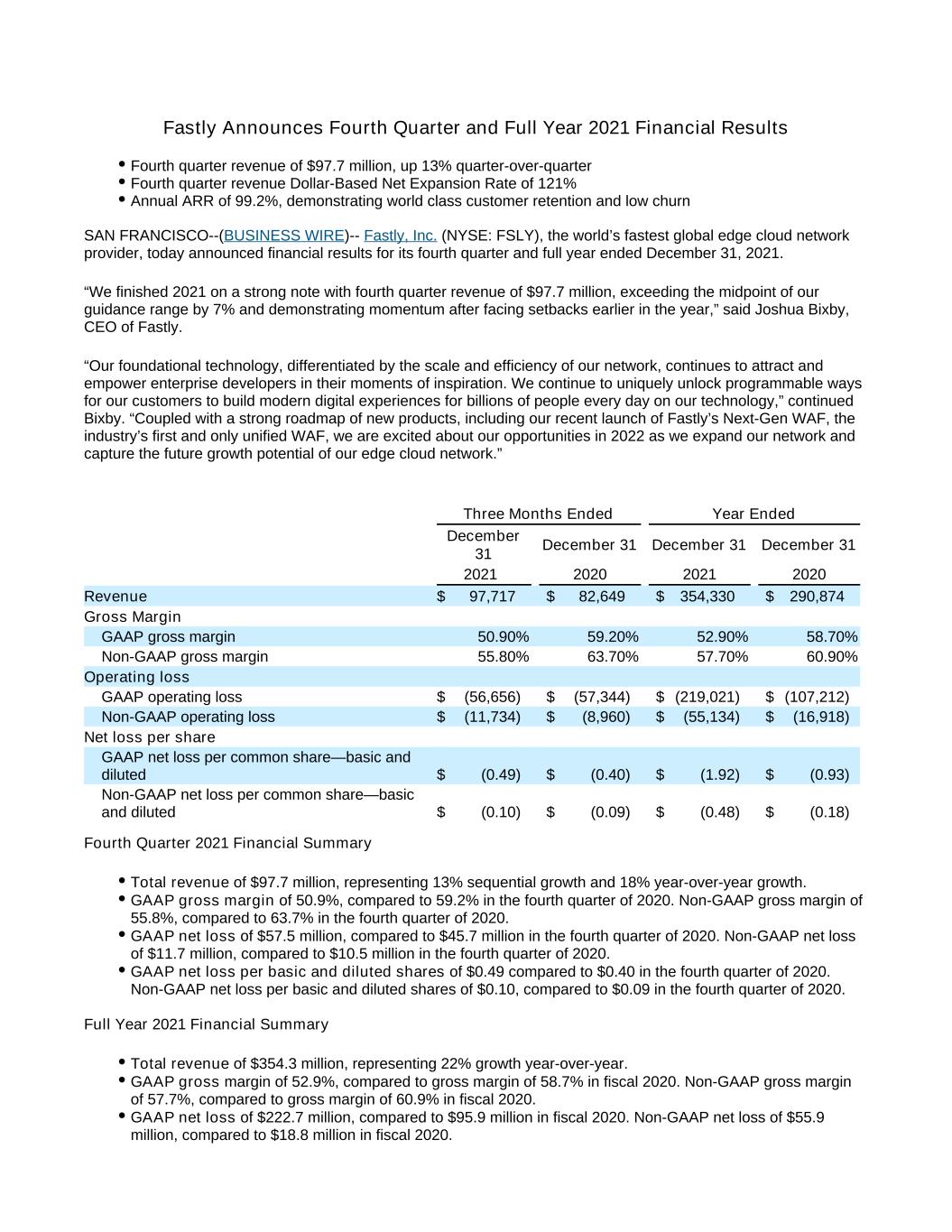
Fastly Announces Fourth Quarter and Full Year 2021 Financial Results Fourth quarter revenue of $97.7 million, up 13% quarter-over-quarter Fourth quarter revenue Dollar-Based Net Expansion Rate of 121% Annual ARR of 99.2%, demonstrating world class customer retention and low churn SAN FRANCISCO--( )-- (NYSE: FSLY), the world’s fastest global edge cloud networkBUSINESS WIRE Fastly, Inc. provider, today announced financial results for its fourth quarter and full year ended December 31, 2021. “We finished 2021 on a strong note with fourth quarter revenue of $97.7 million, exceeding the midpoint of our guidance range by 7% and demonstrating momentum after facing setbacks earlier in the year,” said Joshua Bixby, CEO of Fastly. “Our foundational technology, differentiated by the scale and efficiency of our network, continues to attract and empower enterprise developers in their moments of inspiration. We continue to uniquely unlock programmable ways for our customers to build modern digital experiences for billions of people every day on our technology,” continued Bixby. “Coupled with a strong roadmap of new products, including our recent launch of Fastly’s Next-Gen WAF, the industry’s first and only unified WAF, we are excited about our opportunities in 2022 as we expand our network and capture the future growth potential of our edge cloud network.” Three Months Ended Year Ended December 31 December 31 December 31 December 31 2021 2020 2021 2020 Revenue $ 97,717 $ 82,649 $ 354,330 $ 290,874 Gross Margin GAAP gross margin 50.90% 59.20% 52.90% 58.70% Non-GAAP gross margin 55.80% 63.70% 57.70% 60.90% Operating loss GAAP operating loss $ (56,656) $ (57,344) $ (219,021) $ (107,212) Non-GAAP operating loss $ (11,734) $ (8,960) $ (55,134) $ (16,918) Net loss per share GAAP net loss per common share—basic and diluted $ (0.49) $ (0.40) $ (1.92) $ (0.93) Non-GAAP net loss per common share—basic and diluted $ (0.10) $ (0.09) $ (0.48) $ (0.18) Fourth Quarter 2021 Financial Summary of $97.7 million, representing 13% sequential growth and 18% year-over-year growth.Total revenue of 50.9%, compared to 59.2% in the fourth quarter of 2020. Non-GAAP gross margin ofGAAP gross margin 55.8%, compared to 63.7% in the fourth quarter of 2020. of $57.5 million, compared to $45.7 million in the fourth quarter of 2020. Non-GAAP net lossGAAP net loss of $11.7 million, compared to $10.5 million in the fourth quarter of 2020. of $0.49 compared to $0.40 in the fourth quarter of 2020.GAAP net loss per basic and diluted shares Non-GAAP net loss per basic and diluted shares of $0.10, compared to $0.09 in the fourth quarter of 2020. Full Year 2021 Financial Summary of $354.3 million, representing 22% growth year-over-year.Total revenue margin of 52.9%, compared to gross margin of 58.7% in fiscal 2020. Non-GAAP gross marginGAAP gross of 57.7%, compared to gross margin of 60.9% in fiscal 2020. of $222.7 million, compared to $95.9 million in fiscal 2020. Non-GAAP net loss of $55.9GAAP net loss million, compared to $18.8 million in fiscal 2020.
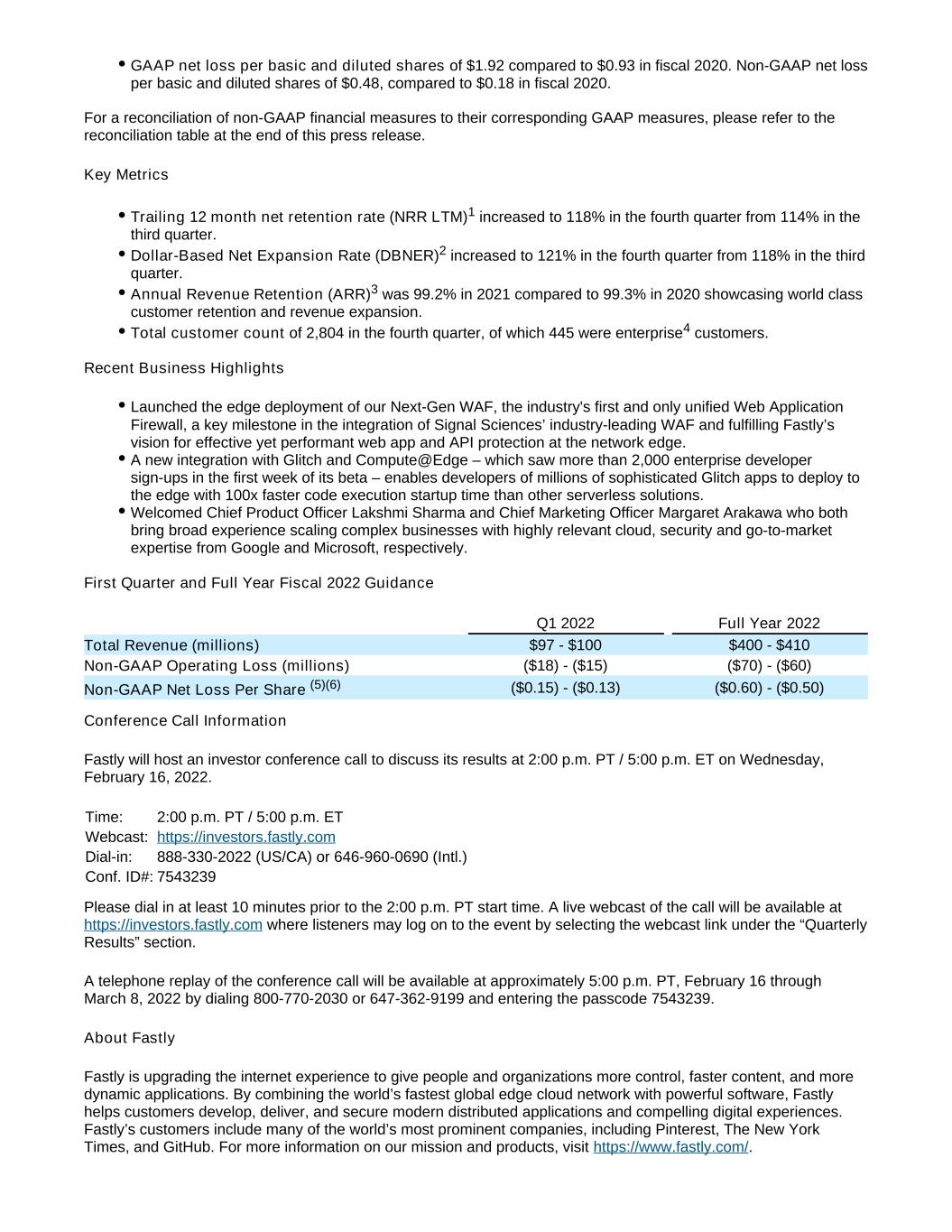
of $1.92 compared to $0.93 in fiscal 2020. Non-GAAP net lossGAAP net loss per basic and diluted shares per basic and diluted shares of $0.48, compared to $0.18 in fiscal 2020. For a reconciliation of non-GAAP financial measures to their corresponding GAAP measures, please refer to the reconciliation table at the end of this press release. Key Metrics increased to 118% in the fourth quarter from 114% in theTrailing 12 month net retention rate (NRR LTM)1 third quarter. increased to 121% in the fourth quarter from 118% in the thirdDollar-Based Net Expansion Rate (DBNER)2 quarter. was 99.2% in 2021 compared to 99.3% in 2020 showcasing world classAnnual Revenue Retention (ARR)3 customer retention and revenue expansion. of 2,804 in the fourth quarter, of which 445 were enterprise customersTotal customer count 4 . Recent Business Highlights Launched the edge deployment of our Next-Gen WAF, the industry's first and only unified Web Application Firewall, a key milestone in the integration of Signal Sciences’ industry-leading WAF and fulfilling Fastly’s vision for effective yet performant web app and API protection at the network edge. A new integration with Glitch and Compute@Edge – which saw more than 2,000 enterprise developer sign-ups in the first week of its beta – enables developers of millions of sophisticated Glitch apps to deploy to the edge with 100x faster code execution startup time than other serverless solutions. Welcomed Chief Product Officer Lakshmi Sharma and Chief Marketing Officer Margaret Arakawa who both bring broad experience scaling complex businesses with highly relevant cloud, security and go-to-market expertise from Google and Microsoft, respectively. First Quarter and Full Year Fiscal 2022 Guidance Q1 2022 Full Year 2022 Total Revenue (millions) $97 - $100 $400 - $410 Non-GAAP Operating Loss (millions) ($18) - ($15) ($70) - ($60) Non-GAAP Net Loss Per Share (5)(6) ($0.15) - ($0.13) ($0.60) - ($0.50) Conference Call Information Fastly will host an investor conference call to discuss its results at 2:00 p.m. PT / 5:00 p.m. ET on Wednesday, February 16, 2022. Time: 2:00 p.m. PT / 5:00 p.m. ET Webcast: https://investors.fastly.com Dial-in: 888-330-2022 (US/CA) or 646-960-0690 (Intl.) Conf. ID#: 7543239 Please dial in at least 10 minutes prior to the 2:00 p.m. PT start time. A live webcast of the call will be available at where listeners may log on to the event by selecting the webcast link under the “Quarterlyhttps://investors.fastly.com Results” section. A telephone replay of the conference call will be available at approximately 5:00 p.m. PT, February 16 through March 8, 2022 by dialing 800-770-2030 or 647-362-9199 and entering the passcode 7543239. About Fastly Fastly is upgrading the internet experience to give people and organizations more control, faster content, and more dynamic applications. By combining the world’s fastest global edge cloud network with powerful software, Fastly helps customers develop, deliver, and secure modern distributed applications and compelling digital experiences. Fastly’s customers include many of the world’s most prominent companies, including Pinterest, The New York Times, and GitHub. For more information on our mission and products, visit .https://www.fastly.com/
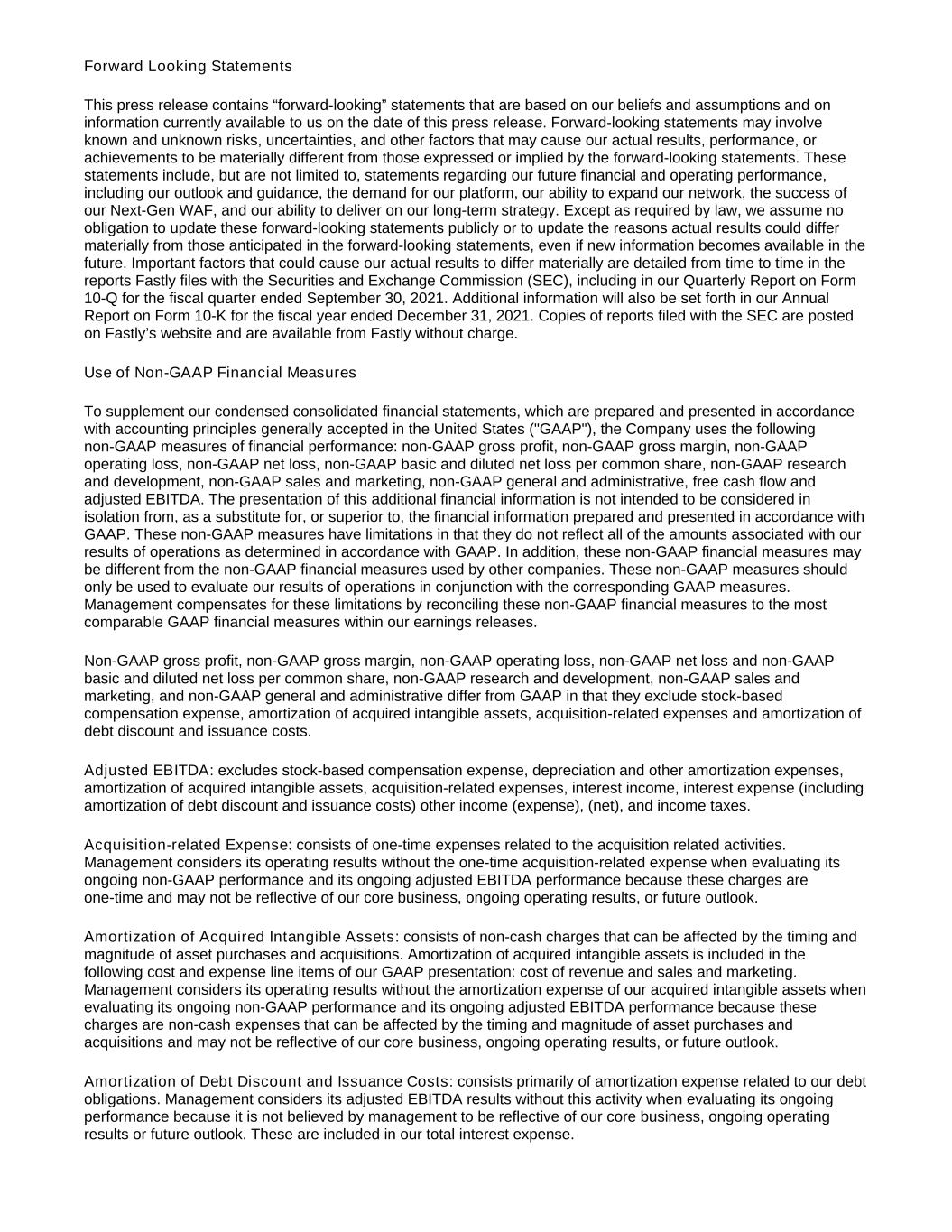
Forward Looking Statements This press release contains “forward-looking” statements that are based on our beliefs and assumptions and on information currently available to us on the date of this press release. Forward-looking statements may involve known and unknown risks, uncertainties, and other factors that may cause our actual results, performance, or achievements to be materially different from those expressed or implied by the forward-looking statements. These statements include, but are not limited to, statements regarding our future financial and operating performance, including our outlook and guidance, the demand for our platform, our ability to expand our network, the success of our Next-Gen WAF, and our ability to deliver on our long-term strategy. Except as required by law, we assume no obligation to update these forward-looking statements publicly or to update the reasons actual results could differ materially from those anticipated in the forward-looking statements, even if new information becomes available in the future. Important factors that could cause our actual results to differ materially are detailed from time to time in the reports Fastly files with the Securities and Exchange Commission (SEC), including in our Quarterly Report on Form 10-Q for the fiscal quarter ended September 30, 2021. Additional information will also be set forth in our Annual Report on Form 10-K for the fiscal year ended December 31, 2021. Copies of reports filed with the SEC are posted on Fastly’s website and are available from Fastly without charge. Use of Non-GAAP Financial Measures To supplement our condensed consolidated financial statements, which are prepared and presented in accordance with accounting principles generally accepted in the United States ("GAAP"), the Company uses the following non-GAAP measures of financial performance: non-GAAP gross profit, non-GAAP gross margin, non-GAAP operating loss, non-GAAP net loss, non-GAAP basic and diluted net loss per common share, non-GAAP research and development, non-GAAP sales and marketing, non-GAAP general and administrative, free cash flow and adjusted EBITDA. The presentation of this additional financial information is not intended to be considered in isolation from, as a substitute for, or superior to, the financial information prepared and presented in accordance with GAAP. These non-GAAP measures have limitations in that they do not reflect all of the amounts associated with our results of operations as determined in accordance with GAAP. In addition, these non-GAAP financial measures may be different from the non-GAAP financial measures used by other companies. These non-GAAP measures should only be used to evaluate our results of operations in conjunction with the corresponding GAAP measures. Management compensates for these limitations by reconciling these non-GAAP financial measures to the most comparable GAAP financial measures within our earnings releases. Non-GAAP gross profit, non-GAAP gross margin, non-GAAP operating loss, non-GAAP net loss and non-GAAP basic and diluted net loss per common share, non-GAAP research and development, non-GAAP sales and marketing, and non-GAAP general and administrative differ from GAAP in that they exclude stock-based compensation expense, amortization of acquired intangible assets, acquisition-related expenses and amortization of debt discount and issuance costs. : excludes stock-based compensation expense, depreciation and other amortization expenses,Adjusted EBITDA amortization of acquired intangible assets, acquisition-related expenses, interest income, interest expense (including amortization of debt discount and issuance costs) other income (expense), (net), and income taxes. : consists of one-time expenses related to the acquisition related activities.Acquisition-related Expense Management considers its operating results without the one-time acquisition-related expense when evaluating its ongoing non-GAAP performance and its ongoing adjusted EBITDA performance because these charges are one-time and may not be reflective of our core business, ongoing operating results, or future outlook. : consists of non-cash charges that can be affected by the timing andAmortization of Acquired Intangible Assets magnitude of asset purchases and acquisitions. Amortization of acquired intangible assets is included in the following cost and expense line items of our GAAP presentation: cost of revenue and sales and marketing. Management considers its operating results without the amortization expense of our acquired intangible assets when evaluating its ongoing non-GAAP performance and its ongoing adjusted EBITDA performance because these charges are non-cash expenses that can be affected by the timing and magnitude of asset purchases and acquisitions and may not be reflective of our core business, ongoing operating results, or future outlook. : consists primarily of amortization expense related to our debtAmortization of Debt Discount and Issuance Costs obligations. Management considers its adjusted EBITDA results without this activity when evaluating its ongoing performance because it is not believed by management to be reflective of our core business, ongoing operating results or future outlook. These are included in our total interest expense.
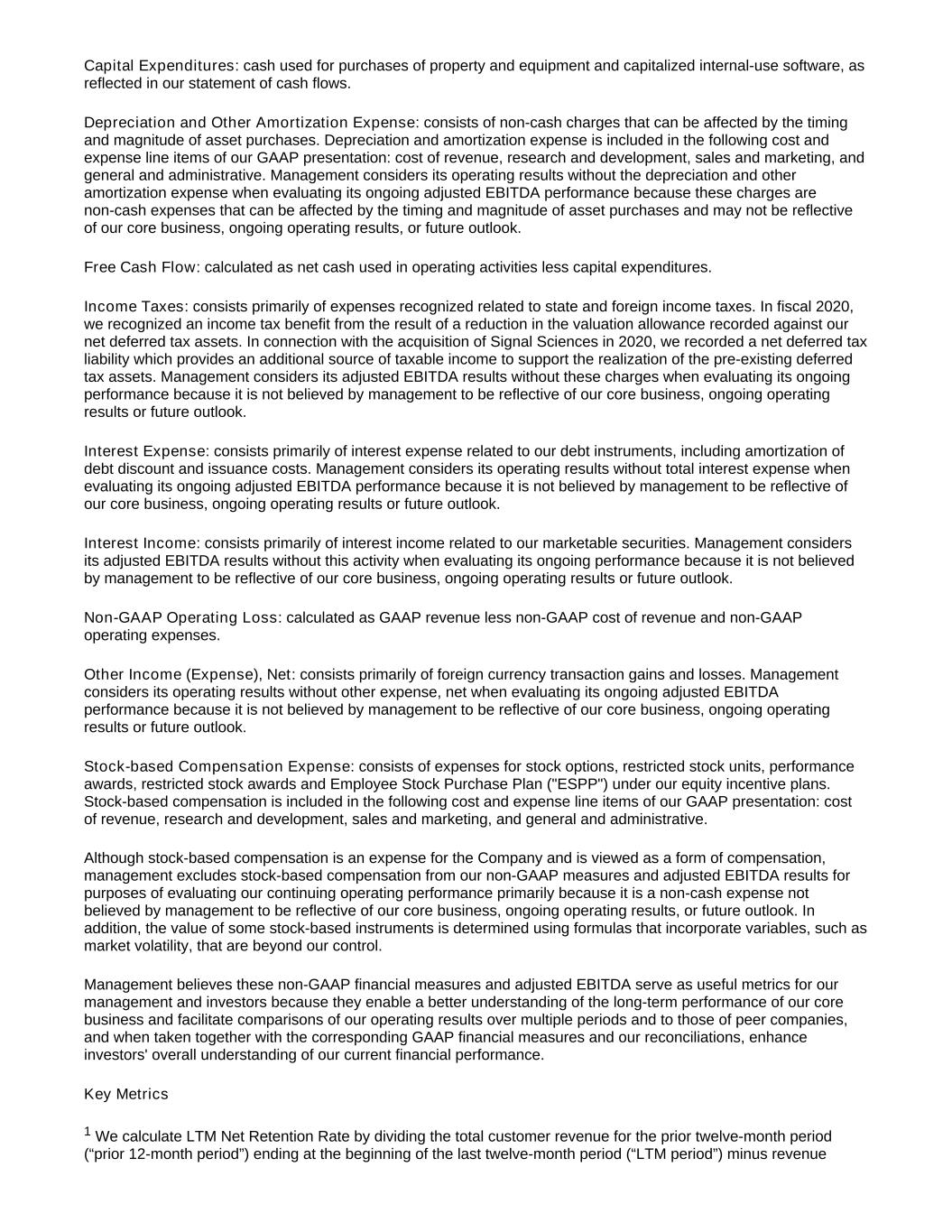
: cash used for purchases of property and equipment and capitalized internal-use software, asCapital Expenditures reflected in our statement of cash flows. : consists of non-cash charges that can be affected by the timingDepreciation and Other Amortization Expense and magnitude of asset purchases. Depreciation and amortization expense is included in the following cost and expense line items of our GAAP presentation: cost of revenue, research and development, sales and marketing, and general and administrative. Management considers its operating results without the depreciation and other amortization expense when evaluating its ongoing adjusted EBITDA performance because these charges are non-cash expenses that can be affected by the timing and magnitude of asset purchases and may not be reflective of our core business, ongoing operating results, or future outlook. : calculated as net cash used in operating activities less capital expenditures.Free Cash Flow : consists primarily of expenses recognized related to state and foreign income taxes. In fiscal 2020,Income Taxes we recognized an income tax benefit from the result of a reduction in the valuation allowance recorded against our net deferred tax assets. In connection with the acquisition of Signal Sciences in 2020, we recorded a net deferred tax liability which provides an additional source of taxable income to support the realization of the pre-existing deferred tax assets. Management considers its adjusted EBITDA results without these charges when evaluating its ongoing performance because it is not believed by management to be reflective of our core business, ongoing operating results or future outlook. : consists primarily of interest expense related to our debt instruments, including amortization ofInterest Expense debt discount and issuance costs. Management considers its operating results without total interest expense when evaluating its ongoing adjusted EBITDA performance because it is not believed by management to be reflective of our core business, ongoing operating results or future outlook. : consists primarily of interest income related to our marketable securities. Management considersInterest Income its adjusted EBITDA results without this activity when evaluating its ongoing performance because it is not believed by management to be reflective of our core business, ongoing operating results or future outlook. : calculated as GAAP revenue less non-GAAP cost of revenue and non-GAAPNon-GAAP Operating Loss operating expenses. : consists primarily of foreign currency transaction gains and losses. ManagementOther Income (Expense), Net considers its operating results without other expense, net when evaluating its ongoing adjusted EBITDA performance because it is not believed by management to be reflective of our core business, ongoing operating results or future outlook. : consists of expenses for stock options, restricted stock units, performanceStock-based Compensation Expense awards, restricted stock awards and Employee Stock Purchase Plan ("ESPP") under our equity incentive plans. Stock-based compensation is included in the following cost and expense line items of our GAAP presentation: cost of revenue, research and development, sales and marketing, and general and administrative. Although stock-based compensation is an expense for the Company and is viewed as a form of compensation, management excludes stock-based compensation from our non-GAAP measures and adjusted EBITDA results for purposes of evaluating our continuing operating performance primarily because it is a non-cash expense not believed by management to be reflective of our core business, ongoing operating results, or future outlook. In addition, the value of some stock-based instruments is determined using formulas that incorporate variables, such as market volatility, that are beyond our control. Management believes these non-GAAP financial measures and adjusted EBITDA serve as useful metrics for our management and investors because they enable a better understanding of the long-term performance of our core business and facilitate comparisons of our operating results over multiple periods and to those of peer companies, and when taken together with the corresponding GAAP financial measures and our reconciliations, enhance investors' overall understanding of our current financial performance. Key Metrics We calculate LTM Net Retention Rate by dividing the total customer revenue for the prior twelve-month period1 (“prior 12-month period”) ending at the beginning of the last twelve-month period (“LTM period”) minus revenue
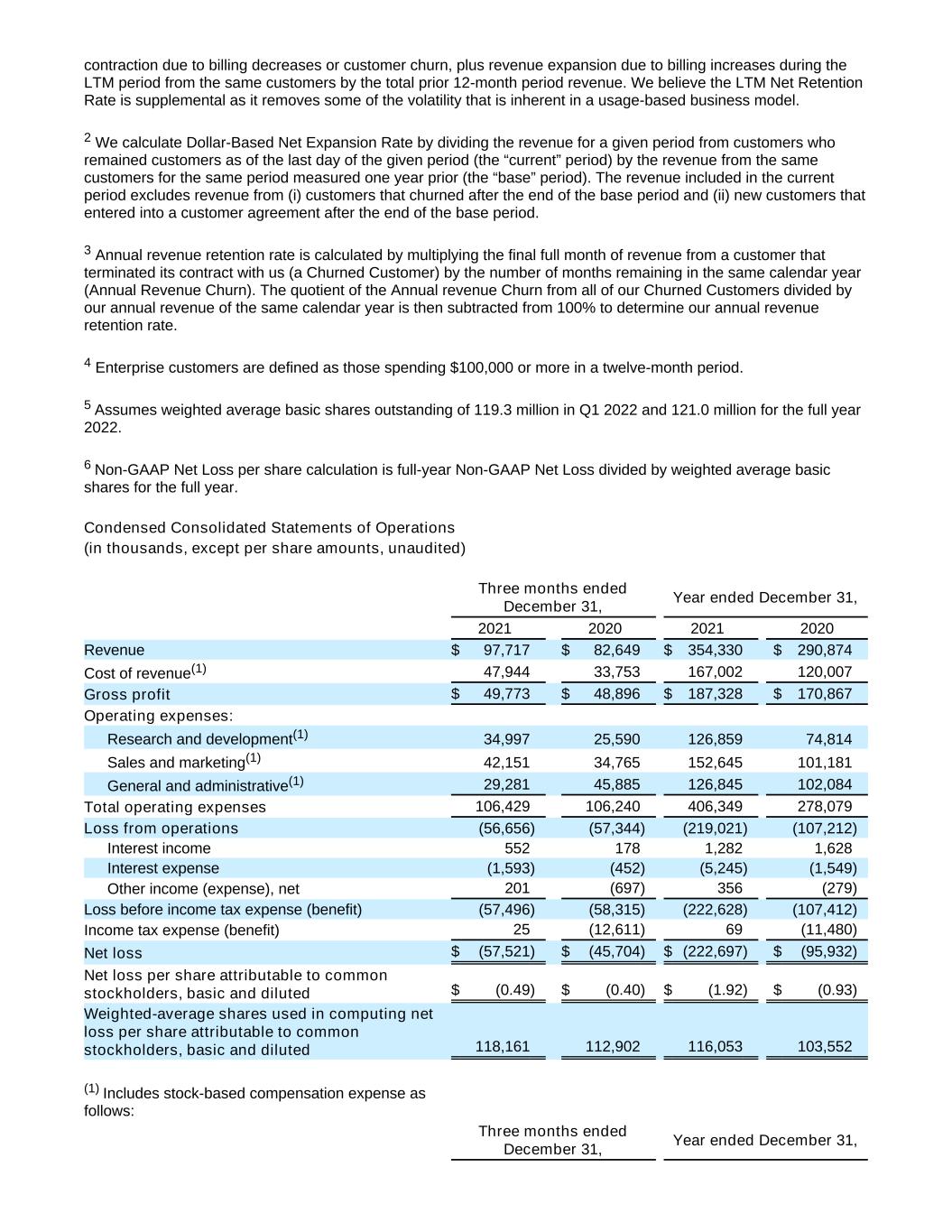
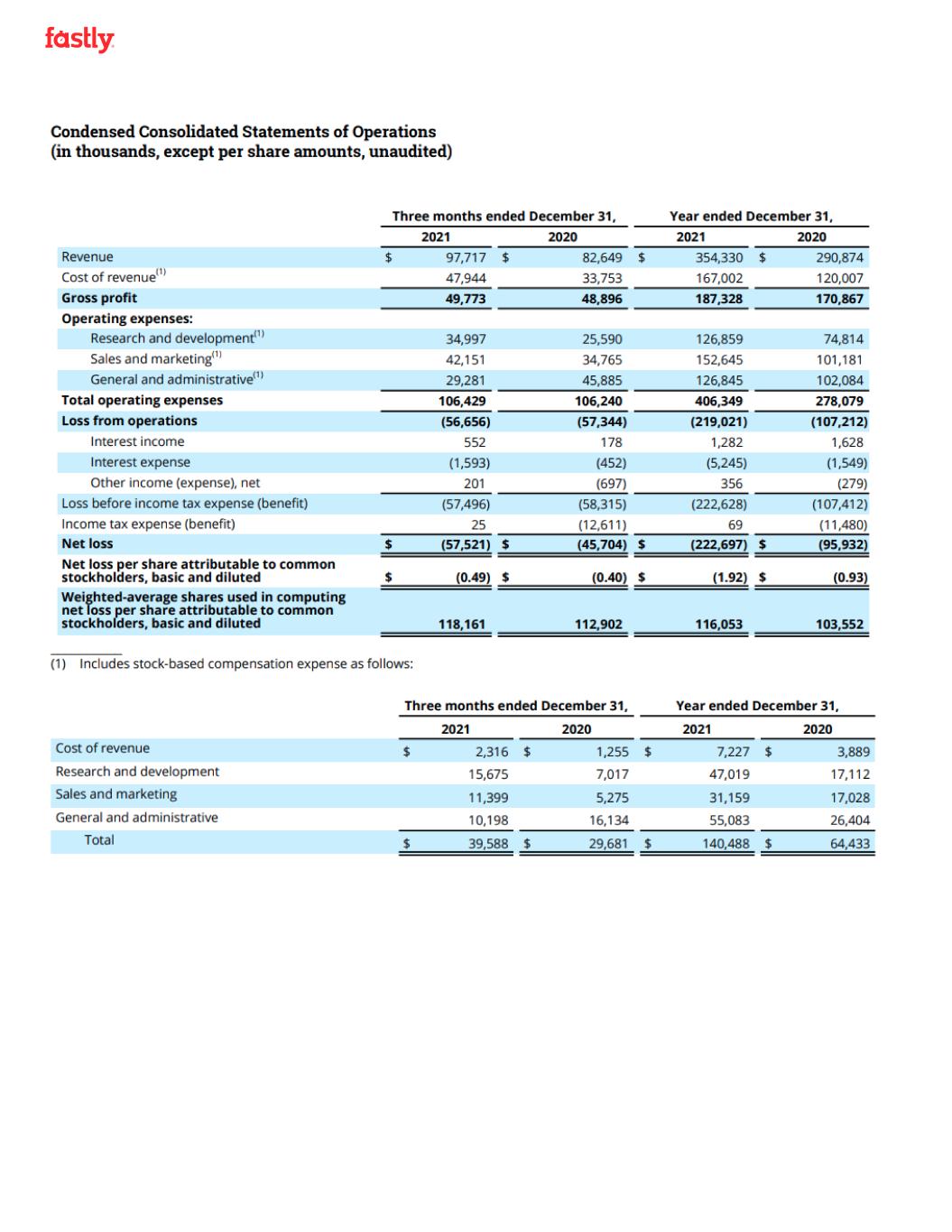
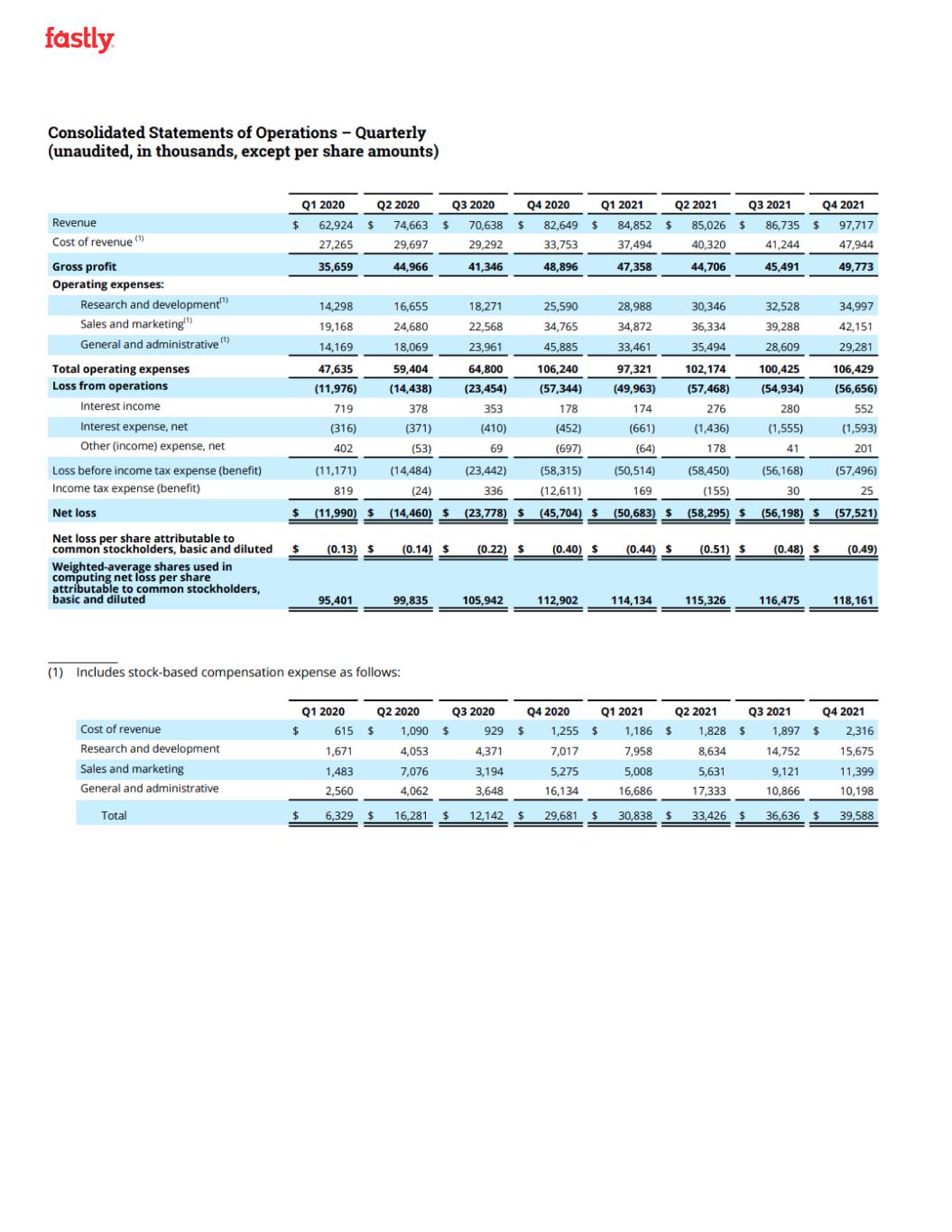
contraction due to billing decreases or customer churn, plus revenue expansion due to billing increases during the LTM period from the same customers by the total prior 12-month period revenue. We believe the LTM Net Retention Rate is supplemental as it removes some of the volatility that is inherent in a usage-based business model. We calculate Dollar-Based Net Expansion Rate by dividing the revenue for a given period from customers who2 remained customers as of the last day of the given period (the “current” period) by the revenue from the same customers for the same period measured one year prior (the “base” period). The revenue included in the current period excludes revenue from (i) customers that churned after the end of the base period and (ii) new customers that entered into a customer agreement after the end of the base period. Annual revenue retention rate is calculated by multiplying the final full month of revenue from a customer that3 terminated its contract with us (a Churned Customer) by the number of months remaining in the same calendar year (Annual Revenue Churn). The quotient of the Annual revenue Churn from all of our Churned Customers divided by our annual revenue of the same calendar year is then subtracted from 100% to determine our annual revenue retention rate. Enterprise customers are defined as those spending $100,000 or more in a twelve-month period.4 Assumes weighted average basic shares outstanding of 119.3 million in Q1 2022 and 121.0 million for the full year5 2022. Non-GAAP Net Loss per share calculation is full-year Non-GAAP Net Loss divided by weighted average basic6 shares for the full year. Condensed Consolidated Statements of Operations (in thousands, except per share amounts, unaudited) Three months ended December 31, Year ended December 31, 2021 2020 2021 2020 Revenue $ 97,717 $ 82,649 $ 354,330 $ 290,874 Cost of revenue(1) 47,944 33,753 167,002 120,007 Gross profit $ 49,773 $ 48,896 $ 187,328 $ 170,867 Operating expenses: Research and development(1) 34,997 25,590 126,859 74,814 Sales and marketing(1) 42,151 34,765 152,645 101,181 General and administrative(1) 29,281 45,885 126,845 102,084 Total operating expenses 106,429 106,240 406,349 278,079 Loss from operations (56,656) (57,344) (219,021) (107,212) Interest income 552 178 1,282 1,628 Interest expense (1,593) (452) (5,245) (1,549) Other income (expense), net 201 (697) 356 (279) Loss before income tax expense (benefit) (57,496) (58,315) (222,628) (107,412) Income tax expense (benefit) 25 (12,611) 69 (11,480) Net loss $ (57,521) $ (45,704) $ (222,697) $ (95,932) Net loss per share attributable to common stockholders, basic and diluted $ (0.49) $ (0.40) $ (1.92) $ (0.93) Weighted-average shares used in computing net loss per share attributable to common stockholders, basic and diluted 118,161 112,902 116,053 103,552 (1) Includes stock-based compensation expense as follows: Three months ended December 31, Year ended December 31,
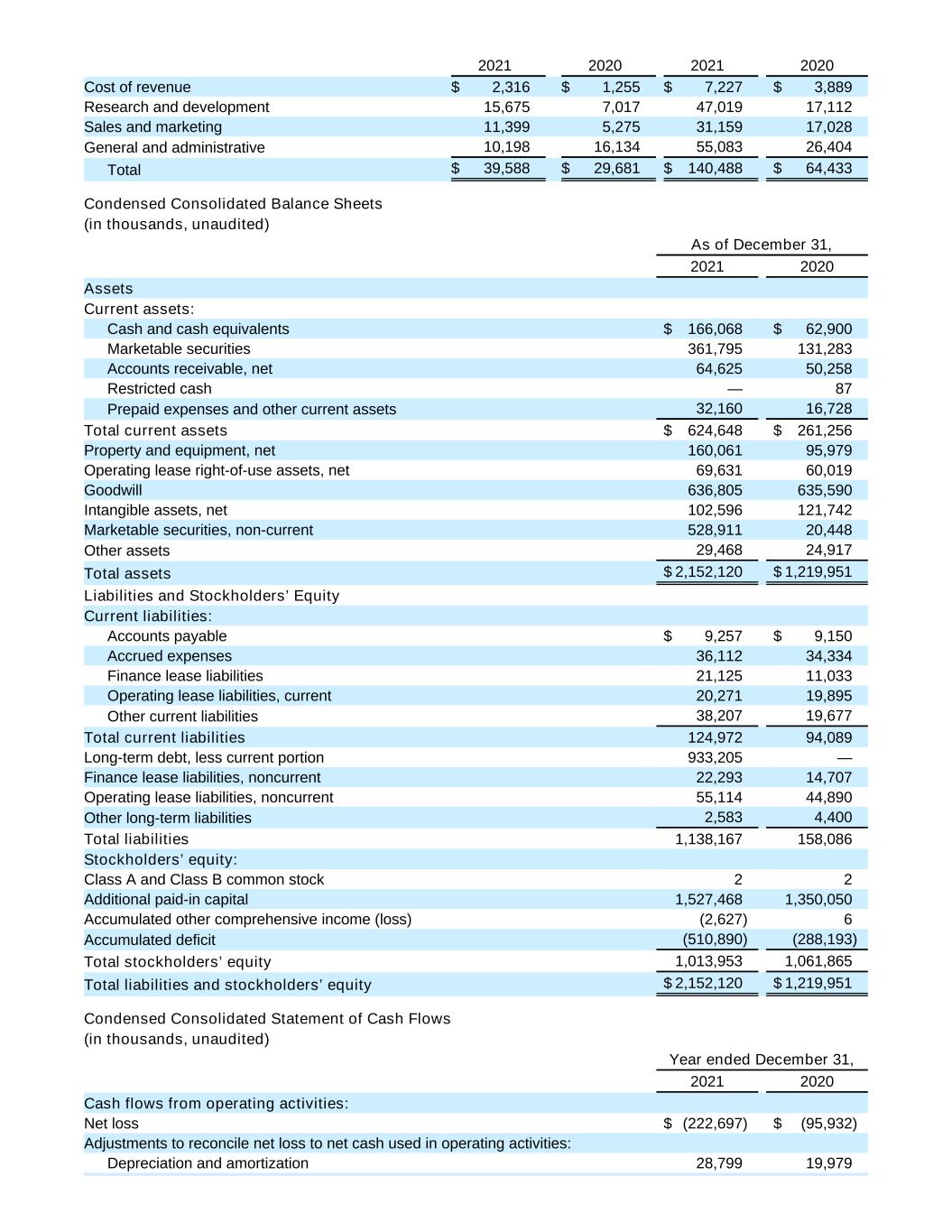
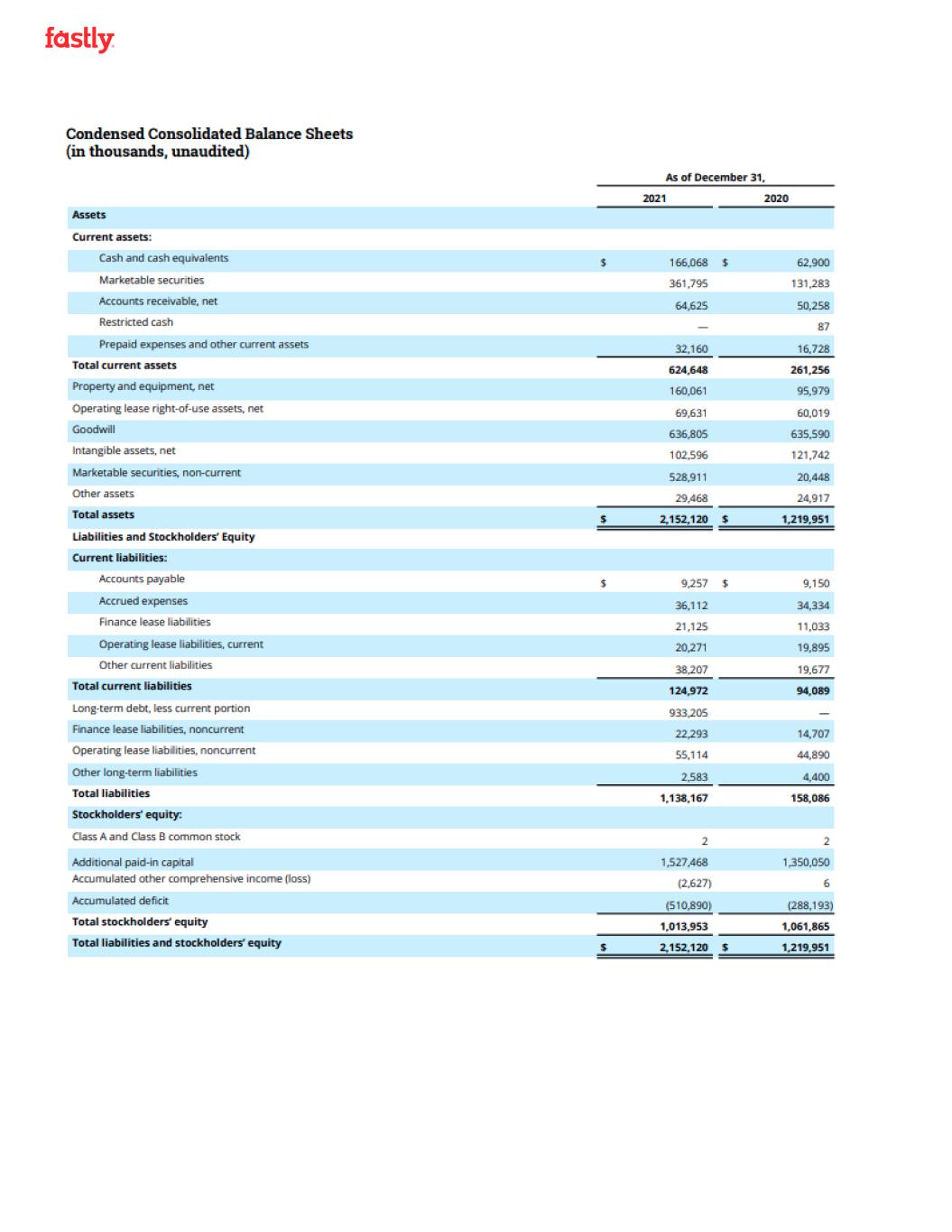
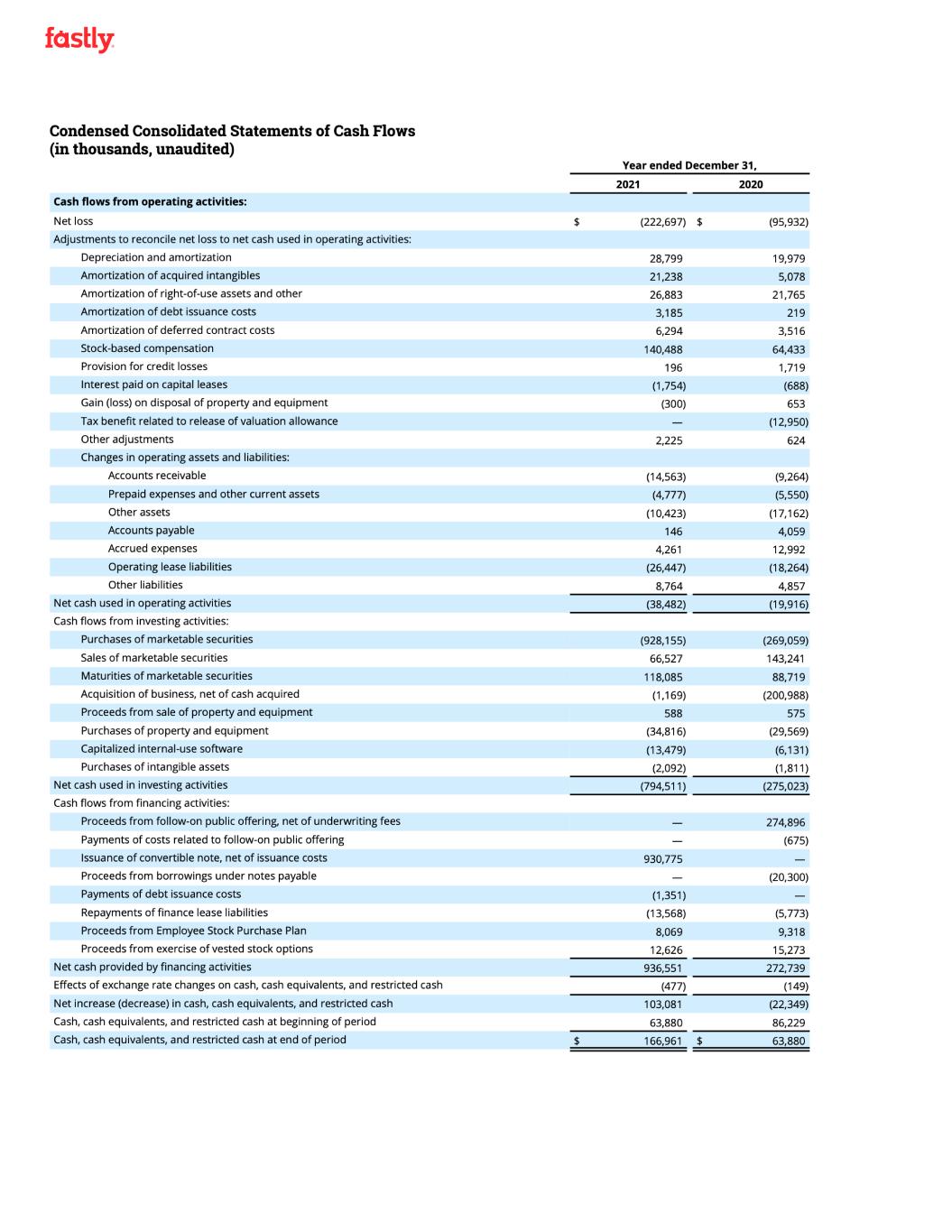
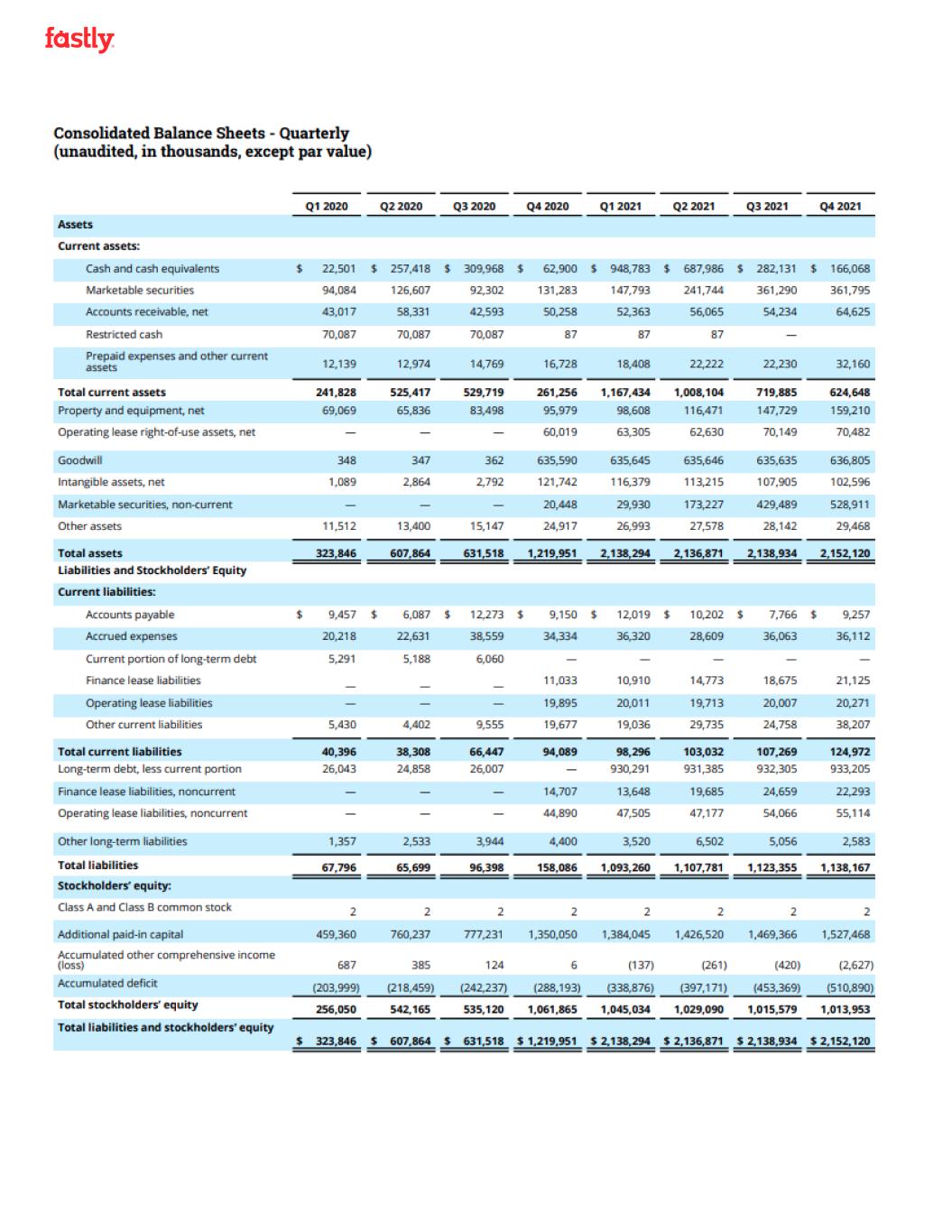
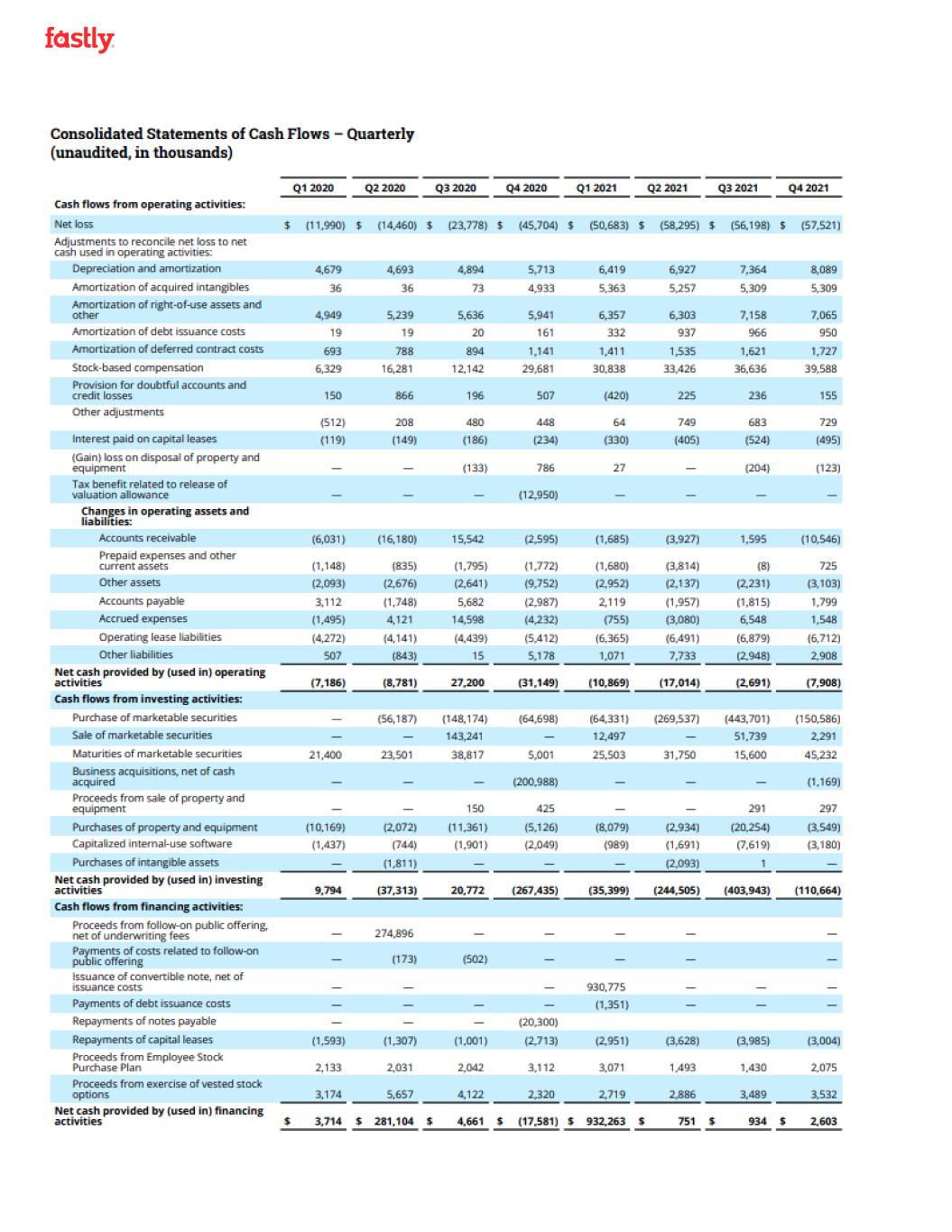
2021 2020 2021 2020 Cost of revenue $ 2,316 $ 1,255 $ 7,227 $ 3,889 Research and development 15,675 7,017 47,019 17,112 Sales and marketing 11,399 5,275 31,159 17,028 General and administrative 10,198 16,134 55,083 26,404 Total $ 39,588 $ 29,681 $ 140,488 $ 64,433 Condensed Consolidated Balance Sheets (in thousands, unaudited) As of December 31, 2021 2020 Assets Current assets: Cash and cash equivalents $ 166,068 $ 62,900 Marketable securities 361,795 131,283 Accounts receivable, net 64,625 50,258 Restricted cash — 87 Prepaid expenses and other current assets 32,160 16,728 Total current assets $ 624,648 $ 261,256 Property and equipment, net 160,061 95,979 Operating lease right-of-use assets, net 69,631 60,019 Goodwill 636,805 635,590 Intangible assets, net 102,596 121,742 Marketable securities, non-current 528,911 20,448 Other assets 29,468 24,917 Total assets $ 2,152,120 $ 1,219,951 Liabilities and Stockholders’ Equity Current liabilities: Accounts payable $ 9,257 $ 9,150 Accrued expenses 36,112 34,334 Finance lease liabilities 21,125 11,033 Operating lease liabilities, current 20,271 19,895 Other current liabilities 38,207 19,677 Total current liabilities 124,972 94,089 Long-term debt, less current portion 933,205 — Finance lease liabilities, noncurrent 22,293 14,707 Operating lease liabilities, noncurrent 55,114 44,890 Other long-term liabilities 2,583 4,400 Total liabilities 1,138,167 158,086 Stockholders’ equity: Class A and Class B common stock 2 2 Additional paid-in capital 1,527,468 1,350,050 Accumulated other comprehensive income (loss) (2,627) 6 Accumulated deficit (510,890) (288,193) Total stockholders’ equity 1,013,953 1,061,865 Total liabilities and stockholders’ equity $ 2,152,120 $ 1,219,951 Condensed Consolidated Statement of Cash Flows (in thousands, unaudited) Year ended December 31, 2021 2020 Cash flows from operating activities: Net loss $ (222,697) $ (95,932) Adjustments to reconcile net loss to net cash used in operating activities: Depreciation and amortization 28,799 19,979
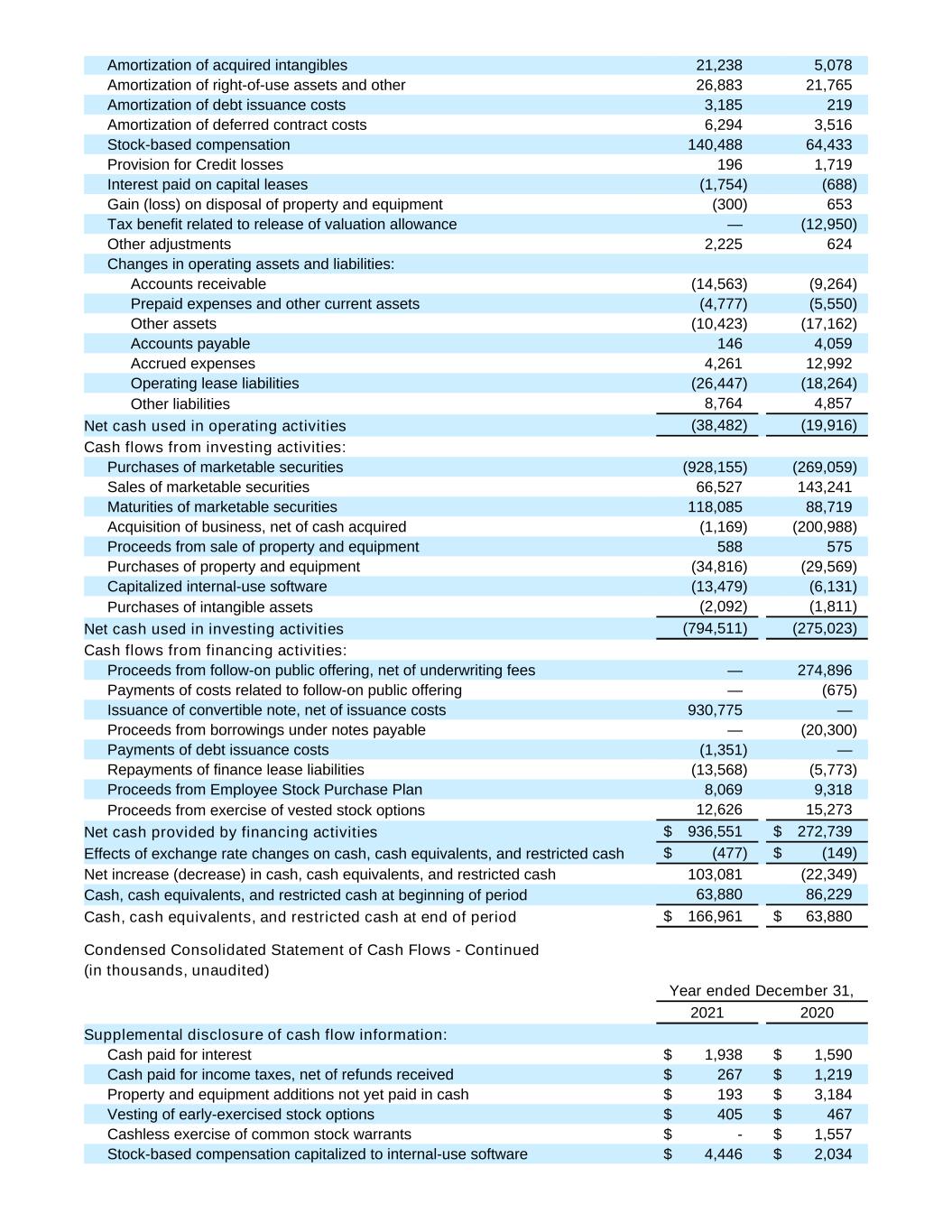
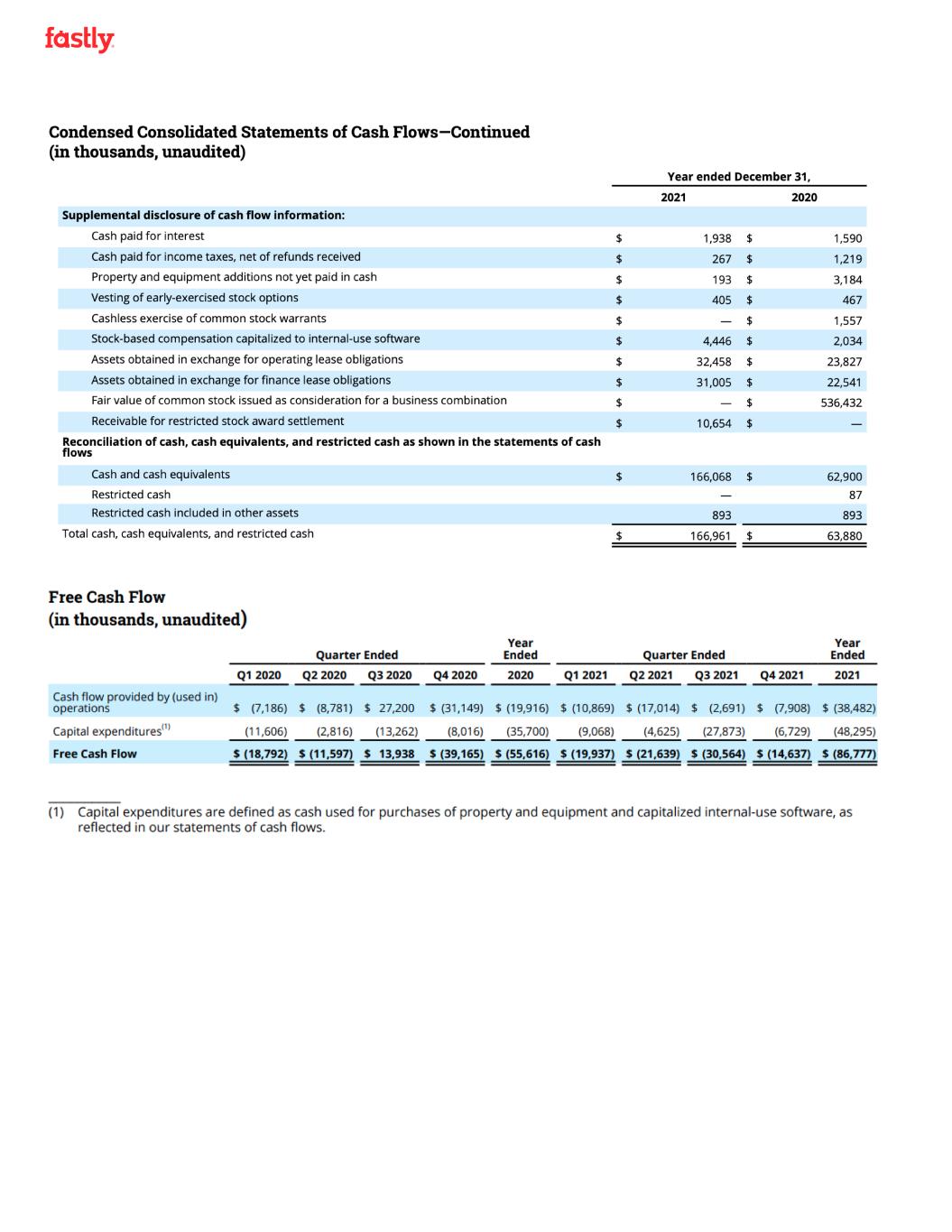
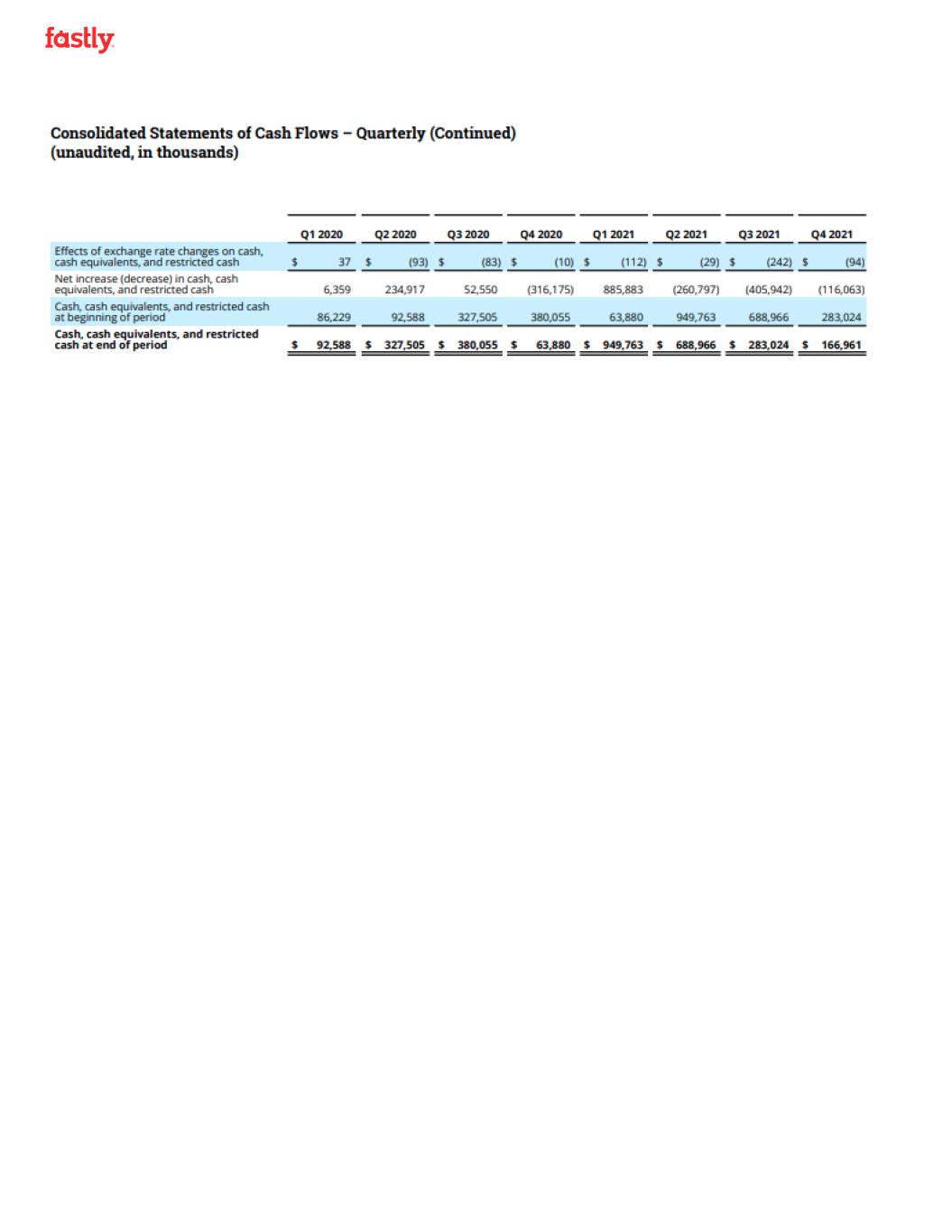
Amortization of acquired intangibles 21,238 5,078 Amortization of right-of-use assets and other 26,883 21,765 Amortization of debt issuance costs 3,185 219 Amortization of deferred contract costs 6,294 3,516 Stock-based compensation 140,488 64,433 Provision for Credit losses 196 1,719 Interest paid on capital leases (1,754) (688) Gain (loss) on disposal of property and equipment (300) 653 Tax benefit related to release of valuation allowance — (12,950) Other adjustments 2,225 624 Changes in operating assets and liabilities: Accounts receivable (14,563) (9,264) Prepaid expenses and other current assets (4,777) (5,550) Other assets (10,423) (17,162) Accounts payable 146 4,059 Accrued expenses 4,261 12,992 Operating lease liabilities (26,447) (18,264) Other liabilities 8,764 4,857 Net cash used in operating activities (38,482) (19,916) Cash flows from investing activities: Purchases of marketable securities (928,155) (269,059) Sales of marketable securities 66,527 143,241 Maturities of marketable securities 118,085 88,719 Acquisition of business, net of cash acquired (1,169) (200,988) Proceeds from sale of property and equipment 588 575 Purchases of property and equipment (34,816) (29,569) Capitalized internal-use software (13,479) (6,131) Purchases of intangible assets (2,092) (1,811) Net cash used in investing activities (794,511) (275,023) Cash flows from financing activities: Proceeds from follow-on public offering, net of underwriting fees — 274,896 Payments of costs related to follow-on public offering — (675) Issuance of convertible note, net of issuance costs 930,775 — Proceeds from borrowings under notes payable — (20,300) Payments of debt issuance costs (1,351) — Repayments of finance lease liabilities (13,568) (5,773) Proceeds from Employee Stock Purchase Plan 8,069 9,318 Proceeds from exercise of vested stock options 12,626 15,273 Net cash provided by financing activities $ 936,551 $ 272,739 Effects of exchange rate changes on cash, cash equivalents, and restricted cash $ (477) $ (149) Net increase (decrease) in cash, cash equivalents, and restricted cash 103,081 (22,349) Cash, cash equivalents, and restricted cash at beginning of period 63,880 86,229 Cash, cash equivalents, and restricted cash at end of period $ 166,961 $ 63,880 Condensed Consolidated Statement of Cash Flows - Continued (in thousands, unaudited) Year ended December 31, 2021 2020 Supplemental disclosure of cash flow information: Cash paid for interest $ 1,938 $ 1,590 Cash paid for income taxes, net of refunds received $ 267 $ 1,219 Property and equipment additions not yet paid in cash $ 193 $ 3,184 Vesting of early-exercised stock options $ 405 $ 467 Cashless exercise of common stock warrants $ - $ 1,557 Stock-based compensation capitalized to internal-use software $ 4,446 $ 2,034
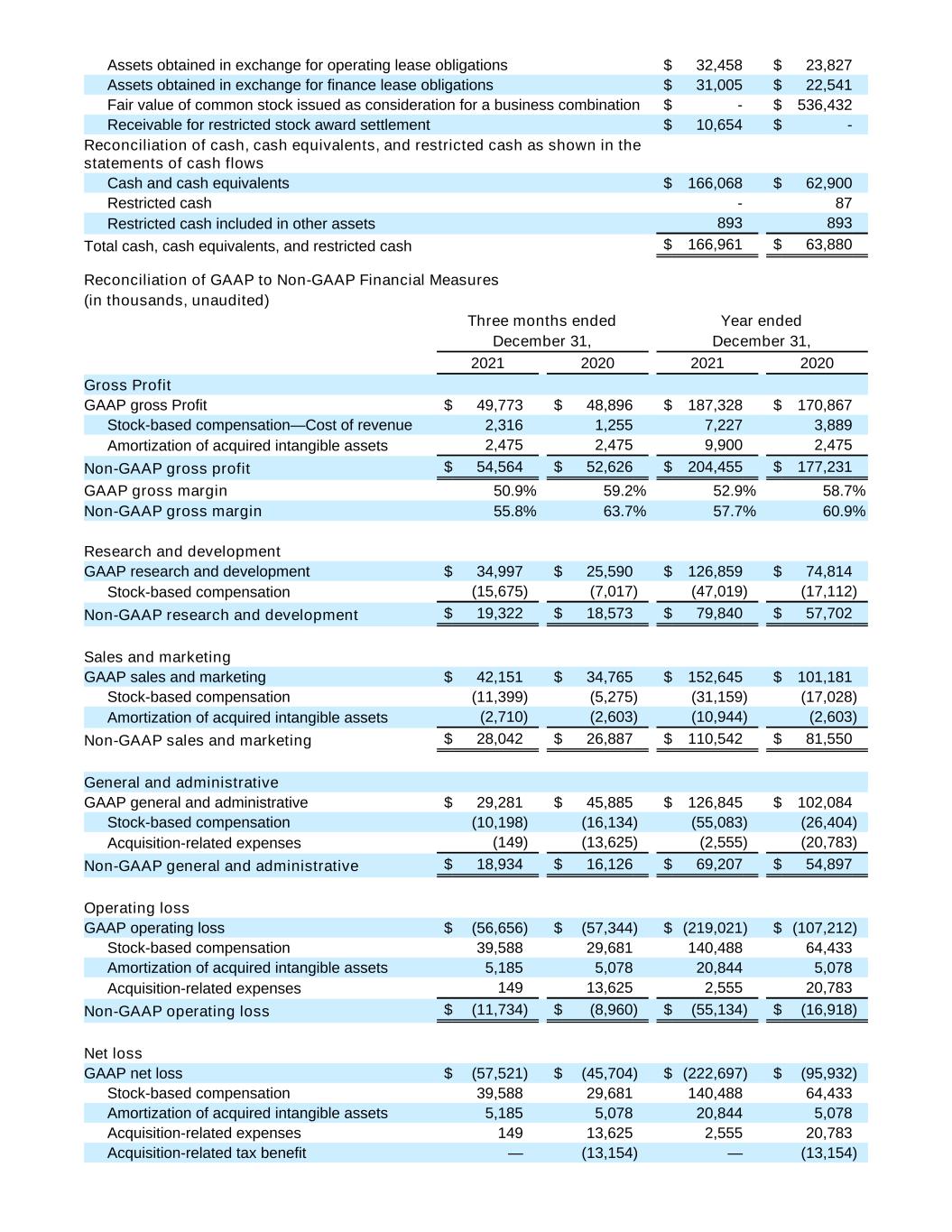
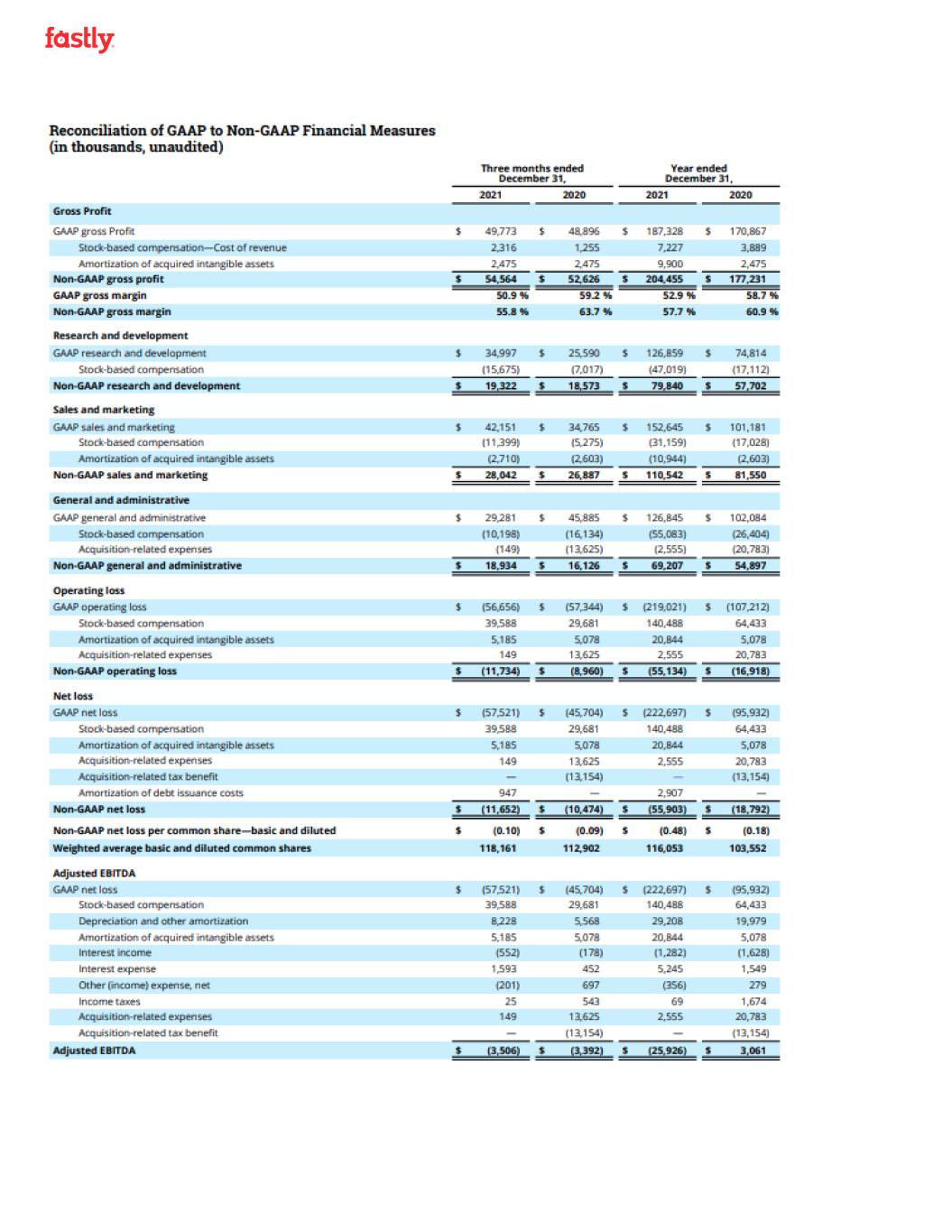
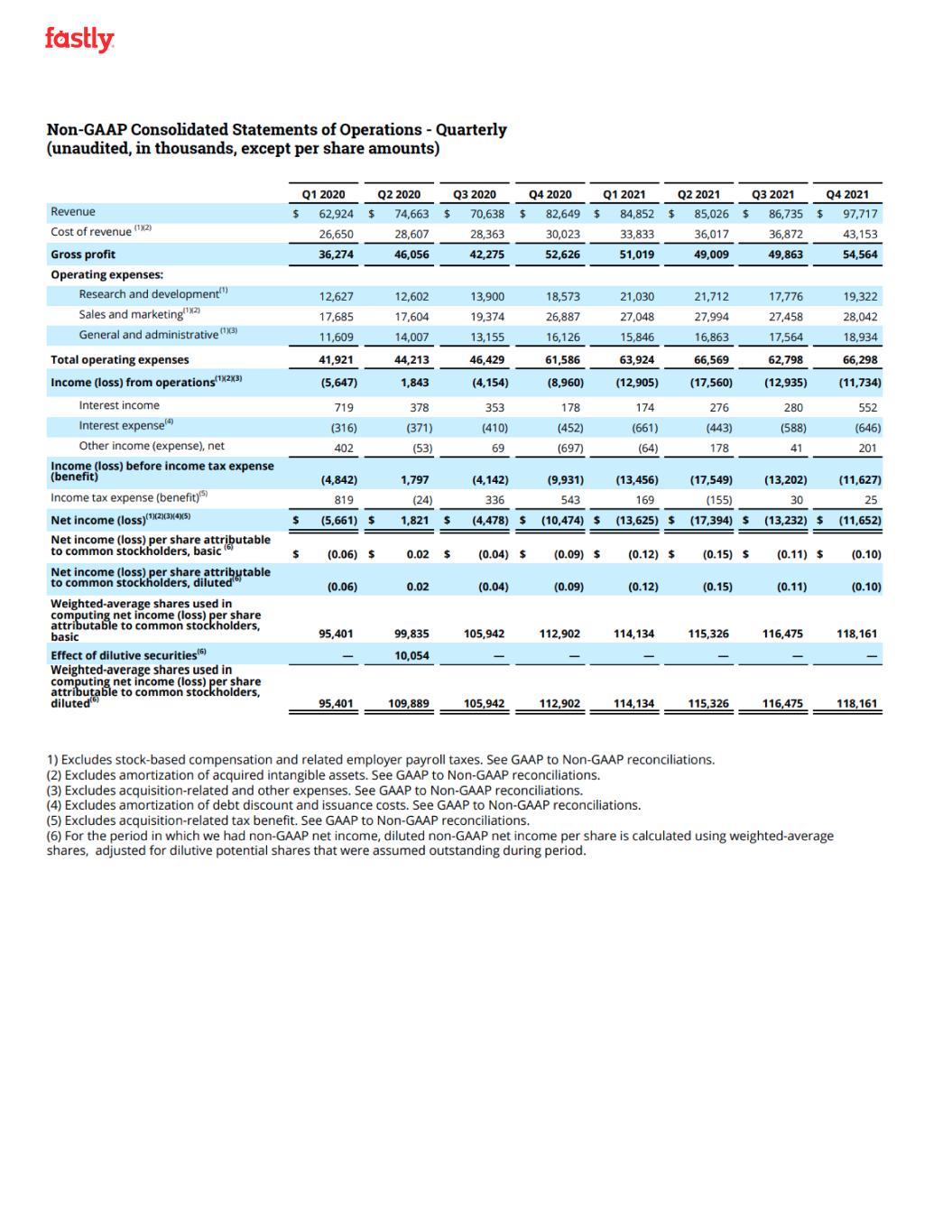
Assets obtained in exchange for operating lease obligations $ 32,458 $ 23,827 Assets obtained in exchange for finance lease obligations $ 31,005 $ 22,541 Fair value of common stock issued as consideration for a business combination $ - $ 536,432 Receivable for restricted stock award settlement $ 10,654 $ - Reconciliation of cash, cash equivalents, and restricted cash as shown in the statements of cash flows Cash and cash equivalents $ 166,068 $ 62,900 Restricted cash - 87 Restricted cash included in other assets 893 893 Total cash, cash equivalents, and restricted cash $ 166,961 $ 63,880 Reconciliation of GAAP to Non-GAAP Financial Measures (in thousands, unaudited) Three months ended Year ended December 31, December 31, 2021 2020 2021 2020 Gross Profit GAAP gross Profit $ 49,773 $ 48,896 $ 187,328 $ 170,867 Stock-based compensation—Cost of revenue 2,316 1,255 7,227 3,889 Amortization of acquired intangible assets 2,475 2,475 9,900 2,475 Non-GAAP gross profit $ 54,564 $ 52,626 $ 204,455 $ 177,231 GAAP gross margin 50.9% 59.2% 52.9% 58.7% Non-GAAP gross margin 55.8% 63.7% 57.7% 60.9% Research and development GAAP research and development $ 34,997 $ 25,590 $ 126,859 $ 74,814 Stock-based compensation (15,675) (7,017) (47,019) (17,112) Non-GAAP research and development $ 19,322 $ 18,573 $ 79,840 $ 57,702 Sales and marketing GAAP sales and marketing $ 42,151 $ 34,765 $ 152,645 $ 101,181 Stock-based compensation (11,399) (5,275) (31,159) (17,028) Amortization of acquired intangible assets (2,710) (2,603) (10,944) (2,603) Non-GAAP sales and marketing $ 28,042 $ 26,887 $ 110,542 $ 81,550 General and administrative GAAP general and administrative $ 29,281 $ 45,885 $ 126,845 $ 102,084 Stock-based compensation (10,198) (16,134) (55,083) (26,404) Acquisition-related expenses (149) (13,625) (2,555) (20,783) Non-GAAP general and administrative $ 18,934 $ 16,126 $ 69,207 $ 54,897 Operating loss GAAP operating loss $ (56,656) $ (57,344) $ (219,021) $ (107,212) Stock-based compensation 39,588 29,681 140,488 64,433 Amortization of acquired intangible assets 5,185 5,078 20,844 5,078 Acquisition-related expenses 149 13,625 2,555 20,783 Non-GAAP operating loss $ (11,734) $ (8,960) $ (55,134) $ (16,918) Net loss GAAP net loss $ (57,521) $ (45,704) $ (222,697) $ (95,932) Stock-based compensation 39,588 29,681 140,488 64,433 Amortization of acquired intangible assets 5,185 5,078 20,844 5,078 Acquisition-related expenses 149 13,625 2,555 20,783 Acquisition-related tax benefit — (13,154) — (13,154)
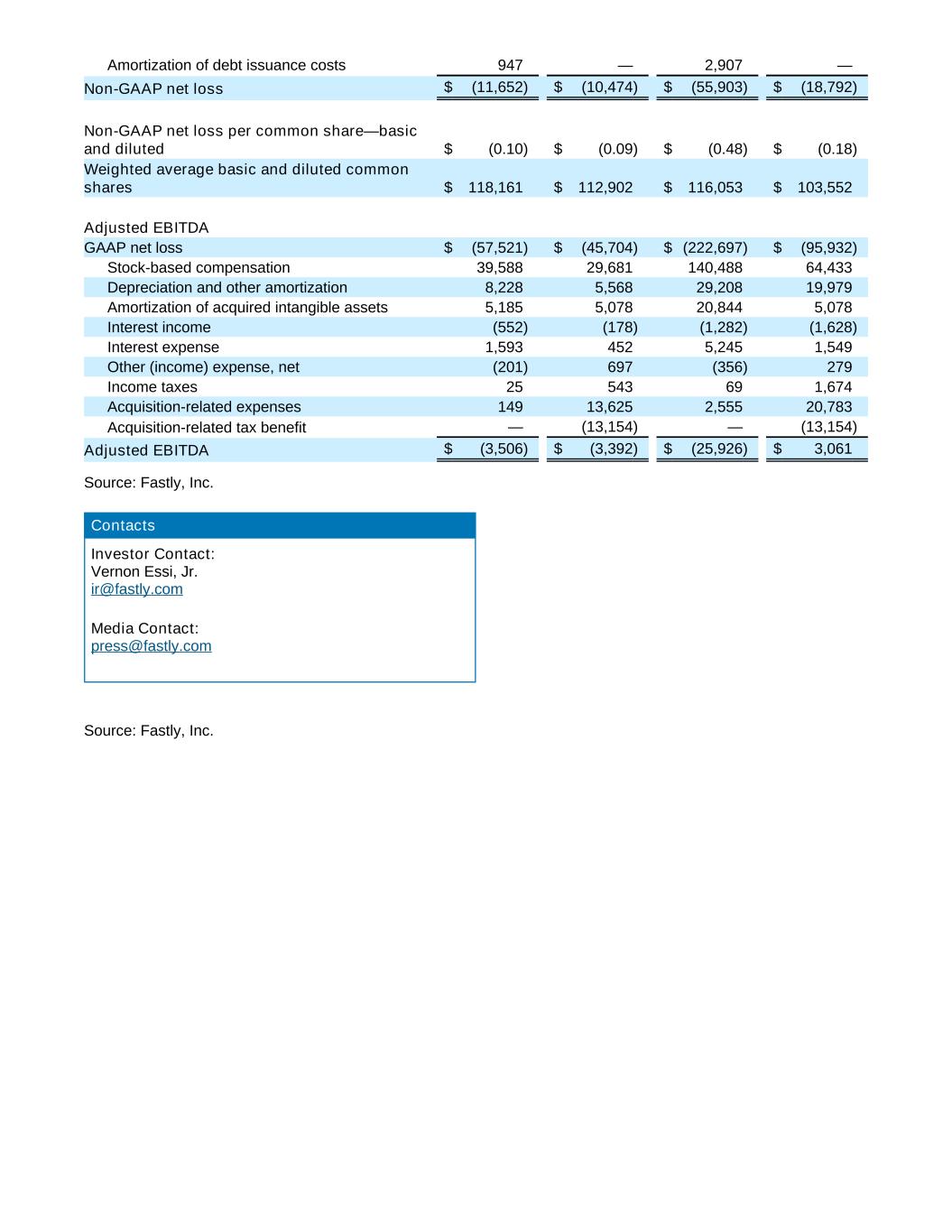
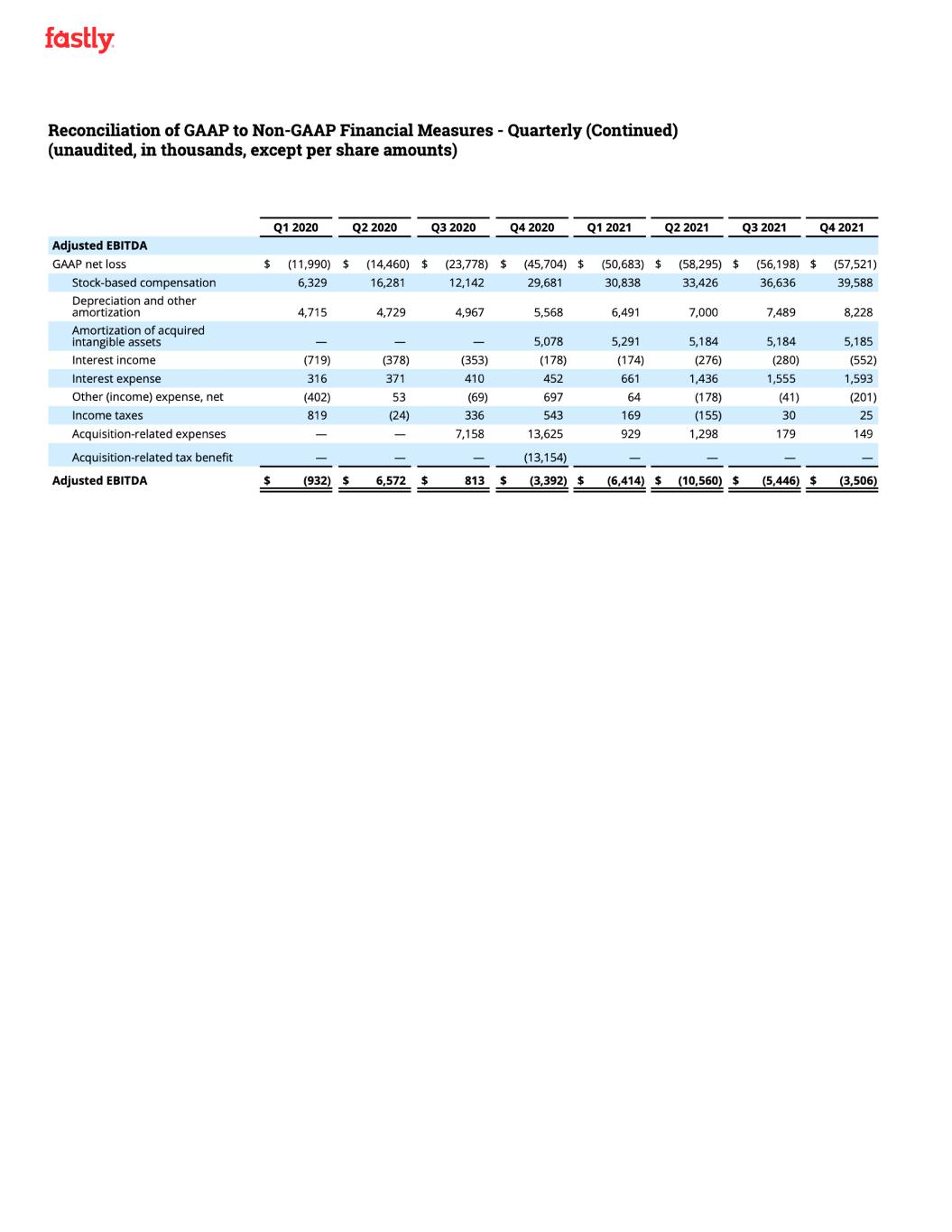
Amortization of debt issuance costs 947 — 2,907 — Non-GAAP net loss $ (11,652) $ (10,474) $ (55,903) $ (18,792) Non-GAAP net loss per common share—basic and diluted $ (0.10) $ (0.09) $ (0.48) $ (0.18) Weighted average basic and diluted common shares $ 118,161 $ 112,902 $ 116,053 $ 103,552 Adjusted EBITDA GAAP net loss $ (57,521) $ (45,704) $ (222,697) $ (95,932) Stock-based compensation 39,588 29,681 140,488 64,433 Depreciation and other amortization 8,228 5,568 29,208 19,979 Amortization of acquired intangible assets 5,185 5,078 20,844 5,078 Interest income (552) (178) (1,282) (1,628) Interest expense 1,593 452 5,245 1,549 Other (income) expense, net (201) 697 (356) 279 Income taxes 25 543 69 1,674 Acquisition-related expenses 149 13,625 2,555 20,783 Acquisition-related tax benefit — (13,154) — (13,154) Adjusted EBITDA $ (3,506) $ (3,392) $ (25,926) $ 3,061 Source: Fastly, Inc. Contacts Investor Contact: Vernon Essi, Jr. [email protected] Media Contact: [email protected] Source: Fastly, Inc.
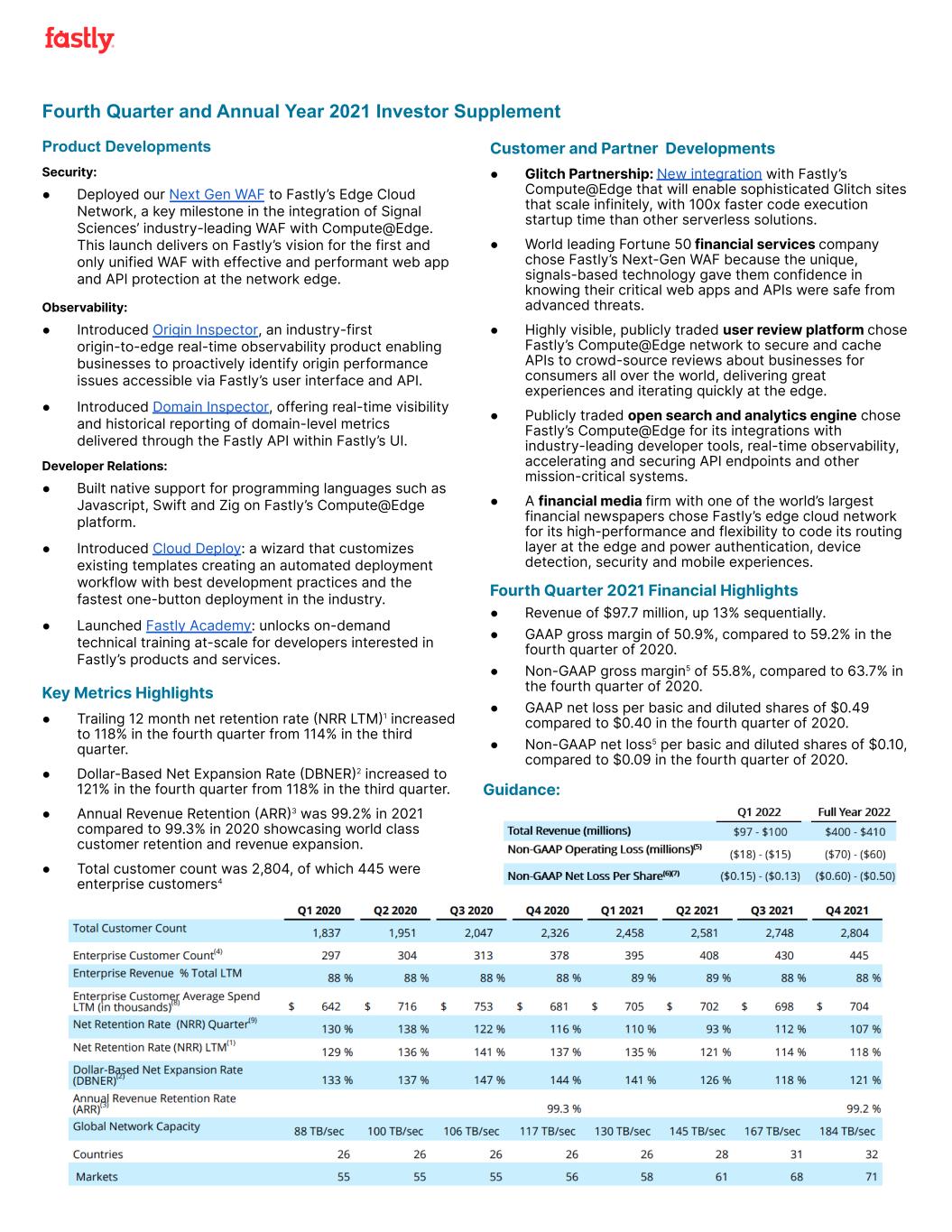
Fourth Quarter and Annual Year 2021 Investor Supplement Product Developments Security: ● Deployed our Next Gen WAF to Fastly’s Edge Cloud Network, a key milestone in the integration of Signal Sciences’ industry-leading WAF with Compute@Edge. This launch delivers on Fastly’s vision for the first and only unified WAF with effective and performant web app and API protection at the network edge. Observability: ● Introduced Origin Inspector, an industry-first origin-to-edge real-time observability product enabling businesses to proactively identify origin performance issues accessible via Fastly’s user interface and API. ● Introduced Domain Inspector, offering real-time visibility and historical reporting of domain-level metrics delivered through the Fastly API within Fastly’s UI. Developer Relations: ● Built native support for programming languages such as Javascript, Swift and Zig on Fastly’s Compute@Edge platform. ● Introduced Cloud Deploy: a wizard that customizes existing templates creating an automated deployment workflow with best development practices and the fastest one-button deployment in the industry. ● Launched Fastly Academy: unlocks on-demand technical training at-scale for developers interested in Fastly’s products and services. Key Metrics Highlights ● Trailing 12 month net retention rate �NRR LTM�1 increased to 118% in the fourth quarter from 114% in the third quarter. ● Dollar-Based Net Expansion Rate �DBNER�2 increased to 121% in the fourth quarter from 118% in the third quarter. ● Annual Revenue Retention �ARR�3 was 99.2% in 2021 compared to 99.3% in 2020 showcasing world class customer retention and revenue expansion. ● Total customer count was 2,804, of which 445 were enterprise customers4 Customer and Partner Developments ● Glitch Partnership: New integration with Fastly’s Compute@Edge that will enable sophisticated Glitch sites that scale infinitely, with 100x faster code execution startup time than other serverless solutions. ● World leading Fortune 50 financial services company chose Fastly’s Next-Gen WAF because the unique, signals-based technology gave them confidence in knowing their critical web apps and APIs were safe from advanced threats. ● Highly visible, publicly traded user review platform chose Fastly’s Compute@Edge network to secure and cache APIs to crowd-source reviews about businesses for consumers all over the world, delivering great experiences and iterating quickly at the edge. ● Publicly traded open search and analytics engine chose Fastly’s Compute@Edge for its integrations with industry-leading developer tools, real-time observability, accelerating and securing API endpoints and other mission-critical systems. ● A financial media firm with one of the world’s largest financial newspapers chose Fastly’s edge cloud network for its high-performance and flexibility to code its routing layer at the edge and power authentication, device detection, security and mobile experiences. Fourth Quarter 2021 Financial Highlights ● Revenue of $97.7 million, up 13% sequentially. ● GAAP gross margin of 50.9%, compared to 59.2% in the fourth quarter of 2020. ● Non-GAAP gross margin5 of 55.8%, compared to 63.7% in the fourth quarter of 2020. ● GAAP net loss per basic and diluted shares of $0.49 compared to $0.40 in the fourth quarter of 2020. ● Non-GAAP net loss5 per basic and diluted shares of $0.10, compared to $0.09 in the fourth quarter of 2020. Guidance:
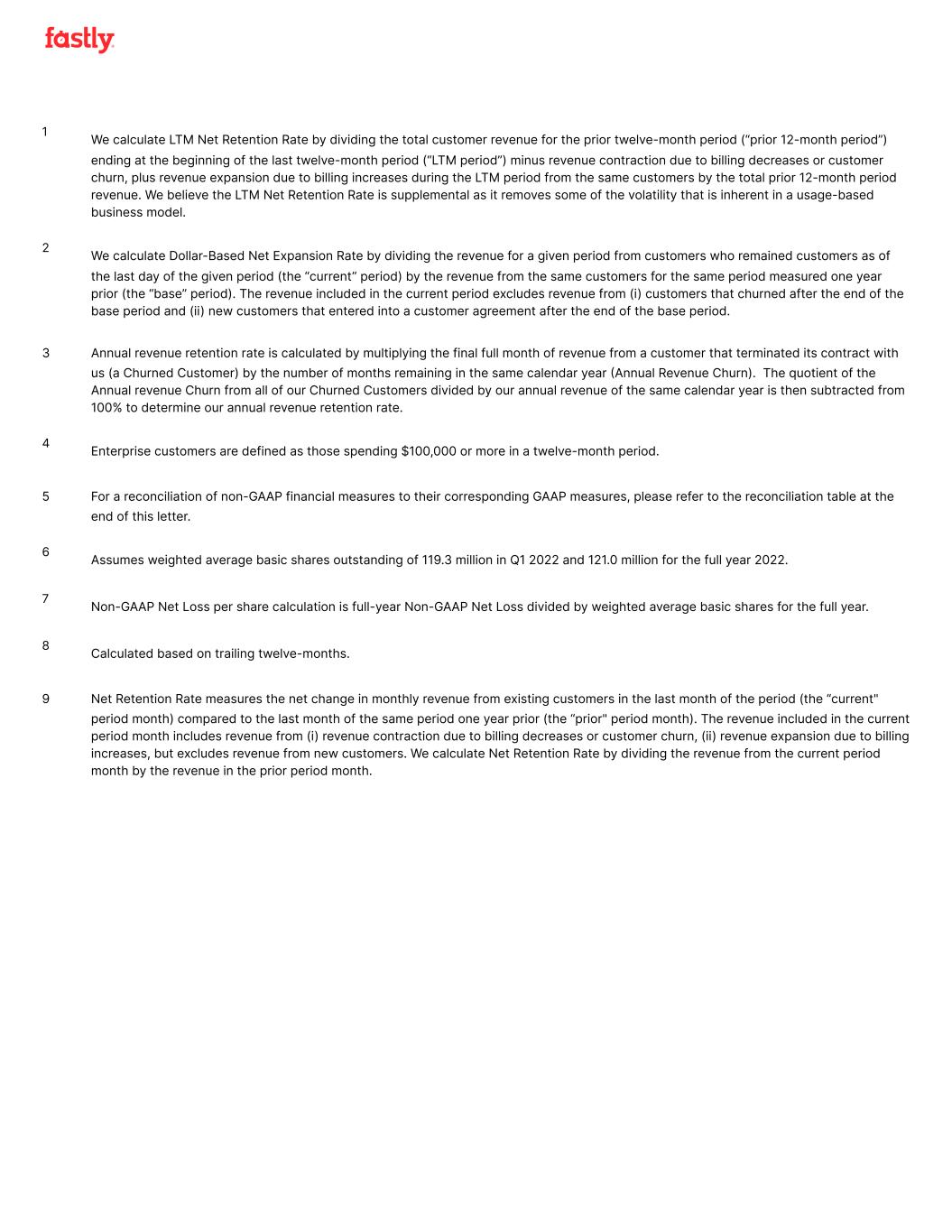
1 We calculate LTM Net Retention Rate by dividing the total customer revenue for the prior twelve-month period (“prior 12-month period”) ending at the beginning of the last twelve-month period (“LTM period”) minus revenue contraction due to billing decreases or customer churn, plus revenue expansion due to billing increases during the LTM period from the same customers by the total prior 12-month period revenue. We believe the LTM Net Retention Rate is supplemental as it removes some of the volatility that is inherent in a usage-based business model. 2 We calculate Dollar-Based Net Expansion Rate by dividing the revenue for a given period from customers who remained customers as of the last day of the given period (the “current” period) by the revenue from the same customers for the same period measured one year prior (the “base” period). The revenue included in the current period excludes revenue from (i) customers that churned after the end of the base period and (ii) new customers that entered into a customer agreement after the end of the base period. 3 Annual revenue retention rate is calculated by multiplying the final full month of revenue from a customer that terminated its contract with us (a Churned Customer) by the number of months remaining in the same calendar year �Annual Revenue Churn). The quotient of the Annual revenue Churn from all of our Churned Customers divided by our annual revenue of the same calendar year is then subtracted from 100% to determine our annual revenue retention rate. 4 Enterprise customers are defined as those spending $100,000 or more in a twelve-month period. 5 For a reconciliation of non-GAAP financial measures to their corresponding GAAP measures, please refer to the reconciliation table at the end of this letter. 6 Assumes weighted average basic shares outstanding of 119.3 million in Q1 2022 and 121.0 million for the full year 2022. 7 Non-GAAP Net Loss per share calculation is full-year Non-GAAP Net Loss divided by weighted average basic shares for the full year. 8 Calculated based on trailing twelve-months. 9 Net Retention Rate measures the net change in monthly revenue from existing customers in the last month of the period (the “current" period month) compared to the last month of the same period one year prior (the “prior" period month). The revenue included in the current period month includes revenue from (i) revenue contraction due to billing decreases or customer churn, (ii) revenue expansion due to billing increases, but excludes revenue from new customers. We calculate Net Retention Rate by dividing the revenue from the current period month by the revenue in the prior period month.
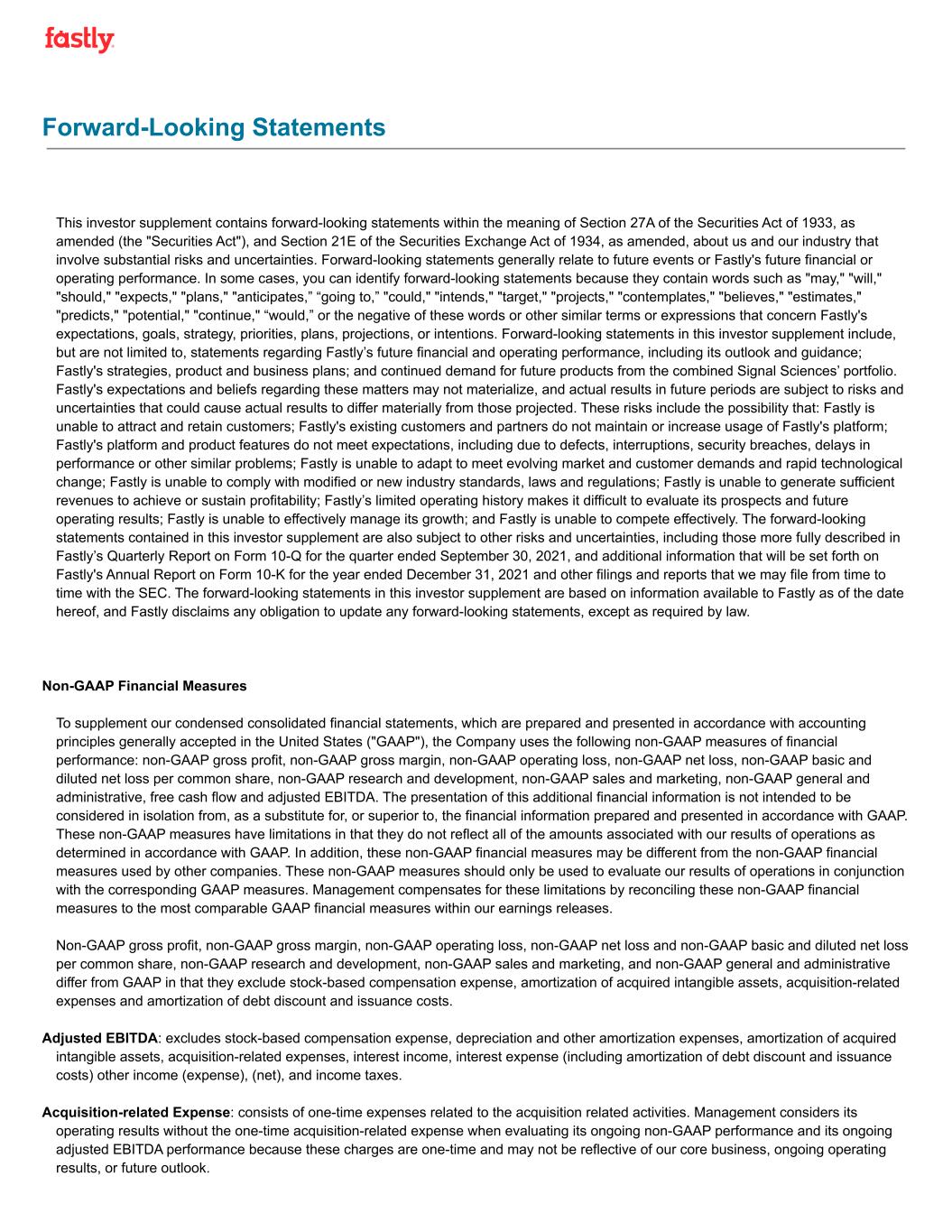
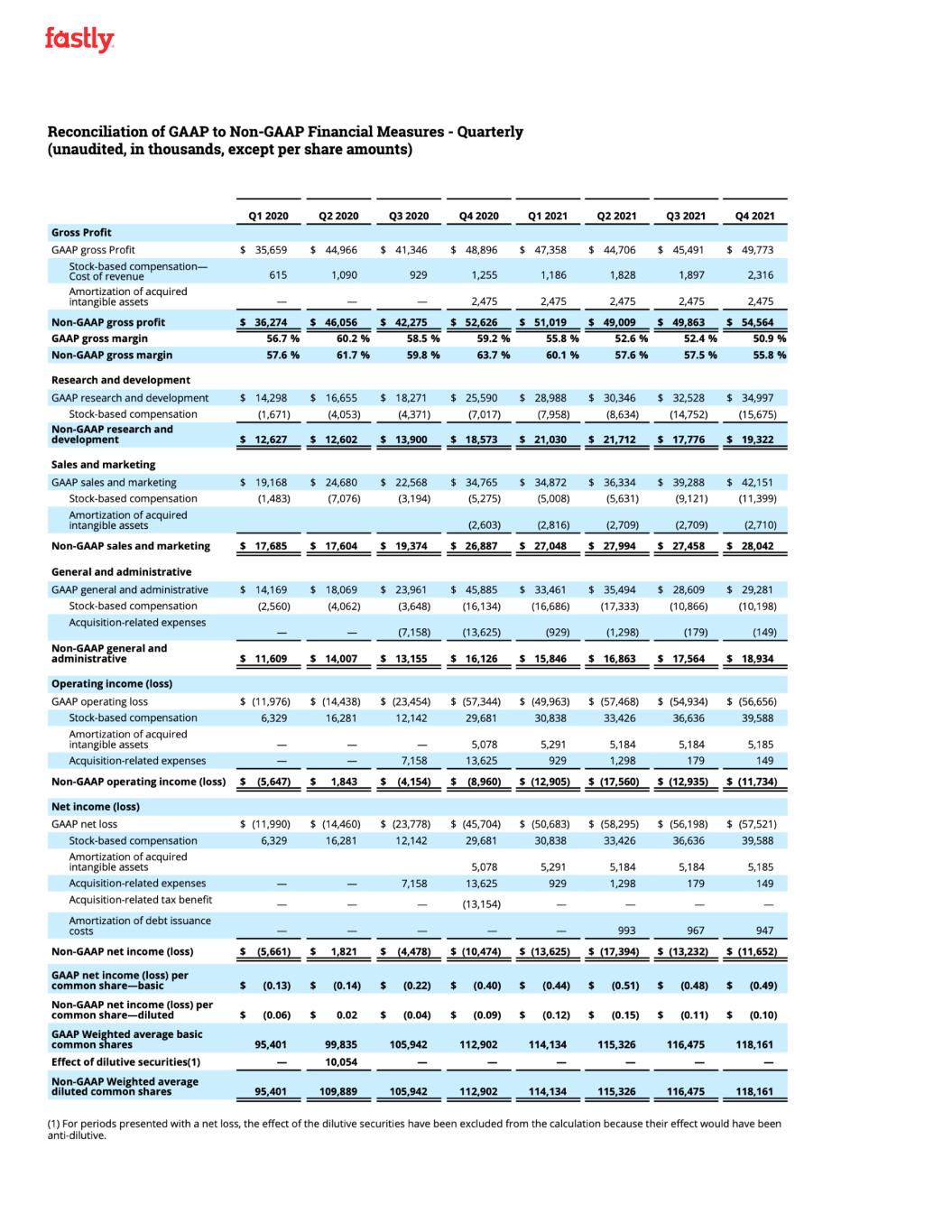
Forward-Looking Statements This investor supplement contains forward-looking statements within the meaning of Section 27A of the Securities Act of 1933, as amended (the "Securities Act"), and Section 21E of the Securities Exchange Act of 1934, as amended, about us and our industry that involve substantial risks and uncertainties. Forward-looking statements generally relate to future events or Fastly's future financial or operating performance. In some cases, you can identify forward-looking statements because they contain words such as "may," "will," "should," "expects," "plans," "anticipates,” “going to,” "could," "intends," "target," "projects," "contemplates," "believes," "estimates," "predicts," "potential," "continue," “would,” or the negative of these words or other similar terms or expressions that concern Fastly's expectations, goals, strategy, priorities, plans, projections, or intentions. Forward-looking statements in this investor supplement include, but are not limited to, statements regarding Fastly’s future financial and operating performance, including its outlook and guidance; Fastly's strategies, product and business plans; and continued demand for future products from the combined Signal Sciences’ portfolio. Fastly's expectations and beliefs regarding these matters may not materialize, and actual results in future periods are subject to risks and uncertainties that could cause actual results to differ materially from those projected. These risks include the possibility that: Fastly is unable to attract and retain customers; Fastly's existing customers and partners do not maintain or increase usage of Fastly's platform; Fastly's platform and product features do not meet expectations, including due to defects, interruptions, security breaches, delays in performance or other similar problems; Fastly is unable to adapt to meet evolving market and customer demands and rapid technological change; Fastly is unable to comply with modified or new industry standards, laws and regulations; Fastly is unable to generate sufficient revenues to achieve or sustain profitability; Fastly’s limited operating history makes it difficult to evaluate its prospects and future operating results; Fastly is unable to effectively manage its growth; and Fastly is unable to compete effectively. The forward-looking statements contained in this investor supplement are also subject to other risks and uncertainties, including those more fully described in Fastly’s Quarterly Report on Form 10-Q for the quarter ended September 30, 2021, and additional information that will be set forth on Fastly's Annual Report on Form 10-K for the year ended December 31, 2021 and other filings and reports that we may file from time to time with the SEC. The forward-looking statements in this investor supplement are based on information available to Fastly as of the date hereof, and Fastly disclaims any obligation to update any forward-looking statements, except as required by law. Non-GAAP Financial Measures To supplement our condensed consolidated financial statements, which are prepared and presented in accordance with accounting principles generally accepted in the United States ("GAAP"), the Company uses the following non-GAAP measures of financial performance: non-GAAP gross profit, non-GAAP gross margin, non-GAAP operating loss, non-GAAP net loss, non-GAAP basic and diluted net loss per common share, non-GAAP research and development, non-GAAP sales and marketing, non-GAAP general and administrative, free cash flow and adjusted EBITDA. The presentation of this additional financial information is not intended to be considered in isolation from, as a substitute for, or superior to, the financial information prepared and presented in accordance with GAAP. These non-GAAP measures have limitations in that they do not reflect all of the amounts associated with our results of operations as determined in accordance with GAAP. In addition, these non-GAAP financial measures may be different from the non-GAAP financial measures used by other companies. These non-GAAP measures should only be used to evaluate our results of operations in conjunction with the corresponding GAAP measures. Management compensates for these limitations by reconciling these non-GAAP financial measures to the most comparable GAAP financial measures within our earnings releases. Non-GAAP gross profit, non-GAAP gross margin, non-GAAP operating loss, non-GAAP net loss and non-GAAP basic and diluted net loss per common share, non-GAAP research and development, non-GAAP sales and marketing, and non-GAAP general and administrative differ from GAAP in that they exclude stock-based compensation expense, amortization of acquired intangible assets, acquisition-related expenses and amortization of debt discount and issuance costs. Adjusted EBITDA: excludes stock-based compensation expense, depreciation and other amortization expenses, amortization of acquired intangible assets, acquisition-related expenses, interest income, interest expense (including amortization of debt discount and issuance costs) other income (expense), (net), and income taxes. Acquisition-related Expense: consists of one-time expenses related to the acquisition related activities. Management considers its operating results without the one-time acquisition-related expense when evaluating its ongoing non-GAAP performance and its ongoing adjusted EBITDA performance because these charges are one-time and may not be reflective of our core business, ongoing operating results, or future outlook.
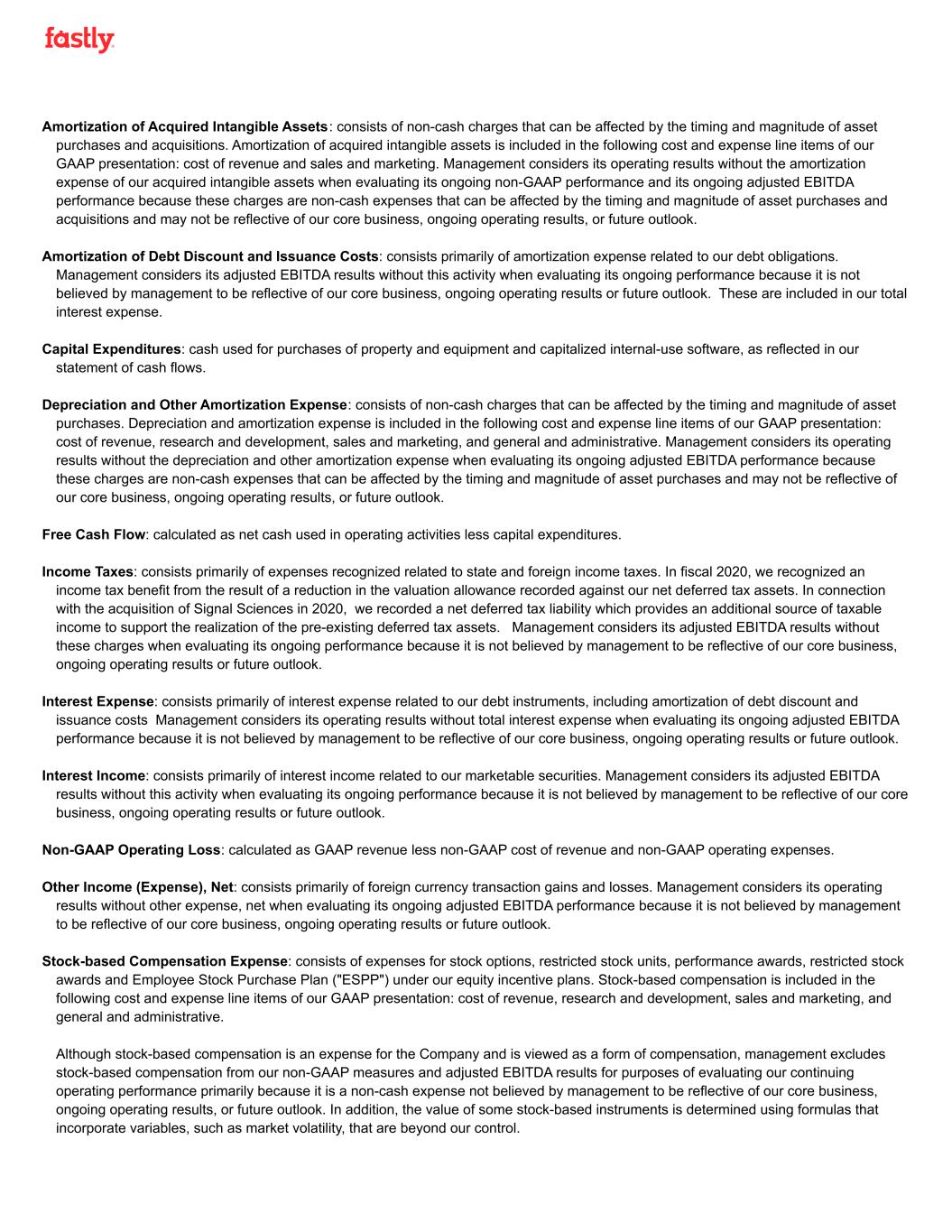
Amortization of Acquired Intangible Assets: consists of non-cash charges that can be affected by the timing and magnitude of asset purchases and acquisitions. Amortization of acquired intangible assets is included in the following cost and expense line items of our GAAP presentation: cost of revenue and sales and marketing. Management considers its operating results without the amortization expense of our acquired intangible assets when evaluating its ongoing non-GAAP performance and its ongoing adjusted EBITDA performance because these charges are non-cash expenses that can be affected by the timing and magnitude of asset purchases and acquisitions and may not be reflective of our core business, ongoing operating results, or future outlook. Amortization of Debt Discount and Issuance Costs: consists primarily of amortization expense related to our debt obligations. Management considers its adjusted EBITDA results without this activity when evaluating its ongoing performance because it is not believed by management to be reflective of our core business, ongoing operating results or future outlook. These are included in our total interest expense. Capital Expenditures: cash used for purchases of property and equipment and capitalized internal-use software, as reflected in our statement of cash flows. Depreciation and Other Amortization Expense: consists of non-cash charges that can be affected by the timing and magnitude of asset purchases. Depreciation and amortization expense is included in the following cost and expense line items of our GAAP presentation: cost of revenue, research and development, sales and marketing, and general and administrative. Management considers its operating results without the depreciation and other amortization expense when evaluating its ongoing adjusted EBITDA performance because these charges are non-cash expenses that can be affected by the timing and magnitude of asset purchases and may not be reflective of our core business, ongoing operating results, or future outlook. Free Cash Flow: calculated as net cash used in operating activities less capital expenditures. Income Taxes: consists primarily of expenses recognized related to state and foreign income taxes. In fiscal 2020, we recognized an income tax benefit from the result of a reduction in the valuation allowance recorded against our net deferred tax assets. In connection with the acquisition of Signal Sciences in 2020, we recorded a net deferred tax liability which provides an additional source of taxable income to support the realization of the pre-existing deferred tax assets. Management considers its adjusted EBITDA results without these charges when evaluating its ongoing performance because it is not believed by management to be reflective of our core business, ongoing operating results or future outlook. Interest Expense: consists primarily of interest expense related to our debt instruments, including amortization of debt discount and issuance costs Management considers its operating results without total interest expense when evaluating its ongoing adjusted EBITDA performance because it is not believed by management to be reflective of our core business, ongoing operating results or future outlook. Interest Income: consists primarily of interest income related to our marketable securities. Management considers its adjusted EBITDA results without this activity when evaluating its ongoing performance because it is not believed by management to be reflective of our core business, ongoing operating results or future outlook. Non-GAAP Operating Loss: calculated as GAAP revenue less non-GAAP cost of revenue and non-GAAP operating expenses. Other Income (Expense), Net: consists primarily of foreign currency transaction gains and losses. Management considers its operating results without other expense, net when evaluating its ongoing adjusted EBITDA performance because it is not believed by management to be reflective of our core business, ongoing operating results or future outlook. Stock-based Compensation Expense: consists of expenses for stock options, restricted stock units, performance awards, restricted stock awards and Employee Stock Purchase Plan ("ESPP") under our equity incentive plans. Stock-based compensation is included in the following cost and expense line items of our GAAP presentation: cost of revenue, research and development, sales and marketing, and general and administrative. Although stock-based compensation is an expense for the Company and is viewed as a form of compensation, management excludes stock-based compensation from our non-GAAP measures and adjusted EBITDA results for purposes of evaluating our continuing operating performance primarily because it is a non-cash expense not believed by management to be reflective of our core business, ongoing operating results, or future outlook. In addition, the value of some stock-based instruments is determined using formulas that incorporate variables, such as market volatility, that are beyond our control.

Management believes these non-GAAP financial measures and adjusted EBITDA serve as useful metrics for our management and investors because they enable a better understanding of the long-term performance of our core business and facilitate comparisons of our operating results over multiple periods and to those of peer companies, and when taken together with the corresponding GAAP financial measures and our reconciliations, enhance investors' overall understanding of our current financial performance. In the financial tables below, the Company provides a reconciliation of the most comparable GAAP financial measure to the historical non-GAAP financial measures used in this investor supplement.