
LMND 8-K
Lemonade, Inc. (LMND)
8-K
2022-05-09
For: 2022-05-09
View Original
Added on
April 08, 2026
UNITED STATES
SECURITIES AND EXCHANGE COMMISSION
Washington, D.C. 20549
FORM 8-K
CURRENT REPORT
Pursuant to Section 13 or 15(d)
of the Securities Exchange Act of 1934
Date of report (Date of earliest event reported): May 9, 2022
(Exact name of registrant as specified in its charter)
(State or other jurisdiction of incorporation) | (Commission File Number) | (I.R.S. Employer Identification No.) | ||||||||||||
(Address of principal executive offices) (Zip Code)
(844 ) 733-8666
(Registrant’s telephone number, include area code)
N/A
(Former Name or Former Address, if Changed Since Last Report)
Check the appropriate box below if the Form 8-K filing is intended to simultaneously satisfy the filing obligation of the registrant under any of the following provisions:
| Written communications pursuant to Rule 425 under the Securities Act (17 CFR 230.425) | |||||
| Soliciting material pursuant to Rule 14a-12 under the Exchange Act (17 CFR 240.14a-12) | |||||
| Pre-commencement communications pursuant to Rule 14d-2(b) under the Exchange Act (17 CFR 240.14d-2(b)) | |||||
| Pre-commencement communications pursuant to Rule 13e-4(c) under the Exchange Act (17 CFR 240.13e-4(c)) | |||||
Securities registered pursuant to Section 12(b) of the Act:
| Title of each class | Trading Symbols | Name of each exchange on which registered | ||||||||||||
Indicate by check mark whether the registrant is an emerging growth company as defined in Rule 405 of the Securities Act of 1933 (§230.405 of this chapter) or Rule 12b-2 of the Securities Exchange Act of 1934 (§240.12b-2 of this chapter).
Emerging growth company ☐
If an emerging growth company, indicate by check mark if the registrant has elected not to use the extended transition period for complying with any new or revised financial accounting standards provided pursuant to Section 13(a) of the Exchange Act. ☐
Item 2.02 | Results of Operations and Financial Condition. | ||||
On May 9, 2022, the Company announced its financial results for the quarter ended March 31, 2022 by issuing a letter to shareholders. The full text of the letter to shareholders is furnished as Exhibit 99.1 to this Current Report on Form 8-K.
The information contained in Item 2.02 of this Form 8-K (including Exhibit 99.1 attached hereto) shall not be deemed “filed” for purposes of Section 18 of the Securities Exchange Act of 1934, as amended (the “Exchange Act”), or otherwise subject to the liabilities of that section, nor shall it be deemed incorporated by reference in any filing under the Securities Act of 1933, as amended, or the Exchange Act, except as expressly provided by specific reference in such a filing.
| Item 9.01 | Financial Statements and Exhibits | ||||
(d) Exhibits
The following exhibits shall be deemed to be furnished.
Exhibit No. | Description | |||||||
| 104 | Cover Page Interactive Data File (embedded with Inline XBRL document) | |||||||
SIGNATURES
Pursuant to the requirements of the Securities Exchange Act of 1934, the registrant has duly caused this report to be signed on its behalf by the undersigned hereunto duly authorized.
| LEMONADE, INC. | ||||||||||||||
| Date: May 9, 2022 | By: | /s/ Tim Bixby | ||||||||||||
| Tim Bixby | ||||||||||||||
| Chief Financial Officer | ||||||||||||||

Shareholder Letter Q1 2022
2
Dear Shareholders, We're happy to report that the year kicked off with a strong first quarter. Notwithstanding the turbulent market forces and macroeconomic environment, both our top line and our bottom line came in ahead of expectations. In force premium (IFP) stood at $419 million, while our EBITDA for the quarter was $(57) million, driven by continued, steady improvements in LTV/CAC and increasing bundle rates. Growing With Our Customers Speaking of bundling, this quarter saw an exciting milestone: the first full quarter in which all Lemonade products (renters/home, life, pet, and car) were available in a market. While this mega-bundle is currently available only in Illinois and Tennessee, these markets offer a peek into how meaningful growing with our customers can become as we roll out these products nationwide. The early data are encouraging. After only one complete quarter, we saw 40% higher bundle rates in Illinois versus the rest of the Lemonade market in the US. The average dual-product-customer outspent the average single- product-customers 3:1, for triple-product-customers the ratio was 7:1, while for customers with all four products it was 9:1. Consequently, Annual Dollar Retention (ADR) in Illinois rose to 90% in Q1 (vs. 82% for Lemonade overall). Where the building blocks are in place, this increase in premium per customer occurs organically. With the passage of time our customers go through predictable lifecycle events: moving, buying a home, getting a car, starting a family - all with dramatic implications for their insurance spend, and no corresponding marketing spend on our end. This dynamic not only boosts our bottom line, it is also the fastest contributor to our top line: while total premiums from single-product-customers grew 61% relative to Q1 2021, premiums from customers with two Lemonade products grew at a pace of 140%, and premiums from customers with 3 products jumped 390% during the same time (we had no 4-product customer last year). 3
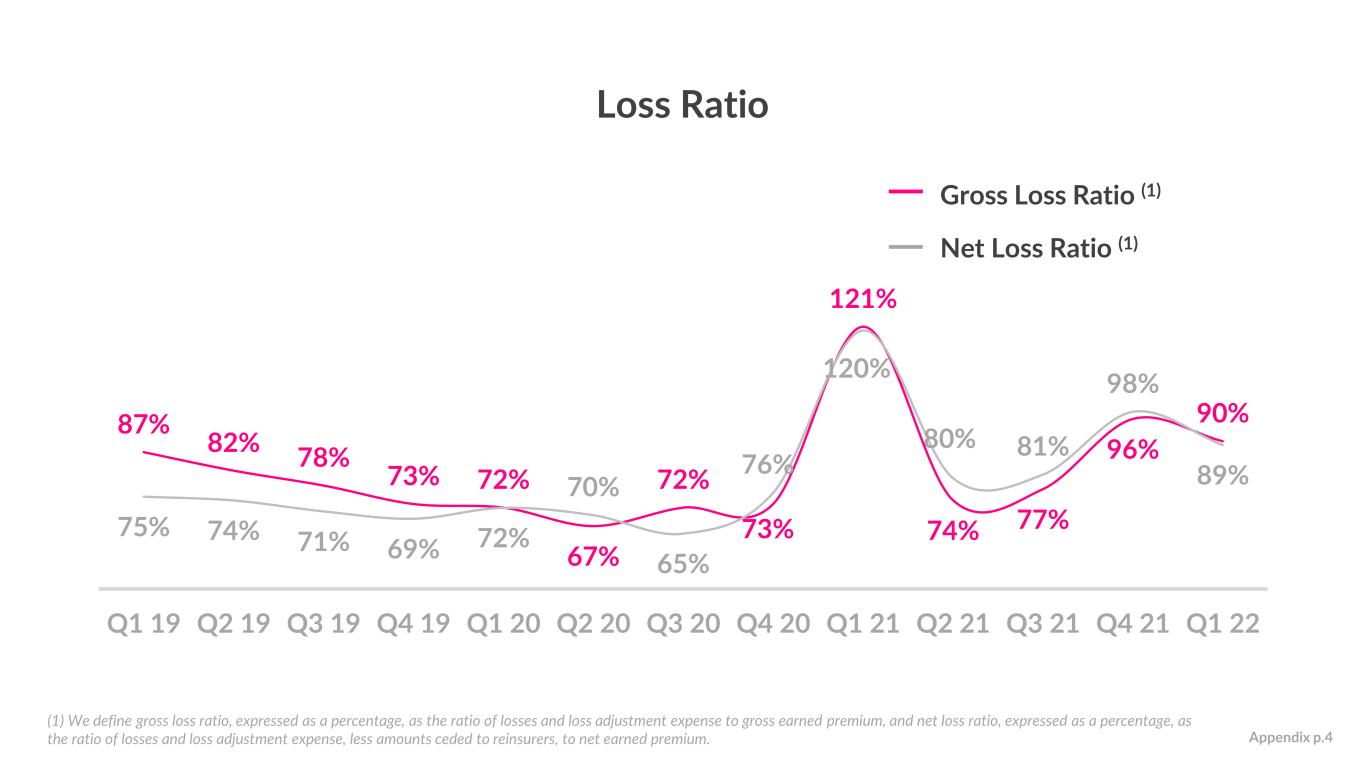
Growing with our customers has long been a central plank in our strategy, and, in the memorable words of Colonel 'Hannibal' Smith, we “love it when a plan comes together." Win With Technology If Grow With Customers has always been one plank of our strategy, Win With Technology has always been the other, holding the promise of best in class cost-to-serve, and risk quantification. Here, too, we are in the early stages of harvesting the fruits of our labors, and leading indicators are encouraging. When it comes to loss ratios, our internal dashboards show increasingly profitable cohorts with every successive month. We’re now on our fifth generation of machine learned models, and these do a bang up job of predicting the lifetime loss ratio of each new customer, as well as their likelihood to churn or cross sell, and combining these into a Lifetime Value (LTV) assessment. Notwithstanding our 90% loss ratio for the quarter, our dashboards show that the business we generated in Q1 is expected to have a loss ratio comfortably within our 75% target. Loss ratios are lagging indicators, and improvements in pricing, underwriting and segmentations take time to get approved, and yet more time to ‘earn in.' This lag between action and results is a structural nuisance in insurance (which is why we use predictive machine learning models, rather than backward looking loss ratios in our day-to-day management), though inflation has introduced an additional cost to this passage of time. As has been reported by all insurers, loss ratios in Q1 were hurt by inflation, as claims are instantly adjusted for inflation, while premium rates take months to adjust. Happily, we have filed 100 applications for rate changes over the past year, and expect to see rates move back in line with risk as we receive regulatory approvals. Based on the foregoing we reiterate our expectation of a multi-year average loss ratio within our 75% target, and remind our shareholders that while loss 4
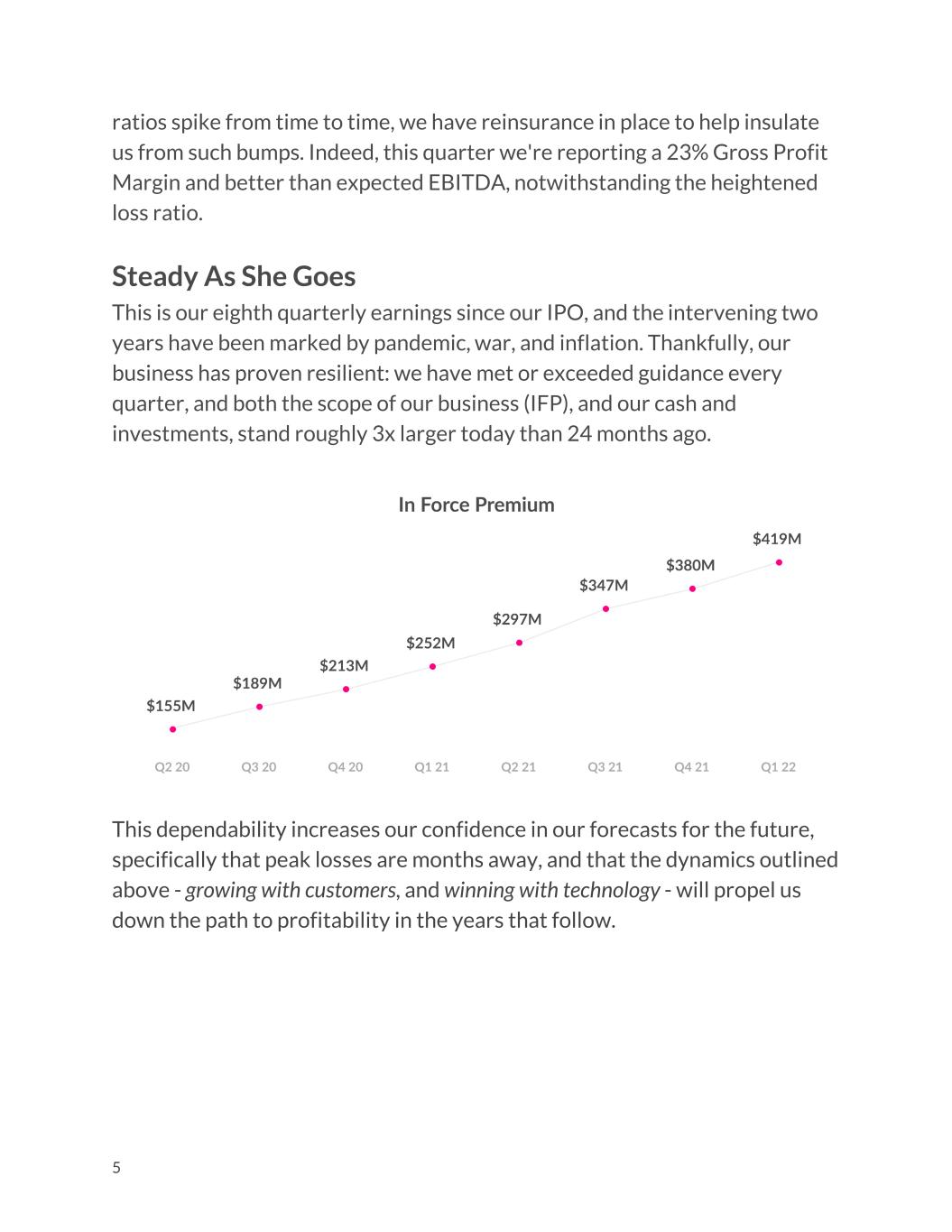
ratios spike from time to time, we have reinsurance in place to help insulate us from such bumps. Indeed, this quarter we're reporting a 23% Gross Profit Margin and better than expected EBITDA, notwithstanding the heightened loss ratio. Steady As She Goes This is our eighth quarterly earnings since our IPO, and the intervening two years have been marked by pandemic, war, and inflation. Thankfully, our business has proven resilient: we have met or exceeded guidance every quarter, and both the scope of our business (IFP), and our cash and investments, stand roughly 3x larger today than 24 months ago. This dependability increases our confidence in our forecasts for the future, specifically that peak losses are months away, and that the dynamics outlined above - growing with customers, and winning with technology - will propel us down the path to profitability in the years that follow. 5
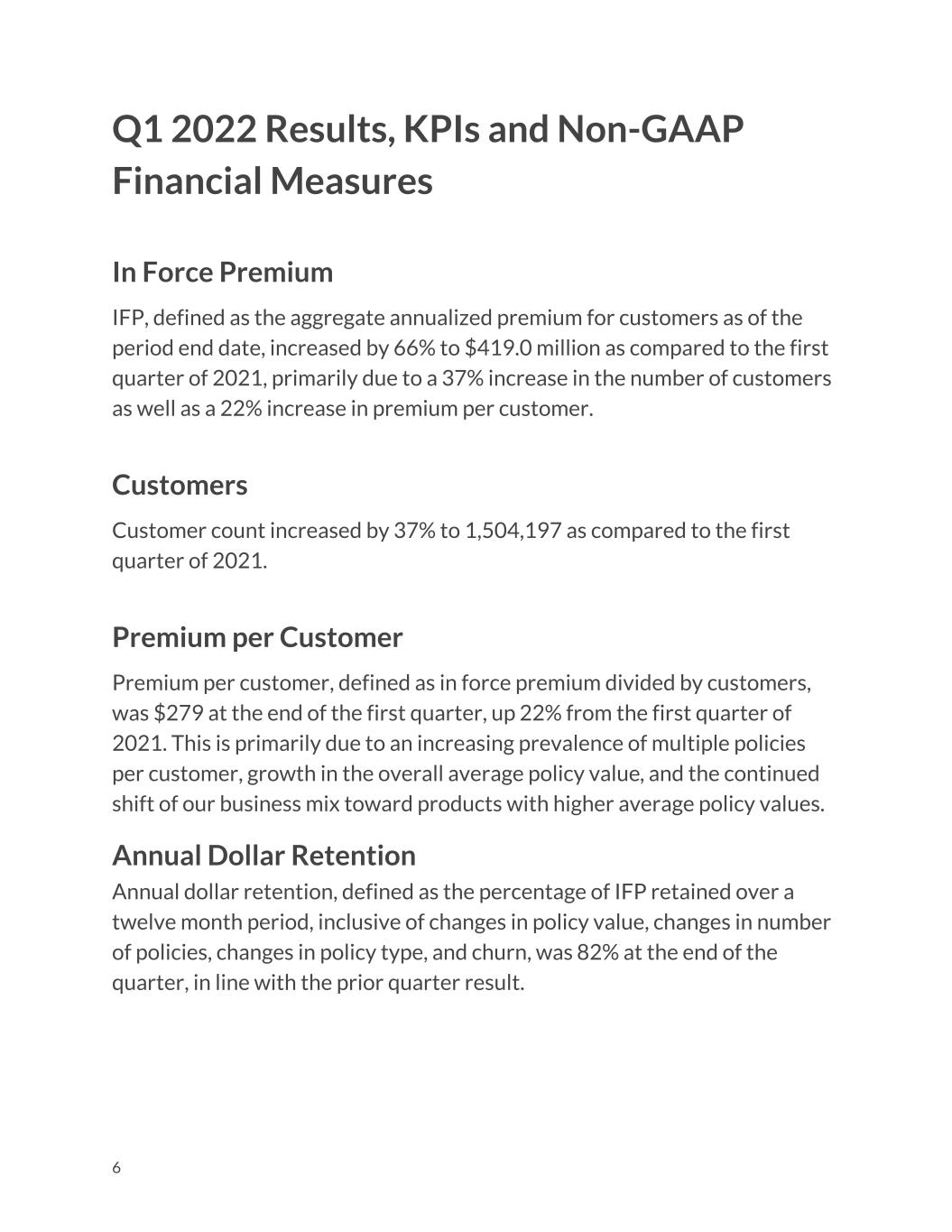
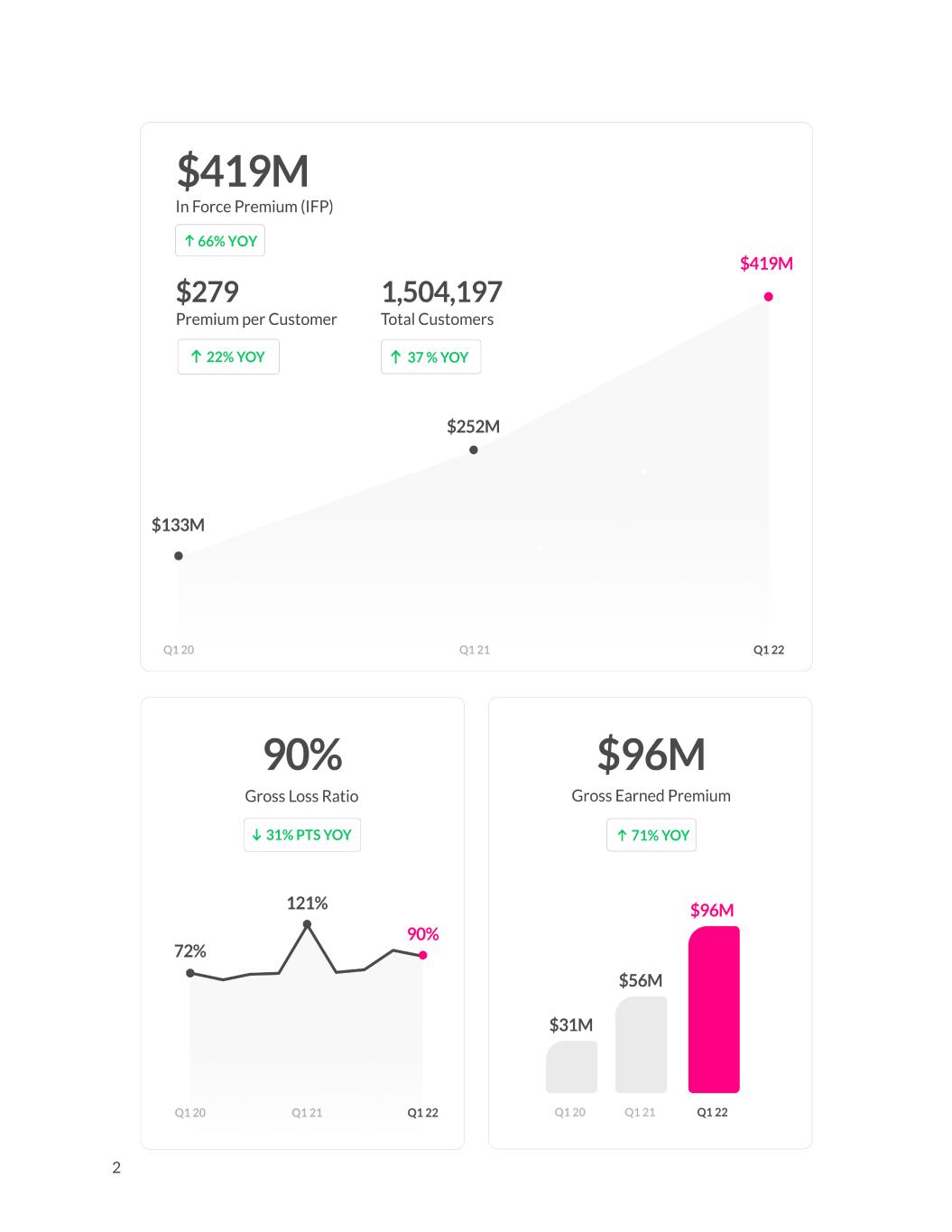
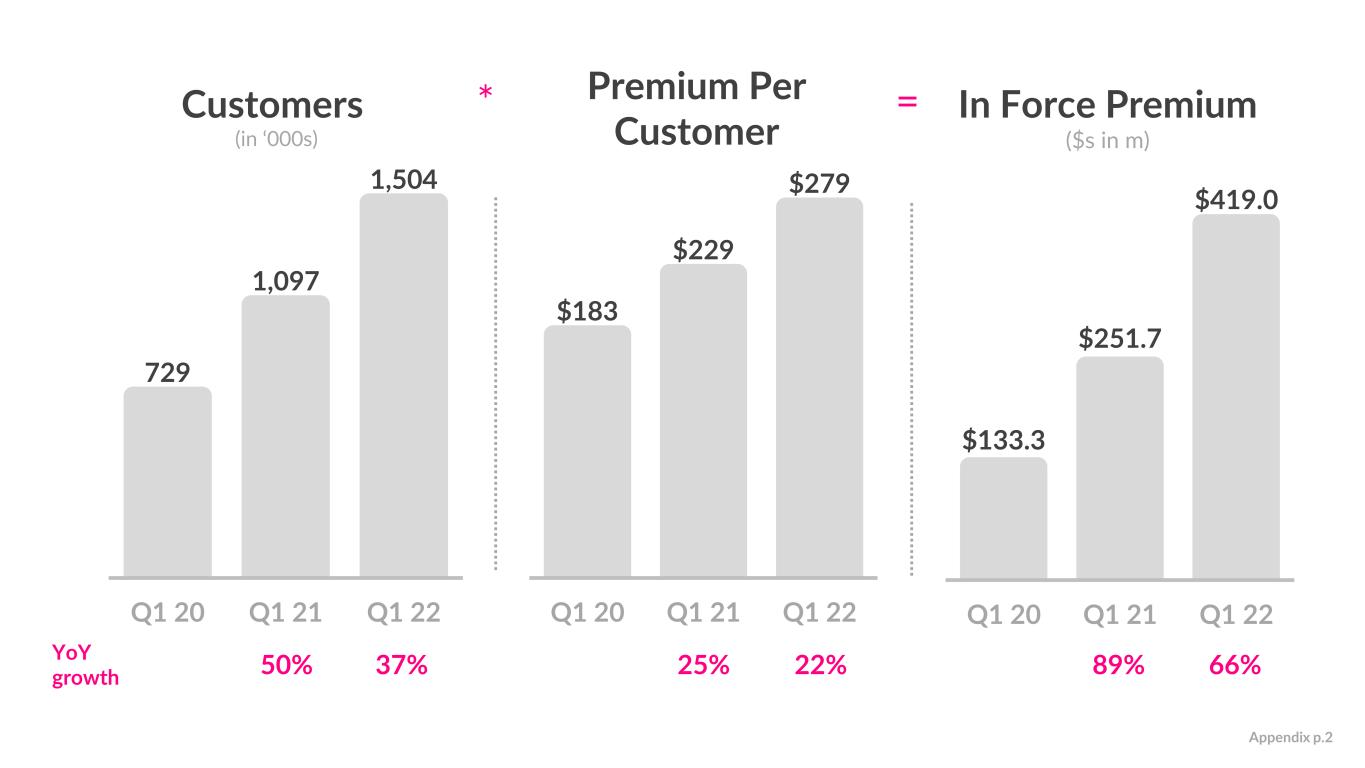
Q1 2022 Results, KPIs and Non-GAAP Financial Measures In Force Premium IFP, defined as the aggregate annualized premium for customers as of the period end date, increased by 66% to $419.0 million as compared to the first quarter of 2021, primarily due to a 37% increase in the number of customers as well as a 22% increase in premium per customer. Customers Customer count increased by 37% to 1,504,197 as compared to the first quarter of 2021. Premium per Customer Premium per customer, defined as in force premium divided by customers, was $279 at the end of the first quarter, up 22% from the first quarter of 2021. This is primarily due to an increasing prevalence of multiple policies per customer, growth in the overall average policy value, and the continued shift of our business mix toward products with higher average policy values. Annual Dollar Retention Annual dollar retention, defined as the percentage of IFP retained over a twelve month period, inclusive of changes in policy value, changes in number of policies, changes in policy type, and churn, was 82% at the end of the quarter, in line with the prior quarter result. 6
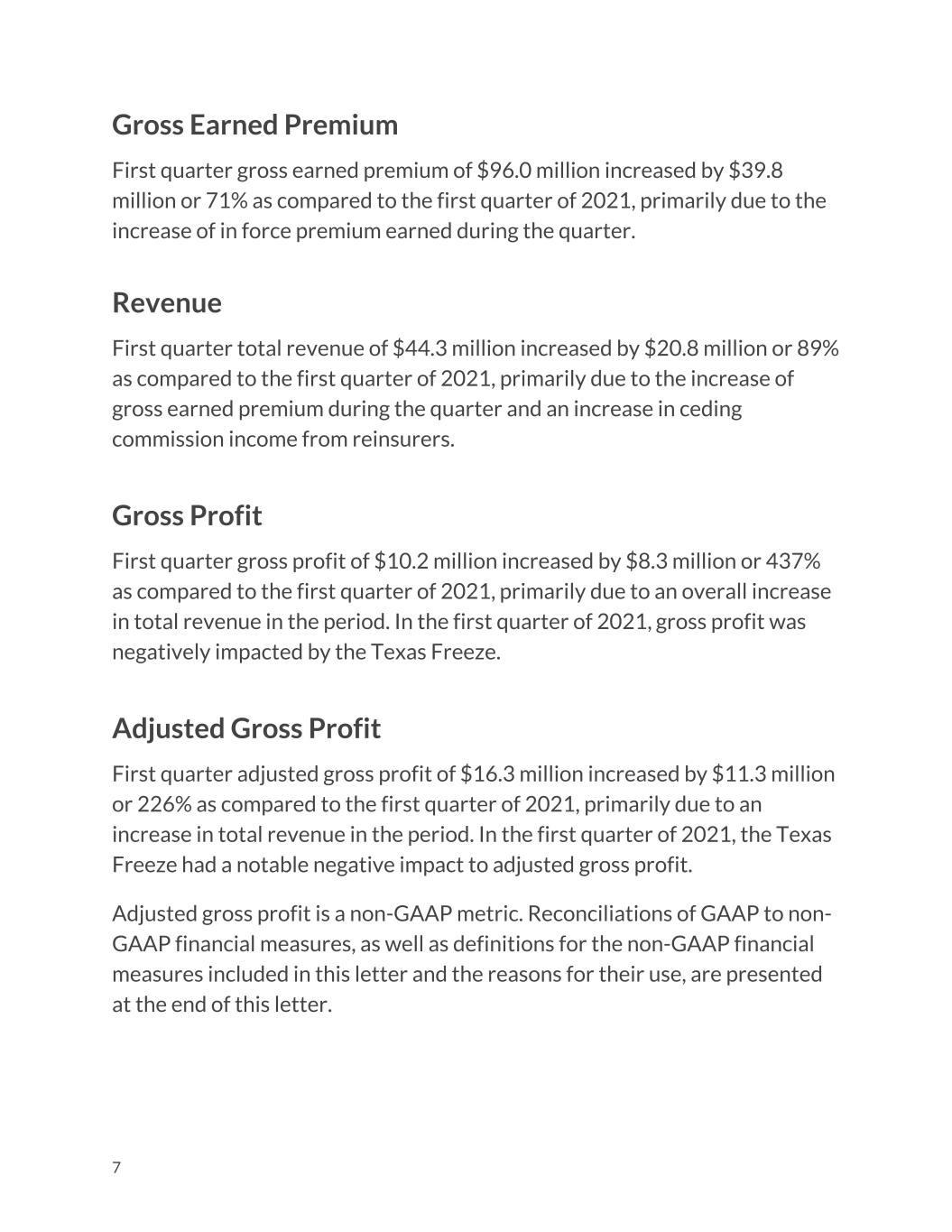
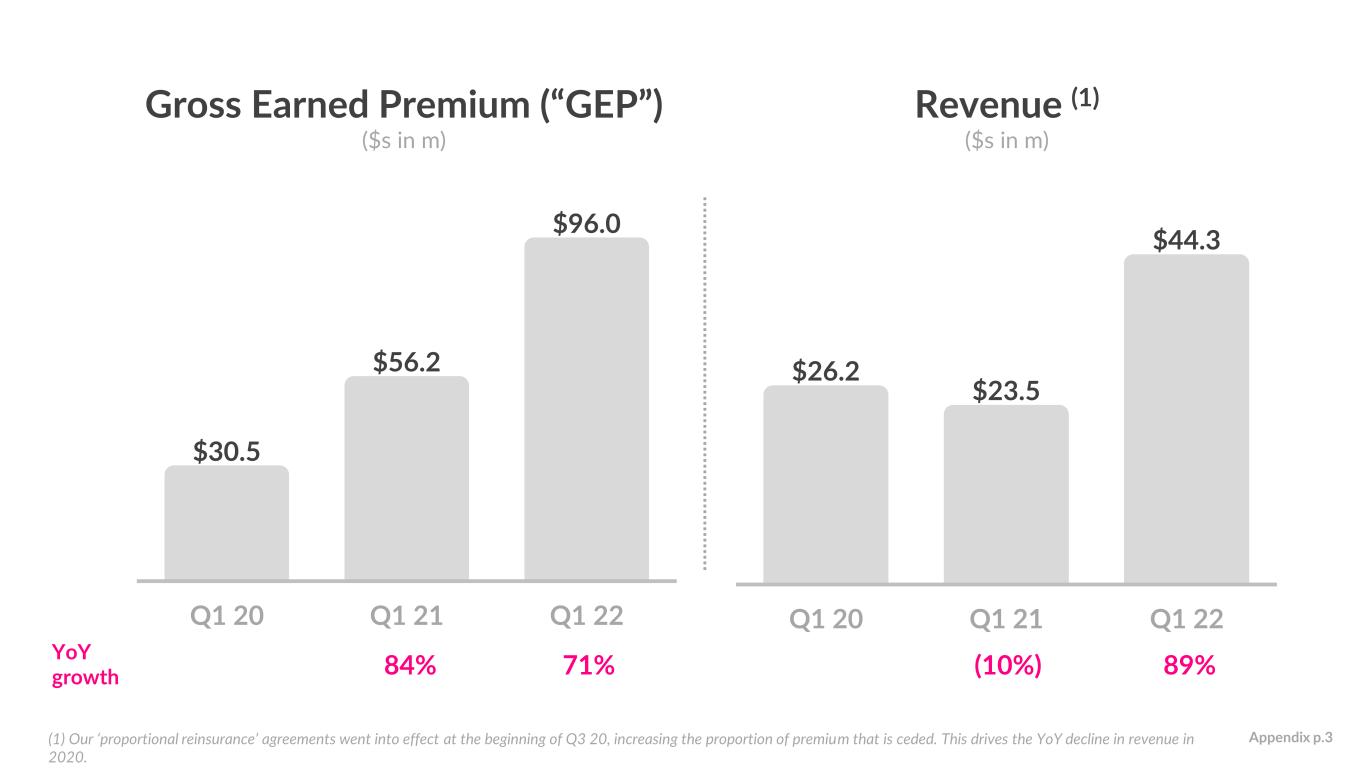
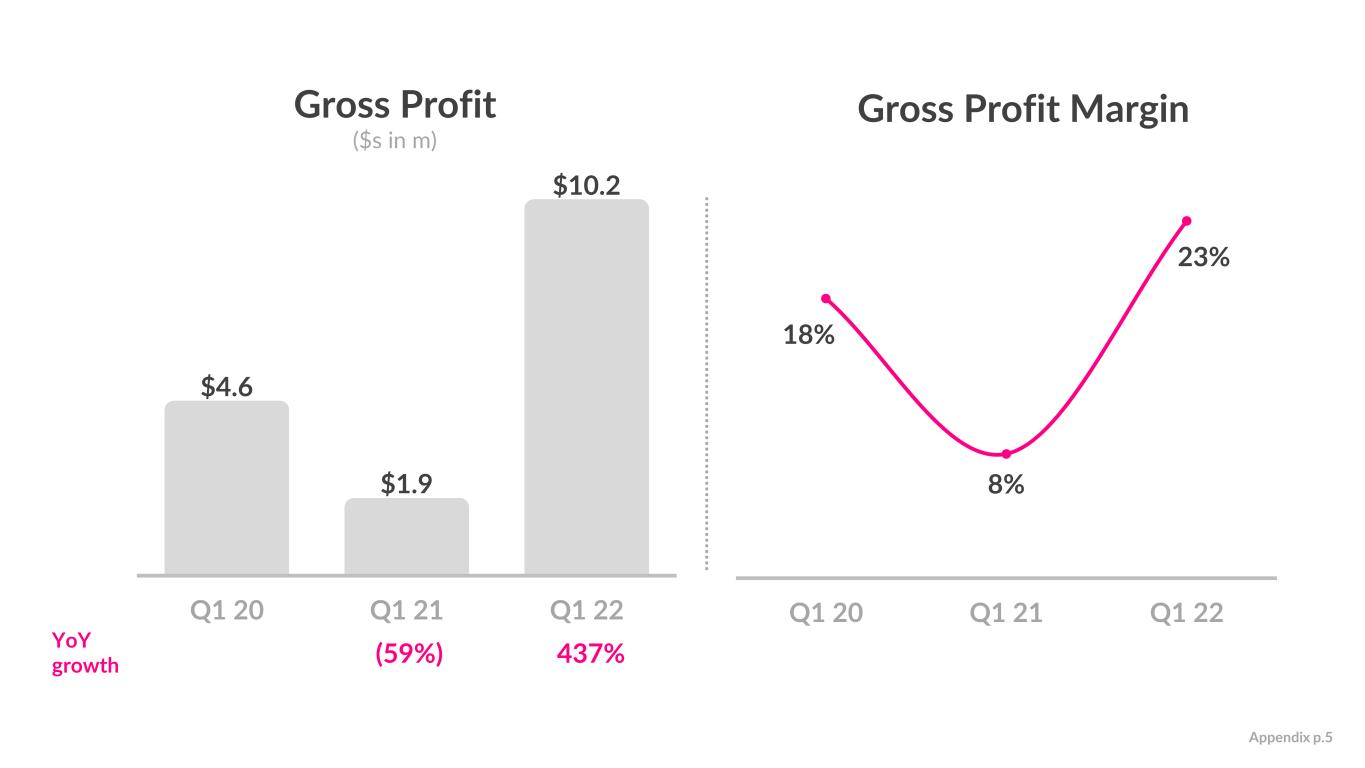
Gross Earned Premium First quarter gross earned premium of $96.0 million increased by $39.8 million or 71% as compared to the first quarter of 2021, primarily due to the increase of in force premium earned during the quarter. Revenue First quarter total revenue of $44.3 million increased by $20.8 million or 89% as compared to the first quarter of 2021, primarily due to the increase of gross earned premium during the quarter and an increase in ceding commission income from reinsurers. Gross Profit First quarter gross profit of $10.2 million increased by $8.3 million or 437% as compared to the first quarter of 2021, primarily due to an overall increase in total revenue in the period. In the first quarter of 2021, gross profit was negatively impacted by the Texas Freeze. Adjusted Gross Profit First quarter adjusted gross profit of $16.3 million increased by $11.3 million or 226% as compared to the first quarter of 2021, primarily due to an increase in total revenue in the period. In the first quarter of 2021, the Texas Freeze had a notable negative impact to adjusted gross profit. Adjusted gross profit is a non-GAAP metric. Reconciliations of GAAP to non- GAAP financial measures, as well as definitions for the non-GAAP financial measures included in this letter and the reasons for their use, are presented at the end of this letter. 7
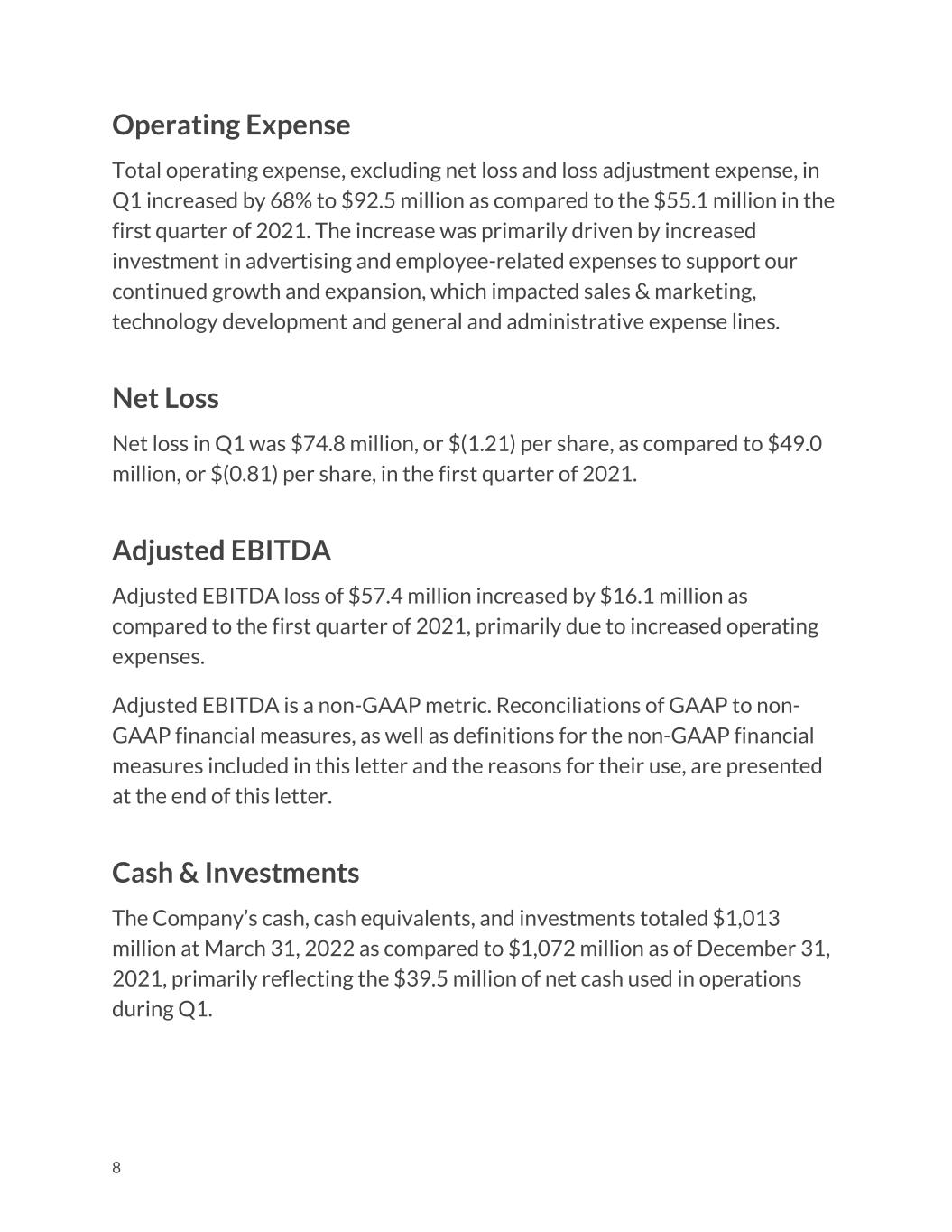
Operating Expense Total operating expense, excluding net loss and loss adjustment expense, in Q1 increased by 68% to $92.5 million as compared to the $55.1 million in the first quarter of 2021. The increase was primarily driven by increased investment in advertising and employee-related expenses to support our continued growth and expansion, which impacted sales & marketing, technology development and general and administrative expense lines. Net Loss Net loss in Q1 was $74.8 million, or $(1.21) per share, as compared to $49.0 million, or $(0.81) per share, in the first quarter of 2021. Adjusted EBITDA Adjusted EBITDA loss of $57.4 million increased by $16.1 million as compared to the first quarter of 2021, primarily due to increased operating expenses. Adjusted EBITDA is a non-GAAP metric. Reconciliations of GAAP to non- GAAP financial measures, as well as definitions for the non-GAAP financial measures included in this letter and the reasons for their use, are presented at the end of this letter. Cash & Investments The Company’s cash, cash equivalents, and investments totaled $1,013 million at March 31, 2022 as compared to $1,072 million as of December 31, 2021, primarily reflecting the $39.5 million of net cash used in operations during Q1. 8
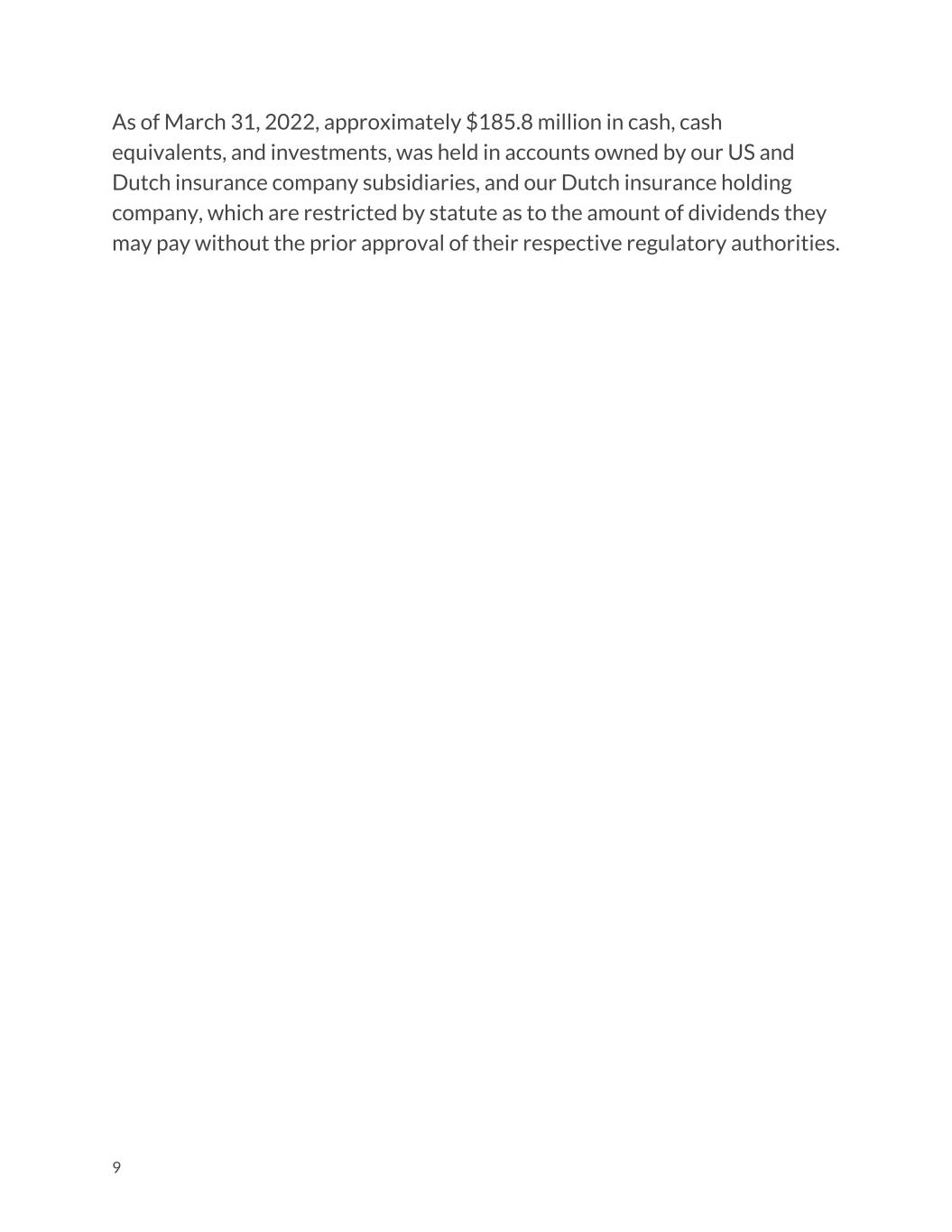
As of March 31, 2022, approximately $185.8 million in cash, cash equivalents, and investments, was held in accounts owned by our US and Dutch insurance company subsidiaries, and our Dutch insurance holding company, which are restricted by statute as to the amount of dividends they may pay without the prior approval of their respective regulatory authorities. 9
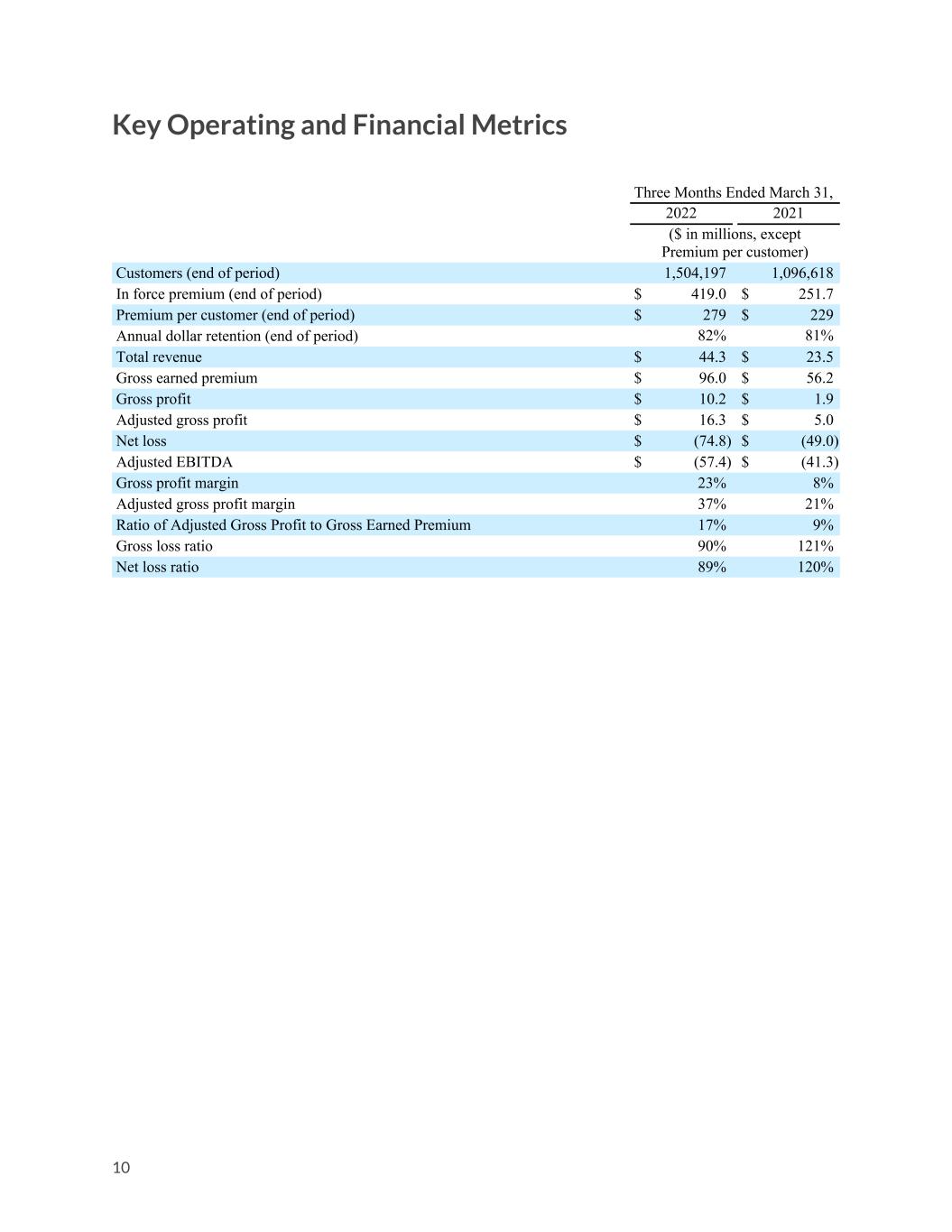
Key Operating and Financial Metrics Three Months Ended March 31, 2022 2021 ($ in millions, except Premium per customer) Customers (end of period) 1,504,197 1,096,618 In force premium (end of period) $ 419.0 $ 251.7 Premium per customer (end of period) $ 279 $ 229 Annual dollar retention (end of period) 82% 81% Total revenue $ 44.3 $ 23.5 Gross earned premium $ 96.0 $ 56.2 Gross profit $ 10.2 $ 1.9 Adjusted gross profit $ 16.3 $ 5.0 Net loss $ (74.8) $ (49.0) Adjusted EBITDA $ (57.4) $ (41.3) Gross profit margin 23% 8% Adjusted gross profit margin 37% 21% Ratio of Adjusted Gross Profit to Gross Earned Premium 17% 9% Gross loss ratio 90% 121% Net loss ratio 89% 120% 10
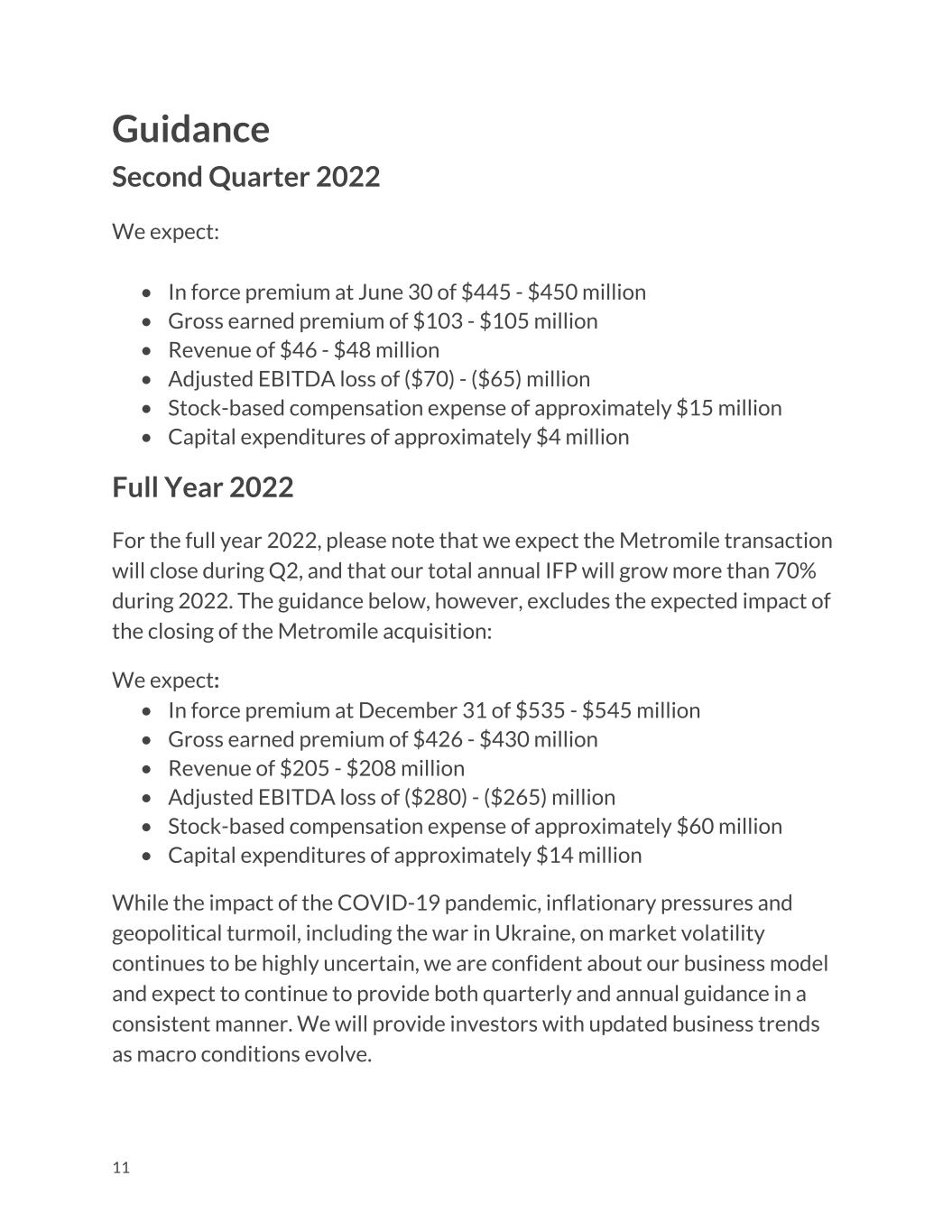
Guidance Second Quarter 2022 We expect: • In force premium at June 30 of $445 - $450 million • Gross earned premium of $103 - $105 million • Revenue of $46 - $48 million • Adjusted EBITDA loss of ($70) - ($65) million • Stock-based compensation expense of approximately $15 million • Capital expenditures of approximately $4 million Full Year 2022 For the full year 2022, please note that we expect the Metromile transaction will close during Q2, and that our total annual IFP will grow more than 70% during 2022. The guidance below, however, excludes the expected impact of the closing of the Metromile acquisition: We expect: • In force premium at December 31 of $535 - $545 million • Gross earned premium of $426 - $430 million • Revenue of $205 - $208 million • Adjusted EBITDA loss of ($280) - ($265) million • Stock-based compensation expense of approximately $60 million • Capital expenditures of approximately $14 million While the impact of the COVID-19 pandemic, inflationary pressures and geopolitical turmoil, including the war in Ukraine, on market volatility continues to be highly uncertain, we are confident about our business model and expect to continue to provide both quarterly and annual guidance in a consistent manner. We will provide investors with updated business trends as macro conditions evolve. 11
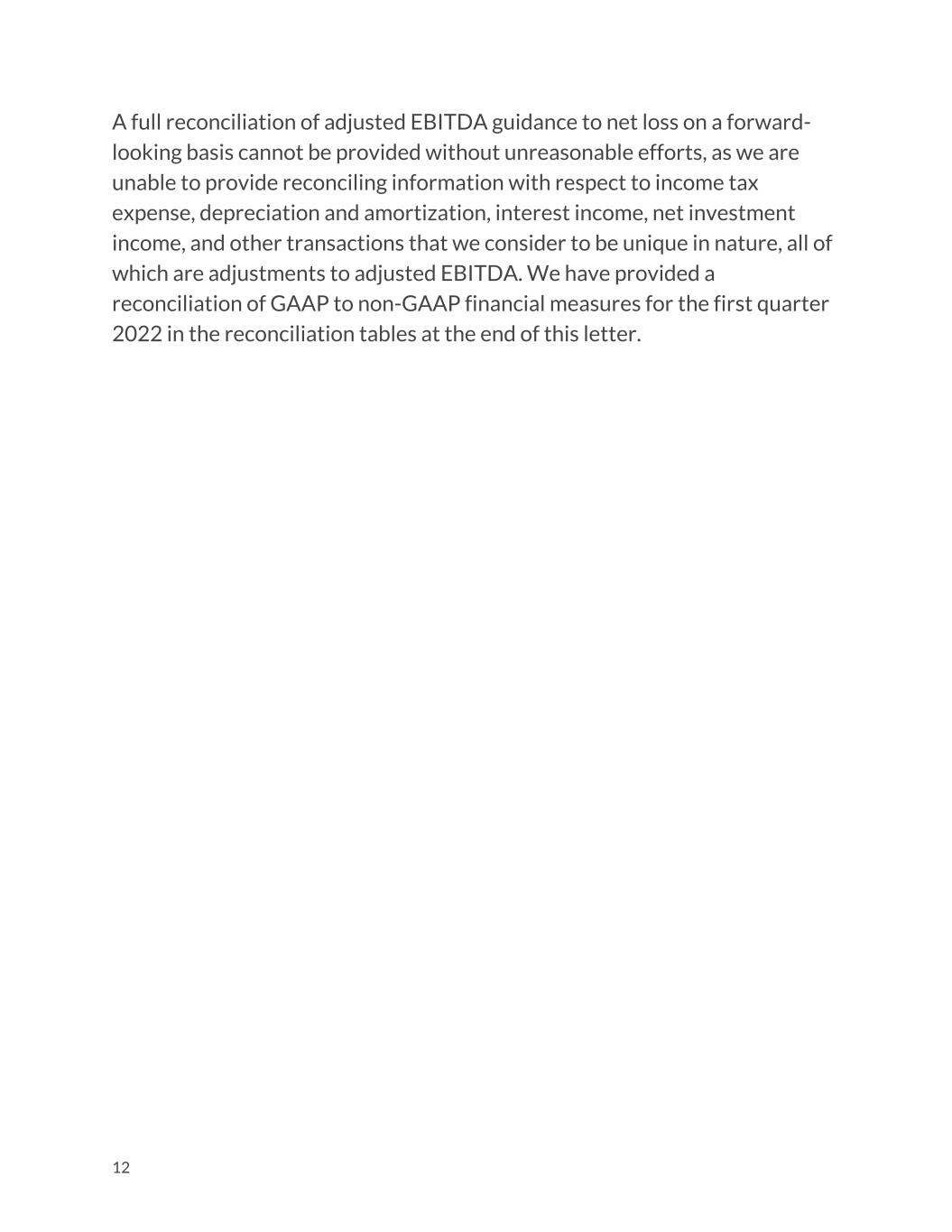
A full reconciliation of adjusted EBITDA guidance to net loss on a forward- looking basis cannot be provided without unreasonable efforts, as we are unable to provide reconciling information with respect to income tax expense, depreciation and amortization, interest income, net investment income, and other transactions that we consider to be unique in nature, all of which are adjustments to adjusted EBITDA. We have provided a reconciliation of GAAP to non-GAAP financial measures for the first quarter 2022 in the reconciliation tables at the end of this letter. 12
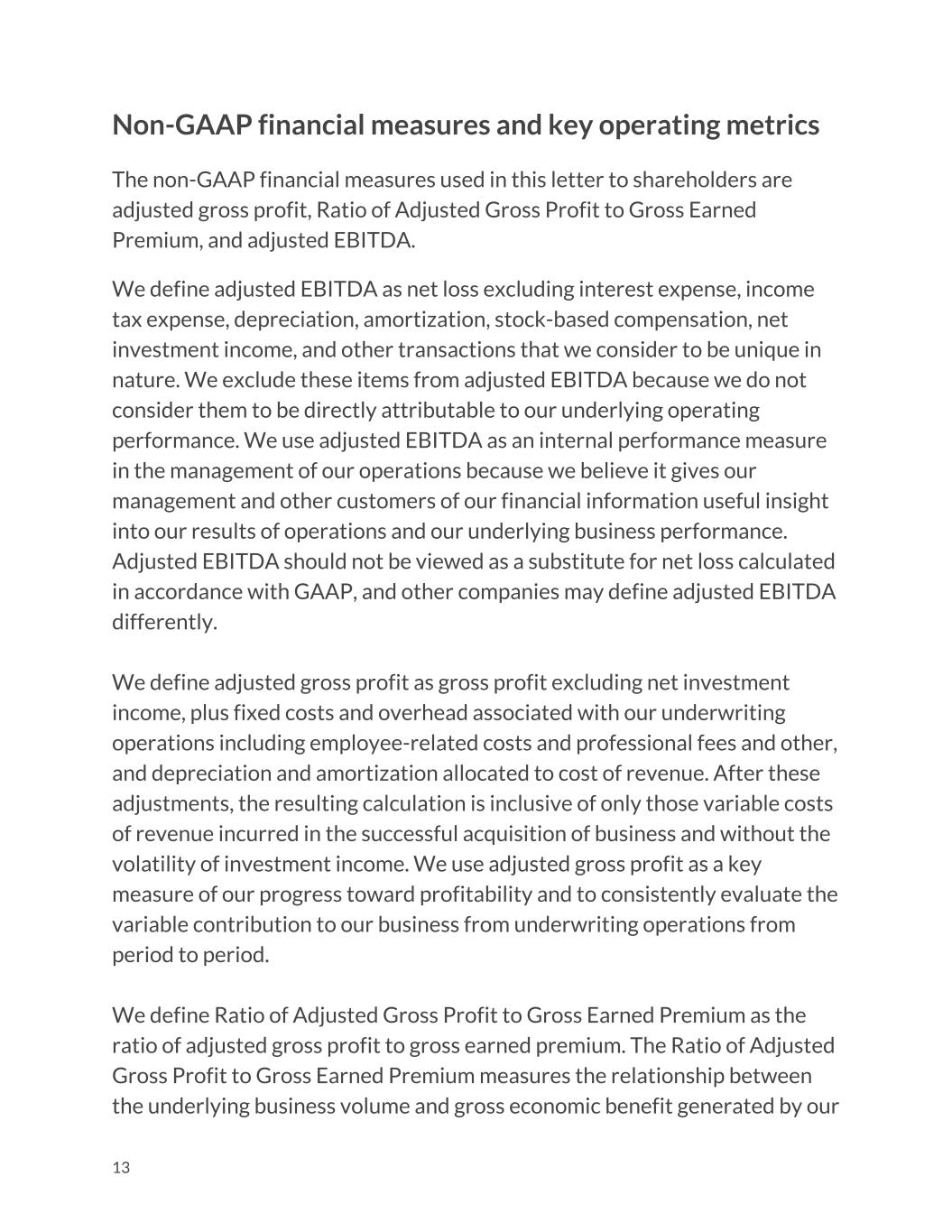
Non-GAAP financial measures and key operating metrics The non-GAAP financial measures used in this letter to shareholders are adjusted gross profit, Ratio of Adjusted Gross Profit to Gross Earned Premium, and adjusted EBITDA. We define adjusted EBITDA as net loss excluding interest expense, income tax expense, depreciation, amortization, stock-based compensation, net investment income, and other transactions that we consider to be unique in nature. We exclude these items from adjusted EBITDA because we do not consider them to be directly attributable to our underlying operating performance. We use adjusted EBITDA as an internal performance measure in the management of our operations because we believe it gives our management and other customers of our financial information useful insight into our results of operations and our underlying business performance. Adjusted EBITDA should not be viewed as a substitute for net loss calculated in accordance with GAAP, and other companies may define adjusted EBITDA differently. We define adjusted gross profit as gross profit excluding net investment income, plus fixed costs and overhead associated with our underwriting operations including employee-related costs and professional fees and other, and depreciation and amortization allocated to cost of revenue. After these adjustments, the resulting calculation is inclusive of only those variable costs of revenue incurred in the successful acquisition of business and without the volatility of investment income. We use adjusted gross profit as a key measure of our progress toward profitability and to consistently evaluate the variable contribution to our business from underwriting operations from period to period. We define Ratio of Adjusted Gross Profit to Gross Earned Premium as the ratio of adjusted gross profit to gross earned premium. The Ratio of Adjusted Gross Profit to Gross Earned Premium measures the relationship between the underlying business volume and gross economic benefit generated by our 13
underwriting operations, on the one hand, and our underlying profitability trends, on the other. We rely on this measure, which supplements our gross profit ratio as calculated in accordance with GAAP, because it provides management with insight into our underlying profitability trends over time. The non-GAAP financial measures used in this letter to shareholders have not been calculated in accordance with GAAP and should be considered in addition to results prepared in accordance with GAAP and should not be considered as a substitute for, or superior to, GAAP results. In addition, adjusted gross profit and adjusted EBITDA should not be construed as indicators of our operating performance, liquidity or cash flows generated by operating, investing and financing activities, as there may be significant factors or trends that they fail to address. We caution investors that non- GAAP financial information, by its nature, departs from traditional accounting conventions. Therefore, its use can make it difficult to compare our current results with our results from other reporting periods and with the results of other companies. Our management uses these non-GAAP financial measures, in conjunction with GAAP financial measures, as an integral part of managing our business and to, among other things: (i) monitor and evaluate the performance of our business operations and financial performance; (ii) facilitate internal comparisons of the historical operating performance of our business operations; (iii) facilitate external comparisons of the results of our overall business to the historical operating performance of other companies that may have different capital structures and debt levels; (iv) review and assess the operating performance of our management team; (v) analyze and evaluate financial and strategic planning decisions regarding future operating investments; and (vi) plan for and prepare future annual operating budgets and determine appropriate levels of operating investments. 14
Investors are encouraged to review the reconciliation of these non-GAAP financial measures to their most directly comparable GAAP financial measures as provided in the tables accompanying this letter to shareholders. This letter to shareholders also includes key performance indicators, including customers, in force premium, premium per customer, annual dollar retention, gross earned premium, gross loss ratio and net loss ratio. We define customers as the number of current policyholders underwritten by us or placed by us with third-party insurance partners (who pay us recurring commissions) as of the period end date. A customer that has more than one policy counts as a single customer for the purposes of this metric. We view customers as an important metric to assess our financial performance because customer growth drives our revenue, expands brand awareness, deepens our market penetration, creates additional upsell and cross-sell opportunities and generates additional data to continue to improve the functioning of our platform. We define in force premium ("IFP") as the aggregate annualized premium for customers as of the period end date. At each period end date, we calculate IFP as the sum of: (i) In force written premium — the annualized premium of in force policies underwritten by us; and (ii) In force placed premium — the annualized premium of in force policies placed with third party insurance companies for which we earn a recurring commission payment. In force placed premium currently reflects less than 2% of IFP. The annualized value of premiums is a legal and contractual determination made by assessing the contractual terms with our customers. The annualized value of contracts is not determined by reference to historical revenues, deferred revenues or any other GAAP financial measure over any period. IFP is not a forecast of future revenues nor is it a reliable indicator of revenue expected to be earned in any given period. We believe that our calculation of IFP is useful to analysts and investors because it captures the impact of growth in customers and premium per customer at the end of each reported period, without 15
adjusting for known or projected policy updates, cancellations, rescissions and non-renewals. We use IFP because we believe it gives our management useful insight into the total reach of our platform by showing all in force policies underwritten and placed by us. Other companies, including companies in our industry, may calculate IFP differently or not at all, which reduces the usefulness of IFP as a tool for comparison. We define premium per customer as the average annualized premium customers pay for products underwritten by us or placed by us with third- party insurance partners. We calculate premium per customer by dividing IFP by customers. We view premium per customer as an important metric to assess our financial performance because premium per customer reflects the average amount of money our customers spend on our products, which helps drive strategic initiatives. We define annual dollar retention ("ADR"), as the percentage of IFP retained over a twelve month period, inclusive of changes in policy value, changes in number of policies, changes in policy type, and churn. To calculate ADR we first aggregate the IFP from all active customers at the beginning of the period and then aggregate the IFP from those same customers at the end of the period. ADR is then equal to the ratio of ending IFP to beginning IFP. We believe that our calculation of ADR is useful to analysts and investors because it captures our ability to retain customers and sell additional products and coverage to them over time. We view ADR as an important metric to measure our ability to provide a delightful end-to-end customer experience, satisfy our customers’ evolving insurance needs and maintain our customers’ trust in our products. Our customers become more valuable to us every year they continue to subscribe to our products. Other companies, including companies in our industry, may calculate ADR differently or not at all, which reduces the usefulness of ADR as a tool for comparison. 16
Gross earned premium is the earned portion of our gross written premium. We use this operating metric as we believe it gives our management and other users of our financial information useful insight into the gross economic benefit generated by our business operations and allows us to evaluate our underwriting performance without regard to changes in our underlying reinsurance structure. Unlike net earned premium, gross earned premium excludes the impact of premiums ceded to reinsurers, and therefore should not be used as a substitute for net earned premium, total revenue, or any other measure presented in accordance with GAAP. We define gross loss ratio, expressed as a percentage, as the ratio of losses and loss adjustment expense to gross earned premium. We define net loss ratio, expressed as a percentage, as the ratio of losses and loss adjustment expense, less amounts ceded to reinsurers, to net earned premium. 17
Links The information contained on, or that can be accessed through, hyperlinks included herein is deemed not to be incorporated in or part of this shareholder letter. Earnings teleconference information The Company will discuss its first quarter 2022 financial results during a teleconference on May 10, 2022, at 8:00 AM ET. The conference call (ID code 101 658 40) can be accessed at 1-844-850-0549. A live audio webcast of the call will also be available simultaneously at https://investor.lemonade.com Following completion of the call, a recorded replay of the webcast will be available on the investor relations section of Lemonade’s website. Additional investor information can be accessed at https://investor.lemonade.com About Lemonade Lemonade offers renters, homeowners, pet, car, and life insurance. Powered by artificial intelligence and behavioral economics, Lemonade’s full stack insurance carriers in the US and the EU replace brokers and bureaucracy with bots and machine learning, aiming for zero paperwork and instant everything. A Certified B-Corp, Lemonade gives unused premiums to nonprofits selected by its community, during its annual Giveback. Lemonade is currently available in the United States, Germany, the Netherlands, and France, and continues to expand globally. For more information, please visit www.lemonade.com, and follow Lemonade on Twitter or Instagram. 18
Media inquiries: [email protected] Investor contact: [email protected] Forward-looking statement safe harbor This letter to shareholders contains forward-looking statements within the meaning of the Private Securities Litigation Reform Act of 1995. All statements contained in this letter to shareholders that do not relate to matters of historical fact should be considered forward-looking statements, including statements regarding our anticipated financial performance, including our financial outlook for the first quarter of 2022 and the full year 2022, our expectations related to the acquisition of Metromile, our average multi-year loss ratio, our industry, business strategy, plans, goals and expectations concerning our market position, future operations and other financial and operating information. These statements are neither promises nor guarantees, but involve known and unknown risks, uncertainties and other important factors that may cause our actual results, performance or achievements to be materially different from any future results, performance or achievements expressed or implied by the forward-looking statements, including, but not limited to, the following: Our history of losses and the fact that we may not achieve or maintain profitability in the future; our ability to retain and expand our customer base; the fact that the “Lemonade” brand may not become as widely known as incumbents’ brands or the brand may become tarnished; the denial of claims or our failure to accurately and timely pay claims; our ability to attain greater value from each user; the novelty of our business model and its unpredictable efficacy and susceptibility to unintended consequences; the possibility that we could be forced to modify or eliminate our Giveback, which could undermine our business model; the examinations and other targeted investigations by our primary and other state insurance regulators that could 19
result in adverse examination findings and necessitate remedial actions; our limited operating history; our ability to manage our growth effectively; the impact of intense competition in the segments of the insurance industry in which we operate on our ability to attain or increase profitability; the unavailability of reinsurance at current levels and prices, which could limit our ability to write new business; our ability to renew reinsurance contracts on comparable duration and terms to those currently in effect; our exposure to counterparty risks as a result of reinsurance; the loss of personal customer information, damage to our reputation and brand, or harm to our business and operating results as a result of security incidents or real or perceived errors, failures or bugs in our systems, website or app; our actual or perceived failure to protect customer information and other data, respect customers’ privacy, or comply with data privacy and security laws and regulations; our ability to comply with extensive insurance industry regulations and the need to incur additional costs or devote additional resources to comply with changes to existing regulations; our exposure to additional regulatory requirements specific to other vertical markets that we enter or have entered, including car, pet and life insurance, and the need to devote additional resources to comply with these regulations; uncertainties as to the timing of the consummation of the proposed transaction and the ability of the parties to consummate the proposed transaction; the satisfaction of the conditions precedent to consummation of the proposed transaction; the ability to obtain required regulatory approvals at all or in a timely manner; any litigation related to the proposed transaction; disruption of Metromile’s or Lemonade’s current plans and operations as a result of the proposed transaction; the ability of Metromile or Lemonade to retain and hire key personnel; competitive responses to the proposed transaction; unexpected costs, charges or expenses resulting from the proposed transaction; the ability of Lemonade to successfully integrate Metromile’s operations, product lines and technology; the ability of Lemonade to implement its plans, forecasts and other expectations with respect to Metromile’s business after the completion of the transaction and realize additional opportunities for growth and innovation; the ability of Lemonade to realize the anticipated synergies from the proposed transaction in the 20
anticipated amounts or within the anticipated timeframes or costs expectations or at all; the ability to maintain relationships with Lemonade’s and Metromile’s respective employees, customers, other business partners and governmental authorities; and the other risks, uncertainties and important factors contained and identified;and our inability to predict the lasting impacts of COVID-19 to our business in particular, and the global economy generally. These and other important factors are discussed under the caption “Risk Factors” in our Form 10-K filed with the SEC on March 1, 2022 and in our other filings with the SEC could cause actual results to differ materially from those indicated by the forward-looking statements made in this shareholder letter. Any such forward-looking statements represent management’s beliefs as of the date of this press release. While we may elect to update such forward-looking statements at some point in the future, we disclaim any obligation to do so, even if subsequent events cause our views to change. 21
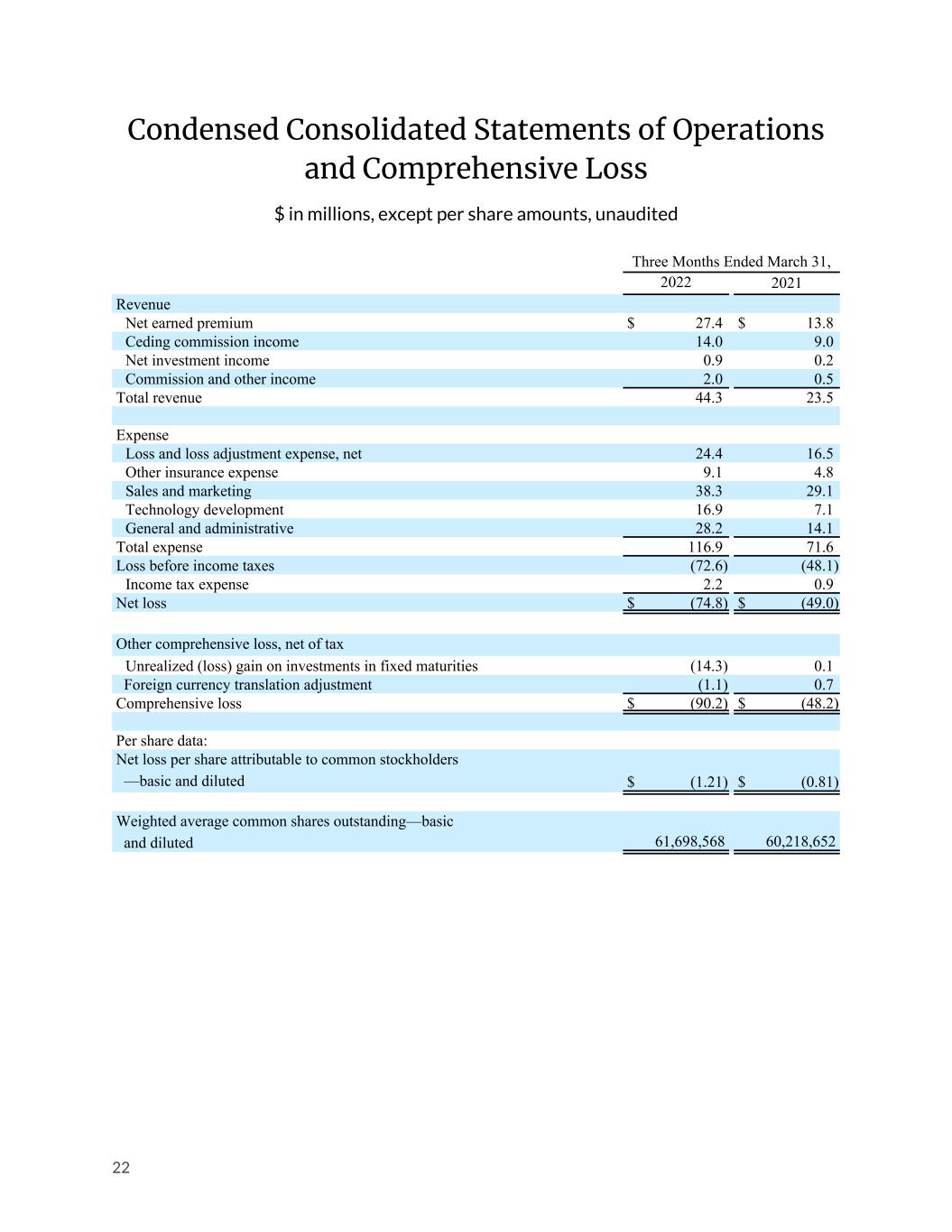
Condensed Consolidated Statements of Operations and Comprehensive Loss $ in millions, except per share amounts, unaudited Three Months Ended March 31, 2022 2021 Revenue Net earned premium $ 27.4 $ 13.8 Ceding commission income 14.0 9.0 Net investment income 0.9 0.2 Commission and other income 2.0 0.5 Total revenue 44.3 23.5 Expense Loss and loss adjustment expense, net 24.4 16.5 Other insurance expense 9.1 4.8 Sales and marketing 38.3 29.1 Technology development 16.9 7.1 General and administrative 28.2 14.1 Total expense 116.9 71.6 Loss before income taxes (72.6) (48.1) Income tax expense 2.2 0.9 Net loss $ (74.8) $ (49.0) Other comprehensive loss, net of tax Unrealized (loss) gain on investments in fixed maturities (14.3) 0.1 Foreign currency translation adjustment (1.1) 0.7 Comprehensive loss $ (90.2) $ (48.2) Per share data: Net loss per share attributable to common stockholders —basic and diluted $ (1.21) $ (0.81) Weighted average common shares outstanding—basic and diluted 61,698,568 60,218,652 22
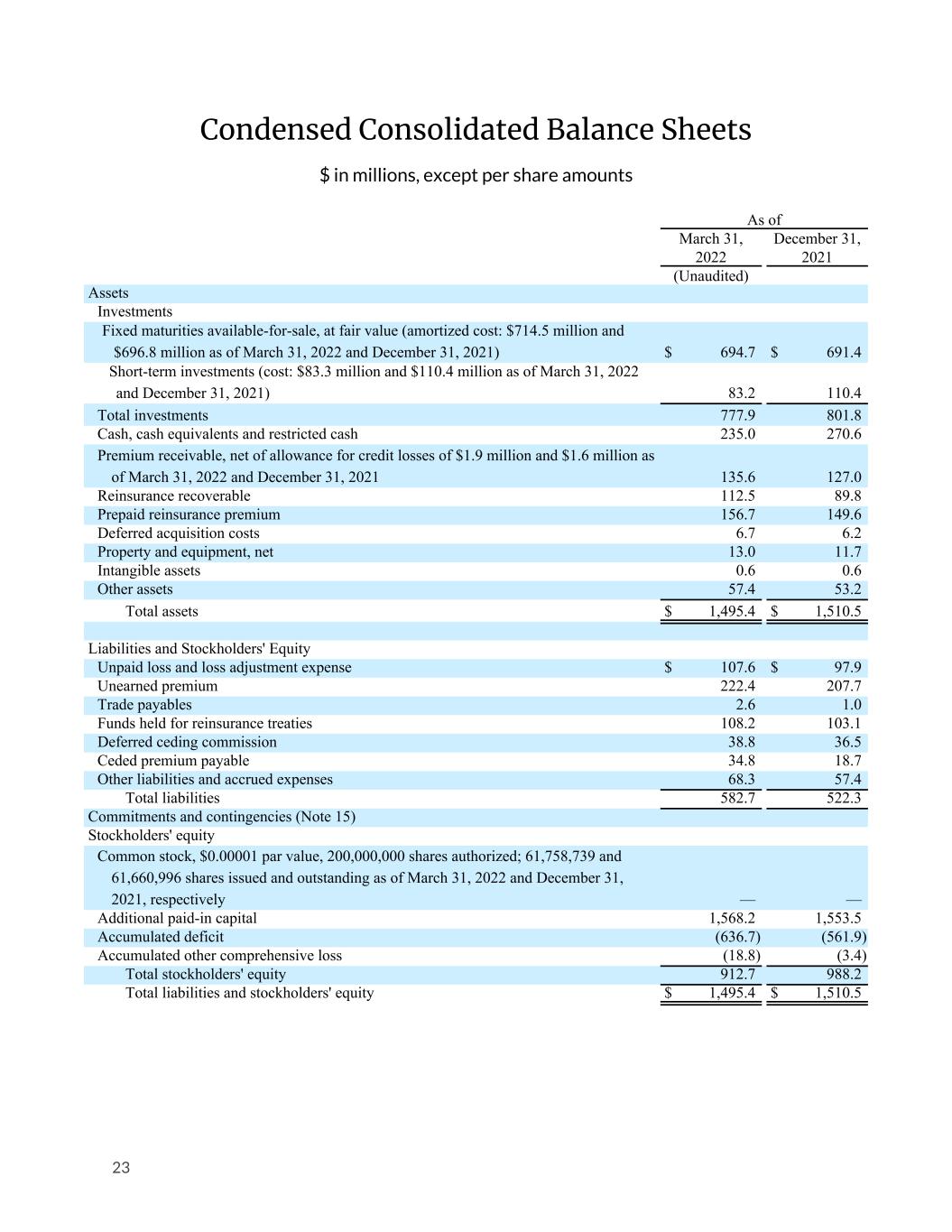
Condensed Consolidated Balance Sheets $ in millions, except per share amounts As of March 31, December 31, 2022 2021 (Unaudited) Assets Investments Fixed maturities available-for-sale, at fair value (amortized cost: $714.5 million and $696.8 million as of March 31, 2022 and December 31, 2021) $ 694.7 $ 691.4 Short-term investments (cost: $83.3 million and $110.4 million as of March 31, 2022 and December 31, 2021) 83.2 110.4 Total investments 777.9 801.8 Cash, cash equivalents and restricted cash 235.0 270.6 Premium receivable, net of allowance for credit losses of $1.9 million and $1.6 million as of March 31, 2022 and December 31, 2021 135.6 127.0 Reinsurance recoverable 112.5 89.8 Prepaid reinsurance premium 156.7 149.6 Deferred acquisition costs 6.7 6.2 Property and equipment, net 13.0 11.7 Intangible assets 0.6 0.6 Other assets 57.4 53.2 Total assets $ 1,495.4 $ 1,510.5 Liabilities and Stockholders' Equity Unpaid loss and loss adjustment expense $ 107.6 $ 97.9 Unearned premium 222.4 207.7 Trade payables 2.6 1.0 Funds held for reinsurance treaties 108.2 103.1 Deferred ceding commission 38.8 36.5 Ceded premium payable 34.8 18.7 Other liabilities and accrued expenses 68.3 57.4 Total liabilities 582.7 522.3 Commitments and contingencies (Note 15) Stockholders' equity Common stock, $0.00001 par value, 200,000,000 shares authorized; 61,758,739 and 61,660,996 shares issued and outstanding as of March 31, 2022 and December 31, 2021, respectively — — Additional paid-in capital 1,568.2 1,553.5 Accumulated deficit (636.7) (561.9) Accumulated other comprehensive loss (18.8) (3.4) Total stockholders' equity 912.7 988.2 Total liabilities and stockholders' equity $ 1,495.4 $ 1,510.5 23
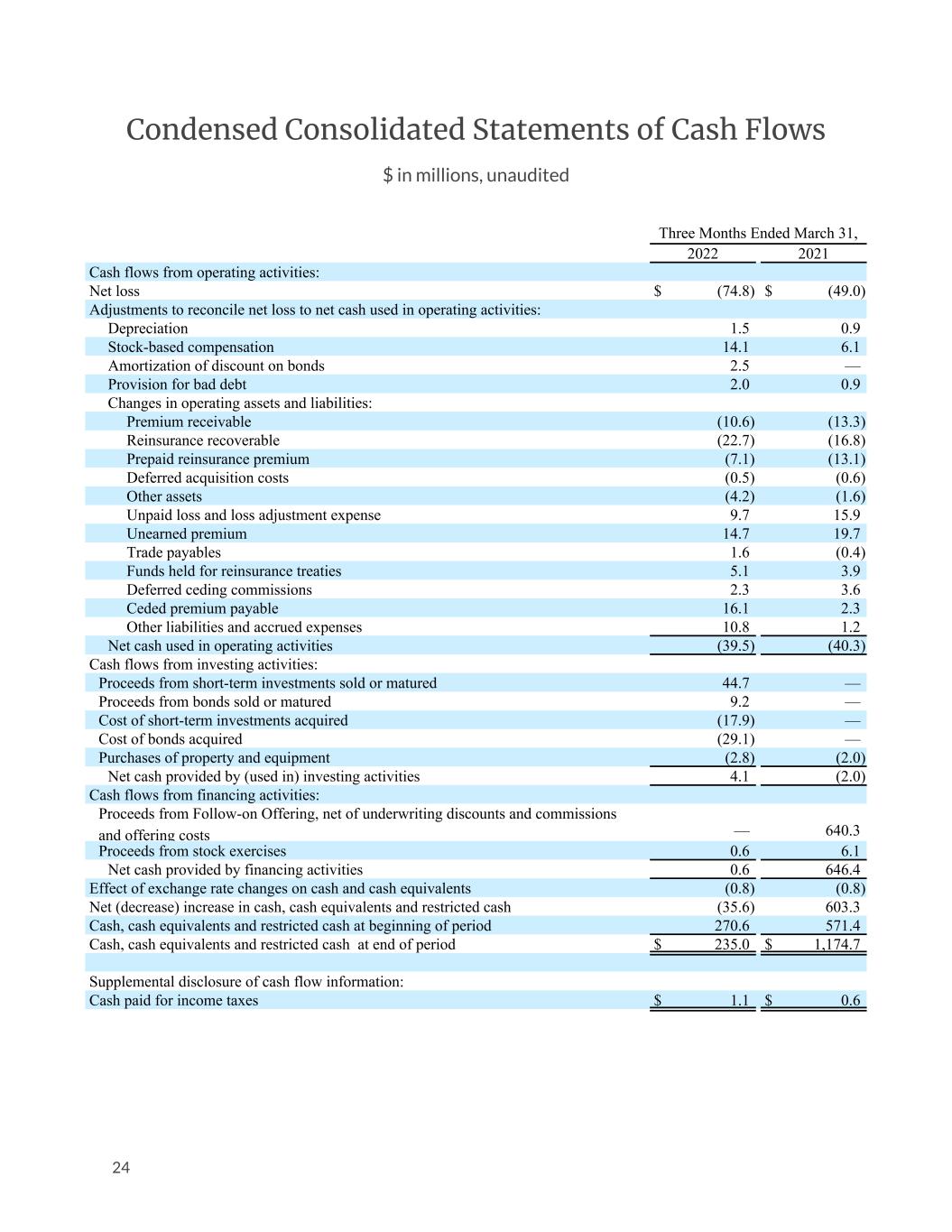
Condensed Consolidated Statements of Cash Flows $ in millions, unaudited Three Months Ended March 31, 2022 2021 Cash flows from operating activities: Net loss $ (74.8) $ (49.0) Adjustments to reconcile net loss to net cash used in operating activities: Depreciation 1.5 0.9 Stock-based compensation 14.1 6.1 Amortization of discount on bonds 2.5 — Provision for bad debt 2.0 0.9 Changes in operating assets and liabilities: Premium receivable (10.6) (13.3) Reinsurance recoverable (22.7) (16.8) Prepaid reinsurance premium (7.1) (13.1) Deferred acquisition costs (0.5) (0.6) Other assets (4.2) (1.6) Unpaid loss and loss adjustment expense 9.7 15.9 Unearned premium 14.7 19.7 Trade payables 1.6 (0.4) Funds held for reinsurance treaties 5.1 3.9 Deferred ceding commissions 2.3 3.6 Ceded premium payable 16.1 2.3 Other liabilities and accrued expenses 10.8 1.2 Net cash used in operating activities (39.5) (40.3) Cash flows from investing activities: Proceeds from short-term investments sold or matured 44.7 — Proceeds from bonds sold or matured 9.2 — Cost of short-term investments acquired (17.9) — Cost of bonds acquired (29.1) — Purchases of property and equipment (2.8) (2.0) Net cash provided by (used in) investing activities 4.1 (2.0) Cash flows from financing activities: Proceeds from Follow-on Offering, net of underwriting discounts and commissions and offering costs — 640.3 Proceeds from stock exercises 0.6 6.1 Net cash provided by financing activities 0.6 646.4 Effect of exchange rate changes on cash and cash equivalents (0.8) (0.8) Net (decrease) increase in cash, cash equivalents and restricted cash (35.6) 603.3 Cash, cash equivalents and restricted cash at beginning of period 270.6 571.4 Cash, cash equivalents and restricted cash at end of period $ 235.0 $ 1,174.7 Supplemental disclosure of cash flow information: Cash paid for income taxes $ 1.1 $ 0.6 24
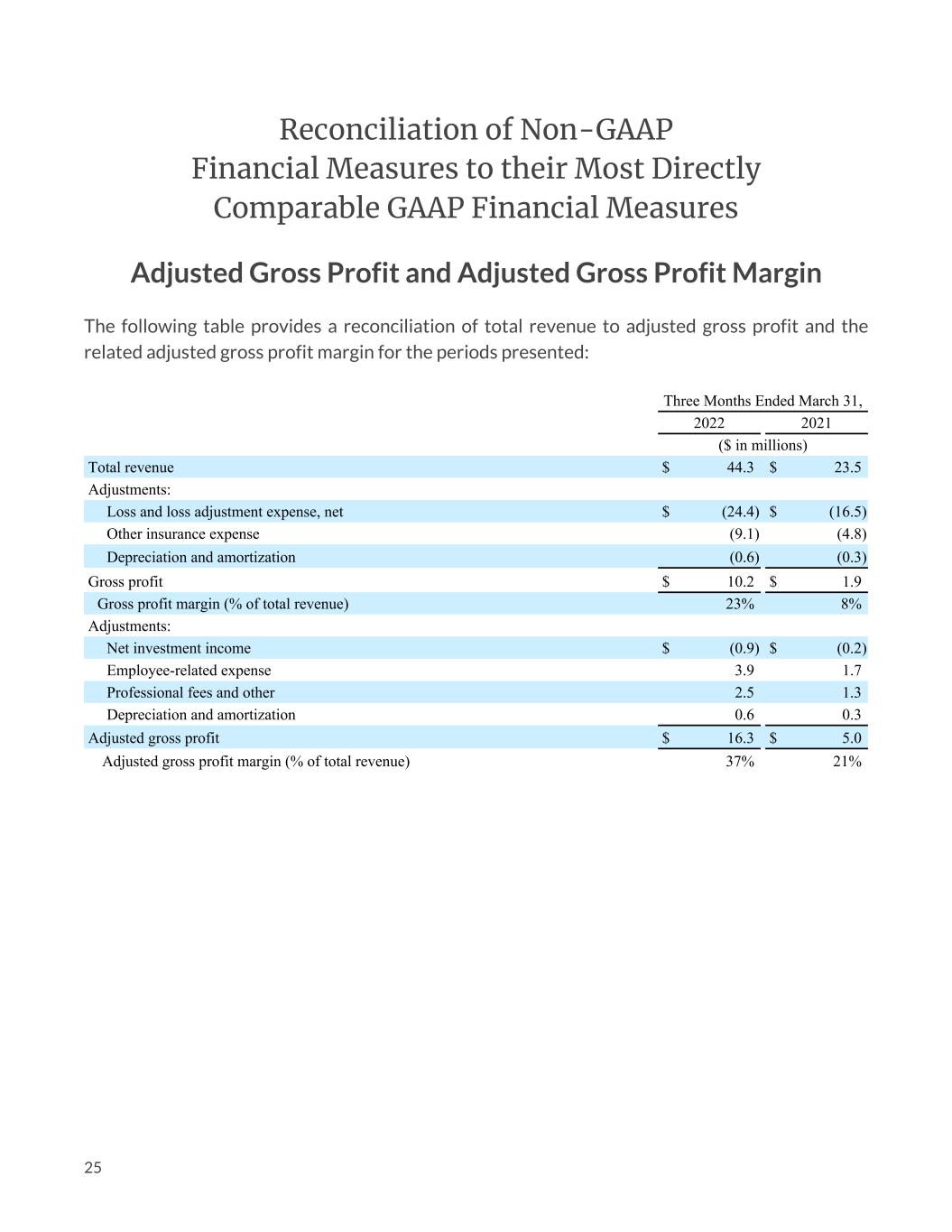
Reconciliation of Non-GAAP Financial Measures to their Most Directly Comparable GAAP Financial Measures Adjusted Gross Profit and Adjusted Gross Profit Margin The following table provides a reconciliation of total revenue to adjusted gross profit and the related adjusted gross profit margin for the periods presented: Three Months Ended March 31, 2022 2021 ($ in millions) Total revenue $ 44.3 $ 23.5 Adjustments: Loss and loss adjustment expense, net $ (24.4) $ (16.5) Other insurance expense (9.1) (4.8) Depreciation and amortization (0.6) (0.3) Gross profit $ 10.2 $ 1.9 Gross profit margin (% of total revenue) 23% 8% Adjustments: Net investment income $ (0.9) $ (0.2) Employee-related expense 3.9 1.7 Professional fees and other 2.5 1.3 Depreciation and amortization 0.6 0.3 Adjusted gross profit $ 16.3 $ 5.0 Adjusted gross profit margin (% of total revenue) 37% 21% 25
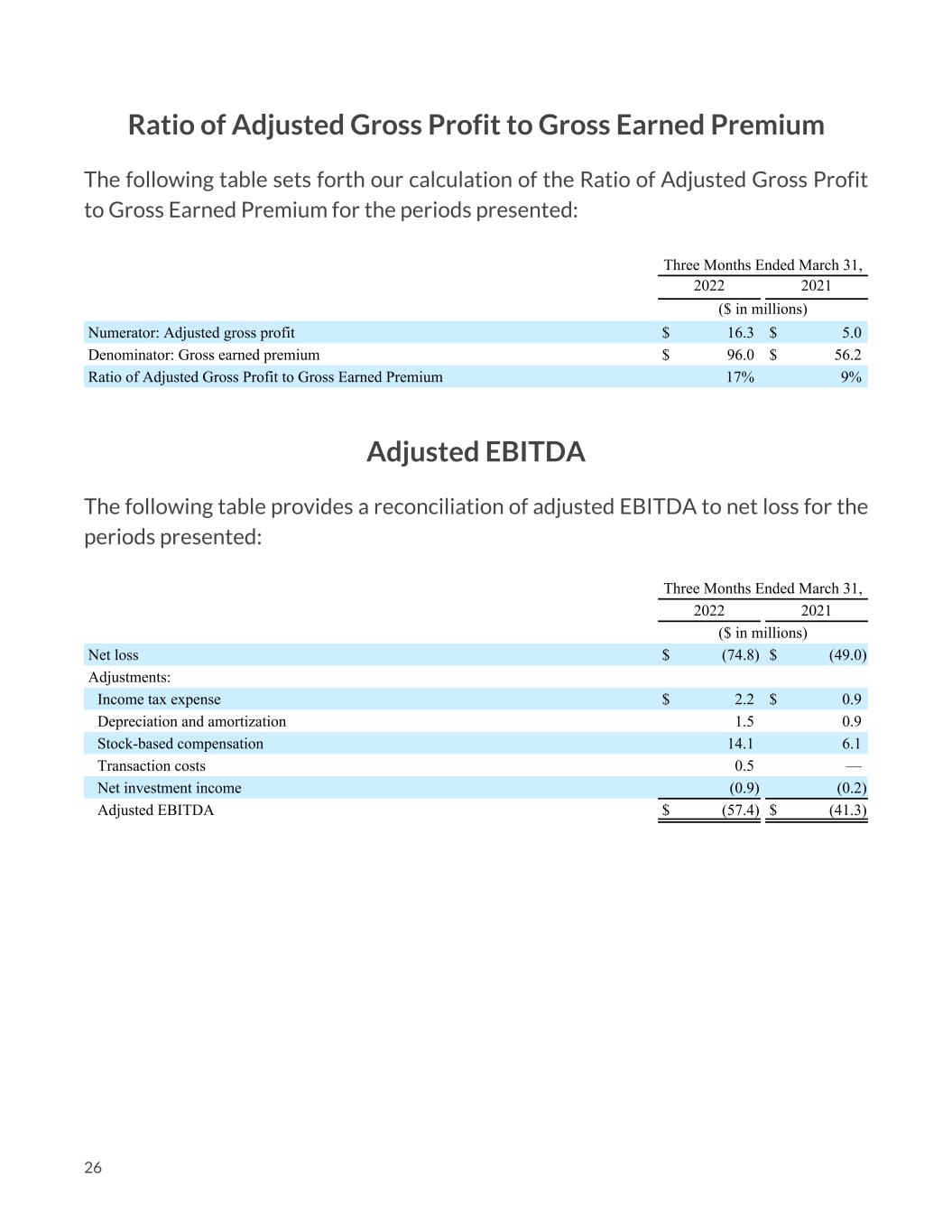
Ratio of Adjusted Gross Profit to Gross Earned Premium The following table sets forth our calculation of the Ratio of Adjusted Gross Profit to Gross Earned Premium for the periods presented: Three Months Ended March 31, 2022 2021 ($ in millions) Numerator: Adjusted gross profit $ 16.3 $ 5.0 Denominator: Gross earned premium $ 96.0 $ 56.2 Ratio of Adjusted Gross Profit to Gross Earned Premium 17% 9% Adjusted EBITDA The following table provides a reconciliation of adjusted EBITDA to net loss for the periods presented: Three Months Ended March 31, 2022 2021 ($ in millions) Net loss $ (74.8) $ (49.0) Adjustments: Income tax expense $ 2.2 $ 0.9 Depreciation and amortization 1.5 0.9 Stock-based compensation 14.1 6.1 Transaction costs 0.5 — Net investment income (0.9) (0.2) Adjusted EBITDA $ (57.4) $ (41.3) 26
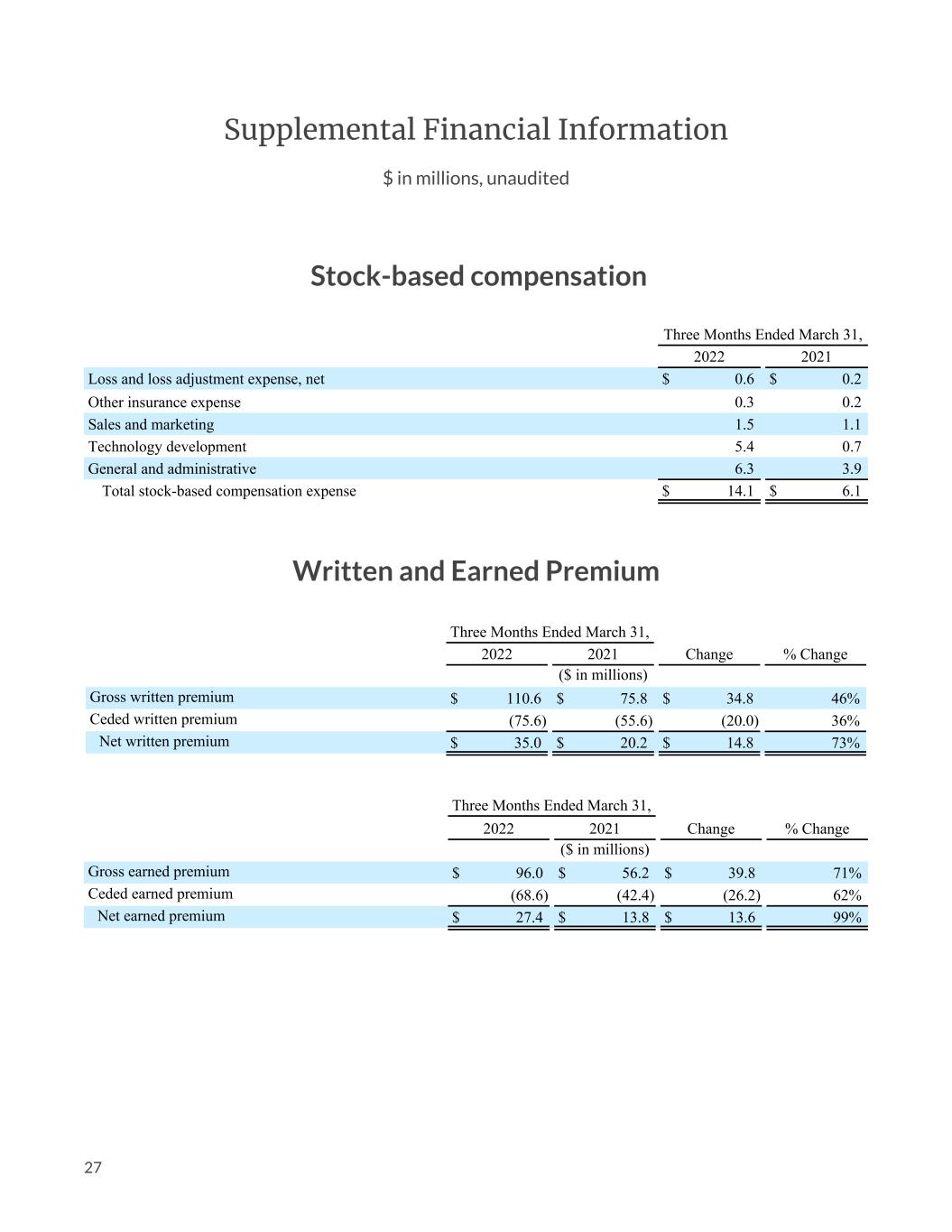
Supplemental Financial Information $ in millions, unaudited Stock-based compensation Three Months Ended March 31, 2022 2021 Loss and loss adjustment expense, net $ 0.6 $ 0.2 Other insurance expense 0.3 0.2 Sales and marketing 1.5 1.1 Technology development 5.4 0.7 General and administrative 6.3 3.9 Total stock-based compensation expense $ 14.1 $ 6.1 Written and Earned Premium Three Months Ended March 31, 2022 2021 Change % Change ($ in millions) Gross written premium $ 110.6 $ 75.8 $ 34.8 46% Ceded written premium (75.6) (55.6) (20.0) 36% Net written premium $ 35.0 $ 20.2 $ 14.8 73% Three Months Ended March 31, 2022 2021 Change % Change ($ in millions) Gross earned premium $ 96.0 $ 56.2 $ 39.8 71% Ceded earned premium (68.6) (42.4) (26.2) 62% Net earned premium $ 27.4 $ 13.8 $ 13.6 99% 27
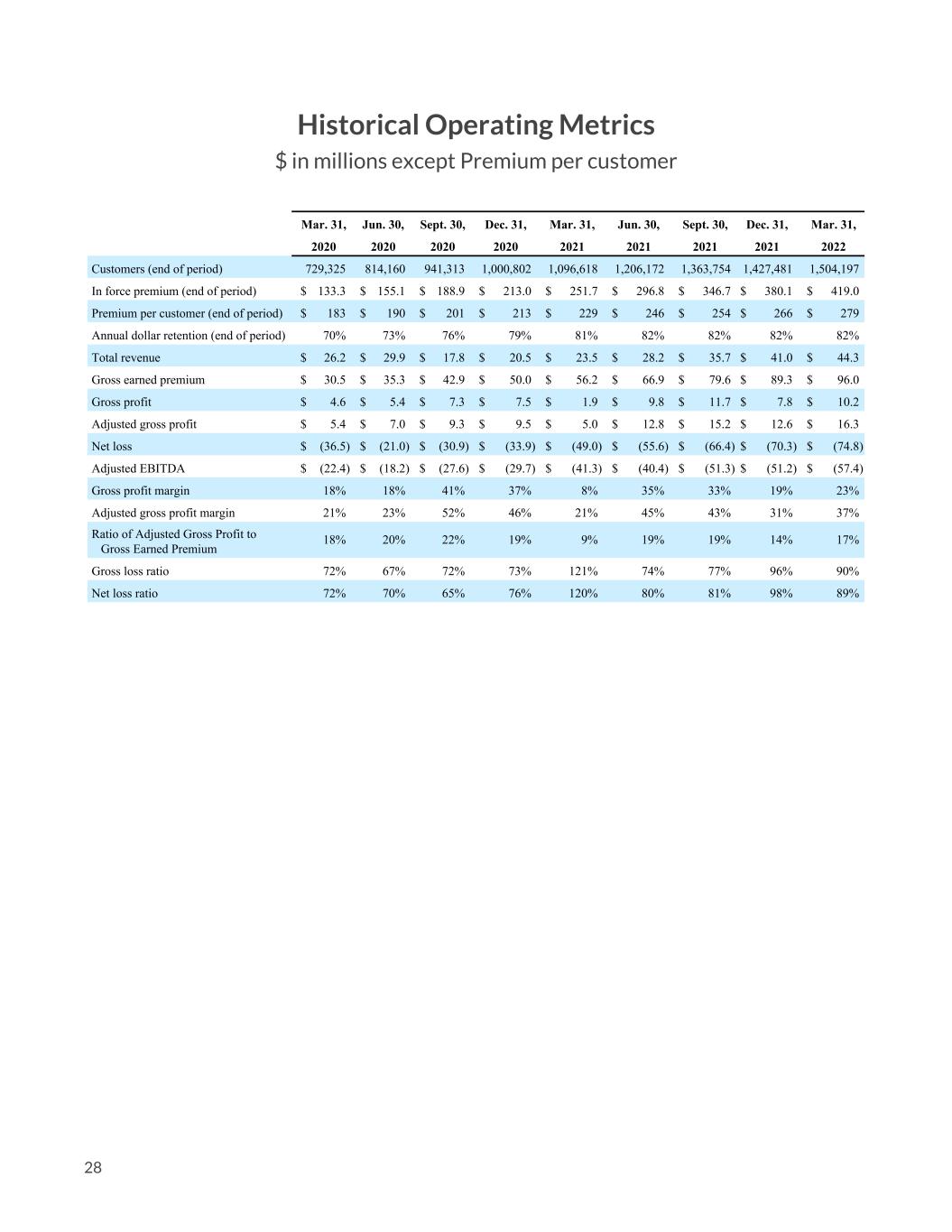
Historical Operating Metrics $ in millions except Premium per customer Mar. 31, Jun. 30, Sept. 30, Dec. 31, Mar. 31, Jun. 30, Sept. 30, Dec. 31, Mar. 31, 2020 2020 2020 2020 2021 2021 2021 2021 2022 Customers (end of period) 729,325 814,160 941,313 1,000,802 1,096,618 1,206,172 1,206,172 1,363,754 1,427,481 1,504,197 In force premium (end of period) $ 133.3 $ 155.1 $ 188.9 $ 213.0 $ 251.7 $ 296.8 $ 346.7 $ 380.1 $ 419.0 Premium per customer (end of period) $ 183 $ 190 $ 201 $ 213 $ 229 $ 246 $ 254 $ 266 $ 279 Annual dollar retention (end of period) 70% 73% 76% 79% 81% 82% 82% 82% 82% Total revenue $ 26.2 $ 29.9 $ 17.8 $ 20.5 $ 23.5 $ 28.2 $ 35.7 $ 41.0 $ 44.3 Gross earned premium $ 30.5 $ 35.3 $ 42.9 $ 50.0 $ 56.2 $ 66.9 $ 79.6 $ 89.3 $ 96.0 Gross profit $ 4.6 $ 5.4 $ 7.3 $ 7.5 $ 1.9 $ 9.8 $ 11.7 $ 7.8 $ 10.2 Adjusted gross profit $ 5.4 $ 7.0 $ 9.3 $ 9.5 $ 5.0 $ 12.8 $ 15.2 $ 12.6 $ 16.3 Net loss $ (36.5) $ (21.0) $ (30.9) $ (33.9) $ (49.0) $ (55.6) $ (66.4) $ (70.3) $ (74.8) Adjusted EBITDA $ (22.4) $ (18.2) $ (27.6) $ (29.7) $ (41.3) $ (40.4) $ (51.3) $ (51.2) $ (57.4) Gross profit margin 18% 18% 41% 37% 8% 35% 33% 19% 23% Adjusted gross profit margin 21% 23% 52% 46% 21% 45% 43% 31% 37% Ratio of Adjusted Gross Profit to Gross Earned Premium 18% 20% 22% 19% 9% 19% 19% 14% 17% Gross loss ratio 72% 67% 72% 73% 121% 74% 77% 96% 90% Net loss ratio 72% 70% 65% 76% 120% 80% 81% 98% 89% 28
Appendix to the Q1 2022 Shareholder Letter
Customers (in ‘000s) In Force Premium ($s in m) 37% 50% YoY growth 66%89% 729 1,097 1,504 Q1 20 Q1 21 Q1 22 $133.3 $251.7 $419.0 Q1 20 Q1 21 Q1 22 $183 $229 $279 Q1 20 Q1 21 Q1 22 Premium Per Customer 22% 25% * = Appendix p.2
Gross Earned Premium (“GEP”) ($s in m) Revenue (1) ($s in m) $26.2 $23.5 $44.3 Q1 20 Q1 21 Q1 22 89%(10%) YoY growth $30.5 $56.2 $96.0 Q1 20 Q1 21 Q1 22 71% 84% (1) Our ‘proportional reinsurance’ agreements went into effect at the beginning of Q3 20, increasing the proportion of premium that is ceded. This drives the YoY decline in revenue in 2020. Appendix p.3
Loss Ratio Gross Loss Ratio (1) Net Loss Ratio (1) (1) We define gross loss ratio, expressed as a percentage, as the ratio of losses and loss adjustment expense to gross earned premium, and net loss ratio, expressed as a percentage, as the ratio of losses and loss adjustment expense, less amounts ceded to reinsurers, to net earned premium. Appendix p.4 87% 82% 78% 73% 72% 67% 72% 73% 121% 74% 77% 96% 90% 75% 74% 71% 69% 72% 70% 65% 76% 120% 80% 81% 98% 89% Q1 19 Q2 19 Q3 19 Q4 19 Q1 20 Q2 20 Q3 20 Q4 20 Q1 21 Q2 21 Q3 21 Q4 21 Q1 22
Gross Profit ($s in m) Gross Profit Margin 437%(59%) 18% 8% 23% Q1 20 Q1 21 Q1 22 YoY growth Appendix p.5 $4.6 $1.9 $10.2 Q1 20 Q1 21 Q1 22
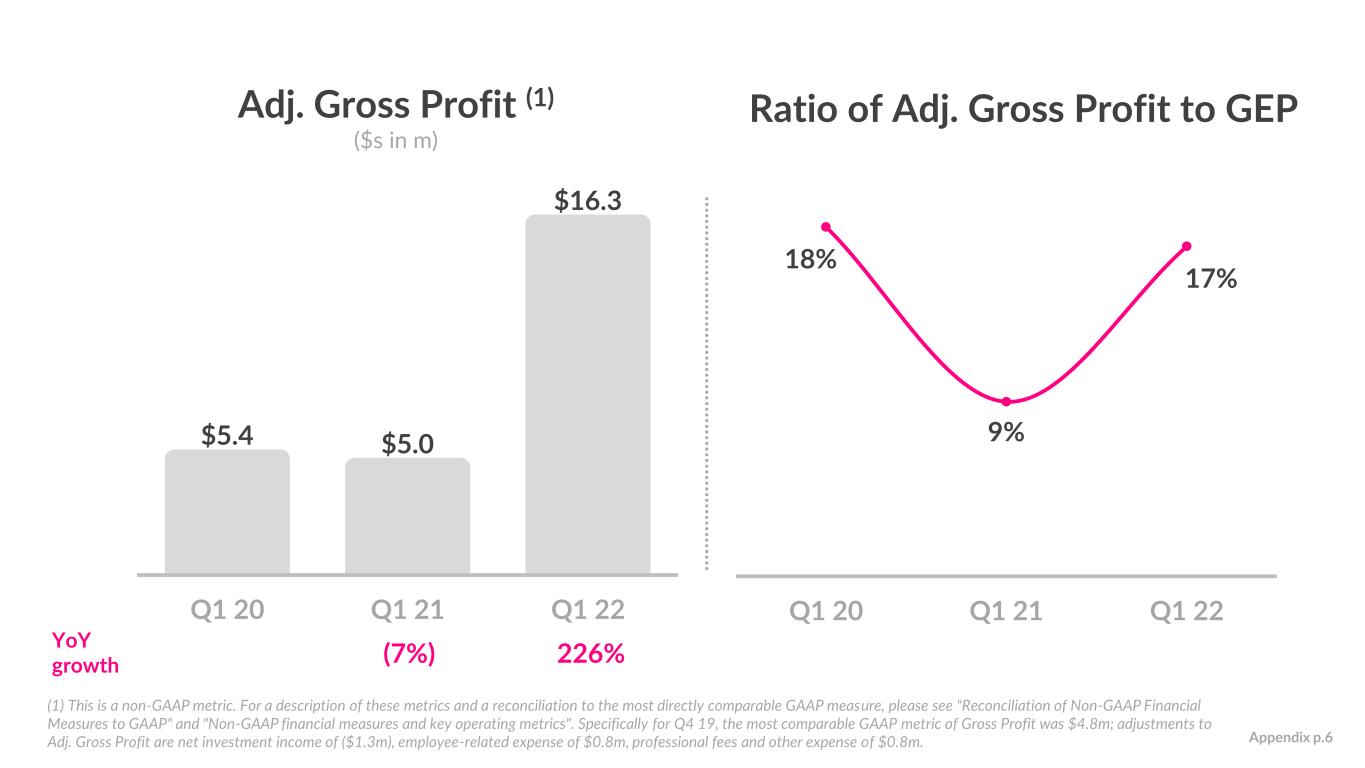
Adj. Gross Profit (1) ($s in m) Ratio of Adj. Gross Profit to GEP $5.4 $5.0 $16.3 Q1 20 Q1 21 Q1 22 226%(7%) (1) This is a non-GAAP metric. For a description of these metrics and a reconciliation to the most directly comparable GAAP measure, please see "Reconciliation of Non-GAAP Financial Measures to GAAP" and "Non-GAAP financial measures and key operating metrics". Specifically for Q4 19, the most comparable GAAP metric of Gross Profit was $4.8m; adjustments to Adj. Gross Profit are net investment income of ($1.3m), employee-related expense of $0.8m, professional fees and other expense of $0.8m. 18% 9% 17% Q1 20 Q1 21 Q1 22 YoY growth Appendix p.6
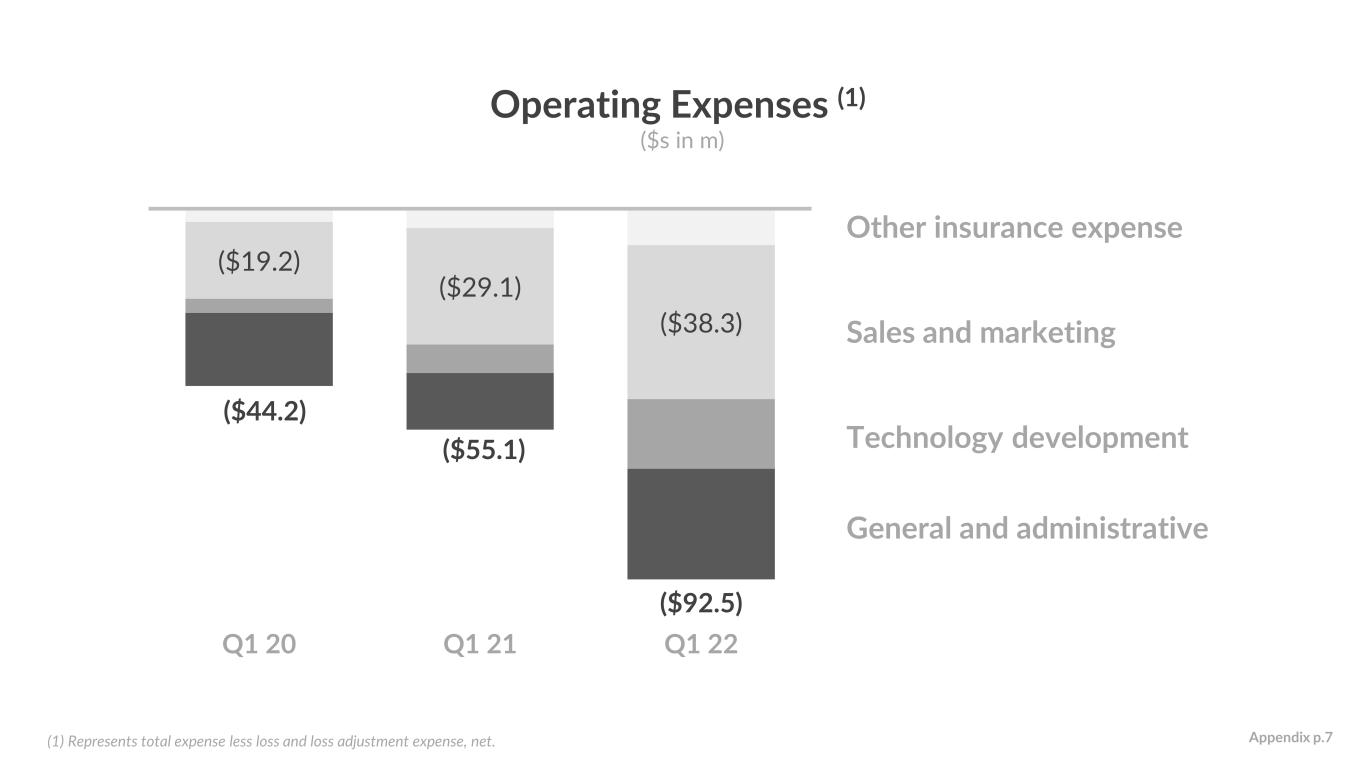
($19.2) ($29.1) ($38.3) ($44.2) ($55.1) ($92.5) Q1 20 Q1 21 Q1 22 Other insurance expense Sales and marketing Technology development General and administrative Operating Expenses (1) ($s in m) (1) Represents total expense less loss and loss adjustment expense, net. Appendix p.7
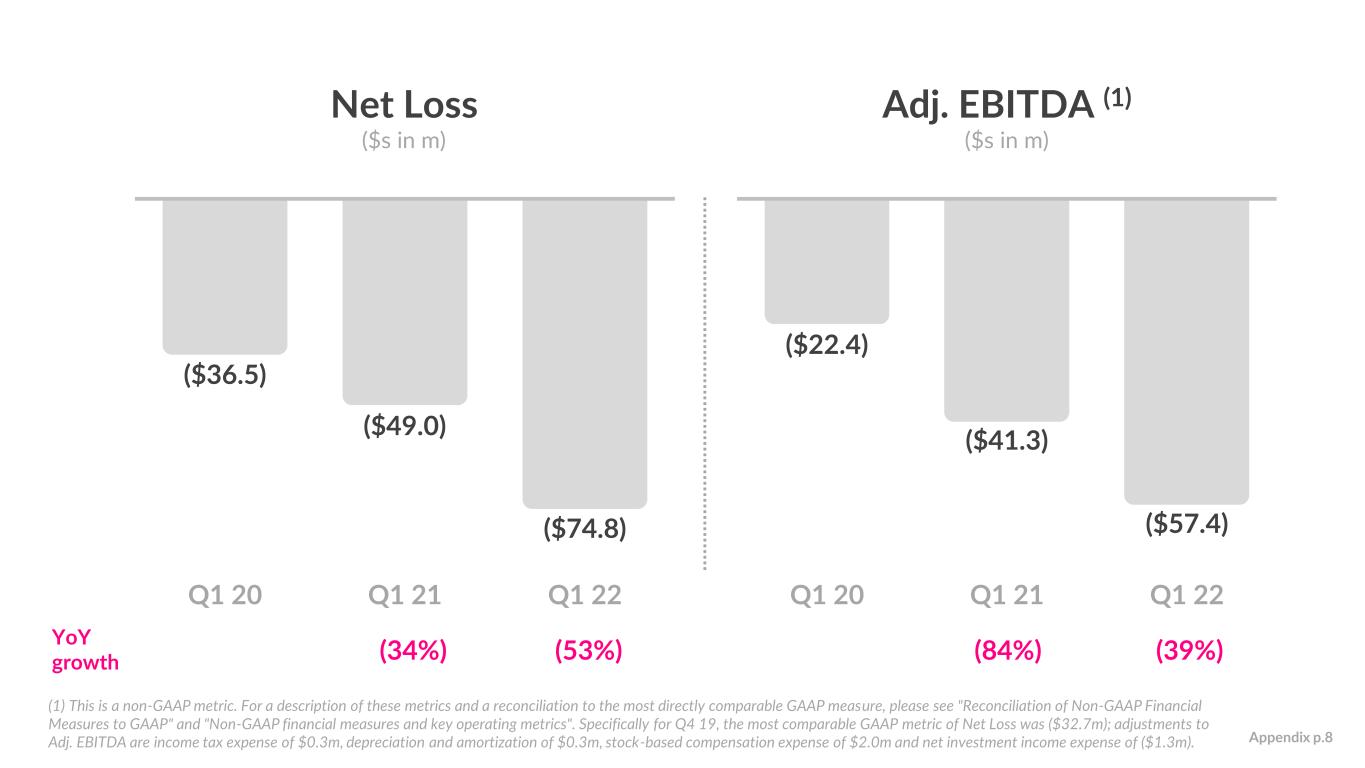
Net Loss ($s in m) Adj. EBITDA (1) ($s in m) (39%)(84%) YoY growth (53%) (34%) (1) This is a non-GAAP metric. For a description of these metrics and a reconciliation to the most directly comparable GAAP measure, please see "Reconciliation of Non-GAAP Financial Measures to GAAP" and "Non-GAAP financial measures and key operating metrics". Specifically for Q4 19, the most comparable GAAP metric of Net Loss was ($32.7m); adjustments to Adj. EBITDA are income tax expense of $0.3m, depreciation and amortization of $0.3m, stock-based compensation expense of $2.0m and net investment income expense of ($1.3m). Appendix p.8 ($36.5) ($49.0) ($74.8) Q1 20 Q1 21 Q1 22 ($22.4) ($41.3) ($57.4) Q1 20 Q1 21 Q1 22
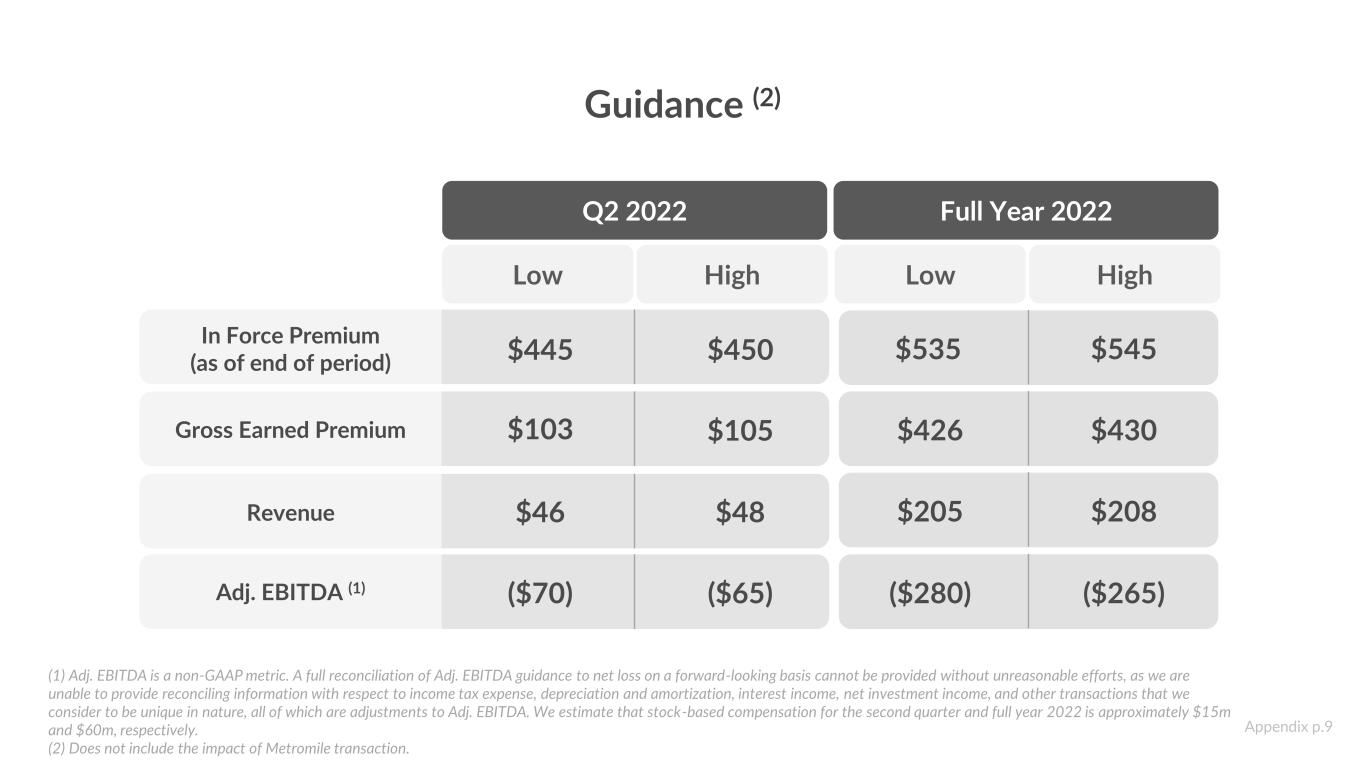
Guidance (2) ($s in m) Q2 2022 Full Year 2022 $445 $450 $103 $105 $46 $48 ($70) ($65) ($280) ($265) $205 $208 $426 $430 $535 $545 Low High Low High In Force Premium (as of end of period) Gross Earned Premium Revenue Adj. EBITDA (1) (1) Adj. EBITDA is a non-GAAP metric. A full reconciliation of Adj. EBITDA guidance to net loss on a forward-looking basis cannot be provided without unreasonable efforts, as we are unable to provide reconciling information with respect to income tax expense, depreciation and amortization, interest income, net investment income, and other transactions that we consider to be unique in nature, all of which are adjustments to Adj. EBITDA. We estimate that stock-based compensation for the second quarter and full year 2022 is approximately $15m and $60m, respectively. (2) Does not include the impact of Metromile transaction. Appendix p.9