
RF 8-K
Regions Financial Corp (RF)
8-K
2023-04-21
For: 2023-04-21
View Original
Added on
April 11, 2026
UNITED STATES
SECURITIES AND EXCHANGE COMMISSION
Washington, D.C. 20549
FORM 8-K
CURRENT REPORT
PURSUANT TO SECTION 13 OR 15(D) OF
THE SECURITIES EXCHANGE ACT OF 1934
Date of Report (Date of earliest event reported): April 21, 2023
(Exact name of registrant as specified in its charter)
| (State or other jurisdiction of incorporation) | (Commission File Number) | (IRS Employer Identification No.) | ||||||||||||
(Address, including zip code, of principal executive office)
Registrant’s telephone number, including area code: (800 ) 734-4667
Check the appropriate box below if the Form 8-K filing is intended to simultaneously satisfy the filing obligation of the registrant under any of the following provisions:
| Written communication pursuant to Rule 425 under the Securities Act (17 CFR 230.425) | |||||
| Soliciting material pursuant to Rule 14a-12 under the Exchange Act (17 CFR 240.14a-12) | |||||
| Pre-commencement communications pursuant to Rule 14d-2(b) under the Exchange Act (17 CFR 240.14d-2(b)) | |||||
| Pre-commencement communications pursuant to Rule 13e-4(c) under the Exchange Act (17 CFR 240.13e-4(c)) | |||||
Securities registered pursuant to Section 12(b) of the Act:
| Title of each class | Trading Symbol(s) | Name of each exchange on which registered | ||||||||||||
| Depositary Shares, each representing a 1/40th Interest in a Share of | ||||||||||||||
| Depositary Shares, each representing a 1/40th Interest in a Share of | ||||||||||||||
| Depositary Shares, each representing a 1/40th Interest in a Share of | ||||||||||||||
Indicate by check mark whether the registrant is an emerging growth company as defined in Rule 405 of the Securities Act of 1933 (17 CFR 230.405) or Rule 12b-2 of the Securities Exchange Act of 1934 (17 CFR 240.12b-2).
Emerging growth company ☐
If an emerging growth company, indicate by check mark if the registrant has elected not to use the extended transition period for complying with any new or revised financial accounting standards provided pursuant to Section 13(a) of the Exchange Act. ¨
Item 2.02 Results of Operations and Financial Condition.
Item 7.01 Regulation FD Disclosure.
On April 21, 2023, Regions Financial Corporation (“Regions”) issued a press release announcing its preliminary results of operations for the quarter ended March 31, 2023. A copy of the press release is attached hereto as Exhibit 99.1. Supplemental financial information for the quarter ended March 31, 2023 is attached as Exhibit 99.2. Executives from Regions will review the results via a live audio webcast at 10:00 a.m. Eastern time on April 21, 2023. A copy of a visual presentation that will be a part of that review is attached as Exhibit 99.3. All of the attached exhibits are incorporated herein by reference and may also be found on Regions’ website at www.regions.com. An archived recording of the webcast will be available for a limited time on the Investor Relations page of that website.
In accordance with general instruction B.2. of Form 8-K, this information is being furnished and shall not be deemed filed for purposes of Section 18 of the Securities Exchange Act of 1934, as amended (the “Exchange Act”), or otherwise subject to the liabilities of that section, nor shall it be deemed incorporated by reference in any filing under the Securities Act of 1933, as amended, or the Exchange Act, except as may be expressly set forth by specific reference in any such filing.
Item 9.01 Financial Statements and Exhibits.
(d) Exhibits.
| Exhibit Number | Description of Exhibit | |||||||
| 99.1 | Press Release dated April 21, 2023. | |||||||
| 99.2 | Supplemental Financial Information for the Quarter Ended March 31, 2023. | |||||||
| 99.3 | Visual Presentation of April 21, 2023. | |||||||
| 104 | Cover Page Interactive Data (embedded within the Inline XBRL document). | |||||||
SIGNATURES
Pursuant to the requirements of the Securities Exchange Act of 1934, the registrant has duly caused this report to be signed on its behalf by the undersigned hereunto duly authorized.
| REGIONS FINANCIAL CORPORATION | ||||||||
| By: | /s/ Karin K. Allen | |||||||
| Name: | Karin K. Allen | |||||||
| Title: | Executive Vice President and Assistant Controller (Chief Accounting Officer and Authorized Officer) | |||||||
Date: April 21, 2023
 Exhibit 99.1
| Media Contact: | Investor Relations Contact: | |||||||||||||
| Jeremy King | Dana Nolan | |||||||||||||
| (205) 264-4551 | (205) 264-7040 | |||||||||||||
Solid Revenue. Consistent Performance. Regions reports first quarter 2023 earnings of $588 million, earnings per diluted share of $0.62
$2.0 billion in total revenue reflects 22 percent year-over-year growth.
BIRMINGHAM, Ala. - (BUSINESS WIRE) - April 21, 2023 - Regions Financial Corp. (NYSE:RF) today reported earnings for the first quarter ended March 31, 2023. The company reported first quarter net income available to common shareholders of $588 million and earnings per diluted share of $0.62. Compared to first quarter of 2022, total revenue increased 22 percent to $2.0 billion on both a reported and adjusted basis(1) driven by growth in net interest income. Strong revenue growth contributed to a 39 percent increase in pre-tax pre-provision income(1) on both a reported basis and adjusted basis(1) compared to the first quarter of 2022.
Regions has built a high-quality deposit base that focuses on relationships starting with operating accounts for both consumer customers and commercial clients. Consistent with the company's expectations, total deposits declined approximately 2 percent, but importantly, deposits remained stable from earlier in the month of March through the end of the quarter. The company's liquidity position also remains robust as of March 31, 2023, including total available liquidity of approximately $54 billion, which exceeds uninsured retail and non-operational wholesale deposits by approximately 3-to-1.
"Despite the recent turmoil in the industry, we delivered another solid quarter that underscores our commitment to generating consistent, sustainable long-term performance" said John Turner, President and CEO of Regions Financial Corp. "Our dedication to prudent risk management and our relationship banking approach have allowed us to build a balanced and diverse business. Even in an uncertain operating environment, executing our strategic plan allows us to be a source of strength for customers and communities while ensuring our focus remains on three primary goals – soundness, profitability, and then growth. Our core values, particularly 'focus on the customer,' consistently govern how we operate. And recent events have given us an opportunity to connect with customers, clients, and prospects to answer questions, meet needs, and provide valuable reassurance."
1
SUMMARY OF FIRST QUARTER 2023 RESULTS:
| Quarter Ended | ||||||||||||||||||||
| (amounts in millions, except per share data) | 3/31/2023 | 12/31/2022 | 3/31/2022 | |||||||||||||||||
| Net income | $ | 612 | $ | 685 | $ | 548 | ||||||||||||||
| Preferred dividends and other | 24 | 25 | 24 | |||||||||||||||||
| Net income available to common shareholders | $ | 588 | $ | 660 | $ | 524 | ||||||||||||||
| Weighted-average diluted shares outstanding | 942 | 941 | 947 | |||||||||||||||||
| Actual shares outstanding—end of period | 935 | 934 | 933 | |||||||||||||||||
| Diluted earnings per common share | $ | 0.62 | $ | 0.70 | $ | 0.55 | ||||||||||||||
| Selected items impacting earnings: | ||||||||||||||||||||
Pre-tax adjusted items(1): | ||||||||||||||||||||
Adjustments to non-interest expense(1) | $ | (2) | $ | (5) | $ | (1) | ||||||||||||||
Adjustments to non-interest income(1) | (1) | 50 | 1 | |||||||||||||||||
Total pre-tax adjusted items(1) | $ | (3) | $ | 45 | $ | — | ||||||||||||||
| Diluted EPS impact* | $ | — | $ | 0.03 | $ | — | ||||||||||||||
| Pre-tax additional selected items**: | ||||||||||||||||||||
| Provision (in excess of) less than net charge-offs*** | $ | (52) | $ | (63) | $ | 82 | ||||||||||||||
| Release of hurricane-related allowance for loan losses | — | 20 | — | |||||||||||||||||
| Capital markets income (loss) - CVA/DVA | (33) | (11) | 6 | |||||||||||||||||
| Residential MSR net hedge performance | (3) | (6) | (5) | |||||||||||||||||
| Pension settlement charges | — | (6) | — | |||||||||||||||||
| Ginnie Mae re-securitization gains | — | — | 12 | |||||||||||||||||
* Based on income taxes at an approximate 25% incremental rate.
** Items impacting results or trends during the period, but are not considered non-GAAP adjustments. These items generally include market-related measures, impacts of new accounting guidance, or event driven actions.
*** The fourth quarter of 2022 provision (in excess of) less than net charge-offs excludes the $20 million for the subsequent release of hurricane-related allowance for loan losses originally established in the third quarter of 2022.
Non-GAAP adjusted items(1) impacting the company's earnings are identified to assist investors in analyzing Regions' operating results on the same basis as that applied by management and provide a basis to predict future performance.
2
Total revenue
| Quarter Ended | ||||||||||||||||||||||||||||||||||||||||||||
| ($ amounts in millions) | 3/31/2023 | 12/31/2022 | 3/31/2022 | 1Q23 vs. 4Q22 | 1Q23 vs. 1Q22 | |||||||||||||||||||||||||||||||||||||||
| Net interest income | $ | 1,417 | $ | 1,401 | $ | 1,015 | $ | 16 | 1.1 | % | $ | 402 | 39.6 | % | ||||||||||||||||||||||||||||||
| Taxable equivalent adjustment | 13 | 13 | 11 | — | NM | 2 | 18.2 | % | ||||||||||||||||||||||||||||||||||||
| Net interest income, taxable equivalent basis | $ | 1,430 | $ | 1,414 | $ | 1,026 | $ | 16 | 1.1 | % | $ | 404 | 39.4 | % | ||||||||||||||||||||||||||||||
| Net interest margin (FTE) | 4.22 | % | 3.99 | % | 2.85 | % | ||||||||||||||||||||||||||||||||||||||
| Non-interest income: | ||||||||||||||||||||||||||||||||||||||||||||
| Service charges on deposit accounts | $ | 155 | $ | 152 | $ | 168 | 3 | 2.0 | % | (13) | (7.7) | % | ||||||||||||||||||||||||||||||||
| Card and ATM fees | 121 | 130 | 124 | (9) | (6.9) | % | (3) | (2.4) | % | |||||||||||||||||||||||||||||||||||
| Wealth management income | 112 | 108 | 101 | 4 | 3.7 | % | 11 | 10.9 | % | |||||||||||||||||||||||||||||||||||
| Capital markets income | 42 | 61 | 73 | (19) | (31.1) | % | (31) | (42.5) | % | |||||||||||||||||||||||||||||||||||
| Mortgage income | 24 | 24 | 48 | — | NM | (24) | (50.0) | % | ||||||||||||||||||||||||||||||||||||
| Commercial credit fee income | 26 | 25 | 22 | 1 | 4.0 | % | 4 | 18.2 | % | |||||||||||||||||||||||||||||||||||
| Bank-owned life insurance | 17 | 17 | 14 | — | NM | 3 | 21.4 | % | ||||||||||||||||||||||||||||||||||||
| Securities gains (losses), net | (2) | — | — | (2) | NM | (2) | NM | |||||||||||||||||||||||||||||||||||||
| Market value adjustments on employee benefit assets* | (1) | (9) | (14) | 8 | 88.9 | % | 13 | 92.9 | % | |||||||||||||||||||||||||||||||||||
| Insurance proceeds | — | 50 | — | (50) | (100.0) | — | NM | |||||||||||||||||||||||||||||||||||||
| Other | 40 | 42 | 48 | (2) | (4.8) | % | (8) | (16.7) | % | |||||||||||||||||||||||||||||||||||
| Non-interest income | $ | 534 | $ | 600 | $ | 584 | $ | (66) | (11.0) | % | $ | (50) | (8.6) | % | ||||||||||||||||||||||||||||||
| Total revenue | $ | 1,951 | $ | 2,001 | $ | 1,599 | $ | (50) | (2.5) | % | $ | 352 | 22.0 | % | ||||||||||||||||||||||||||||||
Adjusted total revenue (non-GAAP)(1) | $ | 1,952 | $ | 1,951 | $ | 1,598 | $ | 1 | 0.1 | % | $ | 354 | 22.2 | % | ||||||||||||||||||||||||||||||
NM - Not Meaningful
* These market value adjustments relate to assets held for employee and director benefits that are offset within salaries and employee benefits and other non-interest expense.
Total revenue of approximately $2 billion decreased 2 percent on a reported basis but remained stable on an adjusted basis(1) compared to the fourth quarter of 2022. Net interest income increased during the quarter to a record $1.4 billion or 1 percent compared to the fourth quarter attributable to the company's asset sensitive balance sheet and stable funding profile. Lower cash balances also supported the net interest margin, which increased 23 basis points to 4.22 percent.
3
Non-interest income decreased 11 percent on a reported basis compared to the fourth quarter of 2022 primarily driven by an insurance reimbursement in the prior quarter that did not repeat. Adjusted non-interest income(1) decreased 3 percent compared to the fourth quarter of 2022. Capital markets income decreased 31 percent driven by negative CVA/DVA valuation adjustments reflecting lower long-term interest rates and volatility in credit spreads. Excluding the impact of CVA/DVA, capital markets income increased 4 percent as growth, primarily in securities underwriting and placement and real estate capital markets, was partially offset by declines in advisory transaction markets. Card & ATM fees decreased 7 percent driven primarily by seasonally lower interchange as well as a card rewards liability adjustment. Service charges increased 2 percent as seasonally higher treasury management fees helped offset 2 fewer business days in the quarter. Wealth management income increased 4 percent compared to the prior quarter despite volatile market conditions. Market value adjustments on employee benefit assets (which are offset in salaries and benefits and other non-interest expense) decreased modestly during the quarter.
Non-interest expense
| Quarter Ended | ||||||||||||||||||||||||||||||||||||||||||||
| ($ amounts in millions) | 3/31/2023 | 12/31/2022 | 3/31/2022 | 1Q23 vs. 4Q22 | 1Q23 vs. 1Q22 | |||||||||||||||||||||||||||||||||||||||
| Salaries and employee benefits | $ | 616 | $ | 604 | $ | 546 | $ | 12 | 2.0 | % | $ | 70 | 12.8 | % | ||||||||||||||||||||||||||||||
| Equipment and software expense | 102 | 102 | 95 | — | NM | 7 | 7.4 | % | ||||||||||||||||||||||||||||||||||||
| Net occupancy expense | 73 | 74 | 75 | (1) | (1.4) | % | (2) | (2.7) | % | |||||||||||||||||||||||||||||||||||
| Outside services | 39 | 41 | 38 | (2) | (4.9) | % | 1 | 2.6 | % | |||||||||||||||||||||||||||||||||||
| Professional, legal and regulatory expenses | 19 | 23 | 17 | (4) | (17.4) | % | 2 | 11.8 | % | |||||||||||||||||||||||||||||||||||
| Marketing | 27 | 27 | 24 | — | NM | 3 | 12.5 | % | ||||||||||||||||||||||||||||||||||||
| FDIC insurance assessments | 25 | 18 | 14 | 7 | 38.9 | % | 11 | 78.6 | % | |||||||||||||||||||||||||||||||||||
| Credit/checkcard expenses | 14 | 14 | 26 | — | NM | (12) | (46.2) | % | ||||||||||||||||||||||||||||||||||||
| Branch consolidation, property and equipment charges | 2 | 5 | 1 | (3) | (60.0) | % | 1 | 100.0 | % | |||||||||||||||||||||||||||||||||||
| Visa class B shares expense | 8 | 7 | 5 | 1 | 14.3 | % | 3 | 60.0 | % | |||||||||||||||||||||||||||||||||||
| Other | 102 | 102 | 92 | — | NM | 10 | 10.9 | % | ||||||||||||||||||||||||||||||||||||
| Total non-interest expense | $ | 1,027 | $ | 1,017 | $ | 933 | $ | 10 | 1.0 | % | $ | 94 | 10.1 | % | ||||||||||||||||||||||||||||||
Total adjusted non-interest expense(1) | $ | 1,025 | $ | 1,012 | $ | 932 | $ | 13 | 1.3 | % | $ | 93 | 10.0 | % | ||||||||||||||||||||||||||||||
NM - Not Meaningful
Non-interest expense increased 1 percent on both a reported and adjusted(1) basis compared to the fourth quarter of 2022. Salaries and benefits increased 2 percent primarily due to merit increases and a seasonal increase in payroll taxes. FDIC insurance assessments increased 39 percent attributable to an increase in the assessment rate charged to all financial institutions.
The company's first quarter efficiency ratio was 52.3 percent on a reported basis and 52.2 percent on an adjusted basis(1). The effective tax rate was 22.4 percent in the first quarter.
4
Loans and Leases
| Average Balances | ||||||||||||||||||||||||||||||||||||||||||||
| ($ amounts in millions) | 1Q23 | 4Q22 | 1Q22 | 1Q23 vs. 4Q22 | 1Q23 vs. 1Q22 | |||||||||||||||||||||||||||||||||||||||
| Commercial and industrial | $ | 51,158 | $ | 50,135 | $ | 43,993 | $ | 1,023 | 2.0 | % | $ | 7,165 | 16.3% | |||||||||||||||||||||||||||||||
| Commercial real estate—owner-occupied | 5,305 | 5,362 | 5,506 | (57) | (1.1) | % | (201) | (3.7)% | ||||||||||||||||||||||||||||||||||||
| Investor real estate | 8,404 | 8,290 | 7,082 | 114 | 1.4 | % | 1,322 | 18.7% | ||||||||||||||||||||||||||||||||||||
| Business Lending | 64,867 | 63,787 | 56,581 | 1,080 | 1.7 | % | 8,286 | 14.6% | ||||||||||||||||||||||||||||||||||||
| Residential first mortgage | 18,957 | 18,595 | 17,496 | 362 | 1.9 | % | 1,461 | 8.4% | ||||||||||||||||||||||||||||||||||||
| Home equity | 5,921 | 6,017 | 6,163 | (96) | (1.6) | % | (242) | (3.9)% | ||||||||||||||||||||||||||||||||||||
| Consumer credit card | 1,214 | 1,207 | 1,142 | 7 | 0.6 | % | 72 | 6.3% | ||||||||||||||||||||||||||||||||||||
| Other consumer—exit portfolios | 527 | 613 | 987 | (86) | (14.0) | % | (460) | (46.6)% | ||||||||||||||||||||||||||||||||||||
| Other consumer* | 5,791 | 5,533 | 5,445 | 258 | 4.7 | % | 346 | 6.4% | ||||||||||||||||||||||||||||||||||||
| Consumer Lending | 32,410 | 31,965 | 31,233 | 445 | 1.4 | % | 1,177 | 3.8% | ||||||||||||||||||||||||||||||||||||
| Total Loans | $ | 97,277 | $ | 95,752 | $ | 87,814 | $ | 1,525 | 1.6 | % | $ | 9,463 | 10.8% | |||||||||||||||||||||||||||||||
NM - Not meaningful.
* Other consumer loans includes EnerBank (Regions' point of sale home improvement portfolio).
Average loans and leases increased 2 percent compared to the prior quarter driven primarily by growth in commercial and industrial lending, investor real estate, residential first mortgages and EnerBank. Growth in average business lending was broad-based across the utilities, retail trade, and financial services industries. Commercial loan line utilization levels ended the quarter at approximately 43.7 percent, increasing 27 basis points over the prior quarter, while line commitments grew approximately $1.5 billion during the quarter.
Deposits
| Average Balances | ||||||||||||||||||||||||||||||||||||||||||||
| ($ amounts in millions) | 1Q23 | 4Q22 | 1Q22 | 1Q23 vs. 4Q22 | 1Q23 vs. 1Q22 | |||||||||||||||||||||||||||||||||||||||
| Customer low-cost deposits | $ | 122,228 | $ | 127,544 | $ | 132,829 | $ | (5,316) | (4.2)% | $ | (10,601) | (8.0)% | ||||||||||||||||||||||||||||||||
| Customer time deposits | 6,813 | 5,462 | 5,905 | 1,351 | 24.7% | 908 | 15.4% | |||||||||||||||||||||||||||||||||||||
| Corporate treasury other deposits | 1 | 1 | — | — | NM | 1 | NM | |||||||||||||||||||||||||||||||||||||
| Total Deposits | $ | 129,042 | $ | 133,007 | $ | 138,734 | $ | (3,965) | (3.0)% | $ | (9,692) | (7.0)% | ||||||||||||||||||||||||||||||||
| ($ amounts in millions) | 1Q23 | 4Q22 | 1Q22 | 1Q23 vs. 4Q22 | 1Q23 vs. 1Q22 | |||||||||||||||||||||||||||||||||||||||
| Consumer Bank Segment | $ | 82,200 | $ | 83,555 | $ | 83,054 | $ | (1,355) | (1.6)% | $ | (854) | (1.0)% | ||||||||||||||||||||||||||||||||
| Corporate Bank Segment | 36,273 | 38,176 | 42,609 | (1,903) | (5.0)% | (6,336) | (14.9)% | |||||||||||||||||||||||||||||||||||||
| Wealth Management Segment | 8,463 | 9,065 | 10,407 | (602) | (6.6)% | (1,944) | (18.7)% | |||||||||||||||||||||||||||||||||||||
| Other | 2,106 | 2,211 | 2,664 | (105) | (4.7)% | (558) | (20.9)% | |||||||||||||||||||||||||||||||||||||
| Total Deposits | $ | 129,042 | $ | 133,007 | $ | 138,734 | $ | (3,965) | (3.0)% | $ | (9,692) | (7.0)% | ||||||||||||||||||||||||||||||||
5
| Ending Balances as of | ||||||||||||||||||||||||||||||||||||||||||||
| 3/31/2023 | 3/31/2023 | |||||||||||||||||||||||||||||||||||||||||||
| ($ amounts in millions) | 3/31/2023 | 12/31/2022 | 3/31/2022 | vs. 12/31/2022 | vs. 3/31/2022 | |||||||||||||||||||||||||||||||||||||||
| Consumer Bank Segment | $ | 83,296 | $ | 83,487 | $ | 85,219 | $ | (191) | (0.2)% | $ | (1,923) | (2.3)% | ||||||||||||||||||||||||||||||||
| Corporate Bank Segment | 35,185 | 37,145 | 42,836 | (1,960) | (5.3)% | (7,651) | (17.9)% | |||||||||||||||||||||||||||||||||||||
| Wealth Management Segment | 7,941 | 9,111 | 10,420 | (1,170) | (12.8)% | (2,479) | (23.8)% | |||||||||||||||||||||||||||||||||||||
| Other | 2,038 | 2,000 | 2,547 | 38 | 1.9% | (509) | (20.0)% | |||||||||||||||||||||||||||||||||||||
| Total Deposits | $ | 128,460 | $ | 131,743 | $ | 141,022 | $ | (3,283) | (2.5)% | $ | (12,562) | (8.9)% | ||||||||||||||||||||||||||||||||
Consistent with the company's expectations, total ending deposits declined approximately 2 percent, while total average deposit balances decreased 3 percent in the first quarter of 2023 compared to the fourth quarter of 2022. Following primarily seasonal patterns, average Consumer deposits declined 2 percent, while Corporate and Wealth Management deposits experienced declines of 5 and 7 percent, respectively.
Asset quality
| As of and for the Quarter Ended | ||||||||||||||||||||
| ($ amounts in millions) | 3/31/2023 | 12/31/2022 | 3/31/2022 | |||||||||||||||||
| Allowance for credit losses (ACL) at period end | $1,596 | $1,582 | $1,492 | |||||||||||||||||
| ACL/Loans, net | 1.63% | 1.63% | 1.67% | |||||||||||||||||
| ALL/Loans, net | 1.50% | 1.51% | 1.59% | |||||||||||||||||
| Allowance for credit losses to non-performing loans, excluding loans held for sale | 288% | 317% | 446% | |||||||||||||||||
| Allowance for loan losses to non-performing loans, excluding loans held for sale | 266% | 293% | 423% | |||||||||||||||||
| Provision for credit losses | $135 | $112 | $(36) | |||||||||||||||||
| Net loans charged-off | $83 | $69 | $46 | |||||||||||||||||
| Net loans charged-off as a % of average loans, annualized | 0.35% | 0.29% | 0.21% | |||||||||||||||||
| Non-performing loans, excluding loans held for sale/Loans, net | 0.56% | 0.52% | 0.37% | |||||||||||||||||
| NPAs (ex. 90+ past due)/Loans, foreclosed properties, and non-performing loans held for sale | 0.58% | 0.53% | 0.39% | |||||||||||||||||
| NPAs (inc. 90+ past due)/Loans, foreclosed properties, and non-performing loans held for sale* | 0.71% | 0.75% | 0.53% | |||||||||||||||||
Total Criticized Loans—Business Services** | $3,725 | $3,149 | $2,539 | |||||||||||||||||
* Excludes guaranteed residential first mortgages that are 90+ days past due and still accruing.
** Business services represents the combined total of commercial and investor real estate loans.
Overall asset quality continued to normalize during the quarter. Non-performing loans increased to 0.56 percent of total loans and business services criticized loans increased 18 percent, while total delinquencies decreased 16 percent. Total net charge-offs for the quarter were $83 million, or 35 basis points of average loans. Provision expense totaled $135 million for the quarter.
6
The increase to the allowance for credit losses compared to the fourth quarter was attributable primarily to economic conditions and continued normalization of credit quality partially offset by a reduction in the allowance associated with the elimination of the accounting for troubled debt restructured loans.
The allowance for credit loss ratio remains at 1.63 percent of total loans, while the allowance as a percentage of nonperforming loans was 288 percent.
Capital and liquidity
| As of and for Quarter Ended | ||||||||||||||||||||
| 3/31/2023 | 12/31/2022 | 3/31/2022 | ||||||||||||||||||
Common Equity Tier 1 ratio(2) | 9.8% | 9.6% | 9.4% | |||||||||||||||||
Tier 1 capital ratio(2) | 11.2% | 10.9% | 10.8% | |||||||||||||||||
Tangible common stockholders’ equity to tangible assets (non-GAAP)(1) | 6.31% | 5.63% | 5.93% | |||||||||||||||||
Tangible common book value per share (non-GAAP)(1)* | $10.01 | $9.00 | $10.06 | |||||||||||||||||
| Loans, net of unearned income, to total deposits | 76.3% | 73.6% | 63.3% | |||||||||||||||||
* Tangible common book value per share includes the impact of quarterly earnings and changes to market value adjustments within accumulated other comprehensive income, as well as continued capital returns.
Regions maintains a solid capital position with estimated capital ratios remaining well above current regulatory requirements. The Common Equity Tier 1(2) and Tier 1(2) ratios were estimated at 9.8 percent and 11.2 percent, respectively, at quarter-end.
The company's liquidity position also remains robust as of March 31, 2023, including total available liquidity of approximately $54 billion, including cash held at the Federal Reserve, FHLB borrowing capacity, unencumbered securities, borrowing capacity at the Federal Reserve's discount window, and the Federal Reserve's new Bank Term Lending Plan facility. The loan to deposit ratio ended the quarter at 76 percent.
During the first quarter, the company declared $187 million in dividends to common shareholders and did not repurchase any shares of Regions' common stock.
(1)Non-GAAP; refer to pages 11, 14, 15 and 17 of the financial supplement to this earnings release for reconciliations.
(2)Current quarter Common Equity Tier 1, and Tier 1 capital ratios are estimated.
Conference Call
In addition to the live audio webcast at 10 a.m. ET on April 21, 2023, an archived recording of the webcast will be available at the Investor Relations page of www.regions.com following the live event.
About Regions Financial Corporation
Regions Financial Corporation (NYSE:RF), with $154 billion in assets, is a member of the S&P 500 Index and is one of the nation’s largest full-service providers of consumer and commercial banking, wealth management, and mortgage products and services. Regions serves customers across the South, Midwest and Texas, and through its
7
subsidiary, Regions Bank, operates more than 1,250 banking offices and more than 2,000 ATMs. Regions Bank is an Equal Housing Lender and Member FDIC. Additional information about Regions and its full line of products and services can be found at www.regions.com.
About Regions Foundation
Regions Foundation supports community investments that positively impact the communities served by Regions Bank. The Foundation engages in a grant making program focused on priorities including economic and community development; education and workforce readiness; and financial wellness. The Foundation is a nonprofit 501(c)(3) corporation funded primarily through contributions from Regions Bank.
Forward-Looking Statements
This release may include forward-looking statements as defined in the Private Securities Litigation Reform Act of 1995. The words “future,” “anticipates,” “assumes,” “intends,” “plans,” “seeks,” “believes,” “predicts,” “potential,” “objectives,” “estimates,” “expects,” “targets,” “projects,” “outlook,” “forecast,” “would,” “will,” “may,” “might,” “could,” “should,” “can,” and similar terms and expressions often signify forward-looking statements. Forward-looking statements are subject to the risk that the actual effects may differ, possibly materially, from what is reflected in those forward-looking statements due to factors and future developments that are uncertain, unpredictable and in many cases beyond our control. Forward-looking statements are not based on historical information, but rather are related to future operations, strategies, financial results or other developments. Forward-looking statements are based on management’s current expectations as well as certain assumptions and estimates made by, and information available to, management at the time the statements are made. Those statements are based on general assumptions and are subject to various risks, and because they also relate to the future they are likewise subject to inherent uncertainties and other factors that may cause actual results to differ materially from the views, beliefs and projections expressed in such statements. Therefore, we caution you against relying on any of these forward-looking statements. These risks, uncertainties and other factors include, but are not limited to, those described below:
•Current and future economic and market conditions in the United States generally or in the communities we serve (in particular the Southeastern United States), including the effects of possible declines in property values, increases in interest rates and unemployment rates, inflation, financial market disruptions and potential reductions of economic growth, which may adversely affect our lending and other businesses and our financial results and conditions.
•Possible changes in trade, monetary and fiscal policies of, and other activities undertaken by, governments, agencies, central banks and similar organizations, which could have a material adverse effect on our businesses and our financial results and conditions.
•Changes in market interest rates or capital markets could adversely affect our revenue and expense, the value of assets and obligations, and the availability and cost of capital and liquidity.
•Volatility and uncertainty related to inflation and the effects of inflation, which may lead to increased costs for businesses and consumers and potentially contribute to poor business and economic conditions generally.
•The impact of pandemics, including the COVID-19 pandemic, on our businesses, operations, and financial results and conditions. The duration and severity of any pandemic could disrupt the global economy, adversely affect our capital and liquidity position, impair the ability of borrowers to repay outstanding loans and increase our allowance for credit losses, impair collateral values, and result in lost revenue or additional expenses.
•Any impairment of our goodwill or other intangibles, any repricing of assets, or any adjustment of valuation allowances on our deferred tax assets due to changes in tax law, adverse changes in the economic environment, declining operations of the reporting unit or other factors.
•The effect of new tax legislation and/or interpretation of existing tax law, which may impact our earnings, capital ratios, and our ability to return capital to shareholders.
•Possible changes in the creditworthiness of customers and the possible impairment of the collectability of loans and leases, including operating leases.
•Changes in the speed of loan prepayments, loan origination and sale volumes, charge-offs, credit loss provisions or actual credit losses where our allowance for credit losses may not be adequate to cover our eventual losses.
•Possible acceleration of prepayments on mortgage-backed securities due to declining interest rates, and the related acceleration of premium amortization on those securities.
•Loss of customer checking and savings account deposits as customers pursue other, higher-yield investments, which could increase our funding costs.
•Possible changes in consumer and business spending and saving habits and the related effect on our ability to increase assets and to attract deposits, which could adversely affect our net income.
•Rising interest rates could negatively impact the value of our portfolio of investment securities.
•The loss of value of our investment portfolio could negatively impact market perceptions of us.
•The effects of social media on market perceptions of us and banks generally.
•Volatility in the financial services industry (including failures or rumors of failures of other depository institutions), along with actions taken by governmental agencies to address such turmoil, could affect the ability of depository institutions, including us, to attract and retain depositors and to borrow or raise capital.
•Our ability to effectively compete with other traditional and non-traditional financial services companies, including fintechs, some of whom possess greater financial resources than we do or are subject to different regulatory standards than we are.
8
•Our inability to develop and gain acceptance from current and prospective customers for new products and services and the enhancement of existing products and services to meet customers’ needs and respond to emerging technological trends in a timely manner could have a negative impact on our revenue.
•Our inability to keep pace with technological changes, including those related to the offering of digital banking and financial services, could result in losing business to competitors.
•Changes in laws and regulations affecting our businesses, including legislation and regulations relating to bank products and services, such as special FDIC assessments, as well as changes in the enforcement and interpretation of such laws and regulations by applicable governmental and self-regulatory agencies, including as a result of the changes in U.S. presidential administration, control of the U.S. Congress, and changes in personnel at the bank regulatory agencies, which could require us to change certain business practices, increase compliance risk, reduce our revenue, impose additional costs on us, or otherwise negatively affect our businesses.
•Our capital actions, including dividend payments, common stock repurchases, or redemptions of preferred stock, must not cause us to fall below minimum capital ratio requirements, with applicable buffers taken into account, and must comply with other requirements and restrictions under law or imposed by our regulators, which may impact our ability to return capital to shareholders.
•Our ability to comply with stress testing and capital planning requirements (as part of the CCAR process or otherwise) may continue to require a significant investment of our managerial resources due to the importance of such tests and requirements.
•Our ability to comply with applicable capital and liquidity requirements (including, among other things, the Basel III capital standards), including our ability to generate capital internally or raise capital on favorable terms, and if we fail to meet requirements, our financial condition and market perceptions of us could be negatively impacted.
•The effects of any developments, changes or actions relating to any litigation or regulatory proceedings brought against us or any of our subsidiaries.
•The costs, including possibly incurring fines, penalties, or other negative effects (including reputational harm) of any adverse judicial, administrative, or arbitral rulings or proceedings, regulatory enforcement actions, or other legal actions to which we or any of our subsidiaries are a party, and which may adversely affect our results.
•Our ability to manage fluctuations in the value of assets and liabilities and off-balance sheet exposure so as to maintain sufficient capital and liquidity to support our businesses.
•Our ability to execute on our strategic and operational plans, including our ability to fully realize the financial and nonfinancial benefits relating to our strategic initiatives.
•The risks and uncertainties related to our acquisition or divestiture of businesses and risks related to such acquisitions, including that the expected synergies, cost savings and other financial or other benefits may not be realized within expected timeframes, or might be less than projected; and difficulties in integrating acquired businesses.
•The success of our marketing efforts in attracting and retaining customers.
•Our ability to recruit and retain talented and experienced personnel to assist in the development, management and operation of our products and services may be affected by changes in laws and regulations in effect from time to time.
•Fraud or misconduct by our customers, employees or business partners.
•Any inaccurate or incomplete information provided to us by our customers or counterparties.
•Inability of our framework to manage risks associated with our businesses, such as credit risk and operational risk, including third-party vendors and other service providers, which could, among other things, result in a breach of operating or security systems as a result of a cyber attack or similar act or failure to deliver our services effectively.
•Our ability to identify and address operational risks associated with the introduction of or changes to products, services, or delivery platforms.
•Dependence on key suppliers or vendors to obtain equipment and other supplies for our businesses on acceptable terms.
•The inability of our internal controls and procedures to prevent, detect or mitigate any material errors or fraudulent acts.
•The effects of geopolitical instability, including wars, conflicts, civil unrest, and terrorist attacks and the potential impact, directly or indirectly, on our businesses.
•The effects of man-made and natural disasters, including fires, floods, droughts, tornadoes, hurricanes, and environmental damage (specifically in the Southeastern United States), which may negatively affect our operations and/or our loan portfolios and increase our cost of conducting business. The severity and frequency of future earthquakes, fires, hurricanes, tornadoes, droughts, floods and other weather-related events are difficult to predict and may be exacerbated by global climate change.
•Changes in commodity market prices and conditions could adversely affect the cash flows of our borrowers operating in industries that are impacted by changes in commodity prices (including businesses indirectly impacted by commodities prices such as businesses that transport commodities or manufacture equipment used in the production of commodities), which could impair their ability to service any loans outstanding to them and/or reduce demand for loans in those industries.
•Our ability to identify and address cyber-security risks such as data security breaches, malware, ransomware, “denial of service” attacks, “hacking” and identity theft, including account take-overs, a failure of which could disrupt our businesses and result in the disclosure of and/or misuse or misappropriation of confidential or proprietary information, disruption or damage to our systems, increased costs, losses, or adverse effects to our reputation.
•Our ability to achieve our expense management initiatives.
•Market replacement of LIBOR and the related effect on our LIBOR-based financial products and contracts, including, but not limited to, derivative products, debt obligations, deposits, investments, and loans.
9
•Possible downgrades in our credit ratings or outlook could, among other negative impacts, increase the costs of funding from capital markets.
•The effects of problems encountered by other financial institutions that adversely affect us or the banking industry generally could require us to change certain business practices, reduce our revenue, impose additional costs on us, or otherwise negatively affect our businesses.
•The effects of the failure of any component of our business infrastructure provided by a third party could disrupt our businesses, result in the disclosure of and/or misuse of confidential information or proprietary information, increase our costs, negatively affect our reputation, and cause losses.
•Our ability to receive dividends from our subsidiaries, in particular Regions Bank, could affect our liquidity and ability to pay dividends to shareholders.
•Changes in accounting policies or procedures as may be required by the FASB or other regulatory agencies could materially affect our financial statements and how we report those results, and expectations and preliminary analyses relating to how such changes will affect our financial results could prove incorrect.
•Fluctuations in the price of our common stock and inability to complete stock repurchases in the time frame and/or on the terms anticipated.
•The effects of anti-takeover laws and exclusive forum provision in our certificate of incorporation and bylaws.
•The effects of any damage to our reputation resulting from developments related to any of the items identified above.
•Other risks identified from time to time in reports that we file with the SEC.
The foregoing list of factors is not exhaustive. For discussion of these and other factors that may cause actual results to differ from expectations, look under the captions “Forward-Looking Statements” and “Risk Factors” in Regions’ Annual Report on Form 10-K for the year ended December 31, 2022 and in Regions’ subsequent filings with the SEC.
You should not place undue reliance on any forward-looking statements, which speak only as of the date made. Factors or events that could cause our actual results to differ may emerge from time to time, and it is not possible to predict all of them. We assume no obligation and do not intend to update or revise any forward-looking statements that are made from time to time, either as a result of future developments, new information or otherwise, except as may be required by law.
Use of non-GAAP financial measures
Management uses pre-tax pre-provision income (non-GAAP) and adjusted pre-tax pre-provision income (non-GAAP), as well as the adjusted efficiency ratio (non-GAAP) and the adjusted fee income ratio (non-GAAP) to monitor performance and believes these measures provide meaningful information to investors. Non-interest expense (GAAP) is presented excluding certain adjustments to arrive at adjusted non-interest expense (non-GAAP), which is the numerator for the adjusted efficiency ratio. Non-interest income (GAAP) is presented excluding certain adjustments to arrive at adjusted non-interest income (non-GAAP), which is the numerator for the adjusted fee income ratio. Adjusted non-interest income (non-GAAP) and adjusted non-interest expense (non-GAAP) are used to determine adjusted pre-tax pre-provision income (non-GAAP). Net interest income (GAAP) on a taxable-equivalent basis and non-interest income are added together to arrive at total revenue on a taxable-equivalent basis. Adjustments are made to arrive at adjusted total revenue on a taxable-equivalent basis (non-GAAP), which is the denominator for the adjusted fee income and adjusted efficiency ratios. Net loan charge-offs (GAAP) are presented excluding adjustments to arrive at adjusted net loan-charge offs (non-GAAP). Adjusted net loan charge-offs as a percentage of average loans (non-GAAP) are calculated as adjusted net loan charge-offs (non-GAAP) divided by average loans (GAAP) and annualized. Regions believes that the exclusion of these adjustments provides a meaningful basis for period-to-period comparisons, which management believes will assist investors in analyzing the operating results of the Company and predicting future performance. These non-GAAP financial measures are also used by management to assess the performance of Regions’ business. It is possible that the activities related to the adjustments may recur; however, management does not consider the activities related to the adjustments to be indications of ongoing operations. Regions believes that presentation of these non-GAAP financial measures will permit investors to assess the performance of the Company on the same basis as that applied by management.
Tangible common stockholders’ equity ratios have become a focus of some investors and management believes they may assist investors in analyzing the capital position of the Company absent the effects of intangible assets and preferred stock. Analysts and banking regulators have assessed Regions’ capital adequacy using the tangible common stockholders’ equity measure. Because tangible common stockholders’ equity is not formally defined by GAAP or prescribed in any amount by federal banking regulations it is currently considered to be a non-GAAP financial measure and other entities may calculate it differently than Regions’ disclosed calculations. Since analysts and banking regulators may assess Regions’ capital adequacy using tangible common stockholders’ equity, management believes that it is useful to provide investors the ability to assess Regions’ capital adequacy on this same basis.
Non-GAAP financial measures have inherent limitations, are not required to be uniformly applied and are not audited. Although these non-GAAP financial measures are frequently used by stakeholders in the evaluation of a company, they have limitations as analytical tools, and should not be considered in isolation, or as a substitute for analyses of results as reported under GAAP. In particular, a measure of earnings that excludes selected items does not represent the amount that effectively accrues directly to stockholders.
Management and the Board of Directors utilize non-GAAP measures as follows:
•Preparation of Regions' operating budgets
•Monthly financial performance reporting
•Monthly close-out reporting of consolidated results (management only)
•Presentation to investors of company performance
•Metrics for incentive compensation
Regions’ Investor Relations contact is Dana Nolan at (205) 264-7040; Regions’ Media contact is Jeremy King at (205) 264-4551.
10
Exhibit 99.2

Regions Financial Corporation and Subsidiaries
Financial Supplement (unaudited)
First Quarter 2023
Regions Financial Corporation and Subsidiaries
Financial Supplement (unaudited) to First Quarter 2023 Earnings Release
Table of Contents
| Page | ||||||||
| Financial Highlights | ||||||||
| Selected Ratios and Other Information* | ||||||||
| Consolidated Balance Sheets | ||||||||
| Loans | ||||||||
| Deposits | ||||||||
| Consolidated Statements of Income | ||||||||
| Consolidated Average Daily Balances and Yield / Rate Analysis | ||||||||
| Pre-Tax Pre-Provision Income ("PPI")* and Adjusted PPI* | ||||||||
| Non-Interest Income, Mortgage Income, Wealth Management Income and Capital Markets Income | ||||||||
| Non-Interest Expense | ||||||||
| Reconciliation of GAAP Financial Measures to non-GAAP Financial Measures* | ||||||||
| Adjusted Efficiency Ratios, Adjusted Fee Income Ratios, Adjusted Non-Interest Income / Expense, Adjusted Operating Leverage Ratios, Return Ratios, and Tangible Common Ratios | ||||||||
| Credit Quality | ||||||||
| Allowance for Credit Losses, Net Charge-Offs and Related Ratios, Adjusted Net Charge-Offs and Related Ratios | ||||||||
| Non-Accrual Loans (excludes loans held for sale), Early and Late Stage Delinquencies | ||||||||
| Forward-Looking Statements | ||||||||
*Use of non-GAAP financial measures
Regions believes that presentation of non-GAAP financial measures provides a meaningful basis for period to period comparisons, which management believes will assist investors in assessing the performance of the Company on the same basis as that applied by management. Non-GAAP financial measures have inherent limitations, are not required to be uniformly applied and are not audited. Although non-GAAP financial measures are frequently used by stakeholders in the evaluation of a company, they have limitations as analytical tools, and should not be considered in isolation, or as a substitute for analyses of results as reported under GAAP. In particular, a measure of earnings that excludes certain adjustments does not represent the amount that effectively accrues directly to shareholders. Additionally, our non-GAAP financial measures may not be comparable to similar non-GAAP financial measures used by other companies.
Regions Financial Corporation and Subsidiaries
Financial Supplement (unaudited) to First Quarter 2023 Earnings Release
Financial Highlights
| Quarter Ended | |||||||||||||||||||||||||||||
| ($ amounts in millions, except per share data) | 3/31/2023 | 12/31/2022 | 9/30/2022 | 6/30/2022 | 3/31/2022 | ||||||||||||||||||||||||
| Earnings Summary | |||||||||||||||||||||||||||||
| Interest income - taxable equivalent | $ | 1,654 | $ | 1,565 | $ | 1,355 | $ | 1,166 | $ | 1,063 | |||||||||||||||||||
| Interest expense - taxable equivalent | 224 | 151 | 81 | 47 | 37 | ||||||||||||||||||||||||
| Net interest income - taxable equivalent | 1,430 | 1,414 | 1,274 | 1,119 | 1,026 | ||||||||||||||||||||||||
| Less: Taxable-equivalent adjustment | 13 | 13 | 12 | 11 | 11 | ||||||||||||||||||||||||
| Net interest income | 1,417 | 1,401 | 1,262 | 1,108 | 1,015 | ||||||||||||||||||||||||
| Provision for (benefit from) credit losses | 135 | 112 | 135 | 60 | (36) | ||||||||||||||||||||||||
| Net interest income after provision for (benefit from) credit losses | 1,282 | 1,289 | 1,127 | 1,048 | 1,051 | ||||||||||||||||||||||||
| Non-interest income | 534 | 600 | 605 | 640 | 584 | ||||||||||||||||||||||||
| Non-interest expense | 1,027 | 1,017 | 1,170 | 948 | 933 | ||||||||||||||||||||||||
| Income before income taxes | 789 | 872 | 562 | 740 | 702 | ||||||||||||||||||||||||
| Income tax expense | 177 | 187 | 133 | 157 | 154 | ||||||||||||||||||||||||
| Net income | $ | 612 | $ | 685 | $ | 429 | $ | 583 | $ | 548 | |||||||||||||||||||
| Net income available to common shareholders | $ | 588 | $ | 660 | $ | 404 | $ | 558 | $ | 524 | |||||||||||||||||||
| Weighted-average shares outstanding—during quarter: | |||||||||||||||||||||||||||||
| Basic | 935 | 934 | 934 | 934 | 938 | ||||||||||||||||||||||||
| Diluted | 942 | 941 | 940 | 940 | 947 | ||||||||||||||||||||||||
| Earnings per common share - basic | $ | 0.63 | $ | 0.71 | $ | 0.43 | $ | 0.60 | $ | 0.56 | |||||||||||||||||||
| Earnings per common share - diluted | $ | 0.62 | $ | 0.70 | $ | 0.43 | $ | 0.59 | $ | 0.55 | |||||||||||||||||||
| Balance Sheet Summary | |||||||||||||||||||||||||||||
| At quarter-end | |||||||||||||||||||||||||||||
| Loans, net of unearned income | $ | 98,057 | $ | 97,009 | $ | 94,711 | $ | 93,458 | $ | 89,335 | |||||||||||||||||||
| Allowance for credit losses | (1,596 | ) | (1,582 | ) | (1,539 | ) | (1,514 | ) | (1,492 | ) | |||||||||||||||||||
| Assets | 154,135 | 155,220 | 157,798 | 160,908 | 164,082 | ||||||||||||||||||||||||
| Deposits | 128,460 | 131,743 | 135,378 | 138,263 | 141,022 | ||||||||||||||||||||||||
| Long-term borrowings | 2,307 | 2,284 | 2,274 | 2,319 | 2,343 | ||||||||||||||||||||||||
| Shareholders' equity | 16,883 | 15,947 | 15,173 | 16,507 | 16,982 | ||||||||||||||||||||||||
| Average balances | |||||||||||||||||||||||||||||
| Loans, net of unearned income | $ | 97,277 | $ | 95,752 | $ | 94,684 | $ | 90,764 | $ | 87,814 | |||||||||||||||||||
| Assets | 153,082 | 155,668 | 158,422 | 161,826 | 161,728 | ||||||||||||||||||||||||
| Deposits | 129,042 | 133,007 | 135,518 | 139,592 | 138,734 | ||||||||||||||||||||||||
| Long-term borrowings | 2,286 | 2,275 | 2,319 | 2,328 | 2,390 | ||||||||||||||||||||||||
| Shareholders' equity | 16,457 | 15,442 | 16,473 | 16,404 | 17,717 | ||||||||||||||||||||||||
1
Regions Financial Corporation and Subsidiaries
Financial Supplement (unaudited) to First Quarter 2023 Earnings Release
Selected Ratios and Other Information
| As of and for Quarter Ended | |||||||||||||||||||||||||||||
| 3/31/2023 | 12/31/2022 | 9/30/2022 | 6/30/2022 | 3/31/2022 | |||||||||||||||||||||||||
Return on average assets* (1) | 1.62 | % | 1.75 | % | 1.07 | % | 1.44 | % | 1.38 | % | |||||||||||||||||||
| Return on average common shareholders' equity* | 16.10 | % | 19.01 | % | 10.82 | % | 15.18 | % | 13.23 | % | |||||||||||||||||||
Return on average tangible common shareholders’ equity (non-GAAP)* (2) | 26.70 | % | 33.20 | % | 18.02 | % | 25.40 | % | 21.00 | % | |||||||||||||||||||
Return on average tangible common shareholders’ equity excluding AOCI (non-GAAP)* (2) | 19.85 | % | 22.91 | % | 14.42 | % | 20.85 | % | 20.25 | % | |||||||||||||||||||
| Efficiency ratio | 52.3 | % | 50.5 | % | 62.3 | % | 53.9 | % | 57.9 | % | |||||||||||||||||||
Adjusted efficiency ratio (non-GAAP) (2) | 52.2 | % | 51.6 | % | 52.6 | % | 54.2 | % | 57.9 | % | |||||||||||||||||||
Dividend payout ratio (3) | 31.8 | % | 28.3 | % | 46.2 | % | 28.5 | % | 30.3 | % | |||||||||||||||||||
| Common book value per share | $ | 16.29 | $ | 15.29 | $ | 14.46 | $ | 15.89 | $ | 16.42 | |||||||||||||||||||
Tangible common book value per share (non-GAAP) (2) | $ | 10.01 | $ | 9.00 | $ | 8.15 | $ | 9.55 | $ | 10.06 | |||||||||||||||||||
| Total equity to total assets | 10.95 | % | 10.27 | % | 9.62 | % | 10.26 | % | 10.35 | % | |||||||||||||||||||
Tangible common shareholders’ equity to tangible assets (non-GAAP) (2) | 6.31 | % | 5.63 | % | 5.01 | % | 5.76 | % | 5.93 | % | |||||||||||||||||||
Common equity (4) | $ | 12,419 | $ | 12,066 | $ | 11,554 | $ | 11,298 | $ | 10,912 | |||||||||||||||||||
Total risk-weighted assets (4) | $ | 126,262 | $ | 125,752 | $ | 124,395 | $ | 122,154 | $ | 116,182 | |||||||||||||||||||
Common equity Tier 1 ratio (4) | 9.8 | % | 9.6 | % | 9.3 | % | 9.2 | % | 9.4 | % | |||||||||||||||||||
Tier 1 capital ratio (4) | 11.2 | % | 10.9 | % | 10.6 | % | 10.6 | % | 10.8 | % | |||||||||||||||||||
Total risk-based capital ratio (4) | 12.9 | % | 12.5 | % | 12.3 | % | 12.3 | % | 12.5 | % | |||||||||||||||||||
Leverage ratio (4) | 9.3 | % | 8.9 | % | 8.5 | % | 8.2 | % | 8.0 | % | |||||||||||||||||||
| Effective tax rate | 22.4 | % | 21.5 | % | 23.7 | % | 21.2 | % | 21.9 | % | |||||||||||||||||||
| Allowance for credit losses as a percentage of loans, net of unearned income | 1.63 | % | 1.63 | % | 1.63 | % | 1.62 | % | 1.67 | % | |||||||||||||||||||
| Allowance for credit losses to non-performing loans, excluding loans held for sale | 288 | % | 317 | % | 311 | % | 410 | % | 446 | % | |||||||||||||||||||
| Net interest margin (FTE)* | 4.22 | % | 3.99 | % | 3.53 | % | 3.06 | % | 2.85 | % | |||||||||||||||||||
| Loans, net of unearned income, to total deposits | 76.3 | % | 73.6 | % | 70.0 | % | 67.6 | % | 63.3 | % | |||||||||||||||||||
| Net charge-offs as a percentage of average loans* | 0.35 | % | 0.29 | % | 0.46 | % | 0.17 | % | 0.21 | % | |||||||||||||||||||
Adjusted net charge-offs as a percentage of average loans (non-GAAP) * (2) | 0.35 | % | 0.29 | % | 0.19 | % | 0.17 | % | 0.21 | % | |||||||||||||||||||
| Non-performing loans, excluding loans held for sale, as a percentage of loans | 0.56 | % | 0.52 | % | 0.52 | % | 0.39 | % | 0.37 | % | |||||||||||||||||||
| Non-performing assets (excluding loans 90 days past due) as a percentage of loans, foreclosed properties, and non-performing loans held for sale | 0.58 | % | 0.53 | % | 0.54 | % | 0.41 | % | 0.39 | % | |||||||||||||||||||
Non-performing assets (including loans 90 days past due) as a percentage of loans, foreclosed properties, and non-performing loans held for sale (5) | 0.71 | % | 0.75 | % | 0.65 | % | 0.52 | % | 0.53 | % | |||||||||||||||||||
| Associate headcount—full-time equivalent | 20,113 | 20,073 | 19,950 | 19,673 | 19,723 | ||||||||||||||||||||||||
| ATMs | 2,034 | 2,039 | 2,043 | 2,048 | 2,054 | ||||||||||||||||||||||||
| Branch Statistics | |||||||||||||||||||||||||||||
| Full service | 1,251 | 1,252 | 1,259 | 1,259 | 1,259 | ||||||||||||||||||||||||
| Drive-through/transaction service only | 34 | 34 | 35 | 35 | 35 | ||||||||||||||||||||||||
| Total branch outlets | 1,285 | 1,286 | 1,294 | 1,294 | 1,294 | ||||||||||||||||||||||||
*Annualized
(1)Calculated by dividing net income by average assets.
(3)Dividend payout ratio reflects dividends declared within the applicable period.
(4)Current quarter Common equity as well as Total risk-weighted assets, Common equity Tier 1, Tier 1 capital, Total risk-based capital and Leverage ratios are estimated.
(5)Excludes guaranteed residential first mortgages that are 90+ days past due and still accruing. Refer to the footnotes on page 18 for amounts related to these loans.
2
Regions Financial Corporation and Subsidiaries
Financial Supplement (unaudited) to First Quarter 2023 Earnings Release
Consolidated Balance Sheets
| As of | |||||||||||||||||||||||||||||
| ($ amounts in millions) | 3/31/2023 | 12/31/2022 | 9/30/2022 | 6/30/2022 | 3/31/2022 | ||||||||||||||||||||||||
| Assets: | |||||||||||||||||||||||||||||
| Cash and due from banks | $ | 2,395 | $ | 1,997 | $ | 2,117 | $ | 2,301 | $ | 2,227 | |||||||||||||||||||
| Interest-bearing deposits in other banks | 6,438 | 9,230 | 13,549 | 18,199 | 25,718 | ||||||||||||||||||||||||
| Debt securities held to maturity | 790 | 801 | 817 | 836 | 864 | ||||||||||||||||||||||||
| Debt securities available for sale | 28,230 | 27,933 | 28,126 | 29,052 | 29,384 | ||||||||||||||||||||||||
| Loans held for sale | 564 | 354 | 720 | 612 | 694 | ||||||||||||||||||||||||
| Loans, net of unearned income | 98,057 | 97,009 | 94,711 | 93,458 | 89,335 | ||||||||||||||||||||||||
Allowance for loan losses | (1,472) | (1,464) | (1,418) | (1,425) | (1,416) | ||||||||||||||||||||||||
| Net loans | 96,585 | 95,545 | 93,293 | 92,033 | 87,919 | ||||||||||||||||||||||||
| Other earning assets | 1,335 | 1,308 | 1,341 | 1,428 | 1,504 | ||||||||||||||||||||||||
| Premises and equipment, net | 1,705 | 1,718 | 1,744 | 1,768 | 1,794 | ||||||||||||||||||||||||
| Interest receivable | 538 | 511 | 424 | 365 | 329 | ||||||||||||||||||||||||
| Goodwill | 5,733 | 5,733 | 5,739 | 5,749 | 5,748 | ||||||||||||||||||||||||
| Residential mortgage servicing rights at fair value (MSRs) | 790 | 812 | 809 | 770 | 542 | ||||||||||||||||||||||||
| Other identifiable intangible assets, net | 238 | 249 | 266 | 279 | 292 | ||||||||||||||||||||||||
| Other assets | 8,794 | 9,029 | 8,853 | 7,516 | 7,067 | ||||||||||||||||||||||||
| Total assets | $ | 154,135 | $ | 155,220 | $ | 157,798 | $ | 160,908 | $ | 164,082 | |||||||||||||||||||
| Liabilities and Equity: | |||||||||||||||||||||||||||||
| Deposits: | |||||||||||||||||||||||||||||
| Non-interest-bearing | $ | 49,647 | $ | 51,348 | $ | 54,996 | $ | 58,510 | $ | 59,590 | |||||||||||||||||||
| Interest-bearing | 78,813 | 80,395 | 80,382 | 79,753 | 81,432 | ||||||||||||||||||||||||
| Total deposits | 128,460 | 131,743 | 135,378 | 138,263 | 141,022 | ||||||||||||||||||||||||
| Borrowed funds: | |||||||||||||||||||||||||||||
| Short-term borrowings | 2,000 | — | — | — | — | ||||||||||||||||||||||||
| Long-term borrowings | 2,307 | 2,284 | 2,274 | 2,319 | 2,343 | ||||||||||||||||||||||||
| Other liabilities | 4,466 | 5,242 | 4,973 | 3,819 | 3,735 | ||||||||||||||||||||||||
| Total liabilities | 137,233 | 139,269 | 142,625 | 144,401 | 147,100 | ||||||||||||||||||||||||
| Equity: | |||||||||||||||||||||||||||||
| Preferred stock, non-cumulative perpetual | 1,659 | 1,659 | 1,659 | 1,659 | 1,659 | ||||||||||||||||||||||||
| Common stock | 10 | 10 | 10 | 10 | 10 | ||||||||||||||||||||||||
| Additional paid-in capital | 11,996 | 11,988 | 11,976 | 11,962 | 11,983 | ||||||||||||||||||||||||
| Retained earnings | 7,433 | 7,004 | 6,531 | 6,314 | 5,915 | ||||||||||||||||||||||||
| Treasury stock, at cost | (1,371) | (1,371) | (1,371) | (1,371) | (1,371) | ||||||||||||||||||||||||
| Accumulated other comprehensive income, net | (2,844) | (3,343) | (3,632) | (2,067) | (1,214) | ||||||||||||||||||||||||
| Total shareholders’ equity | 16,883 | 15,947 | 15,173 | 16,507 | 16,982 | ||||||||||||||||||||||||
Noncontrolling interest | 19 | 4 | — | — | — | ||||||||||||||||||||||||
Total equity | 16,902 | 15,951 | 15,173 | 16,507 | 16,982 | ||||||||||||||||||||||||
Total liabilities and equity | $ | 154,135 | $ | 155,220 | $ | 157,798 | $ | 160,908 | $ | 164,082 | |||||||||||||||||||
3
Regions Financial Corporation and Subsidiaries
Financial Supplement (unaudited) to First Quarter 2023 Earnings Release
End of Period Loans
| As of | |||||||||||||||||||||||||||||||||||||||||||||||||||||
| 3/31/2023 | 3/31/2023 | ||||||||||||||||||||||||||||||||||||||||||||||||||||
| ($ amounts in millions) | 3/31/2023 | 12/31/2022 | 9/30/2022 | 6/30/2022 | 3/31/2022 | vs. 12/31/2022 | vs. 3/31/2022 | ||||||||||||||||||||||||||||||||||||||||||||||
| Commercial and industrial | $ | 51,811 | $ | 50,905 | $ | 49,591 | $ | 48,492 | $ | 45,643 | $ | 906 | 1.8 | % | $ | 6,168 | 13.5 | % | |||||||||||||||||||||||||||||||||||
| Commercial real estate mortgage—owner-occupied | 4,938 | 5,103 | 5,167 | 5,218 | 5,181 | (165) | (3.2) | % | (243) | (4.7) | % | ||||||||||||||||||||||||||||||||||||||||||
| Commercial real estate construction—owner-occupied | 306 | 298 | 282 | 266 | 273 | 8 | 2.7 | % | 33 | 12.1 | % | ||||||||||||||||||||||||||||||||||||||||||
| Total commercial | 57,055 | 56,306 | 55,040 | 53,976 | 51,097 | 749 | 1.3 | % | 5,958 | 11.7 | % | ||||||||||||||||||||||||||||||||||||||||||
| Commercial investor real estate mortgage | 6,392 | 6,393 | 6,295 | 5,892 | 5,557 | (1) | NM | 835 | 15.0 | % | |||||||||||||||||||||||||||||||||||||||||||
| Commercial investor real estate construction | 2,040 | 1,986 | 1,824 | 1,720 | 1,607 | 54 | 2.7 | % | 433 | 26.9 | % | ||||||||||||||||||||||||||||||||||||||||||
| Total investor real estate | 8,432 | 8,379 | 8,119 | 7,612 | 7,164 | 53 | 0.6 | % | 1,268 | 17.7 | % | ||||||||||||||||||||||||||||||||||||||||||
| Total business | 65,487 | 64,685 | 63,159 | 61,588 | 58,261 | 802 | 1.2 | % | 7,226 | 12.4 | % | ||||||||||||||||||||||||||||||||||||||||||
| Residential first mortgage | 19,172 | 18,810 | 18,399 | 17,892 | 17,373 | 362 | 1.9 | % | 1,799 | 10.4 | % | ||||||||||||||||||||||||||||||||||||||||||
Home equity—lines of credit (1) | 3,397 | 3,510 | 3,521 | 3,550 | 3,602 | (113) | (3.2) | % | (205) | (5.7) | % | ||||||||||||||||||||||||||||||||||||||||||
Home equity—closed-end (2) | 2,446 | 2,489 | 2,515 | 2,524 | 2,500 | (43) | (1.7) | % | (54) | (2.2) | % | ||||||||||||||||||||||||||||||||||||||||||
| Consumer credit card | 1,219 | 1,248 | 1,186 | 1,172 | 1,133 | (29) | (2.3) | % | 86 | 7.6 | % | ||||||||||||||||||||||||||||||||||||||||||
Other consumer—exit portfolios (3) | 488 | 570 | 662 | 775 | 909 | (82) | (14.4) | % | (421) | (46.3) | % | ||||||||||||||||||||||||||||||||||||||||||
| Other consumer | 5,848 | 5,697 | 5,269 | 5,957 | 5,557 | 151 | 2.7 | % | 291 | 5.2 | % | ||||||||||||||||||||||||||||||||||||||||||
| Total consumer | 32,570 | 32,324 | 31,552 | 31,870 | 31,074 | 246 | 0.8 | % | 1,496 | 4.8 | % | ||||||||||||||||||||||||||||||||||||||||||
| Total Loans | $ | 98,057 | $ | 97,009 | $ | 94,711 | $ | 93,458 | $ | 89,335 | $ | 1,048 | 1.1 | % | $ | 8,722 | 9.8 | % | |||||||||||||||||||||||||||||||||||
NM - Not meaningful.
(1) The balance of Regions' home equity lines of credit consists of $1,766 million of first lien and $1,631 million of second lien at 3/31/2023.
(2) The balance of Regions' closed-end home equity loans consists of $2,180 million of first lien and $266 million of second lien at 3/31/2023.
(3) Regions ceased originating indirect vehicle loans in the second quarter of 2019 and decided not to renew another third party relationship in the fourth quarter of 2019.
| As of | |||||||||||||||||||||||||||||
| End of Period Loans by Percentage | 3/31/2023 | 12/31/2022 | 9/30/2022 | 6/30/2022 | 3/31/2022 | ||||||||||||||||||||||||
| Commercial and industrial | 52.8 | % | 52.5 | % | 52.4 | % | 51.9 | % | 51.1 | % | |||||||||||||||||||
| Commercial real estate mortgage—owner-occupied | 5.0 | % | 5.3 | % | 5.5 | % | 5.6 | % | 5.8 | % | |||||||||||||||||||
| Commercial real estate construction—owner-occupied | 0.3 | % | 0.3 | % | 0.3 | % | 0.3 | % | 0.3 | % | |||||||||||||||||||
| Total commercial | 58.1 | % | 58.1 | % | 58.2 | % | 57.8 | % | 57.2 | % | |||||||||||||||||||
| Commercial investor real estate mortgage | 6.5 | % | 6.6 | % | 6.6 | % | 6.3 | % | 6.2 | % | |||||||||||||||||||
| Commercial investor real estate construction | 2.1 | % | 2.0 | % | 1.9 | % | 1.8 | % | 1.8 | % | |||||||||||||||||||
| Total investor real estate | 8.6 | % | 8.6 | % | 8.5 | % | 8.1 | % | 8.0 | % | |||||||||||||||||||
| Total business | 66.7 | % | 66.7 | % | 66.7 | % | 65.9 | % | 65.2 | % | |||||||||||||||||||
| Residential first mortgage | 19.6 | % | 19.4 | % | 19.4 | % | 19.1 | % | 19.4 | % | |||||||||||||||||||
| Home equity—lines of credit | 3.5 | % | 3.6 | % | 3.7 | % | 3.8 | % | 4.0 | % | |||||||||||||||||||
| Home equity—closed-end | 2.5 | % | 2.6 | % | 2.7 | % | 2.7 | % | 2.8 | % | |||||||||||||||||||
| Consumer credit card | 1.2 | % | 1.3 | % | 1.3 | % | 1.3 | % | 1.3 | % | |||||||||||||||||||
| Other consumer—exit portfolios | 0.5 | % | 0.6 | % | 0.7 | % | 0.8 | % | 1.0 | % | |||||||||||||||||||
| Other consumer | 6.0 | % | 5.8 | % | 5.5 | % | 6.4 | % | 6.3 | % | |||||||||||||||||||
| Total consumer | 33.3 | % | 33.3 | % | 33.3 | % | 34.1 | % | 34.8 | % | |||||||||||||||||||
| Total Loans | 100.0 | % | 100.0 | % | 100.0 | % | 100.0 | % | 100.0 | % | |||||||||||||||||||
4
Regions Financial Corporation and Subsidiaries
Financial Supplement (unaudited) to First Quarter 2023 Earnings Release
Average Balances of Loans
| Average Balances | |||||||||||||||||||||||||||||||||||||||||||||||||||||
| ($ amounts in millions) | 1Q23 | 4Q22 | 3Q22 | 2Q22 | 1Q22 | 1Q23 vs. 4Q22 | 1Q23 vs. 1Q22 | ||||||||||||||||||||||||||||||||||||||||||||||
| Commercial and industrial | $ | 51,158 | $ | 50,135 | $ | 49,120 | $ | 46,538 | $ | 43,993 | $ | 1,023 | 2.0 | % | $ | 7,165 | 16.3 | % | |||||||||||||||||||||||||||||||||||
| Commercial real estate mortgage—owner-occupied | 5,013 | 5,073 | 5,167 | 5,204 | 5,237 | (60) | (1.2) | % | (224) | (4.3) | % | ||||||||||||||||||||||||||||||||||||||||||
| Commercial real estate construction—owner-occupied | 292 | 289 | 274 | 273 | 269 | 3 | 1.0 | % | 23 | 8.6 | % | ||||||||||||||||||||||||||||||||||||||||||
| Total commercial | 56,463 | 55,497 | 54,561 | 52,015 | 49,499 | 966 | 1.7 | % | 6,964 | 14.1 | % | ||||||||||||||||||||||||||||||||||||||||||
| Commercial investor real estate mortgage | 6,444 | 6,406 | 6,115 | 5,760 | 5,514 | 38 | 0.6 | % | 930 | 16.9 | % | ||||||||||||||||||||||||||||||||||||||||||
| Commercial investor real estate construction | 1,960 | 1,884 | 1,764 | 1,668 | 1,568 | 76 | 4.0 | % | 392 | 25.0 | % | ||||||||||||||||||||||||||||||||||||||||||
| Total investor real estate | 8,404 | 8,290 | 7,879 | 7,428 | 7,082 | 114 | 1.4 | % | 1,322 | 18.7 | % | ||||||||||||||||||||||||||||||||||||||||||
| Total business | 64,867 | 63,787 | 62,440 | 59,443 | 56,581 | 1,080 | 1.7 | % | 8,286 | 14.6 | % | ||||||||||||||||||||||||||||||||||||||||||
| Residential first mortgage | 18,957 | 18,595 | 18,125 | 17,569 | 17,496 | 362 | 1.9 | % | 1,461 | 8.4 | % | ||||||||||||||||||||||||||||||||||||||||||
| Home equity—lines of credit | 3,460 | 3,520 | 3,531 | 3,571 | 3,667 | (60) | (1.7) | % | (207) | (5.6) | % | ||||||||||||||||||||||||||||||||||||||||||
| Home equity—closed-end | 2,461 | 2,497 | 2,519 | 2,511 | 2,496 | (36) | (1.4) | % | (35) | (1.4) | % | ||||||||||||||||||||||||||||||||||||||||||
| Consumer credit card | 1,214 | 1,207 | 1,176 | 1,145 | 1,142 | 7 | 0.6 | % | 72 | 6.3 | % | ||||||||||||||||||||||||||||||||||||||||||
Other consumer—exit portfolios (1) | 527 | 613 | 716 | 836 | 987 | (86) | (14.0) | % | (460) | (46.6) | % | ||||||||||||||||||||||||||||||||||||||||||
| Other consumer | 5,791 | 5,533 | 6,177 | 5,689 | 5,445 | 258 | 4.7 | % | 346 | 6.4 | % | ||||||||||||||||||||||||||||||||||||||||||
| Total consumer | 32,410 | 31,965 | 32,244 | 31,321 | 31,233 | 445 | 1.4 | % | 1,177 | 3.8 | % | ||||||||||||||||||||||||||||||||||||||||||
| Total Loans | $ | 97,277 | $ | 95,752 | $ | 94,684 | $ | 90,764 | $ | 87,814 | $ | 1,525 | 1.6 | % | $ | 9,463 | 10.8 | % | |||||||||||||||||||||||||||||||||||
______
(1) Regions ceased originating indirect vehicle loans in the second quarter of 2019 and decided not to renew another third party relationship in the fourth quarter of 2019.
5
Regions Financial Corporation and Subsidiaries
Financial Supplement (unaudited) to First Quarter 2023 Earnings Release
End of Period Deposits
| As of | |||||||||||||||||||||||||||||||||||||||||||||||||||||
| 3/31/2023 | 3/31/2023 | ||||||||||||||||||||||||||||||||||||||||||||||||||||
| ($ amounts in millions) | 3/31/2023 | 12/31/2022 | 9/30/2022 | 6/30/2022 | 3/31/2022 | vs. 12/31/2022 | vs. 3/31/2022 | ||||||||||||||||||||||||||||||||||||||||||||||
| Interest-free deposits | $ | 49,647 | $ | 51,348 | $ | 54,996 | $ | 58,510 | $ | 59,590 | $ | (1,701) | (3.3)% | $ | (9,943) | (16.7)% | |||||||||||||||||||||||||||||||||||||
| Interest-bearing checking | 24,066 | 25,676 | 26,500 | 26,989 | 28,001 | (1,610) | (6.3)% | (3,935) | (14.1)% | ||||||||||||||||||||||||||||||||||||||||||||
| Savings | 15,286 | 15,662 | 16,083 | 16,220 | 16,101 | (376) | (2.4)% | (815) | (5.1)% | ||||||||||||||||||||||||||||||||||||||||||||
| Money market—domestic | 31,688 | 33,285 | 32,444 | 31,116 | 31,677 | (1,597) | (4.8)% | 11 | NM | ||||||||||||||||||||||||||||||||||||||||||||
| Low-cost deposits | 120,687 | 125,971 | 130,023 | 132,835 | 135,369 | (5,284) | (4.2)% | (14,682) | (10.8)% | ||||||||||||||||||||||||||||||||||||||||||||
| Time deposits | 7,773 | 5,772 | 5,355 | 5,428 | 5,653 | 2,001 | 34.7% | 2,120 | 37.5% | ||||||||||||||||||||||||||||||||||||||||||||
| Total Deposits | $ | 128,460 | $ | 131,743 | $ | 135,378 | $ | 138,263 | $ | 141,022 | $ | (3,283) | (2.5)% | $ | (12,562) | (8.9)% | |||||||||||||||||||||||||||||||||||||
| As of | |||||||||||||||||||||||||||||||||||||||||||||||||||||
| 3/31/2023 | 3/31/2023 | ||||||||||||||||||||||||||||||||||||||||||||||||||||
| ($ amounts in millions) | 3/31/2023 | 12/31/2022 | 9/30/2022 | 6/30/2022 | 3/31/2022 | vs. 12/31/2022 | vs. 3/31/2022 | ||||||||||||||||||||||||||||||||||||||||||||||
| Consumer Bank Segment | $ | 83,296 | $ | 83,487 | $ | 85,455 | $ | 84,987 | $ | 85,219 | $ | (191) | (0.2)% | $ | (1,923) | (2.3)% | |||||||||||||||||||||||||||||||||||||
| Corporate Bank Segment | 35,185 | 37,145 | 38,293 | 41,456 | 42,836 | (1,960) | (5.3)% | (7,651) | (17.9)% | ||||||||||||||||||||||||||||||||||||||||||||
| Wealth Management Segment | 7,941 | 9,111 | 9,400 | 9,489 | 10,420 | (1,170) | (12.8)% | (2,479) | (23.8)% | ||||||||||||||||||||||||||||||||||||||||||||
Other (1) | 2,038 | 2,000 | 2,230 | 2,331 | 2,547 | 38 | 1.9% | (509) | (20.0)% | ||||||||||||||||||||||||||||||||||||||||||||
| Total Deposits | $ | 128,460 | $ | 131,743 | $ | 135,378 | $ | 138,263 | $ | 141,022 | $ | (3,283) | (2.5)% | $ | (12,562) | (8.9)% | |||||||||||||||||||||||||||||||||||||
| As of | |||||||||||||||||||||||||||||||||||||||||||||||||||||
| 3/31/2023 | 3/31/2023 | ||||||||||||||||||||||||||||||||||||||||||||||||||||
| ($ amounts in millions) | 3/31/2023 | 12/31/2022 | 9/30/2022 | 6/30/2022 | 3/31/2022 | vs. 12/31/2022 | vs. 3/31/2022 | ||||||||||||||||||||||||||||||||||||||||||||||
| Wealth Management - Private Wealth | $ | 7,238 | $ | 8,196 | $ | 8,565 | $ | 8,771 | $ | 9,472 | $ | (958) | (11.7)% | $ | (2,234) | (23.6)% | |||||||||||||||||||||||||||||||||||||
| Wealth Management - Institutional Services | 703 | 915 | 835 | 718 | 948 | (212) | (23.2)% | (245) | (25.8)% | ||||||||||||||||||||||||||||||||||||||||||||
| Total Wealth Management Segment Deposits | $ | 7,941 | $ | 9,111 | $ | 9,400 | $ | 9,489 | $ | 10,420 | $ | (1,170) | (12.8)% | $ | (2,479) | (23.8)% | |||||||||||||||||||||||||||||||||||||
| As of | |||||||||||||||||||||||||||||
| End of Period Deposits by Percentage | 3/31/2023 | 12/31/2022 | 9/30/2022 | 6/30/2022 | 3/31/2022 | ||||||||||||||||||||||||
| Interest-free deposits | 38.6 | % | 39.0 | % | 40.6 | % | 42.3 | % | 42.3 | % | |||||||||||||||||||
| Interest-bearing checking | 18.7 | % | 19.5 | % | 19.6 | % | 19.5 | % | 19.9 | % | |||||||||||||||||||
| Savings | 11.9 | % | 11.9 | % | 11.9 | % | 11.7 | % | 11.4 | % | |||||||||||||||||||
| Money market—domestic | 24.7 | % | 25.3 | % | 24.0 | % | 22.5 | % | 22.5 | % | |||||||||||||||||||
| Low-cost deposits | 93.9 | % | 95.7 | % | 96.1 | % | 96.0 | % | 96.1 | % | |||||||||||||||||||
| Time deposits | 6.1 | % | 4.3 | % | 3.9 | % | 4.0 | % | 3.9 | % | |||||||||||||||||||
| Total Deposits | 100.0 | % | 100.0 | % | 100.0 | % | 100.0 | % | 100.0 | % | |||||||||||||||||||
NM - Not meaningful.
(1)Other deposits represent non-customer balances primarily consisting of wholesale funding (for example, Eurodollar trade deposits, selected deposits and brokered time deposits).
6
Regions Financial Corporation and Subsidiaries
Financial Supplement (unaudited) to First Quarter 2023 Earnings Release
Average Balances of Deposits
| Average Balances | |||||||||||||||||||||||||||||||||||||||||||||||||||||
| ($ amounts in millions) | 1Q23 | 4Q22 | 3Q22 | 2Q22 | 1Q22 | 1Q23 vs. 4Q22 | 1Q23 vs. 1Q22 | ||||||||||||||||||||||||||||||||||||||||||||||
| Interest-free deposits | $ | 49,592 | $ | 53,107 | $ | 55,806 | $ | 58,911 | $ | 58,117 | $ | (3,515) | (6.6) | % | $ | (8,525) | (14.7) | % | |||||||||||||||||||||||||||||||||||
| Interest-bearing checking | 24,697 | 25,379 | 26,665 | 27,533 | 27,771 | (682) | (2.7) | % | (3,074) | (11.1) | % | ||||||||||||||||||||||||||||||||||||||||||
| Savings | 15,418 | 15,840 | 16,176 | 16,200 | 15,539 | (422) | (2.7) | % | (121) | (0.8) | % | ||||||||||||||||||||||||||||||||||||||||||
| Money market—domestic | 32,521 | 33,218 | 31,520 | 31,348 | 31,402 | (697) | (2.1) | % | 1,119 | 3.6 | % | ||||||||||||||||||||||||||||||||||||||||||
| Low-cost deposits | 122,228 | 127,544 | 130,167 | 133,992 | 132,829 | (5,316) | (4.2) | % | (10,601) | (8.0) | % | ||||||||||||||||||||||||||||||||||||||||||
| Time deposits | 6,813 | 5,462 | 5,351 | 5,600 | 5,905 | 1,351 | 24.7 | % | 908 | 15.4 | % | ||||||||||||||||||||||||||||||||||||||||||
| Corporate treasury other deposits | 1 | 1 | — | — | — | — | NM | 1 | NM | ||||||||||||||||||||||||||||||||||||||||||||
| Total Deposits | $ | 129,042 | $ | 133,007 | $ | 135,518 | $ | 139,592 | $ | 138,734 | $ | (3,965) | (3.0) | % | (9,692) | (7.0) | % | ||||||||||||||||||||||||||||||||||||
| Average Balances | |||||||||||||||||||||||||||||||||||||||||||||||||||||
| ($ amounts in millions) | 1Q23 | 4Q22 | 3Q22 | 2Q22 | 1Q22 | 1Q23 vs. 4Q22 | 1Q23 vs. 1Q22 | ||||||||||||||||||||||||||||||||||||||||||||||
| Consumer Bank Segment | $ | 82,200 | $ | 83,555 | $ | 84,741 | $ | 85,224 | $ | 83,054 | $ | (1,355) | (1.6) | % | $ | (854) | (1.0) | % | |||||||||||||||||||||||||||||||||||
| Corporate Bank Segment | 36,273 | 38,176 | 39,058 | 41,920 | 42,609 | (1,903) | (5.0) | % | (6,336) | (14.9) | % | ||||||||||||||||||||||||||||||||||||||||||
| Wealth Management Segment | 8,463 | 9,065 | 9,467 | 10,020 | 10,407 | (602) | (6.6) | % | (1,944) | (18.7) | % | ||||||||||||||||||||||||||||||||||||||||||
Other (1) | 2,106 | 2,211 | 2,252 | 2,428 | 2,664 | (105) | (4.7) | % | (558) | (20.9) | % | ||||||||||||||||||||||||||||||||||||||||||
| Total Deposits | $ | 129,042 | $ | 133,007 | $ | 135,518 | $ | 139,592 | $ | 138,734 | $ | (3,965) | (3.0) | % | $ | (9,692) | (7.0) | % | |||||||||||||||||||||||||||||||||||
| Average Balances | |||||||||||||||||||||||||||||||||||||||||||||||||||||
| ($ amounts in millions) | 1Q23 | 4Q22 | 3Q22 | 2Q22 | 1Q22 | 1Q23 vs. 4Q22 | 1Q23 vs. 1Q22 | ||||||||||||||||||||||||||||||||||||||||||||||
| Wealth Management - Private Wealth | $ | 7,785 | $ | 8,367 | $ | 8,792 | $ | 9,266 | $ | 9,591 | $ | (582) | (7.0) | % | $ | (1,806) | (18.8) | % | |||||||||||||||||||||||||||||||||||
| Wealth Management - Institutional Services | 678 | 698 | 675 | 754 | 816 | (20) | (2.9) | % | (138) | (16.9) | % | ||||||||||||||||||||||||||||||||||||||||||
| Total Wealth Management Segment Deposits | $ | 8,463 | $ | 9,065 | $ | 9,467 | $ | 10,020 | $ | 10,407 | $ | (602) | (6.6) | % | $ | (1,944) | (18.7) | % | |||||||||||||||||||||||||||||||||||
________
NM - Not meaningful.
(1)Other deposits represent non-customer balances primarily consisting of wholesale funding (for example, Eurodollar trade deposits, selected deposits and brokered time deposits).
7
Regions Financial Corporation and Subsidiaries
Financial Supplement (unaudited) to First Quarter 2023 Earnings Release
Consolidated Statements of Income
| Quarter Ended | |||||||||||||||||||||||||||||
| ($ amounts in millions, except per share data) | 3/31/2023 | 12/31/2022 | 9/30/2022 | 6/30/2022 | 3/31/2022 | ||||||||||||||||||||||||
| Interest income on: | |||||||||||||||||||||||||||||
| Loans, including fees | $ | 1,360 | $ | 1,208 | $ | 1,072 | $ | 932 | $ | 876 | |||||||||||||||||||
| Debt securities | 187 | 222 | 171 | 157 | 138 | ||||||||||||||||||||||||
| Loans held for sale | 7 | 9 | 8 | 10 | 9 | ||||||||||||||||||||||||
| Other earning assets | 87 | 113 | 92 | 56 | 29 | ||||||||||||||||||||||||
| Total interest income | 1,641 | 1,552 | 1,343 | 1,155 | 1,052 | ||||||||||||||||||||||||
| Interest expense on: | |||||||||||||||||||||||||||||
| Deposits | 179 | 114 | 50 | 20 | 13 | ||||||||||||||||||||||||
| Short-term borrowings | 5 | — | — | — | — | ||||||||||||||||||||||||
| Long-term borrowings | 40 | 37 | 31 | 27 | 24 | ||||||||||||||||||||||||
| Total interest expense | 224 | 151 | 81 | 47 | 37 | ||||||||||||||||||||||||
| Net interest income | 1,417 | 1,401 | 1,262 | 1,108 | 1,015 | ||||||||||||||||||||||||
| Provision for (benefit from) credit losses | 135 | 112 | 135 | 60 | (36) | ||||||||||||||||||||||||
| Net interest income after provision for (benefit from) credit losses | 1,282 | 1,289 | 1,127 | 1,048 | 1,051 | ||||||||||||||||||||||||
| Non-interest income: | |||||||||||||||||||||||||||||
| Service charges on deposit accounts | 155 | 152 | 156 | 165 | 168 | ||||||||||||||||||||||||
| Card and ATM fees | 121 | 130 | 126 | 133 | 124 | ||||||||||||||||||||||||
| Wealth management income | 112 | 108 | 108 | 102 | 101 | ||||||||||||||||||||||||
| Capital markets income | 42 | 61 | 93 | 112 | 73 | ||||||||||||||||||||||||
| Mortgage income | 24 | 24 | 37 | 47 | 48 | ||||||||||||||||||||||||
| Securities gains (losses), net | (2) | — | (1) | — | — | ||||||||||||||||||||||||
| Other | 82 | 125 | 86 | 81 | 70 | ||||||||||||||||||||||||
| Total non-interest income | 534 | 600 | 605 | 640 | 584 | ||||||||||||||||||||||||
| Non-interest expense: | |||||||||||||||||||||||||||||
| Salaries and employee benefits | 616 | 604 | 593 | 575 | 546 | ||||||||||||||||||||||||
| Equipment and software expense | 102 | 102 | 98 | 97 | 95 | ||||||||||||||||||||||||
| Net occupancy expense | 73 | 74 | 76 | 75 | 75 | ||||||||||||||||||||||||
| Other | 236 | 237 | 403 | 201 | 217 | ||||||||||||||||||||||||
| Total non-interest expense | 1,027 | 1,017 | 1,170 | 948 | 933 | ||||||||||||||||||||||||
| Income before income taxes | 789 | 872 | 562 | 740 | 702 | ||||||||||||||||||||||||
| Income tax expense | 177 | 187 | 133 | 157 | 154 | ||||||||||||||||||||||||
| Net income | $ | 612 | $ | 685 | $ | 429 | $ | 583 | $ | 548 | |||||||||||||||||||
| Net income available to common shareholders | $ | 588 | $ | 660 | $ | 404 | $ | 558 | $ | 524 | |||||||||||||||||||
| Weighted-average shares outstanding—during quarter: | |||||||||||||||||||||||||||||
| Basic | 935 | 934 | 934 | 934 | 938 | ||||||||||||||||||||||||
| Diluted | 942 | 941 | 940 | 940 | 947 | ||||||||||||||||||||||||
| Actual shares outstanding—end of quarter | 935 | 934 | 934 | 934 | 933 | ||||||||||||||||||||||||
Earnings per common share: (1) | |||||||||||||||||||||||||||||
| Basic | $ | 0.63 | $ | 0.71 | $ | 0.43 | $ | 0.60 | $ | 0.56 | |||||||||||||||||||
| Diluted | $ | 0.62 | $ | 0.70 | $ | 0.43 | $ | 0.59 | $ | 0.55 | |||||||||||||||||||
| Taxable-equivalent net interest income | $ | 1,430 | $ | 1,414 | $ | 1,274 | $ | 1,119 | $ | 1,026 | |||||||||||||||||||
________
(1) Quarterly amounts may not add to year-to-date amounts due to rounding.
8
Regions Financial Corporation and Subsidiaries
Financial Supplement (unaudited) to First Quarter 2023 Earnings Release
Consolidated Average Daily Balances and Yield/Rate Analysis
| Quarter Ended | |||||||||||||||||||||||||||||||||||
| 3/31/2023 | 12/31/2022 | ||||||||||||||||||||||||||||||||||
| ($ amounts in millions; yields on taxable-equivalent basis) | Average Balance | Income/ Expense | Yield/ Rate (1) | Average Balance | Income/ Expense | Yield/ Rate (1) | |||||||||||||||||||||||||||||
| Assets | |||||||||||||||||||||||||||||||||||
| Earning assets: | |||||||||||||||||||||||||||||||||||
| Federal funds sold and securities purchased under agreements to resell | $ | — | $ | — | — | % | $ | 1 | $ | — | 3.56 | % | |||||||||||||||||||||||
Debt securities (2)(3) | 32,044 | 187 | 2.33 | 32,213 | 222 | 2.75 | |||||||||||||||||||||||||||||
| Loans held for sale | 389 | 7 | 7.23 | 537 | 9 | 6.53 | |||||||||||||||||||||||||||||
| Loans, net of unearned income: | |||||||||||||||||||||||||||||||||||
Commercial and industrial (4) | 51,158 | 763 | 6.02 | 50,135 | 647 | 5.10 | |||||||||||||||||||||||||||||
Commercial real estate mortgage—owner-occupied (5) | 5,013 | 61 | 4.88 | 5,073 | 55 | 4.27 | |||||||||||||||||||||||||||||
| Commercial real estate construction—owner-occupied | 292 | 4 | 5.26 | 289 | 4 | 4.96 | |||||||||||||||||||||||||||||
| Commercial investor real estate mortgage | 6,444 | 100 | 6.23 | 6,406 | 89 | 5.43 | |||||||||||||||||||||||||||||
| Commercial investor real estate construction | 1,960 | 35 | 7.09 | 1,884 | 30 | 6.24 | |||||||||||||||||||||||||||||
| Residential first mortgage | 18,957 | 161 | 3.40 | 18,595 | 155 | 3.33 | |||||||||||||||||||||||||||||
| Home equity | 5,921 | 88 | 5.93 | 6,017 | 81 | 5.31 | |||||||||||||||||||||||||||||
| Consumer credit card | 1,214 | 45 | 14.93 | 1,207 | 44 | 14.34 | |||||||||||||||||||||||||||||
| Other consumer—exit portfolios | 527 | 8 | 6.20 | 613 | 9 | 6.07 | |||||||||||||||||||||||||||||
| Other consumer | 5,791 | 108 | 7.56 | 5,533 | 107 | 7.77 | |||||||||||||||||||||||||||||
| Total loans, net of unearned income | 97,277 | 1,373 | 5.68 | 95,752 | 1,221 | 5.05 | |||||||||||||||||||||||||||||
| Interest bearing deposits in other banks | 6,508 | 72 | 4.49 | 10,600 | 100 | 3.74 | |||||||||||||||||||||||||||||
| Other earning assets | 1,340 | 15 | 4.70 | 1,380 | 13 | 3.76 | |||||||||||||||||||||||||||||
| Total earning assets | 137,558 | 1,654 | 4.84 | 140,483 | 1,565 | 4.42 | |||||||||||||||||||||||||||||
Unrealized gains/(losses) on debt securities available for sale, net (2) | (3,081) | (3,582) | |||||||||||||||||||||||||||||||||
| Allowance for loan losses | (1,427) | (1,447) | |||||||||||||||||||||||||||||||||
| Cash and due from banks | 2,360 | 2,406 | |||||||||||||||||||||||||||||||||
| Other non-earning assets | 17,672 | 17,808 | |||||||||||||||||||||||||||||||||
| $ | 153,082 | $ | 155,668 | ||||||||||||||||||||||||||||||||
| Liabilities and Shareholders’ Equity | |||||||||||||||||||||||||||||||||||
| Interest-bearing liabilities: | |||||||||||||||||||||||||||||||||||
| Savings | $ | 15,418 | 4 | 0.11 | $ | 15,840 | 4 | 0.10 | |||||||||||||||||||||||||||
| Interest-bearing checking | 24,697 | 54 | 0.89 | 25,379 | 42 | 0.65 | |||||||||||||||||||||||||||||
| Money market | 32,521 | 91 | 1.13 | 33,218 | 57 | 0.69 | |||||||||||||||||||||||||||||
| Time deposits | 6,813 | 30 | 1.80 | 5,462 | 11 | 0.80 | |||||||||||||||||||||||||||||
| Other deposits | 1 | — | 4.66 | 1 | — | 4.66 | |||||||||||||||||||||||||||||
Total interest-bearing deposits (6) | 79,450 | 179 | 0.91 | 79,900 | 114 | 0.57 | |||||||||||||||||||||||||||||
| Short-term borrowings | 400 | 5 | 4.92 | — | — | — | |||||||||||||||||||||||||||||
| Long-term borrowings | 2,286 | 40 | 6.91 | 2,275 | 37 | 6.38 | |||||||||||||||||||||||||||||
| Total interest-bearing liabilities | 82,136 | 224 | 1.10 | 82,214 | 151 | 0.73 | |||||||||||||||||||||||||||||
Non-interest-bearing deposits (6) | 49,592 | — | — | 53,107 | — | — | |||||||||||||||||||||||||||||
| Total funding sources | 131,728 | 224 | 0.69 | 135,321 | 151 | 0.44 | |||||||||||||||||||||||||||||
Net interest spread (2) | 3.73 | 3.69 | |||||||||||||||||||||||||||||||||
| Other liabilities | 4,891 | 4,904 | |||||||||||||||||||||||||||||||||
| Shareholders’ equity | 16,457 | 15,442 | |||||||||||||||||||||||||||||||||
| Noncontrolling interest | 6 | 1 | |||||||||||||||||||||||||||||||||
| $ | 153,082 | $ | 155,668 | ||||||||||||||||||||||||||||||||
Net interest income/margin FTE basis (2) | $ | 1,430 | 4.22 | % | $ | 1,414 | 3.99 | % | |||||||||||||||||||||||||||
_______
(1) Amounts have been calculated using whole dollar values.
(2) Debt securities are included on an amortized cost basis with yield and net interest margin calculated accordingly.
(3) Interest income includes no hedging income for the quarter ended March 31, 2023 and $40 million for the quarter ended December 31, 2022. Hedging income for the quarter ended December 31, 2022 reflects strategies designed to accelerate hedge notional maturities through the use of pay-fixed swaps. Benefits migrated from securities to loans in the first quarter of 2023.
(4) Interest income includes hedging expense of $13 million for the quarter ended March 31, 2023 and $43 million for the quarter ended December 31, 2022.
(5) Interest income includes hedging expense of $2 million for the quarter ended March 31, 2023 and $5 million for the quarter ended December 31, 2022.
(6) Total deposit costs may be calculated by dividing total interest expense on deposits by the sum of interest-bearing deposits and non-interest bearing deposits. The rates for total deposit costs equal 0.56% for the quarter ended March 31, 2023 and 0.34% for the quarter ended December 31, 2022.
9
Regions Financial Corporation and Subsidiaries
Financial Supplement (unaudited) to First Quarter 2023 Earnings Release
Consolidated Average Daily Balances and Yield/Rate Analysis (continued)
| Quarter Ended | |||||||||||||||||||||||||||||||||||||||||||||||||||||
| 9/30/2022 | 6/30/2022 | 3/31/2022 | |||||||||||||||||||||||||||||||||||||||||||||||||||
| ($ amounts in millions; yields on taxable-equivalent basis) | Average Balance | Income/ Expense | Yield/ Rate (1) | Average Balance | Income/ Expense | Yield/ Rate (1) | Average Balance | Income/ Expense | Yield/ Rate (1) | ||||||||||||||||||||||||||||||||||||||||||||
| Assets | |||||||||||||||||||||||||||||||||||||||||||||||||||||
| Earning assets: | |||||||||||||||||||||||||||||||||||||||||||||||||||||
| Federal funds sold and securities purchased under agreements to resell | $ | 1 | $ | — | 2.43 | % | $ | — | $ | — | — | % | $ | 2 | $ | — | 0.18 | % | |||||||||||||||||||||||||||||||||||
Debt securities (2) | 32,101 | 171 | 2.12 | 31,429 | 157 | 2.00 | 29,342 | 138 | 1.88 | ||||||||||||||||||||||||||||||||||||||||||||
| Loans held for sale | 539 | 8 | 6.09 | 704 | 10 | 5.39 | 782 | 9 | 4.89 | ||||||||||||||||||||||||||||||||||||||||||||
| Loans, net of unearned income: | |||||||||||||||||||||||||||||||||||||||||||||||||||||
Commercial and industrial (3) | 49,120 | 549 | 4.42 | 46,538 | 480 | 4.12 | 43,993 | 447 | 4.10 | ||||||||||||||||||||||||||||||||||||||||||||
Commercial real estate mortgage—owner-occupied (4) | 5,167 | 56 | 4.20 | 5,204 | 56 | 4.31 | 5,237 | 57 | 4.35 | ||||||||||||||||||||||||||||||||||||||||||||
| Commercial real estate construction—owner-occupied | 274 | 3 | 4.53 | 273 | 2 | 3.85 | 269 | 3 | 3.91 | ||||||||||||||||||||||||||||||||||||||||||||
| Commercial investor real estate mortgage | 6,115 | 64 | 4.06 | 5,760 | 39 | 2.69 | 5,514 | 30 | 2.19 | ||||||||||||||||||||||||||||||||||||||||||||
| Commercial investor real estate construction | 1,764 | 22 | 4.77 | 1,668 | 14 | 3.34 | 1,568 | 11 | 2.83 | ||||||||||||||||||||||||||||||||||||||||||||
| Residential first mortgage | 18,125 | 147 | 3.24 | 17,569 | 137 | 3.12 | 17,496 | 135 | 3.09 | ||||||||||||||||||||||||||||||||||||||||||||
| Home equity | 6,050 | 68 | 4.49 | 6,082 | 56 | 3.76 | 6,163 | 55 | 3.55 | ||||||||||||||||||||||||||||||||||||||||||||
| Consumer credit card | 1,176 | 40 | 13.79 | 1,145 | 36 | 12.38 | 1,142 | 35 | 12.48 | ||||||||||||||||||||||||||||||||||||||||||||
| Other consumer—exit portfolios | 716 | 10 | 5.72 | 836 | 13 | 5.93 | 987 | 14 | 5.84 | ||||||||||||||||||||||||||||||||||||||||||||
| Other consumer | 6,177 | 125 | 8.03 | 5,689 | 110 | 7.73 | 5,445 | 100 | 7.42 | ||||||||||||||||||||||||||||||||||||||||||||
| Total loans, net of unearned income | 94,684 | 1,084 | 4.53 | 90,764 | 943 | 4.15 | 87,814 | 887 | 4.07 | ||||||||||||||||||||||||||||||||||||||||||||
| Interest bearing deposits in other banks | 14,353 | 81 | 2.25 | 22,246 | 45 | 0.81 | 26,606 | 13 | 0.20 | ||||||||||||||||||||||||||||||||||||||||||||
| Other earning assets | 1,379 | 11 | 3.34 | 1,445 | 11 | 2.79 | 1,306 | 16 | 5.02 | ||||||||||||||||||||||||||||||||||||||||||||
Total earning assets | 143,057 | 1,355 | 3.76 | 146,588 | 1,166 | 3.18 | 145,852 | 1,063 | 2.93 | ||||||||||||||||||||||||||||||||||||||||||||
Unrealized gains/(losses) on debt securities available for sale, net (2) | (2,389) | (2,107) | (549) | ||||||||||||||||||||||||||||||||||||||||||||||||||
| Allowance for loan losses | (1,432) | (1,419) | (1,472) | ||||||||||||||||||||||||||||||||||||||||||||||||||
| Cash and due from banks | 2,291 | 2,386 | 2,200 | ||||||||||||||||||||||||||||||||||||||||||||||||||
| Other non-earning assets | 16,895 | 16,378 | 15,697 | ||||||||||||||||||||||||||||||||||||||||||||||||||
| $ | 158,422 | $ | 161,826 | $ | 161,728 | ||||||||||||||||||||||||||||||||||||||||||||||||
| Liabilities and Shareholders’ Equity | |||||||||||||||||||||||||||||||||||||||||||||||||||||
| Interest-bearing liabilities: | |||||||||||||||||||||||||||||||||||||||||||||||||||||
| Savings | $ | 16,176 | 5 | 0.11 | $ | 16,200 | 5 | 0.12 | $ | 15,539 | 5 | 0.13 | |||||||||||||||||||||||||||||||||||||||||
| Interest-bearing checking | 26,665 | 22 | 0.33 | 27,533 | 6 | 0.09 | 27,771 | 2 | 0.03 | ||||||||||||||||||||||||||||||||||||||||||||
| Money market | 31,520 | 17 | 0.22 | 31,348 | 4 | 0.05 | 31,402 | 2 | 0.02 | ||||||||||||||||||||||||||||||||||||||||||||
| Time deposits | 5,351 | 6 | 0.45 | 5,600 | 5 | 0.34 | 5,905 | 4 | 0.30 | ||||||||||||||||||||||||||||||||||||||||||||
Total interest-bearing deposits (5) | 79,712 | 50 | 0.25 | 80,681 | 20 | 0.10 | 80,617 | 13 | 0.07 | ||||||||||||||||||||||||||||||||||||||||||||
| Other short-term borrowings | 30 | — | 0.23 | 7 | — | 1.01 | 9 | — | 0.16 | ||||||||||||||||||||||||||||||||||||||||||||
| Long-term borrowings | 2,319 | 31 | 5.39 | 2,328 | 27 | 4.53 | 2,390 | 24 | 4.06 | ||||||||||||||||||||||||||||||||||||||||||||
| Total interest-bearing liabilities | 82,061 | 81 | 0.39 | 83,016 | 47 | 0.22 | 83,016 | 37 | 0.18 | ||||||||||||||||||||||||||||||||||||||||||||
Non-interest-bearing deposits (5) | 55,806 | — | — | 58,911 | — | — | 58,117 | — | — | ||||||||||||||||||||||||||||||||||||||||||||
| Total funding sources | 137,867 | 81 | 0.23 | 141,927 | 47 | 0.13 | 141,133 | 37 | 0.11 | ||||||||||||||||||||||||||||||||||||||||||||
Net interest spread (2) | 3.36 | 2.95 | 2.75 | ||||||||||||||||||||||||||||||||||||||||||||||||||
| Other liabilities | 4,082 | 3,495 | 2,878 | ||||||||||||||||||||||||||||||||||||||||||||||||||
| Shareholders’ equity | 16,473 | 16,404 | 17,717 | ||||||||||||||||||||||||||||||||||||||||||||||||||
| $ | 158,422 | $ | 161,826 | $ | 161,728 | ||||||||||||||||||||||||||||||||||||||||||||||||
Net interest income/margin FTE basis (2) | $ | 1,274 | 3.53 | % | $ | 1,119 | 3.06 | % | $ | 1,026 | 2.85 | % | |||||||||||||||||||||||||||||||||||||||||
(1) Amounts have been calculated using whole dollar values.
(2) Debt securities are included on an amortized cost basis with yield and net interest margin calculated accordingly.
(3) Interest income includes hedging income of zero, $69 million, and $98 million for the quarters ended September 30, 2022 , June 30, 2022, and March 31, 2022, respectively.
(4) Interest income includes hedging income of zero, $9 million, and $12 million for the quarters ended September 30, 2022, June 30, 2022, and March 31, 2022, respectively.
(5) Total deposit costs may be calculated by dividing total interest expense on deposits by the sum of interest-bearing deposits and non-interest bearing deposits. The rates for total deposit costs equal 0.15% for the quarter ended September 30, 2022, 0.06% for the quarter ended June 30, 2022 and 0.04% for the quarter ended March 31, 2022.
10
Regions Financial Corporation and Subsidiaries
Financial Supplement (unaudited) to First Quarter 2023 Earnings Release
Pre-Tax Pre-Provision Income ("PPI") and Adjusted PPI (non-GAAP)
The Pre-Tax Pre-Provision Income tables below present computations of pre-tax pre-provision income excluding certain adjustments (non-GAAP). Regions believes that the presentation of PPI and the exclusion of certain items from PPI provides a meaningful base for period-to-period comparisons, which management believes will assist investors in analyzing the operating results of the Company and predicting future performance. These non-GAAP financial measures are also used by management to assess the performance of Regions’ business. It is possible that the activities related to the adjustments may recur; however, management does not consider the activities related to the adjustments to be indications of ongoing operations.
| Quarter Ended | |||||||||||||||||||||||||||||||||||||||||||||||||||||
| ($ amounts in millions) | 3/31/2023 | 12/31/2022 | 9/30/2022 | 6/30/2022 | 3/31/2022 | 1Q23 vs. 4Q22 | 1Q23 vs. 1Q22 | ||||||||||||||||||||||||||||||||||||||||||||||
| Net income available to common shareholders (GAAP) | $ | 588 | $ | 660 | $ | 404 | $ | 558 | $ | 524 | $ | (72) | (10.9) | % | $ | 64 | 12.2 | % | |||||||||||||||||||||||||||||||||||
| Preferred dividends (GAAP) | 24 | 25 | 25 | 25 | 24 | (1) | (4.0) | % | — | NM | |||||||||||||||||||||||||||||||||||||||||||
| Income tax expense (GAAP) | 177 | 187 | 133 | 157 | 154 | (10) | (5.3) | % | 23 | 14.9 | % | ||||||||||||||||||||||||||||||||||||||||||
| Income before income taxes (GAAP) | 789 | 872 | 562 | 740 | 702 | (83) | (9.5) | % | 87 | 12.4 | % | ||||||||||||||||||||||||||||||||||||||||||
| Provision for (benefit from) credit losses (GAAP) | 135 | 112 | 135 | 60 | (36) | 23 | 20.5 | % | 171 | 475.0 | % | ||||||||||||||||||||||||||||||||||||||||||
| Pre-tax pre-provision income (non-GAAP) | 924 | 984 | 697 | 800 | 666 | (60) | (6.1) | % | 258 | 38.7 | % | ||||||||||||||||||||||||||||||||||||||||||
| Other adjustments: | |||||||||||||||||||||||||||||||||||||||||||||||||||||
| Securities (gains) losses, net | 2 | — | 1 | — | — | 2 | NM | 2 | NM | ||||||||||||||||||||||||||||||||||||||||||||
| Leveraged lease termination gains, net | (1) | — | — | — | (1) | (1) | NM | — | NM | ||||||||||||||||||||||||||||||||||||||||||||
Insurance proceeds (1) | — | (50) | — | — | — | 50 | 100.0 | % | — | NM | |||||||||||||||||||||||||||||||||||||||||||
| Branch consolidation, property and equipment charges | 2 | 5 | 3 | (6) | 1 | (3) | (60.0) | % | 1 | 100.0 | % | ||||||||||||||||||||||||||||||||||||||||||
Professional, legal and regulatory expenses (1) | — | — | 179 | — | — | — | NM | — | NM | ||||||||||||||||||||||||||||||||||||||||||||
| Total other adjustments | 3 | (45) | 183 | (6) | — | 48 | 106.7 | % | 3 | NM | |||||||||||||||||||||||||||||||||||||||||||
| Adjusted pre-tax pre-provision income (non-GAAP) | $ | 927 | $ | 939 | $ | 880 | $ | 794 | $ | 666 | $ | (12) | (1.3) | % | $ | 261 | 39.2 | % | |||||||||||||||||||||||||||||||||||
______
NM - Not meaningful
(1) In the third quarter of 2022, the Company settled a previously disclosed matter with the Consumer Financial Protection Bureau. The Company received an insurance reimbursement
related to the settlement in the fourth quarter of 2022.
11
Regions Financial Corporation and Subsidiaries
Financial Supplement (unaudited) to First Quarter 2023 Earnings Release
Non-Interest Income
| Quarter Ended | |||||||||||||||||||||||||||||||||||||||||||||||||||||
| ($ amounts in millions) | 3/31/2023 | 12/31/2022 | 9/30/2022 | 6/30/2022 | 3/31/2022 | 1Q23 vs. 4Q22 | 1Q23 vs. 1Q22 | ||||||||||||||||||||||||||||||||||||||||||||||
| Service charges on deposit accounts | $ | 155 | $ | 152 | $ | 156 | $ | 165 | $ | 168 | $ | 3 | 2.0 | % | $ | (13) | (7.7) | % | |||||||||||||||||||||||||||||||||||
| Card and ATM fees | 121 | 130 | 126 | 133 | 124 | (9) | (6.9) | % | (3) | (2.4) | % | ||||||||||||||||||||||||||||||||||||||||||
| Wealth management income | 112 | 108 | 108 | 102 | 101 | 4 | 3.7 | % | 11 | 10.9 | % | ||||||||||||||||||||||||||||||||||||||||||
Capital markets income (1) | 42 | 61 | 93 | 112 | 73 | (19) | (31.1) | % | (31) | (42.5) | % | ||||||||||||||||||||||||||||||||||||||||||
Mortgage income (2) | 24 | 24 | 37 | 47 | 48 | — | NM | (24) | (50.0) | % | |||||||||||||||||||||||||||||||||||||||||||
| Commercial credit fee income | 26 | 25 | 26 | 23 | 22 | 1 | 4.0 | % | 4 | 18.2 | % | ||||||||||||||||||||||||||||||||||||||||||
| Bank-owned life insurance | 17 | 17 | 15 | 16 | 14 | — | NM | 3 | 21.4 | % | |||||||||||||||||||||||||||||||||||||||||||
Market value adjustments on employee benefit assets-other (3) | (1) | (9) | (5) | (17) | (14) | 8 | 88.9 | % | 13 | 92.9 | % | ||||||||||||||||||||||||||||||||||||||||||
| Securities gains (losses), net | (2) | — | (1) | — | — | (2) | NM | (2) | NM | ||||||||||||||||||||||||||||||||||||||||||||
Insurance proceeds (4) | — | 50 | — | — | — | (50) | (100.0) | — | NM | ||||||||||||||||||||||||||||||||||||||||||||
| Other miscellaneous income | 40 | 42 | 50 | 59 | 48 | (2) | (4.8) | % | (8) | (16.7) | % | ||||||||||||||||||||||||||||||||||||||||||
| Total non-interest income | $ | 534 | $ | 600 | $ | 605 | $ | 640 | $ | 584 | $ | (66) | (11.0) | % | $ | (50) | (8.6) | % | |||||||||||||||||||||||||||||||||||
Mortgage Income
| Quarter Ended | |||||||||||||||||||||||||||||||||||||||||||||||||||||
| ($ amounts in millions) | 3/31/2023 | 12/31/2022 | 9/30/2022 | 6/30/2022 | 3/31/2022 | 1Q23 vs. 4Q22 | 1Q23 vs. 1Q22 | ||||||||||||||||||||||||||||||||||||||||||||||
| Production and sales | $ | 13 | $ | 11 | $ | 18 | $ | 23 | $ | 43 | $ | 2 | 18.2 | % | $ | (30) | (69.8) | % | |||||||||||||||||||||||||||||||||||
| Loan servicing | 38 | 42 | 40 | 28 | 27 | (4) | (9.5) | % | 11 | 40.7 | % | ||||||||||||||||||||||||||||||||||||||||||
| MSR and related hedge impact: | |||||||||||||||||||||||||||||||||||||||||||||||||||||
| MSRs fair value increase (decrease) due to change in valuation inputs or assumptions | (12) | — | 28 | 52 | 47 | (12) | NM | (59) | (125.5) | % | |||||||||||||||||||||||||||||||||||||||||||
| MSRs hedge gain (loss) | 9 | (6) | (26) | (41) | (52) | 15 | 250.0 | % | 61 | 117.3 | % | ||||||||||||||||||||||||||||||||||||||||||
| MSRs change due to payment decay | (24) | (23) | (23) | (15) | (17) | (1) | (4.3) | % | (7) | (41.2) | % | ||||||||||||||||||||||||||||||||||||||||||
| MSR and related hedge impact | (27) | (29) | (21) | (4) | (22) | 2 | 6.9 | % | (5) | (22.7) | % | ||||||||||||||||||||||||||||||||||||||||||
| Total mortgage income | $ | 24 | $ | 24 | $ | 37 | $ | 47 | $ | 48 | $ | — | NM | $ | (24) | (50.0) | % | ||||||||||||||||||||||||||||||||||||
| Mortgage production - portfolio | $ | 580 | $ | 712 | $ | 997 | $ | 1,277 | $ | 1,021 | $ | (132) | (18.5) | % | $ | (441) | (43.2) | % | |||||||||||||||||||||||||||||||||||
| Mortgage production - agency/secondary market | 302 | 314 | 526 | 680 | 819 | (12) | (3.8) | % | (517) | (63.1) | % | ||||||||||||||||||||||||||||||||||||||||||
| Total mortgage production | $ | 882 | $ | 1,026 | $ | 1,523 | $ | 1,957 | $ | 1,840 | $ | (144) | (14.0) | % | $ | (958) | (52.1) | % | |||||||||||||||||||||||||||||||||||
| Mortgage production - purchased | 88.3 | % | 87.9 | % | 88.1 | % | 82.9 | % | 65.7 | % | |||||||||||||||||||||||||||||||||||||||||||
| Mortgage production - refinanced | 11.7 | % | 12.1 | % | 11.9 | % | 17.1 | % | 34.3 | % | |||||||||||||||||||||||||||||||||||||||||||
Wealth Management Income
| Quarter Ended | |||||||||||||||||||||||||||||||||||||||||||||||||||||
| ($ amounts in millions) | 3/31/2023 | 12/31/2022 | 9/30/2022 | 6/30/2022 | 3/31/2022 | 1Q23 vs. 4Q22 | 1Q23 vs. 1Q22 | ||||||||||||||||||||||||||||||||||||||||||||||
| Investment management and trust fee income | $ | 76 | $ | 76 | $ | 74 | $ | 72 | $ | 75 | $ | — | NM | $ | 1 | 1.3 | % | ||||||||||||||||||||||||||||||||||||
| Investment services fee income | 36 | 32 | 34 | 30 | 26 | 4 | 12.5 | % | 10 | 38.5 | % | ||||||||||||||||||||||||||||||||||||||||||
Total wealth management income (5) | $ | 112 | $ | 108 | $ | 108 | $ | 102 | $ | 101 | $ | 4 | 3.7 | % | $ | 11 | 10.9 | % | |||||||||||||||||||||||||||||||||||
Capital Markets Income
| Quarter Ended | |||||||||||||||||||||||||||||||||||||||||||||||||||||
| ($ amounts in millions) | 3/31/2023 | 12/31/2022 | 9/30/2022 | 6/30/2022 | 3/31/2022 | 1Q23 vs. 4Q22 | 1Q23 vs. 1Q22 | ||||||||||||||||||||||||||||||||||||||||||||||
| Capital markets income | $ | 42 | $ | 61 | $ | 93 | $ | 112 | $ | 73 | $ | (19) | (31.1) | % | $ | (31) | (42.5) | % | |||||||||||||||||||||||||||||||||||
Less: Valuation adjustments on customer derivatives (6) | (33) | (11) | 21 | 20 | 6 | (22) | (200.0) | % | (39) | NM | |||||||||||||||||||||||||||||||||||||||||||
| Capital markets income excluding valuation adjustments | $ | 75 | $ | 72 | $ | 72 | $ | 92 | $ | 67 | $ | 3 | 4.2 | % | $ | 8 | 11.9 | % | |||||||||||||||||||||||||||||||||||
_________
NM - Not Meaningful
(1)Capital markets income primarily relates to capital raising activities that includes debt securities underwriting and placement, loan syndication and placement, as well as foreign exchange, derivative and merger and acquisition advisory services.
(2)Mortgage income in the first quarter of 2022 includes approximately $12 million in gains associated with the re-securitization and sale of approximately $285 million of Ginnie Mae loans that had been previously repurchased from their pools.
(3)These market value adjustments relate to assets held for employee and director benefits that are offset within salaries and employee benefits expense and other non-interest expense.
(4)In the third quarter of 2022, the Company settled a previously disclosed matter with the Consumer Financial Protection Bureau. The Company received an insurance reimbursement related to the settlement in the fourth quarter of 2022.
(5)Total wealth management income presented above does not include the portion of service charges on deposit accounts and similar smaller dollar amounts that are also attributable to the wealth management segment.
(6)For the purposes of determining the fair value of customer derivatives, the Company considers the risk of nonperformance by counterparties, as well as the Company's own risk of nonperformance. The valuation adjustments above are reflective of the values associated with these considerations.
12
Regions Financial Corporation and Subsidiaries
Financial Supplement (unaudited) to First Quarter 2023 Earnings Release
Non-Interest Expense
| Quarter Ended | |||||||||||||||||||||||||||||||||||||||||||||||||||||
| ($ amounts in millions) | 3/31/2023 | 12/31/2022 | 9/30/2022 | 6/30/2022 | 3/31/2022 | 1Q23 vs. 4Q22 | 1Q23 vs. 1Q22 | ||||||||||||||||||||||||||||||||||||||||||||||
| Salaries and employee benefits | $ | 616 | $ | 604 | $ | 593 | $ | 575 | $ | 546 | $ | 12 | 2.0 | % | $ | 70 | 12.8 | % | |||||||||||||||||||||||||||||||||||
| Equipment and software expense | 102 | 102 | 98 | 97 | 95 | — | NM | 7 | 7.4 | % | |||||||||||||||||||||||||||||||||||||||||||
| Net occupancy expense | 73 | 74 | 76 | 75 | 75 | (1) | (1.4) | % | (2) | (2.7) | % | ||||||||||||||||||||||||||||||||||||||||||
| Outside services | 39 | 41 | 40 | 38 | 38 | (2) | (4.9) | % | 1 | 2.6 | % | ||||||||||||||||||||||||||||||||||||||||||
| Marketing | 27 | 27 | 29 | 22 | 24 | — | NM | 3 | 12.5 | % | |||||||||||||||||||||||||||||||||||||||||||
| Professional, legal and regulatory expenses | 19 | 23 | 199 | 24 | 17 | (4) | (17.4) | % | 2 | 11.8 | % | ||||||||||||||||||||||||||||||||||||||||||
| Credit/checkcard expenses | 14 | 14 | 13 | 13 | 26 | — | NM | (12) | (46.2) | % | |||||||||||||||||||||||||||||||||||||||||||
| FDIC insurance assessments | 25 | 18 | 16 | 13 | 14 | 7 | 38.9 | % | 11 | 78.6 | % | ||||||||||||||||||||||||||||||||||||||||||
| Visa class B shares expense | 8 | 7 | 3 | 9 | 5 | 1 | 14.3 | % | 3 | 60.0 | % | ||||||||||||||||||||||||||||||||||||||||||
| Branch consolidation, property and equipment charges | 2 | 5 | 3 | (6) | 1 | (3) | (60.0) | % | 1 | 100.0 | % | ||||||||||||||||||||||||||||||||||||||||||
| Other miscellaneous expenses | 102 | 102 | 100 | 88 | 92 | — | NM | 10 | 10.9 | % | |||||||||||||||||||||||||||||||||||||||||||
| Total non-interest expense | $ | 1,027 | $ | 1,017 | $ | 1,170 | $ | 948 | $ | 933 | $ | 10 | 1.0 | % | $ | 94 | 10.1 | % | |||||||||||||||||||||||||||||||||||
_________
NM - Not Meaningful
13
Regions Financial Corporation and Subsidiaries
Financial Supplement (unaudited) to First Quarter 2023 Earnings Release
Reconciliation of GAAP Financial Measures to non-GAAP Financial Measures
Adjusted Efficiency Ratios, Adjusted Fee Income Ratios, Adjusted Non-Interest Income/Expense, Adjusted Operating Leverage Ratios, and Adjusted Total Revenue
The table below presents computations of the efficiency ratio, which is a measure of productivity, generally calculated as non-interest expense divided by total revenue; and the fee income ratio, generally calculated as non-interest income divided by total revenue. Management uses these ratios to monitor performance and believes these measures provide meaningful information to investors. Non-interest expense (GAAP) is presented excluding certain adjustments to arrive at adjusted non-interest expense (non-GAAP), which is the numerator for the adjusted efficiency ratio. Non-interest income (GAAP) is presented excluding certain adjustments to arrive at adjusted non-interest income (non-GAAP), which is the numerator for the adjusted fee income ratio. Net interest income and non-interest income are added together to arrive at total revenue. Adjustments are made to arrive at adjusted total revenue (non-GAAP). Net interest income on a taxable-equivalent basis and non-interest income are added together to arrive at total revenue on a taxable-equivalent basis. Adjustments are made to arrive at adjusted total revenue on a taxable-equivalent basis (non-GAAP), which is the denominator for the adjusted fee income and adjusted efficiency ratios. Also presented is a computation of the adjusted operating leverage ratio (non-GAAP) which is the period to period percentage change in adjusted total revenue on a taxable-equivalent basis (non-GAAP) less the percentage change in adjusted non-interest expense (non-GAAP).
| Quarter Ended | ||||||||||||||||||||||||||||||||||||||||||||||||||||||||
| ($ amounts in millions) | 3/31/2023 | 12/31/2022 | 9/30/2022 | 6/30/2022 | 3/31/2022 | 1Q23 vs. 4Q22 | 1Q23 vs. 1Q22 | |||||||||||||||||||||||||||||||||||||||||||||||||
| Non-interest expense (GAAP) | A | $ | 1,027 | $ | 1,017 | $ | 1,170 | $ | 948 | $ | 933 | $ | 10 | 1.0 | % | $ | 94 | 10.1 | % | |||||||||||||||||||||||||||||||||||||
| Adjustments: | ||||||||||||||||||||||||||||||||||||||||||||||||||||||||
| Branch consolidation, property and equipment charges | (2) | (5) | (3) | 6 | (1) | 3 | 60.0 | % | (1) | (100.0) | % | |||||||||||||||||||||||||||||||||||||||||||||
Professional, legal and regulatory expenses (1) | — | — | (179) | — | — | — | NM | — | NM | |||||||||||||||||||||||||||||||||||||||||||||||
| Adjusted non-interest expense (non-GAAP) | B | $ | 1,025 | $ | 1,012 | $ | 988 | $ | 954 | $ | 932 | $ | 13 | 1.3 | % | $ | 93 | 10.0 | % | |||||||||||||||||||||||||||||||||||||
| Net interest income (GAAP) | C | $ | 1,417 | $ | 1,401 | $ | 1,262 | $ | 1,108 | $ | 1,015 | $ | 16 | 1.1 | % | $ | 402 | 39.6 | % | |||||||||||||||||||||||||||||||||||||
| Taxable-equivalent adjustment | 13 | 13 | 12 | 11 | 11 | — | NM | 2 | 18.2 | % | ||||||||||||||||||||||||||||||||||||||||||||||
| Net interest income, taxable-equivalent basis | D | $ | 1,430 | $ | 1,414 | $ | 1,274 | $ | 1,119 | $ | 1,026 | $ | 16 | 1.1 | % | $ | 404 | 39.4 | % | |||||||||||||||||||||||||||||||||||||
| Non-interest income (GAAP) | E | $ | 534 | $ | 600 | $ | 605 | $ | 640 | $ | 584 | $ | (66) | (11.0) | % | $ | (50) | (8.6) | % | |||||||||||||||||||||||||||||||||||||
| Adjustments: | ||||||||||||||||||||||||||||||||||||||||||||||||||||||||
| Securities (gains) losses, net | 2 | — | 1 | — | — | 2 | NM | 2 | NM | |||||||||||||||||||||||||||||||||||||||||||||||
| Leveraged lease termination gains | (1) | — | — | — | (1) | (1) | NM | — | NM | |||||||||||||||||||||||||||||||||||||||||||||||
Insurance proceeds (1) | — | (50) | — | — | — | 50 | 100.0 | % | — | NM | ||||||||||||||||||||||||||||||||||||||||||||||
| Adjusted non-interest income (non-GAAP) | F | $ | 535 | $ | 550 | $ | 606 | $ | 640 | $ | 583 | $ | (15) | (2.7) | % | $ | (48) | (8.2) | % | |||||||||||||||||||||||||||||||||||||
| Total revenue | C+E=G | $ | 1,951 | $ | 2,001 | $ | 1,867 | $ | 1,748 | $ | 1,599 | $ | (50) | (2.5) | % | $ | 352 | 22.0 | % | |||||||||||||||||||||||||||||||||||||
| Adjusted total revenue (non-GAAP) | C+F=H | $ | 1,952 | $ | 1,951 | $ | 1,868 | $ | 1,748 | $ | 1,598 | $ | 1 | 0.1 | % | $ | 354 | 22.2 | % | |||||||||||||||||||||||||||||||||||||
| Total revenue, taxable-equivalent basis | D+E=I | $ | 1,964 | $ | 2,014 | $ | 1,879 | $ | 1,759 | $ | 1,610 | $ | (50) | (2.5) | % | $ | 354 | 22.0 | % | |||||||||||||||||||||||||||||||||||||
| Adjusted total revenue, taxable-equivalent basis (non-GAAP) | D+F=J | $ | 1,965 | $ | 1,964 | $ | 1,880 | $ | 1,759 | $ | 1,609 | $ | 1 | 0.1 | % | $ | 356 | 22.1 | % | |||||||||||||||||||||||||||||||||||||
Operating leverage ratio (GAAP) (2) | I-A | 11.9 | % | |||||||||||||||||||||||||||||||||||||||||||||||||||||
Adjusted operating leverage ratio (non-GAAP) (2) | J-B | 12.1 | % | |||||||||||||||||||||||||||||||||||||||||||||||||||||
Efficiency ratio (GAAP) (2) | A/I | 52.3 | % | 50.5 | % | 62.3 | % | 53.9 | % | 57.9 | % | |||||||||||||||||||||||||||||||||||||||||||||
Adjusted efficiency ratio (non-GAAP) (2) | B/J | 52.2 | % | 51.6 | % | 52.6 | % | 54.2 | % | 57.9 | % | |||||||||||||||||||||||||||||||||||||||||||||
Fee income ratio (GAAP) (2) | E/I | 27.2 | % | 29.8 | % | 32.2 | % | 36.4 | % | 36.3 | % | |||||||||||||||||||||||||||||||||||||||||||||
Adjusted fee income ratio (non-GAAP) (2) | F/J | 27.2 | % | 28.0 | % | 32.2 | % | 36.4 | % | 36.2 | % | |||||||||||||||||||||||||||||||||||||||||||||
NM - Not Meaningful
(1)In the third quarter of 2022, the Company settled a previously disclosed matter with the Consumer Financial Protection Bureau. The Company received an insurance reimbursement related to the settlement in the fourth quarter of 2022.
(2)Amounts have been calculated using whole dollar values.
14
Regions Financial Corporation and Subsidiaries
Financial Supplement (unaudited) to First Quarter 2023 Earnings Release
Reconciliation of GAAP Financial Measures to non-GAAP Financial Measures
Return Ratios
The table below provides a calculation of “return on average tangible common shareholders’ equity” (non-GAAP). Tangible common shareholders’ equity ratios have become a focus of some investors and management believes they may assist investors in analyzing the capital position of the Company absent the effects of intangible assets and preferred stock. Analysts and banking regulators have assessed Regions’ capital adequacy using the tangible common shareholders’ equity measure. Because tangible common shareholders’ equity is not formally defined by GAAP or prescribed in any amount by federal banking regulations it is currently considered to be a non-GAAP financial measure and other entities may calculate it differently than Regions’ disclosed calculations. In calculating return on average tangible common shareholders' equity Regions makes adjustments to shareholders' equity including average intangible assets and related deferred taxes, average preferred stock and average accumulated other comprehensive income (AOCI). Since analysts and banking regulators may assess Regions’ capital adequacy using tangible common shareholders’ equity, management believes that it is useful to provide investors the ability to assess Regions’ capital adequacy on this same basis.
| Quarter Ended | ||||||||||||||||||||||||||||||||
| ($ amounts in millions) | 3/31/2023 | 12/31/2022 | 9/30/2022 | 6/30/2022 | 3/31/2022 | |||||||||||||||||||||||||||
| RETURN ON AVERAGE TANGIBLE COMMON SHAREHOLDERS' EQUITY | ||||||||||||||||||||||||||||||||
| Net income available to common shareholders (GAAP) | A | $ | 588 | $ | 660 | $ | 404 | $ | 558 | $ | 524 | |||||||||||||||||||||
| Average shareholders' equity (GAAP) | $ | 16,457 | $ | 15,442 | $ | 16,473 | $ | 16,404 | $ | 17,717 | ||||||||||||||||||||||
| Less: | ||||||||||||||||||||||||||||||||
| Average intangible assets (GAAP) | 5,977 | 5,996 | 6,019 | 6,034 | 6,043 | |||||||||||||||||||||||||||
| Average deferred tax liability related to intangibles (GAAP) | (103) | (105) | (104) | (101) | (100) | |||||||||||||||||||||||||||
| Average preferred stock (GAAP) | 1,659 | 1,659 | 1,659 | 1,659 | 1,659 | |||||||||||||||||||||||||||
| Average tangible common shareholders' equity (non-GAAP) | B | $ | 8,924 | $ | 7,892 | $ | 8,899 | $ | 8,812 | $ | 10,115 | |||||||||||||||||||||
| Less: Average AOCI, after tax | (3,081) | (3,535) | (2,213) | (1,921) | (379) | |||||||||||||||||||||||||||
| Average tangible common shareholders' equity excluding AOCI (non-GAAP) | C | $ | 12,005 | $ | 11,427 | $ | 11,112 | $ | 10,733 | $ | 10,494 | |||||||||||||||||||||
Return on average tangible common shareholders' equity (non-GAAP) (1) | A/B | 26.70 | % | 33.20 | % | 18.02 | % | 25.40 | % | 21.00 | % | |||||||||||||||||||||
Return on average tangible common shareholders' equity excluding AOCI (non-GAAP) (1) | A/C | 19.85 | % | 22.91 | % | 14.42 | % | 20.85 | % | 20.25 | % | |||||||||||||||||||||
*Annualized
(1)Amounts have been calculated using whole dollar values.
Tangible Common Ratios
The following table provides a reconciliation of shareholders’ equity (GAAP) to tangible common shareholders’ equity (non-GAAP) and the calculations of the end of period “tangible common shareholders’ equity to tangible assets” and "tangible common book value per share" ratios (non-GAAP). Since analysts and banking regulators may assess Regions’ capital adequacy using tangible common shareholders' equity, management believes that it is useful to provide investors the ability to assess Regions’ capital adequacy on this same basis.
| As of and for Quarter Ended | ||||||||||||||||||||||||||||||||
| ($ amounts in millions, except per share data) | 3/31/2023 | 12/31/2022 | 9/30/2022 | 6/30/2022 | 3/31/2022 | |||||||||||||||||||||||||||
| TANGIBLE COMMON RATIOS | ||||||||||||||||||||||||||||||||
| Shareholders’ equity (GAAP) | A | $ | 16,883 | $ | 15,947 | $ | 15,173 | $ | 16,507 | $ | 16,982 | |||||||||||||||||||||
| Less: | ||||||||||||||||||||||||||||||||
| Preferred stock (GAAP) | 1,659 | 1,659 | 1,659 | 1,659 | 1,659 | |||||||||||||||||||||||||||
| Intangible assets (GAAP) | 5,971 | 5,982 | 6,005 | 6,028 | 6,040 | |||||||||||||||||||||||||||
| Deferred tax liability related to intangibles (GAAP) | (104) | (103) | (105) | (104) | (101) | |||||||||||||||||||||||||||
| Tangible common shareholders’ equity (non-GAAP) | B | $ | 9,357 | $ | 8,409 | $ | 7,614 | $ | 8,924 | $ | 9,384 | |||||||||||||||||||||
| Total assets (GAAP) | C | $ | 154,135 | $ | 155,220 | $ | 157,798 | $ | 160,908 | $ | 164,082 | |||||||||||||||||||||
| Less: | ||||||||||||||||||||||||||||||||
| Intangible assets (GAAP) | 5,971 | 5,982 | 6,005 | 6,028 | 6,040 | |||||||||||||||||||||||||||
| Deferred tax liability related to intangibles (GAAP) | (104) | (103) | (105) | (104) | (101) | |||||||||||||||||||||||||||
| Tangible assets (non-GAAP) | D | $ | 148,268 | $ | 149,341 | $ | 151,898 | $ | 154,984 | $ | 158,143 | |||||||||||||||||||||
| Shares outstanding—end of quarter | E | 935 | 934 | 934 | 934 | 933 | ||||||||||||||||||||||||||
Total equity to total assets (GAAP) (1) | A/C | 10.95 | % | 10.27 | % | 9.62 | % | 10.26 | % | 10.35 | % | |||||||||||||||||||||
Tangible common shareholders’ equity to tangible assets (non-GAAP) (1) | B/D | 6.31 | % | 5.63 | % | 5.01 | % | 5.76 | % | 5.93 | % | |||||||||||||||||||||
Tangible common book value per share (non-GAAP) (1) | B/E | $ | 10.01 | $ | 9.00 | $ | 8.15 | $ | 9.55 | $ | 10.06 | |||||||||||||||||||||
____
(1)Amounts have been calculated using whole dollar values.
15
Regions Financial Corporation and Subsidiaries
Financial Supplement (unaudited) to First Quarter 2023 Earnings Release
Credit Quality
| As of and for Quarter Ended | |||||||||||||||||||||||||||||
| ($ amounts in millions) | 3/31/2023 | 12/31/2022 | 9/30/2022 | 6/30/2022 | 3/31/2022 | ||||||||||||||||||||||||
| Components: | |||||||||||||||||||||||||||||
| Beginning allowance for loan losses (ALL) | $ | 1,464 | $ | 1,418 | $ | 1,425 | $ | 1,416 | $ | 1,479 | |||||||||||||||||||
Cumulative change in accounting guidance (1) | (38) | — | — | — | — | ||||||||||||||||||||||||
| Beginning allowance for loan losses (ALL), as adjusted for change in accounting guidance | $ | 1,426 | $ | 1,418 | $ | 1,425 | $ | 1,416 | $ | 1,479 | |||||||||||||||||||
| Loans charged-off: | |||||||||||||||||||||||||||||
| Commercial and industrial | 49 | 38 | 20 | 21 | 23 | ||||||||||||||||||||||||
| Commercial real estate mortgage—owner-occupied | — | 1 | — | 1 | 3 | ||||||||||||||||||||||||
| Total commercial | 49 | 39 | 20 | 22 | 26 | ||||||||||||||||||||||||
| Commercial investor real estate mortgage | — | 5 | — | — | — | ||||||||||||||||||||||||
| Total investor real estate | — | 5 | — | — | — | ||||||||||||||||||||||||
| Residential first mortgage | — | — | 1 | — | — | ||||||||||||||||||||||||
| Home equity—lines of credit | 1 | 1 | 2 | 1 | 1 | ||||||||||||||||||||||||
| Home equity—closed-end | — | — | — | — | 1 | ||||||||||||||||||||||||
| Consumer credit card | 12 | 11 | 9 | 10 | 10 | ||||||||||||||||||||||||
| Other consumer—exit portfolios | 5 | 4 | 4 | 4 | 6 | ||||||||||||||||||||||||
Other consumer (2) | 38 | 33 | 99 | 33 | 33 | ||||||||||||||||||||||||
| Total consumer | 56 | 49 | 115 | 48 | 51 | ||||||||||||||||||||||||
| Total | 105 | 93 | 135 | 70 | 77 | ||||||||||||||||||||||||
| Recoveries of loans previously charged-off: | |||||||||||||||||||||||||||||
| Commercial and industrial | 10 | 10 | 12 | 12 | 13 | ||||||||||||||||||||||||
| Commercial real estate mortgage—owner-occupied | — | 1 | 1 | 1 | — | ||||||||||||||||||||||||
| Total commercial | 10 | 11 | 13 | 13 | 13 | ||||||||||||||||||||||||
| Commercial investor real estate mortgage | — | 1 | — | 1 | — | ||||||||||||||||||||||||
| Total investor real estate | — | 1 | — | 1 | — | ||||||||||||||||||||||||
| Residential first mortgage | — | 1 | 1 | 1 | 2 | ||||||||||||||||||||||||
| Home equity—lines of credit | 3 | 3 | 2 | 4 | 3 | ||||||||||||||||||||||||
| Home equity—closed-end | — | — | — | 1 | 1 | ||||||||||||||||||||||||
| Consumer credit card | 2 | 2 | 2 | 2 | 2 | ||||||||||||||||||||||||
| Other consumer—exit portfolios | 1 | 1 | — | 2 | 2 | ||||||||||||||||||||||||
| Other consumer | 6 | 5 | 7 | 8 | 8 | ||||||||||||||||||||||||
| Total consumer | 12 | 12 | 12 | 18 | 18 | ||||||||||||||||||||||||
| Total | 22 | 24 | 25 | 32 | 31 | ||||||||||||||||||||||||
| Net charge-offs (recoveries): | |||||||||||||||||||||||||||||
| Commercial and industrial | 39 | 28 | 8 | 9 | 10 | ||||||||||||||||||||||||
| Commercial real estate mortgage—owner-occupied | — | — | (1) | — | 3 | ||||||||||||||||||||||||
| Total commercial | 39 | 28 | 7 | 9 | 13 | ||||||||||||||||||||||||
| Commercial investor real estate mortgage | — | 4 | — | (1) | — | ||||||||||||||||||||||||
| Total investor real estate | — | 4 | — | (1) | — | ||||||||||||||||||||||||
| Residential first mortgage | — | (1) | — | (1) | (2) | ||||||||||||||||||||||||
| Home equity—lines of credit | (2) | (2) | — | (3) | (2) | ||||||||||||||||||||||||
| Home equity—closed-end | — | — | — | (1) | — | ||||||||||||||||||||||||
| Consumer credit card | 10 | 9 | 7 | 8 | 8 | ||||||||||||||||||||||||
| Other consumer—exit portfolios | 4 | 3 | 4 | 2 | 4 | ||||||||||||||||||||||||
| Other consumer | 32 | 28 | 92 | 25 | 25 | ||||||||||||||||||||||||
| Total consumer | 44 | 37 | 103 | 30 | 33 | ||||||||||||||||||||||||
| Total | 83 | 69 | 110 | 38 | 46 | ||||||||||||||||||||||||
Provision for (benefit from) loan losses (2) | 129 | 115 | 103 | 47 | (17) | ||||||||||||||||||||||||
| Ending allowance for loan losses (ALL) | 1,472 | 1,464 | 1,418 | 1,425 | 1,416 | ||||||||||||||||||||||||
| Beginning reserve for unfunded credit commitments | 118 | 121 | 89 | 76 | 95 | ||||||||||||||||||||||||
| Provision for (benefit from) unfunded credit losses | 6 | (3) | 32 | 13 | (19) | ||||||||||||||||||||||||
| Ending reserve for unfunded commitments | 124 | 118 | 121 | 89 | 76 | ||||||||||||||||||||||||
| Allowance for credit losses (ACL) at period end | $ | 1,596 | $ | 1,582 | $ | 1,539 | $ | 1,514 | $ | 1,492 | |||||||||||||||||||
16
Regions Financial Corporation and Subsidiaries
Financial Supplement (unaudited) to First Quarter 2023 Earnings Release
| Credit Quality (continued) | |||||||||||||||||||||||||||||
| As of and for Quarter Ended | |||||||||||||||||||||||||||||
| ($ amounts in millions) | 3/31/2023 | 12/31/2022 | 9/30/2022 | 6/30/2022 | 3/31/2022 | ||||||||||||||||||||||||
Net loan charge-offs as a % of average loans, annualized (3): | |||||||||||||||||||||||||||||
| Commercial and industrial | 0.31 | % | 0.22 | % | 0.07 | % | 0.07 | % | 0.09 | % | |||||||||||||||||||
| Commercial real estate mortgage—owner-occupied | (0.02) | % | (0.02) | % | (0.06) | % | 0.05 | % | 0.20 | % | |||||||||||||||||||
| Commercial real estate construction—owner-occupied | (0.05) | % | (0.02) | % | (0.08) | % | (0.01) | % | (0.03) | % | |||||||||||||||||||
| Total commercial | 0.28 | % | 0.19 | % | 0.06 | % | 0.07 | % | 0.10 | % | |||||||||||||||||||
| Commercial investor real estate mortgage | — | % | 0.27 | % | (0.01) | % | (0.04) | % | (0.01) | % | |||||||||||||||||||
| Commercial investor real estate construction | — | % | (0.01) | % | — | % | (0.01) | % | — | % | |||||||||||||||||||
| Total investor real estate | — | % | 0.21 | % | (0.01) | % | (0.03) | % | (0.01) | % | |||||||||||||||||||
| Residential first mortgage | — | % | (0.03) | % | (0.01) | % | (0.01) | % | (0.05) | % | |||||||||||||||||||
| Home equity—lines of credit | (0.22) | % | (0.22) | % | (0.08) | % | (0.31) | % | (0.17) | % | |||||||||||||||||||
| Home equity—closed-end | (0.03) | % | (0.02) | % | (0.09) | % | (0.04) | % | (0.07) | % | |||||||||||||||||||
| Consumer credit card | 3.47 | % | 2.94 | % | 2.39 | % | 2.70 | % | 2.83 | % | |||||||||||||||||||
| Other consumer—exit portfolios | 2.69 | % | 2.46 | % | 2.13 | % | 0.80 | % | 1.83 | % | |||||||||||||||||||
Other consumer (2) | 2.26 | % | 2.08 | % | 5.92 | % | 1.72 | % | 1.89 | % | |||||||||||||||||||
| Total consumer | 0.55 | % | 0.48 | % | 1.25 | % | 0.39 | % | 0.44 | % | |||||||||||||||||||
| Total | 0.35 | % | 0.29 | % | 0.46 | % | 0.17 | % | 0.21 | % | |||||||||||||||||||
| Non-performing loans, excluding loans held for sale | $ | 554 | $ | 500 | $ | 495 | $ | 369 | $ | 335 | |||||||||||||||||||
| Non-performing loans held for sale | 1 | 3 | 2 | 3 | 7 | ||||||||||||||||||||||||
| Non-performing loans, including loans held for sale | 555 | 503 | 497 | 372 | 342 | ||||||||||||||||||||||||
| Foreclosed properties | 15 | 13 | 14 | 11 | 9 | ||||||||||||||||||||||||
| Non-performing assets (NPAs) | $ | 570 | $ | 516 | $ | 511 | $ | 383 | $ | 351 | |||||||||||||||||||
Loans past due > 90 days (4) | $ | 128 | $ | 208 | $ | 105 | $ | 107 | $ | 125 | |||||||||||||||||||
Criticized loans—business (5) | $ | 3,725 | $ | 3,149 | $ | 2,771 | $ | 2,310 | $ | 2,539 | |||||||||||||||||||
Credit Ratios (3): | |||||||||||||||||||||||||||||
| ACL/Loans, net | 1.63 | % | 1.63 | % | 1.63 | % | 1.62 | % | 1.67 | % | |||||||||||||||||||
| ALL/Loans, net | 1.50 | % | 1.51 | % | 1.50 | % | 1.52 | % | 1.59 | % | |||||||||||||||||||
| Allowance for credit losses to non-performing loans, excluding loans held for sale | 288 | % | 317 | % | 311 | % | 410 | % | 446 | % | |||||||||||||||||||
| Allowance for loan losses to non-performing loans, excluding loans held for sale | 266 | % | 293 | % | 287 | % | 386 | % | 423 | % | |||||||||||||||||||
| Non-performing loans, excluding loans held for sale/Loans, net | 0.56 | % | 0.52 | % | 0.52 | % | 0.39 | % | 0.37 | % | |||||||||||||||||||
| NPAs (ex. 90+ past due)/Loans, foreclosed properties, and non-performing loans held for sale | 0.58 | % | 0.53 | % | 0.54 | % | 0.41 | % | 0.39 | % | |||||||||||||||||||
NPAs (inc. 90+ past due)/Loans, foreclosed properties, and non-performing loans held for sale (4) | 0.71 | % | 0.75 | % | 0.65 | % | 0.52 | % | 0.53 | % | |||||||||||||||||||
(1)Regions adopted accounting guidance on January 1, 2023 that removed the definition of troubled debt restructurings and replaced it with modifications to borrowers (MTBs) experiencing financial difficulty. The Company recorded the cumulative effect of the change in accounting guidance as an increase in retained earnings and a reduction in deferred tax assets.
(2)At the end of the third quarter of 2022, the Company sold certain unsecured consumer loans with an associated allowance of $94 million at the time of the sale. As shown in the table below, there was a $63 million fair value mark recorded through charge-offs, which resulted in a net provision benefit of $31 million associated with the sale.
(3)Amounts have been calculated using whole dollar values.
(4)Excludes guaranteed residential first mortgages that are 90+ days past due and still accruing. Refer to the footnotes on page 18 for amounts related to these loans.
(5)Business represents the combined total of commercial and investor real estate loans.
Adjusted Net Charge-offs and Ratio (non-GAAP)
At the end of the third quarter of 2022, the Company made the strategic decision to sell certain unsecured consumer loans. These loans were marked down to fair value through charge-offs as shown below. Management believes that excluding the incremental increase to net charge-offs from the net charge-off ratio (GAAP) to arrive at an adjusted net charge-off ratio (non-GAAP) will assist investors in analyzing the Company's credit quality performance as well as provide a better basis from which to predict future performance.
| For the Quarter Ended | |||||||||||||||||||||||||||||
| ($ amounts in millions) | 3/31/2023 | 12/31/2022 | 9/30/2022 | 6/30/2022 | 3/31/2022 | ||||||||||||||||||||||||
| Net loan charge-offs (GAAP) | $ | 83 | $ | 69 | $ | 110 | $ | 38 | $ | 46 | |||||||||||||||||||
| Less: charge-offs associated with the sale of unsecured consumer loans | — | — | 63 | — | — | ||||||||||||||||||||||||
| Adjusted net loan charge-offs (non-GAAP) | $ | 83 | $ | 69 | $ | 47 | $ | 38 | $ | 46 | |||||||||||||||||||
Adjusted net loan charge-offs as a % of average loans, annualized (non-GAAP) (1) | 0.35 | % | 0.29 | % | 0.19 | % | 0.17 | % | 0.21 | % | |||||||||||||||||||
(1)Amounts have been calculated using whole dollar values.
17
Regions Financial Corporation and Subsidiaries
Financial Supplement (unaudited) to First Quarter 2023 Earnings Release
Non-Performing Loans (excludes loans held for sale)
| As of | |||||||||||||||||||||||||||||||||||||||||||||||||||||||||||
| ($ amounts in millions, %'s calculated using whole dollar values) | 3/31/2023 | 12/31/2022 | 9/30/2022 | 6/30/2022 | 3/31/2022 | ||||||||||||||||||||||||||||||||||||||||||||||||||||||
| Commercial and industrial | $ | 385 | 0.74 | % | $ | 347 | 0.68 | % | $ | 333 | 0.67 | % | $ | 257 | 0.53 | % | $ | 216 | 0.47 | % | |||||||||||||||||||||||||||||||||||||||
| Commercial real estate mortgage—owner-occupied | 34 | 0.68 | % | 29 | 0.58 | % | 29 | 0.57 | % | 29 | 0.55 | % | 32 | 0.61 | % | ||||||||||||||||||||||||||||||||||||||||||||
| Commercial real estate construction—owner-occupied | 6 | 1.85 | % | 6 | 1.93 | % | 6 | 2.22 | % | 10 | 3.92 | % | 10 | 3.75 | % | ||||||||||||||||||||||||||||||||||||||||||||
| Total commercial | 425 | 0.74 | % | 382 | 0.68 | % | 368 | 0.67 | % | 296 | 0.55 | % | 258 | 0.50 | % | ||||||||||||||||||||||||||||||||||||||||||||
| Commercial investor real estate mortgage | 67 | 1.06 | % | 53 | 0.83 | % | 59 | 0.93 | % | 3 | 0.05 | % | 2 | 0.04 | % | ||||||||||||||||||||||||||||||||||||||||||||
| Total investor real estate | 67 | 0.80 | % | 53 | 0.63 | % | 59 | 0.72 | % | 3 | 0.04 | % | 2 | 0.03 | % | ||||||||||||||||||||||||||||||||||||||||||||
| Residential first mortgage | 26 | 0.14 | % | 31 | 0.16 | % | 29 | 0.16 | % | 27 | 0.15 | % | 31 | 0.18 | % | ||||||||||||||||||||||||||||||||||||||||||||
| Home equity—lines of credit | 30 | 0.90 | % | 28 | 0.79 | % | 32 | 0.90 | % | 36 | 1.00 | % | 37 | 1.02 | % | ||||||||||||||||||||||||||||||||||||||||||||
| Home equity—closed-end | 6 | 0.23 | % | 6 | 0.24 | % | 7 | 0.28 | % | 7 | 0.28 | % | 7 | 0.28 | % | ||||||||||||||||||||||||||||||||||||||||||||
| Total consumer | 62 | 0.19 | % | 65 | 0.20 | % | 68 | 0.22 | % | 70 | 0.22 | % | 75 | 0.24 | % | ||||||||||||||||||||||||||||||||||||||||||||
| Total non-performing loans | $ | 554 | 0.56 | % | $ | 500 | 0.52 | % | $ | 495 | 0.52 | % | $ | 369 | 0.39 | % | $ | 335 | 0.37 | % | |||||||||||||||||||||||||||||||||||||||
Early and Late Stage Delinquencies
Accruing 30-89 Days Past Due Loans | As of | ||||||||||||||||||||||||||||||||||||||||||||||||||||||||||
| ($ amounts in millions, %'s calculated using whole dollar values) | 3/31/2023 | 12/31/2022 | 9/30/2022 | 6/30/2022 | 3/31/2022 | ||||||||||||||||||||||||||||||||||||||||||||||||||||||
| Commercial and industrial | $ | 47 | 0.09 | % | $ | 56 | 0.11 | % | $ | 77 | 0.16 | % | $ | 37 | 0.08 | % | $ | 37 | 0.08 | % | |||||||||||||||||||||||||||||||||||||||
| Commercial real estate mortgage—owner-occupied | 7 | 0.14 | % | 9 | 0.18 | % | 5 | 0.09 | % | 5 | 0.10 | % | 6 | 0.11 | % | ||||||||||||||||||||||||||||||||||||||||||||
| Commercial real estate construction—owner-occupied | — | — | % | — | — | % | — | — | % | — | — | % | 1 | 0.46 | % | ||||||||||||||||||||||||||||||||||||||||||||
| Total commercial | 54 | 0.09 | % | 65 | 0.12 | % | 82 | 0.15 | % | 42 | 0.08 | % | 44 | 0.09 | % | ||||||||||||||||||||||||||||||||||||||||||||
| Commercial investor real estate mortgage | 1 | 0.01 | % | — | — | % | 1 | — | % | — | — | % | 16 | 0.29 | % | ||||||||||||||||||||||||||||||||||||||||||||
| Total investor real estate | 1 | 0.01 | % | — | — | % | 1 | — | % | — | — | % | 16 | 0.23 | % | ||||||||||||||||||||||||||||||||||||||||||||
Residential first mortgage—non-guaranteed (1) | 74 | 0.39 | % | 86 | 0.47 | % | 85 | 0.47 | % | 71 | 0.41 | % | 58 | 0.34 | % | ||||||||||||||||||||||||||||||||||||||||||||
| Home equity—lines of credit | 28 | 0.83 | % | 30 | 0.85 | % | 20 | 0.58 | % | 16 | 0.45 | % | 20 | 0.55 | % | ||||||||||||||||||||||||||||||||||||||||||||
| Home equity—closed-end | 10 | 0.38 | % | 11 | 0.44 | % | 11 | 0.44 | % | 11 | 0.43 | % | 12 | 0.47 | % | ||||||||||||||||||||||||||||||||||||||||||||
| Consumer credit card | 15 | 1.24 | % | 16 | 1.26 | % | 17 | 1.39 | % | 13 | 1.11 | % | 13 | 1.12 | % | ||||||||||||||||||||||||||||||||||||||||||||
| Other consumer—exit portfolios | 7 | 1.38 | % | 10 | 1.75 | % | 10 | 1.49 | % | 10 | 1.31 | % | 11 | 1.21 | % | ||||||||||||||||||||||||||||||||||||||||||||
| Other consumer | 69 | 1.18 | % | 67 | 1.18 | % | 49 | 0.93 | % | 48 | 0.81 | % | 45 | 0.82 | % | ||||||||||||||||||||||||||||||||||||||||||||
Total consumer (1) | 203 | 0.74 | % | 220 | 0.82 | % | 192 | 0.73 | % | 169 | 0.66 | % | 159 | 0.64 | % | ||||||||||||||||||||||||||||||||||||||||||||
Total accruing 30-89 days past due loans (1) | $ | 258 | 0.26 | % | $ | 285 | 0.29 | % | $ | 275 | 0.29 | % | $ | 211 | 0.23 | % | $ | 219 | 0.25 | % | |||||||||||||||||||||||||||||||||||||||
| Accruing 90+ Days Past Due Loans | As of | ||||||||||||||||||||||||||||||||||||||||||||||||||||||||||
| ($ amounts in millions, %'s calculated using whole dollar values) | 3/31/2023 | 12/31/2022 | 9/30/2022 | 6/30/2022 | 3/31/2022 | ||||||||||||||||||||||||||||||||||||||||||||||||||||||
| Commercial and industrial | $ | 23 | 0.04 | % | $ | 30 | 0.06 | % | $ | 4 | 0.01 | % | $ | 4 | 0.01 | % | $ | 5 | 0.01 | % | |||||||||||||||||||||||||||||||||||||||
| Commercial real estate mortgage—owner-occupied | — | 0.01 | % | 1 | 0.02 | % | — | — | % | 1 | 0.02 | % | 1 | 0.01 | % | ||||||||||||||||||||||||||||||||||||||||||||
| Total commercial | 23 | 0.04 | % | 31 | 0.05 | % | 4 | 0.01 | % | 5 | 0.01 | % | 6 | 0.01 | % | ||||||||||||||||||||||||||||||||||||||||||||
| Commercial investor real estate mortgage | — | — | % | 40 | 0.63 | % | — | — | % | — | — | % | — | — | % | ||||||||||||||||||||||||||||||||||||||||||||
| Total investor real estate | — | — | % | 40 | 0.48 | % | — | — | % | — | — | % | — | — | % | ||||||||||||||||||||||||||||||||||||||||||||
Residential first mortgage—non-guaranteed (2) | 47 | 0.25 | % | 47 | 0.26 | % | 50 | 0.28 | % | 50 | 0.29 | % | 61 | 0.36 | % | ||||||||||||||||||||||||||||||||||||||||||||
| Home equity—lines of credit | 17 | 0.50 | % | 15 | 0.44 | % | 17 | 0.47 | % | 16 | 0.46 | % | 19 | 0.52 | % | ||||||||||||||||||||||||||||||||||||||||||||
| Home equity—closed-end | 8 | 0.36 | % | 8 | 0.33 | % | 8 | 0.31 | % | 9 | 0.36 | % | 11 | 0.45 | % | ||||||||||||||||||||||||||||||||||||||||||||
| Consumer credit card | 15 | 1.20 | % | 15 | 1.19 | % | 13 | 1.12 | % | 11 | 0.97 | % | 12 | 1.11 | % | ||||||||||||||||||||||||||||||||||||||||||||
| Other consumer—exit portfolios | 1 | 0.18 | % | 1 | 0.19 | % | 1 | 0.20 | % | 2 | 0.19 | % | 2 | 0.19 | % | ||||||||||||||||||||||||||||||||||||||||||||
| Other consumer | 17 | 0.30 | % | 17 | 0.29 | % | 12 | 0.22 | % | 14 | 0.23 | % | 14 | 0.25 | % | ||||||||||||||||||||||||||||||||||||||||||||
Total consumer (2) | 105 | 0.42 | % | 103 | 0.42 | % | 101 | 0.40 | % | 102 | 0.41 | % | 119 | 0.50 | % | ||||||||||||||||||||||||||||||||||||||||||||
Total accruing 90+ days past due loans (2) | $ | 128 | 0.13 | % | $ | 174 | 0.18 | % | $ | 105 | 0.11 | % | $ | 107 | 0.11 | % | $ | 125 | 0.14 | % | |||||||||||||||||||||||||||||||||||||||
Total delinquencies (1) (2) | $ | 386 | 0.39 | % | $ | 459 | 0.47 | % | $ | 380 | 0.40 | % | $ | 318 | 0.34 | % | $ | 344 | 0.39 | % | |||||||||||||||||||||||||||||||||||||||
(1)Excludes loans that are 100% guaranteed by FHA and guaranteed loans sold to Ginnie Mae where Regions has the right but not the obligation to repurchase. Total 30-89 days past due guaranteed loans excluded were $37 million at 3/31/2023, $46 million at 12/31/2022, $39 million at 9/30/2022, $42 million at 6/30/2022, and $39 million at 3/31/2022.
(2)Excludes loans that are 100% guaranteed by FHA and all guaranteed loans sold to Ginnie Mae where Regions has the right but not the obligation to repurchase. Total 90 days or more past due guaranteed loans excluded were $30 million at 3/31/2023, $34 million at 12/31/2022, $26 million at 9/30/2022, $28 million at 6/30/2022, and $37 million at 3/31/2022.
18
Regions Financial Corporation and Subsidiaries
Financial Supplement (unaudited) to First Quarter 2023 Earnings Release
Forward-Looking Statements
This release may include forward-looking statements as defined in the Private Securities Litigation Reform Act of 1995. The words “future,” “anticipates,” “assumes,” “intends,” “plans,” “seeks,” “believes,” “predicts,” “potential,” “objectives,” “estimates,” “expects,” “targets,” “projects,” “outlook,” “forecast,” “would,” “will,” “may,” “might,” “could,” “should,” “can,” and similar terms and expressions often signify forward-looking statements. Forward-looking statements are subject to the risk that the actual effects may differ, possibly materially, from what is reflected in those forward-looking statements due to factors and future developments that are uncertain, unpredictable and in many cases beyond our control. Forward-looking statements are not based on historical information, but rather are related to future operations, strategies, financial results or other developments. Forward-looking statements are based on management’s current expectations as well as certain assumptions and estimates made by, and information available to, management at the time the statements are made. Those statements are based on general assumptions and are subject to various risks, and because they also relate to the future they are likewise subject to inherent uncertainties and other factors that may cause actual results to differ materially from the views, beliefs and projections expressed in such statements. Therefore, we caution you against relying on any of these forward-looking statements. These risks, uncertainties and other factors include, but are not limited to, those described below:
•Current and future economic and market conditions in the United States generally or in the communities we serve (in particular the Southeastern United States), including the effects of possible declines in property values, increases in interest rates and unemployment rates, inflation, financial market disruptions and potential reductions of economic growth, which may adversely affect our lending and other businesses and our financial results and conditions.
•Possible changes in trade, monetary and fiscal policies of, and other activities undertaken by, governments, agencies, central banks and similar organizations, which could have a material adverse effect on our businesses and our financial results and conditions.
•Changes in market interest rates or capital markets could adversely affect our revenue and expense, the value of assets and obligations, and the availability and cost of capital and liquidity.
•Volatility and uncertainty related to inflation and the effects of inflation, which may lead to increased costs for businesses and consumers and potentially contribute to poor business and economic conditions generally.
•The impact of pandemics, including the COVID-19 pandemic, on our businesses, operations, and financial results and conditions. The duration and severity of any pandemic could disrupt the global economy, adversely affect our capital and liquidity position, impair the ability of borrowers to repay outstanding loans and increase our allowance for credit losses, impair collateral values, and result in lost revenue or additional expenses.
•Any impairment of our goodwill or other intangibles, any repricing of assets, or any adjustment of valuation allowances on our deferred tax assets due to changes in tax law, adverse changes in the economic environment, declining operations of the reporting unit or other factors.
•The effect of new tax legislation and/or interpretation of existing tax law, which may impact our earnings, capital ratios, and our ability to return capital to shareholders.
•Possible changes in the creditworthiness of customers and the possible impairment of the collectability of loans and leases, including operating leases.
•Changes in the speed of loan prepayments, loan origination and sale volumes, charge-offs, credit loss provisions or actual credit losses where our allowance for credit losses may not be adequate to cover our eventual losses.
•Possible acceleration of prepayments on mortgage-backed securities due to declining interest rates, and the related acceleration of premium amortization on those securities.
•Loss of customer checking and savings account deposits as customers pursue other, higher-yield investments, which could increase our funding costs.
•Possible changes in consumer and business spending and saving habits and the related effect on our ability to increase assets and to attract deposits, which could adversely affect our net income.
•Rising interest rates could negatively impact the value of our portfolio of investment securities.
•The loss of value of our investment portfolio could negatively impact market perceptions of us.
•The effects of social media on market perceptions of us and banks generally.
•Volatility in the financial services industry (including failures or rumors of failures of other depository institutions), along with actions taken by governmental agencies to address such turmoil, could affect the ability of depository institutions, including us, to attract and retain depositors and to borrow or raise capital.
•Our ability to effectively compete with other traditional and non-traditional financial services companies, including fintechs, some of whom possess greater financial resources than we do or are subject to different regulatory standards than we are.
•Our inability to develop and gain acceptance from current and prospective customers for new products and services and the enhancement of existing products and services to meet customers’ needs and respond to emerging technological trends in a timely manner could have a negative impact on our revenue.
•Our inability to keep pace with technological changes, including those related to the offering of digital banking and financial services, could result in losing business to competitors.
•Changes in laws and regulations affecting our businesses, including legislation and regulations relating to bank products and services, such as special FDIC assessments, as well as changes in the enforcement and interpretation of such laws and regulations by applicable governmental and self-regulatory agencies, including as a result of the changes in U.S. presidential administration, control of the U.S. Congress, and changes in personnel at the bank regulatory agencies, which could require us to change certain business practices, increase compliance risk, reduce our revenue, impose additional costs on us, or otherwise negatively affect our businesses.
•Our capital actions, including dividend payments, common stock repurchases, or redemptions of preferred stock, must not cause us to fall below minimum capital ratio requirements, with applicable buffers taken into account, and must comply with other requirements and restrictions under law or imposed by our regulators, which may impact our ability to return capital to shareholders.
•Our ability to comply with stress testing and capital planning requirements (as part of the CCAR process or otherwise) may continue to require a significant investment of our managerial resources due to the importance of such tests and requirements.
•Our ability to comply with applicable capital and liquidity requirements (including, among other things, the Basel III capital standards), including our ability to generate capital internally or raise capital on favorable terms, and if we fail to meet requirements, our financial condition and market perceptions of us could be negatively impacted.
•The effects of any developments, changes or actions relating to any litigation or regulatory proceedings brought against us or any of our subsidiaries.
•The costs, including possibly incurring fines, penalties, or other negative effects (including reputational harm) of any adverse judicial, administrative, or arbitral rulings or proceedings, regulatory enforcement actions, or other legal actions to which we or any of our subsidiaries are a party, and which may adversely affect our results.
•Our ability to manage fluctuations in the value of assets and liabilities and off-balance sheet exposure so as to maintain sufficient capital and liquidity to support our businesses.
•Our ability to execute on our strategic and operational plans, including our ability to fully realize the financial and nonfinancial benefits relating to our strategic initiatives.
•The risks and uncertainties related to our acquisition or divestiture of businesses and risks related to such acquisitions, including that the expected synergies, cost savings and other financial or other benefits may not be realized within expected timeframes, or might be less than projected; and difficulties in integrating acquired businesses.
•The success of our marketing efforts in attracting and retaining customers.
•Our ability to recruit and retain talented and experienced personnel to assist in the development, management and operation of our products and services may be affected by changes in laws and regulations in effect from time to time.
19
Regions Financial Corporation and Subsidiaries
Financial Supplement (unaudited) to First Quarter 2023 Earnings Release
•Fraud or misconduct by our customers, employees or business partners.
•Any inaccurate or incomplete information provided to us by our customers or counterparties.
•Inability of our framework to manage risks associated with our businesses, such as credit risk and operational risk, including third-party vendors and other service providers, which could, among other things, result in a breach of operating or security systems as a result of a cyber attack or similar act or failure to deliver our services effectively.
•Our ability to identify and address operational risks associated with the introduction of or changes to products, services, or delivery platforms.
•Dependence on key suppliers or vendors to obtain equipment and other supplies for our businesses on acceptable terms.
•The inability of our internal controls and procedures to prevent, detect or mitigate any material errors or fraudulent acts.
•The effects of geopolitical instability, including wars, conflicts, civil unrest, and terrorist attacks and the potential impact, directly or indirectly, on our businesses.
•The effects of man-made and natural disasters, including fires, floods, droughts, tornadoes, hurricanes, and environmental damage (specifically in the Southeastern United States), which may negatively affect our operations and/or our loan portfolios and increase our cost of conducting business. The severity and frequency of future earthquakes, fires, hurricanes, tornadoes, droughts, floods and other weather-related events are difficult to predict and may be exacerbated by global climate change.
•Changes in commodity market prices and conditions could adversely affect the cash flows of our borrowers operating in industries that are impacted by changes in commodity prices (including businesses indirectly impacted by commodities prices such as businesses that transport commodities or manufacture equipment used in the production of commodities), which could impair their ability to service any loans outstanding to them and/or reduce demand for loans in those industries.
•Our ability to identify and address cyber-security risks such as data security breaches, malware, ransomware, “denial of service” attacks, “hacking” and identity theft, including account take-overs, a failure of which could disrupt our businesses and result in the disclosure of and/or misuse or misappropriation of confidential or proprietary information, disruption or damage to our systems, increased costs, losses, or adverse effects to our reputation.
•Our ability to achieve our expense management initiatives.
•Market replacement of LIBOR and the related effect on our LIBOR-based financial products and contracts, including, but not limited to, derivative products, debt obligations, deposits, investments, and loans.
•Possible downgrades in our credit ratings or outlook could, among other negative impacts, increase the costs of funding from capital markets.
•The effects of problems encountered by other financial institutions that adversely affect us or the banking industry generally could require us to change certain business practices, reduce our revenue, impose additional costs on us, or otherwise negatively affect our businesses.
•The effects of the failure of any component of our business infrastructure provided by a third party could disrupt our businesses, result in the disclosure of and/or misuse of confidential information or proprietary information, increase our costs, negatively affect our reputation, and cause losses.
•Our ability to receive dividends from our subsidiaries, in particular Regions Bank, could affect our liquidity and ability to pay dividends to shareholders.
•Changes in accounting policies or procedures as may be required by the FASB or other regulatory agencies could materially affect our financial statements and how we report those results, and expectations and preliminary analyses relating to how such changes will affect our financial results could prove incorrect.
•Fluctuations in the price of our common stock and inability to complete stock repurchases in the time frame and/or on the terms anticipated.
•The effects of anti-takeover laws and exclusive forum provision in our certificate of incorporation and bylaws.
•The effects of any damage to our reputation resulting from developments related to any of the items identified above.
•Other risks identified from time to time in reports that we file with the SEC.
The foregoing list of factors is not exhaustive. For discussion of these and other factors that may cause actual results to differ from expectations, look under the captions “Forward-Looking Statements” and “Risk Factors” in Regions’ Annual Report on Form 10-K for the year ended December 31, 2022 and in Regions’ subsequent filings with the SEC.
You should not place undue reliance on any forward-looking statements, which speak only as of the date made. Factors or events that could cause our actual results to differ may emerge from time to time, and it is not possible to predict all of them. We assume no obligation and do not intend to update or revise any forward-looking statements that are made from time to time, either as a result of future developments, new information or otherwise, except as may be required by law.
Regions’ Investor Relations contact is Dana Nolan at (205) 264-7040; Regions’ Media contact is Jeremy King at (205) 264-4551.
20
Exhibit 99.3 1st Quarter Earnings Conference Call April 21, 2023
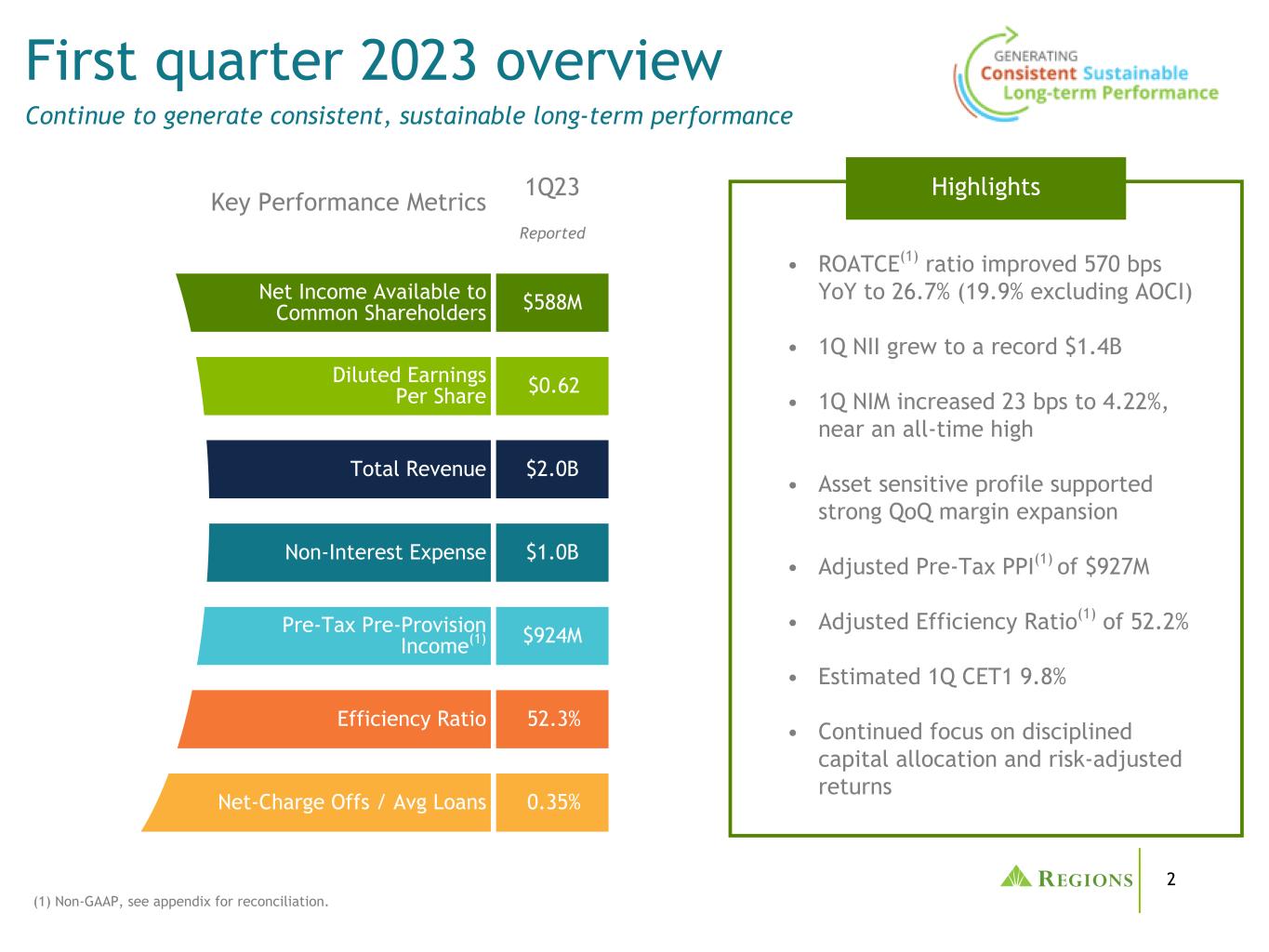
2 First quarter 2023 overview Continue to generate consistent, sustainable long-term performance (1) Non-GAAP, see appendix for reconciliation. Key Performance Metrics 1Q23 Reported Net Income Available to Common Shareholders $588M Diluted Earnings Per Share $0.62 Total Revenue $2.0B Non-Interest Expense $1.0B Pre-Tax Pre-Provision Income(1) $924M Efficiency Ratio 52.3% Net-Charge Offs / Avg Loans 0.35% Highlights • ROATCE(1) ratio improved 570 bps YoY to 26.7% (19.9% excluding AOCI) • 1Q NII grew to a record $1.4B • 1Q NIM increased 23 bps to 4.22%, near an all-time high • Asset sensitive profile supported strong QoQ margin expansion • Adjusted Pre-Tax PPI(1) of $927M • Adjusted Efficiency Ratio(1) of 52.2% • Estimated 1Q CET1 9.8% • Continued focus on disciplined capital allocation and risk-adjusted returns
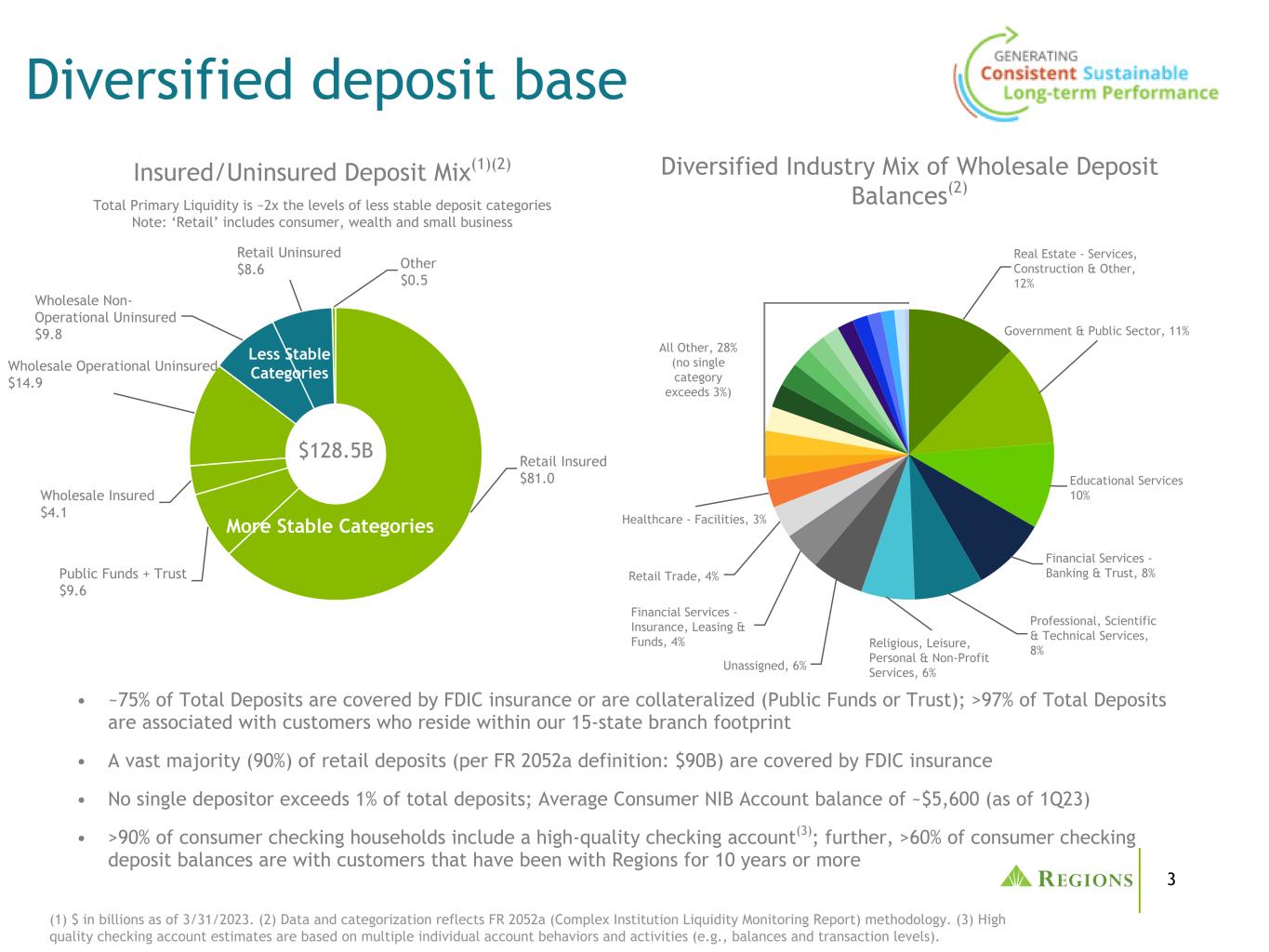
3 Diversified deposit base (1) $ in billions as of 3/31/2023. (2) Data and categorization reflects FR 2052a (Complex Institution Liquidity Monitoring Report) methodology. (3) High quality checking account estimates are based on multiple individual account behaviors and activities (e.g., balances and transaction levels). Diversified Industry Mix of Wholesale Deposit Balances(2) Total Primary Liquidity is ~2x the levels of less stable deposit categories Note: ‘Retail’ includes consumer, wealth and small business Insured/Uninsured Deposit Mix(1)(2) Real Estate - Services, Construction & Other, 12% Government & Public Sector, 11% Educational Services 10% Financial Services - Banking & Trust, 8% Professional, Scientific & Technical Services, 8%Religious, Leisure, Personal & Non-Profit Services, 6%Unassigned, 6% Financial Services - Insurance, Leasing & Funds, 4% Retail Trade, 4% Healthcare - Facilities, 3% All Other, 28% (no single category exceeds 3%) • ~75% of Total Deposits are covered by FDIC insurance or are collateralized (Public Funds or Trust); >97% of Total Deposits are associated with customers who reside within our 15-state branch footprint • A vast majority (90%) of retail deposits (per FR 2052a definition: $90B) are covered by FDIC insurance • No single depositor exceeds 1% of total deposits; Average Consumer NIB Account balance of ~$5,600 (as of 1Q23) • >90% of consumer checking households include a high-quality checking account(3); further, >60% of consumer checking deposit balances are with customers that have been with Regions for 10 years or more Retail Insured $81.0 Public Funds + Trust $9.6 Wholesale Insured $4.1 Wholesale Operational Uninsured $14.9 Wholesale Non- Operational Uninsured $9.8 Retail Uninsured $8.6 Other $0.5 Less Stable Categories More Stable Categories $128.5B
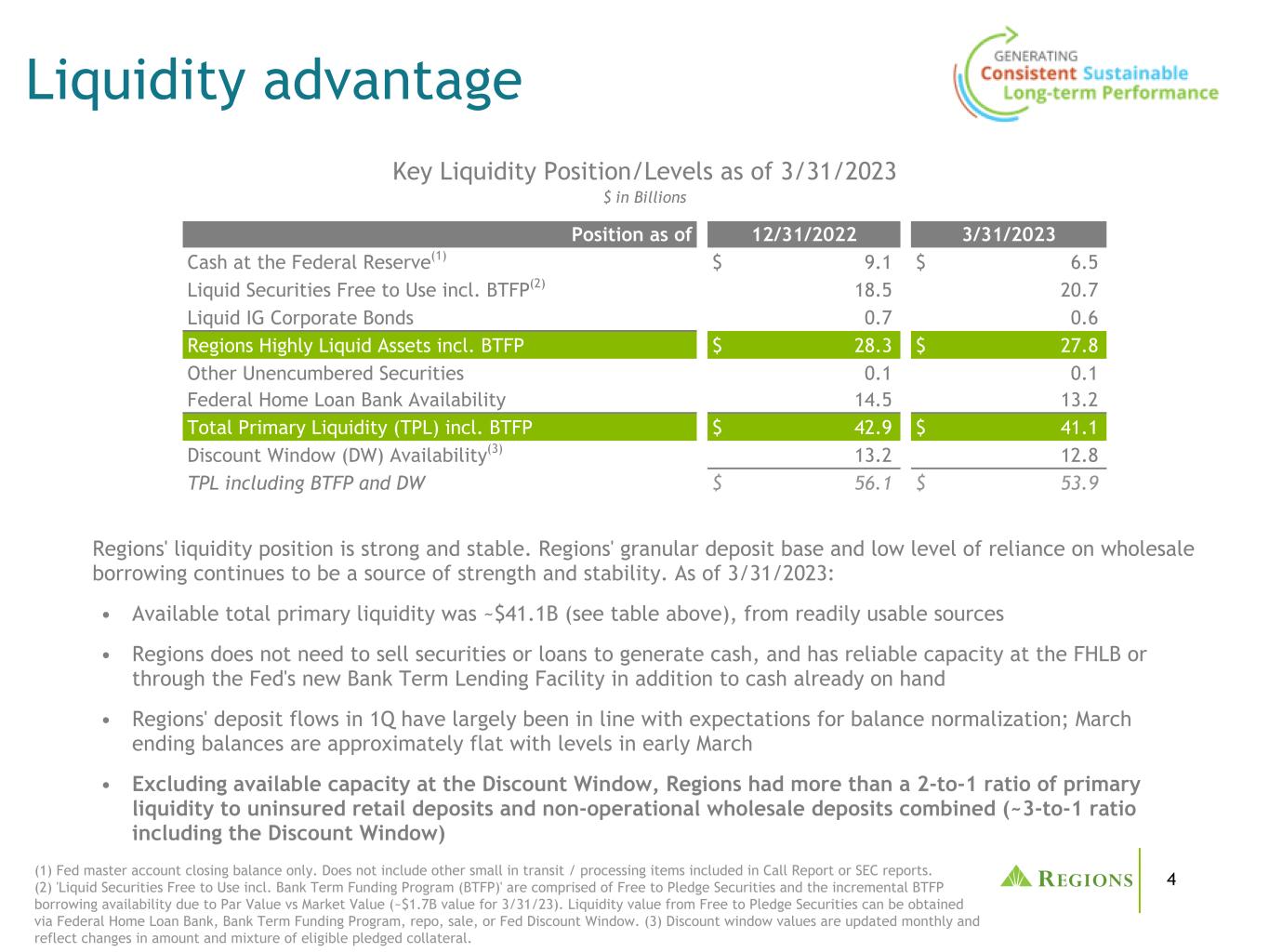
4 Liquidity advantage (1) Fed master account closing balance only. Does not include other small in transit / processing items included in Call Report or SEC reports. (2) 'Liquid Securities Free to Use incl. Bank Term Funding Program (BTFP)' are comprised of Free to Pledge Securities and the incremental BTFP borrowing availability due to Par Value vs Market Value (~$1.7B value for 3/31/23). Liquidity value from Free to Pledge Securities can be obtained via Federal Home Loan Bank, Bank Term Funding Program, repo, sale, or Fed Discount Window. (3) Discount window values are updated monthly and reflect changes in amount and mixture of eligible pledged collateral. Regions' liquidity position is strong and stable. Regions' granular deposit base and low level of reliance on wholesale borrowing continues to be a source of strength and stability. As of 3/31/2023: • Available total primary liquidity was ~$41.1B (see table above), from readily usable sources • Regions does not need to sell securities or loans to generate cash, and has reliable capacity at the FHLB or through the Fed's new Bank Term Lending Facility in addition to cash already on hand • Regions' deposit flows in 1Q have largely been in line with expectations for balance normalization; March ending balances are approximately flat with levels in early March • Excluding available capacity at the Discount Window, Regions had more than a 2-to-1 ratio of primary liquidity to uninsured retail deposits and non-operational wholesale deposits combined (~3-to-1 ratio including the Discount Window) Position as of 12/31/2022 3/31/2023 Cash at the Federal Reserve(1) $ 9.1 $ 6.5 Liquid Securities Free to Use incl. BTFP(2) 18.5 20.7 Liquid IG Corporate Bonds 0.7 0.6 Regions Highly Liquid Assets incl. BTFP $ 28.3 $ 27.8 Other Unencumbered Securities 0.1 0.1 Federal Home Loan Bank Availability 14.5 13.2 Total Primary Liquidity (TPL) incl. BTFP $ 42.9 $ 41.1 Discount Window (DW) Availability(3) 13.2 12.8 TPL including BTFP and DW $ 56.1 $ 53.9 Key Liquidity Position/Levels as of 3/31/2023 $ in Billions

5 • Avg business loans increased 2% reflecting high-quality, broad- based growth across utilities, retail trade (automotive, grocery, hardware, & consumer essentials) and financial services industries • Line commitments increased ~$1.5B and utilization increased to 43.7% • Avg consumer loans increased 1% as growth in avg mortgage and EnerBank was offset by continued pay-downs in home equity and run- off of exit portfolios ◦ Other Consumer includes ~7% growth in avg EnerBank loans • Expect 2023 reported ending loan balances to grow ~4% compared to 2022 Loan growth continues $89.3 $97.0 $98.1 58.2 64.7 65.5 31.1 32.3 32.6 1Q22 4Q22 1Q23 (Ending, $ in billions) $87.8 $95.8 $97.3 56.6 63.8 64.9 31.2 32.0 32.4 1Q22 4Q22 1Q23 Loans and leases (Average, $ in billions) Business loansConsumer loans 2% 1% QoQ highlights & outlook
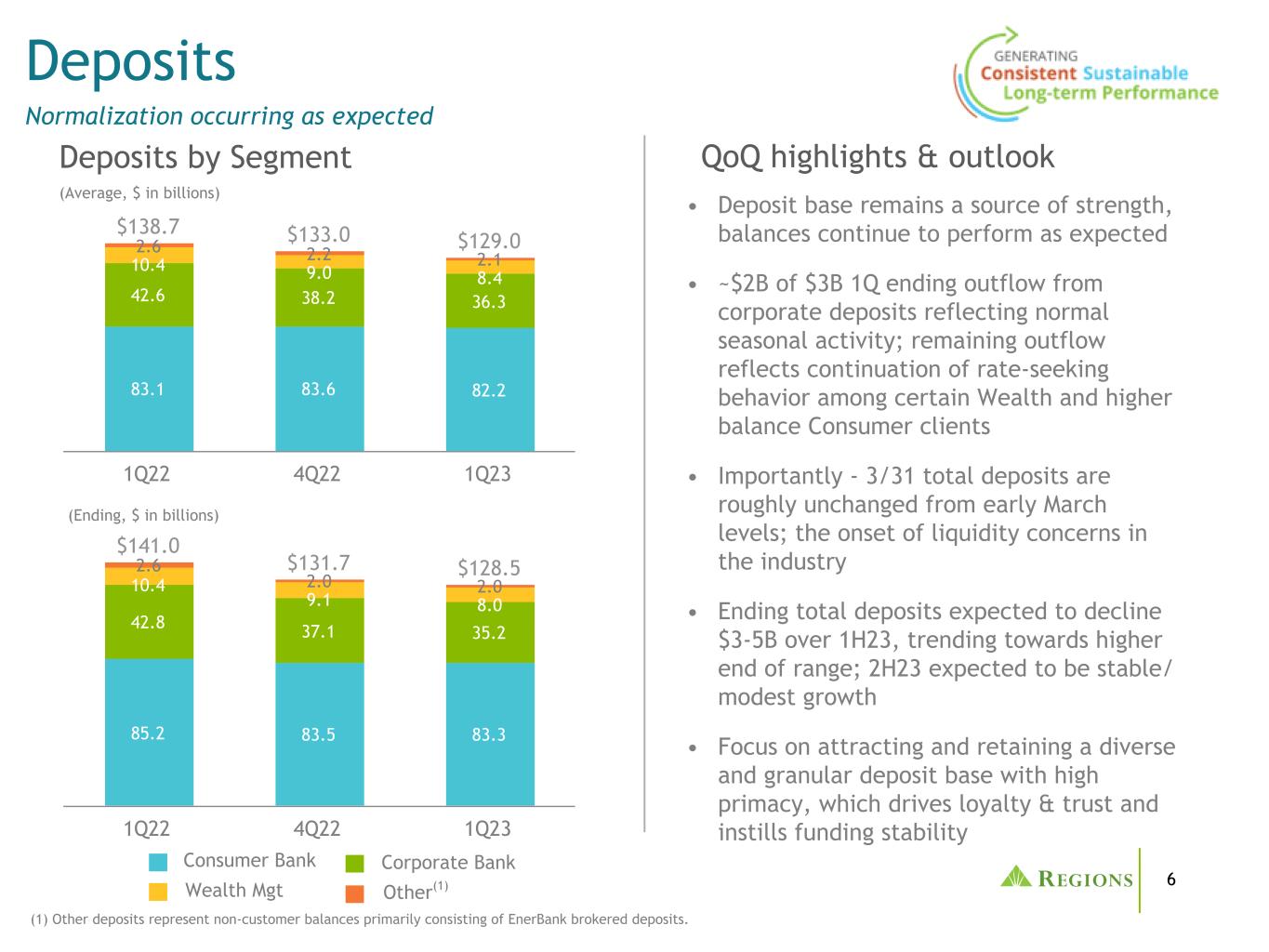
6 $141.0 $131.7 $128.5 85.2 83.5 83.3 42.8 37.1 35.2 10.4 9.1 8.0 2.6 2.0 2.0 1Q22 4Q22 1Q23 $138.7 $133.0 $129.0 83.1 83.6 82.2 42.6 38.2 36.3 10.4 9.0 8.4 2.6 2.2 2.1 1Q22 4Q22 1Q23 Deposits Normalization occurring as expected (1) Other deposits represent non-customer balances primarily consisting of EnerBank brokered deposits. Wealth Mgt Other(1) Consumer Bank Corporate Bank QoQ highlights & outlook • Deposit base remains a source of strength, balances continue to perform as expected • ~$2B of $3B 1Q ending outflow from corporate deposits reflecting normal seasonal activity; remaining outflow reflects continuation of rate-seeking behavior among certain Wealth and higher balance Consumer clients • Importantly - 3/31 total deposits are roughly unchanged from early March levels; the onset of liquidity concerns in the industry • Ending total deposits expected to decline $3-5B over 1H23, trending towards higher end of range; 2H23 expected to be stable/ modest growth • Focus on attracting and retaining a diverse and granular deposit base with high primacy, which drives loyalty & trust and instills funding stability (Ending, $ in billions) Deposits by Segment (Average, $ in billions)

7 Market Rates(2) (1) Net interest income (NII) and net interest margin (NIM) are reflected on a fully taxable-equivalent basis. (2) Market rate impacts include contractual loan, cash, hedge and borrowings repricing; fixed asset turnover at higher market rates; and lower securities premium amortization net discount accretion from $23M to $20M. (3) Expectations assume 03/31/2023 forward rates: upper-end Fed funds ends 2023 at ~4.5%; remaining 2023 avg 10-year U.S. Treasury yield 3.43%. A 2% change in the FY beta assumption would drive +/- ~$50M to FY23 NII. A $1B change in NIB deposit balances assumption would drive +/- ~$40M to FY23 NII. $1,401 $1,417 NII Attribution 1Q23 • NII +$16M, or +1% linked-quarter; NIM +23bps • Higher short-term rates largely drive NII growth, overcoming deposit balance and pricing normalization ◦ 1Q deposit cost = 56bps / interest-bearing deposit cost = 91bps (19% cycle-to-date beta) • Higher long-term rates increase fixed-rate asset yields and reduce securities premium amortization(2) • Avg loan growth of ~$1.5B in 1Q Drivers of NII and NIM 4Q22 -20bps -3bps +7bps+38bps -$67M +$5M -$14M+$129MNII NIM NII & margin performance Days / Other -$37M +1bps Rate Environment $1,026 $1,414 $1,430 2.85% 3.99% 4.22% 1Q22 4Q22 1Q23 Expectations for 2Q23 & Beyond(3) • As Fed Funds nears a peak, NII and NIM will see modest declines from deposit cost normalization, offset by asset turnover at higher rates and modest loan growth ◦ 2Q23 NII expected to decline 1.5-3.5% ◦ 2023 NII expected to grow 12-14% • Forward rates drive mid-point of FY23 range, while stable Fed Funds pushes NII to the upper-end of the range • Assumes ~35% full cycle int-bearing deposit beta NII FTE NII and NIM(1) ($ in millions) NIM Deposit Costs Cash / Deposit Declines Loan Growth +$16M +23bps
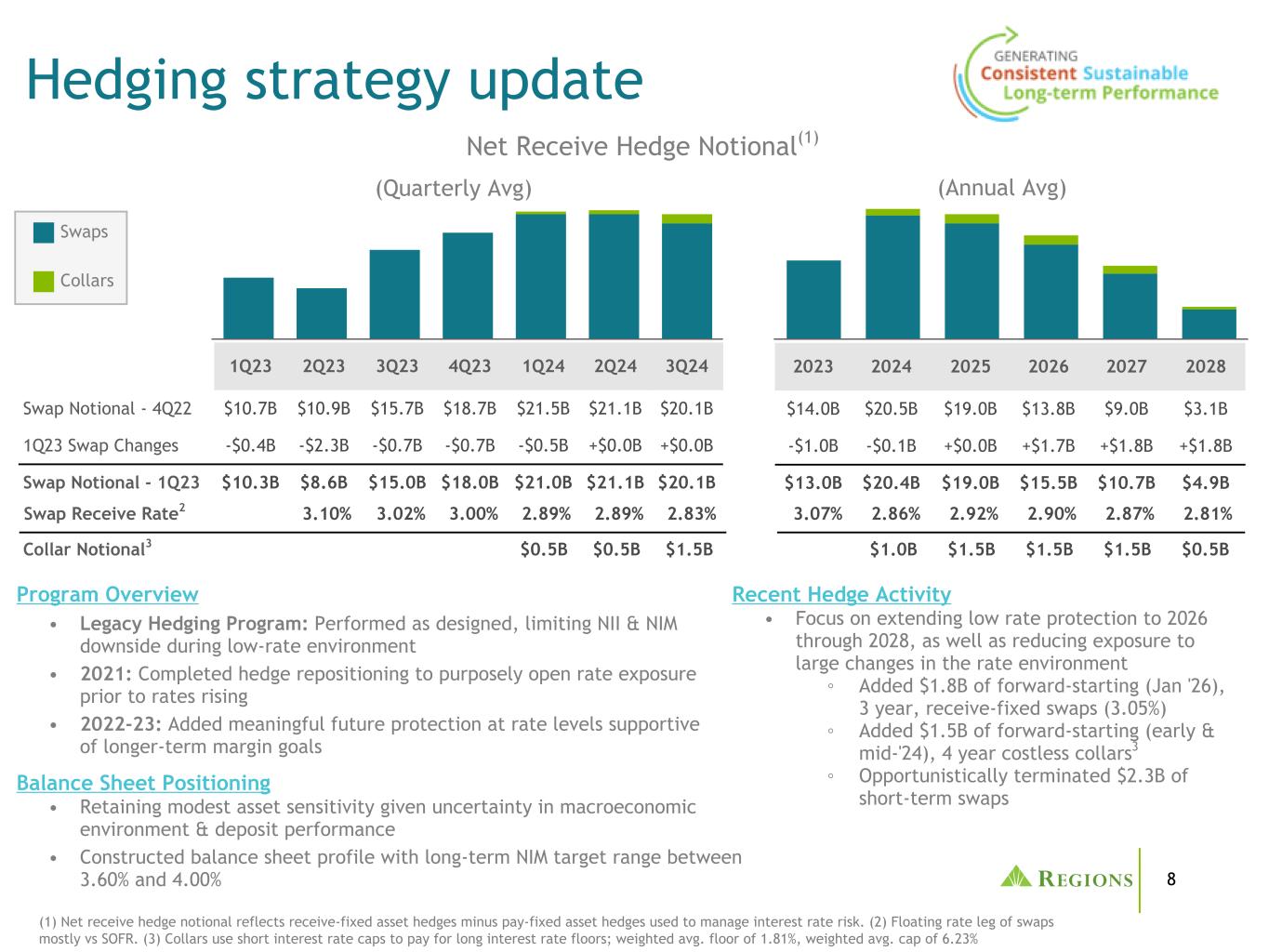
8 1 2 3 4 5 6 7 Program Overview • Legacy Hedging Program: Performed as designed, limiting NII & NIM downside during low-rate environment • 2021: Completed hedge repositioning to purposely open rate exposure prior to rates rising • 2022-23: Added meaningful future protection at rate levels supportive of longer-term margin goals Net Receive Hedge Notional(1) (1) Net receive hedge notional reflects receive-fixed asset hedges minus pay-fixed asset hedges used to manage interest rate risk. (2) Floating rate leg of swaps mostly vs SOFR. (3) Collars use short interest rate caps to pay for long interest rate floors; weighted avg. floor of 1.81%, weighted avg. cap of 6.23% Hedging strategy update (Quarterly Avg) 1 2 3 4 5 62023 2024 2025 2026 2027 2028 $14.0B $20.5B $19.0B $13.8B $9.0B $3.1B -$1.0B -$0.1B +$0.0B +$1.7B +$1.8B +$1.8B $13.0B $20.4B $19.0B $15.5B $10.7B $4.9B 3.07% 2.86% 2.92% 2.90% 2.87% 2.81% (Annual Avg) Recent Hedge Activity • Focus on extending low rate protection to 2026 through 2028, as well as reducing exposure to large changes in the rate environment ◦ Added $1.8B of forward-starting (Jan '26), 3 year, receive-fixed swaps (3.05%) ◦ Added $1.5B of forward-starting (early & mid-'24), 4 year costless collars3 ◦ Opportunistically terminated $2.3B of short-term swaps 1Q23 2Q23 3Q23 4Q23 1Q24 2Q24 3Q24 Swap Notional - 4Q22 $10.7B $10.9B $15.7B $18.7B $21.5B $21.1B $20.1B 1Q23 Swap Changes -$0.4B -$2.3B -$0.7B -$0.7B -$0.5B +$0.0B +$0.0B Swap Notional - 1Q23 $10.3B $8.6B $15.0B $18.0B $21.0B $21.1B $20.1B Swaps Swap Receive Rate2 3.10% 3.02% 3.00% 2.89% 2.89% 2.83% Balance Sheet Positioning • Retaining modest asset sensitivity given uncertainty in macroeconomic environment & deposit performance • Constructed balance sheet profile with long-term NIM target range between 3.60% and 4.00% $1.0B $1.5B $1.5B $1.5B $0.5BCollar Notional3 $0.5B $0.5B $1.5B Collars

9 Adj. Non-Interest Income $583 $550 $535 1Q22 4Q22 1Q23 Change vs ($ in millions) 1Q23 4Q22 1Q22 Service charges $155 2.0% (7.7)% Card and ATM fees 121 (6.9)% (2.4)% Capital markets (Ex CVA/DVA) 75 4.2% 11.9% Capital markets - CVA/DVA (33) (200.0)% NM Wealth management income 112 3.7% 10.9% Mortgage income 24 NM (50.0)% Non-interest income NM - Not Meaningful (1) Non-GAAP; see appendix for reconciliation. (2) FY23 expectation includes an estimated impact for a grace period feature rolling out around mid-year 2023. • Expect full-year 2023 adjusted total revenue to be up 6-8% compared to 2022 QoQ outlook Total revenue outlook • Expect to offer a grace period feature in 2023 resulting in FY23 service charges of ~$550M(2) • Total capital markets decreased 31%; Ex. CVA/DVA, it increased 4%, as growth in real estate, syndications, and debt & securities underwriting more than offset declines in M&A fees and commercial swaps ◦ ($33M) CVA/DVA adjustment reflecting lower long-term interest rates and volatility in credit spreads ◦ Expect 2Q23 capital markets revenue in $60-$80M range ex. CVA/DVA • Card & ATM Fees negatively impacted by higher reward redemption rates • Wealth management continues to perform well despite market volatility Non-Interest Income $584 $600 $534 1Q22 4Q22 1Q23 ($ in millions) ($ in millions) (1)
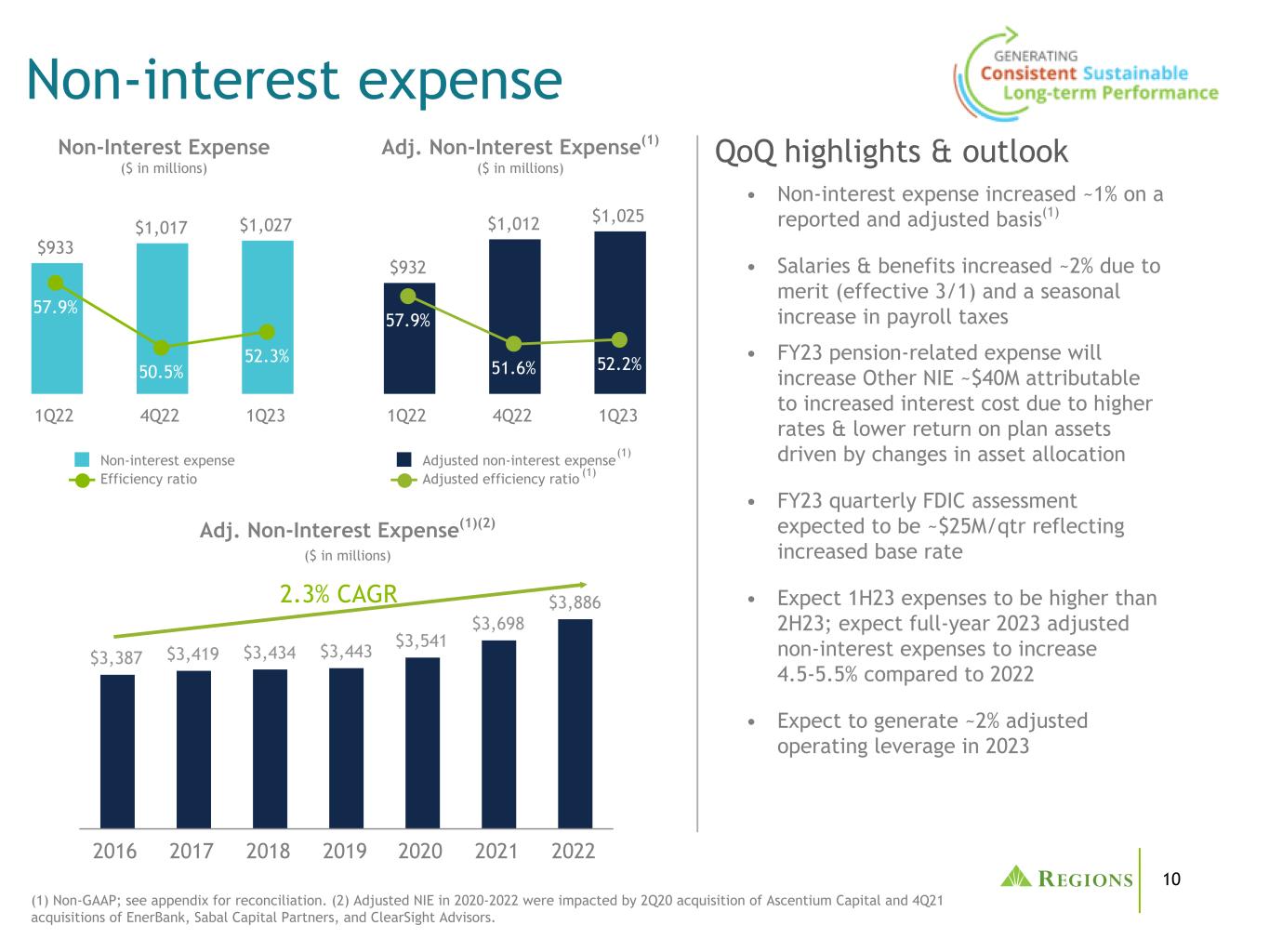
10 $933 $1,017 $1,027 57.9% 50.5% 52.3% Non-interest expense Efficiency ratio 1Q22 4Q22 1Q23 • Non-interest expense increased ~1% on a reported and adjusted basis(1) • Salaries & benefits increased ~2% due to merit (effective 3/1) and a seasonal increase in payroll taxes • FY23 pension-related expense will increase Other NIE ~$40M attributable to increased interest cost due to higher rates & lower return on plan assets driven by changes in asset allocation • FY23 quarterly FDIC assessment expected to be ~$25M/qtr reflecting increased base rate • Expect 1H23 expenses to be higher than 2H23; expect full-year 2023 adjusted non-interest expenses to increase 4.5-5.5% compared to 2022 • Expect to generate ~2% adjusted operating leverage in 2023 $932 $1,012 $1,025 57.9% 51.6% 52.2% Adjusted non-interest expense Adjusted efficiency ratio 1Q22 4Q22 1Q23 $3,387 $3,419 $3,434 $3,443 $3,541 $3,698 $3,886 2016 2017 2018 2019 2020 2021 2022 Non-interest expense QoQ highlights & outlookAdj. Non-Interest Expense(1) ($ in millions) 2.3% CAGR (1) (1) Non-GAAP; see appendix for reconciliation. (2) Adjusted NIE in 2020-2022 were impacted by 2Q20 acquisition of Ascentium Capital and 4Q21 acquisitions of EnerBank, Sabal Capital Partners, and ClearSight Advisors. (1) Non-Interest Expense ($ in millions) Adj. Non-Interest Expense(1)(2) ($ in millions)
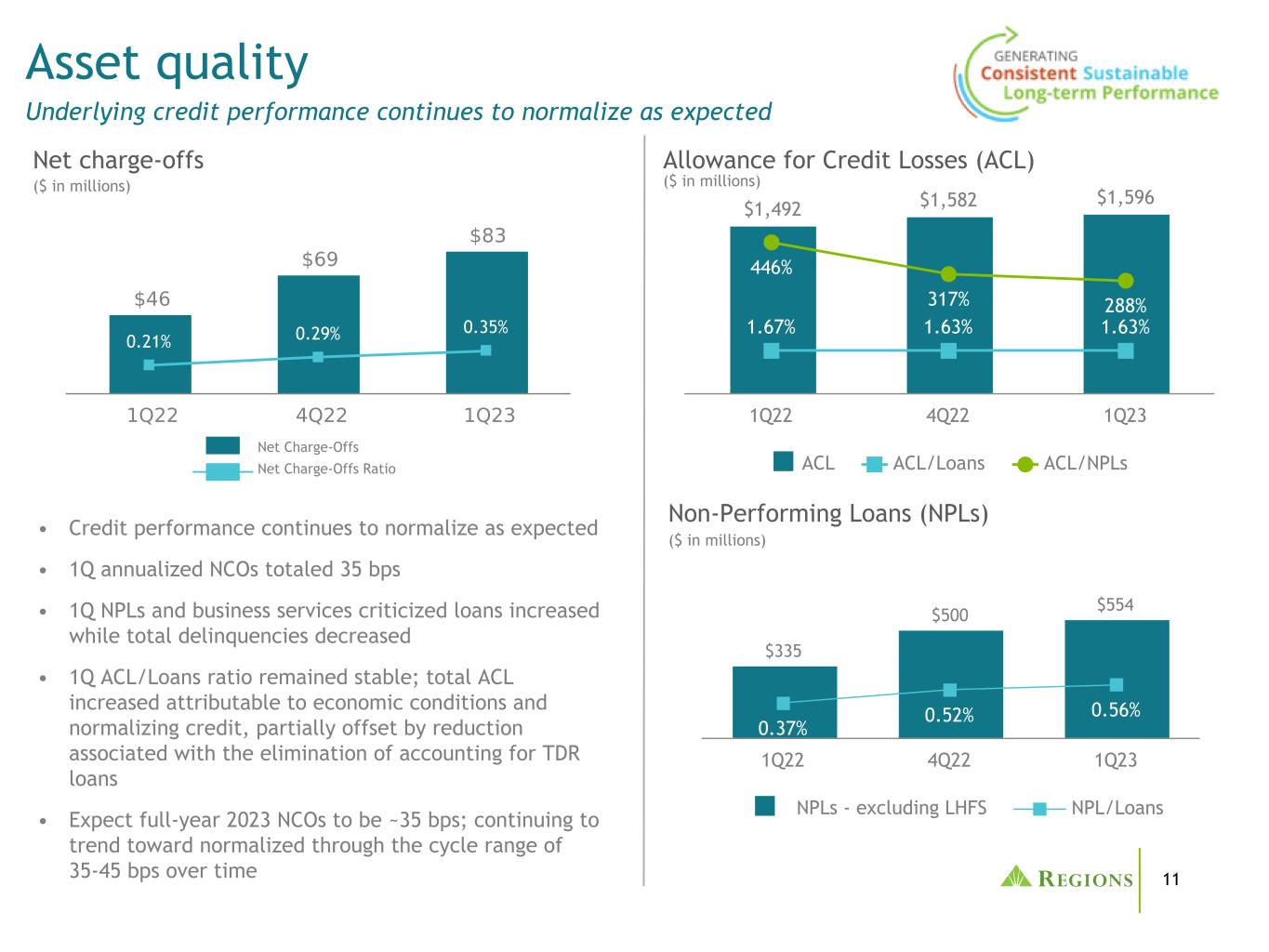
11 • Credit performance continues to normalize as expected • 1Q annualized NCOs totaled 35 bps • 1Q NPLs and business services criticized loans increased while total delinquencies decreased • 1Q ACL/Loans ratio remained stable; total ACL increased attributable to economic conditions and normalizing credit, partially offset by reduction associated with the elimination of accounting for TDR loans • Expect full-year 2023 NCOs to be ~35 bps; continuing to trend toward normalized through the cycle range of 35-45 bps over time Non-Performing Loans (NPLs) Asset quality Underlying credit performance continues to normalize as expected ($ in millions) ($ in millions) Allowance for Credit Losses (ACL) $1,492 $1,582 $1,596 1.67% 1.63% 1.63% 446% 317% 288% ACL ACL/Loans ACL/NPLs 1Q22 4Q22 1Q23 0.21% 0.29% 0.35% $335 $500 $554 0.37% 0.52% 0.56% NPLs - excluding LHFS NPL/Loans 1Q22 4Q22 1Q23 Net charge-offs ($ in millions) Net Charge-Offs Net Charge-Offs Ratio
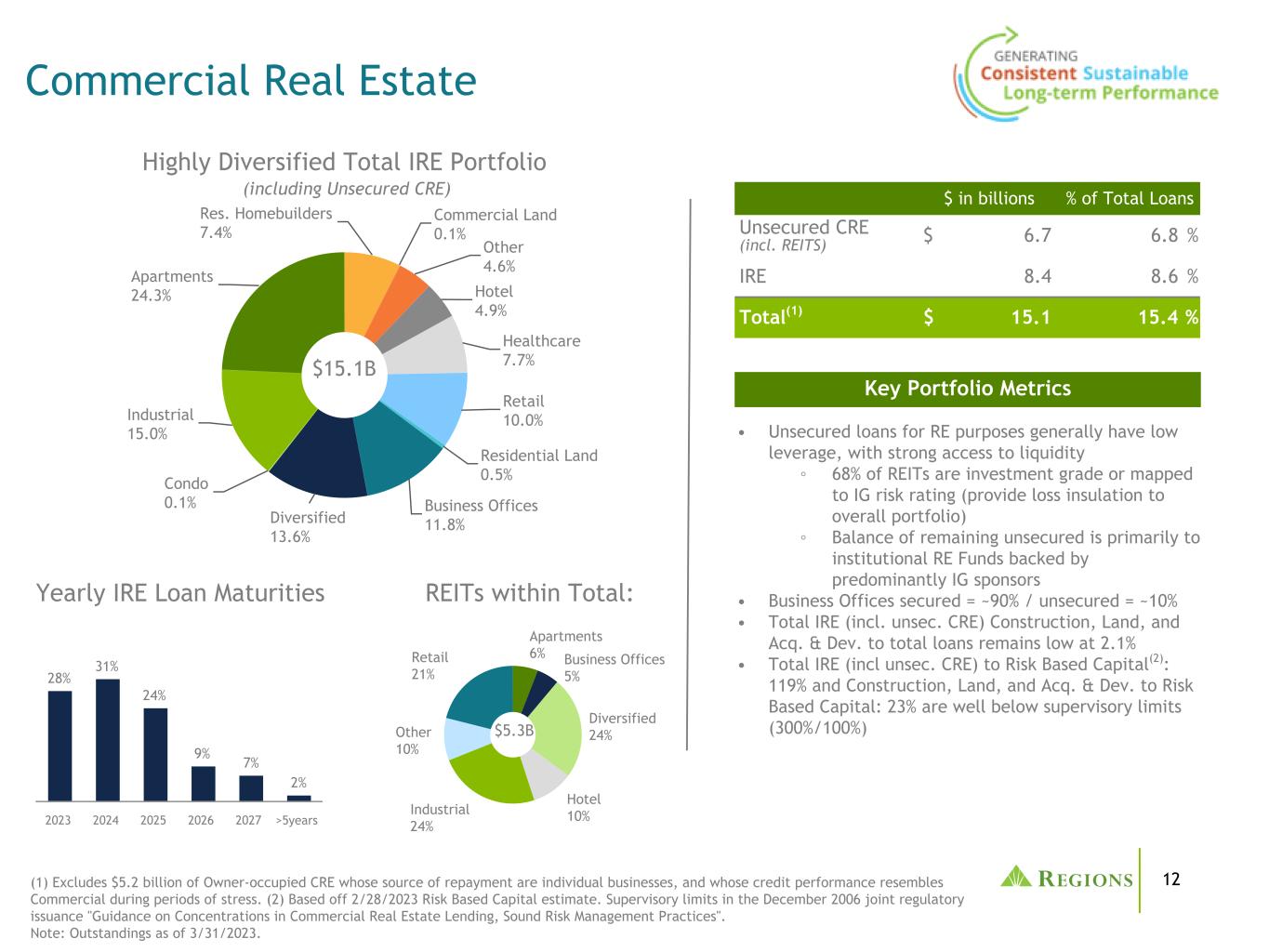
12 Commercial Real Estate Highly Diversified Total IRE Portfolio (including Unsecured CRE) • Unsecured loans for RE purposes generally have low leverage, with strong access to liquidity ◦ 68% of REITs are investment grade or mapped to IG risk rating (provide loss insulation to overall portfolio) ◦ Balance of remaining unsecured is primarily to institutional RE Funds backed by predominantly IG sponsors • Business Offices secured = ~90% / unsecured = ~10% • Total IRE (incl. unsec. CRE) Construction, Land, and Acq. & Dev. to total loans remains low at 2.1% • Total IRE (incl unsec. CRE) to Risk Based Capital(2): 119% and Construction, Land, and Acq. & Dev. to Risk Based Capital: 23% are well below supervisory limits (300%/100%) (1) Excludes $5.2 billion of Owner-occupied CRE whose source of repayment are individual businesses, and whose credit performance resembles Commercial during periods of stress. (2) Based off 2/28/2023 Risk Based Capital estimate. Supervisory limits in the December 2006 joint regulatory issuance "Guidance on Concentrations in Commercial Real Estate Lending, Sound Risk Management Practices". Note: Outstandings as of 3/31/2023. Res. Homebuilders 7.4% Commercial Land 0.1% Other 4.6% Hotel 4.9% Healthcare 7.7% Retail 10.0% Residential Land 0.5% Business Offices 11.8%Diversified 13.6% Condo 0.1% Industrial 15.0% Apartments 24.3% $15.1B $ in billions % of Total Loans Unsecured CRE (incl. REITS) $ 6.7 6.8 % IRE 8.4 8.6 % Total(1) $ 15.1 15.4 % Key Portfolio Metrics Yearly IRE Loan Maturities 28% 31% 24% 9% 7% 2% 2023 2024 2025 2026 2027 >5years Apartments 6% Business Offices 5% Diversified 24% Hotel 10%Industrial 24% Other 10% Retail 21% REITs within Total: $5.3B
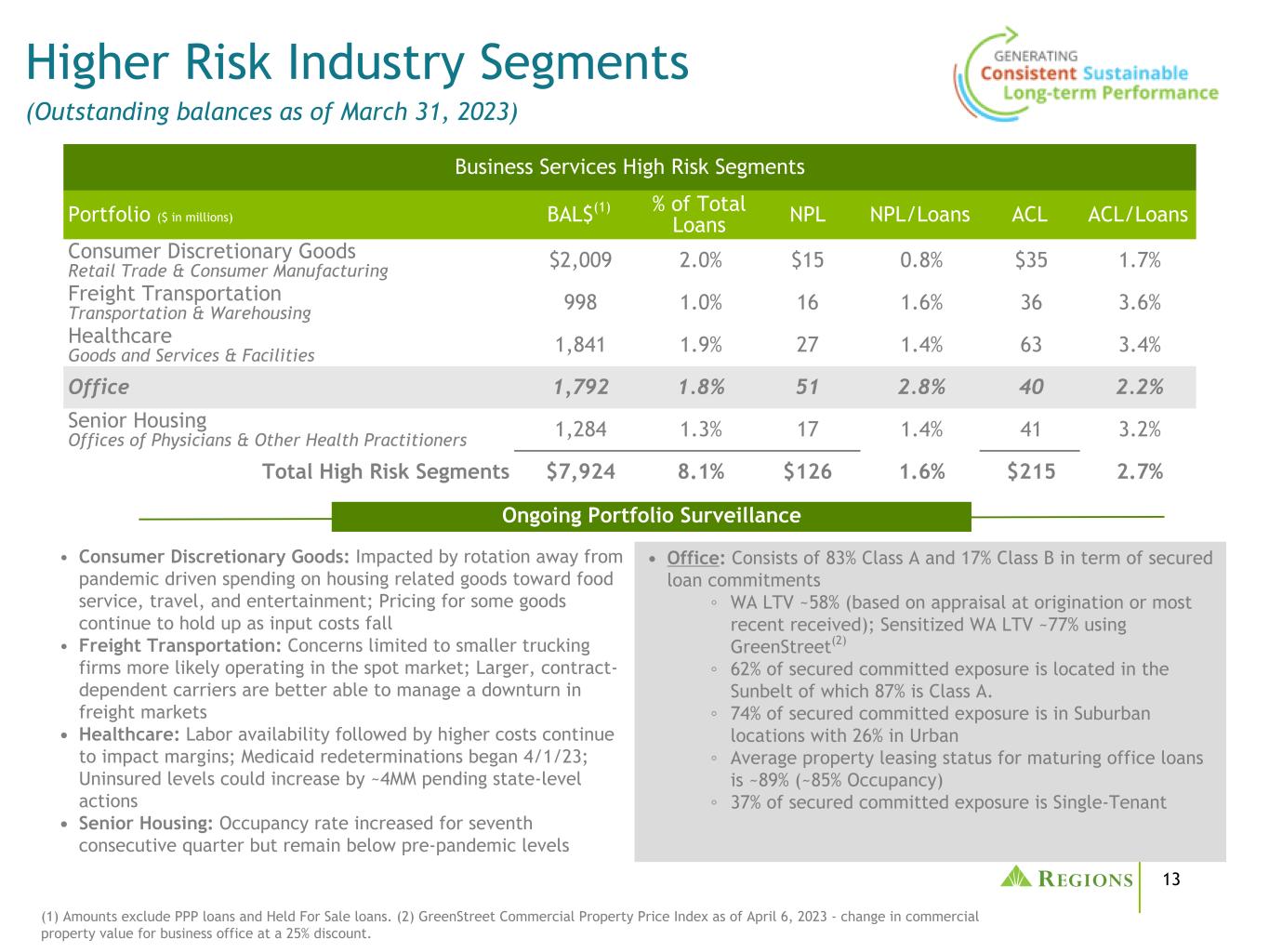
13 Higher Risk Industry Segments (Outstanding balances as of March 31, 2023) (1) Amounts exclude PPP loans and Held For Sale loans. (2) GreenStreet Commercial Property Price Index as of April 6, 2023 - change in commercial property value for business office at a 25% discount. Business Services High Risk Segments Portfolio ($ in millions) BAL$(1) % of Total Loans NPL NPL/Loans ACL ACL/Loans Consumer Discretionary Goods Retail Trade & Consumer Manufacturing $2,009 2.0% $15 0.8% $35 1.7% Freight Transportation Transportation & Warehousing 998 1.0% 16 1.6% 36 3.6% Healthcare Goods and Services & Facilities 1,841 1.9% 27 1.4% 63 3.4% Office 1,792 1.8% 51 2.8% 40 2.2% Senior Housing Offices of Physicians & Other Health Practitioners 1,284 1.3% 17 1.4% 41 3.2% Total High Risk Segments $7,924 8.1% $126 1.6% $215 2.7% • Consumer Discretionary Goods: Impacted by rotation away from pandemic driven spending on housing related goods toward food service, travel, and entertainment; Pricing for some goods continue to hold up as input costs fall • Freight Transportation: Concerns limited to smaller trucking firms more likely operating in the spot market; Larger, contract- dependent carriers are better able to manage a downturn in freight markets • Healthcare: Labor availability followed by higher costs continue to impact margins; Medicaid redeterminations began 4/1/23; Uninsured levels could increase by ~4MM pending state-level actions • Senior Housing: Occupancy rate increased for seventh consecutive quarter but remain below pre-pandemic levels Ongoing Portfolio Surveillance • Office: Consists of 83% Class A and 17% Class B in term of secured loan commitments ◦ WA LTV ~58% (based on appraisal at origination or most recent received); Sensitized WA LTV ~77% using GreenStreet(2) ◦ 62% of secured committed exposure is located in the Sunbelt of which 87% is Class A. ◦ 74% of secured committed exposure is in Suburban locations with 26% in Urban ◦ Average property leasing status for maturing office loans is ~89% (~85% Occupancy) ◦ 37% of secured committed exposure is Single-Tenant
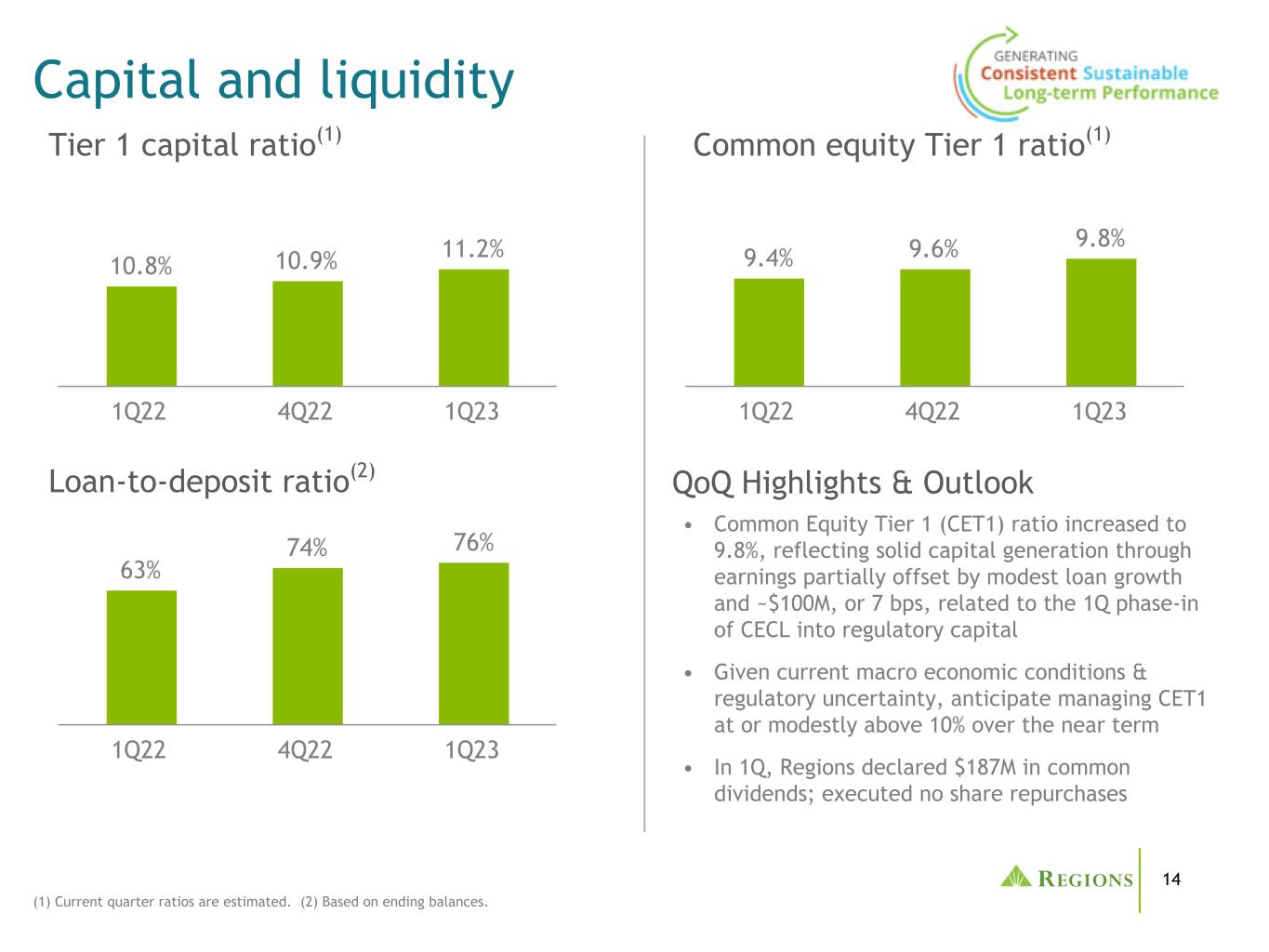
14 9.4% 9.6% 9.8% 1Q22 4Q22 1Q23 • Common Equity Tier 1 (CET1) ratio increased to 9.8%, reflecting solid capital generation through earnings partially offset by modest loan growth and ~$100M, or 7 bps, related to the 1Q phase-in of CECL into regulatory capital • Given current macro economic conditions & regulatory uncertainty, anticipate managing CET1 at or modestly above 10% over the near term • In 1Q, Regions declared $187M in common dividends; executed no share repurchases QoQ Highlights & Outlook Capital and liquidity (1) Current quarter ratios are estimated. (2) Based on ending balances. 10.8% 10.9% 11.2% 1Q22 4Q22 1Q23 Tier 1 capital ratio(1) Loan-to-deposit ratio(2) 63% 74% 76% 1Q22 4Q22 1Q23 Common equity Tier 1 ratio(1)
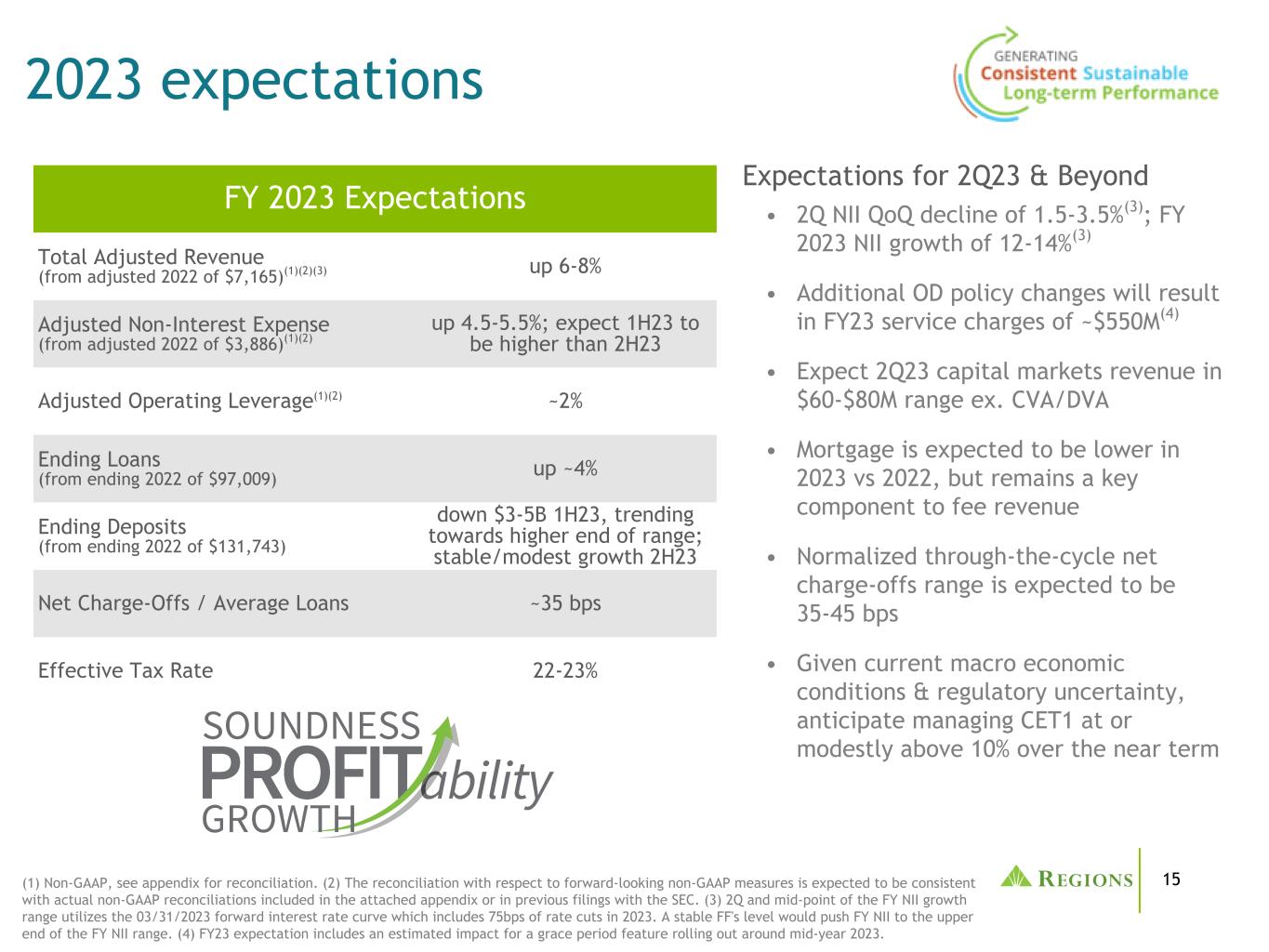
15 2023 expectations (1) Non-GAAP, see appendix for reconciliation. (2) The reconciliation with respect to forward-looking non-GAAP measures is expected to be consistent with actual non-GAAP reconciliations included in the attached appendix or in previous filings with the SEC. (3) 2Q and mid-point of the FY NII growth range utilizes the 03/31/2023 forward interest rate curve which includes 75bps of rate cuts in 2023. A stable FF's level would push FY NII to the upper end of the FY NII range. (4) FY23 expectation includes an estimated impact for a grace period feature rolling out around mid-year 2023. FY 2023 Expectations Total Adjusted Revenue (from adjusted 2022 of $7,165)(1)(2)(3) up 6-8% Adjusted Non-Interest Expense (from adjusted 2022 of $3,886)(1)(2) up 4.5-5.5%; expect 1H23 to be higher than 2H23 Adjusted Operating Leverage(1)(2) ~2% Ending Loans (from ending 2022 of $97,009) up ~4% Ending Deposits (from ending 2022 of $131,743) down $3-5B 1H23, trending towards higher end of range; stable/modest growth 2H23 Net Charge-Offs / Average Loans ~35 bps Effective Tax Rate 22-23% Expectations for 2Q23 & Beyond • 2Q NII QoQ decline of 1.5-3.5%(3); FY 2023 NII growth of 12-14%(3) • Additional OD policy changes will result in FY23 service charges of ~$550M(4) • Expect 2Q23 capital markets revenue in $60-$80M range ex. CVA/DVA • Mortgage is expected to be lower in 2023 vs 2022, but remains a key component to fee revenue • Normalized through-the-cycle net charge-offs range is expected to be 35-45 bps • Given current macro economic conditions & regulatory uncertainty, anticipate managing CET1 at or modestly above 10% over the near term

16 Appendix
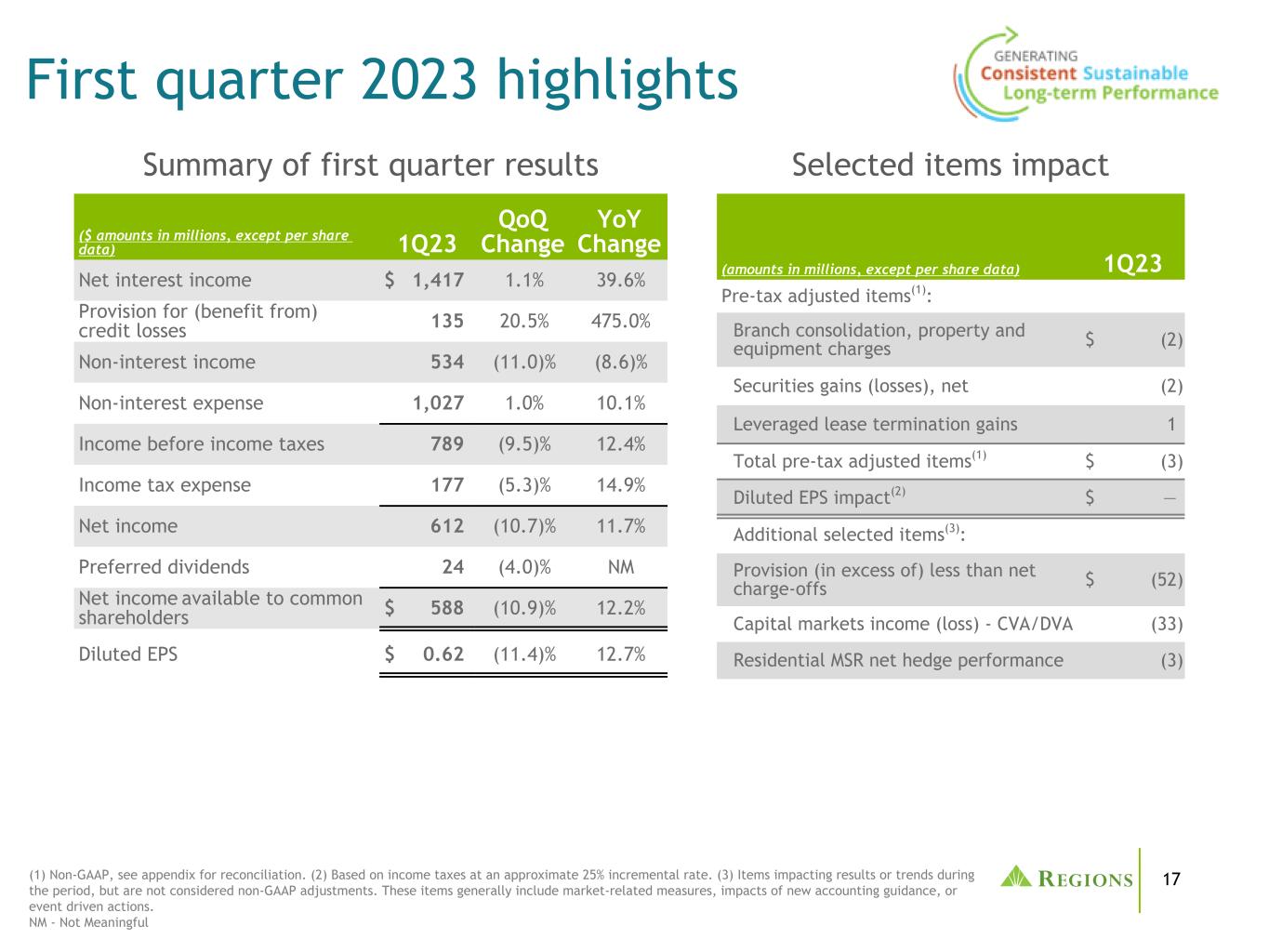
17 Selected items impact First quarter 2023 highlights (1) Non-GAAP, see appendix for reconciliation. (2) Based on income taxes at an approximate 25% incremental rate. (3) Items impacting results or trends during the period, but are not considered non-GAAP adjustments. These items generally include market-related measures, impacts of new accounting guidance, or event driven actions. NM - Not Meaningful ($ amounts in millions, except per share data) 1Q23 QoQ Change YoY Change Net interest income $ 1,417 1.1% 39.6% Provision for (benefit from) credit losses 135 20.5% 475.0% Non-interest income 534 (11.0)% (8.6)% Non-interest expense 1,027 1.0% 10.1% Income before income taxes 789 (9.5)% 12.4% Income tax expense 177 (5.3)% 14.9% Net income 612 (10.7)% 11.7% Preferred dividends 24 (4.0)% NM Net income available to common shareholders $ 588 (10.9)% 12.2% Diluted EPS $ 0.62 (11.4)% 12.7% Summary of first quarter results (amounts in millions, except per share data) 1Q23 Pre-tax adjusted items(1): Branch consolidation, property and equipment charges $ (2) Securities gains (losses), net (2) Leveraged lease termination gains 1 Total pre-tax adjusted items(1) $ (3) Diluted EPS impact(2) $ — Additional selected items(3): Provision (in excess of) less than net charge-offs $ (52) Capital markets income (loss) - CVA/DVA (33) Residential MSR net hedge performance (3)
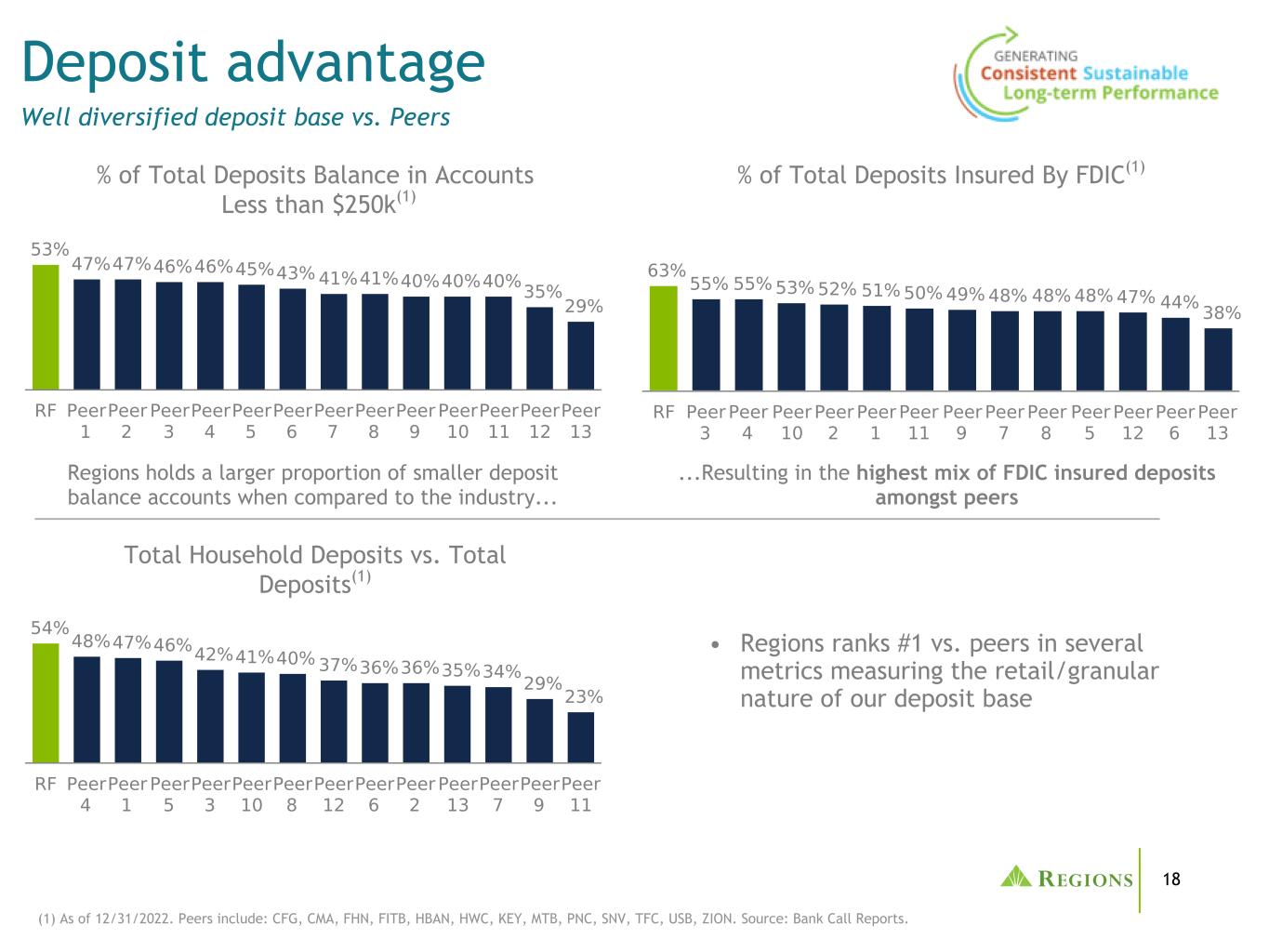
18 Deposit advantage Well diversified deposit base vs. Peers (1) As of 12/31/2022. Peers include: CFG, CMA, FHN, FITB, HBAN, HWC, KEY, MTB, PNC, SNV, TFC, USB, ZION. Source: Bank Call Reports. ...Resulting in the highest mix of FDIC insured deposits amongst peers % of Total Deposits Insured By FDIC(1)% of Total Deposits Balance in Accounts Less than $250k(1) Regions holds a larger proportion of smaller deposit balance accounts when compared to the industry... Total Household Deposits vs. Total Deposits(1) • Regions ranks #1 vs. peers in several metrics measuring the retail/granular nature of our deposit base
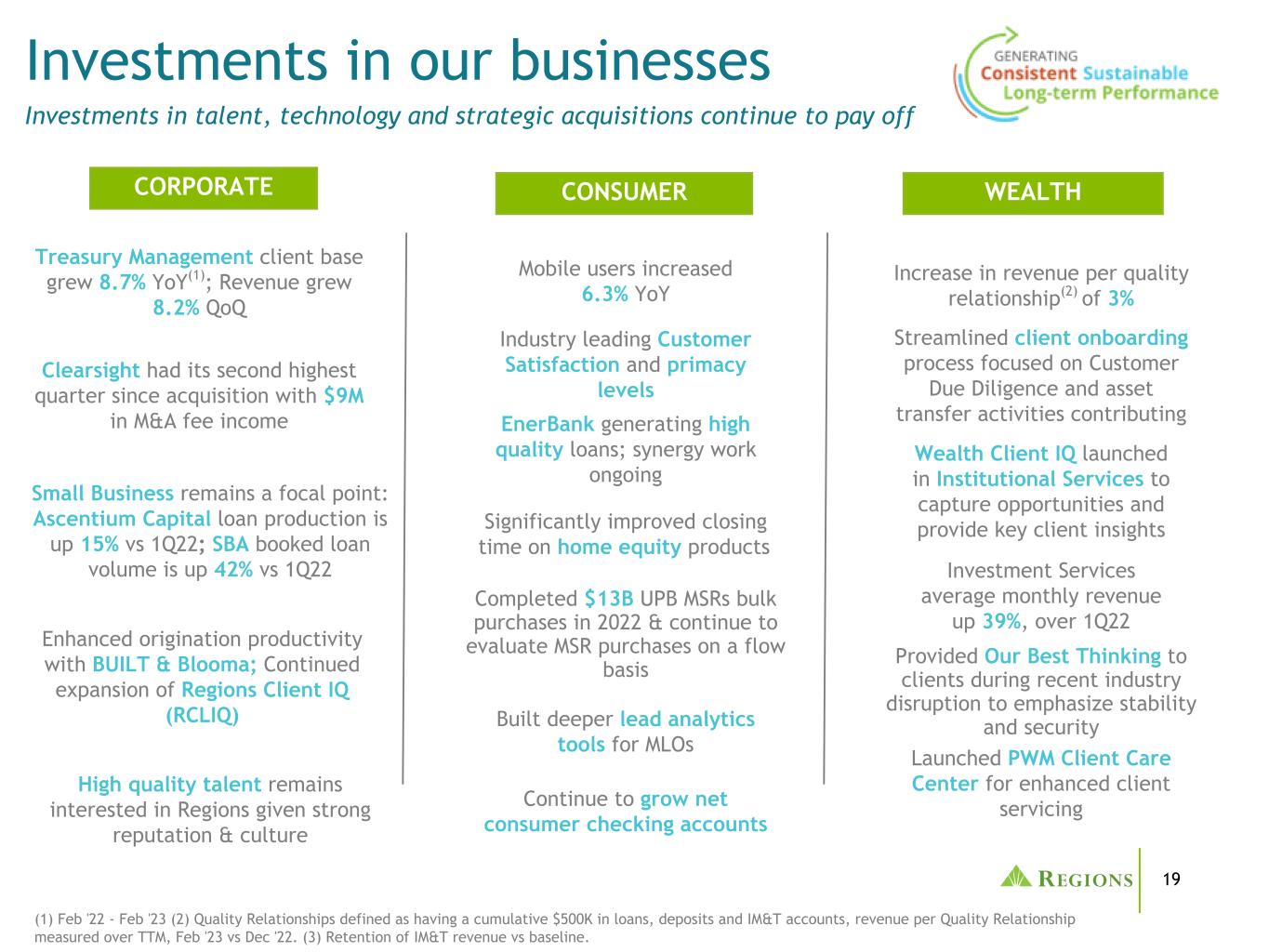
19 (1) Feb '22 - Feb '23 (2) Quality Relationships defined as having a cumulative $500K in loans, deposits and IM&T accounts, revenue per Quality Relationship measured over TTM, Feb '23 vs Dec '22. (3) Retention of IM&T revenue vs baseline. Investments in our businesses Investments in talent, technology and strategic acquisitions continue to pay off CORPORATE CONSUMER WEALTH Mobile users increased 6.3% YoY Increase in revenue per quality relationship(2) of 3% Clearsight had its second highest quarter since acquisition with $9M in M&A fee income Wealth Client IQ launched in Institutional Services to capture opportunities and provide key client insights Industry leading Customer Satisfaction and primacy levels Provided Our Best Thinking to clients during recent industry disruption to emphasize stability and security Completed $13B UPB MSRs bulk purchases in 2022 & continue to evaluate MSR purchases on a flow basis Built deeper lead analytics tools for MLOs EnerBank generating high quality loans; synergy work ongoing Investment Services average monthly revenue up 39%, over 1Q22 Launched PWM Client Care Center for enhanced client servicing Streamlined client onboarding process focused on Customer Due Diligence and asset transfer activities contributing Treasury Management client base grew 8.7% YoY(1); Revenue grew 8.2% QoQ Significantly improved closing time on home equity products High quality talent remains interested in Regions given strong reputation & culture Enhanced origination productivity with BUILT & Blooma; Continued expansion of Regions Client IQ (RCLIQ) Small Business remains a focal point: Ascentium Capital loan production is up 15% vs 1Q22; SBA booked loan volume is up 42% vs 1Q22 Continue to grow net consumer checking accounts
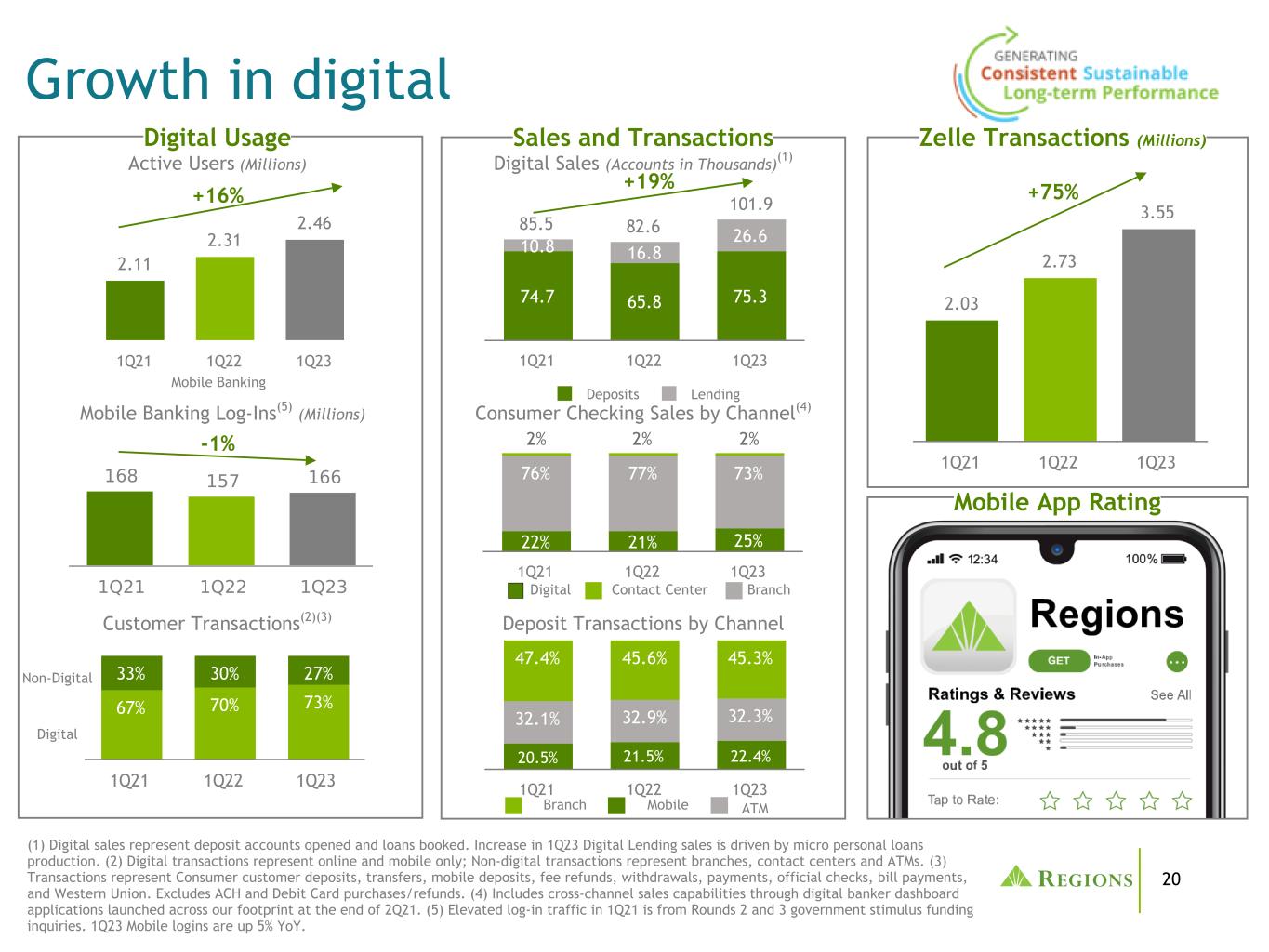
20 2.11 2.31 2.46 1Q21 1Q22 1Q23 2.03 2.73 3.55 1Q21 1Q22 1Q23 20.5% 21.5% 22.4% 32.1% 32.9% 32.3% 47.4% 45.6% 45.3% 1Q21 1Q22 1Q23 85.5 82.6 101.9 74.7 65.8 75.3 10.8 16.8 26.6 Deposits Lending 1Q21 1Q22 1Q23 67% 70% 73% 33% 30% 27% 1Q21 1Q22 1Q23 Growth in digital Mobile Banking Log-Ins(5) (Millions) Customer Transactions(2)(3) Deposit Transactions by Channel Active Users (Millions) Digital Sales (Accounts in Thousands)(1) Digital Non-Digital Mobile ATMBranch (1) Digital sales represent deposit accounts opened and loans booked. Increase in 1Q23 Digital Lending sales is driven by micro personal loans production. (2) Digital transactions represent online and mobile only; Non-digital transactions represent branches, contact centers and ATMs. (3) Transactions represent Consumer customer deposits, transfers, mobile deposits, fee refunds, withdrawals, payments, official checks, bill payments, and Western Union. Excludes ACH and Debit Card purchases/refunds. (4) Includes cross-channel sales capabilities through digital banker dashboard applications launched across our footprint at the end of 2Q21. (5) Elevated log-in traffic in 1Q21 is from Rounds 2 and 3 government stimulus funding inquiries. 1Q23 Mobile logins are up 5% YoY. +75% -1% 22% 21% 25% 76% 77% 73% 2% 2% 2% 1Q21 1Q22 1Q23 Digital BranchContact Center Consumer Checking Sales by Channel(4) Mobile Banking Mobile App Rating Zelle Transactions (Millions)Sales and TransactionsDigital Usage +19% +16%
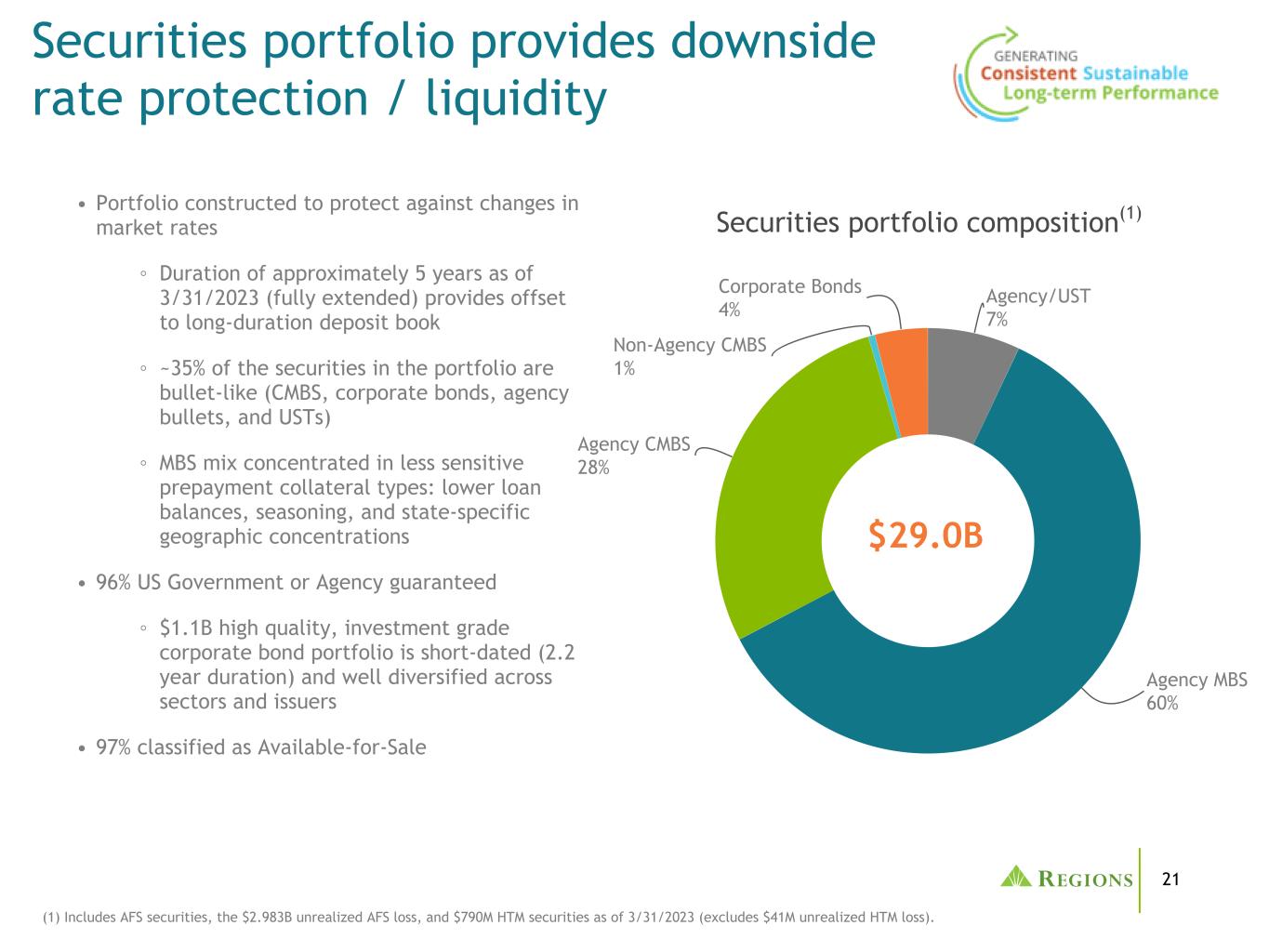
21 • Portfolio constructed to protect against changes in market rates ◦ Duration of approximately 5 years as of 3/31/2023 (fully extended) provides offset to long-duration deposit book ◦ ~35% of the securities in the portfolio are bullet-like (CMBS, corporate bonds, agency bullets, and USTs) ◦ MBS mix concentrated in less sensitive prepayment collateral types: lower loan balances, seasoning, and state-specific geographic concentrations • 96% US Government or Agency guaranteed ◦ $1.1B high quality, investment grade corporate bond portfolio is short-dated (2.2 year duration) and well diversified across sectors and issuers • 97% classified as Available-for-Sale Agency/UST 7% Agency MBS 60% Agency CMBS 28% Non-Agency CMBS 1% Corporate Bonds 4% Securities portfolio provides downside rate protection / liquidity Securities portfolio composition(1) $29.0B (1) Includes AFS securities, the $2.983B unrealized AFS loss, and $790M HTM securities as of 3/31/2023 (excludes $41M unrealized HTM loss).
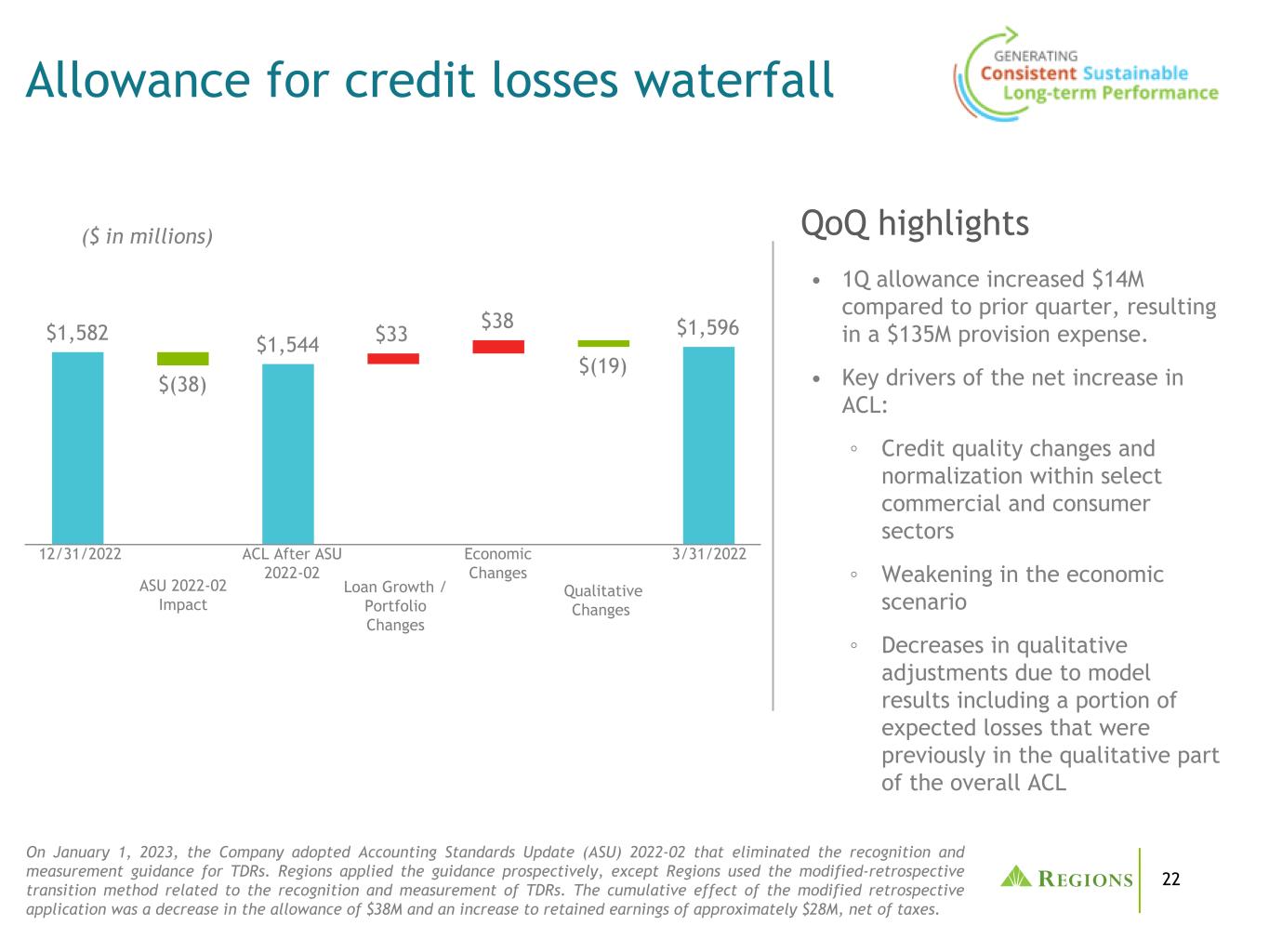
22 ACL After ASU 2022-02 $1,582 $(38) $1,544 $33 $38 $(19) $1,596 Allowance for credit losses waterfall 3/31/2022 • 1Q allowance increased $14M compared to prior quarter, resulting in a $135M provision expense. • Key drivers of the net increase in ACL: ◦ Credit quality changes and normalization within select commercial and consumer sectors ◦ Weakening in the economic scenario ◦ Decreases in qualitative adjustments due to model results including a portion of expected losses that were previously in the qualitative part of the overall ACL QoQ highlights($ in millions) 12/31/2022 ASU 2022-02 Impact Qualitative Changes Loan Growth / Portfolio Changes Economic Changes On January 1, 2023, the Company adopted Accounting Standards Update (ASU) 2022-02 that eliminated the recognition and measurement guidance for TDRs. Regions applied the guidance prospectively, except Regions used the modified-retrospective transition method related to the recognition and measurement of TDRs. The cumulative effect of the modified retrospective application was a decrease in the allowance of $38M and an increase to retained earnings of approximately $28M, net of taxes.
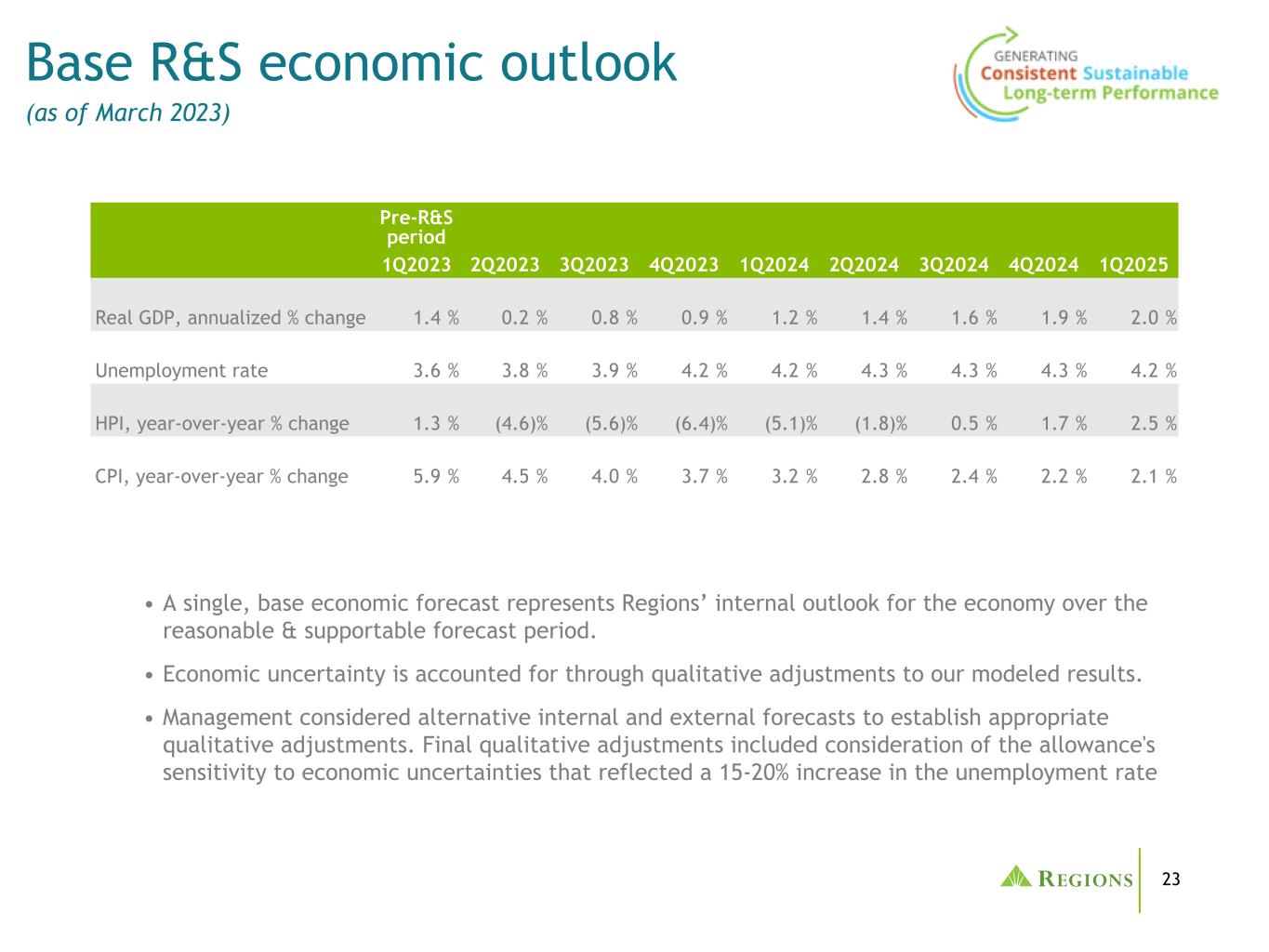
23 Pre-R&S period 1Q2023 2Q2023 3Q2023 4Q2023 1Q2024 2Q2024 3Q2024 4Q2024 1Q2025 Real GDP, annualized % change 1.4 % 0.2 % 0.8 % 0.9 % 1.2 % 1.4 % 1.6 % 1.9 % 2.0 % Unemployment rate 3.6 % 3.8 % 3.9 % 4.2 % 4.2 % 4.3 % 4.3 % 4.3 % 4.2 % HPI, year-over-year % change 1.3 % (4.6) % (5.6) % (6.4) % (5.1) % (1.8) % 0.5 % 1.7 % 2.5 % CPI, year-over-year % change 5.9 % 4.5 % 4.0 % 3.7 % 3.2 % 2.8 % 2.4 % 2.2 % 2.1 % Base R&S economic outlook (as of March 2023) • A single, base economic forecast represents Regions’ internal outlook for the economy over the reasonable & supportable forecast period. • Economic uncertainty is accounted for through qualitative adjustments to our modeled results. • Management considered alternative internal and external forecasts to establish appropriate qualitative adjustments. Final qualitative adjustments included consideration of the allowance's sensitivity to economic uncertainties that reflected a 15-20% increase in the unemployment rate
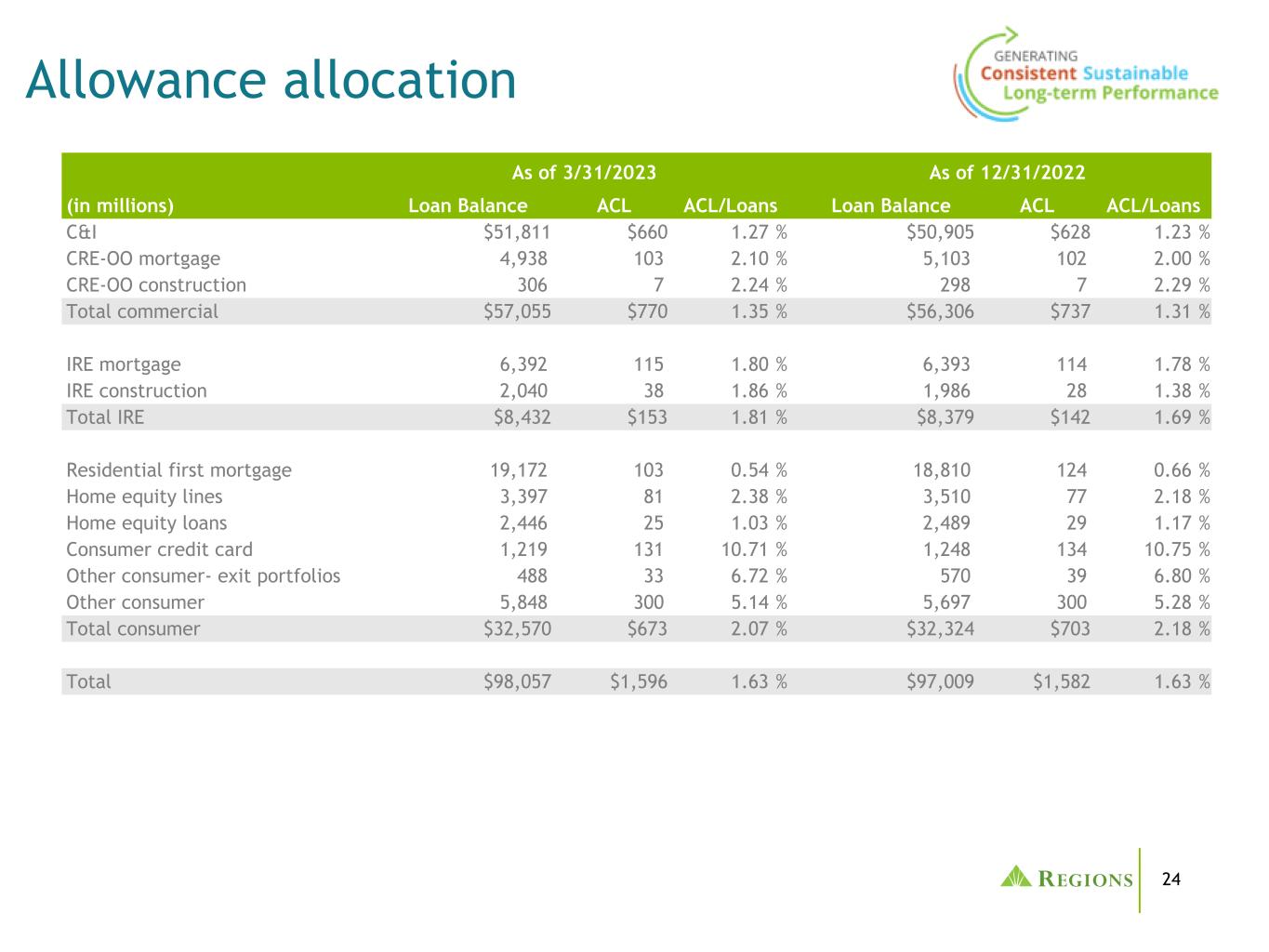
24 As of 3/31/2023 As of 12/31/2022 (in millions) Loan Balance ACL ACL/Loans Loan Balance ACL ACL/Loans C&I $51,811 $660 1.27 % $50,905 $628 1.23 % CRE-OO mortgage 4,938 103 2.10 % 5,103 102 2.00 % CRE-OO construction 306 7 2.24 % 298 7 2.29 % Total commercial $57,055 $770 1.35 % $56,306 $737 1.31 % IRE mortgage 6,392 115 1.80 % 6,393 114 1.78 % IRE construction 2,040 38 1.86 % 1,986 28 1.38 % Total IRE $8,432 $153 1.81 % $8,379 $142 1.69 % Residential first mortgage 19,172 103 0.54 % 18,810 124 0.66 % Home equity lines 3,397 81 2.38 % 3,510 77 2.18 % Home equity loans 2,446 25 1.03 % 2,489 29 1.17 % Consumer credit card 1,219 131 10.71 % 1,248 134 10.75 % Other consumer- exit portfolios 488 33 6.72 % 570 39 6.80 % Other consumer 5,848 300 5.14 % 5,697 300 5.28 % Total consumer $32,570 $673 2.07 % $32,324 $703 2.18 % Total $98,057 $1,596 1.63 % $97,009 $1,582 1.63 % Allowance allocation
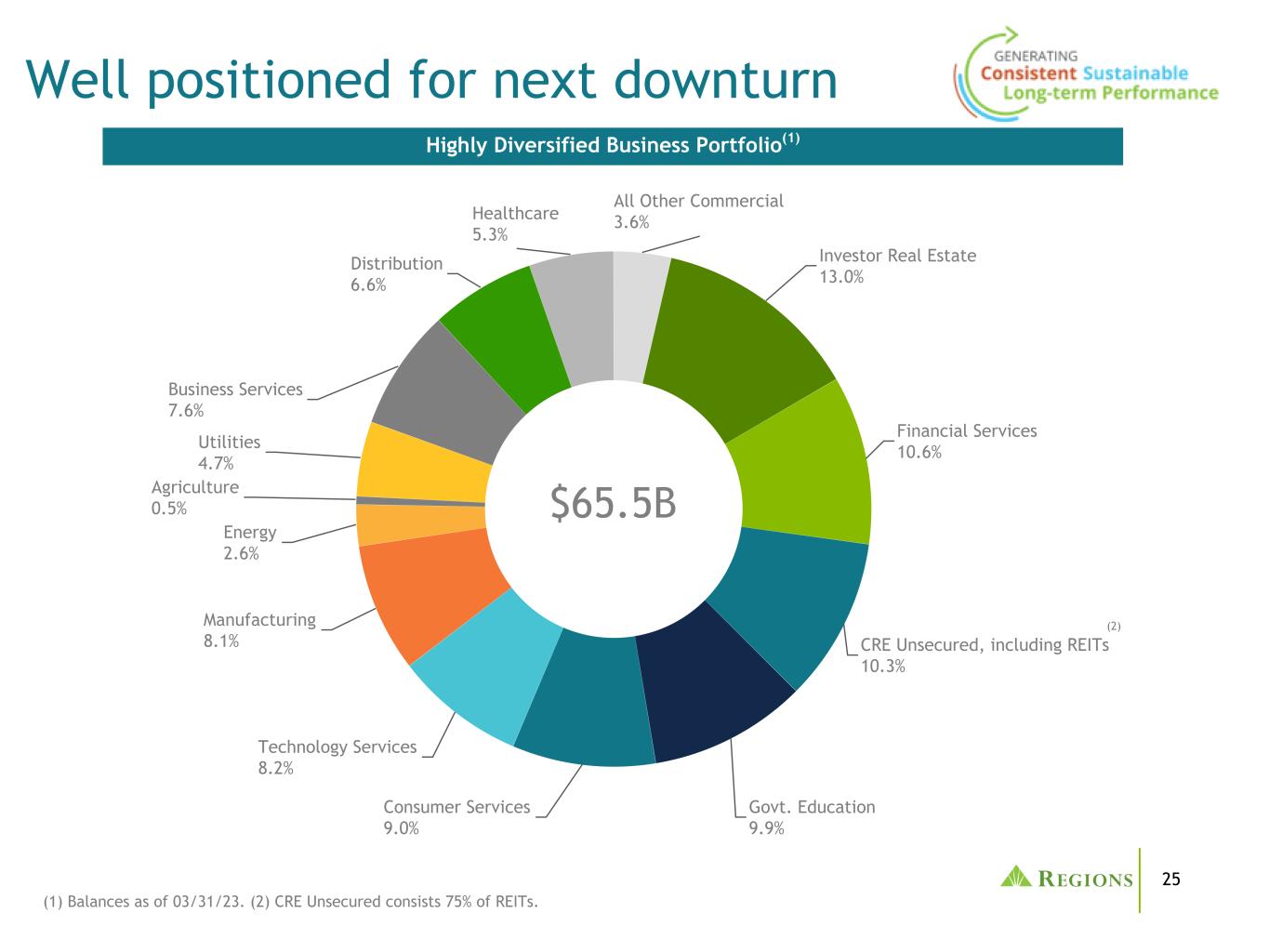
25 All Other Commercial 3.6% Investor Real Estate 13.0% Financial Services 10.6% CRE Unsecured, including REITs 10.3% Govt. Education 9.9% Consumer Services 9.0% Technology Services 8.2% Manufacturing 8.1% Energy 2.6% Agriculture 0.5% Utilities 4.7% Business Services 7.6% Distribution 6.6% Healthcare 5.3% Well positioned for next downturn $65.5B Highly Diversified Business Portfolio(1) (1) Balances as of 03/31/23. (2) CRE Unsecured consists 75% of REITs. (2)

26 Consumer lending portfolio statistics • Avg. origination FICO 758 • Current LTV 52% • 98% owner occupied • Avg. origination FICO 775 • Current LTV 33% • 68% of portfolio is 1st lien • Avg. loan size $35,121 • $90M to convert to amortizing or balloon during 2023 • Avg. origination FICO 762 • Avg. new loan $10,773 • 1Q23 Yield 7.56% • Avg. origination FICO 753 • 1Q23 Yield 6.20% • 1Q23 QTD NCO 2.69% • Avg. origination FICO 769 • Avg. new line $6,835 • 1Q23 Yield 14.93% • 1Q23 QTD NCO 3.47% 3% 6% 4%5% 13% 7% 8% 17% 10% 81% 62% 76% 3% 2% 3% Cons R/E secured Cons non-R/E secured Total consumer Not Available Above 720 620-680 Below 620 681-720 Consumer FICO Scores(1) (1) Refreshed FICO scores as of 03/31/2023. (2) Other Consumer consists primarily of EnerBank and Direct portfolios. Residential Mortgage Consumer - Exit Portfolios Consumer Credit Card Home Equity Other Consumer(2)
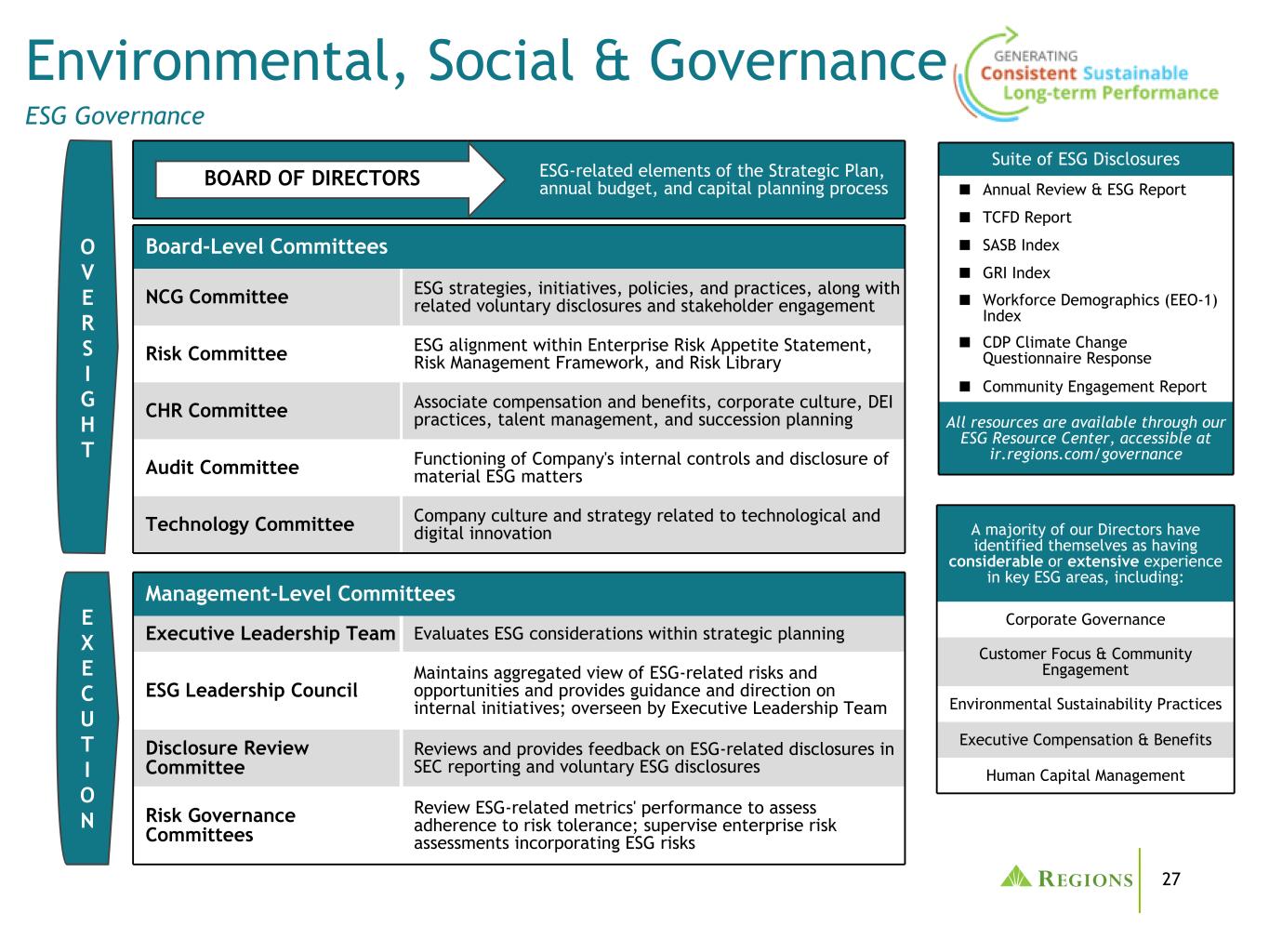
27 Environmental, Social & Governance ESG Governance ESG-related elements of the Strategic Plan, annual budget, and capital planning processBOARD OF DIRECTORS Board-Level Committees NCG Committee ESG strategies, initiatives, policies, and practices, along with related voluntary disclosures and stakeholder engagement Risk Committee ESG alignment within Enterprise Risk Appetite Statement, Risk Management Framework, and Risk Library CHR Committee Associate compensation and benefits, corporate culture, DEI practices, talent management, and succession planning Audit Committee Functioning of Company's internal controls and disclosure of material ESG matters Technology Committee Company culture and strategy related to technological and digital innovation Management-Level Committees Executive Leadership Team Evaluates ESG considerations within strategic planning ESG Leadership Council Maintains aggregated view of ESG-related risks and opportunities and provides guidance and direction on internal initiatives; overseen by Executive Leadership Team Disclosure Review Committee Reviews and provides feedback on ESG-related disclosures in SEC reporting and voluntary ESG disclosures Risk Governance Committees Review ESG-related metrics' performance to assess adherence to risk tolerance; supervise enterprise risk assessments incorporating ESG risks O V E R S I G H T E X E C U T I O N A majority of our Directors have identified themselves as having considerable or extensive experience in key ESG areas, including: Corporate Governance Customer Focus & Community Engagement Environmental Sustainability Practices Executive Compensation & Benefits Human Capital Management Suite of ESG Disclosures ■ Annual Review & ESG Report ■ TCFD Report ■ SASB Index ■ GRI Index ■ Workforce Demographics (EEO-1) Index ■ CDP Climate Change Questionnaire Response ■ Community Engagement Report All resources are available through our ESG Resource Center, accessible at ir.regions.com/governance
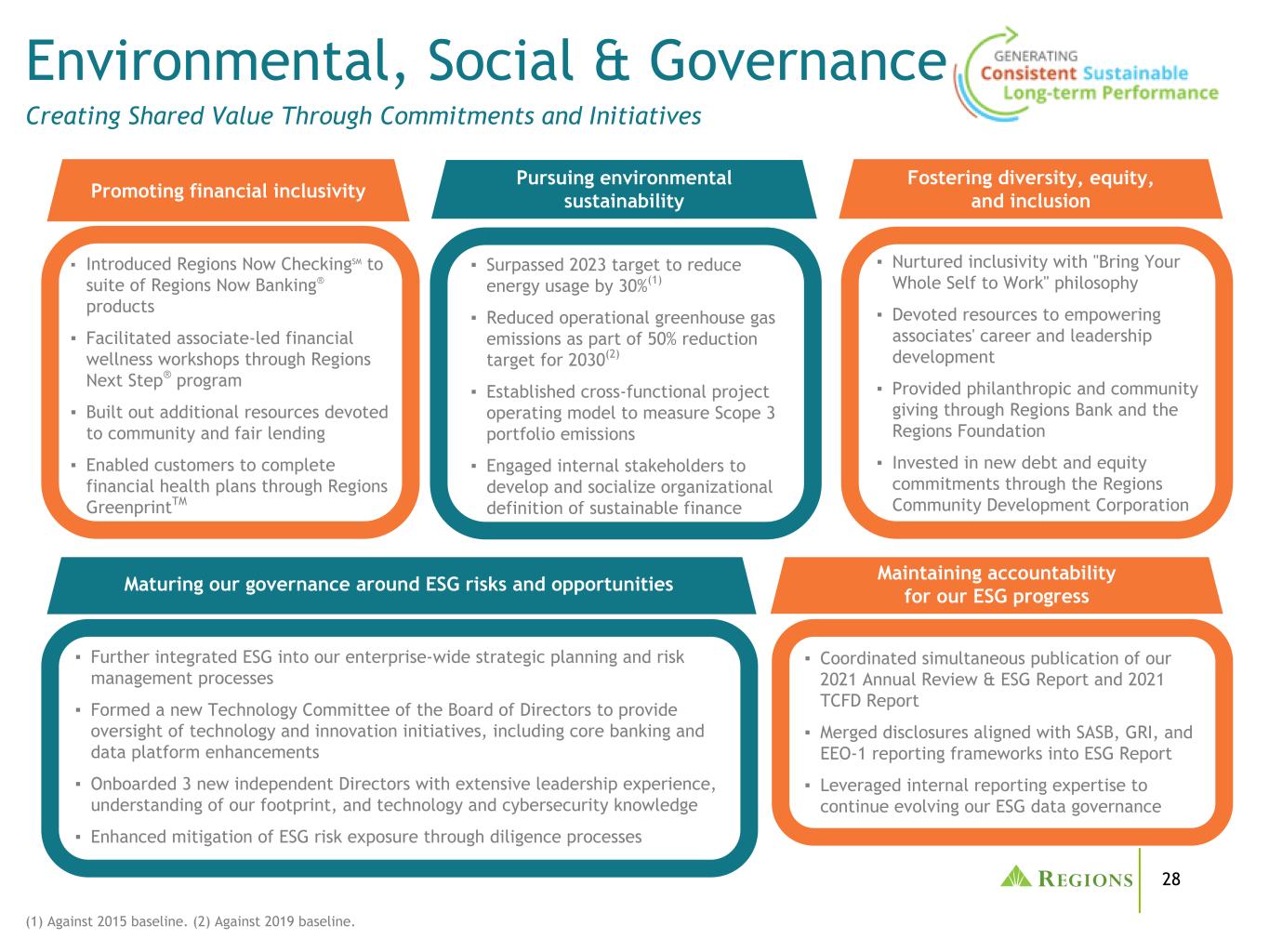
28 Promoting financial inclusivity Pursuing environmental sustainability Maintaining accountability for our ESG progress ▪ Further integrated ESG into our enterprise-wide strategic planning and risk management processes ▪ Formed a new Technology Committee of the Board of Directors to provide oversight of technology and innovation initiatives, including core banking and data platform enhancements ▪ Onboarded 3 new independent Directors with extensive leadership experience, understanding of our footprint, and technology and cybersecurity knowledge ▪ Enhanced mitigation of ESG risk exposure through diligence processes ▪ Introduced Regions Now CheckingSM to suite of Regions Now Banking® products ▪ Facilitated associate-led financial wellness workshops through Regions Next Step® program ▪ Built out additional resources devoted to community and fair lending ▪ Enabled customers to complete financial health plans through Regions GreenprintTM ▪ Surpassed 2023 target to reduce energy usage by 30%(1) ▪ Reduced operational greenhouse gas emissions as part of 50% reduction target for 2030(2) ▪ Established cross-functional project operating model to measure Scope 3 portfolio emissions ▪ Engaged internal stakeholders to develop and socialize organizational definition of sustainable finance ▪ Nurtured inclusivity with "Bring Your Whole Self to Work" philosophy ▪ Devoted resources to empowering associates' career and leadership development ▪ Provided philanthropic and community giving through Regions Bank and the Regions Foundation ▪ Invested in new debt and equity commitments through the Regions Community Development Corporation Fostering diversity, equity, and inclusion Maturing our governance around ESG risks and opportunities ▪ Coordinated simultaneous publication of our 2021 Annual Review & ESG Report and 2021 TCFD Report ▪ Merged disclosures aligned with SASB, GRI, and EEO-1 reporting frameworks into ESG Report ▪ Leveraged internal reporting expertise to continue evolving our ESG data governance Environmental, Social & Governance Creating Shared Value Through Commitments and Initiatives (1) Against 2015 baseline. (2) Against 2019 baseline.
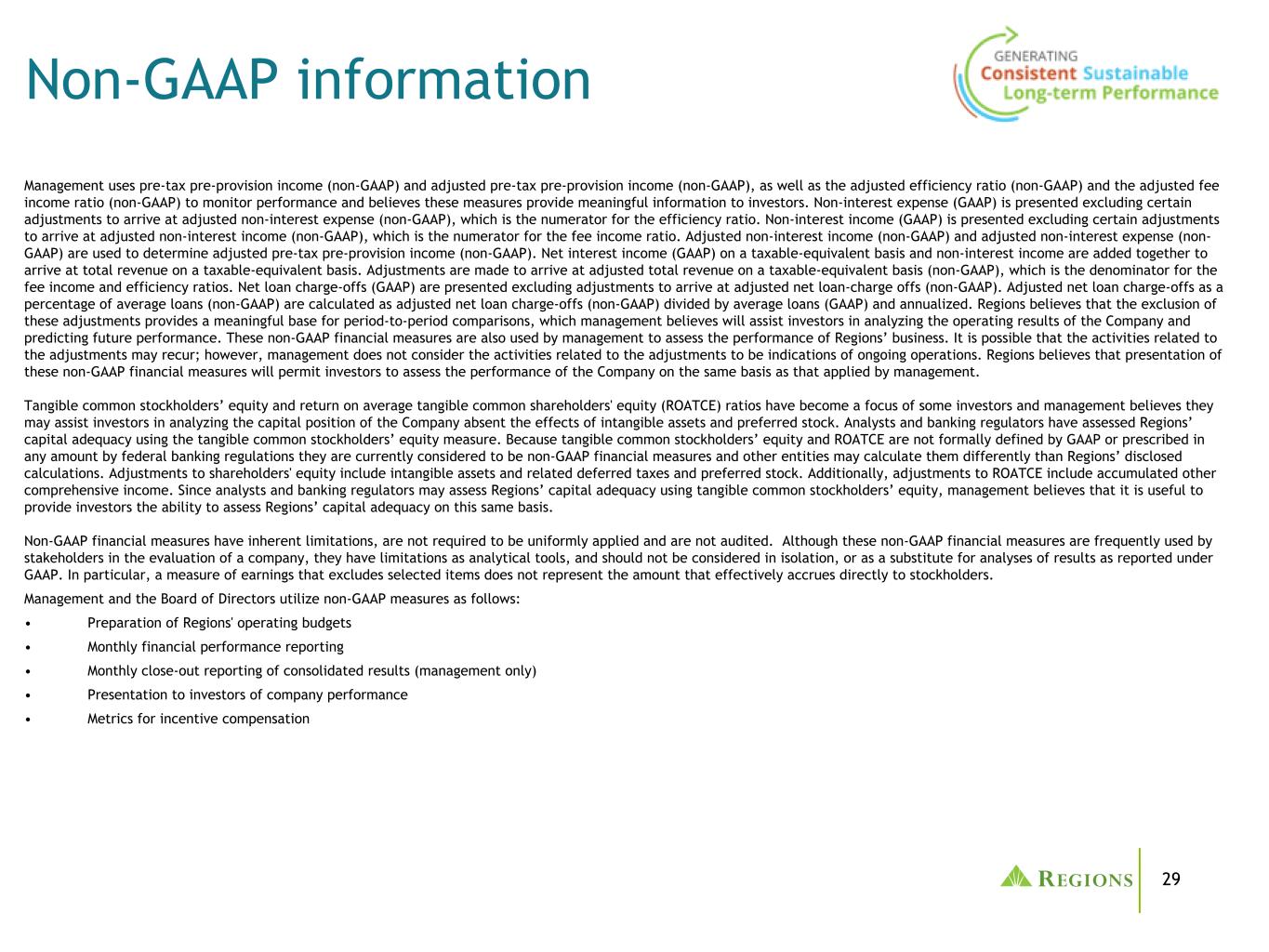
29 Management uses pre-tax pre-provision income (non-GAAP) and adjusted pre-tax pre-provision income (non-GAAP), as well as the adjusted efficiency ratio (non-GAAP) and the adjusted fee income ratio (non-GAAP) to monitor performance and believes these measures provide meaningful information to investors. Non-interest expense (GAAP) is presented excluding certain adjustments to arrive at adjusted non-interest expense (non-GAAP), which is the numerator for the efficiency ratio. Non-interest income (GAAP) is presented excluding certain adjustments to arrive at adjusted non-interest income (non-GAAP), which is the numerator for the fee income ratio. Adjusted non-interest income (non-GAAP) and adjusted non-interest expense (non- GAAP) are used to determine adjusted pre-tax pre-provision income (non-GAAP). Net interest income (GAAP) on a taxable-equivalent basis and non-interest income are added together to arrive at total revenue on a taxable-equivalent basis. Adjustments are made to arrive at adjusted total revenue on a taxable-equivalent basis (non-GAAP), which is the denominator for the fee income and efficiency ratios. Net loan charge-offs (GAAP) are presented excluding adjustments to arrive at adjusted net loan-charge offs (non-GAAP). Adjusted net loan charge-offs as a percentage of average loans (non-GAAP) are calculated as adjusted net loan charge-offs (non-GAAP) divided by average loans (GAAP) and annualized. Regions believes that the exclusion of these adjustments provides a meaningful base for period-to-period comparisons, which management believes will assist investors in analyzing the operating results of the Company and predicting future performance. These non-GAAP financial measures are also used by management to assess the performance of Regions’ business. It is possible that the activities related to the adjustments may recur; however, management does not consider the activities related to the adjustments to be indications of ongoing operations. Regions believes that presentation of these non-GAAP financial measures will permit investors to assess the performance of the Company on the same basis as that applied by management. Tangible common stockholders’ equity and return on average tangible common shareholders' equity (ROATCE) ratios have become a focus of some investors and management believes they may assist investors in analyzing the capital position of the Company absent the effects of intangible assets and preferred stock. Analysts and banking regulators have assessed Regions’ capital adequacy using the tangible common stockholders’ equity measure. Because tangible common stockholders’ equity and ROATCE are not formally defined by GAAP or prescribed in any amount by federal banking regulations they are currently considered to be non-GAAP financial measures and other entities may calculate them differently than Regions’ disclosed calculations. Adjustments to shareholders' equity include intangible assets and related deferred taxes and preferred stock. Additionally, adjustments to ROATCE include accumulated other comprehensive income. Since analysts and banking regulators may assess Regions’ capital adequacy using tangible common stockholders’ equity, management believes that it is useful to provide investors the ability to assess Regions’ capital adequacy on this same basis. Non-GAAP financial measures have inherent limitations, are not required to be uniformly applied and are not audited. Although these non-GAAP financial measures are frequently used by stakeholders in the evaluation of a company, they have limitations as analytical tools, and should not be considered in isolation, or as a substitute for analyses of results as reported under GAAP. In particular, a measure of earnings that excludes selected items does not represent the amount that effectively accrues directly to stockholders. Management and the Board of Directors utilize non-GAAP measures as follows: • Preparation of Regions' operating budgets • Monthly financial performance reporting • Monthly close-out reporting of consolidated results (management only) • Presentation to investors of company performance • Metrics for incentive compensation Non-GAAP information
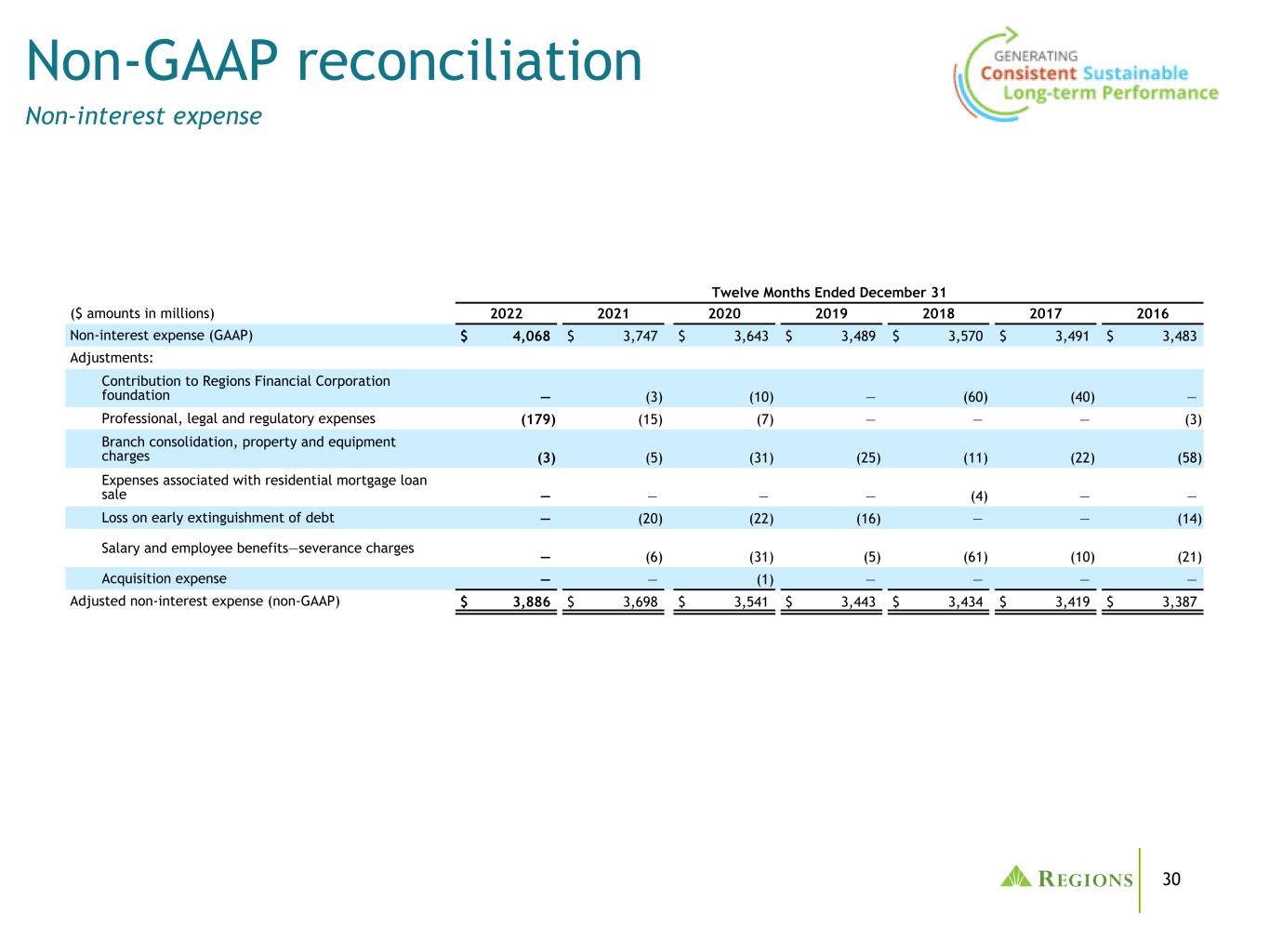
30 Non-GAAP reconciliation Non-interest expense Twelve Months Ended December 31 ($ amounts in millions) 2022 2021 2020 2019 2018 2017 2016 Non-interest expense (GAAP) $ 4,068 $ 3,747 $ 3,643 $ 3,489 $ 3,570 $ 3,491 $ 3,483 Adjustments: Contribution to Regions Financial Corporation foundation — (3) (10) — (60) (40) — Professional, legal and regulatory expenses (179) (15) (7) — — — (3) Branch consolidation, property and equipment charges (3) (5) (31) (25) (11) (22) (58) Expenses associated with residential mortgage loan sale — — — — (4) — — Loss on early extinguishment of debt — (20) (22) (16) — — (14) Salary and employee benefits—severance charges — (6) (31) (5) (61) (10) (21) Acquisition expense — — (1) — — — — Adjusted non-interest expense (non-GAAP) $ 3,886 $ 3,698 $ 3,541 $ 3,443 $ 3,434 $ 3,419 $ 3,387
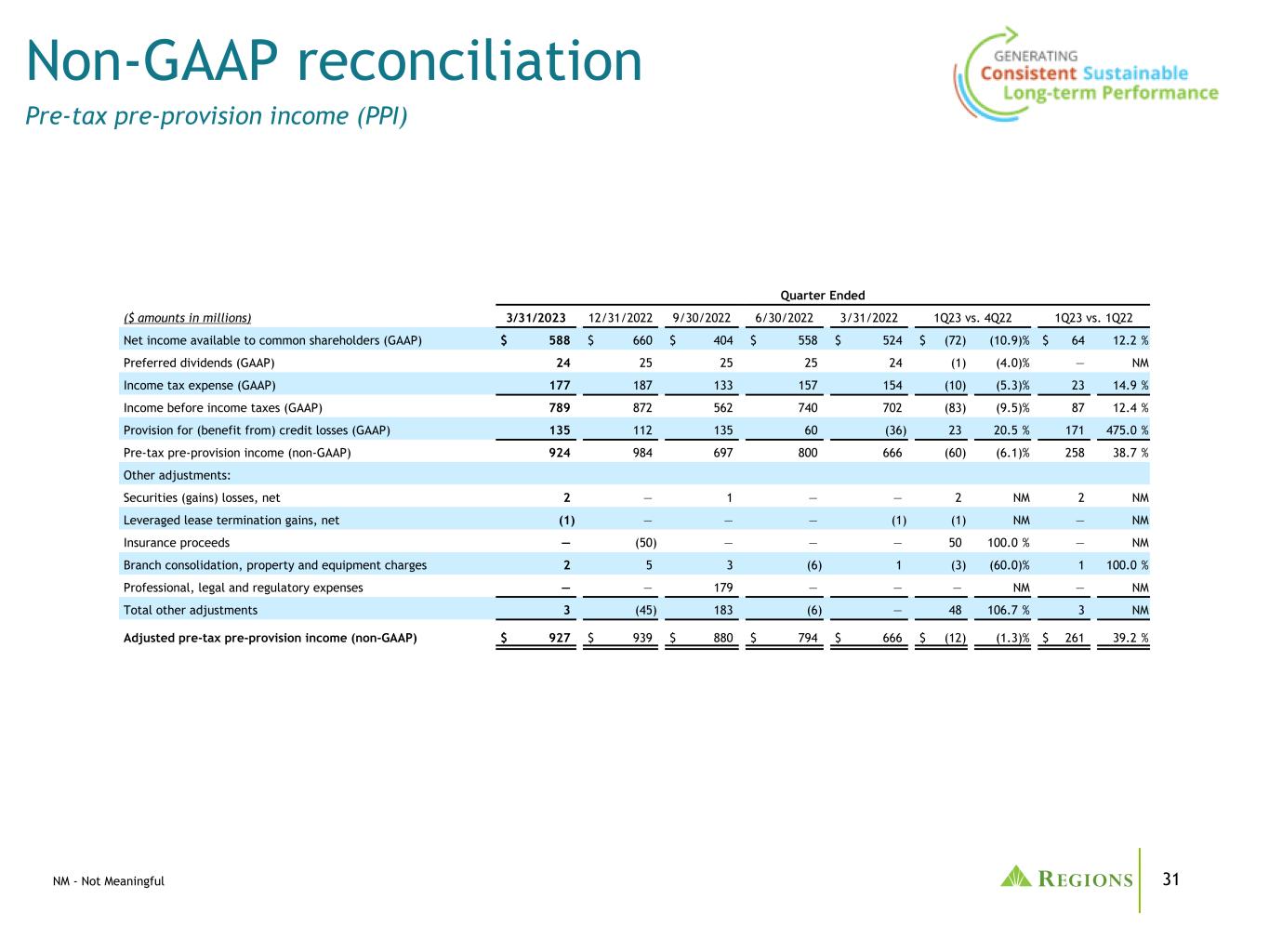
31 Non-GAAP reconciliation Pre-tax pre-provision income (PPI) Quarter Ended ($ amounts in millions) 3/31/2023 12/31/2022 9/30/2022 6/30/2022 3/31/2022 1Q23 vs. 4Q22 1Q23 vs. 1Q22 Net income available to common shareholders (GAAP) $ 588 $ 660 $ 404 $ 558 $ 524 $ (72) (10.9) % $ 64 12.2 % Preferred dividends (GAAP) 24 25 25 25 24 (1) (4.0) % — NM Income tax expense (GAAP) 177 187 133 157 154 (10) (5.3) % 23 14.9 % Income before income taxes (GAAP) 789 872 562 740 702 (83) (9.5) % 87 12.4 % Provision for (benefit from) credit losses (GAAP) 135 112 135 60 (36) 23 20.5 % 171 475.0 % Pre-tax pre-provision income (non-GAAP) 924 984 697 800 666 (60) (6.1) % 258 38.7 % Other adjustments: Securities (gains) losses, net 2 — 1 — — 2 NM 2 NM Leveraged lease termination gains, net (1) — — — (1) (1) NM — NM Insurance proceeds — (50) — — — 50 100.0 % — NM Branch consolidation, property and equipment charges 2 5 3 (6) 1 (3) (60.0) % 1 100.0 % Professional, legal and regulatory expenses — — 179 — — — NM — NM Total other adjustments 3 (45) 183 (6) — 48 106.7 % 3 NM Adjusted pre-tax pre-provision income (non-GAAP) $ 927 $ 939 $ 880 $ 794 $ 666 $ (12) (1.3) % $ 261 39.2 % NM - Not Meaningful
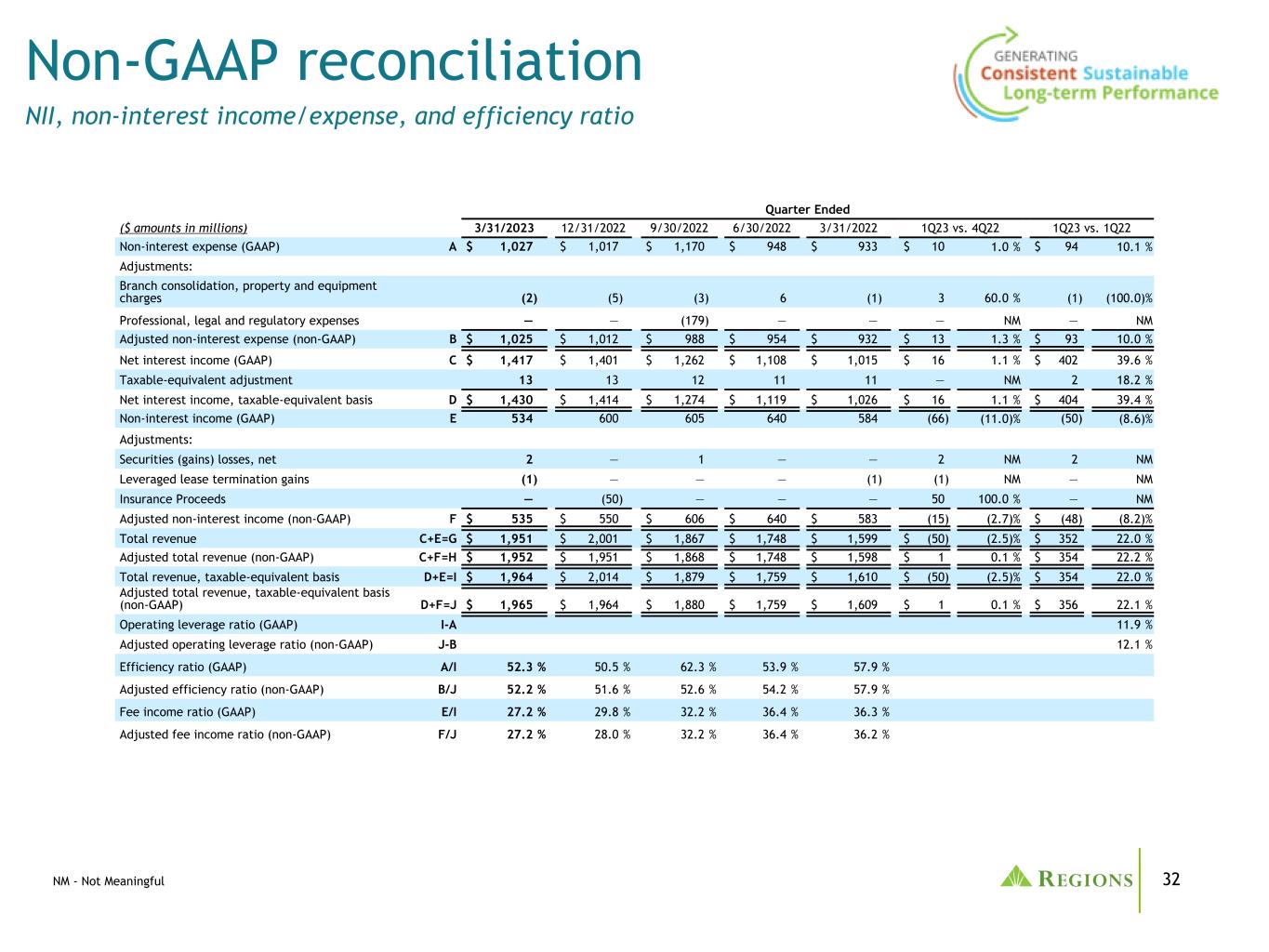
32 Non-GAAP reconciliation NII, non-interest income/expense, and efficiency ratio NM - Not Meaningful Quarter Ended ($ amounts in millions) 3/31/2023 12/31/2022 9/30/2022 6/30/2022 3/31/2022 1Q23 vs. 4Q22 1Q23 vs. 1Q22 Non-interest expense (GAAP) A $ 1,027 $ 1,017 $ 1,170 $ 948 $ 933 $ 10 1.0 % $ 94 10.1 % Adjustments: Branch consolidation, property and equipment charges (2) (5) (3) 6 (1) 3 60.0 % (1) (100.0) % Professional, legal and regulatory expenses — — (179) — — — NM — NM Adjusted non-interest expense (non-GAAP) B $ 1,025 $ 1,012 $ 988 $ 954 $ 932 $ 13 1.3 % $ 93 10.0 % Net interest income (GAAP) C $ 1,417 $ 1,401 $ 1,262 $ 1,108 $ 1,015 $ 16 1.1 % $ 402 39.6 % Taxable-equivalent adjustment 13 13 12 11 11 — NM 2 18.2 % Net interest income, taxable-equivalent basis D $ 1,430 $ 1,414 $ 1,274 $ 1,119 $ 1,026 $ 16 1.1 % $ 404 39.4 % Non-interest income (GAAP) E 534 600 605 640 584 (66) (11.0) % (50) (8.6) % Adjustments: Securities (gains) losses, net 2 — 1 — — 2 NM 2 NM Leveraged lease termination gains (1) — — — (1) (1) NM — NM Insurance Proceeds — (50) — — — 50 100.0 % — NM Adjusted non-interest income (non-GAAP) F $ 535 $ 550 $ 606 $ 640 $ 583 (15) (2.7) % $ (48) (8.2) % Total revenue C+E=G $ 1,951 $ 2,001 $ 1,867 $ 1,748 $ 1,599 $ (50) (2.5) % $ 352 22.0 % Adjusted total revenue (non-GAAP) C+F=H $ 1,952 $ 1,951 $ 1,868 $ 1,748 $ 1,598 $ 1 0.1 % $ 354 22.2 % Total revenue, taxable-equivalent basis D+E=I $ 1,964 $ 2,014 $ 1,879 $ 1,759 $ 1,610 $ (50) (2.5) % $ 354 22.0 % Adjusted total revenue, taxable-equivalent basis (non-GAAP) D+F=J $ 1,965 $ 1,964 $ 1,880 $ 1,759 $ 1,609 $ 1 0.1 % $ 356 22.1 % Operating leverage ratio (GAAP) I-A 11.9 % Adjusted operating leverage ratio (non-GAAP) J-B 12.1 % Efficiency ratio (GAAP) A/I 52.3 % 50.5 % 62.3 % 53.9 % 57.9 % Adjusted efficiency ratio (non-GAAP) B/J 52.2 % 51.6 % 52.6 % 54.2 % 57.9 % Fee income ratio (GAAP) E/I 27.2 % 29.8 % 32.2 % 36.4 % 36.3 % Adjusted fee income ratio (non-GAAP) F/J 27.2 % 28.0 % 32.2 % 36.4 % 36.2 %
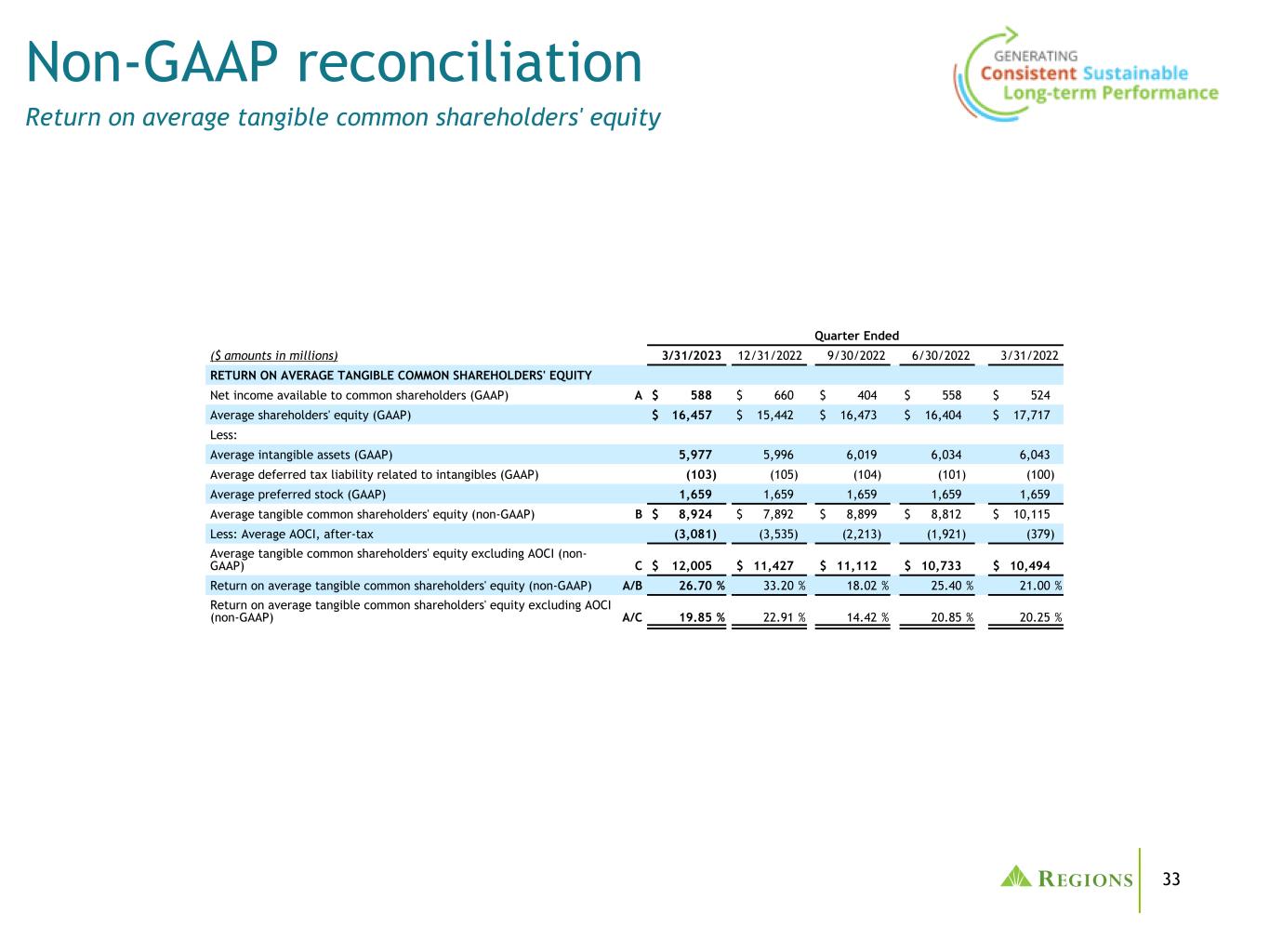
33 Quarter Ended ($ amounts in millions) 3/31/2023 12/31/2022 9/30/2022 6/30/2022 3/31/2022 RETURN ON AVERAGE TANGIBLE COMMON SHAREHOLDERS' EQUITY Net income available to common shareholders (GAAP) A $ 588 $ 660 $ 404 $ 558 $ 524 Average shareholders' equity (GAAP) $ 16,457 $ 15,442 $ 16,473 $ 16,404 $ 17,717 Less: Average intangible assets (GAAP) 5,977 5,996 6,019 6,034 6,043 Average deferred tax liability related to intangibles (GAAP) (103) (105) (104) (101) (100) Average preferred stock (GAAP) 1,659 1,659 1,659 1,659 1,659 Average tangible common shareholders' equity (non-GAAP) B $ 8,924 $ 7,892 $ 8,899 $ 8,812 $ 10,115 Less: Average AOCI, after-tax (3,081) (3,535) (2,213) (1,921) (379) Average tangible common shareholders' equity excluding AOCI (non- GAAP) C $ 12,005 $ 11,427 $ 11,112 $ 10,733 $ 10,494 Return on average tangible common shareholders' equity (non-GAAP) A/B 26.70 % 33.20 % 18.02 % 25.40 % 21.00 % Return on average tangible common shareholders' equity excluding AOCI (non-GAAP) A/C 19.85 % 22.91 % 14.42 % 20.85 % 20.25 % Non-GAAP reconciliation Return on average tangible common shareholders' equity
34 Forward-Looking Statements This presentation may include forward-looking statements as defined in the Private Securities Litigation Reform Act of 1995. The words “future,” “anticipates,” “assumes,” “intends,” “plans,” “seeks,” “believes,” “predicts,” “potential,” “objectives,” “estimates,” “expects,” “targets,” “projects,” “outlook,” “forecast,” “would,” “will,” “may,” “might,” “could,” “should,” “can,” and similar terms and expressions often signify forward-looking statements. Forward-looking statements are subject to the risk that the actual effects may differ, possibly materially, from what is reflected in those forward-looking statements due to factors and future developments that are uncertain, unpredictable and in many cases beyond our control. Forward-looking statements are not based on historical information, but rather are related to future operations, strategies, financial results or other developments. Forward-looking statements are based on management’s current expectations as well as certain assumptions and estimates made by, and information available to, management at the time the statements are made. Those statements are based on general assumptions and are subject to various risks, and because they also relate to the future they are likewise subject to inherent uncertainties and other factors that may cause actual results to differ materially from the views, beliefs and projections expressed in such statements. Therefore, we caution you against relying on any of these forward-looking statements. These risks, uncertainties and other factors include, but are not limited to, those described below: • Current and future economic and market conditions in the United States generally or in the communities we serve (in particular the Southeastern United States), including the effects of possible declines in property values, increases in interest rates and unemployment rates, inflation, financial market disruptions and potential reductions of economic growth, which may adversely affect our lending and other businesses and our financial results and conditions. • Possible changes in trade, monetary and fiscal policies of, and other activities undertaken by, governments, agencies, central banks and similar organizations, which could have a material adverse effect on our businesses and our financial results and conditions. • Changes in market interest rates or capital markets could adversely affect our revenue and expense, the value of assets and obligations, and the availability and cost of capital and liquidity. • Volatility and uncertainty related to inflation and the effects of inflation, which may lead to increased costs for businesses and consumers and potentially contribute to poor business and economic conditions generally. • The impact of pandemics, including the COVID-19 pandemic, on our businesses, operations, and financial results and conditions. The duration and severity of any pandemic could disrupt the global economy, adversely affect our capital and liquidity position, impair the ability of borrowers to repay outstanding loans and increase our allowance for credit losses, impair collateral values, and result in lost revenue or additional expenses. • Any impairment of our goodwill or other intangibles, any repricing of assets, or any adjustment of valuation allowances on our deferred tax assets due to changes in tax law, adverse changes in the economic environment, declining operations of the reporting unit or other factors. • The effect of new tax legislation and/or interpretation of existing tax law, which may impact our earnings, capital ratios, and our ability to return capital to shareholders. • Possible changes in the creditworthiness of customers and the possible impairment of the collectability of loans and leases, including operating leases. • Changes in the speed of loan prepayments, loan origination and sale volumes, charge-offs, credit loss provisions or actual credit losses where our allowance for credit losses may not be adequate to cover our eventual losses. • Possible acceleration of prepayments on mortgage-backed securities due to declining interest rates, and the related acceleration of premium amortization on those securities. • Loss of customer checking and savings account deposits as customers pursue other, higher-yield investments, which could increase our funding costs. • Possible changes in consumer and business spending and saving habits and the related effect on our ability to increase assets and to attract deposits, which could adversely affect our net income. • Rising interest rates could negatively impact the value of our portfolio of investment securities. • The loss of value of our investment portfolio could negatively impact market perceptions of us. • The effects of social media on market perceptions of us and banks generally. • Volatility in the financial services industry (including failures or rumors of failures of other depository institutions), along with actions taken by governmental agencies to address such turmoil, could affect the ability of depository institutions, including us, to attract and retain depositors and to borrow or raise capital. • Our ability to effectively compete with other traditional and non-traditional financial services companies, including fintechs, some of whom possess greater financial resources than we do or are subject to different regulatory standards than we are. • Our inability to develop and gain acceptance from current and prospective customers for new products and services and the enhancement of existing products and services to meet customers’ needs and respond to emerging technological trends in a timely manner could have a negative impact on our revenue. Forward-looking statements

35 • Our inability to keep pace with technological changes, including those related to the offering of digital banking and financial services, could result in losing business to competitors. • Changes in laws and regulations affecting our businesses, including legislation and regulations relating to bank products and services, such as special FDIC assessments, as well as changes in the enforcement and interpretation of such laws and regulations by applicable governmental and self-regulatory agencies, including as a result of the changes in U.S. presidential administration, control of the U.S. Congress, and changes in personnel at the bank regulatory agencies, which could require us to change certain business practices, increase compliance risk, reduce our revenue, impose additional costs on us, or otherwise negatively affect our businesses. • Our capital actions, including dividend payments, common stock repurchases, or redemptions of preferred stock, must not cause us to fall below minimum capital ratio requirements, with applicable buffers taken into account, and must comply with other requirements and restrictions under law or imposed by our regulators, which may impact our ability to return capital to shareholders. • Our ability to comply with stress testing and capital planning requirements (as part of the CCAR process or otherwise) may continue to require a significant investment of our managerial resources due to the importance of such tests and requirements. • Our ability to comply with applicable capital and liquidity requirements (including, among other things, the Basel III capital standards), including our ability to generate capital internally or raise capital on favorable terms, and if we fail to meet requirements, our financial condition and market perceptions of us could be negatively impacted. • The effects of any developments, changes or actions relating to any litigation or regulatory proceedings brought against us or any of our subsidiaries. • The costs, including possibly incurring fines, penalties, or other negative effects (including reputational harm) of any adverse judicial, administrative, or arbitral rulings or proceedings, regulatory enforcement actions, or other legal actions to which we or any of our subsidiaries are a party, and which may adversely affect our results. • Our ability to manage fluctuations in the value of assets and liabilities and off-balance sheet exposure so as to maintain sufficient capital and liquidity to support our businesses. • Our ability to execute on our strategic and operational plans, including our ability to fully realize the financial and nonfinancial benefits relating to our strategic initiatives. • The risks and uncertainties related to our acquisition or divestiture of businesses and risks related to such acquisitions, including that the expected synergies, cost savings and other financial or other benefits may not be realized within expected timeframes, or might be less than projected; and difficulties in integrating acquired businesses. • The success of our marketing efforts in attracting and retaining customers. • Our ability to recruit and retain talented and experienced personnel to assist in the development, management and operation of our products and services may be affected by changes in laws and regulations in effect from time to time. • Fraud or misconduct by our customers, employees or business partners. • Any inaccurate or incomplete information provided to us by our customers or counterparties. • Inability of our framework to manage risks associated with our businesses, such as credit risk and operational risk, including third-party vendors and other service providers, which could, among other things, result in a breach of operating or security systems as a result of a cyber attack or similar act or failure to deliver our services effectively. • Our ability to identify and address operational risks associated with the introduction of or changes to products, services, or delivery platforms. • Dependence on key suppliers or vendors to obtain equipment and other supplies for our businesses on acceptable terms. • The inability of our internal controls and procedures to prevent, detect or mitigate any material errors or fraudulent acts. • The effects of geopolitical instability, including wars, conflicts, civil unrest, and terrorist attacks and the potential impact, directly or indirectly, on our businesses. Forward-looking statements (continued)
36 • The effects of man-made and natural disasters, including fires, floods, droughts, tornadoes, hurricanes, and environmental damage (specifically in the Southeastern United States), which may negatively affect our operations and/or our loan portfolios and increase our cost of conducting business. The severity and frequency of future earthquakes, fires, hurricanes, tornadoes, droughts, floods and other weather-related events are difficult to predict and may be exacerbated by global climate change. • Changes in commodity market prices and conditions could adversely affect the cash flows of our borrowers operating in industries that are impacted by changes in commodity prices (including businesses indirectly impacted by commodities prices such as businesses that transport commodities or manufacture equipment used in the production of commodities), which could impair their ability to service any loans outstanding to them and/or reduce demand for loans in those industries. • Our ability to identify and address cyber-security risks such as data security breaches, malware, ransomware, “denial of service” attacks, “hacking” and identity theft, including account take-overs, a failure of which could disrupt our businesses and result in the disclosure of and/or misuse or misappropriation of confidential or proprietary information, disruption or damage to our systems, increased costs, losses, or adverse effects to our reputation. • Our ability to achieve our expense management initiatives. • Market replacement of LIBOR and the related effect on our LIBOR-based financial products and contracts, including, but not limited to, derivative products, debt obligations, deposits, investments, and loans. • Possible downgrades in our credit ratings or outlook could, among other negative impacts, increase the costs of funding from capital markets. • The effects of problems encountered by other financial institutions that adversely affect us or the banking industry generally could require us to change certain business practices, reduce our revenue, impose additional costs on us, or otherwise negatively affect our businesses. • The effects of the failure of any component of our business infrastructure provided by a third party could disrupt our businesses, result in the disclosure of and/or misuse of confidential information or proprietary information, increase our costs, negatively affect our reputation, and cause losses. • Our ability to receive dividends from our subsidiaries, in particular Regions Bank, could affect our liquidity and ability to pay dividends to shareholders. • Changes in accounting policies or procedures as may be required by the FASB or other regulatory agencies could materially affect our financial statements and how we report those results, and expectations and preliminary analyses relating to how such changes will affect our financial results could prove incorrect. • Fluctuations in the price of our common stock and inability to complete stock repurchases in the time frame and/or on the terms anticipated. • The effects of anti-takeover laws and exclusive forum provision in our certificate of incorporation and bylaws. • The effects of any damage to our reputation resulting from developments related to any of the items identified above. • Other risks identified from time to time in reports that we file with the SEC. The foregoing list of factors is not exhaustive. For discussion of these and other factors that may cause actual results to differ from expectations, look under the captions “Forward-Looking Statements” and “Risk Factors” in Regions’ Annual Report on Form 10-K for the year ended December 31, 2022 and in Regions’ subsequent filings with the SEC. You should not place undue reliance on any forward-looking statements, which speak only as of the date made. Factors or events that could cause our actual results to differ may emerge from time to time, and it is not possible to predict all of them. We assume no obligation and do not intend to update or revise any forward-looking statements that are made from time to time, either as a result of future developments, new information or otherwise, except as may be required by law. Regions’ Investor Relations contact is Dana Nolan at (205) 264-7040; Regions’ Media contact is Jeremy King at (205) 264-4551. Forward-looking statements (continued)

37 ®