
RM 8-K
Regional Management Corp. (RM)
UNITED STATES
SECURITIES AND EXCHANGE COMMISSION
Washington, D.C. 20549
FORM
CURRENT REPORT
Pursuant to Section 13 or 15(d)
of the Securities Exchange Act of 1934
Date of Report (Date of earliest event reported):
(Exact name of registrant as specified in its charter)
|
|
|
|
|
|
|
(State or other jurisdiction of incorporation) |
|
(Commission File Number) |
|
(IRS Employer Identification No.) |
(Address of principal executive offices) (zip code)
(Registrant’s telephone number, including area code)
Not Applicable
(Former name or former address, if changed since last report)
Check the appropriate box below if the Form 8-K filing is intended to simultaneously satisfy the filing obligation of the registrant under any of the following provisions:
|
|
Written communications pursuant to Rule 425 under the Securities Act (17 CFR 230.425) |
|
|
Soliciting material pursuant to Rule 14a-12 under the Exchange Act (17 CFR 240.14a-12) |
|
|
Pre-commencement communications pursuant to Rule 14d-2(b) under the Exchange Act (17 CFR 240.14d-2(b)) |
|
|
Pre-commencement communications pursuant to Rule 13e-4(c) under the Exchange Act (17 CFR 240.13e-4(c)) |
Securities registered pursuant to Section 12(b) of the Act:
|
Title of Each Class |
|
Trading Symbol |
|
Name of Each Exchange on Which Registered |
|
|
|
|
|
|
Indicate by check mark whether the registrant is an emerging growth company as defined in Rule 405 of the Securities Act of 1933 (§230.405 of this chapter) or Rule 12b-2 of the Securities Exchange Act of 1934 (§240.12b-2 of this chapter).
Emerging growth company
If an emerging growth company, indicate by check mark if the registrant has elected not to use the extended transition period for complying with any new or revised financial accounting standards provided pursuant to Section 13(a) of the Exchange Act. ☐
Item 2.02. Results of Operations and Financial Condition.
On May 4, 2021, Regional Management Corp. (the “Company”) issued a press release announcing financial results for the three months ended March 31, 2021. A copy of the press release is attached hereto as Exhibit 99.1 and is incorporated herein by reference. On May 4, 2021, the Company will host a conference call to discuss financial results for the three months ended March 31, 2021. A copy of the presentation to be used during the conference call is attached hereto as Exhibit 99.2 and is incorporated herein by reference.
All information in the press release and the presentation is furnished under Item 2.02 of Form 8-K, “Results of Operations and Financial Condition,” and shall not be deemed “filed” for purposes of Section 18 of the Securities Exchange Act of 1934, as amended (the “Exchange Act”), or incorporated by reference in any filing under the Securities Act of 1933, as amended, or the Exchange Act, except as shall be expressly set forth by specific reference in such filing.
Item 8.01. Other Events.
On May 4, 2021, the Company also announced that its Board of Directors has: (i) completed the stock repurchase program previously announced on October 29, 2020; (ii) authorized a new $30 million stock repurchase program through April 29, 2023; and (iii) declared a quarterly cash dividend of $0.25 per share of outstanding common stock, payable on June 15, 2021 to stockholders of record as of the close of business on May 26, 2021.
Item 9.01. Financial Statements and Exhibits.
(d) Exhibits.
|
Exhibit No. |
|
Description |
|
99.1 |
|
|
|
99.2 |
|
Presentation of Regional Management Corp., dated May 4, 2021. |
|
104 |
|
Cover Page Interactive Data File (embedded within the Inline XBRL document). |
2
SIGNATURES
Pursuant to the requirements of the Securities Exchange Act of 1934, the registrant has duly caused this report to be signed on its behalf by the undersigned hereunto duly authorized.
|
|
Regional Management Corp. |
||
|
|
|
|
|
|
Date: May 4, 2021 |
By: |
|
/s/ Harpreet Rana |
|
|
Name: |
|
Harpreet Rana |
|
|
Title: |
|
Executive Vice President and Chief Financial Officer |
3
Exhibit 99.1

Regional Management Corp. Announces First Quarter 2021 Results
- Record net income of $25.5 million and diluted earnings per share of $2.31 -
- Core net finance receivables and total revenue each grew 1.7% year-over-year -
- Historically low 30+ day contractual delinquencies of 4.3% as of March 31, 2021 -
- Raises quarterly cash dividend by 25% to $0.25 per common share and announces a new $30 million stock repurchase program -
Greenville, South Carolina – May 4, 2021 – Regional Management Corp. (NYSE: RM), a diversified consumer finance company, today announced results for the first quarter ended March 31, 2021.
“We had a fantastic start to 2021, as we built off of our strong performance from the prior year to generate record quarterly earnings,” said Robert W. Beck, President and Chief Executive Officer of Regional Management Corp. “Our growth initiatives helped to reduce our typical first quarter seasonal liquidation and the impact of the new stimulus payments, which in turn drove strong revenue performance. At the same time, we maintained a superior credit profile and historically low 30+ day delinquencies, allowing us to release over $10 million of our allowance for credit losses, including more than $6 million of COVID-19 reserves. In addition, we continued to prudently manage our expenses while also investing in our digital initiatives and growth strategies, positioning us well to expand our portfolio through the remainder of 2021 and beyond.”
“We have maintained our momentum going into the second quarter, having recently extended our operations to Illinois and strengthened our balance sheet by expanding our warehouse facility capacity, further enabling us to fund our long-term growth strategy and to return excess capital to shareholders,” added Mr. Beck. “To that end, we are very pleased to announce an increase of our quarterly dividend by 25% to $0.25 per share, the completion of our $30 million stock repurchase program that began in the fourth quarter, and the authorization by our Board of Directors of a new $30 million stock repurchase program. Moving ahead, we are focused on maintaining our strong credit profile and executing on our omni-channel growth strategies, which include investment in geographic expansion, digital innovation, and the development of new products and channels. We continue to be well-positioned to further expand our market share and to deliver additional long-term value to our shareholders.”
1
First Quarter 2021 Highlights
|
|
• |
Net income for the first quarter of 2021 was $25.5 million and diluted earnings per share was $2.31, compared to net loss of $6.3 million and diluted loss per share of $0.56 in the prior-year period. |
|
|
• |
Net finance receivables as of March 31, 2021 were $1.1 billion, an increase of 0.3%, or $3.3 million, from the prior-year period. |
|
|
- |
Total core small and large loan net finance receivables increased $17.8 million, or 1.7%, compared to the prior-year period. |
|
|
- |
Large loan net finance receivables of $719.4 million increased $86.8 million, or 13.7%, from the prior-year period and represented 65.1% of the total loan portfolio. Small loan net finance receivables were $371.2 million, a decrease of 15.7% from the prior-year period. |
|
|
- |
Originated $231.4 million of loans in the first quarter of 2021, an increase of $2.2 million, or 0.9%, from the prior-year period. |
|
|
• |
Total revenue for the first quarter of 2021 was $97.7 million, an increase of $1.7 million, or 1.7%, from the prior-year period. |
|
|
- |
Interest and fee income increased $0.3 million, or 0.3%, primarily due to improved credit performance across the portfolio, which resulted in fewer loans in non-accrual status and fewer interest accrual reversals. These benefits were partially offset by the intended product mix shift toward large loans and the portfolio composition shift toward higher credit quality customers with slightly lower interest rates due to enhanced credit standards during the pandemic. |
|
|
- |
Insurance income, net increased $2.0 million, or 34.2%, driven by an increase in premium revenue and a decrease in unemployment insurance expense due to COVID-19 reserves taken in the prior-year period. These benefits were offset by higher life insurance claims. |
|
|
- |
Other income decreased $0.7 million, or 21.1%, driven by lower late fees on low delinquency levels. |
|
|
• |
Provision for credit losses for the first quarter of 2021 was $11.4 million, a decrease of $38.2 million, or 77.1%, from the prior-year period. The provision for credit losses for the first quarter of 2021 included releases in the allowance for credit losses of $6.6 million related to the expected economic impact of the COVID-19 pandemic and $3.8 million related to portfolio liquidation. |
2
|
|
- |
Allowance for credit losses was $139.6 million as of March 31, 2021, including a $23.8 million allowance for credit losses associated with COVID-19. The company’s macroeconomic model assumes an unemployment rate under 10% at the end of 2021. |
|
|
• |
Annualized net credit losses as a percentage of average net finance receivables for the first quarter of 2021 were 7.7%, a 280 basis point improvement compared to 10.5% in the prior-year period. |
|
• |
General and administrative expenses for the first quarter of 2021 were $45.8 million, an improvement of $0.4 million, or 0.9%, from the prior-year period, primarily driven by reductions in executive transition costs and operating costs related to COVID-19, partially offset by an increase in personnel expenses, marketing expenses, and investment in digital and technological capabilities to support the company’s growth initiatives. |
|
• |
The operating expense ratio (annualized general and administrative expenses as a percentage of average net finance receivables) for the first quarter of 2021 was 16.3%, an improvement of 20 basis points compared to the prior-year period. |
|
• |
As of March 31, 2021, the company had total unused capacity on its revolving credit facilities of $573 million, subject to the borrowing base, and available liquidity of $207 million, including unrestricted cash on hand and immediate availability to draw down cash from its revolving credit facilities. |
|
• |
In the first quarter of 2021, the company repurchased 352,183 shares of its common stock at a weighted-average price of $33.57 per share under the company’s $30 million stock repurchase program. The company completed the $30 million stock repurchase program in May 2021, having repurchased 951,841 shares of its common stock at a weighted-average price of $31.52 per share. |
Second Quarter 2021 Dividend and New Stock Repurchase Program
The company’s Board of Directors has declared a dividend of $0.25 per common share for the second quarter of 2021. The dividend is 25% higher than the prior quarter’s dividend and will be paid on June 15, 2021 to shareholders of record as of the close of business on May 26, 2021.
3
The declaration and payment of any future dividend is subject to the discretion of the Board of Directors and will depend on a variety of factors, including the company’s financial condition and results of operations.
In addition, the company’s Board of Directors has authorized a new stock repurchase program allowing for the repurchase of up to $30 million of its outstanding common stock. The authorization is effective immediately and will continue through April 29, 2023.
Share repurchases under the stock repurchase program may be made in the open market at prevailing market prices, through privately negotiated transactions, or through other structures in accordance with applicable federal securities laws, at times and in amounts as management deems appropriate. The timing and the amount of any common stock repurchases will be determined by the company’s management based on its evaluation of market conditions, the company’s liquidity needs, legal and contractual requirements and restrictions (including covenants in the company’s credit agreements), share price, and other factors. Repurchases of common stock may be made under a Rule 10b5-1 plan, which would permit common stock to be repurchased when the company might otherwise be precluded from doing so under insider trading laws. The repurchase program does not obligate the company to purchase any particular number of shares and may be suspended, modified, or discontinued at any time without prior notice.
Liquidity and Capital Resources
As of March 31, 2021, the company had net finance receivables of $1.1 billion and outstanding long-term debt of $752.2 million ($750.6 million of outstanding debt and $1.6 million of interest payable), consisting of:
|
• |
$156.5 million on its $640.0 million senior revolving credit facility, |
|
• |
$36.4 million on its $125.0 million revolving warehouse credit facility, and |
|
• |
$559.3 million through its asset-backed securitizations. |
The company’s unused capacity on its revolving credit facilities (subject to the borrowing base) was $573 million, or 74.9%, as of March 31, 2021.
The company had a funded debt-to-equity ratio of 2.7 to 1.0 and a stockholders’ equity ratio of 25.8%, each as of March 31, 2021. On a non-GAAP basis, the company had a funded debt-to-tangible equity ratio of 2.7 to 1.0, as of March 31, 2021. Please refer to the reconciliations of non-GAAP measures to comparable GAAP measures included at the end of this press release.
4
As of March 31, 2021, the company’s branch network consisted of 365 locations, and in April 2021, the company opened its first branch in Illinois. The company continues to expect to open 15 to 20 net new branches during the full year 2021, subject to the economic environment.
Conference Call Information
Regional Management Corp. will host a conference call and webcast today at 5:00 PM ET to discuss these results.
The dial-in number for the conference call is (855) 327-6837 (toll-free) or (631) 891-4304 (direct). Please dial the number 10 minutes prior to the scheduled start time.
*** A supplemental slide presentation will be made available on Regional’s website prior to the earnings call at www.RegionalManagement.com. ***
In addition, a live webcast of the conference call will be available on Regional’s website at www.RegionalManagement.com.
A webcast replay of the call will be available at www.RegionalManagement.com for one year following the call.
About Regional Management Corp.
Regional Management Corp. (NYSE: RM) is a diversified consumer finance company that provides attractive, easy-to-understand installment loan products primarily to customers with limited access to consumer credit from banks, thrifts, credit card companies, and other lenders. Regional Management operates under the name “Regional Finance” in 366 branch locations across 12 states in the Southeastern, Southwestern, Mid-Atlantic, and Midwestern United States, as of April 2021. Most of its loan products are secured, and each is structured on a fixed rate, fixed term basis with fully amortizing equal monthly installment payments, repayable at any time without penalty. Regional Management sources loans through its multiple channel platform, which includes branches, centrally-managed direct mail campaigns, digital partners, retailers, and its consumer website. For more information, please visit www.RegionalManagement.com.
Forward-Looking Statements
This press release may contain various “forward-looking statements” within the meaning of the Private Securities Litigation Reform Act of 1995. Forward-looking statements are not statements of historical fact but instead represent Regional Management Corp.’s expectations or beliefs concerning future events. Forward-looking statements include, without limitation, statements concerning future plans, objectives, goals, projections, strategies, events, or performance, and
5
underlying assumptions and other statements related thereto. Words such as “may,” “will,” “should,” “likely,” “anticipates,” “expects,” “intends,” “plans,” “projects,” “believes,” “estimates,” “outlook,” and similar expressions may be used to identify these forward-looking statements. Such forward-looking statements speak only as of the date on which they were made and are about matters that are inherently subject to risks and uncertainties, many of which are outside of the control of Regional Management. As a result, actual performance and results may differ materially from those contemplated by these forward-looking statements. Therefore, investors should not place undue reliance on forward-looking statements.
Factors that could cause actual results or performance to differ from the expectations expressed or implied in forward-looking statements include, but are not limited to, the following: risks related to Regional Management’s business, including the COVID-19 pandemic and its impact on Regional Management’s operations and financial condition; managing growth effectively, implementing Regional Management’s growth strategy, and opening new branches as planned; Regional Management’s convenience check strategy; Regional Management’s policies and procedures for underwriting, processing, and servicing loans; Regional Management’s ability to collect on its loan portfolio; Regional Management’s insurance operations; exposure to credit risk and repayment risk, which risks may increase in light of adverse or recessionary economic conditions; the implementation of new underwriting models and processes, including as to the effectiveness of new custom scorecards; changes in the competitive environment in which Regional Management operates or a decrease in the demand for its products; the geographic concentration of Regional Management’s loan portfolio; the failure of third-party service providers, including those providing information technology products; changes in economic conditions in the markets Regional Management serves, including levels of unemployment and bankruptcies; the ability to achieve successful acquisitions and strategic alliances; the ability to make technological improvements as quickly as competitors; security breaches, cyber-attacks, failures in information systems, or fraudulent activity; the ability to originate loans; reliance on information technology resources and providers, including the risk of prolonged system outages; changes in current revenue and expense trends, including trends affecting delinquencies and credit losses; changes in operating and administrative expenses; the departure, transition, or replacement of key personnel; the ability to timely and effectively implement, transition to, and maintain the necessary information technology systems, infrastructure, processes, and controls to support Regional Management’s operations and initiatives; changes in interest rates; existing sources of liquidity may become insufficient or access to these sources may become unexpectedly restricted; exposure to financial risk due to asset-backed securitization transactions; risks related to regulation and legal proceedings, including changes in laws or regulations or in the interpretation or enforcement of laws or regulations; changes in accounting standards, rules, and interpretations and the failure of related assumptions and estimates, including those associated with the implementation of CECL accounting; the impact of changes in tax laws, guidance, and interpretations, including the timing and amount of revenues that may be recognized; risks related to the ownership of Regional Management’s common stock, including volatility in the market price of shares of Regional Management’s common stock; the timing and amount of future cash dividend payments; and anti-takeover provisions in Regional Management’s charter documents and applicable state law. The COVID-19 pandemic may also magnify many of these risks and uncertainties.
6
The foregoing factors and others are discussed in greater detail in Regional Management’s filings with the Securities and Exchange Commission. Regional Management will not update or revise forward-looking statements to reflect events or circumstances after the date of this press release or to reflect the occurrence of unanticipated events or the non-occurrence of anticipated events, whether as a result of new information, future developments, or otherwise, except as required by law. Regional Management is not responsible for changes made to this document by wire services or Internet services.
Contact
Investor Relations
Garrett Edson, (203) 682-8331
7
Regional Management Corp. and Subsidiaries
Consolidated Statements of Income
(Unaudited)
(in thousands, except per share amounts)
|
|
|
|
|
|
|
|
|
|
|
Better (Worse) |
|
|||||
|
|
|
1Q 21 |
|
|
1Q 20 |
|
|
$ |
|
|
% |
|
||||
|
Revenue |
|
|
|
|
|
|
|
|
|
|
|
|
|
|
|
|
|
Interest and fee income |
|
$ |
87,279 |
|
|
$ |
86,997 |
|
|
$ |
282 |
|
|
|
0.3 |
% |
|
Insurance income, net |
|
|
7,985 |
|
|
|
5,949 |
|
|
|
2,036 |
|
|
|
34.2 |
% |
|
Other income |
|
|
2,467 |
|
|
|
3,128 |
|
|
|
(661 |
) |
|
|
(21.1 |
)% |
|
Total revenue |
|
|
97,731 |
|
|
|
96,074 |
|
|
|
1,657 |
|
|
|
1.7 |
% |
|
|
|
|
|
|
|
|
|
|
|
|
|
|
|
|
|
|
|
Expenses |
|
|
|
|
|
|
|
|
|
|
|
|
|
|
|
|
|
Provision for credit losses |
|
|
11,362 |
|
|
|
49,522 |
|
|
|
38,160 |
|
|
|
77.1 |
% |
|
|
|
|
|
|
|
|
|
|
|
|
|
|
|
|
|
|
|
Personnel |
|
|
28,851 |
|
|
|
29,511 |
|
|
|
660 |
|
|
|
2.2 |
% |
|
Occupancy |
|
|
6,020 |
|
|
|
5,227 |
|
|
|
(793 |
) |
|
|
(15.2 |
)% |
|
Marketing |
|
|
2,710 |
|
|
|
1,686 |
|
|
|
(1,024 |
) |
|
|
(60.7 |
)% |
|
Other |
|
|
8,262 |
|
|
|
9,819 |
|
|
|
1,557 |
|
|
|
15.9 |
% |
|
Total general and administrative |
|
|
45,843 |
|
|
|
46,243 |
|
|
|
400 |
|
|
|
0.9 |
% |
|
|
|
|
|
|
|
|
|
|
|
|
|
|
|
|
|
|
|
Interest expense |
|
|
7,135 |
|
|
|
10,159 |
|
|
|
3,024 |
|
|
|
29.8 |
% |
|
Income (loss) before income taxes |
|
|
33,391 |
|
|
|
(9,850 |
) |
|
|
43,241 |
|
|
|
439.0 |
% |
|
Income taxes |
|
|
7,869 |
|
|
|
(3,525 |
) |
|
|
(11,394 |
) |
|
|
(323.2 |
)% |
|
Net income (loss) |
|
$ |
25,522 |
|
|
$ |
(6,325 |
) |
|
$ |
31,847 |
|
|
|
503.5 |
% |
|
Net income (loss) per common share: |
|
|
|
|
|
|
|
|
|
|
|
|
|
|
|
|
|
Basic |
|
$ |
2.42 |
|
|
$ |
(0.58 |
) |
|
$ |
3.00 |
|
|
|
517.2 |
% |
|
Diluted |
|
$ |
2.31 |
|
|
$ |
(0.56 |
) |
|
$ |
2.87 |
|
|
|
512.5 |
% |
|
Weighted-average common shares outstanding: |
|
|
|
|
|
|
|
|
|
|
|
|
|
|
|
|
|
Basic |
|
|
10,543 |
|
|
|
10,897 |
|
|
|
354 |
|
|
|
3.2 |
% |
|
Diluted |
|
|
11,066 |
|
|
|
11,253 |
|
|
|
187 |
|
|
|
1.7 |
% |
|
Return on average assets (annualized) |
|
|
9.3 |
% |
|
|
(2.3 |
)% |
|
|
|
|
|
|
|
|
|
Return on average equity (annualized) |
|
|
36.7 |
% |
|
|
(9.4 |
)% |
|
|
|
|
|
|
|
|
8
Regional Management Corp. and Subsidiaries
Consolidated Balance Sheets
(Unaudited)
(in thousands, except par value amounts)
|
|
|
|
|
|
|
|
|
|
|
Increase (Decrease) |
|
|||||
|
|
1Q 21 |
|
|
1Q 20 |
|
|
$ |
|
|
% |
|
|||||
|
Assets |
|
|
|
|
|
|
|
|
|
|
|
|
|
|
|
|
|
Cash |
|
$ |
7,226 |
|
|
$ |
14,668 |
|
|
$ |
(7,442 |
) |
|
|
(50.7 |
)% |
|
Net finance receivables |
|
|
1,105,603 |
|
|
|
1,102,285 |
|
|
|
3,318 |
|
|
|
0.3 |
% |
|
Unearned insurance premiums |
|
|
(34,751 |
) |
|
|
(28,183 |
) |
|
|
(6,568 |
) |
|
|
(23.3 |
)% |
|
Allowance for credit losses |
|
|
(139,600 |
) |
|
|
(142,400 |
) |
|
|
2,800 |
|
|
|
2.0 |
% |
|
Net finance receivables, less unearned insurance premiums and allowance for credit losses |
|
|
931,252 |
|
|
|
931,702 |
|
|
|
(450 |
) |
|
|
(0.0 |
)% |
|
Restricted cash |
|
|
79,012 |
|
|
|
54,649 |
|
|
|
24,363 |
|
|
|
44.6 |
% |
|
Lease assets |
|
|
27,652 |
|
|
|
26,729 |
|
|
|
923 |
|
|
|
3.5 |
% |
|
Deferred tax asset |
|
|
14,366 |
|
|
|
20,025 |
|
|
|
(5,659 |
) |
|
|
(28.3 |
)% |
|
Property and equipment |
|
|
13,046 |
|
|
|
15,155 |
|
|
|
(2,109 |
) |
|
|
(13.9 |
)% |
|
Intangible assets |
|
|
8,926 |
|
|
|
9,144 |
|
|
|
(218 |
) |
|
|
(2.4 |
)% |
|
Other assets |
|
|
16,815 |
|
|
|
6,818 |
|
|
|
9,997 |
|
|
|
146.6 |
% |
|
Total assets |
|
$ |
1,098,295 |
|
|
$ |
1,078,890 |
|
|
$ |
19,405 |
|
|
|
1.8 |
% |
|
Liabilities and Stockholders’ Equity |
|
|
|
|
|
|
|
|
|
|
|
|
|
|
|
|
|
Liabilities: |
|
|
|
|
|
|
|
|
|
|
|
|
|
|
|
|
|
Long-term debt |
|
$ |
752,200 |
|
|
$ |
777,847 |
|
|
$ |
(25,647 |
) |
|
|
(3.3 |
)% |
|
Unamortized debt issuance costs |
|
|
(8,196 |
) |
|
|
(8,581 |
) |
|
|
385 |
|
|
|
4.5 |
% |
|
Net long-term debt |
|
|
744,004 |
|
|
|
769,266 |
|
|
|
(25,262 |
) |
|
|
(3.3 |
)% |
|
Accounts payable and accrued expenses |
|
|
40,943 |
|
|
|
29,459 |
|
|
|
11,484 |
|
|
|
39.0 |
% |
|
Lease liabilities |
|
|
29,712 |
|
|
|
28,803 |
|
|
|
909 |
|
|
|
3.2 |
% |
|
Total liabilities |
|
|
814,659 |
|
|
|
827,528 |
|
|
|
(12,869 |
) |
|
|
(1.6 |
)% |
|
Stockholders’ equity: |
|
|
|
|
|
|
|
|
|
|
|
|
|
|
|
|
|
Preferred stock ($0.10 par value, 100,000 shares authorized, none issued or outstanding) |
|
|
— |
|
|
|
— |
|
|
|
— |
|
|
|
— |
|
|
Common stock ($0.10 par value, 1,000,000 shares authorized, 14,063 shares issued and 10,792 shares outstanding at March 31, 2021 and 13,659 shares issued and 11,175 shares outstanding at March 31, 2020) |
|
|
1,406 |
|
|
|
1,366 |
|
|
|
40 |
|
|
|
2.9 |
% |
|
Additional paid-in-capital |
|
|
105,493 |
|
|
|
103,488 |
|
|
|
2,005 |
|
|
|
1.9 |
% |
|
Retained earnings |
|
|
250,659 |
|
|
|
196,582 |
|
|
|
54,077 |
|
|
|
27.5 |
% |
|
Treasury stock (3,271 shares at March 31, 2021 and 2,484 shares at March 31, 2020) |
|
|
(73,922 |
) |
|
|
(50,074 |
) |
|
|
(23,848 |
) |
|
|
(47.6 |
)% |
|
Total stockholders’ equity |
|
|
283,636 |
|
|
|
251,362 |
|
|
|
32,274 |
|
|
|
12.8 |
% |
|
Total liabilities and stockholders’ equity |
|
$ |
1,098,295 |
|
|
$ |
1,078,890 |
|
|
$ |
19,405 |
|
|
|
1.8 |
% |
9
Regional Management Corp. and Subsidiaries
Selected Financial Data
(Unaudited)
(in thousands, except per share amounts)
|
|
|
Net Finance Receivables by Product |
|
|||||||||||||||||||||||||
|
|
|
1Q 21 |
|
|
4Q 20 |
|
|
QoQ $ Inc (Dec) |
|
|
QoQ % Inc (Dec) |
|
|
1Q 20 |
|
|
YoY $ Inc (Dec) |
|
|
YoY % Inc (Dec) |
|
|||||||
|
Small loans |
|
$ |
371,188 |
|
|
$ |
403,062 |
|
|
$ |
(31,874 |
) |
|
|
(7.9 |
)% |
|
$ |
440,282 |
|
|
$ |
(69,094 |
) |
|
|
(15.7 |
)% |
|
Large loans |
|
|
719,441 |
|
|
|
715,210 |
|
|
|
4,231 |
|
|
|
0.6 |
% |
|
|
632,593 |
|
|
|
86,848 |
|
|
|
13.7 |
% |
|
Total core loans |
|
|
1,090,629 |
|
|
|
1,118,272 |
|
|
|
(27,643 |
) |
|
|
(2.5 |
)% |
|
|
1,072,875 |
|
|
|
17,754 |
|
|
|
1.7 |
% |
|
Automobile loans |
|
|
3,033 |
|
|
|
3,889 |
|
|
|
(856 |
) |
|
|
(22.0 |
)% |
|
|
7,532 |
|
|
|
(4,499 |
) |
|
|
(59.7 |
)% |
|
Retail loans |
|
|
11,941 |
|
|
|
14,098 |
|
|
|
(2,157 |
) |
|
|
(15.3 |
)% |
|
|
21,878 |
|
|
|
(9,937 |
) |
|
|
(45.4 |
)% |
|
Total net finance receivables |
|
$ |
1,105,603 |
|
|
$ |
1,136,259 |
|
|
$ |
(30,656 |
) |
|
|
(2.7 |
)% |
|
$ |
1,102,285 |
|
|
$ |
3,318 |
|
|
|
0.3 |
% |
|
Number of branches at period end |
|
|
365 |
|
|
|
365 |
|
|
|
— |
|
|
|
0.0 |
% |
|
|
368 |
|
|
|
(3 |
) |
|
|
(0.8 |
)% |
|
Average net finance receivables per branch |
|
$ |
3,029 |
|
|
$ |
3,113 |
|
|
$ |
(84 |
) |
|
|
(2.7 |
)% |
|
$ |
2,995 |
|
|
$ |
34 |
|
|
|
1.1 |
% |
|
|
|
Averages and Yields |
|
|||||||||||||||||||||
|
|
|
1Q 21 |
|
|
4Q 20 |
|
|
1Q 20 |
|
|||||||||||||||
|
|
|
Average Net Finance Receivables |
|
|
Average Yield (Annualized) |
|
|
Average Net Finance Receivables |
|
|
Average Yield (Annualized) |
|
|
Average Net Finance Receivables |
|
|
Average Yield (Annualized) |
|
||||||
|
Small loans |
|
$ |
389,138 |
|
|
|
37.5 |
% |
|
$ |
387,688 |
|
|
|
38.4 |
% |
|
$ |
458,132 |
|
|
|
36.7 |
% |
|
Large loans |
|
|
717,572 |
|
|
|
27.9 |
% |
|
|
683,520 |
|
|
|
28.5 |
% |
|
|
633,510 |
|
|
|
27.5 |
% |
|
Automobile loans |
|
|
3,480 |
|
|
|
13.0 |
% |
|
|
4,360 |
|
|
|
14.3 |
% |
|
|
8,618 |
|
|
|
13.5 |
% |
|
Retail loans |
|
|
13,170 |
|
|
|
17.8 |
% |
|
|
14,908 |
|
|
|
18.3 |
% |
|
|
23,056 |
|
|
|
17.8 |
% |
|
Total interest and fee yield |
|
$ |
1,123,360 |
|
|
|
31.1 |
% |
|
$ |
1,090,476 |
|
|
|
31.9 |
% |
|
$ |
1,123,316 |
|
|
|
31.0 |
% |
|
Total revenue yield |
|
$ |
1,123,360 |
|
|
|
34.8 |
% |
|
$ |
1,090,476 |
|
|
|
35.7 |
% |
|
$ |
1,123,316 |
|
|
|
34.2 |
% |
|
|
|
Components of Increase in Interest and Fee Income |
|
|||||||||||||
|
|
|
1Q 21 Compared to 1Q 20 |
|
|||||||||||||
|
|
|
Increase (Decrease) |
|
|||||||||||||
|
|
|
Volume |
|
|
Rate |
|
|
Volume & Rate |
|
|
Total |
|
||||
|
Small loans |
|
$ |
(6,334 |
) |
|
$ |
850 |
|
|
$ |
(128 |
) |
|
$ |
(5,612 |
) |
|
Large loans |
|
|
5,788 |
|
|
|
641 |
|
|
|
85 |
|
|
|
6,514 |
|
|
Automobile loans |
|
|
(173 |
) |
|
|
(11 |
) |
|
|
6 |
|
|
|
(178 |
) |
|
Retail loans |
|
|
(441 |
) |
|
|
(2 |
) |
|
|
1 |
|
|
|
(442 |
) |
|
Product mix |
|
|
1,163 |
|
|
|
(1,199 |
) |
|
|
36 |
|
|
|
— |
|
|
Total increase in interest and fee income |
|
$ |
3 |
|
|
$ |
279 |
|
|
$ |
- |
|
|
$ |
282 |
|
|
|
|
Net Loans Originated (1) (2) |
|
|||||||||||||||||||||||||
|
|
|
1Q 21 |
|
|
4Q 20 |
|
|
QoQ $ Inc (Dec) |
|
|
QoQ % Inc (Dec) |
|
|
1Q 20 |
|
|
YoY $ Inc (Dec) |
|
|
YoY % Inc (Dec) |
|
|||||||
|
Small loans |
|
$ |
98,817 |
|
|
$ |
159,985 |
|
|
$ |
(61,168 |
) |
|
|
(38.2 |
)% |
|
$ |
120,024 |
|
|
$ |
(21,207 |
) |
|
|
(17.7 |
)% |
|
Large loans |
|
|
130,821 |
|
|
|
196,867 |
|
|
|
(66,046 |
) |
|
|
(33.5 |
)% |
|
|
105,648 |
|
|
|
25,173 |
|
|
|
23.8 |
% |
|
Retail loans |
|
|
1,780 |
|
|
|
1,891 |
|
|
|
(111 |
) |
|
|
(5.9 |
)% |
|
|
3,573 |
|
|
|
(1,793 |
) |
|
|
(50.2 |
)% |
|
Total net loans originated |
|
$ |
231,418 |
|
|
$ |
358,743 |
|
|
$ |
(127,325 |
) |
|
|
(35.5 |
)% |
|
$ |
229,245 |
|
|
$ |
2,173 |
|
|
|
0.9 |
% |
|
(1) |
Represents the balance of loan origination and refinancing net of unearned finance charges. |
|
(2) |
The company ceased originating automobile purchase loans in November 2017. |
10
|
|
|
Other Key Metrics |
|
|||||||||
|
|
1Q 21 |
|
|
4Q 20 |
|
|
1Q 20 |
|
||||
|
Net credit losses |
|
$ |
21,762 |
|
|
$ |
18,700 |
|
|
$ |
29,422 |
|
|
Percentage of average net finance receivables (annualized) |
|
|
7.7 |
% |
|
|
6.9 |
% |
|
|
10.5 |
% |
|
Provision for loan losses (1) |
|
$ |
11,362 |
|
|
$ |
24,700 |
|
|
$ |
49,522 |
|
|
Percentage of average net finance receivables (annualized) |
|
|
4.0 |
% |
|
|
9.1 |
% |
|
|
17.6 |
% |
|
Percentage of total revenue |
|
|
11.6 |
% |
|
|
25.3 |
% |
|
|
51.5 |
% |
|
General and administrative expenses (2) (3) |
|
$ |
45,843 |
|
|
$ |
44,794 |
|
|
$ |
46,243 |
|
|
Percentage of average net finance receivables (annualized) |
|
|
16.3 |
% |
|
|
16.4 |
% |
|
|
16.5 |
% |
|
Percentage of total revenue |
|
|
46.9 |
% |
|
|
46.0 |
% |
|
|
48.1 |
% |
|
Same store results (4): |
|
|
|
|
|
|
|
|
|
|
|
|
|
Net finance receivables at period-end |
|
$ |
1,100,840 |
|
|
$ |
1,125,507 |
|
|
$ |
1,093,701 |
|
|
Net finance receivable growth rate |
|
|
0.2 |
% |
|
|
0.1 |
% |
|
|
17.6 |
% |
|
Number of branches in calculation |
|
|
356 |
|
|
|
347 |
|
|
|
351 |
|
|
(1) |
Includes COVID-19 pandemic impacts to provision for credit losses of $(6,600), $(1,500), and $23,900 for 1Q 21, 4Q 20, |
|
(2) |
Includes non-operating executive transition costs of $3,066 for 1Q 20. |
|
(3) |
Includes non-operating loan management system outage costs of $720 for 1Q 20. |
|
(4) |
Same store sales reflect the change in year-over-year sales for the comparable branch base. The comparable branch base includes those branches open for at least one year. |
|
|
|
Contractual Delinquency by Aging |
|
|||||||||||||||||||||
|
|
|
1Q 21 |
|
|
4Q 20 |
|
|
1Q 20 |
|
|||||||||||||||
|
Allowance for credit losses (1) |
|
$ |
139,600 |
|
|
|
12.6 |
% |
|
$ |
150,000 |
|
|
|
13.2 |
% |
|
$ |
142,400 |
|
|
|
12.9 |
% |
|
Current |
|
|
1,010,859 |
|
|
|
91.4 |
% |
|
|
990,467 |
|
|
|
87.2 |
% |
|
|
931,032 |
|
|
|
84.4 |
% |
|
1 to 29 days past due |
|
|
47,024 |
|
|
|
4.3 |
% |
|
|
85,342 |
|
|
|
7.5 |
% |
|
|
98,896 |
|
|
|
9.0 |
% |
|
Delinquent accounts: |
|
|
|
|
|
|
|
|
|
|
|
|
|
|
|
|
|
|
|
|
|
|
|
|
|
30 to 59 days |
|
|
11,252 |
|
|
|
1.0 |
% |
|
|
18,381 |
|
|
|
1.6 |
% |
|
|
20,907 |
|
|
|
1.9 |
% |
|
60 to 89 days |
|
|
9,808 |
|
|
|
0.9 |
% |
|
|
14,955 |
|
|
|
1.3 |
% |
|
|
16,456 |
|
|
|
1.5 |
% |
|
90 to 119 days |
|
|
8,682 |
|
|
|
0.8 |
% |
|
|
10,496 |
|
|
|
0.9 |
% |
|
|
11,889 |
|
|
|
1.1 |
% |
|
120 to 149 days |
|
|
8,717 |
|
|
|
0.8 |
% |
|
|
9,085 |
|
|
|
0.8 |
% |
|
|
12,059 |
|
|
|
1.1 |
% |
|
150 to 179 days |
|
|
9,261 |
|
|
|
0.8 |
% |
|
|
7,533 |
|
|
|
0.7 |
% |
|
|
11,046 |
|
|
|
1.0 |
% |
|
Total contractual delinquency |
|
$ |
47,720 |
|
|
|
4.3 |
% |
|
$ |
60,450 |
|
|
|
5.3 |
% |
|
$ |
72,357 |
|
|
|
6.6 |
% |
|
Total net finance receivables |
|
$ |
1,105,603 |
|
|
|
100.0 |
% |
|
$ |
1,136,259 |
|
|
|
100.0 |
% |
|
$ |
1,102,285 |
|
|
|
100.0 |
% |
|
1 day and over past due |
|
$ |
94,744 |
|
|
|
8.6 |
% |
|
$ |
145,792 |
|
|
|
12.8 |
% |
|
$ |
171,253 |
|
|
|
15.6 |
% |
|
|
|
Contractual Delinquency by Product |
|
|||||||||||||||||||||
|
|
|
1Q 21 |
|
|
4Q 20 |
|
|
1Q 20 |
|
|||||||||||||||
|
Small loans |
|
$ |
22,582 |
|
|
|
6.1 |
% |
|
$ |
27,703 |
|
|
|
6.9 |
% |
|
$ |
37,662 |
|
|
|
8.6 |
% |
|
Large loans |
|
|
24,177 |
|
|
|
3.4 |
% |
|
|
31,259 |
|
|
|
4.4 |
% |
|
|
32,201 |
|
|
|
5.1 |
% |
|
Automobile loans |
|
|
227 |
|
|
|
7.5 |
% |
|
|
296 |
|
|
|
7.6 |
% |
|
|
508 |
|
|
|
6.7 |
% |
|
Retail loans |
|
|
734 |
|
|
|
6.1 |
% |
|
|
1,192 |
|
|
|
8.5 |
% |
|
|
1,986 |
|
|
|
9.1 |
% |
|
Total contractual delinquency |
|
$ |
47,720 |
|
|
|
4.3 |
% |
|
$ |
60,450 |
|
|
|
5.3 |
% |
|
$ |
72,357 |
|
|
|
6.6 |
% |
|
(1) |
Includes incremental COVID-19 allowance for credit losses of $23,800, $30,400, and $23,900 in 1Q 21, 4Q 20, and 1Q 20, respectively. |
11
|
|
|
Income Statement Quarterly Trend |
|
|||||||||||||||||||||||||
|
|
1Q 20 |
|
|
2Q 20 |
|
|
3Q 20 |
|
|
4Q 20 |
|
|
1Q 21 |
|
|
QoQ $ B(W) |
|
|
YoY $ B(W) |
|
||||||||
|
Revenue |
|
|
|
|
|
|
|
|
|
|
|
|
|
|
|
|
|
|
|
|
|
|
|
|
|
|
|
|
|
Interest and fee income |
|
$ |
86,997 |
|
|
$ |
80,067 |
|
|
$ |
81,306 |
|
|
$ |
86,845 |
|
|
$ |
87,279 |
|
|
$ |
434 |
|
|
$ |
282 |
|
|
Insurance income, net |
|
|
5,949 |
|
|
|
7,650 |
|
|
|
6,861 |
|
|
|
7,889 |
|
|
|
7,985 |
|
|
|
96 |
|
|
|
2,036 |
|
|
Other income |
|
|
3,128 |
|
|
|
2,133 |
|
|
|
2,371 |
|
|
|
2,710 |
|
|
|
2,467 |
|
|
|
(243 |
) |
|
|
(661 |
) |
|
Total revenue |
|
|
96,074 |
|
|
|
89,850 |
|
|
|
90,538 |
|
|
|
97,444 |
|
|
|
97,731 |
|
|
|
287 |
|
|
|
1,657 |
|
|
Expenses |
|
|
|
|
|
|
|
|
|
|
|
|
|
|
|
|
|
|
|
|
|
|
|
|
|
|
|
|
|
Provision for credit losses |
|
|
49,522 |
|
|
|
27,499 |
|
|
|
22,089 |
|
|
|
24,700 |
|
|
|
11,362 |
|
|
|
13,338 |
|
|
|
38,160 |
|
|
Personnel |
|
|
29,511 |
|
|
|
26,863 |
|
|
|
26,207 |
|
|
|
26,979 |
|
|
|
28,851 |
|
|
|
(1,872 |
) |
|
|
660 |
|
|
Occupancy |
|
|
5,227 |
|
|
|
5,608 |
|
|
|
5,894 |
|
|
|
5,900 |
|
|
|
6,020 |
|
|
|
(120 |
) |
|
|
(793 |
) |
|
Marketing |
|
|
1,686 |
|
|
|
1,438 |
|
|
|
3,249 |
|
|
|
3,984 |
|
|
|
2,710 |
|
|
|
1,274 |
|
|
|
(1,024 |
) |
|
Other |
|
|
9,819 |
|
|
|
7,616 |
|
|
|
8,404 |
|
|
|
7,931 |
|
|
|
8,262 |
|
|
|
(331 |
) |
|
|
1,557 |
|
|
Total general and administrative |
|
|
46,243 |
|
|
|
41,525 |
|
|
|
43,754 |
|
|
|
44,794 |
|
|
|
45,843 |
|
|
|
(1,049 |
) |
|
|
400 |
|
|
Interest expense |
|
|
10,159 |
|
|
|
9,137 |
|
|
|
9,300 |
|
|
|
9,256 |
|
|
|
7,135 |
|
|
|
2,121 |
|
|
|
3,024 |
|
|
Income (loss) before income taxes |
|
|
(9,850 |
) |
|
|
11,689 |
|
|
|
15,395 |
|
|
|
18,694 |
|
|
|
33,391 |
|
|
|
14,697 |
|
|
|
43,241 |
|
|
Income taxes |
|
|
(3,525 |
) |
|
|
4,219 |
|
|
|
4,157 |
|
|
|
4,347 |
|
|
|
7,869 |
|
|
|
(3,522 |
) |
|
|
(11,394 |
) |
|
Net income (loss) |
|
$ |
(6,325 |
) |
|
$ |
7,470 |
|
|
$ |
11,238 |
|
|
$ |
14,347 |
|
|
$ |
25,522 |
|
|
$ |
11,175 |
|
|
$ |
31,847 |
|
|
Net income (loss) per common share: |
|
|
|
|
|
|
|
|
|
|
|
|
|
|
|
|
|
|
|
|
|
|
|
|
|
|
|
|
|
Basic |
|
$ |
(0.58 |
) |
|
$ |
0.68 |
|
|
$ |
1.02 |
|
|
$ |
1.32 |
|
|
$ |
2.42 |
|
|
$ |
1.10 |
|
|
$ |
3.00 |
|
|
Diluted |
|
$ |
(0.56 |
) |
|
$ |
0.68 |
|
|
$ |
1.01 |
|
|
$ |
1.28 |
|
|
$ |
2.31 |
|
|
$ |
1.03 |
|
|
$ |
2.87 |
|
|
Weighted-average shares outstanding: |
|
|
|
|
|
|
|
|
|
|
|
|
|
|
|
|
|
|
|
|
|
|
|
|
|
|
|
|
|
Basic |
|
|
10,897 |
|
|
|
10,962 |
|
|
|
10,977 |
|
|
|
10,882 |
|
|
|
10,543 |
|
|
|
339 |
|
|
|
354 |
|
|
Diluted |
|
|
11,253 |
|
|
|
11,013 |
|
|
|
11,092 |
|
|
|
11,228 |
|
|
|
11,066 |
|
|
|
162 |
|
|
|
187 |
|
|
Net interest margin |
|
$ |
85,915 |
|
|
$ |
80,713 |
|
|
$ |
81,238 |
|
|
$ |
88,188 |
|
|
$ |
90,596 |
|
|
$ |
2,408 |
|
|
$ |
4,681 |
|
|
Net credit margin |
|
$ |
36,393 |
|
|
$ |
53,214 |
|
|
$ |
59,149 |
|
|
$ |
63,489 |
|
|
$ |
79,234 |
|
|
$ |
15,745 |
|
|
$ |
42,841 |
|
|
|
|
Balance Sheet Quarterly Trend |
|
|||||||||||||||||||||||||
|
|
1Q 20 |
|
|
2Q 20 |
|
|
3Q 20 |
|
|
4Q 20 |
|
|
1Q 21 |
|
|
QoQ $ Inc (Dec) |
|
|
YoY $ Inc (Dec) |
|
||||||||
|
Total assets |
|
$ |
1,078,890 |
|
|
$ |
1,000,225 |
|
|
$ |
1,037,559 |
|
|
$ |
1,103,856 |
|
|
$ |
1,098,295 |
|
|
$ |
(5,561 |
) |
|
$ |
19,405 |
|
|
Net finance receivables |
|
$ |
1,102,285 |
|
|
$ |
1,022,635 |
|
|
$ |
1,059,554 |
|
|
$ |
1,136,259 |
|
|
$ |
1,105,603 |
|
|
$ |
(30,656 |
) |
|
$ |
3,318 |
|
|
Allowance for credit losses |
|
$ |
142,400 |
|
|
$ |
142,000 |
|
|
$ |
144,000 |
|
|
$ |
150,000 |
|
|
$ |
139,600 |
|
|
$ |
(10,400 |
) |
|
$ |
(2,800 |
) |
|
Long-term debt |
|
$ |
777,847 |
|
|
$ |
683,865 |
|
|
$ |
700,139 |
|
|
$ |
768,909 |
|
|
$ |
752,200 |
|
|
$ |
(16,709 |
) |
|
$ |
(25,647 |
) |
12
|
|
|
Other Key Metrics Quarterly Trend |
|
|||||||||||||||||||||||||
|
|
|
1Q 20 |
|
|
2Q 20 |
|
|
3Q 20 |
|
|
4Q 20 |
|
|
1Q 21 |
|
|
QoQ Inc (Dec) |
|
|
YoY Inc (Dec) |
|
|||||||
|
Interest and fee yield (annualized) |
|
|
31.0 |
% |
|
|
30.5 |
% |
|
|
31.5 |
% |
|
|
31.9 |
% |
|
|
31.1 |
% |
|
|
(0.8 |
)% |
|
|
0.1 |
% |
|
Efficiency ratio (1) |
|
|
48.1 |
% |
|
|
46.2 |
% |
|
|
48.3 |
% |
|
|
46.0 |
% |
|
|
46.9 |
% |
|
|
0.9 |
% |
|
|
(1.2 |
)% |
|
Operating expense ratio (2) |
|
|
16.5 |
% |
|
|
15.8 |
% |
|
|
17.0 |
% |
|
|
16.4 |
% |
|
|
16.3 |
% |
|
|
(0.1 |
)% |
|
|
(0.2 |
)% |
|
30+ contractual delinquency |
|
|
6.6 |
% |
|
|
4.8 |
% |
|
|
4.7 |
% |
|
|
5.3 |
% |
|
|
4.3 |
% |
|
|
(1.0 |
)% |
|
|
(2.3 |
)% |
|
Net credit loss ratio (3) |
|
|
10.5 |
% |
|
|
10.6 |
% |
|
|
7.8 |
% |
|
|
6.9 |
% |
|
|
7.7 |
% |
|
|
0.8 |
% |
|
|
(2.8 |
)% |
|
Book value per share |
|
$ |
22.49 |
|
|
$ |
23.11 |
|
|
$ |
24.03 |
|
|
$ |
24.89 |
|
|
$ |
26.28 |
|
|
$ |
1.39 |
|
|
$ |
3.79 |
|
|
(1) |
General and administrative expenses as a percentage of total revenue. |
|
(2) |
Annualized general and administrative expenses as a percentage of average net finance receivables. |
|
(3) |
Annualized net credit losses as a percentage of average net finance receivables. |
Non-GAAP Financial Measures
In addition to financial measures presented in accordance with generally accepted accounting principles (“GAAP”), this press release contains certain non-GAAP financial measures. The company’s management utilizes non-GAAP measures as additional metrics to aid in, and enhance, its understanding of the company’s financial results. Tangible equity and funded debt-to-tangible equity ratio are non-GAAP measures that adjust GAAP measures to exclude intangible assets. Management uses these equity measures to evaluate and manage the company’s capital and leverage position. The company also believes that these equity measures are commonly used in the financial services industry and provide useful information to users of the company’s financial statements in the evaluation of its capital and leverage position.
This non-GAAP financial information should be considered in addition to, not as a substitute for or superior to, measures of financial performance prepared in accordance with GAAP. In addition, the company’s non-GAAP measures may not be comparable to similarly titled non-GAAP measures of other companies. The following tables provide a reconciliation of GAAP measures to non-GAAP measures.
|
|
|
1Q 21 |
|
|
|
Long-term debt |
|
$ |
752,200 |
|
|
Total stockholders' equity |
|
|
283,636 |
|
|
Less: Intangible assets |
|
|
8,926 |
|
|
Tangible equity (non-GAAP) |
|
$ |
274,710 |
|
|
Funded debt-to-equity ratio |
|
|
2.7 |
x |
|
Funded debt-to-tangible equity ratio (non-GAAP) |
|
|
2.7 |
x |
13
1Q 2021 Earnings Call Supplemental Presentation May 4, 2021 Exhibit 99.2
Legal Disclosures This document contains summarized information concerning Regional Management Corp. (the “Company”) and the Company’s business, operations, financial performance, and trends. No representation is made that the information in this document is complete. For additional financial, statistical, and business information, please see the Company’s most recent Annual Report on Form 10-K and Quarterly Reports on Form 10-Q filed with the U.S. Securities and Exchange Commission (the “SEC”), as well as the Company’s other reports filed with the SEC from time to time. Such reports are or will be available on the Company’s website (www.regionalmanagement.com) and on the SEC’s website (www.sec.gov). The information and opinions contained in this document are provided as of the date of this presentation and are subject to change without notice. This document has not been approved by any regulatory or supervisory authority. This presentation, the related remarks, and the responses to various questions may contain various “forward-looking statements” within the meaning of the Private Securities Litigation Reform Act of 1995. Forward-looking statements are not statements of historical fact but instead represent the Company’s expectations or beliefs concerning future events. Forward-looking statements include, without limitation, statements concerning future plans, objectives, goals, projections, strategies, events, or performance, and underlying assumptions and other statements related thereto. Words such as “may,” “will,” “should,” “likely,” “anticipates,” “expects,” “intends,” “plans,” “projects,” “believes,” “estimates,” “outlook,” and similar expressions may be used to identify these forward-looking statements. Such forward-looking statements speak only as of the date on which they were made and are about matters that are inherently subject to risks and uncertainties, many of which are outside of the control of the Company. As a result, actual performance and results may differ materially from those contemplated by these forward-looking statements. Therefore, investors should not place undue reliance on such statements. Factors that could cause actual results or performance to differ from the expectations expressed or implied in forward-looking statements include, but are not limited to, the following: risks related to Regional Management's business, including the COVID-19 pandemic and its impact on Regional Management's operations and financial condition; managing growth effectively, implementing Regional Management's growth strategy, and opening new branches as planned; Regional Management's convenience check strategy; Regional Management's policies and procedures for underwriting, processing, and servicing loans; Regional Management's ability to collect on its loan portfolio; Regional Management's insurance operations; exposure to credit risk and repayment risk, which risks may increase in light of adverse or recessionary economic conditions; the implementation of new underwriting models and processes, including as to the effectiveness of new custom scorecards; changes in the competitive environment in which Regional Management operates or a decrease in the demand for its products; the geographic concentration of Regional Management's loan portfolio; the failure of third-party service providers, including those providing information technology products; changes in economic conditions in the markets Regional Management serves, including levels of unemployment and bankruptcies; the ability to achieve successful acquisitions and strategic alliances; the ability to make technological improvements as quickly as competitors; security breaches, cyber-attacks, failures in information systems, or fraudulent activity; the ability to originate loans; reliance on information technology resources and providers, including the risk of prolonged system outages; changes in current revenue and expense trends, including trends affecting delinquencies and credit losses; changes in operating and administrative expenses; the departure, transition, or replacement of key personnel; the ability to timely and effectively implement, transition to, and maintain the necessary information technology systems, infrastructure, processes, and controls to support Regional Management's operations and initiatives; changes in interest rates; existing sources of liquidity may become insufficient or access to these sources may become unexpectedly restricted; and exposure to financial risk due to asset-backed securitization transactions; risks related to regulation and legal proceedings, including changes in laws or regulations or in the interpretation or enforcement of laws or regulations; changes in accounting standards, rules, and interpretations and the failure of related assumptions and estimates, including those associated with the implementation of CECL accounting; and the impact of changes in tax laws, guidance, and interpretations, including the timing and amount of revenues that may be recognized; and risks related to the ownership of Regional Management's common stock, including volatility in the market price of shares of Regional Management's common stock; the timing and amount of future cash dividend payments; and anti-takeover provisions in Regional Management's charter documents and applicable state law. The COVID-19 pandemic may also magnify many of these risks and uncertainties. The foregoing factors and others are discussed in greater detail in the Company's filings with the SEC. The Company will not update or revise forward-looking statements to reflect events or circumstances after the date of this presentation or to reflect the occurrence of unanticipated events or the non-occurrence of anticipated events, whether as a result of new information, future developments, or otherwise, except as required by law. This presentation also contains certain non-GAAP measures. Please refer to the Appendix accompanying this presentation for a reconciliation of non-GAAP measures to the most comparable GAAP measures. 2
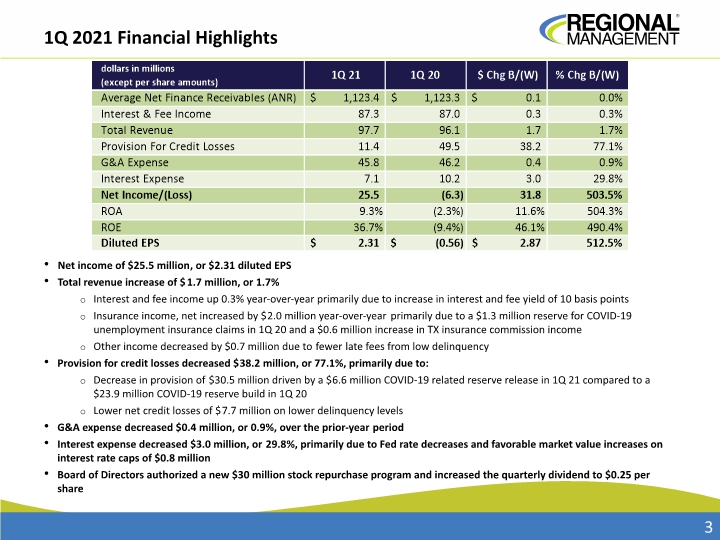
1Q 2021 Financial Highlights 3 Net income of $25.5 million, or $2.31 diluted EPS Total revenue increase of $1.7 million, or 1.7% Interest and fee income up 0.3% year-over-year primarily due to increase in interest and fee yield of 10 basis points Insurance income, net increased by $2.0 million year-over-year primarily due to a $1.3 million reserve for COVID-19 unemployment insurance claims in 1Q 20 and a $0.6 million increase in TX insurance commission income Other income decreased by $0.7 million due to fewer late fees from low delinquency Provision for credit losses decreased $38.2 million, or 77.1%, primarily due to: Decrease in provision of $30.5 million driven by a $6.6 million COVID-19 related reserve release in 1Q 21 compared to a $23.9 million COVID-19 reserve build in 1Q 20 Lower net credit losses of $7.7 million on lower delinquency levels G&A expense decreased $0.4 million, or 0.9%, over the prior-year period Interest expense decreased $3.0 million, or 29.8%, primarily due to Fed rate decreases and favorable market value increases on interest rate caps of $0.8 million Board of Directors authorized a new $30 million stock repurchase program and increased the quarterly dividend to $0.25 per share
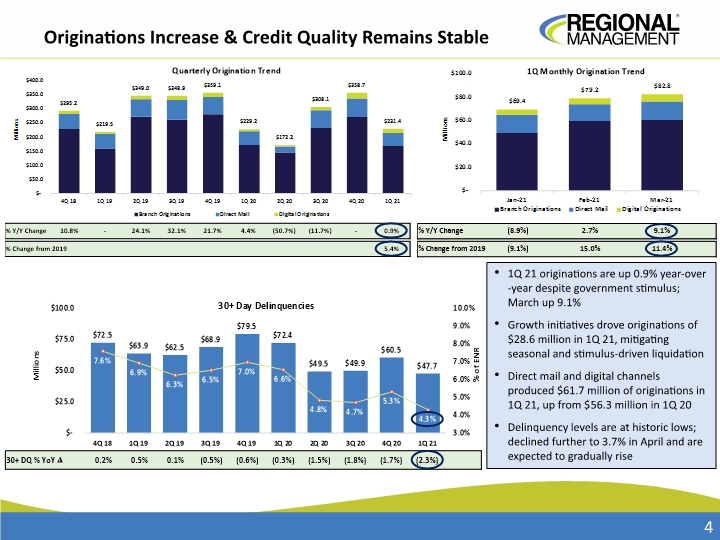
4 Originations Increase & Credit Quality Remains Stable 1Q 21 originations are up 0.9% year-over-year despite government stimulus; March up 9.1% Growth initiatives drove originations of $28.6 million in 1Q 21, mitigating seasonal and stimulus-driven liquidation Direct mail and digital channels produced $61.7 million of originations in 1Q 21, up from $56.3 million in 1Q 20 Delinquency levels are at historic lows; declined further to 3.7% in April and are expected to gradually rise
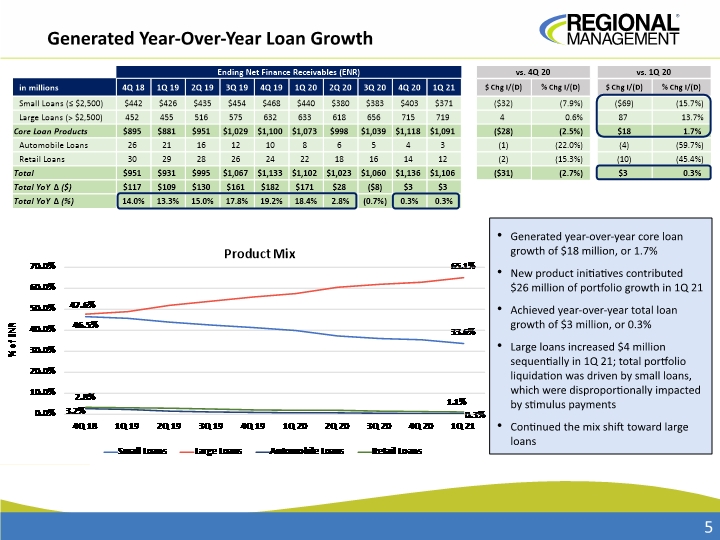
Generated year-over-year core loan growth of $18 million, or 1.7% New product initiatives contributed $26 million of portfolio growth in 1Q 21 Achieved year-over-year total loan growth of $3 million, or 0.3% Large loans increased $4 million sequentially in 1Q 21; total portfolio liquidation was driven by small loans, which were disproportionally impacted by stimulus payments Continued the mix shift toward large loans 5 Generated Year-Over-Year Loan Growth
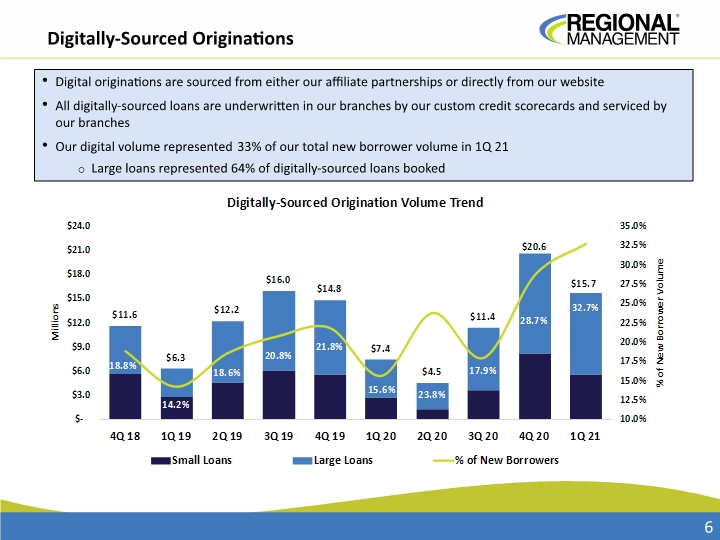
Digitally-Sourced Originations Digital originations are sourced from either our affiliate partnerships or directly from our website All digitally-sourced loans are underwritten in our branches by our custom credit scorecards and serviced by our branches Our digital volume represented 33% of our total new borrower volume in 1Q 21 Large loans represented 64% of digitally-sourced loans booked 6
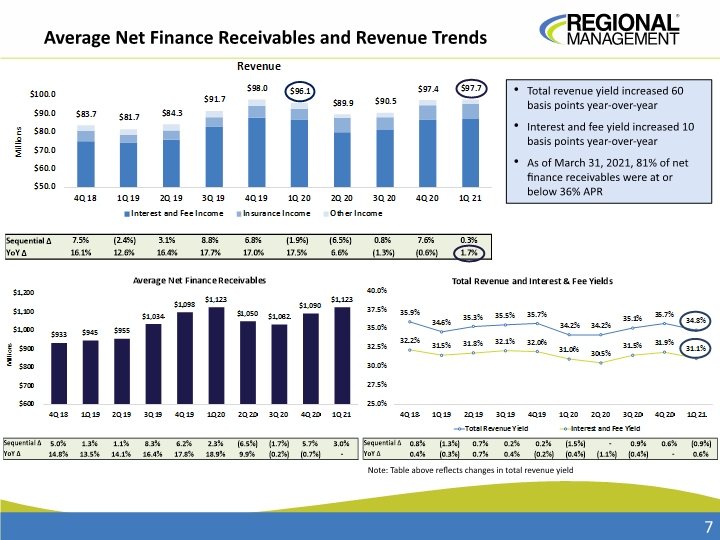
Average Net Finance Receivables and Revenue Trends 7 Total revenue yield increased 60 basis points year-over-year Interest and fee yield increased 10 basis points year-over-year As of March 31, 2021, 81% of net finance receivables were at or below 36% APR Note: Table above reflects changes in total revenue yield
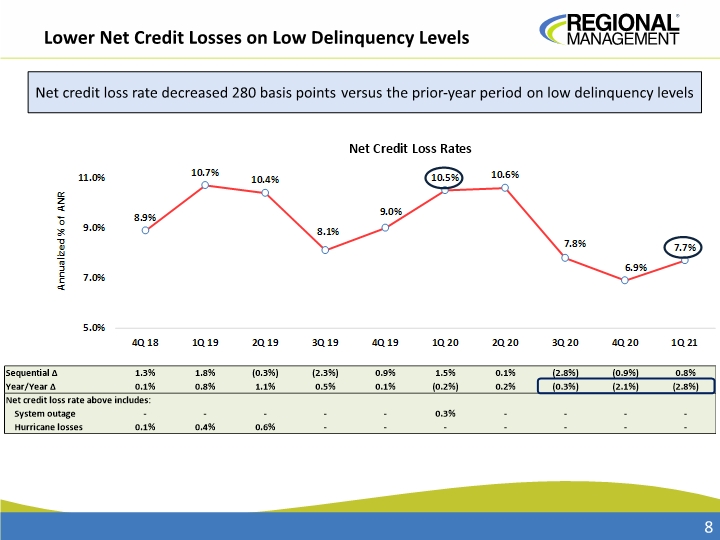
Lower Net Credit Losses on Low Delinquency Levels 8 Net credit loss rate decreased 280 basis points versus the prior-year period on low delinquency levels
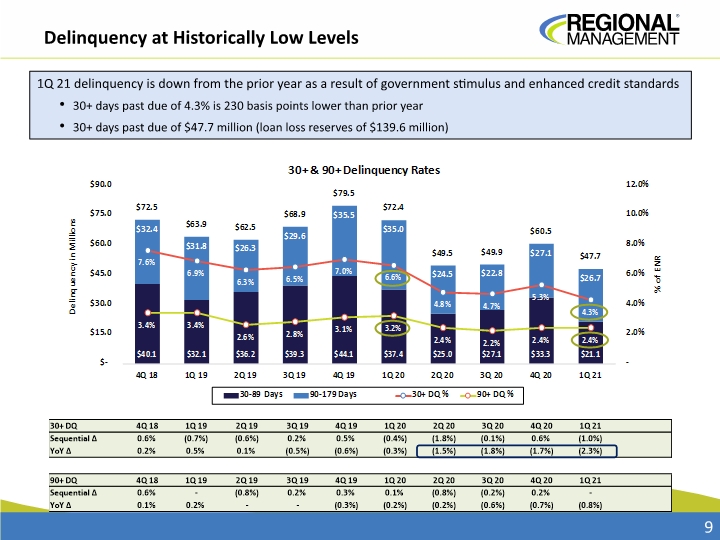
Delinquency at Historically Low Levels 1Q 21 delinquency is down from the prior year as a result of government stimulus and enhanced credit standards 30+ days past due of 4.3% is 230 basis points lower than prior year 30+ days past due of $47.7 million (loan loss reserves of $139.6 million) 9
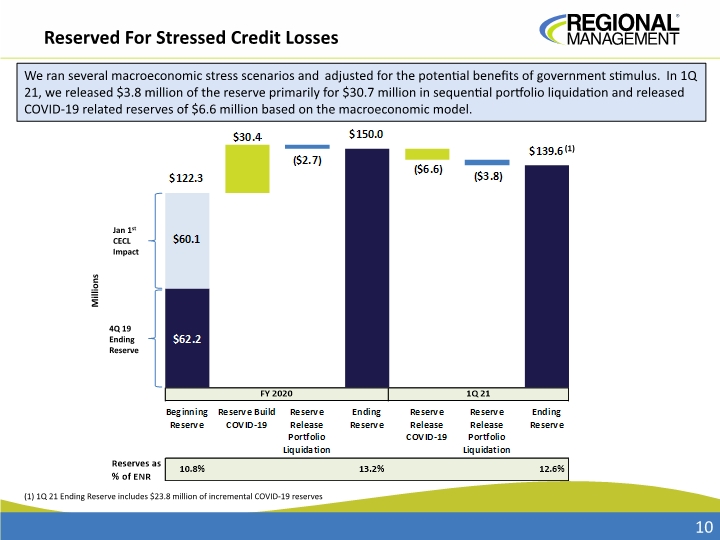
Reserved For Stressed Credit Losses Millions We ran several macroeconomic stress scenarios and adjusted for the potential benefits of government stimulus. In 1Q 21, we released $3.8 million of the reserve primarily for $30.7 million in sequential portfolio liquidation and released COVID-19 related reserves of $6.6 million based on the macroeconomic model. 10 Jan 1st CECL Impact 4Q 19 Ending Reserve (1) (1) 1Q 21 Ending Reserve includes $23.8 million of incremental COVID-19 reserves
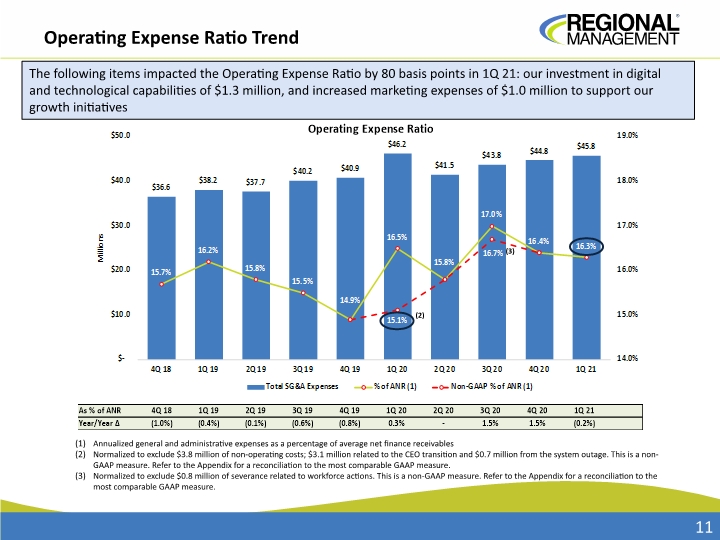
Annualized general and administrative expenses as a percentage of average net finance receivables Normalized to exclude $3.8 million of non-operating costs; $3.1 million related to the CEO transition and $0.7 million from the system outage. This is a non-GAAP measure. Refer to the Appendix for a reconciliation to the most comparable GAAP measure. Normalized to exclude $0.8 million of severance related to workforce actions. This is a non-GAAP measure. Refer to the Appendix for a reconciliation to the most comparable GAAP measure. The following items impacted the Operating Expense Ratio by 80 basis points in 1Q 21: our investment in digital and technological capabilities of $1.3 million, and increased marketing expenses of $1.0 million to support our growth initiatives (2) 11 (3) Operating Expense Ratio Trend
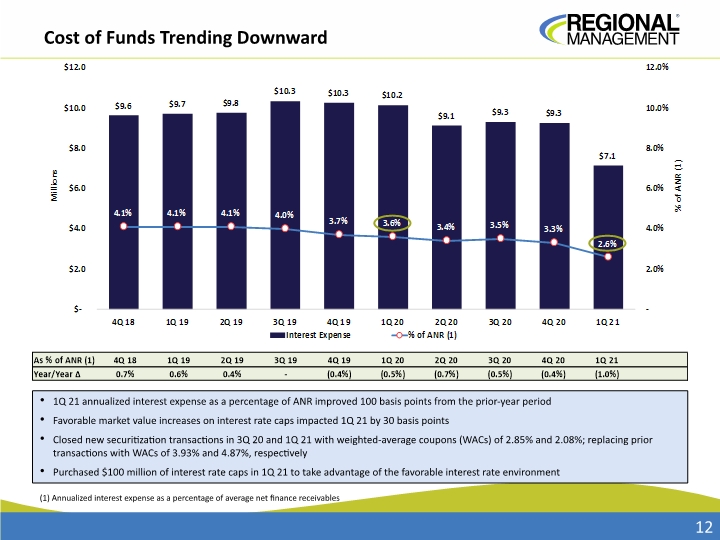
Cost of Funds Trending Downward (1) Annualized interest expense as a percentage of average net finance receivables 12 1Q 21 annualized interest expense as a percentage of ANR improved 100 basis points from the prior-year period Favorable market value increases on interest rate caps impacted 1Q 21 by 30 basis points Closed new securitization transactions in 3Q 20 and 1Q 21 with weighted-average coupons (WACs) of 2.85% and 2.08%; replacing prior transactions with WACs of 3.93% and 4.87%, respectively Purchased $100 million of interest rate caps in 1Q 21 to take advantage of the favorable interest rate environment
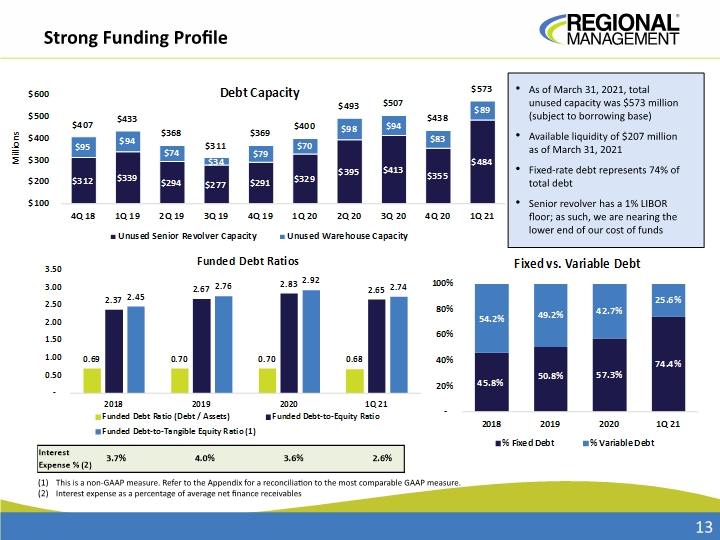
13 Strong Funding Profile This is a non-GAAP measure. Refer to the Appendix for a reconciliation to the most comparable GAAP measure. Interest expense as a percentage of average net finance receivables As of March 31, 2021, total unused capacity was $573 million (subject to borrowing base) Available liquidity of $207 million as of March 31, 2021 Fixed-rate debt represents 74% of total debt Senior revolver has a 1% LIBOR floor; as such, we are nearing the lower end of our cost of funds
Appendix 14
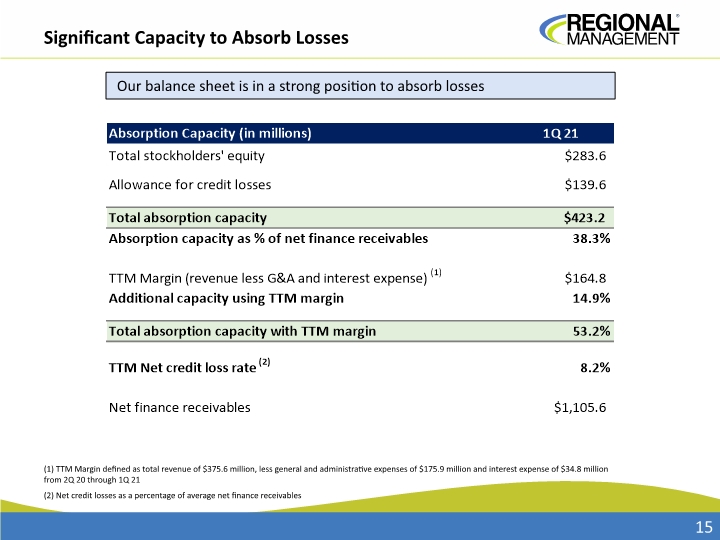
(1) TTM Margin defined as total revenue of $375.6 million, less general and administrative expenses of $175.9 million and interest expense of $34.8 million from 2Q 20 through 1Q 21 (2) Net credit losses as a percentage of average net finance receivables 15 Significant Capacity to Absorb Losses Our balance sheet is in a strong position to absorb losses
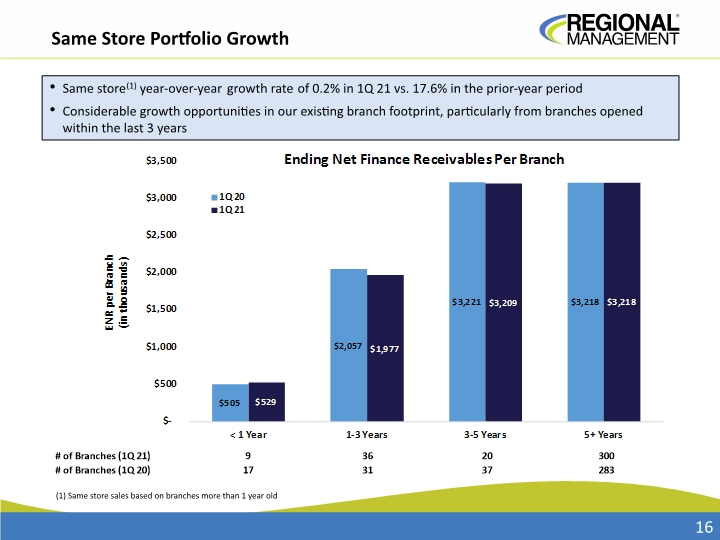
Same Store Portfolio Growth (1) Same store sales based on branches more than 1 year old 16 Same store(1) year-over-year growth rate of 0.2% in 1Q 21 vs. 17.6% in the prior-year period Considerable growth opportunities in our existing branch footprint, particularly from branches opened within the last 3 years
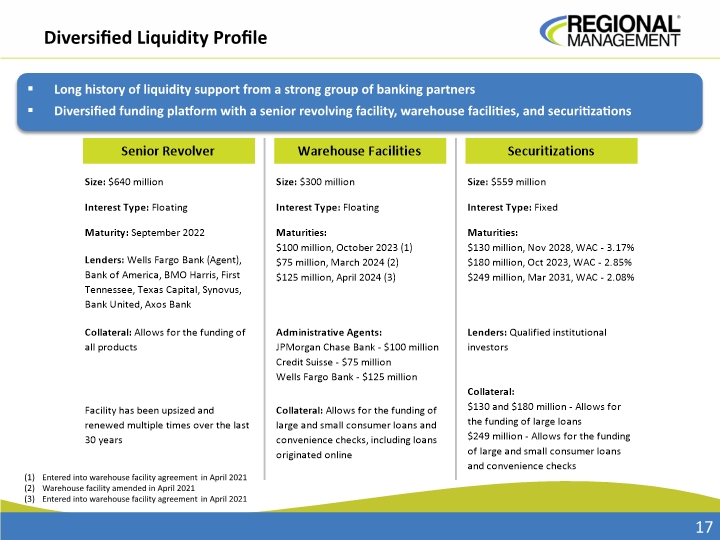
Long history of liquidity support from a strong group of banking partners Diversified funding platform with a senior revolving facility, warehouse facilities, and securitizations 17 Diversified Liquidity Profile Entered into warehouse facility agreement in April 2021 Warehouse facility amended in April 2021 Entered into warehouse facility agreement in April 2021
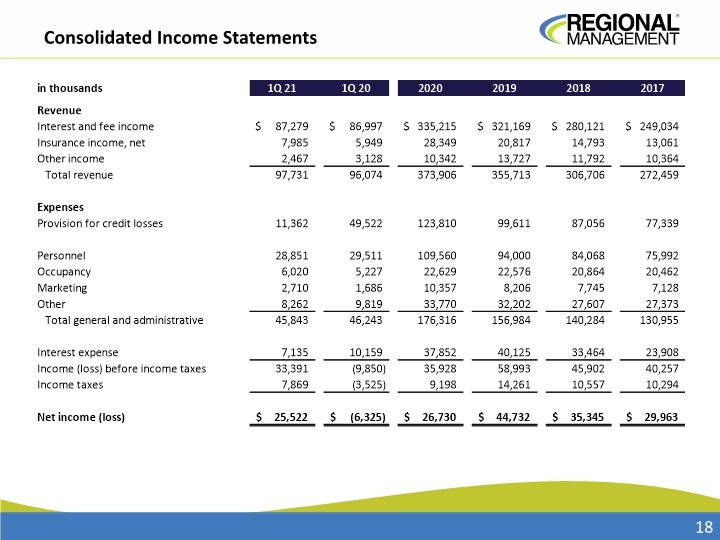
Consolidated Income Statements 18
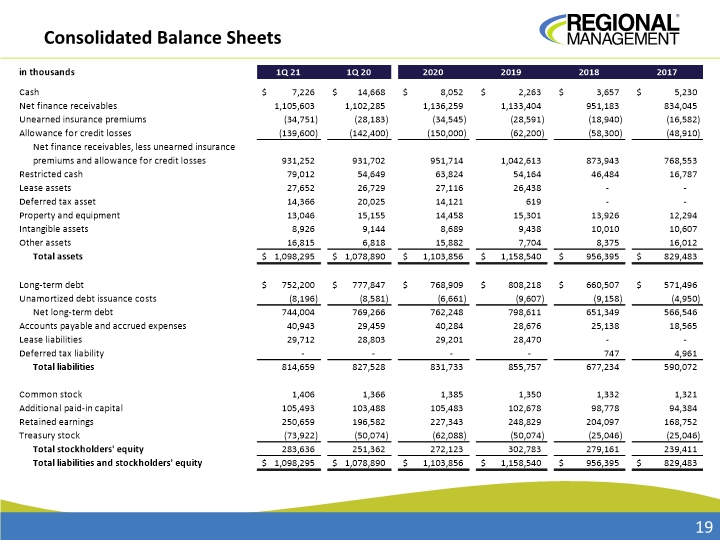
Consolidated Balance Sheets 19
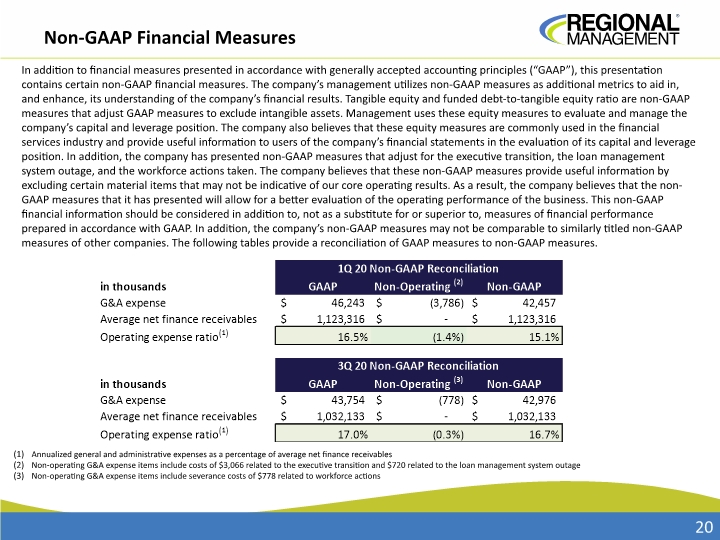
Non-GAAP Financial Measures In addition to financial measures presented in accordance with generally accepted accounting principles (“GAAP”), this presentation contains certain non-GAAP financial measures. The company’s management utilizes non-GAAP measures as additional metrics to aid in, and enhance, its understanding of the company’s financial results. Tangible equity and funded debt-to-tangible equity ratio are non-GAAP measures that adjust GAAP measures to exclude intangible assets. Management uses these equity measures to evaluate and manage the company’s capital and leverage position. The company also believes that these equity measures are commonly used in the financial services industry and provide useful information to users of the company’s financial statements in the evaluation of its capital and leverage position. In addition, the company has presented non-GAAP measures that adjust for the executive transition, the loan management system outage, and the workforce actions taken. The company believes that these non-GAAP measures provide useful information by excluding certain material items that may not be indicative of our core operating results. As a result, the company believes that the non-GAAP measures that it has presented will allow for a better evaluation of the operating performance of the business. This non-GAAP financial information should be considered in addition to, not as a substitute for or superior to, measures of financial performance prepared in accordance with GAAP. In addition, the company’s non-GAAP measures may not be comparable to similarly titled non-GAAP measures of other companies. The following tables provide a reconciliation of GAAP measures to non-GAAP measures. Annualized general and administrative expenses as a percentage of average net finance receivables Non-operating G&A expense items include costs of $3,066 related to the executive transition and $720 related to the loan management system outage Non-operating G&A expense items include severance costs of $778 related to workforce actions 20
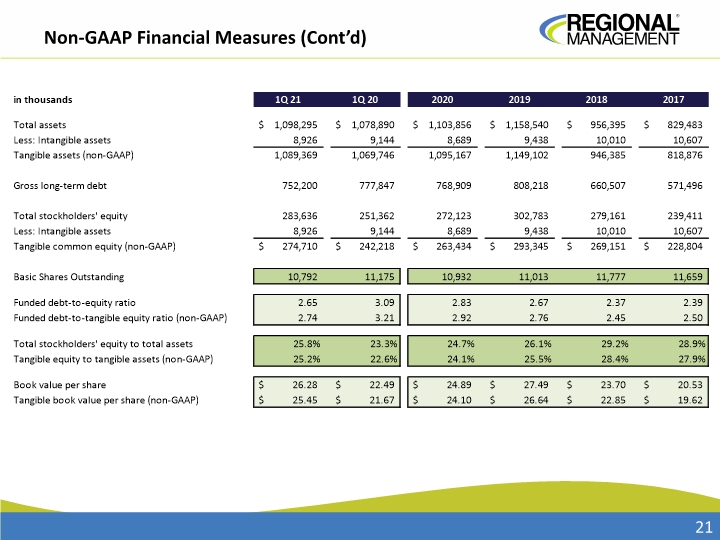
Non-GAAP Financial Measures (Cont’d) 21