
TFC 8-K
Truist Financial Corp (TFC)
8-K
2023-04-20
For: 2023-04-20
View Original
Added on
April 05, 2026
UNITED STATES
SECURITIES AND EXCHANGE COMMISSION
Washington, D.C. 20549
_____________________________________________
Form 8-K
Current Report
_____________________________________________
Pursuant to Section 13 or 15(d)
of the Securities Exchange Act of 1934
Date of Report (Date of earliest event reported)
(Exact name of registrant as specified in its charter)
_____________________________________________
(State or other jurisdiction of incorporation) | (Commission File Number) | (I.R.S. Employer Identification No.) | ||||||
(Address of principal executive offices) | (Zip Code) | |||||||
(336 ) 733-2000
(Registrant’s telephone number, including area code)
_____________________________________________
Check the appropriate box below if the Form 8-K filing is intended to simultaneously satisfy the filing obligation of the registrant under any of the following provisions:
Securities registered pursuant to Section 12(b) of the Act:
| Title of each class | Trading Symbol | Name of each exchange on which registered | ||||||||||||
Indicate by check mark whether the registrant is an emerging growth company as defined in Rule 405 of the Securities Act of 1933 (§230.405 of this chapter) or Rule 12b-2 of the Securities Exchange Act of 1934 (§240.12b-2 of this chapter).
Emerging growth company ☐
If an emerging growth company, indicate by check mark if the registrant has elected not to use the extended transition period for complying with any new or revised financial accounting standards provided pursuant to Section 13(a) of the Exchange Act. ¨
ITEM 2.02 Results of Operations and Financial Condition.
On April 20, 2023, Truist Financial Corporation (“Truist”) issued a press release reporting first quarter 2023 results and posted on its website its first quarter 2023 Earnings Release, Quarterly Performance Summary, and Earnings Release Presentation. The materials contain forward-looking statements regarding Truist and include cautionary language identifying important factors that could cause actual results to differ materially from those anticipated. The Earnings Release, Quarterly Performance Summary, and Earnings Release Presentation are furnished as Exhibits 99.1, 99.2, and 99.3, respectively. Consequently, they are not deemed “filed” for purposes of Section 18 of the Securities Exchange Act of 1934 or otherwise subject to the liabilities of that section. Such materials may only be incorporated by reference into another filing under the Exchange Act or Securities Act of 1933 if such subsequent filing specifically references this Form 8-K. All information in the Earnings Release, Quarterly Performance Summary, and Earnings Release Presentation speaks as of the date thereof, and Truist does not assume any obligation to update such information in the future.
ITEM 9.01 Financial Statements and Exhibits.
(d) Exhibits
| Exhibit No. | Description of Exhibit | |||||||
| Earnings Release issued April 20, 2023. | ||||||||
| Quarterly Performance Summary issued April 20, 2023. | ||||||||
| Earnings Release Presentation issued April 20, 2023. | ||||||||
| 104 | The cover page from this Current Report on Form 8-K, formatted in Inline XBRL. | |||||||
SIGNATURE
Pursuant to the requirements of the Securities Exchange Act of 1934, the registrant has duly caused this report to be signed on its behalf by the undersigned hereunto duly authorized.
TRUIST FINANCIAL CORPORATION | ||||||||
(Registrant) | ||||||||
| By: | /s/ Cynthia B. Powell | |||||||
Cynthia B. Powell | ||||||||
Executive Vice President and Corporate Controller | ||||||||
(Principal Accounting Officer) | ||||||||
Date: April 20, 2023
`
 | News Release | ||||||||||
Truist reports first quarter 2023 results | |||||||||||
GAAP earnings of $1.4 billion, or $1.05 per share | PPNR(1) up 47% and adjusted PPNR(1) up 19% compared to 1Q22 | Capital, liquidity, and credit quality remain strengths | |||||||||
1Q23 Key Financial Data | 1Q23 Performance Highlights(3) | ||||||||||
| (Dollars in billions, except per share data) | 1Q23 | 4Q22 | 1Q22 | ||||||||
| Summary Income Statement | |||||||||||
| Net interest income - TE | $ | 3.92 | $ | 4.03 | $ | 3.21 | |||||
| Noninterest income | 2.23 | 2.23 | 2.14 | ||||||||
| Total revenue - TE | 6.15 | 6.26 | 5.35 | ||||||||
| Noninterest expense | 3.69 | 3.72 | 3.67 | ||||||||
| Net income available to common shareholders | 1.41 | 1.61 | 1.33 | ||||||||
PPNR - unadjusted(1) | 2.46 | 2.54 | 1.68 | ||||||||
PPNR - adjusted(1) | 2.66 | 2.87 | 2.23 | ||||||||
| Per Share Metrics | |||||||||||
| Diluted earnings per common share | $ | 1.05 | $ | 1.20 | $ | 0.99 | |||||
| BVPS | 41.82 | 40.58 | 43.82 | ||||||||
TBVPS(1) | 19.45 | 18.04 | 21.87 | ||||||||
| Key Ratios | |||||||||||
| ROCE | 10.3 | % | 11.7 | % | 9.0 | % | |||||
ROTCE(1) | 24.1 | 27.6 | 18.6 | ||||||||
| Efficiency ratio - GAAP | 60.5 | 60.0 | 69.0 | ||||||||
Efficiency ratio - adjusted(1) | 56.8 | 54.2 | 58.3 | ||||||||
| NIM - TE | 3.17 | 3.25 | 2.76 | ||||||||
| NCO ratio | 0.37 | 0.34 | 0.25 | ||||||||
| ALLL ratio | 1.37 | 1.34 | 1.44 | ||||||||
CET1(2) | 9.1 | 9.0 | 9.4 | ||||||||
| Average Balances | |||||||||||
| Assets | $ | 560 | $ | 553 | $ | 536 | |||||
| Securities | 141 | 142 | 153 | ||||||||
| Loans and leases | 328 | 323 | 292 | ||||||||
| Deposits | 408 | 413 | 415 | ||||||||
Amounts may not foot due to rounding.
(1)Represents a non-GAAP measure. A reconciliation of each of these non-GAAP measures to the most directly comparable GAAP measure is included in the appendix to Truist’s First Quarter 2023 Earnings Presentation.
(2)Current quarter capital ratios are preliminary.
(3)Comparisons noted in this section summarize changes from first quarter of 2023 compared to fourth quarter of 2022, unless otherwise noted.
•Net income was $1.4 billion, or $1.05 per diluted share
◦Includes $63 million ($48 million after-tax), or $0.04 per share, of merger-related and restructuring charges
•Adjusted PPNR was $2.7 billion, down 7.2% compared to prior quarter due to lower net interest income and higher noninterest expense
◦Up 19% from the year ago quarter due to NIM expansion and strong loan growth, partially offset by higher noninterest expense
•Average loans and leases increased 1.7% compared to the prior quarter driven by growth within the commercial and industrial portfolio
•Average deposits decreased 1.2% compared to the prior quarter primarily driven by the impacts of monetary tightening and higher-rate alternatives
•Asset quality remains strong with the net charge-off ratio at 37 basis points, stable nonperforming loans and lower delinquencies
•Capital and liquidity levels remained strong
◦CET1 ratio was 9.1% as of March 31
▪TIH minority stake sale closed April 3, which adds approximately 30 basis points
◦Consolidated LCR was 113%
◦$166 billion of available liquidity sources
| CEO Commentary | ||
“In a challenging and unique quarter for the banking industry, Truist demonstrated strength and leadership that reflects our diverse business model, granular and relationship-oriented deposit base, and strong capital and liquidity position. We also closed on the sale of a 20% minority stake in Truist Insurance Holdings in early April, which adds approximately 30 basis points to our risk-based capital ratios and, longer term, provides strategic and financial flexibility for both Truist and TIH.
Truist earned $1.4 billion of net income and had an ROTCE of 24.1% in the first quarter. We continued to experience the benefits of our shift to operating, including improving organic production and integrated relationship management momentum, although these benefits were offset by higher-than-expected funding costs. As a result, adjusted pre-provision net revenue decreased 7.2% sequentially, consistent with our prior guidance. We have started the year with 310 basis points of positive adjusted operating leverage, although work remains. Asset quality metrics remain strong and we prudently increased our ALLL ratio by 3 basis points to reflect increased uncertainty.
Our focus on clients was unwavering, both during the first two months of the quarter and in March. I am proud of how our teammates continue to care for our clients and stakeholders and live our purpose to inspire and build better lives and communities. I remain highly confident in Truist’s trajectory and ability to be a source of strength and stability for our clients and communities.”
— Bill Rogers, Truist Chairman & CEO
| Truist in the Spotlight | ||||||||
Published 2022 Corporate Responsibility Report, highlighting progress and achievements across climate and energy, DEI, community, and financial inclusion | Closed on transaction to sell minority stake in TIH, positioning TIH for long-term success and growth and providing strategic and financial flexibility for Truist | Announced Where It Starts, a $22 million strategic initiative of Truist Foundation to strengthen small businesses and create career pathways for communities of color | ||||||
`
| Contact: | ||||||||
| Investors: | Ankur Vyas | 404.827.6714 | [email protected] | ||||||
| Media: | Shelley Miller | 704.692.1518 | [email protected] | ||||||

| Net Interest Income, Net Interest Margin, and Average Balances | |||||||||||||||||||||||||||||||||||||||||
| Quarter Ended | Change | ||||||||||||||||||||||||||||||||||||||||
| (Dollars in millions) | 1Q23 | 4Q22 | 1Q22 | Link | Like | ||||||||||||||||||||||||||||||||||||
Interest income(1) | $ | 5,836 | $ | 5,288 | $ | 3,383 | $ | 548 | 10.4 | % | $ | 2,453 | 72.5 | % | |||||||||||||||||||||||||||
| Interest expense | 1,917 | 1,257 | 174 | 660 | 52.5 | 1,743 | NM | ||||||||||||||||||||||||||||||||||
Net interest income(1) | $ | 3,919 | $ | 4,031 | $ | 3,209 | $ | (112) | (2.8) | $ | 710 | 22.1 | |||||||||||||||||||||||||||||
Net interest margin(1) | 3.17 | % | 3.25 | % | 2.76 | % | (8) bps | 41 bps | |||||||||||||||||||||||||||||||||
Core net interest margin(2) | 3.10 | 3.17 | 2.57 | (7) bps | 53 bps | ||||||||||||||||||||||||||||||||||||
Average Balances(3) | |||||||||||||||||||||||||||||||||||||||||
| Total earning assets | $ | 499,149 | $ | 492,805 | $ | 469,940 | $ | 6,344 | 1.3 | % | $ | 29,209 | 6.2 | % | |||||||||||||||||||||||||||
| Total interest-bearing liabilities | 352,472 | 336,584 | 311,586 | 15,888 | 4.7 | 40,886 | 13.1 | ||||||||||||||||||||||||||||||||||
Yields / Rates(1) | |||||||||||||||||||||||||||||||||||||||||
| Total earning assets | 4.72 | % | 4.27 | % | 2.90 | % | 45 bps | 182 bps | |||||||||||||||||||||||||||||||||
| Total interest-bearing liabilities | 2.20 | 1.48 | 0.22 | 72 bps | 198 bps | ||||||||||||||||||||||||||||||||||||
(1)Amounts are on a taxable-equivalent basis utilizing the federal income tax rate of 21% for the periods presented. Interest income includes certain fees, deferred costs, and dividends.
(2)Represents a non-GAAP measure. A reconciliation of each of these non-GAAP measures to the most directly comparable GAAP measure is included in the appendix to Truist’s First Quarter 2023 Earnings Presentation.
(3)Excludes basis adjustments for fair value hedges.
Taxable-equivalent net interest income for the first quarter of 2023 was down $112 million, or 2.8%, compared to the fourth quarter of 2022 driven by higher funding costs and two less days, partially offset by higher rates on earning assets. The net interest margin was 3.17%, down eight basis points.
•Average earning assets increased primarily due to growth in average total loans of $4.8 billion, or 1.5%, and growth in average other earning assets of $3.7 billion, or 17%, primarily due to an increase in balances held at the Federal Reserve to support liquidity build, partially offset by a decline in average securities of $1.9 billion, or 1.3%.
•The yield on the total loan portfolio was 5.81%, up 55 basis points primarily due to higher market interest rates. The yield on the average securities portfolio for the first quarter was 2.14%, up six basis points primarily due to the higher rate environment.
•Average deposits decreased $4.8 billion, or 1.2%, while average short-term borrowings decreased $1.6 billion, or 6.2%, and average long-term debt increased $12.4 billion, or 32%.
•The average cost of total deposits was 1.12%, up 46 basis points. The average cost of short-term borrowings was 4.69%, up 94 basis points. The average cost of long-term debt was 4.05%, up 63 basis points. The increase in rates on deposits and other funding sources was largely attributable to the higher rate environment.
Taxable-equivalent net interest income for the first quarter of 2023 was up $710 million, or 22%, compared to the first quarter of 2022 primarily due to higher short-term interest rates and strong loan growth, alongside well controlled deposit costs. These increases were partially offset by lower purchase accounting accretion and PPP revenue. Net interest margin was 3.17%, up 41 basis points.
•Average earning assets increased $29.2 billion, or 6.2%, primarily due to growth in average total loans of $35.1 billion, or 12%, and growth in other earning assets of $6.7 billion, or 35%, primarily due to an increase in balances held at the Federal Reserve to support liquidity build, partially offset by a decrease in average securities of $12.1 billion, or 7.9%.
•The yield on the total loan portfolio was 5.81%, up 212 basis points, primarily reflecting higher market interest rates, partially offset by lower purchase accounting accretion and PPP revenue. The yield on the average securities portfolio was 2.14%, up 46 basis points primarily due to the higher rate environment.
•Average deposits decreased $6.8 billion, or 1.6%, average short-term borrowings increased $17.1 billion, and average long-term debt increased $15.7 billion, or 44.5%.
•The average cost of total deposits was 1.12%, up 109 basis points. The average cost of short-term borrowings was 4.69%, up 409 basis points. The average cost of long-term debt was 4.05%, up 255 basis points. The increase in rates on deposits and other funding sources was largely attributable to the higher rate environment.
- 2 -
| Noninterest Income | |||||||||||||||||||||||||||||||||||||||||
| Quarter Ended | Change | ||||||||||||||||||||||||||||||||||||||||
| (Dollars in millions) | 1Q23 | 4Q22 | 1Q22 | Link | Like | ||||||||||||||||||||||||||||||||||||
| Insurance income | $ | 813 | $ | 766 | $ | 727 | $ | 47 | 6.1 | % | $ | 86 | 11.8 | % | |||||||||||||||||||||||||||
| Wealth management income | 339 | 324 | 343 | 15 | 4.6 | (4) | (1.2) | ||||||||||||||||||||||||||||||||||
| Investment banking and trading income | 261 | 257 | 261 | 4 | 1.6 | — | — | ||||||||||||||||||||||||||||||||||
| Service charges on deposits | 249 | 257 | 252 | (8) | (3.1) | (3) | (1.2) | ||||||||||||||||||||||||||||||||||
| Card and payment related fees | 230 | 245 | 212 | (15) | (6.1) | 18 | 8.5 | ||||||||||||||||||||||||||||||||||
| Mortgage banking income | 142 | 117 | 121 | 25 | 21.4 | 21 | 17.4 | ||||||||||||||||||||||||||||||||||
| Lending related fees | 106 | 110 | 85 | (4) | (3.6) | 21 | 24.7 | ||||||||||||||||||||||||||||||||||
| Operating lease income | 67 | 68 | 58 | (1) | (1.5) | 9 | 15.5 | ||||||||||||||||||||||||||||||||||
| Securities gains (losses) | — | — | (69) | — | — | 69 | (100.0) | ||||||||||||||||||||||||||||||||||
| Other income | 27 | 83 | 152 | (56) | (67.5) | (125) | (82.2) | ||||||||||||||||||||||||||||||||||
| Total noninterest income | $ | 2,234 | $ | 2,227 | $ | 2,142 | $ | 7 | 0.3 | $ | 92 | 4.3 | |||||||||||||||||||||||||||||
Noninterest income was relatively stable compared to the fourth quarter of 2022 due to seasonally higher insurance income, higher mortgage banking and wealth management income partially offset by lower other income and card and payment related fees.
•Insurance income increased primarily due to seasonality.
•Mortgage banking income increased due to a gain on the sale of a servicing portfolio, partially offset by mortgage servicing rights valuation adjustments in the current quarter.
•Wealth management income increased due to higher brokerage commissions and fees from higher asset valuations.
•Other income decreased primarily due to lower income from investments held for certain post-retirement benefits (which is primarily offset by lower personnel expense).
•Card and payment related fees decreased due to seasonally lower transaction volumes.
Noninterest income was up $92 million, or 4.3%, compared to the first quarter of 2022 due to 12% growth in insurance income, higher mortgage banking income, higher fees from lending-related activities and card and payment related activities. The first quarter of 2022 included $69 million of securities losses and a $74 million gain on the redemption of noncontrolling equity interest (included in other income). These items were partially offset by lower other income.
•Insurance income increased primarily due to acquisitions and 4.7% organic growth.
•Mortgage banking income increased due to a gain on the sale of a servicing portfolio, partially offset by mortgage servicing rights valuation adjustments in the current quarter.
•Lending related fees increased primarily due to higher unused commitment fees.
•Card and payment related fees increased due to higher volumes and the acquisition of a merchant portfolio.
•Other income decreased due to the aforementioned gain in the year ago quarter, lower investment income from the Company’s SBIC and other investments, partially offset by higher income from investments held for certain post-retirement benefits (which is primarily offset by higher personnel expense).
- 3 -
Noninterest Expense | |||||||||||||||||||||||||||||||||||||||||
| Quarter Ended | Change | ||||||||||||||||||||||||||||||||||||||||
| (Dollars in millions) | 1Q23 | 4Q22 | 1Q22 | Link | Like | ||||||||||||||||||||||||||||||||||||
| Personnel expense | $ | 2,181 | $ | 2,198 | $ | 2,051 | $ | (17) | (0.8) | % | $ | 130 | 6.3 | % | |||||||||||||||||||||||||||
| Professional fees and outside processing | 314 | 347 | 363 | (33) | (9.5) | (49) | (13.5) | ||||||||||||||||||||||||||||||||||
| Software expense | 214 | 241 | 232 | (27) | (11.2) | (18) | (7.8) | ||||||||||||||||||||||||||||||||||
| Net occupancy expense | 183 | 179 | 208 | 4 | 2.2 | (25) | (12.0) | ||||||||||||||||||||||||||||||||||
| Amortization of intangibles | 136 | 163 | 137 | (27) | (16.6) | (1) | (0.7) | ||||||||||||||||||||||||||||||||||
| Equipment expense | 110 | 124 | 118 | (14) | (11.3) | (8) | (6.8) | ||||||||||||||||||||||||||||||||||
| Marketing and customer development | 78 | 70 | 84 | 8 | 11.4 | (6) | (7.1) | ||||||||||||||||||||||||||||||||||
| Operating lease depreciation | 46 | 44 | 48 | 2 | 4.5 | (2) | (4.2) | ||||||||||||||||||||||||||||||||||
| Regulatory costs | 75 | 52 | 35 | 23 | 44.2 | 40 | 114.3 | ||||||||||||||||||||||||||||||||||
| Merger-related and restructuring charges | 63 | 114 | 216 | (51) | (44.7) | (153) | (70.8) | ||||||||||||||||||||||||||||||||||
| Other expense | 291 | 190 | 182 | 101 | 53.2 | 109 | 59.9 | ||||||||||||||||||||||||||||||||||
| Total noninterest expense | $ | 3,691 | $ | 3,722 | $ | 3,674 | $ | (31) | (0.8) | $ | 17 | 0.5 | |||||||||||||||||||||||||||||
Noninterest expense was down $31 million, or 0.8%, compared to the fourth quarter of 2022 due to lower merger-related and restructuring charges, professional fees and outside processing expenses, amortization of intangibles, and software expenses. These decreases were partially offset by higher other expenses and regulatory costs. Merger-related and restructuring charges and incremental operating expenses related to the merger decreased $51 million and $56 million, respectively, due to the completion of integration-related activities. The current quarter merger-related and restructuring charges includes costs for personnel and facilities optimization. Adjusted noninterest expenses, which exclude merger-related costs and the amortization of intangibles, increased $103 million, or 3.0%, compared to the prior quarter.
•Professional fees and outside processing expenses decreased due to lower project spend for merger-related activities, partially offset by enterprise technology investments.
•Software expense decreased due to accelerated depreciation for certain contracts in the prior period.
•Personnel expense decreased slightly due to lower pension expenses and lower other post-retirement benefit expense (which is almost entirely offset by lower other income), partially offset by seasonally higher payroll taxes and higher equity compensation expense.
•Other expense increased primarily due to higher pension expense (driven primarily by lower plan assets) and higher operating losses.
•Regulatory costs increased primarily due to an increase in the FDIC’s deposit insurance assessment rate.
Noninterest expense was up $17 million, or 0.5%, compared to the first quarter of 2022 due to higher personnel expense, other expense, and regulatory costs. These increases were partially offset by lower merger-related and restructuring charges and professional fees and outside processing expenses. Merger-related and restructuring charges and incremental operating expenses related to the merger decreased $153 million and $202 million, respectively, due to the completion of integration-related activities. Adjusted noninterest expenses, which exclude merger-related costs and the amortization of intangibles increased $373 million, or 12%.
•Personnel expense increased due to investments in teammates by increasing Truist’s minimum wage, the impact from acquisitions, investments in revenue producing businesses and enterprise technology, and higher other post-retirement benefit expense (which is almost entirely offset by higher other income), partially offset by lower pension expenses.
•Other expense increased primarily due to higher pension expense (driven primarily by lower plan assets) and higher operating losses.
•Regulatory costs increased primarily due to an increase in the FDIC’s deposit insurance assessment rate.
•Professional fees and outside processing expenses decreased due to lower project spend for merger-related activities, partially offset by enterprise technology investments.
- 4 -
Provision for Income Taxes | |||||||||||||||||||||||||||||||||||||||||
| Quarter Ended | Change | ||||||||||||||||||||||||||||||||||||||||
| (Dollars in millions) | 1Q23 | 4Q22 | 1Q22 | Link | Like | ||||||||||||||||||||||||||||||||||||
| Provision for income taxes | $ | 394 | $ | 337 | $ | 330 | $ | 57 | 16.9 | % | $ | 64 | 19.4 | % | |||||||||||||||||||||||||||
| Effective tax rate | 20.6 | % | 16.7 | % | 18.9 | % | 390 bps | 170 bps | |||||||||||||||||||||||||||||||||
The effective tax rate increased compared to the fourth quarter of 2022 primarily driven by discrete tax expenses recognized in the current quarter compared to discrete tax benefits recognized in the prior quarter and the adoption of accounting guidance related to the proportional amortization of tax credit investments in the current quarter. This guidance resulted in an increase in other income and an increase in tax expense of $17 million for the first quarter of 2023 with no impact to net income. The guidance was adopted prospectively and had no impact on prior periods results.
The effective tax rate increased compared to the first quarter of 2022 primarily driven by higher income before taxes, discrete tax expense recognized in the current quarter compared to discrete tax benefits recognized in the prior quarter, and the aforementioned adoption of accounting guidance related to the proportional amortization of tax credit investments.
Average Loans and Leases | |||||||||||||||||||||||
| (Dollars in millions) | 1Q23 | 4Q22 | Change | % Change | |||||||||||||||||||
| Commercial: | |||||||||||||||||||||||
| Commercial and industrial | $ | 165,095 | $ | 159,308 | $ | 5,787 | 3.6 | % | |||||||||||||||
| CRE | 22,689 | 22,497 | 192 | 0.9 | |||||||||||||||||||
| Commercial construction | 5,863 | 5,711 | 152 | 2.7 | |||||||||||||||||||
| Total commercial | 193,647 | 187,516 | 6,131 | 3.3 | |||||||||||||||||||
| Consumer: | |||||||||||||||||||||||
| Residential mortgage | 56,422 | 56,292 | 130 | 0.2 | |||||||||||||||||||
Home equity(1) | 10,735 | 10,887 | (152) | (1.4) | |||||||||||||||||||
| Indirect auto | 27,743 | 28,117 | (374) | (1.3) | |||||||||||||||||||
Other consumer(1) | 27,559 | 27,479 | 80 | 0.3 | |||||||||||||||||||
| Student | 5,129 | 5,533 | (404) | (7.3) | |||||||||||||||||||
| Total consumer | 127,588 | 128,308 | (720) | (0.6) | |||||||||||||||||||
| Credit card | 4,785 | 4,842 | (57) | (1.2) | |||||||||||||||||||
| Total loans and leases held for investment | $ | 326,020 | $ | 320,666 | $ | 5,354 | 1.7 | ||||||||||||||||
(1)In the first quarter of 2023, the Company reclassified certain portfolios within the consumer portfolio segment to delineate home equity from other consumer portfolios. Prior periods were revised to conform to the current presentation.
Average loans increased $5.4 billion, or 1.7%, compared to the prior quarter primarily due to momentum from the prior quarter within the commercial portfolio and the impact of the BankDirect acquisition. Loan growth moderated during the quarter as production in lower return portfolios was reduced with end of period loans up 0.5% compared to December 31, 2022.
•Average commercial loans increased 3.3% due to broad-based growth within the commercial and industrial portfolio and the BankDirect acquisition. The BankDirect acquisition contributed approximately $900 million of average loan growth compared to the fourth quarter of 2022.
•Average consumer loans decreased 0.6% due to runoff in student loans and partnership lending, as well as lower indirect auto production.
- 5 -
| Average Deposits | |||||||||||||||||||||||
| (Dollars in millions) | 1Q23 | 4Q22 | Change | % Change | |||||||||||||||||||
| Noninterest-bearing deposits | $ | 131,099 | $ | 141,032 | $ | (9,933) | (7.0) | % | |||||||||||||||
| Interest checking | 108,886 | 110,001 | (1,115) | (1.0) | |||||||||||||||||||
| Money market and savings | 139,802 | 144,730 | (4,928) | (3.4) | |||||||||||||||||||
| Time deposits | 28,671 | 17,513 | 11,158 | 63.7 | |||||||||||||||||||
| Total deposits | $ | 408,458 | $ | 413,276 | $ | (4,818) | (1.2) | ||||||||||||||||
Average deposits for the first quarter of 2023 were $408.5 billion, a decrease of $4.8 billion, or 1.2%, compared to the prior quarter. The decrease in deposits was primarily driven by the impacts of monetary tightening and higher-rate alternatives.
Average noninterest-bearing deposits decreased 7.0% compared to the prior quarter and represented 32.1% of total deposits for the first quarter of 2023 compared to 34.1% for the fourth quarter of 2022 and 35.1% compared to the year ago quarter. Average money market and savings and interest checking declined 3.4% and 1.0%, respectively, compared to the prior quarter. Average time deposits increased 64% due to an increase in wholesale funding and retail-client time deposits.
Capital Ratios | |||||||||||||||||||||||||||||
| 1Q23 | 4Q22 | 3Q22 | 2Q22 | 1Q22 | |||||||||||||||||||||||||
| Risk-based: | (preliminary) | ||||||||||||||||||||||||||||
| CET1 | 9.1 | % | 9.0 | % | 9.1 | % | 9.2 | % | 9.4 | % | |||||||||||||||||||
| Tier 1 | 10.6 | 10.5 | 10.7 | 10.8 | 11.0 | ||||||||||||||||||||||||
| Total | 12.6 | 12.4 | 12.6 | 12.6 | 13.0 | ||||||||||||||||||||||||
| Leverage | 8.5 | 8.5 | 8.5 | 8.6 | 8.6 | ||||||||||||||||||||||||
| Supplementary leverage | 7.3 | 7.3 | 7.3 | 7.3 | 7.3 | ||||||||||||||||||||||||
Capital ratios remained strong compared to the regulatory requirements for well capitalized banks. Truist declared common dividends of $0.52 per share during the first quarter of 2023. The dividend payout ratio for the first quarter of 2023 was 49%. Truist did not repurchase any shares in the first quarter of 2023.
Truist CET1 ratio was 9.1% as of March 31, 2023. The increase since December 31, 2022 represents organic capital generation, partially offset by the CECL phase-in. Truist closed the sale of the minority stake in TIH on April 3, 2023, which adds approximately 30 basis points and 25 basis points to the risk-based regulatory capital ratios and leverage ratios, respectively.
Truist’s average consolidated LCR was 113% for the three months ended March 31, 2023, compared to the regulatory minimum of 100%. Truist has significant and strong access to liquidity with $166 billion of available liquidity as of March 31, 2023.
- 6 -
| Asset Quality | |||||||||||||||||||||||||||||
| (Dollars in millions) | 1Q23 | 4Q22 | 3Q22 | 2Q22 | 1Q22 | ||||||||||||||||||||||||
| Total nonperforming assets | $ | 1,261 | $ | 1,250 | $ | 1,240 | $ | 1,173 | $ | 1,135 | |||||||||||||||||||
| Total loans 90 days past due and still accruing | 1,361 | 1,605 | 1,709 | 1,787 | 1,914 | ||||||||||||||||||||||||
| Total loans 30-89 days past due | 1,805 | 2,267 | 1,957 | 2,091 | 2,101 | ||||||||||||||||||||||||
Nonperforming loans and leases as a percentage of loans and leases held for investment | 0.36 | % | 0.36 | % | 0.35 | % | 0.36 | % | 0.36 | % | |||||||||||||||||||
Loans 30-89 days past due and still accruing as a percentage of loans and leases | 0.55 | 0.70 | 0.62 | 0.69 | 0.72 | ||||||||||||||||||||||||
Loans 90 days or more past due and still accruing as a percentage of loans and leases | 0.42 | 0.49 | 0.54 | 0.59 | 0.66 | ||||||||||||||||||||||||
| Loans 90 days or more past due and still accruing as a percentage of loans and leases, excluding government guaranteed | 0.04 | 0.04 | 0.04 | 0.04 | 0.04 | ||||||||||||||||||||||||
Allowance for loan and lease losses as a percentage of loans and leases held for investment | 1.37 | 1.34 | 1.34 | 1.38 | 1.44 | ||||||||||||||||||||||||
Net charge-offs as a percentage of average loans and leases, annualized | 0.37 | 0.34 | 0.27 | 0.22 | 0.25 | ||||||||||||||||||||||||
Ratio of allowance for loan and lease losses to net charge-offs, annualized | 3.7x | 4.1x | 5.0x | 6.5x | 5.8x | ||||||||||||||||||||||||
Ratio of allowance for loan and lease losses to nonperforming loans and leases held for investment | 3.8x | 3.7x | 3.8x | 3.8x | 4.0x | ||||||||||||||||||||||||
Nonperforming assets totaled $1.3 billion at March 31, 2023, relatively stable compared to December 31, 2022. Nonperforming loans and leases held for investment were 0.36% of loans and leases held for investment at March 31, 2023, unchanged compared to December 31, 2022.
Loans 90 days or more past due and still accruing totaled $1.4 billion at March 31, 2023, down $244 million, or seven basis points as a percentage of loans and leases, compared with the prior quarter primarily due to declines in government guaranteed student loans and government guaranteed residential mortgages. Excluding government guaranteed loans, the ratio of loans 90 days or more past due and still accruing as a percentage of loans and leases was 0.04% at March 31, 2023, flat from December 31, 2022.
Loans 30-89 days past due and still accruing of $1.8 billion at March 31, 2023 were down $462 million, or 15 basis points as a percentage of loans and leases, compared to the prior quarter primarily due to a seasonal decrease in the consumer portfolios coupled with a decline in the commercial and industrial portfolio.
The allowance for credit losses was $4.8 billion and includes $4.5 billion for the allowance for loan and lease losses and $282 million for the reserve for unfunded commitments. The ALLL ratio was 1.37%, up three basis points compared with December 31, 2022 primarily due to increased economic uncertainty. The ALLL covered nonperforming loans and leases held for investment 3.8X compared to 3.7X at December 31, 2022. At March 31, 2023, the ALLL was 3.7X annualized net charge-offs, compared to 4.1X at December 31, 2022.
Provision for Credit Losses | |||||||||||||||||||||||||||||||||||||||||
| Quarter Ended | Change | ||||||||||||||||||||||||||||||||||||||||
| (Dollars in millions) | 1Q23 | 4Q22 | 1Q22 | Link | Like | ||||||||||||||||||||||||||||||||||||
| Provision for credit losses | $ | 502 | $ | 467 | $ | (95) | $ | 35 | 7.5 | % | $ | 597 | NM | ||||||||||||||||||||||||||||
| Net charge-offs | 297 | 273 | 178 | 24 | 8.8 | 119 | 66.9 | ||||||||||||||||||||||||||||||||||
| Net charge-offs as a percentage of average loans and leases | 0.37 | % | 0.34 | % | 0.25 | % | 3 bps | 12 bps | |||||||||||||||||||||||||||||||||
The provision for credit losses was $502 million compared to $467 million for the fourth quarter of 2022.
•The increase in the current quarter provision expense primarily reflects increased economic uncertainty.
•The net charge-off ratio for the current quarter was up compared to the fourth quarter of 2022 primarily driven by higher charge-offs in the commercial and industrial portfolio.
The provision for credit losses was $502 million compared to a benefit of $95 million for the first quarter of 2022.
•The increase in the current quarter provision expense primarily reflects increased economic uncertainty in the current period, whereas the earlier quarter included a reserve release due to the improving credit environment during that period.
•The net charge-off ratio was up compared to the first quarter of 2022 driven by higher charge-offs in the indirect auto and other consumer portfolios due to normalizing trends, as well as an increase in the commercial and industrial portfolio.
- 7 -
Earnings Presentation and Quarterly Performance Summary | ||
Investors can access a live audio webcast of the first quarter 2023 earnings conference call at 8 a.m. ET today and view the news release and presentation materials at https://ir.truist.com under “Events & Presentations.” The conference call can also be accessed by dialing 855-303-0072 and using passcode 100038. A replay of the call will be available on the website for 30 days.
The presentation, including an appendix reconciling non-GAAP disclosures, and Truist’s First Quarter 2023 Quarterly Performance Summary, which contains detailed financial schedules, are available at https://ir.truist.com/earnings.
About Truist | ||
Truist Financial Corporation is a purpose-driven financial services company committed to inspiring and building better lives and communities. Truist has leading market share in many high-growth markets in the country, and offers a wide range of products and services through our retail and small business banking, commercial banking, corporate and investment banking, insurance, wealth management, and specialized lending businesses. Headquartered in Charlotte, North Carolina, Truist is a top 10 U.S. commercial bank with total assets of $574 billion as of March 31, 2023. Truist Bank, Member FDIC. Learn more at Truist.com.
#-#-#
| Glossary of Defined Terms | |||||
| Term | Definition | ||||
ACL | Allowance for credit losses | ||||
ALLL | Allowance for loan and lease losses | ||||
| BVPS | Book value (common equity) per share | ||||
| CEO | Chief Executive Officer | ||||
CET1 | Common equity tier 1 | ||||
| EBITDA | Earnings before interest, taxes, depreciation, and amortization | ||||
| FDIC | Federal Deposit Insurance Corporation | ||||
| GAAP | Accounting principles generally accepted in the United States of America | ||||
| LCR | Liquidity Coverage Ratio | ||||
| LIBOR | London Interbank Offered Rate | ||||
| Like | Compared to First quarter of 2022 | ||||
| Link | Compared to Fourth quarter of 2022 | ||||
NCO | Net charge-offs | ||||
| NIM | Net interest margin, computed on a TE basis | ||||
| NM | Not meaningful | ||||
| PPNR | Pre-provision net revenue | ||||
| PPP | Paycheck Protection Program, established by the Coronavirus Aid, Relief, and Economic Security Act | ||||
| ROCE | Return on average common equity | ||||
ROTCE | Return on average tangible common equity | ||||
| SBIC | Small Business Investment Company | ||||
TBVPS | Tangible book value per common share | ||||
| TE | Taxable-equivalent | ||||
| TIH | Truist Insurance Holdings | ||||
- 8 -
| Non-GAAP Financial Information | ||
This news release contains financial information and performance measures determined by methods other than in accordance with GAAP. Truist’s management uses these “non-GAAP” measures in their analysis of the Corporation’s performance and the efficiency of its operations. Management believes these non-GAAP measures provide a greater understanding of ongoing operations, enhance comparability of results with prior periods and demonstrate the effects of significant items in the current period. The Corporation believes a meaningful analysis of its financial performance requires an understanding of the factors underlying that performance. Truist’s management believes investors may find these non-GAAP financial measures useful. These disclosures should not be viewed as a substitute for financial measures determined in accordance with GAAP, nor are they necessarily comparable to non-GAAP performance measures that may be presented by other companies. Below is a listing of the types of non-GAAP measures used in this news release:
•Adjusted Performance Measures -The adjusted performance measures, including adjusted diluted earnings per share, return on average tangible common shareholders’ equity, adjusted efficiency ratio, adjusted operating leverage, and adjusted noninterest expense, are non-GAAP in that they exclude merger-related and restructuring charges, other selected items, and amortization of intangible assets, as applicable to tangible measures. Truist’s management uses these measures in their analysis of the Corporation’s performance. Truist’s management believes these measures provide a greater understanding of ongoing operations and enhance comparability of results with prior periods, as well as demonstrate the effects of significant gains and charges.
•PPNR - Pre-provision net revenue is a non-GAAP measure that adjusts net income determined in accordance with GAAP to exclude the impact of the provision for credit losses and provision for income taxes. Adjusted pre-provision net revenue is a non-GAAP measure that additionally excludes securities gains (losses), merger-related and restructuring charges, amortization of intangible assets, and other selected items. Truist’s management believes these measures provide a greater understanding of ongoing operations and enhances comparability of results with prior periods.
•Tangible Common Equity and Related Measures - Tangible common equity and related measures are non-GAAP measures that exclude the impact of intangible assets, net of deferred taxes, and their related amortization. These measures are useful for evaluating the performance of a business consistently, whether acquired or developed internally. Truist’s management uses these measures to assess profitability, returns relative to balance sheet risk, and shareholder value.
•Core NIM - Core net interest margin is a non-GAAP measure that adjusts net interest margin to exclude the impact of purchase accounting. The purchase accounting marks and related amortization for loans, deposits, and long-term debt from SunTrust and other mergers and acquisitions are excluded to approximate the yields paid by clients. Truist’s management believes the adjustments to the calculation of net interest margin for certain assets and liabilities acquired provide investors with useful information related to the performance of Truist’s earning assets.
A reconciliation of each of these non-GAAP measures to the most directly comparable GAAP measure is included in the appendix to Truist’s First Quarter 2023 Earnings Presentation, which is available at https://ir.truist.com/earnings.
- 9 -
| Forward Looking Statements | ||
This news release contains “forward-looking statements” within the meaning of the Private Securities Litigation Reform Act of 1995, regarding the financial condition, results of operations, business plans and the future performance of Truist. Words such as “anticipates,” “believes,” “estimates,” “expects,” “forecasts,” “intends,” “plans,” “projects,” “may,” “will,” “should,” “would,” “could” and other similar expressions are intended to identify these forward-looking statements.
Forward-looking statements are not based on historical facts but instead represent management’s expectations and assumptions regarding Truist’s business, the economy, and other future conditions. Such statements involve inherent uncertainties, risks, and changes in circumstances that are difficult to predict. As such, Truist’s actual results may differ materially from those contemplated by forward-looking statements. While there can be no assurance that any list of risks and uncertainties or risk factors is complete, important factors that could cause actual results to differ materially from those contemplated by forward-looking statements include the following, without limitation, as well as the risks and uncertainties more fully discussed under Part I, Item 1A-Risk Factors in our Annual Report on Form 10-K for the year ended December 31, 2022 and in Truist’s subsequent filings with the Securities and Exchange Commission:
•changes in the interest rate environment, including the replacement of LIBOR as an interest rate benchmark, could adversely affect Truist’s revenue and expenses, the value of assets and obligations, and the availability and cost of capital, cash flows, and liquidity;
•Truist is subject to credit risk by lending or committing to lend money, may have more credit risk and higher credit losses to the extent that loans are concentrated by loan type, industry segment, borrower type or location of the borrower or collateral, and may suffer losses if the value of collateral declines in stressed market conditions;
•inability to access short-term funding or liquidity, loss of client deposits or changes in Truist’s credit ratings could increase the cost of funding, limit access to capital markets, or negatively affect Truist’s overall liquidity or capitalization;
•Truist may be impacted by the soundness of other financial institutions, including as a result of the financial or operational failure of a major financial institution, or concerns about the creditworthiness of such a financial institution or its ability to fulfill its obligations, which can cause substantial and cascading disruption within the financial markets and increased expenses, including FDIC insurance premiums;
•general economic or business conditions, either globally, nationally or regionally, may be less favorable than expected, including as a result of supply chain disruptions, inflationary pressures and labor shortages, and instability in global geopolitical matters, including due to an outbreak or escalation of hostilities, or volatility in financial markets could result in, among other things, slower deposit or asset growth, a deterioration in credit quality, or a reduced demand for credit, insurance, or other services;
•the monetary and fiscal policies of the federal government and its agencies, including in response to higher inflation, could have a material adverse effect on the economy and Truist’s profitability;
•the effects of COVID-19 adversely impacted the Company’s operations and financial performance and similar adverse impacts resulting from pandemics could occur in future periods;
•risk management oversight functions may not identify or address risks adequately, and management may not be able to effectively manage credit risk;
•there are risks resulting from the extensive use of models in Truist’s business, which may impact decisions made by management and regulators;
•deposit attrition, client loss or revenue loss following completed mergers or acquisitions may be greater than anticipated;
•Truist could fail to execute on strategic or operational plans, including the ability to successfully complete or integrate mergers and acquisitions;
•increased competition, including from (i) new or existing competitors that could have greater financial resources or be subject to different regulatory standards or compliance costs, and (ii) products and services offered by non-bank financial technology companies, may reduce Truist’s client base, cause Truist to lower prices for its products and services in order to maintain market share or otherwise adversely impact Truist’s businesses or results of operations;
•failure to maintain or enhance Truist’s competitive position with respect to new products, services, and technology, whether it fails to anticipate client expectations or because its technological developments fail to perform as desired or do not achieve market acceptance or regulatory approval or for other reasons, may cause Truist to lose market share or incur additional expense;
•negative public opinion could damage Truist’s reputation and adversely impact business and revenues;
•regulatory matters, litigation or other legal actions may result in, among other things, costs, fines, penalties, restrictions on Truist’s business activities, reputational harm, negative publicity, or other adverse consequences;
•Truist faces substantial legal and operational risks in safeguarding personal information;
•evolving legislative, accounting and regulatory standards, including with respect to climate, capital, and liquidity requirements, which may become more stringent in light of recent bank failures, and results of regulatory examinations may adversely affect Truist’s financial condition and results of operations;
•increased scrutiny regarding Truist’s consumer sales practices, training practices, incentive compensation design, and governance could damage its reputation and adversely impact business and revenues;
•accounting policies and processes require management to make estimates about matters that are uncertain, including the potential write down to goodwill if there is an elongated period of decline in market value for Truist’s stock and adverse economic conditions are sustained over a period of time;
•Truist faces risks related to originating and selling mortgages, including repurchase and indemnity demands from purchasers related to representations and warranties on loans sold, which could result in an increase in the amount of losses for loan repurchases;
•there are risks relating to Truist’s role as a loan servicer, including an increase in the scope or costs of the services Truist is required to perform without any corresponding increase in servicing fees or a breach of Truist’s obligations as servicer;
•Truist’s success depends on hiring and retaining key teammates, and if these individuals leave or change roles without effective replacements, Truist’s operations could be adversely impacted, which could be exacerbated in the increased work-from-home environment as job markets may be less constrained by physical geography;
•Truist’s operations rely on its ability, and the ability of key external parties, to maintain appropriate-staffed workforces, and on the competence, trustworthiness, health and safety of teammates;
•Truist faces the risk of fraud or misconduct by internal or external parties, which Truist may not be able to prevent, detect, or mitigate;
•security risks, including denial of service attacks, hacking, social engineering attacks targeting Truist’s teammates and clients, malware intrusion, data corruption attempts, system breaches, cyberattacks, which have increased in frequency with geopolitical tensions, identity theft, ransomware attacks, and physical security risks, such as natural disasters, environmental conditions, and intentional acts of destruction, could result in the disclosure of confidential information, adversely affect Truist’s business or reputation or create significant legal or financial exposure; and
•widespread outages of operational, communication, or other systems, whether internal or provided by third parties, natural or other disasters (including acts of terrorism and pandemics), and the effects of climate change, including physical risks, such as more frequent and intense weather events, and risks related to the transition to a lower carbon economy, such as regulatory or technological changes or shifts in market dynamics or consumer preferences, could have an adverse effect on Truist’s financial condition and results of operations, lead to material disruption of Truist’s operations or the ability or willingness of clients to access Truist’s products and services.
Readers are cautioned not to place undue reliance on these forward-looking statements, which speak only as of the date they are made. Except to the extent required by applicable law or regulation, Truist undertakes no obligation to revise or update any forward-looking statements.
- 10 -

Quarterly Performance Summary
Truist Financial Corporation
First Quarter 2023
| Table of Contents | ||||||||
| Quarterly Performance Summary | ||||||||
| Truist Financial Corporation | ||||||||
| Page | ||||||||
| Financial Highlights | ||||||||
| Consolidated Statements of Income | ||||||||
| Consolidated Ending Balance Sheets | ||||||||
| Average Balances and Rates - Quarters | ||||||||
| Credit Quality | ||||||||
| Segment Financial Performance | ||||||||
| Capital Information | ||||||||
| Selected Mortgage Banking Information & Additional Information | ||||||||
| Selected Items | ||||||||
Financial Highlights
| Quarter Ended | |||||||||||||||||||||||||||||
| (Dollars in millions, except per share data, shares in thousands) | March 31 | Dec. 31 | Sept. 30 | June 30 | March 31 | ||||||||||||||||||||||||
| 2023 | 2022 | 2022 | 2022 | 2022 | |||||||||||||||||||||||||
| Summary Income Statement | |||||||||||||||||||||||||||||
Interest income - taxable equivalent(1) | $ | 5,836 | $ | 5,288 | $ | 4,407 | $ | 3,701 | $ | 3,383 | |||||||||||||||||||
| Interest expense | 1,917 | 1,257 | 624 | 266 | 174 | ||||||||||||||||||||||||
| Net interest income - taxable equivalent | 3,919 | 4,031 | 3,783 | 3,435 | 3,209 | ||||||||||||||||||||||||
| Less: Taxable-equivalent adjustment | 51 | 50 | 38 | 28 | 26 | ||||||||||||||||||||||||
| Net interest income | 3,868 | 3,981 | 3,745 | 3,407 | 3,183 | ||||||||||||||||||||||||
| Provision for credit losses | 502 | 467 | 234 | 171 | (95) | ||||||||||||||||||||||||
| Net interest income after provision for credit losses | 3,366 | 3,514 | 3,511 | 3,236 | 3,278 | ||||||||||||||||||||||||
| Noninterest income | 2,234 | 2,227 | 2,102 | 2,248 | 2,142 | ||||||||||||||||||||||||
| Noninterest expense | 3,691 | 3,722 | 3,613 | 3,580 | 3,674 | ||||||||||||||||||||||||
| Income before income taxes | 1,909 | 2,019 | 2,000 | 1,904 | 1,746 | ||||||||||||||||||||||||
| Provision for income taxes | 394 | 337 | 363 | 372 | 330 | ||||||||||||||||||||||||
| Net income | 1,515 | 1,682 | 1,637 | 1,532 | 1,416 | ||||||||||||||||||||||||
| Noncontrolling interests | 2 | 1 | 4 | 1 | 1 | ||||||||||||||||||||||||
| Preferred stock dividends and other | 103 | 71 | 97 | 77 | 88 | ||||||||||||||||||||||||
| Net income available to common shareholders | 1,410 | 1,610 | 1,536 | 1,454 | 1,327 | ||||||||||||||||||||||||
| Additional Income Statement Information | |||||||||||||||||||||||||||||
| Revenue - taxable equivalent | 6,153 | 6,258 | 5,885 | 5,683 | 5,351 | ||||||||||||||||||||||||
Pre-provision net revenue - unadjusted(2) | 2,462 | 2,536 | 2,272 | 2,103 | 1,677 | ||||||||||||||||||||||||
Pre-provision net revenue - adjusted(2) | 2,661 | 2,869 | 2,565 | 2,446 | 2,227 | ||||||||||||||||||||||||
| Per Common Share Data | |||||||||||||||||||||||||||||
| Earnings: | |||||||||||||||||||||||||||||
| Earnings per share-basic | $ | 1.06 | $ | 1.21 | $ | 1.16 | $ | 1.09 | $ | 1.00 | |||||||||||||||||||
| Earnings per share-diluted | 1.05 | 1.20 | 1.15 | 1.09 | 0.99 | ||||||||||||||||||||||||
Earnings per share-adjusted diluted(2) | NA | 1.30 | 1.24 | 1.20 | 1.23 | ||||||||||||||||||||||||
| Cash dividends declared | 0.52 | 0.52 | 0.52 | 0.48 | 0.48 | ||||||||||||||||||||||||
| Common shareholders’ equity | 41.82 | 40.58 | 40.79 | 42.45 | 43.82 | ||||||||||||||||||||||||
Tangible common shareholders’ equity(2) | 19.45 | 18.04 | 18.36 | 20.51 | 21.87 | ||||||||||||||||||||||||
| End of period shares outstanding | 1,331,918 | 1,326,829 | 1,326,766 | 1,326,393 | 1,331,414 | ||||||||||||||||||||||||
| Weighted average shares outstanding-basic | 1,328,602 | 1,326,787 | 1,326,539 | 1,330,160 | 1,329,037 | ||||||||||||||||||||||||
| Weighted average shares outstanding-diluted | 1,339,480 | 1,337,338 | 1,336,659 | 1,338,864 | 1,341,563 | ||||||||||||||||||||||||
| Performance Ratios | |||||||||||||||||||||||||||||
| Return on average assets | 1.10 | % | 1.21 | % | 1.19 | % | 1.14 | % | 1.07 | % | |||||||||||||||||||
| Return on average common shareholders’ equity | 10.3 | 11.7 | 10.7 | 10.3 | 9.0 | ||||||||||||||||||||||||
Return on average tangible common shareholders’ equity(2) | 24.1 | 27.6 | 23.5 | 22.7 | 18.6 | ||||||||||||||||||||||||
| Net interest margin - taxable equivalent | 3.17 | 3.25 | 3.12 | 2.89 | 2.76 | ||||||||||||||||||||||||
| Fee income ratio | 36.6 | 35.9 | 36.0 | 39.7 | 40.2 | ||||||||||||||||||||||||
| Efficiency ratio-GAAP | 60.5 | 60.0 | 61.8 | 63.3 | 69.0 | ||||||||||||||||||||||||
Efficiency ratio-adjusted(2) | 56.8 | 54.2 | 56.4 | 57.0 | 58.3 | ||||||||||||||||||||||||
| Credit Quality | |||||||||||||||||||||||||||||
| Nonperforming loans and leases as a percentage of loans and leases held for investment | 0.36 | % | 0.36 | % | 0.35 | % | 0.36 | % | 0.36 | % | |||||||||||||||||||
| Net charge-offs as a percentage of average loans and leases | 0.37 | 0.34 | 0.27 | 0.22 | 0.25 | ||||||||||||||||||||||||
| Allowance for loan and lease losses as a percentage of LHFI | 1.37 | 1.34 | 1.34 | 1.38 | 1.44 | ||||||||||||||||||||||||
| Ratio of allowance for loan and lease losses to nonperforming LHFI | 3.8x | 3.7x | 3.8x | 3.8x | 4.0x | ||||||||||||||||||||||||
| Average Balances | |||||||||||||||||||||||||||||
| Assets | $ | 559,627 | $ | 552,959 | $ | 545,606 | $ | 540,568 | $ | 535,981 | |||||||||||||||||||
Securities(3) | 140,551 | 142,433 | 145,396 | 148,681 | 152,687 | ||||||||||||||||||||||||
| Loans and leases | 327,547 | 322,733 | 311,876 | 299,861 | 292,484 | ||||||||||||||||||||||||
| Deposits | 408,458 | 413,276 | 420,096 | 423,750 | 415,238 | ||||||||||||||||||||||||
| Common shareholders’ equity | 55,380 | 54,823 | 56,813 | 56,803 | 60,117 | ||||||||||||||||||||||||
| Total shareholders’ equity | 62,077 | 61,519 | 63,510 | 63,500 | 66,798 | ||||||||||||||||||||||||
| Period-End Balances | |||||||||||||||||||||||||||||
| Assets | $ | 574,354 | $ | 555,255 | $ | 548,438 | $ | 545,123 | $ | 543,979 | |||||||||||||||||||
Securities(3) | 128,790 | 129,514 | 131,732 | 139,359 | 146,415 | ||||||||||||||||||||||||
| Loans and leases | 329,833 | 327,435 | 316,639 | 307,300 | 294,248 | ||||||||||||||||||||||||
| Deposits | 404,997 | 413,495 | 415,992 | 424,759 | 428,328 | ||||||||||||||||||||||||
| Common shareholders’ equity | 55,699 | 53,841 | 54,115 | 56,302 | 58,348 | ||||||||||||||||||||||||
| Total shareholders’ equity | 62,394 | 60,537 | 60,811 | 62,999 | 65,044 | ||||||||||||||||||||||||
| Capital and Liquidity Ratios | (preliminary) | ||||||||||||||||||||||||||||
| Common equity Tier 1 | 9.1 | % | 9.0 | % | 9.1 | % | 9.2 | % | 9.4 | % | |||||||||||||||||||
| Tier 1 | 10.6 | 10.5 | 10.7 | 10.8 | 11.0 | ||||||||||||||||||||||||
| Total | 12.6 | 12.4 | 12.6 | 12.6 | 13.0 | ||||||||||||||||||||||||
| Leverage | 8.5 | 8.5 | 8.5 | 8.6 | 8.6 | ||||||||||||||||||||||||
| Supplementary leverage | 7.3 | 7.3 | 7.3 | 7.3 | 7.3 | ||||||||||||||||||||||||
| Liquidity coverage ratio | 113 | 112 | 111 | 110 | 111 | ||||||||||||||||||||||||
Applicable ratios are annualized.
(1)Interest income includes certain fees, deferred costs, fair value mark accretion, and dividends.
(2)Represents a non-GAAP measure. A reconciliation of each of these non-GAAP measures to the most directly comparable GAAP measure is included in the appendix to Truist’s First Quarter 2023 Earnings Presentation.
(3)Includes AFS and HTM securities. Average balances reflect both AFS and HTM securities at amortized cost. Period-end balances reflect AFS securities at fair value and HTM securities at amortized cost.
- 1 -
Consolidated Statements of Income - Five Quarter Trend
| Quarter Ended | |||||||||||||||||||||||||||||
| March 31 | Dec. 31 | Sept. 30 | June 30 | March 31 | |||||||||||||||||||||||||
| (Dollars in millions, except per share data, shares in thousands) | 2023 | 2022 | 2022 | 2022 | 2022 | ||||||||||||||||||||||||
| Interest Income | |||||||||||||||||||||||||||||
| Interest and fees on loans and leases | $ | 4,656 | $ | 4,220 | $ | 3,490 | $ | 2,898 | $ | 2,644 | |||||||||||||||||||
| Interest on securities | 752 | 739 | 709 | 675 | 640 | ||||||||||||||||||||||||
| Interest on other earning assets | 377 | 279 | 170 | 100 | 73 | ||||||||||||||||||||||||
| Total interest income | 5,785 | 5,238 | 4,369 | 3,673 | 3,357 | ||||||||||||||||||||||||
| Interest Expense | |||||||||||||||||||||||||||||
| Interest on deposits | 1,125 | 683 | 331 | 99 | 32 | ||||||||||||||||||||||||
| Interest on long-term debt | 514 | 332 | 190 | 137 | 132 | ||||||||||||||||||||||||
| Interest on other borrowings | 278 | 242 | 103 | 30 | 10 | ||||||||||||||||||||||||
| Total interest expense | 1,917 | 1,257 | 624 | 266 | 174 | ||||||||||||||||||||||||
| Net Interest Income | 3,868 | 3,981 | 3,745 | 3,407 | 3,183 | ||||||||||||||||||||||||
| Provision for credit losses | 502 | 467 | 234 | 171 | (95) | ||||||||||||||||||||||||
| Net Interest Income After Provision for Credit Losses | 3,366 | 3,514 | 3,511 | 3,236 | 3,278 | ||||||||||||||||||||||||
| Noninterest Income | |||||||||||||||||||||||||||||
| Insurance income | 813 | 766 | 725 | 825 | 727 | ||||||||||||||||||||||||
| Wealth management income | 339 | 324 | 334 | 337 | 343 | ||||||||||||||||||||||||
| Investment banking and trading income | 261 | 257 | 222 | 255 | 261 | ||||||||||||||||||||||||
| Service charges on deposits | 249 | 257 | 263 | 254 | 252 | ||||||||||||||||||||||||
| Card and payment related fees | 230 | 245 | 241 | 246 | 212 | ||||||||||||||||||||||||
| Mortgage banking income | 142 | 117 | 122 | 100 | 121 | ||||||||||||||||||||||||
| Lending related fees | 106 | 110 | 80 | 100 | 85 | ||||||||||||||||||||||||
| Operating lease income | 67 | 68 | 66 | 66 | 58 | ||||||||||||||||||||||||
| Securities gains (losses) | — | — | (1) | (1) | (69) | ||||||||||||||||||||||||
| Other income | 27 | 83 | 50 | 66 | 152 | ||||||||||||||||||||||||
| Total noninterest income | 2,234 | 2,227 | 2,102 | 2,248 | 2,142 | ||||||||||||||||||||||||
| Noninterest Expense | |||||||||||||||||||||||||||||
| Personnel expense | 2,181 | 2,198 | 2,116 | 2,102 | 2,051 | ||||||||||||||||||||||||
| Professional fees and outside processing | 314 | 347 | 352 | 349 | 363 | ||||||||||||||||||||||||
| Software expense | 214 | 241 | 225 | 234 | 232 | ||||||||||||||||||||||||
| Net occupancy expense | 183 | 179 | 176 | 181 | 208 | ||||||||||||||||||||||||
| Amortization of intangibles | 136 | 163 | 140 | 143 | 137 | ||||||||||||||||||||||||
| Equipment expense | 110 | 124 | 122 | 114 | 118 | ||||||||||||||||||||||||
| Marketing and customer development | 78 | 70 | 105 | 93 | 84 | ||||||||||||||||||||||||
| Operating lease depreciation | 46 | 44 | 45 | 47 | 48 | ||||||||||||||||||||||||
| Regulatory costs | 75 | 52 | 52 | 44 | 35 | ||||||||||||||||||||||||
| Merger-related and restructuring charges | 63 | 114 | 62 | 121 | 216 | ||||||||||||||||||||||||
| Other expense | 291 | 190 | 218 | 152 | 182 | ||||||||||||||||||||||||
| Total noninterest expense | 3,691 | 3,722 | 3,613 | 3,580 | 3,674 | ||||||||||||||||||||||||
| Earnings | |||||||||||||||||||||||||||||
| Income before income taxes | 1,909 | 2,019 | 2,000 | 1,904 | 1,746 | ||||||||||||||||||||||||
| Provision for income taxes | 394 | 337 | 363 | 372 | 330 | ||||||||||||||||||||||||
| Net income | 1,515 | 1,682 | 1,637 | 1,532 | 1,416 | ||||||||||||||||||||||||
| Noncontrolling interests | 2 | 1 | 4 | 1 | 1 | ||||||||||||||||||||||||
| Preferred stock dividends and other | 103 | 71 | 97 | 77 | 88 | ||||||||||||||||||||||||
| Net income available to common shareholders | $ | 1,410 | $ | 1,610 | $ | 1,536 | $ | 1,454 | $ | 1,327 | |||||||||||||||||||
| Earnings Per Common Share | |||||||||||||||||||||||||||||
| Basic | $ | 1.06 | $ | 1.21 | $ | 1.16 | $ | 1.09 | $ | 1.00 | |||||||||||||||||||
| Diluted | 1.05 | 1.20 | 1.15 | 1.09 | 0.99 | ||||||||||||||||||||||||
| Weighted Average Shares Outstanding | |||||||||||||||||||||||||||||
| Basic | 1,328,602 | 1,326,787 | 1,326,539 | 1,330,160 | 1,329,037 | ||||||||||||||||||||||||
| Diluted | 1,339,480 | 1,337,338 | 1,336,659 | 1,338,864 | 1,341,563 | ||||||||||||||||||||||||
- 2 -
Consolidated Ending Balance Sheets - Five Quarter Trend
| March 31 | Dec. 31 | Sept. 30 | June 30 | March 31 | |||||||||||||||||||||||||
| (Dollars in millions) | 2023 | 2022 | 2022 | 2022 | 2022 | ||||||||||||||||||||||||
| Assets | |||||||||||||||||||||||||||||
| Cash and due from banks | $ | 4,629 | $ | 5,379 | $ | 5,031 | $ | 5,511 | $ | 5,516 | |||||||||||||||||||
| Interest-bearing deposits with banks | 32,967 | 16,042 | 17,194 | 17,602 | 23,606 | ||||||||||||||||||||||||
| Securities borrowed or purchased under resale agreements | 3,637 | 3,181 | 2,568 | 2,650 | 2,322 | ||||||||||||||||||||||||
| Trading assets at fair value | 4,601 | 4,905 | 5,864 | 5,230 | 5,920 | ||||||||||||||||||||||||
| Securities available for sale at fair value | 71,858 | 71,801 | 72,978 | 79,278 | 84,753 | ||||||||||||||||||||||||
| Securities held to maturity at amortized cost | 56,932 | 57,713 | 58,754 | 60,081 | 61,662 | ||||||||||||||||||||||||
| Loans and leases: | |||||||||||||||||||||||||||||
| Commercial: | |||||||||||||||||||||||||||||
| Commercial and industrial | 167,217 | 164,307 | 153,615 | 149,840 | 141,060 | ||||||||||||||||||||||||
| CRE | 22,670 | 22,676 | 22,493 | 22,149 | 22,774 | ||||||||||||||||||||||||
| Commercial construction | 5,951 | 5,849 | 5,568 | 5,157 | 5,220 | ||||||||||||||||||||||||
| Consumer: | |||||||||||||||||||||||||||||
| Residential mortgage | 56,455 | 56,645 | 55,529 | 50,903 | 48,171 | ||||||||||||||||||||||||
Home equity(1) | 10,577 | 10,876 | 10,883 | 10,689 | 10,682 | ||||||||||||||||||||||||
| Indirect auto | 27,279 | 27,951 | 28,239 | 27,419 | 25,756 | ||||||||||||||||||||||||
Other consumer(1) | 27,742 | 27,533 | 27,457 | 26,617 | 25,214 | ||||||||||||||||||||||||
| Student | 4,996 | 5,287 | 5,780 | 6,144 | 6,514 | ||||||||||||||||||||||||
| Credit card | 4,786 | 4,867 | 4,771 | 4,744 | 4,690 | ||||||||||||||||||||||||
| Total loans and leases held for investment | 327,673 | 325,991 | 314,335 | 303,662 | 290,081 | ||||||||||||||||||||||||
| Loans held for sale | 2,160 | 1,444 | 2,304 | 3,638 | 4,167 | ||||||||||||||||||||||||
| Total loans and leases | 329,833 | 327,435 | 316,639 | 307,300 | 294,248 | ||||||||||||||||||||||||
| Allowance for loan and lease losses | (4,479) | (4,377) | (4,205) | (4,187) | (4,170) | ||||||||||||||||||||||||
| Premises and equipment | 3,519 | 3,605 | 3,585 | 3,682 | 3,662 | ||||||||||||||||||||||||
| Goodwill | 27,014 | 27,013 | 26,810 | 26,299 | 26,284 | ||||||||||||||||||||||||
| Core deposit and other intangible assets | 3,535 | 3,672 | 3,726 | 3,535 | 3,693 | ||||||||||||||||||||||||
| Loan servicing rights at fair value | 3,303 | 3,758 | 3,797 | 3,466 | 3,013 | ||||||||||||||||||||||||
| Other assets | 37,005 | 35,128 | 35,697 | 34,676 | 33,470 | ||||||||||||||||||||||||
| Total assets | $ | 574,354 | $ | 555,255 | $ | 548,438 | $ | 545,123 | $ | 543,979 | |||||||||||||||||||
| Liabilities | |||||||||||||||||||||||||||||
| Deposits: | |||||||||||||||||||||||||||||
| Noninterest-bearing deposits | $ | 128,719 | $ | 135,742 | $ | 144,826 | $ | 147,752 | $ | 150,446 | |||||||||||||||||||
| Interest checking | 107,116 | 110,464 | 110,397 | 114,143 | 119,572 | ||||||||||||||||||||||||
| Money market and savings | 136,836 | 143,815 | 146,315 | 149,302 | 143,834 | ||||||||||||||||||||||||
| Time deposits | 32,326 | 23,474 | 14,454 | 13,562 | 14,476 | ||||||||||||||||||||||||
| Total deposits | 404,997 | 413,495 | 415,992 | 424,759 | 428,328 | ||||||||||||||||||||||||
| Short-term borrowings | 23,678 | 23,422 | 25,687 | 13,736 | 5,147 | ||||||||||||||||||||||||
| Long-term debt | 69,895 | 43,203 | 31,172 | 30,319 | 33,773 | ||||||||||||||||||||||||
| Other liabilities | 13,390 | 14,598 | 14,776 | 13,310 | 11,687 | ||||||||||||||||||||||||
| Total liabilities | 511,960 | 494,718 | 487,627 | 482,124 | 478,935 | ||||||||||||||||||||||||
| Shareholders’ Equity: | |||||||||||||||||||||||||||||
| Preferred stock | 6,673 | 6,673 | 6,673 | 6,673 | 6,673 | ||||||||||||||||||||||||
| Common stock | 6,660 | 6,634 | 6,634 | 6,632 | 6,657 | ||||||||||||||||||||||||
| Additional paid-in capital | 34,582 | 34,544 | 34,487 | 34,410 | 34,539 | ||||||||||||||||||||||||
| Retained earnings | 27,038 | 26,264 | 25,344 | 24,500 | 23,687 | ||||||||||||||||||||||||
| Accumulated other comprehensive loss | (12,581) | (13,601) | (12,350) | (9,240) | (6,535) | ||||||||||||||||||||||||
| Noncontrolling interests | 22 | 23 | 23 | 24 | 23 | ||||||||||||||||||||||||
| Total shareholders’ equity | 62,394 | 60,537 | 60,811 | 62,999 | 65,044 | ||||||||||||||||||||||||
| Total liabilities and shareholders’ equity | $ | 574,354 | $ | 555,255 | $ | 548,438 | $ | 545,123 | $ | 543,979 | |||||||||||||||||||
(1)In the first quarter of 2023, the Company reclassified certain portfolios within the consumer portfolio segment to delineate home equity from other consumer portfolios. Prior periods were revised to conform to the current presentation.
- 3 -
Average Balances and Rates - Quarters
| Quarter Ended | |||||||||||||||||||||||||||||||||||||||||||||||||||||||||||
| March 31, 2023 | December 31, 2022 | September 30, 2022 | June 30, 2022 | March 31, 2022 | |||||||||||||||||||||||||||||||||||||||||||||||||||||||
| (Dollars in millions) | Average Balances(1) | Income/Expense(2) | Yields/ Rates(2) | Average Balances(1) | Income/Expense(2) | Yields/ Rates(2) | Average Balances(1) | Income/Expense(2) | Yields/ Rates(2) | Average Balances(1) | Income/Expense(2) | Yields/ Rates(2) | Average Balances(1) | Income/Expense(2) | Yields/ Rates(2) | ||||||||||||||||||||||||||||||||||||||||||||
| Assets | |||||||||||||||||||||||||||||||||||||||||||||||||||||||||||
| AFS and HTM securities at amortized cost: | |||||||||||||||||||||||||||||||||||||||||||||||||||||||||||
| U.S. Treasury | $ | 11,117 | $ | 30 | 1.07 | % | $ | 10,989 | $ | 27 | 0.98 | % | $ | 10,925 | $ | 26 | 0.93 | % | $ | 10,544 | $ | 22 | 0.86 | % | $ | 9,890 | $ | 18 | 0.72 | % | |||||||||||||||||||||||||||||
| U.S. government-sponsored entities (GSE) | 335 | 2 | 2.86 | 325 | 3 | 2.47 | 305 | 1 | 2.56 | 255 | 1 | 1.96 | 1,120 | 6 | 2.13 | ||||||||||||||||||||||||||||||||||||||||||||
| Mortgage-backed securities issued by GSE | 124,746 | 694 | 2.23 | 126,718 | 682 | 2.16 | 129,703 | 655 | 2.02 | 133,339 | 625 | 1.88 | 137,052 | 590 | 1.72 | ||||||||||||||||||||||||||||||||||||||||||||
| States and political subdivisions | 425 | 4 | 4.07 | 426 | 4 | 4.03 | 395 | 4 | 3.92 | 371 | 4 | 3.83 | 374 | 3 | 3.72 | ||||||||||||||||||||||||||||||||||||||||||||
| Non-agency mortgage-backed | 3,907 | 23 | 2.34 | 3,953 | 23 | 2.33 | 4,016 | 24 | 2.32 | 4,097 | 23 | 2.30 | 4,224 | 24 | 2.25 | ||||||||||||||||||||||||||||||||||||||||||||
| Other | 21 | — | 5.30 | 22 | 1 | 4.44 | 52 | — | 3.94 | 75 | 1 | 3.66 | 27 | — | 2.04 | ||||||||||||||||||||||||||||||||||||||||||||
| Total securities | 140,551 | 753 | 2.14 | 142,433 | 740 | 2.08 | 145,396 | 710 | 1.95 | 148,681 | 676 | 1.82 | 152,687 | 641 | 1.68 | ||||||||||||||||||||||||||||||||||||||||||||
| Loans and leases: | |||||||||||||||||||||||||||||||||||||||||||||||||||||||||||
| Commercial: | |||||||||||||||||||||||||||||||||||||||||||||||||||||||||||
| Commercial and industrial | 165,095 | 2,436 | 5.98 | 159,308 | 2,098 | 5.23 | 152,123 | 1,564 | 4.08 | 145,558 | 1,174 | 3.24 | 138,872 | 987 | 2.88 | ||||||||||||||||||||||||||||||||||||||||||||
| CRE | 22,689 | 355 | 6.32 | 22,497 | 314 | 5.51 | 22,245 | 245 | 4.32 | 22,508 | 193 | 3.41 | 23,555 | 168 | 2.84 | ||||||||||||||||||||||||||||||||||||||||||||
| Commercial construction | 5,863 | 101 | 7.14 | 5,711 | 88 | 6.25 | 5,284 | 62 | 4.83 | 5,256 | 43 | 3.46 | 5,046 | 35 | 3.05 | ||||||||||||||||||||||||||||||||||||||||||||
| Consumer: | |||||||||||||||||||||||||||||||||||||||||||||||||||||||||||
| Residential mortgage | 56,422 | 526 | 3.73 | 56,292 | 514 | 3.65 | 53,271 | 478 | 3.59 | 49,237 | 440 | 3.58 | 47,976 | 428 | 3.57 | ||||||||||||||||||||||||||||||||||||||||||||
Home equity(3) | 10,735 | 180 | 6.80 | 10,887 | 164 | 6.02 | 10,767 | 142 | 5.17 | 10,677 | 118 | 4.52 | 10,822 | 116 | 4.33 | ||||||||||||||||||||||||||||||||||||||||||||
| Indirect auto | 27,743 | 398 | 5.82 | 28,117 | 396 | 5.59 | 28,057 | 382 | 5.40 | 26,496 | 362 | 5.47 | 26,088 | 357 | 5.56 | ||||||||||||||||||||||||||||||||||||||||||||
Other consumer(3) | 27,559 | 459 | 6.76 | 27,479 | 447 | 6.44 | 26,927 | 419 | 6.21 | 25,918 | 391 | 6.00 | 24,921 | 383 | 6.24 | ||||||||||||||||||||||||||||||||||||||||||||
| Student | 5,129 | 89 | 7.04 | 5,533 | 90 | 6.42 | 5,958 | 85 | 5.64 | 6,331 | 66 | 4.20 | 6,648 | 63 | 3.86 | ||||||||||||||||||||||||||||||||||||||||||||
| Credit card | 4,785 | 136 | 11.43 | 4,842 | 127 | 10.38 | 4,755 | 119 | 9.97 | 4,728 | 105 | 8.91 | 4,682 | 104 | 8.97 | ||||||||||||||||||||||||||||||||||||||||||||
| Total loans and leases held for investment | 326,020 | 4,680 | 5.81 | 320,666 | 4,238 | 5.25 | 309,387 | 3,496 | 4.49 | 296,709 | 2,892 | 3.91 | 288,610 | 2,641 | 3.70 | ||||||||||||||||||||||||||||||||||||||||||||
| Loans held for sale | 1,527 | 25 | 6.71 | 2,067 | 31 | 6.08 | 2,489 | 30 | 4.81 | 3,152 | 33 | 4.20 | 3,874 | 28 | 2.87 | ||||||||||||||||||||||||||||||||||||||||||||
| Total loans and leases | 327,547 | 4,705 | 5.81 | 322,733 | 4,269 | 5.26 | 311,876 | 3,526 | 4.49 | 299,861 | 2,925 | 3.91 | 292,484 | 2,669 | 3.69 | ||||||||||||||||||||||||||||||||||||||||||||
| Interest earning trading assets | 5,462 | 83 | 6.09 | 5,717 | 79 | 5.60 | 5,446 | 62 | 4.49 | 6,073 | 55 | 3.55 | 5,837 | 43 | 3.04 | ||||||||||||||||||||||||||||||||||||||||||||
| Other earning assets | 25,589 | 295 | 4.67 | 21,922 | 200 | 3.60 | 19,631 | 109 | 2.24 | 21,203 | 45 | 0.85 | 18,932 | 30 | 0.63 | ||||||||||||||||||||||||||||||||||||||||||||
| Total earning assets | 499,149 | 5,836 | 4.72 | 492,805 | 5,288 | 4.27 | 482,349 | 4,407 | 3.63 | 475,818 | 3,701 | 3.12 | 469,940 | 3,383 | 2.90 | ||||||||||||||||||||||||||||||||||||||||||||
| Nonearning assets | 60,478 | 60,154 | 63,257 | 64,750 | 66,041 | ||||||||||||||||||||||||||||||||||||||||||||||||||||||
| Total assets | $ | 559,627 | $ | 552,959 | $ | 545,606 | $ | 540,568 | $ | 535,981 | |||||||||||||||||||||||||||||||||||||||||||||||||
| Liabilities and Shareholders’ Equity | |||||||||||||||||||||||||||||||||||||||||||||||||||||||||||
| Interest-bearing deposits: | |||||||||||||||||||||||||||||||||||||||||||||||||||||||||||
| Interest checking | $ | 108,886 | 430 | 1.60 | $ | 110,001 | 304 | 1.10 | $ | 111,645 | 158 | 0.56 | $ | 112,375 | 43 | 0.15 | $ | 112,159 | 14 | 0.05 | |||||||||||||||||||||||||||||||||||||||
| Money market and savings | 139,802 | 476 | 1.38 | 144,730 | 316 | 0.87 | 147,659 | 159 | 0.43 | 148,632 | 50 | 0.13 | 141,500 | 11 | 0.03 | ||||||||||||||||||||||||||||||||||||||||||||
| Time deposits | 28,671 | 219 | 3.10 | 17,513 | 63 | 1.42 | 14,751 | 14 | 0.40 | 14,133 | 6 | 0.17 | 15,646 | 7 | 0.18 | ||||||||||||||||||||||||||||||||||||||||||||
| Total interest-bearing deposits | 277,359 | 1,125 | 1.64 | 272,244 | 683 | 1.00 | 274,055 | 331 | 0.48 | 275,140 | 99 | 0.14 | 269,305 | 32 | 0.05 | ||||||||||||||||||||||||||||||||||||||||||||
| Short-term borrowings | 24,056 | 278 | 4.69 | 25,640 | 242 | 3.75 | 17,392 | 103 | 2.34 | 9,618 | 30 | 1.26 | 6,944 | 10 | 0.60 | ||||||||||||||||||||||||||||||||||||||||||||
| Long-term debt | 51,057 | 514 | 4.05 | 38,700 | 332 | 3.42 | 31,381 | 190 | 2.43 | 31,263 | 137 | 1.75 | 35,337 | 132 | 1.50 | ||||||||||||||||||||||||||||||||||||||||||||
| Total interest-bearing liabilities | 352,472 | 1,917 | 2.20 | 336,584 | 1,257 | 1.48 | 322,828 | 624 | 0.77 | 316,021 | 266 | 0.34 | 311,586 | 174 | 0.22 | ||||||||||||||||||||||||||||||||||||||||||||
| Noninterest-bearing deposits | 131,099 | 141,032 | 146,041 | 148,610 | 145,933 | ||||||||||||||||||||||||||||||||||||||||||||||||||||||
| Other liabilities | 13,979 | 13,824 | 13,227 | 12,437 | 11,664 | ||||||||||||||||||||||||||||||||||||||||||||||||||||||
| Shareholders’ equity | 62,077 | 61,519 | 63,510 | 63,500 | 66,798 | ||||||||||||||||||||||||||||||||||||||||||||||||||||||
| Total liabilities and shareholders’ equity | $ | 559,627 | $ | 552,959 | $ | 545,606 | $ | 540,568 | $ | 535,981 | |||||||||||||||||||||||||||||||||||||||||||||||||
| Average interest-rate spread | 2.52 | 2.79 | 2.86 | 2.78 | 2.68 | ||||||||||||||||||||||||||||||||||||||||||||||||||||||
| Net interest income/ net interest margin | $ | 3,919 | 3.17 | % | $ | 4,031 | 3.25 | % | $ | 3,783 | 3.12 | % | $ | 3,435 | 2.89 | % | $ | 3,209 | 2.76 | % | |||||||||||||||||||||||||||||||||||||||
| Taxable-equivalent adjustment | 51 | 50 | 38 | 28 | 26 | ||||||||||||||||||||||||||||||||||||||||||||||||||||||
| Memo: Total deposits | $ | 408,458 | 1,125 | 1.12 | % | $ | 413,276 | 683 | 0.66 | % | $ | 420,096 | 331 | 0.31 | % | $ | 423,750 | 99 | 0.09 | % | $ | 415,238 | 32 | 0.03 | % | ||||||||||||||||||||||||||||||||||
(1)Excludes basis adjustments for fair value hedges.
(2)Amounts are on a taxable-equivalent basis utilizing the federal income tax rate of 21% for the periods presented. Interest income includes certain fees, deferred costs, and dividends.
(3)In the first quarter of 2023, the Company reclassified certain portfolios within the consumer portfolio segment to delineate home equity from other consumer portfolios. Prior periods were revised to conform to the current presentation.
- 4 -
Credit Quality
| March 31 | Dec. 31 | Sept. 30 | June 30 | March 31 | ||||||||||||||||||||||||||||
| (Dollars in millions) | 2023 | 2022 | 2022 | 2022 | 2022 | |||||||||||||||||||||||||||
| Nonperforming Assets | ||||||||||||||||||||||||||||||||
| Nonaccrual loans and leases: | ||||||||||||||||||||||||||||||||
| Commercial: | ||||||||||||||||||||||||||||||||
| Commercial and industrial | $ | 394 | $ | 398 | $ | 443 | $ | 393 | $ | 330 | ||||||||||||||||||||||
| CRE | 117 | 82 | 5 | 19 | 27 | |||||||||||||||||||||||||||
| Commercial construction | 1 | — | — | — | — | |||||||||||||||||||||||||||
| Consumer: | ||||||||||||||||||||||||||||||||
| Residential mortgage | 233 | 240 | 227 | 269 | 315 | |||||||||||||||||||||||||||
Home equity(1) | 132 | 135 | 132 | 133 | 122 | |||||||||||||||||||||||||||
| Indirect auto | 270 | 289 | 260 | 244 | 227 | |||||||||||||||||||||||||||
Other consumer(1) | 45 | 44 | 39 | 32 | 23 | |||||||||||||||||||||||||||
| Total nonaccrual loans and leases held for investment | 1,192 | 1,188 | 1,106 | 1,090 | 1,044 | |||||||||||||||||||||||||||
| Loans held for sale | — | — | 72 | 33 | 39 | |||||||||||||||||||||||||||
| Total nonaccrual loans and leases | 1,192 | 1,188 | 1,178 | 1,123 | 1,083 | |||||||||||||||||||||||||||
| Foreclosed real estate | 3 | 4 | 4 | 3 | 3 | |||||||||||||||||||||||||||
| Other foreclosed property | 66 | 58 | 58 | 47 | 49 | |||||||||||||||||||||||||||
| Total nonperforming assets | $ | 1,261 | $ | 1,250 | $ | 1,240 | $ | 1,173 | $ | 1,135 | ||||||||||||||||||||||
| Loans 90 Days or More Past Due and Still Accruing | ||||||||||||||||||||||||||||||||
| Commercial: | ||||||||||||||||||||||||||||||||
| Commercial and industrial | $ | 35 | $ | 49 | $ | 44 | $ | 27 | $ | 22 | ||||||||||||||||||||||
| CRE | — | 1 | 1 | 3 | — | |||||||||||||||||||||||||||
| Commercial construction | — | — | — | 3 | — | |||||||||||||||||||||||||||
| Consumer: | ||||||||||||||||||||||||||||||||
| Residential mortgage - government guaranteed | 649 | 759 | 808 | 884 | 996 | |||||||||||||||||||||||||||
| Residential mortgage - nonguaranteed | 25 | 27 | 26 | 27 | 31 | |||||||||||||||||||||||||||
Home equity(1) | 10 | 12 | 9 | 8 | 9 | |||||||||||||||||||||||||||
| Indirect auto | — | 1 | 1 | 1 | 1 | |||||||||||||||||||||||||||
Other consumer(1) | 10 | 13 | 9 | 5 | 5 | |||||||||||||||||||||||||||
| Student - government guaranteed | 590 | 702 | 770 | 796 | 818 | |||||||||||||||||||||||||||
| Student - nonguaranteed | 4 | 4 | 5 | 5 | 4 | |||||||||||||||||||||||||||
| Credit card | 38 | 37 | 36 | 28 | 28 | |||||||||||||||||||||||||||
| Total loans 90 days past due and still accruing | $ | 1,361 | $ | 1,605 | $ | 1,709 | $ | 1,787 | $ | 1,914 | ||||||||||||||||||||||
| Loans 30-89 Days Past Due | ||||||||||||||||||||||||||||||||
| Commercial: | ||||||||||||||||||||||||||||||||
| Commercial and industrial | $ | 125 | $ | 256 | $ | 162 | $ | 223 | $ | 280 | ||||||||||||||||||||||
| CRE | 34 | 25 | 15 | 10 | 13 | |||||||||||||||||||||||||||
| Commercial construction | 3 | 5 | 3 | 4 | 1 | |||||||||||||||||||||||||||
| Consumer: | ||||||||||||||||||||||||||||||||
| Residential mortgage - government guaranteed | 232 | 268 | 234 | 233 | 216 | |||||||||||||||||||||||||||
| Residential mortgage - nonguaranteed | 259 | 346 | 300 | 302 | 326 | |||||||||||||||||||||||||||
Home equity(1) | 65 | 68 | 67 | 68 | 80 | |||||||||||||||||||||||||||
| Indirect auto | 511 | 646 | 591 | 584 | 529 | |||||||||||||||||||||||||||
Other consumer(1) | 164 | 187 | 152 | 166 | 127 | |||||||||||||||||||||||||||
| Student - government guaranteed | 350 | 396 | 375 | 447 | 476 | |||||||||||||||||||||||||||
| Student - nonguaranteed | 6 | 6 | 6 | 6 | 6 | |||||||||||||||||||||||||||
| Credit card | 56 | 64 | 52 | 48 | 47 | |||||||||||||||||||||||||||
| Total loans 30-89 days past due | $ | 1,805 | $ | 2,267 | $ | 1,957 | $ | 2,091 | $ | 2,101 | ||||||||||||||||||||||
(1)In the first quarter of 2023, the Company reclassified certain portfolios within the consumer portfolio segment to delineate home equity from other consumer portfolios. Prior periods were revised to conform to the current presentation.
| As of/For the Quarter Ended | ||||||||||||||||||||||||||||||||
| March 31 | Dec. 31 | Sept. 30 | June 30 | March 31 | ||||||||||||||||||||||||||||
| 2023 | 2022 | 2022 | 2022 | 2022 | ||||||||||||||||||||||||||||
| Asset Quality Ratios | ||||||||||||||||||||||||||||||||
| Loans 30-89 days past due and still accruing as a percentage of loans and leases | 0.55 | % | 0.70 | % | 0.62 | % | 0.69 | % | 0.72 | % | ||||||||||||||||||||||
| Loans 90 days or more past due and still accruing as a percentage of loans and leases | 0.42 | 0.49 | 0.54 | 0.59 | 0.66 | |||||||||||||||||||||||||||
| Nonperforming loans and leases as a percentage of loans and leases held for investment | 0.36 | 0.36 | 0.35 | 0.36 | 0.36 | |||||||||||||||||||||||||||
Nonperforming loans and leases as a percentage of loans and leases(1) | 0.36 | 0.36 | 0.37 | 0.37 | 0.37 | |||||||||||||||||||||||||||
| Nonperforming assets as a percentage of: | ||||||||||||||||||||||||||||||||
Total assets(1) | 0.22 | 0.23 | 0.23 | 0.22 | 0.21 | |||||||||||||||||||||||||||
| Loans and leases plus foreclosed property | 0.38 | 0.38 | 0.37 | 0.38 | 0.38 | |||||||||||||||||||||||||||
| Net charge-offs as a percentage of average loans and leases | 0.37 | 0.34 | 0.27 | 0.22 | 0.25 | |||||||||||||||||||||||||||
| Allowance for loan and lease losses as a percentage of loans and leases | 1.37 | 1.34 | 1.34 | 1.38 | 1.44 | |||||||||||||||||||||||||||
| Ratio of allowance for loan and lease losses to: | ||||||||||||||||||||||||||||||||
| Net charge-offs | 3.7X | 4.1X | 5.0X | 6.5X | 5.8X | |||||||||||||||||||||||||||
| Nonperforming loans and leases | 3.8X | 3.7X | 3.8X | 3.8X | 4.0X | |||||||||||||||||||||||||||
| Asset Quality Ratios (Excluding Government Guaranteed) | ||||||||||||||||||||||||||||||||
| Loans 90 days or more past due and still accruing as a percentage of loans and leases | 0.04 | % | 0.04 | % | 0.04 | % | 0.04 | % | 0.04 | % | ||||||||||||||||||||||
Applicable ratios are annualized.
(1)Includes loans held for sale.
- 5 -
| As of/For the Quarter Ended | ||||||||||||||||||||||||||||||||
| March 31 | Dec. 31 | Sept. 30 | June 30 | March 31 | ||||||||||||||||||||||||||||
| (Dollars in millions) | 2023 | 2022 | 2022 | 2022 | 2022 | |||||||||||||||||||||||||||
Allowance for Credit Losses(1) | ||||||||||||||||||||||||||||||||
| Beginning balance | $ | 4,649 | $ | 4,455 | $ | 4,434 | $ | 4,423 | $ | 4,695 | ||||||||||||||||||||||
| Provision for credit losses | 482 | 467 | 234 | 171 | (95) | |||||||||||||||||||||||||||
| Charge-offs: | ||||||||||||||||||||||||||||||||
| Commercial: | ||||||||||||||||||||||||||||||||
| Commercial and industrial | (75) | (44) | (51) | (17) | (31) | |||||||||||||||||||||||||||
| CRE | (6) | (11) | — | (1) | (1) | |||||||||||||||||||||||||||
| Commercial construction | — | — | — | — | (1) | |||||||||||||||||||||||||||
| Consumer: | ||||||||||||||||||||||||||||||||
| Residential mortgage | (1) | (1) | (4) | (2) | (2) | |||||||||||||||||||||||||||
Home equity(2) | (2) | (6) | (3) | (3) | (1) | |||||||||||||||||||||||||||
| Indirect auto | (127) | (129) | (103) | (77) | (102) | |||||||||||||||||||||||||||
Other consumer(2) | (105) | (96) | (109) | (100) | (76) | |||||||||||||||||||||||||||
| Student | (5) | (5) | (7) | (4) | (6) | |||||||||||||||||||||||||||
| Credit card | (51) | (53) | (42) | (40) | (41) | |||||||||||||||||||||||||||
| Total charge-offs | (372) | (345) | (319) | (244) | (261) | |||||||||||||||||||||||||||
| Recoveries: | ||||||||||||||||||||||||||||||||
| Commercial: | ||||||||||||||||||||||||||||||||
| Commercial and industrial | 13 | 14 | 43 | 13 | 17 | |||||||||||||||||||||||||||
| CRE | 1 | 1 | — | 6 | 1 | |||||||||||||||||||||||||||
| Commercial construction | 1 | 1 | 2 | 1 | 1 | |||||||||||||||||||||||||||
| Consumer: | ||||||||||||||||||||||||||||||||
| Residential mortgage | 2 | 3 | 3 | 4 | 6 | |||||||||||||||||||||||||||
Home equity(2) | 6 | 6 | 8 | 6 | 5 | |||||||||||||||||||||||||||
| Indirect auto | 26 | 21 | 21 | 26 | 23 | |||||||||||||||||||||||||||
Other consumer(2) | 17 | 17 | 21 | 20 | 21 | |||||||||||||||||||||||||||
| Student | — | 1 | — | — | — | |||||||||||||||||||||||||||
| Credit card | 9 | 8 | 8 | 9 | 9 | |||||||||||||||||||||||||||
| Total recoveries | 75 | 72 | 106 | 85 | 83 | |||||||||||||||||||||||||||
| Net charge-offs | (297) | (273) | (213) | (159) | (178) | |||||||||||||||||||||||||||
Other(3) | (73) | — | — | (1) | 1 | |||||||||||||||||||||||||||
| Ending balance | $ | 4,761 | $ | 4,649 | $ | 4,455 | $ | 4,434 | $ | 4,423 | ||||||||||||||||||||||
Allowance for Credit Losses:(1) | ||||||||||||||||||||||||||||||||
| Allowance for loan and lease losses | $ | 4,479 | $ | 4,377 | $ | 4,205 | $ | 4,187 | $ | 4,170 | ||||||||||||||||||||||
| Reserve for unfunded lending commitments (RUFC) | 282 | 272 | 250 | 247 | 253 | |||||||||||||||||||||||||||
| Allowance for credit losses | $ | 4,761 | $ | 4,649 | $ | 4,455 | $ | 4,434 | $ | 4,423 | ||||||||||||||||||||||
(1)Excludes provision for credit losses and allowances related to other financial assets at amortized cost.
(2)In the first quarter of 2023, the Company reclassified certain portfolios within the consumer portfolio segment to delineate home equity from other consumer portfolios. Prior periods were revised to conform to the current presentation.
(3)The first quarter of 2023 includes the impact from the adoption of the Troubled Debt Restructurings and Vintage Disclosures accounting standard.
| Quarter Ended | ||||||||||||||||||||||||||||||||||||||||||||
| March 31 | Dec. 31 | Sept. 30 | June 30 | March 31 | ||||||||||||||||||||||||||||||||||||||||
| 2023 | 2022 | 2022 | 2022 | 2022 | ||||||||||||||||||||||||||||||||||||||||
| Net Charge-offs as a Percentage of Average Loans and Leases: | ||||||||||||||||||||||||||||||||||||||||||||
| Commercial: | ||||||||||||||||||||||||||||||||||||||||||||
| Commercial and industrial | 0.15 | % | 0.08 | % | 0.02 | % | 0.01 | % | 0.04 | % | ||||||||||||||||||||||||||||||||||
| CRE | 0.09 | 0.19 | (0.01) | (0.10) | 0.01 | |||||||||||||||||||||||||||||||||||||||
| Commercial construction | (0.04) | (0.06) | (0.10) | (0.08) | (0.02) | |||||||||||||||||||||||||||||||||||||||
| Consumer: | ||||||||||||||||||||||||||||||||||||||||||||
| Residential mortgage | — | (0.02) | 0.01 | (0.02) | (0.03) | |||||||||||||||||||||||||||||||||||||||
| Home equity | (0.15) | (0.01) | (0.13) | (0.17) | (0.12) | |||||||||||||||||||||||||||||||||||||||
| Indirect auto | 1.47 | 1.52 | 1.15 | 0.77 | 1.23 | |||||||||||||||||||||||||||||||||||||||
| Other consumer | 1.29 | 1.11 | 1.31 | 1.27 | 0.87 | |||||||||||||||||||||||||||||||||||||||
| Student | 0.42 | 0.34 | 0.40 | 0.30 | 0.33 | |||||||||||||||||||||||||||||||||||||||
| Credit card | 3.54 | 3.68 | 2.80 | 2.63 | 2.77 | |||||||||||||||||||||||||||||||||||||||
| Total loans and leases | 0.37 | 0.34 | 0.27 | 0.22 | 0.25 | |||||||||||||||||||||||||||||||||||||||
| Applicable ratios are annualized. | ||||||||||||||||||||||||||||||||||||||||||||
- 6 -
Rollforward of Intangible Assets and Selected Fair Value Marks(1)
| As of/For the Quarter Ended | |||||||||||||||||||||||||||||
| March 31 | Dec. 31 | Sept. 30 | June 30 | March 31 | |||||||||||||||||||||||||
| (Dollars in millions) | 2023 | 2022 | 2022 | 2022 | 2022 | ||||||||||||||||||||||||
Loans and Leases(2) | |||||||||||||||||||||||||||||
| Beginning balance unamortized fair value mark | $ | (741) | $ | (826) | $ | (924) | $ | (1,119) | $ | (1,323) | |||||||||||||||||||
| Accretion | 64 | 80 | 96 | 189 | 191 | ||||||||||||||||||||||||
| Purchase accounting adjustments and other activity | 4 | 5 | 2 | 6 | 13 | ||||||||||||||||||||||||
| Ending balance | $ | (673) | $ | (741) | $ | (826) | $ | (924) | $ | (1,119) | |||||||||||||||||||
| Core deposit and other intangible assets | |||||||||||||||||||||||||||||
| Beginning balance | $ | 3,672 | $ | 3,726 | $ | 3,535 | $ | 3,693 | $ | 3,408 | |||||||||||||||||||
| Additions - acquisitions | — | 111 | 336 | — | 430 | ||||||||||||||||||||||||
Amortization of intangibles(3) | (136) | (163) | (140) | (143) | (137) | ||||||||||||||||||||||||
| Amortization in net occupancy expense | (1) | (3) | (5) | (5) | (8) | ||||||||||||||||||||||||
| Purchase accounting adjustments and other activity | — | 1 | — | (10) | — | ||||||||||||||||||||||||
| Ending balance | $ | 3,535 | $ | 3,672 | $ | 3,726 | $ | 3,535 | $ | 3,693 | |||||||||||||||||||
Deposits(4) | |||||||||||||||||||||||||||||
| Beginning balance unamortized fair value mark | $ | — | $ | (1) | $ | (3) | $ | (5) | $ | (7) | |||||||||||||||||||
| Amortization | — | 1 | 2 | 2 | 2 | ||||||||||||||||||||||||
| Ending balance | $ | — | $ | — | $ | (1) | $ | (3) | $ | (5) | |||||||||||||||||||
Long-Term Debt(4) | |||||||||||||||||||||||||||||
| Beginning balance unamortized fair value mark | $ | (81) | $ | (94) | $ | (109) | $ | (122) | $ | (139) | |||||||||||||||||||
| Amortization | 12 | 13 | 15 | 13 | 17 | ||||||||||||||||||||||||
| Ending balance | $ | (69) | $ | (81) | $ | (94) | $ | (109) | $ | (122) | |||||||||||||||||||
(1)Includes only selected information and does not represent all purchase accounting adjustments.
(2)Purchase accounting marks on loans and leases includes credit, interest and liquidity components, and are generally recognized using the level-yield or straight-line method over the remaining life of the individual loans or recognized in full in the event of prepayment.
(3)4Q22 amortization expense includes $16 million partial write-down of an investment advisory intangible asset from a prior acquisition.
(4)Purchase accounting marks on liabilities represents interest rate marks on time deposits and long-term debt and are recognized using the level-yield method over the term of the liability.
- 7 -
Segment Financial Performance - Preliminary
| Quarter Ended | ||||||||||||||||||||||||||||||||
| March 31 | Dec. 31 | Sept. 30 | June 30 | March 31 | ||||||||||||||||||||||||||||
| (Dollars in millions) | 2023 | 2022 | 2022 | 2022 | 2022 | |||||||||||||||||||||||||||
| Consumer Banking and Wealth | ||||||||||||||||||||||||||||||||
| Net interest income (expense) | $ | 1,601 | $ | 1,729 | $ | 1,686 | $ | 1,567 | $ | 1,528 | ||||||||||||||||||||||
| Net intersegment interest income (expense) | 1,139 | 1,226 | 971 | 718 | 656 | |||||||||||||||||||||||||||
| Segment net interest income | 2,740 | 2,955 | 2,657 | 2,285 | 2,184 | |||||||||||||||||||||||||||
| Allocated provision for credit losses | 274 | 311 | 283 | 199 | 74 | |||||||||||||||||||||||||||
| Noninterest income | 873 | 846 | 836 | 831 | 910 | |||||||||||||||||||||||||||
| Noninterest expense | 1,969 | 1,924 | 1,930 | 1,927 | 1,885 | |||||||||||||||||||||||||||
| Income (loss) before income taxes | 1,370 | 1,566 | 1,280 | 990 | 1,135 | |||||||||||||||||||||||||||
| Provision (benefit) for income taxes | 326 | 371 | 303 | 235 | 274 | |||||||||||||||||||||||||||
| Segment net income (loss) | $ | 1,044 | $ | 1,195 | $ | 977 | $ | 755 | $ | 861 | ||||||||||||||||||||||
Corporate and Commercial Banking(1) | ||||||||||||||||||||||||||||||||
| Net interest income (expense) | $ | 2,308 | $ | 2,089 | $ | 1,640 | $ | 1,306 | $ | 1,118 | ||||||||||||||||||||||
| Net intersegment interest income (expense) | (556) | (219) | 7 | 61 | 171 | |||||||||||||||||||||||||||
| Segment net interest income | 1,752 | 1,870 | 1,647 | 1,367 | 1,289 | |||||||||||||||||||||||||||
| Allocated provision for credit losses | 232 | 139 | (49) | (27) | (150) | |||||||||||||||||||||||||||
| Noninterest income | 630 | 677 | 645 | 687 | 656 | |||||||||||||||||||||||||||
| Noninterest expense | 843 | 853 | 828 | 815 | 788 | |||||||||||||||||||||||||||
| Income (loss) before income taxes | 1,307 | 1,555 | 1,513 | 1,266 | 1,307 | |||||||||||||||||||||||||||
| Provision (benefit) for income taxes | 273 | 328 | 325 | 274 | 284 | |||||||||||||||||||||||||||
| Segment net income (loss) | $ | 1,034 | $ | 1,227 | $ | 1,188 | $ | 992 | $ | 1,023 | ||||||||||||||||||||||
Insurance Holdings(1) | ||||||||||||||||||||||||||||||||
| Net interest income (expense) | $ | 1 | $ | 1 | $ | 1 | $ | 1 | $ | 1 | ||||||||||||||||||||||
| Net intersegment interest income (expense) | 13 | 11 | 10 | 5 | 2 | |||||||||||||||||||||||||||
| Segment net interest income | 14 | 12 | 11 | 6 | 3 | |||||||||||||||||||||||||||
| Allocated provision for credit losses | — | — | — | — | — | |||||||||||||||||||||||||||
| Noninterest income | 817 | 792 | 731 | 830 | 733 | |||||||||||||||||||||||||||
| Noninterest expense | 684 | 662 | 628 | 610 | 546 | |||||||||||||||||||||||||||
| Income (loss) before income taxes | 147 | 142 | 114 | 226 | 190 | |||||||||||||||||||||||||||
| Provision (benefit) for income taxes | 36 | 35 | 29 | 56 | 47 | |||||||||||||||||||||||||||
| Segment net income (loss) | $ | 111 | $ | 107 | $ | 85 | $ | 170 | $ | 143 | ||||||||||||||||||||||
Other, Treasury & Corporate(2) | ||||||||||||||||||||||||||||||||
| Net interest income (expense) | $ | (42) | $ | 162 | $ | 418 | $ | 533 | $ | 536 | ||||||||||||||||||||||
| Net intersegment interest income (expense) | (596) | (1,018) | (988) | (784) | (829) | |||||||||||||||||||||||||||
| Segment net interest income | (638) | (856) | (570) | (251) | (293) | |||||||||||||||||||||||||||
| Allocated provision for credit losses | (4) | 17 | — | (1) | (19) | |||||||||||||||||||||||||||
| Noninterest income | (86) | (88) | (110) | (100) | (157) | |||||||||||||||||||||||||||
| Noninterest expense | 195 | 283 | 227 | 228 | 455 | |||||||||||||||||||||||||||
| Income (loss) before income taxes | (915) | (1,244) | (907) | (578) | (886) | |||||||||||||||||||||||||||
| Provision (benefit) for income taxes | (241) | (397) | (294) | (193) | (275) | |||||||||||||||||||||||||||
| Segment net income (loss) | $ | (674) | $ | (847) | $ | (613) | $ | (385) | $ | (611) | ||||||||||||||||||||||
| Total Truist Financial Corporation | ||||||||||||||||||||||||||||||||
| Net interest income (expense) | $ | 3,868 | $ | 3,981 | $ | 3,745 | $ | 3,407 | $ | 3,183 | ||||||||||||||||||||||
| Net intersegment interest income (expense) | — | — | — | — | — | |||||||||||||||||||||||||||
| Segment net interest income | 3,868 | 3,981 | 3,745 | 3,407 | 3,183 | |||||||||||||||||||||||||||
| Allocated provision for credit losses | 502 | 467 | 234 | 171 | (95) | |||||||||||||||||||||||||||
| Noninterest income | 2,234 | 2,227 | 2,102 | 2,248 | 2,142 | |||||||||||||||||||||||||||
| Noninterest expense | 3,691 | 3,722 | 3,613 | 3,580 | 3,674 | |||||||||||||||||||||||||||
| Income (loss) before income taxes | 1,909 | 2,019 | 2,000 | 1,904 | 1,746 | |||||||||||||||||||||||||||
| Provision (benefit) for income taxes | 394 | 337 | 363 | 372 | 330 | |||||||||||||||||||||||||||
| Net income | $ | 1,515 | $ | 1,682 | $ | 1,637 | $ | 1,532 | $ | 1,416 | ||||||||||||||||||||||
(1)During the first quarter of 2023, Truist reorganized Prime Rate Premium Finance Corporation, which includes AFCO Credit Corporation and CAFO Holding Company, into the C&CB segment. Prior period results have been revised to conform to the current presentation.
(2)Includes financial data from subsidiaries below the quantitative and qualitative thresholds requiring disclosure.
- 8 -
Capital Information - Five Quarter Trend
| As of/For the Quarter Ended | ||||||||||||||||||||||||||||||||
| March 31 | Dec. 31 | Sept. 30 | June 30 | March 31 | ||||||||||||||||||||||||||||
| (Dollars in millions, except per share data, shares in thousands) | 2023 | 2022 | 2022 | 2022 | 2022 | |||||||||||||||||||||||||||
| Selected Capital Information | (preliminary) | |||||||||||||||||||||||||||||||
| Risk-based capital: | ||||||||||||||||||||||||||||||||
| Common equity tier 1 | $ | 39,532 | $ | 39,098 | $ | 38,277 | $ | 38,016 | $ | 37,225 | ||||||||||||||||||||||
| Tier 1 | 46,202 | 45,768 | 44,947 | 44,686 | 43,895 | |||||||||||||||||||||||||||
| Total | 55,216 | 54,072 | 53,223 | 52,186 | 51,599 | |||||||||||||||||||||||||||
| Risk-weighted assets | 436,549 | 434,413 | 421,489 | 413,384 | 397,855 | |||||||||||||||||||||||||||
| Average quarterly assets for leverage ratio | 544,334 | 539,689 | 526,454 | 521,113 | 512,694 | |||||||||||||||||||||||||||
| Average quarterly assets for supplementary leverage ratio | 635,577 | 629,960 | 616,368 | 608,770 | 599,415 | |||||||||||||||||||||||||||
| Risk-based capital ratios: | ||||||||||||||||||||||||||||||||
| Common equity tier 1 | 9.1 | % | 9.0 | % | 9.1 | % | 9.2 | % | 9.4 | % | ||||||||||||||||||||||
| Tier 1 | 10.6 | 10.5 | 10.7 | 10.8 | 11.0 | |||||||||||||||||||||||||||
| Total | 12.6 | 12.4 | 12.6 | 12.6 | 13.0 | |||||||||||||||||||||||||||
| Leverage capital ratio | 8.5 | 8.5 | 8.5 | 8.6 | 8.6 | |||||||||||||||||||||||||||
| Supplementary leverage | 7.3 | 7.3 | 7.3 | 7.3 | 7.3 | |||||||||||||||||||||||||||
| Common equity per common share | $ | 41.82 | $ | 40.58 | $ | 40.79 | $ | 42.45 | $ | 43.82 | ||||||||||||||||||||||
| March 31 | Dec. 31 | Sept. 30 | June 30 | March 31 | ||||||||||||||||||||||||||||
| (Dollars in millions, except per share data, shares in thousands) | 2023 | 2022 | 2022 | 2022 | 2022 | |||||||||||||||||||||||||||
Calculations of Tangible Common Equity and Related Measures:(1) | ||||||||||||||||||||||||||||||||
| Total shareholders’ equity | $ | 62,394 | $ | 60,537 | $ | 60,811 | $ | 62,999 | $ | 65,044 | ||||||||||||||||||||||
| Less: | ||||||||||||||||||||||||||||||||
| Preferred stock | 6,673 | 6,673 | 6,673 | 6,673 | 6,673 | |||||||||||||||||||||||||||
| Noncontrolling interests | 22 | 23 | 23 | 24 | 23 | |||||||||||||||||||||||||||
| Intangible assets, net of deferred taxes | 29,788 | 29,908 | 29,752 | 29,095 | 29,229 | |||||||||||||||||||||||||||
| Tangible common equity | $ | 25,911 | $ | 23,933 | $ | 24,363 | $ | 27,207 | $ | 29,119 | ||||||||||||||||||||||
| Outstanding shares at end of period (in thousands) | 1,331,918 | 1,326,829 | 1,326,766 | 1,326,393 | 1,331,414 | |||||||||||||||||||||||||||
| Tangible common equity per common share | $ | 19.45 | $ | 18.04 | $ | 18.36 | $ | 20.51 | $ | 21.87 | ||||||||||||||||||||||
| Total assets | $ | 574,354 | $ | 555,255 | $ | 548,438 | $ | 545,123 | $ | 543,979 | ||||||||||||||||||||||
| Less: Intangible assets, net of deferred taxes | 29,788 | 29,908 | 29,752 | 29,095 | 29,229 | |||||||||||||||||||||||||||
| Tangible assets | $ | 544,566 | $ | 525,347 | $ | 518,686 | $ | 516,028 | $ | 514,750 | ||||||||||||||||||||||
| Equity as a percentage of total assets | 10.9 | % | 10.9 | % | 11.1 | % | 11.6 | % | 12.0 | % | ||||||||||||||||||||||
| Tangible common equity as a percentage of tangible assets | 4.8 | 4.6 | 4.7 | 5.3 | 5.7 | |||||||||||||||||||||||||||
(1)Tangible common equity and related measures are non-GAAP measures that exclude the impact of intangible assets, net of deferred taxes, and their related amortization. These measures are useful for evaluating the performance of a business consistently, whether acquired or developed internally. Truist’s management uses these measures to assess profitability, returns relative to balance sheet risk, and shareholder value. These measures are not necessarily comparable to similar measures that may be presented by other companies.
- 9 -
Selected Mortgage Banking Information & Additional Information
| As of/For the Quarter Ended | ||||||||||||||||||||||||||||||||
| March 31 | Dec. 31 | Sept. 30 | June 30 | March 31 | ||||||||||||||||||||||||||||
| (Dollars in millions, except per share data) | 2023 | 2022 | 2022 | 2022 | 2022 | |||||||||||||||||||||||||||
| Mortgage Banking Income | ||||||||||||||||||||||||||||||||
| Residential mortgage income: | ||||||||||||||||||||||||||||||||
| Residential mortgage production revenue | $ | 17 | $ | 7 | $ | 1 | $ | 36 | $ | 52 | ||||||||||||||||||||||
| Residential mortgage servicing income: | ||||||||||||||||||||||||||||||||
| Residential mortgage income before MSR valuation | 155 | 88 | 80 | 49 | 36 | |||||||||||||||||||||||||||
| Net MSRs valuation | (50) | (10) | (9) | (11) | 1 | |||||||||||||||||||||||||||
| Total residential mortgage servicing income | 105 | 78 | 71 | 38 | 37 | |||||||||||||||||||||||||||
| Total residential mortgage income | 122 | 85 | 72 | 74 | 89 | |||||||||||||||||||||||||||
| Commercial mortgage income: | ||||||||||||||||||||||||||||||||
| Commercial mortgage production revenue | 14 | 28 | 30 | 21 | 32 | |||||||||||||||||||||||||||
| Commercial mortgage servicing income: | ||||||||||||||||||||||||||||||||
| Commercial mortgage income before MSR valuation | 7 | 4 | 5 | 2 | — | |||||||||||||||||||||||||||
| Net MSRs valuation | (1) | — | 15 | 3 | — | |||||||||||||||||||||||||||
| Total commercial mortgage servicing income | 6 | 4 | 20 | 5 | — | |||||||||||||||||||||||||||
| Total commercial mortgage income | 20 | 32 | 50 | 26 | 32 | |||||||||||||||||||||||||||
| Total mortgage banking income | 142 | 117 | 122 | 100 | 121 | |||||||||||||||||||||||||||
Other Mortgage Banking Information | ||||||||||||||||||||||||||||||||
| Residential mortgage loan originations | $ | 4,022 | $ | 4,868 | $ | 11,746 | $ | 11,330 | $ | 11,408 | ||||||||||||||||||||||
Residential mortgage servicing portfolio:(1) | ||||||||||||||||||||||||||||||||
| Loans serviced for others | 214,830 | 217,046 | 218,740 | 209,504 | 195,737 | |||||||||||||||||||||||||||
| Bank-owned loans serviced | 57,493 | 56,982 | 56,786 | 53,341 | 50,927 | |||||||||||||||||||||||||||
| Total servicing portfolio | 272,323 | 274,028 | 275,526 | 262,845 | 246,664 | |||||||||||||||||||||||||||
| Weighted-average coupon rate on mortgage loans serviced for others | 3.52 | % | 3.48 | % | 3.45 | % | 3.42 | % | 3.41 | % | ||||||||||||||||||||||
| Weighted-average servicing fee on mortgage loans serviced for others | 0.27 | 0.31 | 0.30 | 0.30 | 0.31 | |||||||||||||||||||||||||||
| Additional Information | ||||||||||||||||||||||||||||||||
Brokered deposits(2) | $ | 23,816 | $ | 22,353 | $ | 20,239 | $ | 22,926 | $ | 19,092 | ||||||||||||||||||||||
| NQDCP income (expense): | ||||||||||||||||||||||||||||||||
| Interest income | $ | 11 | $ | 2 | $ | 2 | $ | 2 | $ | 19 | ||||||||||||||||||||||
| Other income | (18) | 20 | (28) | (30) | (44) | |||||||||||||||||||||||||||
| Personnel expense | 7 | (22) | 26 | 28 | 25 | |||||||||||||||||||||||||||
| Total NQDCP income (expense) | $ | — | $ | — | $ | — | $ | — | $ | — | ||||||||||||||||||||||
| Common stock prices: | ||||||||||||||||||||||||||||||||
| High | $ | 51.26 | $ | 47.47 | $ | 52.22 | $ | 57.50 | $ | 68.95 | ||||||||||||||||||||||
| Low | 28.70 | 40.01 | 42.56 | 44.75 | 56.19 | |||||||||||||||||||||||||||
| End of period | 34.10 | 43.03 | 43.54 | 47.43 | 56.70 | |||||||||||||||||||||||||||
| Banking offices | 2,006 | 2,123 | 2,119 | 2,117 | 2,112 | |||||||||||||||||||||||||||
| ATMs | 3,041 | 3,227 | 3,185 | 3,194 | 3,214 | |||||||||||||||||||||||||||
FTEs(3) | 53,653 | 53,999 | 52,648 | 51,349 | 51,169 | |||||||||||||||||||||||||||
(1)Amounts reported are unpaid principal balance.
(2)Amounts represented in interest checking, money market and savings, and time deposits.
(3)FTEs represents an average for the quarter.
- 10 -
Selected Items(1)
| Favorable (Unfavorable) | |||||||||||
| (Dollars in millions) | After-Tax at | ||||||||||
| Description | Pre-Tax | Marginal Rate | |||||||||
| Selected Items | |||||||||||
| First Quarter 2023 | |||||||||||
| None | $ | — | $ | — | |||||||
| Fourth Quarter 2022 | |||||||||||
| Incremental operating expenses related to the merger ($51 million professional fees and outside processing and $5 million other line items) | $ | (56) | $ | (43) | |||||||
| Third Quarter 2022 | |||||||||||
| Incremental operating expenses related to the merger ($72 million professional fees and outside processing and $18 million other line items) | $ | (90) | $ | (69) | |||||||
| Second Quarter 2022 | |||||||||||
| Incremental operating expenses related to the merger ($103 million professional fees and outside processing, $11 million personnel expense, and $3 million other line items) | $ | (117) | $ | (89) | |||||||
| Gain (loss) on early extinguishment of debt (other expense) | 39 | 30 | |||||||||
| First Quarter 2022 | |||||||||||
| Incremental operating expenses related to the merger ($133 million professional fees and outside processing, $24 million personnel expense, $20 million net occupancy expense, and $25 million other line items) | $ | (202) | $ | (155) | |||||||
Gain on redemption of noncontrolling equity interest related to the acquisition of certain merchant services relationships (other income) | 74 | 57 | |||||||||
(1)Includes selected items representing a part of line items within the consolidated statements of income. Excludes line items adjusted in their entirety, such as securities gains and losses and costs classified as merger-related and restructuring charges as well as immaterial adjustments made for gains and losses on the early extinguishment of debt.
- 11 -

First Quarter 2023 Earnings Conference Call Bill Rogers – Chairman & CEO Mike Maguire – CFO April 20, 2023
2 This presentation contains “forward-looking statements” within the meaning of the Private Securities Litigation Reform Act of 1995, regarding the financial condition, results of operations, business plans and the future performance of Truist. Words such as “anticipates,” “believes,” “estimates,” “expects,” “forecasts,” “intends,” “plans,” “projects,” “may,” “will,” “should,” “would,” “could” and other similar expressions are intended to identify these forward-looking statements. In particular, forward looking statements include, but are not limited to, statements we make about: (i) the benefits of Truist’s shift from integrating to operating and being “One Truist”, (ii) guidance with respect to financial performance metrics in future periods, including future levels of revenues, adjusted expenses, adjusted operating leverage and net charge-off ratio, (iii) Truist’s ability to perform well through a range of economic scenarios, (iv) Truist’s effective tax rate in future periods, (v) the financial impact of recently completed acquisitions in 2023, (vi) projections of preferred stock dividends in 2023, (vii) Truist goal to more fully activate digital capabilities with clients in 2023 to improve client acquisition and retention and reduce costs, (viii) loan growth in future periods, (ix) the effects of purchase accounting accretion in future periods, (x) expected declines in overdraft fees through 2024, (xi) anticipated restructuring costs and expense rationalization efforts, (xii) expectations for organic capital generation in 2023, and (xiii) Truist’s goal to produce strong growth and profitability with less volatility than peers. Forward-looking statements are not based on historical facts but instead represent management’s expectations and assumptions regarding Truist’s business, the economy and other future conditions. Such statements involve inherent uncertainties, risks and changes in circumstances that are difficult to predict. As such, Truist’s actual results may differ materially from those contemplated by forward-looking statements. While there can be no assurance that any list of risks and uncertainties or risk factors is complete, important factors that could cause actual results to differ materially from those contemplated by forward-looking statements include the following, without limitation, as well as the risks and uncertainties more fully discussed under Part I, Item 1A-Risk Factors in our Annual Report on Form 10-K for the year ended December 31, 2022 and in Truist’s subsequent filings with the Securities and Exchange Commission: • changes in the interest rate environment, including the replacement of LIBOR as an interest rate benchmark, could adversely affect Truist’s revenue and expenses, the value of assets and obligations, and the availability and cost of capital, cash flows, and liquidity; • Truist is subject to credit risk by lending or committing to lend money, may have more credit risk and higher credit losses to the extent that loans are concentrated by loan type, industry segment, borrower type or location of the borrower or collateral, and may suffer losses if the value of collateral declines in stressed market conditions; • inability to access short-term funding or liquidity, loss of client deposits or changes in Truist’s credit ratings could increase the cost of funding, limit access to capital markets, or negatively affect Truist’s overall liquidity or capitalization; • Truist may be impacted by the soundness of other financial institutions, including as a result of the financial or operational failure of a major financial institution, or concerns about the creditworthiness of such a financial institution or its ability to fulfill its obligations, which can cause substantial and cascading disruption within the financial markets and increased expenses, including FDIC insurance premiums; • general economic or business conditions, either globally, nationally or regionally, may be less favorable than expected, including as a result of supply chain disruptions, inflationary pressures and labor shortages, and instability in global geopolitical matters, including due to an outbreak or escalation of hostilities, or volatility in financial markets could result in, among other things, slower deposit or asset growth, a deterioration in credit quality, or a reduced demand for credit, insurance, or other services; • the monetary and fiscal policies of the federal government and its agencies, including in response to higher inflation, could have a material adverse effect on the economy and Truist’s profitability; • the effects of COVID-19 adversely impacted the Company’s operations and financial performance and similar adverse impacts resulting from pandemics could occur in future periods; • risk management oversight functions may not identify or address risks adequately, and management may not be able to effectively manage credit risk; • there are risks resulting from the extensive use of models in Truist’s business, which may impact decisions made by management and regulators; • deposit attrition, client loss or revenue loss following completed mergers or acquisitions may be greater than anticipated; • Truist could fail to execute on strategic or operational plans, including the ability to successfully complete or integrate mergers and acquisitions; • increased competition, including from (i) new or existing competitors that could have greater financial resources or be subject to different regulatory standards or compliance costs, and (ii) products and services offered by non-bank financial technology companies, may reduce Truist’s client base, cause Truist to lower prices for its products and services in order to maintain market share or otherwise adversely impact Truist’s businesses or results of operations; • failure to maintain or enhance Truist’s competitive position with respect to new products, services, and technology, whether it fails to anticipate client expectations or because its technological developments fail to perform as desired or do not achieve market acceptance or regulatory approval or for other reasons, may cause Truist to lose market share or incur additional expense; • negative public opinion could damage Truist’s reputation and adversely impact business and revenues; • regulatory matters, litigation or other legal actions may result in, among other things, costs, fines, penalties, restrictions on Truist’s business activities, reputational harm, negative publicity, or other adverse consequences; • Truist faces substantial legal and operational risks in safeguarding personal information; • evolving legislative, accounting and regulatory standards, including with respect to climate, capital, and liquidity requirements, which may become more stringent in light of recent bank failures, and results of regulatory examinations may adversely affect Truist’s financial condition and results of operations; • increased scrutiny regarding Truist’s consumer sales practices, training practices, incentive compensation design, and governance could damage its reputation and adversely impact business and revenues; • accounting policies and processes require management to make estimates about matters that are uncertain, including the potential write down to goodwill if there is an elongated period of decline in market value for Truist’s stock and adverse economic conditions are sustained over a period of time; • Truist faces risks related to originating and selling mortgages, including repurchase and indemnity demands from purchasers related to representations and warranties on loans sold, which could result in an increase in the amount of losses for loan repurchases; • there are risks relating to Truist’s role as a loan servicer, including an increase in the scope or costs of the services Truist is required to perform without any corresponding increase in servicing fees or a breach of Truist’s obligations as servicer; • Truist’s success depends on hiring and retaining key teammates, and if these individuals leave or change roles without effective replacements, Truist’s operations could be adversely impacted, which could be exacerbated in the increased work-from-home environment as job markets may be less constrained by physical geography; • Truist’s operations rely on its ability, and the ability of key external parties, to maintain appropriate-staffed workforces, and on the competence, trustworthiness, health and safety of teammates; • Truist faces the risk of fraud or misconduct by internal or external parties, which Truist may not be able to prevent, detect, or mitigate; • security risks, including denial of service attacks, hacking, social engineering attacks targeting Truist’s teammates and clients, malware intrusion, data corruption attempts, system breaches, cyberattacks, which have increased in frequency with geopolitical tensions, identity theft, ransomware attacks, and physical security risks, such as natural disasters, environmental conditions, and intentional acts of destruction, could result in the disclosure of confidential information, adversely affect Truist’s business or reputation or create significant legal or financial exposure; and • widespread outages of operational, communication, or other systems, whether internal or provided by third parties, natural or other disasters (including acts of terrorism and pandemics), and the effects of climate change, including physical risks, such as more frequent and intense weather events, and risks related to the transition to a lower carbon economy, such as regulatory or technological changes or shifts in market dynamics or consumer preferences, could have an adverse effect on Truist’s financial condition and results of operations, lead to material disruption of Truist’s operations or the ability or willingness of clients to access Truist’s products and services. Readers are cautioned not to place undue reliance on these forward-looking statements, which speak only as of the date they are made. Except to the extent required by applicable law or regulation, Truist undertakes no obligation to revise or update any forward-looking statements. Forward-Looking Statements
3 Non-GAAP Information This presentation contains financial information and performance measures determined by methods other than in accordance with accounting principles generally accepted in the United States of America ("GAAP"). Truist’s management uses these “non-GAAP” measures in their analysis of the Corporation's performance and the efficiency of its operations. Management believes these non-GAAP measures provide a greater understanding of ongoing operations, enhance comparability of results with prior periods and demonstrate the effects of significant items in the current period. The Company believes a meaningful analysis of its financial performance requires an understanding of the factors underlying that performance. Truist’s management believes investors may find these non-GAAP financial measures useful. These disclosures should not be viewed as a substitute for financial measures determined in accordance with GAAP, nor are they necessarily comparable to non- GAAP performance measures that may be presented by other companies. Below is a listing of the types of non-GAAP measures used in this presentation: Adjusted Performance Measures - The adjusted performance measures, including adjusted diluted earnings per share, return on average tangible common shareholders’ equity, adjusted efficiency ratio, adjusted operating leverage, and adjusted noninterest expense, are non-GAAP in that they exclude merger-related and restructuring charges, other selected items, and amortization of intangible assets, as applicable to tangible measures. Truist’s management uses these measures in their analysis of the Corporation’s performance. Truist’s management believes these measures provide a greater understanding of ongoing operations and enhance comparability of results with prior periods, as well as demonstrate the effects of significant gains and charges. Pre-Provision Net Revenue (PPNR) - Pre-provision net revenue is a non-GAAP measure that adjusts net income determined in accordance with GAAP to exclude the impact of the provision for credit losses and provision for income taxes. Adjusted pre-provision net revenue is a non-GAAP measure that additionally excludes securities gains (losses), merger-related and restructuring charges, amortization of intangible assets, and other selected items. Truist’s management believes these measures provide a greater understanding of ongoing operations and enhances comparability of results with prior periods. Tangible Common Equity and Related Measures - Tangible common equity and related measures are non-GAAP measures that exclude the impact of intangible assets, net of deferred taxes, and their related amortization. These measures are useful for evaluating the performance of a business consistently, whether acquired or developed internally. Truist’s management uses these measures to assess profitability, returns relative to balance sheet risk, and shareholder value. Core NIM - Core net interest margin is a non-GAAP measure that adjusts net interest margin to exclude the impact of purchase accounting. The purchase accounting marks and related amortization for loans, deposits, and long-term debt from SunTrust and other mergers and acquisitions are excluded to approximate the yields paid by clients. Truist’s management believes the adjustments to the calculation of net interest margin for certain assets and liabilities acquired provide investors with useful information related to the performance of Truist’s earning assets. Insurance Holdings Adjusted EBITDA - EBITDA is a non-GAAP measurement of operating profitability that is calculated by adding back interest, taxes, depreciation, and amortization to net income. Truist’s management also adds back merger- related and restructuring charges, acquisition retention and change in estimated earn-out incentives, and other selected items. Truist’s management uses this measure in its analysis of the Corporation’s Insurance Holdings segment. Truist’s management believes this measure provides a greater understanding of ongoing operations and enhances comparability of results with prior periods, as well as demonstrates the effects of significant gains and charges.
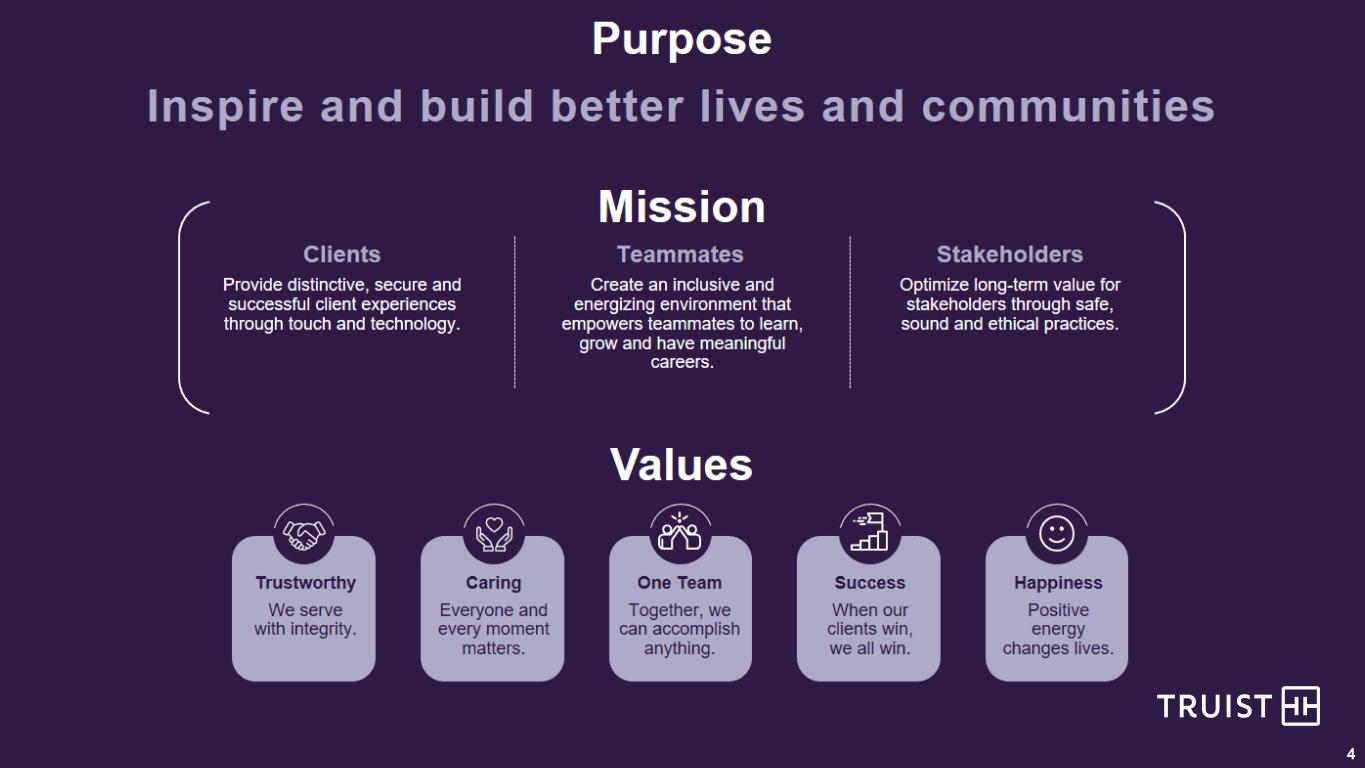
4

5 Living our purpose Inspire and build better lives and communities 5 Living our purpose Inspiring and building better lives and communities In 1Q23, Truist remained a source of strength by: Enhancing the client experience – Significant improvement in our client experience, with Voice of the Client metrics rising since 2Q22, and continued positive momentum with branch satisfaction scores in 1Q23 – Opened T3 Accelerator Lab in the Innovation & Technology Center where we’re redefining the client and teammate experience, putting feedback and ideas to the test in real-world scenarios before rolling out to clients – Continued growth for Truist Momentum, Truist’s financial wellness program, with 200,000+ active employee participants at over 350 companies Supporting our teammates – Launched Truist Long Game, a new mobile app that uses fun to promote long-term financial wellness, to our teammates; available to all clients in spring 2023 – Aspirations to increase female representation by 15%+ and ethnically diverse representation by 20%+ across leadership levels by 2025. Since 12/31/21, we have increased representation by 3% and 9%, respectively Being a responsible corporate citizen – Published 2022 Corporate Responsibility Report, TCFD Report, and ESG Disclosure Summary, highlighting our progress in building our communities across multiple dimensions including community, financial inclusion, DEI, and climate and energy – Committed $282 million in 1Q23 to support 1,686 units of affordable housing, 110 new jobs, and 46,879 people served in LMI communities (through Truist Community Capital) – Announced Where It Starts, a $22 million multiyear strategic initiative of Truist Foundation to strengthen small businesses and create career pathways for communities of color in the U.S. Executing on strategic decisions – Announced strategic agreement and closed on transaction to sell 20% minority stake in Truist Insurance Holdings (“TIH”) to Stone Point Capital and co- investors, positioning TIH for long-term success and growth and providing strategic and financial flexibility for Truist

Financial Results
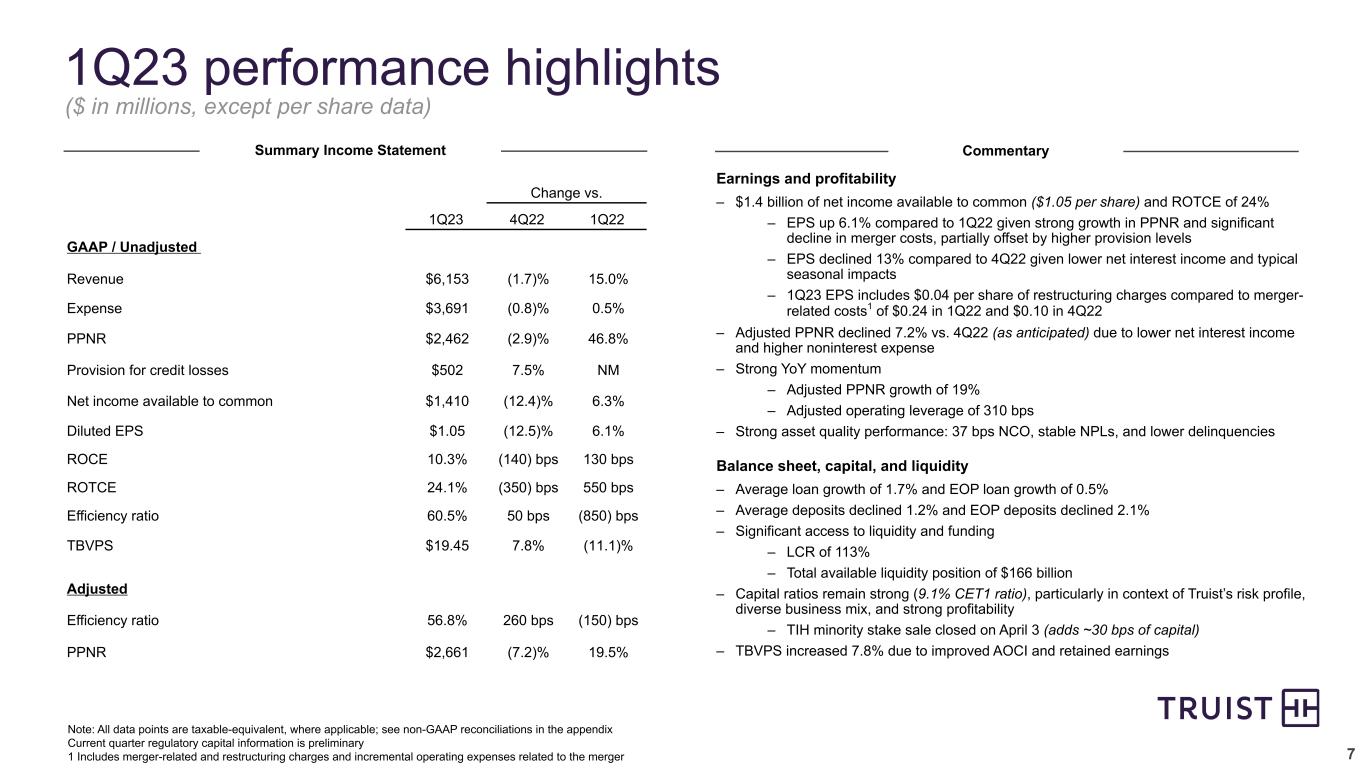
7 1Q23 performance highlights Earnings and profitability – $1.4 billion of net income available to common ($1.05 per share) and ROTCE of 24% – EPS up 6.1% compared to 1Q22 given strong growth in PPNR and significant decline in merger costs, partially offset by higher provision levels – EPS declined 13% compared to 4Q22 given lower net interest income and typical seasonal impacts – 1Q23 EPS includes $0.04 per share of restructuring charges compared to merger- related costs1 of $0.24 in 1Q22 and $0.10 in 4Q22 – Adjusted PPNR declined 7.2% vs. 4Q22 (as anticipated) due to lower net interest income and higher noninterest expense – Strong YoY momentum – Adjusted PPNR growth of 19% – Adjusted operating leverage of 310 bps – Strong asset quality performance: 37 bps NCO, stable NPLs, and lower delinquencies Balance sheet, capital, and liquidity – Average loan growth of 1.7% and EOP loan growth of 0.5% – Average deposits declined 1.2% and EOP deposits declined 2.1% – Significant access to liquidity and funding – LCR of 113% – Total available liquidity position of $166 billion – Capital ratios remain strong (9.1% CET1 ratio), particularly in context of Truist’s risk profile, diverse business mix, and strong profitability – TIH minority stake sale closed on April 3 (adds ~30 bps of capital) – TBVPS increased 7.8% due to improved AOCI and retained earnings Change vs. 1Q23 4Q22 1Q22 GAAP / Unadjusted Revenue $6,153 (1.7)% 15.0% Expense $3,691 (0.8)% 0.5% PPNR $2,462 (2.9)% 46.8% Provision for credit losses $502 7.5% NM Net income available to common $1,410 (12.4)% 6.3% Diluted EPS $1.05 (12.5)% 6.1% ROCE 10.3% (140) bps 130 bps ROTCE 24.1% (350) bps 550 bps Efficiency ratio 60.5% 50 bps (850) bps TBVPS $19.45 7.8% (11.1)% Adjusted Efficiency ratio 56.8% 260 bps (150) bps PPNR $2,661 (7.2)% 19.5% Note: All data points are taxable-equivalent, where applicable; see non-GAAP reconciliations in the appendix Current quarter regulatory capital information is preliminary 1 Includes merger-related and restructuring charges and incremental operating expenses related to the merger Summary Income Statement Commentary ($ in millions, except per share data)
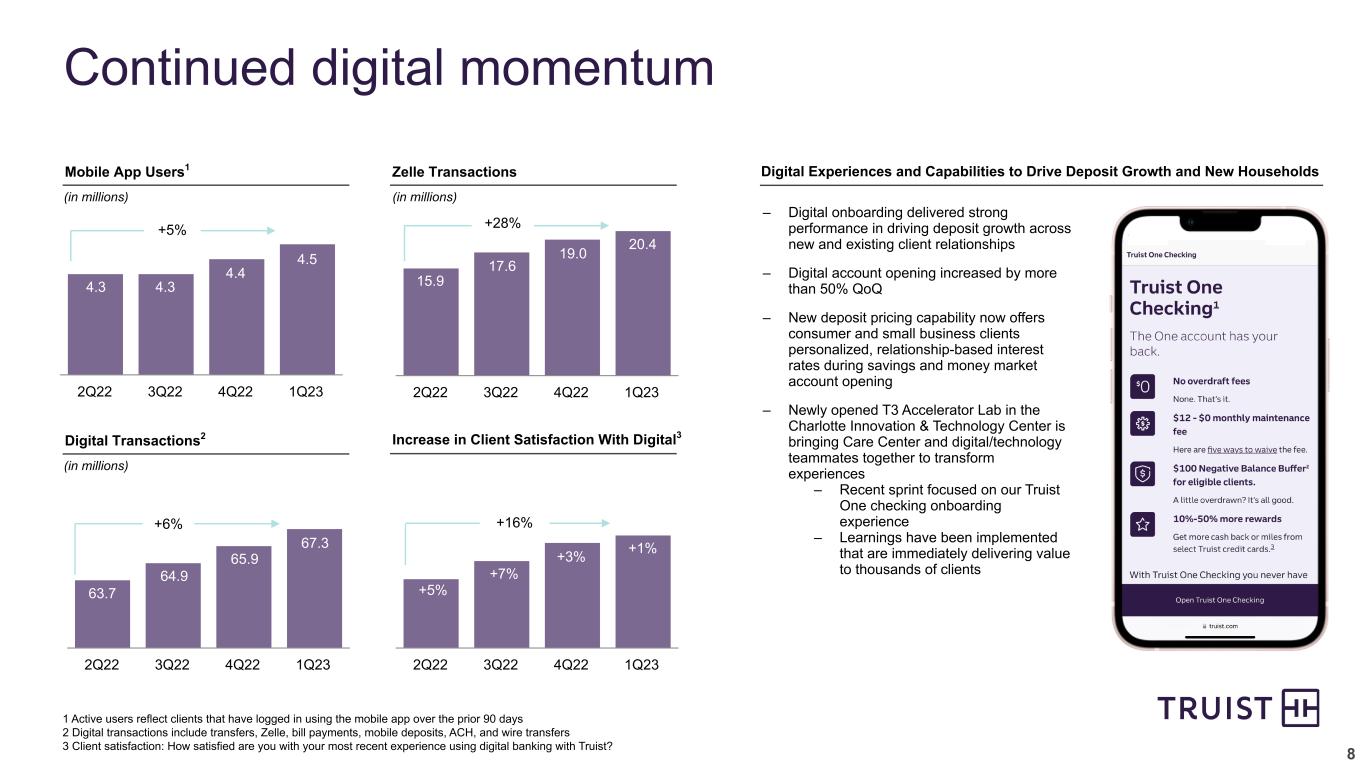
8 2Q22 3Q22 4Q22 1Q23 Digital Experiences and Capabilities to Drive Deposit Growth and New Households 2Q22 3Q22 4Q22 1Q23 Continued digital momentum 2Q22 3Q22 4Q22 1Q23 1 Active users reflect clients that have logged in using the mobile app over the prior 90 days 2 Digital transactions include transfers, Zelle, bill payments, mobile deposits, ACH, and wire transfers 3 Client satisfaction: How satisfied are you with your most recent experience using digital banking with Truist? 4.3 Mobile App Users1 Zelle Transactions Digital Transactions2 Increase in Client Satisfaction With Digital3 2Q22 3Q22 4Q22 1Q23 63.7 64.9 15.9 – Digital onboarding delivered strong performance in driving deposit growth across new and existing client relationships – Digital account opening increased by more than 50% QoQ – New deposit pricing capability now offers consumer and small business clients personalized, relationship-based interest rates during savings and money market account opening – Newly opened T3 Accelerator Lab in the Charlotte Innovation & Technology Center is bringing Care Center and digital/technology teammates together to transform experiences – Recent sprint focused on our Truist One checking onboarding experience – Learnings have been implemented that are immediately delivering value to thousands of clients 65.9 +5% +7% +3% 4.3 4.4 4.5 +5% 17.6 19.0 20.4 +28% 67.3 +6% +1% +16% (in millions) (in millions) (in millions)
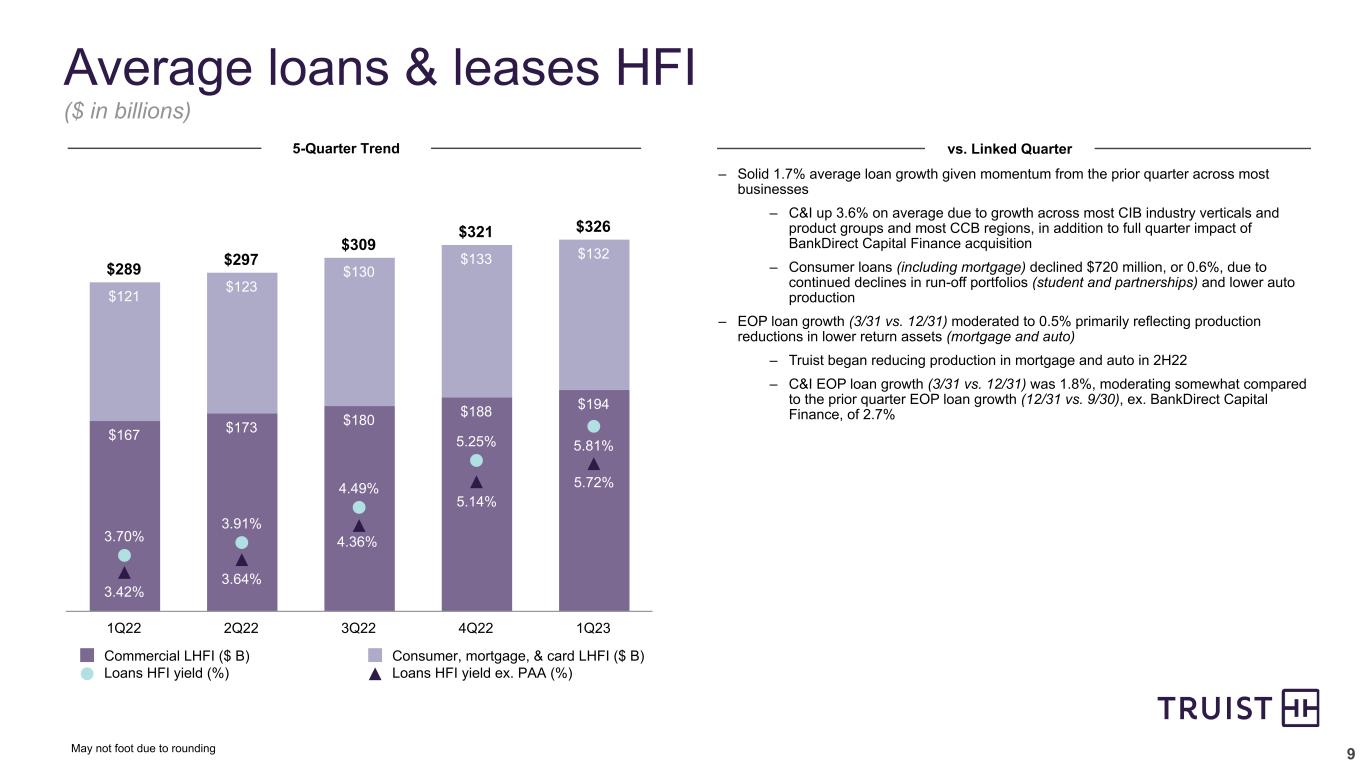
9 ($ in billions) $289 $297 $309 $321 $326 $167 $173 $180 $188 $194 $121 $123 $130 $133 $132 3.70% 3.91% 4.49% 5.25% 5.81% 3.42% 3.64% Commercial LHFI ($ B) Consumer, mortgage, & card LHFI ($ B) Loans HFI yield (%) Loans HFI yield ex. PAA (%) 1Q22 2Q22 3Q22 4Q22 1Q23 – Solid 1.7% average loan growth given momentum from the prior quarter across most businesses – C&I up 3.6% on average due to growth across most CIB industry verticals and product groups and most CCB regions, in addition to full quarter impact of BankDirect Capital Finance acquisition – Consumer loans (including mortgage) declined $720 million, or 0.6%, due to continued declines in run-off portfolios (student and partnerships) and lower auto production – EOP loan growth (3/31 vs. 12/31) moderated to 0.5% primarily reflecting production reductions in lower return assets (mortgage and auto) – Truist began reducing production in mortgage and auto in 2H22 – C&I EOP loan growth (3/31 vs. 12/31) was 1.8%, moderating somewhat compared to the prior quarter EOP loan growth (12/31 vs. 9/30), ex. BankDirect Capital Finance, of 2.7% Average loans & leases HFI 5-Quarter Trend vs. Linked Quarter 4.36% May not foot due to rounding 5.14% 5.72%
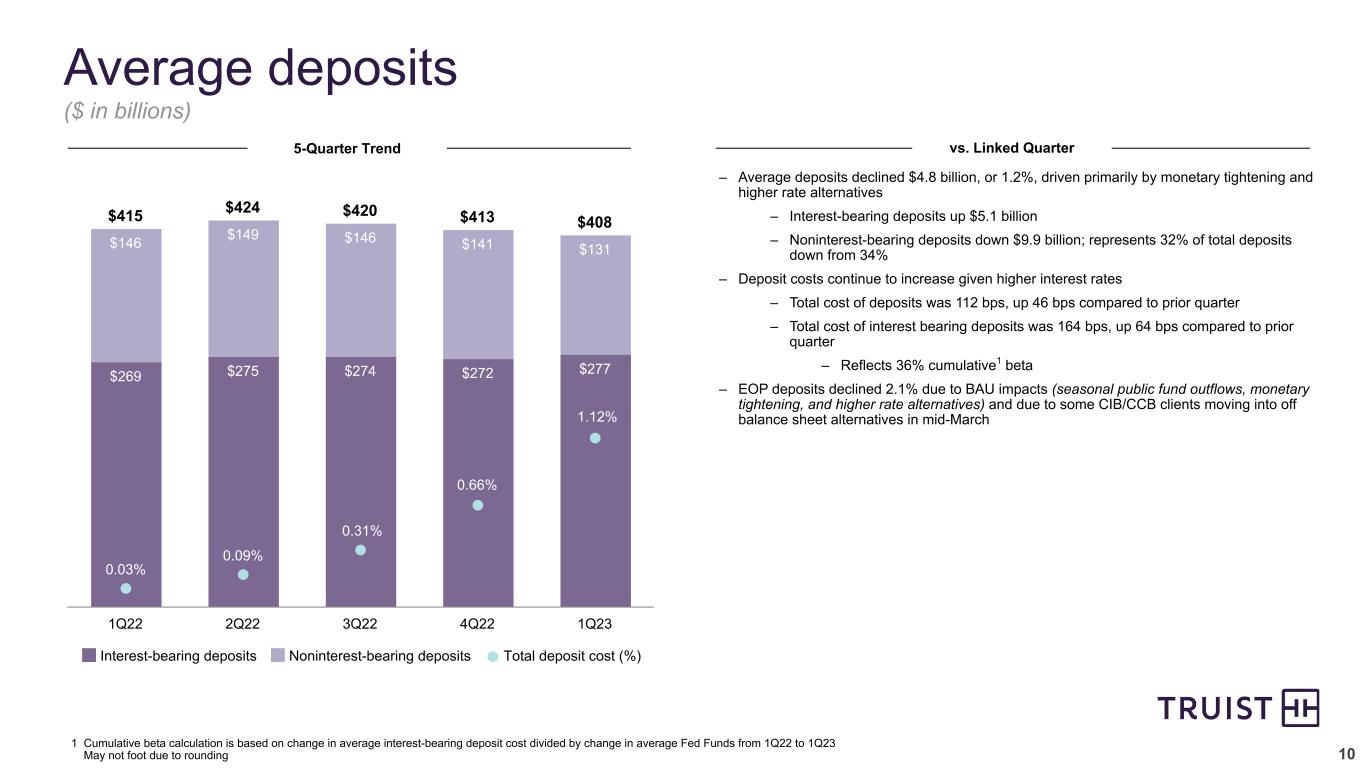
10 ($ in billions) $415 $424 $420 $413 $408 $269 $275 $274 $272 $277 $146 $149 $146 $141 $131 0.03% 0.09% Interest-bearing deposits Noninterest-bearing deposits Total deposit cost (%) 1Q22 2Q22 3Q22 4Q22 1Q23 Average deposits 1 Cumulative beta calculation is based on change in average interest-bearing deposit cost divided by change in average Fed Funds from 1Q22 to 1Q23 May not foot due to rounding – Average deposits declined $4.8 billion, or 1.2%, driven primarily by monetary tightening and higher rate alternatives – Interest-bearing deposits up $5.1 billion – Noninterest-bearing deposits down $9.9 billion; represents 32% of total deposits down from 34% – Deposit costs continue to increase given higher interest rates – Total cost of deposits was 112 bps, up 46 bps compared to prior quarter – Total cost of interest bearing deposits was 164 bps, up 64 bps compared to prior quarter – Reflects 36% cumulative1 beta – EOP deposits declined 2.1% due to BAU impacts (seasonal public fund outflows, monetary tightening, and higher rate alternatives) and due to some CIB/CCB clients moving into off balance sheet alternatives in mid-March vs. Linked Quarter 5-Quarter Trend 0.31% 0.66% 1.12%
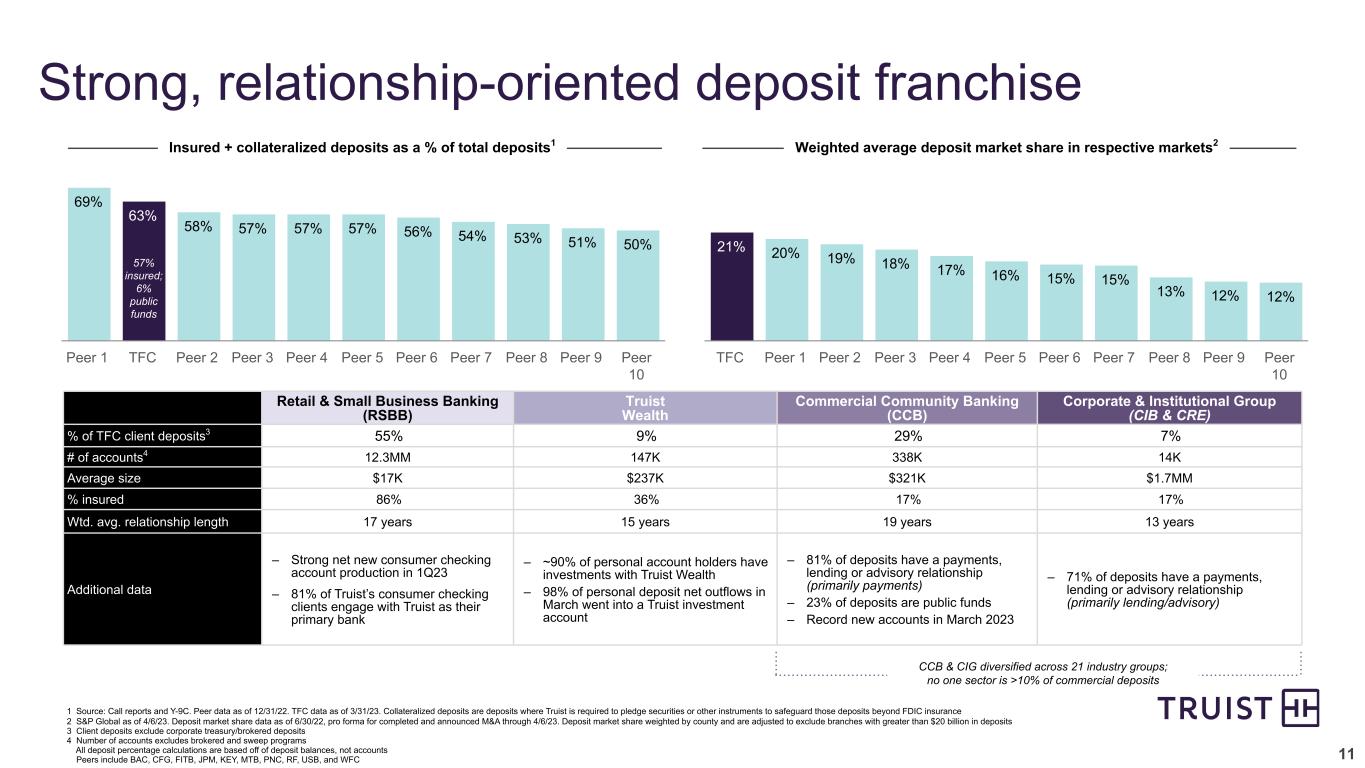
11 Strong, relationship-oriented deposit franchise Insured + collateralized deposits as a % of total deposits1 Weighted average deposit market share in respective markets2 69% 63% 58% 57% 57% 57% 56% 54% 53% 51% 50% Peer 1 TFC Peer 2 Peer 3 Peer 4 Peer 5 Peer 6 Peer 7 Peer 8 Peer 9 Peer 10 21% 20% 19% 18% 17% 16% 15% 15% 13% 12% 12% TFC Peer 1 Peer 2 Peer 3 Peer 4 Peer 5 Peer 6 Peer 7 Peer 8 Peer 9 Peer 10 1 Source: Call reports and Y-9C. Peer data as of 12/31/22. TFC data as of 3/31/23. Collateralized deposits are deposits where Truist is required to pledge securities or other instruments to safeguard those deposits beyond FDIC insurance 2 S&P Global as of 4/6/23. Deposit market share data as of 6/30/22, pro forma for completed and announced M&A through 4/6/23. Deposit market share weighted by county and are adjusted to exclude branches with greater than $20 billion in deposits 3 Client deposits exclude corporate treasury/brokered deposits 4 Number of accounts excludes brokered and sweep programs All deposit percentage calculations are based off of deposit balances, not accounts Peers include BAC, CFG, FITB, JPM, KEY, MTB, PNC, RF, USB, and WFC Retail & Small Business Banking (RSBB) Truist Wealth Commercial Community Banking (CCB) Corporate & Institutional Group (CIB & CRE) % of TFC client deposits3 55% 9% 29% 7% # of accounts4 12.3MM 147K 338K 14K Average size $17K $237K $321K $1.7MM % insured 86% 36% 17% 17% Wtd. avg. relationship length 17 years 15 years 19 years 13 years Additional data – Strong net new consumer checking account production in 1Q23 – 81% of Truist’s consumer checking clients engage with Truist as their primary bank – ~90% of personal account holders have investments with Truist Wealth – 98% of personal deposit net outflows in March went into a Truist investment account – 81% of deposits have a payments, lending or advisory relationship (primarily payments) – 23% of deposits are public funds – Record new accounts in March 2023 – 71% of deposits have a payments, lending or advisory relationship (primarily lending/advisory) CCB & CIG diversified across 21 industry groups; no one sector is >10% of commercial deposits 57% insured; 6% public funds
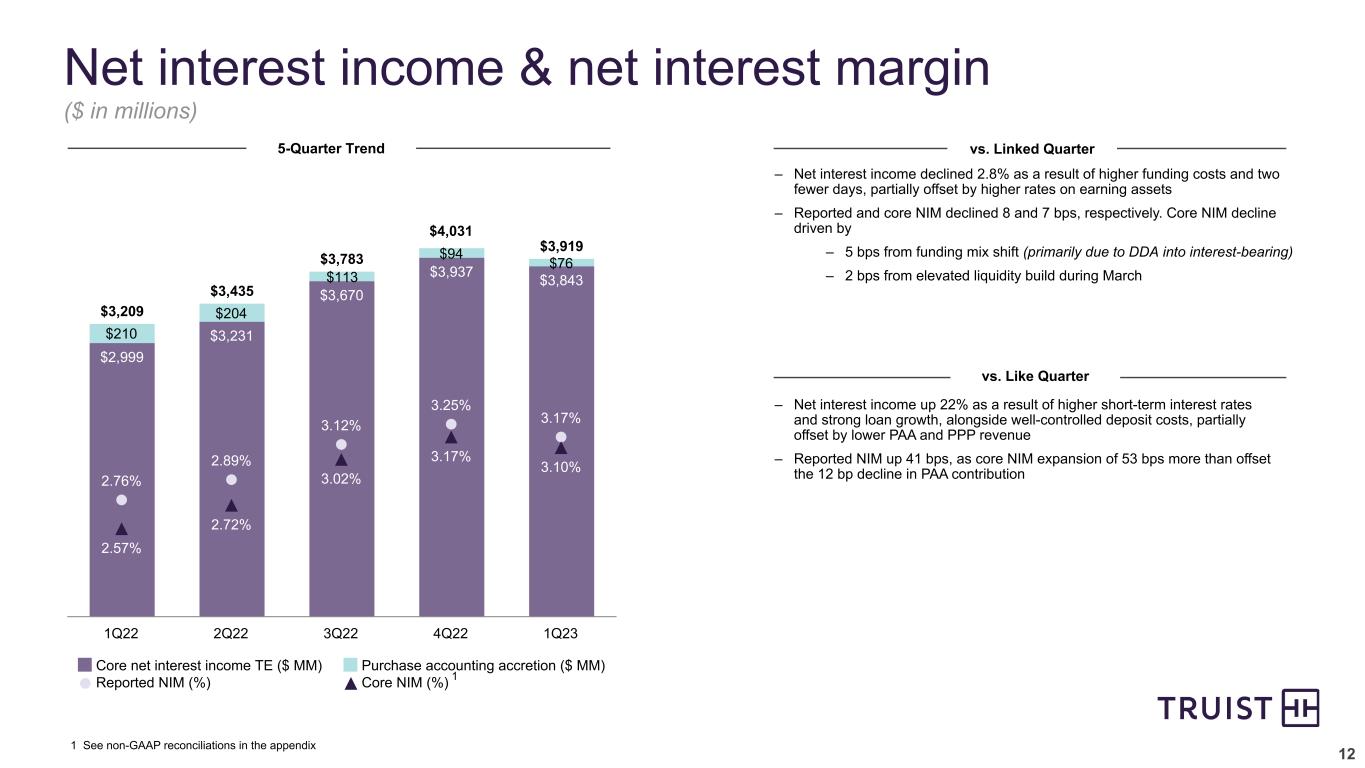
12 $3,209 $3,435 $3,783 $4,031 $3,919 $2,999 $3,231 $3,670 $3,937 $3,843 $210 $204 $113 $94 $76 2.76% 2.89% 3.12% 3.25% 3.17% 2.57% 2.72% 3.02% 3.17% 3.10% Core net interest income TE ($ MM) Purchase accounting accretion ($ MM) Reported NIM (%) Core NIM (%) 1Q22 2Q22 3Q22 4Q22 1Q23 Net interest income & net interest margin 1 See non-GAAP reconciliations in the appendix vs. Linked Quarter5-Quarter Trend 1 – Net interest income declined 2.8% as a result of higher funding costs and two fewer days, partially offset by higher rates on earning assets – Reported and core NIM declined 8 and 7 bps, respectively. Core NIM decline driven by – 5 bps from funding mix shift (primarily due to DDA into interest-bearing) – 2 bps from elevated liquidity build during March vs. Like Quarter – Net interest income up 22% as a result of higher short-term interest rates and strong loan growth, alongside well-controlled deposit costs, partially offset by lower PAA and PPP revenue – Reported NIM up 41 bps, as core NIM expansion of 53 bps more than offset the 12 bp decline in PAA contribution $4,031 ($ in millions)
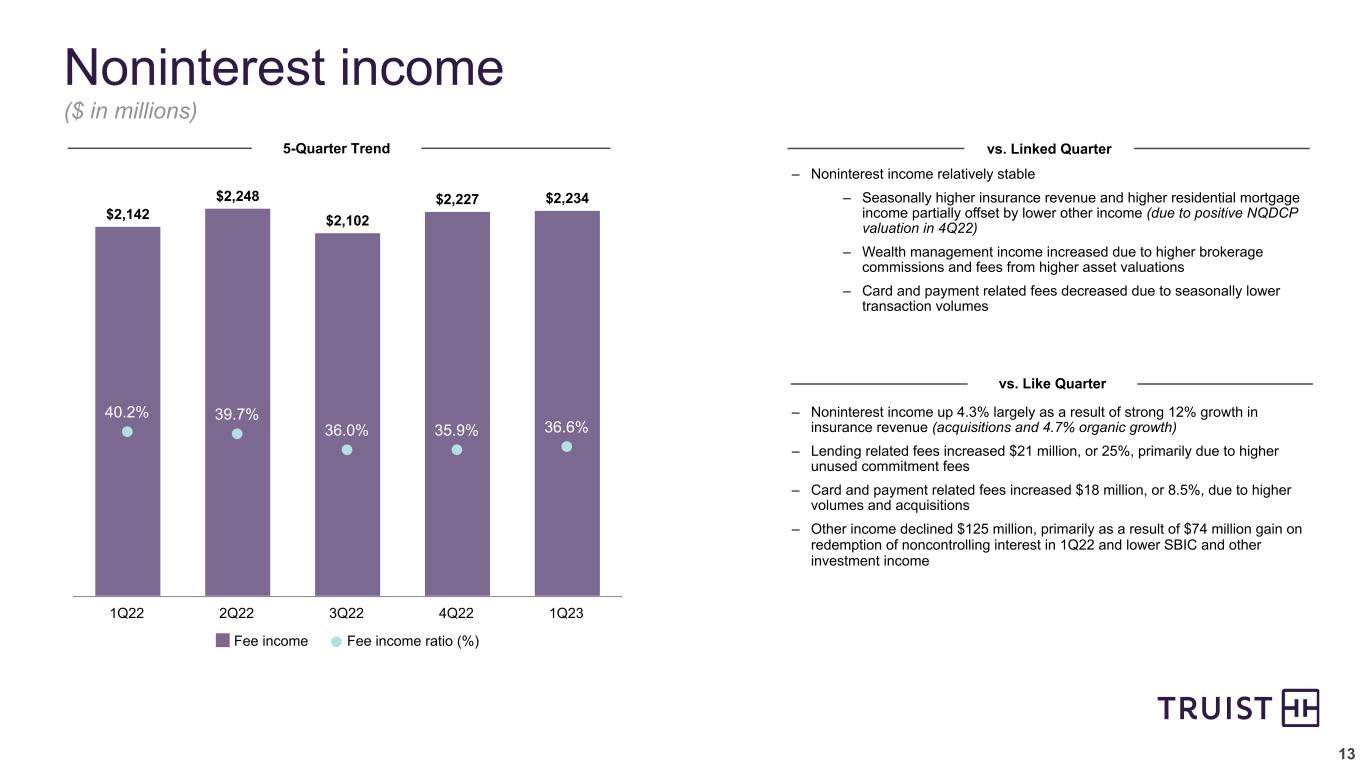
13 $2,142 $2,248 $2,102 $2,227 $2,234 40.2% 39.7% 36.0% 35.9% 36.6% Fee income Fee income ratio (%) 1Q22 2Q22 3Q22 4Q22 1Q23 Noninterest income vs. Linked Quarter5-Quarter Trend – Noninterest income relatively stable – Seasonally higher insurance revenue and higher residential mortgage income partially offset by lower other income (due to positive NQDCP valuation in 4Q22) – Wealth management income increased due to higher brokerage commissions and fees from higher asset valuations – Card and payment related fees decreased due to seasonally lower transaction volumes vs. Like Quarter – Noninterest income up 4.3% largely as a result of strong 12% growth in insurance revenue (acquisitions and 4.7% organic growth) – Lending related fees increased $21 million, or 25%, primarily due to higher unused commitment fees – Card and payment related fees increased $18 million, or 8.5%, due to higher volumes and acquisitions – Other income declined $125 million, primarily as a result of $74 million gain on redemption of noncontrolling interest in 1Q22 and lower SBIC and other investment income ($ in millions)
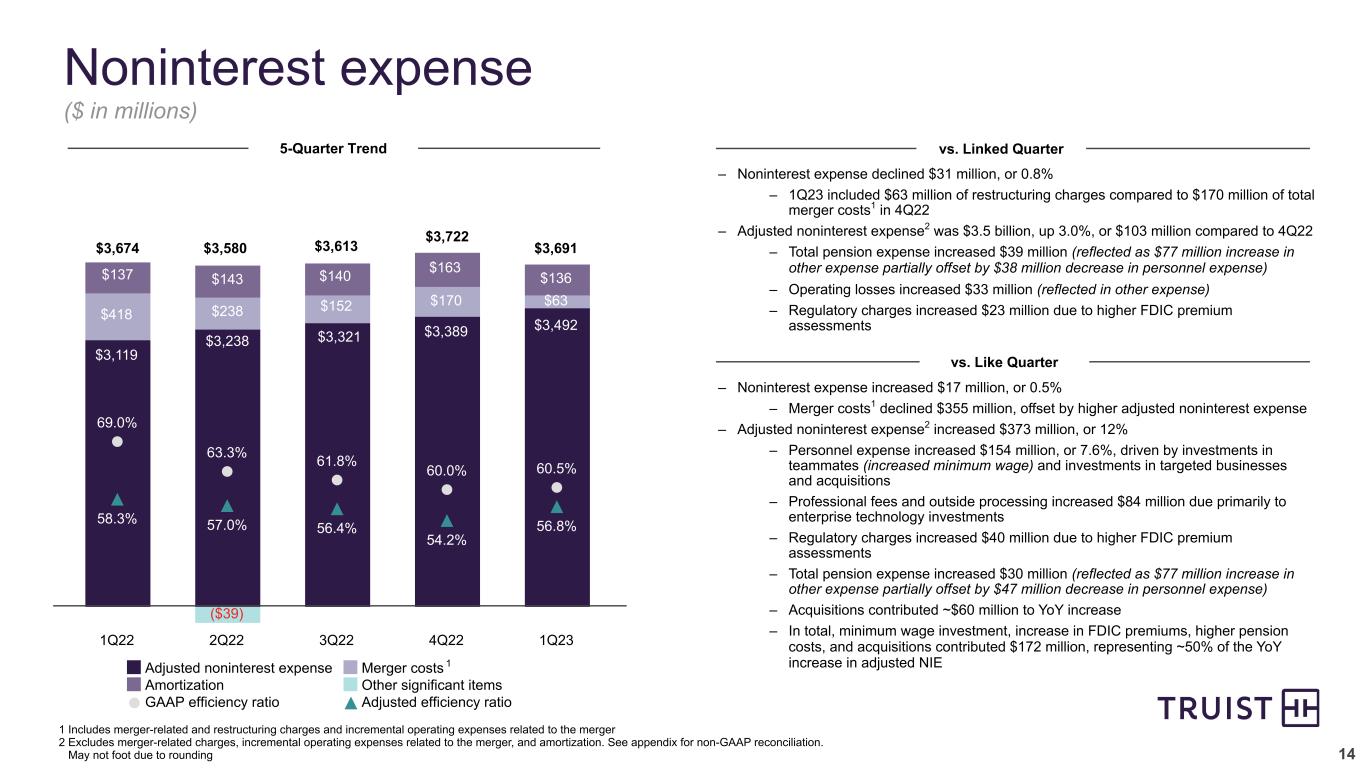
14 – Noninterest expense increased $17 million, or 0.5% – Merger costs1 declined $355 million, offset by higher adjusted noninterest expense – Adjusted noninterest expense2 increased $373 million, or 12% – Personnel expense increased $154 million, or 7.6%, driven by investments in teammates (increased minimum wage) and investments in targeted businesses and acquisitions – Professional fees and outside processing increased $84 million due primarily to enterprise technology investments – Regulatory charges increased $40 million due to higher FDIC premium assessments – Total pension expense increased $30 million (reflected as $77 million increase in other expense partially offset by $47 million decrease in personnel expense) – Acquisitions contributed ~$60 million to YoY increase – In total, minimum wage investment, increase in FDIC premiums, higher pension costs, and acquisitions contributed $172 million, representing ~50% of the YoY increase in adjusted NIE 69.0% 63.3% 61.8% 60.0% 60.5% 58.3% 57.0% 56.4% 54.2% 56.8% Adjusted noninterest expense Merger costs Amortization Other significant items GAAP efficiency ratio Adjusted efficiency ratio 1Q22 2Q22 3Q22 4Q22 1Q23 1 Includes merger-related and restructuring charges and incremental operating expenses related to the merger 2 Excludes merger-related charges, incremental operating expenses related to the merger, and amortization. See appendix for non-GAAP reconciliation. May not foot due to rounding Noninterest expense $137 $418 $3,119 $3,674 $152 $3,238 $3,580 ($39) 1 $3,613 vs. Linked Quarter5-Quarter Trend – Noninterest expense declined $31 million, or 0.8% – 1Q23 included $63 million of restructuring charges compared to $170 million of total merger costs1 in 4Q22 – Adjusted noninterest expense2 was $3.5 billion, up 3.0%, or $103 million compared to 4Q22 – Total pension expense increased $39 million (reflected as $77 million increase in other expense partially offset by $38 million decrease in personnel expense) – Operating losses increased $33 million (reflected in other expense) – Regulatory charges increased $23 million due to higher FDIC premium assessments vs. Like Quarter $238 $3,321 $140 $3,389 $170 $163 $3,722 $143 $3,492 $63 $163$3,691 $136 ($ in millions)
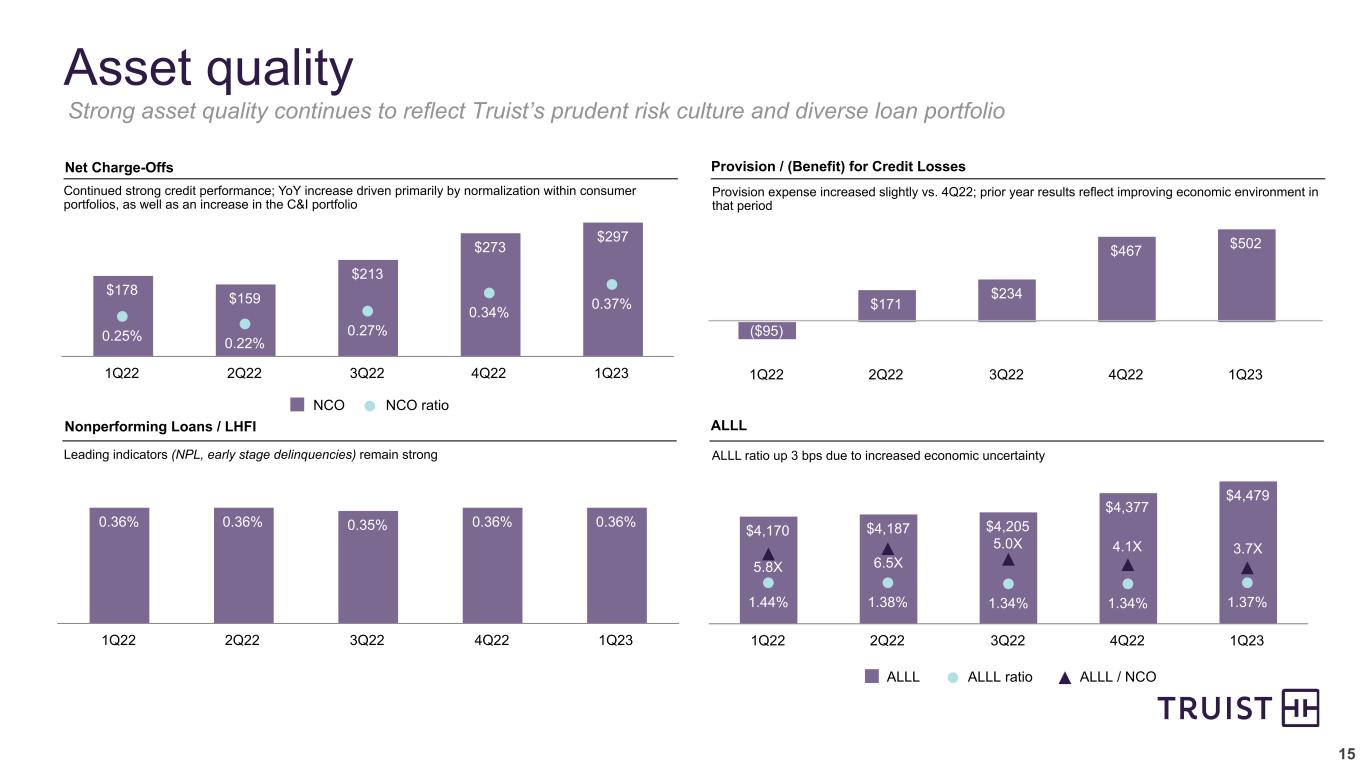
15 $178 $159 $213 $273 $297 0.25% 0.22% 0.27% 0.34% 0.37% NCO NCO ratio 1Q22 2Q22 3Q22 4Q22 1Q23 Asset quality 4.5x 9.0x 8.8x $421Net Charge-Offs Provision / (Benefit) for Credit Losses Nonperforming Loans / LHFI ALLL ($95) $171 $234 $467 $502 1Q22 2Q22 3Q22 4Q22 1Q23 $4,170 $4,187 $4,205 $4,377 $4,479 1.44% 1.38% 1.34% 1.34% 1.37% ALLL ALLL ratio ALLL / NCO 1Q22 2Q22 3Q22 4Q22 1Q23 Continued strong credit performance; YoY increase driven primarily by normalization within consumer portfolios, as well as an increase in the C&I portfolio Provision expense increased slightly vs. 4Q22; prior year results reflect improving economic environment in that period ALLL ratio up 3 bps due to increased economic uncertainty Strong asset quality continues to reflect Truist’s prudent risk culture and diverse loan portfolio Leading indicators (NPL, early stage delinquencies) remain strong 5.8X 6.5X 5.0X 0.36% 0.36% 0.35% 0.36% 0.36% 1Q22 2Q22 3Q22 4Q22 1Q23 3.7X4.1X
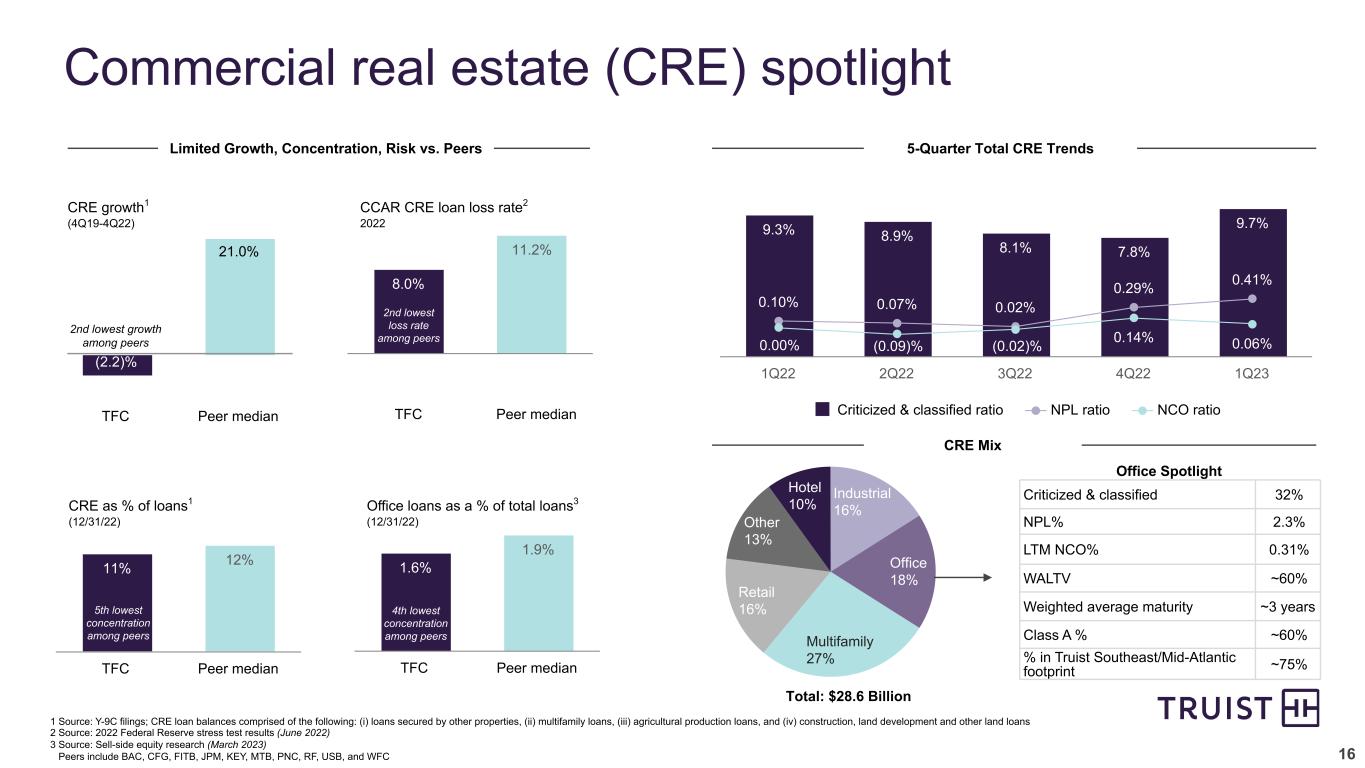
16 Industrial 16% Office 18% Multifamily 27% Retail 16% Other 13% Hotel 10% 8.0% 11.2% TFC Peer median 11% 12% TFC Peer median Commercial real estate (CRE) spotlight Limited Growth, Concentration, Risk vs. Peers 4.36% CRE growth1 (4Q19-4Q22) (2.2)% 13.1% TFC Peer median CRE as % of loans1 (12/31/22) CCAR CRE loan loss rate2 2022 1.6% 1.9% TFC Peer median Office loans as a % of total loans3 (12/31/22) 5-Quarter Total CRE Trends Criticized & classified 32% NPL% 2.3% LTM NCO% 0.31% WALTV ~60% Weighted average maturity ~3 years Class A % ~60% % in Truist Southeast/Mid-Atlantic footprint ~75% TFC Peer median Office Spotlight Total: $28.6 Billion CRE Mix 1 Source: Y-9C filings; CRE loan balances comprised of the following: (i) loans secured by other properties, (ii) multifamily loans, (iii) agricultural production loans, and (iv) construction, land development and other land loans 2 Source: 2022 Federal Reserve stress test results (June 2022) 3 Source: Sell-side equity research (March 2023) Peers include BAC, CFG, FITB, JPM, KEY, MTB, PNC, RF, USB, and WFC 21.0 9.3% 8.9% 8.1% 7.8% 9.7% 0.10% 0.07% 0.02% 0.29% 0.41% 0.14% 0.06% Criticized & classified ratio NPL ratio NCO ratio 1Q22 2Q22 3Q22 4Q22 1Q23 0.00% (0.09)% (0.02)% 2nd lowest growth among peers 2nd lowest loss rate among peers 5th lowest concentration among peers 4th lowest concentration among peers
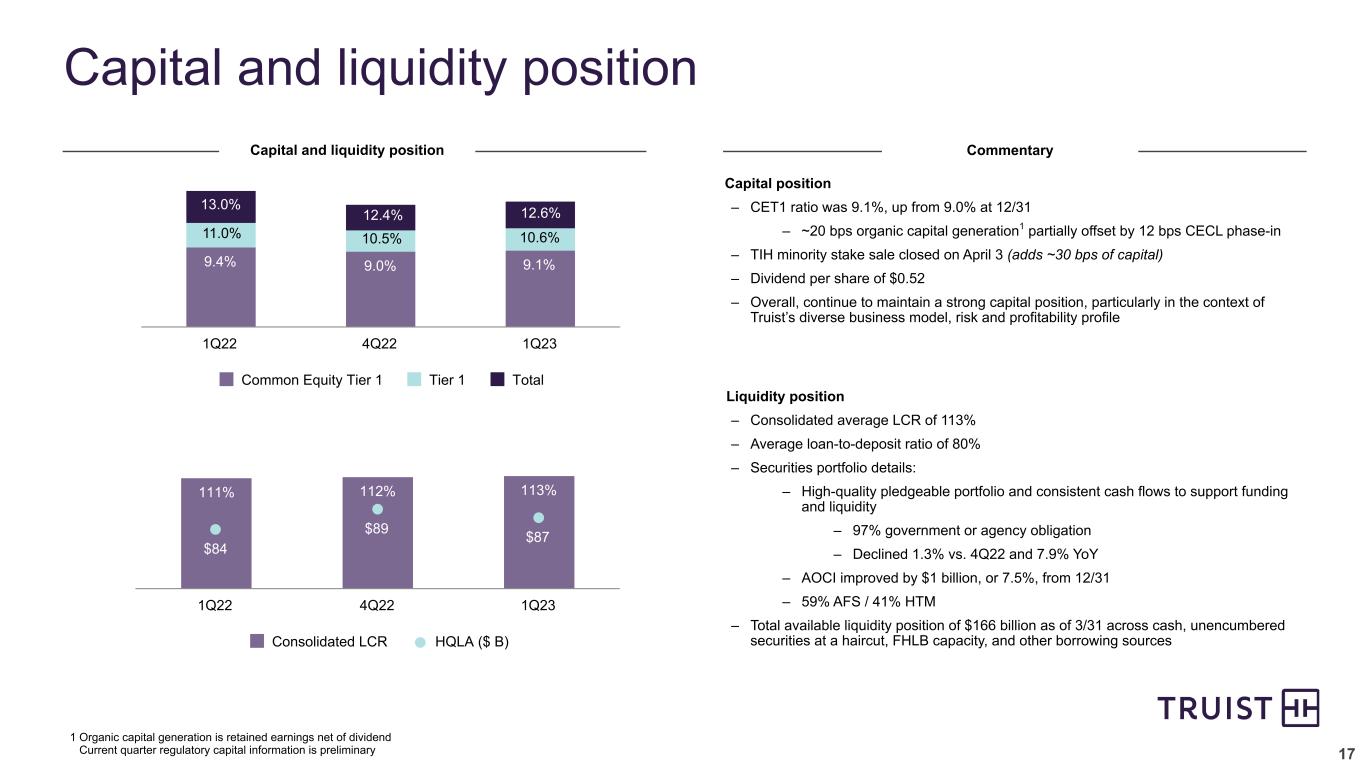
17 Capital and liquidity position 9.4% 9.0% 9.1% Common Equity Tier 1 Tier 1 Total 1Q22 4Q22 1Q23 1 Organic capital generation is retained earnings net of dividend Current quarter regulatory capital information is preliminary 111% 112% 113% $84 $89 $87 Consolidated LCR HQLA ($ B) 1Q22 4Q22 1Q23 12.6% Capital position – CET1 ratio was 9.1%, up from 9.0% at 12/31 – ~20 bps organic capital generation1 partially offset by 12 bps CECL phase-in – TIH minority stake sale closed on April 3 (adds ~30 bps of capital) – Dividend per share of $0.52 – Overall, continue to maintain a strong capital position, particularly in the context of Truist’s diverse business model, risk and profitability profile Liquidity position – Consolidated average LCR of 113% – Average loan-to-deposit ratio of 80% – Securities portfolio details: – High-quality pledgeable portfolio and consistent cash flows to support funding and liquidity – 97% government or agency obligation – Declined 1.3% vs. 4Q22 and 7.9% YoY – AOCI improved by $1 billion, or 7.5%, from 12/31 – 59% AFS / 41% HTM – Total available liquidity position of $166 billion as of 3/31 across cash, unencumbered securities at a haircut, FHLB capacity, and other borrowing sources 11.0% 13.0% Capital and liquidity position Commentary 10.5% 12.4% 10.6% 12.6%
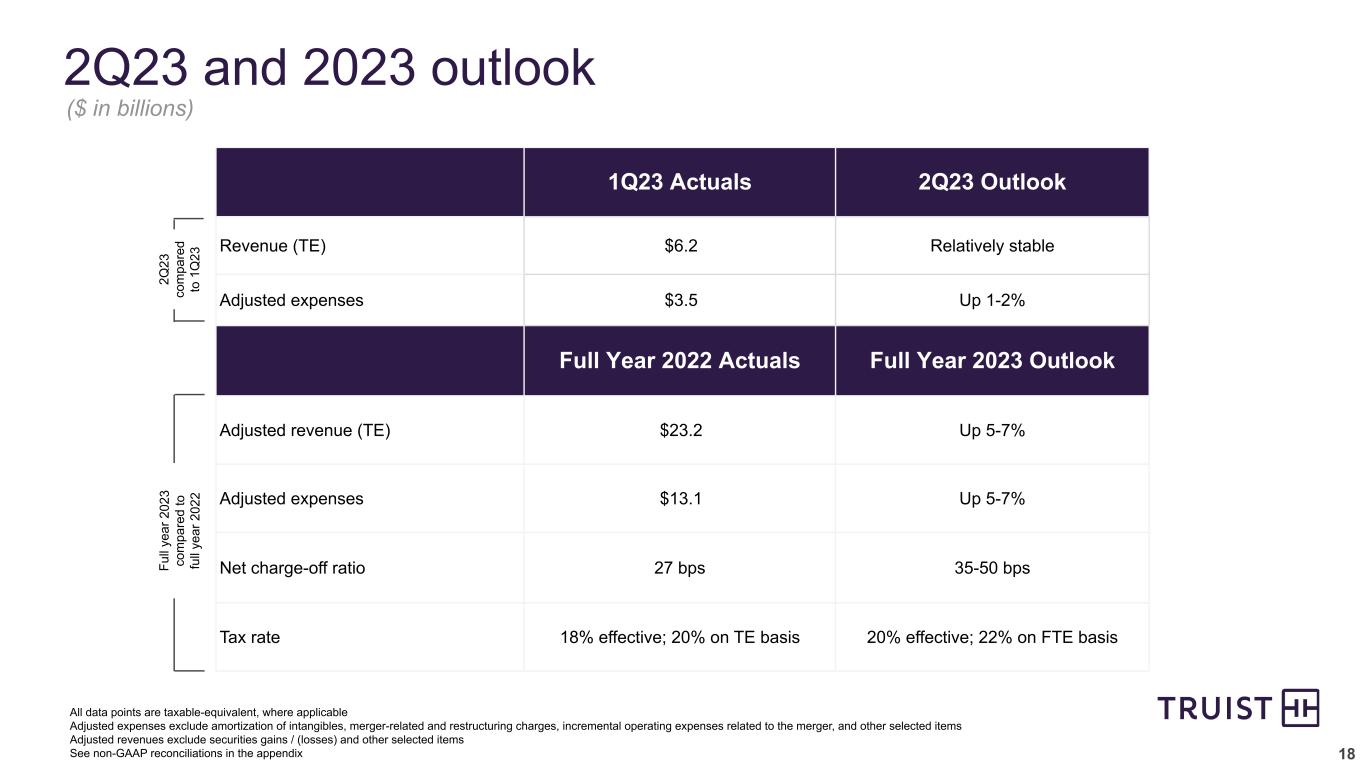
18 13.9% 1Q23 Actuals 2Q23 Outlook Revenue (TE) $6.2 Relatively stable Adjusted expenses $3.5 Up 1-2% Full Year 2022 Actuals Full Year 2023 Outlook Adjusted revenue (TE) $23.2 Up 5-7% Adjusted expenses $13.1 Up 5-7% Net charge-off ratio 27 bps 35-50 bps Tax rate 18% effective; 20% on TE basis 20% effective; 22% on FTE basis 2Q23 and 2023 outlook Fu ll ye ar 2 02 3 co m pa re d to fu ll ye ar 2 02 2 ($ in billions) 2Q 23 co m pa re d to 1 Q 23 All data points are taxable-equivalent, where applicable Adjusted expenses exclude amortization of intangibles, merger-related and restructuring charges, incremental operating expenses related to the merger, and other selected items Adjusted revenues exclude securities gains / (losses) and other selected items See non-GAAP reconciliations in the appendix
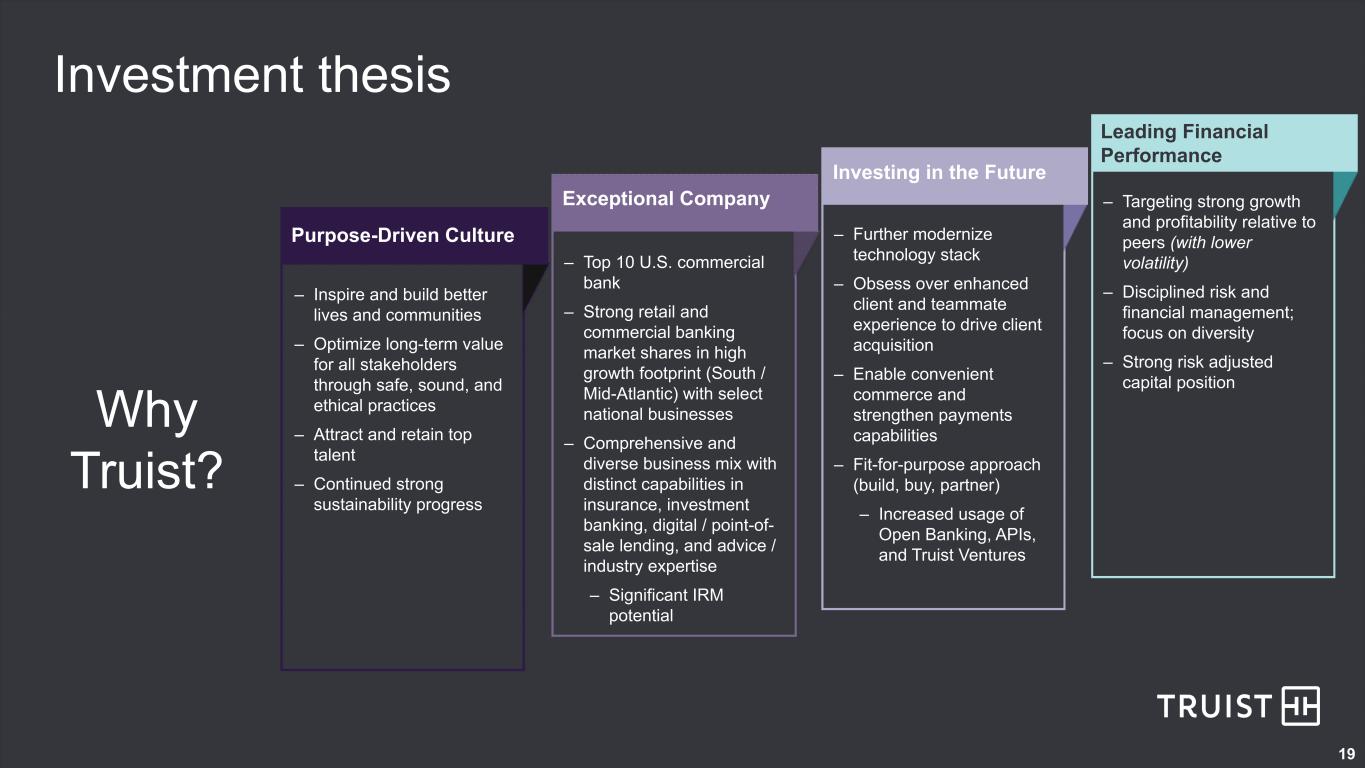
19 Investment thesis Why Truist? Purpose-Driven Culture Exceptional Company Investing in the Future Leading Financial Performance – Inspire and build better lives and communities – Optimize long-term value for all stakeholders through safe, sound, and ethical practices – Attract and retain top talent – Continued strong sustainability progress – Top 10 U.S. commercial bank – Strong retail and commercial banking market shares in high growth footprint (South / Mid-Atlantic) with select national businesses – Comprehensive and diverse business mix with distinct capabilities in insurance, investment banking, digital / point-of- sale lending, and advice / industry expertise – Significant IRM potential – Further modernize technology stack – Obsess over enhanced client and teammate experience to drive client acquisition – Enable convenient commerce and strengthen payments capabilities – Fit-for-purpose approach (build, buy, partner) – Increased usage of Open Banking, APIs, and Truist Ventures – Targeting strong growth and profitability relative to peers (with lower volatility) – Disciplined risk and financial management; focus on diversity – Strong risk adjusted capital position

Appendix
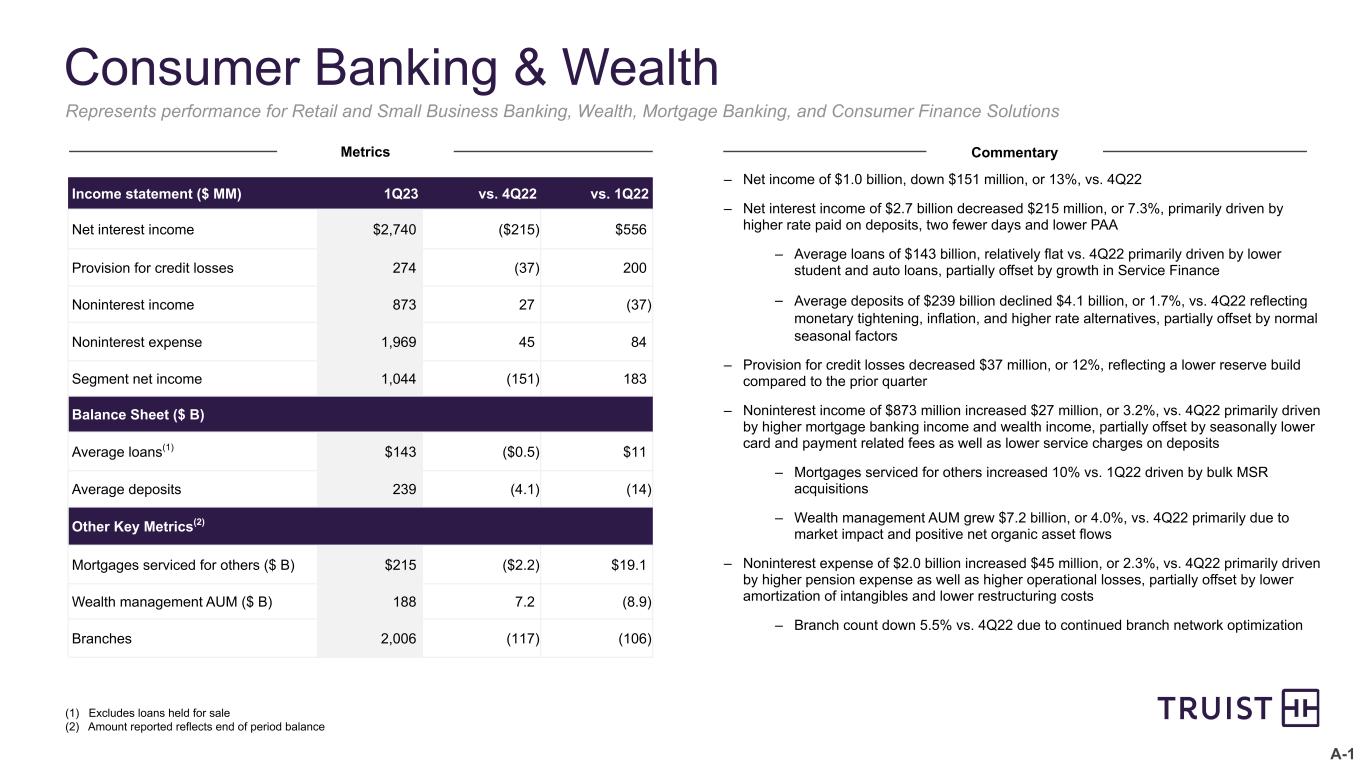
A-1 Consumer Banking & Wealth Income statement ($ MM) 1Q23 vs. 4Q22 vs. 1Q22 Net interest income $2,740 ($215) $556 Provision for credit losses 274 (37) 200 Noninterest income 873 27 (37) Noninterest expense 1,969 45 84 Segment net income 1,044 (151) 183 Balance Sheet ($ B) Average loans(1) $143 ($0.5) $11 Average deposits 239 (4.1) (14) Other Key Metrics(2) Mortgages serviced for others ($ B) $215 ($2.2) $19.1 Wealth management AUM ($ B) 188 7.2 (8.9) Branches 2,006 (117) (106) (1) Excludes loans held for sale (2) Amount reported reflects end of period balance Represents performance for Retail and Small Business Banking, Wealth, Mortgage Banking, and Consumer Finance Solutions – Net income of $1.0 billion, down $151 million, or 13%, vs. 4Q22 – Net interest income of $2.7 billion decreased $215 million, or 7.3%, primarily driven by higher rate paid on deposits, two fewer days and lower PAA – Average loans of $143 billion, relatively flat vs. 4Q22 primarily driven by lower student and auto loans, partially offset by growth in Service Finance – Average deposits of $239 billion declined $4.1 billion, or 1.7%, vs. 4Q22 reflecting monetary tightening, inflation, and higher rate alternatives, partially offset by normal seasonal factors – Provision for credit losses decreased $37 million, or 12%, reflecting a lower reserve build compared to the prior quarter – Noninterest income of $873 million increased $27 million, or 3.2%, vs. 4Q22 primarily driven by higher mortgage banking income and wealth income, partially offset by seasonally lower card and payment related fees as well as lower service charges on deposits – Mortgages serviced for others increased 10% vs. 1Q22 driven by bulk MSR acquisitions – Wealth management AUM grew $7.2 billion, or 4.0%, vs. 4Q22 primarily due to market impact and positive net organic asset flows – Noninterest expense of $2.0 billion increased $45 million, or 2.3%, vs. 4Q22 primarily driven by higher pension expense as well as higher operational losses, partially offset by lower amortization of intangibles and lower restructuring costs – Branch count down 5.5% vs. 4Q22 due to continued branch network optimization Metrics Commentary
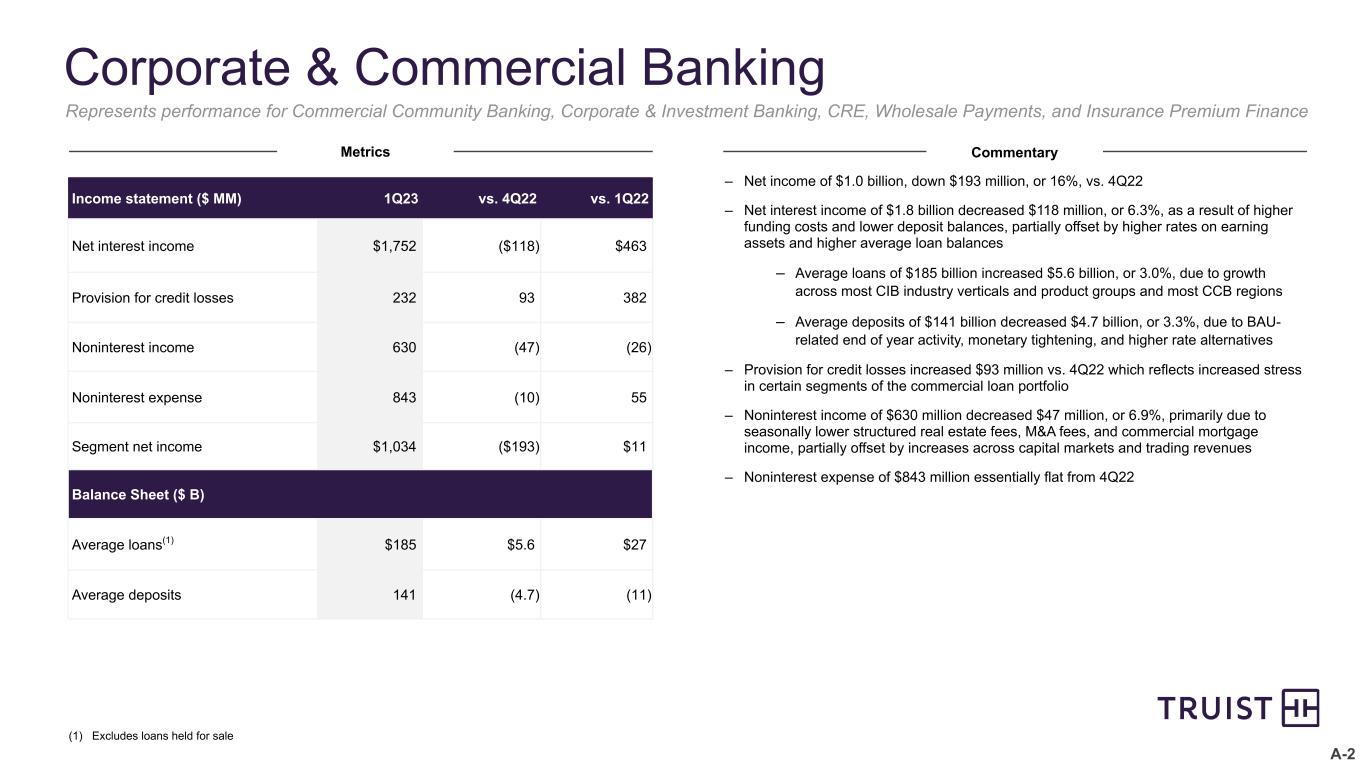
A-2 Corporate & Commercial Banking – Net income of $1.0 billion, down $193 million, or 16%, vs. 4Q22 – Net interest income of $1.8 billion decreased $118 million, or 6.3%, as a result of higher funding costs and lower deposit balances, partially offset by higher rates on earning assets and higher average loan balances – Average loans of $185 billion increased $5.6 billion, or 3.0%, due to growth across most CIB industry verticals and product groups and most CCB regions – Average deposits of $141 billion decreased $4.7 billion, or 3.3%, due to BAU- related end of year activity, monetary tightening, and higher rate alternatives – Provision for credit losses increased $93 million vs. 4Q22 which reflects increased stress in certain segments of the commercial loan portfolio – Noninterest income of $630 million decreased $47 million, or 6.9%, primarily due to seasonally lower structured real estate fees, M&A fees, and commercial mortgage income, partially offset by increases across capital markets and trading revenues – Noninterest expense of $843 million essentially flat from 4Q22 (1) Excludes loans held for sale Represents performance for Commercial Community Banking, Corporate & Investment Banking, CRE, Wholesale Payments, and Insurance Premium Finance Metrics Commentary Income statement ($ MM) 1Q23 vs. 4Q22 vs. 1Q22 Net interest income $1,752 ($118) $463 Provision for credit losses 232 93 382 Noninterest income 630 (47) (26) Noninterest expense 843 (10) 55 Segment net income $1,034 ($193) $11 Balance Sheet ($ B) Average loans(1) $185 $5.6 $27 Average deposits 141 (4.7) (11)
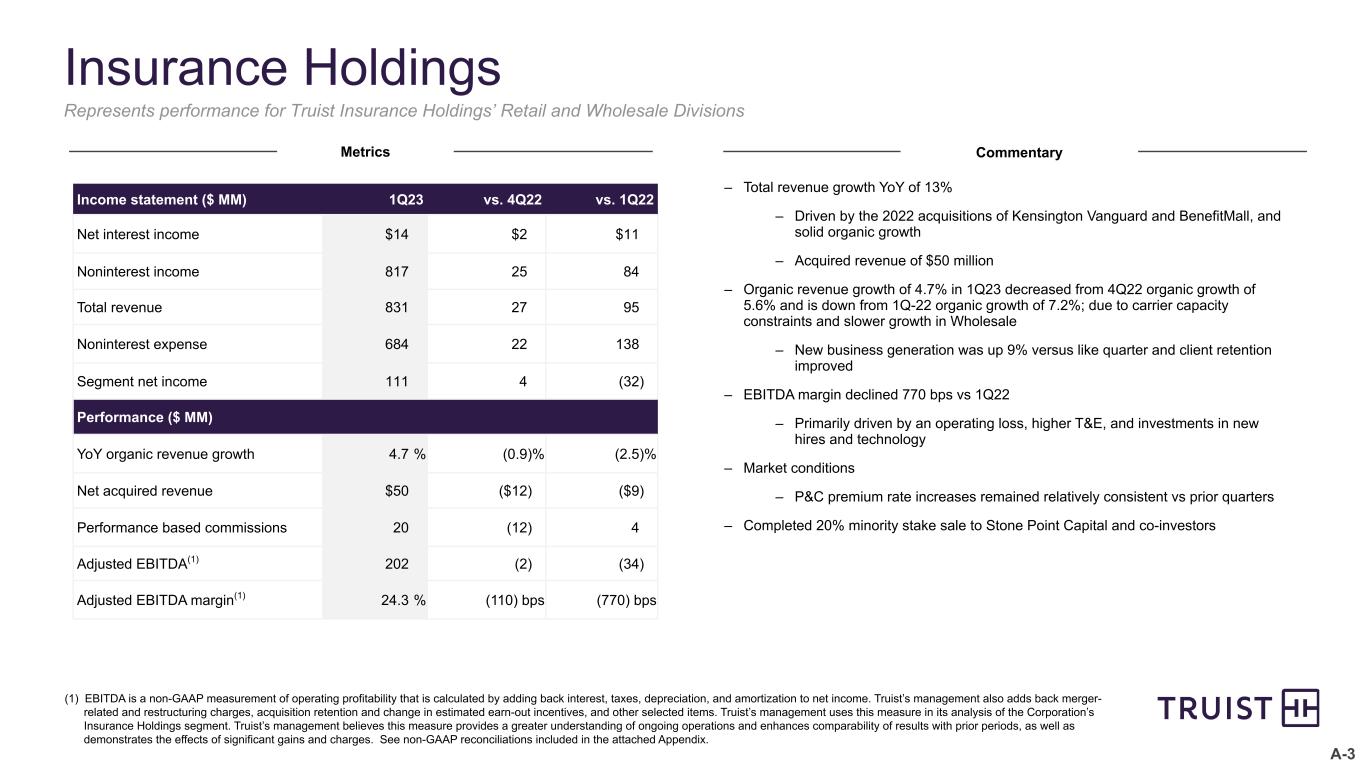
A-3 Insurance Holdings – Total revenue growth YoY of 13% – Driven by the 2022 acquisitions of Kensington Vanguard and BenefitMall, and solid organic growth – Acquired revenue of $50 million – Organic revenue growth of 4.7% in 1Q23 decreased from 4Q22 organic growth of 5.6% and is down from 1Q-22 organic growth of 7.2%; due to carrier capacity constraints and slower growth in Wholesale – New business generation was up 9% versus like quarter and client retention improved – EBITDA margin declined 770 bps vs 1Q22 – Primarily driven by an operating loss, higher T&E, and investments in new hires and technology – Market conditions – P&C premium rate increases remained relatively consistent vs prior quarters – Completed 20% minority stake sale to Stone Point Capital and co-investors (1) EBITDA is a non-GAAP measurement of operating profitability that is calculated by adding back interest, taxes, depreciation, and amortization to net income. Truist’s management also adds back merger- related and restructuring charges, acquisition retention and change in estimated earn-out incentives, and other selected items. Truist’s management uses this measure in its analysis of the Corporation’s Insurance Holdings segment. Truist’s management believes this measure provides a greater understanding of ongoing operations and enhances comparability of results with prior periods, as well as demonstrates the effects of significant gains and charges. See non-GAAP reconciliations included in the attached Appendix. Represents performance for Truist Insurance Holdings’ Retail and Wholesale Divisions Metrics Commentary Income statement ($ MM) 1Q23 vs. 4Q22 vs. 1Q22 Net interest income $14 $2 $11 Noninterest income 817 25 84 Total revenue 831 27 95 Noninterest expense 684 22 138 Segment net income 111 4 (32) Performance ($ MM) YoY organic revenue growth 4.7 % (0.9) % (2.5) % Net acquired revenue $50 ($12) ($9) Performance based commissions 20 (12) 4 Adjusted EBITDA(1) 202 (2) (34) Adjusted EBITDA margin(1) 24.3 % (110) bps (770) bps
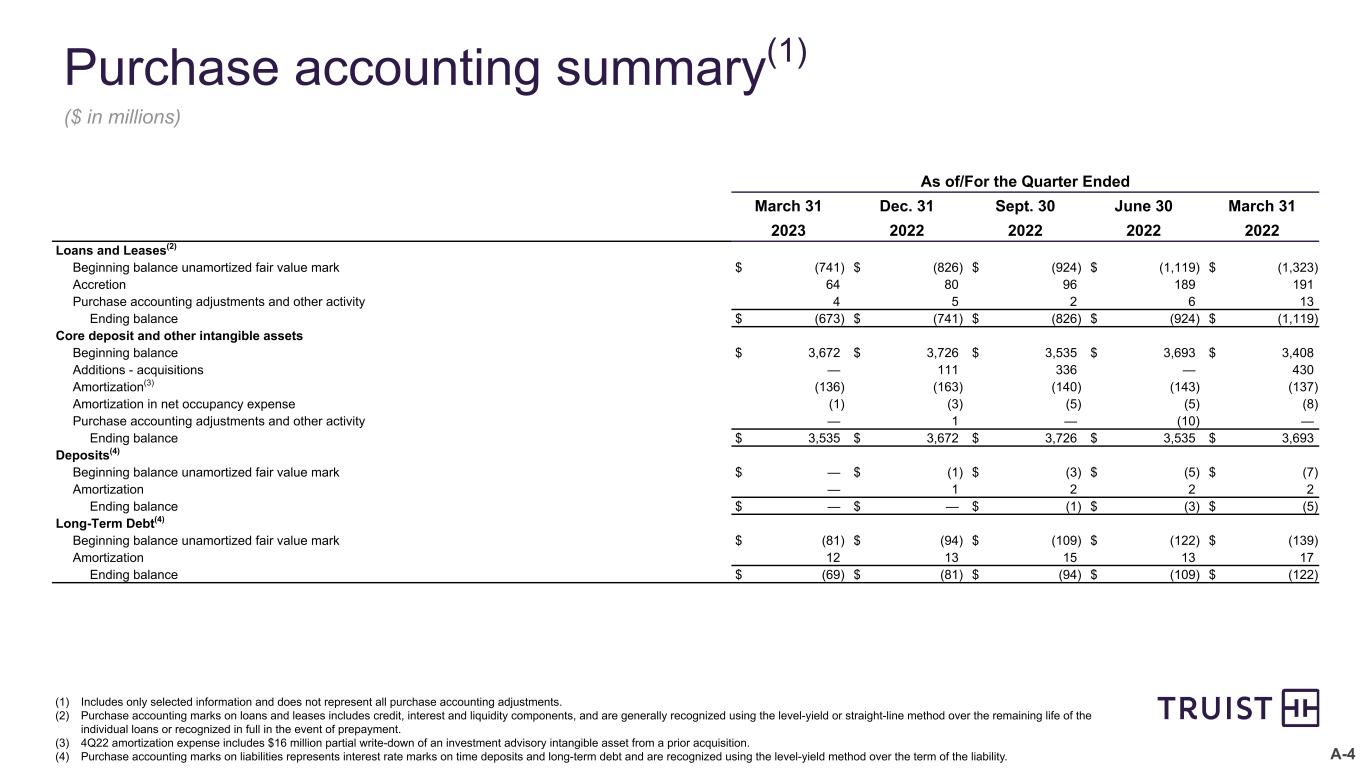
A-4 Purchase accounting summary(1) ($ in millions) As of/For the Quarter Ended March 31 Dec. 31 Sept. 30 June 30 March 31 2023 2022 2022 2022 2022 Loans and Leases(2) Beginning balance unamortized fair value mark $ (741) $ (826) $ (924) $ (1,119) $ (1,323) Accretion 64 80 96 189 191 Purchase accounting adjustments and other activity 4 5 2 6 13 Ending balance $ (673) $ (741) $ (826) $ (924) $ (1,119) Core deposit and other intangible assets Beginning balance $ 3,672 $ 3,726 $ 3,535 $ 3,693 $ 3,408 Additions - acquisitions — 111 336 — 430 Amortization(3) (136) (163) (140) (143) (137) Amortization in net occupancy expense (1) (3) (5) (5) (8) Purchase accounting adjustments and other activity — 1 — (10) — Ending balance $ 3,535 $ 3,672 $ 3,726 $ 3,535 $ 3,693 Deposits(4) Beginning balance unamortized fair value mark $ — $ (1) $ (3) $ (5) $ (7) Amortization — 1 2 2 2 Ending balance $ — $ — $ (1) $ (3) $ (5) Long-Term Debt(4) Beginning balance unamortized fair value mark $ (81) $ (94) $ (109) $ (122) $ (139) Amortization 12 13 15 13 17 Ending balance $ (69) $ (81) $ (94) $ (109) $ (122) (1) Includes only selected information and does not represent all purchase accounting adjustments. (2) Purchase accounting marks on loans and leases includes credit, interest and liquidity components, and are generally recognized using the level-yield or straight-line method over the remaining life of the individual loans or recognized in full in the event of prepayment. (3) 4Q22 amortization expense includes $16 million partial write-down of an investment advisory intangible asset from a prior acquisition. (4) Purchase accounting marks on liabilities represents interest rate marks on time deposits and long-term debt and are recognized using the level-yield method over the term of the liability.
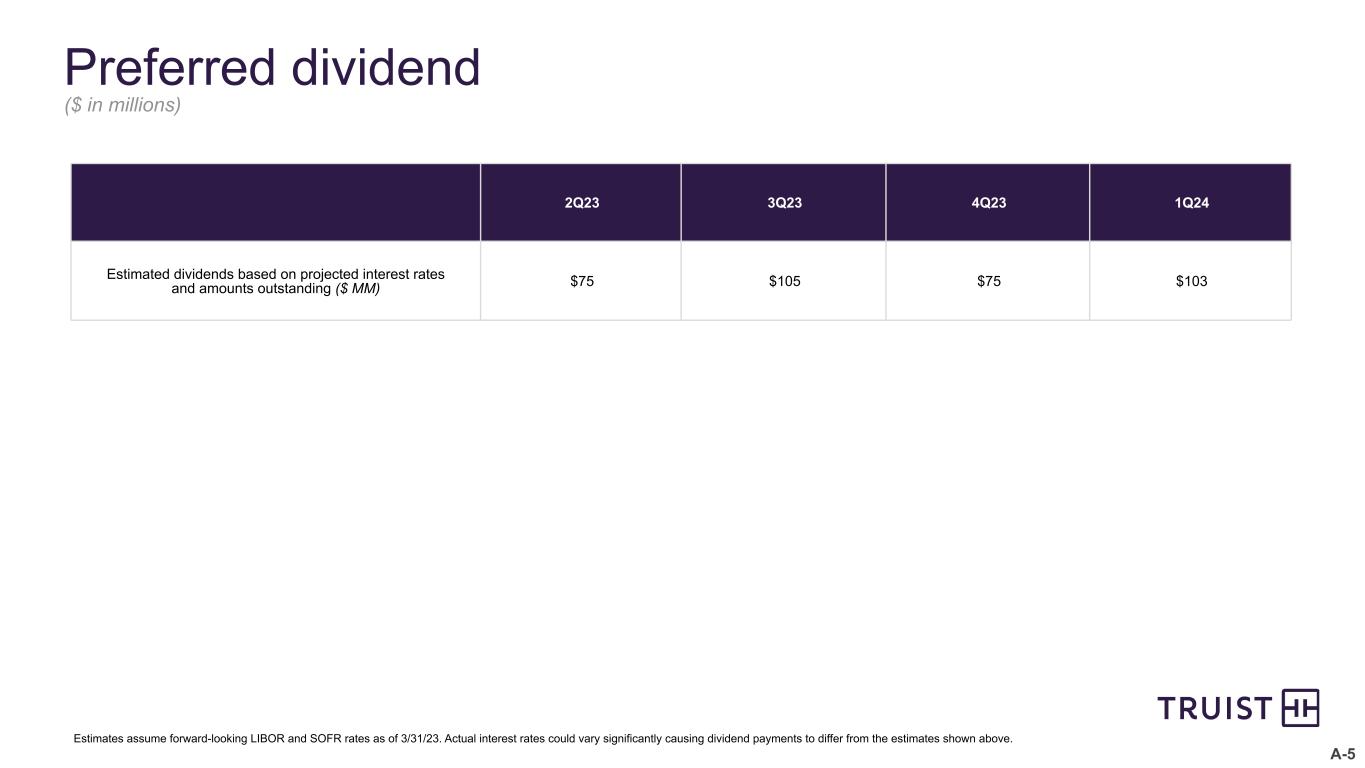
A-5 Preferred dividend ($ in millions) 2Q23 3Q23 4Q23 1Q24 Estimated dividends based on projected interest rates and amounts outstanding ($ MM) $75 $105 $75 $103 Estimates assume forward-looking LIBOR and SOFR rates as of 3/31/23. Actual interest rates could vary significantly causing dividend payments to differ from the estimates shown above.

Non-GAAP Reconciliations
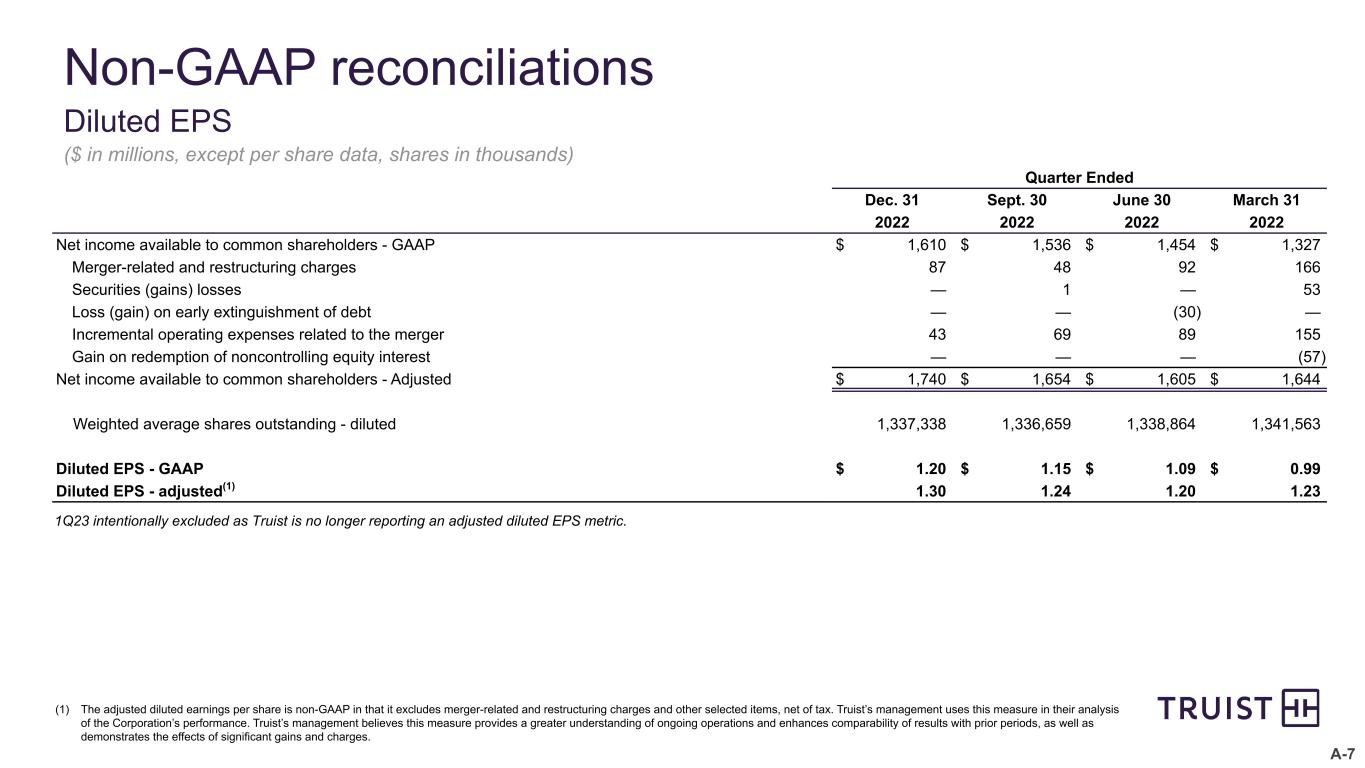
A-7 Quarter Ended Dec. 31 Sept. 30 June 30 March 31 2022 2022 2022 2022 Net income available to common shareholders - GAAP $ 1,610 $ 1,536 $ 1,454 $ 1,327 Merger-related and restructuring charges 87 48 92 166 Securities (gains) losses — 1 — 53 Loss (gain) on early extinguishment of debt — — (30) — Incremental operating expenses related to the merger 43 69 89 155 Gain on redemption of noncontrolling equity interest — — — (57) Net income available to common shareholders - Adjusted $ 1,740 $ 1,654 $ 1,605 $ 1,644 Weighted average shares outstanding - diluted 1,337,338 1,336,659 1,338,864 1,341,563 Diluted EPS - GAAP $ 1.20 $ 1.15 $ 1.09 $ 0.99 Diluted EPS - adjusted(1) 1.30 1.24 1.20 1.23 Non-GAAP reconciliations Diluted EPS ($ in millions, except per share data, shares in thousands) (1) The adjusted diluted earnings per share is non-GAAP in that it excludes merger-related and restructuring charges and other selected items, net of tax. Truist’s management uses this measure in their analysis of the Corporation’s performance. Truist’s management believes this measure provides a greater understanding of ongoing operations and enhances comparability of results with prior periods, as well as demonstrates the effects of significant gains and charges. 1Q23 intentionally excluded as Truist is no longer reporting an adjusted diluted EPS metric.
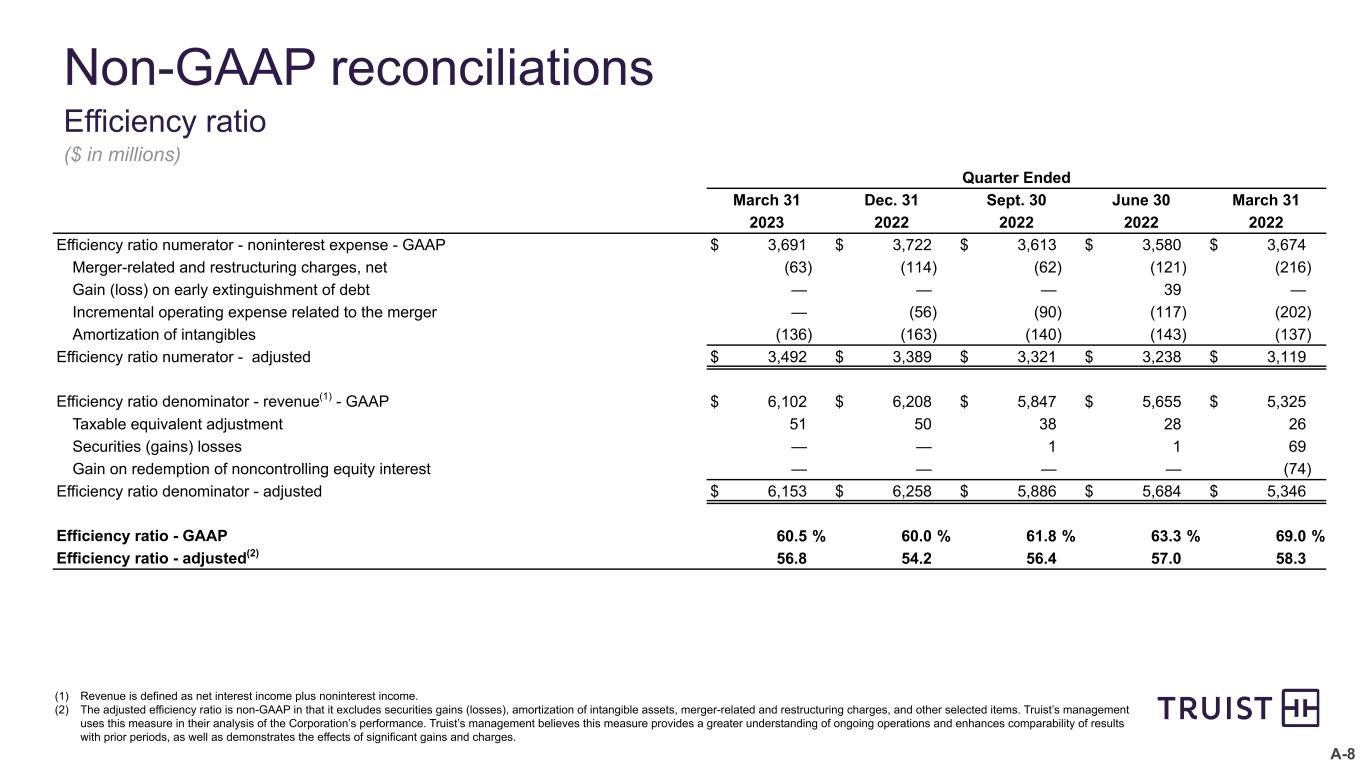
A-8 Non-GAAP reconciliations Efficiency ratio ($ in millions) (1) Revenue is defined as net interest income plus noninterest income. (2) The adjusted efficiency ratio is non-GAAP in that it excludes securities gains (losses), amortization of intangible assets, merger-related and restructuring charges, and other selected items. Truist’s management uses this measure in their analysis of the Corporation’s performance. Truist’s management believes this measure provides a greater understanding of ongoing operations and enhances comparability of results with prior periods, as well as demonstrates the effects of significant gains and charges. Quarter Ended March 31 Dec. 31 Sept. 30 June 30 March 31 2023 2022 2022 2022 2022 Efficiency ratio numerator - noninterest expense - GAAP $ 3,691 $ 3,722 $ 3,613 $ 3,580 $ 3,674 Merger-related and restructuring charges, net (63) (114) (62) (121) (216) Gain (loss) on early extinguishment of debt — — — 39 — Incremental operating expense related to the merger — (56) (90) (117) (202) Amortization of intangibles (136) (163) (140) (143) (137) Efficiency ratio numerator - adjusted $ 3,492 $ 3,389 $ 3,321 $ 3,238 $ 3,119 Efficiency ratio denominator - revenue(1) - GAAP $ 6,102 $ 6,208 $ 5,847 $ 5,655 $ 5,325 Taxable equivalent adjustment 51 50 38 28 26 Securities (gains) losses — — 1 1 69 Gain on redemption of noncontrolling equity interest — — — — (74) Efficiency ratio denominator - adjusted $ 6,153 $ 6,258 $ 5,886 $ 5,684 $ 5,346 Efficiency ratio - GAAP 60.5 % 60.0 % 61.8 % 63.3 % 69.0 % Efficiency ratio - adjusted(2) 56.8 54.2 56.4 57.0 58.3
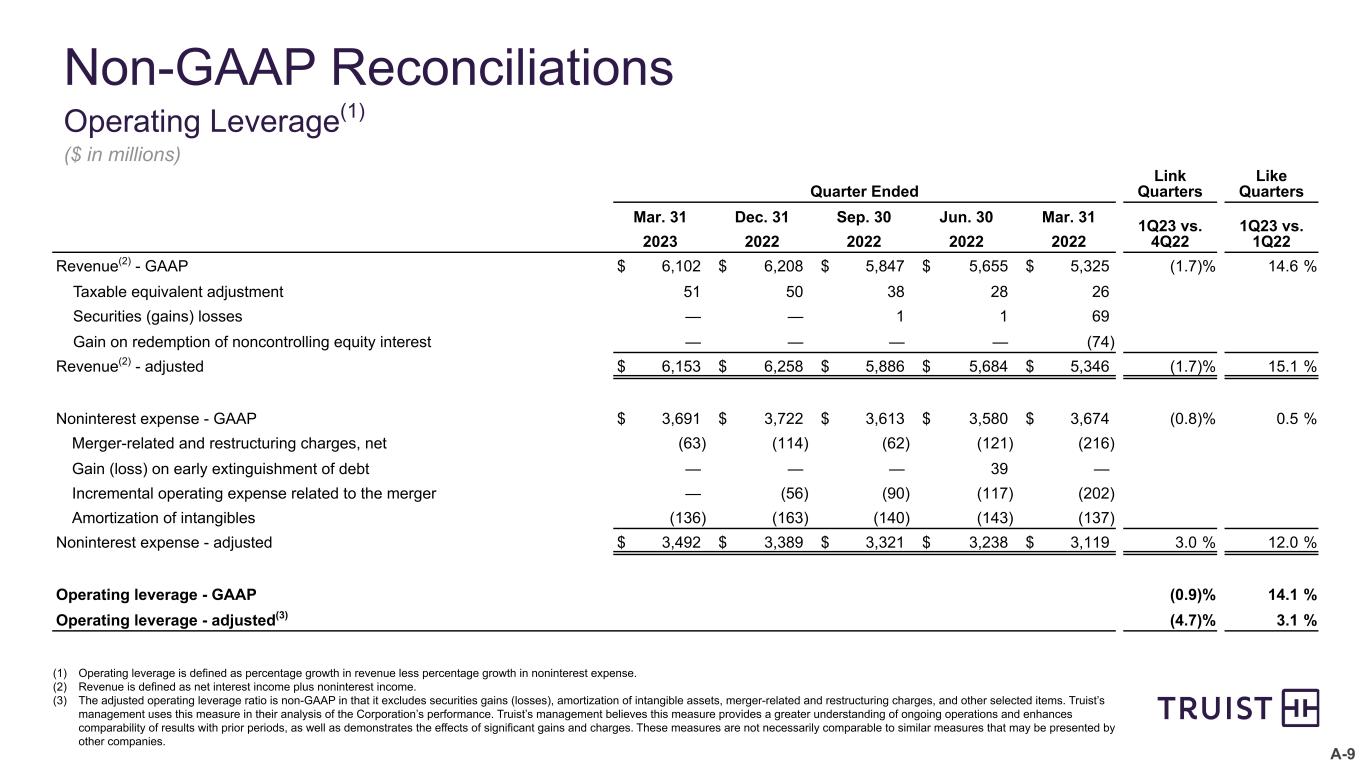
A-9 Non-GAAP Reconciliations Operating Leverage(1) ($ in millions) Quarter Ended Link Quarters Like Quarters Mar. 31 Dec. 31 Sep. 30 Jun. 30 Mar. 31 1Q23 vs. 4Q22 1Q23 vs. 1Q222023 2022 2022 2022 2022 Revenue(2) - GAAP $ 6,102 $ 6,208 $ 5,847 $ 5,655 $ 5,325 (1.7) % 14.6 % Taxable equivalent adjustment 51 50 38 28 26 Securities (gains) losses — — 1 1 69 Gain on redemption of noncontrolling equity interest — — — — (74) Revenue(2) - adjusted $ 6,153 $ 6,258 $ 5,886 $ 5,684 $ 5,346 (1.7) % 15.1 % Noninterest expense - GAAP $ 3,691 $ 3,722 $ 3,613 $ 3,580 $ 3,674 (0.8) % 0.5 % Merger-related and restructuring charges, net (63) (114) (62) (121) (216) Gain (loss) on early extinguishment of debt — — — 39 — Incremental operating expense related to the merger — (56) (90) (117) (202) Amortization of intangibles (136) (163) (140) (143) (137) Noninterest expense - adjusted $ 3,492 $ 3,389 $ 3,321 $ 3,238 $ 3,119 3.0 % 12.0 % Operating leverage - GAAP (0.9) % 14.1 % Operating leverage - adjusted(3) (4.7) % 3.1 % (1) Operating leverage is defined as percentage growth in revenue less percentage growth in noninterest expense. (2) Revenue is defined as net interest income plus noninterest income. (3) The adjusted operating leverage ratio is non-GAAP in that it excludes securities gains (losses), amortization of intangible assets, merger-related and restructuring charges, and other selected items. Truist’s management uses this measure in their analysis of the Corporation’s performance. Truist’s management believes this measure provides a greater understanding of ongoing operations and enhances comparability of results with prior periods, as well as demonstrates the effects of significant gains and charges. These measures are not necessarily comparable to similar measures that may be presented by other companies.
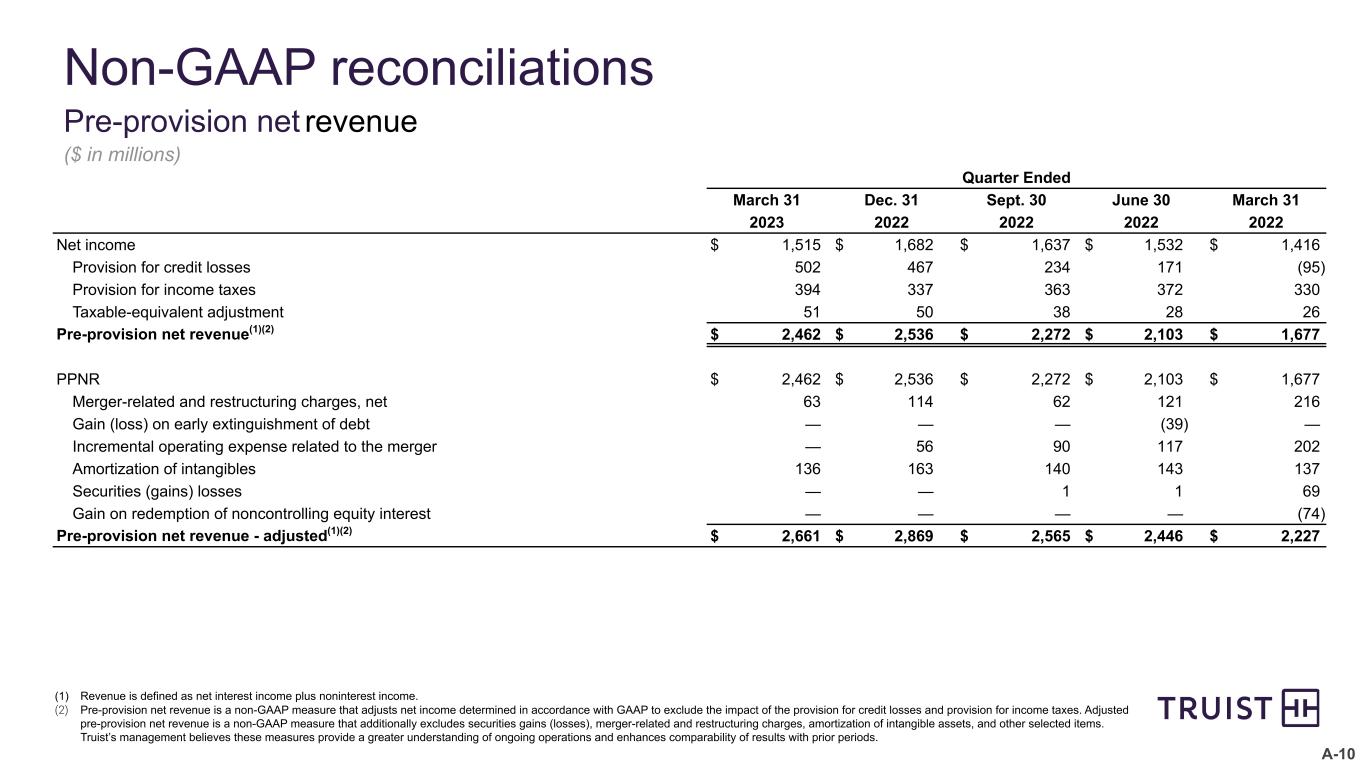
A-10 Non-GAAP reconciliations Pre-provision net revenue ($ in millions) (1) Revenue is defined as net interest income plus noninterest income. (2) Pre-provision net revenue is a non-GAAP measure that adjusts net income determined in accordance with GAAP to exclude the impact of the provision for credit losses and provision for income taxes. Adjusted pre-provision net revenue is a non-GAAP measure that additionally excludes securities gains (losses), merger-related and restructuring charges, amortization of intangible assets, and other selected items. Truist’s management believes these measures provide a greater understanding of ongoing operations and enhances comparability of results with prior periods. Quarter Ended March 31 Dec. 31 Sept. 30 June 30 March 31 2023 2022 2022 2022 2022 Net income $ 1,515 $ 1,682 $ 1,637 $ 1,532 $ 1,416 Provision for credit losses 502 467 234 171 (95) Provision for income taxes 394 337 363 372 330 Taxable-equivalent adjustment 51 50 38 28 26 Pre-provision net revenue(1)(2) $ 2,462 $ 2,536 $ 2,272 $ 2,103 $ 1,677 PPNR $ 2,462 $ 2,536 $ 2,272 $ 2,103 $ 1,677 Merger-related and restructuring charges, net 63 114 62 121 216 Gain (loss) on early extinguishment of debt — — — (39) — Incremental operating expense related to the merger — 56 90 117 202 Amortization of intangibles 136 163 140 143 137 Securities (gains) losses — — 1 1 69 Gain on redemption of noncontrolling equity interest — — — — (74) Pre-provision net revenue - adjusted(1)(2) $ 2,661 $ 2,869 $ 2,565 $ 2,446 $ 2,227
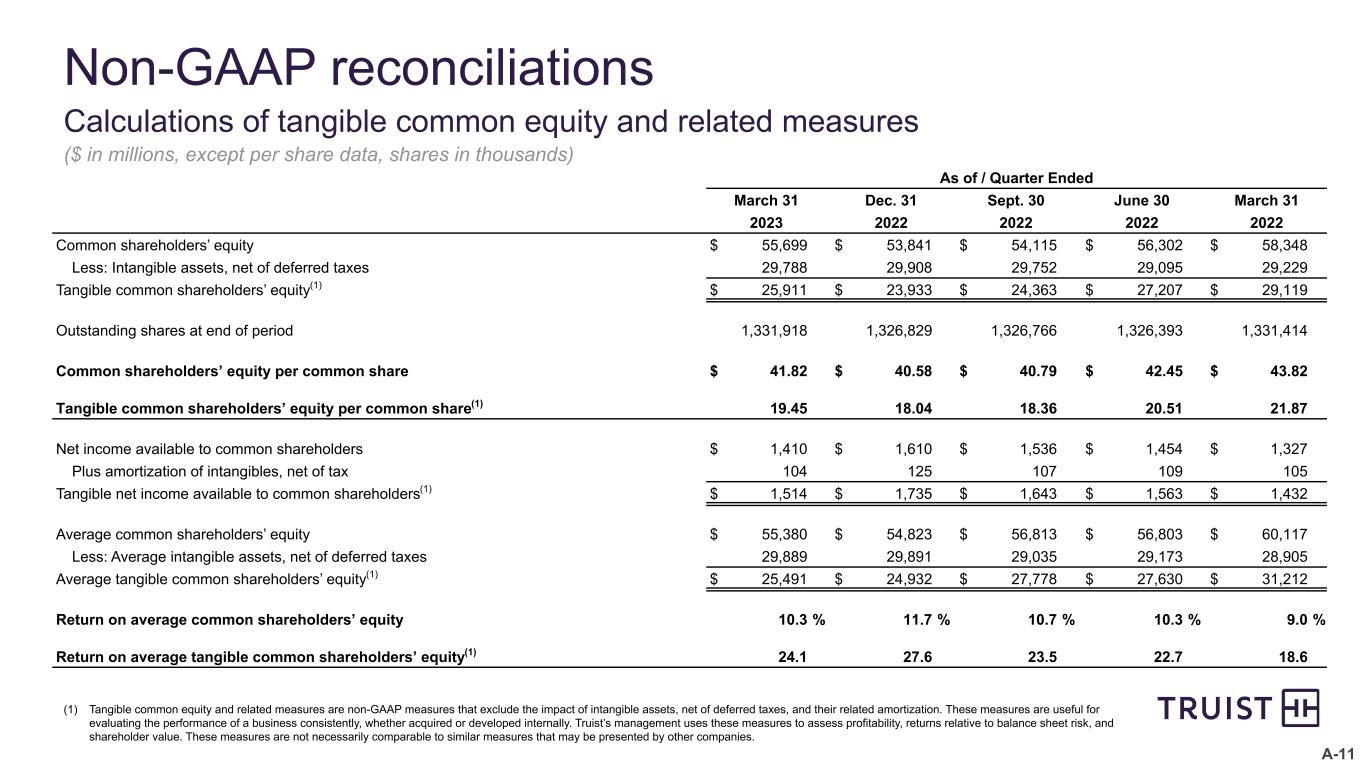
A-11 Non-GAAP reconciliations Calculations of tangible common equity and related measures ($ in millions, except per share data, shares in thousands) (1) Tangible common equity and related measures are non-GAAP measures that exclude the impact of intangible assets, net of deferred taxes, and their related amortization. These measures are useful for evaluating the performance of a business consistently, whether acquired or developed internally. Truist’s management uses these measures to assess profitability, returns relative to balance sheet risk, and shareholder value. These measures are not necessarily comparable to similar measures that may be presented by other companies. As of / Quarter Ended March 31 Dec. 31 Sept. 30 June 30 March 31 2023 2022 2022 2022 2022 Common shareholders’ equity $ 55,699 $ 53,841 $ 54,115 $ 56,302 $ 58,348 Less: Intangible assets, net of deferred taxes 29,788 29,908 29,752 29,095 29,229 Tangible common shareholders’ equity(1) $ 25,911 $ 23,933 $ 24,363 $ 27,207 $ 29,119 Outstanding shares at end of period 1,331,918 1,326,829 1,326,766 1,326,393 1,331,414 Common shareholders’ equity per common share $ 41.82 $ 40.58 $ 40.79 $ 42.45 $ 43.82 Tangible common shareholders’ equity per common share(1) 19.45 18.04 18.36 20.51 21.87 Net income available to common shareholders $ 1,410 $ 1,610 $ 1,536 $ 1,454 $ 1,327 Plus amortization of intangibles, net of tax 104 125 107 109 105 Tangible net income available to common shareholders(1) $ 1,514 $ 1,735 $ 1,643 $ 1,563 $ 1,432 Average common shareholders’ equity $ 55,380 $ 54,823 $ 56,813 $ 56,803 $ 60,117 Less: Average intangible assets, net of deferred taxes 29,889 29,891 29,035 29,173 28,905 Average tangible common shareholders’ equity(1) $ 25,491 $ 24,932 $ 27,778 $ 27,630 $ 31,212 Return on average common shareholders’ equity 10.3 % 11.7 % 10.7 % 10.3 % 9.0 % Return on average tangible common shareholders’ equity(1) 24.1 27.6 23.5 22.7 18.6
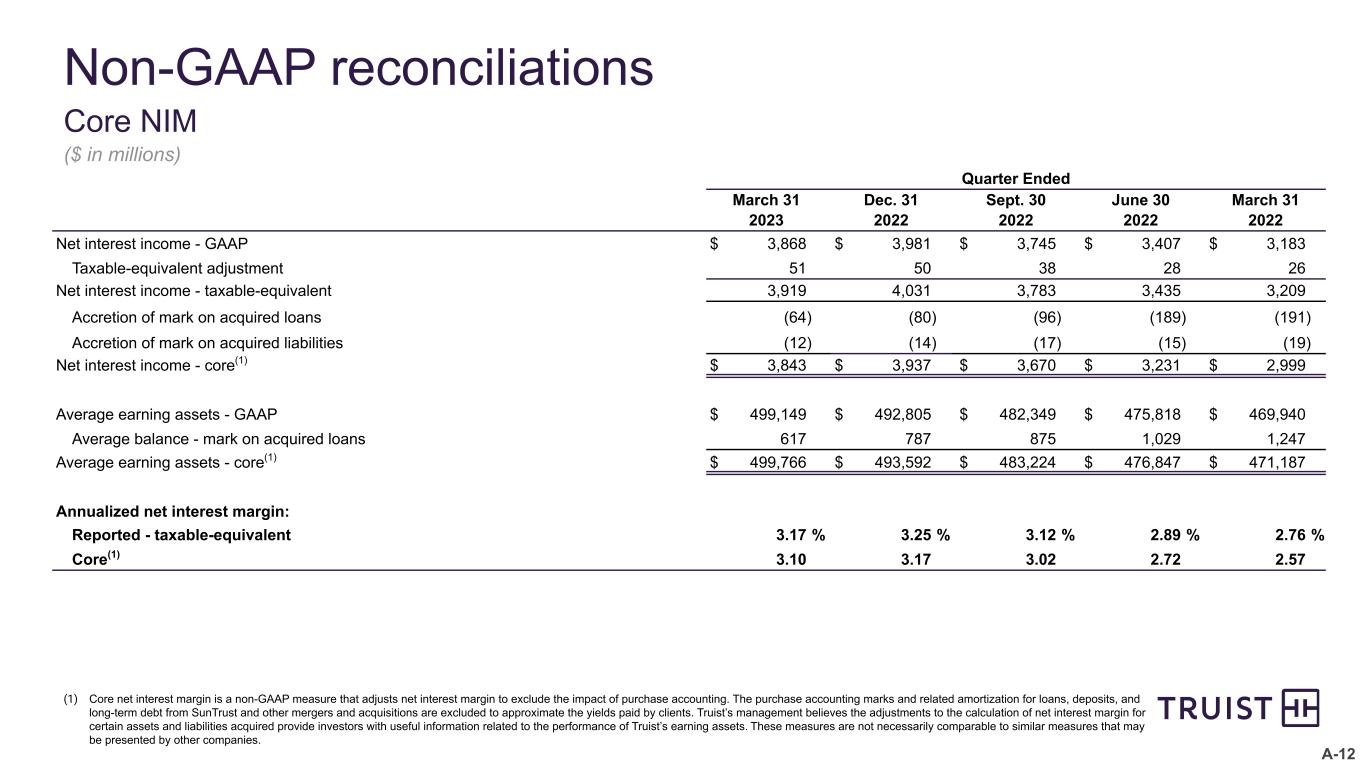
A-12 Quarter Ended March 31 Dec. 31 Sept. 30 June 30 March 31 2023 2022 2022 2022 2022 Net interest income - GAAP $ 3,868 $ 3,981 $ 3,745 $ 3,407 $ 3,183 Taxable-equivalent adjustment 51 50 38 28 26 Net interest income - taxable-equivalent 3,919 4,031 3,783 3,435 3,209 Accretion of mark on acquired loans (64) (80) (96) (189) (191) Accretion of mark on acquired liabilities (12) (14) (17) (15) (19) Net interest income - core(1) $ 3,843 $ 3,937 $ 3,670 $ 3,231 $ 2,999 Average earning assets - GAAP $ 499,149 $ 492,805 $ 482,349 $ 475,818 $ 469,940 Average balance - mark on acquired loans 617 787 875 1,029 1,247 Average earning assets - core(1) $ 499,766 $ 493,592 $ 483,224 $ 476,847 $ 471,187 Annualized net interest margin: Reported - taxable-equivalent 3.17 % 3.25 % 3.12 % 2.89 % 2.76 % Core(1) 3.10 3.17 3.02 2.72 2.57 Non-GAAP reconciliations Core NIM ($ in millions) (1) Core net interest margin is a non-GAAP measure that adjusts net interest margin to exclude the impact of purchase accounting. The purchase accounting marks and related amortization for loans, deposits, and long-term debt from SunTrust and other mergers and acquisitions are excluded to approximate the yields paid by clients. Truist’s management believes the adjustments to the calculation of net interest margin for certain assets and liabilities acquired provide investors with useful information related to the performance of Truist’s earning assets. These measures are not necessarily comparable to similar measures that may be presented by other companies.
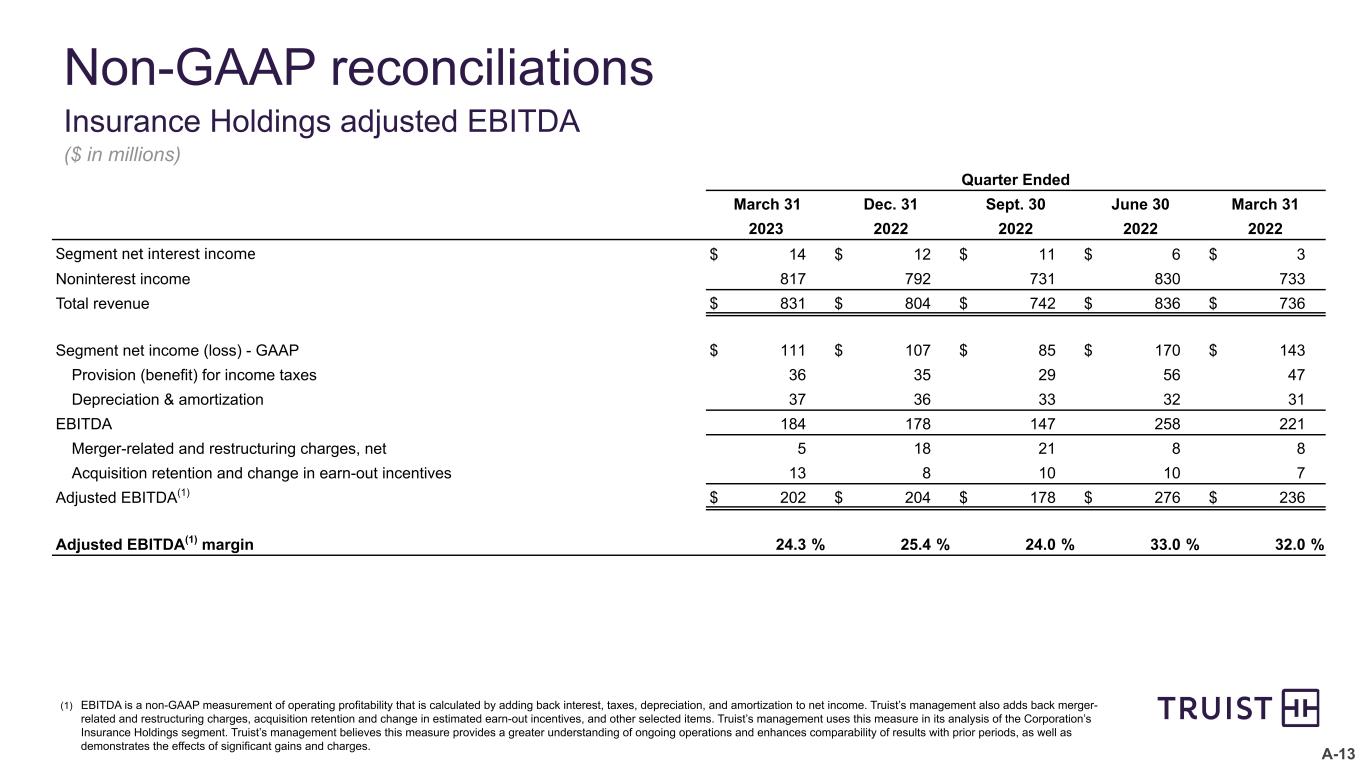
A-13 Non-GAAP reconciliations Insurance Holdings adjusted EBITDA ($ in millions) (1) EBITDA is a non-GAAP measurement of operating profitability that is calculated by adding back interest, taxes, depreciation, and amortization to net income. Truist’s management also adds back merger- related and restructuring charges, acquisition retention and change in estimated earn-out incentives, and other selected items. Truist’s management uses this measure in its analysis of the Corporation’s Insurance Holdings segment. Truist’s management believes this measure provides a greater understanding of ongoing operations and enhances comparability of results with prior periods, as well as demonstrates the effects of significant gains and charges. Quarter Ended March 31 Dec. 31 Sept. 30 June 30 March 31 2023 2022 2022 2022 2022 Segment net interest income $ 14 $ 12 $ 11 $ 6 $ 3 Noninterest income 817 792 731 830 733 Total revenue $ 831 $ 804 $ 742 $ 836 $ 736 Segment net income (loss) - GAAP $ 111 $ 107 $ 85 $ 170 $ 143 Provision (benefit) for income taxes 36 35 29 56 47 Depreciation & amortization 37 36 33 32 31 EBITDA 184 178 147 258 221 Merger-related and restructuring charges, net 5 18 21 8 8 Acquisition retention and change in earn-out incentives 13 8 10 10 7 Adjusted EBITDA(1) $ 202 $ 204 $ 178 $ 276 $ 236 Adjusted EBITDA(1) margin 24.3 % 25.4 % 24.0 % 33.0 % 32.0 %

To inspire and build better lives and communities