
Trinity Industries Inc 8-K, filed Apr 27, 2022
Trinity Industries Inc (TRN)
8-K
2022-04-27
For: 2022-04-27
View Original
Added on
April 07, 2026
About this 8-K
Trinity Industries Inc filed this 8-K on April 27, 2022.
Items reported
- Item 2.02: Financial results
- Item 7.01: Regulation FD disclosure
- Item 9.01: Financial statements and exhibits
UNITED STATES SECURITIES AND EXCHANGE COMMISSION
WASHINGTON, D.C. 20549
FORM 8-K
CURRENT REPORT
Pursuant to Section 13 or 15(d) of the Securities Exchange Act of 1934
| Date of Report (Date of Earliest Event Reported): | ||||||||

_______________________________________
(Exact name of registrant as specified in its charter)
| (State or other jurisdiction of incorporation) | (Commission File No.) | (I.R.S. Employer Identification No.) | ||||||||||||
(Address of Principal Executive Offices, and Zip Code)
(214 ) 631-4420
Registrant's Telephone Number, Including Area Code
Not Applicable
(Former Name or Former Address, if Changed Since Last Report)
______________________________________________
Check the appropriate box below if the Form 8-K filing is intended to simultaneously satisfy the filing obligation of the registrant under any of the following provisions:
Securities registered pursuant to Section 12(b) of the Act:
| Title of each class | Trading Symbol(s) | Name of each exchange on which registered | ||||||
Indicate by check mark whether the registrant is an emerging growth company as defined in Rule 405 of the Securities Act of 1933 (17 CFR §230.405) or Rule 12b-2 of the Securities Exchange Act of 1934 (17 CFR §240.12b-2).
Emerging growth company ☐
If an emerging growth company, indicate by check mark if the registrant has elected not to use the extended transition period for complying with any new or revised financial accounting standards provided pursuant to Section 13(a) of the Exchange Act. ☐
Item 2.02 Results of Operations and Financial Condition.
Trinity Industries, Inc. ("Trinity") hereby furnishes the information set forth in its News Release, dated April 27, 2022, announcing operating results for the three month period ended March 31, 2022, a copy of which is furnished as Exhibit 99.1 and incorporated herein by reference. On April 27, 2022, Trinity held a conference call and webcast with respect to its financial results for the three month period ended March 31, 2022. The conference call scripts of Leigh Anne Mann, Vice President of Investor Relations; E. Jean Savage, Chief Executive Officer and President; and Eric R. Marchetto, Executive Vice President and Chief Financial Officer; are furnished as Exhibit 99.2, and incorporated herein by reference.
The conference call, News Release, and Supplemental Materials, described below, included references to Adjusted Operating Results and Adjusted Earnings Per Share, Pre-Tax Return on Equity, Free Cash Flow, EBITDA and Adjusted EBITDA, which are not calculations based on generally accepted accounting principles (“GAAP”). Reconciliations of each of these non-GAAP measures to the most directly comparable GAAP measures have been included in the News Release and/or the Supplemental Materials. When forward-looking non-GAAP measures are provided, Trinity does not provide quantitative reconciliations of forward-looking non-GAAP measures to the most directly comparable GAAP measures because it cannot, without unreasonable effort, predict the timing and amounts of certain items included in the computations of each of these measures. These factors include, but are not limited to: the product mix of expected railcar deliveries; the timing and amount of significant transactions and investments, such as lease portfolio sales, capital expenditures, and returns of capital to shareholders; and the amount and timing of certain other items outside the normal course of our core business operations, such as restructuring activities and the potential financial and operational impacts of the COVID-19 pandemic.
This information and the materials described in Item 7.01 are not "filed" pursuant to the Securities Exchange Act of 1934 and are not incorporated by reference into any Securities Act of 1933 registration statements. Additionally, the submission of the report on Form 8-K is not an admission of the materiality of any information in this report that is required to be disclosed solely by Regulation FD.
Item 7.01 Regulation FD Disclosure.
See "Item 2.02 — Results of Operations and Financial Condition." Additionally, Trinity posted Supplemental Materials to its website to accompany the conference call; a copy of these materials is furnished as Exhibit 99.3 and incorporated herein by reference.
Forward-Looking Statements
Some statements in this release, which are not historical facts, are “forward-looking statements” as defined by the Private Securities Litigation Reform Act of 1995. Forward-looking statements include statements about Trinity's estimates, expectations, beliefs, intentions or strategies for the future, and the assumptions underlying these forward-looking statements, including, but not limited to, future financial and operating performance, future opportunities and any other statements regarding events or developments that Trinity believes or anticipates will or may occur in the future, including the potential financial and operational impacts of the COVID-19 pandemic. Trinity uses the words “anticipates,” “assumes,” “believes,” “estimates,” “expects,” “intends,” “forecasts,” “may,” “will,” “should,” “guidance,” “projected,” “outlook,” and similar expressions to identify these forward-looking statements. Forward-looking statements speak only as of the date of this release, and Trinity expressly disclaims any obligation or undertaking to disseminate any updates or revisions to any forward-looking statement contained herein to reflect any change in Trinity’s expectations with regard thereto or any change in events, conditions or circumstances on which any such statement is based, except as required by federal securities laws. Forward-looking statements involve risks and uncertainties that could cause actual results to differ materially from historical experience or present expectations, including but not limited to risks and uncertainties regarding economic, competitive, governmental, and technological factors affecting Trinity’s operations, markets, products, services and prices, and such forward-looking statements are not guarantees of future performance. For a discussion of such risks and uncertainties, which could cause actual results to differ from those contained in the forward-looking statements, see “Risk Factors” and “Forward-Looking Statements” in Trinity’s Annual Report on Form 10-K for the most recent fiscal year, as may be revised and updated by Trinity’s Quarterly Reports on Form 10-Q, and Trinity’s Current Reports on Form 8-K.
Item 9.01 Financial Statements and Exhibits.
(a) - (c) Not applicable.
(d) Exhibits:
| NO. | DESCRIPTION | |||||||
| 99.1 | ||||||||
| 99.2 | ||||||||
| 99.3 | ||||||||
| 101.SCH | Inline XBRL Taxonomy Extension Schema Document (filed electronically herewith). | |||||||
| 101.LAB | Inline XBRL Taxonomy Extension Label Linkbase Document (filed electronically herewith). | |||||||
| 101.PRE | Inline XBRL Taxonomy Extension Presentation Linkbase Document (filed electronically herewith). | |||||||
| 104 | Cover Page Interactive Data File (formatted as Inline XBRL and contained in Exhibit 101). | |||||||
SIGNATURES
Pursuant to the requirements of the Securities Exchange Act of 1934, as amended, the registrant has duly caused this report to be signed on its behalf by the undersigned hereunto duly authorized.
| Trinity Industries, Inc. | ||||||||
| April 27, 2022 | By: | /s/ Eric R. Marchetto | ||||||
| Name: Eric R. Marchetto | ||||||||
| Title: Executive Vice President and Chief Financial Officer | ||||||||
Exhibit 99.1
| NEWS RELEASE |  | ||||
FOR IMMEDIATE RELEASE
Trinity Industries, Inc. Announces First Quarter 2022 Results
Reports quarterly GAAP and adjusted earnings from continuing operations of $0.09 and $0.03 per diluted share, respectively
Generates operating and total free cash flow of $29 million and $48 million, respectively
Receives orders for 5,055 railcars and delivers 2,470 railcars in the quarter; backlog of $1.9 billion at quarter-end
DALLAS, Texas – April 27, 2022 – Trinity Industries, Inc. (NYSE:TRN) today announced earnings results for the first quarter ended March 31, 2022.
Financial and Operational Highlights
•Quarterly total company revenues of $473 million
•Quarterly income from continuing operations per common diluted share ("EPS") of $0.09 and quarterly adjusted EPS of $0.03
•Lease fleet utilization of 96.5% and Future Lease Rate Differential ("FLRD") of positive 2.4% at quarter end
•New railcar orders of 5,055 and railcar deliveries of 2,470
•Year-to-date cash flow from continuing operations and total free cash flow after investments and dividends ("Free Cash Flow") were $29 million and $48 million, respectively
2022 Guidance
•Industry deliveries of 40,000 to 50,000 railcars
•Net investment in the lease fleet of $450 million to $550 million
•Manufacturing capital expenditures of $35 million to $45 million
•EPS of $0.85 to $1.05
◦Excludes gains on insurance recoveries and other items outside of our core business operations
Management Commentary
"Trinity's first quarter results are highlighted by strong orders and deliveries evidenced by a book-to-bill ratio of 2.0x in the quarter," stated Trinity's Chief Executive Officer and President, Jean Savage. "Though labor and supply chain challenges persist, we are confident that deliveries in 2022 will be strong and represent a broad-based industrial recovery for North America."
"In our Railcar Leasing and Management Services Group, utilization continued to improve, and our Future Lease Rate Differential once again improved sequentially and is now a positive 2.4%, a strong leading indicator of demand and future revenue growth. Furthermore, we ended the quarter with a fleet utilization of 96.5%, at pre-pandemic levels, which supports our internal estimates for lease fleet investment in the year."
"In our Rail Products Group, we were especially pleased by the volume of orders and deliveries in the quarter," Ms. Savage continued. "In the first quarter, we delivered orders taken at the bottom of the cycle and managed persistent labor and supply chain challenges, which pressured near-term segment margin. However, we expect to see results in this segment improve in the second half of the year based on the quality of our backlog and strong demand."
Ms. Savage concluded, "As we exit the first quarter, we have clear line of sight to improved operating conditions and expect the financial results in the second half of 2022 and beyond to reflect these trends."
1
Consolidated Financial Summary
| Three Months Ended March 31, | |||||||||||||||||
| 2022 | 2021 | Year over Year – Comparison | |||||||||||||||
| ($ in millions, except per share amounts) | |||||||||||||||||
| Revenues | $ | 472.7 | $ | 330.7 | Higher external deliveries in the Rail Products Group | ||||||||||||
Operating profit | $ | 54.8 | $ | 51.5 | Q1 2022 was favorably impacted by $6.4 million in storm-related insurance recoveries | ||||||||||||
Adjusted Operating profit (1) | $ | 48.4 | $ | 51.2 | Higher costs associated with external deliveries in the Rail Products Group and higher fleet operating costs and increased depreciation in the Leasing Group, partially offset by increased lease fleet portfolio sales | ||||||||||||
| Interest expense, net | $ | 43.5 | $ | 51.3 | Improved overall borrowing costs associated with the Company's debt facilities through debt refinancing activity during Q2 2021, partially offset by higher overall average debt | ||||||||||||
| Net income (loss) from continuing operations attributable to Trinity Industries, Inc. | $ | 7.3 | $ | (3.0) | |||||||||||||
EBITDA (1) | $ | 123.9 | $ | 115.0 | |||||||||||||
| Effective tax expense rate | 23.3 | % | 400.0 | % | Q1 2021 tax rate was impacted by adjustments to carryback claims filed in 2020 | ||||||||||||
| Diluted EPS – GAAP | $ | 0.09 | $ | (0.03) | Q1 2022 results include $0.06 in storm-related insurance recoveries | ||||||||||||
Diluted EPS – Adjusted (1) | $ | 0.03 | $ | 0.01 | |||||||||||||
Net cash provided by operating activities – continuing operations | $ | 28.5 | $ | 69.3 | |||||||||||||
Free Cash Flow (1) | $ | 47.8 | $ | 90.5 | Q1 2021 was impacted by timing difference of debt proceeds issued for financing lease fleet equity investment | ||||||||||||
| Capital expenditures – leasing | $ | 84.6 | $ | 107.9 | |||||||||||||
| Returns of capital to stockholders | $ | 19.1 | $ | 60.0 | No shares repurchased in Q1 2022 due to the ongoing accelerated share repurchase agreement | ||||||||||||
(1) Non-GAAP financial measure. See the Reconciliations of Non-GAAP Measures section within this Press Release for a reconciliation to the most directly comparable GAAP measure and why management believes this measure is useful to management and investors.
Additional Business Items
•Total committed liquidity of $718 million as of March 31, 2022.
•On April 20, 2022, Trinity Rail Leasing 2022 LLC, a Delaware limited liability company ("TRL-2022") and a limited purpose, indirect wholly-owned subsidiary of the Company owned through Trinity Industries Leasing Company, entered into a Note Purchase Agreement dated April 20, 2022 (the "Note Purchase Agreement"). The Note Purchase Agreement provides for the issuance and sale of an aggregate principal amount of $244.8 million of its Series 2022-1 Class A Green Secured Railcar Equipment Notes (the "TRL-2022 Notes"). The TRL-2022 Notes will bear interest at a fixed rate of 4.55%, will be payable monthly, and will have a stated final maturity date of May 20, 2052.
2
Business Group Summary
| Three Months Ended March 31, | |||||||||||||||||
| 2022 | 2021 | Year over Year – Comparison | |||||||||||||||
| ($ in millions) | |||||||||||||||||
| Railcar Leasing and Management Services Group | |||||||||||||||||
| Leasing and management revenues | $ | 183.1 | $ | 183.5 | Lower average lease rates and reduced lease fleet size, partially offset by higher utilization | ||||||||||||
| Leasing and management operating profit | $ | 68.0 | $ | 76.6 | Higher fleet operating costs and depreciation | ||||||||||||
Operating profit on lease portfolio sales (1) | $ | 10.5 | $ | 1.7 | Increased lease fleet portfolio sales | ||||||||||||
| Fleet utilization | 96.5 | % | 94.5 | % | |||||||||||||
Future Lease Rate Differential ("FLRD") (2) | +2.4 | % | (15.7) | % | Recovery of current market lease rates compared to the prior year period | ||||||||||||
Owned lease fleet (in units) (3) | 107,090 | 107,970 | Initial sale to new RIV partner in Q3 2021, partially offset by growth in the lease fleet | ||||||||||||||
| Investor-owned lease fleet (in units) | 29,740 | 26,610 | Initial sale to new RIV partner in Q3 2021 | ||||||||||||||
| Rail Products Group | |||||||||||||||||
| Revenues | $ | 391.1 | $ | 261.0 | Higher volume of deliveries | ||||||||||||
| Revenues eliminations – Lease subsidiary | $ | (101.3) | $ | (111.3) | |||||||||||||
| Operating profit (loss) | $ | 0.8 | $ | (8.8) | Q1 2022 was favorably impacted by $6.4 million in storm-related insurance recoveries and higher deliveries, partially offset by higher input costs and labor shortages | ||||||||||||
| Operating profit eliminations – Lease subsidiary | $ | (8.8) | $ | (1.8) | |||||||||||||
| Operating profit (loss) margin | 0.2 | % | (3.4) | % | |||||||||||||
| New railcars: | |||||||||||||||||
| Deliveries (in units) | 2,470 | 1,895 | |||||||||||||||
| Orders (in units) | 5,055 | 1,410 | Higher orders driven by freight car orders supporting agriculture and chemicals markets and replacement demand in consumer products sector | ||||||||||||||
| Order value | $ | 634.7 | $ | 171.1 | Higher number of units and differences in product mix | ||||||||||||
| Backlog value | $ | 1,895.4 | $ | 989.9 | |||||||||||||
| Sustainable railcar conversions: | |||||||||||||||||
| Deliveries (in units) | 445 | — | |||||||||||||||
| Backlog (in units) | 1,275 | — | |||||||||||||||
| Backlog value | $ | 128.2 | $ | — | |||||||||||||
| Corporate and other | |||||||||||||||||
| Selling, engineering, and administrative expenses | $ | 22.2 | $ | 24.8 | Lower litigation-related expenses and lower employee-related costs | ||||||||||||
| Gains on dispositions of property | $ | (6.5) | $ | (8.7) | Gains on dispositions of non-operating facilities | ||||||||||||
| March 31, 2022 | December 31, 2021 | ||||||||||||||||
| Loan-to-value ratio | |||||||||||||||||
| Wholly-owned subsidiaries, including corporate revolving credit facility | 63.8 | % | 62.3 | % | Increased leverage associated with leased assets, partially offset by amortization of debt on encumbered assets | ||||||||||||
(1) Excludes $1.3 million selling profit associated with sales-type leases for the three months ended March 31, 2022.
(2) FLRD calculates the implied change in revenue for railcar leases expiring over the next four quarters, assuming they were renewed at the most recent quarterly transacted lease rates for each railcar type.
(3) Includes wholly-owned railcars, partially-owned railcars, and railcars under leased-in arrangements.
3
Conference Call
Trinity will hold a conference call at 8:30 a.m. Eastern on April 27, 2022 to discuss its first quarter results. To listen to the call, please visit the Investor Relations section of the Company's website at www.trin.net and access the Events & Presentations webpage, or the live call can be accessed at 1-888-317-6003 with the conference passcode "9942194". Please call at least 10 minutes in advance to ensure a timely connection. An audio replay may be accessed through the Company’s website or by dialing 1-877-344-7529 with passcode "7333684" until 11:59 p.m. Eastern on May 4, 2022.
Additionally, the Company will provide Supplemental Materials to accompany the earnings conference call. The materials will be accessible both within the webcast and on Trinity's Investor Relations website under the Events and Presentations portion of the site along with the First Quarter Earnings Call event weblink.
Non-GAAP Financial Measures
We have included financial measures compiled in accordance with generally accepted accounting principles ("GAAP") and certain non-GAAP measures in this earnings press release to provide management and investors with additional information regarding our financial results. Non-GAAP measures should not be considered in isolation or as a substitute for our reporting results prepared in accordance with GAAP and, as calculated, may not be comparable to other similarly titled measures for other companies. For each non-GAAP financial measure, a reconciliation to the most comparable GAAP measure has been included in the accompanying tables. When forward-looking non-GAAP measures are provided, quantitative reconciliations to the most directly comparable GAAP measures are not provided because management cannot, without unreasonable effort, predict the timing and amounts of certain items included in the computations of each of these measures. These factors include, but are not limited to: the product mix of expected railcar deliveries; the timing and amount of significant transactions and investments, such as lease portfolio sales, capital expenditures, and returns of capital to stockholders; and the amount and timing of certain other items outside the normal course of our core business operations, such as restructuring activities and the potential financial and operational impacts of the COVID-19 pandemic.
4
About Trinity Industries
Trinity Industries, Inc., headquartered in Dallas, Texas, owns businesses that are leading providers of rail transportation products and services in North America. Our businesses market their railcar products and services under the trade name TrinityRail®. The TrinityRail platform provides railcar leasing and management services, as well as railcar manufacturing, maintenance and modifications. Trinity reports its financial results in two reportable segments: the Railcar Leasing and Management Services Group and the Rail Products Group. For more information, visit: www.trin.net.
Some statements in this release, which are not historical facts, are “forward-looking statements” as defined by the Private Securities Litigation Reform Act of 1995. Forward-looking statements include statements about Trinity's estimates, expectations, beliefs, intentions or strategies for the future, and the assumptions underlying these forward-looking statements, including, but not limited to, future financial and operating performance, future opportunities and any other statements regarding events or developments that Trinity believes or anticipates will or may occur in the future, including the potential financial and operational impacts of the COVID-19 pandemic. Trinity uses the words “anticipates,” “assumes,” “believes,” “estimates,” “expects,” “intends,” “forecasts,” “may,” “will,” “should,” “guidance,” “projected,” “outlook,” and similar expressions to identify these forward-looking statements. Forward-looking statements speak only as of the date of this release, and Trinity expressly disclaims any obligation or undertaking to disseminate any updates or revisions to any forward-looking statement contained herein to reflect any change in Trinity’s expectations with regard thereto or any change in events, conditions or circumstances on which any such statement is based, except as required by federal securities laws. Forward-looking statements involve risks and uncertainties that could cause actual results to differ materially from historical experience or our present expectations, including but not limited to risks and uncertainties regarding economic, competitive, governmental, and technological factors affecting Trinity’s operations, markets, products, services and prices, and such forward-looking statements are not guarantees of future performance. For a discussion of such risks and uncertainties, which could cause actual results to differ from those contained in the forward-looking statements, see “Risk Factors” and “Forward-Looking Statements” in Trinity’s Annual Report on Form 10-K for the most recent fiscal year, as may be revised and updated by Trinity’s Quarterly Reports on Form 10-Q, and Trinity’s Current Reports on Form 8-K.
| Investor Contact: | ||
| Leigh Anne Mann | ||
| Vice President, Investor Relations | ||
| Trinity Industries, Inc. | ||
| (Investors) 214/631-4420 | ||
| Media Contact: | ||
| Jack L. Todd | ||
| Vice President, Public Affairs | ||
| Trinity Industries, Inc. | ||
| (Media Line) 214/589-8909 | ||
- TABLES TO FOLLOW -
5
Trinity Industries, Inc.
Condensed Consolidated Statements of Operations
(in millions, except per share amounts)
(unaudited)
| Three Months Ended March 31, | |||||||||||||||||||||||
| 2022 | 2021 | ||||||||||||||||||||||
| Revenues | $ | 472.7 | $ | 330.7 | |||||||||||||||||||
| Operating costs: | |||||||||||||||||||||||
| Cost of revenues | 398.5 | 246.3 | |||||||||||||||||||||
| Selling, engineering, and administrative expenses | 44.7 | 44.7 | |||||||||||||||||||||
| Gains on dispositions of property: | |||||||||||||||||||||||
| Lease portfolio sales | 11.8 | 1.7 | |||||||||||||||||||||
| Other | 13.5 | 9.8 | |||||||||||||||||||||
| Restructuring activities, net | — | (0.3) | |||||||||||||||||||||
| 417.9 | 279.2 | ||||||||||||||||||||||
| Operating profit | 54.8 | 51.5 | |||||||||||||||||||||
| Interest expense, net | 43.5 | 51.3 | |||||||||||||||||||||
| Other, net | (1.6) | 1.2 | |||||||||||||||||||||
| Income (loss) from continuing operations before income taxes | 12.9 | (1.0) | |||||||||||||||||||||
| Provision (benefit) for income taxes: | |||||||||||||||||||||||
| Current | 1.8 | 4.7 | |||||||||||||||||||||
| Deferred | 1.2 | (0.7) | |||||||||||||||||||||
| 3.0 | 4.0 | ||||||||||||||||||||||
| Income (loss) from continuing operations | 9.9 | (5.0) | |||||||||||||||||||||
| Income (loss) from discontinued operations, net of income taxes | (6.9) | 6.3 | |||||||||||||||||||||
| Loss on sale of discontinued operations, net of income taxes | (1.1) | — | |||||||||||||||||||||
| Net income | 1.9 | 1.3 | |||||||||||||||||||||
| Net income (loss) attributable to noncontrolling interest | 2.6 | (2.0) | |||||||||||||||||||||
| Net income (loss) attributable to Trinity Industries, Inc. | $ | (0.7) | $ | 3.3 | |||||||||||||||||||
| Basic earnings per common share: | |||||||||||||||||||||||
| Income (loss) from continuing operations | $ | 0.09 | $ | (0.03) | |||||||||||||||||||
| Income (loss) from discontinued operations | (0.10) | 0.06 | |||||||||||||||||||||
| Basic net income (loss) attributable to Trinity Industries, Inc. | $ | (0.01) | $ | 0.03 | |||||||||||||||||||
| Diluted earnings per common share: | |||||||||||||||||||||||
| Income (loss) from continuing operations | $ | 0.09 | $ | (0.03) | |||||||||||||||||||
| Income (loss) from discontinued operations | (0.10) | 0.06 | |||||||||||||||||||||
| Diluted net income (loss) attributable to Trinity Industries, Inc. | $ | (0.01) | $ | 0.03 | |||||||||||||||||||
| Weighted average number of shares outstanding: | |||||||||||||||||||||||
| Basic | 82.9 | 110.2 | |||||||||||||||||||||
| Diluted | 85.5 | 110.2 | |||||||||||||||||||||
Trinity has certain unvested restricted stock awards that participate in dividends on a nonforfeitable basis and are therefore considered to be participating securities. Consequently, diluted net income (loss) attributable to Trinity Industries, Inc. per common share is calculated under both the two-class method and the treasury stock method, and the more dilutive of the two calculations is presented. There were 2.4 million dilutive equivalents from restricted stock and stock options excluded from the computation of diluted earnings per common share for the three months ended March 31, 2021 as we incurred a loss from continuing operations for the period, and any effect on loss per common share would have been antidilutive.
6
Trinity Industries, Inc.
Condensed Consolidated Balance Sheets
(in millions)
(unaudited)
| March 31, 2022 | December 31, 2021 | ||||||||||
| ASSETS | |||||||||||
| Cash and cash equivalents | $ | 143.2 | $ | 167.3 | |||||||
| Receivables, net of allowance | 190.1 | 227.6 | |||||||||
| Income tax receivable | 4.7 | 5.4 | |||||||||
| Inventories | 508.4 | 432.9 | |||||||||
| Restricted cash | 208.2 | 135.1 | |||||||||
| Property, plant, and equipment, net: | |||||||||||
| Manufacturing/Corporate | 346.3 | 349.3 | |||||||||
| Leasing: | |||||||||||
| Wholly-owned subsidiaries | 5,678.7 | 5,706.1 | |||||||||
| Partially-owned subsidiaries | 1,555.5 | 1,570.6 | |||||||||
| Deferred profit on railcars sold to the Leasing Group | (776.9) | (779.1) | |||||||||
| 6,803.6 | 6,846.9 | ||||||||||
| Goodwill | 154.2 | 154.2 | |||||||||
| Other assets | 278.8 | 266.5 | |||||||||
| Total assets | $ | 8,291.2 | $ | 8,235.9 | |||||||
| LIABILITIES AND STOCKHOLDERS' EQUITY | |||||||||||
| Accounts payable | $ | 237.5 | $ | 206.4 | |||||||
| Accrued liabilities | 271.3 | 307.4 | |||||||||
| Debt: | |||||||||||
Recourse (1) | 448.8 | 398.7 | |||||||||
| Non-recourse: | |||||||||||
| Wholly-owned subsidiaries | 3,570.9 | 3,555.8 | |||||||||
| Partially-owned subsidiaries | 1,207.8 | 1,216.1 | |||||||||
| 5,227.5 | 5,170.6 | ||||||||||
| Deferred income taxes | 1,110.6 | 1,106.8 | |||||||||
| Other liabilities | 148.7 | 147.9 | |||||||||
| Stockholders' equity: | |||||||||||
| Trinity Industries, Inc. | 1,032.0 | 1,029.8 | |||||||||
| Noncontrolling interest | 263.6 | 267.0 | |||||||||
| 1,295.6 | 1,296.8 | ||||||||||
| Total liabilities and stockholders' equity | $ | 8,291.2 | $ | 8,235.9 | |||||||
(1) Recourse debt as of March 31, 2022 includes $50.0 million outstanding associated with our corporate revolving credit facility.
7
Trinity Industries, Inc.
Condensed Consolidated Statements of Cash Flows
(in millions)
(unaudited)
| Three Months Ended March 31, | |||||||||||
| 2022 | 2021 | ||||||||||
| Operating activities: | |||||||||||
| Net cash provided by operating activities – continuing operations | $ | 28.5 | $ | 69.3 | |||||||
| Net cash provided by (used in) operating activities – discontinued operations | (8.0) | 0.4 | |||||||||
| Net cash provided by operating activities | 20.5 | 69.7 | |||||||||
| Investing activities: | |||||||||||
| Proceeds from lease portfolio sales | 71.1 | 17.3 | |||||||||
| Proceeds from dispositions of property and other assets | 15.6 | 19.8 | |||||||||
| Capital expenditures – leasing | (84.6) | (107.9) | |||||||||
| Capital expenditures – manufacturing and other | (2.3) | (7.4) | |||||||||
| Acquisitions, net of cash acquired | — | (16.6) | |||||||||
| Other | — | (0.1) | |||||||||
| Net cash used in investing activities – continuing operations | (0.2) | (94.9) | |||||||||
| Net cash used in investing activities – discontinued operations | — | (1.1) | |||||||||
| Net cash used in investing activities | (0.2) | (96.0) | |||||||||
| Financing activities: | |||||||||||
| Net proceeds from (repayments of) debt | 54.2 | 142.4 | |||||||||
| Shares repurchased | — | (35.7) | |||||||||
| Dividends paid to common shareholders | (19.1) | (23.2) | |||||||||
| Other | (6.4) | (0.1) | |||||||||
| Net cash provided by financing activities | 28.7 | 83.4 | |||||||||
| Net increase in cash, cash equivalents, and restricted cash | 49.0 | 57.1 | |||||||||
| Cash, cash equivalents, and restricted cash at beginning of period | 302.4 | 228.4 | |||||||||
| Cash, cash equivalents, and restricted cash at end of period | $ | 351.4 | $ | 285.5 | |||||||
8
Trinity Industries, Inc.
Reconciliations of Non-GAAP Measures
(in millions, except per share amounts)
(unaudited)
Adjusted Operating Results
We have supplemented the presentation of our reported GAAP operating profit, income (loss) from continuing operations before income taxes, provision (benefit) for income taxes, income (loss) from continuing operations, net income (loss) from continuing operations attributable to Trinity Industries, Inc., and diluted income (loss) from continuing operations per common share attributable to Trinity Industries, Inc. with non-GAAP measures that adjust the GAAP measures to exclude the impact of gains on dispositions of other property, restructuring activities, interest expense, net, pension plan settlement, the income tax effects of the CARES Act, and certain other transactions or events (as applicable). These non-GAAP measures are derived from amounts included in our GAAP financial statements and are reconciled to the most directly comparable GAAP financial measures in the tables below. Management believes that these measures are useful to both management and investors for analyzing the performance of our business without the impact of certain items that are not indicative of our normal business operations. Non-GAAP measures should not be considered in isolation or as a substitute for our reporting results prepared in accordance with GAAP and, as calculated, may not be comparable to other similarly titled measures for other companies.
| Three Months Ended March 31, 2022 | |||||||||||||||||||||||||||||||||||||||||
| GAAP | Gains on dispositions of property – other (1) | Interest expense, net (2) | Adjusted | ||||||||||||||||||||||||||||||||||||||
| Operating profit | $ | 54.8 | $ | (6.4) | $ | — | $ | 48.4 | |||||||||||||||||||||||||||||||||
| Income (loss) from continuing operations before income taxes | $ | 12.9 | $ | (6.4) | $ | (0.3) | $ | 6.2 | |||||||||||||||||||||||||||||||||
| Provision (benefit) for income taxes | $ | 3.0 | $ | (1.6) | $ | (0.1) | $ | 1.3 | |||||||||||||||||||||||||||||||||
| Income (loss) from continuing operations | $ | 9.9 | $ | (4.8) | $ | (0.2) | $ | 4.9 | |||||||||||||||||||||||||||||||||
| Net income (loss) from continuing operations attributable to Trinity Industries, Inc. | $ | 7.3 | $ | (4.8) | $ | (0.2) | $ | 2.3 | |||||||||||||||||||||||||||||||||
| Diluted weighted average shares outstanding | 85.5 | 85.5 | |||||||||||||||||||||||||||||||||||||||
| Diluted income (loss) from continuing operations per common share attributable to Trinity Industries, Inc. | $ | 0.09 | $ | 0.03 | |||||||||||||||||||||||||||||||||||||
| Three Months Ended March 31, 2021 | |||||||||||||||||||||||||||||||||||
| GAAP | Pension plan settlement (3) | Restructuring activities, net (3) | Income tax effect of CARES Act | Adjusted | |||||||||||||||||||||||||||||||
| Operating profit | $ | 51.5 | $ | — | $ | (0.3) | $ | — | $ | 51.2 | |||||||||||||||||||||||||
| Income (loss) from continuing operations before income taxes | $ | (1.0) | $ | 1.2 | $ | (0.3) | $ | — | $ | (0.1) | |||||||||||||||||||||||||
| Provision (benefit) for income taxes | $ | 4.0 | $ | 0.3 | $ | (0.1) | $ | (3.8) | $ | 0.4 | |||||||||||||||||||||||||
| Income (loss) from continuing operations | $ | (5.0) | $ | 0.9 | $ | (0.2) | $ | 3.8 | $ | (0.5) | |||||||||||||||||||||||||
| Net income (loss) from continuing operations attributable to Trinity Industries, Inc. | $ | (3.0) | $ | 0.9 | $ | (0.2) | $ | 3.8 | $ | 1.5 | |||||||||||||||||||||||||
Diluted weighted average shares outstanding (4) | 110.2 | 112.6 | |||||||||||||||||||||||||||||||||
| Diluted income (loss) from continuing operations per common share attributable to Trinity Industries, Inc. | $ | (0.03) | $ | 0.01 | |||||||||||||||||||||||||||||||
(1) Represents insurance recoveries in excess of net book value for assets damaged by a tornado at the Company’s rail maintenance facility in Cartersville, Georgia in the first quarter of 2021.
(2) Represents interest income accretion related to a seller-financing agreement associated with the sale of certain non-operating assets.
(3) The effective tax rate for restructuring activities and pension plan settlement is before consideration of the CARES Act.
(4) GAAP diluted weighted average shares outstanding excludes 2.4 million shares for the three months ended March 31, 2021, since the Company was in a net loss from continuing operations position for the period. When adjusting for the items above, these shares become dilutive.
9
Free Cash Flow
Total Free Cash Flow After Investments and Dividends ("Free Cash Flow") is a non-GAAP financial measure. We believe Free Cash Flow is useful to both management and investors as it provides a relevant measure of liquidity and a useful basis for assessing our ability to fund our operations and repay our debt. Free Cash Flow is reconciled to net cash provided by operating activities from continuing operations, the most directly comparable GAAP financial measure, in the following table. Free Cash Flow is defined as net cash provided by operating activities from continuing operations as computed in accordance with GAAP, plus cash proceeds from lease portfolio sales, less capital expenditures for manufacturing, dividends paid, and Equity CapEx for leased railcars. Equity CapEx for leased railcars is defined as leasing capital expenditures, adjusted to exclude net proceeds from (repayments of) debt. Non-GAAP measures should not be considered in isolation or as a substitute for our reporting results prepared in accordance with GAAP and, as calculated, may not be comparable to other similarly titled measures for other companies.
| Three Months Ended March 31, | |||||||||||
| 2022 | 2021 | ||||||||||
| Net cash provided by operating activities – continuing operations | $ | 28.5 | $ | 69.3 | |||||||
| Proceeds from lease portfolio sales | 71.1 | 17.3 | |||||||||
| Adjusted Net Cash Provided by Operating Activities | 99.6 | 86.6 | |||||||||
| Capital expenditures – manufacturing and other | (2.3) | (7.4) | |||||||||
| Dividends paid to common stockholders | (19.1) | (23.2) | |||||||||
Free Cash Flow (before Capital expenditures – leasing) | 78.2 | 56.0 | |||||||||
| Equity CapEx for leased railcars | (30.4) | 34.5 | |||||||||
| Total Free Cash Flow After Investments and Dividends | $ | 47.8 | $ | 90.5 | |||||||
| Capital expenditures – leasing | $ | 84.6 | $ | 107.9 | |||||||
| Less: | |||||||||||
| Payments to retire debt | (73.0) | (185.3) | |||||||||
| Proceeds from issuance of debt | 127.2 | 327.7 | |||||||||
| Net proceeds from (repayments of) debt | 54.2 | 142.4 | |||||||||
| Equity CapEx for leased railcars | $ | 30.4 | $ | (34.5) | |||||||
10
EBITDA and Adjusted EBITDA
“EBITDA” is defined as income (loss) from continuing operations plus interest expense, income taxes, and depreciation and amortization expense. Adjusted EBITDA is defined as EBITDA plus gains on dispositions of other property, restructuring activities, interest income, and pension plan settlement. EBITDA and Adjusted EBITDA are non-GAAP financial measures; however, the amounts included in these calculations are derived from amounts included in our GAAP financial statements. EBITDA and Adjusted EBITDA are reconciled to net income, the most directly comparable GAAP financial measure, in the following table. This information is provided to assist management and investors in making meaningful comparisons of our operating performance between periods. We believe EBITDA is a useful measure for analyzing the performance of our business. We also believe that EBITDA is commonly reported and widely used by investors and other interested parties as a measure of a company’s operating performance and debt servicing ability because it assists in comparing performance on a consistent basis without regard to capital structure, depreciation or amortization (which can vary significantly depending on many factors). EBITDA and Adjusted EBITDA should not be considered as alternatives to net income as indicators of our operating performance, or as alternatives to operating cash flows as measures of liquidity. Non-GAAP measures should not be considered in isolation or as a substitute for our reporting results prepared in accordance with GAAP and, as calculated, may not be comparable to other similarly titled measures for other companies.
| Three Months Ended March 31, | |||||||||||||||||||||||
| 2022 | 2021 | ||||||||||||||||||||||
| Net income | $ | 1.9 | $ | 1.3 | |||||||||||||||||||
| Less: Income (loss) from discontinued operations, net of income taxes | (6.9) | 6.3 | |||||||||||||||||||||
| Less: Loss on sale of discontinued operations, net of income taxes | (1.1) | — | |||||||||||||||||||||
| Income (loss) from continuing operations | $ | 9.9 | $ | (5.0) | |||||||||||||||||||
| Interest expense | 44.1 | 51.4 | |||||||||||||||||||||
| Provision (benefit) for income taxes | 3.0 | 4.0 | |||||||||||||||||||||
| Depreciation and amortization expense | 66.9 | 64.6 | |||||||||||||||||||||
EBITDA | $ | 123.9 | $ | 115.0 | |||||||||||||||||||
| Gains on dispositions of property – other | (6.4) | — | |||||||||||||||||||||
| Restructuring activities, net | — | (0.3) | |||||||||||||||||||||
| Interest income | (0.3) | — | |||||||||||||||||||||
| Pension plan settlement | — | 1.2 | |||||||||||||||||||||
| Adjusted EBITDA | $ | 117.2 | $ | 115.9 | |||||||||||||||||||
11
Exhibit 99.2
Trinity Industries, Inc.
Earnings Release Conference Call – Q1 2022
April 27, 2022
Leigh Anne Mann
Vice President, Investor Relations
Thank you, operator. Good morning everyone. We appreciate you joining us for the Company’s first quarter 2022 financial results conference call.
Our prepared remarks will include comments from Jean Savage, Trinity’s Chief Executive Officer and President, and Eric Marchetto, the Company’s Chief Financial Officer. We will hold a Q&A session following the prepared remarks from our leaders.
During the call today, we will reference slides highlighting key points of discussion, as well as certain non-GAAP financial metrics. The reconciliations of the non-GAAP metrics to comparable GAAP measures are provided in the appendix of the supplemental slides, which are accessible on our investor relations website at www.trin.net. These slides can be found under the Events and Presentations portion of the website, along with the First Quarter Earnings Conference Call event link.
A replay of today’s call will be available after 10:30 a.m. Eastern time through midnight on May 4, 2022. The replay number is (877) 344-7529 with an access code of 7333684. A replay of the webcast will also be available under the Events and Presentations page on our Investor Relations website.
It is now my pleasure to turn the call over to Jean.
E. Jean Savage
Chief Executive Officer and President
Thank you, Leigh Anne, and good morning everyone.
Before we get started today, I wanted to point out that both our 2021 Annual Report and our Interim CSR Update Report are available on our website. I am especially proud that our CSR report provides a summary of our first formal materiality assessment, the results of which are driving our ESG strategy forward with a priority focus on employee health and safety; diversity, equity and inclusion; human rights; energy consumption; and reduction of greenhouse gas emissions.
I’ll start my comments on Slide 3. As we have seen some of the pandemic concerns and restrictions easing, it was nice to be back in person and participate in industry events again in the first quarter. We continue to see strengthening market tailwinds as we discussed on our last call. However, new
1
headwinds appear to be developing, including persistent inflation, increasing interest rates, and the ripple effects of the war in Ukraine. Particularly in the U.S., challenges persist in certain labor markets and supply chains as well.
I want to stress the optimism I have about the second half of this year. While we will address some of the headwinds we saw in the first quarter, we continue to expect leasing margins to improve with rising rates and increased utilization of the fleet driven by strong railcar demand. Also, our rail manufacturing backlog is extremely strong, and we’ll start delivering railcars and conversions that were sold in more favorable market conditions as the year progresses. Our book-to-bill in the quarter was over 2.0 times, our future lease rate differential improved to 2.4% and has now been positive for three quarters, and our fleet utilization continues to improve and is back to pre-pandemic levels at 96.5%. Although we will continue to face challenges in the second quarter, our forward-looking metrics support our optimism about a strong second half of 2022, and we are maintaining our EPS guidance with that in mind.
Now turn with me to Slide 4 for a rail market update and commercial overview.
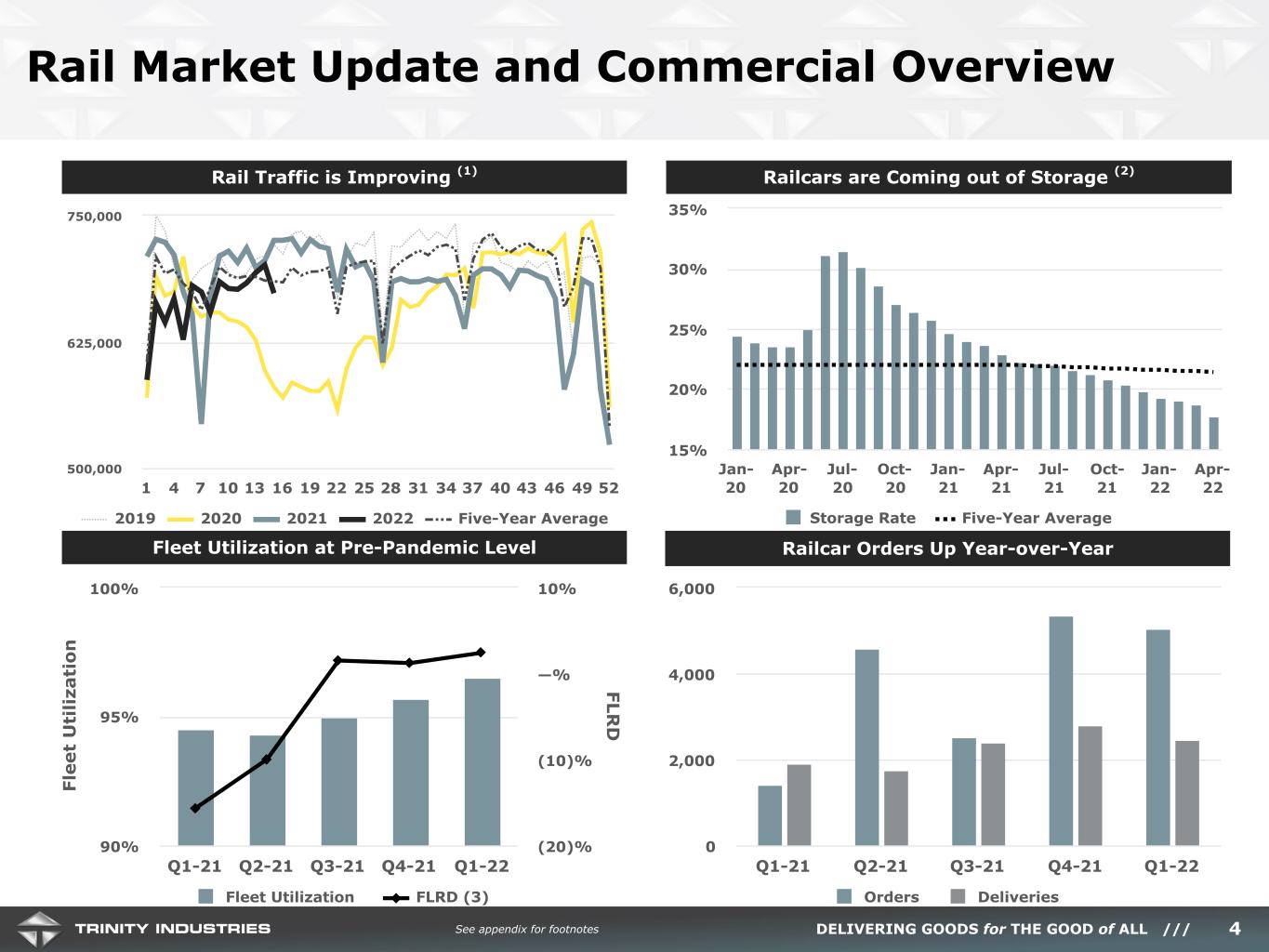
Through the first quarter, we saw continued improvement in demand, which is great, but the rail industry has had difficulty serving that demand. Railroads have been very open about their struggles retaining and hiring labor to scale with the increase in freight demand. Their struggles created a disconnect between weekly carload measures and true freight rail transportation demand. We believe that demand for freight rail transportation is greater than the rail traffic measures would suggest. This disconnect is most evident in the fact that although year-to-date North American rail volumes are down year-over-year, the number of railcars in storage continues to decline. This decline has been steady since the summer of 2020. The downward trend in railcar storage is a function of more demand from shippers to move product, increased scrapping, and slower train speeds. The railroads indicate they are working to improve efficiency and expect to resolve these issues later this year. Improved efficiency is good for traffic growth long-term.
As I mentioned a moment ago, our TrinityRail fleet utilization improved in the quarter to 96.5% as we placed more railcars in service. This was also aided by momentum in our sustainable railcar conversion program. To date, we have converted 1,095 railcars. Remember, these are railcars that would otherwise be under-utilized or scrapped but are instead converted or upgraded to better meet changing market demands and drive higher returns on our invested capital.
2
Also on lease fleet demand, our FLRD was 2.4% in the quarter, the third consecutive positive quarter, giving us momentum into the revenue tailwind for renewing railcar lease rates.
Railcar orders and deliveries are both up year-over-year as well. In the quarter, our Rail Products Group received orders for 5,055 railcars and delivered 2,470 railcars. The market demand continues to be led by freight cars, and in the first quarter, we saw replacement demand for box cars to serve, predominantly, the paper and food markets. As our order book for 2022 deliveries is close to full, we are now taking orders into 2023.
Deliveries are still being impacted by supply chain disruptions, but we did see on-time deliveries improve steadily through the first quarter due to some easing in pandemic related absenteeism, as well as better internal handling of our inventory and supply chain. We expect to end 2022 with daily railcar production basically doubling from where we started the year; again, another very tangible sign of strong market demand.
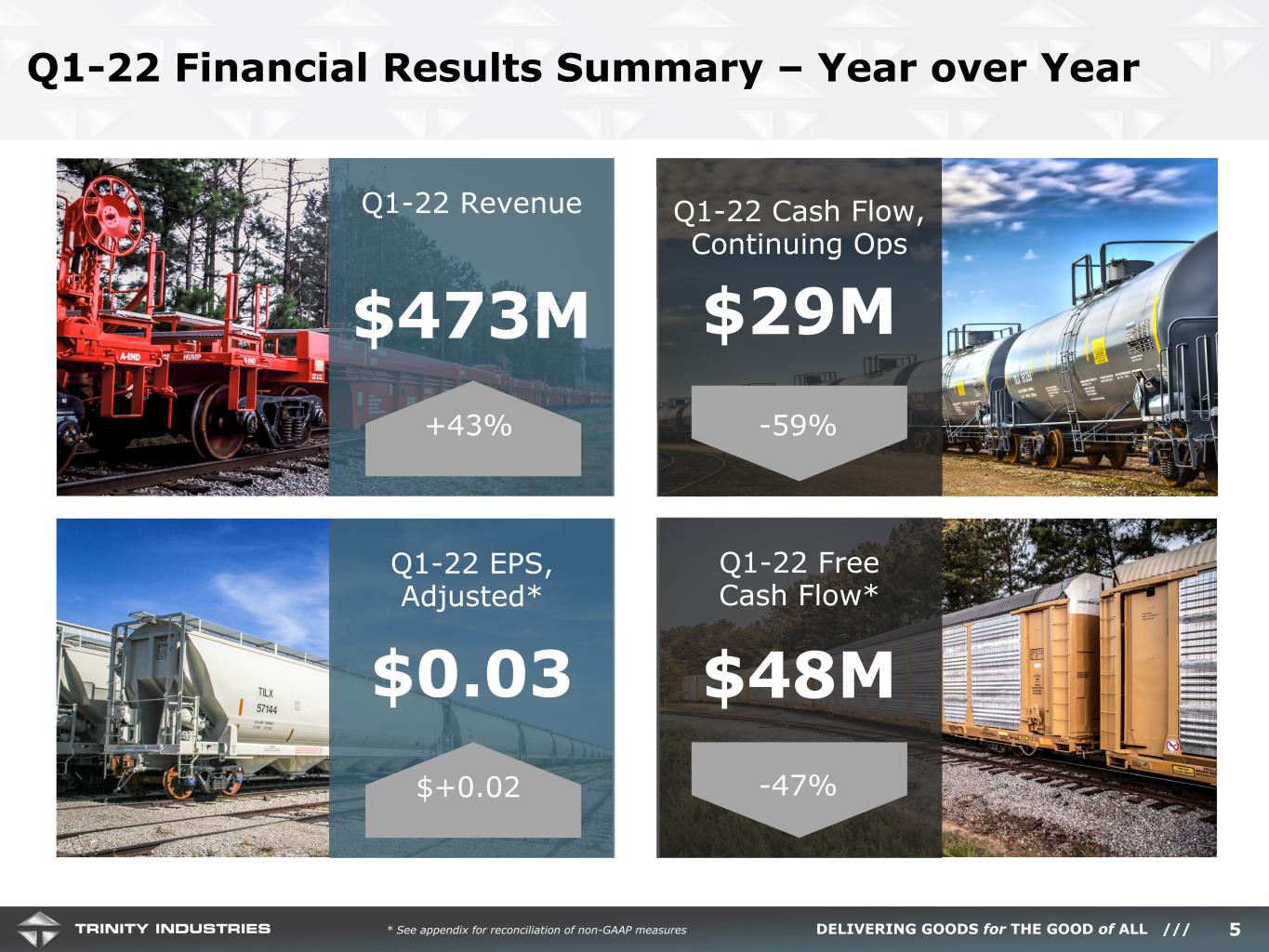
Turning to Slide 5, Eric will go into more detail on our financial highlights, but I’d like to just note a few metrics. Our Q1 2022 revenue of $473 million is up 43% from Q1 2021 driven by the strong external deliveries in the quarter. Our GAAP EPS was $0.09 and includes another insurance gain from the Cartersville tornado that benefited the Rail Products segment. Excluding that gain, our adjusted EPS from continuing operations was $0.03.
Our cash flow from continuing operations was $29 million in the quarter and free cash flow was $48 million, both impacted by working capital growth due to manufacturing volume increases and ongoing supply chain inefficiencies.
We believe our business is well prepared to handle these current headwinds of supply chain disruptions, high input costs, and freight surcharges, but we are not immune to their effects. We are managing these challenges, and this is especially apparent in our working capital growth. Our mitigation efforts include intentionally building up inventory to dampen the effect of supply chain unreliability.
Now moving to Slide 6 and a discussion on our business segments.
In our leasing business, our revenues are up slightly quarter over quarter but have remained pretty flat over the last year as our utilization is improving, while the overall size of the lease fleet has decreased slightly. Lease rates are down slightly on average due to the mix of the fleet and the timing of fleet renewals. As a reminder, our average remaining lease term is about three years, so while renewals and renewal rates are positive, it takes time to see this flow through the results.
3
Our operating margins in the leasing segment were challenged this quarter due to a few factors. We saw an increase in the cost and volume of maintenance activities. Additionally, as we have stated before, the sustainable railcar conversion requires accelerated depreciation on donor railcars. The railcars that are the best candidates for conversion are younger railcars, so the impact of the accelerated depreciation can meaningfully reduce operating margins in the near-term. However, we continue to believe this program is a worthwhile investment in future benefit as the railcars drive more profitability to the fleet.
Moving to Rail Products, quarterly revenue was down sequentially due to the timing of deliveries but still reflects substantial growth and improving fundamentals year-over-year. Looking forward, our orders taken in the first quarter were strong and reflected growth from both a revenue and a margin perspective.
Operating margin in the segment was 0.2%, but includes a gain of $6.4 million from insurance proceeds from the Cartersville tornado. We have removed this gain when calculating adjusted EPS but, as a point of reference, Rail Products margin would have been a negative 1.4% excluding this gain.
Operating margins in the Rail Products Group remain challenged. As I mentioned on our call in February, in the first half of the year, we are delivering railcars that were ordered at the bottom of the cycle, including some fixed price contracts, which have been negatively impacted by high steel and raw material prices. The orders we are taking today, and the orders we will be delivering in the back half of 2022, reflect much stronger pricing, and when those orders start to deliver, we expect to see a meaningful step change in our margins in the segment. In addition to the input cost inflation, margins in the segment were also impacted due to a higher level of production line changeovers.
Additionally, our maintenance services business struggled in the quarter, largely due to very high absenteeism in January due to the omicron wave leading to operating inefficiencies. As so many other companies have mentioned, omicron was a meaningful disruption to our business in Q1 but quickly subsided.
We have previously talked about difficulties in hiring and retention, specifically in the United States. We are making changes to our compensation and benefits to stay competitive in the marketplace. While early, we are starting to see improvement.
Moving to Slide 7, I wanted to highlight a few improvements on our strategic initiatives. Our LTV in the quarter of 63.8% is within our target range of 60% to 65%. We are in year 2 of the 3-year plan we laid
4
out at our Investor Day in 2020 and think we are well-positioned to reach the goals we presented to you then, including a mid-teen Pre-Tax ROE goal.
And now I’ll turn the call to Eric to go into more detail on our financial results and our guidance for the rest of the year.
Eric R. Marchetto,
Executive Vice President and Chief Financial Officer
Thank you, Jean – and good morning everyone.
There are a few things I wanted to point out before talking about the quarter’s results.
First, in 2020, we introduced the Future Lease Rate Differential, or “FLRD.” This metric calculates the implied change in revenue for railcar leases expiring over the next four quarters assuming they were renewed at the current transacted lease rate for each railcar type. We have refined the way we aggregate the data to better correlate with actual revenues and have adjusted the FLRD to account for this change in prior periods as you will see on the trend line on Slide 4. The goal of this metric is the same, and we view it as a good indicator of the direction of our future leasing revenue.
As we previously announced, we priced a $245 million asset backed securitization that is expected to close tomorrow. The debt is backed by a discrete pool of railcar assets that TILC will continue to own and manage. This financing is critical to our ongoing balance sheet management as the majority of the railcars that will serve as collateral for this debt will come from our warehouse facility, freeing up more availability. At an interest rate of 4.55%, it is clear that we are in a different financing environment than last year, but we were very pleased with investor interest in our securitization program. As we move forward, we will evaluate the most attractive financing structures for our capital needs.
Now please turn to Slide 8 with highlights from our financial statements, starting with the income statement.
Total revenues of $473 million in the quarter were relatively flat sequentially and up significantly from the first quarter 2021. The year-over-year increase is driven by increased Rail Products deliveries. Our first quarter GAAP EPS from continuing operations was $0.09, but adjusting for the Cartersville gain previously mentioned, our adjusted EPS was $0.03. We also benefited in the quarter from a gain of $11 million that came from railcar portfolio sales and a gain of $7 million on the sale of a non-operating property. Railcar portfolio sales are a normal part of our business, and you can expect to see them periodically.
5
I also wanted to briefly talk about our results in discontinued operations, which you will see in our 10-Q that we will file later today. In the quarter, we recorded additional legal and transaction costs incurred in the period related to the highway products business that we sold in the fourth quarter of 2021.
Moving to the cash flow statement, cash flow from continuing operations was $29 million, and free cash flow after investments and dividends was $48 million. Our cash flow was negatively impacted in the quarter by increases in working capital requirements and continued supply chain issues. As operating conditions normalize, we expect to see cash flow improve significantly.
We paid $19 million in dividends in the quarter. As a reminder, we are unable to buy back any additional shares until the accelerated share repurchase program is complete, which we expect by the third quarter. Our current share repurchase authorization has $73 million remaining and expires at the end of the year.
Moving to Slide 9, we remain diligent in optimizing our balance sheet and have liquidity of $718 million as of March 31st. As you can see from our reported results, we have benefited from lower interest expense resulting from our previous financings. Having fixed approximately 75% of our debt at rates that are attractive relative to the current market, we believe our debt profile and maturity schedule will help dampen the impact of the current rising rate environment.
I’d like to reinforce the guidance we gave on our last call summarized on Slide 10. We are leaving our guidance unchanged, as our first quarter results are in line with expectations. As Jean mentioned, our 2022 forecast is significantly weighted in the second half of the year.
For the full year, we see industry railcar deliveries to be between 40,000 and 50,000 railcars. Recent order and inquiry activity suggest virtually all of the deliveries are in the industry backlog. It’s also worth noting once again these delivery numbers do not take railcar conversions into account.
Our long-term commitment to disciplined investment in the fleet remains, and we are anticipating net fleet investment of $450 million to $550 million in the year depending on the timing of deliveries. Embedded in this number are secondary market purchases, which we are anticipating to be meaningful this year. As we think about our three year fleet investment targets, we are balancing our fleet investment in a period of increased demand for new railcar leases with a very active secondary market. We will continue to allocate capital to generate long-term shareholder value.
We expect manufacturing and general capital expenditures of $35 million to $45 million, which will be primarily related to investments in safety, efficiency, and automation.
6
And finally, we expect adjusted earnings per diluted share from continuing operations of $0.85 to $1.05 for the full year, excluding any one-time items like the Cartersville gain this quarter. As we move into the second half of the year, we will see substantial growth in our business, and we are confident that we have the initiatives in place to enable us to overcome the current headwinds in our business.
As Jean mentioned, our rate of new railcar production will increase significantly through the year based on the visibility from the orders we have booked in the last few months, and we expect that to be evident in higher revenues. We expect to exit the year with mid to high single digit margins in Rail Products, hitting the goal we introduced at our Investor Day.
We expect similar trends in leasing, with higher lease rates driving up revenue in the segment and normalization of maintenance costs driving up margins in the group. We are seeing increased interest in utilizing existing railcars due to the rise in prices of new railcars. Given higher demand, we are able to raise the rates on these older railcars that have a lower cost basis and thus improve our return on equity.
In closing, Trinity has greater near-term visibility, and this allows us to have confidence in the Company’s ability to achieve our guidance for the year, as well as our long-term return goals. We look forward to sharing our progress with you.
And now, operator, we are ready for our first question.
E. Jean Savage
Chief Executive Officer and President
Thank you everyone for joining us this morning.
The excitement for the second half of the year is high. As we shared with you today, we look around our business and see improving metrics and data that forecast higher returns and earnings later in the year. We look forward to seeing our hard work pay off and reporting those positive results with you. Thank you for your support of Trinity, and please reach out to Leigh Anne with any further questions.
7

DELIVERING GOODS for THE GOOD of ALL TRINITY INDUSTRIES, INC. Investor Contact: TrinityInvestorRelations@trin.net Website: www.trin.net Q1 2022 – Earnings Conference Call Supplemental Materials April 27, 2022 – based on financial results as of March 31, 2022 Exhibit 99.3
DELIVERING GOODS for THE GOOD of ALL /// 2 Some statements in this presentation, which are not historical facts, are “forward-looking statements” as defined by the Private Securities Litigation Reform Act of 1995. Forward-looking statements include statements about Trinity's estimates, expectations, beliefs, intentions or strategies for the future, and the assumptions underlying these forward-looking statements, including, but not limited to, future financial and operating performance, future opportunities and any other statements regarding events or developments that Trinity believes or anticipates will or may occur in the future, including the potential financial and operational impacts of the COVID-19 pandemic. Trinity uses the words “anticipates,” “assumes,” “believes,” “estimates,” “expects,” “intends,” “forecasts,” “may,” “will,” “should,” “guidance,” “projected,” “outlook,” and similar expressions to identify these forward-looking statements. Forward-looking statements speak only as of the date of this release, and Trinity expressly disclaims any obligation or undertaking to disseminate any updates or revisions to any forward-looking statement contained herein to reflect any change in Trinity’s expectations with regard thereto or any change in events, conditions or circumstances on which any such statement is based, except as required by federal securities laws. Forward-looking statements involve risks and uncertainties that could cause actual results to differ materially from historical experience or our present expectations, including but not limited to risks and uncertainties regarding economic, competitive, governmental, and technological factors affecting Trinity’s operations, markets, products, services and prices, and such forward-looking statements are not guarantees of future performance. For a discussion of such risks and uncertainties, which could cause actual results to differ from those contained in the forward-looking statements, see “Risk Factors” and “Forward-Looking Statements” in Trinity’s Annual Report on Form 10-K for the most recent fiscal year, as may be revised and updated by Trinity’s Quarterly Reports on Form 10-Q, and Trinity’s Current Reports on Form 8-K. Forward Looking Statements
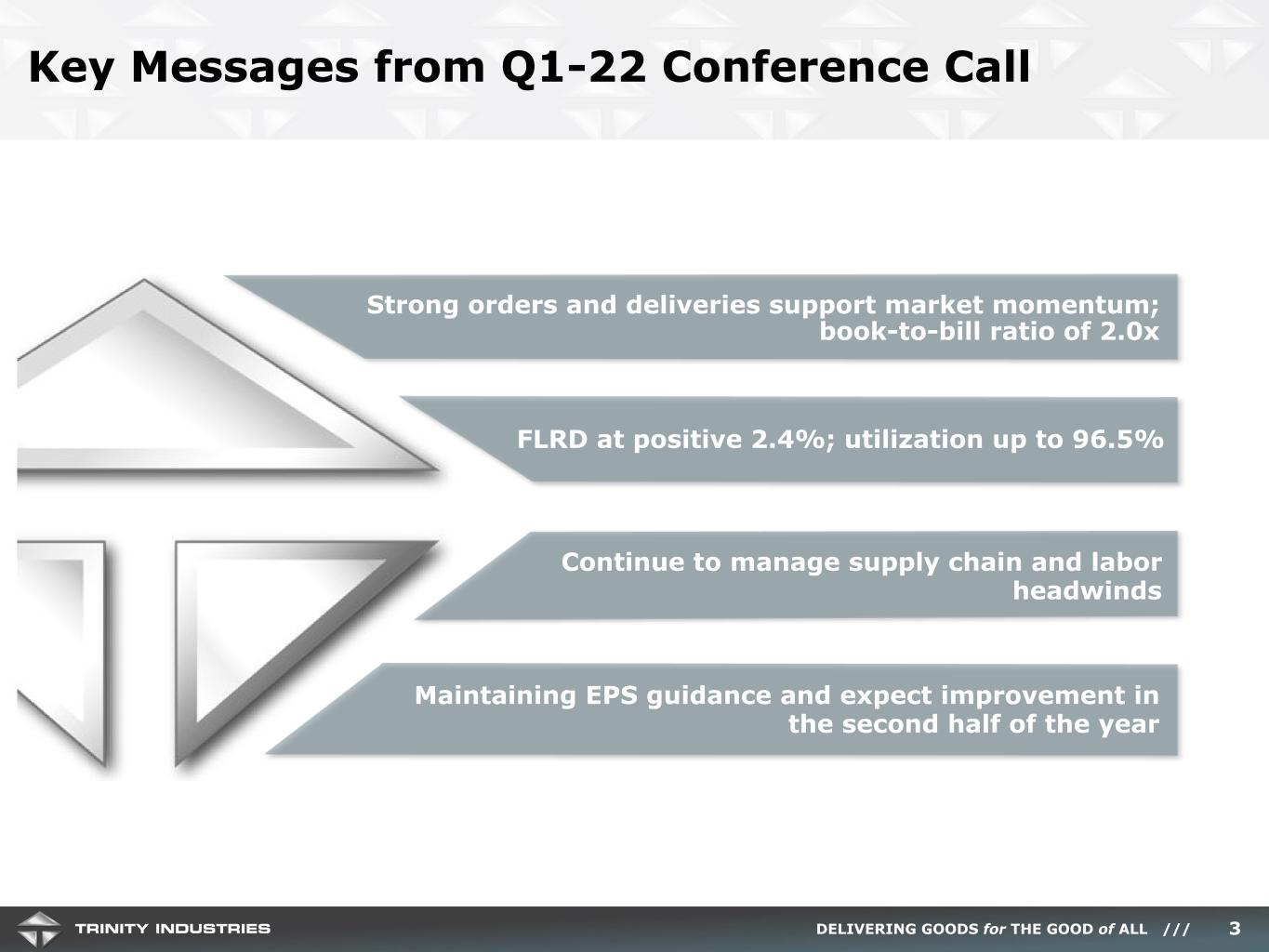
DELIVERING GOODS for THE GOOD of ALL /// Key Messages from Q1-22 Conference Call 3 Strong orders and deliveries support market momentum; book-to-bill ratio of 2.0x FLRD at positive 2.4%; utilization up to 96.5% Continue to manage supply chain and labor headwinds Maintaining EPS guidance and expect improvement in the second half of the year
DELIVERING GOODS for THE GOOD of ALL /// Rail Market Update and Commercial Overview 4 Rail Traffic is Improving (1) Railcars are Coming out of Storage (2) Fleet Utilization at Pre-Pandemic Level Railcar Orders Up Year-over-Year Fl ee t U ti liz at io n FLR D Fleet Utilization FLRD (3) Q1-21 Q2-21 Q3-21 Q4-21 Q1-22 90% 95% 100% (20)% (10)% —% 10% Orders Deliveries Q1-21 Q2-21 Q3-21 Q4-21 Q1-22 0 2,000 4,000 6,000 See appendix for footnotes 2019 2020 2021 2022 Five-Year Average 1 4 7 10 13 16 19 22 25 28 31 34 37 40 43 46 49 52 500,000 625,000 750,000 Storage Rate Five-Year Average Jan- 20 Apr- 20 Jul- 20 Oct- 20 Jan- 21 Apr- 21 Jul- 21 Oct- 21 Jan- 22 Apr- 22 15% 20% 25% 30% 35%
DELIVERING GOODS for THE GOOD of ALL /// Q1-22 Financial Results Summary – Year over Year 5 Q1-22 Revenue $473M Q1-22 Cash Flow, Continuing Ops $29M Q1-22 EPS, Adjusted* $0.03 Q1-22 Free Cash Flow* $48M * See appendix for reconciliation of non-GAAP measures $+0.02 +43% -59% -47%
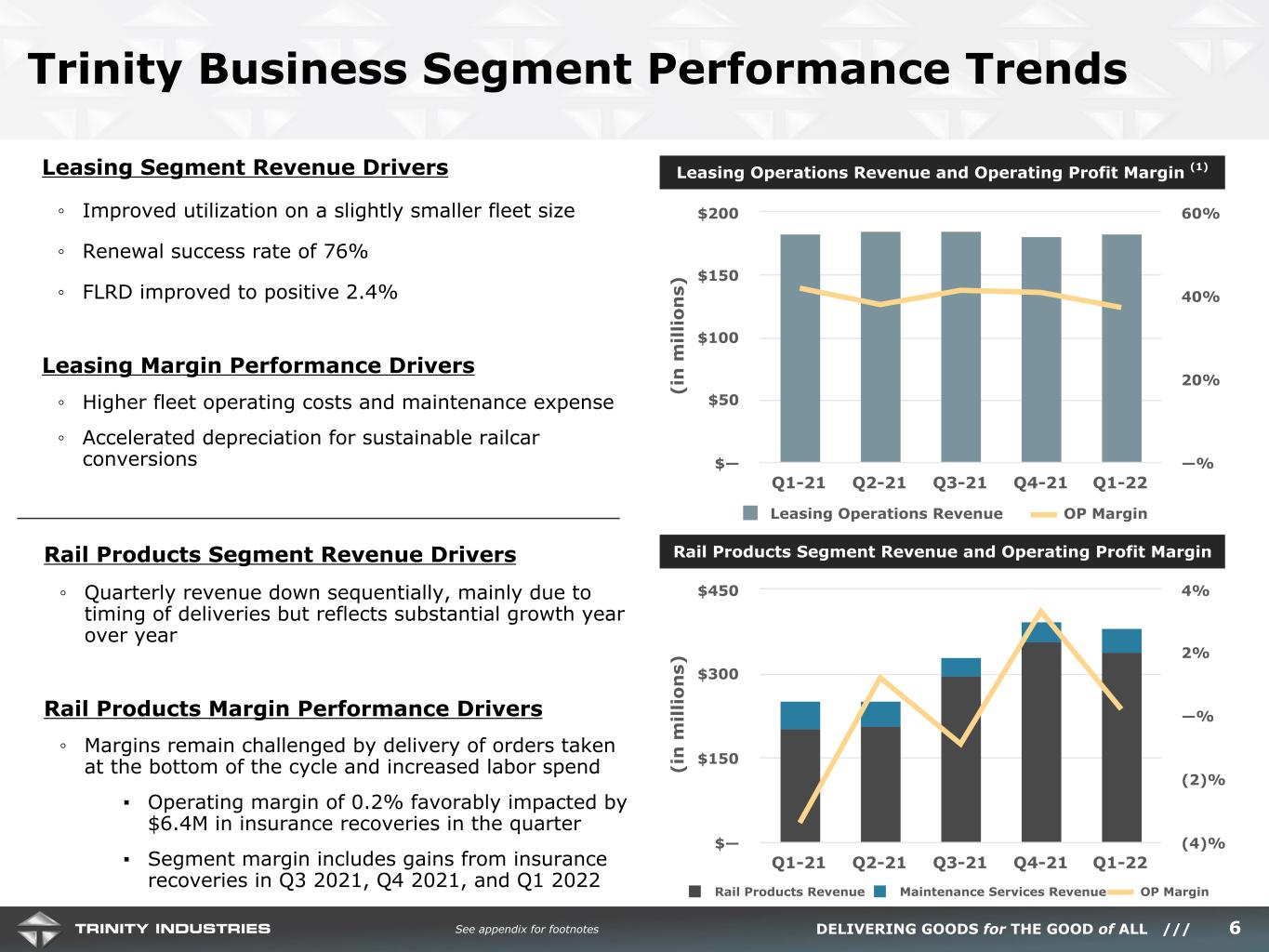
DELIVERING GOODS for THE GOOD of ALL /// Trinity Business Segment Performance Trends 6 Rail Products Segment Revenue Drivers ◦ Quarterly revenue down sequentially, mainly due to timing of deliveries but reflects substantial growth year over year Rail Products Margin Performance Drivers ◦ Margins remain challenged by delivery of orders taken at the bottom of the cycle and increased labor spend ▪ Operating margin of 0.2% favorably impacted by $6.4M in insurance recoveries in the quarter ▪ Segment margin includes gains from insurance recoveries in Q3 2021, Q4 2021, and Q1 2022 Leasing Operations Revenue and Operating Profit Margin (1) Rail Products Segment Revenue and Operating Profit Margin See appendix for footnotes (i n m ill io n s) Leasing Operations Revenue OP Margin Q1-21 Q2-21 Q3-21 Q4-21 Q1-22 $— $50 $100 $150 $200 —% 20% 40% 60% (i n m ill io n s) Rail Products Revenue Maintenance Services Revenue OP Margin Q1-21 Q2-21 Q3-21 Q4-21 Q1-22 $— $150 $300 $450 (4)% (2)% —% 2% 4% Leasing Segment Revenue Drivers ◦ Improved utilization on a slightly smaller fleet size ◦ Renewal success rate of 76% ◦ FLRD improved to positive 2.4% Leasing Margin Performance Drivers ◦ Higher fleet operating costs and maintenance expense ◦ Accelerated depreciation for sustainable railcar conversions
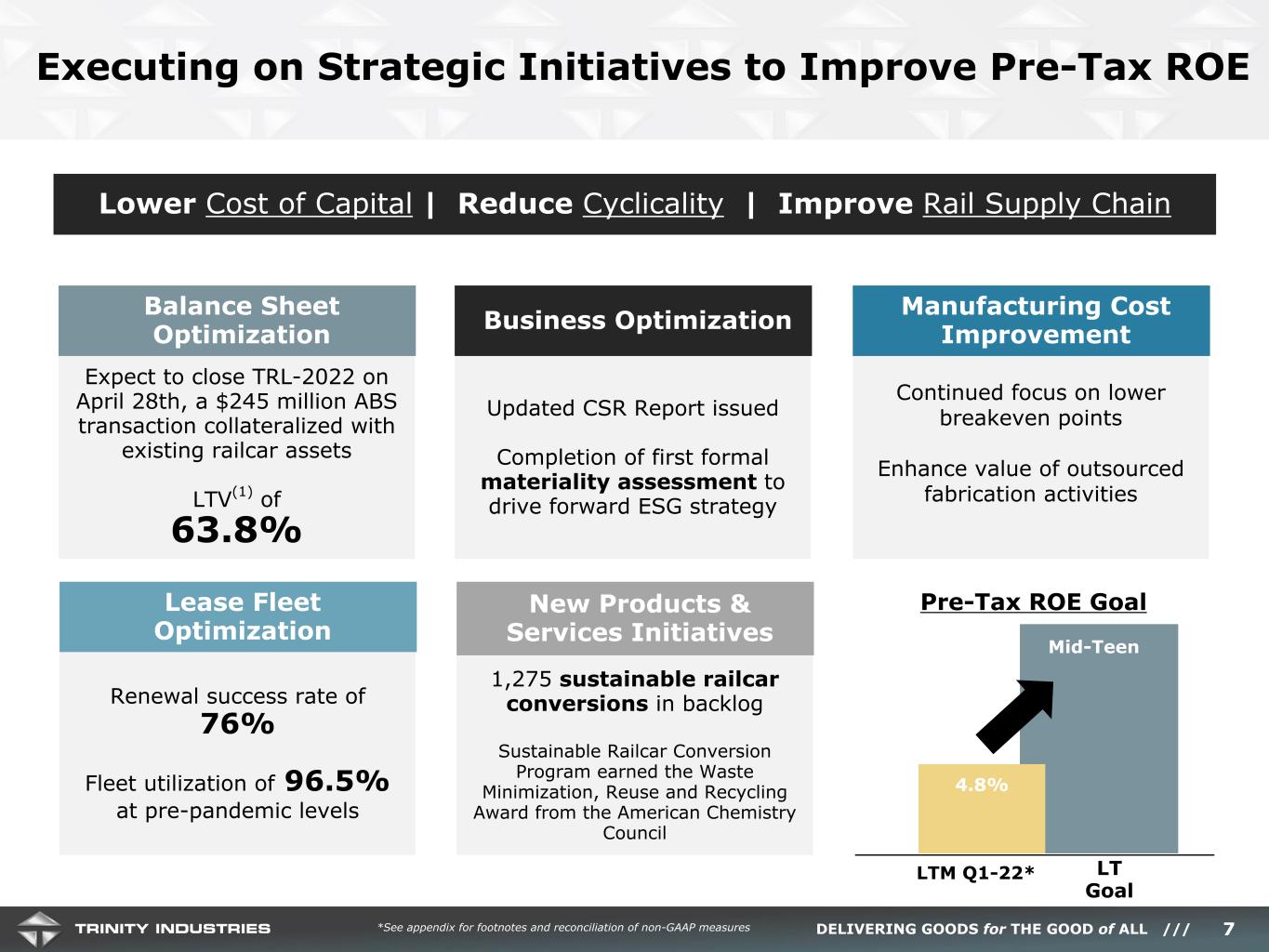
DELIVERING GOODS for THE GOOD of ALL /// Executing on Strategic Initiatives to Improve Pre-Tax ROE 7 Expect to close TRL-2022 on April 28th, a $245 million ABS transaction collateralized with existing railcar assets LTV(1) of 63.8% Balance Sheet Optimization 1,275 sustainable railcar conversions in backlog Sustainable Railcar Conversion Program earned the Waste Minimization, Reuse and Recycling Award from the American Chemistry Council New Products & Services Initiatives Continued focus on lower breakeven points Enhance value of outsourced fabrication activities Manufacturing Cost Improvement Updated CSR Report issued Completion of first formal materiality assessment to drive forward ESG strategy Business Optimization Renewal success rate of 76% Fleet utilization of 96.5% at pre-pandemic levels Lease Fleet Optimization *See appendix for footnotes and reconciliation of non-GAAP measures Lower Cost of Capital | Reduce Cyclicality | Improve Rail Supply Chain LTM Q1-22* LT Goal 9.6% 4.8% Mid-Teen Pre-Tax ROE Goal
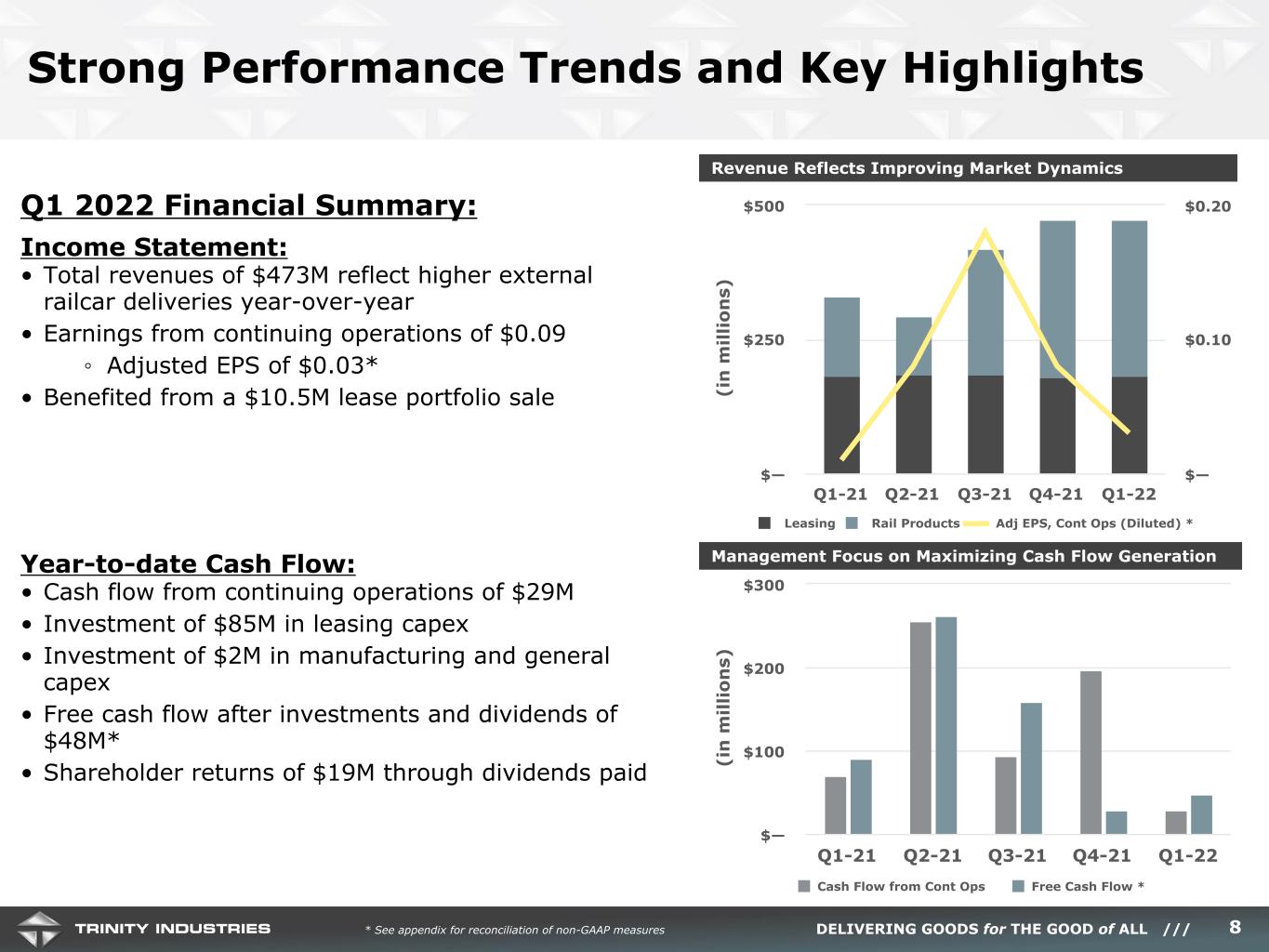
DELIVERING GOODS for THE GOOD of ALL /// Revenue Reflects Improving Market Dynamics Q1 2022 Financial Summary: Income Statement: • Total revenues of $473M reflect higher external railcar deliveries year-over-year • Earnings from continuing operations of $0.09 ◦ Adjusted EPS of $0.03* • Benefited from a $10.5M lease portfolio sale Year-to-date Cash Flow: • Cash flow from continuing operations of $29M • Investment of $85M in leasing capex • Investment of $2M in manufacturing and general capex • Free cash flow after investments and dividends of $48M* • Shareholder returns of $19M through dividends paid Strong Performance Trends and Key Highlights 8 Management Focus on Maximizing Cash Flow Generation * See appendix for reconciliation of non-GAAP measures (i n m ill io n s) Leasing Rail Products Adj EPS, Cont Ops (Diluted) * Q1-21 Q2-21 Q3-21 Q4-21 Q1-22 $— $250 $500 $— $0.10 $0.20 (i n m ill io n s) Cash Flow from Cont Ops Free Cash Flow * Q1-21 Q2-21 Q3-21 Q4-21 Q1-22 $— $100 $200 $300
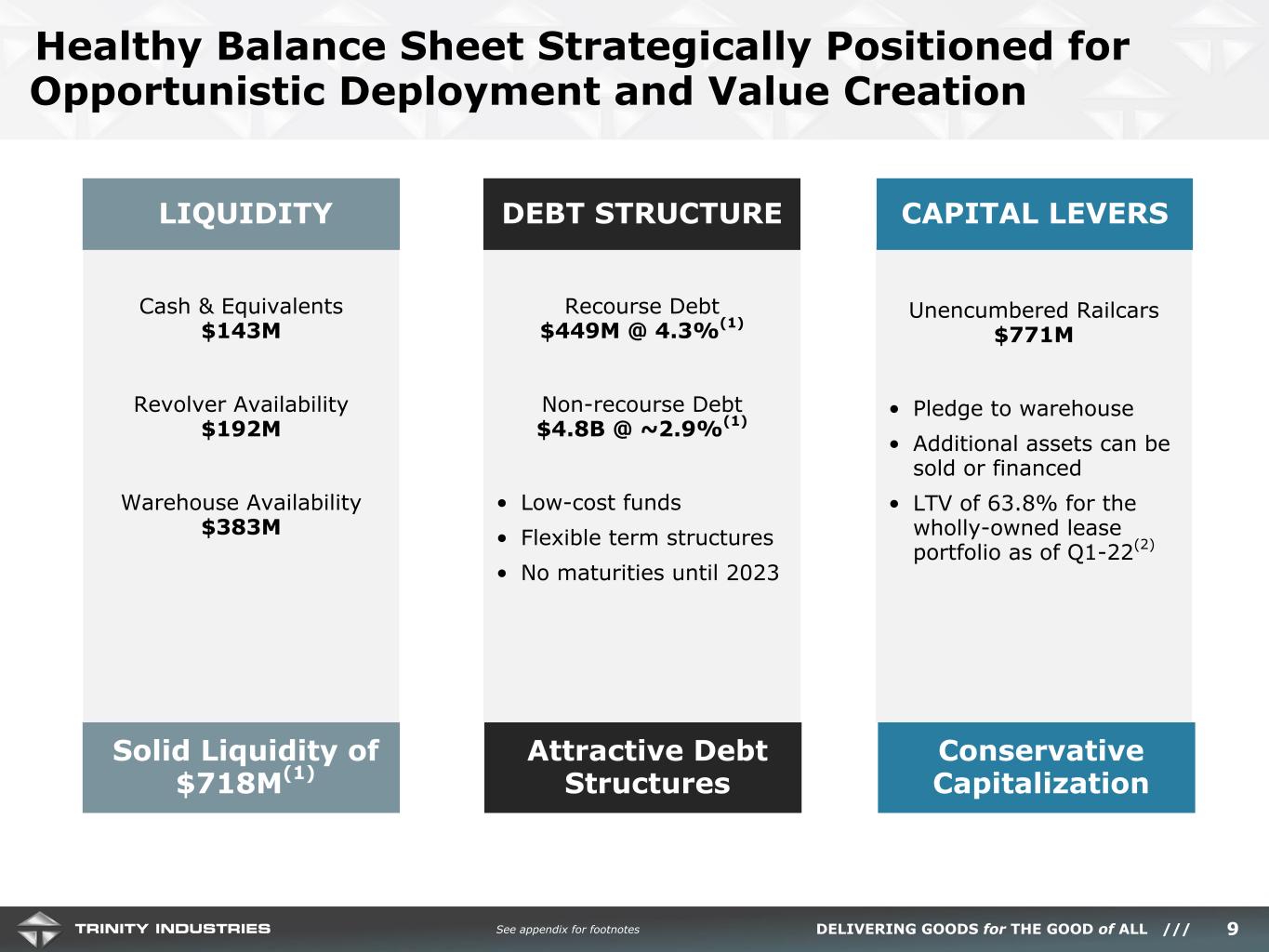
DELIVERING GOODS for THE GOOD of ALL /// 9 Unencumbered Railcars $771M • Pledge to warehouse • Additional assets can be sold or financed • LTV of 63.8% for the wholly-owned lease portfolio as of Q1-22(2) CAPITAL LEVERS Recourse Debt $449M @ 4.3%(1) Non-recourse Debt $4.8B @ ~2.9%(1) • Low-cost funds • Flexible term structures • No maturities until 2023 DEBT STRUCTURE Cash & Equivalents $143M Revolver Availability $192M Warehouse Availability $383M LIQUIDITY Solid Liquidity of $718M(1) Attractive Debt Structures Conservative Capitalization See appendix for footnotes Healthy Balance Sheet Strategically Positioned for Opportunistic Deployment and Value Creation
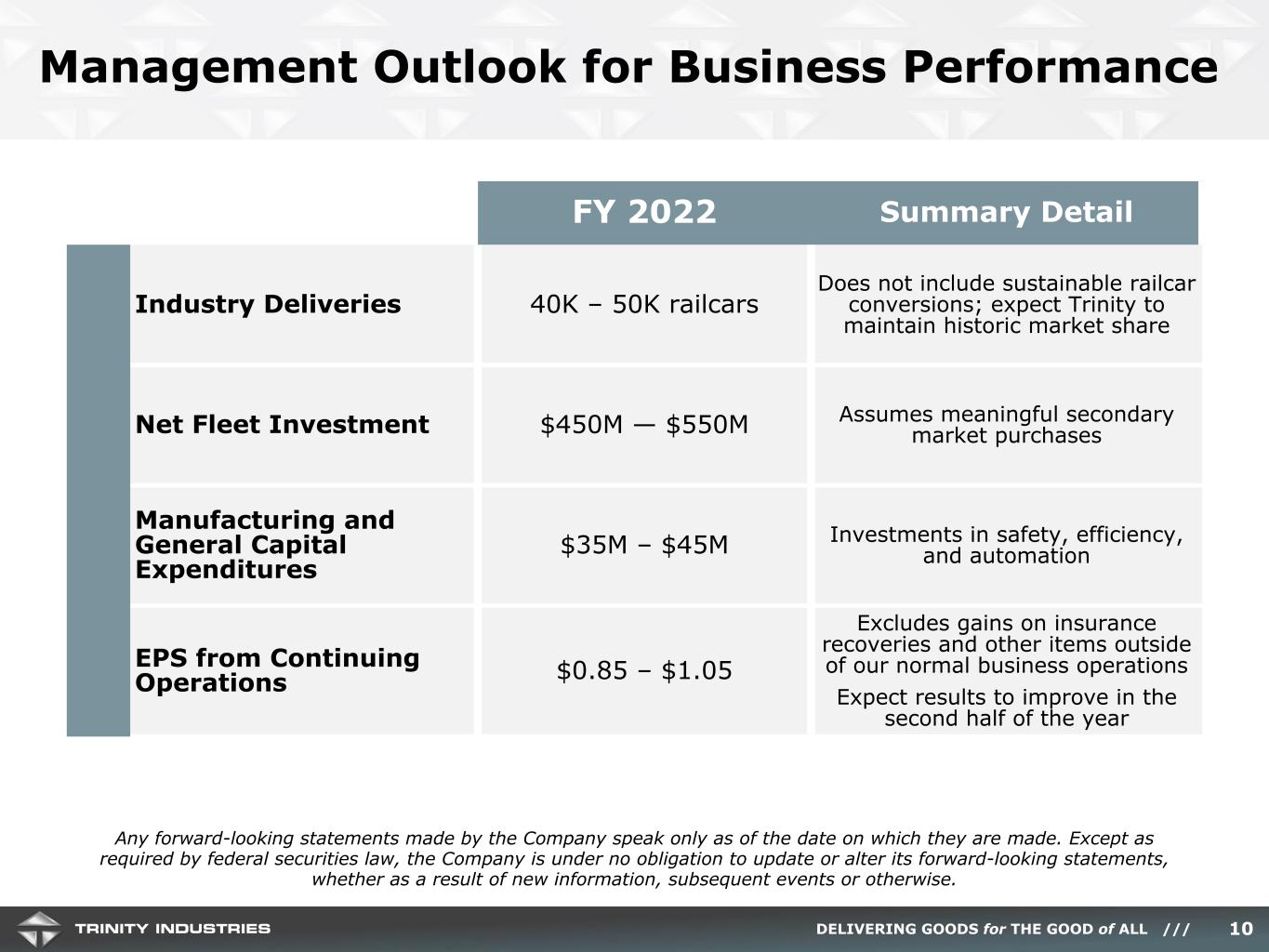
DELIVERING GOODS for THE GOOD of ALL /// Management Outlook for Business Performance 10 C ap it al A llo ca ti on FY 2022 Summary Detail Industry Deliveries 40K – 50K railcars Does not include sustainable railcar conversions; expect Trinity to maintain historic market share Net Fleet Investment $450M — $550M Assumes meaningful secondary market purchases Manufacturing and General Capital Expenditures $35M – $45M Investments in safety, efficiency, and automation EPS from Continuing Operations $0.85 – $1.05 Excludes gains on insurance recoveries and other items outside of our normal business operations Expect results to improve in the second half of the year Any forward-looking statements made by the Company speak only as of the date on which they are made. Except as required by federal securities law, the Company is under no obligation to update or alter its forward-looking statements, whether as a result of new information, subsequent events or otherwise.
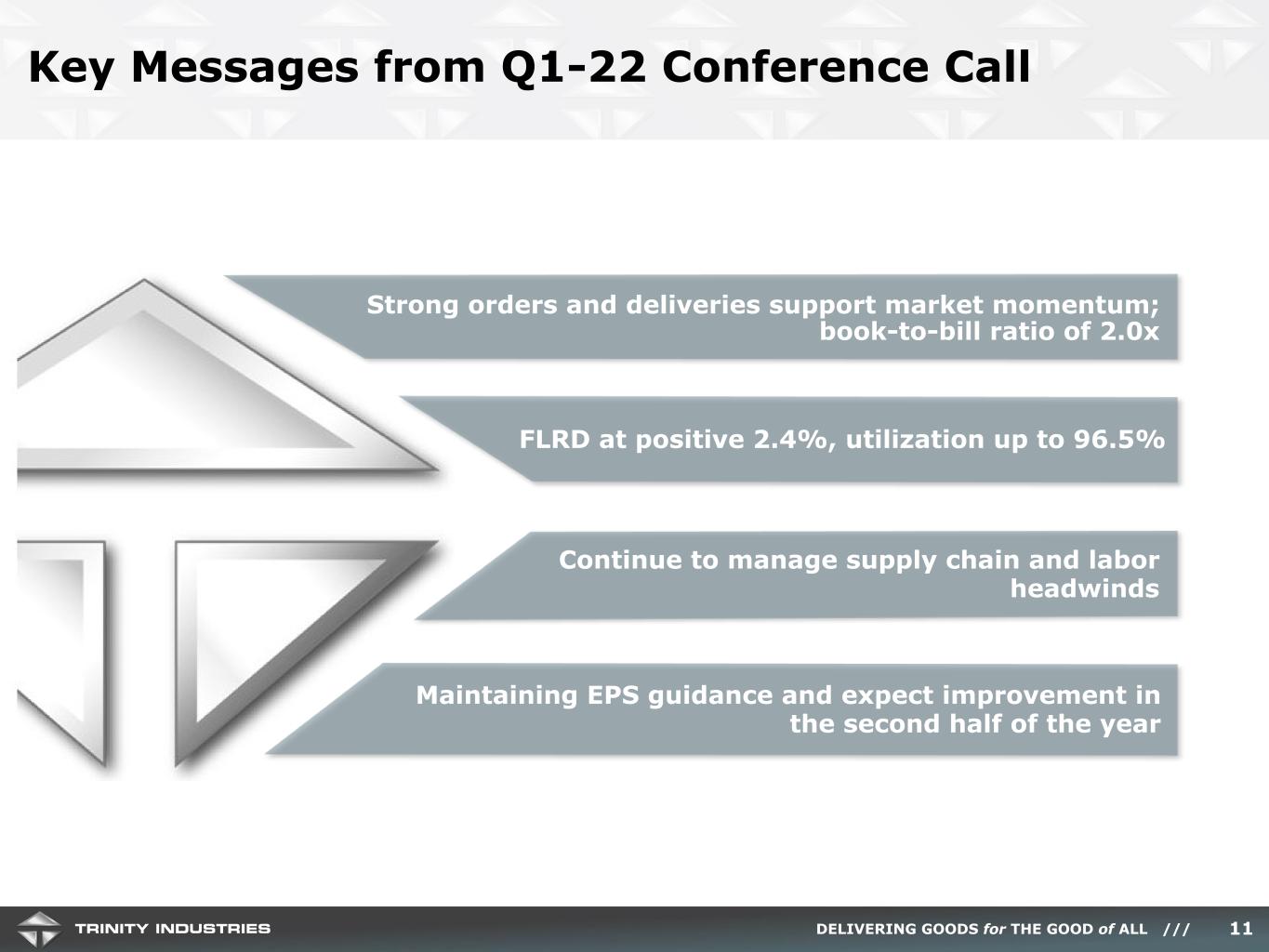
DELIVERING GOODS for THE GOOD of ALL /// Key Messages from Q1-22 Conference Call 11 Strong orders and deliveries support market momentum; book-to-bill ratio of 2.0x FLRD at positive 2.4%, utilization up to 96.5% Continue to manage supply chain and labor headwinds Maintaining EPS guidance and expect improvement in the second half of the year
DELIVERING GOODS for THE GOOD of ALL /// Trinity Q1-22 Earnings Conference Call 12 Q&A
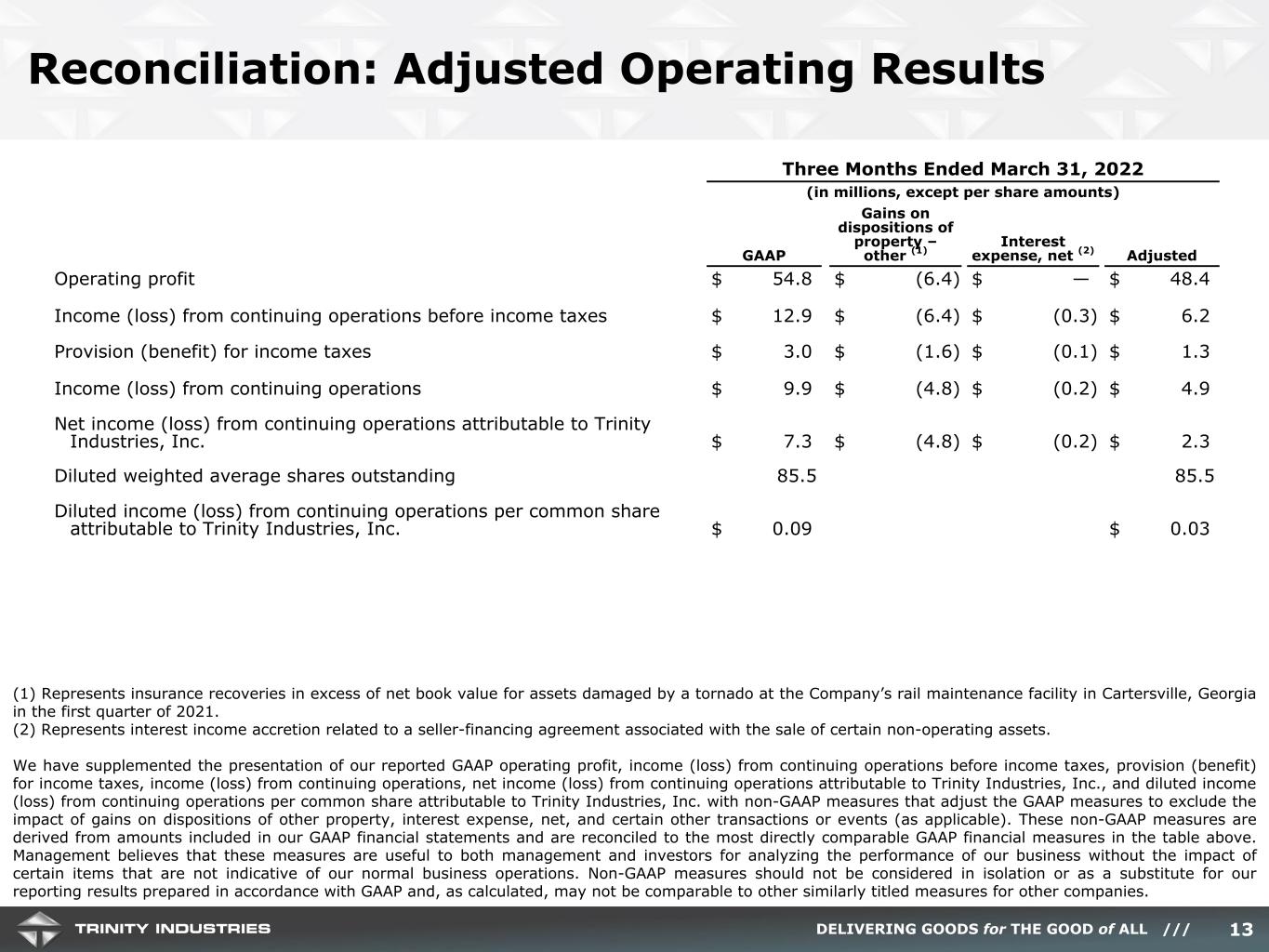
DELIVERING GOODS for THE GOOD of ALL /// Reconciliation: Adjusted Operating Results 13 Three Months Ended March 31, 2022 (in millions, except per share amounts) GAAP Gains on dispositions of property – other (1) Interest expense, net (2) Adjusted Operating profit $ 54.8 $ (6.4) $ — $ 48.4 Income (loss) from continuing operations before income taxes $ 12.9 $ (6.4) $ (0.3) $ 6.2 Provision (benefit) for income taxes $ 3.0 $ (1.6) $ (0.1) $ 1.3 Income (loss) from continuing operations $ 9.9 $ (4.8) $ (0.2) $ 4.9 Net income (loss) from continuing operations attributable to Trinity Industries, Inc. $ 7.3 $ (4.8) $ (0.2) $ 2.3 Diluted weighted average shares outstanding 85.5 85.5 Diluted income (loss) from continuing operations per common share attributable to Trinity Industries, Inc. $ 0.09 $ 0.03 (1) Represents insurance recoveries in excess of net book value for assets damaged by a tornado at the Company’s rail maintenance facility in Cartersville, Georgia in the first quarter of 2021. (2) Represents interest income accretion related to a seller-financing agreement associated with the sale of certain non-operating assets. We have supplemented the presentation of our reported GAAP operating profit, income (loss) from continuing operations before income taxes, provision (benefit) for income taxes, income (loss) from continuing operations, net income (loss) from continuing operations attributable to Trinity Industries, Inc., and diluted income (loss) from continuing operations per common share attributable to Trinity Industries, Inc. with non-GAAP measures that adjust the GAAP measures to exclude the impact of gains on dispositions of other property, interest expense, net, and certain other transactions or events (as applicable). These non-GAAP measures are derived from amounts included in our GAAP financial statements and are reconciled to the most directly comparable GAAP financial measures in the table above. Management believes that these measures are useful to both management and investors for analyzing the performance of our business without the impact of certain items that are not indicative of our normal business operations. Non-GAAP measures should not be considered in isolation or as a substitute for our reporting results prepared in accordance with GAAP and, as calculated, may not be comparable to other similarly titled measures for other companies.
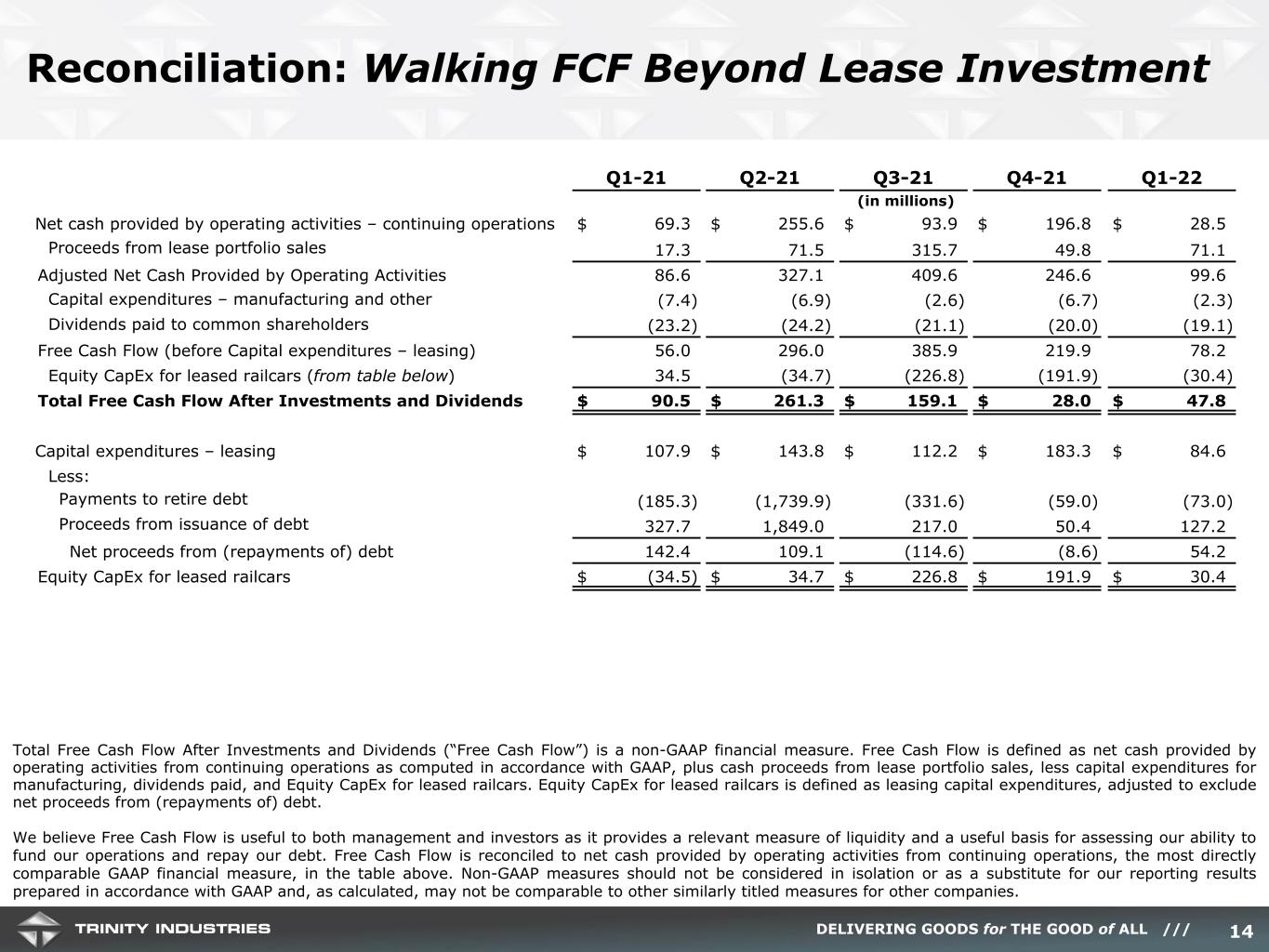
DELIVERING GOODS for THE GOOD of ALL /// Q1-21 Q2-21 Q3-21 Q4-21 Q1-22 (in millions) Net cash provided by operating activities – continuing operations $ 69.3 $ 255.6 $ 93.9 $ 196.8 $ 28.5 Proceeds from lease portfolio sales 17.3 71.5 315.7 49.8 71.1 Adjusted Net Cash Provided by Operating Activities 86.6 327.1 409.6 246.6 99.6 Capital expenditures – manufacturing and other (7.4) (6.9) (2.6) (6.7) (2.3) Dividends paid to common shareholders (23.2) (24.2) (21.1) (20.0) (19.1) Free Cash Flow (before Capital expenditures – leasing) 56.0 296.0 385.9 219.9 78.2 Equity CapEx for leased railcars (from table below) 34.5 (34.7) (226.8) (191.9) (30.4) Total Free Cash Flow After Investments and Dividends $ 90.5 $ 261.3 $ 159.1 $ 28.0 $ 47.8 Capital expenditures – leasing $ 107.9 $ 143.8 $ 112.2 $ 183.3 $ 84.6 Less: Payments to retire debt (185.3) (1,739.9) (331.6) (59.0) (73.0) Proceeds from issuance of debt 327.7 1,849.0 217.0 50.4 127.2 Net proceeds from (repayments of) debt 142.4 109.1 (114.6) (8.6) 54.2 Equity CapEx for leased railcars $ (34.5) $ 34.7 $ 226.8 $ 191.9 $ 30.4 Reconciliation: Walking FCF Beyond Lease Investment 14 Total Free Cash Flow After Investments and Dividends (“Free Cash Flow”) is a non-GAAP financial measure. Free Cash Flow is defined as net cash provided by operating activities from continuing operations as computed in accordance with GAAP, plus cash proceeds from lease portfolio sales, less capital expenditures for manufacturing, dividends paid, and Equity CapEx for leased railcars. Equity CapEx for leased railcars is defined as leasing capital expenditures, adjusted to exclude net proceeds from (repayments of) debt. We believe Free Cash Flow is useful to both management and investors as it provides a relevant measure of liquidity and a useful basis for assessing our ability to fund our operations and repay our debt. Free Cash Flow is reconciled to net cash provided by operating activities from continuing operations, the most directly comparable GAAP financial measure, in the table above. Non-GAAP measures should not be considered in isolation or as a substitute for our reporting results prepared in accordance with GAAP and, as calculated, may not be comparable to other similarly titled measures for other companies.
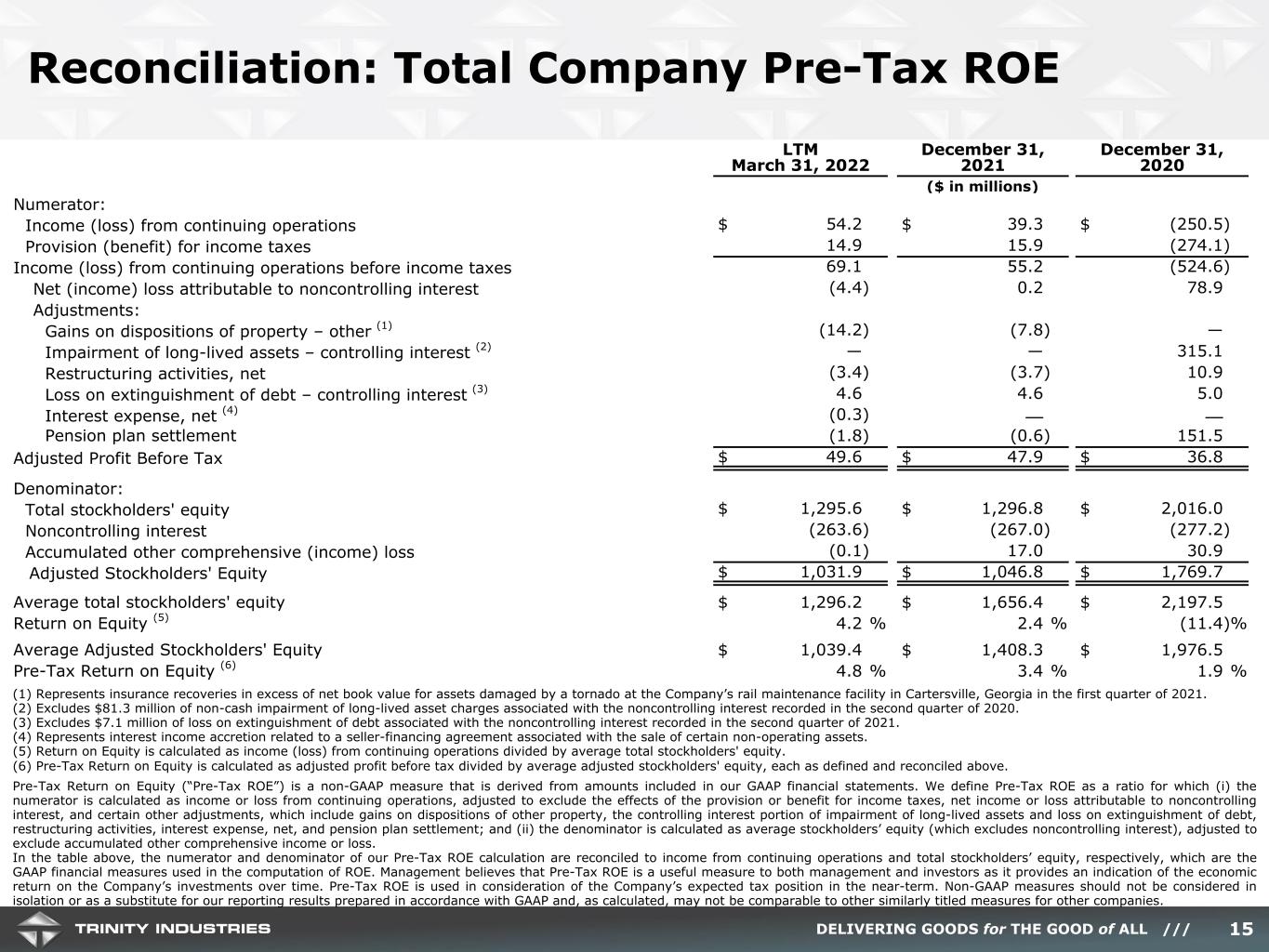
DELIVERING GOODS for THE GOOD of ALL /// Reconciliation: Total Company Pre-Tax ROE 15 (1) Represents insurance recoveries in excess of net book value for assets damaged by a tornado at the Company’s rail maintenance facility in Cartersville, Georgia in the first quarter of 2021. (2) Excludes $81.3 million of non-cash impairment of long-lived asset charges associated with the noncontrolling interest recorded in the second quarter of 2020. (3) Excludes $7.1 million of loss on extinguishment of debt associated with the noncontrolling interest recorded in the second quarter of 2021. (4) Represents interest income accretion related to a seller-financing agreement associated with the sale of certain non-operating assets. (5) Return on Equity is calculated as income (loss) from continuing operations divided by average total stockholders' equity. (6) Pre-Tax Return on Equity is calculated as adjusted profit before tax divided by average adjusted stockholders' equity, each as defined and reconciled above. Pre-Tax Return on Equity (“Pre-Tax ROE”) is a non-GAAP measure that is derived from amounts included in our GAAP financial statements. We define Pre-Tax ROE as a ratio for which (i) the numerator is calculated as income or loss from continuing operations, adjusted to exclude the effects of the provision or benefit for income taxes, net income or loss attributable to noncontrolling interest, and certain other adjustments, which include gains on dispositions of other property, the controlling interest portion of impairment of long-lived assets and loss on extinguishment of debt, restructuring activities, interest expense, net, and pension plan settlement; and (ii) the denominator is calculated as average stockholders’ equity (which excludes noncontrolling interest), adjusted to exclude accumulated other comprehensive income or loss. In the table above, the numerator and denominator of our Pre-Tax ROE calculation are reconciled to income from continuing operations and total stockholders’ equity, respectively, which are the GAAP financial measures used in the computation of ROE. Management believes that Pre-Tax ROE is a useful measure to both management and investors as it provides an indication of the economic return on the Company’s investments over time. Pre-Tax ROE is used in consideration of the Company’s expected tax position in the near-term. Non-GAAP measures should not be considered in isolation or as a substitute for our reporting results prepared in accordance with GAAP and, as calculated, may not be comparable to other similarly titled measures for other companies. LTM March 31, 2022 December 31, 2021 December 31, 2020 ($ in millions) Numerator: Income (loss) from continuing operations $ 54.2 $ 39.3 $ (250.5) Provision (benefit) for income taxes 14.9 15.9 (274.1) Income (loss) from continuing operations before income taxes 69.1 55.2 (524.6) Net (income) loss attributable to noncontrolling interest (4.4) 0.2 78.9 Adjustments: Gains on dispositions of property – other (1) (14.2) (7.8) — Impairment of long-lived assets – controlling interest (2) — — 315.1 Restructuring activities, net (3.4) (3.7) 10.9 Loss on extinguishment of debt – controlling interest (3) 4.6 4.6 5.0 Interest expense, net (4) (0.3) — — Pension plan settlement (1.8) (0.6) 151.5 Adjusted Profit Before Tax $ 49.6 $ 47.9 $ 36.8 Denominator: Total stockholders' equity $ 1,295.6 $ 1,296.8 $ 2,016.0 Noncontrolling interest (263.6) (267.0) (277.2) Accumulated other comprehensive (income) loss (0.1) 17.0 30.9 Adjusted Stockholders' Equity $ 1,031.9 $ 1,046.8 $ 1,769.7 Average total stockholders' equity $ 1,296.2 $ 1,656.4 $ 2,197.5 Return on Equity (5) 4.2 % 2.4 % (11.4) % Average Adjusted Stockholders' Equity $ 1,039.4 $ 1,408.3 $ 1,976.5 Pre-Tax Return on Equity (6) 4.8 % 3.4 % 1.9 %
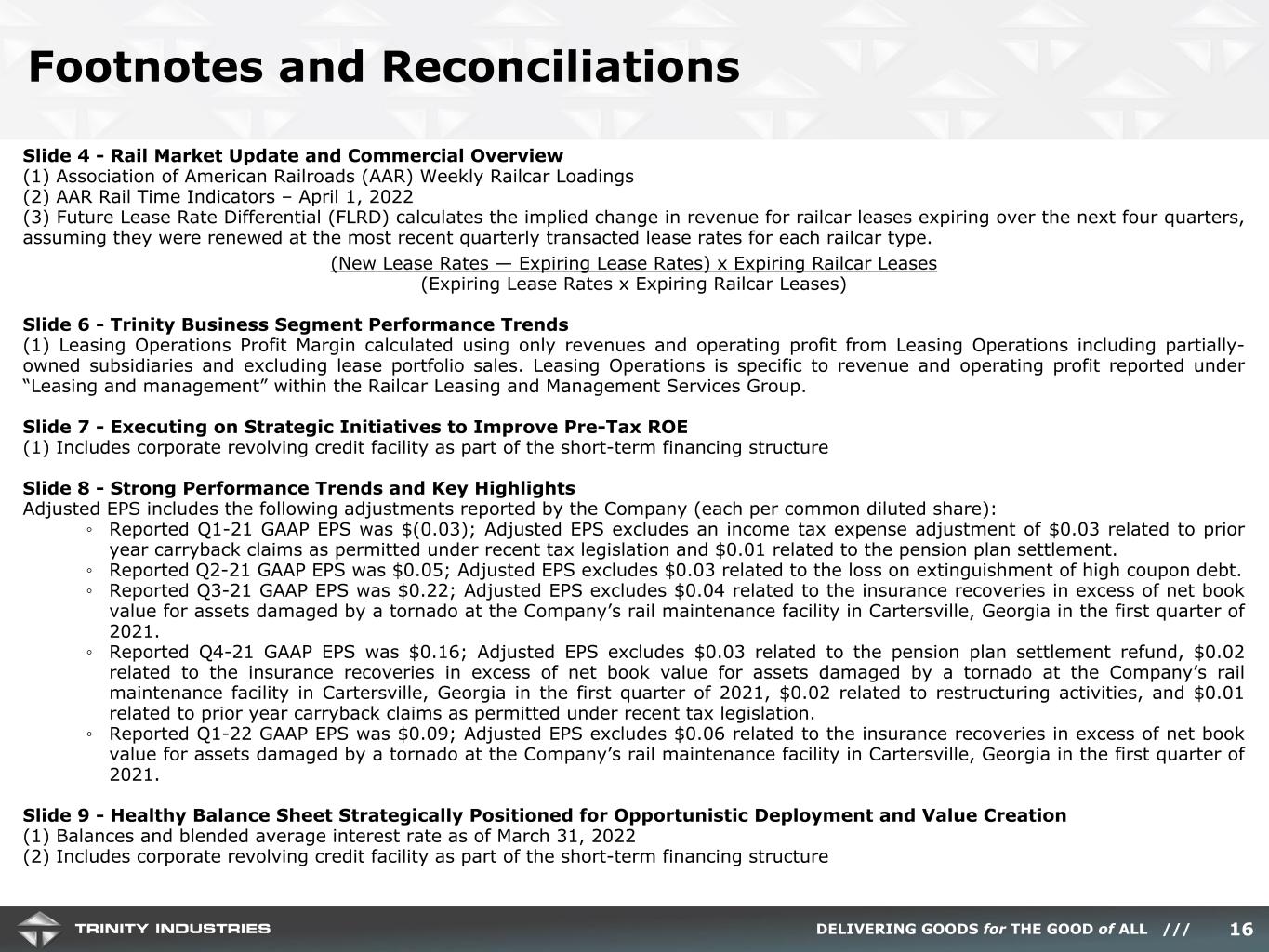
DELIVERING GOODS for THE GOOD of ALL /// Footnotes and Reconciliations 16 Slide 4 - Rail Market Update and Commercial Overview (1) Association of American Railroads (AAR) Weekly Railcar Loadings (2) AAR Rail Time Indicators – April 1, 2022 (3) Future Lease Rate Differential (FLRD) calculates the implied change in revenue for railcar leases expiring over the next four quarters, assuming they were renewed at the most recent quarterly transacted lease rates for each railcar type. (New Lease Rates — Expiring Lease Rates) x Expiring Railcar Leases (Expiring Lease Rates x Expiring Railcar Leases) Slide 6 - Trinity Business Segment Performance Trends (1) Leasing Operations Profit Margin calculated using only revenues and operating profit from Leasing Operations including partially- owned subsidiaries and excluding lease portfolio sales. Leasing Operations is specific to revenue and operating profit reported under “Leasing and management” within the Railcar Leasing and Management Services Group. Slide 7 - Executing on Strategic Initiatives to Improve Pre-Tax ROE (1) Includes corporate revolving credit facility as part of the short-term financing structure Slide 8 - Strong Performance Trends and Key Highlights Adjusted EPS includes the following adjustments reported by the Company (each per common diluted share): ◦ Reported Q1-21 GAAP EPS was $(0.03); Adjusted EPS excludes an income tax expense adjustment of $0.03 related to prior year carryback claims as permitted under recent tax legislation and $0.01 related to the pension plan settlement. ◦ Reported Q2-21 GAAP EPS was $0.05; Adjusted EPS excludes $0.03 related to the loss on extinguishment of high coupon debt. ◦ Reported Q3-21 GAAP EPS was $0.22; Adjusted EPS excludes $0.04 related to the insurance recoveries in excess of net book value for assets damaged by a tornado at the Company’s rail maintenance facility in Cartersville, Georgia in the first quarter of 2021. ◦ Reported Q4-21 GAAP EPS was $0.16; Adjusted EPS excludes $0.03 related to the pension plan settlement refund, $0.02 related to the insurance recoveries in excess of net book value for assets damaged by a tornado at the Company’s rail maintenance facility in Cartersville, Georgia in the first quarter of 2021, $0.02 related to restructuring activities, and $0.01 related to prior year carryback claims as permitted under recent tax legislation. ◦ Reported Q1-22 GAAP EPS was $0.09; Adjusted EPS excludes $0.06 related to the insurance recoveries in excess of net book value for assets damaged by a tornado at the Company’s rail maintenance facility in Cartersville, Georgia in the first quarter of 2021. Slide 9 - Healthy Balance Sheet Strategically Positioned for Opportunistic Deployment and Value Creation (1) Balances and blended average interest rate as of March 31, 2022 (2) Includes corporate revolving credit facility as part of the short-term financing structure