

Research often ends with a website you have to revisit, copy and clean by hand. Web Data Feeds are designed to turn that recurring work into verified data you can use again.
This update leads with Web Data Feeds, followed by a more reliable short-interest forecast, an explanation of the recent service disruption and a Pro pricing change that does not affect existing subscriptions.
Here is what changed.
Web Data Feeds for the data that does not come in an API
Web Data Feeds turn a public website into a recurring stored dataset.
Describe the rows and fields you need, give Equibles the starting page, and choose a cadence from hourly to monthly. The system builds a bounded browsing plan, tests it against the live source, extracts only source-stated values and runs an independent verification pass before a result is stored. Each result keeps its source links, and a failed verification does not silently become data.
Pro accounts can keep up to five feeds. The portal owns creation, scheduling, repair and deletion; ALVIS, the MCP connection and the REST API read the verified results without rerunning a website on demand.
We are still improving workflows behind authentication, especially sources that use two-factor authentication. Site connections keep supported credentials outside prompts, feed plans and returned results. The browser is restricted to the approved source, and authentication support will continue to expand carefully.
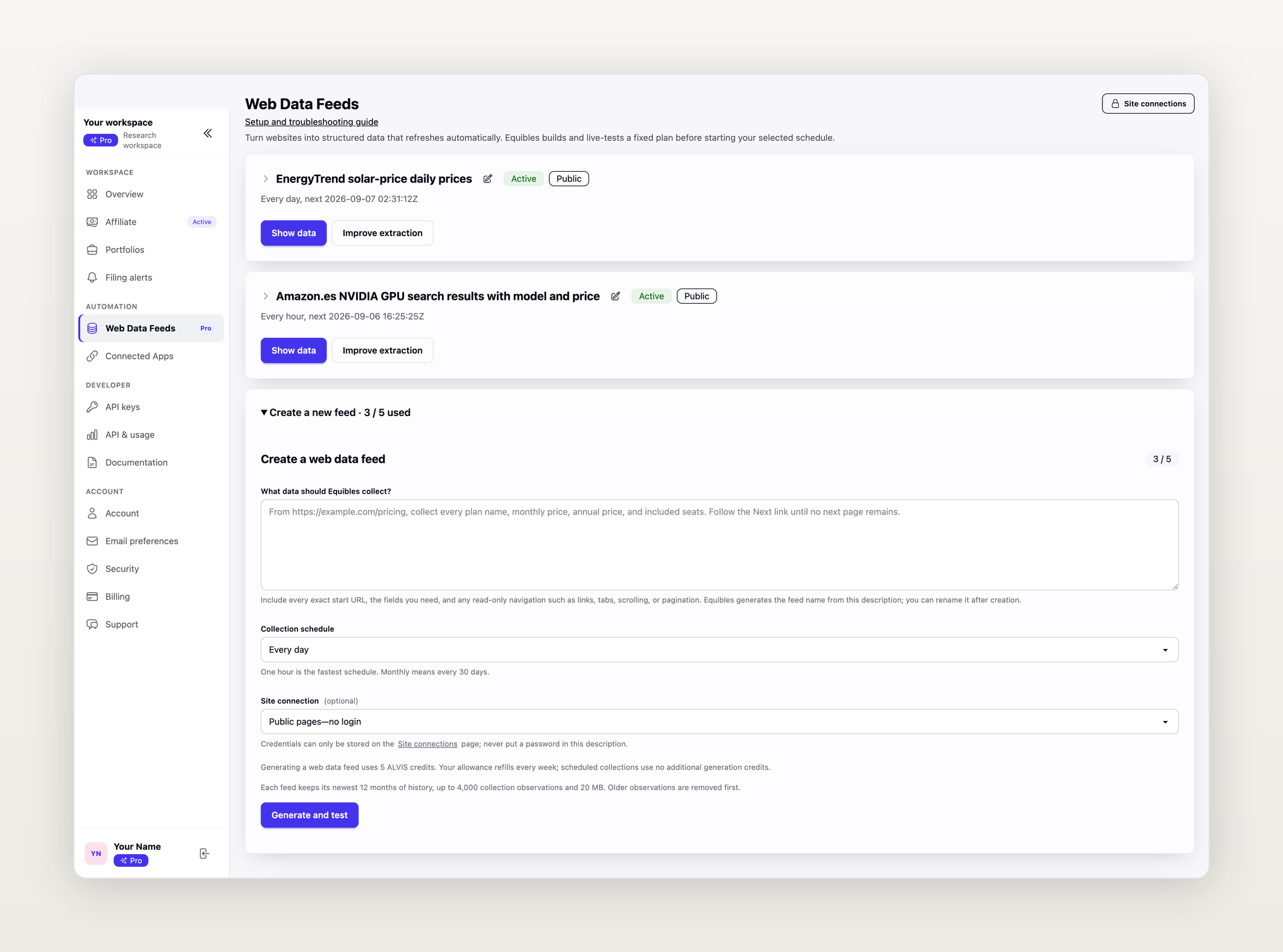
Here is the whole loop on a real public source, from the request to the verified rows.
A short-interest call you can weight by confidence
FINRA still reports official short interest only twice a month. Equibles fills the interval with an estimate for the next settlement, using the eligible daily evidence available so far while keeping the forecast visibly separate from the last official number.
The upgraded model now answers two related questions independently:
- What share count does it estimate for the pending settlement?
- Does it expect short interest to rise or fall, and how strong is that call?
That separation matters. A central estimate can be close to the previous position while the evidence for its direction is weak; one bare number cannot tell you the difference.
In held-out testing across 2025 through July 15, 2026, the model called the direction correctly 61.6% across all estimates, 68.8% for Medium-or-higher confidence, and 72.3% for High confidence. High confidence represents roughly the most confident third of calls, not every forecast.
Those figures are retrospective held-out results. They describe how the released model performed across a large historical panel; they are not a guarantee for any stock or future settlement.
The v2.1 release also corrected the level of the estimated position. The earlier version could rank stocks and call direction while its central share-count estimate drifted too low as more days arrived. The new checkpoint calibrates that level for each stage of the settlement window and was accepted only after its predicted mix of rises and falls stayed close to the held-out market.
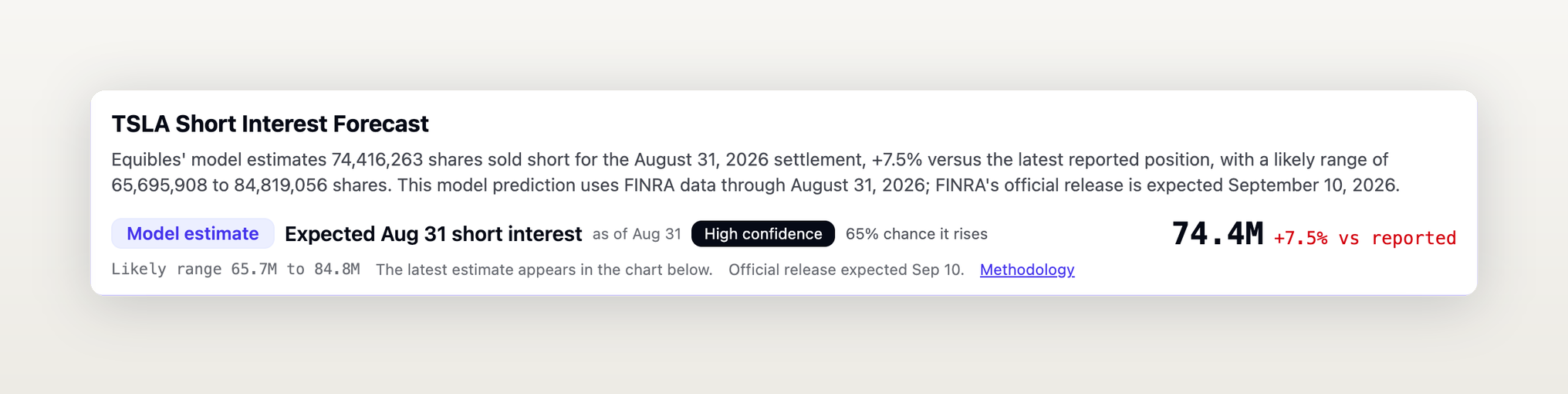
You can access the forecast in ALVIS, through the API and MCP.
A service update: what happened and what we changed
Some users experienced downtime on September 3 and 4. We are sorry for the disruption.
Equibles now serves more than one million requests on a typical day. Demand from real users has grown substantially, and during that growth we were hit by abusive automated scraping routed through residential proxies. At its peak, that traffic exceeded five million page requests in a single hour. Our available capacity could not absorb the legitimate demand and scraper traffic together, and services went down.
We worked with Cloudflare to mitigate the scraper traffic, and those protections are now in place. We also doubled our serving capacity so Equibles can support the growing demand for Pro more reliably.
New Pro pricing applies only to new subscriptions
New Pro subscriptions now cost $49.99 per month, with an introductory first month at $19.99 for eligible new customers. After that first month, the subscription renews at $49.99 per month.
Nothing changes for existing Pro subscribers. Your current recurring price stays locked for as long as your existing subscription remains active. If you currently pay $19.99 per month, you will keep paying $19.99 per month until you cancel.
The new price reflects the demand for Pro and the infrastructure required to serve it reliably. It applies only to new Pro subscriptions. Canceling ends a grandfathered price; a later subscription would use the pricing offered to new customers at that time.
Smaller releases that add up
- The dashboard has been redesigned as a single workspace: your overview, portfolios, filing alerts, Web Data Feeds, API keys and billing now share one persistent side navigation.
- The improved Short Squeeze Score now considers options-market data alongside short-interest and trading data for a broader view of squeeze potential.
- The public API added filing-feed and dividend-history endpoints and filled several remaining filter gaps.
- Free accounts can build a one-condition manual stock screen, while ticker-list screening now works across the portal, ALVIS, MCP and REST surfaces.
- Person profiles now make related companies, roles and research easier to discover while applying stronger identity checks before records are joined.
- Earnings-call capture and repair became more resilient, and transcript pages now offer a direct path to connect the underlying data to your own AI.
What should we build next?
The best next release is usually hiding in a research step that still ends in copying, reconciling or checking the same thing twice.
If one of these additions gets close but leaves that last manual step, tell us. That is the part we want to hear about.