Operator
Good morning. My name is Sarah and I will be your conference operator. At this time, I would like to welcome everyone to AdTran Holdings first quarter 2025 financial results conference call. After the speaker's remarks, there will be a question and answer session. If you would like to ask a question, please press star one on your telephone keypad. Thank you. Mr. Peter Schumann, Vice President, Investor Relations, you may begin your conference.
Thank you, Sarah. Welcome and thank you for joining us today for AdTran Holdings' first quarter 2025 financial results conference call, and welcome to all those joining by webcast. During the conference call, AdTran representatives will make forward-looking statements that reflect management's best judgment based on factors currently known. However, these statements involve risks and uncertainties, including those detailed in our earnings release, our annual report on Form 10-K, and our filings with the SEC. These risks and uncertainties could cause actual results to differ materially from those in our forward-looking statements, which may be made during the conference call. We undertake no obligation to update any statements to reflect events that occur after this call. During today's call, we refer to certain non-GAAP financial measures. Reconciliations of non-GAAP-to-GAAP measures and certain additional information are included in our investor presentation and earnings release. We have We have not provided reconciliations of our second quarter 2025 outlook with regard to non-GAAP operating margin because we cannot predict and quantify without unreasonable effort all of the adjustments that may occur during the period. The investor presentation has been updated and is available for download on the AdTran Investor Relations website. In addition, the financial measures discussed during the conference call are preliminary estimates. Turning to the agenda, Tom Stanton, AdTran Holdings CEO and Chairman of the Board, will provide key investment highlights for the first quarter 2025. Tim Santo, our Senior Vice President and CFO, will review the quarterly financial performance in detail in our second quarter 2025 outlook, and then we will take any questions you may have. I'd now like to turn the call over to Tom Stanton.
Thank you, Peter. Good morning, everyone. Before we discuss the quarterly results, I'd like to introduce Tim Santo, our new CFO, who joined Antrend in early March. Tim was brought on board because of his extensive experience in finance and operational leadership, including more than a decade in leadership roles at General Electric. He has over 25 years of international experience in finance, accounting, and operations across multiple industries. I would also like to take this opportunity to thank Uli Daffer for his significant contributions and leadership. AdTran's first quarter performance highlighted our improved operating efficiency and our strength in our business model. We delivered solid results with improvements across several key operating metrics. Revenue exceeded typical first quarter patterns, showing growth both sequentially and year over year. This increase reflects heightened customer activity and strong execution by our team. Our non-GAAP gross margin remained strong, and non-GAAP operating profit was at the high end of our guidance range. We also generated a robust $41.6 million in cash from operations and $22.9 million in free cash flow. We continue to believe that 2025 will be a year of accelerating performance, and this should translate to meaningful cash generation, which is a key strategic priority for us. Let me talk a little bit about tariffs. In the near term, the impact of tariffs is expected to be minimal. Post-90 days, we are one of the few manufacturers that own and operate our own facilities, which puts us in a stronger position to respond effectively to policy changes. Although the environment is continuously evolving and the mid- to long-term effects from tariffs remain uncertain, AdTrend is well-positioned to adapt thanks to our global customer base and diverse supply chain. Over the years, we have built a durable global network with manufacturing capabilities across the U.S. and Europe. We are actively managing production transfers and enhancing logistics to optimize our supply chain and navigate the evolving trade policies. Our manufacturing strategy is focused on diversifying geographies and operational flexibility. I am incredibly proud of our manufacturing and logistics teams for their swift, decisive actions in handling these challenges. Their efforts have been instrumental in minimizing disruption and controlling costs, demonstrating the strength and flexibility of our operations. Now turning to the quarterly results, a trans revenue of $247.7 million was above the midpoint of our previous guidance, with all three of our product categories achieving year-over-year growth. This progress reinforces the strength across our networking portfolio that spans from the optical core to the customer premise. We delivered particularly strong growth in our access and aggregation solution segment with 23% sequential and 10% year-over-year growth. This performance was driven by fiber footprint expansion initiatives and 10 gig network upgrade cycles, especially with our large European and Tier 2 U.S. service providers. Despite broader global economic uncertainties, the demand for high-speed fiber-based broadband services remains strong. Thanks to our differentiated portfolio and strong regional presence in the U.S. and Europe, ADTRAN continues to be a preferred partner. Our optical networking solutions category grew 4% year-over-year with a 21% year-over-year increase in the U.S. market. Although we maintain a positive outlook for all of our optical customers, the highest year-over-year growth in optical has been with our enterprise, government, and Internet content provider customers. With ongoing vendor consolidation in the optical market and industry-wide shift away from high-risk vendors and all customers essentially having completed their inventory reductions, we are well-positioned for further growth in the optical networking solutions category. Our Subscriber Solutions category grew 15% year-over-year. This growth was driven by increased sales of residential gateways and ONTs as our service providers continue to have success in connecting more homes and businesses with fiber. The outlook for Subscriber Solutions is closely correlated to our success in passing more homes and businesses with our fiber access platforms. With high demand for Wi-Fi 7 platforms, continued customer adoption of fiber-based broadband and wholesale services, and continued innovation in our complementary software platforms, we are confident that we can drive further growth in this category. The year-over-year growth across each of these three major categories is a direct reflection of both the strength of our portfolio and the ability of our sales teams to better position our complete offerings. We are encouraged by the traction we are seeing as more customers recognize the value of our integrated solutions and the depth of our innovation across access, optical, and subscriber platforms. Underscoring that progress, during the quarter, we added another large service provider to our European customer base as we are awarded a share of both the fiber access and optical transport businesses. This large national service provider located in southern Europe is a new customer to ADTRAN and they specifically selected us for our strong regional presence paired with our complete portfolio offering spanning the optical core to the customer premise. Continuing with the theme of growing our business in Europe, we had another large service provider in the region select us for two key optical projects, one for mobile backhaul and another one for mobile fronthaul. This is an operator where we are already an incumbent transport access vendor, and they see the value in expanding their business with a more scaled solutions partner. Moving to the U.S., our cross-selling strategy continues to pay off. We recently had a couple of our high-growth U.S. national service providers, both of whom were incumbent access. We are both an incumbent access vendor for both of those, expand their business with us. One customer selected us for new optical transport deployments moving forward, and the other one selectives for carrier Ethernet business moving forward. These examples are representative of the encouraging trends we are increasingly having success leveraging our relationships and synergies in one portion of our portfolio to have success in other areas. These portfolio synergies start with our Mosaic software suite, which automates and simplifies the provisioning and monitoring of our solutions that span from the optical core to the customer premise. One example of this software is with our optical monitoring solutions that not only provide real-time in-service monitoring of transport networks but can now extend that visibility all the way to the customer premises and point to multi-point networks this solution was selected for an innovation award by the fiber to the home council europe in march alongside a separate award for our 50 gig on solution our portfolio innovation and customer momentum remain strong More customers continue to turn to AdTrend to provide turnkey fiber networking solutions that scale from the optical core to the customer premise while delivering best-in-class subscriber experiences through improved insight and automation. In summary, our quarter-end performance was at the higher end of guidance, giving us confidence that improving mark conditions combined with continued solid execution will drive increased increased cash generation. We delivered above-season revenue and improved profitability with strong-looking trends that give us optimism for continued positive momentum. Our customer base continues to expand, and we are developing strategic platforms with significant opportunities still ahead of us, both in the U.S. and Europe. Importantly, our product portfolio has never been stronger. Fiber infrastructure growth remains strong, fueled by our customer expansion initiatives, vendor consolidation, a broad shift away from high-risk Chinese vendors, and new investments focused on AI-driven networking. Given our strong performance this past quarter and an improving outlook, we remain confident in our long-term operating targets, including gross margins in the low to mid-40% range and operating profit margins in the low double digits. double digits. While the frequent shifts in proposed government policies create potential for uncertainty, AdTrain is uniquely well-positioned to navigate market changes. Thanks to our globally diverse supply chain, operational flexibility, and strong customer relationships, we believe we are better insulated than most of our competitors. We are actively managing the evolving tariff landscape and are focused on minimizing the impact to our business and to our customers. With that, I will turn the call over to Tim, our CFO, to walk you through the financial results for the first quarter, and then following Tim's remarks, we'll open up to any questions you may have. Tim?
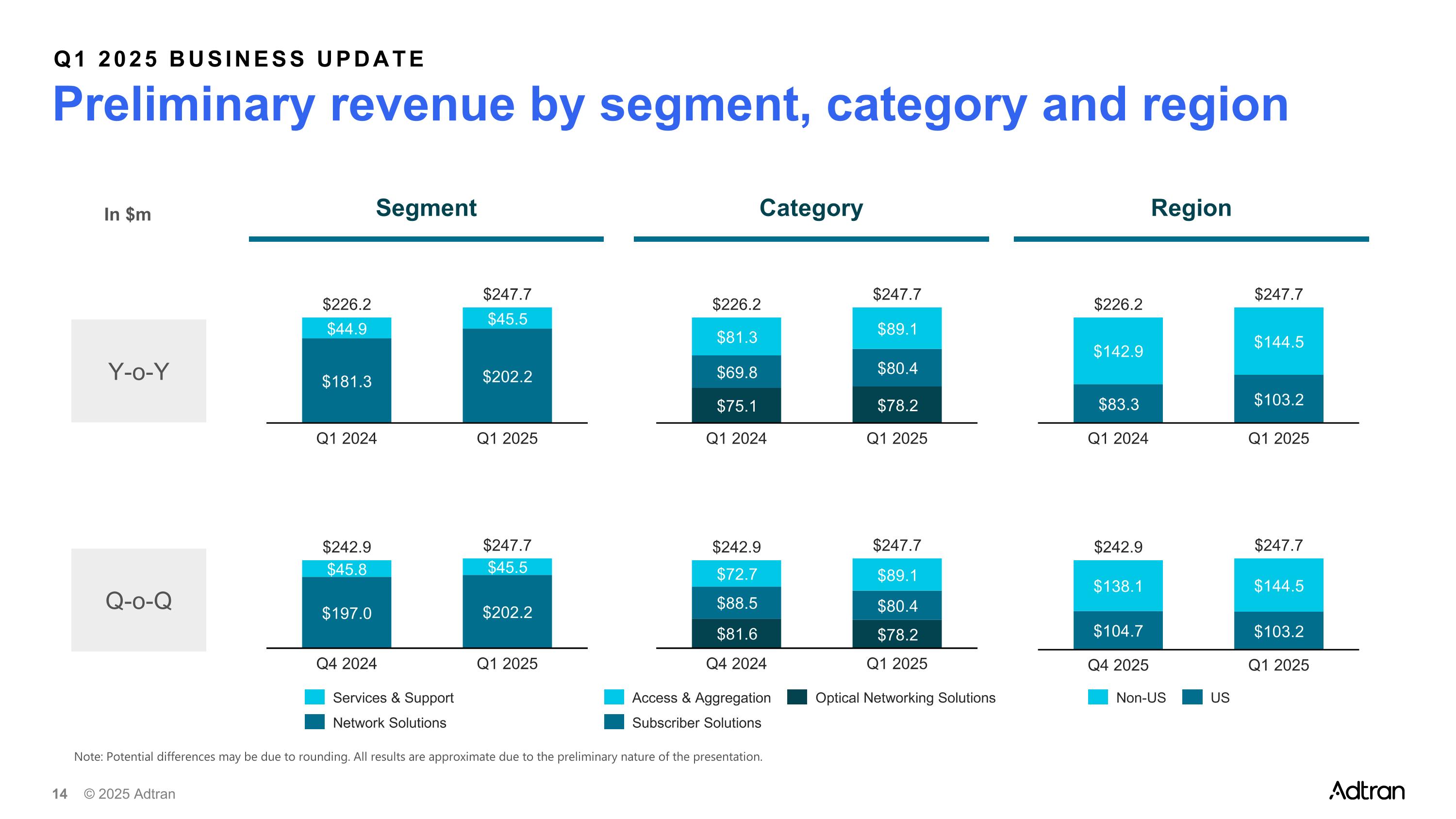
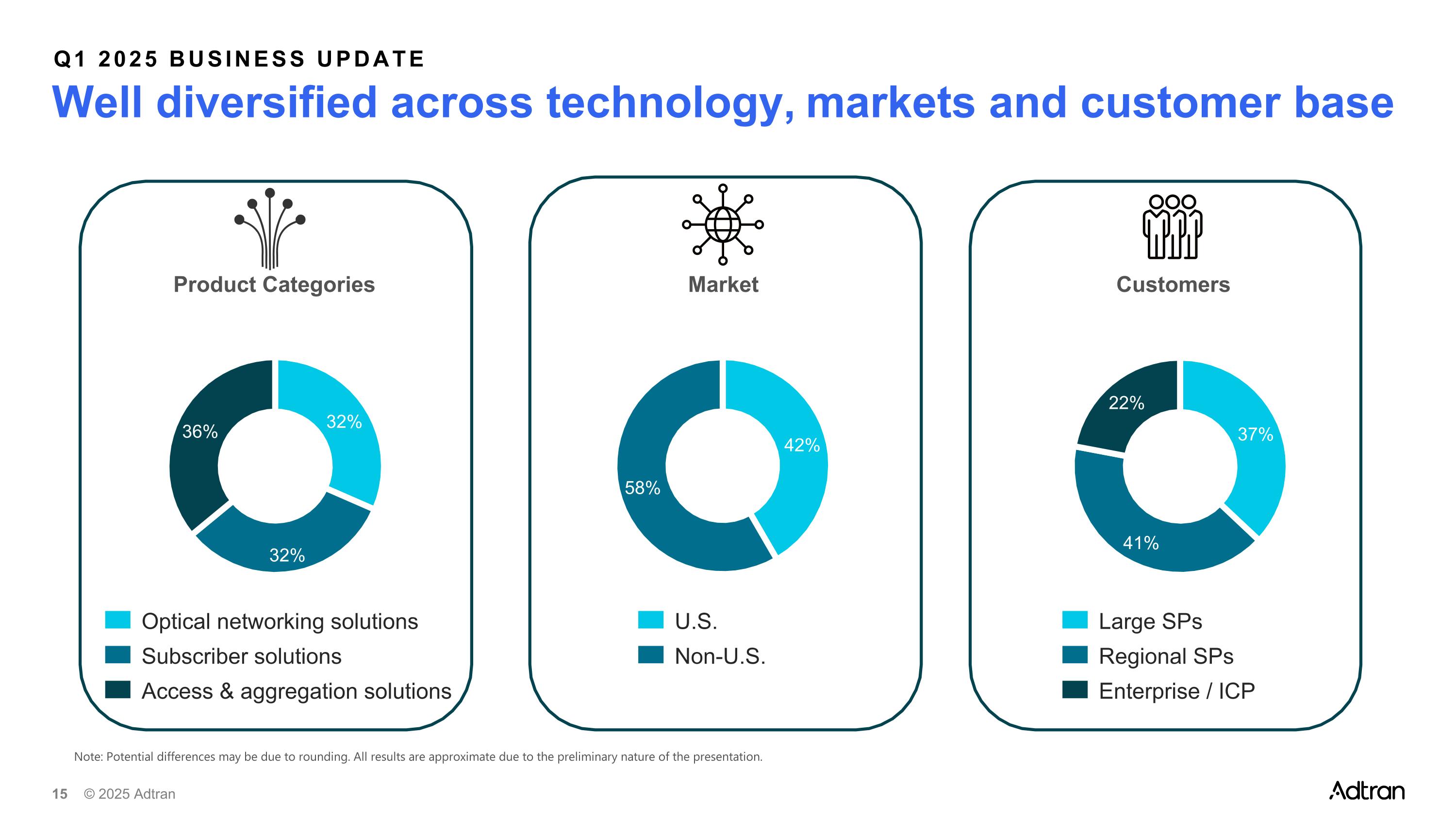
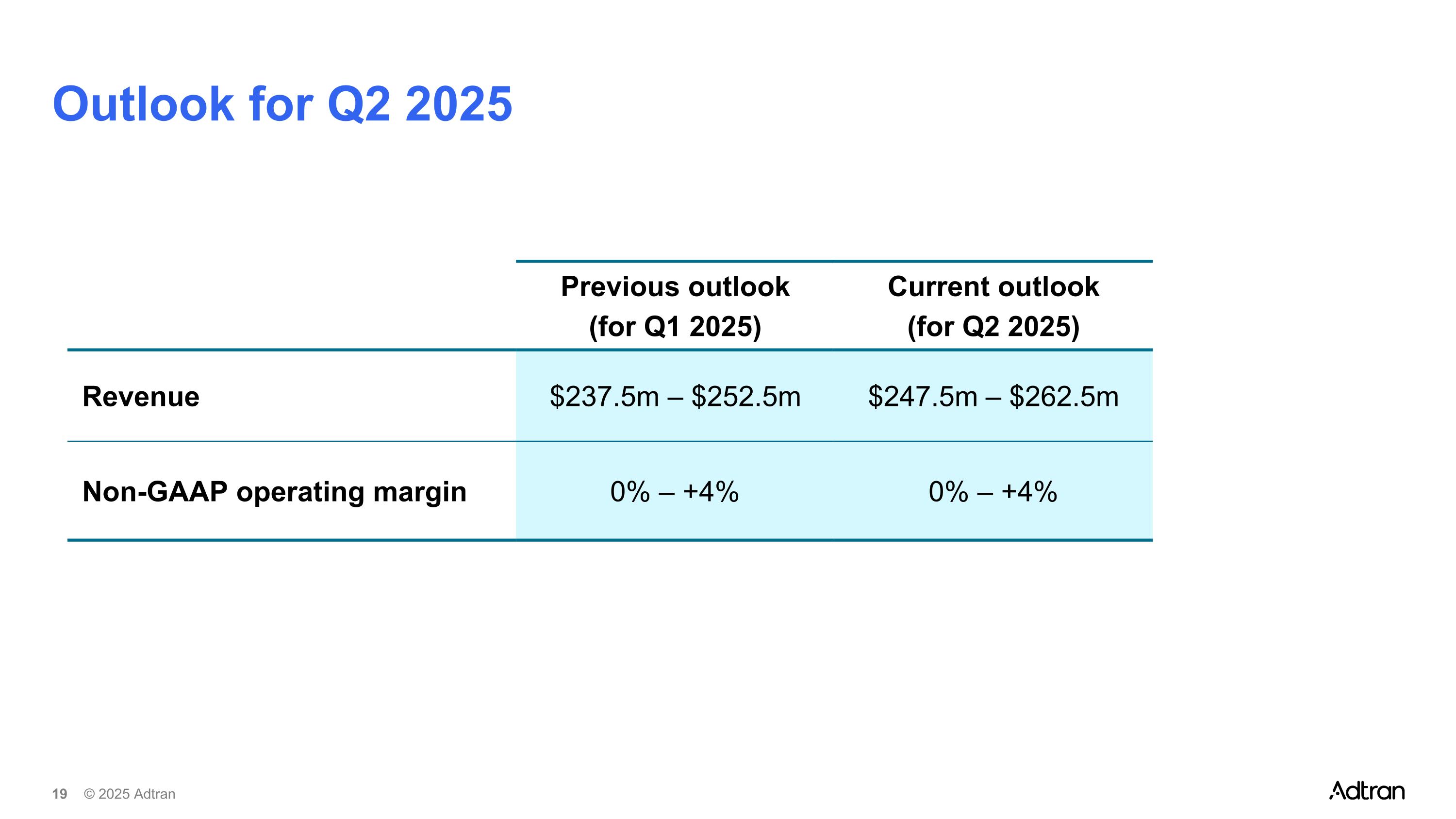
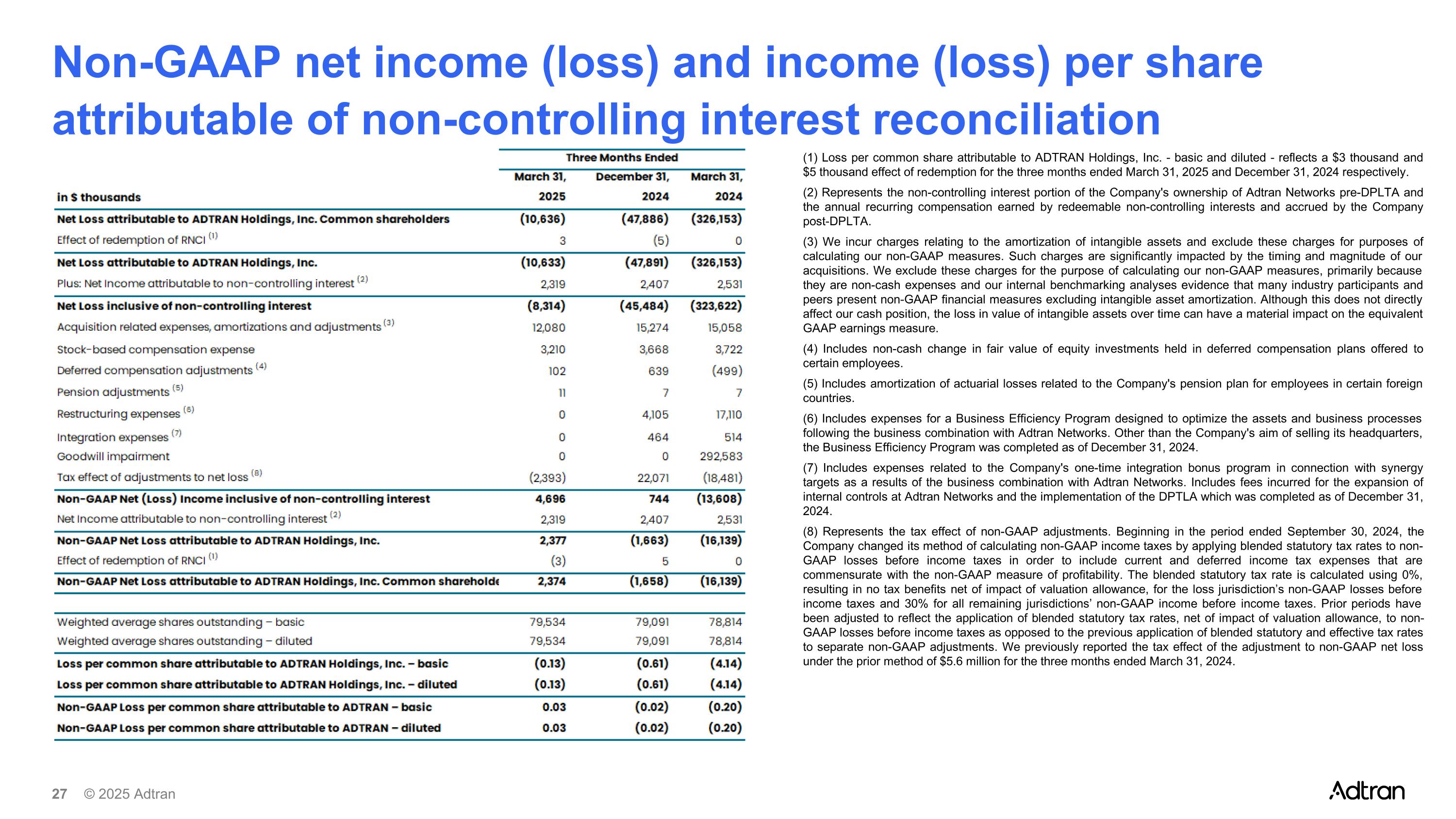
Thank you, Tom, and thank you everyone for joining us on the call this morning. Before I walk through our preliminary financial results for Q1 2025 and discuss our expectations for Q2 2025, I'd like to take a moment to introduce myself and offer a little perspective on why I chose AdTran. Though I've been with the company for just two months, I have had an opportunity to engage with many of our investors, analysts, and team members. These early conversations have been incredibly valuable as I continue to listen, learn, and build a deeper understanding of the business. What drew me to AdTran was the strong alignment between my background, the company's strategic priorities, and the opportunity to join a growing technology company with strong potential in an attractive market. Over the past 25 years, I have led corporate finance, accounting, and treasury functions across both global enterprises and transformation-focused organizations. My work is consistently centered on financial disciplines, simplifying capital structures, and enabling strategic execution. Looking ahead, my priorities are clear. Strengthening our capital structure, continuing to enhance the finance organization, and deepening engagement with our external stakeholders. These are essential elements in positioning ADTRAN to drive long-term, sustainable value for our stockholders. With that, let's dive into the financial results for the first quarter of 2025. We began the year with a stronger than typical first quarter performance, exceeding seasonal trends amid a gradually improving industry environment. As market conditions continue to improve, combined with recent customer wins, we are beginning to recognize the benefits of scale in our business. AdTrend delivered revenue of $247.7 million for the first quarter, representing a year-over-year revenue increase of $21.6 million, or approximately 10%. This is up $4.9 million, or 2%, sequentially, demonstrating our outsized seasonal trends while underscoring ongoing strength across several key areas of the business and exceeding the midpoint of our guidance. Our Network Solutions segment contributed revenue of $202.2 million, accounting for approximately 82% of total revenue in Q1 compared to 80% in the prior year. Our services and support segment generated $45.5 million of revenue, representing 18% of revenue in Q1 2025 compared to 20% in Q1 2024. Moving on to product categories, access and aggregation delivered revenue of $89.1 million or approximately 36% of total revenue and increased 10% year-over-year. Our Optical Networking Solutions category was $78.2 million or 32% of total revenue. This was higher by 4% year-over-year. Subscriber Solutions was $80.4 million or 32% of total revenue, increasing 15% year-over-year. Geographically, non-U.S. revenue accounted for 58% of the total, while U.S. revenue comprised 42%. Additionally, one customer represented more than 10% of our Q1 revenue. Non-GAAP gross margin during the quarter was 42.6%, an increase of 146 basis points sequentially and 193 basis points year-over-year, resulting from favorable product and customer mix. Non-GAAP operating expenses in Q1 were $95.5 million compared to $94 million in Q4 2024 and $102.7 million in Q1 2024. This year-over-year reduction of $7.2 million reflects the positive impact of our business efficiency program. For Q1, our non-GAAP operating profit was $10.1 million, or 4.1% of revenue, slightly above the high end of our guidance range. This compares to a non-GAAP operating profit of $6 million, or 2.5% of revenue, in Q4 2024, and an operating loss of $10.7 million in the first quarter of 2024. The year-over-year improvement in operating margin and profitability was driven by higher revenue and gross profit dollars, coupled with lower operating expenses and strong discipline in managing our fixed costs due to our increased productivity from last year's business efficiency efforts. On a sequential basis, the increase in operating margin and profitability reflects higher revenue and gross margin, translating into greater gross profit dollars. Non-GAAP tax expense in Q1 2025 was $1.7 million, or an effective non-GAAP tax rate of 26.3%. We generated non-GAAP net earnings of $2.4 million during Q1, or $0.03 on an earnings-per-share basis. This compares to non-GAAP net loss of $1.7 million, or a loss of $0.02 per share in Q4 2024, and a net loss of $16.1 million, or a loss of $0.20 per share in Q1 2024. Turning to the balance sheet and cash flow statement. In the first quarter, we continued to make meaningful progress in strengthening our financial position. Networking capital improved by $19.1 million quarter over quarter to $250.1 million. This improvement was supported by stronger collections and improved inventory management. Trade accounts receivable were $166.5 million at quarter end, resulting in DSO of 60 days, a notable improvement from 67 days in the prior quarter. Inventory levels declined to $254.1 million at the end of the quarter, a decrease of $7.6 million sequentially. Correspondingly, day's inventory outstanding decreased by 9 days to 152 days in Q1. Accounts payable stood at $170.5 million, with DPOs increasing by two days sequentially to 74 days. These working capital improvements contributed to an increase in operating cash flow, which came in at $41.6 million, up from $4.6 million in Q4-24. This increase was driven by lower gap net losses, improved collections, and reduced inventory levels. Working capital improved significantly year-over-year, lower by $95.9 million as a result of the benefits of lower inventories, improved collections, and higher payables. We had free cash flow of $22.9 million for Q1 2025, a strong turnaround from negative $10.4 million in Q4 2024. The improvement reflects the strength in operating cash flow and tighter working capital management. At the end of Q1, cash and cash equivalents were $101.3 million, a sequential increase of $23.8 million, representing a significant improvement in our liquidity position. Strengthening our balance sheet remains a key strategic priority in 2025. As previously communicated, we're working to monetize certain non-core assets, including corporate real estate. While the sale of our Huntsville campus has taken longer than initially anticipated, discussions with potential buyers have advanced. To be clear, we have firm offers in hand for each of the towers. However, we'll only sign when we believe that shareholder value has been maximized. We will provide a more substantive update once we reach agreement, and in the meantime, we continue to explore and evaluate alternative options to further reinforce our capital position. We remain firmly committed to materially strengthening our financial position over the course of 25, aiming towards our ultimate goal of achieving a net positive cash position. We are pleased with our strong performance in the first quarter with momentum exceeding historical seasonal trends and have confidence that the industry environment continues to improve. As market conditions stabilize, we are beginning to regain scale in our business, which positions us well for the remainder of the year. Looking ahead, we anticipate additional scale as revenue growth continues. At the same time, we're seeing elevated operating expenses primarily driven by foreign exchange headwinds stemming from a weaker U.S. dollar relative to the euro and British pound. On a constant currency basis, we expect operating expenses to remain relatively consistent with prior quarter levels, reflecting our continued focus on disciplined cost management. Regarding capital allocation, we continue to focus on strengthening our balance sheet. This includes continuing to reduce debt through cash generation and taking decisive steps to streamline our portfolio, notably through the divestiture of non-core assets. These actions align with our long-term strategy to enhance financial flexibility and sharpen our focus on core growth opportunities. Turning now to our outlook for the second quarter, We continue to experience increasing global demand for broadband connectivity and remain encouraged by the underlying industry fundamentals. Regarding tariffs, and as Tom mentioned earlier, while the situation remains fluid, we believe our supply chain strategy places us in a favorable position relative to peers. We are actively evaluating options to minimize the impact of any potential changes on our customers. Our outlook excludes the potential impact of additional future tariffs, given the inherent uncertainty surrounding global trade policies, possible disruptions to the U.S. and international economies, and the potential for retaliatory governmental actions. Based on the information we have today, we expect revenue to range between $247.5 to $262.5 million and a non-GAAP operating margin between 0 and 4 percent. Once again, additional financial information related to today's call is available on ADTRAN's Investor Relations website at investors.adtran.com. This concludes the prepared remarks portion of the call and I will turn the call back over to the operator to begin the Q&A session.
Operator
Thank you. If you would like to ask a question, please press star 1 on your telephone keypad. If you would like to withdraw your question, simply press star 1 again. Please ensure you are not on speakerphone and that your phone is not on mute when called upon. Thank you. Your first question comes from Michael Genovese with Rosenblatt Securities. Your line is open.
Great. Thanks. So, Tom, it looks like in the quarter, right, all the growth came from access and aggregation. So, I just want to ask, you know, across the three revenue segments, sort of what the, you know, what the outlook is going forward.
What will access and aggregation keep up this toward growth and what should we expect from subscribers and from optical you know specifically this quarter but you know over the next next couple quarters thank you um yes some of that as you you may know michael was supply related because we had gotten a little bit slow in our most specifically on subscriber um so without a doubt we left some demand sitting on the dog. That has gotten, notwithstanding tariffs and everything, that has gotten better. We did, but to be frank, we had a strong access quarter. We expected a strong access quarter. As you know, some of our customers tend to buy a little early. Our access customers, especially in Europe, tend to buy a little early in the year. Then they go down a little bit, and then they pick up a little bit towards the end of the year. So that's kind of a new seasonal pattern that we've seen over the last couple of years. Optical, I would say that what we saw in optical was just a seasonal thing and you know there's obstacles growing I mean we I would expect without getting into too much detail but I would expect better performance this quarter and we expect growth from those segments moving forward it was actually across the board from a pure order and environmental perspective it was actually a good quarter okay um and then just uh follow up for me on um on margins um so is you know i guess when we look at the revenue guidance uh compared to um the first quarter and the operating margin guidance
compared to the first quarter it looks like there's some margin pressure in the second quarter and it it sounds like you're saying that that's on the opex side because of the exchange rate and and not because of gross margin. I just want to verify that that's a correct read. And then, you know, I guess it's hard to predict, you know, Forex beyond, you know, beyond the quarter, but, you know, how do you think OPEX should trend, you know, beyond the second quarter?
That's just it. I think you're going to have to project, you know, exchange rates. Our core operating on a constant currency basis, our operating expenses, we would expect to be basically flat through the year, and that hasn't changed a bit. I mean, the movement we saw right around the turn of the quarter here was, you know, pretty substantial, not typical. But from a pure how we're running the business, we would expect OPEX to be effectively flat. okay i appreciate it and um i'll uh i'll pass it on thank you the next question comes from brian kunz with needham and company your line is open all right thanks um tom any um you know evidence or inquiries around pull-ins from maybe a little bit really not a lot i think most people are kind of in the same boat that everybody else is which is you know it's kind of hard to figure what's going to happen, and we're really not – we're not entertaining a whole lot of pull-ins. In fact, we're trying not to have pull-ins because, you know, we just kind of went through an inventory situation and trying not to recreate that. There has been no strong pressure for pull-ins, though. It just hasn't materialized.
And then maybe stepping back a little, you know, you've got great exposure in Europe now Now, can you maybe just top down, help us see what's going on in the macro there as it relates to kind of top five carriers, you know, the BT and DT types, what's going on with those large customers? And then broadly what's happening in Europe with respect to, you know, high-risk Chinese displacement and any other wins you're anticipating ramping up over the balance of the year?
Yeah, sure. So the environment hasn't changed in that it has been really positive now for, you know, a solid year. We had inventory issues, as you know. We went through those inventory issues, but the underlying demand hasn't changed. The success rate has probably picked up in some areas. and some of our biggest customers, their conversion rate has gone up, which has driven a stronger subscriber backlog. But their overall plans for deployment stay in place. In fact, one of them has recently expanded. There's, I think, last quarter expanded the number of homes they were trying to get to by a couple of million. So all of that's in place. The wins that we've had, I just talked about one in my notes, which is a brand-new customer that is a large-tier one. But the other ones that we've talked about before are still on track. We will start shipping some of them right around, hopefully, a little bit before the half. Some of them have already started shipping. and there is a big replacement opportunity where they're actually going to decommission some Huawei equipment. That is probably about to start. It's right around the time for that to kick off. Yeah, so we haven't lost anything. All those are still on track, although, you know, they're being operationalized, and those take a long time.
And that replacement opportunity, Tom, is in fiber, not optical?
Maybe one more if I can squeeze it in, please. Any changes in your attach rate of selling O&Ts versus OLTs and, you know, with regards to modern products? You still have a high attach rate there, and how would you characterize kind of thoughts about that going forward?
I would say with XGS, the attach rate is probably higher than what it was with Pawn. I think that that's – just because it was a newer technology and interoperability and things, I don't think – surprisingly, I mean, you know, if you follow the industry much, it has remained strong. I mean, we've gotten some tier ones that have selected subscriber equipment where traditionally, you know, tier ones shop more. Smaller carriers typically end-to-end and they buy everything. Larger carriers tend to go shopping. It's going to be interesting to see how that environment changes. I think it is changing. I think more and more are looking at trying to buy a more end-to-end solution and maybe not go direct to some of the Asian vendors. So it'll be interesting to see how that – but the attach rate is fairly strong.
The next question comes from Christian Schwab with Craig Hallam. your line is open great thanks for taking my question i know you guys historically have not they you know put in any engine the short answer is yes you know with with the we've realized the the benefit of of the downside and now we're moving the other direction and it's something that we are exploring and then from a from a business momentum perspective excluding new design
wins you know good question i without a doubt europe is just really hot right now it is looking rates coming out of europe are very strong that area is definitely hot um in the u.s it is it is more and in europe i guess what i'm saying is you can say that pretty much across the board um in the u.s it's a little more hit and miss the tier twos have been strong um and they continue to be strong. And I mentioned in my notes that we want incremental business with a couple of the larger Tier 2s. The Tier 3s have been kind of in a lull. You may call it a bead lull or whatever. They seem to be waking up. And, you know, we'll see. We haven't seen that yet, but they seem to be getting better. There's a lot of talk about them getting better. Numbers have been just incrementally moving up.
No big change over the last six to nine months but tier twos have definitely been strong okay the next question comes from Amira Manet with Odell BHF your line is open yes hello can you hear me yes thank you for the presentation I have actually a few questions regarding the increasing trees could you provide more details of the group supply chain, and whether you have suppliers in China or Asia for certain components?
We do have – well, let me start back. So, we have moved and have been moving the majority of our supply chain contingencies outside of China for some time. If you go far enough back, you know, pre-merger of the two companies, the AdTrend portion had moved out a long time ago. And then on the Adva side, they were moving out, and we accelerated that. So that's been going on for a couple of years now. So we're in a pretty good position to where on a finished good basis, there's very little that's done there. And I think the majority of any finished goods, I shouldn't say any, but by and large, any finished goods will be out of there sometime around the middle of this year. So we don't expect a whole lot of impact from tariffs. Now, on a raw material perspective, everybody buys capacitors, everybody buys resistors, everybody buys PC boards. And then, you know, the real thing there is where does the product actually get finished? we're going to have tariffs on some of those materials. But in the overall scheme of things, I think that we're not in a bad place as of today. I don't know what they're going to be tomorrow. I don't know what the tariffs are going to be tomorrow. But as of today, yeah, we're not in a bad place.
And the group's performance quarter over quarter was mainly driven by Europe while the US remained relatively stable. what explains the dynamic and do you foresee continued decline in the u.s share versus non-us in the coming quarters i think you i would say u.s was actually i wouldn't call it not strong it was actually not bad it was just that europe was stronger and europe is just a hot area right now it is pretty much from any metric we see it's actually it's just um it's they're just buying it at a stronger rate i i wouldn't i wouldn't say the u.s is bad it's not but but i would say that the europe europe is just uh and we have a couple of customers that really can materially drive those numbers upwards and and they're kind of hitting on all cylinders right now um okay and And how would you compare Atron's position to its main competitors today?
I mean, from a financial perspective, do you see stronger growth trends in the market? And from a technological side, how does Atron offer stackback against its peers, particularly in emerging areas like fiber broadband, AI, data centers, etc.? And there are any specific areas where you believe ATRAN has a technological advantage for today?
Yeah, I think the key to what we do is maybe the focus on where we put our resources. So on the optical side, we very much focus on that mid-network, transport, kind of a regional-sized network. And we're very, very good at that. And as that market, we do believe that's a growth market, both from just a carrier perspective as they reach more homes with fiber and from an enterprise perspective as people try to find on ramps into the icp cloud or that becomes more distributed and we've seen we've seen some signs of that on the fiber access side we we just fundamentally across the board now i'm biased but we have a better product we have a kind of a next generation product which is very very scalable we did a press release maybe last quarter that said we had passed over 8 million homes with a British Telecom in an incredibly short period of time. It is very flexible because it is software-based and disaggregated, so you can use it in small locations as well as large locations. And it's just a better product. Subscriber, it's a little more difficult to differentiate yourself. With subscriber, it's all about the software. And, you know, you have to keep up with the generational changes in the hardware, but it's really about the software. We launched our Mosaic One product about two years ago, and the big piece that we were missing was IntelliFi, which is in-home Wi-Fi management, which is a real cornerstone for a lot of our customers. We launched that, I think, earlier last year. Phenomenal success so far. It's still relatively new into the market. I think that piece has yet to shake out.
I think competitively we have a very good product. but you know we we just need some more time in that market hopefully that answers okay okay thank you so much that's all for me okay all right the next question comes from tim savageo with northland capital markets your line is open hi good morning a couple of questions but first i wanted to start with you know um it really seems like you're starting to see a greater amount of synergy across your product portfolio, right, particularly between access and optical transport. We've talked about that a couple of times here. You know, are we right to observe some kind of, you know, breakout here or inflection point with regard, you know, given the companies have been together for a while now in cross-selling that portfolio? And then I have a follow-up.
Yeah. You know, the only problem I have with your sentence is, you know, how do you define breakout? So without a doubt, I mentioned it in my notes, and the reason that I mentioned them is we have seen good reception in the Tier 3 space. If we sell them an access product, there's a good chance that we're going to be able to get the transport needs and meet the transport needs, and they'll be open to that because they don't want to do business with a whole lot of vendors. In the larger, kind of more sophisticated, it's a real fight. And what we started to see, it may be earlier than this, but I'll tell you, last quarter was a good quarter for that. We won the European carrier, which is a very large carrier, and we had not done business. And they flat out told us that it had to do with the breadth of our product line and the synergies that we were able to bring in the management and operations. And, you know, they liked the scale of the company. Same thing happened in the U.S. So we had two large tier twos that now are broadening, one specifically in our optical space that we had been locked out of for a period of time, forever. really and they move forward so there's these anecdotal pieces with the larger customers but but you know they had not been in existence before we had I mean it's really starting it feels like it's really getting much more reception now maybe some of that may have to do with inventory by the way you know they had a lot of optical inventory not just ours but everybody's and until they were getting out of that inventory they weren't in a position to make a decision on a new vendor. So I think some of that may just be the fact that they're now in a position to actually start making some moves.
Great. I appreciate that. And as I thunder large Southern European carriers that you're not already engaged with in some way, which I will continue to do, I'd ask about the, at this point, how you're seeing the The size of that opportunity relative to some of your current big European customers, and what sort of timing we should expect in terms of a ramp there?
They're in a hurry, and they're in a hurry on the optical side first. It's hard to predict what you ultimately end up with, but if you think about them in the tens of millions a quarter, that's probably the way to think about them. once with once they get rolling with a full portfolio that's across optical and access yep yep when i say 10 right now that's a broad range so yeah i would definitely go i know i i get it um all right appreciate it okay ladies at this point that's the uh end of our question queue so i appreciate everybody for joining us today and uh we look forward to talking to you
Operator
next quarter ladies and gentlemen that concludes today's call thank you for your participation you