Operator
Good day and thank you for standing by. Welcome to the Q3 2025 Black Hills Corporation Earnings Conference Call. At this time, all participants are in a listen-only mode. Please be advised that today's conference is being recorded. After the speaker's presentation, there will be a question and answer session. To ask a question, please press star 11 on your telephone and wait for your name to be announced. To withdraw your question, please press star 11 again. I would now like to hand the conference over to your speaker today, Sal Diaz, Director of
Investor Relations. Thank you, Operator. Good morning and welcome to Black Hills Corporation's third quarter 2025 earnings conference call. You can find our earnings release and materials for our call this morning on our website at blackhillscorp.com. Leading our quarterly earnings call are Lynn Evans, President and Chief Executive Officer, Kimberly Nooney, Senior Vice President and Chief Financial Officer, and Marnie Jones, Senior Vice President and Chief Utility Officer. During our earnings discussion today, comments we make may contain forward-looking statements as defined by the Securities and Exchange Commission, and there are a number of uncertainties inherent in such comments. Although we believe that our expectations are based on reasonable assumptions, actual results may differ materially. We direct you to our earnings release, slide 2 of the investor presentation on our website, and our most recent Form 10-K and Form 10-Q filed with the Securities and Exchange Commission for a list of some of the factors that could cause future results to differ materially from our expectations. With that, I will now turn the
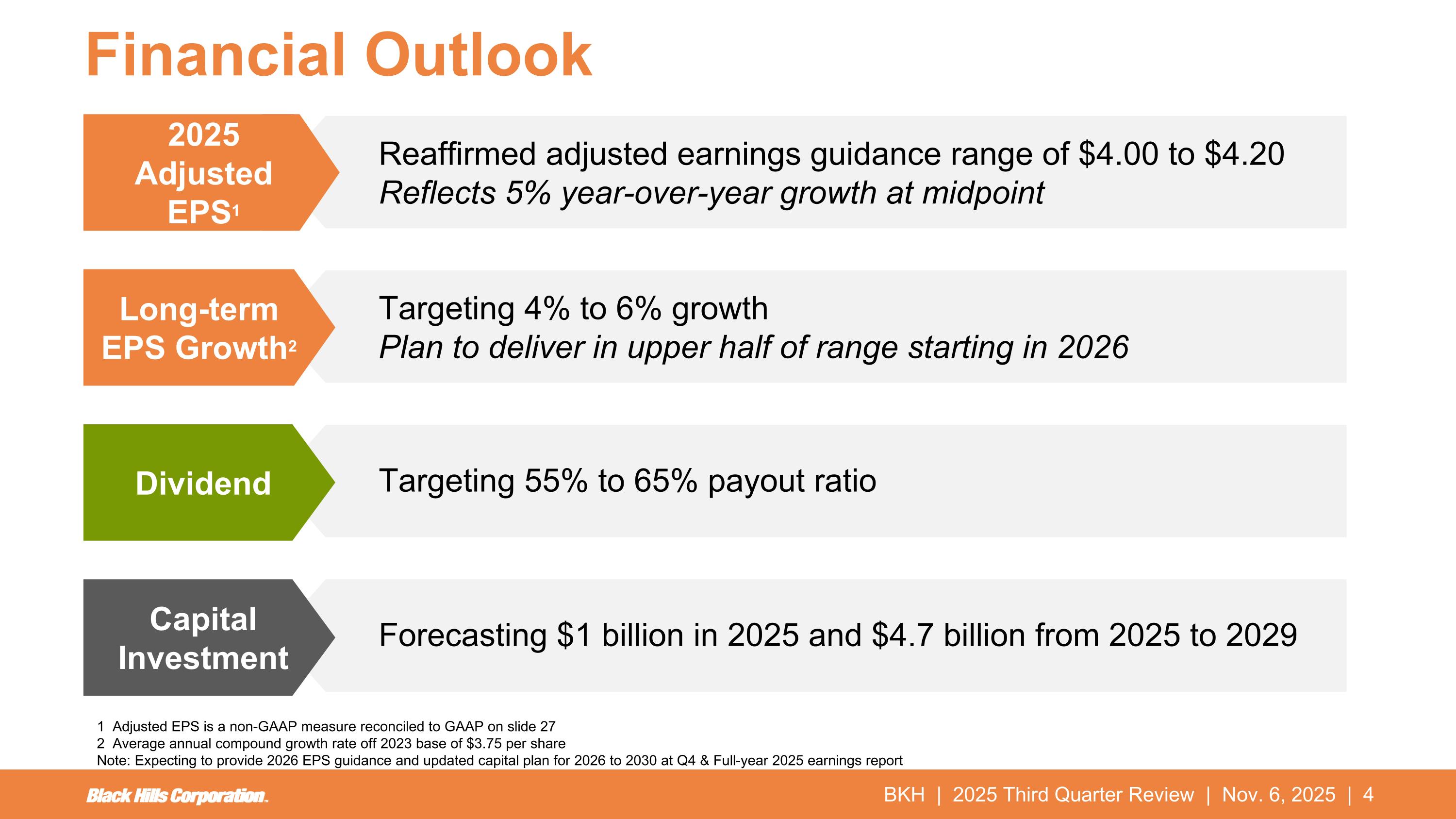
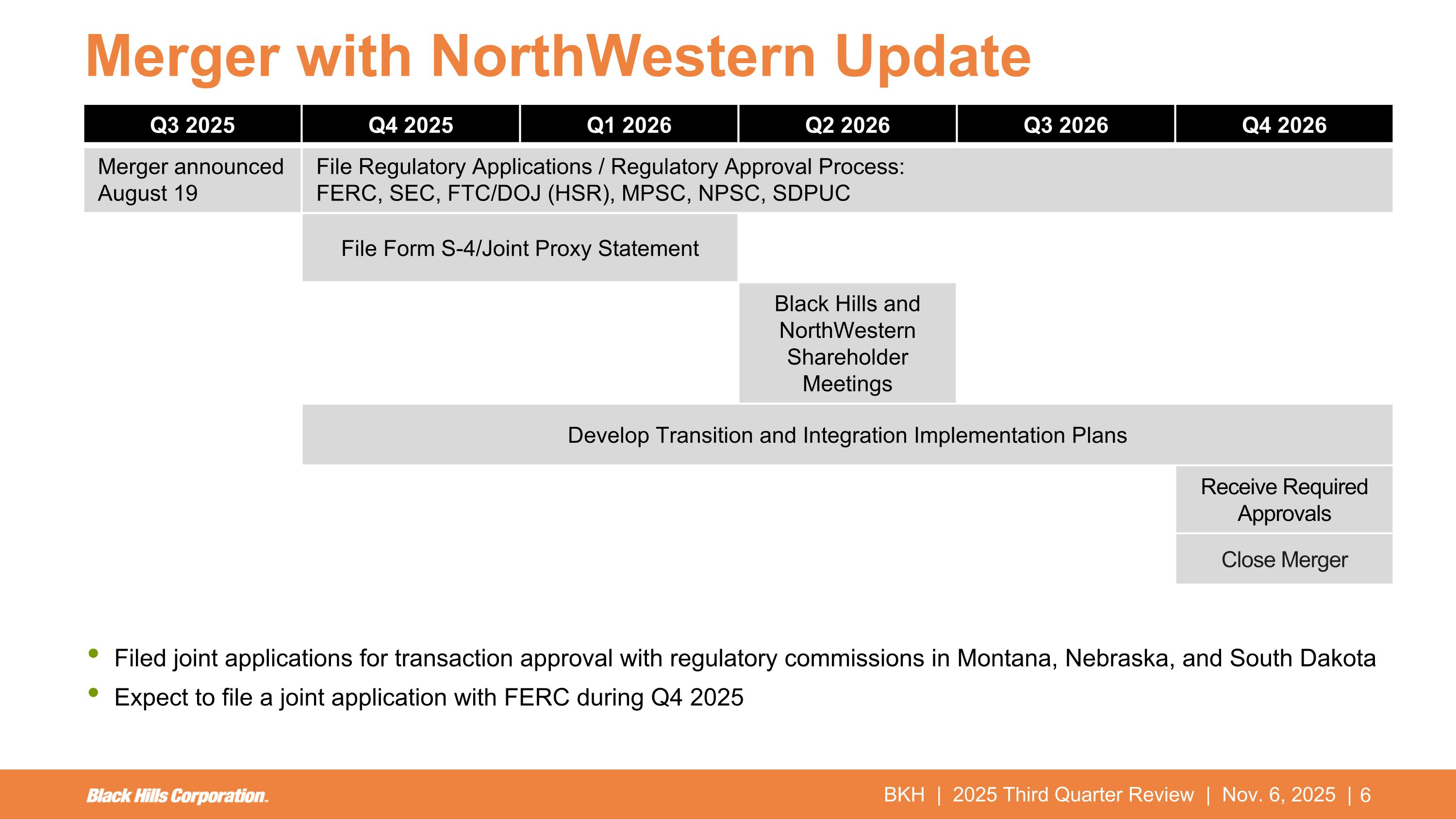
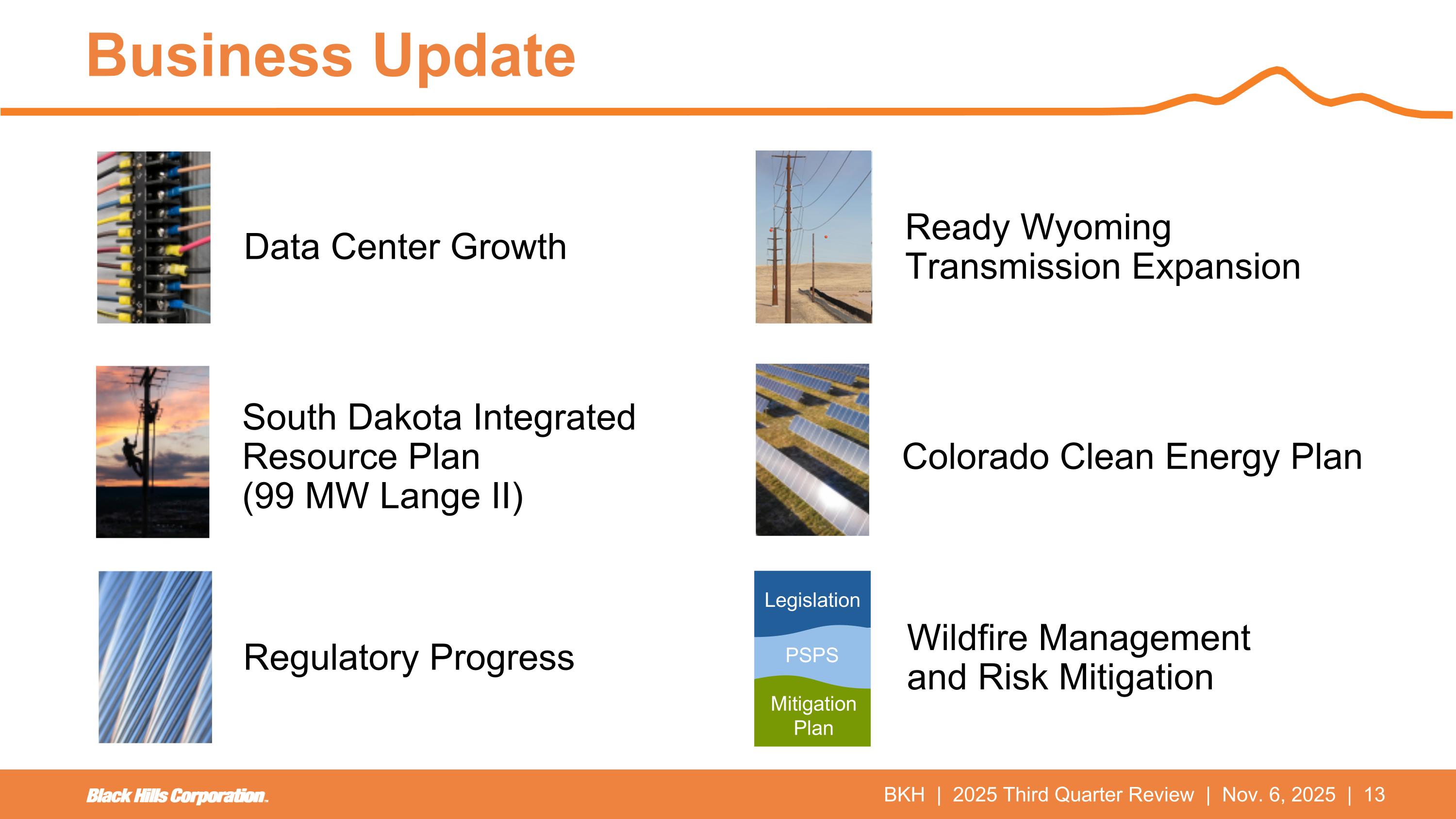
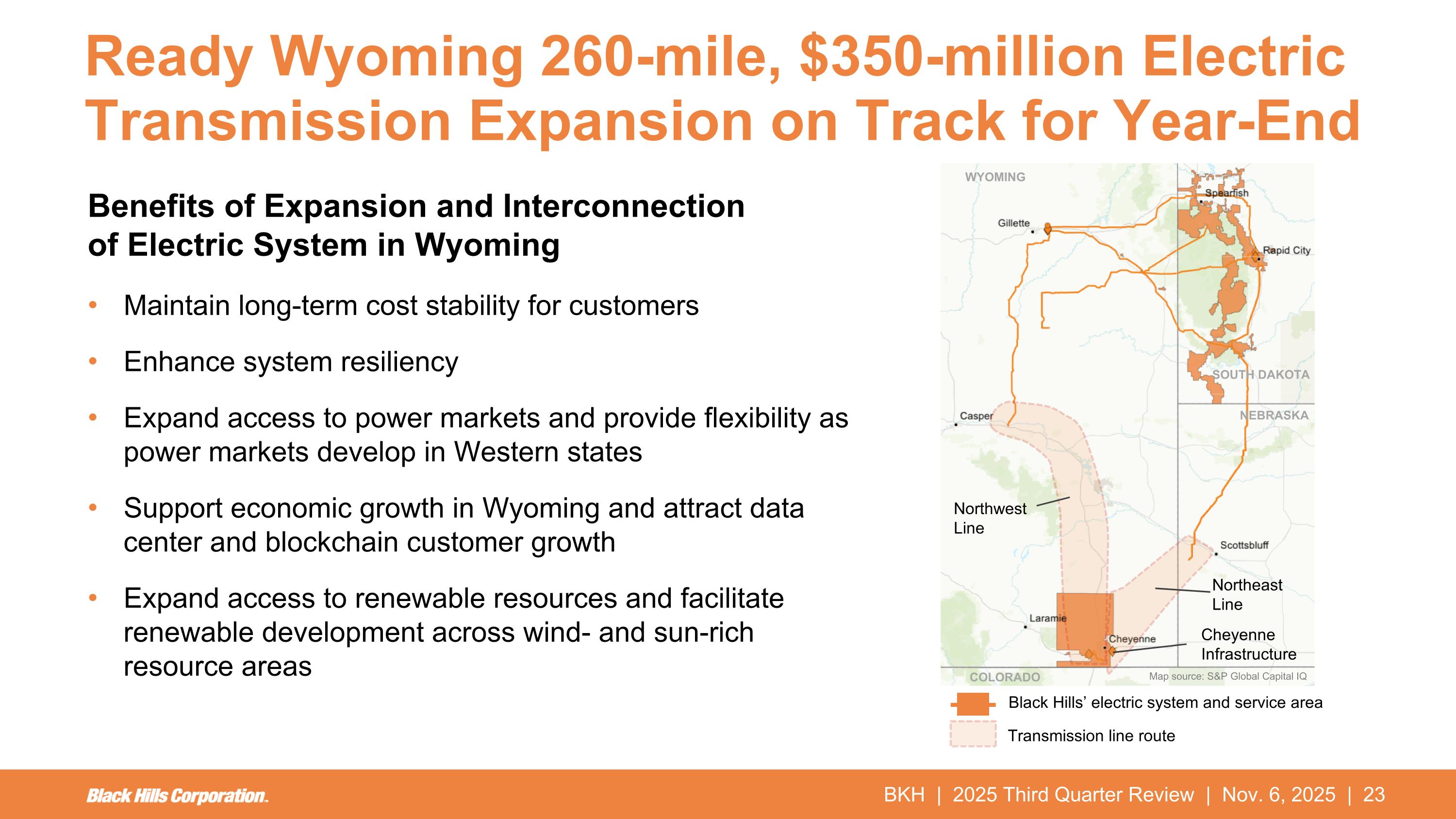
call over to Lynn Evans. Lynn? Thank you, Sal. Good morning, and thank you all for joining us today. Today, I'll start my comments on slide three with a summary of our quarter and our strategic outlook, including an update on our merger with our friends at Northwestern Energy. Kimberly will provide our financial update, and Marnie will discuss our operational performance and progress on key initiatives. We're fulfilling our commitment to deliver results for our stakeholders in three key areas that we identified at the beginning of the year. First, we're delivering on our financial commitments, having reaffirmed our earnings guidance and completed our planned financing activities. Second, we're executing on our regulatory and growth initiatives, including our $1 billion capital plan to support key projects to serve our customers' growing needs. And third, we're providing excellent operational performance, including top quartile reliability and a positive customer experience. I'm proud of our team's remarkable work in delivering strong financial results and making significant progress on our key initiatives. We're on track to achieve our earnings guidance for the full year with three primary drivers, new base rates, rider recovery, and customer growth. We're also continuing to maintain a healthy balance sheet. We have made significant progress with our regulatory strategy, including securing a recent settlement for our rate review in Nebraska. Including this settlement, our team has successfully completed seven rate reviews since the beginning of last year, highlighting our expertise in managing multiple regulatory requests. We also successfully advanced several key near-term projects that will drive growth we're on schedule to complete our 260 mile ready wyoming transmission expansion project by year end and we broke ground on our lang 2 generation project in rapid city during the quarter additionally customer growth including growing demand from our large load customers such as data centers and economic development in our service territories are providing solid contributions to earnings. In addition to our current plan, we continue to be very actively engaged with high-quality data center partners. We have now signed non-disclosure agreements for more than three gigawatts of demand. If and when these negotiations lead to signed agreements, only then will we incorporate them into our plan. Our financial outlook is provided on slide four. We're reaffirming our prior 2025 earnings guidance with an adjusted EPS range of $4 to $4.20, excluding merger-related costs. This represents a 5% growth rate at the midpoint over our 2024 EPS. Looking ahead, with solid progress in our regulatory and growth initiatives, we plan to deliver in the upper half of our 4% to 6% long-term EPS growth target starting in 2026. Our confidence in achieving our long-term growth target is further strengthened by our $4.7 billion capital plan and strong customer demand, including the data center opportunities I previously mentioned. We anticipate presenting an updated financial outlook during our fourth quarter and full-year earnings call in February, including earnings guidance for 2026 and capital investment plans for the years 2026 to 2030. Slide five represents our current 4.7 billion dollar capital plan. Our base annual investment is approximately 700 million dollars, prioritizing our customers core needs for safety, reliability, and growth. Additionally, our transformative infrastructure expansion investments will cost effectively enhance our system's resiliency and support growing demand and evolving requirements for both our electric and natural gas systems. Some of the major capital projects in our current plan include our Ready Wyoming transmission expansion that is on schedule to be completed by year-end, our 99-megawatt Lang 2 generation project in South Dakota that is under construction and we expect to place in service in the second half of 2026, and our battery storage project in 2027 to comply with the Colorado Clean Energy Plan. Our 2025 through 2029 capital plan does not currently include significant investments related to data center demand. We anticipate continuing to profitably serve large load demand through our market energy model with minimal capital investment at a level of approximately 500 megawatts of demand through 2029. However, demand exceeding that level will likely necessitate incremental investments in generation and transmission. Marnie will provide more detailed information about data center demand in her business update. Moving to slide six, on August 19th, we announced our merger with Northwestern Energy. Although we are well-positioned as standalone companies, this merger will create a stronger, more competitive entity with greater scale, an enhanced financial profile, and complementary strengths, enabling us to unlock additional value creation opportunities for our customers and our shareholders. In October, we submitted joint applications to our regulators in Montana, Nebraska, and South Dakota, requesting their approvals of our merger. We anticipate receiving procedural schedules and commencing the discovery process this quarter. We're also diligently working through the S-4 process and intend to secure all necessary approvals to finalize a merger within the second half of next year. With that, I'll turn the call over to Kimberly for
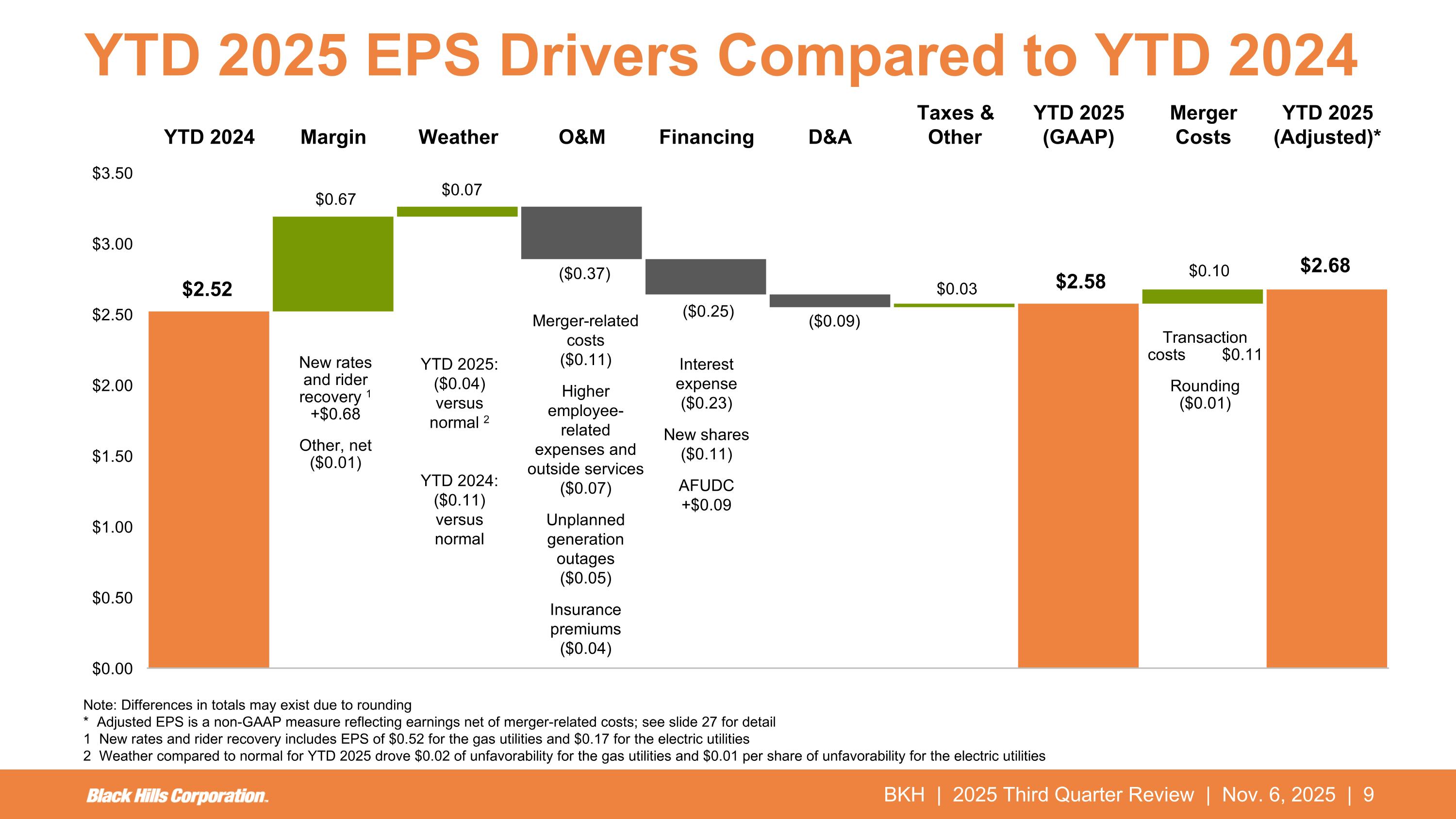
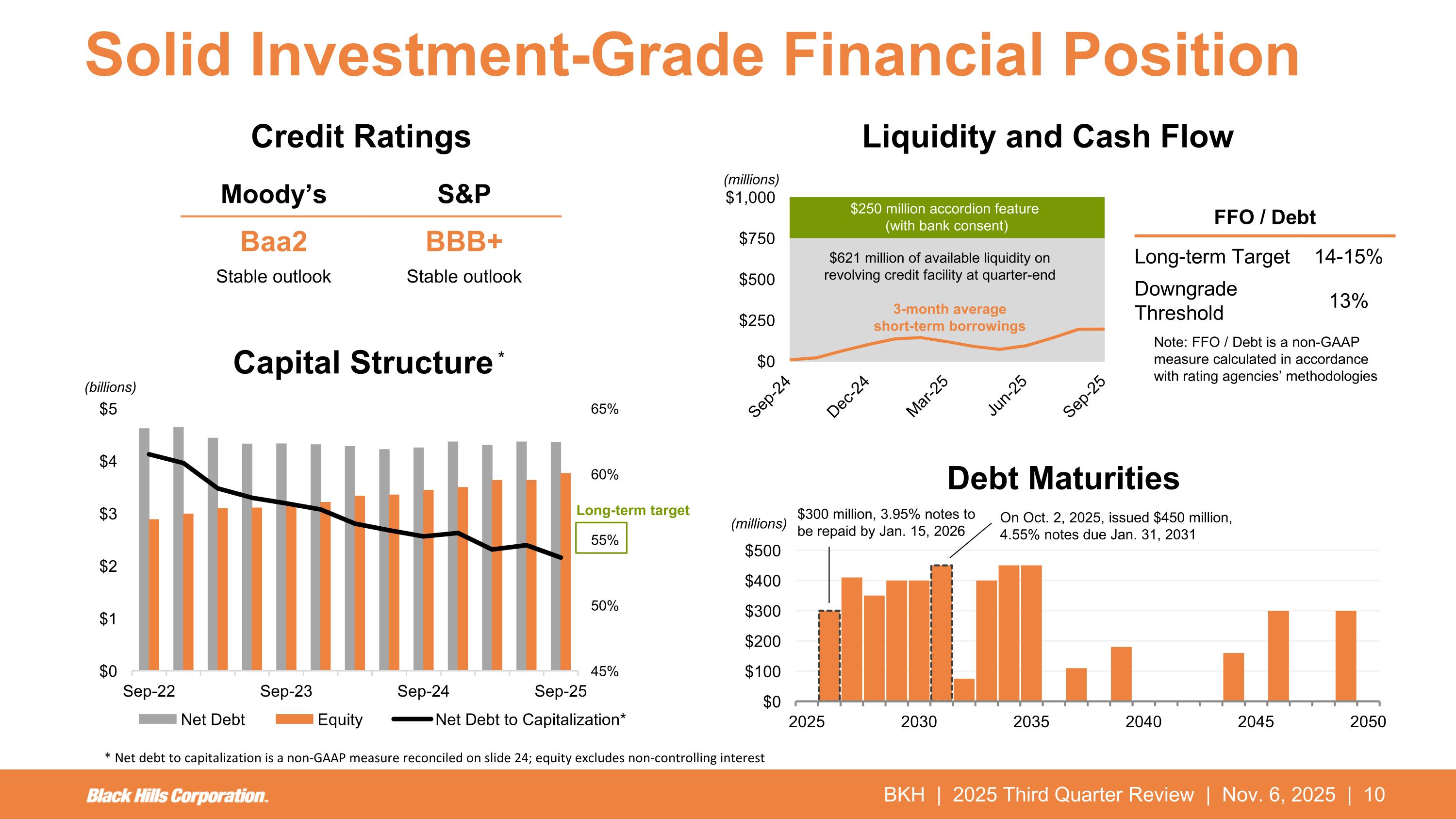
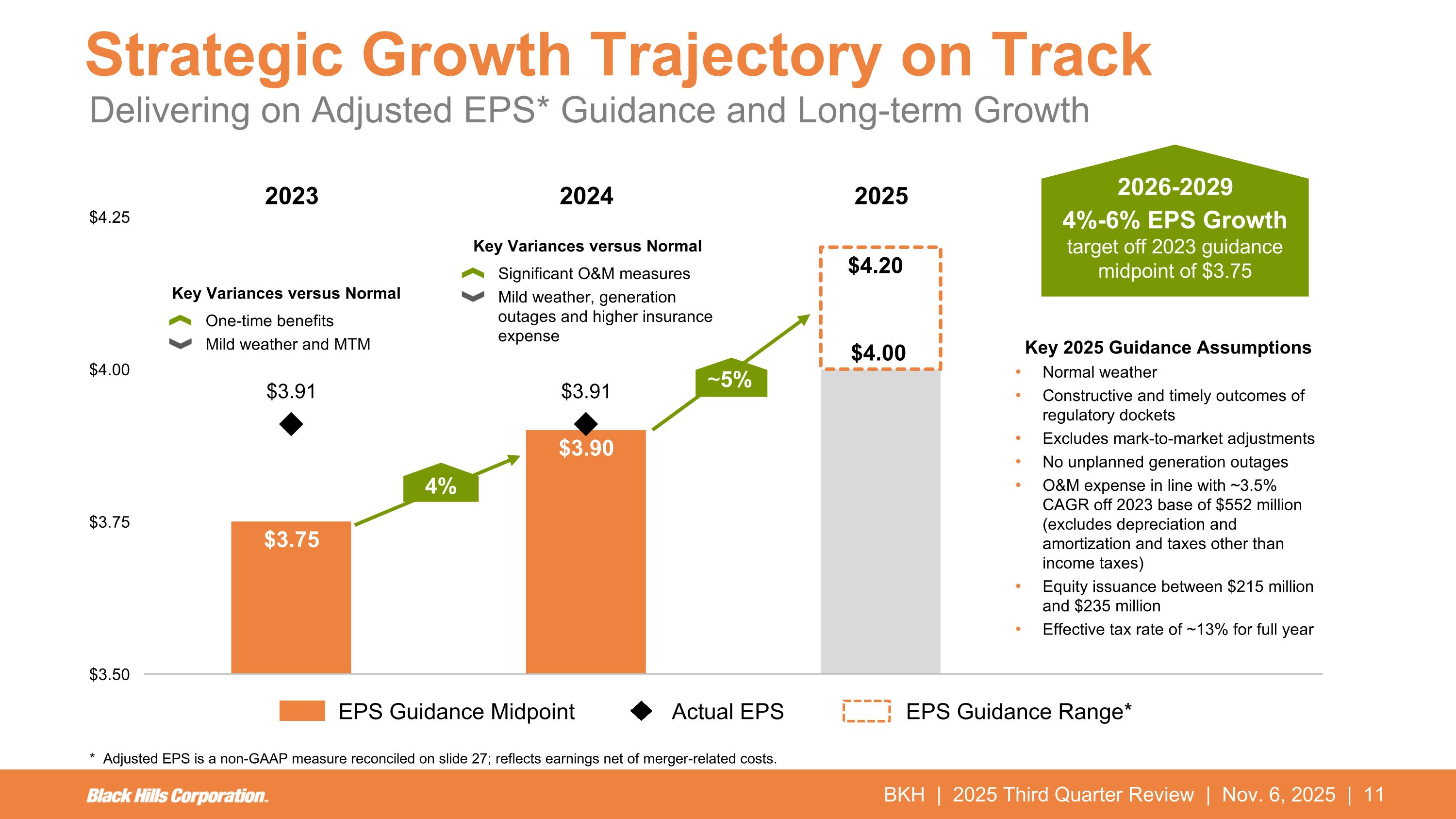
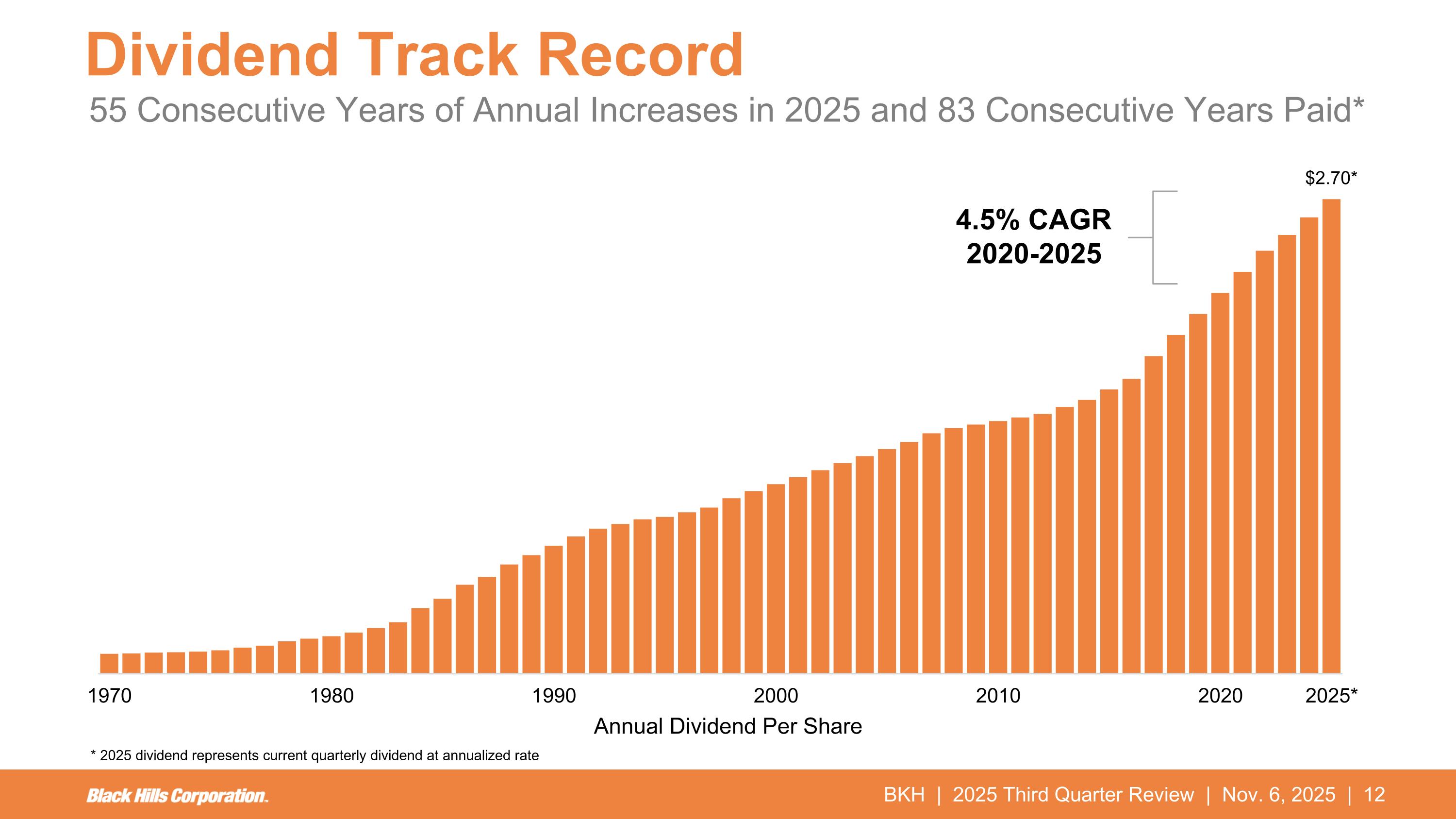
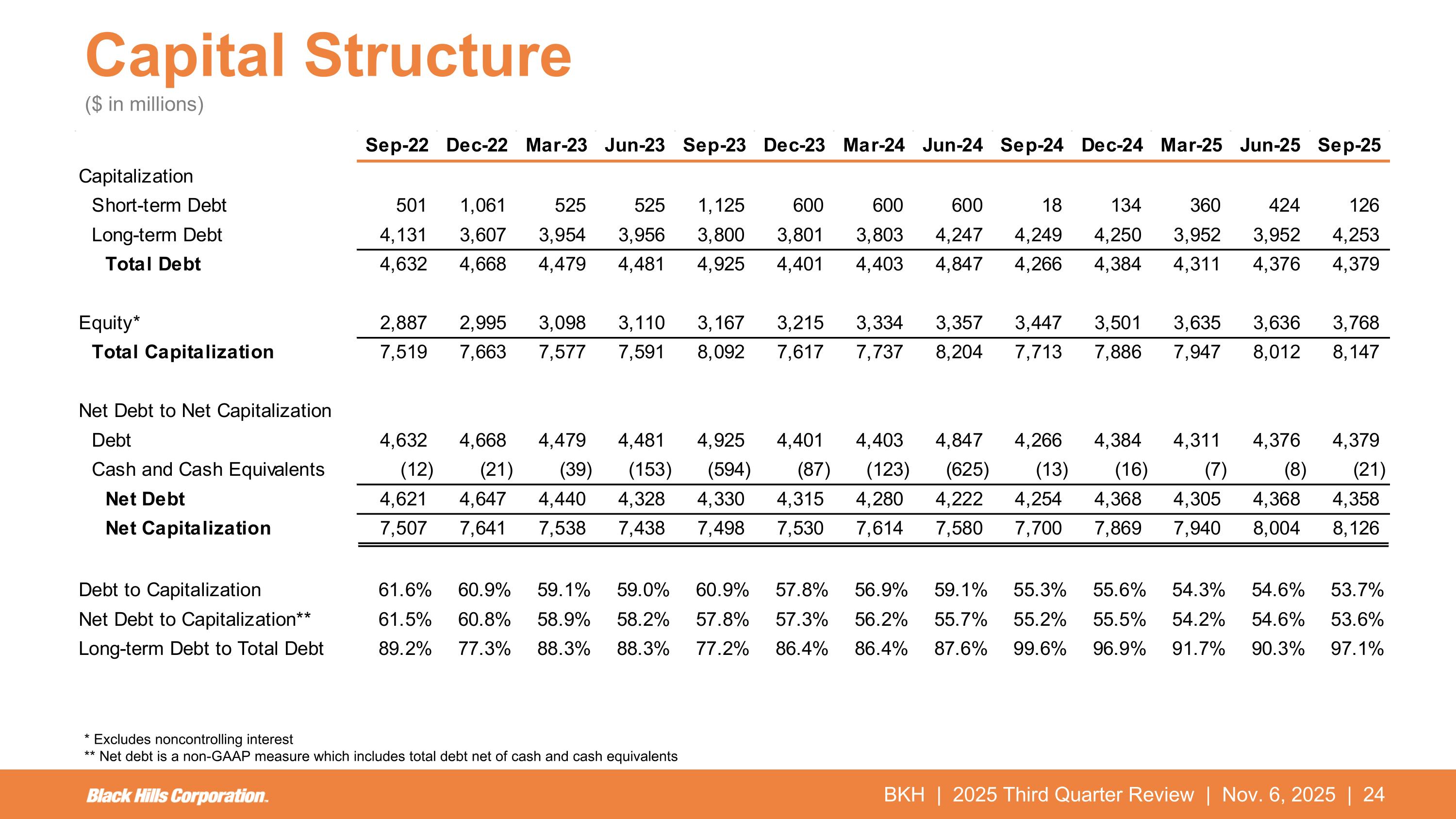
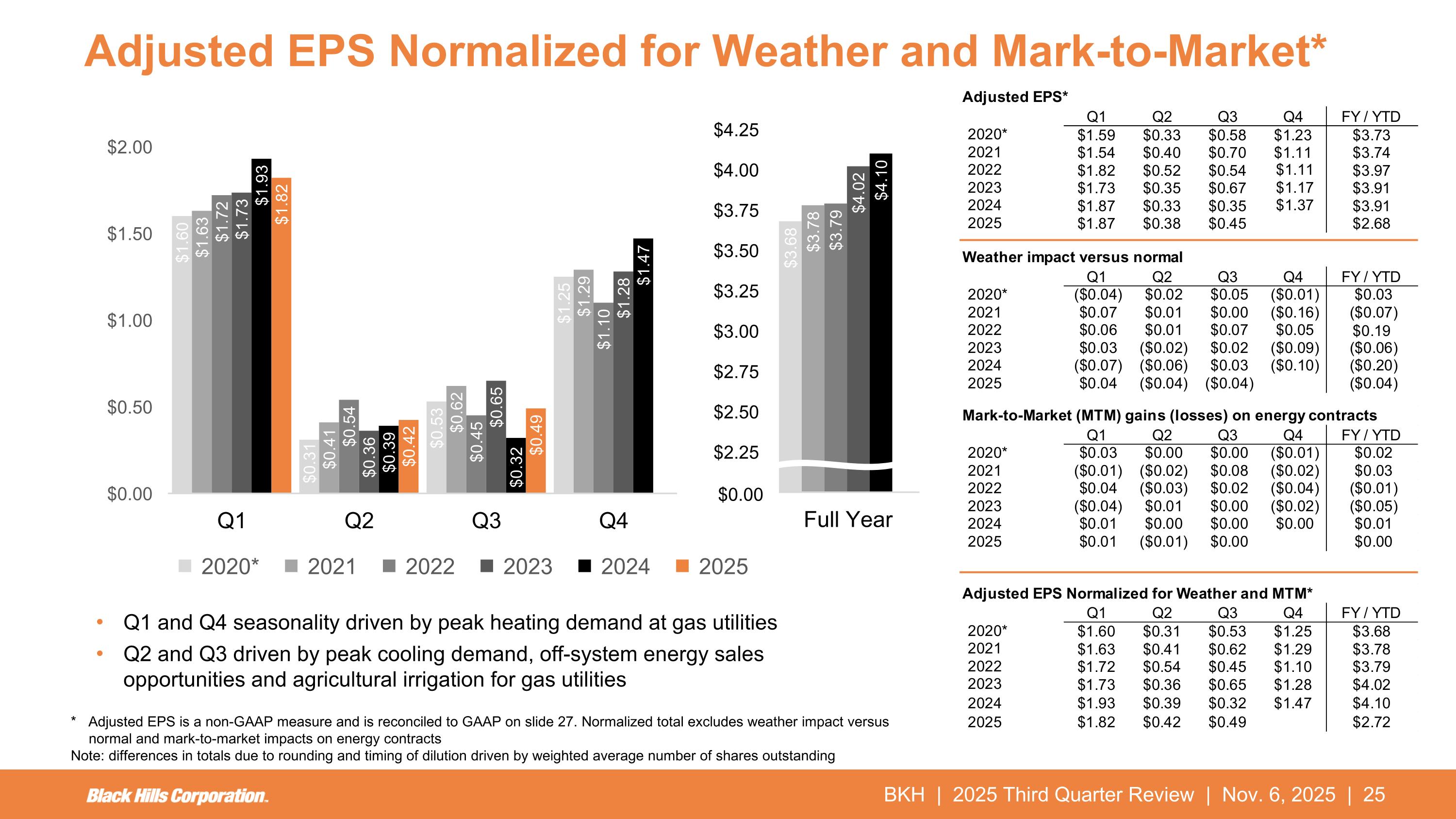
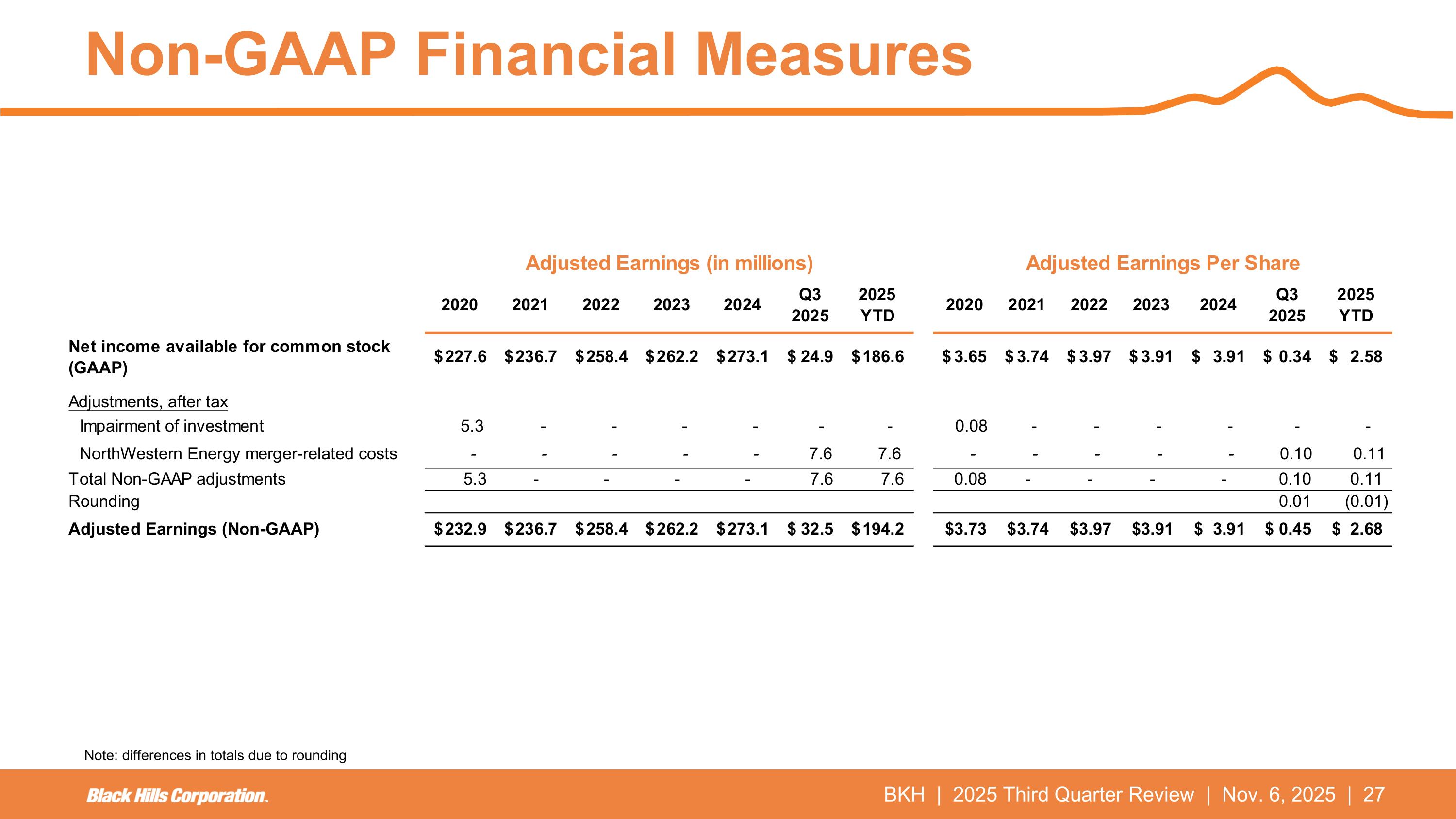
our financial update. Kimberly? Thank you, Lynn, and good morning, everyone. Our team is executing our strategy exceptionally well. From a financial standpoint, we have successfully accomplished several of our objectives in the current quarter and throughout the year. Our financial results met expectations, and we have maintained our strong investment-grade credit rating while funding our $1 billion capital plan for 2025. On slide eight, we provide a bridge comparing Q3 2025 to Q3 2024. For the current quarter, we delivered $0.34 per share of GAAP EPS, which included $0.10 of merger-related transaction costs. After adjusting for these costs, we reported $0.45 of adjusted EPS for Q3 2025, compared to $0.35 per share for Q3 2024. For the quarter, our regulatory efforts provided $0.21 per share of new rates and rider recovery margin, which offset unfavorable weather, O&M costs, and a moderate increase in financing and depreciation expenses. Weather was a $0.07 headwind compared to the same quarter last year. We experienced $0.04 of unfavorable weather this quarter compared to normal, primarily driven by lower agricultural irrigation demand in Nebraska. O&M was higher by $0.08 per share, which included $0.10 of merger-related transaction costs. Excluding merger costs, we reduced our O&M expenses compared to the same period last year by $0.02. Financing costs increased $0.03 per share, which included $0.06 of higher interest expense, $0.01 of share dilution, and a benefit of $0.04 per share from AFUDC, driven by ongoing large construction projects. We also incurred higher depreciation of $0.02 per share, reflecting new assets placed in service. Year-to-date EPS drivers are shown on slide 9. We reported GAAP EPS of $2.58, which included $0.11 of merger-related costs. Removing these costs from the year-to-date results, we delivered $2.68 of adjusted EPS, an increase of 6.3% compared to $2.52 for the same period last year. Our year-to-date results tell a similar success story to the third quarter. Excluding merger-related costs, our regulatory efforts delivered $0.68 of new rates and rider recovery, which more than offset higher operating expenses, financing, and depreciation. We benefited from $0.07 of weather favorability with $0.04 of milder than normal weather this year compared to $0.11 of milder than normal weather for the same period last year. Our earnings guidance is based upon normal weather within our jurisdictions. O&M increased by $0.37 primarily due to merger-related expenses, employee costs and outside services, insurance premiums, and unplanned outages. Excluding merger-related costs, we expect to manage our 2025 O&M expenses to a compounded annual growth rate of approximately 3.5% off of 2023 O&M expense. We incurred $0.34 of financing and depreciation expenses, supporting our capital investments. Financing and costs increased by $0.25, cents which included 23 cents of higher interest expense due to higher interest rates, 11 cents of dilution from new shares issued, and a benefit of 9 cents from AFUDC. Depreciation expense increased by 9 cents driven by new assets placed in service. As we approach the end of the year, we remain confident in our ability to meet our adjusted EPS guidance range and remain committed to achieving the financial commitments we made at the beginning of the year. Further details on year-over-year changes can be found in our earnings release and our 10-Q to be filed with the SEC later today. Slide 10 presents our solid financial position through the lens of credit quality, capital structure, and liquidity. We continue to sustain a healthy balance sheet by delivering credit metrics within our targets of 55 percent net debt to total capitalization and 14 to 15 percent FFO to debt 100 basis points above our downgrade threshold of 13 percent we completed our planned equity issuance for the year issuing a total of 220 million dollars of net proceeds in 2025 achieving our stated equity guidance range of 215 million to 235 million dollars looking forward we expect our 2026 equity issuance to be significantly lower, driven by stronger cash flows from the successful execution of our strategic capital investments, regulatory plans, and increasing data center low growth. In October, we completed our planned debt offering, issuing $450 million of 4.55% notes, a portion to be used to pay off our January 2026 long-term debt maturity of $300 million. As a result of our team's successful execution of our 2025 financing activities, we have funded our capital plan and maintained strong liquidity with more than $600 million of availability under our revolving credit facility at quarter end. Slide 11 shows our earnings growth trajectory beginning in 2023 along with our 2025 earnings guidance assumption. For 2025, we expect adjusted EPS to be between $4 and $4.20 per share, which at the midpoint represents a 5% increase over 2024 earnings. Our long-term earnings growth will be driven by ongoing customer growth within our jurisdictions, increasing data center demand, and new rates and rider recovery on strategic investments like Ready Wyoming and Lang 2 that will provide long-term benefits to customers. We believe we are well positioned to achieve the upper half of our long-term EPS growth target of 4 to 6 percent beginning in 2026. Slide 12 illustrates our industry-leading dividend track record of 55 consecutive years. We continue to target a 55 to 65 percent payout ratio. A dependable and increasing dividend is an important component of our strategy to deliver long-term value for our shareholders. I will now turn the call over to
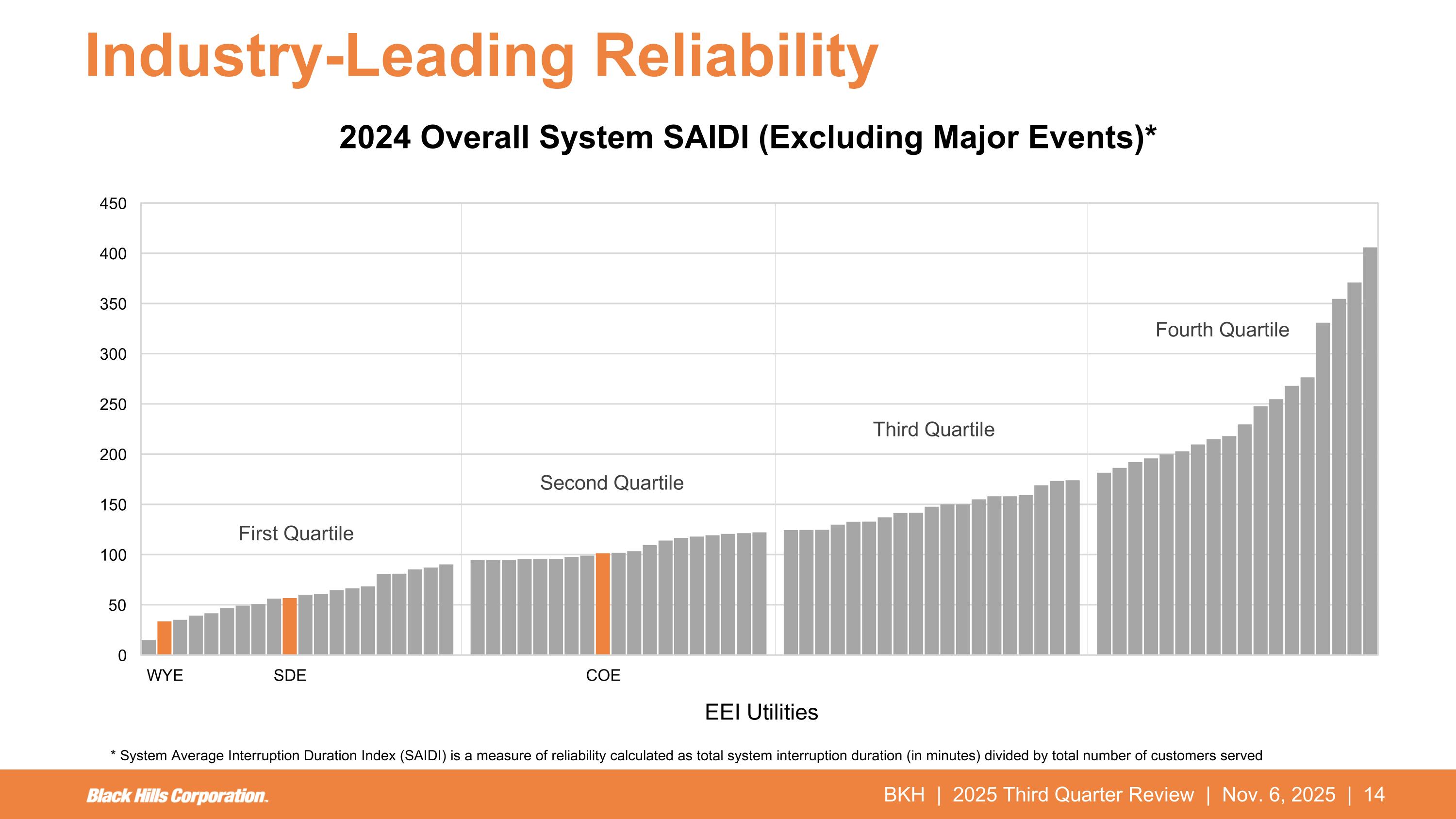
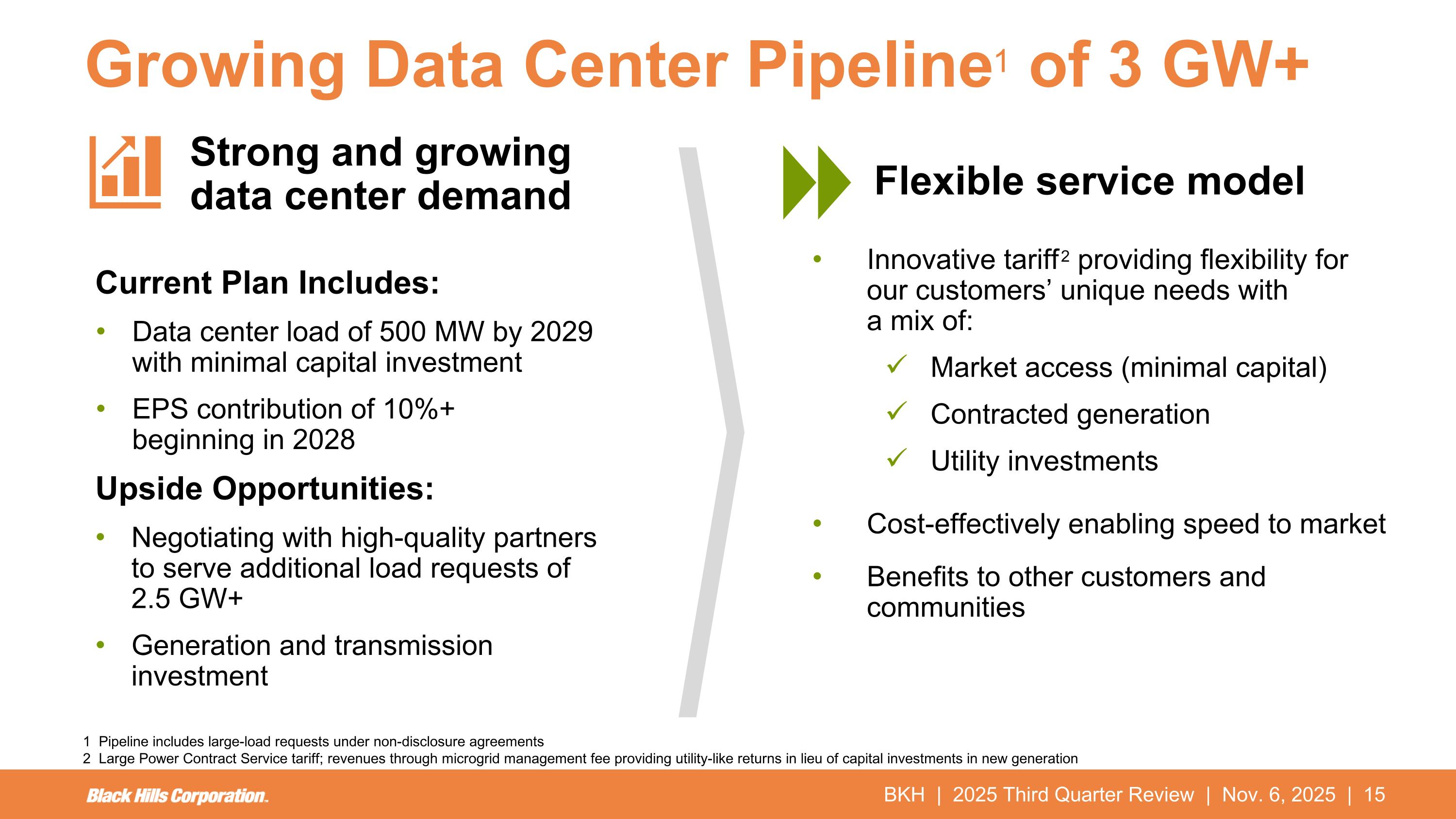
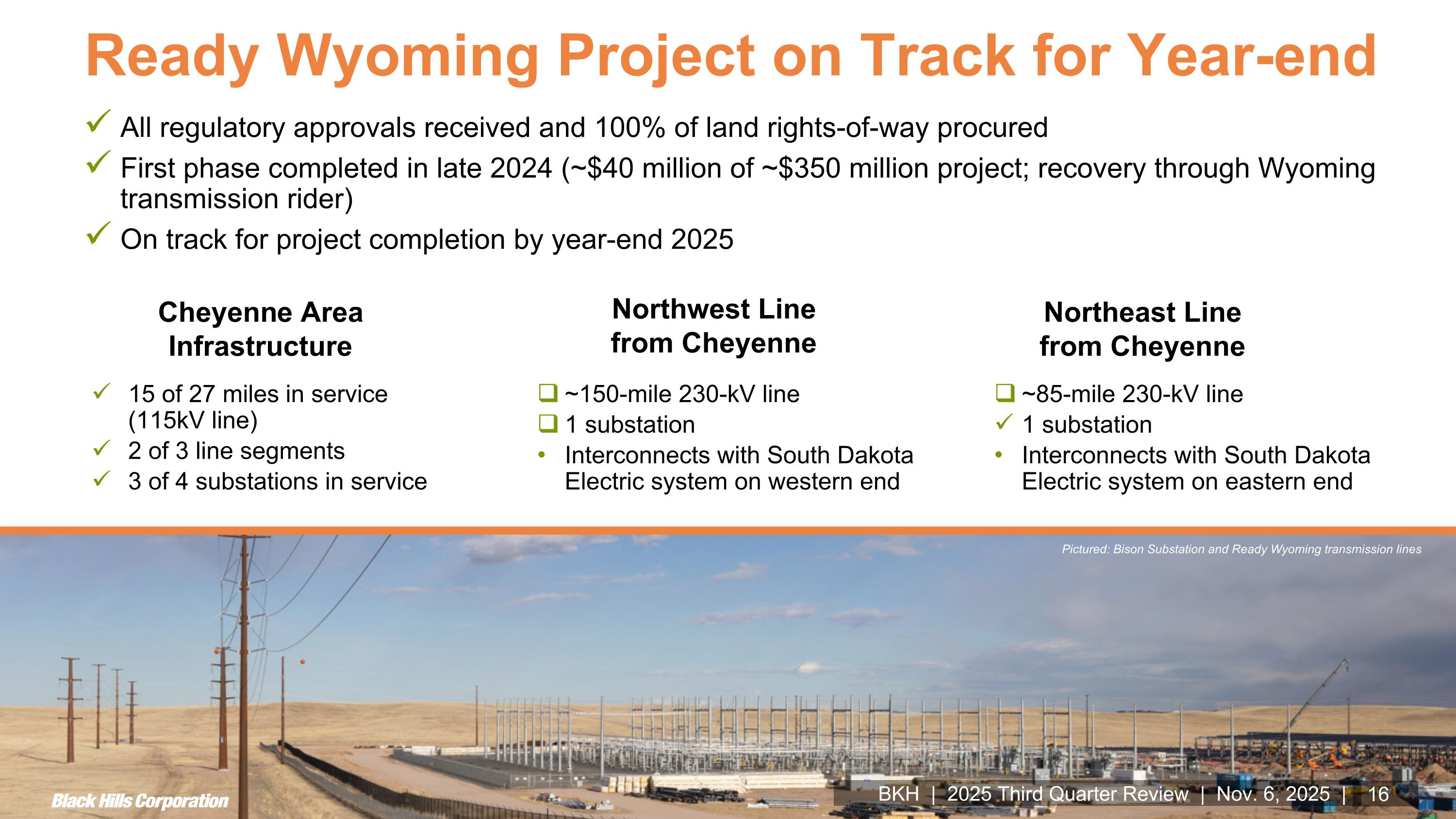
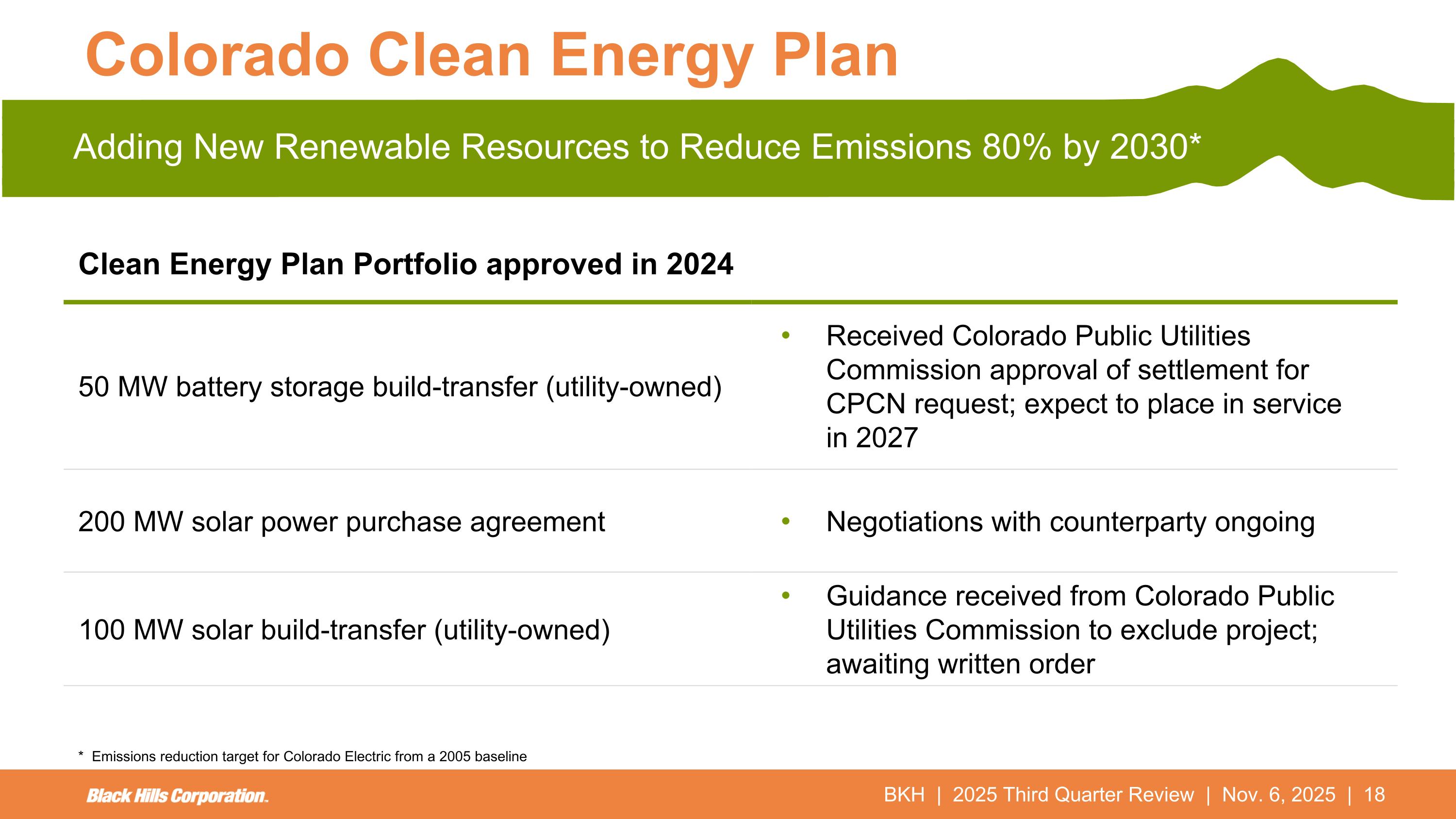
Marnie for a business update. Thank you, Kimberly, and good morning, everyone. I'm excited about our current position, the progress we have made on key initiatives, and the promising growth opportunities that lie ahead, all while continuing to provide our customers with safe, reliable, and cost-effective energy they rely on every day. Slide 14 illustrates our industry-leading reliability for our electric utilities. Two of our three ranked in the top 10 companies in EEI's most recent report based upon 2024 SADI metrics. This reflects the benefits of our long-standing commitment to our customer-focused strategy and investments. Moving to slide 15, we continue to see significant data center interest and in Wyoming we are fulfilling this demand through our flexible service model of market energy, contractor generation, and utility investment. Through our innovative tariff, we have served growing demand from Microsoft hyperscale data centers for more than a decade. We are now serving Meta's new AI data center under construction in Cheyenne, which we expect to transition from construction power to permanent service later this year. As Meta ramps up its data center and Microsoft demand continues to grow, our current plan includes 500 megawatts of data center demand by 2029, growing data center earnings contribution to more than 10% of total EPS in 2028. Other leading data center partners are also recognizing the value of our customer-focused offerings and the ideal attributes of our service territory as a choice location. As a result, our growing pipeline of load requests offers compelling upside to our current plan. We are actively engaged in negotiating with high-quality partners representing more than three gigawatts of data center load, a significant increase from our previously disclosed pipeline of one plus gigawatts. Supporting this expanded pipeline, two additional data center sites were announced in recent months to be constructed in Cheyenne and to take energy as early as 2026. To capture this growth, we have executed non-disclosure agreements and are negotiating service agreements for these and other projects while doing so we continue to prioritize meeting our customers unique needs maintaining overall system reliability and appropriately addressing risks while ensuring we earn a fair return for our shareholders keeping with our normal practice we will announce details when agreements are signed moving to slide 16 we are very excited to be in the final stages of construction on our 260 mile $350 million Ready Wyoming transmission expansion and are just weeks away from the project being placed in service. By year end, we will be serving customers with a stronger system that reduces reliance on third-party transmission, enhances resiliency, and increases access to market energy, including renewables. Our interconnected transmission network will support long-term price stability for our customers and enable continued growth across our service territory. And as a reminder, this investment is recovered through our Wyoming transmission rider with new rates effective in January 2026. Slide 17 outlines our progress on South Dakota Electric Resource Plan. During the third quarter, we broke ground on our Lang 2 project, a 99-megawatt utility-owned natural gas fire generation resource located in Rapid City, South Dakota. This new resource will replace aging generation facilities and address updated reserve margin requirements. We are on pace for the facility to be placed in service in the second half of 2026. Moving to slide 18, in Colorado our clean energy plan is ever evolving, moving from a 350 megawatt plan to a 250 megawatt plan. This week we received approval of our CPC encelement for a 50 megawatt utility-owned battery storage project and recently the commission provided additional guidance on the solar projects. They have requested us to continue negotiating on the 200 megawatt PPA and abandoned negotiations on the 100 megawatt solar project due to increased pricing. Slide 19 summarizes our regulatory progress. We are pleased with our settlement which was reached during the third quarter for our Nebraska rate review. The settlement provides 23.9 million dollars in new annual revenue based on an ROE of 9.85 percent and a capital structure of 50.5 percent equity. We anticipate approval of the settlement in December with new rates effective January 1, 2026 to replace interim rates in effect since August. The settlement also includes a renewal of our five-year system safety and integrity rider, an insurance cost tracker, and a weather normalization pilot program in arkansas we're preparing to file a gas rate review to recover investments that support safe reliable service and strong growth in the region we are also preparing for an electric rate review in south dakota after holding base rates unchanged for more than a decade the request will recover our customer focused investments including the lang two generation project and increased cost to serve customers since our last rate review in 2014 And finally, in Wyoming, we are preparing to file our wildfire mitigation plan this month for commission approval in accordance with wildfire liability legislation. Following our approval process, we expect to obtain significant liability protections as we remain in compliance with our approved plan. With that, I will now turn the call back to Lynn.
Thank you, Marnie. As I hope you've heard, we delivered another strong quarter, achieving significant progress within our financial, strategic, and regulatory strategies. This gives us confidence in achieving our 2025 earnings guidance and our ability to deliver in the upper half of our long-term EPS CAGR starting next year. We're at a pivotal juncture in our company's history. We have large transformative projects coming online in the near term, coupled with a robust pipeline of growth opportunities, including expanding data center demand. Additionally, our planned merger with Northwestern Energy will provide us with the advantages of increased scale and new opportunities. Thank you for your interest and your trust in Black Hills as we partner to grow long-term value for our customers and our stakeholders. This concludes our prepared remarks, and we're happy to take your questions.
Operator
Thank you. As a reminder, to ask a question, please press star 11 on your telephone and wait for your name to be announced. To withdraw your question, please press star one one again. One moment for questions. Our first question comes from Chris Ellinghaus with Seabird Williams
Shank. You may proceed. Hey, good morning, everybody. Marnie, given your pipeline for data center potential resource requirements, have you guys done anything to put in options or reservations on any important critical equipment at this point?
Yeah, good morning, Chris, and thanks for the question. We're obviously very excited about the pipeline that we're building. And, you know, much to your point, it is going to require some generation. But we do have some reservations, and we also, you know, continue to use our LPCS tariff, which allows us to serve it through that mix of utility-owned, contracted, as well as market purchases. and so really providing us a lot of flexibility in how we serve this growing pipeline.
Yeah, I wanted to ask you about this. I assume you have a preference for utility-owned, but do you have any considerations or thought process on having it be non-regulated generation transmission?
yeah you know with the with the tariff certainly there's there's good opportunity for utility ownership but i think the flexibility is what's most important because our tariff does allow us to earn a utility-like return even without the rate-based investment and so that that flexibility is really important as we talk about this expanded pipeline because we we can be almost agnostic in some perspectives of how we serve it. It's really important, as I mentioned earlier today, that, you know, making sure we have the reliability. So that obviously is going to come through some control of capacity, but we want to make sure that we're managing it from a risk perspective with tail risk and protection of customers. We want to make sure we're getting the returns. And so that model that we've been talking about here for, gosh, we've had in place for a little over 10 years will continue to be the model that we use as we've talked about this
growing load. Given, I don't know how to phrase this, but given the activity in the Montana Commission in the last couple of months, have you got any concerns or thoughts about the approval process in Montana? And are you thinking that that could be extended given what's been happening
there. Hi, Chris. Good morning. This is Lynn. We're watching that closely with our friends at Northwestern. Northwestern, of course, does a lot of business for a long time in Montana. We're taking a lot of guidance from them in terms of the politics, etc. To be blunt, we're not worried. In fact, some of the things that have happened recently arguably can be helpful to the process. We're watching it closely, staying highly engaged with that commission through our application. We'll be starting discovery here quite soon. We'll look forward to the procedural schedule. That will tell us a lot, too. So, we're aware, and we're managing our way through it.
Okay. Given the good third consensus expectations are for the fourth quarter, that sort of implies towards the upper end of your guidance range for the year, but you didn't really address where you think you're falling in the range so far. Are there any fourth quarter issues that you'd highlight that might be on the more negative side?
Yeah, Chris, good morning. It's Kimberly here. I don't think there's anything that we would highlight. You know, everything, you know, operationally, financially, we're really hitting on all cylinders. We're obviously always focused on the weather. And I just remind listeners that, you know, our earnings guidance is based on normal weather. So that's the thing that we watch and, you know, are probably most concerned about, but it's outside of our control. Operationally, we're in a really good place. So overall, there's just nothing else that I would highlight. And again, I just remind listeners that we did, you know, reaffirm our guidance for the year. So we're really feeling, you know, good about where we're at.
Chris, this is Lynn. And I would only highlight beyond what Kimberly just said, that the largest project, capital project in our company's history, our Wyoming Ready project, is on schedule. We'll have that finished before the end of the year. So that's a big deal for us, too.
Lastly, you know, there's been some data points on some economic issues, some weakness here and there, and lots of layoffs of late. Have you seen any indicators of weakness in your service areas at this point?
We monitor that closely, Chris, and I'd say the short answer is no. We're watching that closely. But in our particular service territories, the economic conditions seem to continue to be strong. Maybe not as strong as they've been in the past, but they're certainly not weak, put it that way.
Okay. Appreciate the color, guys.
Operator
Thank you, Chris. Thank you. And as a reminder, to ask a question, please press star one one on your telephone. Our next question comes from Andrew Weissel with Scotiabank. You may proceed.
Hey, good morning, everybody. Good morning, Andrew. First question, I want to ask Lloyd to try to quantify the EPS upside from the Crusoe-Tallgrass data center project. Bear with me here. I know that you're not going to answer the direct question here but i want to go through this thesis going around you may have heard the basic concept is you've talked about 10 of 2028 eps coming from data centers based on 500 megawatts we can take 2025 eps grow it by 5 per year take 10 of that divide by 500 that gives a simplified math of eps per megawatt you multiply that by 1.8 gigawatts you get a huge potential impact in the neighborhood of like $1.50 of VPS or more by the time this project is at full scale. It would be even higher if we did like 2.5 gigawatts or 3 gigawatts that you've talked about today. So admittedly, this is very simplified math, but does that approach make sense to quantifying the upside? Or I know you've talked a lot about the tariff structure. Are there diminishing returns or any other reason to think that that approach and that level of upside is
wrong. Good morning, Andrew. It's Kimberly. What I generally say is your theory and your mathematical calculation is directionally correct. It's really important to understand that we negotiate with each of these data centers. And so the nuances of those contractual agreements will be different between each of the respective hyperscalers, whether it's our existing customer base with Microsoft and Meta, whether it's the forecasted opportunities with some of the hyperscalers that we're currently negotiating with. So in general, each megawatt is going to look a little different, but from a theoretical perspective, you're absolutely right. This is going to be a significant opportunity from Black Hills' long-term growth perspective.
And Andrew, Kimberly answered that question very, very well. I'd also add that some of these revenues also go back to customers. They go back through administrative fees and other kinds of fees. So it's very beneficial to customers the way these tariffs are set up as well.
Okay, great. That's helpful and very encouraging. Along those lines, you talked earlier about incorporating the upside to the growth plan from data centers only after contracts are signed, which makes sense. Should that happen before the merger closes, would you address the growth outlook? Or is the 4% to 6% more or less frozen, so to speak, until the deal closes? I'm not
looking for a number. I'm asking for a philosophy. Hi, Andrew. Yes, this is Kimberly again. So obviously, we're very focused on achieving our current growth rate, and we're on target to do that. We've obviously guided to the upper end of that range as a result of a lot of the projects our teams are working on that will go into service, Ready Wyoming, our Lang 2 project, et cetera. So as we think about data center growth, obviously it would be a significant upside to our plan. And we would obviously provide an update at the point that we're going to close or sign these contracts. And at that point, we'll assess whether it's the right time to change our earnings guidance range, our long-term earnings guidance range for any reason. So that's really how we're thinking about it at this point.
Okay, very clear. One last one, if I may. You own a coal mine, which has not gotten a lot of investor attention recently, but in today's environment, it might be worth more than it has been in the past. How are you thinking about that asset? Is it something that you could potentially monetize? Coal, obviously, is not a rare earth mineral, but it seems to fall into that rare earths conversation. How do you think about that asset strategically?
we're keeping our options open I suppose Andrew you might know my background is mining engineering so I'm aware of what this could be and what it could not be we are aware we have rare earth minerals in our coal in our fly ash etc it'd be my personal opinion probably not enough to monetize but stranger things have happened we'll watch what's happening at the Washington D.C. region especially if there was a price floor or something of that nature We're all aware that the Chinese can flood the market very quickly if they choose to in that regard, et cetera. So we're keeping an eye on it, I suppose. Our coal has been tested, analyzed, so we're kind of aware of what's there. But we don't think there's anything that we need to be really happy or concerned about in the near term. How does that sound?
Sounds good. Appreciate it. Thank you, everybody. Thank you, Andrew. Appreciate your questions.
Operator
thank you i would now like to turn the call back over to lynn evans for any closing remarks
well thank you everyone for your interest in black hills today we appreciate your time we appreciate your investment in us and your confidence in us as you can see i think we're hitting on all cylinders so we're very excited about finishing our ready wyoming project we're excited about our merger in the second half of next year with our friends at northwestern energy i will be seeing many of you in the next couple of days at the edison electric institute financial conference. We wish you safe travels, and we'll look forward to connecting with you there. And then finally, I just want to say a huge thank you to our team, how engaged you are as you're improving our customers' lives with energy every day. Thank you for what you do, and with that, enjoy a Black Hills Energy Safe Day. Thank you. This concludes the conference. Thank you for your participation. You may not disconnect.