Operator
Good morning, and welcome to the CNH 2025 Third Quarter Results Conference Call. As a reminder, this conference call is being recorded. I will now turn the call over to Jason Omerza, Vice President of Investor Relations.
Thank you, Julianne, and hello, everyone. We would like to welcome you to CNH's third quarter earnings presentation for the period ending September 30, 2025. This live webcast is copyrighted by CNH and any recording, transmission or other use of any portion of it without the written consent of CNH is strictly prohibited. Hosting today's call are CNH CEO, Gerrit Marx; and CFO, Jim Nickolas. They will reference the material available for download from our website. Please note that any forward-looking statements that we make during today's call are subject to risks and uncertainties mentioned in the safe harbor statement included in the presentation material. Additional information pertaining to factors that could cause actual results to differ materially is contained in the company's most recent annual report on Form 10-K as well as other periodic reports and filings with the U.S. Securities and Exchange Commission. Our presentation includes certain non-GAAP financial measures. Additional information, including reconciliations to the most directly comparable U.S. GAAP financial measures, is included in the presentation material. I will now turn the call over to Gerrit.
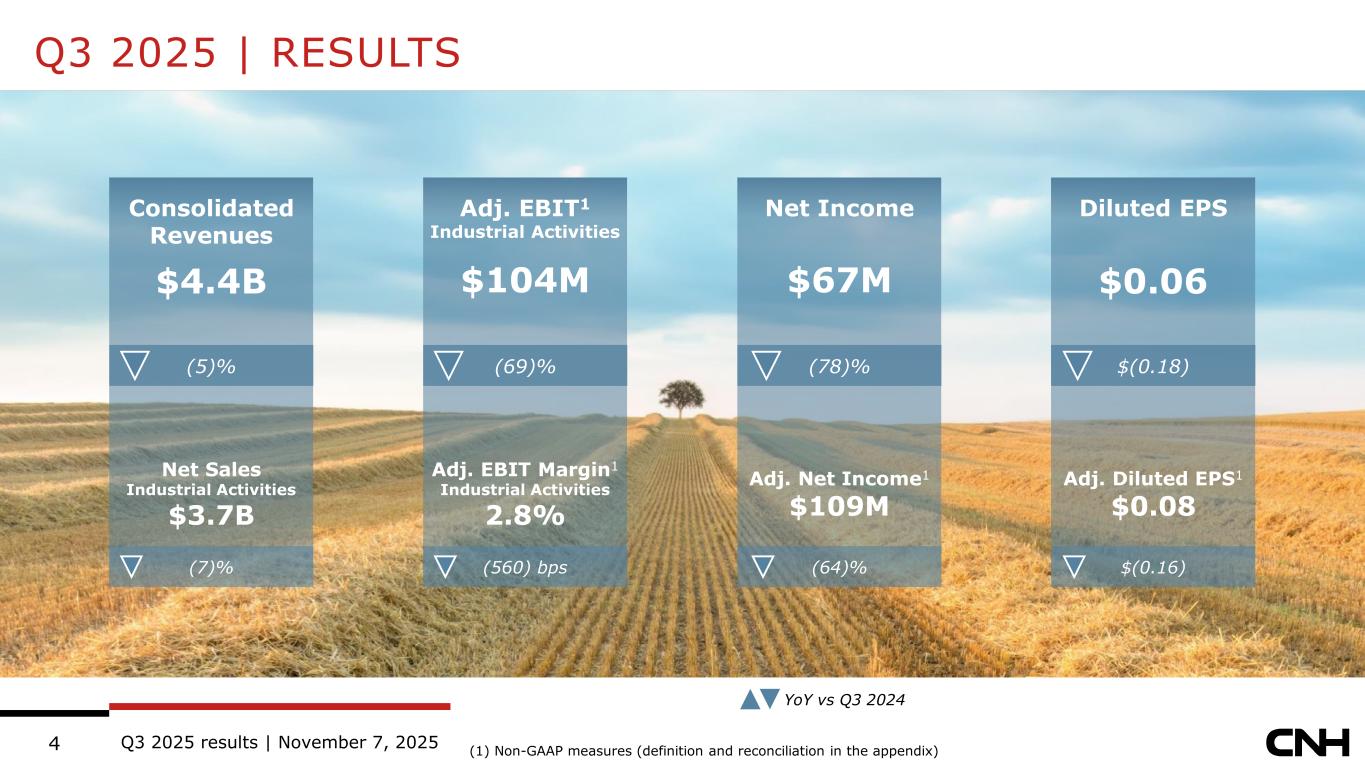
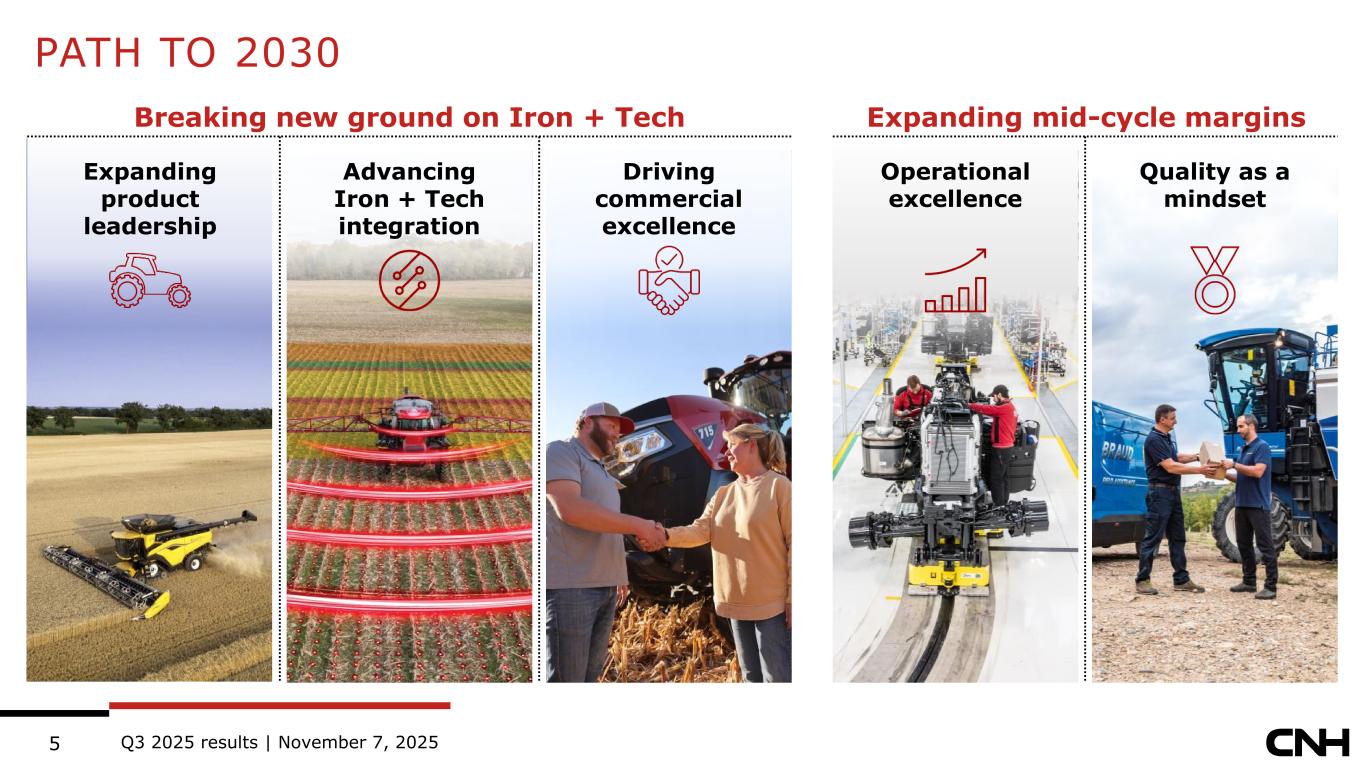
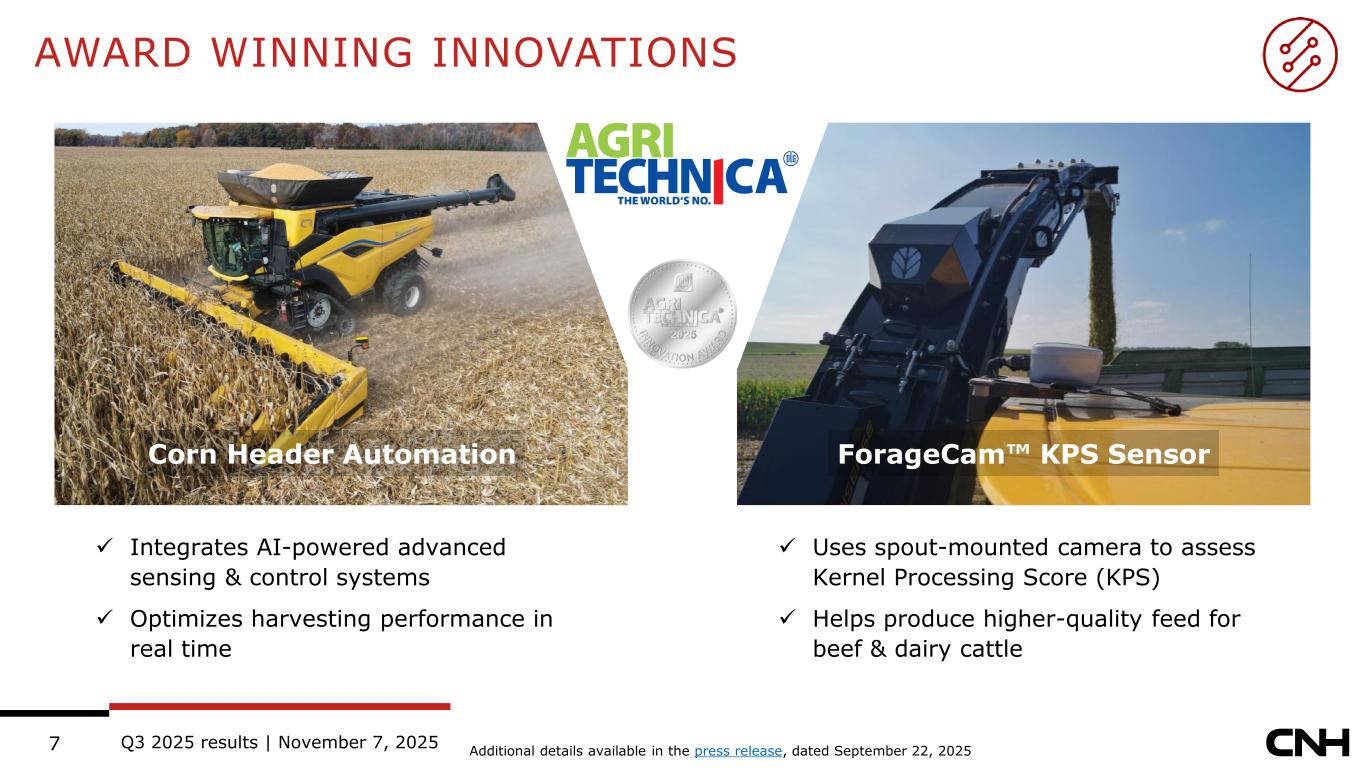
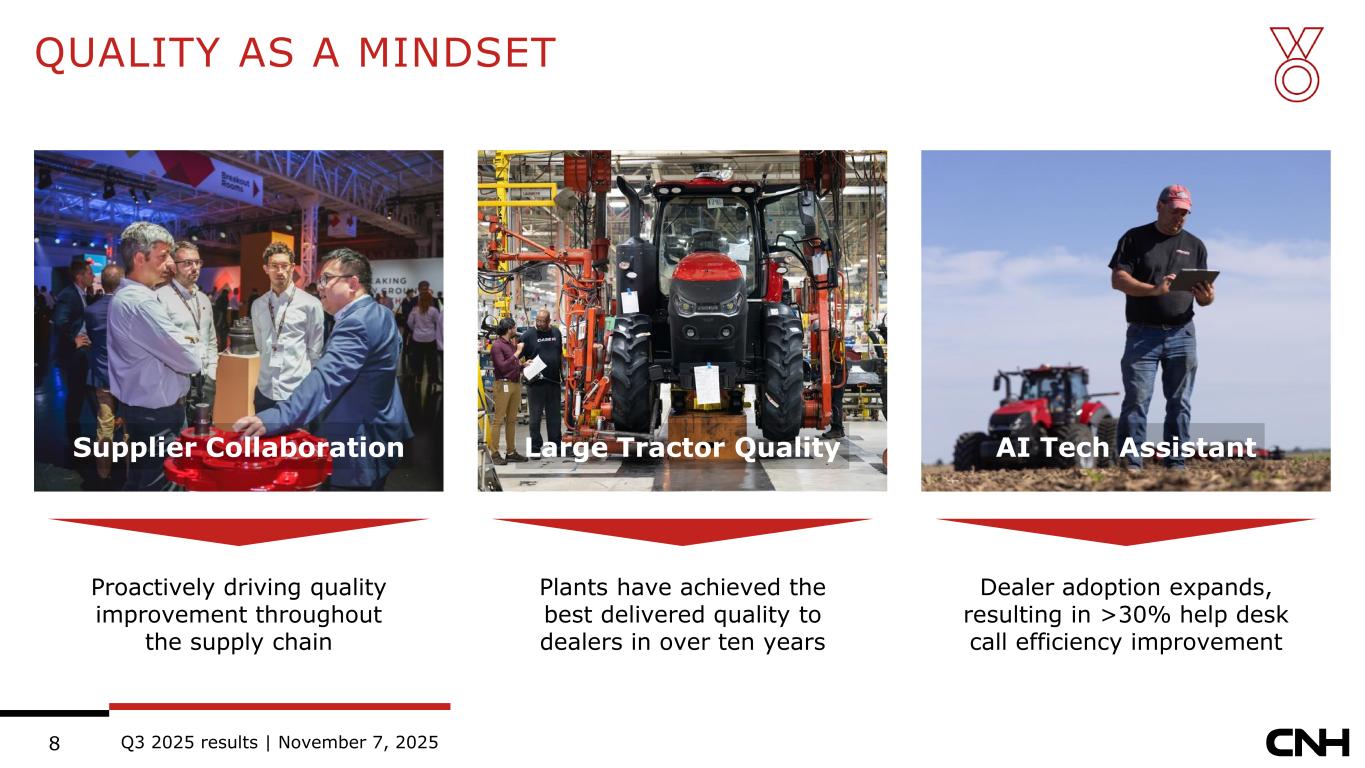
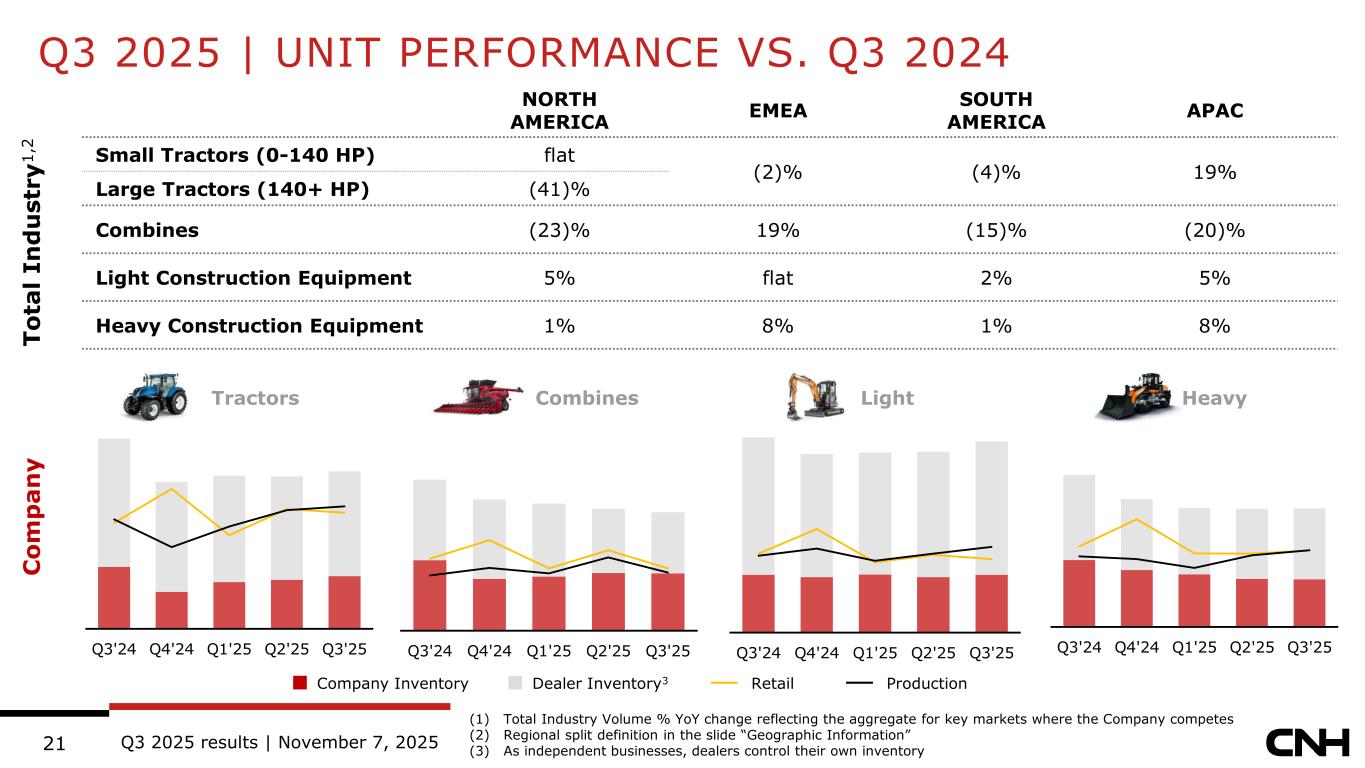
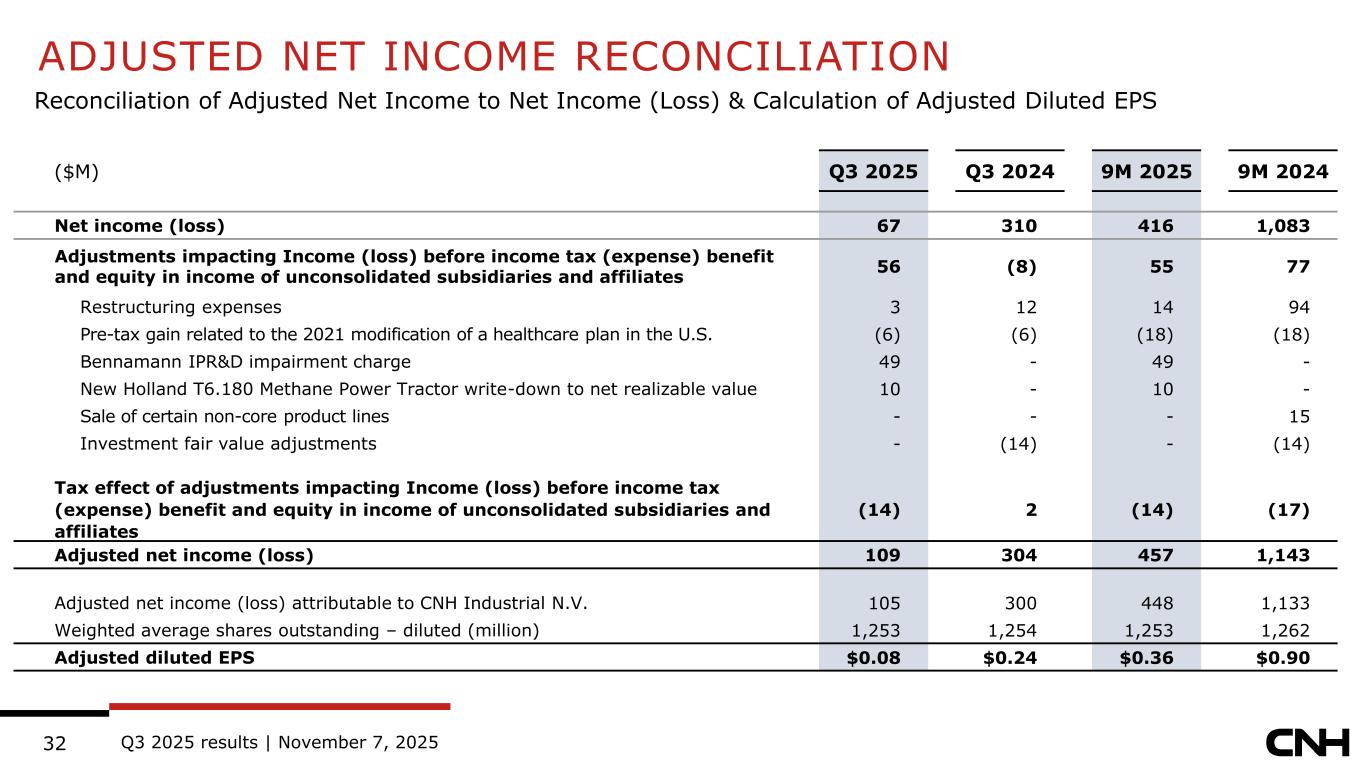
Thank you, Jason, and welcome to everyone joining the call. Our third quarter ended in a changing landscape of global trade, but we made progress on our goals, including reducing channel inventory, managing quality and product costs, exploring new opportunities across our iron and technology offerings, and laying a solid foundation for our recently announced 2030 mid-cycle margin commitment. Farmers have experienced many cycles and shifts in global trade throughout the history of our industry, some even larger and more disruptive than the current one. Looking ahead, it is clear that most arable lands worldwide will be utilized for technology-led crop production and livestock farming to support the growing population, even if it means cultivating different crops. As a leading global agriculture machinery provider, CNH will play an increasingly vital role in helping to feed the world, as we will demonstrate next week at Tech Day during the Agritechnica Fair in Hannover, Germany. We are carefully transforming our global supply chain and dealer network to minimize the risks of potential volatility in our industry. With this clear focus, we have kept overall production levels low since the third quarter of 2024 to help decrease CNH steel inventories and clear out older products while still defending and, in some cases, growing market shares. Both agricultural and construction production remained flat year-over-year, but large agricultural production decreased by 10%, while small agricultural production mostly increased. Our agricultural dealers' new inventory levels experienced another sequential decline of over $200 million, putting them on track to reach our target levels in the next 3 to 4 months. Our North American dealers' used inventory also saw a further sequential decline during the quarter. While this is positive news for CNH, market fundamentals continue to be uncertain and challenging for our farmers. It is hard to predict whether we will enter 2026 with greater visibility or momentum. Conditions in South America, particularly Brazil, remain a headwind for our farmers. Although we had anticipated that this region would be the first to recover from the downturn, difficult geopolitical and market conditions have continued. Likewise, farmers in North America are facing hardships as global trade shifts affect their operating results. Despite recent announcements regarding the trade deal with China, farmers still require substantial subsidies in various forms while efforts to level the global trade playing field continue. Thus, we will utilize these shifts, changes, and challenges as an opportunity to invest in building a more effective and high-performing CNH during these quieter quarters. This prepares us for forthcoming product launches and allows us to identify new ways to work more efficiently. Our business has always been cyclical, and maintaining a long-term perspective on what truly matters, along with consistently delivering profits and cash flows, makes all the difference. We are advancing our investments in iron and technology, including Agentic AI applications for our digital farm management system, FieldOps. We are continually removing outdated costs from our operations to enhance our underlying margin profile beyond the immediate effects of tariffs. We are also making strides in our new market development strategy, with regionally significant actions expected over the coming year. While we carefully navigate current challenges, our focus is on investing in the business to secure leading positions in all major markets. In full agreement with our Board of Directors, we are committed to the path we outlined on May 8, with determination and a healthy dose of flexibility as we face near-term challenges. We are CNH, and we will deliver. Now, let's discuss the results. As anticipated, our Q3 results reflect the delayed effects of tariffs on our costs, which did not have a significant impact in Q2. We implemented additional pricing adjustments for new orders received after May 1, and we began to see some benefits in Q3. Our aim is to eventually offset all tariff-related cost impacts through cost mitigation, structural realignment, and pricing actions. In 2025, however, we are absorbing some of the impact alongside our suppliers, network partners, farmers, and builders as we adapt to these new trade realities. The altered conditions for purchasing components and shipping machines affect the entire industry, and relative differences in exposure and market presence will influence near-term results differently. We expect 2026 to be a year of alignment and adjustments for our industry, fully manifesting by the 2027 season. Consolidated revenues for the quarter decreased by 5% to $4.4 billion. Sales in our Global Agriculture segment dropped by 11%, with North America down 29% but EMEA up 16%. While the shift in geographic mix negatively affects our margins, it's encouraging to see positive developments in EMEA sales, particularly in tractors, especially in Eastern Europe, the Middle East, and to some extent, Germany. Some of the products launching next week in Hannover are specifically designed to address market gaps and gain more traction for CNH. We will provide more detailed information about these significant advancements next week. Industrial adjusted EBIT was $104 million, down 69% year-over-year, primarily reflecting the impact of lower industry demand, tariffs, and geographic mix. Adjusted net income was $109 million, with adjusted EPS for the quarter at $0.08. Although market conditions are not favorable for our farmers, growers, and builders currently, we remain more committed than ever to strengthening the company and prioritizing long-term value creation. Our company strategy is built on five key pillars: expanding product leadership, enhancing our iron and technology integration, driving commercial excellence, ensuring operational excellence, and fostering a quality mindset. These pillars are crucial for ensuring we align with our long-term strategic objectives, and our team is united in our shared purpose to feed and build the world we inhabit. Today, I want to highlight a few key initiatives that illustrate our commitment to the future, as we turn present challenges into future opportunities. First, regarding expanding product leadership, I am revisiting a chart we presented at our Investor Day in May, showcasing a sample of our extensive product range across various farming applications. At the Agritechnica show next week, we will unveil several new products, including key launches within our tractor and hay and forage lineup. Additionally, we’ll be introducing significant upgrades across our entire product portfolio, both in iron and technology. Stay tuned for more details next week, as we are genuinely excited about these developments. Ahead of the Agritechnica event, we have received two innovation awards, silver medals for our corn header automation and ForageCam. The corn header automation leverages advanced AI and automation to improve corn harvesting, resulting in higher quality grain. ForageCam employs a camera to instantly evaluate crop flow and kernel fragments, delivering real-time processing scores to enhance livestock nutrition. These technologies, which provide substantial agronomic advantages, demonstrate how CNH continues to offer tools and innovations that deliver maximum value and impact for farmers. We have redefined our approach to quality at CNH, taking a comprehensive view that encompasses product development, supply chain, manufacturing, and our dealer network. For instance, we are selecting suppliers through a strategic sourcing program that meets our stringent quality standards. These collaborative partnerships yield more reliable and durable parts that enhance our machinery's performance. In an industry downturn, it can be tempting to prioritize only the purchase price of components, but we are committed to maintaining a holistic view of quality during the sourcing process while still reducing costs in our purchased goods. Programs we initiated at our Racine plant, such as no fault forward and dynamic vehicle validation testing, are now being implemented at other facilities. I’m pleased to share that, according to our dealers, we are achieving the highest delivered quality scores for our large tractors in over a decade. Our dealers recognize this improvement, and our customers are noticing it, too. We aim to minimize machine downtime, and when issues arise, our principle is to fix them correctly the first time. Our diagnostic AI tech assistant tool is equipping dealer technicians with real-time insights, significantly reducing the time needed to identify solutions, which is reflected in our dealer help desk efficiency. We are already seeing positive effects on our bottom line. Year-to-date, we have cut our quality costs by over $60 million, with more reductions anticipated as discussed during the Investor Day. Perhaps most importantly, this commitment to a quality mindset strengthens the trust our customers place in our brand and establishes a foundation for achieving a higher net price realization for both new and used machines over time. I will now hand the call over to Jim to discuss the details of our financial results.
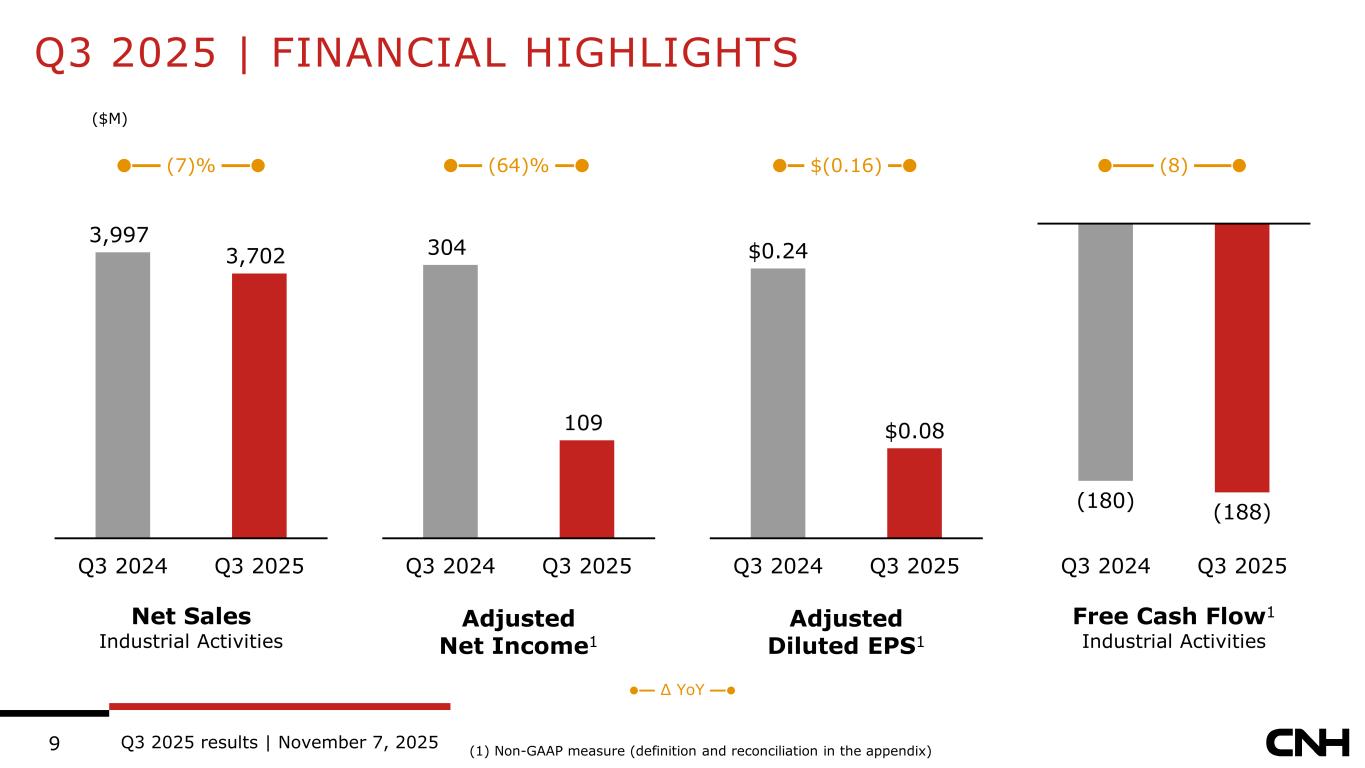
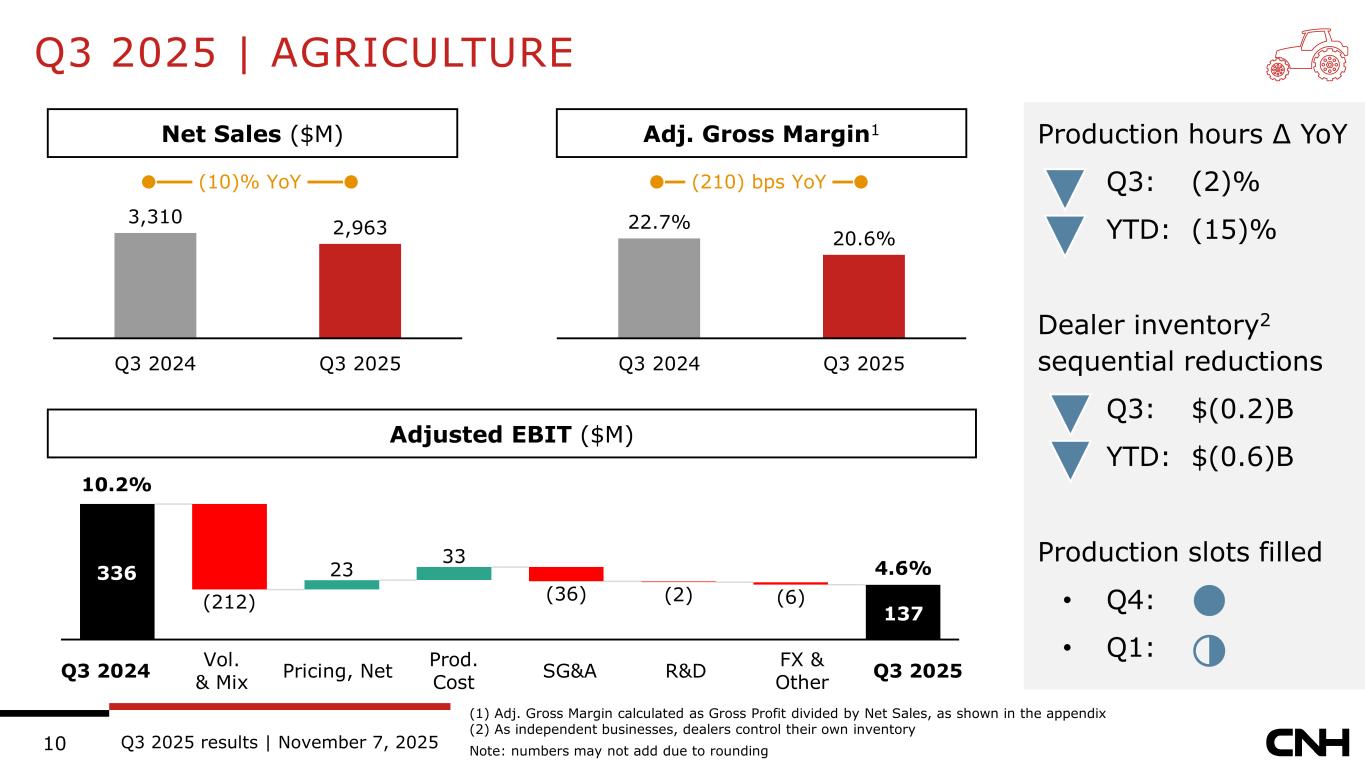
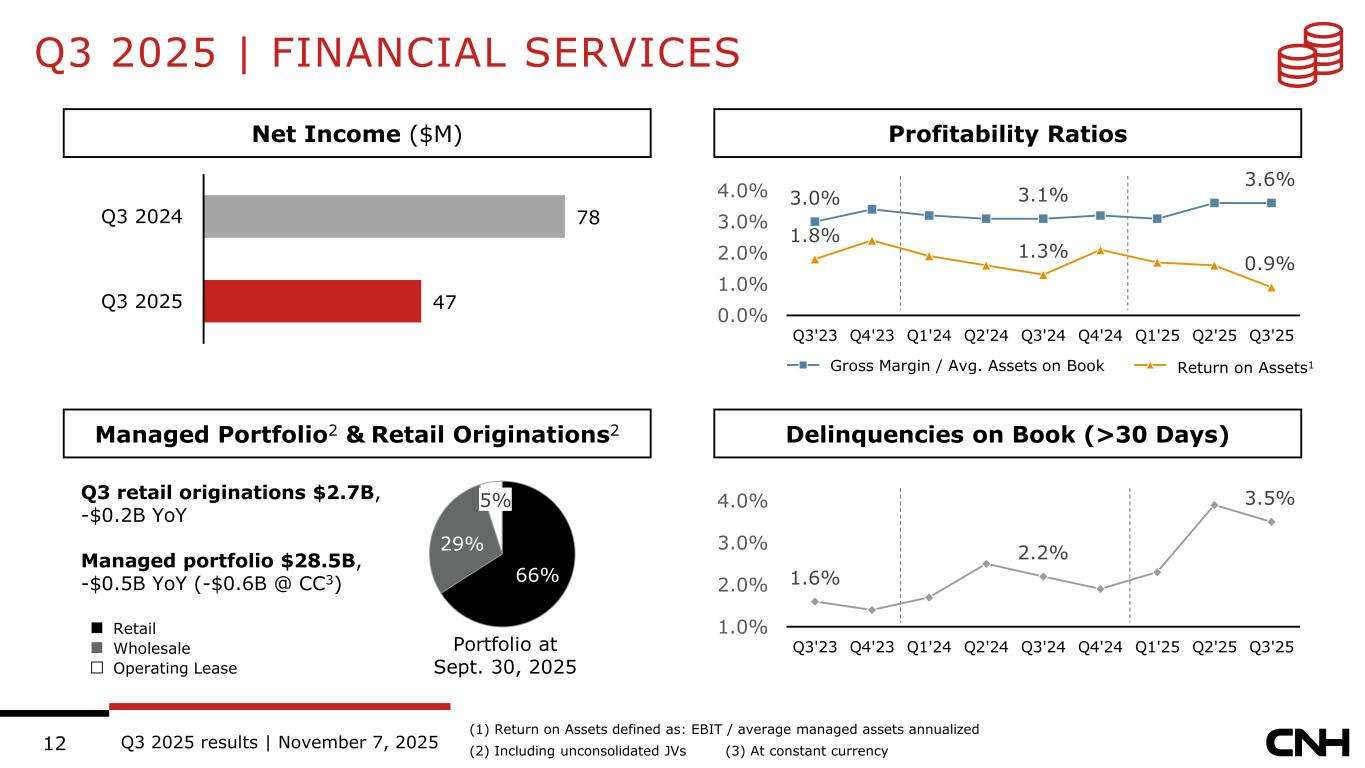
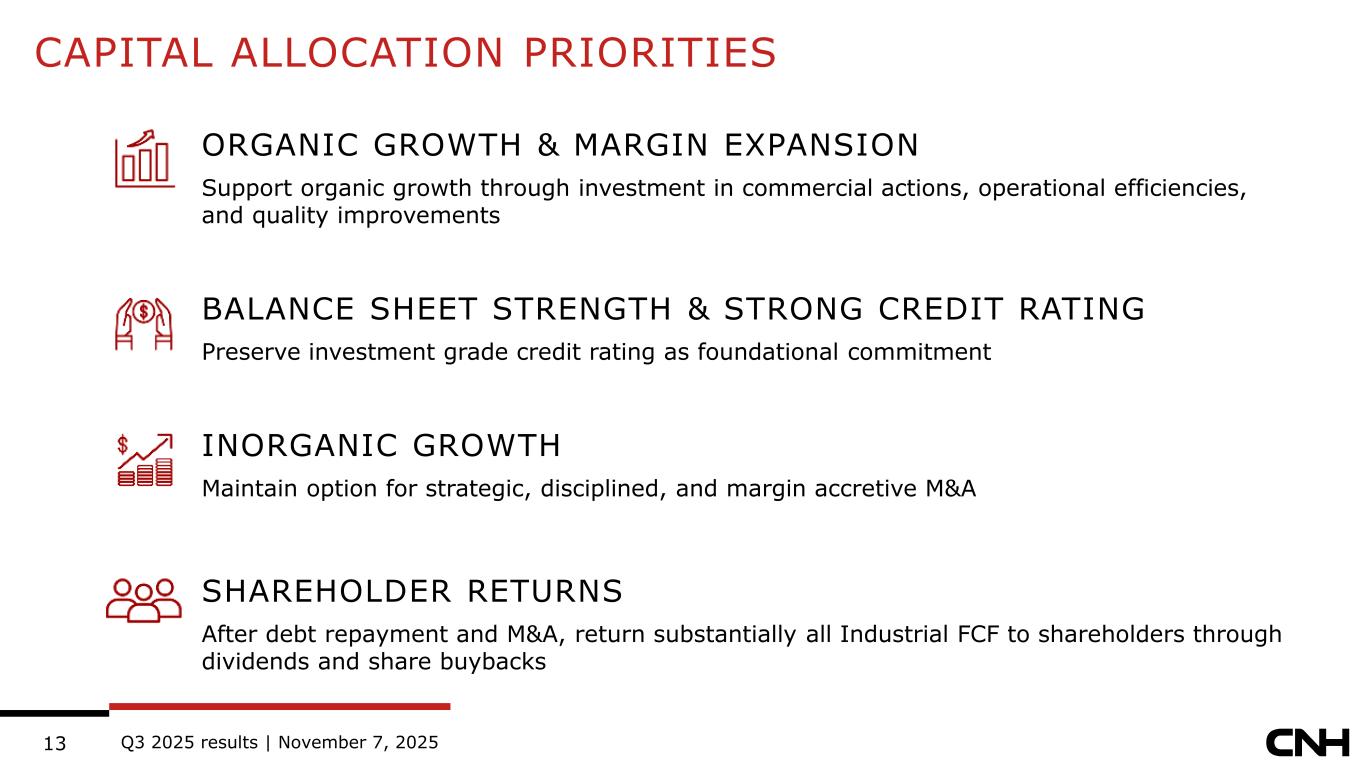
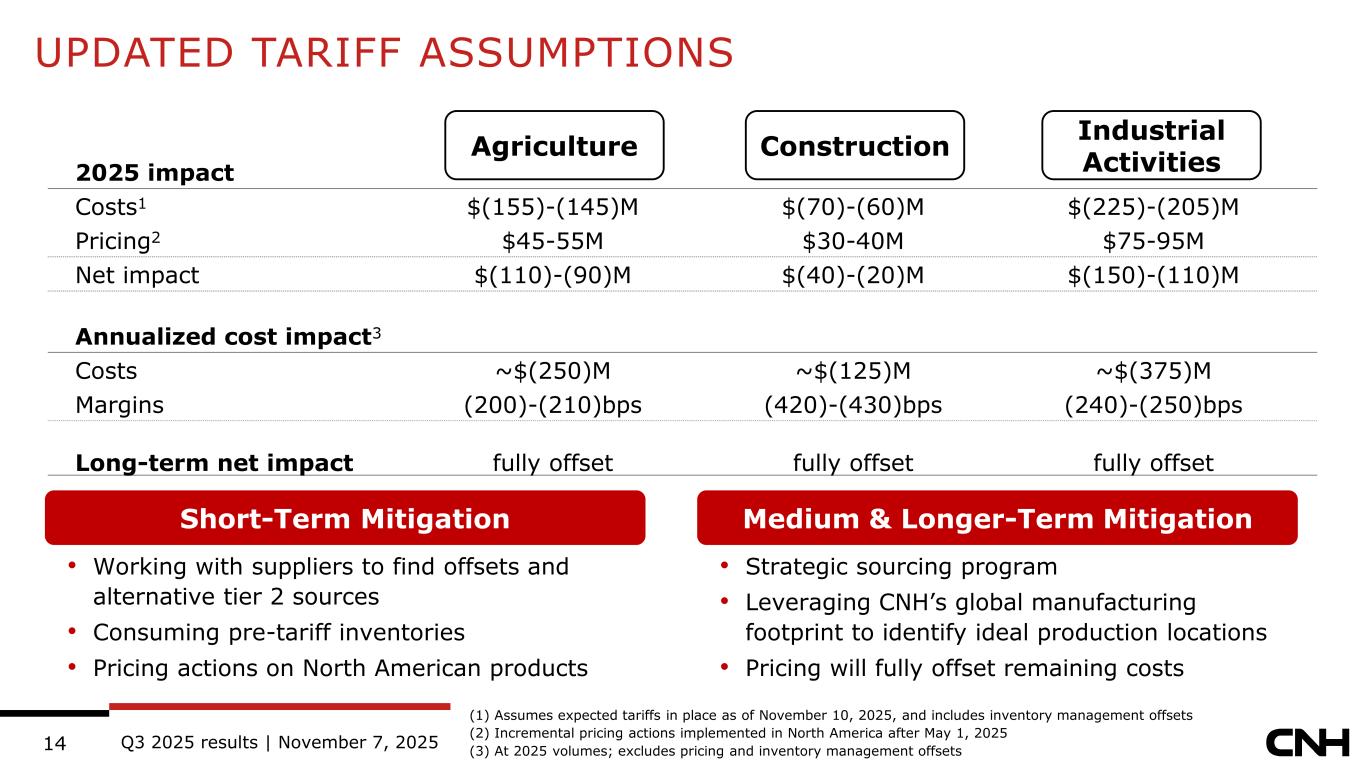
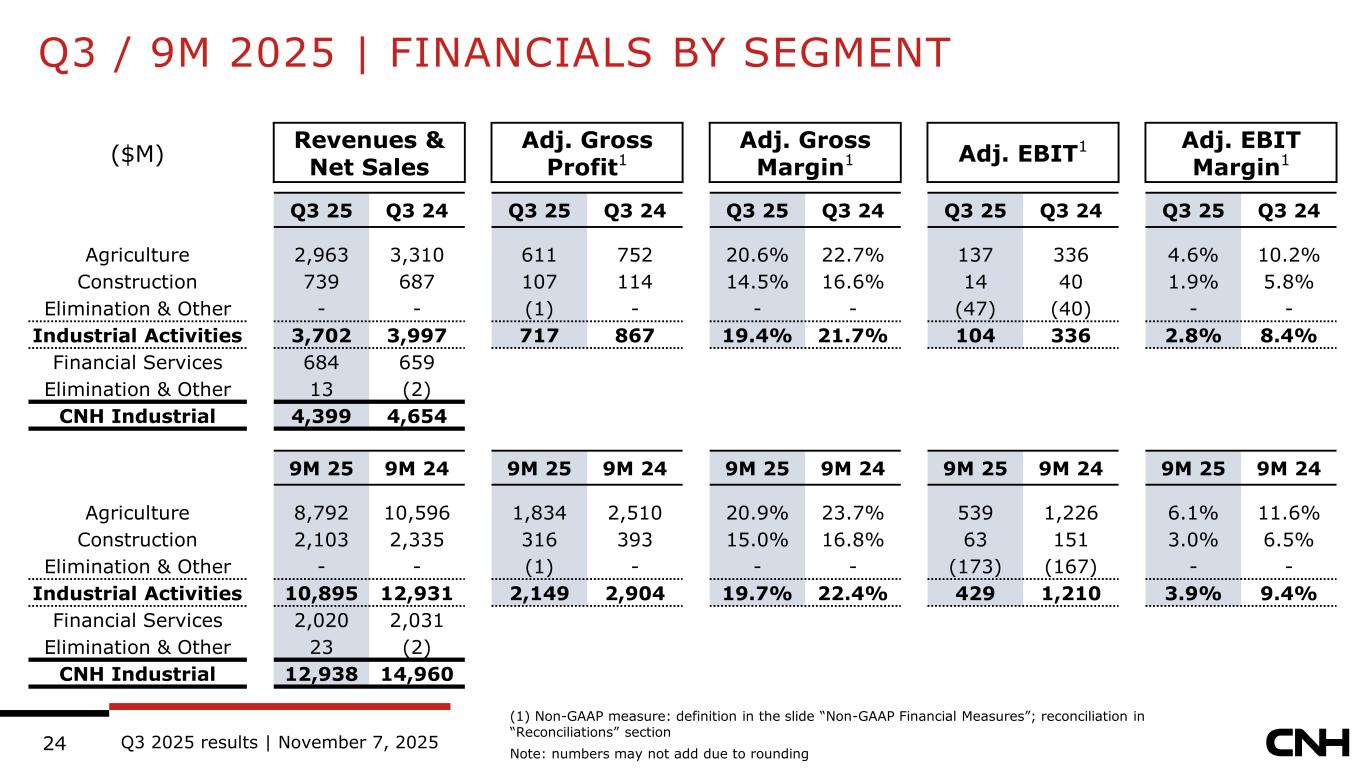
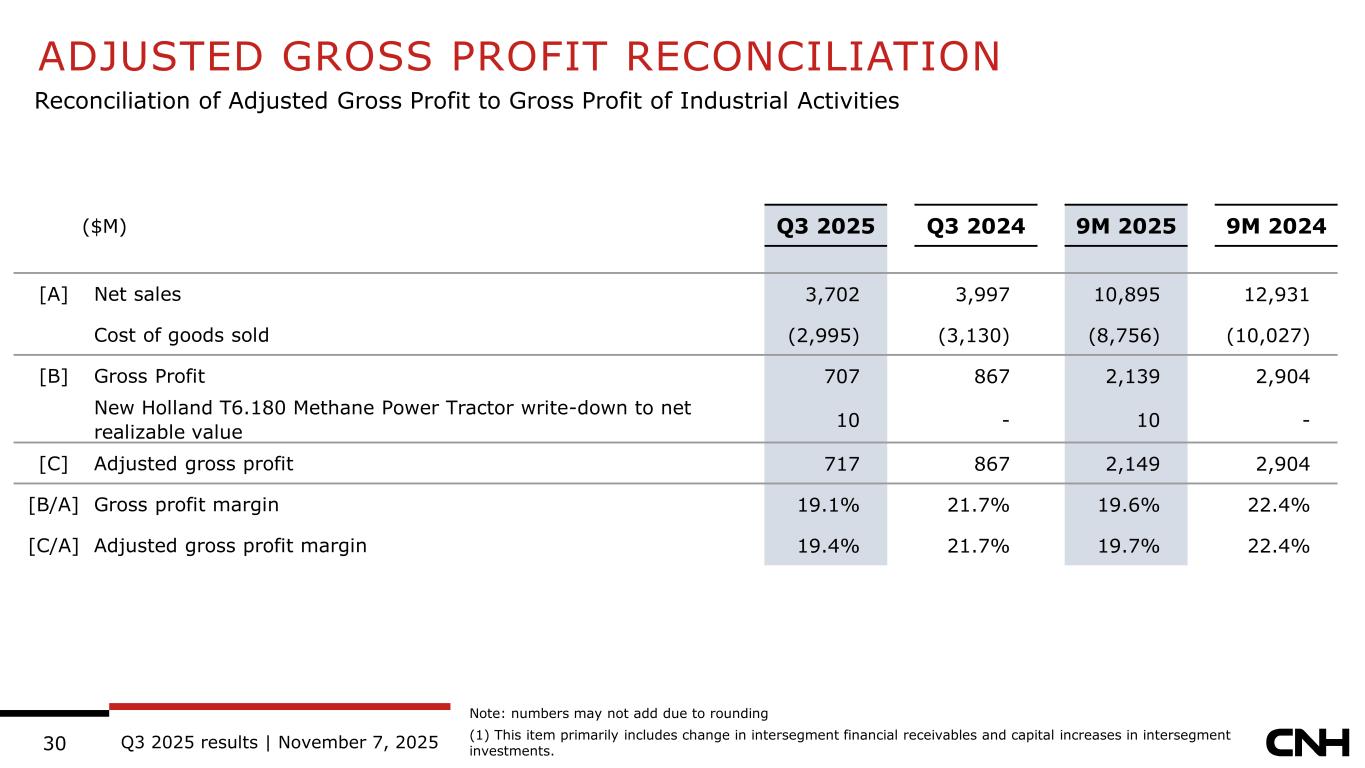
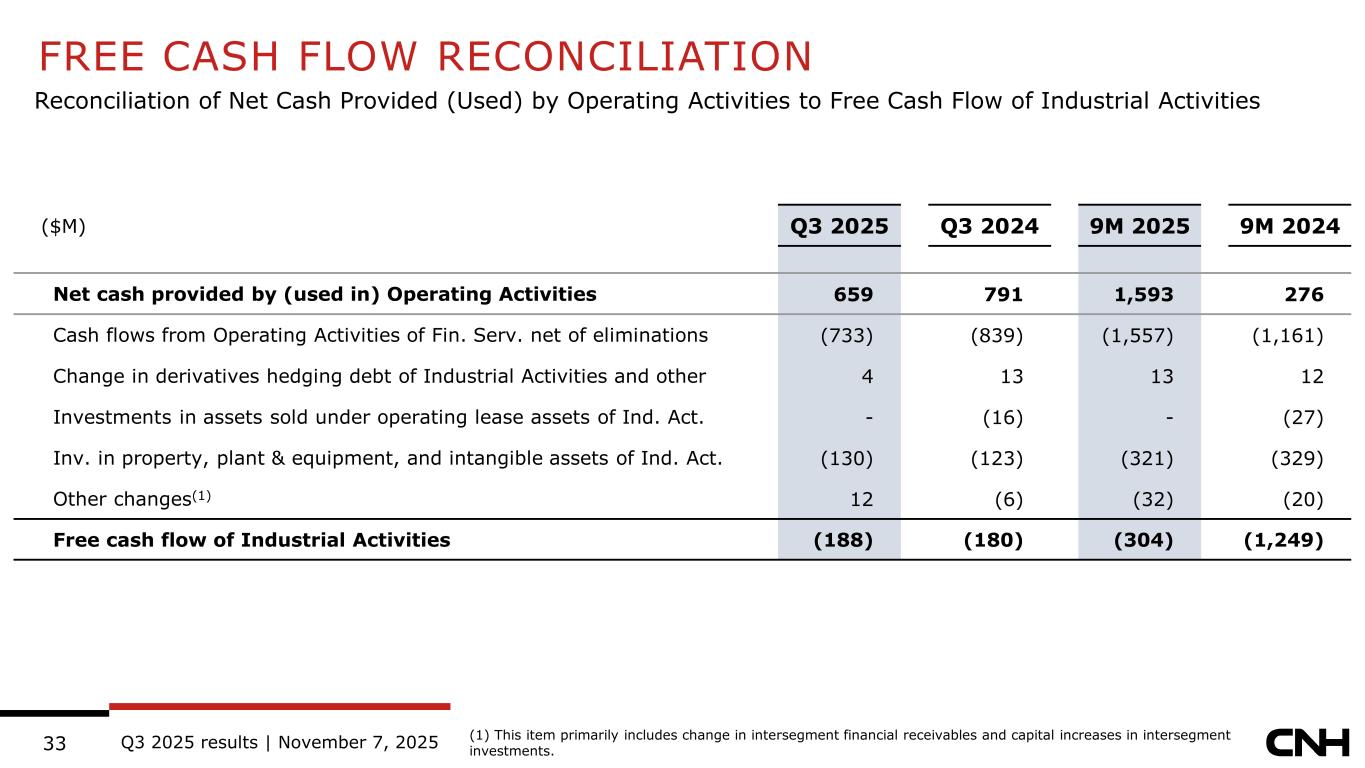
Thank you, Gerrit. Third quarter industrial net sales were $3.7 billion, down 7% year-over-year, mainly driven by decreased agricultural shipment volumes on lower industry demand, compounded by reduced ag dealer inventory requirements. Adjusted net income decreased by nearly two-thirds with adjusted diluted earnings per share down from $0.24 to $0.08. The decrease was mainly due to lower sales levels, tariff impacts, unfavorable geographic mix and increased risk costs in financial services. Q3 free cash flow from industrial activities was an outflow of $188 million, roughly in line with Q3 last year, as the lower year-over-year EBIT was offset by better net working capital and cash taxes. Agriculture Q3 net sales were just under $3 billion, down 10% year-over-year, driven by the 29% decrease in our higher-margin North American market, where we are experiencing both a weak retail demand coupled with dealer inventory destocking. The year-over-year net sales increase in the EMEA region was mostly driven by higher demand in Eastern Europe and in Middle East and Africa. Pricing was favorable overall with North America positive at 3%, which starts to include some tariff-related price adjustments. This was partially offset by some negative pricing in South America, where we have seen aggressive competitive incentives. Third quarter adjusted gross margin was 20.6%, down from 22.7% in Q3 2024, affected by the lower volumes, tariff costs and unfavorable geographic mix, partially offset by purchasing efficiencies and lower warranty expenses. Product costs were favorable, $33 million year-over-year despite including $45 million of unfavorable tariff costs after FIFO inventory offsets. Manufacturing and warranty quality costs were lower by $44 million in the quarter. The supply chain efficiency is making up the remainder of the favorable year-over-year results. So despite the tariff headwind, we are making good progress on our underlying margin improvement initiatives, and this remains central to our path to 2030 strategy. We'll provide a more thorough progress report on our long-term goals during our Q4 call. SG&A expenses were $36 million higher than in the third quarter last year, mainly due to higher variable compensation accruals in 2025 and labor inflation. As a reminder, we took out over 10% of our white collar headcount in late 2023 and early 2024. And since then, the levels have been essentially flat while we work on improving our organizational effectiveness. Adjusted EBIT margin for agriculture was 4.6%, a sequential decline from Q2 2025 levels as a result of the increase in tariffs and our normal quarterly business seasonality. CNH enjoys the distinction of being the most geographically balanced of all the ag OEMs in terms of our sales mix, and we've been profitable in every reach of the world so far this year despite the consistently depressed markets. We expect that trend to continue in the fourth quarter. The EMEA region is weaker than North and South America in terms of margins, but we know what needs to be done to raise its profitability profile. Many of the improvements discussed at our Investor Day such as improving dealer network presence and improving operating performance, along with the product launches mentioned by Gerrit earlier, are designed to improve the fortunes of the EMEA region with our focus on this critical area that will yield benefits for the entire agricultural segment. Construction third quarter net sales were $739 million, up 8% year-over-year, driven by higher sales in North America and EMEA. The increase is mainly due to the low sales level last year as we had cut production aggressively in 2024. Gross margin for the quarter was 14.5%, down from 16.6% in Q3 2024, mainly as a result of the tariffs. Purchasing and manufacturing efficiencies of $12 million favorable were more than offset by $26 million of tariff costs. It's important to point out that we seem to have been a bit more aggressive on price increases as a result of the tariffs that we have seen from our competitors. Like in agriculture, construction SG&A was unfavorable due to variable compensation accruals and labor inflation. We closed the third quarter with an adjusted EBIT margin of 1.9%. I would also like to note that earlier this week, we finalized our previously announced plan to stop production at our construction plant in Burlington, Iowa by the second quarter of 2026 due to declining demand and underutilization. Production will be moved to other existing CNH facilities, including our plant in Wichita, Kansas. This is part of construction's manufacturing optimization effort that was discussed at the Investor Day. Moving to Financial Services. Third quarter net income was $47 million; the $31 million year-over-year decrease was driven by higher risk costs in Brazil, partially offset by better margins in all regions. Retail originations in the third quarter were $2.7 billion, down 6% year-over-year, reflecting the lower equipment sales environment. The managed portfolio ended the quarter at $28.5 billion. The wholesale portfolio was down nearly $1.5 billion since 12 months ago on a constant currency basis, mainly driven by the lower dealer inventory levels. While credit collection rates have been relatively steady in most regions, despite the market downturn, we, along with others in the industry, are experiencing persistent delinquencies in Brazil. Accordingly, we increased our credit reserves again in the quarter. We believe that our reserves are adequate, and we work with farmers in the region so they can continue to operate their farms and pay for their equipment. Our experience from past cycles is that most farmers in delinquent status will eventually catch up on their commitments, but this increase in risk reserves is a needed measure while observing how the market environment unfolds. Our capital allocation priorities remain unchanged. We will continue to reinvest in our business while maintaining a healthy balance sheet. During the third quarter, we repurchased $50 million worth of CNH stock at an average price of $11.25 per share. Before I turn the call back to Gerrit, I want to give you an update on our net tariff assumptions for this year as well as a view of the gross run rate impact of the tariffs. The numbers on this page reflect the expanded Section 232 steel and aluminum tariffs, which were not factored into our previous guidance, and reflect that China tariffs will be lowered by 10 percentage points on Monday. For 2025, we estimate the net impact of agriculture at around $100 million at the midpoint and construction at $40 million at the midpoint. In the fourth quarter, that will be around $60 million for ag and $20 million for construction. In the short term, we are working diligently to offset as much of the tariff impact as we can. This includes collaborating with our suppliers to identify alternative sourcing options and consuming pre-tariff inventories. The price adjustments implemented to date do not fully offset the gross tariff impact, as we have chosen to share the burden alongside our suppliers, network partners, farmers, and builders, while the trade environment is in flux. The 2025 impact is only a partial year impact as the ramp-up in tariff levels and our FIFO accounting pushed most of the impact into the second half. If we annualize the gross impacts still at 2025 volumes, we estimate approximately $250 million of impact in agriculture and $125 million impact in construction. That is approximately 200 basis points of agriculture margin headwind and 425 basis points of construction margin headwind. I'm only showing the gross cost run rate impact here because, as Gerrit said, we do intend to be able to fully offset the tariff impact over the long run. We will take advantage of our ongoing strategic sourcing program to identify the right suppliers with a global footprint to help us identify the most favorable countries of origin. Likewise, we will leverage our global manufacturing footprint to identify the ideal production locations. And ultimately, we will pass through the remaining incremental costs through our pricing and as has been done across the industry in the past. Our 2030 margin targets will not be jeopardized by the tariffs. With that update, I will turn it back to Gerrit.
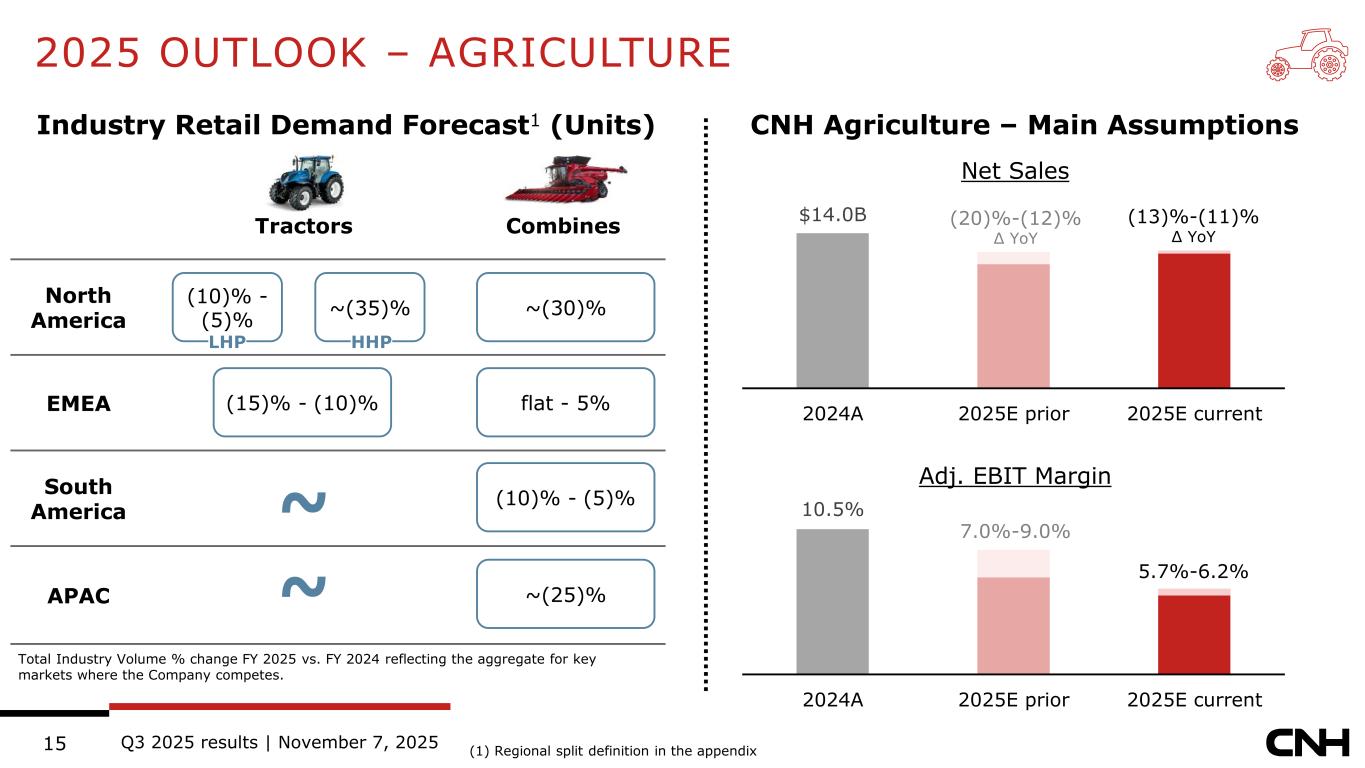
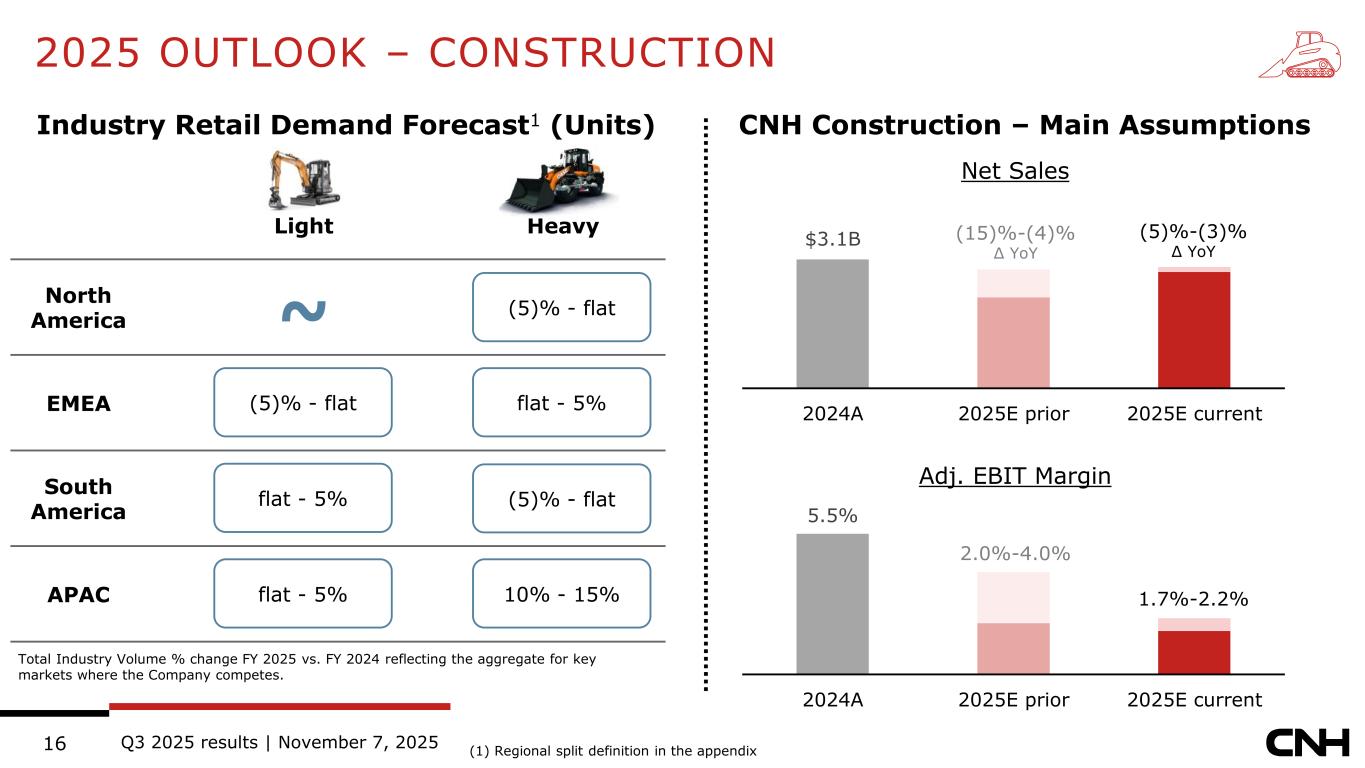
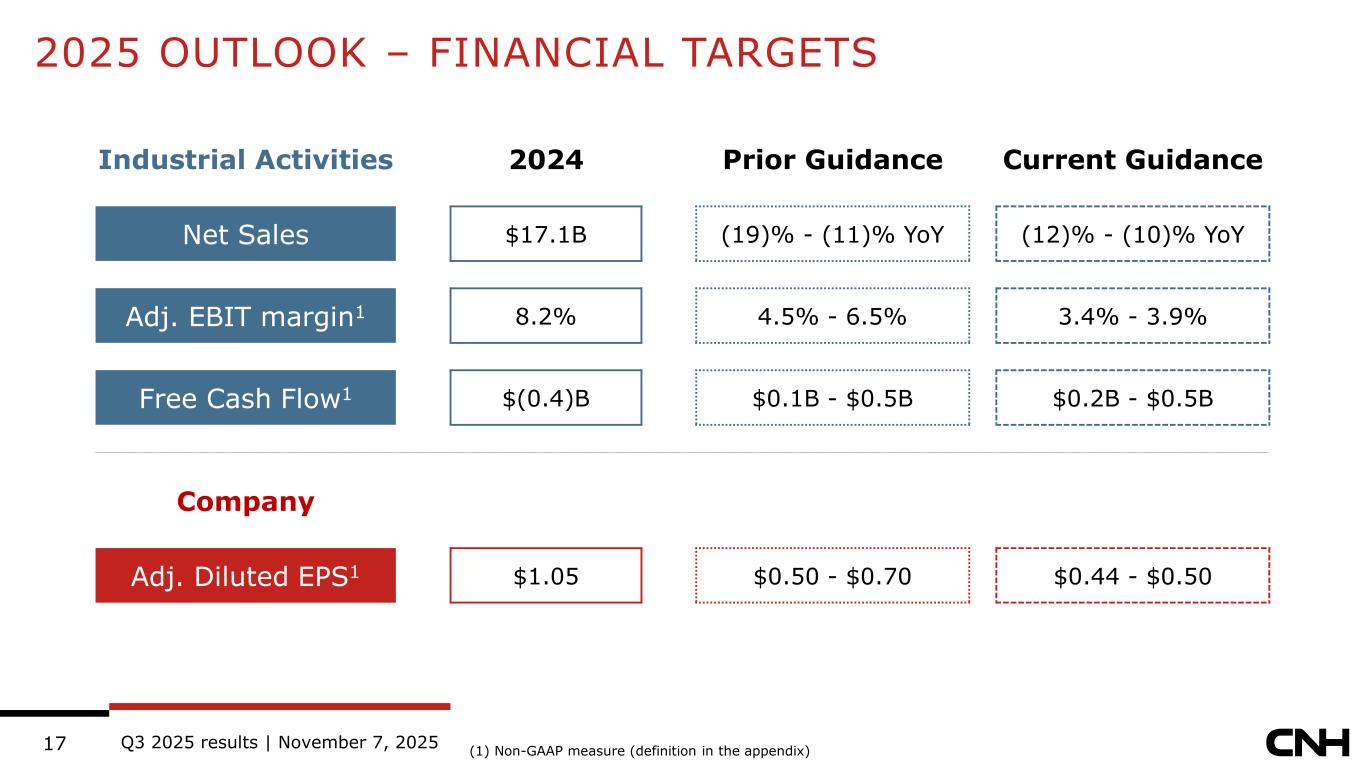
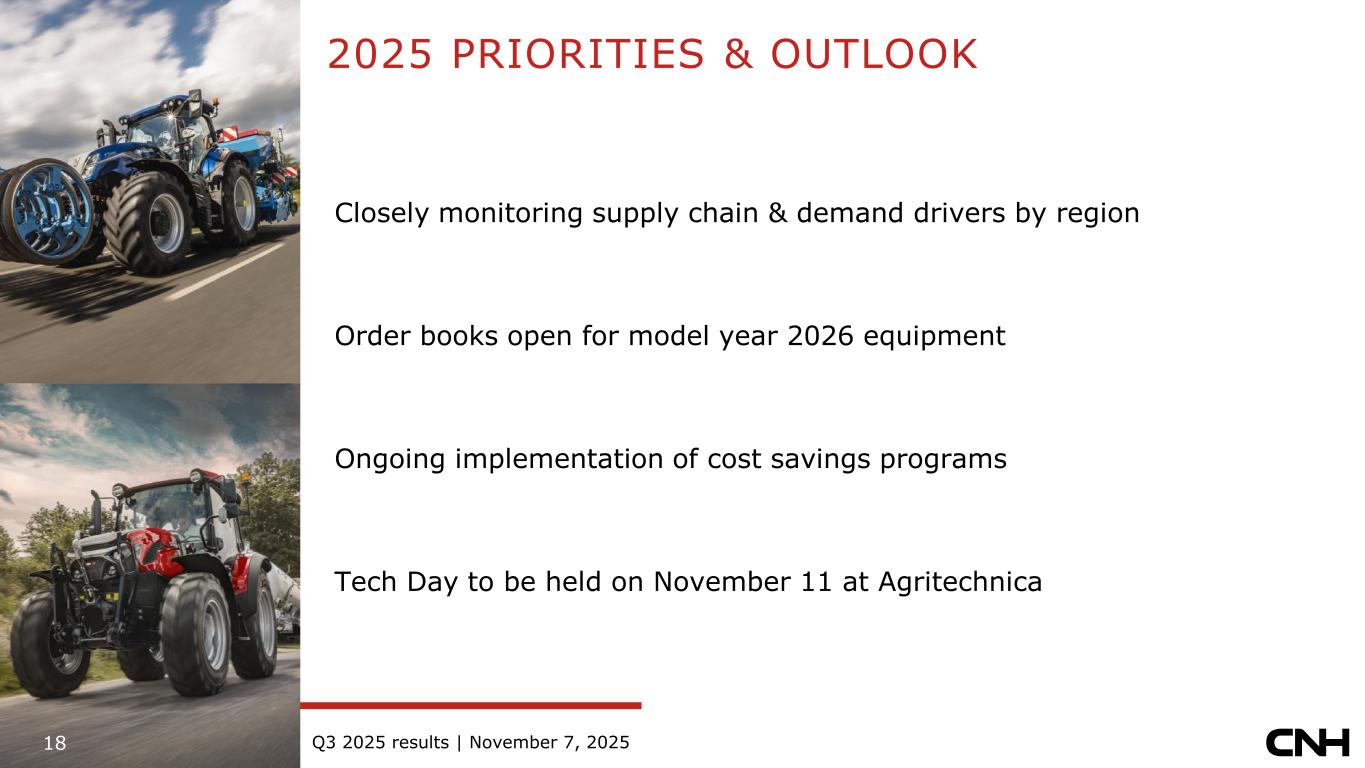
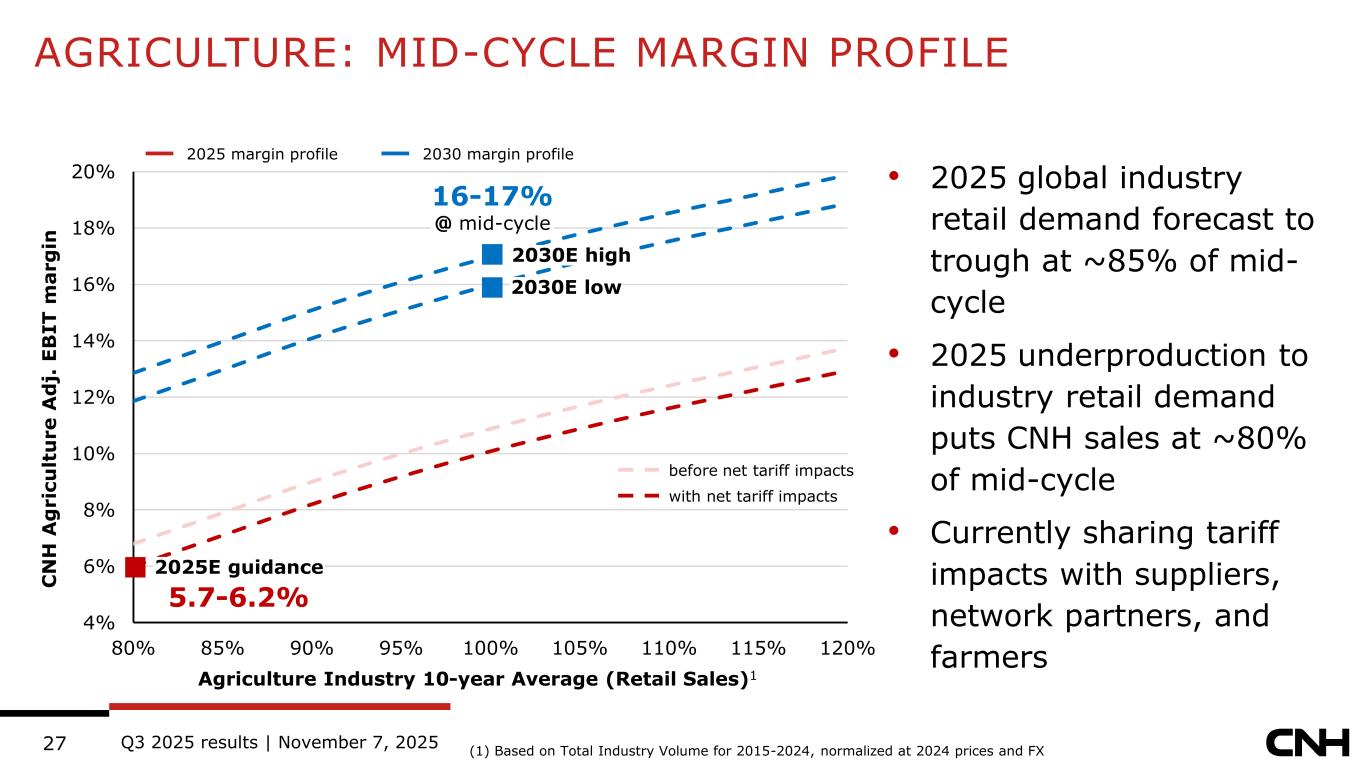
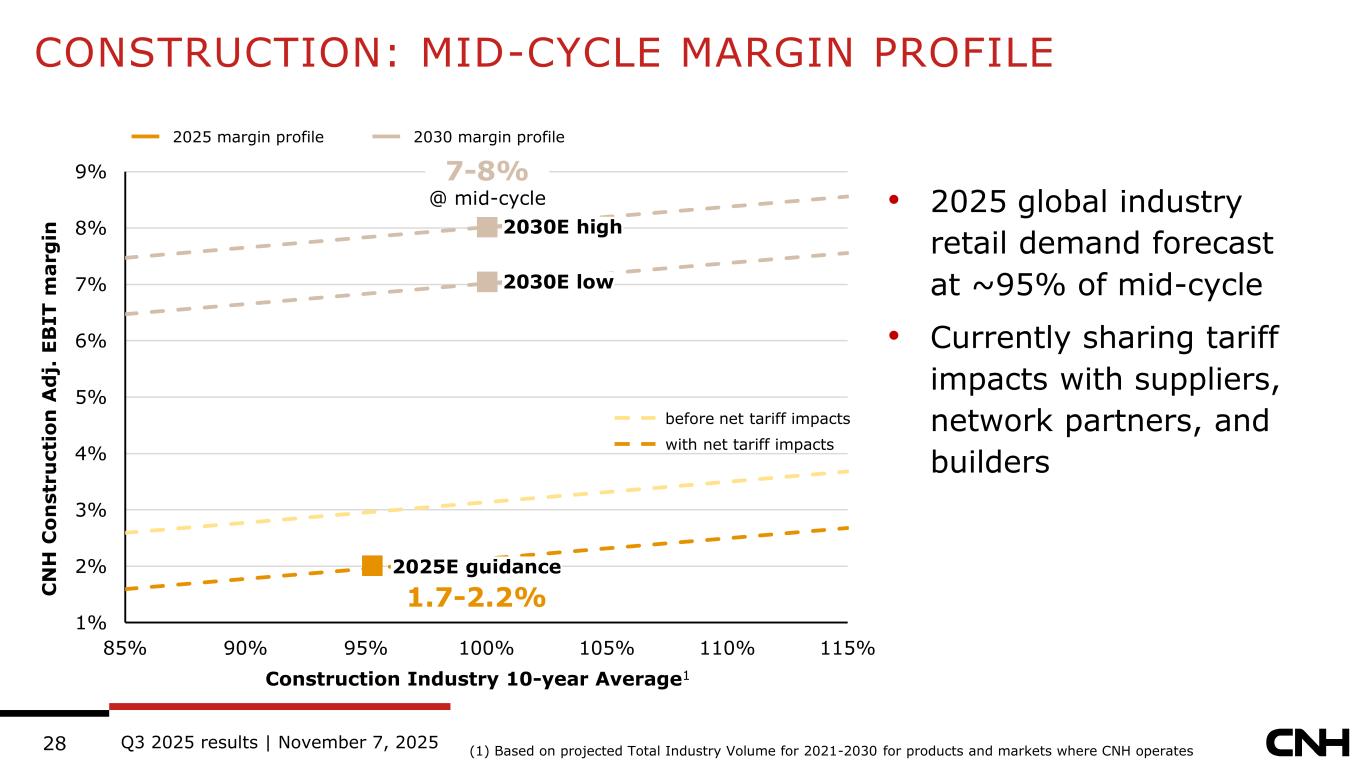
Thank you, Jim. And now let's review our latest outlook for agriculture in 2025. Global industry retail demand is expected to be down around 10% from 2024. We have narrowed our net sales guidance as we approach the end of the year. Full year pricing will be positive about 1%, and there is no expected currency translation impact. We've also updated our margin guidance. As you recall, last quarter, we said that margins would likely fall somewhere below the midpoint in the guidance. However, since our last call, additional Section 232 tariffs on steel and aluminum were introduced. As such, our revised guidance now reflects those tariffs as well as the geographic mix shift between North America and EMEA and product mix between large ag and small ag. The Section 232 tariffs will impact all players in the industry, whether they are components imported or locally sourced as domestic steel and aluminum prices will rise as well. We expect to recover those impacts through pricing of our products. In Construction, overall industry retail volumes are expected to be down about 5% from 2024. As with ag, we have also narrowed our net sales outlook for the year and lowered our margin expectations. We are still working on our 2026 industry estimates, and we'll need to see how some of the larger market players react on pricing before we are able to finalize an opinion here. With the narrowed sales estimates in ag and construction, we are guiding total industry net sales to down 10% to 12% year-over-year with margins reflective of the net tariff exposure between 3.4% to 3.9%. Free cash flow is now expected in the $200 million to $500 million range. EPS is now forecasted to be between $0.44 and $0.50, again reflecting the latest net tariff impact. I will end our prepared remarks by looking at our priorities for the remainder of the year as we close out 2025 and position ourselves for success in a likely transition year in 2026. We are carefully observing the different leading demand indicators. At the same time, while we are dealing with a rapidly changing trade environment, we are working very closely with our network partners and suppliers to ensure that we are responsive to ongoing shifts in the market. We are taking orders for model year 2026 products now at new prices, reflecting another round of cost recovery. Each region has its own cadence for order collection, typically North America ahead of the other regions. Production order slots are full for the remainder of 2025, and we are about half full for the first quarter of 2026. Some products in some regions are a bit further out than that. North America's Q1 slots are already full. For example, we are monitoring order collection closely to understand overall industry retail demand in 2026 and to make the appropriate shift in our production cadence when needed. Besides our order collection, other factors that we are evaluating include commodity prices, stocks-to-use ratios, progress on trade deals, especially a finalization of the recently announced agreement between the United States and China, clarity on renewable fuel standards in the U.S., used inventory levels and their values and competitive pricing dynamics. As of right now, we would expect global industry retail demand to be flat to possibly slightly down in 2026 when compared to 2025, that likely includes EMEA being slightly up, North America slightly down in large ag and South America and Asia Pacific somewhere in between. As year-end approaches, we'll assess market developments to refine our industry forecast with greater precision. As I discussed earlier, we will continue to produce at our current low levels through the end of 2025 and likely into the beginning of 2026, given continued soft demand. Our North American dealers are on pace to achieve our inventory targets for new equipment within the next few months, whereas improving sentiment in Europe will allow dealers to increase their stock somewhat. Like our continued dedication to investing in the future through iron and tech R&D, we are not taking our eyes off our margin improvement initiatives regardless of the market environment. We are maintaining our relentless focus on our homework and executing the cost management strategy that we presented to you in May. We are pursuing productivity improvement and the strategic sourcing program to drive further cost reductions with a particular focus on delivering the highest quality products to our customers. I want to reiterate what Jim said, our 2030 targets are not jeopardized by the current trade environment or status of the ag cycle. Things are very positive for CNH. And during times like these, continuity through dedication and consistent execution are more than ever important. At our Tech Days next week, we will exhibit our latest products, technology applications, and solutions. We are excited to show you how our technology evolves to serve farmers on their field and to preserve their soil health. Our solutions help them rise to everyday challenges, particularly the unexpected ones. We hope to see you in person in Hannover or connected to the webcast. That concludes our prepared remarks, and we are ready for the Q&A.
Operator
We will take our first question from Kristen Owen from Oppenheimer.
Speaker 4
A lot of discussion this morning on the ag margin bridge, and you hit on some of the points, but I'll ask you to articulate on three particular items that stood out to us. First, can I ask you on the decremental margin on the volume mix? How much of that was the decline in North America as the total percent? And how should we think about that decremental going forward? The second item here is on the SG&A and the $37 million drag? And then finally, I'll just ask you to unpack some of the product cost puts and takes, tariffs versus some of that underlying quality work that you addressed. I realize there's a lot there, but I appreciate you addressing that bridge.
Okay, Kristen, I'm glad to address those questions. The decline in agriculture was mainly due to a 29% drop in sales in North America, while EMEA saw an increase of 16%. This indicates a significant geographic mix element. SG&A expenses did increase. To address both parts of your question regarding the agriculture EBIT margin decline, 12% of this decrease was attributed to higher SG&A costs due to variable compensation. Last year, bonus accruals were very low, but this year we are normalizing the rate of accruals. This contributes to SG&A growth, along with tariffs playing a significant role and the geographic mix I mentioned. Additionally, our agriculture joint ventures are generating lower profits this quarter compared to last year. Those are the four main factors. If you exclude those, you're back to a normalized decremental margin of 25% to 30%. So that clarifies the agriculture question. Gerrit?
Yes, I would like to address the first point regarding the mix. In the EMEA region, the tractor segment experienced growth while the harvesting segment has not kept pace in the overall mix. As you might remember, we performed well with tractors, but we have a significant focus on harvesting equipment, particularly large combines. This situation is not about a regional mix per se but more about the product mix within the region. As Jim and I mentioned, EMEA has been trailing behind in terms of margins and is currently at the bottom. We have initiated substantial turnaround and restructuring efforts across the region, which will include product advancements that we will present next week. Our aim is to regain momentum and market share in a region that should match the margins we achieve in North or South America. This is a key priority for us, and we will elaborate on these developments next week when we showcase our new tractor product lineup, including high horsepower mid-range tractors that we previously did not offer. We will demonstrate these efforts as part of our strategy to revitalize Europe.
Yes. And then continuing to answer your question, so the product cost unpacking, that really is $33 million of favorable product costs, excluding $44 million of tariff costs. So without the tariffs, that number would have been $77 million of favorability. That breaks down as $44 million in quality improvements, $17 million in purchasing and manufacturing improvements and $60 million of other improvements. So that sort of, I think, shows the good work we've been doing on our path to 2030 from an operational perspective. The tariff supports our headwind that weren't there previously. And tariffs are growing a bit in Q4. Q4, we expect tariff costs to be $60 million in ag and $20 million in CE, but we'll give you a more detailed breakdown of the full year cost improvements toward our Investor Day targets when we report out in Q4. So I think that addressed all three of your questions.
Operator
Our next question comes from Angel Castillo from Morgan Stanley.
Speaker 5
I would like to clarify two factors affecting fiscal year '26. First, regarding the annualized tariff gross headwind you've mentioned, it seems to imply a 2% to 3% incremental headwind for your North America sales next year. Can you confirm if that's accurate? Additionally, considering the pricing you're implementing for next year and the preliminary cost inflation, how much of the 2% to 3% headwind do you anticipate offsetting through pricing versus other cost initiatives? How much have you already covered, and what initiatives do you still need to pursue? The second aspect for fiscal year '26 relates to production; what gives you confidence in achieving the desired dealer levels within 3 to 4 months? How much more inventory do you need to reduce, and how significant could this be as a tailwind for next year? That information would be helpful.
Yes. Let me address the first question, Angel. I believe you're correct about the impact of the tariffs. The pricing we currently have, when you combine the tariff costs with normal inflation, is not sufficient to fully cover the tariff expenses. However, we are planning to address this throughout 2026 through various strategies, including further cost reductions. We can also make some adjustments to our discounting to help mitigate the impact. While our list price growth is not adequate at this moment, we will be taking other actions to work through these challenges in 2026. Now, regarding the production question.
Yes. Regarding the production question, looking ahead to 2026, we anticipate that our production pace will align with retail pace. For next year, we project that production hours will increase by mid-single-digit percentages compared to 2025, across all regions and products. This is in line with our goal of achieving a $1 billion inventory reduction by the end of 2025, which will significantly improve our position. We plan to boost production hours next year, which may also involve further inventory reduction if necessary. However, this is not a blanket statement for all regions, as EMEA shows signs of growth in some markets. Depending on the seasonal context, we may need to stock up on machines in those areas, while there are still some pockets where we could see additional destocking next year. Overall, we have met our $1 billion destocking target this year, which gives us the capacity to increase production in the mid-single digits.
Operator
Our next question comes from Tami Zakaria from JPMorgan.
Speaker 6
I wanted to touch on tariffs a little more. Is there a way to think about how much of the total tariff costs you quantified, I think, $205 million to $225 million. How much of that is tied to AEPA versus Section 232 versus the baseline? Should the industry get some relief from any Supreme Court ruling in the coming weeks, months? Just wanted to get some sense of what could be the opportunity there?
Yes. About 20% of the tariff costs are from Section 232. So any release is granted, that would be wonderful. We're not counting on that or taking that into our plans at this point, but we'll wait and see where that goes.
Operator
Our next question comes from Kyle Menges from Citi.
Speaker 7
I wanted to follow up on some of the pricing comments on the comments that maybe you've been a little bit more aggressive on price increases versus competitors this year. And just how that's influencing how your pricing model your '26 machines as your opening order books for next year. Curious what the customer feedback has been on pricing as you start to price model your '26 machines and feedback on maybe where you're priced versus competitors in some of your different markets as you're opening order books for next year?
Yes, to clarify, we were quicker to raise prices in the construction sector, where we did not notice much competitive movement. We likely took the lead on that front. Regarding agriculture, I would estimate that we have 3% to 4% list price for our early order program, which has been positively received in the market. It appears to be effective, as evidenced by our production slots being filled, which is encouraging. Everything is aligning with our expectations. So, we are more aggressive with price increases in construction, while in agriculture, our pricing is in line with the market and has received a positive response.
Operator
Our next question comes from Jamie Cook from Truist Securities.
Speaker 8
I mean, if you look at your guide, your fourth-quarter sales implies we're finally up year-over-year versus decline. So I'm just trying to think about that and the backdrop for 2026. It sounds like you broadly think industry demand is sort of flattish in ag, different pockets, obviously, and construction is probably up. Just trying to think of the company-specific items that you can control. And to what degree do you think your earnings could grow next year in a flat market as like next year, you would produce in line with retail demand or potentially better, quality should be an incremental savings, potentially supply chain, I guess, tariffs a headwind. But just the big puts and takes there, the things that you can control to hopefully get us comfortable or maybe not that 2025 would represent the trough of earnings?
Yes. Great question, Jamie. So the production increases that Gerrit outlined in 2026 are not because of the industry is rebounding, it's because we're producing closer to the retail. So under producing less than we did in 2025. So we will get some absorption benefit from that, from the higher production rates. We will, of course, continue and amplify our ID2025 targets that we put out around quality, around supply chain efficiencies. Those areas are sort of working. We're seeing it, strategic sourcing. These are all things that are coming through, as we talked about in Q3. We expect those to keep growing and building. So those are the sources of tailwinds that we're looking towards. And the headwind that you'd point out is the one that we have less control over in the short term, and that's the tariffs. So as I mentioned on my question we answered Angel, we'll be looking for ways to help offset those tariff costs, but those right now are probably the most significant headwind we've got to grapple with.
Operator
Our next question comes from Steven Fisher from UBS.
Speaker 9
I'm curious about the reasons behind the smaller decreases in revenue guidance for 2025 and what you expect for Q4, especially since agriculture seems to indicate around 4% growth and construction possibly in the mid-teens. Can you provide some insights on those changes and what they imply?
In agriculture, EMEA is expected to perform better than other regions. The construction equipment industry is also a key driver of this growth. The end markets are showing improvement, and these are the two main areas fueling our sales growth. Additionally, we're producing less for retail in the fourth quarter on the agricultural side, which should contribute positively beyond just the improvements in EMEA. I hope that clarifies your question, Steven.
Operator
Our next question comes from Tim Thein from Raymond James.
Speaker 10
I want to return to the idea of production versus retail in 2026. We’ve discussed this quite a bit, but I want to confirm my understanding regarding large agriculture in North America. Recent comments suggest that inventory levels have been heavier on the small agriculture side. Therefore, it seems likely that this could provide a greater production advantage for large agriculture as we look towards 2026. If there's going to be increased production pressure, it seems it would be more pronounced on the large side, given that the inventory concerns have predominantly affected small agriculture in North America. So, is this an accurate way to view the potential outlook for production in North America when considering the distinction between large and small agriculture?
Yes, I think you're on the right track; it will be a few percentage points higher in large agriculture compared to small agriculture when we consider production hours from 2026 to 2025.
Operator
Our next question comes from Daniela Costa from Goldman Sachs.
Speaker 11
I have a follow-up regarding what is implied for Q4 in the guidance because in most years, we experience negative seasonality in Q4. I understand there is some delivery growth here, but even with delivery growth, we usually see negative results, and you mentioned that you don't fully offset the tariffs. They are higher in Q4, along with other challenges. Could you explain the factors that lead you to expect a better than usual seasonality in Q4?
Yes, that's a great question. In terms of margins, we are seeing improvements compared to the past, particularly in quality costs and manufacturing costs. We anticipate good product cost improvements in Q4, which continue to grow. This is part of our expectations when compared to 2024 levels. As previously discussed, our ID2025 targets are in progress and yielding results, and we expect this trend to carry on into Q4.
Operator
Our next question comes from Mircea Dobre from Baird.
Speaker 12
Just a clarification, if I may. I'm a little bit confused about the changes to guidance here. Looking at Slide 17, I see that with an 11% revenue decline, the margin you previously expected was 6.5%. Now, with the same revenue decline, we're estimating a margin closer to 3.7%. This suggests we're reducing EBIT by around $430 million, give or take, all in the second half of 2025. What are the factors influencing this change? As I understand it, the tariff assumptions alone do not explain this adjustment. Specifically, what dollar figure relates to tariffs, and what are some of the other contributing factors?
Yes. That's a great question. Page 17 reflects the entire enterprise. The mix effect is not detailed there. The construction equipment business is experiencing sales growth, but those come with very low margins. While I'm satisfied with their current performance, they aren't contributing significantly to overall margins despite the revenue generated. In contrast, the agriculture business is not growing as quickly. This difference within the segments explains why the industrial activities had such poor margins this quarter. CE sales increased while ag sales declined, which contributes to the same issue. What you're seeing on Page 17 is a reflection of our experiences in Q3, and we expect this trend to continue into Q4.
Operator
Our next question comes from Mike Shlisky from D.A. Davidson.
Speaker 13
It sounds like, as you've been saying you're a few months away from getting to the right level of new inventories in the channel. Are you also a few months away on the used inventory side? Just update us on what's happening there? And is that the point where both new and used are at decent levels at optimal levels, we'll start to see your wholesale sales to be above your retail sales and some kind of restocking again happening at the dealership level?
Yes, that's a great question, Mike. We've seen positive results on the used inventory front, with CNH Ag dealers experiencing declines in used inventory for three consecutive quarters. We're pleased with this trend, but I wouldn’t say it's fully resolved by the end of this year, as the levels are still above historical norms. Therefore, there’s more work to be done. While it's not a major concern for us, it does represent a broader industry issue and a larger concern for CNH and our dealers. Although we're making progress over the last few quarters, we anticipate that this effort won't be completed by Q4.
Operator
Our next question comes from Joel Jackson from BMO Capital Markets.
Speaker 14
Definitely a couple of months ago, there was some optimism, I know expressed by the management team around South America maybe turning, wasn't clear, but there was optimism a couple of months out later now as you mentioned earlier, the optimism is sort of died down a bit. Can you talk about what you're thinking then and what you're thinking now, what you've seen in the last couple of months?
The South American market has gained more attention from China regarding soy, sorghum, and other commodities. There is a sense that this region will be the first to respond positively once trade clarity improves. Currently, uncertainty remains, despite a deal being announced between the U.S. and China for 25 million metric tons of soy over the next three years. We are still waiting for specific numbers and need to see what China’s actual purchase volumes will be for South American soybeans and other commodities. This will impact farmer sentiment as we approach the 2026 planting season and influence equipment sales. The ongoing ambiguity in global trade and the lack of concrete details in trade agreements contribute to this uncertainty. For instance, many farmers in Latin America have faced increased delinquencies and were relying on payouts from the Brazilian farm bill for seeds and fertilizer, which have been delayed. As a result, farmers are prioritizing these purchases over equipment. This situation highlights the cautious outlook that both we and the farmers have been taking. We need to see actual purchases from China to understand the market better, as deals are one thing, but consistent monthly purchases are another.
Operator
Our next question comes from Ted Jackson from Northland.
Speaker 15
I have two questions for you. First, regarding the tariff guidance, is it $80 million that you mentioned for the fourth quarter? Also, in the second quarter, what was your outlook for the tariff impact for the rest of the year? I don't remember the details, and when I reviewed the previous presentation, I didn’t find anything regarding this. Are the costs you're discussing here in addition to what you anticipated when exiting the second quarter and entering the third?
Yes, good question. The Section 232 costs were not included in our second quarter guidance. We had indicated between $110 million and $120 million for full-year net tariff costs, and then we revised that to our current estimate. The largest reduction in guidance was not due to tariffs; they accounted for a small portion. The more significant decline was due to the SG&A increases and mix effects, with the geographic mix being tougher than we anticipated.
Speaker 15
My next and last question is regarding the change in guidance. You increased your sales forecast by $650 million to $700 million at the midpoint. In your third quarter, your performance was better than consensus expectations this year. If we use consensus as a baseline, you can attribute an additional $200 million in sales to the fourth quarter based on prior guidance. It seems that construction in EMEA is a key factor behind this. Am I correct in this assessment? Additionally, how much of this revenue increase can be attributed to your ability to adjust pricing to counteract tariffs and similar costs?
Yes, pricing continues to positively influence revenue in the fourth quarter, which is certainly a favorable factor for us. However, the adjustment in the guidance for the second half is primarily due to increased sales volume in areas where margins have lagged. The margin associated with each dollar of sales just wasn't adequate based on where the sales were generated. Therefore, we have higher sales without the corresponding margin. This situation is what is impacting what might seem like a negative incremental or decremental performance; it’s really a matter of the sales mix.
Operator
Our final question today will come from David Raso from Evercore ISI.
Speaker 16
When you speak to global industry retail next year being flat to slightly down, the order books as they sit today, where are the order books right now versus a year ago? An ideal if you can help us between the North American large ag commentary for next year in EMEA. If you can give us some sense of the order patterns in those two regions would be great.
Yes. I think the order coverage we see right now is basically, as I said, Q4 is basically covered everywhere. Q1 largely, let's say, very well on track. We have a bit more order coverage on the North American side than in other regions, but this is pretty comparable, I would say, to prior years. I think there's not a particular pattern here. We are working through, obviously, the other programs, and we're working through, which will be quite exciting for us to showcase the machines next week at the Agritechnica. We have a full lineup of renewed tractors on offer and similar upgrades also on the combines side. So I think the Agritechnica as well will be another stimulating moment when our farmers will see what great machines we are putting out there. And so we're pretty excited to walk you around and show you what we have on offer, but the order books are very much in line with expectations.
David, one more data point that we're excited about, and it's very comforting and validating our flagship combines in North America. The production slots are sold out for the entire year. I think that's evidence of how well that machine is performing, how well it's been received and the value proposition. So that's another good sign about building the right products and markets receiving them quite well.
Operator
That concludes today's conference call. You may now disconnect.