Operator
Good day, and thank you for standing by. Welcome to the Columbia Banking System First Quarter 2025 Earnings and Pacific Premier Bancorp Acquisition Announcement Conference Call. At this time, all participants are in a listen-only mode. After the speakers' presentation, there will be a question and answer session. To ask a question during the session, you would need to press 11 on your telephone. You will then hear an automated message advising your hand is raised. To withdraw your question, please press star 11 again. Please be advised that today's conference is being recorded. At this time, I'd like to introduce Clint Stein, President and CEO of Columbia, to begin the conference call. Please go ahead.
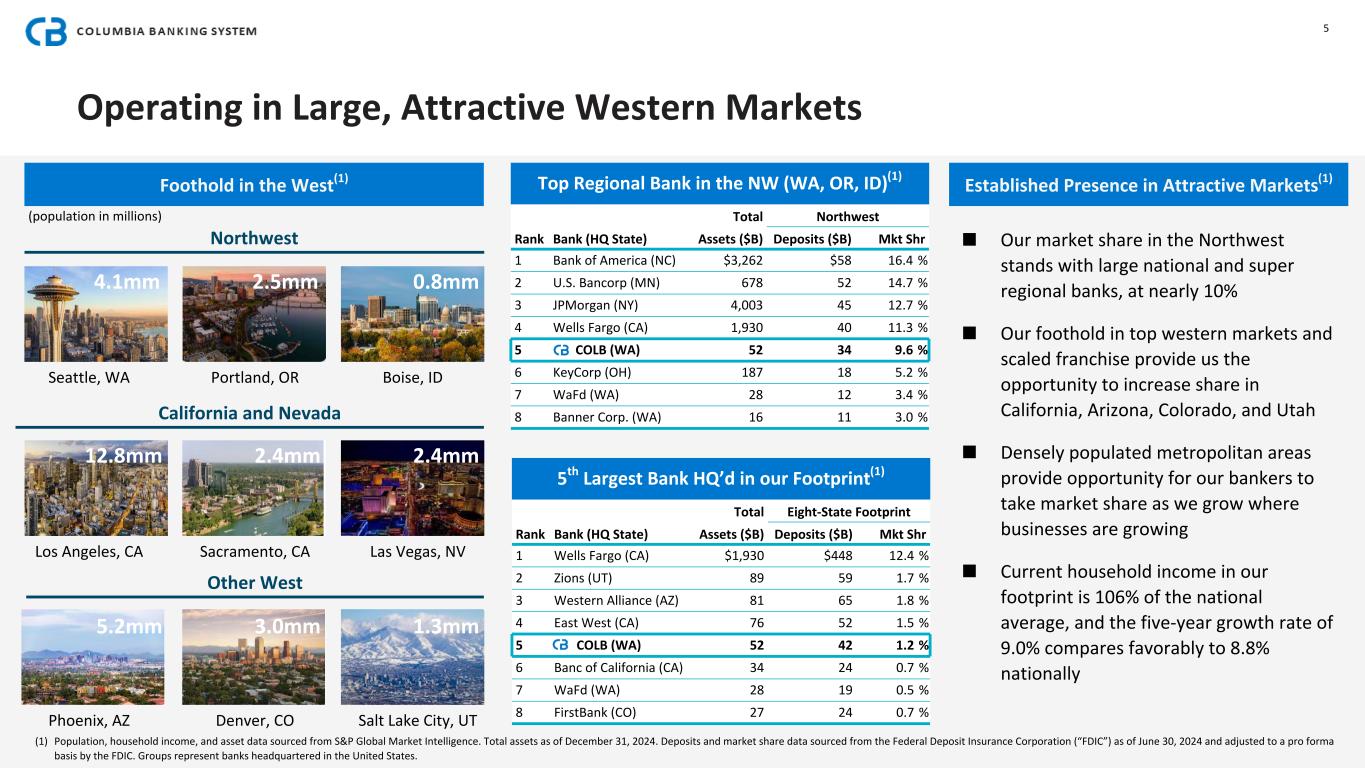
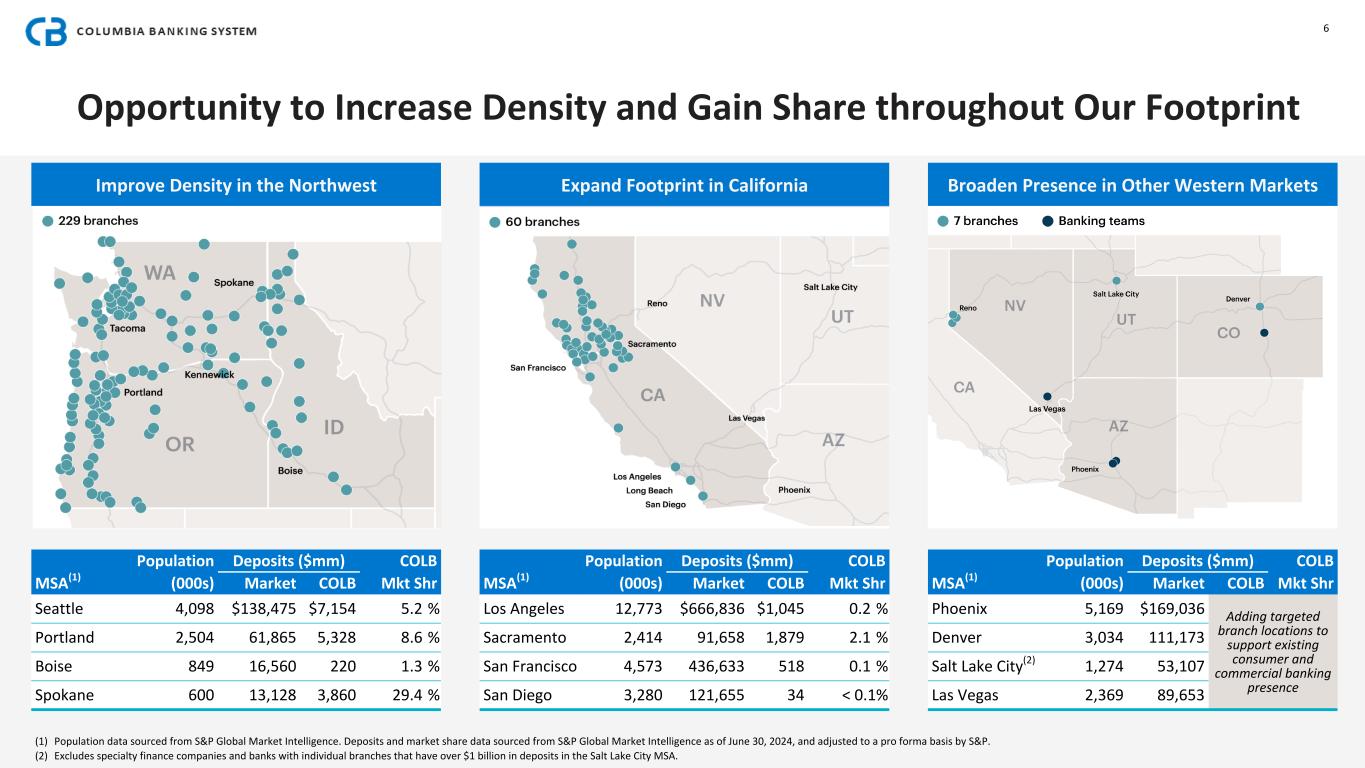
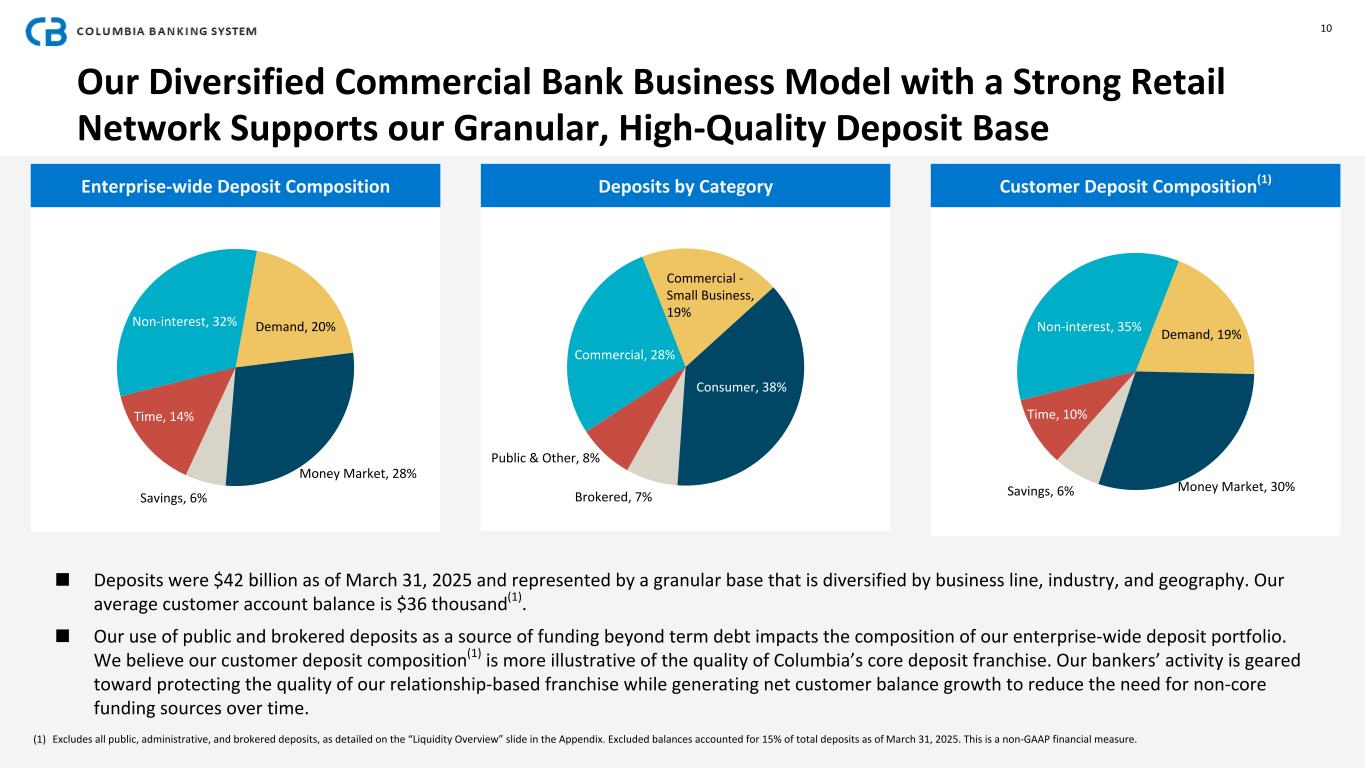
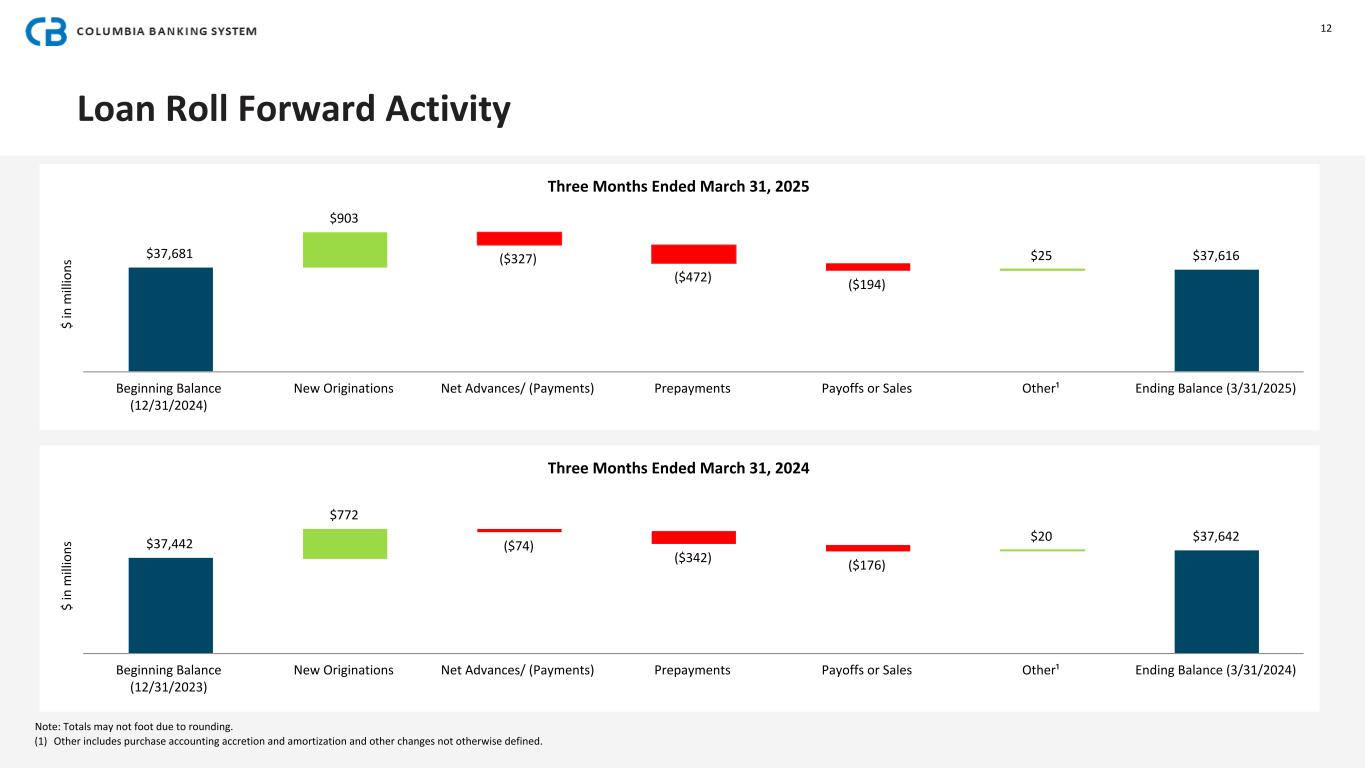
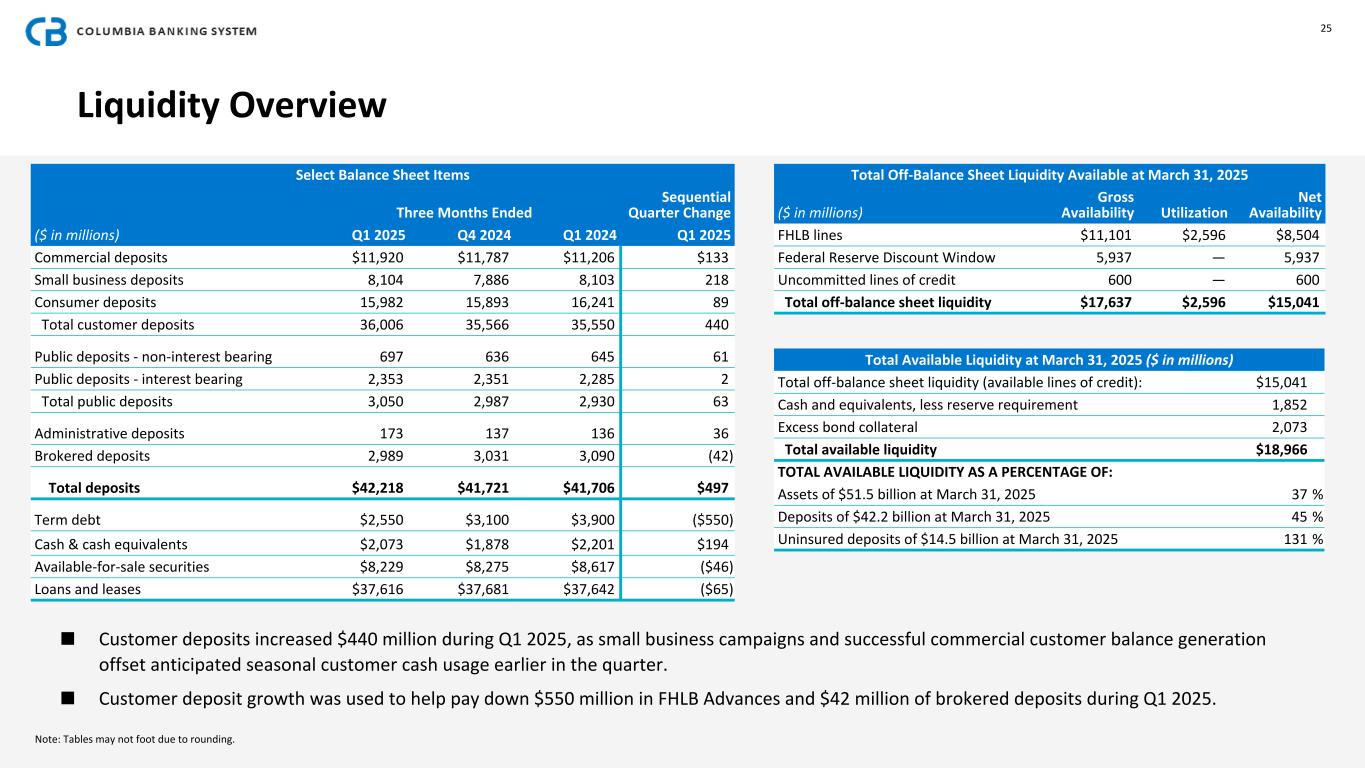
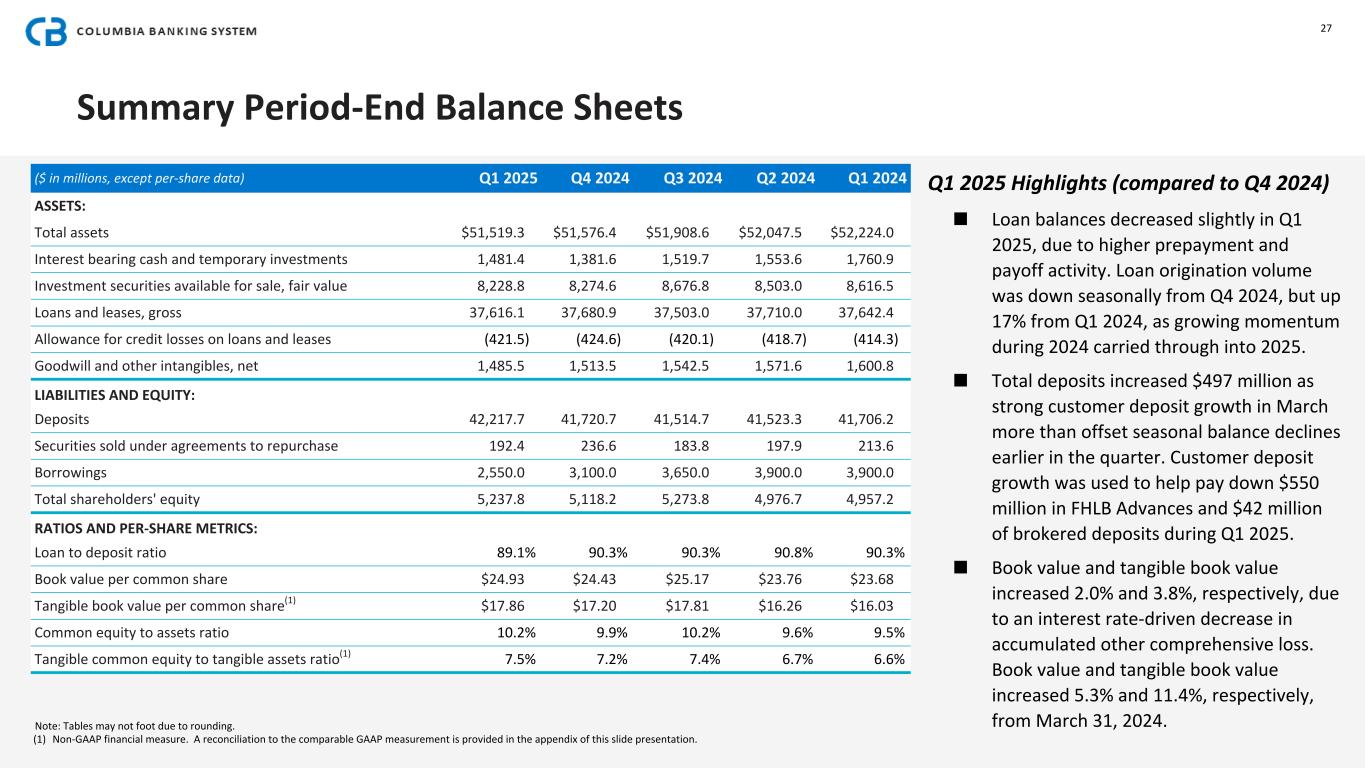
Thank you, Delim. Good afternoon, everyone. Thank you for joining us as we review Columbia's first quarter results and the announced acquisition of Pacific Premier Bancorp. The news releases and corresponding presentations are available on our website columbiabankingsystem.com. During today's call, we will make forward-looking statements, which are subject to risks and uncertainties and are intended to be covered by the safe harbor provisions of federal securities law. For a list of factors that may cause actual results to differ materially from expectations, please refer to the disclosures contained within our SEC filings. We will also reference non-GAAP financial measures, and I encourage you to review the non-GAAP reconciliations provided in our earnings materials. I want to thank each of you again for joining on short notice. I'm eager to get to our discussion of Pacific Premier, an acquisition which I'm excited to talk about, but we also have another solid quarter of results to share with you. Our consistent, repeatable performance in 2024 carried through to the first quarter of 2025. Our results reflect our disciplined focus on relationship banking as our teams work toward long-term balanced growth in deposits, loans, and core fee income. Our net interest margin contracted modestly as anticipated in the first quarter, given customer cash usage in December that carried through into January. But the positive effects of our retail and small business deposit campaigns, as well as growing commercial balances, offset these impacts. We defined seasonal norms with $440 million in net customer deposit growth for the quarter. Loan origination volume was up 17% from the first quarter of 2024, as momentum from the fourth quarter carried through into the new year. Our banking teams continue to win new business with new and existing customers. However, total loan balances were relatively flat as of quarter-end due to higher prepayment and payoff activity. Period-end totals were also muted by our continued focus on pushing the transactional real estate loans discussed in previous quarters off our balance sheet. Beyond the nonrecurring items that impacted our expenses in the first quarter, Columbia maintained its disciplined cost culture while continuing to reinvest in our growing franchise. We opened our first retail branch in Colorado in March, in support of the banking teams that have already been offering our full suite of products and services in the market since 2022. We'll continue to fine-tune our branch footprint and expand in geographies where we see opportunities. On that point, today, we announced our partnership with Pacific Premier. With this acquisition, Columbia will become a $70 billion in assets franchise and pick up a complementary set of products and services to support our growing customer base. Our eight-state Western footprint remains intact but as Pacific Premier's footprint is heavily weighted in Southern California, we accelerate our strategic goals in this market by a decade or more. I'm not going to take you through a page-turn presentation of the deal deck, but I will reference certain key slides during my remarks. Slide four in the deck highlights the highly complementary footprints of Columbia and Pacific Premier. I've previously discussed Columbia's expansion plans in Arizona, Colorado, Utah, and Southern California. A de novo branching strategy accomplishes our coverage goals in the first three states, but Southern California is different. There are 13 million people in the Los Angeles market alone, which is more than Washington and Oregon combined. And there are over 20 million people in the broader Southern California market. Pacific Premier's Southern California footprint fills in our Western reach, from Canada to Mexico, and it enhances our presence in other growth markets like Las Vegas and Phoenix. This acquisition provides the physical footprint to support our Southern California banking teams who have done a phenomenal job with limited infrastructure. It also provides expanded capabilities to the PPBI team through broader product offerings and the benefits of a much larger balance sheet. Columbia's deposit market share position in Southern California moves from fifty-first to number 10 on a pro forma basis. As outlined on slide eight, Ron will cover the numbers behind this financially attractive acquisition in greater detail. But as part of the all-stock transaction, Pacific Premier shareholders will receive a fixed exchange ratio of 0.915 of a share of Columbia stock for each Pacific Premier share. Following the deal's closing, Pacific Premier shareholders will own 30% of the combined company and Columbia shareholders will own 70%. Notably, we expect the transaction to have minimal impact on Columbia's capital ratios and we do not need to raise additional capital to support the deal. Columbia's executive leadership team remains intact and three Pacific Premier directors will join Columbia's board including Steve Gardner, Pacific Premier's chairman and CEO. The combined organization will operate under the unified brand of Columbia Bank, as Umpqua Bank will change its name to Columbia Bank later this year. Columbia Bank name aligns with our holding company name and other brands the bank operates today, simplifying our family of brands and ensuring brand clarity as we deepen our presence throughout the West. Beyond double-digit EPS accretion and a short earn-back period, this transaction represents a strategically compelling partnership as slide five outlines. Columbia and Pacific Premier are like-minded business banks that share a relationship-based operating philosophy. The banks have nearly identical low-cost deposit compositions including a top quartile percentage of noninterest-bearing deposits. Pacific Premier's products and service offerings are additive to Columbia's as we strive toward a larger contribution of fee income to our revenue stream. Pacific Premier's custodial trust business complements our existing wealth management platform, adding new capabilities and revenue-enhancing opportunities. We'll also add Pacific Premier's attractive HOA banking, escrow, and 1031 exchange businesses driving additional fee income and adding low-cost core deposits as detailed on slide 10. Execution risk for this transaction is low. It is predominantly an expansion in existing markets with limited overlap, and we expect very little disruption to depositors, borrowers, and our banking teams. Both companies have similar credit cultures, founded on conservative underwriting, robust review processes, and relationship-centric banking. Our thorough due diligence process confirms significant alignment in our credit approach, go-to-market strategy, operating philosophies, and cultures. In addition, both companies have significant acquisition experience and integration talent so we expect a smooth combination in every respect. I want to take a moment to address heightened macro uncertainty and the recent market volatility. Columbia's consistent approach to banking is a key contributor to our success through business and credit cycles. Our conservative and disciplined approach to building a diverse and granular balance sheet anchored by enduring customer relationships has historically allowed us to thrive during volatile periods. Our company has grown stronger as we have gained scale, talent, and process improvement through the mergers and acquisitions that have shaped Columbia over the years. Through it all, we have maintained our culture, supported our growing customer base, maintained our strong credit profile, and built a superior core deposit franchise. I want to thank our associates for their hard work in delivering another solid quarter of operational results. Their accomplishments contribute to my enthusiasm for our future. Our pending acquisition of Pacific Premier accelerates the organic opportunities in front of us as we continue to grow our customer base throughout our eight-state Western footprint. Together, we continue to strive toward consistent, repeatable top quartile performance in support of long-term shareholder value.
Operator
I'll now turn the call over to Ron.
Speaker 2
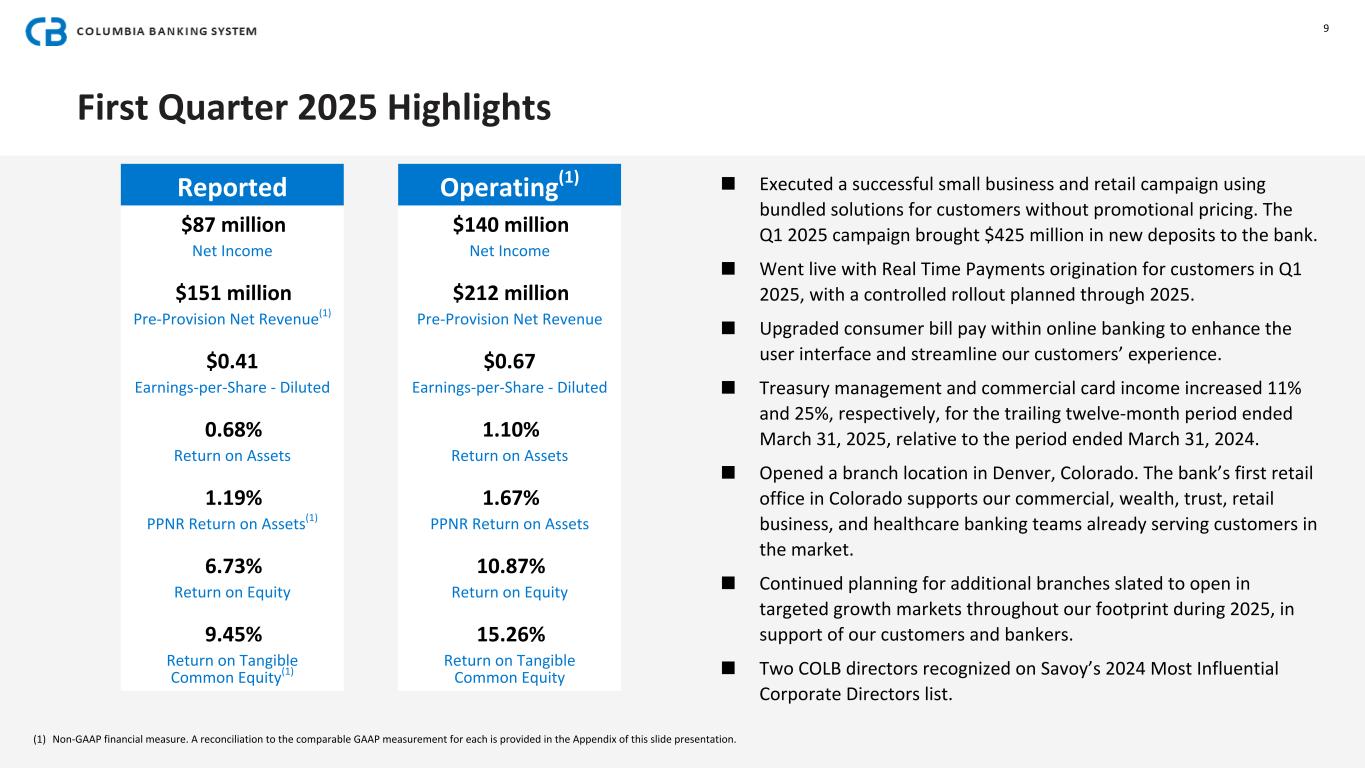
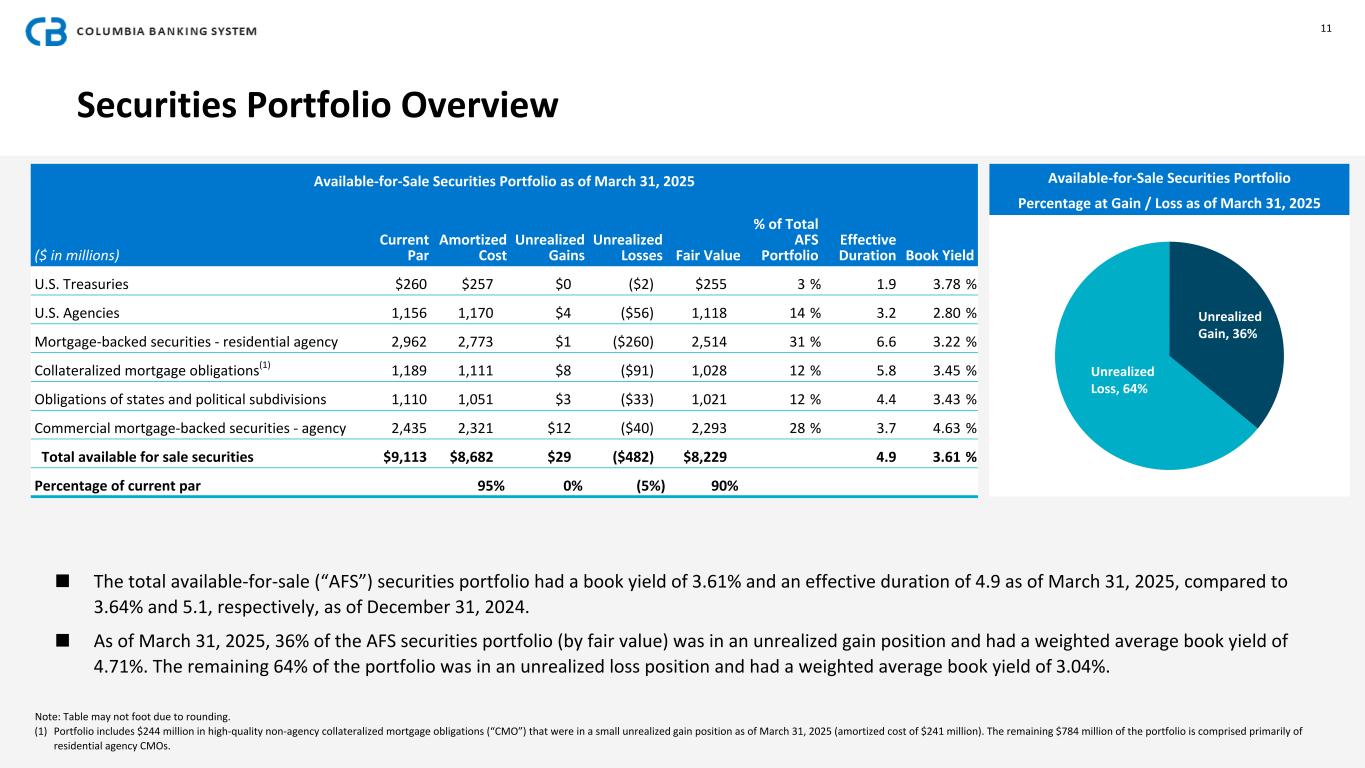
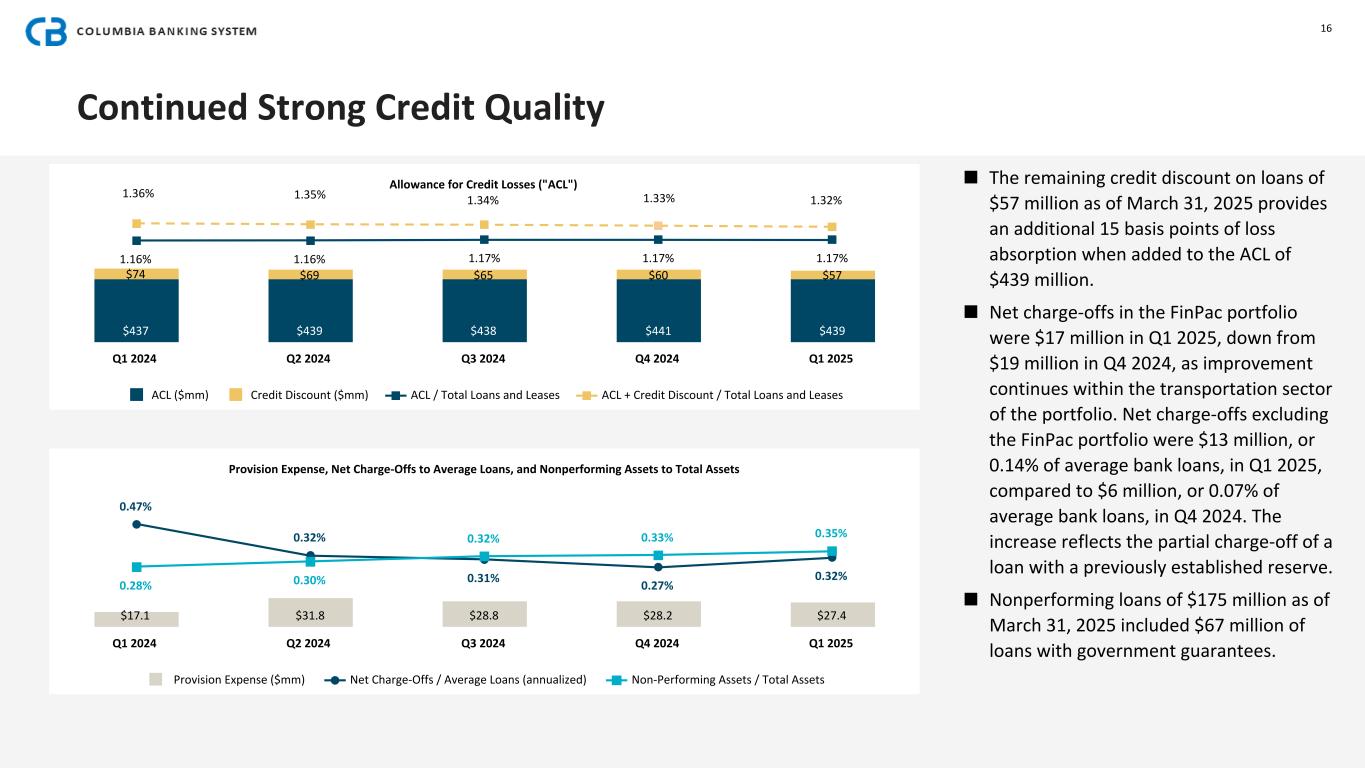
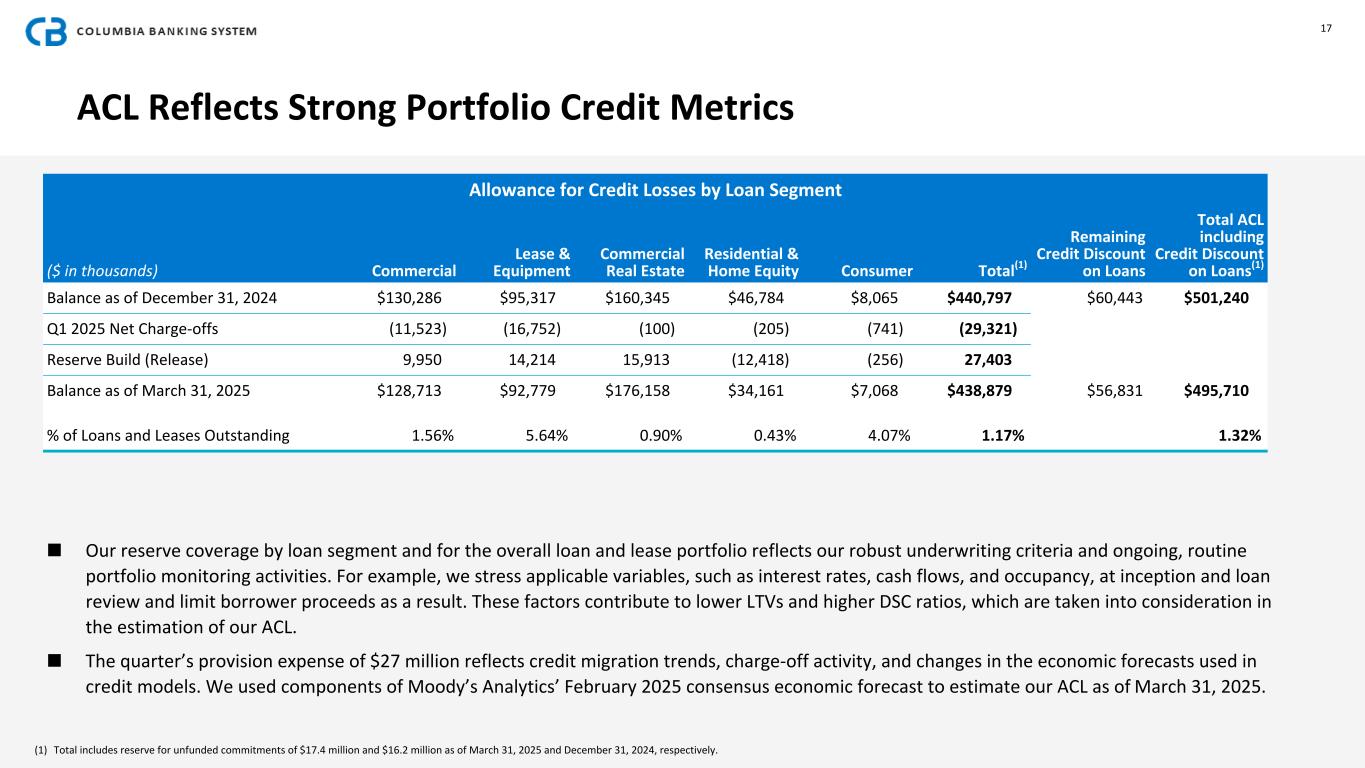
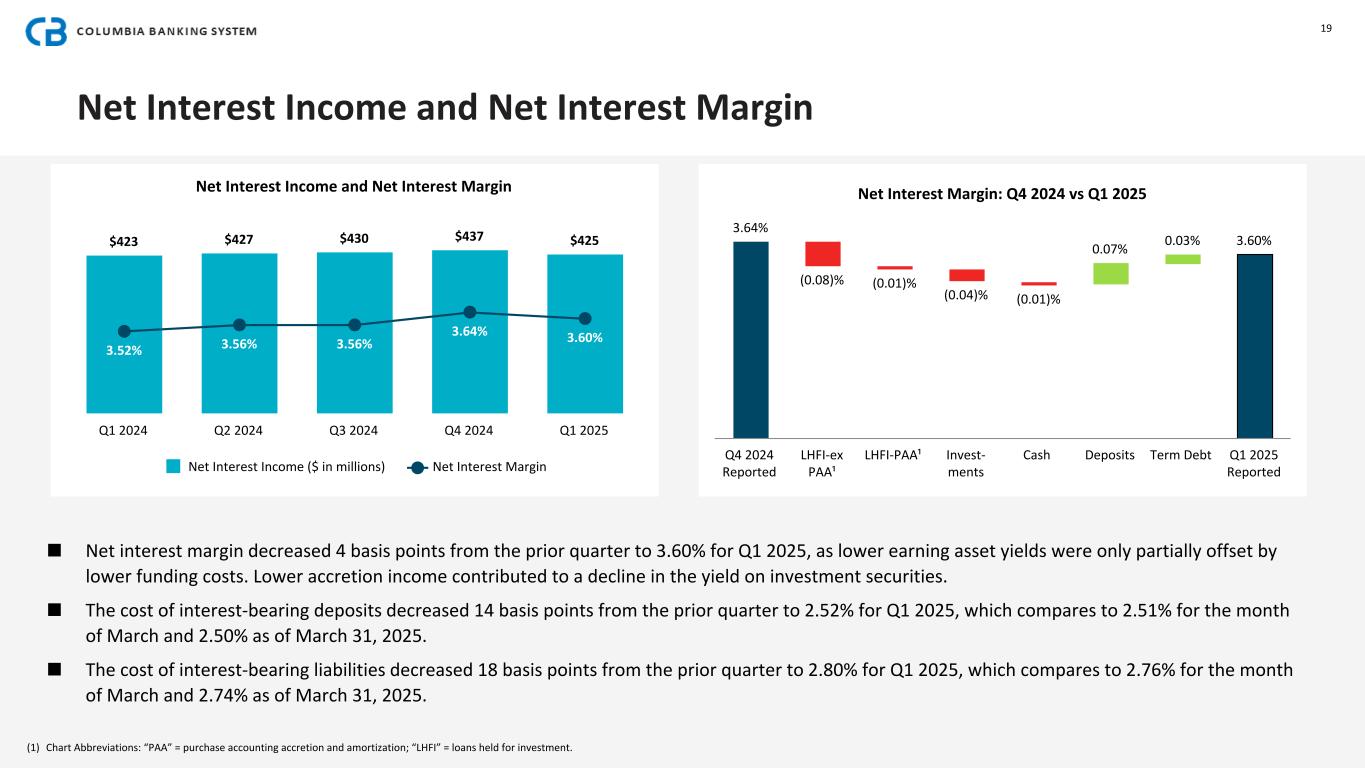
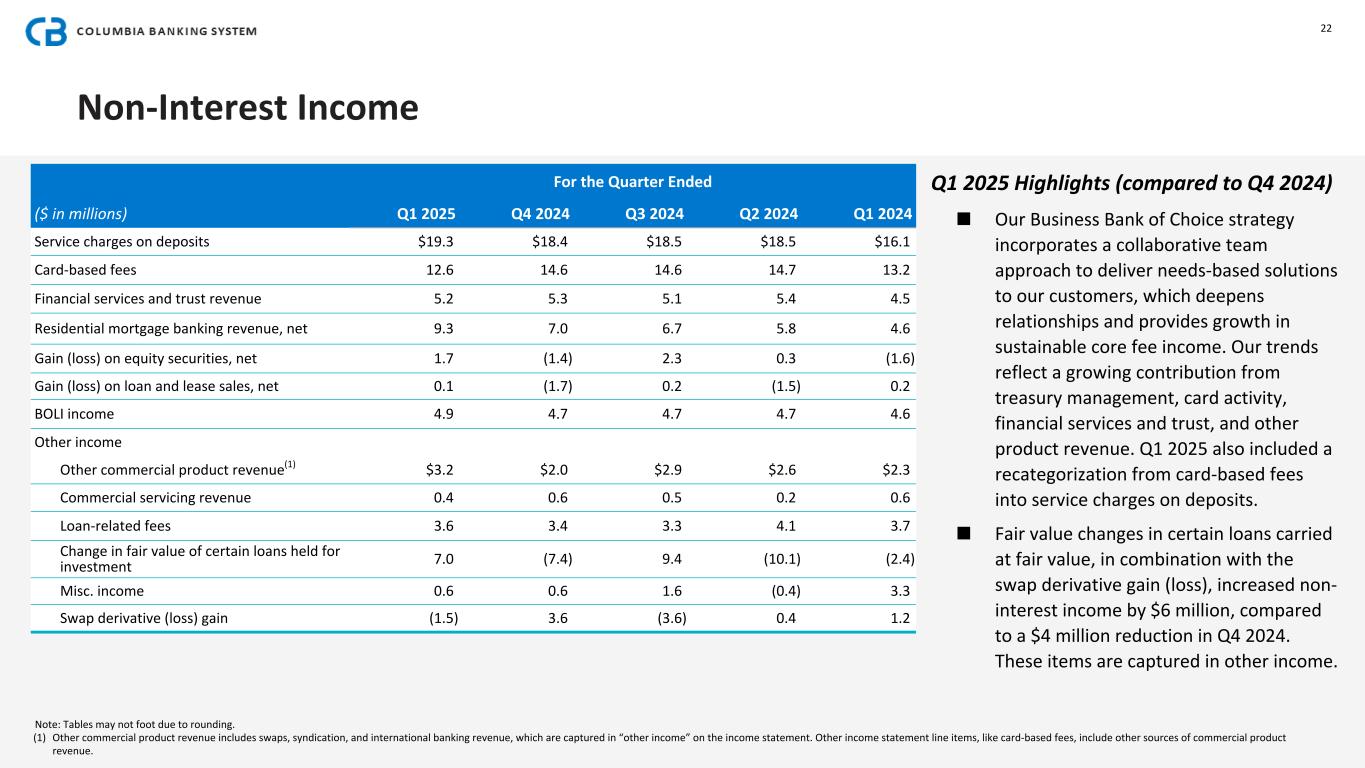
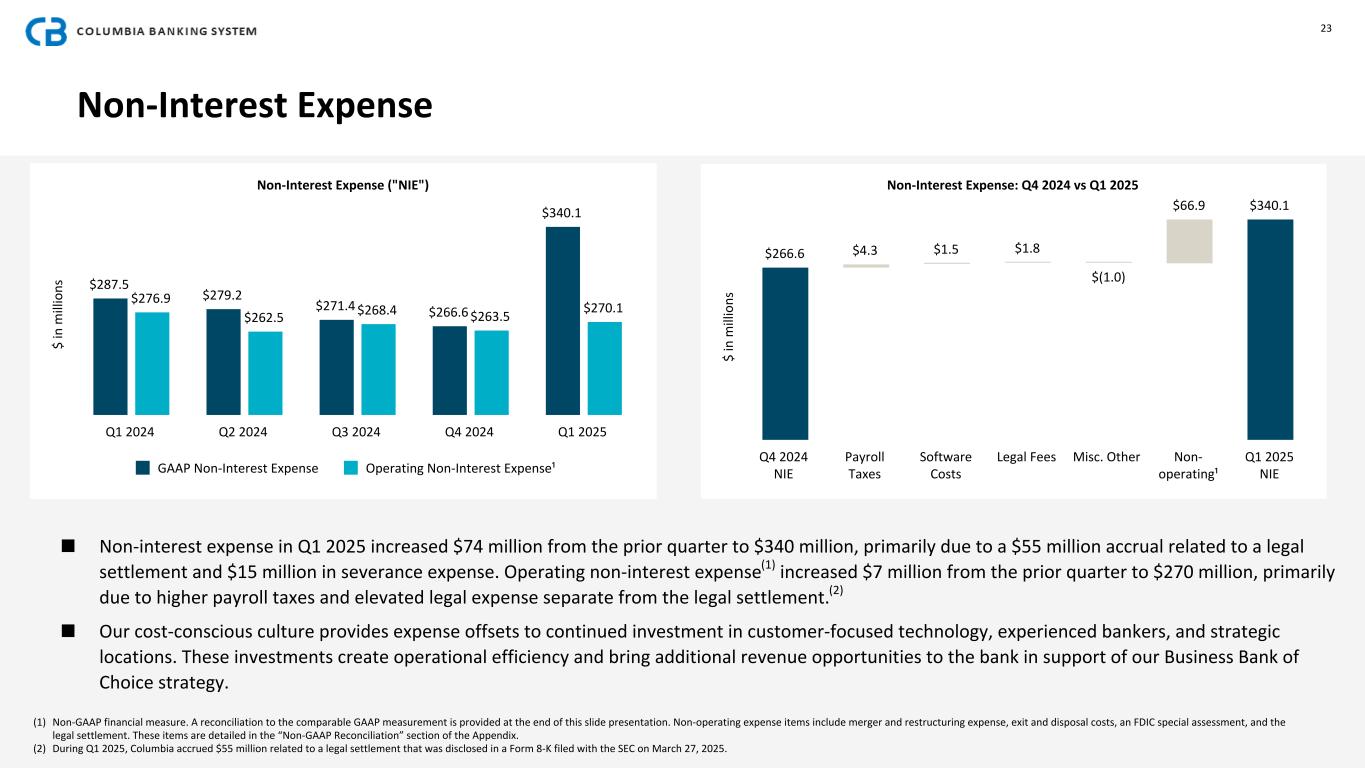
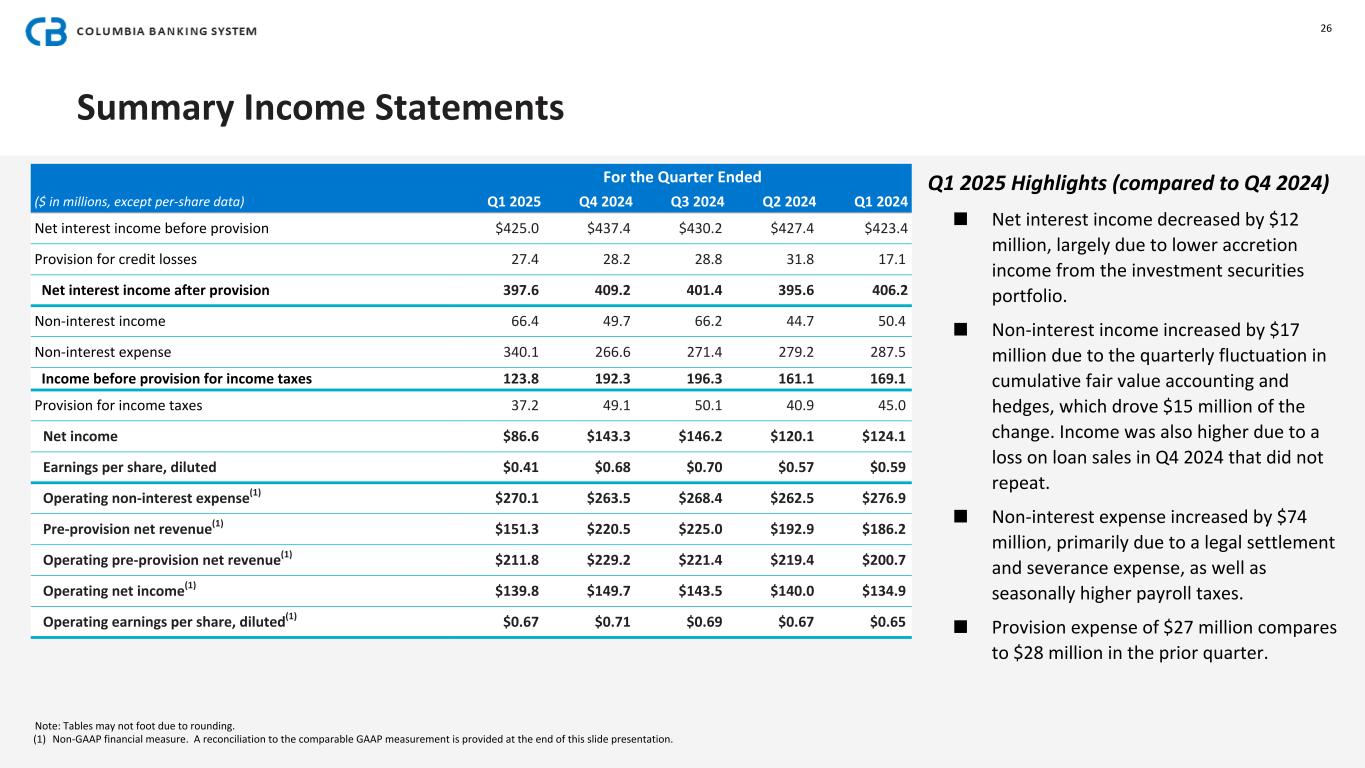
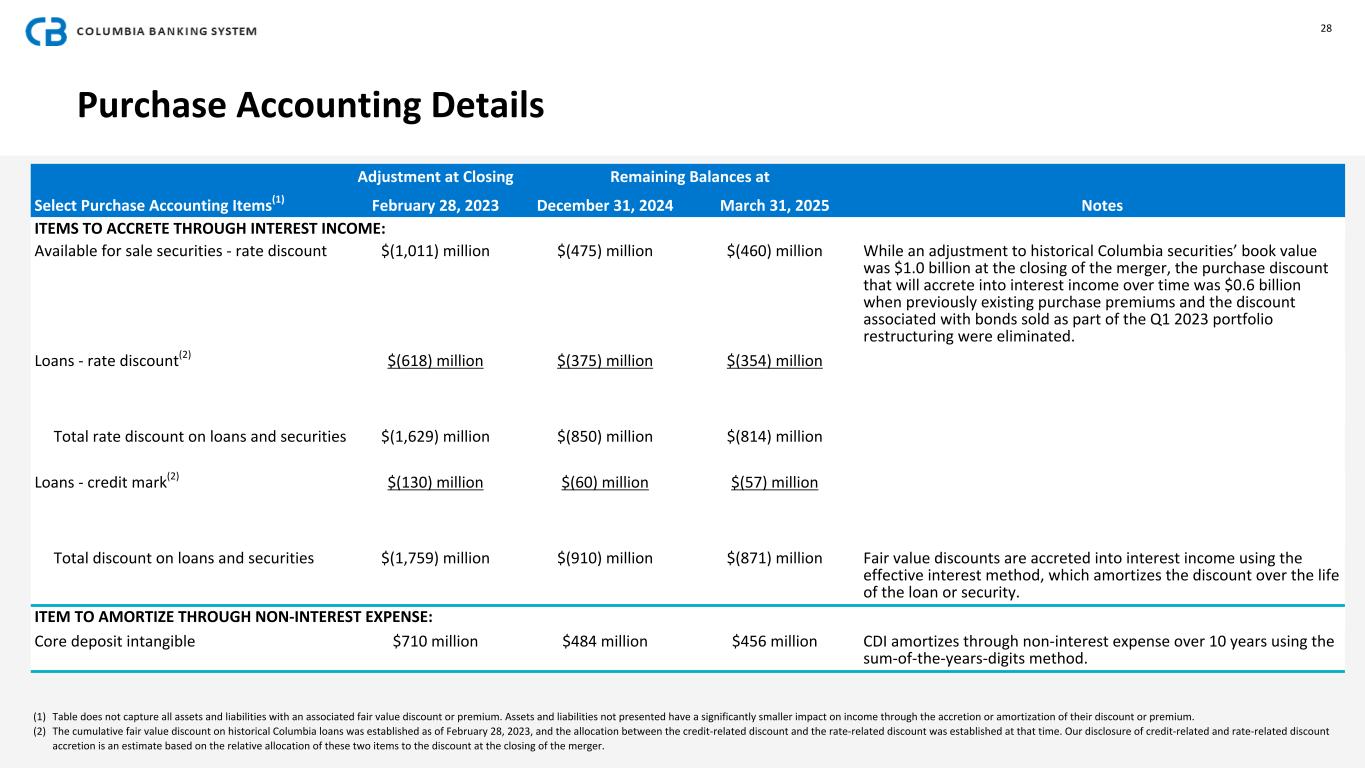
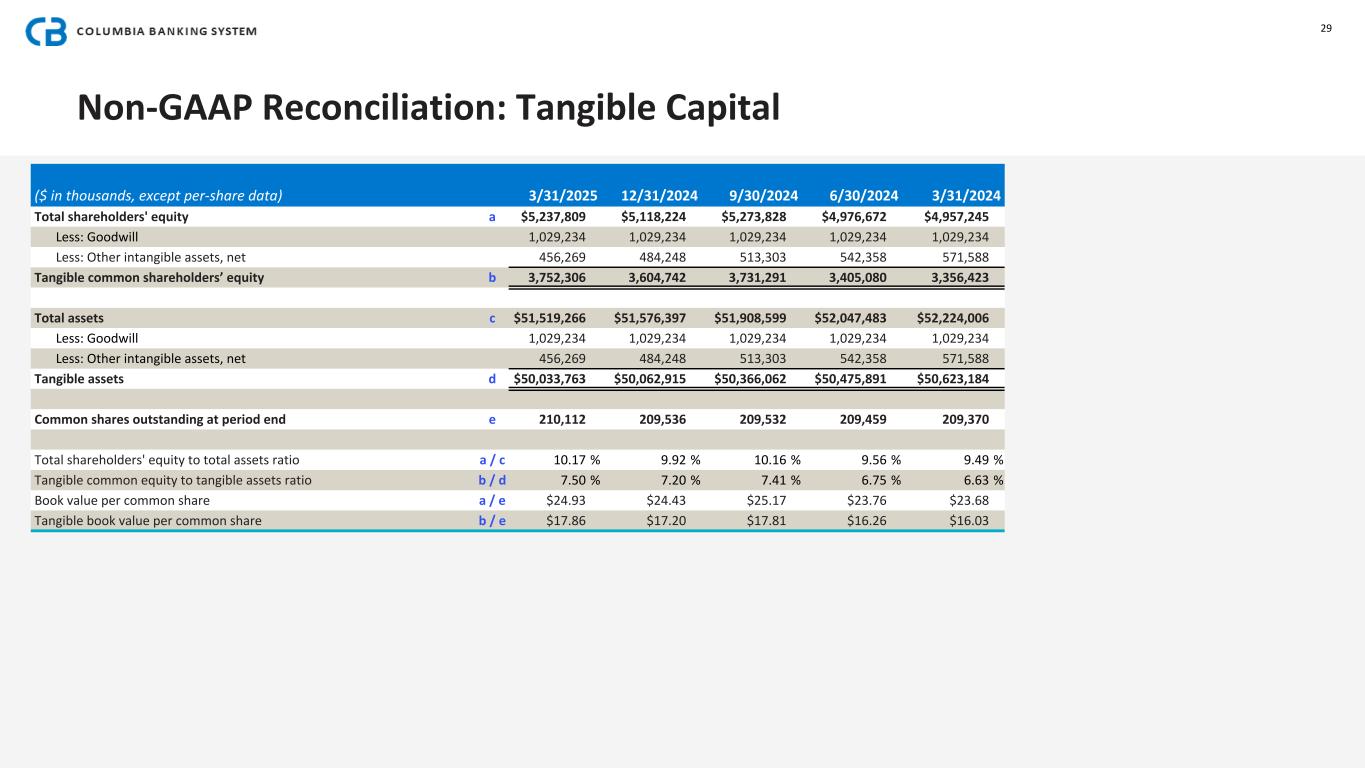
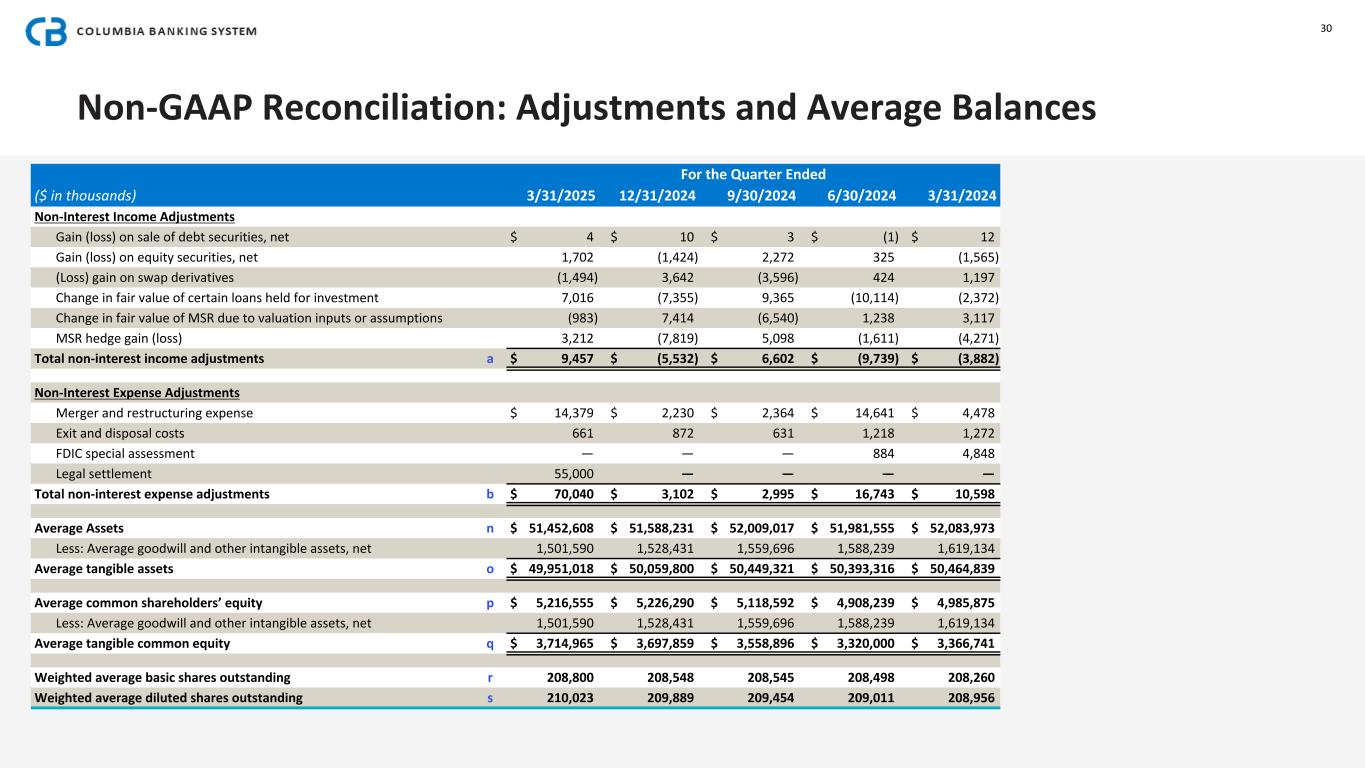
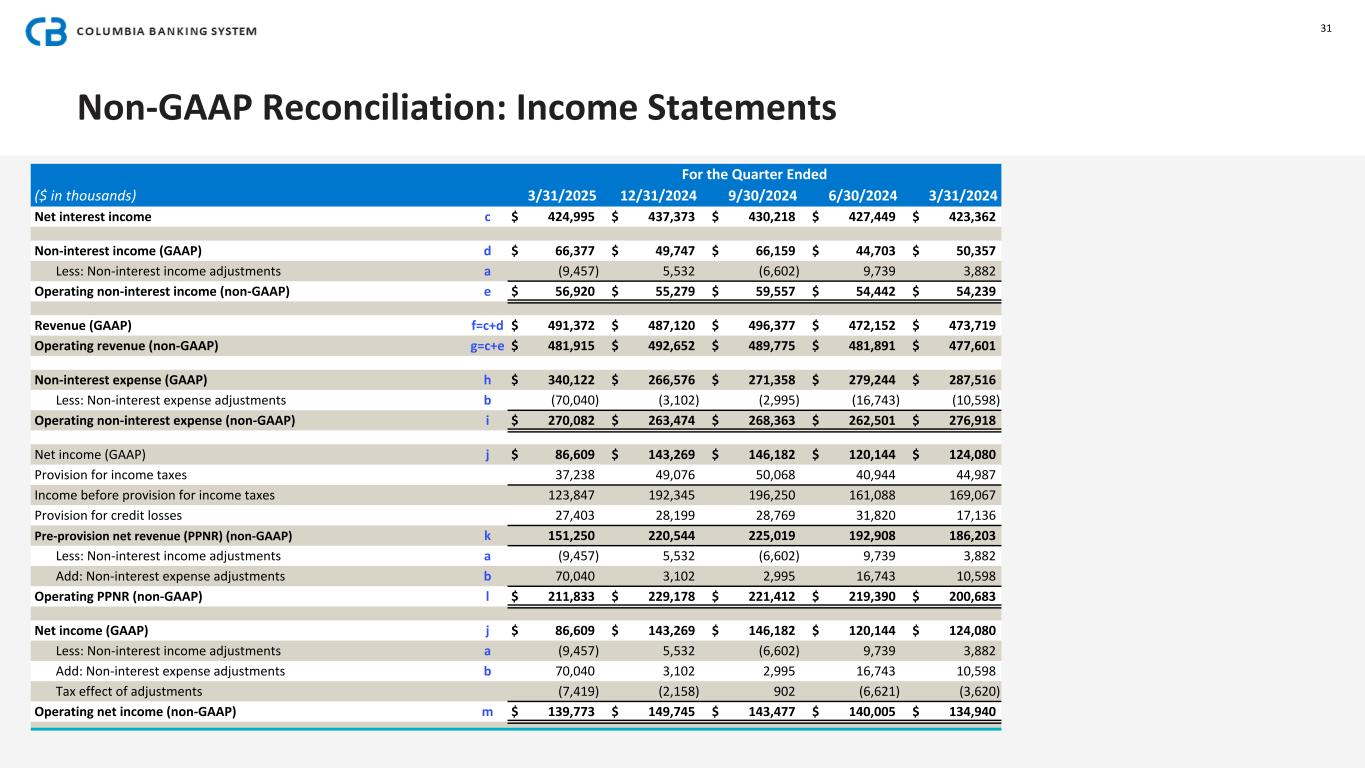
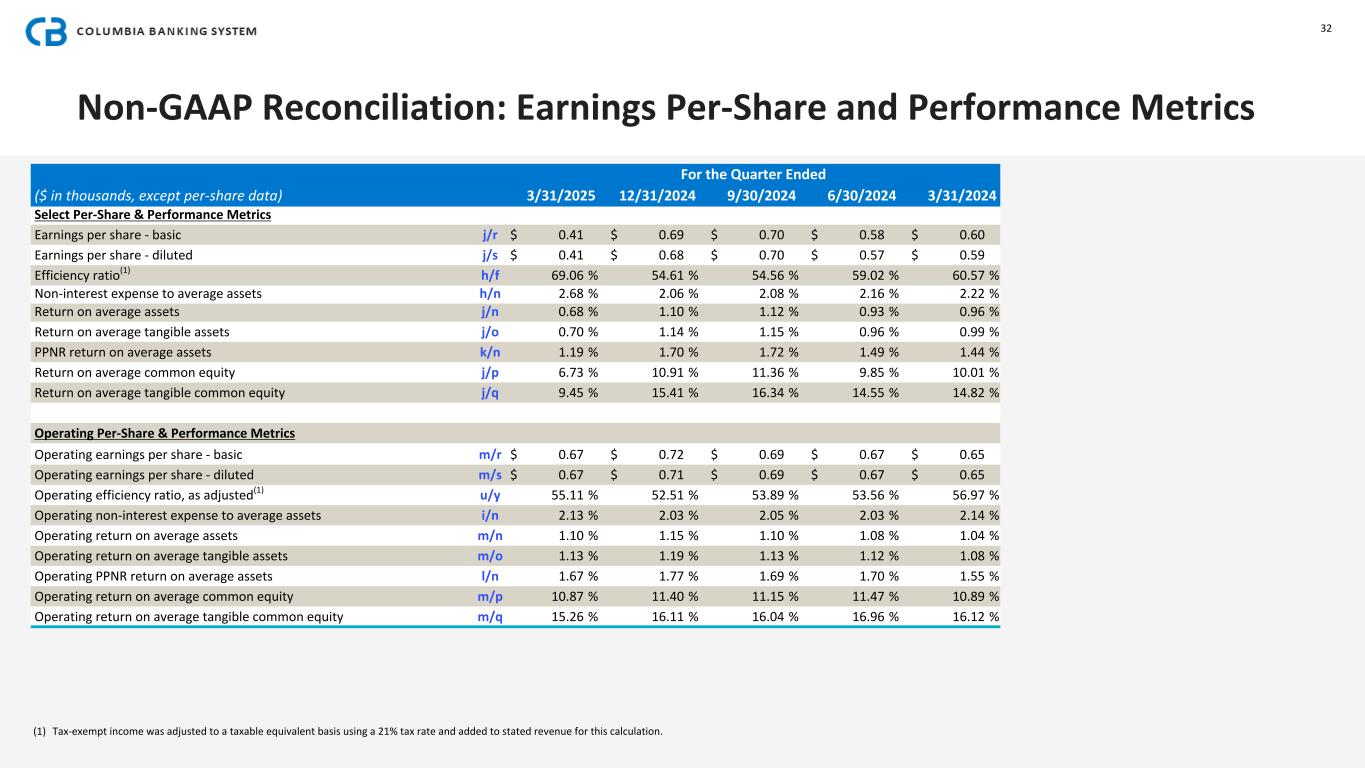
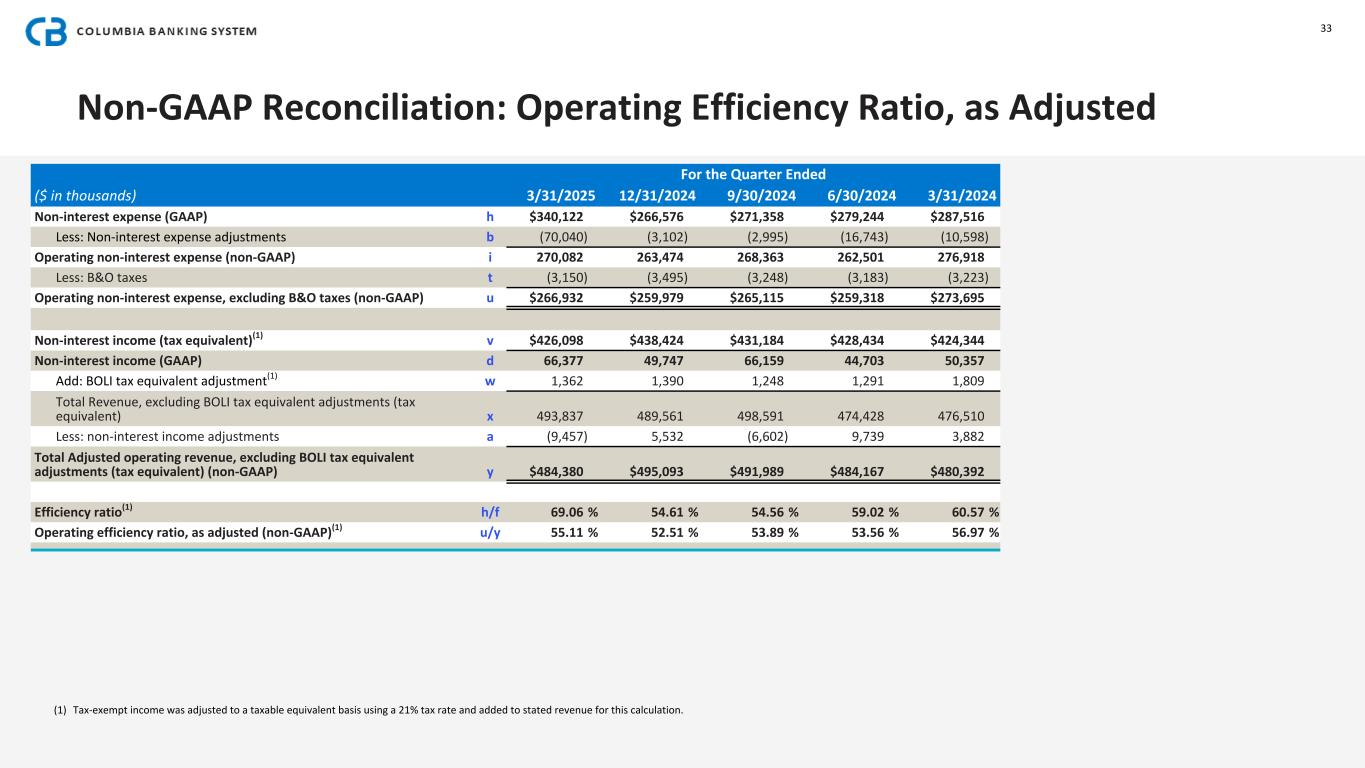
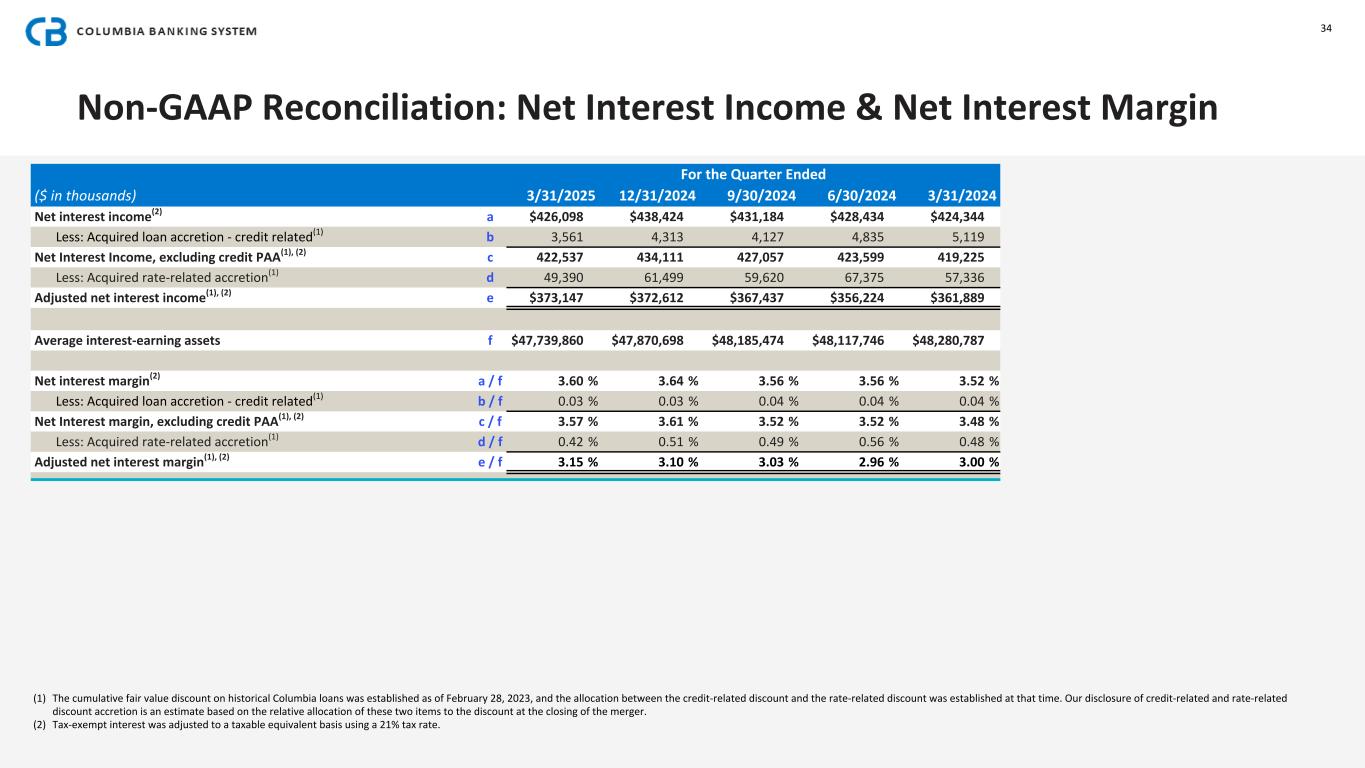
Okay. Thank you, Clint. I'll begin with a review of the first quarter's results. We reported first quarter EPS of $0.41 per share, and operating EPS of $0.67 which excludes the previously disclosed legal settlement of $55 million, $15 million in severance expense, and other fair value and hedging items detailed in our non-GAAP disclosures, which I encourage you to review. Our operating return on tangible equity was 15%, while operating PPNR was $212 million. As Clint noted, our bankers' activity helped offset typical seasonal deposit contraction as customer cash usage in December carried through into January. Balance generation from our small business and retail campaign and other growth in commercial deposits drove $440 million in customer deposit growth during the first quarter. Growth in relationship-based accounts enabled us to repay $590 million of wholesale funding inclusive of broker deposits. And the favorable mix shift benefited our net interest margin later in the quarter. As we discussed on last quarter's call, seasonal deposit flows led to four basis points of NIM contraction to 3.6% in the first quarter. Wholesale repayments were largely executed in March. Our provision for credit loss was $27 million for the quarter, and our overall allowance for credit losses remains robust at 1.17% of total loans or 1.32% when including the remaining credit discount. Noninterest income was $66 million for the quarter. With the change from Q4 mostly related to fair value swings given interest rate changes. On Page 16 of our earnings release, we detail the non-operating fair value changes. Excluding those items, our operating noninterest income of $56.9 million for Q1 was up $2 million as last quarter's loss on sale of loans did not repeat. Total GAAP expense for the quarter was $340 million while operating expenses were $270 million with the variance detailed on Page 16 of the earnings release. Seasonally higher payroll taxes and elevated legal expense separate from the legal settlement drove a $7 million increase from the prior quarter. Before taking today's merger announcement into consideration, we continue to expect our operating expense excluding CDI amortization to be in the $1 to $1.01 billion range for 2025. And lastly, our tax rate was impacted by nondeductible expenses during the quarter. We expect it to remain in the mid-25% range on an operating basis for the remainder of 2025. Turning now to the proposed transaction with Pacific Premier. Slides twenty-one and twenty-two in the deal deck detail diversified pro forma loan portfolio, and the similar deposit profiles Clint discussed. Slide 18 lays out key deal-related financial assumptions. We begin with consensus estimates for Columbia and Pacific Premier, and we expect to realize approximately $127 million in pretax cost savings which represents 30% of Pacific Premier's noninterest expense base. We expect 75% of savings to be phased in during 2026 and 100% thereafter. As Clint outlined, we expect to realize revenue synergies given opportunities across our combined customer base. Though none are included in our announced financial projections. We expect one-time after-tax deal-related costs of $146 million. Fair value and interest rate marks which will be accreted over the remaining life of the assets, include rate-related write-downs of $449 million on Pacific Premier's gross loan portfolio, $327 million on held-to-maturity securities, and $91 million related to available-for-sale securities. We also anticipate a $25 million reversal of existing marks on Pacific Premier's acquired loans, a $12 million write-up to fixed assets, and an $11 million write-up of time deposits which will be amortized over approximately one year. The $96 million credit mark which is equivalent to 0.8% of Pacific Premier's gross loan portfolio, is allocated 50% to purchase credit deteriorated or PCD loans. And 50% to non-PCD loans. As with interest rate marks, the non-PCD mark will accrete into interest income over the remaining life of the loans. We expect to realize an initial provision expense of $48 million on non-PCD loans immediately following the transaction's closing. The core deposit intangible is estimated at 3.3% of Pacific Premier's core deposits, and it will be amortized over ten years using a sum-of-the-year's digits calculation. Lastly, Pacific Premier intends to call its outstanding subordinated debt prior to the transaction closing. These assumptions drive our expectations for 14% EPS accretion in 2026 and 15% in 2027. Based on consensus estimates. We project 7.6% tangible book value dilution and a three-year earn-back period. Please refer to the appendix for reconciliation of the metrics I just discussed. Slides fourteen and fifteen outline the significant value creation and applied equity value upside this transaction offers. Given Pacific Premier's excess capital position, we expect limited impact to our capital ratios at closing, and as Clint noted, we will not need to raise additional capital.
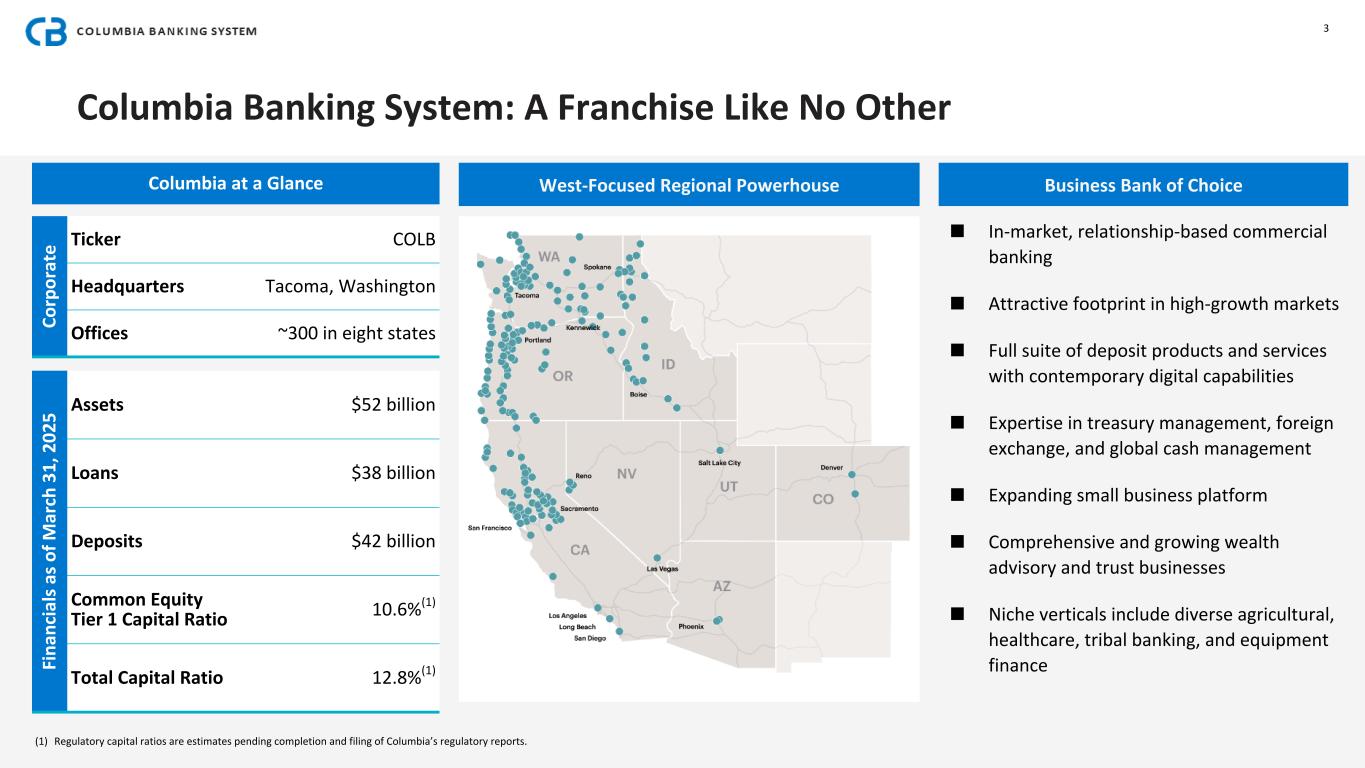
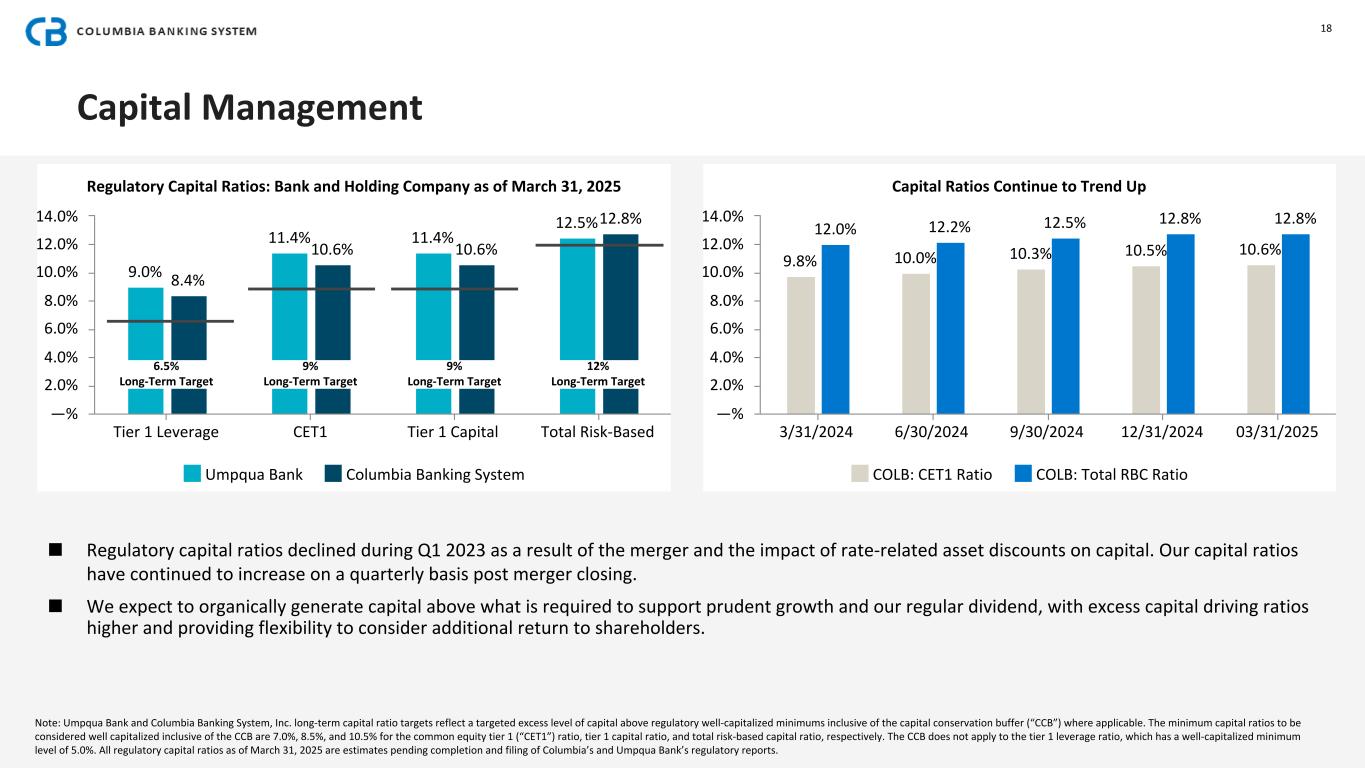
Hey, thanks, Ron. As you've heard me say many times before, the criteria Columbia considers in any transaction must make financial sense for our shareholders, must be complementary or additive to our business model, and must be culturally compatible. Our partnership with Pacific Premier is consistent with all of those criteria. Our focus remains on optimizing our financial performance to drive long-term shareholder value. Our capital position continues to build, and our regulatory ratios are expanding in line with our expectations. Our CET1 and total capital ratios were 10.6% and 12.8% at quarter end, well above our long-term targets. Our operational performance continues to demonstrate our ability to organically generate capital well above what is required to support prudent organic growth and our regular dividend. We expect our acquisition of Pacific Premier to enhance our capital generation capabilities and drive additional flexibility for future return to shareholders. This concludes our prepared comments. Chris, Tory, Ron, Frank, and I are happy to take your questions on our first quarter results. And Steve Gardner is with us for acquisition-related questions. Dalim, please open the call for Q and A.
Operator
Thank you, sir. Star one one on your telephone. To withdraw your question, please press star one one again. And I show our first question comes from the line of Chris McGratty from KBW. Please go ahead.
Speaker 3
Oh, great. Good afternoon. Clint, I got a I guess, an opening question for you. You're you're roughly two years removed from the close of the Umpqua deal. I guess I'm interested in what experience you can bring from that deal to this deal. I know you talked about this being a little bit of a market extension, but maybe the the upside potential and then maybe the risk that you're monitoring. Thanks.
Yeah. Hi, Chris. We have a slide in the deal deck that highlights our M&A experience. And when I say ours, specifically, Steve's M&A experience and my M&A experience, but also that of our teams. Since 2010, each organization has done 10 acquisitions. And so with each one of those, you learn something. And you have a playbook. What's unusual here is to have a counterparty that is as seasoned or more seasoned than we are. And so when you look at that track record, it gives you a lot of confidence in your ability to adapt to whatever comes at you that's a surprise because there's always something. But more specific to the merger integration that we wrapped up. I started talking last summer about the integration aspects, the social aspects of the Columbia-Umpqua integration were largely behind us. And you know, conventional thinking is it's a two-year process for that to happen. So I feel like we accomplished it about six months ahead of time. Look at the consistent operating performance that we drove throughout 2024, which carried into the first quarter here of '25. Everything that we've experienced and what we've been communicating over the past several quarters is that we're in a business-as-usual operating mode. The integration was fully behind us, and it was a much heavier lift. Because if you think about every single individual in both companies was impacted by the Columbia-Umpqua merger. Here, there's still an impact, but it doesn't impact or distract every single person doing every single job in both companies. So I don't want to make light of any integration; it is challenging. But also, Steve and I have spent a lot of time talking about and speaking with key members of his team about how to make sure that we execute flawlessly on this, and we have a great plan. So I'm just very confident in our ability to do this, and I think the environment is also conducive to doing that as well.
Speaker 3
Great. And then I guess my follow-up would be a little bit of a regulatory angle. Are you 70% you're going to be 70% in assets pro forma? I guess two-part question. Is there any expenses either gross or net that you're allocating to preparing for a hundred billion? And then secondarily, what's the CRE concentration going to be pro forma? I know that's a big issue once you get closer to a hundred, and Steve was right around 300. So I'm interested in that pro forma number. Thanks.
So we have a roadmap in terms of preparing as we skate towards a hundred billion. And that roadmap was put in place really as we crossed $50 billion. And it doesn't mean that we've significantly ramped up expense or that we'll need to significantly ramp up at $70 billion. There's not like an expense cliff that comes with this. What it does mean is that we have to start skating to where the puck's going because there's no phase-in period for the regulatory aspect crossing a hundred billion. At $70 billion, I would argue we're only 70% of the way there. But I do think that we'll accelerate some of the components on our roadmap, but it's nothing that will be a meaningful adjustment to your expense models at this point in time. Then we just have to wait and see. You know, there are a lot of moving pieces right now in the regulatory framework, and you know, a hundred used to be two fifty, and I don't know if that happens again. But I think that we're in pretty consistent conversations and constant contact with our regulators at the regional office as well as nationally. I think the time period that we're going through waiting to close this, thresholds could be different. But we're not counting on that, just so you know.
Speaker 3
Great. And then the performance CRE if you have it. Thank you.
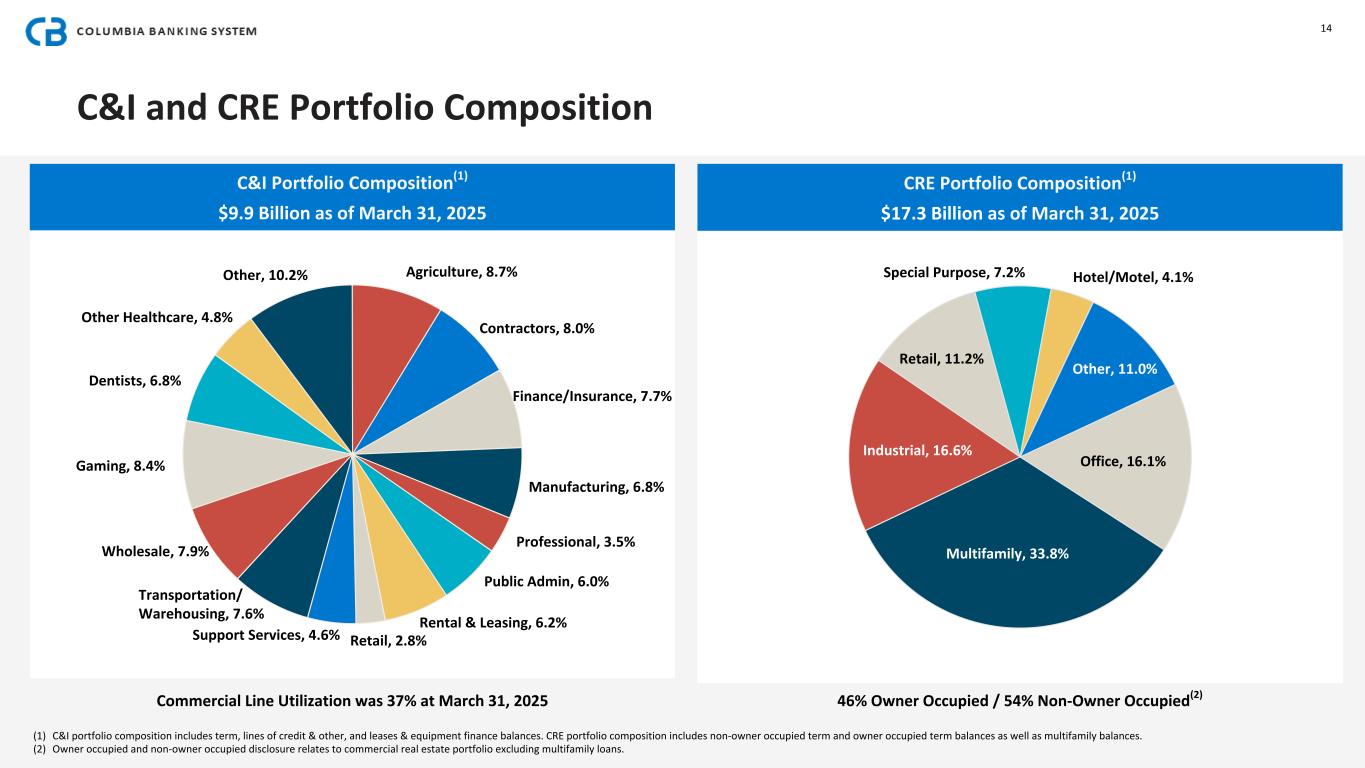
Oh, yeah. I think it's 330. 325, and if you take out the multifamily, which both companies' multifamily books are pretty much the same workforce housing, rock solid credit, I think then that number drops down to 168 or somewhere in that level.
Operator
Thank you. And I show our next question comes from the line of David Feaster from Raymond James. Please go ahead.
Speaker 4
Hi. Good afternoon, everybody.
Speaker 4
Obviously, this is a very complementary deal. It brings some nice fee income lines, which you alluded to, some new lending verticals, expands into some markets that you were already going to. You touched on a few of those things that Pacific Premier brings. I was hoping you could elaborate maybe on where you see the most opportunity to add value utilizing some of their core competencies across the combined franchise or leveraging Columbia's expertise across their footprint. Just kind of curious what where you see what where are you most excited about?
I'll start and then see if Chris and Tory want to give you more details. The thing that excites me the most is, as I said in my prepared remarks, is this accelerates what we had hoped to be able to achieve in Southern California, in particular, by over a decade. And that's not just something we're putting out there because it is impactful, but it's been about a year and a half that we've been trying to solve for how do we get more infrastructure for the bankers that we already have in that market. And I've said in my comments that they've done a phenomenal job with very limited infrastructure. South of the grapevine. And so for eighteen months of work and trying to find the right places and figure out where our existing customers are and good prospective customers, we identified less than a half dozen sites at that point in time. If you think about how do you get and build a footprint, that's not only the sheer number of locations but the size and scale of what Steve and his team have built in that market. It's easily a ten-year push to do that. When you combine that with some of their businesses where they're just ahead of us in areas like HOA banking, Chris and his team have been trying to unlock the secret sauce to that. And of course, Steve and the Pacific Premier team have a very robust offering there. There are other areas as well, and then also we think about the things that we're doing on the small business side that have been impactful on our current operations over the past five quarters, and how we can leverage that as an accelerator of growth. So I've given you the appetizer; I'm going to step back and let Tory and Chris serve up the main course on what the specifics are.
Yeah. Thanks, Clint. It's Tory. I'll jump in real quick. I mean, I've been honestly salivating over the Southern California market for a decade, and just the sheer number of companies of all sizes, the density of it. It's just such a wonderful market to be a part of and to be able to grow into. We will immediately get brand awareness strength and market share, which is just going to support both of us as we come together to grow. Specifically, you think about some of the product capabilities that we combine, we'll be able to expand. You've got the leasing business and a different offer on the commercial card front, you've got international banking just a little bit different as we come together, and you've got the growth from the scale of our balance sheet. So similar to Umpqua and Columbia coming together, we've got the capability to grow with those customers as they grow. We're not going to pass on $2,030,000,000 deals as companies grow and need that from a lending standpoint. We have the capabilities to serve customers as they grow so we grow with them. I think those things combined with inheriting a great group of bankers at Pacific Premier, I think, is just going to be a wonderful opportunity for us.
Speaker 6
Yeah. And David, this is Chris. The acceleration of the HOA program is huge. Light years ahead of where we are today. The complementary nature of the custodial trust business will allow us to expand our fiduciary business and the investment aspects that we put into that as well. We've been expanding into the market down there, and this just accelerates that. Clint started touching on retail small business. Think about what we've shown in the last four campaigns of what we can do with our approach to the market. Really looking forward to the opportunity of getting in there, training up the team on the relationship strategy, and then seeing what we can do when we turn that loose. We've talked about the market and the potential; I think there's a lot of tremendous opportunity there. And then we'll be full service, and we'll bring the mortgage business into play as well.
Speaker 4
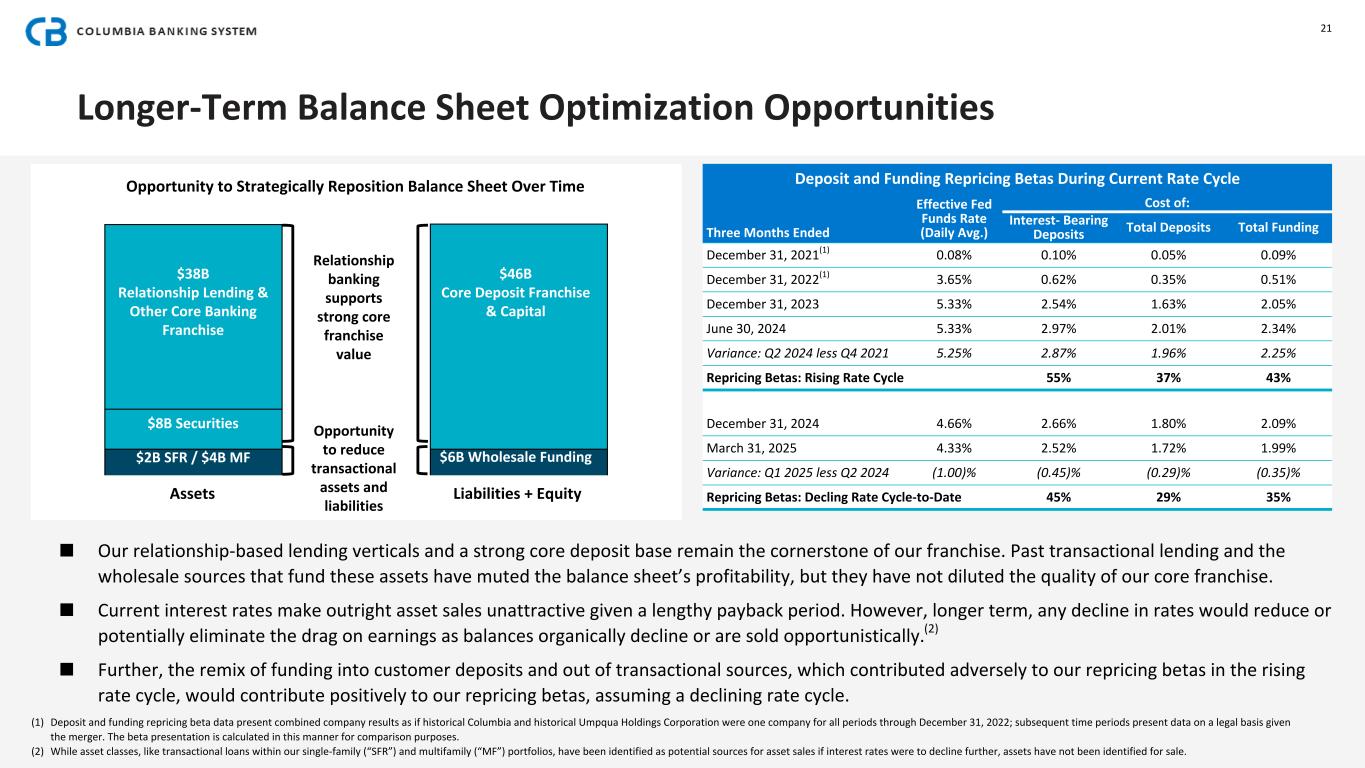
That's great. And you know, Columbia, you guys have had that slide in your deck talking about longer-term balance sheet optimization opportunities. Obviously, we're gonna have the Pacific Premier balance sheet marked. Are you considering any asset sales or optimization efforts to help improve profitability and maybe accelerate that optimization that you've already identified, or is that just some conservatism in these numbers and optionality that you guys have? Because I don't think that's in those pro forma numbers.
No. It's not. But it, but David, as usual, you've zeroed in on some key aspects. It provides flexibility. Not only does it act as a balance sheet restructure on the Pacific Premier balance sheet that then gets accreted back through earnings as opposed to being a hard-coded loss. But it also creates flexibility for us to do some of the things that we've been talking about for the past year or fifteen months on optimizing our balance sheet. The expanded earnings capability of a pro forma company also gives us the potential to look at things a little bit differently in that regard. And as we've mentioned, the deal doesn't require any additional capital, and we've already been growing capital fairly substantially over the last two years. That growth should accelerate as well.
Speaker 4
Okay. That's great. And then maybe just last one for me. A higher level one. You know, we've got an extremely volatile backdrop today. You know, you've got the trade wars and all that going on. Just a kind of high-level question for you, Clint, is how do you get comfortable underwriting credit today? I mean, the good news is I've always looked at Pacific Premier as a very low-risk balance sheet, very conservatively underwritten. Obviously, there's a healthy credit mark. Here too through the marks, but I'm just curious. How did you get comfortable around the credit side of this deal?
Frank could hardly wait to unmute his mic. He's sitting next to me. What I'll start with is by saying I think you hit the nail on the head that Steve and his team have demonstrated a long track record of superb credit performance. That was something that we dug very, very deeply into. Frank likes to be bored, and he likes to sleep well at night. He is also very conservative and has a strong track record in credit performance. I don't want to steal his thunder. I'll go on mute here and let Frank give you some details in terms of the extent of diligence we conducted.
Speaker 7
Thanks, Clint. There's no thunder to be stolen here. I was really excited to see the results and the diligence that we conducted. We looked at over 61% of their loans and was pleased to find out that they really had a similar underwriting and credit philosophy to us here. Their policies were very much aligned with ours. Their application of credit policy was very close to how we apply our credit policy. The most important thing in underwriting through any credit cycle and the ability to continue to underwrite through any credit cycle is to leverage a leverage averse credit culture within the portfolio and underwriting. It's not P&Ls that get companies through credit cycles; it's the strength of the balance sheet. Time after time, we saw within the credits evaluated a low leverage position of these companies similar to ours. It gave me great comfort to see all of that, and not a lot of existing issues within either portfolio. Both companies stay ahead of potential credit problems by staying close to their customer base, and that's really the best way to do it.
Speaker 4
That's great. Thank you for all the color, and congrats on the deal.
Operator
Thank you. And I show our next question comes from the line of Matthew Clark from Piper Sandler. Please go ahead.
Speaker 8
Hey. Good afternoon, everyone.
Speaker 8
This is my first question around your financial targets on a pro forma basis and maybe the lessons learned from the Umpqua deal? I know this is only about a third of your size relative to Umpqua. It's a lot larger. But anything, you know, you might do differently this time around to ensure that you get these targets because, you know, they look fairly strong.
Well, we start with all of your estimates. Not yours specifically, but, you know, consensus estimates. As we look at the environmental changes, we had, what, 550 basis points of rate increases from when we announced the Columbia merger. Hopefully, we won't have a seventeen-month waiting period. I expect that we won't see that kind of rate volatility. The thing that I'd want to make sure people are aware of is that consensus estimates have come down. They haven't for the industry. When we build these models, they use consensus estimates. There is always going to be some variability. In a stable environment, our forecasts are probably not terribly different, maybe a little better, maybe a little worse, from period to period than what consensus is. But there was a whole seismic shift in the operating or the rate environment, and that's what really I think led to the differences. Despite the volatility in the markets right now, what we're seeing from customers, if you don't watch the news and you're not on social media, life's still pretty good. We're not seeing any type of major pullback causing us to rethink what our current forecasts are. Our advisers went through our forecast, and I'm pretty certain that Steve's advisers went through his and our forecast, and we feel pretty good about delivering top-tier performance. As the market moves, maybe those ratios move around just because that's how it works. But on a relative basis, I think this is gonna make a lot of money for a lot of people.
Speaker 8
That's great. And then how about the buyback? I know, you know, we were kind of warming up to one sometime this year. Does this deal put that on pause? I mean, PBBI has a ton of excess capital. It's gonna use all that capital to deliver the marks. But given that your capital on a pro forma basis isn't gonna change materially, would you still consider a buyback this year?
So what I said during our first quarter conversations was that I was pretty confident that there would be capital actions during 2025. And I consider M&A a capital action. Without this, it would have been extremely likely that we would have initiated a buyback. Right now, our biggest focus is getting the deal closed, seeing where the capital ratios are, and then from there, relative to our long-term targets, making an assessment on a buyback. So short answer is yeah, it probably does push it out. It's probably not a 2025 event. But there are still some variables in terms of whether this is a year-end close or is it a sooner-than-that type of close? And then, where do the final ratios shake out? Right now, we expect a modest decline of, you know, 20, 30 basis points from our current levels, and our current levels are modestly above where our long-term targets are. We still expect that we'd be above those targets, but I would hate to go initiate a buyback and then find out that we needed to go out and raise $200 million of capital and deliver shareholders that wouldn't do us any good.
Speaker 8
Yep. Fair enough. And then my last question just around any potential divestitures on PBBI's balance sheet. I know Steve has scrubbed that portfolio quite a bit over the years. But is there anything within there, maybe franchise lending or even multifamily you might want to deemphasize, or do you feel good about the whole portfolio?
We feel pretty good. Steve and team have done a good job at deemphasizing some things. The other piece is that we've run our company, we've built our company to perform through cycles. We've been waiting for a recession for many years. I don't consider 2020 a recession because of all the stimulus that was pushed into the system. I think Steve also built a fortress balance sheet and a tremendous amount of capital in anticipation of some form of economic slowdown. As part of that, it wasn't just building capital, but it was also kind of pulling back from different areas of their portfolio. So it's super, super clean. Yeah. On the multifamily side, we could reduce CRE exposures by selling some of those that are marked. But they're gonna be at current market rates through purchase accounting. There are absolutely zero credit concerns on those. So I don't know that we would necessarily do that. There are some things in the bond portfolio that I think we're looking at that could provide some opportunities for us. And I think this gives us some flexibility with our existing balance sheet to maybe look at some things as well.
Speaker 8
Great. Thank you.
Operator
Thank you. And I show our next question comes from the line of Timur Braziler from Wells Fargo. Please go ahead.
Speaker 9
Hi, good afternoon. I'm wondering how long the courting process for this transaction was? It's pretty impressive to get a deal announced in the midst of some of this volatility in the broader market. I'm just wondering more recently, did you have to update any deal terms, considerations, marks, did you have to recalibrate any parts of the transaction just given some of the market turbulence year to date?
We'll have all of that in the S-4, but what I can give you is that Steve and I started getting to know each other a couple of years ago, just trying to assess my mindset at that time, which was executing on the task at hand, which was the integration of Columbia and Umpqua. I think, if you ask Steve, and you can because he's here in the room, his thought process was probably around seeing if we could execute. Once we both were at a point of where I said, 'yeah, we've executed', and he was able to witness it from an external viewpoint, then we started talking about the possibility and when timing might be right. I would say, as a full-on approach and endeavor, it really started at the first of the year. Here we are in the fourth month. But I'll lean back into our both of our experience in M&A. I think both teams and boards were able to see through the short-term market noise and volatility and really focus on where the long-term shareholder value could be created. It ended up remarkably close to where we originally started. But yeah, it was a wild ride with some of the market swings.
Speaker 10
It was a very disciplined process, and I think importantly here, as a percentage stock deal, this is a reinvestment opportunity for Pacific Premier shareholders and an extremely attractive one. We firmly believe the upside here is significant. When you get two companies that have very similar cultures and operational areas, it really makes for a relatively low risk, low execution risk in our minds. Yes, there was certainly a lot of volatility in both the equity and debt markets, and that had an impact. But given that we had a long-term view here, and this is a reinvestment, we thought the process throughout was very collaborative, and we're really pleased with where we ended up.
Speaker 9
Okay, great. And, obviously, a very different transaction from the Umpqua Columbia deal, but I know that took longer than expected. Here, you guys are expecting to close this in the second half of this year. I guess, can you privy us to some of the conversations that maybe haven't had with regulators in framing that closing timeframe?
There's a body of evidence that continues to build on deals getting approved quicker. For banks either our size or those creating banks that are our size, that gives us a lot of optimism. We had fairly robust preflight conversations with the regulators, both at the regional office level as well as in D.C. I'll say I left those meetings very encouraged that it would be a much more efficient and transparent process than what we went through last time. The other aspect is that we don't expect a DOJ review, and the DOJ review cost us eleven months with the Columbia-Umpqua one. That right there is another data point that leads us to believe that getting this closing is very likely closer to a 2025 event.
Speaker 9
Okay. And then just last for me, maybe for Frank, looking at the credit mark, it looks well below PBBI's allowance level. Can you just talk to the methodology in coming up with that 80 basis point mark relative to what looks like almost one and a half percent reserve for PBBI?
Speaker 2
Yes. As Frank mentioned earlier, there was a significant amount of credit diligence and reviewing ACL modeling, economic forecast, etc. Given the weight of the multifamily portfolio, the losses just aren't there to support a higher level. That's how we weighted into that 80 basis points. In essence, 55% of the portfolio being multifamily is sitting at just under 60 basis points, and even that's probably overstated just given the long-term lack of credit issues expected in that portfolio we're seeing over the history.
Speaker 9
Got it. And that also jived with the due diligence activity looking out three months, six months, that also factored into that number.
Operator
Thank you. And I show our next question comes from the line of Jon Arfstrom from RBC Capital Markets. Please go ahead.
Speaker 11
Hey. Thanks. Evening, everyone.
Speaker 11
Usually, we'd be neck deep in the nuances of your earnings. I guess, but what would you call out in your earnings for the quarter that you think went well and what you need to work on further and it just curious your level of confidence in that '26 consensus estimate. I know it's our estimate, but what are some of the puts and takes to hitting that?
I think the thing that I really looked at is the deposit growth that we had and what we were expecting. As Ron said, guiding into the first quarter, our seasonality could be up to a half a billion of additional wholesale funding. To have the growth that we had and still see the seasonal activity, we could still see the patterns that we historically would, because literally, by month and by the point in time in the month, it’s bonus payments, tax payments, or distributions; you can see the flows, and those flows are still there. It wasn't like we didn't experience the seasonality, but the results of our bankers on both the retail small business side and the commercial side made a difference for us. I think that as we look at the margin, which drives a big portion of earnings, it's deposit flows that are going to determine our performance in that regard. From my perspective, I would have liked to have seen some more C&I loan growth, but I'm encouraged by the year-over-year origination activity that was up 17%. Unlike in the fourth quarter, where the activities translated into strong annualized growth, the first quarter didn’t. Tore and I and Chris are watching closely; there is a lot of optimism in terms of the second quarter, and third-quarter pipelines. But that's where I am really looking. Of course, we'd always love to have more core fee income. Those major points hit the major ones. I'll look down the table and see if Tory or Chris want to add anything.
This is Tory. I think the only thing I'd add is, as Clint talked about, the pipelines are pretty strong. There’s a lot of momentum, and we had some C&I growth that didn't book in the first quarter. They got pushed last minute into the second quarter. But pipelines are strong, they're up about 10% from end of Q4. So there's a lot of good momentum. Things are looking pretty good for us going forward.
So regarding the opportunity from the Umpqua merger, it's really around process improvement. We have a get better every day type of mindset. Not change for the sake of change but to do things better, simpler, and more efficiently. This work will never be done. Some things that we would have done over a longer time horizon were the expense initiative and reorg that we did in the second quarter of last year. Instead of pacing that out, we did that over a ninety-day time period. So that lift was done. But really, that's the operator's business: make it the best that it can be, and we're never satisfied. We always think we can do something better. But in terms of having our bankers on their front foot, out winning new business, competing in the marketplace, continuing to invest in the growth of our franchise, whether products and services or technology, we're doing all those things. It really is business as usual.
Speaker 10
You bring up an important point. This was very early on one of the primary questions that we as a management team and board had, something we did a lot of diligence around was exactly where the combined entity stood and whether they were ready to take this next step. I can tell you we have a high level of confidence in the organization. Otherwise, we wouldn't be here today.
Speaker 11
K. Very helpful. And I would just say for the record, I'm happy about the name change. I think that's smart just to be under one brand. So for what it's worth. Thanks.
Operator
Thank you. And I show our next question comes from the line of Jared Shaw from Barclays. Please go ahead.
Speaker 12
Hey. Good evening. Thanks. Congratulations on the deal. I guess, you know, as we look at the CRE and the work you've done to bring that concentration level down, should we think that going forward, you're just more comfortable sitting at a higher level of CRE with this combination, or as time progresses, should we expect to see that come back down to where you are now?
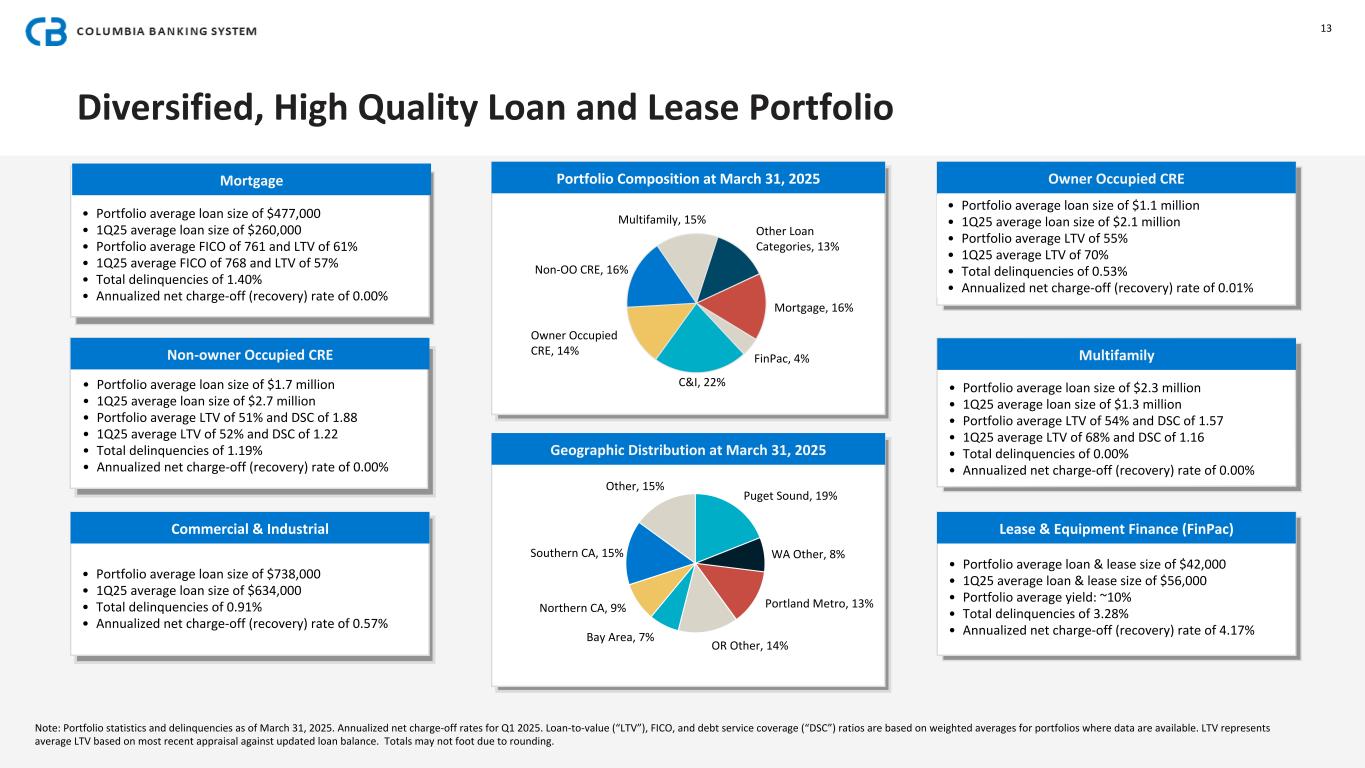
You're going to see a similar trend line that you've seen over the last couple of years post-Columbia-Umpqua merger. If you go back further and you look at deals that Columbia did, there was always a downward slope in the CRE ratio just because the banks that joined us typically had a higher level. Steve has a great slide in his IR deck showing their history of doing the same thing of walking down those ratios over time. I think we're in alignment, and really, what's got that ratio above 300 is the multifamily book. We're not opposed to multifamily. We've talked about stability in credit quality, but I'm not a fan of transactional multifamily, and that's where we still have about $3.7 billion of transactional multifamily on our balance sheet today. I think Steve is still working through some of his balance sheet as well. You move that down, and we're comfortably below 300. You'll see that number come down. We'll still do relationship-based multifamily for customers where we have meaningful relationships, but that activity won't keep pace with the runoff that you'll see in those other portfolios.
Speaker 12
K. Alright. Thanks. Then could you just speak a little bit about the cultural integration that you anticipate going forward, and what the alignment looks like with the way the two banks do business and especially around some of the incentive structures for RMs? Is that similar to what you have at Columbia?
I'm excited; some of the components that Pacific Premier has in their incentive structure can enhance ours. It's not just about paying people more money but ensuring alignment closer to actual desired outcomes and results. There is a value placed on performance and execution at Pacific Premier, and those are the same things that we value. From a cultural standpoint, I think there's really good alignment. We gathered our senior leadership teams in February and talked through some major components of each operation. Steve walked through a deck on their culture, and while the words are different, the principles and values are identical. When you start from a place like that, then the nuances are very minor.
This is Tore. I want to add one piece. I've been doing this business for a long time. If you think about commercial bankers in particular, you get two camps: some who just like to make loans, and some who really understand full relationship banking. Culturally, both companies are completely aligned in the relationship banking aspect of that. It sounds simple, but it's a much more difficult process from a sales standpoint, and the fact that we are both so aligned is a very nice fit. This will allow us to grow the combined company much faster and much better than if it wasn't that way.
Speaker 6
And this is Chris. When you look at the cost of funds, you can tell a lot about how bankers go to market. Very similar to what we've done; it's not leading with rate, it's leading with value and relationship. That comes through in the total cost of funds that you see on Pacific Premier’s books.
It inspired Chris to sharpen a pencil on deposit pricing, and he saw Pacific Premier's cost was lower than ours by a few basis points.
Speaker 12
And just finally for me, when you look at LA and Southern California, is this the platform you sort of need to get to where you want to be? Or do you think that there will be additional hiring, or is there an advantage from some of that market disruption from the last few years to grow the team beyond what it will be now?
I think it's a little bit of both. A $70 billion franchise that has coverage from the Canadian border to the Mexican border, and has the density that we will have in what’s the world's fifth-largest economy, with top 10 pro forma deposit market share, will create a tremendous amount of opportunity. We've seen it even with limited infrastructure in that market. We've seen the power of being a billion-dollar bank in that market. It acts as an accelerant for what we've done. Then you take the talent and experience in the market of Steve's people, and I think that also supercharges what they've been able to do. It's going to be a pretty dynamic company. It's tremendous scarcity value, and we're going to be able to drive additional value, particularly in Southern California, but also throughout the eight states.
This is Tore. There is so much disruption in the Southern California market. We will continue. We're going to get 40 plus new RMs; they're going to be great teammates. We'll keep looking for talent. When we find talent that we think is accretive to the company and helps take market share and grow, we're going to bring them into the bank. We've recently hired a couple of folks in Arizona. I think they're going to be fantastic for the bank. We just keep looking for people that want a really good home to have careers, and I think that's going to help us further in Southern California.
Operator
Thank you. And I show our next question comes from the line of Jeff Rulis from D.A. Davidson. Please go ahead.
Speaker 13
I guess, checking in on kind of the plan to open more branches. I guess, the first part of that question is, is that somewhat on hold with this deal? Do you see that through you've got too much to juggle or not? And then maybe the second question, and know Clint, you're fairly conservative, and you're going to take care of one thing before the next. But I guess it begs the question some of these states in the Rocky Mountain SWAT. You say you're accelerating Southern California expansion by ten years with this transaction. Does that open up the discussion to look for M&A to accelerate the Utah, Colorado, Arizona expansion through M&A, so that's part two. Thanks.
Hi, Jeff. It doesn't put our De Novo branch expansion strategy on hold. We have two locations in the Phoenix area under construction. We have one in LA that I think also is a nice fit with Steve's existing footprint, and that will move forward. We just opened Denver last month; Colorado Springs is coming online. Those things will continue to move forward. That's a different group in a different part of our company that executes on those De Novo branch openings. What this does is it allows us to pivot our focus from a De Novo strategy in Southern California to the Intermountain States and look at some opportunities there. Our bankers have achieved a lot with limited infrastructure in those newer markets. As I always say, they earn the right for us to reinvest in them and help them grow their franchise. I don't want to give out our strategic roadmap, but your line of questioning aligns with our thinking; it allows us to pivot those other resources not necessarily involved in M&A towards those newer markets and figure out some opportunities to capitalize on.
Operator
Thank you. And I show our next question comes from the line of Anthony Elian from JPMorgan. Please go ahead.
Speaker 14
Clint, I'm curious what type of balance sheet growth do you expect from the combined franchise? If I look at Columbia standalone, it's been pretty much a low single digit score the past couple of years. But you're adding Pacific Premier now, which is in higher growth markets. What level of balance sheet growth do you envision the combined company to eventually generate?
One of the things we'll have to work through is this rundown in those transactional real estate portfolios. I’ve said publicly that the single-family resi was too big of a portion of our portfolio. By virtue of being a bigger bank that helps us start to right-size that. It gets us about halfway to where we want to be, which is 10% or less. Loan growth will be muted as those portfolios run off. I would say if we’re not growing at least at the rate of double GDP, then I'll be disappointed.
Speaker 14
And then my follow-up for Steve, I'm curious why PAC Premier is not going at this alone. Clint outlined the attractiveness of Southern California in his prepared remarks. I would just think that there's already a ton of growth opportunities for you available given the number of banks that have exited that market in recent years? Thank you.
Speaker 10
It's a good question. You're right, it's certainly one of the important areas the board has been considering for some time. Looking at organic growth and potentially doing tactical things around the balance sheet and the wide options, when we looked at it, especially this opportunity, it was readily apparent that this would accelerate the returns we generate for our shareholders in a significant way. It's an attractive reinvestment opportunity.
Operator
Thank you. And I show our next question comes from the line of Andrew Terrell from Stephens. Please go ahead.
Speaker 15
Hey. Good afternoon. If I could just ask maybe for Ron on the margin, just the from an organic standpoint, you had a big drop in the securities accounting this quarter. I would assume that's mostly due to rate volatility that we saw intra-quarter.
Speaker 2
Yes. It's a great question on the bond portfolio, and it is interesting when you get a CPR that potentially is at zero, if not below. It's just a complete slowdown in prepays. It could be related to the overall volatility in the markets, and that pushed out the discount accretion. It didn't go away; it just delayed the recognition. Over time, if there's stability, we would see some additional discount accretion, which would help on that front. But if it continues, I’d expect that remain depressed for a couple of quarters. Overall, back to the NIM question, we're pleased with the results in Q1. As I said, we did pay down the $590 million of wholesale later in the quarter. We expect to see the benefit of that on NIM in Q2, but seasonally, historically, Q2 is usually weaker due to tax time. It typically starts to build back up late in the second quarter.
Speaker 15
Any change to I think you guys last quarter, I think we were talking about a margin in the range of 3.55% to 3.65 trying to that level. Any refresh to that?
Speaker 2
As I just covered, if the deposit flows are better, we’re able to reduce wholesale seasonally, that might show maybe in Q3, that's definitely potentially in the upper end of that range.
Speaker 15
Understood. Okay. The rest of mine were addressed, and congrats to both parties in the deal.
Operator
Thank you. And I show our last question in the comes from the line of Nick Coloco from UBS. Please go ahead.
Speaker 16
Clint, just thinking about the CRE concentration conversation and the tendency for that to drift lower on the other side of deals that you've done in the past. Along with your increased focus on growing relationship-type C&I lending. As you were thinking about potential M&A activity, how did you weigh a deal of this nature versus potentially something that might have been more C&I focused that could accelerate your growth efforts there?
PAC Premier is C&I focused. It gets back to the comment Chris Merrywell made about deposit composition and pricing. The activities that the Premier teams are engaged in today very much align with what we do. The multifamily book is a work walk down position for Steve, and I think that's similar to what we'll do with some of the legacy Umpqua portfolio. It takes time to burn that portfolio off your balance sheet. A lot of this Steve has come through a prior acquisition he did. I think this was the deal to make; it creates the most value long-term for both sets of shareholders. I’m not worried about the activities; I want to make sure we keep the customers and talent.
Speaker 10
You may not be familiar with our institution, but similar to Columbia over the years, we do acquisitions, and it typically takes our CRE ratio above 300%. It was well below that prior to the Opus acquisition we did in 2020. Took us up to 385%. We've been working that down. Probably just given the nature of what occurred during the pandemic, it's come down slowly more than we anticipated, but we are historically C&I focused.
Speaker 16
Understood. Thank you both very much for that. And then maybe just one final question on the regulatory front. Just thinking from the perspective of the Umpqua deal not having been that far in the distant past, did you feel any sense of urgency to get a deal done in this more favorable backdrop that we're in? Or did the stars just really align for the deal to come to fruition? Thank you both for your questions, for your answers again.
It's the latter. The stars just aligned. I'll go back to Steve and I's experience in M&A. We know the importance of developing relationships with your counterparts at different institutions. When the stars appear to be aligning, there is already familiarity, and you can have good candid conversation to determine if the timing is right. It's been a couple of years we’ve been talking and developing that relationship. If it would have been 2026 that the stars aligned, I think we would have done it then. The fact is that everything aligned for us at a good time, and we believe where we ended up, from a go-forward pro forma ownership standpoint, is kind of where we would have ended up regardless.
Speaker 16
Understood. Thank you, and congrats on the deal.
Operator
Thank you. This concludes today's conference call. Thank you for participating. You may now disconnect.