Operator
Hello, and thank you for standing by. Welcome to Columbia Banking System 4th Quarter 2025 Earnings Conference Call. At this time, all participants are in a listen-only mode. After the speaker's presentation, there will be a question and answer session. To ask a question during this session, you will need to press star 1-1 on your telephone. You will then hear an automated message advising your hand is raised. To withdraw your question, please press star 1-1 again. At this time, I would like to introduce Jackie Bolin, Director of Investor Relations, to begin the conference call. You may begin.
Thank you, Tawanda. Good afternoon, everyone. Thank you for joining us as we review our fourth quarter results. The earnings release and corresponding presentation are available on our website at ColumbiaBankingSystem.com. During today's call, we will make forward-looking statements which are subject to risks and uncertainties and are intended to be covered by the safe harbor provisions of federal securities law. For a list of factors that may cause actual results to differ materially from expectations, please refer to the disclosures contained within our SEC filings. We will also reference non-GAAP financial measures, and I encourage you to review the non-GAAP reconciliations provided in our earnings materials. I will now hand the call over to Columbia's Chair, CEO, and President, Clint Stein.
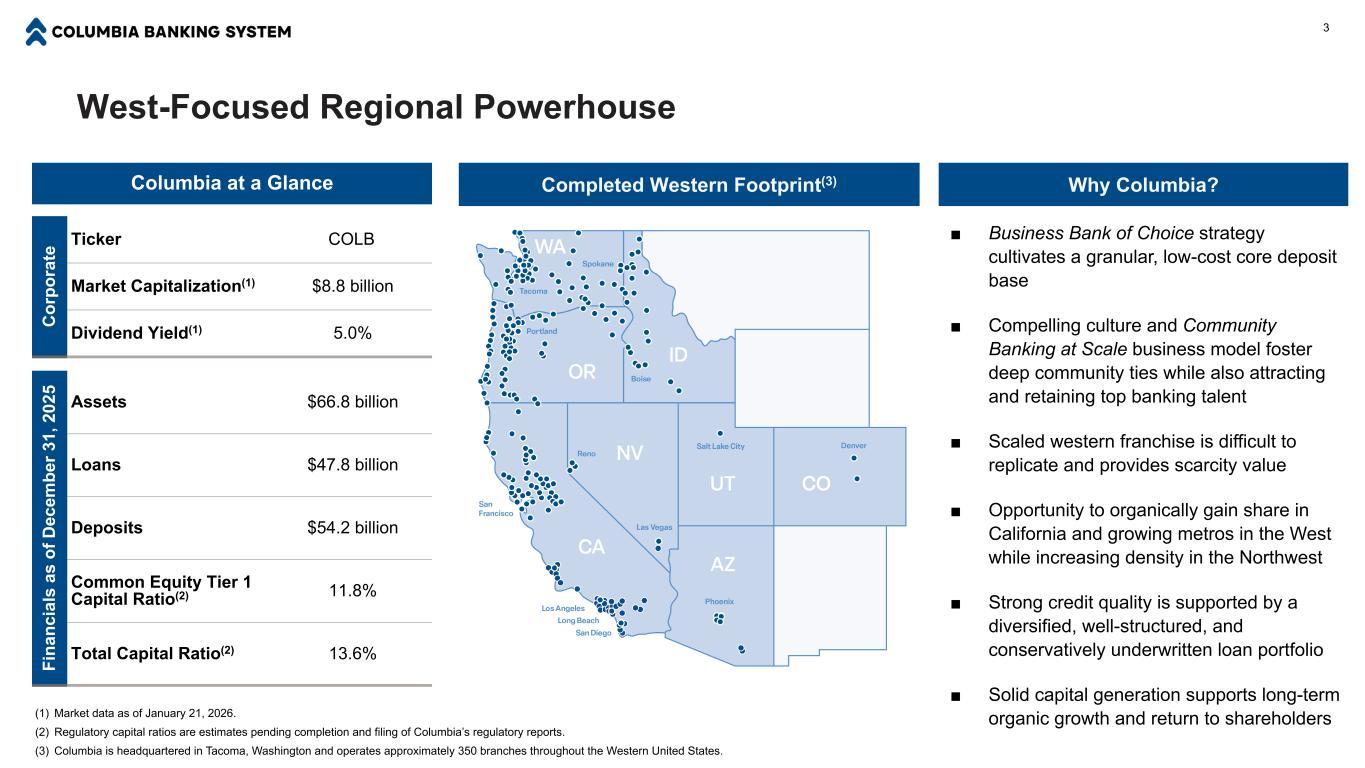
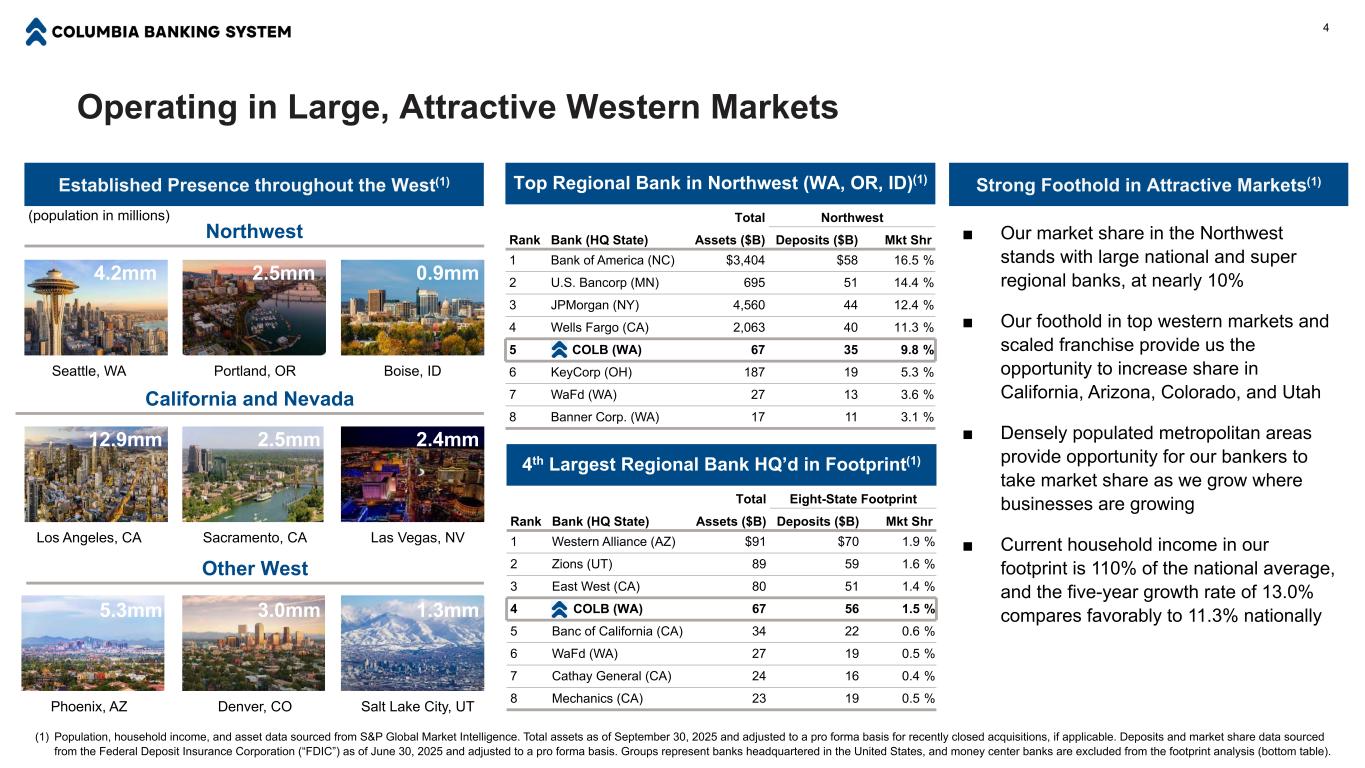
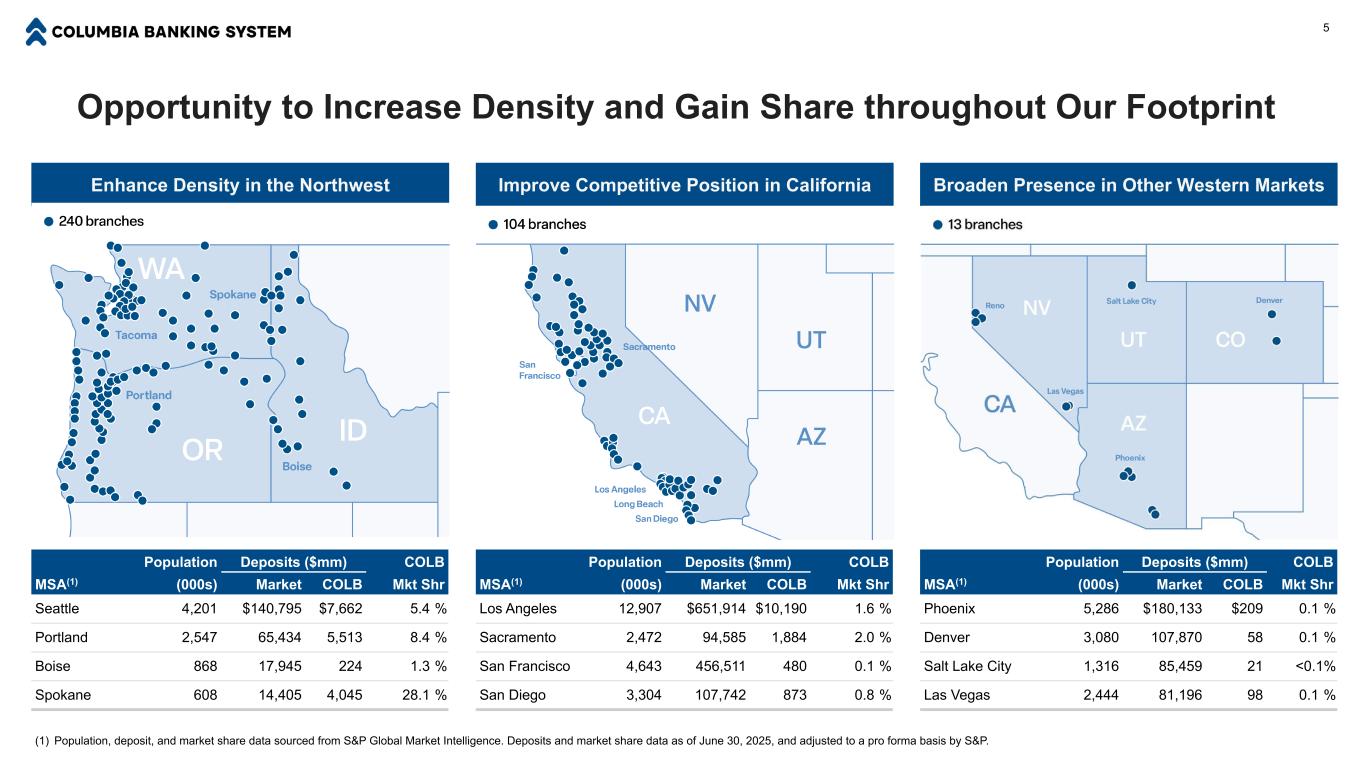
Thank you, Jackie. Good afternoon, everyone. The fourth quarter marked a strong end to a tremendous year for Columbia. We continued to advance our strategic priorities while delivering solid operating performance and consistent, repeatable financial results. During 2025, we announced and closed our strategic acquisition of Pacific Premier Bank. As I have stated many times, PAC Premier was the missing puzzle piece to complete our Western footprint. The acquisition bolstered our position as the preeminent regional bank in the Northwest and improved our competitive position in other key Western markets, most notably Southern California, where we now hold a top 10 deposit market share position. We remain on track for another seamless systems conversion this quarter, supported by our highly experienced team of associates, meticulous planning, and successful integration activity to date. I'm very pleased with the cultural integration I have witnessed over the past several months as well. Our new team members from PAC Premier continue to impress with their unrelenting focus on taking care of customers while adapting to Columbia's products, policies, and processes. We also contributed to our operational momentum through de novo growth, opening new locations in Arizona, Colorado, California, and Oregon during 2025. These investments reflect our commitment to expanding our presence throughout our entire footprint. We have planned for continued targeted de novo activity in 2026 with investments funded by resources set aside from our 2024 expense initiative and other efficiency opportunities. Turning to the fourth quarter, Columbia's operating results were once again consistent and repeatable, underscoring our focus on operational enhancement and top quartile, and in some cases top decile, performance. Fourth quarter operating PPNR was up 27% from the third quarter, as our focus on profitability and balance sheet optimization was enhanced by the full quarter run rate of PAC Premier. We are already seeing that momentum carry into 2026 with the continued realization of deal-related cost savings and healthy customer pipelines across each of our business units and geographies. Our teams remain focused on the activities that drive business with new and existing customers. Our ongoing balance sheet management strategies are enhancing the quality of our earnings and driving strong internal capital generation. Our disciplined approach to balance sheet management encompasses our prudent credit underwriting and proactive portfolio monitoring. Our fourth quarter metrics highlight our strong credit profile, which remains stable throughout 2025 as we were untouched by external events that negatively impacted some of our peer banks. Looking forward to 2026 and beyond, we will continue to prioritize profitability over growth just for the sake of growth. Our priorities have not changed. We remain focused on optimizing performance, driving new business growth, supporting the evolving needs of existing customers, and consistently delivering superior financial results for our shareholders. Our bankers have worked tirelessly to generate consistent, reputable earnings for eight consecutive quarters. Consistency has long been a historical trend for Columbia, and we expect that trend to continue as we go forward. want to thank our associates for another incredible year your dedication and passion to be the best drive our success but I couldn't be more excited about the opportunities ahead together we are building a stronger more dynamic Columbia one that delivers lasting value for our customers communities and shareholders well now turn the call over to Ivan thank you Clint and good
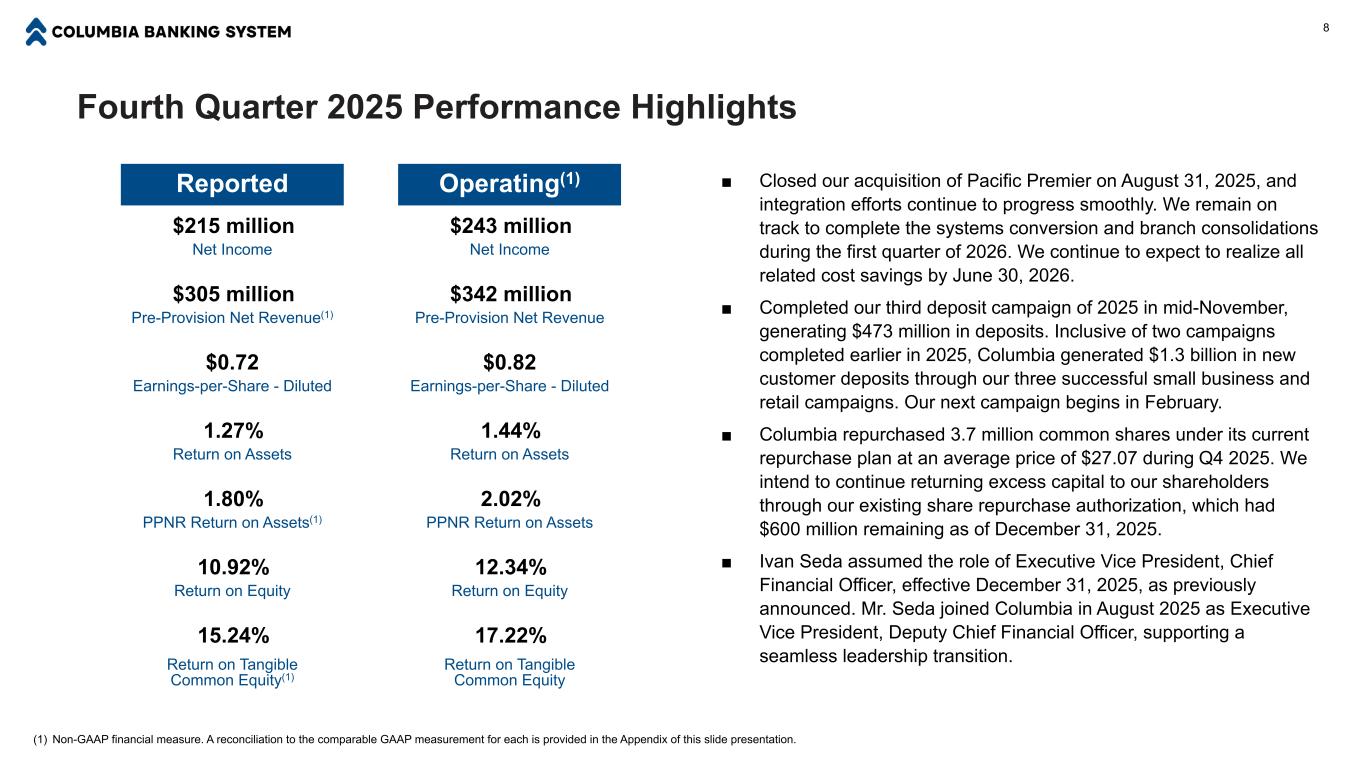
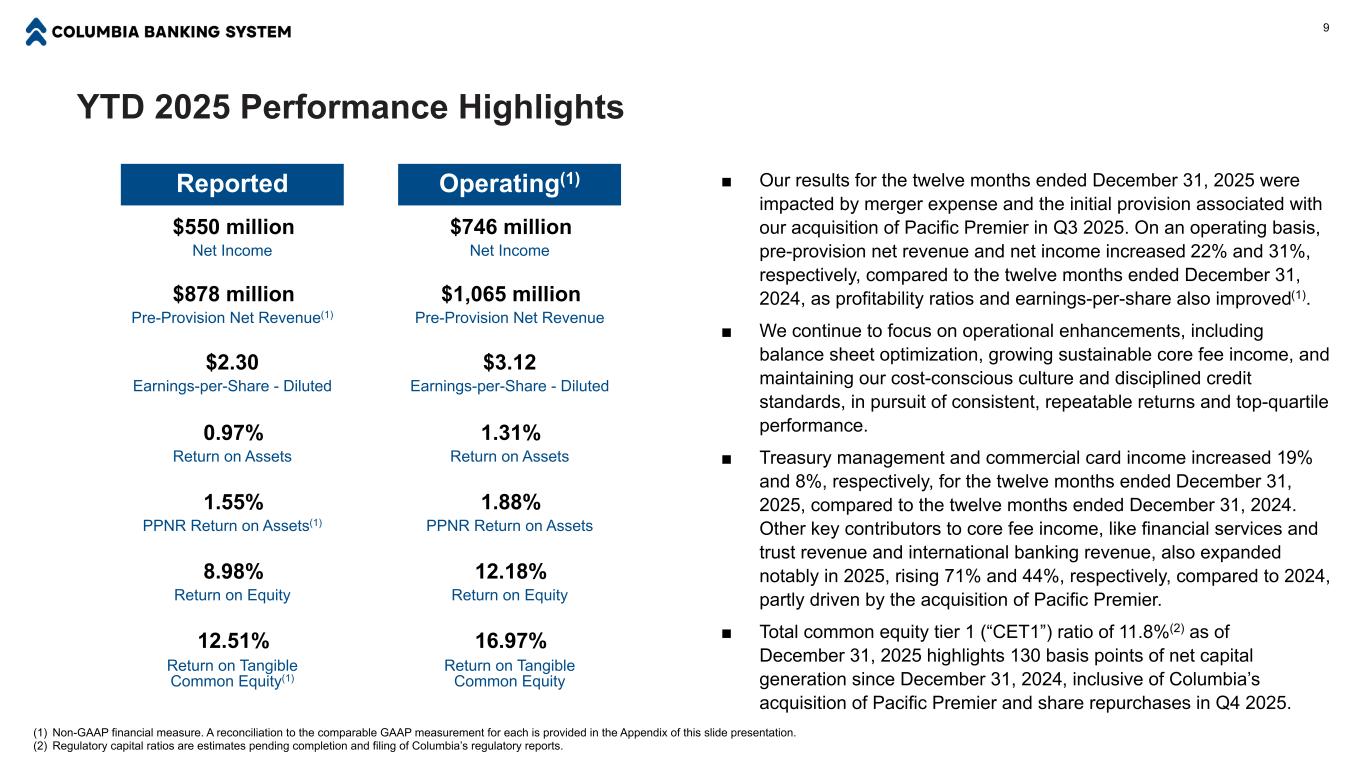
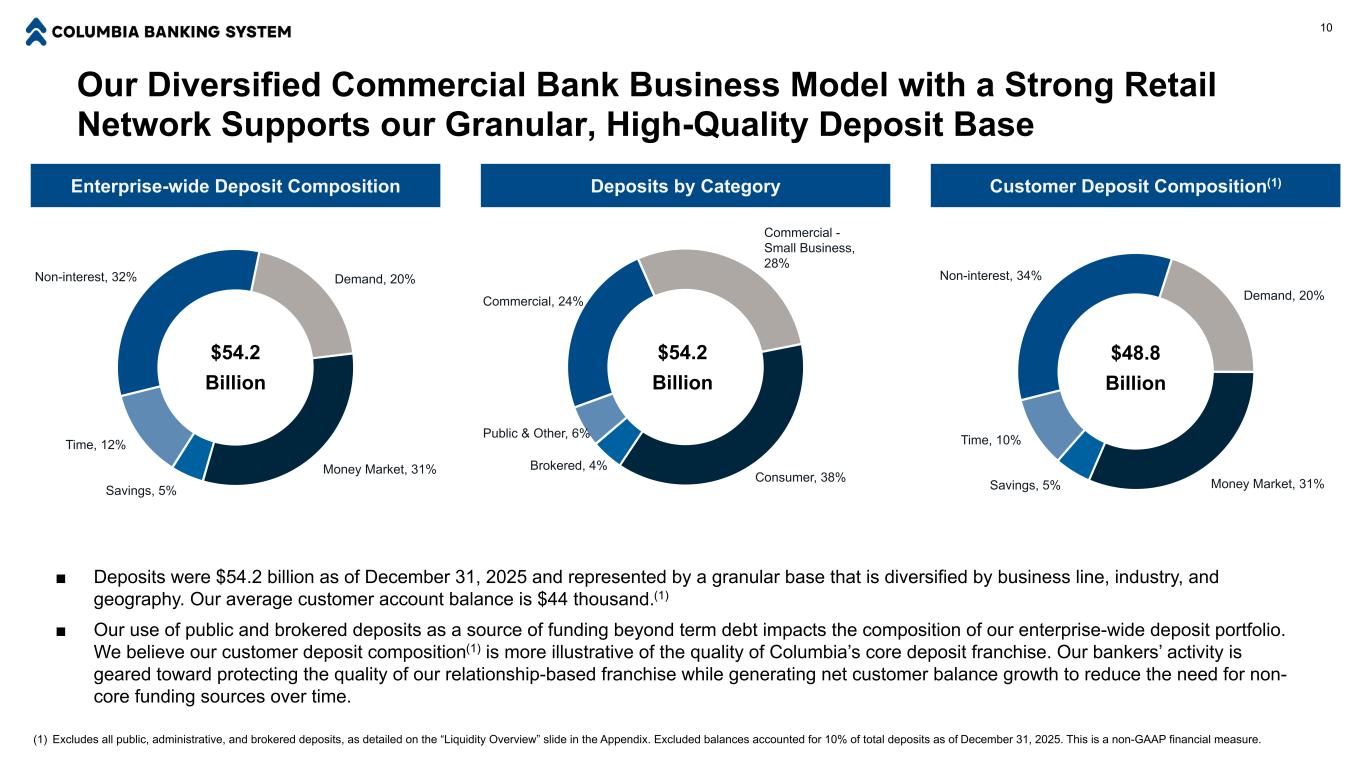
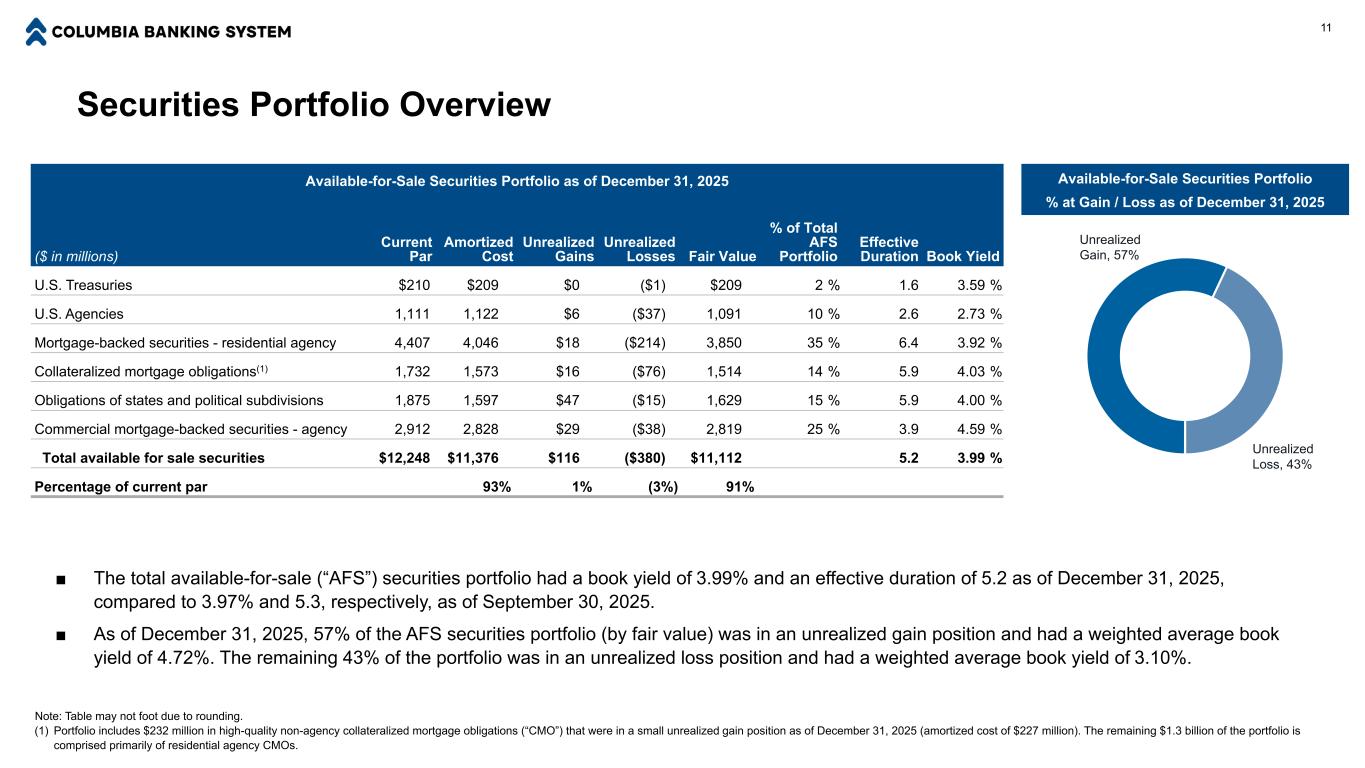
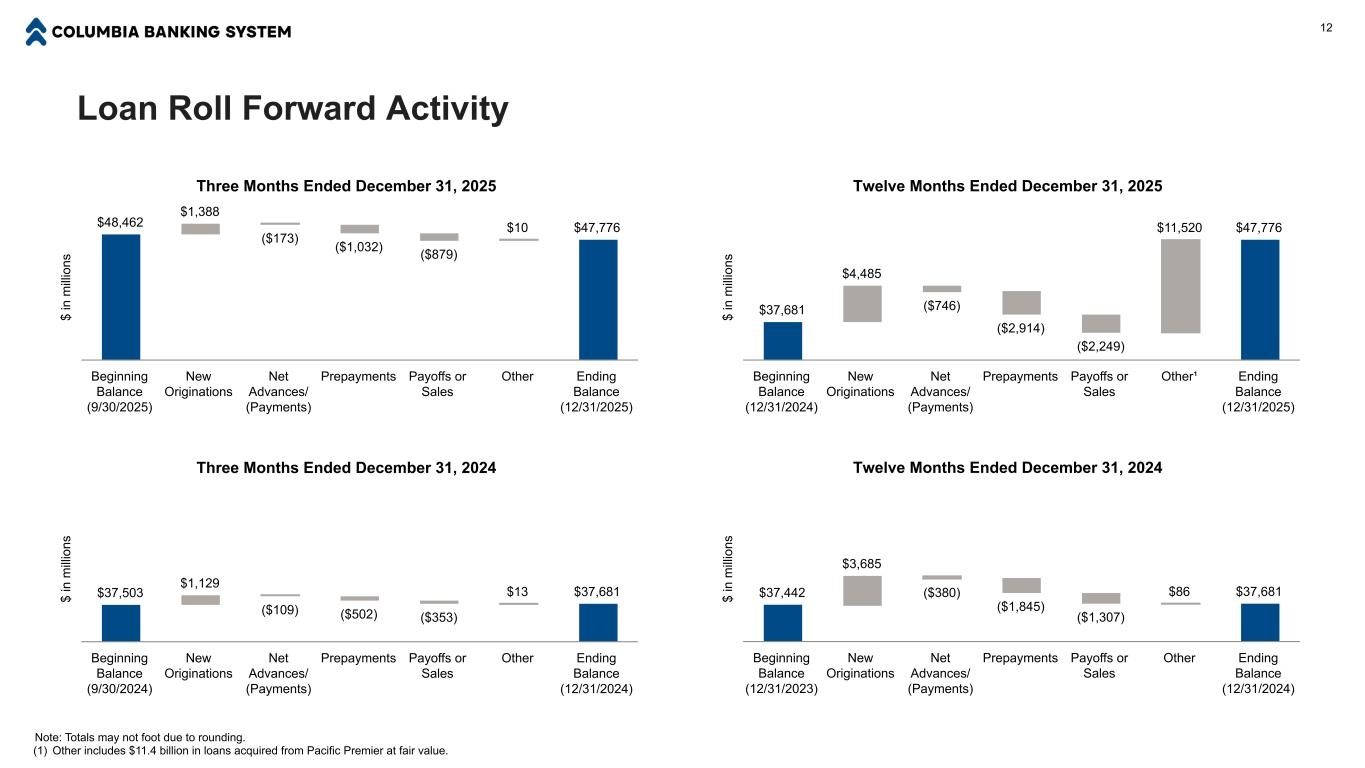
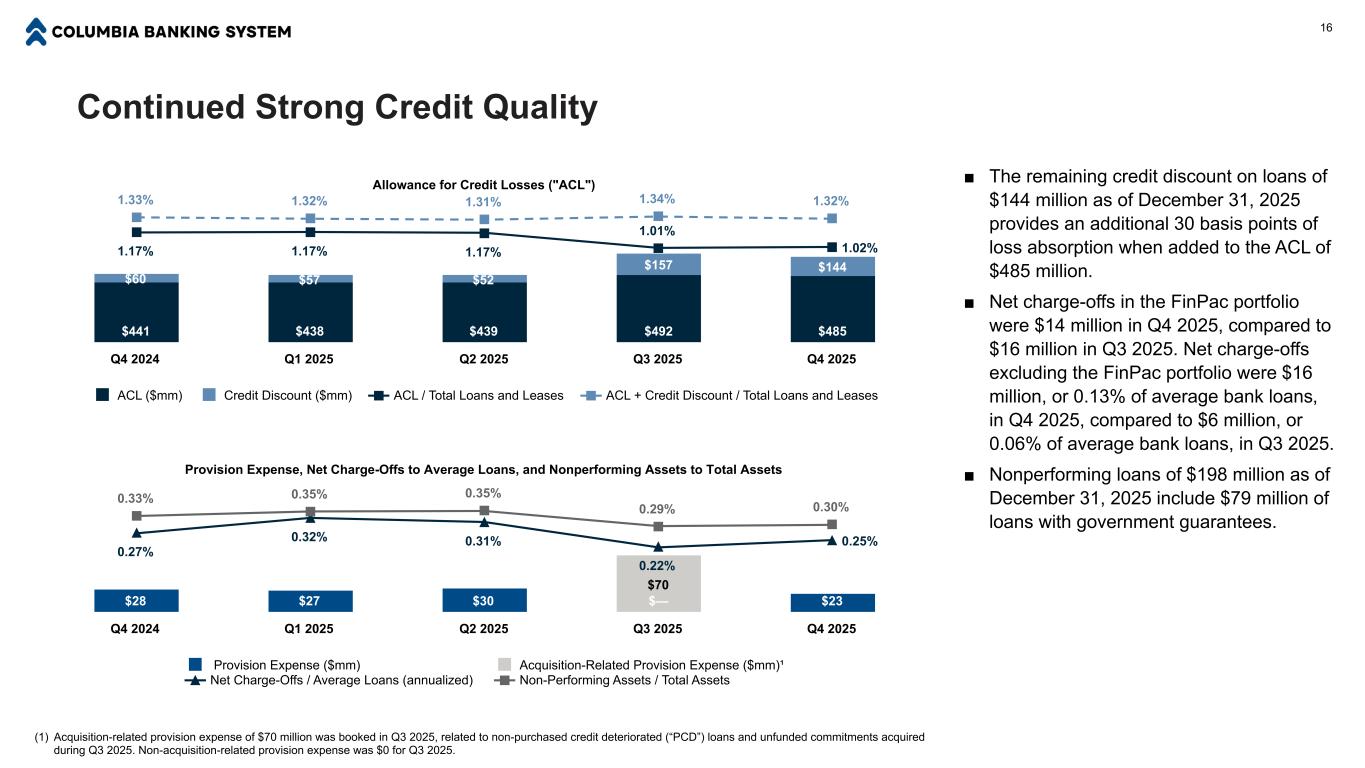
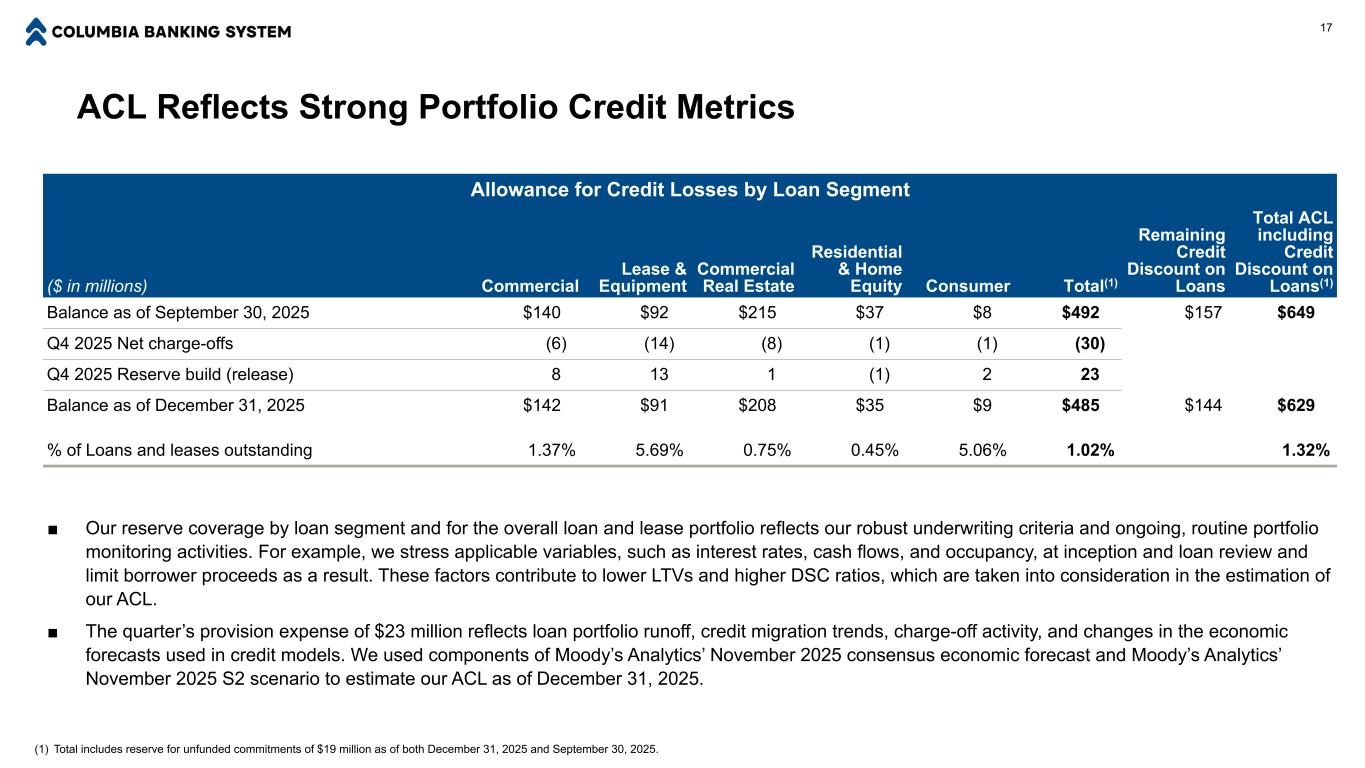
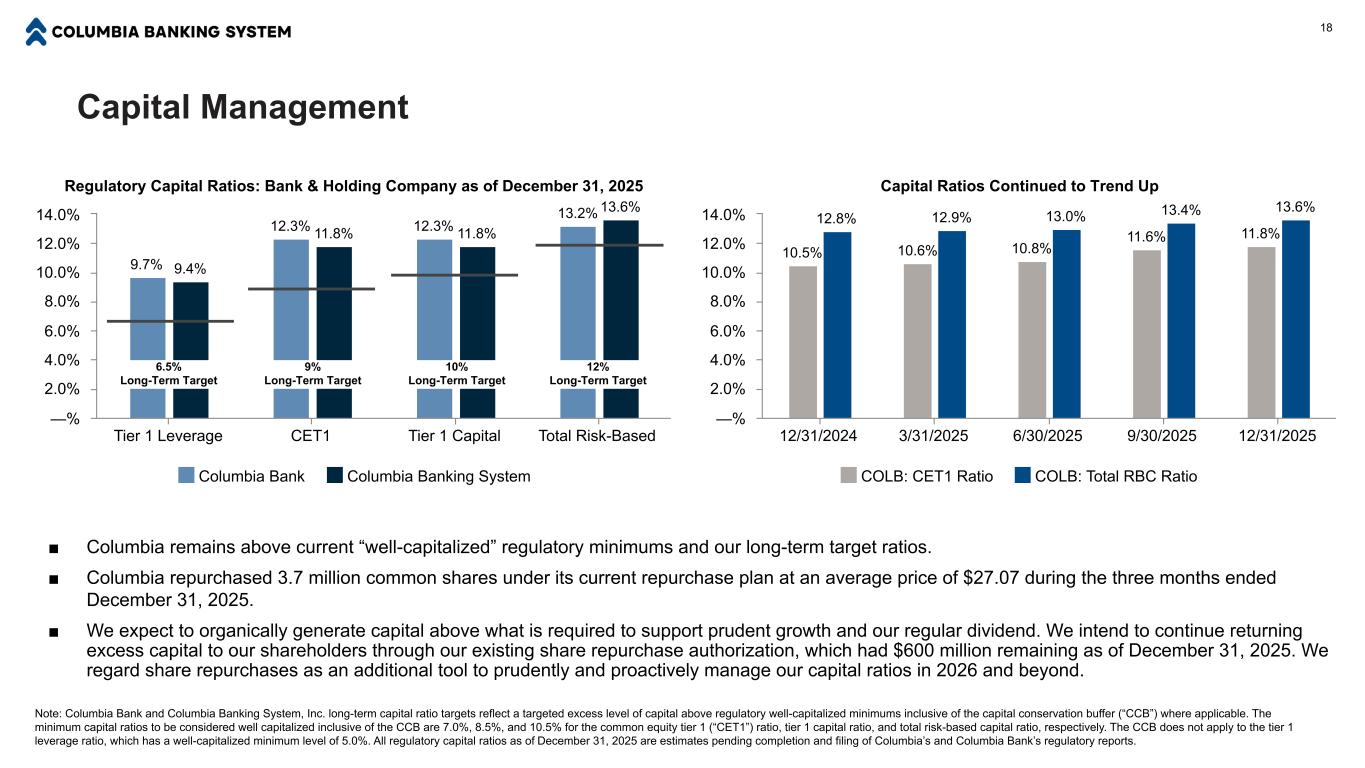
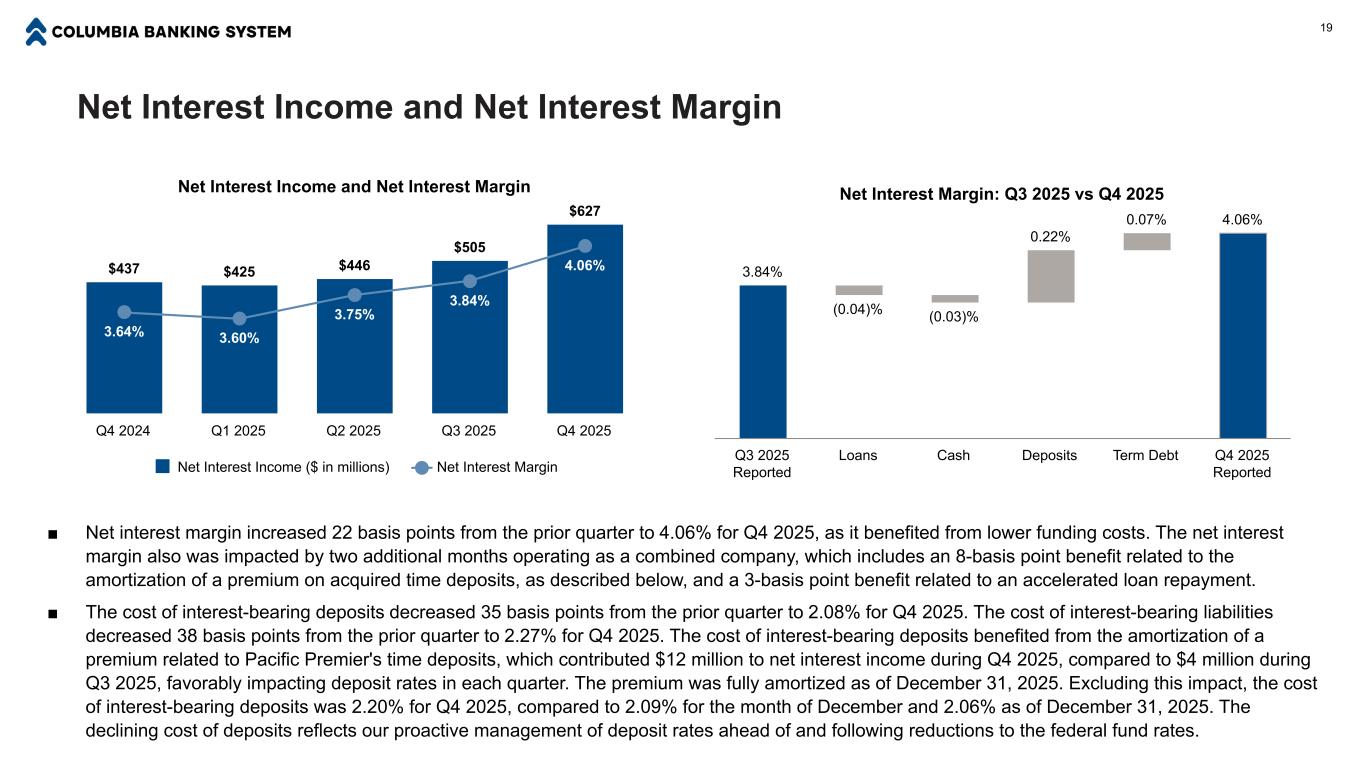
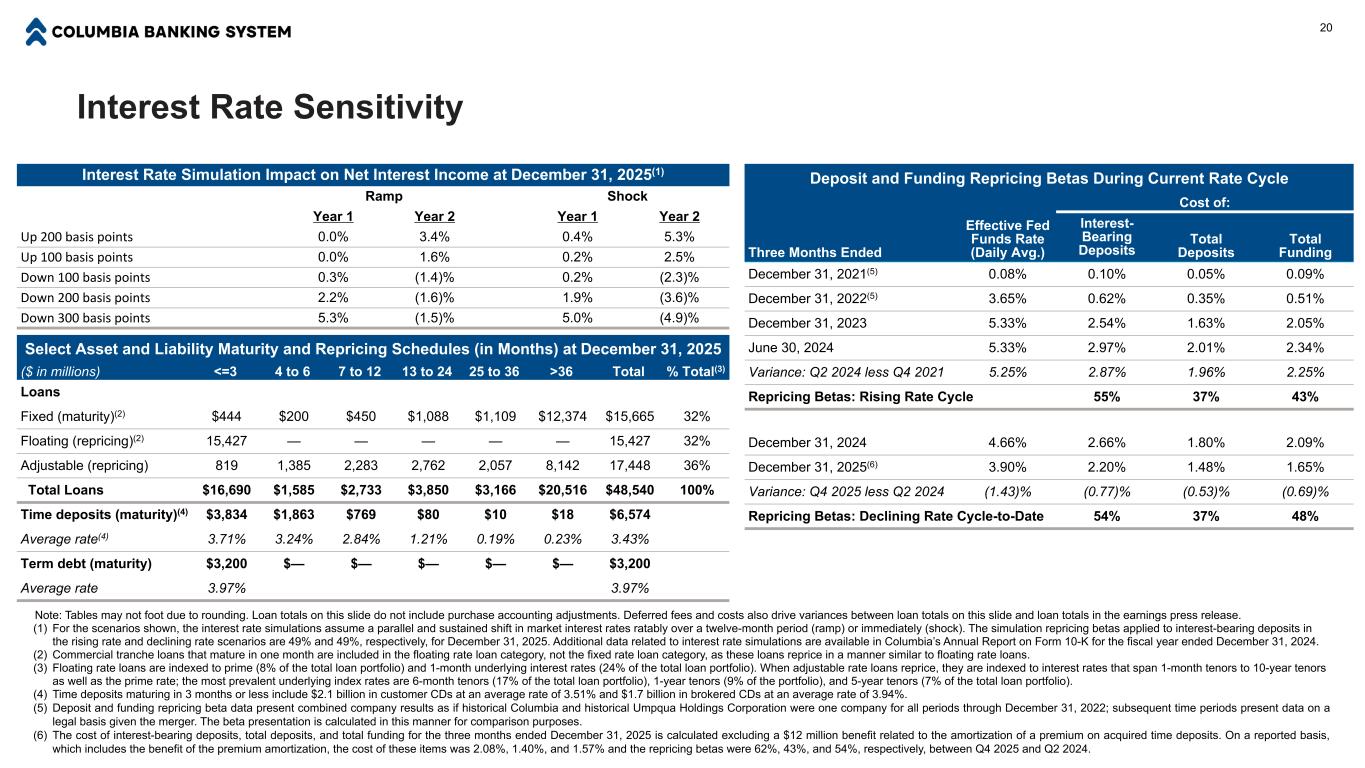
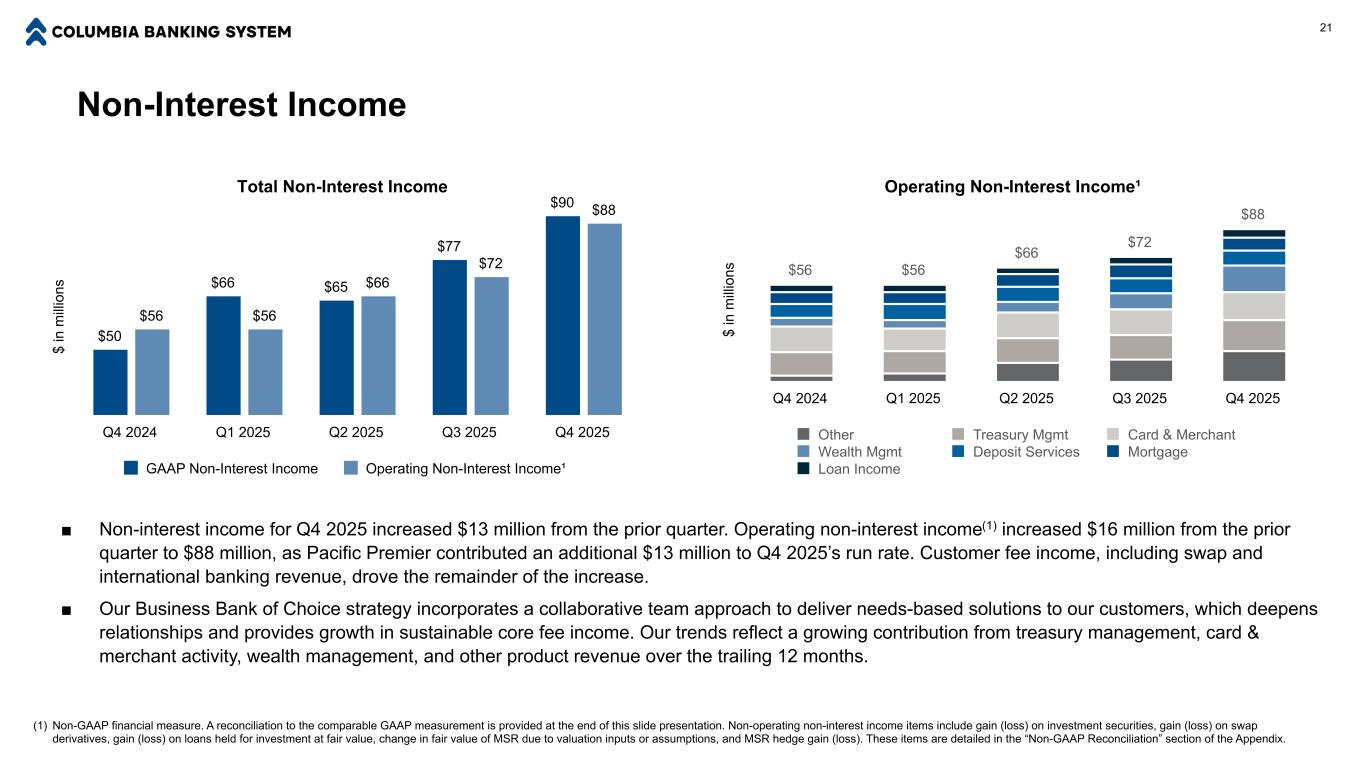
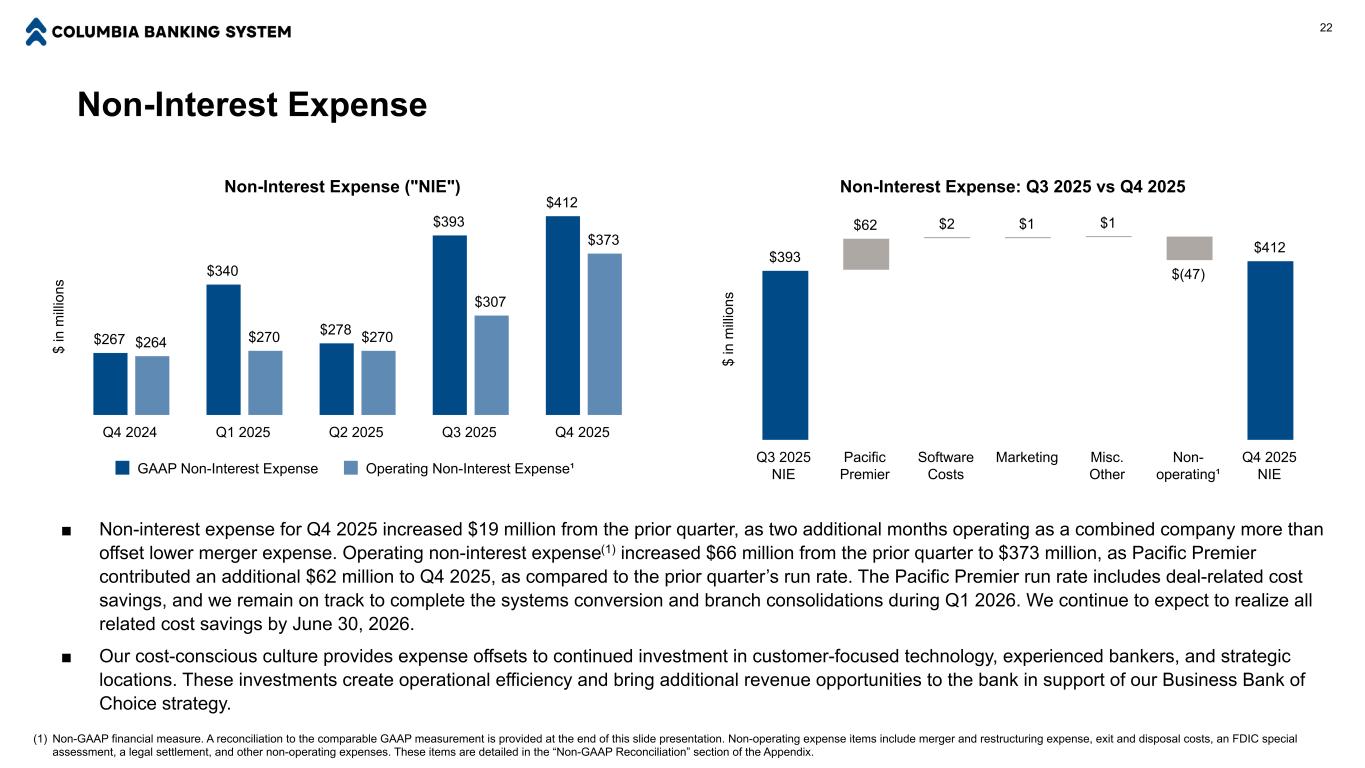
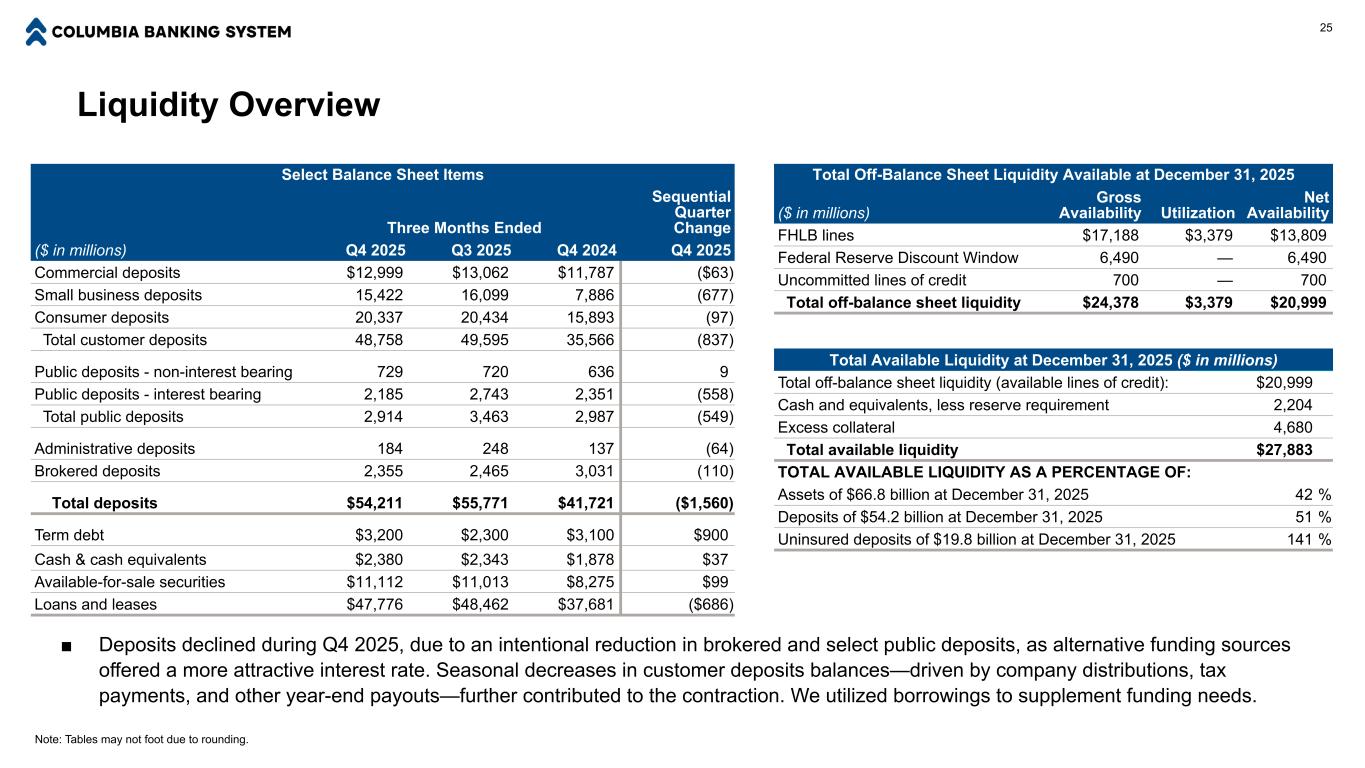
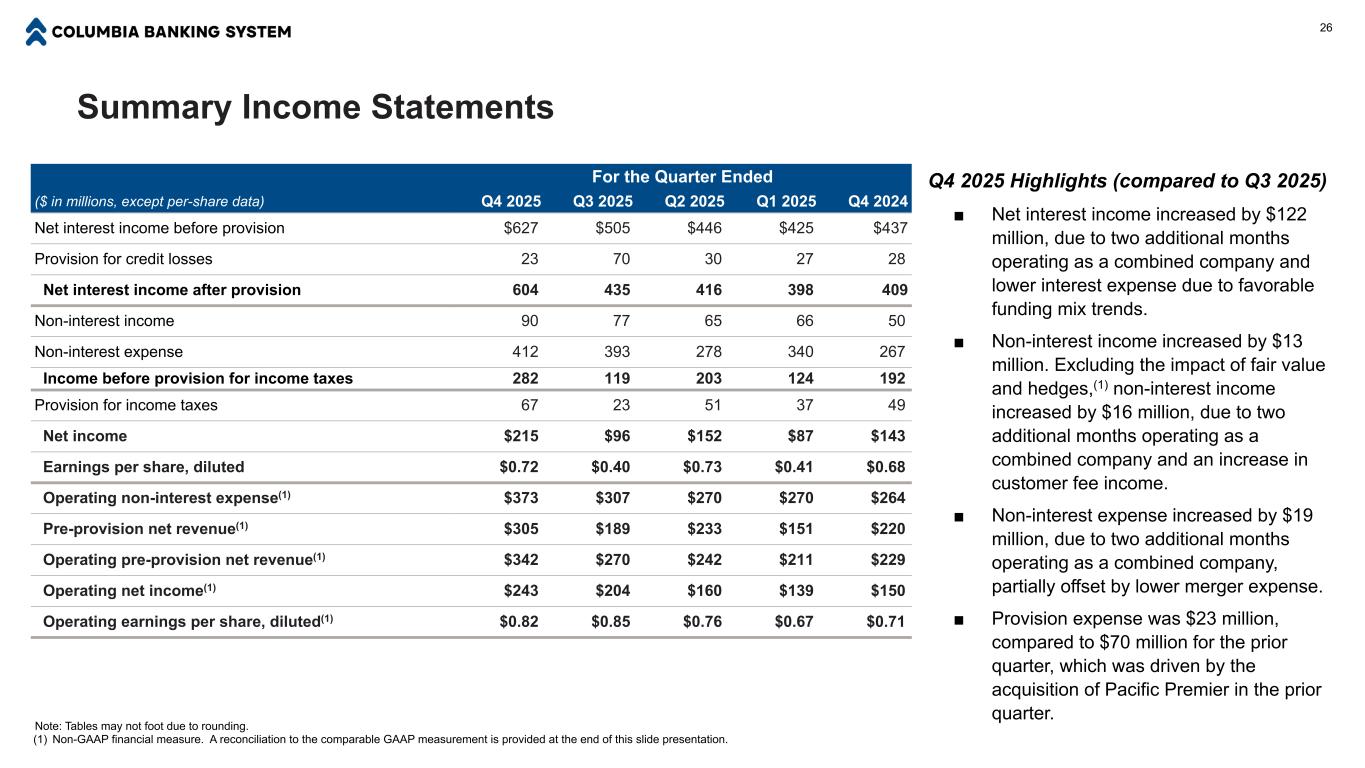
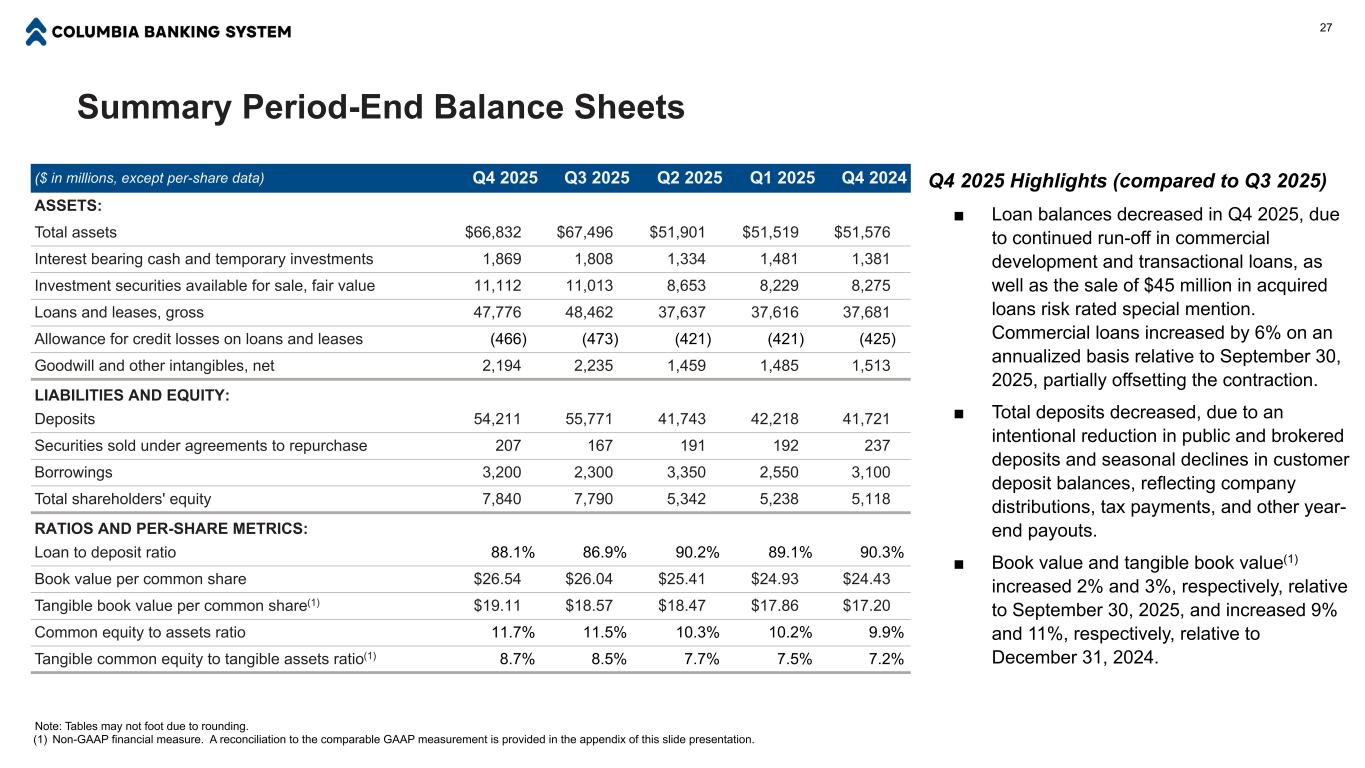
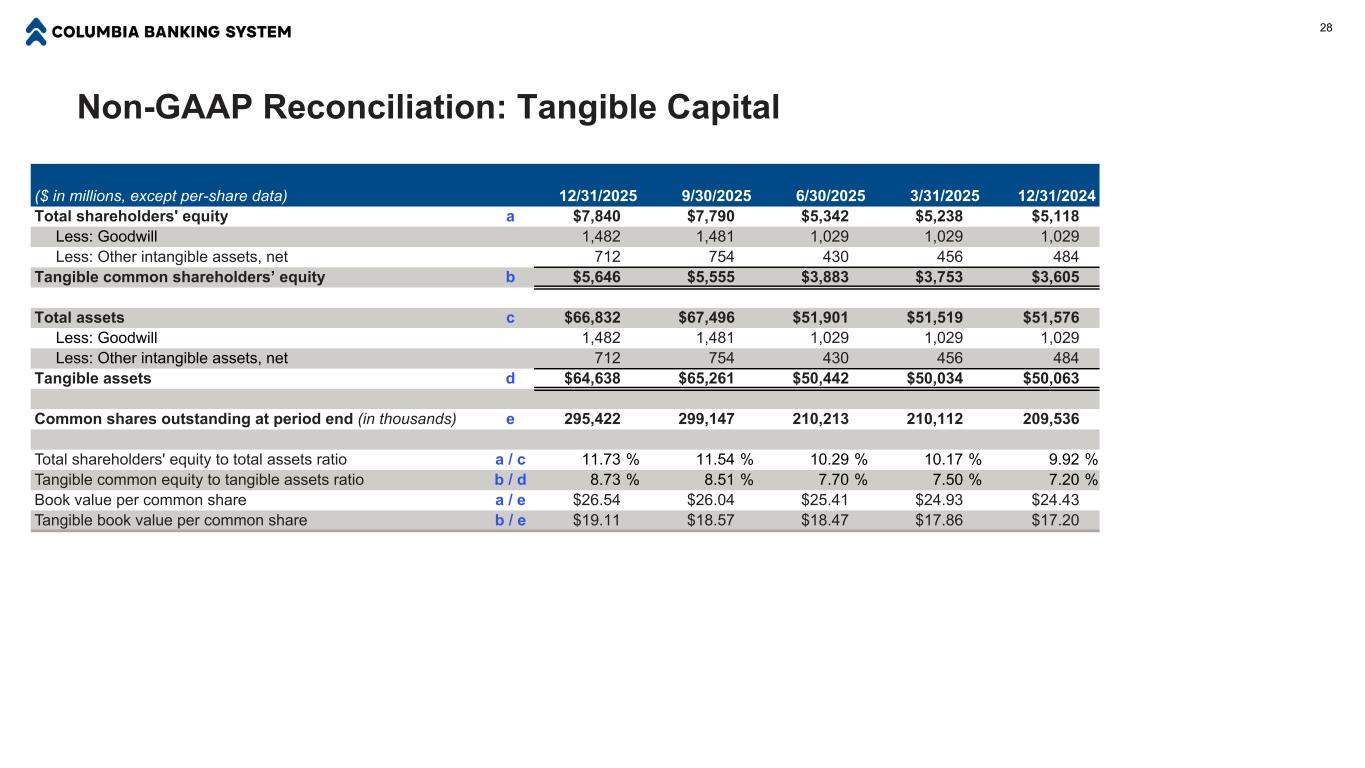
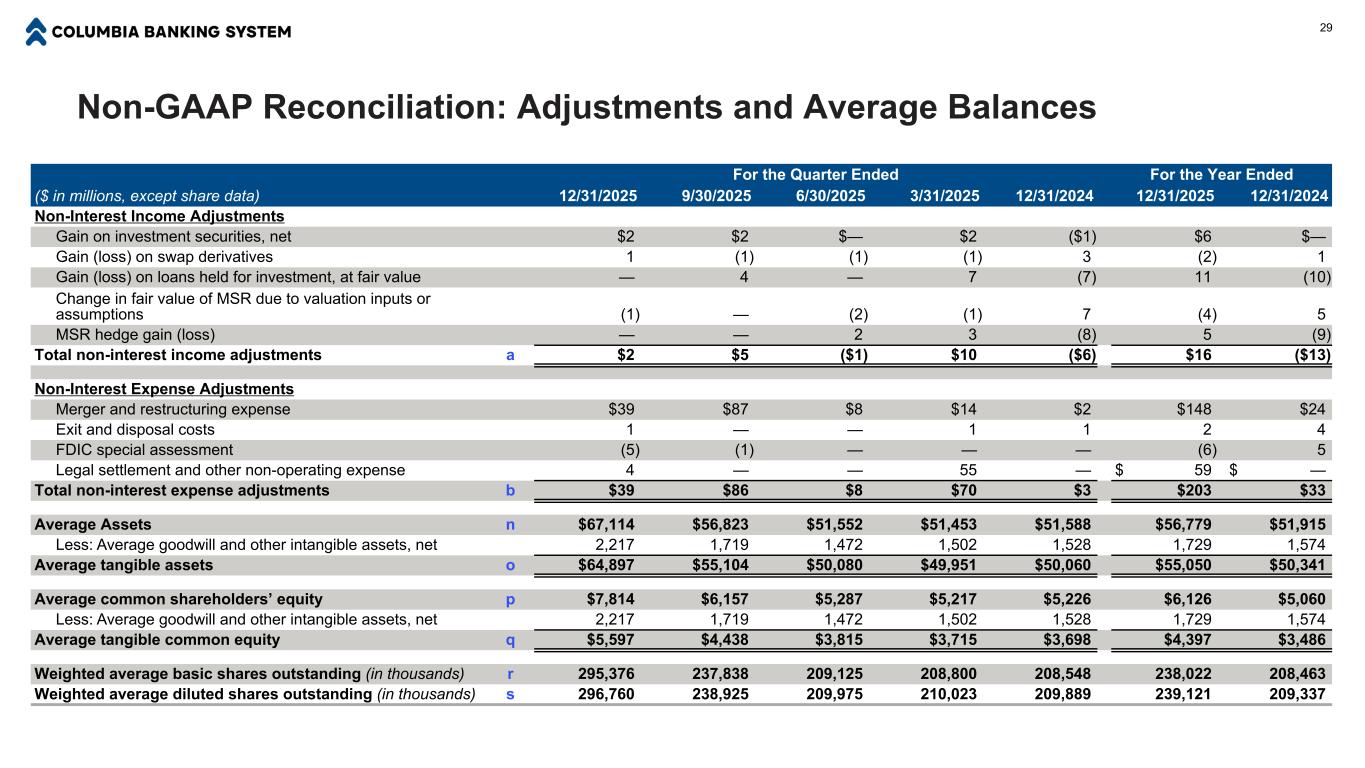
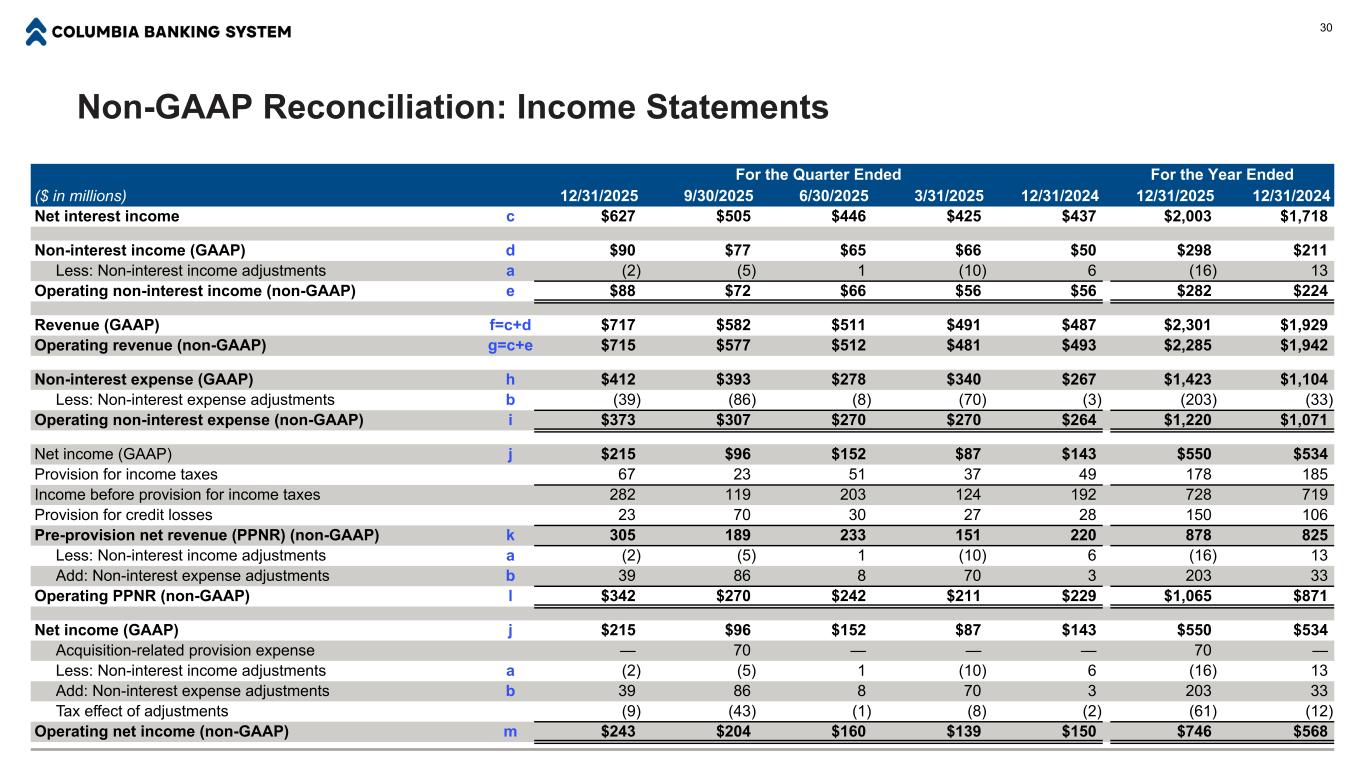
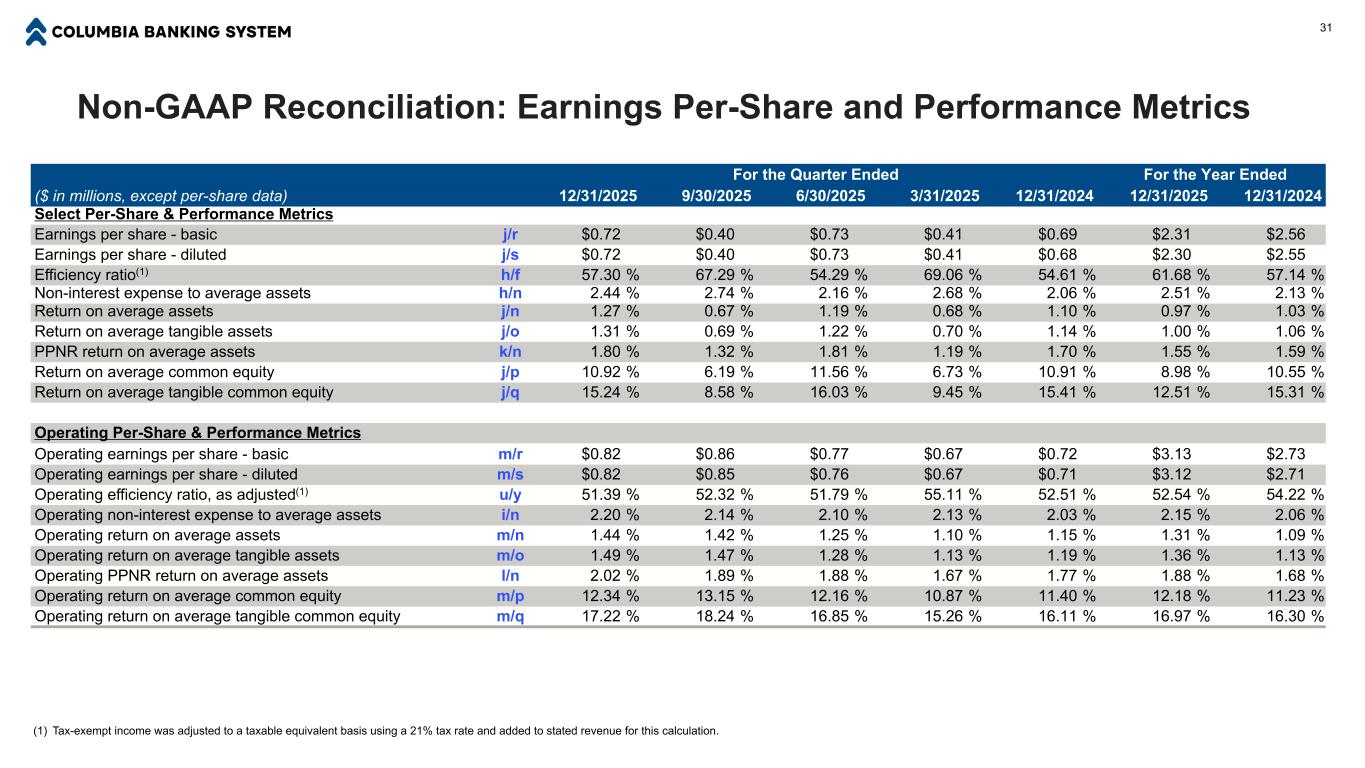
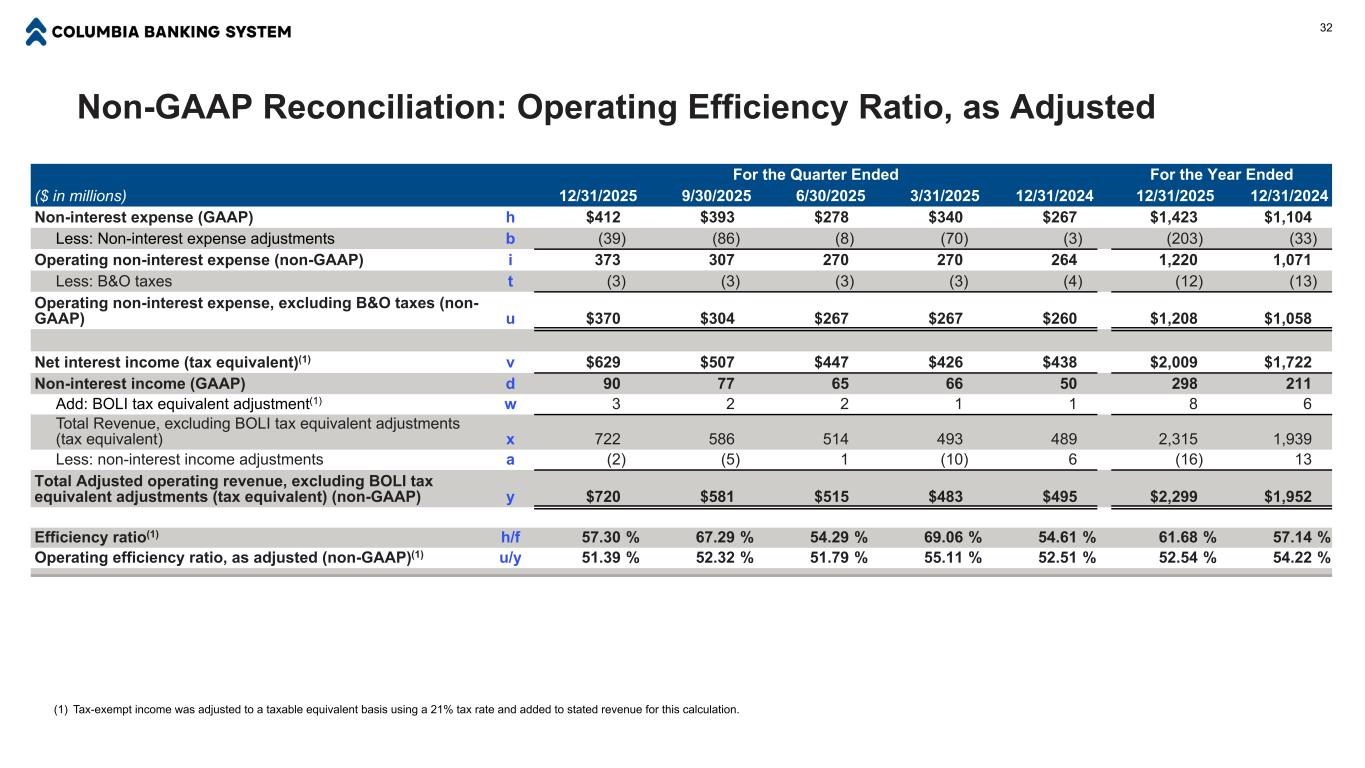
afternoon everyone as Clint highlighted the fourth quarter completed a strong year for Columbia. On an operating basis, which excludes merger expense and other items detailed in our non-GAAP disclosure, fourth quarter pre-provision net revenue and operating net income increased 27% and 19% respectively compared to the prior quarter, while full year 2025 results rose 22% and 31% compared to 2024. These improvements reflect four months of operating as a combined company following our acquisition of PAC Premier, as well as our continued emphasis on balance sheet optimization and disciplined expense management. Focusing on the fourth quarter, we reported EPS of $0.72 and operating EPS of $0.82, increases of 6% and 15% respectively from the prior year's fourth quarter. Net interest margin expansion and corresponding increase in net interest income was a key driver of earnings performance. Net interest margin was 4.06% for the fourth quarter, up from 3.84% for the third quarter and 3.64% for the fourth quarter of 2024. Slide 19 of our earnings presentation outlines the contributors to the 22 basis points sequential quarter expansion with improved funding performance serving as a primary factor alongside continued earning asset optimization. Having reduced wholesale funding by nearly $2 billion during the third quarter, the fourth quarter results reflect the full benefit of these actions alongside two additional months of operating as a combined company. Net interest income during the fourth quarter also benefited from $12 million in premium amortization related to acquired time deposits, which we anticipated and highlighted last quarter, and $5 million from an accelerated loan repayment, contributing a combined 11 basis points to the margin. The premium on time deposits was fully amortized as of year-end, and it will not repeat in 2026. Non-interest income was very strong in Q4, with $90 million on a gap basis and $88 million on an operating basis, as detailed on slide 21. Of the $16 million sequential quarter increase in operating non-interest income, $13 million reflects two additional months of PAC Premier, while the remaining $3 million was driven by higher customer fee income, most notably in swap and syndication banking revenue, representing a high watermark for those revenue streams. Slide 22 outlines non-interest expense, which was $373 million on an operating basis. Of the $66 million sequential quarter increase, $62 million relates to PAC Premier, inclusive of cost savings. As of year-end, we achieved $63 million in annualized deal-related cost savings, or approximately 50% of the targeted $127 million, although these savings were not fully run-rated for the fourth quarter's result. Excluding CDI amortization expense of $42 million, operating non-interest expense of $331 million was at the lower end of our $330 to $340 million range that we signaled in our last call as certain investments fell back into 2026 from a timing perspective. Flipping back to slides 16 and 17, provision expense was $23 million for the fourth quarter, reflecting low loan portfolio runoff, credit migration trends, and changes in the economic forecast used in our credit models. Our credit metrics remain stable and healthy, and our allowance for credit losses was 1.02% of loan at quarter end and 1.32% of loan balances when the credit discount on acquired loans is factored in. Continuing with the balance sheet, our investment securities portfolio is outlined on slide 11. The portfolio increased by approximately $100 million during the fourth quarter as we purchased $246 million of securities at a weighted average base yield of 4.52%, partially offset by paydowns. Gross loans and leases were $47.8 billion as of December 31st, down from $48.5 billion as of September 30th, as we continue to allow below market rate transactional loan balances to decline alongside declines in our CRE construction and development portfolio. Chris will discuss loan portfolio trends in greater detail shortly. Total deposits were $54.2 billion as of December 31st compared to $55.8 billion as of September 30th. During the fourth quarter we intentionally reduced brokered and select public deposits which collectively declined by over $650 million as alternative funding sources is offered more attractive rates. Seasonal customer outflows, which Chris will discuss, also contributed to the decline. To supplement funding, term debt increased to $3.2 billion as of December 31st. Slides 20 and 25 review funding flows, our balance sheet sensitivity to interest rate changes, and maturity and repricing schedules. Turning to capital, slide 18 highlights our expanding ratios, supported by net capital generation and balance sheet optimization. During the fourth quarter, we increased our common dividend to 37 cents per share from 36 cents per share and repurchased 3.7 million common shares at an average price point of $27.07. Even with the execution of our buyback activity, we saw CET1 and total risk-based capital ratios increase to 11.8% and 13.6% respectively as of December 31st. Tangible book value increased to $19.11 as of December 31st, up 3% from the prior quarter and 11% from the prior year. Looking forward, we expect net interest margin in the first quarter to land in a range from 3.90% to 3.95%, consistent with what we indicated on our last call. This change reflects the absence of the 11 basis point benefit in the fourth quarter from required CD premium amortization in the accelerated loan repayment activity that I discussed earlier, as well as higher wholesale balances added to the balance sheet in the latter part of December, resulting in this quarter. We expect net interest margin to trend higher each quarter throughout 2026 as customer deposit balances rebound and balance sheet optimization actions continue to improve profitability, ultimately surpassing 4% net interest margin in the second or third quarter of the year. As we saw this past quarter, our continued balance sheet optimization activity may lead to modest earning asset contraction during the first quarter. We have maintained a conservative level of excess liquidity following the Pacific Premier acquisition, and we may reduce excess cash to further optimize our funding structure by repaying wholesale sales sources. Following these actions, we expect the balance sheet size to remain relatively stable with commercial loan growth offsetting contraction in the transactional portfolio. Excluding CDI amortization, we expect non-interest expense to remain in the $335 to $345 million range in the first and second quarters before declining modestly in the third quarter as we realize all cost savings related to Pacific Premier by the end of Q2. CDI amortization will average around $40 million per quarter. We expect to increase share repurchase activity to a range of $150 to $200 million per quarter in 2026, noting $600 million remains authorized under our current plan. We ended the year with over $600 million in excess capital on our most constrained measure. Overall, we are very pleased with the financial results for the fourth quarter, driving over 1.4 ROAA and over 17% return on tangible common equity, and we feel very well positioned to continue to drive strong profitability as we move into 2026. I will now hand the call over to Chris. Thank you, Ivan. Our team's had
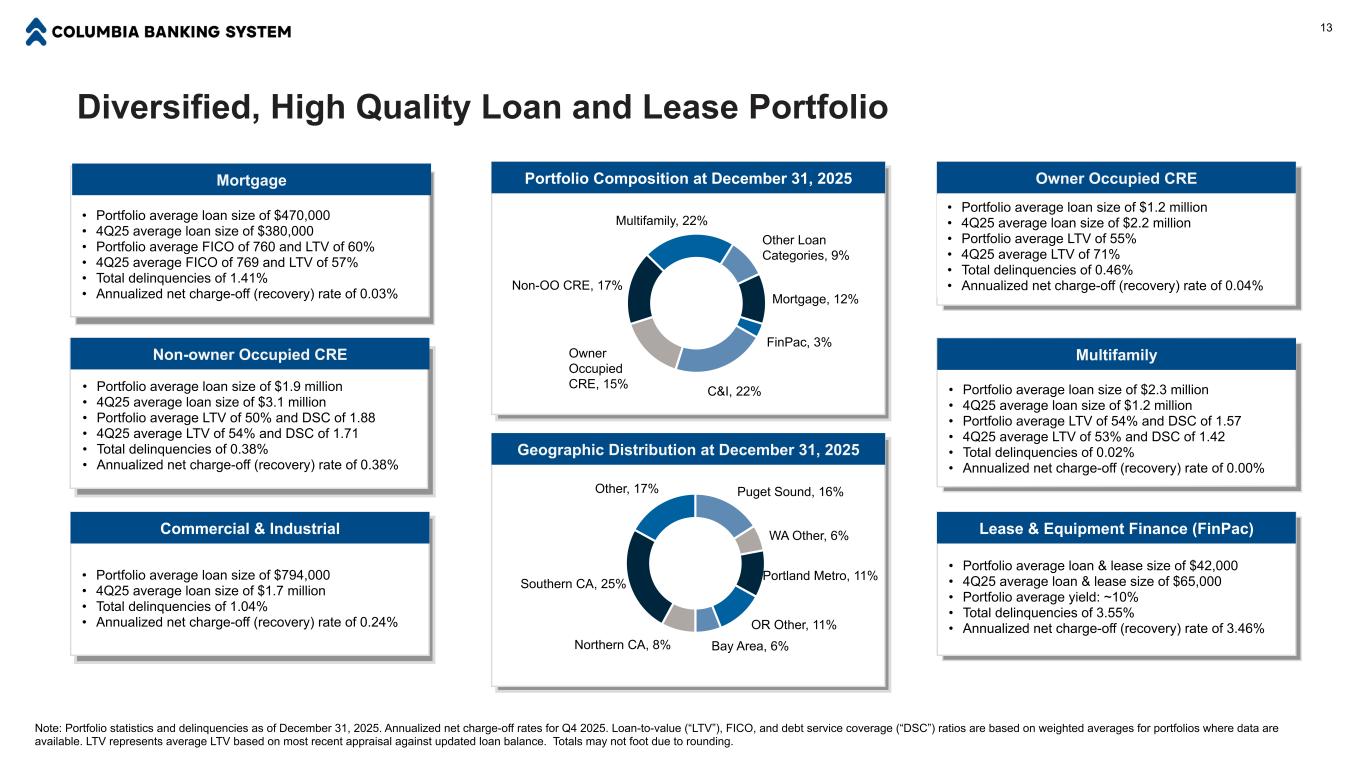
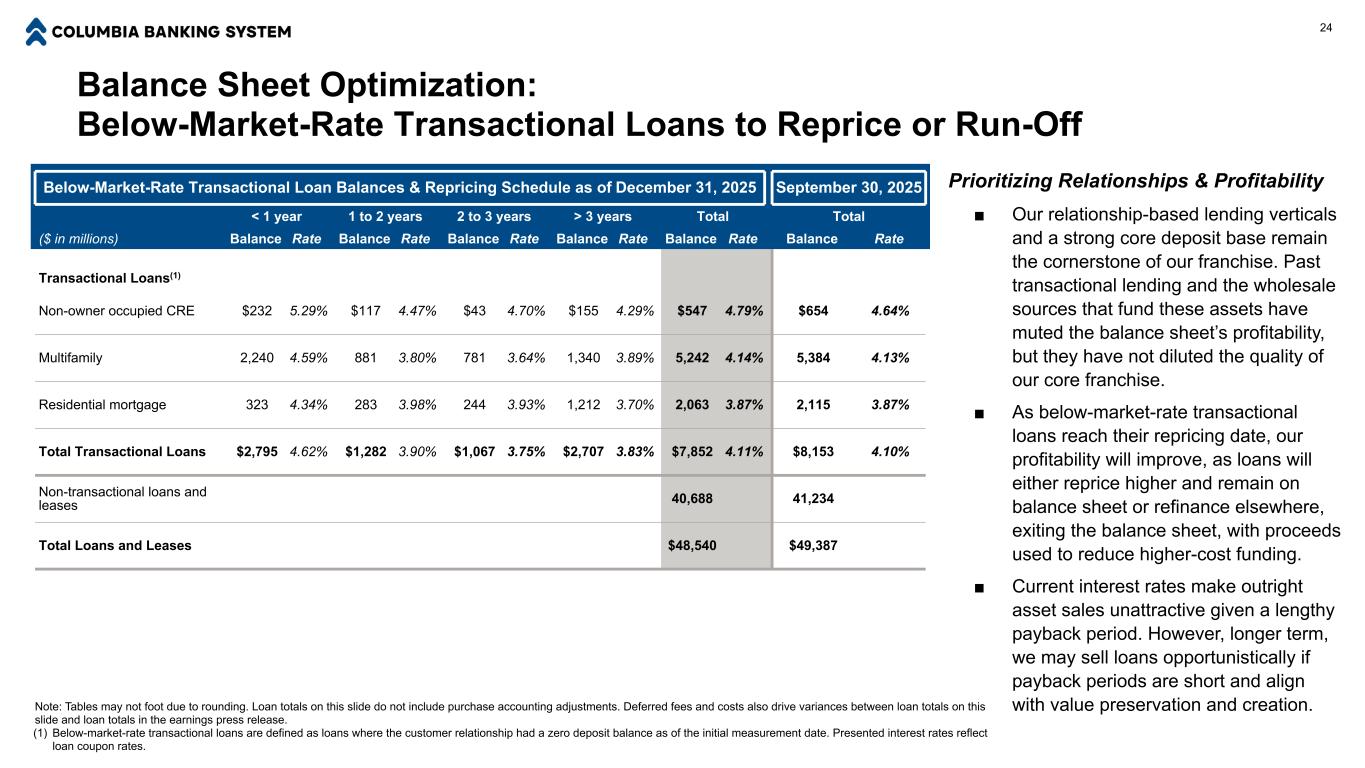
another strong quarter of business generation. New loan origination volume of $1.4 billion was up 23% from the year-ago quarter, while full-year 2025 volume was up 22% from the previous 2024. As a result of this activity, Columbia's commercial loan portfolio increased 6% on an annualized basis, although the growth was offset by a decline in transactional loan balances, construction, and development loans. We also sold $45 million in acquired loans, risk-rated special mention as we continually prune our loan portfolio. Slide 24 in our earnings presentation provides additional balance and repricing details related to transactional loans. We continue to expect this portfolio to amortize down until loans reach their repricing date, limiting our net loan portfolio growth but improving our profitability. Turning to customer deposits. The strong growth momentum from the third quarter carried into October, bolstered by our successful small business and retail deposit campaign, which ran from September through mid November and added $473 million in low-cost deposits. Inclusive of the two campaigns completed earlier in 2025, Columbia generated $1.3 billion in new customer deposits through three successful campaigns. Returning to the fourth quarter, customer deposit balance is contracted due to seasonal decreases in customer accounts driven by company distributions, tax payments, and other typical year-end payouts. We expect modest additional deposit contraction during the first quarter and into April given anticipated customer tax payments, with net growth resuming in the spring as business activity accelerates and seasonal payments end. As Ivan discussed, customer fee income increased for the fourth quarter. This was driven by the addition of PAC Premier and our continued efforts to expand the contribution of core fee income to total revenue. On an operating basis, non interest income increased 26% in 2025 over the previous year. With exceptional growth in treasury management, international banking, financial services, and trust revenue, along with strength across other core fee businesses. PAC Premier's custodial trust business has been a powerful complement to our existing wealth management platform, and we expect continued fee income momentum as we deepen customer relationships with legacy PAC premier customers. Our loan, deposit, and core fee income pipelines are healthy, and we remain outwardly focused on generating business in a disciplined manner. I want to hand the call back
to Clint. Thanks, Chris. The past several years has brought significant change to Columbia. 2023 was a year of widespread integration following the closing of the Umpqua acquisition, which impacted every associate at each legacy organization. We collectively managed through industry liquidity events that occurred in tandem with the deal's elongated closing and our scheduled systems conversion. 2024 was a year of efficiency initiatives. Our full-scale review resulted in consolidated positions, simplified organizational structures, and an improved profitability outlook. In 2025, we added the missing piece to our Western footprint with the PAC Premier acquisition. We continued to invest a portion of 2024's cost savings into de novo locations in targeted markets. In addition, we added new talent throughout the company, launched new products, and implemented new technology, all with an eye towards improving operational efficiencies and growing revenue. We also made significant progress optimizing our balance sheet as we increased capital returned to our shareholders by repurchasing shares. As we look to 2026, we have set the stage for an exciting future. We are now positioned to deliver on the full capabilities of our company with the resources, talent, and vision to excel in every market we serve in the pursuit of long-term shareholder value creation. We expect to continue to generate meaningful excess capital and fully intend to return that access to our shareholders. This concludes our prepared comments. Chris, Tori, Ivan, and Frank are with me, and we're happy to take your questions. Tawanda, please open the call for Q&A.
Operator
Thank you. Ladies and gentlemen, as a reminder to ask the question, please first start 1-1 on your telephone, then wait for your name to be announced. To withdraw your questions, please press star 1-1 again. Please stand by while we compile the Q&A roster. Our first question comes from the line of John Armstrong with RBC Capital Markets. Your line is open.
Thanks. Good afternoon, everyone. Hi, John. Congrats on the chairman role, Clint, first of all. Thank you. I guess maybe to start this, Can you talk a little bit more about PAC Premier? You referenced it in your prepared comments, but it's showing up everywhere in the P&L, and you talked about it as the missing puzzle piece. Can you talk about how it's going so far and what kind of contributions you've seen so far in terms of growth?
Yeah, I'll kick it off and then ask Tori and Chris both to offer their insight as well. You know, I've said on previous calls and in various discussions from the very first week that we announced this, how this one was different and how the folks at PAC Premier, you know, showed a level of excitement that typically you don't see initially, or at least not widespread like what we experienced in the days and weeks following the announcement. And then typically, you know, it's an emotional time for people as change can be hard. And so there can be a little bit of ebb and flow in terms of emotions. And we've seen none of that, nothing but excitement, embracing the ability to do more with their longstanding and very deep customer relationships, excitement of being part of this broader company that has a footprint and reach throughout the Western U.S. So, you know, we work really hard at it. We have some great leaders that joined us from PAC Premier that were working hard every single day to make sure they're taking care of their people, taking care of their customers, and managing through the change. And, you know, the last hurdle that we have is the systems integration. And, you know, we have a very seasoned team, as well as PAC Premier has had a very seasoned team, both Columbia and PAC Premier, I think on a combined basis over the last 15 years have done 20-plus systems conversions and integrations. And so that talent has been hard at work and completing mock conversions and all kinds of other detailed work that goes beyond the scope of my knowledge. But I can tell you that the two co-leaders of the integration management office, we were on a call on Tuesday, and they look very calm, rested, and confident in their ability to execute on the task that's at hand. So I'm going to step back and ask Torrey to provide a little more detail on what he's seen as he's been throughout the market and in front of customers more recently
than I have. Great. Thanks, Clint. And John, just to give a slightly, a little bit more color, As Clint said, I mean, the enthusiasm and excitement from the PAC Premier folks has just been amazing. I mean, it's been centered in kind of three different areas. One is the ability to grow with their existing customer base. So as those customers get bigger, you know, they get to do more stuff with them. Second would be to call on larger customers, I think, than they historically have on the commercial side of the house. They're continuing to do what they've always done, but they're kind of slightly going up market, which has been fun for them and great for the bank. And I think the third is just provide more products and services for the customers based on the capabilities that we have as a new company. And I'll give you a couple examples because we look at these often and they're kind of fun to see. I mean, they had a law firm that they brought into the bank that's $22 million in credit and $20 million in deposits. They brought in an environmental remediation company, about $200 million in revenue, a company much bigger than they would historically call on, $10 million in credit facility and $10 million in deposits. Got a surgery center, again, something bigger than they would normally call on, $40 million in deposits, $15 million in credit. And then lastly, they had a construction contractor that they banked for a while that expanded their credit facility, and they added $20 million and got up to a $60 million credit facility. So just some great examples, I think, of the PAC Premier folks embracing our new company and seeing the opportunity in front of them and seizing on it. It's been really fun to be a part of.
Hey, John, this is Chris. I'll echo the excitement. That has not waned it one bit. You know, the quarter was full of, you know, training on our relationship strategy and getting people ready. And we'd talked previously about the number of referrals that were coming in across all different business lines. Tori gave you some really nice, the larger ones there, but it's very granular as well. And I think another piece is we really started digging in and seeing how the deposit portfolio, which we said was similar to ours how it is really held up and the customers are behaving in that manner and so that's a that's a real good indication that everything we thought in that space is is playing itself out and I'll close you with the trainings there we're getting ready to go and later this quarter well it will launch another retail campaign and I can't wait to see the
results of that so it's pretty exciting thank you for that and then just a small one. Ivan, thanks for the guidance, by the way. What does a modest step down in earning assets
mean? Can you help us frame that up? Yep, certainly can. So we ended the quarter with earning assets at around $61.3 billion. And as we look out into Q1, our expectation at this point is that HFI loans will stay roughly flat to modestly down relative to our ending balance. that we just published at 12 31. i mentioned it earlier we will likely see some modest decline in our cash balance levels as well relative to where we finished up the year um just in in that we've been holding an excess uh there for the last few months following the ppbi close so that'll impact earning assets obviously won't impact net interest income in regard to that so i i would signal a range probably in the $60.5 to $61 billion range for the first quarter of this year.
Okay. Thanks for the help. And good luck to the heart.
Operator
Thank you. Our next question comes from the line of David Feaster with Raymond James. Your line is open.
Hey, good afternoon, everybody.
um i wanted to maybe kind of follow up kind of on that on that growth side i mean obviously we had a lot of payoffs and paydowns um this quarter i'm curious maybe how much of that was intentional runoff versus like normal payoffs and paydowns just being elevated and then just you know as you look at those transactional relationships i mean we got 2.8 billion dollars How much of that do you think you can retain, or would you expect a majority of that to exit the bank?
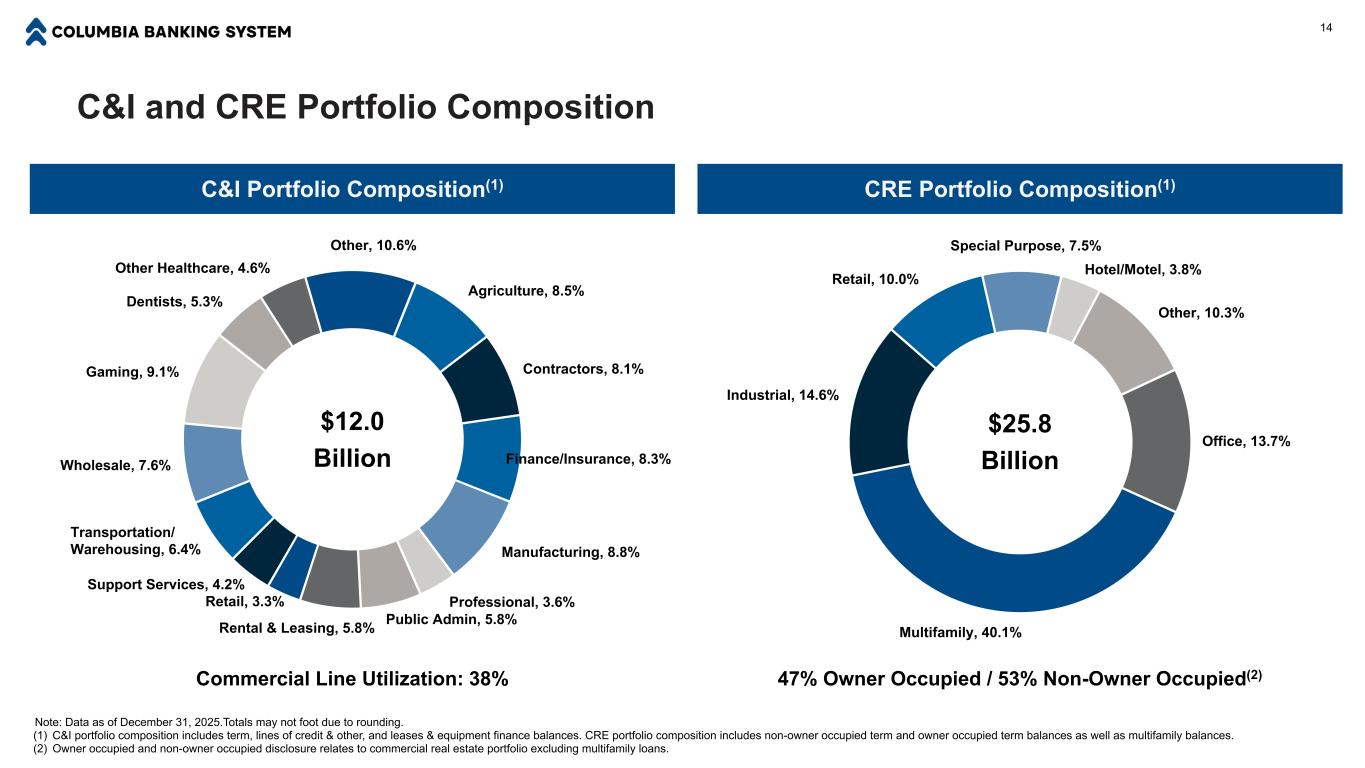
Thanks, David. Ivan here. I'll start, and then I'll hand over to Tori for maybe more of the color commentary. When you think about that loan decline at $686 million quarter-on-quarter, I really break it down into two major buckets. The first is what you referenced earlier, which is that transactional portfolio decline at just under $300 million, and then the second really being very concentrated within the commercial real estate construction and development portfolio, and Tori will speak a little bit more to that aspect of it. Within the transactional book, so far we're seeing CPRs at kind of an 11%, 12%, 13% type level as we've been tracking it over the last quarter. We do believe that'll move a bit quarter on quarter, depending on kind of what's coming up for repricing. We've got, you know, $4 billion of that book that will be maturing or repricing here over the next 24 months. And as we've talked about in the past, you know, some of that stuff is likely to reprice and stay on our balance sheet. But if it exits, that's also an opportunity for us to drive strong accretive value from a revenue growth perspective, whether that's in the form of backfilling with core relationship lending, kind of in the six and a half plus type range is what we're seeing. So a 200 base point yield improvement on that or through kind of elevating our pay downs on the wholesale side of the equation. So that's kind of how we're thinking of it at this point, fairly similar to where we were. So, you know, as I look at it quarter-on-quarter, kind of validation of what we were thinking would likely occur in what we talked about three months ago. I'll hand over to Tori just to kind of give more color commentary as well.
Thanks, Evan. David, this is Tori. I break it down into two different pieces. The first would be the transactional multifamily division lending that we've talked about a lot. And Ivan mentioned that. And I would say this, that roughly 70% or 80% of it today that's coming up from kind of this fixed to floating period is just rolling into the bank at a 6.5% to 7% coupon. And then the balance of that is exiting the balance sheet and going either being paid off or going someplace else, being financed somewhere else. But we're retaining right now somewhere between 75% and 80% of it. I don't know if that changes much over the course of this year, but that's kind of what we're seeing today. On the construction side, I mean, essentially, we've got a lot of projects that have gotten to a point where they are seasoned and stable, and they're just rolling from the construction facility into permanent financing. And roughly 85% of that that's exiting the bank is being permanently financed by Fannie or Freddie. And the balance is either being done a little bit by us or other banks or life companies. So the majority of it's going to the agencies and just, you know, a little bit of it's kind of rolling into either life money or commercial banks. So that's kind of where we are on those two big asset classes for us.
Okay, that's great. And then maybe just following up on John's question a little bit on FAC Premier, I know we've got the conversion upcoming. I was hoping we could maybe get a sense of the timeline for the integration of like all the systems. And, you know, you got a slide in here that talks about, you know, some of the rollout of all their technologies, in addition to some of the key businesses that you're focused on cross selling or leveraging. Chris, you mentioned the custodial trust business. I know they're going to be included in the next small business campaign. We're just kind of curious, again, the process and the timeline to roll out some of their technologies and then the fee income lines to cross-sell post-conversion.
David, you never disappoint. You packed a lot into that follow-up question. You know, I'll just start by saying, you know, kind of a general guide in terms of the systems component of it is in Ivan's prepared remarks, he noted that we expect to have the full realization of the cost saves in, you know, by the end of the second quarter. So that kind of gives you a good sense of, you know, the ancillary systems and shutting down, you know, surplus servers and getting, you know, all of those other things aside from just the core system integrated. I don't think we will ever be done in terms of when we look at technology implementation and utilization because it's a moving target, and that's just as an organization. We're always going to be in some form of investing and optimizing the tech stack. You know, in terms of timing of some of the technology that we were excited about from a proprietary standpoint that PAC Premier brought along, you know, the first mandate was make sure that the folks from PAC Premier don't lose any of the functionality or the customers lose any of the functionality that they've had for many years. so we don't want anybody going backwards, and we want to use it as a way to springboard the legacy Columbia customer base and employee base forward. So you had a lot in that question, and so I'm going to step back and let Ivan, Chris, and Tori offer their insights.
Hey, David. You mentioned the custodial trust piece of it. I tell you, that's an example of where there's a real win from the standpoint of the technology that they use for the core business is something that we're actually looking to adopt into our fiduciary trust business and bring them even closer in line together. They have a deposit portfolio that will go through the banking conversion. HOA goes through that. The rest of the bank goes through it as well. As Clint said in his remarks, we're very comfortable with where we're at. That's upcoming. and, you know, from there, I think you'll see it's pretty stable and we'll really look at these opportunities where we're taking of advantage not just the things that we bring to the table, but the things that PAC Premier brings to the table and that custodial trust one has already paid dividends in winning new business because we have that capability now, or the combined capabilities.
I'll just add, David, this is Tori, that we're full steam ahead. And they're doing, I think they're doing a great job. Chris mentioned earlier in prepared remarks of a 23% origination growth quarter over quarter. Like a big chunk of that is specific premier. And, you know, what excites me about that growth is all the growth from Q3 to Q4 is C&I growth. And they're just, they're fully locked in on that. Our pipeline for core fee income, you know, TM, commercial card, international banking, and merchant is up nicely. We're about 10, roughly $10 million pipeline, which is really strong. A big chunk of that is Pacific Premier. So they're out there providing the products and capabilities that we brought to them, and they're doing a great job executing it.
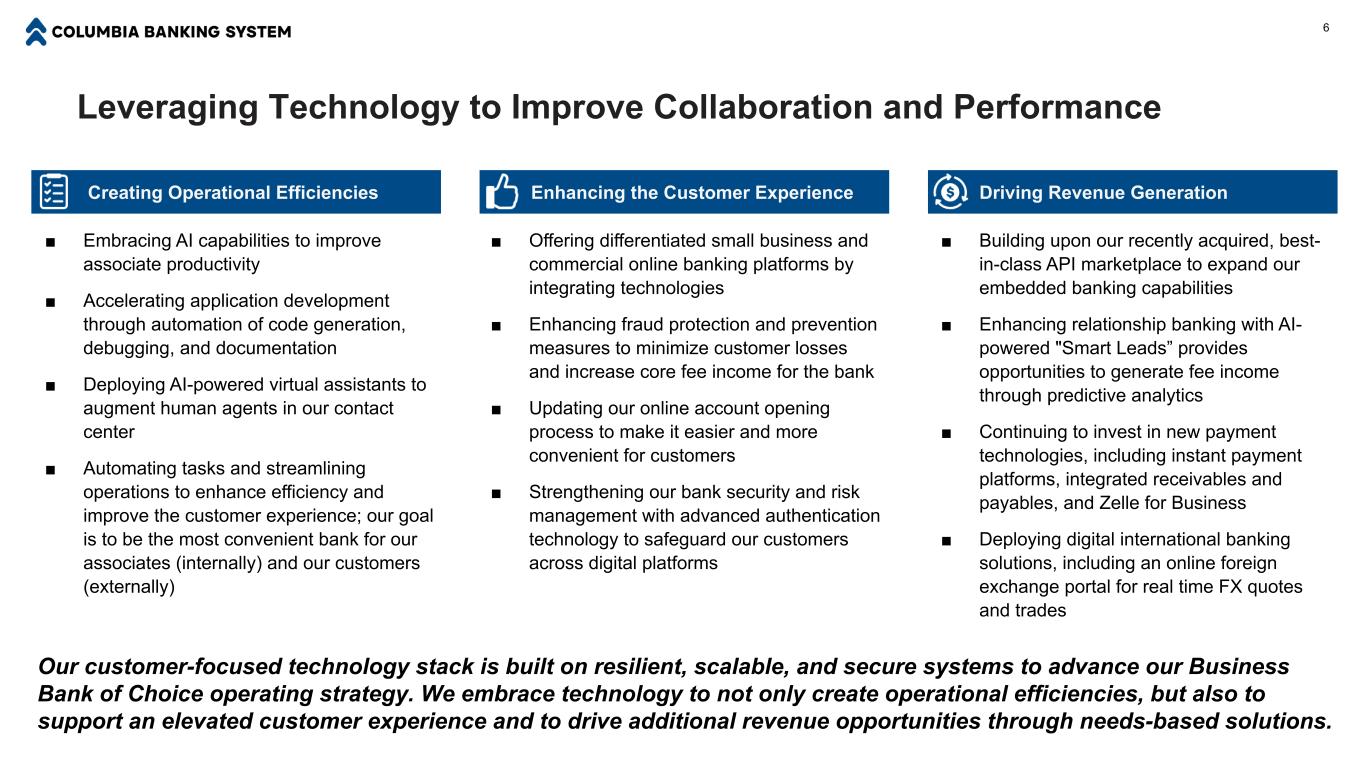
that's great thanks everybody yeah yeah david and and you know i'll just add like another example of one of the things that we we were excited about was uh you know pack premieres uh uh you know they called it their api marketplace and and that connectivity to customer systems and everything and uh you know we're we're not super creative um as as bankers and so you know that is that is now the Columbia Bank API marketplace, and it's been fully implemented and is operational and being utilized across the combined company today as we sit here. So, you know, every component of what we can do, and I'll kind of lean into some of my prepared comments about, you know, how do we get more efficient? How do we get better every day as an organization? And then what kind of activities can we do or what kind of talent can we bring in to drive additional revenue sources and value for all of our stakeholders. And so it's just what I'll call a relentless pursuit of those types of activities.
All right. That's awesome.
Operator
Thank you. Please stand by for our next question. Our next question comes from the line of Jeff Rulis with DA Davidson. Your line is open.
Thanks. Good afternoon. I mean, Ivan, I appreciate the earning asset discussion for Q1. I wanted to try to get the sense for the full year on the loan balance. It looks like $2.8 billion set to reprice a runoff within a year in that table on 24. Just wanted to see what the offset is on organic growth. So, what do you expect a loan portfolio on net for the balance of the year?
Pretty flat is our current outlook. So, we saw a bit of that step down here, as you saw, during Q4. We are currently, as Tori mentioned earlier, we've seen some of that transactional portfolio roll into relationships we've been able to retain. So, currently, the outlook for total loans is relatively flat to year end. That will ebb and flow quarter on quarter. So you'll probably see some plus or minus to that each quarter, but generally the goal is to offset any of that transactional runoff with core relationship-based lending activities.
Okay. All right. I appreciate that. And then this second question on capital sounds like on the buyback, I guess the first part of that is I think your stock's 10% higher than it was on average what you bought back in the fourth quarter. So, one, a nice trade. But does that diminish your appetite at all? And then the second piece is the alternative use of capital beyond buyback and organic growth if you focus on talent liftouts, a special dividend, and or M&A.
so um jeff um taking on you're taking a cue from from david feaster and packing a lot of a lot of threads into into that um and so there's parts of it that that probably makes sense for ivan to to to respond to and and um and then obviously i have i have some thoughts and so i'll try to try to hit on between ivan and myself we'll try to hit on all your points but if we miss one, just redirect us. I still think as a company that we're undervalued, the lift in our share price has been nice, but it doesn't change our view on reducing the share count and repurchasing stock. I said on the last quarter's call that I believe that the best investment we can make is in our own company I still firmly believe that and so so really no interest in in M&A you know with our increase in our share price still buy backs make sense for us from from my point of view you know it at some point we may get to a position where the markets got us valued appropriately and and buybacks may not make sense and special dividends or tools that we've used in the past when we've been in that position and obviously would take a lot of discussion with our board and as we approached that we would signal that to investors and make sure that folks fully understood why we were making that pivot. There are some things that we can do in terms of cleaning up the capital stack and things of that nature. And that's where I'll step back and ask Ivan to give
you his thoughts. Yeah, no, it's a great question and something we spent a lot of time on. You know, when we talk about capital priorities, really there's four of them, right? Ensuring that we've got the capital necessary to lend to our core clients, right? So supporting core loan growth opportunities there. Number two, obviously the dividend you saw us take that up 3% quarter on quarter and we announced that last quarter as well. Number three, we are making investments in the business. Clint referenced some of them earlier in terms of market expansion opportunities and we've heard Chris and Tori talk kind of in the past quarter as well about some of the teams that we're building out and bankers that we're adding in certain markets, which is very exciting. And then fourth, to the extent to which we still have excess capital, we will continue to execute our share buyback program and you know we do see that as as a as a programmatic approach to it a likely a multi-year uh approach uh given the level of excess that we're we're currently looking at so um that that's kind of how we've thought about the uh the capital opportunity there
Operator
appreciate it thanks thank you please stand by for our next question our next question comes from the line of Jared Shaw with Barclays. Your line is open.
Hey, good afternoon. Maybe starting with the loan sales that you broke out, the $45 million, were those considered or were those classified PCD? And I guess where did that sale come through in terms of where they were carried or marked? Is that what that million gain is on sale of loans?
Those were all PAC Premier, inversely rated loans, to offload some loans with certain accounting, and that's what we did. So there was about a $1 million hit, I believe, to goodwill associated with that loan sale. It was really a win-win.
Otherwise, though, it was basically sold at carrying value. There wasn't a gain or loss associated with that. What's the appetite for additional loan sales from here? I mean, I guess it sounds like that was a little bit of a unique situation, but could we think that there's additional sale opportunities out there?
You know, we've looked at, in every single quarter, we look at component parts of that transactional portfolio in particular. You know, the piece that Frank just talked about was kind of a cleanup execution from the PPBI acquired portfolio. You know, I would not expect anything big from a transactional portfolio, you know, that we would still take a significant capital hit if we were to do a kind of a bulk sale on some of those assets, but we will continue to evaluate for kind of more surgical opportunities as we go throughout the year.
Okay, thanks. And then shifting to deposits and deposit costs, thanks for giving us the spot right there, 206 at 1231. How should we think about deposit pricing and deposit costs as we move through the first half of the year with some of the moving parts in the deposit categories?
Yeah, and we try to be careful. I'll start and then maybe I'll hand it over to Chris. So quarter over quarter, like you mentioned, we saw interest bearing deposits flow from about a 243 last quarter down to 220 when you exclude the CD premium impact. And as you quoted kind of that 206 in the closing days of the year, you know, with the rate cuts happening throughout the course of Q4, the full effect of that wasn't reflected within the quarter. We've seen, I think, since Q2, a beta over 50%. We continue to believe that 50% is a good estimate from a through-the-cycle perspective on the interest-bearing deposit beta. And really, that comes down to execution. And I think we talked in prior quarters around the rates down deposit playbook. And we've now done that three times in the last several months. And to great effect, I'll hand over to Chris to give
kind of some business commentary as well. Thanks, Ivan. And Jared, you know, the pricing aspect of it really becomes market-driven. And so we're analyzing that and following our competitors all the time. And when we see opportunities where we can bring it down five basis points, we will. When we see renewal rates are maybe a little higher than what we typically anticipate, We might see that there's opportunities to bring down CD rates and things of that nature. And so it's a pretty fluid process throughout the quarter in looking at those opportunities. And then further, we're really starting to look at, because of our footprint now, we're really looking at some regional types of pricing, which may give us the opportunities to be able to recognize markets that aren't quite as competitive versus those that are and keep that more in balance and check. But it's really an active, ongoing process. Tori and I have conversations with bankers all the times about the exception portfolio and what we can do in there. It's really not waiting for just a Fed action to make things happen. Although the deposit playbook has been fantastic, we're always looking for opportunities to trim there
Operator
if we can. Okay. Thank you. Thank you. Please stand by for our next question. Our next question comes from the line of Chris McGrady with KBW. Your line is open. Oh, great. How are you doing?
Thanks for the question. I've been on the expense guide. I just want to make sure I'm clear. So Q1, 335, 345, and then AB 40 from there. If I'm doing the math on kind of your run rate, half of the run rate expenses are in. I presume Q1 is your seasonally high watermark, and then I guess I'm trying to get after the exit rate once you get all the synergies. Any fourth quarter exit
rate would be helpful. Thanks. Yep. I think you nailed it. Full year, somewhere in the ballpark of $1.5 billion, with more of that in the first half than the second half. Second, exit velocity should be south of 370 all in, and probably in the range of about a 330, excluding the CDI impact. Okay, so one that's super helpful. The 1.5, is that a fully loaded, or is that a, that's a fully loaded number, right? Yep, that includes the CDI accretion impact.
Okay, and then if we think about, like, expensive investments and technology have been a big theme this quarter, once you get to that stripped out number in the fourth quarter, can you just speak about the need to invest, the balancing act between operating leverage as you go into next year?
Torrey, I'll just jump in on the investment side quickly. I will tell you that Chris and I are continuously looking for opportunity to bring people into the company. So, there's been over the past probably quarter and a half we've added uh five our commercial rms in utah a team in northern idaho a team in eastern washington a franchise finance team a couple rms in phoenix um three new tm i mean we're continuously looking at and finding um really good talent that we're investing in bringing the company and we watch very closely the de novo locations that we that we've created and and every one of them is is uh profitable within 12 months most of them a lot earlier than that they're just really good solid bankers coming in um bringing uh customers with them and and um kind of just off to the races right out of the gate i think chris i don't know
do you want to add to that? No, I just echo it. Same markets. We're finding talent in the healthcare space. They've hit the ground running extremely quickly. We're finding talent in the wealth space. That typically takes a little longer because of the fee-based type of business that they run. But we do it at 12-month look back, and we're very pleased with the folks that we brought in last year, and we're continuing to build out that business as well. I think maybe part of your question, Chris, was around the other technology and the things of investing in the bank, and that's just always been part of our run rate. I don't know that you see anything different unless we come across something that's going to be a real game changer for us. That's really built into a way of life for us. Perfect. And then, Ivan, on the tax rate,
any thoughts? Right now, we're modeling a 25% effective tax rate for 2026. Great. Thank you.
Operator
Thank you. Please stand by for our next question. Our next question comes from the line of Matthew Clark with Piper Sandler. Your line is open.
Hey, good afternoon, everyone. Just circling back to the deposit discussion, can you remind us what your comfort zone is from a loan-to-deposit ratio perspective?
Yeah, right now we're in a very comfortable spot. I think we finished the quarter at 88%, you know, comfortable into kind of the low 90s, certainly 90, 94, maybe 95. We'd start to kind of look at other options there, but we've got excess liquidity to work with in regard to that. Okay, great.
And then the other one for me, just on with the sale of this special mention, loans that were acquired from Pacific Premier. I don't think I saw it in the deck or the release, but can you give us a sense for where your criticized loans or classified loans stood
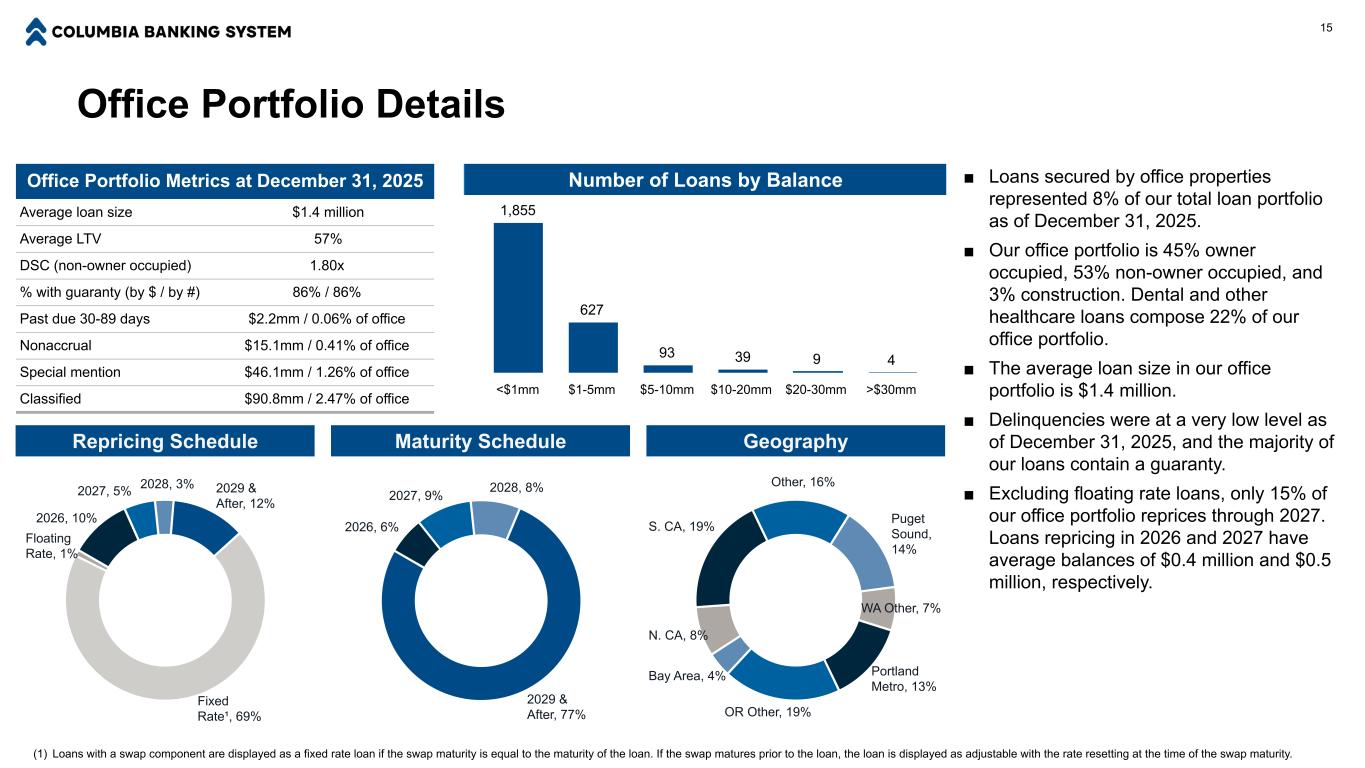
at the end of the year relative to last quarter? Special mention loans were lower. Substandard loans were a little bit higher, roughly about $130 million swing each direction. So basically resulting in, you know, some special mention, those special mention loans migrating down into substandard. And, you know, not necessarily due to, you know, degrading performance, but more of an elongated downturn. We don't really expect, you know, anything more negative to come out of that, but we're just reflecting the risk profile.
Okay. Okay. So net-net, relatively flat. Is that what I'm hearing?
Operator
Thank you. Please stand by for our next question. Our next question comes from the line of Anthony Elian with J.P. Morgan. Your line is open.
Hi, everyone. Ivan, appreciate the color you gave us on NIM for this quarter. How are you thinking about NII in 1Q, just considering the impact, day count, and the absence of the time deposit premium?
Yeah, I think when you look at, so first of all, we put up obviously a very banner, strong finish to the year. We talked about in Q4 some of the elements, including the $12 million impact of the CD accretion. So I'd back that out, you know, with Earning Asset Outlook that I talked about earlier, along with the 390-395 net interest margin for Q1, would expect NII to dip down just below kind of the $600 million range in the first quarter before yo-yoing back up above that in Q2.
And above that in the second half as well, correct?
Yes. Yeah, it should continue to trend up throughout the course of the year.
Operator
Ladies and gentlemen, as a reminder to ask the question, please press star 1-1. Please stand by for our next question. Our next question comes from the line of Janet Lee with TD Securities. Your line is open. Good afternoon.
If I were to put together the comments that were provided on earning assets, you know, 60.5 and 61 billion for the first quarter, and then NIM surpassing the 4% mark in either second or third quarter, Sure. So is it am I fair to describe, you know, earning assets staying in that 60.5 to 61 billion or modestly trending down throughout 2026, while NIM stays in that 4 percent range in the back half of 2026? Is that a fair way to describe the baseline expectations?
Yes, on the first part regarding earning assets. On the second part regarding NIM, what I expect is that we'll dip down to a range of 390 to 395 in Q1, and then we'll grow back up each quarter sequentially from a net interest margin perspective, surpassing 4% at some point in Q2 or Q3, and we'll continue upward from there.
Oh, continue going upwards above that 4% each quarter. Correct. Got it. Sorry if this was asked already. Did you talk about the fee income growth expectations for 2026? Obviously, fourth quarter was a very solid quarter, it appears. how should we think about the the growth and in fee income yeah from a core
perspective I would model core fee income in the low to mid 80s type range q4 was was an absolute banner finish to the year and we talked a bit about swaps syndications and some of those items that are you know we don't have a lot of kind of chunkier fee income elements within our core operating non-interest revenue base, but those elements were high watermarks for the quarter. So modeling somewhere in the low to mid-80s would be appropriate. Got it. Thank you. Thank you. Please stand by for our
Operator
next question. We have a follow-up question from the line of Anthony Elian with J.P. Morgan. The
line is open. Hey, thanks for the follow-up. Clint, for you, just from a strategic perspective, does anything change with you now adding the role of chair? Thank you. The short answer is no.
You know, this is something that, you know, from a board perspective, we've anticipated would occur around this time. And we began actively discussing and working towards it from a full board perspective in kind of the back half of 2024. for. You know, and I'll say that one area that has been a focus of conversation over that time period and will remain a focus initially for the board and specifically for me with the expanded role is to continue to work with Maria and Louie on, you know, what's the right size for our board? What does refreshment look like? So I guess the way to sum it up is our roles are changing, but our priorities as a board are not. And, you know, we added three directors from PAC Premier. That was also a component of, you know, refreshment as we had three directors that rotated out in 2025. And I think we've quickly seen the impact that fresh thinking and, you know, new perspective brings. It's been very healthy, a lot of great dialogue with the board. And so that's just the kind of work that we're going to be focused on in 2026.
Operator
Ladies and gentlemen, I ain't showing no further questions in the queue. I would now like to turn the call back over to Jackie Bowling
for closing remarks. Thank you, Tawanda. Thank you for joining this afternoon's call. Please contact me if you have any questions or would like to schedule a follow-up discussion with members of management. Have a good rest of the day. Ladies and gentlemen, that concludes today's
Operator
conference call. Thank you for your participation. You may now disconnect.