Operator
Thank you. I would now like to turn the call over to John Andrews, Vice President of Capital Markets and Investor Relations. Please go ahead.
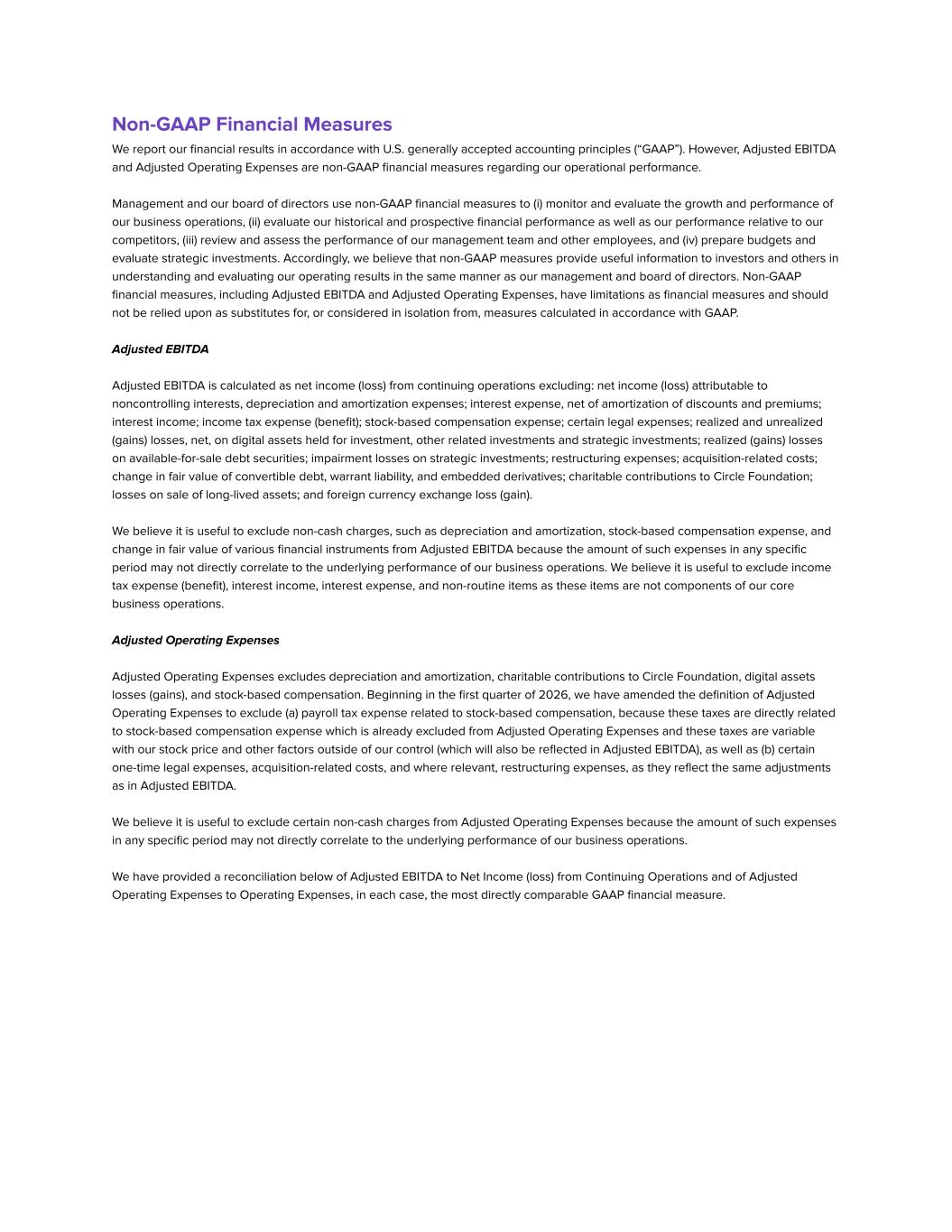
Thank you, operator, and good morning. I'd like to welcome you to Circle's fourth quarter and full year 2025 earnings conference call. I'm joined by Jeremy Allaire, our co-founder, chief executive officer, and chairman, and Jeremy Fox Gein, our chief financial officer. Earlier this morning, we posted our earnings press release and earnings presentation on the Circle Investor Relations website, investor.circle.com. The transcript of this call will be posted on that website once available. I do need to remind everyone that our earnings press release presentation and this call contain statements that are forward-looking. Because forward-looking statements are inherently subject to risks and uncertainties, some of which cannot be predicted or quantified, and some of which are beyond our control, you should not rely on these forward-looking statements as predictions of future events. The events and circumstances reflected in our forward-looking statements may not be achieved or occur, and actual results could differ materially from those projected in the forward-looking statements. Information concerning risks, uncertainties, and other factors that could cause these results to differ is included in our SEC violence. We will also disclose non-GAAP financial measures on this call today. Definitions of those non-GAAP financial measures and reconciliations to the most comparable GAAP financial measures can be found in the earnings release and earnings presentation, which are posted on Circle's Investor Relations website, investor.circle.com. Non-GAAP financial measures should be considered in addition to not as a substitute for GAAP measures. Now, I'd like to turn the call over to Jeremy Allaire.
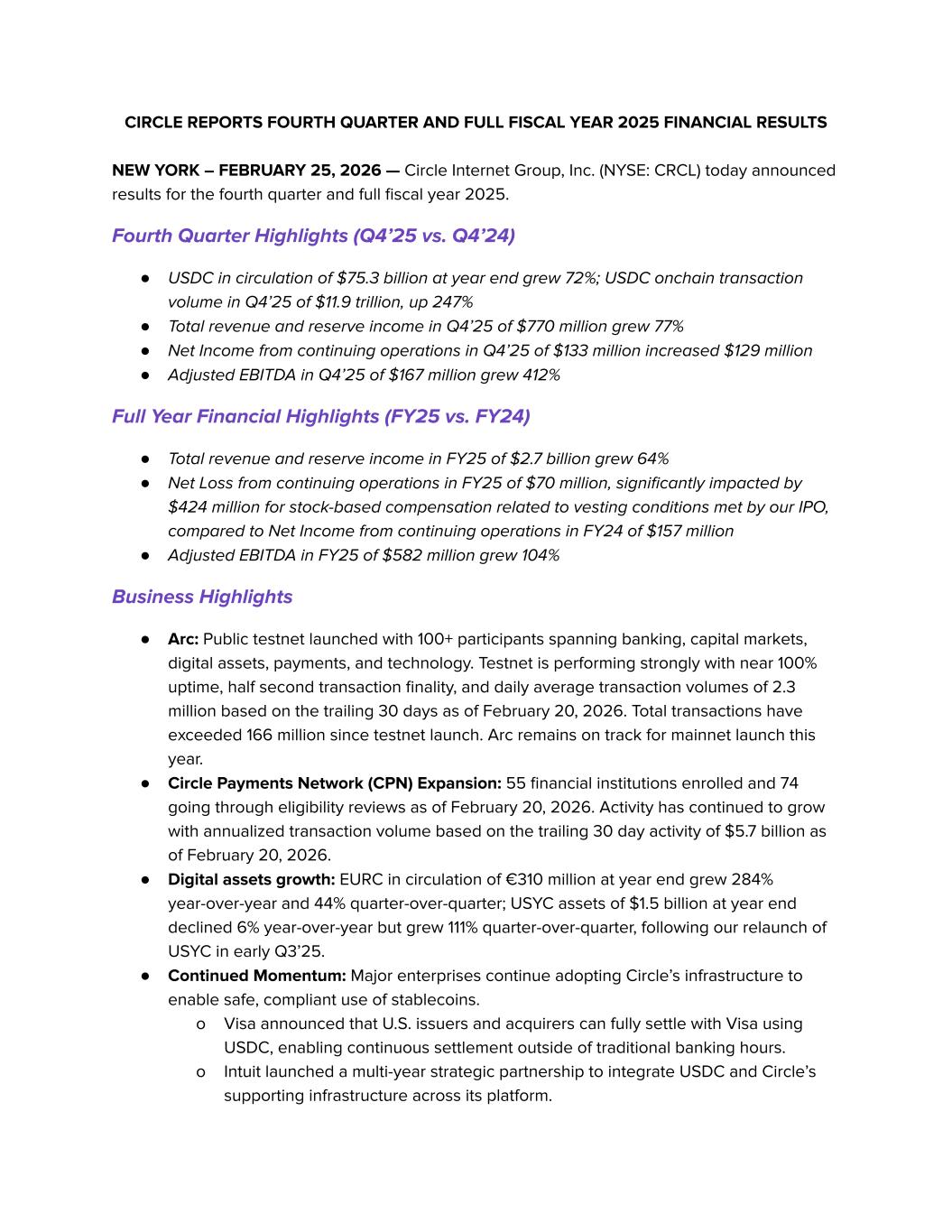
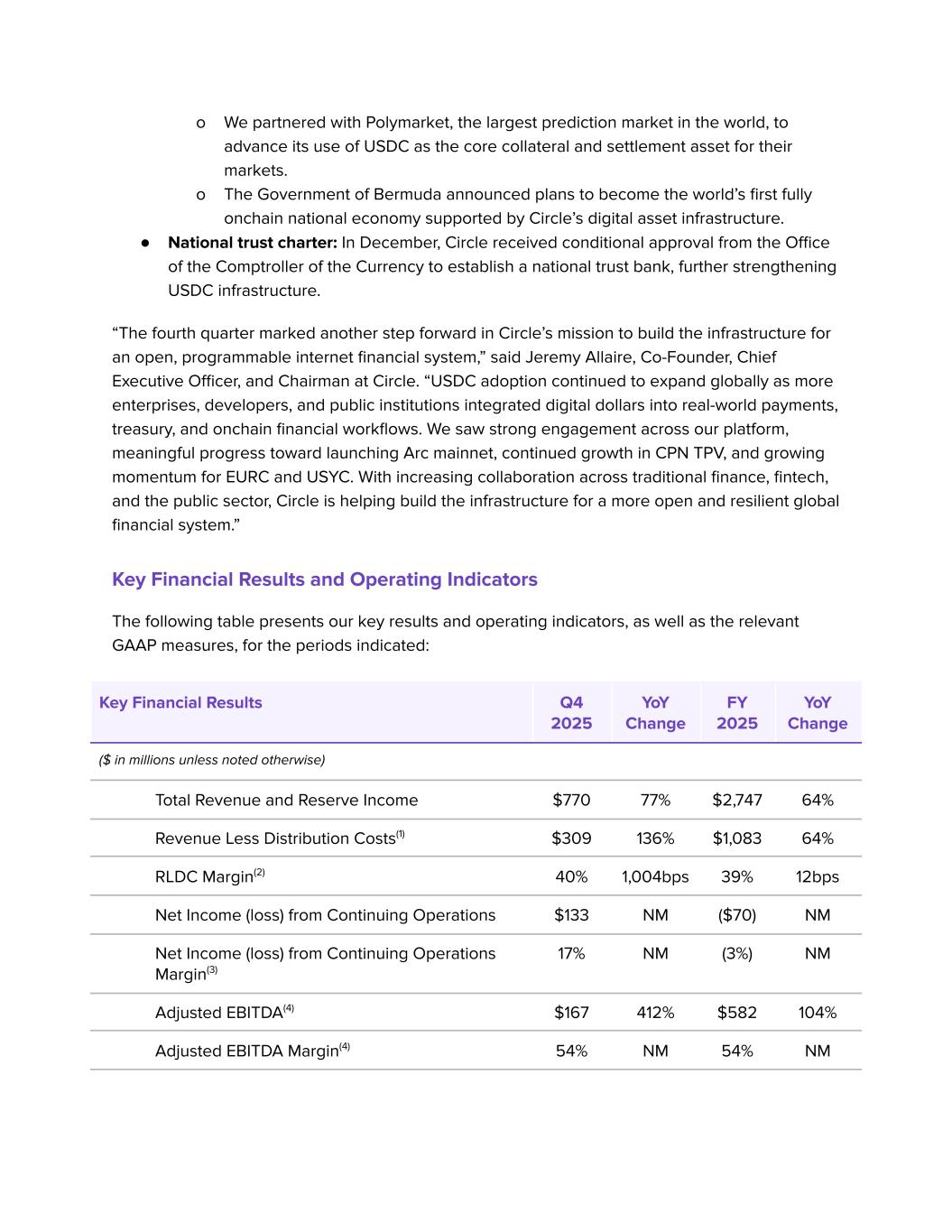
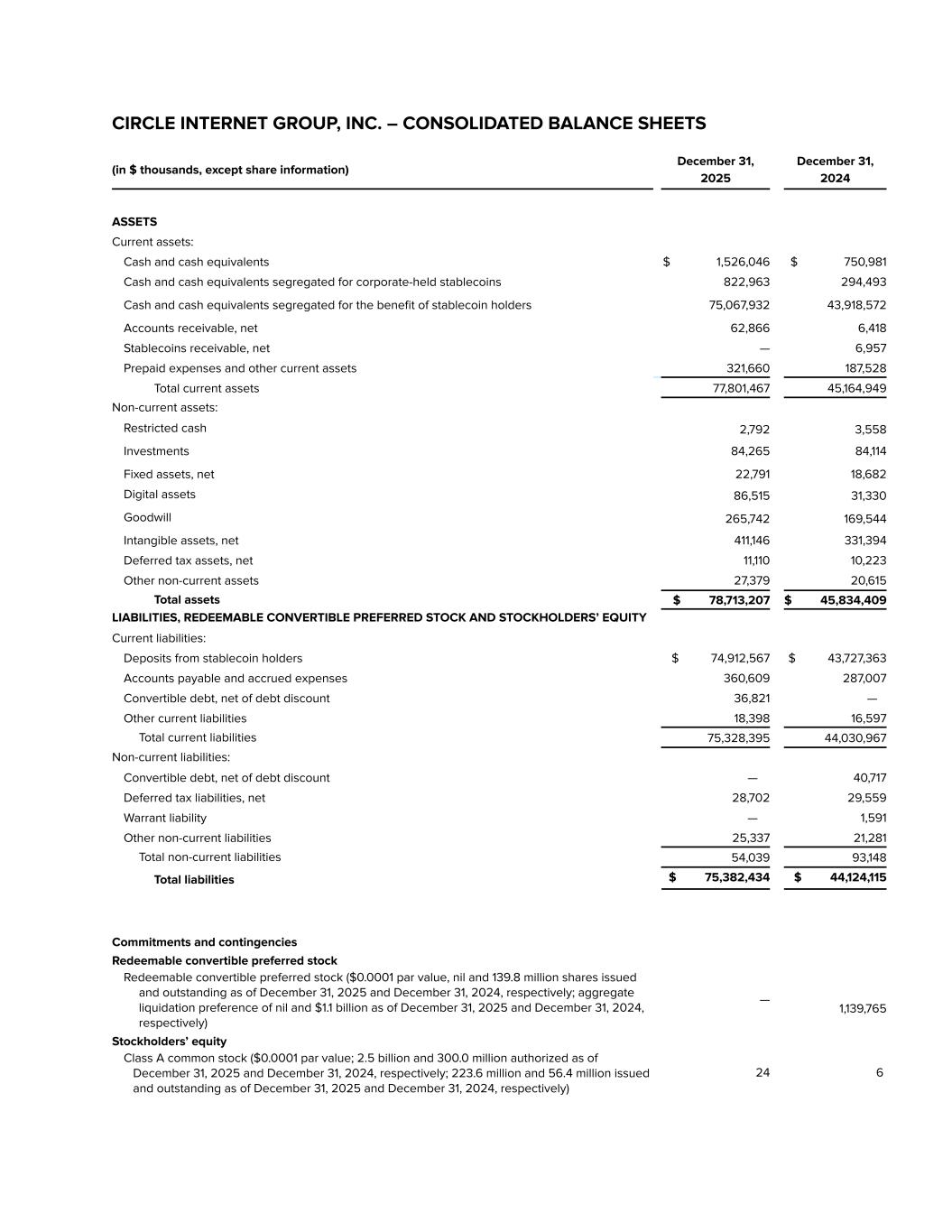
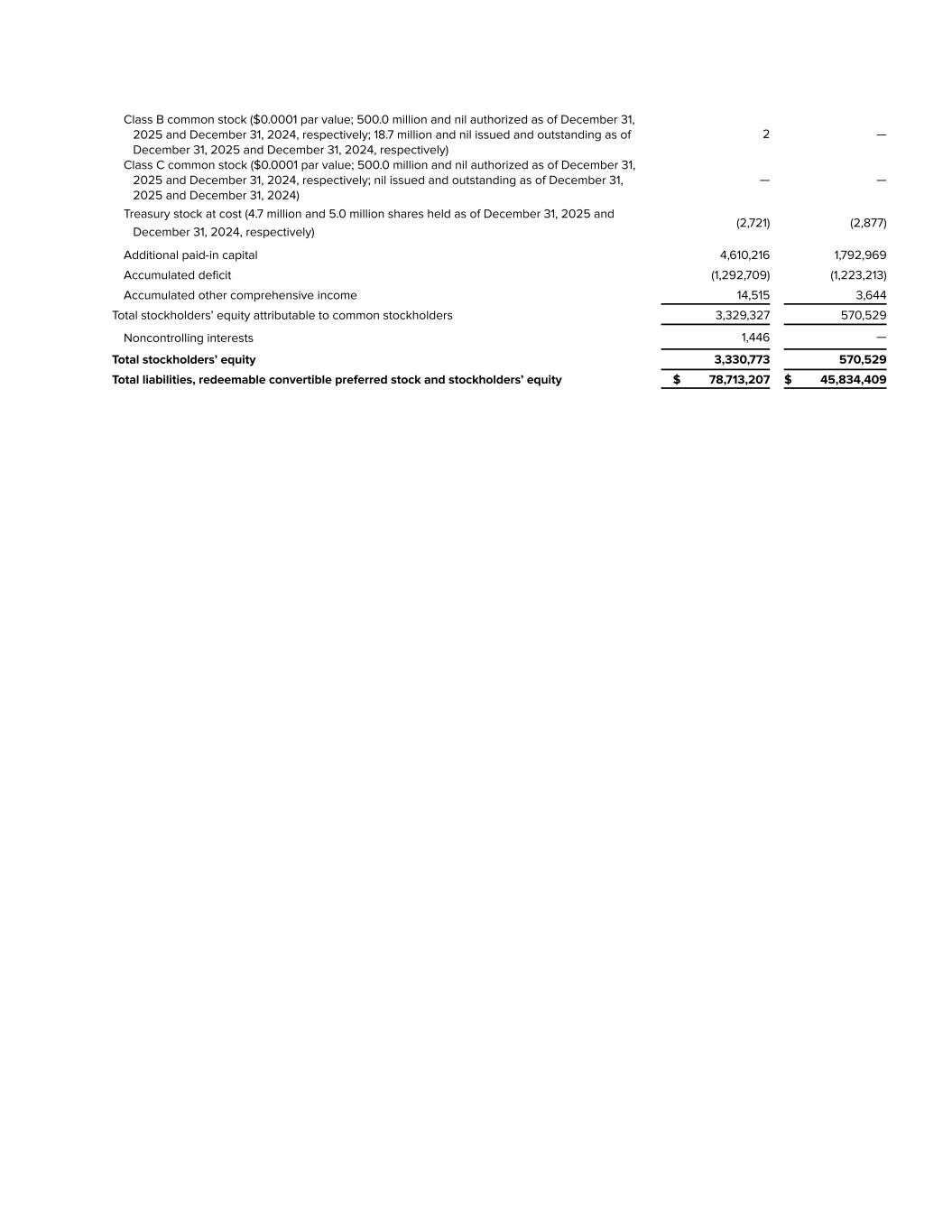
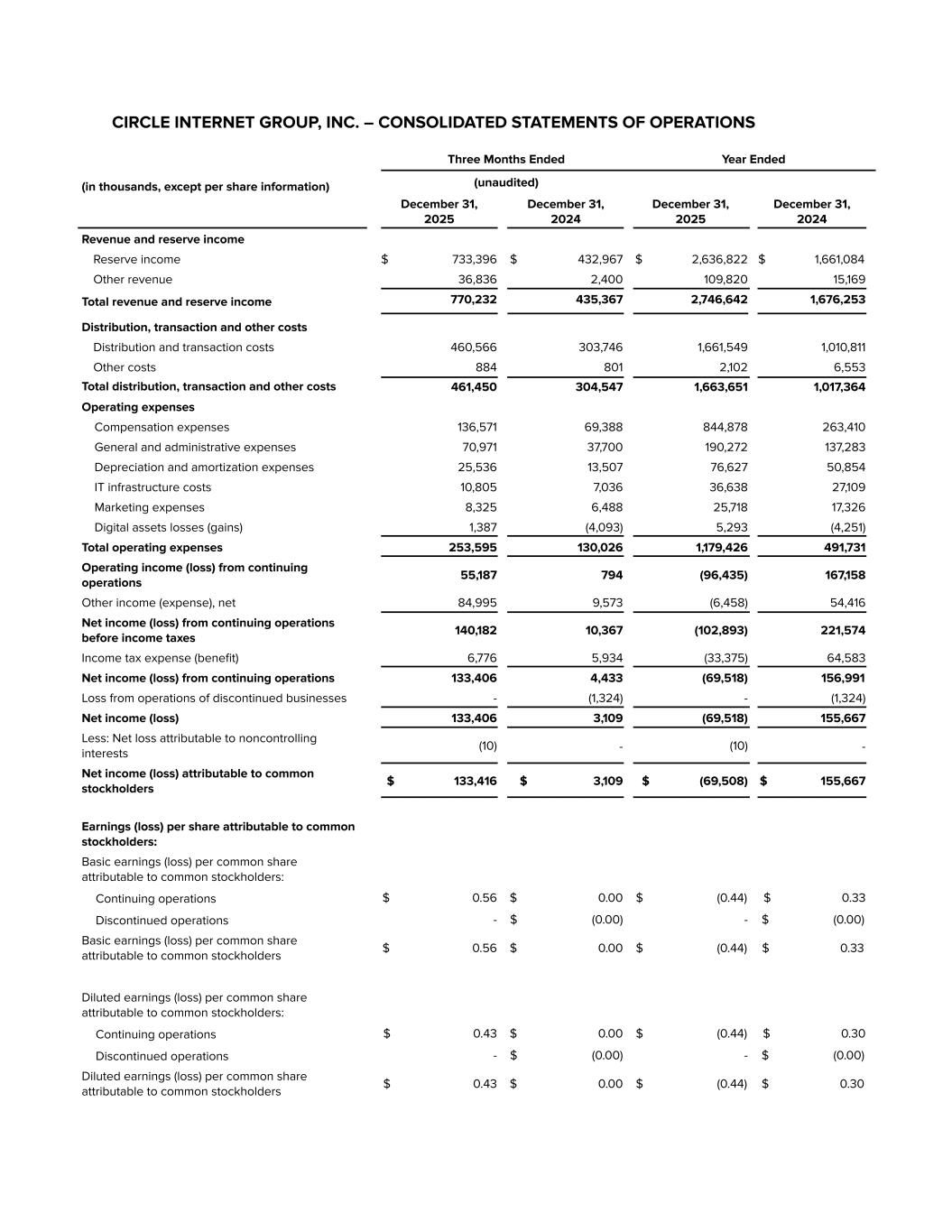
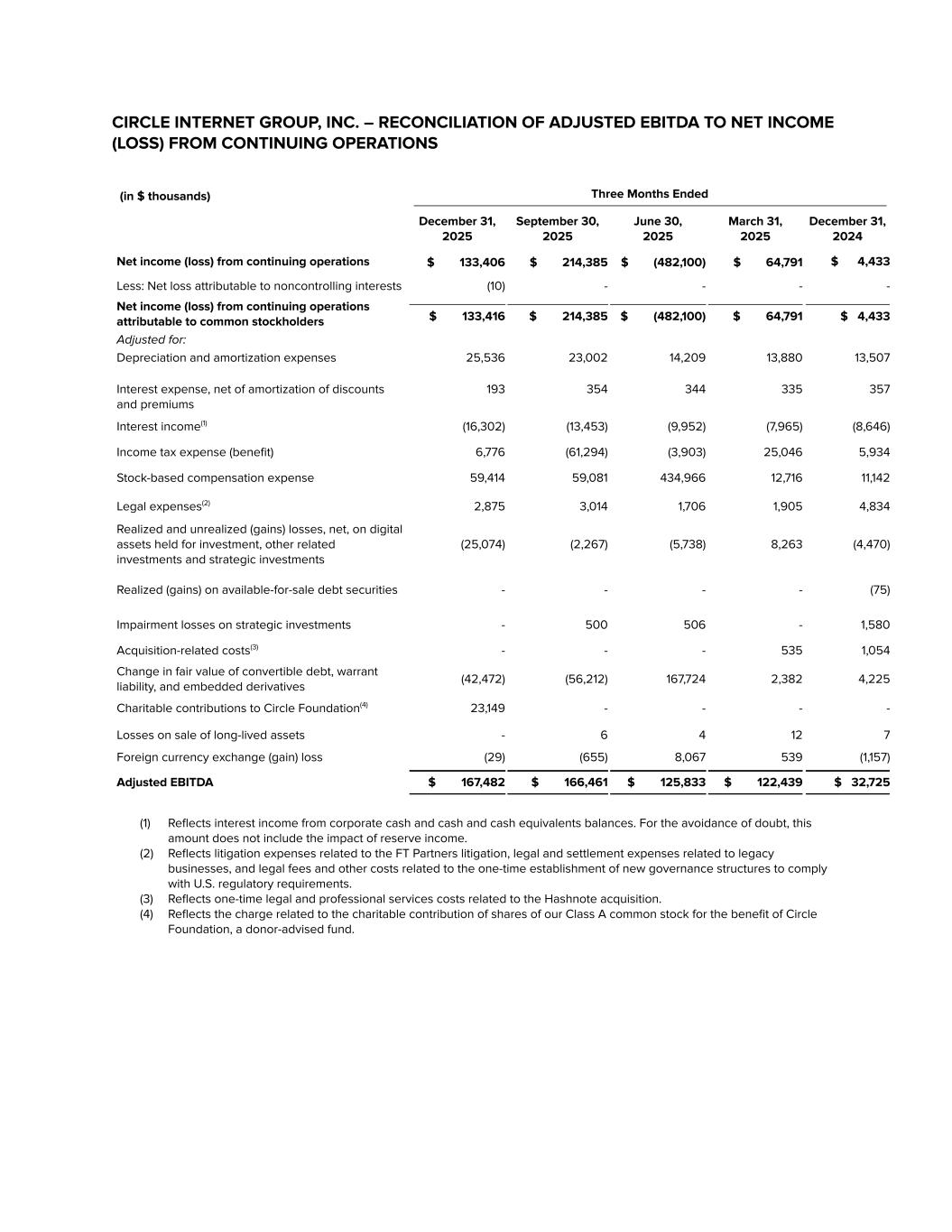
Thank you, John, and good morning, everyone. I want to start this morning talking a little bit about what I'm seeing in terms of this extraordinary transformation that's underway. I'm speaking not just about the changes we're seeing from blockchains and stablecoins, but the broader backdrop of technology acceleration, software-powered technology acceleration, and artificial intelligence. I believe we are in the earliest stages of a very deep and very fundamental transformation of the way the global economic system functions and works. Not only will our global economic system become more Internet native, but it's also going to become dramatically more automated. We are entering a world where, in my view, likely tens or hundreds of billions of AI agents will interact and perform economic functions over the Internet. If we look at the past decades, we've seen this progression, and this progression has been accelerating. This progression has been one where we build more and more software-native infrastructure, more and more data and transactions on the Internet. The progression from the Internet of Information into an Internet of Software Distribution, interactive media, and commerce, all made possible through the adoption of web, cloud, and mobile platforms has created extraordinary value over time. Beginning around 2013, we began to see another transition, this time into the value era of the internet, where early blockchain platforms emerged. Later, through the innovation of fiat-backed stablecoins, we saw the birth of a transformative internet-native money layer. Now, as we've achieved regulatory clarity and as the technology has matured, we're now seeing these developments directly colliding with another major platform shift, which is the adoption of AI platforms. This value era, this combination of economic operating systems and an internet-native money layer with artificial intelligence, agentic economic activity, and automation seems likely to drive the greatest acceleration of economic activity we've ever seen in human history. And we're really just at the beginning. Our aim at Circle has always been to build a new internet financial system, to build the software infrastructure that powers it. And we're more excited than ever to have that opportunity today. Let's talk about our key highlights in Q4. Our stablecoin network continued to grow. We saw USDC end the year around $75 billion in circulation, up 72% year-on-year, despite some of the declines that we saw in Q4 due to the crypto market correction. We also saw tremendous ongoing growth in the amount of transactions happening on our network, with on-chain USDC volume hitting nearly $12 trillion, representing 247 percent year-on-year growth. This continues to reflect the growing velocity and utility of digital dollars on the internet. Q4 delivered very strong financial results. We realized $770 million in total revenue and reserve income in the quarter, up 77 percent year-on-year. Adjusted EBITDA for the quarter was $167 million, up 412 percent year-on-year, with an adjusted EBITDA margin of 54 percent.
Overall for the quarter, we had very strong yearly growth across the board.
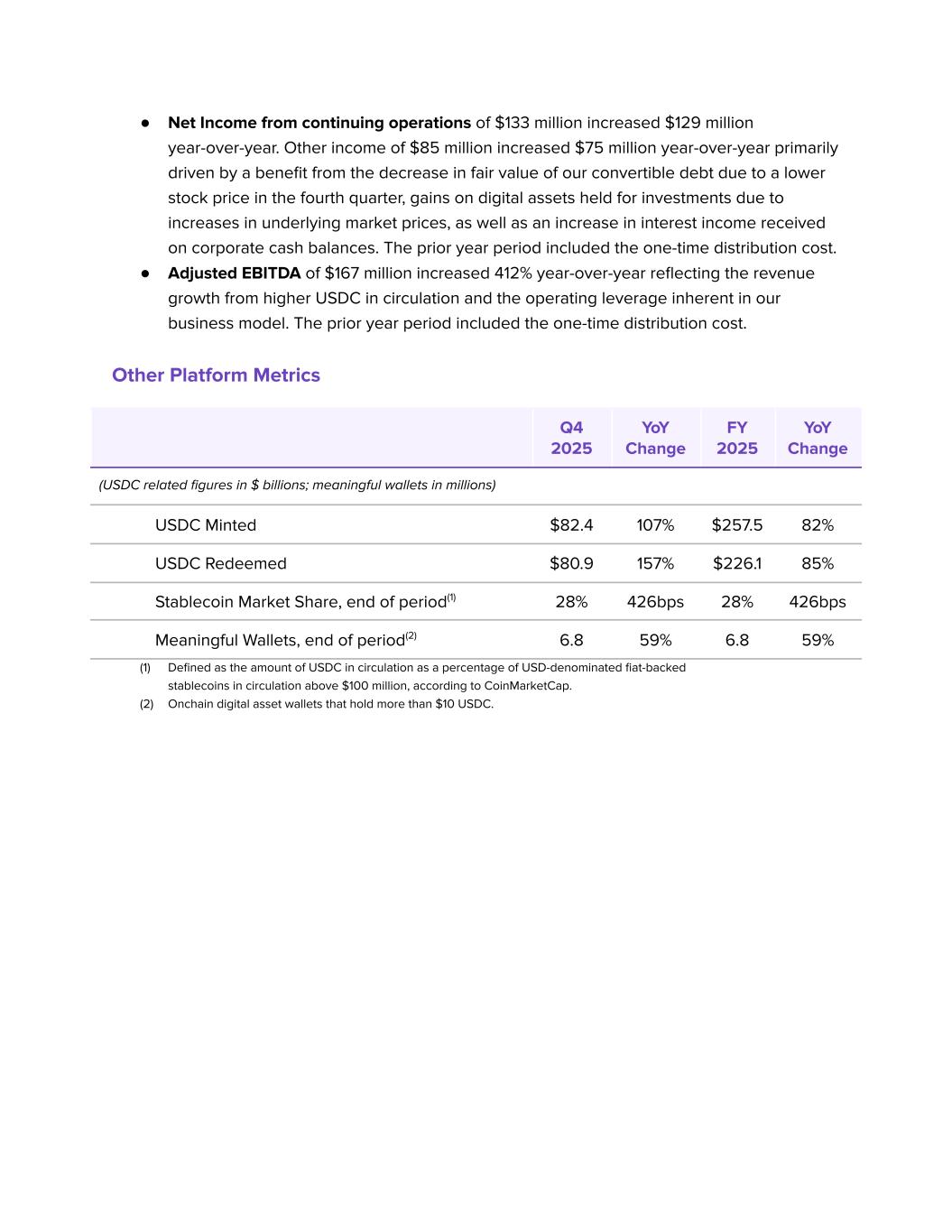
Importantly, our platform continues to expand. We launched the testnet of ARK, our layer one blockchain network, and we're on track to launch mainnet this year. Circle Payments Network continues to see very strong volume growth and participant expansion as we continue to see traction in real-world payments and cross-border settlements we're also adding new products we introduced stable fx in beta our new on-chain fx app and x reserve which supports continued expansion of usdc across a wide range of blockchain ecosystems and we now support usdc on over 30 different blockchain networks, with interoperability being a key piece of Circle's platform strategy. Mainstream adoption continues to deepen across a broad range of leading enterprises and institutions. Intuit and Circle are partnering for Intuit to bring low-cost, programmable money through Circle's technology to its millions of consumers and businesses. Visa continues to expand its integration of Circle stablecoins, announcing the launch of USDC settlement that permits U.S. Visa card issuers and acquirers to settle outside of normal banking hours using USDC. And earlier this month, Circle and Polymarket, the largest prediction market in the world, announced a formal partnership where Polymarket will continue to advance its use of USDC as the core collateral and settlement asset for their markets, demonstrating our very strong position as the leading regulated stablecoin network. Now, these are just the tip of the iceberg. Major enterprises and financial institutions continue to integrate and support USDC in their businesses. We saw firms as diverse as Cash App, Gusto, Deal, Interactive Brokers, JP Morgan, and MasterCard launched products and offerings that took advantage of USDC. Right now, we're seeing more activity from startups, enterprises, and financial firms than we've ever seen in our history. The stablecoin market continues to grow strongly, and our position in that market continues to strengthen as well. Fiat-backed stablecoins grew $85 billion in a year with 46% year-on-year growth. Within that market, our competitive position remains strong, and we continue to maintain a significant share. Importantly, it's a market that, despite the efforts of many other firms to enter and compete, is really a market of two major issuers. And this reflects the very durable network effects that we maintain that are significant barriers to entry and adoption. Looking at growth in actual transaction volumes, Circle's share of transaction volume grew from 39% in the third quarter to nearly 50% in the fourth quarter. This is based on Visa's published analysis. which works to eliminate internal transactions, exchange wallet rebalancing, and bots to really capture the volume that better reflects real economic activity. You can also note that while there have been a number of other stablecoins entering the market over the past year, their usage in real transactions is effectively zero. As noted in my introductory comments, Circle's network grew strongly, with 3.5x year-on-year growth in on-chain transaction volume, And notably, CCTP, a critical infrastructure for interoperable usage of USDC, grew 3.7x year-over-year to over $41 billion of volume in the fourth quarter. I know that competition is a major topic for many, so I want to talk again about the durable network effects that Circle maintains. Foundationally, Circle's competitive position has been built on trust. As an audited public company with a deep commitment to compliance, as a firm regulated across jurisdictions around the world and with the highest levels of transparency possible, we enjoy the trust of major financial institutions, payments companies, enterprises, developers, and end users around the world. And that trust shows up in our fundamental liquidity with $75 billion of USDC in circulation and unmatched liquidity infrastructure that in Q4 supported $163 billion of minting and redemption volume. That minting and redemption, that promise to create and redeem a digital dollar one-for-one at scale and through banking systems around the world is completely unmatched by any other player in the market. In Q425, we saw distribution and network usage grow, as noted, to nearly $12 trillion of on-chain transaction volume, continued growth in meaningful wallets using USDC, and our product platform continuing to expand. The breadth of infrastructure we provide, the breadth of liquidity services that we provide, and with new applications like CPN and StableFX, our whole product platform is not something others in our market are able to replicate. And crucially, acting as a market-neutral infrastructure, not competing with our customers and our partners, and building widely accessible and usable technology across as many platforms as possible have been keys to our competitive success as well. Moving on to our platform expansion, Circle's platform has really evolved from being a stablecoin network to being a a comprehensive platform and infrastructure partner for on-chain finance, spanning our three platform pillars. ARK and our developer infrastructure, which includes the tools, the operating systems, and the on-chain protocols and infrastructure to enable the internet financial system to flourish. Our digital assets and services, which includes USDC and EURC, the world's leading regulated digital dollar and digital euro, tokenized funds such as USYC, and liquidity services such as Circle Mint and X Reserve that ensure liquid and available stable coins around the world. And our apps. CPN is a rapidly growing application service from Circle for Payments. And in beta now, StableFX, an application service for FX. We continue to invest in our platform and our infrastructure to expand what we can provide to companies around the world. With ARK and our developer infrastructure, we're seeing very strong progress. Arc testnet launched in Q4 with over 100 companies in banking, capital markets, digital assets, technology, commerce, and payments. All leading brands actively testing, evaluating, and working with us to bring this into commercial production. We've had near 100% uptime since the launch of our testnet with an average of half a second for transaction settlement finality, over 166 million total transactions, and we're now averaging around 2.3 million daily transactions in our Tessna environment. We're on track to launch mainnet in 2026, and we're thrilled with the progress we're making. More exciting things to come in terms of technology, partnerships, and our ultimate mainnet launch. I also want to touch a little bit more on CCTP. Obviously, we've had very strong year-on-year growth, very strong growth in the number of transactions that are happening over this network. But I want to call your attention to the market share for CCTP. You can see here that for USDC, CCTP is nearly all of the traffic that flows for moving USDC across blockchains. But we also reach more than 50% of all bridged volume, not just of USDC, but of all assets across chains that we track. And in fact, in January, that volume reached 62%. CCDP is becoming a critical infrastructure for how value moves on the Internet, and we're excited with our advancements in CCTP and the advancements in our interoperability infrastructure through our acquisition of Interop Labs. Through these advancements, we're building new capabilities that are really aimed at helping asset issuers of all types, whether you're issuing tokenized stocks, tokenized funds, tokenized bank deposits, and new stable coins, to be able to take advantage of this tremendous interoperability infrastructure to enable your assets to travel on these highways that Circle has built to move value on the internet more seamlessly. We view interoperability infrastructure as a huge opportunity for us. And we also saw strong growth in Circle's other digital assets. In the fourth quarter, EURC reached 310 million euro, representing 3.8x year-on-year growth, and has already grown 25% since quarter end to 389 million euro as of February 20th. This reflects the growing demand for regulated euro-denominated stablecoins, and EURC remains the largest euro stablecoin. usyc our tokenized money market fund has also grown strongly since q3 we acquired usyc in january of last year we integrated it into circle and we developed a new product and distribution strategy around it focused on tokenized collateral on digital asset exchanges with the relaunch of usyc we've seen accelerating growth driven by demand for usyc as collateral on leading exchanges like Binance and others. USYC assets ended the year at approximately $1.5 billion and have continued to grow to now over $1.7 billion in assets since quarter end. In our apps pillar, Circle Payments Network continues to scale. We have 55 financial institutions enrolled. That's up from 29 in the third quarter. We have 74 financial institutions that are currently in eligibility reviews, and we continue to maintain a strong pipeline with interest from hundreds of banks, payments firms, and others all around the world. We've continued to expand the markets where CPN is available, with live flows now in 14 markets across the Americas, EMEA, and APAC. And importantly, CPN volumes continue to ramp, with annualized volume based on a trailing 30-day period as of February 20th, reaching $5.7 billion. That's growing approximately 68% from our third quarter earnings update. We are aggressively investing in product development for CPN and have a strong pipeline of upcoming country launches and anticipate adding 11 new markets in the coming months. We also launched StableFX in production beta. This extends our application layer by combining institutional-grade FX execution with on-chain atomic settlement, enabling 24-7 capital-efficient currency conversion and simplified risk management. We have stablecoin issuers from many jurisdictions participating in this, and we're excited to bring this application online alongside ARK, which will benefit the entire digital asset ecosystem and provide key infrastructure as we continue to scale CPN as well. I want to talk specifically about AI at Circle. We are seeing an explosion of developer activity around AI, and it's becoming an important driver for Circle's platform. And we believe an important and potentially significant driver for USDC adoption. We have a number of initiatives here. As many of you may have seen, when OpenClaw, the new open source autonomous agent system, came out, we quickly responded and ran an agent-only hackathon where agents competed with each other to build innovative applications with USDC, and agents themselves voted on the winners, and we saw incredible engagement on this. We're also building systems to better support agentic payments. In fact, we just went into testnet release of a new capability with Circle Gateway that allows for agents to autonomously and programmatically automate cross-chain USDC transactions with a transaction cost of one one thousandth of a penny. This is live on our test net and we're thrilled with what this is going to enable in terms of agentic payments and monetization models on the internet. We believe that no other payment system in the world can do this. We're also investing in helping developers who are building AI agents and are using AI for their own development to build faster and smarter with Circle products. We're bringing our capabilities as an infrastructure provider into skills libraries and providing servers that allow developer tools and AI agents to directly use Circle products. And we're seeing great uptake on this. Now, inside Circle, AI is also becoming foundational infrastructure across all of our functions. We began our work with AI, like many companies over the last two years, and our investments there are accelerating. We're making core AI infrastructure and automation a critical component that's embedded into all of our operations, agentic infrastructure, specialized tooling, and specific AI playbooks. We're building the governance that will allow all of our employees to self-serve, develop, deploy, and use AI agents across their functions. And we're deepening AI integration across every aspect of our product development, design, engineering, and deployment lifecycle, and seeing very strong results. Our product velocity is accelerating and i anticipate that to continue alongside the exponential improvements we're seeing from ai coding agents now my own belief is that ai platforms ai agents and blockchain-based economic operating systems will support trustworthy automated transparent and hyper efficient infrastructures that are going to be the underpinnings of the future of the global economic system and i believe that this is going to be one of the most accelerated periods of technology transformation in the history of the world, and it really is just thrilling to be here building core infrastructure that can help to underpin this new economic system. I've never been more excited about Circle's market position, platform stack, and our growth opportunities. With that, let me turn it over to Jeremy Foxkeen, our CFO, to take you through the financial results.
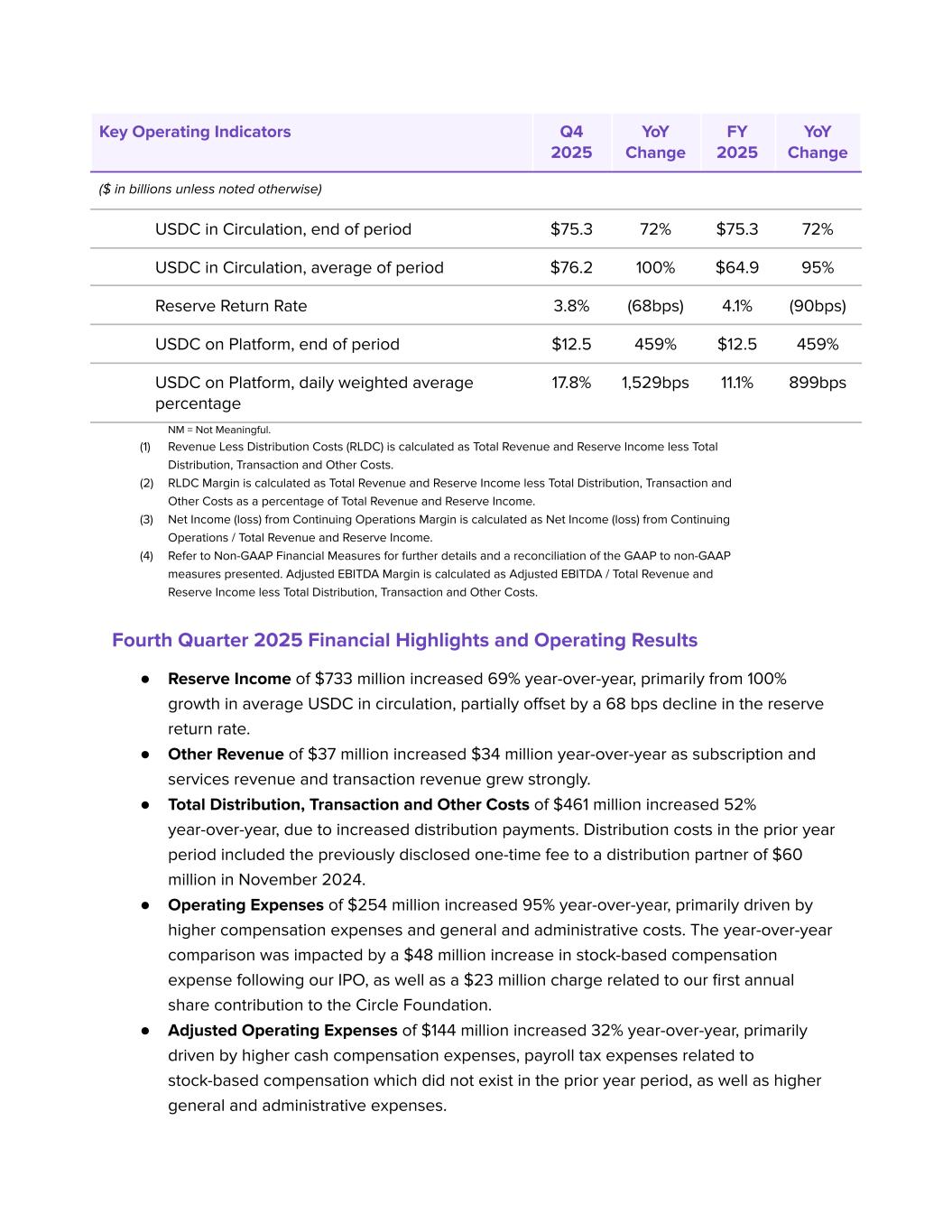
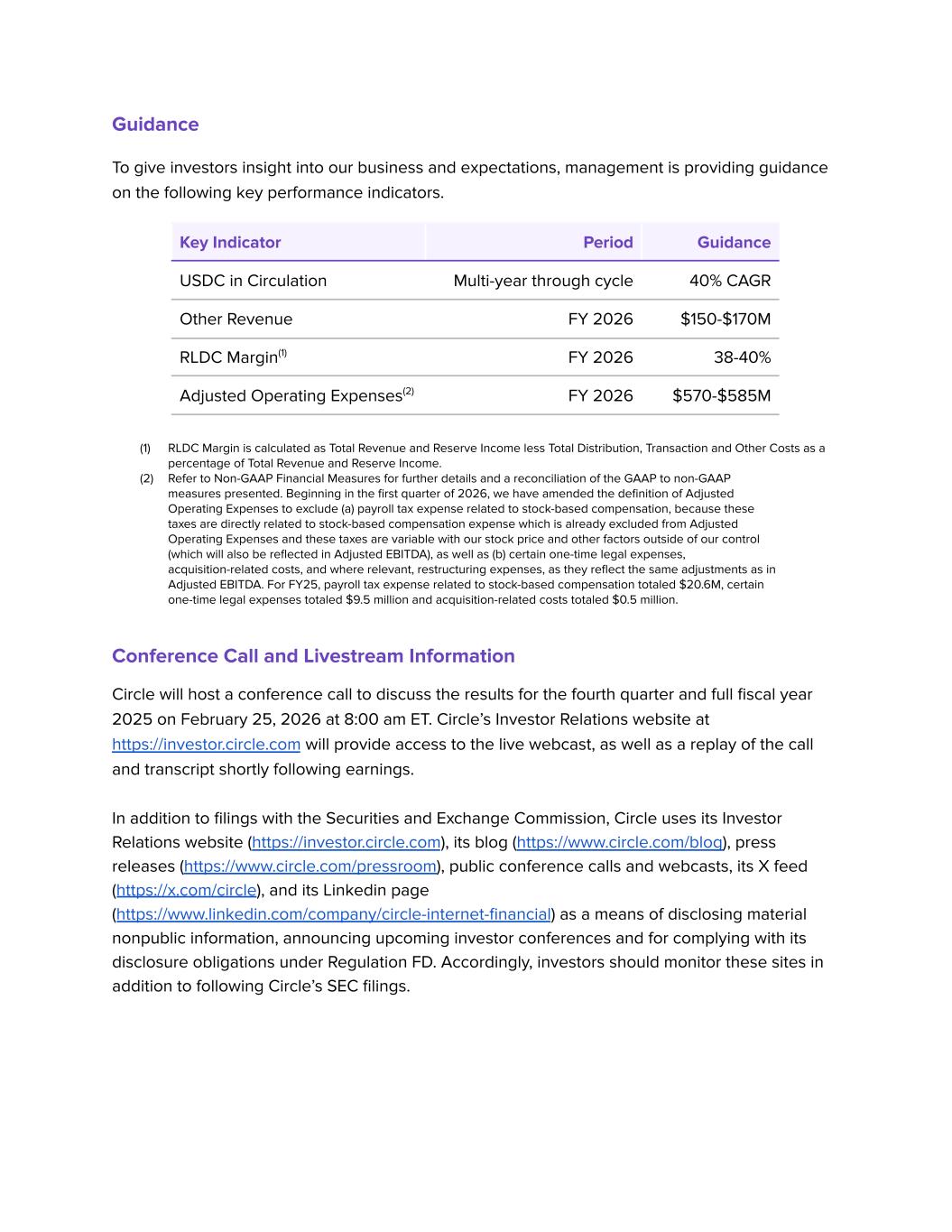
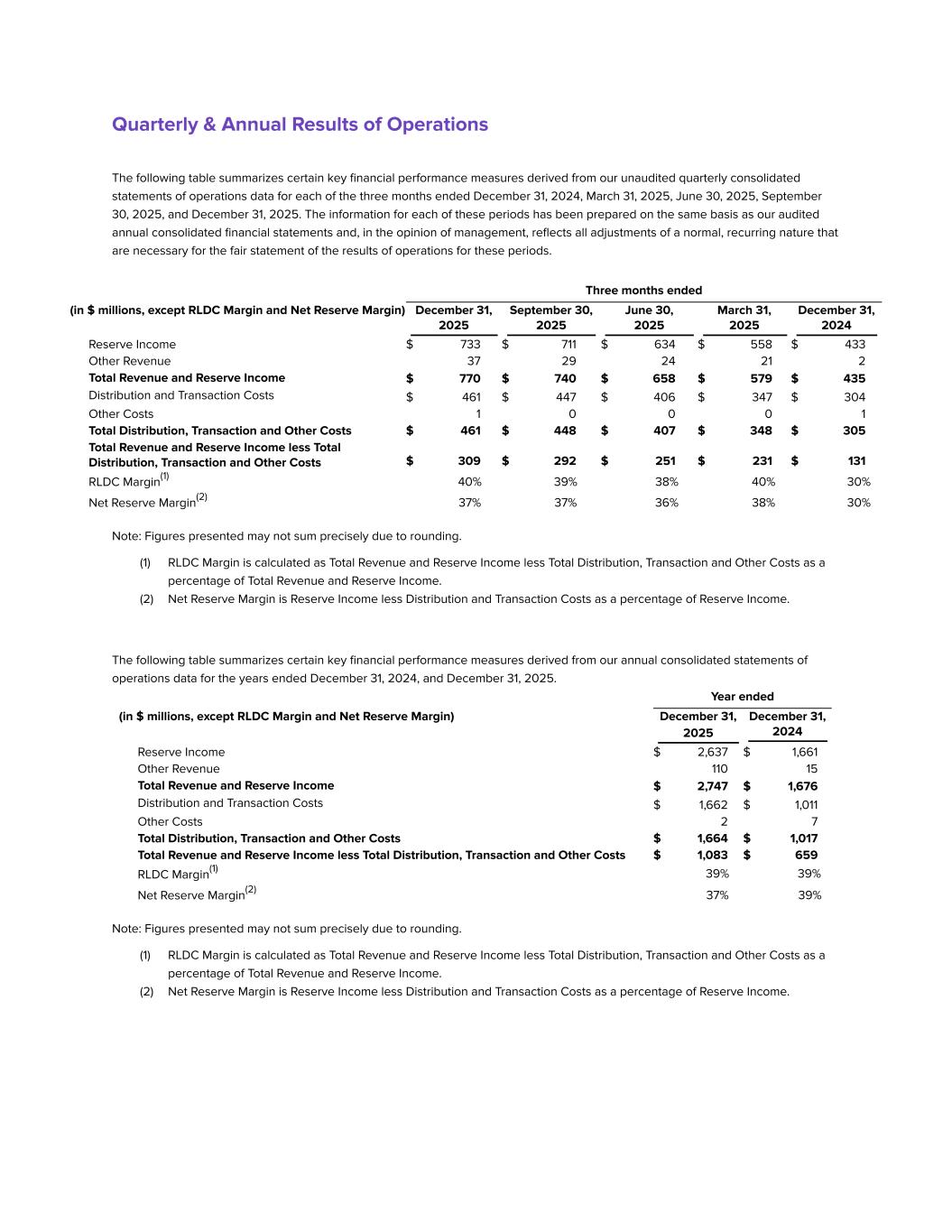
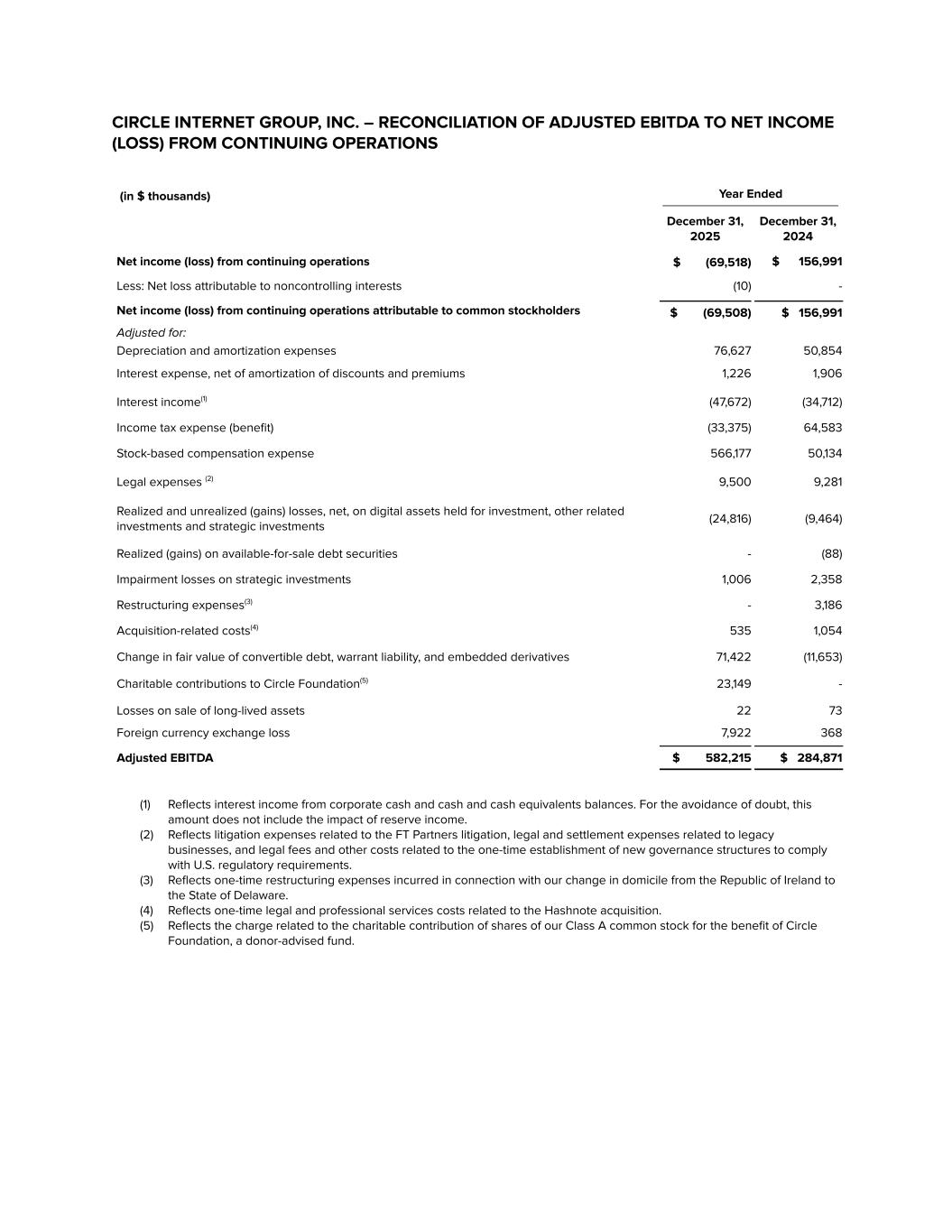
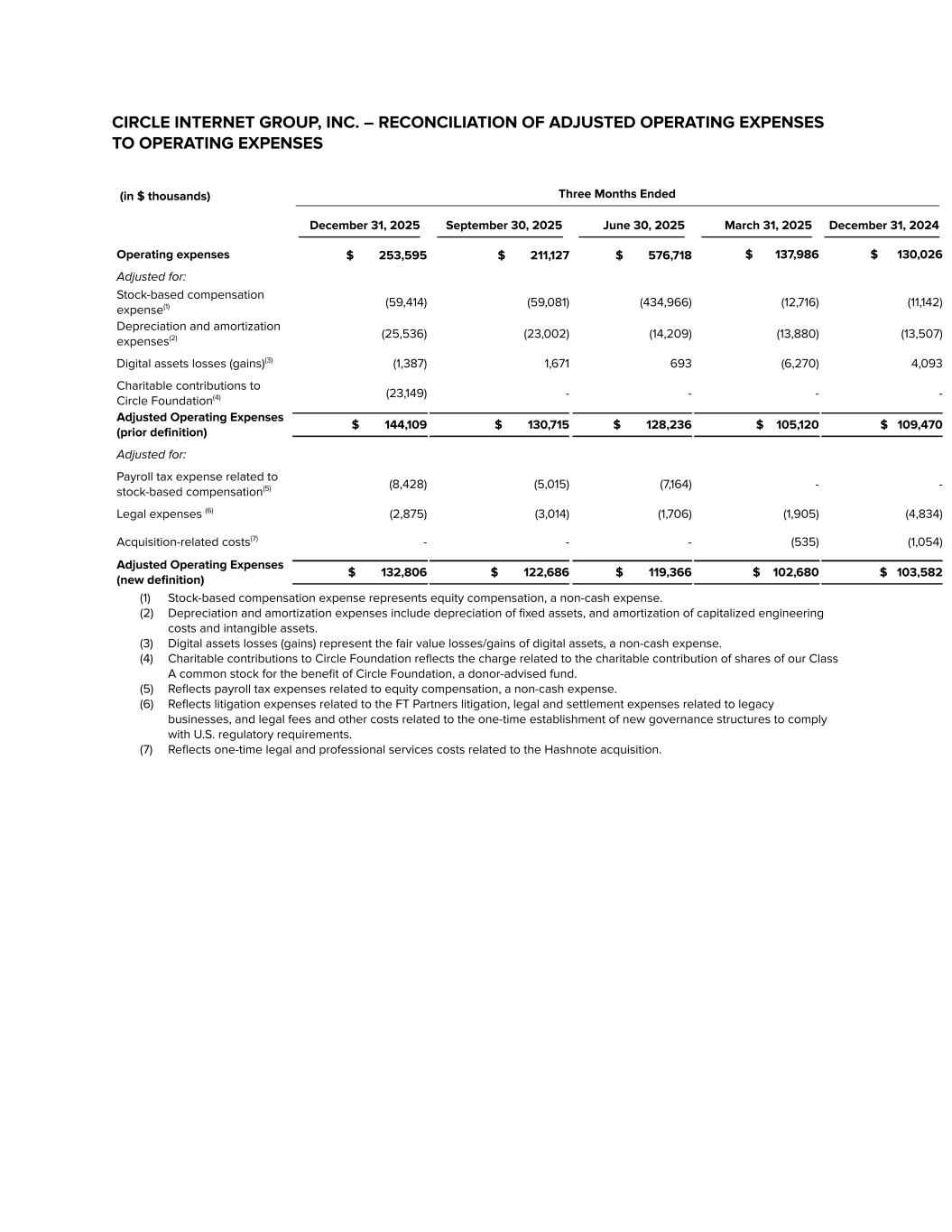
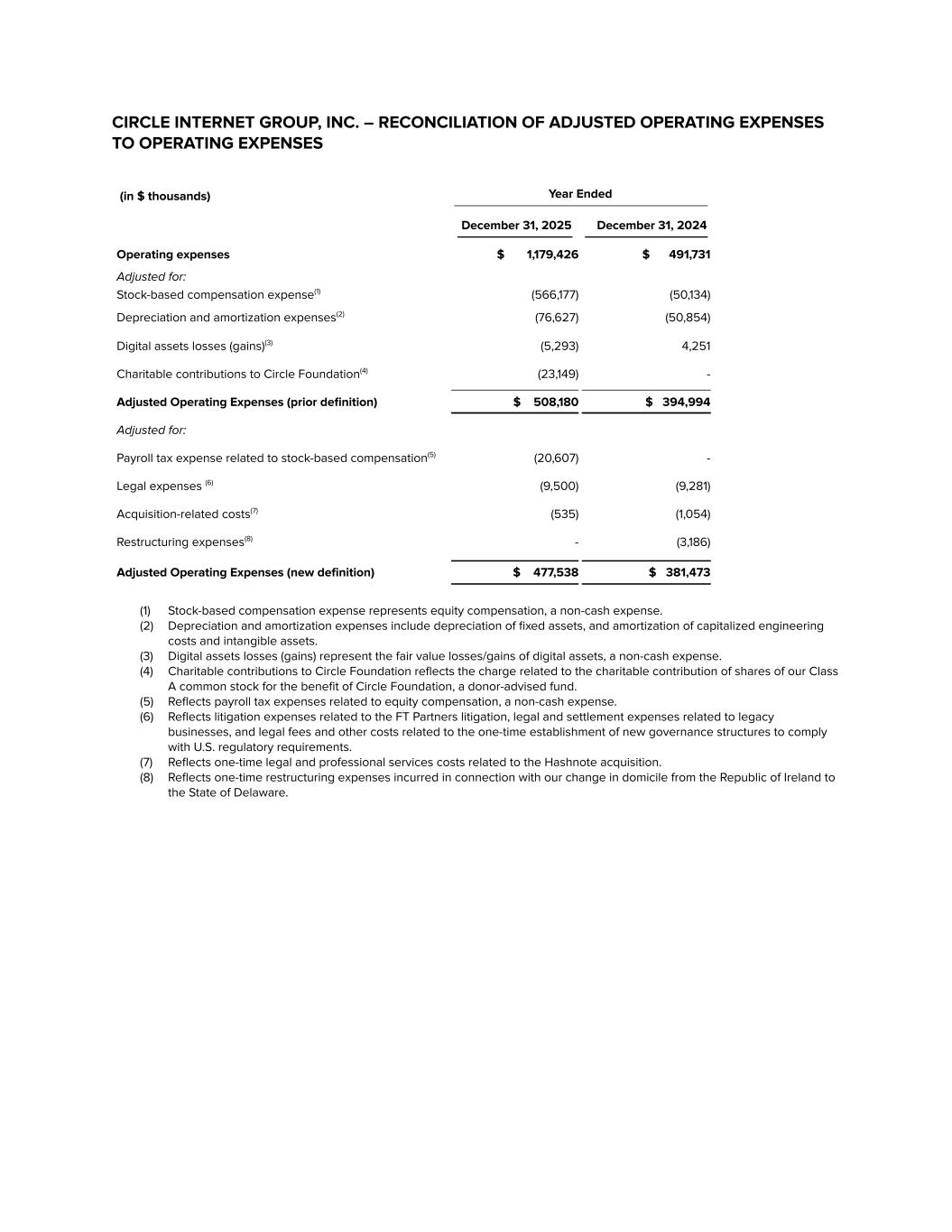
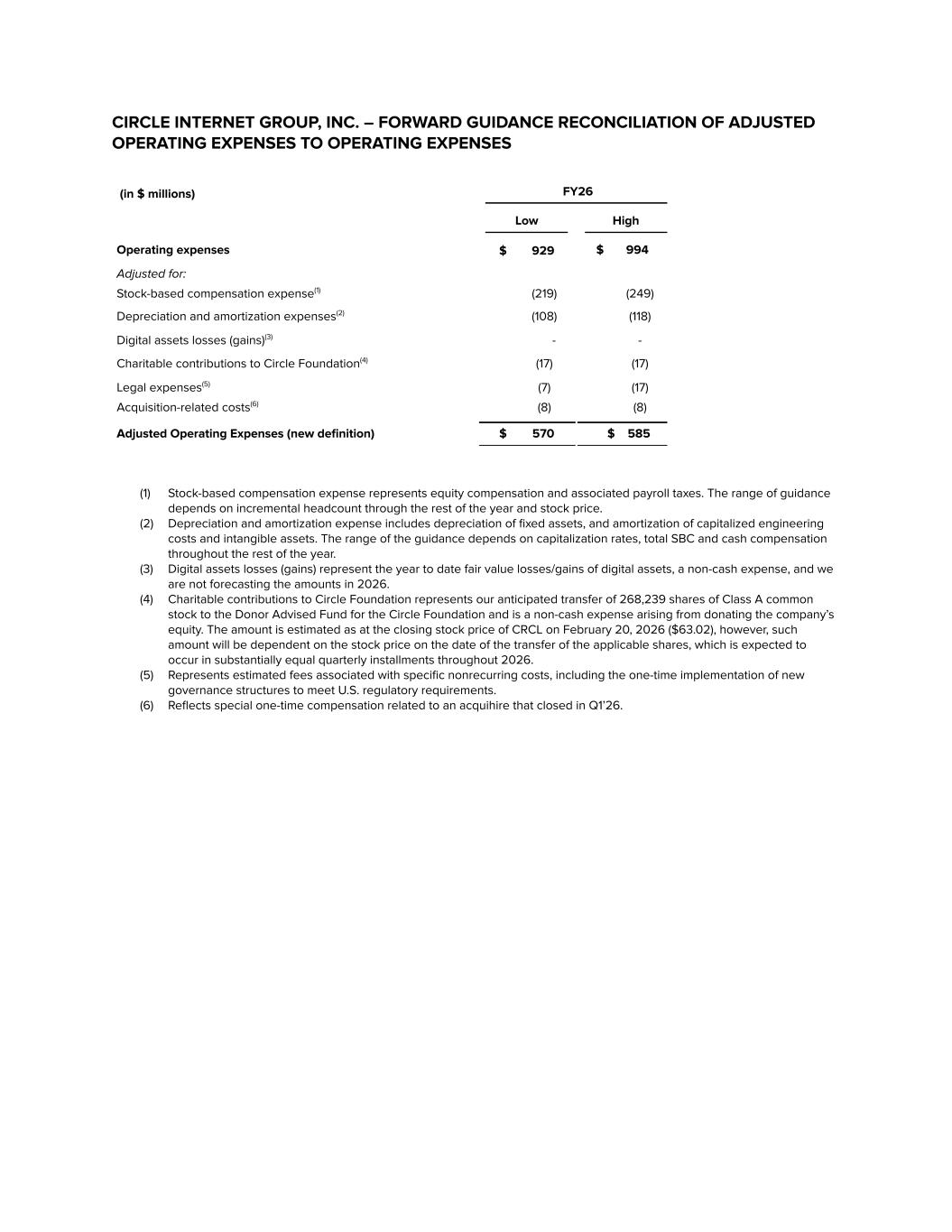
Thank you, Jeremy, and good morning, everyone. I'm pleased to report we delivered strong financial results in the fourth quarter and full fiscal year, closing out an exceptional year of growth and momentum for Circle. I'll start by reviewing the quarter and then provide our forward guidance. USDC in circulation was $75.3 billion at year end, up 72% year-on-year, and notably grew faster than the overall fiat-backed stablecoin market. USDC held within Circle's platform infrastructure, or on-platform USDC, grew 5.6 times year-on-year to $12.5 billion at year-end, representing 17% of total circulation. The reserve return rate was 3.81% for the fourth quarter, down 68 basis points year-on-year, reflecting the decline in SOFR during this period. Total revenue and reserve income increased 77% year-on-year to $770 million for the quarter, as growth in average USDC in circulation and other revenue was partially offset by the lower reserve return rate. Total distribution transaction and other costs increased 52% year-on-year to $461 million. I do want to remind you that distribution costs in the fourth quarter of 2024 included the previously disclosed one-time payments of $60 million to a large distribution partner. Revenue-less distribution cost margin was 40.1% in the fourth quarter, with a modest quarter-on-quarter increase of 0.6 percentage points, primarily reflecting the impact from growth in other revenue. Other revenue increased to $37 million in the fourth quarter. Subscription and services revenue was $24.7 million in the fourth quarter, primarily from revenue associated with our blockchain network partnerships. Transaction revenue was $12.2 million, primarily from blockchain rewards revenue, where our revenues from running a supervalidator on the Canton network increased substantially as Canton coin began trading during the quarter. Total revenue and reserve income, less distribution transaction and other costs, grew 136% year-over-year to $309 million in the fourth quarter. Adjusted operating expenses grew 32% year-on-year to $144 million for the quarter, as we continue to invest in growing our platform and distribution at this pivotal time for our industry. Adjusted operating expenses include payroll taxes, including payroll taxes related to stock-based compensation, which were $8.4 million in the fourth quarter, while we had no such expense in the prior year period. Beginning in the first quarter of 2026, we have amended the definition of adjusted operating expenses. First, to exclude stock-based compensation payroll tax expense to align with our treatment of stock-based compensation expense. And second, to exclude certain one-time legal expenses, acquisition-related costs, and where relevant restructuring expenses, all of which totaled $2.9 million in the fourth quarter, as they reflect the same adjustments as in our adjusted EBITDA measure. Based on this amended definition, adjusted operating expenses would have been $133 million in the fourth quarter and would have grown 28% year-on-year on a comparable basis. Adjusted EBITDA grew 412% year-on-year to $167 million, reflecting the operating leverage inherent in our model. The prior year adjusted EBITDA included the one-time distribution payment that I previously mentioned. Adjusted EBITDA margin was 54% in the fourth quarter. I want to take a moment to briefly recap our FY25 guidance and results. First, our guidance philosophy. We are building our business for long-term success, and moreover, several of our most impactful performance drivers are visible to the market in real time. As such, we do not give detailed quarterly or full financial guidance. We guide only on certain metrics to help our investors better understand our expected performance trajectory. We will update this guidance when we expect our performance to materially deviate from guidance. USDC in circulation at year-end grew 72% year-on-year. FY25 other revenue of $110 million exceeded our guidance of $90 to $100 million. Fourth quarter results came in better than expected, largely driven by a $7 million benefit as Canton Coin began trading. FY25 RLDC margin of 39.4% exceeded our guidance of approximately 38%. Fourth quarter margin came in better than expected, driven by the combination of other revenue outperformance as well as a sustained reserve margin. FY25 adjusted operating expenses of $508 million was in line with guidance. Let me conclude with comments on our guidance for FY2026. We do not give guidance on USDC circulation or growth. We are at the beginning of meaningful shifts in the global markets for money, and we expect both long-term growth and quarter-on-quarter variability. As previously noted, we would anticipate USDC to grow at a 40% CAGR over a multi-year through cycle. We anticipate FY26 of the revenue to be between 150 and 170 million dollars. We anticipate the FY26 RLDC margin to be between 38 and 40 percent. We anticipate the FY26 adjusted operating expenses to be between 570 and 585 million dollars, reflecting growing investment in building our platform, capabilities, and global partnerships. As noted before, beginning in the first quarter of 2026, adjusted operating expenses will exclude payroll tax expense related to stock-based compensation, which totaled $20.6 million in FY25, as well as certain one-time legal expenses, acquisition-related costs, and where-relevant restructuring expenses, all of which totaled $10 million in FY25. Our 2026 guided range reflects this definitional change, as does the FY25 comparable figure on this slide of $478 million. Overall, we have delivered a strong close to a critical year for Circle with meaningful growth and strong profitability. We are only just beginning to attack the opportunity before us, and we remain excited about our future. I want to thank the team here at Circle for your continued hard work and thank our investors and analysts for your support and engagement. With that operator, we can now start the Q&A portion of the call.
Operator
Ladies and gentlemen, we will now begin the question and answer session. As we enter Q&A, we ask that you please limit your input to one question and one follow-up. As a reminder to ask a question, please press the star button followed by the number one on your telephone keypad if you would like to withdraw your question please press star one again one moment please for your first question your first question comes from the line of devin ryan of citizens bank please go ahead uh good morning thanks for taking the questions here um i want to start on kind of this agentic evolution you know i think it's a compelling case uh and just want to get a sense of how you think from a timing perspective this plays out?
And does it start with trading liquidity and then progressing to payments and borrowing and lending? Or how do you see that? And then how do you make sure that USDC is in the middle of that? And can ARK perform relative to other layer ones technically to support this? Thanks.
Thank you. It's a great question. And it's something that we are spending a lot of time on. You know, when we designed ARK and announced and rolled out the testnet, we talked specifically about this agentic economic activity as a fundamental design center for how we saw autonomous software, autonomous agents, and others conducting economic activity on the internet. And, you know, it kind of speaks to the bigger backdrop of the early vision of the company, which is programmable money and what that allows and machine-intermediated money and what that allows. And we're really seeing this convergence happen as we speak. And so we started our journey not just in the design of ARK, but with USDC by making sure that we're participating in all of the key standards for agentic payments and value movement, helping contribute to what's called the X402 standard, the agentic payment standard from Google. We're part of the AI agent consortium. So we've been engaged and involved, but something happened really a month ago, which is this turning point with Claude, Claude Code, what's now called OpenClaw. And we really saw this kind of incredible leap in the ability for the average person, but also sophisticated developers to spin up agents to do an incredibly wide array of tasks. And obviously, we're all seeing that out in the market. And what's been interesting to see is that there's been this direct and immediate pickup where AI agents are realizing and the developers of those AI agents are realizing that agent to agent transactions need a reliable, low cost, trusted medium of exchange. And so virtually all of the AI payments infrastructure that we're seeing, the agent to agent type activity is happening with blockchains. It's happening with USDC. So that's been very, very encouraging. And we're doubling down on that in a pretty significant way. Now, I think two other parts your question um you know what what's the ramp on this i mean i think this is this is a one of the great uh known unknowns or however you might want to put it which is what is the uh are we are we having a kind of takeoff moment the collison brothers yesterday talked about we you know q126 might be the takeoff moment for the singularity we may look back at that and i think the technology shifts that we've been experiencing are indicative of a kind of takeoff. And that leads to the uses, which is AI agents consuming work from other AI agents, the kind of collaboration amongst AI agents, AI agents distributing out work to humans, humans consuming from AI agents. All of these are happening. We've seen AI agent marketplaces launch just in the past weeks where AI agents can employ human workers to conduct tasks and be compensated in USDC as the medium of exchange. We're seeing AI job boards where AIs can hire each other and use USDC as the way to make those payments. So this is happening very organically. And I think from our perspective, as businesses and startups build products around agentic economic activity, the natural place that they're going to do that is with stable coins and on blockchains, which leads to part of your other question, which is really around ARK. ARK is purpose built for this moment. ARK is built with a validation and consensus model that can support scale. ARC is built with an economic model where we can drive the cost of transactions in high-performance kind of channels down to one one-thousandth of a penny. And in fact, we just went in testnet last week with a feature that is designed for autonomous agents called Circle Gateway, which is a feature that would allow autonomous agents to hold a balance and spend not just on ARK, but on other networks and have a transaction cost of one one thousandth of a penny and get that value moved in less than a second to all these other apps and services that are out on these networks. So we're building the primitives, we're building it at the operating system level, the infrastructure level, we're building the tooling, and we're really engaged in actually marketing to agents that are autonomously out there and want to build. So a lot more to come from us here, and we're really pleased. And I think we, again, we talk about money velocity and how effectively, you know, networks and infrastructure like what we've built will lead to higher and higher amounts of money velocity. And my own view, which is, you know, in my opening comments as well, is in a world of tens or even hundreds of billions of AI agents, the velocity of money is just going to be multiple orders of magnitude higher than it is today in the existing economic system. And so we're building a new economic infrastructure. We're building a new internet financial system. And I think we're very optimistic that Circle can play a really key role in this convergence between AI and stable coins and blockchains.
Yeah. Thank you, Jeremy. A great, great response.
And it will be fascinating to follow this evolution um maybe this is a faster follow-up but on um just arc token you know any update on kind of the considerations there how that's evolving and then uh any sense of timing of when you might make a decision on whether you would launch a token for arc yeah um a couple things i could say i think we're continuing to explore the arc token uh it's i think a very good exploration, we're getting a very good understanding of how a token can play a key role in providing stakeholder incentives, governance, security, utility, and other things on the ARK network. And so that exploration continues. We aren't communicating about any specific timeline or other because we're still in that exploration. But as noted, we're making tremendous progress with ARK. And we're making very strong progress towards ARK mainnet. And we're very excited to see that, you know, come into play. And we expect to see some amazing companies participating in running the ARK infrastructure, deploying apps on the ARK infrastructure, and also providing foundational infrastructure to asset issuers and AI agents, you know, a wide array of use cases on it. So we're pleased with the progress.
And of course, as we have more to say about that, we'll share that publicly okay excellent thanks so much your next question comes from the line of joseph bathy of can occur genuity please go ahead hey guys uh great progress just um maybe we'll just uh talk regulatory backdrop a little bit um jeremy and jeremy a genius has been uh in uh in place now for a couple quarters just wondering what kind of tangible signs of progress you've seen directly from Genius. And then, you know, the follow-up would be on Clarity, you know, where we sit now, your views on it. You know, clearly the stablecoins are kind of in the middle of the compromise and discussion there. So your comments and thoughts there. Thanks.
Sure. So first on Genius, Genius has absolutely continued to be a tailwind for our business and I think the sector as a whole. It has created this legal foundation for major institutions to come into this market. We've seen follow-on guidance from the likes of the SEC and the CFTC as they're clarifying how effectively what would be genius-compliant stablecoins can be used as collateral on CFTC markets. The recent SEC guidance in terms of the haircut treatment on stablecoins for broker-dealers, which is a big breakthrough in terms of how stablecoins can be used in capital markets. And I would just say, broadly, banks, payments companies, tech firms, large enterprises around the world are leaning in and wanting to weave stablecoins into the product strategies. And so it's also spilling over into international markets where international regulators are also saying, okay, well, we now need to kind of acknowledge genius-compliant stablecoins as the sort of good stablecoins that could be allowed in their markets. And that's really strong from our perspective. So we think it's been very positive and will continue to be positive as it goes effective and as some of these OCC licenses start to come through as well, which will impact large issuers like Circle. On Clarity, I mean, Clarity is very close to the finish line right now. I know we're very close to the issues. There's a lot that's been reported. I think the most recent reporting seems accurate, which is that, you know, the crypto industry and the banking industry are working, you know, day over day, week over week at a staff level and with the White House to come up with some compromised language around, you know, the different kinds of rewards that people can get for holding stable coins or using stable coins and how they use them. And my sense is that, you know, everybody wants to figure this out. There's there's there's a lot in this for banks, capital markets, asset managers, the crypto industry as well. And so right now I'm cautiously optimistic about it. But obviously, D.C. is D.C. and and all the dynamics of the spring and everything else. You know, it's not my job to handicap. There are probably analysts at some of your firms that can do that better. But we're cautiously optimistic, and we do think that with Clarity Act, if it does come to pass on a bipartisan basis, is another significant unlock for building in this space. And we'll certainly talk about that in the future, but we think it's a very, very significant unlock for the development of this market and the use of blockchains in a far broader range of applications as well. Sure. Thanks very much, Jeremy. You're welcome.
Operator
Your next question comes from the line of John Todaro, if need them. Please go ahead.
Hey, thanks for taking my question. I guess just going back to ARK and then maybe CCTP in there as well, you know, things like the evolution of these could long-term become kind of asset agnostic. ARK could be just a broad asset tokenization platform for assurance of equity, some of the other assets. I guess just, yeah, Jimmy, what are your thoughts on kind of that evolution long-term, I don't know if we could just go a little bit more into the long-term vision park.
Yeah, absolutely. So, you know, the conceptual model for ARK for us is this is an economic operating system. It is a distributed economic operating system. That distributed economic operating system is going to be operated by a collection of known leading financial infrastructure companies, including Circle, that will run the infrastructure to support the compute, the transactions, and the like, and the data on these networks. And it's designed for, you know, prudentially sound financial activity and economic activity. We think that's necessary to build the real-world economy on the Internet. Within that, though, we want to make sure that as a safe and sound and secure foundation that it has several things that are important to financial system actors. We want to make sure that it has the single best, most capital efficient liquidity for digital dollars in the world. And so marrying what we do with USDC to what we're able to do with the technology in ARK, we believe we can create the most capital efficient and fast digital dollar kind of liquidity model in the world. The second, which relates to another part of it, is we really think about ARK as a liquidity and distribution hub for other asset issuers. And so we're building technology, and this technology builds on the incredible distribution we've already created with CCTP. We're building technology that would allow an asset issuer, whether it's a tokenized equity, a tokenized fund, a tokenized bank deposit, other stablecoin issuers, and any kind of asset that can be imagined that can be tokenized, to be able to be issued on ARK and then be able to turn on liquidity and distribution on other blockchain networks. So if I'm issuing a tokenized stock and I want that tokenized stock to be able to run on Robinhood's L2 and on Coinbase's on-chain exchange and on some other tokenized environment that supports these assets, the people who are issuing assets really need to know that they can do it in a safe way, in a liquid way, and have that kind of distribution. And so we've built the highways. CCTV in January was over 60% of all traffic moving across these different networks. And with the new technologies that we're bringing into ARK around this, we believe that we can light up those highways for any asset issuer. And so, again, back to the vision side, big picture, this is a general purpose OS for economic activity on the internet. As we come into the market in this environment where we have demands from people who want to build very, very cost-efficient, capital-efficient AI transactions, we have demands from people who want to build tokenization applications and get liquidity and distribution for those, we think ARK and our interoperability infrastructure will be very, very well-suited for that environment.
That's great. That's very helpful. And then I guess just as a follow-up, going back to the agentic AI comments, I would agree with you. Just with the way some of the crypto equities have been trading and then just the crypto token market in general, is agentic AI and payments and all that within those ecosystems, do you see the excitement kind of extending beyond stable coins in ARK? Could this be a general tailwind for the sector?
I mean, I think this is one of the most exciting, obviously I'm biased, but I think this is one of the most exciting kind of points of convergence out there. If I'm a developer building AI agents and I want to build AI agents that can enter into contracts with other agents, that can enter into contracts with humans, that might have disputes, that need proof of data or things that happen, that need to execute those contracts and move money. if I'm thinking about building an organization that mostly consists of some humans and some AI agents, and I want to build the underlying governance mechanisms for how that's going to work, blockchain infrastructure is going to be how that happens. We need cryptographic proof. It's the only thing that will allow us to trust the activity and the data and the transactions of these agents. And so we're seeing that in our developer activity. We're seeing that in the ARC developer engagement where startup founders who are coming in from the AI space are realizing like this is kind of a backplane that is really, really helpful. And if you go back and think about other big platform shifts, there was sort of sometimes there's these sort of two sides of the coin. And you had the rise of mobile, which was obviously this surface area for creating applications. And that corresponded to the rise in cloud platforms, which could actually be the backend and scale the backend for mobile. And so they work kind of hand in hand. And so I very much believe starting now, you know, really starting now in 2026, that AI platforms and these blockchain operating system platforms will be kind of hand in glove for people who want to build for this new AI driven economic system.
Thanks for all that and congrats on the strong quarter guys.
Operator
Your next question comes from the line of Pete Christensen of Citi. Please go ahead.
Thank you. Good morning. Impressive and rapid progress on a number of fronts here in the competitive moat looks stronger than ever um jeremy i was wondering if you could provide some underlying color on cpnr boarding and flow and flows perhaps initial use cases sense of stickiness growth per fi partner that sort of thing and then as a follow-up regarding the conversation on agentic commerce which looks incredibly compelling how should investors think about this opportunity, transforming circles operating slash financial model? Thank you.
Sure. So on CPN, as you saw from the results, we are seeing very steady and very strong growth in the kind of key things that we're focused on now, which is when we launched this last June, it was at sort of state zero with no financial institutions or just a couple, and the technology just getting off the ground. We have been progressing through product iterations and then commercial iterations. As noted, we now have 55 financial institutions on the network. That's up sequentially considerably. The number of financial institutions wanting to add to the network continues to grow and be robust. And then the flows, which I can characterize a little bit more about, the flows have grown as well. So from a standing start to, you know, an annualized TPV of about $5.7 billion as of last Friday, up, you know, I think 68% since the last time we talked to you guys, we're very pleased with what we're seeing there. We are, a couple of things I'd say is there are more and more larger types of firms that can support larger flows that we're very focused on coming onto the network, and that's a key goal. From a product perspective, we want to increase the velocity of everything that happens, the velocity of how these members can join and implement and operationalize. For a lot of financial institutions, they've never dealt with blockchains they've never dealt with stable coins and so kind of streamlining how they can do that um and um and then making sure that the highest demand corridors have good redundancies have good players in those but what we're seeing in terms of use cases is um this is uh uh very much b2b cross-border merchant settlement uh as major drivers and we're seeing that in the in the markets that you would not be surprised to see, you know, businesses that are exporters out of Asia and importers in both other emerging markets and developed markets. We're seeing some application flows that are very clearly can be south to south and north to south remittance applications. So we're seeing the use cases we want to see. There's certainly a lot more to come there. And we're, you know, again, very pleased with the success. I made the comment on the earnings call that we've got a lot of product investments here. We, you know, we have ambitious goals here in terms of what this can scale to be. And, you know, ultimately, obviously, as this starts to get to a more meaningful scale, we can start to monetize this and our partners are already starting to monetize this. So that's a bit on CPN. And then on Agentic and kind of the impact for us. We think about this in a few ways. I think one is just as a major new demand driver for the utility of our stablecoin network. So AI agents as consumers of this, as essentially end customers in a sense that are driving stablecoin transaction volume, driving balances of stablecoins, driving stablecoins out into more use cases and businesses that are not crypto native, but are kind of interacting with this new agentic economy. I think it's a way for us to kind of accelerate into other types of software-based institutions that see that they need to have their products be consumable by AI agents and maybe with different pricing and economics. and where, again, the standards that we're building around agentic payments could play a role. But also, this can drive fundamentally traffic on ARK and growth on ARK. And over time, as we've noted, we believe that ARK can create new kind of transaction-based revenue streams. And so the velocity of that, the scale of that is, again, early, but we think could be very significant over time. And those are a few of the things. And I think we'll have more to say about this, obviously, as it progresses. But what we've seen literally just over the last three to four weeks has been really eye-opening. And we've been happy that we've had product and technology ready to go for, and we have been working on some of the standards in this space now for some time and are ready to go for this kind of liftoff moment that seems to be happening.
Thanks. Super helpful caller. Thank you.
Operator
Your next question comes from the line of Dan Dolo of Mizuho. Please go ahead.
Hey, Team Circle, Jeremy. Great results here. Really nice to see that. Congrats. I wanted to ask you about the opportunity specifically in prediction markets and your partnership with Polymarket. Just in general, like, you know, why is USDC so critical to, you know, this very fast-growing segment? And, you know, what should we expect, you know, in the coming quarters and years from that very interesting partnership? Thank you.
It's a great question, Dan. I mean, I think, you know, when we think about the adoption of our stablecoin network and our broader infrastructure, we're always kind of asked, like, well, what are the killer apps? And we have lots of different killer apps that are emerging. We see cross-border payments is one of those. Obviously, historically, crypto trading, we're seeing agentic emerging tokenization and so on. But prediction markets is absolutely one of those. We've been very fortunate that we made big bets in the kind of on-chain ecosystem early on. And so USDC is sort of systemic and critical to a lot of on-chain applications that were built over the past three, four, five years. And Polymarket is one of those. And so with Polymarket, we've been able to work closely with them to kind of advance how they use our technology to improve the experience for their customers, improve what they can offer to their users, make it a more seamless experience. But what something like USDC does and our infrastructure does for a prediction market But like polymarket is, you know, people want to be able to move quickly. You know, the sort of essence of markets in general, but prediction markets in particular, is these are information markets and people want to be able to move quickly. And so stable coins give, you know, end users and people who want to participate in these markets the ability to basically provide collateral and settlement at the speed of the Internet and do that from lots of different wallets, from lots of different markets all around the world. So it opens up global access in a more seamless way, and it gives a firm like Polymarket a good infrastructure to kind of store that and surface that to users. Now, USDC is now offered as a way to fund your Cauchy accounts. USDC underpins Coinbase's prediction markets. You can use USDC to get funds onto Kraken or Robinhood, and obviously they're offering prediction markets. So there's more to see here, and we want to work with the leading players and make sure that the best digital dollars, whether for settlement or for collateral, are used in all these places. And having the world's leading player kind of adopt this and build on this with us, we think, is a very positive win. And obviously, everyone has been tracking the growth and success of Polymarket, which has been pretty astounding and obviously still early days in these markets.
Very impressive. Thank you. Thanks, Dan.
Operator
Your next question comes from the line of Ken Worthington of JPMorgan. Please go ahead.
Hi, good morning, and thanks for taking the question. USDC on Circle Platform rose to 17% in 4Q. As we think about 2026 and the new initiatives you have underway, what is a reasonable range of outcomes in terms of where that mix can go for Circle, and what relationships or initiatives are likely to be the biggest drivers of incremental on-platform USDC, say, over the next 12 to 24 months?
Thanks, Ken. And we're, you know, we're very pleased with the, you know, 5X growth year over year in that, you know, a couple of things. I think that the first is we're continuing, we are continuing to build infrastructure products that are valuable for kind of holding and using USDC. And we're doing that across our wallets products. We're doing that across products like Circle Gateway. way. We're doing that in Circle Mint and in many, many places that we interface with customers and developers and people building on us. And the fundamental premise here is that more and more major institutions, whether those are financial institutions or others, are going to want to build on our infrastructure. And ARK, for example, is a driver because ARK is our infrastructure and it It will be wired really well into Mint and wallets and Gateway and these other infrastructures. And so these can all work together to drive more applications, more money flow, and more money stock to use Circle Technologies. And that contributes to what can be on platform USDC. And so in many respects, it's just continuing to build these institutional partnerships with this wide diversity of companies that will continue to help us grow that. I would say, you know, that's sort of the high level on that. We're not guiding, obviously, anything on that. But I think, you know, you've seen the direction of travel. We continue to focus on building great infrastructure people want to build on. And one other note is, you know, we have received conditional approval for Circle's National Trust Bank, First National Digital Currency Bank. That is obviously something that is important to USDC and USDC reserves and ultimately how we work with the OCC under the Genius Act. It's also something that can strengthen the custody infrastructure that we provide to market participants. And so you can expect us to pursue that. And I think as we build that as a kind of fiduciary and security and operational apparatus that has some of the protections that come with a trust bank, we think that is additive to our on-platform capabilities as we go out into future quarters.
Yeah, and I'd just add on to that, Jeremy talked about the expansion of our platform infrastructure and the products that we have that make it more attractive for world-leading enterprises to build upon Circles platform and technology. But I'd also add all of the rest of the infrastructure that we've built that underpins what we do is part of that. Our broad-based global banking and liquidity infrastructure is unmatched in the stablecoin space. The broad network of users and developers and other enterprises building on USDC only makes it more attractive for any one additional major enterprise to choose to use USDC. And of course, we're positioned as neutral market infrastructure.
We're not competing with any of the enterprises and the developers who build on our infrastructure for that customer great thank you very much your next question comes from the line of jeff cantwell of seaport research please go ahead hey thanks a lot i'll ask both of mine up front i was wondering first if you can give us the building blocks for your other revenue guidance of 150 to 170 for this year what is causing the step up your mind's just breaking that out for us versus 2025 and then again on arc just to kind of uh get a little more comfortable with the strategy and the rollout as you're getting closer to the mainnet launch do you mind giving us maybe at a high level what the rollout plan is post going to mainnet and i guess i'm just curious do you foresee a world where elements of arc and elements of cpn mesh together to deliver more value for clients and new customers. Thanks a lot.
Yeah, thank you. Maybe I'll take the second question, and then Jeremy Foxkeen can take the first question. So on ArcMainnet, a few things. The first is we're making great progress. And as noted, the technology infrastructure through Testnet has been strong. The usage has been strong. the growth in in transactions and activity and developer activity we're very pleased with when we think about that transition from test net to main net there's a couple key things that we're looking at so one is you know there are technologies that we still want to make sure are available to all of the users of arc network before we go to mainnet and I alluded to some exciting technology. So these relate to things that are valuable to institutions doing tokenization and are valuable to AI agents doing activity on these networks. So we've got some technology delivery. But importantly, we've said publicly that the first phase of ArcMainNet is going to be what's called a proof of authority validation. And that's really bringing on that first wave of strategic partners that are going to be working with us to run the ARK Network infrastructure. And we want to make sure that we have world-class financial infrastructure companies who are running the infrastructure with us. And so if you're a developer or you're an institution or you're an end user, you will understand that ARK Network is run by some of the leading financial infrastructure companies of the world, which is really, really key to not just trust and reliability, but ultimately to governance and how we think about this going forward. So that's a key piece. The second is, you know, we are working closely with the entire digital asset ecosystem across enterprise tools, custody, wallets, exchanges, everything that's out there to make sure that everyone is ready for that day one. And so we want to give everyone time to get all their infrastructure ready. And that includes deep integration across Circle's existing product stack so that, for example, on day one, when we go mainnet, USDC liquidity, for example, is the best in the world, is the most capital efficient in the world, and becomes an attractive way for value flowing on the internet to kind of come through ARK. So there's work there. There's work with mainstream companies who are in that testnet group that we announced, who are looking to commit to launch products on ARK and making sure we have the right mix of use cases across capital markets, payments, FX, Agentec, and the like. And so that's a key thing in getting those all ready. And then to your last part of your question, ARK is going to be a key infrastructure for CPN. ARK will provide a very strong infrastructure for speed, reliability, prudential safety and soundness, efficiency. It simplifies flows because people only need to hold a stablecoin in order to use it. But it also has all the interoperability features built in. So ARK has best-in-class interoperability. And so if an endpoint on CPN needs to interact with a wallet that is on a different network, ARK actually gives those members on CPN the ability to really easily get conversion into those other networks. And so ARK becomes a backplane for CPN and relatedly stable FX, which is a key application that runs natively on ARK, will also become the FX backplane to support ARK transactions. So a transaction between a euro and a dollar or a euro and a peso or a dirham and a peso, you pick what it is, we're bringing other stable coins onto ARK and we're bringing other stable coins and market makers onto StableFX. And that's going to allow us to provide real-time, atomically swapped liquidity across currencies, which just speeds that conversion in settlement and settlement assurances, reduces the amount of capital people have to tie up and the like. And so ARK, StableFX, CPN, and CircleMint kind of working together are going to support, I think, key things as we go into ARK mainnet.
And Jeff, I'll take the first part of that question. So the other revenue, that was $36.8 million in the quarter. And that was roughly $25 million from subscription and services revenue and $12 million from transaction revenue. Within those categories, within subscription and services revenue, the largest part of the revenue we earn within that is revenues from our blockchain network partnerships which have both upfront and recurring elements we've talked about how the upfront um depending upon the number of integrations and the number of partnerships we strike can be a little bit lumpy quarter on quarter and how the underlying recurrings are building up over time as we bring more and more of those online and we execute against that pipeline um which is strong also within that are asset management fees on the usyc tokenized money market fund which are relatively small today, but obviously have potential going forward. Within transaction revenues, there's a, as I think we've said before, there's a number of different pieces in that. There's fees from value-added products like fast redemption for USDC, for CCTP fast transfer. That's where you'll see fees over time from the Circle Payments Network. In addition, We also run validator infrastructure, and we mentioned that in my opening remarks, is that this quarter in particular, because of the trading, the listing of Canton coin and the share price movement, we recognized unusually high revenue in this quarter, particularly for that. Now, we're not guiding on those building blocks. All of these monetizing products and services only started in their monetizable form in really the fourth quarter of 2024 and the first quarter of 2025 and onwards. So it's very, very early days for these products. But given that, collectively, this revenue line is only a year old, we're very pleased with where we ended up with $110 million for the year.
Operator
Your next question comes from the line of Ken Suchofsky of Autonomous Research. Please go ahead.
Hey, good morning. Thanks for taking the question. Circle's seen some nice leverage on distribution costs. I wanted to focus there. I mean, the coin agreement is what it is, but I wanted to get your latest thinking on what's happening outside of Coinbase in terms of distribution costs and how those conversations are going. because those non-coin-based distribution costs have been pretty stable like the last couple quarters. So just any update there would be great.
Yeah, I can take part of that. And if Jeremy wants to add anything, he can as well. I think, you know, we are in a really strong position because USDC has the strength of its network effects, which is that if you're building a product or service and you want to have a compliant, liquid, available, interoperable digital dollar, USDC is the top choice. And so what we see is just many, many products being built and launched that use USDC and connect to our stablecoin network and drive demand and drive liquidity. And that's valuable for those products. Those products are tapping into essentially this globally available, nearly free dollar payment system. And so, you know, as that happens organically, that's kind of the organic developer driven, institutionally driven flywheels that drives growth in USDC. And in those institutions, we don't need to go and do, you know, incentive deals or other things with. And so we're, I think, as we've said, we're disciplined about where we think it makes sense to have an incentive relationship, where it makes sense, where we can see that the partner can actually drive growth and can drive meaningful growth. So we look at those as factors, like where's the growth, where's the meaningful growth. And I think that contributes to, you know, the kind of strength of the fundamental kind of unit economics that we've been able to maintain here. And that's sort of the big picture. Jeremy may have other comments to add.
Yeah, I'd add a couple of things to that important strategic narrative, which is, and we've said this, I think, before on these calls, which is growth in USDC through distribution partners, some of which is incentivized, also leads to a growth in the strength of the underlying network effects around USDC, which I spoke about the elements of that earlier in this call. And that makes it more attractive for other market participants to independently build and use USDC and provide USDC-based products and services to their customers. The underlying point of that, which is any distribution relationship we have, also strengthens USDC that is not subject to any distribution relationship or indeed any incentive partnership. And that's a fundamental networks have network effects strength to our RLDC margin and our underlying economics.
Operator
Your next question comes from the line of James Fawcett of Morgan Stanley. Please go ahead.
Great. Thank you so much. I want to go back to the comments you made about the AI hackathon and the like. How do you think about the to-do list for Circle to become integral to a lot of those evolving payment networks and that kind of thing, especially when obviously there are other players or solutions like Ether or crypto more generally? Just wondering, you know, kind of what the pluses and minuses are and how you establish position in an agentic world.
Sure. Thank you for the question. I think a couple of things I'd note. The first is that, you know, Circle has invested heavily over the past, you know, four to five years to make sure that our stable coin network and essentially the pipes that support the distribution, liquidity and settlement of USDC are available on as many blockchain network platforms as possible. We're on over 30 blockchain networks. And that's key because developers who are building applications are going to build applications where their agents might anchor on Ethereum. As you note, they might anchor on Solana. They might anchor on ARK. They might anchor on a new chain that hasn't even come out. There's exciting new blockchains that are coming out. And I think we all believe that if you think about blockchain networks, these economic operating systems, like we're in the early innings of these scaling out and scaling out to the kind of velocity of transactions that AI is going to demand. And so one is we run across these networks today. And in fact, you know, we've co-authored and participated in almost all of the key agentic payment standards and the agentic payment standards like X402 and ERC 8004. It's a little jargon for those that aren't aware, but basically these are sort of agent related standards are almost all. I think I saw a statistic, and I may be wrong about this, but essentially 99% of agentic payments that have been measured over this recent period have been in USDC. So we have a first mover advantage by being on all of these networks, by being involved in the standards, by being deployed in these ways. We also make sure that all of our own APIs, all of our own protocols are surfaced directly as skills libraries to the agentic coding systems and as MCP servers so that AI developer tools can seamlessly integrate to this. And so those are all things that we started making investments in some time ago that are paying off now as we get to this kind of liftoff moment. So we feel good about those pieces. And I think now, you know, I think a lot of companies are really realizing, like, let's say you're a SaaS company, and you realize, well, maybe we're not going to sell end user seats, but we're going to sell access to our capabilities as an API to AI agents. A lot of companies are trying to figure out, well, how do you market to swarms of AI agents running around? And are there marketplaces where AIs can find things they can use? And so the sort of distribution in the AI agent world is like a new thing. And, you know, we chose, as you noted, right after Moldbook launched, we saw an opportunity to allow AI agents to compete in a hackathon amongst themselves to vote on things. And that was the first of its kind. and I think was a powerful marketing activity where that collection of AI agents are now well-educated about USDC. And so there's more things like that that you'll expect to see us do over time. But at a technology level, just kind of coming back, is we believe that ARK as an infrastructure, both because of the USDC-centric capability, the capital efficiency, the interoperability, and the kind of cost efficiency of transactions is going to be a very attractive, high-throughput infrastructure, and we're going to be leaning into that.
Operator
There are no further questions at this time. And with that, I will now turn the call over to John Andrews for closing comments. Please go ahead.
Great, Kelton. Yeah, great, Kelton. Thank you so much. And for those who couldn't get through on the Q&A line, we'll happily follow up with you over the course of the day. Again, we'd like to thank you for your attention and participation this morning and look forward to connecting soon. Thanks, everyone.
Operator
Ladies and gentlemen, this concludes the base call. We thank you for participating. You may now disconnect your lines.