Speaker 0
Good morning, and welcome to the CorMedix Second Quarter 2025 Earnings and Corporate Update Conference Call. Leading the call today is Joe Todisco, Chief Executive Officer of CorMedix, and he is joined by Dr. Matt David, Executive Vice President and CFO. In addition, Beth Zelnick Kaufman, EVP and Chief Legal and Compliance Officer; Liz Hurlburt, EVP and Chief Clinical Strategy and Operations Officer; and Erin Mistry, EVP and Chief Commercial Officer, are on the line and will be available during the Q&A session. Before we begin, I would like to remind everyone that during the call, management may make what are known as forward-looking statements within the meaning set forth in the Private Securities Litigation Reform Act of 1995. These statements are statements other than statements of historical facts regarding management's expectations, beliefs, goals and plans about the company's prospects and future financial position. Actual results may differ materially from the estimates and projections on which these statements are based due to a variety of important factors, including the risks and uncertainties described in greater detail in CorMedix filings with the SEC, which are available free of charge at the SEC's website or upon request from CorMedix. CorMedix may not actually achieve the goals or plans described in these forward-looking statements, and investors should not place undue reliance on these statements. CorMedix does not intend to update these forward-looking statements, except as required by law. During this call, the company will discuss certain non-GAAP measures of its performance. GAAP to non-GAAP financial reconciliations and supplemental financial information are provided in CorMedix earnings release and the current report on Form 8-K filed with the SEC. This information is available on the Investor Relations section of CorMedix website. At this time, it's now my pleasure to turn the call over to Joe Todisco, Chief Executive Officer of CorMedix. Joe, please go ahead.
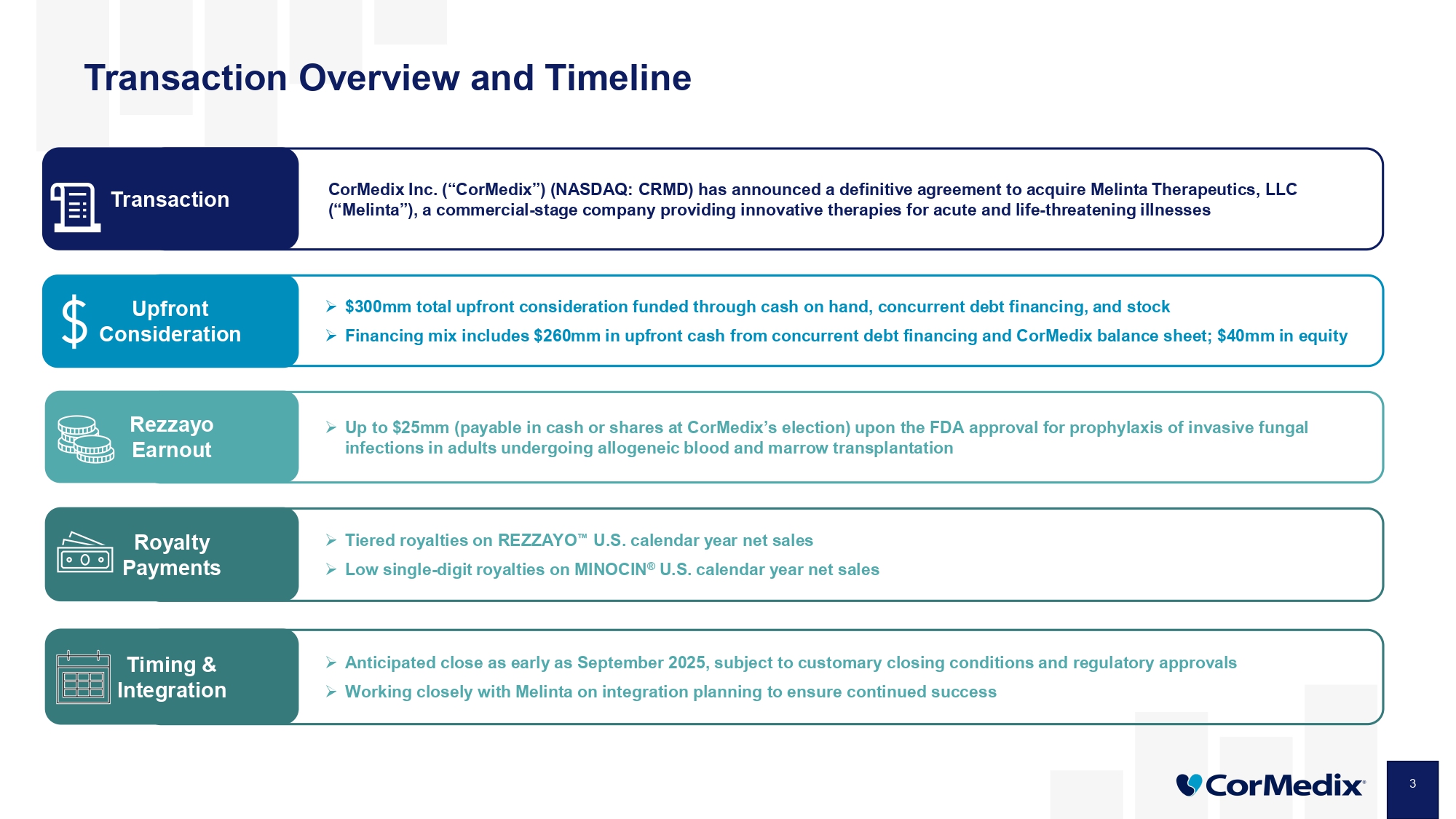
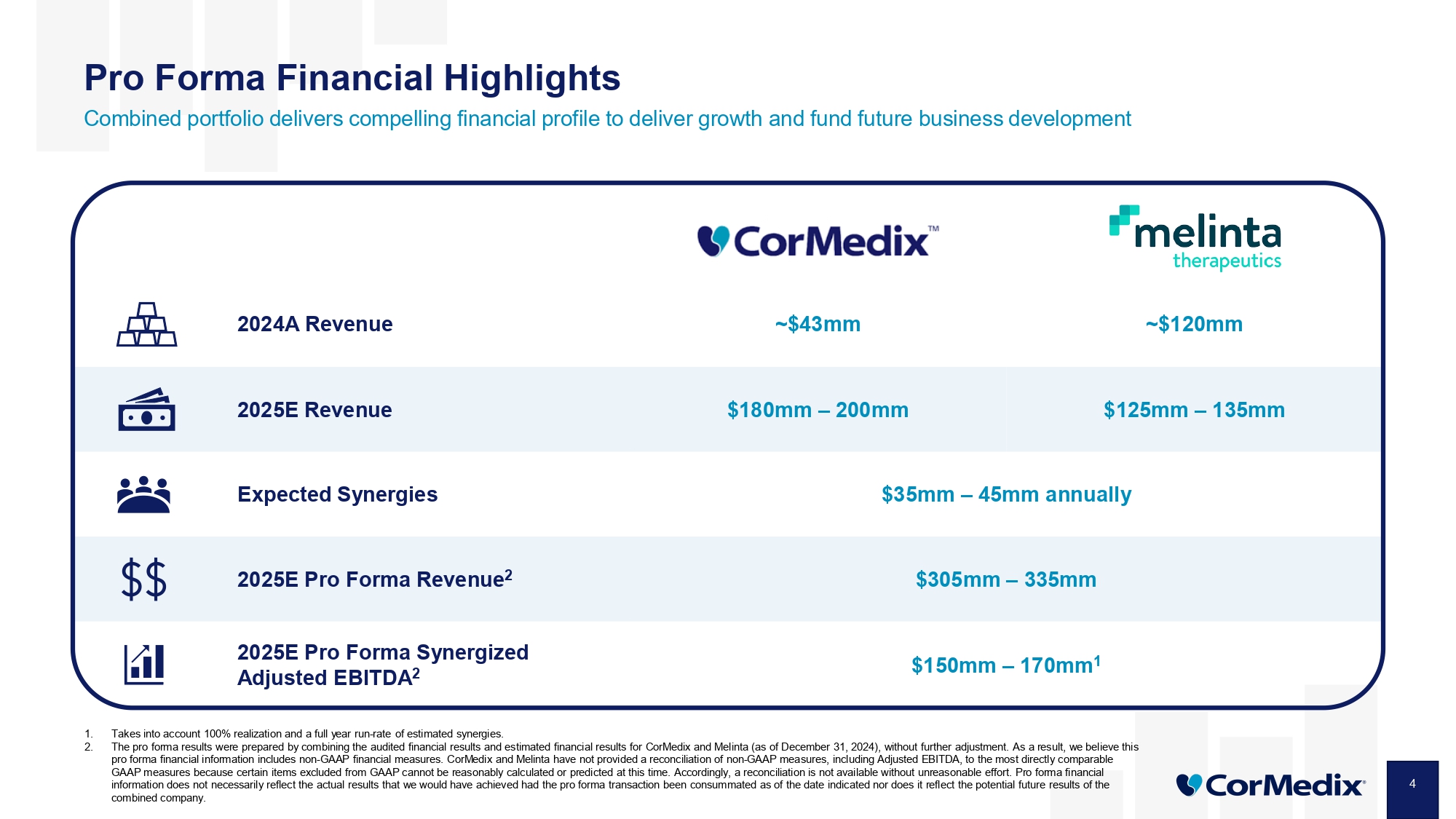
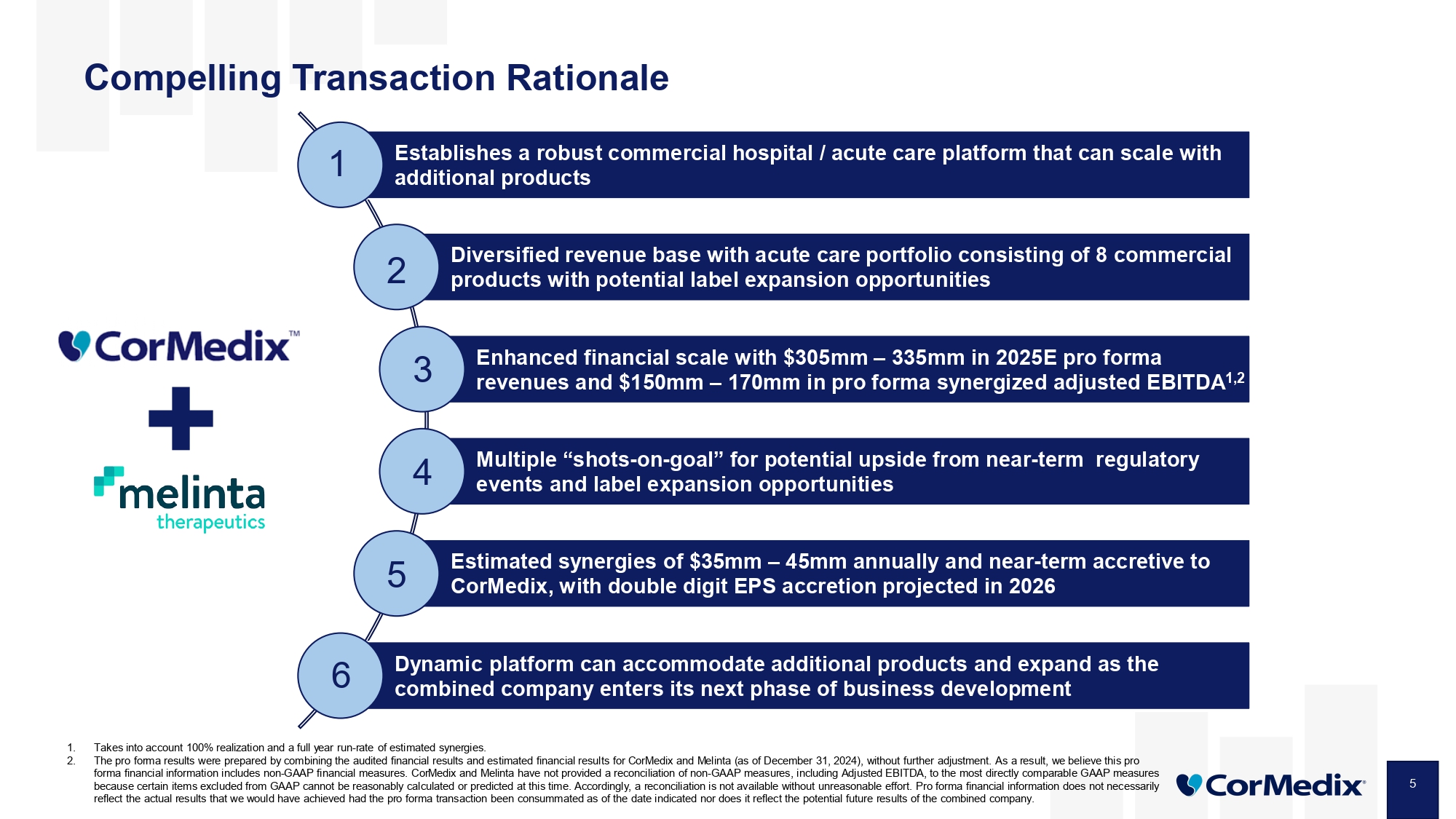
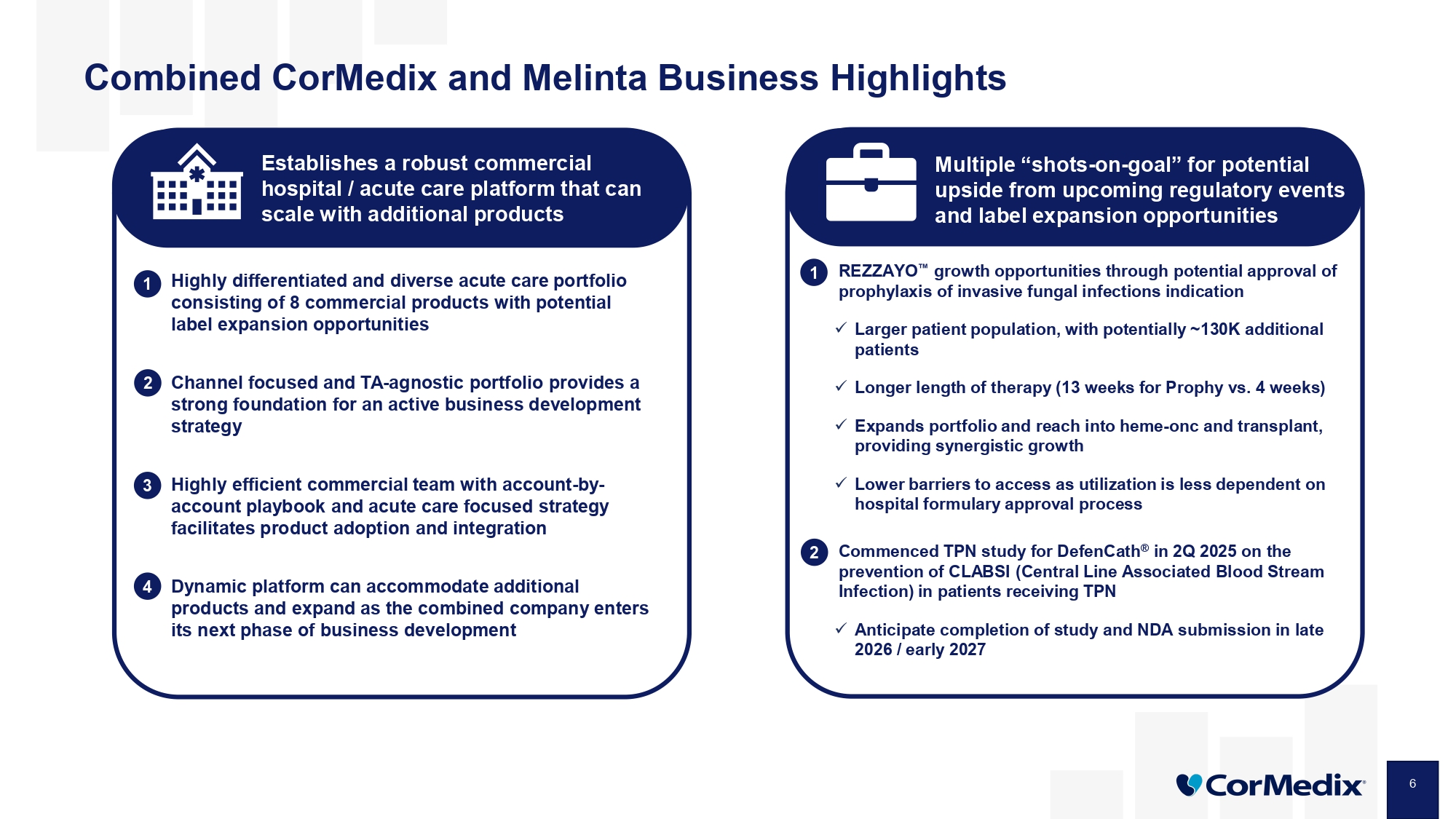
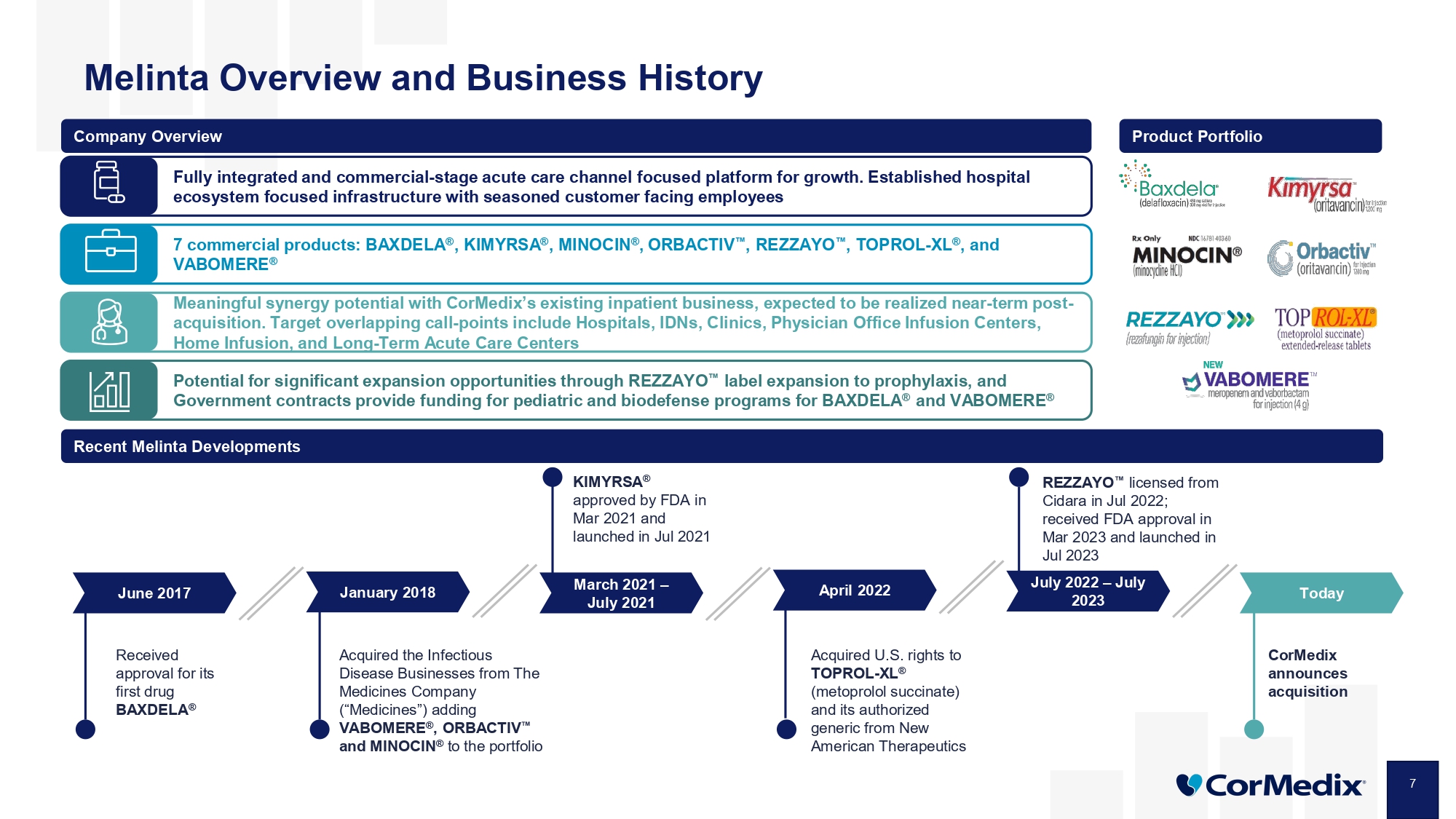
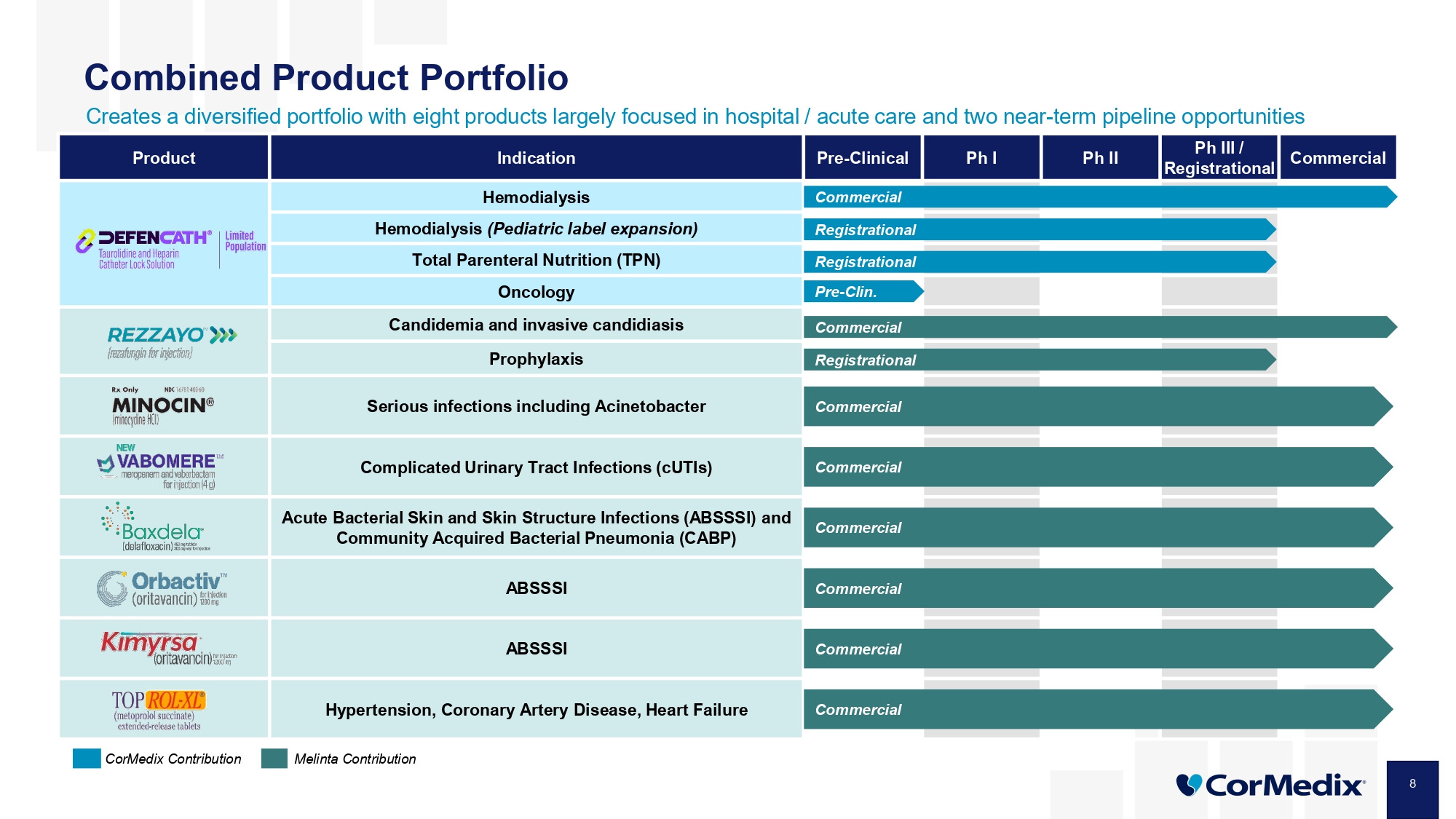
Thank you, Dan. Good morning, everyone, and thank you for joining us on this call. Today, concurrent with our second quarter earnings announcement, CorMedix announced the acquisition of Melinta Therapeutics in a combination cash and stock transaction. This deal is transformational for CorMedix, creating a fully diversified specialty pharmaceutical company with a broad portfolio of commercial and pipeline products concentrated in the acute care and anti-infectives areas. The Melinta product portfolio and existing operational infrastructure are highly synergistic with CorMedix's current commercial portfolio and sales deployment and also provides an exceptional complement to future potential expanded indications for our lead product, DefenCath. I would like to congratulate Christine Miller, Melinta Therapeutics President and CEO and her team on building such a high-performing organization with deep expertise in the hospital acute care and infectious disease arena. From a financial standpoint, Melinta adds to CorMedix a stable base of revenue for which we are currently guiding full year 2025 Melinta revenue between $125 million and $135 million spread across multiple assets, including six commercial stage products in the acute care and infectious disease space. We see opportunities for growth from both the existing commercial assets as well as their lead pipeline drug opportunity, a potential expanded indication for REZZAYO for the prophylaxis of invasive fungal diseases in adult patients undergoing allogeneic blood and marrow transplantation. In terms of key highlights of the transaction, the acquisition is expected to be near-term accretive with double-digit EPS accretion in 2026, and we are forecasting that will drive mid- to long-term revenue and cash flow growth. The addition of the pipeline opportunity of REZZAYO's expanded indication for prophylaxis provides a valuable growth driver of future revenue, and we estimate that if approved, peak annual sales potential in this indication could exceed $200 million. In the combined company, we also expect to capture significant near-term operating expense synergies estimated in the range of $35 million to $45 million, which will foster near-term EBITDA growth and EPS accretion. We have already submitted the necessary filings to the Federal Trade Commission in order to comply with the Hart-Scott-Rodino Act, otherwise known as HSR, and we expect to close this transaction as early as September 1, pending regulatory approval and other customary conditions of closing. The deal was structured as a combination of cash and stock with Deerfield Management Company to receive $40 million of the upfront purchase price in the form of CorMedix equity. Deerfield has also subscribed to $35 million of the $150 million debt offering executed concurrently with the transaction, which was used to fund the cash portion of the purchase price. We are excited to have Deerfield as a long-term investor in the new combined company given their long history as an investor in Melinta and in the health care space. On a pro forma basis, we are guiding to full year combined 2025 revenue of $305 million to $335 million with $180 million to $200 million of contribution from DefenCath net sales. In addition, we are guiding to pro forma fully synergized adjusted EBITDA for 2025 in the range of $150 million to $170 million. Turning now to the CorMedix business and our second quarter updates. We were excited to announce a few weeks ago that our LDO customer initiated purchases of DefenCath, and we can now confirm that they have initiated utilization in patients beginning in early July. Based upon feedback from the LDO, their rollout plan involved a limited clinic rollout for the month of July to establish workflow practices and a system-wide rollout that is taking place this week across all of their more than 2,000 clinics. We expect the system-wide rollout to initially target approximately 6,000 patients. However, we do not yet have visibility from the LDO into the pace for that rollout. As we get more information and better visibility from our LDO partner, we will update investors accordingly. On the clinical front, we have made great progress on our Phase III study for DefenCath in the reduction of CLABSI in adult patients receiving parental nutrition through a CVC. We now have multiple sites up and running and patients enrolled, and we are on track to complete the study and submit the NDA in the late 2026 to early 2027 time frame. We have also begun enrollment in our pediatric study for the reduction in CRBSI in pediatric patients undergoing hemodialysis through a CVC, with the first patient expected to begin dosing in August. Lastly, we have made the decision to perform an interim analysis of our real-world evidence study with U.S. Renal Care and hope to be in a position to provide interim data by the end of 2025. This is significant as we aim to evaluate patient outcomes and the impact of DefenCath utilization on the cost of patient care, infection rates, hospitalizations and mortality, all metrics that are critical to our goal of making DefenCath the standard of care for the reduction of bloodstream infections in patients getting hemodialysis through a CVC. I'd now like to turn the call over to Matt to discuss the company's second quarter financial results and financial position. Matt?
Thanks, Joe, and good morning, everyone. I'm excited to be here today to provide an overview of our second quarter 2025 financial results as well as an update on CorMedix's cash position and recent financing activities. The company will soon file its quarterly report on Form 10-Q for the quarter ended June 30, 2025. I urge you to read the information contained in the report for a more complete discussion of our financial results. With respect to our second quarter of 2025 financial results, our net revenue for the second quarter of 2025 amounted to $39.7 million. Our net income was approximately $19.8 million or $0.29 per share compared with a net loss of $14.2 million or $0.25 per share in the second quarter of 2024. The positive net income recognized in 2025 was driven by commercial sales of DefenCath. Operating expenses in the second quarter of 2025 increased approximately 18% to $18.3 million compared with $15.6 million in the second quarter of 2024. R&D expense increased by approximately 275% to $2.4 million, primarily driven by increases in personnel and clinical trial services in support of the ongoing clinical studies. Selling and marketing expense decreased 14% to $6.4 million in the second quarter of 2025 compared with $7.4 million in second quarter of 2024. G&A expense increased 25% to $9.5 million in the second quarter of 2025 versus $7.6 million in second quarter of 2024. The decrease in selling and marketing expense was attributable primarily to marketing costs related to the commercial launch of DefenCath. The increase in G&A expense was primarily driven by the non-cash charges for stock-based compensation and an increase in costs related to business development. We recorded net cash provided by operating activities during the second quarter of 2025 of $30 million compared with net cash used in operations of $14 million in the second quarter of 2024. The increase is primarily driven by net income for the period versus a net loss in the prior comparison period and a decrease in trade receivables. On June 27, CorMedix announced the pricing of an underwritten public offering of common stock for which we received net proceeds of $82.4 million. We noted in the press release at the time that the use of proceeds from the offering included general corporate purposes, expenses related to R&D and potential strategic transactions that complement CorMedix's business. In addition to strengthening our balance sheet, the transaction included a number of high-quality new and existing investors. Concurrent with our announcement today of the acquisition of Melinta Therapeutics, we are also announcing the pricing of a $150 million convertible debt offering with use of proceeds to fund the acquisition of Melinta. The key terms of the convertible debt are 5-year tenor with a 4% annual coupon and priced at a premium of 30%. In addition to Deerfield, the investors include a small group of high-quality life sciences institutional and convertible debt investors. As reported today, CorMedix has cash and cash equivalents of $190.7 million as of June 30, 2025. The company expects to use approximately $110 million of cash on hand in addition to the convertible debt proceeds to fund the upfront portion of the purchase price in the acquisition. While CorMedix on a stand-alone basis continues to track toward the low end of previously guided cash OpEx, we expect to issue updated guidance over the coming months for the combined entity.
Thanks, Matt. CorMedix is now firing on all cylinders with the implementation by our LDO customer commencing in July and the acquisition of Melinta targeted for closing in September. We intend to provide additional updates on the integration with Melinta over the coming months. We are excited about the platform we are creating for future growth and the opportunity to continue to create shareholder value. I appreciate everyone's continued support in CorMedix, and I'm happy to take questions.
Operator
Yes. And the first question comes from Leonid Timashev with RBC Capital Markets.
Speaker 4
It's Anish on for Leo. Congrats on the progress this quarter and the deal with Melinta. Just a couple of quick questions from us. First, if you could just talk to us about the guidance dynamics, how you're getting to the $180 million to $200 million range for DefenCath and what the sensitivities are there? And second, just quickly on Melinta, how are you thinking about the potential risks to the ongoing BARDA collaborations given the current policy and regulatory environment?
Thanks, Anish. I appreciate the question. To clarify our guidance for DefenCath, we are projecting revenue in the range of $180 million to $200 million. This estimate is based on our current customer orders and a conservative ramp-up expectation for the latter part of the year. We have some visibility into this, though not complete clarity on how the LDO may perform in the upcoming months. We want to ensure we leave some room for adjustments. While we acknowledge potential upside, this is our current comfort level for guidance at this stage of the year. Regarding risks from the BARDA perspective, we see the collaboration with BARDA as an added benefit rather than a critical underpinning of the deal’s value, which reduces our level of concern regarding the impact on the transaction's worth for CorMedix. First and foremost, this deal diversifies our revenue stream and establishes a stable income base. It's expected to yield immediate benefits, depending on how swiftly we can leverage synergies, with more clarity to come in the weeks ahead. The deal is highly synergistic, not just from an operational standpoint but also strategically, aligning with our goals for DefenCath’s future indications. The additional potential indication for REZZAYO enhances our pipeline and provides us multiple opportunities for growth. From a valuation perspective, this deal offers a very attractive post-synergy valuation multiple, especially considering the growth prospects of the platform and associated assets. Additionally, they have a strong and experienced team in the hospital and acute care sectors. This transaction meets all our criteria and exceeds our expectations, and we are very excited about it as it's truly transformative for us.
Operator
The next question comes from Jason Butler with Citizens.
Speaker 5
Let me add my congrats on the quarter and the acquisition. Joe, could you talk to us a little bit about the growth potential of the current approved portfolio commercial profile of the Melinta assets?
Sure. Are you going to have any follow-ups, Jason?
Okay. All right. Look, in terms of the growth of the existing portfolio, there's absolutely growth potential there. Certainly, we see it with REZZAYO in the treatment space for its current indication for MINOCIN, a little bit for VABOMERE and for ORBACTIV and KIMYRSA. So the biggest growth driver, obviously, is the potential expanded indication for REZZAYO. We do think BAXDELA and VABOMERE have upside as part of that BARDA collaboration that I mentioned, but that's not something that we've really incorporated into our valuation to underwrite the deal. Look, from a commercial synergy and overlap standpoint on that side, that's something we're going to look at over the next couple of weeks and see what makes the most sense from a structure standpoint. Obviously, we've got a strong team. They've got a strong team. We want to look at the best ways to put these two together and put them together in a way that makes the most sense for the organization.
Operator
And the next question comes from Les Sulewski with Truist.
Speaker 6
A couple for me. Just provide perhaps, Joe, a little bit of a background on the Melinta transaction, specifically if there was a competitive process. And then second, across their portfolio of products, how competitive is this space either from branded and other or generic offerings? And then second, on the integration and the synergies, what sort of integration expenses can we assume for this year and the progress within your Syneos sales team in inpatient side? Is this something that could be multiple product offerings, including DefenCath with Melinta on board?
Thanks, Les, for that summary. Regarding the background of the process, it was indeed a competitive auction, and there were several bidders involved with multiple rounds of bidding, in which we actively participated. As for details, the anti-infective market, especially for inpatient use, is quite competitive. Typically, infectious disease doctors tend to prefer less expensive generics before moving on to newer branded products, which is a familiar trend in this area. One of the appealing aspects of REZZAYO's expanded indication is its application in outpatient settings, particularly in infusion and oncology clinics, focusing on outpatient reimbursement rather than inpatient DRG reimbursement. This presents a significant opportunity. When it comes to integration expenses, we aren’t providing guidance on that yet, but we plan to share more insights after the deal closes. As for operational synergies with our existing team, we will assess this in the coming weeks. We believe our team is strong, and we recognize the strength of their organization, and we’re looking for the best ways to integrate the two.
Operator
Next question comes from Roanna Ruiz with Leerink.
Speaker 7
This is Mezzie on for Roanna Ruiz. So I guess just building on the Melinta acquisition. So what key asset that you're acquiring are you most excited about? And then secondly, I guess, beyond the Melinta acquisition, how are you thinking about capital allocation? Are there other strategic opportunities you're evaluating? And I guess big picture, what's your philosophy on returning cash to shareholders versus reinvesting for future growth?
Thank you for your question. In terms of the asset I am most excited about, it feels a bit like choosing a favorite child. However, the expanded indication for REZZAYO certainly has significant potential upside, which is very appealing to us. Additionally, our diverse portfolio of assets provides stability and growth, which is very attractive to our organization. Regarding your second question about capital allocation and business development, we are open to exploring other opportunities that align well with our organization and are expected to be accretive in the near term. These have been our established criteria for the types of deals we are currently considering, focusing on generating immediate value for shareholders. This is our primary focus at the moment, rather than developing a future dividend policy.
Operator
And the next question comes from Brandon Folkes with H.C. Wainwright.
Speaker 8
Congratulations on the deal and the quarter. Maybe just following on from the prior question. As you take these steps to build a specialty pharma company, how do you look at the post-close commercial infrastructure you will have? I guess, twofold. One, especially in terms of adding TPN to the bag, do you think TPN now potentially largely drops to the bottom line? And then as you go forward and do add potential additional products, how do you feel about the number of products in the acute care reps bags today versus additional acquisitions coming with additional sales force versus just the bringing in products to the combined commercial infrastructure?
That's fair. I think I've addressed part of that question already. I'll emphasize that both teams are incredibly strong, and we will explore how to integrate them. Regarding the Melinta team, the potential TPN indication aligns well with their current sales deployment as well as ours in hospitals. The number of products a typical account manager can handle varies, and not every product gets equal attention at all times. Some products see stable sales without heavy promotion, while others require significant effort and ongoing education. It will be a blend of both types, and we plan to focus on this intensively in the coming months to build a robust organization positioned for growth.
Speaker 8
And maybe just one follow-up, if I may, just coming back to DefenCath. Any additional color, and I understand if you can't, what you contemplate in terms of the LDO ordering in your updated guidance? And then secondly, is the outpatient setting for DefenCath now a little bit more hands off and you as a company can focus more on the inpatient setting? Or is there still sort of quite a high touch in that outpatient setting as well as you grow the inpatient setting? That's all for me.
Yes. I'll address the second question first. Regarding the sales and marketing effort, you're correct that the outpatient setting requires a smaller footprint. It involves less direct interaction and focuses more on high-level account management within these organizations. However, there is still effort involved, and we have a dedicated team working on smaller dialysis operators. As for the outlook on the LDO ramp, we've established our guidance based on what we believe to be a conservative expectation, given the information available to us. We have also allowed for potential upside as we assess orders in the coming weeks. We're confident in the range we've set based on the current information.
Operator
And the next question comes from Serge Belanger with Needham & Company.
Speaker 9
Congrats on the acquisition. Obviously, a big day for CorMedix. First question, regarding the Melinta portfolio, I think you highlighted six to seven products. Can you just maybe talk about which are the key ones that are generating the growth for this portfolio? Second question, it sounds like the REZZAYO label expansion opportunity is a significant potential upside for the potential of this product. Can you just maybe talk about this Phase III trial, when you expect results and maybe what the outcome needs to be to be successful? And then lastly, on DefenCath, any additional progress regarding the remaining LDO customer?
Thank you, Serge. As we move towards closing, we will provide more directional guidance on each product. We have just announced the transaction. Overall, in terms of our portfolio, as I mentioned earlier, the approved products such as REZZAYO, MINOCIN, VABOMERE, and the ORBACTIV commercial franchise present growth opportunities. BAXDELA is a relatively small product, and you can see from IQVIA data that it currently contributes minimally to sales. However, it is part of the BARDA agreement and has potential for growth in the future. Regarding label expansion, the Phase III study is expected to conclude in early 2026, but I do not have a specific date for when the data will be released. This study is being conducted in collaboration with Melinta's partner, Mundipharma, and we will share more information as it becomes available. As for the other LDO customer, as I mentioned in the last call, once we operationalize our existing LDO, we plan to resume discussions. We are currently at that stage and will provide updates as we make progress.
Operator
Thank you. That concludes the question-and-answer session as well as the event. Thank you so much for attending today's presentation. You may now disconnect your phone lines.