Operator
Good day, and thank you for standing by. Welcome to the Constellium Fourth Quarter and Full Year 2025 Results Conference Call. At this time, all participants are in a listen-only mode. Please be advised that today's conference is being recorded. After the speaker's presentation, there will be a question and answer session. To ask a question, please press star 1-1 on your telephone and wait for your name to be announced. To withdraw your question, please press star 1-1 again. I would now like to hand the conference over to your speaker today, Jason Hirschheiser, Director of Investor Relations at Constellium.
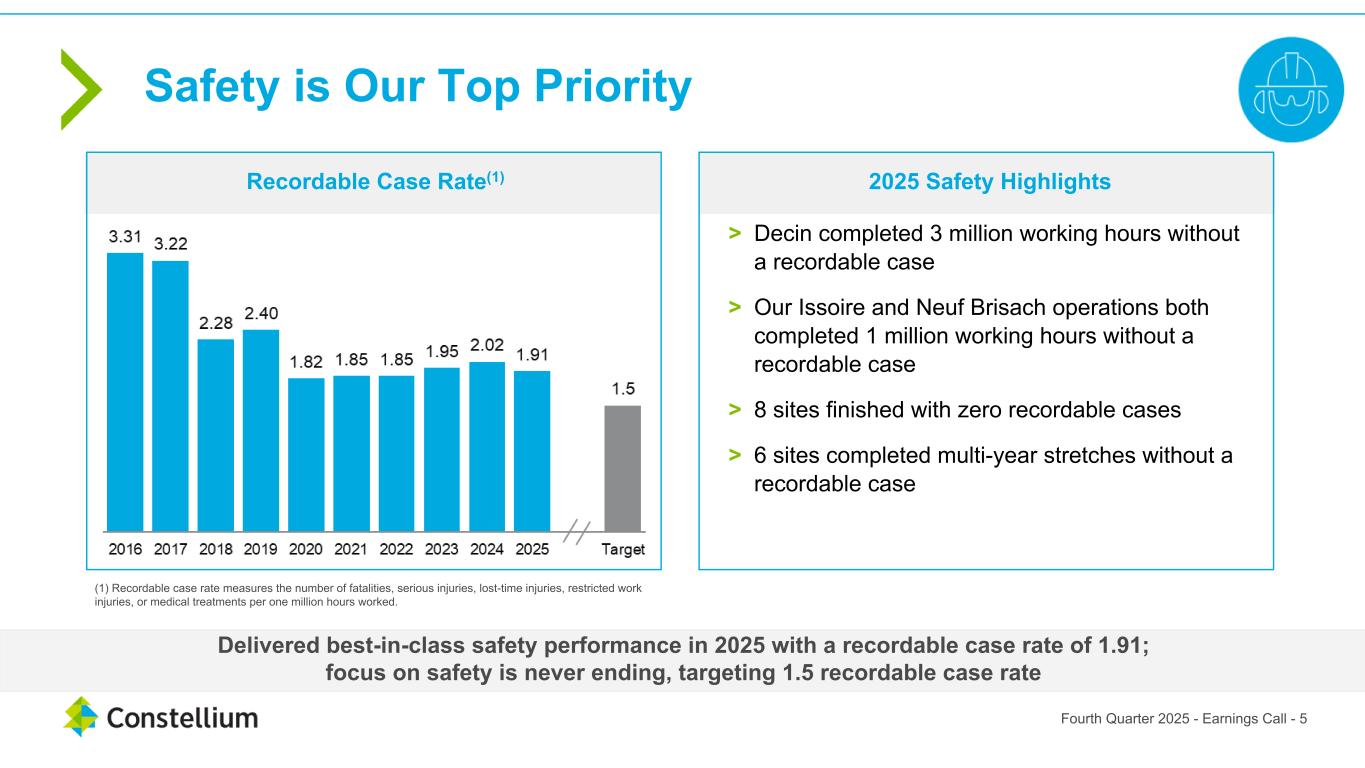
Thank you, Josh. I would like to welcome everyone to our fourth quarter and full year 2025 earnings call. On the call today, we have our Chief Executive Officer, Ingrid Yurd, and our Chief Financial Officer, Jack Wook. After the presentation, we will have a Q&A session. A copy of the slide presentation for today's call is available on our website at Conselium.com, and today's call is being recorded. Before we begin, I'd like to encourage everyone to visit the company's website and take a look at our recent file. Today's call may include forward-looking statements within the meeting of the Private Securities Litigation Reform Act of 1995. Such statements include statements regarding the company's anticipated financial and operating performance, future events, and expectations. and may involve known and unknown risks and uncertainties. For a summary of specific risk factors that could cause results to differ materially from those expressed in the forward-looking statement, please refer to the factors presented under the heading Risk Factors in our annual report on Form 10-K. All information in this presentation is as of the date of the presentation. We undertake no obligation to update or revise any forward-looking statement as a result of new information, future events or otherwise except if required by law in addition today's presentation includes information regarding certain non-GAAP financial measures please see the reconciliations of non-GAAP financial measures attached in today's slide presentation which supplement our GAAP disclosures and with that I would now like to hand the call over to Ingrid thank you Jason good morning good afternoon everyone and thank you for your interest in let's begin on slide number five I want to start with safety our number one priority in 2025 we achieved a recordable case rate of 1.9 an
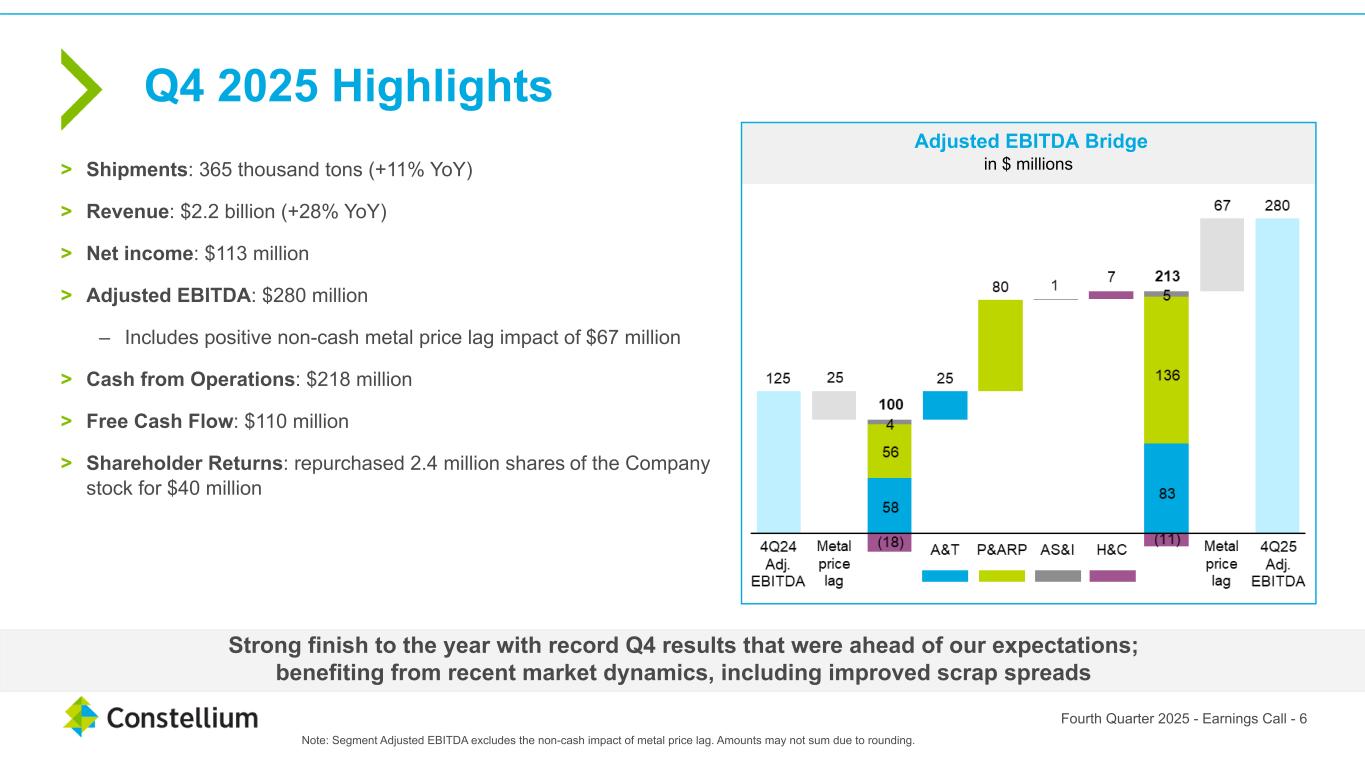
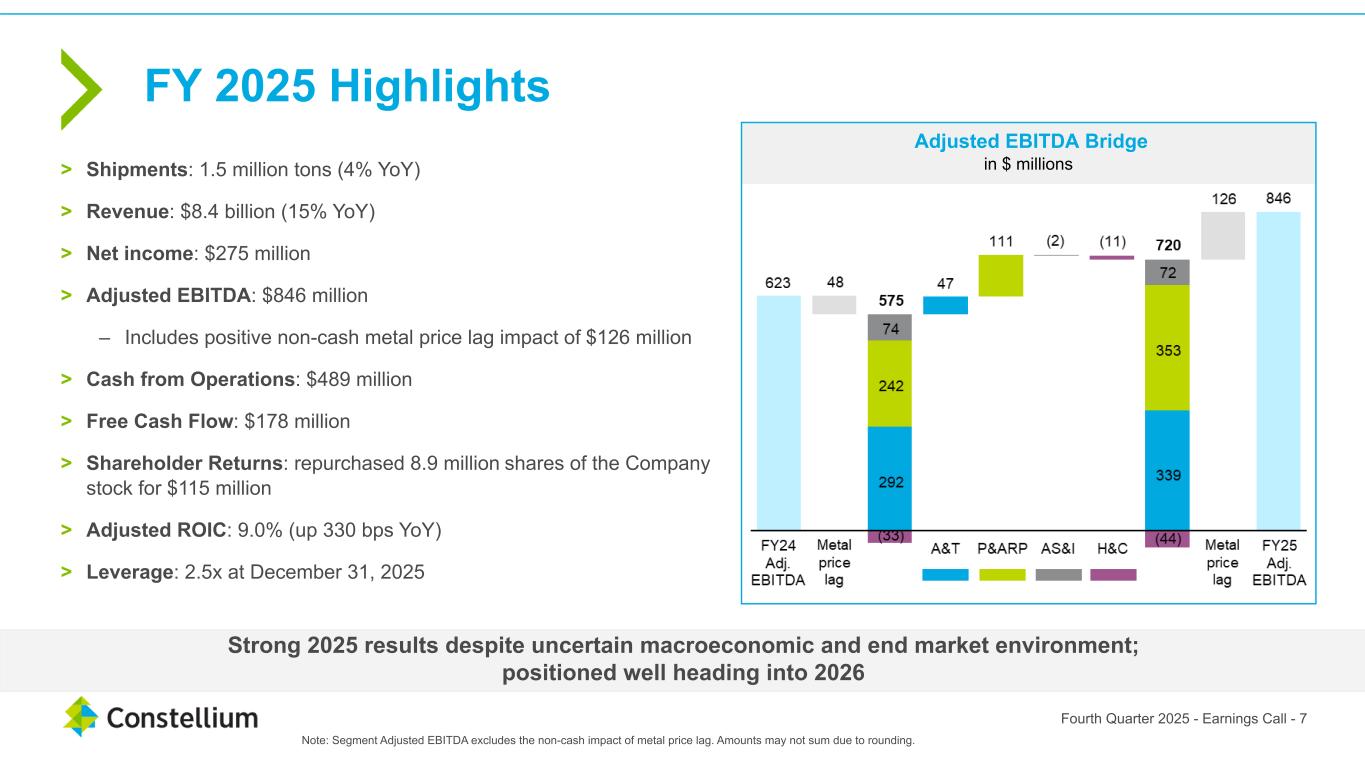
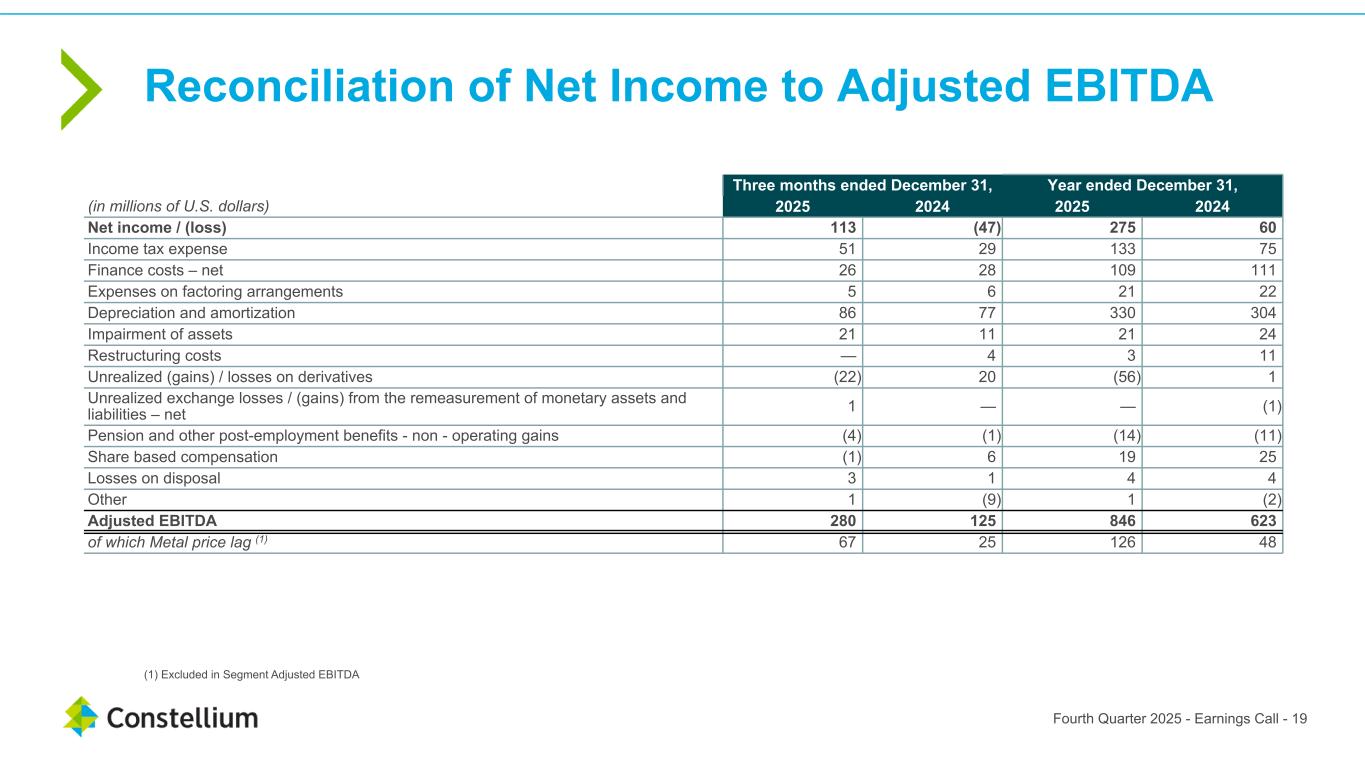
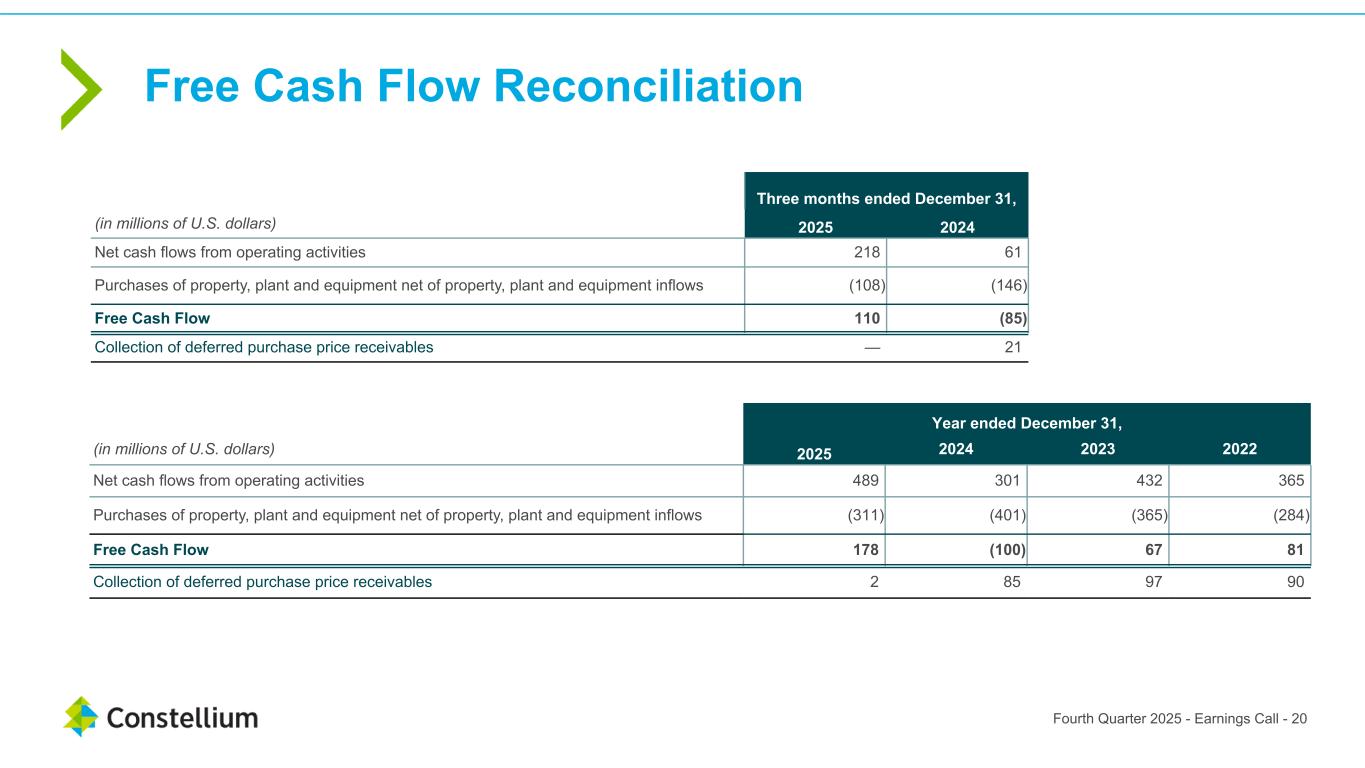
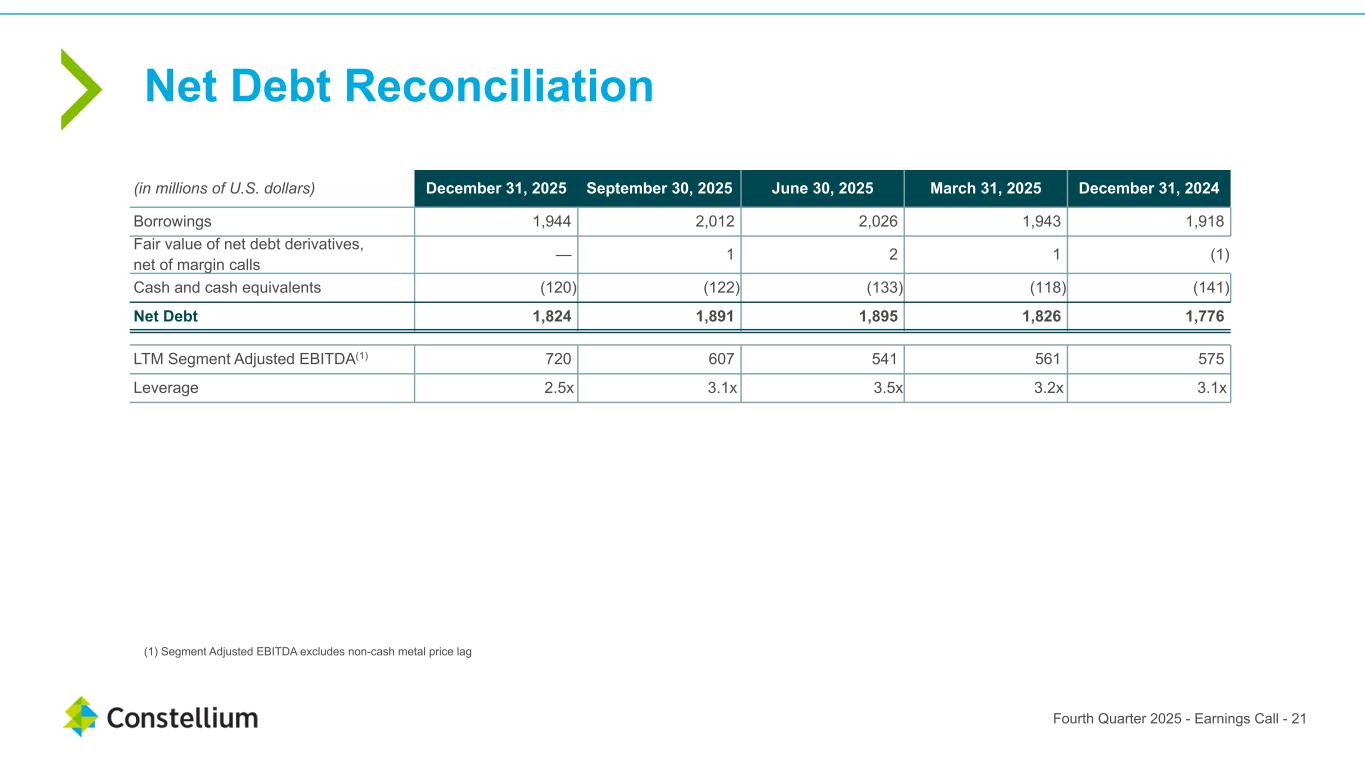
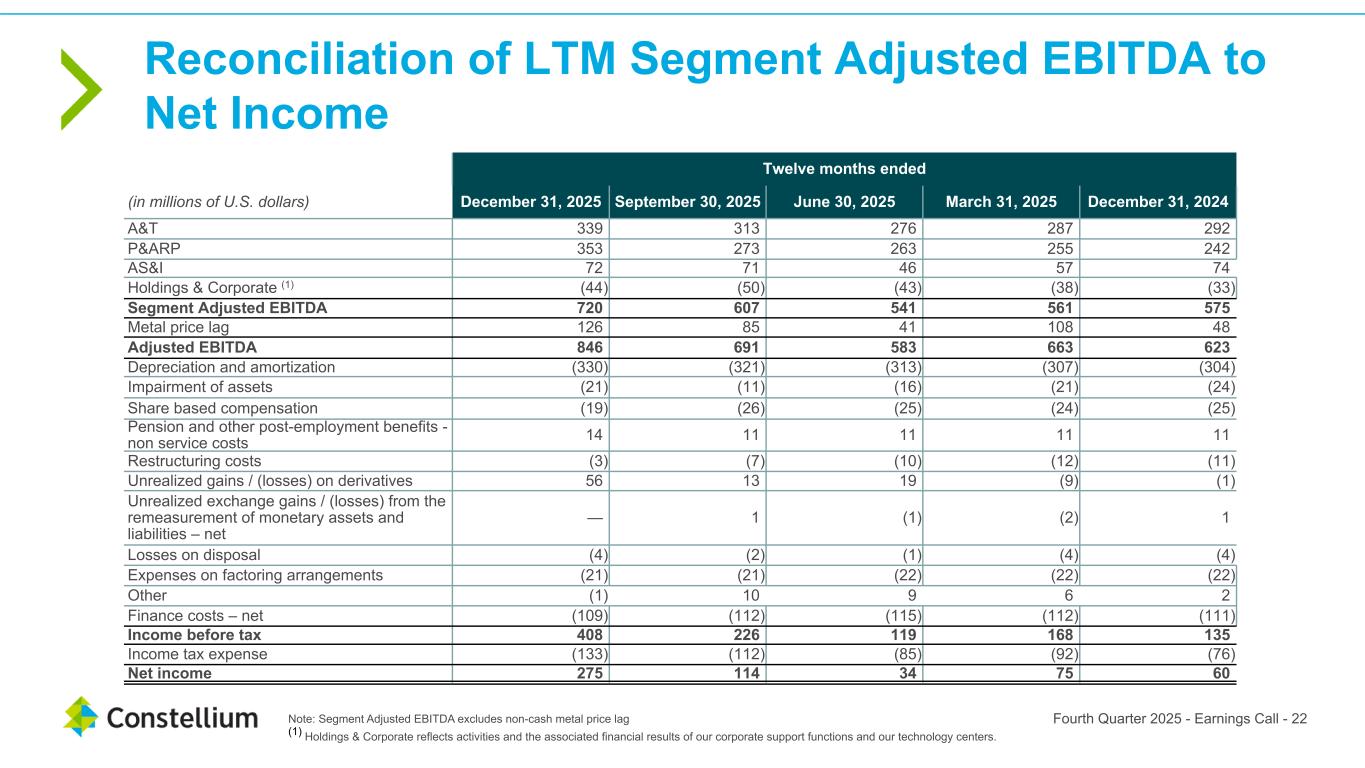
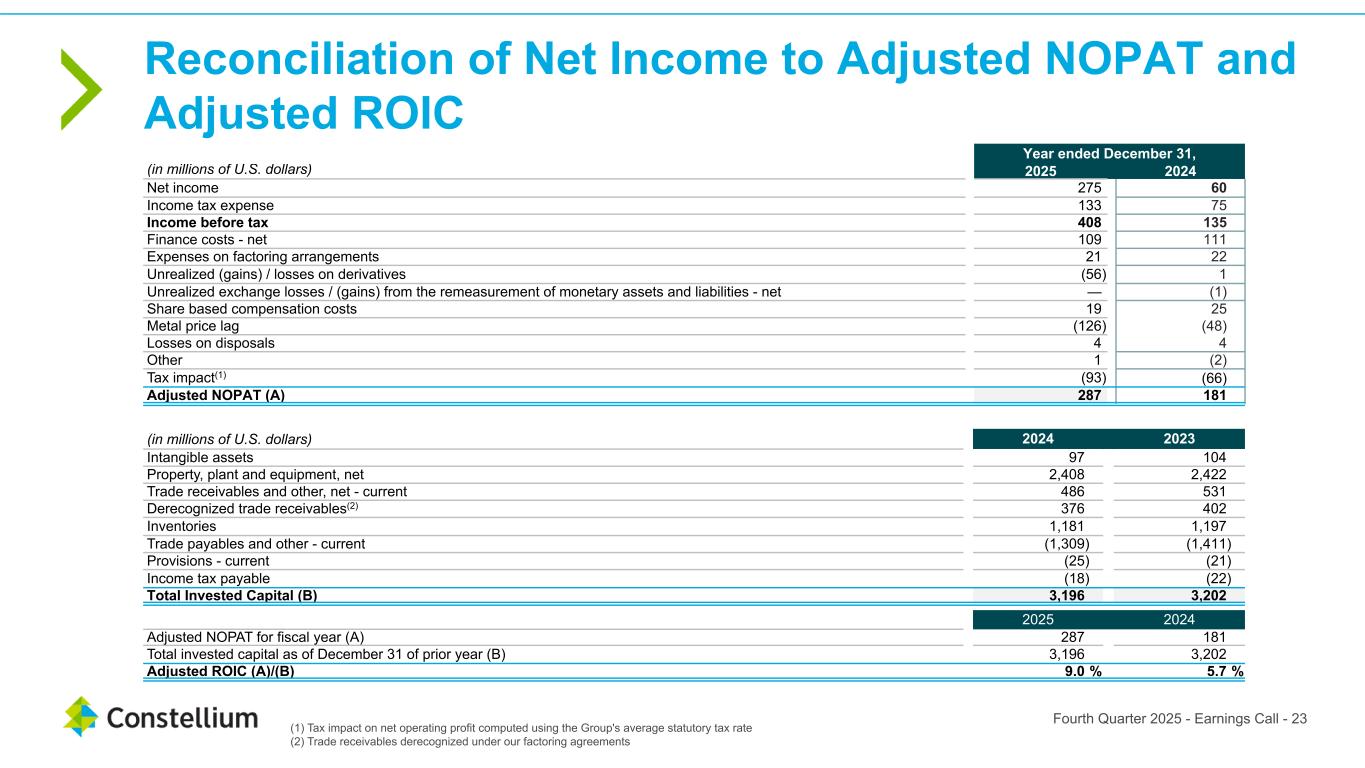
improvement compared to 2024 and much better than the industry average while we did not meet our ambitious target of 1.5 this progress reinforces our commitment to safety and reminds us that reaching our goal will require continued strong efforts across the organization our safety journey is never complete and we all need to remain committed to this critical priority every day now let's turn to slide number six and discuss the highlights from our fourth quarter performance shipments were 365 thousand tons or up 11% compared to the fourth quarter of 2024 due to higher shipments in each of our operating segments revenue of 2.2 billion dollars increased 28% compared to the fourth quarter of 2024 due to higher shipments and higher revenue per ton including higher metal prices remember while our revenues are affected by changes in metal prices we operate the path through business model which minimizes our exposure to metal price risk our net income of 113 million dollars in the quarter compared to a net loss of 47 million dollars in the fourth quarter last year the main driver of the increase was higher gross profit in the quarter versus last year compared to the fourth quarter last year adjusted ebitda increased 124 to 280 million dollars in the fourth quarter this year so this includes a positive non-cash impact from metal price lag of 67 million dollars if we exclude the impact of price lag which as you know is the way we view the real economic performance of the business we achieved an adjusted EBITDA of 213 million dollars in the quarter this is a new fourth quarter record for us and it's up 113 percent versus the hundred million dollars in the fourth quarter last year Our free cash flow in the quarter was strong at $110 million, and during the quarter we returned $40 million to shareholders through the repurchase of 2.4 million shares. Now please turn to slide number 7 for our full year 2025 highlights. For the full year, shipments were 1.5 million tons, were up 4% compared to 2024. Revenue of $8.4 billion increased 15% compared to 2024, due to higher shipments and higher revenue per ton, including higher metal prices. Our net income of $275 million compared to a net income of $60 million in 2024. The main driver of the increase was higher gross profit versus the prior year. Adjusted EBITDA increased 36% to $846 million in 2025, though this includes a positive non-cash impact from metal price lag of $126 million. Again, if we exclude the impact of metal price lag, the real economic performance of the business reflects adjusted EBITDA of $720 million for the year compared to $575 million we achieved in 2024 and represents our second best year ever. Moving now to free cash flow. Our free cash flow for the year was $178 million in 2025. During the year, we returned $115 million to shareholders through the repurchase of 8.9 million shares. We reduced our leverage by the end of 2025 to 2.5 times, which is at the upper end of our target range. Constellium achieved strong results in 2025 that were ahead of our own expectations coming into the year, and despite the uncertain macroeconomic and end-market environment. I want to thank each of our 11,500 employees for their commitment and relentless focus on safety and serving our customers. We delivered strong execution and demonstrated our ability to control costs throughout the the year in 2025 and we believe we are well positioned heading into 2026 to capitalize on market opportunities as they arise with that I will now hand the call over to check for further details on the financial performance check thank you Ingrid and thank you everyone for joining the call today please turn out to slide 9 and let's discuss our ANT segment performance.
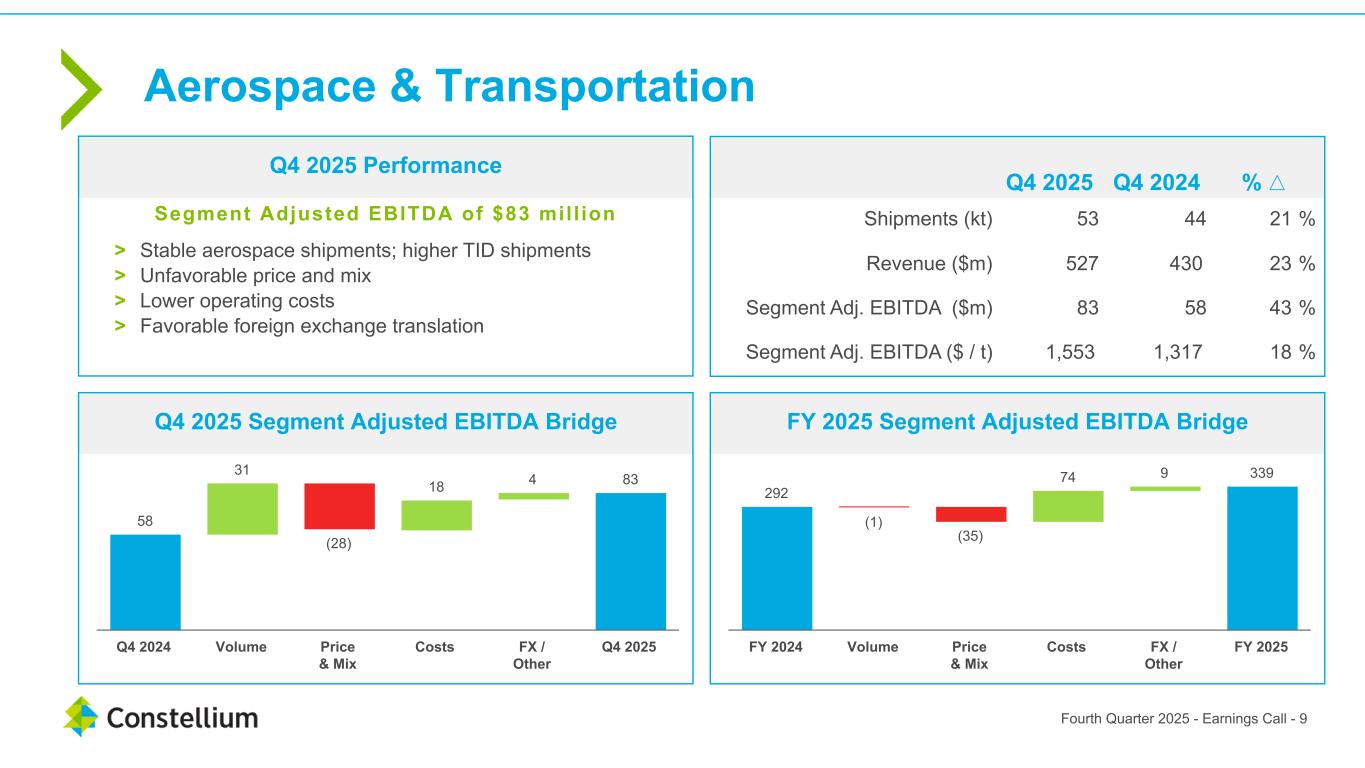
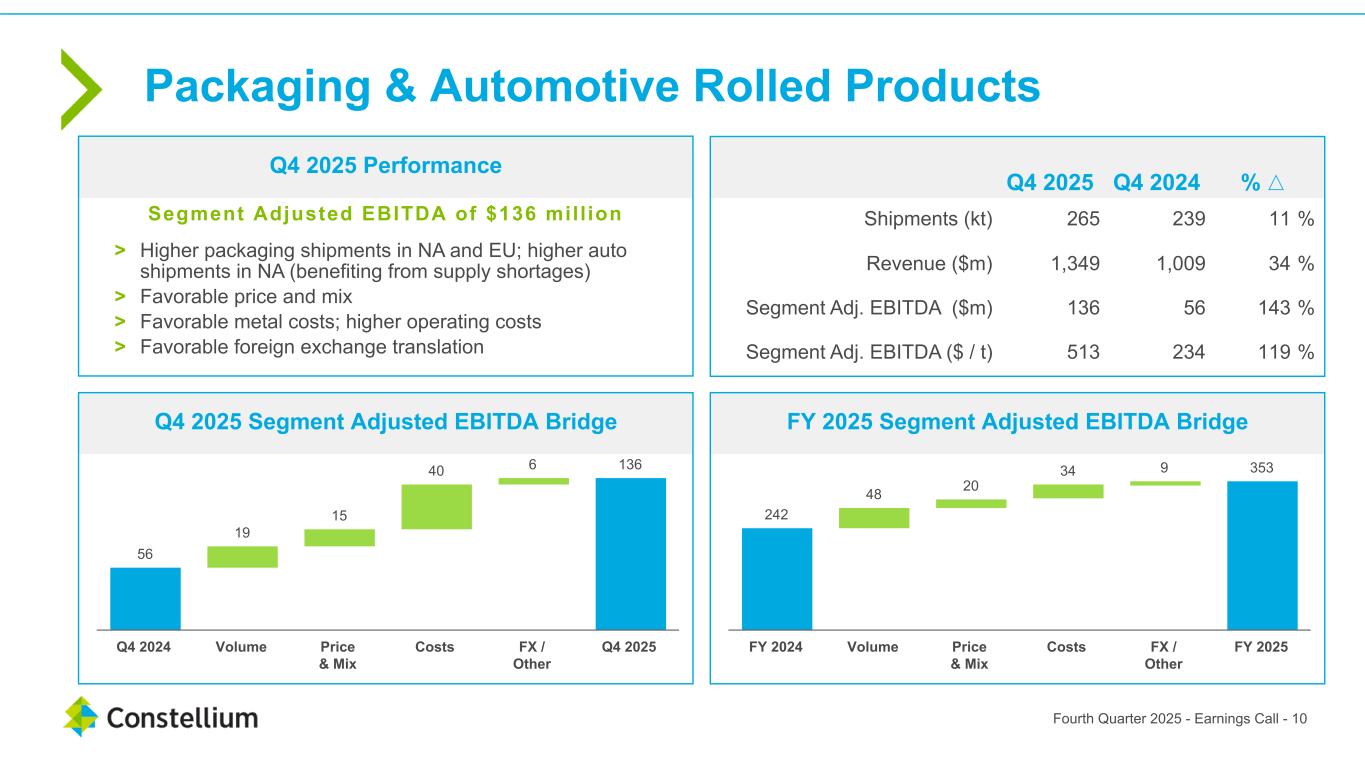
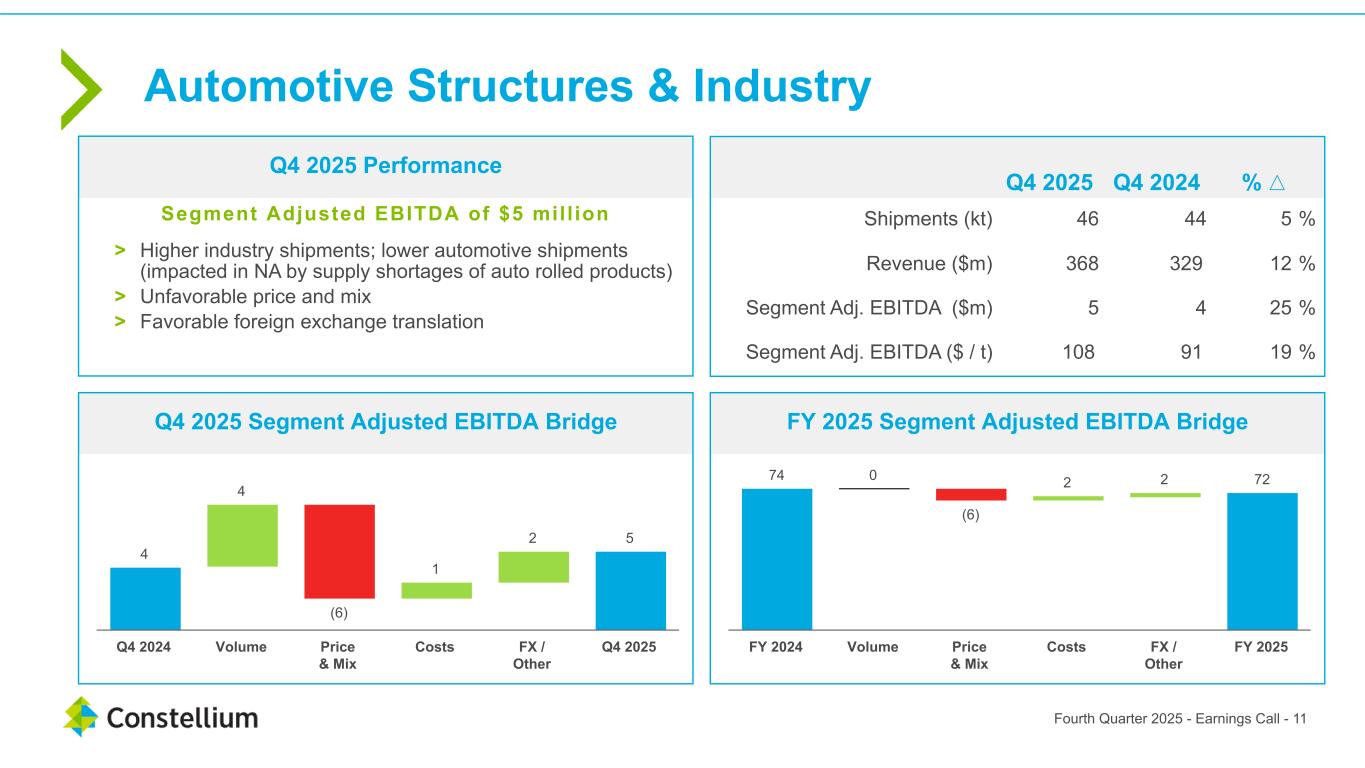
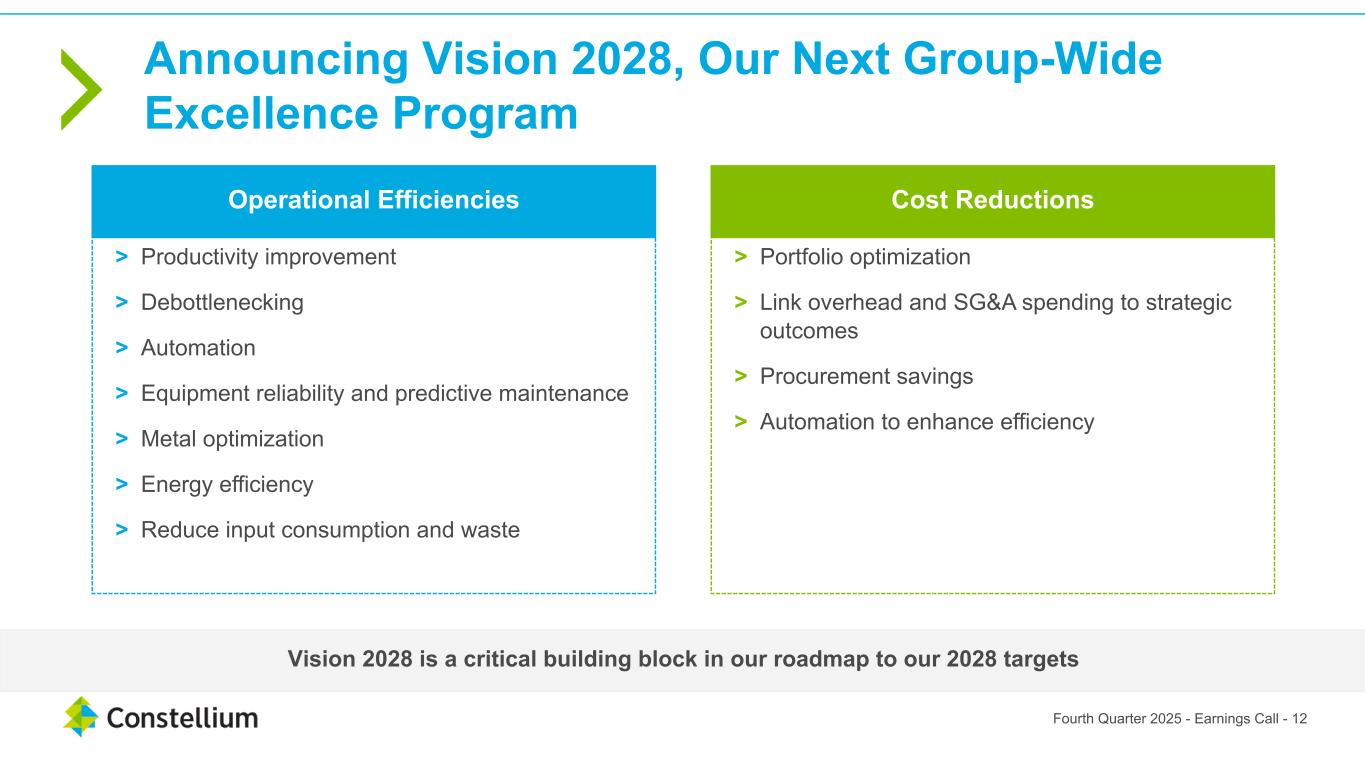
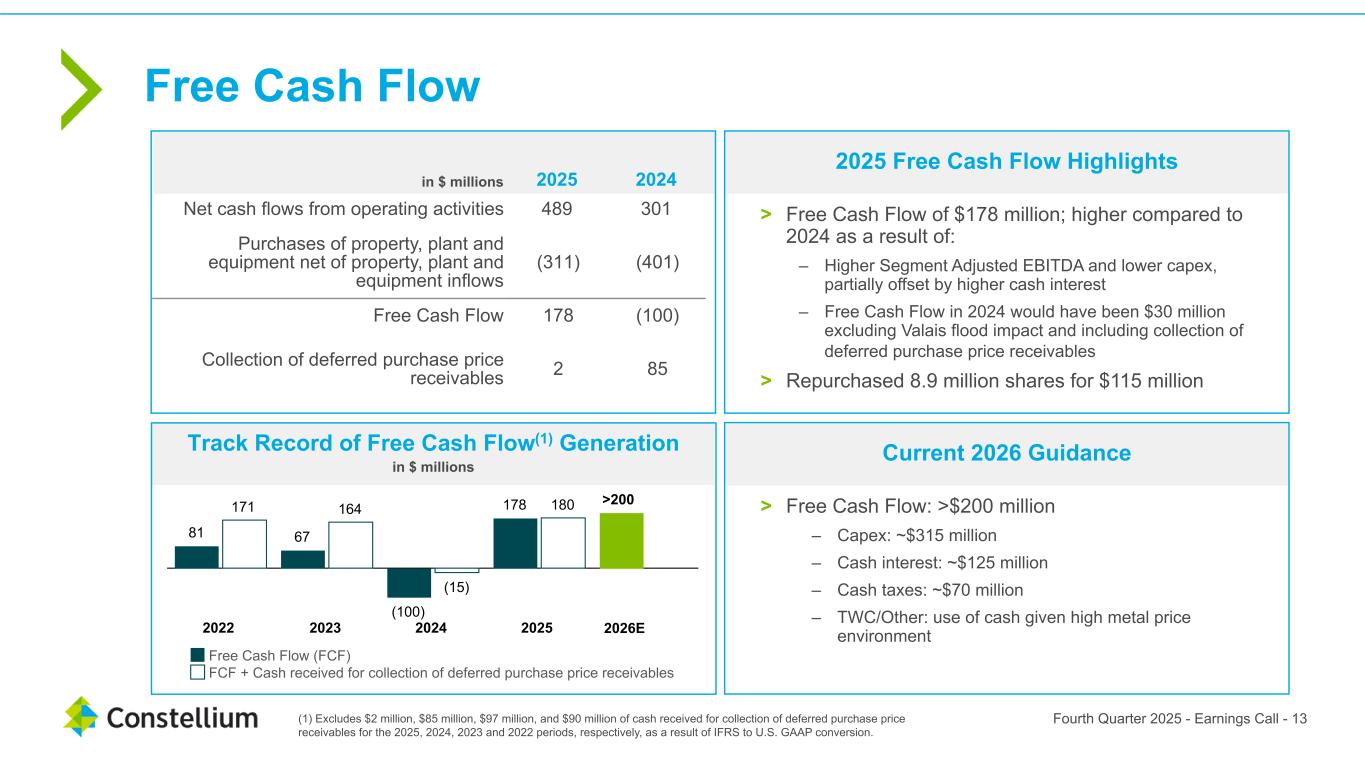
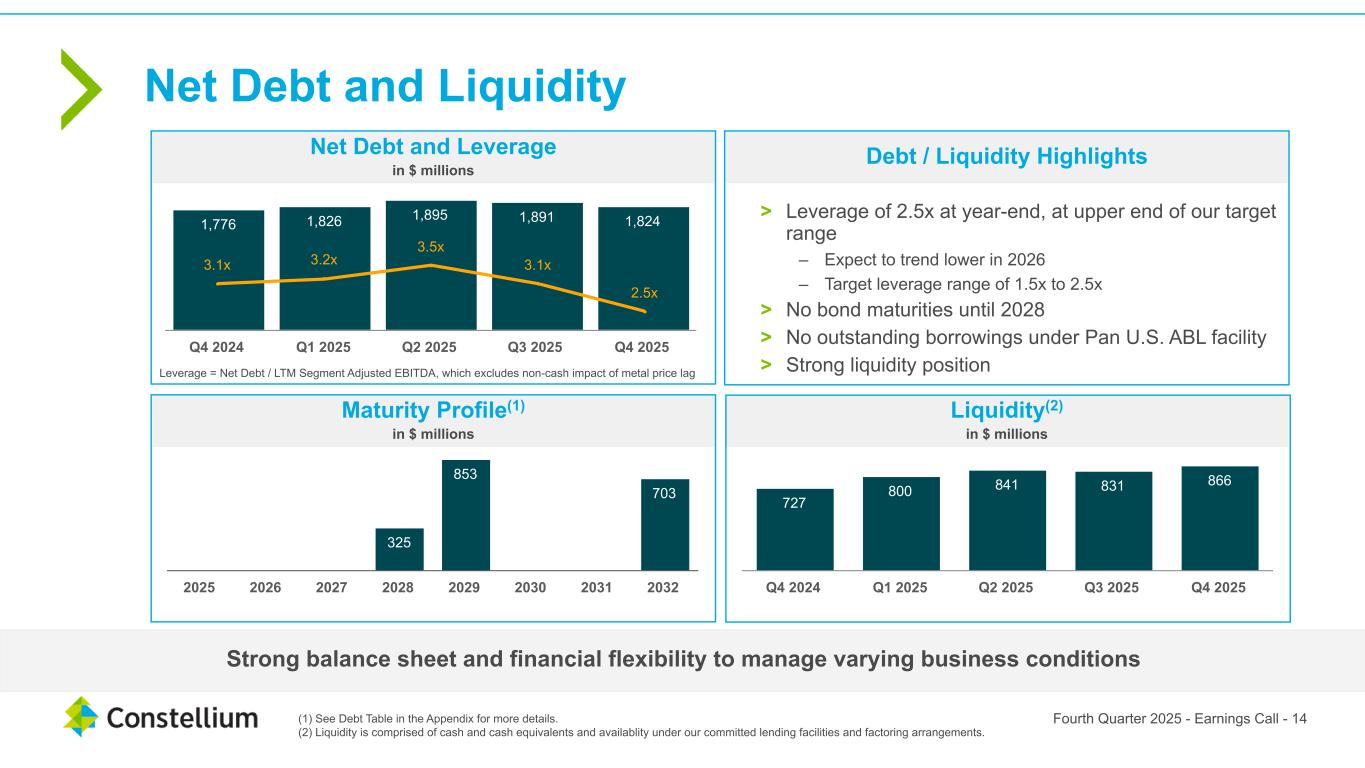
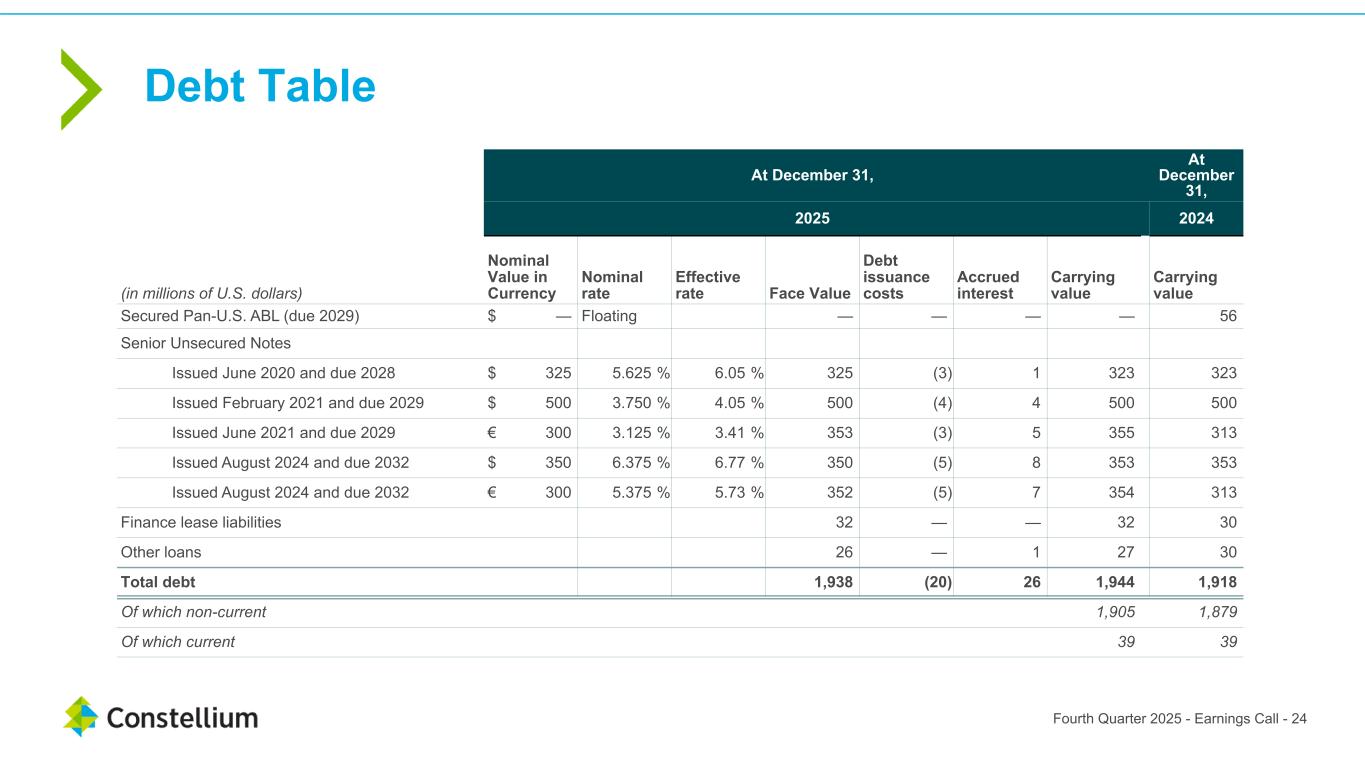
Adjust the EBITDA of $83 million increased 43% compared to the fourth quarter last year. Volume was a tailwind of $31 million due to higher TID shipments. TID shipments were up 41% versus last year. First, as we continue to see increased demand from unshoring in the U.S., and secondly, we also benefited from higher shipments in ballet following recovery from the flood last year. Aerospace shipments were stable in the quarter versus last year as commercial OEMs continue to work through excess aluminum inventory in the supply chain. Demand in space and military aircraft remains generally healthy. Price and mix was a headwind of $28 million due to unfavorable mix in the quarter, partially offset by improved contractual and spot pricing in aerospace and TID. Costs were a tailwind of $18 billion, primarily as a result of lower operating costs. FX and other was also a tailwind of $4 million in the quarter due to the weaker U.S. dollar. For the full year 2025, A&T generated adjusted EBITDA of $339 million, an increase of 16% compared to 2024. The drivers of the full year performance were similar to those in the fourth quarter, except volume was a headwind of $1 million for the full year. Now turn to slide 10 and let's focus on our parked segment performance. Adjusted EBITDA of $136 million increased 143% compared to the fourth quarter last year and is a new quarterly record for PARP. Volume was a tailwind of $19 million in the quarter. Packaging shipments increased 15% in the quarter versus last year as demand remained healthy in both North America and Europe. In North America, we also benefited at Muscle Shoals from continued improvement of operational performance in the quarter. Automotive shipments were relatively stable in the quarter overall, though we did benefit in both regions from the current supply shortages in North America of aluminum automotive body sheet. Price and mix was a tailwind of $15 million, mainly as a result of improved pricing and favorable mixing quarter. costs were a tailwind of 40 million dollars primarily as a result of favorable metal costs given improved scrap spread and higher metal pricing environment in north america and increased consumption of scrap given the muscle shows improvement which is partially offset by higher operating costs fx and other was a tailwind of six million dollars in a quarter for the full year For 2025, FARC generated adjusted EBITDA of $353 million, an increase of 46% compared to 2024. The drivers of the full-year performance were similar to those in the fourth quarter, though we benefited more in the fourth quarter from favorable metal costs compared to the full year. Now turn to slide 11, and let's focus on the AS&I segment. Adjusted the EBITDA of $5 million increased by $1 million compared to the fourth quarter of last year. Volume was a $4 million tailwind as a result of higher shipments in industry-treated products, partially offset by lower shipments in automotive. Industry shipments were up 33% in the quarter versus last year, as we had higher shipments in LA following recovery from the flood last year. the industrial markets in europe in europe appear to have bottomed although they remain at depressed levels automotive shipments were down 10 percent in the quarter with weakness in both north america and europe even though the broad automotive markets in north america relatively stable our automotive structures business was negatively affected by the current supply shortages of aluminum automotive body sheet and its impact on production of certain platforms in the region which automotive structures business applies to. Price and mix was a $6 million headwind in the quarter. Costs were a tailwind of $1 million primarily due to lower operating costs, partially offset by the impact of tariffs. FX and other was a tailwind of $2 million in the quarter. For the full year of 2025, AS&I generated adjusted EBITDA of $72 million, a decrease of 3% compared to 2024. The drivers of the full year performance were similar to those in the fourth quarter, except that volume was stable for the full year. And in the third quarter, we received net customer compensation for the underperformance of an automotive program. It is not on the slide here but our holdings and corporate expense for the full year of 2025 was 44 million dollars up 11 11 million dollars compared to the prior year the increase is primarily due to higher labor costs and costs associated with corporate transformation projects we currently expect holdings and corporate expense to run at approximately 50 million dollars in 2026. Now, please turn to slide 12. It is not on the slide here, but I wanted to summarize the current cost environment we're facing. As you know, we operate a pass-through business model, so we're not materially exposed to changes in the market price of primary aluminum, our largest cost input. On other metal costs, following the U.S. tariff announcement in 2025, market aluminum prices in the U.S., which includes the L&E aluminum price plus the Midwest premium, have risen sharply to historical levels. Spot scrap spreads for aluminum, mainly used beverage cans or UVCs, have also improved from historically tight levels experienced in the second half of 2024 and into 2025. Both of these dynamics unfolded as we moved through the year in 2025. Given that a portion of our scrap purchases were negotiated previously, we did not benefit much from this dynamic in 2025 until the fourth quarter and the favorable impact was augmented through strong performance at Muscle Shoals in the quarter. As we look at 2026, we expect to benefit from these trends, especially in the first half. Moving on to inflation. Inflationary pressures continue today across operating cost categories, including labor, energy, maintenance, and supplies, albeit at more normal levels. Regarding tariffs, we have made some progress on pass-throughs and other actions to mitigate a portion of our gross tariff exposure, and we believe at this stage, our direct tariff exposure remains manageable and the current tariff and trade policies are net positive for us. In terms of the overall cost management, we have demonstrated strong cost performance in the past, and we're confident in our ability to maintain a right-sized cost structure in any environment. On that front, we're pleased today to announce our next group-wide excellence program, which we're calling Vision 2028. This program will target both operational efficiencies and cost reduction across our businesses, and is one of the building blocks in our roadmap to our 2028 targets. We look forward to updating you on our progress going forward. Now, let's turn to slide 13 and discuss our free cash flow. We generated $178 million of free cash flow in 2025, well ahead of a very challenged 2024. The increase in free cash flow in 2025 was primarily a result of higher segment-adjusted EBITDA and lower capital expenditures partially offset by higher cash interest. Looking at 2026, we expect to generate free cash flow in excess of $200 million for the full year. We expect CapEx to be approximately $115 million, which includes approximately $100 million of return-seeking CapEx, primarily related to key aerospace and recycling and casting projects we announced previously at ISWAR, Muscle Shoals, and Ravenswood. We expect cash interest of approximately $125 million and cash taxes of approximately $70 million, and we expect working capital and other to be a use of cash for the full year. As Ingrid mentioned previously, we continued our share buyback activities in the quarter. During the quarter, we repurchased 2.4 million shares for $40 million, bringing our 2025 total to 8.9 million shares for $115 million. We have approximately $106 million remaining on our existing share repurchase program, which we intend to complete by using our free cash flow generated this year now let's turn to slide 14 and discuss our balance sheet and liquidity position at the end of the fourth quarter our net debt of 1.8 billion dollars was up approximately 50 million dollars compared to the end of 2024 with the largest driver in the translation impact from the weaker us dollar at the end of the year we reduced our leverage to two and a half times at end of 2025, which is at the upper end of our target range. We expect leverage to trend lower in 2026 and to maintain our target leverage range of one half to two and a half times over time. As you can see in our debt summary, we have no bond maturities until 2028, and as of the end of 2025, we had no outstanding borrowings under the Penn-USABL facility. Our liquidity increased by around $140 million from the end of 2024 and remains very strong at $866 million as of the end of 2025. With that, I'll now have the call over to Ingrid.
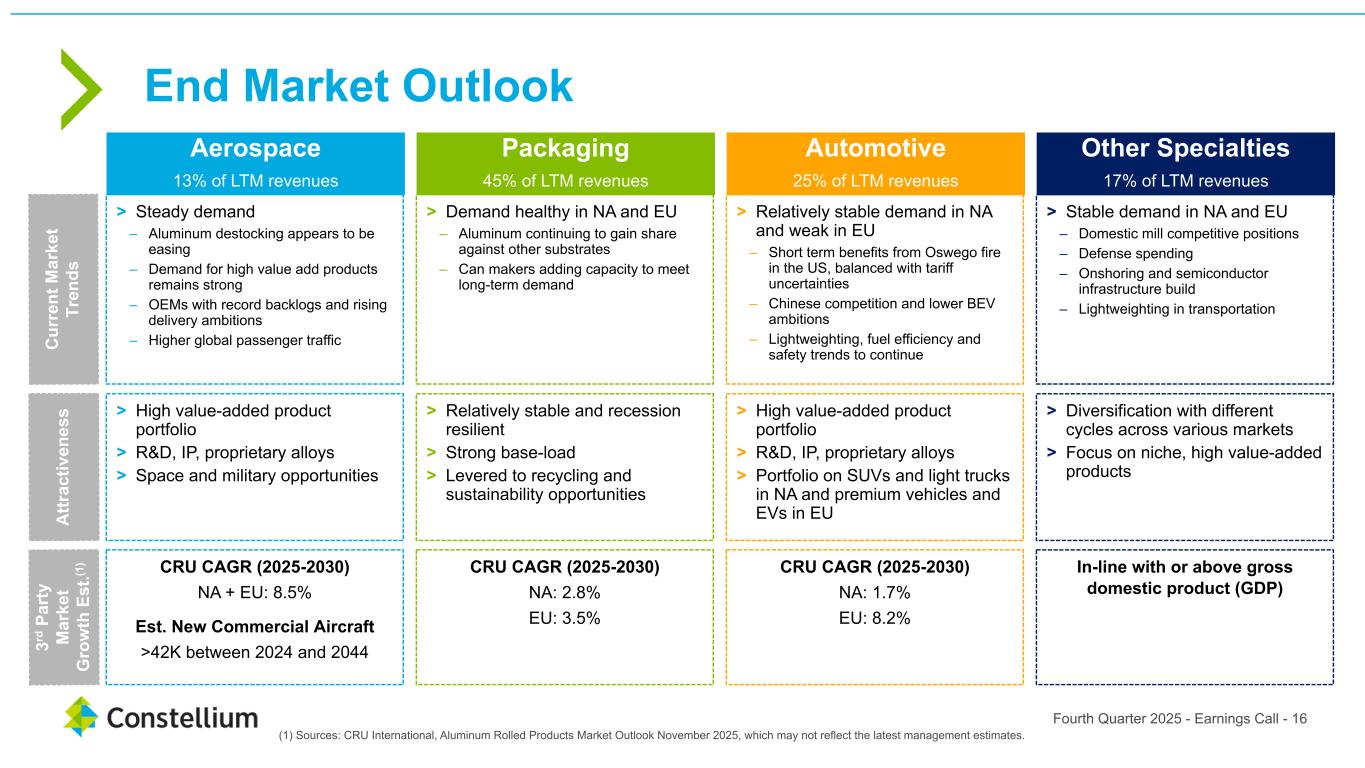
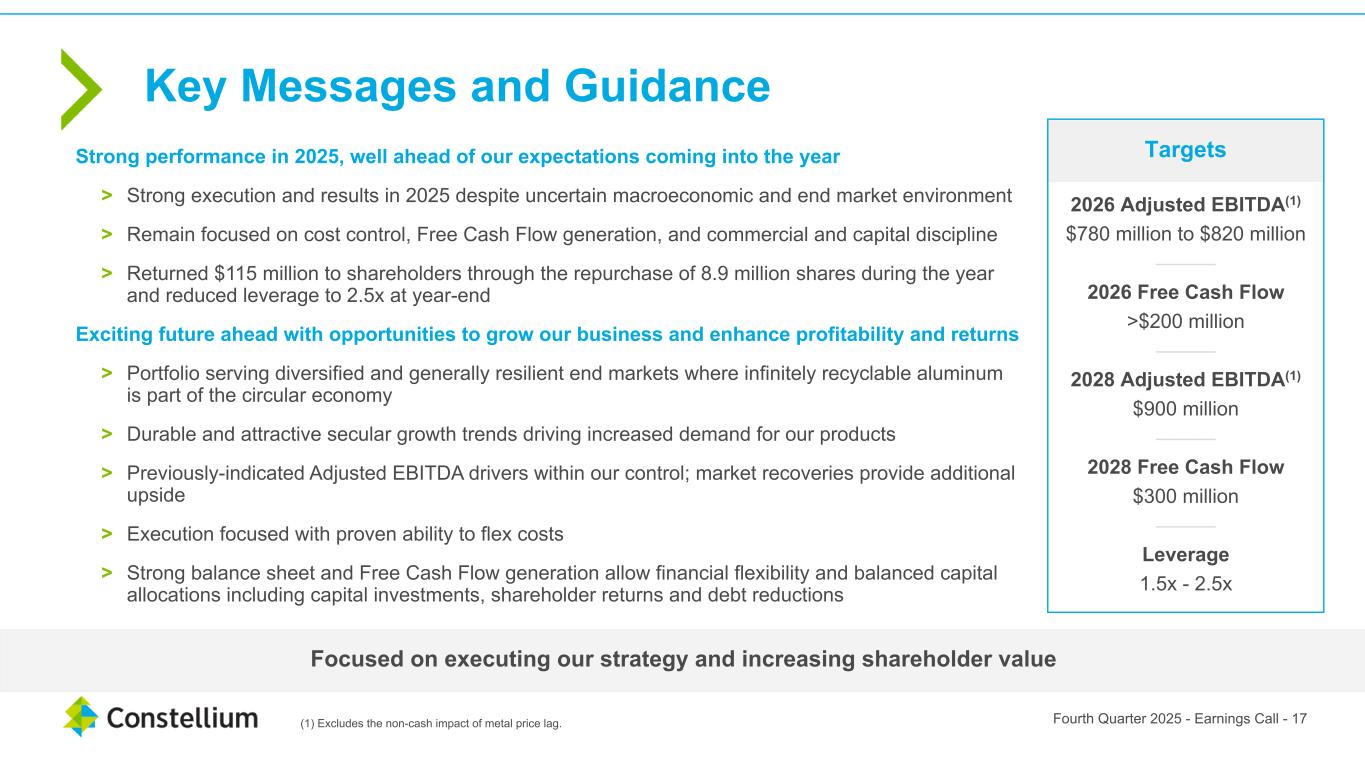
Thank you, Jack. Let's turn to slide 16 and discuss our current end market outlook. The majority of our portfolio today is serving end markets benefiting from durable and attractive secular growth trends in which aluminum, a light and infinitely recyclable material, plays a critical role. Turning first to the aerospace market, commercial aircraft backlogs are at record levels today and continue to grow. Major aerospace OEMs remain focused on increasing build rates for both narrow-body and wide-body aircraft, as evidenced by higher plane deliveries year over year and rising delivery ambitions in the near term. Although supply chain challenges have continued to slow deliveries below what OEMs were expecting for several years in a row now, demand is steady for the most part, and aluminum destocking in the supply chain appears to be easy. Demand for high-value-add products, which is one of our core focus areas, remains strong. We remain confident that the long-term fundamentals driving commercial aerospace demand remain intact, including growing passenger traffic and greater demand for new, more fuel-efficient aircraft. In addition, demand remains stable in the business and regional jet market, whereas demand for space and military aircraft is strengthening. We believe we are a leading provider of proprietary aluminum solutions for those customers in the space and military aviation markets today. As you know, we are investing in additional capacities and capabilities, such as our third airware cast house in Isoir, which we expect to start up by the end of this year to further strengthen our position in the future. Looking across our entire commercial and military aviation and space businesses, we believe our product portfolio is unmatched in the industry, and we have industry-leading R&D capabilities for aluminum aerospace solution given the visibility over the next several years we are raising our adjusted EBITDA per ton target for our a&t business to one thousand three hundred dollars which is up from one thousand one hundred dollars that we provided last year turning out of packaging demand remains healthy in both North America and Europe the long-term outlook for packaging continues to be favorable as evidenced by the growing consumer preference for the sustainable aluminum beverage can capacity growth plans from the can makers in both regions and the greenfield investment ongoing here in the u.s we continue to see aluminum gain share against other substrates in the beverage market and the majority of new beverage products are launched in aluminum cans today due to its sustainable attributes. Aluminum cans are highly recyclable, and we are well positioned to capitalize on the benefits from recycling packaging materials at our facilities in Matroscholz and Neuf-Brizak. Packaging markets are relatively stable and recession-resilient, as we have seen many times in the past. Longer term, we continue to expect packaging markets to grow low to mid-single digits in both North America and Europe, providing a strong baseload for our operations in both regions. Now, let's turn to automotive, which continues to be a bit of a different story in North America versus Europe. In North America, demand is relatively stable, so the tariff environment is creating some uncertainties. Last year, one of our competitors' U.S.-based facilities was impacted by fire, a very unfortunate event, and which has created an interruption in the aluminum raw product supply chain in North America. The entire industry continues to mobilize to ensure we limit the impact on our customers. In the fourth quarter, we started to benefit on the raw product side as we were able to help our customers during this outage. On the automotive structure side, we were negatively impacted as some OEMs were forced to reduce production on certain platforms, impacted by the disruption on the raw product side. The overall impact in 2025 was a net positive on our results, which we expect to continue into the first half of 2026. automotive demand in europe remains weak particularly in the premium vehicle segment where we have greater exposure european markets are seeing increased chinese competition and have lowered their battery electric vehicle ambitions automotive production in europe is also feeling the impact of the current section 232 auto tariffs given the number of vehicles Europe exports to the U.S. Longer term, we believe electric and hybrid vehicles will continue to grow, but at a lower rate than previously expected. Secular trends such as light weighting, fuel efficiency, and safety will continue to drive the demand for aluminum products. As a result, we remain positive on this market over the longer term in both regions despite the weakness we are seeing today as you can see on the page these three core end markets represent over 80% of our last 12 months revenue turning lastly to other specialties these markets are typically dependent upon the health of the industrial economies in each region including drivers like the interest rate environment industrial production levels and consumer spending patterns. Industrial market conditions in North America and Europe became more stable in the second half of 2025 and we believe the markets, particularly in Europe, have bottomed after three years of market downturn. Nevertheless, we expect the specialty markets in Europe to remain relatively weak in the near term. We do believe TID markets in North America provide us with some opportunities today given the current tariffs make imports less competitive compared to domestic production we also believe there are some opportunities in land-based defense and semiconductor markets given current market dynamics in most industrial markets we are focused on niche high value added applications to conclude on the end markets we like the fundamentals in each of the markets we serve and we strongly believe that the diversification of our end markets is an asset for the company in any environment turning lastly now to slide 17 we detail our key messages and financial guidance our team delivered strong execution and results in 2025 that were well ahead of our expectations coming into the year excluding metaphoric lag our adjusted EBITDA in 2025 was our second best year ever we returned 115 million dollars to shareholders in the year with the repurchase of 8.9 million shares and we reduced our leverage to 2.5 times by year-end we remain focused on strong cost control free cash flow generation and commercial and capital discipline based on our current outlook for 2026 we are targeting adjusted EBITDA excluding the non-cash impact of metal price lag in the range of $780 to $820 million and free cash flow in excess of $200 million. Our guidance assumes the recent demand trends in our end markets that I described earlier will continue into at least the early part of 2026 and the overall macroeconomic environment to remain relatively stable. looking into the future we also want to reiterate our targets of adjusted ebitda excluding the non-cash impact of metal price lag of 900 million dollars and free cash flow of 300 million dollars by 2028 to conclude we are extremely well positioned for the long-term success and remain focused on executing our strategy and shareholder value creation with that operator we will now open the Q&A session.
Operator
Thank you. As a reminder, to ask a question, please press star one one on your telephone and wait for your name to be announced. To withdraw your question, please press star one one again. One moment for questions. Question comes from Katja Zantik with BMO Capital Markets. You may proceed.
Tim
Analyst — Wells Fargo
Hi, thank you for taking my questions.
Maybe starting on the 26 guide, can you let us know how much of a benefit for scrap spreads is embedded in this guide?
Good morning, Katya. So, I think it's – thank you for the question. Regarding the scrap benefits for 2026, and here I'm going to go on for a little bit. Obviously, it's a – we We believe it's a tailwind for us in 2026. Our expectation is given our scrap consumption needs are fully contracted in the first quarter, we should see similar type of benefits as we've seen in the fourth quarter of 2025. And if you were to kind of look at the bridge for Q4 2025 for PARP business unit, you'll see that, and we caught this out, right, the metal benefits in the system. So it includes the European plans as well as muscle shows more than offset, a little bit of a higher operating cost, if you will. so the net impact is 40 million dollars which gives you an idea on the amount of benefits we had in the fourth quarter of 2025 and we believe that should continue to carry into at least the first quarter of 2026. now um obviously there's quite a bit of interest on this topic so i think it is um we think it's it's important to have some context um number one um as we mentioned discussed previously, the recycling economics is quite complex. There are really a lot of elements at work. Here we're talking about the market, the aluminum price levels. We're talking about scrap spreads. We're talking about scrap consumption levels, productivity, melt loss, type of scrap. We procure, and it's not just UBCs. We also consume other types of scrap. And even within UBCs, you have different grades. So it gets really, really complicated. And even if you just take three of the many elements there, it becomes a three-dimensional matrix. So it's very complicated as they can work in sync or they can work against one another. I think another important point to understand is, you know, recycling economics has averaged out over time. And that was the case when markets were much more stable and call it, you know, the pre-2024 time periods where we have mentioned previously that the annual swings could vary between sort of the $20 million to $30 million range, but they have averaged out over time. And that is also the case in times which are more volatile, like between 2024 to today. And if you just rewind a little bit, in 2024 we saw sharp contractions, scrap spreads, and we had challenges and muscle shows. So we experienced actually, you know, $15 million to $20 million worth of quarterly headwind, if you will. And then you kind of multiply that by four, you'll get the full-year headwind. So it's quite substantial. And then we saw similar type of headwinds in the first half of 2025, which, you know, was more pronounced in the first quarter to a lesser extent. In the second quarter, as spot spread tightened, but Muscle Shoes was doing better. And the Midwest saw a sharp rise, a sharp increase due to the tariffs. But overall, you know, if you look at 24 to the first half of 2025, that was an extremely challenging 18 months for us from a metal profit perspective. Now, Q3 2025 was stable, and then in the fourth quarter, as I mentioned, we've benefited from favorable environment and quite strong performance at Muscle Shoals, which have allowed us to recoup the losses we had in the first half of 2025 plus a bit more. So now looking at 2026, I've already covered the first quarter. And looking at the future quarters, we do have some open, you know, volumes. And we're working very hard to lock in those additional open volumes beyond the first quarter. But the incremental benefits based on the current expectation is that they should gradually taper off as we move through the year. But overall, we should – our expectations is that we should be able to recoup the losses we had from 2024. So that's a long answer, but it gives you a lot of kind of color around the scrap topic. And I think the takeaway is, you know, one, it's a very complicated topic. Number two, it does average out over time. And number three, you know, recycling, it requires a lot of investments, which we have made. It requires a lot of know-how. We've been operating it for decades. It is one of the cylinders in our engine, as we mentioned previously. And, you know, when the market conditions are more favorable like it is today, you can count on us to make the best out of the opportunity.
Okay. and I understand that it's complicated but let's say if these scraps say at the current level and then looking more to your 28 target of 900 million it seems that that target might be conservative can you just remind us how we get there or what are some of the moving parts there hello Katya thank you for all the this follow-up question.
I let check come in later, but maybe, you know, with respect to 2028, I think when we talked the first time a year ago about our bridge, we said we were still going to take more conservative assumptions on the metal side. So, what you are seeing today is that we are ahead due to metal benefits versus our 2028 target. But obviously, this is a very dynamic and market environment and things can change very very quickly so midwest premium can change very quickly and the percentages of scrap spreads can change very quickly which is why we have taken a conservative assumption in the first place we don't know if the current situation that we experienced in 2026 are going to last and for how long they are going to last which is why we we have preferred to remain at a more prudent stance and assumption in our 2028 target.
Operator
Thank you, Katya.
Operator
Thank you. Our next question comes from Bill Peterson with JP Morgan. You may proceed.
Yeah, hi, good morning and thanks for taking the question. Maybe outside of the scrap spread, I'm trying to get a sense for some other factors within the 2026 guidance. For example, what is your latest thoughts on aerospace recovery, how much can be attributed to vision 2028, any sort of assumptions related to you know one of the peers in the space with their you know their rolling mill ramping for the automotive space, trying to get a sense because some other puts and takes within the four-year guidance.
Thank you very much for the question Bill. I start and let check complete. Let me start on the market side maybe I think we believe that packaging is going to remain a good driver of growth for us going into next year we see both regions US and Europe with solid performance and and you know we have been having a quite a good turnaround in our social shows operational and so we we have been growing on the packaging side and we expect to continue to grow on the automotive side I think we have a very mixed picture between the US and Europe the US seems to be rather stable but remember we do we only have one continuous annealing line in the US so our capacity on the raw product size is is limited to this one line we have seen nice benefits in Q4 from this unfortunate event that happened in the US supply chain and we've also had benefits in Europe which we expect to last into the first half of 2026. As you know the European automotive market has remained weak and we have not seen any change. It seems that the market has bottomed out but it's very hard to predict at this point in time. On the aerospace side we see the business is steady we see quite a good strong good and strong mix on on the aerospace products today in 2026 we have a little bit more visibility today than we then we had during our last call on 26 and maybe also 2027 we've we feel that military jets and and space is going to continue to grow and be positive for us. Just as a reminder we're also going to get our new airware castiles that will ramp up towards the end of this year so most of the benefit you should expect coming in starting to come in 2027 and not this year but we are fully on track with with the expansion of our airware capacities and capabilities. I think on the on the more negative side is maybe that industrial markets and specialty markets in Europe remain weak. We also feel they have bottom belts, but we do not see a recovery coming in Europe as of yet. So I think there's a good mixture of positives and also some uncertainties in the market that we see for 2026. On the recycling side, we continue to expand our recycling with the investments we've made in the past and the strong operating performance that we also had in q4 so it was not just because of scrap spreads but also strong operating performance and we expect that to continue in 2026 as check already explained the second half of scrap spreads may be maybe less favorable so this is something that we will update as we as we go along important also to note that inflationary pressures are continuing that's why we are very focused on cost control and controlling what we can control in this fluid environment market environment that we experiencing and with our vision 2028 program we want to underpin our roadmap to 2028 in terms of operating efficiencies which is something that we need to focus on every year okay great for that thanks for all that information Maybe it's a little bit early days, but there's been some news here about some potential tariff relief on downstream or derivative products.
Trying to get a sense of maybe if there's any overlap with, you know, your own product suite that you sell into the U.S. You know, what are you hearing on the ground? And I guess specifically, is there any risk that there's relief on derivative products that that could have some, you know, impact on your business? Any sort of thoughts would be helpful.
I think the situation remains very fluid as it comes to tariffs so with the information we are having today we do not see any impact on us and we continue to believe that tariffs are net positive for us given that we will have stronger demand within the North American market.
Okay thanks I'll pass on.
Our next question comes from Mike McNulty with Deutsche bank you may proceed Mike McNulty your line is now open hey hey sorry this is Corrine can you hear me yep hey good morning hey I don't know where you went through to Mike um hey good morning so maybe a few questions and first of all congratulations I mean this is an amazing quarter and a pretty good outlook what you're giving us here can you talk maybe about the cadence that we can expect in terms of EBITDA and free cash flow. And then the second question, Ingrid, if you can go back on the vision 2028, I think we know that you focus quite a lot on cost control. But I'm interested to hear more about the operational efficiencies, and especially in terms of people making, where are the opportunities that you're seeing in which market?
Thank you. Thank you for the question. So I'll start, Corrin, and appreciate the comments. I'll start on the cadence question, and then Ingrid can help out on the Vision 28. So in terms of 26 cadence for EP done, I think, as you know, Q1 and first half, typically there's seasonality in our business. So from a seasonality perspective, they tend to be stronger than the second half. That's normal course. Now, for 26, I've mentioned about the incremental benefits we expect to see in the first quarter from favorable recycling economics, right, recycling profits. So, that should come in the first quarter. And on top of it, we expect to see a full quarter of benefits related to the automotive supply due to the unfortunate fire that happened at one of our competitors' plants last year. So we should see a full quarter benefit. So Q1 is set up nicely, and it should be stronger than Q4 of 2025 based on the current expectation. And then from a free cash flow perspective, typically we build working capital in the first quarter and then into the first half of the year, and then we would release working capital. So, that gives you an idea of the cadence for free cash flow.
Thanks, Corinne. So, in terms of Vision 2028, this is a program that is really going to support our 2028 targets. We have net productivity assumed in our bridge, and this program is there to support achieving those numbers. So, in terms of major pillars, we're certainly targeting asset reliability. You see when Microsoft is running well that it's a very important driver of profitability for us. So asset reliability remains an opportunity across our system, which will support the throughput maximization, and it goes along with the portfolio optimization of the products that we make today. Given that some markets are rather weak and others have continued growth ahead of us, we want to better optimize how we are using our assets and this project is going to help us work more on cross-qualification so that we optimize our overall footprint and not just optimize on-site so asset reliability throughput and optimized flows we have the bottlenecking activities that are part of our bridge to 2028 with some limited investment that is embedded in our numbers and then on top of it I think we also have still opportunity to improve recycling and metal cost reduction these are really going to be the focus areas of this program in terms of which markets additional capacity should be going to I think it's it's clear from what we see in the market it's on the packaging side so can she'd we would continue to like to grow with with the market in both regions and and then obviously on the aerospace side as this is our highest margin product and with the new cast house coming in on the other side we would like to continue to grow this business for space military but also commercial aviation and we have invested in some finishing capability in in our sites that will allow us to support the ramp of the
Tim
Analyst — Wells Fargo
aerospace that is expected to come somewhere around 27 thank you thank you and as a reminder to ask a question please press star one one on your telephone our next question comes from Celia with Wells Fargo you may proceed um hi I think I'm only the only person from Wells Fargo this is Tim I hope y'all are doing well I wanted to dig down back to Katia's question if I could just if you look at the second half cadence and annualize it that's above where the midpoint is on your guidance so just trying to really understand what
takes a step down maybe more in the second half can you help elaborate on that and please give us the assumptions on the Midwest premium and scrap spread that's baked into your guidance so I'll start so the the way to think about it is the Q4-25, we've seen a fairly substantial amount of metal benefits, as I mentioned previously, But then the first half is quite challenged. Then from a relative comparison perspective, as we go through the year, Q1 of 25 was extremely weak. Q2 was also weak. So the incremental benefits on the metal side, you would expect it to kind of be more significant in the first half of 2026. I think that's one point. Then the other piece of it is we have more certainty, more visibility. Obviously, as, you know, we stand here today, February, looking at Q1 and into the first half of the year. in some of the markets, the visibility there is not as certain into the second half.
Tim
Analyst — Wells Fargo
So does that mean that you have some sort of Midwest premium and scrap spread stronger in the first half than the second half? I was hoping for quantification, but even if we just know that that's the way to think about it, it would be helpful.
I think there is more volume, consumption volume, that's not being the first quarter relative to the future quarters. So we have more exposure. Okay.
Tim
Analyst — Wells Fargo
And then, if I could, we're hearing a bit about demand destruction, a little bit of switching to steel away from aluminum and from auto and tractor-trailer applications, but also opportunities for aluminum to take share from copper. So I was hoping you could comment on that. And along those same lines would be great to get any thoughts on the C-VAM impact as there were some public quotes from Constellium on that topic recently.
Okay. let me start enough so I think with respect to aluminum substitution in automotive we really do not see any evidence of that and particularly nothing related to the outage that has has happened in North America you know that these design decisions I mean it takes a long time to change design is very very costly and we develop a lot of platform specific products and and usually once you're on the program it doesn't really or on the platform it really doesn't happen that that you get substituted so we we haven't seen any impact or any talk from our customers with respect to to substitution uh with steel um you know the trailer bills are low right now and that's more related i think also to the general economic situation but clearly we haven't seen it um and and we do not expect it because they're trying to lightweight uh the trend you know the more the better safety needs uh and and the fuel economy this is just going to stay so we we are not worried that on the automotive or transportation market anything like this could happen and then with respect to to copper i have to say i have i'm i'm not aware of this In terms of substitution of materials, we have been able to substitute some materials in the past with our more high-performing alloys on the aerospace side, for example, but not particularly related to copper. Now, going to your question on CBAN, even though CBAN has been adjusted a little bit, we still think it's negative for the industry in Europe. We need to really create a level playing field with people importing into Europe. We need much more than what is on the table right now. We think the CBAM is going to be reflected in the regional premium in Europe. And so it's for people who are exporting a lot from Europe. It's not going to be good to pay higher metal prices in Europe for exports. We produce mostly local for local, so we are not really directly impacted by this. But clearly, the C-band design as it is today is flawed and will not prevent carbon leakage, and it could potentially lead to resource reshuffling, you know, material coming into Europe based on recycled content that is very, very difficult to prove. So, overall, we continue as an industry to oppose to its current design, and we're working with industry associations like European Aluminum to work on changing it and adjusting it to the needs that the industry has.
Tim
Analyst — Wells Fargo
Okay. Appreciate all the color and best of luck.
Operator
I would now like to turn the call back over to Ingrid York, CEO of Conselium, for any closing remarks.
Well, thank you, everybody, for your interest in Conselium. As you see, we have delivered strong results in 2025, and today we provided a strong outlook for 2026. We are very happy with the steps that we are making towards our 2028 targets, and we look forward to updating you on our progress in April. Thank you very much, everyone.
Operator
Thank you. This concludes the conference. Thank you for your participation. You may not escape.