Operator
Welcome to the DT Meadstream First Quarter 2025 Earnings Call. I will now turn it over to our speaker today, Todd Lerman, Director of Investor Relations. Please go ahead.
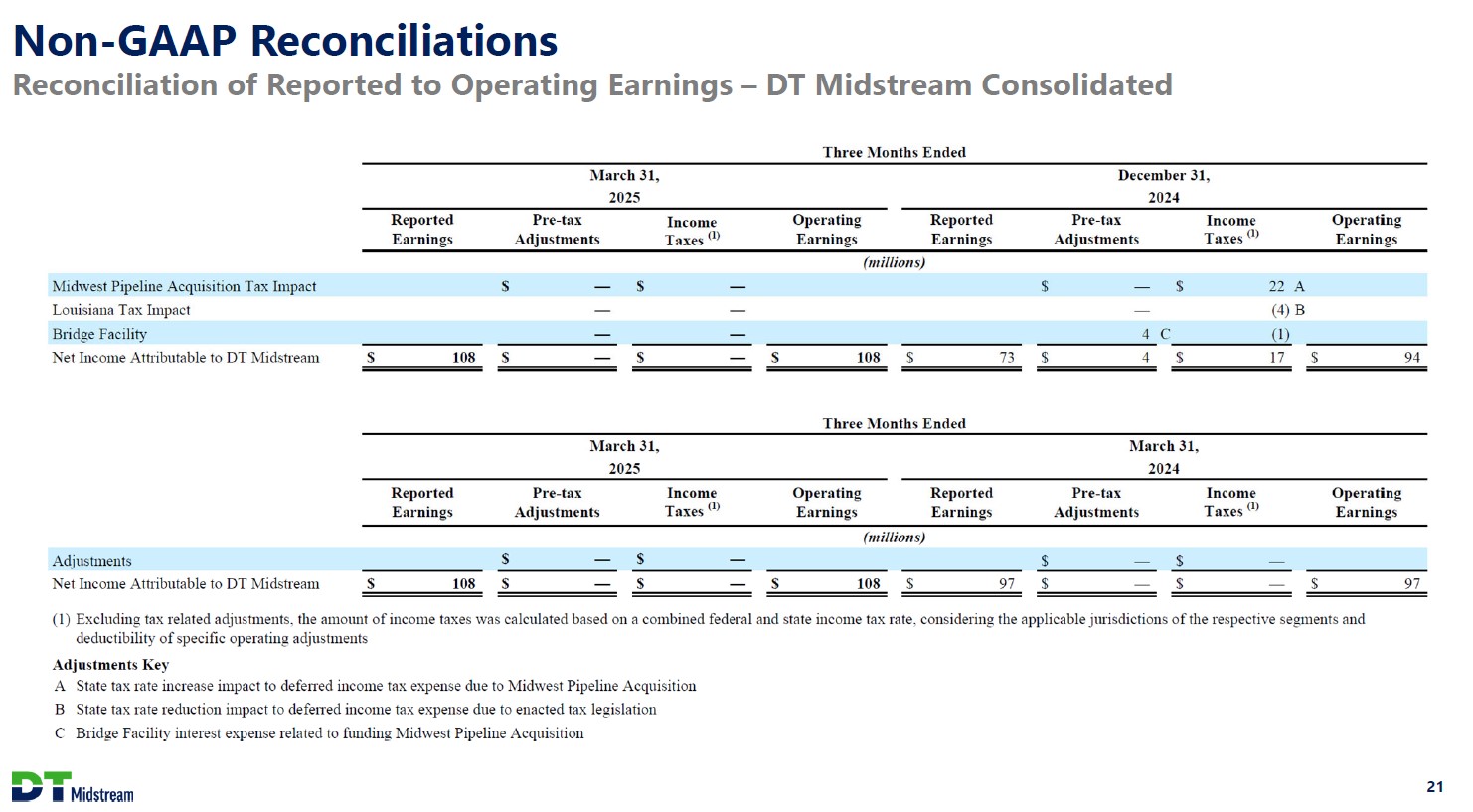
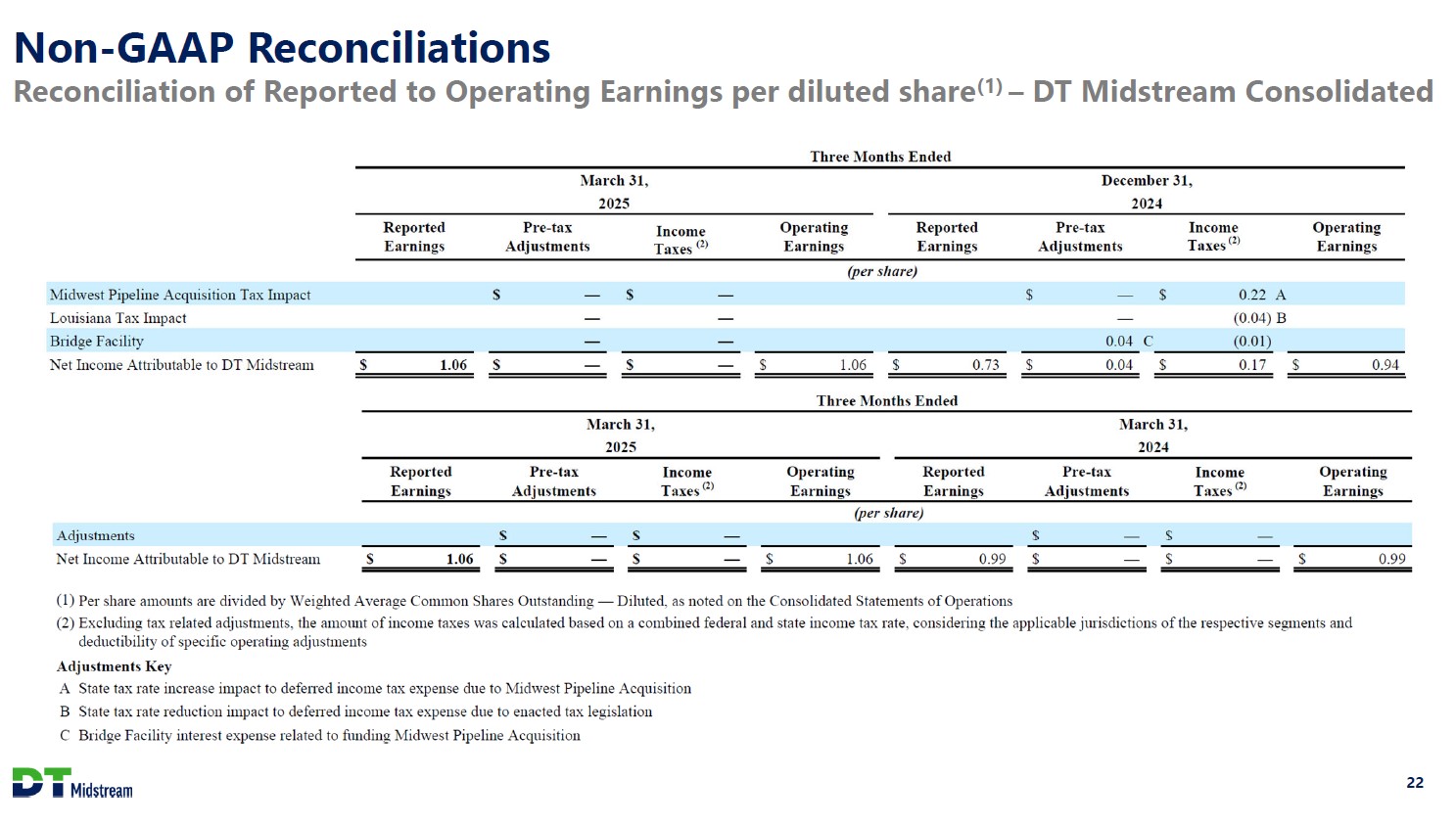
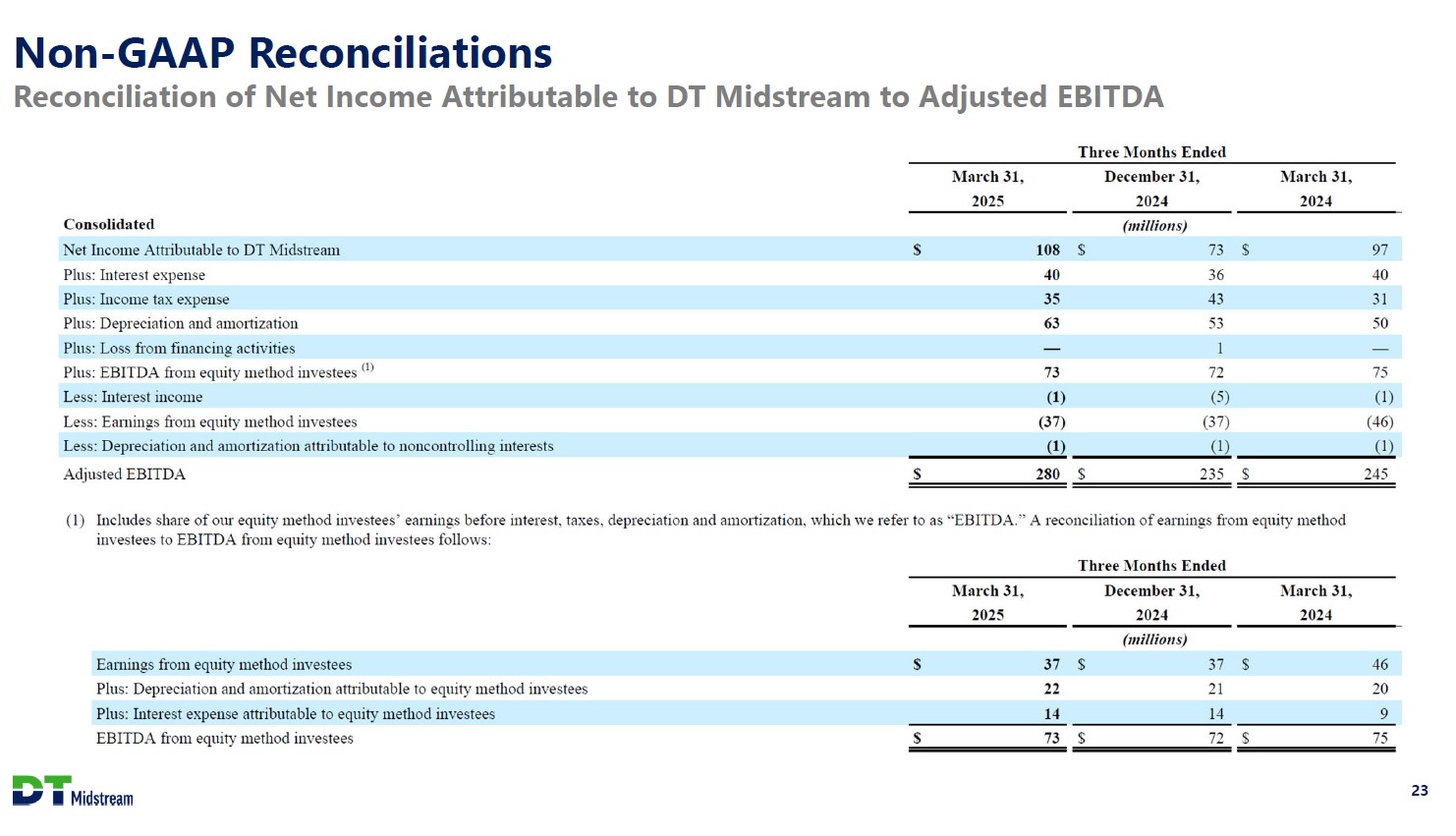
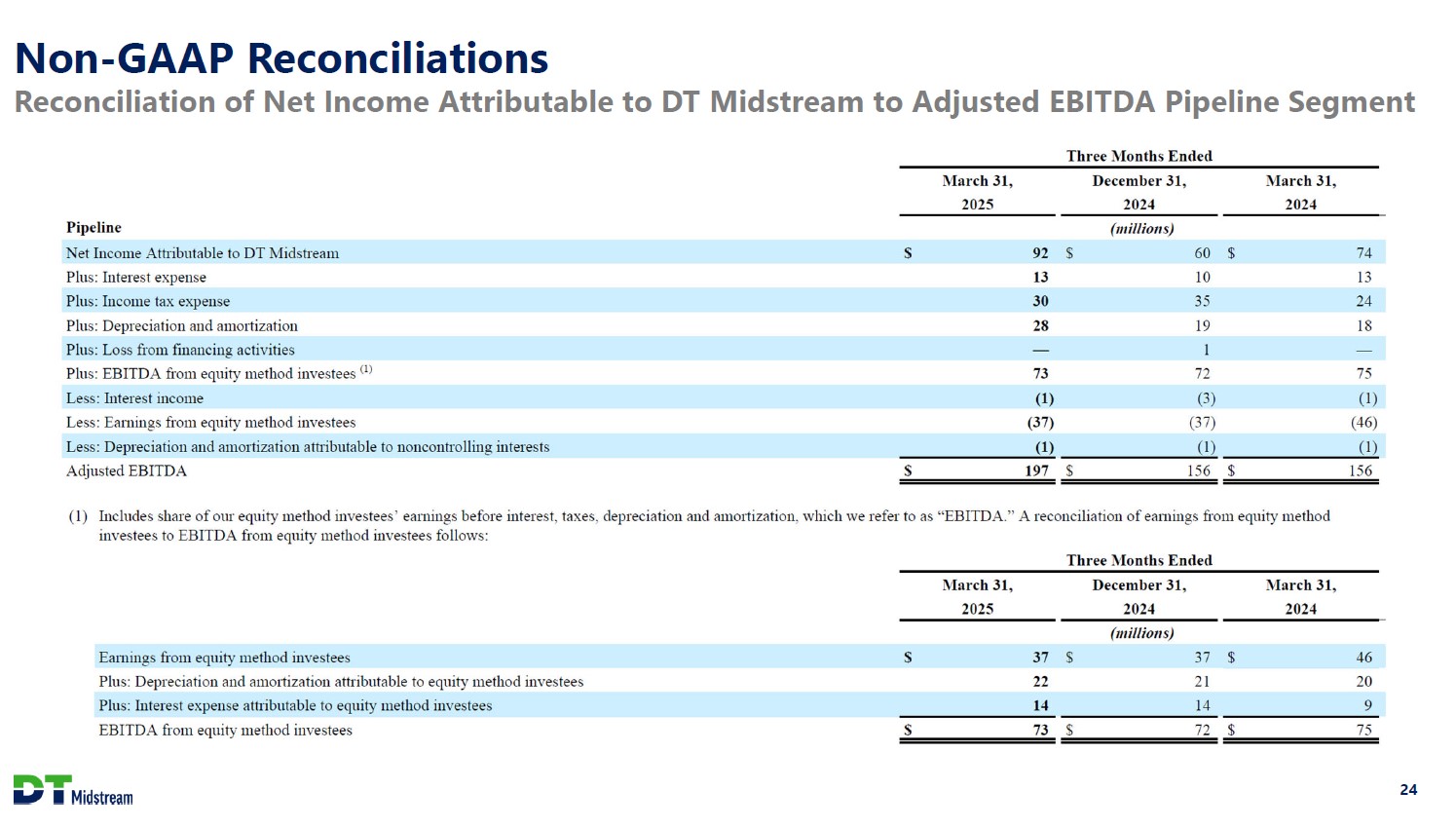
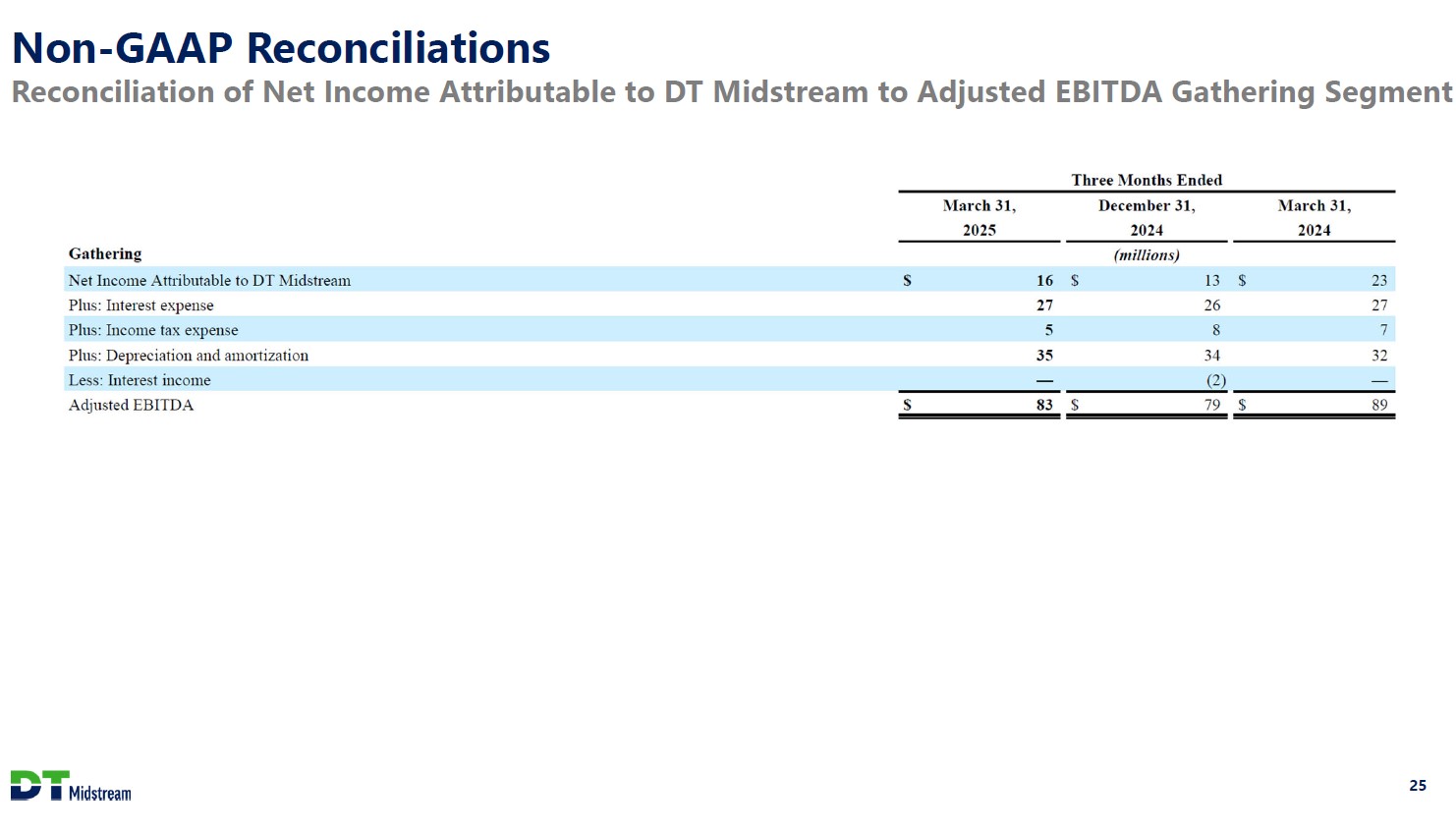
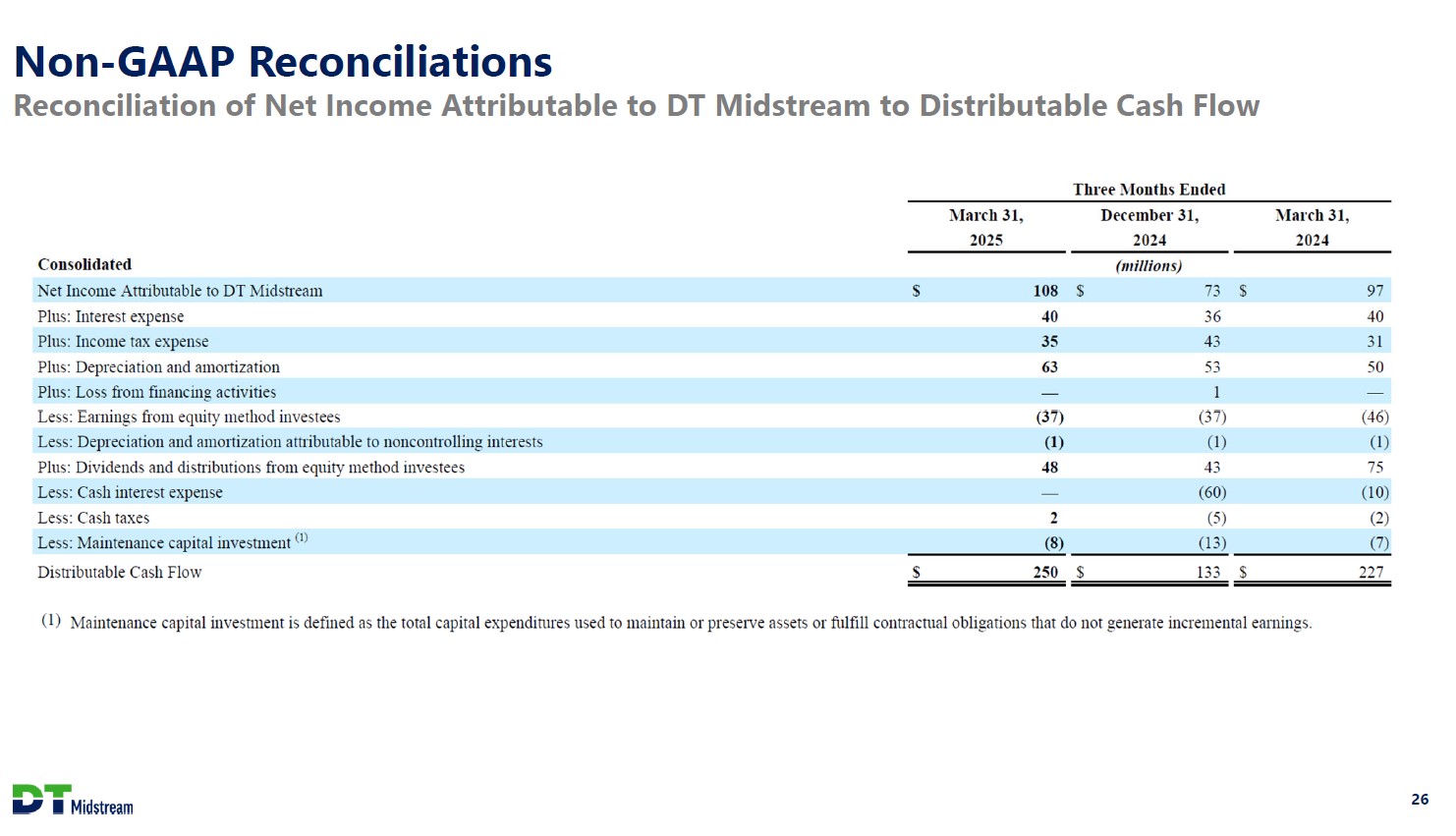
Good morning and welcome, everyone. Before we get started, I would like to remind you to read the Safe Harbor Statement on page two of the presentation, including the reference to forward-looking statements. Our presentation also includes references to non-GAAP financial measures. Please refer to the reconciliations to GAAP contained in the appendix. Joining me this morning are David Slater, President and CEO, and Jeff Jewell, Executive Vice President and CFO. So, with that, I'll go ahead and turn the call over to David.
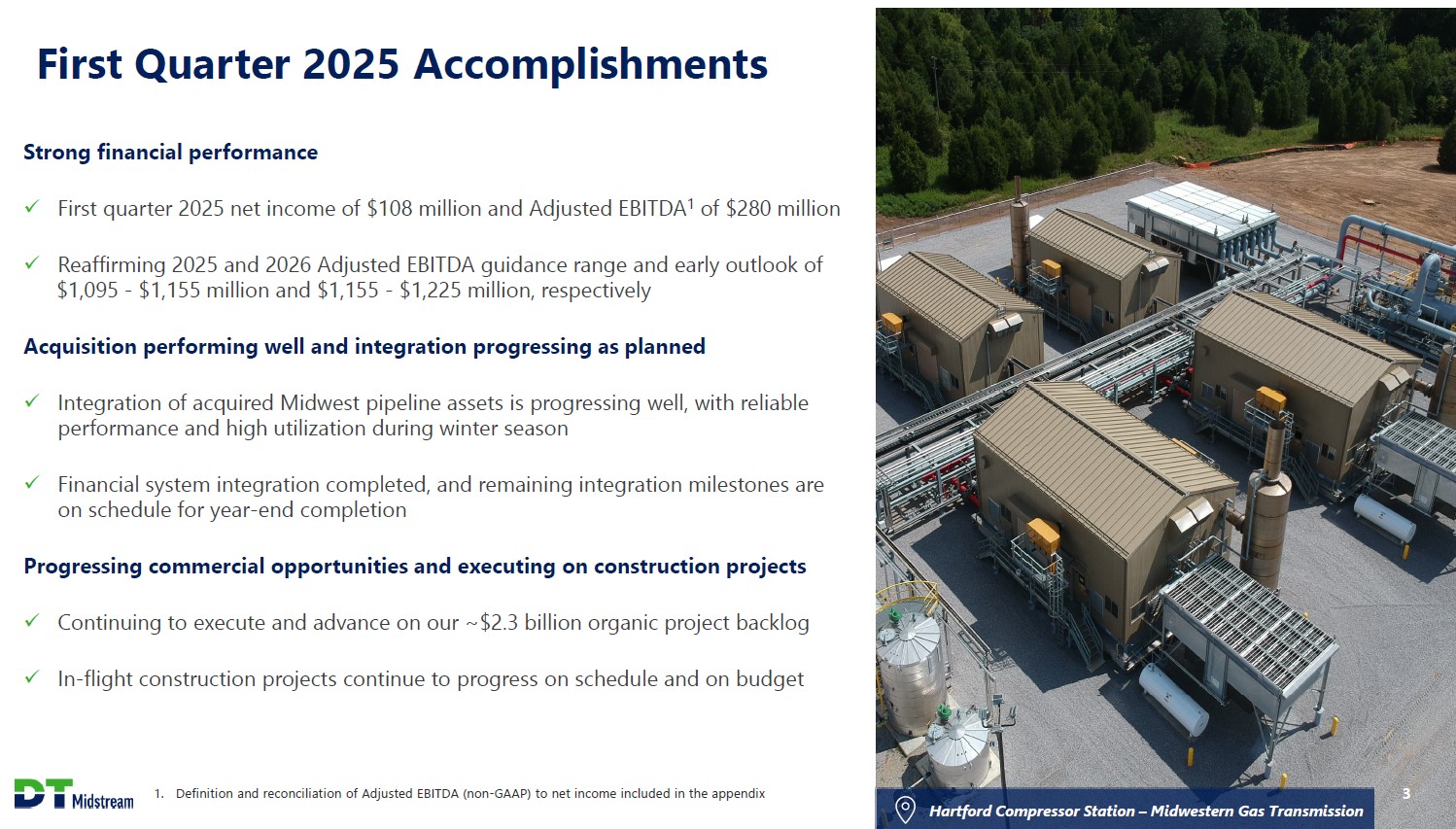
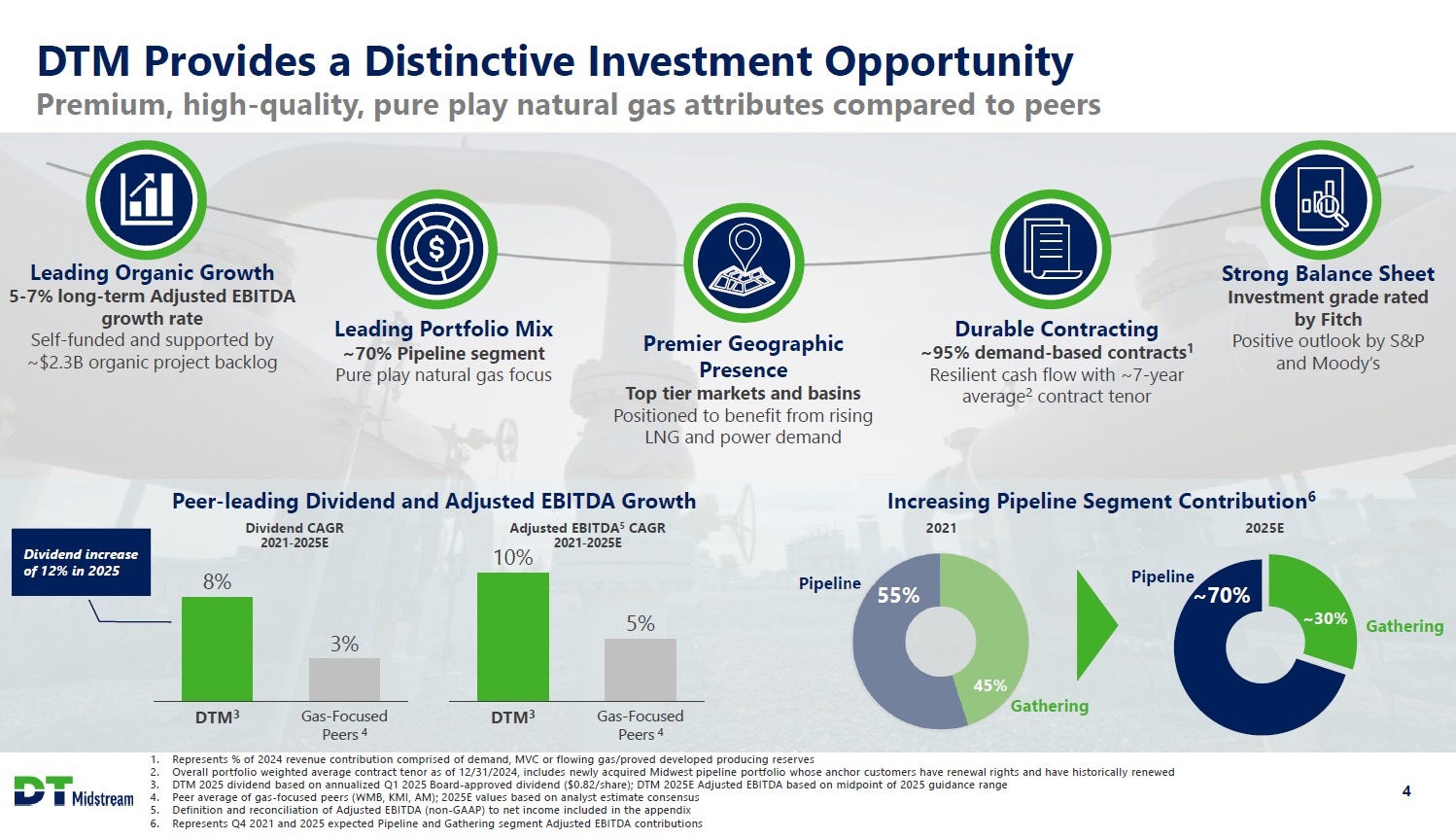
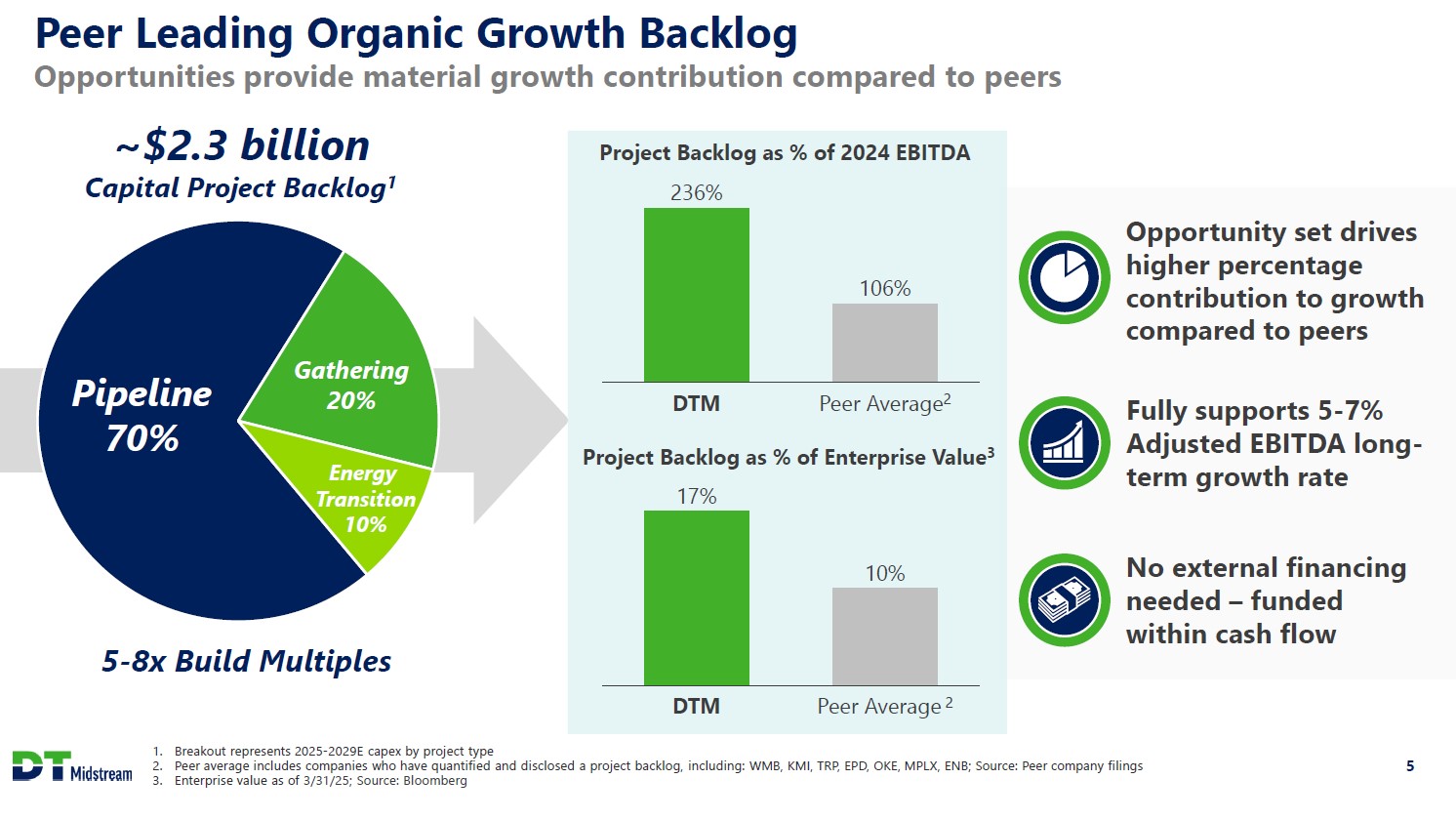
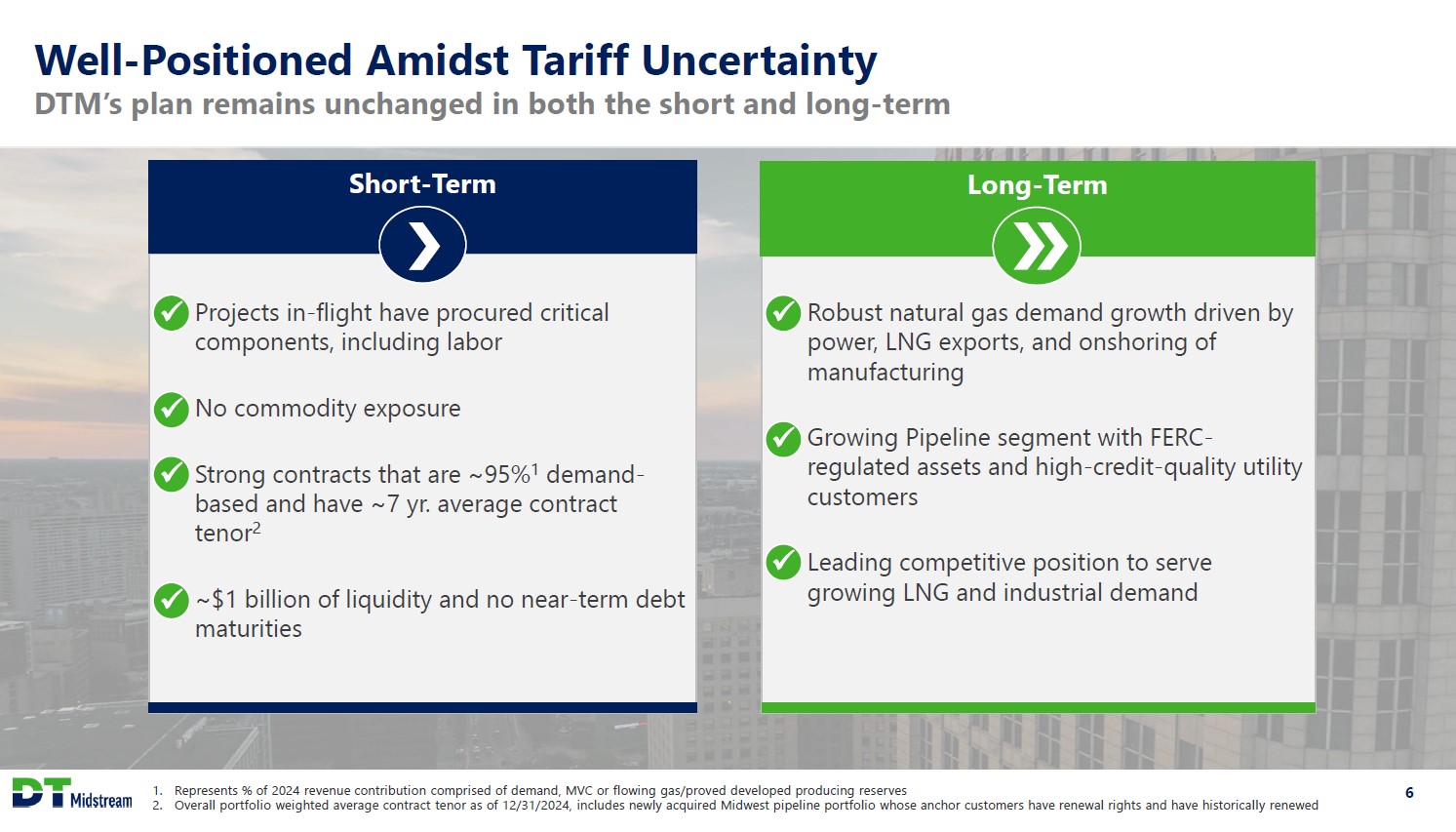
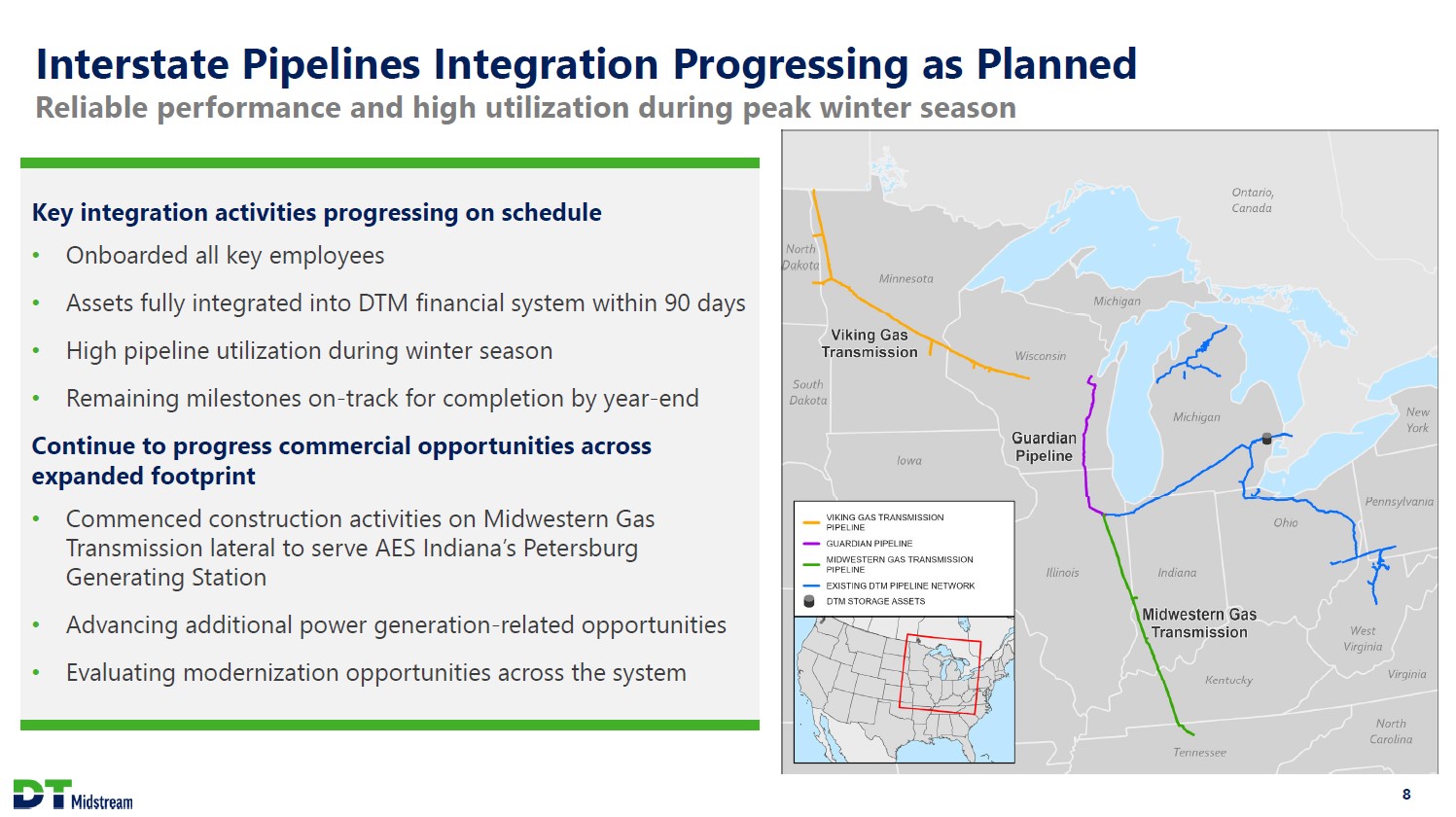
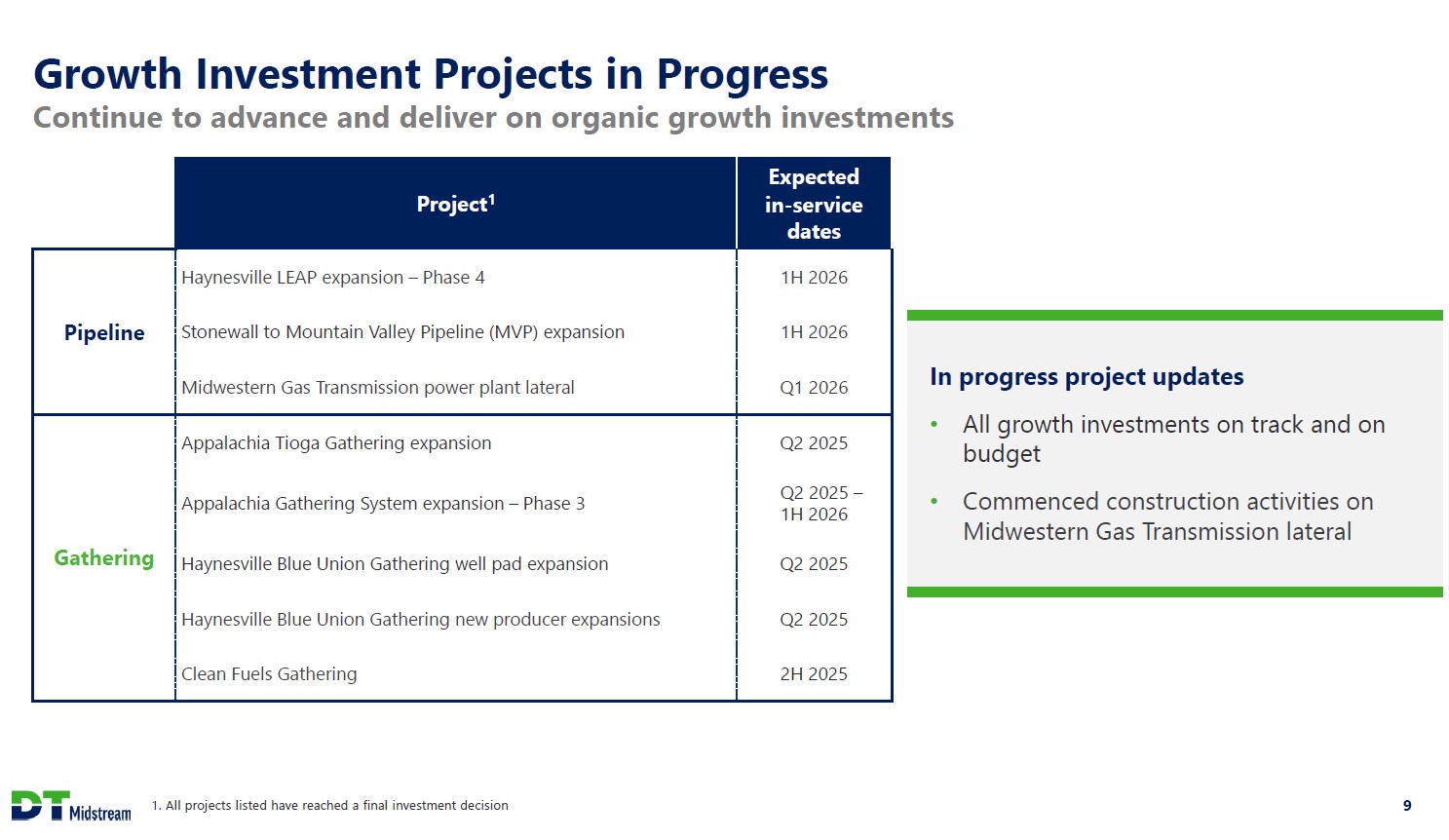
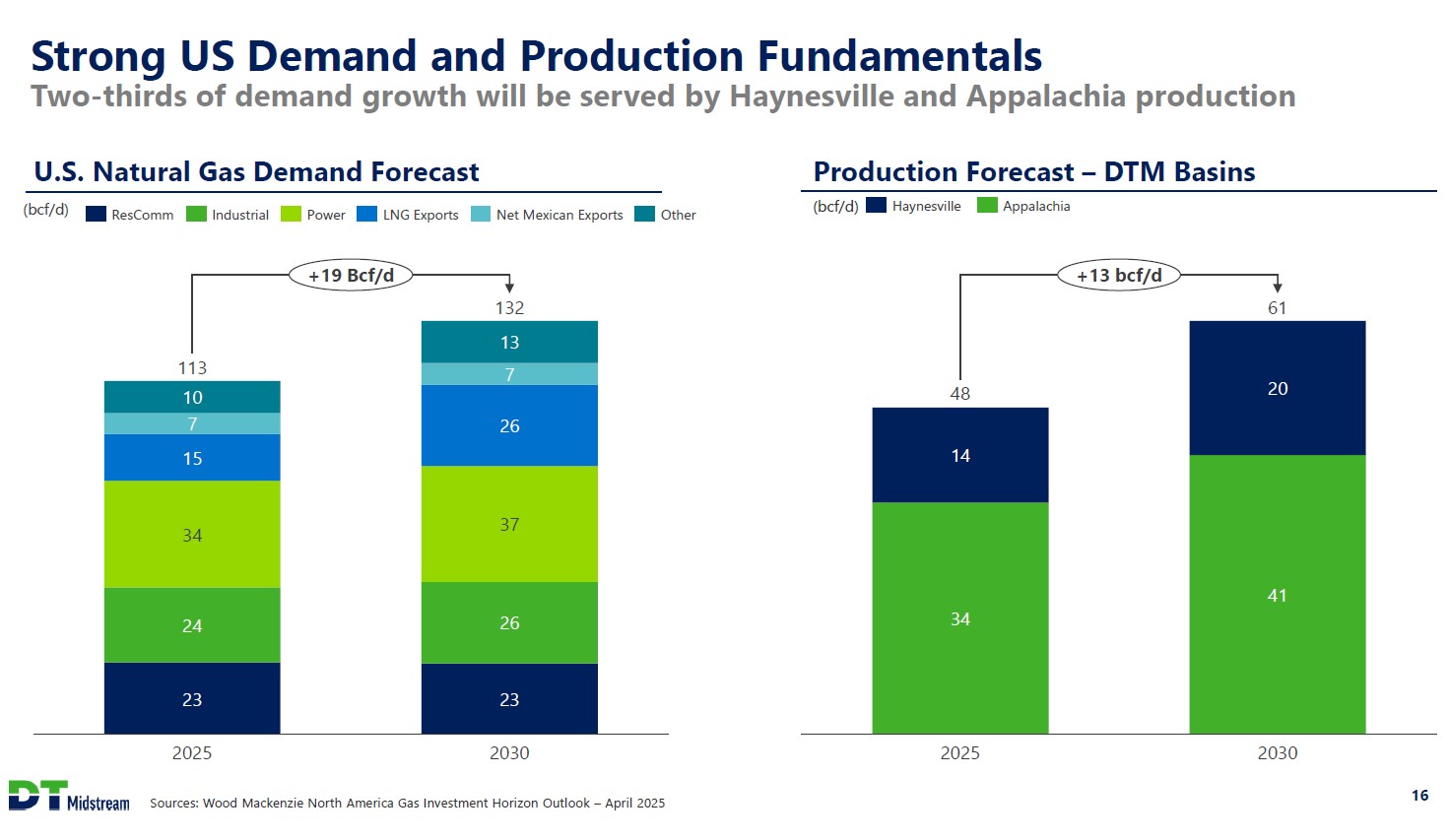
Thanks, Todd, and good morning, everyone, and thank you for joining. During today's call, I'll touch on our financial results, provide an update on the latest commercial activity and construction progress on our growth projects. I'll then close with some commentary on the current market fundamentals before turning it over to Jeff to review our financial performance and outlook. So with that, we're off to a strong start in 2025, giving us confidence in our full-year plan. We are reaffirming our 2025 adjusted EBITDA guidance range and our 2026 adjusted EBITDA early outlook range. and we continue to execute on our $2.3 billion organic growth project backlog. Our teams remain focused on integrating our newly acquired interstate pipelines. The key integration activities are progressing on schedule and we completed full cutover of all financial activities in the DTM systems on April 1st. We are on track to complete all remaining milestones by year-end. We on-boarded all key employees at close and benefited from the team's expertise with these assets during the winter season, which our pipelines were highly utilized and provided reliable service. As we gain additional insights into these assets and how they operate, we're developing a clearer view of the commercial opportunities they present, including synergies with our existing network, and we feel that the growth and modernization opportunities offered from them are better than our initial assessment. Construction is currently underway on the first of these growth projects, the Midwestern Gas Transmission Power Plant lateral to serve AES, Indiana's Petersburg generating station. On the broader construction front, all of our in-flight growth investments remain on track and on budget. And expansions across the gathering footprint will begin to contribute during the second half of the year. As a reminder, we expect these projects to ramp over a period of time and look forward to their contributions as they serve some of the most strategic supply areas in the country. Finally, I'd like to take a moment to address the recent market volatility and its long-term impacts to DTM and the broader natural gas sector fundamentals. The first quarter of 25 was a volatile period for the market, with significant cold weather in January rebalancing the market and driving natural gas prices up, followed by a decline in pricing as the market tried to understand the impact of tariff announcements. Despite the uncertainty ahead and volatility, BTM, a pure play natural gas midstream company, is fundamentally well positioned and our plan remains unchanged. Our contracts have been structured to be durable, even in volatile markets, with significant demand-based revenues, a customer base that is over 80% investment grade rated, and contract terms that average seven years. In addition, we have no commodity exposure and minimal volume exposure across our portfolio, with our pipeline segment comprising 70% of adjusted EBITDA, serving strong demand pull utility customers anchored by long-term contracts. We expect tariffs will have no material effect on us as we have procured long-lead critical components for our projects currently in progress and maintain strong strategic relationships with suppliers, which is why we are confident in reaffirming our 25 and 2026 adjusted EBITDA guidance ranges as well as our CAPEX guidance. Looking out over a longer-term time horizon, we remain bullish about the outlook for natural gas infrastructure. Total U.S. natural gas supply and demand are both expected to grow by approximately 19 BCF per day through 2030, with demand growth primarily driven by energy exports, data center power generation, utility-scale power generation, and industrial on-shoring. Our Louisiana assets are very well positioned to serve this growing LNG demand in the Gulf Coast region. Likewise, data center and utility scale power generation is expected to drive 25% growth in the PGM and MISO power market regions by 2030. And this is where the bulk of our pipeline assets are located. In addition, the long-term positive effects of higher tariffs will result in reshoring of industrial demand, requiring more power and natural gas to serve energy-intensive industries that relocate manufacturing and industrial operations to the United States. Two-thirds of the supply increase to meet this demand growth is expected to come from the Haynesville and Appalachia regions where our assets are located, providing opportunities for higher utilization and expansion of our gathering systems to feed our pipelines. Finally, there is growing political and regulatory support emerging for natural gas and energy infrastructure. With the recognition of a national energy emergency and appreciation of the need to streamline the process, we're getting much needed infrastructure built. So overall, the fundamentals supporting the need for more natural gas infrastructure remain intact, and we are confident in our ability to continue to deliver our commitments to our customers, suppliers, and investors. I'll now pass it over to Jeff to walk you through our quarterly financials and outlook.
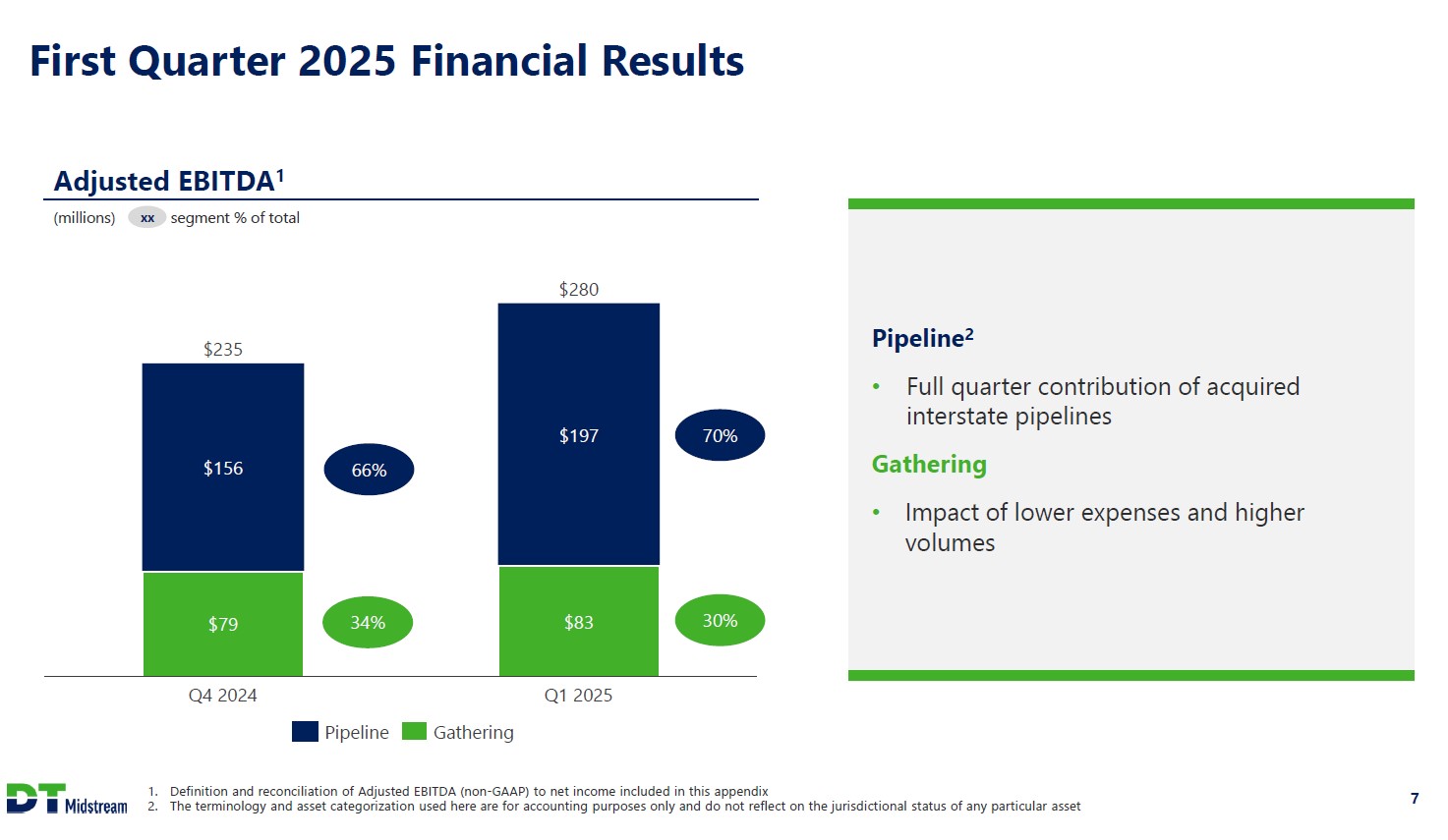
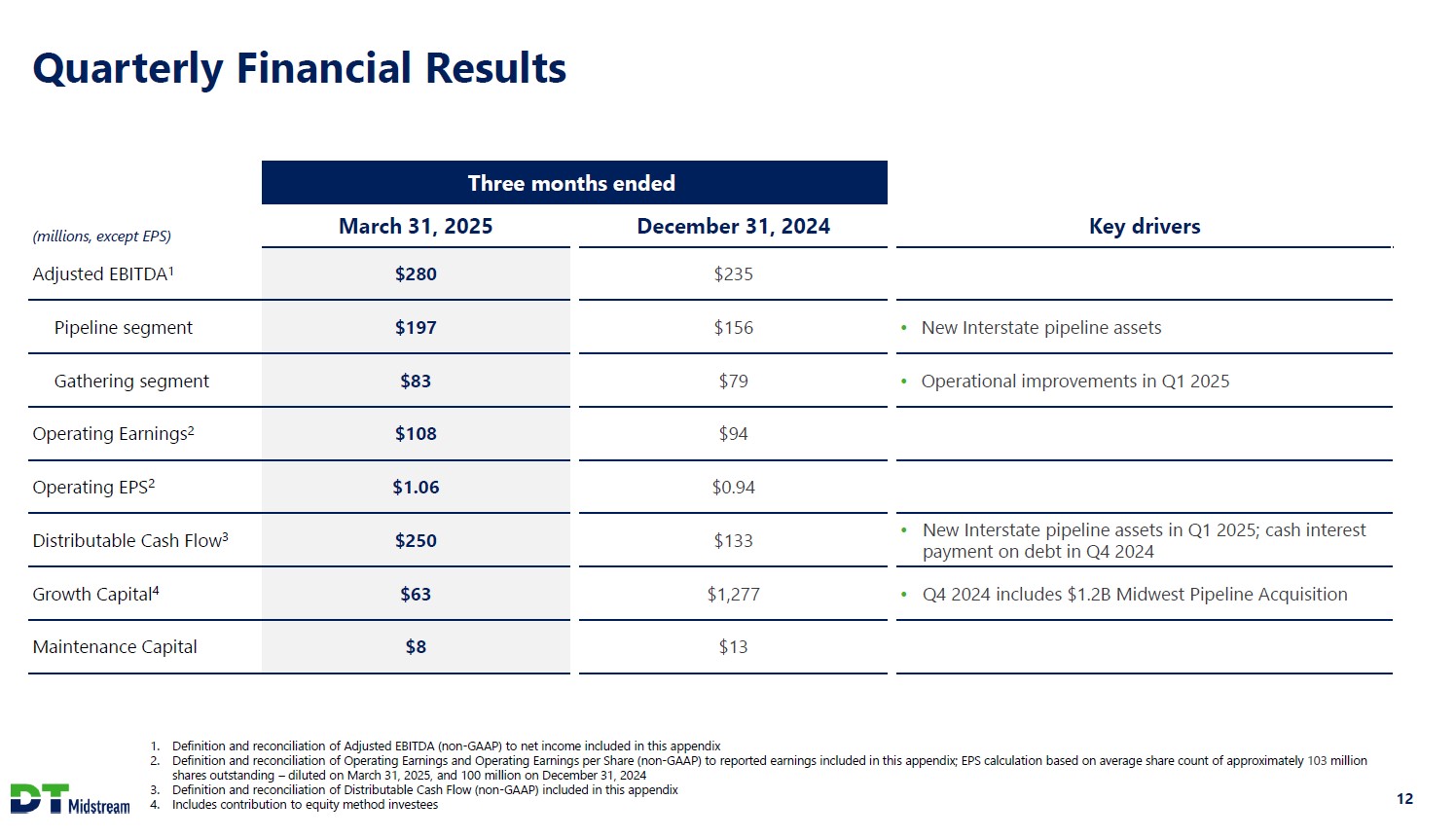
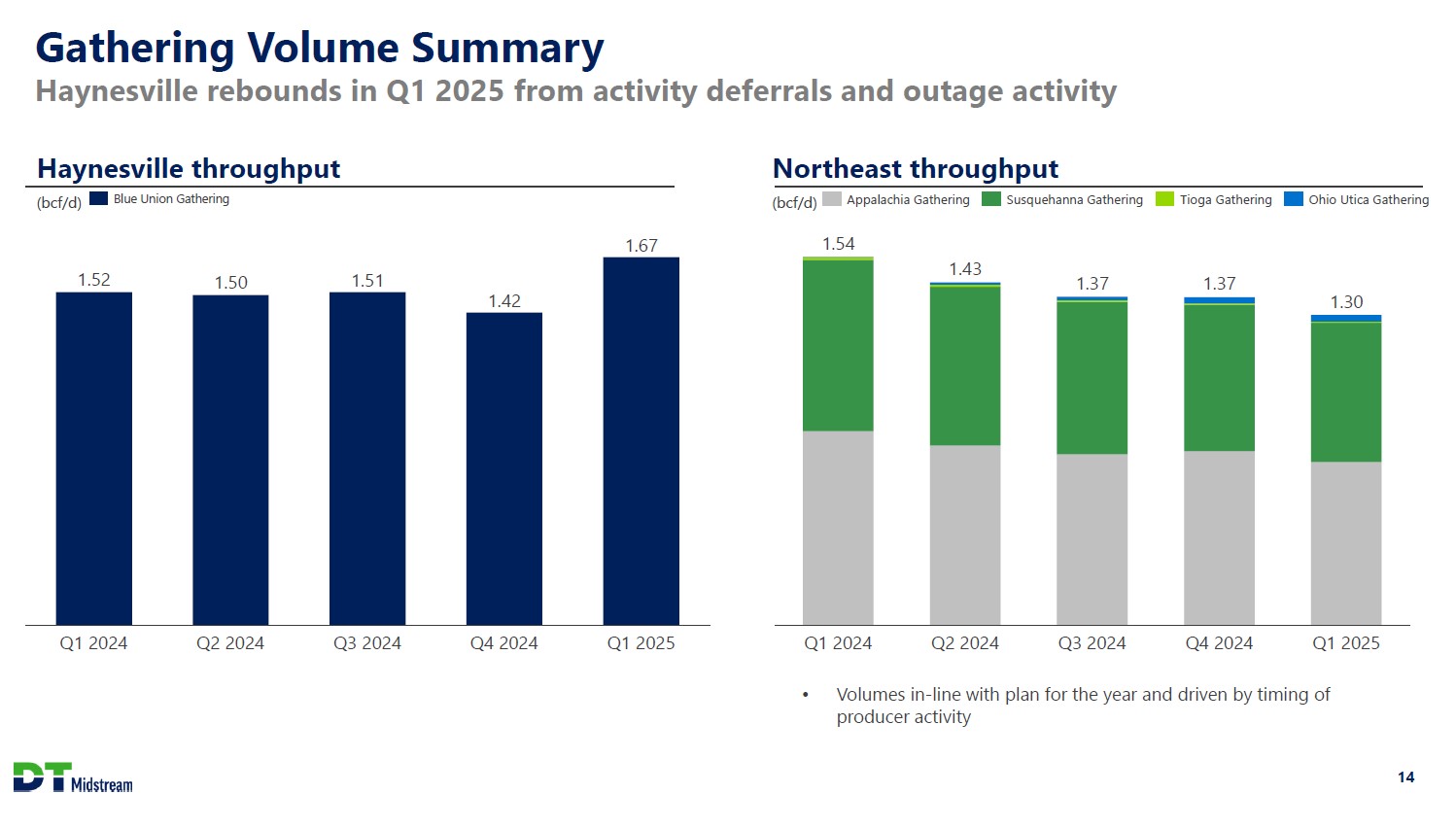
Thanks, David, and good morning, everyone. In the first quarter, we delivered adjusted EBITDA of $280 million, representing a $45 million increase from the prior quarter. Our pipeline segment results were $39 million higher than the fourth quarter 2024, 24, which includes a full quarter contribution from our acquired interstate pipelines. Gathering segment results were $6 million greater than the fourth quarter of 2024, reflecting lower overall expenses in the first quarter of 2025 and the impact of growing volumes in the Haynesville. operationally total gathering volumes across the haynesville averaged 1.67 bcf per day an increase from the fourth quarter driven by new volumes and the return of offline production in the northeast volumes averaged 1.3 bcf per day a decrease from the fourth quarter driven by timing of producer activity primarily across our Appalachia and Susquehanna gathering systems, but remain in line with our full year plan. Looking ahead to the second quarter, our plan, which our full year guidance is based on, is for adjusted EBITDA to be lower than the first quarter, driven by seasonality across our interstate pipelines, including JVs, an expected rate step-down on Guardian Pipeline, which was settled earlier in 2024 and included in our transaction purchase multiple, and typical maintenance activity across our gathering assets.
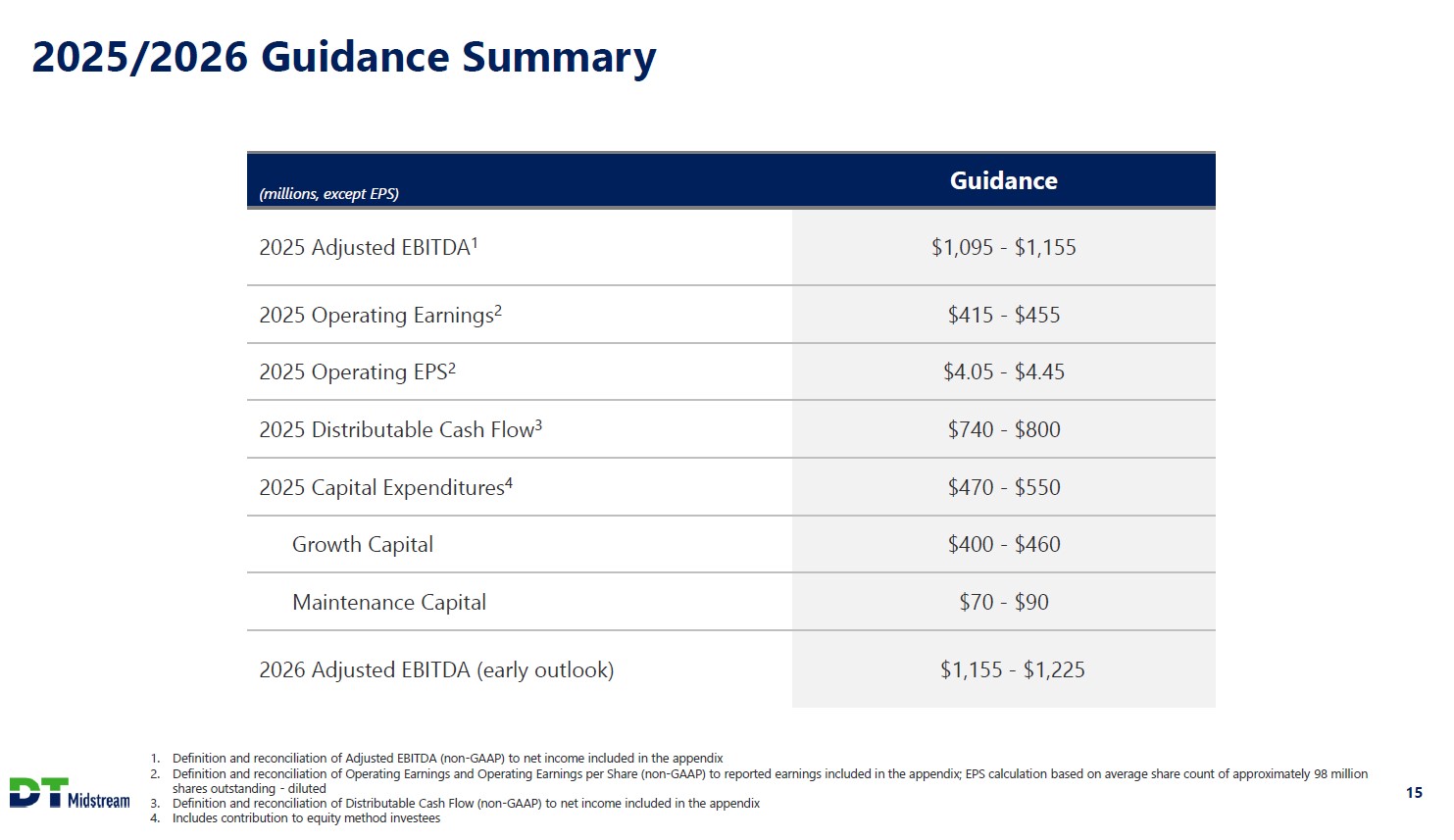
We remain confident in our full-year outlook and reaffirm our 2025 adjusted EBITDA guidance range and our 2026 adjusted EBITDA early outlook, reflecting the strong positioning of our assets and the durable nature of our contracting.
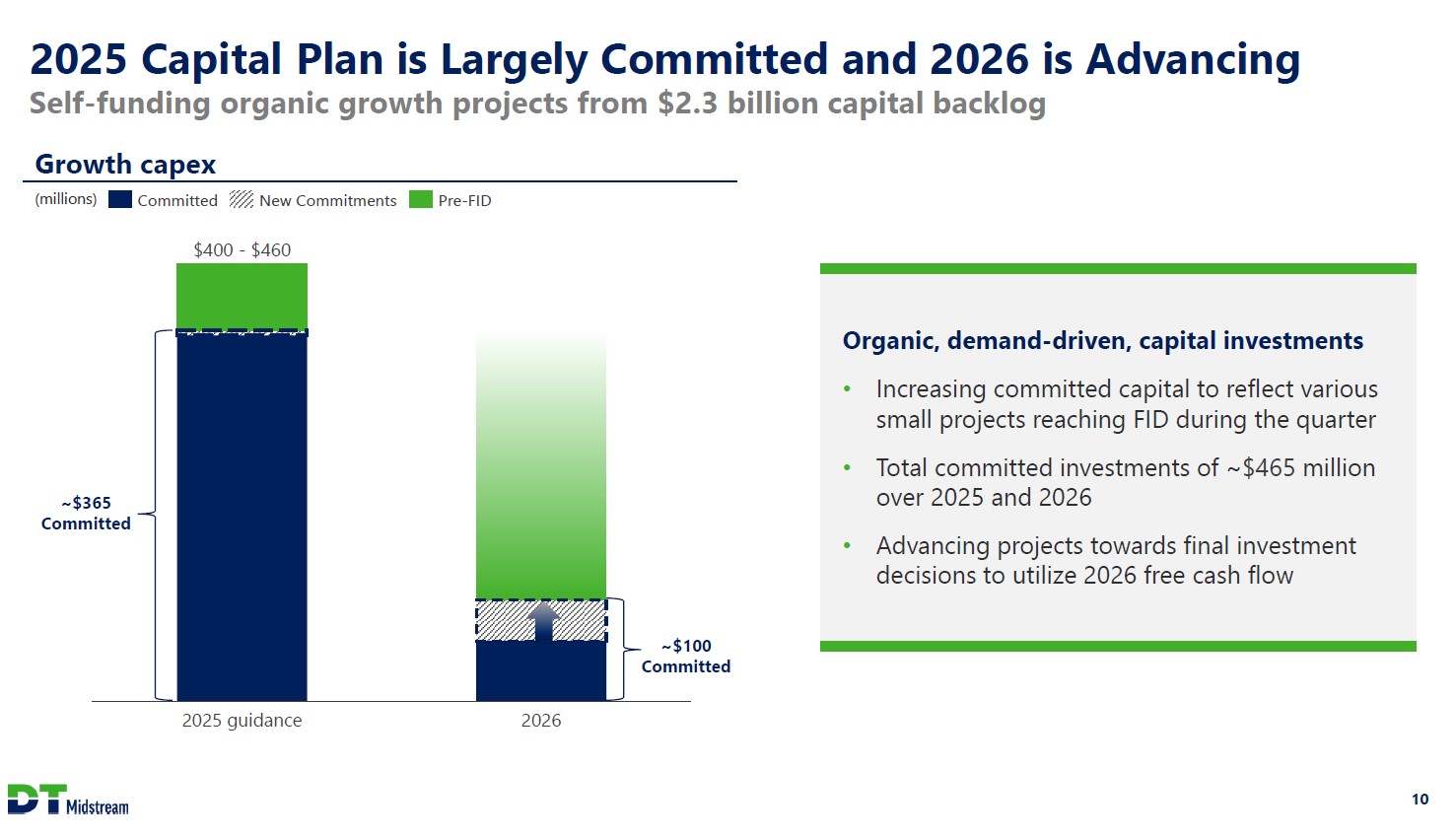
We've increased our committed capital in 2025 and 2026 to reflect several new projects being executed, with approximately 365 65 million total committed in 2025, and approximately 100 million committed in 2026. We look forward to our annual rating agency meetings in mid-May, where we will discuss the strength of our credit profile and our commitment to preserving the strength of our balance sheet and achieving an investment-grade credit rating. As a reminder, we are currently investment-grade with Fitch ratings and on positive outlook with both Moody's and S&P, requiring only one additional agency to upgrade us before fully achieving an investment-grade rating. Finally, today we also announced that our Board of Directors approved our first quarter dividend of $0.82 per share unchanged from the prior quarter, and we remain committed to grow the dividend 5% to 7% per year in line with our long-term adjusted EBITDA growth. I'll now pass it back over to David for closing remarks.
Thanks, Jeff. So, in summary, we remain confident in delivering on our guidance, continuing our track record of strong performance that we've maintained since we spun the company in 2021. Our high quality pure playing natural gas pipeline asset portfolio is very well positioned to take advantage of opportunities across our network and execute on our large organic project backlog and the fundamentals supporting natural gas infrastructure remains stronger than ever with significant increases in demand coming from LNG exports and the power sector, increased political support behind natural gas and energy infrastructure, and a broader realization of the key role natural gas will need to play as a reliable, cost-effective, and clean fuel to meet our country's growing energy demands. And with that, we can now open up the line for questions.
Operator
Thank you. And we will now begin the question and answer session. If you have dialed in and would like to ask a question, please press Star 1 on your telephone keypad to raise your hand and join the queue. If you would like to withdraw your question, simply press store one again. And your first question comes from the line of Michael Bloom with Wells Fargo. Please go ahead.
Thanks. Good morning, everybody.
So I wanted to start on the volumes, the gathering volumes in Q1. So you had a really big uptick in Haynesville and obviously a downtick in Northeast. I wanted to get, first of all, just speak to what's happening there, particularly in Haynesville? Is this kind of a new run rate or is there anything in particular going on there? And then how do you see the rest of 25 and beyond playing out in both Northeast and Haynesville?
Yeah, in Haynesville, which is where you saw the biggest uptick, that's completely in line with our large public producers and what they've communicated and reported to the markets on their activity. I'd say the other activity that's happening, particularly in the Hainesville, is the privates have become very active. We have a number of privates on the network, so we're working very closely with them as they seem to have been responding quicker to the price signals and the demand showing up in the area than some of the publics. but uh yeah we feel very confident in in the haynesville activity uh you know very confident in our guidance for what we expect to see there for the balance of the year you know likely continuing to see some ramp uh throughout the year towards year end so again feel very uh optimistic about the haynesville right now appalachia it's playing out exactly as we expected it to play out in our guidance there's some timing of activity that's kind of embedded in those volume numbers and i think in our disclosures we've talked about a number of projects clicking in in the second half of the year in appalachia and uh that's how you should think about the profile for appalachia but uh in general very aligned with uh god in our full year okay great thanks for that and then And I just wanted to ask, in the past, you've talked about, you know, multiple, I think six or maybe even more, potential projects aimed at supplying data centers and want to
kind of hear the update where that stands today.
Yeah, that continues to be very active, that file. And, yeah, there's a large group of proposals on the table with numerous sites across our entire footprint. uh and that and i'm referring to what i'll call behind the meter data center power demand in addition to that there's also numerous proposals across our entire footprint on what i would call utility scale power generation so we're seeing both those sectors very active you know and uh you know advanced commercial conversations in both those categories even ongoing and uh So, yeah, as we FID projects, we'll be happy to share that with our investors.
Operator
And your next question comes from the line of Jeremy Tenet with J.P. Morgan. Please go ahead.
Morning, Jeremy. I just wanted to start off with Millennium here, if I could. It looks like I think there might be an open season for about a half a B or so.
And just wondering if you could provide any color there on the Outlook, if that's in the backlog. or any other thoughts you could share yeah thanks for bringing that one up jeremy that is literally hot off the press i think that went public at the end of the week last week but yes um i'd say that's a good example of the the level of inbound inquiries we're getting right now across all of our uh pipelines especially in the in the you know the upper midwest and in northeast strong interest in incremental capacity and Millennium is in a fairly unique position there they've got some abilities to repurpose existing capacity and to leverage other assets that are in the ground locally there's synergies between the Millennium pipeline and those other assets to get deeper into that New York and New England market I think I think that market area has come to a realization that they are materially short capacity and you know I think what I've talked about in in my opening statement just that fundamental backdrop has shifted and changed in a positive way and I think those those utilities and those markets are sort of reassessing their situation. And we'll see how the open season goes, but this open season is really to draw in and get a better read from those markets, the nature of the demands that they need to meet and how Millennium can serve that. So stay tuned. That's kind of the first step in a larger expansion project. We're seeing similar inbounds across other FERC assets uh you know including our newly acquired assets so again it just kind of goes to that fundamental backdrop that we're operating in clear demand growth occurring across our footprint we're in the early stages of assessing how we can respond to that and what type of expansions are acceptable in the market um you know another data point to kind of support this early activity you know we've we had peak day um send outs on three of our regulated assets storage business and two of our uh our new pipelines and that's just an indication of uh that demand has grown in this region and there's constraints emerging in terms of business in our backlog no this is not in our backlog so this is another good example of you know what we communicate with investors our projects that are either FID or near FID in the backlog projects like this that are earlier days are kind of excluded from the backlog. So the backlog is, you know, the gross backlog, the unadjusted backlog is actually growing, right? Again, very optimistic. Our job is we need to commercialize that and stay tuned as we move these projects along and we'll share the updates with the investors as appropriate. Great question though.
Got it. And maybe if I could just dig in at a high level little bit more in some of the comments you say there. I mean clearly there's a change at the federal level with dealing with energy infrastructure and the utilities have a duty to serve their customers and so we see that alignment. But just you know curious I guess maybe more at the local level or really at the state level we've seen legal filibuster and other tactics in the past you know stymie energy infrastructure development.
Do you see I guess different um tone coming out of uh you know some of those uh stakeholders we do and um you know i think there's a series of events that has occurred over the last 12 months you know and i'll rattle off a few that i think are changing the sentiment in the market i'd say one is a lot of the renewal builds that have been announced um you know they haven't delivered as advertised they've either been canceled or they're showing up late the cost is significantly different than what was originally intended so that would be one thing that i think is soaking into the market i'd say on a reliability perspective the true impact to reliability on their on the intermittency of these new generation assets is sinking into the market and being realized um you said well jeremy the utilities have an obligation to serve and if there are service challenges in the future that likely lands uh you know the public sentiment will be with the utilities and they don't want to be the ones quote holding the bag on that public sentiment so i think that's shifting the the thinking around the executives with a bunch of utilities significant growth happening behind utilities both gas and power so these are all just the fundamentals that that are i think causing the sentiment in the market to shift and a realization that you know we're probably short capacity we need to shore up the supply side and um i think we're in the early days of that so and i think public sentiment has shifted as well i think um On the other side of the new administration and how the election played out, I think there's just this recognition in the public, the general recognition in the public that, hey, we need this fuel. We need economic fuel and energy. And we have it within the country. This is a domestic supply. So there's just a lot of things I think have shifted here over the last 12 months that's really moved the pendulum from what I'll call maybe on the far left side to bringing it back to the center where there's an appreciation we need all of the above. And I think that's going to benefit the natural gas, the pipeline sector, and it's also going to benefit the electric sector as well.
Got it. That's very helpful.
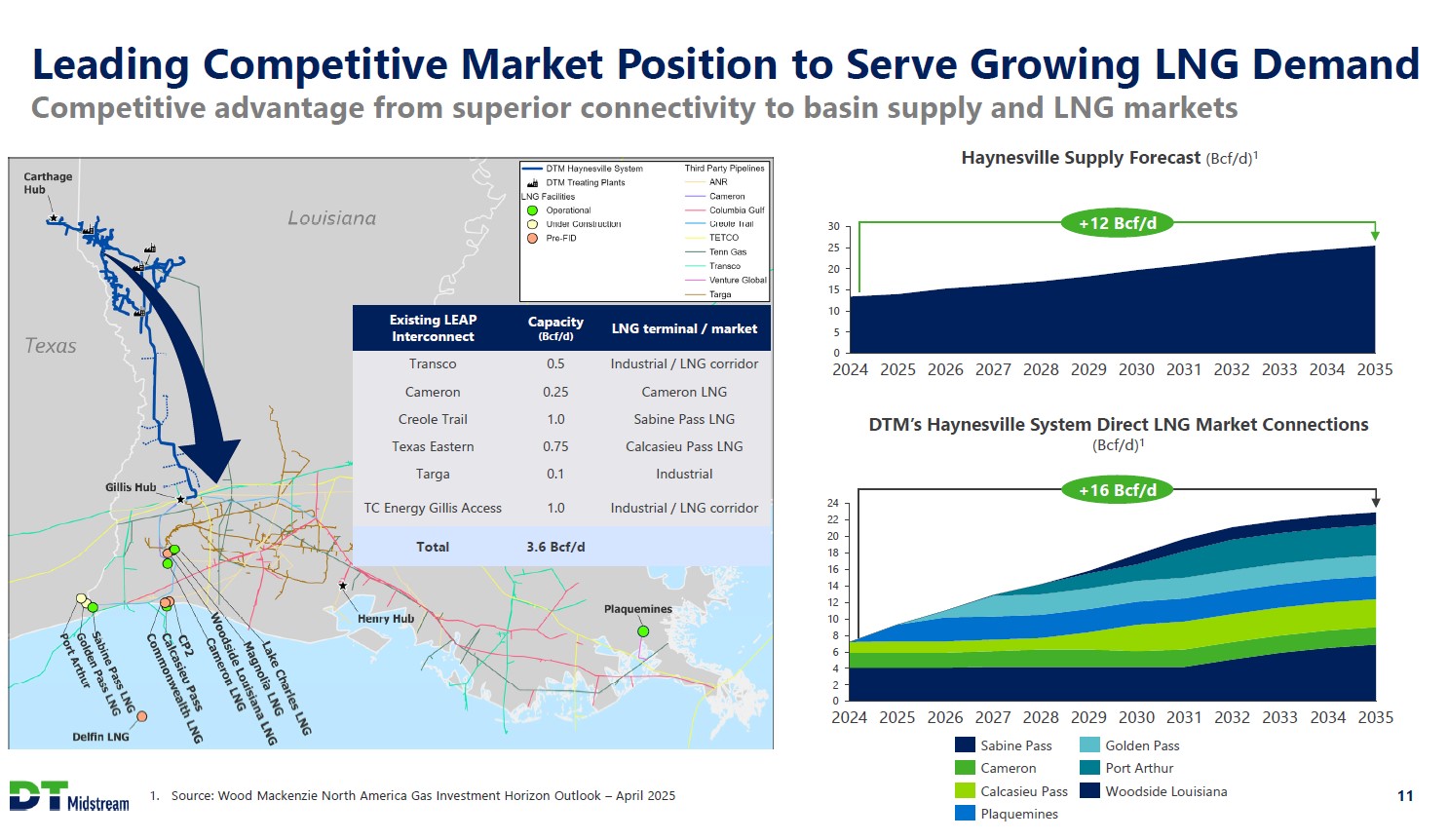
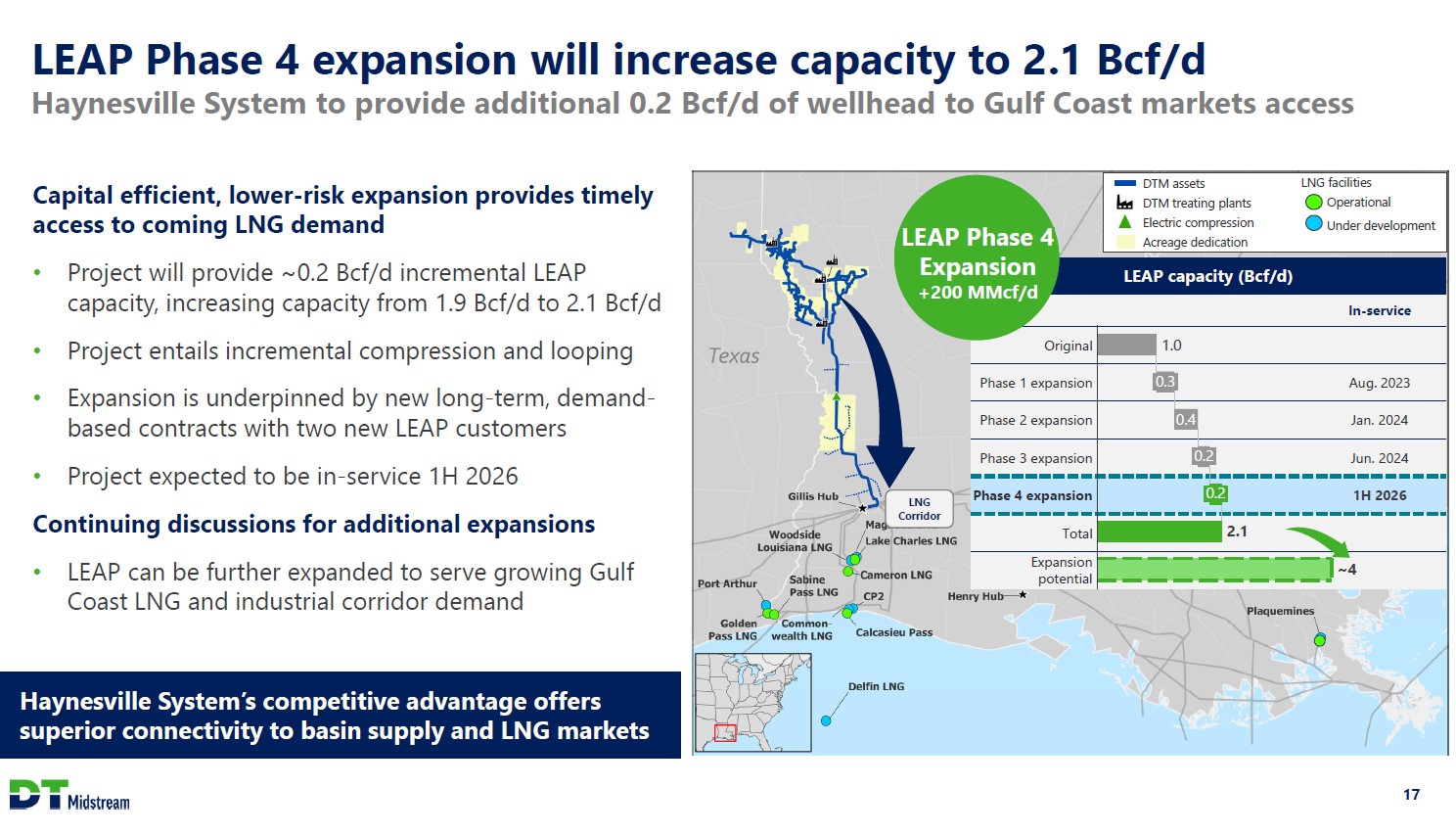
Thank you for that. one last one if i could sneak in here just on the lng uh demand pull side we saw the woodside fid here and just wondering if you comment on opportunities that might stem from that or anything else we're seeing on you know lng commercialization moving forward across the board yeah that fid was really positive when i when i read that the other day and um just to remind everybody uh website part of that fid is the header system that serves that facility it's about a three bcf a day header system and it's designed to connect directly into leap so leap will be one of a handful of supply points into that header system so we're really happy and pleased to see
Operator
that fid and as we worked hand in glove with the previous owner we will continue to work hand in glove with uh woodside and you know the new ownership so very pleased to see that fid got it sounds like expansion opportunity there thank you for the color you're welcome jeremy next question comes from the line of teresa cheng weed barclays please go ahead morning um david i'd like to dig in a little bit more um on your backlog um specifically related to your comments about um potential further expansions that are under development Can you provide some more color on where things stand with the integrated solution across your Northeast gathering, as well as the existing pipelines into your Midwest, newly acquired Midwest assets? Are there any, you know, commercial developments to note there? And can we just think about, you know, how much CapEx that could be for DTM if you were to bring that molecule from your gathering system onto Nexus expansion, vector expansion, you know, straight to the end user in the Midwest?
Yeah, sure. I can provide a bit more color there. Maybe I'm going to pivot. I think we talked about what's happening already on Millennium, so I'm going to pivot over to the new pipelines. uh that we acquired from one oak so we're we're in month four um you know we had a really strong winter though those assets like i i mentioned earlier uh performed really well really strong demand had some uh you know a record high send outs on those assets so really pleased fundamentally with how they performed and our assessment of their importance to serve those load centers in the upper midwest we're taking a harder look and we obviously have more information now around the growth opportunities uh the modernization opportunities and how they will integrate into the other assets so it's particularly and what i'll say at this point is that what we thought when we announced the transaction based on what we think today we are more bullish the opportunity set is more robust than we thought it was when we announced the acquisition so very positive about that obviously it's our job to commercialize that now you know that that power plant on midwestern literally commercializing late last year right around close was was a really good early indication of the opportunity set and the speed at which it can move so as we get more confident uh in this we will be providing more clarity and updates to the investors but um at this point i would just put a green arrow up on the on the backlog of opportunities that um that are manifesting um as we get more confident with them and can clarify them we'll provide further updates thank you and your next question comes from the line of spiro dunes with city please go ahead
Thanks, Operator. Morning, team. I wanted to start with LEAP, actually. David, I just want to pull some of your comments together. It sounds like angel activity is kind of ramping back up again. At the same time, Woodside, LNG is starting to FID again. And I think our working assumption around the next LEAP expansion was that maybe it was years away, just given the two competing pipelines coming online soon. But any sense of that timeline as it's moving forward? Just want to get your latest thoughts there.
Morning, Spiro. Yeah, so our thoughts on LEAP, you know, LEAP, if you look at how we've expanded that over the last two, three years, it's been in these nice bite-sized digestible increments. I don't see that changing going forward. I think we're really well positioned in the market in terms of the service offering. You know, we offer very competitive rates. We are highly interconnected to the supply footprint of the basin. and we have a lot of delivery flexibility in terms of the physical deliveries we can make to a myriad of the energy facilities. You know, I'd say from a competitive perspective, we're well positioned. You should expect, you know, the continued what I'll call bite-size opportunities. You know, we're kind of coming out of this period where Hainesville kind of tap the break over the last 18 months right and they're now you know feels like they're putting their foot back on the gas so i think we just need to let the clock run here a little bit see how the basin responds you alluded to the new projects coming into service they're expected to come in later this year that that'll digest into the market and then you know we'll carry on from there so nothing has changed in terms of how i think that will play out over time Clearly, the Woodside FID is a positive catalyst, and that's hot off the press. So, you know, we're going to digest that. The market's going to digest that, and we'll see where that takes us. But I feel good about our position.
Got it. Good to hear. Second question, maybe just a finer point on maybe just the cadence as we think about the rest of the year. Jeff, as you pointed out, TQ maybe dips down a little bit on seasonality and some other factors. which does seem to imply kind of a pretty strong second half of the year. And so just curious if you guys could make a finer point on what the specific drivers are to get you to that midpoint, how much is volume growth versus projects versus other items.
Yeah, so what we've got, you're exactly right. Second half of the year, we're planning on being stronger than the first half. And you're right, that's driven by volume and a couple of other projects coming online. So you've got a couple of those factors. and then the move from the first quarter to the second quarter is one item i mentioned was related to the guardian there's a there's a small decline in the in the rates related to that that was all contemplated in the acquisition and that's all built into the guidance that we provided and for the full year um pieces of guidance um there so i think those are really the the factors to think about as you're thinking about the modeling um than the first spiro i i do want to be clear though we haven't changed our guidance for the year so if we felt correct you know if we felt
we were getting outside of that we would be updating you on that uh on the call and i'll just add to what jeff said there you know we had a pretty cold winter right so we had some you know really uh robust seasonality i'll use that word on our pipeline assets because of the severe winter that we had. We had almost a 30-year normal winter up here in the Midwest, which it's been a long, long time since we've had a winter like that. So there's some of that playing through in Q1 as well.
Got it. All right. Appreciate the color. I'll leave you there. Thank you, gentlemen. Thanks, bro.
Operator
And your next question comes from the line of Jen Lakai with Goldman Sachs. Please go ahead.
Hey, good morning. Thanks for the time. I wanted to go back to some your comments, David, on the privates in the Haynesville. You commented that they're kind of, you know, responding quicker to price signals. Definitely makes sense for first quarter. I guess I'd be curious to hear of you, though. We've kind of bounced back from, you know, $4.50 down to about $3 now. Are we seeing them kind of respond quicker in the opposite direction at this point?
Or do you think this kind of first quarter, you know, strength can follow through, even if prices are a little weaker here in uh shoulder season yeah john that's a really good question that's uh a topic that's the forefront of my mind right now we're watching that very closely um to to see if what you just described if we see any signals of that happening my my high level sense john is that they they're fairly quick on the draw but they also are pretty disciplined about hedging when they see those attractive prices um you know privates are typically pe backed and uh you know capital recovery is paramount in their minds right so if they can they
can drill and hedge and turn that capital quickly that's their business model so we're watching for that we're not seeing any signals of that at this point um you know we've seen a little bounce back here uh on price over the last week or so but uh we're definitely watching closely for that currently we don't see any evidence of that i appreciate that that's uh helpful maybe um just staying and gathering we're uh i don't know about a year into the utica um pickup maybe you can kind of just share your you know latest thoughts there maybe what that looks like in uh this kind of softer liquids environment um and maybe anything you can kind of share on just
you know pace the development from here sure yeah so just to remind everybody um the area that utica that we're gathering for eog it's really the oil window you know their economics are not ngl dependent and you know i would just point you to what they've said publicly about their resource there they have a massive resource footprint that they've established in that area it's a it's a virgin area they've unlocked the rock technically and um you know the pace of development is consistent with kind of what we have in our guidance for this year and next year and you know they're a great counterparty uh we're working closely with them and uh yeah we we view that as is a is kind of a long-term growth opportunity inside the uh the appalachian gathering portfolio and the nice thing about it is that it it feeds it feeds one of our pipelines as well so it feeds an excess pipeline i appreciate it thank you your next question comes from the line of kit stanley with milk research please go ahead hi good morning uh first just wanted to start and clarify uh slide 10 the the high end of the 2026 capex range looks lower than last quarter was that intentional or or not hey good morning keith um no there is no change to the high end and if if that looks different we'll check the formatting on the slide there there could be a formatting glitch there but uh there is no change in the high end of 26 capex guidance yeah and so keith from our from our guidance and what we've you know guided you guys to is we're going to spend and our free cash flow on organic growth projects.
So that's in your bottom, that's what you assume we'll adjust that.
Second one. Thanks for mentioning that.
Second question. So last quarter you put out a large number of pre-FID projects in the refreshed backlog and you talked to a number of opportunities today too. Are there any projects you'd flag as closer to moving forward based on customer demand and timing from that list? And I guess I'm just curious what's looking most interesting near-term or making the most progress?
Yeah, I'm going to give you a high-level answer to that because I don't want to get too specific just given the discussions that are happening directly with the anchor customer commitments, you know, contractual commitments with them. But what I'll say generally, and I'm probably going to repeat what I said earlier, is there's a green up arrow sitting in that $2.3 billion backlog. A number of things are driving that. Our assessment of the new pipelines we acquired is part of what's driving that. You know, the Millennium Open Season, which is, you know, hot off the press, is driving that. um i'd say a number of the projects that we've been talking to you about are progressing to fid so what i'm seeing in that backlog is is nothing but um kind of fundamental green arrows up and again as we get more confident because just to remind everybody that backlog is not the total opportunity set, it's only the opportunity set that we feel highly confident in executing on and delivering to our investors. So as that gross backlog continues to grow, it's going to eventually push into that 2.3, which we talked to the investors about. So I'm feeling really bullish about it, but I don't want to communicate anything until we're highly confident in it and I just say it's consistent with my fundamental assessment earlier on the call that there is just a it feels like we have you know we've went from a situation a year ago where it felt like we had a headwind that we're constantly bucking to today it feels like we actually have a tailwind now around around the business and we're working hard to better quantify and assess that tailwind and how that would adjust into our future long-term outlook for coming.
Operator
And your next question comes from the line of Jean Ann Salisbury with Bank of America. Please go ahead.
Hi, good morning. BoardWalk recently announced an open season for the Borealis project, which would source gas very close to your Appalachian footprint. If this project goes forward, do you see DTM as being a material beneficiary?
Oh, good morning, and thanks for the question. Yeah, that's a really interesting project because as we look at our new asset footprint, just to remind everybody, Midwestern connects directly to Texas gas. There is an existing pathway into Clarington between that asset and one other asset that could potentially avoid a greenfield build or maybe set a different way. There could be some lower cost capacity expansions. that could kind of marry into their open season so we're very aware of that you know and assessing that but so if there's a benefit to our asset footprint it would predominantly be as I just described and that's on the pipeline side looking over to the gathering side a project like that leaving Clarington there is not an incremental couple BCF a day of gathering capacity to clarington so yes if a project like that of that size and scale was to fid i think there would be upstream um incremental gathering investments that that would trigger and i think we would be you know one of the short list of parties that would um be the be a beneficiary be able to participate in some of that to get more gas to clarington that's super helpful thank you yeah that's a great example of what I just talked about on the previous question, just this tailwind that's emerging in the region.
Great. Thank you for the detailed answer. That's super helpful. And then as a follow-up, there are concerns that if the China tariffs remain in place, you could see eventual significant pressure on U.S. propane prices, which could reduce uh kind of the call on the ngl portion of appalachia um can you remind us what share of your appalachia footprint is in the wet versus dry footprints and do you view that as a risk yeah so first off we don't view that as a risk and very little of our appalachian gathering footprint gathers what i'll call the wet side of the marcellus or the ngl side of the utica so So the EOG assets is really the oil side of the Utica, not the NGL side of the Utica.
And the bulk of our gathering in Appalachia is on the dry side. So we don't have any derivative exposure to the NGL side in Appalachia. What I will say, though, is if that crack spread collapses or shrinks, what we do see is we see ethane rejection and what that means is they put more of the NGLs into the gas stream which basically grows the gas production in the basin by kind of toggling over to the gas infrastructure versus the NGL infrastructure and that would be a positive for us because that typically would show up on the egress pipelines nexus for example The capability to pivot that in Appalachia is capped by the gas quality specs, so you can only put so much ethane into the stream before you cap out. That would actually be an opportunity for us versus a risk.
Super interesting. I'll leave it there.
Operator
And your next question comes from the line of Manav Gupta with UPS.
Please go ahead. good morning there's a lot of macro uncertainty out there you saw GDP shrinking a little today some companies are actually withdrawing guidance it's very positive that you actually reaffirmed your 2025 guide and 26 guide so help us understand what gives you the confidence that you can navigate this kind of very tough macro environment and deliver on both 25 and 26 goals yeah so I So we've talked already about the long-term fundamentals and how we feel about that.
I'd say in the near term, the way we've built the portfolio, it's a highly durable portfolio and it's intentionally built to protect to the downside. So if I just talk at a very high level, we have no commodity exposure in this portfolio, none. very minimal volumetric exposure, and that only exists in their gathering segment, which is only 30% of the business. And on the pipeline segment, which is the bulk of the business, 70%, that's predominantly 100% demand-based contracts. So it's highly resilient to short-term economic fluctuations. So that's really, you know, the short answer. I think, Jeff, you may want to add from a balance sheet perspective and a durability perspective how we feel about, you know, what I'll call our company itself going through turmoil.
Yeah, sure can. Again, just like they were talking about on the commercial side, how we built the company, we've done the same thing on the balance sheet we don't have any um maturities um throughout through 2029 um we've got over a billion dollars worth of um liquidity for our leverage metric and maybe my last is when you look at historically
look back at other cycles the economic cycles that we've gone through we've we've been able to grow through those cycles and um i say that's the other maybe proof point um to provide confidence that nothing has changed with the management team in terms of how we're running the company. And past performance is only one data point, but I think it's another comforting data point to point to.
Perfect. My quick follow-up here is, you know, last year we were in this power trade where data centers are going to need a lot more power. And then first DC came, and then came all these announcements that Microsoft is pulling back from the data center. You are obviously negotiating with a bunch of customers about their power needs. Has anything actually changed on the ground because of either DeepSeek or Microsoft pulling back the data center spend? Or when you go out there, the underlying demand for power is still growing and very resilient out there?
Yeah, so let me kind of break that question up into two parts. I'll address the behind-the-meter site-specific power generation opportunities, and then i'll address the utility scale power generation opportunities because i think there's different fundamentals driving those two different opportunity sets on the site specific data centers we have numerous like many and i don't i don't want to put a number out there because every time i put a number out there everybody chases the number i'm just going to tell you there are a lot of what i'll call mature commercial proposals sitting in front of developers for numerous sites across our entire footprint. A lot of different elements have to come together for a site to commercialize. You know, energy and fuel supply is only one of many elements. And then once all those elements are together and commercially sort of lined up, then ultimately the host has to commercialize the site. And I'd say that's the phase that we're in right now. We're in the phase where sites have all the elements that they need now And the final step is commercialization of the site. So that's where we are with a host of opportunities across a myriad of our pipelines. So to the extent that the ultimate host is waiting or making decisions, that's where I think we are today. And I suspect that's true for all the other pipelines as well. Flipping over the utility scale generation, we announced the West Virginia project. That project is expected to FID next year. They continue to move along and do the things that they need to do to commercialize that They're in the PJM interconnect. They have full control of the site now. They've gone through the West Virginia regulatory process. Their air permit is underway. so we see these utility scale sites advancing and continuing and and like i said in my in my earlier comments this realization that there's a reliability issue in pjm and emerging in miso the demand is robust than they thought the other generation that they thought was coming in isn't coming in or it's coming in at a different pace all those are positive catalysts to drive incremental utility scale generation and i'd say the last thing that we're seeing on the utility side is the utilities many utilities have been quietly very successful in connecting these data centers directly to the utility grid and i would point the investors to you know public announcements made out of wisconsin by some of the utilities there in michigan by some the utilities there, Louisiana, the energy announcements. So the utilities are getting a fair share of this demand directly connected to utilities and what that does is it drives utility scale generation. So instead of site generation, utilities are just rolling it into their portfolio and will add a plant to their future development. So that's how I would characterize what's happening on the data center side. I know that was a long answer, but it's very interesting to watch. We're active on both of those two dimensions, the utility scale and on the site specific. And again, I'm highly confident we're going to get our fisher of that market across our geographic footprint. So I'll stop there.
We have another question.
Operator
Oh, your next question comes from the line of Robert Mosca with Ms. Rowe. Please go ahead.
Hey, thanks, everyone. Just one from me. Seems like your major customer in the Hainesville is building productive capacity this year that they could tap into in 26. Just wondering the extent to which that's captured in your preliminary 26 guidance, and if possible, the base case you're assuming there.
Yeah, so I'll just keep it at a high level. All of our customers provide us insights into their plan. And for all of our customers, that's reflected in our 25 and 26 guidance. So the short answer is in there. Broader, do we have another question?
Operator
This time? We have no further questions at this time. I would like to turn it back to David Slater for closing remarks.
Well, thank you very much, everybody, for your great questions today, and I appreciate the support, and I look forward to catching up with everybody on the next quarter.
Operator
Thank you, presenters. And ladies and gentlemen, this concludes today's conference call. Thank you all for joining. You may now disconnect.