Operator
Welcome, everyone, to the DT Midstream Fourth Quarter and Year-In 2025 Earnings Call. I will now turn the call over to our speaker today, Todd Lorman, Director of Investor Relations. Please go ahead, sir.
Good morning, and welcome, everyone. Before we get started, I would like to remind you to read the safe harbor statement on page two of the presentation, including the reference to forward-looking statements. Our presentation also includes references to non-GAAP financial measures. Please refer to the reconciliations to GAAP contained in the appendix. Joining me this morning are David Slater, Executive Chairman and CEO, and Jeff Jewell, Executive Vice President and CFO. With that, I'll go ahead and turn the call over to David.
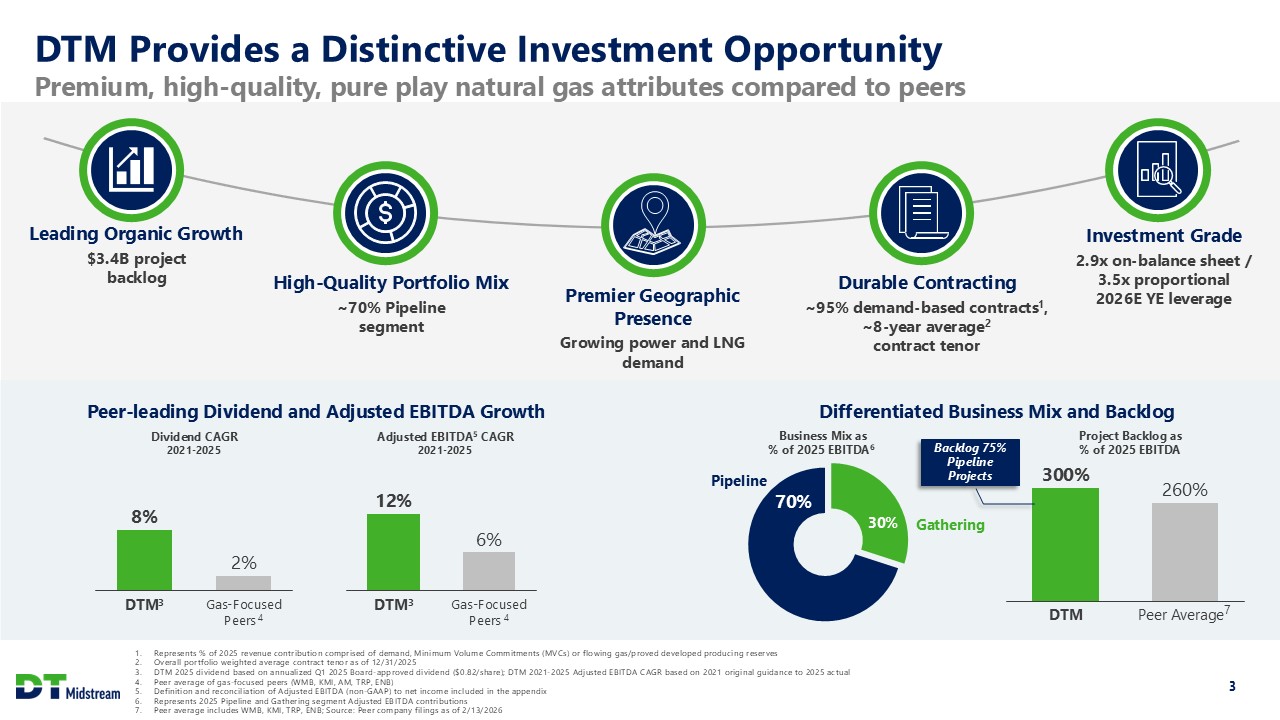
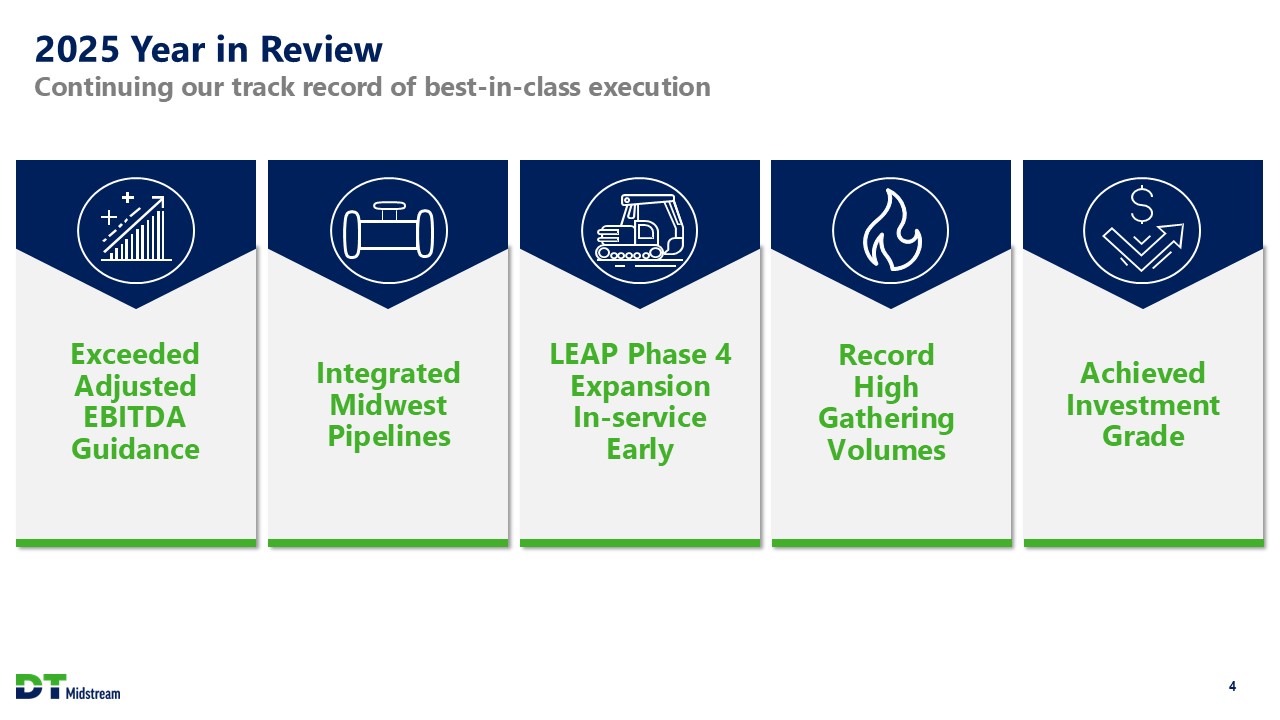
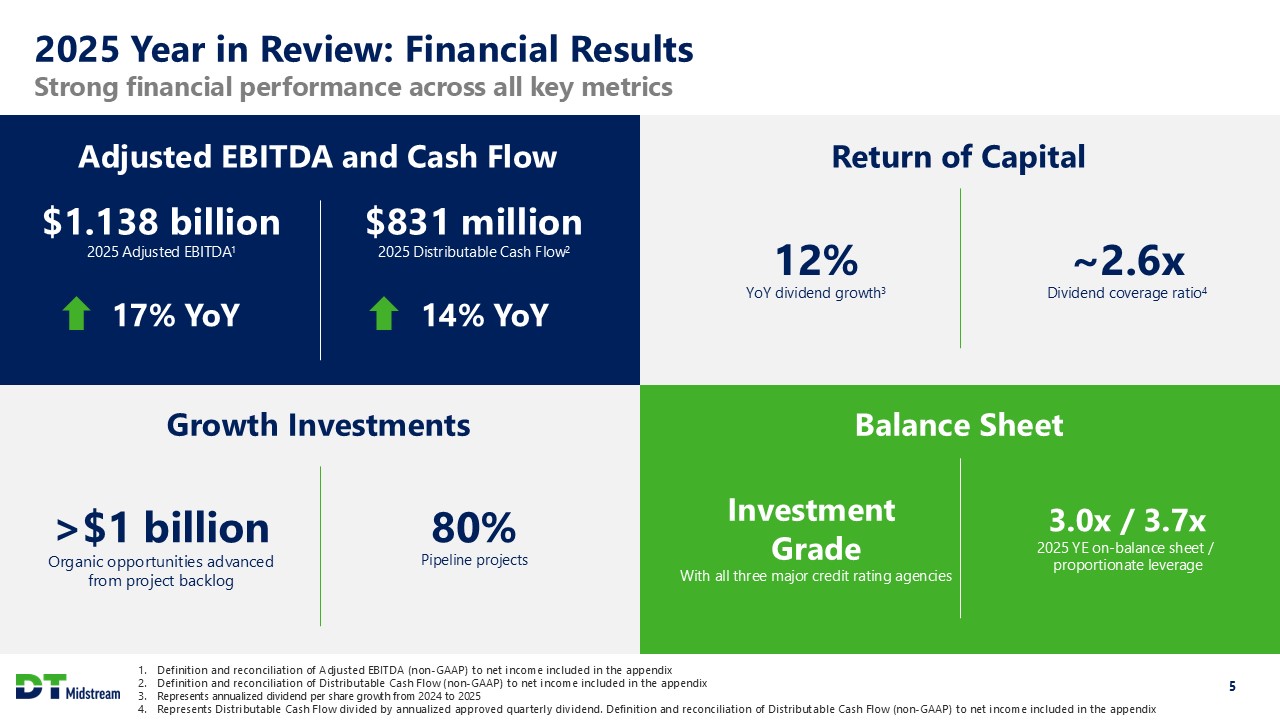
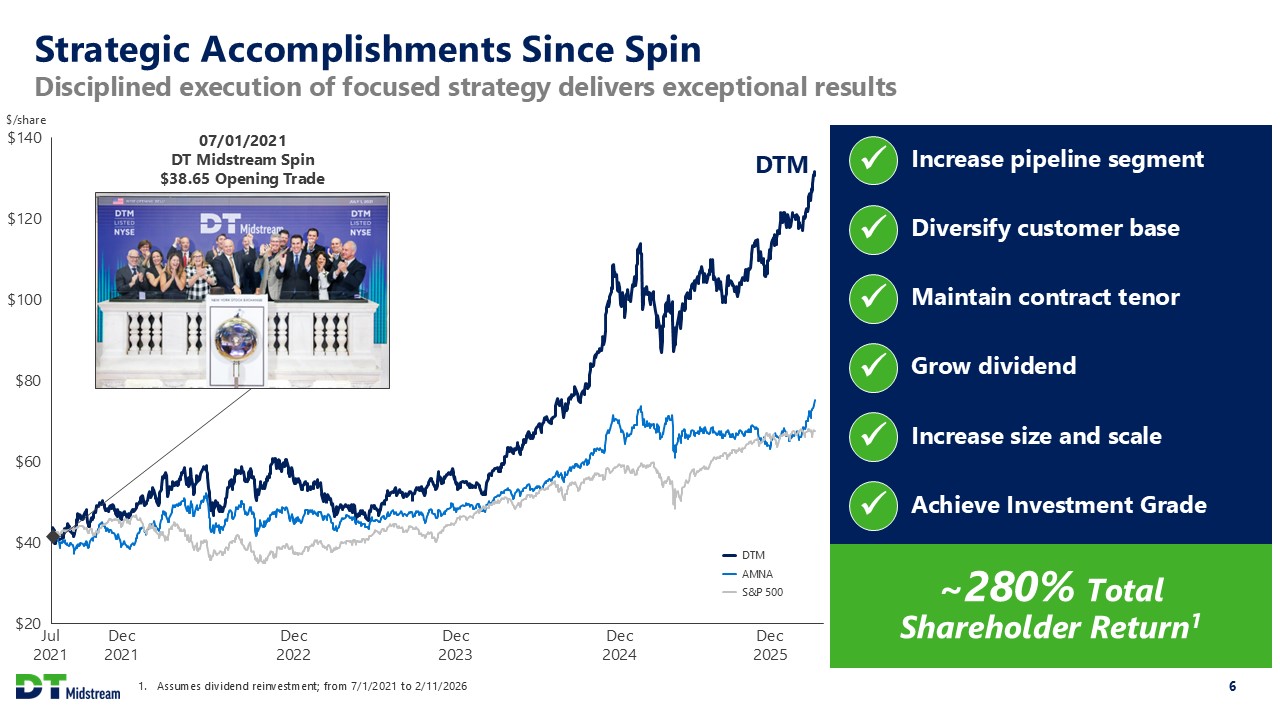
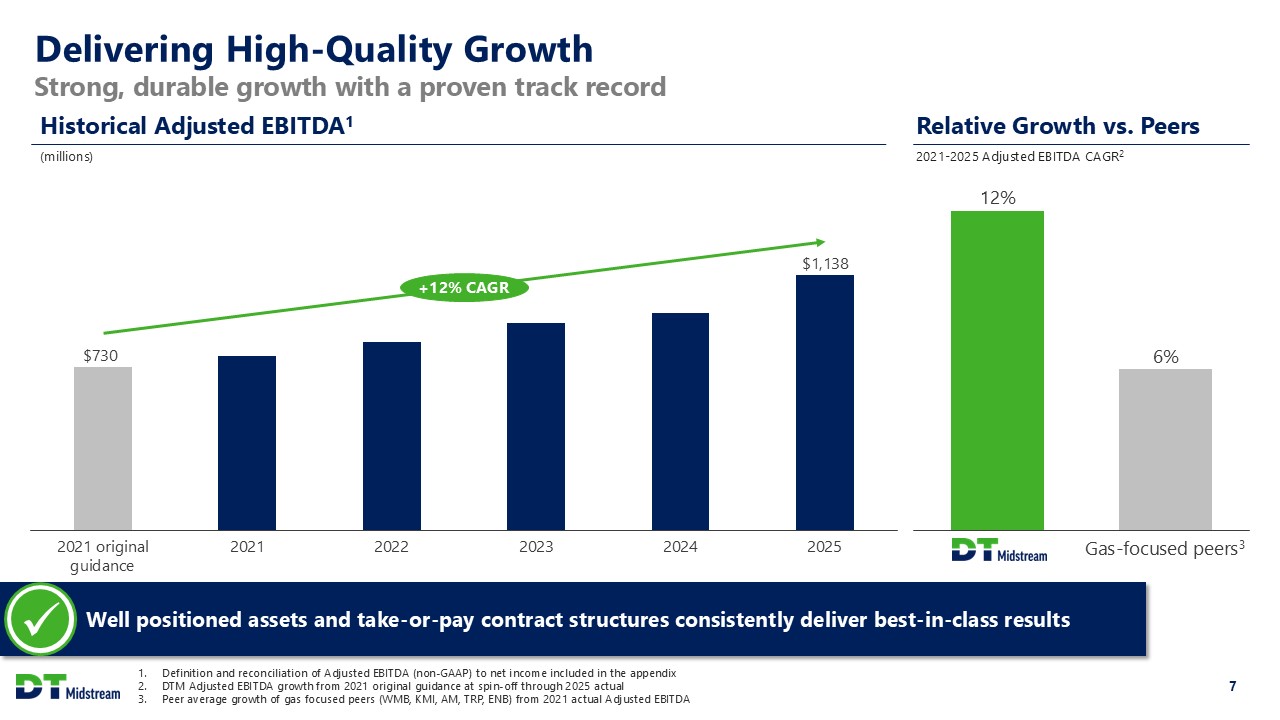
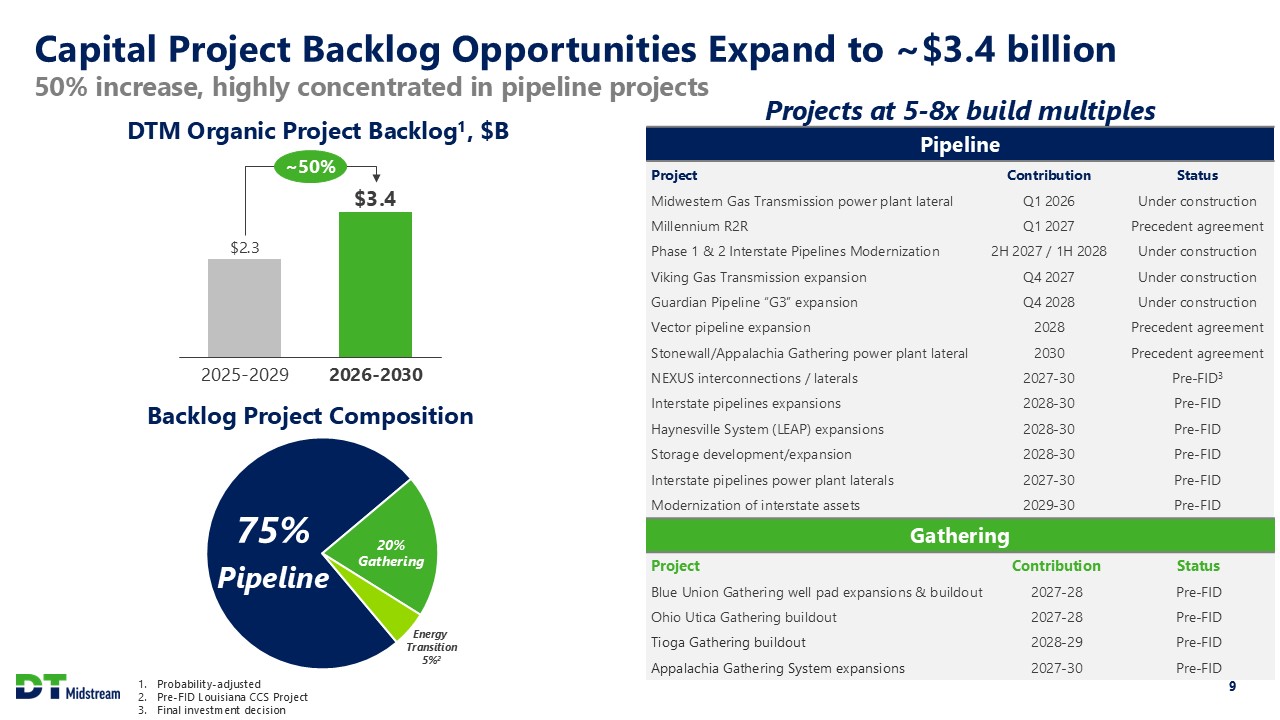
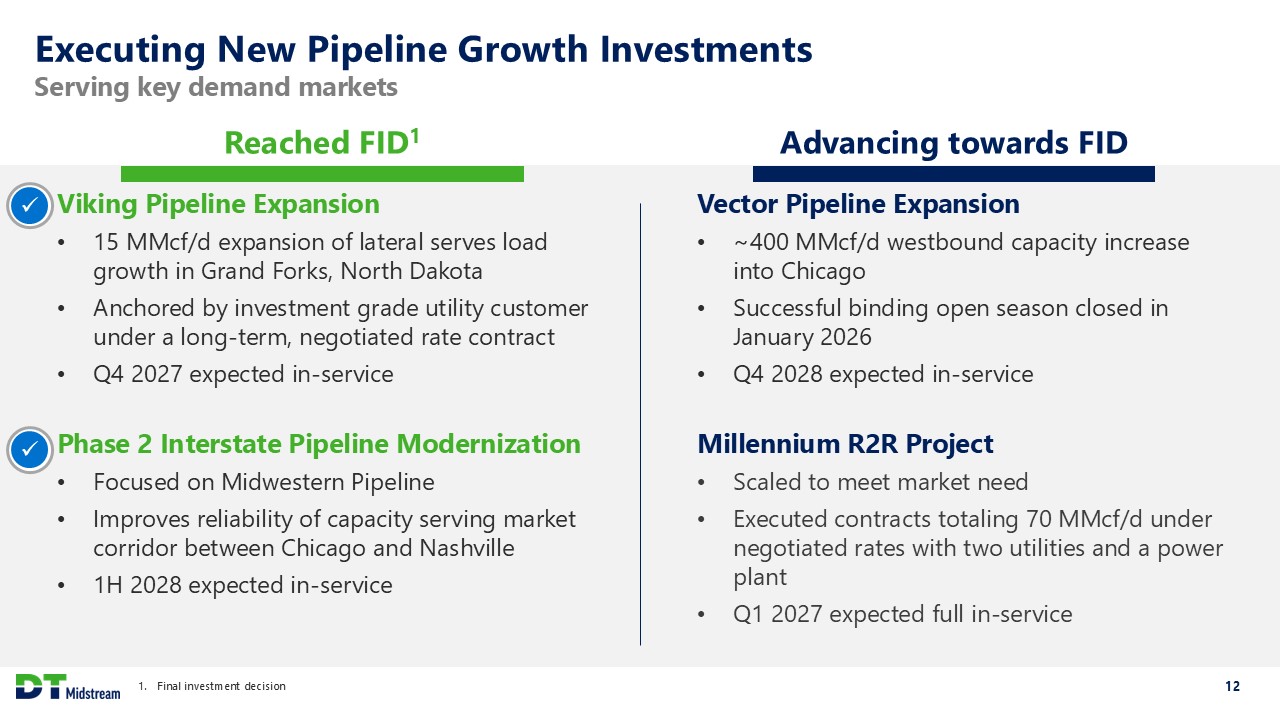
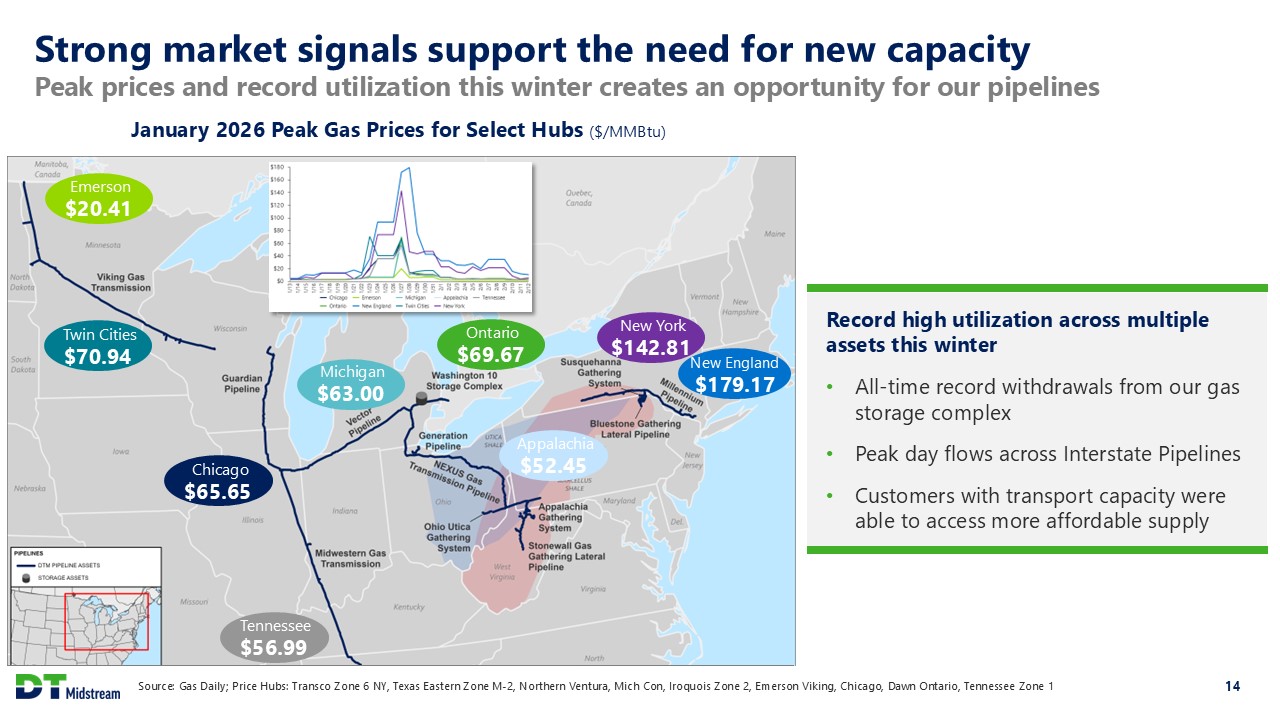
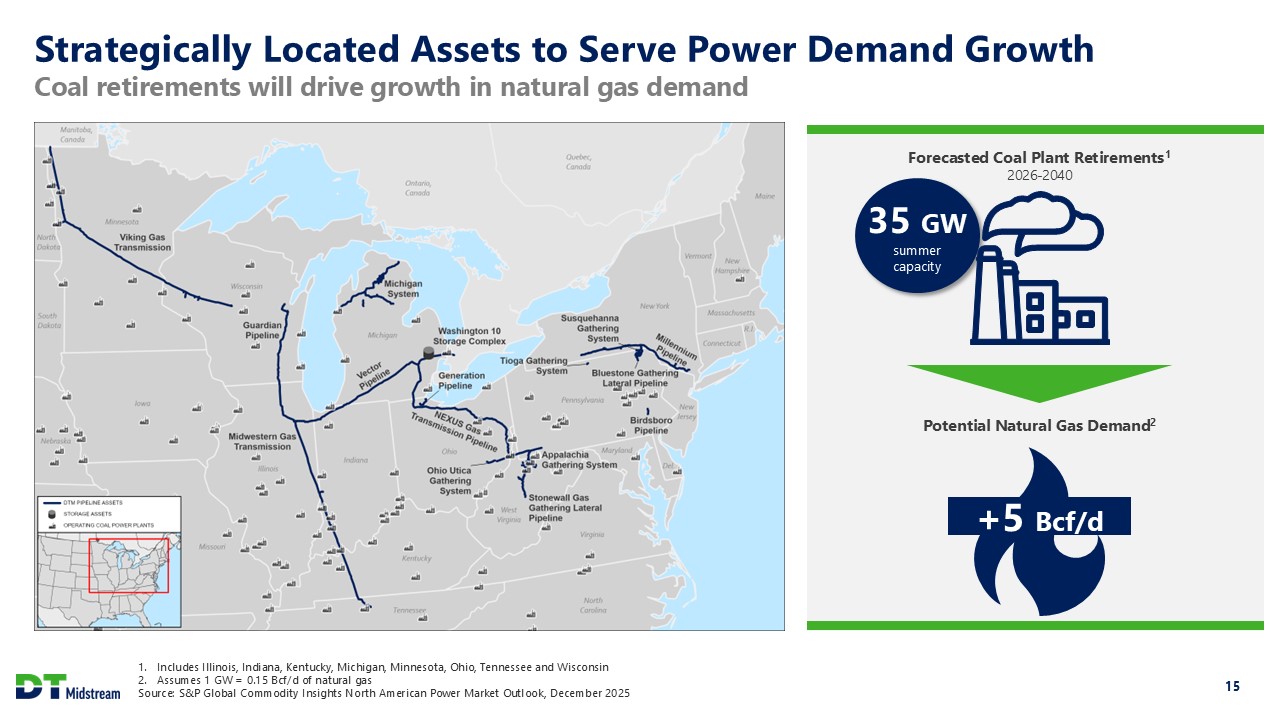
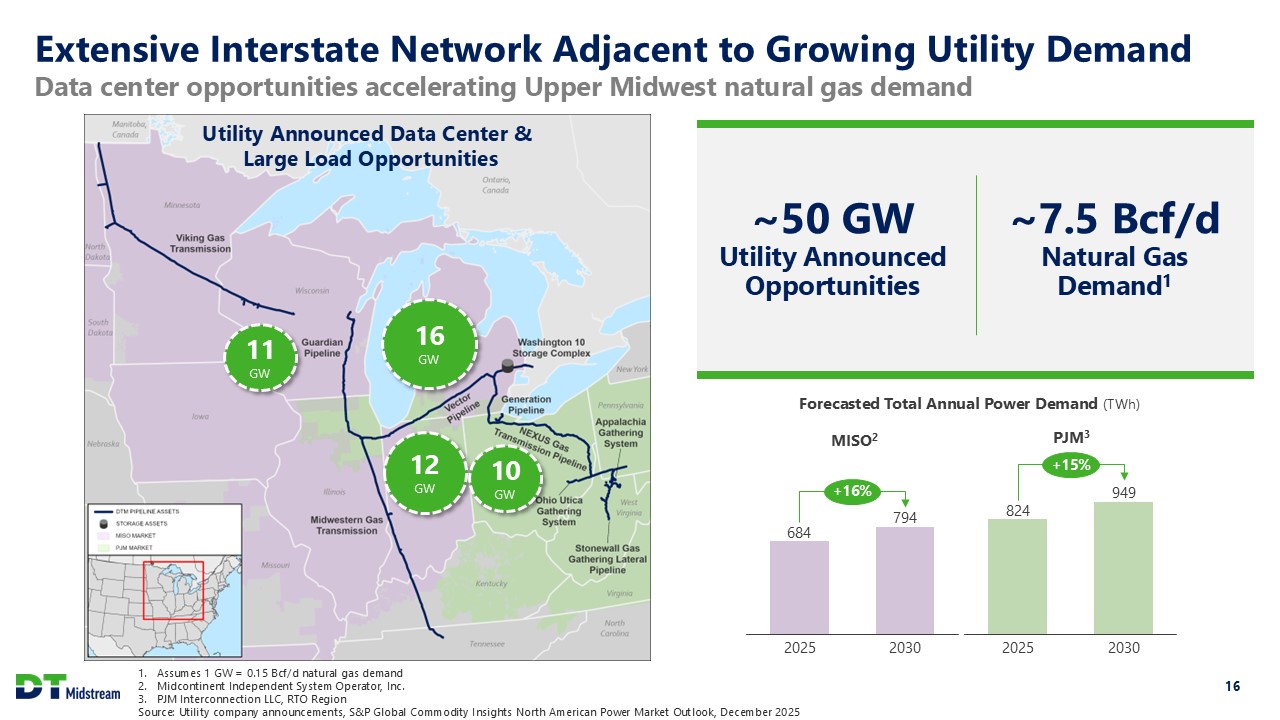
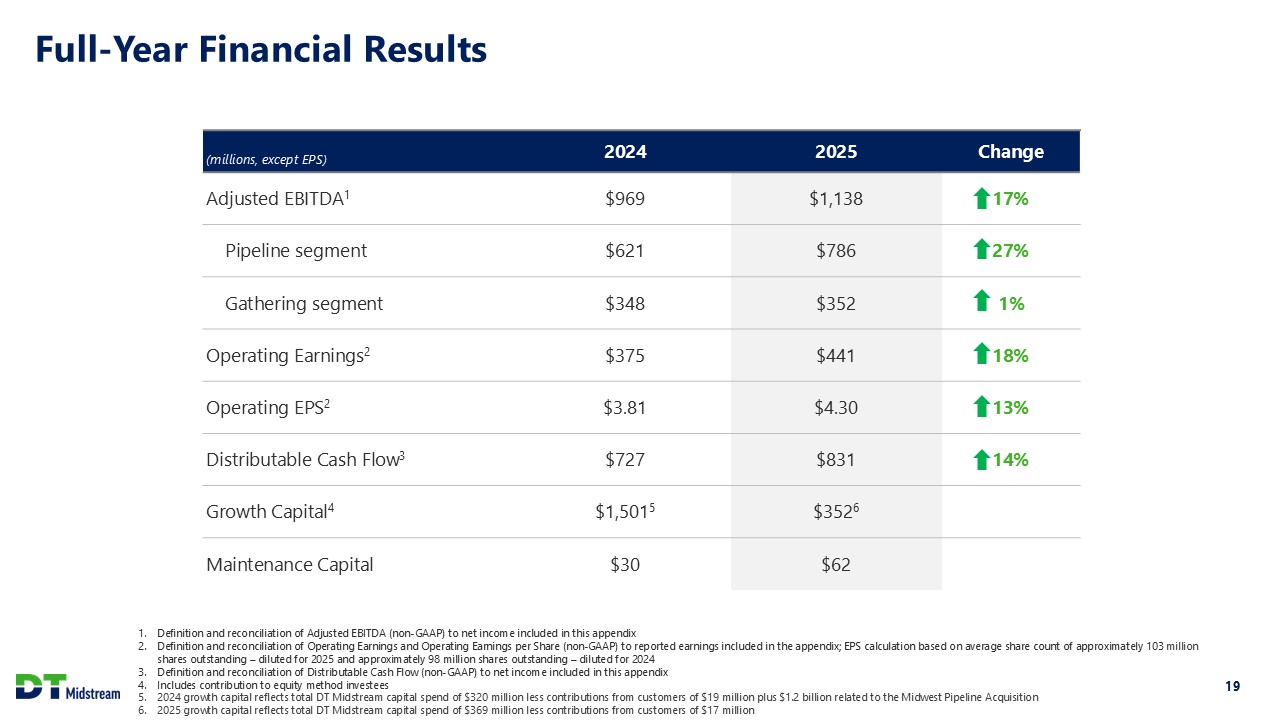
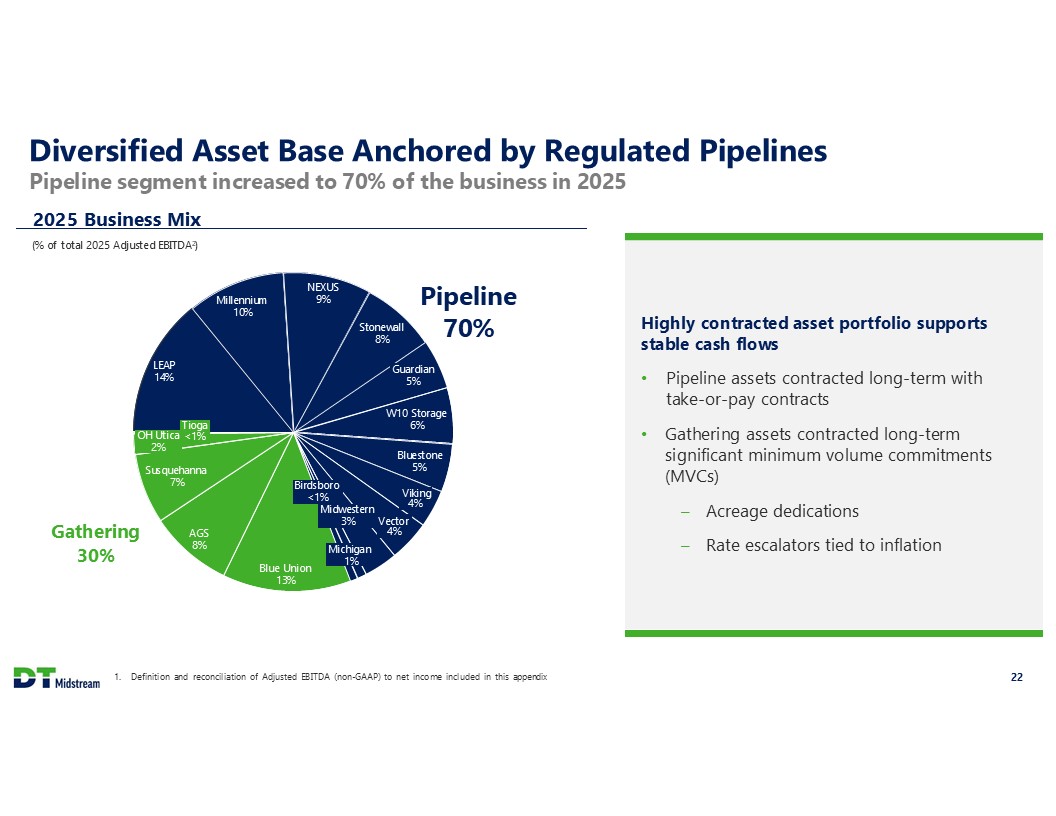
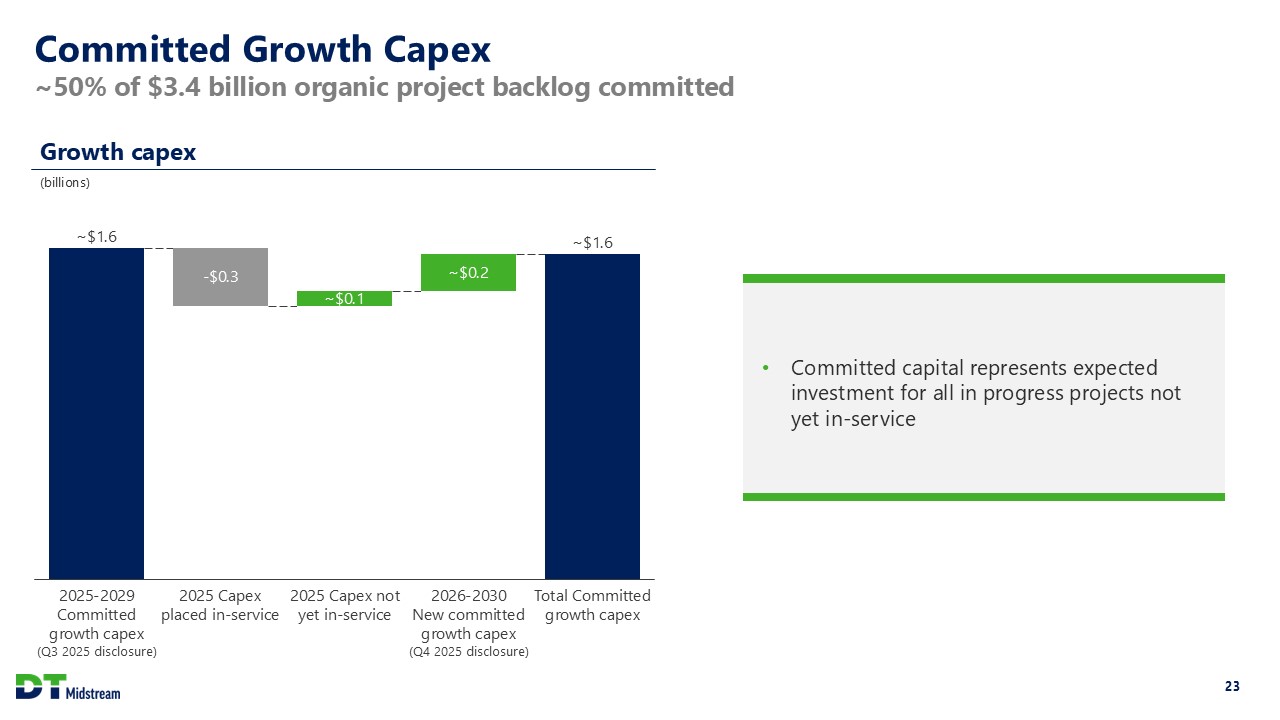
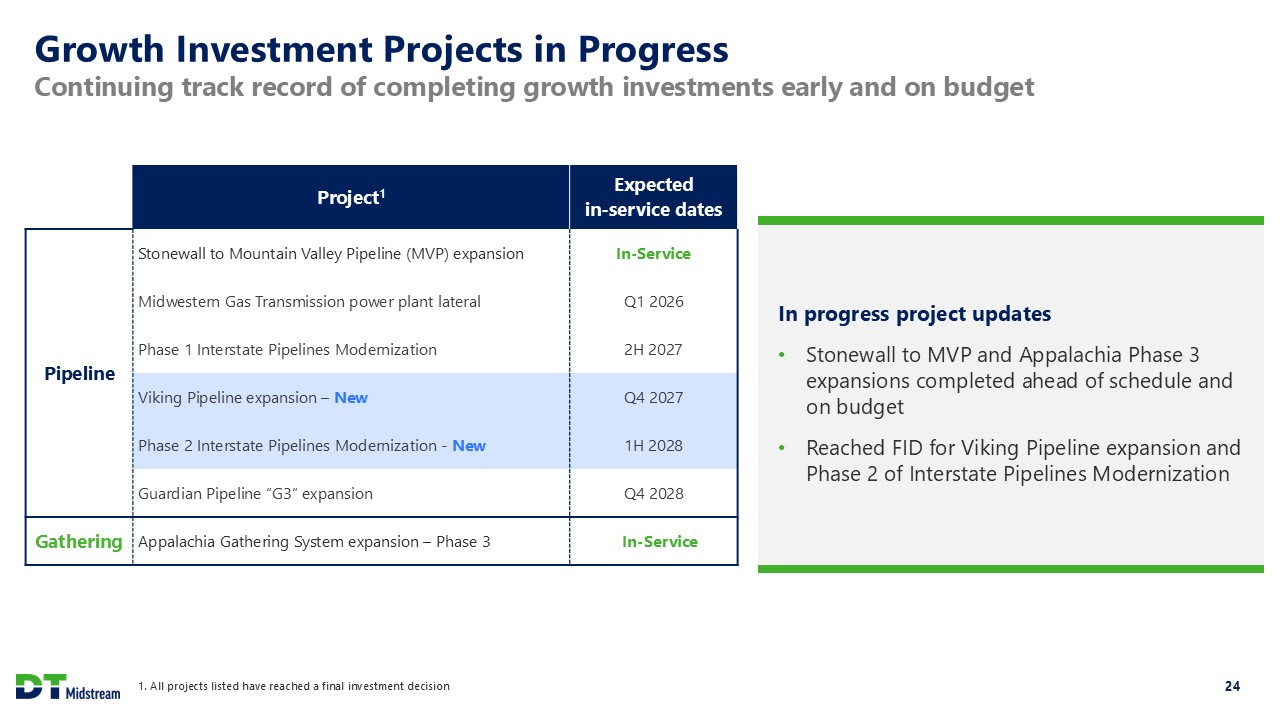
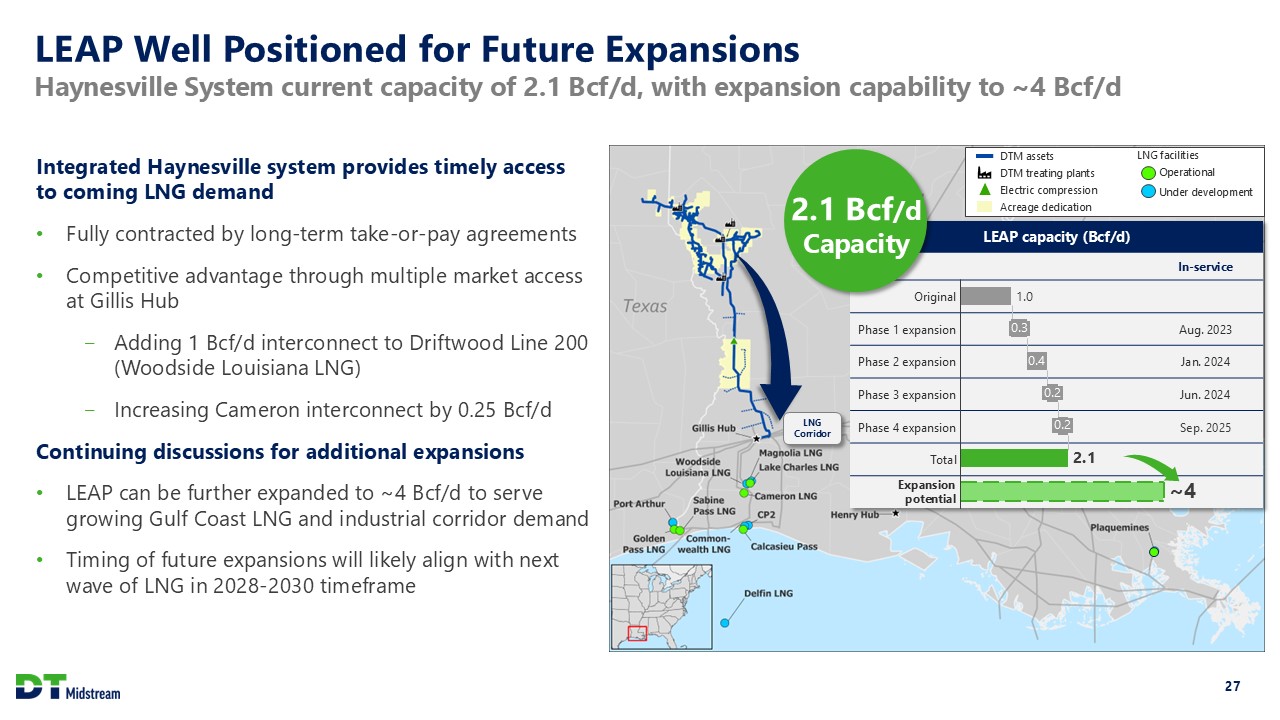
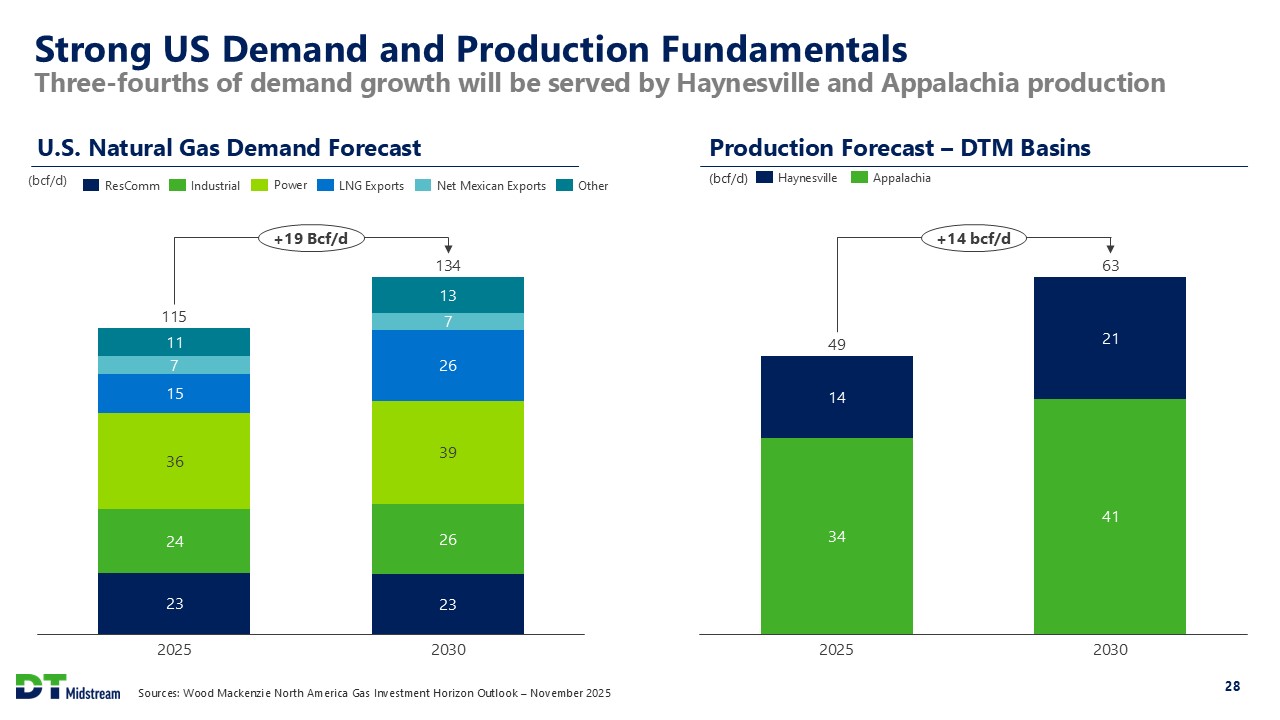
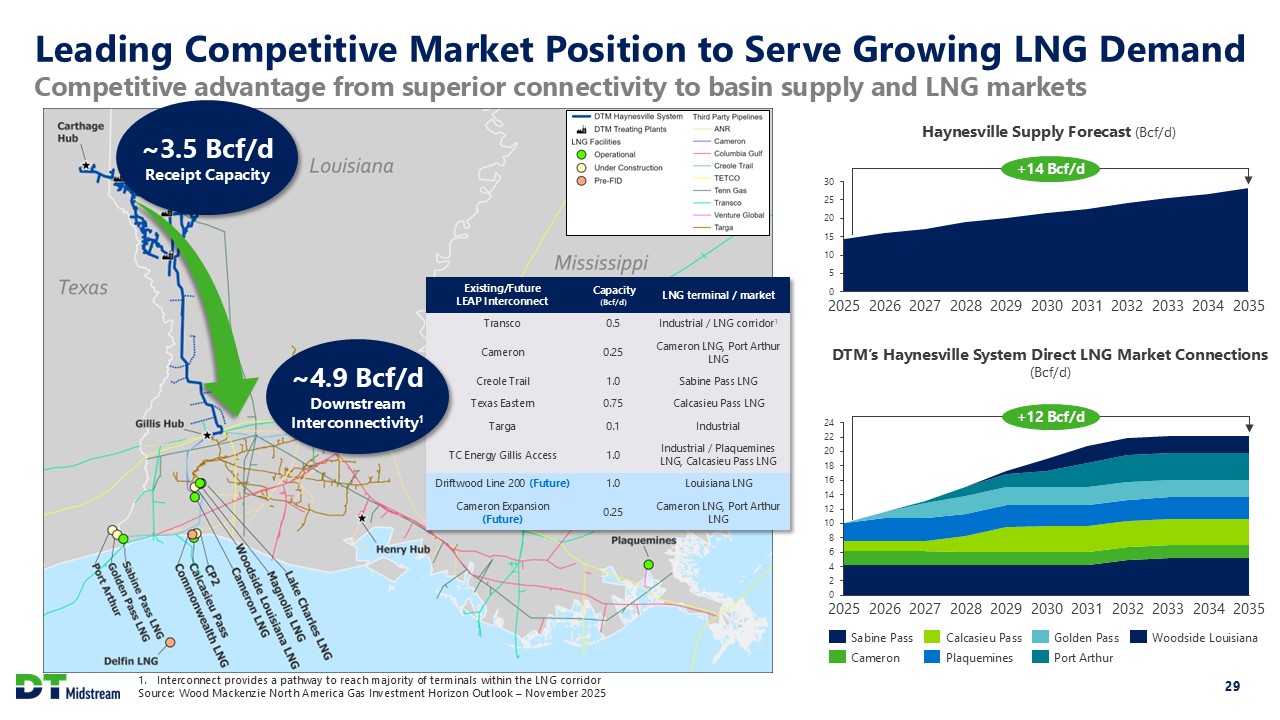
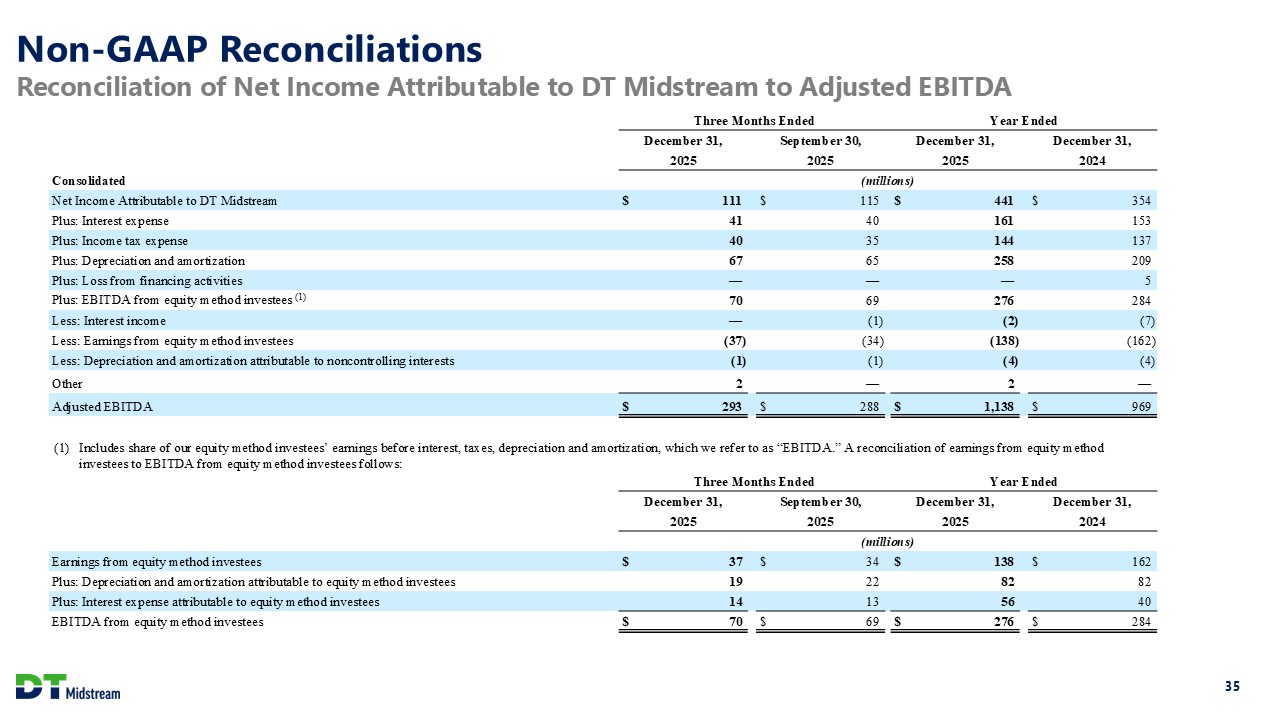
David Slater Thanks, Todd, and good morning, everyone, and thank you for joining. During today's call I'll discuss our 2025 accomplishments, recap the strategic milestones DTM has achieved since our spin-off approximately five years ago, and provide an update on our organic growth project backlog and our outlook for 2026 and beyond. I'll then close with some observations on the current natural gas market fundamentals before turning it over to Jeff to review our financial performance and guidance. So with that, 2025 was another record year for DTM. Our adjusted EBITDA exceeded our increased guidance midpoint and represents a 17% increase from the prior year, driven by a significant growth in the pipeline segment, which has been a strategic focus for the company since we spun. The end of 2025 also marked one year since our Midwest pipeline acquisition, and I'm very pleased to report that we have successfully completed the integration of these assets and I'd like to take a moment to recognize and thank the team for their hard work on this effort. From a commercial perspective last year we advanced more than 1 billion of organic opportunities from our backlog of which 80% is for pipeline projects. On the construction front we continued our successful track record of project execution. Most notably our construction team placed the LEAP Phase 4 expansion into service early and on budget, increasing the capacity of LEAP to 2.1 BCF per day. Additionally, we placed several gathering projects into service across our footprint, which enabled us to achieve record high throughput in 2025. We also continued our disciplined financial management prioritizing a strong balance sheet and achieved investment-grade credit ratings across all three rating agencies. So I am very pleased with our overall performance last year, which reflects the continued focused execution of our core strategy, pure play natural gas, leading contribution from the pipeline segment, long-term demand-based contracts, and a high-quality portfolio of strategically located assets. Since we spun the company nearly five years ago, DTM has consistently outperformed the broader market and our midstream peers, delivering total shareholder return of approximately 280%, including 12% compounded annual adjusted EBITDA growth and a consistently growing and durable dividend. Our high-quality natural gas pipeline segment has driven this growth, increasing from 50% of our business to 70% today, the highest among our peer group. Our portfolio continues to be well-contracted with 95% demand-based agreements and an average contract tenor of eight years, which reflects how the market values these assets and our ability to continually replenish the contract tenor. We have also successfully executed focused, strategic bolt-on acquisitions that have increased our ownership in regulated pipeline assets. All of these great accomplishments could not have been achieved without the hard work and dedication from our team, to whom I am forever grateful and who continue to be the foundation of our success. Their commitment to safety, performance excellence, and customer service are core elements of our exceptional results, and I'm excited for the future and our ability to deliver on the tremendous opportunities ahead. Turning to 2026 and beyond, we are very well positioned within the natural gas ecosystem to serve the increasing demand across our footprint and continue our track record of premium, high-quality natural gas pipeline growth. Supported by strong fundamentals, we are embarking upon a window of generational investment and opportunities, and have updated our overall organic project backlog to reflect this, increasing it by approximately 50% to $3.4 billion over the next five years, with pipeline projects leading the way, comprising approximately 75% of the backlog. Our growth backlog represents our FID projects and probability-adjusted future organic opportunities that we are committing to execute on and can be fully funded with our strong cash flows and healthy balance sheet. The gross backlog is much larger, which is an indicator of the extraordinary opportunity set that exists. We will continue our prudent capital allocation through this investment cycle and expect to deliver growth above our long-term growth rate guidance in the later part of the decade, driven by sizable projects being placed in service. With that, I'm pleased that 2026 is already off to a great start, and we are announcing that we've reached FID on two new projects in our pipeline segment. The first is an expansion of Viking to serve low growth in Grand Forks, North Dakota, and is anchored by an investment-grade utility customer under a long-term negotiated rate contract and is expected to go into service in Q4, 2027. The second is our next phase of Interstate Pipeline's modernization program, which will be focused on Midwestern Pipeline and will improve the reliability of this critical capacity serving the market corridor between Chicago and Nashville. With these projects commercialized, we have approximately $1.6 billion committed out of our 3.4 billion backlog. We are also advancing additional pipeline projects towards FID. Vector Pipeline closed a successful binding open season for an expansion to increase westbound capacity into Chicago by approximately 400 million cubic feet per day and has the contractual support needed to move forward subject to final approvals from both owners and is expected to be in service in Q4-2028. Millennium Pipeline has obtained contractual support for the R2R project as long-term agreements have been executed with two utilities and an existing power plant. Subject final approvals from both owners, the project is expected to be fully in service in Q1-2027. We will provide more updates once these projects are formally approved. Turning to project construction, we place the Stonewall Mountain Valley pipeline expansion into service early and on budget at the beginning of February. And deliveries are being made to Mountain Valley for multiple customers. In addition, our phase three Appalachian Gathering System expansion has now reached full in service, also early and on budget. All other previously announced growth investment projects remain on track and on budget. Finally, I'd like to take a moment to provide our view on the natural gas market fundamentals. Natural gas has firmly established itself as a core North American fuel, offering unmatched affordability and reliability, lower emissions, and the security of a domestic resource base. It underpins the onshoring of manufacturing, rapid data center development, and the continued build out of LNG exports, all key drivers of long-term demand and foundational to America's global competitive posture. With these tailwinds, the stage is set for specific opportunities driving our strategy, and we are seeing these strong structural demand signals across our operating footprint. Demand for natural gas to serve power continues to accelerate across the upper Midwest, with approximately 35 gigawatts of coal plant generation expected to retire in the next 10 to 15 years, and increasing announcements of new large loads and data centers being cited. This demand is largely going to land with utilities in these states who have announced contracted and potential large load opportunities of approximately 50 gigawatts and are planning to invest close to 150 billion dollars in new generation over the next five years to keep pace with low growth. These are large numbers and while not all power demand will be served by natural gas, we see an addressable opportunity set of up to 13 BCF per day and a pathway that could easily result in five to eight BCF per day of potential incremental gas demand in the upper Midwest. DTM's extensive interstate gas pipeline network is uniquely located across this region and is already serving many of the utilities that will experience this load growth, positioning us to fuel many of these opportunities. On the LNG front, we saw four terminals reach FID in 2025, as well as international companies vertically integrating in the Haynesville to extend their natural gas value chain, both of which will support strong and sustained export demand. We expect LNG demand to grow by 11 BCF through 2030, with two-thirds being served by the Haynesville. And our integrated system, with its leading connectivity to both supply and demand markets, is exceptionally well positioned to capitalize on these strengthening trends. I'd also like to address the recent cold weather. It has illuminated the tightness that exists today in the North American market, resulting in extreme price volatility across our entire footprint, a signal of capacity constraints driven by demand growth. The natural gas pipeline and storage network performed very well during the cold, demonstrating its reliability to serve its existing firm customers. However, the price volatility is a strong signal that we need to build and expand the pipeline network to bring more natural gas to serve the growing demand. For DTM, this winter, our storage complex recorded all-time high withdrawals, and many of our pipelines experienced record-high peak-day throughputs. Pulling this all together, today's natural gas market fundamentals makes DTM's natural gas infrastructure critically important and positioned for growth. And with that, I'll pass it over to Jeff to walk you through our financial results and outlook.
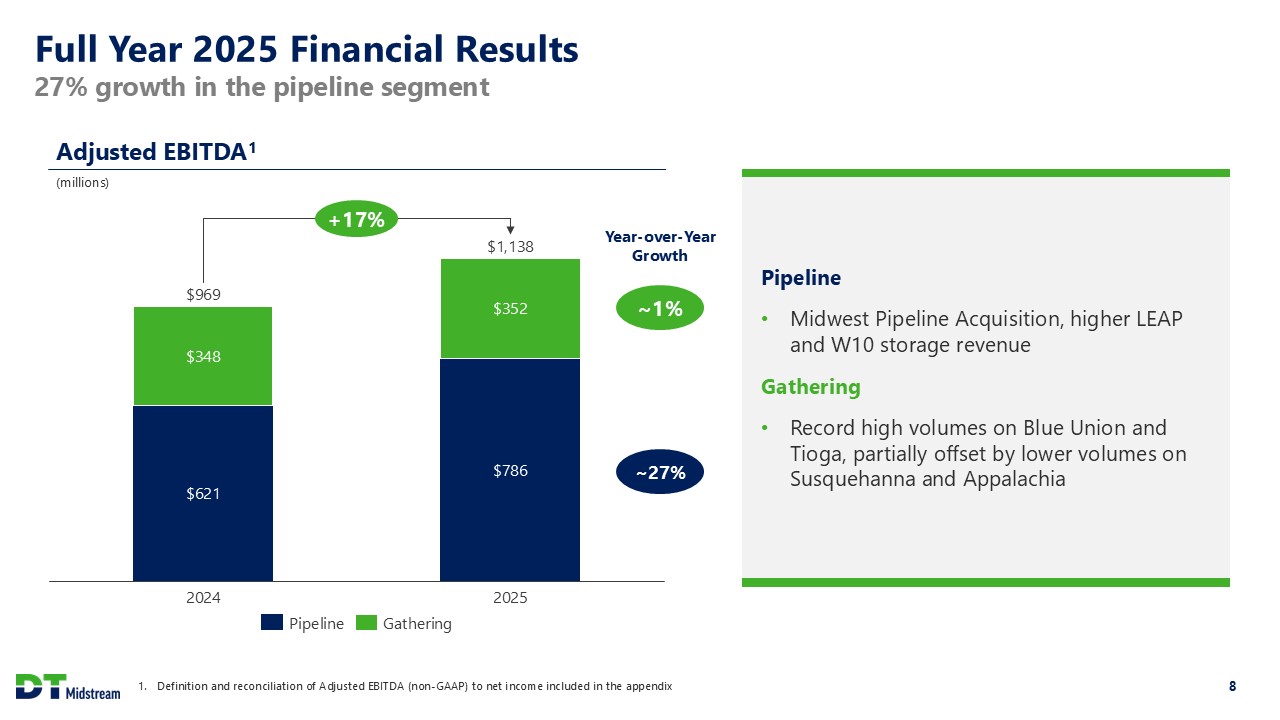
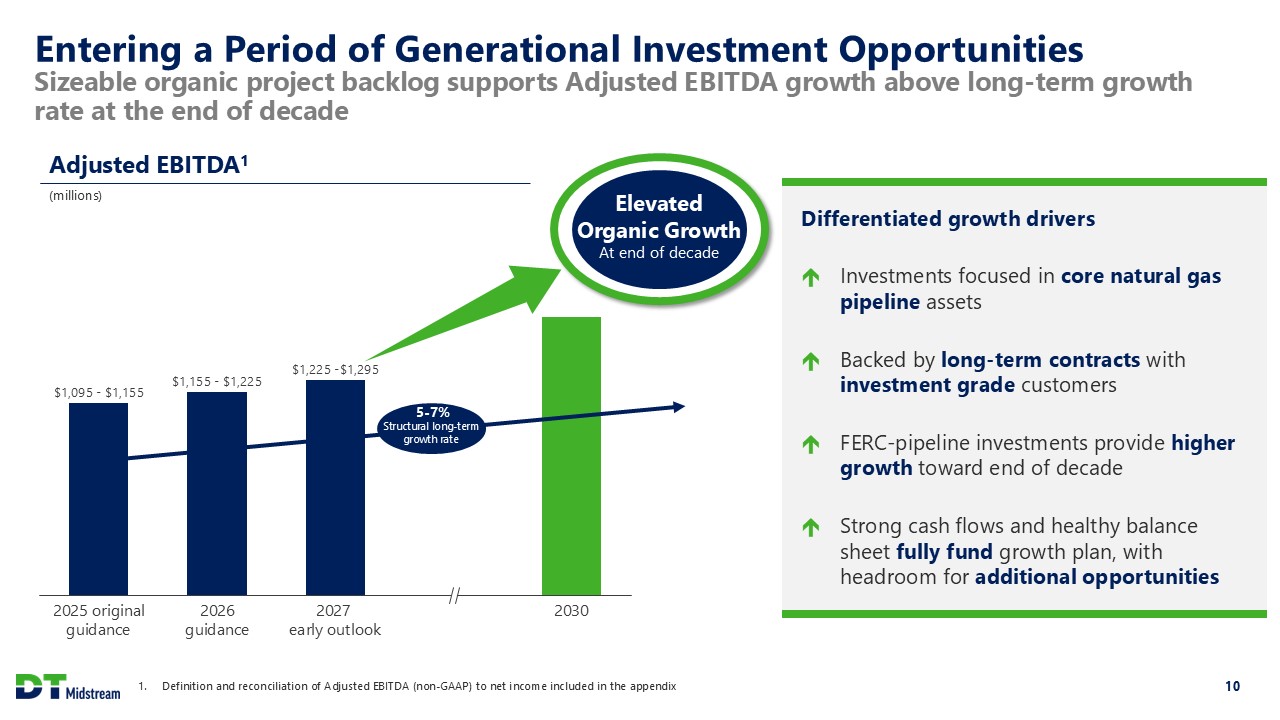
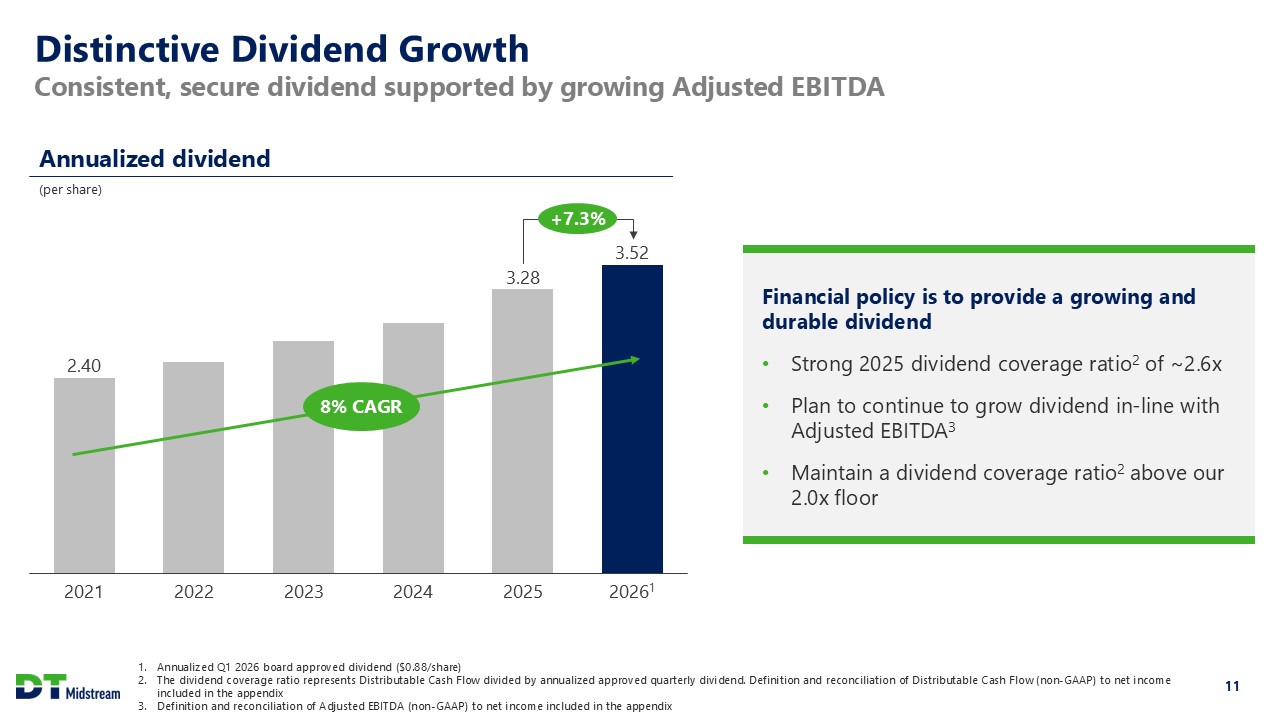
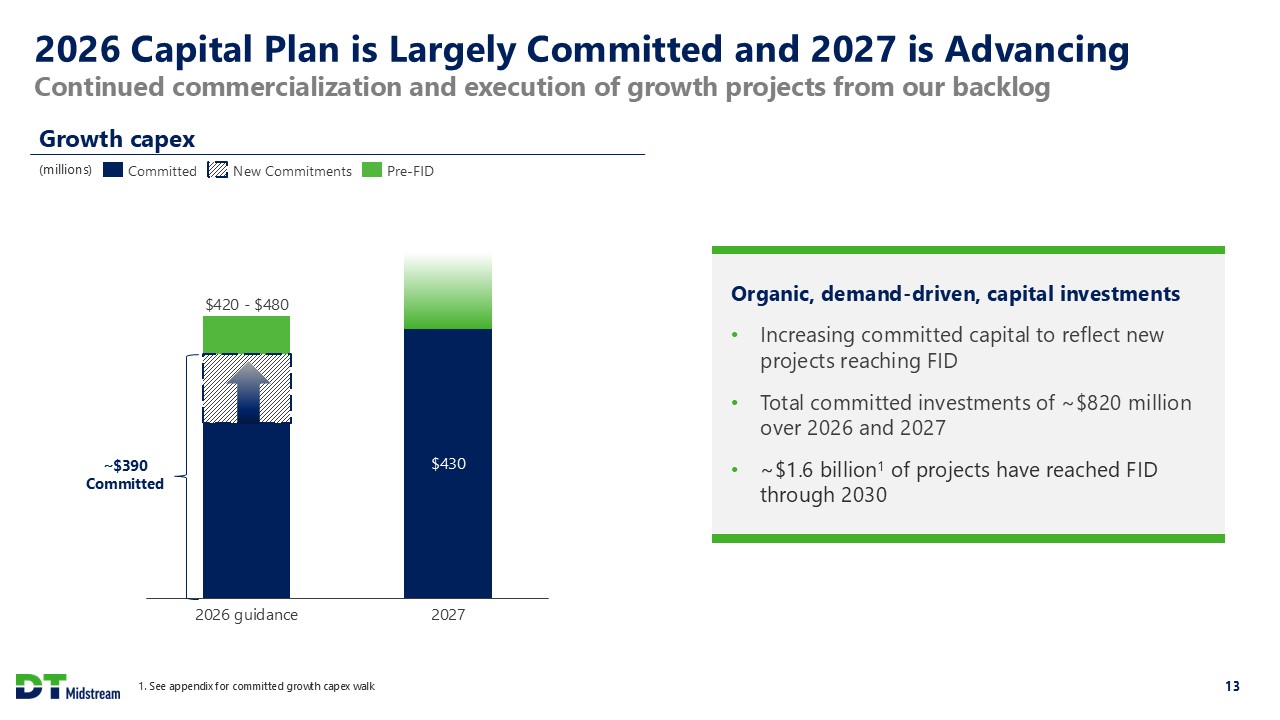
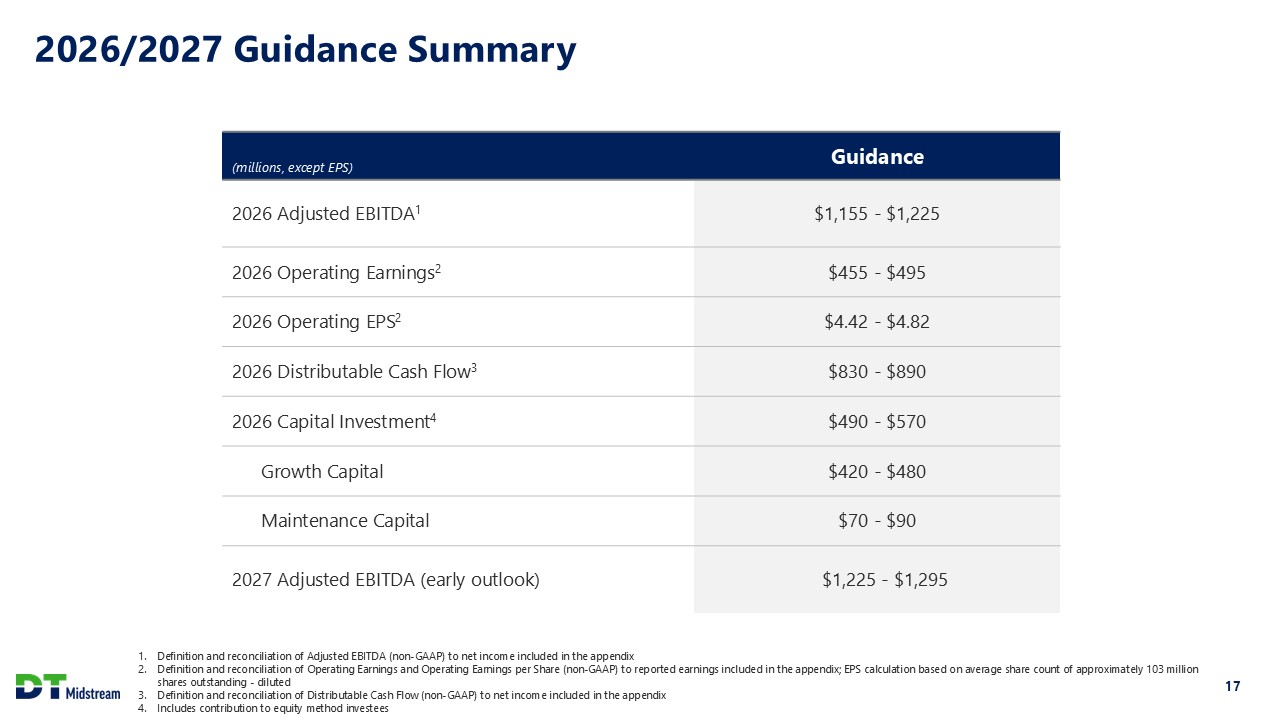
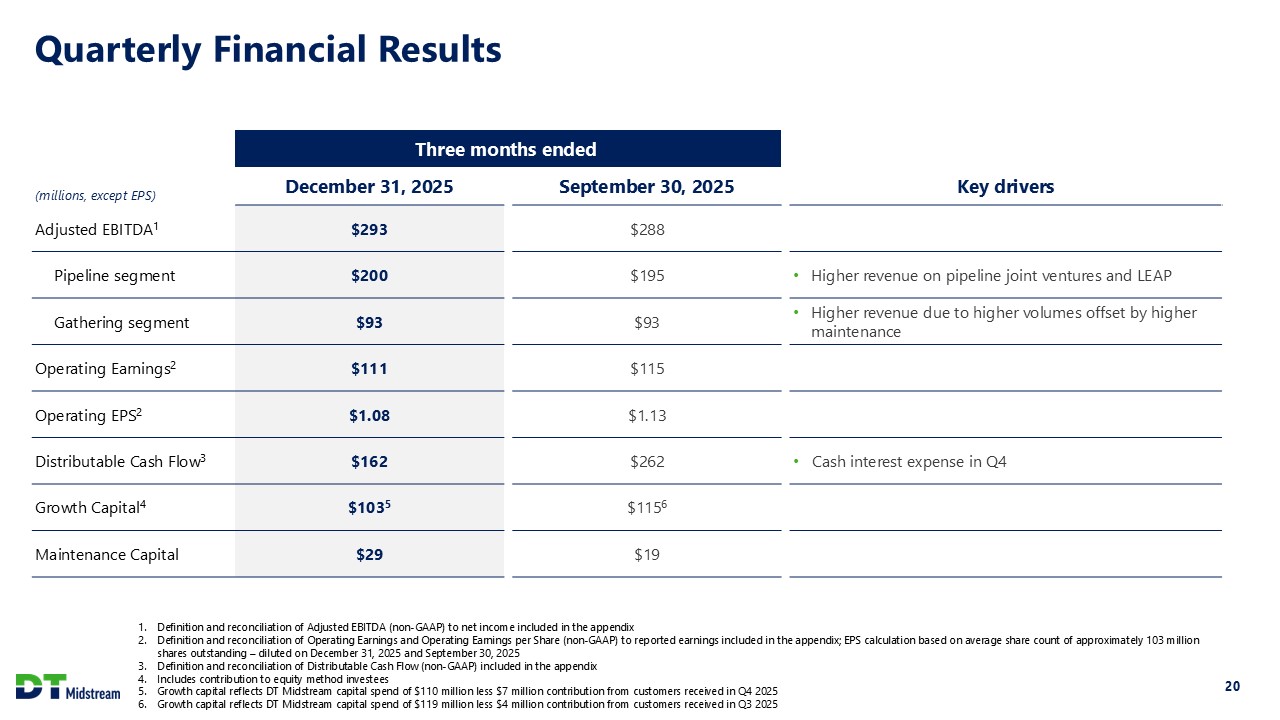
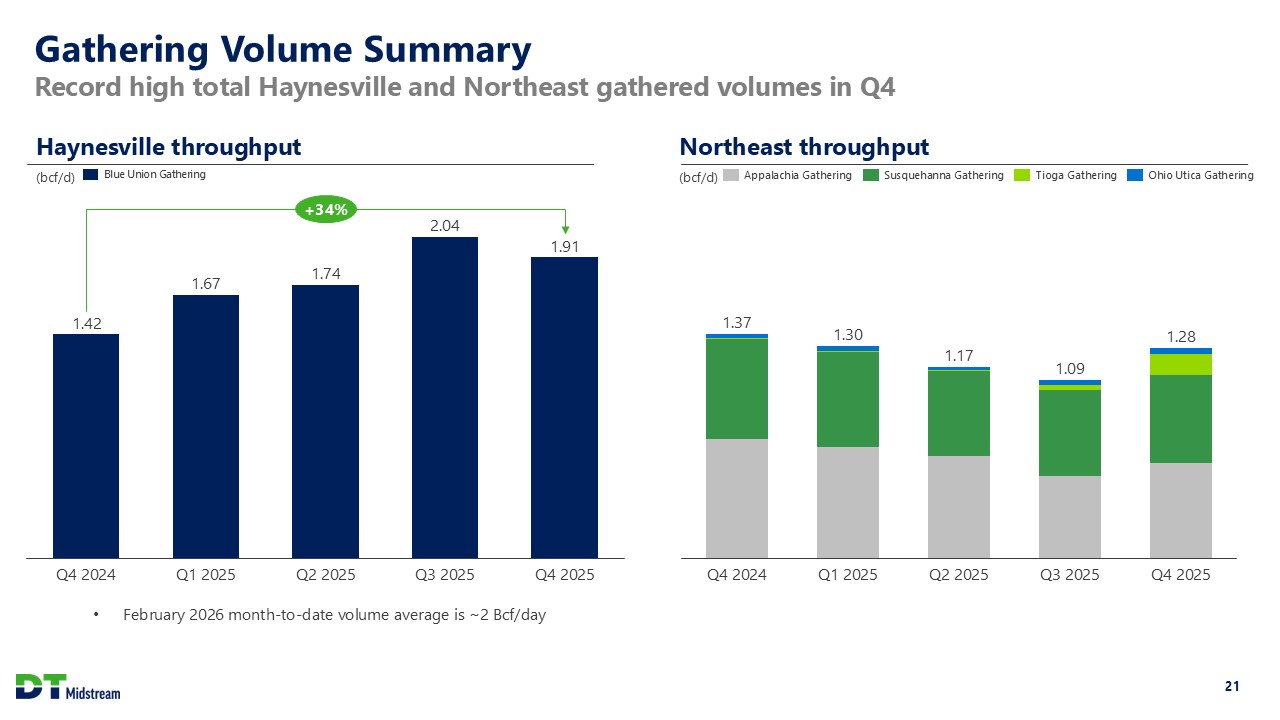
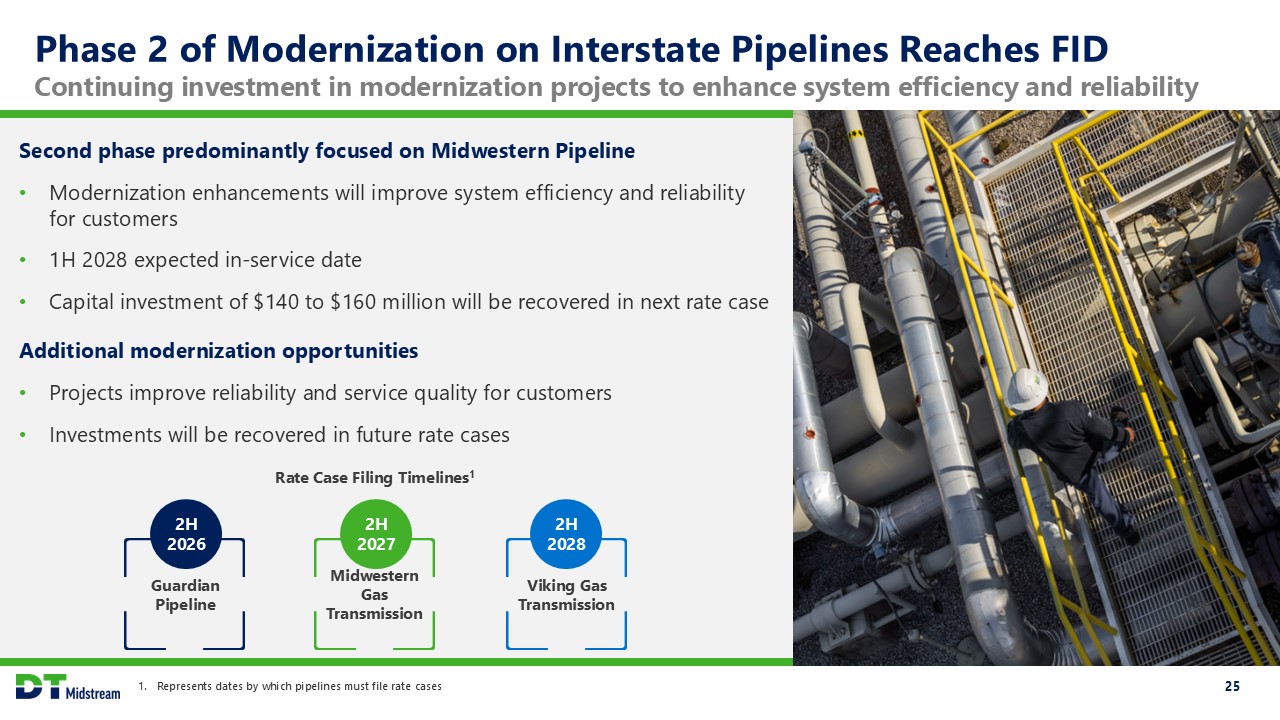
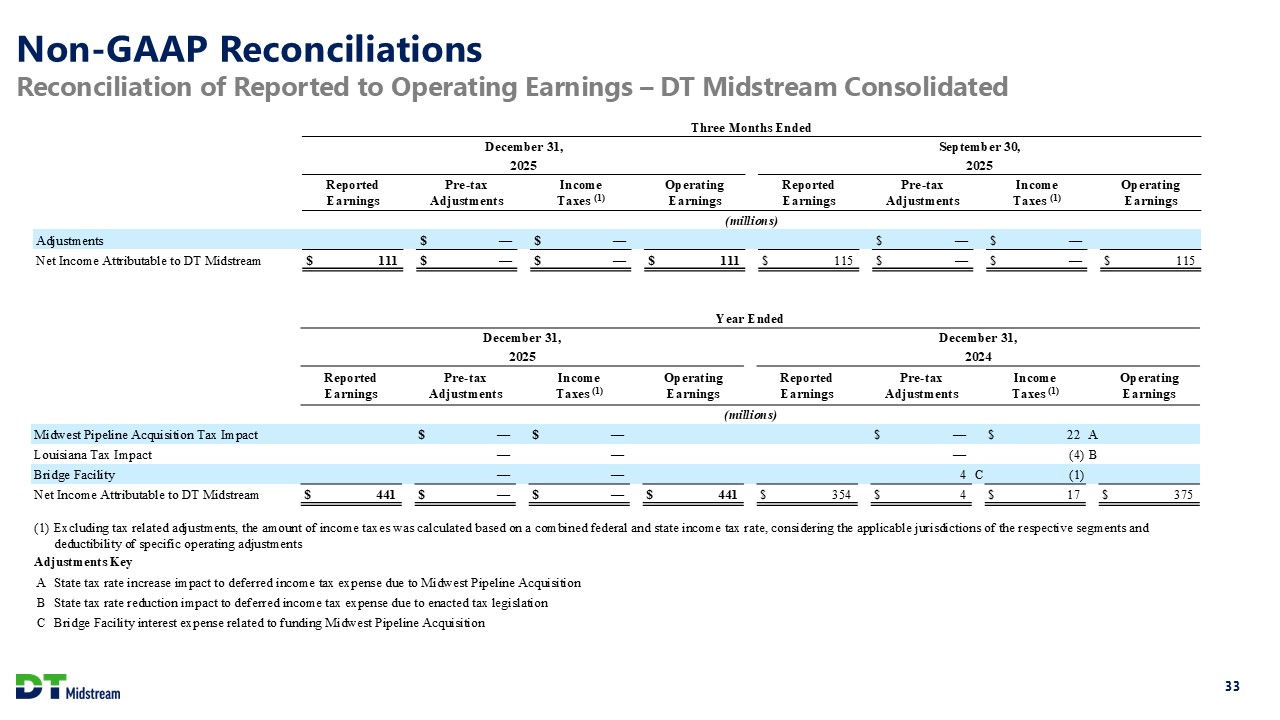
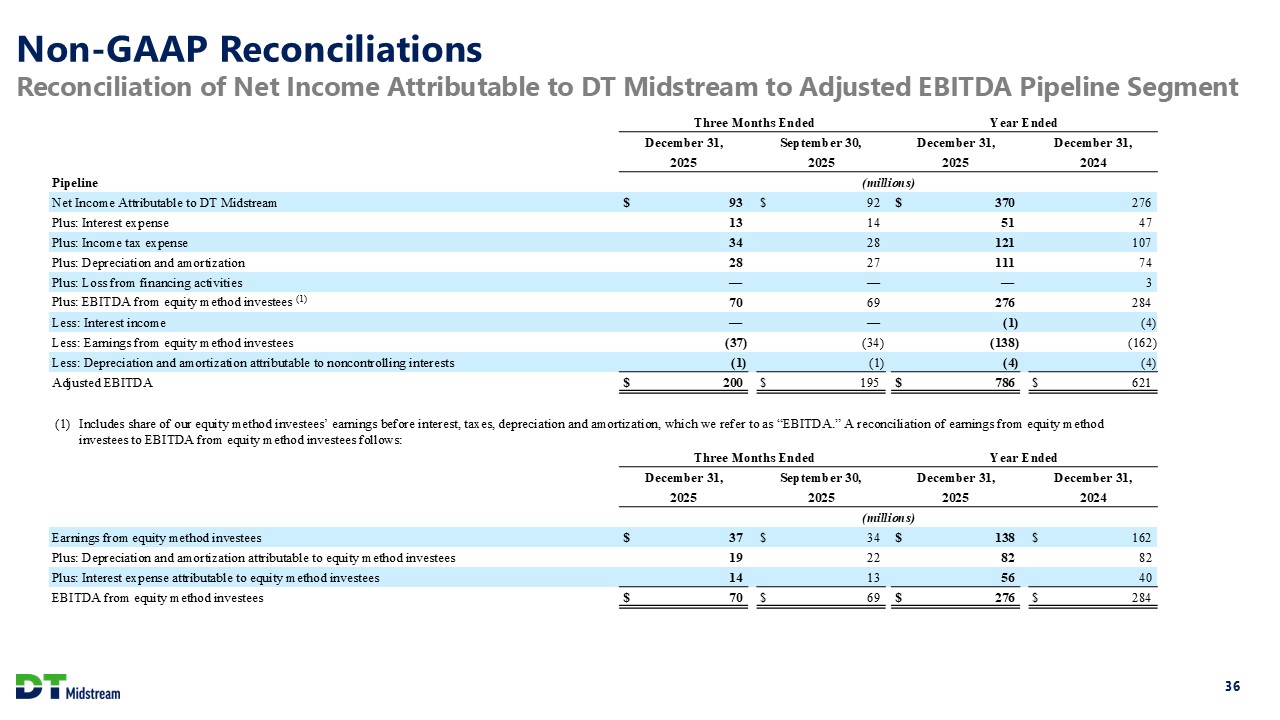
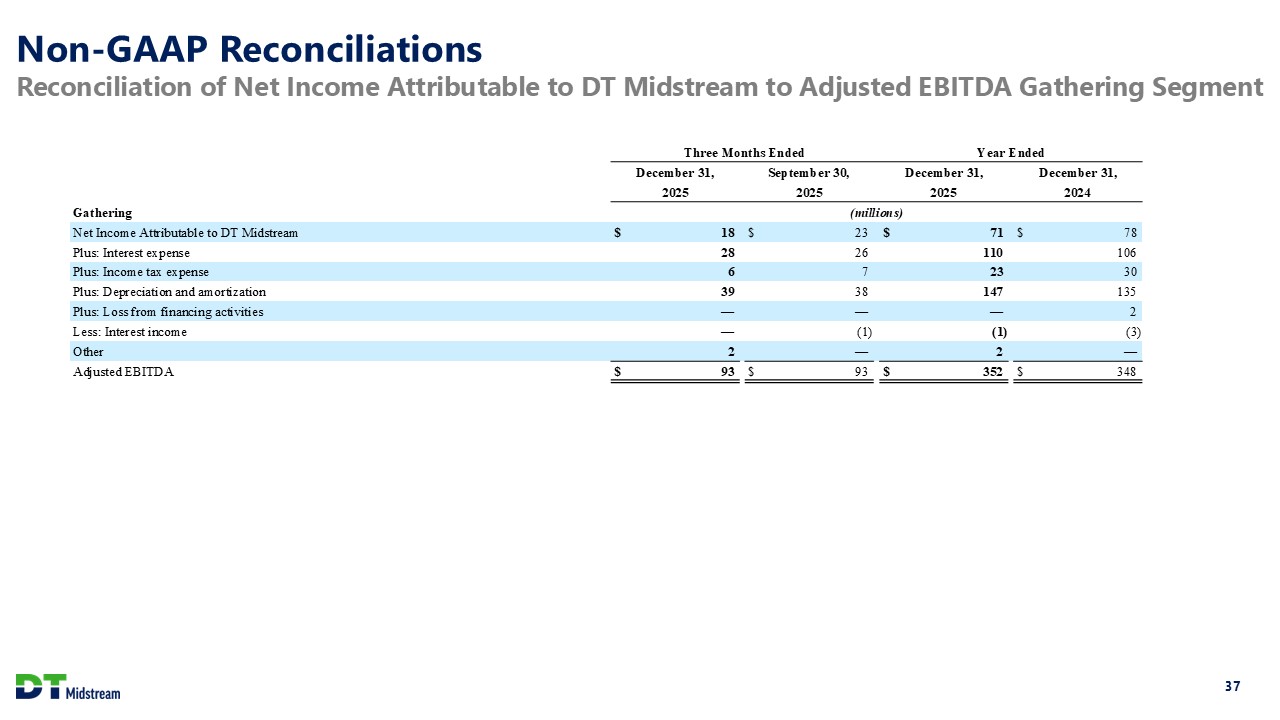
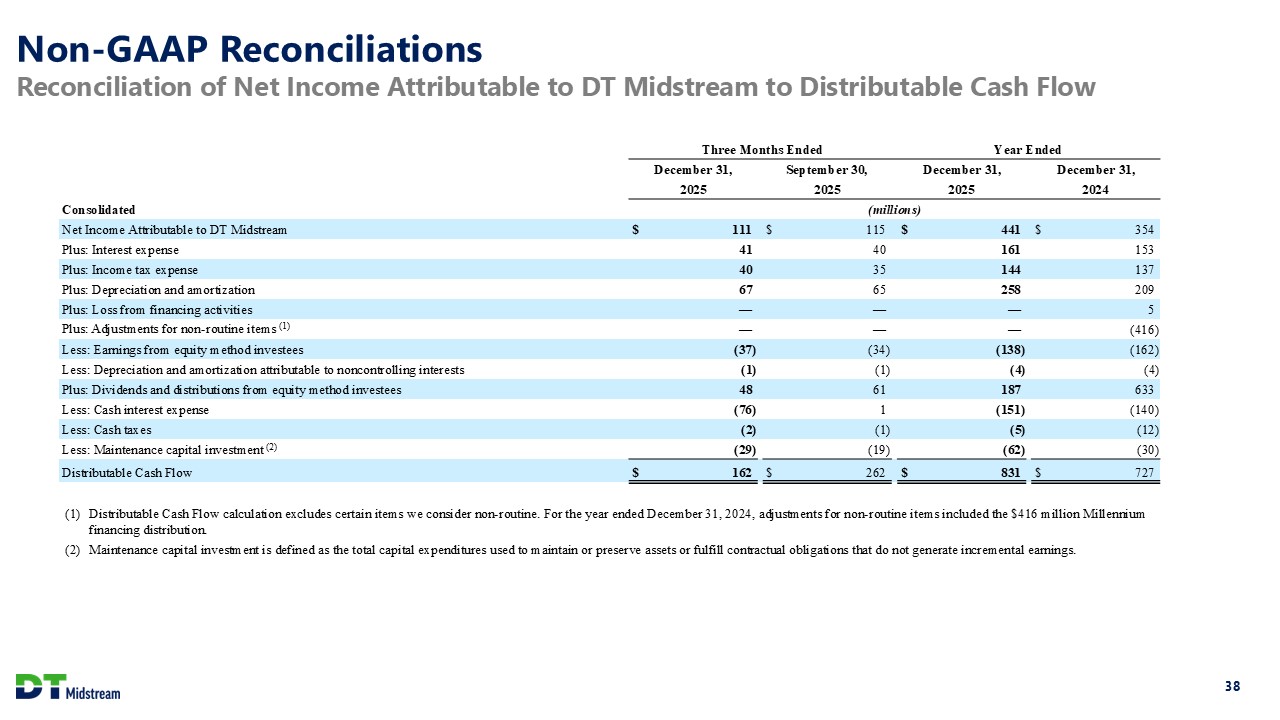
Thanks, David, and good morning, everyone. For 2025, DTM's adjusted EBITDA was $1.138 billion, an increase of 17% over the prior year, supported by our pipeline segment's 27% growth, which was driven by the Midwest pipeline acquisition and higher LEAP and storage revenue. For the fourth quarter, we delivered overall adjusted EBITDA of $293 million, a $5 million increase from the prior quarter, which was driven by increased seasonal demand on our JV pipelines and higher LEAP revenue. Our gathering segment results were in line with the third quarter. Operationally for the quarter, we achieved a record high in total gathering volumes, with the Haynesville averaging above 1.9 BCF per day, slightly down from the third quarter due to upstream maintenance. Average volumes in the northeast ramped in the fourth quarter to approximately 1.3 BCF per day in line with our expectations of flat entry to exit for the year in 2026 winter storm fern drove some production curtailments which is contemplated in our 2026 guidance range moving forward to our financial outlook for 2026 and beyond as we have done in the past we are providing the current year guidance as well as an early outlook for the following year. For 2026, our adjusted EBITDA guidance range is $1.155 to $1.225 billion, with the midpoint representing 6% growth over our 2025 original guidance midpoint. Our 2027 early outlook range for adjusted EBITDA is $1.225 to $1.295 billion, with the midpoint representing a 6% increase over the 2026 guidance midpoint. Our adjusted EBITDA guidance for 26 and for 27 is supported by the incremental contribution from our organic growth investments, as well as expected activity from our major producer customers. Our 2026 growth capital guidance is $420 to $480 million. And we've increased our committed capital to reflect the new FID growth projects, with approximately $390 million now committed. For 2027, we expect the level of growth investments to be above 2026. And we already have approximately $430 million committed. As David mentioned, we have reached FID on a FIKING pipeline expansion. and we expect to invest a total of $30 million to $40 million for the project. We have also FID'd Phase II of our Interstate Modernization Program, which has a planned investment range of $140 million to $160 million and an expected first half 2028 in-service date. The capital associated with this project will be included in the next rate case. From a balance sheet perspective, we are very pleased with obtaining investment-grade credit rating in 2025, which we are committed to preserving, as evidenced by our 2026 year-end forecast for on-balance sheet leverage of 2.9 times and proportional leverage of 3.5 times. With our cash flows being strong and our healthy balance sheet, we will fully fund our project backlog with significant headroom for additional future growth opportunities. And finally, our board has declared a quarterly dividend of $0.88 per share, which represents a 7.3% increase from the prior year, and continues our track record of providing leading dividend growth. Our approach to delivering a secure dividend has not changed, as we plan to grow it in line with adjusted EBITDA and are committed to maintaining a strong coverage ratio above our two-times floor, which was 2.6 times for 2025. And with that, I will now pass it back over to David for closing remarks.
Thanks, Jeff. So, in summary, we're highly confident in delivering on our guidance, continuing our track record of strong performance. Looking ahead, the fundamentals supporting our business are exceptionally strong, and our integrated footprint sits in the most advantaged corridors to benefit from this generational investment opportunity. Our sizable organic project backlog with potential for additional opportunities reflects our disciplined, focused, capital allocation to high quality natural gas pipeline projects. We will continue our consistent execution of this strategy, which has delivered dependable, best in class growth, and will continue to create significant value for years to come. And with that, we can now open up the line for questions.
Operator
Thank you, sir. And everyone, if you would like to ask a question today, please press star one on your telephone keypad. Once again, that is star one. If you have a question, we'll go first to Teresa Chen from Barclays.
Thank you for taking my questions. It's encouraging to see such a robust project backlog, the breadth and depth of the opportunities. It's impressive. Can you discuss the expected pace and cadence of commercialization from here, the key drivers behind that trajectory, and how it informs your outlook for capital spending beyond 2027?
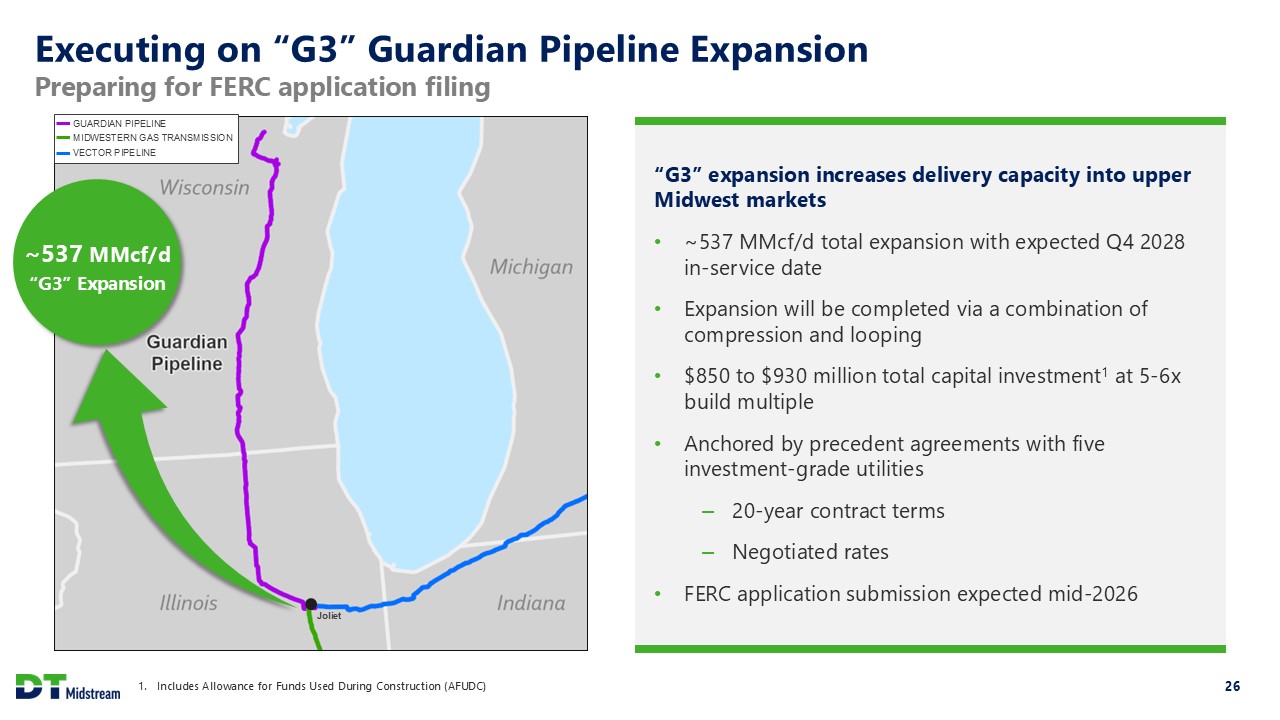
Good morning, Theresa. Thanks for the question. And yes, we're extremely excited about the opportunity set that's presenting in our footprint right now. And I'll say this, it's a very fluid market. And as we laid out all these utility announcements that have been happening over the last couple of weeks as they've talked about their year-end and their outlook, The opportunity set continues to grow. So it's a very fluid market, opportunity-rich market. All of our assets, especially our upper Midwest assets, these utilities are our current customers. So we're in detailed conversations with them about their growth trajectory and their needs. So, again, I think these will move forward in a very disciplined, rational way. Many of these demands are anchored in a state regulatory framework, so they'll go through a very disciplined process with utilities as they go through their approval process. But I think it results in a very strong and durable opportunity set for us to contract into. I'd say our Guardian project last year is a really good indication of what we expect this to look like going forward. The Vector expansion into Chicago, again, anchored, utility anchored. So we're just seeing this theme kind of rolling through our asset footprint. And if I turn to the south and talk LNG briefly, again, a really clear line of sight on LNG growth. Two-thirds of the Haynesville is expected to meet that growth, and we continue to see that demand pull, and we're in a really good position to participate in that demand growth with LEAP.
Thank you. So maybe specifically turning to Midwestern gas transmission, the potential expansion of that pipeline, how are conversations progressing at this point? What scale or scope could this ultimately reach, and how are you thinking about the opportunity generally at this stage, knowing that multiple sources of demand as well as optionality for supply connectivity here?
Yeah, that's a really exciting one, Teresa. We're in deep conversations with our existing customers on Midwestern for both a northern expansion and a southern expansion. And just if you can visualize the asset, REX cuts right across the middle of the asset. So supply can come in from Appalachia and it can come in from the Rockies. So, there's supply diversity through the REX connection and strong demand signals to bring more gas north into the greater Chicago, upper Midwest, but we're also seeing strong demand signals to put into what I'll call that greater Nashville region that is also experiencing tremendous power demand growth.
Operator
Thank you. Up next, we'll take a question from Julian Dumoulin-Smith from Jefferies.
Hey, good morning, everyone. It's from Moscow. on for Julian. So big update here with the five-year growth CapEx outlook, but hopefully you could dive into how you arrive at that number, maybe how you're risk adjusting that outlook for the uncommitted CapEx and how you characterize the texture, the geography within that uncommitted capital outlook. I just hope you could dig into that gross number a little bit more.
I mean, it's really increased from our last outlook a year ago, and I think we've talked about that as the years progressed, and that's the fluidity of the market. The backlog continues to grow. We're highly confident in the increase that we laid out for the investors. About half of that is FID already. The other half is highly probable. we look at our gross backlog, which, by the way, is multiples of this committed backlog that we're committing to execute on. So, it's probability adjusted based on our kind of our historical success ratio. So, we're highly confident in deploying that 3.4 billion. And as I said earlier, this is an extremely fluid market with incremental waves of demand that seems to be showing up every time we talk to our customers. So we're very bullish right now. You know, we're also very disciplined, and we tend to have a conservative view on running the business, which delivers these very consistent results. So, you know, we're just really in a sweet spot right now in the market. The assets are in the right location, both in the north and in the south, and the fundamentals around our assets. So our job here is to commercialize this and to do it in a really rational and prudent manner. And I expect we're going to continue to deliver great returns for the investors.
I appreciate that commentary, David. And, you know, there's seems like there's a large open season for a pipeline right now. It serves some of that growing Midwest demand. I think you alluded to in your prepared remarks. Just wondering how that expansion or other third-party expansions in the region could impact your ability to execute some of those planned pipeline expansions that you guys have or are seeking to FID. Or should we not think about it as being mutually exclusive?
Yeah, Rob, we're not afraid of competition. You know, the projects that we FID'd last year also had competitive tension around them, you know, Guardian. And so that's not an issue for us. I think locationally, our assets are in the right location. It's somewhat like real estate, location matters, connectivity matters, track record matters. The other thing I'd say, you know, in my opening remarks, I kind of laid out the addressable opportunity set of five to eight BCF a day, which is sizable in the upper Midwest. there's plenty of room for others to participate in that and for us to have outstanding results you know we don't need to get all five day BCF and then we get one or two and that's gonna that's gonna be outstanding results for the company so I'm not concerned about competition but we're focused on the market right now and on those relationships and working customer by customer to provide the right answer, the right solution for their growth, and talking to these utilities, they're experiencing generational growth as well, and I think that's going to domino, the domino effect is going to fall across our assets, and what I'm really excited about with our assets is the connectivity that we have across multiple assets so you know you sort of you can see it with vector you know Guardian was FID last year we're on the doorstep of FID and vector that domino effect is playing out across our assets footprint right now and I expect that to continue got it appreciate the
Operator
time this morning everyone Michael Bloom from Wells Fargo has the next question Hey, good morning, everyone.
Good morning. Yeah, I wanted to ask on the backlog again. So you mentioned the gross backlog is much larger than the risk-adjusted backlog number that you provided. I'm wondering if you're willing to give us, you know, that gross number or some way to size what that is, what some of your pipeline competitor peers would call the shadow backlog so we can get a sense of the total magnitude of the opportunity set.
Hey, Michael. So I was expecting someone would ask that question. I'll say it's multiples and I'm going to leave it at that and you guys can infer a number or a range, but it's, you know, I use the word generational investment opportunity. It truly is. And I think for us, when I think about the sector and we're focused on, we're just super We're focused on our core business right now on our pipelines in our core region and deploying capital in a proper fashion so that the returns show up on the other side of these large capital outlays. Certainly I recall what happened a decade ago in the sector that didn't end well. we're committed that we will be deploying capital in a very prudent rational way as we approach another you know super cycle or generational cycle of capital investment opportunity so you know we're super focused on it you know the a very robust opportunity says a healthy backdrop for us to work within And, you know, it's going to allow us to be selective and very focused and do the right thing for the investors.
Appreciate that. And then just wanted to ask a question on the growth CapEx. You came in a little light versus your own guidance for 25, and I think you had even reduced that number during this past in 2025 last year. So can you just speak to what's going on there? And is that just capital efficiency on your part, or is it timing and that CapEx is just going to show up in 2026?
Yeah, yeah, you're bang on. It's performance, you know, capital efficiency, I call it performance, and it's timing. So it's no more complicated than that.
Operator
From Goldman Sachs, John Mackay has the next question.
Hey, good morning, guys. Thank you for the time. David, you've talked a lot in the past about wanting to stay kind of front of meter with the utilities. We have seen kind of behind the meter pick up some momentum again recently. I'd be curious just to hear a little bit on your view there where it sits now, particularly in the context of a broader focus on affordability for the utilities.
Yeah, John, we're seeing some of the, you know, the Energy Island load knocking on the pipeline's door, so to speak. And we're very happy to contract with that on the main lines, you know, long-term contracts on the main lines. So we are seeing some of that demand manifesting across the footprint. The utilities have done an exceptional job here reeling in this market. They're doing it through a regulatory construct. When you monitor their filings, they're being very particular about explaining how it lowers the cost to the rest of their customers, so there's no cross-subsidization occurring. And these large loan customers slash data centers really like the fact that the utilities their counterparty because they get a lot of comfort in that they're connected to the grid there's diversity really strong counterparty so there's a lot of features that the utilities are offering to this segment of the market that seems to be very attractive and we're very happy to work closely with our existing utility customers to participate bringing the fuel to these projects so we like how it's playing out it's sort of been we've been observing this for the last 12 months utilities being more successful than in the past and we
really like the fact that it's going into a regulated construct which I believe provides long-term durability to the demand that's clear thank you second Second one for me is, you know, when you – a lot of the projects you've been announcing are effectively, you know, brownfield expansions of existing assets. I'd be curious your view on the opportunity for anything on the greenfield side and or opportunities for you to do incremental kind of bolt-on M&A and try to repeat what you did with the 1-0 gas sets. Thanks.
Yeah, we are focusing predominantly on, you know, what I'll call in-the-footprint expansions. They're easier. They're typically more economic because you can scale it. And they're lower risk from an execution-slash-regulatory perspective. So I think there's a lot of features to addressing this demand through that mechanism, if you can, versus a brand-new greenfield. when we did nexus 10 years ago that was a heavy heavy lift to get that through and then if if you remember there was a one-year delay a regulatory delay on that project so it's super big capital that if you get any delays can have a pretty material impact on you pretty quickly so we like the risk profile of the of the brownfield in terms of greenfield where we Where we are seeing greenfield, you know, we continue to pursue greenfield storage opportunities. Some of the fundamentals that we laid out in the deck where you see the extreme price volatility across our footprint, it's really screaming for more capacity, both pipeline and storage capacity. So that's probably where we see more of a greenfield opportunity in the near term, John.
All right. That's great. Appreciate the time. Thank you.
Operator
The next question comes from Jeremy Tanette from J.P. Morgan.
Morning, Jeremy. Good morning.
Just wanted to come to slide 10, if we could, and there's been a lot of discussion on the capital side, but just wondering if you could dial in a little bit more in the translation to EBITDA growth. The slide here says elevated organic growth, and it points, you know, post-2027. I was just wondering if you could expand a bit more on what that looks like, what the quantity of this elevated growth looks like.
Sure, Jeremy. Well, I start with the backlog update, right? That's the fuel that goes into the equation that drives the EBITDA growth. And most of that capital, 75% of that capital is deploying into the pipeline segment, which is work regulated, which has a longer capital invest, EBITDA generation cycle, you know, it's two and a half to three-year cycle, right? So it's really going to supercharge the back end of our five-year plan. You know, I didn't want to put a number on that. I don't want to cap that because the market is so fluid right now. The opportunity set is robust. And every time we take a fresh look at it, it seems to get more robust. So we're early in the cycle. And I think we want to let it run for a little bit before we start to try to stick the landing, so to speak, at the back of our five-year plan. But, you know, it's green, the arrow's up, we're very bullish, the fundamentals. We laid out what those fundamentals are here in the deck for you. And I think this will be a conversation we can have as the year unfolds, Jeremy, as to how we're feeling about this and how this starts to commercialize and sort of the picture will take shape.
Got it. That makes sense. Don't want to put a ceiling on it, given all the opportunities. I was wondering not to push too much here, but could we put a floor on it? I mean, if it's 5% to 7%, you say now, and I would assume that that elevated growth is at least 7% plus or any other way to think about what a floor might look like.
I think you just said it really well, Jeremy. I won't add anything to your comment there.
Got it. Great to hear. I'll leave it there.
Operator
The next question will come from Jean Ann Solisbury from Bank of America.
Hi, good morning. It looks like the gathering and the new backlog is up by a couple hundred million, even though several 2025 gathering projects came online. So I guess my question is, versus a year ago, is this an increase in expected gathering spend? Is it primarily driven by the Hainesville or Appalachia or both?
Oh, that's a good question. I'd start with just reminding everybody that our gathering assets are all interconnected to our pipelines, right, so they feed our pipelines. You know, the gathering, I'm going to – can we get back to you on that, Jean-Anne, because I'm not 100% sure the answer to your question. I don't want to guess at it. But we'll follow up with you. How's that sound?
Yeah, no problem. I'll circle back with Todd. And then as my follow-up, you know, there's a comment in the deck about future LEAP expansions likely being tied to the next wave of LNG in 2028 to 2030. I kind of wanted to clarify what that meant. I guess my understanding was that most of the LNG projects under construction had already kind of tied up their gas supply.
I guess, you know, maybe that's wrong, or if you – basically, if you are expecting a whole wave of new contracting to come as these projects under construction start to Yeah, I think you've got two projects that just came online, you know, the second half of last year and that's getting absorbed into the market and I think this this next wave is going to be the wave that drives the next round of incremental expansion we're in detailed conversations with numerous shippers on on this topic right now so it feels very ripe for us so I would just stay tuned and as we commercialize these we'll we'll be sharing them all right thank
Operator
you very much. Keith Stanley from Wolf Research is up next.
Hi, good morning, and I'd like to circle back on slide 10. So, David, no, you don't want to put a cap on the 2030 outlook, but, you know, that green bar, you can kind of figure out where it's going if you just extrapolate the chart. I guess I'm curious in that 2030 figure, you know, we're getting to like a seven to eight percent CAGR through 2030, is that directionally right over a five-year period? And when you show that green bar, is that only baking in sanctioned projects to date, or is that including a fair amount of executing on the unsanctioned projects that you've identified as well?
Keith, that green bar boxes out to the updated backlog, the $3.4 billion. So that's kind of the way to think about it. And what I'll say is exceeding the high end of our five to seven. And again, at this point, we're just too early in the game and there's too much fluidity in the market right now in terms of putting a number on it. As I said, I don't want to cap it. I want to let the market unfold a little bit. And we'll be the first people to give you better clarity on that once we're confident in our execution.
Got it. So just to clarify on that, the green bar is effectively the $3.4 billion divided by EBIT.build multiples that you're assuming in that outlook.
That would be the back on the envelope map, Keith, what you just said. Okay, great.
Thanks for that. Second question, just following up on the Midwestern expansion potential, any better sense of timing? You said you're in deep conversations. I assume you need an open season there. Just any sense of when you're hoping to get more clarity on that project? Is it next six months? Is it beyond that? Just how would you put that?
Yeah, it's definitely in front of us right now, Keith, like right in front of us. You know, so there's clearly a need for more volumes into Chicago. You know, we commercialized the Vector piece. We've turned our attention out at Midwestern. We'll turn our attention back to Vector as well for another round there. But, yeah, it's front and center, and it's on everyone's mind right now. know all of our customers are looking closely at all of this as I kind of alluded to we're in deep discussions with a lot of the shippers predominantly that you there are the regulated entities on those lines and you know we're going to move at their pace and that's what I'll say right now but it's it's a hot topic right now so thank you your next question is from Samantha Banerjee from UBS hi good morning thanks for taking the question what was
I'm just curious about the additional modernization opportunities that you mentioned in the deck and great to see the phase two interstate pipeline modernization that I've created. So just curious about that.
Yeah, thanks for the question. Yeah, that phase two is going to be focused on Midwestern and it's going to be focused on reliability, predominantly compression, replacing some aging, end of life compression. Yeah, that'll roll through the next rate case on Midwestern. So really, really good about those investments. They're very much needed. And yeah, I think it'll be a pretty standard play for us to make those investments and roll them through the next rate case.
Got it. That's really helpful. And then the second question I had was just a general one on capital allocation priorities going forward and how are you looking at balancing dividend growth versus keeping leverage maintained?
Yeah, I mean, we're very focused on capital allocation. If you look at the backlog, the majority of the backlog is going to be allocated into our pipeline segment, predominantly the regulated pipeline segment. So, those tend to be backed by long-term, 10, 20-year contracts. contracts, again, predominantly with utilities, so investment-grade counterparties. So very strong cash flows, security of those cash flows over the long term. We've committed, since we spun the company, to grow the dividend in line with EBITDA growth. And I think over the last five years, you can see us doing that consistently.
Our plan is to continue to do that going forward, and maybe Jeff, you can talk about the balance sheet and how our thoughts on managing the balance sheet and the dividend yeah sure sure can yeah so what our plan is and again we've been talking about this since the spin is as we fund our internal capital allocation plan with our free cash flow we're going to naturally and have been naturally deleveraging and so with that we're able to fund all the projects and everything that David's been talking about and the growing dividend inside of our capital capacity or credit capacity.
And I'd say we work pretty hard to get to investment grade. And now that we've crossed that threshold, we're firmly staying on that side of the line.
Yeah, we've got plenty of room between on the credit metric. So again, we're very confident in our capacity to be able to fund any and everything that we're seeing coming at us.
Got it. That's very helpful. Thank you so much.
Operator
Moving on to Zach Van Everen from TPH & Co. Hi, all.
Thanks for taking my questions. Maybe first on the Haynesville, we've continued to see the rate count step up into the beginning of 26. Curious on conversations with producers and just views on overall capacity needs in the basin. Sure.
Let me tackle that, Zach. So, you've seen, we saw a nice ramp in the Hainesville in Q3 and Q4. We're expecting, you know, to see those robust volumes, you know, going into this year. You know, our biggest customer is public, and I think they've just recently shared their thoughts on their Hainesville growth for the year. So, that's probably a good yardstick to measure our activity. against. We do have a number of other producers that are also under experiencing growth or growing their portfolio. And we certainly are going to participate and see some activity there that'll be helpful to the cause as well. But the big shipper, the big anchor is XSEES. So I'll point you to XSEES public disclosures.
Perfect. Appreciate that. And then maybe one in the Northeast, you know, with the open season on Vector and some producers up in the Northeast, you know, talking about more growth coming into the next few years. Could you maybe give an update on Nexus and the ability to expand that, what size that could look like and any conversations going on currently around that pipe? Sure.
So it's somewhat that domino effect that I spoke of earlier you know we're seeing this play out across our portfolio as you know what I'll call we expand the last mile pipe then you know you got to look at an expansion upstream and it keeps going upstream and eventually falls its way back to where the production is so as we see vector expanding point 400 million a day of incremental supply out of Michigan you You know, that's going to have to get made up some way somehow. We're obviously working closely with potential shippers to utilize Nexus to do that. Nexus is easily expandable with compression and, you know, blocks of, you know, a couple hundred million a day with compression. So that is forefront in our minds right now as this market evolves and the demand grows in the upper Midwest is how do we unlock additional what I'll call egress freeways out of Appalachia to sort of ramp up and bring incremental supply into this region and again if if our fundamental assessment is is accurate that there's five to eight BCF a day that is in flight growth that's in flight over the next five years, that's going to demand some pipelines or multiple pipelines to expand into this region, out of the supply basins. And Appalachia is the closest basin, Rockies is right there, they can come back into the So, we're really excited to work on these projects and I really like the domino effect across the portfolio as we work our way back into the basin perfect makes sense thank you so much for the time and everyone at this time there are no further questions i'll hand the conference back to the company for any additional or closing remarks well thank you i just want to thank everyone for joining us today thank you for your interest and support of the company and
Operator
look forward to seeing everybody in person at one of the next conferences have a great day and once again everyone that does conclude today's conference we would like to thank you all for your participation today you may now disconnect