Operator
Hello, everyone. Thank you for joining us and welcome to EverQuote Q1 2026 Earnings Call. After today's prepared remarks, we will host a question and answer session. If you would like to ask a question, please press star 1 to raise your hand. To withdraw your question, press star 1 again. I will now hand the conference over to Sarah Buda with EverQuote Investor Relations.
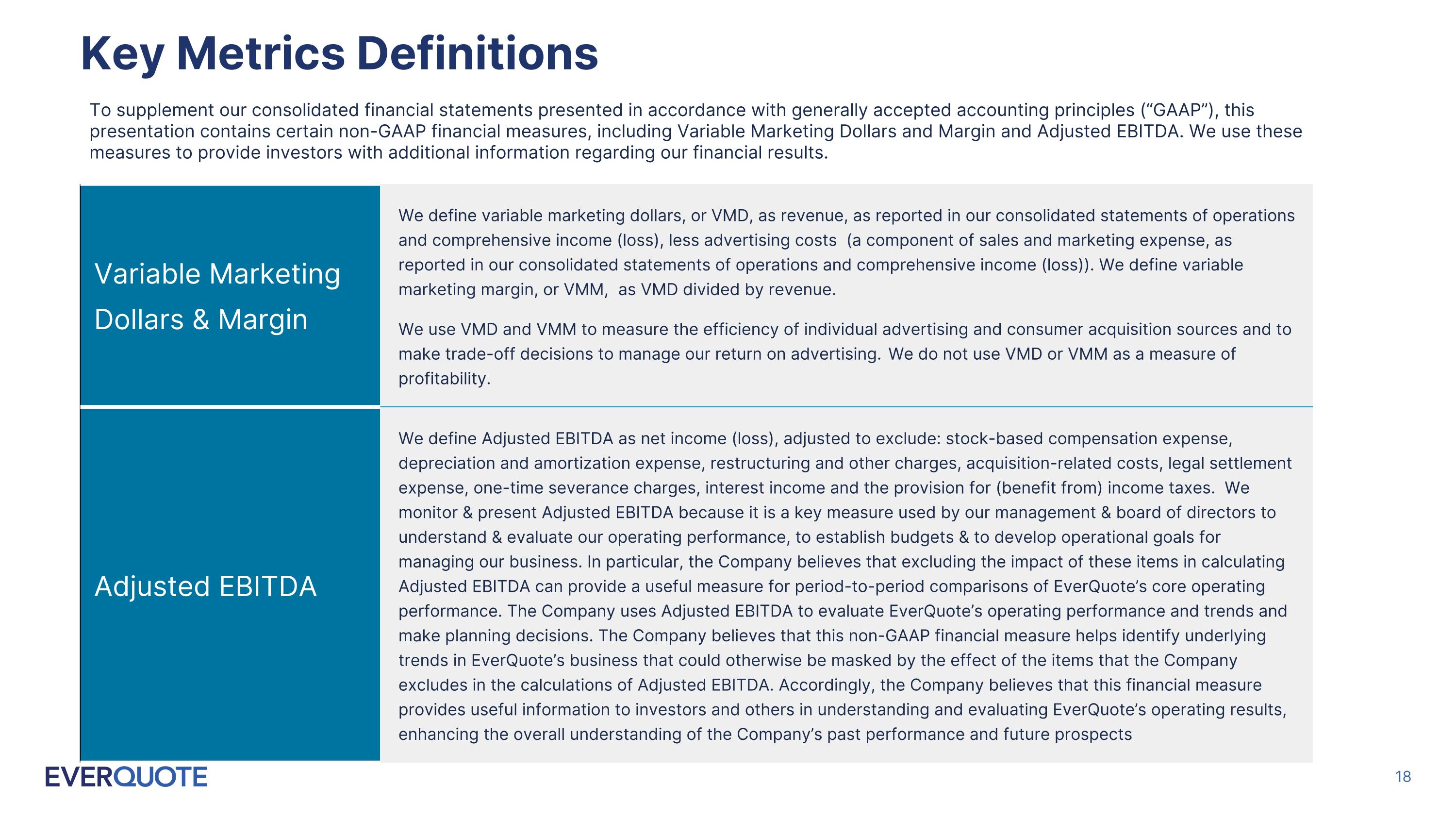
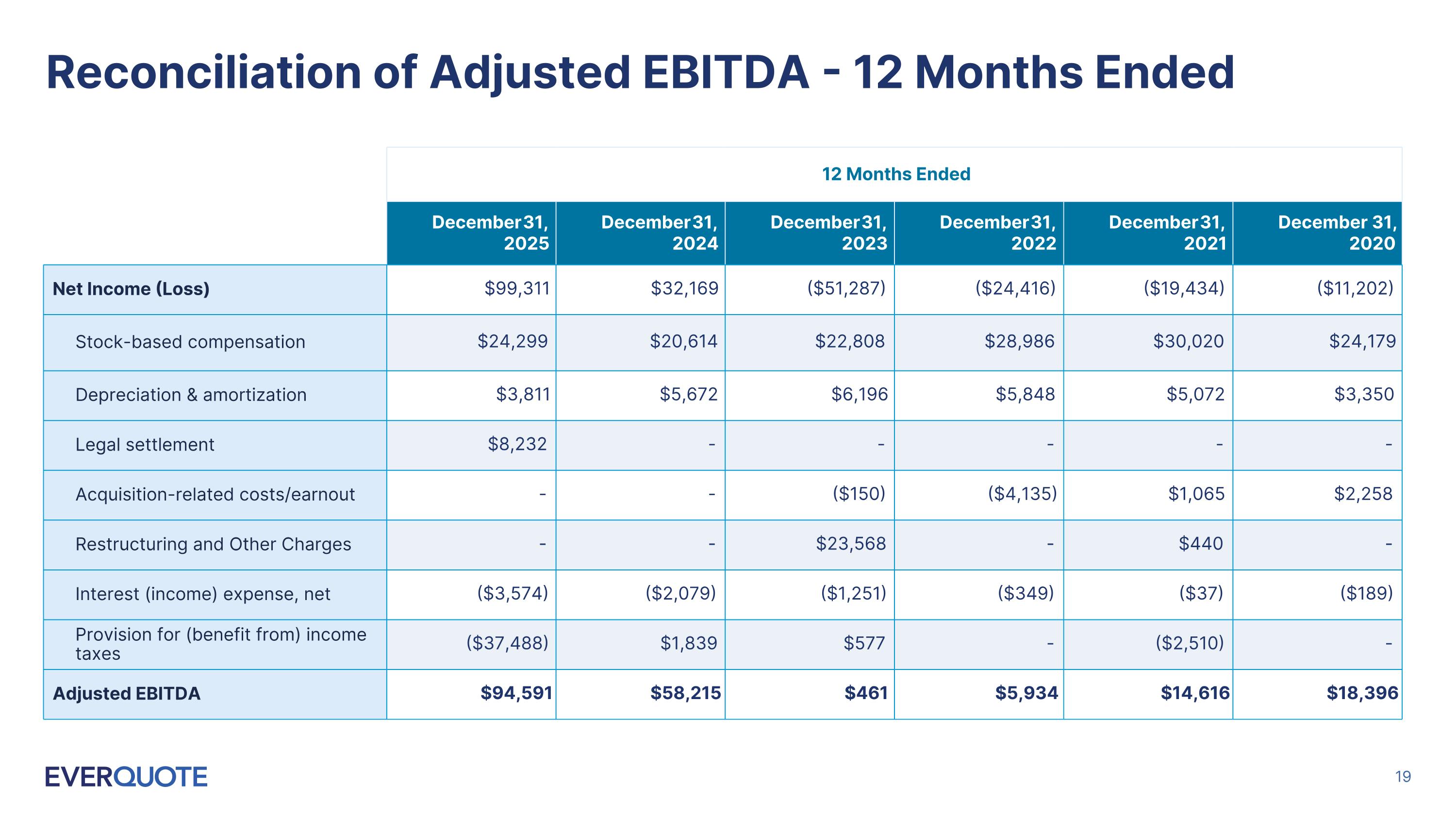
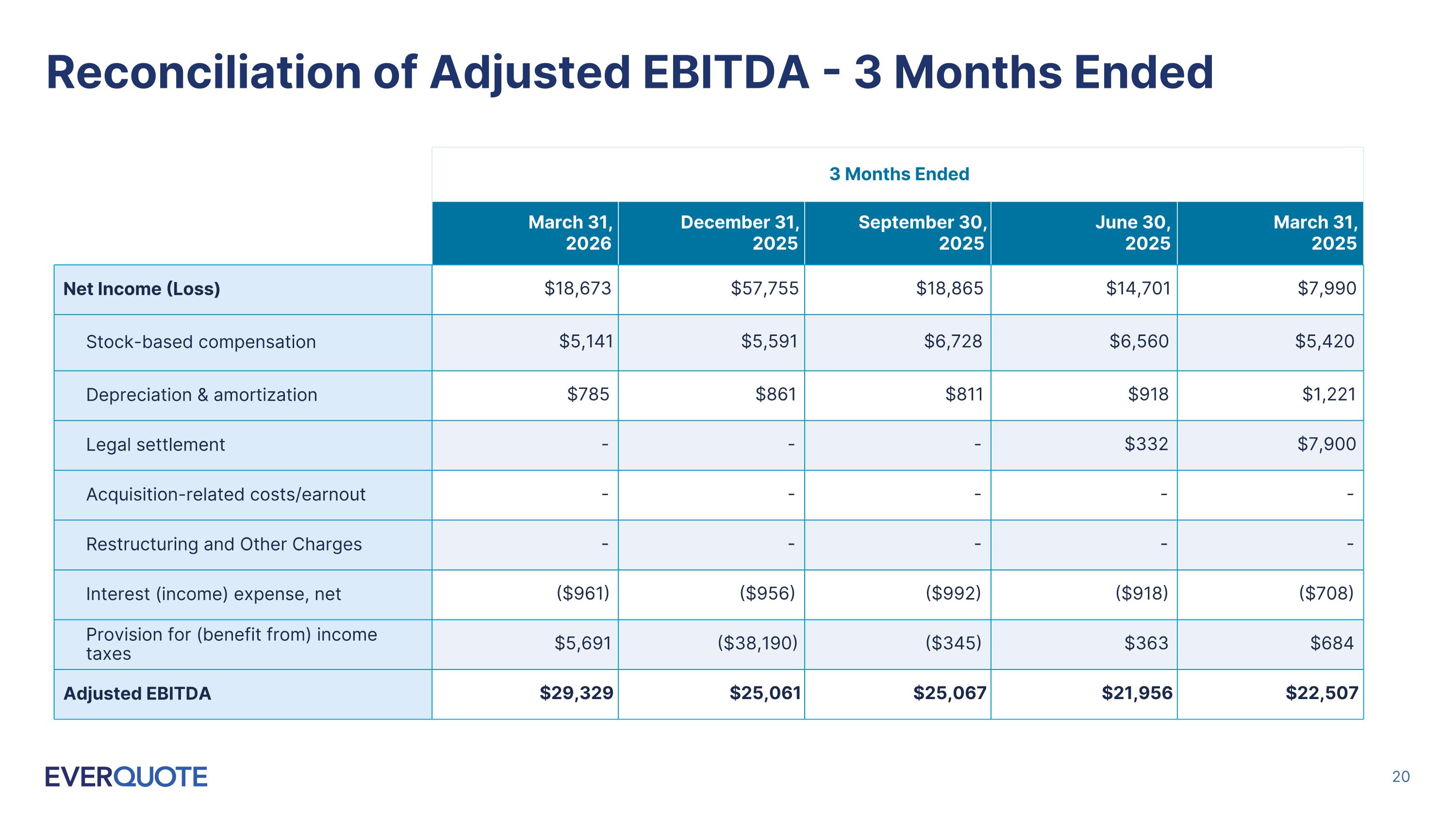
Thank you, good afternoon, and welcome to EverQuotes' first quarter 2026 earnings call. We will be discussing the results announced in our press release issued today after market With me on the call this afternoon are Jamie Mendel, EverQuotes' Chief Executive Officer, and Joseph Sanborn, EverQuotes' Chief Financial Officer and Chief Administrative Officer. During this call, we may make statements related to our business that may be considered forward-looking statements under federal securities laws, including statements considering our financial guidance for the second quarter of 2026. Forward-looking statements may be identified with words and phrases such as aim, expect, believe, intend, anticipate, plan, will, may, continue, upcoming, and similar words and phrases. These statements reflect our views only as of today and should not be considered our views as of any subsequent date. We specifically disclaim any obligation to update or revise these forward-looking statements, except as required by law. Forward-looking statements are subject to a variety of risks and uncertainties that could cause the actual results to differ materially from our expectations. For a discussion of those risks and uncertainties, please refer to our SEC filings, including our annual report on Form 10-K and our quarterly reports on Form 10-Q on file with the Securities and Exchange Commission and available on the Investor Relations section of our website. Finally, during the course of today's call, we will refer to certain non-GAAP financial measures, which include adjusted EBITDA, variable marketing dollars, and variable marketing margin, which we believe are helpful to investors. A reconciliation of GAAP to non-GAAP measures was included in the press release we issued after the close of Market Today, which is available on the Investor Relations section of our website. And with that, I will now turn the call over to Jamie.
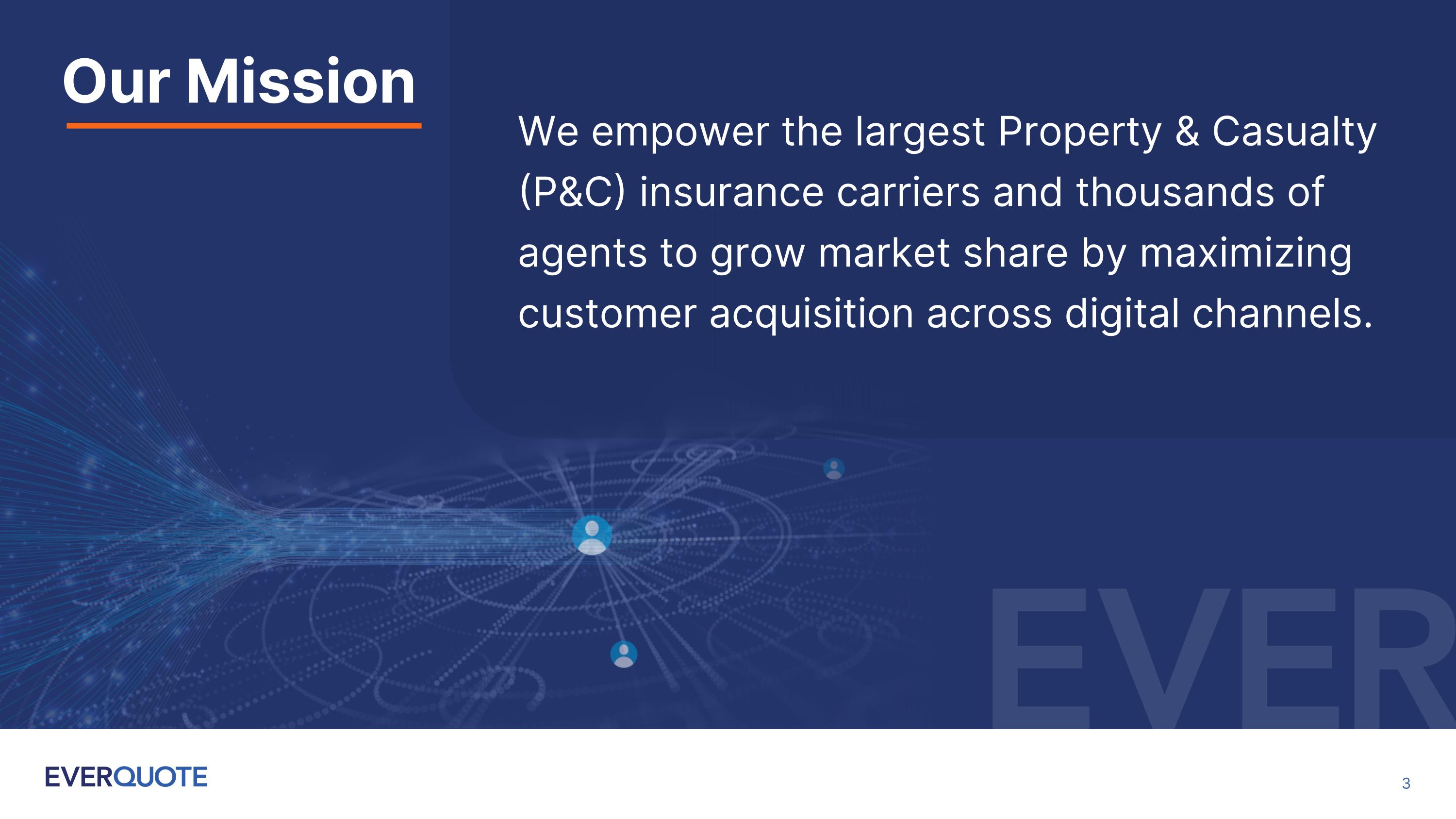
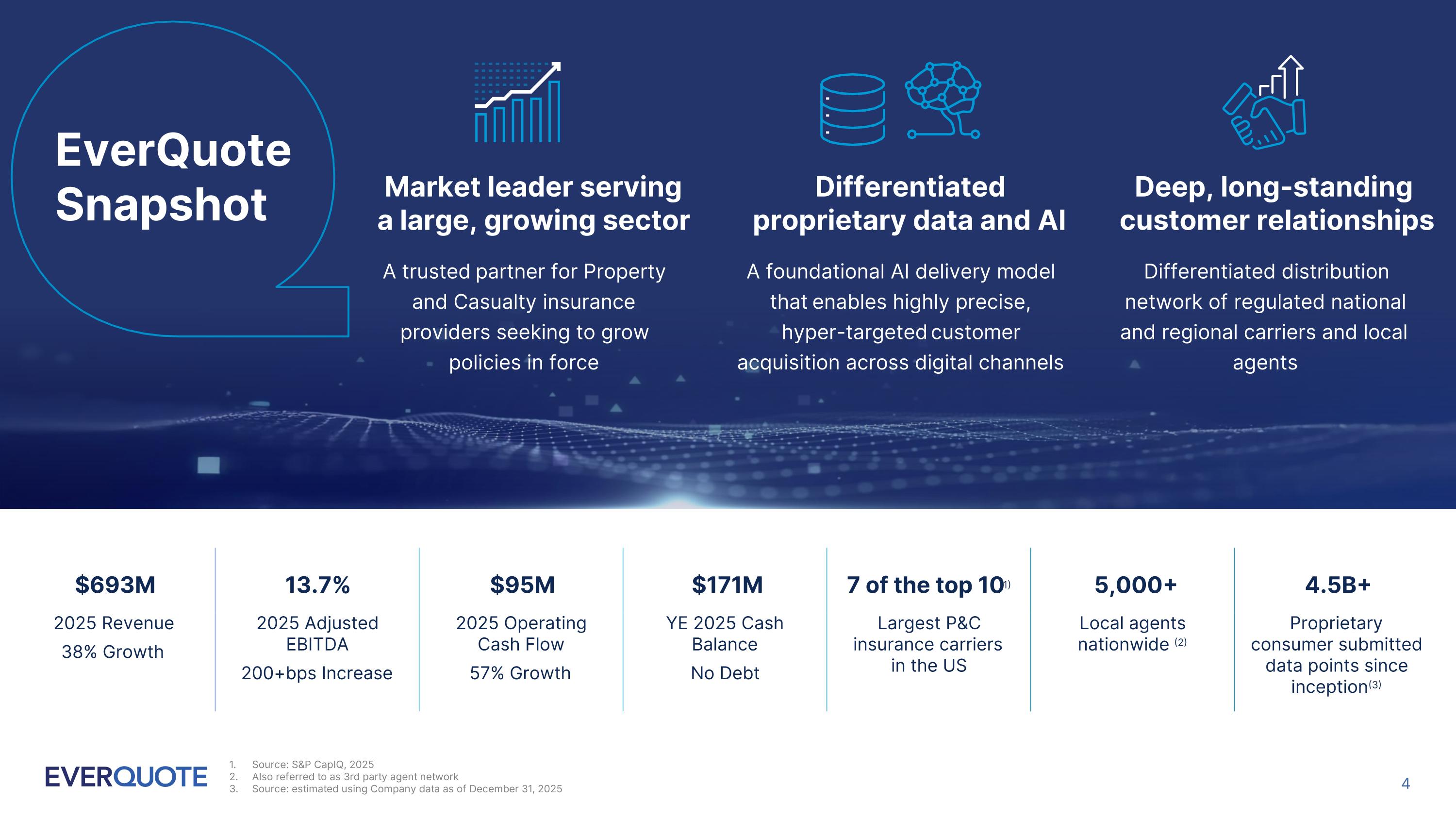
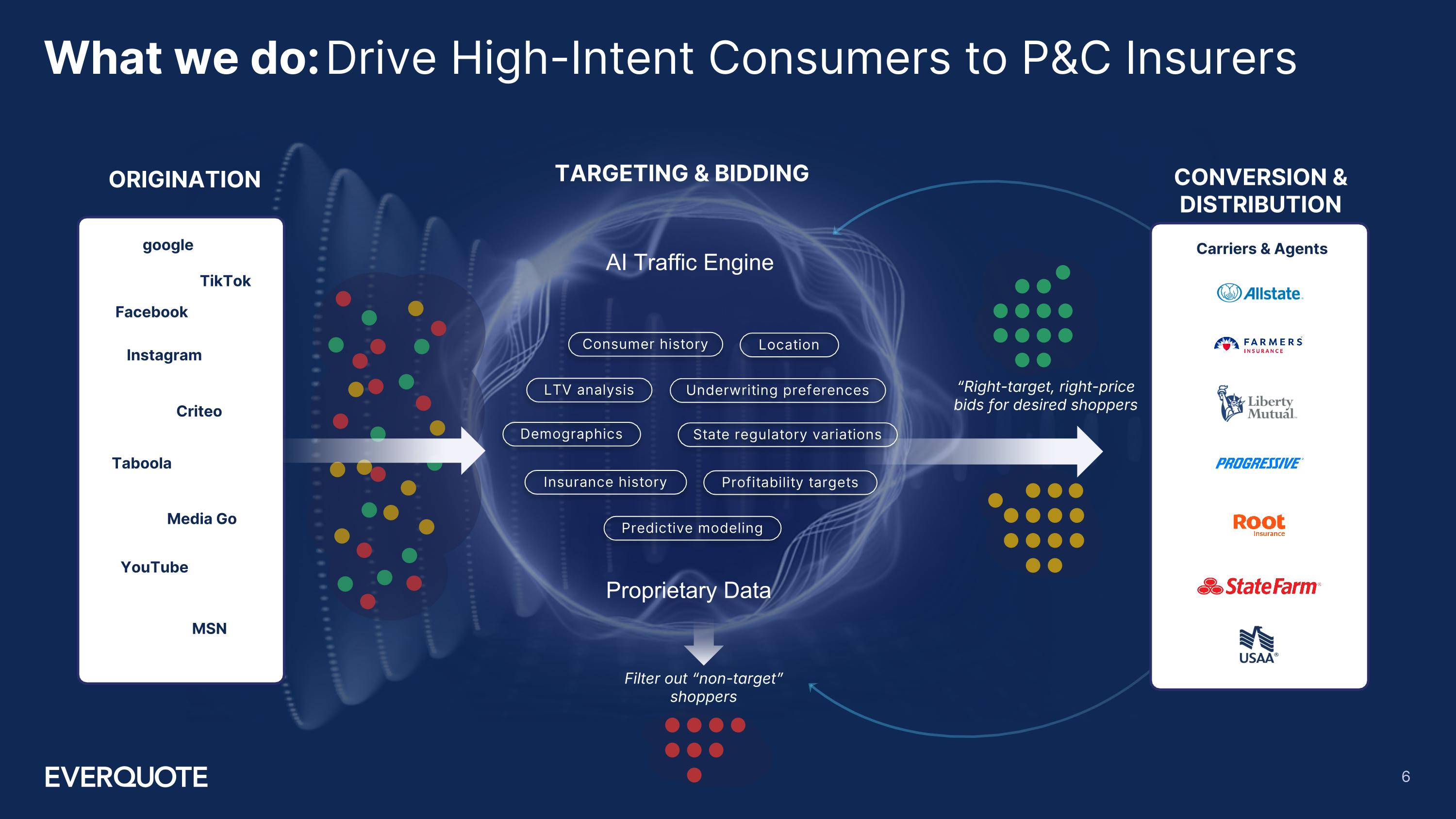
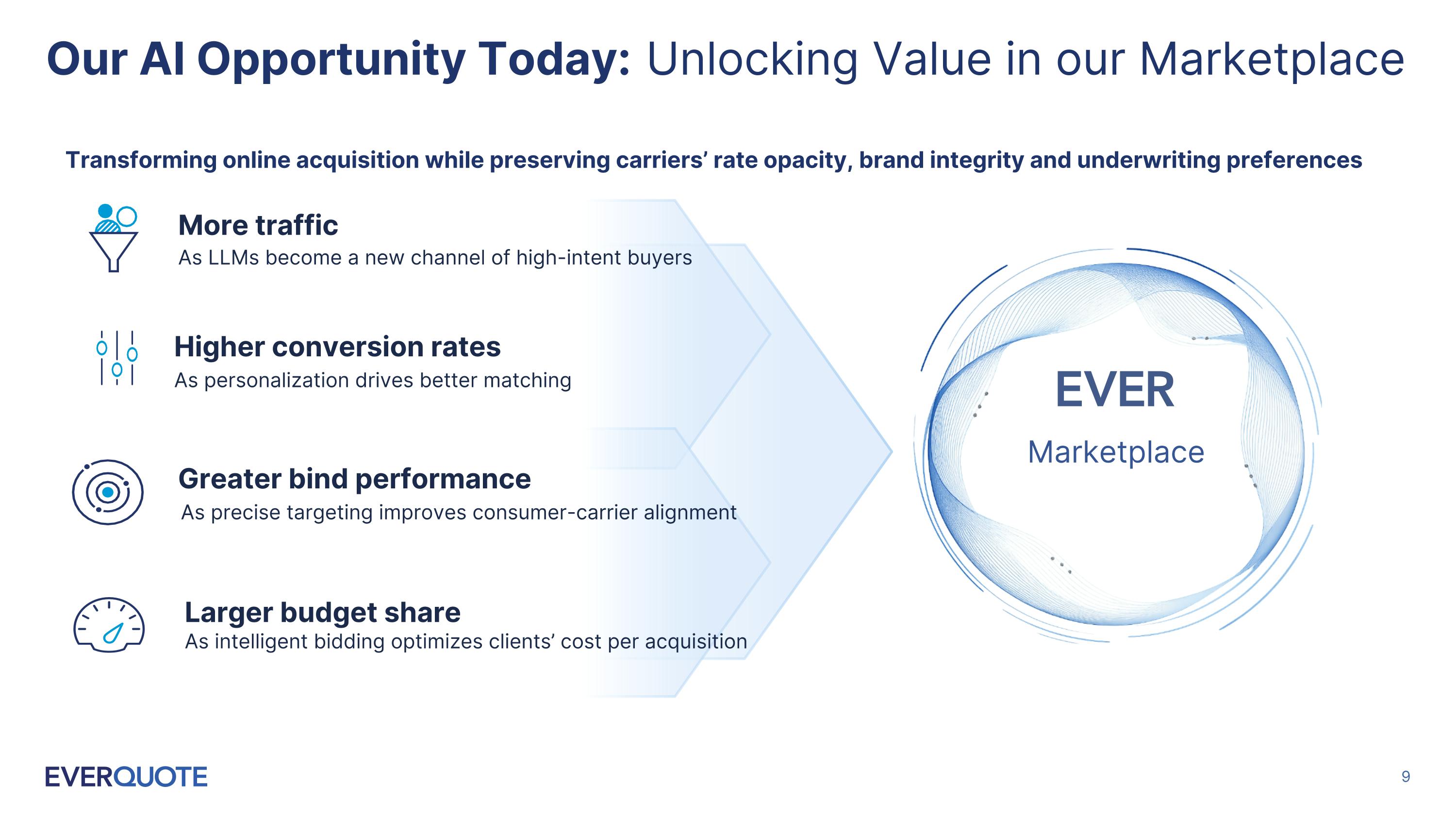
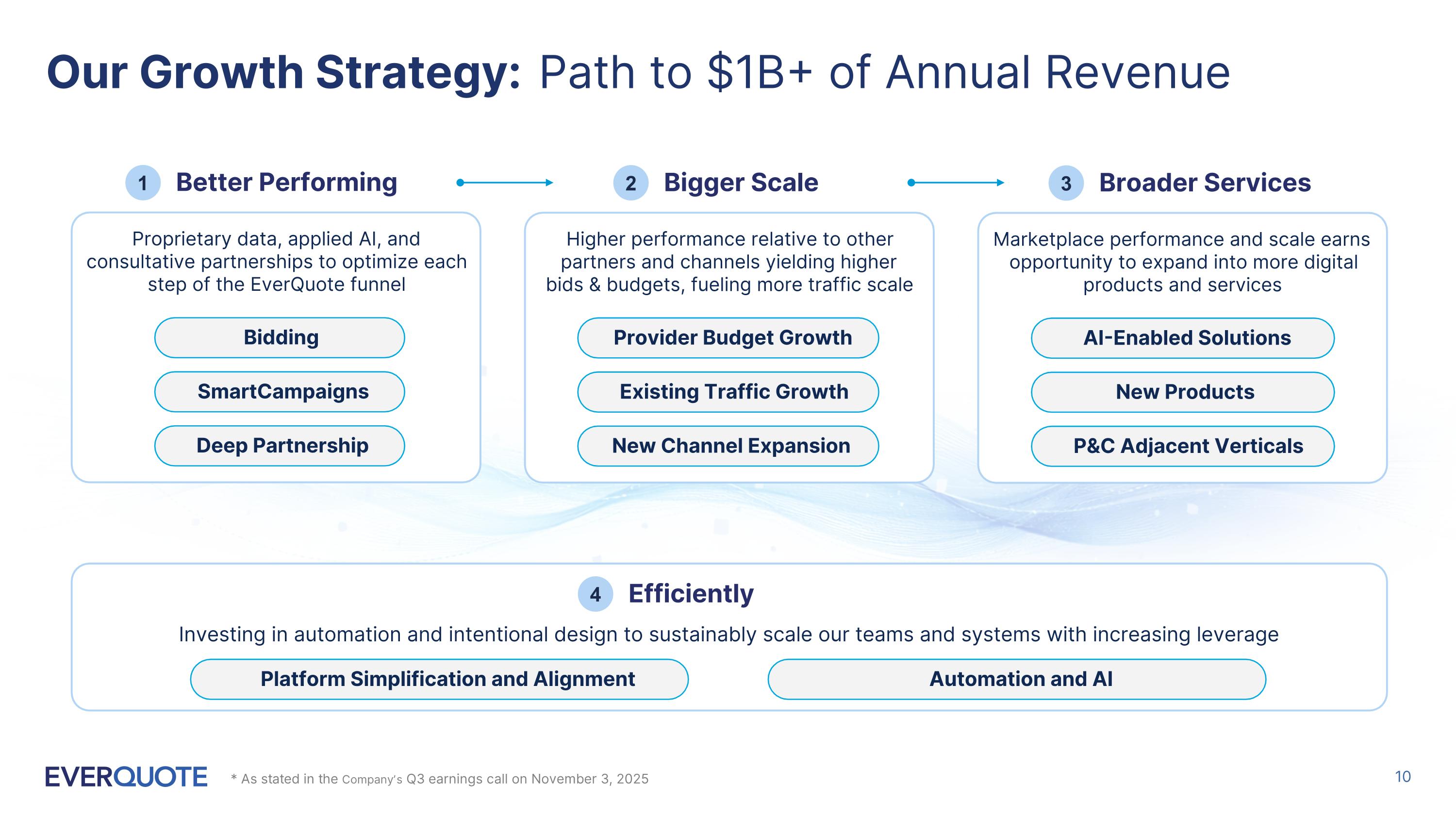
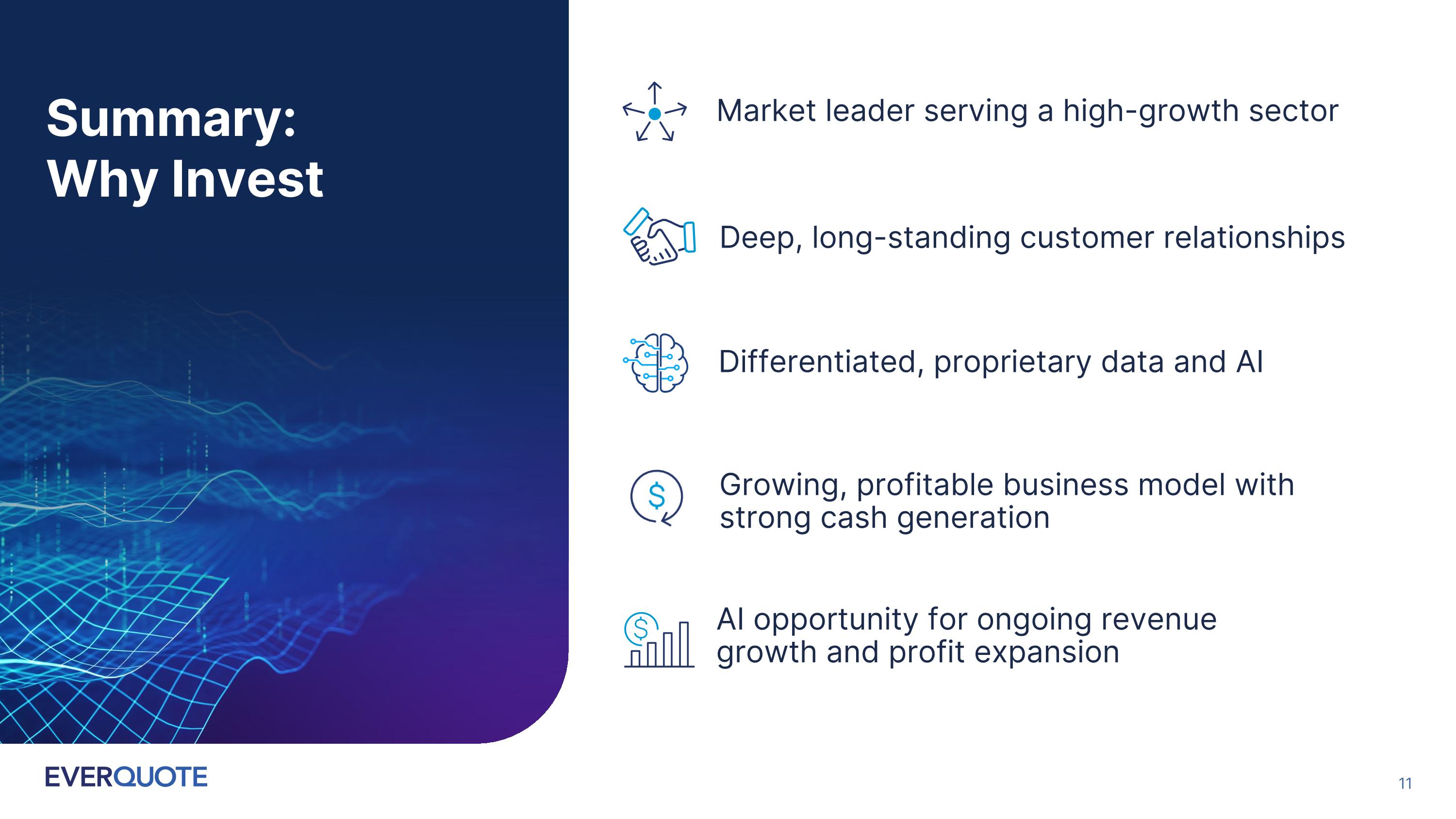
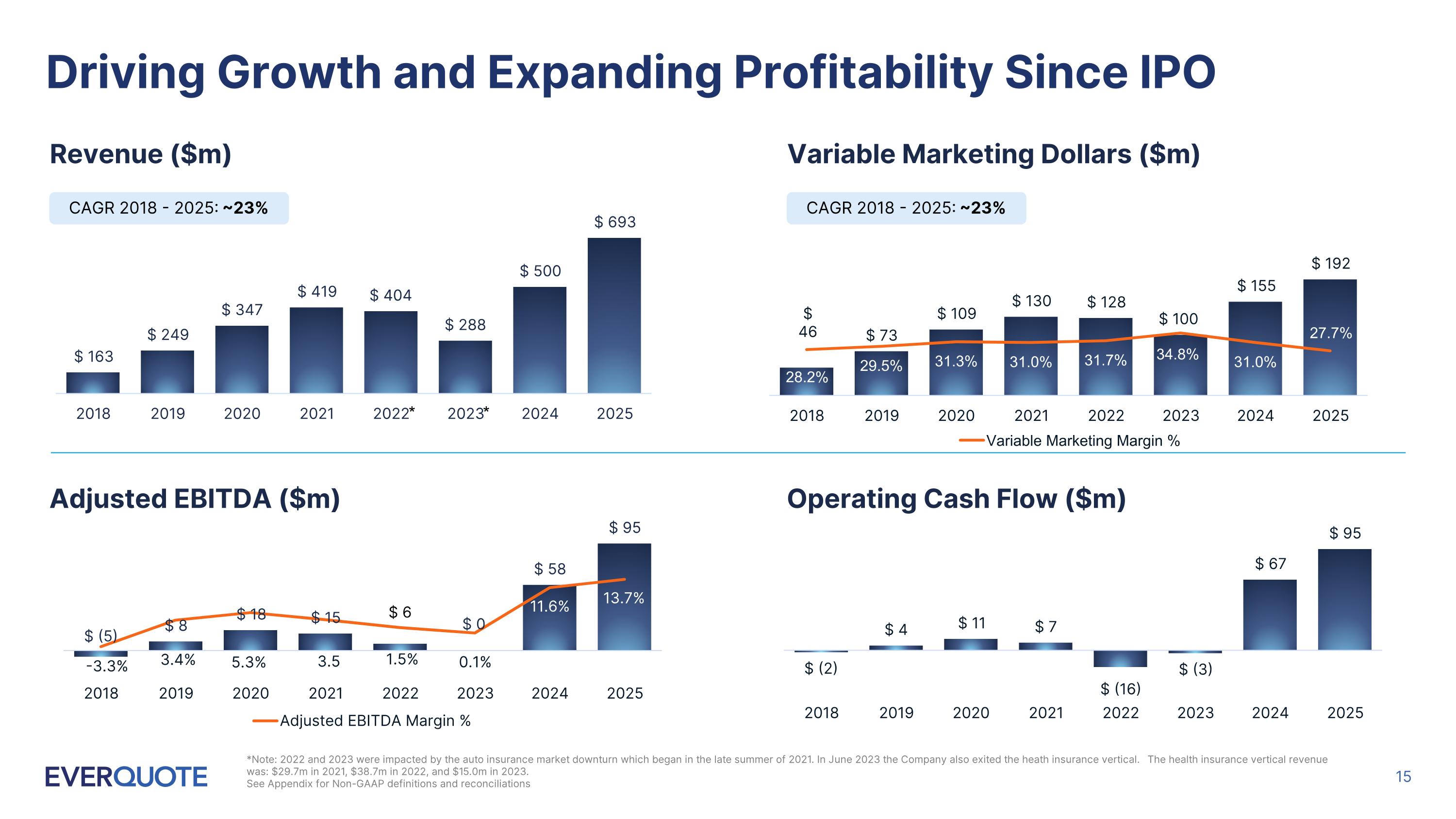
Thank you, Sarah, and thank you all for joining us today. We delivered excellent results in Q1, exceeding the high end of our guidance range across revenue, VMD, and adjusted EBITDA, punctuated by 30% growth in adjusted EBITDA to a record level of $29.3 million. Our strategy is working as planned as we scale our marketplace and deepen provider relationships. When we went public in 2018, EverQuote committed to growing revenue 20% and expanding profitability, adjusted EBITDA margin, by 1 to 2 percentage points per year. For seven years, we've delivered as promised, resulting in 4x revenue growth and over $100 million of annualized adjusted EBITDA expansion. Through disciplined execution, we have built a strong balance sheet and a highly cash-generative business. At the end of Q1, while repurchasing shares of our stock under our share repurchase plan, our cash balance is over $178 million with no debt, and for three quarters in a row, we have generated annualized adjusted EBITDA levels at or above $100 million. We will keep driving profitable marketplace growth through a focused execution of our strategy and by leveraging AI to drive productivity and accelerate our pace of innovation on behalf of customers. Applying our proprietary data together with AI to support the growth of insurance providers has always been and continues to be foundational to the value we deliver. It has enabled us to become the trusted platform of choice for the country's largest carriers and thousands of local agents to grow their business. We are now continuing to build on this heritage, harnessing agentic AI capabilities to drive new levels of productivity, innovation, and customer performance. We have proven our ability to drive immense productivity gains with tech and AI-enabled automation over time. In the three years from Q1 2023 to Q1 of 2026, we have increased revenue per employee by nearly 3x. We are now significantly ramping the build, deployment, and usage of agentic AI tools across our employee population to further enhance productivity and create additional capacity to invest in long-term growth. As examples, we are building what we call an AI cockpit for our sales and service teams to dramatically reduce time spent on repetitive tasks. And we added an AI layer on our homegrown site management platform to automate and improve experimentation on our site experience. More importantly, our teams remain hungry to accelerate our pace of innovation and service of improved customer outcomes using newfound capabilities of agentic AI. Already today, AI benefits our customers in a number of ways. Our AI-powered traffic engine and proprietary data enable us to effectively deploy ad spend in a way that optimally aligns carriers' underwriting preferences, profitability targets, and growth goals with the right consumers based on their location, history, demographics, and other factors. Through smart campaigns, we have productized our AI-powered bidding capabilities, improving carriers' ability to optimize return on ad spend in our marketplace, resulting in budget increases and embedding our technology more directly in our clients' workflows. Moving forward, we are rolling out AI-powered products and features to create value for customers at an accelerating rate. For example, we have begun extending smart campaigns to local agents. We also expect LLM-originated traffic to become a growing source across the market broadly. We believe EverQuote can provide carriers and agents with greater access to this traffic as paid advertising opens up and as we invest in content generation and technical integrations with LLM search platforms. Looking ahead, we maintain a favorable outlook for Q2, reflecting continued strong execution by our team in a growth-oriented carrier environment. We are progressing as planned along our path to build a billion-dollar revenue business with an accelerating rate of innovation to support the growth of insurance carriers and agents. Over the years, we have proven our ability to listen to our customers' needs and rapidly adapt to changes in the environment to support their success and our financial performance. Agentic AI unlocks new opportunities in many sectors, including ours. As a team, we are aligned and focused as we continue to seize this opportunity to expand our product offering, broaden our competitive mode, and propel our long-term success. I will now turn the call over to Joseph, who will discuss our financial results and outlook.
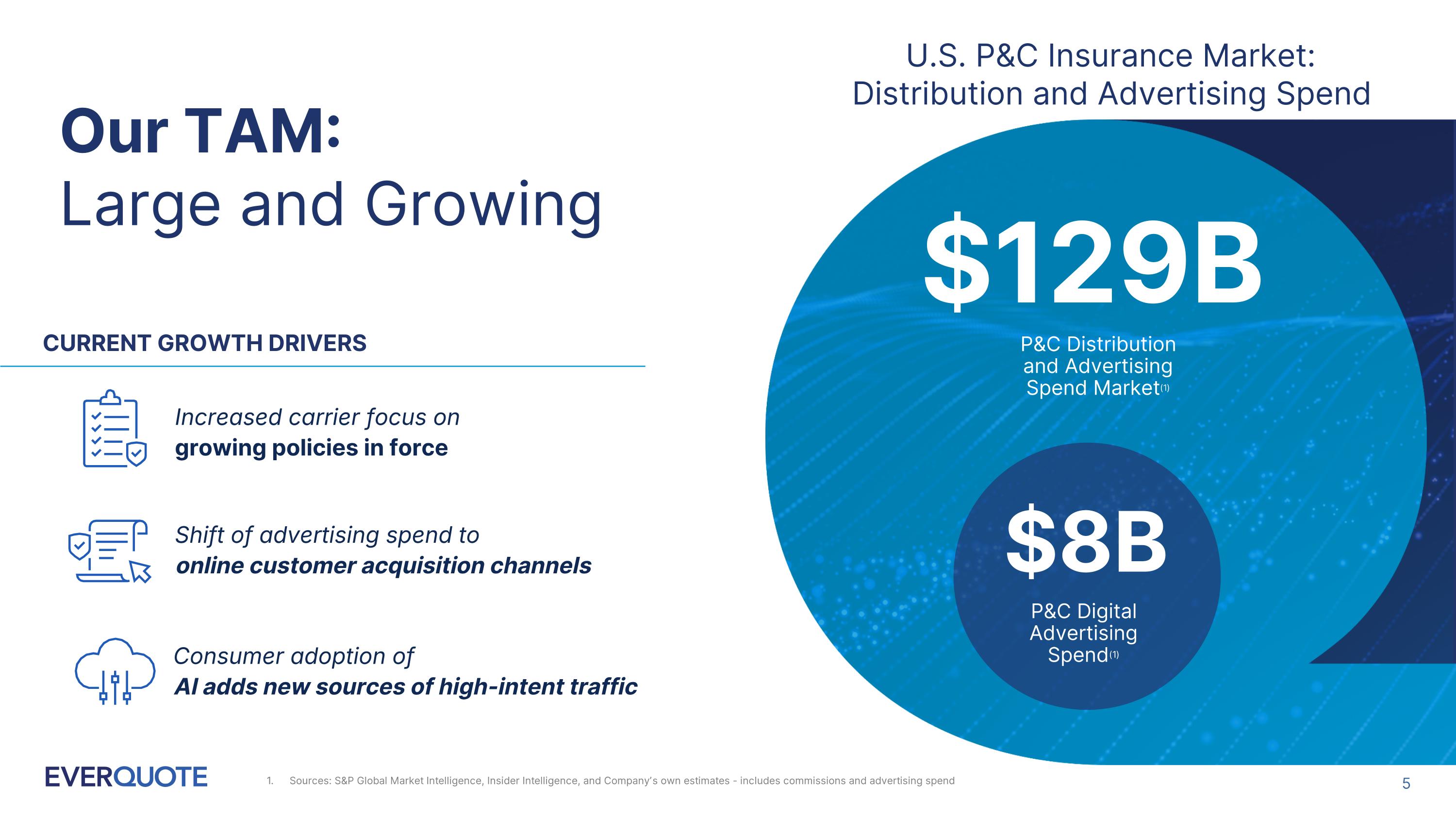
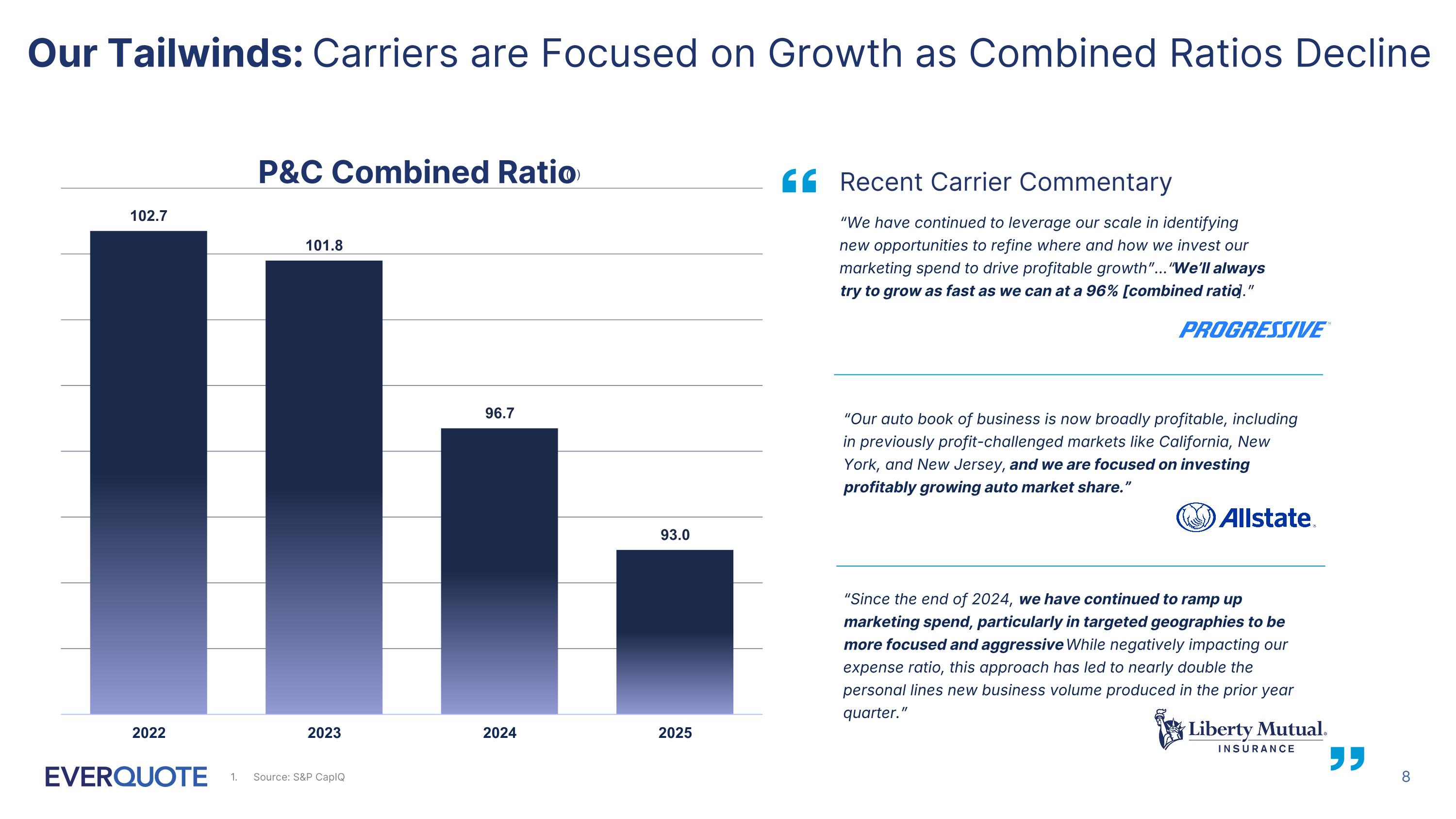
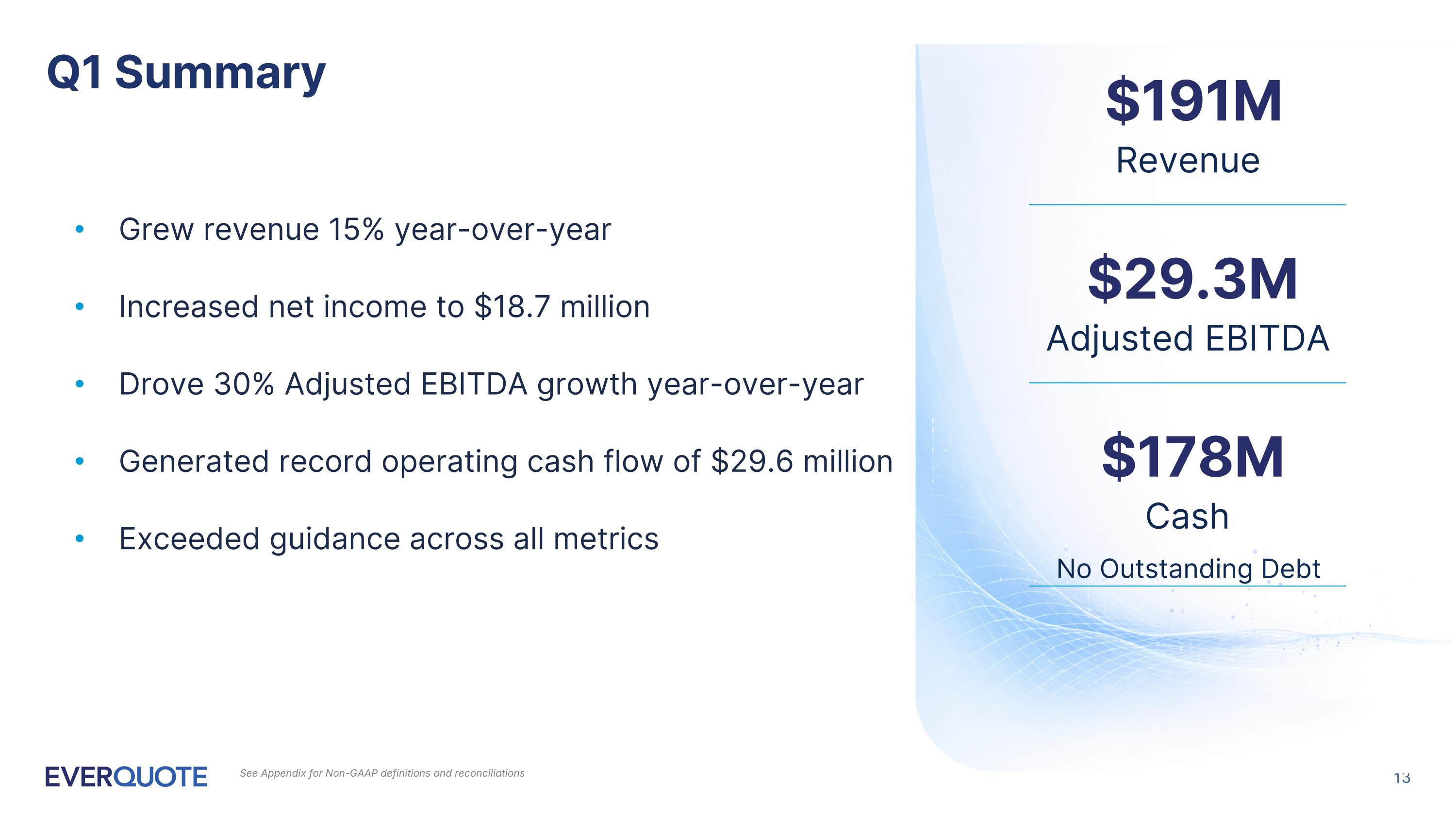
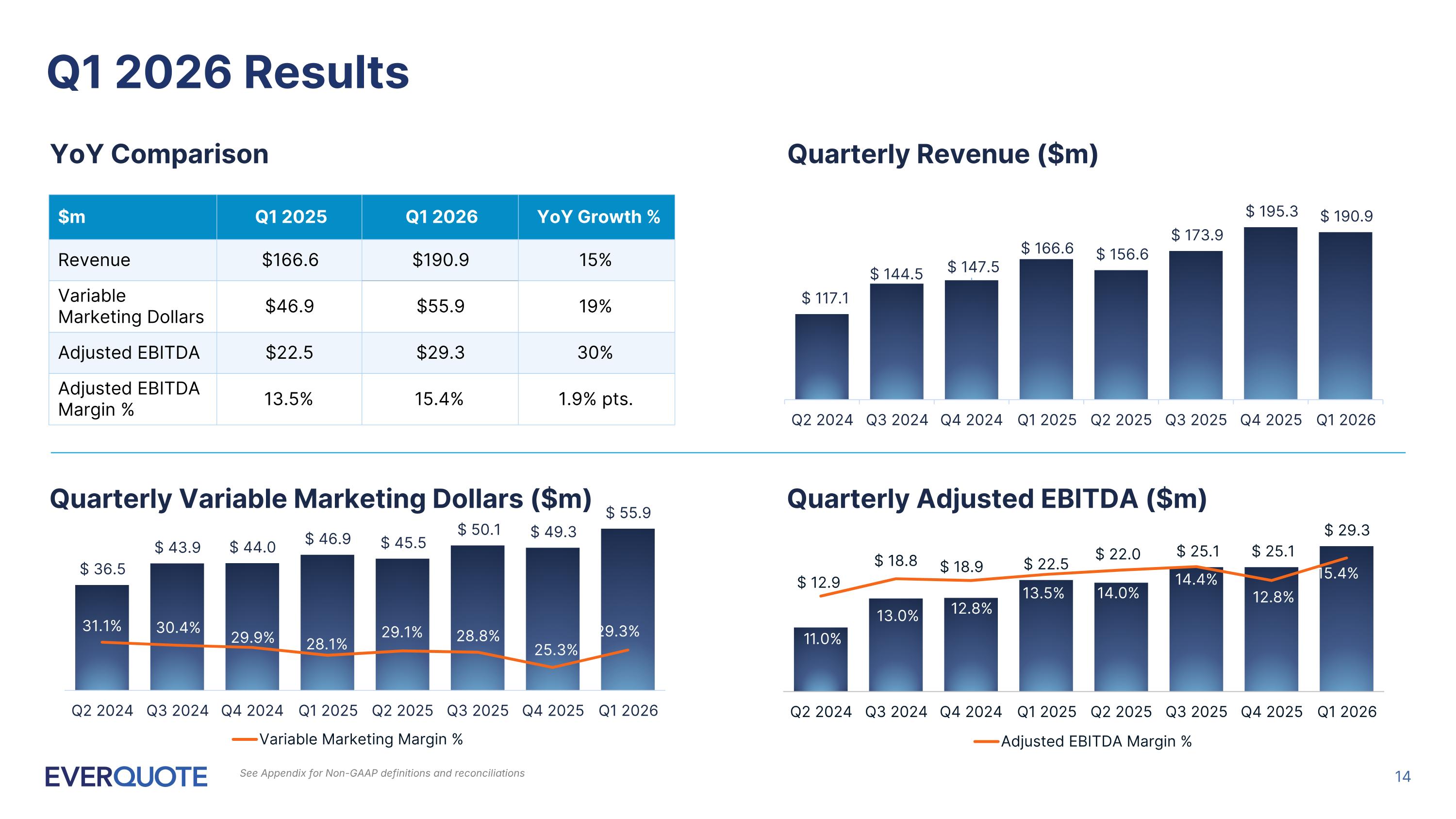
Thank you, Jamie, and good afternoon, everyone. In Q1, we once again delivered impressive financial performance. Before I walk through the details of our Q1 results and Q2 outlook, let me share some key highlights. We grew total revenue 15% year-on-year and grew adjusted EBITDA 30% year-on-year, while also delivering record adjusted EBITDA and operating cash flow. Let me take you to the first quarter. Total revenue grew 15% year-over-year to $190.9 million. Revenue from our auto insurance vertical increased to $172.4 million in Q1, up 13% year-over-year as we continue to benefit from our broad and differentiated distribution. Revenue from our home insurance vertical grew 33% to $18.5 million in Q1 as we continue to benefit from strong execution against the operational plan we implemented last spring to bolster this vertical. Variable marketing dollars, or VMD, increased to a record $55.9 million in the first quarter, up 19% from the prior year period. Variable marketing margin, or VMM, was 29.3% for the quarter, up both sequentially and year-on-year as the new traffic channels we invested in last quarter are starting to show better profitability. Turning to operating expenses in the bottom line. This quarter, we continue to demonstrate the strong operating leverage of the business. As Jamie said, AI and data have always been cornerstones of our business and have both fueled our operational efficiencies and enhanced our revenue generation. As I said in the last call, we have effectively doubled our revenues over the last two years while keeping operating expenses nearly flat. AI is positively impacting our economic model, and we are now at a scale where we expect to continue to drive strong cash flow generation and year-on-year adjusted EBITDA growth even as we invest in the business. In the first quarter, we grew gap net income to $18.7 million, up from $8 million in the prior year period. Q1 adjusted EBITDA increased 30% from the prior year period to $29.3 million, representing a 15.4% adjusted EBITDA margin. Cash operating expenses, which excludes advertising spend and certain non-cash and other one-time charges for $26.6 million in Q1, up from Q4 as expected. We delivered record operating cash flow of $29.6 million for the first quarter. In Q1, we repurchased approximately $19.9 million of shares under our share repurchase program. We ended the period with no debt and cash-in-cash equivalents of $178.5 million. To recap, we are starting the year with positive momentum, driven by two primary factors. First, we continue to execute well and deliver strong performance for both carriers and agents. And second, we benefit from a strong and broadening overall demand as carriers continue to sit well below their targeted combined ratio and are seeking to grow policies in force. Turning to guidance for the second quarter of 2026, we expect revenue to be between $185 and $195 million, representing 21% year-over-year growth at the midpoint. We expect VMD to be between $55 and $57 million, representing 23% year-over-year growth at the midpoint. And we expect adjusted EBITDA to be between $28 and $30 million, representing 32% year-over-year growth at the midpoint. Looking to the remainder of the year, we continue to see a healthy environment as carriers focus on growing policies in force, shift spend to digital channels, and rely on EverQuote as a partner of choice. We remain committed to our goal of achieving $1 billion in revenues over the next two to three years while generating strong cash flow and year-on-year adjusted EBITDA growth. At the same time, we are continuing to build on our AI capabilities by making investments in, one, developing AI-first products that can add incremental value to our customers, two, hiring additional AI talent and upskilling our existing team, and three, driving increasing efficiency by deploying agentic AI tools across every function in the company. To summarize at a high level, one, our continued strong financial performance reflects that our focus strategy to be a trusted growth partner for P&C insurance providers is working. Two, we are executing amidst a strong market backdrop as carriers continue to shift spend to digital channels and choose EverQuote as a partner to drive customer acquisition and help them gain market share. Three, our ongoing growth and positive outlook offers clear evidence that AI is a tailwind for our business. Four, we are building on our AI heritage to bring new value to customers and reinforce our position as an AI beneficiary long-term. And five, we remain committed to our path to a billion dollars in revenue while driving strong cash flow generation and year-on-year adjusted EBITDA growth. Jamie and I will now take your questions.
Operator
We will now begin the question and answer session. Please limit yourself to one question and one follow-up. If you would like to ask a question, please press star one to raise your hand. To withdraw your question, press star one again. We ask that you pick up your handset when asking a question to allow for optimum sound quality. If you are muted locally, please remember to unmute your device. Please stand by while we compile the Q&A roster. Our first question comes from the line of Cory Carpenter with JP Morgan. Your line is now open. Please go ahead.
Hey, guys. Thanks for the question. I was hoping you all could expand a bit just on what you're seeing out there from the carriers. I know last time we talked a few months ago, we were off. Carriers were a little more measured to start the year, but clearly you outperformed your initial expectations. So what do you think drove that? And are you still expecting kind of a similar cadence through the year as you described three months ago?
So, the carrier underwriting environment, it's healthy, and it seems to be healthy across the board now. You know, we're seeing 80s combined ratios in auto. We're not seeing home, you know, at similar levels for multiple quarters now. And so, we're hearing from our customers a tone of, you know, growth orientation pretty much across the board. So, we have the market back into growth mode. We have all the major carriers now live and participating in the auction. And I don't know if Joseph has anything to add, but that's kind of the sentiment in the market right now.
Yes, and maybe I'll have to answer your question more specifically with regards to overperformance in Q1. You know, the upside to the quarter was pretty broad based on the carriers showing more spend they initially said they would do. But I would highlight that one carrier in particular was more than double what they said they would spend in the back half of Q1. And so that obviously helped us result in overperformance on the revenue side. As we look beyond Q1, I guess what I would reiterate what Jamie said, you know, we feel good about where we're at. You know, carriers are in growth mode. They want to grow policies in force. They want to use digital channels, and we feel well-positioned to help them do that and partner with them to do that. And so we feel good about the environment, probably.
And then maybe more near term, obviously been a lot of, you know, focus on just the broader macro uncertainty, oil prices, et cetera. You know, has that come up at all in your conversation with carriers or how are you thinking about the potential that that could or could not impact their spend through the year? Thank you.
With respect to carrier, recent carrier conversations, it has not come up.
And then I guess how might it impact carriers with progress through the year? it's always hard to speculate, but what I would say is this, which is carriers have low combined ratios. So the extent that, you know, cost of repair were to increase, you know, they have a lot of ability to absorb higher costs and claims costs, given that combined ratios are quite low and continue to be quite low. The other thing I would say is if you think about, you know, if energy prices should remain high, gas prices specifically, one impact you could see is on consumers actually driving less and less miles driven equals less accidents so it could be a benefit to the carriers potentially in their combined ratio as well and claims costs great thank you all very helpful thank you the next question comes from the line of maria rips with canaccord your line is now open please go ahead uh great thanks for taking my questions and congrats on the strong quarter uh i just wanted to follow up on the last question clearly growth has been very encouraging here.
I guess to what extent should we view the first half strength as sort of as incremental versus sort of possible pull forward of their second half activity?
Sure. So as we said, we've been pleased by how the year has started. You know, Q1 is strong in our guide for Q2. Obviously, it's a continuation of what we're seeing in Q1. As we look to the second half of the year, I guess I would say this. You know, we have not guided for the second half of the year we're not going to do that in this call what we have given you as a view of sort of our path beyond this in the next quarter we've given you a path to being a billion dollar business in two to three years and we still feel very good about that and our path to achieve that and really nothing has really changed in our view since uh our last time we discussed this got it that's very helpful and then i guess more broadly on llm traffic uh you talked about sort of three strategies to to capture llm traffic which is content integrations and and paid ads.
Now, we've seen a couple of competitors out there sort of actually launching apps within ChatGPT. Sort of what are your thoughts on developing maybe similar app-level integrations with AI platforms, and how would that feed with your broader strategy?
Thanks, Maria. Yeah, I would put that under the umbrella of technical integrations. And, you know, we've built, we've been sort of testing in these platforms for a while now. We've built several apps. We have not pushed anything to production yet. There's a number of them. There's probably 15 plus apps in the insurance category right now in ChatGPT. They're all quite similar. They kind of just take a web form experience and apply a lightweight conversational front end to it before spitting the consumer back to a web-based quoting and binding experience. And there's, like, a lot of friction to actually access these apps. So you've got to, you know, prove it or install it. You've got to give it permissions. It's just that there's a lot of friction. And so our sense is there's very little actual traffic flowing through those at this point. You know, we're working on something that I think will be more interesting, but still the challenge is always going to be driving traffic into it. And that's where I think the other elements of the strategy will come into play. One is paid advertising, where I think especially ChatGPT is opening up to paid ads. We're among the largest paid advertisers in insurance. And so as the LLMs open up and become a more sophisticated paid advertising platform, I think that's going to give us an opportunity to drive immediate scale. And then we're also making quite a bit of investment in content and a content strategy specifically as it relates to gaining visibility in the LLMs, and we have a very experienced and capable team focused on this, and we do expect to start to see some impact from their efforts materializing as the year progresses slowly but steadily. So that's kind of the, that's our assessment right now of the landscape. You know, for us, it will be incremental traffic. Right now, we have no seo traffic right we're historically we're paid and so um we do expect that as this pool of traffic grows and and we tap into it it will represent incremental traffic forever quote got it that's very helpful thank you thanks maria thanks our next question comes from the line of navid khan with b riley securities your line is now open please go ahead great thank you very much.
I think on the last call, you gave us a stat that 75% of the areas were below peak levels. Where does that stand today? How does it look to give us some flavor of what demand could be? And then the second question I had is just around the buyback. It looks like you finished the authorization that was out. Have you replenished that or the plan to kind of deploy additional capital towards more of a share by that? Thank you.
Sure. So thanks for the question, Evan, and welcome to our call. You know, so first in terms of carrier demand, the stat we give a sort of percentage of top 25 carriers, around 80% now, if not are below peak quarterly spend. I guess I would sort of fine tune that a bit and remind folks that when you look at our marketplace, in any given quarter, you wouldn't expect all CARES to get back to peak quarterly spend, right? We've had, as we look at this quarter going into Q2, we're seeing recovery, particularly in one of our top five CARES who wasn't on the platform, you know, until Q1, as someone who was a top five CARES prior to the downtrend. So as I think about, you know, the concentration dynamic on the room for our side. So we're pleased with that. And then with regards to the buyback, what I would say is we purchased about 19, just under 20 million purchase of shares in Q1. That represents shares purchased to date under the authorization, about 7.5% dilution is being, 7, 7.5% is offset and dilution. And as we look at buybacks, we'll obviously continue to be using our buyback plan. And as we talk about more broadly about capital allocation, I'll repeat what I've said in sort of our prior calls, which is there's sort of three uses for capital in our mind. First and foremost is a fortress balance sheet. We believe strongly in the importance of having a strong balance sheet and we have no debt, and we're going to continue to have that as a hallmark of our capital allocation strategy. Second is buyback plans. As I said, we've done a fair amount of those. We see that as another way to bring value back to shareholders. And a third, of course, is M&A. And as we think about M&A, we've talked about this in the past, which is we do not see M&A as required to hit our path to a billion dollars in revenues. We see that as being an organic strategy. But we see an opportunity in this market to really build the leading player at helping PNC carriers and agents grow their business successfully. And M&A could play a part in helping us accelerate some of the things we'd be naturally building internally. Whether that is additional products for carriers and agents, whether it's helping expand into our non-auto verticals, whether it's bringing additional sources of traffic or AI talent, all those could be part of our M&A strategy.
Thank you. Thanks, David.
Operator
The next question comes from the line of Ralph Shacker with William Blair. Your line is now open. Please go ahead.
Good evening. Thanks for taking the question. Two, if I could, please. First, maybe just switching gears to the consumer side, can you maybe talk about the shopping levels or sort of some of the surge traffic you're seeing given elevated insurance costs? Are you still seeing high intent there? And then two, Joseph, maybe on the VMD, I know you don't guide the full year, but just kind of thinking about the linearity for the balance of the year. Is it reasonable to see that these levels could persist for the remainder of the year? I know you talked about new traffic channels providing better profitability. Any more color you could add there would be great.
I'll take the first question, Ralph. So as it relates to shopping activity, you know, we expected it to start to normalize this year as the rate cycle somewhat settled down, and that's what we're seeing. You know, we have continued to see year-on-year growth in our search traffic, but we're seeing some normalization in the overall traffic levels. But that's with a much more competitive advertising environment from the insurers. And so within the marketplace, that normalizing volume is being met by also much higher value per referral going out the door, which has been a favorable dynamic for us. And, you know, as demand continues to grow from the advertisers, you know, we continue to drive growth ourselves beyond what's happening in the ambient environment by launching and scaling some of these new traffic channels and programs, which we've done successfully over the last quarter and will continue to do over the course of this year.
And with regards to VMM, I guess I would touch on the thing that I know you know well, Ralph, from hearing from us is we don't run the business day-to-day basis to drive VMM. we drive VMD. But we were pleased in Q1 that VMM margin was at over 29%. I think it reflected the strategy we talked about in a November call going into the fourth quarter. We had investments in new channels. Those investments in channels paid off, and they're scaling at it better profitability than they were in Q4 when they initially were scaling. So we're pleased with that. As we look into the balance of the year, we sort of have this view of sort of high 20s, you know, 27%, 28%, sometimes they'll tip into 29%. I think it's important to realize, you know, not only do we not run the business day-to-day for VMM margin, there's also the image of what we control and what we don't control, So the advertising cost that we purchase, where it's a competitive market for advertising that can ebb and flow quarter to quarter, you know, what we control is how we, the efficiency with how we acquire that advertising and are using our traffic bidding engine to help us acquire that most efficiently. The context that reminds you is when we look at our business, you go back when we were $250, $260 million business in auto, our VMM margin was in the high 20s. Here we are. We're three times that size, and our VMM is in the high 20s. The advertising environment has certainly gotten more competitive, but at the same time, we are actually continuing to drive efficiencies in the business. So, we think high 20 is a reasonable place to think about it. You know, 27, 28 percent, you know, maybe taking a 29 occasion for the rest of the year.
That's great. Thanks, Joseph.
Thanks, standing the next question comes from the line of jed kelly with oppenheimer your line is now open please go ahead hey great thanks for taking my questions um it kind of seems just just given the guys given the outlook you know we we've reached a pretty i call it maybe stable where where we're like competition around marketing seems pretty stable if you look at the vm margins you know they're kind of going up so can you just talk about that environment and then how should we think about higher gas prices and you know higher used car prices and higher higher prices and just just just how's that impacting people's ability to shop for insurance thanks sure thanks jed so the the first question just to make sure i understood it was jed were you asking about the consumer side or or what's happening in the sort of on the provider side of the advertising dynamic marketplace right like in your marketplace it seems that you know vmm margins are you know operating back in the high 20s right so it seems like it's you're kind of reaching like a goldilocks period of where it's like peace and stability in terms of traffic acquisition costs for you guys? I mean, is that the right way to look at it when I kind of look at like what some of your other competitors have said and, you know, where like VMM margins are going?
I would say we have a very healthy marketplace dynamic right now from our perspective where demand on the provider side is very strong. And that's kind of across the board, carriers, agents, auto, home. And we've been doing our best to sort of keep pace with the demand by investing in growing our existing traffic channels and launching and scaling new channels and programs. So we're at a relatively stable place right now. As Joseph mentioned, I mean, it's consistent with our historical levels of VMM. So there's nothing like out of the ordinary about it, but it's just a, it's a healthy marketplace dynamic.
Yeah. And I guess the second piece I would say with regards to sort of the environment, I think if I have a question right, Jed, is consumer, how is consumer shopping behavior given higher gas prices, potentially higher used car price, higher used car price, et cetera. And I guess what I'd say is this, is that, you know, shopping levels have been elevated for some time. They're starting to normalize a bit from these elevated levels. I guess when I think about the environment for what does it mean for our business for the macro environment, I'd say on the one hand, you could say if there are higher used car prices or higher repair costs, that could impact claims costs for carriers. That being said, carriers are quite healthy with combined ratios that are still quite low. So the ability to absorb higher claims costs, they have significant cushions, so to speak, to absorb that should they need to. The flip side is with high gas prices is consumers, particularly when you start to get over certain milestone levels, $4 a gallon, you start to see consumers actually driving less. When there's less miles driven, there's less accidents. So it's interesting dynamic in our business where there's these dynamics on an environment we're in right now, in the macro environment, consumers may be actually driving less, and that benefits care. And there's also dynamic where consumers still are shopping because auto insurance is a top-five expenditure, and they see opportunities to continue to save.
Got it. And, you know, I guess I probably ask this every quarter, but obviously saw the repurchase. You know, you're building up a pretty nice war chest with the cash. You know, can you just talk about how you think about your capital allocation for acquisitions and some of the opportunities out there? Thank you.
Sure. So as I mentioned, so we think about capital allocation is obviously Fortress balance sheet is critical. in our business, you know, we think that it's particularly important for us and something that differentiates from some of the other companies out there. Second, buybacks. We did another $20 million in Q1. You know, buybacks, another portion of how we all give return back to shareholders. And the third is on M&A. When we think about M&A, what I would say is this. You know, our path to a billion remains one where we need no M&A to drive that growth. I think that's purely organic. That being said, we have a strategy to really emerge as the leader helping PNC carriers and agents grow their business. And we think we're well-positioned to do that. There might be opportunities to accelerate our strategy through acquisitions. Acquisitions could take a couple forms. They could be additional products for our carrier partners, our agents. We've talked about our product strategy with our agents. We're doing the same thing on the carrier side. We think about verticals, you know, 90% auto, 10% home. We're bullish on home. You know, might we think about other verticals. Might we think about technology we could bring in additional data or additional AI talent that could help accelerate some of our AI initiatives. All those are things we consider in our M&A strategy. And we've been spending more time in thinking about our M&A strategy, you know, at this point in 2026, certainly, than we were at this point in 2025.
Thank you, and Greg Porter. Thank you.
Operator
The next question comes from the line of Jason Cryer with Craig Hallam. Your line is now open. Please go ahead.
Thank you. Spent the last few years in a hard market or premium growth and came into a 25 and 26 of a change, right? Like a soft thing marked.
Jason, you're breaking up. We're having a hard time hearing it.
Really high level. So any improvement?
That's better. Thank you.
Here, how about that? much better yep okay sorry about that so just as we transition from a you know softer market or a harder market to a softer market and you've gone through executing the last couple of quarters just curious if there's any learnings as far as however quote competes in a new market and how you've gone through that transition i i think our strategy generally lends itself well to to the you know, the transition into the market.
I mean, we managed very effectively through the hard market, but, you know, our stated strategy is to become, you know, the one-stop shop for agents and carriers to grow their business. And now when they're in a period where they're really focused on growth, they tend to be more open-minded to embracing and testing new products, new features. And over the last couple of years, we've developed quite a few new products and features that, you know, incorporate, take advantage of our data that applies AI, machine learning to really help agents and carriers grow. And we're starting to see, you know, an increasing rate of adoption of some of these products and features because the carriers and the agents really need to grow to hit some aggressive growth targets.
Thanks, Jamie. That's a good dovetail to my follow-up question, just on the adoption curve of these AI-enabled solutions. Do you feel you're now at a critical mass with those products that you brought to market?
Yeah, I do. I mean, for us, generally speaking, it's an exciting time for us. I think there's few companies in our market that are better equipped to benefit from some of the new agentic AI capabilities than we are. You know, we've been applying AI and our proprietary data to acquire traffic, to streamline insurance shopping, to help providers grow for years now. And, you know, before it was machine learning and reinforcement learning. And more recently, it's some more of the Gen AI tools and now Agentec AI tools that are really powerful tools in the toolkit. And we're seeing the carriers and agents, many of them really need our help. They need our help to access the benefits of these tools probably much sooner than they'd be able to do on their own. And so this year is definitely marking acceleration in agentic AI adoption and usage at EverQuote probably in two ways. One is more internal, so that's how we apply it to our operations. And the second is how we apply it to add value for our customers through our products. But both of those have really, I think, accelerated this year. Internally, in engineering, we've been using generative AI for years now to improve productivity, largely through co-pilots. But in the last six months, the capabilities of agentic coding have reached a point where we're able to rethink our entire software development lifecycle to be agentic first. And that's going to unlock a lot of gains in our ability to ship more value to customers faster than ever before. And then, you know, beyond engineering, as Joseph was mentioning, we're starting to integrate now AI tools and agents throughout our operations, whether that's, you know, our site experience and how we're experimenting on it. We've got tools to streamline, debug, carrier integrations. We've got applications and, you know, legal design, you name it. And so operationally, it's really starting to drive increasing productivity. And then with respect to customers, you know, the adoption has been great. I mean, we've talked about smart campaigns quite a bit in the context of carriers. We're continuing to improve the performance of those models and get more adoption with carriers. But we're also extending smart campaigns now to agents for the first time, for local agents. um we've got a product that's focused on um you know our next generation uh proprietary traffic bidding platform which is introducing more like advanced reinforcement learning into traffic bidding uh we talked a bit earlier about llm-based traffic and and ai search engine optimization so all this stuff is really coming together this year and we're excited i mean we're excited for things to begin to really accelerate in the impact both internally to our productivity as well as for our customers.
That's great. Thank you, Jamie.
Operator
We have reached the end of the Q&A session. I will now turn the call back to management for closing remarks.
Thank you. Well, thanks for all for joining us. It was an excellent quarter for us, continuing to grow. We produced record-adjusted EBITDA, and we're executing. We're executing our strategy, accelerating our marketplace flywheel, we're deepening our customer relationships, and we're really progressing through 2026 from a position of strength. We feel we're really well positioned to further embed AI into both our operations and our products to usher the insurance market into an AI-native future. And we look forward to sharing more along the way.
Operator
This concludes today's call. Thank you for attending. You may now disconnect.