Operator
Good morning, and welcome to the Third Quarter 2025 Results Presentation for Hillman Solutions Corp. My name is Tanya, and I'll be your conference call operator today. Before we begin, I would like to remind our listeners that today's presentation is being recorded and simultaneously webcast. The company's earnings release, presentation and 10-Q were issued this morning. These documents and a replay of today's presentation can be accessed on Hillman's Investor Relations website at ir.hillmangroup.com. I would now like to turn the call over to Michael Koehler with Hillman.
Thank you, Tanya. Good morning, everyone, and thank you for joining us for Hillman's Third Quarter 2025 Results Presentation. I'm Michael Koehler, Vice President of Investor Relations and Treasury. Joining me on today's call are Hillman's President and Chief Executive Officer, Jon Michael Adinolfi, or JMA as we call him; and our Chief Financial Officer, Rocky Kraft. I would like to remind our audience that certain statements made today may be considered forward-looking and are subject to the safe harbor provisions of applicable securities laws. These forward-looking statements are not guarantees of future performance and are subject to certain risks, uncertainties, assumptions and other factors, many of which are beyond the company's control and may cause actual results to differ materially from those projected in such statements. Some of the factors that could influence our results are contained in our periodic and annual reports filed with the SEC. For more information regarding these risks and uncertainties, please see Slide 2 in our earnings call slide presentation, which is available on our website. In addition, on today's call, we will refer to certain non-GAAP financial measures. Information regarding our use of and reconciliations of these measures to our GAAP results are available in our earnings call slide presentation. JMA will begin today's call by providing some commentary on our record third quarter results, briefly hit on our guidance and discuss our performance by business segment. Rocky will then give a more detailed walk through our financial results and guidance before turning the call back over to JMA for some closing comments. Then we will open up the call for your questions. It's now my pleasure to turn the call over to our President and CEO, Jon Michael Adinolfi. JMA?
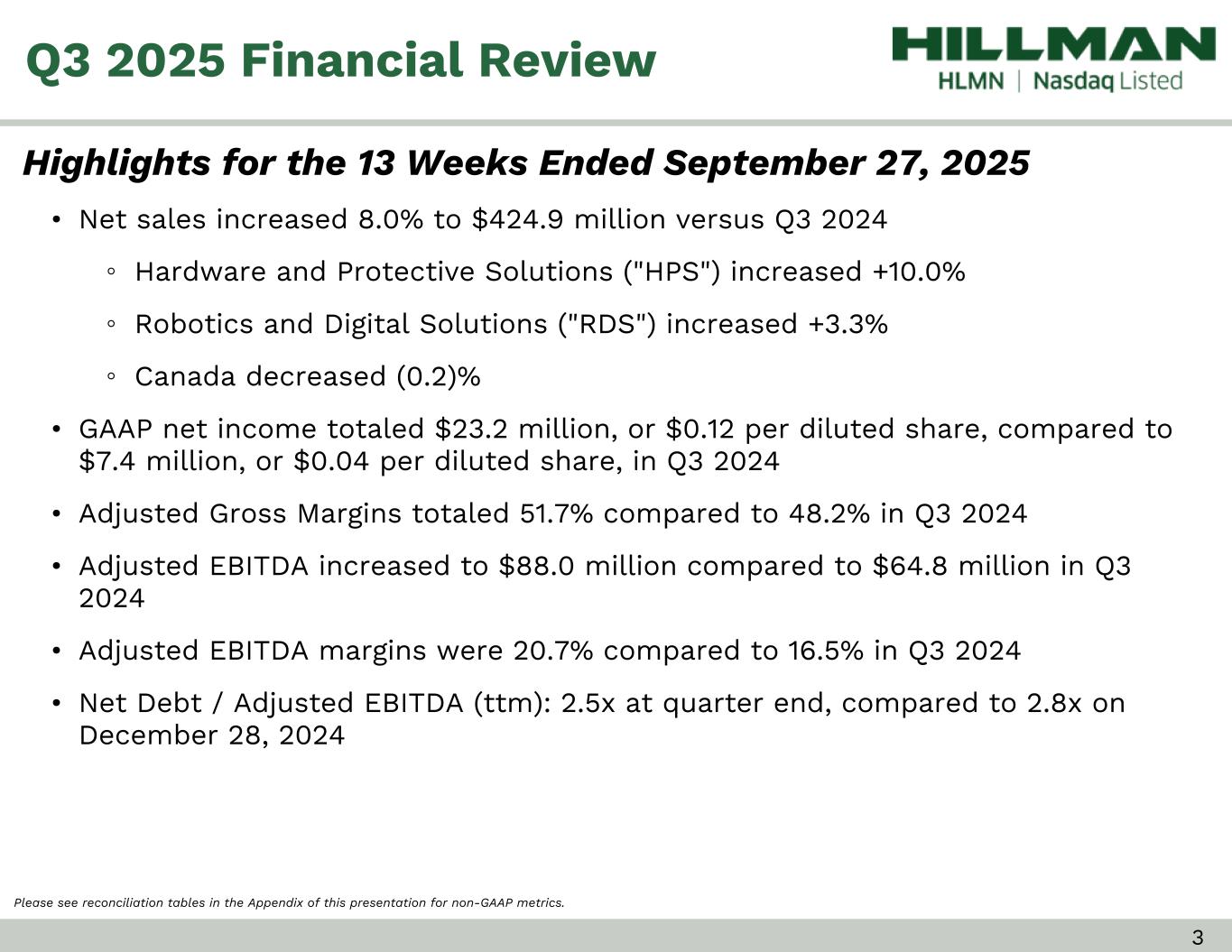
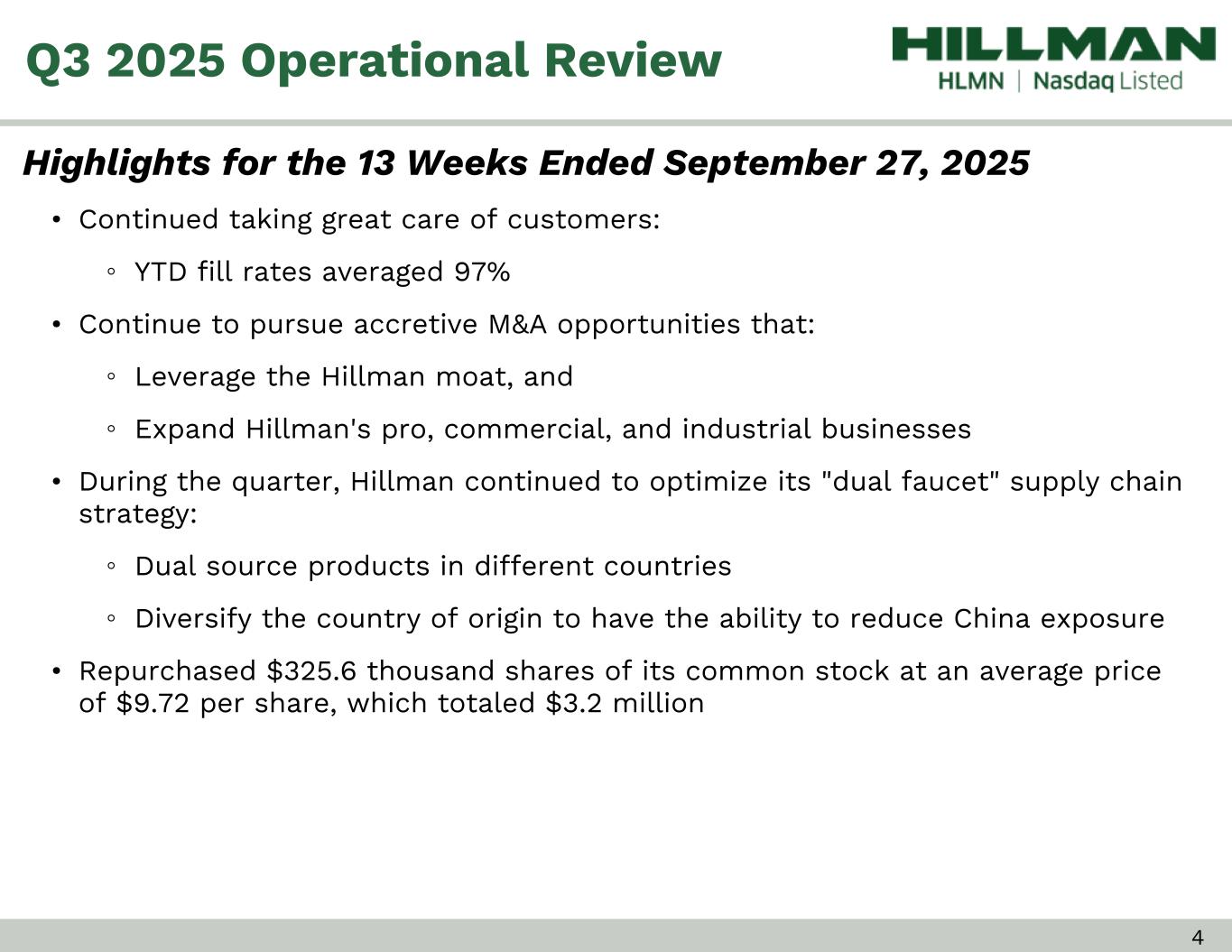
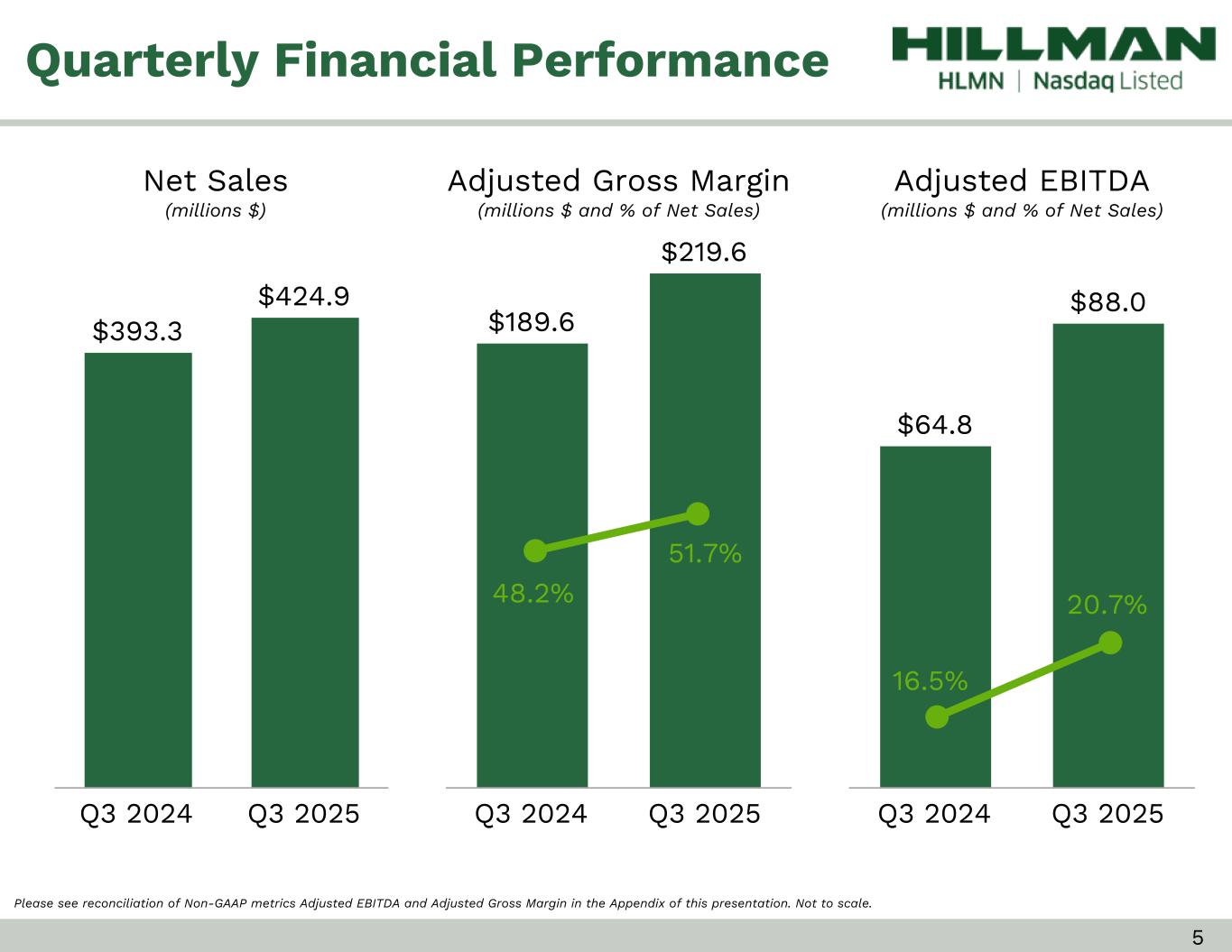
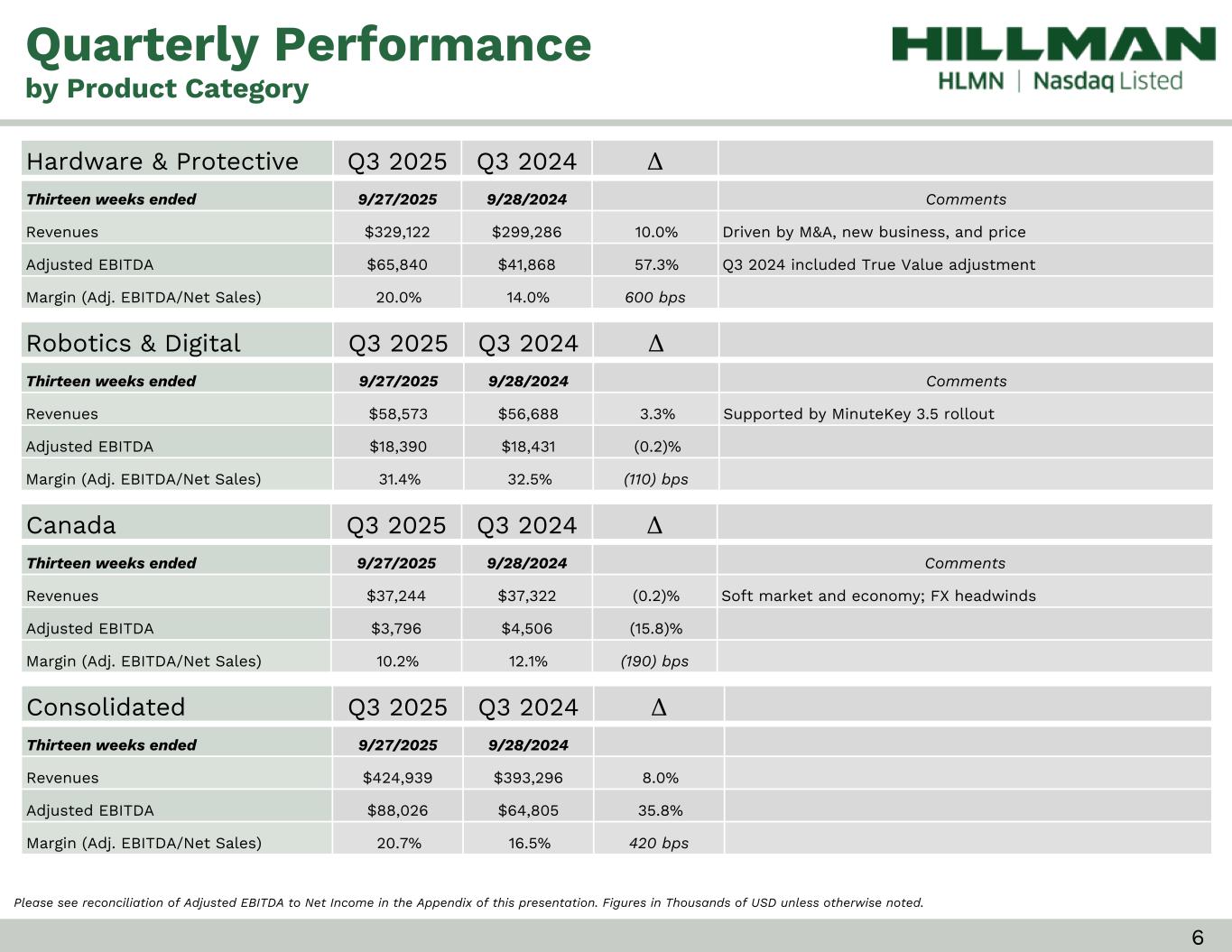
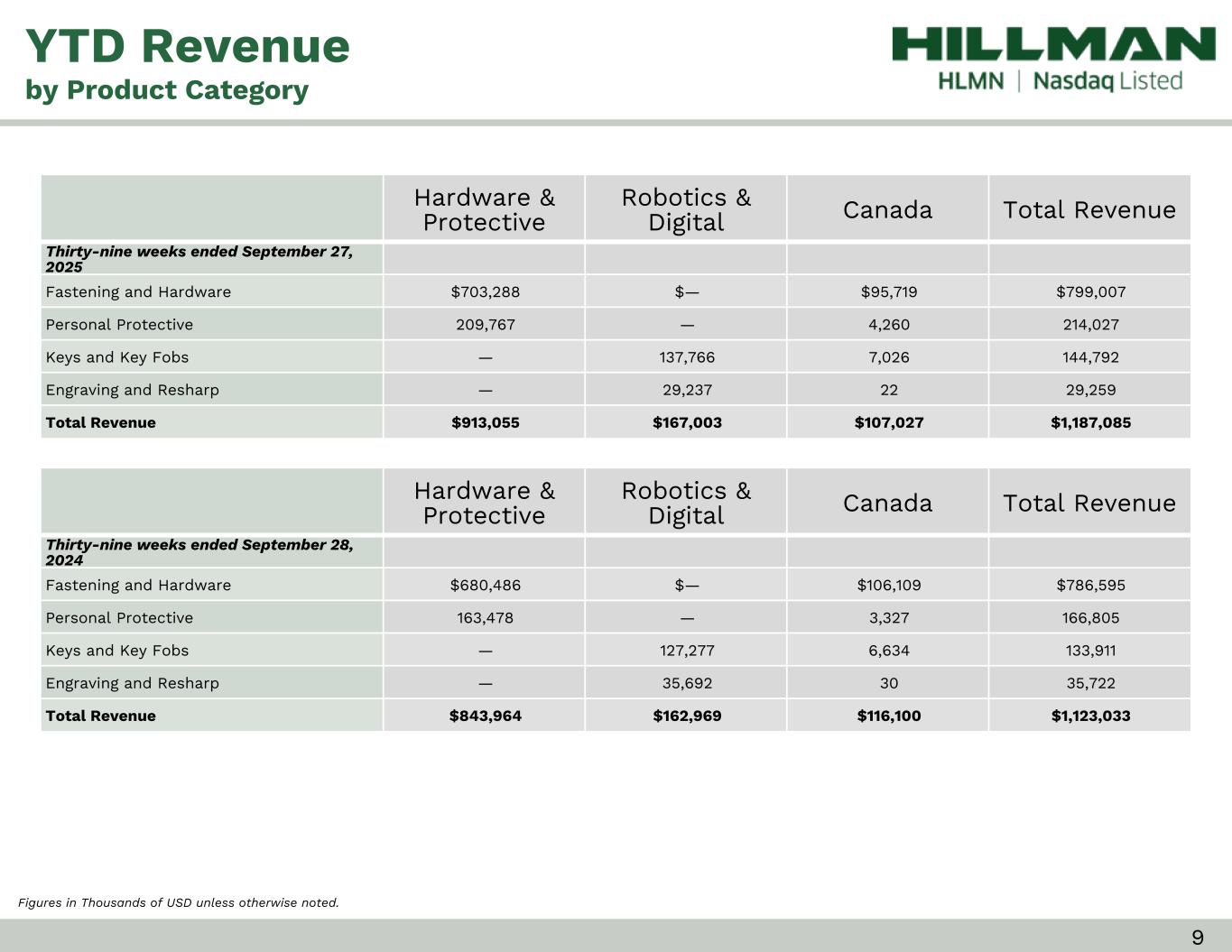
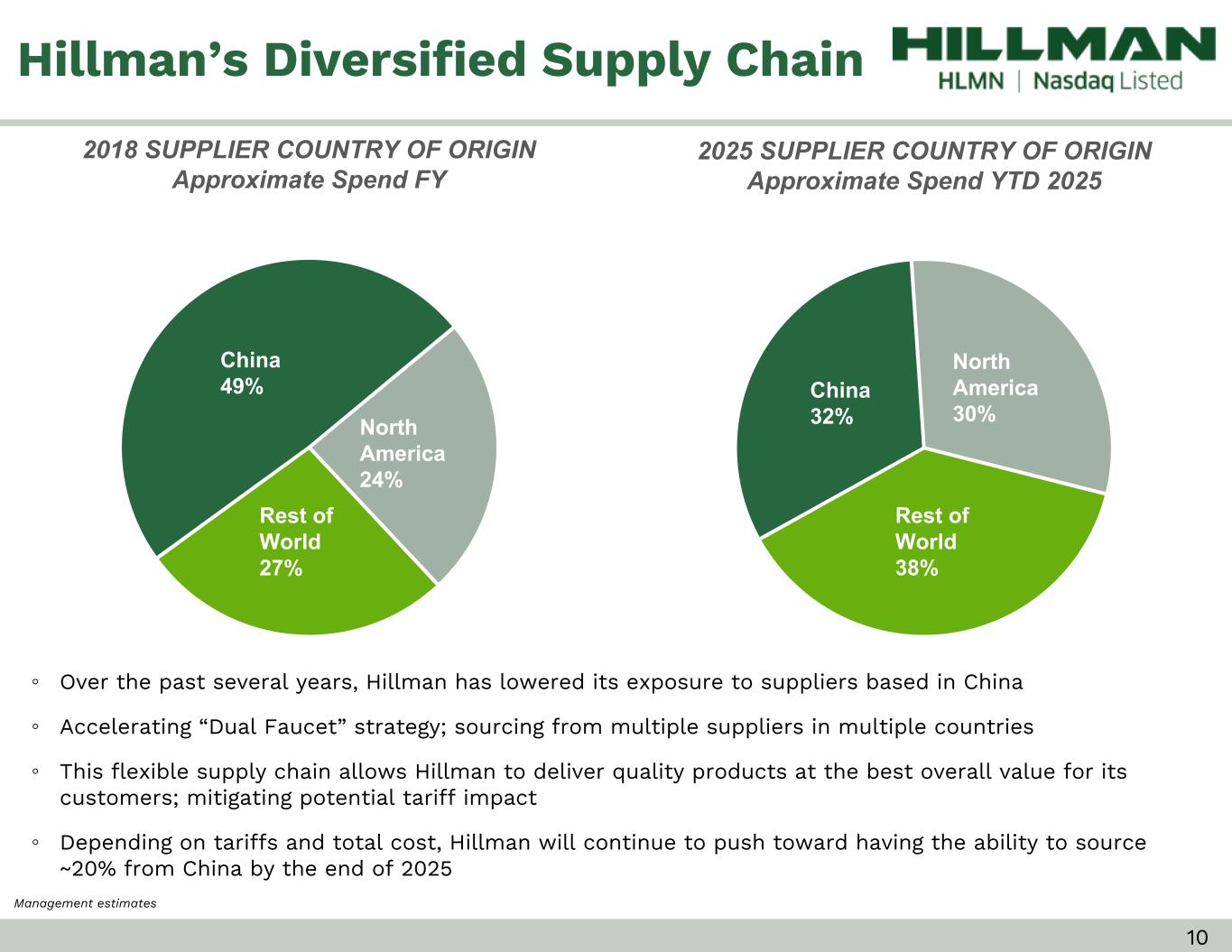
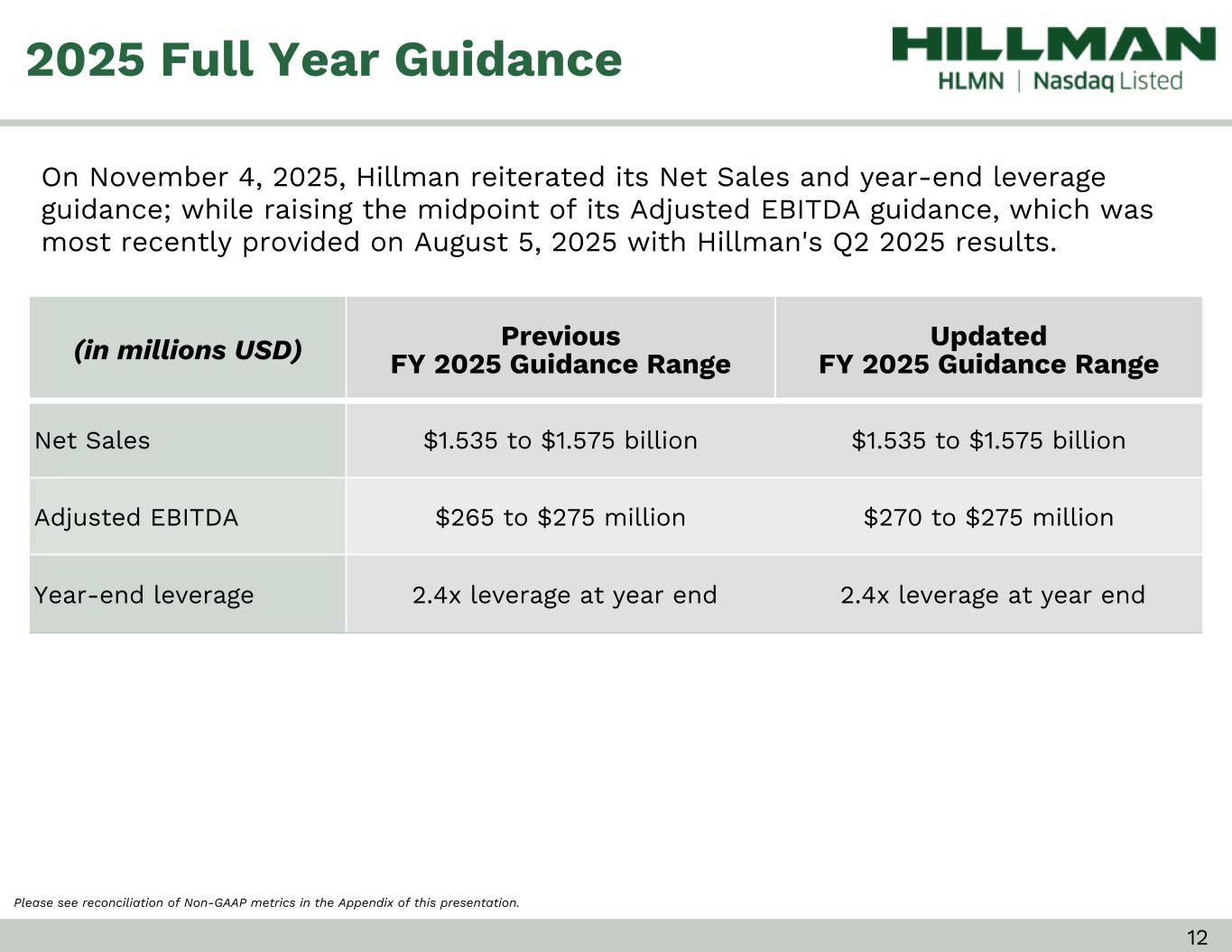
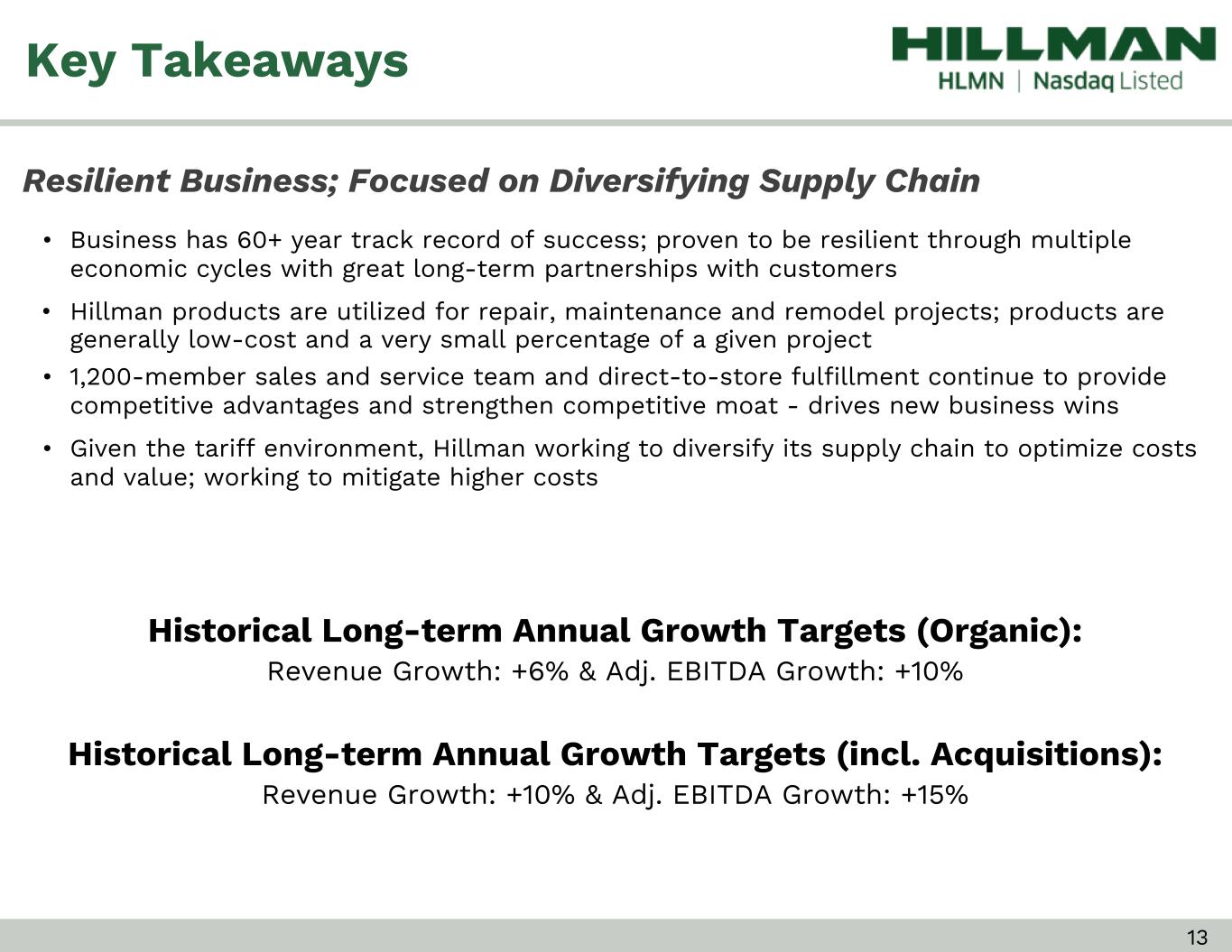
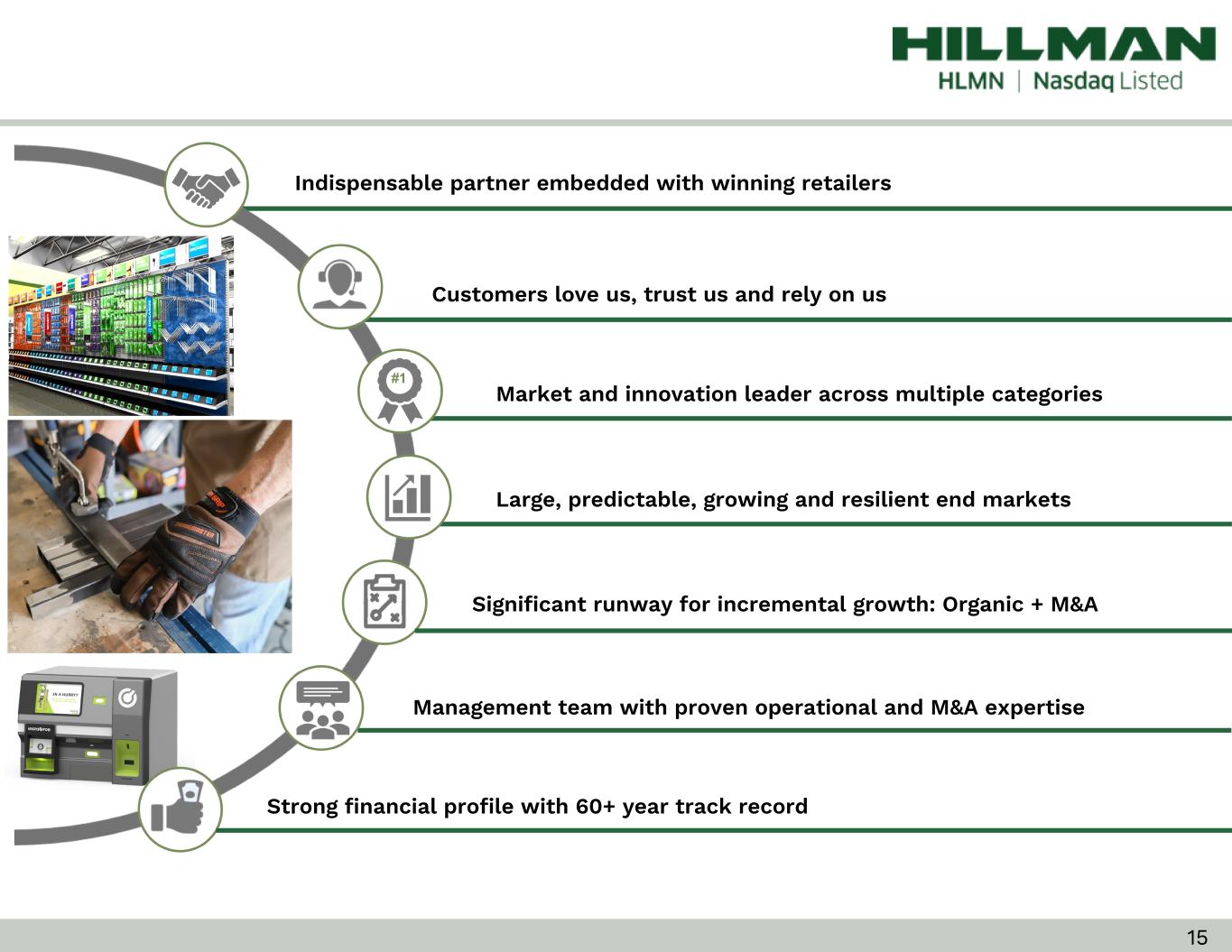
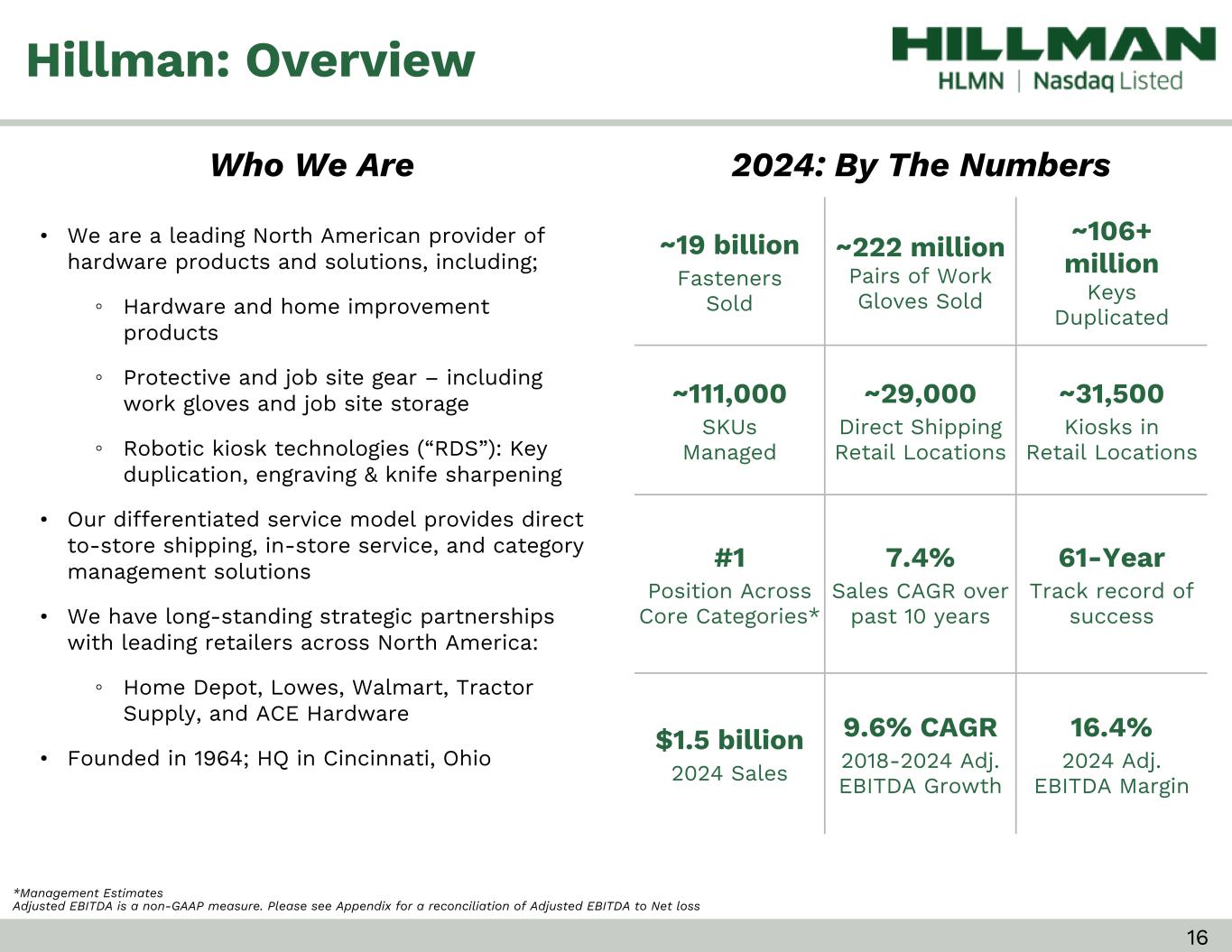
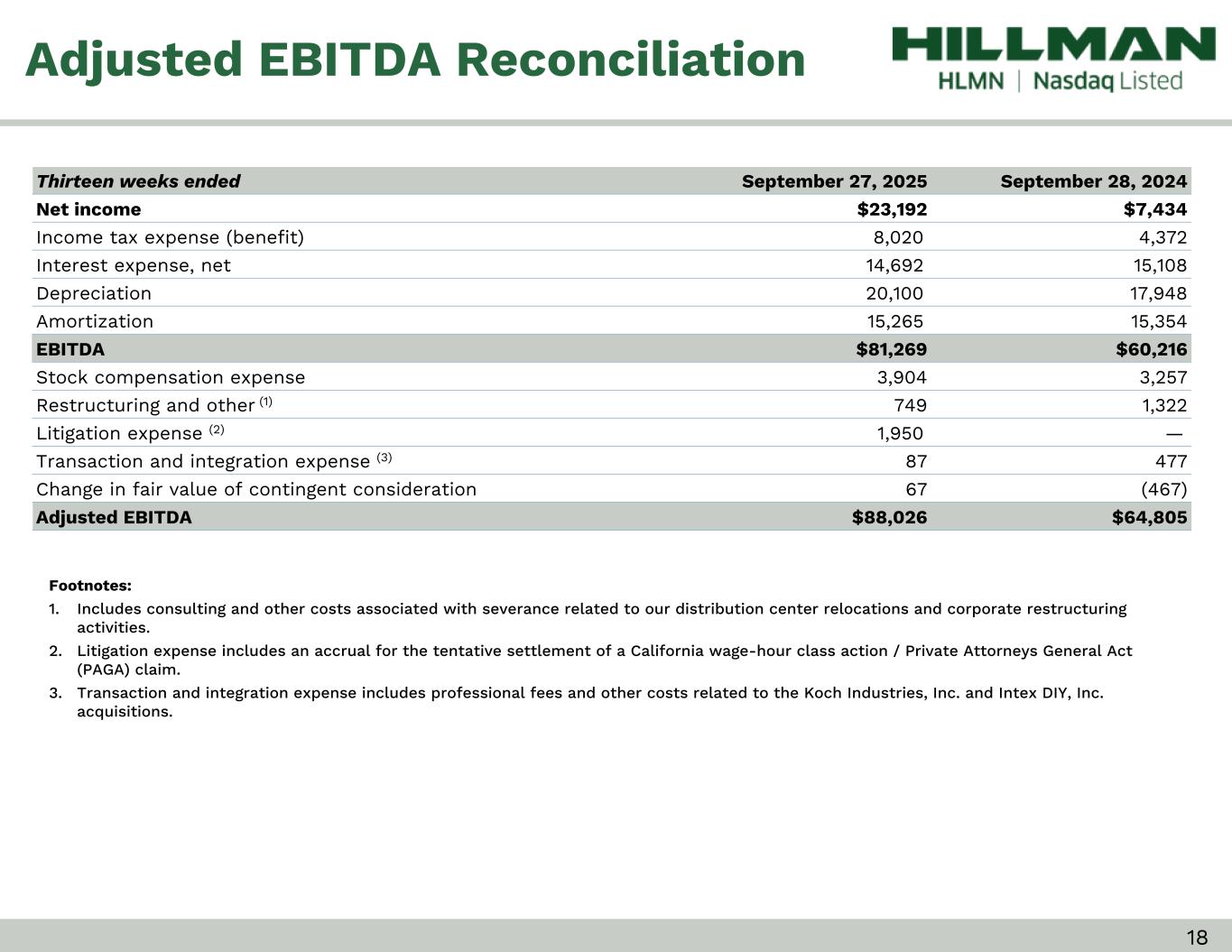
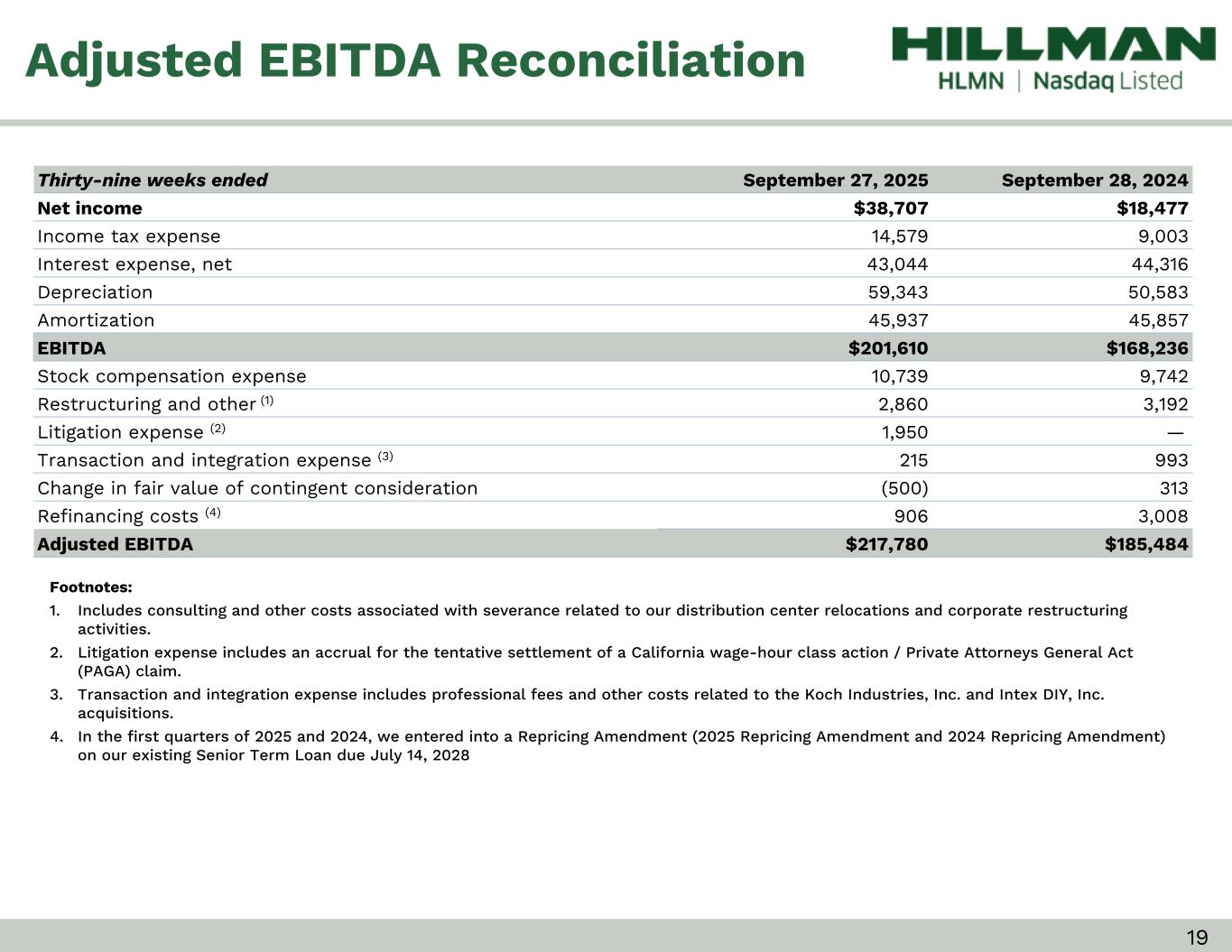
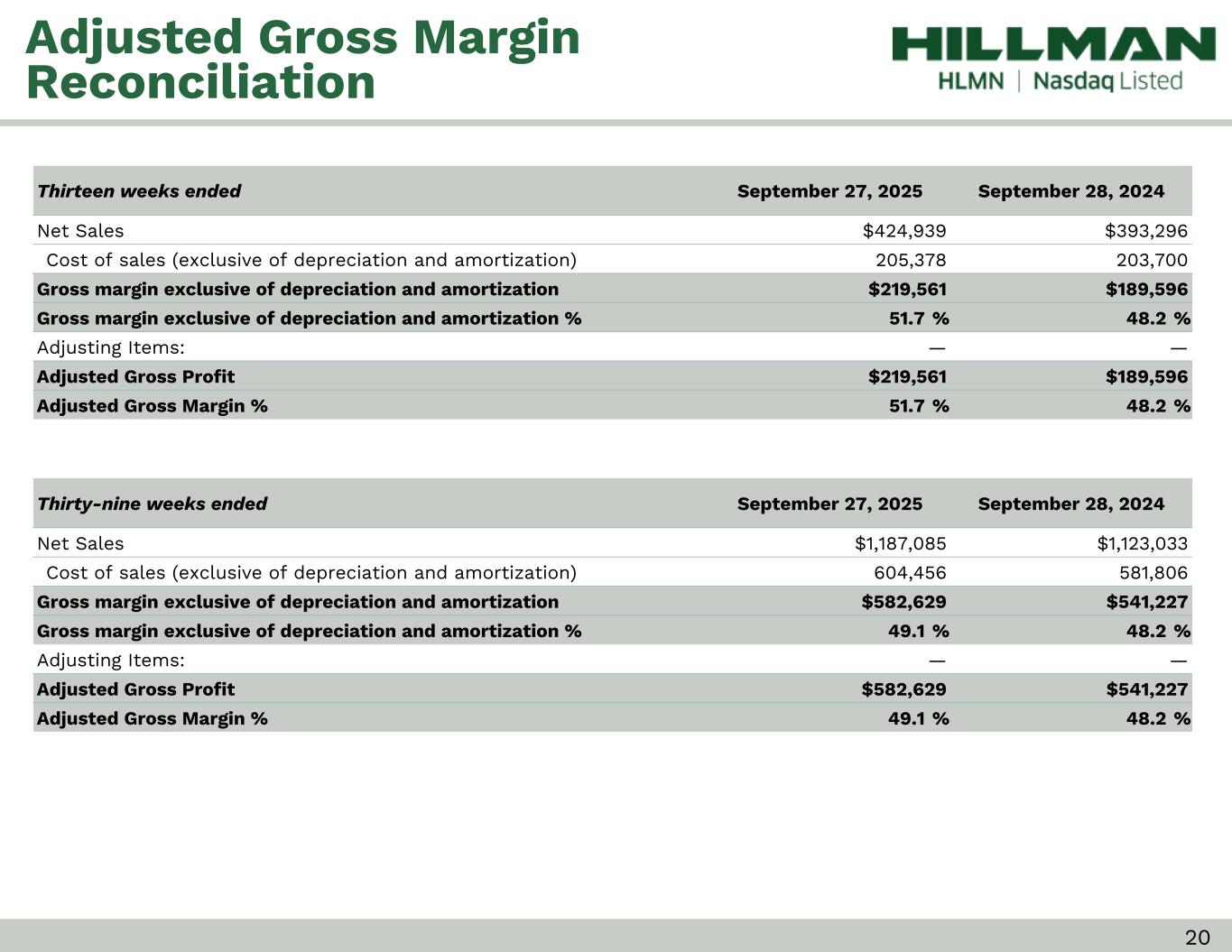
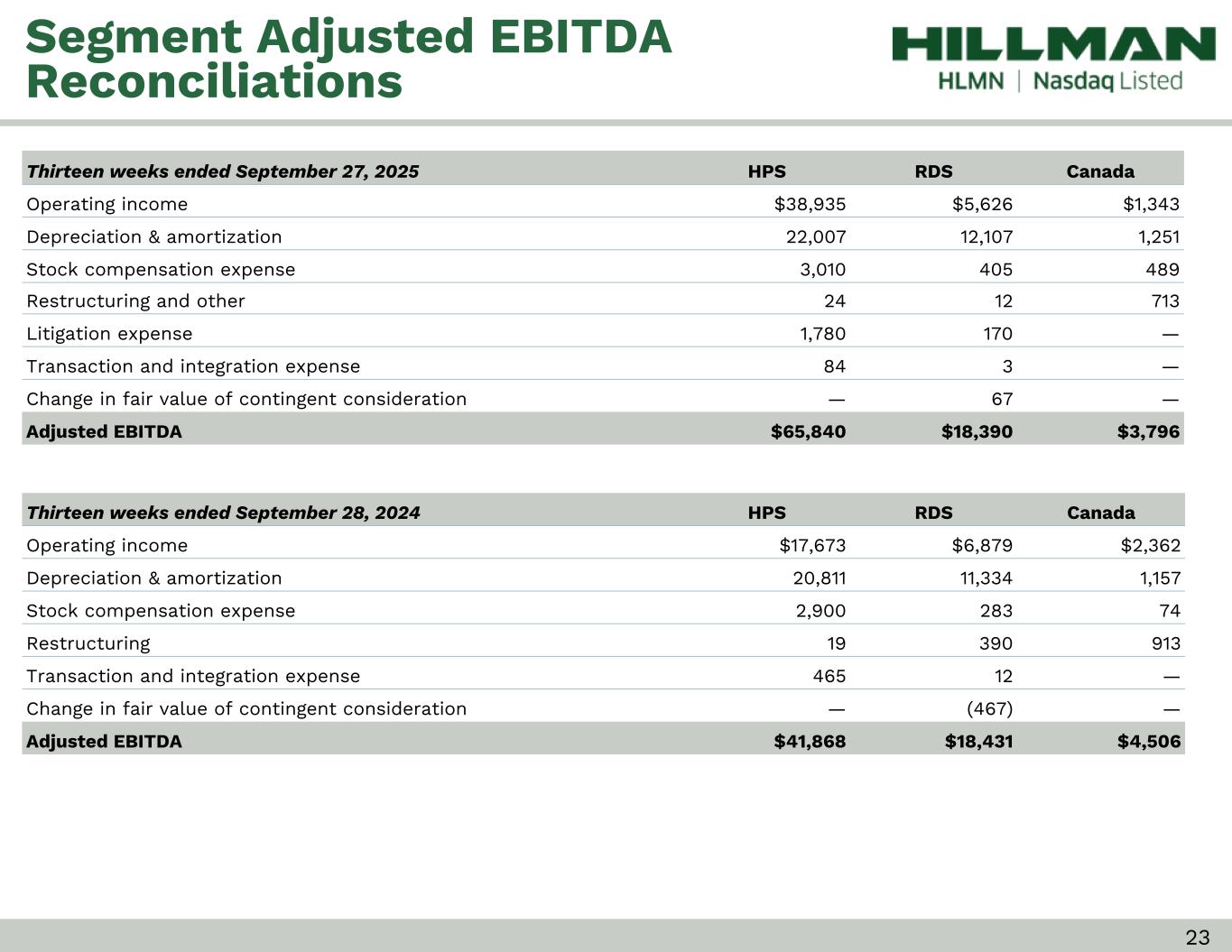
Thanks, Michael. Good morning, everyone, and thank you for joining us. The third quarter of 2025 was a record quarter for Hillman. We recognized the highest net sales and adjusted EBITDA of any quarter in our company's 61-year history. Net sales for the quarter increased 8%. Adjusted EBITDA increased 36% and our leverage improved to 2.5x versus 2.7x a quarter ago. These outstanding results were driven by our team's commitment to taking great care of our customers, successfully navigating the current tariff environment and operating efficiently across our global supply chain. I'm especially proud of this team because we accomplished these great results despite market volume headwinds and tariff volatility. Our results for the year-to-date period have been strong. We are positioned well to build off this strength and expect to see continued growth for the remainder of 2025 and for 2026. For the first time in a long time, we are encouraged with some of the leading macro indicators. For example, 30-year mortgages are down 50 basis points lower since last quarter. We are hopeful that lower rates, coupled with the elevated level of existing homes currently for sale will help drive existing home sales in the near future. Based on our performance so far this year and our expectations for the rest of the year, we are reiterating our full year 2025 net sales guidance and increasing the midpoint of our full year 2025 adjusted EBITDA guidance. We maintain our expectation that our full year 2025 net sales will be between $1.535 billion to $1.575 billion, with a midpoint of $1.555 billion. The low end of our net sales guidance represents 4% growth over 2024 and the high end of our guidance represents 7% growth over 2024. As for our bottom line, we are increasing the low end of our guidance and now expect full year 2025 adjusted EBITDA to be between $270 million to $275 million with a midpoint of $272.5 million. The low end of our 2025 adjusted EBITDA guidance represents 12.7% growth over 2024 and the high end of our guidance represents 14% growth over last year. These numbers are very consistent with our long-term algorithm and as we have said many times, we get there many different ways, but this business delivers in just about any environment. Since our founding in 1964, Hillman has built a long and consistent track record. Over the decades, we have proven our ability to perform through every kind of economic cycle from periods of expansion to times of uncertainty. The durability of our business model comes from the essential nature of our products. Our 112,000 SKUs are generally tied to everyday repair, maintenance and home improvement projects. These projects need to be done during good times and difficult times. As a result, we have delivered steady, resilient performance for more than 60 years. Many would argue that the last 3 years have been a difficult market in our space with existing home sales hovering around $4 million annually. This is about 20% below the 10-year average of over 5 million single-family existing homes sold in the U.S. How has Hillman performed during this time? Compared to where we were just 3 years ago, we have increased our trailing 12-month adjusted EBITDA at a 10% CAGR, totaling over $70 million, paid down over $240 million of debt while reducing our leverage over 2 full turns and successfully executed and integrated 2 acquisitions. These outstanding results demonstrate the resilience of Hillman's model and the ability of this team to execute well in any environment. You've heard us say that we are a good business when things are good and a surprisingly good business when things have been challenging. The last 3 years have proved this. Hillman is a great company with a long track record of success. We have an experienced team that has been battle tested, great relations with our customers who are the best in the business at what they do and a world-class distribution network. We believe when the market turns, we will be positioned for outsized growth at both the top and bottom line. Our growth and performance have been powered by our competitive moat and the long-term customer relationships that are unmatched in our space. The Hillman moat includes our secret sauce of 1,200 dedicated sales and service reps working directly in our customer stores, our best-in-class direct-to-store delivery capabilities, category management expertise and retail partnerships that are embedded and strategic. These make Hillman an indispensable partner to our customers. To date, we have successfully managed the current tariff environment, which continues to evolve. Thanks to our team's hard work, we have fully covered the increased costs associated with higher tariffs. We continue to execute our dual faucet strategy where we buy products from multiple suppliers in multiple countries. At the end of the quarter, we held our annual supplier conference in Vietnam. Our sourcing team and I met with many of our top suppliers. This annual event serves as an important in-person touch point to strengthen relationships with our supplier partners, which is especially important given the environment. Meeting face-to-face offers our long-term and new supplier partners a fresh view of Hillman's near-term objectives and how we can work together to achieve our long-term goals. As we have seen throughout this year, changes in tariff policy can shift the market rapidly. The flexible supply chain we have built allows us to react to these changes so that we can always deliver high-quality products to our customers at the best value. Managing tariffs has been a big effort for our team, but we have not lost focus on taking great care of our customers, winning new business and consistently striving to make our operations more efficient. We continue to deliver orders on time and in full to our customers, which have been demonstrated by excellent fill rates, which have been above 95% this year. Now let's turn to results for our quarter. Net sales in the third quarter of 2025 totaled $424.9 million, which increased 8% versus the third quarter of last year. Driving our robust top line was a 10-point increase from price, 2 points from Intex, which we acquired during August of 2024 and 2 points from new business wins. These were partially offset by a 6-point headwind from market volumes, which was consistent with our expectations. For the quarter, adjusted EBITDA increased 36% to $88 million compared to $64.8 million last year. Adjusted EBITDA margins improved by 420 basis points to 20.7%. Adjusted gross margin for the quarter totaled 51.7%. This marks a 350 basis point improvement from 48.2% during the year ago quarter and a 340 basis point improvement from 48.3% last quarter. Driving our year-over-year sequential margin performance were both improved contributions from RDS and benefit from price cost timing. Our biggest segment, Hardware and Protective Solutions or HPS, had a great quarter with 10% growth versus the comparable period. Adjusted EBITDA increased by 57.3% to $65.8 million. Our results were driven by contributions from Intex, new business wins and price cost, partially offset by a 5.5% decline in HPS market volume. Net sales in Robotics and Digital Solutions, or RDS, were up 3.3% versus the year ago quarter. This is our third consecutive growth quarter for RDS and again illustrated the successful rollout of our Mini Key 3.5 strategy. Adjusted gross margins and adjusted EBITDA margins were both near their historic norms, totaling 74.2% and 31.4%, respectively. As of today, we have over 3,000 Mini Key 3.5 machines in the field, an increase of over 800 during the last 3 months. We remain on track to finalize the rollout of these kiosks to our 2 largest customers by the end of 2026. Turning to Canada. Net sales in our Canadian business were nearly flat, down just 0.2% compared to the prior year quarter. New business wins were partially offset by another quarter of soft market volumes and FX remained a headwind. We continue to expect that adjusted EBITDA margins will remain above 10% in Canada. Overall, this was a great quarter. Hillman's disciplined operations, strong execution and healthy customer relationships position us to continue delivering consistent results in this or just about any environment. With that, let me turn it over to Rocky to talk financials and guidance. Rocky?
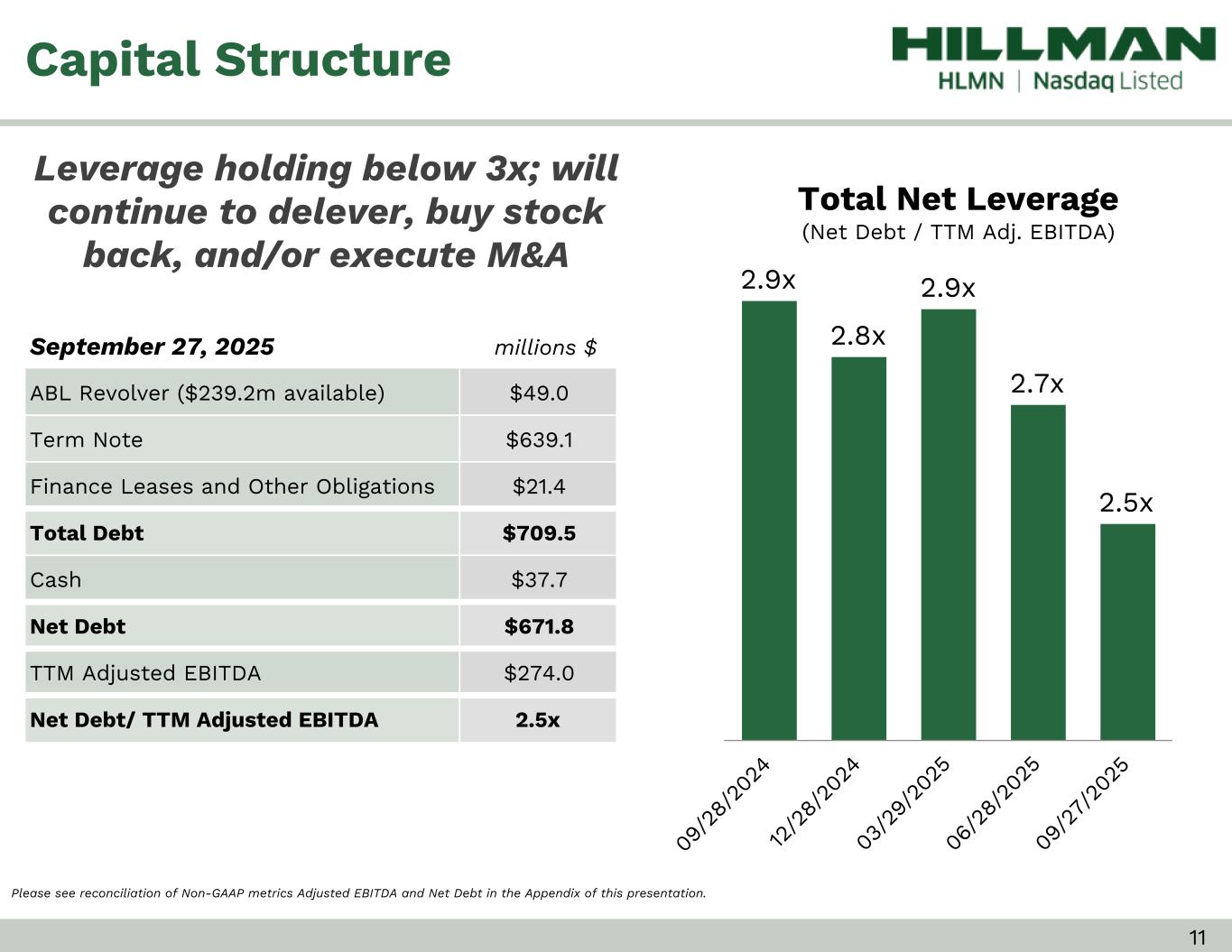
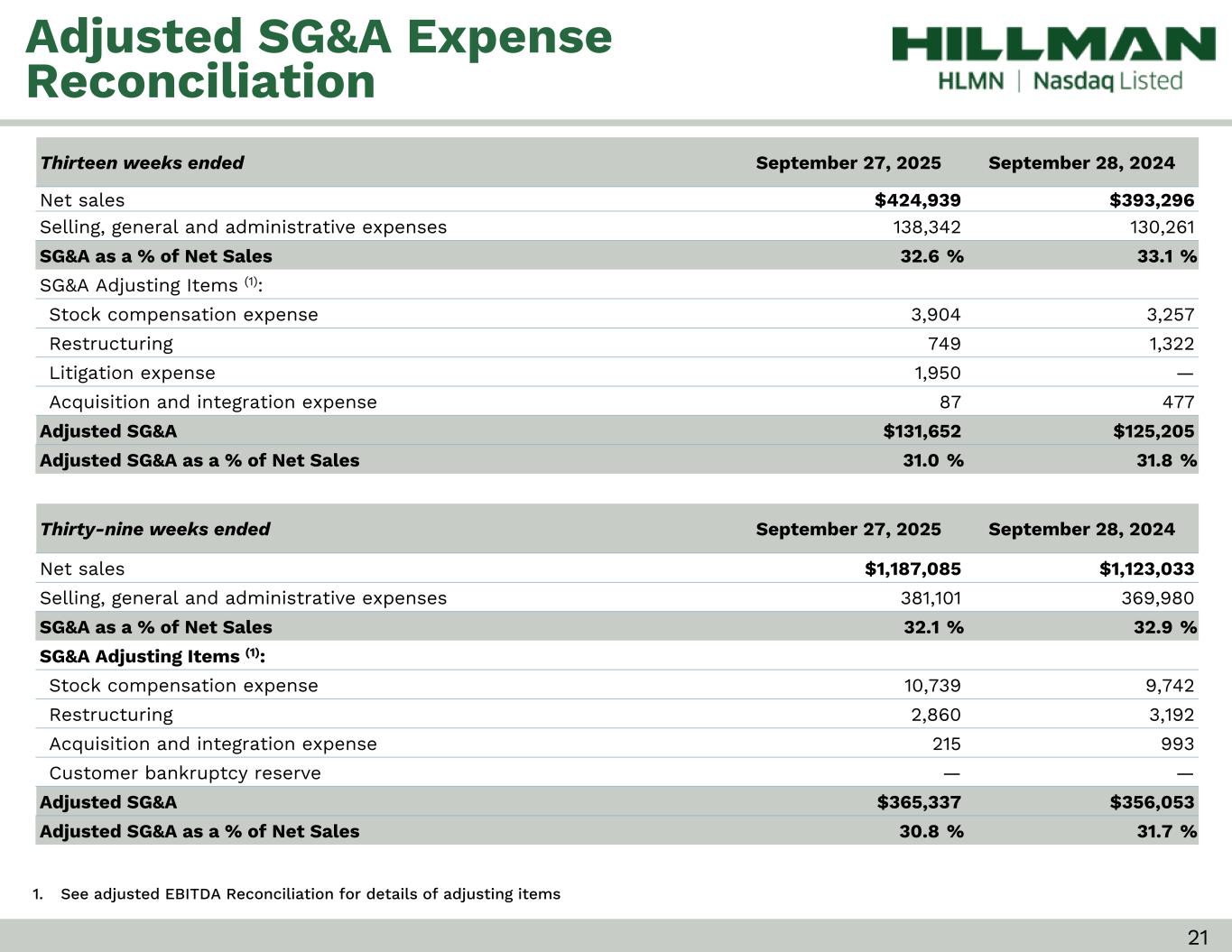
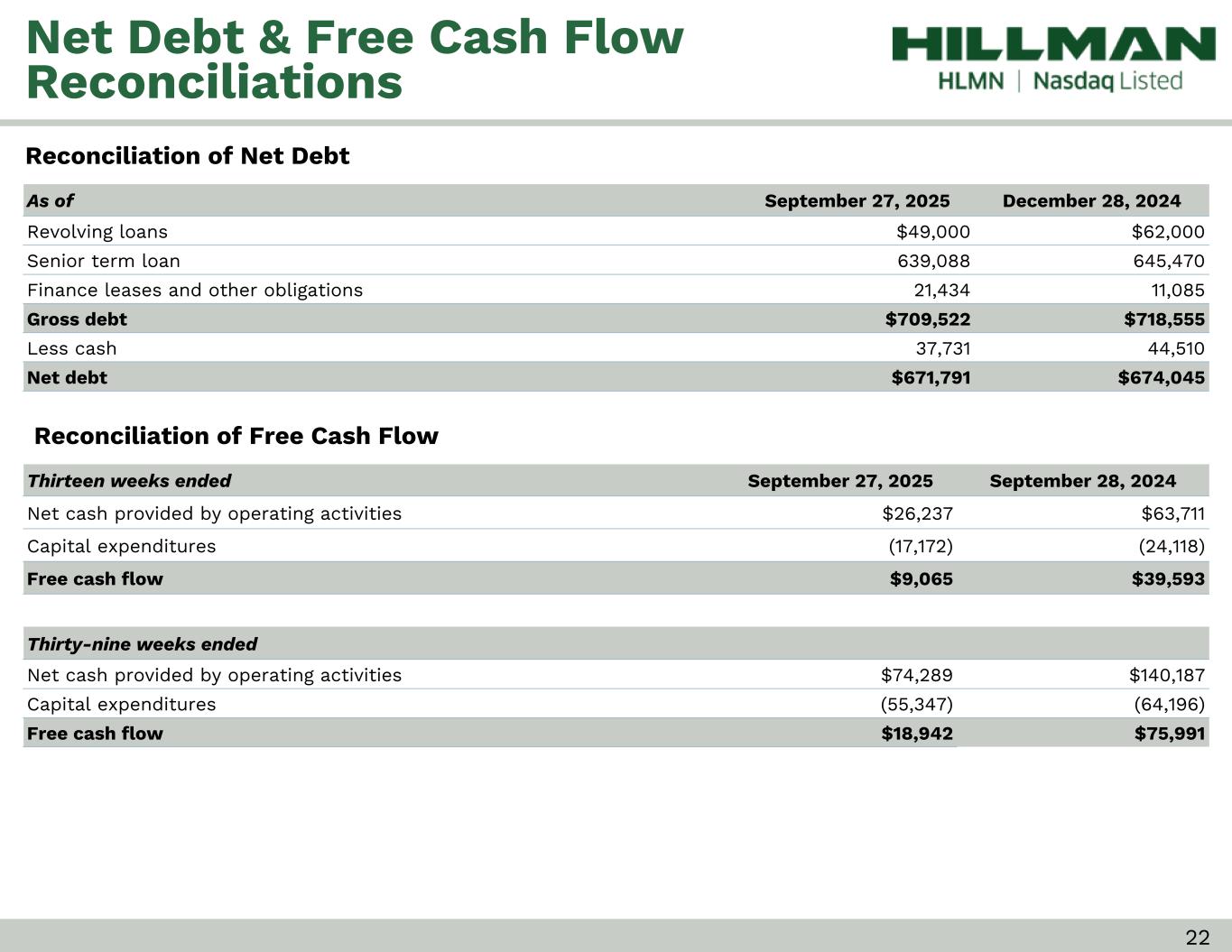
Thanks, JMA. Let's move on to our results, then we'll discuss our guidance. In the third quarter of 2025, net sales amounted to $424.9 million, representing an 8% increase compared to the same quarter last year. This is a record high for Hillman, marking the greatest net sales achieved in any quarter throughout our 61-year history. Adjusted gross margin for the third quarter rose by 350 basis points to 51.7% compared to the previous year and improved by 340 basis points sequentially. Adjusted SG&A as a percentage of sales decreased to 31% from 32% in the same quarter last year. Adjusted EBITDA for the third quarter totaled $88 million, a 36% improvement year-over-year, which was also the highest adjusted EBITDA for any quarter in our history. It's important to note that last year we adjusted our presentation of adjusted EBITDA to include a $7.8 million write-off of receivables from True Value during Q3. Even without that revision, adjusted EBITDA still rose over 21%. The adjusted EBITDA to net sales margin increased by 420 basis points to 20.7% during the quarter. Throughout the quarter, we experienced price increases reflected in our income statement, while tariffs began affecting our cost of goods sold toward the end. This pricing and cost dynamic resulted in record performance for Hillman and is expected to normalize in the next quarter. Now, on to cash flows. For the quarter, net cash from operating activities was $26.2 million, and we generated $9.1 million in free cash flow, though our free cash flow was negatively impacted by approximately $30 million in tariff-related costs. By the end of the third quarter, we had around $60 million in new tariffs within our inventory. Regarding leverage and liquidity, we concluded the third quarter of 2025 with $672 million of total net debt, a decrease of $3 million from the preceding quarter. Our available liquidity stood at $277 million, including $239 million available from our credit facility and $38 million in cash and cash equivalents. At the end of the quarter, our net debt to trailing 12-month adjusted EBITDA ratio improved to 2.5x from 2.7x in the prior quarter and 2.8x at the end of 2024. We have now achieved our long-term adjusted EBITDA to net leverage ratio target of 2.5x or below. We will continue to reduce debt while evaluating M&A opportunities and leveraging our enhanced financial strength strategically. As mentioned in the last quarter, our Board authorized a $100 million share repurchase program, marking the first active share repurchase plan since Hillman went public in 2021. During the third quarter of 2025, we used $3.2 million to buy back 326,000 shares at an average price of $9.72 per share, and we remain in the market for additional stock purchases. Our share repurchase activity for Q3 and beyond aligns with our anticipated annual spending of $20 million to $25 million on stock buybacks. Our goal with these repurchases is to mitigate any dilution from employee equity grants and to buy back stock opportunistically when we see a significant gap between the company's value and its trading price. We believe these repurchases will enhance earnings per share, create shareholder value, and represent an attractive capital deployment. Now, moving to our guidance, we are reaffirming our revenue guidance of $1.535 billion to $1.575 billion, with a midpoint of $1.555 billion, which indicates a 5.6% growth compared to last year. For the full year, the midpoint of our guidance reflects about 6 points from price increases, 3 points from Intex, and 2 points from new business acquisitions, which are somewhat offset by a 6-point decline in market volumes. In the second half of the year, we expect approximately 11 points from price increases, 1 point from Intex, and 2 points from new business, partially offset by a 7-point decline in market volumes. On the bottom line, we are raising the lower end of our adjusted EBITDA guidance by $5 million, adjusting the midpoint while keeping the top end steady. Our updated adjusted EBITDA guidance is now between $270 million and $275 million, with a midpoint of $272.5 million, reflecting a 12.7% increase compared to last year and a $2.5 million rise from our previous guidance. We anticipate ending the year with a leverage ratio around 2.4x. As mentioned, the pricing and cost timing dynamic led to record results for Hillman in Q3. In Q4, we will see the full effect of price increases while tariffs continue to impact our cost of goods sold, which will result in a decrease in adjusted gross margin rate similar to our gross margins in Q2 of this year. Before handing it back to JMA, I want to express my gratitude to the team for delivering a robust quarter with strong growth on both the revenue and profit sides. We are optimistic that we can maintain this momentum into 2026 by remaining disciplined and focused on our key priorities. However, with stagnant market volumes, we expect net sales for the full year 2026 to grow in the high single to low double digits, driven by rollover prices and new business wins. Nonetheless, the pricing and cost timing dynamics we are currently benefiting from may make for a challenging margin comparison next year. Additionally, we expect adjusted EBITDA growth next year to be in the low to mid-single-digit range, assuming the tariff environment remains unchanged. We will provide detailed guidance for the full year 2026 during our Q4 earnings call next February. The figures I just mentioned are directional as we are not making specific predictions about market volumes for next year at this point. Hillman is well-positioned to build on its success, continue our growth with customers, and create long-term value for our shareholders going forward.
Thanks, Rocky. We are pleased with our results so far this year and are very excited about the future. We continue to work on ways to grow our business within our four walls of our existing customers and beyond. Before we wrap up, I want to once again thank the entire Hillman team for an outstanding quarter. Your hard work and commitment continue to drive great results, strong growth, solid execution and momentum. As we look ahead, we're confident in our ability to keep the momentum going. We're focused, disciplined and aligned around the correct priorities, growing with our customers, strengthening our partnerships and creating long-lasting value for our shareholders. Hillman is in a great position and the opportunities in front of us are exciting. I'm incredibly proud of what this team has accomplished so far this year and even more excited about what's ahead. With that, I'll turn it back to the operator for the Q&A portion of the call. Tanya, please open the call for questions.
Operator
And our first question will come from Lee Jagoda of CJS Securities.
Speaker 4
It's Pete Lucas for Lee. I guess starting out, have you seen any competitive opportunities or pressures as a result of other suppliers to your customers and their actions around willingness or ability to import product that could be changing the competitive landscape out there?
I mean, from what we're seeing right now, we actually have quite a few different business opportunities that we're quoting on. We're excited about our new business opportunities that will cascade into 2026. So yes, we do see opportunities in the market where we've seen some competitors that have faced challenges operating in this environment. So yes, we're excited about 2026 and what's ahead of us.
Speaker 4
That's great. What have you observed regarding order patterns from your largest retail customers in the past month or two compared to sell-through?
They've been very consistent. We've got great relationships with our retail partners. They're running solid businesses right now. And I think all of us are excited about the next run that will be in front of us. So we haven't seen anything out of the ordinary.
Speaker 4
Great. Just one last question from me. I know you touched on it and we'll hear more about 2026 later, but during the last call, you provided some insight into the growth you might expect in 2026. Given today's results and the guidance, has there been any change in your outlook for 2026?
This is Rocky. Pete, absolutely nothing. We reiterated our previous view. If you assume the markets remain flat, we believe the top line will increase by high single to low double digits, primarily driven by rollover price and new business wins, which gives us confidence in that projection. When considering how that translates to EBITDA, we expect low single to mid-single digit growth in that area. The reason we don't leverage as we typically do in 2026 is due to the temporary windfall we anticipate in 2025 from tariffs.
Operator
And our next question will be coming from Andrew Carter of Stifel.
Speaker 5
I want to focus on the Hardware Solutions segment. Prices increased by 12.5% while volume decreased by 33%. Is that a real-time elasticity figure? Or were there any factors that influenced the volume? I believe the new business wins were limited to Protective Solutions. Hardware sales closely reflect real-time activity with retailers. Are there any areas where retailers might be able to take on additional inventory? I'll leave it at that.
Yes, I would say that the short answer is yes, but it depends. We sell to many different customers and a variety of products, and each behaves a bit differently. For instance, in the retail channel, a local hardware store is likely to purchase less inventory initially when prices rise, until they understand the price changes. For larger companies, we don't supply much through their distribution centers; we sell directly to stores. Therefore, the ability to remove inventory from the channel is limited, but that doesn't mean that large customers can't sometimes reduce inventory during periods of rising prices. It would be naive to assume they can't. However, compared to businesses that operate through distribution channels, there's significantly less impact on our business because we sell directly to stores. In summary, as prices increase, there is a clear impact on our customers regarding pricing. Looking at point of sale data, October seemed okay, and the third quarter was better than it had been for some time with some positive signs, but we remain cautiously optimistic. One thing we continue to believe is that we have set this business up well for when the market improves and housing starts to pick up. When housing does bounce back, our operational effectiveness positions us to take full advantage of it.
Rocky framed it up well. I mean, you think about the repair and maintenance side of our business, very consistent. We see some good trends. And so we see some good things setting up for 2026 and beyond. We're not changing our outlook. But Andrew, we were pleased with how the business performed in Q3.
Speaker 5
I have a second question regarding the tariff amount. You mentioned $150 million in the script. Is that still an accurate figure considering the favorable changes? If there are favorable conditions, how will that impact pricing with retailers and the potential effects on your profit and loss statement? Will you notice these benefits right away, or will there be a delay?
Yes, we still have approximately $150 million in total tariffs affecting the business. Interestingly, just last week, we experienced a 10% reduction in reciprocals from China. However, there were many factors that changed during the quarter, so we remain around that same figure. In response to your second question regarding timing, any benefits or costs will take some time to work through our inventory, which means we will be delayed in realizing either the benefits or the negative impacts from the timing of the tariffs.
Rocky, that's exactly right. So for us, we're running the business, we're always going to put the right products in front of our customers from the country of origin where it makes the most sense. We're going to have the highest quality and make sure that our supply chain stays robust. So Andrew, no macro change with what you just mentioned. And candidly, there were a number of other changes, plus and minuses in tariffs over the past quarter. We don't spike those out separately.
Operator
And our next question will be coming from Reuben Garner of Benchmark.
Speaker 6
So Rocky, you mentioned that the volume numbers for the second half are down 7%. Do you think that the high prices due to tariffs are driving this, or is it more related to overall consumer activity? I'm not sure if you have insights on this, but I know you didn't increase prices uniformly across all products. Can you provide any indication of how much pricing is affecting demand in your sector?
Yes. It is virtually impossible to figure out what's driving consumer impact, whether it's price increase or whether it's whatever other thing that's happening in the external environment. We do look at POS, we look at customer trends, but figuring out what is directly related is very difficult. The 7% is the implied number at the midpoint of our guide. I think everyone will remember the implied number in our guide in the third quarter was down about 9% in volumes. We did a little better than that. And our commentary around that was what we told people. It is really hard to predict what's going to happen to market volumes. We were confident that the amount of price that was going into the market would result in losses of less than 9%, and we ended the third quarter kind of right in the middle of those numbers. I think as we go into the fourth quarter, we're cautiously optimistic that market volumes may be a little better than the guidance, but we were down 6% in the third quarter, and when thinking about going into the fourth quarter, could be other macro factors like even think about Christmas spending and things like that, it's probably a good number and will be in the ballpark.
Speaker 6
Got it. And then the sequential improvement in gross margin, you mentioned RDS. Can you talk to us about how much of that improvement was from RDS versus the price cost? And then I guess, what exactly is driving the pickup in the RDS profitability?
Yes, I mean, the largest percentage of the increase was driven by what happened with price cost. When you think about RDS, that number was up, it was up about, call it, 100 basis points in the quarter. The RDS pickup is really driven by the 3.5 rollout and what's happening there and the profitability of that business. So we feel really good about RDS, the fact that we've grown it for 3 quarters in a row and we continue to execute on our 3.5 strategy. But again, the biggest driver of margin improvement in the quarter was the price cost dynamic. And as we said in the prepared remarks, we expect that to come back in the fourth quarter and we would expect the fourth-quarter gross margins to look a lot like what we saw in the second quarter of this year.
Operator
And our next question will be coming from Matthew Bouley of Barclays.
Speaker 7
You have Elaine Ku on for Matt. I wanted to touch on pricing a little bit. So you've kind of pointed to expectations of price cost neutrality in the face of tariffs. But sort of this quarter, we've seen a sense of price fatigue where some of your peers have not seen that full anticipated price realization. So just wondering, are you experiencing any similar signs of a bit more elasticity or pushback on price than expected? Or is that price kind of coming through largely according to your expectations? And just what has feedback been on just receptiveness of increases or negotiations, just anything around that?
Yes. It's Rocky. I'll answer the beginning of the conversation, then I'll let JMA comment on the relationship with customers. I think it kind of went as expected with lots of twists and turns because as you can imagine, the tariff regime has changed so many times. That said, we had always told everyone that we expected price even before tariffs to be flat during the current year, but a bit of a headwind in the front half. That implied that we would take some price for inflation, and we did take some price for inflation in certain channels and on certain products where it was necessary. So I think as you think about that, price, in my opinion and in the company's opinion, has played out about as expected. It hasn't been easy, but our customers understand. They live in the same world we live in and so have been fair, I would say, relative to how price has rolled out. And JMA, do you want to add onto that?
Yes, Rocky. I mean, that's exactly right. The customer conversations have been challenging, but they've been balanced, right? They want the same thing that we want. We want to make sure they continue to flow the supply chain right. They will need high levels of service. They want to make sure their customers are taken care of. And that's why we're doing things with our customers now. We're resetting more in this year and 2025 than we really have in record, if you will. So we're going to continue to make investments in our business. We're going to continue to keep the product flowing because we really are still excited. I won't call when it's going to happen, but when it does, we believe the home improvement market is set up for a great run. So we're excited about where we are. The conversations around price are certainly challenging, but our customers and we are aligned that we want to take care of the end user.
Speaker 7
Great. And second to that, I guess, you had mentioned October felt okay and you're seeing some green shoots. So could you kind of elaborate more on what those green shoots are? And similar to Pete's question earlier, are you seeing any incremental new business wins just given today's market backdrop or opportunity there?
Yes. So October was slightly better than what we saw in the third quarter. I'm not going to go into specifics about each retailer. However, certain categories that we consider to be non-elastic are performing well. Given the complexity of this discussion, I won't provide further details. We believe the setup moving forward is positive, and the new business wins we've discussed, including our recent chain win that will roll out nicely in 2025, are examples of our efforts. Our teams have several significant projects in progress that we will report as they materialize rather than preemptively discussing potential wins. We have some exciting opportunities coming up, and we'll have more updates in future quarters.
Operator
Our next question will come from David Manthey of Baird.
Speaker 8
First off, thanks for the 2026 outlook. I guess, did you say that that revenue outlook of high single, low double on the top line is in a flattish market? Is that correct?
Yes. That is, Dave. What we keep trying to say and we're going to keep trying to say it is that assumes a flat market. At this point, sitting on November 4 to predict next year's market is tough. And so we'll let people make their own estimates. But in a flat market, that's the expectation we have.
Speaker 8
Got it. Yes, it seems that EBITDA will likely increase more steadily from 2024 than from 2025, but that aligns with what you mentioned. Thank you for providing that framework. Regarding the quarter, can you discuss the significant variability we observed compared to the Street in the third and fourth quarters? Overall, it appears to have met expectations. The high gross margin in the third quarter was anticipated. Can you explain why SG&A was also significantly higher in the third quarter?
Yes, Dave, the biggest impact, quite frankly, on the SG&A in the third quarter is the way our bonus accrual works. And so there was a pretty significant bonus accrual relative to the rest of the quarter. And so I think if you took that out, you would see that number be pretty consistent with what we've seen in the other quarters of the year.
Speaker 8
And so was that some sort of catch-up that you had to smooth it out relative to the first 3 quarters and then it will be normal in the fourth? Is that right?
Speaker 8
Yes. Okay. And then when you think about the third quarter and the fourth quarter, again, given the wild variability relative to our own estimates to the Street, what for you came in differently than how you were thinking about things, if at all? When you look at the third quarter and then sort of what you're guiding for the fourth, is there anything in there that you say, well, this is a little bit more, a little bit less than we were originally anticipating midyear?
Yes. I would say, Dave, as we look back on what we said last quarter, I think it was pretty consistent with our expectations in both the third and what we're seeing in the fourth quarter. So I don't think there was anything really that surprised us. We expected the profitability. We expected the margin rate to increase about 300 basis points. It might have been a little better than that, but pretty much in line with our own expectations. I think the team did a really good job of performing again in a really tough environment when you think about what's happening macro with tariffs and those conversations with our customers. I think the other thing that I think we're really proud of is we had 2% new business wins in the quarter in spite of all of the noise around tariffs. Again, great job when you think about what our sales team is doing, and it really speaks volumes about how much our customers value and trust us when we're able to go out and win new business when we're asking for price at the same time.
Yes. And I think in addition to the sales team doing a great job, our operations team is world-class. We're very proud of what they've done. They've really run the business well. Q3 was an excellent quarter, very efficient. We had a lot of moving pieces and the team was able to execute. So yes, there's a little bit higher cost, as Rocky mentioned. We did do things like labeling in the field. There was a lot of activity in Q3. So we feel like Q3 is set up, and we also feel like, Dave, Q4 is on target with what we expected.
Operator
And our last question will be coming from Brian McNamara of Canaccord Genuity.
Speaker 9
So Rocky, I just want to clarify the cadence. In May, I think your projection for market volumes and pricing was plus 17, minus 17. Then in August, it was plus 12, minus 9 for H2. And then now it's plus 11, minus 7. Is that correct?
I believe those were quick points you made, Brian, but yes, I think you are right. The only thing I want to highlight regarding those numbers is that the minus 17 was during a $250 million tariff regime, and in that situation, we didn't adjust any of our guidance.
Speaker 9
Understood. Understood. I'm curious on the timing of when these price increases hit the shelves, understanding, obviously, it probably varies by retailers. As our work suggests it's kind of late August, early September?
Yes. I mean, you're spot on. I mean, if you think about traditional hardware, labels are put on throughout the back half of the year. So yes, you didn't see all that price really reading in till Q3, into Q4. And then each of the other retailers, they maintain their own pricing and they drive the retail strategies that they see fit. So you've seen it cascade in throughout the quarter, and we expected it to cascade in the fourth quarter as well.
Speaker 9
Got it. Has there been any resistance to these significant price increases from either retailers or customers in stores? I'm also interested in your views on the price of lumber, which has been quite volatile this year. There has been a lot of discussion about its decline in price recently, despite being up year-to-date. How have the prices of lumber and other construction materials, whether directly or indirectly, affected your business?
Customers have been balanced and reasonable. They understand that this is a tax and that we have to run a business. I wouldn’t say they’ve been easy, but they have been fair. We work with some of the top retailers in the world, which I think is reasonable. Regarding the impact of lumber, in my view, we are still seeing smaller projects moving forward as people continue to handle repairs and maintenance regardless of the economic situation. However, there is some pushback on larger projects. In instances where we would typically see demand for drywall screws or structural screws linked to projects, lumber has affected that demand, which is not as strong as we would like. We believe that settling down interest rates and tariff issues will help in 2026, which is why we are optimistic about the future. In my opinion, rising input prices on bigger-ticket items are a significant pressure point.
Speaker 9
Great. And then just if I could squeeze one last one on M&A. Obviously, a big part of your story historically, I'm assuming there's been a pause given tariffs and the like. When do you see that maybe starting to open up a little bit, just given we probably have a little more clarity on tariffs today than we have in acknowledging it changes daily with tweets?
Yes, I won't comment on that specific aspect. However, regarding M&A, our team is actually receiving more inbound inquiries now compared to last quarter or the one before. We're starting to see some interesting activity, and the level of interest is increasing a bit. We’re excited about continuing our strategy of pursuing tuck-ins, whether focusing on our core business, growing DIY, or enhancing our Pro segment, which constitutes 25% of our business. We will consider deals that make sense in all three areas, and we are optimistic about the opportunities M&A will present as we move forward.
Operator
And this concludes the Q&A portion of today's call. I would now like to turn the call back to Mr. Adinolfi for closing remarks.
Thanks again, everyone, for joining us this morning. We look forward to updating you on our progress soon. Thanks, and have a great day. Take care.
Operator
You may now disconnect.