Operator
Welcome to IdaCorp's fourth quarter in year-end 2024 earnings conference call. Today's call is being recorded and our webcast is live. A replay will be available later today and for the next 12 months on the IdaCorp website. If you need assistance at any time during the presentation, please press star zero on your phone. I will now turn the call over to Amy Shaw, Vice President of Finance, Compliance and Risk. Please go ahead.
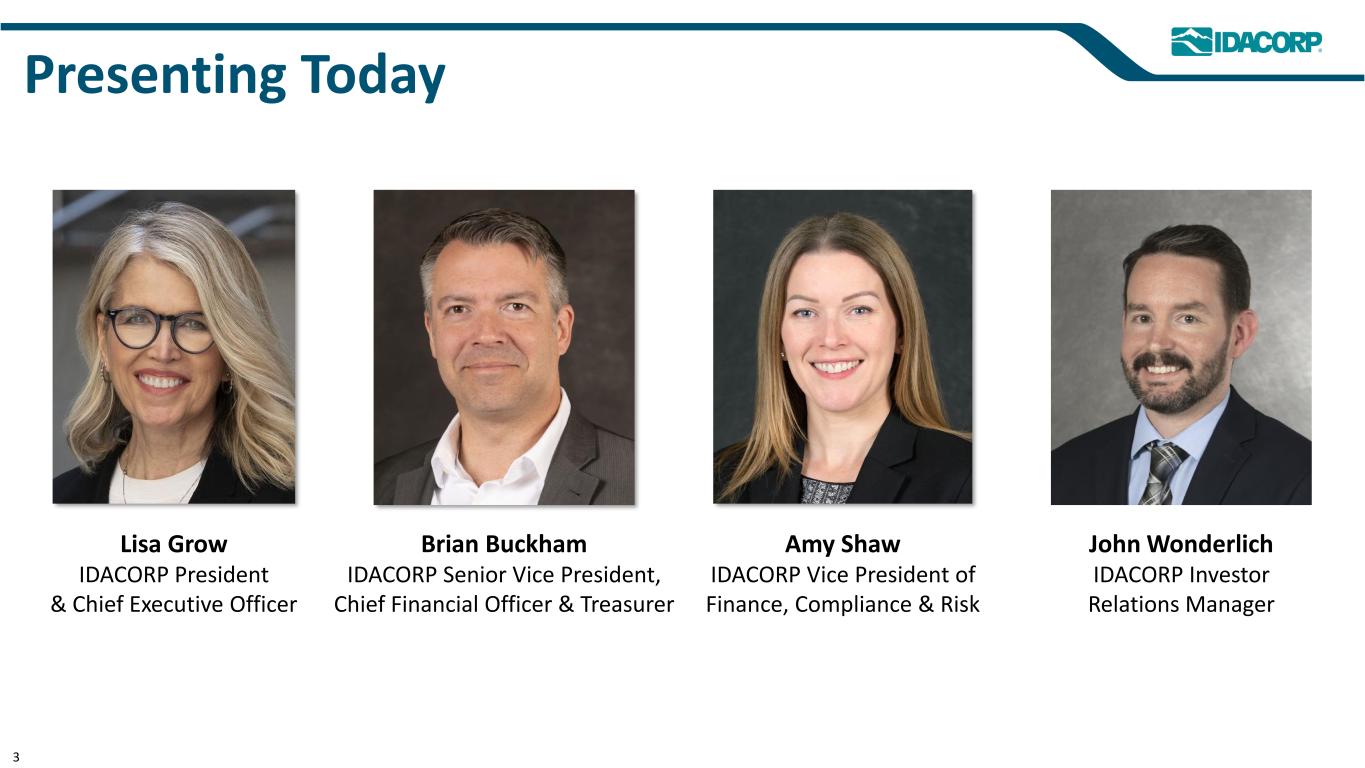
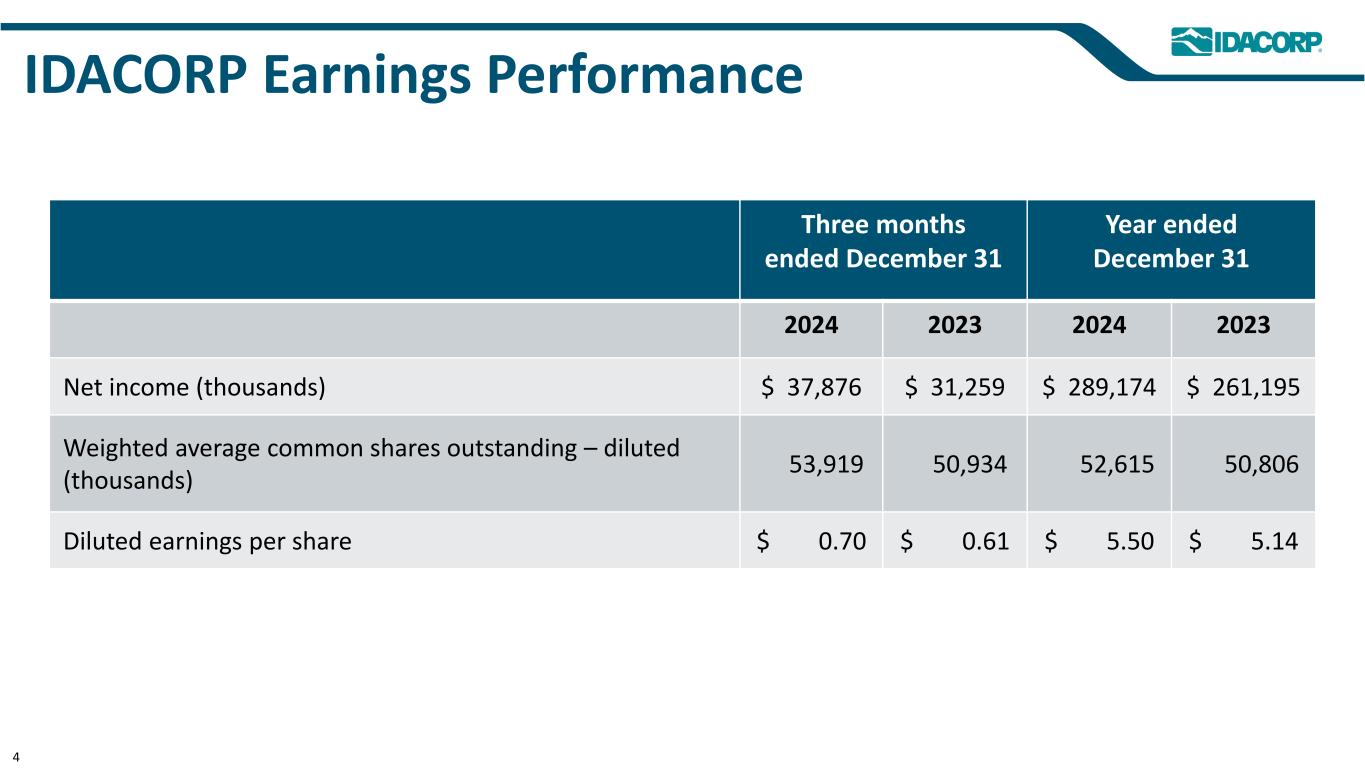
Thank you. Good afternoon, everyone. We appreciate you joining our call. This morning we issued and posted to IDACORP's website our fourth quarter and year-end 2024 earnings release and our Form 10K. The slides we'll reference during today's call are available on IDACORP's website. As noted on Slide 2, our discussion today includes forward-looking statements, including earnings guidance, spending forecasts, financing plans, regulatory plans and actions, and estimates and assumptions that reflect our current views on what the future holds, all of which are subject to risks and uncertainties. These risks and uncertainties may cause actual results to differ materially from statements made today, and we caution against placing any undue reliance on forward-looking statements. Our cautionary note on forward-looking statements and various risk factors are included in more detail for your review in our filings with the Securities and Exchange Commission. As shown on slide three, we have Lisa Groh, IDACorp's President and CEO, and Brian Buckham, IDACorp Senior Vice President, CFO, and Treasurer, presenting today. Also, I'm excited to introduce a new member of our investor relations team, who some of you have already met. In December, we promoted John Wunderlich to investor relations manager. John has been with the company over 12 years in various roles within finance, including our financial planning and analysis team. His depth with the company, along with his strong technical background and his impressive financial modeling abilities, are a fantastic addition to our team. We also have other members of our management team available for a Q&A session following our prepared remarks. Slide four shows a summary of our full-year financial results. IDACorp's diluted earnings per share were 550 compared with 514 last year. These results include additional tax credit amortization of $29.8 million for 2024 compared to no additional tax credit amortization in 2023. Today, we initiated our full year 2025 IdaCorp earnings guidance estimate in the range of 565 to 585 diluted earnings per share, which includes our expectation that Idaho Power will use between $60 and $77 million of additional tax credit amortization to support earnings. These estimates assume historically normal weather conditions throughout the year and normal power supply expenses. It's important to note that approximately $25 million of our expected usage of additional tax credits relates to amortization of incremental tax credits generated from Idaho Power's investment in 2023 battery storage projects, which you may recall we removed from the revenue requirement as part of our 2023 general rate case in Idaho and was also not included in the 2024 Idaho limited scope case. Now I'll turn the call over to Lisa.
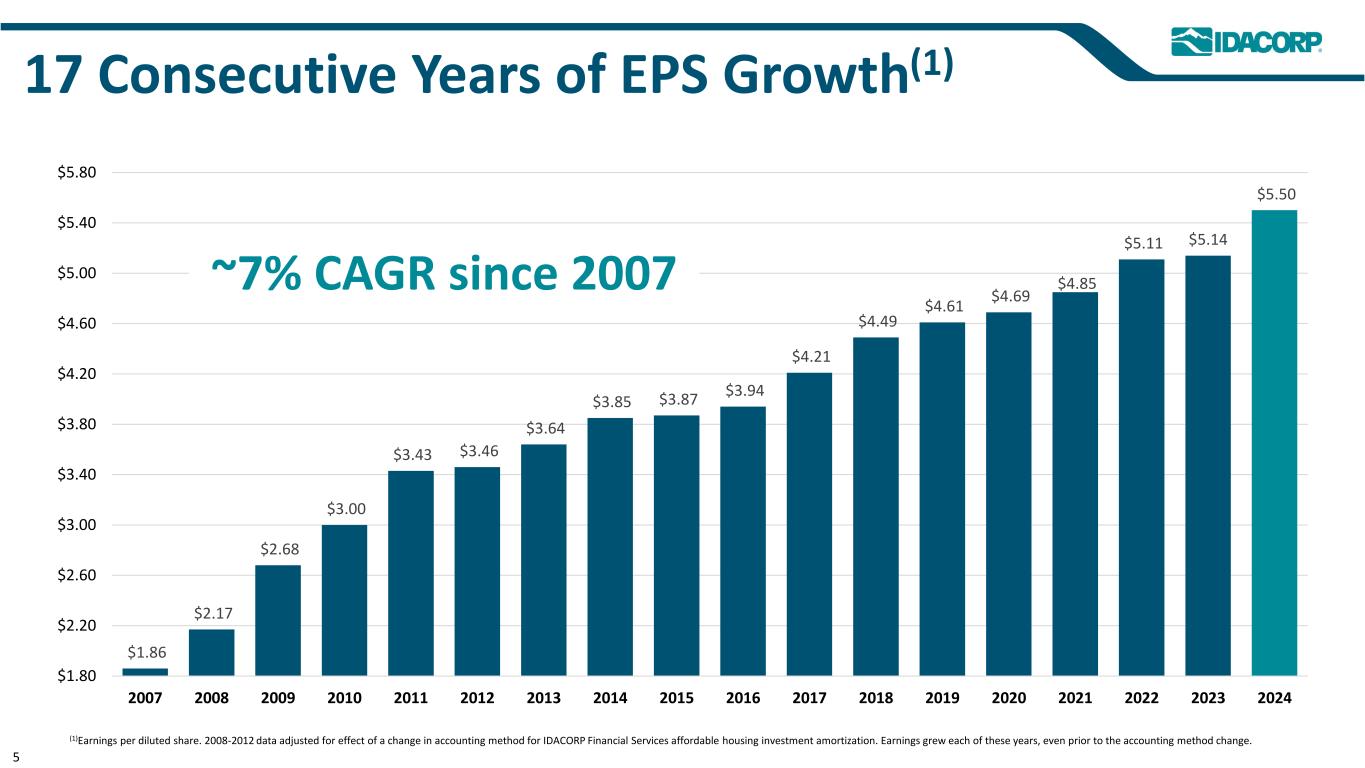
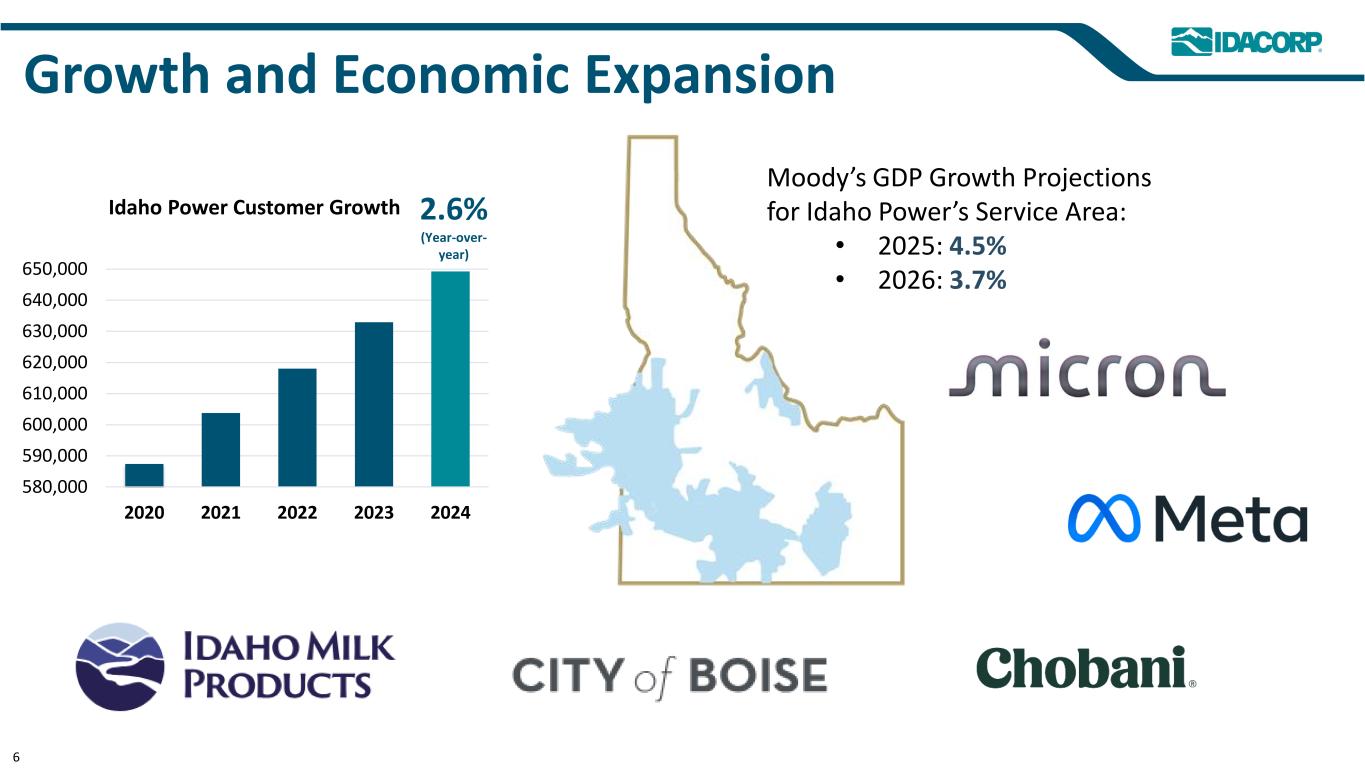
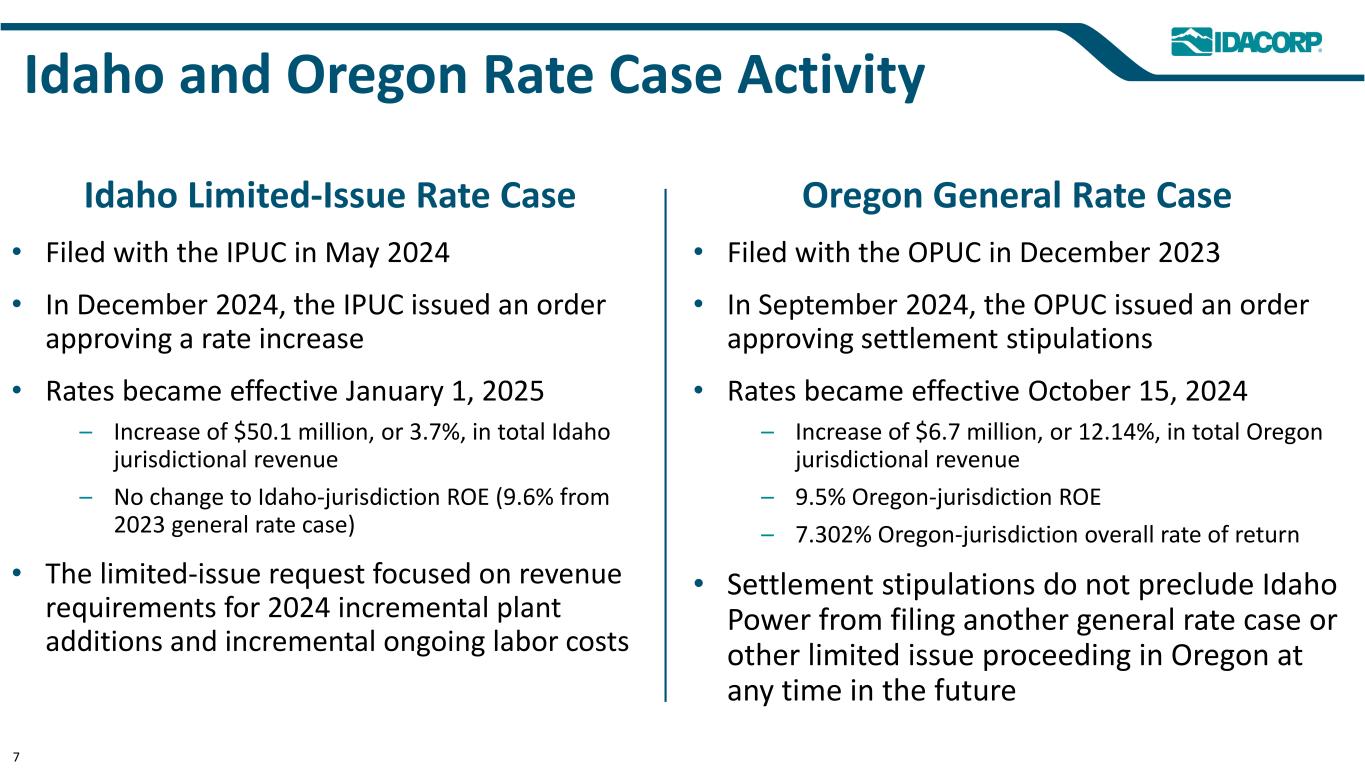
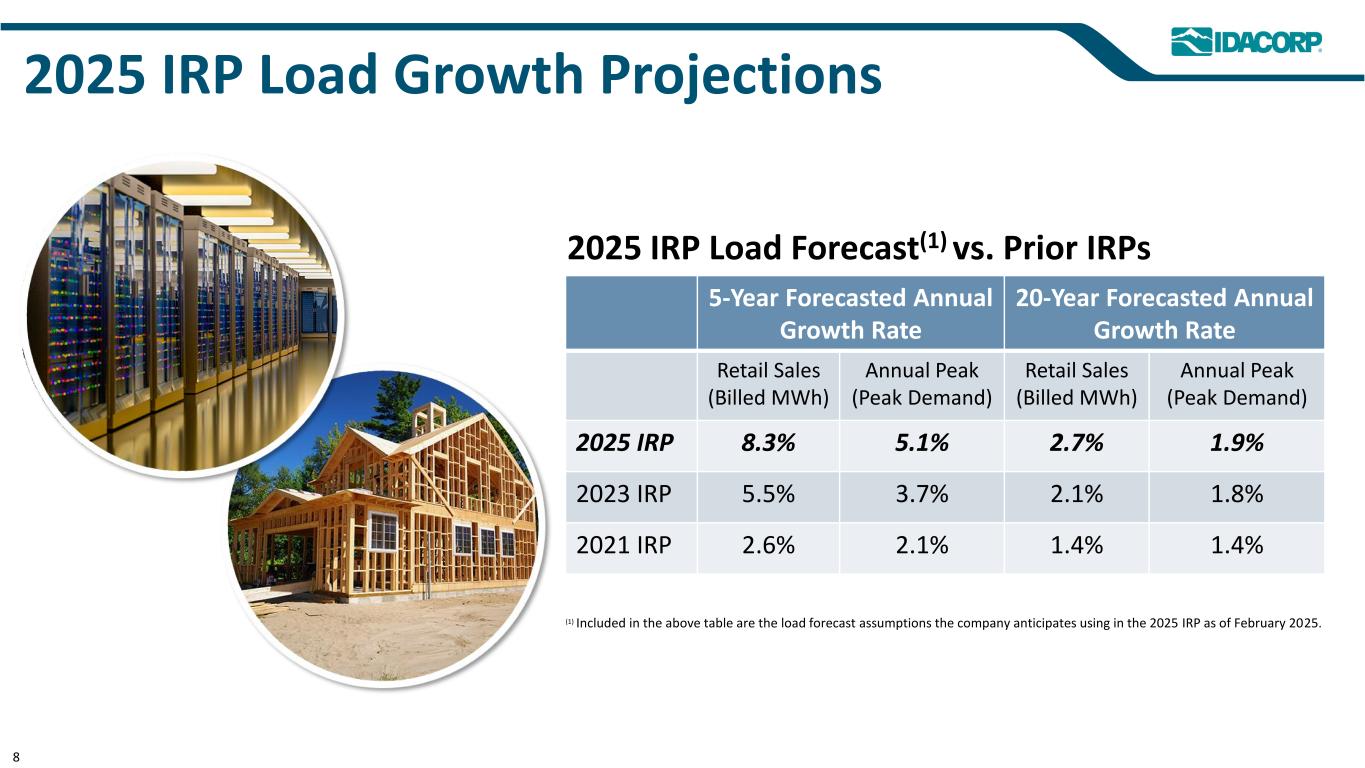
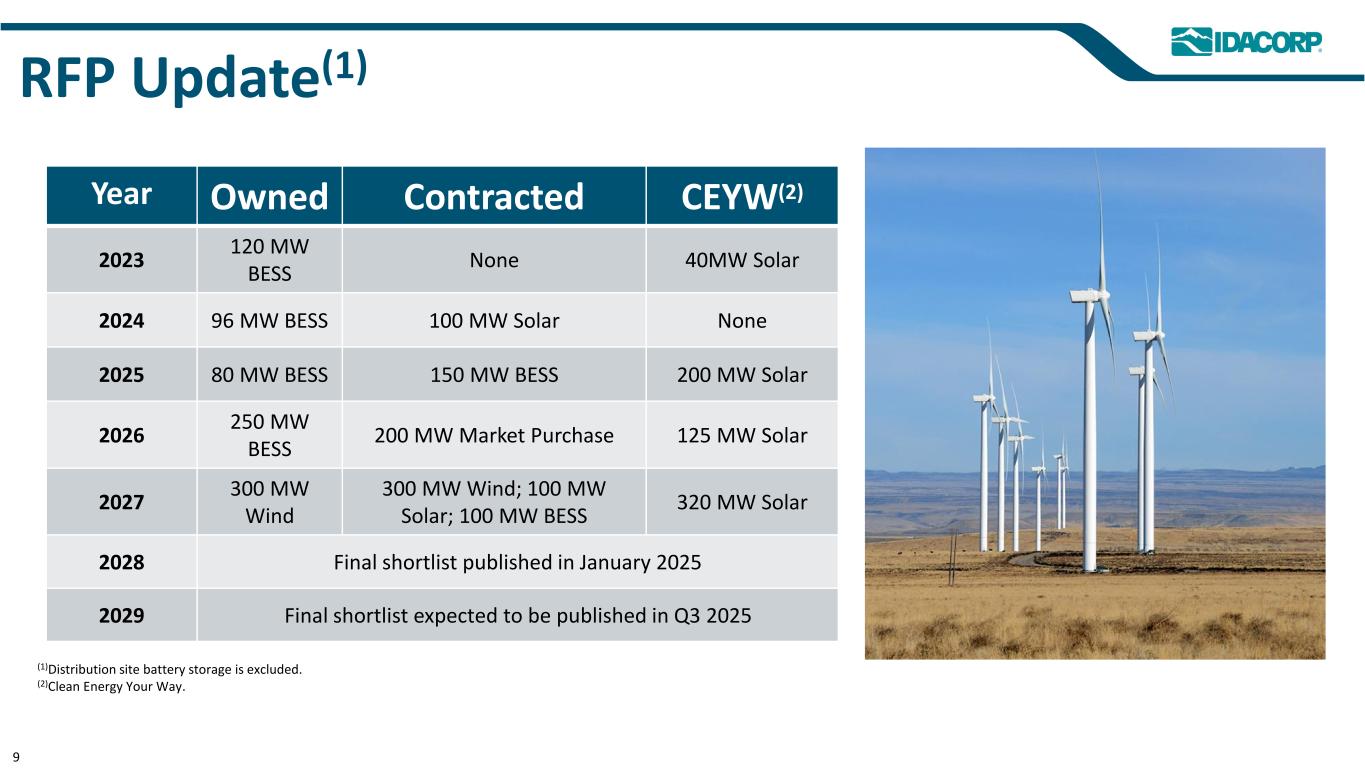
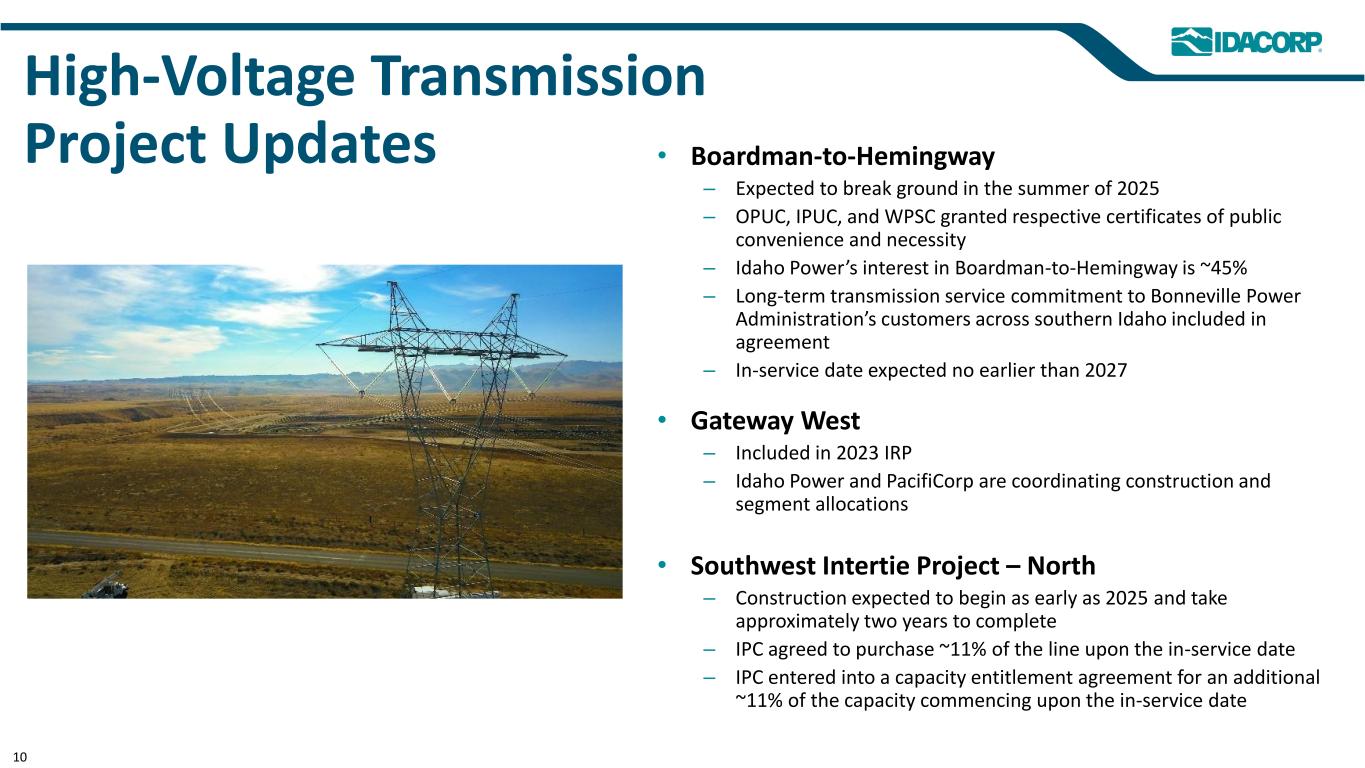
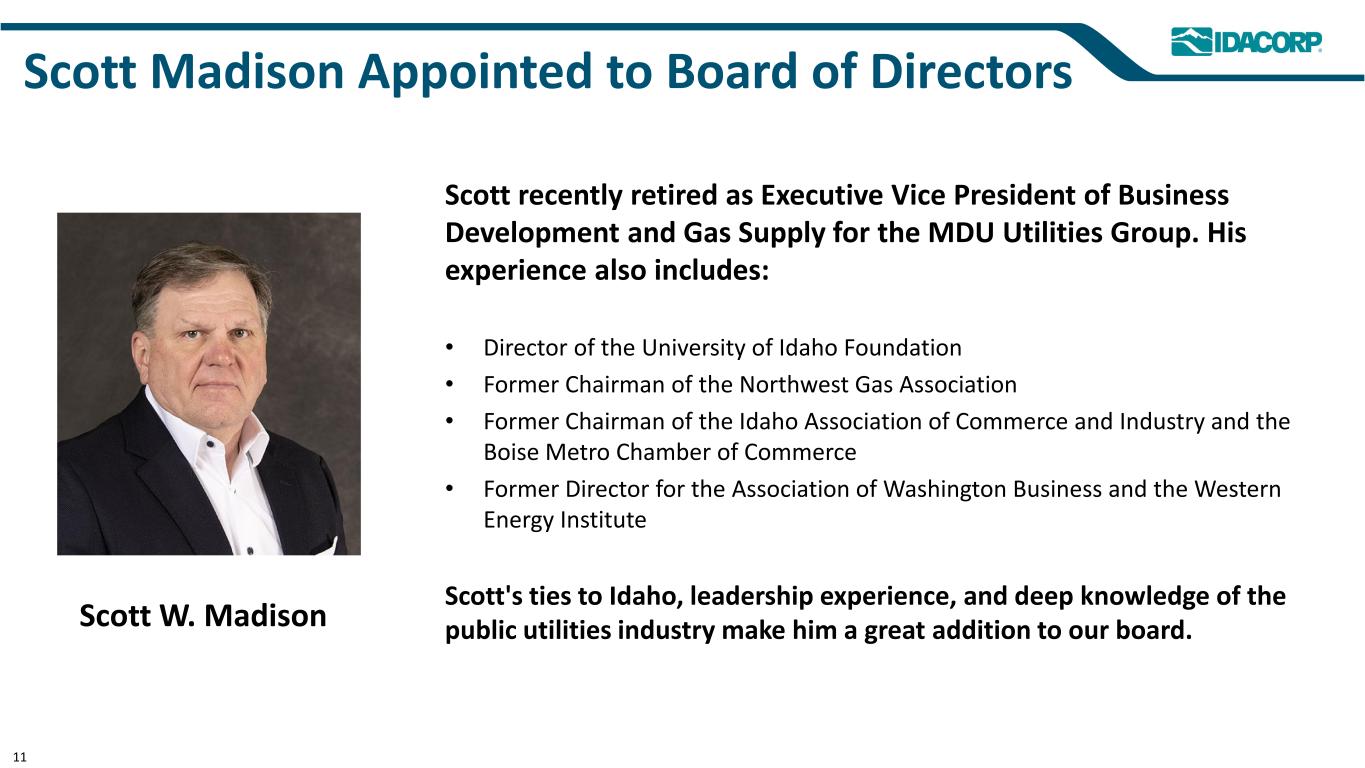
Thanks, Amy, and thanks to everyone for joining our call. We have many exciting updates for you, and I will begin by celebrating our dedicated employees for their commitment to safety and for the great work they did serving our customers and our owners. We're proud to share that we had our 17th consecutive year of earnings growth as shown on slide five. And we kept our customers lights on 99.96% of the time despite hot summer and increasing energy demand. In fact, we set new summer and winter peaks last year. As you can see on slide six, customer growth remains strong for Idaho Power. At the end of 2024, we served nearly 650,000 customers after experiencing 2.6% customer growth. We expect growth to stay robust as our local economy continues to outperform national trends as demonstrated by the major projects under development in our area. Moody's most recent GDP calculations for Idaho Power Service Area forecast growth of 4.5% in 2025 and 3.7% in In addition, Idaho's total labor force surpassed 1 million workers for the first time in December 2024. We continue to see strong interest from businesses looking to locate and expand within Idaho Power's service area. In addition to projects in some of our core industries of food processing, manufacturing, distribution, and warehousing, we've fielded numerous requests from large energy-intensive customers. These new projects would be in addition to our ongoing work with Meta and Micron. Idaho Power's work with those two customers is tracking ahead of schedule as we build substation and transmission infrastructure to support their needs. Last quarter, I referenced a couple of additional energy-intensive projects that signed generation and construction study agreements and were considering executing service agreements with Idaho Power. We didn't include them in our load forecast then. As an update, while the specific megawatts and online dates are confidential, one of those potential projects signed an agreement with us and were continuing discussions on the other project. For the project that did sign, we've now included their early ramp in our load growth estimate, although much of their load comes online after 2029. On another front, we plan to start our work on upgraded infrastructure development for Perpetua Resources' recently permitted mine in central Idaho soon, which will also be a large special contract customer. We've included Perpetua in our load forecast as well. We'll need to upgrade 75 miles of transmission line to support their operations, and that's in progress. As a reminder, our large load customers pay up front for upgrades necessary to interconnect, and we work closely with them to establish timeframes that will allow us to meet their energy needs while mitigating impacts to the rest of our customers. As our customers' energy needs grow, and we work to keep our infrastructure development on pace with that growth, our regulatory strategy is vital to financing our operations, being mindful of affordability for customers, and continuing to achieve excellent results for our owners. As seen on slide 7, our Idaho limited issue rate case reached its conclusion right at the end of the year, with the Idaho Commission approving an overall increase of $50.1 million, or 3.7 percent, effective January 1. This increase will help us recover some of our costs associated with infrastructure investments and labor expenses not included in our 2023 Idaho general rate case. The Idaho Commission has also been supportive of our significant investment in the safety of our communities through ongoing enhanced wildfire mitigation efforts. As a reminder, our 2024 Oregon general rate case reached a settlement resulting in an overall increase of $6.7 million, or 12.14%, effective October 15, 2024. This was our first general rate case in Oregon since 2011. We will need additional rate filings to collect the level of revenue necessary to finance our operations and allow for a reasonable rate of return. And to do that, we plan to file another general rate case in Idaho in 2025, likely around the middle of the year with rates expected to go into effect in early 26. At this point, we are preparing a full general rate case in 25 as opposed to the limited scope case we filed in mid-24. Customer affordability remains a focus as we grow and even with these recent rate increases our prices remain 20 to 30 percent below the national averages as sales growth offsets a large portion of the revenue requirement increases. As we prepare our 2025 IRP the latest five-year forecast for retail sales growth is 8.3% annually as shown on slide 8. That's a notable increase from the already significant 5.5% growth rate we had in our 23 IRP and the 7.7% preliminary number we shared on the third quarter call last year. That annual rate could continue growing if additional large load projects move forward within Idaho Power Service Area, though they would likely come online in stages closer to 2030, based on the scale of the infrastructure needed to serve them. With potential load growth of 8.3% or larger, it's easy to see why we continue to need additional resources. We've brought nearly 200 megawatts of solar and battery storage capacity online during 2024. Going forward, as shown on slide 9, we've selected several wind, solar, and battery projects as well as power purchase agreements to meet projected load deficits through 2027. This includes a 600 megawatt Wyoming wind project, 300 megawatts of which will be our first company-owned wind resource. We have initiated an all-sourced RFP for resources needed in 28 and 29. The shortlist for the 28 RFP was published in early January and includes some Idaho Power Projects. We expect to have an update for you on our Q3 call, if not sooner. On the transmission topic, as you can see on slide 10, we continue to make progress on the Boardman to Hemingway project and expect to break ground this summer, with an anticipated in-service date of no earlier than 27th. As for Gateway West, we continue to work with Pacificor to coordinate the timing of next steps to best meet customer and system needs. We anticipate a portion of the line in Idaho will be completed in 28 or later. Earlier this month, we entered into an agreement to become a partial owner of Swift North, a high voltage line that will run from the Robinson Summit substation near Ely, Nevada to our midpoint substation. Once the project is in service, Idaho Power plans to purchase an approximate 11% ownership interest. In addition, we entered into a capacity entitlement agreement for approximately 11% of additional capacity on the line over a 40-year term. We expect construction to begin as early as this year and take approximately two years to complete. Turning to slide 11, I'm pleased to share that Scott Madison has been appointed to serve on the Board of Directors of IDACOR and Idaho Power. Scott recently retired as the Executive Vice President of Business Development and Gas Supply for the MDU Utilities Group. Scott has been with MDU since 1997, and he brings extensive board experience and leadership in the areas of business strategy, finance, and customer service. His ties to Idaho and deep knowledge of the public utility sector make him a great addition to our board. I'll close with some good news on hydropower conditions. Our current snowpack above Brownlee is over 120% of average, and the other significant basins are trending above average as well. And we're expecting the snowpack to improve as snow continues to accumulate. A strong finish to the winter season will bode well for our hydropower operations, and it's so far been great for skiing as well. With that, I'll turn the time over to Brian.
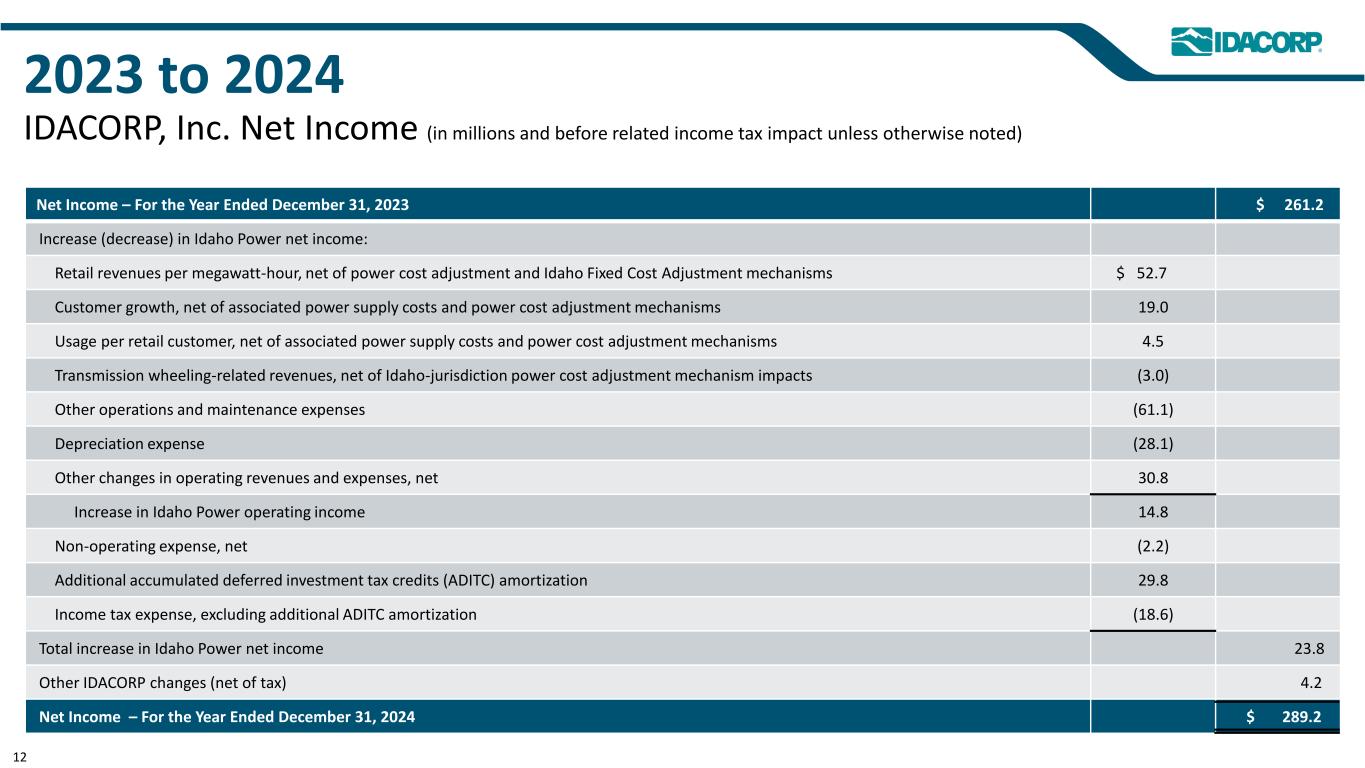
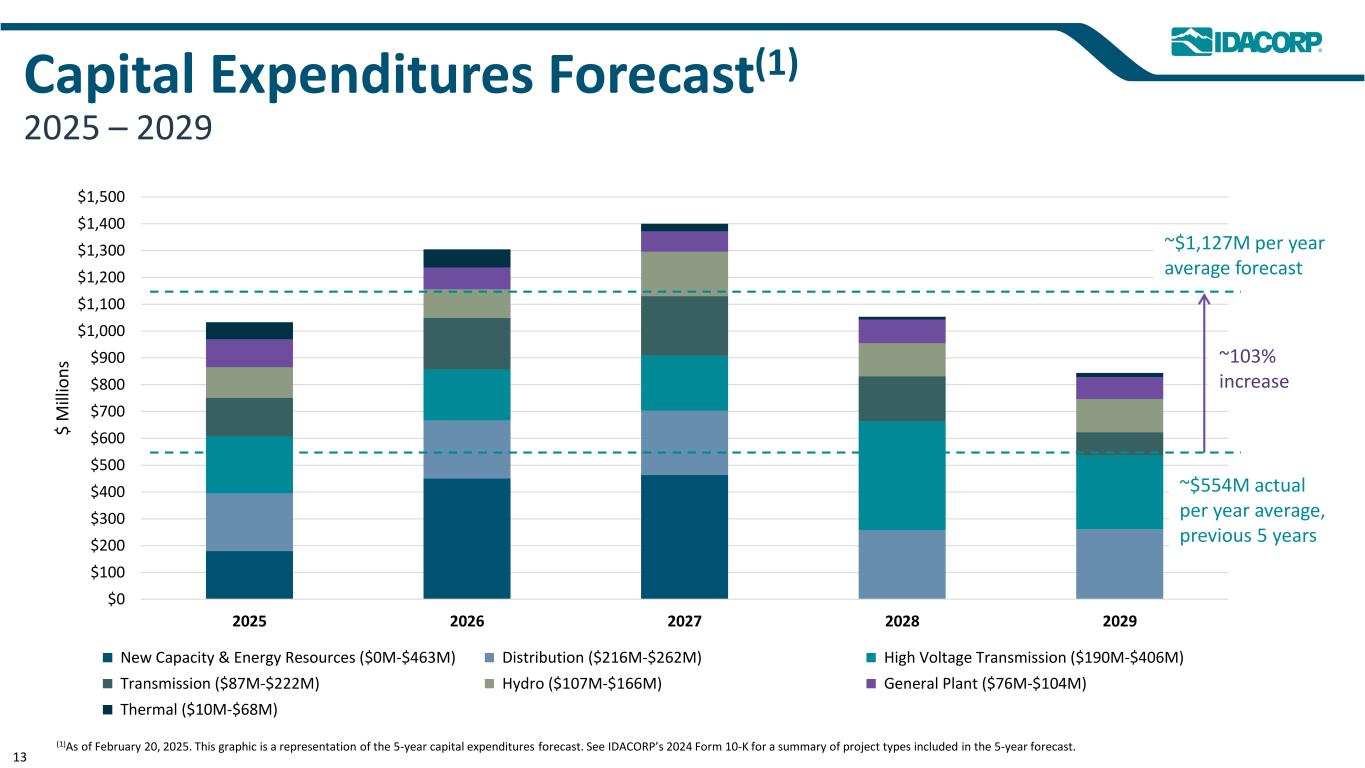
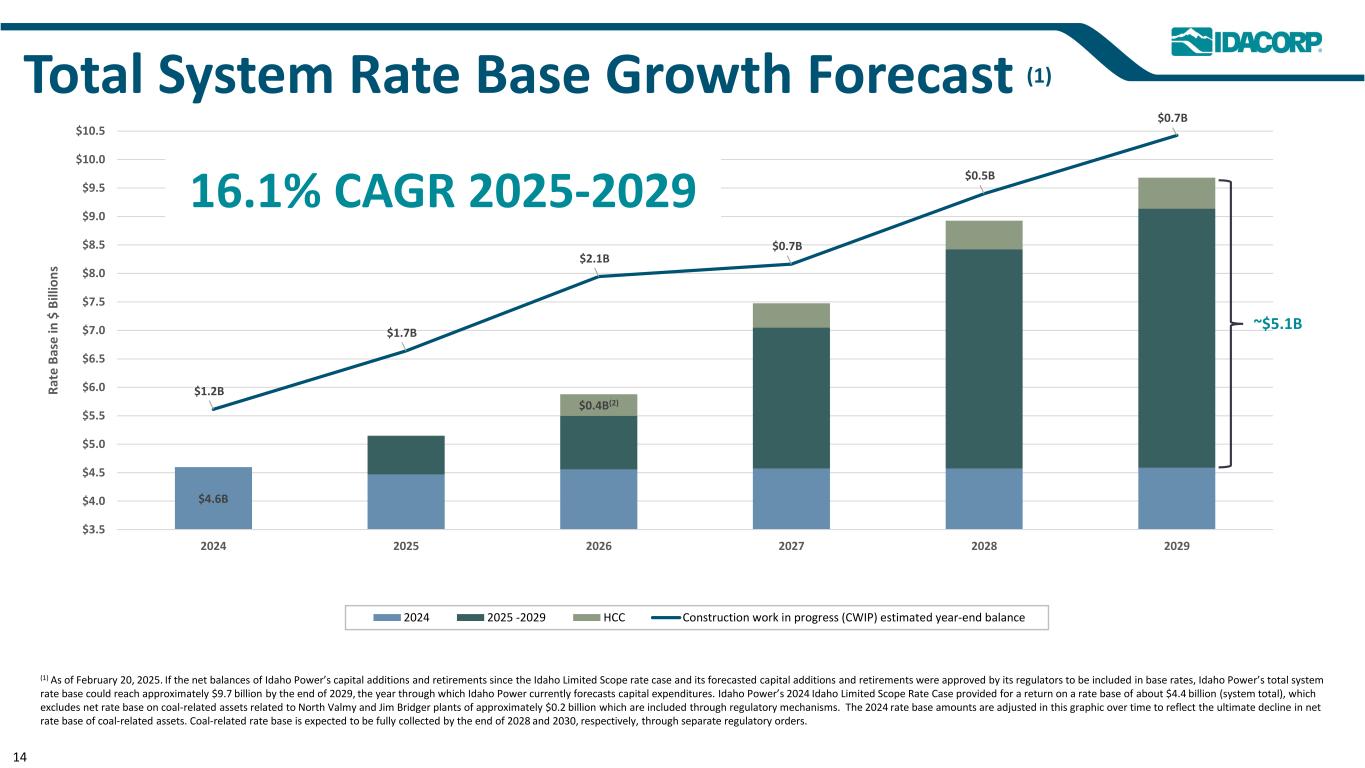
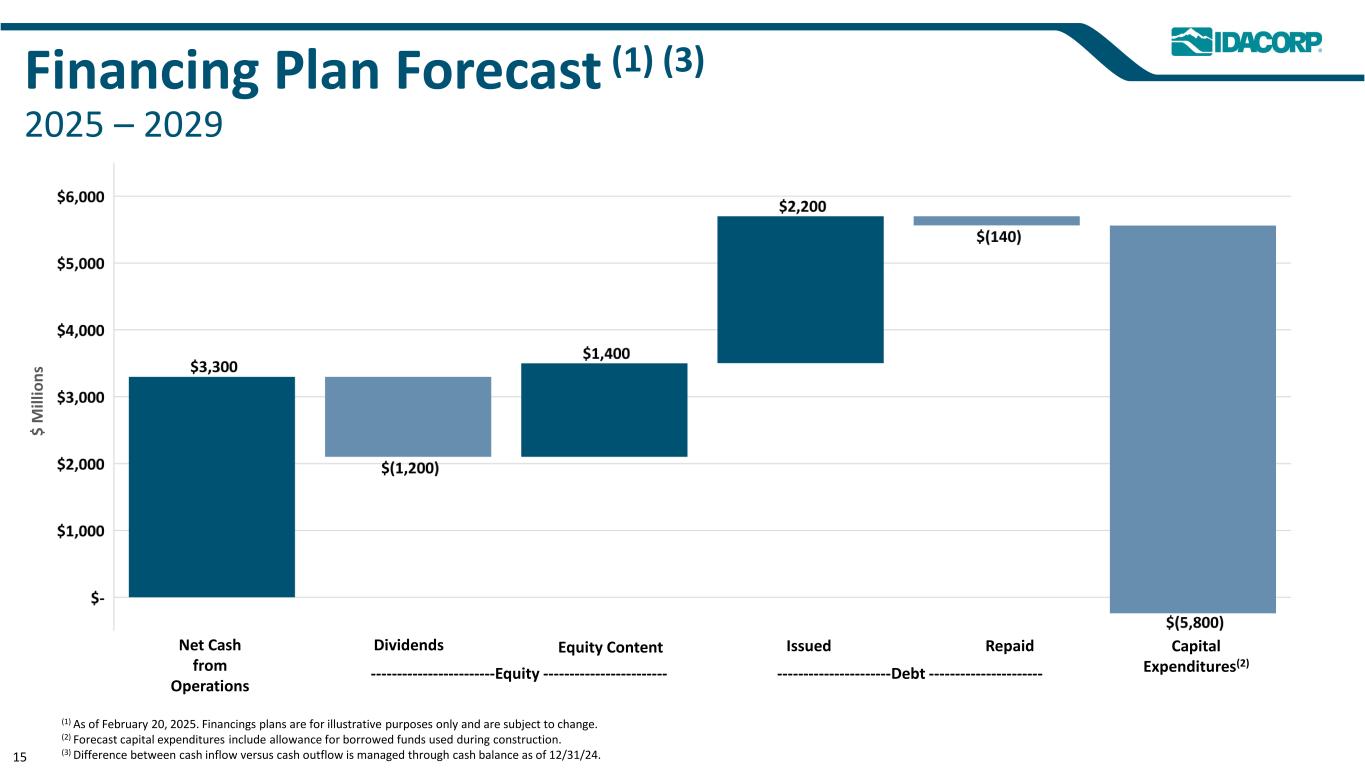
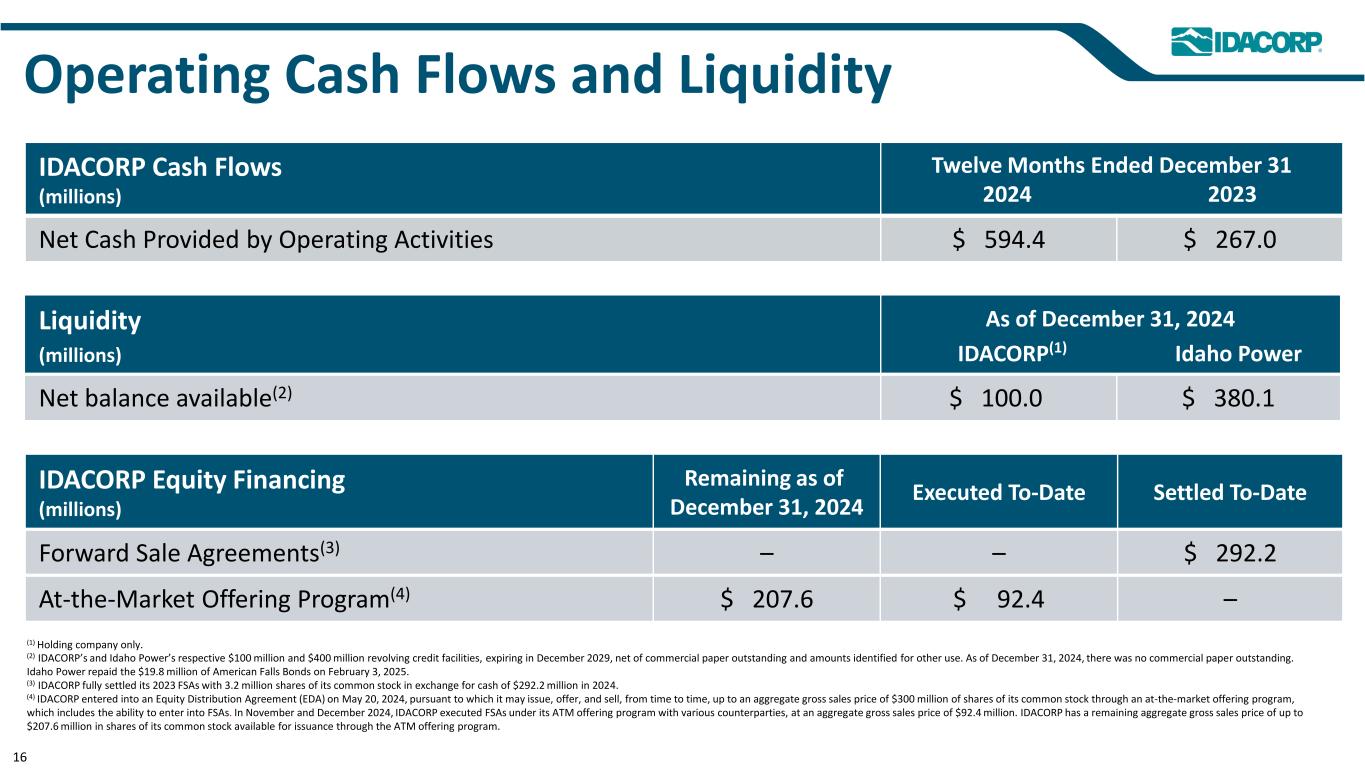
Thanks, Lisa. Hi, everybody. I'm going to start on slide 12 with our reconciliation of year-end results. If I had to pick three primary drivers for last year's results, I'd highlight strong customer growth, the rate changes, and the regulatory mechanism, which we actually used on the credit amortization side instead of on the sharing side. Looking ahead, I'd highlight those same items as some of our expected. Getting into the details of last year, Adicorp's net income increased $28 million compared to 2023. That was due to higher net income at Idaho. The benefit of customer growth continues to stand out in the usage on a per customer classes, with the exception of an increase for years. Overall usage was relatively high, 18-degree days. Total other O&M expenses, all that initially seen after formerly being recorded. Labor-related expenses, all $8.1 million for the year, which was an expected increase. On a net basis, other changes in operating revenues and expenses increased operating income by $30.8 million. This resulted in part from a decrease in net power supply expenses. that weren't deferred for future. More moderate wholesale natural gas and power in combination with higher decreased Idaho power. Non-operating expenses increased $2.2 million in 2024 on a net basis, mainly driven by an increased long-term debt balance. And then partially offsetting those items we're in. Historically, we've shared $127 million with our customers under the Idaho regulatory mechanism. Last year, for the first time since that mechanism's been in place, the ITC amortization, which was mostly the result of relating to taxes, the $18.6 million relative. Moving on to slide 13, we've updated our five-year CapEx forecast, spending $1.1 billion pre-25 to 2029 forecast period, and a total five-year CapEx. So that's basically a doubling of our average. If you look at the cash flow statement, you'll see additions to $1 billion. We've been over the path flowing down. I'd say to the contrary, we expect with what we've stated in the past, we take a conservative approach to reporting our capex expectations. We don't include capital in our forecast until we're relatively certain it will materialize. And because of that, there's still potential upside to our forecast. As Lisa mentioned, we recently developed the final and we've also begun evaluating bids for the 2029 RFP projects. We have Idaho Power projects on the shortlist for the 2028 RFP, but because we haven't made final selections, we don't include any of those RFP projects. Depending on the results from the RFPs, Lisa also mentioned that Idaho Power signed an agreement with an additional large load project at the end of last year, and also one with the mining company Perpetua, and that our discussions are ongoing with potential additional large. The results of the 28 and 29 RFPs will be helpful in serving those loads, and they could also culminate into additional capex further. Building the needed infrastructure is just one element. We also need to convert it into rate-based to keep the utility financially healthy. and we rolled forward our rate-based forecast for the 2025 to 2029 period, which coming out of our most recent Idaho case, our rate base at the end of 2024 was about $4.6 billion. When we roll forward to 2025 and pull 2029 into the forecast window, we estimate rate base increasing by around $5.1 billion by the end of 2029, which is more than doubling our rate base in that five-year span. When we layer on our updated estimated rate-based addition, aligning with the outcome of our last Idaho rate case, our current projected rate-based category is 16, and that's, again, before factory. That's a tremendous amount of growth, and for that, we'll need growth capital. We have a strong balance sheet now. The amount of external financing we estimate in the plan is about $1.4 billion in equity and about $2.2 billion in debt to stay at that ratio. amount of our external so one caveat on that and not a bad thing for the equity side we have an atm program in place and that's been a cost-effective and efficient method for us to issue equity comes to fund a considerable amount of our equity needs over the next several years and as we noted on slide 16 we sold around 92 million dollars of equity on a forward basis under the atm in the fourth quarter we'll plan to draw on that sometime also on slide 16 cash flow from operations improved substantially from last year. Nearly $600 million of operating cash flows in 2024, which was close to a net $325 million comparison. The June 23 revenue benefit of the Idaho general rate case outcome and a notable moderation impacted to that. And those cash flows also helped reduce our financing needs and leaves IDACorp with a strong cash position. I'm going to wrap up by reiterating two key points I mentioned last quarter. First, the importance of maintaining affordability for customers just as a reminder the thoughtful and constructive regulatory construct in idaho looks to allocate appropriate and customer growth in the denominator of our owning long-lived assets and being efficient stewards of the company's capital and second as i said on the last call earnings quality profile as you've seen the regulatory process has an element of lag particularly in this environment of high cap but i used the phrase we'll keep focusing on solid execution in this period of enormous growth and what we do with that i'm going to turn over to john to step through our 2025 guidance and estimated key operating metrics thanks brian i'm excited to join the ir team and i look forward to meeting many of you in person in the coming weeks as we will be out and about brian and amy asked me to share an interesting fact about myself
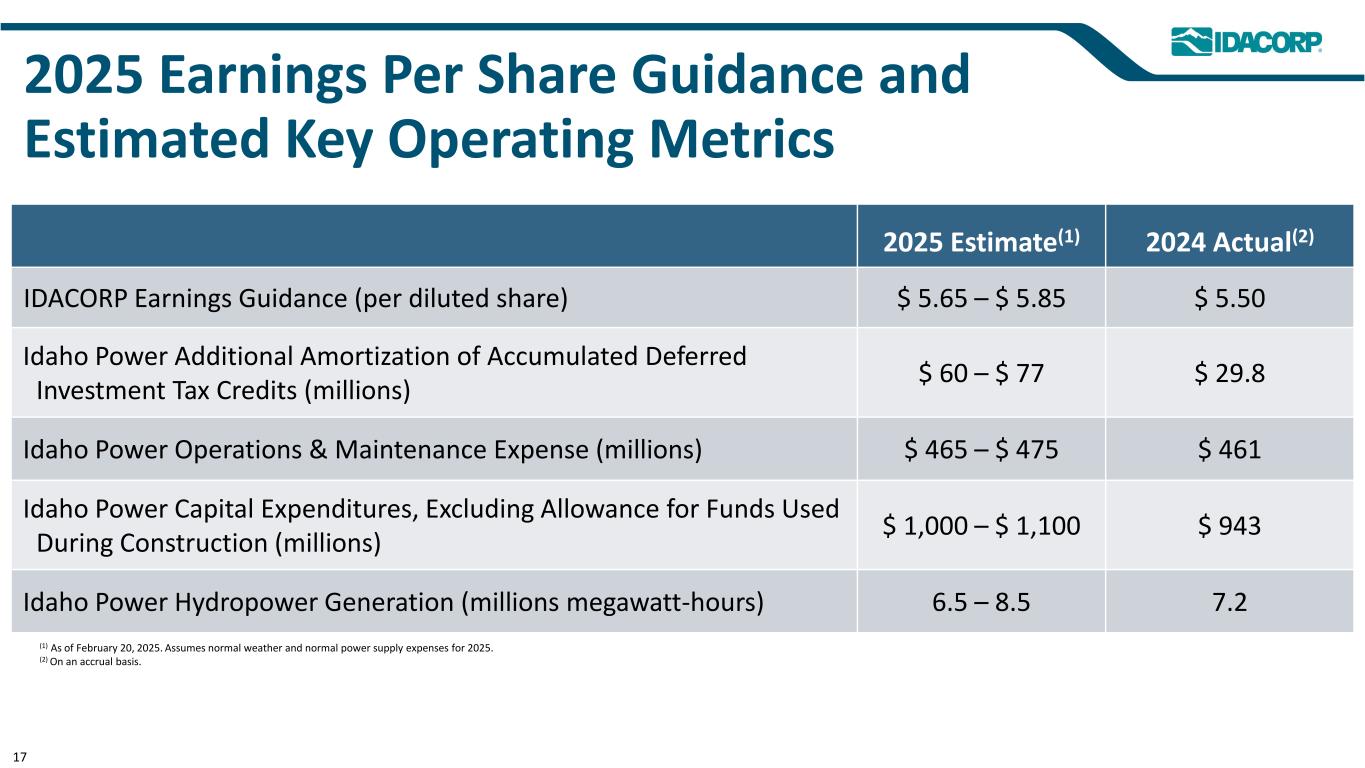
as part of my introduction so i want to share that i am a third grade assistant basketball coach which is a fantastic opportunity for me to develop patience, persistence, and positivity. Slide 17 shows our 2025 full-year earnings guidance and key operating metrics. This guidance assumes normal weather throughout 2025 and normal power supply expenses. We expect IDACORP's diluted earnings per share this year to be in the range of $5.65 to $5.85, with the assumption that Idaho Power will use $60 to $77 million of additional investment tax credit amortization. That $77 million top end is what we currently have remaining in the mechanism. though we could file an application requesting that the Idaho PUC allow Idaho Power to add additional credits to the mechanism, legacy credits on our balance sheet or credits from current battery projects. We expect full-year O&M expense to be in the range of $465 to $475 million. We anticipate spending between $1 and $1.1 billion on CapEx in 2025. As the five-year forecast showed, we expect to see these higher CAPEX numbers for the next few years as we continue to respond to growth in our service area. Finally, given our current forecast of hydropower operating conditions, we expect hydropower generation to be within the range of 6.5 to 8.5 million megawatt hours for the year. We have solid carryover from our prior year, and snowpack so far this year has been favorable with the storms that have been rolling through lately. With that, we're happy to address any questions you might have.
Operator
Thank you. We are now ready to begin the question and answer session for attendees who have joined the Q&A line. If you would like to ask a question, please do so by pressing star 1 on your phone. Please ensure that your mute function is turned off before you ask your question. We will take as many questions as time permits on a first-come basis. Once again, that is part one on your phone to ask a question now. One moment, please, for your first question. Your first question comes from the line of Alex Mortimer of Nezuko Securities. Please go ahead.
Hi, good afternoon, team. So, you mentioned, you know, just a couple seconds ago, you mentioned the potential filing to replenish the ADITC mechanism. Can you just discuss a little bit of what that process would potentially look like?
Well, I think there's a couple of ways that we could do that. You know, if we included it in our general rate case request or if it would be a separate filing, we are still working through those details.
Okay. Thank you. And then I guess, you know, turning to the FFO, to that side, can you say where you ended the year from a credit metric perspective and then how you think you, you know, look to be tracking in the future, given that seems like period-end rate-based treatment, you know, kind of seems unlikely given how the last case went? And then finally, just any conversations you've had with rating agencies following, you know, the conclusion of the rate case?
Yeah, Alex, this is Brian. So just to answer your first question, where we ended up for 2024 on Moody's, I would say we ended up near 18%, slightly lower. For S&P, the numbers were a little lower, probably some diminishment for coming in at 600 million dollars that's unlikely to be somewhat and then also we I would guess an issue and so a little reduction and then we do have a downgrade threshold in terms of conversation next week it was a good rate case wonderful thank you so much I'll leave it there congrats on a great
Operator
year thank you our next question comes from the line of David or Carl Morgan family please go ahead hi David oh it looks like sorry about that talking to myself there.
Speaker 7
Thanks so much for taking the question. Reflecting on the regulatory backdrop here in the outcome of the rate case, I was wondering, do you still see an opportunity to shift to a period-end rate-based framework with the Commission in the future, or should we be thinking potentially that capital trackers might be another avenue to pursue? I'm curious your latest thoughts.
Well, I think we're looking at all options, and the Commission was open in their order for mechanisms or some other ways to narrow the regulatory lag, so, you know, I think we continue to explore all those options.
Yeah, and this is Brian. I would just add to that that, you know, as Lisa mentioned, everything's on the table. I wouldn't say that period on rate base is off the table. You know, the commission has a mindset of a healthy utility for us. And as we looked at the case from last time, I think we made a pretty reasonable ask of what we needed on a conservative basis. In a limited scope case, a period end rate base wasn't something from that. But in a more general broad rate case, we'll be exploring that as we go forward. And it also doesn't prevent us from filing some.
Speaker 7
Okay, got it. That makes sense. And then I was wondering if you could maybe elaborate a bit more on the incremental load growth that you're seeing. Are there – you mentioned a couple of customers and even some more large load customers in the works. What are you seeing from any data center activity in your service area? And are there certain industry verticals where you're seeing particularly strong incremental new projects looking to site in your service territory from here? certainly doesn't sound like growth is slowing down.
Yeah, I would say it's a good challenge to have for sure. And we're seeing it across a lot of industries. But yes, we've been talking a lot about the meta data center that's under construction. And there is interest in others that are from that same industry. So I think they're sort of everywhere asking all utilities what they can do. But I think as far as agriculture, mining, healthcare, there's some very large projects that are going in all around our service area. Adam, what would you add?
I think you covered most of it. Maybe two additional ones on the dairy side and also on the biodigester side and really just basic manufacturing in general. So I think data centers and the loads you see there are the largest, but we're seeing a steady inquiry.
Speaker 7
Okay, great. Yeah, it definitely sounds broad-based. Much appreciated.
Operator
This question comes from the line of Chris Ellinghaus of Speedbird Williams-Tramp. Please go ahead.
Hey, good afternoon. address you know your thoughts on the executive orders from Washington so far and do any of the orders you know sort of change your thoughts on generation mix going forward at all well as everyone is trying to do we're waiting to see you know sort of which ones go into effect and which ones don't we're actively monitoring all of them.
You know, we're hopeful that maybe some of the permitting and siting might get a little bit easier going forward. That has certainly been a very big challenge for any kind of infrastructure, and, you know, anything that would streamline those processes would be very helpful. As far as the mix, certainly we use a least risk, least cost, analysis in what gets chosen in the preferred portfolio for our IRP. So at this point in time, we don't necessarily see that it would change what we're planning, but depending on sort of how the tax credits and some of the funding through the IIJA or IRA, what ends up happening there could change some of that IRP planning for sure.
Okay. Maybe, Chris, I think you covered the main issues. Lisa, I do think there's maybe going to be fewer restrictions on the thermal side. There's been a fair amount of talk about that. And then, obviously, potentially a changing in position on the Clean Air Act. So we're keeping an eye on those. And so far, they look like they may be beneficial at the end of the day from a resource perspective.
And I don't think we've seen the last of all of them either. so we will continue to monitor that's helpful can you characterize your fourth quarter weather a little bit for us you know it was it seems like it stayed warm for a while and then it got really cold so I think it was also a little bit surprising that we had snow the you know right after Thanksgiving which was kind of not forecasted and pleasant surprise for those of us that like to recreate out there. So I think in general, I don't know that historically it was a wide variation. It felt sort of like a normal winter and late summer.
Okay. When you put together the 2.7 percent, you know, load growth forecast, do you include anything in that number for some of the large loads that remain sort of in loads to this point?
Yeah, we're very conservative before we add prospective loads into our load forecast. So generally, it's a signed agreement or one that's really close to being signed. So we usually have historically put only loads in that have a very high degree of certainty.
Yeah, Chris, this is Adam. At the end of the five-year period, kind of going in five-, six-year period of that 20 years, you'll see a little bit of that just because some of these large loads extend into that period. But beyond that, it's typically a load forecast load.
You know, sort of, I don't know how many years, last three, four, five years, you've seen an acceleration to a degree in your customer growth. um can can you separate out you know can you tell which portions of customer growth are coming from say in migration versus you know new customers coming in to support the business development in the region do you get any sort of clarity on where what the source of your new customer growth is?
So, I would say, you know, it's heavily skewed to the large commercial and industrial. Some of it's coming from out of state. Some of it is current customers expanding. But the in-migration of residential customers is actually fairly modest when you compare it against the sort of oversized impact of the large commercial and industrial customers.
There are hundreds of megawatts so it just it would take a lot of single-family homes to make that up and by percentage sure yeah typically if you look at that 8.3 it's around a percent at one last thing Brian you were talking about line item property tax refunds from some litigation I think you said was that in a particular period and And can you give us any kind of sense of the magnitude of what that looked like?
Yeah, Chris, that was over a three-year historic property tax period, if I remember correctly. Sort of a one-time event that we litigated the valuation methodology for those. And based on that, a pre-tax note.
All right, thanks a bunch. Appreciate it, guys.
Operator
The next question comes from the line of Julian Des Moines-Smith of Jeffries. Please go ahead.
Speaker 0
Hi, good afternoon. Actually, Brian, you're so on for Julian. Hey, just to clarify, the new rate-based disclosures that are illustrated on the slide, is each year now the average rate-based versus year-end to correlate with the rate case order and the 2024 rate-based that you're showing, which I believe is average, but is every year average rate-based?
Yeah, Brian, this is Brian. And so, the 2024 number that we're premising it on is the outcome of the rate case, which used an average methodology. And then, as you go on a go-forward basis, we did assume more.
Speaker 0
So, you've now switched to an average rate-based approach. Thank you. And then, I'm just curious, with the increased load forecast of 8.3%, does the 28 and 29 RFPs enough for that? Or should we expect a 2030 RFP to follow? Okay. And is the IDA proposed bids in the 2029 RFPs, is that baseload generation project? Okay, great. And then you mentioned the Swift North interest of 11%, I think it's a $1 billion project. Are there any milestones left before construction begins? And then when would IDACORP's financial commitments be necessary? And then I assume that is incremental to the CapEx forecast.
Yeah, this is Adam again. You're right. The public figure, I think, is 1.2 in that. It ends up being around 4 million plus a mile. They received a record decision. It's actually a permit that we owned idle power back in the day, and we sold it when we did see the growth, and now we're seeing the growth again. So we're getting back to fall 85 miles this year.
And Brian, the answer to the last part of you.
Speaker 0
Okay, it's in the CapEx. And then just while we're on transmission, I know Boardman to Hemingway is a preferred resource in your IRPs. Is there a risk of, you know, further delays of the, not just construction, but at the actual start date when we're moving to Hemingway? How do you, you know, mitigate the risk of the capacity that that transmission line was going to provide? Could that be done in another RFP or would you just source it on the wholesale markets?
It's a great question, yeah. would it would probably be through another rfp the wholesale markets have been uh pretty tight um and so we look at the 2028 2029 rfps and if we start to get concerned that b2h will get held up we would pull the trigger and look at additional reasons but we are feeling good about um you know working our way to the construction date to get this this line started after a long journey so So we feel good about the project. We've hit some pretty key federal permitting milestones. We're close to hitting another key state milestone. Materials are coming in, and they're coming to our staging area. And so construction in the summer is looking pretty good at this point.
Speaker 0
All right, understood. Thank you very much.
Operator
And a final opportunity. Press star 1 to signal for a question, and we'll pause this for a moment. There are no further questions at this time. That concludes the question and answer session for today. Ms. Groh, I will turn the conference back over to you.
Well, thanks to everyone again for joining us today and for your continued interest in IDACOR. I hope you all have a great evening.