Operator
Good day, ladies and gentlemen, and welcome to the Nauticus Robotics 2025 Q1 Earnings Conference Call. At this time, all lines are in listen-only mode. Following the presentation, we will conduct a question-and-answer session. This call is being recorded on Thursday, May 15, 2025. I would now like to turn the conference over to Kristin Moorman. Please go ahead.
Speaker 1
Thank you, and good morning, everyone. Joining me today and participating in the call are John Gibson, CEO and President; Vickie Hay, Interim CFO; and other members of our leadership team. On today's call, we will first provide prepared remarks concerning our financial and operations results. Following that, we will answer questions. We have now released our results for the first quarter of 2025, which are available on our website. In addition, today's call is being webcast, and a replay will be available on our website shortly following the conclusion of the call. Please note that comments we make on today's call regarding projections or our expectations for future events are forward-looking statements. Forward-looking statements are subject to a number of risks and uncertainties, many of which are beyond our control. These risks and uncertainties can cause actual results to differ materially from our current expectations. We advise listeners to review our earnings release and the risk factors discussed in our filings with the SEC. Also, please refer to the reconciliations provided in our earnings press release as we may discuss non-GAAP metrics on this call. I will now turn it over to John.
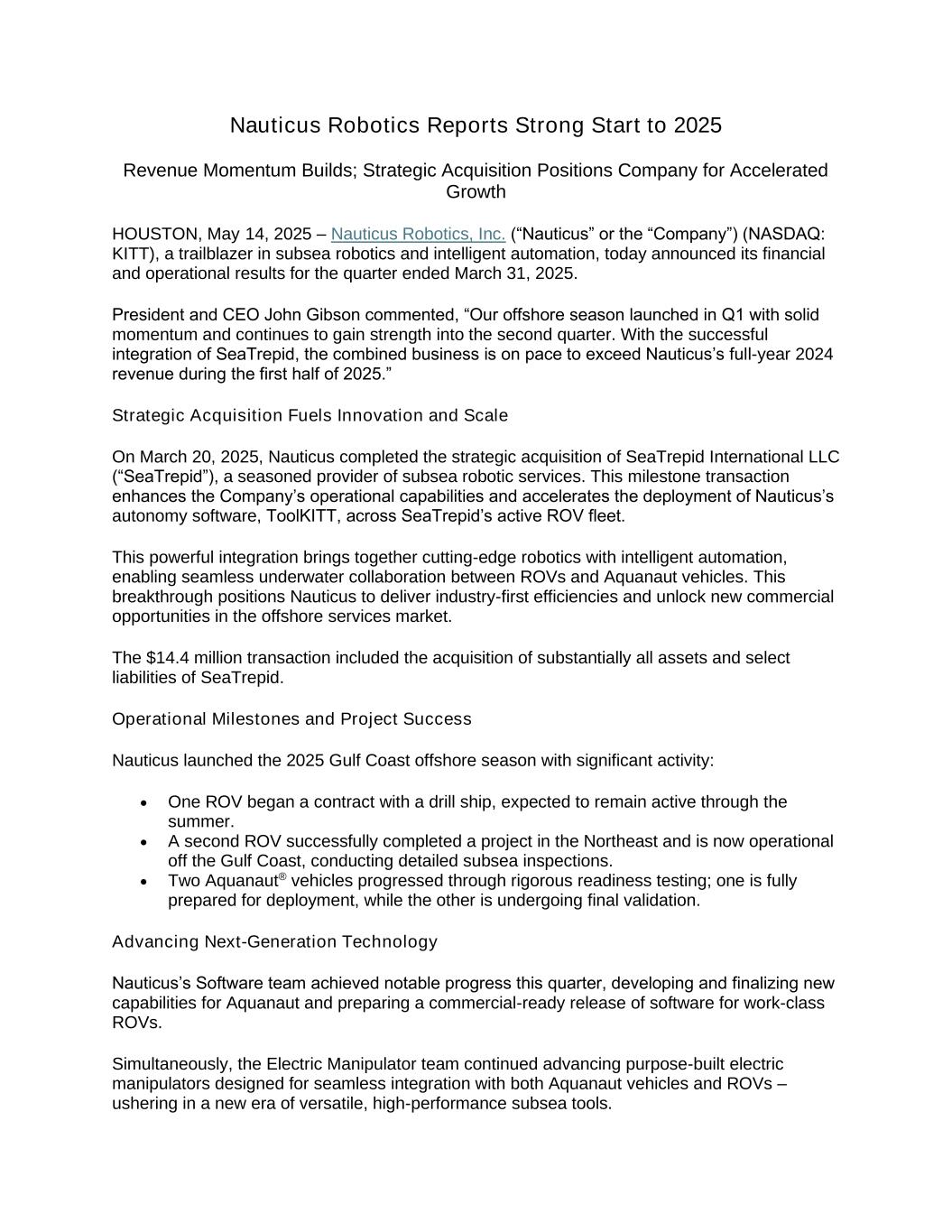
Good morning, and thank you for joining us. Today's call comes at an exciting time for Nauticus Robotics. With the successful acquisition of SeaTrepid in March, we've entered a new chapter marked by operational scale, expanding commercial opportunities and growing demand for our autonomous subsea technologies. Over the next few minutes, you're going to hear from our executive team on our first quarter financials, operational progress and our emerging pipeline of offshore work all pointing to a business gaining momentum and maturing rapidly. While Q1 results reflect the seasonal nature of offshore work and the timing of our acquisition, the quarter also marked the beginning of our 2025 offshore season and the formal start of our integration efforts. Early signs are encouraging. We've mobilized equipment, secured extended contracts and are seeing enthusiastic interest in our Aquanaut platform from both existing and new customers. The conversations have shifted from what if to how soon and that signals real traction. Now to turn it over to team Nauticus to explain how we intend to meet the growing demand for safer, smarter and more sustainable subsea solutions. With that, I'm going to hand it to Vickie, our Interim CFO and let her get us started on the financial side for Q1.
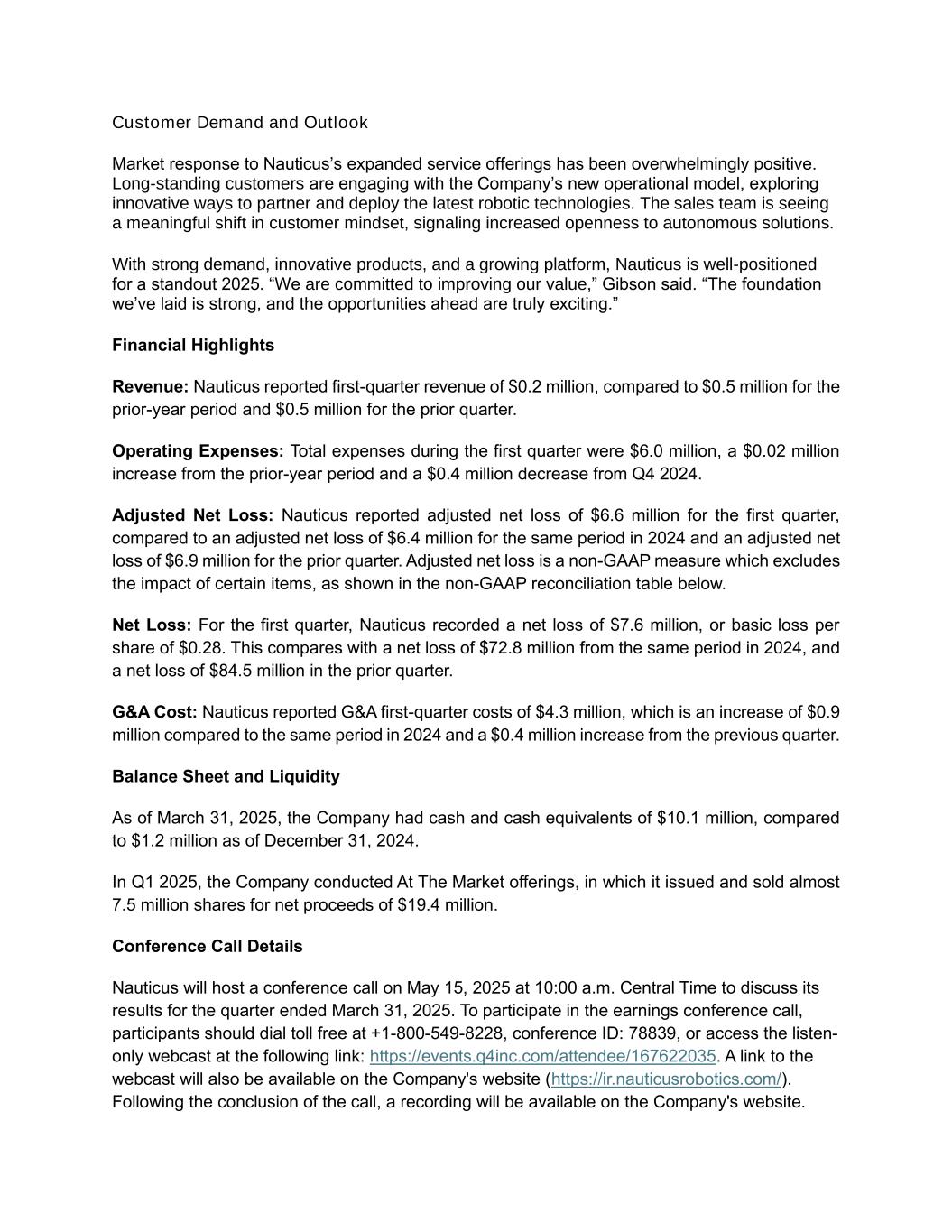
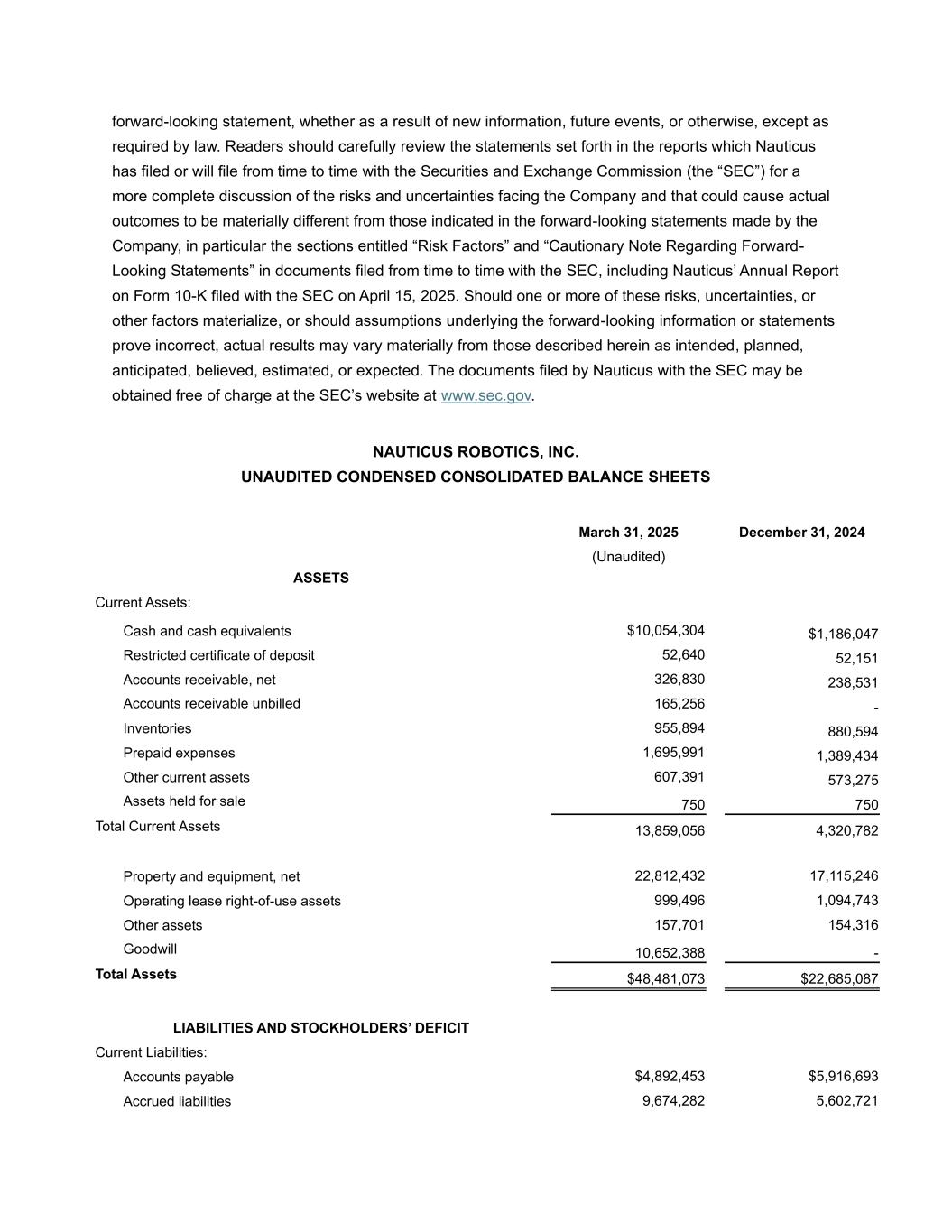
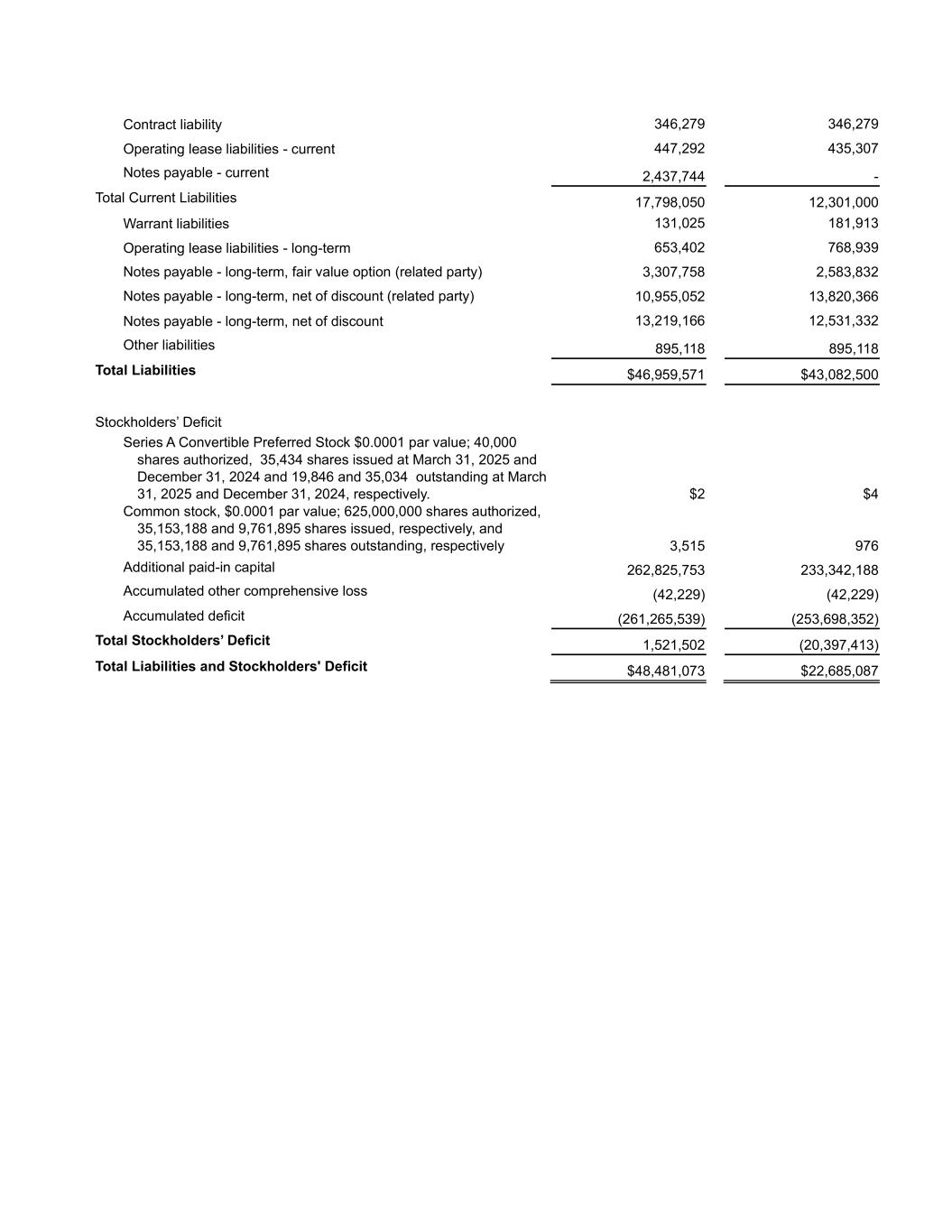
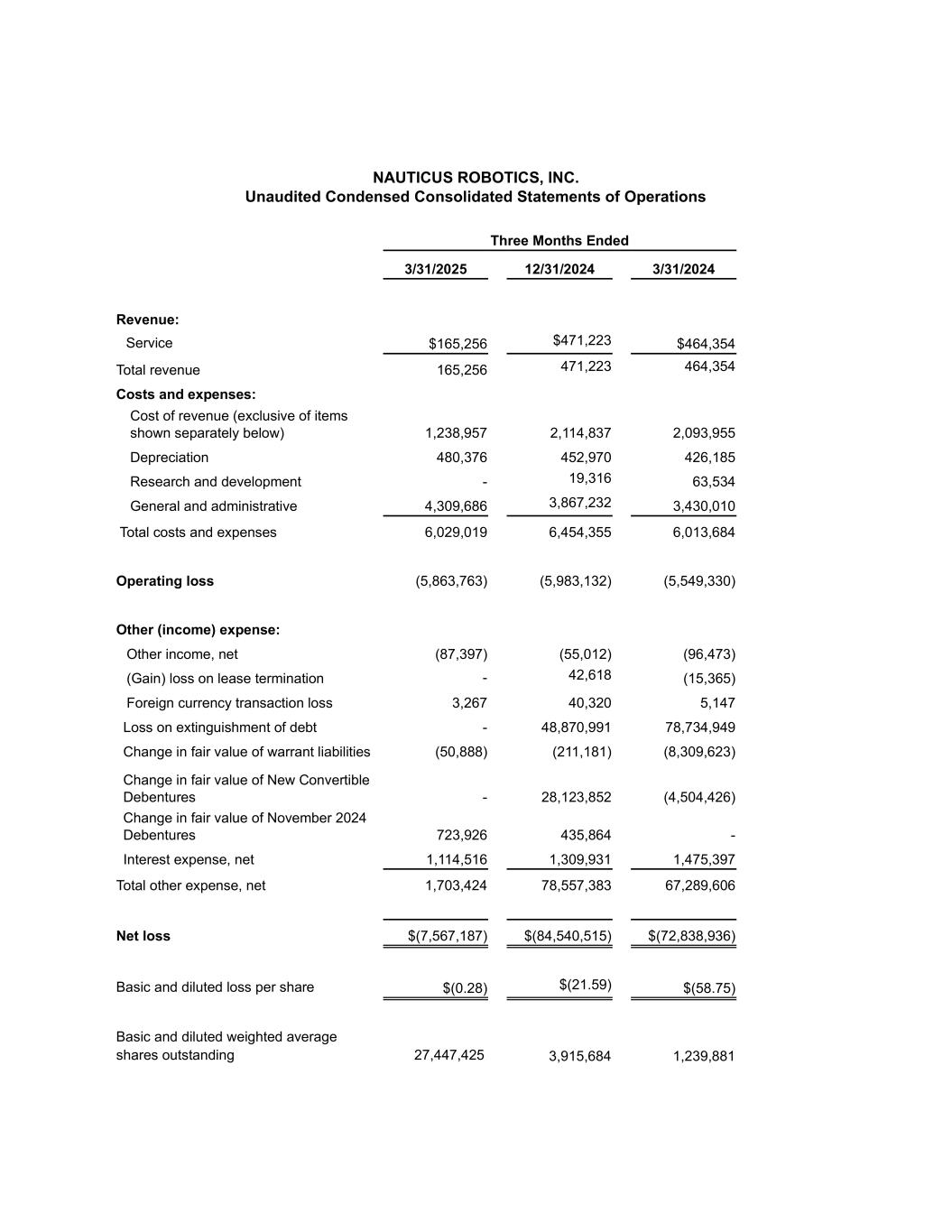
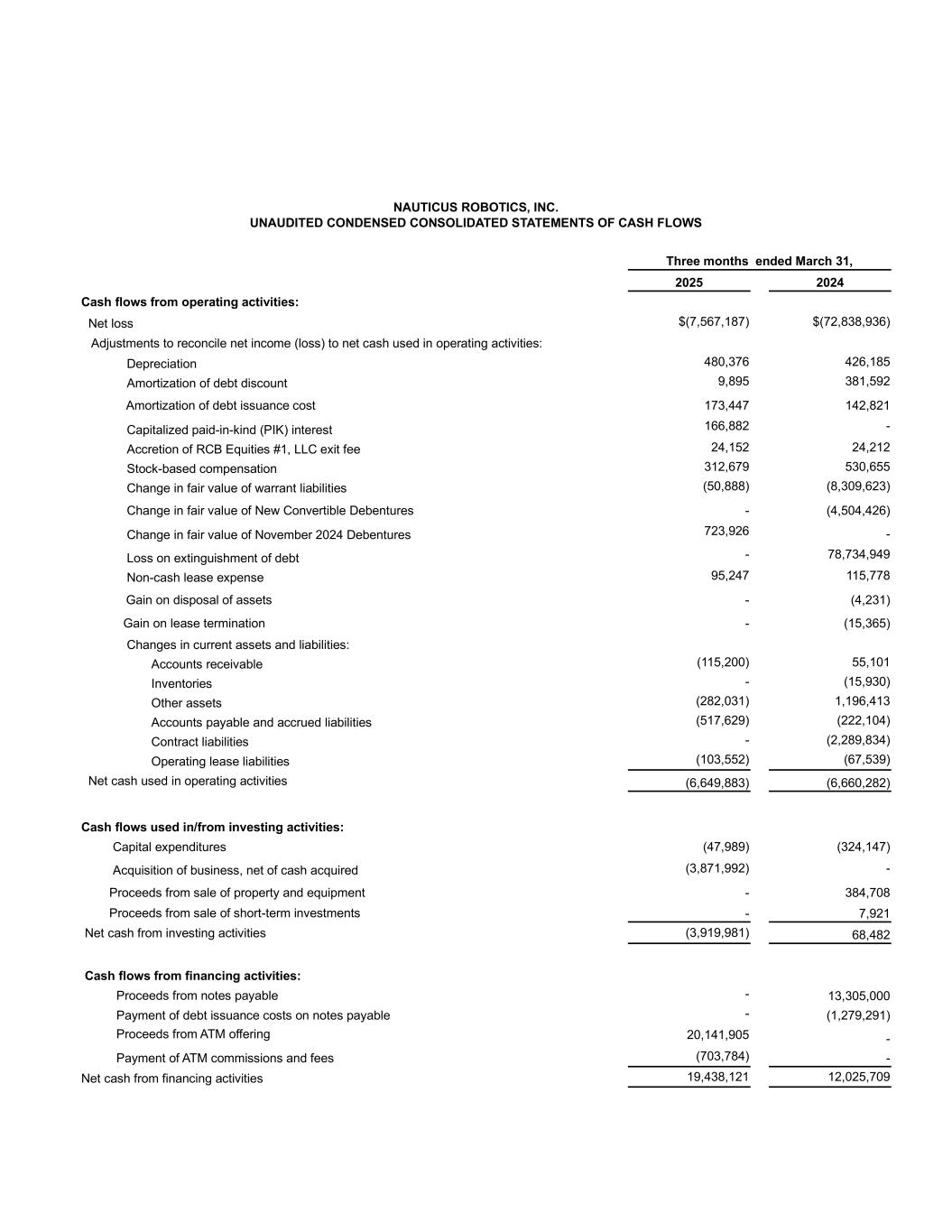
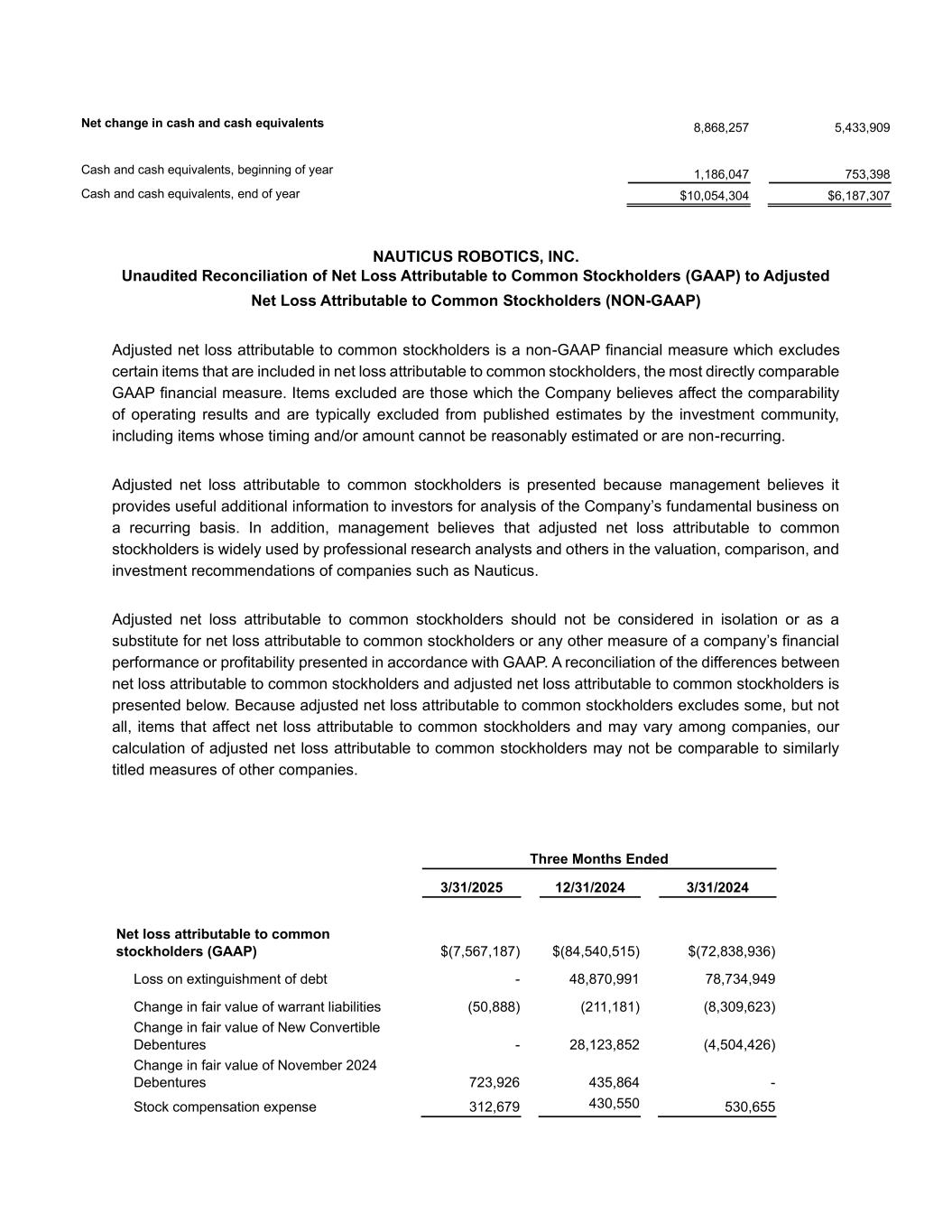
Thank you, John, and good morning. I will now discuss our financial results for the first quarter of 2025. The SeaTrepid acquisition closed on March 20 and has so far proved impactful to the organization with revenue being recognized from it in the first quarter and has continued to grow over the past six weeks following the end of the quarter. Other key milestones this quarter included further reducing our debt and associated interest by $3 million as a result of lowering the conversion price of the term loan and subsequent conversions. We also had a $20 million raise from our at-the-market facility to fund the acquisition of SeaTrepid and current year capital investments and operations. Revenue for the first quarter was $0.2 million, which is down $0.3 million sequentially and down $0.3 million from the same quarter last year. The Gulf of America offshore season just kicked off at the end of March, and we are now under contract. Operating expenses for the quarter were $6 million, which is flat from Q1 2024 and down $0.5 million sequentially. G&A costs for the quarter were $4.3 million, which is an improvement of $0.9 million compared to Q1 2024. Sequentially G&A has increased $0.4 million due to nonrecurring professional fees in Q1 2025, primarily related to the acquisition of SeaTrepid which included preparing financials for a two-year order that was needed as part of the transaction and other professional fees related to the restatement of 2024 quarterly financials that was completed in early April. Net loss for the quarter was $7.6 million. This is a $76.9 million decrease in net loss sequentially and a $65.3 million decrease from the net loss in Q1 2024. This large variance is attributable to the loss on extinguishment of debt recognized in 2024. Adjusted net loss for the quarter was $6.8 million compared to $6.9 million for the fourth quarter of '24. When removing the nonrecurring professional fees that occurred in Q1 2025, there would have been an improvement sequentially of $1.1 million quarter-on-quarter. Cash at the end of Q1 '25 was $10.1 million compared to $1.2 million at the end of '24. This is primarily a result of funding received through the aftermarket offering, offset by the recent acquisition of SeaTrepid on cash used in operations. With the second quarter already well underway, we are excited about having a full quarter of operational revenue to report for the first time in Q2, while continuing to keep a strong focus on cost control and value-added activities. I will now pass the call back to John.
Well, thank you, Vickie. I just want to really thank Vickie and the finance team for doing an incredible job ensuring that all companies file a 10-Q and then just a few weeks later file a 10-K. And the restatement caused a delay in getting everything done. And so they've been really hard at it and did an outstanding job, and I'm excited that we're shifting from focus on reporting here to focus on executing in the field. And so it's a welcomed change for us. Now I'd like to turn it over to Daniel Dehart, our Field Operations Lead; and Steve Walsh, our Sales Lead to discuss the emergence of Nauticus's first backlog of offshore commercial work. Daniel?
Speaker 4
Thank you, John. I'm excited to provide an update on our current operations. We recently completed a mobilization of one of our Comanche ROVs onboard a vessel, and we are currently on hire completing a platform inspection off the Gulf Coast. The integration of SeaTrepid and Nauticus operations teams has gone better than expected and continues to expand the commercial forecast for our company. We will mobilize the Aquanaut vehicle once the ROV completes its inspection job in the coming weeks. And then the vessel will roll right into multiple scheduled inspection jobs. We will continue to execute our existing contracts and will utilize any idle time between these projects to complete our 3,000-meter test with the Aquanaut vehicle. We have now reached a phase of our company that will become a new norm, scheduling current contracts and new opportunities to maximize utilization and margins and continue to diversify our customer base throughout the season. Our goal is to continue to provide autonomy throughout the industry, utilizing our combined services with the Aquanaut system and ROV. We are currently negotiating contracts with multiple new customers that are excited about the benefits autonomy can bring to their subsea operations. After significant discussions with our current clients, our technology has the potential to significantly decrease the environmental footprint of offshore operations, utilizing an Autonomous Surface Vessel or ASV. We will progress these discussions into funded testing opportunities this summer that include pairing the second Aquanaut vehicle with an ASV. Our current clients see extreme value in this operation by completing inspection work without the use of a large vessel, eliminating personnel from dangerous offshore environments and reducing the CO2 footprint exponentially. With that, I will now turn it over to Steve for an update on our 2025 offshore commercial pipeline.
Speaker 5
Thanks, Daniel, and good morning, everyone. I'm Steve Walsh, Vice President of Sales at Nauticus Robotics. I officially joined the team on March 21 through the SeaTrepid acquisition and it's been full throttle from day one. Let me tell you, the momentum here isn't just buzz. It's real. It's growing and is translating directly into opportunity. The offshore energy market is surging now and Nauticus is right at the center of it. We're actively supporting oil and gas operations while making serious inroads into emerging sectors. What's driving this? A clear industry shift towards smarter, safer, lower emissions propelled by autonomous solutions, and that's exactly what we deliver. The response from customers since the merger has been overwhelmingly positive. Combining SeaTrepid's operational legacy with Nauticus next-gen tech has created a powerful offering. Technologies like the Aquanaut aren't just impressing people, they're changing the conversation. Operators are now thinking differently about risk, efficiency and how robotics can reshape offshore operations. There is a strong appetite to remove personnel from hazardous environments and Aquanaut is opening the doors that weren't available before. Since the acquisition, we've been hard at work transferring SeaTrepid's existing Master Service Agreements into the new Nauticus framework while also signing new MSAs with major industry players. That's a clear signal of confidence from the market and what we're building. And here's the key point. Demand isn't our bottleneck. Scaling is. Right now, the only thing holding back revenue acceleration is equipment and personnel capacity. That's a high-quality problem, and we're tackling it aggressively with smart investments and a laser focus on execution. We're also honing our sales strategy around high-impact sectors like deepwater energy, offshore infrastructure and defense, areas where our expanded portfolio truly stands out. To wrap it up, the market is ready for the future we're building. Our pipeline is growing. Our technology is gaining traction and our customers are leaning in. It's an incredibly exciting time at Nauticus and this is just the beginning. We're working towards the shift from selling to order taking. And with that, I will turn it back over to you, John.
I appreciate that, Steve. We made a big shift here from last year to this year. We've really gotten a lot of customer diversification here and have reduced our customer concentration. The number of calls coming in is exciting because it looks as though we can continue to diversify our customer base. And so it's an exciting time for us. I mean, it's a great market, and we really like the equipment we have. I do want to introduce to you, our team to really sort of talk about our equipment and Jason Close, our Software Lead, so that you can get some updates from their departments where you could see what's going on. So with that, I'll turn it over to you guys.
Speaker 6
Thanks, John. Working with SeaTrepid over the past few months has expanded our market reach and introduced us to a wider range of customers and prospects, helping us refine our value proposition and better respond to industry-wide needs. In the first quarter, we made meaningful progress advancing ToolKITT across both our primary product line, Aquanaut and ToolKITT enabled world-class ROVs. For Aquanaut, our efforts were centered on releasing the latest version of ToolKITT in support of commercial operations for the remainder of the year. In parallel, we continue developing capabilities for a near-term field deployment and established a structured program for 2025 to broaden Aquanaut's operational envelope and further expand supervised autonomy across the subsea industry. We also reached an important milestone in the development of ToolKITT for world-class ROVs. Following early on vehicle integration and a rigorous round of hardware in the loop testing, ToolKITT is now prepared for tool trials as the final step towards our first commercial deployment. We see strong demand for this capability and expect to integrate ToolKITT onto our own ROV fleet in the near future as part of this initial commercial release. That said, our assets remain heavily engaged in offshore work, reflecting the growing customer activity we're seeing across the business. As we move through the year, we're focused on delivering value through Aquanaut operations while preparing ToolKITT for broader field adoption, setting the stage for long-term growth across both our service and product offerings. I'll now hand it over to Amin for an update on Aquanaut and our electric manipulators.
Speaker 7
Thank you, Jason. The engineering team is collaborating closely with the operation and software teams to maximize uptime across both Aquanaut vehicles. This joint effort ensures consistent, reliable performance throughout the year with minimal operational disruption. The engineering team has been transitioning from a traditionally R&D-focused approach to a commercially driven development model. This shift is essential for enabling scalable growth and aligning our capabilities with evolving market demand. For Aquanaut, design improvements are being implemented to boost vehicle reliability and reduce the maintenance cycle. These upgrades are critical in transitioning Aquanaut into a robust and reliable platform that can meet redress field demand. In tandem with our design improvements, the team is enhancing our design documentation and validation protocols to streamline assembly and support reliable maintenance and servicing. Looking ahead, we are developing a capital deployment strategy and actively seeking manufacturing partnerships to scale production of the next Aquanaut fleet in alignment with anticipated market demand. With the manipulators, we are making steady progress on the design of our next generation fully electric autonomous manipulators. This system is intended for integration not only with Aquanaut but also with world-class ROVs, expanding our product capabilities and market applications. I will now hand the call back to John.
Thank you, Amin. Thank you, Jason. As you've heard throughout this call, Nauticus Robotics is entering a period of significant opportunity. The integration of SeaTrepid has not only expanded our operational capacity, it's unlocked meaningful customer relationships. They accelerated the deployment of our technology though we are trying to stay disciplined and balanced upgrading equipment with getting revenue. And so we will bring it in to make changes as long as it doesn't interrupt revenue. We're now seeing real traction in the market with a growing backlog, expanding pipeline, and the clear demand for autonomous solutions that improve safety, lower costs, and reduce environmental impact. Our focus moving forward is clear. It's execute with precision, scale with discipline and deliver on the promise of autonomy in subsea operations. We're confident in the team and the strategy and the momentum we're building and we believe 2025 is shaping up to be a transformative year for Nauticus and its stakeholders. It really does feel like we've made it through the inflection point. And with that, I'll turn it back over to the operator, and we'll take any questions that are on the line. Thank you.
Operator
Ladies and gentlemen, we will now begin the question-and-answer session. Your first question comes from Kunal Madhukar from Water Tower Research. Please go ahead.
Speaker 8
Hi, thank you for taking the question. Two, if I could. One, on the broader oil and gas industry, with oil prices kind of declining, what are you seeing in terms of consumer demand and/or the demand for your vehicles? How is that changing?
Well, Kunal, I appreciate you joining the call and asking a question. It's interesting. For the larger clients that have established bases at higher price points, I think that the decline in oil and gas prices is going to be more difficult. For us, it really gives us an opportunity to displace incumbents and change the market, because we're going to be looking for more efficient solutions that are more cost-effective. And so I think it opens up conversations for us. I'm glad to see oil prices come down. I think it stimulates the economy; the stimulation of the economy statement fixed energy demand is sort of an interesting combination. But for us, I think we're at least 20% to 25% below the current price points of the alternatives. And with as good or better margins. And so I think it gives us a great opportunity to knock on doors, and what's happening now in the market is, I think they start knocking on our doors that if the pressure increases on them as prices go down. So I'd probably be in favor of a little bit further decline in order to help accelerate our business.
Speaker 8
That's an intriguing perspective. You mentioned that the offshore season hasn't really commenced, particularly when we examine Q1 revenue figures. In the last quarter, during your Q4 results announcement, you indicated that the anticipated revenue for 2025 was around $16 million. Could you explain how we can connect the revenue forecast for Q1 '25 with the overall revenue outlook you've shared?
That's a great question, Kunal. The main reason I avoid making forward-looking statements is that it then requires clarification later. We have a strong pipeline and are generating proposals that meet the $16 million goal; over three-fourths of the pipeline is focused on day rate work. You can analyze the amount of equipment we have, our day rate, and build a model around that pretty easily. However, there's still about a quarter of the $16 million linked to software sales and other proposals related to both defense and technological advancements that have yet to be finalized. As you develop your model, you'll see we have work ahead of us. Our sales team is engaging with customers daily, and proposals are being generated. Expect to see a few irregularities mixed in next quarter with the revenue from day rates, allowing you to create a straightforward model and factor in the irregular proposals tied to other activities. I remain optimistic that we'll have a strong year; this represents a turning point, and we are poised to deliver solid results compared to last year.
Speaker 8
Great. As a follow-up, John, last quarter you mentioned day rates between $40,000 and $60,000. Should we consider that multiplied by 90 as a base case for Q2 revenue?
I really like that $50,000 price point, but it is dependent upon several factors, including the size of the boat we're using, the use of the ROV, and the use of the Aquanaut. Unfortunately, as you pointed out, in the oil price market, companies with heavy assets that have much higher price points in down markets tend to offer discounts. This could create some discounting pressure for us. However, we have the margin to remain competitive; these companies would need to incur significant losses to reach our price point. While we may encounter some pricing pressure, I don't anticipate it will be substantial, and we could maintain our pricing for an extended period, potentially throughout the year, without significant impact from them lowering their prices. It will take them time to reach our level. I believe we are in a solid position regarding pricing. The $50,000 figure is promising, but it will fluctuate and should be revisited every quarter, as it will depend on hurricanes, boat availability, and competitive pressures from companies like Oceaneering, CI, and others. We will continuously monitor the market.
Speaker 8
Great. Thank you so much.
Operator
Thank you. Your next question comes from Robert from Investor. Please go ahead.
Speaker 9
Good morning. Thank you for the update. I appreciate the information about the revenue for this year being around $16 million. It was a wise move to partner with SeaTrepid earlier this year. My question is about your confidence in achieving the $16 million this year. Additionally, can you provide a breakdown on the software sales, particularly regarding the command center, which I believe is very important? What do you project the revenue to be over the next year or two from software sales?
Thank you for your questions, and I appreciate you joining us. Regarding the $16 million, I want to note that I’m hesitant to provide forward-looking information since market conditions and equipment performance can be unpredictable. However, we are focused on managing our budget and activities, which is why we have set this planning target. About three-quarters of that amount will come from utilizing current assets, while the remaining quarter will come from software sales and proposals that cater to our customers’ interests, particularly in oil and gas, wind, and defense sectors. We have exciting opportunities and are developing solutions that don’t rely on traditional vessels. For instance, if we can deploy a USB with an Aquanaut without needing a boat, it would dramatically lower costs for the industry. Being able to operate autonomously and without the complexities of vehicle launch and recovery is a significant advantage. We're working with partners on proposals that aim to drive costs down to help our customers maintain profitability even at lower oil and gas prices, which is critical as they adjust their day rates. Our advancements in full autonomy are unmatched; no competitors are approaching it quite like we are. This initiative has the potential to gain momentum, and we expect to push forward a collaborative project by 2026 or 2027. As for software, while AI is a hot topic, it’s autonomy that is currently reshaping the market by removing personnel from vessels and enhancing overall efficiency, which in turn reduces incident rates and carbon footprints. Our software development is progressing well, and we’re preparing for the commercial release of our ROV software. Demonstrating our software on our own equipment before launching it to the market is crucial, and we’re engaging in fruitful discussions that I believe will lead to favorable outcomes. Our software is designed to be platform-agnostic, enabling it to operate on any robot, and we are actively collaborating with other robotics companies to integrate autonomy into their systems. I am confident in our capability to achieve impressive results this year.
Speaker 9
Thank you, John. One last question. And I assume the patents that you have on the software and the hardware basically is 20 years plus. How do you see the Leidos partnership basically rolling out? Secondly, is it possibly an exit down the road?
The fact I can't answer it doesn't change the fact it's a great question. I can't talk about exit strategies here as a public company. I'll just say that I'm very interested in Leidos and in the partnership with them. There's a tremendous amount of capabilities we have that we know bring value to the maritime industry in the defense sector. And so we're excited as that develops. I said this a year ago; I just find the defense sector, particularly given the uncertainty that you have in Washington over spending and budgets and leadership, that we made a really good decision focusing on the commercial side, because of the speed at which these contracts will be left, they're going to be left, and they're going to be big. You want to be there, and you want to participate, and we want to work with a great partner like Leidos. But when you're small, that kind of lumpiness is just not something you can endure. So we're very excited that we've got all this commercial pipeline developing, and it will carry us forward. On the Leidos side, they have contractual commitments to us and we're working with them. The timing on that is extended over a long period. We will be announcing those as we get to them, but we're working slowly with them as they navigate the uncertainty with the defense sector and really have more experience and capability than we do. We're delighted to have a great partner and continue to look forward to working closely with them.
Speaker 9
Thank you. I look forward to your email, John.
Not a problem. Take care.
Operator
Thank you. There are no further questions at this time. I will now turn the call over to John for closing remarks. Please go ahead.
I appreciate all of you joining today. It's challenging to make an announcement about a future quarter rather than one that has already concluded. Q2 is significant as it will be our first quarter operational for the entire period. By the end of Q2, you'll have a great opportunity to build models and understand our execution and margins, as well as our clientele. This is an exciting time for Nauticus, and in our next call in August, we plan to discuss the business and the quality of our work in more detail. We will have strong statements to share about our progress and direction because we will have established a track record by then. Thank you all for your continued support. I look forward to discussing concretely what we are achieving in the ocean, the value we deliver, and how our customers view us. Again, I appreciate your investment in our company, and we are working hard to create as much value as possible, as quickly as we can. Take care.
Operator
Ladies and gentlemen, this concludes today's conference call. Thank you all for your participation. You may now disconnect.