
Linear Minerals Corp 20-F for FY2026
Linear Minerals Corp (LINMF)
About this 20-F
Linear Minerals Corp filed this 20-F on August 12, 2026, covering the fiscal year ended March 31, 2026 (FY2026).
Headline figures
Fiscal year ended March 31, 2026, as reported in this filing, compared with the same period a year earlier where the filing states it.
- Net loss
- 2.68M CAD
- compared with a net loss of 3.31M CAD a year earlier
| UNITED STATES |
| SECURITIES AND EXCHANGE |
| COMMISSION WASHINGTON, D.C. 20549 FORM |
| REGISTRATION STATEMENT PURSUANT TO SECTION 12(b) or 12(g) OF THE SECURITIES EXCHANGE ACT OF 1934 |
OR
| ANNUAL REPORT PURSUANT TO SECTION 13 OR 15(d) OF THE SECURITIES EXCHANGE ACT OF 1934 |
For the fiscal year ended
OR
| TRANSITION REPORT PURSUANT TO SECTION 13 OR 15(d) OF THE SECURITIES EXCHANGE ACT OF 1934 |
For the transition period from _____________ to _____________.
OR
| SHELL COMPANY REPORT PURSUANT TO SECTION 13 OR 15(d) OF THE SECURITIES EXCHANGE ACT OF 1934 |
Date of event requiring this shell company report _______________
Commission file number
(Exact name of Registrant as specified in its charter)
, CANADA |
(Jurisdiction of incorporation or organization)
|
| (Address of principal executive offices) |
|
| (Name, telephone, e-mail and/or facsimile number and address of Company contact person) |
Securities registered or to be registered pursuant to Section 12(b) of the Act.
| Title of Each Class | Name of each exchange on which registered |
| Not Applicable |
Not applicable |
Securities registered or to be registered pursuant to Section 12(g) of the Act
| Common Shares without Par Value |
(Title of Class)
| Securities for which there is a reporting obligation pursuant to Section 15(d) of the Act. | None |
1
Number of outstanding shares of Linear Minerals Corp.’s only class of issued capital stock as at March 31, 2026:
Indicate by check mark if the registrant is a well-known seasoned issuer, as defined in Rule 405 of the Securities Act.
Yes ☐
If this report is an annual or transition report, indicate by check mark if the registrant is not required to file reports pursuant to Section 13 or 15(d) of the Securities Exchange Act of 1934.
Yes ☐
Indicate by check mark whether the registrant (1) has filed all reports required to be filed by Section 13 or 15(d) of the Securities Exchange Act of 1934 during the preceding 12 months (or for such shorter period that the registrant was required to file such reports), and (2) has been subject to such filing requirements for the past 90 days.
Indicate by check mark whether the registrant has submitted electronically every Interactive Data File required to be submitted pursuant to Rule 405 of Regulation S-T (§232.405 of this chapter) during the preceding 12 months (or for such shorter period that the registrant was required to submit such files).
Indicate by check mark whether the registrant is a large accelerated filer, an accelerated filer, a non-accelerated filer, or an emerging growth company. See definition of “large accelerated filer, “accelerated filer,” and “emerging growth company” in Rule 12b-2 of the Exchange Act.
| Large Accelerated Filer ¨ | Accelerated Filer ¨ | | ||
| Emerging growth company |
If an emerging growth company that prepares its financial statements in accordance with U.S. GAAP, indicate by check mark if the registrant has elected not to use the extended transition period for complying with any new or revised financial accounting standards† provided pursuant to Section 13(a) of the Exchange Act. ☐
Indicate by check mark whether the registrant has filed a report on and attestation to its management’s assessment of the effectiveness of its internal control over financial reporting under Section 404(b) of the Sarbanes-Oxley Act (15 U.S.C. 7262(b) by the registered public accounting firm that prepared or issued its audit report.
Yes ☐
If securities are registered pursuant to Section 12(b) of the Act, indicate by check mark whether the financial statements of the registrant included in the filing reflect the correction of an error to previously issued financial statements. ☐
Indicate by check mark whether any of those error corrections are restatements that required a recovery analysis of incentive- based compensation received by any of the registrant’s executive officers during the relevant recovery period pursuant to §240.10D-1(b). ☐
Indicate by check mark which basis of accounting the registrant has used to prepare the financial statements included in this filing:
| U.S. GAAP | ☐ |
| Other | ☐ |
If other has been checked in response to the previous question, indicate by check mark which financial statement item Registrant has elected to follow:
Item 17 ☐ Item 18 ☐
If this report is an Annual Report, indicate by check mark whether the registrant is a shell company (as defined in Rule 12b-2 of the Exchange Act).
Yes ☐ No
Indicate by check mark whether the registrant has filed all documents and reports required to be filed by Section 12, 13 or 15(d) of the Securities Exchange Act of 1934 subsequent to the distribution of securities under a plan confirmed by a court.
N/A Yes ☐ No ☐
2
CAUTIONARY STATEMENT REGARDING FORWARD LOOKING INFORMATION
Certain statements in this Annual Report on Form 20-F (this “Annual Report”) under the captions “Item 3 - Risk Factors”, “Item 4 – “Business Overview”, Item 5 - “Operating and Financial Review and Prospects” and “Item 11 - Quantitative and Qualitative Disclosures about Market Risk” and elsewhere in this Annual Report and the documents incorporated herein by reference constitute “forward-looking statements” within the meaning of the U.S. Securities Litigation Reform Act of 1995 and “forward-looking information” under applicable Canadian securities legislation. Some forward-looking statements may be identified by such terms as “believes,” “anticipates,” “intends” or “expects” collectively “forward-looking statements.” Forward-looking information in this Annual Report include statements regarding the Company’s plans for its projects, statements relating to mineral resources, as they are based on various assumptions that are inherently forward-looking, statements regarding the anticipated timing by which the Company will require additional funds. These forward-looking statements are based on the Company’s current expectations and projections about future events and financial trends affecting the financial condition of its business and the industry in which it operates. Such forward-looking statements are based on assumptions regarding future events and other matters and are subject to known and unknown risks, uncertainties and other factors including the factors set forth in other filings with the Canadian securities commissions and the United States Securities and Exchange Commission (the “Commission”), which may cause the actual results, performance or achievements of the Company or industry results to be materially different from any future results, performance, or achievements expressed or implied by such forward-looking statements. Assumptions on which forward-looking statements are based include the assumptions underlying mineral resource estimates and in the technical reports supporting such estimates, the assumption that the Company will continue as a going concern and will continue to be able to access the capital required to advance its projects and continue operations. Such risks and the assumptions that accompany them, uncertainties and other factors include, among others, the following: general economic and business conditions, which will, among other things, impact the demand for gold and silver and other precious metals explored for by the Company; industry capacity; the ability of the Company to raise the capital required to implement its business strategy; changes in, or the unintentional failure to comply with, government regulations (especially safety and environmental laws and regulations); changes in the uses of gold, silver and other precious metals; silver and gold price volatility; increased competition; risks of the mining industry; exploration programs not being successful; inability to obtain financing; inability to obtain, or cancellation of, government permits; changes to regulations and mining law; increased reclamation obligations; title defects with respect to properties; risks associated with international operations; and foreign exchange and currency fluctuations. There can be no assurance that forward-looking statements in this Annual Report will prove to be accurate and actual results and future events could vary materially from those implied by such statements. Consequently, all of the forward-looking statements made in this Annual Report are qualified by these cautionary statements. The Company disclaims any obligation to update or revise any written forward-looking statements whether as a result of new information, future events or otherwise except as required by applicable laws.
Currency and Measurement
All currency amounts in this Annual Report on Form 20-F are stated in Canadian dollars unless otherwise indicated. Conversion of metric units into imperial equivalents is as follows:
| Metric Units | Multiply by | Imperial Units |
| hectares | 2.471 | = acres |
| metres | 3.281 | = feet |
| kilometres (“km”) | 0.621 | = miles (5,280 feet) |
| grams | 0.032 | = ounces (troy) |
| tonnes | 1.102 | = tons (short) (2,000 lbs.) |
| grams/tonne | 0.029 | = ounces (troy)/ton |
3
CAUTIONARY NOTE TO U.S. INVESTORS REGARDING MINING DISCLOSURE
This Annual Report uses the mining disclosure standards set out in Subpart 1300 of Regulation S-K (“S-K 1300”). S-K 1300 permits the disclosure of mineral resources in measured, indicated and inferred categories and mineral reserves in proven and probable categories.
Mineral resources are not mineral reserves and do not have demonstrated economic viability. A mineral reserve may only be established where a qualified person has determined, based on a pre-feasibility or feasibility study and the application of relevant modifying factors, that the applicable portion of a measured or indicated mineral resource is economically mineable.
Inferred mineral resources are based on limited geological evidence and sampling and are subject to a high degree of uncertainty as to their existence and prospects for economic extraction. There can be no assurance that an inferred mineral resource will be upgraded to an indicated or measured mineral resource or converted into a mineral reserve.
The Company has not established any mineral resources or mineral reserves on any of its mineral properties under S-K 1300. References in this Annual Report to exploration results, mineralization, exploration targets or geological potential do not constitute mineral resource or mineral reserve estimates and should not be interpreted as demonstrating economic viability.
The Company may disclose scientific and technical information in Canada in accordance with National Instrument 43-101 — Standards of Disclosure for Mineral Projects and the definitions adopted by the Canadian Institute of Mining, Metallurgy and Petroleum. Although Canadian mining disclosure standards and S-K 1300 are similar in certain respects, they are not identical. Information prepared solely in accordance with Canadian standards should not be assumed to comply with S-K 1300 unless the Company expressly states that it does.
4
TABLE OF CONTENTS
5
PART 1
| ITEM 1. | identity of DIRECTORS, SENIOR management and advisers |
| A. | Directors and Senior Management |
This Form 20-F is being filed as an annual report under the Securities Exchange Act of 1934, as amended and as such, there is no requirement to provide any information under this item.
| B. | Advisors |
This Form 20-F is being filed as an annual report under the Securities Exchange Act of 1934, as amended and as such, there is no requirement to provide any information under this item.
| C. | Auditor |
This Form 20-F is being filed as an annual report under the Securities Exchange Act of 1934, as amended and as such, there is no requirement to provide any information under this item.
| ITEM 2. | OFFER STATISTICS AND EXPECTED TIMETABLE |
This Form 20-F is being filed as an annual report under the Securities Exchange Act of 1934, as amended and as such, there is no requirement to provide any information under this item.
| ITEM 3. | KEY INFORMATION |
| A. | Selected Financial Data |
This Form 20-F is being filed as an annual report under the Securities Exchange Act of 1934, as amended and as such, there is no requirement to provide any information under this item.
| B. | Capitalization and Indebtedness |
This Form 20-F is being filed as an annual report under the Securities Exchange Act of 1934, and as such, there is no requirement to provide any information under this item.
| C. | Reasons for the Offer and Use of Proceeds |
This Form 20-F is being filed as an annual report under the Securities Exchange Act of 1934, and as such, there is no requirement to provide any information under this item.
| D. | Risk Factors |
The following is a brief discussion of those distinctive or special characteristics of the Company’s operations and industry which may have a material impact on Linear Minerals ’s financial performance.
Readers should carefully consider the risks and uncertainties described below before deciding whether to invest in shares of the Company’s common stock.
Financial Risk Factors
The Company has no producing mineral properties, generates no operating revenue and depends on external financing to fund its exploration and administrative activities. The Company has no revenues from operations and all of its mineral property interests are in the exploration stage. The Company will not receive revenues from operations at any time in the near future, and the Company has no prior years’ history of earnings or cash flow. The Company has not paid dividends on its shares at any time since incorporation and does not anticipate doing so in the foreseeable future. The Company’s financial statements have been prepared assuming it will continue on a going-concern basis. Should funding not be obtained, this assumption will change and the Company’s assets may be written down to realizable values. The Company has incurred losses since inception (deficit at March 31, 2026, is $62,176,224), which casts doubt on the ability of the Company to continue as a going concern. The Company has no revenue other than interest income. A mining project can typically require ten years or more between discovery, definition, development and construction and as a result, no production revenue is expected from any of the Company’s exploration properties in the near future. All of the Company’s short to medium-term operating and exploration expenses must be paid from its existing cash position or external financing. At March 31, 2026, the Company had working capital deficit of $657,582, compared to working capital of $311,693 at March 31, 2025. Working capital is defined as current assets less current liabilities.
6
Linear Minerals may be unable to obtain the funds necessary to expand exploration. The Company’s operations consist, almost exclusively, of cash consuming activities given that all of its mineral projects are in the early exploration stage. The Company will need to receive additional equity capital or other funding from the joint venture of one or more properties or the sale of one or more properties for the next year, and failing that, may cease to be economically viable. To date, the only sources of funds that have been available to the Company are the sale of equity capital or the offering by the Company of an interest in its properties to be earned by another party or parties carrying out further development thereof.
The Company will need to raise additional financing as the Company’s current assets are not sufficient to finance its operations and administrative expenses. The Company is evaluating financing options including, but not limited to, the issuance of additional equity and debt. The Company has no assurance that such financing will be available or be available on favourable terms. Factors that could affect the availability of financing include the Company’s performance (as measured by numerous factors including the progress and results of its projects), the state of international debt and equity markets, investor perceptions and expectations and the global financial and metals markets. In addition to evaluating financing options, the Company has also implemented cost savings measures.
The Company is continuously reviewing strategies for private placement equity financings as well as other forms of financing that would carry the Company through the next fiscal year. If a private equity financing were to be completed, it is expected that warrants may be included in the securities offered. Any such financings will result in dilution of existing shareholders.
Volatile metal prices and external market conditions can cause significant changes in the Company’s share price because as the prices of metals increase or decrease, the economic viability of the mineral properties is affected. The Company has no history of mining or current source of revenue. The Company is exploring for metals and historically, the prices of the common shares of junior exploration companies are very volatile. This volatility may be partly attributed to the volatility of metal prices, and also to the success or failure of the Company’s exploration programs. Market, financial and economic factors not directly related to mining activities can also affect the Company’s ability to raise equity financing.
Fluctuations in financial markets can negatively impact the Company’s ability to achieve sufficient funding.
Over the last decade there have been periods of significant volatility in world financial markets. The volatility can negatively impact the Company’s ability to raise sufficient equity financing to sustain operations. Future financial market volatility is likely and it should not be assumed that adequate funding will be available to the Company in amounts or at times when it is required.
Risks Associated with Mineral Exploration
Linear Minerals’ exploration efforts may be unsuccessful in locating viable mineral resources. Resource exploration is a speculative business, characterized by a number of significant risks, including, among other things, unprofitable efforts resulting not only from the failure to discover mineral deposits but also from finding mineral deposits, which, though present, are insufficient in quantity and/or quality to return a profit from production.
There is no certainty that expenditures to be made by the Company on the exploration of its properties and prospects as described herein will result in discoveries of mineralized material in commercial quality and quantities.
Mineral Resource Estimates Are Only Estimates and May Not Reflect the Actual Deposits or the Economic Viability of Extraction. If the Company establishes mineral resources in the future, such estimates will be subject to significant uncertainty and may require revision as additional exploration and technical information becomes available. There is significant uncertainty in any mineral resource estimate. Estimates of inferred resources are the least certain of the resource categories and there is no assurance that such resources can or will be upgraded to another category of resource, or that further exploration will confirm or validate such estimates. Actual deposits encountered and the economic viability of, and returns from, a deposit (if mined) may differ materially from estimates disclosed by the Company or implied by estimates of mineral resources. The estimating of mineral resources is a subjective process and the accuracy of mineral resource estimates is a function of the quantity and quality of available data, the accuracy of statistical computations, and the assumptions used and judgments made in interpreting engineering and geological information. Mineral resource estimates are based on many things, including assumed commodity prices, continuity of mineralization, tonnage and grade of mineralization, metallurgy, estimated mineral recovery rates, cost of capital, mine development costs, operating costs, and exchange rates. Changes in assumptions may result in a significant reduction
7
in the reported mineral resources and thereby have a material adverse effect on the Company’s results of operations and financial condition.
Estimated mineral resources may also require downward revisions based on changes in metal prices and further exploration or development activity. This could materially and adversely affect estimates of the tonnage or grade of mineralization, estimated recovery rates or other important factors that influence mineral resource and reserve of estimates. Any reduction in estimated mineral reserves or estimated resources as a result could require material write downs in investment in the affected mining property, which could have a material and adverse effect on the Company’s results of operations and financial condition.
The Company has not established the presence of any proven and probable reserves at any of its mineral properties. There can be no assurance that subsequent testing or future studies will establish proven and probable reserves on the Company’s properties. The failure to establish proven and probable reserves could severely restrict the Company’s ability to successfully implement its strategies for long-term growth.
There is Uncertainty Relating to Mineral Resources. Mineral resources that are not mineral reserves do not have demonstrated economic viability. Due to the uncertainty, which may attach to inferred mineral resources, there is no assurance that inferred mineral resources will be upgraded to indicated and measured mineral resources as a result of continued exploration. If mineral resources are not upgraded to proven and probable mineral reserves, it could materially and adversely affect and/or restrict the Company’s ability to successfully implement its strategies for long-term growth.
Linear Minerals may not be able to market minerals if any are acquired or discovered by the Company due to factors beyond the control of the Company. The marketability of minerals that could in the future be acquired or discovered by the Company may be affected by numerous factors which are beyond the control of the Company and which cannot be accurately predicted, such as market fluctuations, the proximity and capacity of milling facilities, mineral markets and processing equipment, and such other factors as government regulation, including regulation relating to royalties, allowable production, importing and exporting of minerals and environmental protection, the combination of which factors may result in the Company not receiving an adequate return on investment capital.
Environmental and Regulatory Risk Factors
Compliance with environmental regulations could affect future profitability and timeliness of operations. The current and anticipated future operations of the Company require permits from various federal, territorial and local governmental authorities. Companies engaged in the exploration and development of mines and related facilities must comply with applicable laws, regulations and permits.
The Company’s exploration activities are subject to various laws governing land use, the protection of the environment, prospecting, development, commodity prices, exports, taxes, labour standards, occupational safety and health, waste disposal, toxic substances, mine safety and other matters. The Company believes it is in substantial compliance with all material laws and regulations which currently apply to its activities. The Company may be unable to obtain all permits required for exploration and development, and the costs of obtaining these permits may not be commercially reasonable. Existing laws and regulations may be modified, which could have an adverse effect on any exploration project that the Company might undertake.
Failure to comply with environmental and reclamation rules could result in penalties. The Company’s activities are subject to laws and regulations controlling not only mineral exploration and exploitation activities but also the possible effects of such activities upon the environment. Environmental legislation may change and make mining uneconomic or result in significant environmental or reclamation costs. Environmental legislation provides for restrictions and prohibitions and a breach of environmental legislation may result in the imposition of fines and penalties or the suspension or closure of operations. In addition, certain types of operations require the submission of environmental impact statements and approval thereof by government authorities. Environmental legislation is evolving in a manner that may mean stricter standards and enforcement, increased fines and penalties for non-compliance, more stringent environmental assessments of proposed projects and a heightened degree of responsibility for companies and their directors, officers, and employees. Permits from a variety of regulatory authorities are required for many aspects of mineral exploitation activities, including closure and reclamation. Future environmental legislation could cause additional expense, capital expenditures, restrictions, liabilities, and delays in the development of the Company’s properties, the extent of which cannot be predicted. In the context of environmental permits, including the approval of closure and reclamation plans, the Company must comply with standards, laws, and regulations that may entail costs
8
and delays, depending on the nature of the activity to be permitted and how stringently the regulations are implemented by the permitting authority. The Company does not maintain environmental liability insurance.
Failure to comply with applicable laws, regulations and permitting requirements may result in enforcement actions, including orders issued by regulatory or judicial authorities causing operations to cease or be curtailed, and may include corrective measures requiring capital expenditures, installation of additional equipment or remedial actions. The Company has been involved in the exploration of mineral properties for many years. Currently, the operations of the Company have been limited to exploration, and no mining activity has yet been undertaken. The mining industry is heavily regulated in North America, where the Company has its operations, so that permitting is required before any work is undertaken where there is any form of land disturbance. To date, land disturbance has been minimal and all required reclamation has been completed.
Other Risk Factors
Linear Minerals is dependent on its ability to recruit and retain key personnel. The success of the activities of the Company is dependent to a significant extent on the efforts and abilities of its management. Investors must be willing to rely to a significant extent on their discretion and judgment. The Company has relied on and will continue to rely on consultants and others for exploration, development and technical expertise. The ability of the Company to retain key personnel and its ability to continue to pay for services are dependent upon the ability of the Company to obtain adequate financing to continue operating as a going concern.
Linear Minerals’ title to mineral property interests may be challenged. Although the Company has done a review of titles to its mineral interests, it has not obtained title insurance with respect to its properties and there is no guarantee of title. The Company’s mineral properties may be subject to prior unregistered agreements or transfers or native land claims, and title may be affected by undetected defects. The Company’s Canadian mineral property interests consist of mineral claims, which have not been surveyed, and therefore the precise area and location of such claims or rights may be in doubt.
Linear Minerals’ directors and officers serve as directors and/or officers of other publicly traded junior resource companies. Some of the directors and officers of the Company serve as officers and/or directors of other resource exploration companies and are engaged and will continue to be engaged in the search for additional resource opportunities on their own behalf and on behalf of other companies, and situations may arise where these directors and officers will be in direct competition with the Company. Such potential conflicts, if any, will be dealt with in accordance with the relevant provisions of British Columbia corporate and common law. In order to avoid the possible conflict of interest which may arise between the directors’ and officers’ duties to the Company and their duties to the other companies on whose boards they serve, the directors and officers of the Company expect that participation in exploration prospects offered to the directors or officers will be allocated among or between the various companies that they serve on the basis of prudent business judgement and the relative financial abilities and needs of the companies.
Linear Minerals’ may not be able to insure against certain risks which could negatively impact the Company’s operating results. In the course of exploration, development and production of mineral properties, certain risks, and in particular unanticipated geological and operating conditions as well as fires, explosions, flooding, earthquakes, power outages, labour disruptions, and the inability to obtain suitable or adequate machinery, equipment or labour may occur. It is not always possible to fully insure against such risks and the Company may decide not to take out insurance against such risks as a result of high premiums or other reasons. Should such liabilities arise, they could reduce or eliminate any future profitability and result in increasing costs and a decline in the value of the securities of the Company.
U.S. investors may not be able to enforce their civil liabilities against the Company or its directors, controlling persons and officers. It may be difficult for U.S. investors to bring and enforce suits against the Company. The Company is a corporation incorporated in British Columbia under the Business Corporations Act (British Columbia) and, consequently, there is a risk that Canadian courts may not enforce judgements of U.S. courts or enforce, in an original action, liabilities directly predicated upon the U.S. federal securities laws. The Company’s directors and officers are residents of Canada or other countries other than the United States. Consequently, it may be difficult for United States investors to affect service of process upon those directors or officers who are not residents of the United States, or to realize in the United States upon judgements of United States courts predicated upon civil liabilities under United States securities laws. It is unlikely that an original action could be brought successfully in Canada against any of such persons or the Company predicated solely upon such civil liabilities under U.S. securities laws.
9
Risks Relating to an Investment in the Securities of the Company
Linear Minerals could be deemed a Passive Foreign Investment Company which could have negative consequences for U.S. Holders. Potential investors who are U.S. Holders (defined below) should be aware that the Company expects to be a passive foreign investment company (“PFIC”) for the current fiscal year, may have been a PFIC in prior fiscal years and may continue to be a PFIC in subsequent years. If the Company were to be treated as a PFIC, U.S. Holders of the Company’s common shares would be subject to adverse U.S. federal income tax consequences, including a substantially increased U.S. income tax liability and an interest charge upon the sale or disposition of the Company’s common shares and upon the receipt of distributions on the Company’s common shares to the extent such distributions are treated as “excess distributions” under the U.S. federal income tax rules relating to PFICs. U.S. Holders could potentially mitigate such consequences by making certain elections with respect to the Company’s common shares. U.S. Holders are urged to consult their tax advisors regarding the Company’s PFIC classification, the consequences to them if the Company is a PFIC, and the availability and the consequences of making certain elections to mitigate such consequences. (See Item 10 Taxation -United States Tax Consequences).
Linear Minerals’ stock price may limit its ability to raise additional capital by issuing common shares. The low price of the Company’s common shares also limits the Company’s ability to raise additional capital by issuing additional shares. There are several reasons for this effect. First, the internal policies of certain institutional investors prohibit the purchase of low-priced stocks. Second, many brokerage houses do not permit low-priced stocks to be used as collateral for margin accounts or to be purchased on margin. Third, some brokerage house policies and practices tend to discourage individual brokers from dealing in low-priced stocks. Finally, broker’s commissions on low-priced stocks usually represent a higher percentage of the stock price than commissions on higher priced stocks. As a result, the Company’s shareholders pay transaction costs that are a higher percentage of their total share value than if the Company’s share price were substantially higher.
The liquidity of Linear Minerals’ shares in the United States markets may be limited or more difficult to effectuate because Linear Minerals is a “Penny Stock” issuer. The Company’s stock is subject to U.S. “Penny Stock” rules which make the stock more difficult for U.S. shareholders to trade on the open market. The SEC has adopted rules that regulate broker-dealer practices in connection with transactions in “penny” stocks. Penny stocks are equity securities with a price of less than US$5.00 per share, other than securities registered on certain national securities exchanges or quoted on the NASDAQ system provided that current prices and volume information with respect to transactions in such securities is provided by the exchange or system.
The Penny Stock Rules require a broker-dealer, prior to effecting a transaction in a penny stock not otherwise exempt from such rules, to deliver a standardized risk disclosure document prepared by the SEC that provides information about penny stocks and the nature and level of risks in the penny stock market.
In addition, the Penny Stock Rules require that prior to a transaction in a penny stock not otherwise exempt from such rules the broker-dealer must make a special written determination that the penny stock is a suitable investment for the purchaser and receive the purchaser’s written acknowledgment of the receipt of a risk disclosure statement, a written agreement to transactions involving penny stocks, and a signed and dated copy of a written suitability statement. At the present market prices, the Company’s common shares will (and in the foreseeable future are expected to continue to) fall within the definition of a penny stock. Accordingly, United States broker-dealers trading in Linear Minerals’ shares will be subject to the Penny Stock Rules. Rather than complying with those rules, some broker-dealers may refuse to attempt to sell penny stocks. As a result, shareholders and their broker-dealers in the United States may find it more difficult to sell their shares of the Company, if a market for the shares should develop in the United States.
The market for the Company’s stock has been subject to volume and price volatility which could negatively affect a shareholder’s ability to buy or sell the Company’s shares. The market for the common shares of the Company may be highly volatile for reasons both related to the performance of the Company or events pertaining to the industry (e.g. mineral price fluctuation/high production costs/accidents) as well as factors unrelated to the Company or its industry.
Market demand for products incorporating minerals in their manufacture fluctuates over time, resulting in a change of demand for the mineral and an attendant change in the price for the mineral. The Company’s common shares can be expected to be subject to volatility in both price and volume arising from market expectations, announcements and press releases regarding the Company’s business, and changes in estimates and evaluations by securities analysts or other events or factors. In the last decade, securities markets in the United States and Canada and internationally have experienced periods of high price and volume volatility, and the market prices of securities of many companies, particularly small-capitalization companies such as the Company, have experienced wide fluctuations that have not necessarily been related to the operations, performances, underlying asset values, or prospects of such companies. For these reasons, the Company’s common shares can also be expected to be subject to volatility resulting from purely
10
market forces over which the Company will have no control. Further, despite the existence of a market for trading the Company’s common shares in Canada, shareholders of the Company may be unable to sell significant quantities of common shares in the public trading markets without a significant reduction in the price of the stock.
| ITEM 4. | INFORMATION ON THE COMPANY |
| A. | History and Development of the Company |
The Company’s executive office is located at:
Suite 2421, 1055 West Georgia Street,
Vancouver, British Columbia, V6E 3P3
Telephone: (604) 375-6005
Email: info@linearminerals.com
Website: www.linearminerals.com
The mailing address of the Company is Suite 2421, 1055 West Georgia Street, Vancouver, British Columbia, Canada, V6E 3P3. The Company’s fiscal year end is March 31.
The Company’s common shares are listed on the Canadian Securities Exchange (“CSE” or the “Exchange”) under the symbol “LINE”. Prior the Company’s name change on December 31, 2024, the Company’s common shares were trading under the symbol “FE”. The Company shares are quoted on the OTCQB, (also under the symbol “LINMF”), an electronic trading platform operated by the OTCQB. The Company’s common shares are also quoted on the Frankfurt market under the symbol “J9K”.
The Company was incorporated under the laws of the Province of British Columbia, Canada on October 12, 1966. Effective March 29, 2004, the Company Act (British Columbia) was replaced by the Business Corporations Act (British Columbia). The Business Corporations Act (British Columbia) does not require a company’s Notice of Articles to contain a numerical limit on the authorized capital with respect to each class of shares. Effective September 21, 2004, the Company altered the authorized capital of the Company from 50,000,000 shares without par value to an unlimited number of shares without par value. By Special Resolution effective June 23, 2011, shareholders approved the adoption of new articles for the Company. See Item 10B – Memorandum and Articles of Association.
On December 31, 2024, FE Battery Metals Corp. changed its name to Linear Minerals Corp., having previously operated as First Energy Metals Limited until its name change on October 25, 2022.
On November 1, 2022, the Company completed a share consolidation of its capital on the basis of 3.8 existing common shares for 1 new common share post consolidation. All common shares, per common share amounts, warrants and stock options in these financial statements have been retroactively restated to reflect the share consolidation.
As at July 29, 2026, the Company had 12,974,542 common shares issued and outstanding, after giving effect to the consolidation completed on July 13, 2026 on the basis of one post-consolidation common share for every 6.5 pre-consolidation common shares.
Unless otherwise indicated, all common share, option, warrant and related exercise-price amounts presented as at July 29, 2026 are stated on a post-consolidation basis. Historical share issuances and the number of common shares issued and outstanding as at March 31, 2026 are stated on a pre-consolidation basis. Weighted-average share and loss-per-share amounts have been retrospectively adjusted to reflect the consolidation.
Since its incorporation in 1966, the Company has been in the business of acquiring and exploring mineral properties. For most of the past three completed years, the Company has been principally attempting to locate deposits of lithium and other critical minerals in the Canadian provinces of British Columbia, Ontario, and Quebec and most recently in Washington State.
| B. | Business Overview |
General
| (i) | Nature of Company: |
The Company has historically been a junior resource company engaged in the exploration and development of mineral properties. It currently maintains early-stage exploration properties in Canada and United States.
| (ii) | Principal Markets: Not Applicable. |
11
| (iii) | Seasonality: Not Applicable. |
| (iv) | Raw Materials: Not Applicable. |
| (v) | Marketing Channels: Not Applicable. |
| (vi) | Dependence: Not Applicable. |
| (vii) | Competitive Position: Not Applicable. |
| (viii) | Material Effect of Government Regulation: The Company’s exploration activities and its potential mining and processing operations are subject to various laws governing land use, the protection of the environment, prospecting, development, production, contractor availability, commodity prices, exports, taxes, labour standards, occupational safety and health, waste disposal, toxic substances, safety and other matters. The Company believes it is in substantial compliance with all material laws and regulations which currently apply to its activities. There is no assurance that the Company will be able to obtain all permits required for exploration, any future development and construction of mining facilities and conduct of mining operations on reasonable terms or that new legislation or modifications to existing legislation, would not have an adverse effect on any exploration or mining project which the Company might undertake. |
| C. | Organizational Structure |
Not Applicable.
| D. | Property, Plant and Equipment |
Data disclosed in this Annual Report on Form 20-F, including sampling, analytical and test data, have been reviewed and verified by Afzaal Pirzada, P.Geo., the Company’s Qualified Person as defined by National Instrument 43-101.
The Company’s mineral property interests in Canada and United States are in good standing and all payments on the properties are up to date, except as noted above under Item 4.
None of the Company’s projects have known mineral reserves or mineral resources, and exploration work is exploratory in nature.
Mineral Properties
The Company has exploration properties in Canada and the United States, principally in Quebec, Ontario and Washington State. The subsections below describe the property locations and overviews of the properties. Our only material property, as determined pursuant to S-K 1300, is the Augustus Lithium Project.
Augustus Lithium Project, Quebec
Property Description, and Location
The Company’s material property, Augustus Lithium Project, is an early-stage exploration property comprised of five groups of claims totaling 563 mining claims covering approximately 27,700 hectares of land located in western Quebec in the Landrienne and La Corne Townships on NTS 32C05 and 32D08. The Augustus Lithium Project is comprised of the Abitibi Lithium property claims, the Canadian Lithium property claims, McNeely Lithium property claims, Electron Lithium property and the Augustus Lithium property claims.
As at March 31, 2026, the aggregate carrying value of the properties comprising the Augustus Lithium Project was $3,009,094. The project is an exploration-stage property and has no material plant, processing facilities or equipment. Pending completion or termination of the proposed CLM transaction, the Company has not approved a material exploration program for the project.
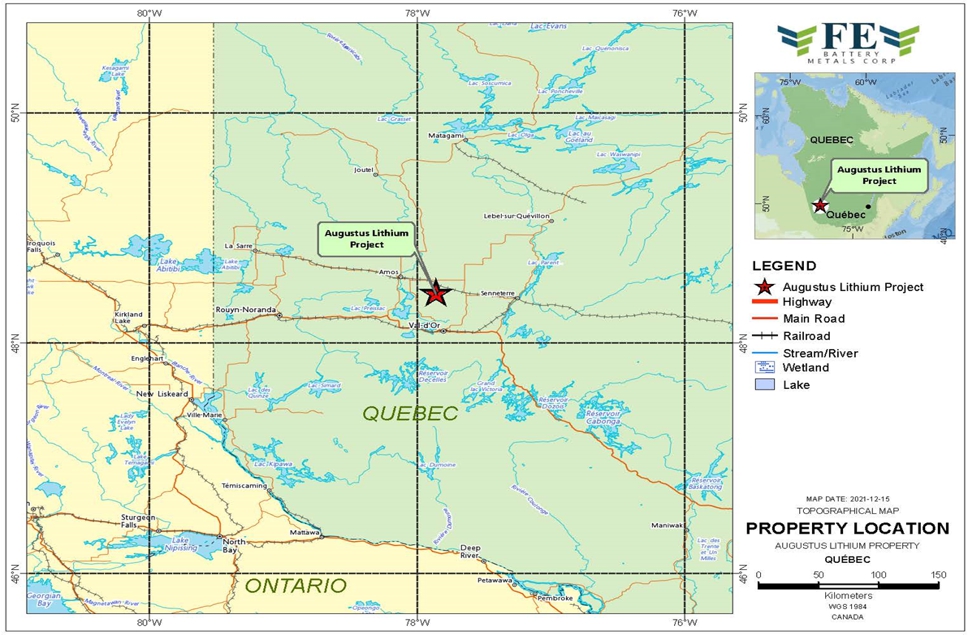
The property is located about 50 kilometers north of Val d’Or town. The block of claims that make up the property is centered at coordinates 5360000 North and 290000 east, NAD 1983 Zone 18N Datum. The Augustus Property is reachable by either provincial highway #111 connecting Val-d’Or and Amos or by provincial highway #397 connecting Val-d’Or and Barraute. From highway 111, the property can be reached by driving seven kilometers on an all-weather secondary road which is also known as Route Quebec Lithium which traverses the property. The climate is such that exploration and mining operations can generally be conducted year-round. As the property is in an active mining belt, there is a substantial professional workforce nearby experienced in mining and related activities.
12
Property Location Map
Ownership
The Company holds 100% rights in the Augustus Lithium Project which comprised of five groups of claims totaling 563 property claims through agreements with various vendors with vendors retaining either a 2% Net Smelter Royalty or 3% Gross Metal Royalty on certain claims. The claims cover approximately 27,700 hectares of land located in western Quebec in the Landrienne and La Corne Townships.
Joint Venture Agreement for certain claims
On November 14, 2022, the Company entered into a joint venture agreement (the “Infini Joint Venture Agreement”) with Infini Resources Pty Ltd. (“Infini Resources”) whereby Infini Resources may earn a 100% interest in certain mineral claims comprising the Electron Lithium Property.
Pursuant to the Infini Joint Venture Agreement, Infini Resources made a non-refundable payment of AUD$50,000 (CAD$44,088) and has elected to earn an initial 50% interest by making an initial cash payment of AUD$550,000 (CAD$486,837). Upon exercising the option, a joint venture will also be formed between Linear Minerals and Infini Resources to further advance the project. The Infini Joint Venture Agreement may be terminated in certain circumstances, including by Linear Minerals if certain milestones are not met in accordance with the agreement.
Included under the Infini Joint Venture Agreement are 131 of the 563 mining claims covering approximately 6,258 hectares’ area out of the Augustus Project.
On June 4, 2026, the Company entered into a term sheet with Consolidated Lithium Metals Inc. (“CLM”) pursuant to which CLM proposes to acquire a 100% undivided interest in the Augustus Lithium Project and certain additional mineral claims held by the Company. The proposed transaction comprises 449 mineral claims located in the Abitibi and James Bay regions of Québec.
The aggregate consideration payable to the Company under the proposed transaction is approximately $2,750,000, consisting of $687,500 in cash and $2,062,500 payable through the issuance of common shares of CLM, with the number of shares determined based on the applicable 20-day average trading price of CLM’s common shares.
The term sheet provides CLM with an exclusivity period to October 1, 2026 and includes a break fee of $1,687,500 payable by the Company in certain circumstances. Completion of the proposed transaction remains subject to, among
13
other conditions, satisfactory due diligence, negotiation and execution of a definitive agreement, and receipt of all required corporate and regulatory approvals. As at the date these financial statements were authorized for issue, the proposed transaction had not been completed and no amounts relating to the transaction had been recognized in these financial statements.
Management believes that the proposed transaction has the potential to unlock value from the Augustus Lithium Project while allowing the Company to focus capital allocation toward its broader portfolio of critical mineral projects. Completion of the transaction remains subject to a definitive agreement and customary regulatory closing conditions, and accordingly there can be no assurance that the transaction will be completed on the proposed terms or at all.
Map of claims subject to the Infini earn-in agreement—Blocks 1 and 2

Geological Setting and Mineralization style
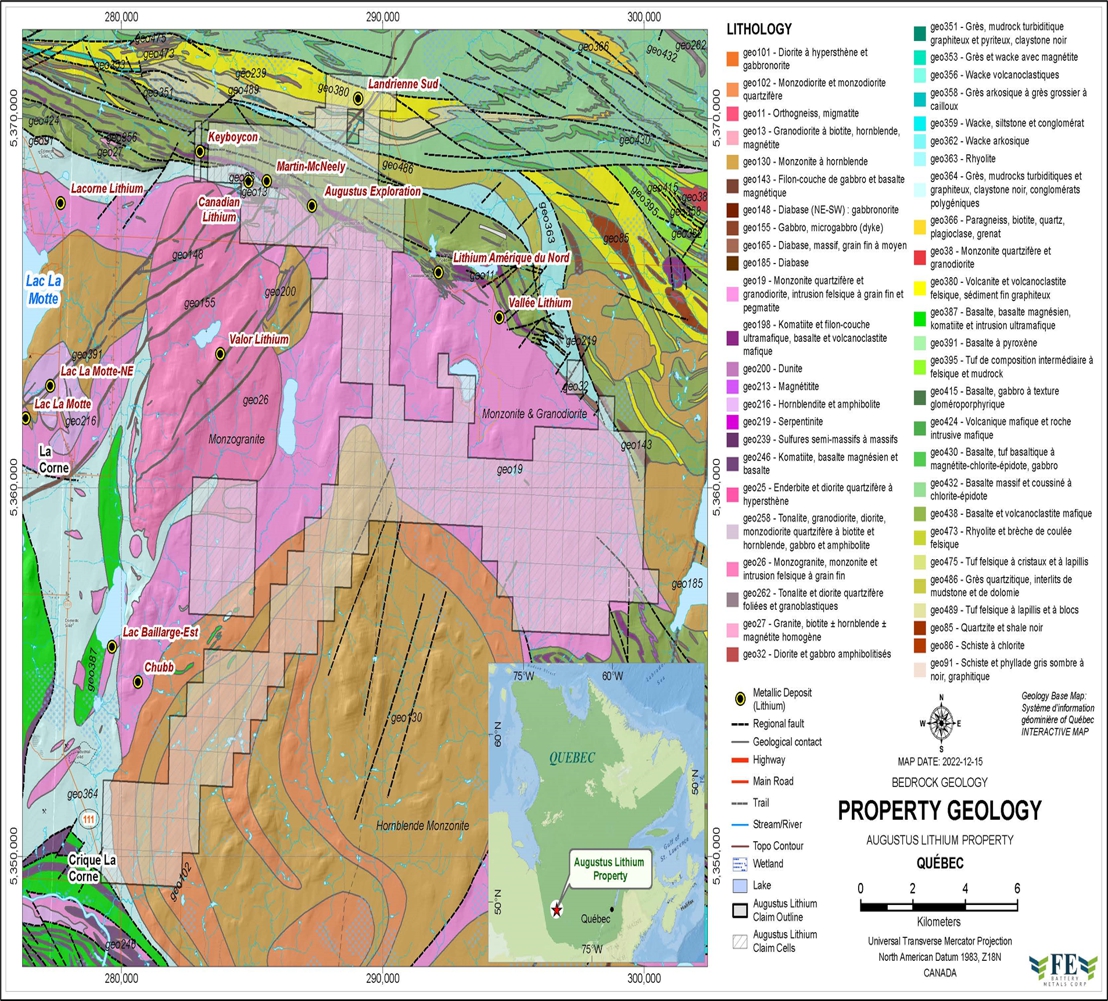
The property is situated on the Archean Preissac-Lacorne batholith, a syn- to post- tectonic intrusion that was emplaced in the Southern Volcanic Zone of the Abitibi Greenstone Belt of the Superior Province of Quebec. To the north, the batholith is bounded by the Manneville Fault and to the south by the Cadillac Fault and the eastward extension of the Porcupine-Destor Fault. The batholith, which is a composite body has associated pegmatites and quartz veins.
Local geology of the property area is comprised basic to intermediate rocks of Kinojevis Group, volcanic rocks of Malartic Group, and sedimentary rocks Kewagama Group. The intrusive rocks including Lacorne batholith, occupies most of Lacorne township and adjacent parts of the adjoining townships. The intrusive rocks occur in both the volcanic and sedimentary rocks in the Lacorne area and range in composition from ultrabasic to acidic.
The regional metamorphic grade is greenschist facies and close to the batholith is hornblende hornfels facies contact metamorphism. Numerous pegmatitic and aplitic dykes occur in muscovite granite, particularly near its north and south contacts where they constitute the bulk of the exposed rock. These pegmatites mainly strike in east direction but north, north-west and 40° east of north strikes are also stated. Generally best mineralization occurs in north and east striking dykes. The Pegmatites are classified simple and complex.
14
The simple ones contain the same minerals as those found in the muscovite granite which are albite, quartz, microcline, and microcline-perthite with small amount of muscovite. The complex Pegmatite include common minerals of the simple pegmatites with fewer common minerals such as spodumene, columbite, tantalite, lepidolite, beryl, and others, which in places have potential for mineral deposits of economic value.
The pegmatite dykes, sills and lenses can be subdivided into rare-element pegmatites and granitic pegmatites. The rare-element pegmatites are significance, and they contain microcline or perthite, albite, quartz, muscovite, spodumene and minor amounts of beryl, columbite-tantalite and cassiterite.
The deposit model for the area is that the spodumene occurs in Li-Cs-Ta (“LCT”) rare-element pegmatite dykes. LCT pegmatites are associated with S-type, peraluminous (Al-rich), quartz-rich granites. S-type granites crystallize from a magma produced by partial melting of preexisting sedimentary source rock. They are characterized by the presence of biotite and muscovite, and the absence of hornblende. Rare-element pegmatites derived from a fertile granite intrusion are typically distributed over a 10 to 20 km2 area within 10 km of the fertile granite. A fertile granite is the parental granite to rare-element pegmatite dykes.
Property Geology Map
15
History
Exploration work in the Property and surrounding area dates to the late 1940s’ with the discovery of lithium showings documented in Quebec Department of Natural Resources. Augustus Prospect was described as a lithiferous dyke oriented N300°/40°, it is documented more than 850 m long and 7.6 m wide on average. Its extent to depth is unknown. Martin-McNeely pegmatite was intersected by drilling with grades up to 1.0 percent Li over 2.44 m. Mineralization is confined to pegmatite dykes of unknown attitude. Beluga / Canada Lithium Prospect is reported as a 90.0 m by 30.0 m high grade pegmatite estimated to contain 5.0 to 10.0% spodumene. Highlights of the historical work are presented below:
| ● | Canadian Lithium Corp. carried out work from 1948 to 1955 which included trenching and diamond drilling. The work identified spodumene at the Augustus and Canadian Lithium (named Beluga by FE) prospects. Several drill holes intersected spodumene bearing lithium zones. |
| ● | Martin – McNeely Mines Ltd. drilled three holes on the Martin-McNeely prospect. Two out of three holes intersected spodumene mineralization. |
| ● | Dome Exploration Canada Ltd. Drilled one hole with no spodumene mineralization. |
| ● | Certac Mining Corp. in 1977 investigated the Canada Lithium / Beluga spodumene bearing pegmatite bodies near the south end of Range 1, Lot 25, and Lot 26. |
| ● | In 2010 Mineral Hill Industries did prospecting and rock sampling which revealed a new lithium occurrence which was dubbed the Lithium Chalet showing. |
| ● | In 2011 Rock Tech completed a ZTEM and magnetometer survey carried out over a total of 4001.3 line-kilometres. Gerard Lambert Geosciences carried out a magnetic survey on behalf of the group of prospectors in the same year. |
| ● | In 2017 Hi Ho Silver acquired a part of the current claim block of the Property and completed a technical report to summarize historical work on Augustus and Canadian Lithium Prospects. |
There is no past producing mine on the Property and there were no historical mineral resource or mineral reserve estimates documented.
Exploration
Since acquiring its interests in the Augustus Lithium Project, the Company has completed prospecting, geological mapping, surface sampling and two phases of diamond drilling. During 2021 and 2022, the Company completed 39 diamond drill holes totalling approximately 7,522 metres. The drilling intersected multiple spodumene-bearing pegmatite zones of varying widths and grades. The exploration results confirmed the presence of lithium-bearing pegmatites but are insufficient to establish a mineral resource or mineral reserve under S-K 1300. No mineral resources or mineral reserves have been established on the property, and further exploration and technical work would be required to determine whether the property has reasonable prospects for economic extraction. During 2025, the Company completed an exploration drill program including 11 drill holes for a total 1,558 metres of drilling.
Current Non-Material Mineral Properties and Recently Disposed Properties
In addition to our principal property, the Augustus Lithium Property, the Company has other mineral interests in exploration properties, as summarized below, which we do not consider to be material at this time. Also included below are recently disposed properties.
Lac Marion Uranium Property, Quebec
Property description and location
The Lac Marion Uranium Property consists of 47 mining claims covering approximately 2,760 hectares area in two claim blocks on land located about 40 kilometres northeast of Mont Laurier in Quebec.
Ownership
On June 10, 2024, the Company entered into an option agreement to acquire a 100% interest in the Lac Marion Uranium Property.
On October 30, 2025, the Company entered into an amended option agreement (the “Lac Marion Uranium Property Amended Agreement”) which amended the due dates for certain share issuances and exploration expenditure requirements of the option agreement.
Under the terms of the Lac Marion Amended Agreement, the Company has the option to acquire a 100% interest in the property by completing the share issuance of 1,200,000 common shares (not issued).
The Lac Marion property has a 1.5% GMR payable to the optionor of which the Company will have the option to buy-out of 0.5% by paying $1,000,000.
16
Lac Coulombre Property
Property description and location
The Lac Coulombre property consists of 89 mining claims covering approximately 5,000 hectares area on land located about 100 kilometres south of Quebec City, Quebec.
Ownership
On November 5, 2024, the Company entered into an option agreement to acquire a 100% interest in the Lac Coulombre Property.
On November 3, 2025, the Company entered into an amended option agreement (the “Lac Coulombre Property Amended Agreement”) which amended the due dates for certain share issuances and exploration expenditure requirements of the option agreement.
Pursuant to the terms of the Lac Coulombre Amended Agreement, the Company acquired a 100% interest in the property by making a cash payment of $5,000 and issued 2,250,000 common shares during the year ended March 31, 2026.
The Lac Coulombre property has a 1.5% NSR payable to the optionor of which the Company will have the option to buy-out of 0.5% by paying $1,000,000.
Falcon Lake Property, Ontario
Property description and location
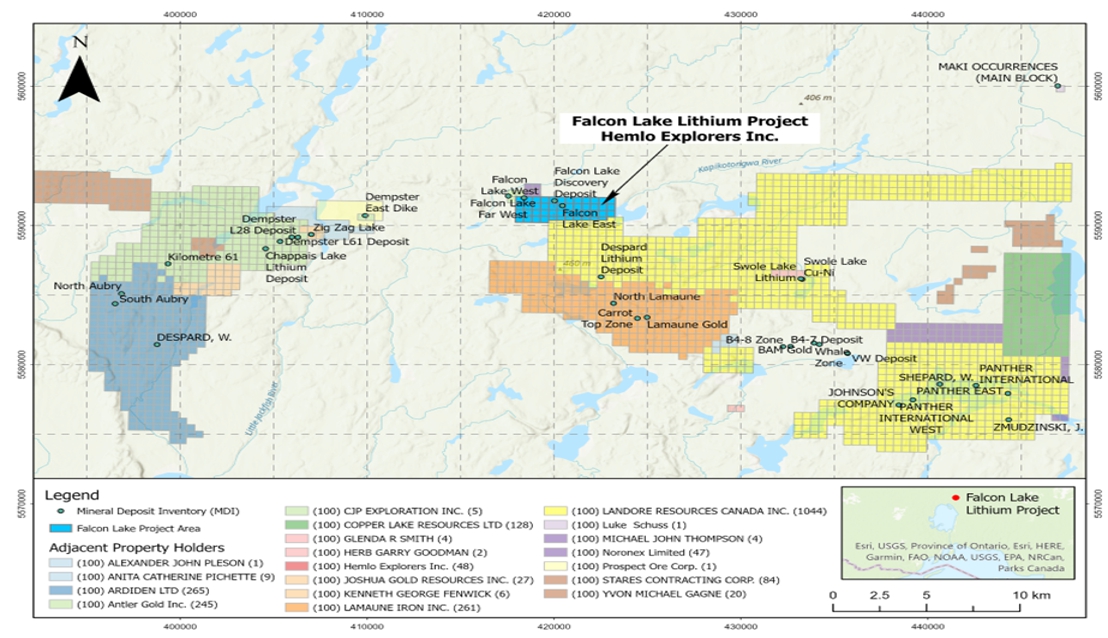
The Falcon Lake property is comprised of 48 mineral claims covering approximately 1,000 hectares located in the Thunder Bay Mining Division, Ontario.
Ownership
On October 21, 2022, the Company completed its commitments under the terms of the Falcon Lake Agreement, by completing an aggregate of $85,000 in options payments and 157,895 in common share issuances to acquire a 100% interest in the property.
On January 27, 2023, the Company executed a joint venture agreement (the “Battery Age Minerals Joint Venture Agreement”) with Battery Age Minerals Limited (“Battery Age Minerals”) whereby Battery Age Minerals may earn a 100% interest in the Falcon Lake Property.
Pursuant to the Battery Age Minerals Joint Venture Agreement, Battery Age Minerals made a non-refundable payment of AUD$50,000 (CAD$45,359) and elected to earn a 65% interest by completing the initial option payment consisting of a cash payment of AUD$100,000 (CAD$93,999) and issuing the Company 1,375,000 of Battery Age Mineral shares valued at $513,975. Battery Age Minerals earned a further 25% interest, for an aggregate 90% interest, by issuing a further 750,000 shares of Battery Age Minerals valued at $290,295 and by making a cash payment of AUD$50,000 (CAD$46,175). Battery Age Minerals may acquire the remaining 10% interest, for a 100% beneficial interest by making a further payment equal to the lower of the price determined by independent valuation or AUD$2 million. Upon Battery Age Minerals earning a 90% interest, a joint venture will be deemed to have been formed between Linear Minerals and Battery Age Minerals to further advance the project.
The option agreement may be terminated in certain circumstances, including by Linear Minerals if certain milestones are not met in accordance with agreement.
17
Property Location Map
Rose West Lithium Property, Quebec
Property description and location
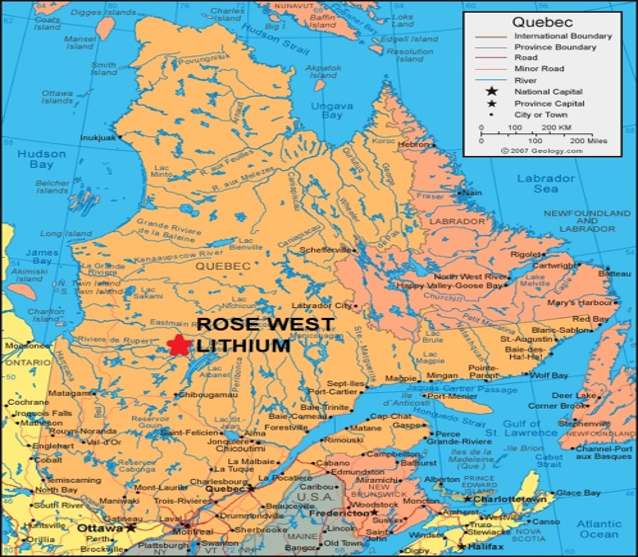
Rose West Lithium Property consists of 32 mining claims covering approximately 1,700 hectares area on NTS map 33C01 on the territory of Eeyou Istchee in James Bay area, Quebec, Canada. It is located about 40 km north of Cree Village of Nemaska located about 300 km northwest of Chibougamau.
Located in a premier mining jurisdiction in Quebec, the property is accessible through the James Bay Road that connects Matagami and Radisson (highway Route/109 from Val d’Or). It is also accessible by road via the Route du Nord, usable all year round from Chibougamau.
Ownership
In April 2023, the Company acquired a 100% interest in the Rose West property by issuing 1,300,000 shares of the Company.
The Rose West Lithium property has a 1% GMR payable to the optionor upon the commencement of commercial production.
18
Property Location Map
Geology
The property is underlain by similar geological rocks to the Rose Lithium deposit and are comprised of the Archean Lower- Eastmain Group, constituted of volcano-sedimentary formational units and ultramafic to felsic intrusives. Gabbros, pyroxenites, and diorites cut across the Property geology. Pegmatites occur as irregular but generally continuous lenses within biotite schists. These felsic rocks intruded paragneiss, sandstone and conglomerate. Younger rocks of the property are represented by a Proterozoic diabase dyke.
Other rock types, including gneiss, dacite, quartzite and conglomerate, have also been reported. Lithologies are generally well foliated with a SE orientation, except for the more massive and unfoliated granites and pegmatites.
Mineralization recognized to date in the area includes rare-element lithium-cesium-tantalum (LCT) type pegmatites and molybdenum occurrences. The geological reports of the area indicate that pegmatite dykes generally strike WSW-ENE with dips of 60 degrees or steeper.
Pontax West Lithium Property, Quebec
Property description and location
The Pontax West Lithium Property consists of 72 mining claims covering over 3,800 hectares in the James Bay lithium region of northern Quebec.
19
Ownership
On October 13, 2023, the Company entered into an option agreement to acquire a 100% interest in the Pontax West Lithium Property (the “Pontax Lithium Agreement”). The property consists of 72 mining claims covering over 3,800 hectares in the James Bay lithium region of northern Quebec.
On September 13, 2024, the Company entered into an amended option agreement (the “Pontax West Lithium Amended Agreement”) which amended the due dates for certain share issuances and exploration expenditure requirements of the option agreement. Under the terms of the Pontax West Lithium Amended Agreement, the Company acquired a 100% interest in the property by completing the share issuance of 2,500,000 on May 7, 2025 with a fair value $37,500. The share issuance had been accrued at March 31, 2025. The Pontax West Lithium property has a 1.5% GMR payable to the Optionor of which the Company will have the option to reduce the GMR to 1.0% by paying $1,000,000 for one-half of one percent.
On August 1, 2025, the Company signed a plan of arrangement agreement (the “Agreement”) to spin out its Pontax West lithium property located in the province of Quebec to Westlinear Minerals Corp. (“Westlinear”). Under the terms of the arrangement, the Company’s shareholders will be issued one share of Westlinear with respect to every 10 shares of the Company owned on the share distribution record date. On October 23, 2025, the shareholders of the Company approved by special resolution the Agreement to spin out the Company’s Pontax West lithium property to Westlinear. With the completion of the Arrangement occurring on November 28, 2025, following receipt of regulatory approval, Linear transferred the Pontax West Lithium property to Westlinear.
Rose East Lithium Property, Quebec
Property description and location
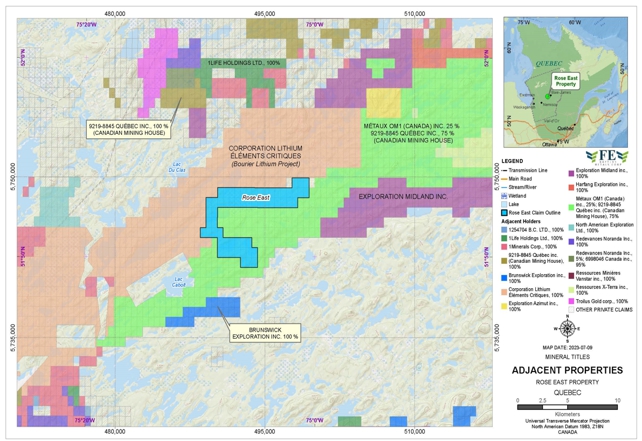
The Rose East Lithium Project covers over 3,100 hectares (approx. 31 square kilometers) which sit directly adjacent to the Bourier project of Critical Elements Lithium Corporation (TSX-V: CRE).
The acquired land package consists of 59 mining claims within the north-east portion of the Northeast-Southwest striking 150 km long Lac des Montagnes volcano-sedimentary belt of Quebec, which contains abundant pegmatite showings and is one of the most active centers for lithium exploration in the province.
Ownership
On March 4, 2023, the Company entered into an option agreement to acquire a 100% interest in the Rose East Lithium Property (“Rose East Lithium”). The Rose East Lithium property consists of 59 mining claims covering approximately 3,100 hectares in northern Quebec.
On November 3, 2025, the Company entered into an amended option agreement (the “Rose East Lithium Property Amended Agreement”) which amended the due dates and amounts for certain share issuances requirements of the option agreement.
Under the terms of the Rose East Lithium Amended Agreement, the Company has the option to acquire a 100% interest in the property by completing the share issuance of 1,250,000 common shares. On February 3, 2026, the Company issued the required shares to complete its acquisition of a 100% interest in the Rose East Lithium property.
The Rose East Lithium property has a 1.5% GMR payable to the Optionor of which the Company will have the option to reduce the GMR to 1.0% by paying $1,000,000 for 0.5%.
Geology
The Rose East claims are underlain by neo-Archean Voidyre Formation metasediments which contains numerous pegmatite intrusives of the Senay Suite. The Senay suite pegmatites range in length from a few meters to up to 3 kilometers and are the key target of Lithium exploration in the area.
20
Property Location Map
Ridgeway Clark County, Washington, USA
Property description and location
The Ridgeway Clark County mineral property claims are located in the Clark County, Washington, U.S.
Ownership
The Company staked 67 mineral property claims located in the Clark County, Washington, U.S at a cost of $60,220.
Kipawa West Property
Property description and location
The Kipawa West property is comprised of 53 mining claims covering an approximate area of 3,000 hectares located in Abitibi-Temiscamingue, Quebec.
Ownership
On December 9, 2025, the Company entered into an option agreement to acquire a 100% interest in the Kipawa West rare-earth property(the “Kipawa West Agreement”).
Under the terms of the Kipawa West Agreement, the Company has the option to acquire a 100% interest in the property by completing the following share issuance and exploration expenditures:
| Due Dates | Issuance of Linear Minerals common shares |
Exploration expenditures ($) |
| On signing (not yet issued) | 1,000,000 | - |
| December 9, 2026 | 1,500,000 | 250,000 |
| December 9, 2027 | 2,000,000 | 500,000 |
| December 9, 2028 | - | 500,000 |
The Kipawa West Property is subject to a 2% GMR royalty payable to the Optionor. The Company will have the option to reduce the GMR from 2.0% to 1.0% by paying $1,000,000.
21
Kokanee Creek Gold Property, British Columbia
Property description and location
The Kokanee Creek Gold Property consists of 3 claims covering approximately 1,000 hectares area in Nelson Mining Division in British Columbia, Canada. It is located 18 km to the east of Nelson on NTS map 082F055. The property is part of a very active mining area with several historical and current gold, silver and base metals deposits located in the region. Nelson is a historical mining town dating back to the discovery of Toad Mountain Silver deposit in 1886.
Ownership
The Company acquired a 100% interest in the Kokanee Creek Property in 2022. The Property is subject to a 2.0% NSR royalty of which the Company will have the option to reduce the NSR by 1.0% by paying $1,000,000.
During the year ended March 2025, the Company wrote-off all deferred costs to date as the company does not plan to do further work on the property.
Cosgrave Lithium Property, Ontario
Property description and location
The Cosgrave Lithium property is comprised of 198 mineral claims covering approximately 3,700 hectares located in the Ear Falls, Ontario.
Ownership
On August 24, 2023, the Company entered into a purchase agreement to acquire a 100% interest in the Cosgrave Lithium property. Pursuant to the terms of the Cosgrave Agreement, the Company acquired a 100% interest in the Cosgrave Lithium property by issuing 175,000 common shares of the Company and by making the option payment of $22,500 during the year ended March 31, 2024.
The Cosgrave Lithium Property is subject to a 1.5% NSR royalty, which the Company will have the option to reduce the NSR by 0.75% to 0.75% by paying $500,000.
During the year ended March 2025, the Company wrote-off all deferred costs to date as the company does not plan to do further work on the property.
Jubilee Lithium Property, Ontario
Property description and location
The Jubilee Lithium property consisted of 10 contiguous mineral claims which cover 184 cells with a geographic area of approximately 2,944 hectares of land in the Red Lake Mining District, Northwestern Ontario. The Property is located approximately 80 km northeast of Ear Falls, Ontario. The nearest settlement is the town of Ear Falls, Ontario with a current approximate population of 1,000 inhabitants. The property lies within NTS map sheet 52N/01 and straddles four townships of Costello, Latrielle Lake Area, Jubilee Lake Area and Birkett Townships.
Ownership
On December 1, 2022, the Company entered into an option agreement to acquire a 100% interest in the Jubilee Lithium Property. The Company has completed the required option payments totaling $50,000 as of March 31, 2024 to acquire a 100% interest in the property.
During the year ended March 31, 2024, the Jubilee Lithium property claims were allowed to lapse and as a result the Company wrote-off all deferred costs incurred to date.
North Spirit Property, Ontario
Property description and location
The property consists of 124 mining claims covering approximately 2,500 hectares area in two claim blocks on crown land in northwestern Ontario and is located about 175 kilometres to the north of Red Lake, Ontario.
Ownership
The Company acquired a 100% interest in the North Spirit Property by completing the share issuance of 1,105,262 common shares. The North Spirit property has a 1% GMR payable to the Optionor.
During the year ended March 31, 2024, the Company decided it would not be pursuing any further exploration work on the North Spirit property and wrote-off all deferred costs incurred to date.
22
Titan Gold Property
Property description and location
Titan Gold is located in the Abitibi area of Western Quebec, Canada and is comprised of 80 mining claims covering approximately 4,400 hectares. in the “municipalité régionale de comté” “regional county municipal” of Jamesie in Quebec.
Ownership
On October 2, 2020, the Company entered into an option agreement to acquire a 100% interest in the Titan Gold Property. Under the terms of the option agreement, the Company has the option to acquire a 100% interest in the Titan Gold property by completing the certain option payments, and common share issuances. The Company has an outstanding option payment of $40,000 to acquire its 100% interest in the property.
The Titan Gold property is subject to a 1.5% NSR royalty.
During the year ended March 2024, the Company wrote-off all deferred costs to date as the company does not plan to do further work on the property.
Trix Lithium Property, Ontario
Property description and location
Trix Lithium is located in in the Georgia Lake area in northwestern Ontario and is comprised of 23 mining claims covering approximately 11,000 hectares.
Ownership
On March 13, 2023, the Company entered into an option agreement to acquire a 100% interest in the Trix Lithium Property.
Under the terms of the option agreement, the Company has the option to acquire a 100% interest in the Trix Lithium property by completing the certain option payments, common share issuances and exploration expenditures
The Trix Lithium property is subject to a 2.0% NSR royalty.
During the year ended March 2024, the Company wrote-off all deferred costs to date as the company does not plan to do further work on the property.
Exploration Amounts Expensed
Exploration expenses in the five fiscal years ended March 31:
| Year | 2026 | 2025 | 2024 | 2023 | 2022 |
| British Columbia | |||||
| Kokanee Creek | $Nil | $Nil | $Nil | $Nil | $74,500 |
| Ontario | |||||
| Jubilee Lithium(1) | Nil | Nil | Nil | 64,295 | Nil |
| Phyllis Cobalt(1) | Nil | Nil | Nil | Nil | 21,047 |
| Trix Lithium(1) | Nil | Nil | 110,050 | 32,750 | Nil |
| Quebec | |||||
| Augustus Lithium | 727,335 | 955,337 | 2,121,855 | 1,474,863 | 1,502,261 |
| Kipawa West | 79,000 | Nil | Nil | Nil | Nil |
| Lac Coulombre | 80,000 | Nil | Nil | Nil | Nil |
| Lac Marion | 75,000 | Nil | Nil | Nil | Nil |
| Pontax West Lithium | Nil | 30,000 | 181,000 | Nil | Nil |
| Rose West Lithium | Nil | 25,000 | 72,600 | Nil | Nil |
| Rose East Lithium | Nil | 25,000 | 88,200 | Nil | Nil |
| Titan Gold(1) | Nil | Nil | Nil | 89,100 | 75 |
| General exploration | Nil | 252,864 | 9,700 | 159,665 | 11,238 |
| Total | $961,335 | $1,288,201 | $2,583,405 | $1,820,673 | $1,609,121 |
| (1) | As of March 31, 2026, the property is no longer held by the Company. |
The Company’s sole source of funding has been the issuance of equity securities for cash, primarily through private placements to sophisticated investors and institutions. The Company has issued common shares in each of the past few years, pursuant to private placement financings and the exercise of warrants and options.
23
Internal Controls Disclosure
The Company has internal controls for reviewing and documenting the information from exploration activities, and ensuring the validity of the information. Information that is used to compile exploration results are prepared and certified by appropriately qualified persons at the location of drilling or other exploration activities and is subject to our internal review process which includes review and approval by appropriate project management and the Company’s corporate qualified person under National Instrument 43-101.
| ITEM 4A. | UNRESOLVED STAFF COMMENTS |
Not applicable.
| ITEM 5. | OPERATING AND FINANCIAL REVIEW AND PROSPECTS |
Management’s discussion and analysis is presented in relation to the financial statements of Linear Minerals , which statements are prepared as a going concern in accordance with IFRS.
The Company is a mineral exploration company with no producing properties and consequently has no current operating income or cash flow. All of the Company’s short to medium-term operating and exploration cash flow must be derived from external financing.
The financial statements referred to in this Annual Report have been prepared in accordance with IFRS issued by the International Accounting Standards Board (“IASB”) and Interpretations of the International Financial Reporting Interpretations Committee (“IFRIC”). The policies applied in the financial statements are based on the IFRS issued and outstanding as at July 29, 2026.
| A. | Operating Results |
Fiscal 2026 compared to Fiscal 2025
The net loss and comprehensive loss for the year ended March 31, 2026 (the “Current Year”) was $2,683,523, a $629,842 decrease over the net loss of $3,313,365 for the year ended March 31, 2025 (the “Comparative Year”). The significant variances for the Current Year and Comparative Year are as follows:
| · | Consultants and director fees were $1,000 in the Current Year, a decrease of $17,900 over $18,900 for the Comparative Year. Consulting fees consist primarily of corporate advisory and development fees as well as director fees; |
| · | Exploration and evaluation expenditures were $961,335 in the Current Year, a decrease of $326,866 over $1,288,201 for the Comparative Year. Exploration expenditures are primarily for exploration and drill programs carried out on its Quebec lithium prospects, Lac Marion uranium project and the Kipawa West rare earth project; |
| · | Investor relations expenses were $39,874 in the Current Year, a decrease of $291,717 over $331,591 for the Comparative Year. Investor relations consist of North American and European Investor Marketing programs; |
| · | Professional fees were $174,064 in the Current Year, an increase of $54,297 over $119,767 for the Comparative Year. The increase was due to legal costs associated with the Plan of Arrangement for the Company during the Current Year; |
| · | Shareholder communications was $154,500 for the Current Year, an increase of $64,296 over $90,204 for the Comparative Year. Shareholder communication consists primarily of investor programs focused on increasing market and investor awareness of the Company by engaging several groups to assist in growing the Company’s online and digital media presence throughout North America and European markets. Shareholder communications also includes expenses such as transfer agent fees, exchange listing fees, website maintenance and news release costs; |
| · | Share-based compensation was $90,000 in the Current Year, while the Comparative Year was $131,314 expense. Share-based compensation expense is the fair value of restricted share units and stock options granted and vested to directors, officers and consultants during the year; |
| · | Loss on marketable securities was $21,679 in the Current Year while the Comparative Year was $Nil. The loss was due to the sale of the marketable securities during the Current Year; |
| · | Recovery of flow-through premium liability was $218,207 in the Current Year (Comparative Year - $159,579) due to the flow-through recovery during the Current year; and |
| · | Write-down of exploration and evaluation assets was $1,050,482 for the Current Year (Comparative Year - $1,036,875). This amounts relating to mineral claims that were allowed to lapse or projects for which management |
24
determined that future exploration expenditures were no longer justified based on current exploration priorities. The write-downs reflect management’s ongoing review of the Company’s exploration portfolio and capital allocation strategy.
Fiscal 2025 compared to Fiscal 2024
The net loss and comprehensive loss for the year ended March 31, 2025 (the “Current Year”) was $3,313,365 a $3,321,708 decrease over the net loss of $6,635,073 for the year ended March 31, 2024 (the “Comparative Year”). The significant variances for the Current Year and Comparative Year are as follows:
| · | Consultants and director fees were $18,900 in the Current Year, a decrease of $92,600 over $111,500 for the Comparative Year. Consulting fees consist primarily of corporate advisory and development fees as well as director fees; |
| · | Exploration and evaluation expenditures were $1,288,201 in the Current Year, a decrease of $1,295,204 over $2,583,405 for the Comparative Year. Exploration expenditures are primarily for exploration and drill programs carried out on its Quebec lithium prospects; |
| · | Investor relations expenses were $331,591 in the Current Year, a decrease of $761,430 over $1,093,021 for the Comparative Year. Investor relations consist of North American and European Investor Marketing programs; |
| · | Professional fees were $119,767 in the Current Year, a decrease of $12,372 over $132,139 for the Comparative Year. The decrease was due to reduced legal costs for the Company during the Current Year; |
| · | Shareholder communications was $90,204 for the Current Year, a decrease of $35,640 over $125,844 for the Comparative Year. Shareholder communication consists primarily of investor programs focused on increasing market and investor awareness of the Company by engaging several groups to assist in growing the Company’s online and digital media presence throughout North America and European markets. Shareholder communications also includes expenses such as transfer agent fees, exchange listing fees, website maintenance and news release costs; |
| · | Share-based compensation was $131,314 in the Current Year, while the Comparative Year was $1,786,445 expense. Share-based compensation expense is the fair value of restricted share units and stock options granted and vested to directors, officers and consultants during the year; |
| · | Unrealized loss on marketable securities was $63,513 in the Current Year while the Comparative Year was $549,946. The loss was due to a decrease in the fair value of the market securities held; |
| · | Recovery of flow-through premium liability was $159,579 in the Current Year (Comparative Year - $717,679) due to the flow through recovery during the current year; and |
| · | Write-down of exploration and evaluation assets was $1,036,875 for the Current Year (Comparative Year - $749,771). These amounts are due to the Company’s write down of the deferred costs on certain properties for which the Company is either negotiating amendment agreements, re-staking claims or has decided not to continue with further exploration work on the property. |
The Company’s projects are at the exploration stage and have not yet generated any revenue from production to date.
Readers should refer to the notes to the financial statements for details regarding all the mineral leases and option to joint venture agreements for each of the Company’s properties.
| B. | Liquidity and Capital Resources |
Financial Conditions for the year ended March 31, 2026
The Company has historically financed its operations through equity financings. As an exploration-stage issuer, the Company does not generate operating revenues and is dependent on external financing to fund exploration activities, corporate administration and working capital requirements.
The Company currently has no long-term debt obligations. Future capital requirements will depend upon a number of factors, including the timing and extent of exploration programs, the acquisition or disposition of mineral properties, regulatory approvals and general market conditions. The Company expects that future exploration expenditures will continue to be funded primarily through equity financings and strategic transactions.
Management believes that additional financing will be required to fund the Company’s planned exploration activities and corporate overhead during the next twelve months. The Company intends to continue evaluating financing alternatives, including equity financings, strategic partnerships, property transactions and other capital raising initiatives. There can be no assurance that additional financing will be available on acceptable terms, or at all.
25
Please refer to Item 3 – Key Information – section D - Risk Factors in this document.
At March 31, 2026, the Company had cash of $330,676 (March 31, 2025 – $951,807), current assets of $473,133, current liabilities of $1,130,715 and a working capital deficiency of $657,582. The decrease in cash during the year primarily reflects expenditures on exploration activities, corporate administration and professional fees, partially offset by proceeds from private placements completed during the year. At March 31, 2026, the Company is required to incur $150,000 of flow-through qualified expenditures.
Linear Minerals began the year ended March 31, 2026, with $951,807 in cash. During the year ended March 31, 2026, the Company expended $1,274,144 on operating activities, net of working capital changes, cash provided by investing activities was $37,013, comprising $102,233 of proceeds from the sale of marketable securities, partially offset by $65,220 of exploration and evaluation asset acquisition costs and generated $616,000 from financing activities which was attributable to proceeds from share issuances, net of share issue costs, to end at March 31, 2026 with $330,676 in cash.
The Company’s financial statements were prepared using IFRS applicable to a going concern. Several adverse conditions cast substantial doubt on the validity of this assumption – see “Going Concern” disclosure below. The Company holds its cash in bank accounts that earn interest at variable interest rates.
Operations for the year ended March 31, 2026, have been funded primarily through non-brokered private placement financings with the issuance of equity.
Capital Resources
As discussed above, at March 31, 2026, the Company had a working capital deficit of $657,582 compared to a working capital of $311,693 at March 31, 2025. The Company’s continued operations are dependent upon the Company’s ability to obtain sufficient financing to carry on planned operations. The Company estimates that these funds will not be sufficient to provide the Company with the financial resources to carry out currently planned exploration and operations through the next twelve months and will therefore need to seek additional sources of financing to meet all exploration expenditures for its property commitments as well its ongoing operations.
The Company had 84,335,286 common shares issued and outstanding as at March 31, 2026. (March 31, 2025 – 61,335,286).
Share Capital
The Company’s continued operations are dependent upon the Company’s ability to obtain sufficient financing to carry on planned operations.
Fiscal 2026 and subsequently up to July 29, 2026
On December 11, 2025, the Company closed a non-brokered private placement and issued 3,000,000 Quebec flow-through shares (“QFT share”) priced at $0.05 per QFT share for gross proceeds of $150,000. The Company recognized a liability for flow-through shares of $15,000. The Company paid finder fees of $9,000;
On January 22, 2026, the Company closed a first tranche of its non-brokered private placement and issued 3,000,000 units at a price of $0.05 per unit with each unit consisting of one common share and one common share purchase warrant for gross proceeds of $150,000. Each share purchase warrant entitles the holder to purchase one common share at a price of $0.25 per share for a period of one year from the issue date. The share purchase warrants were valued using the Black-Scholes pricing model with the following assumptions: weighted average risk-free interest rate of 2.53%, volatility factor of 190.61% and an expected life of one year;
On February 3, 2026, the Company closed its non-brokered private placement. As part of the closing, the Company issued 6,500,000 units at a price of $0.05 per unit and one common share purchase warrant for gross proceeds of $325,000. Each share purchase warrant entitles the holder to purchase one common share at a price of $0.25 per share for a period of one year from the issue date; The share purchase warrants were valued using the Black-Scholes pricing model with the following assumptions: weighted average risk-free interest rate of 2.52%, volatility factor of 188.44% and an expected life of one year; and
On July 13, 2026, the Company completed a consolidation of its issued and outstanding common shares on the basis of one post-consolidation common share for every 6.5 pre-consolidation common shares. Immediately before the consolidation, the Company had 84,335,286 common shares issued and outstanding. Following the consolidation, the Company had approximately 12,974,542 common shares issued and outstanding, subject to adjustments arising from
26
the rounding of fractional shares. The Company’s common shares continue to trade on the Canadian Securities Exchange under the symbol “LINE.” All weighted-average share and per-share amounts presented in these financial statements have been retrospectively adjusted to reflect the share consolidation.
Fiscal 2025
On April 18, 2024, the Company closed a non-brokered private placement consisting of 1,739,130 Quebec flow-through shares (“QFT share”) priced at $0.23 per QFT share for gross proceeds of $400,000. The Company recognized a liability for flow-through shares of $86,957 also paid finder’s fees of $24,000; and
On October 18, 2024, the Company closed its non-brokered private placement and issued 8,750,000 QFT shares at a price of $0.08 per QFT share for gross proceeds of $700,000. The Company recognized a liability for flow-through shares of $131,250 and also paid finders’ fees of $42,000.
Fiscal 2024
On April 3, 2023, the Company issued 1,500,000 common shares value at $975,000, pursuant the Rose East Lithium property option agreement and 83,333 common shares valued at $54,166, pursuant the Trix Lithium property option agreement;
On April 5, 2023, the Company issued 1,300,000 common shares valued at $884,000, pursuant the Rose West Lithium property option agreement to acquire a 100% interest in the property;
On June 9, 2023, the Company closed a non-brokered private placement consisting of 1,338,461 Quebec flow- through shares (“QFT share”) priced at $0.65 per QFT share and 573,770 National flow through shares (“NFT share”) priced at $0.61 per NFT share for aggregate gross proceeds of $1,220,000. The Company recognized a liability for flow-through shares of $91,783. The Company also paid finder’s fees of $73,200; and
On November 21, 2023, the Company closed a non-brokered private placement consisting of 675,000 common shares priced at $0.40 per share for aggregate gross proceeds of $270,000 and 1,855,554 Quebec flow-through units (“QFT unit”) priced at $0.45 per QFT unit for gross proceeds of $835,000. Each flow-through unit consists of one flow-through share and one-half common share purchase warrant. Each whole warrant entitles the holder to purchase one common share at a price of $0.65 cents per share for a period of two years from the issue date. The QFT share purchase warrants were valued using the Black-Scholes pricing model with the following assumptions: weighted average risk-free interest rate of 4.39% and 4.57%, volatility factor of 116.96% and an expected life of two years. The Company recognized a liability for flow-through shares of $92,778. The Company also paid finder’s fees of $48,000.
The securities offered have not been registered under the United States Securities Act of 1933, as amended, and may not be offered or sold in the United States absent registration or an available exemption from the registration requirements.
Stock Options
During the year ended March 31, 2026, the Company did not grant any stock options.
During the year ended March 31, 2025, the Company granted 1,200,000 incentive stock options to directors, officers and consultants and all of which vested at the date of grant. The options are exercisable at $0.18 per share, expiring on April 26, 2026.
During the year ended March 31, 2024, the Company granted 2,000,000 incentive stock options to directors, officers and consultants and all of which vested at the date of grant. The options are exercisable at $0.59 per share, expiring on June 4, 2028.
Restricted Share Units
During the year ended March 31, 2026, the Company granted 4,500,000 restricted share units (“RSU’s”) to officers, directors and consultants of the Company. On September 8, 2025, the Company issued 4,500,000 common shares upon the vesting and settlement of restricted share units granted on May 8, 2025.
During the year ended March 31, 2025, the Company did not issue any RSU’s.
During the year ended March 31, 2024, pursuant to the Company’s restricted share unit plan, the Company issued 550,000 RSUs on May 26, 2023, vesting immediately and issued 875,000 RSU’s vesting on grant date of September 22, 2023. The Company issued the RSUs to directors, officers and consultants.
Financing Activities
27
The Company estimates that it will require additional financing to carry out its exploration plans and operations through the next twelve months. This could involve joint venture, equity financing, or other forms of financing.
Going Concern
As at March 31, 2026, the Company had cash of $330,676, a working capital deficiency of $657,582, incurred a net loss of $2,683,523 and used $1,274,144 in operating activities. The Company will need to raise additional financing as the Company’s current assets are not sufficient to finance its operations and administrative expenses. The Company is evaluating financing options including, but not limited to, the issuance of additional equity and debt. The Company has no assurance that such financing will be available or be available on favourable terms. Factors that could affect the availability of financing include the Company’s performance (as measured by numerous factors including the progress and results of its projects), the state of international debt and equity markets, investor perceptions and expectations and the global financial and metals markets. In addition to evaluating financing options, the Company has also implemented cost savings measures.
The financial statements do not include any adjustments to the recoverability and classification of recorded assets, or the amounts of, and classification of liabilities that would be necessary if the going concern assumption were not appropriate. Such adjustments could be material.
Plans for Fiscal 2027
The Board of Directors will continue to evaluate strategic alternatives intended to enhance shareholder value, including potential acquisitions, dispositions, joint ventures and other transactions involving the Company’s mineral property interests.
On July 6, 2026, the Company entered into an addendum to its May 21, 2026 non-binding letter of intent with Critical Prospecting Corp. Under the revised transaction structure, the Company proposes to acquire certain mineral properties directly from Critical Prospecting Corp., rather than acquiring all of its issued and outstanding securities.
The properties to be acquired and the consideration payable remain subject to negotiation and will be set out in a definitive agreement. The previously announced flow-through and hard-dollar financings associated with the proposed transaction have been placed on hold. Completion of the proposed transaction remains subject to satisfactory due diligence, the execution of definitive agreements, receipt of required regulatory approvals and other customary closing conditions. As the final terms have not yet been determined, the financial effect of the proposed transaction cannot currently be reasonably estimated.
The Company has not established any mineral reserves on its mineral properties. The Company’s ability to continue its operations and realize the carrying value of its mineral property interests depends on the identification of economically recoverable mineral deposits, its ability to obtain the financing required to advance its properties and, ultimately, the achievement of profitable operations or proceeds from the disposition of its mineral property interests.
As at July 29, 2026, the Company had 12,974,542 common shares issued and outstanding, after giving effect to the consolidation completed on July 13, 2026 on the basis of one post-consolidation common share for every 6.5 pre-consolidation common shares.
| C. | Research and development, patents and licenses |
As Linear Minerals is a mineral exploration company with no producing properties, the information required by this item is inapplicable.
| D. | Trend information |
As a mineral resource exploration company, the Company’s activities are mainly in response to metal prices and the availability of equity financings. Further, we consider that our ability to raise additional funding in order to complete our exploration programs and the plan of operations for its mineral properties for the current fiscal year and beyond will be impacted by prevailing prices for metals. As a mineral resource exploration company, the interest in Linear Minerals ’s stock, and our ability to raise financing and conduct work programs, has been cyclical as it is related to metal prices that, traditionally, have been cyclical in nature.
The Company is a mineral exploration company. At this time, any issues of seasonality or market fluctuations have no material impact other than our ability to raise additional equity capital on terms that are acceptable to the Company.
28
The Company currently defers its mineral property acquisition costs. The Company expenses its exploration and project investigation and general and administration costs and these amounts are included in the net loss for each quarter.
The Company’s Management and board of directors are not financial or commodity analysts and therefore cannot and should not forecast metal prices. Management and the directors do monitor the metals industry trends, specifically demand supply data, and believe that the metals market may continue to experience positive fundamentals. As such the Company will continue to advance its properties, subject to available funds.
| E. | Critical Accounting Estimates |
The preparation of financial statements requires management to make judgments and estimates that affect the amounts reported in the financial statements and notes. By their nature, these judgments and estimates are subject to change and the effect on the financial statements of changes in such judgments and estimates in future periods could be material. These judgments and estimates are based on historical experience, current and future economic conditions, and other factors, including expectations of future events that are believed to be reasonable under the circumstances. Actual results could differ from these judgments and estimates. The more significant areas are as follows:
Going Concern
The assessment of the Company’s ability to raise sufficient funds to finance its exploration and administrative expenses involves judgment. Estimates and assumptions are continually evaluated and are based on historical experience and other factors, including expectations of future events that are believed to be reasonable under the circumstances.
Intangible Exploration and Evaluation Assets
Management is required to assess impairment in respect of intangible exploration and evaluation assets. Note 6 discloses the carrying value of such assets. The triggering events for the potential impairment of exploration and evaluation assets are defined in IFRS 6 Exploration for and Evaluation of Mineral Properties and are as follows:
| · | the period for which the entity has the right to explore in the specific area has expired during the period or will expire in the near future, and is not expected to be renewed; |
| · | substantive expenditure on further exploration for and evaluation of mineral resources in the specific area is neither budgeted nor planned; |
| · | exploration for and evaluation of mineral resources in the specific area have not led to the discovery of commercially viable quantities of mineral resources and the entity has decided to discontinue such activities in the specific area; and |
| · | sufficient data exists to indicate that, although a development in the specific area is likely to proceed, the carrying amount of the exploration and evaluation asset is unlikely to be recovered in full, from successful development or by sale. |
In making the assessment, management is required to make judgments as to the status of each project and its future plans towards finding commercial reserves. The nature of exploration and evaluation activity is such that only a proportion of projects are ultimately successful and accordingly some assets are likely to become impaired in future periods.
| F. | Tabular disclosure of contractual obligations |
The following table summarizes the Company’s short-term and long-term obligations as at March 31, 2026:
| Less than one year | 1-2 years | 2-3 years | 3-4 years | 4-5 years | 5th and subsequent years (1) | Total | |
| N/A | N/A | N/A | N/A | N/A | N/A | N/A | N/A |
| (1) | Mineral property option payments are made at the option of the Company, however non-payment of mineral property leases may result in forfeiture of Linear Minerals ’s rights to a particular property. |
| G. | Safe Harbour |
Certain statements contained in the foregoing Operating Results and elsewhere in this Annual Report on Form 20-F constitutes forward-looking statements. Such forward-looking statements involve a number of known and unknown risks, uncertainties and other factors which may cause the actual results, performance or achievements of Linear Minerals to be materially different from any future results, performance or achievements expressed or implied by such forward-looking statements. Readers are cautioned not to place undue reliance on these forward-looking statements, which speak only as of the date the statements were made, and readers are advised to consider such forward-looking
29
statements in light of the risks set forth below. Risk factors that could affect our future results include, but are not limited to, risks inherent in mineral exploration activities and other operating and development risks, no revenue from commercial operations, no assurance that any of our mineral properties possess commercially mineable bodies of ore, financial risk, shareholder dilution from additional equity financings, competition, environmental regulations, changes to reclamation requirements, volatility and sensitivity to market prices for precious and base metals, the impact of changes in foreign currencies’ exchange rates, political risk, changes in government regulation and policies including trade laws and policies, demand for precious and base metals, and receipt of permits and approvals from governmental authorities.
| ITEM 6. | DIRECTORS, SENIOR MANAGEMENT AND EMPLOYEES |
| A. | Directors and Senior Management |
The following table lists the directors and senior management of the Company as at March 31, 2026. The directors have served in their respective capacities since their election and/or appointment and will serve until the next AGM or until a successor is duly elected, unless the office is vacated in accordance with the Articles/By-Laws of the Company.
| Name and Position | Other Principal Directorships | Shares Beneficially Owned as at July 29, 2026 (6) |
Principal Business Activities Outside the Company |
| Gurminder Sangha (1) Director, President and Chief Executive Officer |
None | 517,579 | Businessman and consultant to companies in the junior resource sector |
| Jurgen Wolf (2) Director, Chief Financial Officer and Corporate Secretary |
Electrum Discovery Corp. Petrichor Energy Inc. Adastra Holdings Ltd. Consolidated Odyssey Exploration Inc. Odyssey Petroleum Corporation |
30,769 | Consultant to companies in the junior resource sector |
| Craig Alford (3) Director |
Evergreen- Agra Inc. Verde Science Inc. |
30,769 | Geologist |
| Jason Grewal (4), Director |
None | 16,923 | Lawyer |
| Jodie Gibson(5), Director |
None | 92,308 | Geologist |
| (1) | Gurminder was appointed to the Company’s board of directors on December 22, 2017 and appointed President and Chief Executive Officer on March 26, 2018. Mr. Sangha is an independent business advisor to the resources industry and brings over twelve years of management and financing expertise in both public and private companies. |
| (2) | Jurgen Wolf was appointed to the Company’s board of directors on February 22, 2018 and appointed Chief Financial Officer and Corporate Secretary of the Company on February 28, 2018. Mr. Wolf has been involved in the oil and gas industry for more than 15 years, assisting public companies with investor relations and administration. Mr. Wolf was President and a director of former US Oil and Gas Resources Inc., which amalgamated to form Petrichor Energy Inc. in 2005. Mr. Wolf is a director of several public companies. |
| (3) | Craig Alford was appointed Director of the Company on October 7, 2019. Mr. Alford holds both a Bachelor of Science (Hons) and a Master of Science in Geology. He is a registered Professional Geoscientist (P. Geo) in Ontario and is a Qualified Person, as defined in National Instrument 43-101. During his 30 years of experience worldwide, Mr. Alford has designed, managed and provided technical direction for projects throughout North and South America, China, Central Asia, Russia, Australia and Africa. Mr. Alford’s experience has included senior positions for a number of large mining companies including, Zijin Mining Group, China Railway, and Teck Mining Ltd. |
| (4) | Jason Grewal was appointed to the Company’s board of director on October 23, 2019. Mr. Grewal is a solicitor in England and Wales and was admitted as an attorney in the state of New York. He has studied law at the London School of Economics, and holds a law degree from the University of London, an LLM in international business law from the IE Law School in Madrid and an MSc in global finance from Cass Business School in London. He has experience working in Canada, the United States and the United Kingdom, and in Europe. He has advised on various capital market transactions in various jurisdictions, and has experience working with both international law firms and multinational corporations. |
| (5) | Jodie Gibson was appointed to the Company’s board of director on March 23, 2021. Mr. Gibson is an exploration geologist with over 14 years mineral exploration experience throughout the North American Cordillera from Alaska to Mexico; including syngenetic and epigenetic precious and base metal systems. He was the Project Manager of the Underworld Resources Inc. exploration team that discovered and defined the Golden Saddle and Arc deposits. Prior to joining the Company, Mr. Gibson was serving as Vice President Exploration for White Gold Corp where he oversaw over $30 million in exploration activities over the previous three years with highlights including expansion of the Golden Saddle and Arc deposits and five new discoveries across the White Gold district: including the high-grade Vertigo discovery on the JP Ross property. Mr. |
30
Gibson holds a Bachelor of Science Degree and a Master of Science Degree from Indiana State University and is a member of the Association of Professional Engineers and Geoscientists of British Columbia.
| (6) | All share, option and warrant quantities and related exercise prices in this table have been adjusted to reflect the 6.5-for-1 consolidation of the Company’s common shares completed on July 13, 2026. |
Executive officers are appointed by the board of directors to serve until terminated by the board of directors or until their successors are appointed. Certain of the directors serve as directors of other reporting companies and if a conflict of interest arises at a meeting of the board of directors, any director in a conflict will declare his interest and abstain from voting on such matter. All directors have a term of office expiring at the next AGM.
Family Relationships
There are no family relationships among any of the persons named above.
Arrangements
There are no arrangements or understandings regarding the selection of any of the persons named above.
| B. | Compensation |
Compensation of Executive Officers
“Named Executive Officer” (“NEO”) means each of the following individuals:
| (a) | A Chief Executive Officer (“CEO”) or one who acted in a capacity similar to a CEO, for any part of the financial year ended March 31, 2026; |
| (b) | A Chief Financial Officer (“CFO”) or one who acted in a capacity similar to a CFO, for any part of the financial year ended March 31, 2026; |
| (c) | Each of the three most highly compensated executive officers, or the three most highly compensated individuals acting in a similar capacity, other than the CEO and CFO, at the end of the most recently completed financial year whose total compensation was, individually, more than $150,000 for that financial year; and |
| (d) | Each individual who would be a NEO under paragraph (c) but for the fact that the individual was neither an executive officer of the Company, nor acting in a similar capacity, as at the financial year ended March 31, 2026. |
The Company had two NEOs during the year. The following disclosure sets out the compensation that the Board intended to pay, make payable, award, grant, give or otherwise provide to each NEO and director for the financial year ended March 31, 2026.
Compensation of Directors and NEOs
The Company’s Corporate Governance and Compensation Committee (“CGCC”) has responsibility for reviewing compensation for the Company’s directors and senior management. The independent directors are encouraged to meet at any time they consider necessary without any members of management including the non-independent directors being present. The Company’s auditors, legal counsel and employees may be invited to attend. The independent directors exercise their responsibilities for independent oversight of management through a strong CGCC.
To determine compensation payable, the CGCC reviews compensation paid for directors and NEOs of companies of similar size and stage of development in the mineral exploration industry and determines an appropriate compensation reflecting the need to provide incentive and compensation for the time and effort expended by the directors and senior management while taking into account the financial and other resources of the Company. In setting the compensation, the CGCC annually reviews the performance of the NEOs in light of the Company’s objectives and considers other factors that may have impacted the success of the Company in achieving its objectives and financial resources.
The Company’s compensation policies and its stock option plan are intended to assist the Company in attracting, retaining and motivating directors, officers and employees of the Company and of its subsidiaries and to closely align the personal interests of such directors, officers and employees with those of the shareholders by providing them with the opportunity, through stock options, to acquire shares in the capital of the Company.
Share-based awards
The board of directors adopted a Restricted Share Unit Plan (“RSU Plan”) dated for reference December 31, 2021, which has been most recently approved by the shareholders of the Company on October 22, 2025 at the Company’s
31
AGSM on that date, providing for the issuance of RSUs to directors, officers, employees, and consultants (“Eligible Persons”).
Nature and Administration of the RSU Plan
All Eligible Persons (as defined in the RSU Plan) of the Company are eligible to participate in the RSU Plan (as “RSU Plan Participants”), though the Company reserves the right to restrict eligibility or otherwise limit the number of persons eligible for participation in the RSU Plan at any time. Eligibility to participate in the RSU Plan does not confer upon any person a right to receive an award of RSUs.
Subject to certain restrictions, the Board can, from time to time, grant RSUs to Eligible Persons. RSUs will be credited to an account maintained for each RSU Plan Participant on the books of the Company as of the award date. The grant of an RSU Award shall entitle the Participant to the conditional right to receive for each RSU credited to the Participant’s Account, at the election of the Company, either one Common Share or an amount in cash, net of applicable taxes and contributions to government sponsored plans, as determined by the Board, equal to the Market Price of one Common Share for each RSU credited to the Participant’s Account on the Settlement Date, subject to the conditions set out in the RSU Grant Letter and in the Plan, and subject to all other terms of this Plan
Each award of RSUs vests on the date(s) (each a “Vesting Date”) specified by the Board on the award date and reflected in the applicable Award Notice (as defined in the RSU Plan). Additionally, the term of the RSUs shall be determined by the Board on the date of the award of RSUs. Each RSU outstanding and all rights thereunder shall expire at the expiry time determined by the Board, subject to earlier termination in accordance with the RSU Plan.
Rights and obligations under the RSU Plan can be assigned by the Company to a successor in the business of the Company, any company resulting from any amalgamation, reorganization, combination, merger or arrangement of the Company, or any corporation acquiring all or substantially all of the assets or business of the Company. The RSUs are non-transferable and non-assignable by the RSU Plan Participant.
Notwithstanding any other provision of the RSU Plan:
| (1) | the aggregate number of Shares reserved for issuance pursuant to RSUs granted under the RSU Plan and other Security Based Compensation Arrangements (as defined in the RSU Plan) cannot exceed 10% of the issued and outstanding Shares as at the date of grant (on a non-diluted basis); |
| (2) | the aggregate number of Shares reserved for issuance pursuant to RSUs granted to any one individual in any 12 month period shall not exceed 1% of the issued and outstanding Shares, unless disinterested shareholder approval is obtained; |
| (3) | the aggregate number of Shares reserved for issuance pursuant to RSUs granted to Insiders (as defined in the policies of the Exchange) shall not exceed 2% of the issued and outstanding Shares, unless disinterested shareholder approval is obtained; and |
| (4) | all RSUs granted pursuant to the RSU Plan are subject to the policies of the Exchange. |
At March 31, 2026, and at July 29, 2026, the maximum number of common shares which may be issued pursuant to share-based awards under the RSU Plan is equal to 1,297,454 and 1,297,454 of the issued and outstanding common shares at the respective dates. There were Nil RSU’s share-based awards outstanding at March 31, 2026 and July 29, 2026 respectively.
Option-Based Awards
The board of directors of the Company adopted a stock option plan, as amended (the “Plan”), effective December 8, 2018, which has been most recently approved by the shareholders of the Company on October 22, 2025 at the Company’s AGSM on that date. The number of shares in respect of which options may be granted under the plan shall not exceed 10% of the issued and outstanding common shares of the Company at the relevant grant date. In addition, the number of shares which may be reserved for issuance to any one individual may not exceed 5% of the issued shares on a yearly basis or 2% if the optionee is engaged in investor relations activities or is a consultant.
In accordance with good corporate governance practices and as recommended by Canadian National Policy 51-201 Disclosure Standards, the Company imposes black-out periods restricting the trading of its securities by directors, officers, employees and consultants during periods surrounding the release of annual and interim financial statements and at other times when deemed necessary by management and the Board. In order to ensure that optionees are not prejudiced by the imposition of such black-out periods, the Plan includes a provision to the effect that any outstanding
32
options with an expiry date that falls during a management imposed black-out period or within five days thereafter will be automatically extended to a date that is ten trading days following the end of the black-out period.
The Plan provides that if a change of control (as defined therein) occurs, or if the Company is subject to a take-over bid, all shares subject to stock options shall immediately become vested and may thereupon be exercised in whole or in part by the optionees. The Board may also accelerate the expiry date of outstanding stock options in connection with a take-over bid.
The Plan contains a provision that, if pursuant to the operation of the plan’s adjustment provisions, in respect of options granted under the Plan (the “Subject Options”), an optionee receives options to purchase securities of another company (the “New Company”), such new options shall expire on the earlier of: (i) the expiry date of the Subject Options; (ii) if the optionee does not become an eligible person in respect of the New Company, the date that the Subject Options expire pursuant to the applicable provisions of the Plan relating to expiration of options in cases of death, disability or termination of employment discussed in the preceding paragraph above (the “Termination Provisions”); (iii) if the optionee becomes an eligible person in respect of the New Company, the date that such new options expire pursuant to the terms of the New Company’s stock option plan that correspond to the Termination Provisions; and (iv) the date that is one (1) year after the Optionee ceases to be an eligible person in respect of the New Company or such shorter period as determined by the Board.
The Plan allows the board to impose vesting provisions and provides that, unless otherwise specified at the time of grant, all options shall vest and become exercisable in full immediately upon grant of such options. However, as required by the policies of the Exchange, options granted to optionees performing Investor Relations Activities must vest in stages over 12 months with no more than ¼ of such options vesting in any three-month period.
The purpose of the Plan is to allow the Company to grant options to directors, officers, employees and service providers, as an incentive for performance, and as an opportunity to participate in the success of Linear Minerals. The granting of such options is intended to align the interests of such persons with that of the shareholders. Options are exercisable over periods of up to ten years as determined by the board of directors of Linear Minerals and are required to have an exercise price no less than the market price as defined in the Plan prevailing on the day that the option is granted. Pursuant to the Plan, the board of directors may from time to time authorize the issue of options to directors, officers and employees of and consultants to Linear Minerals and its subsidiaries or employees of companies providing management services to Linear Minerals or its subsidiaries.
At March 31, 2026 and July 29, 2026, 724,580 and 980,045 Common Shares, respectively, remained available for future option grants under the Plan. There were 572,874 and 317,409 stock options outstanding at those respective dates. All quantities in this paragraph are presented on a post-consolidation basis.
The board of directors generally grants options to corporate executives on the recommendation of the CGCC. As part of its annual work plan, the CGCC reviews, among other things, executive compensation and makes appropriate recommendations to the board regarding such compensation, including but not limited to the grant of options. Options may be granted at other times of the year to individuals commencing employment with the Company.
33
Summary Compensation Table
The compensation paid to the NEOs during the years ended March 31, 2026, 2025 and 2024 is as set out below:
| NEO Name and Principal Position | Year (1) | Salary/Fees ($) |
Share-Based Awards ($) |
Option-Based Awards (2) ($) |
Non-Equity Incentive Plan Compensation ($) |
Pension Value ($) |
All Other Compensation ($(3) ) |
Total Compensation ($) |
|
| Annual Incentive Plans | Long-term Incentive Plans | ||||||||
| Gurminder Sangha (4) President and CEO |
2026 2025 |
307,929 280,050 234,800 |
18,000 Nil 236,000 |
Nil 21,886 422,028 |
Nil Nil Nil |
Nil Nil Nil |
Nil Nil Nil |
Nil Nil Nil |
325,929 301,936 892,828 |
| Jurgen Wolf (5) CFO and Corporate |
2026 2025 2024 |
Nil Nil 10,000 |
15,000 Nil 93,000 |
Nil 21,886 131,884 |
Nil Nil Nil |
Nil Nil Nil |
Nil Nil Nil |
Nil Nil Nil |
15,000 21,886 234,884 |
| (1) | Financial years ended March 31. |
| (2) | The “grant date fair value” of options granted during the year is determined by using the Black-Scholes model, please see the table under “Incentive Plan Awards” for the ‘in-the-money’ value of these options. |
| (3) | Includes any health, dental, parking, group plan insurance benefits and professional fees paid by the Company on behalf of the NEO. |
| (4) | Gurminder was appointed to the Company’s board of directors on December 22, 2017 and appointed President and Chief Executive Officer on March 26, 2018. |
| (5) | Jurgen Wolf was appointed to the Company’s board of directors on February 22, 2018 and appointed Chief Financial Officer and Corporate Secretary of the Company on February 28, 2018. |
As part of its annual work plan, the CGCC reviews, among other things, executive compensation and makes appropriate recommendations to the board regarding such compensation.
Incentive Plan Awards
Outstanding Share-Based Awards and Option-Based Awards
The share-based awards and option-based awards outstanding for the NEOs, as at the financial year ended March 31, 2026, is as set out below:
| Option-based Awards | Share-based Awards | |||||
| Name |
Number of Securities Underlying Unexercised Options (1) (2) |
Option |
Expiry Date |
Value of ($) |
Number of Shares or Units of Shares that have not Vested (#) |
Market or Pay-out Value of Share-based Payments that have not Vested ($) |
| Gurminder Sangha | 123,077 | 3.835 | June 4, 2028 | Nil | Nil | Nil |
| Gurminder Sangha | 30,769 | 1.17 | April 26, 2026 | Nil | Nil | Nil |
| Jurgen Wolf | 38,462 | 3.835 | June 4, 2028 | Nil | Nil | Nil |
| Jurgen Wolf | 30,769 | 1.17 | April 26, 2026 | Nil | Nil | Nil |
| (1) | This amount is calculated based on the difference between the market value of the shares underlying the options at the end of the most recently completed financial year. |
| (2) | All share, option and warrant quantities and related exercise prices in this table have been adjusted to reflect the 6.5-for-1 consolidation of the Company’s common shares completed on July 13, 2026. |
Incentive Plan Awards – Value Vested or Earned During the Year
Details for share-based awards earned and option-based awards that vested for Gurminder Sangha and Jurgen Wolf respectively during the financial year ended March 31, 2026, are disclosed above in the Summary of Compensation Table.
34
Discussion
The Company accounts for stock options issued to employees at the fair value determined on the grant date using the Black-Scholes option pricing model. The fair value of the options is recognized as an expense using the graded vesting method where the fair value of each tranche is recognized over its respective vesting period. When stock options are forfeited prior to becoming fully vested, any expense previously recorded is reversed.
Share-based payments made to non-employees are measured at the fair value of the goods or services received or the fair value of the equity instruments issued, if it is determined that the fair value of the goods or services cannot be reliably measured. These payments are recorded at the date the goods and services are received.
Warrants issued are recorded at estimated fair values determined on the grant date using the Black-Scholes model. If and when the stock options or warrants are ultimately exercised, the applicable amounts of their fair values in the reserves account are transferred to share capital.
See “Share-Based Awards” for further information on the Restricted Share Unit Plan.
See “Option-Based Awards” and “Securities Authorized for Issuance under Equity Compensation Plans” for further information on the Stock Option Plan.
The Company does not have Incentive Plan Awards, pursuant to which cash or non-cash compensation intended to serve as an incentive for performance (whereby performance is measured by reference to financial performance or the price of the Company’s securities) was paid.
Pension Plan Benefits
Defined Benefit Plan or Defined Contribution Plan
The Company has no pension plans for NEOs that provide for payment or benefits at, following, or in connection with retirement.
Deferred Compensation Plans
The Company has no deferred compensation plan for NEOs.
Termination and Change in Control Benefits
The Company has no contract, agreement plan or arrangement that provides for payment to a NEO at, following or in connection with any termination (whether voluntary, involuntary, or constructive), resignation, retirement, a change in control of the Company or a change in a NEO’s responsibilities.
Director Compensation
The Company does not have a compensation plan for directors.
35
Director Compensation Table
The following table sets out all amounts of compensation provided to the directors who are not NEOs for the Company’s most recently completed financial year:
| Name |
Year (1) | Fees earned ($) |
Share-based awards ($) |
Option-based awards ($) |
Non-equity incentive plan compensation ($) |
Pension value ($) |
All other compensation ($) |
Total ($) |
| Craig Alford | 2026 2025 2024 |
Nil Nil Nil |
6,000 Nil 38,000 |
Nil 13,679 131,884 |
Nil Nil Nil |
Nil Nil Nil |
1,000 5,600 16,000 |
7,000 19,279 185,884 |
| Jason Grewal | 2026 2025 2024 |
Nil Nil Nil |
20,000 Nil 177,500 |
Nil 43,771 79,130 |
Nil Nil Nil |
Nil Nil Nil |
Nil 6,500 Nil |
20,000 50,271 256,630 |
| Jodie Gibson | 2026 2025 2024 |
Nil Nil Nil |
15,000 Nil 93,000 |
Nil 13,679 52,753 |
Nil Nil Nil |
Nil Nil Nil |
Nil Nil Nil |
15,000 13,679 145,753 |
Outstanding Share-based Awards and Option-based Awards
The share-based awards and option-based awards outstanding for the NEOs, as at the financial year ended March 31, 2026, is as set out below:
| Option-based Awards | Share-based Awards | |||||
|
Name |
Number of Securities Underlying Unexercised Options (1) |
Option |
Expiry Date |
Value of Unexercised in- the money Options (1) ($) |
Number of Shares or Units of Shares that have not Vested (#) |
Market or Pay-out Value of Share-based Payments that have not Vested ($) |
| Craig Alford | 38,462 | 3.835 | June 4, 2028 | Nil | Nil | Nil |
| Craig Alford | 19,231 | 1.17 | April 26, 2026 | Nil | Nil | Nil |
| Jason Grewal | 23,077 | 3.835 | June 4, 2028 | Nil | Nil | Nil |
| Jason Grewal | 61,538 | 1.17 | April 26, 2026 | Nil | Nil | Nil |
| Jodie Gibson | 19,231 | 1.17 | April 26, 2026 | Nil | Nil | Nil |
| Jodie Gibson | 15,385 | 3.835 | June 4, 2028 | Nil | Nil | Nil |
| (1) | This amount is calculated based on the difference between the market value of the shares underlying the options at the end of the most recently completed financial year. |
| (1) | All share, option and warrant quantities and related exercise prices in this table have been adjusted to reflect the 6.5-for-1 consolidation of the Company’s common shares completed on July 13, 2026. |
Incentive Plan Awards – Value Vested or Earned During the Year
Share-based awards earned and option-based awards that vested for directors, during the financial year ended March 31, 2026, was $41,000 and $Nil respectively. Details of these amounts are found above under Directors Compensation.
36
Securities Authorized for Issuance under Equity Compensation Plans
Equity Compensation Plan Information
| Number of securities to be issued upon exercise of outstanding options, warrants and rights | Weighted-average exercise price of outstanding options, warrants and rights | Number of securities remaining available for future issuance under equity compensation plans (excluding securities reflected in column (a)) | |
| Plan Category | (a) | (b) | (c) |
| Equity compensation plans approved by security holders (1) (2) | 572,874 | $3.496 | 724,580 |
| Equity compensation plans not approved by security holders | Nil | Nil | Nil |
| Total (1) (2) | 572,874 | $3.496 | 724,580 |
| (1) | Column (a) consists of 572,874 Common Shares issuable upon the exercise of outstanding stock options under the Company’s shareholder-approved Stock Option Plan. There were no restricted share units outstanding under the Company’s shareholder-approved Restricted Share Unit Plan as at March 31, 2026. |
| (2) | The Stock Option Plan and Restricted Share Unit Plan are subject to a single aggregate rolling reserve equal to 10% of the Company’s issued and outstanding Common Shares. As at March 31, 2026, the aggregate reserve was 1,297,454 Common Shares. After deducting 572,874 Common Shares issuable under outstanding stock options and Nil Common Shares issuable under outstanding restricted share units, 724,580 Common Shares remained available for future grants under either plan. |
| (3) | All share and option quantities and related exercise prices in this table have been adjusted to reflect the consolidation of the Company’s Common Shares on the basis of one post-consolidation Common Share for every 6.5 pre-consolidation Common Shares completed on July 13, 2026. |
Indebtedness of Directors and Executive Officers
None of the directors, executive officers, or associates of any such person, has been indebted to the Company at any time during the most recently completed financial year.
Aggregated Options Exercises during the Most Recently Completed Financial Year
None.
C. Board Practices
The Company has five directors as of July 29, 2026, namely: Gurminder Sangha, Jurgen Wolf, Craig Alford, Jason Grewal, and Jodie Gibson. Mr. Sangha, Mr. Wolf, Dr. Alford, Mr. Grewal, and Mr. Gibson were appointed on December 22, 2017, February 22, 2018, October 7, 2019, October 23, 2019, and March 23, 2021, respectively. All directors will serve for a term of office expiring at the next AGM of the Company. All officers have a term of office lasting until their removal or replacement by the board of directors.
An “independent” director under the CSE governance guidelines is a director who is independent from management and is free from any interest and any business or other relationship which could materially interfere with his or her ability to act in the best interest of the Company other than interests arising from shareholding. Where a company has a significant shareholder, in addition to a majority of “independent” directors, the Board should include a number of directors who do not have interest or relationships with either the Company or the significant shareholder. The Board currently consists of five directors, three of whom are independent based upon the tests for independence set forth in Canadian National Instrument 52-110. Mr. Sangha is not independent as he is the President and CEO of the Company, Mr. Wolf is not independent as he is the CFO of the Company.
Except as set out below, no director and/or executive officer has been the subject of any order, judgment, or decree of any governmental agency or administrator or of any court of competent jurisdiction, revoking or suspending for cause any license, permit or other authority of such person or of any corporation of which he is a director and/or executive officer, to engage in the securities business or in the sale of a particular security or temporarily or permanently restraining or enjoining any such person or any corporation of which he is an officer or director from engaging in or continuing any conduct, practice or employment in connection with the purchase or sale of securities, or convicting such person of any felony, or misdemeanor involving a security or in any aspect of the securities business of theft.
37
There are no director’s services contracts with the Company providing for benefits upon termination of employment. The Company has no compensatory plan or arrangement in respect of compensation received or that may be received by the directors of the Company in its most recently completed or current financial year to compensate such directors in the event of termination as director (resignation, retirement) or in the event of a change in control. There are no arrangements or understandings with any two or more directors or executive officers pursuant to which he was selected as a director or executive officer. Other than as disclosed in related party transactions, fees payable to directors as disclosed above under “Director Compensation”, and salaries for executive officers, there is no compensation paid to outside directors other than stock-based compensation.
Audit Committee
As of July 29, 2026, Gurminder Sangha, Jason Grewal and Jodie Gibson are the members of the Company’s audit committee and with Mr. Grewal acting as Chair. Its primary function is to review the financial statements of the Company before they are submitted to the board for approval. The audit committee is also available to assist the board if required with matters relating to the appointment of the Company’s auditor and the overall scope and results of the audit, internal financial controls, and financial information for publication for various purposes.
Corporate Governance and Executive Compensation Committee
The members of the Corporate Governance and Executive Compensation Committee are Gurminder Sangha, Jason Grewal and Jodie Gibson. The Committee monitors developments in corporate governance, reviews the Board’s governance practices, identifies suitable candidates for nomination to the Board, evaluates the performance of the Board and senior executives, and makes recommendations regarding executive compensation.
D. Employees
At March 31, 2026, the Company did not have any employees.
E. Share Ownership
See Item 6A. – “Directors and Senior Management”.
See Item 6B. for stock options held by the directors or members of senior management of the Company as at March 31, 2026.
The following table sets forth, as of July 29, 2026, the number of Linear Minerals’ common shares beneficially owned by the directors and members of senior management of Linear Minerals , individually, and as a group, and the percentage of ownership of the outstanding common shares represented by such shares.
The shareholders listed below possess sole voting and investment power with respect to the shares shown.
Directors and Senior Management Share Ownership as at July 29, 2026
| Name of Shareholder | Number of Shares held, directly and indirectly, at July 29, 2026 (1)(2) | % of Issued and Outstanding Shares at July 29, 2026(1) |
| Gurminder Sangha | 517,579 | 3.99% |
| Jurgen Wolf | 30,769 | 0.24% |
| Jodie Gibson | 92,308 | 0.71% |
| Craig Alford | 30,769 | 0.24% |
| Jason Grewal | 16,923 | 0.13% |
| (1) | Based on 12,974,542 common shares issued and outstanding as at July 29, 2026. |
| (2) | All share quantities in this table have been adjusted to reflect the 6.5-for-1 consolidation of the Company’s common shares completed on July 13, 2026. |
| ITEM 7. | MAJOR SHAREHOLDERS AND RELATED PARTY TRANSACTIONS |
A. Major Shareholders
The Company is a publicly traded corporation, incorporated in the province of British Columbia, the registered shareholders of which include residents of the United States, residents of Canada and other foreign residents. To the
38
extent known by the directors and executive officers of the Company, the Company is not directly or indirectly owned or controlled by another corporation.
To the knowledge of the directors and executive officers of the Company as at July 29, 2026, there are no holders of 5% or more of the common shares of Linear Minerals.
The above information was obtained from SEDAR+ at www.sedarplus.ca
All shareholders, including major and/or controlling shareholders have the same voting rights with respect to the issued common shares.
The Company’s securities are recorded on the books of its transfer agent in registered form; however, the majority of such shares are registered in the name of intermediaries such as brokerage houses and clearing houses on behalf of their respective brokerage clients, and Linear Minerals does not have knowledge of or access to information about the beneficial owners thereof. To the best of its knowledge, Linear Minerals is not directly or indirectly owned or controlled by a corporation or foreign government. As of July 29, 2026, the Company had authorized an unlimited number of common shares without par value of which 12,974,542 were issued and outstanding.
The Company is not aware of any arrangements between shareholders or other persons which may result in a change of control of the Company.
B. Related Party Transactions
During the years ended March 31, 2026, 2025, and 2024, the Company:
| a) | paid $307,929 (2025 - $280,050, 2024 - $234,800) to non-independent director and officers of the Company; |
| b) | paid fees to independent directors of $1,000 (2025 – $12,100, 2024 - $16,000); |
| c) | made share-based payments of $74,000 (2025 - $114,900, 2024 - $1,455,180). |
As at March 31, 2026, an amount of $237,535 comprised of $20,390 owing for fees and/or expenses to directors and officers and $217,145 owing for fees and/or expenses to companies controlled by directors and officers is included in amounts due to related parties (March 31, 2025 - $142,889, March 31, 2024 - $254,869) and an amount of $18,785 was due from companies controlled by common directors and officers. These amounts were settled in the ordinary course of business.
Other than as disclosed above, there have been no transactions during the 2026 fiscal year which have materially affected or will materially affect Linear Minerals in which any director, executive officer, or beneficial holder of more than 5% of the outstanding common stock, or any of their respective relatives, spouses, associates or affiliates has had or will have any direct or material indirect interest. Management believes the transactions referenced above were on terms at least as favorable to Linear Minerals as Linear Minerals could have obtained from unaffiliated parties.
C. Interests of Experts and Counsel
This Form 20-F is being filed as an annual report under the Securities Exchange Act of 1934, and, as such, there is no requirement to provide any information under this sub-item.
| item 8. | Financial information |
A. Financial Statements and Other Financial Information
Statements
The financial statements required as part of this Annual Report are filed under Item 18 of this Annual Report. The financial statements as required are found at Exhibit F-1 to this Annual Report. The audit report of DeVisser Gray LLP, Chartered Professional Accountants, is included immediately preceding the financial statements for the years ended March 31, 2026, 2025, and 2024.
Legal Proceedings
The Company is not involved in any litigation or legal proceedings and to the Company’s knowledge no material legal or arbitration proceedings involving the Company is threatened.
39
Dividend Policy
Linear Minerals has not paid any dividends on its outstanding common shares since its incorporation and does not anticipate that it will do so in the foreseeable future. All funds of Linear Minerals are being retained for working capital and exploration of its projects.
B. Significant Changes
There are no significant changes that have occurred since the date of Linear Minerals’ most recent audited financial statements, March 31, 2026, other than disclosed in this Annual Report on Form 20-F, items represented in Note 14 to the financial statements for the year ended March 31, 2026.
| ITEM 9. | THE OFFER AND LISTING |
A. Offer and Listing Details
Linear Minerals ’s common shares trade on the CSE under the trading symbol “LINE” and CUSIP # 53567A200. The Company is also listed on the OTC under LINMF.
Trading Markets
The tables below list the high and low prices for common shares of the Company for the five most recent full financial. The Company’s common shares began trading on the Canadian Securities Exchange as of March 1, 2020 and prior to that date, the common shares were traded on the TSX Venture Exchange.
CSE: LINE – Trading in Canadian Dollars
|
|||
| High | Low | ||
| ($) | ($) | ||
| Annual | |||
| March 2026 March 2025 |
0.065 0.20 |
0.018 0.015 |
|
| March 2024 | 0.95 | 0.16 | |
| March 2023 | 1.04 | 0.25 | |
| March 2022 | 1.52 | 0.53 | |
The following table lists the volume of trading and high, low and maximum closing sales prices for shares of Linear Minerals ’s common stock for the last eight fiscal quarters and for the most recent six months.
| CSE: LINE – Trading in Canadian Dollars | |||
| High | Low | ||
| ($) | ($) | ||
| Fiscal 2026 | |||
| Fourth Quarter Third Quarter |
0.035 0.065 |
0.015 0.015 |
|
| Second Quarter | 0.055 | 0.035 | |
| First Quarter | 0.07 | 0.035 | |
| Fiscal 2025 | |||
| Fourth Quarter Third Quarter |
0.07 0.07 |
0.03 0.045 |
|
| Second Quarter | 0.116 | 0.07 | |
| First Quarter | 0.20 | 0.08 | |
| Month ended | |||
| June 30, 2026 | 0.04 | 0.025 | |
| May 31, 2026 | 0.045 | 0.035 | |
| April 30, 2026 | 0.065 | 0.045 | |
| March 31,2026 | 0.05 | 0.035 | |
| February 28, 2026 | 0.055 | 0.05 | |
| January 31, 2026 | 0.07 | 0.04 | |
The Company’s common stock is issued in registered form.
40
B. Plan of Distribution
This Form 20-F is being filed as an annual report under the Securities Exchange Act of 1934, and as such, there is no requirement to provide any information under this item.
C. Markets
Linear Minerals shares trade on the following stock exchanges and other regulated markets:
| Stock Exchange or other regulated market | Company symbol |
| Canadian Securities Exchange | LINE |
| Frankfurt Stock Exchange | JKL |
| OTCB | LINMF |
D. Selling Shareholders
This Form 20-F is being filed as an annual report under the Securities Exchange Act of 1934, and as such, there is no requirement to provide any information under this item.
E. Dilution
This Form 20-F is being filed as an annual report under the Securities Exchange Act of 1934, and as such, there is no requirement to provide any information under this item.
F. Expenses of the Issue
This Form 20-F is being filed as an annual report under the Securities Exchange Act of 1934, and as such, there is no requirement to provide any information under this item.
| item 10. | additional information |
| A. | Share Capital |
This Form 20-F is being filed as an annual report under the Securities Exchange Act 1934, and as such, there is no requirement to provide any information under this item.
| B. | Memorandum and articles of association |
The Company’s original corporate constituting documents comprising Articles of Association and Memorandum are registered with the British Columbia Registrar of Companies under Corporation No. 71412. A copy of the Articles of Association and Memorandum then in effect were filed as an exhibit with the Company’s initial registration statement on Form 20-F. In 2004 the Company’s existing Memorandum was replaced by a Notice of Articles. Subsequent amendments to the Company’s Articles have been also filed as exhibits subsequent to the initial registration statement.
On June 23, 2011, the Company adopted new Articles of Association.
Securities Registrar
Endeavor Trust Corporation. is the transfer agent and registrar for the shares at its principal office in Vancouver, BC.
Objects and Purposes
The Company’s Articles of Incorporation do not specify objects or purposes. Under British Columbia law, a British Columbia corporation has all the legal powers of a natural person. British Columbia corporations may not undertake certain limited business activities such as operating as a trust company or railroad without alterations to its form of articles and specific government consent.
Directors – Powers and Limitations
The Company’s articles do not specify a maximum number of directors (the minimum under British Columbia law for a public company is three). Shareholders at the annual shareholders meeting determine the number of directors annually and all directors are elected at that time. There are no staggered directorships. Under the British Columbia Business Corporations Act, (“BCA”) directors are obligated to abstain from voting on matters in which they may be financially interested after fully disclosing such interest. Directors’ compensation is not a matter on which they must abstain.
41
Directors must be of the age of majority (18), and meet eligibility criteria including not being mentally infirm, an undischarged bankrupt, no fraud related convictions in the previous five years and a majority of directors must be ordinarily resident in Canada. There is no mandatory retirement age either under the Company’s Articles or under the BCA.
Directors’ borrowing powers are not generally restricted where the borrowing is in the Company’s best interests. Directors need not own any shares of the Company in order to qualify as directors.
The Articles specify the number of directors shall be the number of directors fixed by shareholders annually, or the number that are actually elected at a general shareholders meeting. Shareholders at the annual shareholders’ meeting determine the number of directors annually and all directors are elected at that time. Under the Articles the directors are entitled between successive AGMs to appoint one or more additional directors but not more than one-third of the number of directors fixed at a shareholders meeting or actually elected at the preceding annual shareholders’ meeting. Directors automatically retire at the commencement of each annual meeting but may be re-elected thereat.
A director or senior office who holds any office or possesses any property, right or interest that could result, directly or indirectly, in the creation of a duty or interest that materially conflicts with that individual’s duty or interest as a director or senior officer, is required under the BCA to disclose the nature and extent of the conflict as required by the Business Corporations Act, and may be counted for the purpose of quorum requirements is required to abstain from voting on any directors’ resolution to approve a contract or transaction in which he has a disclosable interest.
The new form of articles adopted by the Company in June 2011 (“Articles”) update some of the terminology therein as well as incorporating some of the more flexible provisions of the BCA. The major changes from the existing Articles are: 1. certain changes to the Notice of Articles, Articles and share structure may be able to be made by directors’ resolution or ordinary resolution of the Company’s shareholders, in each case as determined by the directors. A more detailed description of this changes is provided below; 2. the directors may, by directors’ resolution, approve a change of name of the Company without the necessity for shareholder approval; 3. shareholder meetings may be held by electronic means; 4. the quorum for shareholder meetings is changed from two shareholders or proxyholders present to one shareholder present in person or represented by proxy; 5. shareholder meetings may, if authorized by directors’ resolution, be held in jurisdictions outside British Columbia; and 6. the Chairman of a directors’ meeting does not have a casting vote, in the event of an equality of votes.
The Company is subject to the policies of the Canadian Securities Exchange and compliance with Exchange policy may supersede powers granted to the Board pursuant to the Articles.
Descriptions of rights, preferences and restrictions attaching to each class of shares
Common Shares
The Company has only one class of shares, common shares without par value of which an unlimited number are authorized and 12,974,542 are outstanding as of July 29, 2026. All common shares rank pari passu for the payment of dividends and distributions in the event of wind-up.
Some of the significant provisions under British Columbia law and the Company’s Articles relating to the common shares may be summarized as follows:
Capital increases and Other Changes
The Company may alter its Notice of Articles, Articles and share structure in the following manner: 1. by directors’ resolution or ordinary resolution of the shareholders of the Company, in each case as determined by the directors, (a) create one or more classes or series of shares and, if none of the shares of a class or series of shares are allotted or issued, eliminate that class or series of shares and alter the identifying name of any of its shares; (b) establish, increase, reduce or eliminate the maximum number of shares that the Company is authorized to issue out of any class or series of shares; (c) if the Company is authorized to issue shares of a class of shares with par value, decrease the par value of those shares or, if none of the shares of that class of shares are allotted or issued, increase the par value of those shares; (d) change all or any of its unissued shares with par value into shares without par value or vice versa or change all or any of its fully paid issued shares with par value into shares without par value; (e) create, attach, vary or delete special rights or restrictions for the shares of any class or series of shares, if none of those shares have been issued; (f) subdivide or consolidate all or any of its unissued, or fully paid issued, shares; (g) authorize alterations to the Articles that are procedural or administrative in nature or are matters that pursuant to the Articles are solely within the directors’ powers, control or authority; and (h) alter the identifying name of any of its shares. 2. if the BCBCA does not specify the type of resolution and the Articles do not specify another type of resolution, by ordinary resolution of the shareholders
42
otherwise alter its shares or authorized share structure and, if applicable, alter its Notice of Articles and, if applicable, alter its Articles accordingly.
Certain changes such as amalgamations, re-domiciling may also give rise to rights of dissent and appraised (the right subject to meeting certain conditions, to be paid the “fair value” determined in accordance with the BCA for their shares in cash if the matter is proceeded with).
Shares Fully Paid
The Company’s shares must, when issued be fully paid for in cash, property, or services. The common shares, when validly issued are non-assessable and not subject to further calls for payment.
Redemption
The Company has no redeemable securities authorized or issued.
Pre-emptive Rights
There are no pre-emptive rights under the Articles of the Company which provide a right to existing shareholders to participate in offerings of the Company’s securities.
Liquidation
All common shares of the Company are entitled to participate ratably in, if any, available for distribution assets in the event of a winding up or other liquidation of the Company.
No Limitation on Foreign Ownership
There are no limitations under the Company’s Articles or in the BCA on persons who are not citizens of Canada holding or exercising their voting rights as holders of common shares (See also “Exchange Controls”).
Dividends
Dividends may be declared by the Board out of available assets and are paid ratably to holders of common shares. No dividend may be paid if the Company is, or would thereby become, insolvent.
Voting Rights
Each of the Company’s share is entitled to one vote on matters on which common shares ordinarily vote including the election of directors, appointment of auditors and approval of corporate changes. There are no cumulative voting rights applicable to the Company.
Shareholder Meetings
Shareholders’ meetings are governed by the Articles of the Company but many important shareholder protections are also contained in the Securities Act (British Columbia) and the BCA. The Articles provide that the Company will hold an annual shareholders’ meeting, will provide at least 21 days’ notice and will provide for certain procedural matters and rules of order with respect to the conduct of the meeting. Under British Columbia securities legislation and policies, the Company is required to conduct advanced searches to facilitate delivery of meeting materials and proxy to beneficial shareholders. The form and content of information circulars and proxies and like matters are governed by the Securities Act (British Columbia) and the BCA. This legislation specifies the disclosure requirements for the proxy materials and various corporate actions, background information on the nominees for election for director, executive compensation paid in the previous year, unusual matters, or related party transactions. The Company must hold determination general meeting of shareholders within 15 months of the previous annual shareholders’ meeting. A quorum for a shareholders’ meeting is one shareholder present in person or by proxy.
Change in Control
Other then as disclosed under Item 6.B “Termination and Change of Control Benefits,” the Company does not have any agreements which are triggered by a take-over or other change of control, except that a takeover or change of control may result in the vesting of stock options previously granted. There are no provisions in its Articles triggered by or affected by a change in outstanding shares which gives rise to a change in control. There are no provisions in the Company’s material agreements giving special rights to any person on a change of control.
43
Insider Share Ownership Reporting
The articles of the Company do not require disclosure of share ownership. Share ownership of director nominees must be reported annually in proxy materials sent to the Company’s shareholders. There are no requirements under British Columbia corporate law to report ownership of shares of the Company but the Securities Act (British Columbia) requires disclosure of trading by insiders (generally officers, directors, and holders of 10% of voting shares) within 5 days of the trade. Controlling shareholders (generally those in excess of 20% of outstanding shares) must provide 3 days advance notice of share sales.
Securities Act (British Columbia)
This statute applies to the Company and governs matters typically pertaining to public securities such as continuous disclosure, quarterly financial reporting, immediate disclosure of material changes, insider trade reporting, take-over protections to ensure fair and equal treatment of all shareholders, exemption and resale rules pertaining to non-prospectus securities issuances as well as civil liability for certain misrepresentations, disciplinary, appeal and discretionary ruling maters.
| C. | Material Contracts |
The Company is not party to any contracts that are material to its operations, business, or assets, other than those entered into in the ordinary course of business for the two years preceding the date of this document.
| D. | Exchange Controls |
Linear Minerals is a corporation incorporated pursuant to the laws of the Province of British Columbia, Canada. Canada has no system of exchange controls. There are no Canadian restrictions on the repatriation of capital or earnings of a Canadian public company to non-resident investors. There are no laws in Canada or exchange restrictions affecting the remittance of dividends, profits, interest, royalties, and other payments to non-resident holders of the Issuer’s securities, except as discussed in “E. Taxation” below.
There are no limitations under the laws of Canada or in the organizing documents of the Company on the right of foreigners to hold or vote securities of the Company, except that the Investment Canada Act may require review and approval by the Minister of Industry (Canada) of certain acquisitions of “control” of the Company by a “non-Canadian”. The threshold for acquisitions of control is generally defined as being one-third or more of the voting shares of the Company. “Non-Canadian” generally means an individual who is not a Canadian citizen, or a corporation, partnership, trust, or joint venture that is ultimately controlled by non-Canadians.
| E. | Taxation |
All prospective investors are advised to consult their own tax advisors with respect to the specific tax consequences of purchasing the common shares of the Company.
Canadian Federal Income Tax Consequences for United States Residents
The discussion under this heading summarizes the principal Canadian federal income tax consequences of acquiring, holding and disposing of shares of our common stock for a shareholder of ours who is not a resident of Canada but is a resident of the U.S. and who will acquire and hold our common shares as capital property for the purposes of the Income Tax Act (Canada) (the “Canadian Tax Act”). This summary does not apply to a shareholder who carries on business in Canada through a “permanent establishment” situated in Canada or performs independent personal services in Canada through a fixed base in Canada if the shareholder’s holding in Linear Minerals Corp. is effectively connected with such permanent establishment or fixed base. This summary is based on the provisions of the Canadian Tax Act and the regulations thereunder and on an understanding of the administrative practices of Canada Revenue Agency and takes into account all specific proposals to amend the Canadian Tax Act or regulations made by the Minister of Finance of Canada as of the date hereof. It has been assumed that there will be no other relevant amendment of any governing law although no assurance can be given in this respect. This discussion is general only and is not, nor is it intended to provide a detailed analysis of the income tax implications of any particular shareholder’s interest. Investors are advised to obtain independent advice from a shareholder’s own Canadian and U.S. tax advisors with respect to income tax implications pertinent to their particular circumstances. The provisions of the Canadian Tax Act are subject to income tax treaties to which Canada is a party, including the Canada-United States Income Tax Convention (1980), as amended (the “Convention”).
44
Dividends
Dividends paid or deemed to be paid to a U.S. Holder by The Company will be subject to Canadian withholding tax. Under the Treaty, the rate of withholding tax on dividends paid to a U.S. Holder is generally limited to 15% of the gross amount of the dividend (or 5% if the U.S. Holder is a corporation and beneficially owns at least 10% of The Company’s voting shares). The Company will be required to withhold the applicable withholding tax from any such dividend and remit it to the Canadian government for the U.S. Holder’s account.
Disposition
Under the Canadian Tax Act, a taxpayer’s capital gain or capital loss from a disposition of a share of our common stock is the amount, if any, by which his or her proceeds of disposition exceed (or are exceeded by, respectively) the aggregate of his or her adjusted cost base of the share and reasonable expenses of disposition. The capital gain or loss must be computed in Canadian currency using a weighted average adjusted cost base for identical properties. The capital gains net of losses included in income are as follows: for gains net of losses realized after October 17, 2000, as to 50%. There are special transitional rules to apply capital losses against capital gains that arose in different periods. The amount by which a shareholder’s capital loss exceeds the capital gain in a year may be deducted from a capital gain realized by the shareholder in the three previous years or any subsequent year, subject to certain restrictions in the case of a corporate shareholder. Under the Canadian Tax Act, a non-resident of Canada is subject to Canadian tax on taxable capital gains, and may deduct allowable capital losses, realized on a disposition of “taxable Canadian property.” Shares of our common stock will constitute taxable Canadian property of a shareholder at a particular time if the shareholder used the shares in carrying on business in Canada, or if at any time in the five years immediately preceding the disposition 25% or more of the issued shares of any class or series in our capital stock belonged to one or more persons in a group comprising the shareholder and persons with whom the shareholder and persons with whom the shareholder did not deal at arm’s length and in certain other circumstances.
The Convention relieves U.S. residents from liability for Canadian tax on capital gains derived on a disposition of shares unless:
(a) the value of the shares is derived principally from “real property” in Canada, including the right to explore for or exploit natural resources and rights to amounts computed by reference to production;
(b) the shareholder was resident in Canada for 120 months during any period of 20 consecutive years preceding, and at any time during the 10 years immediately preceding, the disposition and the shares were owned by him when he or she ceased to be resident in Canada; or
(c) the shares formed part of the business property of a “permanent establishment” that the holder has or had in Canada within the 12 months preceding the disposition.
United States Tax Consequences
United States Federal Income Tax Consequences
Certain United States Federal Income Tax Consequences
The following is a discussion of material U.S. federal income tax consequences generally applicable to a U.S. Holder (as hereinafter defined) of our common shares under current law. This discussion does not address all potentially relevant federal income tax matters and it does not address consequences peculiar to persons subject to special provisions of federal income tax law, such as those described below as excluded from the definition of a U.S. Holder. In addition, this discussion does not cover any state, local or foreign tax consequences. (see “Taxation – Canadian Federal Income Tax Consequences” above). Accordingly, holders and prospective holders of our common shares are urged to consult their own tax advisors about the specific federal, state, local, and foreign tax consequences to them of purchasing, owning, and disposing of our common shares, based upon their individual circumstances. The following discussion is based upon the sections of the Internal Revenue Code of 1986, as amended (the “Code”), Treasury Regulations, published Internal Revenue Service (“IRS”) rulings, published administrative positions of the IRS and court decisions that are currently applicable, any or all of which could be materially and adversely changed, possibly on a retroactive basis, at any time and which are subject to differing interpretations. This discussion does not consider the potential effects, both adverse and beneficial, of any proposed legislation which, if enacted, could be applied, possibly on a retroactive basis, at any time.
US Holders
As used in this annual report, a “U.S. Holder” means a holder of our common shares who is a citizen or individual resident of the United States, a corporation or partnership created or organized in or under the laws of the United States or of any political subdivision thereof, an entity created or organized in or under the laws of the United States or of any
45
political subdivision thereof which has elected to be treated as a corporation for U.S. federal income tax purposes (under Treasury Regulation Section 301.7701-3), an estate whose income is taxable in the U.S. irrespective of source or a trust subject to the primary supervision of a court within the U.S. and control of a U.S. fiduciary as described in Section 7701(a)(30) of the Code. This summary does not address the tax consequences to, and U.S. Holder does not include, persons subject to specific provisions of federal income tax law, such as tax-exempt organizations, qualified retirement plans, individual retirement accounts and other tax-deferred accounts, financial institutions, insurance companies, real estate investment trusts, regulated investment companies, broker-dealers, non-resident alien individuals, persons or entities that have a “functional currency” other than the U.S. dollar, shareholders subject to the alternative minimum tax, shareholders who hold common shares as part of a straddle, hedging or conversion transaction, and shareholders who acquired their common shares through the exercise of employee stock options or otherwise as compensation for services. This summary is limited to U.S. Holders who own common shares as capital assets, within the meaning of Section 1221 of the Code, and who own (directly and indirectly, pursuant to applicable rules of constructive ownership) no more than 5% of the value of our total outstanding stock. This summary does not address the consequences to a person or entity holding an interest in a shareholder or the consequences to a person of the ownership, exercise or disposition of any options, warrants, or other rights to acquire common shares. In addition, this summary does not address special rules applicable to U.S. persons (as defined in Section 7701(a) (30) of the Code) holding common shares through a foreign partnership or to foreign persons holding common shares through a domestic partnership.
Distributions on Our Common Shares
In general, U.S. Holders receiving dividend distributions (including constructive dividends) with respect to our common shares are required to include in gross income for U.S. federal income tax purposes the gross amount of such distributions, equal to the U.S. dollar value of such distributions on the date of receipt (based on the exchange rate on such date), to the extent that we have current or accumulated earnings and profits, without reduction for any Canadian income tax withheld from such distributions. Such Canadian tax withheld may be credited, subject to certain limitations, against the U.S. Holder’s federal income tax liability or, alternatively, may be deducted in computing the U.S. Holder’s federal taxable income by those who itemize deductions (See more detailed discussion at “Foreign Tax Credit” below). Dividends received from us by a non-corporate U.S. Holder during taxable years beginning before January 1, 2011, generally, will be taxed at a maximum rate of 15% provided that such U.S. Holder has held to shares for more than 60 days during the 120-day period beginning 60 days before the ex-dividend date and that certain other conditions are met (“qualified dividend income”). For this purpose, dividends will include any distribution paid by us with respect to our common shares but only to the extent such distribution is not in excess of our current and accumulated earnings and profits, as determined under U.S. Federal income tax principles.
To the extent that distributions exceed our current or accumulated earnings and profits, they will be treated first as a return of capital up to the U.S. Holder’s adjusted basis in the common shares and thereafter as gain from the sale or exchange of property. For this purpose, “qualified dividend income” generally includes dividends paid on stock in U.S. corporations as well as dividends paid on stock in certain non-U.S. corporations if, among other things, (i) the shares of the non-U.S. corporation (including ADRs backed by such shares) are readily tradable on an established securities market in the U.S., or (ii) the non-U.S. corporation is eligible with respect to substantially all of its income for the benefits of a comprehensive income tax treaty with the U.S. which contains an exchange of information program. We currently anticipate that if we were to pay any dividends with respect to our shares, they should constitute “qualified dividend income” for U.S. federal income tax purposes and that U.S. Holders who are individuals should be entitled to the reduced rates of tax, as applicable.
In the case of foreign currency received as a dividend that is not converted by the recipient into U.S. dollars on the date of receipt, a U.S. Holder will have a tax basis in the foreign currency equal to its U.S. dollar value on the date of receipt. Generally, any gain or loss recognized upon a subsequent sale or other disposition of the foreign currency, including the exchange for U.S. dollars, will be ordinary income or loss and will not be eligible for the special tax rate applicable to qualified dividend income. However, an individual whose realized gain does not exceed $200 will not recognize that gain, provided that there are no expenses associated with the transaction that meet the requirements for deductibility as a trade or business expense (other than travel expenses in connection with a business trip) or as an expense for the production of income.
Dividends paid on our common shares will not generally be eligible for the dividends received deduction provided to corporations receiving dividends from certain United States corporations. A U.S. Holder that is a corporation may, under certain circumstances, be entitled to a 70% deduction of the United States source portion of dividends received from us (unless we qualify as a “foreign personal holding company” or a “passive foreign investment company”, as defined below) if such U.S. Holder owns shares representing at least 10% of our voting power and value, or to a 85% deduction if the U.S. Holder owns shares representing at least 20% of the voting power and value of the Company. The availability of this deduction is subject to several complex limitations that are beyond the scope of this discussion.
46
Under current Treasury Regulations, dividends paid on our common shares, if any, generally will not be subject to information reporting and generally will not be subject to U.S. backup withholding tax. However, for dividends and the proceeds from a sale of our common shares paid in the U.S. through a U.S. or a U.S. related paying agent (including a broker) a U.S. Holder will be subject to U.S. information reporting requirements and may also be subject to the 28% (tax years beginning in 2006 and 2007) U.S. backup withholding tax, unless the paying agent is furnished with a duly completed and signed Form W-9. Any amounts withheld under the U.S. backup withholding tax rules will be allowed as a refund or a credit against the U.S. Holder’s U.S. federal income tax liability, provided the required information is furnished to the IRS.
Foreign Tax Credit
A U.S. Holder who pays (or has withheld from distributions) Canadian income tax with respect to the ownership of our common shares may be entitled, at the option of the U.S. Holder, to either receive a deduction or a tax credit for such foreign tax paid or withheld. Generally, it will be more advantageous to claim a credit because a credit reduces U.S. federal income taxes on a dollar-for-dollar basis, while a deduction merely reduces the taxpayer’s income subject to tax. This election is made on a year-by-year basis and generally applies to all foreign taxes paid by (or withheld from) the U.S. Holder during that year. There are significant and complex limitations which apply to the credit, among which is the general limitation that the credit cannot exceed the proportionate share of the U.S. Holder’s U.S. income tax liability that the U.S. Holder’s foreign source income bears to his or its worldwide taxable income. In the determination of the application of this limitation, various items of income and deduction must be classified into foreign and domestic sources. Complex rules govern this classification process. In addition, this limitation is calculated separately with respect to specific categories of income. For tax years beginning after December 31, 2006, the foreign tax credit is limited separately with respect to passive category income and general category income. Dividends distributed by us will generally constitute “passive income” or, in the case of certain U.S. Holders, “financial services income,” which for tax years beginning after December 31, 2006, is in certain cases treated as general category income. Additionally, the rules regarding U.S. foreign tax credits include limitations that apply to individuals receiving dividends eligible for the 15% maximum tax rate on dividends described above. For tax years beginning after December 31, 2004, U.S. Holders can reduce their alternative minimum tax (“AMT”) liability by an AMT foreign tax credit without the limitation. Under the pre-2006 Act Law, the AMT foreign tax credit was limited to 90% of AMT. The availability of the foreign tax credit and the application of the limitations on the credit are fact specific, and U.S. Holders of our common shares should consult their own tax advisors regarding their individual circumstances.
Disposition of Our Common Shares
In general, U.S. Holders will recognize gain or loss upon the sale of our common shares equal to the difference, if any, between (i) the amount of cash and the fair market value of any property received, and (ii) the shareholder’s tax basis in our common shares. Preferential tax rates apply to long-term capital gains of U.S. Holders that are individuals, estates or trusts. In general, gain or loss on the sale of our common shares will be long-term capital gain or loss if our common shares are a capital asset in the hands of the U.S. Holder and are held for more than one year. Deductions for net capital losses are subject to significant limitations. For U.S. Holders that are not corporations, any unused portion of such net capital loss may be carried over to be used in later tax years until such net capital loss is thereby exhausted. For U.S. Holders that are corporations (other than corporations subject to Subchapter S of the Code), an unused net capital loss may be carried back three years preceding the loss year and carried forward five years following the loss year to be offset against capital gains until such net capital loss is thereby exhausted.
Other Considerations
Set forth below are certain material exceptions to the above-described general rules describing the U.S. federal income tax consequences resulting from the holding and disposition of common shares:
Foreign Personal Holding Company
The Foreign Personnel Holding Company (“FPHC”) rules have been repealed for tax years of foreign corporations beginning after December 31, 2004, and tax years of U.S. Holders whose tax year ends with or within the FPHC’s tax year. Prior to repeal, if at any time during a taxable year more than 50% of the total combined voting power or the total value of our outstanding shares was owned, directly or indirectly (pursuant to applicable rules of constructive ownership), by five or fewer individuals who were citizens or residents of the U.S. and 60% or more of our gross income for such year was derived from certain passive sources (e.g., from certain interest and dividends), we may have been a FPHC. In that event, U.S. Holders that hold common shares would have been required to include in gross income as a dividend for such year their allocable portions of such passive income to the extent we did not actually distribute such income. Each U.S. Holder should consult his own tax advisor about this change of law.
47
Foreign Investment Company
The rule relating to foreign investment companies have been repealed for tax years of foreign corporations beginning after December 31, 2004, and tax years of U.S. Holders whose tax year end with or within the corporation’s tax year. Prior to repeal, if 50% or more of the combined voting power or total value of our outstanding shares was held, directly or indirectly, by citizens or residents of the U.S., U.S. domestic partnerships or corporations, or estates or trusts other than foreign estates or trusts (as defined by Code Section 7701(a)(31)), and we were found to be engaged primarily in the business of investing, reinvesting, or trading in securities, commodities, or any interests therein, it is possible that we were a “foreign investment company” as defined in Section 1246 of the Code, causing all or part of any gain realized by a U.S. Holder selling or exchanging common shares to be treated as ordinary income rather than capital gain. Each U.S. Holder should consult his own tax advisor about this change of law.
Passive Foreign Investment Company
As a foreign corporation with U.S. Holders, the Company could potentially be treated as a passive foreign investment company (“PFIC”), as defined in Section 1296 of the Code, depending upon the percentage of the Company’s assets that are held for the purpose of producing passive income.
Certain United States income tax legislation contains rules governing PFICs, which can have significant tax effects on U.S. Shareholders of foreign corporations. These rules do not apply to non-U.S. shareholders. Section 1296 of the Code defines a PFIC as a corporation that is not formed in the United States and, for any taxable year, either (i) 75% or more of its gross income is “passive income”, which includes interest, dividends and certain rents and royalties or (ii) the average percentage, by fair market value or, if the Company is a controlled foreign corporation or makes an election, by adjusted tax basis, of its assets that produce or are held for the production of “passive income”, is 50% or more.
A U.S. shareholder who holds stock in a foreign corporation during any year in which such corporation qualifies as a PFIC is subject to U.S. Federal income taxation under one of two alternative tax regimes at the election of each such U.S. shareholder. The following is a discussion of such two alternative tax regimes applied to such U.S. shareholders of the Company.
A U.S. shareholder who elects in a timely manner to treat the Company as a Qualified Electing Fund (“QEF”), as defined in the Code (an “Electing U.S. Shareholder”), will be subject, under Section 1293 of the Code, to current federal income tax for any taxable year in which the Company qualifies as a PFIC on his pro-rata share of the Company’s (i) “net capital gain” (the excess of net long-term capital gain over net short-term capital loss), which will be taxed as long-term capital gain to the Electing U.S. Shareholder and (ii) “ordinary earnings” (the excess of earnings and profits over net capital gain), which will be taxed as ordinary income to the Electing U.S. Shareholder, in each case, for the shareholder’s taxable year in which (or with which) the Company’s taxable year ends, regardless of whether such amounts are actually distributed.
The effective QEF election also allows the Electing U.S. Shareholder to (i) generally treat any gain realized on the disposition of his Common Shares (or deemed to be realized on the pledge of his Common Shares) as capital, (ii) treat his share of the Company’s net capital gain, if any, as long-term capital gain instead of ordinary income, and (iii) either avoid interest charges resulting from PFIC status altogether, or make an annual election, subject to certain limitations, to defer payment of current taxes on his share of the Company’s annual realized net capital gain and ordinary earnings subject, however, to an interest charge on the deferred taxes. If the Electing U.S. Shareholder is not a corporation, such an interest charge would be treated generally as “personal interest” that can be deducted only when it is paid or accrued and is only 10% deductible in taxable years beginning in 1990 and not deductible at all in taxable years beginning after 1990.
The procedures a U.S. Shareholder must comply with in making an effective QEF election will depend on whether the year of the election is the first year in the U.S. Shareholder’s holding period in which the Company is a PFIC. If the U.S. Shareholder makes a QEF election in such first year, i.e. a timely QEF election, then the U.S. Shareholder may make the QEF election by simply filing the appropriate documentation at the time the U.S. Shareholder files its tax return for such first year. If, however, the Company qualified as a PFIC in a prior year during such shareholder’s holding period, then in addition to filing documents, the U.S. Shareholder must elect to recognize (i) (under the rules of Section 1291 discussed below), any gain that he would otherwise recognize if the U.S. Shareholder sold his stock on the application date or (ii) if the Company is a controlled foreign corporation, and such shareholder so elects, his/her allocable portion of the Company’s post-1986 earnings and profits.
When a timely QEF election is made, if the Company no longer qualifies as a PFIC in a subsequent year, normal code rules will apply. It is unclear whether a new QEF election is necessary if the Company thereafter re-qualifies as a PFIC. U.S. Shareholders should seriously consider making a new QEF election under those circumstances.
48
If a U.S. Shareholder does not make a timely QEF election in the year in which it holds (or is deemed to have held) the shares in question and the Company is a PFIC (a “Non-resident U.S. shareholder”), then special taxation rules under Section 1291 of the Code will apply to (i) gains realized on disposition (or deemed to be realized by reason by of a pledge) of his/her common shares and (ii) certain “excess contributions”, as specially defined, by the Company.
Non-electing U.S. shareholders generally would be required to pro-rata all gains realized on the disposition of his/her common shares and all excess distributions over the entire holding period for the common shares. All gains or excess distributions allocated to prior years of the U.S. shareholder (other than years prior to the first taxable year of the Company during such U.S. Shareholder’s holding period and beginning after January 1, 1987 for which it was a PFIC) would be taxed at the highest tax rate for each such prior year applicable to ordinary income. The Non-electing U.S. Shareholder also would be liable for interest on the foregoing tax liability for each such prior year calculated as if such tax liability had been due with respect to each such prior year. A Non-electing U.S. Shareholder that is not a corporation must treat this interest charge as “personal interest” which, as discussed above, is partially or wholly non-deductible. The balance of the gain or the excess distribution will be treated as ordinary income in the year of the disposition or distribution, and no interest charge will be incurred with respect to such balance.
If the Company is a PFIC for any taxable year during which a Non-electing U.S. Shareholder holds common shares, then the Company will continue to be treated as a PFIC with respect to such common shares, even if it is no longer, by definition, a PFIC. A Non-electing U.S. Shareholder may terminate this deemed PFIC status by electing to recognize a gain (which will be taxed under the rules discussed above for Non-electing U.S. Shareholders) as if such common shares had been sold on the last day of the last taxable year for which it was a PFIC.
Under Section 1291(f) of the Code, the Department of the Treasury has issued proposed regulations that would treat as taxable certain transfers of PFIC stock by Non-electing U.S. Shareholders that are generally not otherwise taxed, such as gifts, exchanges pursuant to corporate reorganizations, and transfers at death.
Certain special, generally adverse, rules will apply with respect to the common shares while the Company is a PFIC whether or not it is treated as a QEF. For example, under Section 1297(b)(6) of the Code, a U.S. shareholder who uses PFIC stock as security for a loan (including a margin loan) will, except as may be provided in regulations, be treated as having made a taxable disposition of such stock.
The foregoing discussion is based on existing provisions of the Code, existing and proposed regulations thereunder, and current administrative ruling and court decisions, all of which are subject to change. Any such change could affect the validity of this discussion. In addition, the implementation of certain aspects of the PFIC rules requires the issuance of regulations which in many instances have not been promulgated and which may have retroactive effect. There can be no assurance any of these proposed regulations will be enacted or promulgated, and if so, the form they will take or the effect that they may have on this discussion. Accordingly, and due to the complexity of the PFIC rules, U.S. persons who are shareholders of the Company are strongly urged to consult their own tax advisors concerning the impact of these rules on their investment in the Company.
Controlled Foreign Corporation
If more than 50% of the total combined voting power of all classes of shares entitled to vote or the total value of our common shares is owned, actually or constructively, by citizens or residents of the United States, U.S. domestic partnerships or corporation, or estates or trusts other than foreign estates or trusts (as defined by Code Section 7701(a)(31)), each of which owns, actually or constructively, 10% or more of our total combined voting power of all classes of shares entitled to vote (“U.S. Shareholder”), we would be treated as a controlled foreign corporation (“CFC”) under Subpart F of the Code. This classification could affect many complex results, one of which is the inclusion by the U.S. shareholders of certain income of a CFC, which is subject to current U.S. tax. The United States generally taxes U.S. Shareholders of a CFC currently on their pro rata shares of the Subpart F income of the CFC. Such U.S. Shareholders are generally treated as having received a current distribution out of the CFC’s Subpart F income and are also subject to current U.S. tax on their pro rata shares of increases in the CFC’s earnings invested in U.S. property. The foreign tax credit described above may reduce the U.S. tax on these amounts. In addition, under Section 1248 of the Code, gain from the sale or exchange of shares of the CFC by a U.S. Holder which is or was a U.S. Shareholder at any time during the five-year period ending on the date of the sale or exchange is treated as ordinary income to the extent of earnings and profits of the CFC attributable to the shares sold or exchanged. If a foreign corporation is both a PFIC and a CFC, the foreign corporation generally will not be treated as a PFIC with respect to U.S. Shareholders of the CFC. This rule generally is effective for taxable years of U.S. Shareholders beginning after 1997 and for taxable years of foreign corporations ending with or within such taxable years of U.S. Shareholders. Special rules apply to U.S. Shareholders who are subject to the special taxation rules under Section 1291 discussed above with respect to a PFIC. Because of the complexity of Subpart F, a more detailed review of these rules is outside of the scope of this
49
discussion. We do not believe that we currently qualify as a CFC. However, there can be no assurance that we will not be considered a CFC for the current or any future taxable year.
| F. | Dividends and Paying Agents |
This Form 20-F is being filed as an annual report under the Securities Exchange Act of 1934, and as such, there is no requirement to provide any information under this item.
| G. | Statement by Experts |
This Form 20-F is being filed as an annual report under the Securities Exchange Act of 1934, and as such, there is no requirement to provide any information under this item.
| H. | Documents on Display |
Exhibits attached to this Form 20-F are available for viewing at the head office of the Company, 700 West Georgia Street, 25th Floor, Vancouver, British Columbia V7Y 1B3 during normal business hours. Copies of Linear Minerals ’s financial statements and other disclosure documents required under the British Columbia Securities Act are available for viewing at www.sedarplus.ca.
| I. | Subsidiary Information |
This information is not required for reports filed in the United States.
| ITEM 11. | QUANTITATIVE AND QUALITATIVE DISCLOSURES ABOUT MARKET RISK |
Linear Minerals is exposed to market risk arising from changes in interest rates, foreign currency exchange rates and other market prices. As at March 31, 2026, the Company had no derivative financial instruments, marketable securities or interest-bearing debt and had no significant exposure to foreign currency or interest rate risk through its financial instruments.
The Company does not enter into financial instruments for trading or hedging purposes. Management has determined that reasonably possible near-term changes in interest rates, foreign currency exchange rates or other market prices would not have a material effect on the Company’s earnings, cash flows or the fair value of its financial instruments. Accordingly, no quantitative market-risk disclosure has been presented.
Additional information regarding the Company’s financial instruments and financial risk management is included in Note 11 to the audited financial statements included in this Annual Report.
| ITEM 12. | description of securities other than equity securities |
Not applicable.
PART II
| ITEM 13. | defaults, dividend arrearages and DELINQUENCIES |
Not applicable.
| ITEM 14. | material modifications to the rights of security holders and use of proceeds |
Not applicable.
| item 15. | CONTROLS AND PROCEDURES |
Disclosure Controls and Procedures
At the end of the period covered by this Form 20-F Annual Report for the fiscal year ended March 31, 2026, an evaluation was carried out under the supervision of and with the participation of the Company’s management, including the Chief Executive Officer (“CEO”) and Chief Financial Officer (“CFO”), of the effectiveness of the design and operation of the Company’s disclosure controls and procedures (as defined in Rule 13a-15(e) and Rule 15d-15(e) under the Exchange Act). Based on that evaluation, the CEO and the CFO have concluded that as of the end of the period covered by this report, the Company’s disclosure controls and procedures were effective in ensuring that: (i) information required to be disclosed by the Company in reports that it files or submits to the SEC under the Exchange Act is recorded, processed, summarized, and reported within the time periods specified in applicable rules and forms and (ii)
50
material information required to be disclosed in our reports filed under the Exchange Act is accumulated and communicated to our management, including our CEO and CFO, as appropriate, to allow for accurate and timely decisions regarding required disclosure.
Management’s Report on Internal Control over Financial Reporting
The management of Linear Minerals is responsible for establishing and maintaining adequate internal control over financial reporting. Internal control over financial reporting is defined in Rule 13a-15(f) and Rule 15d-15(f) promulgated under the Exchange Act as a process designed by, or under the supervision of, the Company’s principal executive and principal financial officers and effected by the Company’s Board of Directors, management and other personnel, to provide reasonable assurance regarding the reliability of financial reporting and the preparation of financial statements for external purposes in accordance with generally accepted accounting principles. The Company’s internal control over financial reporting includes those policies and procedures that:
● pertain to the maintenance of records that, in reasonable detail, accurately and fairly reflect the transactions and dispositions of the assets of the Company;
● provide reasonable assurance that transactions are recorded as necessary to permit preparation of financial statements in accordance with generally accepted accounting principles, and that receipts and expenditures of the Company are being made only in accordance with authorizations of management and directors of the Company; and
● provide reasonable assurance regarding prevention or timely detections of unauthorized acquisition, use or disposition of the Company’s assets that could have a material effect on the financial statements.
The Company’s management assessed the effectiveness of the Company’s internal control over financial reporting as of March 31, 2026. In making this assessment, they used the criteria set forth in the 2013 Internal Control - Integrated Framework issued by the Committee of Sponsoring Organizations of the Treadway Commission (COSO). Based on this assessment, management concluded that, as of March 31, 2026, the Company’s internal control over financial reporting was and is effective, based on those criteria.
The SEC has defined a material weakness as a deficiency, or a combination of deficiencies in internal control over financial reporting, such that there is a reasonable possibility that a material misstatement of the Company’s annual financial statements will not be prevented or detected on a timely basis
Attestation Report of registered public accounting firm
This Annual Report does not include an attestation report of our registered public accounting firm regarding internal control over financial reporting. Management’s report was not subject to attestation by our independent registered public accounting firm pursuant to the rules of the Securities and Exchange Commission that permit us to provide only management’s report in this Annual Report.
Changes in internal controls over financial reporting
No changes in the Company’s internal control over financial reporting occurred during the year ended March 31, 2026, that materially affected or are reasonably likely to materially affect, the Company’s internal control over financial reporting.
| ITEM 16. | [RESERVED] |
| ITEM 16A. | AUDIT COMMITTEE FINANCIAL EXPERT |
The Board has determined that Jason Grewal, an independent member and Chair of the Audit Committee, qualifies as an “audit committee financial expert” as defined in Item 16A of Form 20-F.
| ITEM 16B. | CODE OF ETHICS |
The Company has adopted a code of ethics that applies to the Company’s CEO, the CFO, and other members of senior management. The Company’s Code of Ethics is filed as an exhibit to this Form 20-F. There have been no amendments to the code of ethics and no waivers during the year ended March 31, 2026, and to the date of filing of this Form 20-F.
51
| ITEM 16C. | PRINCIPAL ACCOUNTANT FEES AND SERVICES |
The following table discloses the aggregate fees billed for each of the last two fiscal years for professional services rendered by the Company’s audit firm for various services.
| Years ended March 31, | |||
| Services: | 2026 (1) | 2025 | |
| Audit fees | $ 55,500 | $ 50,010 | |
| Audit-Related fees | Nil | Nil | |
| Corporate tax fees | 2,500 | 2,500 | |
| All other fees | Nil | Nil | |
| Total fees | $ 58,500 | $ 52,510 | |
(1) Estimated audit fees for the year ended March 31, 2026
From time to time, management of the Company recommends to and requests approval from the audit committee for non-audit services to be provided by the Company’s auditors. The audit committee routinely considers such requests at committee meetings, and if acceptable to a majority of the audit committee members, pre-approves such non-audit services by a resolution authorizing management to engage the Company’s auditors for such non-audit services, with set maximum dollar amounts for each itemized service. During such deliberations, the audit committee assesses, among other factors, whether the services requested would be considered “prohibited services” as contemplated by the United States Securities and Exchange Commission and whether the services requested and the fees related to such services could impair the independence of the auditors. All of the non-audit related services provided by the Company’s audit firm were pre-approved by the audit committee.
During the year ended March 31, 2026, all of the services described above under “Principal Accountant Fees and Services” under the captions “Audit-Related Fees”, “Corporate Tax Fees”, and “All Other Fees” were approved by the audit committee pursuant to paragraph (c)(7)(i)(C) of Rule 2-01 of Regulation S-X.
| ITEM 16D. | EXEMPTIONS FROM THE LISTING STANDARDS FOR AUDIT COMMITTEES |
Not applicable.
| ITEM 16E. | PURCHASES OF EQUITY SECURITIES BY THE ISSUER AND AFFILIATED PURCHASERS |
There were no purchases of equity securities by the issuer and affiliated purchasers.
| ITEM 16F. | CHANGE IN REGISTRANT’S CERTIFYING ACCOUNTANT |
Not applicable.
| ITEM 16G. | CORPORATE GOVERNANCE |
Not applicable.
| ITEM 16H | MINE SAFETY DISCLOSURE |
Not applicable
| ITEM 16I | DISCLOSURE REGARDING FOREIGN JURISDICTIONS THAT PREVENT INSPECTIONS. |
Not applicable
| ITEM 16J | INSIDER TRADING POLICIES |
The Company has
A copy of the Company’s Insider Trading Policy is filed as Exhibit 11.2 to this Annual Report.
52
| ITEM 16K | CYBERSECURITY |
Risk Management and Strategy
The Company also considers cybersecurity risks associated with its third-party service providers, although its ability to monitor their systems and controls is limited.
Governance
PART III
| ITEM 17. | FINANCIAL STATEMENTS |
Linear Minerals is furnishing financial statements under Item 18.
| ITEM 18 | FINANCIAL STATEMENTS |
The Company’s financial statements are stated in Canadian dollars and are prepared in accordance with IFRS as issued by the IASB.
The financial statements and notes thereto as required under Item 18 are attached as Exhibit F-1 to this Annual Report and are incorporated by reference herein. The auditor’s report of DeVisser Gray LLP, Chartered Professional Accountants, is included therein immediately preceding the financial statements and is also incorporated by reference herein.
This annual report on Form 20-F includes the following financial statements of Linear Minerals :
| a) | Auditors’ Report on the Statements of Financial Position as at March 31, 2026, and 2025 and the Statements of Operations and Comprehensive Loss, Statement of Changes in Shareholder’s Equity, and Statements of Cash Flows for years ended March 31, 2026, 2025, and 2024; |
| b) | Statements of Financial Position as at March 31, 2026, and 2025; |
| c) | Statements of Loss and Comprehensive Loss for the years ended March 31, 2026, 2025 and 2024; |
| d) | Statement of Changes in Shareholder’s Equity for the years ended March 31, 2026, 2025 and 2024; |
| e) | Statements of Cash Flows for years ended March 31, 2026, 2025 and 2024; and |
| f) | Notes to Financial Statements for the years ended March 31, 2026, March 31, 2025, and March 31, 2024. |
53
| ITEM 19. | EXHIBITS |
The following exhibits are filed with this Annual Report on Form 20-F in respect of the current year:
| (1) | These exhibits were included as exhibits to, and are incorporated herein by reference to, the Company’s Annual Report filed on Form 20-F with the Commission on September 30, 2005. |
| (2) | These exhibits were included as exhibits to, and are incorporated herein by reference to, the Company’s Annual Report filed on Form 20-F with the Commission on August 11, 2026. |
END OF EXHIBITS
54
SIGNATURES
Linear Minerals Corp. certifies that it meets all of the requirements for filing on Form 20-F and that it has duly caused and authorized the undersigned to sign this Annual Report on its behalf.
LINEAR MINERALS CORP.
Per:
/s/ Gurminder Sangha
Gurminder Sangha, President
DATED: August 11, 2026
55
Exhibit F-1
FINANCIAL STATEMENTS
FOR THE YEARS ENDED MARCH 31, 2026, 2025, and 2024
(Expressed in Canadian dollars)

REPORT OF INDEPENDENT REGISTERED PUBLIC ACCOUNTING FIRM
To the Board of Directors and Shareholders of Linear Minerals Corp.
Opinion on the Financial Statements
We have audited the accompanying financial statements of Linear Minerals Corp. (the “Company”), which comprise the statements of financial position as at March 31, 2026 and 2025 and the statements of loss and comprehensive loss, changes in equity and cash flows for each of the years in the three-year period ended March 31, 2026, and the related notes (collectively referred to as the “financial statements”). In our opinion, the financial statements present fairly, in all material respects, the financial position of the Company as at March 31, 2026 and 2025 and its financial performance and its cash flows for each of the years in the three-year period ended March 31, 2026, in conformity with IFRS Accounting Standards (“IFRS”) as issued by the International Accounting Standards Board.
Going Concern
The accompanying financial statements have been prepared assuming that the Company will continue as a going concern. As discussed in Note 1 to the financial statements, the Company’s current assets are not sufficient to finance its operations and administrative expenses. These conditions, along with other matters as set forth in Note 1, raise substantial doubt about its ability to continue as a going concern. Management’s plans in regard to these matters are also described in Note 1. The financial statements do not include any adjustments that might result from the outcome of this uncertainty. This issue also constitutes, from our perspective, a critical audit matter.
Basis for Opinion
These financial statements are the responsibility of the Company’s management. Our responsibility is to express an opinion on the Company’s financial statements based on our audits. We are a public accounting firm registered with the Public Company Accounting Oversight Board (United States) (“PCAOB”) and are required to be independent with respect to the Company in accordance with U.S. federal securities laws and the applicable rules and regulations of the Securities and Exchange Commission and the PCAOB.
We conducted our audits in accordance with the standards of the PCAOB. Those standards require that we plan and perform the audit to obtain reasonable assurance whether the financial statements are free of material misstatement, whether due to fraud or error. The Company is not required to have, nor were we engaged to perform, an audit of internal control over financial reporting. As part of our audits, we are required to obtain an understanding of internal control over financial reporting but not for the purpose of expressing an opinion on the effectiveness of the Company’s internal control over financial reporting. Accordingly, we express no such opinion.
Our audits included performing procedures to assess the risks of material misstatement of the financial statements, whether due to error or fraud, and performing procedures that respond to those risks. Such procedures included examining, on a test basis, evidence regarding the amounts and disclosures in the financial statements. Our audits also included evaluating the accounting principles used and significant estimates made by management, as well as evaluating the overall presentation of the financial statements. We believe that our audits provide a reasonable basis for our opinion.
Critical Audit Matters
The critical audit matters communicated below are matters arising from the current period audit of the financial statements that were communicated or required to be communicated to the audit committee and that: (1) relates to accounts or disclosures that are material to the financial statements and (2) involved our especially challenging, subjective, or complex judgments. The communication of a critical audit matter does not alter in any way our opinion on the financial statements, taken as a whole, and we are not, by communicating the critical audit matters below, providing a separate opinion on the critical audit matters or on the accounts or disclosures to which it relates.
Exploration and Evaluation Assets – Assessment of Whether Indicators of Impairment Exist
As described in Note 6 to the financial statements, the Company holds the rights to several exploration stage exploration and evaluation assets, which are the Company’s primary non-current assets. Note 2(d) to the financial statements explains that the Company capitalizes acquisition costs incurred in acquiring these exploration and evaluation assets. At the end of each reporting period, as discussed in Note 3(b), the carrying amounts of the Company’s exploration and evaluation assets are reviewed under IFRS 6 – Exploration and Evaluation of Mineral Resources to determine whether there is any indication that these assets are impaired.
Management considered the following factors to determine whether or not an indicator of impairment exists: (i) whether the period for which the Company has the right to explore its projects has expired or will expire in the near future; (ii) further exploration on its project(s) is neither budgeted nor planned; (iii) whether exploration activities to date have led to the discovery of commercially viable quantities of mineral resources; and (iv) whether there is sufficient data that indicates the carrying amount of the Company’s exploration and evaluation assets are unlikely to be recovered in full from successful development and/or sale. Of the factors that must be considered, the judgments associated with the Company’s ability and options to develop its projects and the impact of the Company’s market capitalization relative to the carrying value of its net assets are the most subjective. Auditing these judgments required a high degree of subjectivity in applying audit procedures and in evaluating the results of those procedures. This resulted in an increased extent of audit effort.
The principal considerations for our determination that the assessment of potential impairment is a critical audit matter are:
(i) materiality of the aggregate amounts involved in respect to quantum; (ii) the degree of judgment required by management when assessing the recoverability of deferred acquisition costs; and (iii) the required extent of auditor judgment, subjectivity, and effort in performing procedures to evaluate management’s assessment.
Addressing the matter involved performing procedures and evaluating audit evidence in connection with forming our overall opinion on the financial statements. These procedures also included, among others, (i) testing management’s process for determining whether an indicator of impairment exists; (ii) testing the completeness and accuracy of underlying data used in management’s assessment and evaluating the reasonableness of the significant estimates and assumptions used by management; and (iii) considering whether the financial statements fairly disclosed the inherent uncertainties applicable to the recoverability of deferred exploration and evaluation asset costs.
Going Concern
The principal considerations for our determination that the going concern uncertainty was a critical audit matter were: (i) that the formal reporting of such uncertainty involves a significant disclosure, the absence of which could constitute a material misstatement to a financial statement reader and, (ii) that, at the same time, it involves on our part the use of a high level of subjective judgement as we are required to consider the possible impact of future events that cannot currently be known and which typically cannot be directly linked to any particular current or future financial results and reporting, or the lack thereof.
Addressing this matter involved performing procedures and evaluating audit evidence in connection with forming our overall opinion on the financial statements. These procedures also included, among others, (i) obtaining and evaluating management’s assessment of the Company’s ability to remain a going concern; (ii) determining based on all other evidence available to us whether management’s assessment appeared to be fair and reasonable in the circumstances and, (iii) considering whether the resultant disclosure of these matters herein was consistent with the foregoing, in the context of the Company’s overall business activities, objectives and financial history.
CHARTERED PROFESSIONAL ACCOUNTANTS
We have served as the Company’s auditor since 2017.
July 29, 2026
LINEAR MINERALS CORP.
Statements of Financial Position
(Expressed in Canadian dollars)
| March 31, | March 31, | ||||
| Note | 2026 | 2025 | |||
| ASSETS | |||||
| Current Assets | |||||
| Cash | 11 | $ | $ | ||
| Amounts receivable and prepaid expenses | 4 | ||||
| Marketable securities | 5 | ||||
| Total Current Assets | |||||
| Non-current Assets | |||||
| Reclamation deposits | |||||
| Equipment | |||||
| Exploration and evaluation assets | 6 | ||||
| Total Non-current Assets | |||||
| Total Assets | $ | $ | |||
| LIABILITIES | |||||
| Current Liabilities | |||||
| Accounts payable and accrued liabilities | 7 | $ | $ | ||
| Due to related parties | 8 | ||||
| Flow-through share premium liability | 9,13 | ||||
| Total Liabilities | |||||
| SHAREHOLDERS’ EQUITY | |||||
| Share capital | 9 | ||||
| Warrants reserve | 9 | ||||
| Share-based payments reserve | 9 | ||||
| Deficit | ( | ( | |||
| Total Shareholders’ Equity | |||||
| Total Liabilities and Shareholders’ Equity | $ | $ | |||
| Nature of operations and going concern |
1 |
||||
| Subsequent events | 14 | ||||
Approved and authorized for issue on behalf of the board of directors on July 29, 2026 by:
| /s/ Gurminder Sangha | /s/ Jurgen Wolf |
| Director | Director |
The accompanying notes are an integral part of these financial statements.
4 | P a g e
LINEAR MINERALS CORP.
Statements of Loss and Comprehensive Loss
(Expressed in Canadian dollars)
| For the years ended March 31, | |||||||
| Note | 2026 | 2025 | 2024 | ||||
| Expenses | |||||||
| Consultants and directors fees | 8 | $ | $ | $ | |||
| Exploration and evaluation costs | 6 | ||||||
| General and administrative | |||||||
| Investor relations | |||||||
| Professional fees | |||||||
| Salaries, fees and benefits | 8 | ||||||
| Shareholder communications | |||||||
| Share-based payments | 8, 9(f) | ||||||
| Loss before other items | ( | ( | ( | ||||
| Other income (expenses) | |||||||
| Interest income | |||||||
| Other income (expenses) | ( | ( | |||||
| Loss on foreign exchange | ( | ( | |||||
| Loss on marketable securities | 5 | ( | ( | ( | |||
| Flow-through recovery | 13 | ||||||
| Write-down of exploration and evaluation assets | 6 | ( | ( | ( | |||
| Total other income (expenses) | ( | ( | ( | ||||
| Net and comprehensive loss for the year | $ | ( | $ | ( | $ | ( | |
| Loss per common share, basic and diluted (1) | $ | ( | $ | ( | $ | ( | |
| Weighted average number of shares outstanding–basic and diluted (1) | |||||||
| (1) |
The accompanying notes are an integral part of these financial statements.
5 | P a g e
LINEAR MINERALS CORP.
Statements of Changes in Equity
(Expressed in Canadian dollars)
| Common Shares | |||||||||||||||||||||
| Without Par Value | |||||||||||||||||||||
| Note | Shares | Amount | Warrants Reserve | Share Subscription (Receivable) | Share-based Payments Reserve | Deficit | Total Equity (Deficiency) | ||||||||||||||
| Balance, March 31, 2023 | ( | ||||||||||||||||||||
| Shares issued for exploration and evaluation assets | 9 | ||||||||||||||||||||
| Private placements, net of flow-through premium | 9 | ||||||||||||||||||||
| Fair value of warrants from private placement | 9 | - | ( | ||||||||||||||||||
| Share issue costs | 9 | ( | ( | ||||||||||||||||||
| Share-based payments - Stock options | 9 | - | |||||||||||||||||||
| Share-based payments - RSUs | 9 | ||||||||||||||||||||
| Share subscriptions | 9 | - | ( | ( | |||||||||||||||||
| Net loss for the year | - | ( | ( | ||||||||||||||||||
| Balance, March 31, 2024 | ( | ||||||||||||||||||||
| Private placements, net of flow-through premium | 9 | ||||||||||||||||||||
| Share issue costs | 9 | - | ( | ( | |||||||||||||||||
| Share-based payments - Stock options | 9 | - | |||||||||||||||||||
| Net loss for the year | - | ( | ( | ||||||||||||||||||
| Balance, March 31, 2025 | $ | $ | $ | $ | $ | ( | $ | ||||||||||||||
| Shares issued for exploration and evaluation assets | 9 | ||||||||||||||||||||
| Private placements, net of flow-through premium | 9 | ||||||||||||||||||||
| Fair value of warrants from private placement | - | ( | |||||||||||||||||||
| Share issue costs | 9 | - | ( | ( | |||||||||||||||||
| Share-based payments - RSUs | 9 | ||||||||||||||||||||
| Distribution of Pontax West property to Westlinear | |||||||||||||||||||||
| Minerals Corp. | 6, 9 | - | ( | ( | |||||||||||||||||
| Net loss for the year | - | ( | ( | ||||||||||||||||||
| Balance, March 31, 2026 | $ | $ | $ | $ | $ | ( | $ | ||||||||||||||
The accompanying notes are an integral part of these financial statements.
6 | P a g e
LINEAR MINERALS CORP.
Statements of Cash Flows
(Expressed in Canadian dollars)
| For the years ended March 31, | ||||||
| 2026 | 2025 | 2024 | ||||
| Cash provided by (used in): | ||||||
| Operations | ||||||
| Net loss for the year | $ | ( | $ | ( | $ | ( |
| Items not involving cash: | ||||||
| Depreciation | ||||||
| Share-based payments | ||||||
| Loss on marketable securities | ||||||
| Gain on write-down of amounts payable and share subscriptions | ( | |||||
| Write-down of exploration and evaluation assets | ||||||
| Flow-through recovery | ( | ( | ( | |||
| Changes in non-cash operating assets and liabilities: | ||||||
| Amounts receivable and prepaid expenses | ||||||
| Accounts payable and accrued liabilities | ( | |||||
| Due to related parties | ( | ( | ||||
| Cash used in operating activities | ( | ( | ( | |||
| Investing activities | ||||||
| Acquisition of exploration and evaluation assets | ( | ( | ||||
| Proceeds from sale of marketable securities | ||||||
| Cash provided by (used in) investing activities | ( | |||||
| Financing activities | ||||||
| Proceeds from financing | ||||||
| Share issue costs | ( | ( | ( | |||
| Cash provided by financing activities | ||||||
| Decrease in cash during the year | ( | ( | ( | |||
| Cash, beginning of the year | ||||||
| Cash, end of the year | $ | $ | $ | |||
| Supplemental information: | ||||||
| Shares issued for exploration and evaluation assets | $ | $ | $ | |||
| Fair value of warrants issued in connection with financing | $ | $ | $ | |||
| Exploration and evaluation assets in accounts payable | $ | $ | $ | |||
| Write-down of accrued exploration and evaluation acquisition costs included in accounts payable | $ | $ | $ | |||
The accompanying notes are an integral part of these financial statements.
7 | P a g e
LINEAR MINERALS CORP.
Notes to the Financial Statements
For the years ended March 31, 2026, 2025, and 2024
(Expressed in Canadian dollars)
| 1. | Nature of Operations and Going Concern |
Linear Minerals Corp. (“Linear Minerals” or the “Company”), formerly known as FE Battery Metals Corp, was incorporated on October 12, 1966 in the Province of British Columbia under the Business Corporations Act of British Columbia, and its principal business activity is the exploration of mineral properties in Canada and United States (“U.S”).
The Company’s head office and principal address is Suite 2421 – 1055 West Georgia Street, Vancouver, B.C., Canada, V6E 3P3. The Company’s registered and records office is 25th Floor-700 West Georgia Street, Vancouver, B.C., Canada, V7Y 1B3.
On December 31, 2024, FE Battery Metals Corp. changed its name to Linear Minerals Corp. with a new trading symbol of ‘LINE’ on the Canadian Securities Exchange (LINE), the OTCBB Exchange (LINMF) and the Frankfurt Exchange (A4OY3E).
On August 1, 2025, Linear Minerals Corp. and Westlinear Minerals Corp. (“Westlinear”) entered into an arrangement agreement pursuant to which Westlinear would, through a series of transactions, acquire the Company’s Pontax West Lithium mineral property (the “Plan of Arrangement”). Under the terms of the arrangement agreement, Linear Mineral’s shareholders were issued one common share of Westlinear with respect to every 10 common shares of Linear Minerals owned on the share distribution record date of November 25, 2025 as determined by Linear’s Board of Directors.
On November 28, 2025, Linear Minerals completed the statutory arrangement under the Plan of Arrangement with Westlinear.
Pursuant to the arrangement agreement and on the payable date of November 28, 2025, the following occurred:
| ● | A total of |
| ● | Linear Minerals transferred the assets to Westlinear, being the Pontax West lithium property in Quebec; and |
| ● | Westlinear became a reporting issuer in the provinces of British Columbia, Alberta, and Ontario. |
The transaction was accounted for as a reorganization of entities under common control. Accordingly, the Pontax West lithium property was derecognized at its carrying amount of $
As at March 31, 2026, the Company had cash of $
The financial statements have been prepared on the basis that the Company will continue as a going concern, which assumes that the Company will be able to meet its commitments, continue operations, and realize its assets and discharge its liabilities in the normal course of business for the foreseeable future. These events and conditions indicate that a material uncertainty exists that may cast significant doubt on the Company’s ability to continue as a going concern.
8 | P a g e
LINEAR MINERALS CORP.
Notes to the Financial Statements
For the years ended March 31, 2026, 2025, and 2024
(Expressed in Canadian dollars)
| 2. | Basis of Preparation and Material Accounting Policy Information |
| (a) | Statement of Compliance |
These financial statements have been prepared in accordance with IFRS Accounting Standards as issued by the International Accounting Standards Board (“IASB”). The policies applied in these financial statements are based on IFRS Accounting Standards (“IFRS”) issued and outstanding as at July 29, 2026, the date the board of directors approved these financial statements for issue.
| (b) | Basis of Measurement and Presentation |
These financial statements have been prepared using the historical cost convention using the accrual basis of accounting except for some financial instruments, which have been measured at fair value. In the opinion of management, all adjustments (including normal recurring accruals) considered necessary for a fair presentation have been included.
| (c) | Cash |
Cash consists of cash held in bank accounts. For purposes of the statement of cash flows, the Company considers all highly liquid debt instruments purchased with a maturity of three months or less to be cash equivalents to the extent the funds are not being held for investment purposes.
| (d) | Exploration and Evaluation Assets |
Exploration and evaluation acquisition costs are considered assets and capitalized at cost. When shares are issued as consideration for exploration and evaluation asset costs, they are valued at the closing share price on the date of issuance. Payments relating to a property acquired under an option or joint venture agreement, where payments are made at the sole discretion of the Company, are recorded in the accounts upon payment. When the technical and commercial viability of a mineral interest has been demonstrated and a development decision has been made, accumulated expenses will be tested for impairment before they are reclassified to assets and amortized on a unit of production basis over the useful life of the ore body following commencement of commercial production.
Costs incurred before the Company has obtained the legal rights to explore an area are expensed. Mineral property exploration and evaluation expenditures are expensed until the property reaches the development stage.
The recoverability of the amounts capitalized for exploration and evaluation assets is dependent upon the determination of economically recoverable mineral deposits, confirmation of the Company’s interest in the underlying mineral claims, the ability to obtain the necessary financing to complete their development, and future profitable production or proceeds from the disposition thereof. If it is determined that exploration and evaluation assets are not recoverable, the property is abandoned, or management has determined an impairment in value, the property is written down to its estimated recoverable amount.
Refer to note 3(b).
| (e) | Financial Instruments |
Financial instruments are measured on initial recognition at fair value, plus, in the case of financial instruments other than those classified as fair value through profit or loss (“FVPL”), directly attributable transaction costs. Financial instruments are recognized when the Company becomes party to the contracts that give rise to them and are classified as amortized cost, fair value through profit or loss or fair value through other comprehensive income, as appropriate.
The Company considers whether a contract contains an embedded derivative when the entity first becomes a party to it. The embedded derivatives are separated from the host contract if the host contract is not measured at fair value through profit or loss and when the economic characteristics and risks are not closely related to those of the host contract. Reassessment only occurs if there is a change in the terms of the contract that significantly modifies the cash flows that would otherwise be required.
9 | P a g e
LINEAR MINERALS CORP.
Notes to the Financial Statements
For the years ended March 31, 2026, 2025, and 2024
(Expressed in Canadian dollars)
| 2. | Basis of Preparation and Material Accounting Policy Information (continued) |
| (e) | Financial Instruments (continued) |
Financial assets at FVPL
Financial assets at FVPL include financial assets held for trading and financial assets not designated upon initial recognition as amortized cost or fair value through other comprehensive income (“FVOCI”). A financial asset is classified in this category principally for the purpose of selling in the short term, or if so designated by management. Transaction costs are expensed as incurred. On initial recognition, a financial asset that otherwise meets the requirements to be measured at amortized cost or FVOCI may be irrevocably designated as FVPL if doing so eliminates or significantly reduces an accounting mismatch that would otherwise arise. Financial assets measured at FVPL are measured at fair value with changes in fair value recognized in profit or loss. The Company’s marketable securities being equity securities of other listed entities, are classified as FVPL.
Financial assets at FVOCI
On initial recognition of an equity investment that is not held for trading, an irrevocable election is available to measure the investment at fair value upon initial recognition plus directly attributable transaction costs and at each period end, changes in fair value are recognized in other comprehensive income (“OCI”) with no reclassification to profit or loss. The election is available on an investment-by-investment basis. None of the Company’s financial assets are classified as FVOCI.
Financial assets at amortized cost
A financial asset is measured at amortized cost if it is held within a business model whose objective is to hold assets to collect contractual cash flows and its contractual terms give rise on specified dates to cash flows that are solely payments of principal and interest on the principal amount outstanding, and is not designated as FVPL. Financial assets classified as amortized cost are measured subsequent to initial recognition at amortized cost using the effective interest method. Cash, other receivables and certain other assets are classified as and measured at amortized cost.
Financial liabilities
Financial liabilities, including accounts payable and accrued liabilities and finance leases are recognized initially at fair value, net of transaction costs. After initial recognition, other financial liabilities are subsequently measured at amortized cost using the effective interest method. Gains and losses are recognized in net earnings when the liabilities are derecognized as well as through the amortization process. Borrowing liabilities are classified as current liabilities unless the Company has an unconditional right to defer settlement of the liability for at least 12 months after the statement of financial position date. Accounts payable and accrued liabilities and due to related parties are classified as and measured at amortized cost.
Derivative instruments
Derivative instruments, including embedded derivatives, are measured at fair value on initial recognition and at each subsequent reporting period. Any gains or losses arising from changes in fair value on derivatives are recorded in profit or loss.
Fair values
The fair value of quoted investments is determined by reference to market prices at the close of business on the statement of financial position date. Where there is no active market, fair value is determined using valuation techniques. These include using recent arm’s length market transactions; reference to the current market value of another instrument which is substantially the same; discounted cash flow analysis; and pricing models.
Financial instruments that are measured at fair value subsequent to initial recognition are grouped into a hierarchy based on the degree to which the fair value is observable as follows:
Level 1 – Unadjusted quoted prices in active markets for identical assets or liabilities;
Level 2 – Inputs other than quoted prices that are observable for the asset or liability either directly or indirectly; and
Level 3 – Inputs that are not based on observable market data.
10 | P a g e
LINEAR MINERALS CORP.
Notes to the Financial Statements
For the years ended March 31, 2026, 2025, and 2024
(Expressed in Canadian dollars)
| 2. | Basis of Preparation and Material Accounting Policy Information (continued) |
| (e) | Financial Instruments (continued) |
Impairment of financial assets
A loss allowance for expected credit losses is recognized in OCI for financial assets measured at amortized cost. At each balance sheet date, on a forward-looking basis, the Company assesses the expected credit losses associated with its financial assets carried at amortized cost and FVOCI. The impairment methodology applied depends on whether there has been a significant increase in credit risk. The impairment model does not apply to investment in equity instruments. The expected credit losses are required to be measured through a loss allowance at an amount equal to the 12- month expected credit losses (expected credit losses that result from those default events on the financial instrument that are possible within 12 months after the reporting date) or full lifetime expected credit losses (expected credit losses that result from all possible default events over the life of the financial instrument). A loss allowance for full lifetime expected credit losses is required for a financial instrument if the credit risk of that financial instrument has increased significantly since initial recognition.
Derecognition of financial assets and liabilities
A financial asset is derecognised when either the rights to receive cash flows from the asset have expired or the Company has transferred its rights to receive cash flows from the asset or has assumed an obligation to pay the received cash flows in full without material delay to a third party. If neither the rights to receive cash flows from the asset have expired nor the Company has transferred its rights to receive cash flows from the asset, the Company will assess whether it has relinquished control of the asset or not. If the Company does not control the asset, then derecognition is appropriate.
A financial liability is derecognised when the associated obligation is discharged or canceled or expired. When an existing financial liability is replaced by another from the same lender on substantially different terms, or the terms of an existing liability are substantially modified, such an exchange or modification is treated as the derecognition of the original liability and the recognition of a new liability. The difference in the respective carrying amounts is recognised in profit or loss.
| (f) | Equipment |
Equipment is recorded at cost and depreciated over its estimated useful life. The cost of an item includes the purchase price and directly attributable costs to bring the asset to the location and condition necessary for it to be capable of operating in the manner intended by management. Where an item of equipment comprises major components with different useful lives, the components are accounted for as separate items of equipment.
Subsequent costs are included in the asset’s carrying amount or recognized as a separate asset, as appropriate, only when it is probable that future economic benefits associated with the item will flow to the Company and the cost of the item can be measured reliably. The carrying amount of the replaced part is derecognized. All other repairs and maintenance are charged to the statement of operations and comprehensive loss during the financial period in which they are incurred.
Depreciation is recognized using the straight-line basis over the estimated useful lives of the various classes of equipment, ranging from
| (g) | Impairment of Tangible and Intangible Assets |
At the end of each reporting period, the Company’s assets are reviewed to determine whether there is any indication that the assets may be impaired. If such indication exists, the recoverable amount of the identified asset is estimated in order to determine the extent of the impairment, if any. The recoverable amount is the higher of fair value less costs of disposal and value in use. Fair value is determined as the amount that would be obtained from the sale of the asset in an arm’s length transaction between knowledgeable and willing parties. In assessing value in use, the estimated future cash flows are discounted to their present value using a pre-tax discount rate that reflects current market assessments of the time value of money and the risks specific to the asset. If the recoverable amount of an asset is estimated to be less than its carrying amount, the carrying amount of the asset is reduced to its recoverable amount and the impairment loss is recognized in profit or loss for the period. For an asset that does not generate largely independent cash flows, the recoverable amount is determined for the cash generating unit to which the asset belongs.
11 | P a g e
LINEAR MINERALS CORP.
Notes to the Financial Statements
For the years ended March 31, 2026, 2025, and 2024
(Expressed in Canadian dollars)
| 2. | Basis of Preparation and Material Accounting Policy Information (continued) |
| (g) | Impairment of Tangible and Intangible Assets (continued) |
Where it is possible to estimate the recoverable amount of an individual asset, the impairment test is carried out on the asset’s cash-generating unit, which is the lowest group of assets in which the asset belongs for which there are separately identifiable cash inflows that are largely independent of the cash inflows from other assets. Each of the Company’s exploration and evaluation properties is considered to be a cash-generating unit for which impairment testing is performed.
Where an impairment loss subsequently reverses, the carrying amount of the asset (or cash generating unit) is increased to the revised estimate of its recoverable amount, but to an amount that does not exceed the carrying amount that would have been determined had no impairment loss been recognized for the asset (or cash-generating unit) in prior reporting periods. A reversal of an impairment loss is recognized immediately in profit or loss.
Management’s estimates of mineral prices, recoverable reserves, and operating, capital and restoration costs are subject to certain risks and uncertainties that may affect the recoverability of exploration and evaluation assets. A mining enterprise is required to consider the conditions for impairment write-down. The conditions include significant unfavorable economic, legal regulatory, environmental, political and other factors. In addition, management’s development activities towards its planned principal operations are key factors considered as part of the ongoing assessment of the recoverability of the carrying amount of exploration and evaluation assets. Whenever events or changes in circumstances indicate that the carrying amount of a mineral property in the exploration stage may be impaired, the capitalized costs are written down to the estimated recoverable amount. Although management has made its best estimate of these factors, it is possible that changes could occur in the near term that could adversely affect management’s estimate of the net cash flow to be generated from its projects.
| (h) | Income Taxes |
Income tax expense comprises current and deferred tax. Income tax is recognized in profit or loss except to the extent that it relates to items recognized directly in equity. Current tax expense is the expected tax payable on taxable income for the year, using tax rates enacted or substantively enacted at period end, adjusted for amendments to tax payable with regards to previous years.
Deferred tax is recorded using the liability method, providing for temporary differences between the carrying amounts of assets and liabilities for financial reporting purposes and the amounts used for taxation purposes. Temporary differences are not provided for goodwill that is not deductible for tax purposes, the initial recognition of assets or liabilities that affect neither accounting nor taxable loss, and differences relating to investments in subsidiaries to the extent that they will probably not reverse in the foreseeable future. The amount of deferred tax provided is based on the expected manner of realization or settlement of the carrying amount of assets and liabilities, using tax rates enacted or substantively enacted at the statement of financial position date.
A deferred tax asset is recognized only to the extent that it is probable that future taxable profits will be available against which the asset can be utilized. To the extent that the Company does not consider it probable that a deferred tax asset will be recovered, it provides a valuation allowance against that excess.
| (i) | Foreign Currency Translation |
The functional currency of an entity is the currency of the primary economic environment in which the entity operates. The functional currency of the Company is the Canadian dollar. The functional currency determinations were made through an analysis of the consideration factors identified in IAS 21, The Effects of Changes in Foreign Exchange Rates.
Transactions in currencies other than the Canadian dollar are recorded at exchange rates prevailing on the dates of the transactions. At the end of each reporting period, monetary assets and liabilities denominated in foreign currencies are translated at the period end exchange rate while non-monetary assets and liabilities are translated at historical rates. Revenue and expenses are translated at the exchange rates approximating those in effect on the date of the transactions. Exchange gains and losses arising on translation are included in the statement of operations.
12 | P a g e
LINEAR MINERALS CORP.
Notes to the Financial Statements
For the years ended March 31, 2026, 2025, and 2024
(Expressed in Canadian dollars)
| 2. | Basis of Preparation and Material Accounting Policy Information (continued) |
| (j) | Share-based Payments |
The Company accounts for stock options issued to directors and employees at the fair value determined on the grant date using the Black-Scholes option pricing model. The fair value of the options is recognized as an expense using the graded vesting method where the fair value of each tranche is recognized over its respective vesting period. When stock options are forfeited prior to becoming fully vested, any expense previously recorded is reversed.
Share-based payments made to non-employees are measured at the fair value of the goods or services received or the fair value of the equity instruments issued, if it is determined that the fair value of the goods or services cannot be reliably measured. These payments are recorded at the date the goods and services are received.
Share purchase warrants issued are recorded at estimated fair values determined on the grant date using the Black-Scholes model. If and when the stock options or share purchase warrants are ultimately exercised, the applicable amounts of their fair values in the reserve accounts are transferred to share capital.
| (k) | Restricted share units |
The Company measures the cost of equity-settled share-based transactions by reference to the fair value of the equity instruments at the date at which they are granted. For restricted share units(“RSU’s”), the fair value of the grant is determined by multiplying the Company’s share price at grant date by the number of RSU’s granted.
| (l) | Marketable securities |
Marketable securities are investments in publicly traded companies.
| (m) | Share Capital |
Common shares issued for non-monetary consideration are recorded at their fair value on the measurement date and classified as equity. The measurement date is defined as the earliest of the date at which the commitment for performance by the counterparty to earn the common shares is reached or the date at which the counterparty’s performance is complete.
Transaction costs directly attributable to the issuance of common shares and share purchase options are recognized as a deduction from equity, net of any tax effects.
The proceeds from the issue of the units are allocated between common shares and share purchase warrants on a pro-rata basis based on the relative fair values as follows: the fair value of the common shares is based on the market closing price on the date the units are issued and fair value of the share purchase warrants is determined using the Black-Scholes option pricing model.
| (n) | Earnings (Loss) per Common Share |
Basic earnings (loss) per common share is calculated by dividing net income (loss) available to common shareholders by the weighted average number of common shares outstanding during the period. Dilutive earnings per share reflect the potential dilution of securities that could share in the earnings of an entity. In periods where a net loss is incurred, potentially dilutive common shares are excluded from the loss per share calculation as the effect would be anti-dilutive and basic and diluted loss per common share are the same. In a profit year, under the treasury stock method, the weighted average number of common shares outstanding used for the calculation of diluted earnings per share assumes that the proceeds to be received on the exercise of dilutive stock options and share purchase warrants are used to repurchase common shares at the average price during the period.
13 | P a g e
LINEAR MINERALS CORP.
Notes to the Financial Statements
For the years ended March 31, 2026, 2025, and 2024
(Expressed in Canadian dollars)
| 2. | Basis of Preparation and Material Accounting Policy Information (continued) |
| (o) | Flow-through Shares |
Share capital includes flow-through shares which is a unique Canadian tax incentive pursuant to certain provisions of the Canadian Income Tax Act. Proceeds from the issuance of flow-through shares are used to fund qualified Canadian exploration and evaluation projects and the related income tax deductions are renounced to the subscribers of the flow- through shares. The premium paid for flow-through shares in excess of the market value of the shares without flow-through features, at the time of issue, is credited to other liabilities and recognized in income at the time qualifying expenditures are incurred. The Company also recognizes a deferred tax liability with a corresponding charge in the statement of operations when the qualifying exploration and evaluation expenditures are renounced. If the Company has sufficient tax assets to offset the deferred tax liability, the liability will be offset by the recognition of a corresponding deferred tax asset and recovery of deferred income taxes through profit or loss in the reporting period.
Proceeds received from the issuance of flow-through shares are restricted to be used only for Canadian resource property exploration expenditures within a two-year period. The portion of the proceeds received but not yet expended at the end of the Company’s period is disclosed separately as flow-through expenditure commitments.
The Company may also be subject to a Part XII.6 tax on flow-through proceeds, renounced under the Look-back Rule, in accordance with Government of Canada flow-through regulations. When applicable, this tax is accrued as a financial expense until paid.
| (p) | Decommissioning Liabilities |
The Company is subject to various government laws and regulations relating to environmental disturbances caused by exploration and evaluation activities. The Company records the present value of the estimated costs of legal and constructive obligations required to restore the exploration sites in the period in which the obligation is incurred. The nature of the rehabilitation activities includes restoration, reclamation and re-vegetation of the affected exploration sites.
The rehabilitation provision generally arises when the environmental disturbance is subject to government laws and regulations. When the liability is recognized, the present value of the estimated costs is capitalized by increasing the carrying amount of the related mining assets. Over time, the discounted liability is increased for the changes in present value based on current market discount rates and liability specific risks. Additional environmental disturbances or changes in rehabilitation costs will be recognized as additions to the corresponding assets and rehabilitation liability in the period in which they occur.
| (q) | New, Amended and Future IFRS Pronouncements |
Accounting standards and amendments issued but not yet adopted
There are no other IFRS that are not yet effective that would be expected to have a material impact on the Company. Certain new accounting standards, amendments to existing standards and interpretations have been issued but have future effective dates that are either not applicable or are not expected to have a significant impact on the Company’s financial statements.
14 | P a g e
LINEAR MINERALS CORP.
Notes to the Financial Statements
For the years ended March 31, 2026, 2025, and 2024
(Expressed in Canadian dollars)
| 3. | Critical Accounting Judgments and Estimates |
The preparation of financial statements requires management to make judgments and estimates that affect the amounts reported in the financial statements and notes. By their nature, these judgments and estimates are subject to change and the effect on the financial statements of changes in such judgments and estimates in future periods could be material. These judgments and estimates are based on historical experience, current and future economic conditions, and other factors, including expectations of future events that are believed to be reasonable under the circumstances. Actual results could differ from these judgments and estimates. The more significant areas are as follows:
| (a) | Going Concern |
The assessment of the Company’s ability to raise sufficient funds to finance its exploration and administrative expenses involves judgment. Estimates and assumptions are continually evaluated and are based on historical experience and other factors, including expectations of future events that are believed to be reasonable under the circumstances.
| (b) | Intangible Exploration and Evaluation Assets |
Management is required to assess impairment in respect of intangible exploration and evaluation assets. Note 6 discloses the carrying value of such assets. The triggering events for the potential impairment of exploration and evaluation assets are defined in IFRS 6 Exploration for and Evaluation of Mineral Properties and are as follows:
| ● | the period for which the entity has the right to explore in the specific area has expired during the period or will expire in the near future, and is not expected to be renewed; |
| ● | substantive expenditure on further exploration for and evaluation of mineral resources in the specific area is neither budgeted nor planned; |
| ● | exploration for and evaluation of mineral resources in the specific area have not led to the discovery of commercially viable quantities of mineral resources and the entity has decided to discontinue such activities in the specific area; and |
| ● | sufficient data exists to indicate that, although a development in the specific area is likely to proceed, the carrying amount of the exploration and evaluation asset is unlikely to be recovered in full from successful development or by sale. |
In making the assessment, management is required to make judgments as to the status of each project and its future plans towards finding commercial reserves. The nature of exploration and evaluation activity is such that only a proportion of projects are ultimately successful and accordingly some assets are likely to become impaired in future periods.
| 4. | Amounts Receivable and Prepaid Expenses |
| March 31, 2026 | March 31, 2025 | |||
| GST/HST | $ | $ | ||
| Prepayments and other receivable | ||||
| Total | $ | $ | ||
| 5. | Marketable Securities |
The Company’s marketable securities consisted of
During the year ended March 31, 2026, the Company sold all
15 | P a g e
LINEAR MINERALS CORP.
Notes to the Financial Statements
For the years ended March 31, 2026, 2025, and 2024
(Expressed in Canadian dollars)
| 5. | Marketable Securities (continued) |
| March 31, 2026 | March 31, 2025 | |||
| Net change in fair value of marketable securities through profit and loss Beginning of the period | $ | $ | ||
| Proceeds on sale of marketable securities | ( | |||
| Loss on marketable securities | ( | ( | ||
| Total | $ | $ |
| 6. | Exploration and Evaluation Assets |
Exploration and evaluation assets deferred to the statements of financial position at March 31, 2026 and 2025 are as follows:
| March 31, 2025 | Additions | Transfer of property | Write-off | March 31, 2026 | ||||||
| Abitibi Lithium | $ | | $ | $ | $ | ( | $ | | ||
| Augustus Lithium | ||||||||||
| Canadian Lithium | ||||||||||
| Electron Lithium | ( | |||||||||
| Lac Coulombre | ||||||||||
| McNeely Lithium | ||||||||||
| Pontax West Lithium | ( | |||||||||
| Ridgeway Clark County | ||||||||||
| Rose East Lithium | ||||||||||
| Rose West Lithium | ||||||||||
| $ | | $ | | $ | ( | $ | ( | $ | | |
| March 31, | March 31, | |||||||||
| 2024 | Additions | Write-off | 2025 | |||||||
| Abitibi Lithium | $ | | $ | $ | $ | | ||||
| Augustus Lithium | ||||||||||
| Canadian Lithium | ||||||||||
| Cosgrave Lithium | ( | |||||||||
| Electron Lithium | ||||||||||
| Kokanee Creek | ( | |||||||||
| McNeely Lithium | ||||||||||
| Pontax West Lithium | ||||||||||
| Rose East Lithium | ||||||||||
| Rose West Lithium | ||||||||||
| $ | $ | $ | ( | $ | | |||||
| (a) | Abitibi Lithium Property |
On March 12, 2021, the Company entered into a purchase agreement to acquire a
Under the terms of the Abitibi Agreement, the Company acquired a
16 | P a g e
LINEAR MINERALS CORP.
Notes to the Financial Statements
For the years ended March 31, 2026, 2025, and 2024
(Expressed in Canadian dollars)
| 6. | Exploration and Evaluation Assets (continued) |
| (a) | Abitibi Lithium Property (continued) |
During the year ended March 31, 2026, the Company recorded an impairment of $
| (b) | Augustus Lithium Property |
On January 18, 2021, the Company entered into an option agreement to acquire a
On October 29, 2022, the Company entered into amended option agreement allowing the Company to accelerate its option to acquire a
The Augustus Lithium Property is subject to a
| (c) | Canadian Lithium Property |
On February 3, 2021, the Company entered into an option agreement to acquire a
On February 3, 2023, the Company had completed the required option payments of $
The Canadian Lithium Property is subject to a
| (d) | Cosgrave Lithium Property |
On August 24, 2023, the Company entered into a purchase agreement to acquire a
Pursuant to the terms of the Cosgrave Agreement, the Company acquired a
During the year ended March 31, 2025, the Company decided it would not be pursuing any further exploration work on the Cosgrave Lithium property, allowed the claims to lapse and wrote-off all deferred costs incurred to date.
| (e) | Electron Lithium Property |
On March 2, 2022, the Company entered into a purchase agreement to acquire a
On November 8, 2022, the Company completed the required option payments and share issuances to acquire a
The Electron Lithium property is subject to a
17 | P a g e
LINEAR MINERALS CORP.
Notes to the Financial Statements
For the years ended March 31, 2026, 2025, and 2024
(Expressed in Canadian dollars)
| 6. | Exploration and Evaluation Assets (continued) |
| (e) | Electron Lithium Property (continued) |
On November 14, 2022, the Company entered into a joint venture agreement (the “Infini Joint Venture Agreement”) with Infini Resources Pty Ltd. (“Infini Resources”) whereby Infini Resources may earn a
Pursuant to the Infini Joint Venture Agreement, Infini Resources made a non-refundable payment of AUD$
As at March 31, 2026, the Company holds interest in
During the year ended March 31, 2026, the Company recorded an impairment of $
| (f) | Falcon Lake Property |
On January 3, 2022, the Company entered into an option agreement to acquire a
On September 30, 2022, the Company entered into an amended option agreement which amended certain cash payments, share issuances and exploration expenditures due dates and requirements of the Option Agreement.
On October 21, 2022, the Company completed the required option payments and share issuances to acquire a
On January 27, 2023, the Company executed a joint venture agreement (the “Battery Age Minerals Joint Venture Agreement”) with Battery Age Minerals Limited (“Battery Age Minerals”) whereby Battery Age Minerals may earn a
18 | P a g e
LINEAR MINERALS CORP.
Notes to the Financial Statements
For the years ended March 31, 2026, 2025, and 2024
(Expressed in Canadian dollars)
| 6. | Exploration and Evaluation Assets (continued) |
| (g) | Kipawa West Property |
On December 9, 2025, the Company entered into an option agreement to acquire a
Under the terms of the Kipawa West Agreement, the Company has the option to acquire a
Due Dates | Issuance of Linear Minerals common shares | Exploration expenditures ($) |
| On signing (not yet issued) | ||
| December 9, 2026 | ||
| December 9, 2027 | ||
| December 9, 2028 |
The Kipawa West Property is subject to a
| (h) | Kokanee Creek Property |
During the year ended March 31, 2025, the Company decided it would not be pursuing any further exploration work on the Kokanee Creek property, allowed the claims to lapse and wrote-off all deferred costs incurred to date.
| (i) | Lac Coulombre Property |
On November 5, 2024, the Company entered into an option agreement to acquire a
On November 3, 2025, the Company entered into an amended option agreement (the “Lac Coulombre Property Amended Agreement”) which amended the due dates for certain share issuances and exploration expenditure requirements of the option agreement.
Pursuant to the terms of the Lac Coulombre Amended Agreement, the Company acquired a
The Lac Coulombre property has a
During the year ended March 31, 2026, the Company issued
19 | P a g e
LINEAR MINERALS CORP.
Notes to the Financial Statements
For the years ended March 31, 2026, 2025, and 2024
(Expressed in Canadian dollars)
| 6. | Exploration and Evaluation Assets (continued) |
| (j) | Lac Marion Uranium Property |
On June 10, 2024, the Company entered into an option agreement to acquire a
On October 30, 2025, the Company entered into an amended option agreement (the “Lac Marion Uranium Property Amended Agreement”) which amended the due dates for certain share issuances and exploration expenditure requirements of the option agreement.
Under the terms of the Lac Marion Amended Agreement, the Company has the option to acquire a
The Lac Marion property has a
| (k) | McNeely Lithium Property |
Pursuant to the McNeely Lithium Property purchase agreement entered on June 7, 2021, the Company acquired a
| (l) | Pontax West Lithium Property |
On October 13, 2023, the Company entered into an option agreement to acquire a
On September 13, 2024, the Company entered into an amended option agreement (the “Pontax West Lithium Amended Agreement”) which amended the due dates for certain share issuances and exploration expenditure requirements of the option agreement. Under the terms of the Pontax West Lithium Amended Agreement, the Company acquired a
On August 1, 2025, the Company signed a plan of arrangement agreement (the “Agreement”) to spin out its Pontax West lithium property located in the province of Quebec to Westlinear. Under the terms of the arrangement, the Company’s shareholders will be issued one share of Westlinear with respect to every
20 | P a g e
LINEAR MINERALS CORP.
Notes to the Financial Statements
For the years ended March 31, 2026, 2025, and 2024
(Expressed in Canadian dollars)
| 6. | Exploration and Evaluation Assets (continued) |
| (m) | Ridgeway Clark County |
The Company staked
| (n) | Rose East Lithium Property |
On March 4, 2023, the Company entered into an option agreement to acquire a
On November 3, 2025, the Company entered into an amended option agreement (the “Rose East Lithium Property Amended Agreement”) which amended the due dates and amounts for certain share issuances requirements of the option agreement.
Under the terms of the Rose East Lithium Amended Agreement, the Company has the option to acquire a
The Rose East Lithium property has a
| (o) | Rose West Lithium Property |
On November 25, 2022, the Company entered into an option agreement to acquire a
On December 9, 2022, the Company entered into amended option agreement to which the Company could acquire a
The Rose West Lithium property has a
21 | P a g e
LINEAR MINERALS CORP.
Notes to the Financial Statements
For the years ended March 31, 2026, 2025, and 2024
(Expressed in Canadian dollars)
| 6. | Exploration and Evaluation Assets (continued) |
Exploration and evaluation expenditures recorded in the statements of loss and comprehensive loss for the year ended March 31, 2026, 2025 and 2024 are as follows:
| Year ended March 31, 2026 | Assay and sampling | Drilling and mobilization | Field expenditures | Geological Consulting | Geological and Technical Services | Land claims and property taxes | Total March 31, 2026 | ||||||||||||||
Quebec | |||||||||||||||||||||
| Augustus Lithium | $ | $ | $ | $ | $ | $ | $ | ||||||||||||||
| Kipawa West | |||||||||||||||||||||
| Lac Coulombre | |||||||||||||||||||||
| Lac Marion | |||||||||||||||||||||
| Total | $ | $ | $ | $ | $ | $ | $ | ||||||||||||||
| Year ended March 31, 2025 | Assay and sampling | Drilling and mobilization | Field expenditures | Geological Consulting | Geological and Technical Services | Land claims and property taxes | Total Mavrch 31, 2025 | |||||||||||||
| Quebec | ||||||||||||||||||||
| Augustus Lithium | $ | $ | $ | $ | $ | $ | $ | |||||||||||||
| Pontax West Lithium | ||||||||||||||||||||
| Rose East Lithium | ||||||||||||||||||||
| Rose West Lithium | ||||||||||||||||||||
| General Exploration | ||||||||||||||||||||
| Total | $ | $ | $ | $ | $ | $ | $ | |||||||||||||
| Year ended March 31, 2024 | Assay and sampling | Drilling and mobilization | Field expenditures | Geological Consulting | Geological and Technical Services | Land claims and property taxes | Total March 31, 2024 | ||||||||||||||
| Ontario | |||||||||||||||||||||
| Trix Lithium | $ | $ | $ | $ | $ | $ | $ | ||||||||||||||
| Quebec | |||||||||||||||||||||
| Augustus Lithium | |||||||||||||||||||||
| Pontax West Lithium | |||||||||||||||||||||
| Rose West Lithium | |||||||||||||||||||||
| Rose East Lithium | |||||||||||||||||||||
| General Exploration | |||||||||||||||||||||
| Total | $ | $ | $ | $ | $ | $ | $ | ||||||||||||||
| 7. | Accounts Payable and Accrued Liabilities |
| March 31, 2026 |
| March 31, 2025 | |
| Trade and other payables | $ | | $ | |
| Accrued liabilities | ||||
| Totals | $ | $ | ||
22 | P a g e
LINEAR MINERALS CORP.
Notes to the Financial Statements
For the years ended March 31, 2026, 2025, and 2024
(Expressed in Canadian dollars)
| 8. | Related Party Transactions and Balances |
Remuneration of directors and key management personnel of the Company for the years ended March 31, 2026, 2025, and 2024 were as follows:
| For the years ended March 31, | ||||||
| 2026 | 2025 | 2024 | ||||
| Consulting fees charged by directors of the Company | $ | $ | $ | |||
| Exploration consulting fees charged by directors | $ | $ | | $ | ||
| Salaries, fees and benefits | $ | $ | $ | |||
| Share-based payments | $ | | $ | $ | ||
Related party balances as at March 31, 2026 and 2025 were as follows:
March 31, 2026 | March 31, 2025 | |||
| Amounts due to Directors and Officers of the Company | $ | | $ | |
| Amounts due to companies controlled by directors and officers | ||||
| Amounts due from companies controlled by directors and officers | ||||
| Total | $ | $ | | |
The directors’ and officers’ balances also include fees and expenses owing to directors and officers incurred in the normal course of business.
| 9. | Share Capital |
| (a) | Authorized – Unlimited number of common shares without par value. |
| (b) | Issued share capital |
The Company had
On July 13, 2026, the Company completed a 6.5:1 share consolidation (Note 14).
Fiscal 2026
| i) | On May 7, 2025, the Company issued |
| ii) | On Sept 8, 2025, the Company issued |
| iii) | On December 11, 2025, the Company closed a non-brokered private placement and issued |
| iv) | On January 22, 2026, the Company closed a first tranche of its non-brokered private placement and issued |
23 | P a g e
LINEAR MINERALS CORP.
Notes to the Financial Statements
For the years ended March 31, 2026, 2025, and 2024
(Expressed in Canadian dollars)
| 9. | Share Capital (continued) |
| (b) | Issued share capital (continued) |
| v) | On February 3, 2026, the Company closed its non-brokered private placement. As part of the closing, the Company issued |
| vi) | On February 3, 2026, the Company issued |
Fiscal 2025
| i) | On April 18, 2024, the Company closed a non-brokered private placement consisting of |
| ii) | On October 18, 2024, the Company closed its non-brokered private placement and issued |
Fiscal 2024
| i) | On April 3, 2023, the Company issued |
| ii) | On April 5, 2023, the Company issued |
| iii) | On May 26, 2023, the Company issued |
| iv) | On June 9, 2023, the Company closed a non-brokered private placement consisting of |
| v) | On September 22, 2023, the Company issued |
| vi) | On November 21, 2023, the Company closed a non-brokered private placement consisting of |
| (c) | Stock Options |
The Company has a shareholder approved “rolling” stock option plan (the “Plan”) in compliance with the Canadian Securities Exchange’s (“CSE”) policies. Under the Plan, the maximum number of shares reserved for issuance may not exceed
24 | P a g e
LINEAR MINERALS CORP.
Notes to the Financial Statements
For the years ended March 31, 2026, 2025, and 2024
(Expressed in Canadian dollars)
| 9. | Share Capital (continued) |
| (c) | Stock Options (continued) |
each stock option shall not be less than the discounted market price of the Company’s stock at the date of grant. Such options will be exercisable for a period of up to
The continuity for stock options for the years ended March 31, 2026, 2025 and 2024 is as follows:
Number of Stock Options | Weighted Average Exercise Price | |
| Balance, fully vested and exercisable at March 31, 2023 | $ | |
| Granted | $ | |
| Balance, fully vested and exercisable at March 31, 2024 | $ | |
| Granted | $ | |
| Balance, fully vested and exercisable at March 31, 2025 | $ | |
| Expired unexercised | ( | $ |
| Balance, fully vested and exercisable at March 31, 2026 | $ |
As at March 31, 2026, the following stock options were outstanding:
| Expiry Date | Number Outstanding | Number Exercisable | Weighted average exercise price | Average Remaining Contractual Life | |
| April 26, 2026 | (1) | $ | |||
| May 14, 2026 | (1) | $ | |||
| July 13, 2026 | (1) | $ | |||
| January 6, 2027 | $ | ||||
| June 4, 2028 | $ | ||||
| $ | |||||
| (1) | Subsequently expired unexercised |
| (d) | Share Purchase Warrants |
The continuity for share purchase warrants for the years ended March 31, 2026, 2025 and 2024 is as follows:
| Number of Warrants | Weighted Average Exercise Price | |
| Balance, March 31, 2023 | $ | |
| Issued | $ | |
| Expired | ( | $ |
| Balance, March 31, 2024 | $ | |
| Expired | ( | $ |
| Balance, March 31, 2025 | $ | |
| Issued | $ | |
| Expired | ( | $ |
| Balance, March 31, 2026 | $ |
25 | P a g e
LINEAR MINERALS CORP.
Notes to the Financial Statements
For the years ended March 31, 2026, 2025, and 2024
(Expressed in Canadian dollars)
| 9. | Share Capital (continued) |
| (d) | Share Purchase Warrants (continued) |
As at March 31, 2026, the Company had the following warrants outstanding:
Expiry date |
Exercise price | Number Outstanding and Exercisable | Average Remaining Contractual Life |
| January 21, 2027 | $ | ||
| February 2, 2027 | $ | ||
| $ |
| (e) | Restricted share units |
The Company has a shareholder approved “
Fiscal 2026
During the year ended March 31, 2026, the Company granted
Fiscal 2025
No restricted share units were granted by the Company during the year ended March 31, 2025.
Fiscal 2024
During the year ended March 31, 2024, the Company granted
The continuity for restricted share units for the years ended March 31, 2026, 2025 and 2024 is as follows:
| RSU’s outstanding | |
| Balance, March 31, 2023 | |
| Granted | |
| Vested and issued | ( |
| Balance, March 31, 2024 and March 31, 2025 | |
| Granted | |
| Vested and issued | ( |
| Balance, March 31, 2026 |
| (f) | Share-Based Payments Reserve |
The share-based payment reserve records items recognized as stock-based compensation expense and other share-based payments. At the time that the stock options are exercised, the corresponding amount will be transferred to share capital.
The fair value of each option granted to directors, officers and consultants was estimated on the date of grant using the Black-Scholes option-pricing model.
26 | P a g e
LINEAR MINERALS CORP.
Notes to the Financial Statements
For the years ended March 31, 2026, 2025, and 2024
(Expressed in Canadian dollars)
| 9. | Share Capital (continued) |
| (f) | Share-Based Payments Reserve (continued) |
Fiscal 2026
On May 8, 2025, the Company granted
Fiscal 2025
On April 26, 2024, the Company granted
Fiscal 2024
On May 26, 2023, the Company granted
On June 5, 2023, the Company granted
| 10. | Segmented Information |
The Company operates in
| 11. | Financial Instruments and Risk Management |
Fair Value
IFRS 7 establishes a fair value hierarchy that prioritizes the input to valuation techniques used to measure fair value as follows:
Level 1 – Unadjusted quoted prices in active markets that are accessible at the measurement date for identical, unrestricted assets or liabilities.
Level 2 – Quoted prices in markets that are not active, or inputs that are observable, either directly or indirectly, for substantially the full term of the asset or liability; and
Level 3 – Prices or valuation techniques that require inputs that are both significant to the fair value measurement and unobservable (supported by little or no market activity).
27 | P a g e
LINEAR MINERALS CORP.
Notes to the Financial Statements
For the years ended March 31, 2026, 2025, and 2024
(Expressed in Canadian dollars)
| 11. | Financial Instruments and Risk Management (continued) |
The following provides the valuation method of the Company’s financial instruments as at March 31, 2026 and March 31, 2025:
| As at March 31, | |||||
Level | 2026 | 2025 | |||
| Cash | 1 | $ | $ | ||
| Reclamation deposits | 1 | $ | $ | ||
| Marketable securities | 1 | $ | $ | ||
| Financial liabilities | 1 | $ | $ | ||
There were no transfers from levels or change in the fair value measurements of financial instruments for the years ended March 31, 2026 and 2025.
Financial Risk Management
The Company’s activities expose it to a variety of financial risks including credit risk, liquidity risk and market risk.
Liquidity Risk
Liquidity risk is the risk that an entity will encounter difficulty in raising funds to meet commitments associated with financial instruments. The Company attempts to manage liquidity risk by maintaining a sufficient cash balance. As at March 31, 2026, the Company had cash of $
Liquidity risk on amounts due to creditors and amounts due to related parties were significant to the Company’s statement of financial position. The Company manages these risks by actively pursuing additional share capital issuances to settle its obligations in the normal course of its operating, investing and financing activities. The Company’s ability to raise share capital is indirectly related to changing metal prices and the price of lithium and gold in particular.
Market Risk
Market risk is the risk that the fair value or future cash flows of a financial instrument will fluctuate because of changes in market prices. Market risk comprises three types of price risk: currency risk, interest rate risk and other price risk.
Interest Rate Risk
The Company has no significant exposure at March 31, 2026, to interest rate risk through its financial instruments.
Credit Risk
Credit risk is the risk that one party to a financial instrument will fail to discharge an obligation and cause the other party to incur a financial loss. Financial instruments that potentially subject the Company to credit risk consist of cash, short- term investment, reclamation bonds and amounts receivable. The carrying amount of financial assets recorded in the financial statements, net of any allowances for losses, represents the maximum exposure to credit risk.
The Company deposits its cash with a high credit quality major Canadian financial institution as determined by ratings agencies. The Company does not invest in asset-backed deposits or investments and does not expect any credit losses. To reduce credit risk, the Company regularly reviews the collectability of its amounts receivable and establishes an allowance based on its best estimate of potentially uncollectible amounts. The Company historically has not had difficulty collecting its amounts receivable.
28 | P a g e
LINEAR MINERALS CORP.
Notes to the Financial Statements
For the years ended March 31, 2026, 2025, and 2024
(Expressed in Canadian dollars)
| 11. | Financial Instruments and Risk Management (continued) |
Currency Risk
The Company has no significant exposure at March 31, 2026, to currency risk through its financial instruments. Financial assets and financial liabilities that bear interest at fixed rates are subject to fair value interest rate risk. In respect of financial assets, the Company’s policy is to invest cash at floating rates of interest in order to maintain liquidity while achieving a satisfactory return. Fluctuations in interest rates impact the amount of return the Company may realize but interest rate risk is not significant to the Company.
| 12. | Management of Capital |
The Company primarily considers shareholders’ equity in the management of its capital. The Company manages its capital structure and makes adjustments to it based on funds available to the Company, in order to support exploration and development of mineral properties. The Board of Directors has not established quantitative capital structure criteria for the management of it capital structure but will review on a regular basis the capital structure of the Company to ensure its appropriateness to the stage of development of the business.
The Company’s objectives when managing capital are:
• To maintain and safeguard its accumulated capital in order to provide an adequate return to shareholders by maintaining sufficient level of funds, to support continued evaluation and maintenance of the Company’s existing properties, and to acquire, explore and develop other precious metals, base metals and industrial mineral deposits;
• To invest cash on hand in highly liquid and highly rated financial instruments with high credit quality issuers, thereby minimizing the risk and loss of principal; and
• To obtain the necessary financing if and when it is required.
The properties in which the Company currently holds an interest are in the exploration stage and the Company is dependent on external financing to explore and take the project to development. In order to carry out planned exploration and development and pay for administrative costs, the Company will spend its existing working capital and attempt to raise additional amounts as needed.
Management reviews its capital management approach on an ongoing basis and believes that this approach, given the relative size of the Company, is reasonable.
In order to facilitate the management of capital and development of its mineral properties, the Company’s management informs the Board of Directors as to the quantum of expenditures for review and approval prior to commencement of work. In addition, the Company may issue new equity, incur additional debt, enter into joint venture agreements or dispose of certain assets. When applicable, the Company’s investment policy is to hold cash in interest bearing accounts at high credit quality financial institutions to maximize liquidity. In order to maximize ongoing development efforts, the Company does not pay dividends. The Company expects to continue to raise funds, from time to time, to continue meeting its capital management objectives.
There were no changes in the Company’s approach to capital management during the year ended March 31, 2026, compared to the year ended March 31, 2025. The Company is not subject to externally imposed capital requirements. Further information relating to management of capital is disclosed in Note 1.
29 | P a g e
LINEAR MINERALS CORP.
Notes to the Financial Statements
For the years ended March 31, 2026, 2025, and 2024
(Expressed in Canadian dollars)
| 13. | Income Taxes |
The reconciliation of the expected income tax recovery is as follows:
| 2026 | 2025 | |||
| Net loss for the year | $ | $ | ||
| Statutory tax rate | ||||
| Expected income tax recovery | ||||
| Decrease to income tax recovery due to: | ||||
| Non-deductible permanent differences | ( | ( | ||
| Change in tax assets not recognized | ( | ( | ||
| Income tax recovery | $ | $ | ||
The significant components of the Company’s deferred tax assets are as follows:
| March 31, 2026 | March 31, 2025 | |||
| Mineral property interests | ||||
| Equipment | ||||
| Operating losses carried forward | ||||
| Capital losses and other | ||||
| Total deferred tax assets | ||||
| Deferred tax assets not recognized | ( | ( | ||
| $ | $ | |||
The Company’s unrecognized deductible temporary differences and unused tax losses consist of the following:
March 31, 2026 | March 31, 2025 | |||
| Mineral property interests | $ | $ | ||
| Equipment | ||||
| Operating losses carried forward | ||||
| Capital losses and other | ||||
| Unrecognized deductible temporary differences | $ | $ | ||
30 | P a g e
LINEAR MINERALS CORP.
Notes to the Financial Statements
For the years ended March 31, 2026, 2025, and 2024
(Expressed in Canadian dollars)
| 13. | Income Taxes (continued) |
The realization of income tax benefits related to these deferred potential tax deductions is uncertain and cannot be viewed as more likely than not. Accordingly, deferred income tax assets have been recognized for accounting purposes. The Company has Canadian non-capital losses carried forward of approximately $
| Expiry date | $ |
| 2027 | |
| 2028 | |
| 2029 | |
| 2030 | |
| 2031 | |
| 2032 | |
| 2033 | |
| 2034 | |
| 2035 | |
| 2036 | |
| 2037 | |
| 2038 | |
| 2039 | |
| 2040 | |
| 2041 | |
| 2042 | |
| 2043 | |
| 2044 | |
| 2045 | |
| 2046 | |
| Total |
Liability and Income Tax Effect on Flow-Through Shares
Funds raised through the issuance of flow-through shares are required to be expended on qualified Canadian mineral exploration expenditures, as defined pursuant to Canadian income tax legislation. The flow-through gross proceeds, less the qualified expenditures made to date, represent the funds received from flow-through share issuances that have not been spent.
On June 9, 2023, the Company had closed a non-brokered private placement and issued
On November 21, 2023, the Company had closed a non-brokered private placement and issued
On April 26, 2024, the Company had closed a non-brokered private placement and issued
31 | P a g e
LINEAR MINERALS CORP.
Notes to the Financial Statements
For the years ended March 31, 2026, 2025, and 2024
(Expressed in Canadian dollars)
| 13. | Income Taxes (continued) |
On October 18, 2024, the Company had closed a non-brokered private placement and issued
On December 11, 2025, the Company had closed a non-brokered private placement and issued
During the year ended March 31, 2026, the Company incurred, in aggregate, $
At March 31, 2026, the Company is required to incur $
| 14. | Subsequent Events |
On July 13, 2026, the Company completed a consolidation of its issued and outstanding common shares on the basis of one post-consolidation common share for every 6.5 pre-consolidation common shares. Immediately before the consolidation, the Company had
32 | P a g e
EXHIBIT 2.1
LINEAR MINERALS CORP.
DESCRIPTION OF THE REGISTRANT’S SECURITIES
REGISTERED PURSUANT TO SECTION 12 OF THE
SECURITIES EXCHANGE ACT OF 1934
Common Shares Without Par Value
General As of March 31, 2026, Linear Minerals Corp. (the “Company”) had one class of securities registered under Section 12(g) of the Securities Exchange Act of 1934, as amended: its common shares without par value (the “Common Shares”).
Qualification of Summary. The following description is a summary and does not purport to be complete. It is subject to, and qualified in its entirety by reference to, the Company’s Notice of Articles and Articles, each as amended from time to time (collectively, the “Constating Documents”), and the Business Corporations Act (British Columbia) (the “BCBCA”). The Articles were adopted effective June 23, 2011 and provide that the Company’s authorized share structure is set out in its Notice of Articles. The Constating Documents are incorporated by reference as exhibits to the Annual Report on Form 20-F of which this Exhibit 2.1 forms a part.
1. Authorized Capital and Outstanding Common Shares
The Company is authorized to issue an unlimited number of Common Shares without par value. As at March 31, 2026, 84,335,286 Common Shares were issued and outstanding. On July 13, 2026, the Company completed a consolidation of its Common Shares on the basis of one post-consolidation Common Share for every 6.5 pre-consolidation Common Shares. The consolidation did not alter the rights attached to the Common Shares.
2. Voting Rights
Subject to any special rights or restrictions attached to any class or series of shares, each holder of Common Shares is entitled to receive notice of and attend meetings of shareholders. On a vote by show of hands, each person present who is a shareholder or proxyholder and entitled to vote has one vote. On a poll, each holder is entitled to one vote for each Common Share held and may vote in person or by proxy. The Articles do not provide for cumulative voting.
3. Dividends
Subject to the BCBCA and any special rights attached to another class or series of shares, the Board of Directors may declare and authorize the payment of dividends. Dividends on the Common Shares are declared and paid according to the number of Common Shares held. The Company may not pay a dividend if there are reasonable grounds for believing that the Company is insolvent or that payment of the dividend would render the Company insolvent.
4. Rights on Liquidation, Dissolution or Winding-Up
In the event of the liquidation, dissolution or winding-up of the Company, holders of Common Shares are entitled to participate ratably in the property and assets of the Company remaining after payment of the Company’s liabilities, subject to any prior rights of holders of another class or series of shares.
5. Fully Paid and Non-Assessable
No Common Share may be issued until it is fully paid in the manner permitted by the BCBCA and the Articles. Common Shares that are validly issued and fully paid are non-assessable, and their holders are not subject to further calls or assessments by the Company in respect of those Common Shares.
Page 1 of 3
6. Pre-Emptive and Redemption Rights
The Articles do not provide holders of Common Shares with pre-emptive rights to subscribe for additional securities of the Company. The Common Shares are not redeemable and are not subject to any sinking-fund provision.
7. Transferability and Registration
The Common Shares are issued in registered form. Transfers must comply with the procedural requirements set out in the BCBCA and the Articles, including delivery of a duly signed instrument of transfer and any share certificate or other evidence required by the Company or its transfer agent. Although Article 26.3 permits the directors to decline to register a transfer in certain circumstances, Article 26.2 provides that this restriction does not apply while the Company is a public company. Transfers remain subject to applicable securities laws and stock-exchange requirements.
8. Shareholder Meetings
While the Company is a public company, the Articles require at least 21 days’ notice of a meeting of shareholders, subject to the BCBCA and applicable securities laws. The quorum for the transaction of business at a meeting is one person present in person or represented by proxy. Shareholders may vote in person or by proxy in accordance with the BCBCA, applicable securities laws and the Articles.
9. Alteration of Share Capital and Rights
Subject to the BCBCA, the Company may alter its authorized share structure, including by creating or eliminating classes or series of unissued shares, increasing, reducing or eliminating the maximum number of shares authorized, or subdividing or consolidating shares, by directors’ resolution or ordinary resolution, in each case as determined by the directors, where permitted by the Articles. If shares of an affected class or series have been issued, the creation, variation or deletion of special rights or restrictions attached to that class or series requires a special resolution of the holders of the affected class or series. Under the Articles, a special resolution requires two-thirds of the votes cast on the resolution.
10. Dissent and Appraisal Rights
The BCBCA provides shareholders with dissent and appraisal rights in connection with certain specified corporate transactions and alterations. A shareholder who validly exercises those rights and complies with the prescribed procedures may be entitled to be paid the fair value of the shareholder’s shares.
11. No Limitation on Foreign Ownership
The Constating Documents and the BCBCA do not impose a limitation on the right of a person who is not a citizen or resident of Canada to own Common Shares or to exercise the voting rights attached to Common Shares, subject to laws of general application.
12. Change of Control
The Articles do not contain provisions specifically triggered by, or specifically designed to prevent, delay or make more difficult, a change of control of the Company. A change-of-control transaction remains subject to applicable corporate and securities laws, stock-exchange requirements and the terms of any relevant agreements or equity-compensation plans.
13. Transfer Agent and Registrar
Endeavor Trust Corporation acts as the transfer agent and registrar for the Common Shares at its principal office in Vancouver, British Columbia.
14. Additional Provisions
The directors are elected annually and do not serve staggered terms.
The Articles do not prescribe a period after which entitlement to a declared but unclaimed dividend lapses or provide that such entitlement lapses in favour of the Company or any other person.
Page 2 of 3
The Constating Documents do not contain any provision that discriminates against a holder because the holder owns a substantial number of Common Shares and do not establish an ownership threshold above which share ownership must be disclosed. Shareholders may nevertheless be subject to ownership-reporting obligations under applicable securities laws.
The Constating Documents do not impose conditions governing changes in the Company’s capital that are more stringent than those imposed by the BCBCA.
The Company is incorporated under the BCBCA rather than under the laws of a state of the United States. Accordingly, the rights and remedies of shareholders and the procedures governing shareholder meetings, changes to share rights and corporate actions may differ from those applicable to corporations incorporated in the United States.
This Exhibit summarizes the rights of the Common Shares and does not amend, replace or otherwise modify the Constating Documents, the BCBCA or any applicable securities law.
Page 3 of 3
EXHIBIT 11.2
LINEAR MINERALS CORP.
INSIDER TRADING AND BLACKOUT PERIOD POLICY
1. Purpose and Application
This Policy is intended to promote compliance with applicable insider-trading and tipping laws and to protect the integrity and reputation of Linear Minerals Corp. (the “Company”).
It applies to the Company’s directors, officers, employees, consultants and contractors who receive or may have access to Material Non-Public Information, as well as their household members and any entity whose trading decisions they direct or control. Each person subject to this Policy is responsible for ensuring that those related persons and entities comply with it.
2. Material Non-Public Information
“Material Non-Public Information” or “MNPI” means information that has not been generally disclosed and that a reasonable investor would consider important when deciding whether to buy, sell or hold the Company’s securities, or that could reasonably affect their market price or value.
Examples may include financial results or liquidity concerns; financings; acquisitions, dispositions or joint ventures; material exploration results or technical information; property impairments or claim changes; material contracts, litigation or regulatory matters; changes in directors, officers or auditors; cybersecurity incidents; and changes to the Company’s capital structure.
Information remains non-public until it has been broadly disclosed and sufficient time has passed for the market to absorb it.
3. Prohibited Conduct
A person who is aware of MNPI must not:
- purchase, sell or otherwise trade in the Company’s common shares, options, warrants, restricted share units, convertible securities or related derivatives (“Company Securities”);
- recommend or encourage another person to trade or hold Company Securities;
- direct or influence a related person or controlled entity to trade; or
- disclose MNPI to another person, except where disclosure is necessary in the course of the Company’s business and the recipient has a legitimate need to know.
The same restrictions apply to material non-public information concerning another public company obtained through work for, or a relationship with, the Company.
4. Blackout Periods
Directors, officers and any other persons designated by the Policy Administrator must not trade during a regular or event-specific blackout period.
Unless otherwise determined by the Policy Administrator, a regular blackout period begins 15 calendar days before the anticipated public release of annual or interim financial results and ends after one full trading day has elapsed following the release. The Policy Administrator may impose an event-specific blackout whenever an undisclosed material development exists. The existence and reason for an event-specific blackout may be confidential.
The absence of a blackout period does not permit trading while aware of MNPI.
5. Restricted Transactions
Unless approved in writing by the Policy Administrator after consultation with legal counsel, directors and officers must not engage in short sales, hedging transactions, puts, calls or other derivatives involving Company Securities, or pledge Company Securities where they could be sold without the holder’s consent. Any automatic trading plan must receive prior written approval and comply with applicable law.
6. Confidentiality and Public Communications
Confidential information must be safeguarded and shared only with persons who have a legitimate need to know. Documents and electronic records containing MNPI must be stored and transmitted securely. Questions from investors, analysts or the media must be referred to an authorized Company spokesperson.
Page 1 of 2
7. Insider Reporting
Reporting insiders are personally responsible for filing all required insider reports within the applicable deadlines. The Company may assist with filings, but that assistance does not transfer responsibility from the insider. Reporting insiders must promptly provide the Policy Administrator with complete details of their transactions.
8. Administration, Questions and Violations
The Chief Financial Officer and Corporate Secretary, or another person designated by the Board, will act as the “Policy Administrator” and may maintain insider and blackout lists, communicate blackout periods, and consult legal counsel as appropriate.
Questions about this Policy, a proposed trade or whether information is material or public must be directed to the Policy Administrator before any action is taken. Suspected violations must be reported promptly to the Policy Administrator, the Chief Executive Officer or the Chair of the Audit Committee.
Violations of insider-trading laws may result in serious civil, administrative or criminal penalties. A violation of this Policy may also result in disciplinary action, including termination of employment or engagement and referral to regulatory or law-enforcement authorities.
9. Review and Priority of Law
The Board may review and amend this Policy from time to time. If this Policy conflicts with applicable law, the law prevails.
Adopted by the Board of Directors: July 29, 2026
Page 2 of 2
EXHIBIT 12.1
CERTIFICATION PURSUANT TO
SECTION 302 OF THE SARBANES-OXLEY ACT OF 2002
I, Gurminder Sangha, certify that:
1. I have reviewed this Annual Report on Form 20-F of Linear Minerals Corp.;
2. Based on my knowledge, this report does not contain any untrue statement of a material fact or omit to state a material fact necessary to make the statements made, in light of the circumstances under which such statements were made, not misleading with respect to the period covered by this report;
3. Based on my knowledge, the financial statements, and other financial information included in this report, fairly present in all material respects the financial condition, results of operations and cash flows of the company as of, and for, the periods presented in this report;
4. The company’s other certifying officer(s) and I are responsible for establishing and maintaining disclosure controls and procedures (as defined in Exchange Act Rules 13a-15(e) and 15(d-15e)) and internal control over financial reporting (as defined in Exchange Act Rules 13a-15(f) and 15d-15(f)) for the company and have:
| (a) | Designed such disclosure controls and procedures, or caused such disclosure controls and procedures to be designed under our supervision, to ensure that material information relating to the company, including its consolidated subsidiaries, is made known to us by others within those entities, particularly during the period in which this report is being prepared; |
| (b) | Designed such internal control over financial reporting, or caused such disclosure controls and procedures to be designed under our supervision, to provide reasonable assurance regarding the reliability of financial reporting and the presentation of financial statements for external purposes in accordance with generally accepted accounting principles; |
| (c) | Evaluated the effectiveness of the company’s disclosure controls and procedures and presented in this report our conclusions about the effectiveness of the disclosure controls and procedures, as of the end of the period covered by this report based on such evaluation; and |
| (d) | Disclosed in this report any change in the company’s internal control over financial reporting that occurred during the period covered by the annual report that has materially affected, or is reasonably likely to materially affect, the company’s internal control over financial reporting; and |
5. The company’s other certifying officer(s) and I have disclosed, based on our most recent evaluation of internal control over financial reporting, to the company’s auditors and the audit committee of the company’s board of directors (or persons performing the equivalent functions):
| (a) | All significant deficiencies and material weaknesses in the design or operation of internal control over financial reporting which are reasonably likely to adversely affect the company’s ability to record, process, summarize and report financial information; and |
| (b) | Any fraud, whether or not material, that involves management or other employees who have a significant role in the company’s internal control over financial reporting. |
August 11, 2026
| /s/ Gurminder Sangha | |
| Gurminder Sangha | |
| Chief Executive Officer |
EXHIBIT 12.2
CERTIFICATION PURSUANT TO
SECTION 302 OF THE SARBANES-OXLEY ACT OF 2002
I, Jurgen Wolf, certify that:
1. I have reviewed this Annual Report on Form 20-F of Linear Minerals Corp.;
2. Based on my knowledge, this report does not contain any untrue statement of a material fact or omit to state a material fact necessary to make the statements made, in light of the circumstances under which such statements were made, not misleading with respect to the period covered by this report;
3. Based on my knowledge, the financial statements, and other financial information included in this report, fairly present in all material respects the financial condition, results of operations and cash flows of the company as of, and for, the periods presented in this report;
4. The company's other certifying officer(s) and I are responsible for establishing and maintaining disclosure controls and procedures (as defined in Exchange Act Rules 13a-15(e) and 15(d-15e)) and internal control over financial reporting (as defined in Exchange Act Rules 13a-15(f) and 15d-15(f)) for the company and have:
| (a) | Designed such disclosure controls and procedures, or caused such disclosure controls and procedures to be designed under our supervision, to ensure that material information relating to the company, including its consolidated subsidiaries, is made known to us by others within those entities, particularly during the period in which this report is being prepared; |
| (b) | Designed such internal control over financial reporting, or caused such disclosure controls and procedures to be designed under our supervision, to provide reasonable assurance regarding the reliability of financial reporting and the presentation of financial statements for external purposes in accordance with generally accepted accounting principles; |
| (c) | Evaluated the effectiveness of the company's disclosure controls and procedures and presented in this report our conclusions about the effectiveness of the disclosure controls and procedures, as of the end of the period covered by this report based on such evaluation; and |
| (d) | Disclosed in this report any change in the company's internal control over financial reporting that occurred during the period covered by the annual report that has materially affected, or is reasonably likely to materially affect, the company's internal control over financial reporting; and |
5. The company's other certifying officer(s) and I have disclosed, based on our most recent evaluation of internal control over financial reporting, to the company's auditors and the audit committee of the company's board of directors (or persons performing the equivalent functions):
| (a) | All significant deficiencies and material weaknesses in the design or operation of internal control over financial reporting which are reasonably likely to adversely affect the company's ability to record, process, summarize and report financial information; and |
| (b) | Any fraud, whether or not material, that involves management or other employees who have a significant role in the company's internal control over financial reporting. |
August 11, 2026
| /s/ Jurgen Wolf | |
| Jurgen Wolf | |
| Chief Financial Officer |
Exhibit 13.1
Certification of Chief Executive Officer
Pursuant to
18 U.S.C. Section 1350,
As Enacted Pursuant to
Section 906 of the Sarbanes-Oxley Act of 2002
Linear Minerals Corp. (the “Company”) is filing with the U.S. Securities and Exchange Commission on the date hereof, its annual report on Form 20-F for the fiscal year ended March 31, 2026 (the “Report”).
I, Gurminder Sangha, President and Chief Executive Officer of the Company, hereby certify, pursuant to 18 U.S.C. section 1350, as enacted pursuant to section 906 of the Sarbanes-Oxley Act of 2002, that to the best of my knowledge:
(i) the Report fully complies with the requirements of section 13(a) or 15(d) of the U.S. Securities Exchange Act of 1934; and
(ii) the information contained in the Report fairly presents, in all material respects, the financial condition and results of operations of the Company.
| /s/ Gurminder Sangha | |
| Gurminder Sangha | |
| Chief Executive Officer |
August 11, 2026
EXHIBIT 13.2
Certification of Chief Financial Officer
Pursuant to
18 U.S.C. Section 1350,
As Enacted Pursuant to
Section 906 of the Sarbanes-Oxley Act of 2002
Linear Minerals Corp. (the “Company”) is filing with the U.S. Securities and Exchange Commission on the date hereof, its annual report on Form 20-F for the fiscal year ended March 31, 2026 (the “Report”).
I, Jurgen Wolf, Chief Financial Officer of the Company, hereby certify, pursuant to 18 U.S.C. section 1350, as enacted pursuant to section 906 of the Sarbanes-Oxley Act of 2002, that to the best of my knowledge:
(i) the Report fully complies with the requirements of section 13(a) or 15(d) of the U.S. Securities Exchange Act of 1934; and
(ii) the information contained in the Report fairly presents, in all material respects, the financial condition and results of operations of the Company.
| /s/ Jurgen Wolf | |
| Jurgen Wolf | |
| Chief Financial Officer |
August 11, 2026