Operator
Thank you for standing by. My name is Karen, and I will be your conference operator today. At this time, I would like to welcome everyone to the OCLO 4th Quarter 2024 Financial Results and Business Update Call. All lines have been placed on mute to prevent any background noise. After today's presentation, there will be an opportunity to ask questions. To ask a question, you may press star followed by the number one on your telephone keypad. To withdraw your question, you may press star followed by the number one again. I'll now turn the call over to Sam Doan, Director of Investor Relations. Please go ahead.
Thank you, Operator. Good day, everyone, and welcome to Okla's fourth quarter and annual company update and earnings call. Joining me today are Jake DeWitt, Okla's co-founder and chief executive officer, and Craig Bellmer, Okla's chief financial officer. Earlier today, after market close, we announced our fourth quarter and full year 2024 earnings. You can find our shareholder letter and supplemental slides on the Investor Relations page of our website. Before we begin, I'd like to remind everyone that our discussion today, including our remarks and the Q&A session, will include forward-looking statements. These statements reflect our current views on trends, assumptions, risks, uncertainties, and other factors that could cause actual results to differ materially from what we discussed today. We encourage you to review the forward-looking statements language in our shareholder letter and supplemental slides for additional context. You can also find the discussion of relevant risk factors in our most recent SEC bilines. OCUL assumes no obligation to update these statements as a result of new information, future events, or otherwise, except as required by law. With that, I'll now turn the call over to Jake DeWitt, OCUL's co-founder and chief executive officer. Jake.
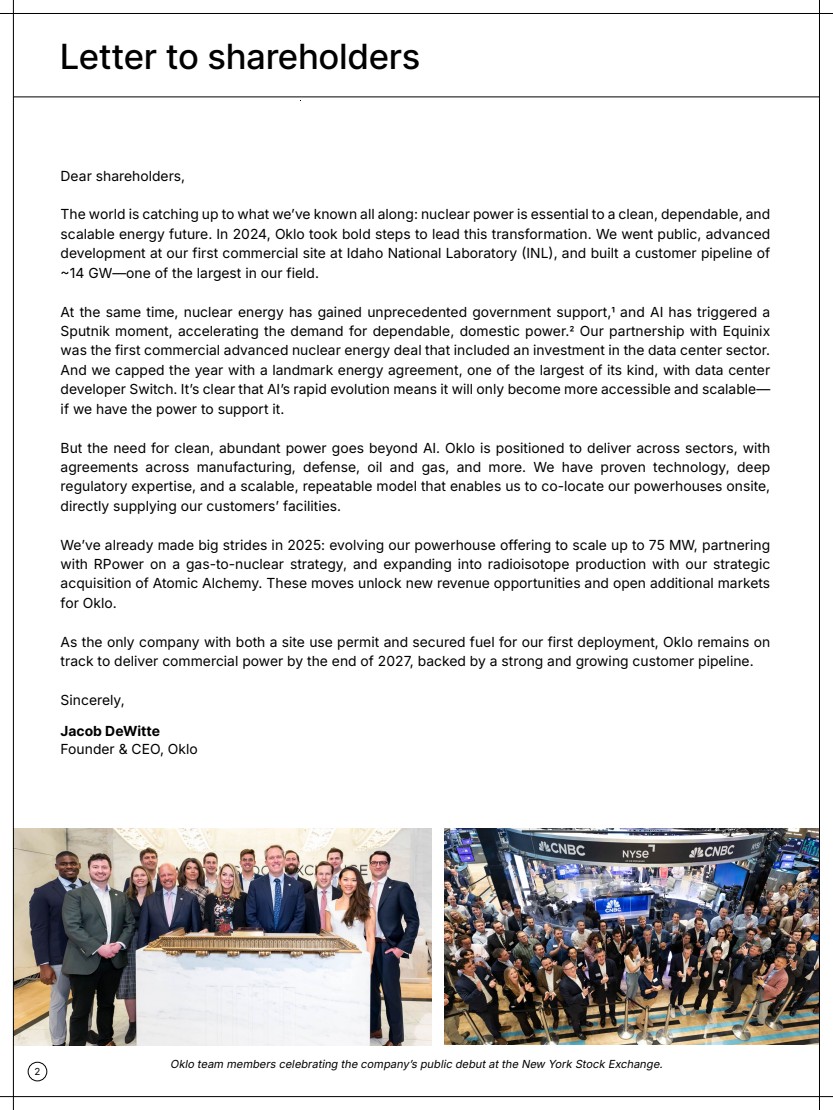
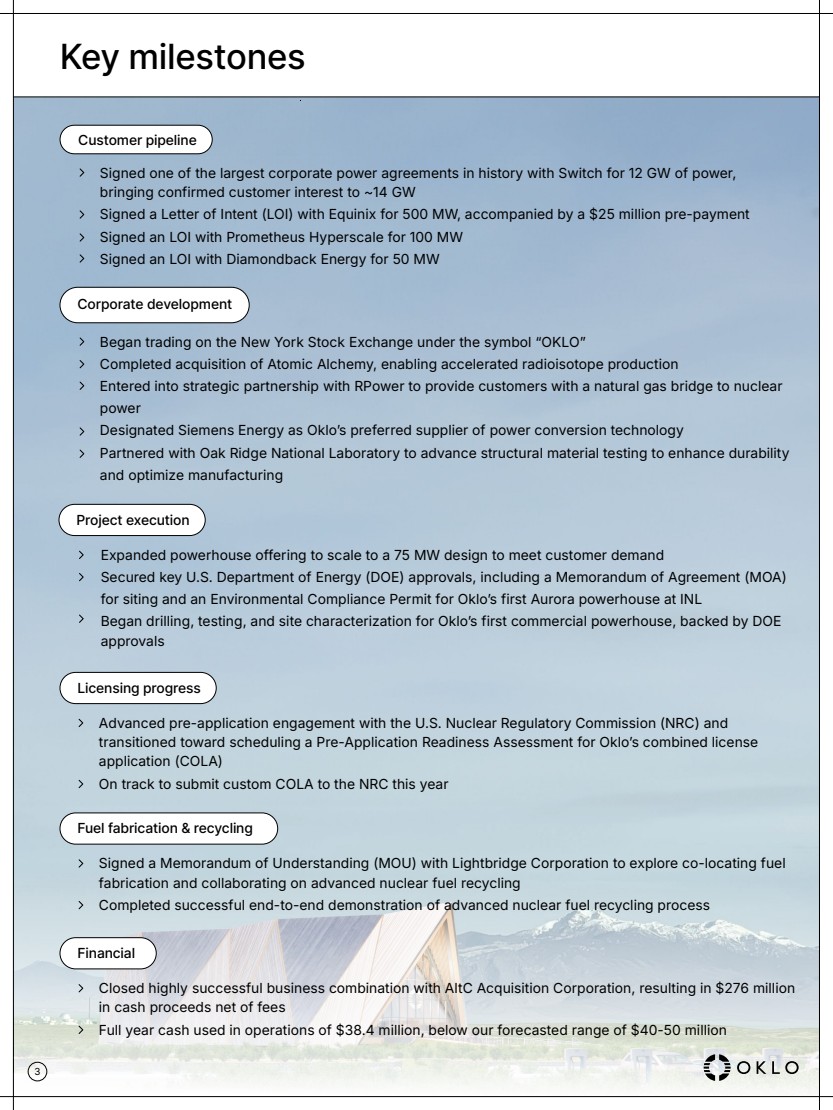
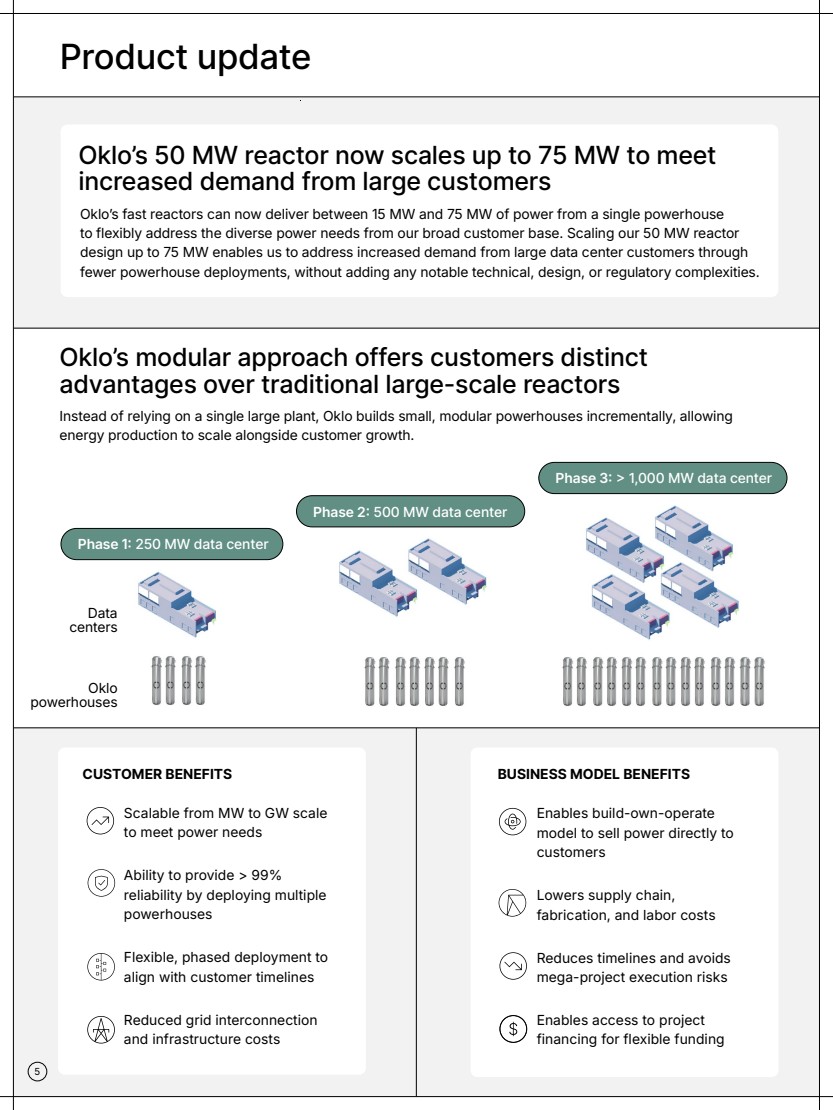
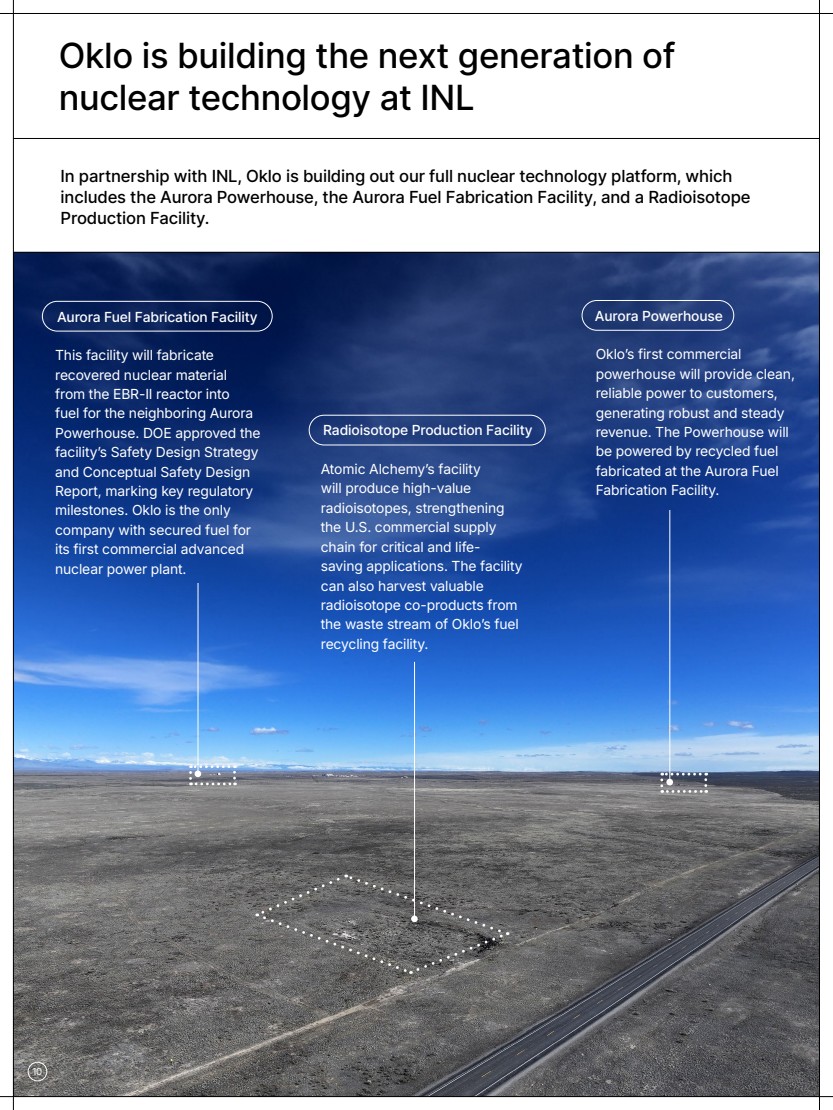
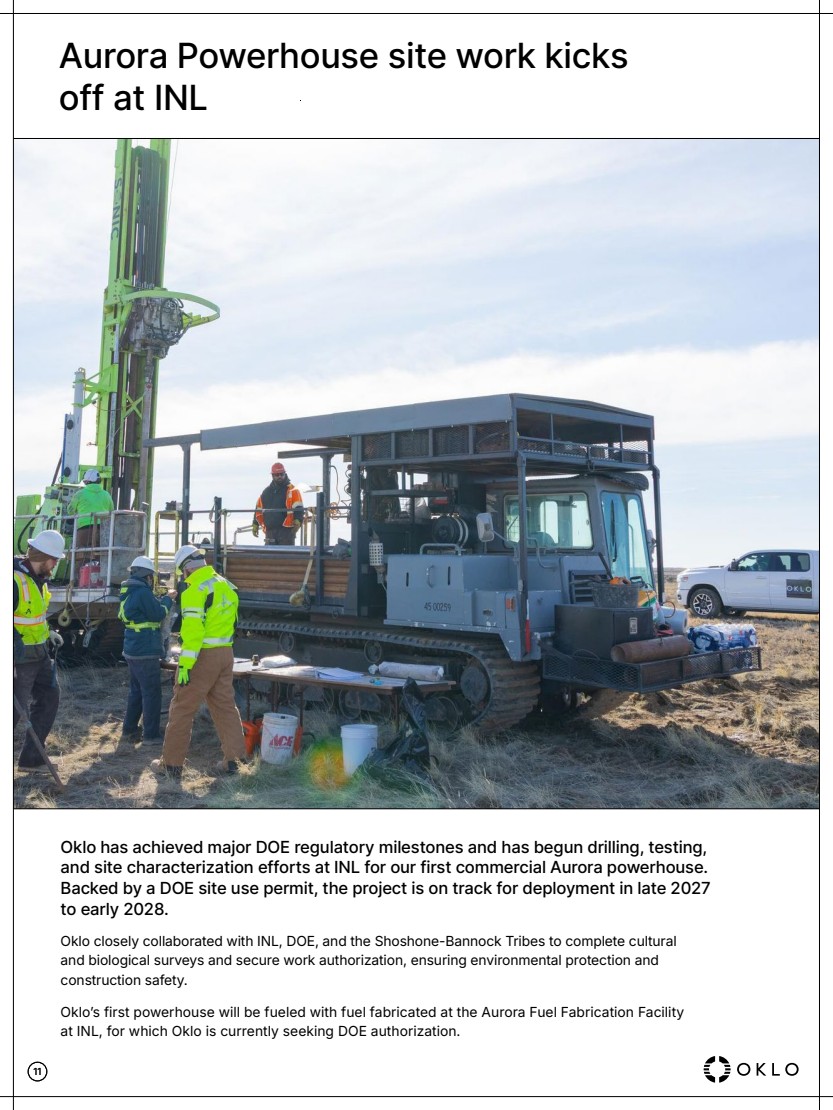
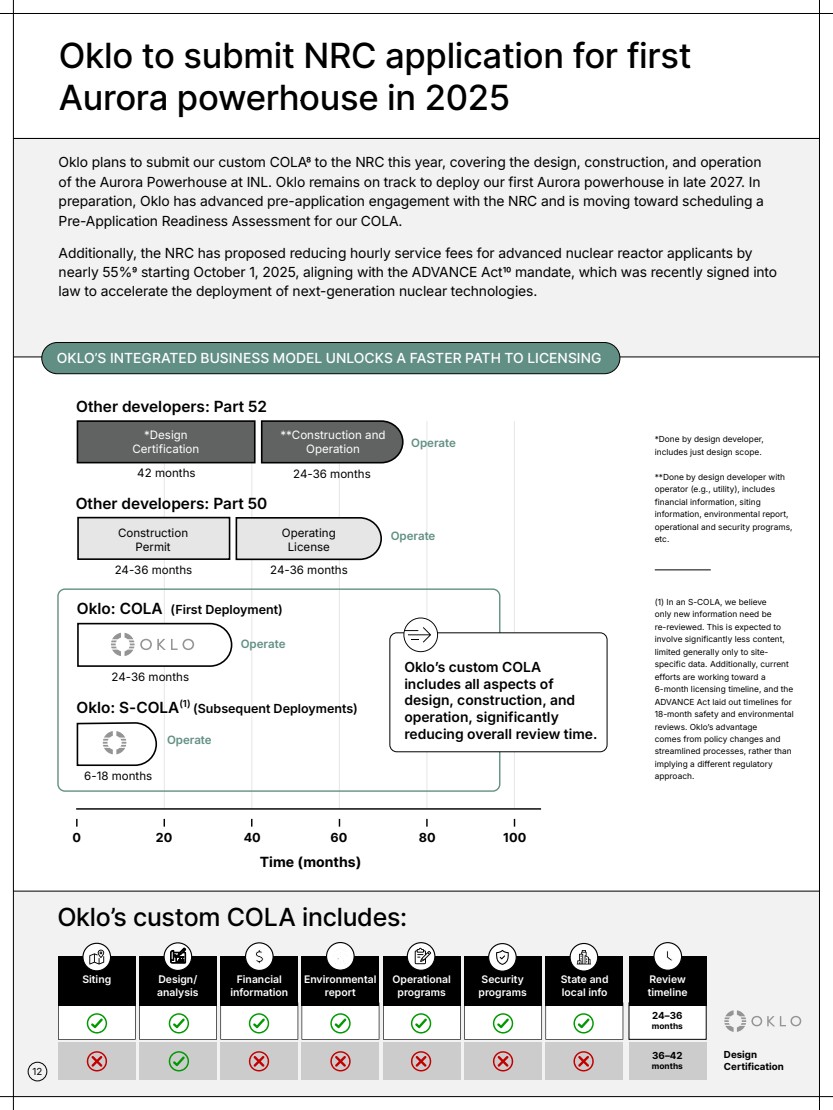
Thanks, Sam, and thank you all for joining us today. we're excited to share our quarterly and full year update and provide insights into Oklo's progress over the past 12 months. Oklo was founded on the belief that there are significant opportunities for advanced nuclear technology. We saw an industry that had stagnated and recognized the need to rethink how new nuclear technologies could be brought to market. We started Oklo to seize this opportunity and fulfill our mission to deliver clean, reliable, and affordable energy on a global scale. The momentum behind nuclear energy has never been stronger. The new administration has made it clear that nuclear power is a cornerstone of America's Energy Future, with direct policy actions and public endorsements supporting its expansion. Key voices in government and industry are reinforcing the need for advanced nuclear deployment. Energy Secretary and former Oakland board member Chris Wright stated that the long awaited American nuclear renaissance must launch now. He said, we're at the start of Manhattan Project 2. It is critical, just like Manhattan Project 1, that the United States wins this race and has emphasized the administration's commitment through financial and regulatory support to enable rapid deployment and commercialization of next-generation nuclear technology. Additionally, President Trump has recently highlighted the advantages of small, scalable nuclear plants. These statements reflect a growing consensus. Nuclear is essential for energy abundance, and small, advanced nuclear reactors provide a practical, cost-effective path forward. The demand for power is growing at an unprecedented rate, and while AI-driven data centers are a major contributor, they are not the only source of this growth. This slide shows other sectors, residential, transportation, commercial, and industrial are also driving sustained energy needs. Total U.S. power demand is projected to grow greater than 160% through 2030, with data centers contributing approximately 31% of this increase. We have demonstrated that Oklo is uniquely positioned to take advantage of this staggering potential growth. Our build-own-operate model and small scalable powerhouse designs are well-suited for a broad range of applications, ensuring we can meet growing energy needs across multiple sectors. At Oklo, our strategy is built on three core pillars that we believe will fundamentally transform how nuclear power is delivered to our customers. First is our business model. We've designed a model that simplifies the process for customers to purchase clean power at scale, eliminating traditional complexities and points of friction. Second is our reactor size. Our small, scalable reactors allow us to achieve greater capacity while meeting customer demand incrementally. This approach not only optimizes our financial performance by creating a recurring revenue model, but also delivers resilient and redundant power solutions, ensuring operational reliability. Finally, our technology sets us apart. By utilizing technology backed by centuries of cumulative reactor operation experience, our use of liquid sodium coolant provides significant economic and operational advantages. This technology underpins our ability to deploy advanced nuclear solutions that are both efficient and cost effective. 2024 was a transformative year for oklu marked by major commercial technological and regulatory milestones we started the year with a 500 megawatt partnership with equinix one of the largest co-location data center companies in the world supported by a 25 million dollar investment through the form of a prepayment this really kicked off the partnership wave between nuclear technology companies and ai data center companies building on this momentum we signed a letter of intent with diamondback energy for 50 megawatts demonstrating an emerging demand for nuclear energy in the oil and gas sector as companies seek long-term sustainable energy solutions to electrify their operations we also expanded our presence in the data center space by sending a letter of intent with prometheus hyperscale to deliver 100 megawatts of clean power to next generation ai infrastructure we ended the year by signing what is potentially the largest corporate clean power agreement ever with switch for 12 gigawatts of power to put the magnitude of this agreement into perspective that is equivalent to approximately one percent of the u.s grid This is a massive opportunity for us, not just because of the size of the power needs, but for the multi-pronged partnership with SWITCH to work together to bring nuclear to market at scale. One highlight to me of this partnership is that building data centers has significant similarities to building small reactors. If you think about data centers, they are fixed civil assets into which prefabricated and manufactured components and systems are installed, and electrical and cooling systems are tied together to move power and heat through the system. This has similarities to building small reactors, fixed civil facilities into which prefabricated and manufactured components are installed and electrical and cooling systems are integrated and tied together. Working with Switch's expertise here will likely be accelerated to us, and we are excited about how this will progress. In May 2024, we went public on the New York Stock Exchange under the ticker OKLO, a defining step in our growth. Beyond our commercial success, we made major progress in our regulatory strategy and in building our nuclear technology platform. Our Idaho National Lab or INL powerhouse project remains on track to be the first commercial small nuclear reactor built in the U.S. with key DOE approvals and an environmental compliance permit secured. We also advanced our Aurora fuel fabrication facility, receiving DOE approval for its safety design strategy, reinforcing our ability to produce advanced reactor fuel domestically. Local is the only advanced nuclear company with high assay, low-enrich uranium, also known as HALU Fuel Secured, for its first deployment, a significant competitive advantage that ensures we can move forward without fuel supply chain delays. We also successfully demonstrated our end-to-end fuel recycling process, proving our ability to close the nuclear fuel cycle and leverage both fresh and recycled fuel for long-term sustainability and growth. As we continue to execute on our strategy, we remain committed to keeping the market informed with clear and consistent updates on our progress. Our company updates are structured around six key focus areas project execution reactor licensing progress fuel fabrication and recycling customer pipeline development strategic partnerships for corporate and business development and financial updates the last quarter was marked by major commercial regulatory and technology milestones that drive us toward commercialization to meet increasing customer demand we expanded our powerhouse offering to support up to 75 megawatts of power output building on the same design architecture of the 50 megawatt powerhouse to deliver more power without changing our reactor design footprint or regulatory framework the scalable platform strengthens our ability to serve energy intensive industries efficiently on the regulatory front we continue to advance key approvals with the nrc and voe ensuring steady progress towards deployment we are working with the nrc through a pre-application readiness assessment for our aurora powerhouse combined license application at idaho national laboratory commercially we signed a landmark 12 gigawatt master power agreement with SWITCH, underscoring the growing demand for reliable carbon-free baseload power and positioning OKLOW at the forefront of the energy transition. We're also strengthening our capabilities through strategic partnerships. Our agreement with our power provides near-term natural gas solutions as a bridge to nuclear, offering customers flexible energy options that can accelerate timeframes. Additionally, our MOU with Lightbridge explores co-locating commercial fuel fabrication and recycling, reinforcing our long-term fuel strategy. Beyond power generation, we've expanded into the high-value radioisotope market with the completion of our Atomic Alchemy acquisition. It continues to make progress towards near-term radioisotope opportunities and in their regulatory pre-application work to deploy their Viper reactor. We're also driving next-generation materials innovation through collaborations with the DOE and Oak Ridge National Laboratory. With strong financial positioning, scalable technology, and growing customer demand, we enter 2025 with clear momentum, accelerating toward deployment and cementing Oklo as a leader in the advanced nuclear space. Over the years, we've made significant progress in refining our powerhouse platform. We initially developed both 15 megawatt and 50 megawatt designs, but it consolidated our approach around a 50 megawatt architecture. This allowed us to scale power output efficiently by simply adjusting things like fuel load and heat exchangers. With this approach, we can flexibly deliver between 15 megawatts and 75 megawatts from the same design platform, adapting to different customer needs while maintaining a streamlined supply chain and regulatory approach the decision to scale up to 75 megawatts was driven by demand characteristics from large energy users particularly data centers this power range aligns well with the infrastructure of these customers including at the data hall level and it reduces the number of reactors needed to support gigawatt scale projects we anticipate the majority of our plants will operate in the 60 to 75 megawatt range importantly this update does not introduce new technical regulatory or design risk we're leveraging the same core technology optimizing it to deliver more power while maintaining the benefits of a compact, repeatable system. By focusing on design, flexibility, scalability, and cost efficiency, Oklo continues to provide innovative and capital-efficient nuclear power solutions to meet the evolving needs of our customers. Oklo continues to make steady progress on our first commercial Aurora Powerhouse at the Idaho National Laboratory, or INL. We are actively engaging with the U.S. Nuclear Regulatory Commission through a pre-application readiness assessment for our Aurora Powerhouse combined license application at Idaho National Laboratory. This process enables NRC staff to review and familiarize themselves with OCO's licensing materials ahead of the formal application submission, streamlining regulatory review, and positioning us for an efficient approval process. We have submitted our Licensed Operator Topical Report, a key step in enabling our fleet-based licensing approach. This approach lowers costs, accelerates deployment, and enhances operational efficiency. Beyond licensing, we have begun drilling testing and site characterization efforts at INL, critical steps toward construction. Backed by a DOE site use permit, the project remains on track for deployment in late 2027 to early 2028. At Oklo, our business model and licensing strategy provide a more streamlined regulatory pathway compared to conventional nuclear approaches. Rather than pursuing separate construction and operating licenses or obtaining a design certification or DC, which is not a license or permit, to then later license out to customers who then have to obtain the actual commercial permits and or licenses, we take a direct path by securing a combined license, or COL. This single step approval allows us to build and operate without additional regulatory hurdles. Unlike the DC process, which requires multiple and separate NRC reviews, and unlike the Part 50 approach, which requires separate NRC reviews and approvals for construction and operation, the COL includes all key NRC-specific reviews up front. This integrated approach eliminates duplicative reviews and accelerates deployment. Ultimately, only after completing these regulatory steps can a company begin construction, operate a plant, and generate power and revenue. Oclo's approach ensures that we reach those milestones faster and with greater certainty. As I just alluded to, what sets Oclo apart is our direct-to-COL approach. We secure a combined license and one streamlined process, whereas others in the industry pursue design certification or construction permits first, requiring separate construction and operating approvals later. We believe this makes our approach faster, more efficient, and more aligned with deployment. Because we build, own, and operate our powerhouses, rather than selling designs or licenses, streamlining regulatory approval under a single process makes strategic sense. Securing our first COL will also serve as a reference license, an R-COL, allowing future applications, an S-COL, to focus only on site-specific differences, greatly reducing approval timelines. By minimizing those differences, we can gain faster regulatory approvals for each additional plant, enabling rapid scaling. This approach not only simplifies licensing, but strengthens our ability to bring advanced nuclear power to market faster and more efficiently than traditional models. Our path with INL paves the way for future sites through subsequent combined licenses, reducing review timelines under the ADVANCE Act, and accelerating deployment at scale. Oklo's licensing strategy is not just about getting approval, it's about getting to multiple powerhouses to deployment operation and revenue generation faster than conventional approaches. At OCLO, we have built deep expertise in working with both the NRC and DOE, making significant regulatory progress as we move toward deploying our first commercial Aurora powerhouse. We completed key pre-application work with the NRC, including safety analysis, operational programs, and environmental siting. Additionally, we submitted fleet-based licensed operators and staffing methodology topical reports, important milestones that enable a standardized fleet-wide staffing model. Unlike traditional nuclear plants, which require site-specific operator licensing our approach improves efficiency reduces costs and accelerates deployment alongside our energy progress we are working closely with the doe since our first commercial powerhouse will be deployed at the idaho national lab we finalized a memorandum of agreement with doe granting oklo access to begin critical site investigations a major step that allows us to conduct essential ground work to prepare for construction with this approval we have begun site characterization activities including drilling to study soil and rock conditions looking ahead we are advancing the quality assurance program description for design construction and operations which is currently in progress these milestones reinforce oakland's strong regulatory momentum and clear path to deployment each step moves us closer to our goal of delivering advanced nuclear power through streamlined efficient regulatory approach additionally the nrc is actively advancing the implementation of the advanced act which is modernizing the regulatory landscape for advanced nuclear the key component of this effort is a significant reduction in licensing fees, making regulatory processes more accessible and cost-effective for advanced reactor developers. The NRC has proposed cutting the hourly rate by nearly 55% for advanced reactor applicants. This change, set to take effect on October 1st, 2025, directly lowers the financial burden of licensing. Securing fuel is a critical priority for Oklo, and we continue to make strong progress. We have successfully secured fuel for our first core load at INL through a competitive selection process and are expanding access for future deployments. Our MOU with Centrist establishes a long-term HALU supply, ensuring a scalable domestic source. It is important to highlight, Centrist is already producing HALU today and continues to scale their production. Beyond securing fuel, we are also collaborating with Lightbridge, who is developing next-generation lightwater reactor fuels. We are exploring opportunities where Lightbridge could manufacture their fuel at our fuel fabrication facility, given we are both fabricating metallic fuel forms. Furthermore, we are working together on our recycling activities and evaluating the benefits of recycling used LightBridge fuel into our reactors. With that, I'll turn it over to Craig for customer development, atomic outcomes, and financial updates.
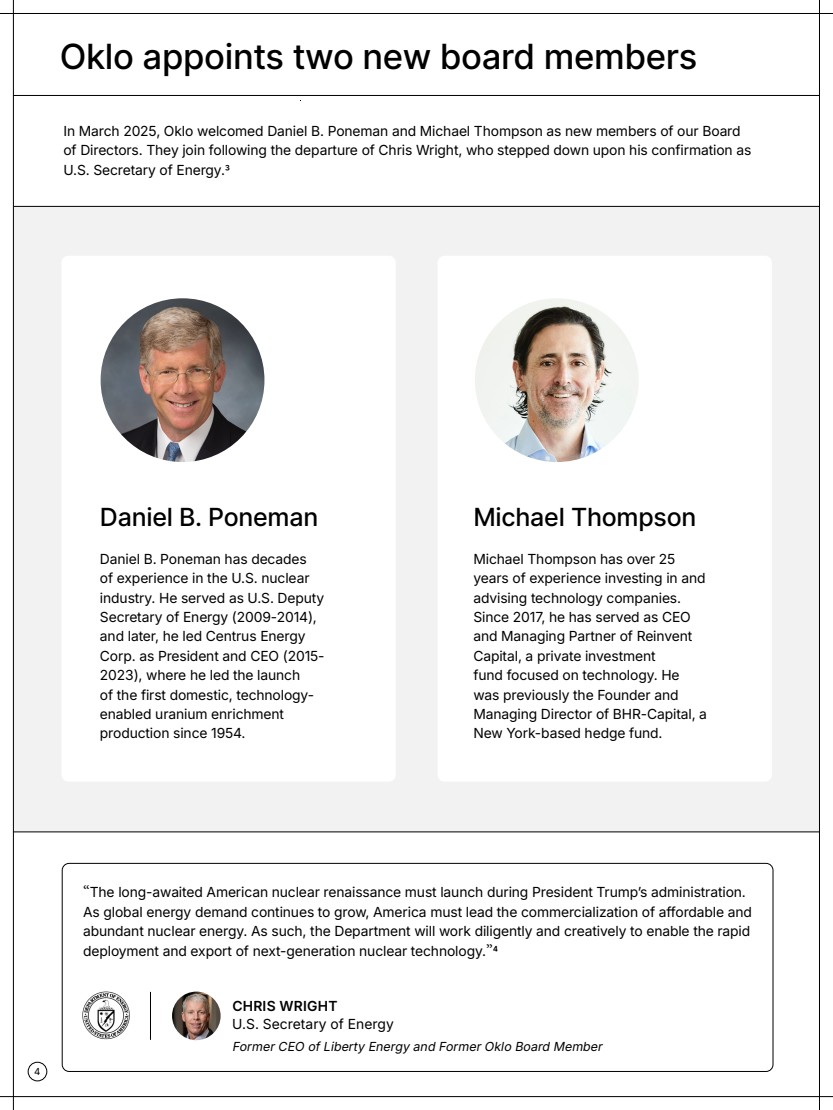
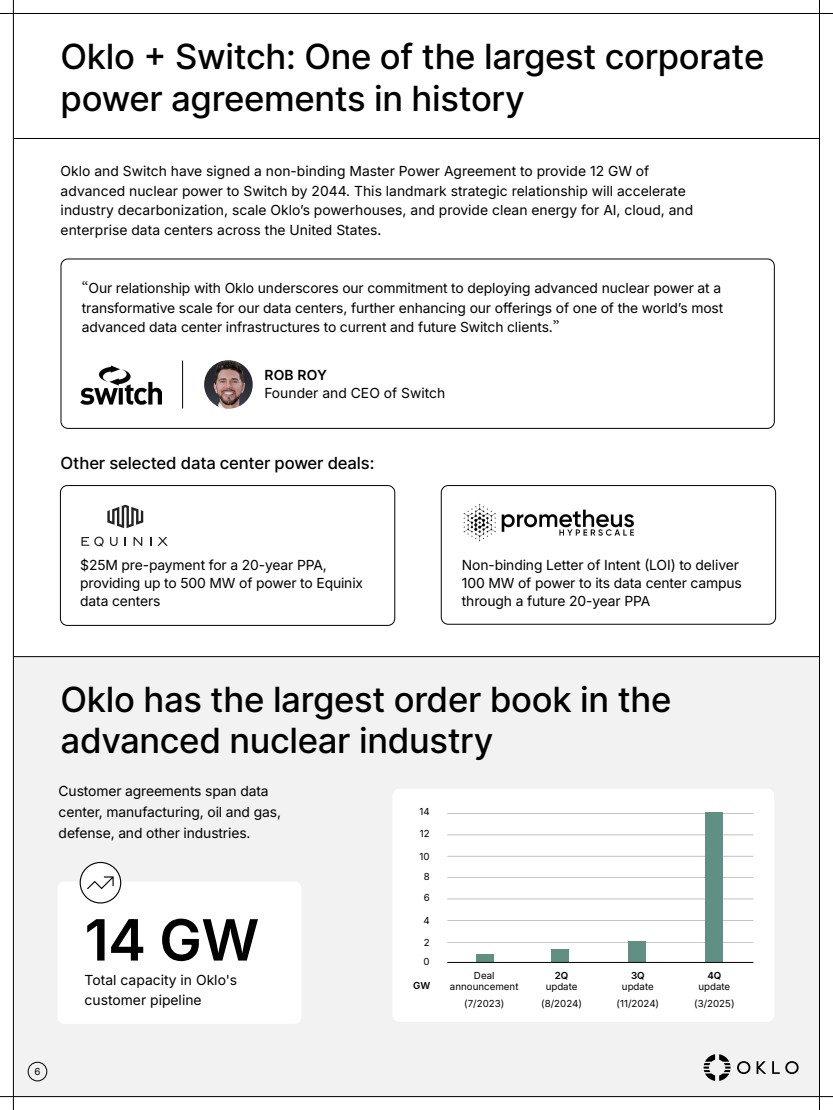
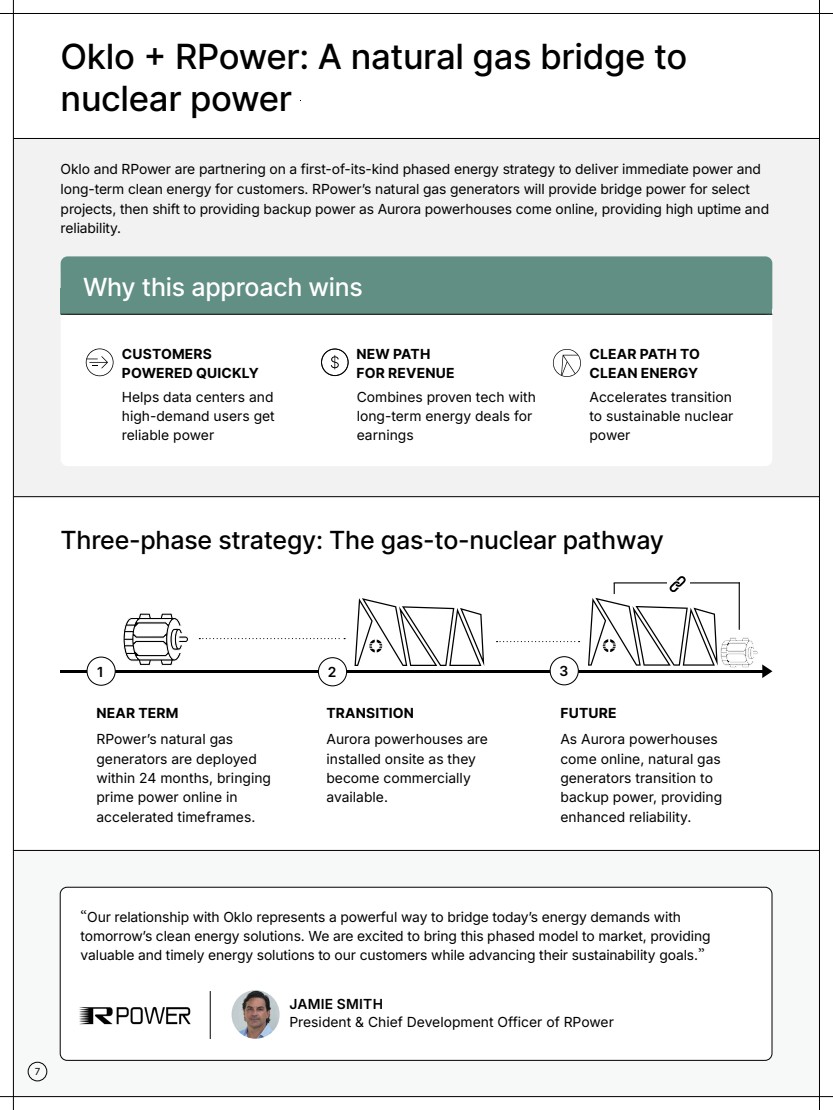
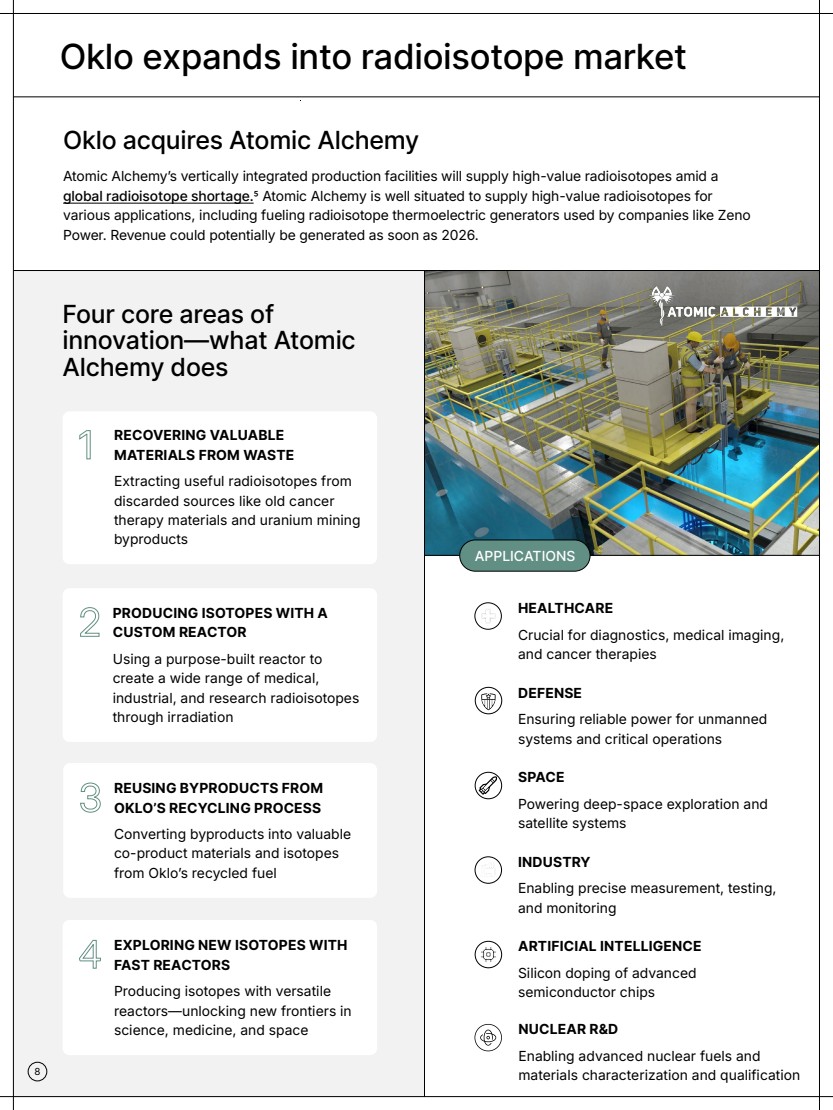
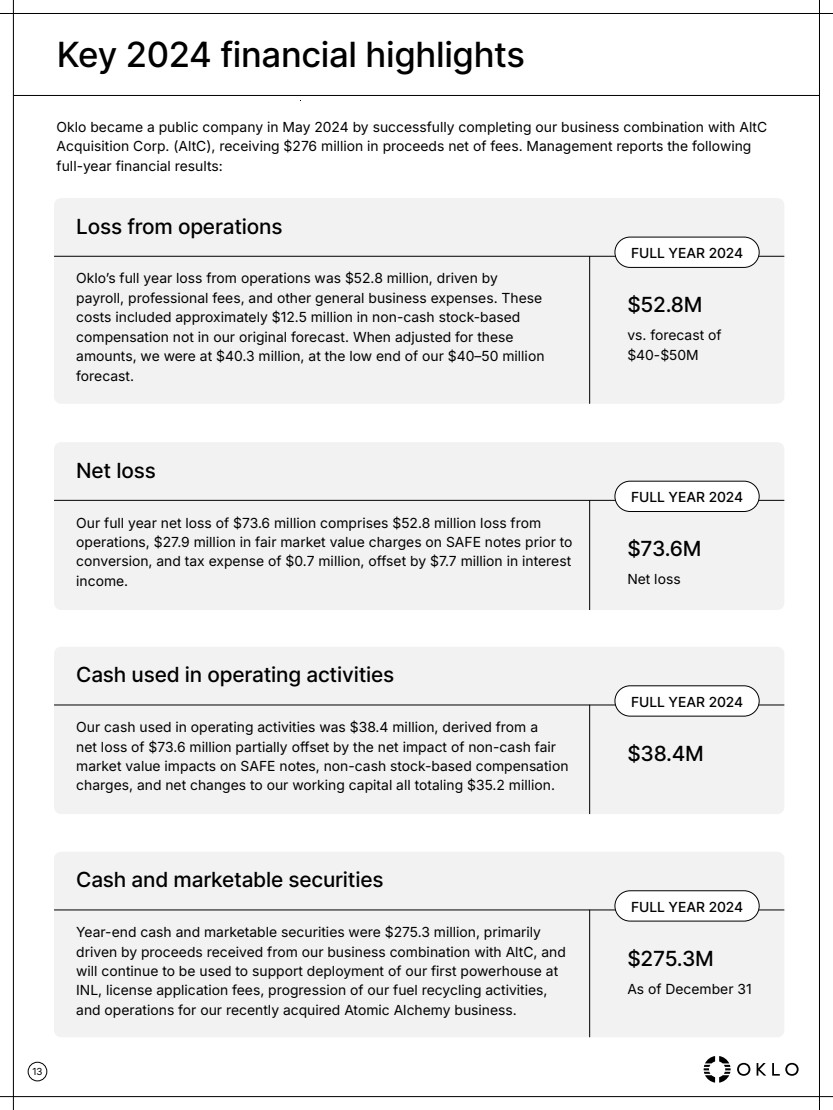
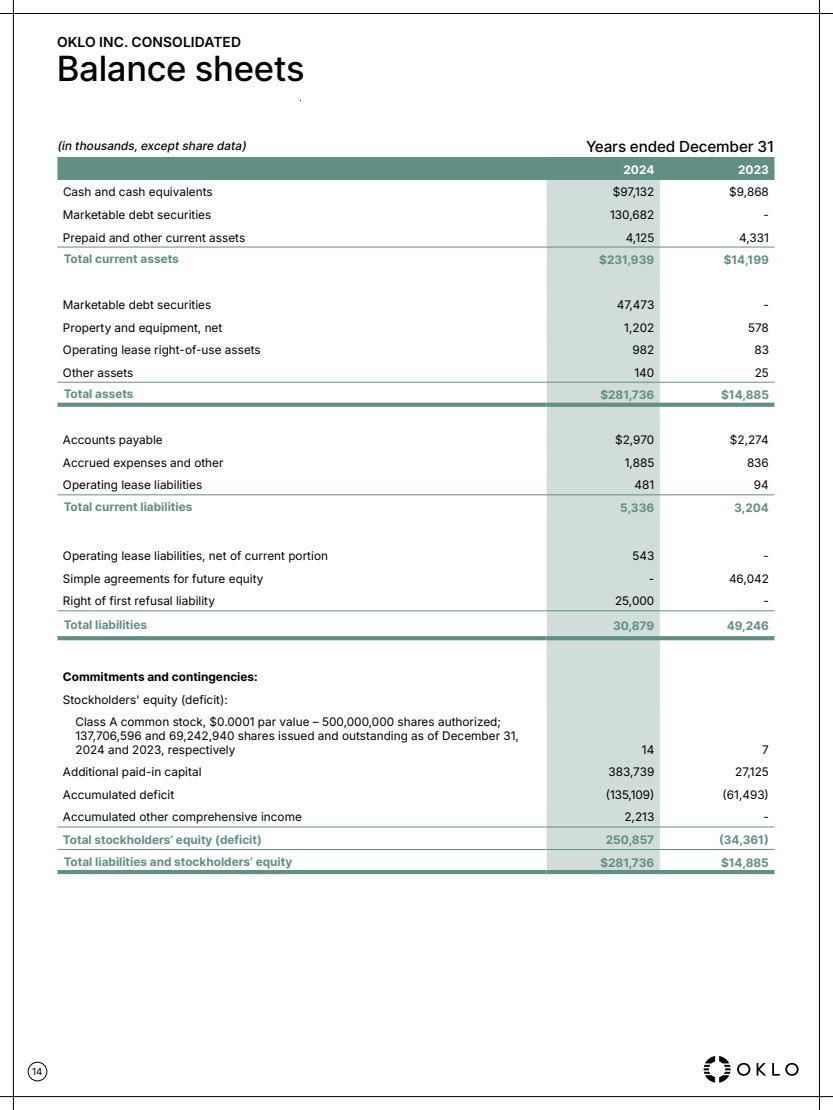
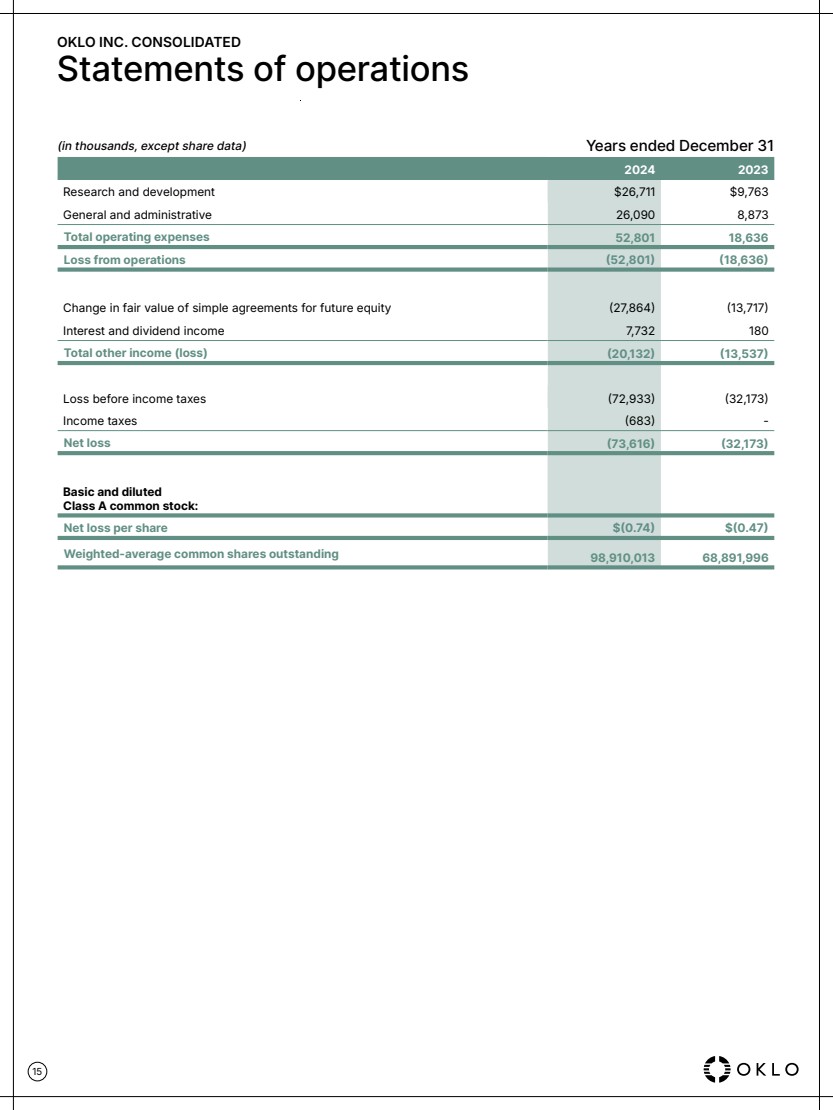
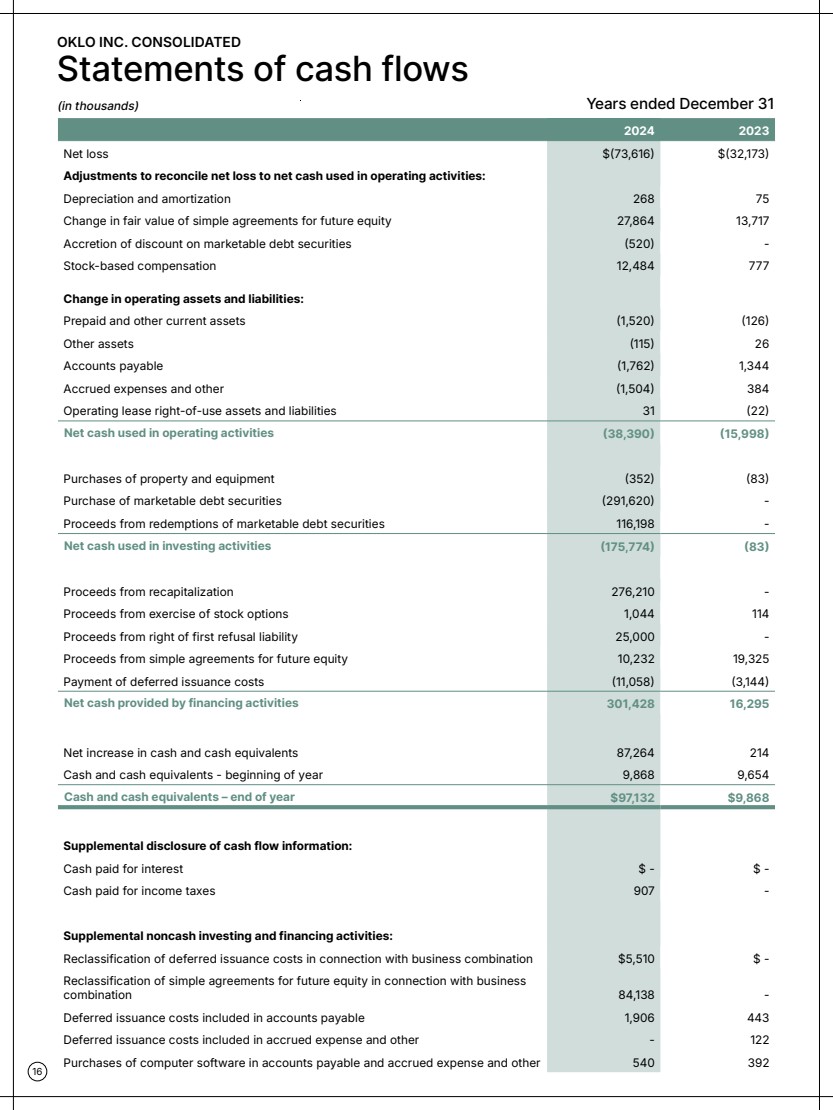
Thank you, Jake. Oculus powerhouses are purpose-built to meet the growing energy needs of numerous customer segments, including AI data centers. As Jake has already highlighted, our 50-megawatt design now offers the flexibility to deliver up to 75 megawatts of power, demonstrating our modular power offering can scale with customer demand and enabling OHLO to meet higher customer capacity with fewer deployments. We expect OHLO powerhouses to have construction timelines of less than 18 months, providing a very competitive time-to-market option for nuclear reactors, and our cost-oriented design and engineering provides customers with competitive pricing. Oklo is capable of providing data centers with high reliability through the development of redundant powerhouse facilities and can deploy multiple powerhouse facilities to a single site that matches the phased deployment approach of data center campuses. Finally, Oklo's small land footprint enables the company to pursue a co-location model that provides customers with greater site flexibility and competing alternatives. Moving to our next slide, I would like to highlight two product features that are really resonating with data center customers, phase deployment and reliability. The first product feature that our large customers like about Oakland's powerhouse approach is the ability to build and deploy multiple small powerhouses in parallel rather than relying on a single large-scale plant with long lead times. This phased and modular expansion capability allows us to better align with specific customer timelines and capacity requirements. Our data center customers absolutely love the phased scaling capabilities of multiple reactor projects. Moving to the next slide, I will talk about the second product feature that resonates with our data center customers, which is our ability to build in redundant powerhouses to achieve greater than 99% reliability. reliability. Reliability is critical for AI-driven data centers, which operate 24-7 and require constant uninterrupted power. Even brief outages can result in significant data loss, service disruptions, and financial consequences. Unlike large-scale reactors that can experience complete shutdowns for maintenance, our modular powerhouses are designed so that routine or even unexpected maintenance on one unit does not impact overall system performance when there are more than one facility built on site. This built-in redundancy can enable behind-the-meter operations as well as reducing the size of the customer's interconnect with the grid. I would now like to talk about our relationship with Switch. Our product market fit with the data center industry continues to be validated through major customer announcements. In December 2024, Oklo announced it had secured one of the largest corporate power agreements in history, a 12-gigawatt master power agreement to switch. That could be deployed through 2044. For context, this is equivalent to 1% of the U.S. grid capacity, which is a leader in designing, building, and operating cutting-edge modular and scalable data center campuses. Their facilities support the most demanding AI, cloud, and enterprise clients, requiring reliable and sustainable power solutions. SWITCH has been a leader in clean power procurement and believes nuclear is critical to the future of AI data center development and operations. This agreement is an example of putting a master partnership agreement in place and is the result of extensive collaboration to understand SWITCH's needs and tailor a solution ensures long-term energy reliability. It underscores OCLA's role in powering next generation data infrastructure while establishing a significant long-term revenue stream. Beyond just power delivery, this partnership lays the foundation for broader collaboration, aligning OCLA's investment strategy, government and public affairs efforts, and supply chain optimization efforts to support large-scale deployment with a strategic customer. We often get asked why OCLA hasn't signed Power Purchase Agreements, or PPAs. The answer is that OCLA is taking a measured approach to reduce risk to the company and get the most attractive terms for the company and our investors. We are looking to implement a comprehensive risk-mitigated strategy, customer acquisition, and project execution. On the previous slide, I talked about the Master Power Agreement, or NPA, that we have in place with Switch. Today, we are assigning NPAs with customers that establishes a framework for the overall partnership. Once a Master Power Agreement is established, we use it as a platform for multiple partnership elements, which include power sales, corporate and asset investment, supply chain optimization, and public relations and permitting. The Master Power Agreement also establishes the starting point for PPA negotiations. NPAs start to define potential target sites or regions, total and phase power delivery, timing of capacity additions, and a pricing range. With this framework established, OCLO can begin site feasibility analysis with customers and start specific PPA negotiations. In addition, this structure lives and iterates as the market evolves and is not limited to customers. We are applying this structure with parties across our value chain from fuel supply to component manufacturing, creating a repeatable and scalable model for asset deployment that should enable Oakland to move quickly while maintaining capital efficiency. As a result of our efforts over the last 18 months, Oakland's customer pipeline has expanded significantly, driven primarily by growing data center demand. We've signed agreements across key customer segments, with demand shifting towards our 75-megawatt powerhouse offer to meet large-scale AI-powered needs. Our pipeline has grown from 700 megawatts at the announcement of our business combination with Alt-C to over 14 gigawatts today, supported by major customers like Equinix, Prometheus, Switch, and Diamondback Energy. As DEMAT accelerates, we continue to advance discussions with additional customers to further expand our pipeline. I'd now like to talk about our partnership with RPower. Oaklow and RPower are partnering to bridge the gap between today's power needs and the transition to advanced nuclear. This phase model ensures data centers secure reliable power now while seamlessly moving towards a clean, long-term energy solution. The approach has three phases. Phase one, immediate power deployment. Our power's natural gas generators should be in a position to be deployed within 24 months to meet urgent demand opportunities. Phase two, transition to advanced nuclear. As OCLO's Aurora powerhouses come online, they will integrate into these sites, delivering new, clean baseload power. Phase three, long-term energy resilience. Over time, Aurora powerhouses will become the primary energy source, with RPower's generators shifting to an auxiliary power delivery role. This enhances grid stability, allowing our power to act as a good grid citizen with Oakland, supplying surplus power when needed. This approach meets urgent power needs today while enabling a clean, scalable energy future. We have successfully closed the $25 million acquisition of Atomic Alchemist. This transaction marks Oakland's strategic expansion into the high-growth radio isotope market we view this as an extremely attractive bolt-on acquisition that enhances oakland's nuclear technology platforms and diversifies our customer base to include critical industries such as space defense industrial applications medical diagnostics and semiconductor manufacturing this acquisition is not expected to have material near-term operating cost increases for Oklo, and does have the potential to accelerate revenues to the company through the sale of radio isotopes. This transaction was primarily funded via stock and represented less than 1% of dilution to Oklo shareholders. Additionally, shares issued to the Atomic Alchemy founders are subject to multi-year revesting to drive strong long-term alignment. The next slide focuses on some acquisition highlights. Atomic Alchemy will enhance Oklo's technology portfolio and serve as a standalone radioisotope business with significant market potential. Acquisition highlights include the following. Massive market demand with limited supply. The radioisotope market is projected to exceed $55 billion by 2026. With applications spanning including medical imaging, cancer therapies, space and defense, and next-generation semiconductor manufacturing. Meanwhile, aging facilities are struggling to keep up with demand, creating a critical supply gap. Benefits to Oakland's energy and fuel business. Collecting high-value radioisotopes from recycling co-products enhances the economics of fuel recycling. Third, growth opportunities. We are already exploring joint ventures with customers in radiopharmaceuticals and advanced silicon dopings for semiconductor manufacturing, positioning OCO for long-term success in high-growth industries. Fourth and finally, revenue and milestone acceleration. Radio isotopes are among the most valuable materials on Earth. work. Take Actinium-225, for example, which sells for $400 per nanogram or an astonishing $400 billion per gram. With our recent acquisition of Atomic Alchemy, we are positioning OHLO to capitalize on this high-margin market. Our radioisotope demonstration project is already underway, and we could begin generating revenue as early as the first quarter of 2026, unlocking significant near-term value for our business. This acquisition is a true force multiplier, accelerating our entry into the radioisotope sector. We are excited about the opportunities ahead and confident in the value this can create for our shareholders. I'd now like to talk about recent board appointments. With Chris Wright's confirmation as the new U.S. Secretary of Energy, Oakland needed to fill an open board seat. In doing so, we took the opportunity to strengthen our board by adding not just one, but two exceptional leaders, Daniel Poneman and Michael Thompson. Daniel Poneman brings decades of experience in nuclear energy and national security. Most recently, he served as president and chief executive officer of Centris Energy, leading the company to profitability and deploying the first U.S.-based technology uranium enrichment facility since 1954. Before that, Dan was deputy secretary of energy overseeing energy technology and nuclear security and playing a critical role in international nuclear negotiations and U.S. energy security policies. Michael Thompson has significant experience in capital markets and technology investment. As managing partner at Reinvent Capital, he has worked with some of the most innovative technology companies. Previously, he founded and led BHR Capital, a New York-based hedge fund, and has served as an investor and board advisor across multiple high-growth sectors. With these additions, Oakland Board is well-positioned to guide the company through its next phase of growth, ensuring strong governance as we execute on our strategy to deliver advanced nuclear power. I'll now provide a summary of our financials. Oklahoma's full-year operating loss was $52.8 million. This included a one-time fair market value expense of $7.8 million related to earn-out shares payable to Oklahoma staff who held dusted options at the time of SPAC closing, as well as $4.7 million of non-cash stock-based compensation expense. When adjusting for these non-cash amounts that were not included in our original 2024 budget, you get to $40.3 million, which is at the low end of our forecasted range of $40 to $50 million. In preparing our year-end consolidated financials, Oklo made two changes related to the accounting presentation associated with our business combination with Alt-C that occurred in the second quarter of 2024. First, management received additional guidance that led us to reduce the fair market value of our safe notes at deal closure by $2.1 million, improving our full year net loss to $73.6 million. Second, we were directed that the tabular presentation of the deemed dividend on our quarterly income statement for earn out and founder shares was not required, as this was already covered in the accompanying footnotes. We elected to reflect this as a material weakness in Section 9B, other information, in our 10K for 2024 in the area of infrequent and complex accounting. It should be noted that these changes come from our business combination transactions that close in the second quarter and actually result in improvement to our financial statements. by minimizing our net loss attributable to common stockholders from a loss of $563 million to a loss of $73.6 million. We are working to address this material weakness and expect to have it remediated by year-end. Oakland's full year cash use and operating activities was $38.4 million. This balance is derived from a net loss of $73.6 million partially offset by $40.4 million in non-cash impacts. These non-cash impacts included $27.9 million of fair market value charges associated with the previously converted safe notes, as well as non-cash stock-based compensation charges of $12.5 million. Finally, at the end of the year, cash and marketable securities were at $275.3 million, primarily driven by the $276 million in proceeds netta fees received at the closing of our business combination. This cash balance generated approximately $7.7 million in interest income in 2024. Looking forward to 2025, we expect the cash use and operations to be in the range of $65 million to $80 million. This year-on-year growth from 2024 is driven by increases in head count, initiation of procurement activities in support of our first powerhouse at the Idaho National Labs, license application fees, progressing activities in support of fuel recycling, and a small increase resulting from our recently acquired Atomic Alchemy business. To close, we believe there are six factors that make Oakland such a compelling investment proposition. First, technology and size that are based on proven fast reactor technologies that we look to deploy at scale to reduce complexity, cost, and time delivery. Second, an attractive business model that is customer-oriented and enables recurring revenue and profits. Third, superior economics that can deliver power at competitive cost. Fourth, a diverse and growing customer base with interest across multiple market sectors. Fifth, a streamlined approach to regulatory approval underpinned by our combined license application process that leverages years of experience in our work with the NRC. And finally, a well-capitalized balance sheet that positions us well for the implementation of our business strategy. With that, I would like to thank you for your time. Jake and I will now open up the call for questions. Thank you.
Operator
At this time, I would like to remind everyone in order to ask a question. Press star, then the number one on your telephone keypad. We ask that you please limit your question to one and one follow-up. We will pause for just a moment to compile the Q&A roster. The first question comes from Ryan Fingst from B Reilly. Your line is open.
Hey guys, thanks for taking my questions.
First, was the decision to go from 50 megawatts to 75 driven by customers you already have in your pipeline or potential customers you're talking to today?
And do you see obvious benefits for your economics with the greater output? Yeah. Thanks, Ryan. So a lot of it is built off of kind of what we're seeing in the market comes together from the customer interest set, where we see sort of the data center architectures progressing. There's a sweet spot that kind of lives between 50 and 75, and probably more of it really between 60 and 72, probably more specifically. But in that range, that's really well targeted at our size. Like basically being at that size matches really well where we see kind of that range existing. So it just made sense, given that we have some latent extra capacity just through the design process for margin to be able to go up that high and provide that flexibility and do that now rather than kind of, you know, sort of strip, like basically keep the system more, say, you know, and target it at 50 and then limit some of the upside so we just kind of unlock that in there and focus on making sure we can get up all that all the way to that number so very much a customer informed designed you know kind of i would say decision if that makes sense um and just to be a little more specific you might you know people talk about gigawatt scale data centers and that's awesome and exciting to see how that's going to come together but many of the actual buildings that make up a campus because it's really going to be a campus that makes up a gigawatt scale um these kind of buildings these structures are smaller than that and the sort of subunit or if you will in those actual like data center buildings by themselves is really this kind of data hall architecture as we refer to it is really living in that kind of 50 to 75 megawatt range which is why we decided to go to that you know each different customer set has their own design their own approach so it does kind of have some range on that um but given kind of the lower relative parts of the capex for us uh on the plant that's non-fuel related it gives us a little more flex to accommodate that. And then we just size the core accordingly to make sure we match and live with what we need to do between sort of that 1575 range. But generally speaking, I think we're going to see some general convergence that increasingly moves that number to exist pretty well between that 60 and sort of just, you know, basically 75 megawatt number. But it works pretty figuratively to tie in to what they need at their core IT as well as heating and cooling loads at those sizes.
And Ryan, it's correct. There will be some, you know, absolute economic benefits as well, because just, you know, on the surface, if we have a customer once 150 megawatts of power delivered, it now moves that from three powerhouses at 50 to two powerhouses at 75. And so there'll be some economies of scale there.
Got it. I appreciate that detail. And I'll stick to the customer side. Now that you have a pipeline of 14 gigawatts, do other potential customers see that and think, you know, Oklo is pretty full, I better seek out power elsewhere?
Or are your discussions progressing at the same pace following your announcement of the switch agreement?
Yeah, I think it's, I mean, generally speaking, I think it actually in some ways kind of accelerates for some, because now it's like, oh, shoot, like, you know, we want to, we don't want to miss out on this, we don't want to lose out on this. But, you know, our kind of dynamic with customers and our engagement as Craig talked about is is iterative based on you know what makes the most sense to engage folks when it you know when and how and kind of bringing a little bit more to the table accordingly uh and so at the end of the day I think there's a bit of scarcity effect that that is that is is existent now and I imagine will probably increase and generally speaking that's going to be pretty positive to us but you know uh then accordingly we'll kind of see how that unfolds as things progress in terms of what there might be an effect on some folks being like that's pretty much you know but okay oklahoma might be pretty full up but i think what we see is more folks being like okay we want to get in to try to figure out how to work with you guys and also what can we do to help expand that bandwidth and capacity so so there's you know you can you can do more uh and i think that's a little bit of a more begets more here um and that's really how we're trying to like structure you know how and who we work with the next question comes from Jeffrey Campbell from Seaport Research.
Operator
Your line is open.
Good afternoon, and congratulations on a pretty strong year.
Jake, regarding the increased range of the powerhouse to .50 to .70, does this require any kind of change in your COLA license approach, or is this already covered, or what kind of effect yeah and really try to keep it so that it's a pretty minimal effect um in general like this everything we're doing to support kind of going to the 50 yes basically is accommodating to this uh there are of course a few you know things we need to be mindful of um but in general like all the infrastructure and everything we have and all the design and analysis work all those kind of things accommodate this pretty well and if you think about what this is really doing is this is giving us a platform that allows us to go between 50 and 75. That's pretty unconventional nuclear because people, again, typically think of very fixed, heavy CapEx of the plant dominating the cost profile. So you want to maximize the power output. Well, because of the benefits of what liquid sodium affords you and kind of our design approach, you actually have a little more flex on that side and you become a little bit more sensitive and driven by the fuel side, relatively speaking. And that can use some more room then to say, okay, if I need to be at 50, here's the number I'll be at. If I need to be at 75, here's the number I'll be at because of less fuel and more fuel, respectively. And that gives you that flexibility then to match customer demand and some of the economic side. As Craig said, of course, there's some benefits on the 75 just because you kind of get a scaling benefit on fuel efficiency getting a little bit bigger. But at the end of the day, all of these sizes kind of keep us inside of a nice realm where the work we're doing on the licensing side carries over. That's also a reason why staying at this size range is important for us you know as you if you do get much bigger here you do start to tip into a world where some of the a lot like you'll start needing to do more things that kind of go outside of the envelope of what we've been doing on the regulatory front to date so it's a very intentional to be mindful about those considerations and works out pretty well that you know we're in this kind of sweet spot on the market right now and jeff we counted through the slides pretty quickly but if you go back to slide 10 it does talk about no new technical or design risk to achieve a larger power output which is pretty important okay great and uh i'll stick with one more uh regulatory question uh can you describe uh broadly what the readiness assessment
entails and does it de-risk your actual cola application to an extent yeah i think um it's a Great question.
So how we're approaching, you know, our application on this go is it's kind of a structured submission of a first phase and a second phase where you're putting in sort of this initial work on studying environmental and some other, you know, dynamics that were being evaluated there. But ahead of that, we're doing a readiness assessment, which is an optional kind of thing you can do with the NRC to basically do a pre-review. it's something we've intended to do as kind of a key takeaway and listen learn from our prior regulatory experience and leading up to this because it's continual and dynamic to basically make sure we're all sort of working on the same page. It pre-converges us, it pre-converges the NRC to kind of have a good efficient review process accordingly. It's been a pretty clear point of benefit based on some recent regulatory actions by the NRC that the readiness assessment is supportive of that um so yeah it's a it's a it's a way to de-risk uh both the content the timeline of the review and position everyone for for not just success but more efficiency as a result so that's how we're approaching this to lead into that review um here so it's pretty exciting stuff for us to to come here next week the next question comes from Vikram Bagri from city your line is open hi thanks for taking a question it's ted on for vic um just wanted to
follow up on that is there any initial feedback you could share on your discussions with the nrc as you work towards that pre-application readiness assessment um just in terms of kind of you know how many meetings you've been having what sort of discussions you're having um and then in terms of timing um i think the letter mentioned that you're expecting the cola to be submitted this year is the plan to do that once uh certain aspects of the advanced acts um become effective so should we be expecting that sometime in the fourth quarter yeah so um yeah i mean the engagement with the nrc is is pretty continual um i don't you know i don't
actually have the latest number in terms of the the total tally of meetings we've had but it's You know, it's like over between, you know, meetings and, you know, report submissions over there, it's over 600 since we started working with them back in 2016, and the number is almost changing. Well, it is changing pretty much by the week. And so, but yeah, I mean, basically, you know, what all this work is for is, right, we're developing application to content. What that is, is really saying, okay, here's how we're going to meet the regulatory requirements that are outlined in the Code of Federal Regulations. and then you know making sure that that is you know the nrc is able to spend some time understanding that and then using that to inform how they're going to do their independent safety analysis and their independent review that they have to do um and so spending some time to kind of work through that and then it's readiness assessment put them in a position where they have they go through the exercises to be like okay here's what we here's here's the actual sort of approach we need in the review to make sure that everything is in place until then accordingly uh is incredibly valuable so um you know hitting face on with that here is going to be super useful to then move quickly into submitting the application thereafter um one reference point that i think is important here is tara powers uh construction permit work uh is you know they they did a readiness assessment and relatively quickly thereafter submitted a construction permit and there's been recent news that the energy has had a schedule on that review so you can see why like that's a very and that's you know it's a very similar technology set to ours so this is why doing this for ecola is is probably even more valuable uh and which is why we're doing it for the rest of your question uh yeah i mean we're targeting submitting the rest of the full cola by the end of the year the timeline is going to depend a bit on sort of the how the readiness assessment feedback you know affects sort of the timing of the phase one submission but most likely you know we i mean given that the advanced act takes effect on october 1st it's it's going to you know we're
targeting q4 uh just because the benefits of that are pretty important to be fully scoped under on it that's that's very helpful and just in terms of the opex outlook uh for this year um just just kind of curious like what are the main drivers there um how how should we be thinking about uh cash from operations uh this year relative to last um with that lower hourly fee rate from the nrc is that factored into the uh to the opex outlook as well yeah so um it's correct so i gave a range of 65 to 80 million and incorporated in that range is um the potential
is the upside that we get from the lower in our cps but those really don't go in effect until october so that's probably more of a next year impact than a this year impact you know in terms of you know what are going to be the the uses of that increase you know we can continue to bring on more staff um you know jake talked in his portion of the slides around um the work we're doing at INL to get the site ready for deployment. We are continuing to advance things on the recycling front and seeing activity scale up there. You know, and I think I said at the last update that we expected Atomic Alchemy to add, you know, circa three to six million to our overall burn rate. And, you know, and we're still very much within that range post-deal completion.
Operator
The next question comes from Eric Stein from Grey Column. your line is open.
Hi Jake, hi Craig. Hey, so earlier question just talking about scarcity value as your pipeline fills up just want to take it a step further. I'm curious you know how how is that kind of change discussions or driven discussions around prepayments such as you've got with Equinix. I mean is that something that counterparties out there looking at it as a way to potentially, you know, get up further in line, secure a spot? Just curious how that's playing out.
Yeah, it's a great question. I mean, I think, you know, what we're learning and been interesting is, one, you know, each customer has different, you know, I would say different things that matter to them and different tools in their toolbox accordingly. And so, well, what Craig, like the important thing about what we've learned and how we've adapted kind of our engagement with them, as Craig pointed to, we definitely could have jumped into signing some PPAs and probably left a lot of value for everybody on the table accordingly, right? And so it's important for us to kind of scope out what makes the most sense for everybody through how we can structure master partnership agreement and find different ways to work with folks. And, you know, I think the flavor of that is, of that kind of prepayment or similar structures is going to take a lot of different, well, I'm afraid that it's going to have a lot of different flavors um based on what we're learning so far you know everything from prepayment like we saw directly there to the potential for uh you know strategic investment as a possibility if that makes sense for both parties there's some reasons that may or may not make sense for all of us of course uh the possibility of uh you know sort of off-balance china joint venture approaches the possibility of direct supply chain and procurement the possibility of land lease and kind of value kind of work like that even even just the actual in-kind value of doing work uh like engineering siding and different work like that i mean that's one of the things that on the switch deal i'm particularly excited about that i think is kind of a little bit underappreciated because you know it's it's it's a huge opportunity i mean 12 gigawatts is a hard number to get your head around but the reality is like their position for all this massive right growth given kind of their positioning in the industry and their leadership especially in high density compute but their attention to detail and their focus on how they do design engineering procurement construction and that we i i was captivated by that the first time i met them and how similar i saw some of what they do is to what we do uh and as a result like the ability to kind of i'm going to use the term co-accelerate uh deployment by working with them and tapping into their engineering capabilities resource you know on the sort of full stack engineering construction side uh is is really helpful for us i mean it's the preconditioning and acceleration of working with a group that's actively already building a lot of facilities that have some direct carryover it's it can be difficult to overstate the value of that right so being able to slide into some of those pieces and work towards those sites is very promising and very exciting so there's a lot of in-kind value that comes off that doesn't show directly on the balance sheet but helps accelerate everything across the board um you know in that sense uh so accordingly i think there's a lot of flavors and each customer has different you know different tools in a toolbox and a different appetite accordingly and our view is just working with the ones that kind of help us you know maximize value for everybody and help us get a you know position to do what actually want needs to get done which is build build plants and produce power and then you know have them use the power that's what we're ultimately working towards and since there's several different initial steps that can help us get there you know this master power kind of and master part sorry master power agreement structure allows us to define those partnerships and structure them and then iteratively grow those things um because the more you get to know a site the customer the more you find that certain levers are higher impact than other levers and so you want to work with them to pull those accordingly so it's kind of a long-winded answer but that's how we're how we're seeing it structure out so definitely the opportunity for that and other types of things that have a similar kind of upside benefit yep that was a great great answer thank you for that um and maybe just for my follow-up
Just on Atomic Alchemy, you mentioned potential that we see revenues initial in first quarter of 26, and you mentioned the demonstration project. Could you just lay out some of the signposts to look for, you know, so we can kind of track if, in fact, you know, things are on track for that first quarter of 26 or, you know, any of the factors that might push that out a bit?
Yeah. So, you know, this is a fun part of the business that's going to have a lot of upside of as kind of continual illumination occurs here um from the sort of you know just like edification perspective is what i mean with that i i think you know there's a couple watch points of how that's going to progress accordingly with different you know progress at their facilities and capabilities that uh build out um with what they're doing out in idaho potentially other sites uh and then also their ability to source some of these different materials uh and tap into that um and then couple that within you know if you think about what they're doing there's a couple main major kind of points of value creation they have right one is on uh being able to do the kind of near-term work the other is uh like like you know pull out some existing materials from either you know existent sort of reserves of radionuclides that are kind of untapped or uh like you know priorly used sources and radiotherapy devices then the other is um You know, the opportunity to actually directly produce with their own reactor design and approach is very different than a power reactor. And it's very cool to see how this stuff works. But basically, you know, you build a reactor that's main product is neutrons. And then you put materials in that reactor to absorb neutrons and turn into other elements. I mean, it literally is alchemy, which is what's so cool about neutrons. And then, and that produces incredibly high-value materials. one of the things we really like about their approach is they're leveraging very mature technology sets they're not trying to build these hyper exotic designs on the reactor side that give you the highest absolute performance but at a marginally massive cost and that's something that's easy to fall into because you know the marginal economics the unit economics of some of these materials are so high it's like oh I may as well you know I can pay for building out sort of this like Lamborghini of a reactor when really you just need like a Ford F-150 maybe that's not best analogy maybe better to pick a toyota camry but like you're just a simpler cheaper machine it gets you 20 80 of what you need but does it you know uh in bulk and you can get it built a lot faster and need a lot less capex to get it built um so like that's that's another angle for potential future growth and some of the regulatory developments and milestones that come there are going to be important uh and then additionally uh there's going to be sort of the ability to tap into the things we're doing on the recycling side uh pull out some of the what would otherwise be byproducts and turn them into code products from our recycling process and then another thing that's a little bit underappreciated but goes back to the legacy of fast reactors it's really cool one of the plants we derive our legacy from was called the fast flex test facility in washington state and that actually was a fast reactor studying fast reactor a lot of similar attributes what we're doing and it was and did a lot of really cool things in terms of isotope production and there's some unique things you can do for high value isotope production and fast reactors. So accordingly, we expect that some of our plants, the Idaho plant being a very good candidate for this, to have some extra flexibility baked into it to actually allow you to produce radioisotopes. They're already doing work at Idaho National Laboratory in Idaho Falls. So it's kind of a natural segue to produce additional revenue streams from that first plant with isotope production and sales from it. So like very kind of cool combination of different features that come together that way. But I would say like, you know, there's going to be updates as we go forward on the quarterly side about sort of where the progress and how that's tracking you know certain things are kind of well and uh sorry certain things are kind of in development on the sort of facility side other things have some regulatory permitting milestones that will kind of come forward as as uh as this kind of you know progress accordingly and that'll just be a point where we fold into our normal update excuse and cadence that we have the next question comes from I'm Craig Shearer from 2E Brothers.
Operator
Your line is open.
Good afternoon. Thanks for taking questions. Did I hear correctly in response to Ryan's opening question that your 75-megawatt powerhouse would have similar non-fuel CapEx at the 50-megawatt design? And as to Eric's question, does the more scaled plant design, obviously increasing, you know, fuel needs and CapEx, including fuel, does that necessitate either front-loaded customer payments and or project equity participation if you're going to implement, you know, the faster scaled deployments? And finally, you know, not only is capital an issue in your early years of of commercialization, but obviously in the first two, three years, HALU fuel is in more limited supply. Any thoughts of addressing accelerated HALU requirements if you move more quickly to these upsized designs?
Yeah, a bunch of questions. So I'll try to get through unpacking each of those accordingly. I mean, there's a bit of a higher capex between 50 and 75 if you go that way just because you know you have bigger heat exchangers uh bigger turbines so you do have an increase in the capex across the board there um but it typically is something that that scales favorably for you and similarly you know at this size range you actually get more power per you know kilogram of fuel accordingly so there's some benefits accordingly that come that way um so it gives us some more flexibility but that you know that's really just kind of margin improvement part of the main like part of the other driver here i mean the main driver is matching this with customers the other benefit though that happens this way is you are getting more megawatts you know basically for your fuel and given that fuel supply is a constraint this gives us a flexibility to preserve the benefits of tapping into existing in supply chains and capabilities uh for a lot of the componentry here and live within that realm and not get too bespoke and all of the upstream downstream effects that happen if you do that right including needing to put a lot more capex in the tooling and the upfront manufacturing and all those kinds of things it avoids a lot of that by staying in these sizes um but also uh gives you that benefit of having you know a little bit more i'll call just economic efficiency on the fuel side so at the end of the day you can build more reactor or sorry you can build more megawatts i'll actually really say you can build more gigawatts with less fuel accordingly and that's a that's part of the the one of the other drivers that's important here um now a natural question that comes is well what if why don't you just go up to like 100 megawatts well we always evaluate kind of different size points but the reality is there's there's a lot of an inflection that occurs once you get above kind of the 75 megawatt range um that starts to complicate things uh up and downstream on supply chain that that do put a lot more uh cost challenges drivers and uncertainties in play um and so maybe in time that makes something you know something we'll continue to watch and see as we execute at what we're doing now to see if there's some added insights we get through execution that make those more either palatable or pleasurable or want to do them. But we see a pretty favorable sweet spot that matches really well with where we see the bulk of our customer interest being at this size range and giving us the ability to execute against that accordingly.
And the thoughts about Capul?
Sorry, I feel like I kind of cut you off. you say that last part again i'm sorry it was about capital jake yeah because you have to front load more obviously it's economic but you have to come up with the money yeah so so craig it will add you know more front-end capex but um you know similar to what we saw when you go from 15 to 50 and and materials we showed it you know on our investor day deck but it will improve in terms of you know, the dollars per megawatt delivered. And as Jake said, it's a much more efficient use of fuel and other things.
Operator
The next question comes from Max Hopkins from CLSA. Your line is open.
Hello. Thank you for the time. Question on fuel. I see, you know, Daniel Poneman from Centris. He kind of led them and turned them around very well. Now on the board, I'll see in my talks with a lot of investors, it all comes down to fuel it seems like in the longer term um you guys are not part of the ARDP but you know you have HALU procured and secured um I guess how does that look going forward with more procurement HALU will it be center specifically that you guys need to procure with or can you go to other you know HALU providers or just straight to the DOE I guess how does the fuel procurement look going forward yeah it's a great question i mean this is one of the things that's interesting and exciting about this space and this opportunity um it's i love that we have fuel for our first
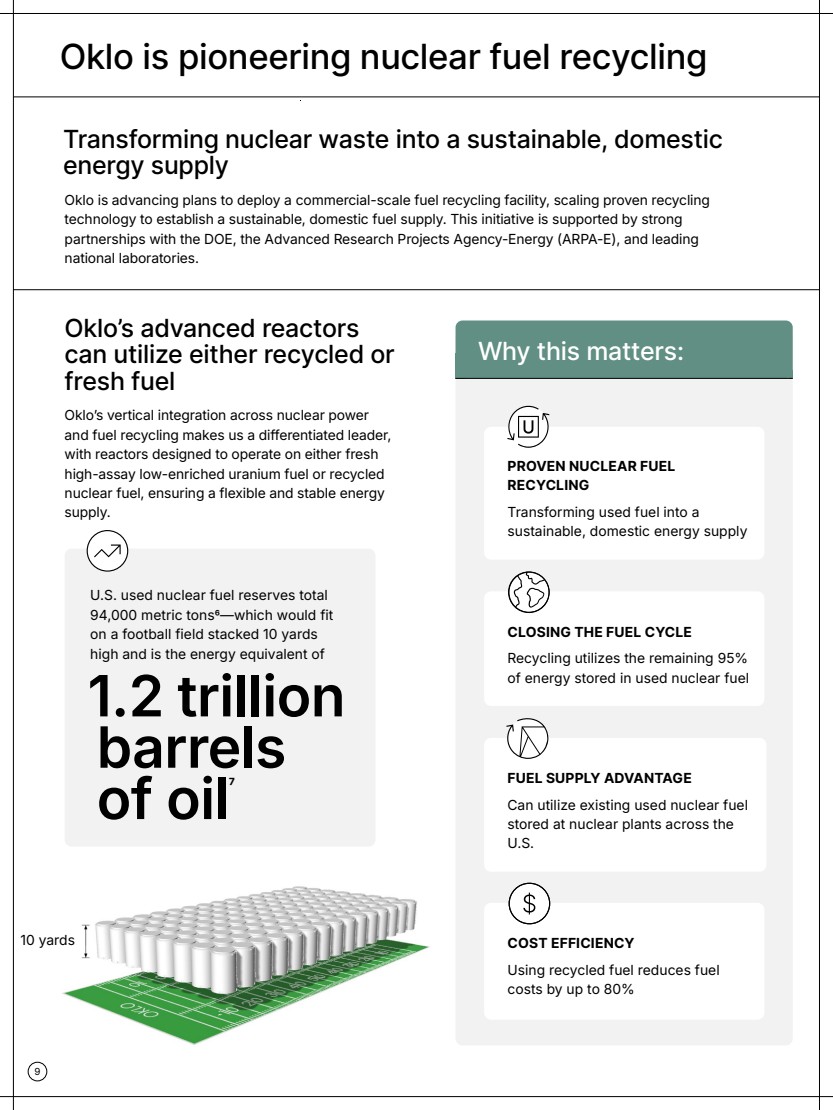
plant for many many reasons uh and one really important one is it helps position us to figure out the best ways to find fuel for the next plants and in a scalable way it's one of the reasons we we've publicly you know partnered with centrists um we're very excited that they are producing HALU as we speak. We're very excited about what their path looks like to increase that. And we continue to work with them and find the different ways we can help partner and accelerate accordingly on that front. We're very pleased that, you know, obviously there's been the programs from the US government to help scale up and spin out what's happening on the HALU side. And we see those things as all constructive and moving forward. There is, you know, this kind of multi-step dance that's occurring um but look the part of the reason that these kind of partnership agreements that we sign are so important is because it helps build the order book and then help build the frameworks accordingly because everything's adapting and dynamic right now to best accelerate the fuel side jumping forward with the ppa while you know too too soon and then the maybe you leave some opportunity on the table about how you could position the growth forward because some of these ppas if even if it's a multi gigawatt potential upside on the whole project or the whole partnership you're probably going to most likely have the ppa signed in incremental chunks as the phases go and as they sell the power in their capacity right on the data center side accordingly you know if you want to build the framework for sustained fuel production over 20 years that's much more valuable to everybody than just sort of like all right we have this ppa we're going to sprint to get built in the next five to eight years and therefore bring the order accordingly that sense and then having the refueling kind of cadences go with it those things pieced together are even more powerful than standalone but building that picture out helps the enrichers on capital planning helps us help build the right frameworks help build the right kind of contract structures and even inform the right policy levers it's a very important thing to highlight here too that's like significant first of all i think sometimes people tend to focus well a design doesn't need halo and that's a big benefit that's not really that that accurate um The enrichment markets across the Western world are pretty tight. We were importing 18% of our enrichment service from Russia, and that's off the table, more or less, and there's exemptions being made. Of course, I understand that. But even if there's changes in that policy, this is being challenged by, I should say challenged, stretched by increasing demand for new plans, life extensions, restarting plans, even on just the conventional LEU side. So really, the capacity for LEU is basically overbooked, and so is, of course, the capacity for HALU. Now, obviously, the production of LEU is much larger than the production of HALU today, but this is a constraining challenge across the board. Now, what's a feature about that problem, though, is the demand signals are clear across the spectrum. Obviously, the hyperscalers have shown that they've been partnering. Most of these announcements have come working with us and our peers who are doing reactors that you say lose so clearly there's something that they dig into it they feel like these are things that help move that forward because it's a solvable problem but uh it's important because what all that kind of translates to then is we're stimulating the supply chain for the enrichment industry across the board with these different government programs and these different sort of commercial updates right that are coming together because the centrifuges that you make on the centrifuge technology base to make leu are the same that you're really going to use to make haleu but you're going to typically see an order book that's larger on the LEU side, just given the existing cleat and the size of it. So if you spin that into a growth mode, you're going to see a significant drop in the economy scales of production of that equipment. And then that's going to propagate across the entire ecosystem from LEU to HALIB. So all of this is a silver lining of the tightness today to significant benefits to be seen tomorrow. So I do worry about sort of the bridge between now and the early 2030s. We obviously have a little bit of an eighth in our up our sleeve on the recycling side it's kind of a silly way to say it but recycling helps diversify our exposure to that massively and that's part of why we're taking this approach it also just massively changes the fuel utilization in question in economics it's hard to beat dropping your fuel cost which is a big cost item in our plants by over 80 having that potential is pretty exciting um not to mention all the other benefits you get from recycling but uh what we see is you know like there is significant opportunity uh energy appetite as we see it coming together on a policy landscape for opening up reserves extra reserves of fuel that the government uh has that can be used to bridge us to that point and one of the interesting things about that is that's actually preferentially advantageous on average to actually fast reactors because you're accommodating the impurities that might exist in some of the government reserves that they can't use for anything else because of impurities that don't matter to fast reactors i don't they're already using different you know sources of this material and therefore opening up totally different, you know, opportunities to basically bridge us forward. And I'll not make this be kind of as a potential sort of coupled kind of finding risk dynamic that does exist today that is going, you know, market forces will force through this and resolve it. But we're pretty excited about some of the policy appetite. We've already been a beneficiary of what that looks like. We've shown that that can be a successful pathway to open up government reserves as a bridging mechanism. And we're very excited and eager to see that, you know, basically help drive forward, hopefully more of that to come that helps us and others. But there's a lot of features that actually by on purpose, how we've designed our system, the features that allow us to recycle and be flexible on fuel streams are actually going to help us a lot if those programs get opened up, because a lot we can use pretty much anything that's out there. Not everyone else can do that. And that's going to obviously help because the material that maybe others can use is not going to be as competitive for. And so it gives us good advantages in that sense. And so at the end of the day, I feel like, you know, the market's moving in the right ways to address this in a number of fronts for LEU and HLEU. It's a problem across the board to just catch up on the supply there. But it's happening, which is good. I'd love to see it happen faster, obviously. But then I think there's also the bridging piece that can really help and help accelerate that happening, by the way, that ramps up on the commercial side. Because then you can go build reactors and faster because you're not fuel constrained, which is going to help you then order more fuel to build more reactors faster after that. So, you know, virtuous cycle. That's how I kind of look at that.
Operator
I will now pass the call back to Sam Doan, Director of Investor Relations, for a couple of retail questions.
Thanks, Karen. Jake, Greg, we had a couple of retail questions. The first one is, can you give more detail on the switch deal? And is this a firm or conditional? And what does it mean for Oclo?
Yeah, happy to. So the switch deal is a pretty exciting opportunity for us given the size, right? it's just it's immense um in terms of the magnitude of it at 12 gigawatts accordingly uh it has conditional elements around it for sure so it's not a firm ppa we didn't want to sign a firm ppa right away around that kind of size it's too early it's much better to do what we did here which is say okay um here's how we're going to work together you know switch went around and kind of built their case and talked to several different company companies technologies and liked what we're doing and decided they wanted to work with us and partner with us to power their growth and help power their growth and their ambitions accordingly. And we also really liked working with them. You know, there's a lot of people doing work in the space. So we have the benefits of being selected too. And we see like they are really well aligned, big vision about what they can do. Incredibly impressive technology for high compute. I mean, it's just incredibly impressive. The guy, the technical guy, just from like, you know, they don't have neutronics and data centers but they do a thermal hydraulics to thermal fluids and what they do is awesome and very cool uh and getting to see that was pretty neat to see and accordingly like their philosophy their design approach their attention to detail all kind of resonated really strongly not to mention kind of the benefits they have in terms of their plan for scale and growth across a number of different areas so we were pretty excited to be able to work with them um and want to work with them to then frame out this big vision uh to say hey here's where we see the roadmap being able to go to and here's how we're going to start working together as we further refine and define this so this is the stage just you know 12 gigawatts is it i mean it is it's one of if not the largest clean power deal in the u.s history or in u.s history uh and so like it's it's great to have the stage set for that but it takes a lot of time to say okay how are we going to execute against this and instead of spending a bunch of time to come up with you know this grand master plan that at the end of the day is only going to be you know 20 accurate because once you start executing against it things change um rather it was like let's take this incremental piece and approach let's sign a master power agreement that sets the stage of how we're going to work together on fighting and working together in different areas and government affairs uh and different aspects around public relations and site relations how we do site characterization and studies how we do design scoping and sizing how we actually do site design and integration and do the engineering some of the engineering work and therefore the engineering procurement and construction work accordingly how do we look at how we can overlap those things tap into what they do really well and find ways to sort of build off of their capabilities so that there's some economic and timing benefits that way. And then use those to define how you actually move to the next stages of contract negotiations for firm opting. So this is actually really important and it's the right way to do things. If you jump straight to this like firm PPA model, again, you might miss the target and get into a bunch of retrading and a bunch of renegotiation. And that's just not going to be helpful to building out what we're actually trying to do together, which is much more than just the transactional relationship right it's much more about building a very sustainable source of energy to power the future of compute and AI so like that is so that's how we structure that again like just from an engineering kind of like I guess I'd almost call it a philosophical alignment like we I saw so many parallels to what they do to what we need to do from designing a fixed civil asset so then how you route the sort of bring in these prefabricated manufactured componentry and put it together and wrap piping and rep plumbing and right route power like there's a lot of similarities it's not again not the same same but there's a lot of interesting similarities it's a great example of what that partnership says to stage four and how we expect that to go and it's also worth noting it spans a very long timeline to deploy to that i mean it's going to take us a long time to scale into 12 gigawatts i mean i'm excited about the opportunity but it's not something we can just do overnight and it's not something we can just do in five years even or even 10 years right that's why this fans several decades so uh anyway that's how we frame this and scope exist uh and i think this is kind of the right way to put these things together to help move the ball forward so there's much more to come here right as these things progress but uh it's the right kind of initial steps to move forward and jake i always kind of held it internally that you know with when we were talking to switch and i think back to the meeting that you and i and other members of our team had
with rob roy and his team in las vegas to kind of pivot us towards the master partnership agreement Because as we were going deeper in conversations with the SWITCH team, we realized there was more than one avenue of partnership that we could take with them, which is why we put that overarching frame in place so we could, you know, explore different things at different points in time, you know, and try to find optimized partnership elements between, you know, what SWITCH is looking for in their priorities as well as OCLO.
Great. Thank you both. Last question for the day. Oklo previously faced regulatory setbacks with the NRC, rejecting its application due to information gaps. Given those challenges, what specific changes or advancements have you made that now give you confidence in securing approval for your nuclear projects?
Yeah. I'm not trying to just like, you know, what's the word, like polish this or put a silver lining on it, but like the setbacks were also very informative, like learning points to gain a lot of information but i view them some way setbacks but more as learning opportunities afford progress and i'm instant just to recap like you know we we submitted our our combined license application the first time around for a one and a half megabot plans out of the idaho site this is 2020 right um free this boom in ai data centers all these customer dynamics um and much more focused on kind of a smaller incremental piece of reactor development deployment our long-term roadmap was always to work our way up into the sizes we're at now we just want to start as small as we could to reduce the total amount of capital to get built and still have a viable market which really works well that we've fought at that time at that size well the market evolved and moved which was good and it's nice because we would you know would have been would have been the best thing for us to build a one and a half megawatt plant uh given where the market is today had that license progressed but also we took a very forward leaning licensing approach and the nrc had worked with us in pre-application for four years leading up submitting that application, including us piloting an application with them that was very novel in structure in 2018. And that was pretty important because we wanted to try to set up a new framework and a new approach on sort of what a licensed application would look like. I think the tendency in, you know, if we try to license these new reactor types, like large conventional light water reactors, it just doesn't really make sense. A lot of square peg round hole. There's a of ways you need to do things differently and so we leaned into that pretty heavily the nrc leaned back into that heavily and they after they did a round of audits on our application you know pilot application in 2018 and 19 they gave us a clear feedback clear feedback that they could review an application that looked like that they gave some feedback about how to approach framing and scoping it and also took it that okay you know more or less if you come in or something like that we could find a path to review that uh and just to put some numbers on it we went in with an application it was very very forward leaning very very innovative it was like seven major sections rather than the 19 typical chapters it was only like less than 600 pages compared to tens of thousands like 10 to 20 000 pages very different much more lightweight approach in parallel to that the nrc was doing some new things that was pretty cool uh and so we were pretty excited about what they were doing uh in terms of highlighting a very audit heavy review focus rather than kind of a written question and answer approach i mean they're going to do both but do a lot more in the audits which are much more intensive by the way but they move faster much more productive for us and for the regulators additionally uh and that was all based on in-person audits right and then additionally they wanted to move forward uh this kind of doing some cool like you know core team cross-functional review team that was working together in person not in the sort of departmental technical silos that they typically would sit in where an application would come in and get shotgunned out whether they would all be together across different subject matters and working together to kind of develop out their independent safety analysis review and move forward on top of that you know we told them hey we're going to come in you know very forward-leaning we're going to come in with a we think is a justifiable and defensible approach but it's going to inherently be quite different than what you've seen before so a very you know i would say optimized uh safety footprint and how we classified what things were safety related and not so it was it was you know is very modern, frankly. All of that, I think, was great going in 2019 into early 2020. And unfortunately, for much bigger reasons than our application, but obviously the world changed very substantially in March of 2020, which was when we submitted our application, literally on the day the pandemic was declared. And that completely shifted the review dynamic so that we were no longer doing these in-person things. We weren't doing the same approach that we built our application for you know as far as we knew and we were told by the nrc at that time we submitted the first application that had ever been submitted online you know we never verified and validated that through the whole change but we think that's pretty true uh and that was in 2020 right it just showed you that we were really doing some new things and they were really responding to it ultimately i think it was all too much during an era of of covet and that's where we got set back considerably on i think sort of the okay we can't review the application that's submitted given all these things so they denied it in january to you know 2022 after you know a couple months later we're able to engage again in person with them and immediately got back into pre-application obviously we updated the design to be bigger to the market had moved on us that way we'd already been talking about that with the nrc and so that gave us the platform to do that move fully into that and then take an approach that allowed us to focus on sort of resolving and answering the open items that the nrc wanted which mostly turned into hey how did you do this what was your methodology and then bridging our approach and how we did it to sort of what they're used to seeing and and you know what they were comfortable with what we found was a little more time on that got everyone a lot more kind of sort of comfortable with the different approaches being taken and saying oh actually you did do these things it was just done in a way we're different from seeing it but now spending time together we see that it's done in a way that we're kind of used to maybe some extra you know approaches on like if you can help answer questions we have in these areas that will help us then you know progress a review for for example do you have many many meetings that then happen from april 22 through now to sort of converge on this to put draft content of application together to submit different technical reports and have meetings and have reviews on this or white papers i should say and then also have the topical reports coming out and then also moving into readiness assessment gives us the chance to then move forward on all these things and time since when we first submitted through now and time looking at these things as well as how we're using them and implementing them has actually grown a lot more conversions on the doability of some of the things we were intending to do. Obviously, there's some updates and some modernization, but the lessons learned have been massive because we spent time to actually now go through those things and try to do things. A key thing that was different for us compared to other companies is we leaned into that opportunity back at the very beginning of our engagement with the NRC to try to do things in as efficient as a way as we could see possible. And we got some bumps and bruises and scratches and all of that and black eyes accordingly. But guess what? Look at how things have progressed accordingly. And a of that stuff mimics not mimics but but builds off of some of the things we put forward like some stuff we tried and put forward maybe a bit too different or too much so it's kind of changed but a lot of things are finding a lot of footing in the different things the energy has done in the last frankly right almost nine years since we started working with them um not because it's like oh we did all these things look how great it is it's more hey we're trying to do something differently and then others start echoing that with some time in it and we were obviously ahead of the pack uh and so as others start kind of digging in and developing their own plans in the space and then they're actually looking at it it kind of all comes together in a constructive way to say okay yeah we could do something in this way that's more efficient and right-sized then you couple that with the current environment that's gone from several administrations excessively of trying to drive forward more modernized regulatory framework and approach to reflect these kind of capabilities and these changes you know it's it's pretty exciting honestly so at the end of the day like um you know we've applied a lot of lessons learned we've done a lot obviously we've grown this team we've hired a lot of good folks to come in and help us do this but a lot of the things that we put forward are also finding kind of footing with some updates and tweaks with iterations on them that have you know come together over the last couple years these things don't move super quickly but we've invested the longest amount of time of anybody to get to the state so we're in a really good position to go forward into sending an application and the next steps thereafter so um you know obviously there's a lot more work to do uh but you know we've been very excited about how the nrc has done things how we've been doing things the feedback we've gotten has been helpful and constructive here uh you know there's some things we've we've kind of evolved our course on there's things that i think actually has as well but at the end of the day uh it's coming together to set the stage for review and look they have licensed and issued things for other advanced reactor types um which are pretty important uh granted our construction permits or design certifications and those aren't the same as a cola but all that builds on itself so that when we go in with the cola application you know there's a lot that we get to stand on and they get to stand on from a success perspective so that's my really long answer but uh it's a it's been a journey and one next it will continue to i will now hand the call back to jake do it for closing remarks great well thank you all so much for the time um always fun to talk about the different updates and things we have going on 2024 year was a very exciting year for us for a lot of reasons um but also just a preview of what we're all really excited to go do something i tend to talk about internally is the broad potential that this technology has in truly unlocking the energy of the actinides that we are fortunately blessed with to have as this incredible energy resource that fast reactors are in recycling are pretty uniquely positioned to fully fully tap into. So thank you for the time and looking forward to the next one.
Operator
Ladies and gentlemen, that concludes today's call. Thank you all for joining and you You may now disconnect.