Operator
Good day, and thank you for standing by. Welcome to the PAR Technology Corporation 2024 Fourth Quarter and Year-End Financial Results Conference Call. At this time, all participants are in a listen-only mode. After the speaker's presentation, there will be a question and answer session. To ask a question during this session, you will need to press star one one on your telephone. You will then hear an automated message advising your hand is raised. To withdraw your question, please press star one one again. Please be advised that today's conference is being recorded. I would now like to hand the conference over to your speaker today, Christopher Byrnes, Senior Vice President of Investor Relations and Business Development. Please go ahead.
Speaker 1
Thank you, Daniel. Good morning, everyone, and thank you for joining us today for PAR Technology Corporation's 2024 Fourth Quarter and Year-End Financial Results Call. Earlier this morning, we released our Q4 financial results. The earnings release is available on the investor relations page of our website at partech.com. You can also find the Q4 financials presentation as well. It's in our related Form 8-K furnished to the SEC. During our call today, we will reference non-GAAP financial measures, which we believe to be useful to investors and exclude the impact of certain items. A description and timing of these items along with a reconciliation of non-GAAP measures to the most comparable GAAP measures can be found in our earnings release. I'd also like to remind participants that this conference call may include forward-looking statements that reflect management's expectations based on currently available data. However, actual results are subject to future events and uncertainties. The information on this conference call related to projections or other forward-looking statements may be relied upon and is subject to the Safe Harbor statement included in our earnings release this morning, and in our annual and quarterly filings with the SEC. Finally, I'd like to remind everyone that this call is being recorded. It will be made available for replay via a link available on the investor relations section of our website. Joining me on the call today is our CEO and President, Savneet Singh, and Bryan Menar, PAR Technology Corporation's Chief Financial Officer. I'd now like to turn the call over to Savneet Singh for the formal remarks portion of the call which will be followed by general Q&A. Savneet?
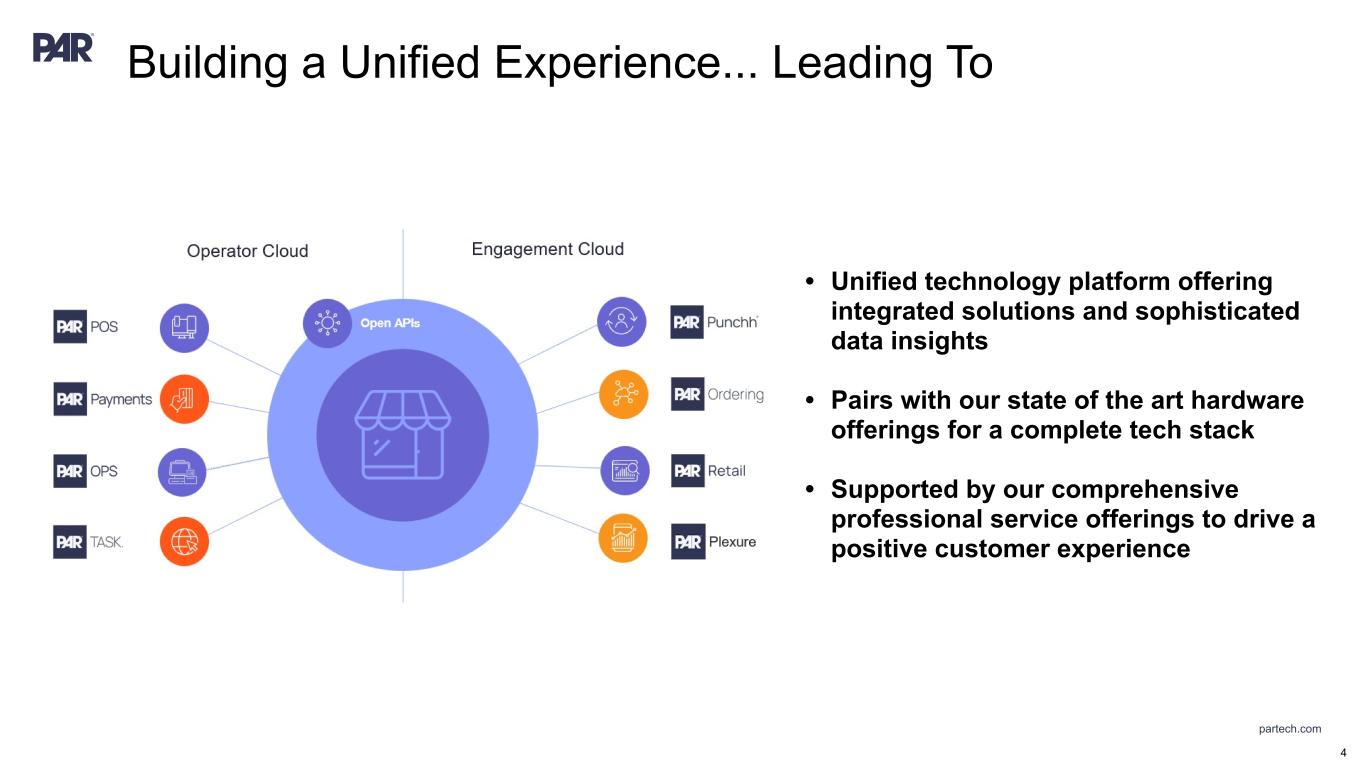
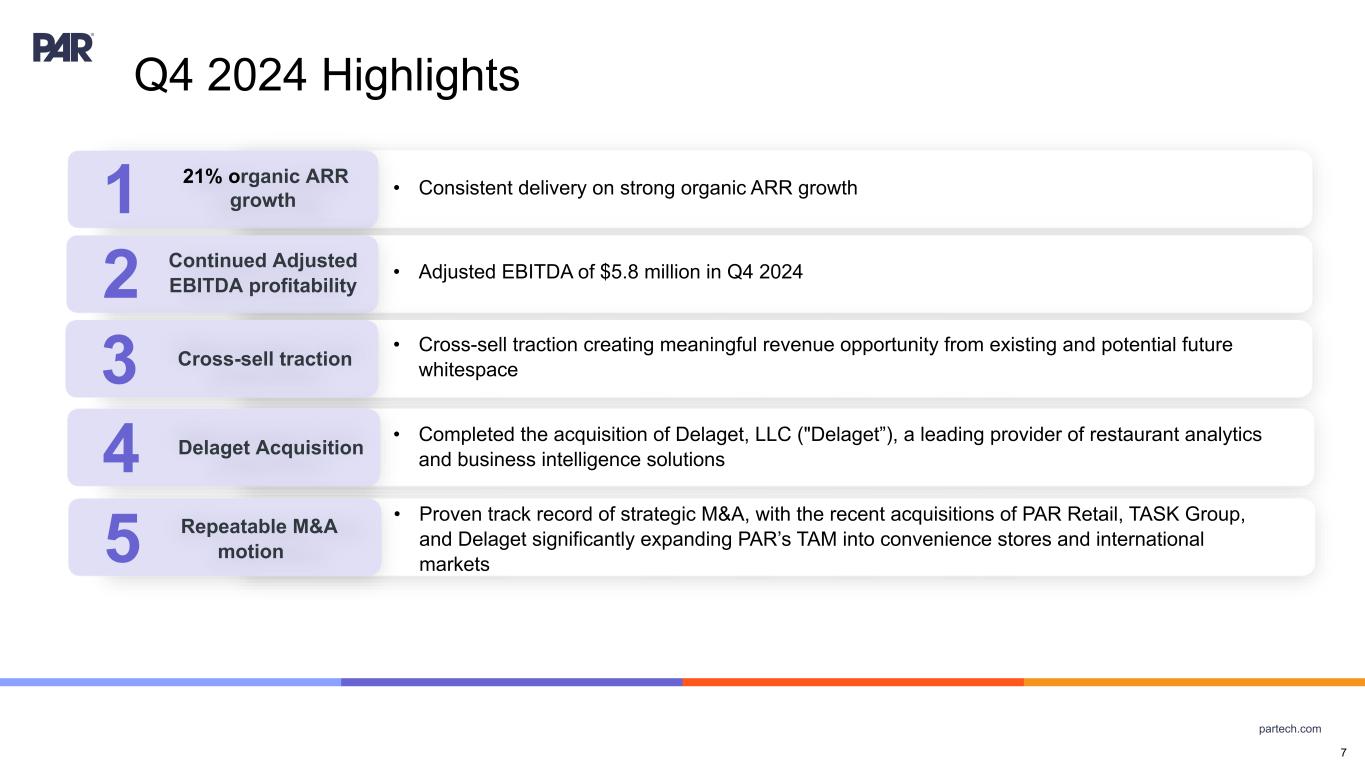
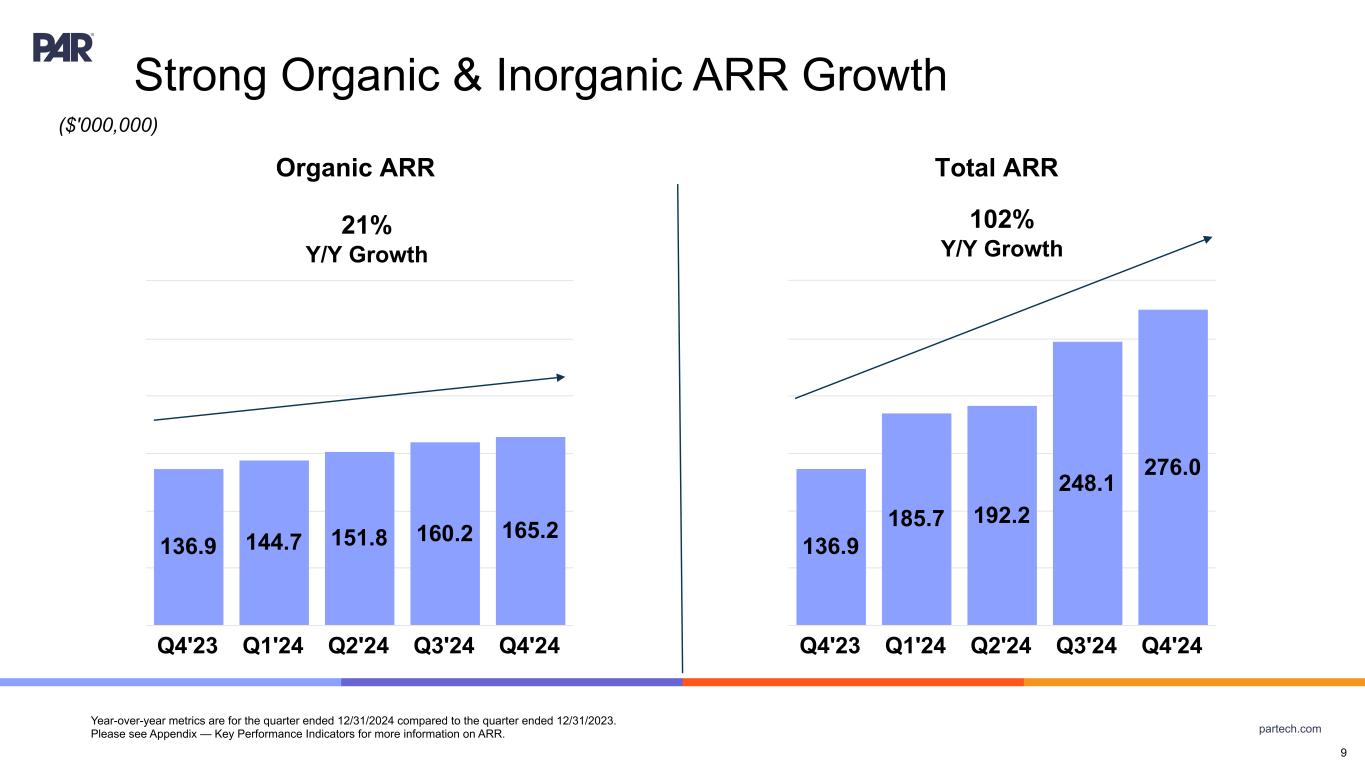
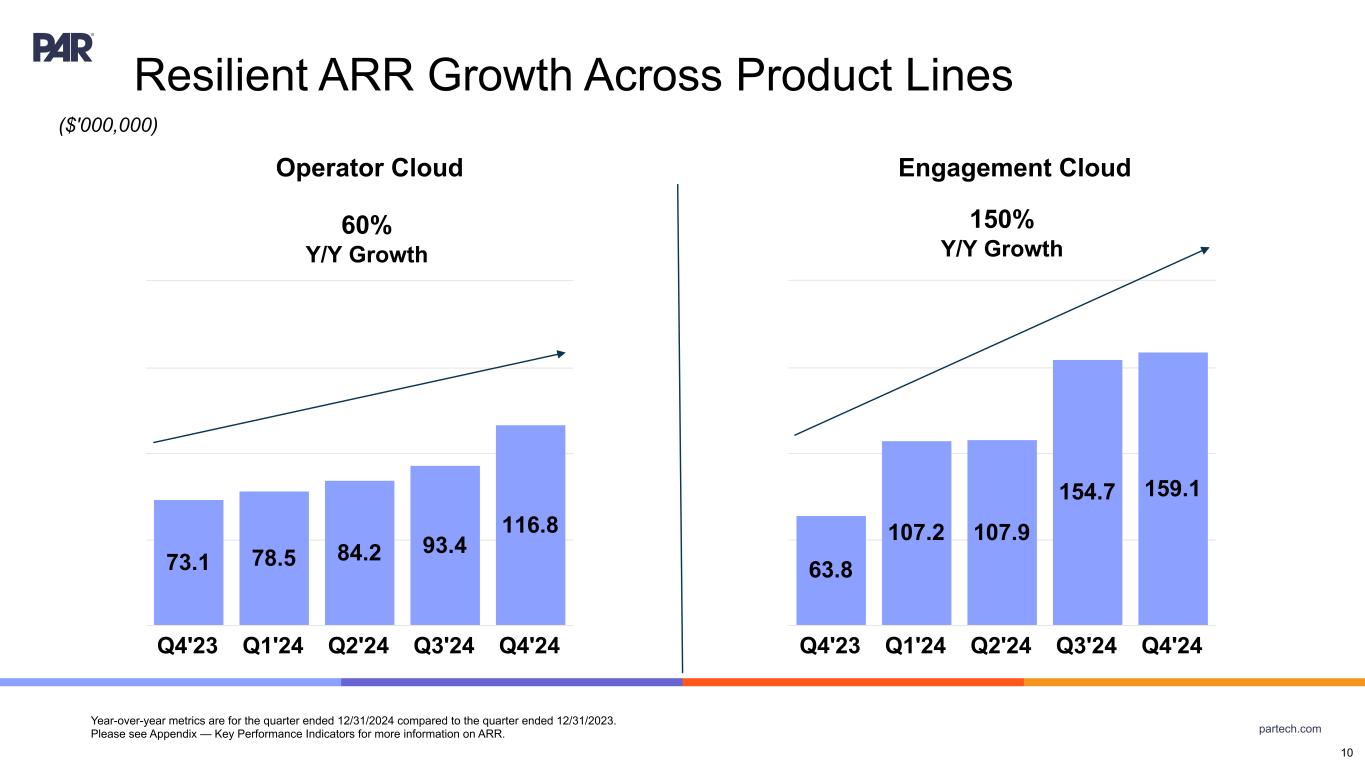
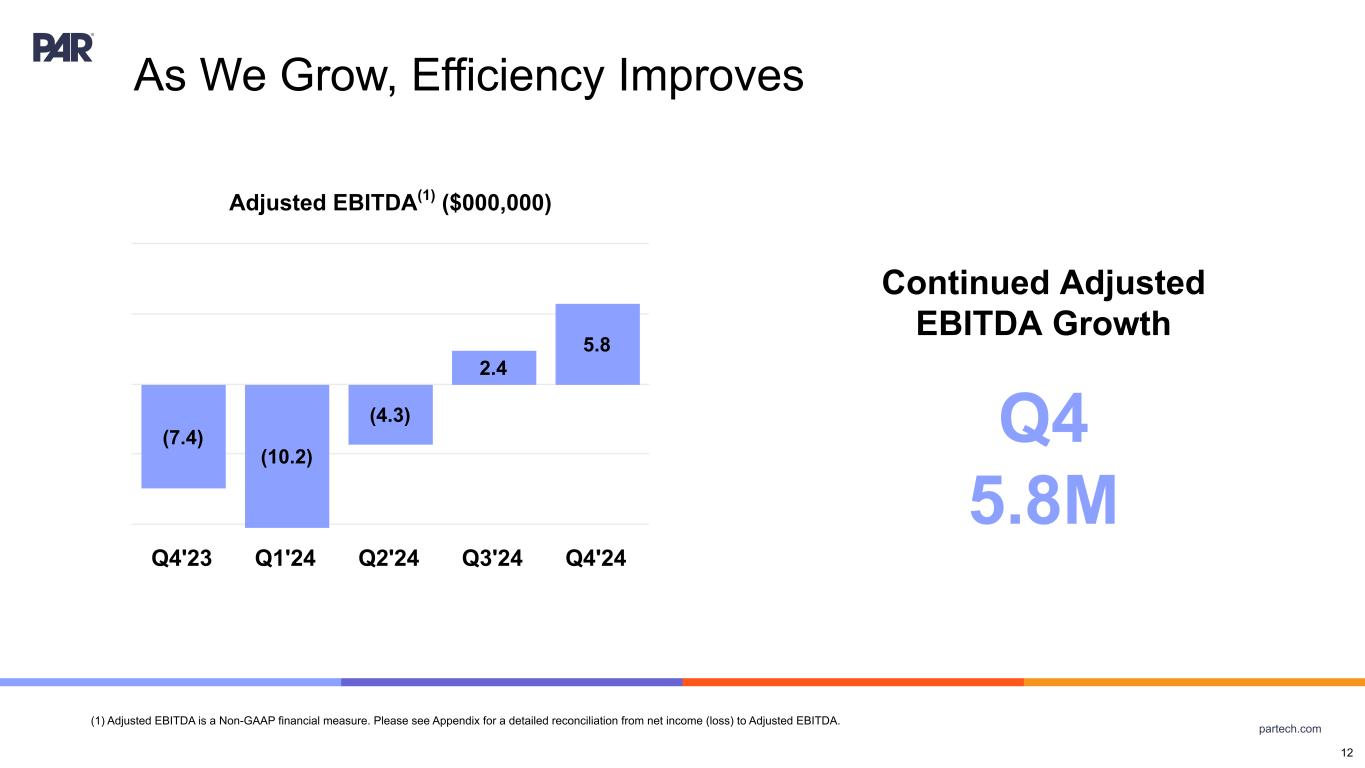
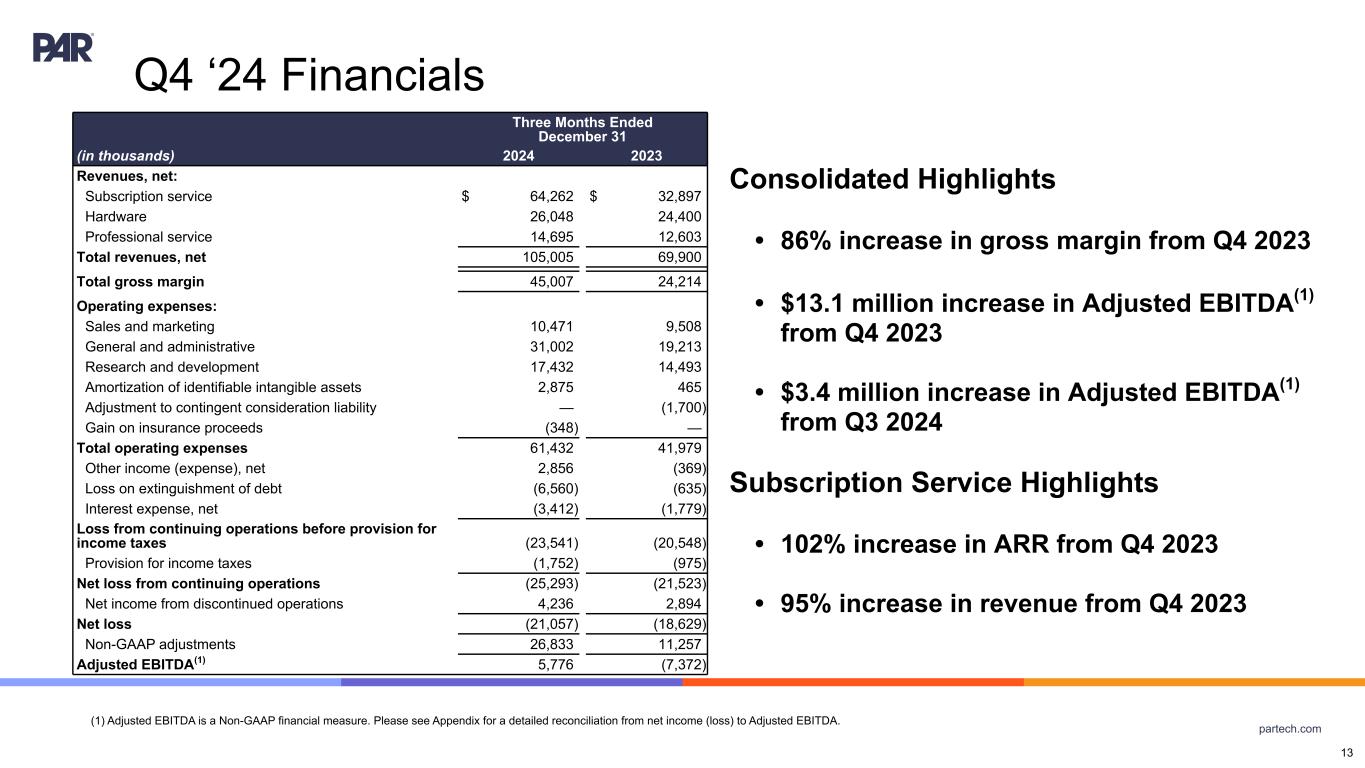
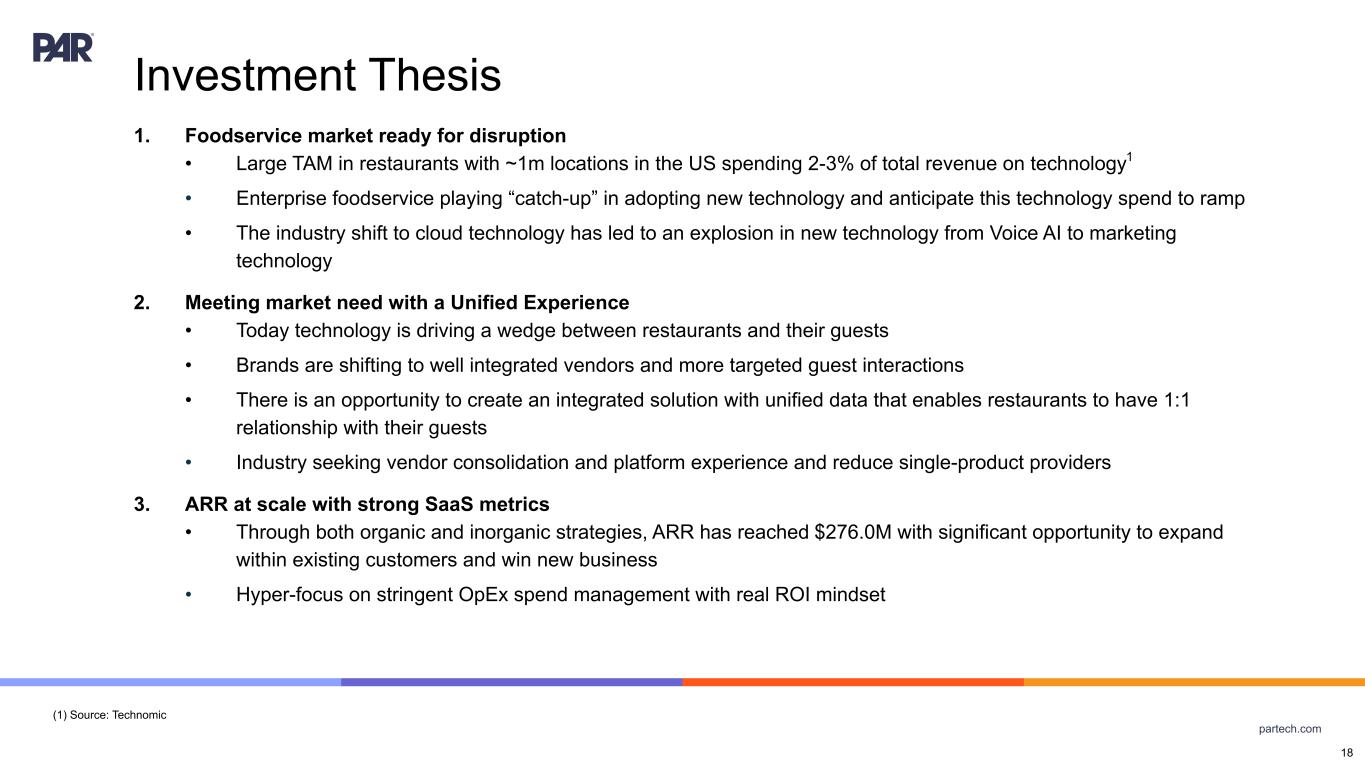
Thanks, Christopher Byrnes, and good morning, everyone. We reported $105 million in revenues in Q4, an increase of more than 50% year over year. Subscription services ARR more than doubled to $276 million from last year, with 21% organic growth when compared to Q4 of 2023. Alongside this revenue growth, our non-capitalized profit grew organically 30% year over year. Adjusted EBITDA came in at $5.8 million, more than doubling the sequential previous quarter, continuing to show the long-term margin expansion potential. The growth in profitability in the quarter was driven by both Operator and Engagement Cloud. Operator Cloud ARR grew organically by 26% in Q4 when compared to the same period last year. ARR for this business unit now totals approximately $117 million, including Delegate. Operator Cloud growth is being driven by increased new customer wins, upsells, and bookings from planned rollouts with existing customers. PAR POS signed eight new customer logos in the fourth quarter, with all of those new customers selecting multiple products from PAR Technology Corporation. This continues to validate our better together thesis while increasing our LTV per customer meaningfully with no additional cost to acquire. We are excited about the projected velocity for Burger King as well in 2025 across both POS and PAR Ops. Having recently expanded our partnership with Burger King to include our PAR Ops product line, we are working closely with BK and using Q1 to fine-tune the sequencing of rollouts between both products to enable a combined and mutually agreed-upon implementation rollout for 2025. We expect significant and accelerated implementations from Q2 onwards. This is an exciting change as it demonstrates our better together thesis working at one of our largest POS customers. We currently have approximately 1,500 BK sites in backlog, with a robust white space ensuring excellent 2025 visibility, acceleration, and potential. While combining a second product to the BK rollout temporarily slows our PAR POS rollout in Q1, adding a second module dramatically increases our LTV. We would make this trade every time. And importantly, a combined rollout is the right thing for franchisees as well. We will never sacrifice customer success for short-term gain. Partnership is what drives our long-term strategy. At the very end of the quarter, we announced the acquisition of Delegate, and we immediately kicked off a rebrand of our back-office initiative into the new PAR Ops, which includes the Delegate and Data Central product modules. Our integration with Delegate and the team has been better than expected, and we are seeing strong customer interest, including among marquee tier-one accounts. As we continue to build out our PAR Data Platform, Delegate not only boasts a highly synergistic product offering that will accelerate cross-sell, but it also affords entry into more than 25,000 sites covering 40 of the top 50 restaurant concepts. Further, it comes with a seasoned management team now driving the combined PAR Ops business. It's important to note that Data Central finished up the year with a strong Q4 through targeted cross-sell growth across our customer base. Growth will accelerate as we are forecasting PAR Ops to have its strongest growth year yet in 2025. We have begun the work on product unification efforts with Delegate that includes single sign-on and real-time data flow, a big step in building towards our data platform. This initiative is highly strategic and underscores our continued drive towards a better together platform that is not replicated anywhere else in the enterprise market. We will be sharing additional details as the year progresses on this exciting initiative. Now to report on our payments business. As we exit 2024, our payment services continue to drive high transaction counts and processing volumes across our customer base, and we look to take more stores live while driving better payment processing economics. Notably, we continue to see strong interest in our Punch Wallet with more customers onboarding every quarter, including Paris Baguette, Gold Star Chili, and Runza in Q4. Additionally, we successfully cross-sold a tier-one customer with approximately 1,000 locations on our payment services. This customer's conversion will positively impact our results over the coming quarters and is a further example of our better together project wins. As our customers continue to unify through both off-premise and in-store processing with PAR Pay, the scale of our datasets across loyalty, ordering, and POS product puts PAR Technology Corporation in a unique position to leverage tokenized information to drive actionable insights mapping known and unknown customers, and personalizing communications to drive higher ROI and increased lifetime value. We are the only company in the enterprise who can link off-premise and on-premise tokenized data with loyalty data all the way to the back of house. This is a moat that is hard to replicate. There's a growing trend in the industry towards disjointed multi-vendor solutions that attempt to stitch together guest data, payments, and ordering across multiple third parties. But integrations alone don't create intelligence. First-party data does. Many attempt to take pieces of payment data and combine them with external systems because PAR Technology Corporation owns the full technology stack; everything we do is first-party, ensuring true data integrity. Some would have you believe that restaurant technology should be run outside the POS, fragmenting operations across multiple platforms. We see it differently. POS is and will always be the true control center of the restaurant. After all, 80% of transactions still happen at the POS, where real-time transactions, menu data, and guest interactions all converge. Payments, loyalty, and ordering are not separate systems. They are part of a restaurant's mission-critical platform. That's what makes our approach fundamentally different from the rest. Rather than layering on third-party processors and intermediaries, we are removing inefficiencies, giving our customers lower processing costs, higher authorization rates, and full control over the guest relationship. Looking ahead for the year, our pipeline remains robust for our payment offering across both PAR Clouds, ensuring we capture new growth opportunities. Moving to our Engagement Cloud, Engagement Cloud ARR reported 15% organic growth in Q4 when compared to the same quarter last year. ARR now stands at approximately $159 million for the Engagement Cloud and includes Plexure and PAR Retail. Our strong execution in this business has led to several new tier-one customer wins. Our Engagement Cloud continues to exceed standards and dominate the loyalty offers and engagement market with consistently strong interest from existing and new customers. With increasing customer headwinds in 2025, many brands are doubling down on digital technology to drive increased consumer frequency and retention, notably through enhanced investments in loyalty programs. Punch is seeing continued product and sales consistency by delivering growth, with new customers and expansion with existing brands. Punch is a market leader for restaurant loyalty and delivers stability and innovation to our customers. This quarter, we achieved multiple large customer winbacks who had previously churned from Punch for pure guest data platforms but then returned back to Punch. Most notably, a tier-one table service chain and two well-known casual dining enterprises are part of this transition back to Punch. Moving to PAR Retail. In the convenience and fuel industry, our team executed the launch of a major multi-thousand unit brand and additional major upsells with our largest customer in Q4. We brought to market the first fully integrated major oil and branded retailer program in the industry. Beyond our exciting customer wins, the PAR Retail product continues to expand to serve the fuel and convenience industry. In Q4, we successfully launched gamification, updated unified e-receipts, enhanced punch card functionality, and optimized member surveys with our focus on developing features that drive incremental outcomes like more visits, more gallons, and bigger baskets that continue to deliver value for our customers. Our customers look to us to expand our platform into the industry-specific white space, and we are looking to accelerate innovation efforts in the retail vertical through M&A. We are targeting strategic opportunities in the near term that will add additional value to our customers and their members. Moreover, we're beginning to see our integration synergy efforts begin to flourish as we have streamlined our efforts across the retail and restaurant space. We've seen already that this is allowing us to focus our R&D and sales efforts between industries to maximize profitability, accelerate innovation, all while improving customer satisfaction. Briefly touching on hardware. I'm pleased to report that we have reversed recent trends and increased our hardware revenues by 7% in Q4 versus the same quarter last year. Several key global brands have approved our newest platform, the PAR Wave, and we are seeing increases in both domestic and global sales. Also contributing to the turnaround was our new PAR Clear drive-through solution that is setting the standard for drive-through comps. An open architecture that will enable users to leverage the power of AI for the drive-through, PAR Clear is positioned to be not only the industry leader in QSR drive-through systems today but also the preferred platform for the future. Our hardware and POS software divisions are partnering closely on product to ensure that PAR Clear adds to our strategy of better together innovation. To summarize, we remain very bullish about the future of foodservice technology and PAR Technology Corporation's continued role as a leading enterprise provider. In 2025, we foresee our ability to execute on both our historical growth rates and deliver on the biggest M&A pipeline we've seen to date. We view this time as a great opportunity for us to make bold bets and strengthen our market position. I'm confident in our ability to consistently innovate and provide value to our customers for years to come. Persistence trumps everything, and I believe we'll come out as a winner in the enterprise. Raising the bar for execution, investing in our products and teams for the long term, we are well-positioned to drive durable growth in the category. The opportunity will continue to grow for the foreseeable future. Bryan will now review the numbers in more detail. Bryan?
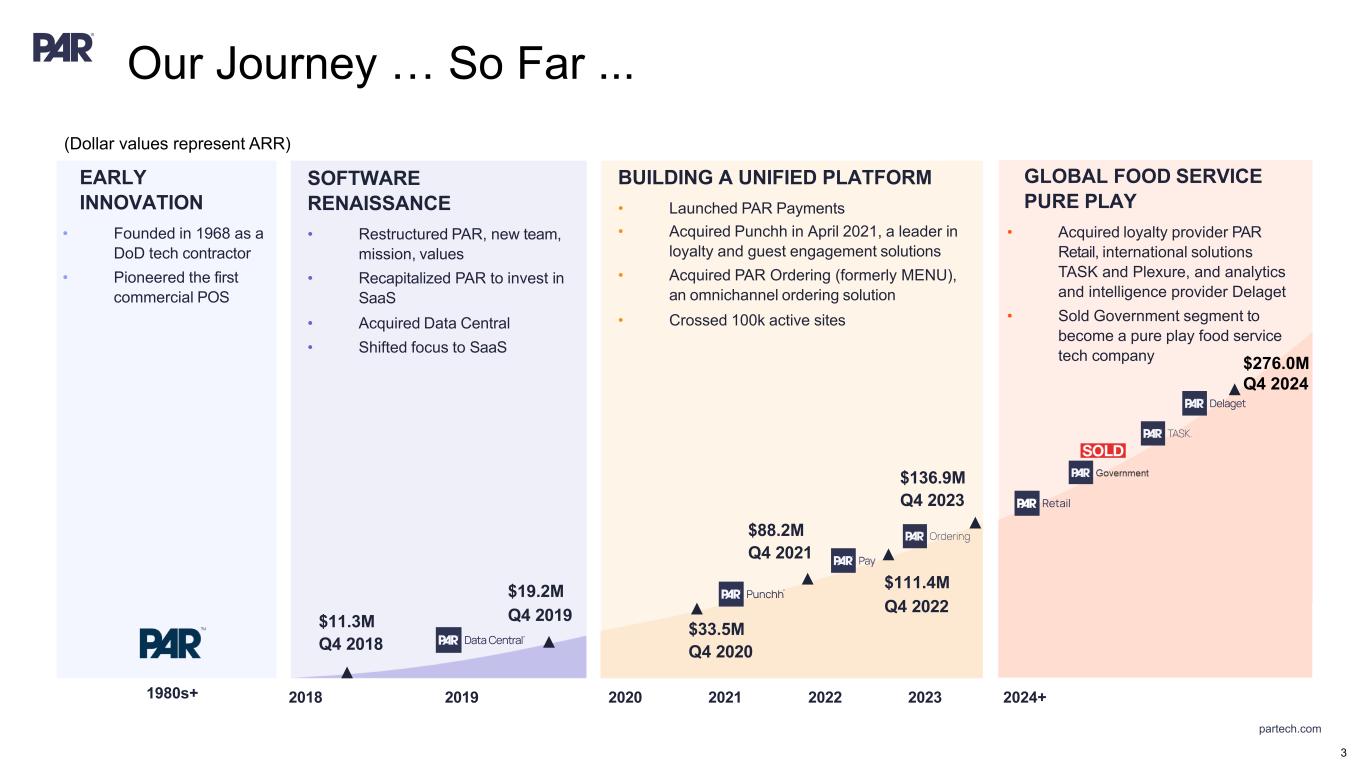
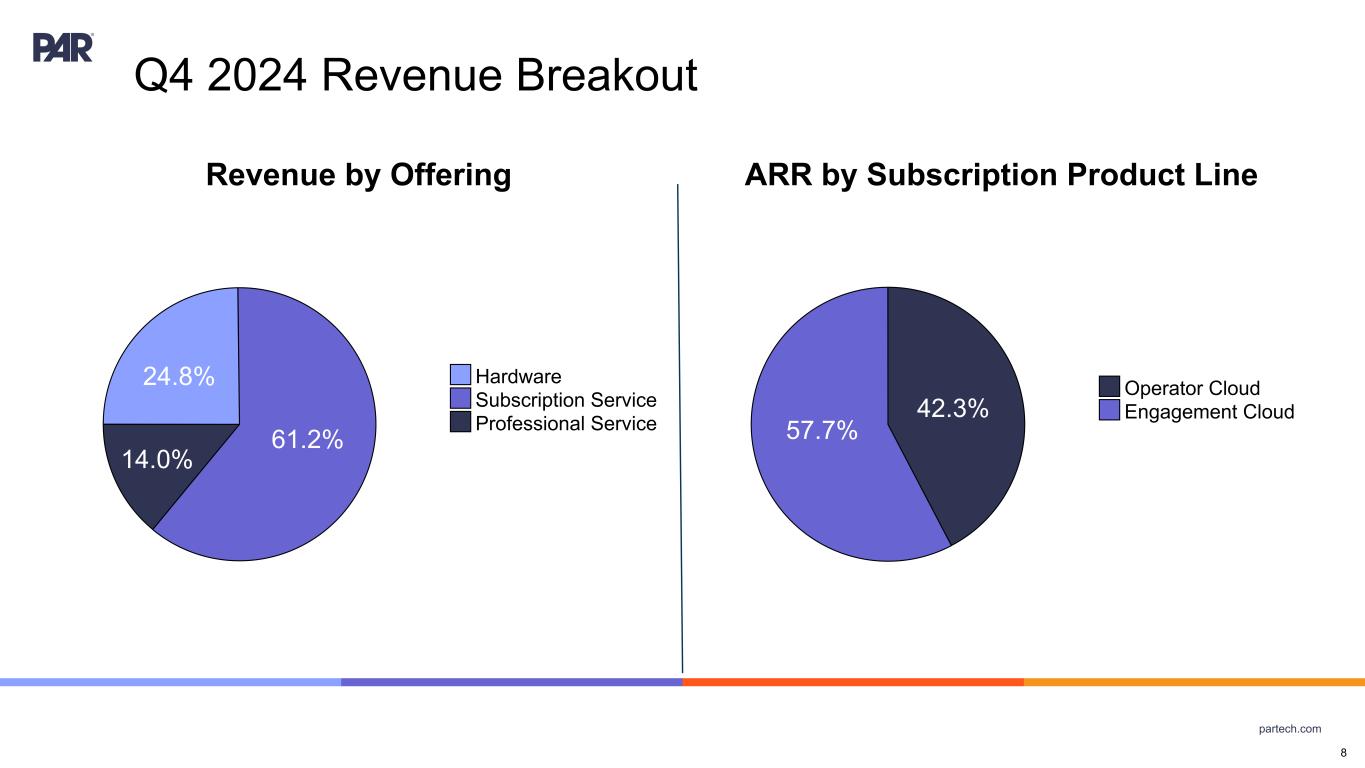
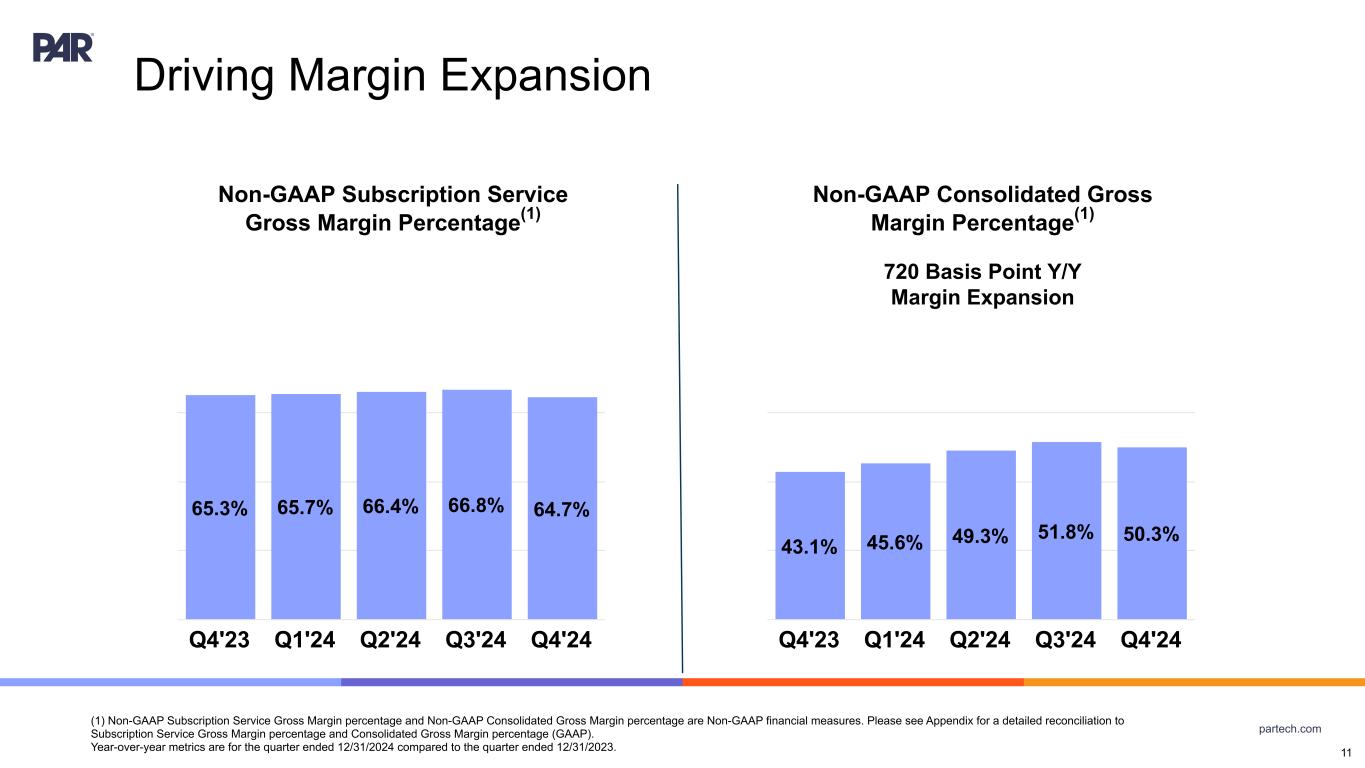
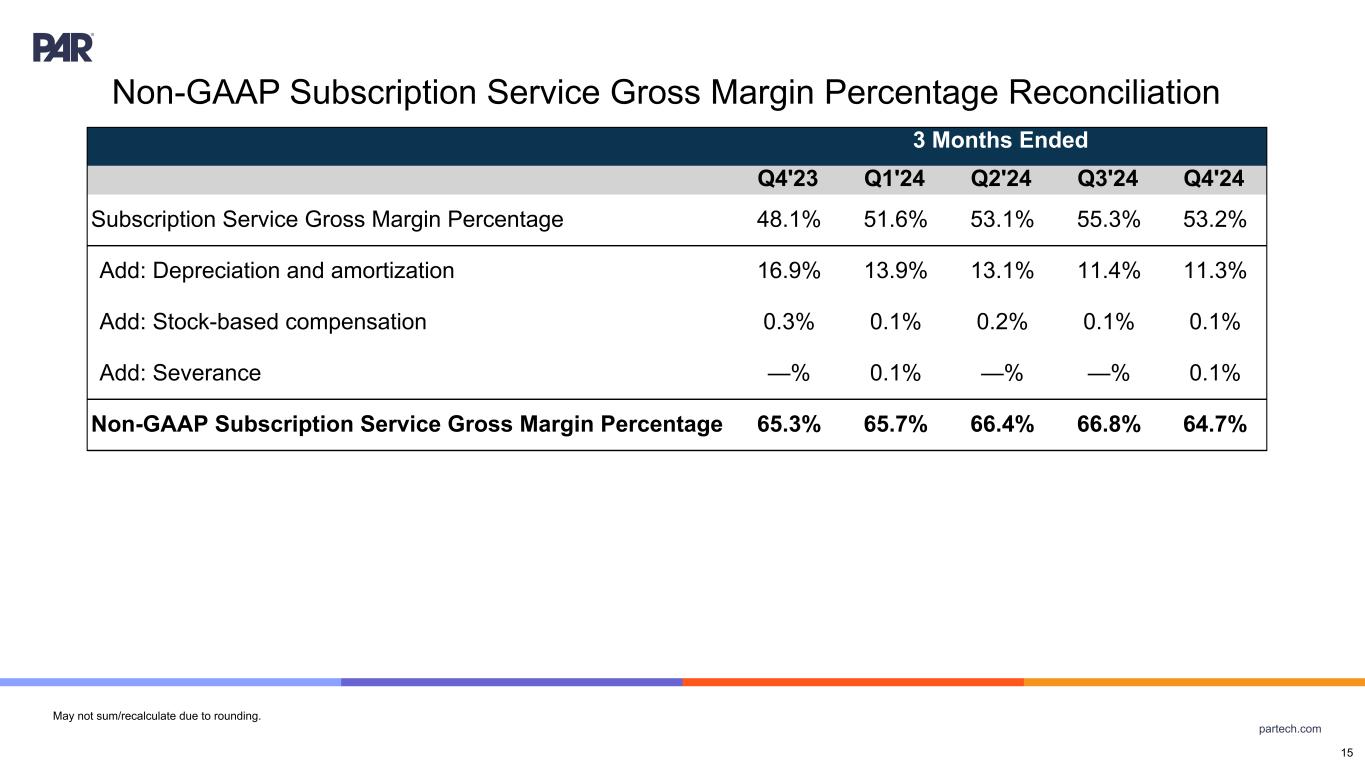
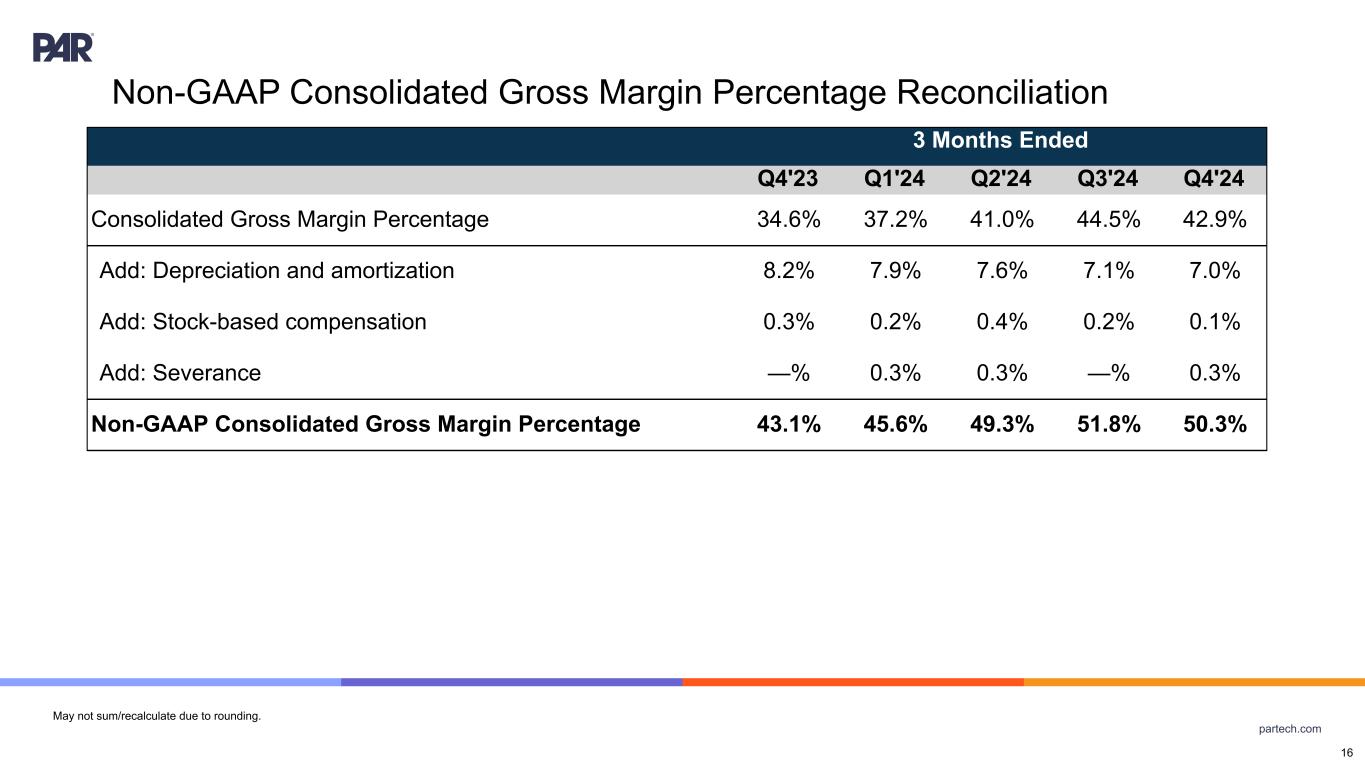
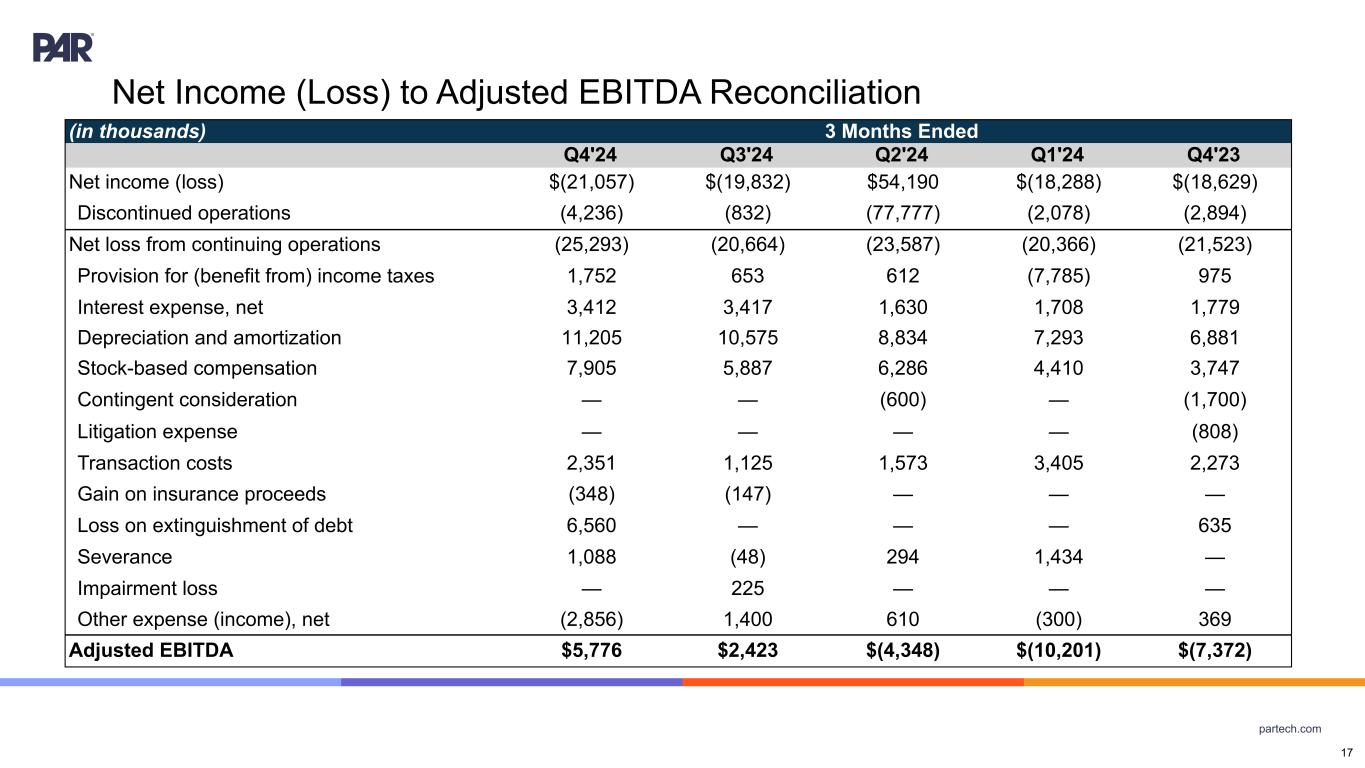
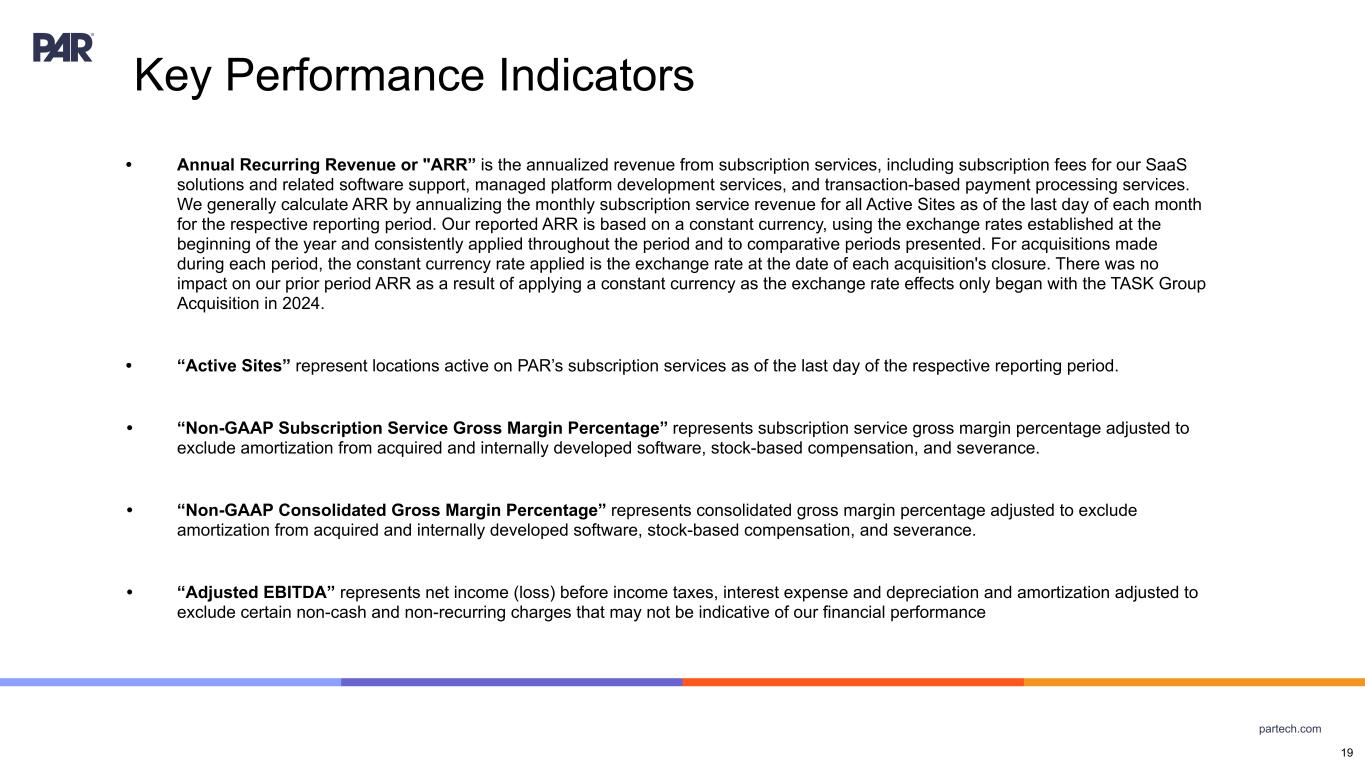
Thank you, Savneet Singh. Good morning. We closed out 2024 with another successful quarter for PAR Technology Corporation. Subscription services continue to fuel our organic growth while our team continues to execute with fiscal responsibility. As a result, adjusted EBITDA for the quarter improved $3.4 million sequentially from Q3 and $13.1 million compared to Q4 prior year. This positive movement is indicative of our ability to continue to drive growth with profitability. Now to the financial details. Total revenues were $105 million for Q4 2024, an increase of 50% compared to the same period in 2023, driven by subscription services revenue growth of 95% inclusive of 25% organic growth. Net loss from continuing operations for the fourth quarter of 2024 was $25 million or $0.68 loss per share, compared to a net loss from continuing operations of $22 million or $0.77 loss per share reported for the same period in 2023. Non-GAAP net loss for the quarter of 2024 was $37,000 or effectively $0.00 per share, a significant improvement compared to non-GAAP net loss of $12 million or $0.43 loss per share for the prior year. Now for more details on revenue. Subscription services revenue was reported at $64 million, an increase of $31 million or 95% from the $33 million reported in the prior year and now represents 61% of our core revenue. Excluding core retail and Task Group, organic subscription services revenue grew 25% compared to the prior year. ARR exiting the quarter was $276 million, an increase of 102% from last year's Q4, with Engagement Cloud up 150% and Operator Cloud up 60%. Excluding PAR Retail, Task Group, and Delegate, total organic annual recurring revenue was up 21% year over year. Hardware revenue in the quarter was $26 million, an increase of $2 million or 7% from the $24 million reported in the prior year. Sequentially, compared to Q3 this year, hardware was up $3 million or 15% driven by an increase in volume attached to our software customers. Professional service revenue was reported at $15 million, an increase of $2 million or 17% from the $13 million reported in the prior year. The growth was driven by recurring revenue service contracts. $9 million of the professional services revenue in the quarter consisted of recurring revenue, a 25% increase versus the prior year. Now turning to margins. Gross margin was $45 million, an increase of $21 million or 86% from the $24 million reported in the prior year. The increase was driven by subscription services with a gross margin of $34 million, an increase of $18 million or 116% from the $16 million reported in the prior year. Subscription services margin for the quarter was 53%, compared to 48% reported in Q4 of the prior year. The increase in margin is driven by continued focus on efficiency improvements with our hosting and customer support costs as well as accretive margin contributions from recent acquisitions. Excluding the amortization of intangible assets, stock-based compensation, and severance, total non-GAAP subscription services margin for Q4 2024 was 64.7% compared to 65.3% for Q4 of 2023. The modest tick down was driven by a shift in product mix post-2024 acquisitions. Gross margin continues to improve across our products and we expect total non-GAAP subscription services margin to continue to improve in this current baseline. Hardware margin for the quarter was 26% versus 29% in the prior year. Hardware margin in Q4 2023 was positively affected by one-time inventory adjustments. Our focus on demonstrating value for our price with improved operational efficiency has allowed us to improve hardware margins during the year and finish 2024 with full-year hardware margin at 24%. Professional service margin for the quarter was 28%, compared to 10% reported in the prior year. The increase primarily consists of increases in margins for field operations and repair services, substantially driven by improved cost management and reductions in third-party spending. In regard to operating expenses, GAAP sales and marketing was $10.5 million, an increase of $1 million from the $9.5 million reported for the prior year. The increase was primarily driven by inorganic increases related to our acquisition, while organic sales and marketing expenses decreased $0.3 million year over year. GAAP G&A was $31 million, an increase of $12 million from the $19 million reported in the prior year. The increase was primarily driven by non-GAAP adjustment items for M&A transaction fees and stock-based compensation, as well as inorganic increases related to our acquisitions. GAAP R&D was $17 million, an increase of $3 million from the $14 million recorded in the prior year. The increase was primarily driven by inorganic increases related to our acquisitions, while organic R&D expenses decreased $0.5 million year over year. Our team was able to effectively drive cost efficiency and properly prioritize resource allocation, which enabled us to continue to drive innovative outcomes without incremental cost during 2024. Operating expenses excluding non-GAAP adjustments were $47 million, an increase of $9 million or 25% versus Q4 2023. Excluding inorganic growth, organic operating expenses increased a modest 2%. The organic increase was primarily driven by variable compensation and benefits. Exiting Q4, non-GAAP OpEx as a percent of revenue was 45%, a 900 basis point improvement from 54% in Q4 prior year. Now to provide information on the company's cash flow and balance sheet position. As of December 31, 2024, we had cash and cash equivalents of $108 million and short-term investments of $59 million. For the year ended December 31, cash used in operating activities from continuing operations was $21 million versus $32 million for the prior year, representing an improvement of $11 million. Cash flow metrics improved throughout 2024, and we exited the year with positive operating cash flow of $3 million for the fourth quarter. Cash used in investing activities was $180 million for the year ended December 31, versus $8 million for the prior year. Investing activities included $309 million of net cash consideration in connection with our recent acquisitions and capital expenditures of $6 million for developed technology costs associated with software platforms, partially offset by $96 million of cash consideration received in connection with the disposition of PAR Government and $37 million of proceeds from net sales of short-term investments. Cash provided by financing activities was $279 million for the year ended December 31, compared to cash used of $2 million for the prior year. Financing activities were substantially driven by a private placement of common stock to fund the Stuzo acquisition and a credit facility entered into to fund the Task acquisition. Subsequent to the 2024 fiscal year-end, the company issued $115 million of convertible notes and utilized the net proceeds from this offering to repay in full the credit facility. These transactions enhanced our capital structure by extending our debt maturity profile and significantly reducing our go-forward cash interest expense. I would now like to take a moment to reiterate and thank our PAR Technology Corporation team on how they managed a successful and action-packed year, both from an operational and business development point of view. We pride ourselves on making accretive capital allocation decisions, and through our focus on operational execution, position PAR Technology Corporation for sustained growth and success. As a result, the PAR Technology Corporation exiting 2024 is an improved and better-positioned organization than when we entered the year. This is clearly demonstrated by some key financial metrics. ARR more than doubled during the year, increasing 102%. Locations utilizing our SaaS solutions doubled to over 140,000 locations at the end of 2024. Non-GAAP consolidated gross margin increased by 720 basis points to 50.3%. Q4 non-GAAP OpEx as a percent of revenue improved by 900 basis points compared to the prior year. And Q4 adjusted EBITDA improved by $13.1 million compared to Q4 prior year. We are proud of what we have been able to achieve, but we are by no means content with where we stand and look forward to continuing to execute our strategy as we progress through 2025. I'll now turn the call back over to Savneet Singh for closing remarks prior to moving to Q&A.
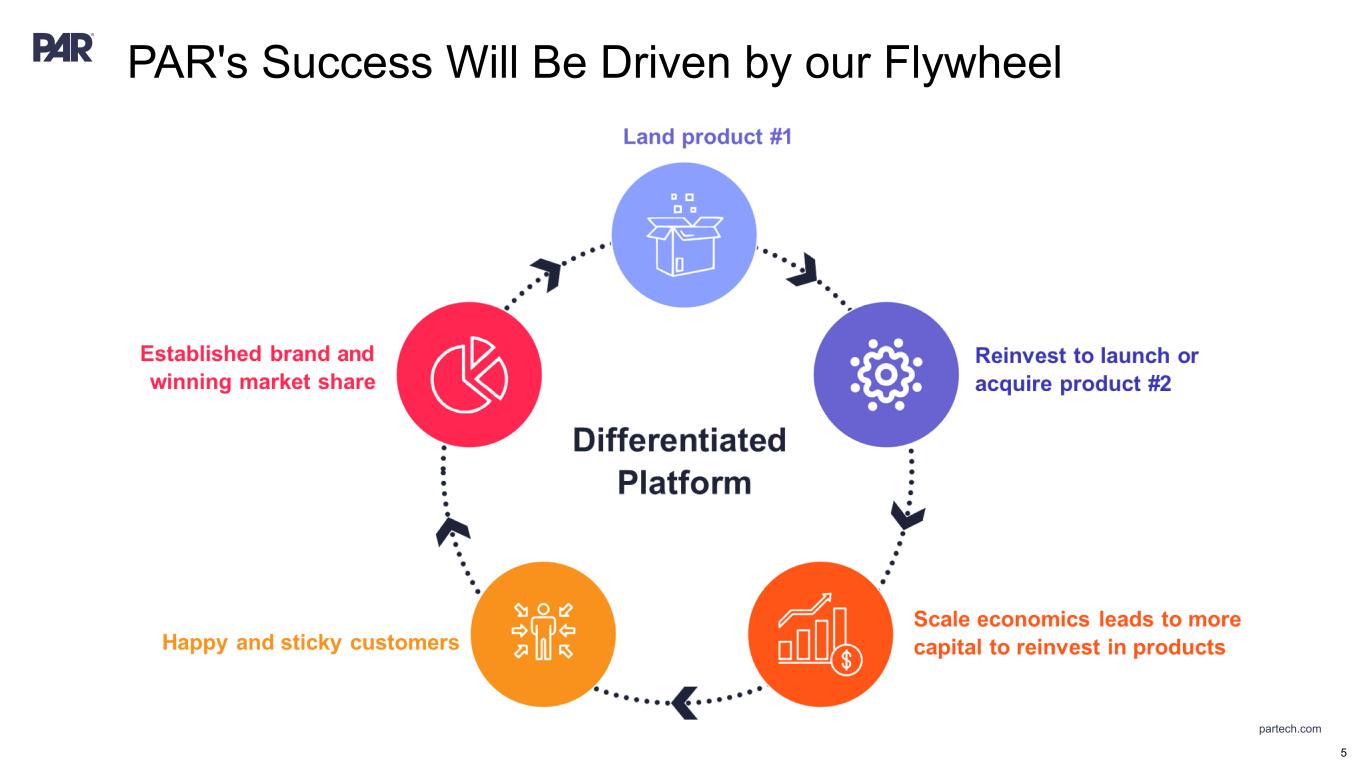
Thanks, Bryan Menar. Let me wrap up with a few key messages before we open the call for Q&A. We're pleased to have closed on a positive note with a strong Q4 performance and maintaining category leadership in food service tech. We had a key objective in 2024, and that was to grow sustainably and efficiently to build our business for the long term. To this end, our team executed on three main areas. First, we focused on driving organic ARR growth and sustained momentum in our software business. We worked on initiatives to improve our products and operations, cross-sell our entire software portfolio, and sign new customers. As we spoke about earlier, all of our POS deals in the quarter were multiproduct deals, and equally important was our upsell into our biggest POS customer. Our flywheel continues to expand through our better together strategy, which is based on product innovation and ROI, not predatory pricing tactics. Second, we executed on a targeted and meaningful acquisition strategy to strengthen our product offerings, expand our TAM, and build out a global capability to serve food service enterprises. Our expansion into C-stores and international markets has created a truly new TAM for us, and our acquisition of Delegate is already accelerating our flywheel for existing customers, including our largest and most strategic. We also divested our legacy government business, which now enables us to 100% focus on our core markets. M&A is core to our product strategy, and our integration efforts are what drive our robust cross-sell. PAR Technology Corporation has over many years invested in building a deep leadership bench that can digest and optimize investments. As companies join, they become part of a cohesive, culturally aligned PAR Technology Corporation where we add to, not detract from, their project aspirations and go-to-market motions. We cross-pollinate leaders quickly and unite core operating structures, and this synergistic approach to M&A is what sets us apart from other food service technology companies or sector investors who operate a collection of siloed entities and masquerade as multiproduct, while really just being single-threaded multiple times over. Better together is what we live every day at PAR Technology Corporation, and I'm extremely proud that the vast majority of our executive leadership team has risen through the ranks at PAR Technology Corporation over many years in multiple roles. This is our key to turning inorganic growth into sustained future organic growth. We are a team of seasoned operators with a holistic view of our business and industry. Finally, we remain fanatical about managing our operating expenses by continually optimizing our cost structure. As a result, we maintained top-line revenue growth and have now delivered two quarters of strong adjusted EBITDA growth. I'm extremely proud of our revenue expansion. I'm equally proud that non-GAAP gross profit grew organically by 30% this quarter, and our adjusted EBITDA well more than doubled quarter over quarter. Today, our sales and marketing and R&D expenses are now well within our long-term goals of 15% and 25% respectively, far ahead of schedule, and I believe this shows the upside of our long-term margin goals for the company. With 2024 firmly in the rearview mirror, we look towards 2025 with confidence and optimism. For 2025, we feel confident in committing to continue to grow our business at 20% plus annual rates for the year. Our growth quarter to quarter will never be linear, but I feel confident that over the course of the year, we'll continue to hit our targets while continuing to drive EBITDA. What's more, we see a number of key levers that create upside to our year. There's still a lot of work ahead of us, but we are confident that our balance sheet, cost discipline, and execution strategies will enable us to continue to grow our business sustainably. As always, I want to thank my PAR Technology Corporation teammates for their hard work in driving these results. Our shared belief that today is day one drives our collective hunger and ambition. I also want to express deep appreciation to our customers, partners, and shareholders. Thank you for your time this morning, and we will now open the call up to questions. Operator?
Operator
As a reminder, to ask a question, press star one one on your telephone. Wait for your name to be announced. To withdraw your question, please press star one one again. Our first question comes from Mayank Tandon with Needham. Your line is open.
Speaker 4
Thank you. Good morning. Congrats, Savneet Singh, Christopher Byrnes, and Bryan Menar on the quarter. Savneet Singh, I wanted to start with the upsell into BK. Does this change the timeline of the rollout? I believe the rollout was expected to be completed sometime in spring of 2026. Does this, in any way, change the timeline of the 7,000 plus locations? And also, does it change the ARR opportunity, which I believe was something in the order of low twenties millions? Is that going to be meaningfully different based on the upsell?
Yes. It will probably push us out a quarter to quarter and a half. As I referenced, we're sequencing the rollout so that starting in Q2, we can do a combined rollout. While it will slow down Q1 just for a pure POS rollout, it will accelerate Q2 onward. It's a trade we would make every time because it significantly adds to the ARR in that opportunity. As you know, we disclosed that the POS deal was around the low twenties. This adds to that pretty meaningfully. We haven't disclosed that number yet, but we feel really excited. While it pushes out the rollout a little bit, it dramatically increases the LTV and operating cash flow that this deal will generate over time.
Speaker 4
Got it. And then maybe as a follow-up, I would just ask around the quarterly cadence. I get it that it's not going to be linear. There'll be some volatility, but any color you can provide in terms of the various revenue buckets, how we should think about the quarterly cadence and also the same question around margins, should we expect sequential improvement? Or are there other factors we should consider as we're modeling up at 2025?
I think you should see meaningful margin expansion in the second half of the year, as well as acceleration of revenue. To this point partly related to the Burger King question, we're going from one product to two products, so there is a lot more revenue opportunity in a condensed period. Q1 and Q2 we'll be investing aggressively to make sure we can complete that rollout. The fact that we're expanding our relationship is a positive sign that we're earning their trust. You'll see in the back half more revenue growth and more significant EBITDA expansion because of that roll accelerating. Additionally, we have a large payment services deal rolling out that also hits the second half, as well as the convenience store deal I mentioned. These are forecastable — they are signed and committed. As I mentioned on the call, we're at roughly 1,500 BKs in backlog currently. There's a lot of room for acceleration in the second half of the year.
Speaker 4
Great. That's all good to hear. Congrats on the quarter.
Operator
Thank you. Our next question comes from Stephen Sheldon with William Blair. Your line is open.
Speaker 5
Hey. Thanks for taking my questions. I had a lot to be excited about. Just want to follow up on Burger King. Can you remind us what all is included in that contract? I think it was initially PAR POS potentially MenuLink. I think you're saying now the contract includes PAR Ops. Are they adding both Data Central and Delegate, or can you talk about all the products they will be picking?
Our core deal is POS and historically parts of MenuLink, with POS being the vast majority. Our expansion into PAR Ops is on Data Central. We've only recently closed the Delegate acquisition so we'll certainly be trying to bring Delegate into that opportunity as well. No guarantee it happens, but the better together point resonates, and given attachment rates, we believe there's an opportunity to add more modules if we do a good job.
Speaker 5
Got it. That's helpful. And then on 2025, I appreciate the commentary that you're confident in 20% annual growth rates. Is there any way to roughly frame how you're thinking about organic ARR next year, given what you can see in the pipeline and current implementation schedules? Any way to refine that a little more?
From what we see today, the second half of the year will have higher growth rates, and the first half will be lower partly because of the deals I mentioned going live in the second half. The way I would frame it is 20% plus for the year, with higher growth in Q4 and lower in Q1. Q1 will be the slowest due to Burger King coordination. In aggregate, we feel very good about the year. Those three deals I referenced are signed, committed, and booked.
Speaker 5
Got it. That's helpful. Thank you.
Operator
Thank you. Our next question comes from Will Nance with Goldman Sachs. Your line is open.
Speaker 6
Hey, guys. Good morning. Congrats on all the good things you have going on. I wanted to ask about the restaurant space more broadly. There's been a lot of focus on consumer trends in restaurant sales, and you have differentiated visibility. What are you seeing on the ground and what does it tell you about the health of the consumer?
It's not categorical; we see a wide disparity of outcomes. Full-service dining shows a slowdown, which has helped our Punch business because those firms are investing in loyalty. In our core QSR and fast-casual space there is a slowdown compared to prior years, but we are not seeing negative comps across our base — the base is still up low single digits. The customers we sell to have tended to outperform the industry in aggregate. Bankruptcies occur but represent a small portion of our base. The most disruption is in single-store and small chains under thirty to forty units. Those operators lack scale and technology investment, and they are experiencing significant pain. Larger brands with loyalty programs and data platforms are positioned to do better.
Speaker 6
That's super helpful. A quick follow-up on the hardware inflection you saw. We heard a competitor expects a material drop in hardware. What have you done differently to reaccelerate hardware? Are the momentum gains competitive wins? How are you thinking about the hardware refresh cycle?
Two parts. We sell to enterprise, and product matters. We have strong product-market fit and best-in-class stand-alone products. We saw strong attachments of hardware to our software customers. The better together value proposition — hardware, software, and services from one vendor — makes life easier for customers and drives attachments. On legacy non-software customers there hasn't been a big change, but we've invested in our drive-through product, PAR Clear, positioning us for voice AI integration and to be the preferred partner. That should drive hardware growth going forward.
To add, our location count doubling has given us a larger audience to drive hardware attachment. That helps compared to hardware-only competitors who are seeing downturns in certain areas. We have a larger white space to support hardware growth among our installed base.
Speaker 6
Appreciate the color, guys. Nice job today.
Operator
Thank you. Our next question comes from Samad Samana with Jefferies. Your line is open.
Speaker 7
Hey. Good morning. Thanks for taking my question. Savneet Singh, you mentioned the drive-through hardware and leveraging AI. Is that AI homegrown and embedded, or are you working with third-party platforms? Help me understand the path to modernization via APIs or if it's your own product. I have a follow-up after that.
We build the drive-through hardware — headsets and base stations. PAR Clear is a cloud offering; we'll charge subscription software to manage the drive-through. There will be an API that allows voice AI companies to plug into the base station so they can run their technology. We're not planning to be a voice AI company immediately; we may explore acquisitions or development over time. For now, we enable third-party voice AI to integrate with our hardware and cloud, and we monetize that integration and service.
Speaker 7
Great. On Punch, you mentioned winbacks. What made customers leave initially, and what convinced them to come back?
Some customers left to try customer data platforms (CDPs) or guest data platforms with the promise of targeting customers better. Those platforms have good sales pitches, but many are not yet developed enough to deliver the ROI of loyalty programs. Brands need both a CDP and a loyalty product. The customers realized the third-party promise didn't deliver expected ROI and returned to Punch because Punch delivers real ROI. Over time, as brands evolve their data platforms, they will benefit from integrating loyalty-first data, tokenized payment data, and operations data in a unified PAR Data Platform — a strong competitive moat.
Speaker 7
Any details on Delegate's financial profile — revenue base, growth rate, margin structure, and how you think about it through 2025?
At close, Delegate had about $19 million of recurring revenue. Historically it grew in the mid-thirties percent range and exited 2024 marginally profitable. We expect it to be one of our fastest-growing products outside of payments and ordering, and we expect it to contribute meaningful EBITDA. It's highly synergistic with our products; with single sign-on and real-time data flow, it will be compelling for customers.
Speaker 7
Great. Congrats on a transformative 2024.
Operator
Thank you. Our next question comes from Eric Martinuzzi with Lake Street Capital Markets. Your line is open.
Speaker 8
I wanted to ask about subscription services gross margin. That non-GAAP number was 64.7%, below what we were forecasting for Q4. You said this may be a trough. Where do you expect it for full-year 2025 or Q4 2025?
The slight decline from a year ago was driven by recent acquisitions and integrating them. Nothing operationally changed, but it may have reset a baseline. As we grow off that base, we've seen quarter-over-quarter improvement in the past of roughly fifty to a hundred and fifty basis points, and we expect similar continued improvement in the near to medium term.
Speaker 8
Okay. Housekeeping: your pro forma diluted weighted average share count finished Q4 at 37.2 million. What is that post-Delegate?
We're just north of forty million shares.
Operator
Thank you. Our next question comes from Adam Wyden with ADW Capital. Your line is open.
Speaker 9
Hey, guys. Really good profit. A couple of items on gross margin: if you expect margins to improve fifty to a hundred and fifty basis points per quarter, would you expect incremental gross margin rate to be materially higher on subscription software each quarter throughout the year?
Correct. Subscription services are our growth driver, representing 61% of total revenue. As we grow top line, the gross profit margin will have a multiplier effect. We continue to drive margin improvements across products.
Speaker 9
I would think payments, Delegate, Stuzo, MenuLink, and others should have very high incremental gross margins as you ramp. Prospectively, as you ramp 20% organic ARR plus acquisitions, I would expect really high incremental gross margins on those products. Thoughts?
It varies by product. POS can have heavier R&D, back-office products differ. We focus on each area to incrementally improve margins. I wouldn't expect a massive single-quarter step up; it's a consistent improvement trend over time.
Speaker 9
Great. On M&A: other companies trade at higher multiples. How do you think about doing M&A given your cost of capital and how you can grow multiple through execution? You've executed in prior deals; curious how you balance buying prices and the market multiple.
Numbers matter most. Accounting and results will dictate valuation. We believe our numbers are strong and durable: growth and durable cash flow will drive valuation. Software multiples contract when growth slows. We expect to continue above-median growth while driving profit improvements. Regarding M&A, it's a relative game — we set a benchmark and seek opportunities accretive to our strategy. We prioritize product-led acquisitions that accelerate organic growth. If the market multiple constrains certain large assets, we focus on the many targets that fit our strategy and metrics. M&A is a product strategy for us, not just revenue acquisition. We have a strong M&A pipeline and integration capabilities.
Speaker 9
I appreciate that. The valuation gap persists compared to peers, and I hope that narrows.
Let the numbers drive it. I'm confident our results will get us there. Thanks, Adam Wyden.
Operator
Thank you. Our next question comes from Andrew Hart with BTIG. Your line is open.
Speaker 10
Hey. Thanks. A big message today was better together. As ARR doubled and the platform scaled, how have conversations with larger enterprise CTOs evolved from a brand and sales pipeline perspective?
The flywheel is working. We signed eight POS deals in the quarter and all picked multiple products; we also upsold our largest customer. Customers like fewer vendors, especially when operators and IT are not expanding headcount. They prefer integrated solutions that reduce operational overhead. We've restructured teams to emphasize account management and ensure unified customer experiences. We win because products work better together, not by bundling. The goal is for customers to feel a materially better experience with integrated PAR offerings versus multiple vendors.
Speaker 10
For 2025, you mentioned Burger King, payments, and the convenience deal. Stuzo and Task get layered into organic over time. How have those acquisitions been integrated and how do they contribute to upside above 20%?
As acquisitions become organic, they can lift organic growth because we buy faster-growing assets. Stuzo should grow faster than 20% a year. Task will grow above 20% and Plexure closer to Engagement Cloud rates. Delegate should grow well above 20%. Execution on existing signed deals is the primary lever to exceed 20%. PAR Retail has performance-based pricing in some deals that can increase revenue if we deliver results. Acquisitions also shorten sales cycles as they provide more pull-through opportunities and integration synergies. Overall, these factors create upside when we execute.
Operator
Thank you. Next question comes from Charles Nabhan with Stephens. Your line is open.
Speaker 11
Hi. Good morning. I wanted to drill into Task and the international opportunity. It expands your TAM and seems to be growing in excess of 20%. Can you speak broadly about international opportunity and specifics around Task?
Give us another quarter; we're making investments and will provide more detail. Our current focus is APAC where we have a strong foothold, winning marquee brands in Australia, New Zealand, and the region. We're operationalizing the business to make it more programmatic to scale site rollouts and add experienced leadership to Task to drive this effort. We are also winning US brands that want to expand into that region, which is exciting because it provides global expansion opportunities.
Speaker 11
Got it. A follow-up on hardware margin: nice uptick this quarter. What drove the expansion and where do you see hardware margins going in 2025? Are you at peak margins or is there room to improve?
We've increased hardware margin to the mid-twenties and are proud of the improvement. Best-in-class hardware margins can be in the low-thirties, so there's room to improve but not large structural changes expected. Professional services margin improved from 10% to 28% year over year, and we've been consistently mid-to-upper twenties on professional services. Continued hardware growth will also incrementally support margins, but we expect modest improvements rather than dramatic steps.
Speaker 11
Got it. Appreciate the color. Nice quarter. Thank you.
Operator
Thank you. Our next question comes from Anja Soderstrom with Sidoti. Your line is open.
Speaker 12
Hi. Thank you. Most questions were addressed already and congrats on the year. One question on whether the tier-one pipeline has expanded and how you are talking to those potential customers about upselling. Given the expanded Burger King rollout, how will you take on tier-one customers in the near future?
Tier-one pipeline remains strong, and mid-market pickup is notable. The Burger King expansion introduces a new module, so it won't negatively impact the core POS pipeline. We are investing in Q1 and Q2 to prevent rollout stumbles and ensure proper staffing and training. Getting rollout execution right accelerates revenue and long-term outcomes.
Speaker 12
Okay. Thank you. That was all for me.
Operator
I'm showing no further questions at this time. I would now like to turn it back to Christopher Byrnes for closing remarks.
Speaker 1
Thank you, Daniel, and thank you to everyone for joining us today. We look forward to updating you further in the coming weeks and days. Have a nice day and a great weekend. Thank you.
Operator
This concludes today's conference call. Thank you for participating. You may now disconnect.