Operator
Good morning. My name is Kate. Welcome to Roblox Third Quarter 2025 Earnings Conference Call. All lines on mute. After the speaker's opening remarks, there will be a question and answer session. If you would like to ask a question during this time, simply press star. File will be the number one on your telephone keypad. If you would like to withdraw your question, press star one again. Thank you. Stephanie Notany, you may now begin your conference.
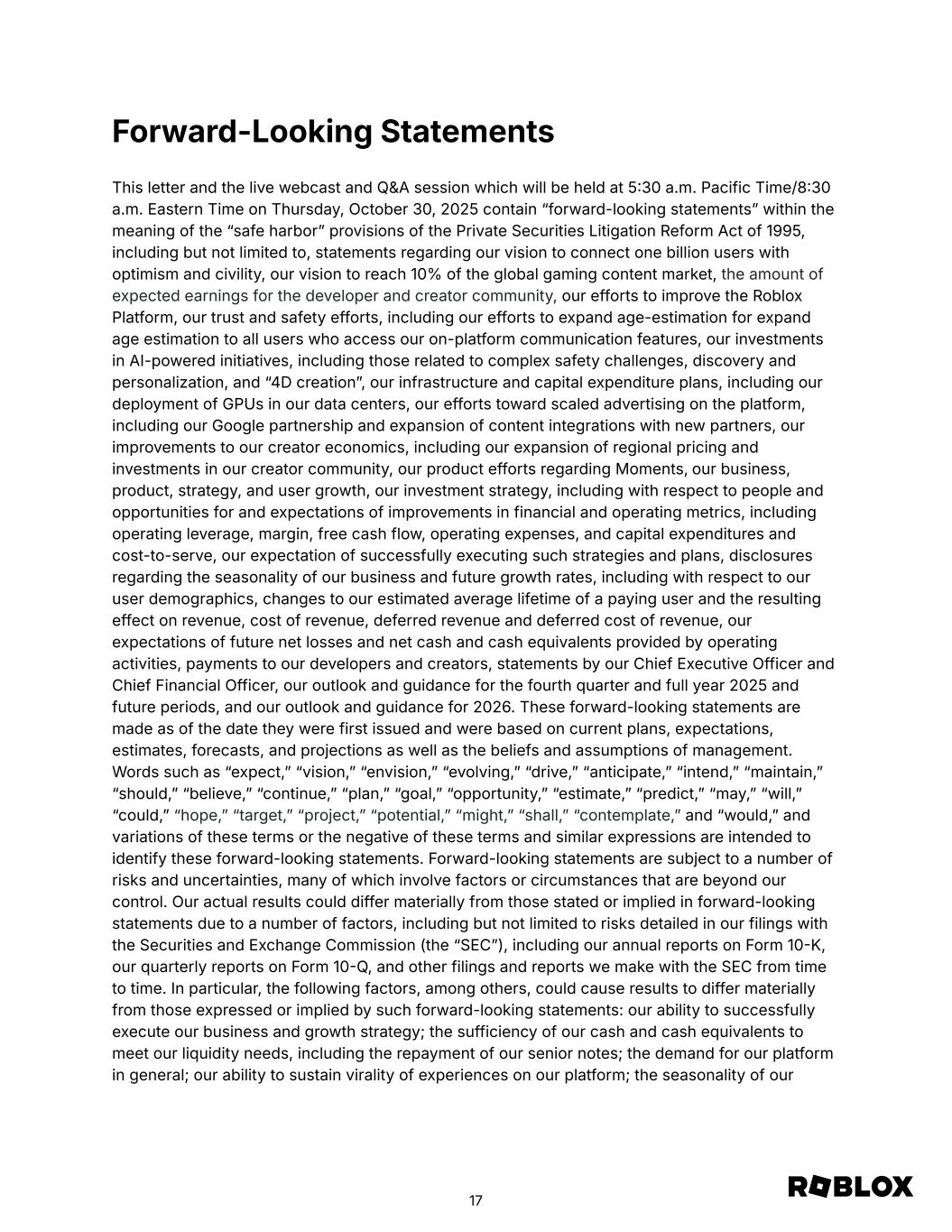
Thanks, Kate. Good morning, everyone. Thank you for joining our Q&A session to discuss Roblox's Q3 2025 results. With me today is Roblox co-founder and CEO, David Buzuki, and our Chief Financial Officer, Naveen Chopra. Our shareholder letter, SEC filings, supplemental slides, and a replay of today's call can be found on our Investor Relations website. Our commentary today may include forward-looking statements which are subject to risk uncertainties and assumptions that could cause actual results to differ materially from those described in our forward-looking statements a description of these risk uncertainties and assumptions are included in our sec filings including our most recent reports on form 10k and form 10q you should not rely on our forward-looking statements as predictions of future events we disclaim any obligation to update these statements except as required by law. During this call, we will also discuss certain non-GAAP financial measures. Reconciliations between GAAP and non-GAAP metrics can be found in our shareholder letter and supplemental slides. With that, I'll turn it over to Dave.
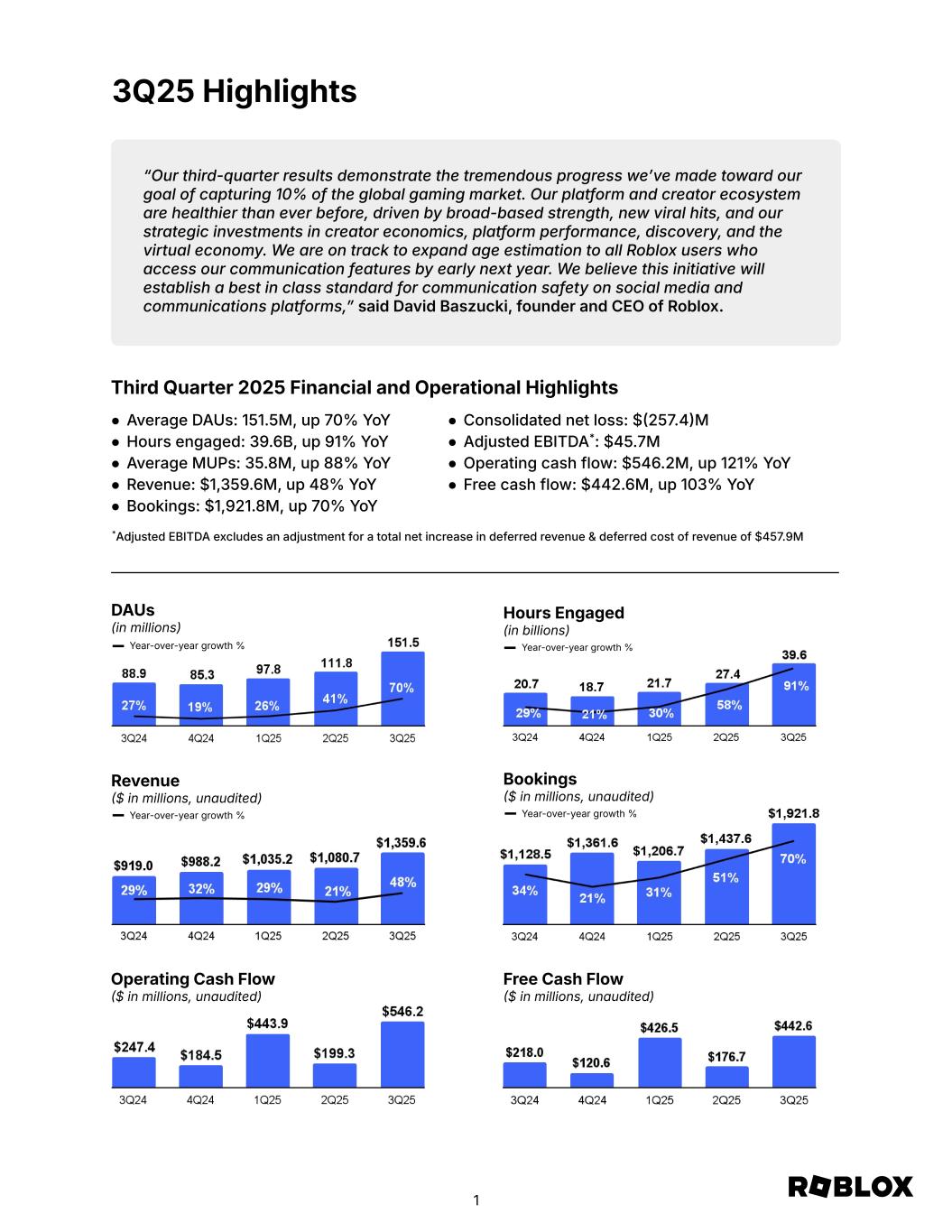
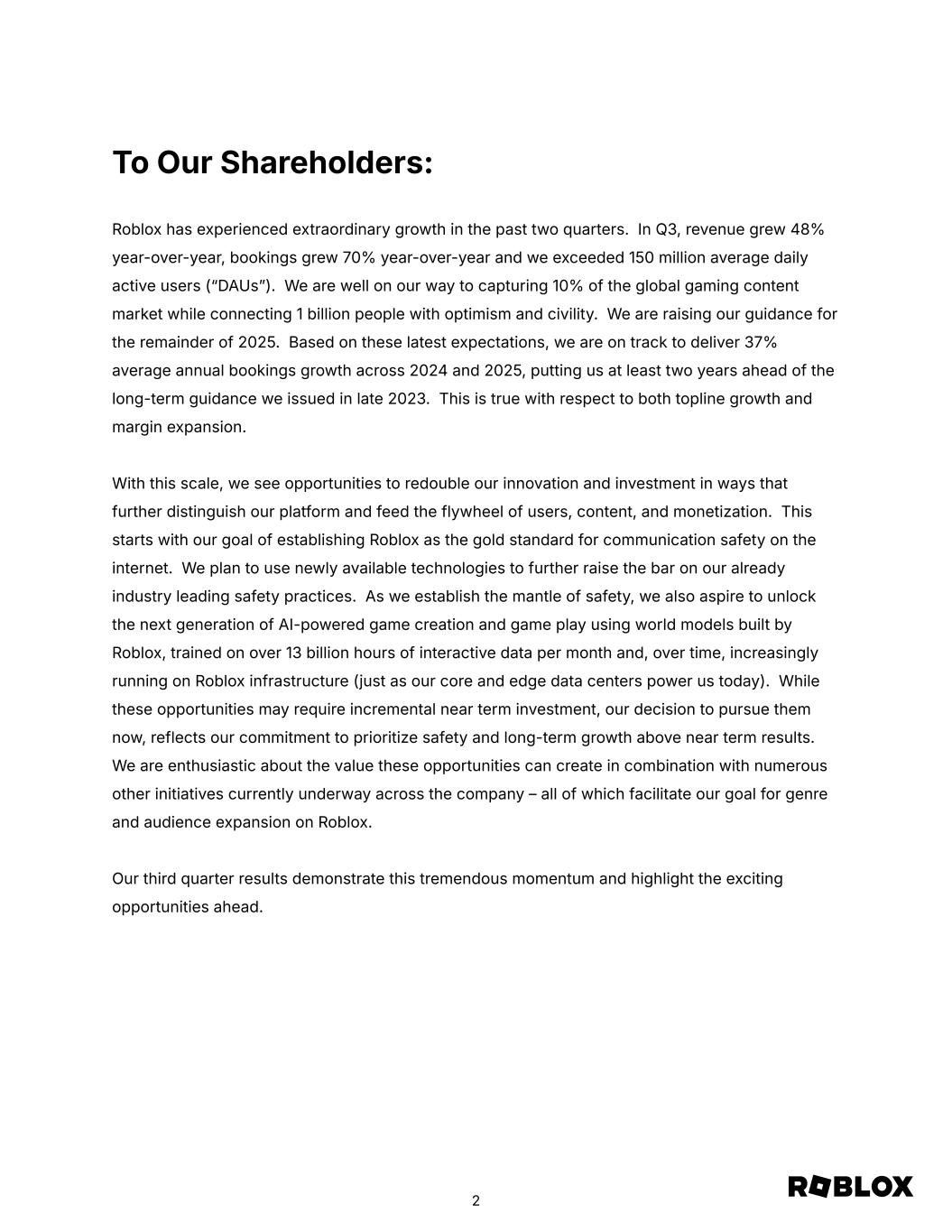
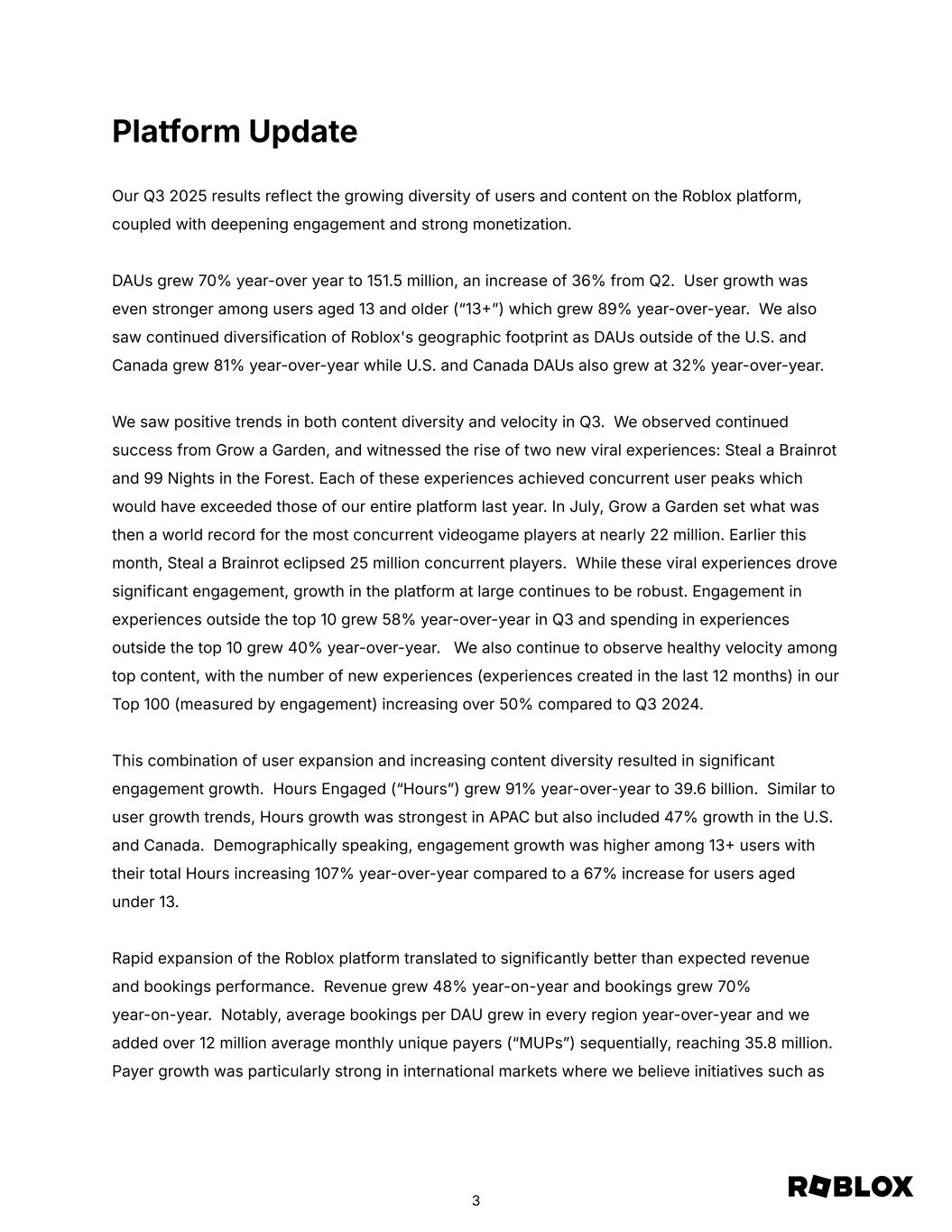
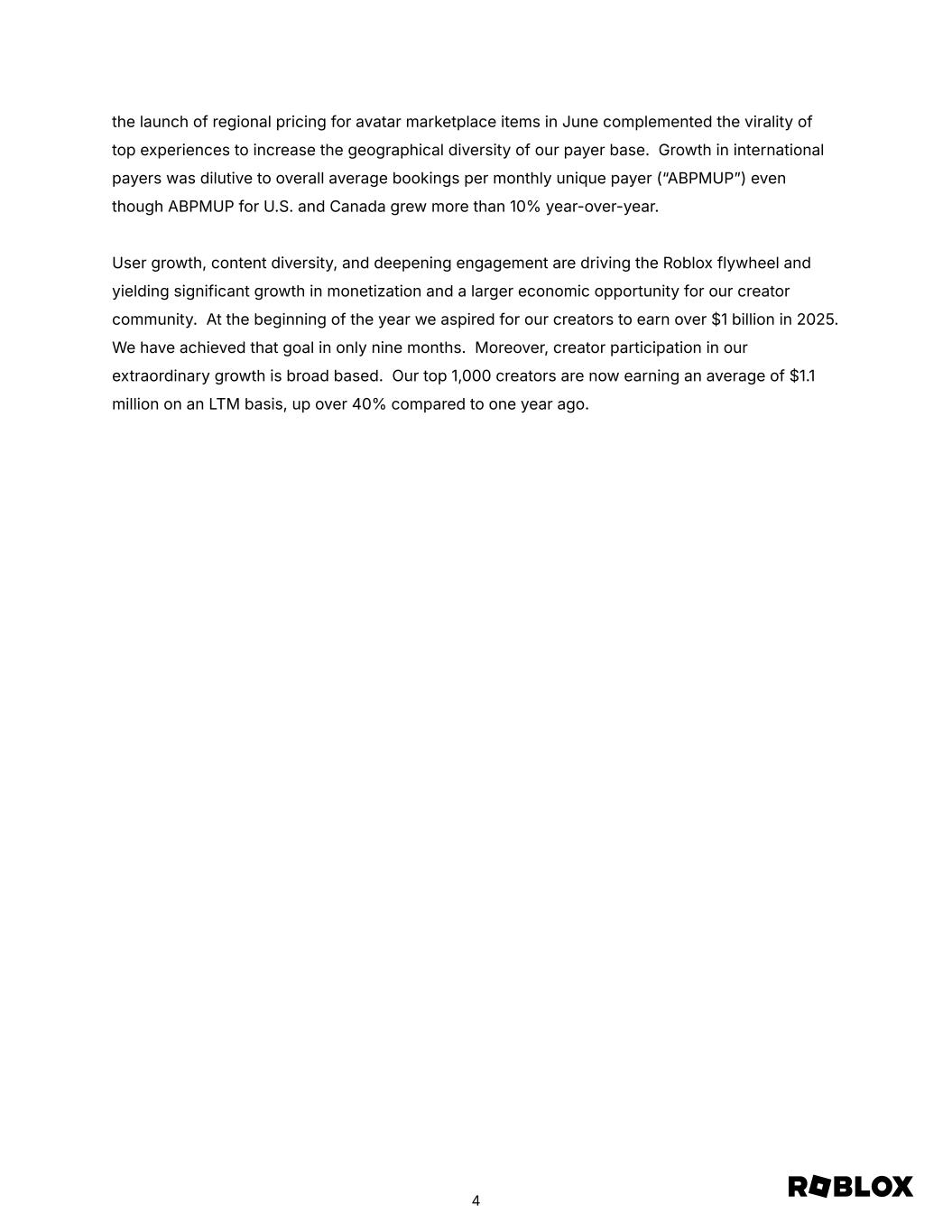
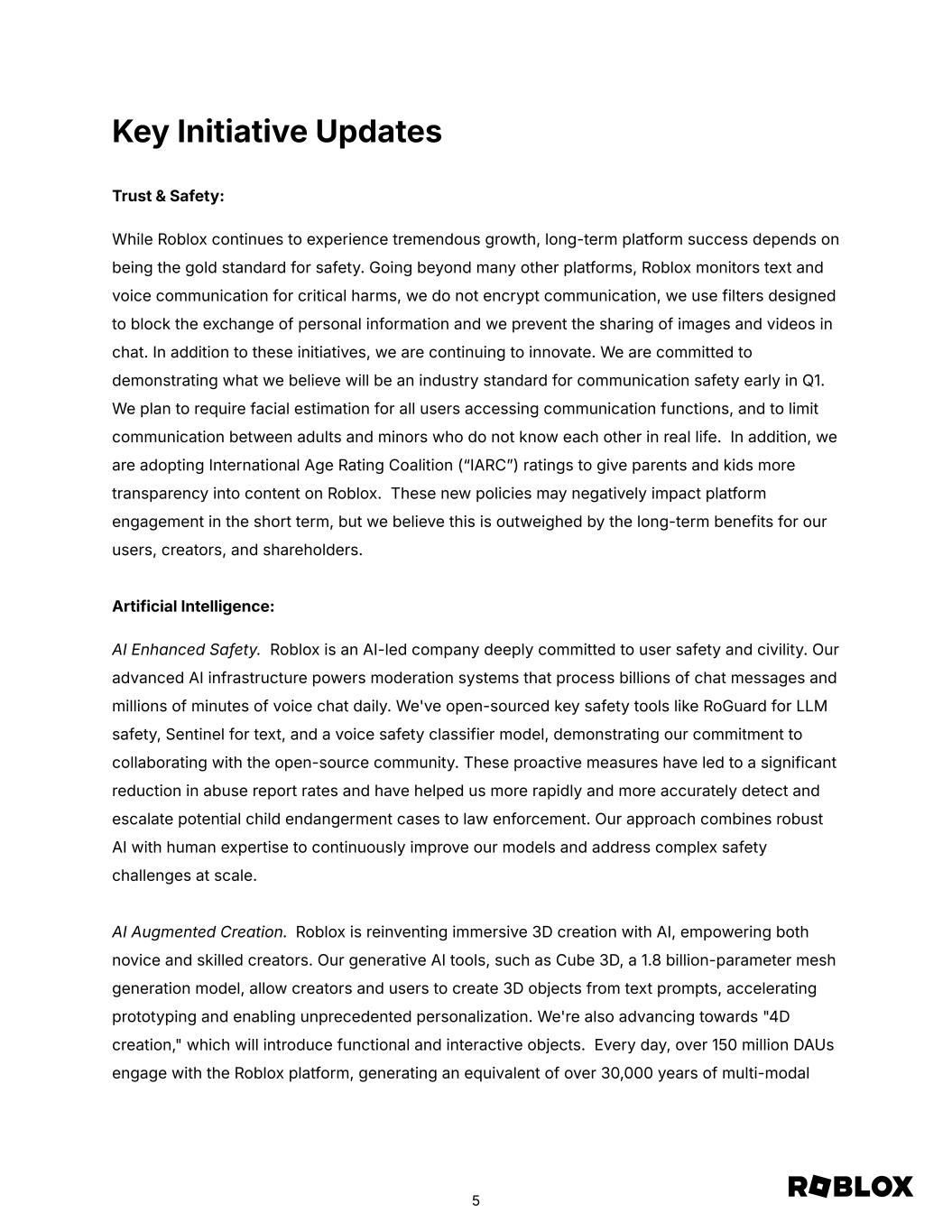
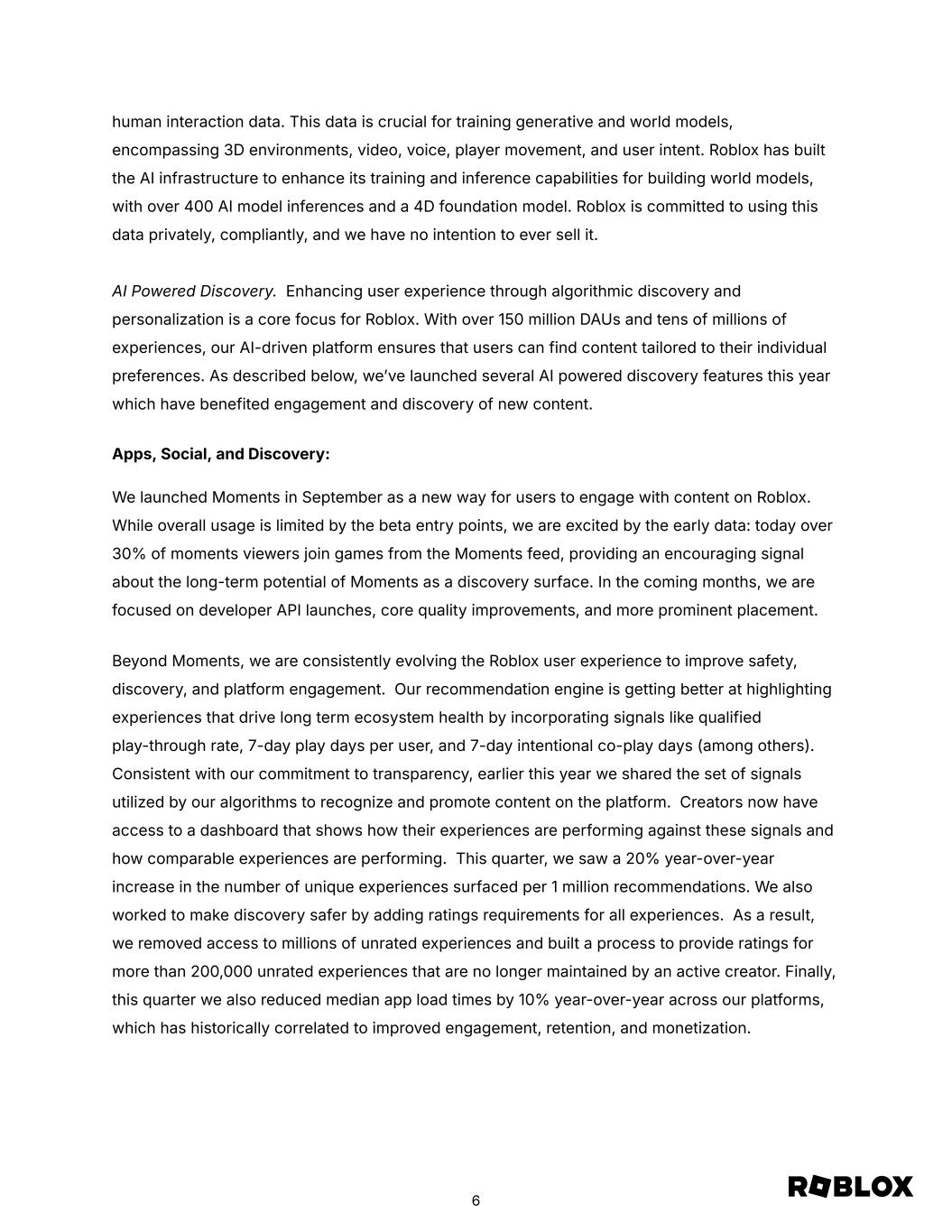
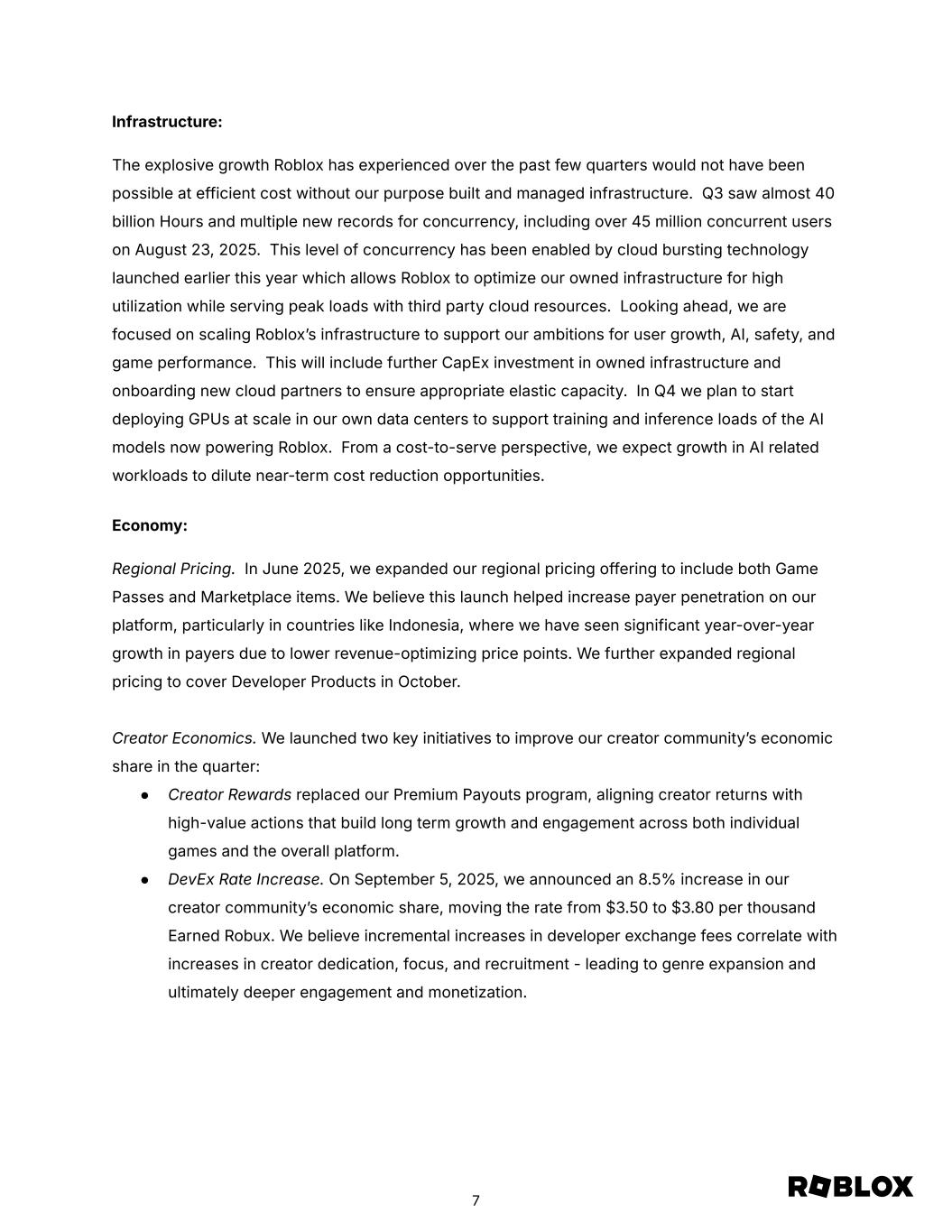
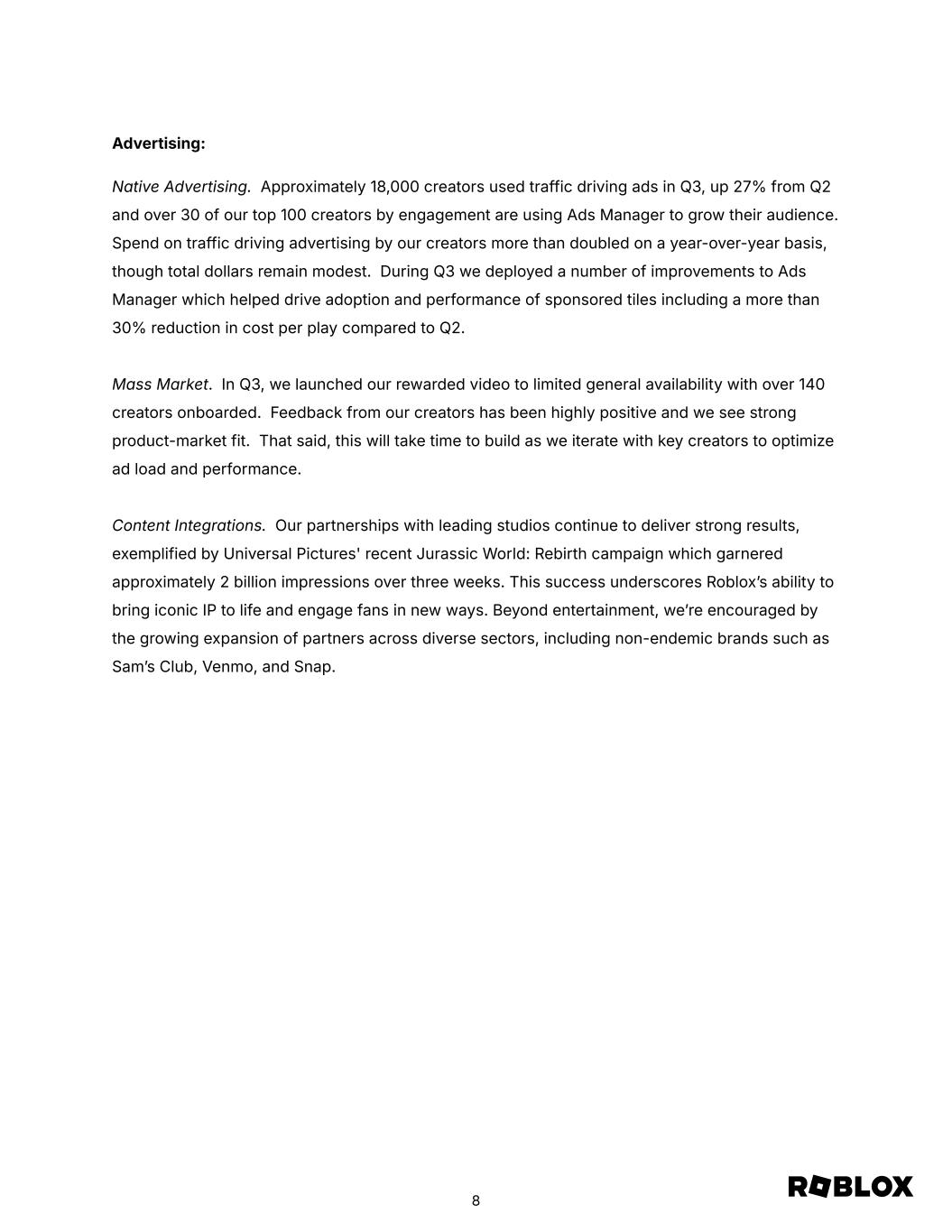
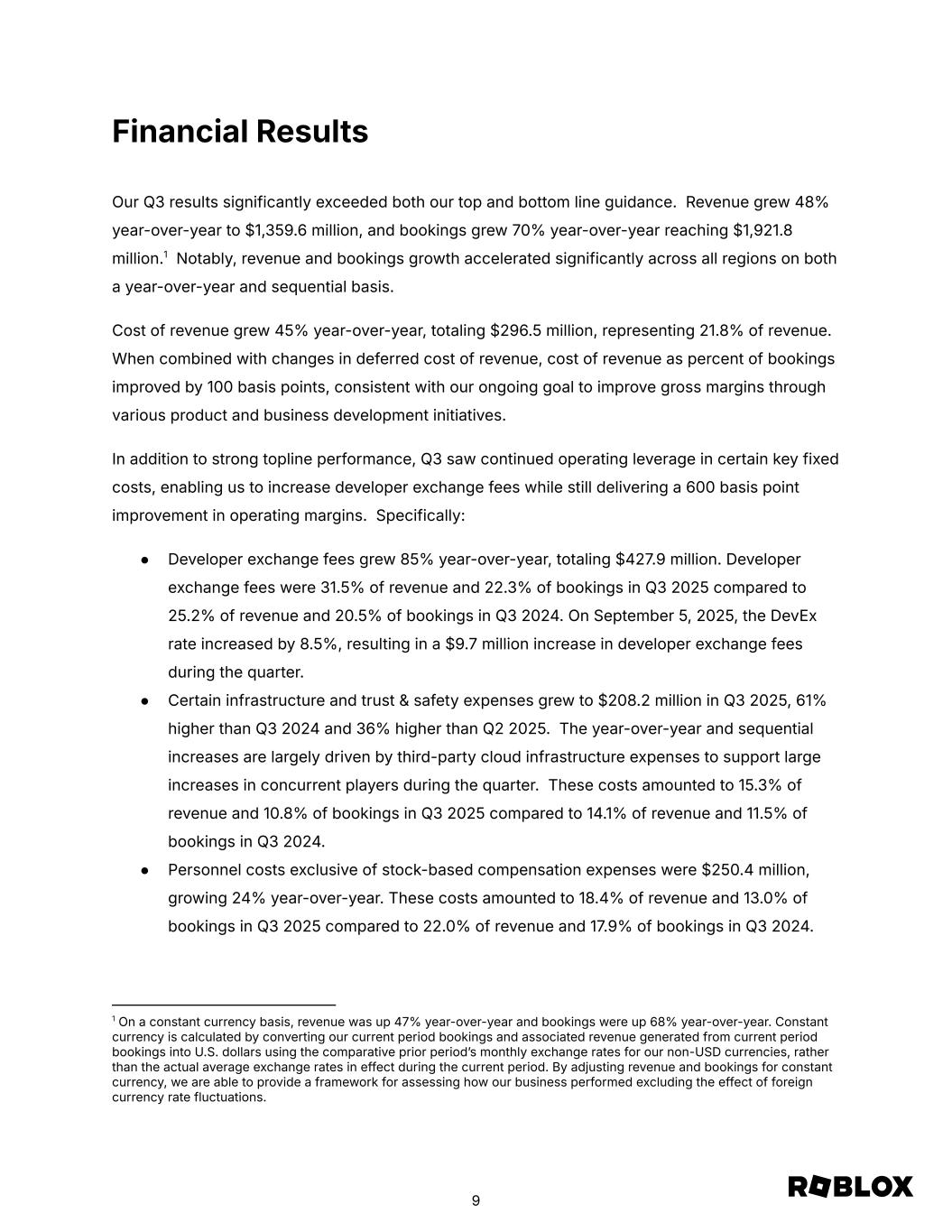
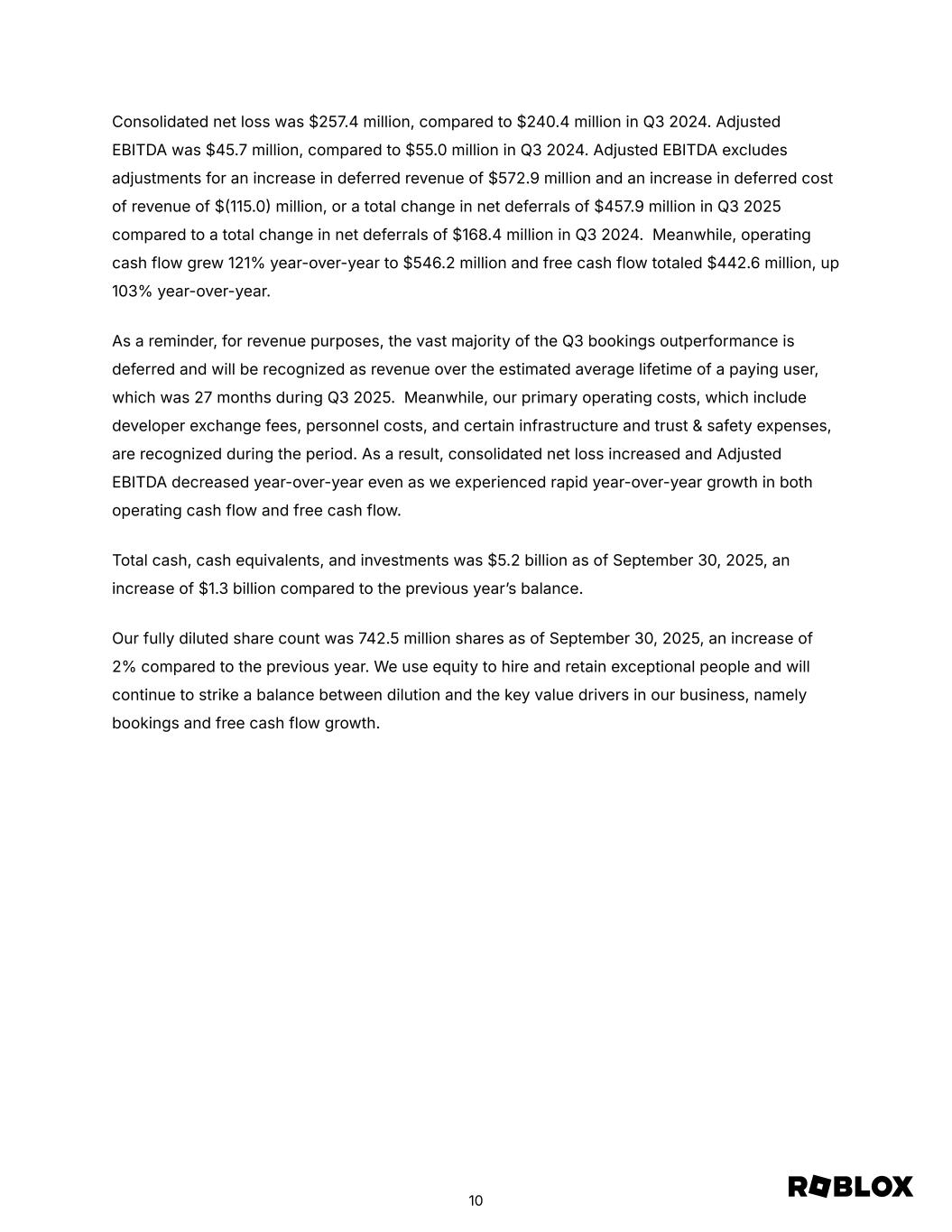
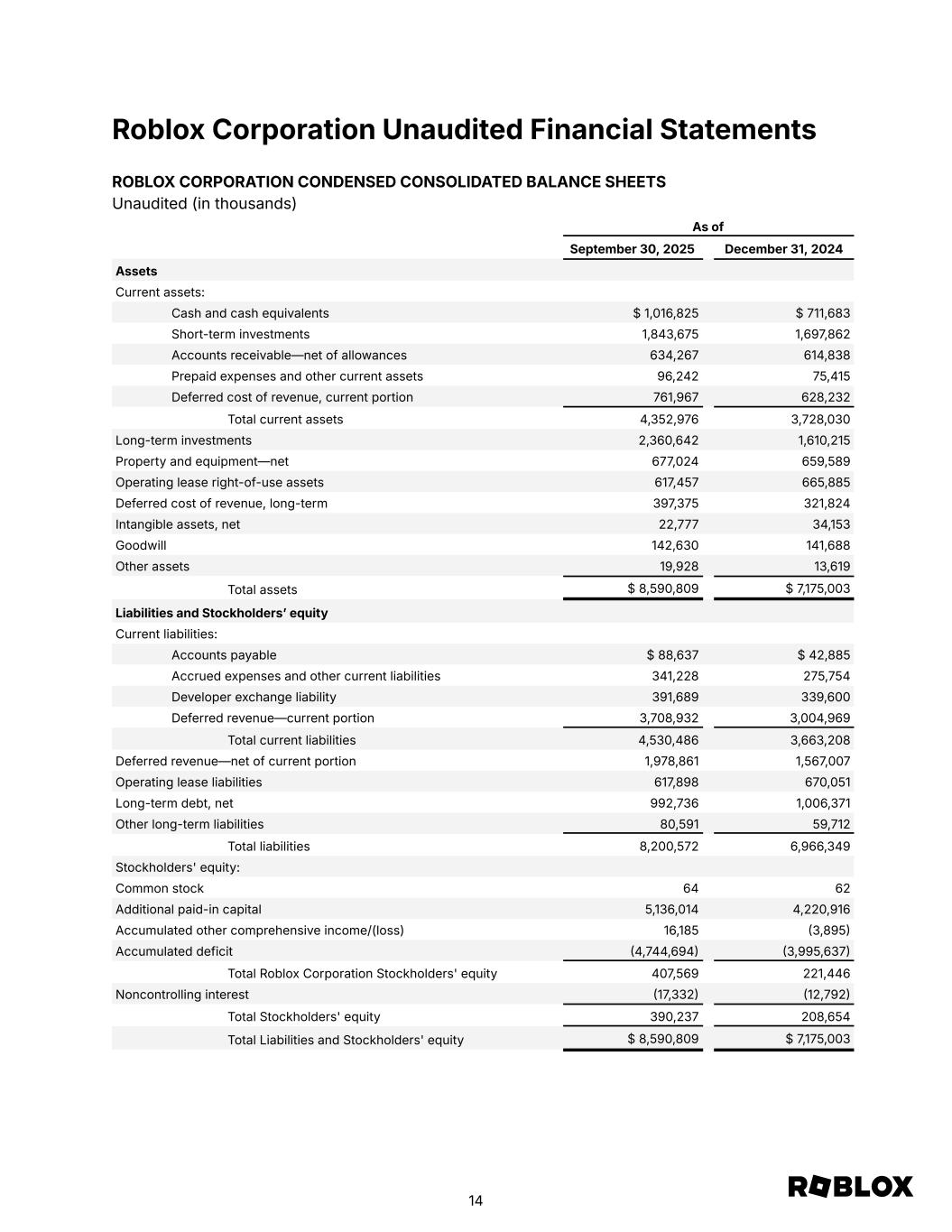
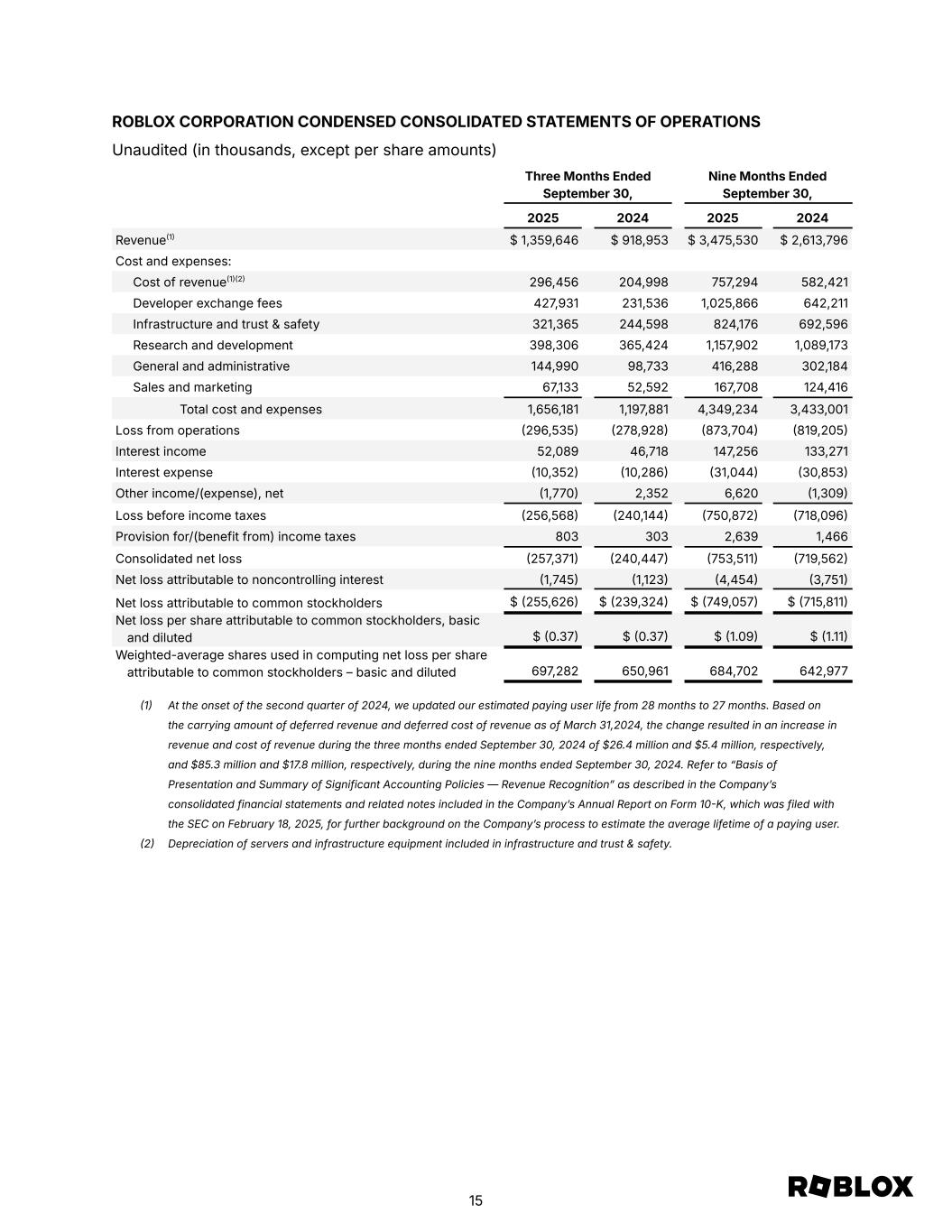
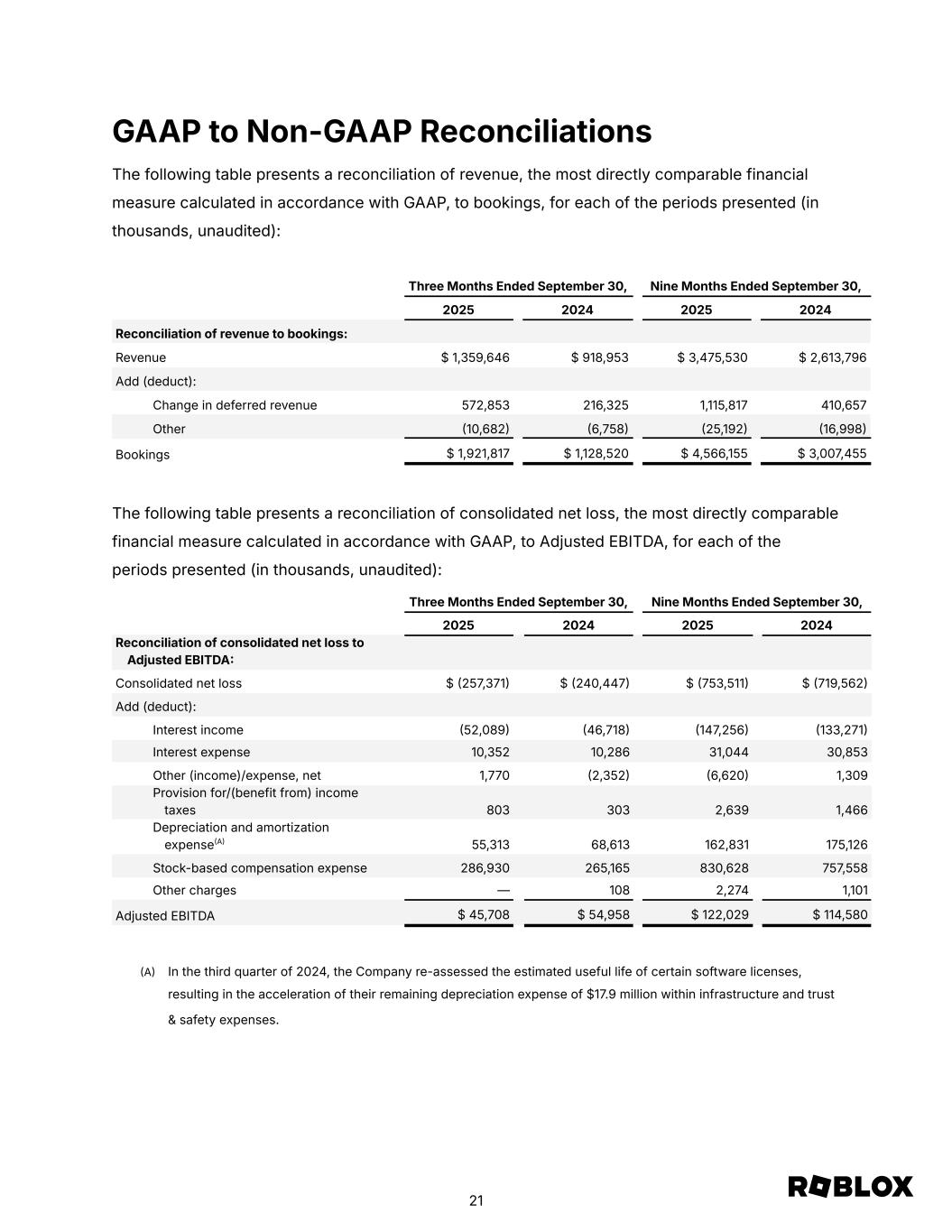
Thank you, Stephanie. Good morning, and thank you for joining us today. A year ago, at RDC, we shared the goal of capturing 10% of the global gaming content market. it, we'd like to report that we've made tremendous progress. We estimate now that 3.2% of global gaming bookings or revenue is going through Roblox, and that's up from 2.3% last year. Our platform and our creator ecosystem is healthier than it has ever been. Similarly to Q2, in Q3, we saw strength both across the platform with both existing and new experiences on the platform. The number of experiences that have more than 10 million daily active users on the platform at some point during Q3 2025 hit seven, and that includes a lot of experiences we're all familiar with, as well as five that were created in the last 12 months. That's Grow a Garden, Steal a Brain Rot, Brookhaven, 99 Nights in the Forest, Plants vs. Brain Rot, Ink Game, and Blox Roots. We believe the success on our platform continues to be driven by raw platform capabilities and performance, continued improvements in discovery, continued improvements in our virtual economy, And complementing that, the investments we've made in infrastructure, which supported multiple groundbreaking records over the last quarter, including a $45 million peak concurrency during the weekend in August. Let's get into the financial results. In Q3, our DAUs hit 151.5 million. That's up 70% year-on-year. This was growth really across all regions, including U.S. and Canada, 32% up year-on-year. APAC up 108% year-on-year. And importantly, we see continued evolution of our age demo with 13 and over DAUs growing 89% year-on-year. Right now, two-thirds of total DAUs are 13 and up. Ours had similar strength, Strength, hitting 39.6 billion hours of engagement in Q3, that's up 91% year-on-year. Strength across all regions, U.S. and Canada, up 47% year-on-year. APAC hours of engagement, up 127% year-on-year. Commensurate growth with 13 and up, 107% year-on-year. 68% of our total hours are 13 and up. Q3 revenue was $1.36 billion, up 48% year-on-year. Q3 bookings was $1.92 billion, up 70% year-on-year. Once again, strong growth across regions, U.S. and Canada, bookings up 50% year-on-year. APAC bookings up 110% year-on-year. Some highlights, Japan 125%, India 146%. Indonesia bookings up 804% year-on-year. Our monthly unique payers continues to be strong at $35.8 million, up 88% year on year. And in Q3, through DevX, we hit $427.9 million of DevX, up 85%, a new record. I want to highlight that DevX, which is what our creators are earning on the platform, has grown 250% from the same period two years ago. We continue to have strong conviction for our long-term vision, and we'll continue to be more diligent about investing in this innovation to support long-term genre expansion and growth. We've talked about genre expansion a lot over the last year. I want to do a few highlights here. We have a lot of technology that showed at RDC this year that's rolling out, including server authority and custom matchmaking. which will make Roblox more resilient and powerful for competitive genres like shooters, sports, and racing. We've already showcased avatar enhancement technology that is in the pipeline that we believe is going to really expand the look and feel of Roblox to higher fidelity and more lifelike avatars and continued focus in raw performance on the platform, including tech like Harmony and Slim, which we believe is part of the future of high-fidelity gaming, and the ability of our creators to make experiences that can run both on low-end 2GIG Android, as well as really nice high-end gaming PCs. On Discovery, we've continued really a commitment to transparency that we also believe is good for the company. And we shared the notion that we're sharing our discovery signals with our creators, making those transparent in their analytics dashboard. And we've highlighted that we're using playthrough rates, seven-day play days per user, seven-day intentional co-play days. So our creators can see exactly what we're using to make recommendations. We continue to see discovery highlight new hits. For example, in Indonesia, Fish It has become extremely popular, and we believe our discovery system has helped promote that. I would also highlight our content ecosystem continues to be strong with what have now become perennial successes like Brookhaven, Adopt Me, and Bloxfruits, which all continue to draw strong engagement. And some of our hits from last year, like Rivals and Dressed to Impress, continue to launch active and successful updates. Really important, at RDC, we announced an 8.5% increase to the Devex rate. Creator earnings surpassed $1 billion in the first nine months of 2025. Also, in support of our creator ecosystem, we've launched our IP platform, which we believe really is the future way to allow IP holders and creators to connect without all of the complexity of handcrafted individual one-on-one contractors or contracts. and want to highlight IP owners like Mattel and Kodansha have joined that platform. And we recently announced and launched Roblox Moments, which we believe is an additional innovative discovery surface for our creators. Now, in addition to all of this, I want to make a couple highlights on some of the areas of tech we've been really working on before I hand over to Naveen. First, really safety, which has always been a top priority for us and foundational to everything we do at Roblox. Just yesterday, we announced a partnership with the AGA, the Attorney General's Alliance, on a child safety coalition. Stay tuned with this. We believe there's a wonderful opportunity to share and develop what we believe is going to be the industry standard in communication for social and mobile apps, including our commitment by the end of this year to use AI-based facial age estimation to estimate the age of everyone on our platform and to use that to gate who uses communication technology and help root who can communicate with who. Even in addition to what we already do, which is filtering of all text and no image sharing on Roblox, we believe as new technology rolls out, it allows us to harvest and use this technology for continued advancements in safety and civility. We've also released over 100 innovations this year in our safety and civility group, including an announcement that we're going to be adopting IARC and International Age Rating Coalition rating over the next few quarters. And we've raised our minimum age for restricted content to really the global standard of 18 years old. I want to highlight we do run stricter than typical industry policies on Roblox. We believe it's an essential strategic investment to how we run the company. And as we roll out facial age estimation, we really do believe this is going to add long-term value creation for shareholders, even if there are any short-term headwinds from that rollout. On the AI side, we are now up to running over 400 AI systems inside the company. These are core within safety, discovery, and creation, highlighting a few things that we've shipped so far. Our Cube 3D model, which we shipped earlier, is really going to come to life over the next one to two quarters as this goes live in multiplayer mode for everyone on the platform. We've also open-sourced the Studio NCP server, which is making Roblox Studio the ability to integrate as both a client and a server in complex AI-based workflows. Behind the scenes, our safety model for PII continues to get better all the time. and we shipped Rogard for our safety of our LLM text gen tech in-game. Stay tuned for a lot more generative AI. I want to highlight that in addition to AI for safety and discovery, there's been a lot of chat about how much training data various people have access to. Within Roblox, every day, we are moving forward to capturing, which is literally over 30,000 years of human interaction data and doing this in a PII compliant way. This is unique data, data we have no intent of ever getting outside of our walls or selling that can really be used as we start to roll out our future vision of allowing people to play both with others as well as with NPCs and supporting unlimited creation in Roblox, not just for our creators, but for everyone. And that can mean per object, with clothing, per the world you're in, per game creation, and ultimately with friends in real time while playing. Finally, 45 million concurrent users is a really big number, and we supported this really moving towards what we think is more and more an optimal mix of our own data centers, both core data centers, edge data centers, and GPU installations on our own bare metal, with bursting with our cloud partners. And we did this in really a wonderful way by bursting over weekends for several hour slots when we hit peak numbers. We're going to continue to go down this route. We're investing more and more in our own bare metal for scale. Core data centers give us load balancing and efficiency. Everyone in Brazil is happy because we added a new edge data center there to reduce latency. We're going to continue doing that. And we are more and more now building out our own native bare metal GPU capability, but coupling with our cloud partners. We're going to make sizable improvements here. The big improvements we've seen in cost to serve may be harder to realize for the next few quarters, but this is all consistent with our long-term focus. With all of this excitement about innovation, we, of course, we have a lot of initiatives we work on every day to enhance our platform. We focus on the details. And with that, we're going to hand it, I'm going to hand it over to Naveen to complement my introduction.
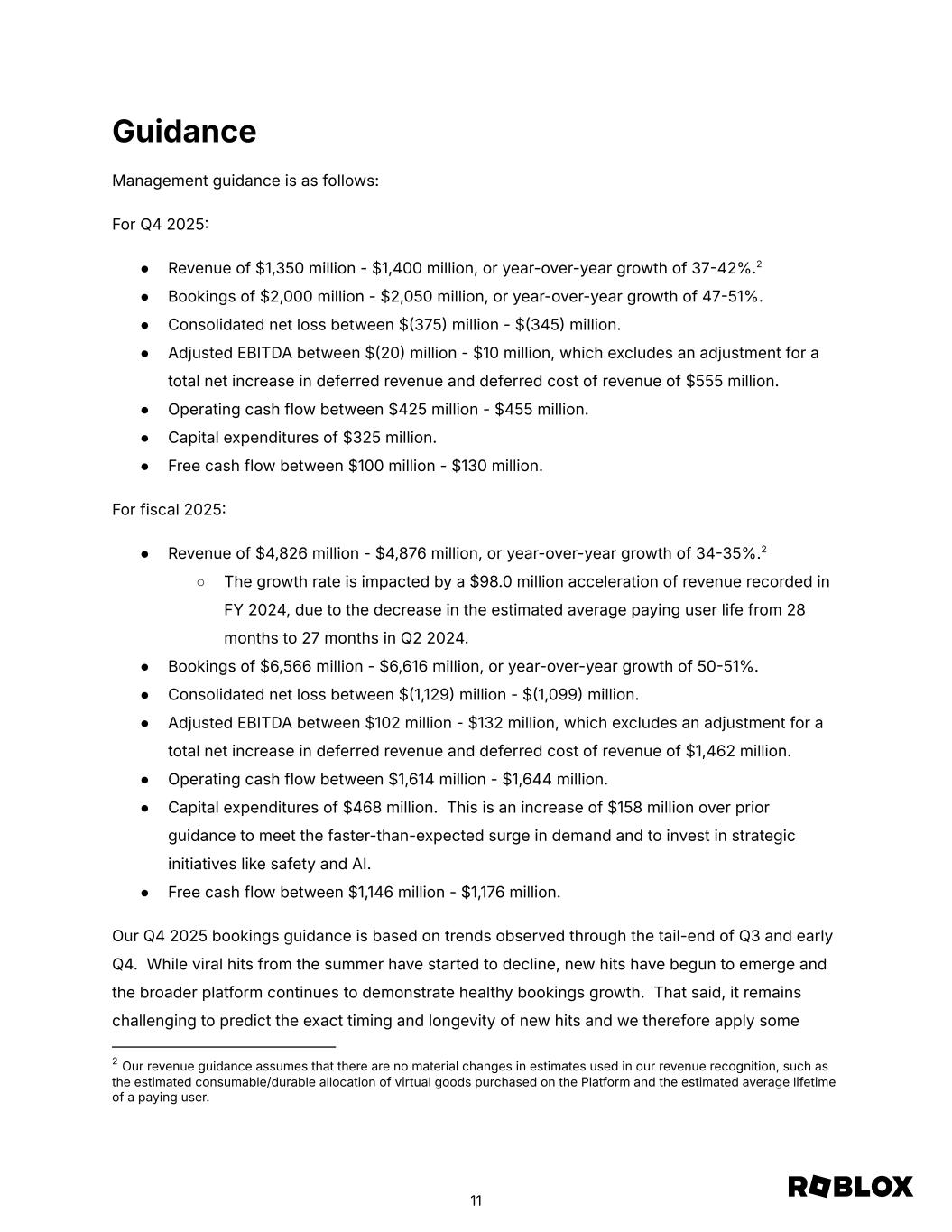
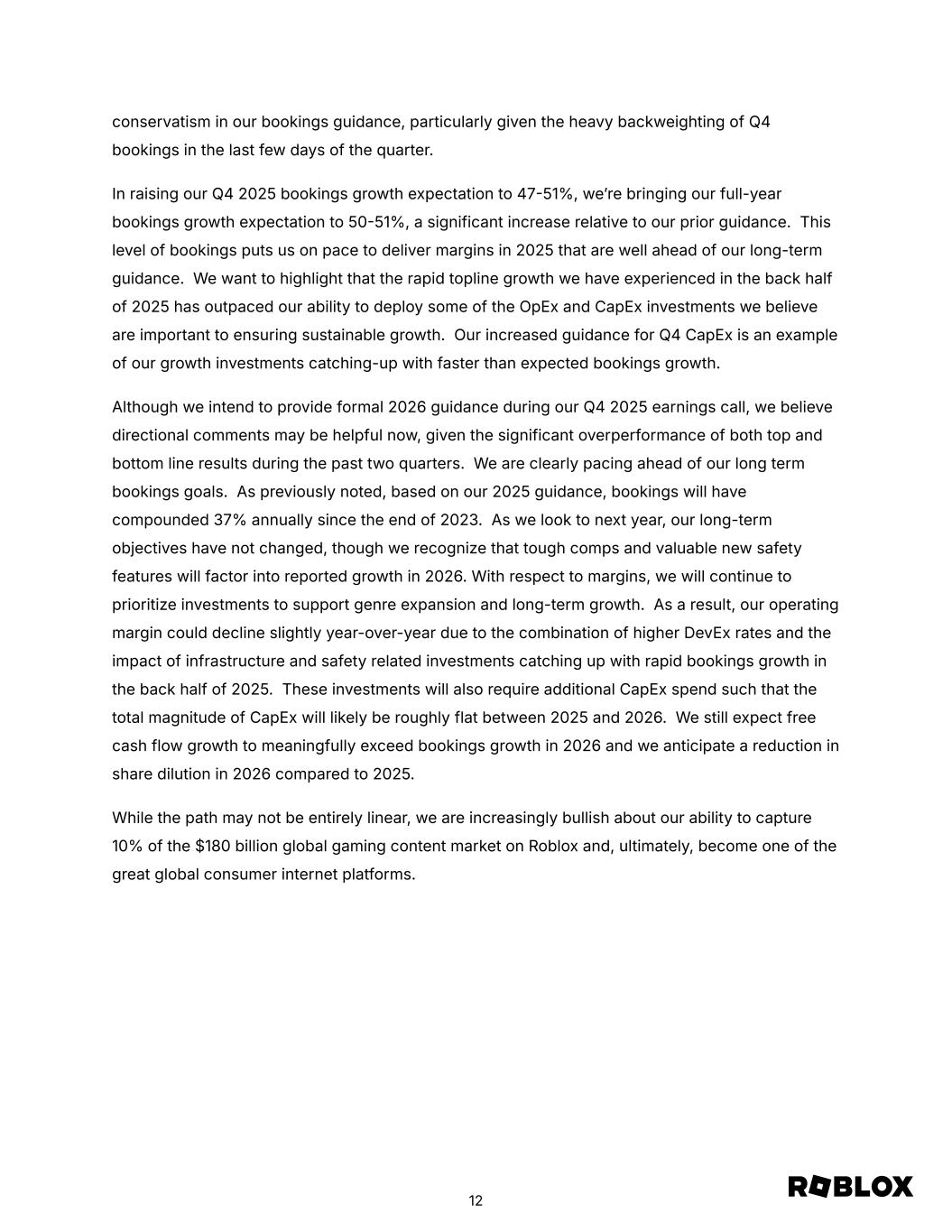
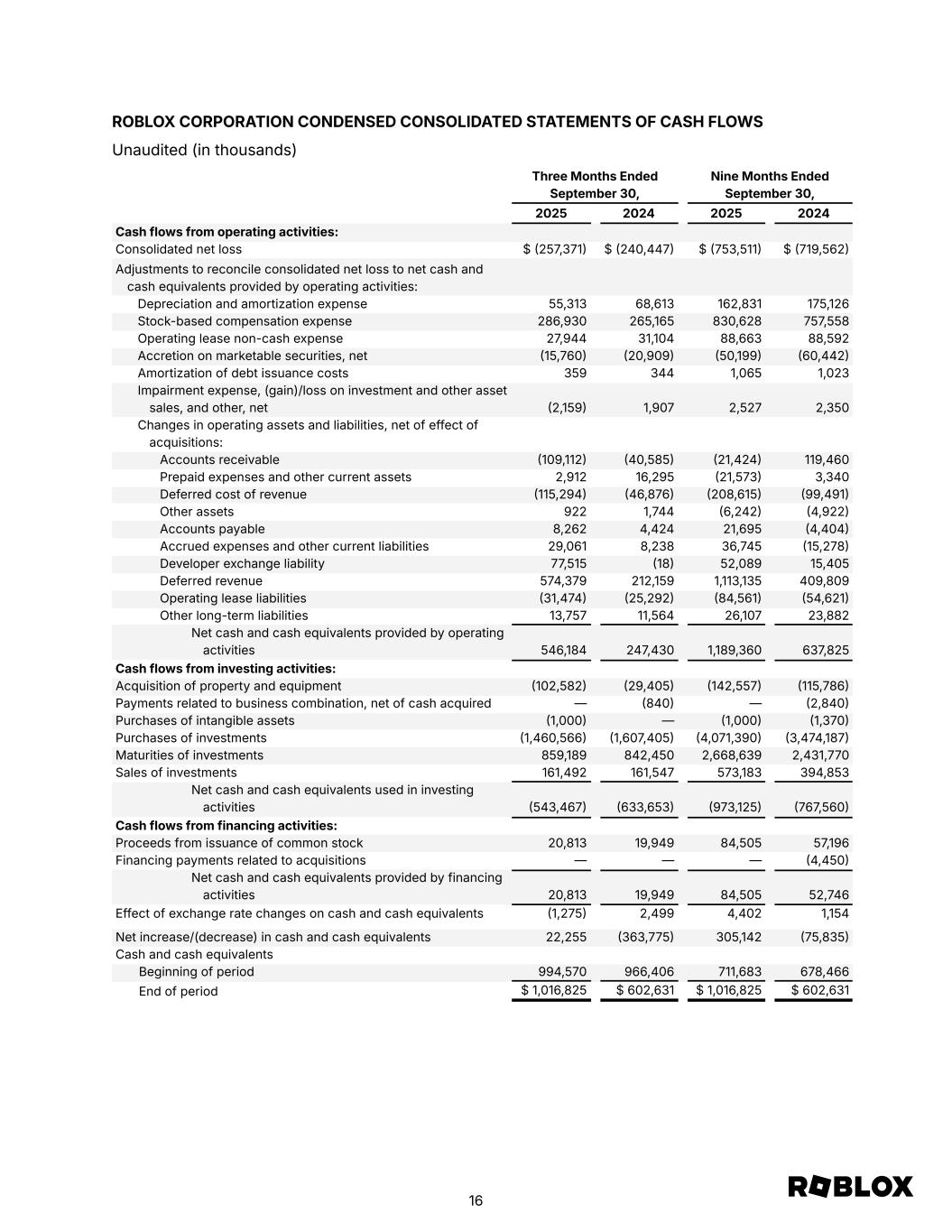
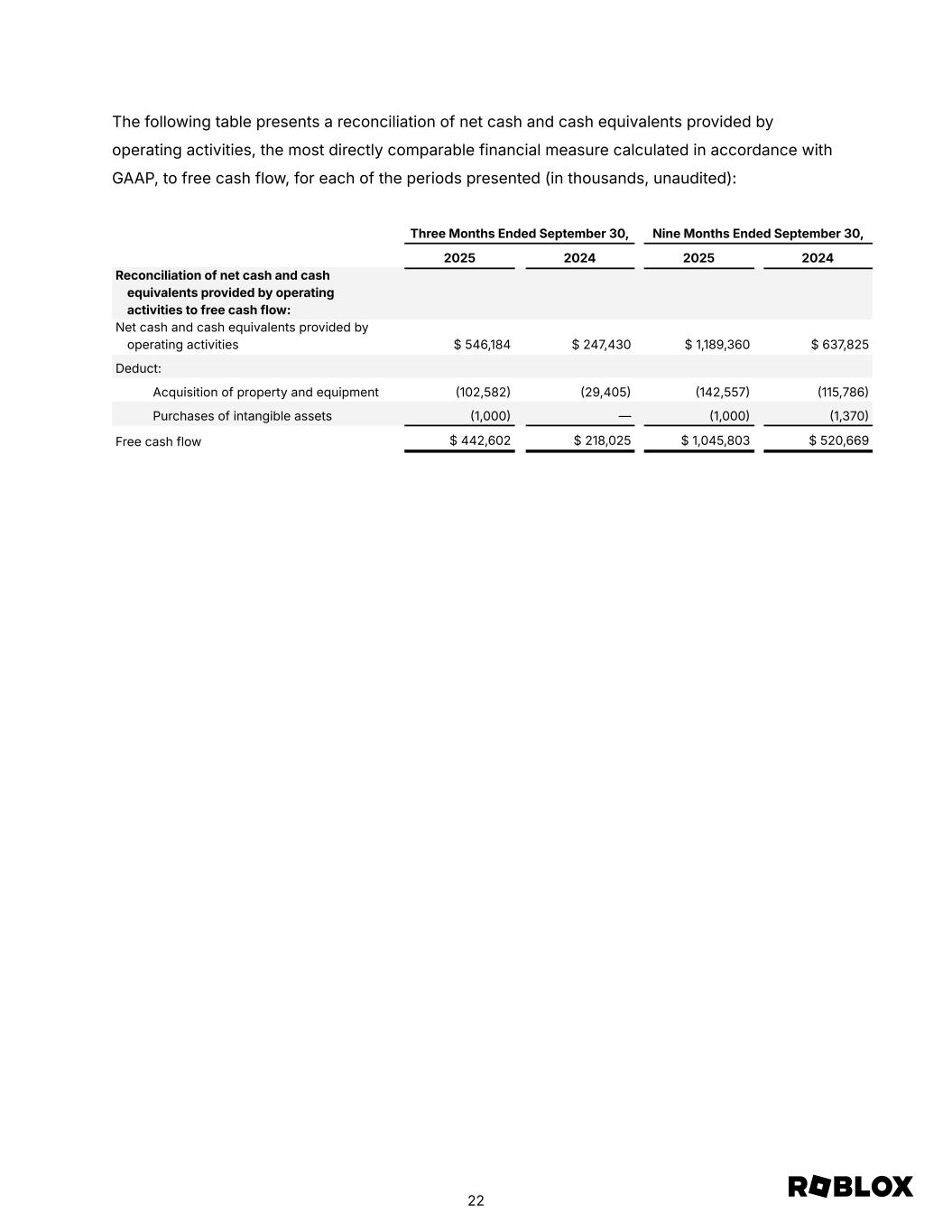
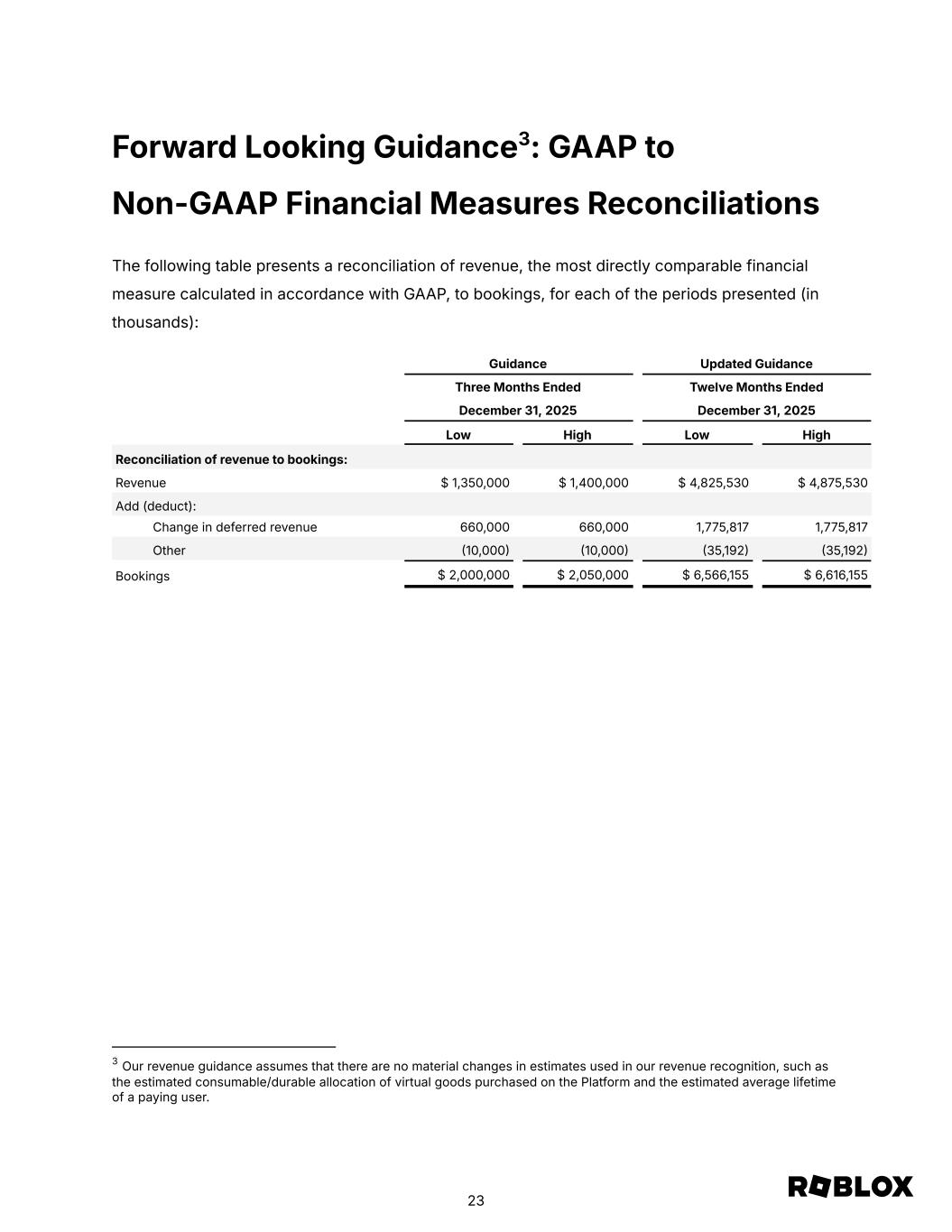
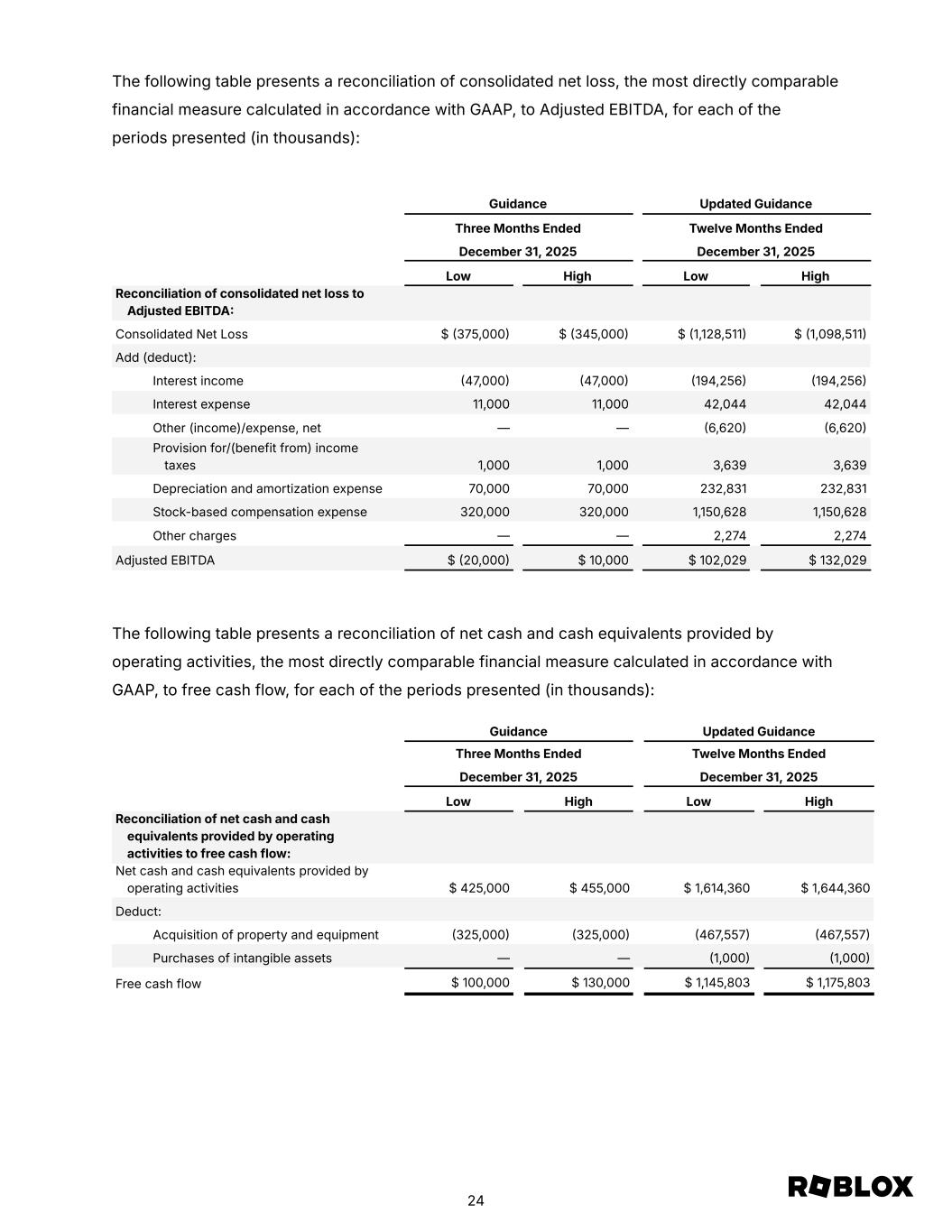
Great. Thanks, Dave. Good morning, everybody. I'm going to try to keep my comments relatively brief so we can get to some questions. As Dave noted, the tremendous growth that we saw in the quarter was driven by this combination of big viral hits and underlying platform growth. And so with that in mind, I want to just share a few observations regarding overall platform health, if you will. Last quarter, I highlighted the engagement growth that we were seeing in experiences outside of our top 10. Well, this quarter, the growth and engagement for these experiences, again, outside of the top 10, accelerated even further from 47% in Q2 to 58% in Q3. That's the engagement. And then on the monetization side, spending in that cohort of experiences remained north of 40%, excuse me, spending growth remained north of 40%. We also saw healthy growth in bookings per daily active user. That was true in every region other than APAC, which I call out because very importantly in APAC, the trend really is a function of mixed shift at the country level. Payers, as Dave highlighted, grew 88 percent year on year, which is a very healthy growth rate in and of itself, but notably is higher than the rate of user growth, which was 70 percent. And we believe that this dynamic is at least in part caused by changes that we've made in our economy. Remember, we launched regional pricing for marketplace items back in June, and we think that that helped drive higher payer penetration in markets like Southeast Asia. We did see a decline in bookings per payer on a blended basis, but similar to my comments on bookings per DAU, it's important to understand that this was really driven by geographic mix shift. So platform revolution looks healthy, and that really increases our conviction in our long-term goals, but as Dave pointed out, also underscores the importance of continuing to invest to ensure that we can deliver healthy growth over a multi-year period of time. So what does that look like financially? Well, on the top line, we see momentum in the business to continue to deliver healthy double-digit bookings growth. We think that'll be aided by the launch of a number of the key technologies Dave touched on that will roll out in late Q1 and early Q2 of 2026. Many of these technologies are designed to enable genre expansion on our platform. You saw some of those demoed at RDC. From a reported growth perspective in 26, we think the adoption of these technologies will be a factor, meaning how quickly developers adopt some of these new capabilities will influence the growth rate, particularly given the tough compares that we know we'll have coming out of 2025. We're also conscious of the fact that the new safety policies we're rolling out, consistent with our commitment to being the gold standard for safety, may cause some short-term friction to engagement and bookings, But ultimately, we think those are a magnifier of long-term growth. And then on the expense side of the equation, we are envisioning more investments in Devex, in infrastructure, and people to support our goals around safety and genre expansion. That's the reason you're not seeing year-over-year margin expansion in Q4 based on our guidance. And it's the reason that we expect margins to decline slightly in 2026, given the combined impact of a full year of higher DEVX rates, limited cost-to-serve improvements around infrastructure and safety, and higher growth rates in our comp and BEND expense lines. There will also be incremental CAPEX starting in Q4 2025. That's incorporated in the guidance that we shared. And I would tell you to expect similar levels of CAPEX in 2026, which, of course, implies that CAPEX intensity next year should be lower than 2025, but still somewhat elevated relative to 2024. for. So, you know, realize probably getting a little bit into the weeds there, but let me step back for a second. I think the key takeaways here are we are way ahead of our long-term growth plans. And in fact, the reality situation is that bookings have grown faster than our ability to deploy the appropriate growth investments. And that means you're going to see some slight margin compression as we catch up over the next few quarters. But I think those investments really should give everyone even more confidence in our ability to continue to deliver sustainable long-term growth. So hopefully that's some helpful color both on what we're seeing and what we're expecting. And with that, I think we'll open the line for questions.
Operator
Thank you. At this time, I would like to remind everyone in order to ask a question, please press star then the number one on your telephone keypad. We'll first go to Matthew Kost at Morgan Stanley. Your line is open.
Good morning. Thanks for taking the question. Dave, I want to start on AI. I mean, just when I look at your infrastructure plans, clearly you're very excited about putting, you know, gpus and and more data center power behind what you're doing tie that back to what the user experience or you know the the games on roblox are going to look like in in this world that you're building towards when you think about what cube is capable of what will real-time content generation and what you're calling 4d content creation mean uh you know for roblox experiences and for engagement over the next couple of years and then i have one for navine as a follow-up thank you.
Matthew, great question. And this is a fun one to answer. It also highlights the just enormous future technical innovation we have right looking in front of us. We have shared publicly at RDC and others really a vision of what the ultimate spec for Roblox should be. And that ultimate spec should be creator decides everything from fun, anime look and feel all the way up to photo realism anywhere from one player to 100 000 people at a concert simultaneously the ability to use ai to do real-time modification of that world everything from a piece of clothing to really a hundred thousand people with a dungeon master modifying the whole environment in real time A mix of true human players, NPC players all together, doing this with a very tight eye towards efficiency and cost, because we're a freemium platform. Ultimately, doing this on everything from a 2GB RAM Android device to a high-end gaming PC. So that is an amazingly complex spec. What you're going to see coming out soon with Cube 4D is real-time generation, inexperience in multiplayer, not just of static objects, but of complex objects, vehicles, weapons, other types of things that user can interact with in multiplayer. More of that to come, more AI supporting the stack everywhere, but we're marching as quickly as we can to that really big visionary spec. Some of the gameplay that we will see, we do not know what it is. We've seen that historically on Roblox more and more as we both cover new and existing genres in a predictable way, along with new types of games. I would highlight Dress to Impress was an example a year ago where the raw technology we were building to support more traditional gaming allowed the creation of a whole new genre. So stay tuned both for more coverage of existing genres at higher performance as well as as of now unthought of types of gameplay.
Operator
Before going to the next question, I would like to remind everyone if you have a two-part question to ask up front because the line will be muted. We'll move next to Brian Peets with BMO Capital Markets. Your line is open.
Thanks so much. Dave, you mentioned increasing the Devex rate by eight and a half percent, putting more economics into creators' hands. However, at the same time, if you look at competing UGC platforms like Fortnite, they're also offering very attractive economics to try to win over creators to build a mirror UGC platform. How do you think about the need to continue driving economics towards creators to help fend off any competition from other platforms that either are currently in development or could be coming in the future? Thank you.
Hey, great question. I do want to highlight, you know, generally at Roblox, we run the company by looking to the future and not looking over our shoulder, I would say in this situation, there's one additional component to what is the Debex rate. And that is the ability of a new creator or an existing creator to make enormous economic returns. And so one needs to multiply the devx rate by the volume of users on the platform, by the breadth of the creative tools, by the velocity that new creators can make new experiences. And in the end, that's how I believe and we believe creators analyze the situation, not simply by the devx rate. We do believe for every incremental percentage within, obviously, our fiduciary duty and our balancing of earnings and Devex and all of our other costs, that for every incremental percent, we do believe there can be some effect on the creators in making Roblox a more appealing platform. It ends up at the highest level making us think about our company where we want our cogs to be as lean and as efficient as possible, our personnel costs to be as lean and efficient as possible, our infra trust and safety costs to never compromise, and at the same time to be run as thoughtfully as possible. And this has been one of the benefits of building out our own infrastructure. And then finally being very thoughtful on how much we move back to our creator community relative to our own cash flow. So I think it's much bigger than kind of this one-to-one comparison. And that's really long-term. We want to move as much money in a prudent and thoughtful way while always being responsible for trust safety and our earnings to the creators.
Operator
We'll move next to Eric Sheridan with Golden Facts. Your line is open.
Thanks so much for taking the question. Can you share with us key learnings as older age cohorts continue to scale as a percentage of the mix in the business and based on those learnings how can you line up your investment priorities to sustain that growth and stimulate that aspect of mix in the years ahead thanks so much i'll share some key learnings and then I'll share how we are lining things up.
I think one of the key learnings is Roblox has a huge ability to virally attract new users to the platform with new hits. And we've seen that both with Dress to Impress, we've seen it with Grow a Garden, where we really get user acquisition at an enormous scale organically as word of mouth traverses these properties. We've also seen with new types of gameplay, once again, use those two as examples, that older players are excited and interested in that. If anything, as we look at the global gaming market space, which is estimated anywhere, I won't make the exact estimate, but numbers between 180 and 200 billion, we see all of the existing genres, and we've been able to align those genres with our technical roadmap. As we shared before, a lot of our technology we believe is going to support sports. A lot of our technology will support racing. Some of the new technology we're working on is going to make RPGs better. Some of the technology we're working on now, we believe we're going to see more and more avatars on Roblox that have a much bigger diversity, just as we see in the gaming ecosystem as a whole, relative to what we have on Roblox. And so we can use that to guide our technical roadmap, but I would highlight we're not copying. We are envisioning satisfying those technical constraints, while at the same time building a platform where the exact same experience can run on 2GB RAM Android in a very difficult networking configuration, and at the same time look absolutely amazing on a high-end gaming PC, eliminating really kind of this void between mobile and desktop and console. We also believe the future of platforms like Roblox is much more cloud integrated, such that AI and generative AI is always available in the experience for all creators. So we are able to align a bit both our own vision, as well as what are all of the current genres in the gaming ecosystem and make sure we line up with that um so that's you know we're optimistic there's a lot of growth ahead of us in some of these genres where we're not um fully at three percent of the global gaming market right now we'll move next to jason bazanet with the city group your line is open i just had a question on the shareholder letter i think in your 23 investor day, you laid out 20% plus bookings growth from 25 to 27.
And in the shareholder letter, you acknowledge the great results you've had so far this year. But then you say, quote, as we look to next year, our long-term objectives have not changed. Is that essentially a soft way of saying that you think that the growth will be below 20% in 26? Is that what you're trying to say? Because I think that's what the market's trying to digest with the pre-market action in your stock. Thanks.
Yeah, Jason, it's Naveen. Thanks for asking to clarify that. Look, I think we are not providing any specific guidance about 2026 at this point in time. I think that would be premature. We need to land the plane on 25, and then I think we'll be able to dial in expectations for 2026 more specifically. I think what we're trying to highlight for people is that there are some important things to consider as we look at expectations for bookings growth next year. There will be tailwinds from the momentum that we are seeing in the platform today. There will be tailwinds from a lot of the tech that's going to be hitting the platform in the first half of next year. But there could also be potential headwinds, obviously from the tough comps, and then potentially from some of the new safety policies that we are going to be rolling out. We don't think any of that changes where we expect this business to be, you know, over the next several years. But I think it is too early to put any specific numbers around 26 at this point in time.
Operator
We'll move next to Corey Carpenter with J.P. Morgan. Your line is open.
Thanks for the questions. Naveen, maybe building on that, you did not mention advertising as a potential tail end next year. So just curious what your early learnings have been in rewarded video. How big of a push or priority do you plan to make that in 2026? Thank you.
Yeah. So I think consistent with some of the comments we've shared recently around advertising, We remain very bullish about the long-term opportunities there, that we are cautious about the near term, because we want to make sure that we get it right. And as you've heard at RDC, we are now rolling out rewarded video on sort of a limited basis. I think we pointed out in the shareholder letter, we now have over 140 creators onboarded. What we have learned from that is that we want to be very thoughtful and diligent with those creators about how we integrate rewarded video to make sure that it works for them from an engagement and a monetization perspective, that it works for our users in terms of the experience, performance, et cetera, and that obviously we are representing our advertisers in a high-quality way. So, you know, there's still a lot for us to do on that front, and therefore not something that we would call out as a major contributor in the short term, but something that is going to be a key part of our business as we progress over the next few years.
Operator
We'll move next to Ken Gorelski with Wells Fargo. Your line is open.
Thank you. Appreciate it. Could you talk a little bit about the various genres and how do you think about the recommendation engine, which has been clearly very successful and kind of surfacing new hit games? Could you talk about how you're pushing more diversity of genres and to make sure that there's enough experiences out there? And is this a concern? Are you worried at all a little bit about a more concentration in certain types of genre games or in certain game mechanics? Thank you very much.
Hey, great question. And part of my intro was to highlight that diversity on the platform with seven titles over 10 million DAUs at some point during the quarter and five of them new. One of the way we have been thinking about discovery, there's two big areas of it. One is we're not trying to optimize the short term. We are trying to optimize the long term enterprise value of the company. And we're also trying to optimize ecosystem health in addition to what we put in front of users, which really does mean surfacing new creators and new genres side by side. The second part on our discovery, we're moving more and more towards complete transparency of our discovery algorithm. We're sharing the signals that we believe point to long-term health of the ecosystem. And as you correctly noted, we believe part of that long-term health is through expansion in some genres like RPGs, shooting, racing, battle, sports, and other genres on the platform. The final thing I want to highlight on the way our discovery system is working is long-term, there's really three prongs to discovery on Roblox. there's our own recommendation engine it's coupled with on the home page sponsored tiles which is paid discovery by our creators and more and more new creators who are launching a new game or bursting are using that to complement our organic discovery finally our top picks and curated sort is an additional way that we complement that with the vision on the platform We're being very careful not to look backwards, not to burn in what has historically been big on Roblox, but instead to look forward to what we believe will be new types of gaming on the platform. So I believe relative to a year or even two years ago, our discovery system is working better than it ever has. And I think we have continued improvements coming. So stay tuned.
Operator
We'll move next to Benjamin Black with Deutsche Bank. Your line is open.
Good morning. Thank you for taking my question. So, you know, just touching on the growing number of experiences that are eclipsing 10 million users. So, you know, with the growing data set that you have on user engagement, DAU behavior, does the discovery model just get increasingly smarter at recommending content? So I guess the question is, are you starting to have a real data mode in discovery? And then, Levine, you know, over the past couple quarters, we've seen a divergence in hours-engaged growth and booking growth. Could you just help us understand, so why is this happening? Is it as easy as sort of a makeshift towards low-monetizing experiences or low-monetizing regions? And if so, how should, you know, the relationships between those two evolve from here?
Hey, this is a really good question. I want to put it under the umbrella of, first, privacy safety, PII safety, adherence to all local laws, and all of that. And second, I want to put it under the umbrella of we're not under any financial pressure and have no intent to ever release any of this Roblox data anywhere off the platform. Once we look into those two things, though, the data set is enormous. The data set is not simply who clicks where. The data set is real-time 3D avatar interactions. It's what areas of a certain experience are retaining more. It's what our avatar is doing in any creator's experience. It's the ability to analyze that and the ability to analyze the data that makes up a 3D experience. And in addition to maybe more traditional signals for discovery, use 3D and time-based immersion signals to help predict what may be a good experience on our platform. That goes back to an interlock with what I shared, which is every day on Roblox, there's over 30,000 years of potential 3D interaction avatar training data available for us. So the answer is yes. We will mix more content understanding, understanding of what makes experiences interesting and fun into our discovery mechanism. And I'll kick it over to Naveen for the second part of that.
Yeah, thanks. Hey, Ben, your or at least the second part of your hypothesis was correct in terms of the dynamic between ours growth versus monetization growth. meaning it really is about geographic mix shift. You can see that if you look at, you know, in the supplementals, we have some disclosure around bookings per daily active user. I realize you were comparing monetization versus hours, but it's a very similar dynamic, i.e. if you look at this on a regional basis, very strong growth year over year. but the mix of hours is skewing toward regions that just do monetize at a lower level and that's what you're seeing in the blended numbers and as I pointed out in my remarks even at the regional level we see some geographic mix shift between specific countries that impacts the monetization at the entire region. So it really is all about growth in various regions.
Operator
We'll move next to Omar Dasowski with Bank of America. Your line is open.
Hi, Omar Dasowski. Hi, guys. So you called out the Tough Comp in 26 and some of the dynamics there. I'm looking back at Roblox. A lot's changed, obviously. New CFO. The company has almost doubled in size over the last two years. And when things change, you may consider different approaches. And with 26 being such a tough comp year, potentially, you know, Roblox has never used advertising to attract users, either through ad networks or otherwise. And, you know, given that it sounded like Dave said that the virality of your hits is the main engine for, you know, for user growth, in a tough comp year like 26, why wouldn't Roblox consider advertising, you know, to kind of smooth out these troughs and peaks in growth? That's my question.
Omar, great question. And hey, a couple of things to take a step back at. Big picture right now, we're simultaneously excited that we've nudged over 3% of the global gaming content market running on Roblox. And at the same time, there's almost 97% out there. So I continue to be enormously bullish as we roll out our tech and we expand genres. And we do this really in a new way for gaming, complemented with AI. The second thing I do want to highlight is that this quarter, next quarter, we're rolling out a lot of what we shared at RDC, which supports massive expansion of the way Roblox works and the types of genres. You correctly note, Roblox got to where it is primarily based on viral growth, but we do buy traffic. I don't know if it shows up in our financial statements, but we very thoughtfully complement that with paid user acquisition. And what we are testing and starting to roll out is the notion that we can partner with the creators on our platform to help them supercharge their paid acquisition in partnership with us. And there's a future opportunity for us to expand paid acquisition where a creator may be a little hesitant to buy paid traffic and send that to Roblox because, you know, we get some benefit as well. They land in our client. That user may pay other experiences. But when we start sharing that with creators, there's an opportunity for both creators to expand paid acquisition and for us to support them and do it with them. So, we already do some paid acquisition. There's an opportunity to make this a lot larger. We always do this in a financially prudent way, which is appropriate return on ad spend in the right amount of time so that we're doing this incrementally. So, yeah, great idea. We've got this in our sights to expand. And, Naveen, I don't know if you want to compliment that at all.
No, I think the only thing I would say is that in terms of overall scale of what we're spending on growth marketing, it is still very modest, and we rely on the tremendous organic growth that the platform still has. You know, as Dave said, there's a lot of market white space yet for us to tackle, and we added close to 40 million users relative to Q2. So the organic growth engine is working really well, and that will still be, I think, the primary driver of growth. But there are some very interesting things that we can do, as Dave described, in conjunction with our devs to promote some of the content that is coming to the platform, which is consistent with our goals around genre expansion, content diversity, content velocity, et cetera. So looking forward to continuing to experiment with that.
Operator
Time for one last question from Clark Lompin with BTIG. Your line is open.
Hey, thanks very much for taking the questions. I'll try to make these quick ones. Dave, you talked about making the platform more attractive to the creator community. Over the last two quarters, we've obviously seen a really big spike in users. You've invested in developer exchange fees, tech, the platform. um we obviously have a very good view into user growth but um a little bit less so on the developer side of the ecosystem and has dev growth essentially held serve with users in a way where we could think about that sort of growing proportionate to da use and and maybe just take that a step further for naveen if we think about that you know and sort of the elasticity of growth and engagement we've been through investment cycles in the past this one feels a little bit different because it's ai oriented um is there a reason to think that like the the yield on some of these investments if we are seeing you know um proportionate growth could be a little bit more
immediate and is that reflected in you know some of the comments around 26 thanks a lot okay i'll go first and then i'll hand it over to navine on the yield side um at rdc and i don't know if we publishes part of this earnings. There's one spec or stat that we constantly share, which is some averages around top 10, top 100, top 1,000 devs and their year-on-year growth in bookings and engagement. And we continuously see, I would say, a flattening of that tail where the top thousand looks very, very healthy. So I think we're in a very healthy zone still. We continue to flatten that curve. We have many, many more creators making a living or making a million dollars or making 10 million on the platform. And that all is continuing to grow. I believe we can extrapolate to the future, which is our vision of having 10% of that global gaming bookings running through our platform and that gives a little bit of a perspective of what we would hope happens to that wide range of creators on the platform um just one highlight on infrastructure we we continue to highlight the movement to supporting our own bare metal data centers both for core edge and ai and complementing with burst we're this has been part of the key to our efficiency, and I'll let Naveen speak on the yield of these investments as we get into that.
Yeah, I think the way to think about, call it the payback period on these investments is that there are a variety of things that we are doing that we will start to see the fruit relatively quickly. There are others that are more long-term in nature. The AI stuff in particular, you know, there's a lot of AI investment that we've already made. You heard Dave talk about some of the benefits we're already seeing around discovery, economy, et cetera. So I view those as having relatively near-term payback. There are others that are going to be longer term. And quite frankly, it's going to take us a little while to roll out the CapEx to train and ultimately deploy these models to move them onto our own metal, as you heard Dave describe. So those are not necessarily going to have as immediate of a payback, but I think it's fair to say we're already getting benefit from a number of the investments that have been made on this front, call it in 2025 and increasingly in 26 and beyond. I think that's our last question. So thank you all for joining and then I will turn it back to Dave for any closing comments.
Hey, just want to once again thank you all for your support and your insightful questions today. We look forward to continuing to innovate in our quest to have 10% of global gaming on the platform. Thank you all.
Operator
Thank you and that concludes today's conference call. Thank you for your participation. You may now disconnect.