Operator
Hello and thank you for joining us. My name is Regina and I will be your conference operator today. I would like to welcome everyone to the Riley Exploration Permian Inc. Fourth Quarter and Full Year 2024 Earnings Conference Call. All lines are muted to avoid background noise. After the speaker's remarks, we will have a question-and-answer session. Now, I will turn the conference over to Philip Riley, CFO. Please go ahead.
Good morning. Welcome to our conference call covering fourth quarter 2024 results. I'm Philip Riley, CFO. Joining me today are Bobby Riley, Chairman and CEO, and John Suter, COO. Yesterday, we published a variety of materials which can be found on our website under the investors section. These materials in today's conference call contain certain projections and other forward-looking statements within the meaning of the federal securities laws. These statements are subject to risks and uncertainties that may cause actual results to differ materially from those expressed or implied in these statements. We'll also reference certain non-GAAP measures. The reconciliations to these appropriate GAAP measures can be found in our supplemental disclosure on our website. I'll now turn the call over to Bobby.
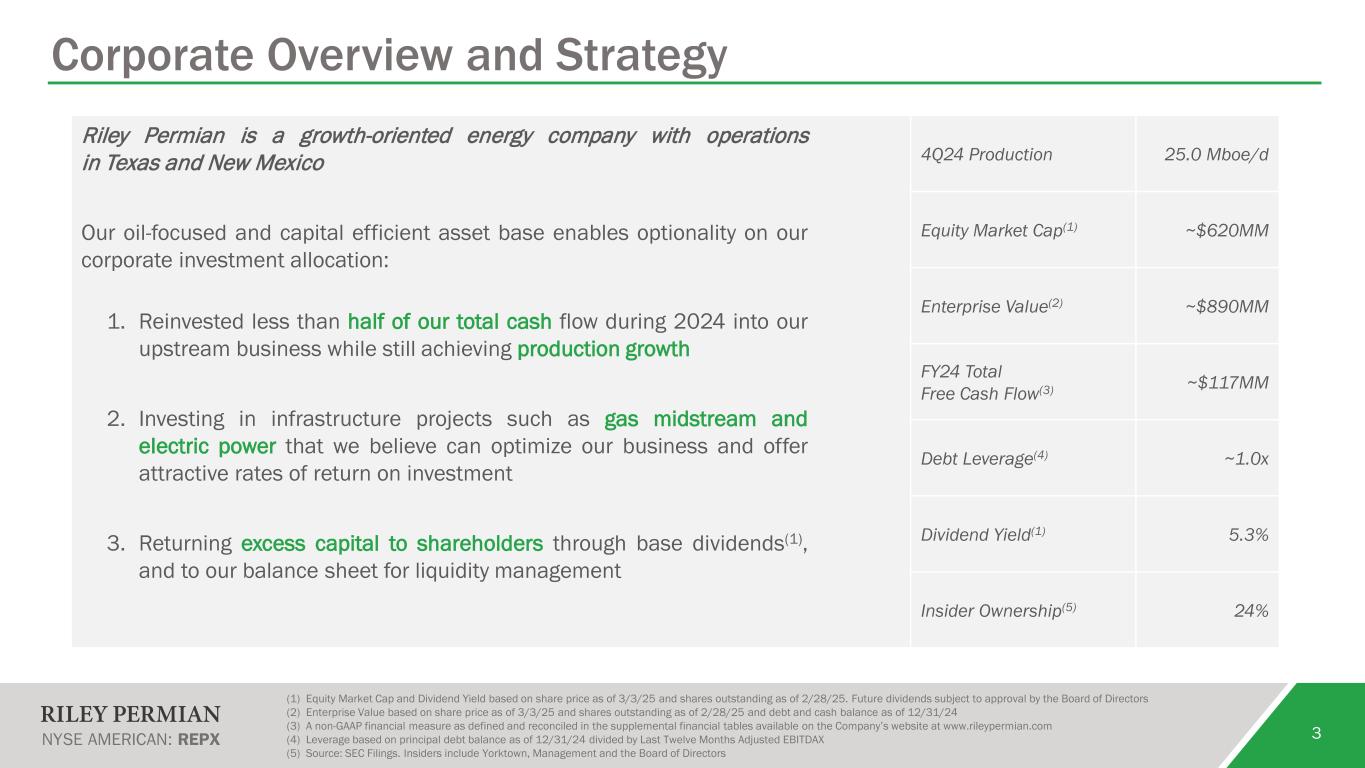
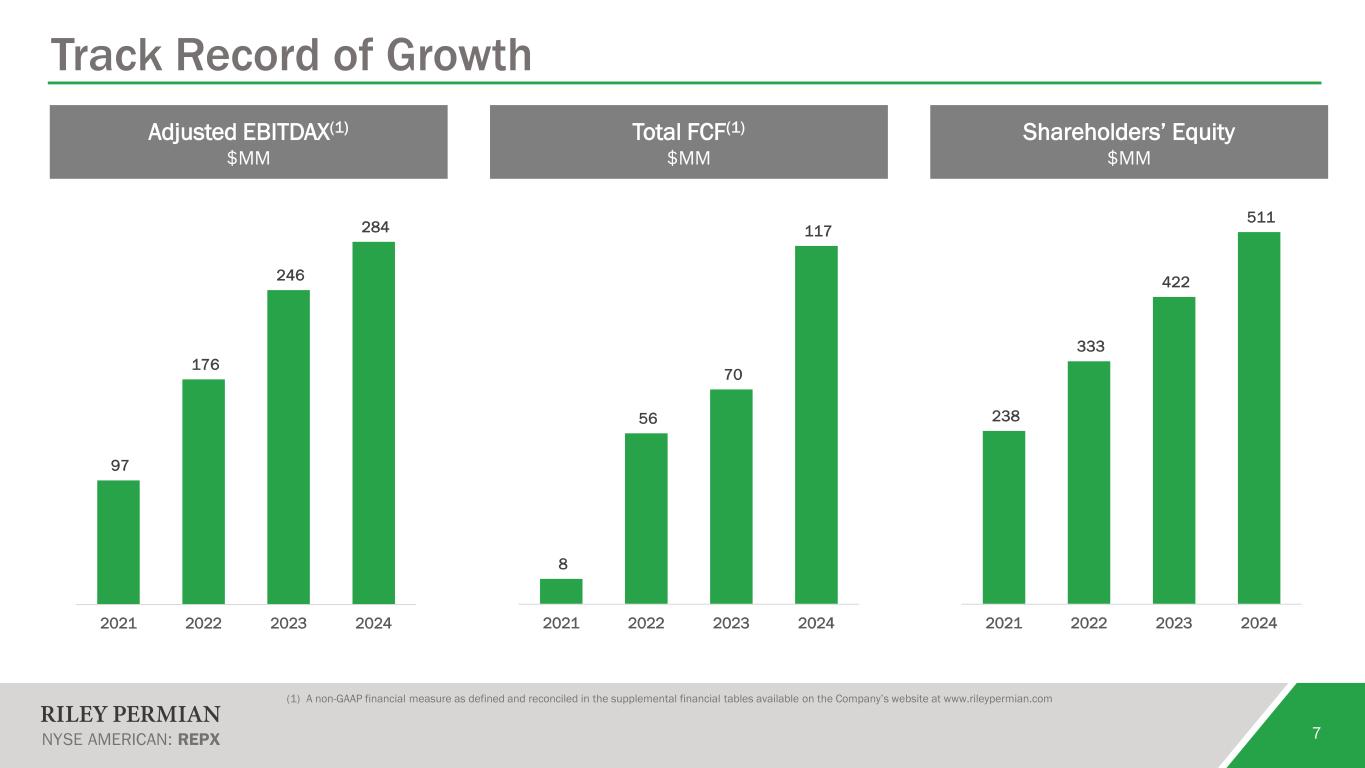
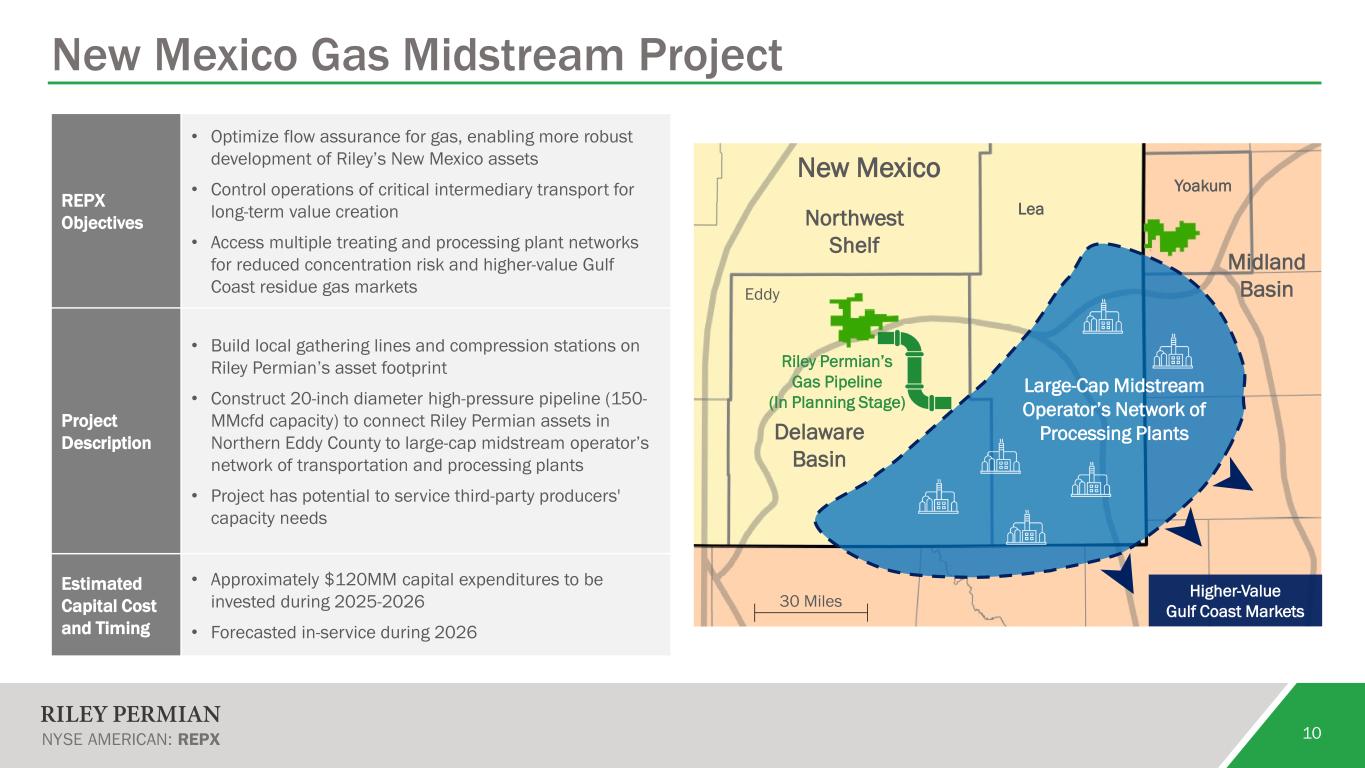
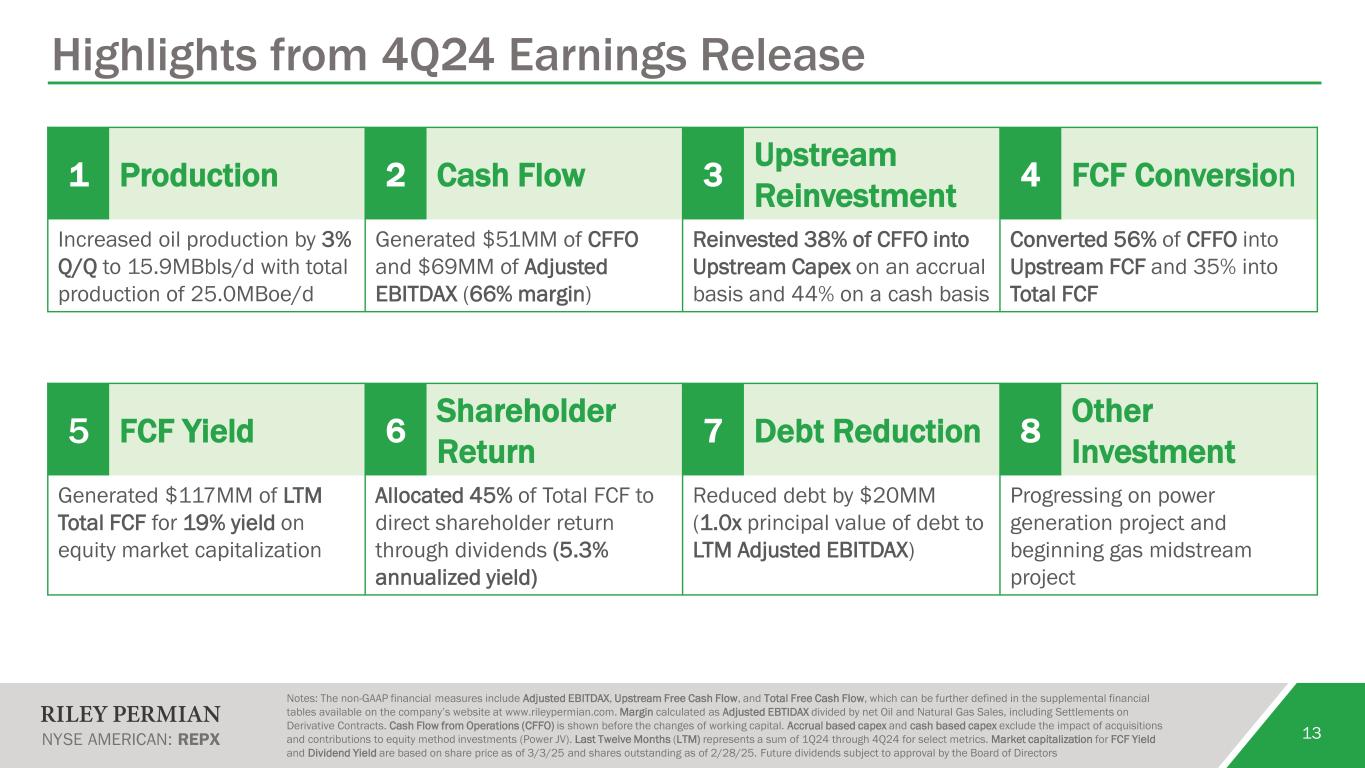
Thank you, Philip. Good morning and welcome to our Q4 2024 earnings call. We had an exceptional year by all measures, and I'm extremely proud of what our team has accomplished. At the start of 2024, we outlined a plan to grow oil production by 10% while reducing capital expenditures by 10%. Our actual results significantly exceeded these targets, with oil production growing by 15% and total production increasing by 22% while upstream cash capital expenditures declined by 27%. Our 2024 performance underscores the capital efficiency of our asset base and the results of past infrastructure investments. We achieved these results while reinvesting less than half of our cash flow into our upstream business, which allowed for excess cash for debt paydown, dividends, and investments into midstream and power. In 2025, we will shift more development activity to New Mexico, where we see significant long-term growth potential. Thus, we are excited to advance our investment in the New Mexico midstream project. This strategic development will provide greater operational control over our gas gathering and regional transportation, enabling more robust development and access to multiple treating and processing plant networks to optimize our flow assurance. Additionally, we see commercial opportunities with third-party producers that could generate significant incremental revenue. In early 2025, we announced a 15-year gas purchase agreement and plans for a high-pressure 20-inch natural gas pipeline capable of transporting up to 150 million cubic feet per day. This infrastructure will secure our takeaway needs while accommodating future growth and third-party volumes, providing much-needed takeaway capacity for the region. Finally, we continue to make progress on our power joint venture, which was initially designed in 2023 to reduce Riley Permian’s reliance on an intermittent and less reliable grid. We expanded the project scope in 2024 to include new power generation for the sale of energy into ERCOT, capitalizing on attractive market fundamentals within the Texas power grid. As part of our future-focused strategy, we will continue to invest strategically while maintaining balance sheet flexibility and preserving access to capital markets should additional actionable opportunities arise. Now I'll turn the call over to John Suter, our COO, to discuss operational results for the quarter, followed by Philip Riley, our CFO, who will discuss forward guidance.
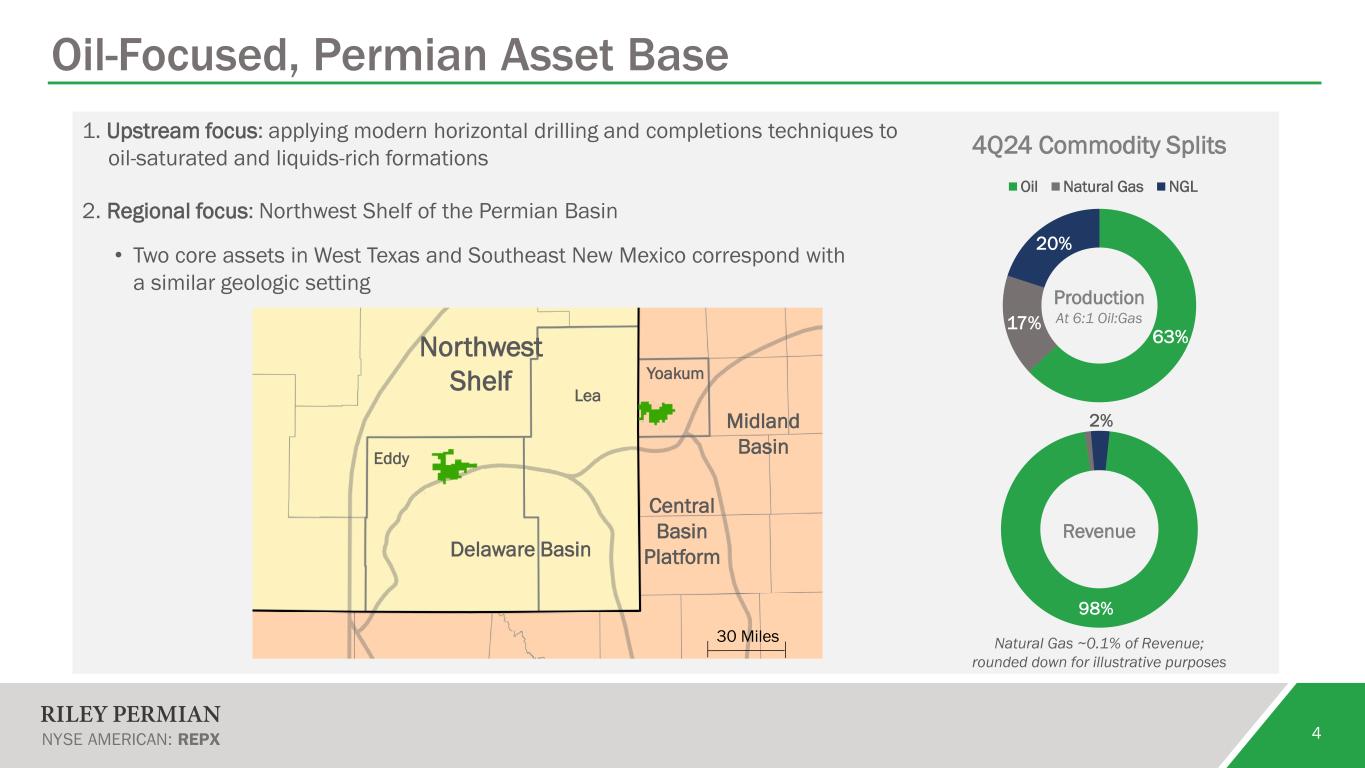
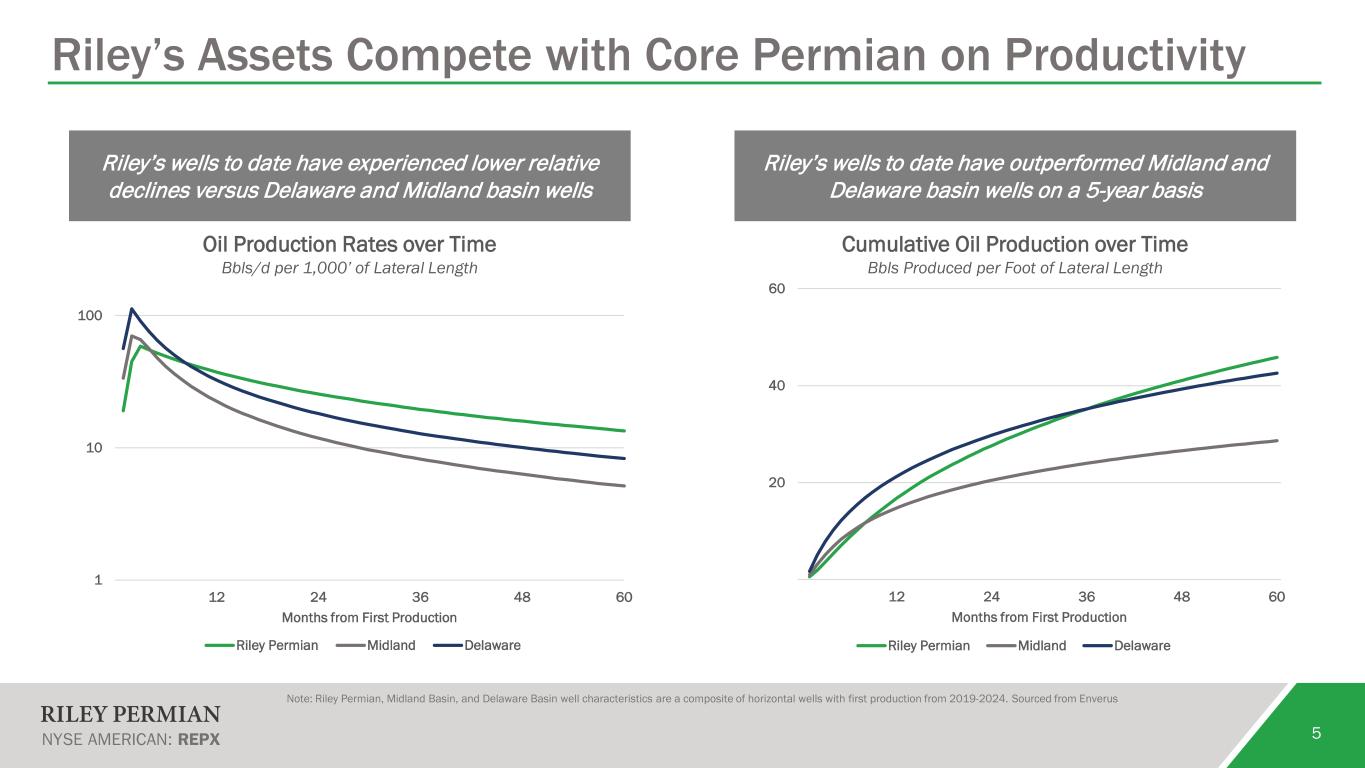
Thank you, Bobby, and good morning. Once again, Riley demonstrated excellence in operations through safe operating practices. The team achieved a total recordable incident rate of zero for 2024. We achieved 90% safe days in the year, a metric requiring no recordable incidents, vehicle accidents, or spills over 10 barrels. In 2024, we drilled 30, completed 20, and turned in line 22 gross operated wells. The additional wells turned in line are carried over from Q4 2023 completion activity. Our 2024 drilling and completion campaign achieved measurable success in both fiscal and operational metrics. We decreased our cost per foot across both Texas and New Mexico assets by 11% year-over-year in 2024. At the same time, we also increased our lateral feet drilled per day by 20% since 2023, setting records in Texas for both 1-mile and 1.5-mile laterals. Of note, all wells that were drilled and completed in 2024 were on multi-well pads that had zipper-style completions, saving on rig moves and pump times. We continue to focus on driving drilling cost reductions through optimized bit selection, single BHA lateral runs, and minimized steering through better targeting resulting in shorter spud to TD times. Other changes were made to optimize our completions, such as increasing cluster spacing and decreasing sand loading. These strategies allowed us to achieve higher efficiency and cost savings while maintaining or exceeding the production and reserve value of which our assets have shown to be capable. Net production grew from 4.8 million to 5.52 million barrels of oil year-over-year in 2024, an increase of 15%, while equivalent production is up 22% from 6.79 million to 8.25 million barrels of oil equivalent. Our average daily net production was 15.91 MBO per day and 25.03 MBOE per day for the fourth quarter of 2024. We continue to work with our midstream partners to maximize gas sales through strategic infrastructure projects and optimizations. Of note, we were able to capture and sell more of our produced gas in Texas, resulting in the same oil production but at a lower percentage of oil in the overall mix. This strategy in Texas has allowed us to drive full field development at a pace controlled by us, allowing us to be flexible to market conditions and other industry considerations. We will continue to utilize this approach as we develop our New Mexico assets. This value creation is the main basis for our added focus on infrastructure in 2025. The production increase was achieved while maintaining low operating costs. Our LOE per BOE for 2024 was $8.66 per equivalent barrel, roughly flat with the 2023 full-year metric. Routine clean-out workovers have gotten more efficient in our Texas asset as we've continued to refine our operations. These efficiencies, including timing of workovers, optimization of chemical treatments, and tool selection. As a result, our clean-outs cost 33% less than they did just two years ago, and we begin doing them proactively, resulting in higher production for longer before intervening. Overall, Texas workover expense is down 16% year-over-year on a per BOE basis in 2024. Also in 2024, we completed our New Mexico plugging requirements that came as a part of the 2023 acquisition on schedule and within budget. This will result in a substantially lower spend for ARO in 2025. Related to the midstream development that Bobby discussed, the fourth quarter of 2024 saw the initial construction phases of our New Mexico gathering and compression project. Commissioning of the compression portion of this project is currently underway with the first high-pressure sales before the end of this month. We will begin the project with roughly 15 million a day compression capacity to our existing gatherers' high-pressure system, and in the process, leaving an additional low-pressure capacity to fill in the interim. Further compression, gathering, and transmission infrastructure will continue to be built out over 2025, increasing our ability to deliver gas consistently and reliably. We continue to utilize our power generation station with a greater percentage of our existing Texas assets. We're currently using roughly 20% more self-generated power than at the end of 2024. This lets us control our Texas development plan without relying on utilities to drive our development timing. We're evaluating the benefits of a similar installation in New Mexico. In summary for the year, we produced 22% more equivalent production, sped 13% more net wells, turned in line 28% more net wells, operated with flat LOE per equivalent barrel, and spent 19% less D&C capital dollars, all while delivering stellar safety metrics. It was an impressive year for safe, efficient, and technically driven development of our asset base. I want to congratulate the Riley Development and Operational Team for a very successful 2024. Philip, I'll turn it over to you.
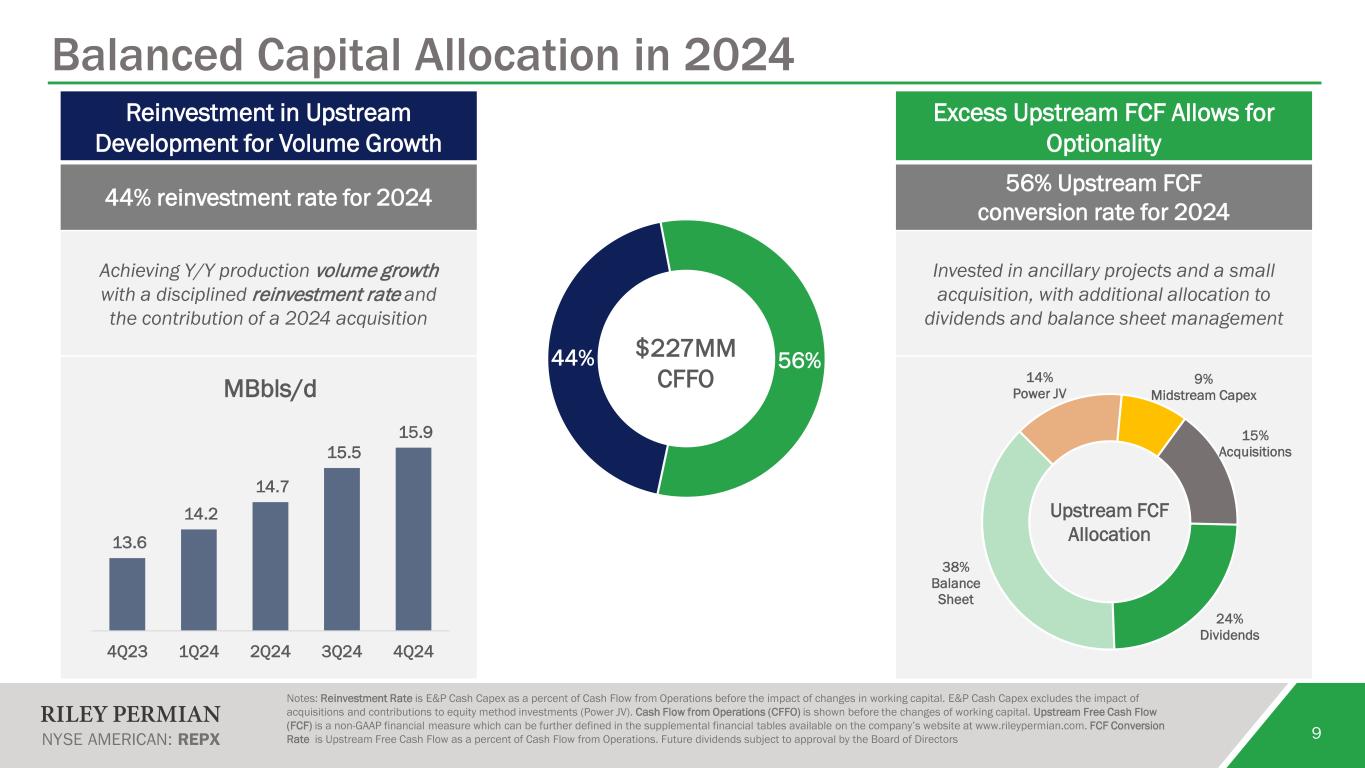
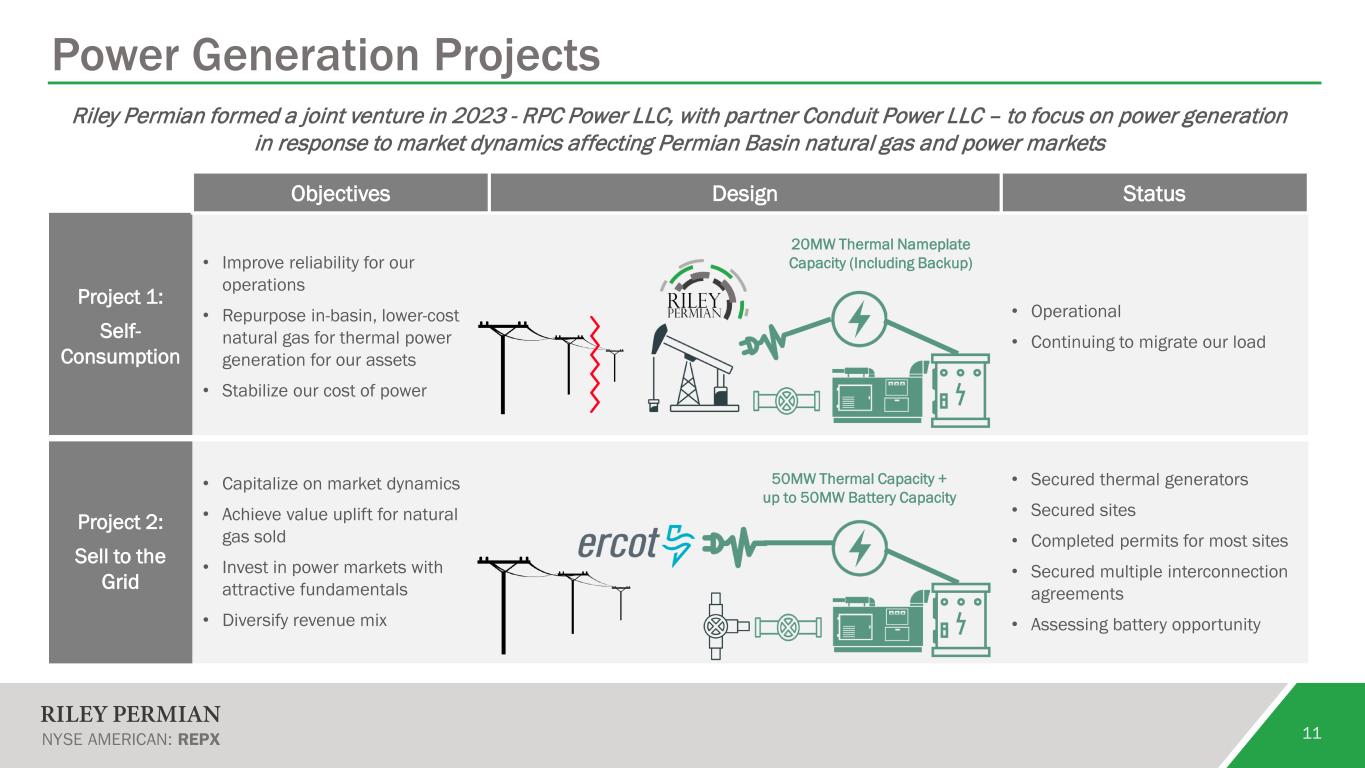
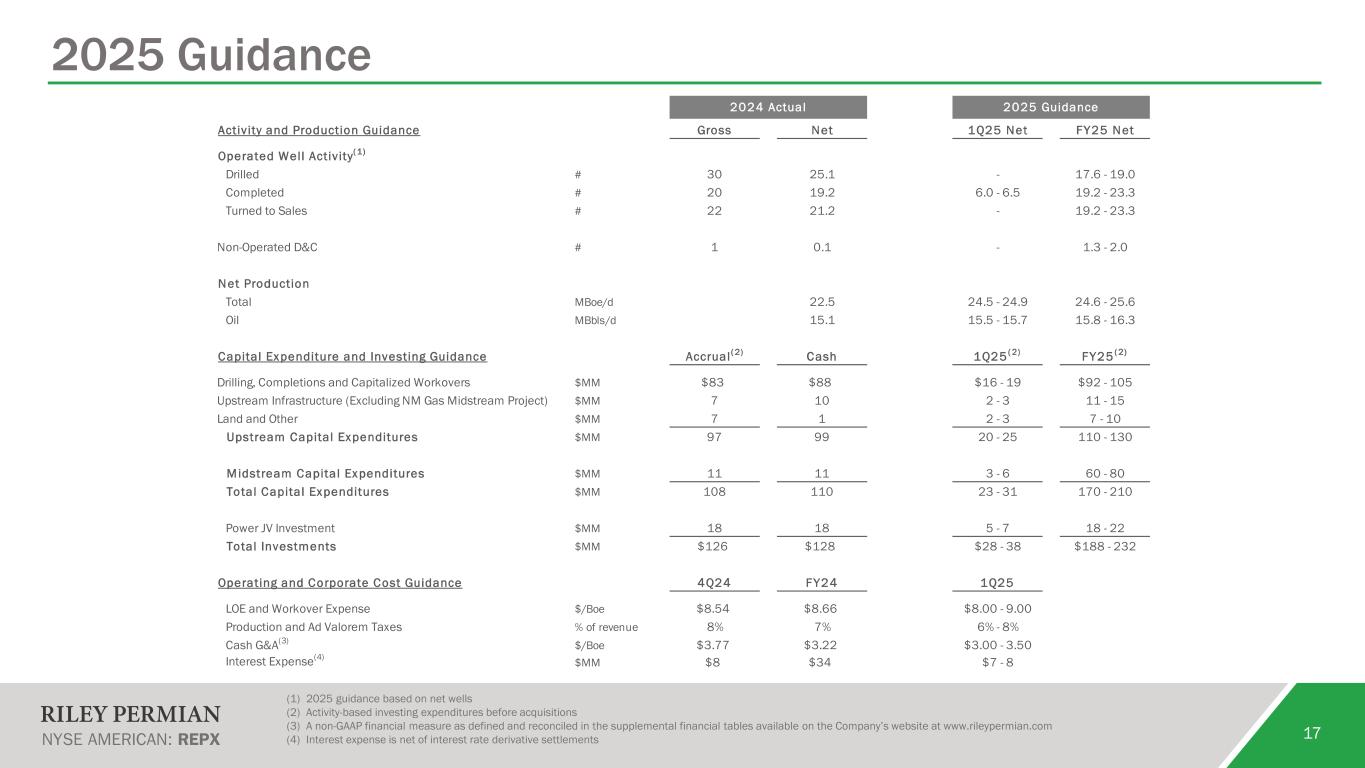
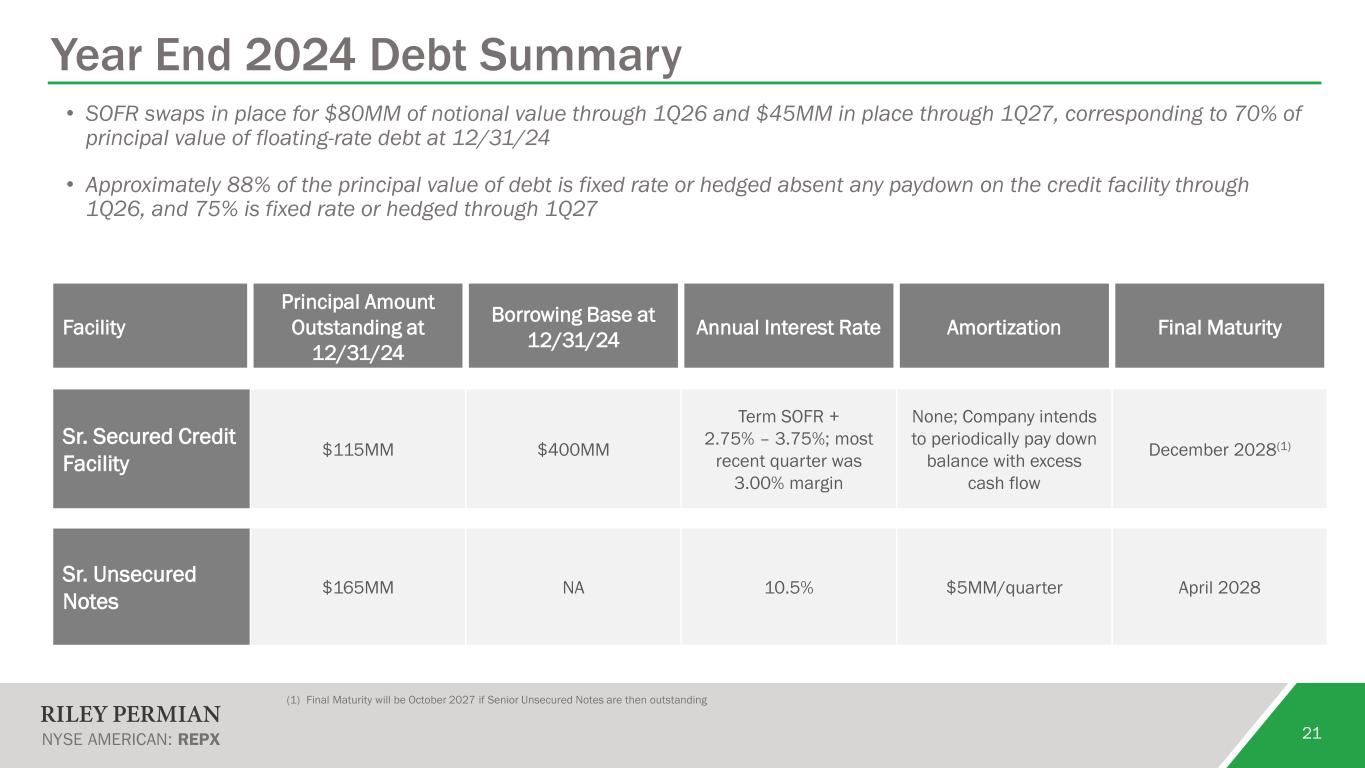
Thank you, John. I won't address the 2024 financial results as most are straightforward, but I'll add some color on new disclosures and metrics. Beginning with the most recent financials and in forward guidance, we've separately listed midstream CapEx, which in turn allows us to show pure upstream free cash flow metric separate from total free cash flow. Upstream free cash flow is a residual cash flow after reinvesting CapEx in upstream assets for production volume maintenance or growth outside of acquisitions. We believe this transparency will be helpful to shareholders given the different stages of maturity of our upstream business, which is well-established, as compared to these newer midstream assets. For most capital-intensive businesses, the ability to generate positive free cash flow will be correlated with the maturity of the business, with early-stage businesses often having growth capital investments exceeding operating cash flow. To apply the example, we allocated upstream free cash flow in 2024 as follows. 38% was allocated to additional growth initiatives, including 15% to an upstream acquisition, 14% to our Power JV, and 9% to the new midstream project. 38% went to debt reduction, lowering debt by $90 million year-over-year to one-times leverage at year-end, with the final 24% to dividends. Moving on to our 2025 plan and guidance. If the primary objective in 2024 was to demonstrate the capital efficiency of our asset base and to generate annual free cash flow, then the core objective of our 2025 plan can be characterized as longer-term positioning, wider business building, and option aggregation. Beginning with our upstream business, we're showing a range of total full-year production growth of 9% to 14%, with oil up 5% to 8%. The total production growth rate is higher than the oil rate, as we should benefit from the full-year impact of increased gas processing in Texas, which leads to the gassier mix that John referenced. We've got a fairly broad range of D&C CapEx, partially to reflect some optionality and partially given some uncertainty on non-op activity. Full-year operated D&C CapEx is forecast to increase by about 9%, while non-op spend could be $10 million, up from essentially zero last year. We're currently seeing well costs maybe 2% to 3% higher than last year, but we're showing full-year upstream CapEx increasing by higher percentage bases, including higher relative to production volume growth rates, primarily due to development being back-end weighted. So for measurement purposes, the CapEx is fully captured in 2025, while a smaller percentage of production is captured within the year. Specifically, 45% of our net operated wells put online are scheduled for the fourth quarter, most of which are currently set for New Mexico. There's a scenario where we might accelerate the midstream project. And if it's operational by late in the year, then this might allow us to flow into the new pipe and also collect some midstream revenue. Other aspects of upstream, including infrastructure outside of the gas midstream project, land, and other smaller items, which are mostly in line with spending levels from 2024 on an accrual basis. Midstream spending ranges shown of $60 million to $80 million correspond to what we believe is a reasonable construction timing schedule, though it could be slower or faster. We plan to fund this with cash flow, cash on hand, and borrowings from our credit facility as needed. We forecast staying approximately neutral for the year on debt at about $70 WTI. We're fortunate to have our balance sheet in good shape should we choose to increase debt modestly during the build-out phase. I'll note that we explored the possibility of alternative financing for the midstream project, but have currently chosen to keep it simple on balance sheet with our low-cost revolver, as well with full equity ownership. While we can reconsider options as the project develops and as cash flow takes shape. For power, we show a tighter investing range of $18 million to $22 million. Recall this is not CapEx at the Riley level, but rather a contribution to an equity method investment from Riley down to the joint venture after the benefit of project level financing at the JV level, and a net to each 50% JV partner. This year's spend is for funding the ERCOT project, and the team is making good progress there. We listed several updates on Page 11 of our investor presentation. To summarize, we're trying to build complementary assets across upstream, midstream, and power that work well together. And we're trying to turn challenges into opportunities, aiming to create situations that allow for multiple ways to win. For example, if our working interest in operated wells in New Mexico is lower than 100%, then we have a midstream asset to benefit. Note, our average is about 60% working interest. If GORs increase over time on our New Mexico oil wells, then we have a midstream asset to benefit. If gas basis in the Permian stays materially negative, then we have lower cost feedstock for power generation, leading to higher spark spreads for selling to ERCOT. And lastly, just for context, if gas index prices for the year stay somewhat elevated, yet basis remains tough, we still might realize an effective gas price of roughly $1 to $2, which could correspond to $10 million to $20 million of revenue compared to negative $1.4 million last year. I'll turn it back to Bobby for closing. Thank you.
Thank you, Philip. Once again, we appreciate your time and interest in Riley Permian. While we're pleased with our strong 2024 results, our focus remains firmly on the future. We are committed to building long-term value through disciplined capital allocation, strategic infrastructure investments and operational excellence. Our recent initiatives position us for sustained growth, and we believe our long-term strategy will continue to drive shareholder value well beyond this upcoming year. Thank you for your continued support. Operator, you may now turn the call over for questions.
Operator
We'll take our first question from Neal Dingmann with Truist Securities. Please go ahead.
Speaker 4
Good morning. Thanks for the time. Phil, maybe first one, just on the power side. I'm wondering you continue to ramp up, you've got ERCOT project coming quite soon. I'm just wondering, could you tell us maybe on the heels of that, what are the things you would consider, maybe what type of upside? And then maybe just for my second, I love the potential for the midstream gas contract? And just wonder besides the one that you've agreed for, what other upside do we see there? Thank you.
Yeah. Thanks, Neal. Good morning. Yeah, power merchant project is going great. Really excited about it, put some updates there on our slide in the investor deck. We've got all the thermal generation. It's a tight market out there, so we're excited to have procured all of that. We've got our sites for thermal. We've got several interconnection agreements. Those take a while. There's both power and gas. We're excited to have done that. Next steps will be construction. That will start in the following quarter, maybe that last 90 days, gas infrastructure, maybe that's a six to nine month build. And then we've got some power interconnect there, 30-day maybe ERCOT decommissioning. So we still think that's kind of a fourth quarter deal. It might roll into the first part of next year depending on how much testing we want to do. So that's kind of the timing. As we noted, we are assessing batteries still. It's been a volatile market, both on economics and then with some latest tariff developments and such. Just a quick thought there. Battery price. I guess, first battery generation that's been loaded to the grid has been very large. This is a bit like LED TVs, the pricing. You've got a ton of supply, price has been falling. The margin has been falling as well. And so we're just continuing to assess how much we want to do there. Overall project though, excited about it. Prices are looking good. We think this could be a nice business for next year. On the whole, it's relatively small for our total company. We like to think of it as like a hedge for a natural gas basis. As long as nat gas basis on the Permian is very poor. And even at these higher Henry Hub gas prices, you still get some nice spark spread. We report this as an equity method investment. So the financials are down below at the JV. They just trickle up to us in the form of that equity method. We've also got a project financing down there, which limits our need to have to invest through capital other than the equity we're showing there. So that's kind of an overview. Happy to answer some more if helpful. But I know you asked about midstream, I might let Bobby talk about midstream just to give you some exciting outlook there.
Thank you, Philip. We are excited about developing our New Mexico assets to quickly gain control of our molecule and ensure we are not dependent on another party's capacity for our development. We are implementing a long-term plan to address the infrastructure needs in New Mexico, including gas, water, and power, similar to what we did initially in Texas, which led to the operational efficiencies we now enjoy there. After this year, once everything is in place, we anticipate seeing significant benefits in New Mexico. It’s crucial for us to bring our molecules to market, and we are actively managing that process.
Speaker 4
Thank you, guys.
Operator
Our next question will come from the line of Derrick Whitfield with Texas Capital. Please go ahead.
Speaker 5
Good morning, guys. And congrats on a strong end of 2024. With my first question, I wanted to focus on the New Mexico Gas Midstream project. I certainly understand the need for the project, could you perhaps speak to your decision to build it versus seek a solution from a midstream operator?
Let me elaborate on that. When we assessed our development potential, we identified over 100 net locations and potentially close to 200 gross locations. However, our options in the area were limited. The entire region is facing a shortage of takeaway capacity, affecting not just us but other operators as well. Building a standalone treatment plant in New Mexico presents challenges due to the stringent permitting regulations currently in place, and such a plant would need to be quite large to meet our long-term requirements. Therefore, we chose to transport the resource via low-pressure gathering and compression into a high-pressure line that we are constructing, approximately 56 miles long, to connect with a midstream company for treatment and processing, linking to about 12 different processing plants. This strategy will enhance our efficiency while minimizing downtime. Although it's a significant commitment upfront, I believe there will be considerable long-term benefits, not just for our production but also for other operators in the region.
Let me add one thing there, Derrick. Bobby provided an important detail for those who noticed. He mentioned 100 net locations and 200 gross, which indicates that our working interest is less than 100%. It’s probably around 60% to 65% or even 50%. This implies that even for the molecules that we operate, there's a significant portion of non-owned working interest involved. While we aren't discussing fees and revenue for this midstream project at this moment, it's important to know that we will charge a market rate. There are other parties that will benefit from this, and even if no third-party producers come in, we still have a substantial amount of non-owned working interest that can contribute to additional revenue.
Speaker 5
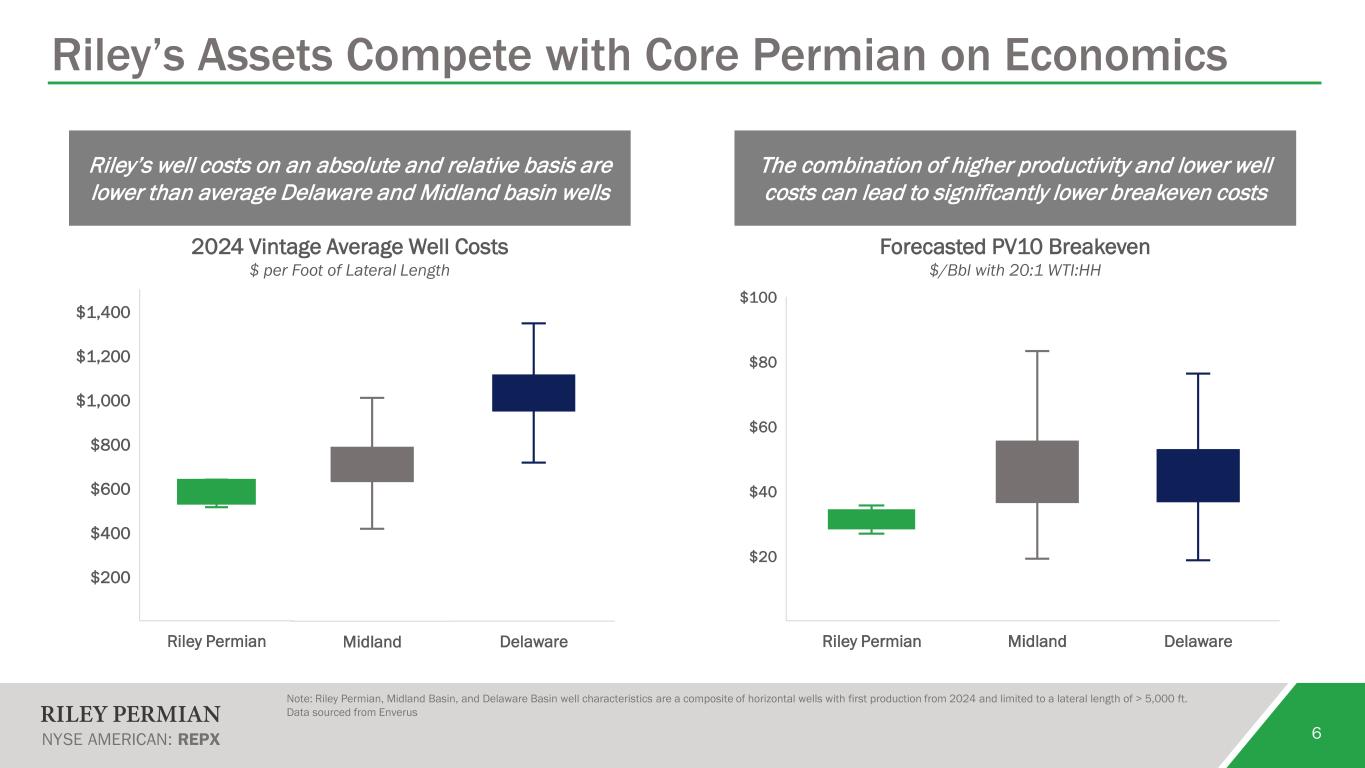
Terrific. Great color. And then referencing Slide 6, and then also thanks for the color on D&C optimization in your prepared remarks. But maybe referencing Slide 6, could you speak to how D&C cost per foot progressed throughout 2024? And then what's baked into your 2025 plan from the perspective of location mix, lateral length and cost per foot?
2024 was a great year for us. We focused mainly on our Champions asset and expanded into New Mexico, completing a few wells that we're really enthusiastic about. We have drilled about 20 horizontal wells, both with our predecessor and ourselves, and they show promise similar to our Texas asset. In terms of cost per foot, we managed to improve, reporting a reduction of about 11%, with costs around $520 per foot in the fourth quarter. We had to be strategic about waiting until we finalized our infrastructure plans, which is why we concentrated on Champions initially. Moving into 2025, we will follow a similar strategy, resuming drilling in Champions where our infrastructure is already established. The investments made in previous years allow us the flexibility to focus our resources there for development. We plan to start our New Mexico drilling in the latter half of the year, ensuring that our compression and some short-term upgrades are completed for our current gatherer by the time those wells are finished. Currently, we are also testing some completions from wells we drilled late last year in New Mexico, which we believe will provide us with technical advantages as we complete wells in the second half of 2025. This is why we are starting with Champions and then moving into New Mexico this year.
Speaker 5
And just to clarify on lateral length for 2025. You saw improvement, I think, 20% longer in 2024. Would you project that to continue to lengthen?
I think in Champions, we have a situation where 1.5 mile laterals are quite feasible. In New Mexico, most of the permits we acquired were based on 1 mile units. However, we believe there are additional opportunities to explore. Half of the extra cost in Mexico compared to Texas is related to stimulation. We are currently experimenting with our approach to increasing stage length and are using slickwater for fracking in New Mexico, while applying a gelled frac in Texas. We are also testing what a crosslink frac can achieve in New Mexico, which could offer significant advantages in the future. The results of these tests may bring cost savings in 2025, and we are eager about the potential impact.
Speaker 5
All right, great. Thanks for your time.
Operator
Our next question comes from the line of John White with ROTH Capital. Please go ahead.
Speaker 6
Good morning and congratulations on the impressive results across the board, particularly regarding your proved reserve report.
Speaker 6
Wondering if you could provide or talk about some more detail on your ERCOT effort. Maybe give us an idea of how many deals are being worked on? And what's the status of those deals and when do you think you might get something executed that you can announce?
Yeah, John, this is Philip. Right now, we're deep into Phase 2 of our ERCOT project. We appreciate the market response so far and are intrigued about the potential for more opportunities. There’s a lot of discussion happening around power for data centers, and we're looking into various ways to engage in that. We have significant gas reserves and expect to have better control over some of our gas supply, which makes this opportunity even more appealing. We're thankful for our first-mover advantage and want to monitor our progress closely. Recently, we received updates about our interconnection agreements, although these can sometimes take time due to the workload at large gas midstream companies. It’s an exciting development for our industry, being both responsive and forward-thinking. Let's stay tuned and see how things unfold. We’ll be back in two months with our first-quarter report.
Speaker 6
Okay, thanks for the update. And I’ll turn it back to the operator.
Operator
And our next question comes from the line of Noel Parks with Tuohy Brothers. Please go ahead.
Speaker 7
Hi. Good morning. Looking into the year, I'm assuming service availability or cost pressure are like not a big concern in terms of the scenarios you've been looking at, is that fair to say?
Yes, I believe we are performing quite well. The drilling aspect is stable with a slight improvement. There has been a notable reduction, thanks to consolidation and increased stimulation services. In New Mexico, we have experienced good availability and achieved some nice savings compared to 2023.
And just to add on to that, Noel, if there's any confusion, I've mentioned in my prepared remarks, we see well costs for the years slightly up. That's what we're modeling currently. Hopefully, that's conservative. Some of what that accounts for are some fixed cost facilities for some of these new areas that we're pushing into for our five well pads. So it's got that fixed facility cost that somewhat offsets the benefits that John is describing on drilling and completion.
Speaker 7
Great. Thanks. And you did mention just the statistic that you're using 20% more self-generated power than a year ago. And is that a good sort of plateau for where you think you'll be? Or is there upside to have you anticipate for that?
Yeah, I think what we were doing is really taking our time to test this to ensure the high run rate and reliability. We're continuing to transfer overload. We've got more to do there. We've got plenty of room. So we're excited to keep doing that. And I think you'll see a little bit more there next time we're talking. All in all, that shouldn't translate to much change in our LOE. This is a small party overall company, but it's nice to say that we're doing that. And it's nice to have so much ship then in that joint venture.
Speaker 7
Great. Thanks a lot.
Operator
And our next question comes from Jeff Robertson with Water Tower Research. Please go ahead.
Speaker 8
Thank you, good morning. Regarding the Midstream projects, could you provide more details on the timing for when you expect them to come into service? Additionally, Philip, will the benefits you mentioned appear in financial line items? For instance, if you're marketing third-party gas for non-operators, would that result in a reduction to your LOE?
This is John. Regarding the timing of the midstream projects, we believe they could potentially come online as early as the end of 2025, with a longer scenario extending into the middle to end of the first half of the third quarter. The timeline depends on several factors, including the right-of-way and regulatory approval for the route, which typically take about five to nine months and proceed concurrently. Following that, we will need to decide on the rollout of the long pipeline that Bobby referenced. Ultimately, project execution is crucial, and there isn’t much flexibility in timing there. The pivotal factors will be the right-of-way and regulatory approval. We believe we’re making good progress on getting the final route approved and securing an earlier order for the pipe. We are enthusiastic about the project and aim to expedite it. However, the right-of-way and regulatory aspects are the least expensive parts of the entire process, which complicates our ability to accurately forecast how everything aligns with 2025 or 2026 when the larger expenses for the pipe and the labor necessary for installation will occur. These are important factors in determining when expenditures will be made.
And then, Jeff, on the income statement geography. We're still working through it, but I think at a high level, you'll see some midstream revenue. You may see midstream OpEx. And then you'll see an intercompany elimination to adjust out from the gross to the net for our owned working interest versus the growth that I described before. But a reminder, you can think about it as the gross as it starts, you can jump on in there and look at how much gas we produce out there on a gross basis. And probably do some simple math as to what some market rates could be and think about how that has the potential to grow into the future.
Speaker 8
Is the build, Philip, I think you said that production in New Mexico would be fourth quarter weighted for 2025. Is some of that dependent on progression on the midstream system?
Yes, it really depends on when we can finalize that. Even if we achieve it in late fourth quarter, we might be fortunate to see significant production beyond the immediate impact from our existing assets. The newly drilled completions will either be operational in the fourth quarter or likely in the first quarter of 2026.
And just to add to that, I think there's two lenses you can consider as the physical constraint for the flow assurance is what John just addressed, gives us higher confidence to produce those if we're going through our own system. But then there's also the opportunity, right, or opportunity cost if you don't put it through your own system. So all else equal, if we're going to be doing these, we'd rather put it through our own system and collect some of the fee revenue.
And there are some other phases of the project where we are laying some gathering system into the New Mexico asset, part of what we've already described. But that will bring on some other production that already exists, again, besides just what we'll be drilling.
Speaker 8
And lastly, on the midstream, does that footprint provide any advantages in acquiring assets that could further support the build-out?
Well, that's pretty perceptive. Exactly what we're thinking.
Operator
And that will conclude the question-and-answer session and our call today. Thank you all for joining. You may now disconnect.