Operator
Good day, and welcome to the STAAR Surgical Company Fourth Quarter 2025 Financial Results Conference Call. Please note, this event is being recorded. I would now like to turn the conference over to Connie Johnson, Director, Investor Relations. Please go ahead.
Speaker 1
Thank you, operator. Good afternoon, and thank you for joining us. On the call today are Warren Foust, Interim Co-CEO, President and Chief Operating Officer of STAAR Surgical; and Deborah Andrews, Interim Co-CEO and Chief Financial Officer of STAAR Surgical. Earlier today, we reported our fourth quarter and fiscal 2025 results via press release and Form 8-K. We posted our results release and shareholder letter to our investor website at investors.staar.com. Today's call is scheduled for 1 hour and will include Q&A for publishing analysts. Webcast participants can also send questions for today's Q&A session to [email protected]. Before we get started, I want to remind you that during today's discussion, we will be making forward-looking statements. Forward-looking statements are subject to risks and uncertainties that may cause actual results to differ materially from those expressed or implied by such forward-looking statements. I encourage you to read the disclaimers in today's release, the shareholder letter as well as disclosures in our filings with the SEC. Except as required by law, STAAR assumes no obligation to update these forward-looking statements to reflect future events or actual outcomes. In addition, during today's discussion, we will reference certain non-GAAP financial measures, including adjusted EBITDA and constant currency sales. Please refer to today's release for definitions and reconciliations of non-GAAP metrics. For brevity, unless otherwise specified, all comparisons on today's call will be on a year-over-year basis versus the relevant period. Finally, a quick reminder. We intend to use our website as a means of disclosing material nonpublic information and for complying with our disclosure obligations under Regulation FD. Such disclosures will be included on our website in the Investor Relations section. Accordingly, investors should monitor our investor website in addition to following our press releases, SEC filings and public conference calls and webcasts. And with that, I'd like to turn the presentation over to the Interim Co-CEO, Warren Foust. Warren?
Speaker 2
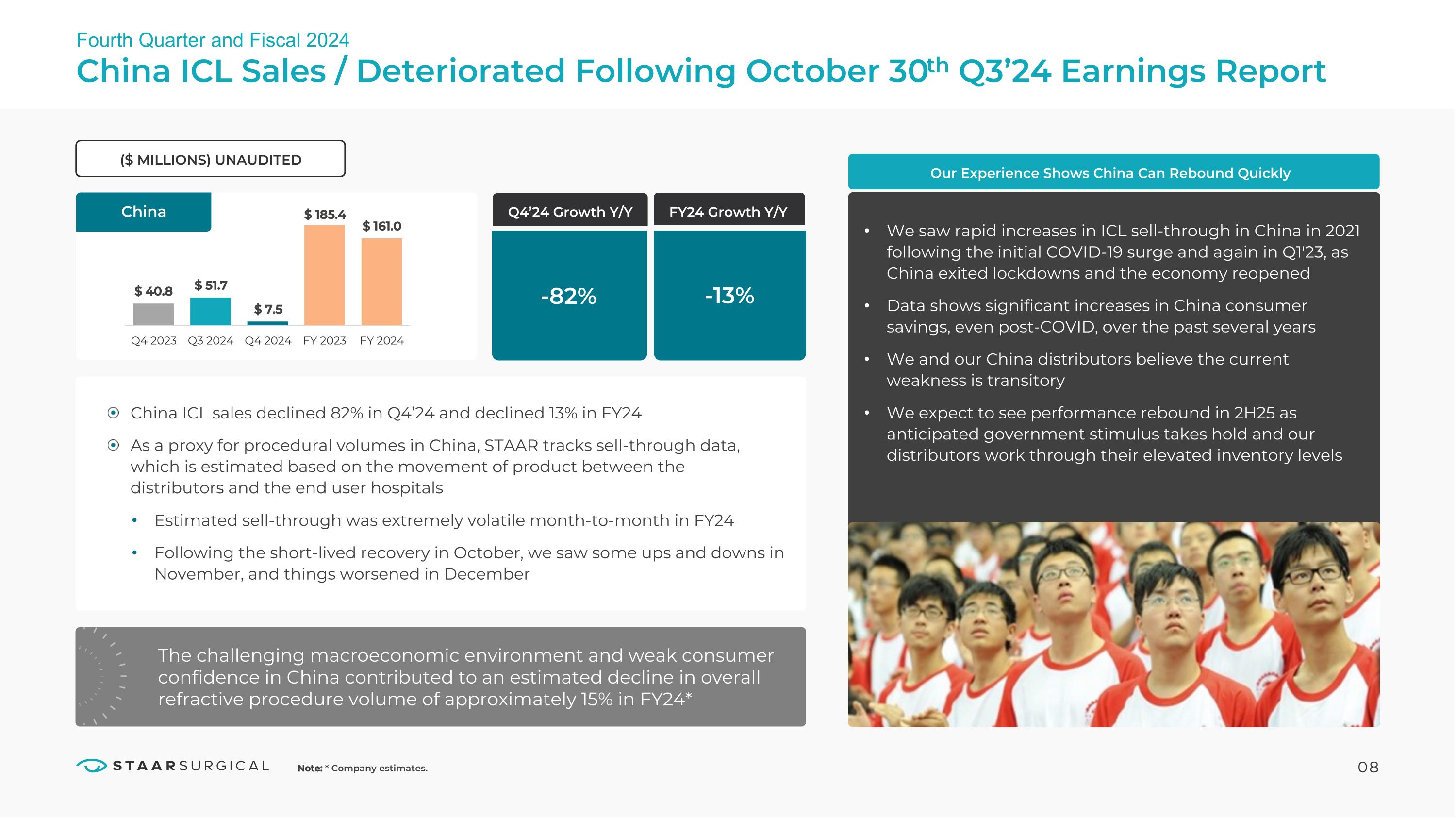
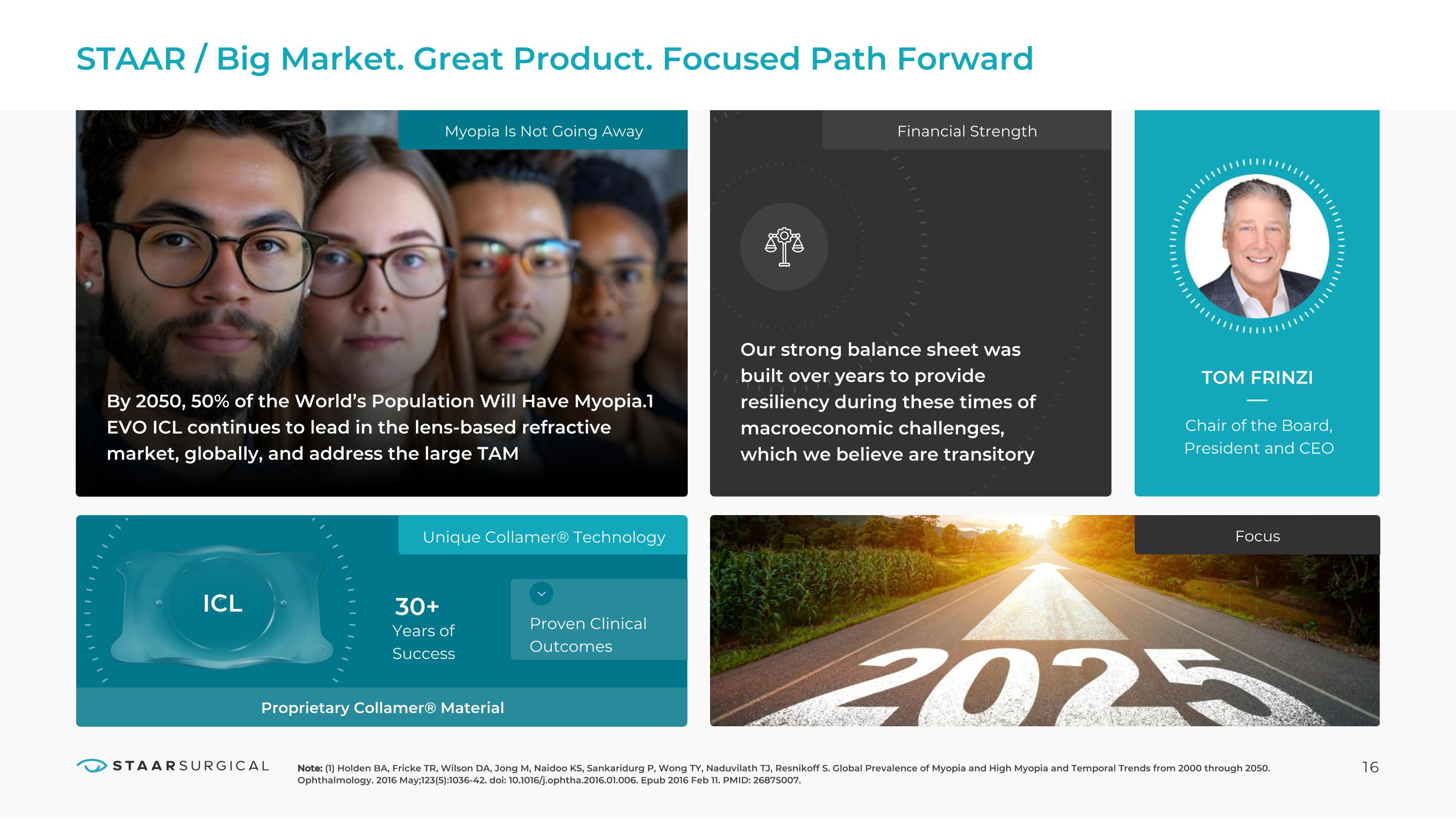
Good afternoon, everyone, and thank you for joining us. Deborah and I are pleased to be with you today on our first quarterly results call as Interim Co-CEOs. Before we dive in, I'd like to address our leadership structure. Deborah and I stepped into the shared role of Co-CEOs effective February 1st, and we are jointly leading the organization on an interim basis. We bring continuity to this transition. Deborah and I have worked very closely and collaboratively over the past year in our roles as Chief Financial Officer and President and Chief Operating Officer, respectively, and that partnership has positioned us well for this next chapter. We complement each other's capabilities and areas of expertise, and we are aligned on both priorities and execution. STAAR's Board of Directors has engaged Egon Zehnder, a leading global executive search and leadership advisory firm, to conduct the search for STAAR's next Chief Executive Officer. The search will include both internal and external candidates. 2025 was a difficult year of transition for STAAR. We expect 2026 to be a much better year, a year of growth, improving profitability and meaningful progress across our innovation pipeline, all of which we plan to discuss on today's call. As Connie indicated, along with today's results release, we have issued a shareholder letter that provides commentary on 2025 and discusses our plans and approach for 2026. Deborah and I have the benefit of being deeply familiar with and embedded in the operations of STAAR. We are working with our teams to evaluate our portfolio and roadmap after a period of uncertainty, setting clear expectations on both operational front and in terms of financial performance in order to unlock the power of our 2026 growth, profit and innovation plan. We are encouraged by the start of 2026. The team is energized and productive. Days are filled with customer engagements, distributor meetings, internal town halls, leadership alignment sessions, and global commercial kickoffs focused on clinical training, commercial readiness, sales effectiveness and message discipline. Our teams are excited because across most markets, refractive surgery continues to move toward lens-based procedures and away from laser vision correction procedures that require corneal tissue removal. EVO ICL continues to gain share even as the broader laser vision correction market struggles. Consequently, STAAR remains well positioned to reaccelerate growth in existing markets and unlock opportunities with our new product offerings. In China, our largest market, after several years of macroeconomic volatility driven by COVID, housing market weakness and uneven consumer spending, conditions stabilized in 2025 as policy support increased and the stock market rose sharply. In-market EVO ICL demand recovered at mid-single-digit rates and procedures improved as we exited the year. This recovery did not translate into China net sales growth for STAAR in 2025 as our distributors reduced inventory levels, but it does provide us with optimism about 2026. Market conditions in China appear to be positioned for a rebound, which will help drive growth for STAAR. Outside China, we also have reason to be optimistic about STAAR's future growth. We are seeing momentum in our U.S. business despite the ongoing decline in laser vision correction procedures. And with our recently announced expanded age range indication for EVO in the United States, which is now approved for myopia treatment in adults aged 21 to 60, our opportunity is even bigger. This expanded indication equates to roughly 8 million more potential candidates for EVO in the United States. Our efforts to expand our EVO labeling are helping fuel our growth in other parts of the world as well. For example, in Brazil, EVO had previously been approved for use down to minus 6 diopters and can now be used for treatment of myopia down to minus 0.5 diopters. Our growth remains steady across the Americas, and we expect to see additional expansion in Canada in 2026. In 2025, we went direct in Canada. And while the team is small, our efforts there are already paying off. In 2026, we are targeting solid growth of EVO in EMEA and in our Asia Pacific markets such as Japan, Korea and India. India, in particular, where we're laying a foundation, represents a growing opportunity for us as its economy is growing quickly and a rising portion of its population can afford refractive surgery. We're also excited about the market opportunities in Taiwan, where we received regulatory approval in 2025. In terms of profitability, we made a lot of progress in 2025, and profitability will continue to be a focus in 2026. In 2025, we took costs out and reduced our annualized adjusted operating expense run rate, and we beat our second half $225 million target communicated to investors back in Q1 2025. As revenue grows, we expect cost discipline to drive operating leverage. We are focused on enterprise-wide impacts, not isolated improvements and on new ways of working that increase the velocity of decision-making, so actions can translate more quickly into results and returns. Profitability expansion comes from reducing costs enterprise-wide, but it also comes from disciplined investing. We are focused on opportunities big and small, including manufacturing and infrastructure improvements, and we continually look for margin improvement opportunities in our sales and distribution network. We also believe that optimizing ASPs can contribute to increased profitability. We are allocating capital where it makes the greatest impact, the right programs in the right markets, supported by the right people and infrastructure. To that point, we are in the final stages of our Oracle ERP implementation, which will modernize the way we operate enterprise wide. Full deployment is expected early in the second half of the year. Alongside ERP, we are advancing Stella, our next-generation online sizing and ordering platform, which reduces friction in the adoption of EVO ICL technology. We are also advancing additional IT initiatives spanning from manufacturing process improvements to sales force enablement. We believe these investments will not only benefit our surgeon customers and patients, but will drive efficiency and profitability across the organization. Our 2026 growth, profit and innovation plan also reflects a renewed focus on innovation. I'm proud to report that we have launched EVO+ in China, and we are progressing with our rollout plan as we scale Swiss manufacturing to meet demand. EVO+ represents our first new lens in China in more than a decade. Early demand has been encouraging, and we are working to increase supply as production scales. Over time, we expect higher ASPs and margin expansion from EVO+ in China. In 2026, we are also expanding the commercial availability of the Lioli injector for EVO ICL procedures. The Lioli injector has been well established in the United States, and we are pleased to bring this new injector option to our surgeons in EMEA. We're excited about these near-term launches, but we are also focused on our pipeline for the longer term. We are building new capabilities, and our teams are establishing clear milestones and timelines for future advancements as well as the operational discipline and accountability required to stay on track in a rapidly evolving market. Before I hand things over to Deborah, I think it's important to recognize that 2025 is now in the rearview mirror and the disruption associated with our proposed merger with Alcon is behind us. Our shareholders have spoken supporting a long-term approach, and we are listening to them, embracing the opportunities for STAAR as a stand-alone company. We firmly believe that STAAR has everything it takes to deliver on our growth, profitability and innovation goals. We have superior technology. Our differentiated Collamer material is the foundation for our EVO technology and is unmatched in the market. Only STAAR has 40-plus years of history treating myopia with our innovative lens-based procedure. And the myopia and dry eye disease epidemics are only getting worse. We have trusted relationships with our partners. The STAAR surgeon community is passionate about EVO ICLs and bringing the benefits of lens-based vision correction without corneal tissue removal to their patients. The power of this devoted customer base is real and tangible. We have a talented team. Our dedicated employees and the STAAR leadership team are aligned, focused and have the capabilities to execute our goals and objectives and drive stockholder value creation. Now I would like to turn things over to my Co-CEO, Deborah, for additional commentary and to discuss our financial results. Deborah?
Speaker 3
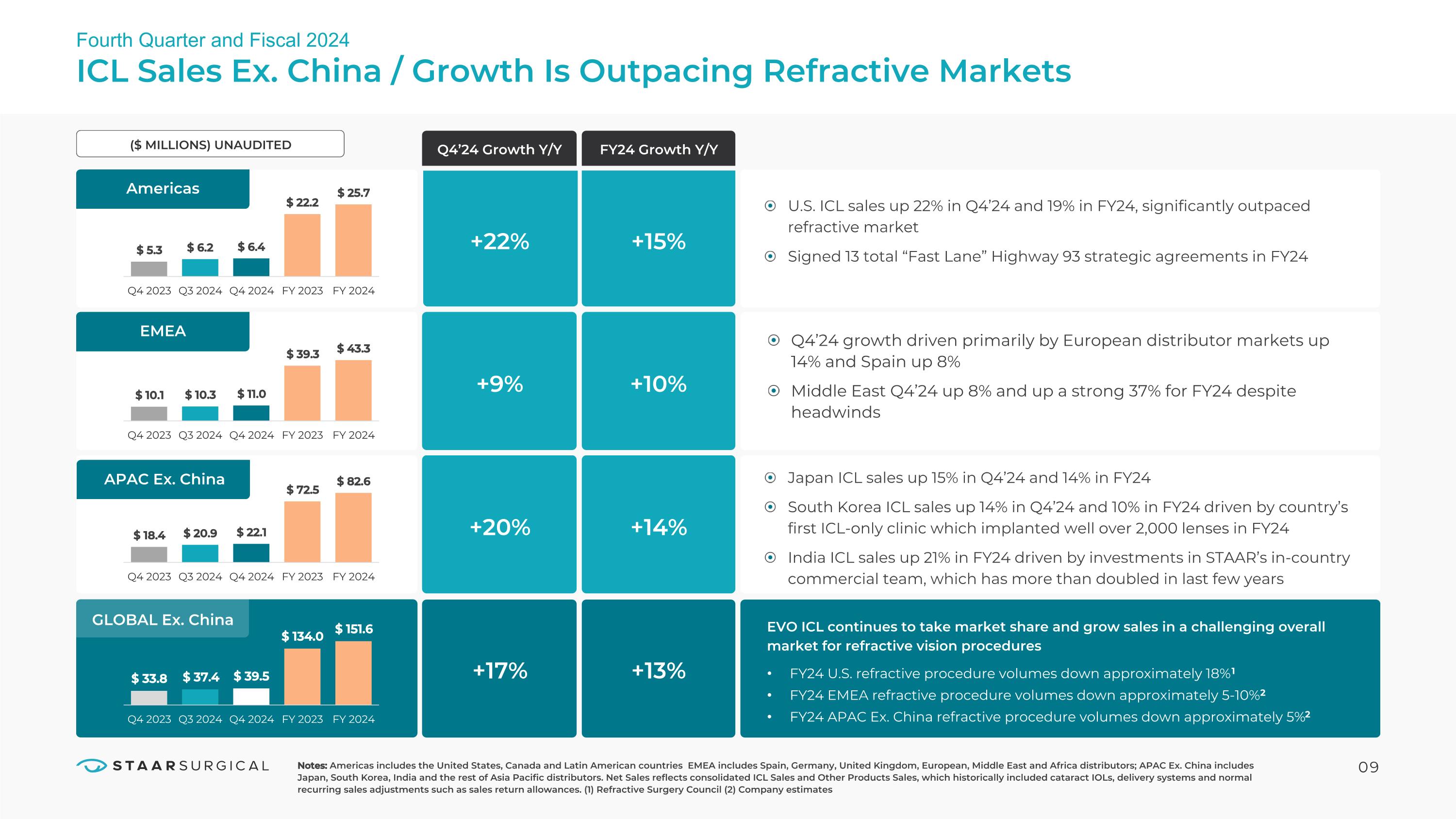
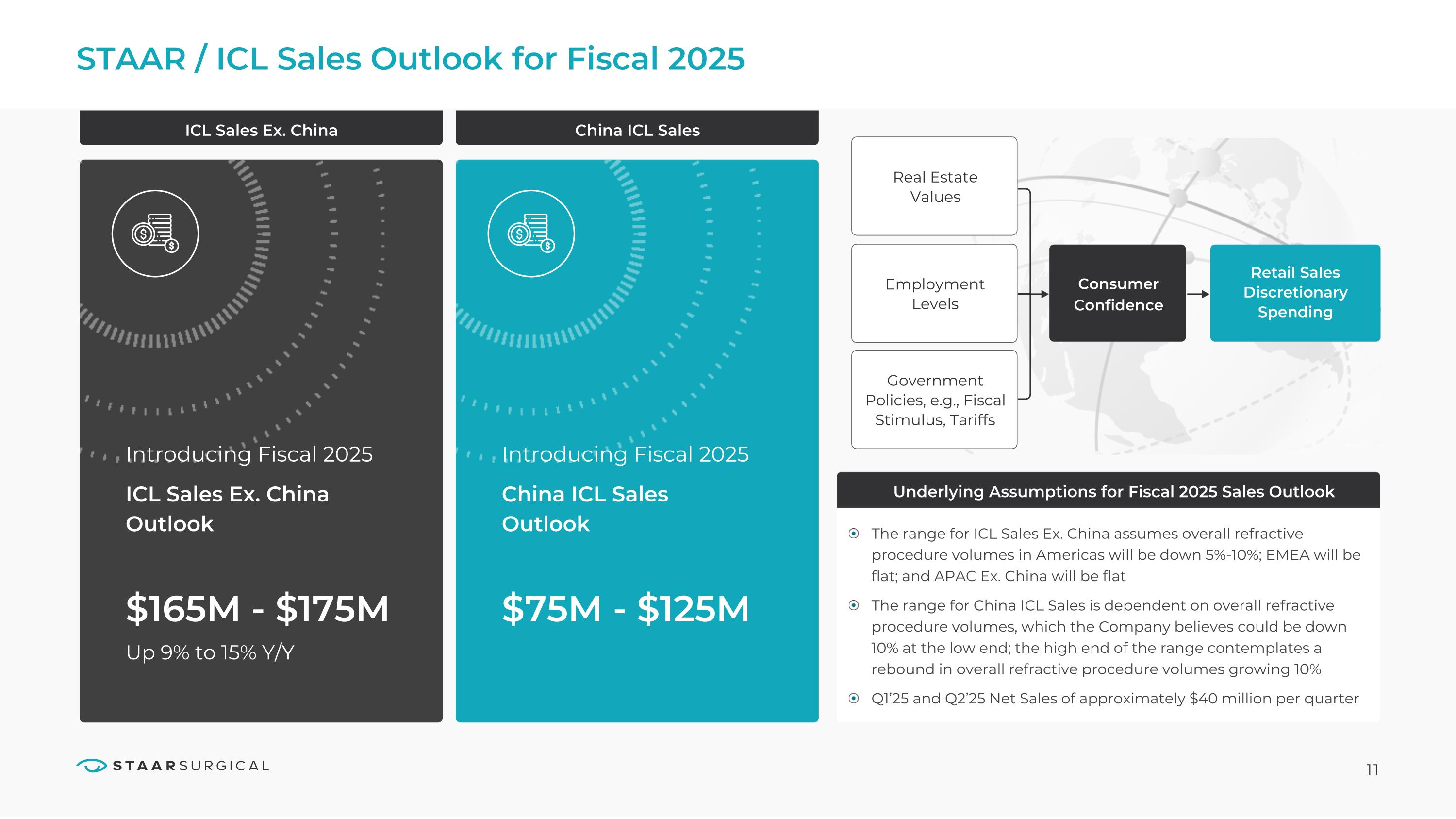
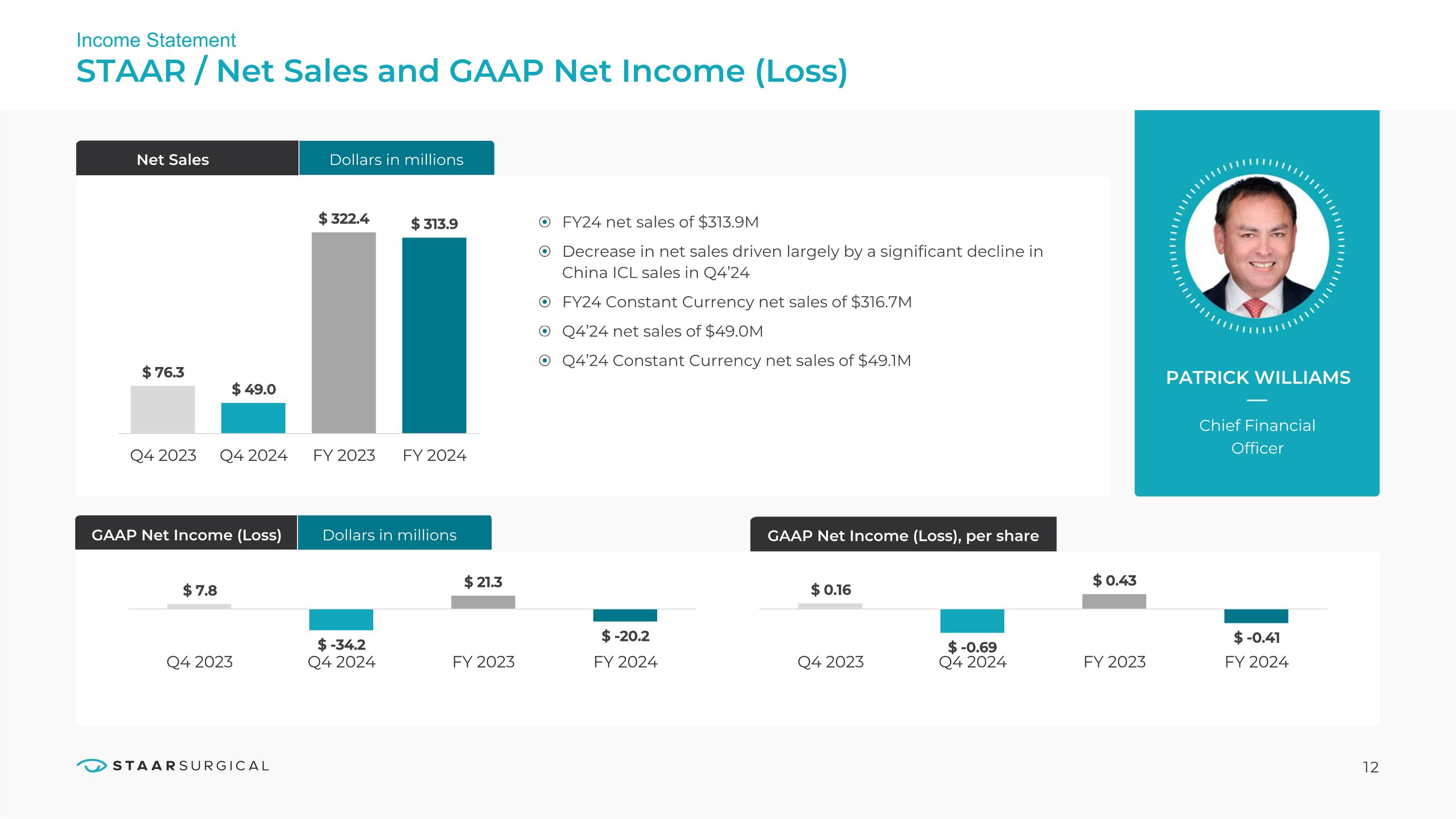
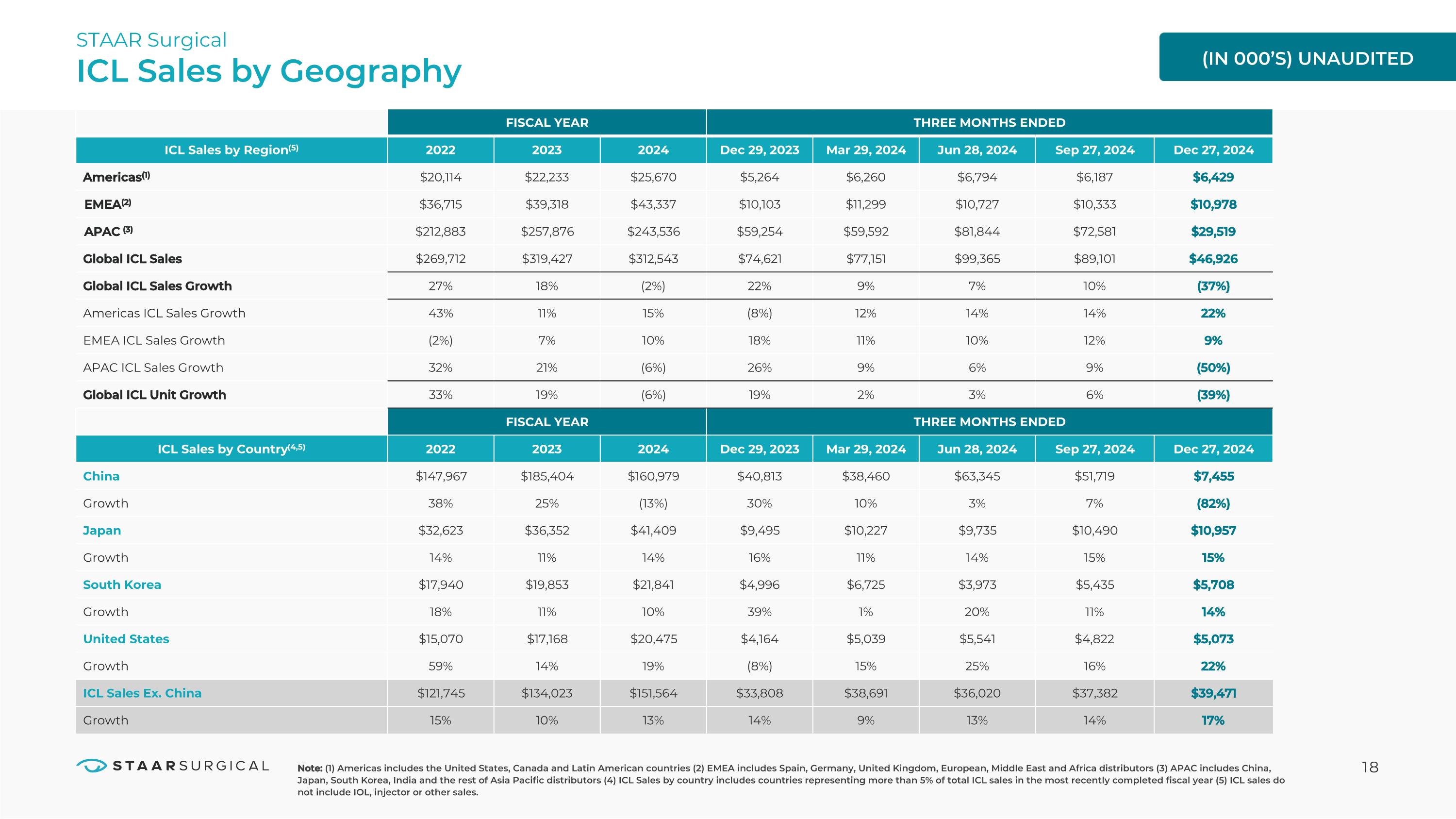
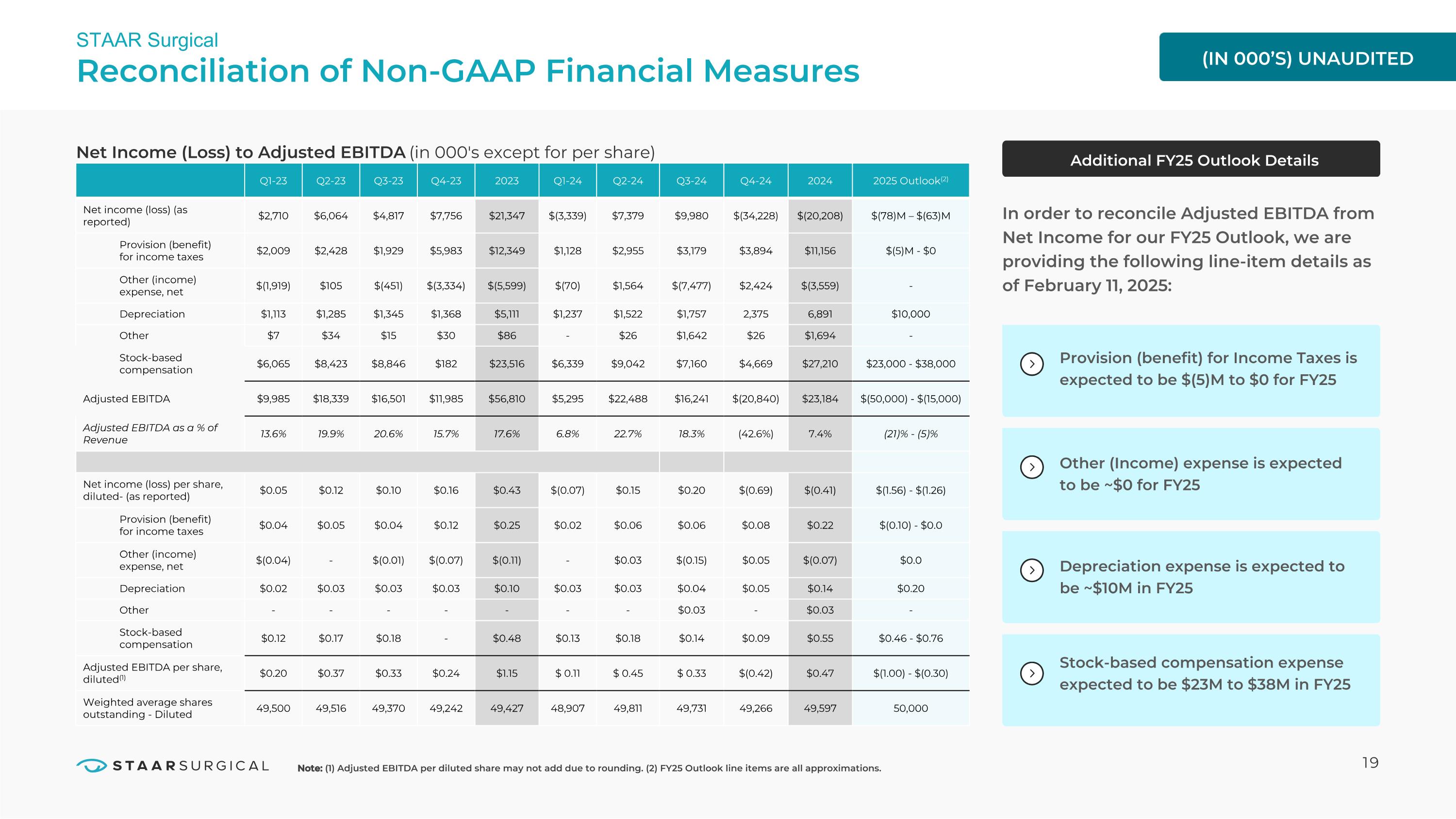
Thank you, Warren. I'm pleased to join you on today's call, and I'm proud to lead the STAAR organization with you as Co-CEO. As Warren said, we took a number of steps in 2025 to reduce our costs and improve our profitability. A key activity in 2025 was addressing our China inventory to position STAAR for future growth. Our most significant operational challenge in 2025 was working through rebalancing product inventory in China following weakened demand in 2024. That year saw a double-digit decline in in-market EVO ICL sales and elevated inventory levels. In response, we deliberately paused shipments, normalized channel inventory and strengthened distributor discipline. These actions were painful, but necessary. By late 2025, inventory held by our distributor customers in China had declined to contractual levels. In-market sales and procedures improved and business momentum began to return. As previously discussed, our December 2024 China shipment contributed to elevated inventory levels. This $27.5 million shipment was consumed during fiscal 2025. And by the end of Q3, we had fully recognized the revenue associated with the December 2024 China shipment. During much of this period, STAAR did not have complete visibility into downstream inventory levels or actual EVO ICL procedure volumes. Over the past year, we have invested time and effort in more comprehensive data processes and analyses that now provide improved and still evolving insight into inventories across the channel. While this work is ongoing, our visibility has improved materially and will continue to strengthen. Let me briefly touch base on tariffs and Swiss manufacturing. We are pleased to report that we were able to respond quickly in 2025 when rising China-U.S. tariffs created additional headwinds for our business. We were able to mitigate near-term exposure by deploying temporary consignment inventory and leveraging existing China-held inventory, while accelerating manufacturing expansion in Nidau, Switzerland. Our Swiss facility is now producing commercial product and is focused on EVO+ for China. Products manufactured in Switzerland are not subject to U.S.-China tariffs, which will be a benefit in the near-term as we roll out EVO+ in China. We believe Swiss manufacturing can be a long-term benefit as we look to manufacture EVO and EVO+ for China in the future. Swiss manufacturing not only helps mitigate tariff exposure, but it provides flexibility and scale to support sustained growth and significantly strengthens our long-term supply chain resilience. Now I'd like to turn to fourth quarter results. I'll start with fourth quarter sales performance, then margins, profitability and cash. Total net sales for the quarter were $57.8 million as compared to $49 million in the year-ago quarter, driven by a lower-than-expected rebound in sales in China, partially offset by growth in Americas and non-China APAC regions. China net sales were $17.5 million in the fourth quarter of 2025 as compared to $7.8 million in the year-ago quarter. During the quarter, certain China subdistributors and customers returned some inventory to our distributors, resulting in lower-than-anticipated fourth quarter net sales for STAAR. We believe this was largely due to uncertainties about their future if the company were acquired by Alcon. This uncertainty also impacted sales to distributors in other parts of the world. While these disruptions depressed our fourth quarter results, we believe that reduced distributor inventories will lead to improved net sales for STAAR in 2026 and beyond. Excluding China, net sales declined by 2% year-over-year, with the Americas up 18% in the fourth quarter, EMEA down 20% in the fourth quarter, driven by a distributor transition in the Middle East and distributor dynamics across the region due to the proposed Alcon merger and APAC ex-China up 2% in the fourth quarter. Turning to margins. Gross profit margin for the fourth quarter of 2025 was 75.7% of total net sales compared to the prior year quarter of 64.7% of total net sales. The increase in gross profit versus the prior year quarter was due primarily to the timing of the recognition of the cost of sales associated with the December 2024 China shipment, decreased period costs resulting from cost reductions implemented in the first quarter of 2025 and the ramp-up of Swiss manufacturing, partially offset by higher inventory provisions. Total operating expenses for the fourth quarter of 2025 were $66.6 million compared to $59.6 million in the prior year quarter. Operating expenses for the quarter included costs related to the company's terminated merger transaction with Alcon of $11.2 million and costs related to restructuring of $0.7 million. Excluding the costs related to the merger and restructuring, operating expenses for the fourth quarter of 2025 were $54.7 million, a reduction of 8.2% from the prior year quarter. Our 2025 cost actions reversed the expense growth of prior years, and we achieved significant cost savings in 2025. As revenue recovers, we intend to maintain this cost discipline, positioning the company to return to profitability. Because our proprietary products can earn strong gross margins, our operating margin has the potential to be quite high if we execute our plans effectively. Adjusted EBITDA for the fourth quarter of 2025 was a loss of $200,000 as compared to a loss of $20.8 million in the year-ago quarter. The year-over-year improvement in adjusted EBITDA was primarily attributable to higher gross profit and lower operating expenses before merger and restructuring expenses, partially offset by merger and restructuring expenses. Turning to our balance sheet. We ended the quarter with approximately $187.5 million in cash, cash equivalents and investments available for sale, a level of cash we have held fairly steady since Q2 despite significant restructuring and merger-related expenses. STAAR has no debt. As we look ahead to 2026, we are not providing financial guidance. However, we do want to provide some color commentary as to how we think 2026 will compare to 2025. First, because we expect to significantly increase our sales in 2026 compared to 2025 and because we made significant cost reductions in 2025, we are targeting profitability in FY '26. Second, while we are driving profitability, we believe gross margin will be slightly lower in '26 relative to '25 as higher cost of inventory for our Swiss manufacturing facility is sold in '26 and increased inventory reserves from expiring product create headwinds. We will work to offset these increased costs in 2026 through higher ASPs, improved yields and efficiencies in our manufacturing, which should lead to tailwinds in 2027. Third, we achieved significant operating expense savings in 2025. For 2026, we expect to maintain our operating expense run rate at levels generally aligned to the $225 million target we communicated to investors back in Q1 2025. Finally, while cash will dip modestly in the near-term, we expect to resume cash generation in the back half of the year and end 2026 with a higher cash balance than 2025.
Speaker 2
Thanks, Deborah. To summarize, 2025 was a year of transition. 2026 is about execution. We have stabilized China. We have rightsized costs. We are scaling Swiss manufacturing. We're accelerating EVO+ in China, and we are aligned around growth, profit and innovation. We possess differentiated Collamer material, exceptional optical technology and a proven ability to gain market share in a very large and growing myopia market. We are moving quickly to ensure every employee understands our growth, profit and innovation focus and carries measurable goals tied directly to execution. Our people are talented and highly capable. We recognize change can be difficult, but it's also exciting and filled with promise and opportunity. We are working to reignite the organization around sustained long-term growth. Our Board and leadership team are aligned. Our strategy is clear, and our focus is disciplined execution and long-term shareholder value creation. We are energized by what lies ahead and confident in our path forward. Thank you for your continued support. Operator, we'll now take questions.
Operator
The first question comes from Tom Stephan with Stifel.
Speaker 4
First one, just on distributor inventory. Warren, have the reductions continued into the first quarter, or has that stabilized now that Alcon is behind you? And with that in mind, can you give us any guardrails for how to think about the first quarter and revenues maybe compared to the $77 million in 1Q '24? We're here in March. I actually think Chinese New Year ended today. So just any comments on 1Q revenue as well would be helpful. And then I have a follow-up.
Speaker 2
Yes. Thanks for the question. Look, we're really pleased with the progress we've made on inventory management. I actually love the progress and the oversight. We've got a new leader based there in Asia Pacific and China. This is a highly skilled, deeply experienced senior VP who's joined us, who's helping with that process. We're looking at inventory on a weekly basis. So we understand much better than we used to. It will never be perfect, but we understand it much better than we did. So we watched at the end of 2025 inventory get cooled down all the way below or right at contractual levels as we exited 2025. And we continue to see really stable inventory levels at our distributor. In fact, we're a little bit below the 6-month contractual level that we referenced before. So inventory is in a good place. We feel like we're ready now as the market starts to come back and we'd see what the market is going to bring. So that's on inventory. And then as far as just the Q1, you heard Deborah's comments, we're obviously not going to provide guidance. But what we would say is we're pleased with how '25 ended in China end market. 2024 was a really challenging year. That was, we believe, double-digit decline in in-market demand, which in 2025 rebounded to a nice sort of mid-single-digit level, and we think that we're going to experience that as we exited '25 into '26. So we maintain optimism.
Speaker 4
Got it. That's great. And then just my follow-up, more thematic and taking a step back. Warren or Deborah, maybe if you can spend some time just discussing sort of the health of the organization today and how it compares to pre-Alcon. Sort of curious if this is any sort of consideration, positive or negative, in the near-term or long-term as we think about the path forward for the company?
Speaker 2
Yes, it's a good one. I'll start and maybe Deborah can join us because I think she's done a lot in 2025 on the financial side to really get us into a healthy place. You'll remember that we let expenses spiral out of control in advance of the Alcon merger agreement. And we really got control of that starting in the Q1 2025 timeframe. And so I think as we went through the year, despite what was going on with the disruption, and there was a lot of disruption, particularly in the Q4 timeframe, we can talk about that. But we got our expenses in line, and we've carried that discipline now through '25 and we believe into '26, and that's our plan is to make sure we maintain that discipline. So I think from a cost management standpoint, that's great. Now it's about restoring revenue. You heard us talk about this 3-pronged approach. Let's grow our revenue, let's expand our profit margin, and then we have to accelerate our innovation. And we've got the organization what we believe, even early in our new roles, aligned around those 3 focal points. So I think what you would find is post Alcon transaction, we have a very aligned Board. The Board and the management team, we all want the same thing. We want growth and profitability. The organization, I think, is happy to be past the disruption. And so now it's about can we go out and execute. And I believe that we have the talented team to lead us to do that.
Operator
The next question comes from Ryan Zimmerman with BTIG.
Speaker 5
This is Izzy speaking on behalf of Ryan. To begin, I appreciate that you're not providing guidance for 2026, and I heard your comments, Tom. However, I wanted to ask for a bit more insight. Given that China experienced mid-single-digit growth in end market demand while the rest of the business declined by around 2%, do you think a low single-digit growth rate is a reasonable expectation for 2026 overall? Any additional commentary on growth would be very helpful as we start to refine our models.
Speaker 2
Thanks for the question, Izzy. Just to clarify, are you asking if the 2% decrease we observed in the quarter excludes China? Or is your inquiry about something different?
Speaker 5
So as we think about the balance of the company, right, weighing what we've seen in China versus what you're doing in the rest of the world collectively, do you think low single-digits is a good place to be or something that could be achievable for 2026 for STAAR?
Speaker 2
I appreciate the question. To provide some context regarding 2025, particularly in Q4, there has been significant disruption. We've observed our distributor partners globally, not just in Asia, making decisions about their inventory. When distributors anticipate potential transactions and fear for their job security, they tend to reduce their inventory and may hesitate to invest in initiatives that could generate revenue. We observed this behavior especially in Europe, where our Q4 figures were weaker. We believe these factors were largely influenced by the disruptions, which are now behind us. We remain optimistic about the growth of our business outside of China. We see surgeons shifting away from LASIK towards lens-based refractive surgery, preferring our Collamer product, which has been established for 30 years. We are the only player in the phakic IOL market with such a history. The momentum for ICLs is continuing. We anticipate this positive trend to persist both in China and internationally. While we are not providing specific guidance on future numbers, we are satisfied with our current position.
Speaker 5
Got it. And as we think about the distributor dynamics, can you elaborate a little bit more about the specific structural changes that you've put into place with those agreements, particularly in China that will prevent us from seeing any form of inventory buildups similar to what we saw in '24 and '25?
Speaker 2
You bet. As I mentioned earlier, it will never be perfect. I don’t want to suggest that we have complete knowledge of China, including all the layers of subdistribution, first tier, second tier, and various hospital holding companies, as well as the numerous hospitals throughout the country. However, I can tell you that we have significantly improved our processes. We monitor those numbers on a weekly basis, and we have insight into the shipments from our distributors down into the distribution network, along with the returns. This gives us a useful estimate for net sales. While it may not be an exact net sales figure, we believe that now, with our inventory levels adjusted in China, we have a reliable indicator of in-market demand.
Operator
The next question comes from Brad Bowers with Mizuho.
Speaker 6
I wanted to ask about China. Historically, the second quarter is a busy season. Last year, that was unclear due to distributor issues. How should we be modeling the second quarter? Is seasonality still expected? Are there any early indications that the momentum we usually see will return this year in China?
Speaker 3
This is Deborah. We expect that from a seasonality standpoint, Q2 and Q3 will continue to be very strong for STAAR in 2026, as it has been historically. So, don’t anticipate significant changes in that area.
Speaker 6
Okay. That's helpful. And then maybe just a high-level one, just how we should be thinking about prioritization, U.S. growth versus China growth. Obviously, historically, China has been a ballast to the business. How should we be thinking about getting back towards that versus accelerating some of the U.S. businesses and again, the prioritization of each?
Speaker 2
Yes, it's a good question. We're proud of the progress we're making in the U.S., where we're seeing success. Last year, we adjusted our cost structure, which was partly related to the U.S. business and partly due to our global footprint, as a lot of our infrastructure is based in the U.S. Despite this, we achieved solid double-digit growth in the U.S. However, it remains a smaller business compared to our larger operations outside of the U.S., particularly in China, followed by Japan, Korea, Southeast Asia, and India, which represents significant opportunities, in addition to our activities in Europe. We will continue to invest alongside our customers in EVO ICL, both in the U.S. and internationally, as long as customers show interest in partnering with us. We're noticing that surgeons and patients are increasingly looking for alternatives to laser vision correction, favoring lens-based options that are reversible. As customers share this with potential patients, we will collaborate with them and direct our investments there. China is still our biggest opportunity, and we plan to expand our efforts there significantly.
Operator
The next question comes from Simran Kaur with Wells Fargo.
Speaker 7
I guess just bouncing off of the prior question, maybe Warren or Deborah, could you help us understand like what is the true growth algorithm from here? How much is driven by the continued China recovery and growth versus ex-China recovery penetration and mix? And can you get back to that strong double-digit growth levels that you were seeing in China prior to last year and sort of that mid-teens growth level ex-China? Just help us understand how you get back to sort of the pre-2025 levels, and over what time?
Speaker 3
Thank you for the question. I don't believe that in 2026 we'll experience the same hyper growth levels we saw in 2023 and earlier. We are certainly aiming for that. Fortunately, our Board takes a long-term perspective on the company. While we do anticipate solid global growth for the company in 2026, I want to caution that I don't expect growth rates of 20% or 25%. However, we are definitely working towards that, and that remains a significant opportunity.
Speaker 7
Understood. That's very helpful. And maybe just in China, I appreciate the commentary around the EVO+ sort of launch. How should we think about competition in 2026? And can you give any color around what is that ASP delta between EVO+ versus EVO in China? And how much of the 2026 China growth algorithm is being driven by price versus volume and sort of underlying demand and improving macro?
Speaker 2
Yes, it's a good question, Simran. And what I would say is even just appending to Deborah's previous comments because I think they're somewhat related, we're still wildly underpenetrated as far as refractive surgery as a percentage of the myopia epidemic that exists in this world. China is no different. They, in fact, lead in that. Maybe India is right there close with them. And so I think we collectively, as those that want to impact that epidemic. Lens-based refractive surgery is growing, but that's one piece of it. And so I think there's going to be plenty of opportunity for us, plenty of opportunity for competition as well. What I would say about the competitors, look, we take it really seriously. It's a little flattering, if I'm honest, that phakic IOLs are starting to grow. And I think it just speaks to LASIK is in most markets on the decline and folks are looking for another way to treat. And this reversible approach, I think, is really appealing to the patient, or potential patients. So it's a strong recognition we're happy with. Many companies have come as competitors in the past, and they all are non-Collamer lenses. They are acrylic lenses, which are varying types, but it typically creates a more rigid structure. And history will tell you that of the many that have come, only a few have really even stayed in the market. And so Collamer is a differentiator for us, 30-plus years. We had a pretty big head start on the market. And so we're taking advantage of that, but we can't just rely on that. We also have to continue to innovate. And so it's important for us to bring products like EVO+ into the Chinese market to allow us to expand. So that gets to your question around ASP. What we've seen so far is a lot of excitement around EVO+. So we're happy about that. And we're going to continue to try and scale up our Swiss plant to be able to satisfy the demand. We are seeing a premium. We're not sharing the premium. You can imagine why it's a competitive advantage to us. What I'll say is that customers see the difference and patients are paying for the difference. And so we'll see where that goes. It's still really early. I wouldn't make too much out of it yet, but we are pleased with the early progress.
Operator
The next question comes from John Young with Canaccord Genuity.
Speaker 8
I want to follow up on the comments regarding EVO+ and its launch in China. If I'm correct about the strategy, part of it was to protect against value-based purchasing in China. Are you currently experiencing any challenges to the traditional EVO model from VBP there, and do you anticipate any in the future?
Speaker 2
Yes. We haven't heard anything about VBP. And so what I would say is, in order for a VBP to happen, typically, it happens in the public market. It can happen in the private market. There are examples of that in dental. And I think even in some of the provinces, they've tried to look at orthokeratology. But we've not heard anything about VBP. Remember that our competitor, the Loong Crystal that you hear about, they don't have a toric version yet. You need multiple competitors in the market before the government has typically gotten interested in it. We certainly can't predict one way or the other what's going to happen, wouldn't try to do it. But to answer your question, haven't heard a thing about VBP and feel like so far, so good.
Speaker 8
Great. And then in your script, you also talked about the importance of people in the organization. I'm just wondering, have you had any higher-than-usual turnover in the organization outside the restructuring with all the changes that have been going on?
Speaker 3
No. Things have been pretty steady in that regard. We have a wonderful team. We have wonderful employees in the organization. They're all very happy, to be very honest, that the Alcon transaction did not go through because they love working here, and we love having them. So yes, so far, so good in that regard.
Operator
The next question comes from David Saxon with Needham & Co.
Speaker 9
I wanted to get your thoughts on what year has no stocking dynamics for China, just so we can kind of better frame what a normal year is for China sales? Like, is 2023 at 185 kind of a clean year in your view when you think about channel inventory and not necessarily returning to that in '26, but over the near-term?
Speaker 2
It seems like an easy question to answer, but the reality is China was going through such a hypergrowth period that the distributors were doing everything they could to get inventory, train personnel, and distribute it across thousands of hospitals in a very large, diverse country. I can't pinpoint when the in-market demand changed enough for it to affect inventory backfilling at the distributor level. Therefore, I don’t know if that question can be definitively answered. What I can share is that moving forward, we have a strong understanding of our inventory position and have implemented effective controls to prevent this from happening again. I feel confident about our contractual inventory levels with our importers and am optimistic about the stabilization of our China business in 2025, looking forward to a fresh start in 2026.
Speaker 9
Okay. Great. And then just as my follow-up, I wanted to switch gears to the U.S. and just to get an update on the strategy. How has it evolved since early to mid-last year? What's going right? What are some areas that need retooling?
Speaker 2
Our U.S. team is exceptional, and the leadership there is remarkable. A few years back, we talked about the strategy around Highway 93, which originally targeted 93 customers. However, it's more about adopting a mindset focused on partnering with customers who are eager to offer EVO ICLs as an option for their patients. This team has broadened their approach and analyzed the economics to enhance the business model for refractive surgeons looking to expand their practices. The refractive market is not declining; it’s evolving away from LASIK, which involves corneal tissue removal, toward a reversible procedure that, when priced and taught correctly, offers significant profit potential for those practices. They are dedicated to this goal, emphasizing strong training and consistent messaging, which is evident in their double-digit growth projection for 2025. We're optimistic about their progress this year as they're achieving this with a much tighter budget compared to a couple of years ago. We've learned valuable lessons from our previous spending habits in the U.S., and I believe we are now in a stronger position.
Operator
The next question comes from Mason Carrico with Stephens.
Speaker 10
I'll keep it to one. The deck that you guys published on the Alcon merger included language around STAAR's inability to penetrate lower diopter patients, which makes up the majority of refractive patients, and that is deviated from prior commentary around moving down the diopter curve. So could you just talk about that shift in messaging and really how it informs your strategic decision-making and process moving forward?
Speaker 2
Yes, that's a valid question. I would like to clarify that there hasn't been a change in our messaging regarding the need to advance down the diopter curve to be effective. As mentioned in the publication you referenced, we have made progress in moving down the diopter curve, starting from approximately minus 12 diopters to around minus 9 or minus 9.5. We are currently at a stage where we must continue this process, which presents some challenges. This is particularly true in global markets where customers have invested in laser technology and expect to see returns from those investments. Therefore, we will persist in encouraging our customers to consider EVO for lower diopters. We understand that higher refractive errors require more tissue removal, which can lead to issues like dry eye and other complications. We recognize that our progress has not met our expectations, and we aim to improve. Some markets may perform better than others, with regions like China, India, Korea, and Japan having a significant number of high myopia patients. We are committed to continuing this effort, and I appreciate your question as validation for this focus.
Operator
The next question comes from Adam Maeder with Piper Sandler.
Speaker 11
Two for me. The first one is on China and lots of questions have been asked, but not sure we've discussed expectations for ICL in-market growth in FY '26? And it sounds like things have started to stabilize some over the course of 2025. Do you expect to see further recovery this year? And just any finer point you can put on it would be appreciated. And then I had a follow-up.
Speaker 2
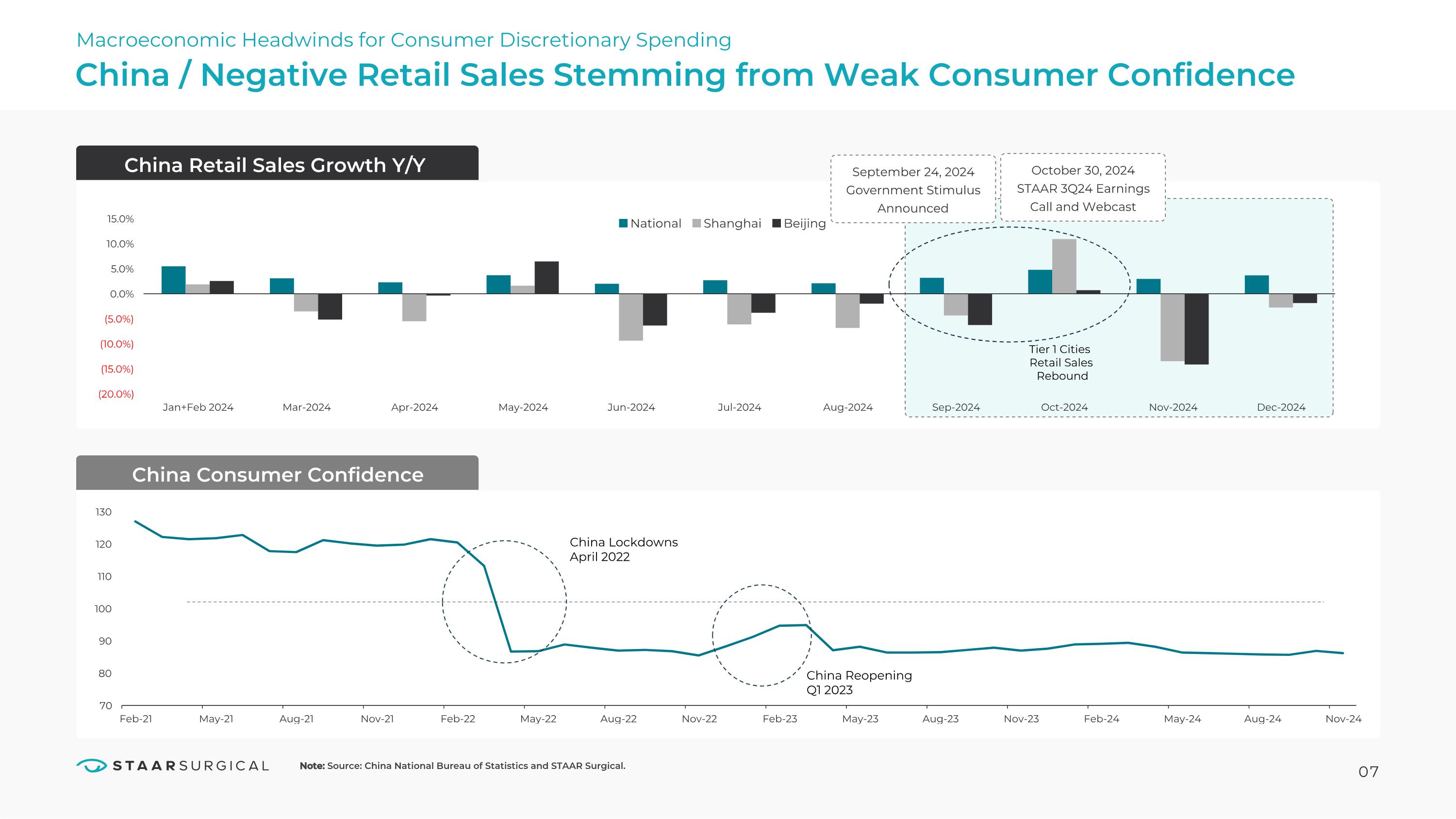
Many of the same challenges we faced in 2025 are still present. There are ongoing macro challenges in China, though things are improving. The stock markets are seeing significant gains, but the housing market remains somewhat sluggish. As we come out of the Chinese New Year, we still lack comprehensive data. The initial sentiment from the holiday seems positive, but we will have to wait and see. We believe the government's stimulus measures implemented during 2024 and 2025 are beginning to make a difference, possibly contributing to the stock market rally. We are cautiously optimistic about the economy. However, it's difficult to determine how this will impact in-market sales. What we can say is that Q4 in 2025 showed a nice uptick compared to previous quarters in in-market sales. For the full year '25, we anticipate a single-digit growth in in-market demand compared to the prior year. We hope to carry some of that momentum from Q4 into this year. If the economy remains stable or improves, that would be ideal, but it's still too soon to make any definitive predictions, which is why we are hesitant to provide guidance.
Speaker 11
Okay. That's very helpful, Warren. I appreciate the color. And for the follow-up, I wanted to ask about innovation and prioritizing innovation. I think that was mentioned a couple of times during the call in the shareholder letter. So I guess, what can you tell us today about the innovation pipeline and specifically, how we should think about some of these new products potentially getting regulatory clearance and impacting models?
Speaker 2
Yes, that’s a great question as it relates to the third pillar of our strategy, where we acknowledge that we haven’t delivered as effectively as we would like. EVO is impressive, and the Collamer material stands out. Now, it’s up to us to introduce new products to the market. We take pride in V5 and our efforts to bring EVO+ to China, which we believe will set us apart. We're also introducing the Lioli injector, which is an incremental innovation. While the lens remains our main focus, this will provide a convenient method for our customers to administer EVO to their patients. Additionally, we are working on several projects in the background, and we hope to provide updates on timelines in future calls. Key milestones will include when we start first-in-man treatments and progress through the design control process, which is essential to our R&D efforts. We aim to offer you that insight, though we are not quite ready to share specifics just yet.
Speaker 1
That's all the phone questions we have so far.
Speaker 2
Okay. Operator, it sounds like there's no more questions?
Operator
That concludes the question-and-answer session and today's conference call. Thank you for attending today's presentation. You may now disconnect.