Operator
Good morning. My name is Cynthia, and I will be your conference facilitator. At this time, I would like to welcome everyone to Two’s First Quarter 2025 Earnings Call. All participants will be in a listen-only mode. After the speakers’ remarks, there will be a question-and-answer period. I would now like to turn over the call to Maggie Karr. Please go ahead.
Speaker 1
Good morning, everyone. And welcome to our call to discuss TWO’s first quarter 2025 financial results. With me on the call this morning are Bill Greenberg, our President and Chief Executive Officer; Nick Letica, our Chief Investment Officer; and William Dellal, our Chief Financial Officer. The earnings press release and presentation associated with today's call have been filed with the SEC and are available on the SEC's website as well as the Investor Relations page of our website at twoimv.com. In our earnings release and presentation, we have provided reconciliations of GAAP to non-GAAP financial measures, and we urge you to review this information in conjunction with today's call. As a reminder, our comments today will include forward-looking statements, which are subject to risks and uncertainties that may cause our results to differ materially from expectations. These are described on Page 2 of the presentation and in our Form 10-K and subsequent reports filed with the SEC. Except as may be required by law, Two does not update forward-looking statements and disclaims any obligation to do so. I will now turn the call over to Bill.
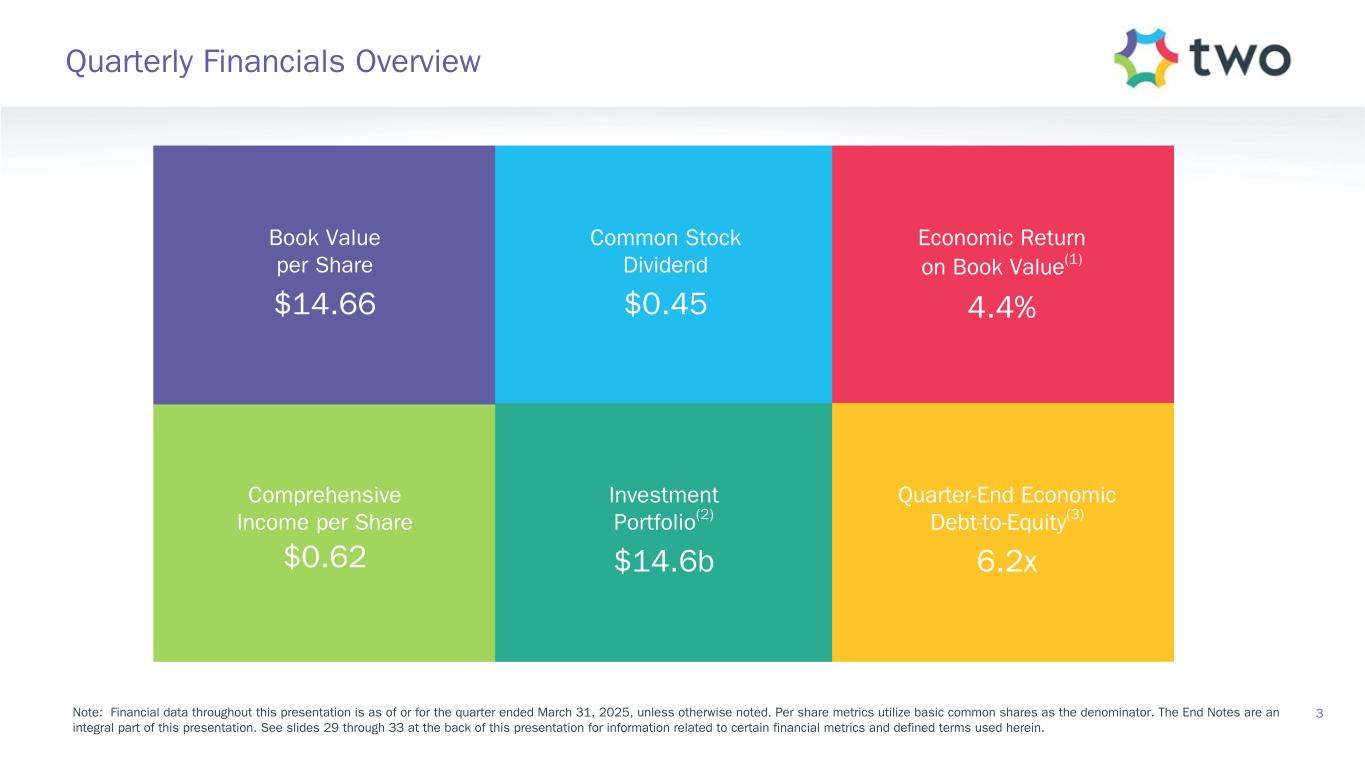
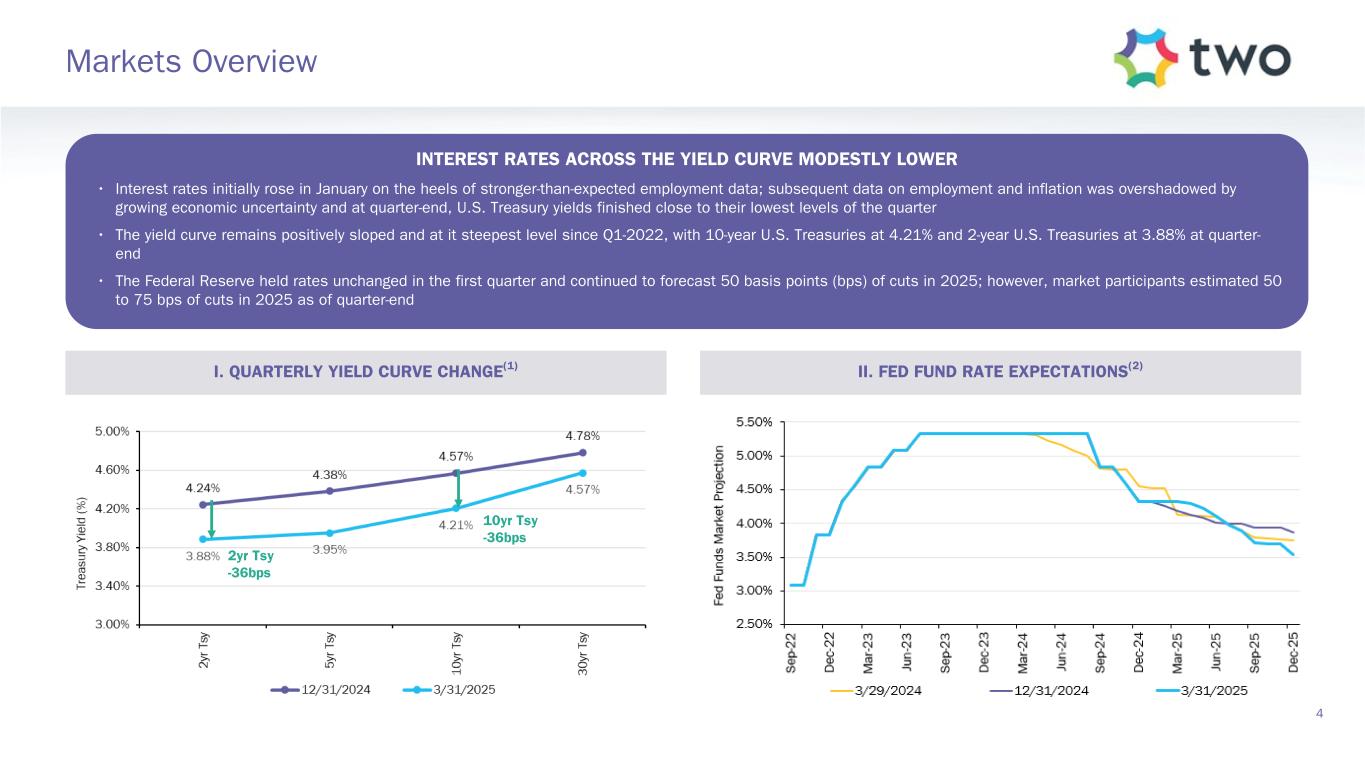
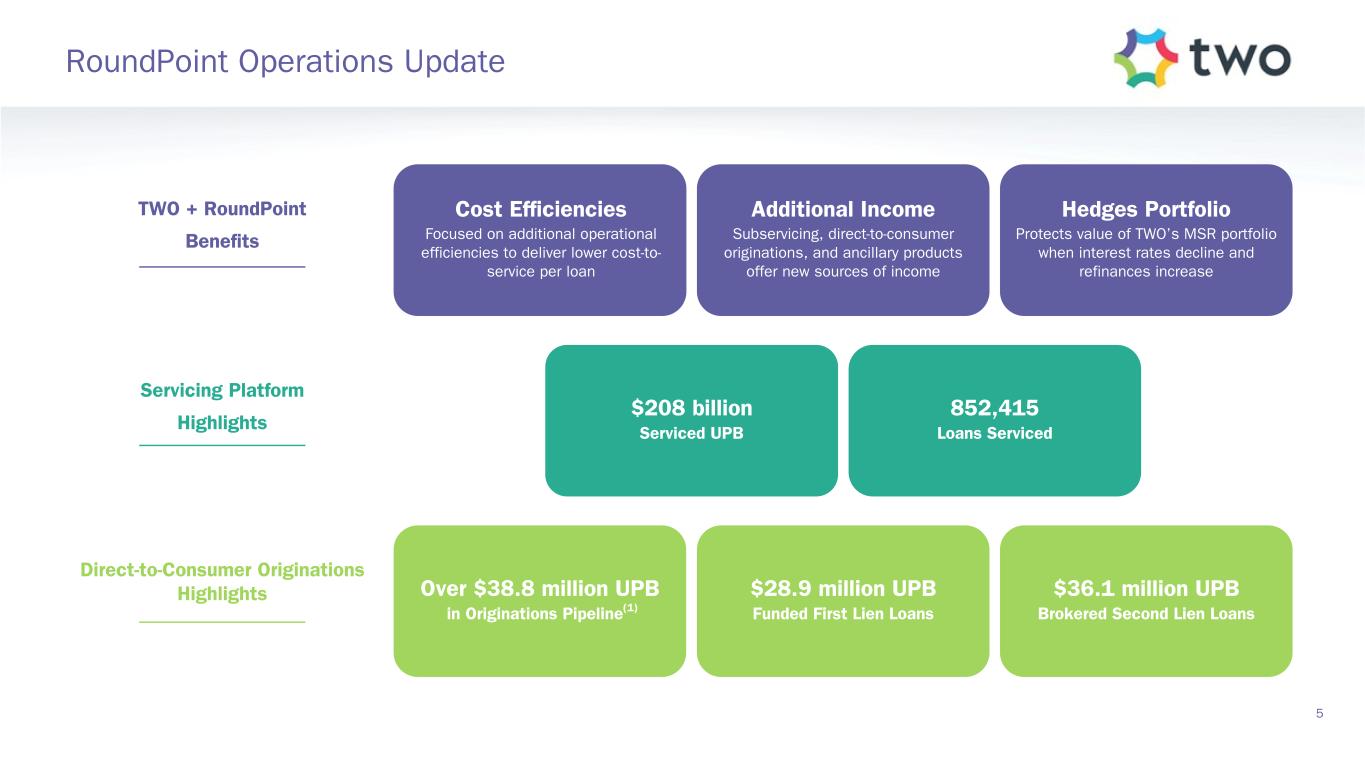
Thank you, Maggie. Good morning, everyone, and welcome to our first quarter earnings call. Please turn to Slide 3. We generated a total economic return of 4.4% for the first quarter with both RMBS and MSR contributing positively to the results. Throughout the changing macroeconomic environment of the first quarter, we kept our risk exposures low, which proved to be prudent. While overall, spreads have widened in the second quarter, they have been variable day-to-day, and we have actively managed the portfolio and our risk to take advantage of any market dislocations and attractive return opportunities. Please turn to Slide 4. Interest rates across the U.S. Treasury yield curve ended the first quarter lower than at 2024 year-end, with 2-year and 10-year notes both decreasing by 36 basis points to finish at 3.88% and 4.21%, respectively, as seen in Figure 1. The Fed once again held rates unchanged at their March 19 meeting for revised lower real GDP growth expectations for this year from 2.1% to 1.7%, while core PCE was revised up from 2.5% to 2.8%, changes which Chairman Powell acknowledged were related to potential changes in trade policies. At the March meeting, the market's expectations for cuts for the remainder of 2025 moved from 50 to 75 basis points, as you can see in Figure 2. However, subsequent data on employment, inflation, and most everything else has largely been overshadowed by growing economic uncertainty driven by proposals from the administration on tariffs, trade policy, and the composition of the Fed and its reaction function. The instability of U.S. policy has, for the first time, raised questions about the status of the dollar as the world's reserve currency, and we are carefully watching developments unfold. Please turn to Slide 5. Our focus at RoundPoint this year is fivefold. First, to bring our direct-to-consumer originations platform fully to scale with widespread brand recognition. Second, to increase the velocity and depth of our offerings of second liens to our borrowers, producing additional revenue. Third, to evaluate opportunities and adapt as the mortgage finance landscape evolves. This includes diversifying our portfolio by potentially participating in the Ginnie Mae market as well as exploring possibilities in the non-agency sectors. Fourth, as a full-service mortgage servicer and originator to grow our presence in third-party subservicing. And fifth and finally, to continue to generate additional cost efficiencies in servicing, primarily through the use of technology and AI applications. As I just described, we view the RoundPoint platform as an expansion of our opportunity set, providing additional benefits for our shareholders by allowing us to impact our results through our own actions in ways that portfolios without operating platforms cannot. At Two, we have thoughtfully and intentionally built an investment portfolio with MSR at its core that is designed to deliver attractive risk-adjusted returns across a variety of market environments. The investment in Two allows our shareholders to benefit from our team's deep expertise and experience in managing and hedging portfolios of MSR and mortgage-backed securities. I'm very excited about the opportunities ahead for Two. And with that, I'd like to hand the call over to William to discuss our financial results.
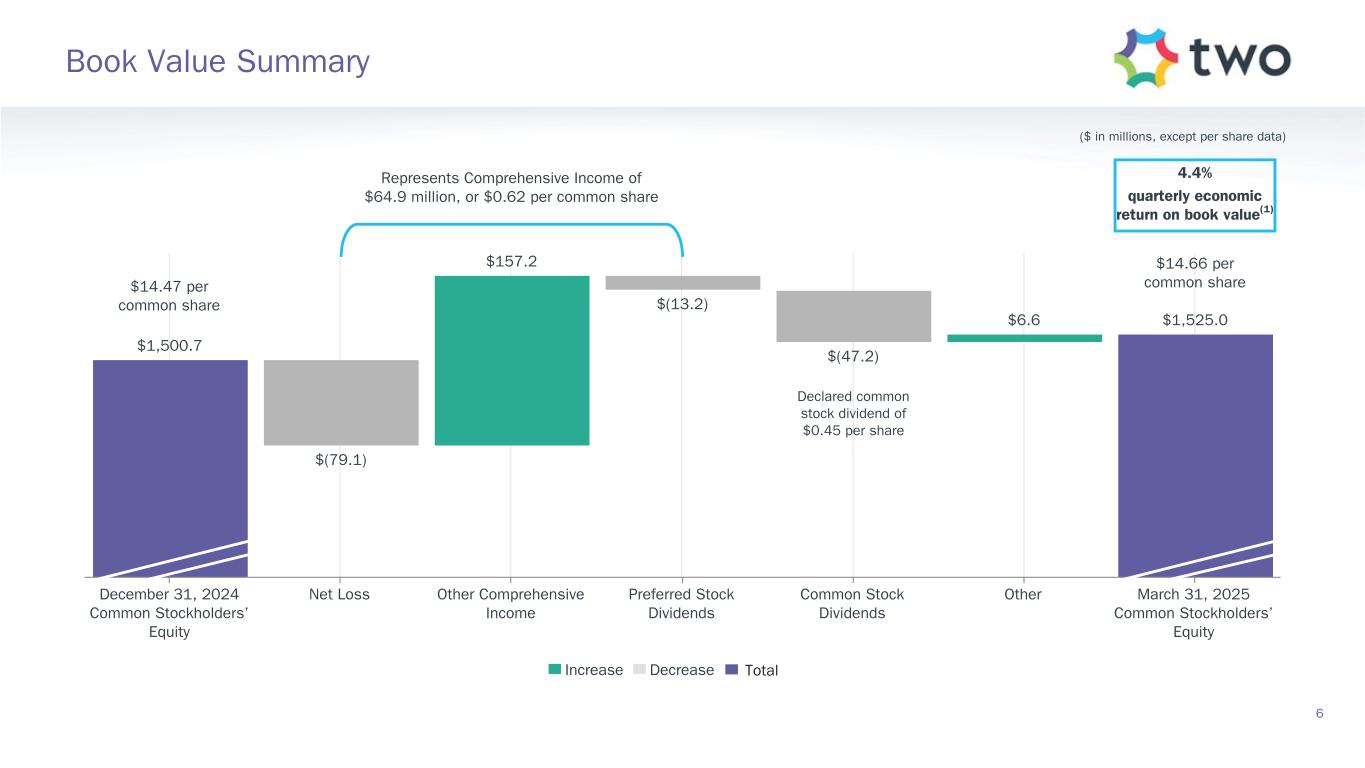
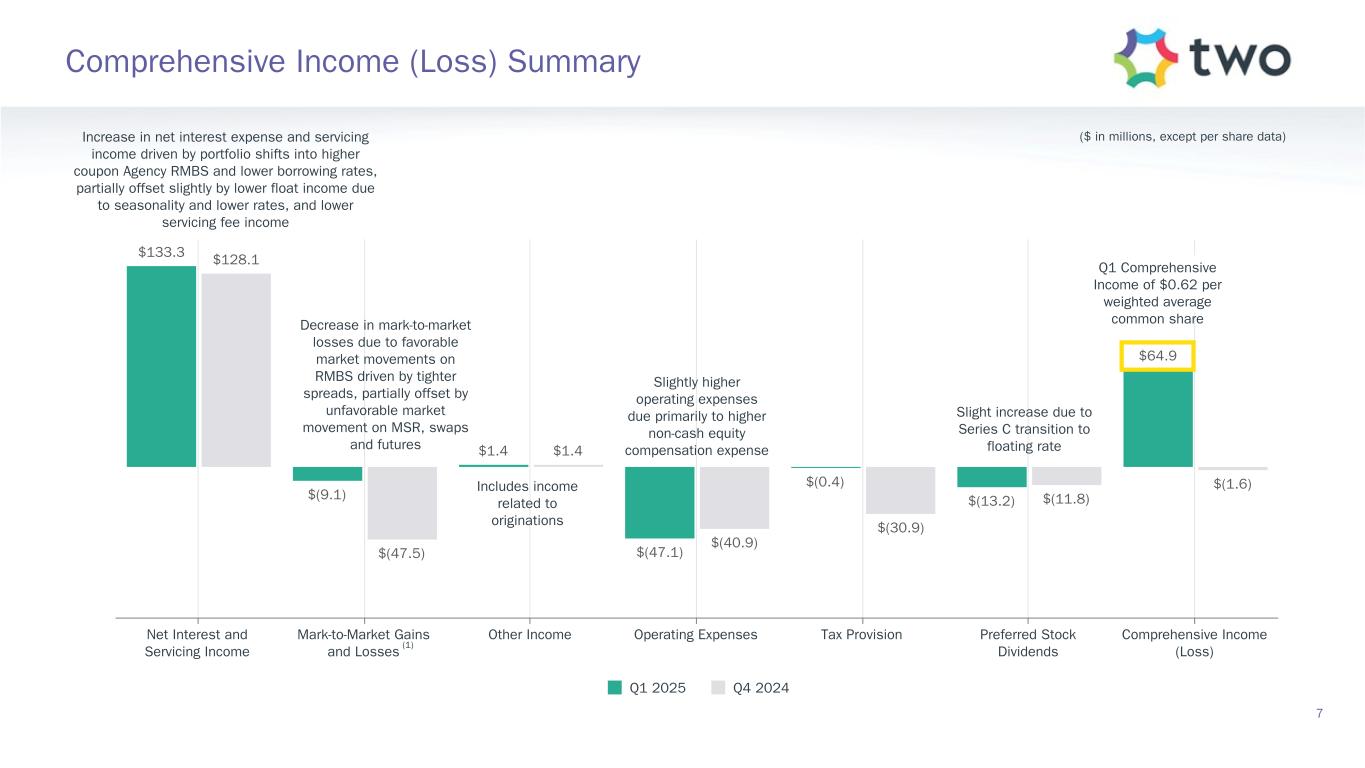
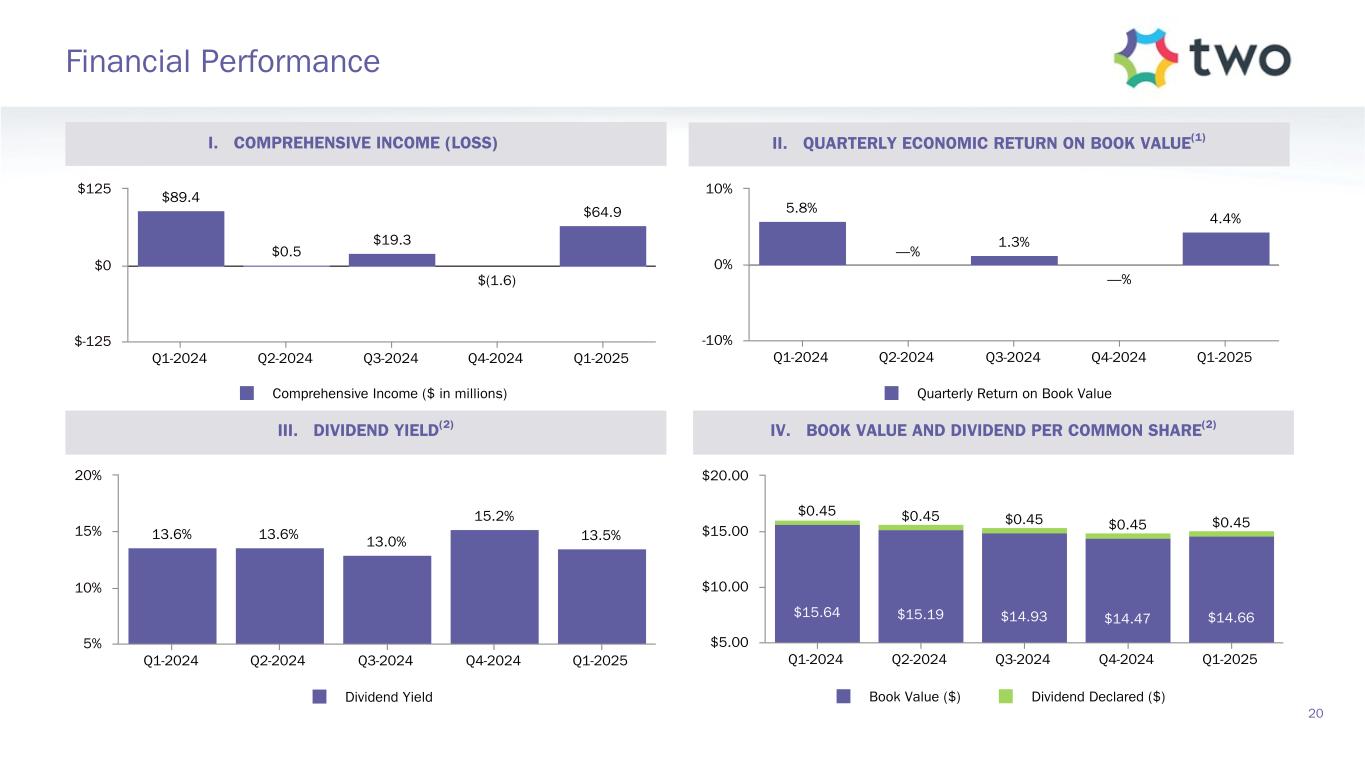
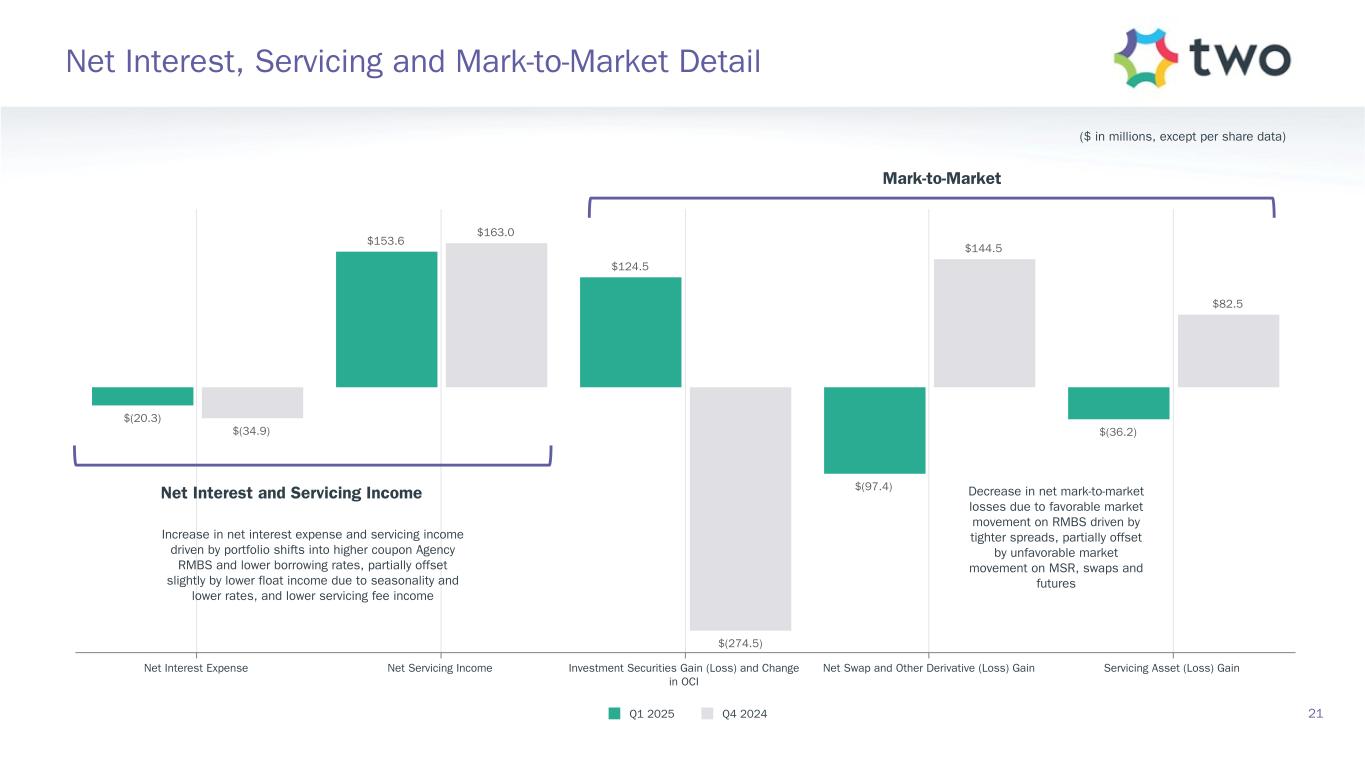
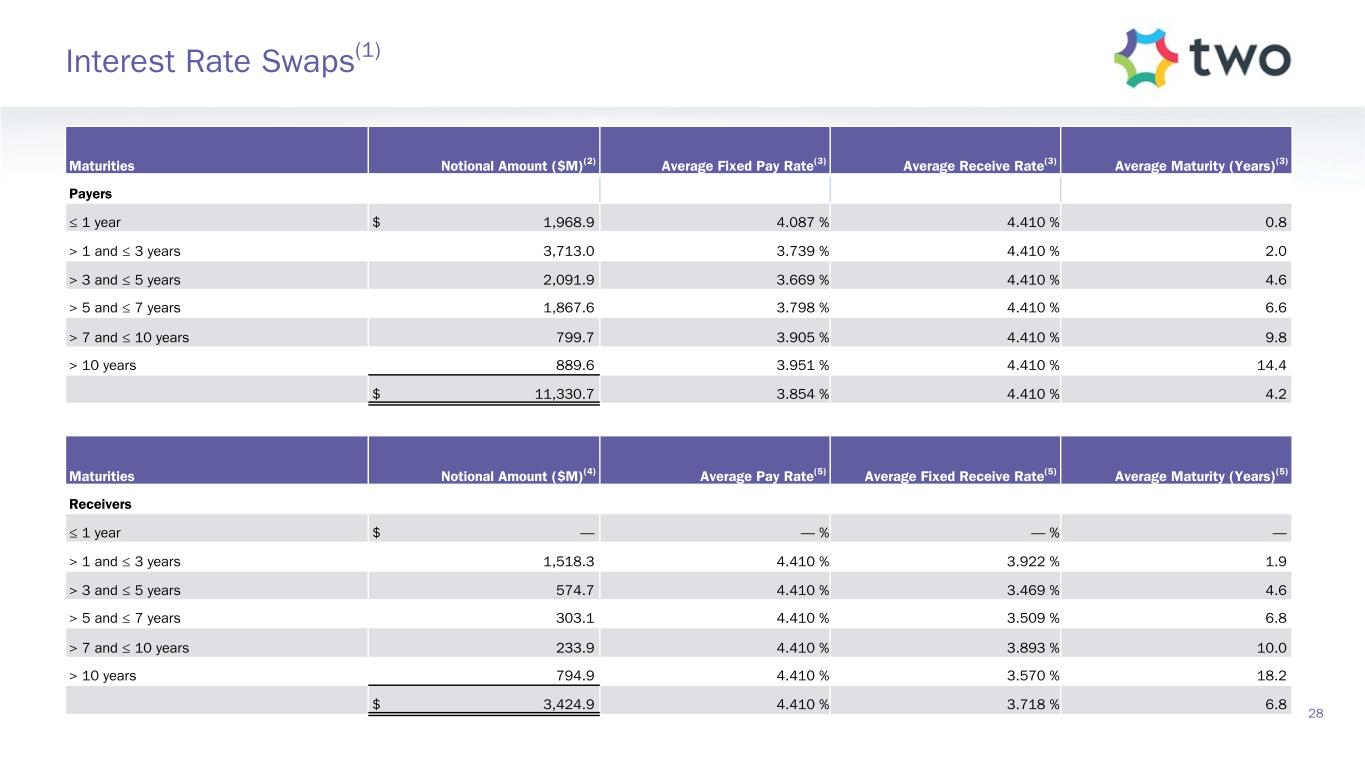
Thank you, Bill. Please turn to Slide 6. Our book value increased to $14.66 per share at March 31, compared to $14.47 on December 31. Including the $0.45 common stock dividend, this resulted in a positive 4.4% quarterly economic return. Please turn to Slide 7. The Company generated comprehensive income of $64.9 million or $0.62 per weighted average common share in the first quarter. We slightly amended the chart on this slide to better reflect how we think about changes in values for the assets and the hedges together rather than in isolation. Net interest and servicing income, which is a sum of GAAP net interest expense and net servicing income before operating costs, was higher in the first quarter by $5.2 million, driven by portfolio shifts into higher coupon Agency RMBS and lower borrowing rates, slightly offset by lower float income due to seasonality and lower rates and lower servicing fee income from MSR portfolio runoff. The next column mark to market gains and losses represents the sum of investment securities gain and change in OCI, net swap and other derivative losses, and servicing asset losses. The duration of our RMBS and MSR assets was hedged by net long TBA positions in the case of MSR and by net short futures and payer swaps in the case of RMBS. The $38.4 million difference quarter over quarter was driven primarily by unrealized gains on RMBS and TBA positions offset by MSR portfolio runoff and mark to market losses on swaps and futures. Finally, operating expenses increased due primarily to higher non-cash equity compensation expenses, which typically occur in the first quarter of the year. You can see the individual components of net interest and servicing income and mark-to-market gains and losses on the appendix Slide 21.
Speaker 4
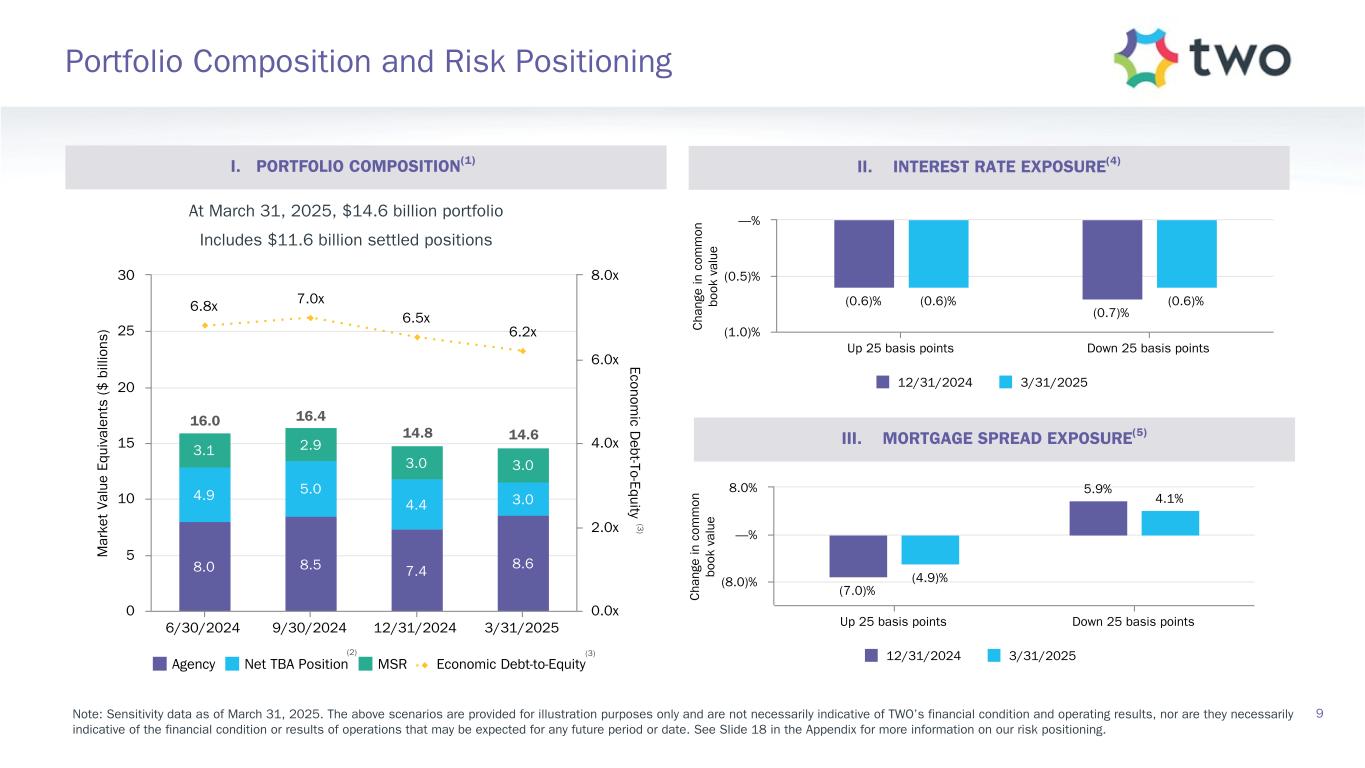
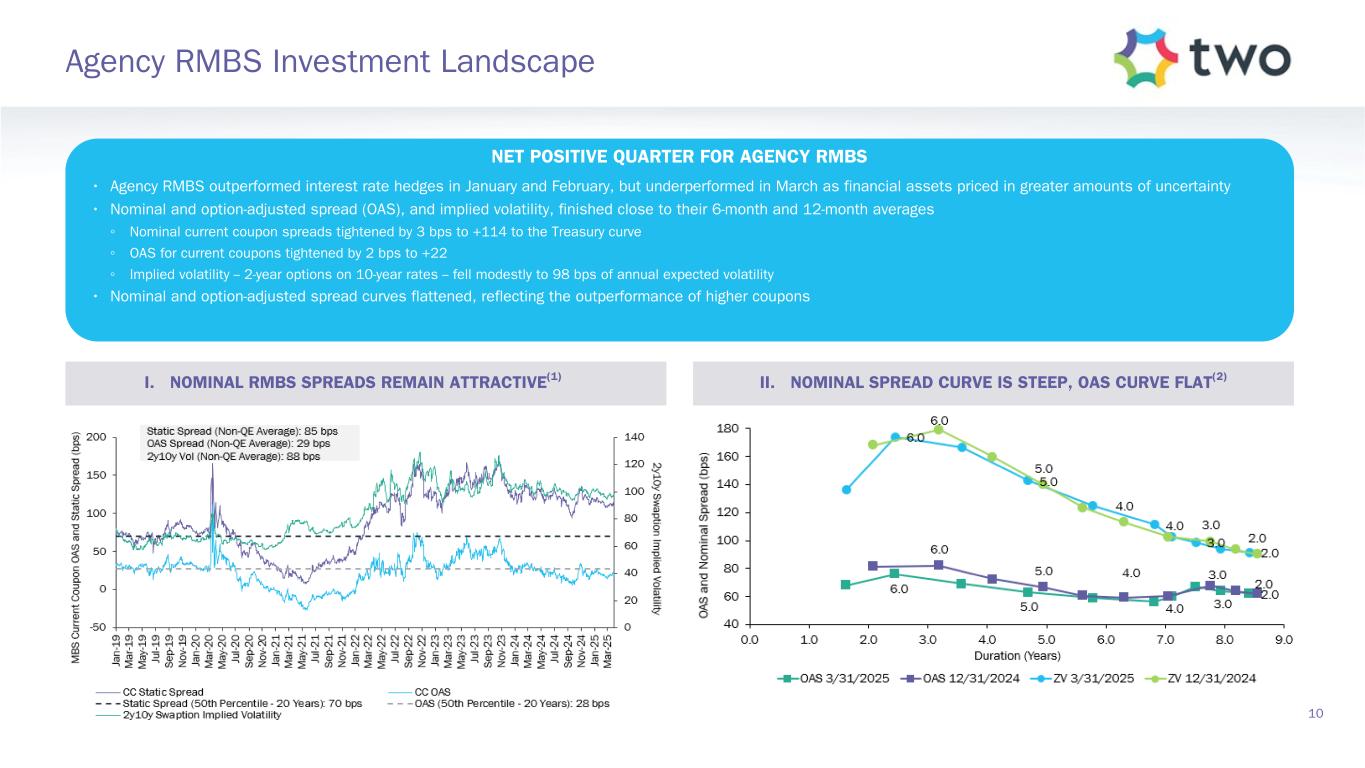
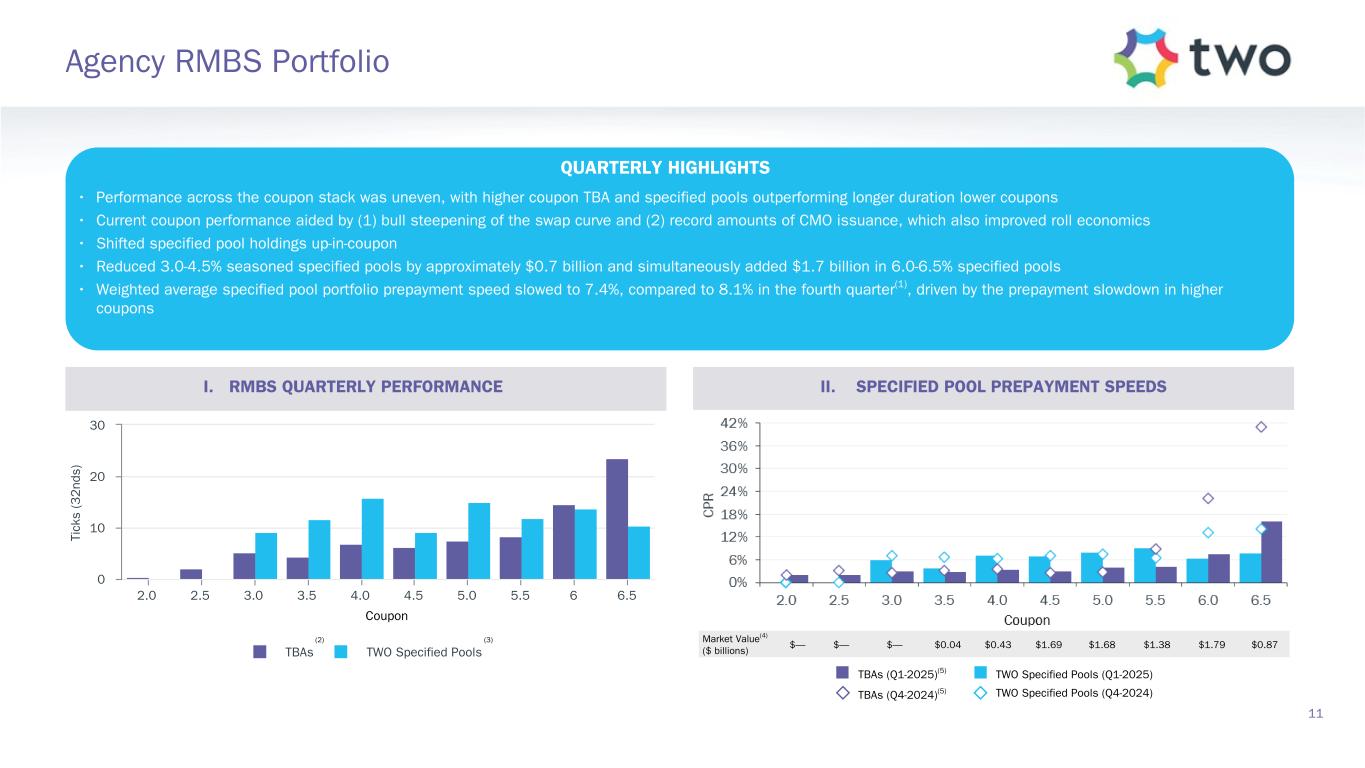
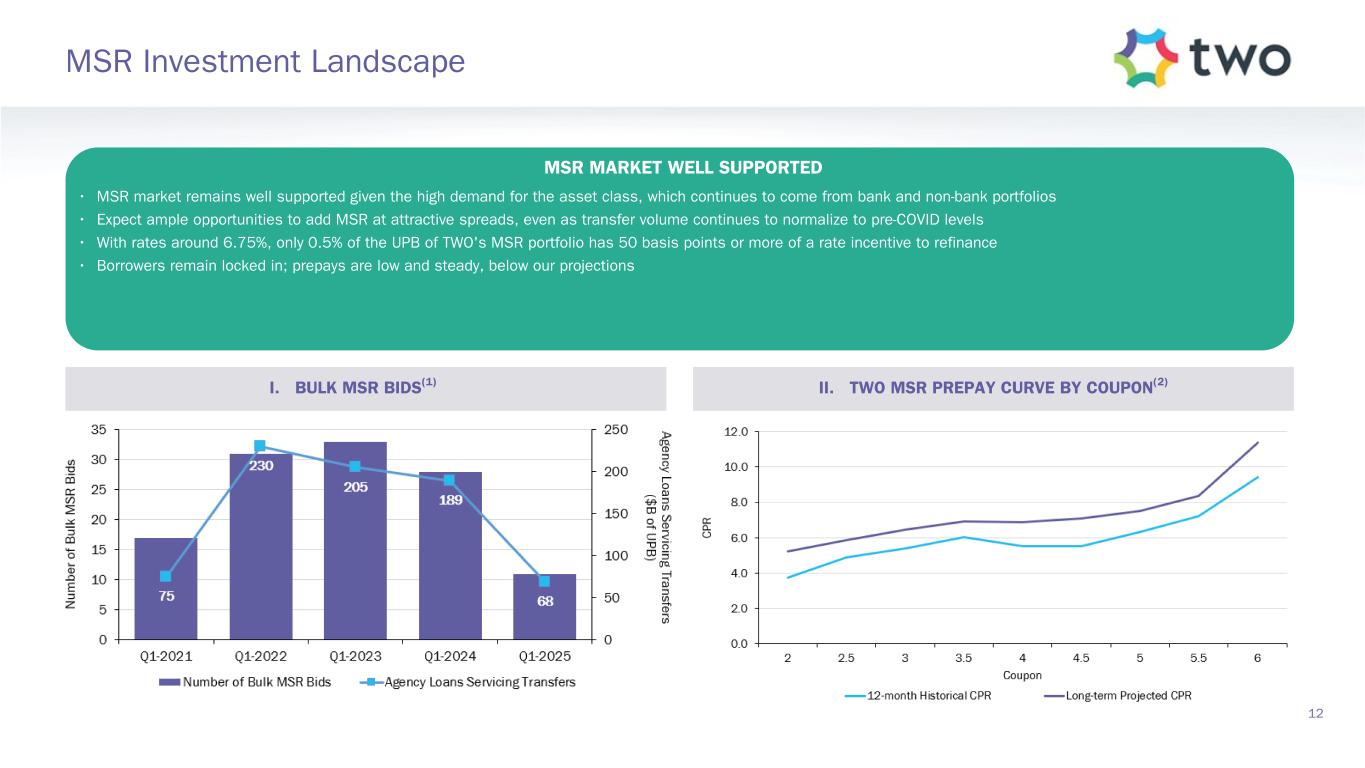
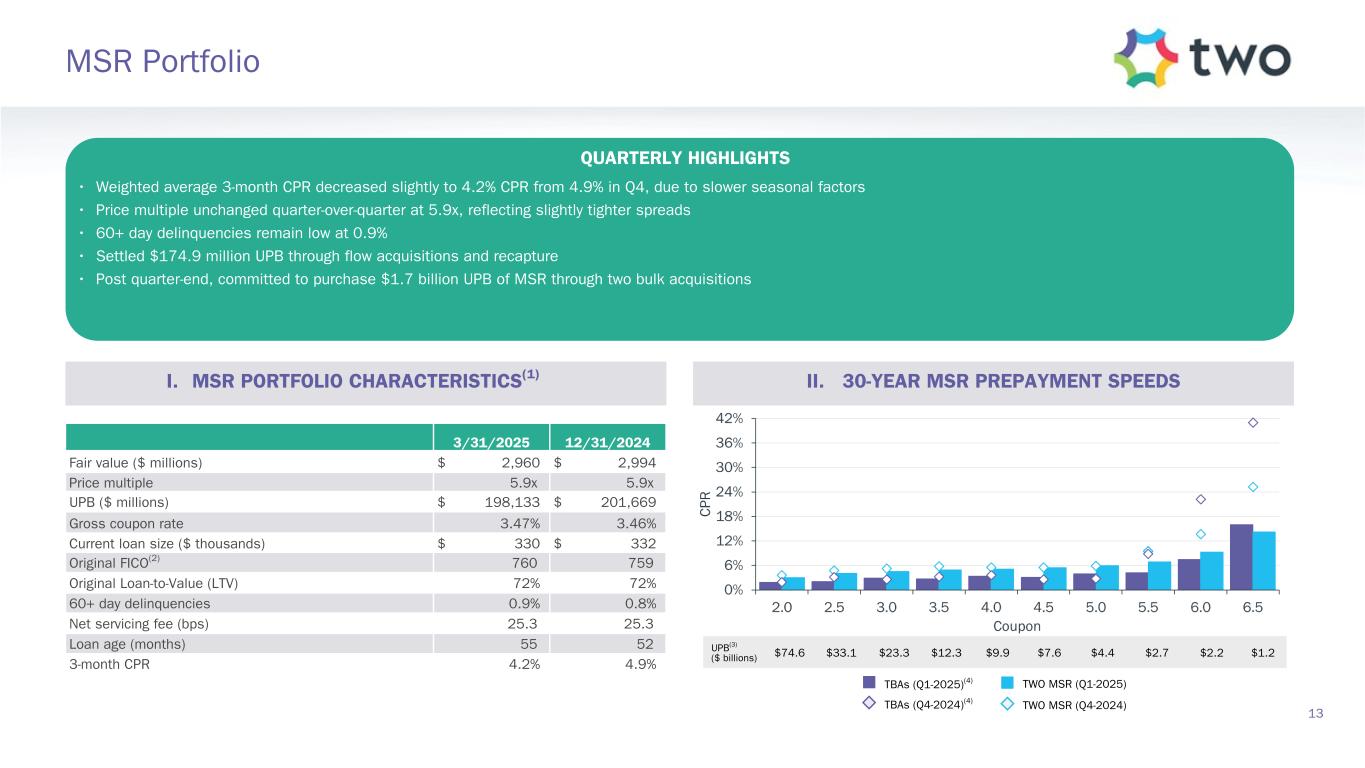
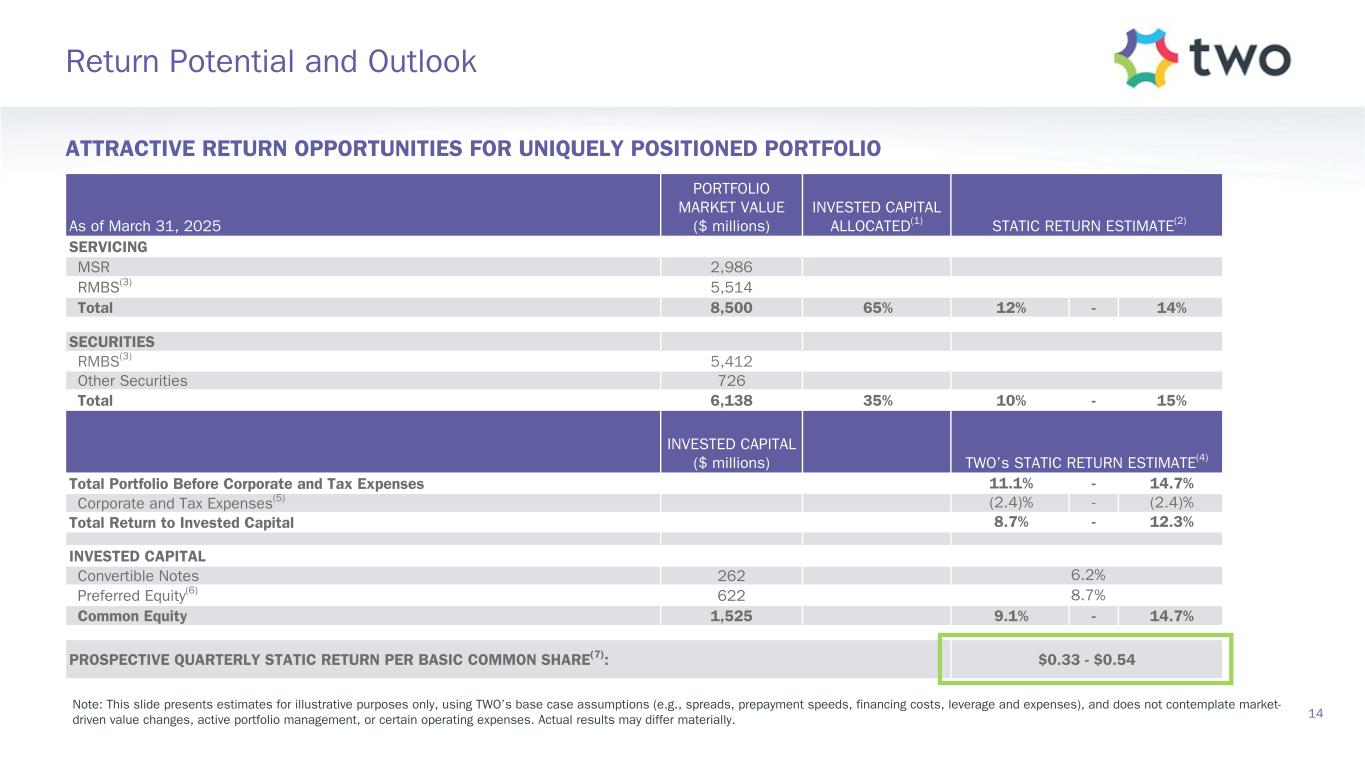
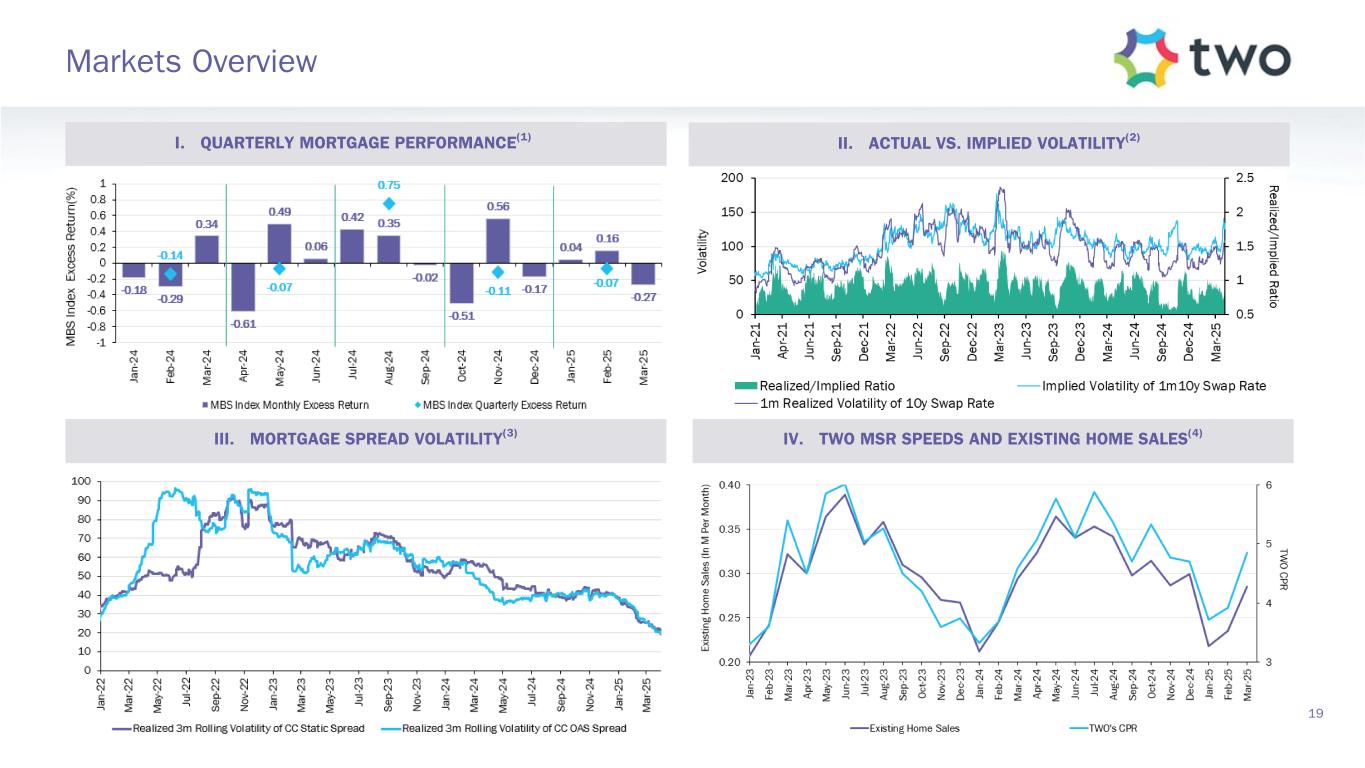
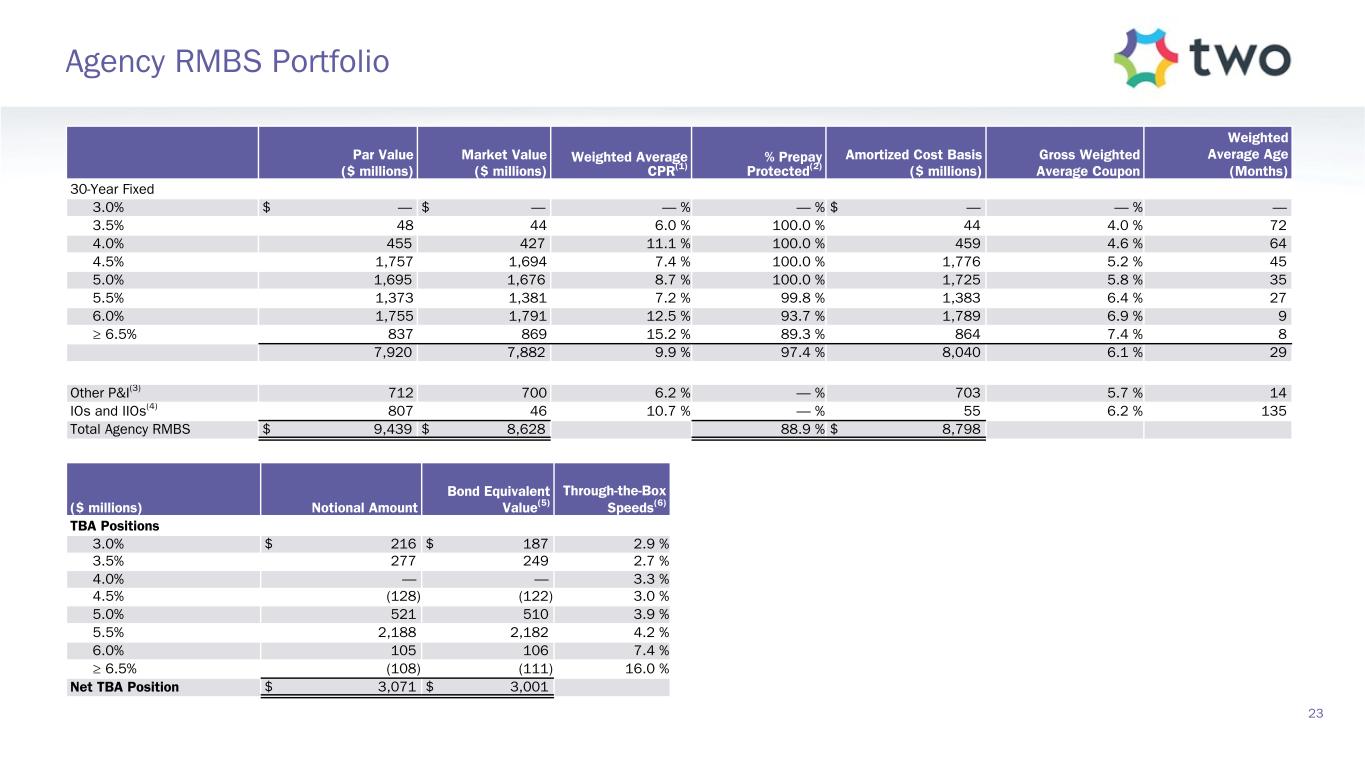
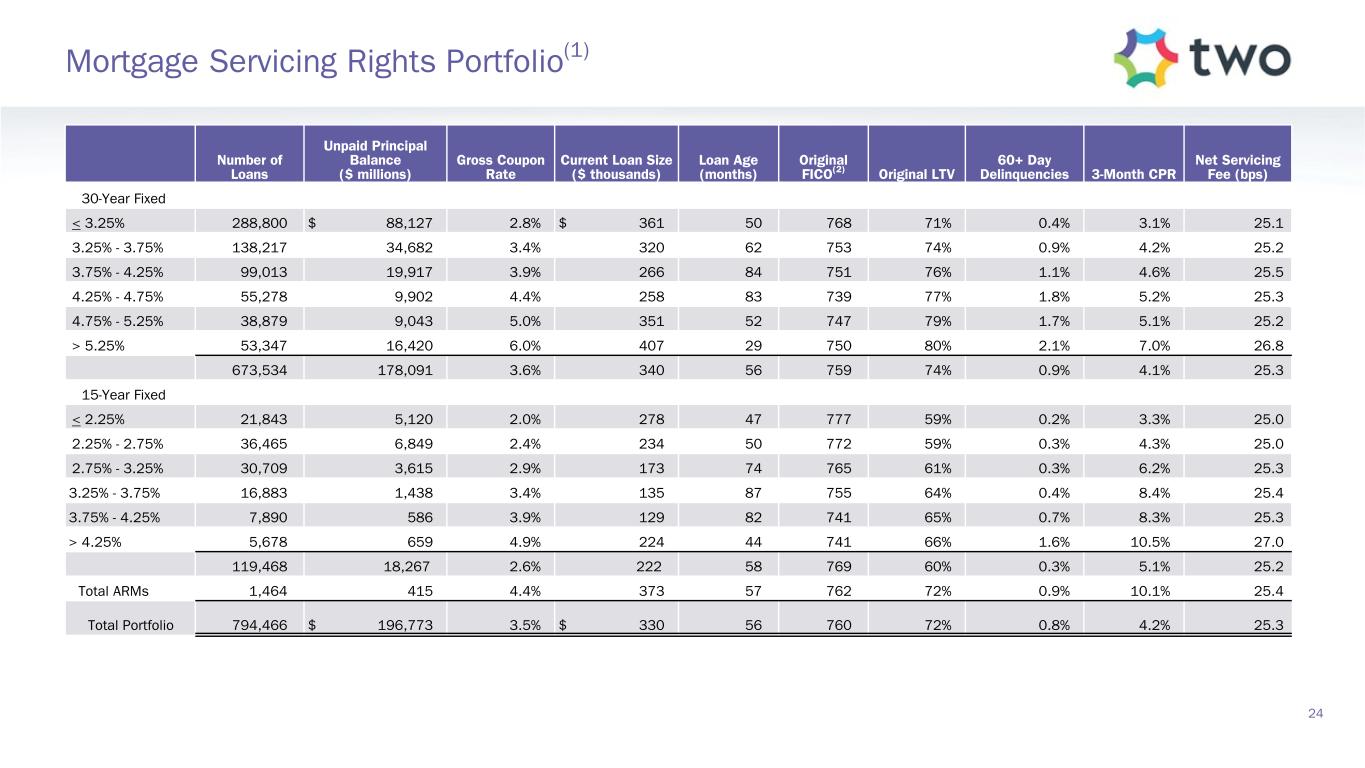
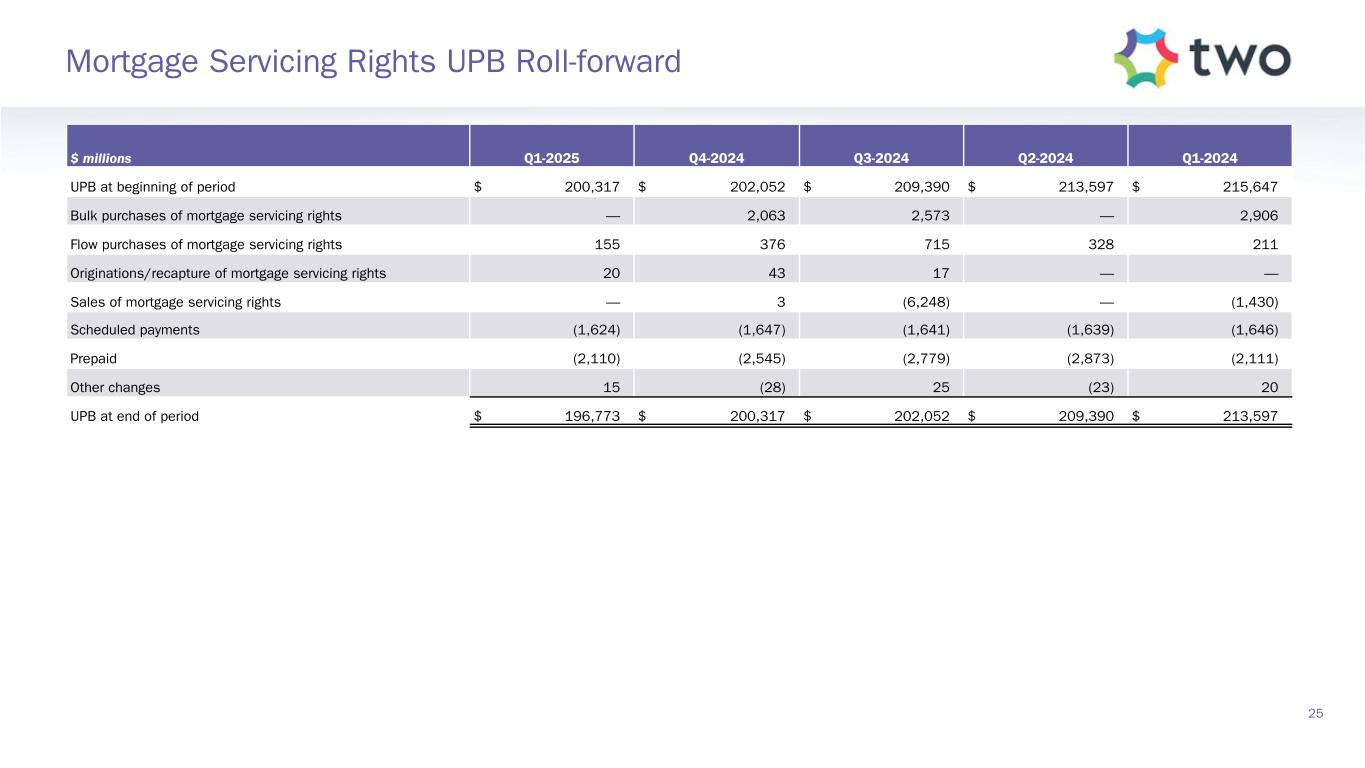
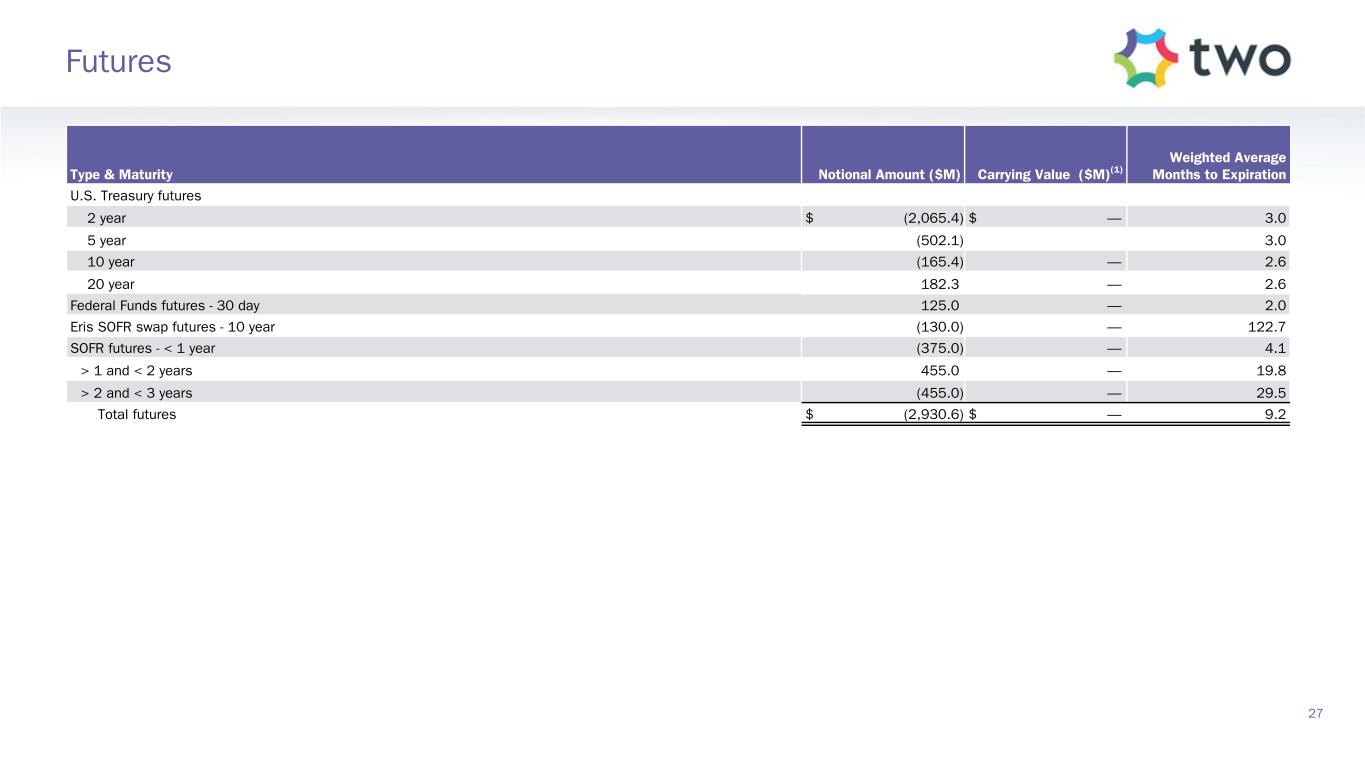
Thank you, William. Our portfolio performed well in the first quarter with both components of our strategy contributing to the positive return. At year-end, we commented that mortgage spread volatility would decline and that indeed was the case in Q1, helping to drive our positive hedged RMBS return. Our MSR performance was bolstered not only by slower than expected speed but also a slight tightening of spreads indicative of the demand for the asset. Jumping back into the deck, please turn to Slide 9. Our portfolio at March 31 was $14.6 billion, including $11.6 billion in settled positions and $3 billion in TBAs. Our economic debt to equity decreased to 6.2 times. We manage our exposure to rates across the curve very closely. In the first quarter, we lowered our risk to mortgage spreads and interest rate, as you can see in figures two and three. At quarter-end, we had substantially less risk than when we started the quarter. Overall, we decreased our mortgage exposure by 30% and reduced our leverage. You can see more detail on our risk exposures on appendix Slide 18. Please turn to Slide 10. The performance of Agency RMBS securities was net positive over the quarter. RMBS outperformed interest rate hedges in January and February but underperformed in March as equities and fixed income spread products weakened. Performance across the RMBS coupon stack was uneven with higher coupons both in TBAs and specified pools outperforming longer duration lower coupons. As you can see in Figure 1, our preferred implied volatility gauge to your options on 10-year rates decreased modestly from 101 to 98 basis points on an annualized basis. Both nominal spread and OAS tightened slightly, and these metrics, as well as the 2-year and 10-year implied volatility finished the quarter close to their 6- and 12-month averages. As has been the case, nominal spreads and volatility remain well above longer term averages, but option-adjusted spreads are close to their long-term average. For this reason, we continue to believe that volatility will need to decline for RMBS spreads to materially tighten to treasuries. Of course, we have seen the opposite as implied and realized volatility has increased in the second quarter given the uncertainty around the macroeconomic outlook. Spreads for Agency RMBS have widened, and spread volatility itself has increased to pre-election levels. Please turn to Slide 11 to review our Agency RMBS portfolio. Figure 1 shows the performance of TBAs compared to the specified pools we own throughout this quarter. The bull steepening of the swap curve plus strong levels of CMO issuance led to the outperformance of higher coupon RMBS. In terms of coupon stack activity, we started the quarter with an up in coupon bias, while progressively lowering our risk throughout the quarter. We reduced our exposure in 3% to 4.5% season specified pools by approximately $730 million and simultaneously added about $1.7 billion of 6.5% specified pools while correspondingly reducing our net TBA position. To maintain our MSR current coupon hedging, we moved our MSR duration related TBA position down in coupon by selling 6s and buying 5s. Primary mortgage rates hovered around 7% for most of the quarter. With winter seasonal at play, prepayment activity was muted. Overall, prepayment rates for the 30-year Agency RMBS universe decreased by 1.4 percentage points quarter over quarter to 5.6% CPR. Figure 2 on the bottom right shows our specified pool prepayment speeds by coupon. Most of the decline in speeds quarter-over-quarter came from higher coupon slowing down. Please turn to Slide 12 as we discuss the market for investing in MSR. The MSR market remains well supported given the high demand for the asset class and limited bulk acquisition opportunities. As you can see in Figure 1, transfer volume appears to have normalized to pre-COVID levels. Borrowers remain as locked in as ever, happy with their low rates. With a current mortgage rate around 6.75%, less than 1% of the UPB of our portfolio has 50 basis points or more of a rate incentive to refinance. As you can see in Figure 2, prepays have remained low and steady and below our projections for the majority of our portfolio with only a five and above slightly increasing. The slow and steady nature of realized prepayment speeds, however, belies a very interesting characteristic of the structure of the market and of the nature of lock-in. In particular, looking at the blue line, we do not see prepayment speeds asymptotically approaching some base turnover level of payoffs. Historical 12-month prepayment rates for 2.5s are faster than for 2s by about 1.2 CPR and faster for 3s than for 2.5s by about 0.5 CPR. This shows that even from mortgages that are very deeply out of the money, there is still rate sensitivity to the prepayment function. This has pricing implications for low coupon MSR and explains why the lowest note rate MSR has been able to trade at historically high multiples. Please turn to Slide 13, where we will discuss our MSR portfolio. Figure 1 is an overview of the portfolio at quarter-end, further details of which can be found in appendix Slide 24. In April, we committed to purchase $1.7 billion UPB of MSR through two bulk purchases, which are expected to settle in the second quarter. Price multiple of our MSR was unchanged quarter over quarter at 5.9 times and 60 plus day delinquencies remained low at under 1%. Figure 2 compares CPRs across those implied security coupons in our portfolio of MSR versus TBAs. The prepayment speed of our MSR portfolio was 4.2 CPR for the first quarter, down 0.7% quarter over quarter. Please turn to Slide 14, our return potential and outlook slide. As you can see on this slide, the top half of this table is meant to show what returns we believe are available on the assets in our portfolio. We estimate that about 65% of our capital is allocated to servicing with a static return potential of 12% to 14%. The remaining capital is allocated to securities with a static return estimate of 10% to 15%. With our portfolio allocation shown in the top half of the table and after expenses, the static return estimate for our portfolio is between 8.7% to 12.3% before applying any capital structure leverage to the portfolio. After giving effect to our outstanding convertible notes and preferred stock, we believe that the potential static return on common equity falls in the range of 9.1% to 14.7% or a prospective quarterly static return per share of $0.33 to $0.54. Remember, these numbers reflect our portfolio and spreads at quarter-end and would be higher today given that spreads are wider. We made a small update to this table this quarter by expanding the factors that we vary in determining the range of prospective static returns per basic common share. Previously, we had determined the range by varying prepayment rates and funding rates. Today, in addition, we have chosen to vary portfolio leverage rather than only using the spot value, keeping in mind that this slide is meant to be a medium-term estimate of return potential. Post-quarter end dramatic shifts on tariff policies have triggered speculation on broad global asset allocation shifts away from dollar-based assets and heightened concerns about the effects of stagflation on Fed policy. Predictably, equity and fixed income volatility have spiked. Since April 2, the 10-year treasury yield has traded in a whopping 70 basis point range and the yield curve between 2- and 10-year treasuries has steepened by about 20 basis points. Swap spreads also fell precipitously to all-time tight before widening back. While recent talk of tariff walk-backs have to some degree calmed the market, there still remains a large amount of economic uncertainty, all but guaranteeing a continued bumpy road ahead. But from dislocation, there is also opportunity. Volatility will continue to be a headwind we manage our portfolio for the long term. Being mindful of the current environment, we are keeping our portfolio leverage and risk at muted levels until there is more clarity on the economic path forward. However, we continue to see attractive levered returns on Agency RMBS and our portfolio of low-weighted average mortgage rate MSR should continue to generate stable cash flows over a wide range of interest rate scenarios. Thank you very much for joining us today. And now, we will be happy to take any questions you might have.
Operator
We will take our first question from Doug Harter with UBS.
Speaker 5
Just given the volatility, can you give us an update on book value through April? And then also any changes you might have made in the portfolio to sort of adjust for the current environment?
Yes, sure. Good morning, Doug. Thanks for the question. As you know, it's been quite a volatile April with all the activity that's happened. Nick mentioned some of those in his prepared remarks, rate volatility, spread volatility, and so forth. But I think we've been able to manage that pretty well, and so that through last Friday, we were down about 3.5%. I'll let Nick take the question of the change to the portfolio that we made.
Speaker 4
Hey, Doug. Thank you for the question. We have modulated the portfolio since April. As again in my prepared remarks, we did take our risk down by the end of the first quarter and we actually lowered it even further into early April just with some of the news coming out. It seemed to us that we were in for a bout of greater amounts of volatility and some weakness in assets. But since we have actually raised it a little bit from where we were, we ended the quarter around 6.2% debt to equity. We got as low as in the low 5s and we're now back up, approaching 6% again. That's really been a function of seeing the developments in some of the actions coming out of D.C. and around the markets. There has been a little bit of a de-escalation in our opinion in terms of the rhetoric and a clear recognition that some of the actions that have been proposed have had a dysregulatory effect on the markets, especially the bond market. And we take it to heart that some of that has calmed the markets down. And spreads have widened, particularly in terms of mortgages versus swaps, where the majority of our hedges. And while they certainly don't look as wide as they did at some of the really peak wide periods of this interest rate cycle, like in late '22 or late '23, for example, they have widened out to a decent degree and present a better opportunity than they were at the end of the quarter. But there's still a lot of unknown things ahead. And even with all of this, when and if all of this tariffs and trade policy gets settled, there's clearly still some effects are going to happen in terms of the Fed and how they're going to react to either a slowdown in the economy or a pickup in inflation. And we do feel like, again, there's good reason to believe that volatility is not going to be going down in any real material way for the foreseeable future.
Speaker 5
Great. And then Nick, if I could just clarify, I believe you said in your prepared remarks that the return potential would be higher today because of wider spreads. Just wanted to make sure I heard that correct.
Speaker 4
Yes, that's correct. I mean, we estimate that where spreads were, I think we did this as of Friday, that it would be about $0.03 on the return potential, just with spreads being wider.
Operator
We will take our next question from Trevor Cranston with Citizens JMP.
Speaker 6
Can you guys talk a little bit about the big merger or acquisition between Rocket and Mr. Cooper and how you think that sort of impacts the competitive landscape in the servicing market and potentially the bulk MSR purchase market as well?
Yes, of course. It's indeed an exciting development in the market. However, I believe the real-life impacts might be less significant than what the headlines suggest. Both companies were active buyers of mortgage servicing rights, so as a combined entity, I expect demand to remain consistent with the overall individual demands. The bidding may have improved slightly, as it now reflects the higher of the two individual bids, making it a bit more competitive. Nevertheless, I don't anticipate a major shift. The securities market has shown some reaction regarding prepayment speeds related to pools serviced by Cooper, which have adjusted to align more closely with typical forward prepayment speeds. Therefore, while there are some impacts, they are not transformative. The dynamics of the servicing market have largely remained the same. As mentioned earlier, the supply of mortgage servicing rights has returned to pre-COVID levels, and that situation is unlikely to change.
Speaker 6
Got it. Okay, that's helpful. And then, can you guys maybe provide a little color around the change you had to the previously announced CFO transition?
Yes. Well, as we announced, William Dellal has been appointed Chief Financial Officer instead of Interim Chief Financial Officer. We're thrilled to have him here. William has added so much value and he's been terrific. And we're happy to have him. And we continue to benefit from all of William's experience and we're happy to have him. So that's all I'm really going to say about that.
Operator
We will take our next question from Bose George with KBW.
Speaker 7
Hey, guys. Good morning. A quick follow-up to Doug's question just on the impact on spread. So, you said up $0.03? Is that both the high end and the low end or does volatility do anything just in terms of what happens to that range?
Speaker 4
Hey, Bose, it's Nick. Yes, it's very high end and low end. And it's a little bit of a rough estimate, but yes, it's $0.03 on both sides.
Operator
Okay, great. And then just with the new target range, etc., can you just talk about the comfort level with the dividend?
Speaker 4
Yes, we are pleased with our projections. We are confident in maintaining the dividend despite the changes in spreads within our portfolio. With spreads widening this quarter and our risk level adjusting to what we believe is a safer environment, we feel assured about supporting the dividend with our current portfolio.
Operator
We will take our next question from Eric Hagen with BTIG.
Speaker 8
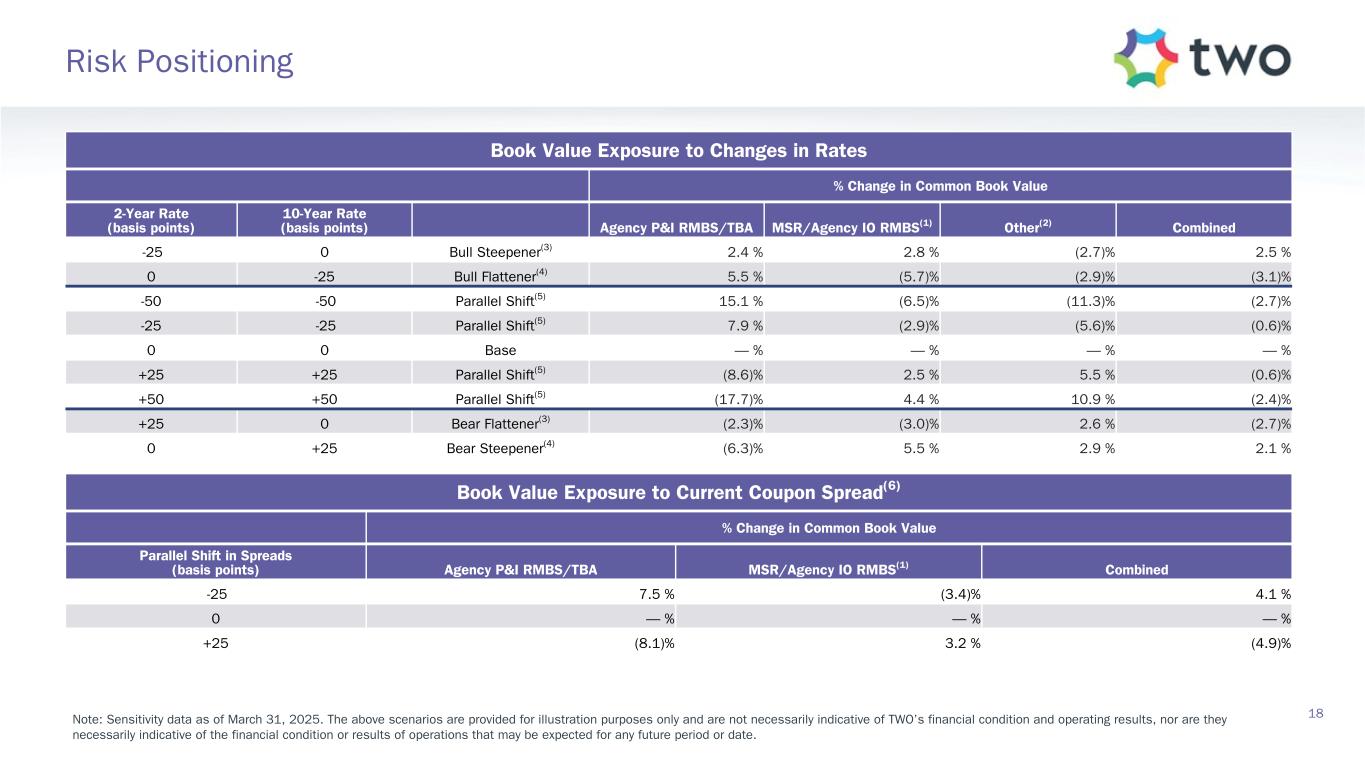
We're just looking at the book value sensitivity for the change in a tightening in spreads, and I realize that in April maybe it's changed a little bit. But for a 25 basis point move, we may be expected the sensitivity to be a little bit higher. Is there a way to flush out kind of like what's going on with the sensitivity in the MBS portfolio versus the MSRs?
I'm sorry, you think that this so spreads up 25 basis points in the deck, we showed minus 4.9%?
Speaker 8
Yes, I'm actually looking at tightening in spreads. Yes, so like the up move 4%.
The tightening of 4.1%, you think that should be higher?
Speaker 8
Maybe a little bit. I mean, just for a 25 basis point move in spreads. That's pretty meaningful, right?
Yes. Well, I mean, as you know, if you go back down to Slide 14, right, we say that 65% of our capital is allocated to the hedge servicing strategy part of the portfolio and only 35% is allocated to hedge securities. So, when MBS spreads do something, the MSR part of the portfolio doesn't react really at all because that is incorporated quickly and immediately into the MSR values, right. That's where the MSR market prices itself and works. And so, by definition, right, all else being equal, you would think that our portfolio would have 35% of the spread sensitivity exposure to a portfolio without MSR. Now, there are somewhat differences between capital structures and so forth. So, there's slight differences, but as a base case, that's where I would start. Let's say whatever spreads do, we would be 35% of what portfolios without MSR would be. And that's true when spreads tighten and that's true when spreads widen. Nick, would you add anything to that?
Speaker 4
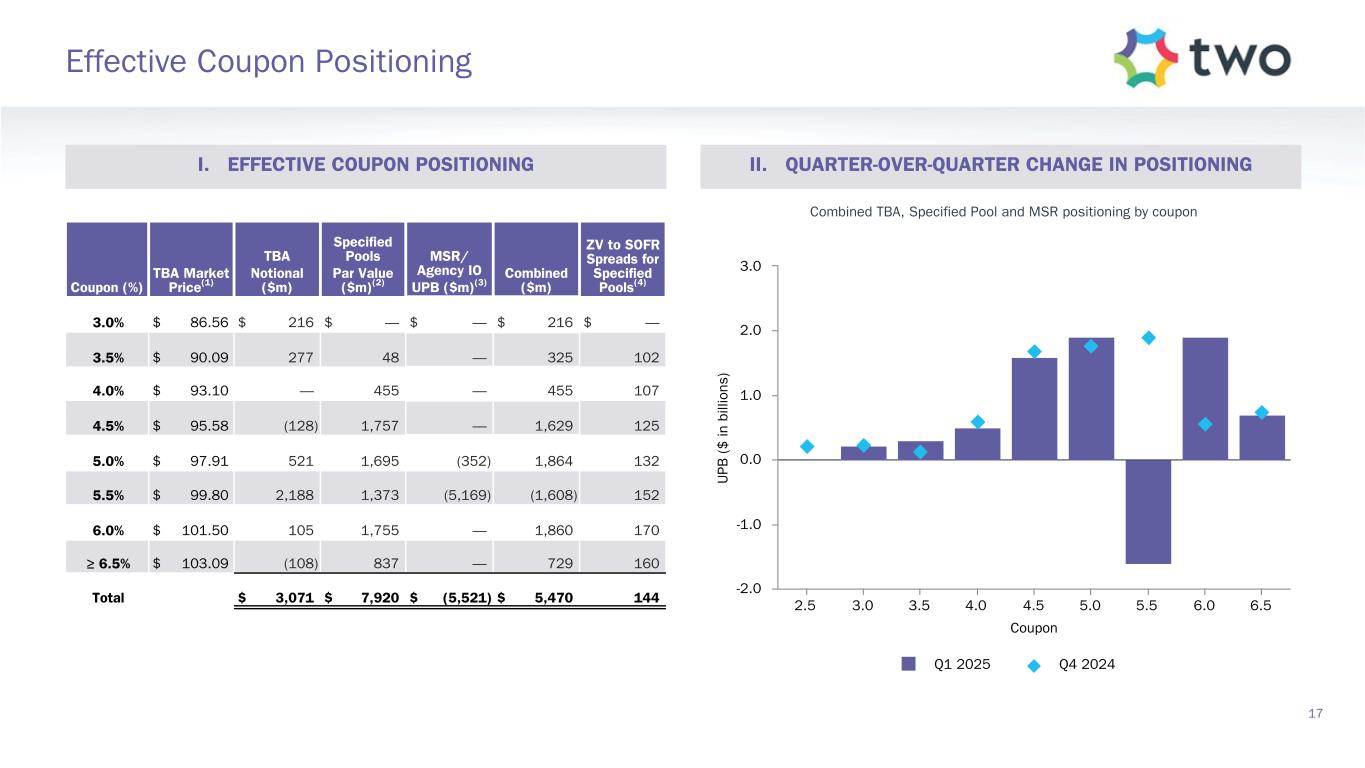
Yes, Eric. So just I would point you to the fact that if you look at our net mortgage exposure as in my comments and if you look at it, quarter-over-quarter, our net mortgage exposure, which is on Page 17 of the deck, I think was down to about $5.5 billion, when you take out the effect of the MSR, which was down significantly. And we talked about this before, the amount of duration and the amount of spread duration you have in a mortgage with a mortgage portfolio depends on where you are on the coupon stack too, right? If we had all of that $5 billion in 2.5s or 3s as opposed to having the majority of it more up in the stack, you would have more spread exposure there. It's the notional amount and where it's located on the coupon stack that determine that sensitivity. And I think that if you distill down that the net mortgage exposure is lower, number one, and two, we did have a little bit more of a shift up in coupon. Both of those things will decline the amount of spread sensitivity. But again, that was something that we very intentionally did by the end of the quarter because we were sort of hunkering down getting into second quarter with all of these changes flowing through the macroeconomic world.
Speaker 8
Yes. Okay. That's helpful. I think that prompts a follow-up question. I mean, do you feel like the like MBS spreads have essentially kind of reset wider as a result of tariffs in this new range for volatility? And how do you feel like spreads would maybe respond if the Fed looks more likely to cut rates from this point?
I mean, they have reset a little bit. I mean, they haven't gone nuts in terms of spreads like by hour, if that's a technical term. But they actually, if you look at like treasury spreads, they're pretty close to where they were at the beginning of the year. Swap spreads mortgages to swaps are wider, but like I said earlier, they're not like at all-time. They're good and we like them here and that's why we're getting a little bit we're putting back on some risk and being opportunistic in adding some assets here and there that we think look really good. But they're far from where they were at sort of the peak points in time. And the way we look at the world everyone looks at the world differently. As you know, we really look at our securities across the whole yield curve with partial durations. We tend not to use sort of spot numbers and that's the way we hedge our book and run our book. But answer your last question, if the Fed cuts, I think that's going to be good for mortgages. I mean, steeper yield curves are typically good for mortgages. It brings more investors into fixed income in general. And I think that would be stimulative to mortgage spreads.
Operator
We will take our next question from Harsh Hemnani with Green Street.
Speaker 9
So, it sounds like you think that volatility at least in the near term will continue to remain elevated, especially on the realized side perhaps? And given maybe the more deeper negative convexity in the portfolio, has there sort of been more hedging activity that could impact the static return estimates that we should be thinking about?
Hi, Harsh, how are you doing? Yes, I mean, look, we know that a lot of realized volatility is never good for a hedge mortgage portfolio. So, we clearly ourselves and I'm sure other REITs have been experiencing more convexity costs than they would under other circumstances. But we have been, as you know, and we've been keeping our risk pretty tight through this whole time period. I think this is a time period where you have to be very cautious about taking on any sort of excess risk in the portfolio. But there is compensation for it, of course, and the fact that spreads have widened, right? So, I mean, there are pluses and minuses to it. Yes, convexity costs are going to be higher when you have more realized volatility, but thankfully spreads have widened in concert with that, which should mitigate some of that convexity cost.
Speaker 9
Okay. That's helpful. And then maybe as you've been stepping back into getting more spread exposure, maybe towards the April, is it fair to assume that the up in coupon bias still remains or where you see relative value across the coupon stack today?
Yes, that is fair to assume. We really do, I'm what the issue with lower coupons for me is I think they trade in such a technical way that the value across the curve is on an OAS basis at least is fairly evenly distributed, but like everything else, there are trade-offs. But the lower part of the stack continues to be extraordinarily technical in the way it trades, and I think can trade in ways that are not necessarily intuitive. So, at the moment, we do like being more up in coupon than down in coupon.
Operator
We will take our next question from Rick Shane with JPMorgan.
Speaker 10
Hey, this is AJ Oden for Rick. Your static return estimate on Slide 14 appears to have widened a bit. Can you talk about what drove that and how has varying your leverage impacted this measure compared to last quarter?
Thank you for the question. As Nick mentioned in his prepared remarks, we adjusted the portfolio leverage slightly at both the lower and upper ends of the ranges. This adjustment reflects our dynamic and active management of the portfolio, particularly this quarter. We believed it was important to present a range of expected static returns available over the medium term in a kind of equilibrium-style leverage portfolio. We ended the quarter with leverage at 6.2%, having dipped as low as the low 5% range and now back up towards the high fives around six. It would be less informative to showcase these static return estimates fluctuating so much as we actively manage the portfolio to capitalize on market dislocations and opportunities. Therefore, we’ve established a higher and lower end of the range, with leverage approximately six at the low end and around seven at the high end, alongside the changes in funding spreads and prepayment rates we’ve been addressing for some time. This is why the range has widened a bit, but we believe it offers a more accurate representation of what the portfolio truly entails.
Operator
We will take our next question from Merrill Ross with Compass Point Research.
Speaker 11
I just have three questions or three things I'd like to hear from you about. One is liquidity. You say you maintained high liquidity, but you could just put some rough numbers around that, that would help.
Good morning, Merrill. We maintained our liquidity at very high levels from the end of the year, and we're maintaining a lot of cash and capacity in our borrowing.
Speaker 11
Regarding the $179 million of slow loans that were recaptured, can you explain the specifics? How much of this was due to recapture versus new flow? Additionally, how does this align with your expectations in light of the market runoff, especially since the portfolio size has increased slightly? I'm curious if your recapture efforts are effectively keeping pace with the runoff.
Yes, thank you for your question, Merrill. The organic recapture from our direct-to-consumer channel remains very low and is still in its early stages. As Nick mentioned, only about 0.5% of our portfolio is currently refinanceable from a rate and term perspective. This limits our ability to recapture some of those loans. However, within that 0.5%, we are seeing increased activity in our direct-to-consumer channel, and I’m optimistic about the potential once we fully scale the platform. We have been active in the flow market on a small scale, allowing us to replenish the portfolio somewhat and participate in the market. We are confident in our ability to maintain or even grow our servicing portfolio over time by using all available tools in both the bulk and flow markets, as well as the direct-to-consumer channel once it reaches full scale.
Speaker 11
Great. Thank you. And the last one is quite small, but you threw out a mention to being interested in the Ginnie Mae market. Do you see price dislocations there? Or is that just sort of a safe harbor for return generation when the GSEs are being recapped and released?
I think it's many factors. I mean, we're taking the beginning stages in order to get involved in that market. But the rationales are number one, just to have the ability to participate in the broader aspect of the servicing market rather than just conventional, the ability to be able to service and subservice for Ginnie Mae's. It is slightly cheaper. It's a little bit more opportunity there. And I think being able to be a more full-service mortgage originator/servicer sort of requires us to be involved in the Ginnie Mae market. So, we're taking the beginning steps in order to do that.
Operator
There are no further questions at this time. I will turn the conference back to Bill Greenberg for any additional or closing remarks.
I want to thank everyone for joining us today. Thank you as always to our shareholders for your interest, and I look forward to talking to you again next quarter.
Operator
This concludes today's call. Thank you for your participation. You may now disconnect.