Operator
Thank you for standing by, and welcome to American Airlines Group's First Quarter 2025 Earnings Conference Call. At this time, all participants are in a listen-only mode. After the speaker presentation, there will be a question and answer session. To ask a question during the session, you will need to press star one one on your telephone. I would now like to hand the call over to Gabriel Jackson, Managing Director of Investor Relations. Please go ahead.
Speaker 1
Thank you, Latif. Good morning, and welcome to the American Airlines Group First Quarter 2025 Earnings Conference Call. On the call with prepared remarks, we have our CEO, Robert Isom, and our CFO, Devon May. In addition to our Vice Chair, Steve Johnson, we have a number of our senior executives in the room this morning for the Q&A session. Robert will follow up with an overview of our performance, and Devon will follow with details on the first quarter in addition to outlining our operating plan and outlook going forward. After our prepared remarks, we will open the call for analyst questions, followed by questions from the media. To get in as many questions as possible, please limit yourself to one question and one follow-up. Before we begin today, we must state that today's call contains forward-looking statements, including statements concerning future revenue, cost, forecast of capacity, and fleet plans. These statements represent our predictions and expectations of future events, but numerous risks and uncertainties could cause actual results to differ from those projected. Information about some of these risks and uncertainties can be found in our earnings press release that was issued this morning as well as our Form 10-K for the year ended December 31, 2024. In addition, we will be discussing certain non-GAAP financial measures, which exclude the impact of unusual items. A reconciliation of those numbers to the GAAP financial measures is included in the earnings press release, which can be found in the Investor Relations section of our website. A webcast of this call will also be archived on our website. The information we are giving you on the call this morning is as of today's date, and we undertake no obligation to update the information subsequently. Thank you for your interest and for joining us this morning. With that, I'll turn the call over to our CEO, Robert Isom.
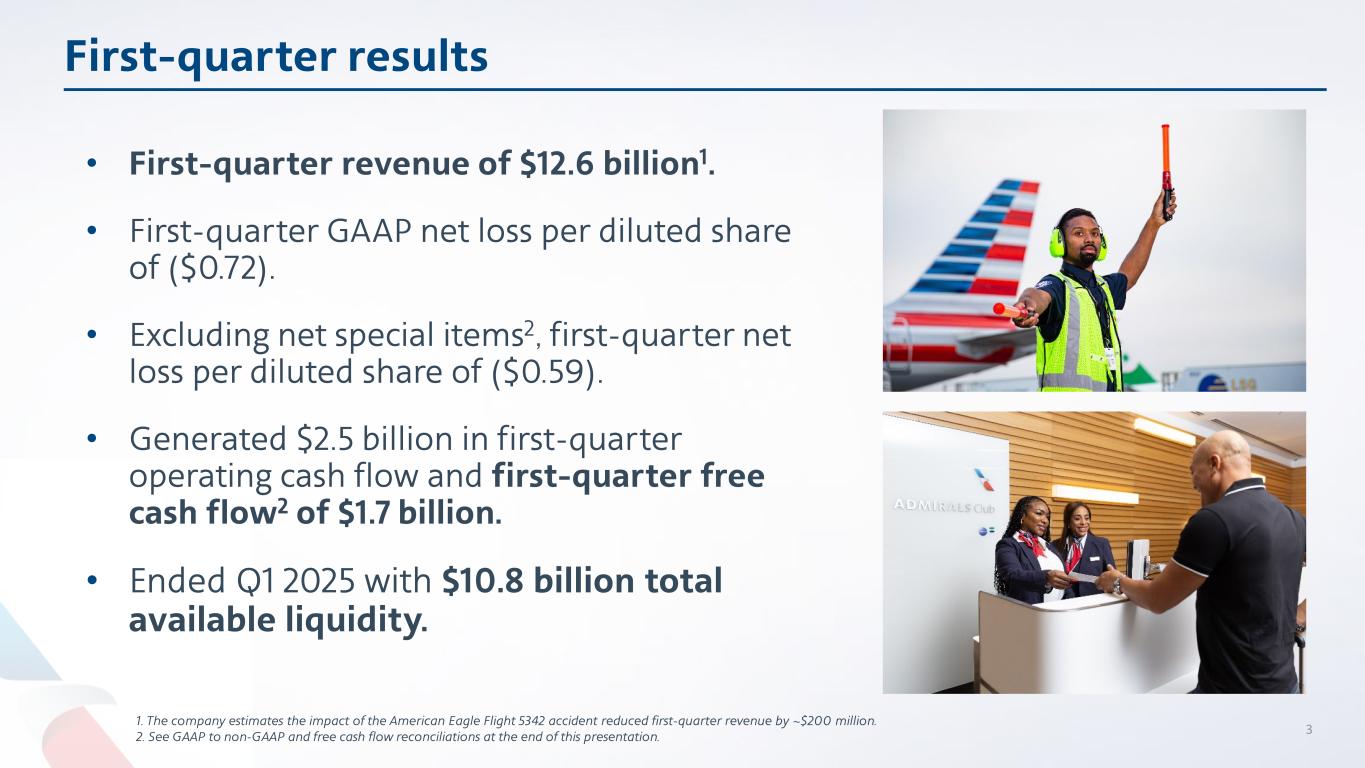
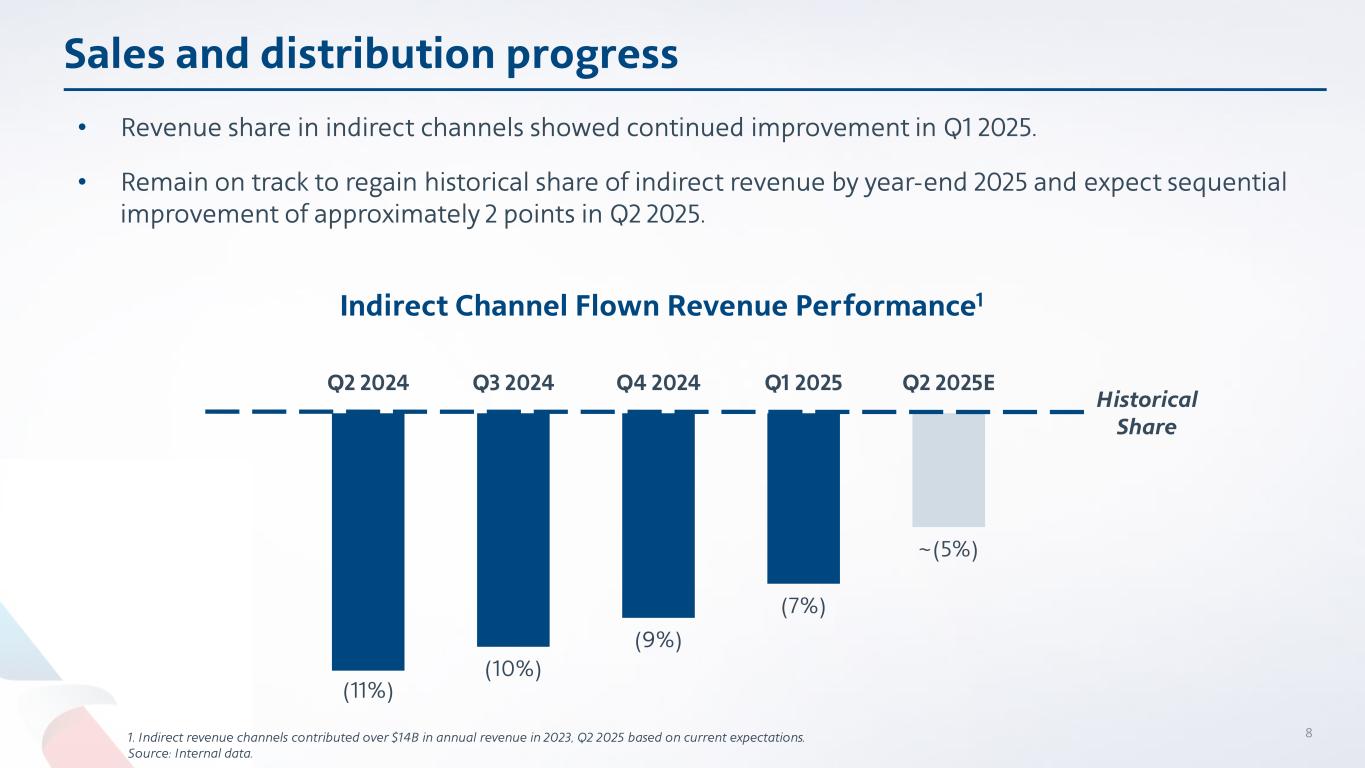
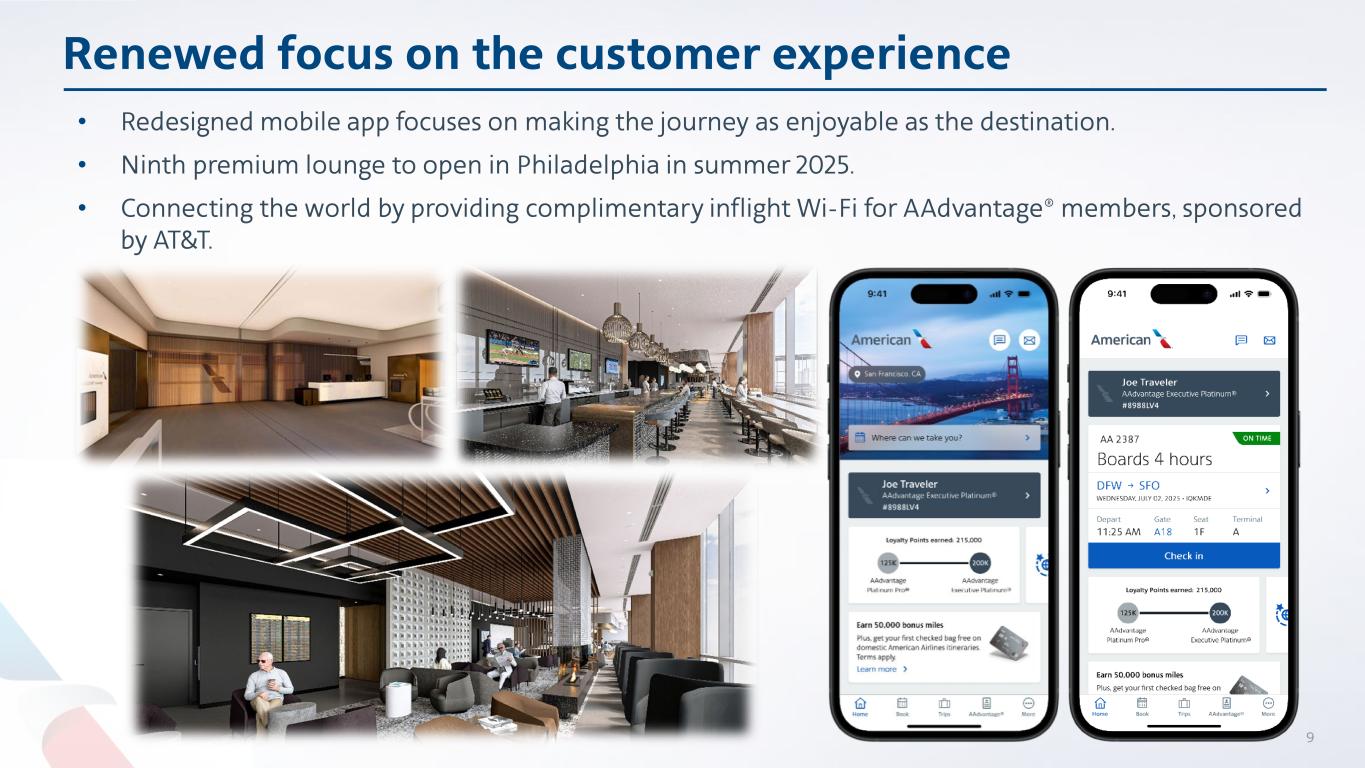
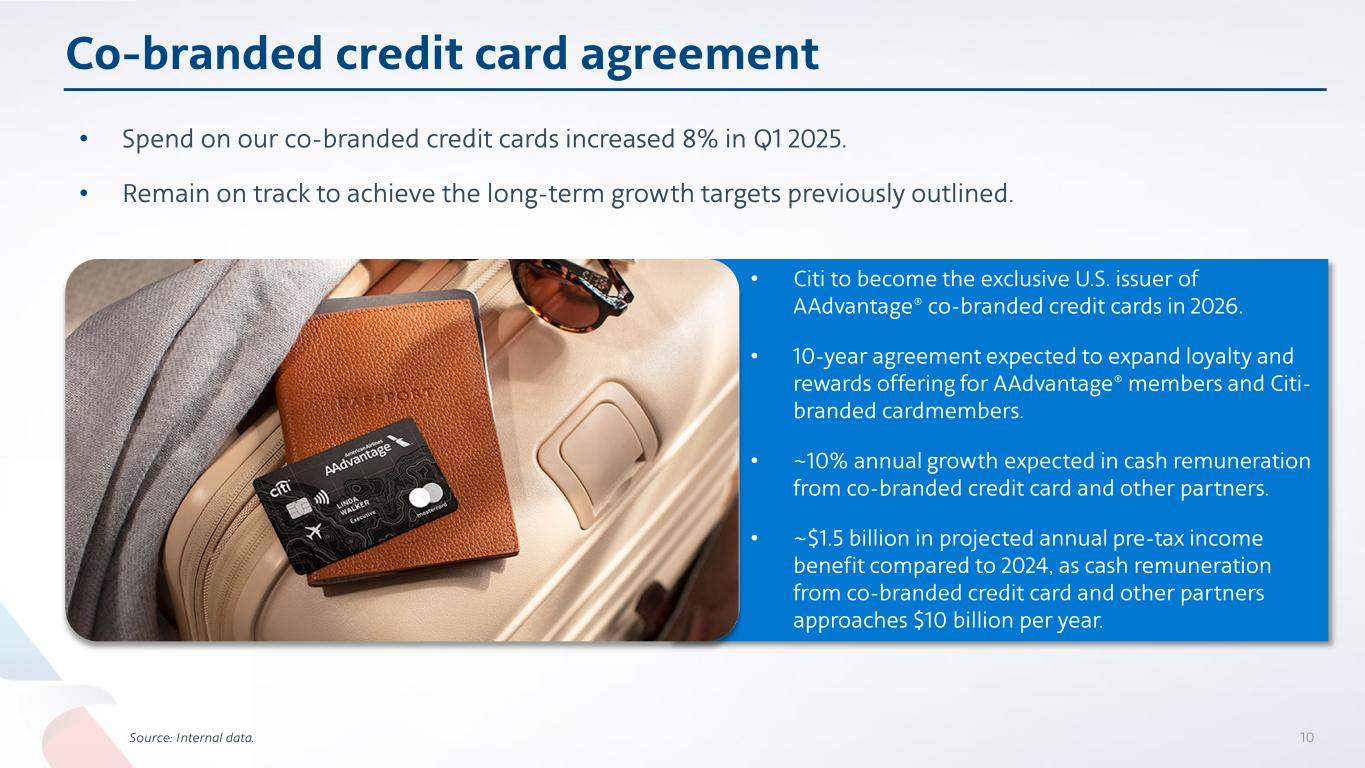
Good morning, everyone. It goes without saying that we're in a challenging economic environment which has had a significant impact on the industry. Historically, the airline industry has done well in periods of economic growth and certainty. The industry exited the fourth quarter with positive momentum, but this quickly shifted during the first quarter. The economic uncertainty in the market has pressured demand and impacted American Airlines Group's first quarter results and second quarter outlook. Given this macro environment, we're withdrawing our full-year outlook. That said, if current demand trends continue, we expect to deliver a profitable year and produce positive free cash flow. At American Airlines Group, we have the foundational strength, resilience, team, and financial and operating flexibility to navigate the current environment. The work we have done the past several years has prepared us for times like these. We completed our fleet renewal in a very different economic environment with lower aircraft costs, lower lease and interest rates, and during a time of OEM and supply chain stability. As a result, we have low aircraft CapEx requirements for the remainder of the decade. We continue to employ our best-in-class cost management to make the airline more efficient. Through our efforts to reengineer the business, we now expect more than $750 million of cumulative cost savings as we exit 2025. We've utilized our free cash flow to strengthen the balance sheet. At the end of the first quarter, we had our lowest net debt level since the end of 2015, while simultaneously taking action to smooth our debt maturity obligations going forward. This foundation allows us to focus on our 2025 priorities of running a reliable operation as we reestablish connectivity throughout our network and continue to find ways to run a more efficient airline. We're taking action to deliver on our revenue potential, enhancing our partnership with Citi, growing our Advantage loyalty program, progressing in our sales and distribution indirect channel recovery, and renewing our focus on customer experience to provide the best product and service for everyone who flies with American Airlines Group. As we move forward, we remain committed to delivering on our long-term growing margins, generating sustainable free cash flow, and further strengthening our balance sheet. Now onto our first quarter performance. First quarter unit revenue was up 0.7% year over year, which continues to lead the industry, despite more exposure to a challenging domestic environment. We estimate the impact of American Eagle flight 5342 reduced first quarter revenue by approximately $200 million. Long-haul international passenger RASM continued to lead the way in the first quarter. Atlantic passenger RASM was up 10.5% year over year, and Pacific passenger RASM was up 4.9% on 24.1% more capacity, primarily driven by strength in Japan. Short-haul Latin passenger RASM increased year over year for the first time in more than a year and remains one of the most profitable regions on an absolute basis. We continue to see strong demand for international travel from the US. Domestic passenger RASM was down 0.7% year over year in the quarter as US consumer discretionary spending, especially consumer spending on air travel, decelerated throughout the quarter. Performance in our premium and loyalty revenues continued to show strength year over year. Premium revenue increased 3% year over year in the first quarter on 0.3% lower capacity. Our premium cabin RASM year over year outperformed main cabin RASM by four points in domestic and eight points in international. Paid load factor in our premium cabins remained historically high and was up 2.9 points year over year. Loyalty revenues were up 5% year over year, with spending on our co-branded credit cards up 8% in the quarter. We've begun laying the foundation for our expanded co-branded credit card partnership with Citi, which is set to begin in 2026, and we remain on track to achieve the long-term growth targets we outlined last year. Most importantly, customers continue to recognize the value of our loyalty program, with Advantage enrollments increasing 6% year over year. Advantage members are responsible for 76% of premium cabin revenue. American Airlines Group is proud to have an industry-leading travel rewards program that is frequently recognized for providing the best value for its members. Despite the headwinds in the economy and lower capacity, managed business revenue was up 8% year over year in the first quarter. We remain encouraged by the feedback we're receiving from corporate customers as we continue to engage with them to understand how best to meet their needs. We saw specific strength in the financial and professional services sectors during the quarter. Momentum in recovering revenue from indirect channels continued in the first quarter. We hit our target of reducing the gap versus our historical share to 7% in the first quarter, and we forecast to gain back another two points in the second quarter. We remain on track to restore our revenue share from indirect channels to historical levels as we exit this year. Despite the current macroeconomic uncertainty, we started the year with a conservative growth plan, and we will continue to be mindful of our capacity deployment. The demand and the competitive environments will continue to serve as the guidepost for our future capacity plans. We'll remain nimble and take action as conditions warrant, and we have many levers at our disposal, such as reducing off-peak flying or, if circumstances require, returning leased aircraft, retiring aircraft, and deferring aircraft deliveries to efficiently reduce capacity without jeopardizing the quality of our core network. We're positioning American Airlines Group for sustained long-term success, and a big part of that is transforming our customers' experience and engagement with us. We've established a new customer experience organization, a centralized cohesive team that sits at the intersection of our commercial and operations organizations. This team will advocate on behalf of customers, leading the strategy and implementation of initiatives to improve every part of the customer journey, from bookings to the airport to in-flight experience to customer feedback. Last week, we announced that Advantage members will receive complimentary high-speed satellite Wi-Fi beginning in January 2026, thanks to a new sponsorship with AT&T. We're excited to be able to offer free high-speed satellite Wi-Fi on more aircraft than any other carrier, and it's a great way to demonstrate that we have renewed our focus on the customer experience. American Airlines Group continues to have the youngest fleet of the US network carriers. We're excited to debut our new state-of-the-art flagship suite seat on our first new Boeing 787-9, and we look forward to the rollout of this product on our new Airbus A321XLR aircraft. These deliveries, along with the planned refresh of existing seats, are expected to grow American Airlines Group's lie-flat and premium economy seating by approximately 50% by the end of the decade. Additionally, American Airlines Group has led the way in introducing premium lounges and offers more premium lounges than any other US network carrier. We're committed to reinvigorating the customer experience throughout various touchpoints to the travel journey, and we're on track to open our newest flagship lounge in Philadelphia in May. This lounge will be our ninth premium lounge across the system, with more to come. Finally, we recently announced several changes to improve our boarding process starting next month, and just this week, we introduced a new redesigned mobile app to further enhance customer interactions and self-service options. Turning now to our operation. During the first quarter, the American Airlines Group team demonstrated our resilience and ability to quickly recover from irregular operations. We continue to make investments to drive further enhancements to our operating reliability. Our first quarter operation was impacted by California wildfires, increased winter weather in our Sunbelt hubs, and the tragic accident of flight 5342 on January 29th. Before moving on, I want to take a moment to acknowledge the tragedy and pay tribute to the lives lost in the accident. We're supporting the families and loved ones through our Office of Continued Care and Outreach, which we established within a week of the accident. The role and responsibilities of the office will evolve over time, but it will always be focused on ensuring we live out our purpose of caring for people on life's journey. Thank you to our team members who helped in the immediate response to those who kept the operation running while caring for our customers, and to our care team members who supported the families. We continue to work closely with the US government, and we're encouraged by the collective commitment to make the US aviation system even safer going forward. Now I'll turn the call over to Devon to share more about our first quarter financial results and second quarter outlook.
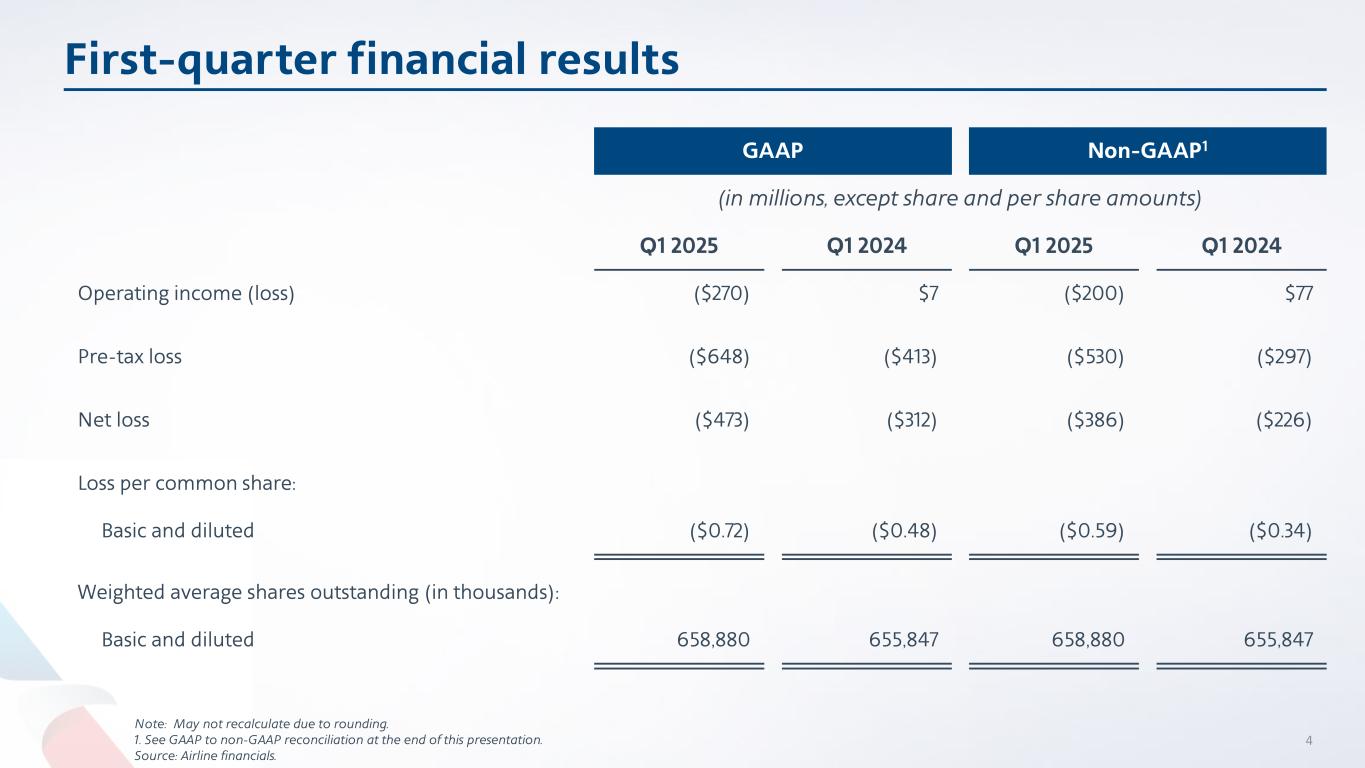
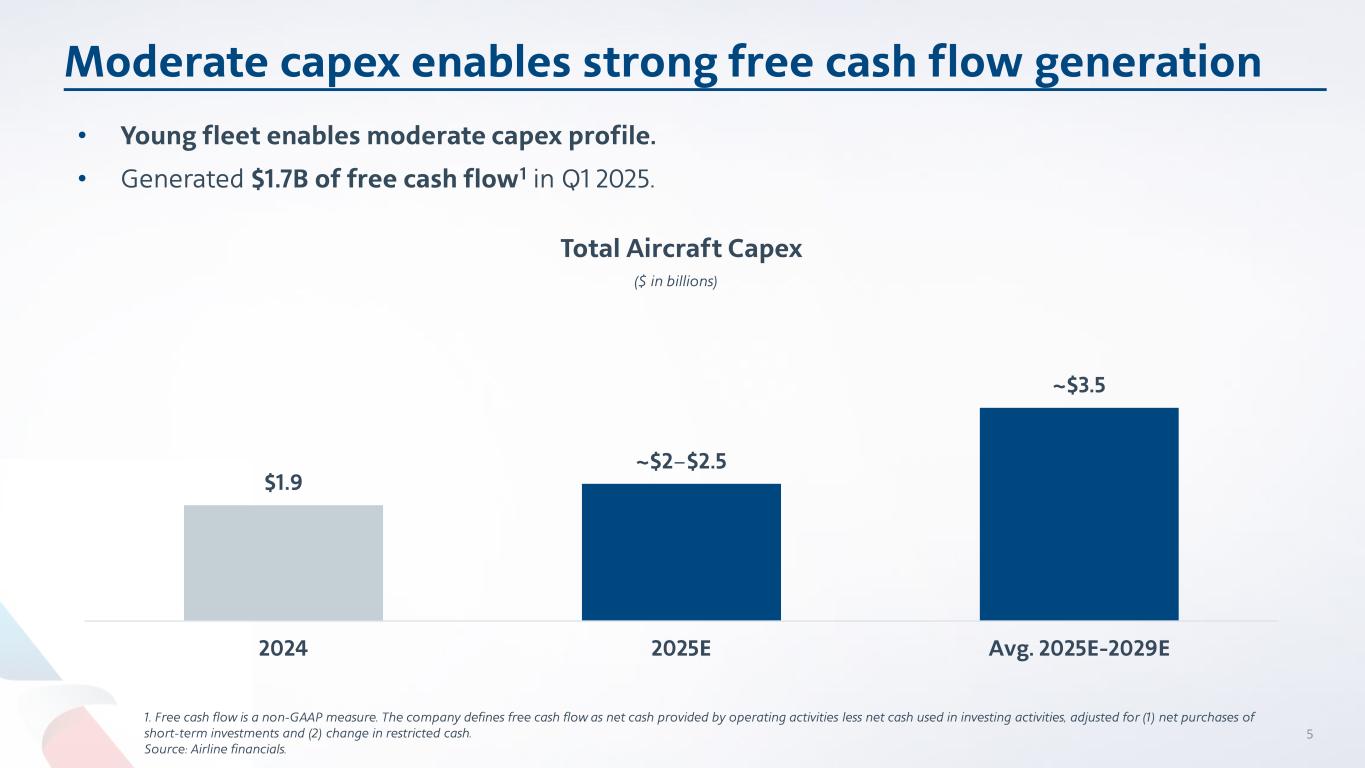
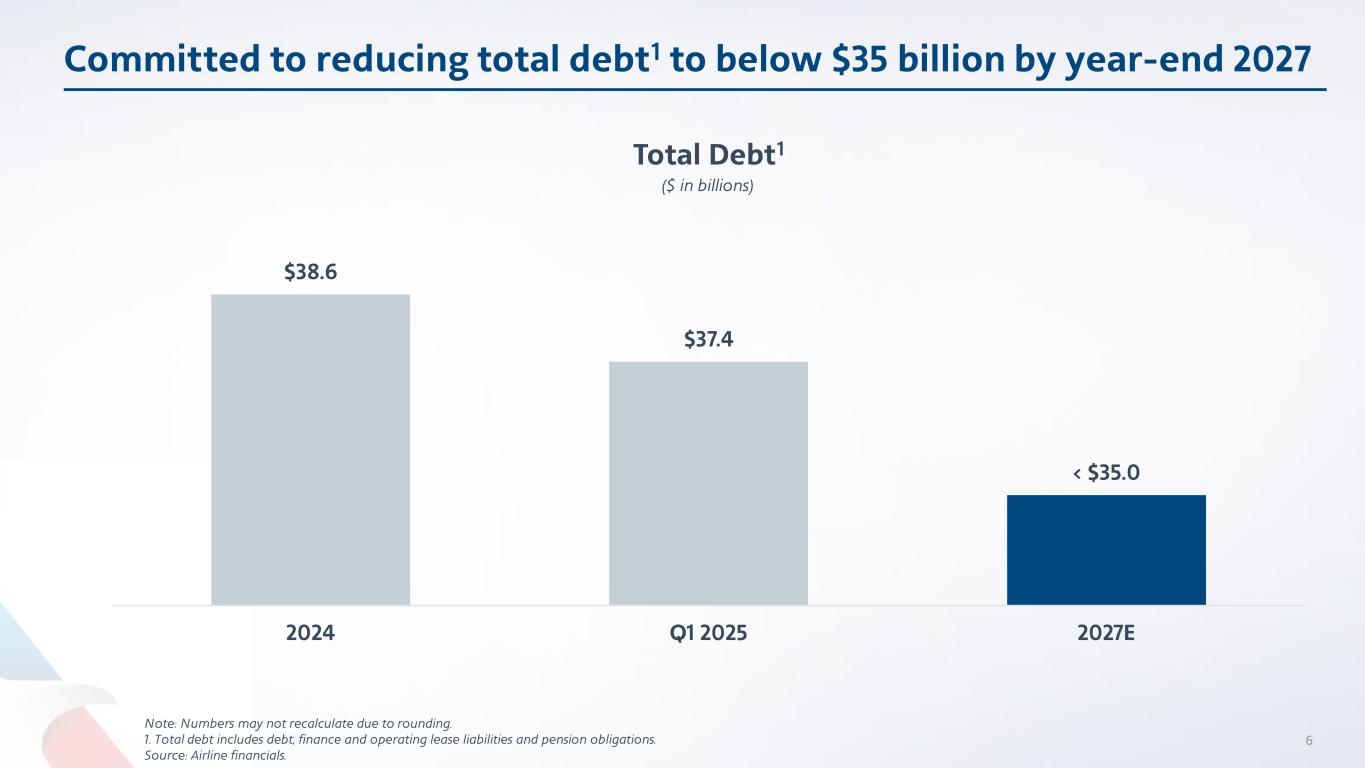
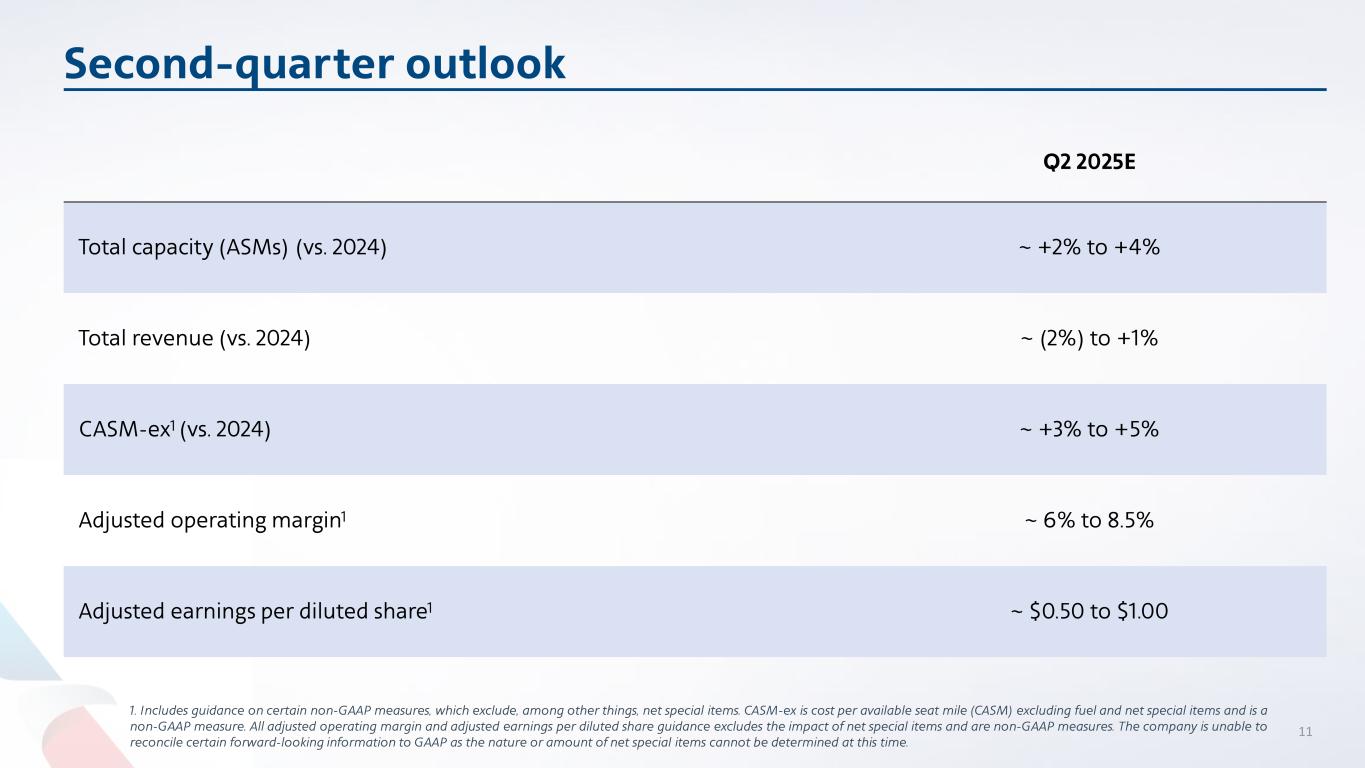
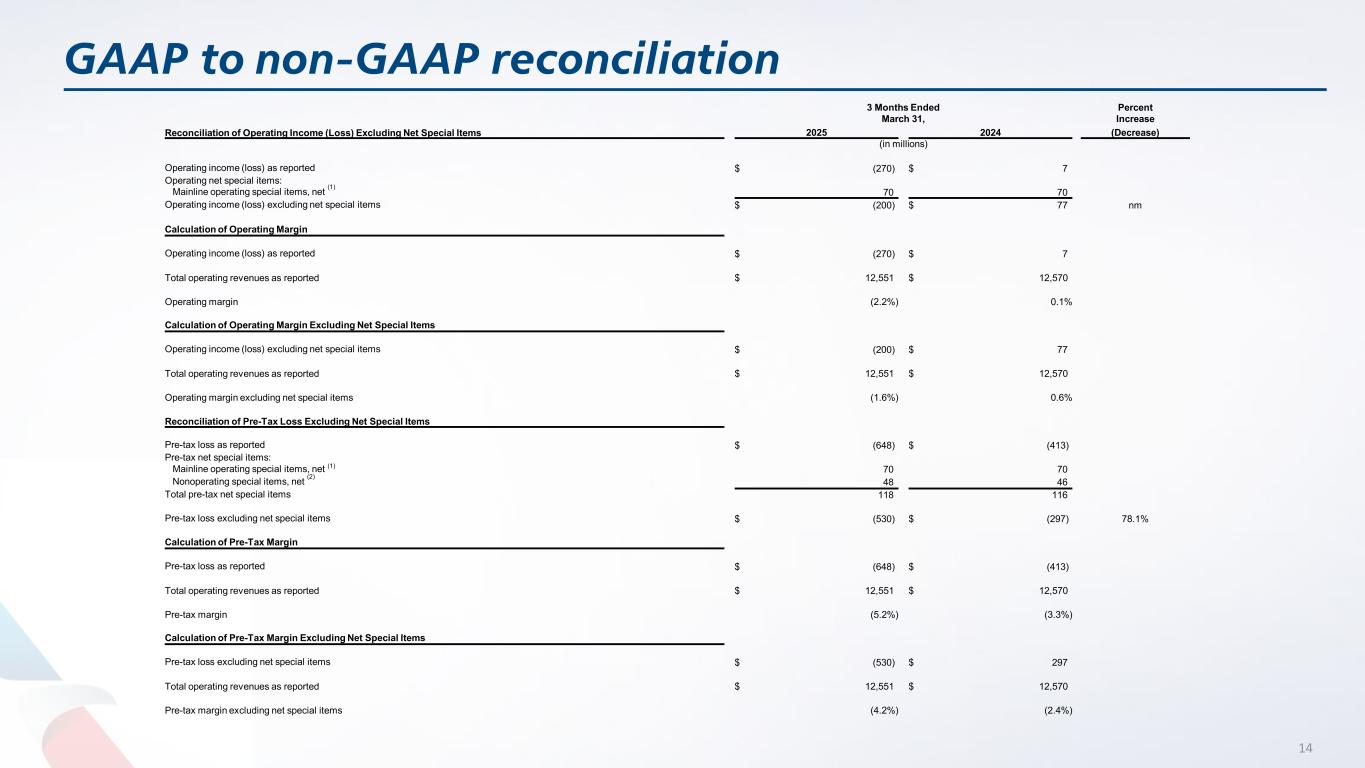
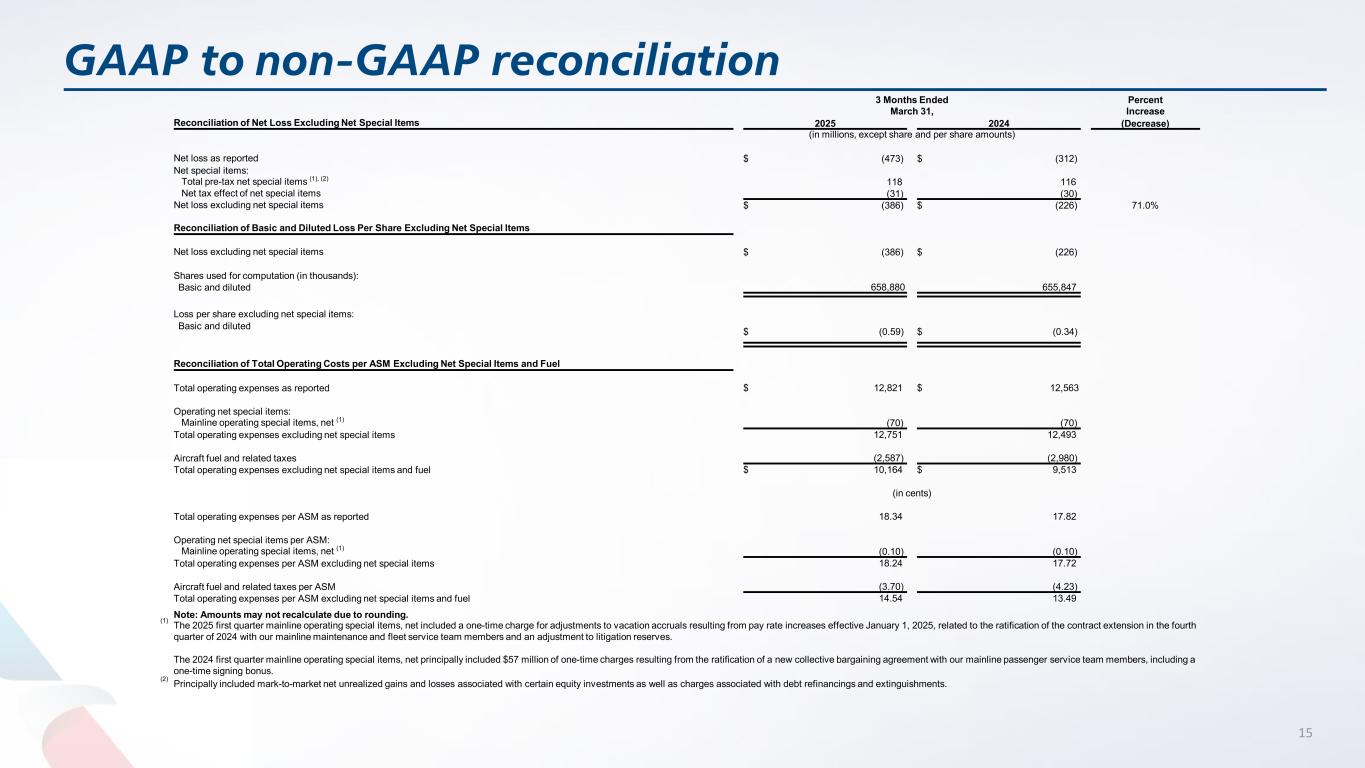
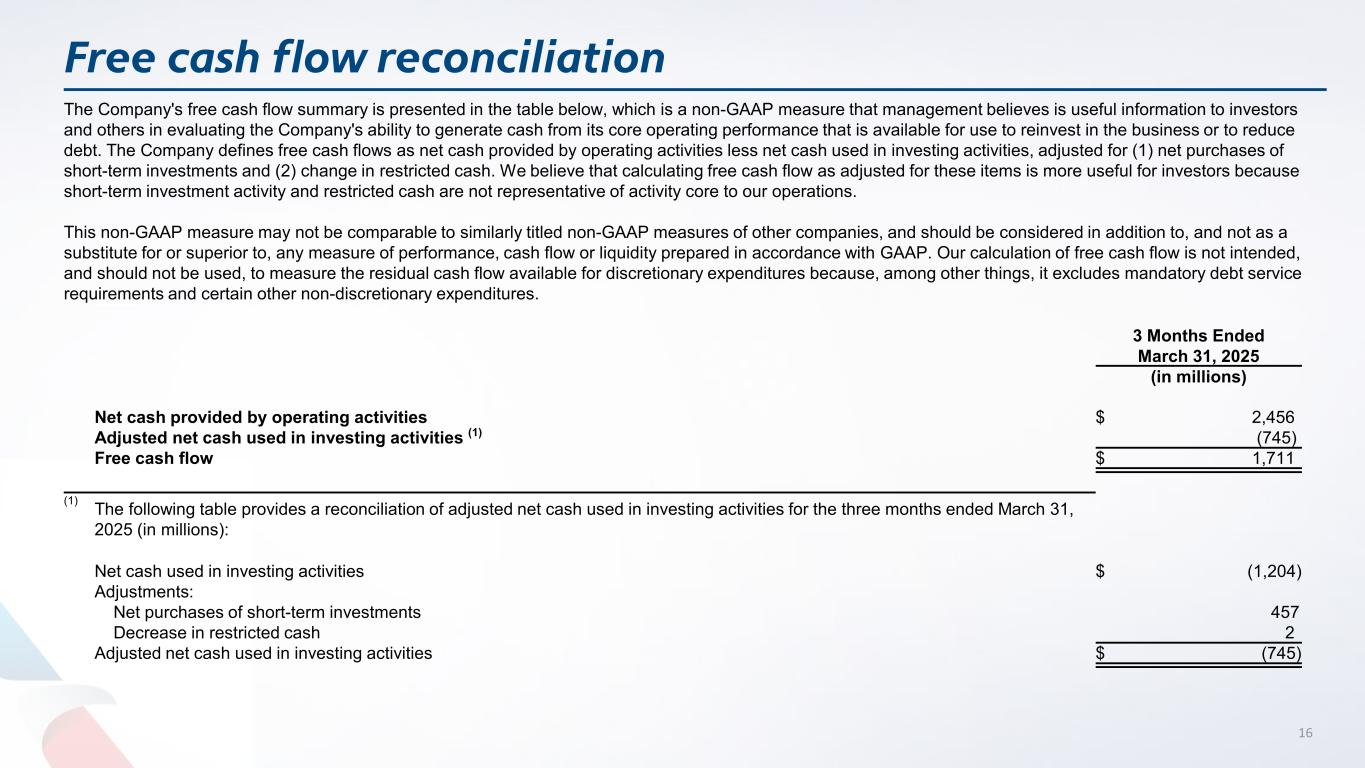
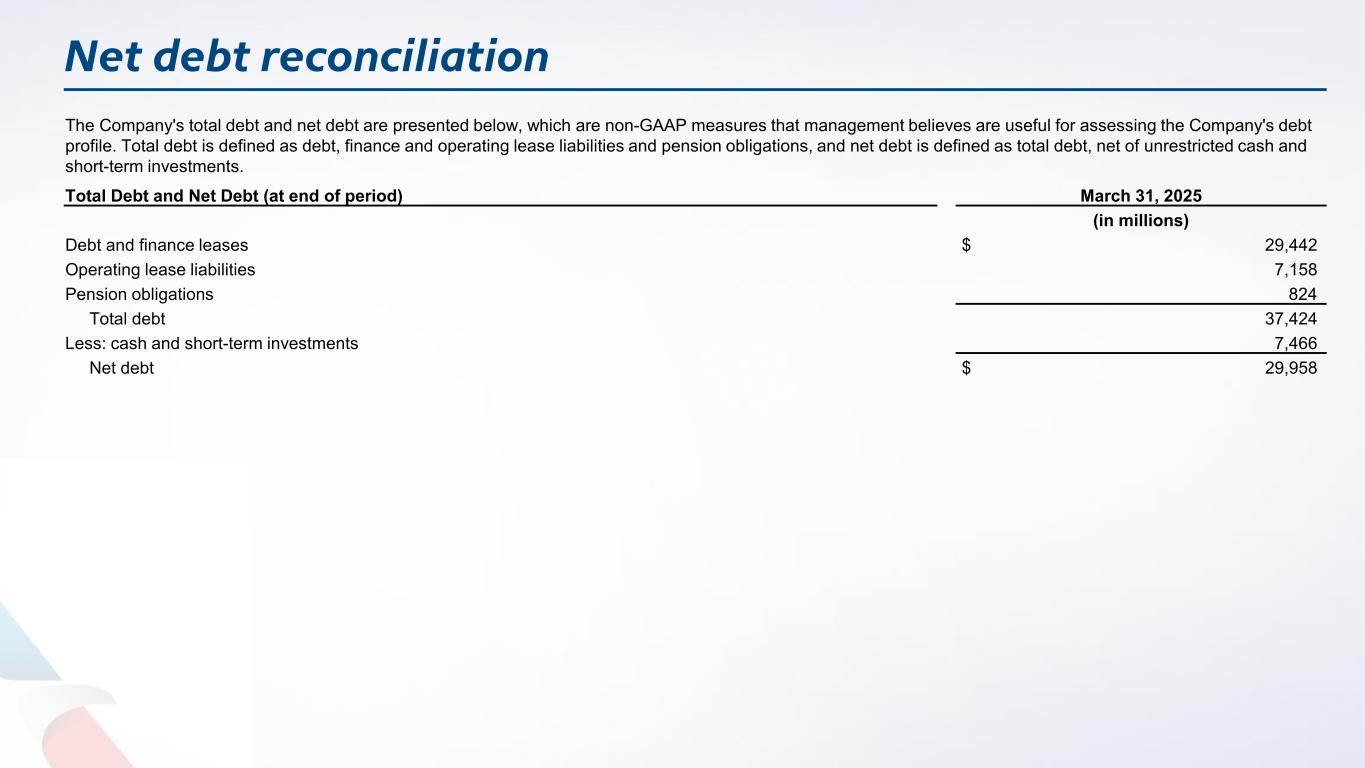
Thank you, Robert. This morning, American Airlines Group reported a first quarter GAAP net loss of $473 million. Excluding special items, we reported a first quarter net loss of $386 million, an adjusted loss of $0.59 per diluted share. We produced first quarter revenue of $12.6 billion, down 0.2% year over year, with unit revenue up 0.7% year over year. First quarter unit cost excluding fuel and net special items was up 7.8% year over year. We are committed to running the airline as efficiently as possible while enhancing the customer experience. Through best-in-class workforce management, efficient asset utilization, and procurement transformation, we now expect to achieve approximately $250 million of cost savings in 2025, on top of the $500 million achieved last year. We also expect an additional $100 million of working capital cash release, bringing our total improvement in working capital to approximately $550 million over the past three years. We continue to see improvements in the productivity of our team and expect mainline full-time employee accounts to stay approximately flat relative to 2024. With regard to our fleet, we expect to take delivery of 40 to 50 new aircraft this year. Based on our current expectations for new deliveries, our 2025 aircraft CapEx, which also includes used aircraft purchases, spare engines, and net PDPs, is expected to be between $2 billion and $2.5 billion, and our total CapEx is expected to be between $3 billion and $3.5 billion. We continue to expect moderate levels of CapEx moving forward, with aircraft CapEx averaging approximately $3.5 billion for the remainder of the decade. We ended the first quarter with $10.8 billion of total available liquidity, and we produced free cash flow of $1.7 billion in the quarter. During the quarter, we strategically repriced our $2.3 billion Advantage-backed term loan. The repricing lowered the interest rate by nearly 300 basis points and vastly improved the amortization profile, pushing out $1.9 billion of amortization over the next three years into 2028. Additionally, we reduced total debt by $1.2 billion during the quarter. We now have more than $10 billion in unencumbered assets and more than $13 billion in additional first lien borrowing capacity. Our balance sheet is stronger than it has been in nearly a decade, and we remain committed to reducing our total debt to less than $35 billion by year-end 2027. For the second quarter of 2025, we expect capacity to be up 2% to 4% year over year as we continue to build back our northern hubs. We remain focused on deploying profitable capacity and being nimble in response to the demand and competitive environment. We expect second quarter revenue to be down 2% to up 1% year over year as we anticipate softness in the domestic main cabin to continue. To partially offset this, we expect long-haul international and premium bookings to outperform year over year and anticipate additional progress in recovering revenue through our indirect channels. Second quarter non-fuel unit cost is expected to be up 3% to 5% year over year, which is in line with our expectations to start the year. Nearly the entirety of our year-over-year CASM ex increase is driven by the collective bargaining agreements that we have ratified over the past two years. While these collective bargaining agreements have resulted in a meaningful step-up in labor costs, we are pleased that all of our largest work groups enjoy contracts that are in line with industry-leading agreements and that we have labor cost certainty through 2027. Based on our current demand assumptions and fuel price forecast, we expect to produce second quarter earnings of approximately $0.50 to $1.00 per diluted share. I'll now turn the call back to Robert for closing remarks.
Thank you, Devon. The travel industry is a critical engine for the US economy, generating $1.3 trillion in direct spending in the US and supporting one in every eleven US jobs. With increased global travel to the US comes increased spending and investment in economic growth. Airlines are a big part of that equation, and American Airlines Group is proud to be the largest employer of US workers among them. Anything that spurs demand for travel, both domestically and abroad, is something we will support. This starts with making America a welcoming destination for international travelers, especially in advance of major events like the FIFA World Cup 2026, of which we're a sponsor, and later, the 2028 Olympic Games in Los Angeles. This means expanding Visa-free travel, lowering Visa processing times, and expediting the deployment of new technologies to make travel more seamless and secure. And, of course, ensuring the growth and long-term health of the travel industry in the US will require us to address critical infrastructure issues, the most pressing of which is ATC modernization. American Airlines Group is committed to working with the administration, regulators, and the rest of the industry to meet each of these challenges. At American Airlines Group, we're resilient by design. The underlying strength of our business and balance sheet and our ability to remain nimble and adjust to the environment gives us confidence in our ability to navigate the path forward. We remain focused on delivering on our commitments and producing results for the airline and for our shareholders. Operator, you may now open the line for analyst questions.
Operator
You will be limited to one question and one follow-up. Please standby while we compile the Q&A roster. Our first question comes from the line of David Scott Vernon of Bernstein. Please go ahead, David.
Speaker 4
Good morning, guys. Robert, so I guess the first question I have for you is the earnings release and materials didn't make much mention around sort of capacity moderation given the weakness that we're seeing in demand. Can you talk about kind of how you're thinking about sizing the network as we get through the second half of the year?
Mean, clearly, with the financial leverage of the business, you know, I'm sure this is something you guys are looking at. It just like to hear from you kinda what you're thinking about on the capacity front as we look at two h. Thanks, David. Appreciate the question. What we've done is obviously pulled our guidance. We've more or less have our capacity plan set for the summer. We plan on flying that. You saw in our in our second quarter guide, two to four percent growth. We look beyond that, there's a lot of uncertainty. Our view as we go forward is we're gonna be nimble and quick to react. Size demand sized capacity to demand. But I'll tell you right now, we have a negative bias to all capacity as we go forward. We'll know more you know, as as time develops in the next several weeks, month, and we'll have more to talk about on that on future earnings calls.
Speaker 4
Alright. Maybe just as a follow-up, as you think about the corporate, sort of share recovery, is that coming in at the yields you would have expected to be coming in? Or is there a little bit of reinvestment required in terms of recapturing some of that, the business share. Yeah. Thanks for the question. This is Steve.
Speaker 5
It's coming in just as we expected. And as Robert said in his opening remarks, we're on track to recover share by the end of the year.
Operator
Thank you. Our next question comes from the line of Savi Syth of Raymond James. Please go ahead, Savi.
Speaker 6
Thank you. Good morning, everyone. I know you mentioned it sounds like in 2Q, you're expecting kind of international in premium to continue leading the way. But I was curious if you can provide a little bit more color across the four entities on how you know, what's in guidance in terms of performance there?
Speaker 5
Sure. Thanks, Alek. It's across the entities. We're seeing strength through the summer. Really, in each one. Obviously, with the uncertainty and just the booking curve visibility beyond the summer's a little unclear right now, but we're seeing really, you know, very good strength in our Heathrow and Europe operation. Strength in the North Pacific, strength in the South Pacific, you know, South America to South America, but it is doing pretty well. And Argentina is kind of the star of the show down there right now. And it also you know, just don't wanna finish the answer without mentioning that you know our we're still continue we have a very significant international operation in its short haul in the Caribbean, Mexico, Central America, and that's performing pretty well.
Speaker 6
I appreciate that. And if I could on the domestic side, are you expecting much of a deceleration or are, you know, what's the trend into 2Q there?
Speaker 5
Domestically, you know, we remain strong in as we described in the opening remarks, our premium bookings are terrific. Our the bookings through indirect channels are solid. Our business bookings are solid. What we're seeing, though, like the other airlines, is, you know, really significant weakness in the demand that books through our indirect channels, which is, you know, I think we believe is mostly our most price sensitive customers, our customers for whom travel is most discretionary, And, you know, that's that's where the issue is. You know, we'd like to think that that's demand that's not been lost, but demand that's on the sidelines waiting to understand which direction the economy is gonna go. But, nevertheless, at the moment, that's that we're seeing weakness in those cohorts.
Operator
Thank you. Our next question comes from the line of Scott Group of Wolfe Research. Please go ahead, Scott.
Speaker 7
K. Thanks. So just to follow-up there, that that subset of the business that you're talking about that's I guess, maybe domestic, main cabin, or indirect. What percentage of the total business is that end I if international is staying it sounds like international is positive. If know, correct me if I'm wrong. Like,
Speaker 7
are we seeing is this business down? Is this a high down, high single digit kind of RASM right now? On this more domestic main cabin part of the business?
Speaker 5
Domestic main cabin is weak, and that's what's driving, I think, the overall demand numbers that you're seeing and the weakness in the reports. Right? I think I'd say mid to high single digit weakness in those groups particularly over the course of the summer is what we're looking at.
Speaker 7
Okay. And then I guess are we seeing any signs of that stabilize or is it continuing to get worse? And then maybe just, like, bigger pick you a year ago in q two, I you guys do underperformed on RASM and we heard about well, we lost a lot of corporate. We're now getting the corporate back. Why aren't we seeing the RASM benefit of that at least relative to some of the others?
Hey, Scott. I just let me let me start with this, which is look. There's a tremendous amount of uncertainty in the environment. We take a look at fourth quarter, tremendous amount of momentum. You go into the first quarter. January kinda came in where we had anticipated. February looked kinda kinda solid. But, really, March and then continuing to April, you know, changed considerably. So we're cautious about what we're looking at in terms of forecast for second quarter. Because there is so much uncertainty. And it's why we pulled the our guide beyond that. So as we take a look and as Steve mentioned, premium is doing well. International We're winning back our sales in from a sales and distribution perspective. We just don't have a lot of clarity what goes beyond that. And even as we take a look into the summer, what we know right now, we're telling you the best what we know and, you know, we're gonna have to see how things play out.
Operator
Thank you. Our next question comes from the line of Connor Cunningham of Melius Research. Please go ahead, Connor.
Speaker 8
Hi, everyone. Thank you. Just going back to the US domestic market, I realize this is a short-term question and I hate to ask it, but can you talk about how you've changed your revenue management systems? Are you doing what Delta and United are doing essentially in opening up basic economy earlier? And the question the reason why I asked that is, like, the industry in general has a lot more seats to sell in June versus April. So are you seeing incremental discounting into a month like that relative general? Thank you.
Speaker 5
Sure. Thanks for the question. I don't have specifics about how Delta and United have set up, but we believe that we are properly set up for a summer that is, you know, along the lines that I just described a moment ago where there's, you know, significant weakness in our main cabin demand, significant weakness among our most discretionary travelers. So our inventory systems and our pricing is set up to accommodate that, to capture you know, all of the demand that is available, under the existing circumstances. And, obviously, those are levers that we can pull and tweak and manage very carefully on a real-time basis. We're monitoring the situation very carefully, making changes every day. But I think right now, our setup is where it needs to be.
Speaker 5
Okay. And then, you know, I'd spent a lot of time on their call talking about share shift in Chicago. And, you know, I'm just trying to understand from your corporate travel expectation as you exit this year. Like, can you talk about the importance of rebuilding New York in Chicago in general and, you know, how that correlates to getting back the corporate share that you lost from the distribution changes in general. Thank you. Sure. Sure. A big complicated question, but let me try to unpack it. First first, if United is gaining share in Chicago, they're gaining it from somebody other than us. So let's start there. But and might as well just stick with Chicago. I mean, it's a huge market. It's a huge business market. It's, you know, our third largest hub. It's a really key part of our network. It has been, you know, profitable in the past. Even as a shared hub. And, you know, we've been part of Chicago for ninety-nine years. We have a really loyal customer base there. We have significant advantage penetration, significant co-brand penetration. We've received a really positive reception from our corporate clients as we, you know, pivot on sales and distribution. Chicago's really important to them, and our presence there is really important to our business with them. Geographically, Chicago is important. It's where, you know, we, it's how we take care of and connect to and provide service to our customers in the upper Midwest and the Great Lakes region. It's how we connect passengers across the northern tier of the United States. And I can also say that so far, the Chicago operations this year we have increased our share in Chicago, and the overall performance is I think, going exactly in accordance with our plans. New York is likewise a very important part of our network—a very large market, a market that has always accommodated several airlines. We in New York, we have a large customer and large loyal customer base. Significant advantage penetration, significant co-brand penetration. And we're excited about the evolving position that we're creating in New York. LaGuardia will be, you know, the largest, I think, operation that we've had in history. We've optimized it, we think, for our New York customers. We've optimized it for our hubs and spokes, and we've optimized it to maximize the halo effect that that New York has. At JFK, we've created a really competitive one-world hub at Terminal 8 at the airport there. And together with LaGuardia, we now serve a hundred markets out of New York. We have a, you know, really significant franchise in the transcontinental market, really significant franchise in London Heathrow, the biggest travel market in the world, I think. And we operate at two really great facilities in New York with terrific lounge products, terrific retail. Indeed, we still, we're reimagining the retail at JFK, and I'm told there are gonna be sixty new stores and restaurants there as that work is completed. So we're evolving in New York. We're adapting in New York. We're obviously constrained in New York by slots, but we're, I think, really happy with positioning we have there.
Operator
Thank you. Our next question comes from the line of Jamie Baker of JPMorgan Securities. Please go ahead, Jamie.
Speaker 9
Hey, good morning, everybody. First one for Devin. So you know, you're obviously not buying back stock at the moment, which is, you know, a good thing. But curious how we should think about your approach to minimum liquidity and CapEx if operating cash flow deteriorates from here. So which bucket or buckets, plural, of collateral would you consider easiest to tap given where market yields are right now?
Yeah. Well, I'll just start by saying I really like the position we're in. You know, we ended the first quarter with ten point eight billion dollars of liquidity. We have made a ton of progress on the balance sheet. We've reduced total debt by fifteen billion dollars from peak levels back in mid twenty twenty-one. We have billion dollars of unencumbered assets. We have thirteen billion dollars of first lien capacity. You know, we have really high quality first lien capacity. It's out there as well, whether it's, you know, slot gates routes or mhmm. Advantage-backed. We feel really good about where we're at right now and know, we'll see what we end up doing with it if we do really get into a downside scenario, but we're in a great position.
Speaker 9
Okay. And then following on Connor's question, and it wouldn't be an American earnings call, I suppose, if I didn't ask about one of your hubs. But looking at, Chicago, it seems that a pretty material portion of the capacity restoration is really early in the morning or pretty late at night. Can you comment on how RASM you know, sort of at the edges of the workday, however you define that, compares to that of I don't know. Daylight hours for lack of a better term. Although, I suppose that's not a good term for the summer. But you get the idea.
Speaker 5
Sure, Jamie. I mean, as you grow markets, you particularly hub markets, you grow them by adding banks. And so we've added banks at the beginning of the day and the end of the day. There's obviously, those are gonna be weaker than in the heart of the day. But but they it's cheaper to add those by just improving your asset utilization. Also, it's important to know that, you know, the first slide of the day and the last slide of the day is really important. And so as we think about what we where we wanna end up and Chicago, that's that that's a big step, and, you know, ultimately, those we expect that those banks will improve performance as you know, we have the opportunity to fly them and have the our customers get more remember American and and those will those will be better. Really important part of our local traffic offering for our Chicagoans is the banks are the first part of the day, and the banks for the last part of the day. So, yeah, they're that's that's what we had always planned and what you would have expected to see.
Operator
Thank you. Our next question comes from the line of Dwayne Fenigwerth of Evercore ISI. Your line is open, Dwayne.
Speaker 10
Hey. Hey. Thanks. Appreciate the time. Just on the corporate share recapture, it's hard to find that in your guidance and understand it's a dynamic backdrop for sure. But you know, what would be offsetting this share recapture if you're winning back corporates?
Speaker 5
From a margin and from a, I guess, implied, you know, RASM perspective. Thanks. I think that you're not seeing it because it's overwhelmed by the weakness in our main cabin demand.
And, Steve, I'd add to that. Our government business is falling off considerably as well. So that would add to it as well.
Operator
Okay. And then apologies. I really don't wanna ask another Chicago question, but I'll venture down the path again. It might be hard to parse in this backdrop. But can you contrast, you know, presumably, some of this was about taking pressure off of a market like Charlotte versus the investment that you're making in a market like Chicago, can you just you know, help us size you know, the relative benefit in Charlotte from a RASM and margin perspective versus, you know, the relative investment in Chicago? And I guess, when are we done? What what inning are we in of that rebuild in Chicago?
It's right now, like, maybe the fourth inning, I think, is about right. Fourth or fifth inning, something like that. And our strategy to grow Chicago didn't have anything to do with our strategy in Charlotte. You know? It Chicago was a place that that is a place that we have been very successful in the past. We took down our Chicago operation during the pandemic. As we grew our operation after the pandemic, we deployed our assets in the places where demand was strongest first. Chicago just, you know, was slower to rebound. But now we're focused on rebuilding the position that we've traditionally had in Chicago. We understand that we'll probably always be second place in Chicago, but that's been you know, a very effective, and it means to serve our customers. Profitable, and a position that we like a lot. So that's what we're focused on is rebuilding Chicago. Because Chicago is a really important part of our network, not in Charlotte, you know, we've our strategy there is to continue to be as large in Charlotte as we can operate. It's a, you know, very efficient, very geographically well-placed hub. Very low cost for purposes of connecting, but, we are, you know, close to capacity at that airport. And so we're just not in a position at least right now to grow it any further.
Operator
Thank you. Our next question comes from the line of Catherine O'Brien of Goldman Sachs. Please go ahead, Catherine.
Speaker 11
Hey. Good morning, everyone. Thanks so much for the time. Just one more on the 2Q revenue guidance, if you allow it. Steve, I think you were talking about you're expecting to see momentum in international through the summer. That's looking strong, often with that being cabin. So I guess underlying your revenue guidance, are you expecting each international geography to see PRASM improve relative to its one q performance and and the demand is all domestic or or have I got that scrambled?
Speaker 5
The I think what we are seeing is solid performance in the long haul international markets that is, you know, improved year over year. It's hard to I think, to compare second quarter performance to first quarter performance because, you know, the demand's so different. But I would just say sequentially strong. It's still positive. If you if what you're asking is, is the year over year growth in the second quarter as good as the year over year growth in the first quarter. I'd say it's decelerating a little bit, but still strong and, again, fueled by really strong premium demand, really strong demand for the premium cabins.
Speaker 11
Understood. Thanks. And maybe one for Devin. You guys understandably pulled for your EPS in this very uncertain backdrop and, you know, there's downside bias to your capacity outlook. But if you wind up growing low single digits as was your plan back in January, you still thinking CASM would be up mid singles, or or would the incremental cost save you highlighted earlier, could could you do better than that? Thanks for the time.
I think if our capacity ends up being largely in line with where we started the year, our costs are also going to be largely in line with where we started the year. Just say that we're best in the business at managing cost in the long term and also driving efficiencies over the long term that are good for our customers, also good for our team members. That was built into our plan for this year. So while there may be some trimming around the edges I think we have all of the right plans in place to run a really effective and efficient business this year. On the other side, if we do pull capacity, I think we're gonna be really effective in managing costs out as well.
Operator
Thank you. Our next question comes from the line of Steven Trent of Citi. Please go ahead, Steven.
Speaker 12
Good morning, everybody. And thanks for taking my question. First, I was kind of curious. When we think about twenty twenty-six, I know it seems like an eternity from now. But looking at sort of the World Cup event on the horizon, would you guys expect any flux you know, vis a vis what we saw in the transatlantic for the Paris Olympics last year. Or do you guys have a, like, say, a relative advantage versus other peers because of a high US point of sale? Thank you.
Hey, Steven. Thanks. No. Hey. We're really proud to to be a sponsor along with our partner, Qatar. It's the largest sporting event in in the world, and it's unique in that it is spread out across the United States, Canada, and Mexico, and American Airlines Group is the strongest carrier in all of the host cities or in the vast majority of the host cities. So we're really proud to be the title sponsor. I tell you, this is an event that's very different than the Olympics. It's all concentrated in one city, you know, all at one time, that actually, in some cases, can diminish the demand over a period of time. This is one in which we see tremendous interest in travel and spending time, and we don't believe it will have an impact on the other business that goes into these cities, namely because it's spread out and because it will be something that is such a focus. So tremendous excited. Americans are glad to be at the top of that, and it's just another indication of us building for the future.
Speaker 12
Okay. Super, Robert. Really appreciate that. And just as a quick follow-up to that, can you sort of refresh my memory approximately where is your the percentage of US point of sale for your international?
Speaker 5
We about seventy-five percent of our international is sold in the US as US point of sale.
Operator
Thank you. Next question comes from the line of Ravi Shanker of Morgan Stanley. Your line is open there, Ravi.
Speaker 13
Good morning, thanks. Good morning, everyone. Just a follow-up on the normalization of share, it indirect distribution and corporate. How much macro-sensitive or agnostic is that share recovery?
Speaker 5
That's a really good question. It is share, first of all. So it's not absolute numbers. But we're, you know, at this period of uncertainty, we're seeing that share build very nicely. And with that, and we're not hearing anecdotally about reduced travel. Our business travel is up overall, as Robert said in his opening remarks. So I, you know, it remains to be seen, but right now, business traffic seems strong. Our share is growing. We're getting a lot of positive feedback with respect to our new sales and distribution efforts. So fingers crossed, it's going in the right direction and, you know, really positive part of our revenue effort at this point in time.
Speaker 13
That's helpful. And maybe as a follow-up, apologies if I missed this. But can you talk about bookings following the tragic accident and whether or not that has normalized since?
I can't. It's look. The flight 5342, as I said in my remarks, it had an impact in the first quarter, had a material impact in the first quarter. But that's largely been something that is unique to that quarter. And as we take a look to the to the future, we don't anticipate any impact.
Operator
Thank you. Our next question comes from Michael Linenberg of Deutsche Bank. Please go ahead, Michael.
Speaker 14
Oh, yeah. Hey. Good morning, everyone. Hey. I just wanna go back with Steve. You talked about corporate, you know, trending up for being up. I mean, if we look at managed business revenue, that was up eight percent in the March quarter. Based on what you're seeing now, and the fact that you also have a fairly easy comp, because of you know, the sort of the distribution strategy from a year ago and the fact that you are gaining back share, Is that increase should we expect that increase to be higher in the June quarter? That managed business revenue will be better than up eight percent? Given kind of the underlying kind of the factors that I just mentioned.
Speaker 5
Thanks. As I look out, what I expect is that we're gonna continue to grow our share in the in the second quarter. Remember, again, as I said a moment ago, that's share, not absolute. So I'd say, you know, as long as the economy continues to support business traffic, we're gonna continue to grow business traffic in the second quarter.
Operator
Okay. Great. And we should grow it faster than the other airlines because of our distribution efforts. Thank you. And just a second question here. Obviously, there's it seems like there's a lot of movement around with respect to the real estate in Chicago. If we think about your gate position today and and where we are, you know, over the next, you know, call it six months or so as gates are reallocated, where are you on a net basis on a, you know, I mean, I think it's been reported that you lose gates but then there's the offset or there's the opportunity to use common use gates So on a net basis, what what happens to your gate position in Chicago? Are you down or are you flat? Any color there would be?
Speaker 5
Sure. Yeah. Thanks. I mean, first off, as I think you saw, we're, we disagree with the the airports and the city of Chicago's determination on that, and we're appealing that decision. That would have gates be reallocated during, twenty twenty-five. That said, it's gonna take a while to sort that out, I expect. And, you know, to the extent that it's not sorted out by October when the new regime would go into place, I think we're in we feel like we're in good shape. Remember, we're growing Chicago back, and I expect that we will be able to accommodate our growth in Chicago all the way until the next summer with the gate footprint that we have. But we also expect that gate growth in Chicago will put us in a really good position to benefit from the reallocation of gates that's gonna take place again next February and March.
Operator
Thank you. Our next question comes from the line of Andrew D'Dora of Bank of America. Please go ahead, Andrew.
Speaker 15
Hi. Good morning, everyone. Most of my questions around, certainly, 2Q have been asked and answered, but Josh, one question for me for Devin. On the sub thirty-five billion dollars of debt by the end of twenty twenty-seven. Just curious what you are assuming for liquidity over that time frame as you know, I know you have a lot of debt coming due over the next few years. So just curious how you're thinking about liquidity.
Sure. I'll just start by saying we are committed to reducing total debt to under thirty-five billion at the end of twenty twenty-seven. And structurally, we're set up really well to do that. We've talked about our limited CapEx requirements over that period, so it gives us the potential for a lot of free cash flow. When we think about liquidity, you know, right now, we're holding ten point eight billion dollars. We've talked that over time, as we continue to improve the balance sheet, we would expect our levels of liquidity to come down slightly. During this uncertain time, we're gonna, you know, continue to hold right around this ten-billion-dollar mark, but that is likely to change over time as we expand margins and improve the balance sheet.
Operator
Thank you. Our next question comes from the line of Tom Fitzgerald of TD Cohen. Your question please, Tom.
Speaker 16
Hi, everyone. Thanks so much for the time. I'm just kinda curious on corporate generally both, you know, large managed accounts and the small and medium-sized enterprises. If there's any pockets of green shoots or in any sectors that are demand is looking a little more resilient than some of the sectors like autos or agriculture that we hear about on the news.
Speaker 5
Thanks for the question. I, you know, we are not seeing any real pullback in business travel at this point across the board. You know, that may come later. If the economy continues to deteriorate. But, but right now, we're our overall business travel looks good across the board. We maybe look, you know, have a better position to look in terms of in terms of improvement because of our sales distribution recovery efforts. But right now, business travel looks good across the board.
Speaker 16
Okay. That's really helpful. And then just, you know, going back to the topic about, you know, international travel and cross-border flows, what have your conversations been like, you know, with your government relations team or your contacts in DC about conveying the importance of smooth cross-border flows to policymakers. Thanks again for the time.
No. I appreciate the question. Travel is incredibly important to the US. And I think people are aware that almost one in eleven jobs is tied to travel. One point three trillion dollars of direct spending, two point nine trillion dollars of overall spending in related outside of direct. This is an incredibly important sector to our economy. And we have to make this something that is the cornerstone of infrastructure. And that starts with not only doing the work we can domestically, but also making the country a welcoming place. And as we work with the administration, just overall reducing concerns about certainty, we're also getting ready for where we should be. And that means making sure Visa wait times are very, very limited. That means that we open up travel without visa opportunities. That means that we work with the administration on safe and secure so that when you when you come to one of our ports that it's easy to get into and you feel like it's a process that's not cumbersome. Ultimately, we look to the future of making sure that the industry as a whole can continue to grow. That's the long-term plan. And from that perspective, we're working with the administration on air traffic control reform, which is likely the biggest limiter to growth in the industry as we look at, you know, over several years.
Operator
Thank you. Ladies and gentlemen, at this time, the Q and A session is open and for media questions. We are open for media questions. Our first question comes from the line of Allison Sider of Wall Street Journal. Your line is open, Allison.
Speaker 17
Hi. Thanks so much. I guess, just wanna ask a broad question. On the economy. And I'm just curious, you know, Robert, like, do you are you expecting? Like, do you expect the US economy to to sort of tip into a recession and kind of what are you watching or keeping an eye on to gauge whether that's happening?
Hey, Ali. Thanks. Right now, there's uncertainty in the marketplace. I know we've heard that over and over again, but it's no different in, you know, our planning process than it is for, you know, a domestic leisure passenger. Right now, we don't know what is going to happen. That means that we're taking a very cautious even a negative approach to growth as we as we take a look out to the rest of the year. Does that mean? It means that we don't hire as much. It means that we don't bring out as many planes potentially. It means, you know, the reduction in overall economic activity. Same thing for, you know, the the customer that's planning a vacation. Nobody relishes uncertainty when they're talking about what you could do on a vacation and spend hard-earned dollars. So I think that is an overhang, but it's one that I know that the administration is aware of and wants to get back on track as soon as possible. Certainty will restore the economy, and I think it will restore it pretty quickly. All that said, though, we have to be ready no matter the environment, and American Airlines Group is incredibly well-positioned if uncertainty lasts, you know, quite a long time. Devin mentioned all the steps that we've taken to our balance sheet, make sure that we have liquidity on hand. We're the best at cost managing. We have refleeted the airline in a period of much greater certainty with OEMs and in a financial environment that was much more favorable as well. So we're ready for that. On the other end, on the other side, travel always comes back. And we're ready for that. The investments that we're making, you heard some of what we talked about in terms of building back our network. But on top of that, it's also with a focus on customer experience. A customer experience is everything from, you know, new flagship suites to a Philadelphia flagship lounge and free Wi-Fi coming through partnership with AT&T. And at the end of the day, American Airlines Group has the most opportunity, I believe, to add value to customers and certainly, you know, from a shareholder return in an environment where the economy comes back. So we're on both sides of it. Been in this business for thirty years and have gone through everything from SARS to COVID and nine eleven and great recession and everything in between. We have a leadership team here that is better prepared, experienced. And, also, you know, from what I see, this airline is throughout my entire career going into any type of a of a lot better positioned than I've ever been.
Speaker 17
Thanks. I'm sorry.
Speaker 18
Thank you. I wanted to ask if you could address the issue of tariffs whether you plan to pay the tariffs on any Airbus deliveries and the impact that you expect from tariffs both on aircraft and on parts. And then secondly, you just mentioned, Robert, manpower in this uncertain environment. I'm wondering if you've already frozen hiring for the rest of the year or taken in any steps in that direction?
Hey, Mary. I appreciate the question. So first off, aircraft cost too much already. I don't wanna pay any more for aircraft. It doesn't make sense. And, certainly, you know, we're pulling guidance. Certainly, this is not something we would intend to absorb. And I'll tell you, it's not something that I would expect our customers to welcome. So we've gotta work on this. We fortunately don't have any near-term deliveries. We have deliveries at the end of the year that would be potentially subject to tariffs. The three twenty-one XLRs that are built over in Europe. But I would tell you, we gotta do some work before then. And from an overall perspective, I would tell you there's good reason to do something in regard to aviation civil aviation. Because since nineteen seventy-nine, we've operated under a tariff regime that has been zero for zero. No tariffs in and no tariffs, you know, purchasing. That's worked very well for civil aviation. And by that, I mean everything from, you know, aircraft to engines and to parts as well. That framework has led to an industry, a sector that has produced the largest level of exports, the largest level of surplus of any industry. And so I know that that's where we wanna end up. Now there may be changes to that framework, but the end result has to be that the US is a powerhouse and continues to be incredibly strong from an aviation perspective. We're part of that. You know, we ultimately operate these aircraft. And I anticipate in working with the administration that we're gonna end up with a framework that really does ensure that aviation in the US is competitive. Now in regard to questions about our people, you know, right now, we are planning for the peak of our schedule. And so we're getting ready for that as we take a look into the fall. It's generally not a time where we do a lot of hiring, but we're we're very focused on that. Right now, we don't quite know exact And and that's certainly coloring our views of twenty twenty-six as well. So stay tuned on that. Right now, you know, we're gonna be nimble depending on what we see in the environment.
Operator
Thank you. Ladies and gentlemen, this concludes today's conference call. Thank you for participating. You may now disconnect.