Operator
Thank you for your patience, and welcome to the American Airlines Group Third Quarter 2025 Earnings Conference Call. I will now pass the call to Neil Russell, Vice President of Investor Relations. Please proceed.
Thanks, Latif, and good morning, everyone. Welcome to the American Airlines Group Earnings Conference Call. On the call with prepared remarks, we have our CEO, Robert Isom; and our CFO, Devon May. In addition, we have a number of senior executives in the room this morning for the Q&A session. After our prepared remarks, we will open the call for analyst questions, followed by questions from the media. To get in as many questions as possible, please limit yourself to one question and one follow-up. Before we begin, we must state that today's call contains forward-looking statements, including statements concerning future events costs, forecast of capacity and fleet plans. These statements represent our predictions and expectations of future events, but numerous risks and uncertainties could cause actual results to differ from those projected. Information about some of these risks and uncertainties can be found in our earnings press release that was issued earlier this morning, Form 10-Q that was filed with the SEC earlier this morning, as well as in our Form 10-K for the year ended December 31, 2024, filed with the SEC on February 19, 2025. Unless otherwise specified, all references to earnings per share are on an adjusted and diluted basis. Additionally, we will be discussing certain non-GAAP financial measures, which exclude the impact of unusual items. A reconciliation of those numbers to the GAAP financial measures is included in the earnings press release, which can be found in the Investor Relations section of our website. A webcast of this call will also be archived on our website. The information we are giving you on the call this morning is as of today's date, and we undertake no obligation to update the information subsequently. Thank you for your interest in American and for joining us this morning. With that, I'll turn the call over to our CEO, Robert Isom.
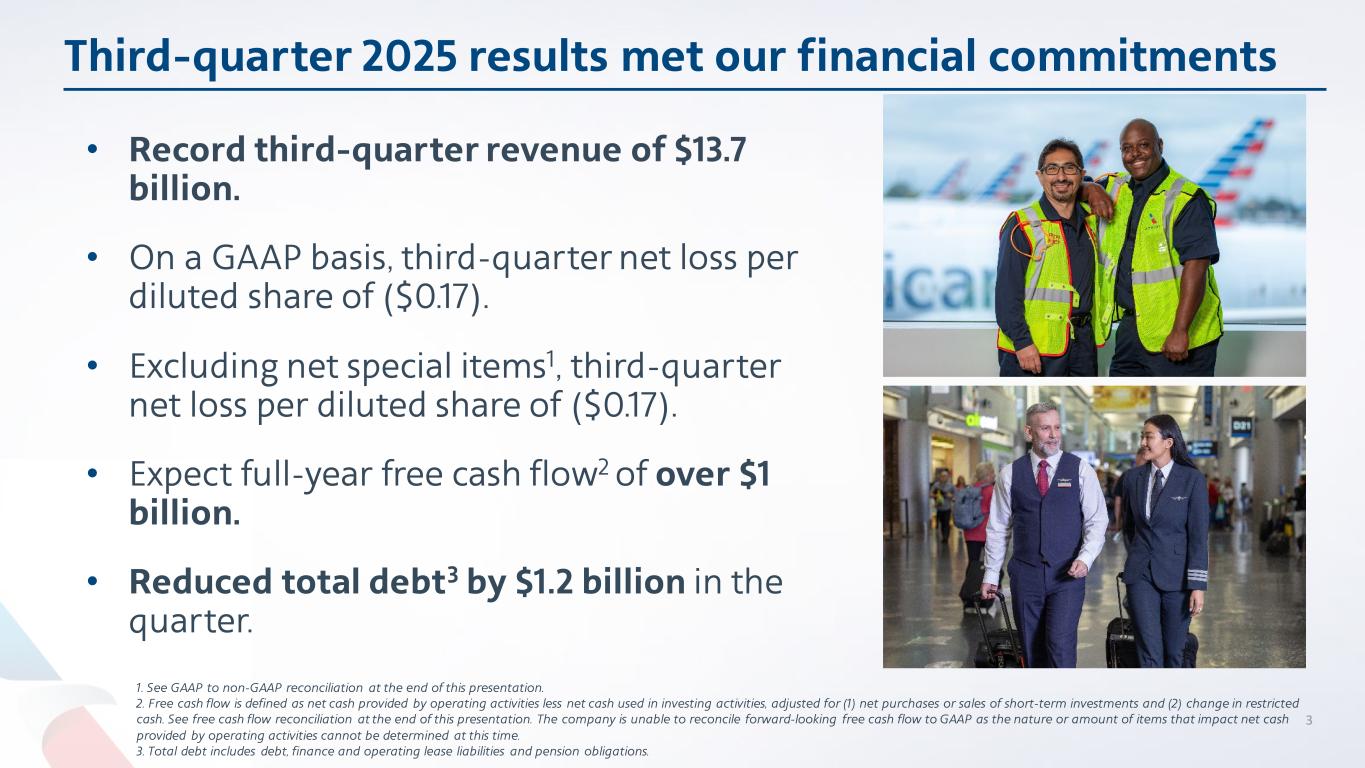
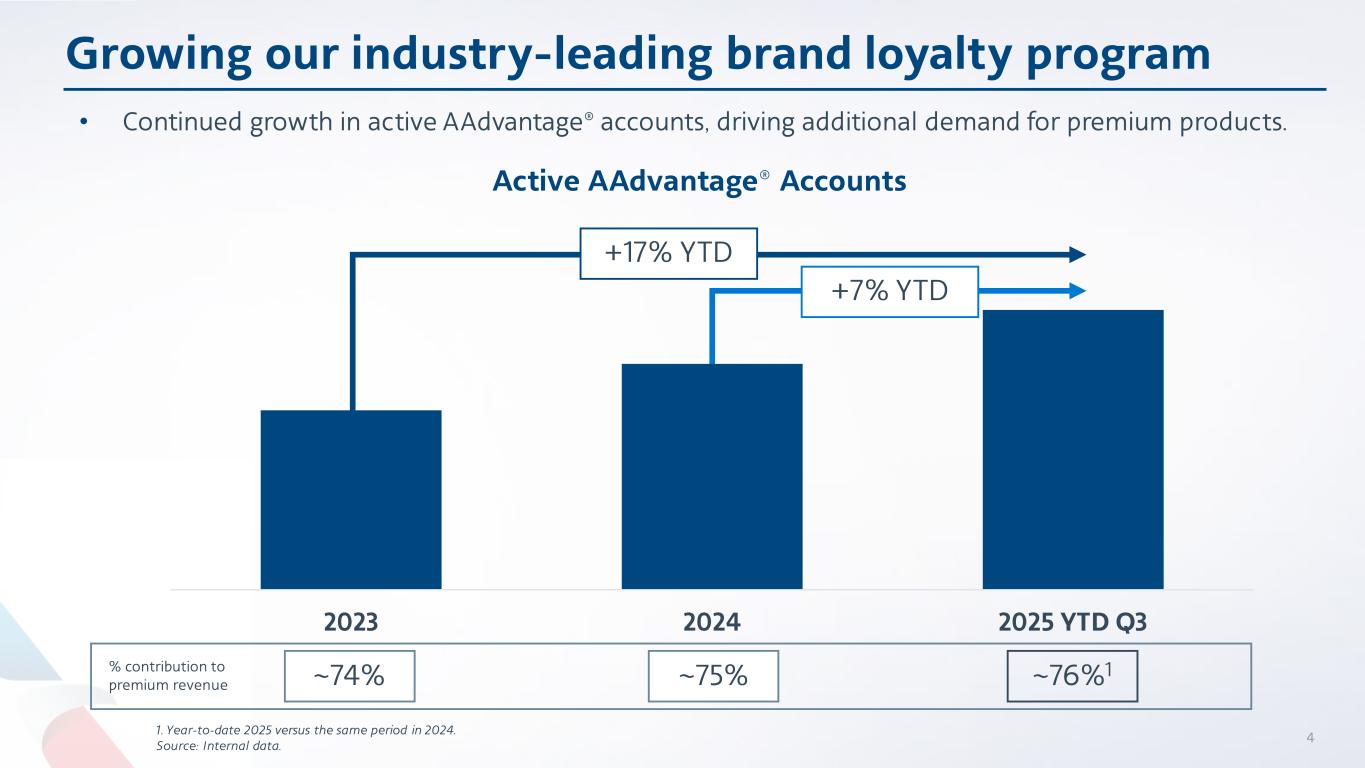
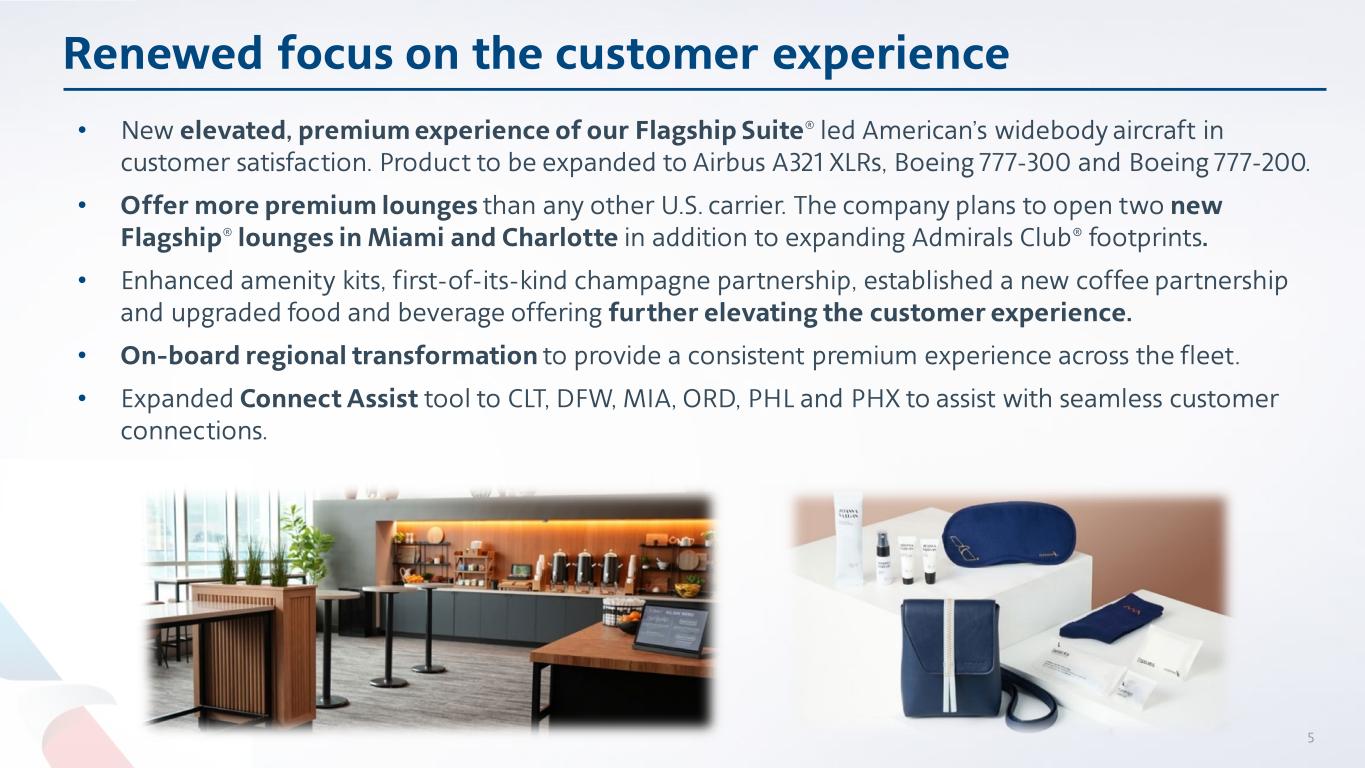
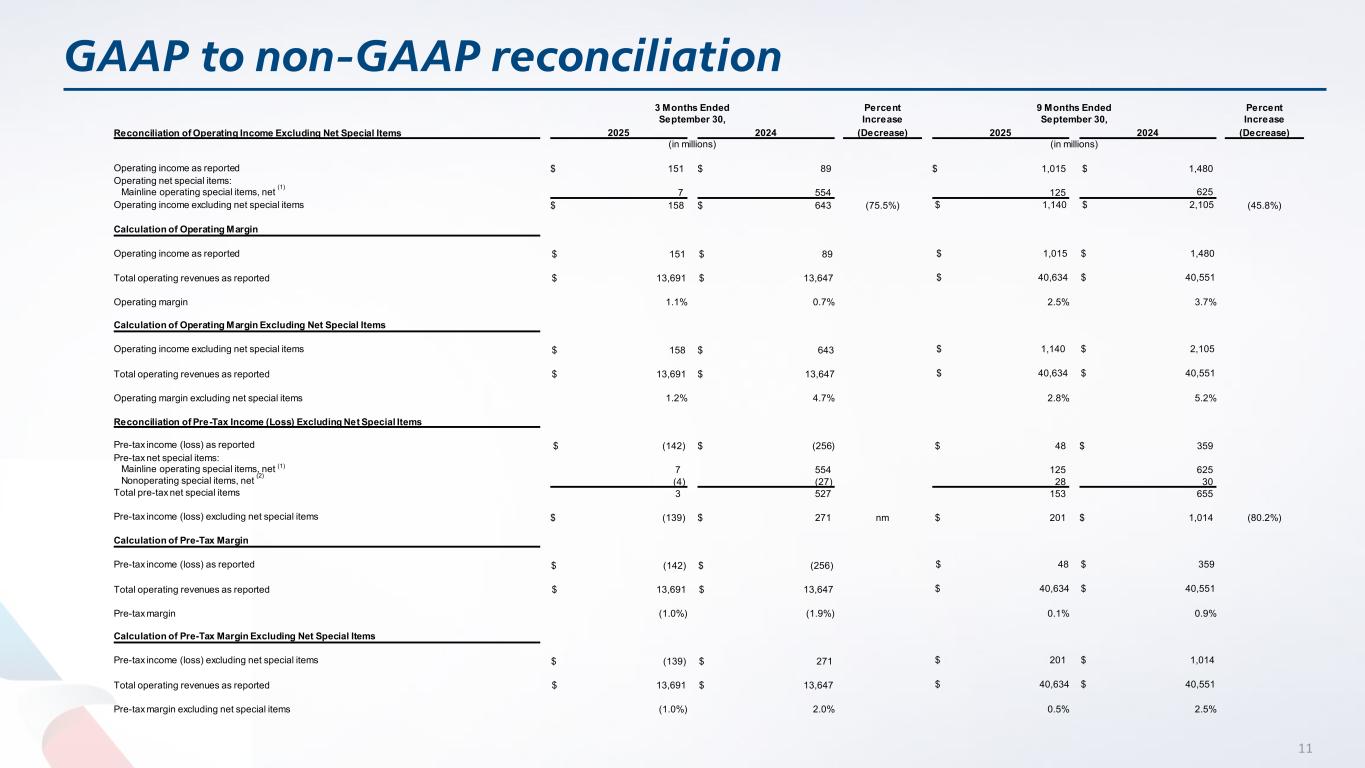
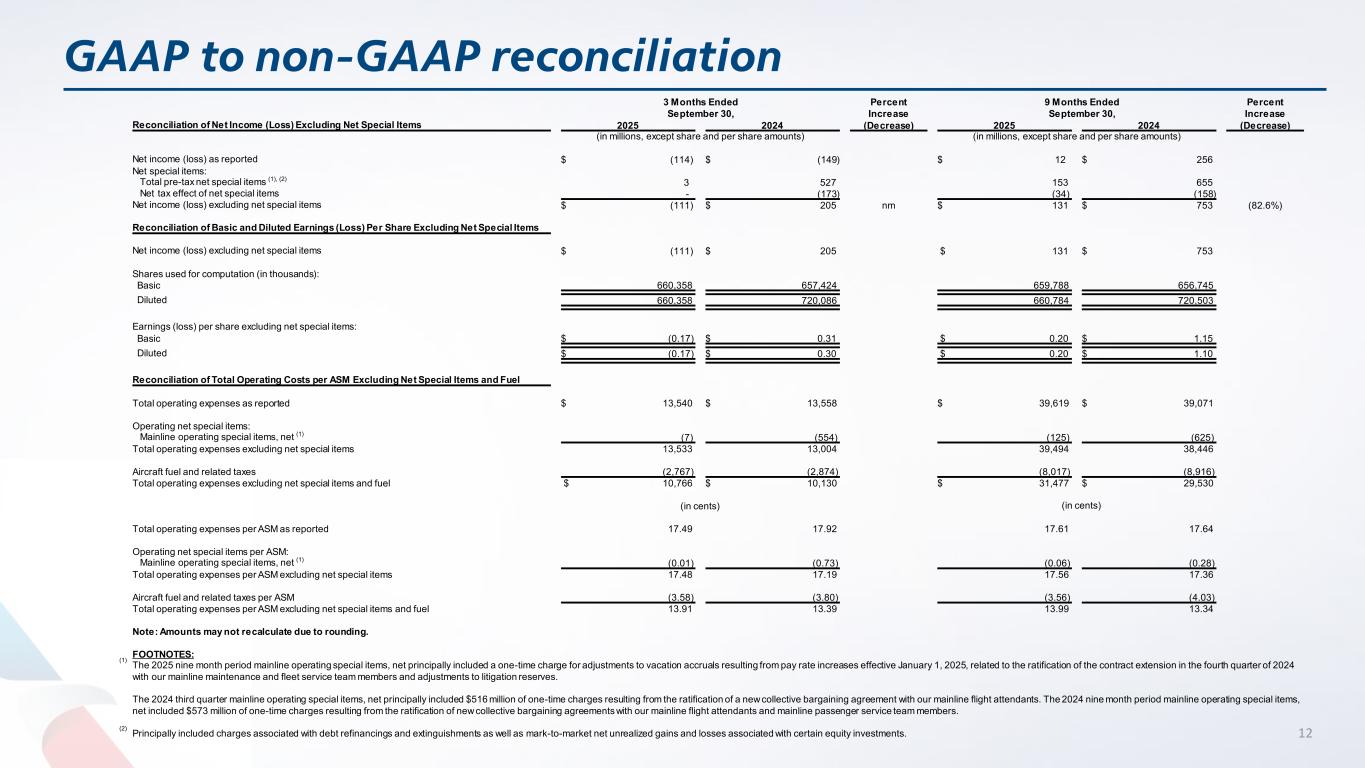
Thanks, Neil, and good morning, everyone. This morning, American reported an adjusted pretax loss of $139 million for the third quarter, or a loss of $0.17 per share. This result was at the higher end of the guidance provided in July and was driven by stronger revenue performance. We see that performance continuing and have adjusted our fourth quarter and full year guidance accordingly. I'm proud of the team's hard work and resilience throughout the third quarter. They executed well despite tough operating conditions. At American Airlines, we're proud to be a premium global airline with an enduring legacy of innovation and a commitment to caring for people on life's journey. We've built an airline positioned to excel over the long term and are focused on delivering for our shareholders, customers, and team. That said, we recognize there's significant revenue opportunity ahead of us, and we're excited about the good work underway to accelerate our revenue growth and view that as considerable upside as we move into 2026. The revenue momentum we've seen and the opportunity ahead is a product of our sales and revenue management initiatives, scaling our new agreement with Citi, restoring capacity in our hubs, and using consistent improvements in the customer experience as a value multiplier to everything we do. Much of this foundation has been laid thanks to the efforts of our commercial team and Steve Johnson. Last year, I asked Steve to step in and lead the commercial organization to quickly stabilize and reenergize this part of our business. We knew we'd hire a new Chief Commercial Officer in the future, and I'm grateful to Steve for taking this on. He and the team have strengthened our commercial position, and we're now in a great spot to make a transition. And today, we've named Nat Pieper as American's new Chief Commercial Officer. Nat has more than 25 years' experience in leading commercial and financial teams at Alaska, Delta, and Northwest Airlines, and most recently, the Oneworld Alliance. He is a seasoned airline executive who understands the complexity of highly integrated organizations. I've known Nat for more than 20 years, and he's exactly the kind of leader we want at American. He will officially join us on November 3, at which point Steve will return to his role as our Vice Chair and Chief Strategy Officer. So with that, let's talk more about some of the work that the team has delivered. Leading off with our focus on sales and distribution, we continue to build out our sales organization and are aggressively using our loyalty program to win back customers, especially in competitive markets. In the third quarter, we grew our corporate revenue by 14% year-over-year. This result is further confirmation that our sales and distribution efforts are being well received by our customers. Exiting this year, we expect to have fully recovered the revenue share that was lost by our prior sales and distribution strategy. We'll now shift our focus to growing our share beyond those historical levels, which we believe that, combined with revenue management investments and retailing optimization, will produce significant value for the airline. Next, deepening our relationship with Citi and expanding our co-brand card portfolio will further the growth of our industry-leading loyalty program. We're excited for our exclusive partnership with Citi to begin on January 1. The teams at American and Citi have been hard at work, executing a successful cutover of our in-flight acquisition channels to Citi earlier this month. In addition, we've recently launched our new mid-tier Citi AAdvantage Globe MasterCard, expanding our card offerings to meet travelers at every level. Our partnership with Citi will provide more benefits to our customers and is designed to drive growth in our credit card acquisitions and penetration over the coming years. The upside is significant. As we approach the end of the decade, we expect remuneration from our co-branded credit card and other partners to reach approximately $10 billion per year. At that time, the incremental annual benefit to operating income is projected to be approximately $1.5 billion compared to 2024. On the loyalty side, active AAdvantage accounts increased 7% year-over-year in the third quarter with our highest growth in enrollments coming from Chicago, which was up approximately 20% year-over-year. AAdvantage members are more engaged, generate a higher yield versus nonmembers, and are a key driver for premium cabin demand. In the third quarter, spending on our co-branded credit cards was up 9% year-over-year as customers continue to favor AAdvantage Miles as their preferred rewards currency. We remain focused on strengthening our network by scaling our hubs. We're proud of our hub network that we have with eight of our hubs located in the ten largest metro areas in the U.S. This year, our growth was focused on Chicago, Philadelphia, and New York. American has a long history in all three cities with a base of corporate and premium customers that are loyal to the American brand. Our improved schedules, along with our new sales and distribution strategy and other product improvements are helping us win local high-value customers. Performance continues to track in line with our expectations. This targeted expansion will continue through the fourth quarter and into 2026 as we add more cities and more frequencies to improve our offering for customers. Our ability to grow capacity in premium markets will be further supported as we take delivery of new aircraft and reconfigure our existing fleet. These efforts will allow us to grow our premium seats at nearly twice the rate of main cabin seats and grow our lie-flat seats over 50% by the end of the decade. Additionally, we're excited about the significant investments in airport infrastructure happening throughout our system, headlined by rapid construction of the new Terminal F and enhanced Terminals A and C at DFW. When complete, DFW will be a world-class facility and the largest single carrier hub in the world. All of this is intended to deliver a consistent and elevated travel experience for our customers, whether on the ground or in the air. And it's not just facilities. The investments we continue to make in customer experience are the value multiplier on top of everything we're doing. With the ongoing rollout of our new flagship suite designed to elevate privacy, comfort, and luxury, we're continuing to reimagine and advance the premium travel experience. Customers have responded very positively to this product on our new Boeing 787-9 Ps, which led American wide-body aircraft in customer satisfaction. We will offer the same product on our 321XLRs and our 777 fleets in the coming years. We're also investing in the onboard experience of our regional aircraft, including the installation of high-speed satellite WiFi to maintain a consistent premium experience across our fleet. We're proud to offer high-speed gate-to-gate satellite WiFi on more aircraft than any other airline, keeping our customers connected while traveling. Thanks to our new sponsorship with AT&T, this amenity will be complementary for our AAdvantage members starting in January. We announced several exciting updates to our leading lounge network, including plans to open new flagship lounges in Miami and in Charlotte, and we'll expand our Admirals Club Lounge footprint in both markets as well. We also introduced several additional premium enhancements, including new amenity kits, improvements to our food and beverage offerings, and a new partnership with Champagne Ballanger. We continue to explore partnerships to elevate the art of travel, like our new coffee partnership with Lavazza that aligns with our focus on refined offerings and exceptional service throughout the travel journey. Nothing matters more to our customers than flying on a reliable airline. While this quarter presented challenging operating conditions, the American team quickly recovered, minimized disruptions, and maintained a resilient operation for our customers. Thanks to continued investments in technology, including the expansion of our Connect Assist platform, we've enhanced the connection experience and successfully preserved customer connections. The team is focused on investing in the right areas, and we're committed to executing on our initiatives to deliver on our revenue opportunities. Before closing, I'd like to take a moment to recognize the dedicated aviation professionals who continue to uphold the safety and security of our industry during the government shutdown. We're hopeful that action will be taken to reopen the government as soon as possible. And now I'll turn the call over to Devon to share more about our financial results and outlook.
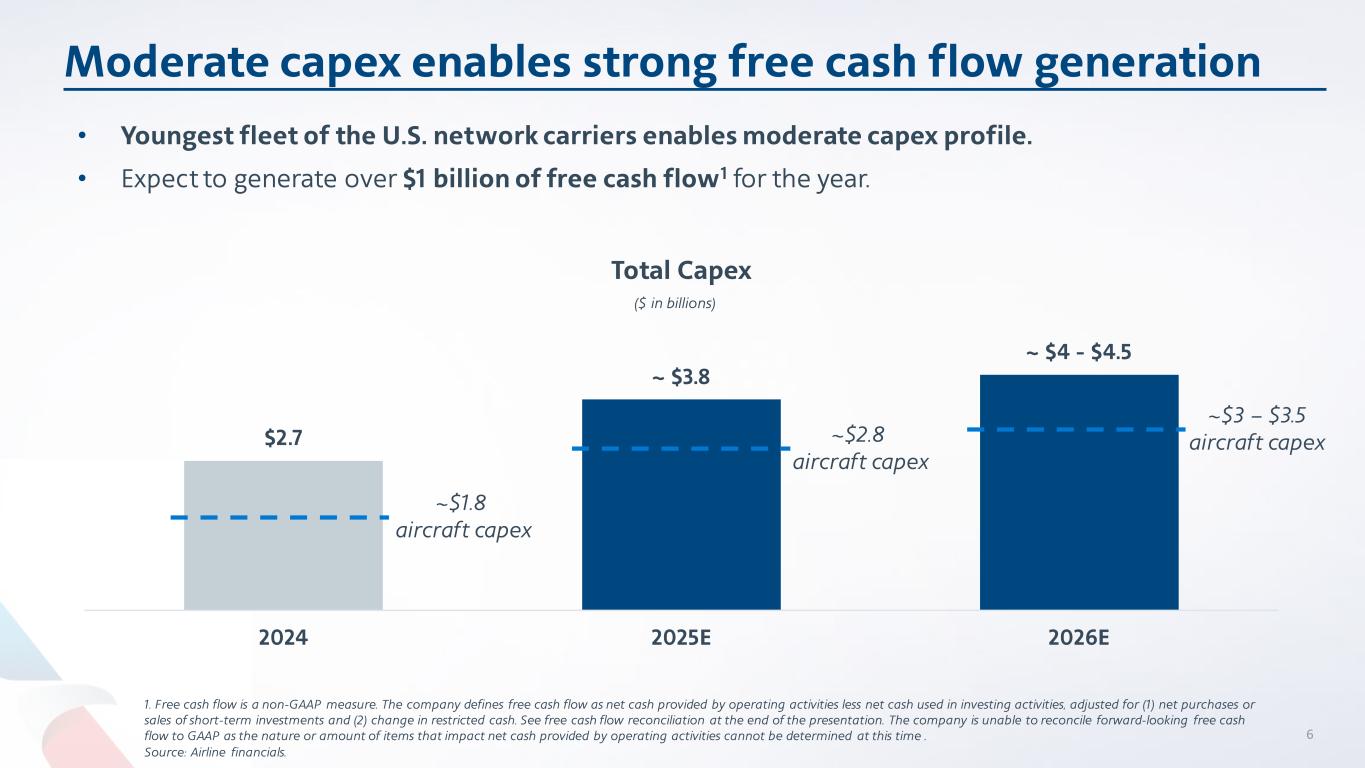
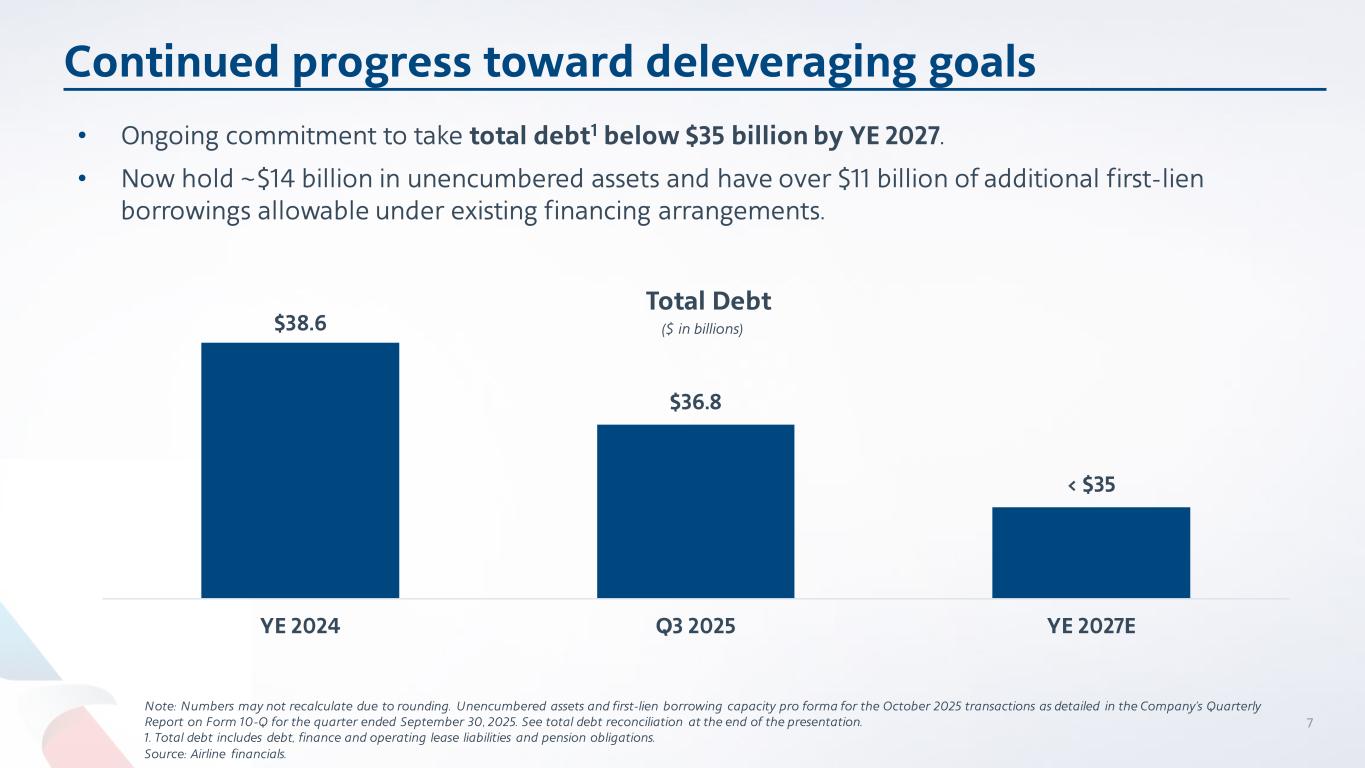
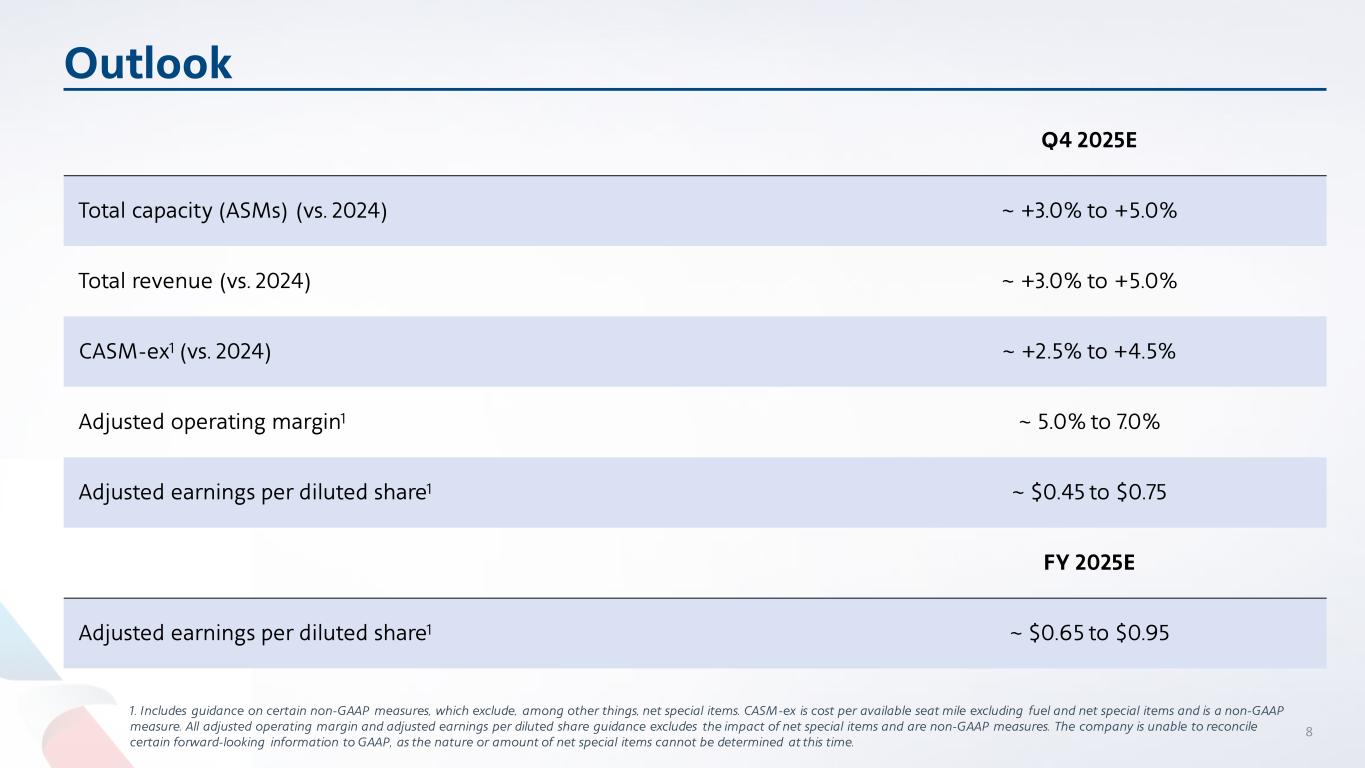
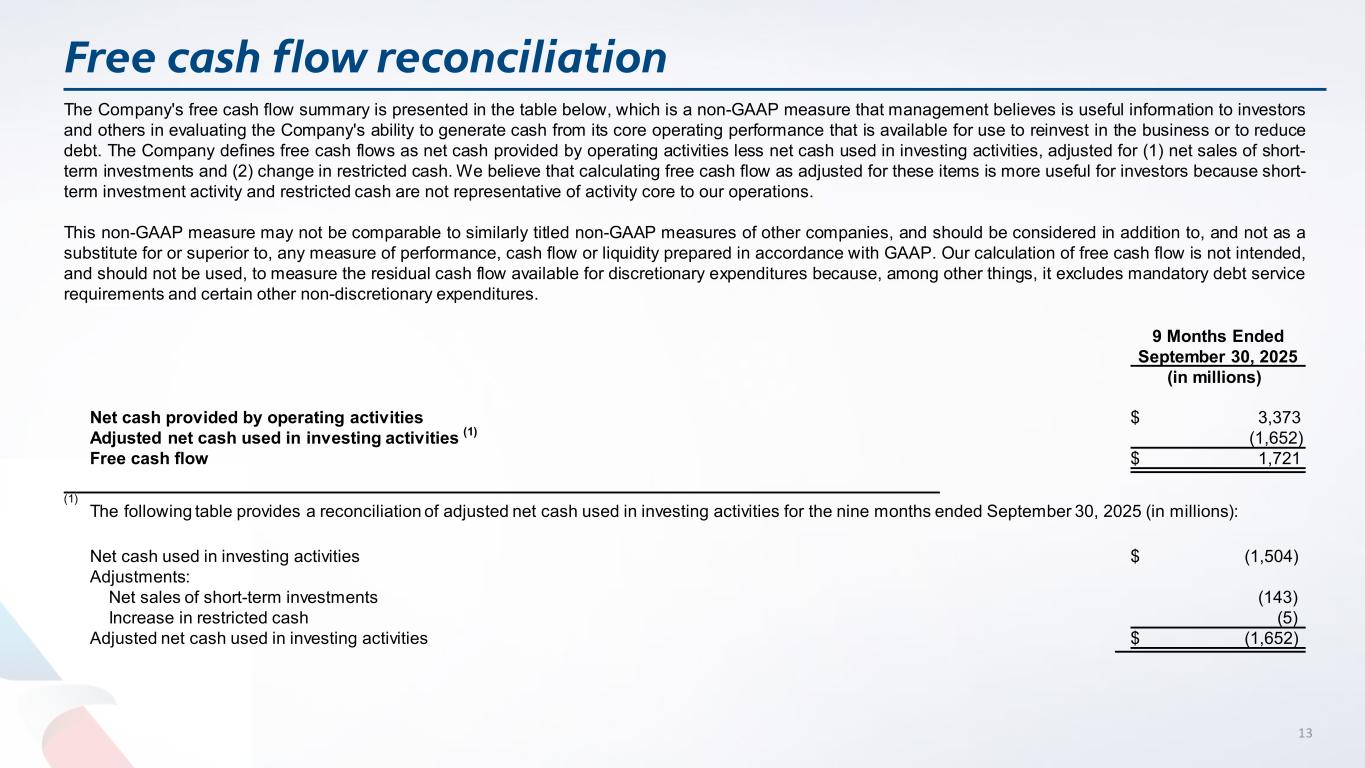
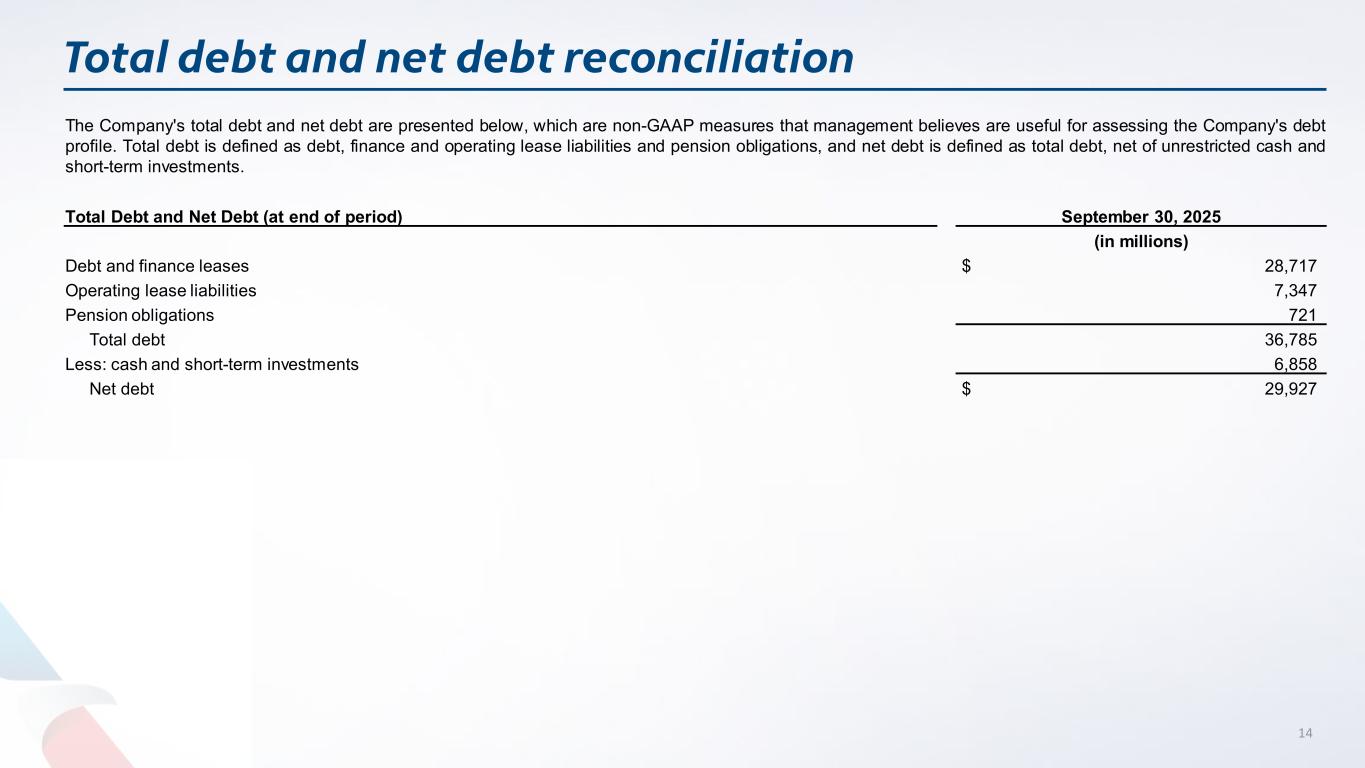
Thank you, Robert. Excluding net special items, American reported a third quarter adjusted loss per share of $0.17, a 50% beat versus the midpoint of our prior guidance. We continue to progress on our commitment to deliver on our revenue potential. We produced record third quarter revenue of $13.7 billion, which was about 1% ahead of the midpoint of our initial guidance. Domestic year-over-year PRASM improved sequentially each month and turned positive in September. While premium continued to outperform Main cabin, we've seen improvement in the main cabin since its low point in July. That momentum has continued into October, and we're encouraged by the bookings we have taken for November and December. Our international entities performed in line with the guidance we gave in July. After a very strong second quarter, unit revenue in the Atlantic region was down year-over-year due in part to the macro uncertainty during the peak booking window and a continued seasonal shift in demand from the third quarter to the fourth quarter. That said, Atlantic was our most profitable region during the quarter, and we expect Atlantic unit revenue to be solidly positive in the fourth quarter. In Latin America, unit revenues were down year-over-year as the short-haul Latin market was oversupplied during the quarter. American's presence in the region, the premium services we offer, and the scale we have in Miami and our other Southern hubs allow for profitable results in this environment and a continued long-term competitive advantage in the region. Lastly, Pacific year-over-year unit revenue declined mid-single digits in the quarter. We expect fourth quarter unit revenues to be approximately flat year-over-year off a very strong 2024 base, supported by strength in the premium cabins. Premium continues to perform well with year-over-year premium unit revenue outpacing main cabin by five points in the third quarter. Capitalizing on this demand, American is continuing to invest in expanding our premium offerings across the customer journey. While already recognized amongst the U.S. network carriers for having the highest rated and most consistent lie-flat product across our long-haul fleet, we are elevating this experience with the investment in our new flagship suite, which we launched with our high premium Boeing 787-9s. As Robert said, in the coming quarters, we'll expand this product further with the introduction of our A321 XLRs and the retrofit of 20 777-300 aircraft, which will increase premium seats on this fleet by over 20%. We're excited to announce that we'll continue scaling our new flagship product on our 777-200 aircraft. These aircraft, which will be receiving a nose-to-tail retrofit, will see a 25% increase in lie-flat and premium economy seats, along with a new in-flight seatback entertainment system. Additionally, we continue to expand premium on our domestic aircraft. We are retrofitting our A319s and A320s, where we will grow first-class seating by 50% and 33%, respectively. With these investments in our existing fleet, along with our new deliveries, our premium seat growth will outpace our non-premium offerings. Our total capital expenditures in 2025 are expected to be approximately $3.8 billion, which includes the delivery of 51 new aircraft this year. Longer term, capital expenditures remain consistent with our prior guidance, and our current expectations for 2026 are approximately $4 billion to $4.5 billion of total CapEx. We continue to make progress in strengthening the balance sheet. Total debt at the end of the third quarter was $36.8 billion, down by $1.2 billion from the second quarter. We ended the quarter with $10.3 billion of available liquidity. At the start of the year, we made a commitment to reduce total debt by approximately $4 billion to less than $35 billion by the end of 2027. Just nine months after making that commitment, we are more than 50% of the way to achieving that goal. Now on to our outlook for the remainder of the year. For the fourth quarter, we expect capacity to be up between 3% and 5% year-over-year as we continue to build back our hubs and adjust our schedules to meet evolving seasonal demand trends. We expect fourth quarter revenue to be up between 3% and 5% year-over-year. If we achieve the midpoint of our guidance, we'll deliver flat unit revenue in the quarter after being down 2.7% in Q2 and 1.9% in Q3. Fourth quarter CASM ex is anticipated to be up 2.5% to 4.5% year-over-year, in line with the guidance we provided in July. We are continuing our multi-year reengineering of the business effort to utilize technology and streamline processes to enable an improved customer and team member experience while driving a more efficient business. These efficiencies are being realized through best-in-class workforce management, efficient asset utilization, and procurement excellence. These efforts have resulted in $750 million of annual savings versus 2023. As a result of the investments and process improvements we have made, most mainline work groups are operating at higher productivity levels today than they were in 2019. With labor cost certainty through 2027, American is able to focus on our long-term efficiency efforts while executing on our commercial and customer initiatives. With this fourth quarter guidance, we expect to deliver an adjusted operating margin of between 5% and 7% and earnings per share between $0.45 and $0.75, over two times higher than the midpoint of our implied fourth quarter guidance from July. This brings our full year EPS guidance to a range of $0.65 to $0.95 per share. Based on these earnings and capital projections, we expect to generate free cash flow of over $1 billion for the year. I'll now hand the call back to Robert for closing remarks.
Thanks, Devon. We're positioning American for long-term success. Our commercial efforts in sales and distribution and revenue management are taking root, driving business and premium revenue outperformance. We're poised to take advantage of the new relationship being launched with Citi in 2026 to grow the world's first and largest airline loyalty program at unprecedented rates. We started down the path of restoring our network presence, further expanding our industry-leading footprint in North America, the world's most important aviation market, all powered by the youngest and most fuel-efficient fleet. These efforts are being bolstered by our focus on elevating the customer experience, evidenced by the continual announcements this year of exhilarating upgrades. Finally, we'll always remain focused on efficient capacity production. We've been a leader in this space for years, and we'll continue to make smart investments that drive efficiencies in our business. We're looking forward to closing out 2025 in a strong fashion, and with this groundwork, we plan to deliver meaningful long-term value for our shareholders in 2026 and beyond. Thank you for your interest in American Airlines. Operator, you may now open the line for questions.
Operator
Our first question comes from the line of Scott Group of Wolfe Research.
Speaker 4
So I think I saw you said that September unit revenue was positive. Fourth quarter guide is sort of flat. So maybe just explain that change. And then within that, I think I just heard you say domestic unit revenue, you think is flat in Q4 as well. Maybe just some thoughts on premium versus domestic and how that shakes out.
I'm sorry, Latif, I think we were on mute there. So we'll start this over. Steve, do you want to take this question?
Speaker 5
Sure. Latif, can you hear me now? Yes, Scott, thanks for the question. What we've seen is consistent with what other airlines have reported; July was a very tough month for the industry. August showed improvement over July, and September was better than August, with a positive shift in September. October is looking better than September, and the fourth quarter appears strong. This improvement has been driven primarily by better main cabin revenues for us. Premium revenues have remained robust throughout the year, despite the economic uncertainty we faced. However, that uncertainty, along with Liberation Day and other factors, has made it challenging for main cabin revenue, particularly from our price-sensitive customers. Overall, we project that the fourth quarter will be flat year-over-year, which signifies sequential improvement. We're pleased with the solid performance domestically and across the Atlantic, North Pacific, and in South America, although we’ve seen mixed results in the South Pacific mainly due to capacity issues. Year-over-year, short-haul Latin America hasn't performed well, again due to capacity challenges, but this segment, despite being down year-over-year, remains a vital and profitable part of our business, supported by strong networks from Miami, DFW, and Phoenix into these regions. We're excited about the sequential improvement and the potential for flat unit revenue year-over-year.
Speaker 4
Okay. And then I want to see if you want to provide any sort of early thoughts for next year. So if I look at Q4, right, we've got capacity up 3% to 5%, what are you saying unit cost up 2.5% to 4.5%. Is that sort of the right way to think about capacity and unit cost for next year? And ultimately, what I'm trying to figure out is what's the visibility or confidence in sort of a price cost inflection next year.
Scott, we're just in the planning process for next year as we sit here today. So we're not guiding to capacity or unit cost performance at this point. But we'll stay consistent with what we've been saying on that front is we have this fleet plan that can allow us to grow somewhere around mid-single digits. Our guardrails on capacity production are at one end; we just want to understand what sort of economic growth and what sort of demand growth we're seeing, and we like where we're at on that front. The other side is where the competition is at. And lastly, just what sort of growth opportunities we have. We're really excited about the growth we put into the market this year, primarily in Philadelphia, Chicago, and New York. Those markets will continue to grow in 2026, and we're also excited about growth opportunities in Miami and in Phoenix. On the cost side, I think you see it in our numbers. We believe we manage cost and efficiency better than anyone. It's been a very formal and long-standing effort. And so next year, we look out, yes, we're looking for margin expansion as we head into 2026.
Operator
Our next question comes from the line of Sheila Kahyaoglu of Jefferies.
Speaker 6
Maybe digging a bit deeper into the capacity and premium investment comments now that you have also the 777-200 fleet going, the schedules are loaded up 5% in the first half of next year. The fleet grows a similar amount, assuming no retirements. So how are you thinking about the mix in premium versus main cabin and short haul versus long haul?
So I'll start. Thanks, Sheila. Well, first off, in terms of capacity mix, international, domestic, it takes a strong domestic and very strong hubs to support a thriving international operation. And so we'll keep a balance in terms of that growth. It's really exciting in terms of premium offerings. So our premium seating, we expect, especially now with the 787-9s, the XLRs, the reconfigurations we're making, the premium seating is going to grow roughly at twice the rate of what our non-premium offerings would grow. And even more specific in terms of our lie-flat international capable seating, that is going to grow by 50% as we look out towards the end of the decade. So we feel really excited about it, and it all plays into what we're seeing in the marketplace that people are willing to pay for experience. And we're going to make sure that we have a hard product that they enjoy.
Speaker 6
Great. And then maybe if I could ask another one on just domestic hubs. You mentioned Chicago enrollments are up 20% year-over-year for AAdvantage. Lots have been said about this market. When you look across domestic hubs, where are you seeing the greatest level of unit revenue improvement, either sequentially or year-over-year? And how are you thinking about capacity next year?
Well, I'll just start. Look, we're pleased with our efforts in Chicago. Certainly, we've done a nice job in growing that back. And as you look towards next year, that's a hub that will be over 500 departures. And we have just an incredible base of customers that are waiting for us to really get back in the marketplace. Those AAdvantage enrollments overall, we grew 7%. But in Chicago specifically, 20%. I mean that's a really remarkable number. We're going to take advantage of that desire for our product, as I mentioned. And as we look out into the future, we anticipate that Chicago will return to its rightful place as one of our largest and more profitable hubs. So capacity, at least in Chicago, as we take a look at, we're going to fly what we can. It will be, again, over 500 departures. Capacity throughout the rest of the system, it's really focused on restoration of flying in Philadelphia, Miami, and Phoenix. We've already have DFW and Charlotte appropriately sized. So we're really excited about what we're going to be able to bring back to markets that, quite frankly, because of regional aircraft and delivery delays, we haven't been able to serve as thoroughly as we'd like.
Operator
Our next question comes from the line of David Vernon of Bernstein.
Speaker 7
I hate to bang the same drum, but maybe I'll ask the same question in a slightly different way. If we think about what percentage of premium seats are in the mix kind of as we end 2025? And how does that change? If you can put a number on that, that would be helpful as well as any sort of commentary or directional commentary on the relative buy-up from what would be considered a non-premium versus a premium seat. I think what we're trying to all kind of model out here is what kind of unit revenue lift you could get because the product mix is changing so much next year. I appreciate the twice the normal seat growth rate, but I think what we're trying to do is really kind of help handicap what kind of margin expansion should be coming from that product investment.
Speaker 5
Thanks, David. That's a great question, even if it's reiterating what we've discussed. This is a significant narrative for the industry and for American Airlines. As I've mentioned before and was highlighted in the opening remarks, our premium segment has remained strong throughout the year, despite economic challenges. For those of us who have been in the business for a long time, it's memorable to think about whether we could ever encourage customers to pay more for higher quality products and services. The current situation seems to indicate a strong affirmative. We're experiencing what feels like a new normal post-pandemic, which has been remarkably consistent even in tough economic times. Premium offerings have always included a demand from businesses, but companies don't always allow their employees to fly in premium class. What we are witnessing now is a resurgence or perhaps a fresh start for premium leisure travel. This ties back to my observation about our customers' willingness to invest in superior services and products. Our premium cabin currently boasts a 65% load factor and has outperformed the main cabin by 5 percentage points in revenue per available seat mile year-over-year. Our paid load factor in premium has increased by 2 points year-over-year, reaching almost 80%. Pre-pandemic, we were only in the mid-60s on a paid basis. Currently, nearly 50% of our ticket revenue comes from premium fares. With these market dynamics in mind, our focus is on capitalizing on this growth. Robert and Devon have discussed the additional premium seats we are integrating into our fleet. We're enhancing our product offerings, simplifying the upgrade process with user-friendly digital options, and creating numerous wallet-friendly upgrade opportunities. This is increasingly becoming a vital and exciting aspect of our business.
Speaker 7
Okay. As you consider the investments beyond the hard products and how the mix will change in terms of seating, Robert, when discussing this with the team and as he is ramping up, what are the two or three key areas of product and experience investments that you are concentrating on with the team?
Thank you, David. The positive aspect here is that we are fulfilling several investments we have made over time. Additionally, we are enhancing the customer experience through a new team focused on in-flight amenities and products. This includes building relationships with top brands for offerings like coffee and champagne, as well as reintroducing comfort features like amenity kits, bedding, and duvets. We are coordinating the in-flight experience with an emphasis on ground facilities. Notably, we are investing in our premium lounges, expanding our already extensive network in locations like Charlotte and Miami. Moreover, it’s essential to focus on the hard product. As mentioned previously, we maintain the most consistent lie-flat seating available. I am particularly enthusiastic about our upcoming deliveries of 787-9s and XLRs. We are also equipping our A320s, A319s, and regional aircraft with satellite WiFi, which is impressive. Furthermore, our announcement today regarding the reconfigurations of the 777-200 is significant, as it allows us to extend their service life without needing immediate fleet replacement, resulting in benefits for our customers, our company, and our investors.
Operator
Our next question comes from the line of Dan McKenzie of Seaport Global.
Speaker 8
Congrats on the outlook here in the quarter. Going back to an earlier question on Chicago and the response that you expect it to return to its rightful place as the largest and one of the more profitable hubs. That, of course, is pretty different messaging than what we heard from one of your chief competitors there. So just a couple of questions. One, can the airport support two strong competitors longer term? And what does history tell us? And then finally, with the 20% improvement in enrollments, is that enough for you to help close that margin gap there in '26 or 2027?
Thanks, Dan. I'll just again, restate what we've been saying all along. Of course, Chicago can support two hub carriers. It's been doing it forever. American has served Chicago now for almost 100 years. And so we're looking to serve it well into the future. I've talked about a hub. It's going to be our third largest hub. There aren't many 500 departure hubs out there. It's critically important to our customers in Chicago and those that connect in the region. It ensures that there is service, competitive service. And I think that, that's probably the thing that maybe a competitor doesn't like that we're going to be there. We're going to be investing in Chicago. And there aren't going to be really any impediments to us building out the network and the footprint that we need there. So thanks for the question. Really excited about Chicago and what's coming up in 2026 and beyond.
Speaker 8
Yes. Very good. And then, Robert, you mentioned a $1 billion cost labor disadvantage to competitors on CNBC this morning. Is it your sense that this cost disadvantage should go away in '26, at least in theory? And can the domestic supply backdrop support the higher fares needed to offset that increased cost or whether or not more capacity needs to exit?
You'll need to direct that question to our competitor, who clearly has profits stemming from a labor cost advantage. That advantage is solely based on rates, and I don’t foresee it becoming a factor in the future. This is definitely not something we would consider at American in the long term. Speaking of improving margins, American has a significant opportunity here. We already have market rates accounted for, along with labor cost certainty, which positions us well to initiate our efforts. Whether it's reviving our network, we have the pilots and flight attendants ready to support it and reclaim areas where we've lost market share. Looking ahead to 2026, our new Citi deal is set to significantly enhance our net income. I previously mentioned our sales and distribution progress, thanks to Steve’s leadership. From a managed corporate revenue perspective, we have improved by 14% year-over-year, which is exceptional compared to others. There's still room for us to gain market share as the year ends, and we're committed to that. We're also making strides in premium services, which reflects positively on American's position regardless of the economic situation. The indicators suggest that domestic supply and demand are realigning. The regions we serve are among the fastest-growing in the country, and we are well-positioned to thrive as we approach 2026.
Operator
Our next question comes from the line of Jamie Baker of JPMorgan Securities.
Speaker 9
First question likely won't be a surprise, as it's similar to what I've been asking this season. The concept of premium leisure yields surpassing corporate yields in some markets is intriguing because many investors still view corporate yields as the benchmark. My question to American is how common this phenomenon is across your domestic markets and beyond. Does this influence your approach to pursuing corporate share if premium leisure yields are potentially the future? Any insights on that?
Thank you for the question, Jamie. We've gained some insights on this topic. Corporate travel offers significant yield potential. While we're pleased with the developments in the premium leisure sector, we recognize the importance of both areas. That's why we're increasing our investment in our sales team. We're optimistic about what we see and believe there is potential for growth at American. It's important to note that business travel has not yet returned to 2019 passenger levels, indicating there is still significant room for improvement. Although we may not reach the same percentage of business travel revenue as before, there are still opportunities available. Considering the current global situation and the continued push for in-person meetings to rebuild connections, I'm quite hopeful regarding this aspect. From the perspective of premium leisure, we need to be prepared, and our fleet is designed to meet those demands. We will ensure that we offer an excellent product to appeal to these customers, which will be crucial for expanding our margins. American is already a premium carrier, and we aim to enhance that status even further.
Speaker 5
And Jamie, I want to emphasize that while we currently see a strong demand for premium leisure travel, which provides excellent yields, we must remember that business travel has always been a crucial part of our operations and will continue to be. Business travelers are frequent travelers, and even though their yields may be slightly lower than our premium leisure yields, they still bring in 1.5 to 2 times the revenue compared to other sources. Many of them are AAdvantage members, contributing more to our business, and they are often co-brand cardholders. Regular business travelers tend to shift their leisure travel to the airline they use for business, which means they play a role in driving our premium leisure demand. It's an exciting aspect to consider. Right now, business travel is at only 80% of its 2019 levels, not accounting for economic growth, indicating significant potential for increase. As Robert mentioned, we aim to fill our airplanes with both business and premium leisure travelers.
While I have you, a quick follow-up on the air traffic liability. Your drawdown from the second quarter to the third quarter was the most modest that I've seen, at least going back a decade. And it was quite a bit less than the drawdowns at Delta and United. I assume the American's domestic international balance may have something to do with that. Maybe it's attributable to some of the second quarter challenges and subsequent recovery. Whatever the case, it jumped out at me, maybe it shouldn't have. Any thoughts? Well, I think it's in part due to some of the seasonal trends that you're seeing. So a strengthening fourth quarter just means there's going to be more bookings for fourth quarter travel that happened in the third quarter, so less of a drawdown on that front. Relative to United and Delta, there may be some entity mix there and perhaps just some of our relative performance in the quarter. But I think more than that, it's just the seasonal trends we're seeing in demand.
Operator
Our next question comes from the line of Tom Wadewitz of UBS.
Speaker 10
This is Atul Maheswari on for Tom Wadewitz. First, on the shape of the fourth quarter RASM or yield, you mentioned that September RASM turned positive and October looks better than September. So implicit in those points is that November and December would be a little worse than October for you to be flattish for the full fourth quarter. So the question really is the expectation around November and December being a bit slower than October. Is that simply due to American being cautious given difficult compares you and the industry have from the demand strength that you saw during the holidays last year? Or is there something in the current booking data that suggests that December or the holiday yields are tracking lower than what you're seeing for this month?
Speaker 5
That's a great question, and I apologize for not being clearer earlier. I mentioned October as part of a trend we are observing in the industry. I didn't talk about November and December because we currently don't have many bookings for those months. However, I want to emphasize that we are feeling optimistic about the holiday bookings for November and December, despite experiencing a bit of softness during typically slow periods this year. Our best estimate right now is that we will finish the quarter flat compared to last year, and we will reassess that as more bookings for November and December come in.
Speaker 10
Got it. That's helpful. And then just as a quick follow-up. As you run rate the normal historical share in the indirect channel that you expect to get back to in the fourth quarter, how much revenue lift does that provide next year, especially in the first three quarters of the year? I guess another way to ask it would be, like in the past, you mentioned about $1.5 billion of shortfall due to the prior strategy. How much was recovered this year, and what's left to be recovered in '26?
Well, Tom, thanks for the question. We don't have the full recovery rate yet because it's been a gradual process throughout the year. Looking ahead to next year, we will integrate this into our guidance and forecasts. However, a good sign is that we are outperforming many of our key competitors in areas like managed corporate travel, which gives me confidence. As we move into the new year, I believe we will be fully restored, and our goal will then be to exceed that state. Moving forward, we will focus on overall unit revenue production, and we will continue to analyze it from a corporate standpoint.
Speaker 5
Yes. And just to think about it, as we've gone through the year and improved our sales improved our share in indirect channels. You've seen that sort of step up over the course of the year. So next year, we're going to have the benefit of that continued step-up plus the run rate of that, which we've already captured and returned to American.
Operator
Our next question comes from the line of Catherine O'Brien of Goldman Sachs.
Speaker 11
I wanted to ask a theoretical question about CASM. You have done a lot of work to improve efficiency in the system. Is the fourth quarter a good example of what the business can achieve, with low to mid-single capacity growth leading to low to mid-single CASMex? Or is there more potential for CASMex to be lower at that level of growth? I am trying to understand what you think CASMex could look like with base case mid-single-digit capacity growth over the next couple of years, knowing there will always be some variability from year to year.
Yes, I appreciate your question. It really depends on the level of capacity growth we have. Currently, we are working through the 2026 plan. I can provide some insight into the P&L lines where certain costs are increasing at a rate higher than inflation, as well as areas where we might experience positive trends. Right now, in terms of labor, we have contracts with all our major frontline team members, so the increase in labor costs is not much beyond inflation. However, a couple of labor groups, such as pilots, are set to receive a 4% raise next year, which aligns with industry standards. Any increase beyond inflation will be modest. Other expenses like airport rent and landing fees will continue to rise at a pace greater than inflation. The situation with maintenance is still uncertain and will vary from year to year. In the fourth quarter, I believe we can perform better over the long term, but we need to finalize the 2026 plan before providing extended guidance.
Speaker 11
Great. And then, Devon, probably a second one for you. You've made great progress on the balance sheet even in a tough year demand-wise. I think looking back at my notes from the 2024 Investor Day, the longer-term goal is to get to net debt below $30 billion and leverage below 3x in 2028. I guess, is that still the goal? And really, is that your ultimate goal? Or do you believe there's a benefit to taking leverage lower than that over time? I realize this is a longer-term one, but just trying to get a picture of how you're thinking about capital allocation over the next couple of years.
Yes. Well, just one step at a time. We're incredibly excited to have hit our first goal of total debt reduction of $15 billion. We did that a year earlier than planned. We completed that last year. The next goal we set out for total debt was that it would be inside of $35 billion by the end of 2027. That's another goal we brought in by a year. We're really pleased with the progress right now. It's happening because we have pretty limited capital needs right now. We talked about being able to grow the airline at 5%, but we're doing that with aircraft CapEx in that $3 billion to $3.5 billion range. That's a really nice spot to be in. And in a year like this, even where earnings aren't exactly where we want them to be, we're producing really nice free cash flow that we're using to improve the balance sheet. So that's where we're at now. We fully expect to hit our $35 billion goal. That would, to your point, put us inside of $30 billion of net debt and hopefully well inside of that. We have this goal at that point, obviously, to be within net debt-to-EBITDA leverage ratios of about 3x, which you get to that BB credit rating. To get there, we have to continue to focus on improving margins and improving earnings. And I think we're focused on all of the right things there.
Operator
Our next question comes from the line of Conor Cunningham of Melius Research.
Speaker 12
Just talking about thinking about building blocks for 2026. I think a big one is just the loyalty component. I was curious if you could just remind us what you think the incremental dollar value is from just the loyalty step-up alone. It seems like a pretty big lever for you all and a pretty massive driver for earnings in general. So just any thoughts around that would be helpful.
Yes, Conor, we will return to what we have been discussing. The new relationship with Citi presents us with an opportunity to increase cash remuneration by 10% annually. Ultimately, as we aim for $10 billion in remuneration, we anticipate an additional $1.5 billion in net income resulting from that. These are all significant figures.
Speaker 12
Agreed. Okay. There seems to be a lot of discussion about CASMex and RASM and similar topics. I believe the industry needs to shift towards ensuring that if we invest in the product, we should anticipate an overall improvement in margins. Could you share your thoughts on the investment spending related to the customer service product and what that might mean for your cost allocation? Are you planning to allocate a significant portion of expenses for this, with the expectation of a return from the customers? Any insights on the investment needed for the product moving forward would be appreciated.
So Conor, yes, the name of the game here is to grow margins, increase profitability and ultimately increase shareholder value. So everything we do, we've been incredibly thoughtful, diligent, and efficient in terms of when we deploy capital. But as Devon said in his comments, we have, look, a capital expenditure profile that others would love to have. What we are spending, I believe, is going to, number one, drive the revenue benefits that continue to drive revenue benefits that we see. And if you take a look at our guide and the outperformance or the improved performance in the third quarter and what we're anticipating in the fourth quarter, that's a result for us of revenue performance. Now again, we'll continue to be incredibly efficient in terms of how we deploy our capacity. But the opportunity for us going into next year, I think, look, we have better opportunity than most. Domestic capacity, I think, is more in balance. That benefits American. We've got catch-up to work to do from a sales and distribution perspective. That benefits American. We finally have our Citibank deal that's coming into play. That will start in January. We have a network that is fantastic, but again, hasn't been able to serve all of our customers' needs. And as we restore in places, we're going to be a more formidable carrier from the perspective of premium and business traffic and a better carrier for all of our alliance partners to deal with. So there's a lot of opportunity for American. And I think in many respects, that will benefit American more than others.
Operator
Our next question comes from the line of Michael Linenberg of Deutsche Bank.
Speaker 13
I guess a question to Devon. Just given the age of your 777-200ER fleet, how much of the decision to make the nose to tail investment was a function of just lack of new wide-body availability? And what is the cash payback period of those investments?
Michael, you know what, this has actually been something we've been planning on doing for a while. This is an aircraft we think we can run well into the next decade. And obviously, it's time to go through a cabin refresh. We have a nice product on there right now, but the new flagship suite is going to be a fantastic addition to it. We think it pays back really nicely over the useful life of the airplane and sets us up well for our CapEx requirements in the next decade.
There's a significant amount of capital needed for this business, particularly for aircraft and facilities. We plan to maximize the use of what we purchase. This strategy has proven beneficial for at least one of our competitors over time. We're not aiming to maintain the youngest fleet indefinitely; we are satisfied with what we currently possess. Our focus is on providing a product that attracts customers and ensuring we manage it wisely throughout its lifecycle.
Speaker 13
Great. And then just a second question, given that we're day 23 in the shutdown, and I know you guys have a sizable presence at Reagan, we have seen the volumes really trend down, especially the last week at Reagan. What are you seeing there? And is it just really contained to the D.C. area on the government shutdown?
Well, first off, I've been in constant contact with Secretary Duffy regarding the impact of the government shutdown and our efforts to mitigate it. I want to express my appreciation to TSA, CBP, and our air traffic controllers. For the most part, they have been keeping the air system and airports running fairly well. In terms of business impact, government travel is important to us, but it amounts to less than $1 million a day in revenue. So while the impact is present, I am quite confident that when the government reopens, there will be some pent-up demand, and we can hopefully get back on track quickly. About Reagan, we have encountered some difficulties with operating delays and issues related to air traffic control. However, I believe these are temporary challenges, and as we move through the year, this should benefit American as we approach 2026.
Operator
At this time, we will be taking media questions. Our first question comes from the line of Leslie Josephs of CNBC.
Just wondering with the push to premium, what is your end goal? Is it to catch up to Delta United margins? And what would you be satisfied with? And what inning would you say American is in, in that transformation? And is there any limit to the amount you're willing to spend to get there, thinking of everything from onboard amenities to eventually a new plane?
Speaker 5
Thanks, Leslie. Good question. I would just frame it in the way we frame all questions about how we think about the business and how we invest. We're interested in providing a service for our customers and meeting demand. And we're very excited about the growth in premium demand, again, because it allows us to serve our customers better and allows us to earn higher yields. And we are going to invest and provide product and grow the number of the capacity of our premium cabins as our customers demand us to do. And we'll invest as much capital in that as is appropriate and will allow us to earn a return and will allow us to provide the service that our customers are demanding. As I said earlier, we spent a lot of time way back when in the ancient days of the airline industry, wondering if our customers would pay more for a better product. And the answer to that question is a resounding yes, and we're going to respond to that and respond to it for so long and to the extent that our customers demand it.
And where do you think American is in that process? And also, if I could add about the operation, do you have any idea of the cost of improving the operation and what steps you want to do to improve reliability?
Thank you, Leslie. The airline business operates daily, and we will continue to do so this year and for many years to come. There is no endpoint in sight. Currently, I am very enthusiastic about enhancing our hard product and our lounges, which will receive ongoing attention and investment. Regarding our investments, the upgrades and new aircraft deliveries are already accounted for in our capital plan, so nothing is particularly unusual there. On the operational expense front, we are examining where we can adjust current expenditures, like with our new coffee brand. We've always offered coffee, but now we have improved it significantly with Lavazza. While there may be some variation in costs due to the new brand, it is not substantial. Overall, we are operating more efficiently while also providing our customers with a better experience. I am not focused on a specific number; instead, I consider our entire P&L, excluding fuel, as an area fully dedicated to enhancing our customers' experience.
Speaker 5
And Leslie, I would just add that over the past year, we have rapidly added amenities and improvements in response to our customers. This effort is ongoing, as Robert mentioned, it’s an infinite game. I have many new ideas for enhancing customer experience that I plan to pass on to my successor in a week or so. This improvement process will continue, and I believe it will help address many of the concerns raised today regarding how we will manage labor costs and the rising operational expenses of airlines. By providing better customer service, premium products, and more amenities, we aim to enhance the experience that customers look forward to enjoying with American Airlines and across the industry.
Operator
Our next question comes from the line of Niraj Chokshi of New York Times. Please go ahead, Niraj.
Speaker 15
I was curious if you could discuss how you're managing the focus on core hubs while also exploring growth opportunities in non-hub markets where there might be favorable populations and demographics.
Sure. First off, we were fortunate to have our hubs positioned in the fastest-growing metro areas. And our hubs, I think we represent eight of the ten largest metro regions, and that's something that we're going to benefit from going forward. And then I just take a look at what we've done recently. We made sure coming out of the pandemic that DFW and Charlotte were restored as fast as we could. And we've done a nice job of that. DFW has some new capacity coming on with new Terminal F and remodeled Terminals A and C. We're going to take full advantage of that. American will continue to be the largest carrier in DFW, and we think that we're only going to grow our presence there. Charlotte, we've taken a little bit of a break in terms of growth there. We definitely need to make sure that, that operates efficiently and runs well. But then as you take a look at opportunities for growth in 2026, the near term and even right now, it is going to be focused. This past year 2025 was on New York and Chicago. As we take a look into 2026, it will be those two, but along with Phoenix and Miami and Philadelphia. And I'll note that while Miami operated one of its largest schedules, both Phoenix and Philadelphia are far from being to the size that they were. And the cool thing about that is we're not building $100 million gates to go fly there. That's an opportunity for us and you'll see substantial increases in terms of deployment. But of course, as we always talk, we operate with the guardrails of making sure that we're paying attention to the supply and demand environment, overall GDP and also at the other side, making sure that our market share and our presence is competitive with our primary competitors.
Speaker 15
Since you mentioned GDP, I'm just curious, do you feel like is that relationship as steady as it's always been? There's some talk about it's maybe not as closely tied? Or I'm just sort of curious what your thoughts are on that.
I'd say for some revenue streams, it's not as closely tied. And there's some parts of GDP growth that don't drive air travel. But in general, there's still a large component of our travel that's somewhat dependent on the economic environment and economic growth. So it's a component of how we think about revenue. We obviously do a lot of other things as we go through our forecast, but airline revenues aren't completely disconnected from economic growth.
Operator
This concludes the Q&A portion of the call. I would now like to turn the conference back to Robert Isom for closing remarks. Sir?
Thanks, Latif. We appreciate everybody's interest in American, and we look forward to getting back to work and delivering on our commitments. Thanks.
Operator
This concludes today's conference call. Thank you for participating. You may now disconnect.