Operator
Hello, and welcome to the Agilon Health Fourth Quarter 2024 Earnings Conference. My name is Elliot, and I'll be coordinating your call today. If you'd like to register a question during today's event, please press star 1 on your telephone keypad. On our list, I hand over to Evan Smith. Please go ahead.
Thank you, operator. Good afternoon, and welcome to the call. With me is our CEO, Steve Sell, and our CFO, Jeff Schwanaghi. Following our prepared remarks, we will conduct a Q&A session. Before we begin, I'd like to remind you that our remarks and responses to questions may include forward-looking statements. Actual results may differ materially from those stated or implied by forward-looking statements due to risks and uncertainties associated with our business. These risks and uncertainties are discussed in our SEC filings. Please note that we assume no obligation to update any forward-looking statements. Additionally, certain financial measures we will discuss in this call are non-GAAP financial measures. We believe that providing these measures helps investors gain a better and more complete understanding of our financial results and is consistent with how management views our financial results. A reconciliation of these non-GAAP financial measures to the most comparable GAAP measures is available in the earnings press release in Form 8-K filed with the SEC. And with that, let me turn the call over to Steve.
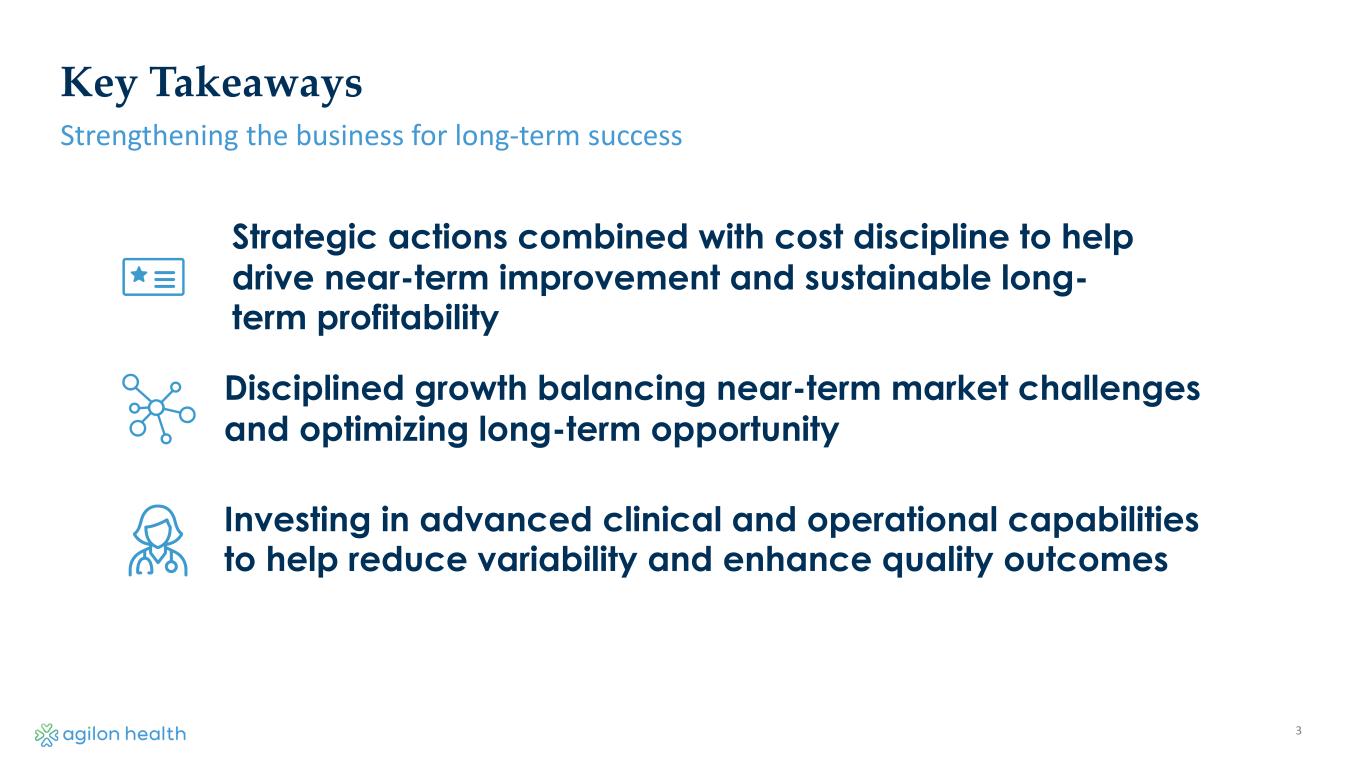
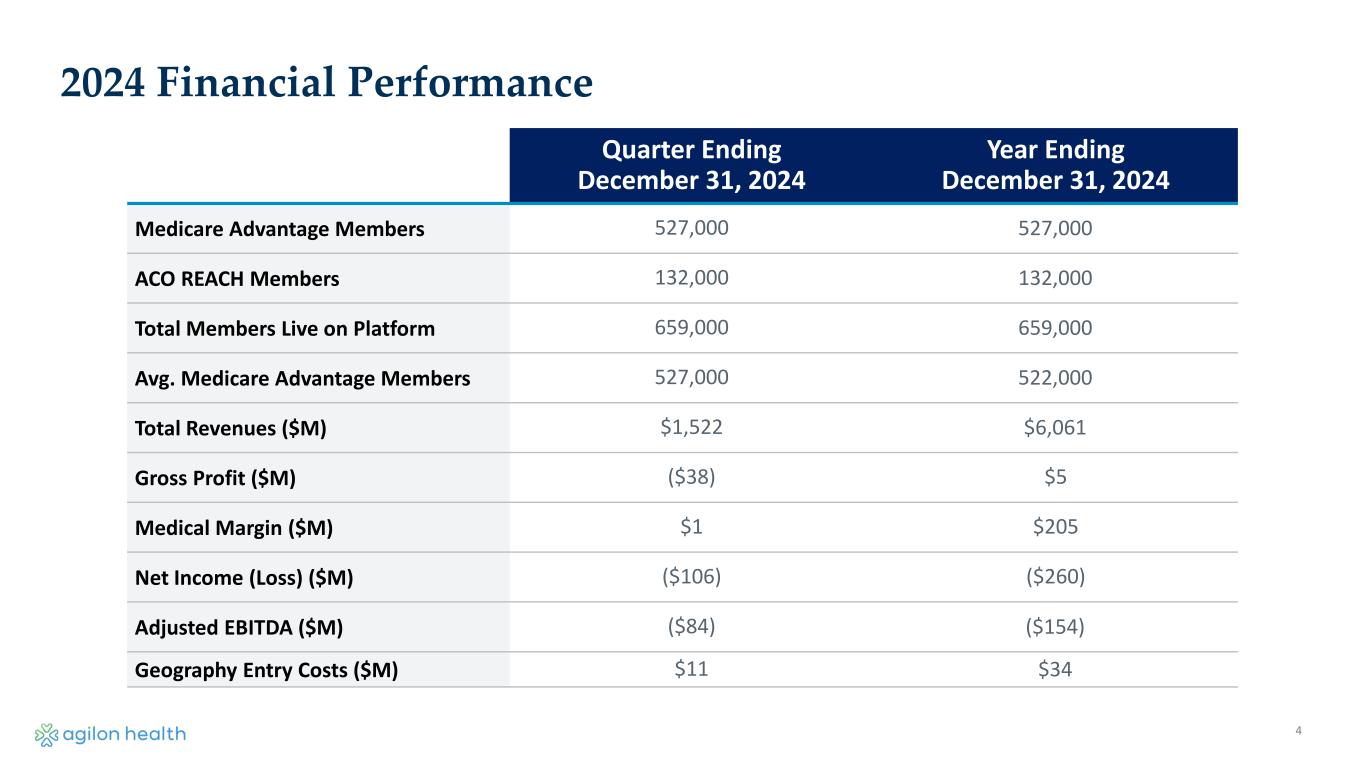
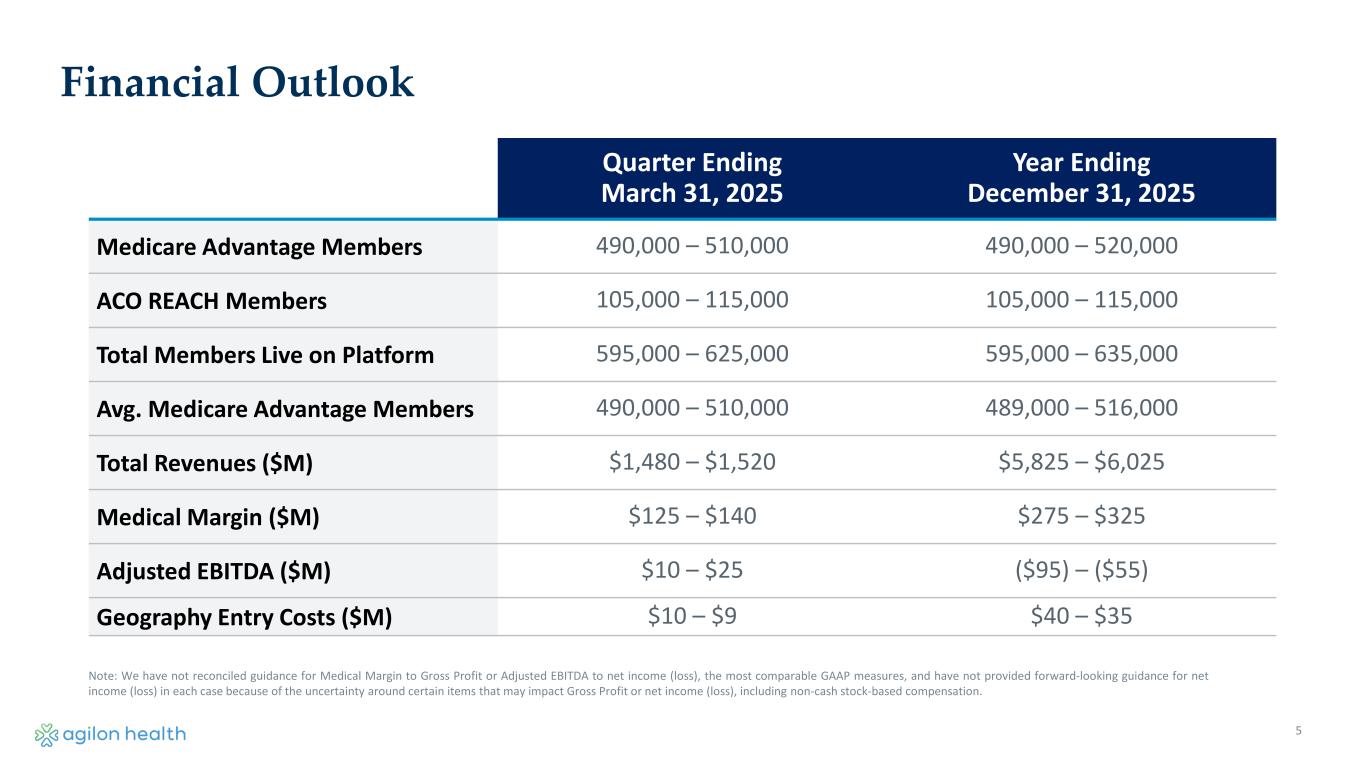
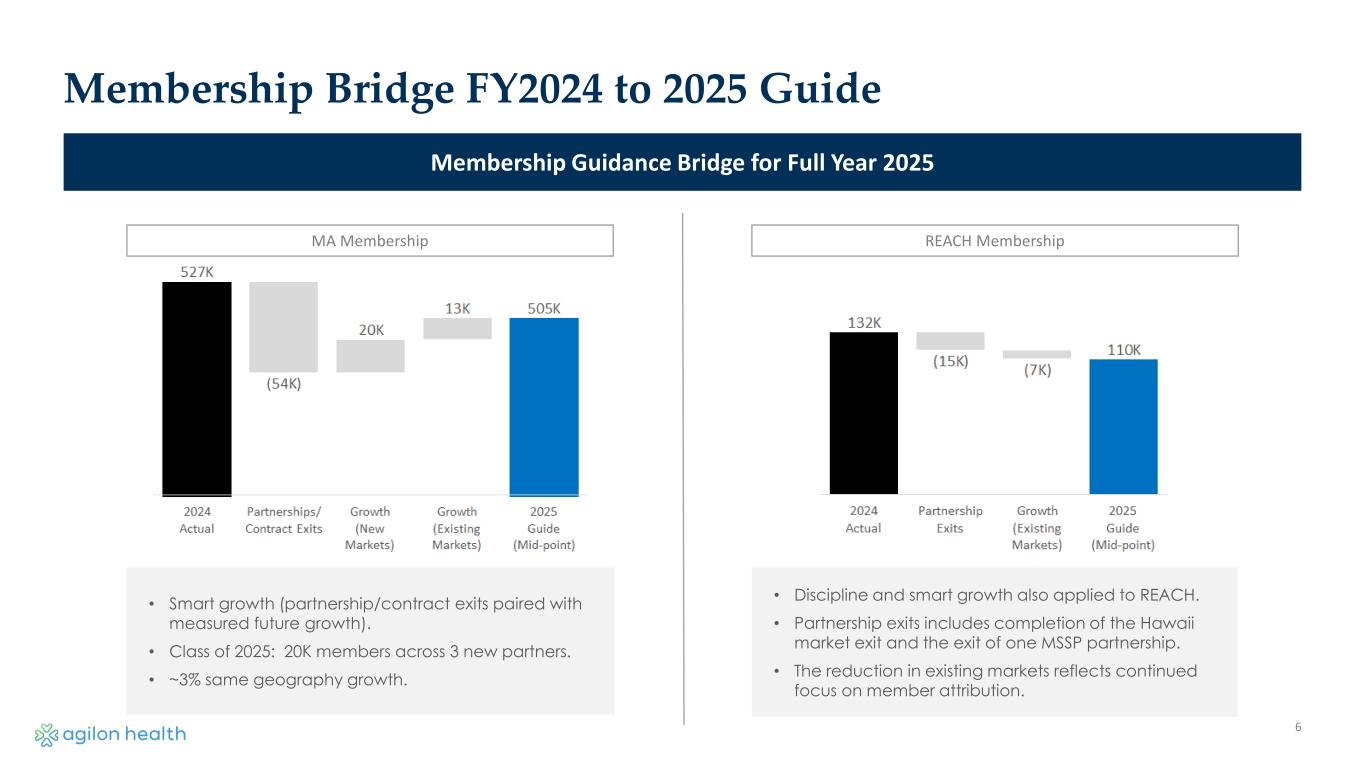
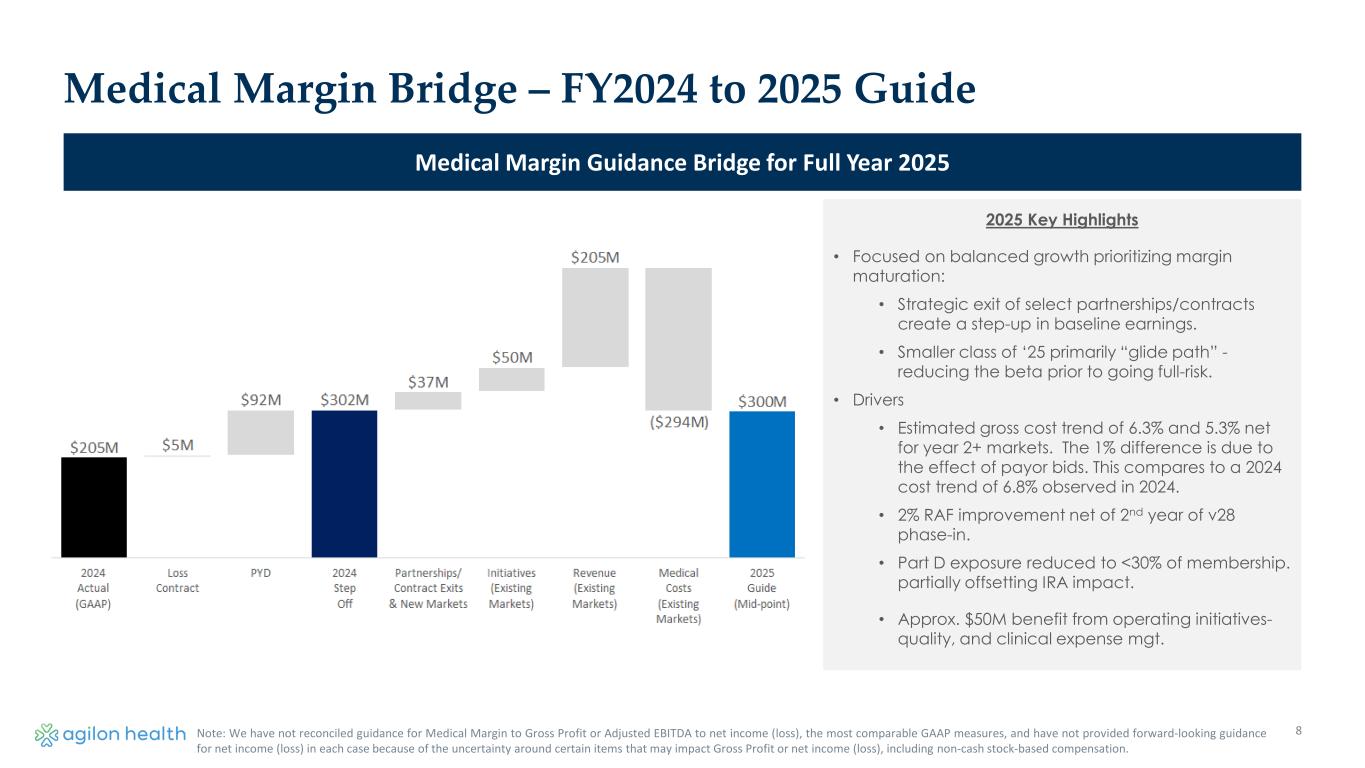
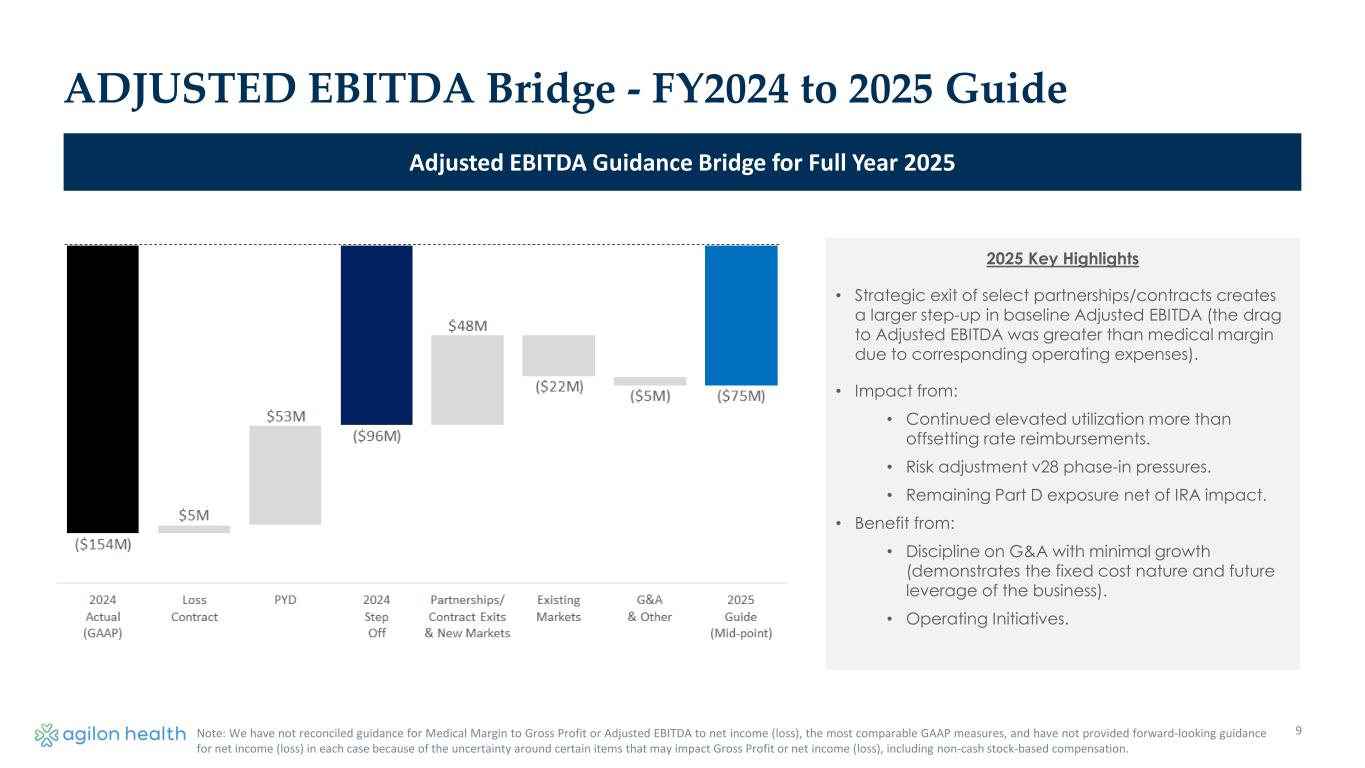
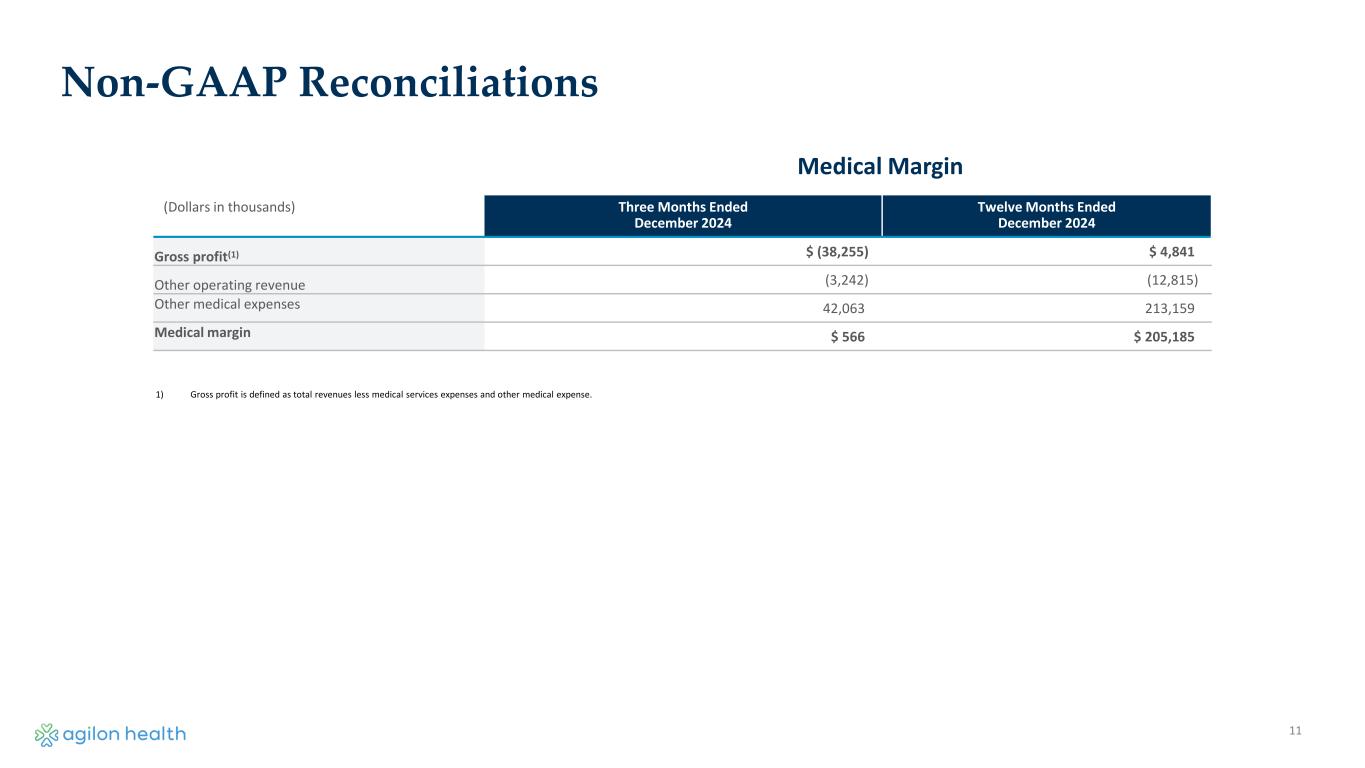
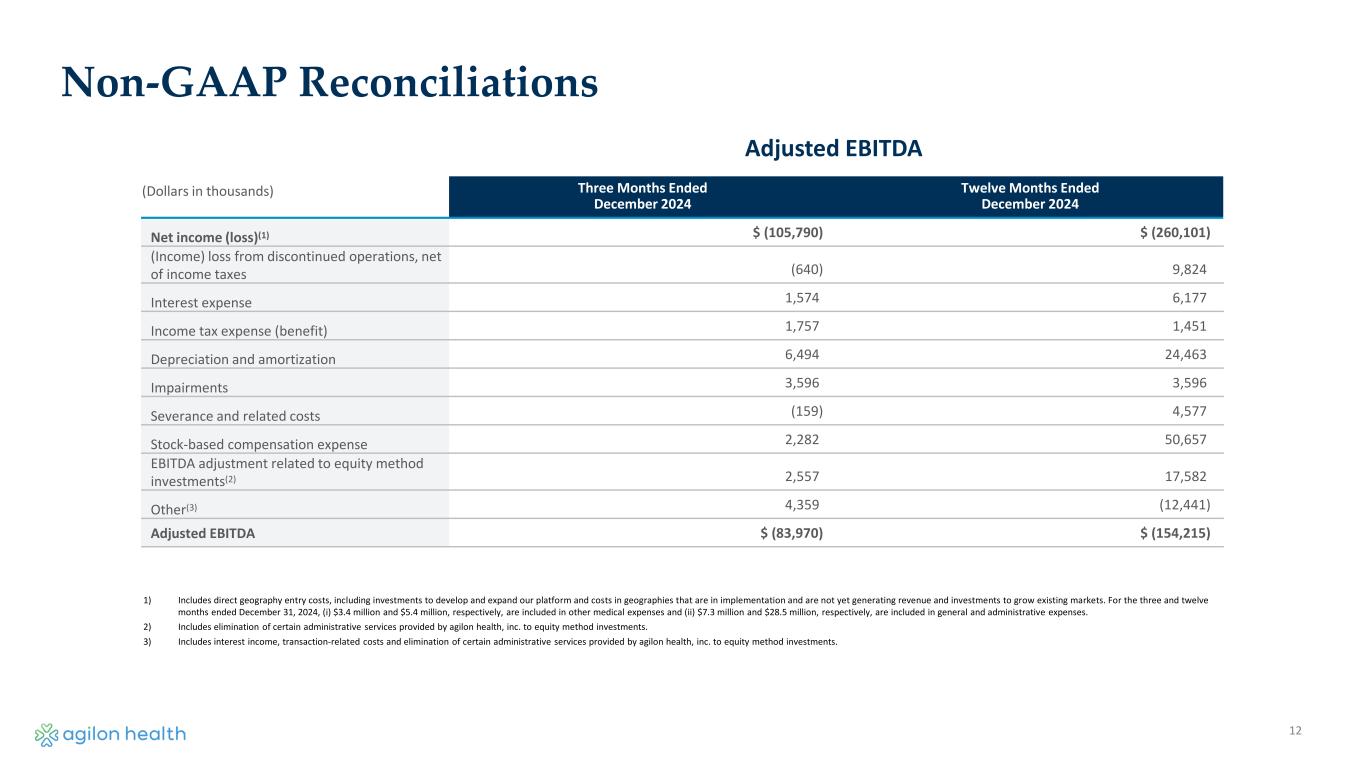
Thanks, Evan. Good afternoon, and thank you for joining us. On today's call, I will provide you with an overview on one, our fourth quarter and full year 2024 financial results and our 2025 guidance. Two, investments we are making to further enhance our clinical strategy and capabilities. And three, actions and programs we are implementing to reduce certain business risks that lie outside our control, enhance our operational execution, and drive improved performance going forward. But I'd like to begin with some context on the trajectory of our business as we continue to take actions to manage through the third year of a difficult Medicare Advantage rate and utilization cycle. While the 2025 macro environment continues to be challenging, we enter this year with a laser focus on strengthening our business for near-term improvement, success, and profitability. In 2024, we took actions to, one, reduce our underwriting exposure to costs outside our control, such as a reduction in Medicare Part D exposure to less than 30% of our membership. Two, pursue profitable and measured growth aligned with current payer and provider dynamics, which is reflected in both our reduced 2024 membership step-off and a smaller revised 2025 partner class. Three, strengthen our core clinical and operational capabilities to reduce variability and enhance quality outcomes. And four, maintain operating cost discipline by further leveraging our scaled infrastructure and technology investment. We intend for this focused approach to continue in 2025. And despite the near-term headwinds, our goal is to be cash flow breakeven by 2027. With respect to those 2025 headwinds, the Medicare Advantage market continues to experience an elevated cost trend while managing through the ongoing transition to V28, changes related to the Inflation Reduction Act, and increased quality bonus thresholds, all of which are embedded in our 2025 outlook. Our ability to weather this down cycle in Medicare Advantage and differentiate on the management of medical costs and quality outcomes relative to the fee-for-service alternative should position us well with health plans and physicians as the rate and cost spread ultimately corrects. With that said, the recent favorable trends in payer bids and the 2026 advance notice from CMS make us optimistic that we will see a more favorable overall environment for 2026 and beyond. Now, let me provide a quick overview of our fourth quarter and full year results and our guidance for 2025. Note that Jeff will provide more details in his remarks later in the call. For the fourth quarter, MA membership continued its growth trend and was in line with our expectations, increasing 36% for 138,000 members year-over-year to 527,000 members, driven by the continued expansion of our 24 partner class and 4.1% same geography growth. ACO model membership was 132,000 members, slightly ahead of our expectations. Total revenue grew 44% to $1.52 billion in the quarter and $6.06 billion on the year. Growth was primarily driven by the class of 24 and organic growth in our existing classes, partially offset by higher costs associated with Medicare Part D and lower risk adjustment revenue related to unfavorable prior period development for the full year. Medical margin was $1 million in the quarter and $205 million for the year, which when adjusted for a $5 million reserve for estimated 2025 losses from partnerships we intend to exit this year, was at the low end of our guidance range. In the quarter, we also recorded elevated Medicare Part D prescription drug and supplemental benefit costs, partially offset by favorable medical cost development from Q1 and Q2. It should be noted that $6 million of the higher Medicare Part D costs in the quarter are tied to payer contracts in which Part D risk is carved out starting in 2025. Adjusted EBITDA was minus $84 million for the quarter and minus $154 million for the year, which came in at the low end of our guide. The quarter reflected lower medical margins due to the aforementioned items, lower ACO model contract performance isolated to one partnership that we will be exiting for 2025, and favorable operating cost leverage. Now turning to full year 2025 guidance. Based on current market dynamics, we have made a strategic decision to constrain our 2025 MA membership to balance near-term risk and opportunity, And we now anticipate a full-year MA membership decline of approximately 4%, or 22,000 members, to a range of 490,000 to 520,000, or 505,000 at the midpoint. This year-over-year change includes adding 20,000 members in a smaller class of 2025 from three new partners. Same geography growth of 3% or 13,000 members, and a reduction of 54,000 members from previously disclosed partnership exits, multiple December 2024 payer contract terminations, and tighter attribution management with health plans. Similarly, our ACO model business, which has been an area of strength, will see 2025 membership projected at 110,000 members as we exit one underperforming MSSP. Revenue is forecasted to decline 2% to $5.925 billion, driven by the impact of the above mentioned membership decline, offset by a better revenue yield, inclusive of improved payer contracts, member mix changes, and 2025 payer bid impact. Medical margin is expected to improve 46% to $300 million at the midpoint, which reflects a slightly lower jumping-off point from what we communicated in November, in our view of an elevated cost trend continuing in 2025. Finally, 2025 adjusted EBITDA guidance is expected to be minus $75 million at the midpoint, which assumes a gross medical cost trend of 6.3% in line with our 2024 experience and a series of offsetting strategic actions noted above. Jeff will provide more specific details on the impact of our actions, market trends, and growth priorities embedded in our 25 Guide. While the outlined actions are anticipated to provide incremental benefit in 2025, we expect they will be more fully reflected in our 26 performance, supporting a potential re-acceleration of medical margin and adjusted EBITDA growth. Now, let me provide some color on the focused investments we continue to make in what we see as a differentiated set of clinical and quality programs. Our ability to manage cost trends relative to a benchmark and deliver top-tier quality performance fully relies on our ability to leverage the strength of a PCP's relationship with the senior patient. Current MA results show our readmission, hospital admission, and ER visit rates 20-30% better than the local fee-for-service benchmark and quality scores for each year 2-plus market approaching or greater than 4.25 stars. This level of quality performance reinforces our value to payers and is reflected in 2025 payer contracts with increased incentives tied to delivering four-plus stars performance. Similarly, ACO REACH results show our network as a top performer in terms of quality and medical cost management, with the most recent period delivering $150 million or 13% in gross savings, beating the national overall cost trend by approximately 280 basis points to extend our impact on these key metrics and drive stronger more consistent performance we continue to advance our clinical strategy specifically with our physician partners we are better connecting opportunities across our burden of illness quality and care delivery programs to drive best-in-class medication adherence, further address advanced illnesses like palliative care and target significant high-acuity chronic disease categories like heart failure, dementia, and COPD, in which the primary care physician is positioned to intervene earlier with the goal of preventing disease progression, alleviating symptom burden, and avoiding unnecessary ER and inpatient utilization. In addition to continuing to invest in our clinical strategy, we continue to be tightly focused on the block and tackle elements of our business to improve operating performance and reduce variability around the following key components. First, we are focused on measured growth as a controllable lever across existing and new geographies with a smaller 20,000 member class of 2025. In addition, for certain new partners in 2025, we have taken a glide path approach with select payers via year one agreements with a no downside in care coordination fee structure. Second, our payer strategy is focused on minimizing risk for elements outside our control, like Part D and supplemental benefits, and maximizing reward for areas within our control. like quality performance and Part C medical cost management, where we perform well. For January 2025, we successfully repriced 40% of our membership with improved percentage of premium economic terms, including incentive dollars tied to our partner's quality performance, while reducing our Part D exposure to less than 30% of our 25 membership. Third, we are enhancing our core clinical strategy and capabilities to improve quality outcomes and accelerate performance. This includes leveraging our investments in software and AI technology, physician education and coaching content and practice, and the expanded team of regional medical directors. And fourth, we continue to maintain cost discipline while investing in technology and clinical programs to further support medical margin and patient outcome improvements, as well as strengthen our position with payers and PCPs. All these actions are supported by our enhanced data and analytics capabilities that benefit that are geography, practice selection, contracting, and day-to-day operating visibility. Jeff will talk more about these important improvements. In closing, and before I turn it over to Jeff, there are a few points I want to underscore. First, we see 25 as both a transition year in terms of membership and financial performance, and an inflection year in terms of focused quality, clinical program, and payer underwriting work to further position our platform and network as the scaled solution for physicians and health plans in full risk care for senior patients. Second, the scaled platform we have built across 615,000 senior patients, 2,200 PCPs, 30 markets, and 12 states has yielded more favorable payer economic contract terms while delivering consistent outperformance relative to the MA and ACO quality and clinical cost benchmarks. Third, we believe the actions we took in 24 and our continued focus on reducing our exposure to things outside our control, pursuing measured growth due to current market dynamics, enhancing our core clinical and operational capabilities, and maintaining cost discipline will further strengthen our network and support improved and sustainable performance for all stakeholders. And fourth, and finally, while early, the advance rate notice is a positive signal that MA rates will improve for 2026, but it renews the call for rates that keep pace with increased costs in Medicare Advantage. With that, let me turn the call over to Jeff. Thanks, Steve.
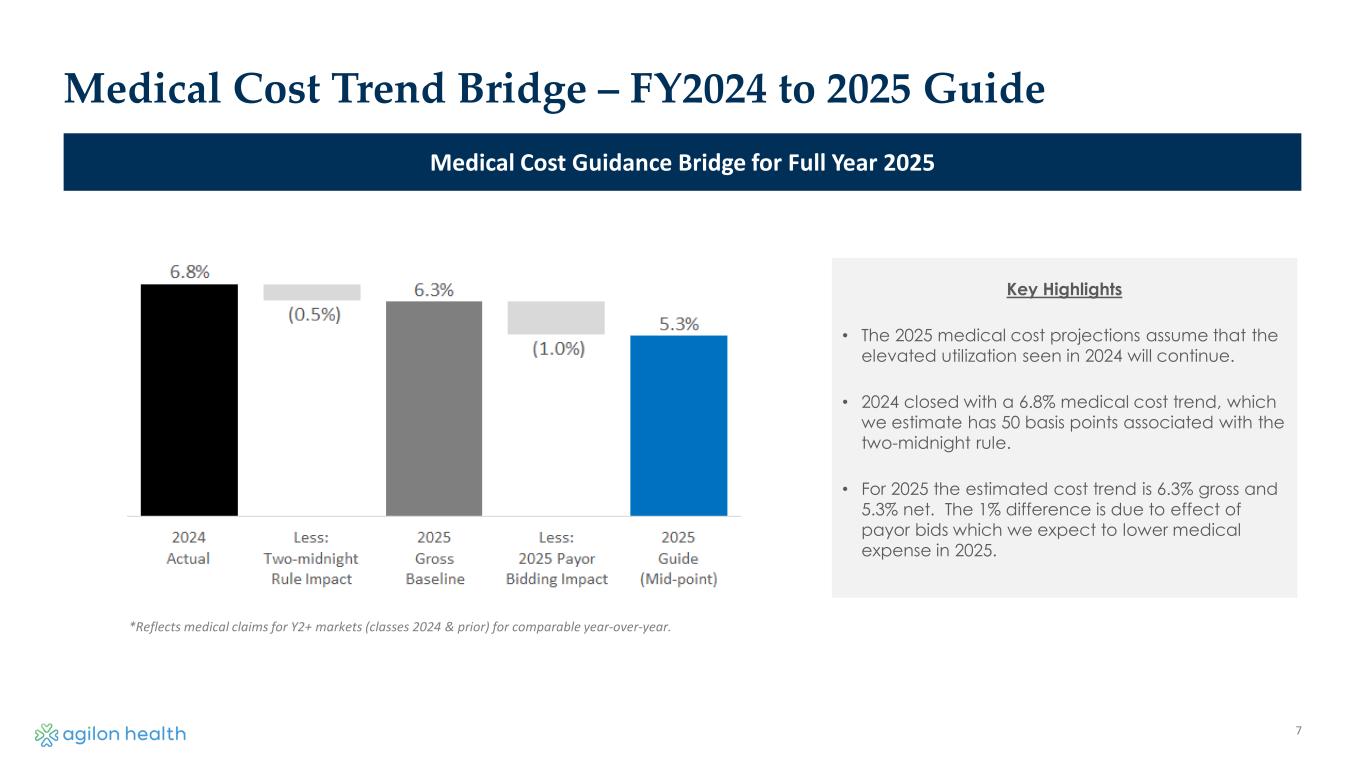
Good evening. Before I discuss the fourth quarter results in 2025 guidance, I want to highlight the actions we have taken to improve the performance of the business. Over the last six months, we have exited two unprofitable partnerships and underperforming payer contracts, substantially improving our bottom line profitability and cash burn. We've We've improved our back-end processes and data and analytics capabilities designed to enhance our visibility and reduce volatility around risk adjustment and medical costs. We've reduced our exposure and risk in areas outside of our control, such as Medicare Part D. We've implemented new training and clinical programs designed to improve practice performance and increased our ability to more closely align incentive payments in percentage of premium to Agilon performance. These actions will help mitigate most of the cost trend headlands and regulatory changes impacting our 2025 outlook and establish a stronger foundation for the future while we continue to navigate a rate environment that has not kept pace with underlying cost trends. Early indications from the advance rate notice combined with greater potential contribution from our actions gives us confidence in our ability to deliver improved financial performance in 2026 and beyond. Now, let me start by reviewing our overall financial performance for the fourth quarter in full year 2024 results, and then I will discuss our guidance for the first quarter in full year 2025. Overall medical margin and adjusted EBITDA came in at the lower end of our previously communicated guidance range, driven by several items. First, we recorded $5 million dollars of additional medical expense associated with projected 2025 losses on a contract we intend to exit at the end of this year. And we reported higher Medicare Part D and supplemental benefits expense in the fourth quarter based on updated information from our payer partners. Walking through the line items, our Medicare Advantage membership increased to approximately 527,000 members at the end of the fourth quarter of 2024, representing a year-over-year increase of 36%. ACO model membership was approximately $132,000 at the end of the fourth quarter, representing 48% year-over-year growth. MA membership growth was driven by the class of 2024 and 4.1% same geography growth. Total revenues increased 44% on a year-over-year basis to $1.52 billion for the fourth quarter. For the full year, revenues increased 40% to $6.06 billion. Growth was primarily driven by the class of 2024 markets and continued organic growth in our existing classes, partially offset by higher costs associated with Medicare Part D and lower risk adjustment revenue related to unfavorable prior year development that we recorded in the third quarter. Fourth quarter medical expense increased to $1.52 billion compared to $1.16 billion last year. The 31% growth compared to last year was driven by the expansion of the 2024 class and continued elevated cost trends. Additionally, as mentioned earlier in my prepared remarks, in the fourth quarter we also recorded additional reserves of $5 million for lost contracts that we expect to exit at the end of 2025, as well as additional medical expense primarily related to supplemental benefits. For the full year, medical services expense increased 46% due primarily to average membership growth of 38% and the continued impact of elevated medical cost trends and unfavorable prior year reserve development. The fourth quarter and full year 2024 cost trend was 4.6% and 6.8% respectively. The full year also includes the lost contract that I previously mentioned. Medical margin for the fourth quarter was $1 million compared to a negative medical margin of $102 million in the fourth quarter of 2023. The full year 2024 medical margin was $205 million compared to $299 million in 2023. Medical margin for the full year 2024 was negatively impacted by prior year development that we recorded in the third quarter and the continued impact of elevated medical cost trends. General administrative expense or GNA expense for the fourth quarter of 2024 was $60 million compared to $65 million in the fourth quarter of 2023. For the full year, G&A expense was $269 million, compared to $286 million for 2023. G&A expense for the fourth quarter and the full year 2024 reflect lower geography entry costs, capital support, and stock compensation expense. This was partially offset by costs related to exited markets resulting from business optimization initiatives. Lower geography entry costs for 2024 are driven by continued cost discipline, lower capital support funding needs, and as Steve mentioned, a more measured market expansion strategy to balance growth and performance in the current cost trend and rate environment. platform support costs were 40 million dollars compared to 37 million for the fourth quarter of 2023 for the full year platform support costs were 169 million compared to 164 million for 2023 platform support costs remain in line with our target and demonstrate our cost discipline efforts while continuing to invest in the business the adjusted EBITDA loss for the fourth quarter of 2024 was $84 million, which compares to a loss of $137 million for 2023. For the full year, 2024 adjusted EBITDA was negative $154 million compared to negative $95 million for 2023 and is attributable to the continued elevated medical cost trends and unfavorable prior year development as previously discussed. Adjusted EBITDA for our ACO model markets for the fourth quarter of 2024 was breakeven. For the full year of 2024, adjusted EBITDA attributable to our ACO model markets was $33 million compared to $39 million for the full year 2023. Fourth quarter and full year 2024 results include $5 million of additional medical costs for one of our Medicare Shared Savings Program contracts where we received additional performance data in the fourth quarter. This true-up is related to an underperforming MSSP market, which we expect to exit in 2025. Performance in our other ACO model markets was in line with expectations. Turning to our balance sheet and cash flow, Agilon ended the quarter with cash and marketable securities of $406 million and another $36 million of off-balance sheet cash held by our ACO entities. We added seven million dollars in cash during the fourth quarter and for the full year used 90 million which was well below our previous expectations. About half of the favorable variance is timing related which will now occur in 2025. Turning now to our 2025 guidance. We have provided our first quarter and full year 2025 guidance metrics in the press release and slides provided for you today. For the full year 2025, we expect year-end membership on the Agilon platform will be in a range of 595 to 635,000 members. This includes estimated Medicare Advantage membership of 505,000 and ACO model membership of 110,000 at the midpoints. As Steve mentioned, the year-over-year change includes adding 20,000 members in a smaller class of 2025 from three new partners and reduced same geography growth of 3% for 13,000 members. Note that this is net of multiple December 2024 payer contract terminations, tighter attribution management with health plans, and the reduction of 54,000 members from previously disclosed partnership exits at the end of last year. Regarding these exits, an additional 29,000 members will exit at the end of 2025. Additionally, as mentioned earlier in my prepared remarks, we will exit one of our underperforming MSSP contracts in 2025. For the full year, we expect revenues in the range of approximately $5.83 billion to $6.03 billion, which is down slightly at the midpoint from 2024. The slight decrease in revenue is due to the following. First, a decrease in members served as a result of the market and partnership exits in 2024, payer contract terminations, and more measured growth in 2025. This reduction has been primarily offset by favorable Medicare Part C percentage of premium rate adjustments, inclusive of additional incentives for quality tied to re-contracting approximately 40% of our membership effective January 1st, 2025. Medicare Part D carve-outs and caps, which reduced Medicare Part D risk effective January 1st, 2025 to below 30% of our overall membership, which should reduce the performance beta in our business. For 2025, we had assumed that our Part D losses double on a PM-PM basis from 2024 for the membership will be continued to take Part D risk. Targeted clinical programs supporting improved outcomes and quality scores of greater than 4.25 STARS, which are heavily valued by our payer partners given the increased CMS STARS cut points effective for measurement year 2025, and year-over-year risk adjustment improvement of a net 2% increase, which is roughly in line with 2024. We expect medical margin to be in the range of $275 million to $325 million in 2025, or $300 million at the midpoint. This reflects a lower starting point exiting 2024 than we previously estimated due to continued elevated medical expense and higher supplemental benefits recorded in Q4 and lower prior year development than we anticipated. Our 2025 medical margin guidance includes the benefit of the underperforming contract and market exits completed in 2024. Premium increases in excess of 4% driven by payer bids of approximately 2% and an incremental 2% net benefit from risk adjustment. Additionally, as Steve mentioned earlier, we expect to execute on $50 million of operating, quality, and clinical initiatives in 2025. We expect these tailwinds to be more than offset by the continued high medical cost trend in 2025. Our cost trend for 2024 was 6.8%, which we estimate includes 50 basis points associated with the 2 midnight rule. For 2025, our estimated cost trend is 6.3% gross and 5.3% net. The 1% difference is due to the effect of payer bids, which we expect to lower medical expense in 2025. We expect our adjusted EBITDA to be negative $75 million at the midpoint. This is driven by the medical margin guidance I previously mentioned and assumes flat G&A costs, including platform support costs, as we maintain our cost discipline. We expect our ACO model performance to be between $35 and $40 million for 2025. in addition we expect geo entry costs of between 35 and 40 million based on our assumption that the class of 26 membership will be between 30 000 and 45 000 members reflecting our balanced approach to growth for the first quarter we expect ma membership of 490 000 to 510 000 revenues of 1.48 billion to 1.52 billion medical margin of 125 million to 140 million and adjust the EBITDA of $10 million to $25 million inclusive of $18 million contribution from ACO reach at the midpoint. Our expected use of cash for 2025 is approximately $110 million. We continue to believe we have adequate capital on the balance sheet to support the business and achieve our goal of cash flow break-even in 2027. Our focus for 2025 is executing on our clinical and operational initiatives to drive better outcomes for our members and shareholders. We are confident that our investments, disciplined growth, and strategic actions will drive long-term profitability. This concludes my remarks. Operator, we are now ready for questions.
Operator
If you would like to ask a question, please press star followed by one on your telephone keypad. If you would like to withdraw your question, please press star followed by two. When preparing to ask your question, please ensure your device is unmuted locally. Our first question comes from Stephen Baxter with Wells Fargo. Your line is open. Please go ahead.
Hi, thanks. I just wanted to ask a little bit about some of the changes you're making to Part D and the contract in there for 2025. I guess, first, can you just give us a little bit more color on how that's going to flow through the P&L, both at the revenue line and the medical expense line? And then it would also be great to just better understand what was actual Part D medical margin in 2024, Just trying to understand, you know, why we're not seeing that as a specific spike out in the medical margin bridge. And maybe that's because the PMPM losses are getting bigger in 2025, as you mentioned. But I just want to make sure we're fully tracking that discussion.
Sure. Steve, thanks for the question. I'll start, and Jeff can give you some of the specifics on the P&L. So, last time we talked to all of you, one of the key areas we talked about was really narrowing our exposure to things that we can't control. Part D risk was at the top of that list. It has a series of challenges that come with it. There's a lag in terms of our finding out where the results actually occur, and that's typically Q3 the following year. But there's also things like the formulary and the rebates that we just can't control and don't have visibility to. We laid out a goal of getting to less than 50% of our members with D-Risk. We've exceeded that. We've taken it down to 30%, and I think that reflects the good relationship that we've got with our payers, and they're recognizing that we really can't control that. So, that's been a real area of success for us, and Jeff, you want to talk about the P&L?
Yeah, yeah. Thanks, Steve. So, a couple of things just to remind everybody. We record Part D net in revenue in the P&L. That's why you're not really seeing it show up because it's a really small component of the overall revenue number. And it has been a loss for us. So it continues to be a loss for us. And what we've done is if you think about from 24 to 25, we've taken the 30% of members that we are going to retain that risk for 2025. 25, we've taken that PMPM loss for 24, and we've doubled that, because we know the Inflation Reduction Act materially increases the dollars at risk there. And we think that's a pretty good starting point for the 25 budget.
So fewer members with de-exposure, but taking for those remaining members, doubling the magnitude of the PMPM in 25.
Operator
Our next question comes from Justin Lake with Wolf Research. Your line is open. Please go ahead.
I apologize if you covered this. Can you talk a little bit about the year one performance this year, what you're expecting or 24, what you're expecting for 25 there? And then also, can you talk a little bit about how you're thinking about the potential for class of 26, which you typically have visibility on at this point in time.
Thanks. Yeah, thanks, Justin. So the year one performance for the class of 24 was very strong. It's the largest class we've had to date. And as we shared at your conference, they're off to a really nice start, and they close the year kind of consistent with that level of performance that we talked about. The class of 25, part of the measured growth strategy we talked about in November, is at 20,000 members, so it's a smaller class. It also is the first class in which we've used a care management fee and no downside construct for the vast majority of those members, really to reduce the beta with the idea that we'll take them to full risk as market and payer dynamics improve over time. For the class of 26, we have a strong class for 26. We have signed letters of intent around that. And so we're feeling good about that. That class will be larger than our class of 25 and where that came in at. And I think it's reflective, Justin, of the primary care physician market today really needs a new business model. We are positioned well from that standpoint, given the success we've had, given the references that we've got from our existing network that's out there. And there's just fewer alternatives for primary care physicians. So that is reflective. There's an opportunity for us to make that class of 26 a little bit larger, but we like to have a really robust full implementation cycle. And so our focus will soon turn to the class of 27, and we'll be engaging people two, three months from now talking about what it could look like around that. Now, as you think about growth overall, I guess the other area I would call out for you, we talked a little bit about this in November, is a really strong in-market opportunity for us. And so as we look at that in-market opportunity, we see the opportunity to see a larger growth rate across time, again, tied to kind of payer and market dynamics. So that's sort of the balance that we're looking at as we think about being measured and disciplined around our growth strategy.
Operator
We now turn to Jack Slevin with Jeffries. Your line is open. Please go ahead.
Hey, good afternoon. Thanks for taking the question. A few things I want to clarify on the the medical cost trend guidance um and appreciate all the color i just want to say that on the front end it's really helpful um so two pieces one on a two midnight i just want to understand the 50 basis point estimates for the full year we've got certain mixed reads that have on a number of fronts about did that sort of ramp throughout the year um maybe just just getting of your guys' thoughts on, like, was that higher in 2024? And if so, you know, does that 50 basis points you think sort of fully encapsulate a run rate level that we might be at right now? And then the second piece, just on supplemental benefits, I know, at least in the press release, it looks like it's excluded from the medical cost trend guide that you gave.
I just want to understand if there's a tailwind this year on either removing that from some of your contracts or from the plans pulling back on that my thought is the flow through there could be you know decently significant so just want to get thoughts on both of those fronts thanks yeah thanks jack a couple things on on the two midnight uh rule so there was a little bit of a ramp that's incorporated into our calculation of the of the 50 the 50 basis points uh on a on a year-over-year basis so there there was some of that but that that's incorporated in our number obviously because we'll have a full 12 months of that into 2025. As far as supplemental benefits go, I think we've stated before that based on the bids the payers had, we did see an overall decrease across the board. Roughly 97% of the bids had decreases in supplemental benefits. And so the magnitude of those dollars for us go down as we think about 2025 and I think your final question was on contracting changes and so as we think about this I think Steve has mentioned this before we certainly talked about it that we really want to be you know at risk for the things that we control supplemental benefits isn't one of those and so long term you know we'd like to go down that path but right now they're all car at risk for those in 2025.
Yeah, Jack, I'll just wrap up by saying, you know, we're on an evolution in terms of reducing risk around the things we can't control. We were ahead of what we laid out on Part D for this year. Supplemental benefits based on what Jeff talked about with how payers really adjusted down on those was a little bit lower on our risk, but it remains a real priority and our payer partners know that we would like to carve that out the same way we have on Part D. Got it.
Really helpful color. Appreciate it, guys.
Operator
We now turn to Ryan Langston with TD Cohen. Your line is open. Please go ahead.
Hey, thanks. On the ACO reach side, on that one client, can you give us a sense of the impact for the fourth quarter and for the full year? And then I saw that you, for the cost trend, you're assuming about 100 basis points lower for the year two cohort. I guess, is that just benefit reductions or geography or national versus regional payers? Just looking for a little bit more detail on why the year two cohorts just going to run a little bit better. Thanks.
Yeah. First question I can answer. I may have to get you a follow-up here in a second. The first question on the MSSP, I mean, one of the reasons obviously we're exiting is because it was, you know, losing money for the year.
So I'm not going to quantify the specific magnitude, but obviously it was it was a decent amount and that your second question was what was the second question I didn't pick up on that yeah you all about cost trend 6.2 or 6.3 but you're saying I think your cohorts a 1% difference or something so just wondering what that oh I yeah so Ryan I think what you're asking about is we show you from 24 to 25, we adjust 24 cost trend from 6.8 to 6.3 to reflect the two midnight rule that was asked about earlier. We then say 25 is roughly at that same level. And then there is a hundred basis point reduction from 6.3 to 5.3, which is reflective of the change in the payer bids that Jeff talked about earlier, and we saw a reduction from a revenue perspective of 100 base points and a cost perspective of 100 base points. So at the med margin line, we're not really reflecting a pickup around that, but it does reflect in the overall cost trend.
Okay. Thank you very much. Yep.
Operator
Our next question comes from Amir Farahane with Bernstein. Your line is open. Please go ahead.
Hi, good afternoon. Thanks for taking my question. In the last quarter, we mentioned you can pull some additional levers to improve working capital. It sounds like that will help you in Q4. It would be great to talk a little bit about those factors and what you expect that to help you in 2025. It sounds like you expect some of those to reverse. If you can put some numbers around that would be very helpful. Thank you.
Yeah, Amira, thanks for the question. Let me just say, I mean, I think this is something that we're proud of. We were really focused on discipline cash management. We called it out last time we talked, both in terms of working with our payer partners and in terms of working capital. And Jeff can dimension the improvement relative to what we projected.
Yeah, a couple of things just to walk you through the numbers, right? So That includes the ACO cash that we have as well, so a total of $440. And, you know, we expect to use $110 million if you think about 2025. So that means we'd end 2025 at roughly $330 million. That's really $75 million better than our previous expectations. And as Steve mentioned, in November, we had these cash flow levers that we were focused on. And it was really, you know, the first and foremost is around the partnership exits, which obviously has a meaningful cash flow improvement going forward. And you can see that impact in the EBITDA bridge that we provided today. The second is tighter working capital management. Think about receivables on the books that we have the ability to go and collect from vendors and others. And then last but not least is payer contract negotiations where a lot of our payers pay a percentage of our POP up front, of our premium up front, and those are varying. And we were successful across a few of those, which is really driving the cash flow outperformance. We're not done. There's still more opportunity, and we're still focused on it. And, you know, to quantify the timing and volume of when that's going to happen, I think that's really challenging because they kind of come when you get them negotiated. But our view is there's still opportunity here and we're working on it and hope to have a better update, more information.
Operator
We now turn to Jay Landris Singh with Truist. Your line is open. Please go ahead.
And thanks for taking my questions. So I want to go back to this medical margin bridge. 50 million initiatives you called out, various drivers. I was curious, how much visibility do you have at this point? Are there any initiatives that still need to be executed? Just trying to get a better sense of range of outcomes there, because you clearly need to offset some pretty large delta of $90 million on revenue and cost.
Yeah, thanks, Jalendra. I really appreciate it. So I think we talked about we feel like we are differentiating in terms of cost trends relative to a benchmark and in terms of our quality performance. When we talk about specifically our initiatives for next year, it reflects that. Roughly half of those initiatives are around quality performance, delivering greater than four stars, in some case four and a quarter. Some even will give us an additional incentive up at four and a half. this is something that a payers not able to do with their fee-for-service network and so as I talked about 40% of our membership being renewed and one of the areas we saw improvement in was not just percentage of premium but also around these incentives for quality that is a much larger number for this coming year and so we need to execute the way we have but it is something that's clearly within our control. We've been successful with our payer partners in terms of having them reward us for that because in this environment, it is worth so much to them because it is so difficult to do that. Cut points are up and a PCP model with a tight relationship with the patient has the ability to close those care gaps and deliver that. So that is a huge component of it. The other part is really around our clinical management activities. Palliative, that I called out, is an area that we've done very well on in terms of reducing the admission rates, in terms of reducing the total cost of care. And so that is a significant component of that.
And we are literally on a daily basis tracking that, looking at what our enrollment is around the the appropriate patients that's a critical component of that program so i would say there is high visibility around that and i think we have confidence around that number okay that's helpful and a quick follow-up uh steve you talked about 2026 ma advanced notice uh clearly showing some nice improvement but curious from your point of view from agilon point of view and geographical any puts and takes we should be aware as we think about the update there in 2026?
Any, sorry, any what updates?
Any color from Agilent point of view in particular with respect to the advance notice for 2026 on MA?
Well, I mean, I think like everyone, we were encouraged by the advance notice. I think my color would be as we look towards the final notice, I sort of called out I think it reinforces the need for rates to catch up with the utilization that we've seen over the last couple of years in the program. So like everyone, we would like to see an increase from the advance notice to the final notice. And we obviously won't know that for a little while here, but that will be a key indicator. That's not something we can control, so we're super focused on our controllables. We talked about this year as a transition year, and you asked about the $50 million. But as we look towards next year, I think given where we're at and our ability to differentiate around quality and cost, we see the opportunity for improvement in 2026.
Operator
Our next question comes from Michael Ha with Baird. Your line is open. please go ahead.
Thank you. Just two questions. Firstly, I know you mentioned certain new partners in the 25 glide path approach with no downside in year one. I think you mentioned it applies to the vast majority of your 20,000 lives, which is great. I'm curious how receptive do you believe pairs are in doing more of these sort of no downside year one arrangements? Is it basically a temporary type arrangement to help you guys navigate near term trends? Or could this be something new, like structural pair arrangement going forward that you could extend to future partners and new markets?
So, Michael, it's a great question. I think from a macro perspective, we've made a lot of progress with our payer partners, whether it's around the cash that Jeff talked about, whether it's around reducing our Part D risk. As we think about these year one contracts, this is the first year that we've done that. I think our payer partners were receptive to that. Ultimately, they would obviously like to see this move to full risk, but that's really going to be predicated around kind of market dynamics and just the dynamics with them overall. So I think this is something that's available to us, but it's really going to be dictated by the environment. We have not done it in prior years, and as I said, the class of 24 on full-risk contracts performed very well. So I think it's going to be situational, but it's a quiver that we've got that we can work Our next question comes from Andrew Mock with Barclays.
Operator
Your line is open. Please go ahead.
Hi, this is Thomas on for Andrew. Could you share the latest 2024 national trend you received from CMS for ACO reach? I believe you last shared through September it stood around 7 or 8 percent.
Yeah, I think it's 7.8 percent is the latest that we've seen published.
In terms of the reference population for 2024, but that will be updated again. And I think there's some discussion and people expecting that that number will end up being larger than that. But that is the latest number that we've got.
Operator
Our next question comes from Elizabeth Anderson with Evercore. Your line is open. Please go ahead.
Hi, guys. Thanks so much for the question. I was wondering if you could talk about, you talked about sort of the repricing of membership growth across, you repriced 40% of the contracts. Can you just maybe tell us sort of like, do you feel like that was like the full catch-up or you sort of see that as something that could go, you know, can you talk about the evolution of that as you sort of think about 2025 and how to sort of think about that on the go-forward rate on that? And also anything to call out on the medical cost cadence across the course of 2025. Thank you.
So I'll take the first one. And Jeff, you can talk about kind of the seasonality and the progression across time. So, Elizabeth, thanks for the question. You know, I mean, just to back up, we repriced 40% of our membership for 1-125, and we've got another 50% for 1-126. So we appreciate that we're in this period in which it's a challenging environment, but we do have that pricing lever to address it. I think from a percentage of premium standpoint, we felt good about our ability to get the increases that we were looking for around that. A big priority for us was also the reduction in Part D. And in some cases, there was an adjustment in Part C trend, depending upon how that payer treated that. But in aggregate, we saw an improvement in the percentage of premium for C. We saw a reduction in Part D risk in about 30% of our, 30 of the 40%, we saw language come in that was sort of standard language that we believe is really going to help protect us as we go forward. So I think that was a very good start. I think the work for 25 or in 25 for 2026 on these renewals is a, you know, is a real opportunity for us as we think about those elements that I just talked about. So repricing is, we think, a tailwind as we move into 2026 and as we look forward.
Yeah, and this is Jeff. Real quick on the seasonality. you know, you have to strip out all of the development and, you know, really look at an occurred basis. I think it would follow a normal progression that you would see in this business where there's more, you know, medical margin or lower medical costs in the first half of this year, higher medical costs in the back half of this year. And I think we've talked specifically about, you know, the fourth quarter generally being the highest medical expense quarter of the year, just based on the way the plans are designed.
Operator
Our next question comes from Adam Ron with Bank of America. Your line is open. Please go ahead.
Hey, thanks for the question. So I'm not sure if I'm getting confused by the way you're talking about it, but with the 1% impact on trend from payers repricing or changing their bids, presumably that is because they're lowering their rebates and lowering benefits for their members because they're under pressure. but i thought that that would have been a tailwind for you from a medical margin perspective um and i thought you had talked about that when i was first talking about um cutting benefits um and so just want to clarify if you're saying that payers cutting benefits is not a net tailwind to your medical margins and if if so is that just because it wasn't cut that dramatically in 25 and that you expect it to be more in 2026 so more all around that would be helpful. Thanks.
Yeah, sure. This is Jeff. I guess what I would say is when you think about the two components, you have the revenue component, which was based on the bid information, and then you have the cost trend component. And what we've done here is we've said, listen, embedded in the bids is really, you're exactly right, a member cost share reduction or increase to the member, if you will. And so that was taken out of our revenue, but we also think it's going to obviously reduce our medical expense as well. And so that's how we get from the 6.8 to the 5.3. You have the 50 basis points of to midnight that we talked about. And then from 6.3 to 5.3 is really the benefit of, I would say, you know, those costs, you know, being pushed to the member.
Operator
We now turn to Ryan Daniels. We now turn to Ryan Daniels or to William Blair. Your line is open. Please go ahead.
Yeah, thanks for taking the question, guys. Just one quick follow-up on the new kind of payment model with the care management fee, and I guess it's multifold. Is that paid by your provider partners to you or from the payers, number one? Number two, is there actual upside potential after those fees if there's residual shared savings? And then number three, can you speak to how you can move that to full risk over time? Is there a trigger? Is it an annual contract? Just want to give a little more color on that.
Yeah, thanks for the question, Ryan. So first, you know, it's in this umbrella of working really constructively with payers. The care management fee is paid to the partnership that we operate 50-50 with our physician partners. so it's paid directly there. Two is there are upside incentives in these contracts for outperformance and in particular around some of the areas that we do well and are important to our partners like the quality incentives that I mentioned. The expectation is that you do move to full risk across time, maybe as quickly as you move to year two. And so that is the discussion that you have as you approach the back half of year one. And that's why we describe it as a glide path. I think you're ultimately moving towards that full risk model, but you're doing it in a more protected kind of lower beta type of way.
Operator
We now turn to Witt Mayo with Leerink partners. Your line is open. Please go ahead.
Hey, thanks. Steve, I'm just wondering how you guys are internally planning for the fork in the road here with ACO REACH with your physician groups. I'm not sure what happens next year, if it gets extended or not. I'm not smart enough to know. But when do you guys say like, hey, we need to move on this. We need to evaluate MSSP or we need to pull the plug. Just wondering kind of how you guys are thinking about the decision tree here.
Yeah. Listen, thanks for the question. It's a really good one, one that we've spent a lot of time on. Obviously, ACO reach has been a clear area of strength. As we call that, we're consistently beating the benchmark. We're superior from a quality performance perspective. Medical margin equivalent is roughly north of 100 bucks PMPM. So, all of those are very encouraging for us I think our sense is we're more optimistic about the post 26 outlook whether that is an extension of reach whether that is a new program and Medicare fee-for-service that is full risk there's multiple vehicle options around that one of which could be within the construct of MSSP I think from a timeline perspective we think this year is going to be very active around that. A few people got to get in the seats there to have more of those discussions. But certainly by early next year, you need to know what's going on with that. And that kind of lines up with the timeline in which if you're doing something like MSSP or others, you'd have to be enrolling in that. So, you know, more to come. It's going to be a pretty dynamic discussion. But I think if versus six months ago, our optimism level about a follow-on program or extension is increased.
Operator
Our next question comes from Daniel Grossleit with Citi. Your line is open. Please go ahead.
Hi, thanks for taking the question. Just a couple quick ones on the glide path, not to beat it to death. But I'm still a little confused on who actually decides to move that to full risk. Is it the partnership? Is it the payers? Is it that in conjunction you both have to agree to move to full risk? Is there any kind of timeline where you have to, there's a drop dead where you must move to full risk? And then as we think about the 2026 class, the letters of intent that you have, are they as well on the glide path or is it TBD on 2026, how you're thinking about that? Thanks. Yeah, Daniel, thanks for the question. I think, you know, the timeline on the glide path is we would mutually work it out with a payer at the end of this year, just like we worked out Part D, which was off-cycle on a lot of things, just like we worked out accelerations on cash payments that Jeff talked about, off-cycle. I think, you know, payers are going through the same world that we're going through. And just like physicians have a real need for an alternative business model, payers have a real need for a primary care centric model that's great on quality and great on medical cost management. So we have payers who have more flexibility in terms of working with us than we did, you know, six, nine, 12 months ago. And I would put this in that bucket. As we think about the class of 2026, it will be situational in terms of the markets and the payers that we're working with there. Obviously, the things we talked about around advance notice, final notice, the traction we've got around the controllable items around quality and medical cost management will all factor into that. And then finally, how payers bid for 2026. So I think it's in front of us. I think it's an option that we've got available to us, but we're going to be making those decisions as we approach it.
Operator
We now turn to David Larson with BTIG. Your line is open. Please go ahead.
I seem to recall you reporting cost terms in like the 7% or 8% or 9% range in the first three quarters of the year. And I heard a bunch of cost trend numbers reported on the call here. What was your final trend for 2024? And what do you expect it to be for 2025, please? Thank you.
Yeah. So real quick, the final for at least how we have it recorded today as we close the year for 2024 is 6.8%. And then what we said for next year that we have in the budget is the 5.3, but there's a slide that we put out there that kind of bridges you from, you know, 6.8% as we ended 2024 and 5.3. You know, the two midnight rule is 50 basis points. So that gets you down to 6.3. And then from 6.3 to 5.3 is the 1% really impact on payer bids and the cost sharing that we mentioned earlier. So in our view, I guess the way I would frame it, in our view, we believe we have the same level of cost trend from 24 to 25.
Operator
We now turn to George Hill with Deutsche Bank. Your line is open. Please go ahead.
Hey, good evening, guys, and thanks for sneaking me in here. Jeff, I kind of have a numbers question. You had indicated that you guys had carved Part D out of about 70% or greater than 70% of the membership for 2025, but the PMPM is indicated up, and I would have thought that the percent of premium that you guys receive would be down kind of reflecting the carving out of the Part D piece, but you guys also indicated that you've repriced about 40% of the members. I was just kind of wondering if you could talk about kind of the interplay of those pieces, and like maybe, I don't know if it's an accounting issue or if it's a red rack issue, I just want to know kind of like how the revenue on a per member basis changes is when you guys do big card outs, whether it be supplemental or Part D. And my quick follow-up would be, am I doing the math right in the deck that the PYD in the quarter was about $8 million positive?
Yeah, so first question is the Part D. So a couple of things, just it's different here than other places, right? Especially at the payers. We record Part D on a net basis. So revenue minus expense, we record that net in revenue. And so that's why you're not seeing the revenue line go up, because it's recorded net of cost in the revenue line. And what we said was, for those members that were continuing with risk in 2025, we took the 2024 PMPM on a net basis, and we doubled that. We doubled that cost for 2025 five because of the impact of the inflation reduction act so second second piece was PYD so in the quarter you know we really had I'd say three million dollars of favorable prior year development it doesn't show that way in the financial statements because we do have retroactively assigned membership which includes revenue and claims as well and so you have to back that out of the numbers. And if you do that, it's roughly 3 million positive development in the quarter for prior years.
And George, if I can just call out on that, I think Jeff and the team have done a really nice job in terms of stabilizing and providing predictable kind of medical cost trend forecasts. You see it in terms of what he just talked about in terms of the favorable prior year but he has he also called out q1 and q2 developed more favorably and so that's the pattern that we're trying to get in and making sure that we're really doing that now we've got further to go in terms of part d and supplemental benefit we're trying to reduce our exposure to that for the remaining piece we've got both in the quarter and in the guide for 2025 we are we are forecasting that cautiously our final question comes from match day with Neatham.
Operator
Your line is open. Please go ahead.
Thanks for taking the questions and congratulations on getting Part D exposure below 30 percent night speed relative to the 50 percent expectation. I guess anything to call out in terms of why you were more successful than anticipated on the Part D and maybe looking ahead how are you thinking about the remainder of the book from here? Is the intention to remove all Part D risk over time and if so how long would an initiative like that take?
Thanks for the question, Matt. I mean, the goal is ultimately to take that to zero, as it is for our supplemental benefit exposure. You know, getting to less than 30 based on less than 50, these are intermingled discussions around a lot of things. And, you know, I think payers understood the challenges coming with the Inflation Reduction Act, understood the beta that a primary care-based model could have on a smaller pool, because this gets reconciled at each individual partnership level. I think the question was, how do they administer it and how do they work their way through it? And then how do you get the math to work that Jeff was talking about. So that took a lot of work, a lot of kudos to our payer team. They really did an exceptional job. A lot of time with the senior management folks around how important this was to us. And they want us to be their value-based partner for the next decade and beyond. So this is, I think that's why ultimately we're able to get this success and the success on, you know, cash payments and other things because in a world of fewer alternatives of primary care centric models, you know, being able to sustain that is important to the payer. And so I think that's the big part that really drove that overall success.
Operator
This concludes our Q&A. I'll now hand back to the management team for any final remarks.
Well, thank you all for the call. I think, you we're managing through a dynamic and difficult environment, but we feel really good about the actions that we're taking. We laid things out at the end of last year. We've executed on all of those things. We see this year as a transition year, as we talked about, from a membership and a margin perspective, but it's also an inflection year. And as we look to 26, we talked about we're feeling optimistic. So thanks, everybody. Talk to you soon.
Operator
Ladies and gentlemen, today's call has now concluded. We'd like to thank you for your participation. You may now disconnect your lines.