Operator
good afternoon and thank you for attending the agilon health second quarter 2025 conference call my name is jay song i'll be the moderator today all lines will be muted during the presentation portion of the call an opportunity for questions and answers at the end i would now like to pass the conference over to your host evan smith thank you operator good afternoon and welcome to the call with me are ron williams our executive chair and our cfo jeff schwanke following our prepared remarks, we will conduct a Q&A session.
Before we begin, I would like to remind you that our remarks and responses to questions may include forward-looking statements. Actual results may differ materially from those stated or implied by forward-looking statements due to risks and uncertainties associated with our business. These risks and uncertainties are discussed in our SEC filings. Please note that we assume no obligation to update any forward-looking statements. Additionally, certain financial measures we will discuss in this call are non-GAAP financial measures. We believe that providing these measures helps investors gain a better and more complete understanding of our financial results and is consistent with how management reviews our financial results. A reconciliation of these non-GAAP financial measures to the most comparable GAAP measures is available in the earnings press release in Form 8-K filed with the SEC. And with that, let me turn the call over to Ron. Thanks, Evan.
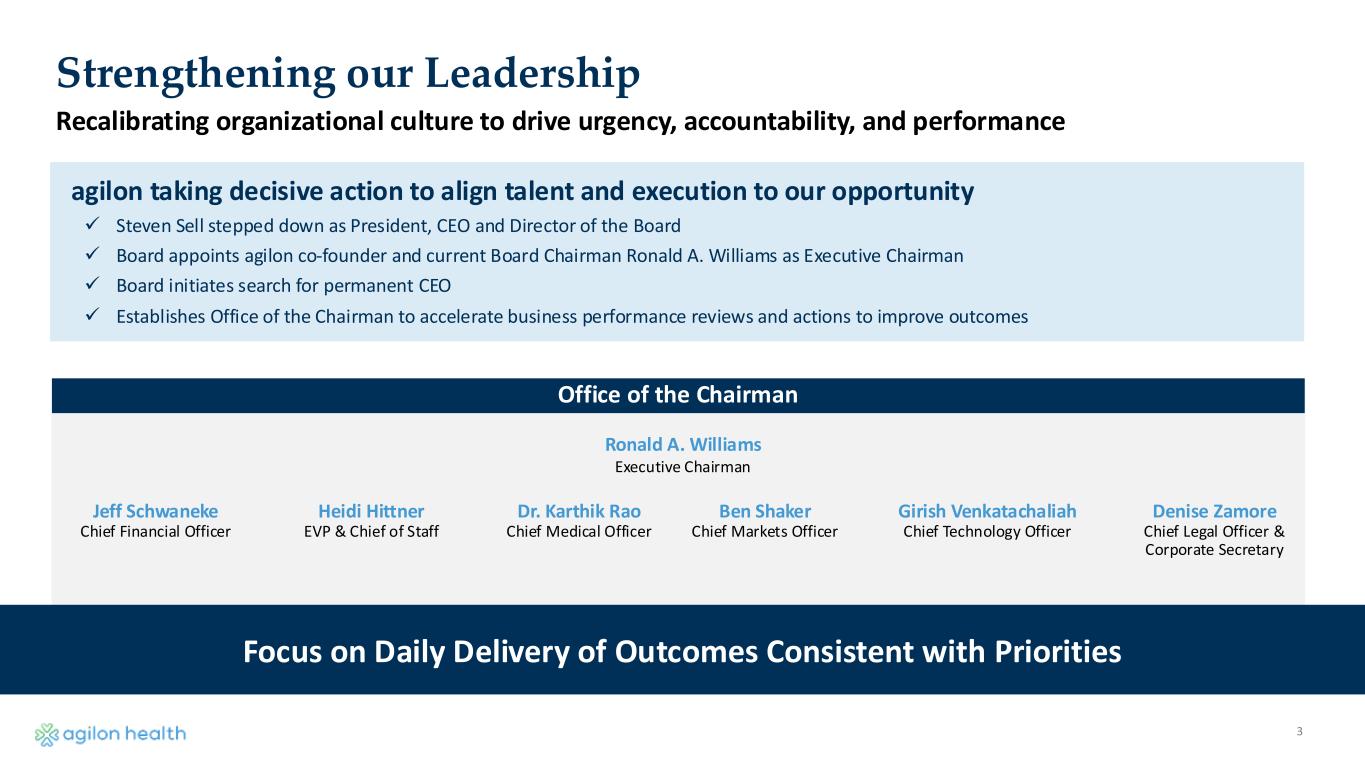
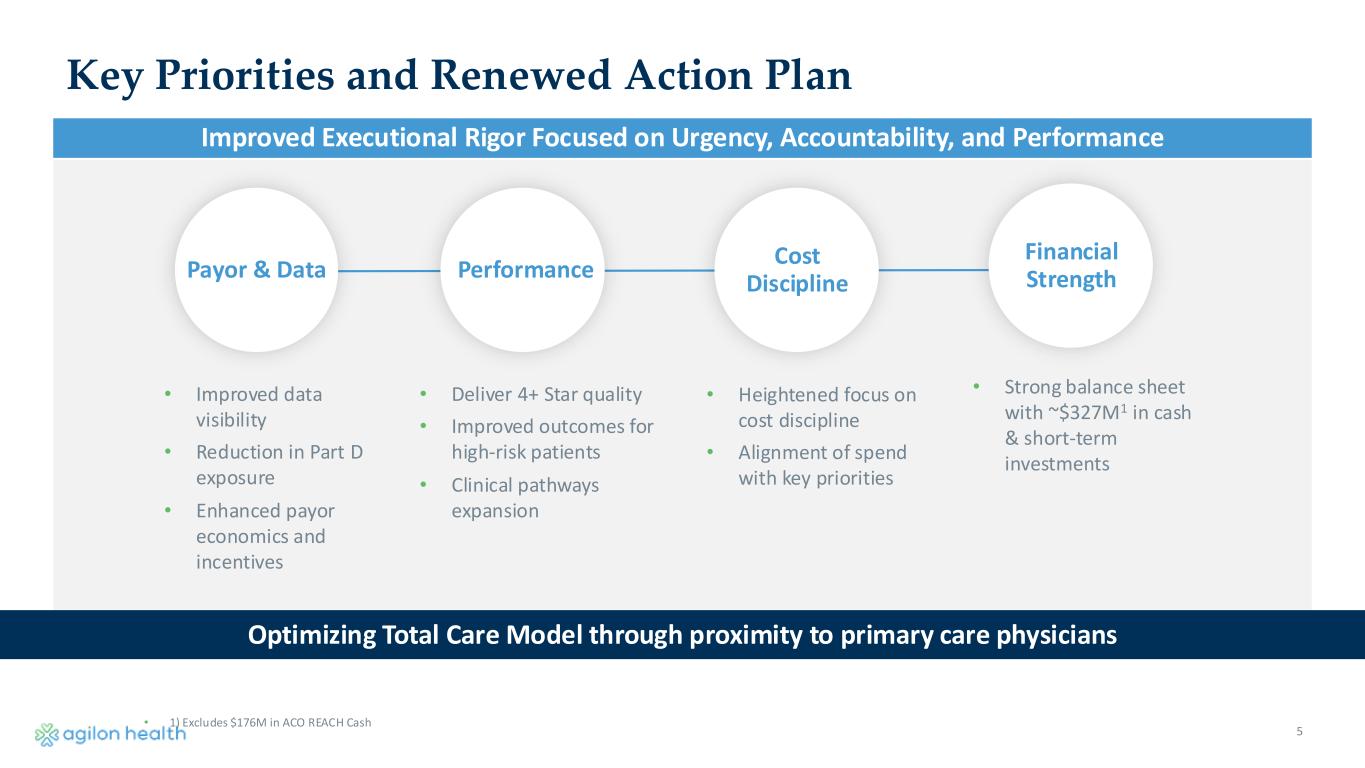
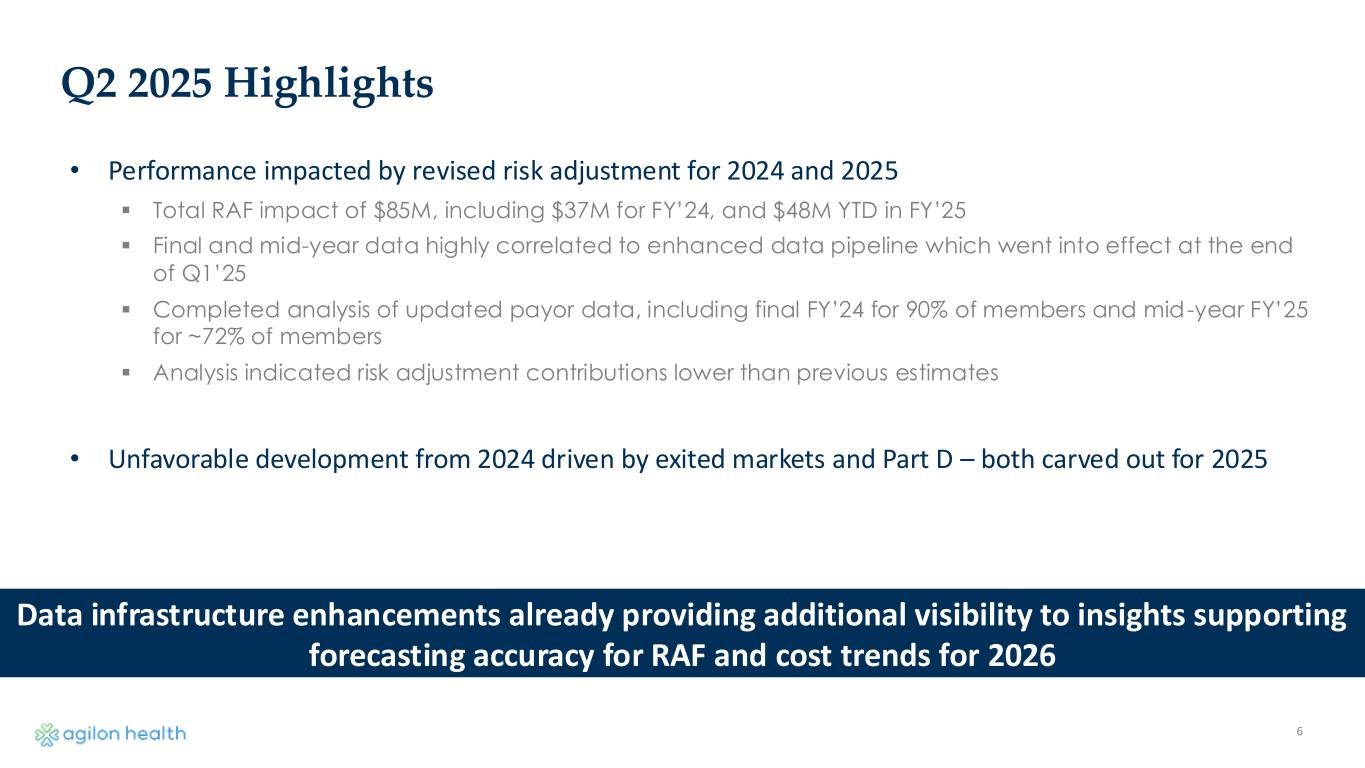
Good afternoon, everyone, and thank you for joining us on short notice. I'm pleased to be with all of you today. For those of you I may not have met before, I've been Chair of Agilon Health since we founded the company. As we announced today, I have been appointed by the Board to the role of Executive Chairman, with Steve Sell stepping down as President, CEO, and the Director of the Board. We also reported our second quarter results and withdrew our 2025 guidance. Jeff will walk you through this in detail. But first, I want to take a step back, introduce myself, and discuss how we are tackling Agilon's recent underperformance and positioning the company to realize the value of our unique and differentiated model in 2026 and beyond. I've been fortunate to have served in a number of leadership and operational roles in health care companies, including as chair and CEO of Aetna. Throughout my long career in the sector and many different economic and market cycles, I've helped organizations at critical inflection points to drive transformation and improve performance, including Aetna. From its inception, I believed in Agilent's mission and the critical role we serve in the health care industry, helping to transform health care for seniors by empowering primary care physicians to focus on the entire health of their patients and to create value for stakeholders. The foundation of our business and Agilon's model is built on a belief that aligning incentives with community-based physicians and a commitment to delivering innovative, integrated capabilities will allow primary care physicians to successfully navigate their transition to a healthcare system defined by providing high-value medical care. The value that Agilon's model provides is more important today than ever. The health care system needs effective solutions to improve quality outcomes and address costs by empowering primary care physicians to support the aging population that is rapidly growing, particularly the growing 80-plus years old segment, which typically have the most complex needs. As we moved through 2024, we identified certain challenges our business could face in 2025, recognizing Agilon would be operating in a volatile environment and that this year would be an important transition period. Using learnings we gained in 2024, we took action and launched strategic initiatives last year to strengthen our platform and improve performance, which our team has actively advanced this year. These efforts include deepening our engagement with our physician partners, expanding programs that support the most complex patients, enhancing our operational and business visibility capabilities, including through investments in AI and advanced technology, and improving contract economics in our cost structure. Given the long-term nature of our business cycle, we have not yet captured the full upside from these enhancements this year, but are confident in realizing them in 2026. Nevertheless, as 2025 progressed, the industry complexities and headwinds we believed Agilon would face were more acute than previously expected, and our execution was not adequate. This resulted in the underperformance we reported. There are two key drivers, as Jeff will cover. One, the final 2024 payer data we received indicated our risk adjustment last year was lower than we previously assumed, resulting in a lower 2024 risk baseline. Two, due to the lower 2024 baseline, and because of our enhanced data platform, we see our 2025 risk adjustment is trending lower than expected, and the activity levels that would allow us to overcome this have not yet materialized. We are clearly disappointed with the financial results as we firmly believe in the value our business creates for positions, patients, and payers, and the significant growth opportunities Agilon can capture. This is why we are taking additional decisive actions to further strengthen our foundation as we look to drive improved performance and take advantage of what we expect would be a more favorable environment in 2026. We will be aggressive in aligning our talent and execution to our opportunity. We're transitioning our leadership as announced today and I will work even more closely with the Agilon team as executive chairman while we conduct a search for a permanent CEO. I'm committed to ensuring a smooth transition but in the meantime I'm fully focused on improving execution across our business and helping to strengthen all relationships that are critical to our future success. In addition, I formed an office of the chairman to help drive this effort which includes several key members from across our existing leadership team this group is recalibrating the culture of the organization against a standard of urgency accountability and performance meeting with the leadership team daily with the purpose of shortening the interval between business performance review and actions to accelerate outcome. This approach is cascading across the organization. We expect this will translate to improve results for our partners and Agilon. Together, we are working with urgency to advance and execute efforts now to improve performance. This includes making economic changes to ensure that Agilon and our position partners capture the appropriate value for the benefits that we deliver through our outcomes focus total care model urgently addressing the elements that are in our control while also navigating the broader market-based challenges and sharpening our commitment to discipline and operational rigor which is current environment demands I have seen firsthand what is required to stabilize and ultimately reaccelerate an organization that is undergoing a challenging transition and that operates within a prolonged business cycle in my past roles leading large and complex healthcare technology companies i have evaluated and implemented ways to streamline operations reduce administrative complexity and unlock performance through data-driven decision making and a culture of empowerment and accountability This insight and experience reinforced my confidence in the sustainable value that Agilon can deliver if we improve our execution. We've seen time and again that Agilon's value-based care model provides significant value to our physician partners and their patients across the U.S. Our proven success over the years has been driven by the differentiated value proposition of Agilon's platform. Our foundation remains strong today and with the many competitive advantages Agilon has created, including our unique integrated set of capabilities that are specific to primary care physicians driven value-based care model that reinforce our role as a long-term solution for physicians focused on outcomes. We have consistently demonstrated that the Agilon platform can drive utilization performance 20 to 30 percent better than local fee-for-service benchmark and quality scores approaching are greater than 4.25 stars. Our deep relationship with community-based physicians, many of which have been leaders in their communities for decades, supports the stability of our business and a durable long-term growth pathway. Our scaled platform that serves over 600,000 senior patients, 2,200 primary care physicians, and 30 markets generates consistent quality, clinical cost, outperformance, and significant value to our payers. Building on this foundation, we are committed to enhancing performance and Agilon's position for sustainable value creation so we can maximize the benefits of the initiatives we have been implementing as well as improved medicare reimbursement model that takes effect next year we know that our powerful model provides important solutions to the industry and we believe that improved execution and a ceo with the skills experience and relationships that are aligned to our new path will deliver the results for our position partners and our shareholders that we know are possible thank you for your continued support during this transition with that, I'll turn it over to Jeff.
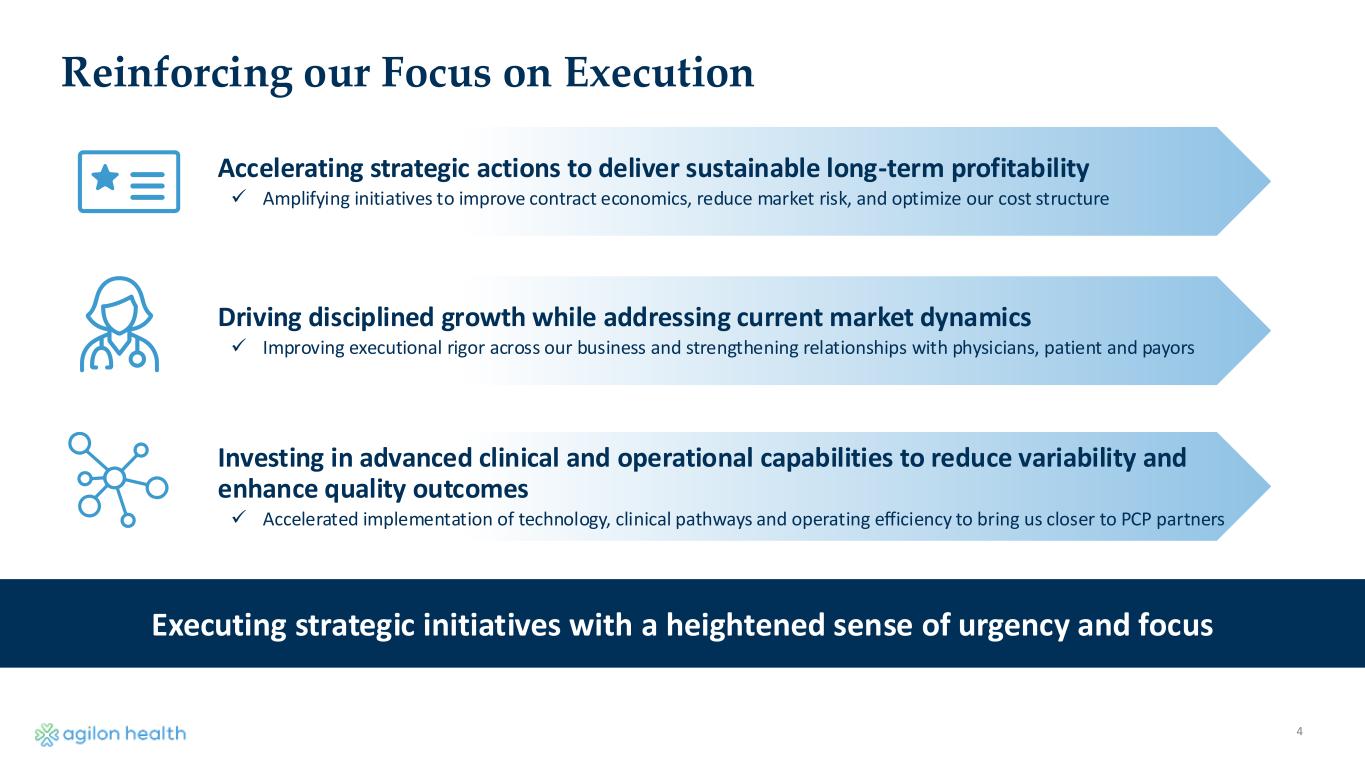
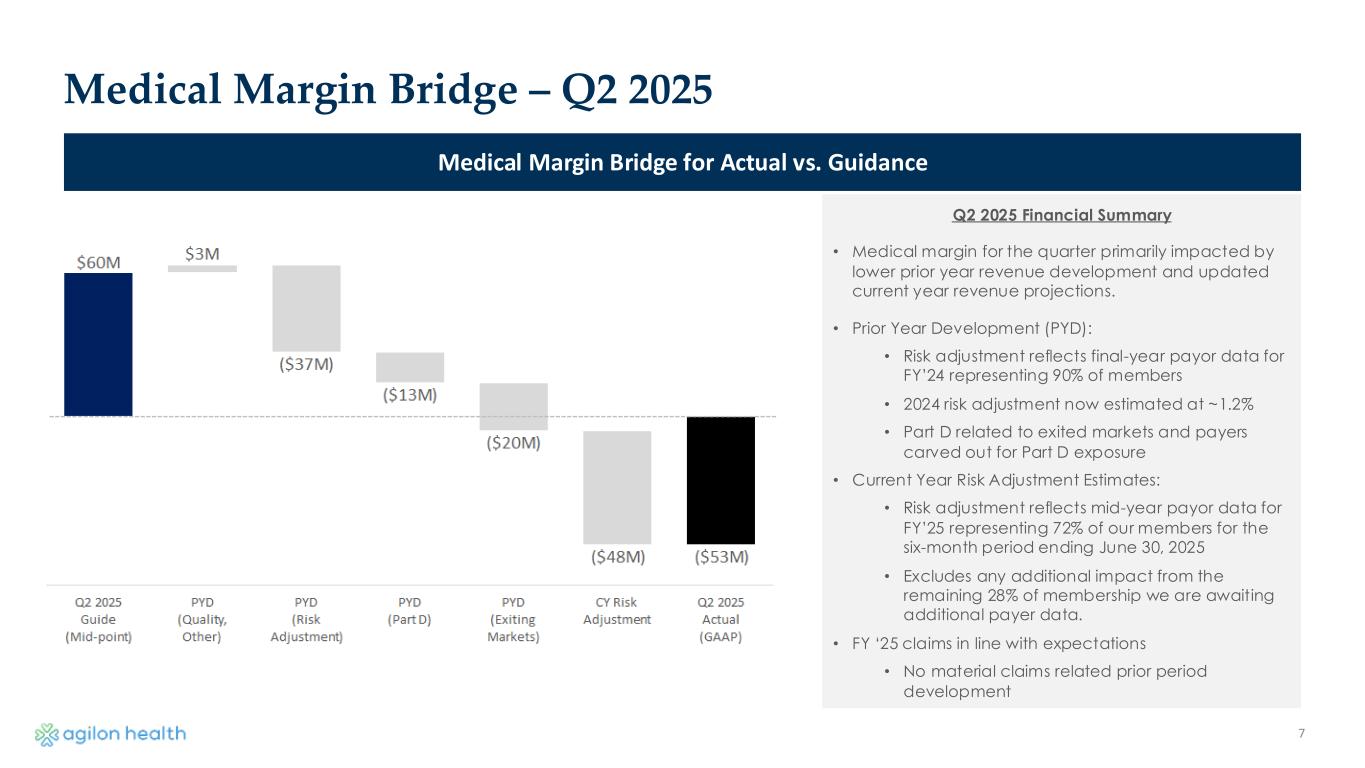
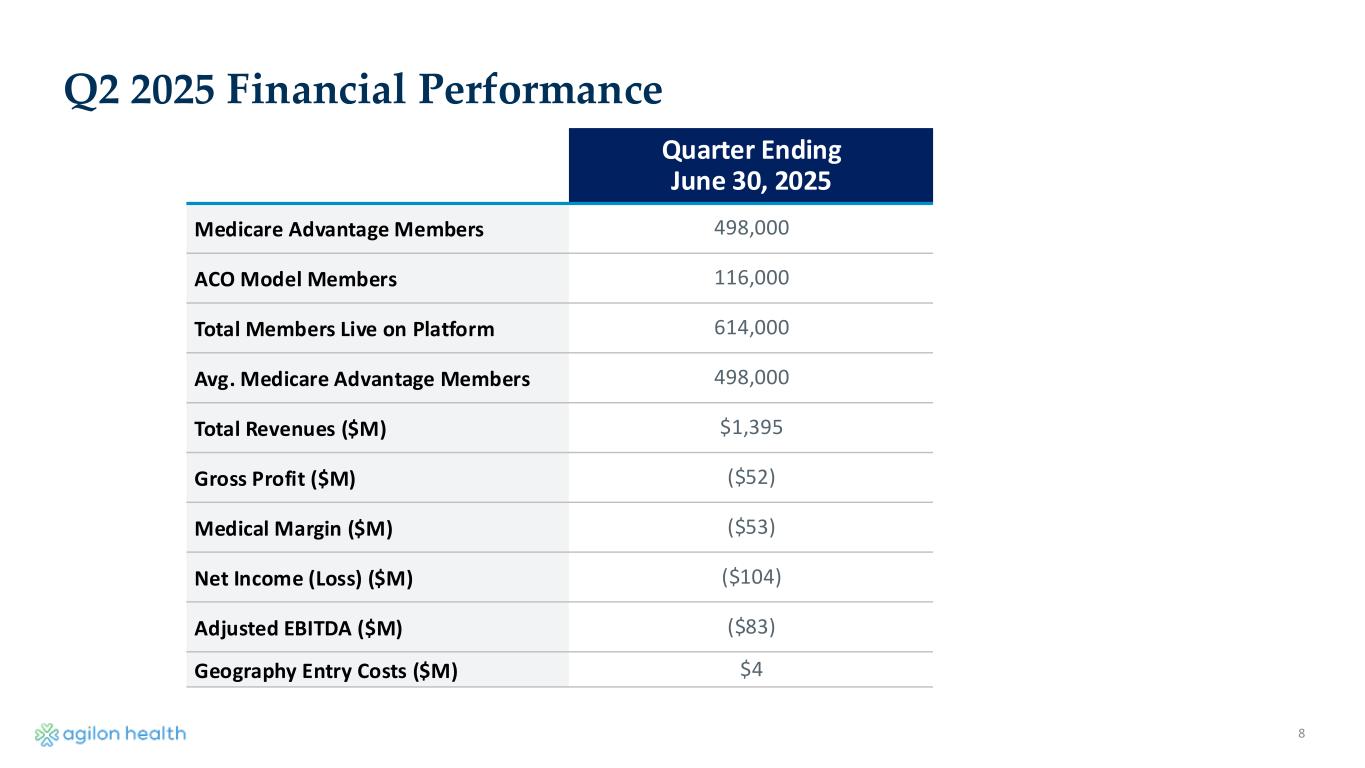
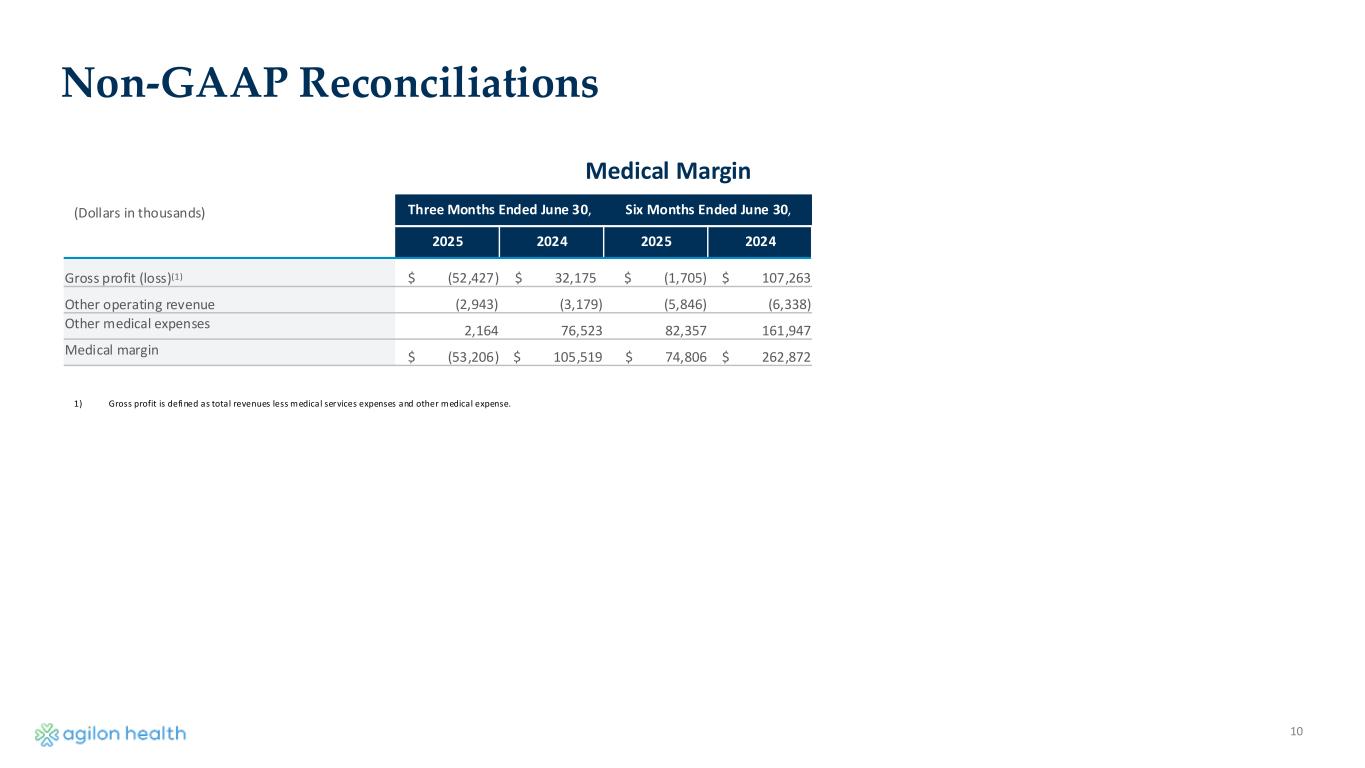
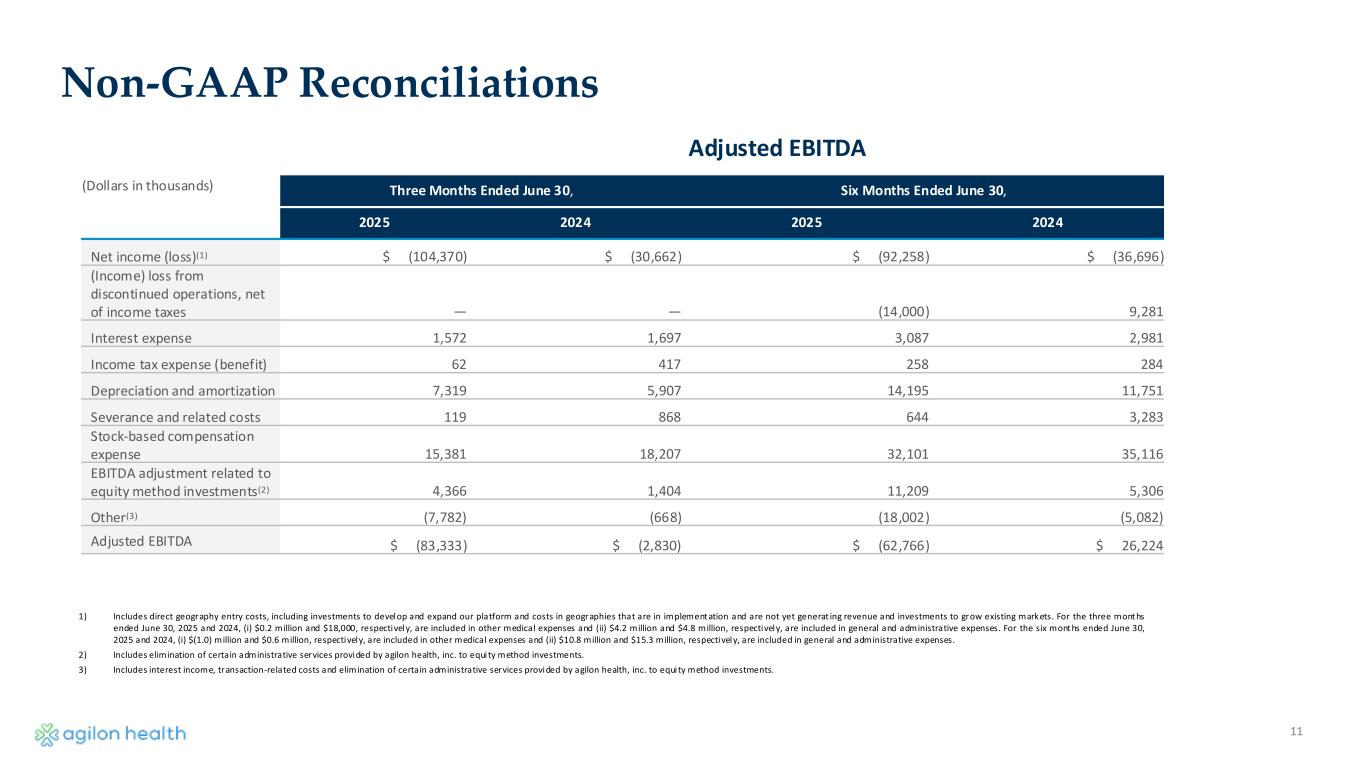
Thanks, Ron, and thanks everyone for joining. On today's call, I'll start by providing an update on the initiatives we are actively pursuing to reduce variability and drive improved performance on a go-forward basis before reviewing our second quarter financial results. As Ron touched on, 2025 is a transition year in which we are advancing strategic initiatives that we started putting in place last year to improve our contract economics, reduce our risk, and optimize our cost structure. While this is a long business cycle, we are now taking a more assertive approach for improved operational and financial performance. The increased visibility and alignment of our financial and operational data will enable us to more quickly identify and drive improvements and better manage the business. We believe we're going to start seeing the results of these changes to deliver enhanced performance and growth in 2026 and forward as we look at our second quarter results it is clear that a combination of factors are at play some of them are market-based and out of our control others are actively addressing through previously exited markets or reducing our exposure to part d and these will not reoccur in 2026. while headwinds remain we are confident they can be addressed through better execution and a sharper focus on our operations and cost discipline. While our strategic priorities remain consistent, we are confident that with our new leadership structure, we have greater flexibility to pursue these objectives with a faster pull-through from action to outcome. I will run through the changes we are implementing and aggressive steps we are taking to set us up for improved performance one by one. First, enhancing our platform. During the quarter, we made additional progress in strengthening our network and our platform through advancements in technology, clinical pathways, and operating efficiency. By more effectively leveraging data and technology, we are working to bring Agilon closer to our PCP partners by providing solutions that drive higher quality of care and reduce variability in care delivery across our network. Second, data. We have significantly improved our data visibility and timeliness. Approximately 72% of our patient population is validated in our enhanced data platform, which went into effect at the end of the first quarter 2025. For those patients, we are seeing a high correlation with the final 2024 and mid-year 2025 data. The high correlation of the Enhanced Data Platform for estimating and validating cost trends and RAF scores increases our confidence in the foundation and potential for 2026 performance. In addition, in late 2024 and early 2025, we expanded the clinical depth and data of our burden of illness and quality programs while directly integrating clinical evidence and evidence-based guidelines for the physician at the point of care. These improvements are now driving an increase in early identification of high-risk conditions and potential gap closures, and we expect to make additional advancements this year. These enhanced capabilities support our expectation for improvement in 2026 for burden of illness, expanded clinical pathways, and quality scores. Third, enhancing quality and delivery. Our ability to deliver top-tier quality performance relies on us leveraging the strengths of a PCP's relationship with the senior patient. Overall demand for our total care model remains strong as payers and providers look to Agilon to deliver quality and clinical outcomes while reducing costs. Recent surveys support the strength and demand of the total care model with an NPS score of 85, as well as 92% PCP retention and 90% retention among MA patients. We remain committed to driving 4-plus star quality performance. Our Enhanced Burden of Illness program provides the foundation for our clinical model through early and accurate identification, assessment, and documentation of a patient's comprehensive of health conditions at the PCP office. By connecting the burden of illness assessment to our quality and care delivery programs through the design and implementation of care plans, we can impact high-acuity chronic disease categories like heart failure, kidney disease, and dementia. Generally, high-risk patients are driving the majority of inpatient utilization. Through early identification, we are making significant progress on our clinical pathways programs. By focusing on high-risk patients and seeing them more often, we can help lower costs and improve health outcomes. Starting with our heart failure program, we continue to make strong progress. While still in the early stages of implementation, we are now live in over half our markets and are seeing strong month-over-month increases in enrollment. We will provide updates on our progress in clinical outcomes later in the year. Our palliative program is now live across most of our markets. We've been pleased to see a strong increase in patients choosing to receive advanced illness management via our program. We also continue to see improved care quality indicators like a reduction in unnecessary hospital admissions compared to benchmark and increased hospice length of stay. Given the positive patient and clinical impacts to date, we're focused on expanding this program across partnerships and geographies in 2025, which we expect will create additional value in 2026. Our fourth area of focus is improving our contract economics. We are currently in active negotiations with our payer partners for 2026, with approximately 50% of our membership up for renewal. We believe we can establish agreements that better align economic terms with the value delivered and predictability of performance. During this renewal process, we remain focused on several areas. First, a further reduction in Part D exposure where we are already seeing positive indications from payers. Second, an expansion of quality incentives which are aligned with payer objectives. Third, improved economic terms for Part C, and fourth, a continued narrowing of the risk from supplemental benefits through better information. We are also optimistic that the recent public commentary from payers will translate to a more normalized payer bidding environment on both pricing and benefits as they focused on improved margin performance. Last, we will be working to drive greater efficiency across the platform. We have launched a process to further evaluate our operating expenses to support improved profitability. Collectively, these levers that we are pulling and our focus on enhanced execution will drive performance recovery in 2026 and beyond. Before turning toward what is next, I'm going to provide the details of the second quarter results. Let me start by saying that we are clearly disappointed with our financial results for the second quarter. These results reflect a lower-than-expected burden of illness or risk adjustment contribution for both 2024 and 2025, unfavorable development in Part D costs, and 2025 cost trends that are in line with expectations. Our second quarter results are meaningfully influenced by the recent introduction of our enhanced data platform, which we believe has materially improved our financial and clinical data visibility and insights for both operational execution and financial forecasting. We have further to go with more payers to add, but the data we do have indicates that the burden of illness assessment work our physician partners performed in 2024 did not yield the expected increase in 2024 and 2025 revenue. Before we provide more detail on risk adjustment, let me highlight some other key metrics. Starting with membership. Our Medicare Advantage membership at the end of Q2 2025 is 498,000 members compared to 513,000 members in Q2 2024, reflective of our measured approach to membership growth and recent market exits. As a reminder, the class of 2025 contracts are on a glide path approach and are not driving a meaningful variance in our financial results. We expect our same geography growth rate to be in line with the broader industry for 2025. ACO REACH membership in the second quarter was 116,000 members compared to 132,000 members in the second quarter of 2024 and was in line with our expectations. Turning to revenue, total revenue for Q2 2025 was $1.4 billion compared to $1.48 billion in Q2 2024. The year-over-year revenue decrease is primarily due to lower risk adjustment in 2024 and 2025 and unfavorable development in Part D. Medical margin for the second quarter 2025 was negative 53 million, compared to positive 106 million in Q2 of 2024. While medical cost trends are in line with our prior expectations, medical margin was below our guidance, driven primarily by the underperformance of our burden of illness program in 2024 and 2025 and unfavorable prior period development. We have provided a bridge in the earnings presentation we issued today that walks from the guide we provided for the second quarter 2025 to our actual results. During the second quarter, we received substantially all of the final 2024 risk adjustment data from our payer partners that indicated our 2024 risk adjustment was lower than expected. This, in combination with additional payer data for 2024 Part D, resulted in negative prior period development of $66 million recorded primarily as a reduction of revenue. It is important to point out several things. First, of this amount, $20 million was associated with exited markets. Second, $13 million was associated with higher 2024 Part D costs from one payer who agreed to carve out Part D beginning in 2025, leaving $37 million of risk adjustment related to 2024 activity in our existing markets. Last, because of the lower risk score step-off from 2024, combined with data that we now have from our enhanced data platform, we see that our 2025 risk adjustment is also trending lower than our expectations. As a result, we have trued up our risk adjustment, resulting in a $48 million reduction in revenue. This represents the year-to-date true-up for 2025 risk scores for the 72% of our membership on the enhanced data platform. We have not changed the estimates for the remaining members pending the receipt of mid-year risk score information which we expect late in the third quarter. Our enhanced data platform provides greater visibility and detail for both revenue and claims which we expect will continue to enhance our forecasting including on risk adjustment. Adjusted EBITDA for the quarter was negative $83 million compared to negative $3 million in Q2 2024. The year-over-year movement reflects the items I just mentioned partially offset by favorability from lower geography entry costs and operating cost initiatives. Adjusted EBITDA related to ACO reach was $10 million in the second quarter of 2025, in line with our expectations. Managing medical cost trends remains a top priority. For Q2 2025, our year two plus market's medical cost trend was 5.9 percent compared to 6 percent in Q2 2024. MA results continue to demonstrate Agilon's strong quality performance metrics, with readmission, hospital admission, and ER visit rates 20 to 30 percent better than the local fee-for-service benchmark. Primary care utilization and annual wellness visit volume remained relatively flat and the overall medical cost trend was within our expected range for the first half of the year. As part of our strategy to manage risk, we have successfully reduced our exposure to Medicare Part D with less than 30 percent of our membership carrying Part D risk in 2025, and we continue to make progress to reduce it further as we enter 2026. Additionally, we are working closely with our payer partners to refine benefit designs and improve alignment on medical cost management. On the balance sheet, we ended the quarter with $327 million in cash and marketable securities and $176 million of off-balance sheet cash held by our ACO entities. We believe our current liquidity position gives us the flexibility we need to navigate this challenging period while maintaining our focus on the factors that will drive long-term performance for our business, our physician partners, and our shareholders. In conjunction with the announcement of Agilon's leadership change and the evaluation of additional actions to optimize our business, as well as continued execution of ongoing initiatives and market uncertainty, which may impact future results, we have made the decision to withdraw our previously issued full-year 2025 financial guidance and related assumptions. In summary, we are extremely focused on improving the near-term profitability of the business that will allow us to drive growth in 2026. Our actions include improving contract economics and bid visibility with payers, continuing to enhance our data platform and burden of illness program, removing variability in the business by reducing exposure to items we don't control, focus on expansion of quality programs that are aligned with our execution, and continued cost discipline and capital allocation to strengthen our balance sheet. Moreover, with a positive rate environment in 2026, continued execution on our clinical and quality initiatives, and improved burden of illness performance, we believe we will significantly enhance profitability in 2026 and beyond. Finally, I want to thank our employees and our physician partners who have been working tirelessly to navigate these challenges with us. Our people are the foundation of our success and are key to our ability to execute our plan and strategic priorities. To reiterate what we have outlined today, this is a marked pace of change from how we executed the business previously. With that operator, let's move to the Q&A portion of the call.
Operator
If you'd like to ask a question, please press star followed by one in your telephone keypad. If for any reason you'd like to remove that question, please press star followed by two. Again, to ask a question, it's R01 or your telephone is at. Our first question is from Elizabeth Anderson. This is Evercore. Your line is now open.
Hey, guys. Good afternoon, and thanks so much for the question. I guess a couple of things that have come up. Like, one, I just want to understand, just maybe I missed it, so apologies, about the, you're saying that you might have a positive PYD in 3Qs. I just want to clarify that. And then two, like, is there something that you change about the growth rate going into 2026 in terms of adding new practices or sort of allowing new members until you sort of have the cost trends more in a stable place? Or do you believe that based on what you just said on the 2020, on your 2026 outlook, that that should sort of continue along the same dynamic? Thanks so much.
Yeah, Elizabeth, this is Jeff. Thanks for the question. I guess the first thing I would do is point you to the presentation that we've published today in connection with our earnings. In that presentation, you'll find a bridge from the prior midpoint of the guidance of the medical margin, roughly $60 million, and bridging that to the actual results for the And I guess the first thing that I would start out with is I would say, you know, generally medical cost trends were in line with our expectations and the cost trends for the first half were roughly around 6%. And then as far as developments concerned, we had a small amount of favorable development on quality programs, roughly $3 million. I would say the most significant pieces of development were unfavorable. The first is related to the risk adjustment, which we covered in the prepared remarks, $37 million. We do have $13 million of negative development with Part D. That's related to a payer that agreed to carve that out in 2025. So, that issue does not go forward. And then $20 million of negative development for exited markets. So, again, that development will also not carry forward as well. So, I guess that's how I would frame the negative development. There are two components which aren't really continuing with the business going forward, and then the 2024 risk adjustment that has a, I would say, a step-off impact on 2025. Second, as far as the growth rate is concerned, I think, listen, we're focused on the near-term changes to the business to improve profitability, and I would say 2026 growth is under review. We're going to be highly selective on future growth given the performance of the business, and ultimately we're looking to improve profitability here in the near term.
Great. Thanks so much for the clarification.
Operator
Our next question is from Jaylindra Singh with Truist. Your line is now open.
Hi, guys. This is Eduardo Rondon for Jaylindra. Thanks for taking the question. On call trends in the quarter, I mean, you said it was six percent for first half. I guess, can you break down how those trends develop sequentially from Q1 to Q2 and perhaps what information you might have on July at this point. I guess we'd also be curious if those trends were consistent across your markets and cohorts or if there were any things that we could call out.
Yeah, thanks, Eduardo. I would say the first thing is we had 6% accrued for Q1 cost trends. And at this point in time, that's roughly 85, the mid-80s percent complete, roughly around 85% complete. So we feel pretty good about cost trends in Q1. Q2, you know our data model here, we are on a little bit of a delay, so we don't have a lot of paid data, but generally what we're seeing is consistent cost trends with Q1, and as far as July is concerned, that would be our least complete month. So I wouldn't really be able to comment on kind of cost trends in July. Obviously, we get a new batch of data here coming this week, but I guess that would be my framing. I think the first thing that I would say just generally is the cost trends for us development on the medical cost line hasn't been that significant this year from 2024 or from Q1 to 2025. And recall, last year we made substantial changes to our reserving methodology in the third quarter. That was on the old data model. Now we have those changes that are on the new data model, which has provided, I would say, a higher level of confidence in our reserve estimation.
All right, great. Maybe I could just squeeze one more in there. Just on the top line risk adjustment estimate for the 72% of membership, was that pretty consistent across the board? I'm just trying to figure out why you guys didn't make the additional adjustment on the 28%, you know, maybe the 72%, it was one payer that had the information which caused the adjustment or just trying to see what the variability was that you didn't extrapolate.
Yeah, good call out here. I'll get to that at the end of my comment, but let me just start out with a couple things on risk adjustment. First, I just want to be clear that ultimately we are generating, I would say, positive risk adjustment lift, both in 2024 and in 2025, really over and above the impact of V28. I think if you look at the slides that we published today, 2024 net risk adjustment lift is roughly around 1.2%. And if you account for the step-off change, 25 would also be positive after the impact of B28 as well. And so the issue with 24 is we had an estimate at the end of the year for the mid-year to final sweeps that was based on history, based on our historical experience that we've seen by payer in the past. Those came in a little bit lighter than we anticipated. Obviously, that lower baseline impacts the jumping off point for 2025, and so therefore, we had to change that as well. I would say the enhanced data pipeline is important here. We have visibility that we did not have a year ago today, and we can calculate member-level risk scores. And as I mentioned in my prepared remarks, there's a high correlation between the data pipeline and some of the mid-years we've received. We've received a couple of mid-years from some of our larger payers, but for the vast majority, we haven't. And here's where I'll get to your question. So the remaining 28% of members, we really don't have any information available because we didn't get the mid-year files, and we ultimately won't receive those until we get later in the third quarter. I would say we made a lot of changes to the BOI program last year, including updated clinical guidelines, enhanced provider education, the introduction of third-party technology partners to enhance our data and strengthen our ability to identify potential health conditions for our members. But it's a long cycle business, and we really won't see the value of these changes until 2026. Early information from the enhanced data pipeline is promising and indicates improvements are working, But, again, it's early. But the data pipeline is a massive step forward in providing more accurate information on risk adjustment throughout the year. And as we think about our budget heading into 2026, ultimately, you know, we will use this new process. And lastly, to your point, I would say there was variability, significant variability by payer, which is why we just didn't extrapolate those dollars.
Operator
We're ultimately waiting for that information to come in the third quarter. uh thanks our next question is from daniel coastlight with city your line is now open hey this is louis i'm for daniel grossly i just had a question on if you are able to give comments here in the 2026 class doing the headwinds that's looks like except they expected to come in at 30 to 35 000 members and i'm assuming these would be under glide past FEMG still, correct?
Yeah, I'll cover, I guess, both pieces. So, first, as far as, you know, we said we were going to have 20,000 GlidePath members this year, you know, effectively no downside risk. We are not at that number at the end of Q2. Ultimately, you know, we're still working on economic terms with some of them, and ultimately, if we can't get to those, then they won't show up, which is fine. I would say I commented earlier about 2026 growth. Again, we're focused on improving profitability in the near term. And that growth, I would say, is under review. And we're going to be highly selective on future growth, given where the business is performing.
Operator
Got it. Thank you. Our next question is from Justin Lake with all of research airlines now.
Thanks. Jeff, I heard you talk about 2026 bids and getting clarity there. First, you know, any insight that you can share with us in terms of, you know, how you think the bidding looks for your kind of book of business for 2026? Are you expecting a lot of help there?
Yeah, Justin, thanks for the commentary. Obviously, it's early and we don't really, get the full bid detail until later in the year. But we've been working closely with our payer partners, Justin. And I guess what I would say is the information that we're exchanging back and forth is consistent with the payer's public commentary. I think some have commented a little bit differently than others, but I would say generally it's pretty consistent that payers are looking for improved economics as they head into 2026.
And is Umana still your biggest payer?
That's a good question. I'd have to look at the 10Q. You know, we disclosed that information, I think, payer A, B, C, that's disclosed in the filing. So it's not specific, and we're not going to get specific on the call. Certainly, they are one of our larger payers, for sure.
So publicly, they've said that they're not looking to cut benefits. they're going to cut SG&A and improve medical management to get to their margin targets. Just curious, you know, your view of that. Do you feel like, you know, that's something where, you know, you have to have a tough conversation and potentially walk away from membership? And it just doesn't have to be about Umana. I doubt you'd want to talk about that specifically. But just in general, do you feel like you're going to have some of those conversations where you're going to say, look, we're either, you know, handing you back to members, here you go, or we're going to see real economic improvement? And when would you be able to share that with us?
Yeah, I would say, Justin, those conversations are going on right now, but ultimately depends on their final bid. And so, you know, as you think about how we negotiate with our payers, we don't conclude our negotiations until we get the full bid detail. And we can see what we believe those bids are going to do to our economics and our performance in those markets. And I would say you're absolutely correct. If ultimately we don't see a situation that provides the economics that we believe are prudent for our business, then yes, we may not do a deal with that payer. Now, if you remember our model, right, we have longstanding relationships with the primary care physicians who have had, you know, more than 10-year-plus relationships with their members. And so, generally, that doesn't mean the member leaves the Agilent ecosystem. It may mean that they're just enrolled with another payer. Got it.
Operator
All right. Thanks. Our next question is from Ryan Langston with TD Calendar. Your line is now open.
Great. Thanks. Just two things for me. I guess on the CEO search, I guess, can you give us a sense on kind of what you're looking for in the next CEO? And how should we think about potential partnership exits from here? I guess with some of the updates that you've kind of laid out here, are there now maybe some partners that just aren't looking as attractive as they would have historically?
I would speak to the CEO surgeon. And first, I would say that we think that given the potential of the business, this would be a very attractive platform for a CEO who is committed to the vision that we have, which is we want someone who really has multi-market management capability, experience in working with primary care physicians as we have these very large independent groups that we have longstanding relationships with, really understands the payer world, and most importantly, brings the kind of operating rigor and diligence and focus and alignment that we think is necessary to achieve success in the business. So that's kind of the broad outline that we're looking for.
Yeah, Ryan, this is Jeff. I'll just comment on, there's no immediate plans to exit anything right now, but our job is to continuously evaluate the profitability of our business based on payer dynamics, the macro rate environment, cost trends, you know, everything together and look at those economics on a going forward basis. And so that's what we'll do.
Operator
All right. Thank you.
Operator
Our next question is from Matt Shea with me. Your line is now open.
Hey, thanks for taking the question. Called out slight favorability in the quarter from quality incentives. Can you just elaborate on that? Maybe how durable of a benefit you anticipate that to be in the back half of this year. And then as you think about the renewal process, talked about going after more quality incentives. What has payer willingness been like to include more of those quality incentives in your contract or just how are you thinking about how much opportunity there is to add within your contracts for next year? Thanks.
Yeah, yeah, real quick, small amount of favorability here in quality, which is good, really related to our performance in 2024. So I think, listen, we have a strong quality program. I think what's one of the important values that we deliver to our payer partners is high quality scores. I think if you look at our year two plus markets, we are at or above 4.25 stars. So it's really been a strength for us. And again, I guess I come back to the we want to get paid for how we perform. And I think payers, given some of their own quality challenges, are more willing than ever to put dollars at risk in these quality programs. And so we saw that this year, which is a step up in dollars available if you earn those quality scores. And I think payers are even more willing to pay for higher level of performance, which is really good for us and really plays to the strength of our model. So I think that's where payers, where they're coming from now. So I do expect those dollars to increase from 25 to 26. How much, we'll have to see. But I do think it's a mutually agreed upon set of metrics that we can really drive value that ultimately produces economics for the payer and for us.
Operator
Our next question is from Craig Jones with Bank of America. Your line is now.
Thank you. Hi, thanks for the question. So maybe to follow up on the quality incentives, um let's say you weren't able to get that installed in all the kind obviously you're only a 50 percent up for renewal this year but over the next few years as you renegotiate all these contracts if you're able to get those quality incentives into the into the contracts across 100 of your membership you know how much how much potential margin could there be um from from getting those installed thanks yeah i would say we we already have a lot of these programs uh in the majority of our contracts today with payers.
I think the difference is the dollars are escalating because, I mean, you know this publicly, a lot of the public payers have had challenges in quality specifically, which has cost them a lot of returns. And so ultimately, they're putting more dollars here in order to, I would say, incentivize performance and outperformance. So this isn't new. The quality metrics have already been there.
Operator
I would say the difference is the dollars are escalating which actually plays into our strength okay got it thank you our next question is from jack slevin with jeffries your line is now open hey thanks for taking the question i think i just want to follow up on justin's here just to make sure i've got the timing of this right so it sounds like to me and and please ron or jeff jump in if if this is incorrect but it sounds like the main pillars of what needs to improve to affect the turnaround are sort of still in place and you're working towards them, but that as we think about further market sort of either market exits or really looking at the portfolio and making a decision about what's the right sizing of it or what's the right version of it to go with, that's going to come later in the year and bids are the most important piece there. Do I have that right?
Yeah, I guess what I would say is I think some of the majority of the levers that we're pulling in the business are certainly the same. I think, you know, the point that Ron and we're trying to make is the business really has to operate differently from an urgency and action perspective. We really need to reduce the time from evaluating performance to action. I think the data model and the progression of the data model has been an important piece of that where we are now tying, you know, financial outcome back to operational metrics, which is pushing the business forward. Certainly, you know, looking at our operating cost is something we're always doing, but I would say we're taking an enhanced view here. But ultimately, yes, payer economics is a big component beside all of the other, I would say, macro changes that you guys are aware about. For example, you know, the final rates for next year. So all of these changes kind of come together. But, yes, payer bidding is a large component.
Yeah, the other thing I would add is that if you look at our population, the Medicare Advantage population, you look at the top chronic diseases that are affecting them, and with the aging population, there is an enormous unmet medical need, undiagnosed medical need in that population. And so doing a better job there will result in more revenue as a result of doing a good job of taking care of seniors through the total care model that we have. The tools we've put in place support the physicians and give them the ability to enhance their care delivery to that population. And that represents, I think, an important source of value for us and for our physician partners.
Operator
Got it. Really helpful. If I can just squeeze in a follow-up, any details you can give on ATO reach performance in the quarter, and if that is still tracking to, I think, $35 million to $40 million of EBITDA contribution on the full year?
Yeah, certainly we're not providing the guide, but I would say reach performance was in line with our expectations. And so, you know, it's been a strong performer for us, and it continues to do so.
Operator
Our next question is from George Hill with Deutsche Bank. the line is now open.
Hey, good evening, Jeff, and thanks for taking the question. One thing, on the impact as it relates to the 72% of your book that you guys have the data from the new model on, do you feel like it's safe to extrapolate that to the balance of the book, or is there a reason why that would be less or that would be more? And then my next question would just be, is it too early to talk about magnitude of earnings performance improvement in 2026, or do we really just need to see more there? I guess we're just trying to figure out if the earnings improvement is in like basis points or percentage points. Thank you.
Yeah, the first thing is, I mean, there's a reason, and I think we talked about this a little earlier, there's a reason why we didn't extrapolate and record, and it's because there was variability among payers related to this adjustment, right? So for the payers that we do not have the data for, we're just really waiting for that information. So I think we've provided you enough here to do whatever you want with that number, I would say, but that's ultimately the adjustment we recorded in the quarter. And, you know, we're not really providing a 2025 guide setting here today. But as you know, there are a lot of things that are happening in 2026. And first and foremost is, you know, we're really final rate notice was a good start, positive impact on our results, or it would have a positive impact on our margin spread as you head into next year. If you assume cost trends are, you know, roughly in line what we've seen in the first half, which is roughly six percent again our historical performance and risk adjustment and the actions we're taking with the enhanced data pipeline we would anticipate a benefit of that from risk adjustment in 2026 i think for 2025 and 2024 we do have a net lift after the impact of v28 so we do think that would be a positive you know again contracting 50 of our contracts for 2026 are open for renewal and we're looking for improved economic terms. We continue to focus on carving out Part D this year. It's below 30 percent where we have Part D risk. We've made progress on that, not quite final, but we do think we'll be able to bring that down heading to next year. Pay your bids, we had a little bit of a discussion here today about that, but generally I would say stable to favorable commentary if you take the broad brush of payers and ultimately lower supplemental benefit underwriting risk due to decreased supplemental benefits and payers have agreed to provide us more information. Again, we have operating expense optimization that we're working on heading into next year, and then you have the big question mark, which is what are medical cost trends. So, you know, I think the things that will impact us in 2026 are similar to what they were before. I think our focus on execution and discipline for the remainder of this year would only add to that.
Operator
Our next question is from Andrew Mock with Barclays. Your line is now open.
Hi, good evening. A couple of questions. First, you commented that the burden of illness assessments done last year did not yield the risk adjustment revenue you estimated for 24 and 25. Can you be more specific on the drivers of that downward revision? Did you not have the documentation necessary to support the diagnosis codes or were codes rejected by CMS? Any additional color there will be helpful. And then secondly, I think you noted a 6% cost trend in the first half of the year and said that was in line, but I thought your full year cost trend previously was 5.3%. So can you clarify your comments there? Thanks.
Yeah, I'll handle the cost trend one first. You are correct. Our previous guidance was 5.3%, but we didn't necessarily lay that out by quarter. What I would say is for the first half of the year, the cost trends were in line with our expectations, and that's kind of as far as I'll go on that. I would say as you think about 2024 risk adjustment performance, I think what we're trying to say is that we didn't do as good a job of identifying the conditions that our patients had and then rolling them into the appropriate care. I don't think this is a codes got rejected by CMS or anything of that nature. It goes back to, you know, I would say we started up some of these new clinical programs really to attack the disease burden of our existing patient population and really get them to the care that they need to reduce the burden of illness and ultimately have better health outcomes and lower overall costs. So I think that's really what we're talking about. We've talked about new programs that we've implemented either late last year or this year specific to heart failure, COPD, dementia. I think these are clinical pathways that we have here that ultimately will serve to identify these conditions where patients have those and treat that accordingly.
Operator
Our next question is from David Larson with BTIG. Your line is not open.
This is Jenny on for Dave.
Thanks for taking the question.
So, just more on the cost trend, it's good to hear that it was fairly in line with year-on expectations and year-over-year. Just any more details on what you're seeing in that cost trend would be very helpful. Any pockets where the utilization or costs are higher, specifically, if there are any? Thanks.
Yeah, yeah. I would say for the first quarter, specifically, we have, you know, a high percentage of paid claims there. And I guess what I would say, it continues to be inpatient, inpatient costs, and Part B as in boy drugs, and specific to oncology. So, that's been a consistent theme for us, exiting last year and into the first quarter of this year. So, that's really the pressure points that I would highlight.
Operator
Our next question is from Lance Wilkes with Bernstein. Your line is now open.
Thanks, Ron and Jeff. Could you talk a little to the practice partnerships and your tactics and strategies for maintaining stability there? And in particular, if you could talk to concentration, kind of in line with payer concentration, but thinking about the partnerships, The other medical expense in the quarter and maybe how it varied from prior period and then the loans shifting to prepaid expenses. And just part of your talent and management process, can you kind of talk about who's on point or what the process is for managing those practice relationships? Thanks a lot.
Yeah, I would maybe start with practice partnerships. We're structured in a way where the partners that we have in those markets are primary care groups predominantly that have been in that market for quite some time. They are often one of the largest, if not the largest, primary care practices in that group. We have long-term arrangements with them, and they understand, we think, the cyclical nature of the business and the fact that we are focused on clinical pathway improvement and evidence-based elimination of variability, I think, deepens the relationship that we have with them, because what they care about at the front line is really delivering quality care to people. And clearly, there's always an economic component to that, and that's why we're tackling all the things that Jeff has talked about. The model is that there's a market president who works with the group on a regular basis they're in the market there's a medical director who supports them and works with the medical directors in our partners and so that's overall kind of the general model that we have to work with our partners yeah and lance your second question on on other medical expense that's just the function of calculating the the partner share calculations it's on a partner by partner basis and so that's the variability you're seeing there great thanks a lot our next question
Operator
is from Lisa Gill with J.P. Morgan. Your line is now open.
Good question. Jeff, can you maybe just talk about your cash balances and do you have enough cash to get you through to 26 in the potential turnaround? I noted in the press release, you only talked about the associated unconsolidated ACO model, not the rest of your cash balances.
Yeah. Yeah. Thanks for the question. So, on the balance sheet, we ended the quarter with $327 million in cash and marketable securities. And as you mentioned, $176 million of off-balance sheet cash held by our ACO entities. That number, the $176 for ACOs, is higher than normal because we have payments in the next couple of quarters that ultimately we think will bring that number down to about $40 million. That's consistent with how the cash flow in the ACO program works. We believe our current liquidity position gives us the flexibility we need to navigate the challenging environment and focus really on improving the short and long-term performance of the business and at a minimum I would say we're confident that we have enough cash to get through 26 and this excludes any actions we're taking to improve cash flow in the near term.
That's helpful thank you.
Operator
Looks like there are no more questions so I'll pass the call back over to the management team for closing.
Well thank you for your time today especially on short notice. We look forward to continuing our dialogue with analysts and investors as we advance the performance-improving steps we've outlined today. And we look forward to introducing you to Agilon's new CEO when we have completed that search. To our employees and partners who may be listening in, we also want to thank you for your dedication, your partnership. You're playing a crucial role in the healthcare industry, helping to transform healthcare for seniors by empowering primary care physicians to focus on the entire health of their patients. We will continue to fulfill this mission together. Thank you. Have a good evening.
Operator
That concludes the conference call. Thank you for your participation. Enjoy the rest of your day.