Operator
Thank you for standing by. My name is Jordan and I'll be your conference operator today. At this time, I'd like to welcome everyone to the Q1 2026 Amoresco Inc. Earnings Conference Call. All lines have been placed on mute to prevent any background noise. After the speaker's remarks, there will be a question and answer session. If you'd like to ask a question during this time, simply press star followed by the number one on your telephone keypad. If you'd like to withdraw your question, press star one again. Thank you. I would now like to turn the call over to Lila Dillon, Chief Marketing Officer. Please go ahead.
Thank you, and good afternoon, everyone. We appreciate you joining us for today's call. Our speakers on the call today will be George Saccolaris, Amoresco's Chairman and Chief Executive Officer, Mike Backus, who will become the CEO of Neogenics Fuels, Nicole Bulgarino and Lou Maltezos, newly appointed co-presidents of Amoresco, and Mark Chiplock, Chief Financial Officer. In addition, Josh Barabow, our Chief Investment Officer, will also be available during Q&A to help answer questions. Before I turn the call over to George, I would like to make a brief statement regarding forward-looking remarks. Today's earnings materials contain forward-looking statements, including statements regarding our expectations. All forward-looking statements are subject to risks and uncertainties. In particular, some of the commentary is predicated on the expected closing of the neogenic fuels transaction. Please refer to today's earnings materials, the safe harbor language on slide two of our supplemental information, and our SEC filings for a discussion of the major risk factors that could cause our actual results to differ from those in our forward-looking statements. In addition, we use several non-GAAP measures when presenting our financial results. We have included the reconciliations of these measures and additional information in our supplemental slides that were posted to our website. Please note that all comparisons that we will be discussing today are on a year-over-year basis, unless otherwise noted. I will now turn the call over to George.
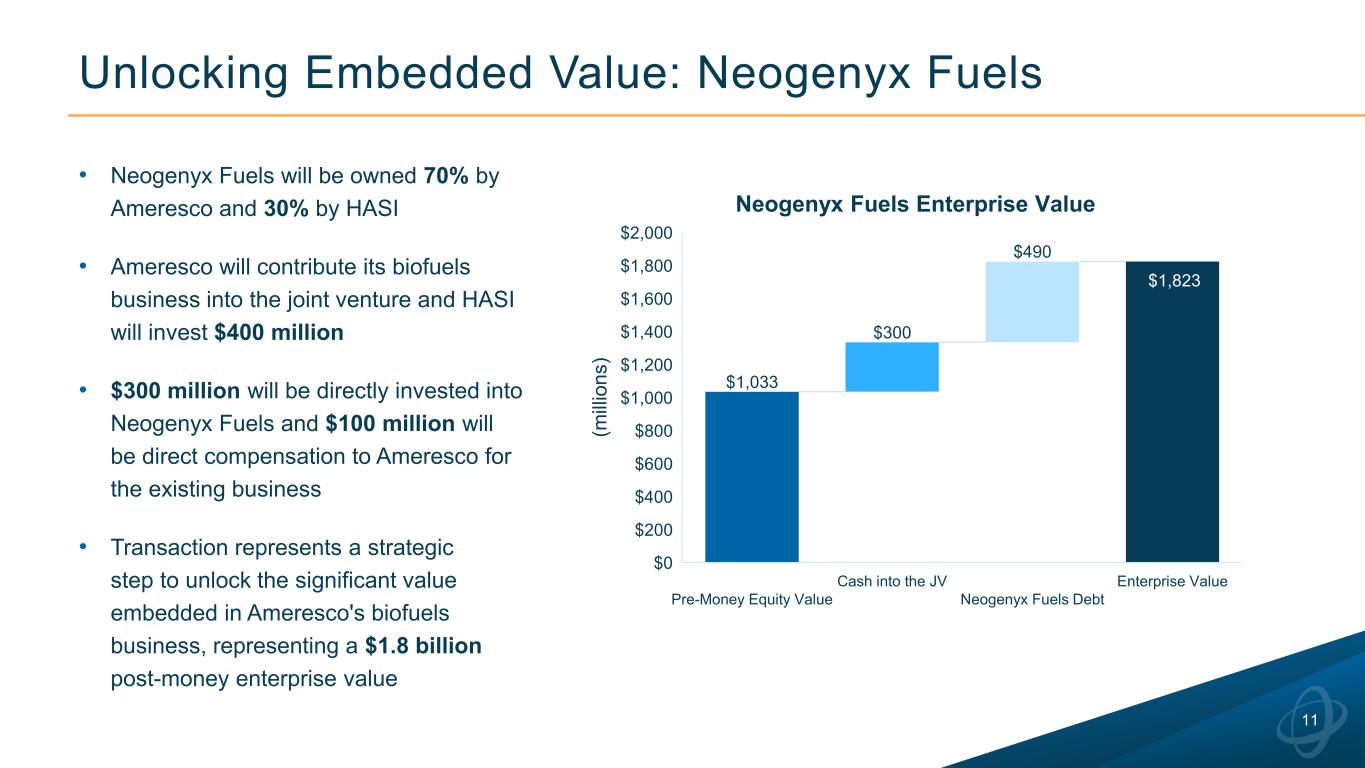
George? Thank you, Lila, and good afternoon, everyone. I am pleased to report that we had a solid start to the year, with the Ameresco team delivering 14% revenue growth, despite experiencing adverse weather conditions impacting several of our RNG facilities. New business also remained quite strong, with 20% growth in awarded backlog, against a backdrop of significant activity, especially with the federal government. We also announced several important corporate actions which we have taken to better position ourselves for substantial future growth opportunities while also maximizing shareholder value. Today, after the market closed, we announced the signing of a transformational agreement with HACI for a $400 million strategic investment in our biofuels business. This agreement will create a newly formed joint venture named Neogenics Fuels. M-Aresco has been a leader in the biofuels industry for the last 25 years. When completed, this transaction will enable us to monetize a portion of the $1.8 billion enterprise value that we have created in our biogas business. Of the $400 million commitment from Cassie, $300 million will be directly invested in eugenics fuels to drive business growth. And the $100 million will be direct compensation to Amoresco for the existing business, which will be used for strategic opportunities, working capital, and leveraging throughout the year. I would like to turn the call over to Mike Backus, a member of my management team for nearly 30 years and who will become Chief Executive Officer of Neogenics Fuels, to comment on this exciting introduction. Mike?
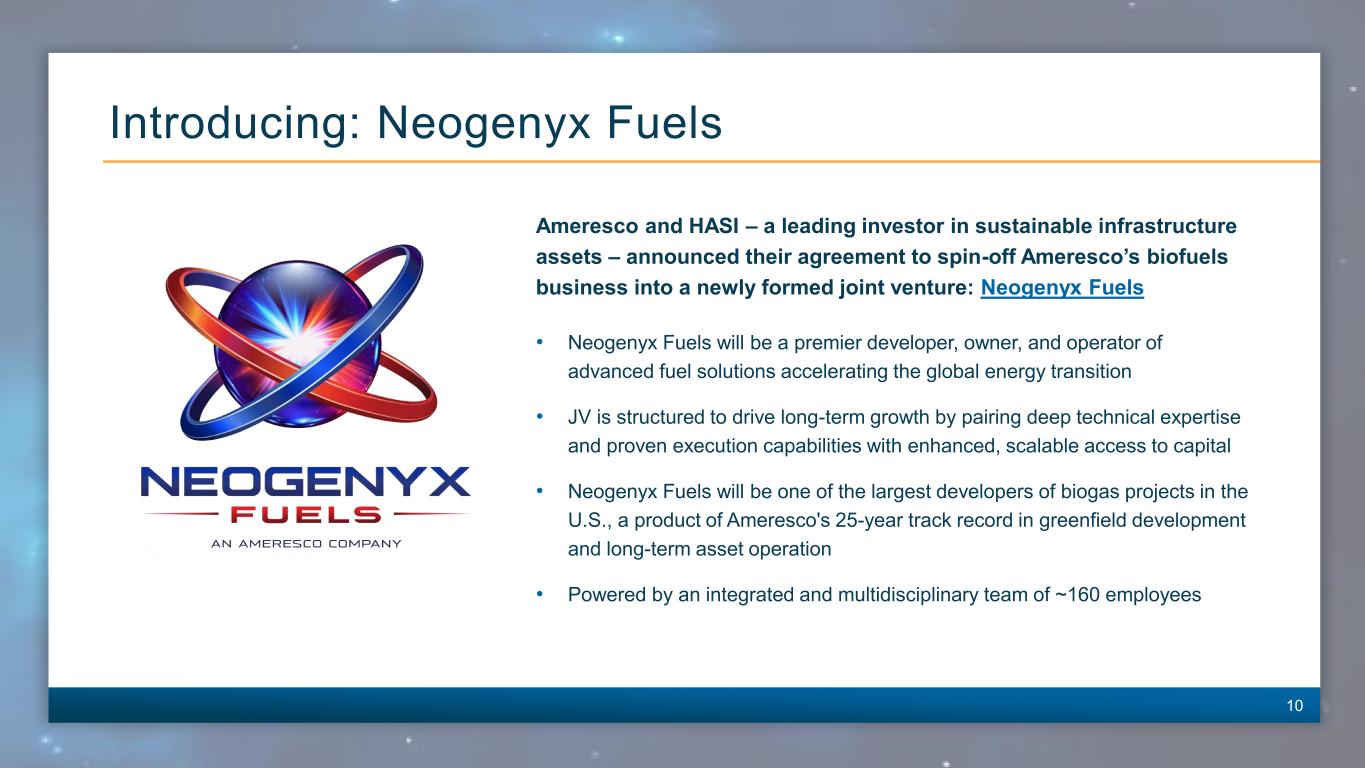
Thank you, George. Good afternoon, everyone. First and foremost, I very much appreciate the confidence and trust that George and Hatsi leadership have bestowed on me to take the helm of what we see as a transformative business. As many of you are aware, I have been leading Amoresco's biogas business since the founding of the company, helping to create one of the country's largest greenfield developers of biogas projects. We are thrilled to be taking the next step in this evolution, along with our long-term partner, HACI, with the creation of Neogenics Fuels, which will be 70% owned by Amoresco and 30% by HACI. As part of the transaction, Amoresco will contribute its operating biogas assets, along with one of the most robust development pipelines in the industry. The organization will be staffed by Amoresco's seasoned team of biogas veterans. Both Amoresco and HACI recognize the tremendous opportunities to deliver resilient energy and biofuel solutions, while building the foundation for renewable molecules and next-generation drop-in fuels of the future. This transaction represents the combination of Amoresco's proven history and expertise in successful biogas development with Hasi's deep sector financial knowledge and scalable capital platform. We see this partnership as positioning Neogenics to become a global industry leader in the next generation of fuels as our addressable market continues to expand. As noted, we have a signed agreement and expect a timely close to the transaction. George, I'll turn the call back to you.
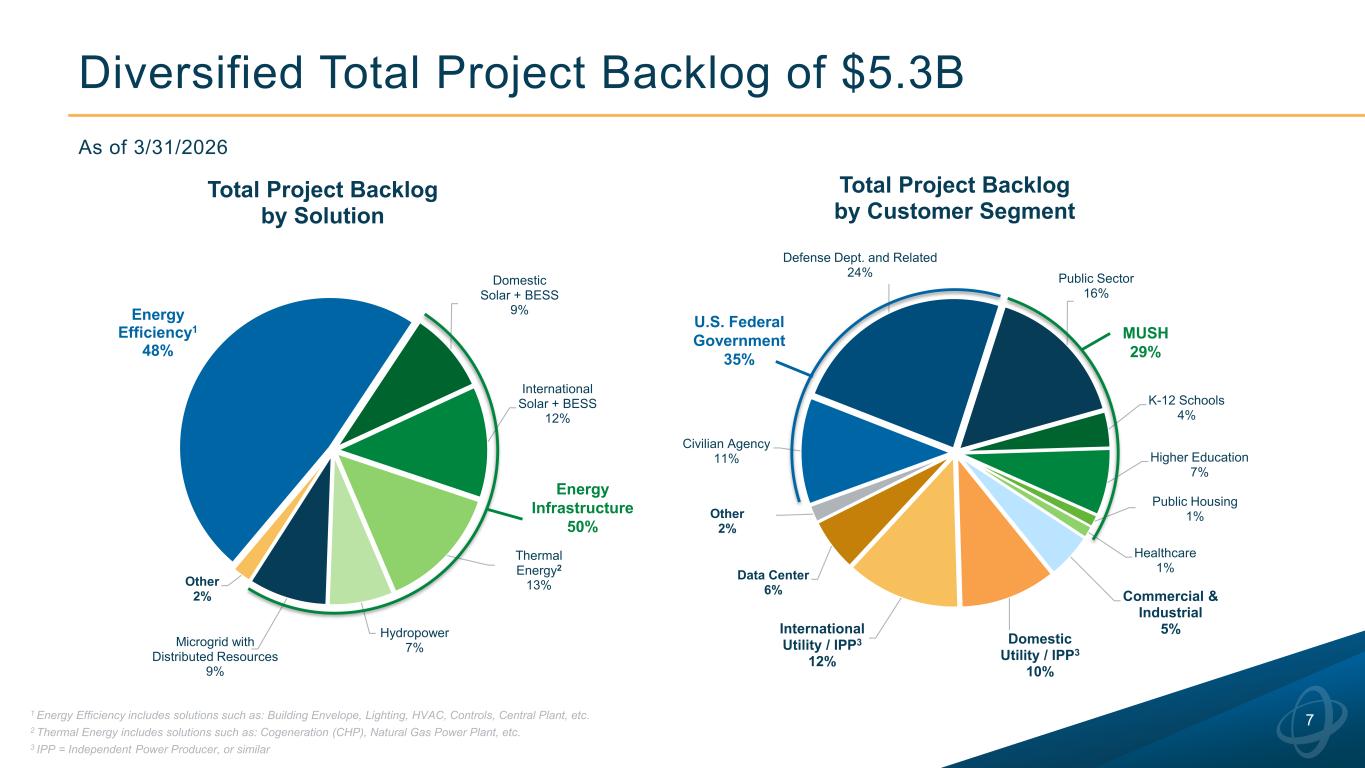
Thank you, Mike. We are very excited about this transaction, which I believe not only recognizes the tremendous tangible value of our energy assets, but also positions MRS to better drive long-term profitable growth. And also during the quarter, we strengthened our corporate structure to position us to fully execute on our great growth opportunities. We recently promoted proven leaders, Nicole Bolgarino and Lou Maltesos, to co-presidents of MRSCO, and Pira Gristakis to chief operating officer. Lou and Nicole both came to Amaresco 22 years ago with our successful Excellent Solutions acquisition. As co-presidents, Nicole and Lou will work closely with me on Amaresco's continued growth strategy while at the same time maintaining clear and distinct areas of operational focus. The easiest way to understand the operational alignment is to look at our current project business, which is split evenly between energy infrastructure and building efficiency. Nicole is responsible for the energy infrastructure half of the business while continuing to guide the company's federal solution business. Luke focuses on the built-in efficiency side, overseeing the core non-federal projects. Now, I will ask each of them to comment on some of the market dynamics in their respective areas.
Thank you, George, and good afternoon, everyone. Amoresco's federal business continues to be a core strength of the company. We see strong demand across our traditional federal programs, including energy efficiency, infrastructure modernization with long-term ESPC and design-build work. Amoresco's military and civilian federal government customers remain focused on upgrading buildings, improving reliability, reducing lifecycle costs, and hardening critical facilities. And I am pleased to note a nice uptick in federal government proposal activity over the last year. Amoresco's longstanding relationships, technical expertise, and proven execution track record position us well to continue delivering strong results in this important market. In parallel, we are seeing great demand for our energy infrastructure solutions. We have built a strong pipeline of large and complex projects, including transformational data center opportunities. This activity is being driven by growing demand for on-site, reliable power solutions where access to utility power is constrained or delayed. We are approaching this market with discipline, focusing on larger, experienced developers and projects where Amoresco's behind-the-meter capabilities can provide clear value. While still disciplined in what we advance, we are encouraged by the quality and the scope of opportunities we are pursuing and how they are progressing. I will now turn the call over to Lou.
Thank you, Nicole. It's been a very exciting time for our project business with our long history and expertise in providing building efficiency solutions. For many of our customers, energy represents one of their single largest operating expenditures. More and more, our customers are experiencing spiking electricity prices, leading to heightened interest in energy efficiency solutions. In addition to these challenges, many customers have older, often outdated buildings with limited capital budgets to pursue new construction. So upgrading their existing facility is not only the best economic option, but it's often their only option. The cost savings generated from our energy efficiency upgrades can then be reinvested in a laundry list of facility improvements, all done by Amoresco. As electricity prices rise, energy efficiency investments drive much faster returns, allowing our customers to tackle more and more improvements. This enables Amoresco to execute larger, more comprehensive projects. As one of the largest energy services companies in North America, Amoresco should be a main beneficiary of increasing energy costs for years to come. I'll now turn the call back over to George for a few brief comments before Mark covers our financials.
Thank you, Lou. Before we turn to the financials, I want to step back and connect the themes you have heard over the last few minutes. We see the creation of neogenic fuels with HACI as a clear validation of the scale and value we have created in our biofuels platform, while also bringing in a strong long-term partner and incremental capital to accelerate the next phase of growth. At the same time, the leadership updates we announced reflect the depth of our bench and our focus on continuity and execution as we scale. Positioning Mike to lead Neogenics fuels and elevating Nicole and Lou as co-presidents to sharpen execution across our energy infrastructure and building efficiency business. Together, we see these actions as strengthening our operating model, enhancing our ability to deploy capital and talent where returns are most attractive, and keeping the Maresco firmly on the same strategic path, delivering durable growth while creating long-term shareholder value. With that, I will turn it over to Mark to walk through the Corus financial results and guidance reflecting the Neogenics-Fuelz transaction. Mark? Thank you, George.
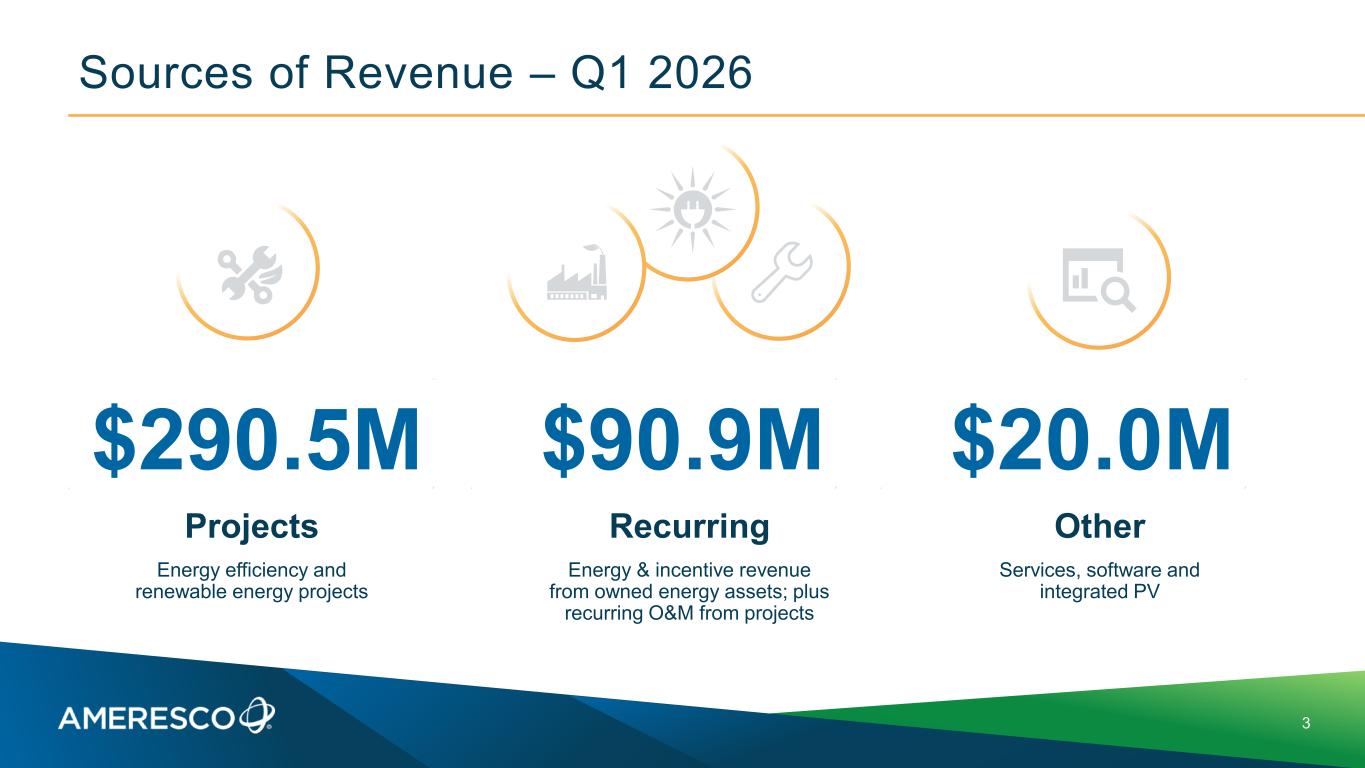
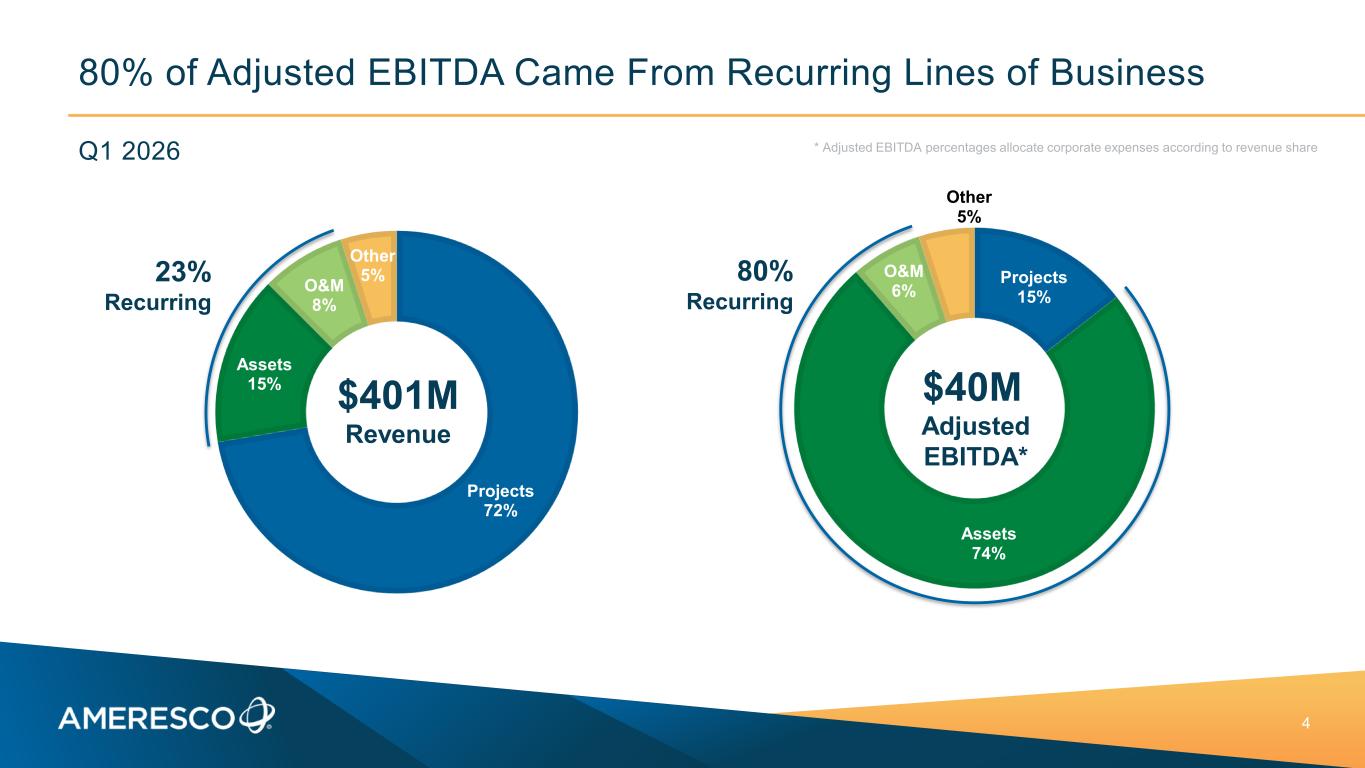
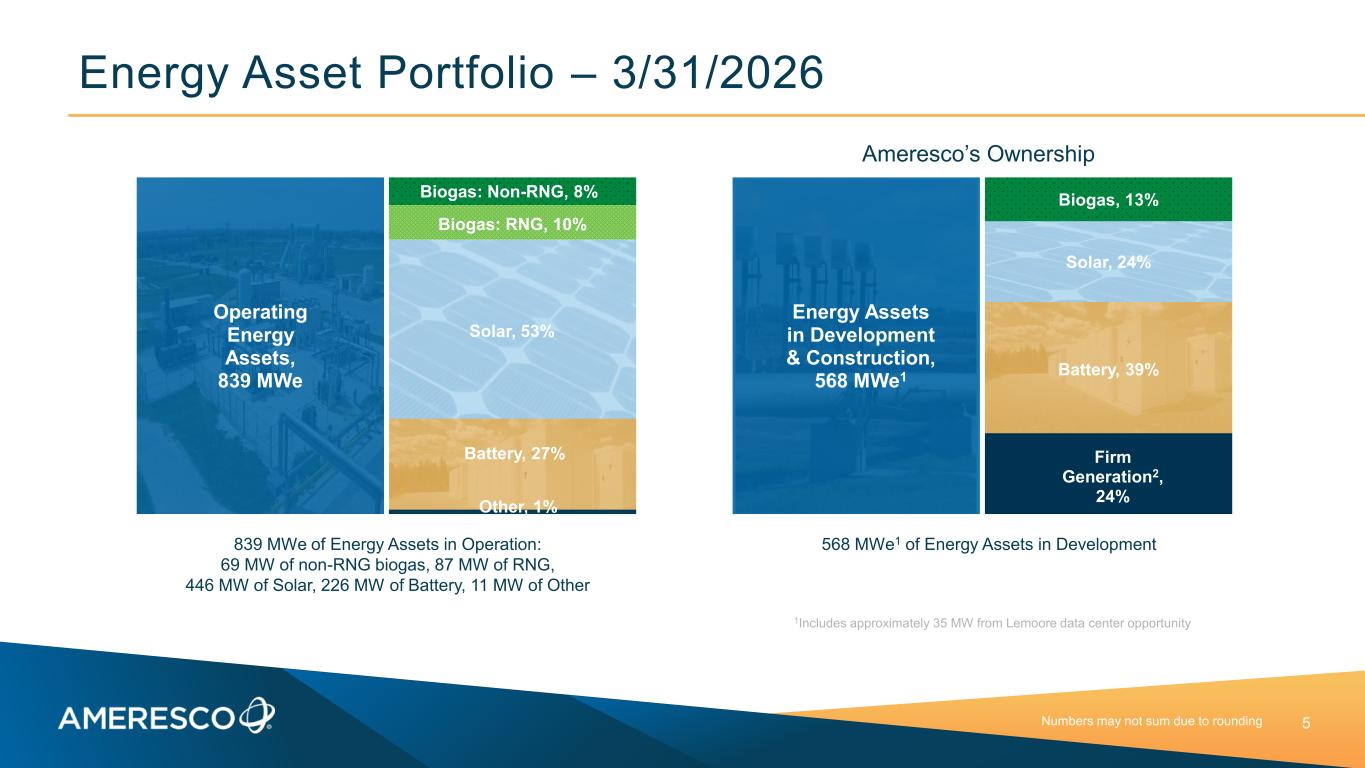
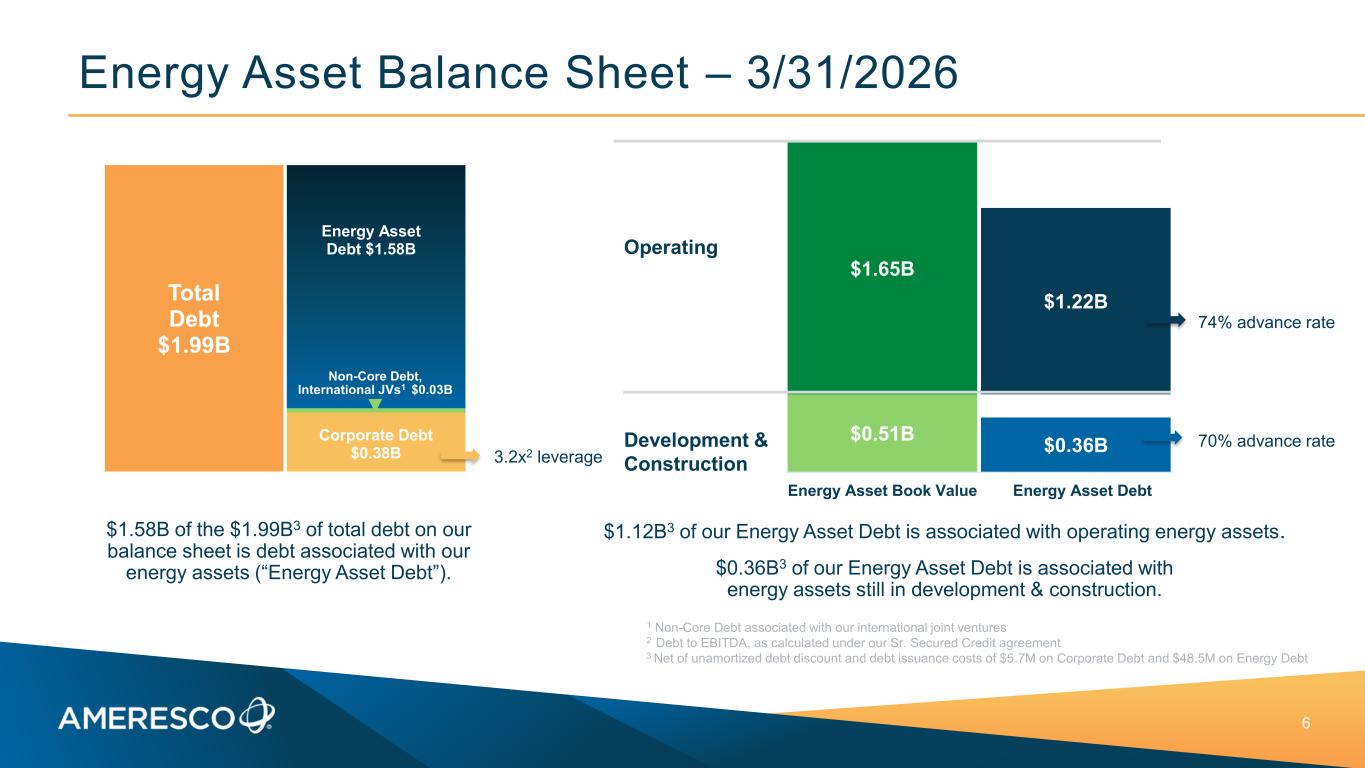
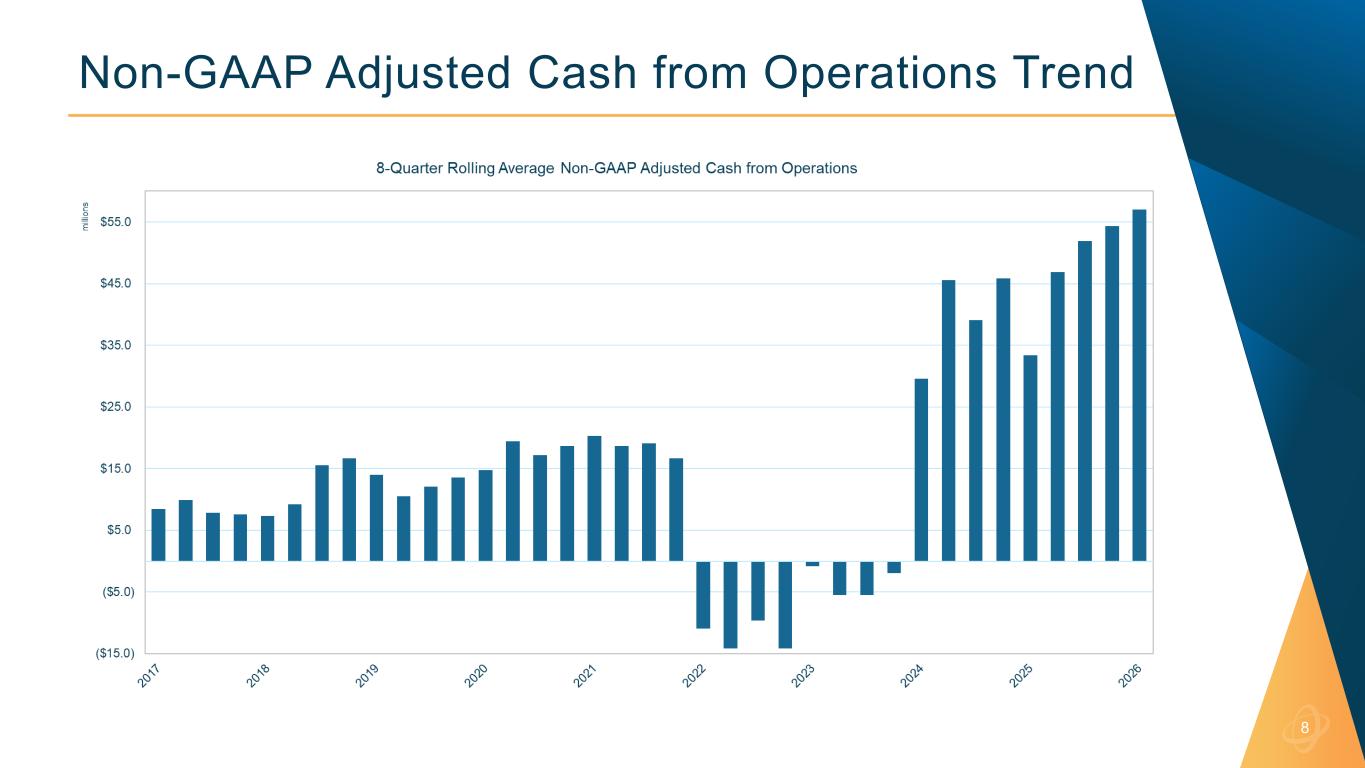
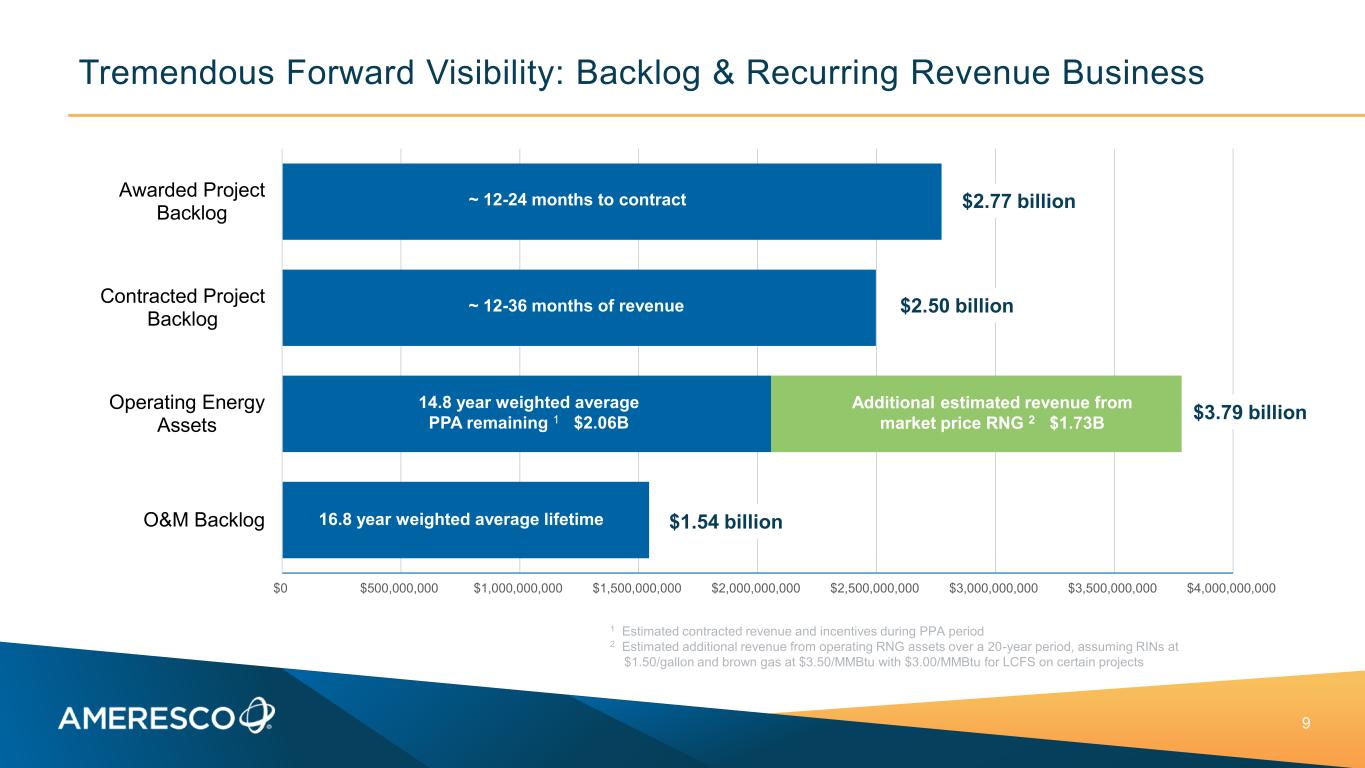
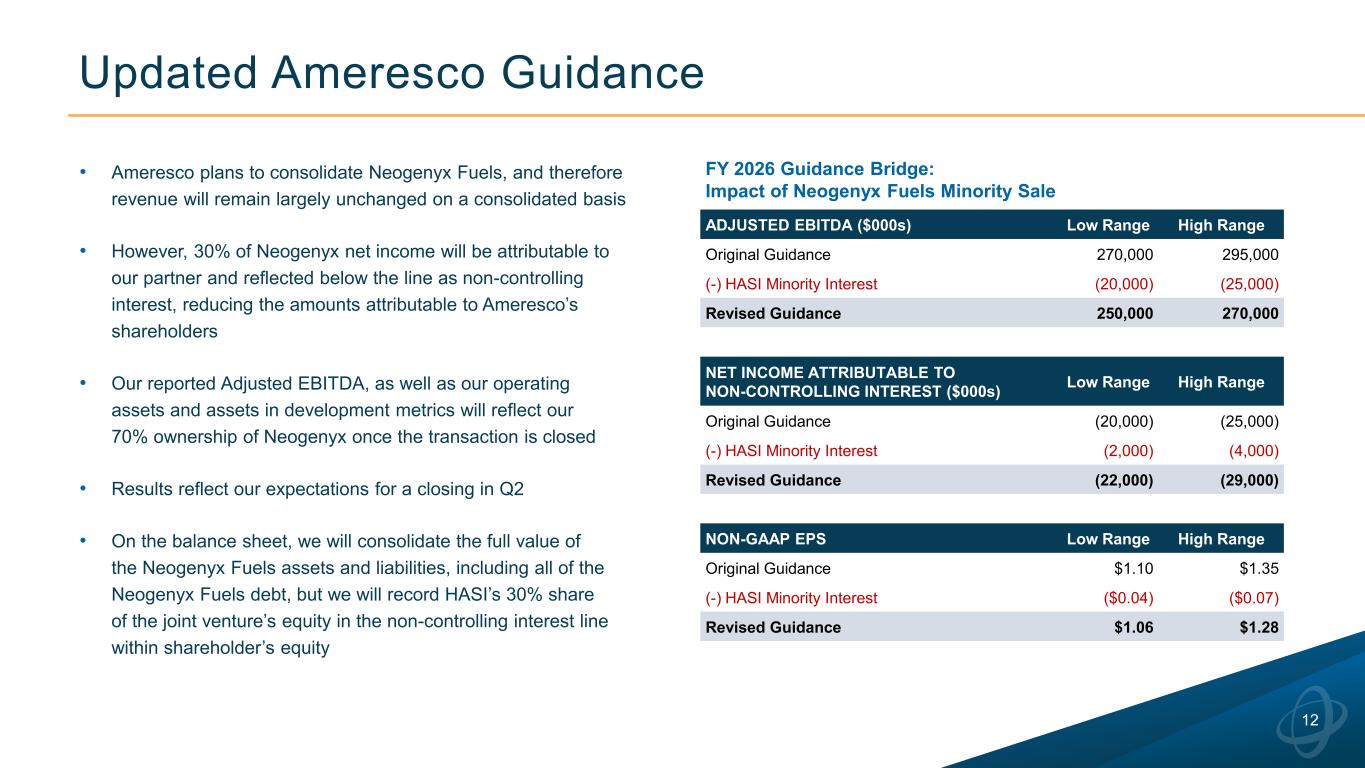
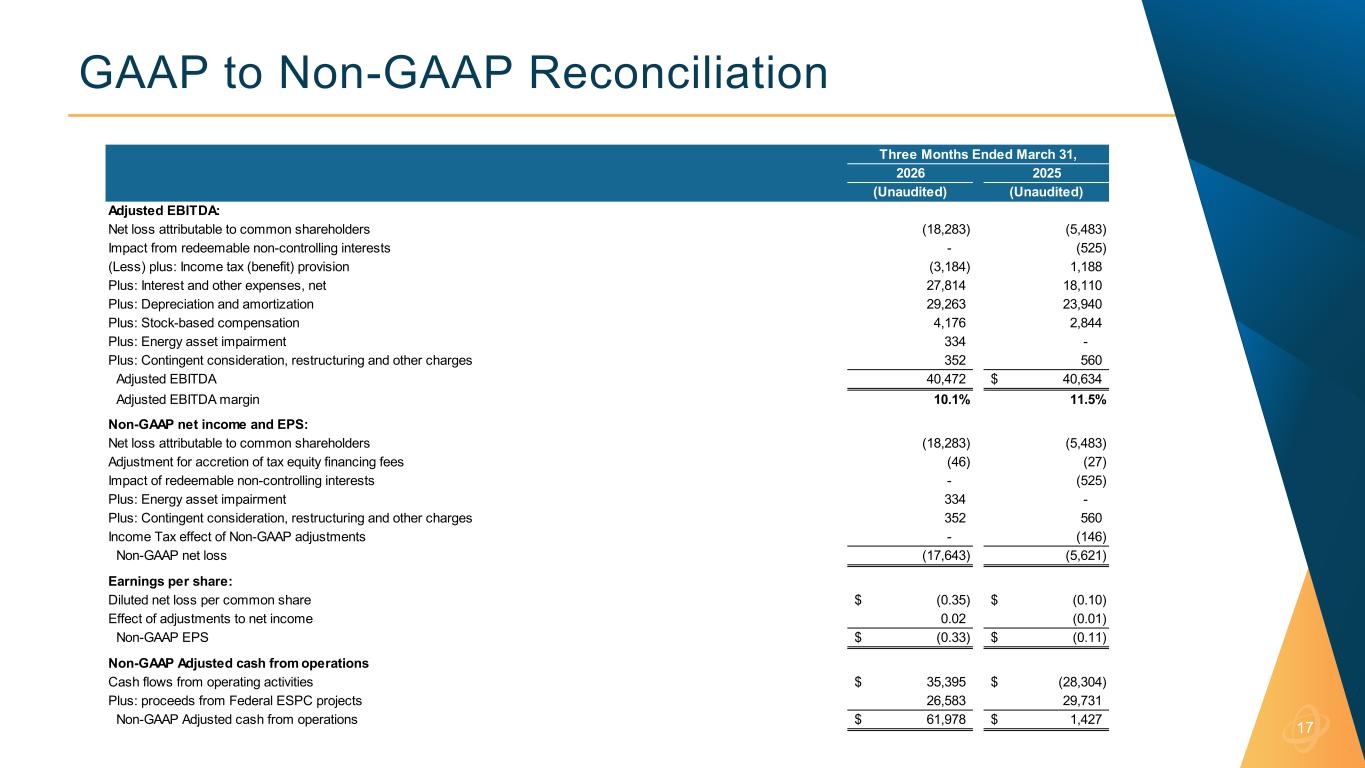
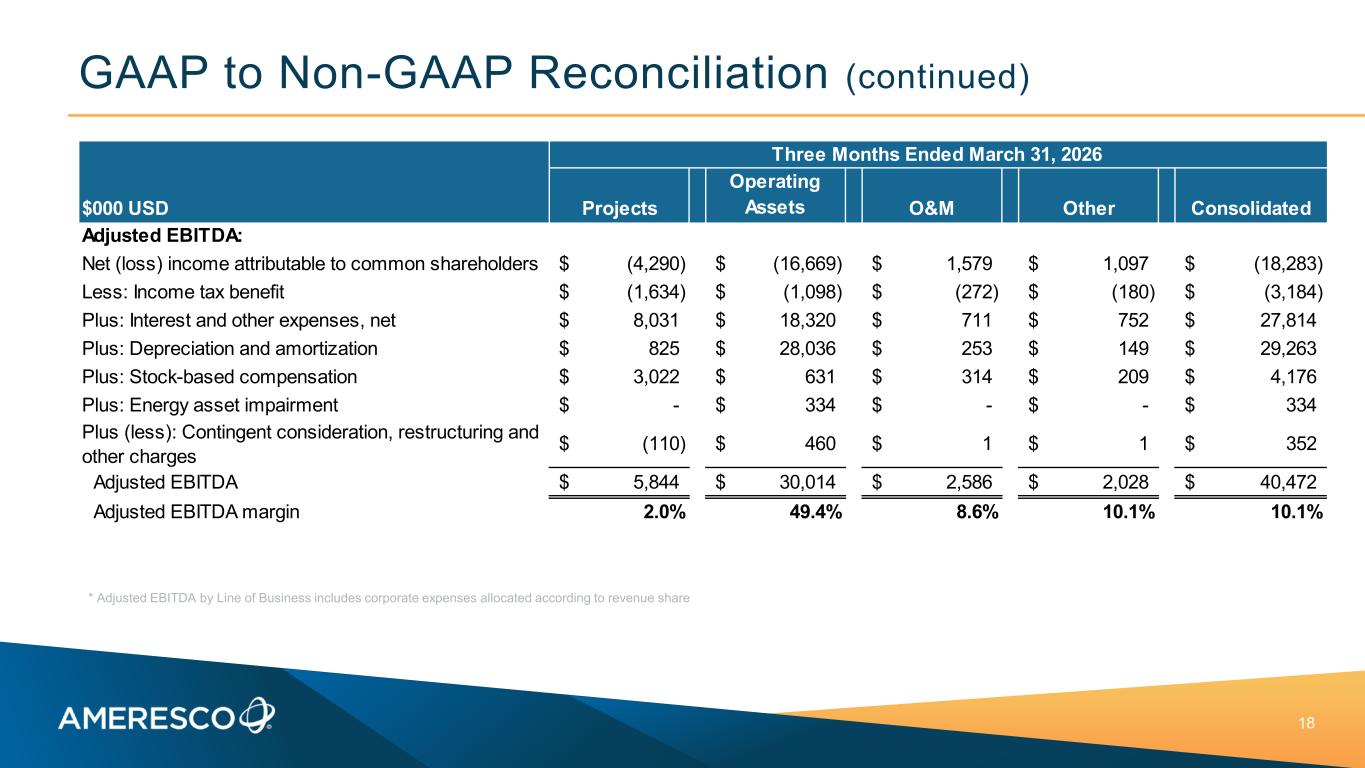
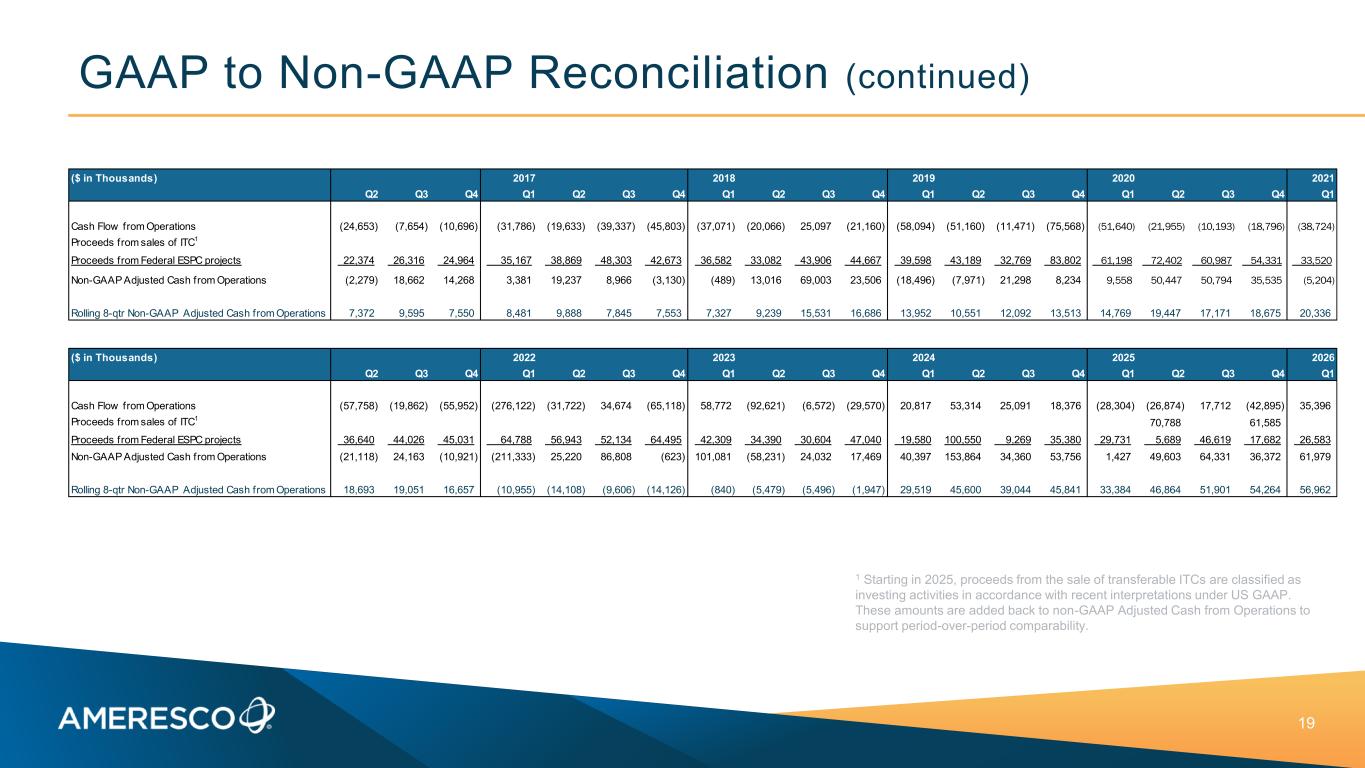
We had a solid start to the year with total revenue of $401 million, up 14% year-over-year, reflecting broad-based growth across our core businesses and led by continued strength in projects and O&M. Project revenue increased 16% to $291 million, dollars, driven by solid execution across federal and key geographies, as well as continued demand for both building efficiency and energy infrastructure solutions. Importantly, business development activity remained very strong. Awarded project backlog grew 20 percent to 2.8 billion dollars, with over half a billion dollars of new awards during the quarter, bringing our total project backlog to $5.3 billion. We continue to see a healthy pipeline of opportunities and strong proposal activity, particularly in the federal market. Energy asset revenue grew 7% to $61 million, supported by the continued expansion of our operating portfolio. We did see some weather-related impacts at certain RNG facilities during the quarter, but the underlying performance of the portfolio remains strong. Our operating energy asset base now stands at 838 megawatts, with 568 megawatts in development and construction, positioning us well for continued long-term growth. As we continue to scale this platform, we're increasingly focused on both the operational performance and the capital efficiency of our asset strategy. In line with that strategy, and as George highlighted, we entered into an agreement to sell a 30% equity interest in our biofuels business. Of the $400 million commitment from HACI, $300 million will be directly invested in Neogenics fuels to drive business growth, and $100 million will be direct compensation to Amoresco for the existing business, which will be used for strategic opportunities, working capital, and deleveraging throughout the year. This transaction implies a post-money enterprise value of approximately $1.8 billion, and recognizes the tremendous value embedded within our energy asset portfolio. In addition, it will allow us to retain control of the platform and bring in a trusted partner to help fund future growth, which will allow us to continue scaling the business in a capital-efficient manner. Turning back to the financials, O&M had another strong quarter with revenue up 22%, driven by the continued additions of new long-term contracts. Our long-term O&M backlog now exceeds $1.5 billion, reinforcing the visibility and durability of this revenue stream. Gross margin of 14.1% reflects project mix along with the impact from adverse weather conditions at certain RNG sites. We continued to make targeted investments in people, project development, and execution capabilities to support future growth. These investments drove operating expenses to $46 million during the quarter. Net interest and other expenses were slightly higher than expected, driven primarily by $1.8 million of non-cash, mark-to-market impact, and approximately $1 million in foreign exchange losses. Net loss attributable to common shareholders was $18.3 million, with a gap EPS loss of $0.35 per diluted share and non-gap loss per share of $0.33. Adjusted EBITDA of $40.5 million was in line with the company's expectations. Turning to our balance sheet, we ended the quarter with $104 million of unrestricted cash. Total corporate debt was $417 million, reflecting our investment in working capital to support continued growth across both our project and energy asset businesses. In the quarter, our senior secured lenders reaffirmed their confidence and commitment to Amoresco by increasing our term loan by $45 million. dollars. Our corporate leverage was 3.2 times, which remains below our 3.5 times covenant. Our cash generation remained solid this quarter, with adjusted cash flows from operations of approximately 62 million dollars. On a longer-term basis, our eight-quarter rolling average adjusted cash from operations was approximately 57 million dollars. Now turning to guidance. Given our solid start to the year and strong visibility, we would have been reaffirming our 2026 guidance. But in anticipation of the closing of the Neogenics fuels transaction, we are updating our full year guidance to reflect the expected impact on our reported results. Given the structure of the transaction, we plan to consolidate Neogenics fuels, and therefore our revenue guidance remains unchanged. 30% of adjusted EBITDA and net income from the biofuels business will be attributable to HACI and reflected as non-controlling interest. Consistent with this, our operating assets and assets and development metrics will reflect our 70% ownership in the JV. On the balance sheet, we plan to consolidate 100% of Neogenics Fuel's assets and liabilities, including all related project-level debt. HACI's 30% ownership will be reflected as a non-controlling interest within shareholders' equity, representing their share of the JV's net assets. We continue to anticipate placing approximately 100 to 120 megawatts of total energy assets in service, including two RNG plans. Expected CapEx is $300 million to $350 million, the majority of which is expected to be funded with a combination of energy asset debt, half-season investment, tax equity, and tax credit sales. The revenue cadence for the remainder of the year is expected to follow our historical seasonal pattern, with results weighted towards the second half. We expect the second half to contribute approximately 60% of total 2026 revenue, consistent with recent year performance. And finally, for the second quarter, with the expectation that the Neogenics fuels transaction will close in the quarter, we expect adjusted EBITDA of $58 million to $62 million and non-GAAP EPS of $0.18 to $0.23. Now I'd like to turn the call back to George for closing comments. Thank you, Mark.
As you have heard today, we are not only off to a solid start in 2026, but we are also taking the decisive steps to position the company to thrive long-term and build shareholder value. We look forward to seeing many of you at upcoming meetings and conferences. In closing, I would like to once again thank our employees, customers, and stockholders for their continued support. Operator, we would like to open the call to questions now.
Operator
You start the question-answer session. In order to ask a question, press star followed by one on your telephone keypad. Please limit yourself to one question and one follow-up question. Your first question comes from the line of Craig Aaron from Roth Capital Partners. Your line is live.
Good evening, George. Congratulations on another, you know, really foundational move for the company with the investment in Neogenics here. You know, we've advocated for this for years, and it's really just a fantastic thing that I think will generate a lot of value for your company. So, congratulations.
Thank you. Thank you, Greg.
So as we look at the value of Neogenics, a lot of people know that Mike has been incredibly loyal to your company, having built your asset portfolio from his early days, I guess, at Duke Solutions, right? And it seems that the multiple that you're using for the enterprise value might be kind kind of at the low end of the range versus what some of the other public competitors are trading at. You know, if you were to, you know, use a public mark for the valuation of this business, you know, what are the features of this business that you would point people to that would have you compare this to some of your peers that seem to trade at a better than 15x multiple?
Well, we went out and we spent over a year in evaluating the company and looking, getting various proposals and so on. And we think we got a very fair valuation for the company. And the fact that we only sell in only 30% is because with the additional investment that we will make in the company, the $300 million coming into it, we will accelerate the development. We have almost 10 projects under development right now, and it will help us accelerate the development at the end of the day. We will substantially increase the value and become much more significant. And Josh did lots of the analysis, and I think you might want to add some color to that.
Sure, yeah. So one of the reasons we did this transaction and, of course, got a board approval and we had a lot of brainpower behind the advisors we used is because this actually we believe this is in line, if not above market multiples. We're at over 20 times post money valuation on the one point eight billion. So, again, I think that's – we believe that's significantly greater than Amoresco was trading prior to this, as well as what a lot of the prior transactions in the market, either public comps or transaction multiples in the past three, four years in the space have been. So, we're very comfortable that we created a lot of value here and unlocked a lot of value.
No, congratulations on that. The next question is also not really about the quarter. For the last many years, how long it's been, I guess, 10, 15 years, investors have had a hard time separating out the debt related with your ESPC receivables financing. You know, there's been constant debate about, you know, do we take it out? Do we leave it in? We've been squarely in the camp that you take it out because it's non-recourse debt. It's debt where the federal government is the agency of recourse there, and you've never had a project not accepted by the federal government. You know, you handled one of the biggest issues today with neogenics that I think will drive value for the company over the long run. This is another key thing that, you know, I know that you've been bringing some creative ideas to over the last many years. Is it possible that we see this other point of sort of structural, you know, confusion in the market? You know, is it possible that we see, you know, similar changes that might allow a cleaner valuation on Amoresco versus its peers so people can see, you know, how clearly your company is undervalued?
Go back and permit the SEC to change the way we were doing it before. You know, you got a good point. Greg, no question about it. You know, it's not, it's non-recourse that, and it shouldn't even show up as people combine it, and then they indicate that the company will be over-leveraged, where indeed it's not. So, Marco, my one has more color.
We won't geek out on any accounting or GAAP accounting, but, I mean, this, the federal ESPC, I mean, the contract structure, I think that the federal government likes to use. Certainly, Nicole can speak more to that. So, yeah, I think, you know, we're constrained a little bit, And I think some of the complexity is just really how we need to report this, not only on the balance sheet, but coming through the cash flows. But, yeah, we don't consider this to be debt. And so we don't include it in our reported debt metrics. But I don't know. I guess you'll be able to tell us if we see that changing of the contract structure.
I don't see any. You know, it might not be a bad idea to start to think about it and see maybe we can do something. Yeah.
We haven't become large enough, right? I'm sorry.
Sorry, George. If I could squeeze in one last question. So your EBITDA, you know, a million ahead of consensus, you know, two million ahead of us in this quarter. You know, you mentioned some weather headwinds that impacted things a little bit in the first quarter. Clearly, the federal business is not facing some of the potential issues from the shutdown. Everything's tracking in line. Were there any particular closeouts or big wins or big pieces of book and burn business that maybe contributed to this strength in the quarter, or is this just indicative of a strong start to the year?
It was a strong start for the year, and probably I would say $20 to $30 million of next quarter revenue that were pulled into this quarter. But the weather, though, did have a major impact. We had the freeze-up on three of our RNG plans, and that was for at least a couple of weeks, Mike, more. So we would have an excellent quarter if that hadn't happened. And then, of course, the snow cover. We had more snow this season than we did the last couple of seasons, and that didn't help some of the solar farms that we had. But even on the construction side, some of the solar farms, we couldn't get in. We had to demobilize, remobilize. But anyway, not one-time pickup, so.
I think it was purely mixed. That way helped to offset some of the impacts, but nothing unusual or one-time from a close-out perspective. Great.
Well, thanks for taking my questions, and congratulations on these big changes. Thank you. That's great.
Operator
Your next question comes from the line of George Gianna Ricas from Cancord Genuity. Your line is live.
Hi, everyone. Good afternoon, and thank you for taking my questions. Again, maybe to focus on neogenics, what are the plans that you have in place to accelerate growth, and are there any additional plans to maybe go public with this asset as well?
Yeah, you know, we always look at opportunities to maximize value, and then if Greg is right, we grow it, get it to a large enough size, and then we will look at opportunity, no question about it. And as far as the money that we will invest, the $300 million, no question about it, we will accelerate the growth. Right now, we're building a couple of plants a year. I think it will take us probably a couple of years at least to get to about four plants a year, and maybe we could do a little bit better than that as we go down the road. But as you know, to permit some of these plants, it takes a couple of years. So you're not going to see anything until late 28th and beyond. But the plan is to accelerate the growth, double it up. And then Mike might want to add some more color, some other opportunities that we are looking at that will help us accelerate the growth.
Yeah, and George, nice to hear from you again. Look, there's a tremendous amount of opportunity, I think, in our space to see some consolidation. And so there's a fair bit of, I think, platform smaller that Mike, through M&A, help us grow the business in addition to our organic growth. As you know, to date, our portfolio has been 100% greenfield. We haven't acquired anything yet. I also think that the market has really started to transition to more of a global opportunity. And I think the capital will allow us to expand our resources to potentially export some of our product that we produce today.
Thank you. And maybe as a follow-up on the cash. So you're expecting $100 million of cash from the transaction internally to Amorosco. And if I may bring this up, at some point you're going to get, if our math is correct, about another $100 million from the SEC deal. So you will be, I would argue, at a corporate level at least, relatively under-levered. What are your plans for that, about $200 million of cash inclusion?
I can start. Look, our business plans to have sufficient cash in order to be able to accelerate the growth of this company. You know, we've been growing in the high single digits, and we want to add a few percentage points to that to get over the 10 threshold that we have established as a goal internally. And then, as we know, we've added a substantial amount of resources in expanding our, what I call the large energy infrastructure project, like data centers and so on and so forth. And that's why the OPEX, it picked up for the first quarter. And because many of these people, they charge into OPEX now rather than capitalizing the cost. And then, of course, we have Europe. So we have quite a few opportunities that we can expand our market and our reach. And then, of course, if there are some strategic acquisitions, we will always be looking at them. And that, of course, rather than hiring one person at a time, when you buy a particular company, especially if they have the human resources that we will need, it will help us accelerate the business.
And then Yeah, I won't add too much I think that George said I think we'll take a balanced approach, George As we look at this This is a great place for us to be When you start talking about that cash And the flexibility that it will give us So certainly we'll focus on supporting working capital But we'll selectively de-lever Throughout the year We're going to want to give ourselves plenty of dry powder To stay flexible for opportunities So yeah, this is going to be A good place for us to be We're looking forward to all of this coming in.
Operator
Thanks. Next question comes from the line of Dushant Ailani from Jefferies. Your line is live.
Hi, team. Thanks for taking my question. Maybe just to follow up on the prior comment there, maybe could you share the timeline that it would take for you guys to kind of cross over that 10% hurdle threshold that you've set for top line And then maybe specifically, I know you touched on some of the key drivers, but what would be more imminent if you had to, you know, kind of discuss that?
Yeah, so maybe just some clarity on the question. So you're talking about the top line 10% growth? Yeah. Yeah, I mean, I think that's just going to come down to execution. I mean, we feel really comfortable in the plan we put in place for the year and the visibility we have coming out of our backlog, especially with the projects business. So, yeah, I mean, I think that's why, you know, we said in our remarks we would have reaffirmed guidance. And revenue doesn't change in any of this with the transactions. So, you know, I think, you know, our plan this year probably puts us right around that 10% growth. We feel pretty confident about that.
Got it. And then maybe just another question on, I know you guys talked about tax equity earlier in your comments. Have you guys seen any slowdown in tax equity in terms of, like, have there been any FIOC concerns around tax equity that have been impacting your projects? I know that we have heard, you know, some comments around FIOC for tax equity, but I don't know if that's been maybe impacting you guys or not.
The compliance around FIOC, this is Josh, the compliance around FIOC has been more of a concern more so than a pullback in availability. we we're probably not large enough to to source those mega tax equity funds or syndications that some of the those sort of tier one utility scale developers are that that we've also been hearing or been pulling back I think you know we use a mix of transferability which we're tapping into bank markets as well as corporate and and we use kind of smaller regional banks as well as large like Coase. So we have a pretty diversified pool of tax investors or tax equity. And so far, given the strength of our pipeline, our reputation, and probably even the fact that our appetite isn't huge, we have not seen any meaningful pullback because of that.
Operator
Got it. Thank you.
The next question comes from the line of Ben Calo from Baird.
Operator
Your line is live. Your line is live.
Hi. Sorry about that, guys. So a couple quick ones for me. Congrats on the JV. Just first, if pricing is impacted, could you just maybe talk to it just from the amount of natural gas, I think, that's being demanded to power data centers? Maybe it's a completely different market. We may talk to that, and then I have a follow-up.
Question. Can you repeat it? Ben, this is Josh. Let me see if I can reiterate the question. You're wondering if the price of natural gas impacts the end market for renewable natural gas based on either data on demand or other?
Or if the data center will demand any RNG or if that changes the market at all.
Yeah, I mean, I will say if you're tracking some of the stats, I think there was a whole host of projects, I think almost 200 data center projects that have been in jeopardy because of community groups. And so a lot of the data centers are looking to green their power supply to get through the concerns of some of the local community groups. So we have seen an uptick in interest in fuel. And I think part of it is it's a baseload security supply. The RNG, it's all local. So that adds a lot of interest versus intermittent resources.
A follow-on just on data centers, you guys talked about being targeted and selective. Maybe could you just talk more about where you would play in data centers? And then also if you could just mention, you know, any kind of more work you're doing with military bases as well and data centers related to the U.S. government. Thank you.
Yeah, so this is Nicole. So to answer your second question first, I mean, we're continuing our strategy of working on military land because we feel like it's a great position for data centers to be located on. It has less land permitting requirements that commercial properties do. It's also on secure, usually away from communities and on secure military bases, which is another plus in the field. And certainly the ultimate tenant there serves nicely for the government IT. So that's top of our strategy, but also we've been working with a lot of commercial developers who need to bring power land solutions to the market. And we're seeing that you know, across, you know, lots of states right now because of the constraints from the grid. And that's our specialty is doing these behind the meter microgrid eventually to connect to the grid future solutions as well.
Great. Thank you, guys. Thanks, Ben.
Operator
Next question comes from the line of Eric Stein from Craig Hollow. Your line is live.
Hi, everyone. Hi, Eric. Hey, so I know it'd be in a different form, but, you know, any thoughts about, you know, something like the joint venture that you're forming for RNG and doing that in the data center space? I know that your first award, I believe you're counting 10 percent or so of the megawatts in your backlog with the expectation that you would have a partner in some way. So just curious, I mean, is there a path to having, you know, rather than each project, maybe a separate, do you have a defined partnership where you can accelerate that?
Yeah, definitely, Eric. We are looking into it, and we are talking to several people, but we don't have anything concrete to announce yet. When we are ready, we will do it. But the data centers, as you know, they require a substantial amount of capital and even in the development state. And so it will be good to have somebody with deep pockets that will help us accelerate the development of those data centers. Yep. And then the larger infrastructure projects that we are developing and we are building. You know, like we're doing the hydro plan up in Alaska, the wind farm up there. so on. That's the infrastructure business. We're getting very good traction into it, in addition to the data centers. It's a good question, and we are looking into it.
Okay. I'll definitely stay tuned. I guess maybe my follow-up. Just curious, you touched on this a little bit last quarter, but after the award that you made back in, I believe it was September. You know, I common get the question, you know, when's the next order? And so I know these projects take time. I know often that these are, you know, greenfield situations where you need to wait for the data center to even be built out before you start your work. So could you maybe just touch on, you know, kind of the typical project you're going after and why maybe that timeline's a little longer than other parts of your business?
Yeah, I mean, I think you've already kind of highlighted it very well. I mean, these are complex projects and it's not just the power side, but it's also the data center side itself and getting the right specs for the tenants that they're serving and then matching that with the power, you know, the power that we can put there, matching that with the permitting, the air permitting that's required, the gas supply, the future interconnection, there's a lot of complexities there. So our pipeline consists of a lot of projects that are in various stages, some very far in development that we've been brought into for the power specifically, others that we're developing together on the land side to bring solution there. So, you know, again, when you're talking with a large amount of capital required that George mentioned, I mean, these are complex projects and just require a lot more, I mean, It's like our normal assets require a lot of development in there. But, again, having a diverse pipeline will help us hedge against when they start coming online.
Operator
Got it. That is very helpful.
Thanks, Sarah. Thanks, Sarah.
Operator
Next question comes from the line of Manish Sumaya from Cantor. Your line is live.
Thank you. Thank you for taking my question. Mark, you mentioned 60% of the earnings out in the second half. Maybe if you can just talk about the biggest execution milestones embedded in the second half outlook.
I don't know. I mean, then I point to the biggest, you know, we have great visibility coming out of contracted backlog, which, you know, just becomes our ability to execute conversion of that. And then there's a portion of that coming out of our awarded backlog that, you know, again, will require us to, you know, to convert that to sales, get to a contract, and then start executing on that revenue. So, again, you know, we drive that forward-looking view based on, you know, the best visibility we have coming out of the backlog. We feel pretty confident, not only based on the mix of what's coming out of the backlog with our ability to execute.
Okay. And then the $522 million of new awards that you had in the quarter, maybe you can just talk about where do you see the biggest opportunities going forward?
I think certainly a lot of it. And just on the federal side, there's an uptick in activity for infrastructure modernization with GSA, with VA, even with the Department of War. So we're seeing new activity that, modifications in the federal government. We also, again, the power infrastructure side of this, you know, providing new projects for electrical distribution, for other generation-type projects as well.
And I think in the rest of the business, this is Lou, and the rest of the projects business, we're also seeing a lot of increased demand. I mentioned in the comments that electricity prices are increasing pretty dramatically for some of our customers, and that's creating a real motivation for them to get to the table and look at projects that might have been borderline in the past.
Super helpful. Thank you so much. Congrats again on the JV. Thank you, Hish.
Operator
As a reminder, if you'd like to ask a question, press star 1 on your telephone to ask a question or rejoin the queue. Next question comes from the line of Ryan Finkst from B. Riley Securities. Your line is live.
Hey, guys. Thanks for taking my questions. You're right. Hey there. Michael, it would be great to hear your view on the recently finalized RVO and any expectations you might have for D3 pricing.
Yeah, I mean, it's – I think, again, the EPA was focused on trying to get a RVO set that kind of meets market conditions. And that's why I think we've seen the rates have been pretty steady between 240 and currently, I think, today was around 251. And I think what you're going to see, if you think about with the market expansion, you know, what's going on in the industry, we're starting to see more gas go to Canada. The California is going to start seeing more gas go to their program, which is a non-RFS, SB1440. You're going to start seeing more go to Europe. So you're going to have this, if you would, some of the gas leaving the RFS program, which will just create more demand to fulfill the RBO. So I think we were happy with where it ended up on the volume.
Operator
Appreciate that.
And then turning to the data center opportunity, are there any updates or milestones that we should look for around the Cyrus One project as that one moves forward?
I mean, I think we're continuing to develop that and work with the timing of when the data center can be built and constructed, because that needs to match up with the energy build as well. So we're continuing to refine those dates and when they can come online together. But in the meantime, we're continuing to work with Cyrus on other opportunities as well.
Great. Thanks, Nicole. I'll turn it back. Your final question comes from the line of Noah K. from Oppenheimer.
Operator
Your line is live.
All right, Grit, thanks for taking the questions. And I want to start by congratulating Nicole and Lou and Mike on your new roles and responsibilities. Just great to see how you all and how the company has kind of continued to grow over the years. So I wish you all a lot of success. let me ask a question or two questions on the JV I just want to make sure I got this right I guess the comments imply something like 90 million EBITDA profile for the platform that's that's where it's running for 26 first of all is that right and then I guess with with 74 megawatt equivalent in the development pipeline where does that kind of grow to do you think over the next three years? Because that pipeline is usually what you expect to bring online in the next three years.
No, this is Josh. I'll start with the valuation. If you just look at what we have to back out for non-controlling interest at 30%, so $22.5 million at the midpoint divided by 0.3, it's more of like a $75 million type of number at the midpoint for this year.
Mike, in terms of growth and pipeline yeah i mean you're pretty spot on it typically represents that we have typically visibility on three years out on our pipeline which is what we have now with the 11 projects in development and we continue to add to that pipeline so right now we have good visibility through 2029 and we're working on some new awards right now that we would expect to build into that 2030 timeframe and beyond.
Okay, thanks. And then I guess the follow-up is as the platform kind of continues to grow in size, just how should we think about the ability to further recycle capital or monetize? Is this going to stay a 70-30 split? Is there any kind of an option to adjust ownership percentages going forward? Just curious about the mechanics.
This is Josh. I'll start again. So I think what's important to note is that Amoresco does not have to put another dollar into this business until Hazy's $300 million commitment is exhausted. And we think that'll last us a few years, unless something kind of really material and exciting comes along from an acquisition standpoint. But if you're a CapEx, this is multiple years worth of cash that Amoresco does not have to put in. And just to be absolutely clear, those dollars will not dilute us further. We're at 70-30 for this $400 million commitment. But the natural, I guess, the natural other side of that is that all the dollars we would have normally had to put into that business ourselves are now back at Amoresco, Inc., where we can invest in Lou's business, Nicole's business, and just the rest of what we're doing at a corporate level, including potential acquisitions, if they're accretive. So I wanted to just make sure that's clear for everyone listening as well as yourself. I think that's our key message. After that 300 is exhausted, then the partnership, if there's further capital calls, it could be pro rata or depending on how the partners choose to fund, that's kind of when you'll get maybe a change in ownership. But as of right now, we don't have to put a dollar into this business for the foreseeable future.
Yeah. So you marry up the pipeline visibility with now kind of the funding visibility. Just great to hear. Congratulations, Saul.
Thanks. And actually, sorry, I'll add a comment just to be also clear. This doesn't change any of the strategy around non-recourse debt or tax equity, and that's how we're able to stretch these dollars so far. We'll still be levering the assets probably somewhere between 60% to 70% if we can get it on a loan-to-value on a non-recourse basis and monetize the majority of the tax credits themselves through partnerships or tax transfer. So that's why we're able to stretch this $300 very far and really pull in the build in potential acquisitions.
Operator
There are no further questions in the question and answer session. That concludes today's meeting. You may not disconnect.