Operator
Hello, and welcome to Amrize's Q3 2025 Earnings Conference Call. This conference is being recorded today. I will now turn the call over to Scott Einberger, Investor Relations Officer for Amrize.
Speaker 1
Thank you, and good morning. Welcome to Amrize's Third Quarter 2025 Earnings Conference Call. We released our third quarter financial results yesterday after the market closed. You can find both our earnings release and presentation for today's call in the Investor Relations section of our website at investors.amrize.com. On the call with me today are Jan Jenisch, our Chairman and CEO; and Ian Johnston, our CFO. Jan will open today's call with highlights from our third quarter results and the growth investments we are making in our business. Ian will then review our financial performance for the quarter and provide an update on our Project ASPIRE synergy program before turning the call back to Jan to discuss our outlook for the remainder of the year. We will then take your questions. Before we begin, during the call and in our slide presentation, we reference certain non-GAAP financial measures, which we believe provide useful information for investors. We include reconciliations of non-GAAP financial measures to GAAP in our earnings release and slide presentation. As a reminder, today's call is being webcast live and recorded. A transcript and recording of this conference call will be posted to our website. Any statements made about future results and performance, plans, expectations and objectives are forward-looking statements. These forward-looking statements are subject to risks and uncertainties that could cause actual results to differ from those presented during the call due to various factors, including, but not limited to, those discussed in our Form 10 filings and in other reports filed with the SEC. The company disclaims any undertaking to publicly update or revise any forward-looking statements. With that, I will now turn the call over to Jan.
Speaker 2
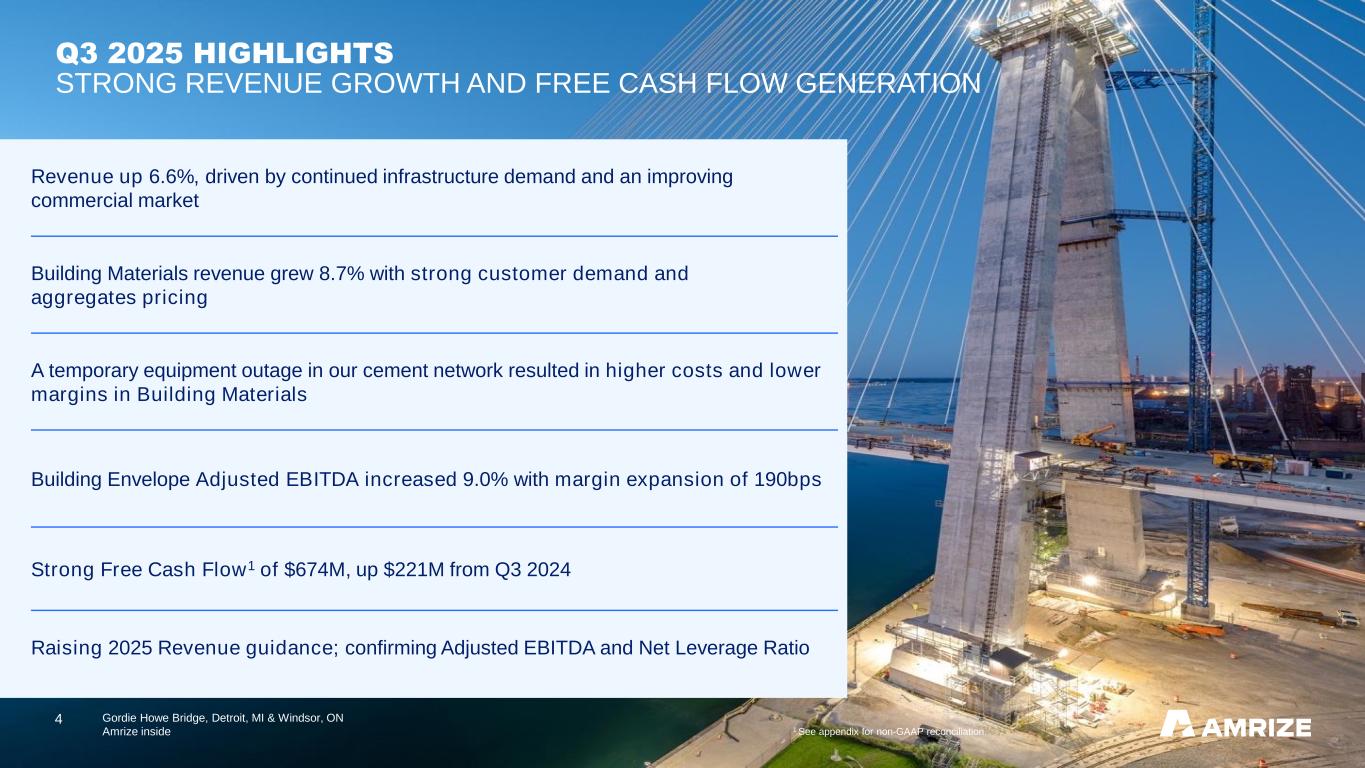
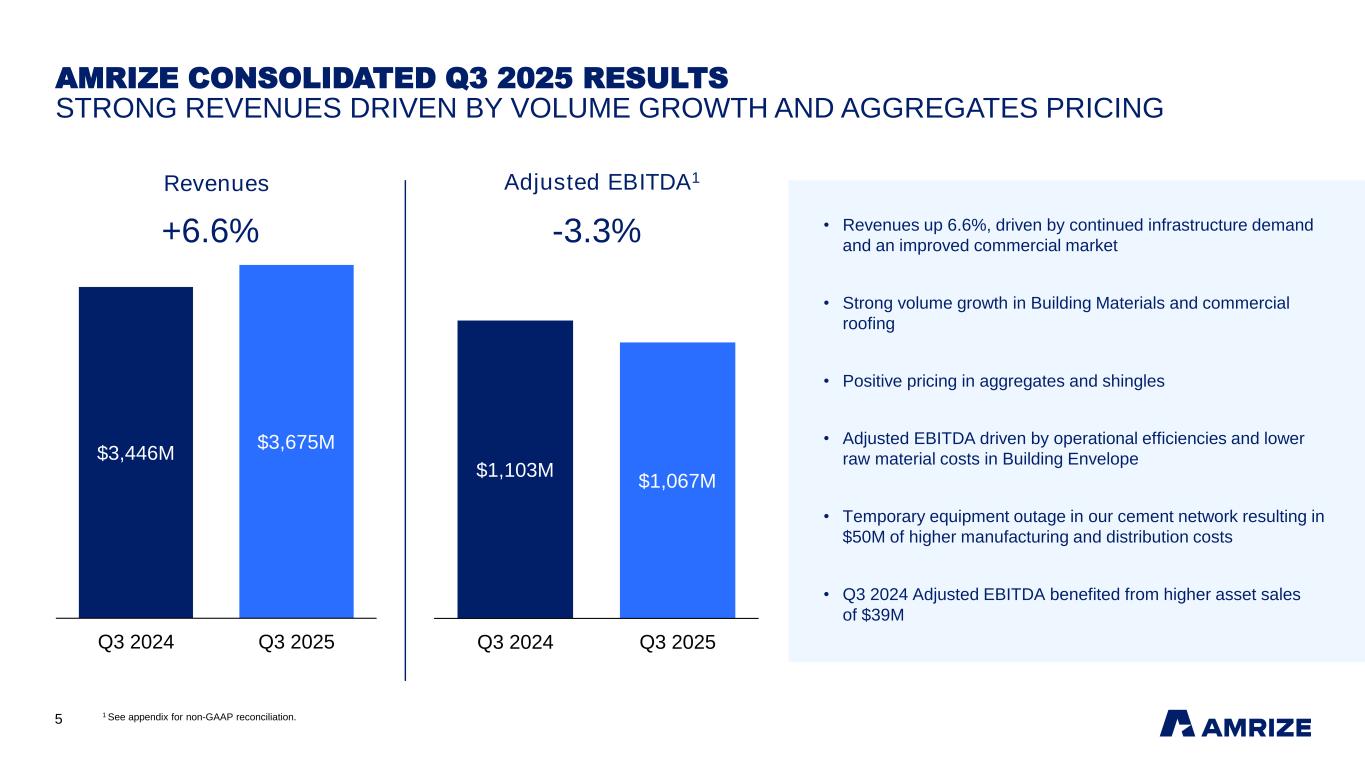
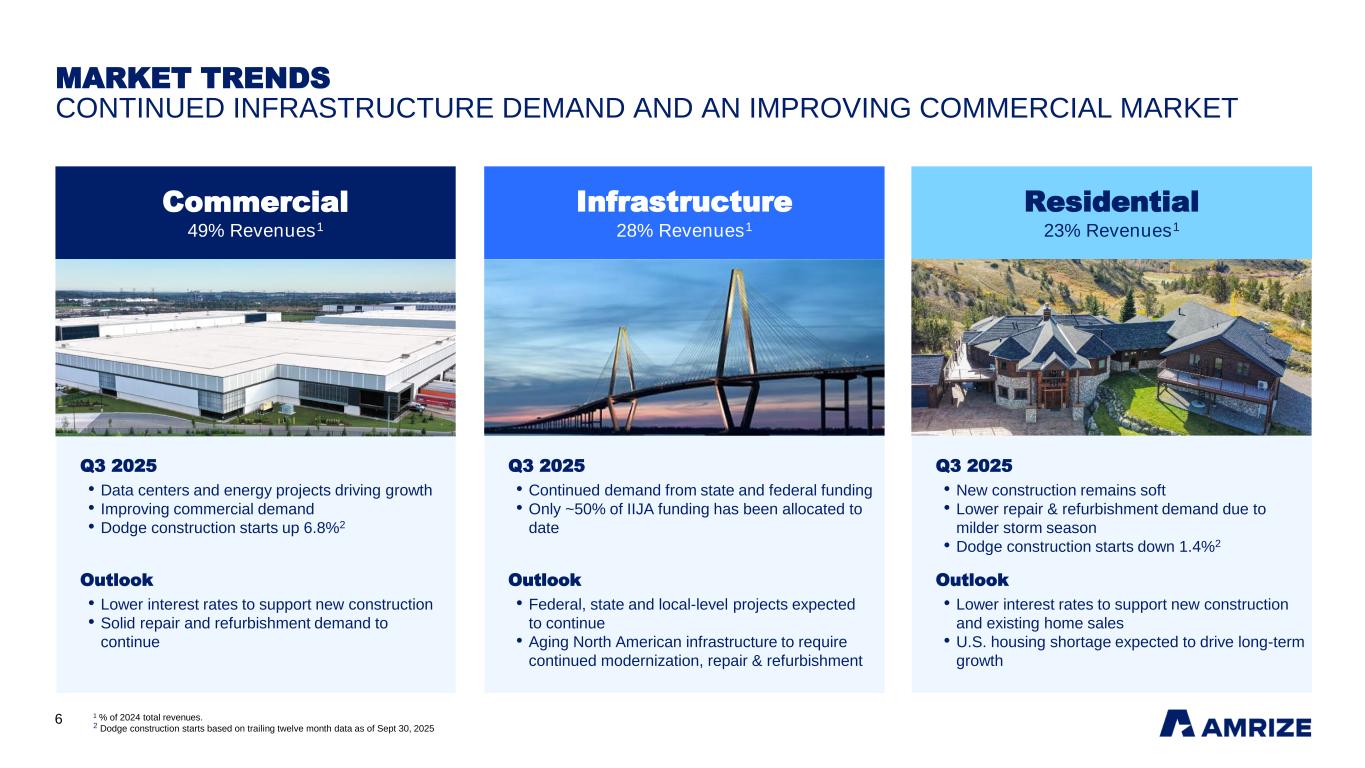
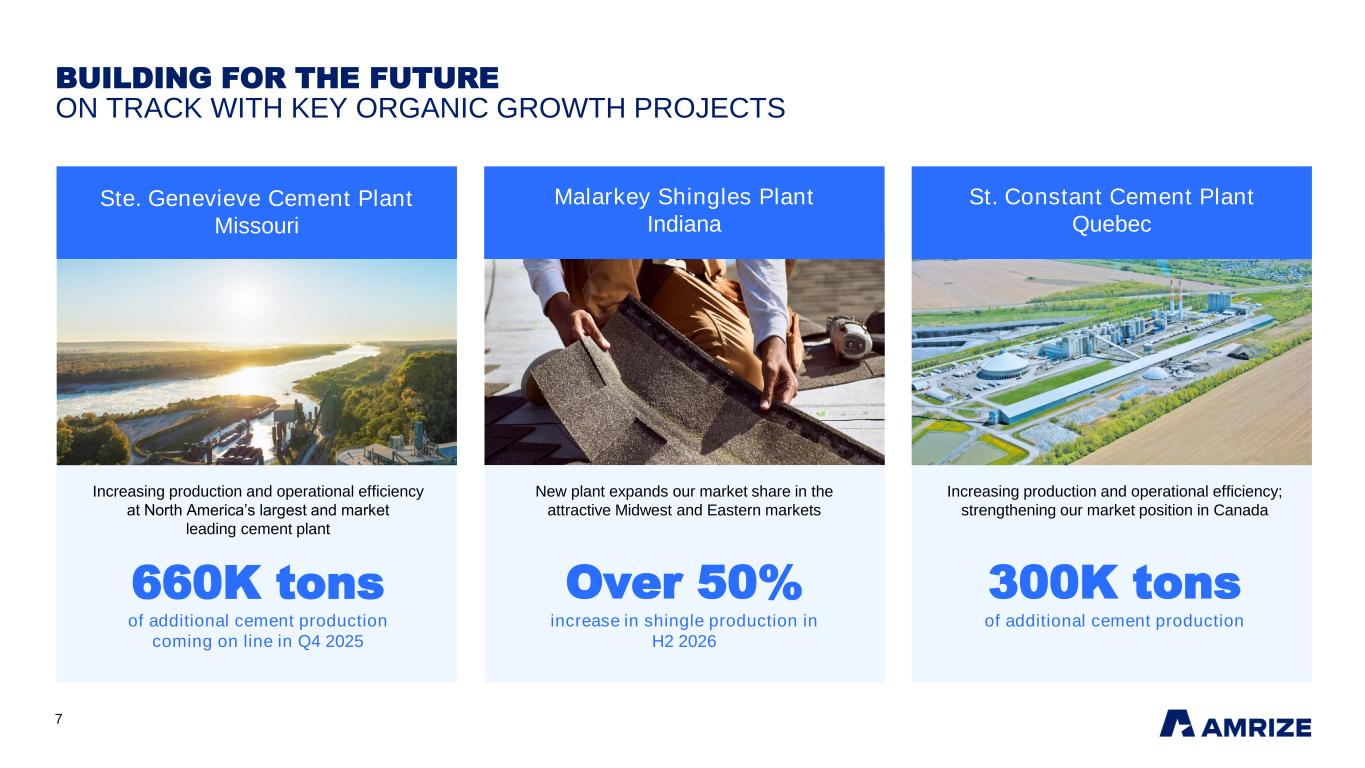
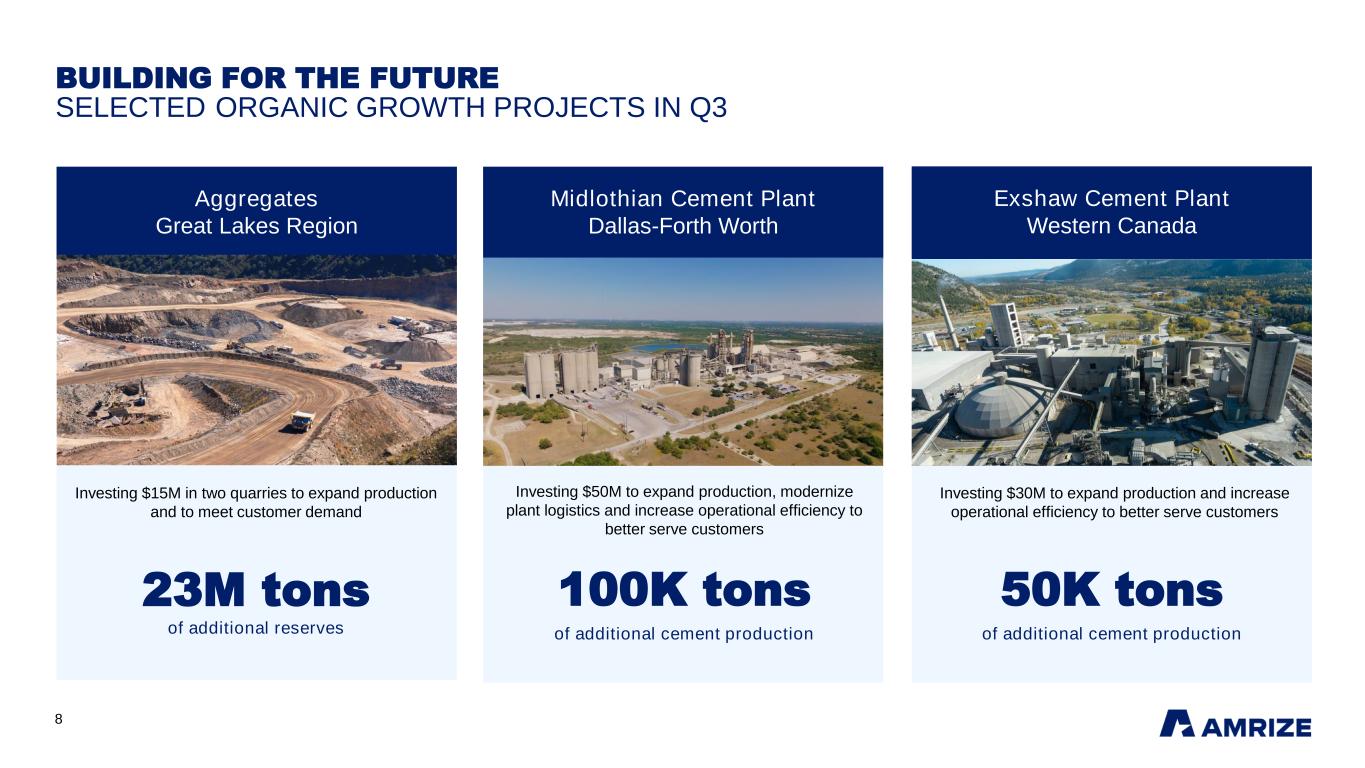
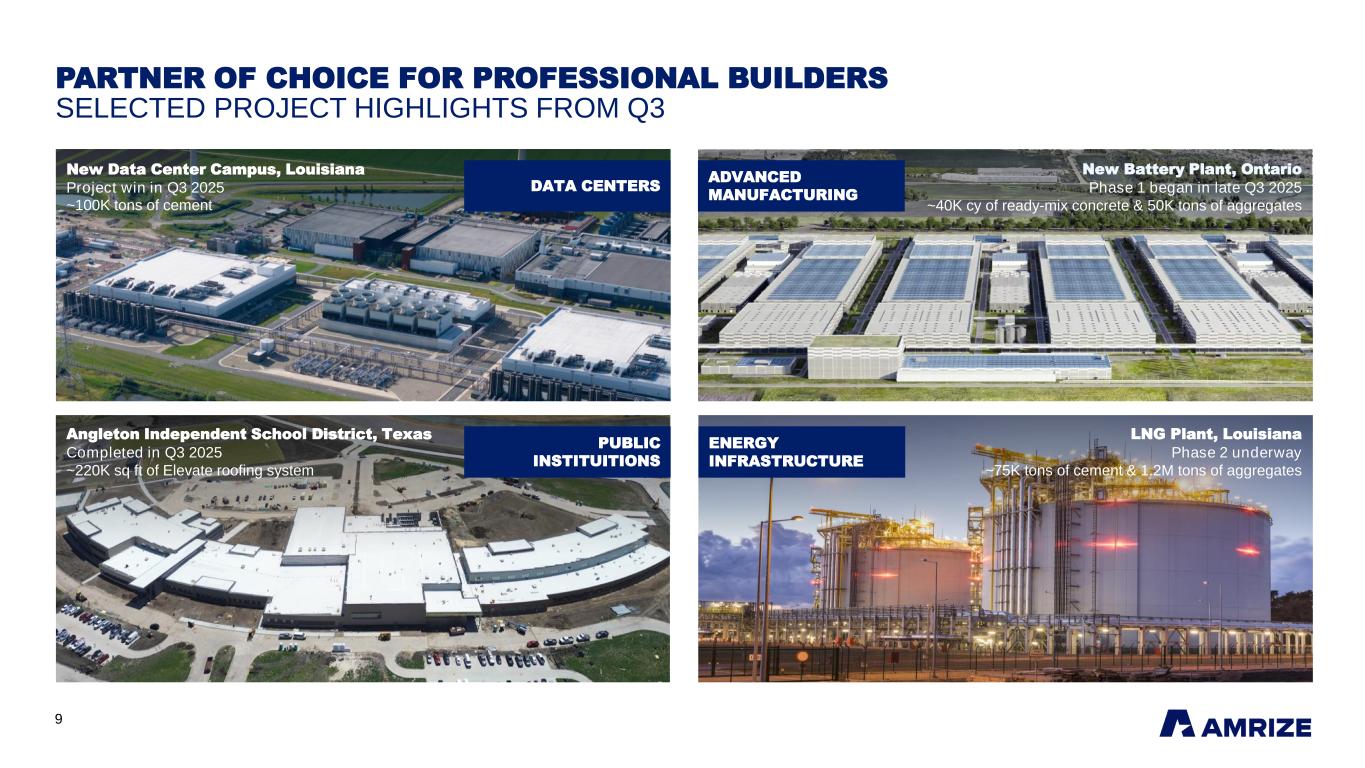
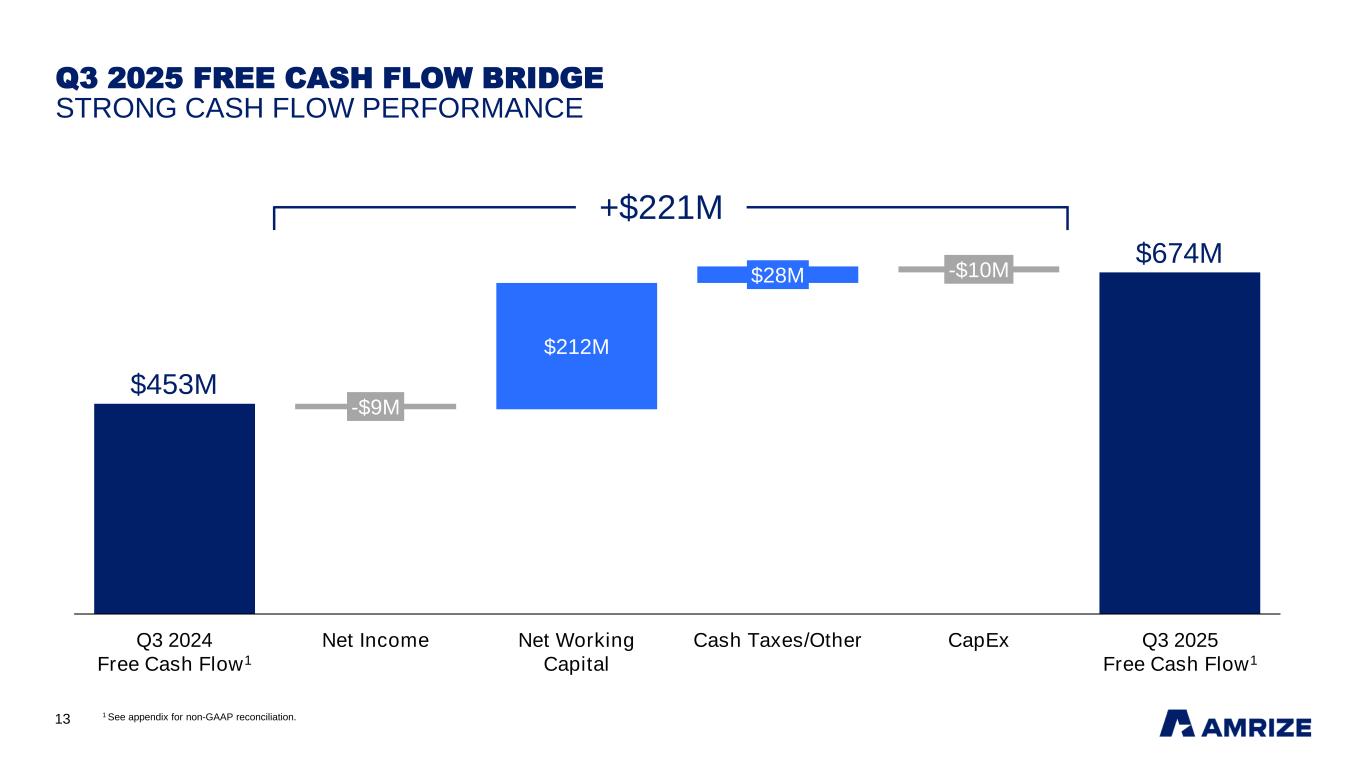
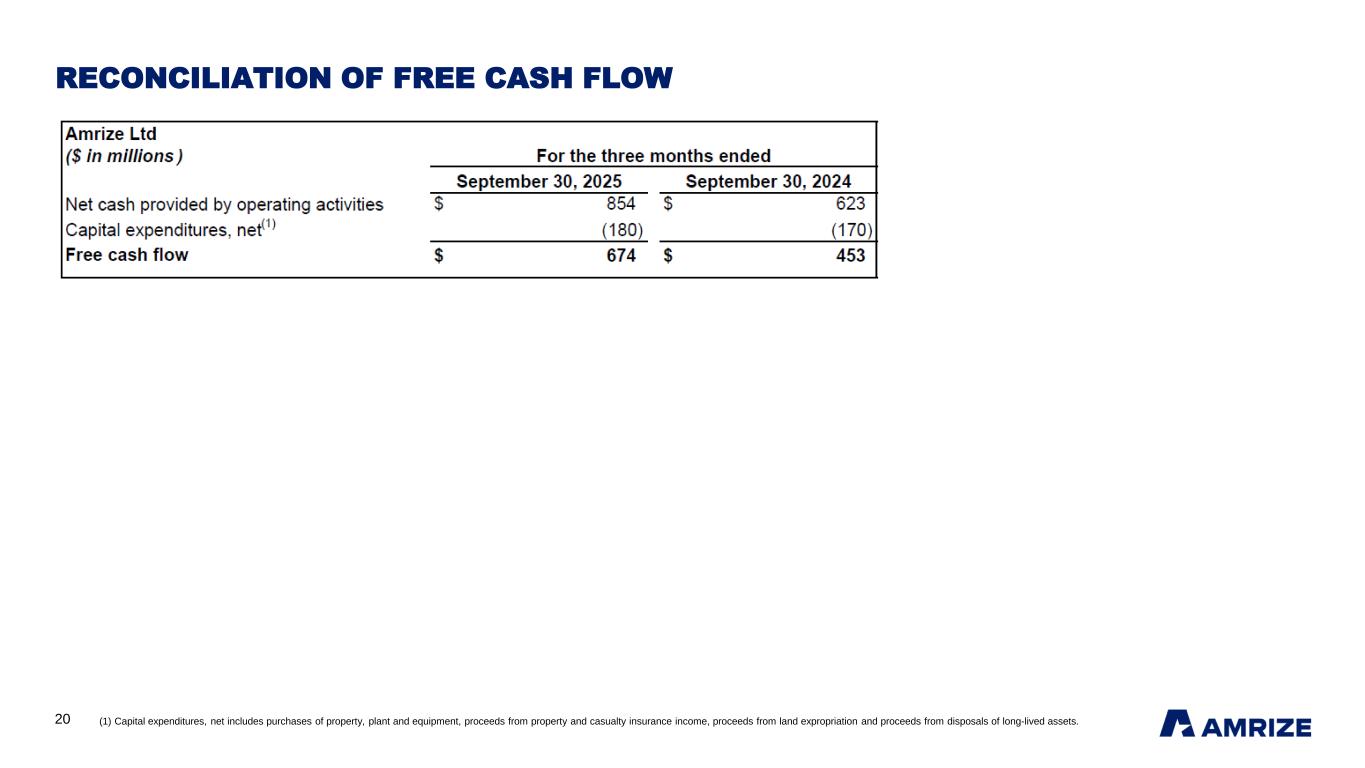
Thank you, Scott, and thank you all for joining us today for our third quarter earnings call. This marks our first full quarter operating as Amrize, and we've made progress across our businesses. I want to express my gratitude to our 19,000 teammates who are serving our customers in all our markets. Together, we achieved a strong revenue growth of 6.6%, driven by ongoing infrastructure demand and a recovering commercial market. Our Building Materials business experienced robust volumes and positive aggregates pricing, although a temporary equipment outage in our cement network led to higher costs for the quarter. Our Building Envelope business realized significant margin expansion thanks to operational efficiencies and reduced raw material costs. We generated a strong free cash flow of $674 million, an increase of $221 million from last year. As we build on our third quarter progress, we are raising our revenue guidance for 2025 while confirming our EBITDA and net leverage ratio guidance. Moving to the financials, we had strong revenue performance influenced by volume growth throughout the business, from cement and aggregates to ready-mix concrete and commercial roofing. Several positive factors contributed to our margins, including operational efficiencies in Building Envelope and favorable aggregates and residential roofing pricing. Within Building Materials, the temporary equipment outage in our cement network impacted our margins, but we successfully leveraged our network's strength to continue serving our customers without disruptions, which did result in higher costs. The equipment repair has now been completed, and all our plants are back to normal operations. We also faced a significant asset sale in the third quarter of last year, which affected the year-over-year adjusted EBITDA comparison. Regarding the market environment, our commercial customers are showing early signs of improvement, driven by strong demand for data centers and energy projects. This is supported by the latest Dodge construction starts report showing new commercial construction starts have increased by 6.8% over the last 12 months. Demand in infrastructure remains steady as federal, state, and local authorities prioritize modernization projects. However, in residential construction, new activity remains soft, and a milestone season negatively impacted repair and refurbishment demand. Looking forward, we anticipate robust long-term demand for Amrize. As interest rates decline, we expect pent-up demand to unwind, leading to an uptick in construction activity across both commercial and residential sectors. Key megatrends such as infrastructure, modernization, the onshoring of manufacturing, data center expansion, and addressing the housing gap will fuel our long-term growth. We are well-positioned across infrastructure, commercial, and residential construction, maintaining an approximately even split between new builds and repair and refurbishment. We are committed to investing in and executing our key organic growth projects. In the fourth quarter, we will finalize the expansion of our flagship Ste. Gen plant, boosting production capacity and efficiency at North America's largest cement plant. Our new state-of-the-art Malarkey Shingles factory in Indiana is on schedule, and we are advancing the expansion of our St. Constant cement plant in Quebec. In the third quarter, we launched several additional projects in key markets, including expanding our aggregates production in the Great Lakes region to meet customer demand and improving efficiencies at our Midlothian, Texas cement plant to serve the Dallas-Forth Worth market. We are also expanding in Exshaw, Canada, to cater to the Calgary and Western Canada market. We will maintain our focus on accelerating organic growth investments to enhance our market-leading positions and better serve our customers. I would like to highlight a few projects from the third quarter. In Louisiana, we secured a new data center project to supply 100,000 tons of cement. This is part of 25 data center projects we have planned for 2025 as the AI boom fuels construction growth. In Ontario, we are providing ready-mix concrete and aggregates for a new battery plant, which exemplifies the advanced manufacturing and onshoring trends driving construction growth. Our roofing team completed a significant project for a new school near Houston, along with many similar projects in Building Envelope that contribute to strong communities. To support a new large LNG plant in Louisiana, we are supplying over 75,000 tons of cement and over 1 million tons of aggregates, as energy projects continue to drive demand. All of these substantial commercial projects reflect the megatrends supporting long-term growth in the North American construction market. The growth of Amrize is closely tied to these trends. We have a substantial project pipeline, with new projects commencing each quarter. Our investment activities and focus on driving synergies are positioning Amrize to take advantage of significant long-term demand within our $200 billion addressable market. I will now turn the call over to Ian to elaborate on our third quarter financials.
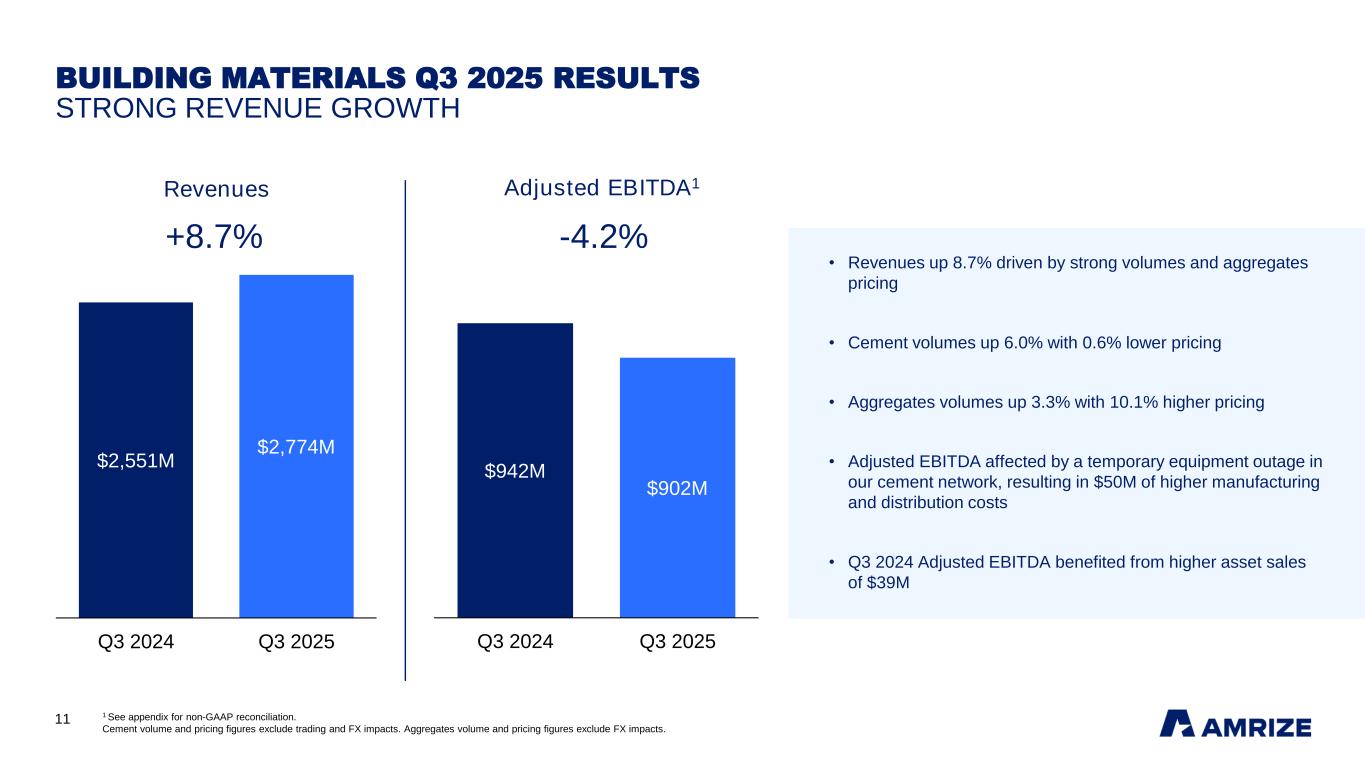
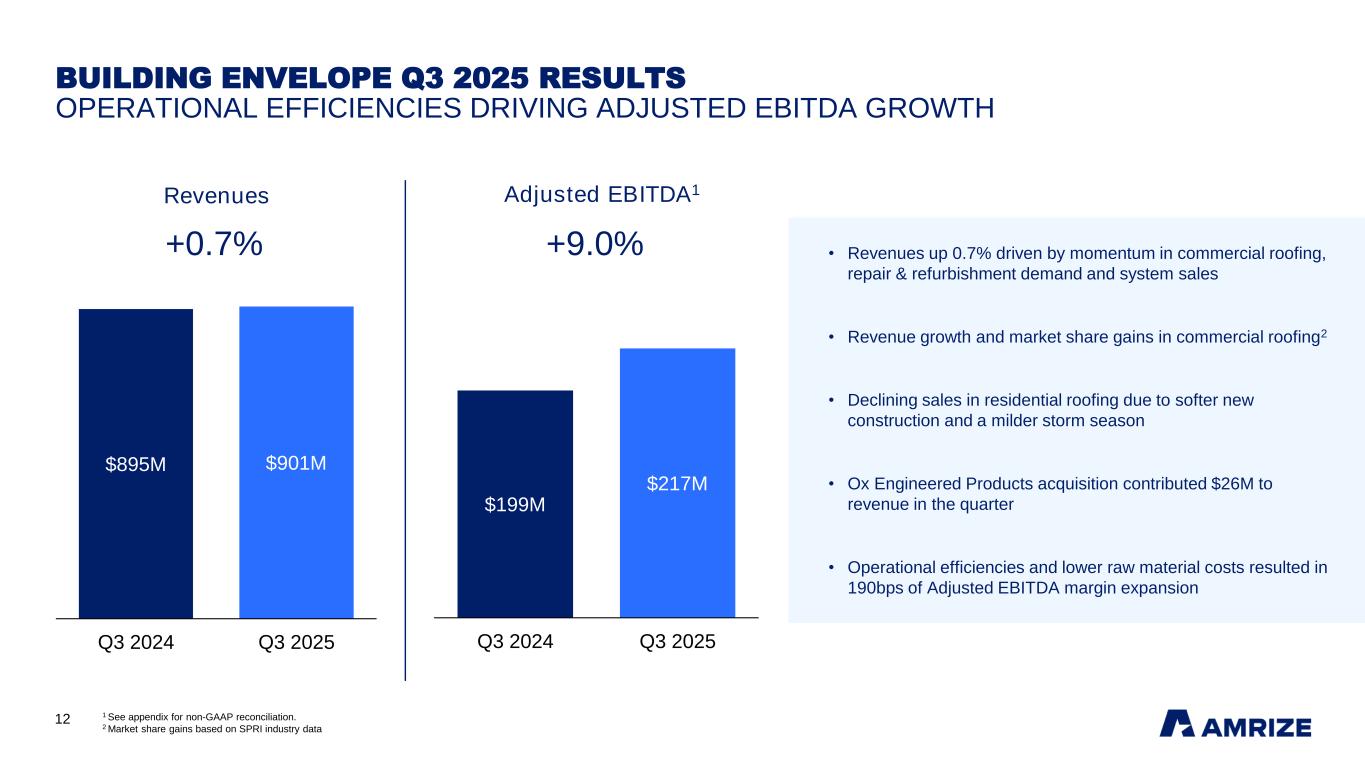
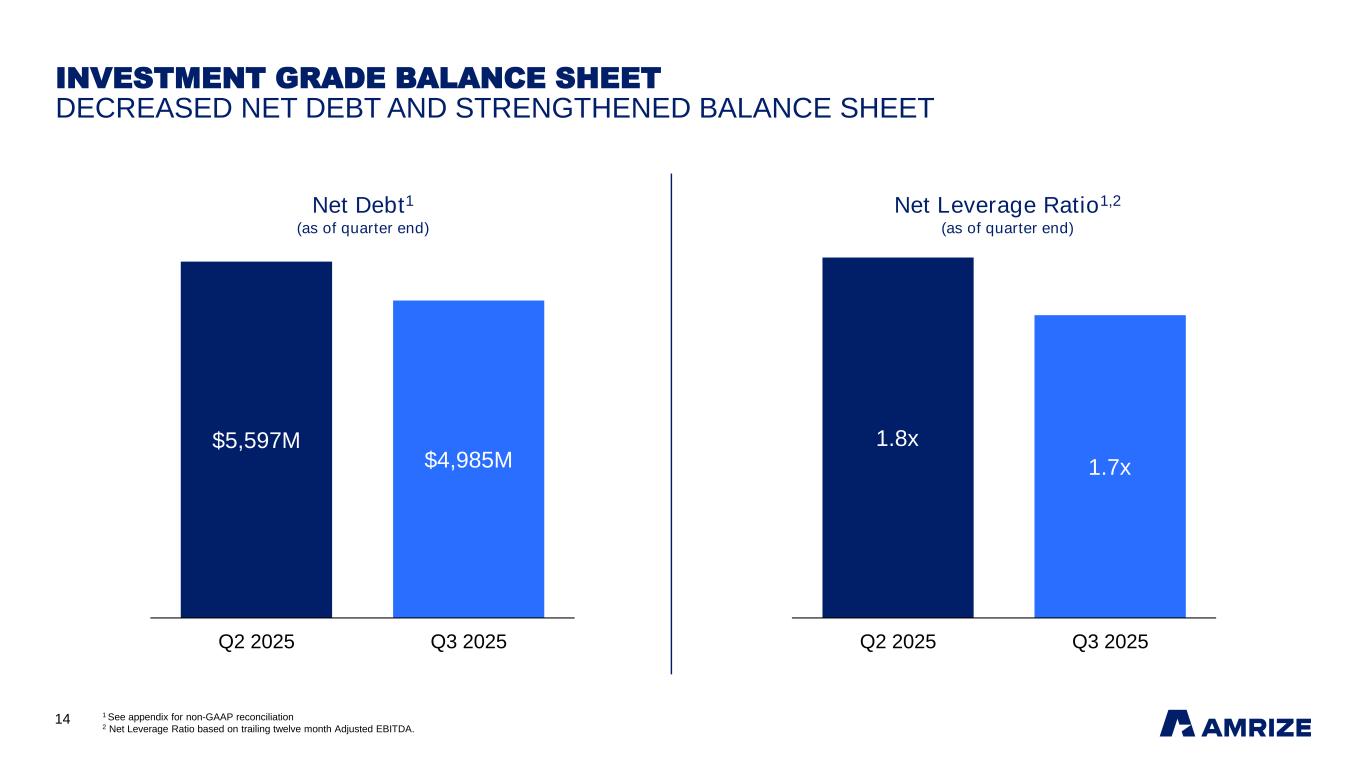
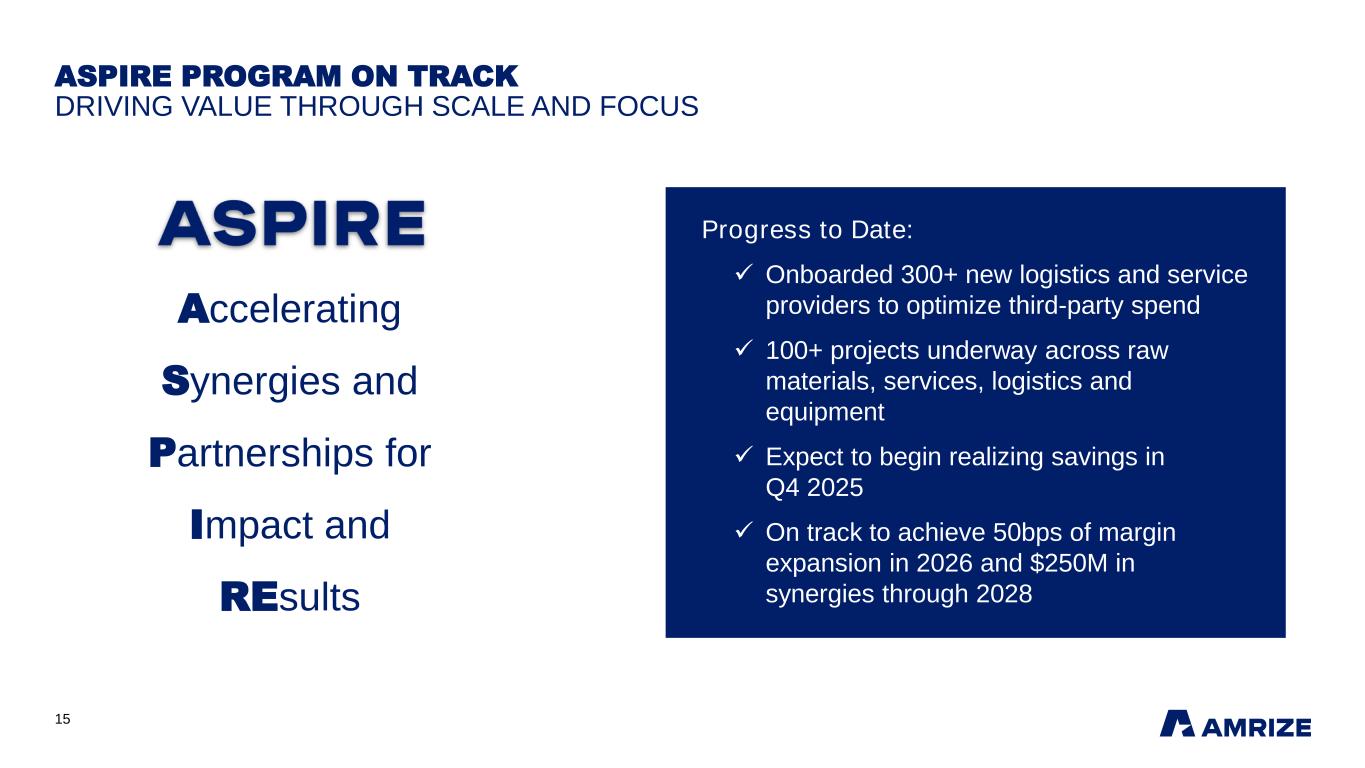
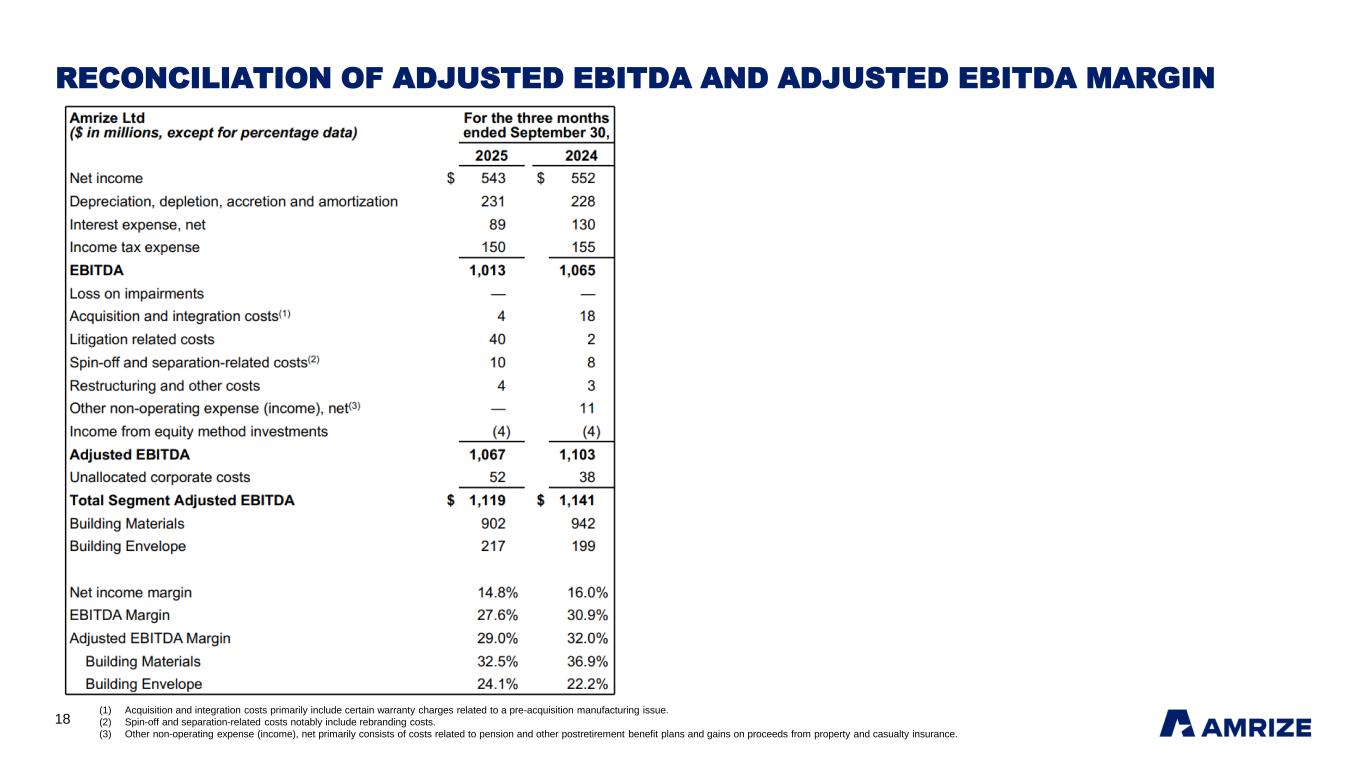
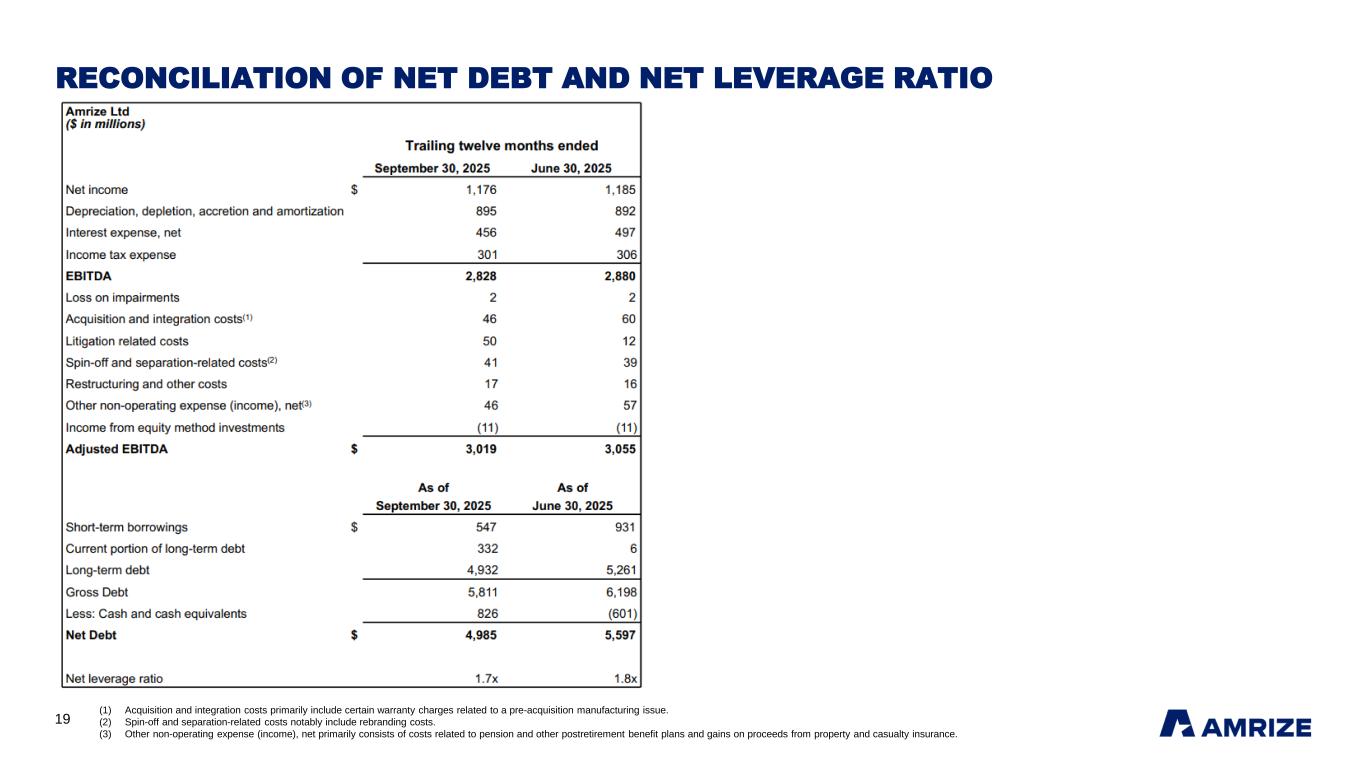
Thank you, Jan. I'll begin on Slide 11 with our results by segment, starting with Building Materials. Building Materials' third quarter revenue was approximately $2.8 billion, an increase of 8.7%. During the quarter, we saw strong volume growth in both our cement and aggregates businesses, with cement volumes increasing 6% and aggregates volumes increasing 3.3%. We continue to see new infrastructure projects breaking ground, along with spending on data centers and energy-related projects. While there is still some uncertainty in the market, conversations with our customers are encouraging, and our pipeline continues to grow. Cement pricing for the quarter was down 0.6%, while year-to-date, it remains up 0.6%. Over the last several years, we've seen consecutive cement gains, which are stabilizing this year with softer demand. We expect pricing to be flat on a full-year basis and anticipate pricing to improve in 2026 as demand increases. Total aggregates pricing, including distribution revenue, increased 10.1%. We continue to see healthy pricing growth in our aggregates business supported by strong market fundamentals and ongoing infrastructure demand. Adjusted EBITDA for the quarter was $902 million, and our adjusted EBITDA margin was 32.5%. The strong volume and aggregates pricing growth that I just spoke about were positive contributors to adjusted EBITDA in the quarter. These were offset by a temporary equipment outage in our cement network that lasted for several weeks during the quarter. With demand high, we leveraged the strength of our footprint and logistics network to move products from other plants to serve our customers. This resulted in approximately $50 million of higher manufacturing and distribution costs in the quarter, including the impact that lower production volumes had on fixed cost absorption. Through the combined efforts of our team, we were able to continue serving our customers without disruption. We have now completed the necessary repairs, and our plants are operating as normal. In the fourth quarter, we expect to recover some of this lost production. Additionally, during the third quarter of 2025, we recorded $4 million of asset gains as compared to $43 million in the third quarter of 2024. The prior year included a $31 million gain on an asset sale specifically related to one transaction in Canada. While asset sales are a routine part of our business, the specific transaction from last year was large, and we do not have a similarly sized transaction this year. Moving to our Building Envelope segment. Third quarter revenue was $901 million, an increase of 0.7% compared to the prior year. Commercial roofing revenue increased in the quarter, supported by repair and refurbishment activity and system sales. Residential volumes were down in the quarter due to soft new construction activity and a milder storm season. Based on recent industry data from SPRI, we outperformed the market in commercial roofing in the quarter. Our Elevate business is performing well, and our system offering continues to resonate with customers. Last November, we closed the OX Engineered Products acquisition, which contributed $26 million to revenue in the quarter. As a reminder, we will begin lapping the benefits of this acquisition in the fourth quarter. Adjusted EBITDA was $217 million, and our adjusted EBITDA margin was 24.1%, representing a margin increase of 190 basis points from the prior year. The increase in adjusted EBITDA was driven by several factors, including operational efficiencies, lower raw material costs, and higher residential shingles pricing. In the quarter, we saw improved operating performance in our Elevate business as the team executed well, driving efficiencies at the plant. Price over cost in the quarter was down slightly versus the prior year but improved sequentially versus the second quarter. That's favorable raw material costs and higher residential shingles pricing, partially offsetting lower pricing in our commercial roofing business. Our team continues to drive synergies and effectively manages our cost base, resulting in improved performance compared to the prior year. Moving to cash flow in the quarter, we generated $674 million of free cash flow, an increase of $221 million versus the third quarter of 2024. The increase was primarily driven by a net benefit in working capital. Taking a closer look at working capital, September was a strong revenue month, resulting in an increase in our accounts receivable and a modest use of cash; we expect to turn these into cash in the fourth quarter. In addition, as part of our Project ASPIRE, we are working on vendor payment terms to benefit cash in the quarter. We also reduced inventory levels as a result of higher demand and lower production volumes. Finally, the timing of cash tax payments was a small benefit to cash in the quarter. As a reminder, we typically generate the majority of cash flow in the second half of the year, with the fourth quarter being our highest cash flow quarter of the year. The fourth quarter of 2024 was an above-average cash flow quarter, and while we also expect strong cash flow in the fourth quarter this year, cash flow for the full year '25 is expected to be below 2024. This is primarily a result of lower net income on a full-year basis and higher CapEx spend as we continue to invest in organic growth opportunities across our network. Turning to Slide 14. During the third quarter, we successfully reduced our net debt and strengthened our balance sheet. Net debt at the end of the third quarter was approximately $5 billion, down $612 million from the end of the second quarter, and our net leverage ratio declined to under 1.7x, both benefiting from the strong cash flow we generated in the quarter. Our healthy balance sheet and investment-grade credit rating allow us to operate from a position of strength with the flexibility to pursue value-accretive acquisitions and allocate capital to growth projects. Lastly, I would like to provide a brief update on our ASPIRE program where we are leveraging our scale across 1,000 sites and 2 business segments to accelerate synergies. We made excellent progress in the third quarter. We have onboarded over 300 new logistics and service providers to optimize third-party spend, and we launched more than 100 projects to drive synergies across raw materials, services, logistics, and equipment. This continues to be a top priority for all our teams, and we expect to begin realizing savings from our ASPIRE program in the fourth quarter. We are on pace to deliver the full 50 basis points of margin expansion beginning in 2026. I'll now turn the call back over to Jan to discuss our 2025 guidance.
Speaker 2
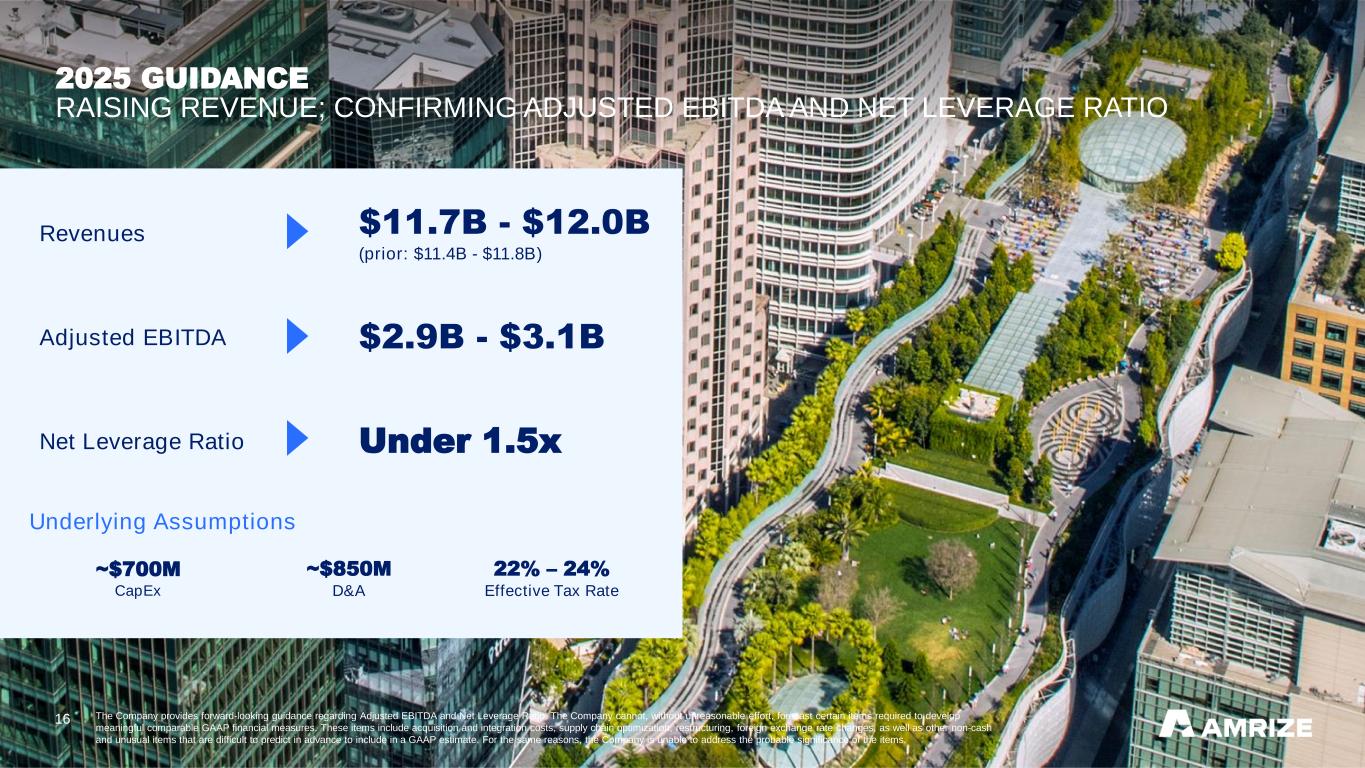
Yes. Thank you, Ian. When we look at our guidance, I think I'm satisfied with the good demand we saw with our customers in Q3, our first full quarter as Amrize, and we see markets now have begun to stabilize, and we see significant pent-up demand backed by long-term megatrends. There are some uncertainties remaining with our customers. However, we are cautiously optimistic about our demand momentum to continue from now on. Building on our third quarter revenue, we are raising our 2025 revenue guidance, and we are confirming our EBITDA and net leverage ratio guidance. So for the full year, we now expect revenues to be in the range of $11.7 billion to $12 billion, adjusted EBITDA to be in the range of $2.9 billion to $3.1 billion and we expect to finish the year with a net leverage ratio below 1.5x. With this, I think we will now begin the Q&A process, and I turn over to Scott.
Speaker 1
Thank you, operator. We're ready to begin a Q&A process. Can you please explain the instructions?
Operator
Our first question is from Keith Hughes from Truist.
Speaker 4
The midpoint of the guidance implies flattish year-over-year EBITDA, I believe. Could you talk about some of the puts and takes that could be coming in the fourth quarter? It does sound like cement is going to have some positive carryover, but there must be some other things going against you.
Speaker 2
We have a difficult time to understand the question. Would you mind repeating the question?
Speaker 4
Your guidance seems to imply for the fourth quarter around flattish at the midpoint EBITDA year-over-year. Could you talk about what will be the positives and negatives you expect in the fourth quarter?
Speaker 2
Thank you, Keith, for the question. We are very satisfied with the demand from our customers and the increasing number of projects we are delivering, and we are pleased with the 6.6% sales growth in Q3. Looking ahead, it's a bit challenging to provide guidance for Q4 due to some uncertainties among our customers regarding tariff policies and future interest rates. As you know, we conduct about half of our business in the commercial market segment. We have not experienced any project cancellations, but there are still a significant number of projects on hold that we believe will commence as soon as the market environment stabilizes. Therefore, it is difficult for us to forecast Q4. While we remain optimistic for the long term, Q4 is uncertain. This is why we provided cautious guidance to ensure we meet our commitments.
Speaker 4
Okay. Just one final thing. It does appear from your previous comments that the production issues you had in cement, those are fixed and will not play a negative role in the fourth quarter. Is that correct?
Speaker 2
Yes. We are happy with our operational performance. It's basically for two items. We have this land sale in Q3 last year, and then we have this production outage, which is resolved. So we're looking forward to having solid margins in Q4 and in the coming quarters.
Operator
Our next question is from Anthony Pettinari from Cementir Holding.
Speaker 5
Good morning. I'm wondering if you could talk about cement market dynamics in a little bit more detail. And specifically, in terms of the confidence and potential price improvement in 2026, are you seeing specific things in your backlogs or the market or import dynamics that would give you kind of confidence in pricing momentum in '26? And as a follow-up, I'm just wondering if you could talk a little bit more about Ste. Genevieve in terms of the ramp-up and how that's going.
Speaker 2
We have come from a challenging couple of years with lower demand for cement, which impacted our pricing. However, given the circumstances, we have maintained almost stable cement prices this year, which is a commendable achievement. We believe that this trend will change next year. The volume growth we are currently seeing in cement is expected to continue, leading to healthy pricing dynamics, particularly in our inland markets, and we feel well-prepared to take advantage of this opportunity. We have also made targeted investments, such as the fifth mill in Ste. Genevieve, aimed at increasing our production and efficiency, which is on track to deliver its first output that we will start selling next month, in November.
Operator
Our next question is from Timna Tanners from Wells Fargo. Please go ahead.
Speaker 6
Okay. Great. Just wanted to follow up on the cement question and ask about pricing and if you're seeing any impact from imports. So we've been hearing that there may be some price hikes announced, and if you're seeing the impact from the tariffs reducing competitiveness of some of those overseas tons.
Speaker 2
So in principle, our customers largely recognize the value of a local producer like Amrize, providing consistent high-quality products, local service, and full reliability of supply chain and logistics. In addition, our inland footprint in the hard end markets will make us very strong going forward. I think there's a lot of information at the moment in the market about price increases, about increasing import costs from tariffs, and so on. I prefer not to comment on this. We're going to focus on ourselves, and we believe we have the right action plan in place to improve pricing for next year.
Operator
Our next question is from Pujarini Ghosh from Bernstein.
Speaker 7
So on the building products side, could you provide some color on the volume and pricing that you saw in Q3 and specifically commenting around the market share gains that you were referring to on the commercial side? Also, could you give some color around the 190 basis points of margin expansion we saw seems to be in sharp contrast with what some of your peers have been saying. So how are you getting this margin expansion?
Speaker 2
Yes. Thank you for the question. First of all, we're very happy we had a good commercial roofing business in Q3, with increasing volumes but also with market share gains. So very happy to report that we have been very successful here with our customers to provide our systems with all the different membranes we are offering. In contrast to this, the shingle market is difficult. I think we shared the information with you. We have a very soft new construction market in residential. Also, we see a softer storm season or something. So residential is a bit challenged. But overall, I think we have flat sales, which I think is quite a success in this market. I'm especially pleased with the market share gains for commercial roofing. On the operational efficiencies, I am very happy that our teams put all the plants in excellent condition. You sometimes have hiccups. We have around 40 manufacturing facilities in Building Envelope, and we had a few we were working on over the last 12 months or so, and this all comes now to very positive results basically with lowered cost, leading to significant increases in our EBITDA margin of 190 basis points.
Operator
Our next question is from Cedar Ekblom from Morgan Stanley.
Speaker 8
I just wanted to ask a question on the commercial landscape as it relates to your Building Envelope and roofing business. We've obviously seen quite a lot of change in the distributor channel. We've had a lot of assets change hands, SRAs going to Home Depot and obviously a new entrant in QXO acquiring Beacon. I'd like to hear how you are seeing this play out for your business because there does seem to be at least some commentary from the distribution players that there might be a desire to be a little bit more aggressive on pricing with their OEM suppliers. Are you seeing that in the market at all? How would you respond to one of your distributors looking to sort of negotiate price and then linked question, can you comment on some of the new entrants actually on the sort of manufacturing side of things, if you have a perspective on, for example, Kingspan looking to add capacity?
Speaker 2
All right. Cedar, thank you for the questions. First of all, we are not in competition with any distributor; we are partnering with distributors to make our products efficiently available for all the roofing jobs. You can see in our Q3 results that obviously, we don't see any impact from any consolidation in the distribution space. It's important to note that all our efforts in building envelope and in roofing systems are to provide the best, most innovative systems for our customers, which are the building owners, specifiers, and roofing contractors. We're focusing on making the best possible roofs and efficiently installing roofs. This is all our focus, and this is underpinned by our strong branding. We do this with our innovation; we do this with our workforce for specification of roofing, inspecting roofs, and then providing warranty for the roofs. As for the question regarding new entrants in the roofing market, we haven't seen new greenfield roofing businesses in the U.S. for many years, and it's challenging to start one now. We are focusing on some of our other peers as we compete for nationwide distribution, that's our focus. We see any impact from new entrants very limited; we rather see roofing going towards more consolidation.
Operator
Our next question is from Adrian Huerta from JPMorgan.
Speaker 9
Jan, if you can share with us how you see the M&A environment over the next 12 months and potential opportunities within the different segments that you're in. Do you think there will be opportunities for Amrize to expand through M&A over the next 12 months?
Speaker 2
Adrian, yes, look, we made it clear that part of our strategy is, of course, organic growth. We believe we will invest more into the business compared to recent years. In addition, we are very open to M&A. Amrize's story has been very much driven by M&A as well. I think we have a healthy pipeline of targets and projects, and hopefully, we will have some news for you in the months to come.
Operator
Our next question is from Yassine Touahri from On Field Research.
Speaker 10
Just a short follow-up on the volume in the fourth quarter. Do you have any view on what's happening in the cement business in October? Additionally, regarding strategy, when you look at your Building Envelope business, it's mostly roofing, but you call that Building Envelope. In your Form 10, you mentioned wall solutions. How do you think about the business in the next 5 to 10 years? Do you see any opportunity in the next 12 to 24 months to do a big platform deal? If you see an attractive platform deal to complete this business line, what kind of maximum leverage would you be happy to go to in terms of net debt to EBITDA?
Speaker 2
Good question. Look, first of all, to your pricing and volume question, I think the cement and aggregates pricing is set for the remainder of 2025, and we shifted our focus for pricing for next year. For the fourth quarter, we expect cement pricing to continue as we have seen it in Q3, but also then our strong aggregates pricing up 10%. We also expect this to continue into the fourth quarter. Demand is good in Q3. We have to note that our customers still have certain uncertainties regarding tariffs and interest rates. But besides that, we believe a strong underlying demand makes it a bit more difficult to really guide Q4. However, we are optimistic for next year. Regarding Building Envelope, we call it Building Envelope instead of roofing systems as it gives us more opportunities into the future to expand into complementary applications and technologies. But I told my teams to focus on our core businesses now, as we have a $200 billion addressable market in front of us. We don't need to enter new segments to grow Amrize; we believe we have plenty of opportunities to grow. The Envelope gives us a little extra vision and strategy for the years to come.
Speaker 10
In terms of leverage, what's the maximum leverage that you would be happy to go to if you see an attractive platform deal?
Speaker 2
Look, we are happy to have the balance sheet we have. We made further progress now in Q3. We are very happy to close the year strong in our balance sheet, as guided. If we have attractive M&A transactions, you remember we have an excellent track record of value-accretive deals, we can go well above our current leverage. It's important to always have a clear plan to further reduce leverage.
Operator
Our next question is from Tom Zhang from Barclays.
Speaker 11
Just housekeeping ones for me at this stage. Could you give a little color around the litigation, the $40 million that is not in the adjusted EBITDA? Could you give us a bit of background on what that is about and which division it was booked in? And then also just on the guided corporate costs, I see it's come in quite a bit below the $75 million to $80 million number that you spoke about at the Q2 prints. Any color on why that's better? Is $75 million to $80 million the right number into Q4? Is there a bit of catch-up? Just a bit of help there for the modeling.
Sure. Tom, thanks for the question. Just to begin with the litigation, we're quite happy with the outcome of the quarter; we were able to reach a final settlement on several long-standing commercial litigation items. As you would expect, we cannot provide details related to specific litigation items, but we're quite happy with the conclusion on those particular matters. Regarding the corporate costs, we did guide at a little bit higher range. We think we're making good progress. This was our first quarter as a fully independent Amrize. We're pleased with our numbers coming in below expectations. We had some delays in terms of our assumptions on staffing and so forth, so it was a good outcome, and we think we'll continue to refine that as we go forward.
Speaker 11
Okay. Maybe just to confirm, sorry, on the litigation that it wasn't sort of one major case. There were a few different outcomes. It's sort of spread across different segments. It's not like all in Building Envelope or in Building Materials.
That's correct. There were some long-standing items that we were able to resolve in the quarter as conclusive, and it was a quite good outcome from our perspective.
Operator
Our next question is from Martin Hüsler from ZKB. Please go ahead, Martin.
Speaker 12
Yes. I hope you can hear me. I have a question. Can you give us a bit more background on the nature of this outage you were mentioning, if this was maintenance driven or just about when and where this happened?
Thanks, Martin, for the question. Yes, it happened in our Mountain region. It was a temporary equipment outage. We were down for approximately 6 weeks to repair the equipment, which resulted in reduced production. We also had increased distribution costs. The challenge here is that it was very temporary in nature. However, given our extensive footprint and our network, we were able to leverage other opportunities to be able to supply and keep our customers satisfied. We were able to move products into the market and meet the demand that was there. The equipment at the plant was repaired. The plant is now operating within normal parameters, and we expect to recover some of this production in the fourth quarter.
Speaker 12
That's helpful. And then maybe on volumes, because you had such stellar growth in cement. However, pricing was down. I just want to double-check if you think that's kind of are you chasing volumes and maybe giving some price rebates? Or is this a different function there?
Speaker 2
Martin, no, we didn't really do this. I think we just had our customers starting more projects as reported, especially in our most important market segment of commercial projects. So, very happy to see that. The demand was not driven by us making any concessions on pricing. You will probably see that we probably had the best pricing or we're going to be among the best pricing this year. This is something we couldn't change within the Q3 time span, so it makes us confident for the future.
Operator
Our next question is from Juilan Radlinger from UBS.
Speaker 13
Two for me, please. First of all, in building envelope, can you talk about what drove the positive pricing in residential shingles when volumes were negative? Was that both a year-on-year and a sequential comment on pricing, i.e., is pricing holding up? Or is it declining in line with the residential and reroofing weakness? That's number one. And then number two, in Building Materials, obviously, your volumes were very strong in Q3, and now based on your guidance for Q4, you're guiding to lower sales growth in Q4 than what we saw in Q3 implied. I remember that Q3 last year was a very wet quarter for the industry in some states. Is it fair to say that easy comps played some role in the strength in cement and aggregates volumes in Q3, and Q4 will be a bit tougher just on a comps basis? Or is that something we shouldn't be thinking about?
Speaker 2
No, I think we shouldn't speculate about this at this point. As we talked about before, it's just difficult to guide now. We are happy with the project starts of our customers in Q3, and we believe this will continue from here. However, there are still uncertainties in the market, which makes it difficult to predict. So just take our guidance as tentative guidance now for Q4. Regarding the pricing side, I think we took a good step on the pricing on the shingles. This is something we did early in the year, and this has continued successfully despite the decline in volumes in the market.
Operator
Our next question is from Will James from Redburn.
Speaker 14
Please could I just explore a little bit more on the confidence around pricing for next year in Building Materials? I guess on the cement side, just wondering your view on the extent to which it would rely on volumes being up next year? Or do you think price could make some progress even if volumes were flat? And then in aggregates, would you be willing to offer a view on what you might achieve potentially next year? Could it be another kind of mid- to high single-digit year on price?
Speaker 2
I think it's the wrong time now to talk specifics about next year guidance. I think you should recognize that we provided already a lot of comments on market dynamics and on our action plan to position ourselves well for next year; I don't want to give any more guidance regarding volume or pricing. We've discussed this quite extensively.
Speaker 14
Okay. I might just ask a different one then, please, which is just around your kind of demand views and whether there's any difference between how you see Canada and the U.S. in the mix?
Speaker 2
No, we're seeing good progress in Q3 in Canada and also in the U.S.
Operator
Our next question is from Glynis Johnson from Jefferies.
Speaker 15
Just a follow-up on the ASPIRE program because obviously you saw margin improvements coming through on the Envelope side, and you have reported lower nonallocated costs as well. I'm wondering how much of that actually is part of the ASPIRE program? Or is everything for ASPIRE going to come from sort of the Q4 onwards?
Yes. Thanks for the question. We do reference a little bit in the presentation deck. For instance, we had over 300 suppliers added to our portfolio. We have over 100 projects that have been kicked off, and we expect to have some positive impact in our fourth quarter, but really all of this will begin to materialize into the 2026 season. We're on pace for our 50 points of margin expansion beginning in 2026. We had several actions within the quarter. We're quite happy with the way things are progressing, and we think that will continue into the fourth quarter.
Speaker 15
Okay. But there was nothing in Q3 in terms of the margin expansion or the lower corporate costs that you would say is part of ASPIRE?
No. Very limited. Q3, we began this project in late April, early May. That's continuing. We have our teams mobilized. There's several hundred projects underway, but very limited in Q3.
Operator
Our next question is from Arnaud Lehmann from Bank of America.
Speaker 16
Just to confirm one thing on capital allocation. Can you confirm that you've not done any buybacks so far? Is share buyback something that could be possible in 2026? Also, just in terms of the idea of the model, you guide for D&A depreciation of $850 million, but the run rate is probably a bit closer to $900 million for the full year. Is there any reason why depreciation will be smaller in Q4?
Arnaud, regarding the buyback and dividends, those are policy questions that we still have to work through the Board; that would come up in early 2026. We haven't provided a framework for that yet, but that will be coming in due course once we have alignment with the Board. Regarding the D&A, thank you for the question. We do expect a little bit of reduction in the fourth quarter, where traditional equipment will phase off in terms of their depreciation expense. That should help us into the fourth quarter.
Operator
Our last question is from Pujarini Ghosh.
Speaker 7
One follow-up on the Building Materials margins. On the face of it, we saw a sharp decline in the margin on the Building Material side. Even if we adjust for the one-off outage this year and the higher land sales proceeds last year, we still see around 100 basis points of decrease in the margin. What is causing this decrease? Do you expect to recover this maybe next year?
Obviously, we outlined in the presentation the biggest factor being the plant outage that we had, which cost us approximately $50 million. There was also a significant variance in asset sales year-over-year with the prior year including $31 million from one particular transaction in Canada. Additionally, there was a decline in pricing in cement, which had a negative impact, along with some cost inflation. However, we do expect to recover some of that production volume going into the fourth quarter, which should help lift margins a little bit. All of that temporary nature of the shutdown issues is behind us.
Speaker 7
So in terms of price cost, would you say there’s more negative than the 0.6% pricing decrease in cement?
Price cost in cement was negative, that's correct, because of those temporary cost increases in our Mountain region.
Operator
Thank you. We have no further questions at this time. I will turn the call back over to Scott Einberger, Investor Relations Officer, for closing remarks.
Speaker 1
Thank you all for joining us today for our third quarter earnings call. We look forward to speaking with you in February for our fourth quarter call. Have a nice day.