Operator
Greetings. Welcome to Amerant's Second Quarter 2025 Earnings Conference Call. Please note, this conference is being recorded. I will now turn the conference over to Laura Rossi, SVP, Head of Investor Relations.
Thank you, Darryl. Good morning, everyone, and thank you for joining us to review Amerant Bancorp's Second Quarter 2025 Results. On today's call are Jerry Plush, Chairman and CEO; and Sharymar Calderon, Senior Executive Vice President and CFO. As we begin, please note that discussions on today's call contain forward-looking statements within the meaning of the Securities Exchange Act. In addition, references will also be made to non-GAAP financial measures. Please refer to the company's earnings release for a statement regarding forward-looking statements as well as for information and reconciliation of non-GAAP financial measures to GAAP measures. I will now turn it over to our Chairman and CEO, Jerry Plush.
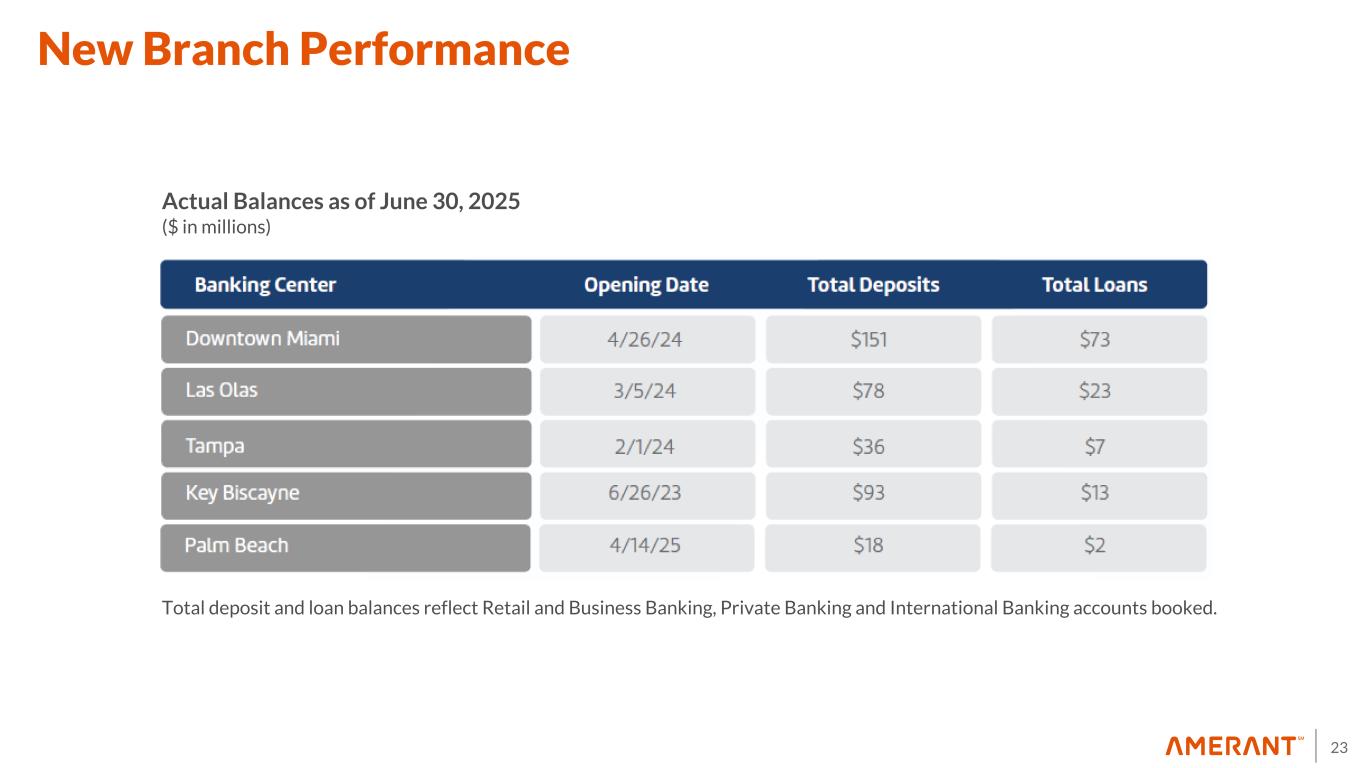
Thank you, Laura, and good morning, everyone, and thank you for joining us today to discuss Amerant's second quarter 2025 results. You will notice we continue to evolve our approach to these calls, including refining the slides we will cover today. So, Shary is going to take the lead in commenting on results and asset quality, and I'll wrap up our prepared remarks with some strategic updates in order to allow ample time for Q&A. As I noted in our press release, we are pleased to be reporting improved results this quarter, which were driven by higher core pre-provision net revenue, along with a lower provision for credit losses. A lot of time and effort this quarter was focused on asset quality, and that will continue to be the top priority for us. Loan growth in Q2 was offset by payoffs and paydowns and the number of deals we closed in Q2 have yet to fund. We saw solid customer deposit growth in light of stiff competition for market share, which we utilized to grow our investment portfolio this quarter. Our new banking centers continue to grow nicely, and we've included the details by banking center in the supplemental slides. And we continue to selectively add key personnel to our team, which I'll comment on later in this presentation. So, with that, let me turn it over to Shary now to cover Q2 results in detail.
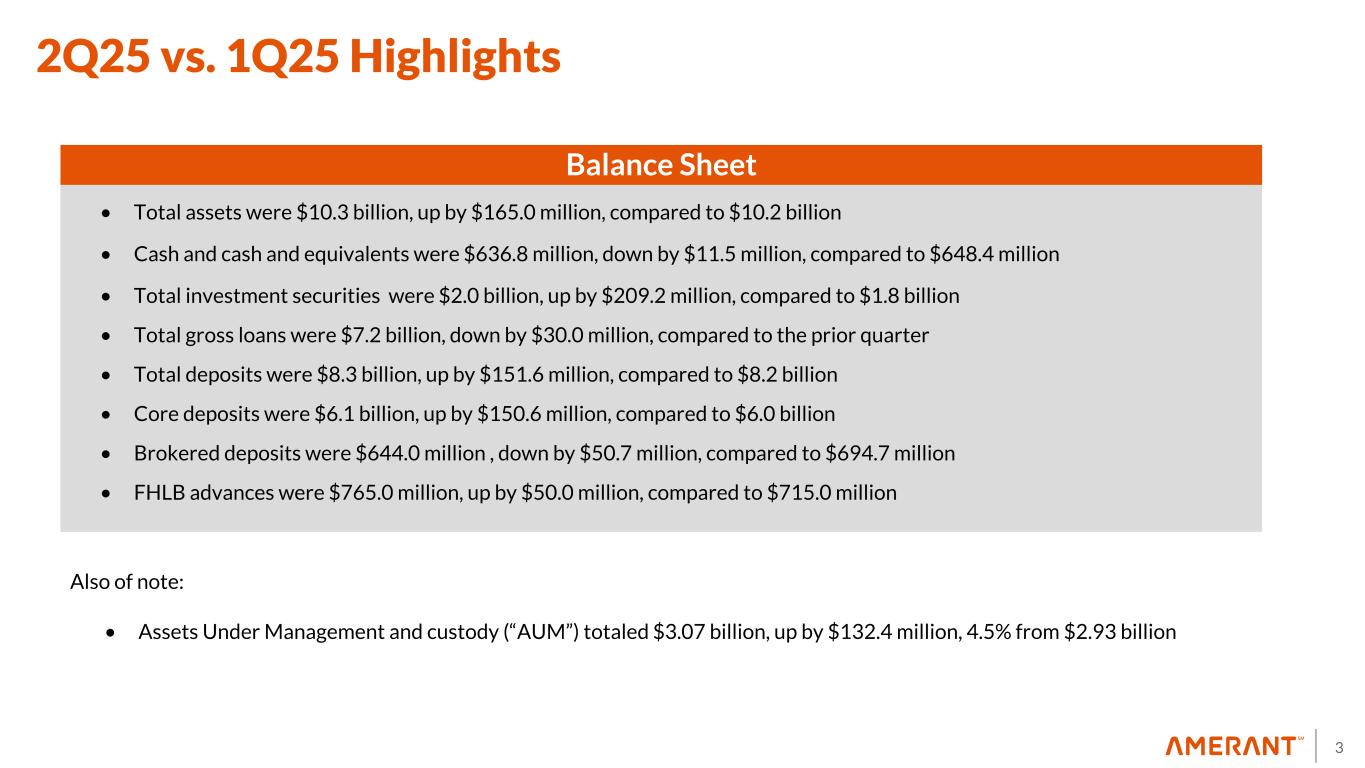
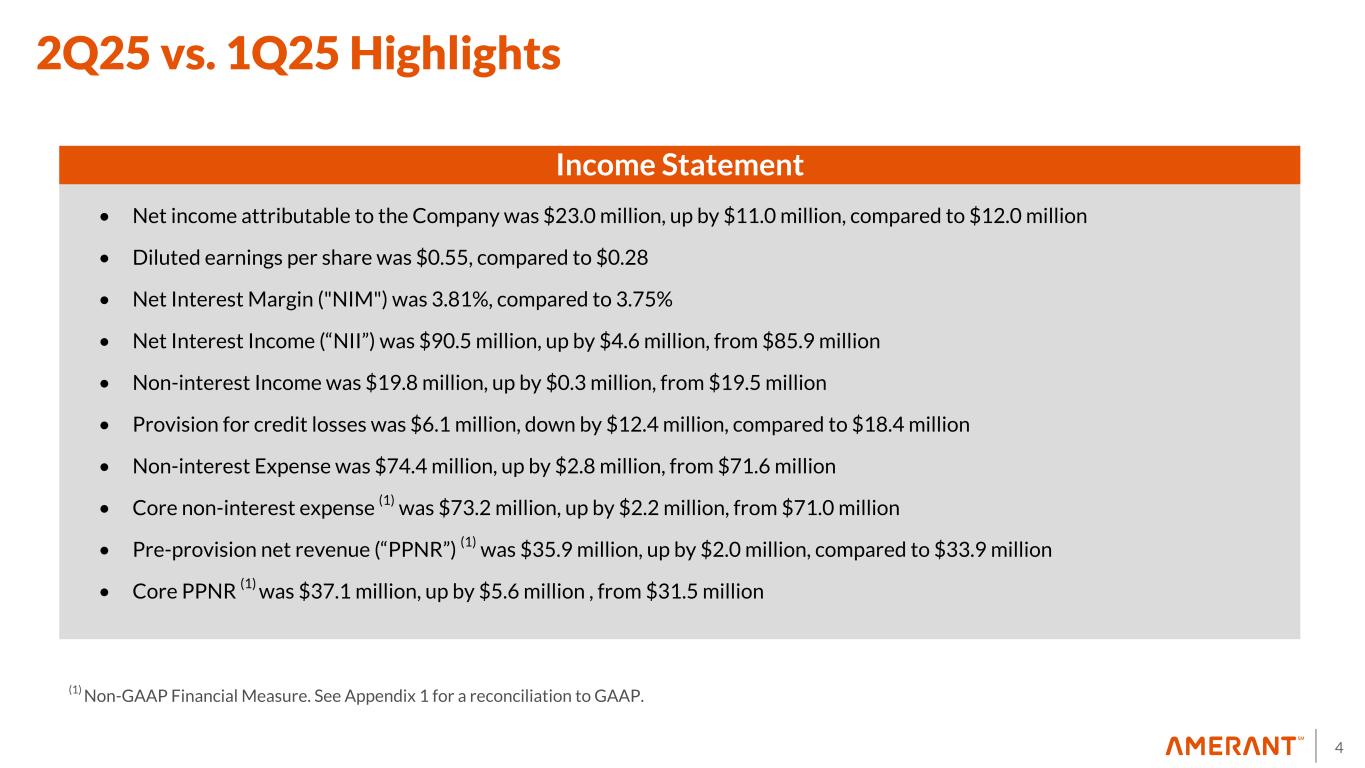
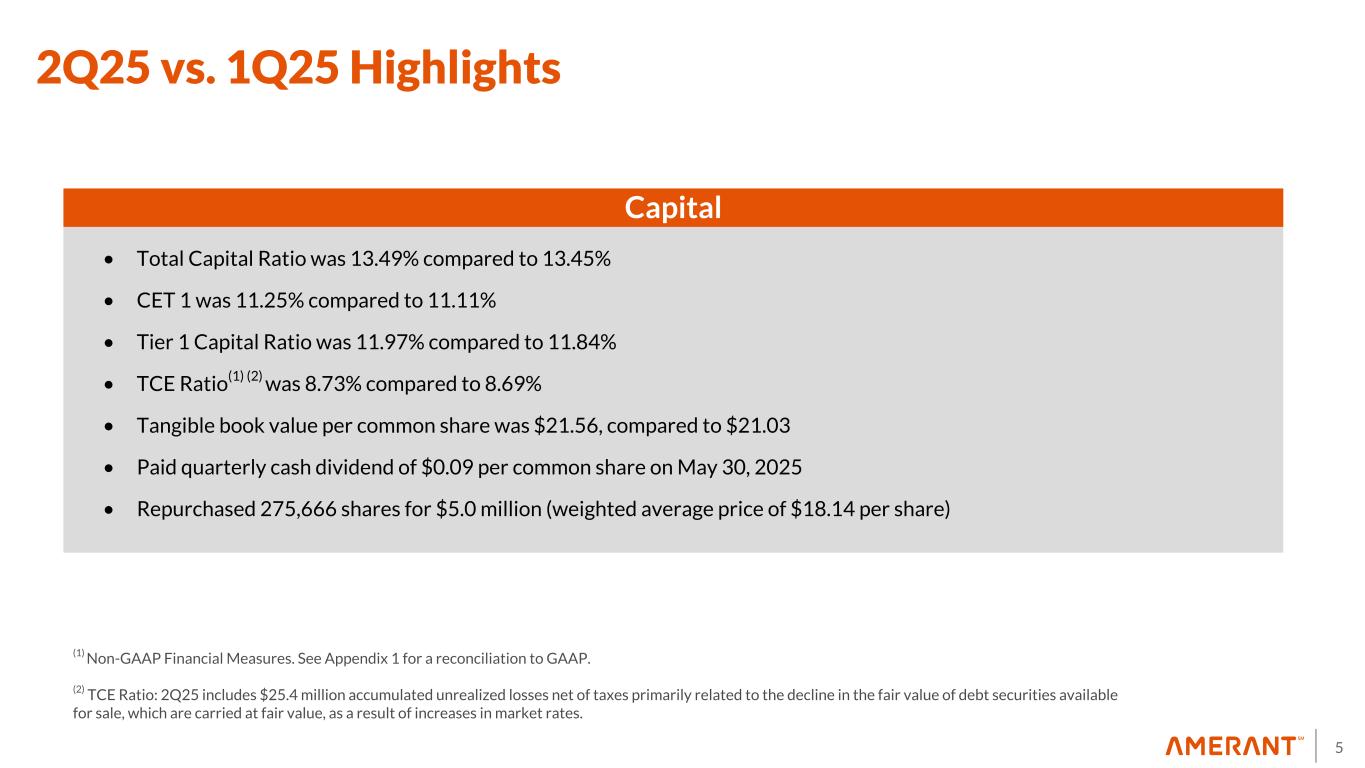
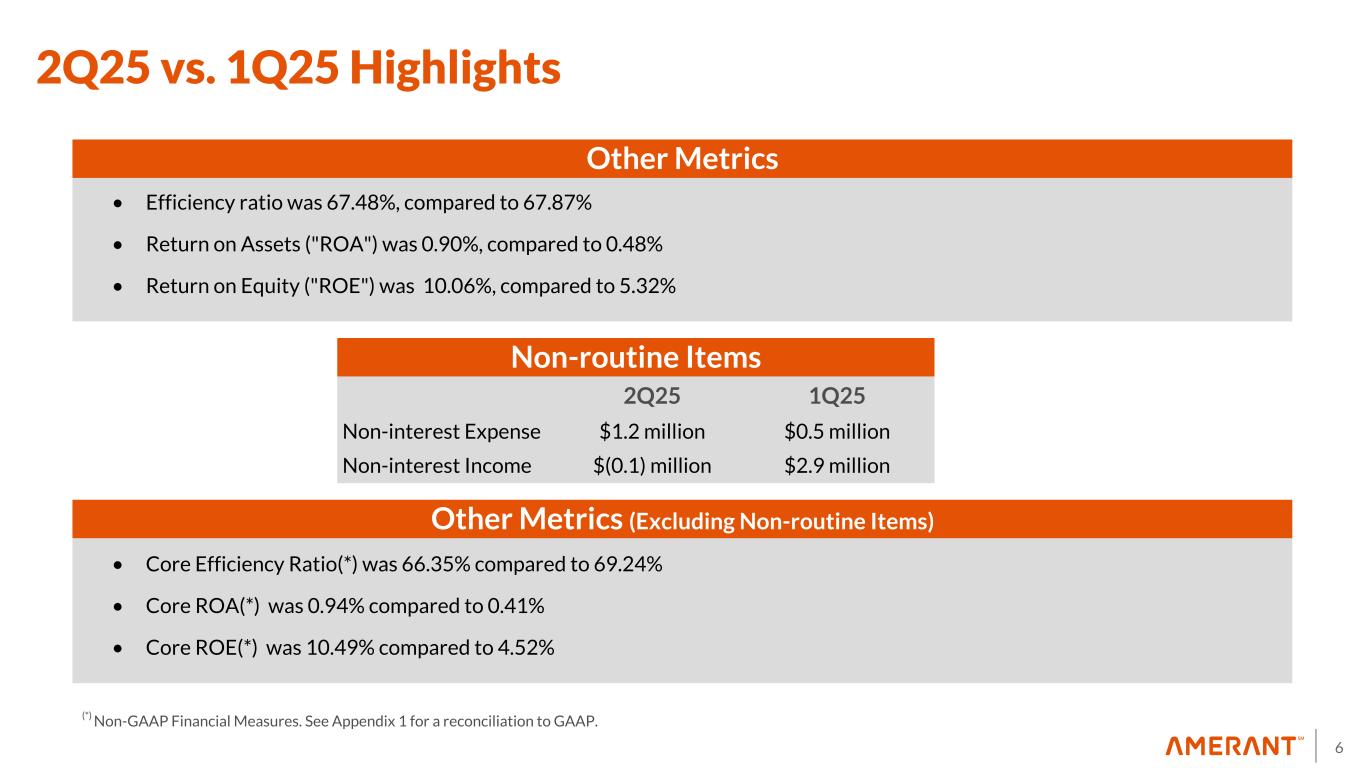
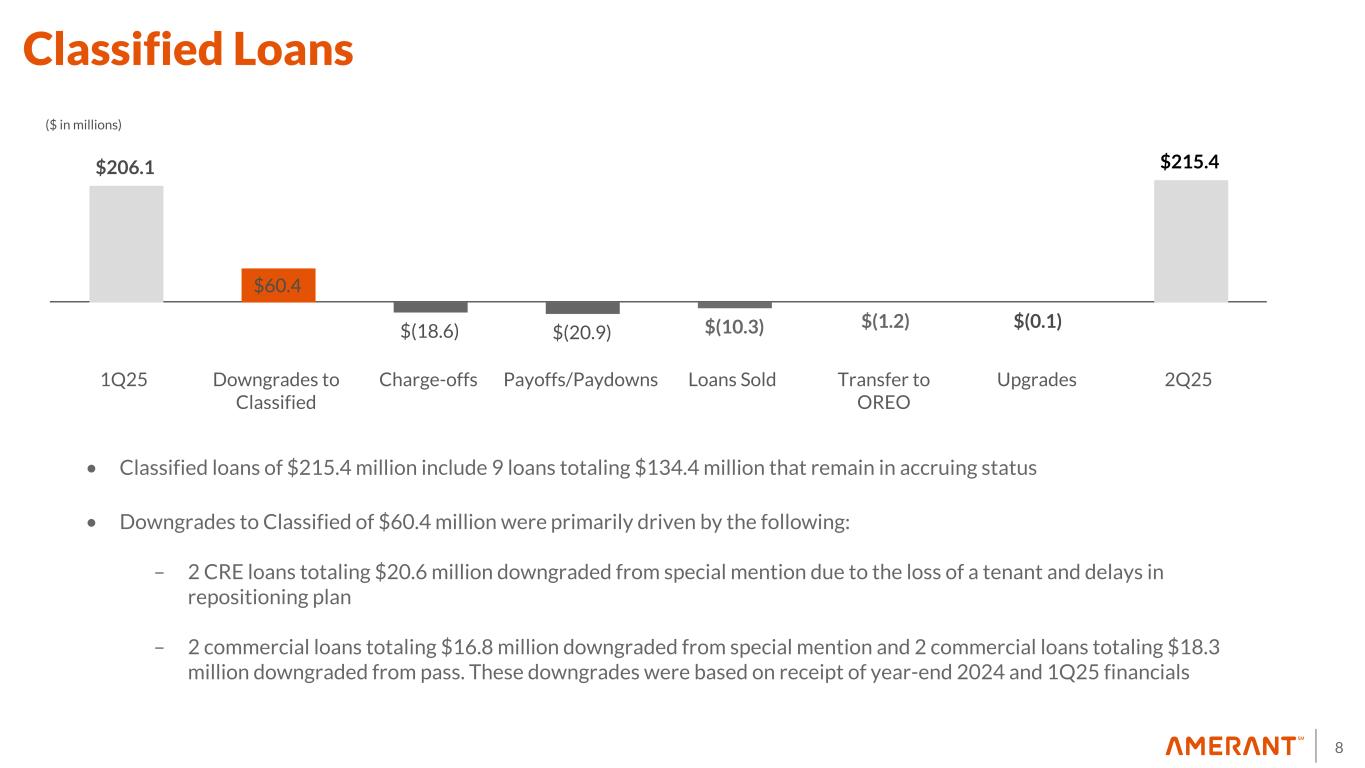
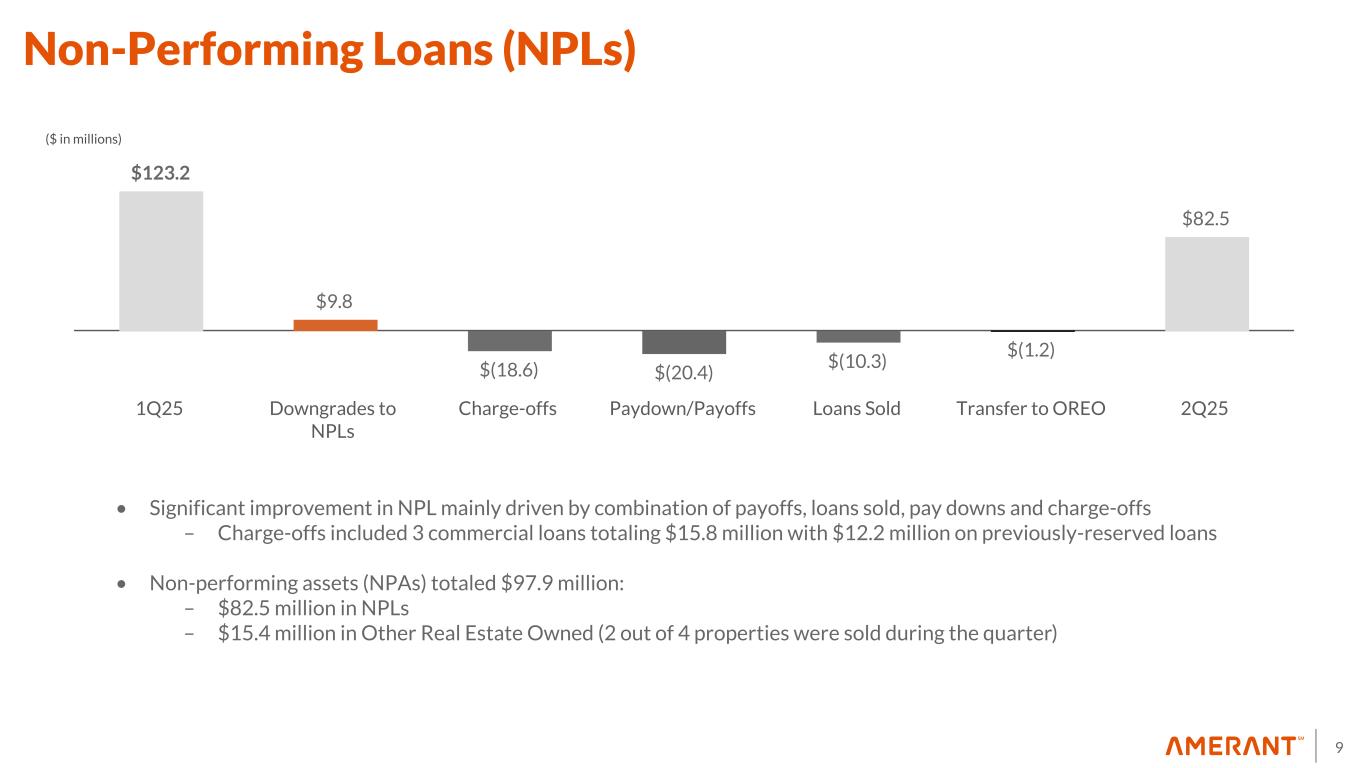
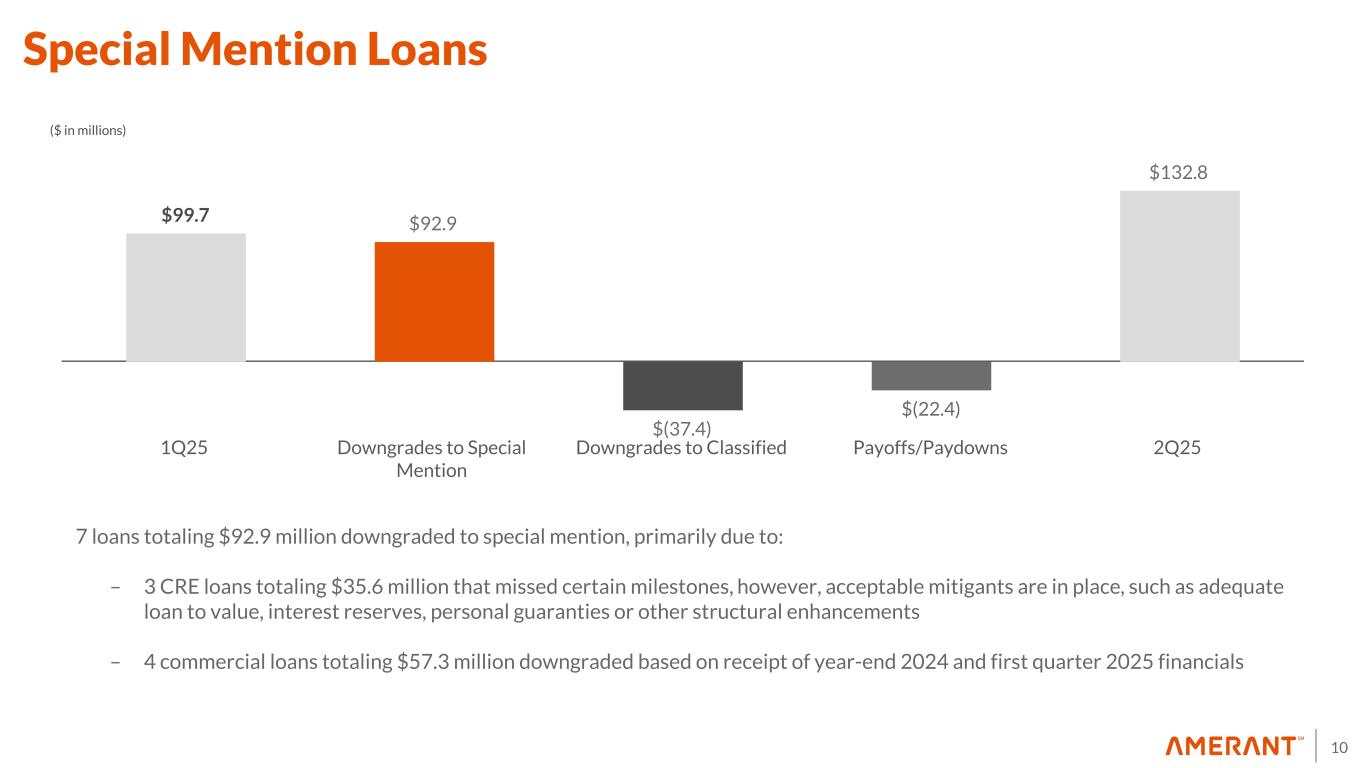
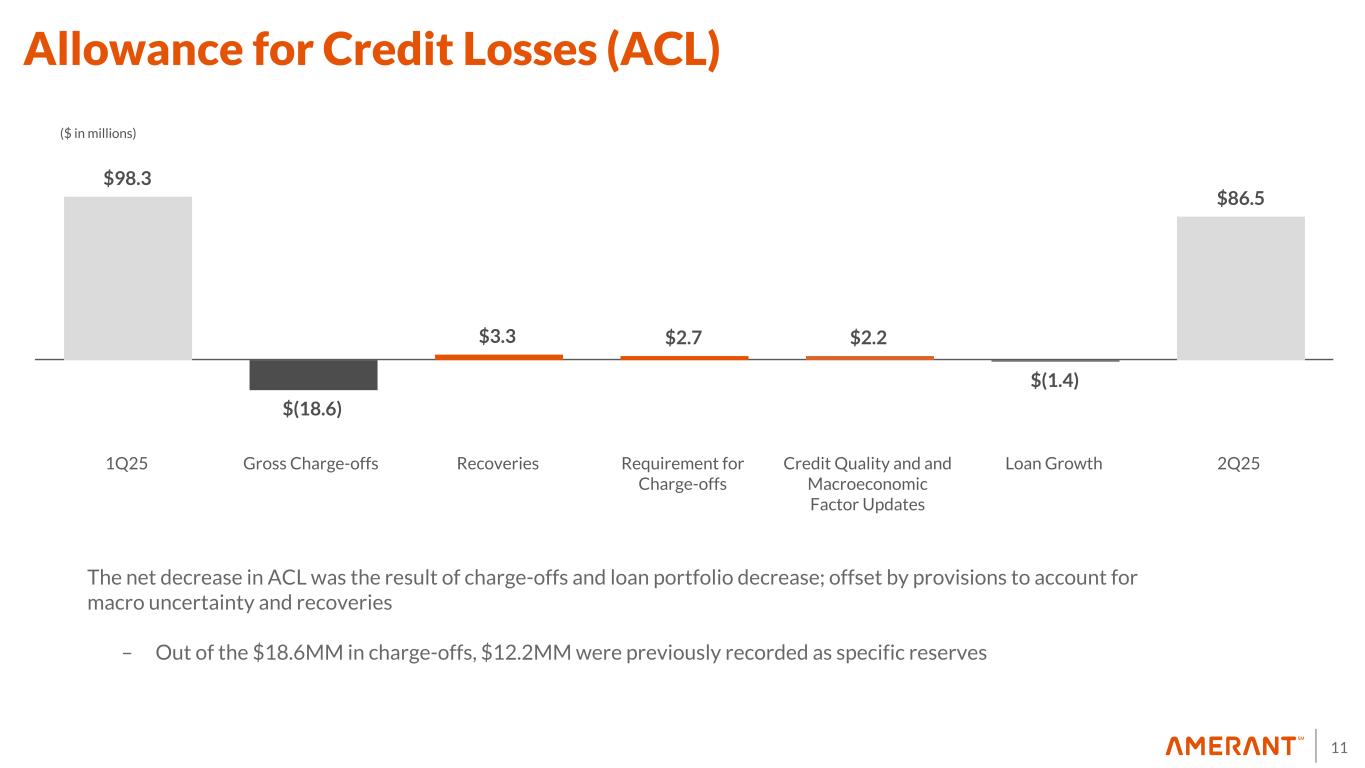
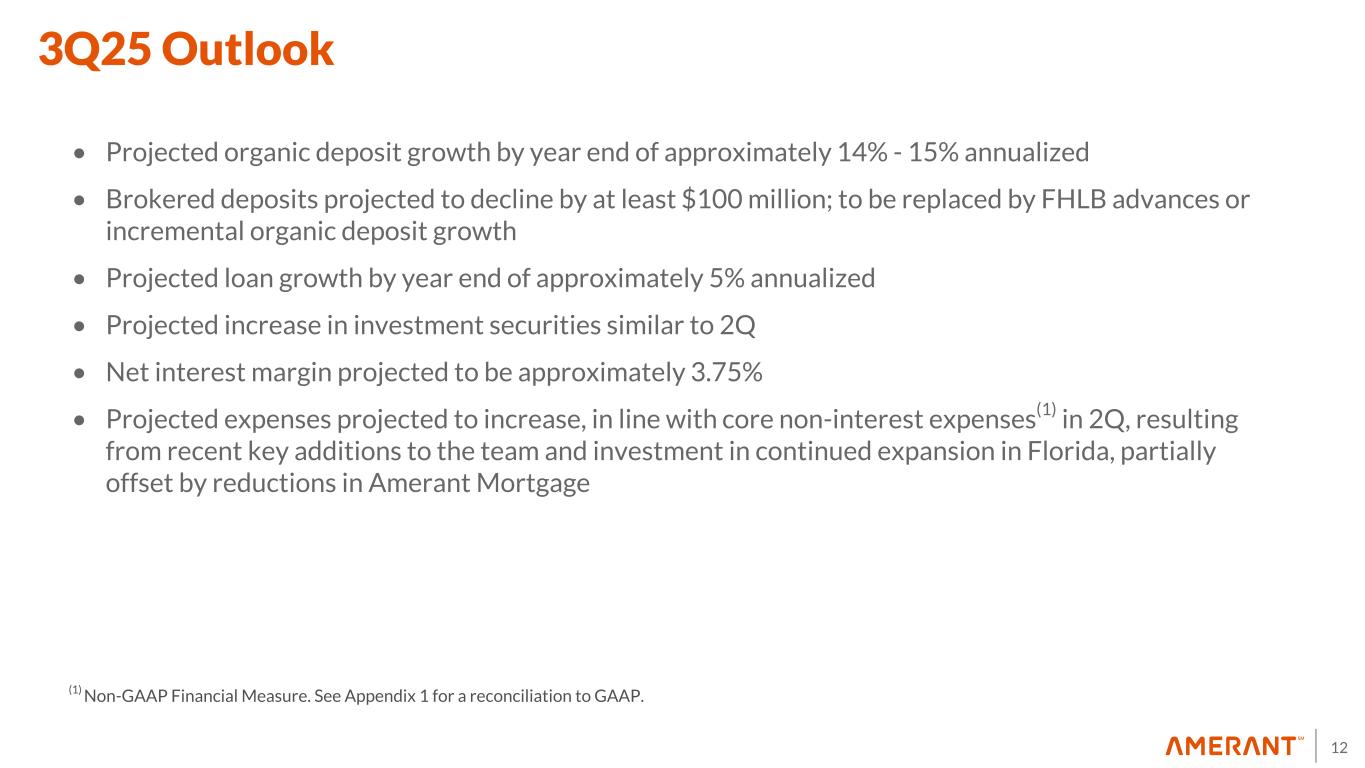
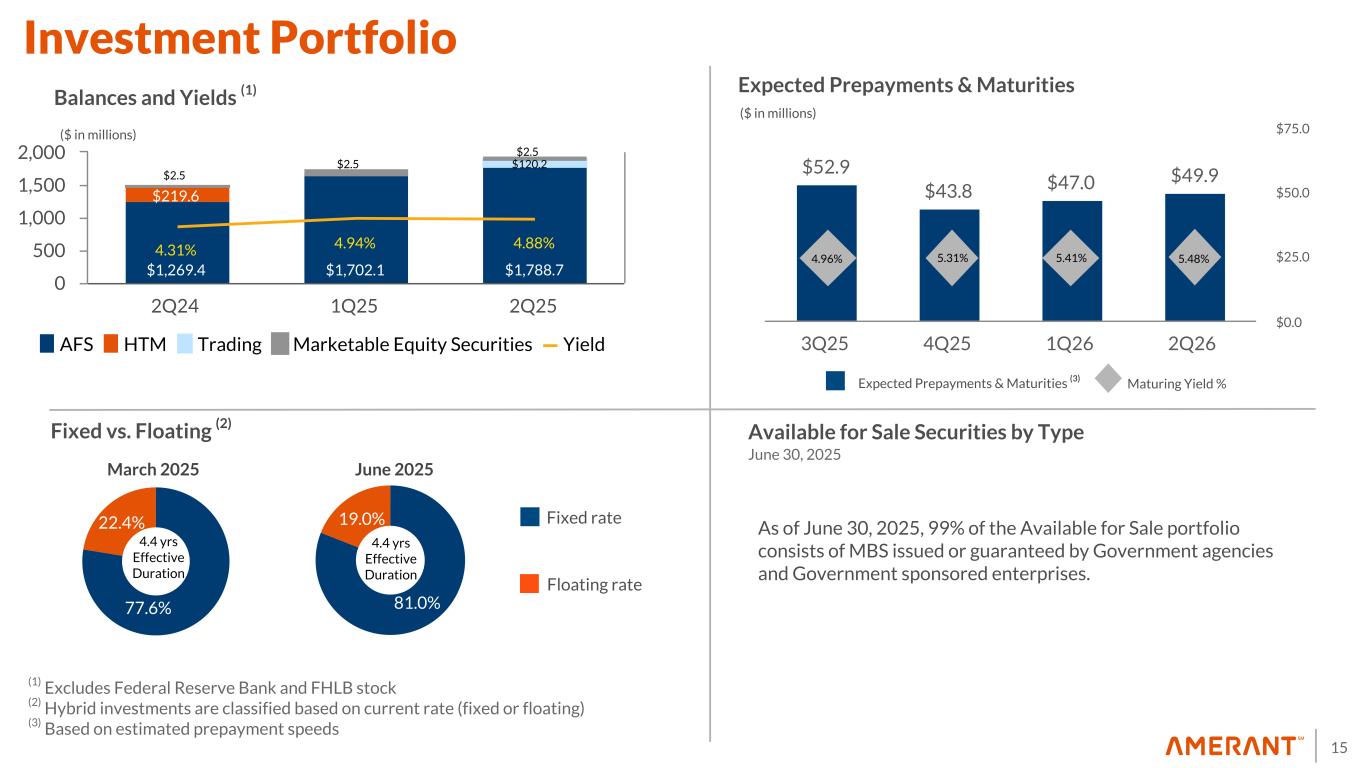
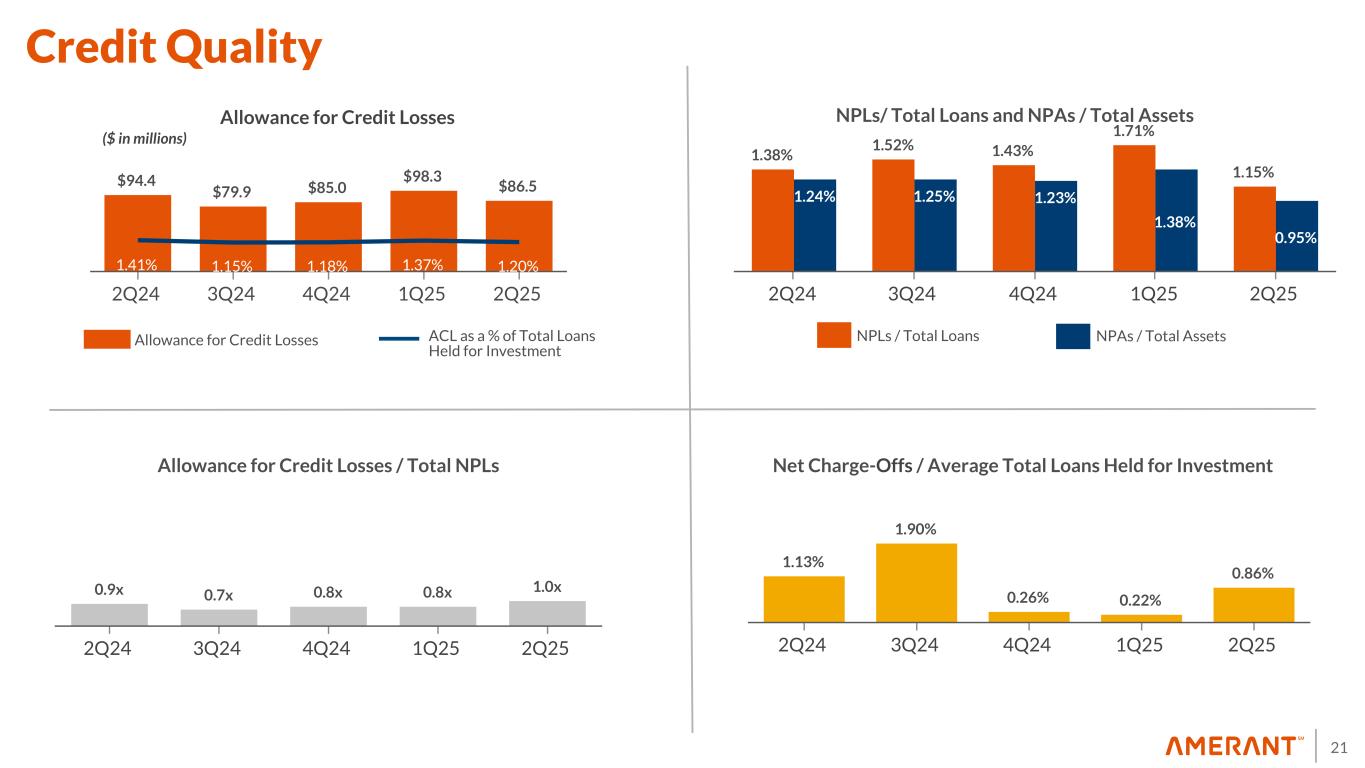
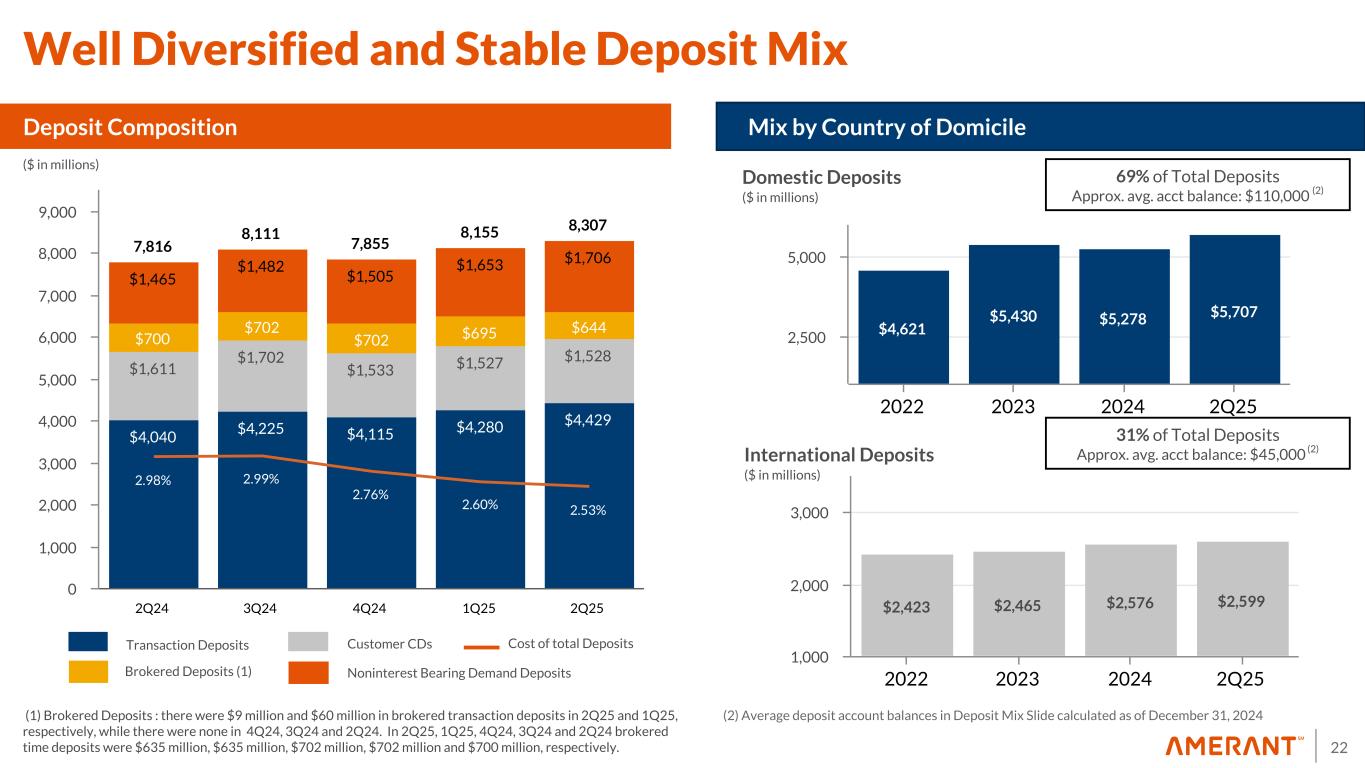
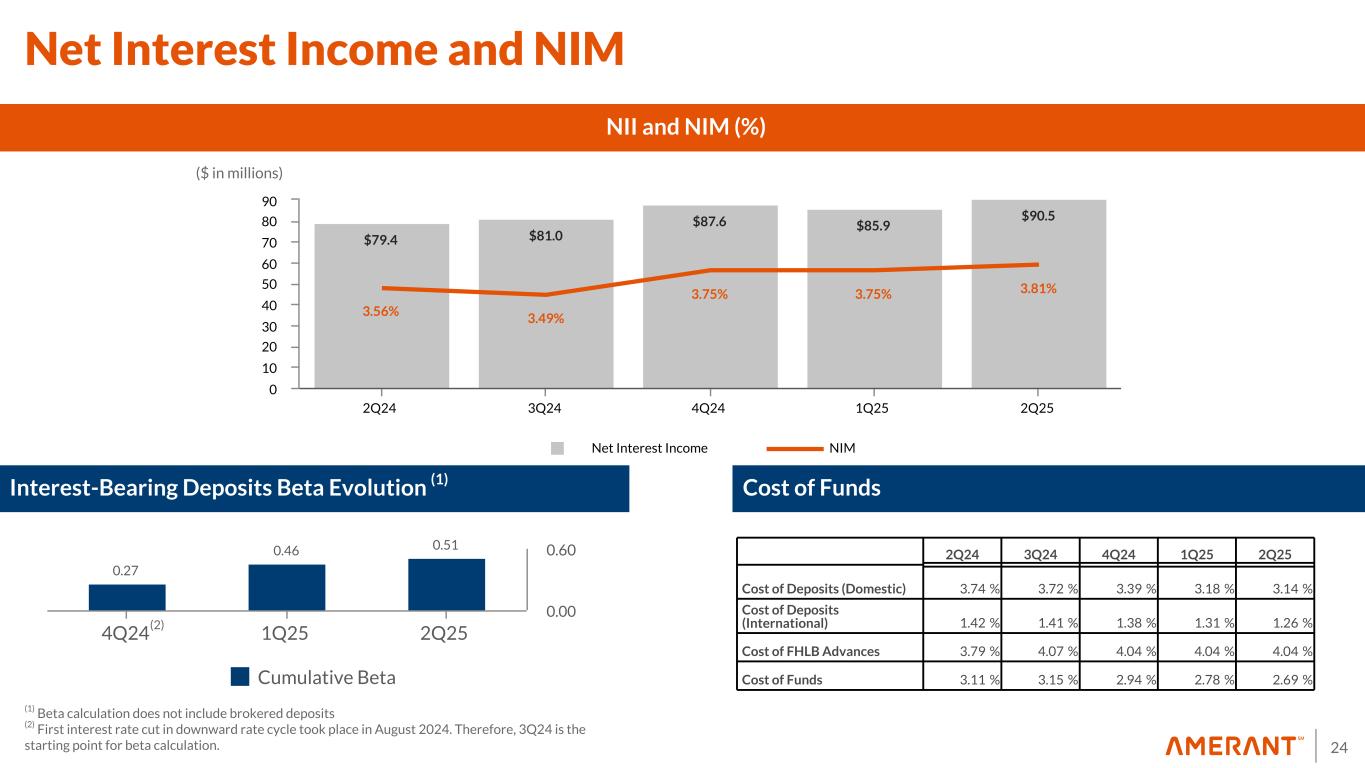
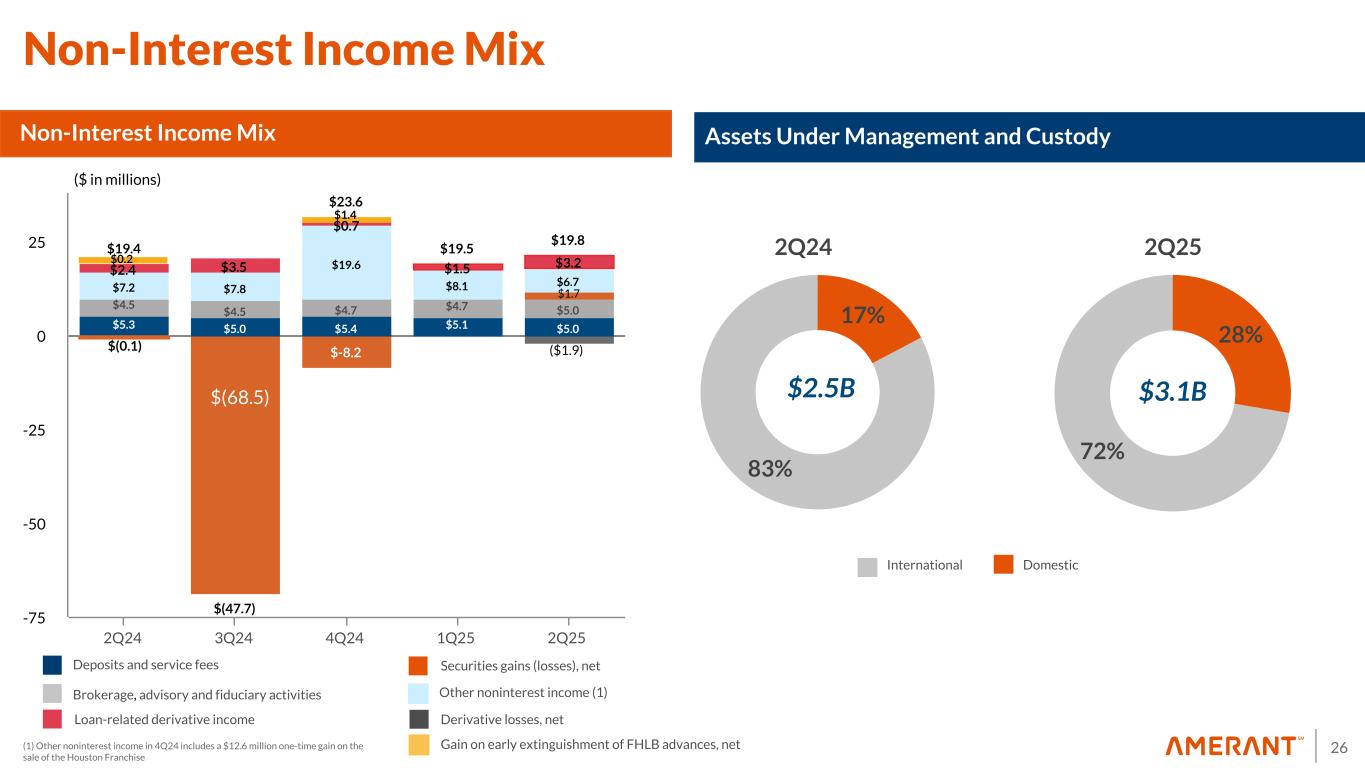
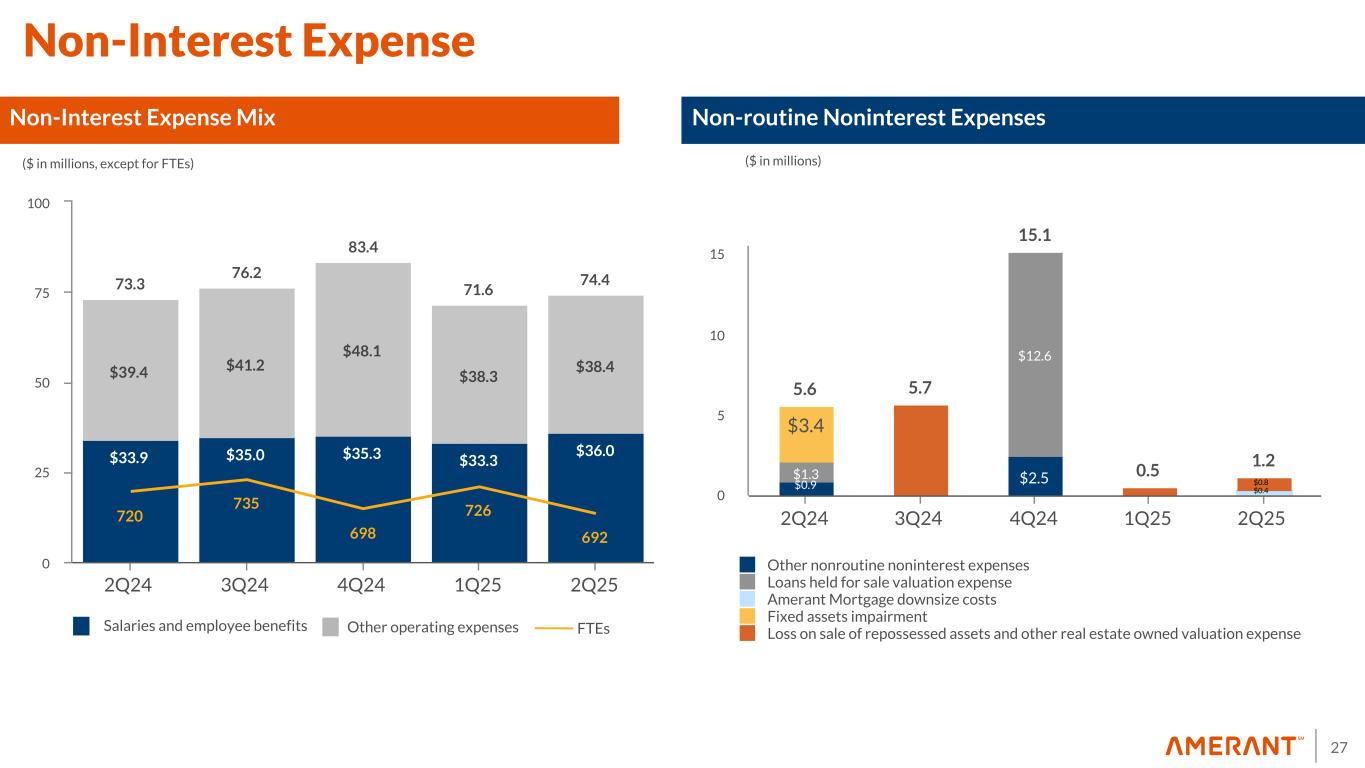
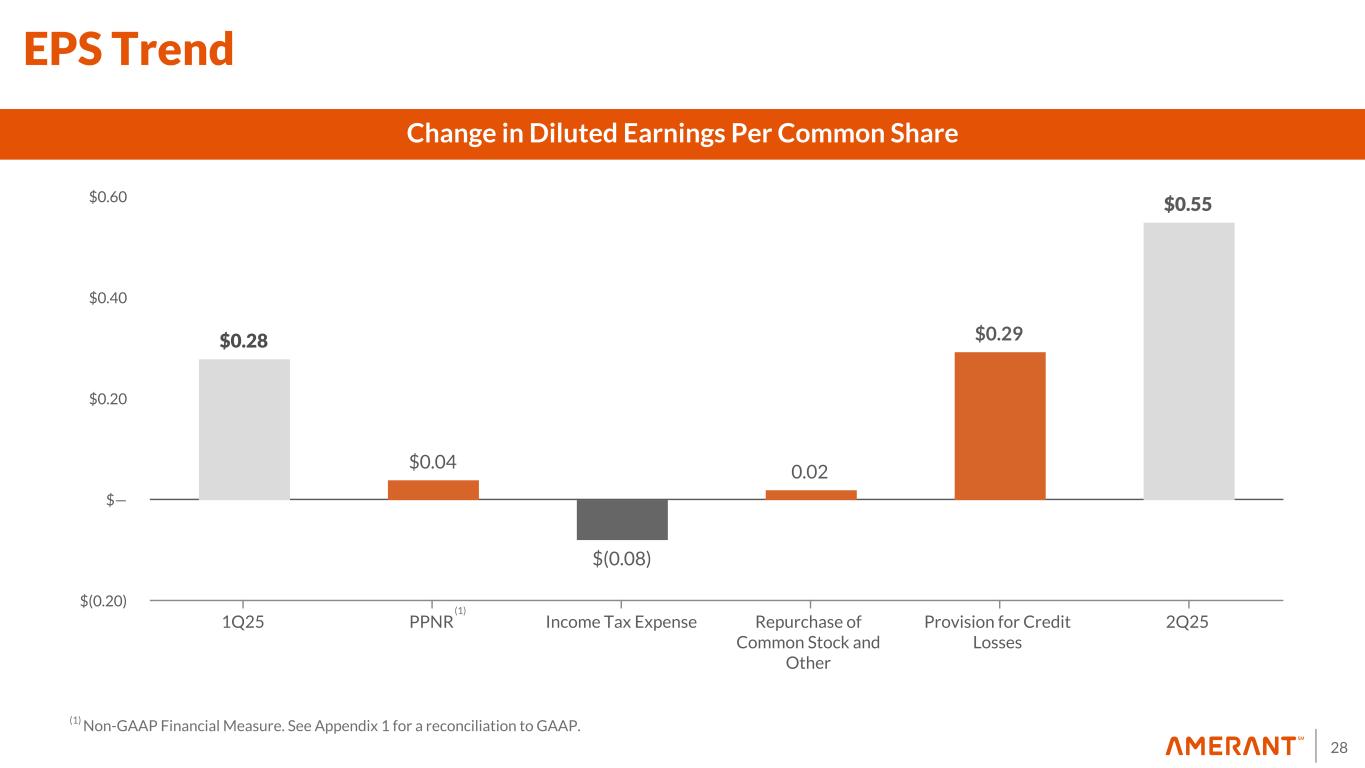
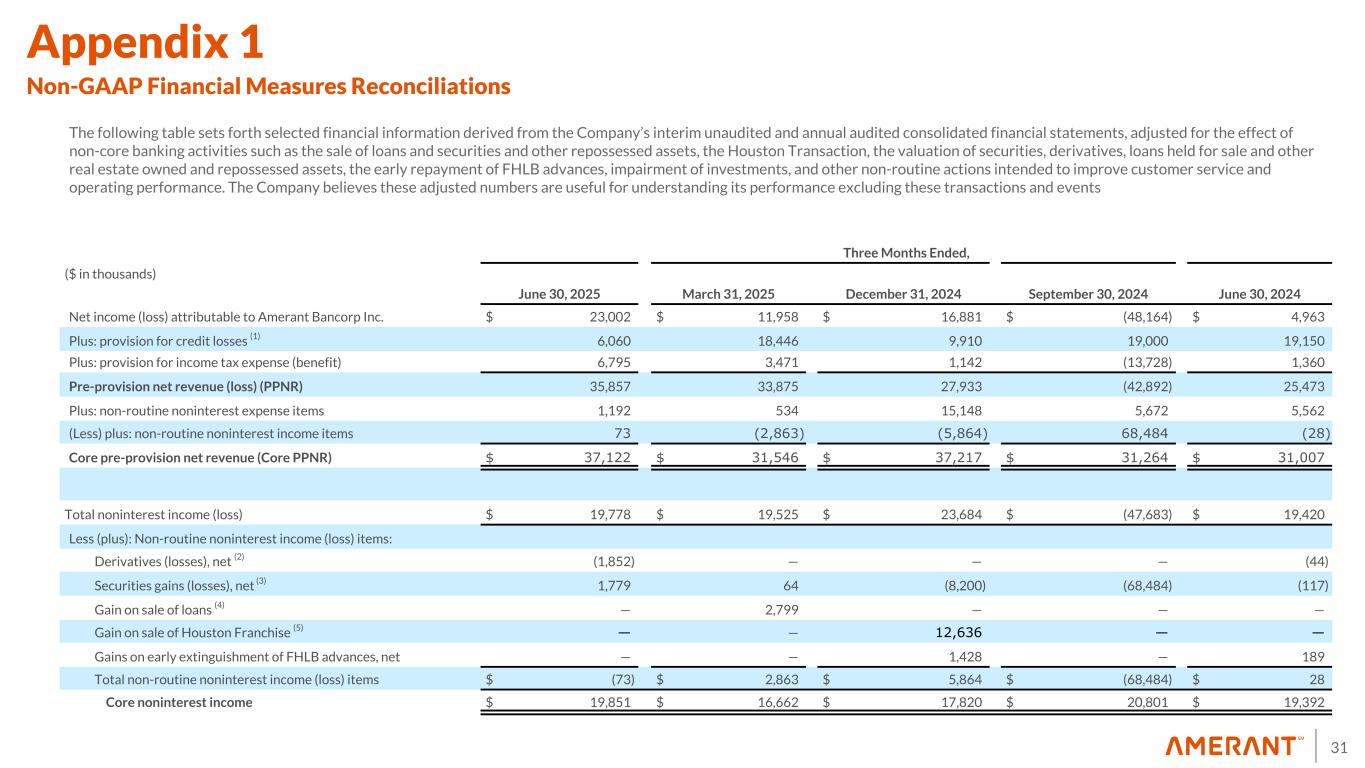
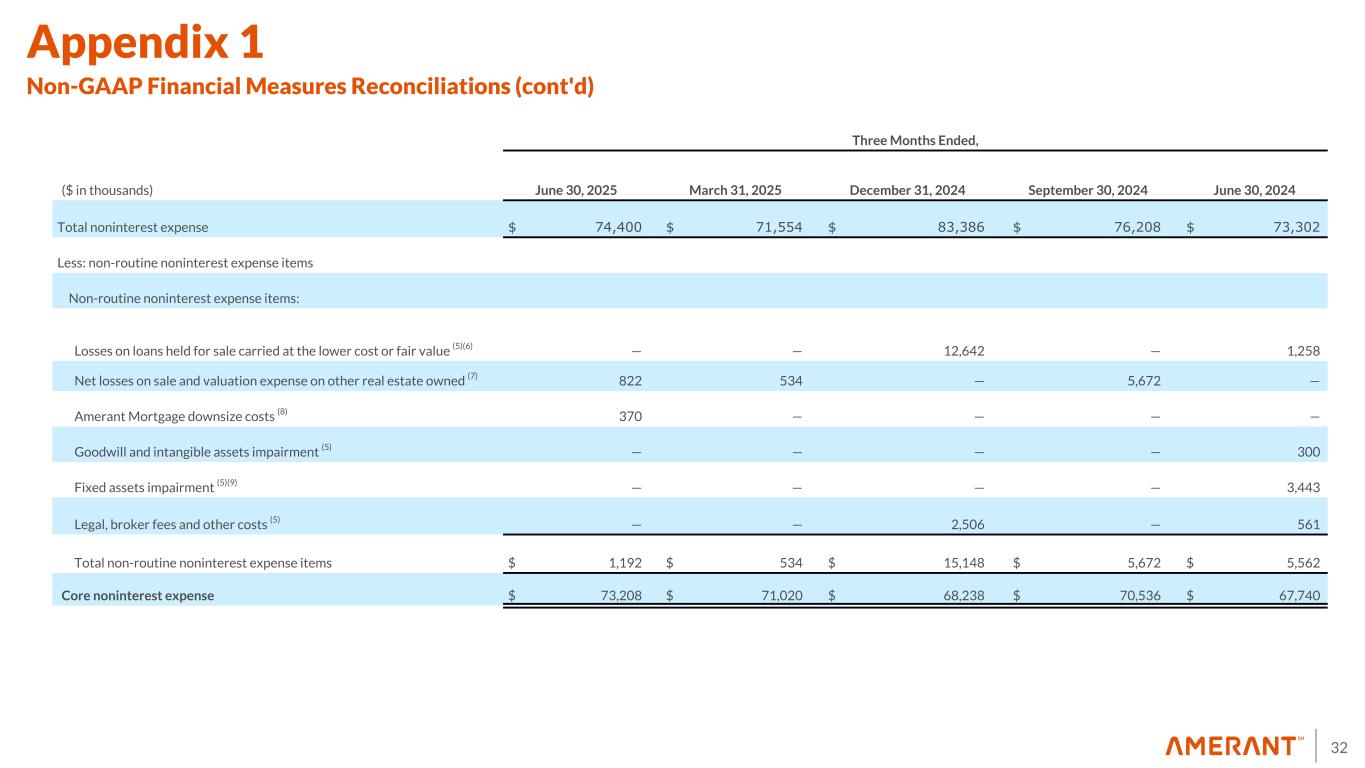
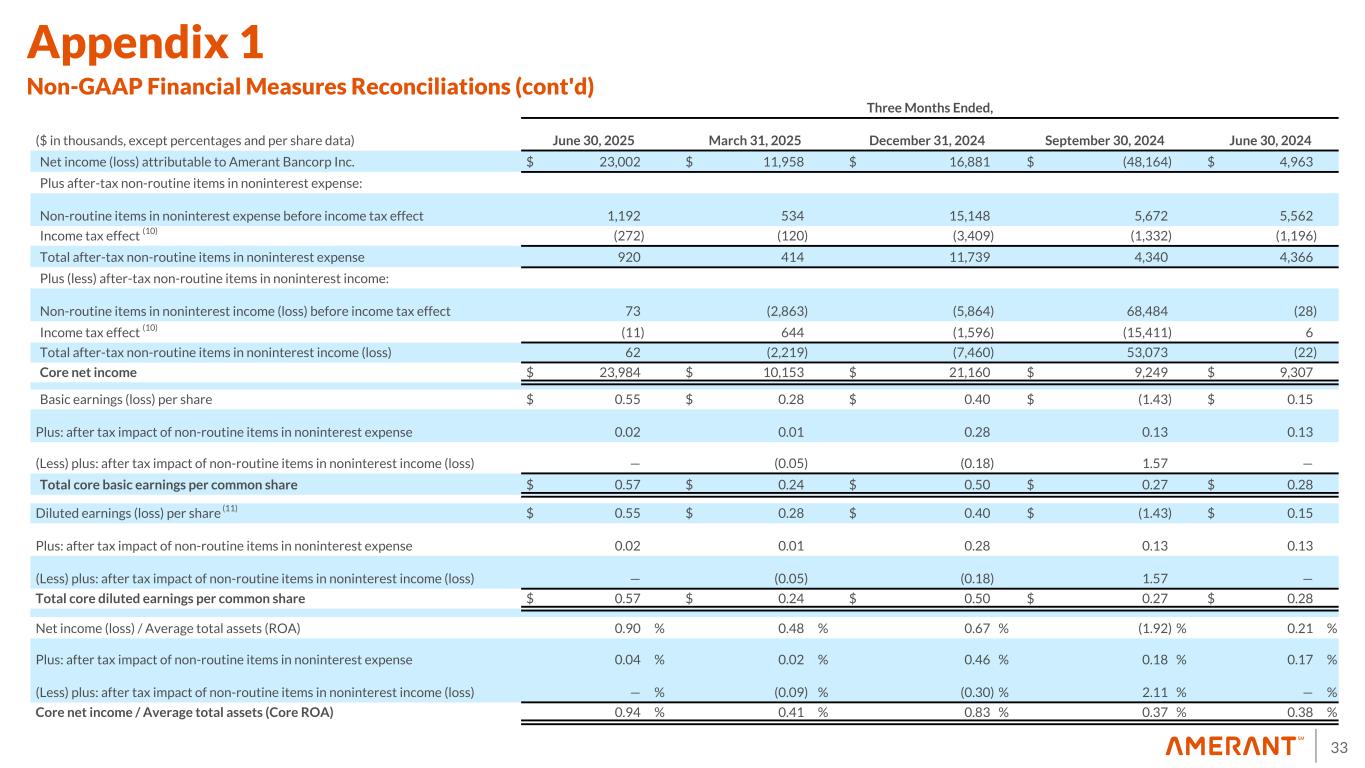
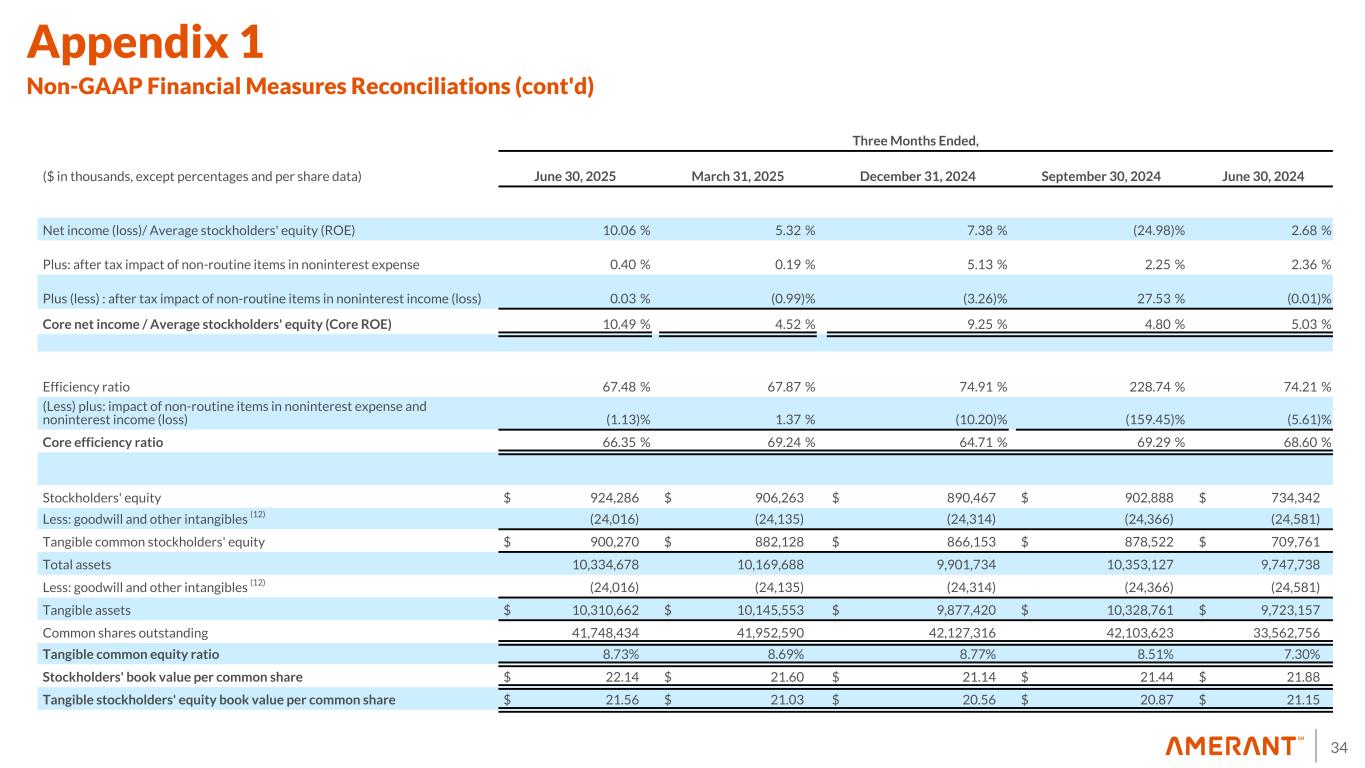
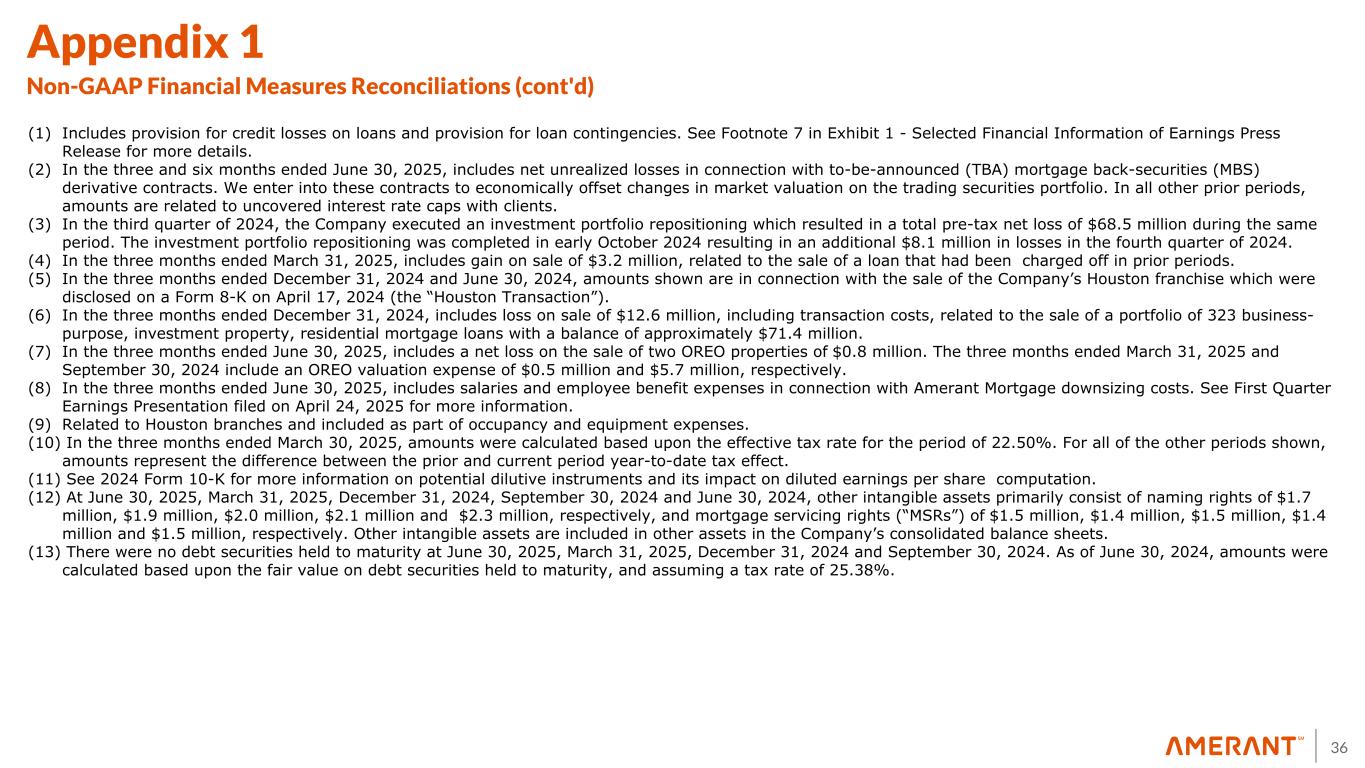
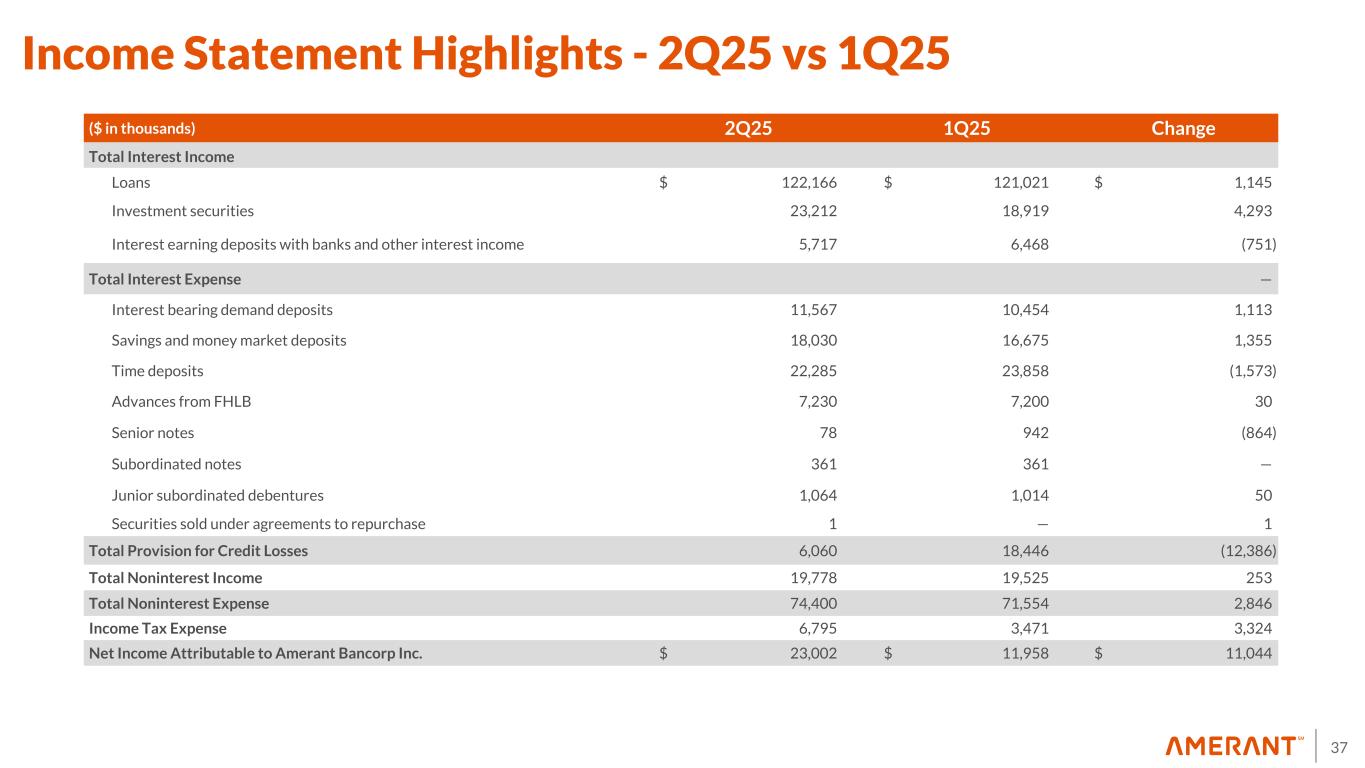
Thank you, Jerry, and good morning, everyone. Let's turn to Slide 3. Here, you will see the highlights of our balance sheet. Total assets reached $10.3 billion as of the close of the second quarter. As we guided in the first quarter, we temporarily supplemented loan originations with purchases of investment securities. Total investment securities were $2 billion, up by $209.2 million. Of note, $120 million of these securities are mortgage-backed securities, which the company classified as trading securities, and $87 million are available for sale. The gross loans were down by $30 million to $7.2 billion, primarily driven by increased prepayments, which offset loan production in the quarter, as well as some loans originated that are yet to fund. On the deposit side, total deposits were up by $151.6 million to $8.3 billion, driven by growth in core deposits. Customer deposits grew by $202.3 million, partially offset by a planned reduction of $51 million in broker deposits. Our assets under management increased $132.42 million to $3.1 billion, primarily driven by higher market valuations and net new assets. We continue to see this as an area of opportunity for us to grow fee income going forward. Looking at the income statement on Slide 4, you will see that we had strong pre-provision net revenue, driven by higher than previously projected net interest income and net interest margin. Our NIM was higher than projected at 3.81% due to recovery of interest on commercial loans, including a non-accrual loan that was fully paid off and another loan that had been fully charged off. Lower cost of time deposits resulting from lower average balances and repricing rates and lower cost of senior notes as these were fully repaid in April 2025. NIM increases were partially offset by higher average balances of interest-bearing demand and money market deposits by prepayments, which offset loan production in Q2 '25, as well as higher average balances in the investment securities portfolio. Net interest income was $90.5 million, up $4.6 million, primarily driven by higher average balances of securities and lower average balances and rates on time deposits. Provision for credit losses was $6.1 million, down $12.4 million from $18.4 million in the first quarter. Noninterest income was $19.8 million, while noninterest expense was $74.4 million. Looking back at the guidance provided for noninterest expense for the second quarter, we had guided to $71.5 million. The variance to actual results was primarily driven by noncore expenses of $1.2 million. Additionally, we incurred $1.1 million in expenses on customer derivatives, an increase of $700,000 when compared to the prior quarter. Pre-provision net revenue was higher at $35.9 million in Q2 '25 compared to $33.9 million in Q1 '25, and core PPNR was $37.1 million, an increase of $5.6 million or 17.7% compared to $31.5 million in Q1 '25. A reconciliation of core PPNR and the impact on key ratios is shown in Appendix 1 included in this presentation. Turning to Slide 5. You can see improvement across all capital metrics. We paid our quarterly cash dividend of $0.09 per share of common stock on May 30, 2025. And our Board of Directors just approved a quarterly dividend of $0.09 per share payable on August 30 of this year. During the second quarter, we also repurchased 275,666 shares at a weighted average price of $18.14 per share. Jerry will cover some additional notes on buybacks and part of his remarks later in this call. Next up in Slide 6, you can see we made significant improvement in our ROA and ROE this quarter at 0.90% and 10.1% compared to 0.48% and 5.3%, respectively. Both of these metrics reflect the improved profitability this quarter. This quarter, we had $1.2 million in nonroutine noninterest expenses, which included an $800,000 net loss on the sale of 2 OREO properties and approximately $400,000 in salaries and employee benefit expenses in connection with the downsizing of Amerant Mortgage. Our core efficiency ratio was 66.35%, core ROA was 0.94% and core ROE was 10.49%. Turning to Slide 8. Here, you can see the roll forward of classified loans from the first quarter to the second quarter, showing a net increase of $9.3 million or 4.5% to $215.4 million, primarily due to 2 CRE loans totaling $21 million downgraded to substandard due to the loss of a tenant and delays in repositioning plan, as well as 2 commercial loans totaling $16.8 million downgraded from special mention and 2 commercial loans totaling $18.3 million downgraded from pass. These downgrades were based on receipt of year-end 2024 and Q1 '25 financials. These increases were partially offset by approximately $50 million in charge-offs, payoffs and loans sold. Classified loans include 9 loans totaling $134 million that remain in accruing status. Let's move on to Slide 9, where we included the roll forward of nonperforming loans from the first quarter to the second quarter of 2025, showing a significant net decrease of $41 million, mainly driven by a combination of payoffs, loans sold, paydowns and charge-offs. It is important to note that the charge-offs included 3 commercial loans totaling $16 million with $12 million previously in specific reserves. From an NPA standpoint, in addition to the reduction in NPLs, 2 out of 4 OREO properties were sold during the quarter, therefore, reducing our OREO balance to $15 million. Turning to Slide 10. We show the look forward of special mention loans from the first quarter to the second quarter and provide color on the main drivers of these changes. Special mention loans increased by $33 million, primarily driven by 3 CRE loans totaling $36 million that missed certain milestones. However, there are acceptable mitigants in place such as adequate loan-to-value, interest reserves, personal guarantees or other structural enhancements. The increase in special mention loans was also due to 4 commercial loans in multiple industries, totaling $57 million that rated based on receipt of year-end 2024 and first quarter 2025 financials. These increases were partially offset by $22 million in payoffs and further downgrades to classified previously mentioned. Now moving on to Slide 11, which shows the drivers of the $11.7 million decrease in the allowance for credit losses. The provision for credit losses was $6.1 million in the second quarter. Excluding reserves for commitments, the provision was $3.6 million and was comprised of $6 million to cover net charge-offs, $2.2 million due to macroeconomic factors, offset by releases of $1.4 million due to loan growth and $3.3 million due to recovery. During the second quarter of 2025, there were gross charge-offs of $18.6 million related to 3 commercial loans totaling $16 million with $12 million previously in specific reserves, $1.7 million related to purchased consumer loans and $1.1 million related to certain smaller retail and business banking loans. This was offset by $3.3 million in recoveries, primarily due to the recovery of $1.9 million related to a commercial loan previously charged off. Lastly, the coverage of the allowance for credit losses to total loans decreased to 1.2% compared to 1.37% in the first quarter, primarily due to the charge-offs in some specific reserves. Otherwise, net of specific reserves, the ratio remained unchanged at 1.17%. Turning now to Slide 12. I'd like to provide some details on our expectations for the third quarter of 2025. Starting with the deposit side. We continue to expect 14% to 15% annual growth by year-end 2025, even if this is not linear during the third and fourth quarters. Also note, that we plan to further reduce broker deposits by at least $100 million and replace them with either FHLB advances or incremental organic deposits. On the lending side, we expect to evidence loan production and growth of approximately 5% annualized by year-end. In Q3, we project an increase in investment securities similar to what we saw in Q2. Looking at profitability, we project our net interest margin to be approximately 3.75% for the third quarter. We project noninterest income to be at $17.5 million in Q3 and $18.5 million in Q4. Regarding expenses, we expect them to be in line with what we reported as core noninterest expenses for Q2 of $73 million based on recent key additions to the team and investment in continued expansion in Florida. This is expected to be partially offset by cost reductions in Amerant Mortgage. We expect the efficiency ratio to be in the mid-60s given the investment in growth. And as previously stated, we are prioritizing ROA over all other metrics and continue to expect to reach 1% in the second half of 2025, confident that any significant macroeconomic updates will be captured by the allowance model in the last quarter of 2025. And with that, I pass it back to Jerry for additional comments and closing remarks.
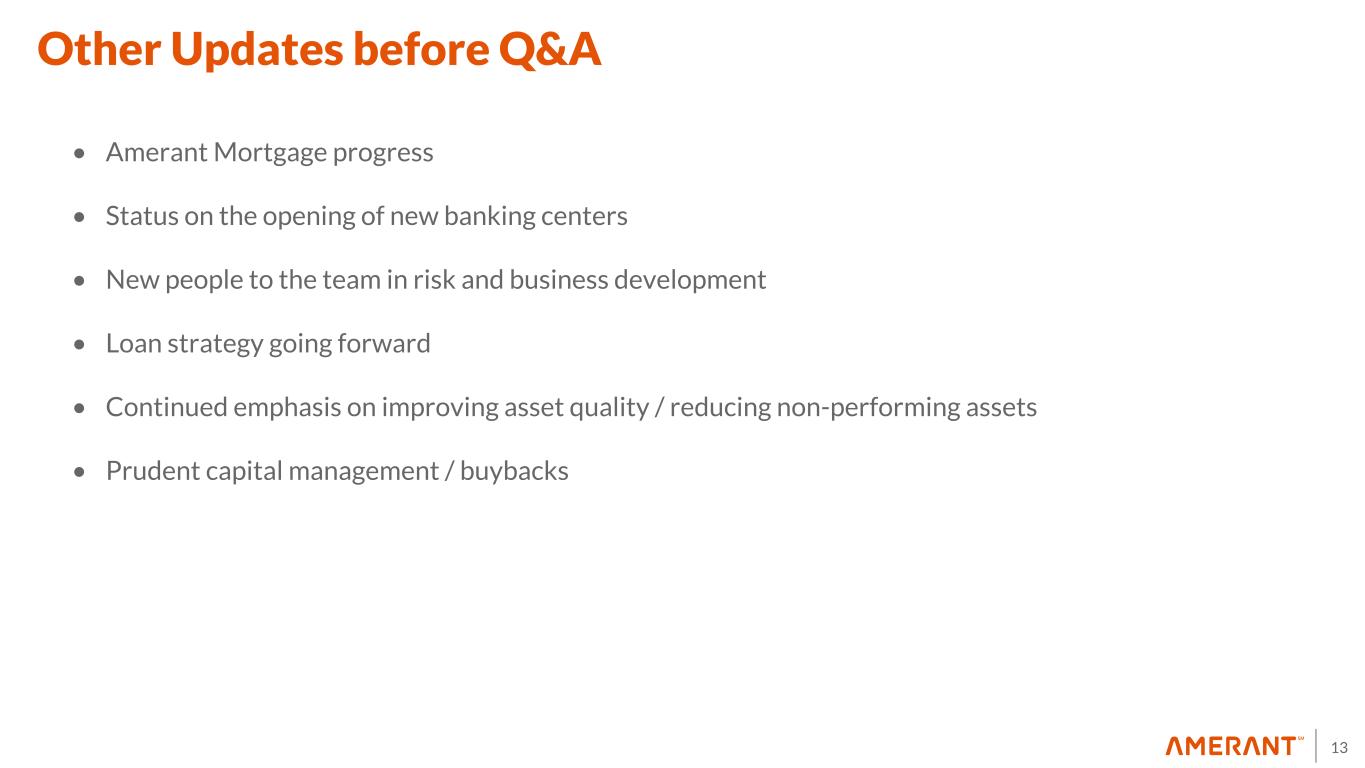
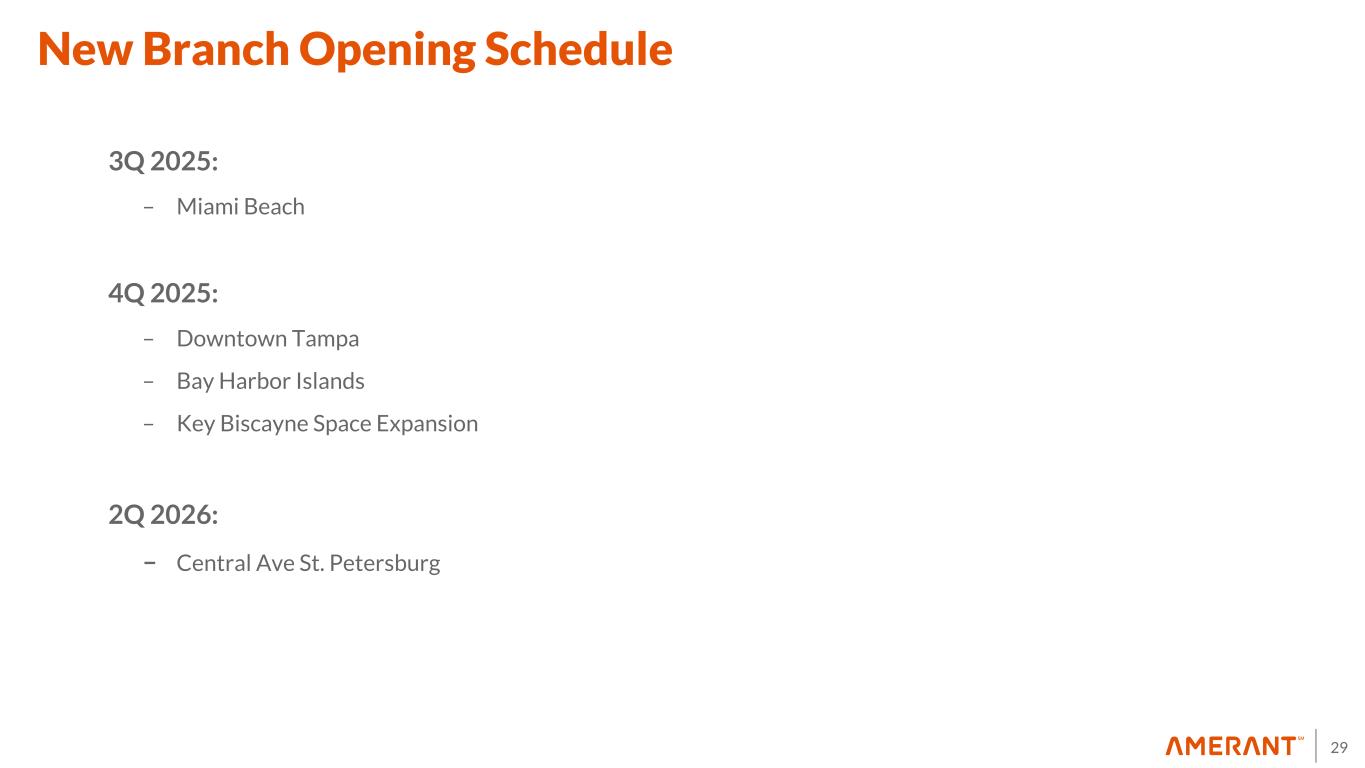
Thanks, Shary. Now, turning to the last slide we'll discuss, I want to share some insights on the topics listed here. First, about Amerant Mortgage, as we mentioned last quarter, we're implementing a plan to streamline our mortgage business, shifting from a national mortgage originator to focusing solely on mortgage lending within our key markets to support our retail and private banking customers. We're steadily reducing our FTE count toward our target of under 20 and are in the process of moving owned loans to our core platform. We expect this to be finalized by early Q4. Next, about the opening of new banking centers, we plan to open our first of two new Miami Beach offices in the third quarter, with the second Miami Beach office and our downtown Tampa center opening in the fourth quarter. Additionally, we have entered into an agreement for a prominent location in St. Petersburg, which is set to open in Q2 2026. While we continue to explore opportunities in the Greater Tampa area, this new St. Petersburg location provides us with three of the original six offices we initially envisioned. However, we are now looking at a longer timeline for completing the remainder of this expansion by 2026. Now, let's discuss the new hires made in the quarter for our risk and business development teams. During our first quarter call, we announced several key additions to our leadership team in both areas, and we indicated our intention to continue adding skilled individuals in the coming months. In the second quarter, we welcomed a new Head of Special Assets, and just this week our new Head of Credit for C&I started. Both have extensive experience in larger commercial organizations. On the business development side, we recently added Elliot Shafer, who came from Huntington to lead our business development efforts from the new West Palm Beach regional office. In August, we will also welcome our new Head of Loan Syndications and Sales, who has a strong track record at several well-known institutions. He will immediately aid our loan growth objectives as we encounter new large relationship opportunities that require risk management, necessitating our participation with other banks. To summarize our talent additions, we will continue to selectively seek new team members. Regarding our loan strategy going forward, as noted in our first quarter call, we anticipated that reduced loan growth might lead to temporary increases in mortgage-backed securities to compensate for any shortfall, which we observed occurring in the second quarter. Despite a significant amount of activity, our loans outstanding remained flat for the second consecutive quarter. A few factors have contributed to this, including our focus on asset quality, several construction deals year-to-date that are yet to be funded, and projected higher paydowns. It is fair to say that rebuilding our momentum will need to occur in the second half of 2025, significantly aided by recent talent additions across almost all our regions. The new Head of Business Development, the new Head of Loan Syndications and Sales, and additional relationship managers in our various locations will help enhance our pipeline. Now, let's discuss our continued emphasis on improving asset quality and reducing nonperforming assets. Further reducing nonperforming loans is currently a top priority, and it's essential to proactively address credit quality. It’s important to understand that initiatives to strengthen our risk culture are underway, especially now as a regional bank under heightened scrutiny. The new members of our team are already making valuable contributions to this effort. Finally, regarding prudent capital management and buybacks, our approach remains unchanged. We aim to balance the need to retain capital for supporting our growth objectives with the necessity for buybacks and dividends that enhance returns. As Shary stated in the second quarter, we used a 10b5-1 plan to purchase shares amounting to $5 million in the quarter. We plan to continue these prudent share repurchases based on trading volume and pricing in the third quarter under the currently authorized amount. In closing, we remain focused on executing our strategy to be the bank of choice in the markets we serve. With that, I’ll conclude our prepared remarks and look forward to addressing any questions you may have. Operator, please open the line.
Operator
Operator Instructions. Our first questions come from the line of Russell Gunther with Stephens.
Speaker 4
I wanted to start on the loan growth discussion. I appreciate the color you shared in the prepared remarks. Maybe just bigger picture and thinking maybe into '26, should we be thinking about the guide more in the mid-single-digit growth range going forward? And is this reflective of a strategic refocus? Or is it more just market driven?
Yes, Russell, thank you for the question. You can expect us to return to double-digit growth. We have consistently stated that our focus on deposits is our top priority. I want to highlight the quality of the organic growth we are experiencing in deposits, which is currently in the mid-teens. This positions us well to grow similarly on the loan side. We anticipate rebuilding our pipeline with some new additions, though I won't go into detail about the specific number of new relationship managers we have brought on. Our main focus has been on asset quality, but we believe there are significant growth opportunities in the markets we serve. We expect to see higher loan growth in the upcoming quarters and into 2026, while remaining very cautious and selective about our loan-side additions.
Speaker 4
Okay. Great. And then just one more for me, switching gears onto the asset quality discussion. So nice to see the NPAs come down this quarter. Charge-offs were a bit higher than at least I was expecting. So, we also saw a build back in classified and special mention. It would just be helpful to get a sense for how you guys are thinking about realized losses in the back half of this year. I think we kind of talked about the 30 to 40 basis point range prior and I guess, just what's embedded in that 1% ROA expectation in the back half of '25.
Yes. Russell, I think the key thing, and Shary referenced it a couple of times in her remarks, we have already provisioned for the uptick that we took this quarter in charge-offs. So again, the $12 million of the $18 million was already in specific reserves. So, if you subtract that and then do the comparison from a charge-off rate, we were relatively flat quarter-over-quarter. I think we were probably in the 5.5% range last quarter to roughly 6% and change this quarter. And that's still the core of, again, continuing to see the consumer, the indirect consumer charge-offs and some of the business banking charge-offs is primarily the key drivers there.
And Jerry, to add to that, in the 1% ROA, that includes the provision number, we do still expect some loan growth early in the second half of the year. So that is still within the provision expectation because we would have to set up reserves on day 1.
Speaker 5
Given the ongoing discussion, as you mentioned, some of the loans that have already charged off have specific reserves. Would it be accurate to consider the $120 loan loss reserve as the appropriate approach for reserving for the current loan book?
Yes. That's a great question, Stephen. I think that figure is reasonable. The allowance will always depend on the asset classes we are growing. So, considering the $120 to $125 range seems appropriate for our future outlook. We will provide updates and discuss our growth and reserve requirements. This quarter benefited from stable loan growth, which is actually a positive sign, as the growth we saw came from the investment side. As Shary mentioned, we recognize the provision when we report growth. Our expectation is that the provision will increase slightly as we anticipate a rebound in loan growth.
Additionally, I want to mention that the provision includes a component for a funded commitment. As we begin to fund those loans, there will be a re-provision. While this won’t affect the overall provision, there will be a re-classification into the funded portion, which will have an impact.
Speaker 5
Sure. That makes sense. And then as you guys in the third quarter outlook, it looks like the margin is projected to be down a touch. Can you walk me through some of the dynamics there? I mean, given where the loan-to-deposit ratio has moved down and the expectation for growth to kind of resume, I would actually kind of theoretically thought there'd be incremental upside to the NIM on a positive remix. But maybe you can help me think through those dynamics or where you think the NIM will trend beyond third quarter?
Sure. So, I think the first step, Stephen, is to normalize the NIM because this quarter, we had a component related to our recovery, and we also had a component related to collection of an NPL. So, if we normalize the NIM and we think about what would be different in the third quarter, the first thing I would say is we're expecting to have a slightly higher average balances on the wholesale side based on the timing of the maturities within the quarter and the replenishing of that wholesale funding. But the second thing is related to the securities portfolio, where we're going to see a full quarter effect of a higher securities balance that while it definitely is the contribution to NII, it's slightly lower than the average of the NIM. So, once we see that full effect in the third quarter, it takes us to the 3.75%. With that said, we're also working in terms of NPL resolution. So, if we do see the collection of those items, then it will certainly impact NIMs like it did this quarter. So, the 3.75% is guidance towards a normalized NIM.
Speaker 5
Okay. And what does that compare to this quarter? And forgive me if I missed that, but relative to the 3.81%, what the kind of normalized NIM would have been this quarter?
I would say 4 basis points less, more or less.
Speaker 5
Okay. Great. And then lastly for me, Jerry, you noted a hire around loan syndications and sales head. I'm kind of curious how you guys are thinking about that component moving forward, if that is something where you're desiring to move upmarket and do some larger loans and kind of if there's maybe a limit of where you'd say, 'Hey, at this dollar amount, we want to syndicate everything out above this dollar amount or just kind of how we can think about that from a business perspective?'
I appreciate your question, Stephen. It's great to clarify. What I see as an opportunity is that we are receiving many sizable deal possibilities. It's essential to approach larger credits with prudent risk management. For example, if we encounter a $50 million opportunity that is well underwritten, we aim to hold 25% of it. This approach isn't about simply expanding for growth; it's about enhancing our capacity to engage in more transactions. Our participation in these deals alongside other banks is wise from a risk management perspective. This marks a natural progression towards becoming a true regional bank. In the past, we've had substantial exposures, but we have customers who are growing, allowing us to continue growing with them instead of them outgrowing us. This strategy enables us to maintain strong relationships. I want to reiterate that this approach is a sensible risk management strategy for a bank of our size when considered from a capital perspective.
Speaker 6
Maybe I'll ask the same question I posed last quarter. Jerry, how do you assess the current state of asset quality? Using a hockey analogy since the Panthers just won, what phase do you believe we are in? Do you think, despite the difficulty in making absolute statements, that we may have already reached the peak in criticized classified assets and can expect continued improvement, especially given the seemingly positive macroeconomic environment from trade deals and other factors? I would like to hear your thoughts on our current status and how this may develop over the next year or so.
Yes, thanks for the question. I believe we've positioned ourselves well with the talent we have added and our approach. This is part of our natural transition regarding credit quality. We are recognizing and addressing any concerns proactively. With the leadership we've brought on in special assets and credit, we are focusing on enhancing our credit culture and risk management while ensuring consistency in our results. I can't specify exactly where we stand, but the positive news is that nonperforming loans are decreasing. We've placed the right people in key roles and are being proactive and transparent. Overall, we are in a better position now compared to last quarter and in the past. That's the key takeaway to keep in mind.
Speaker 6
Okay. And just to follow up on that, you recently brought in some individuals from larger organizations last quarter. It's been 90 days, and I understand it's a bit early to discuss lessons learned and any changes to policies or procedures. However, could you share any significant updates regarding underwriting, grading, or new production? This would help us feel more confident about what you're currently putting on the books moving forward.
Yes, we are focused on the new business we're bringing on board. For instance, we are taking precautions as mentioned in previous discussions about syndications to ensure we can retain credits and maintain an effective underwriting process. I believe we are in a better position now than in the past. It's important to monitor key asset quality ratios, especially nonperforming loans, as they indicate how we manage our loan portfolio. We also want to highlight that our allowance for nonperformers has improved, with coverage now over 100%. Early identification is crucial, and we are strengthening our team, including the addition of a new head of Commercial and Industrial lending from a larger organization. We're committed to responsible growth rather than just growth for the sake of it, and we've taken these prudent measures as we transition from a community bank to a regional one.
Speaker 6
I appreciate the color, Jerry. Maybe just one more, switching gears. The last couple of quarters have been fairly heavy in terms of hiring. Do you expect the pace to kind of slow, at least on some of the back-office nonrevenue-producing efforts as we move into the fourth quarter? And as we think about kind of the intermediate term, where do you think from an efficiency standpoint, you guys can operate? And I'm not trying to ask for kind of longer-term targets necessarily. But I think everyone wants to obviously see these revenue hires, be accretive to the efficiency ratio. But kind of intermediate term, where do you think the company should and can continue to run just with obviously the pickup in growth, but obviously continue to support revenue growth efforts with additional hires? So just wanted to get a sense for kind of where we're going and kind of what the efficiency could look like kind of intermediate to longer-term?
Yes, that's a valid question. From an earnings asset perspective, we aim to be over $11 billion. This target will help us get closer to a 60% efficiency organization. We expect to achieve a 1% ROA and aim for 11.5% to 12% ROE. Efficiency will improve with increased size. Specifically, we believe the selective hires we've made will enhance our progress towards the $11 billion goal. Additionally, we are exploring ways to implement artificial intelligence to boost efficiency. However, we will experience some slowdown in physical expansion because we have already made significant additions, which are reflected in our current numbers. As a reminder, the moment we sign a new lease, we start incurring expenses, not just for space but for staffing as well. We anticipate greater deposit growth and more loan and relationship opportunities from our new locations. Our growth has been substantial, and I encourage everyone to review the supplemental slides that highlight this progress, which has been exceeding our expectations. We expect to see further contributions from four new locations, three opening this year and one projected for the first quarter of 2026. Overall, we are focusing on improving efficiency by carefully examining expenses to reach our 60% efficiency ratio. With continued asset growth, new hires, and the opening of our new locations, we are confident that we can meet our goals.
Speaker 7
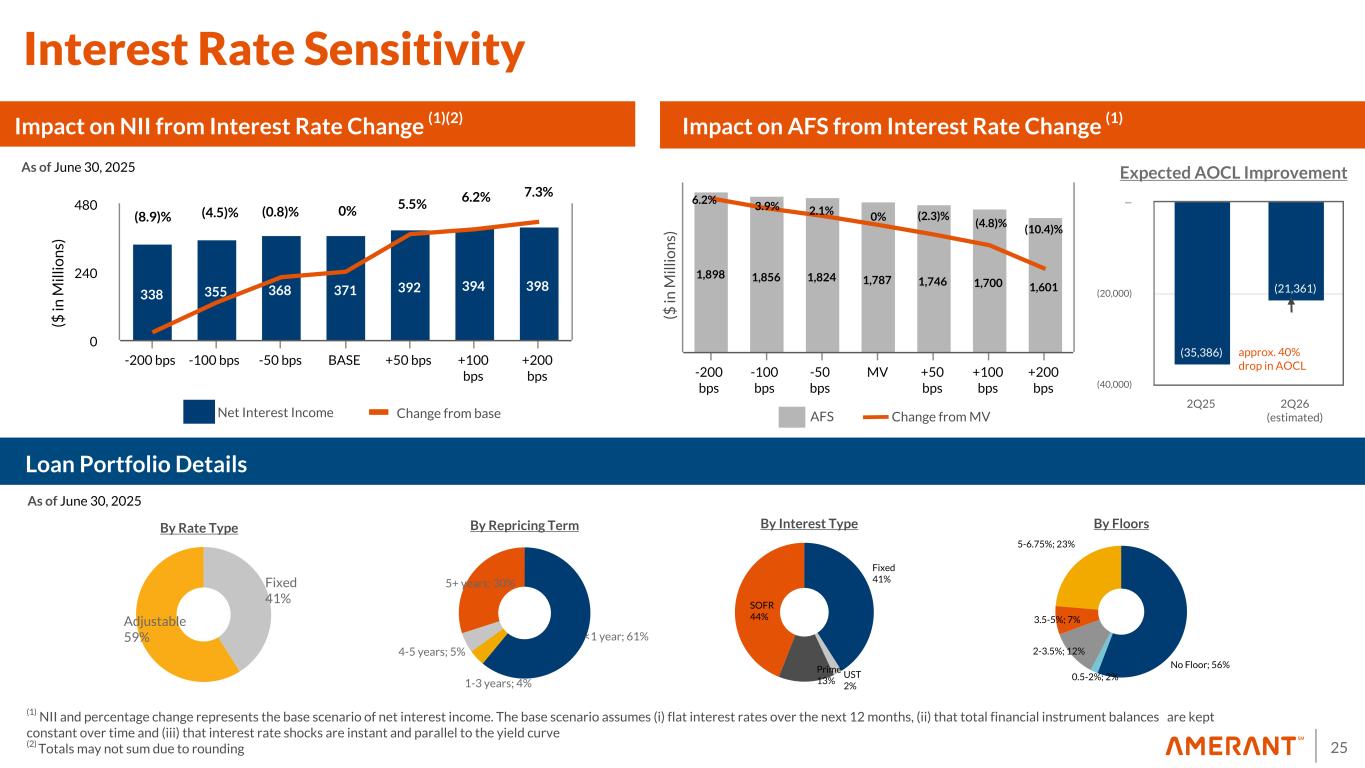
Shary, I wanted to circle back on the margin discussion. I know you called out some interest recoveries that happened in the quarter. Just to help us normalize that margin, did you have that dollar amount of recoveries? And then just a follow-on to that. I appreciate all the helpful color around the guidance and where the margin could be a head in the third quarter. But could you just remind us from an asset sensitivity standpoint, where do you guys kind of stand today? And what maybe a cut or 2 would do to the margin as we think about an exit rate for 2025?
Sure. So, in terms of the normalization of the NIM, I think we should be close to $1.2 million, adding both the recovery and the collection from the NPL, so between $1.2 million and $1.3 million. And then in regards to the second question about the NIM for the third quarter, I guess the question would be the components towards the 3.75 million, just to make sure I address the question.
Speaker 7
Or it was really just help us synthesize the margin. If we do get a few cuts in the back half of the year, what does that do to the margin? And just any general commentary on your asset sensitivity?
Sure. So at least for forecast purposes, we're modeling one cut occurring in September and one in December. So, third quarter wouldn't receive much of an impact from that cut. It would be more seen in the fourth quarter. Typically, a rate cut, assuming a full quarter impact would be around $1.4 million to $1.5 million to NII. Yes. I think it's not an either/or. I think we're looking at multiple options. We are considering in the third quarter, a reduction of broker deposits depending on the timing of the loan fundings we would either replace with some wholesale funding or we would actually pay it down and not renew. So, it is a possibility. However, we do see that through the investment portfolio, we're getting a very decent yield from the portfolio still from a risk-weighted asset perspective, it's helpful as well, and you can see that through metrics like CET1. So, I do believe that we're getting optionality through the securities portfolio. We have cash flow optionality so that we can fund the portfolio as the pipeline materializes.
Yes, I think it's not an either-or situation. Shary described it well. We are exploring all options. Our intention is to reduce brokered funding, and we will evaluate if that can be replaced with organic growth or if we need to consider taking additional advances to offset. We have significant collateral, amounting to billions of dollars at this point. We've also indicated that we consider the increase in investments to be temporary. Our goal is to operate the company in the 90-plus range for loans to deposits, with 95% being our optimal target. Currently, we're in the mid to upper 80s, around 86%. We definitely prefer to fund loan growth at this time, and we expect to build back up as we move forward.
Speaker 8
Okay. That's great color. I appreciate that answer. And then, Gerald, just high level for you, I know that you're very much an organic-focused story right now. You're very much focused on building density in the state of Florida. But at the same time, there's quite a bit of optimism out there regarding just M&A and what's happened and maybe more of a deregulatory environment. So, could you just help us recall where M&A stands in terms of your priority list and whether you feel like that could be an opportunity for you guys down the road here? And maybe whether you consider either upstream or downstream M&A?
Yes. We have stated that organic growth is our top priority and focus, and that will remain the case. However, as our currency strengthens, we will definitely consider it as an option, especially given the significant projects we have undertaken, such as system conversions and expansions. Our main goal is to continue growing and to be the bank of choice in the markets we serve. There are many opportunities we see, particularly in Greater Tampa Bay and St. Pete, as well as in Palm Beach County, where we believe we can expand further. First of all, let me just say thank you to everyone for joining today. We appreciate it giving the opportunity to share some of our comments and provide some color on second quarter results. Greatly appreciate everyone's interest in Amerant and your continued support. Have a great day, and thanks again.
Operator
Thank you. This does now conclude today's teleconference. We appreciate your participation. You may disconnect your lines at this time. Enjoy the rest of your day.