Operator
Greetings, and welcome to the Amerant Bancorp Fourth Quarter 2025 Earnings Conference Call. As a reminder, this conference is being recorded. It's now my pleasure to turn the call over to your host, Laura Rossi, Executive Vice President and Head of Investor Relations. Please go ahead, Laura.
Thank you, Kevin. Good morning, everyone, and thank you for joining us to review Amerant Bancorp's Fourth Quarter and Full Year 2025 results. On today's call are Carlos Iafigliola, our Senior Executive Vice President and Interim CEO; and Sharymar Calderon, our Senior Executive Vice President and CFO. As we begin, please note that discussions on today's call contain forward-looking statements within the meaning of the Securities Exchange Act. In addition, references will also be made to the non-GAAP financial measures. Please refer to the company's earnings release for a statement regarding forward-looking statements as well as for information and reconciliation of non-GAAP financial measures to GAAP measures. I will now turn it over to our Interim CEO, Carlos Iafigliola.
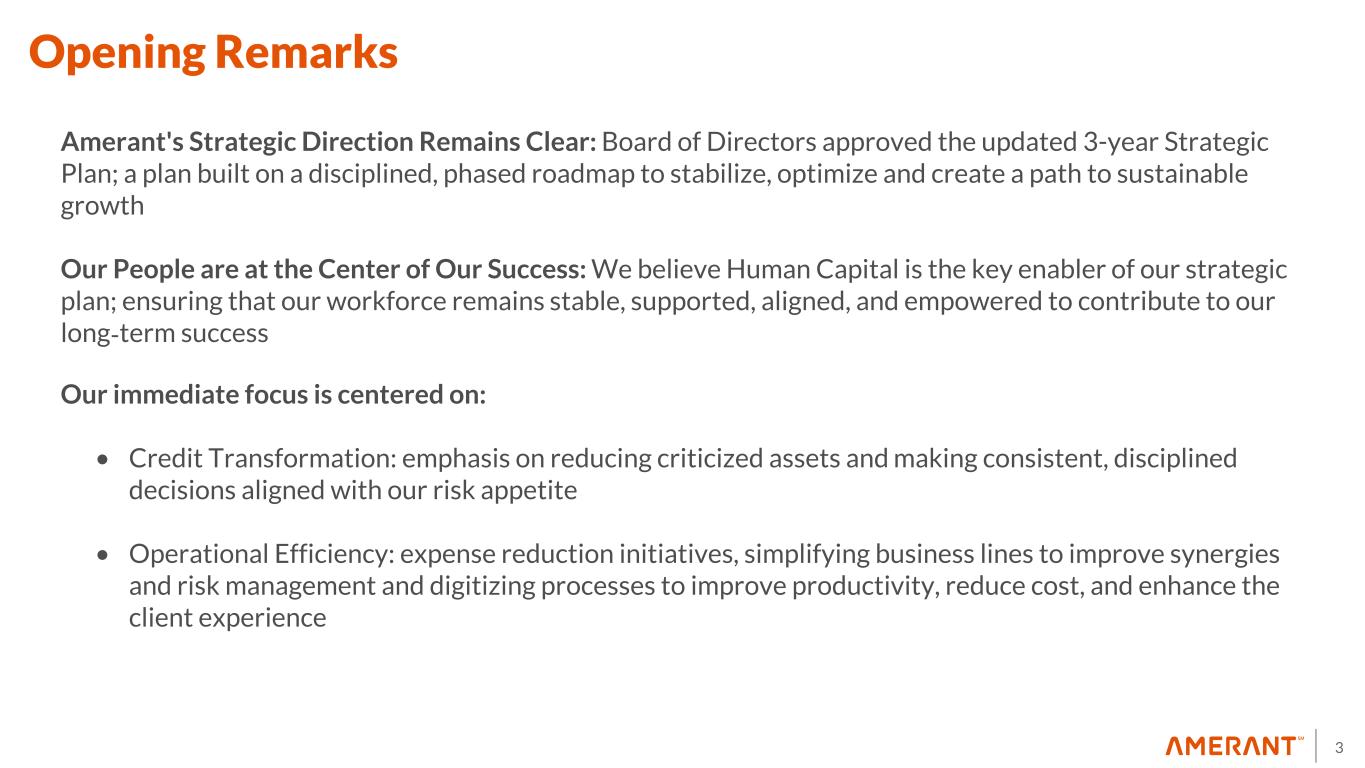
Thank you, Laura, and good morning, everyone, and thank you for joining us today to discuss Amerant's fourth quarter and full year 2025 results. As we begin today's call, I would like to turn to Slide 3 and frame our discussion around the clarity of our direction and the disciplined execution underway across the organization. Our strategic direction remains clear. In December, the Board approved our 3-year strategic plan. Our plan is built on a disciplined and sequenced road map in order to stabilize, optimize and grow the organization. This strategy reflects our confidence in Amerant's future and our ability to significantly enhance shareholder value in the coming years. We believe human capital is a key enabler of our strategic plan. We intentionally focus on our strategy on leveraging Amerant's intrinsic values, which encourages teamwork, supports talent development and retention, and promotes effective challenge at all levels of the organization. We're investing in the development of our teams, promoting via talent recognition, and ensuring that our workforce remains stable, supported, aligned, and empowered to contribute to our long-term success. As part of the stabilization phase, our immediate priorities are focused on strengthening the foundation through the following highly impactful areas. Credit transformation, we concentrated on restoring predictability to our loan portfolio's credit performance. We have taken a decisive approach to review our loan portfolio and work diligently on the resolution of our credit issues to improve asset quality. We're focused on aligning our credit portfolio with our strategic objectives, such as targeting exits from non-core markets and large exposures as well as avoiding migration into criticized buckets. At the same time, we made significant progress to improve our risk selection practices by making disciplined decisions aligned with our risk appetite. Our second point is balance sheet optimization or growing wiser. We identified components that expanded Amerant's assets above the $10 billion watermark and reduced non-core funding by quarter-end to right-size our balance sheet and improve key metrics. Our third initiative is operational efficiency, assessing processes and leveraging our technology tools to improve productivity, reduce costs, and enhance client experience. We have initiated several actions resulting from our cost review process, and we'll continue to provide updates in the following quarters. Notably, we have launched an AI project aimed at discovering use cases that will assist in optimizing our processes. We remain confident in the results of our ongoing efforts to strategically reposition Amerant. Accordingly, we have approved a share repurchase program, recognizing the intrinsic value of our shares. Our continued momentum will allow us to advance with clear direction and stability, positioning the organization for sustained growth and long-term value creation. To our investors, clients, and team members, thank you for the continued partnership and confidence in our future. We believe we have the right people, the right plan, and the right focus. We are aligned, we are committed, and we are executing with discipline. I'm confident in where we are headed and proud of what we are building together. Before I turn it to Shary, I want to briefly address recent events in Venezuela, considering our historical customer base and upcoming opportunities there. Our view on these events impacting Amerant is positive. We almost have $2 billion in deposits, significant AUM, and close to 50,000 customers in this country. We see meaningful opportunities for growth in a market we know exceptionally well across both individual, wealth and deposit flows as well as commercial banking relationships. We expect commercial activity to pick up again after the administration recently announced plans to restore U.S. oil extraction licenses and return them to American companies, which suggests that a key sector of Venezuela's economy could reopen soon. We believe Amerant is well positioned to support international oil industry participants through account onboarding, payment processing, and transactional services tied to activity between operators and subcontractors. We have also seen an incremental value and trading flow of Venezuelan bonds through our broker-dealers since early January. We are closely monitoring the situation in the country, connecting with current and potential customers, and assessing opportunities. We will continue to provide updates as appropriate. With that, I will turn it to Shary to review our financial results for the quarter.
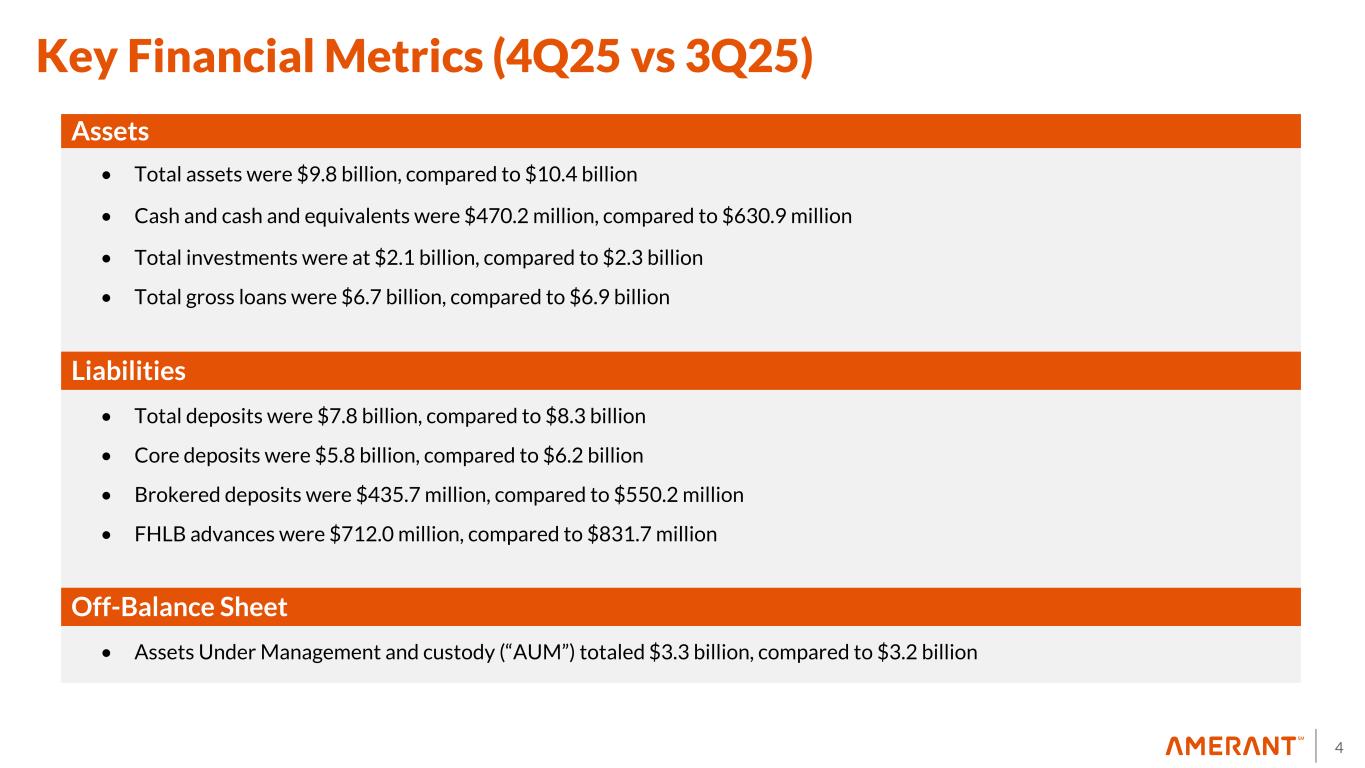
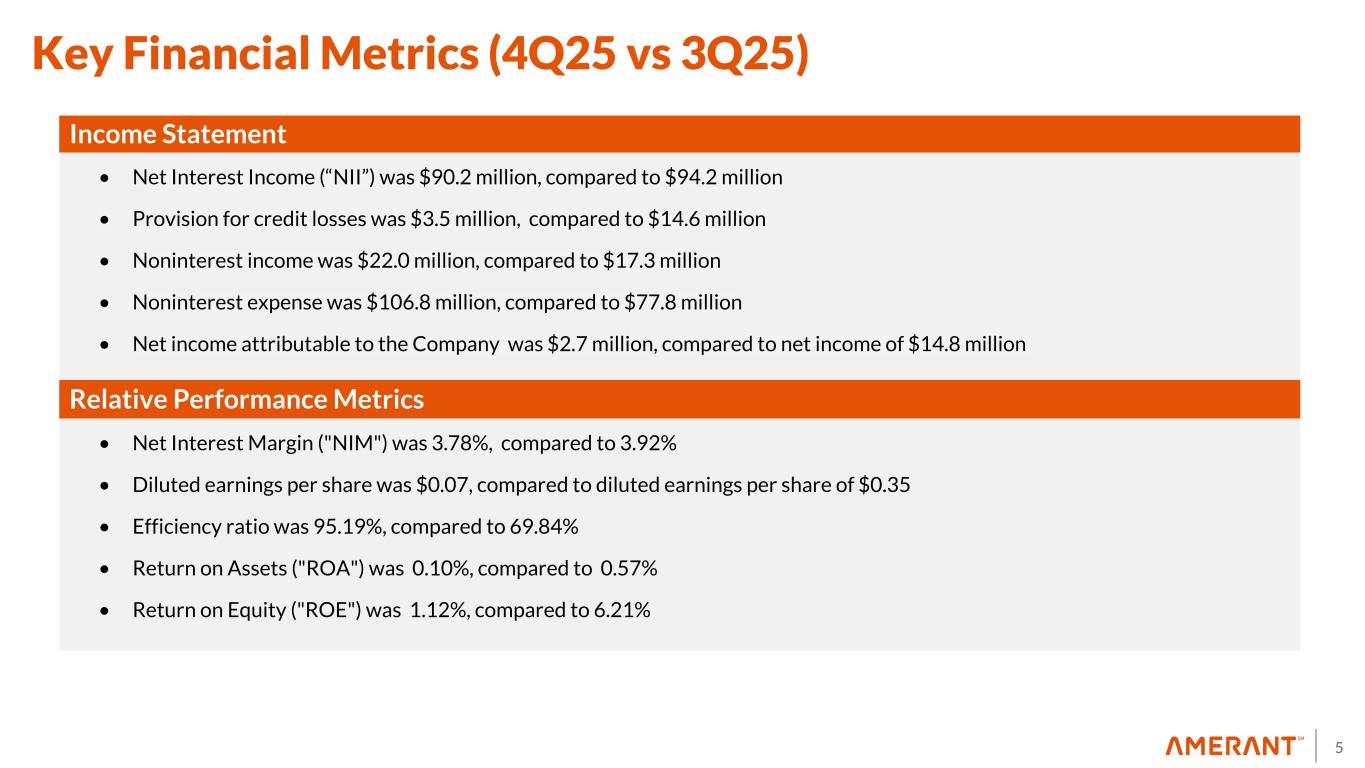
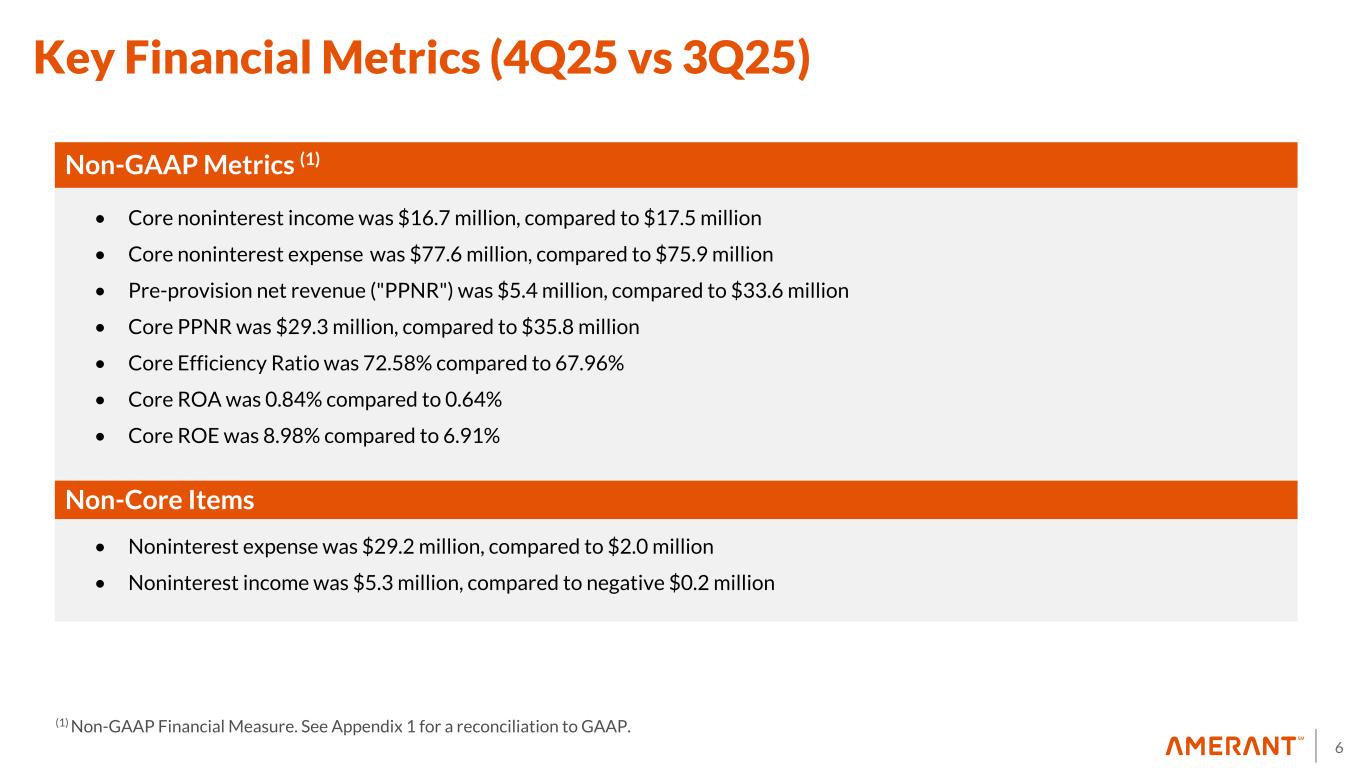
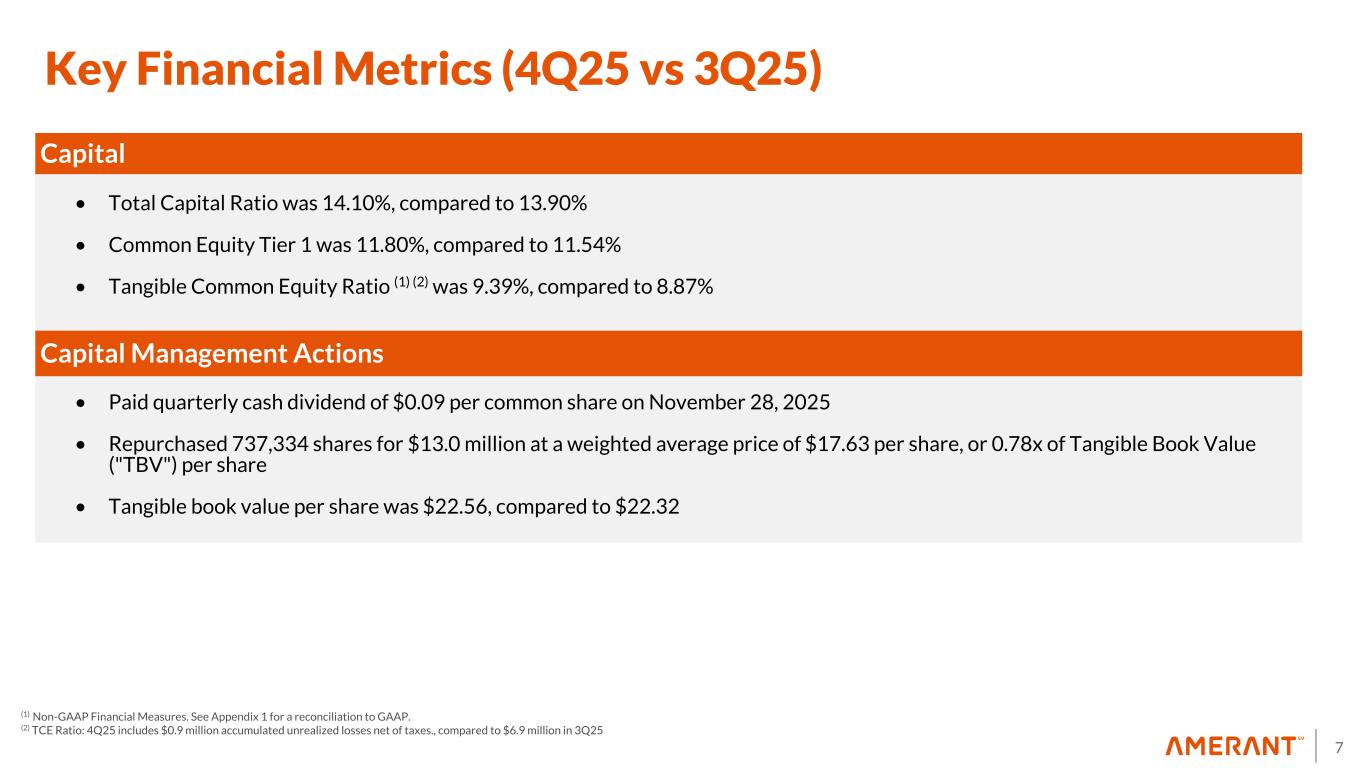
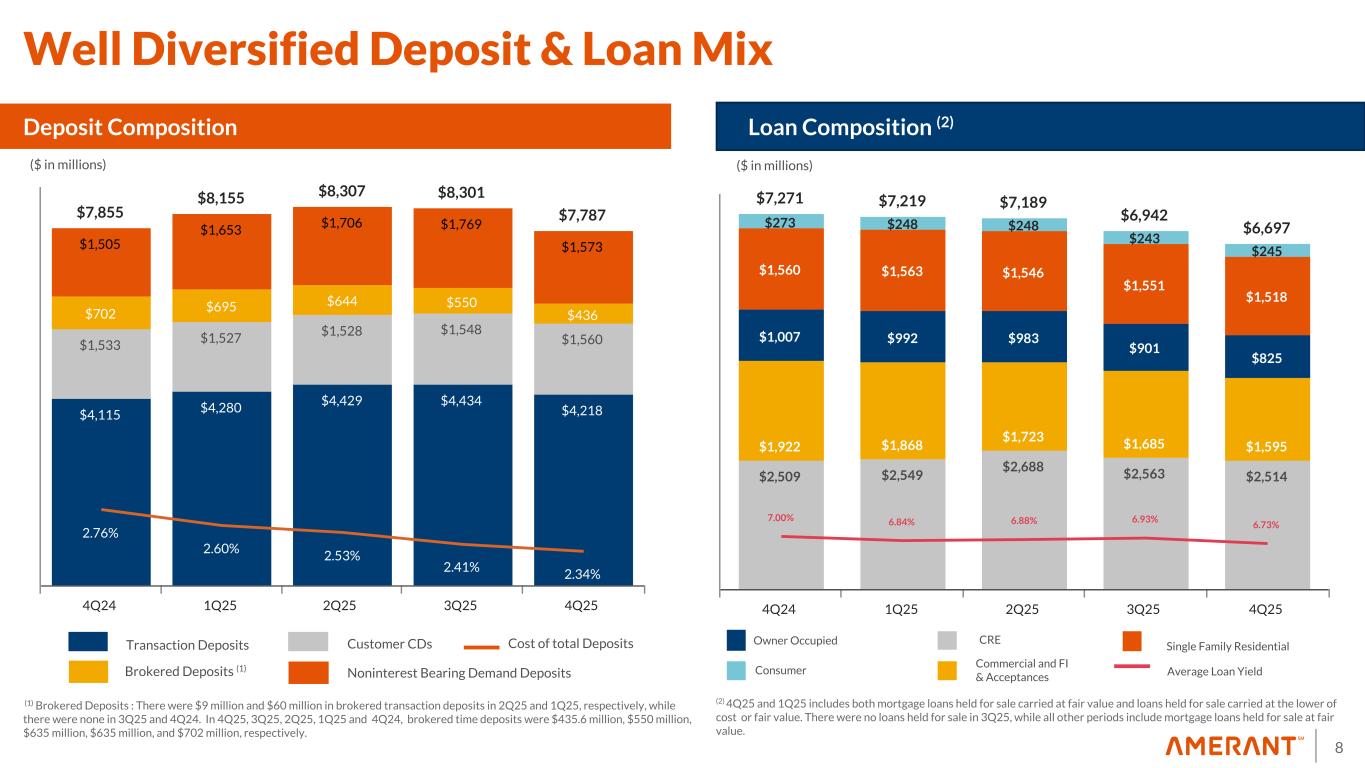
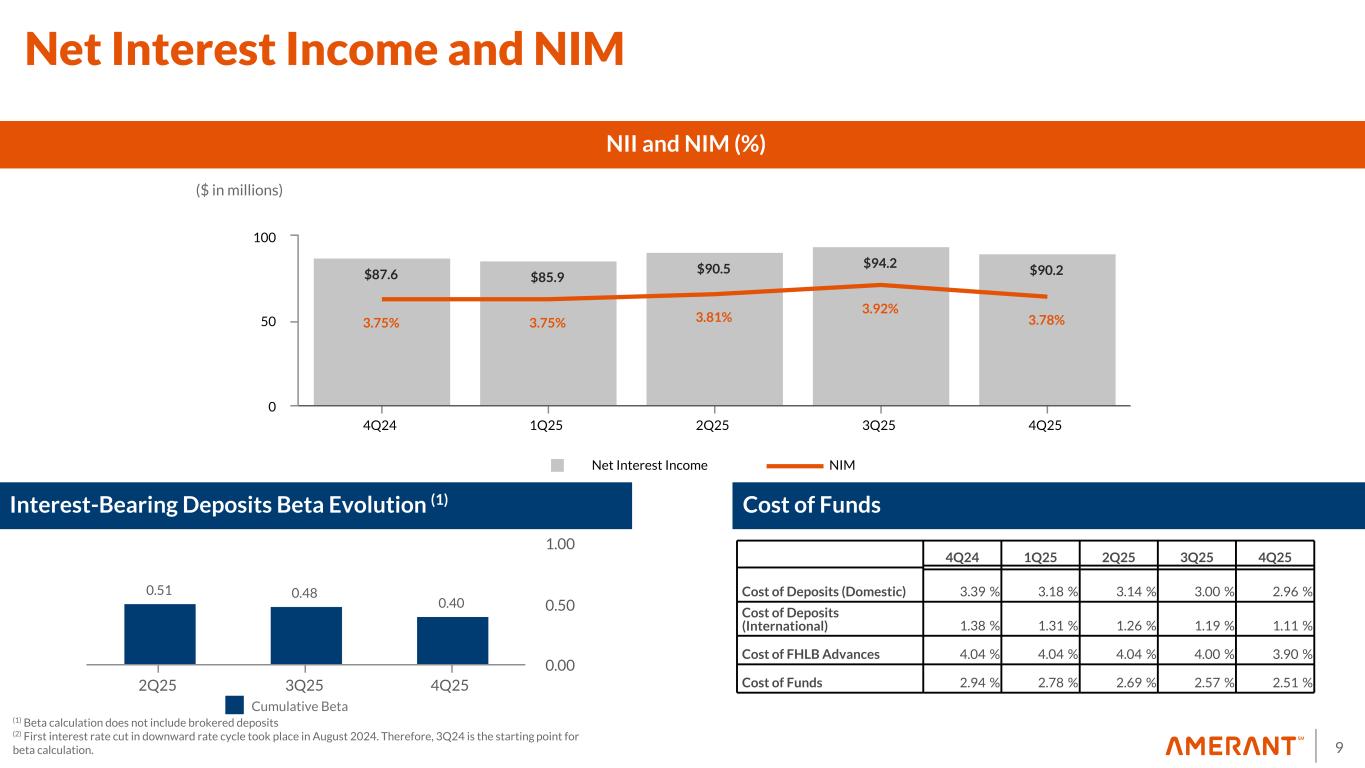
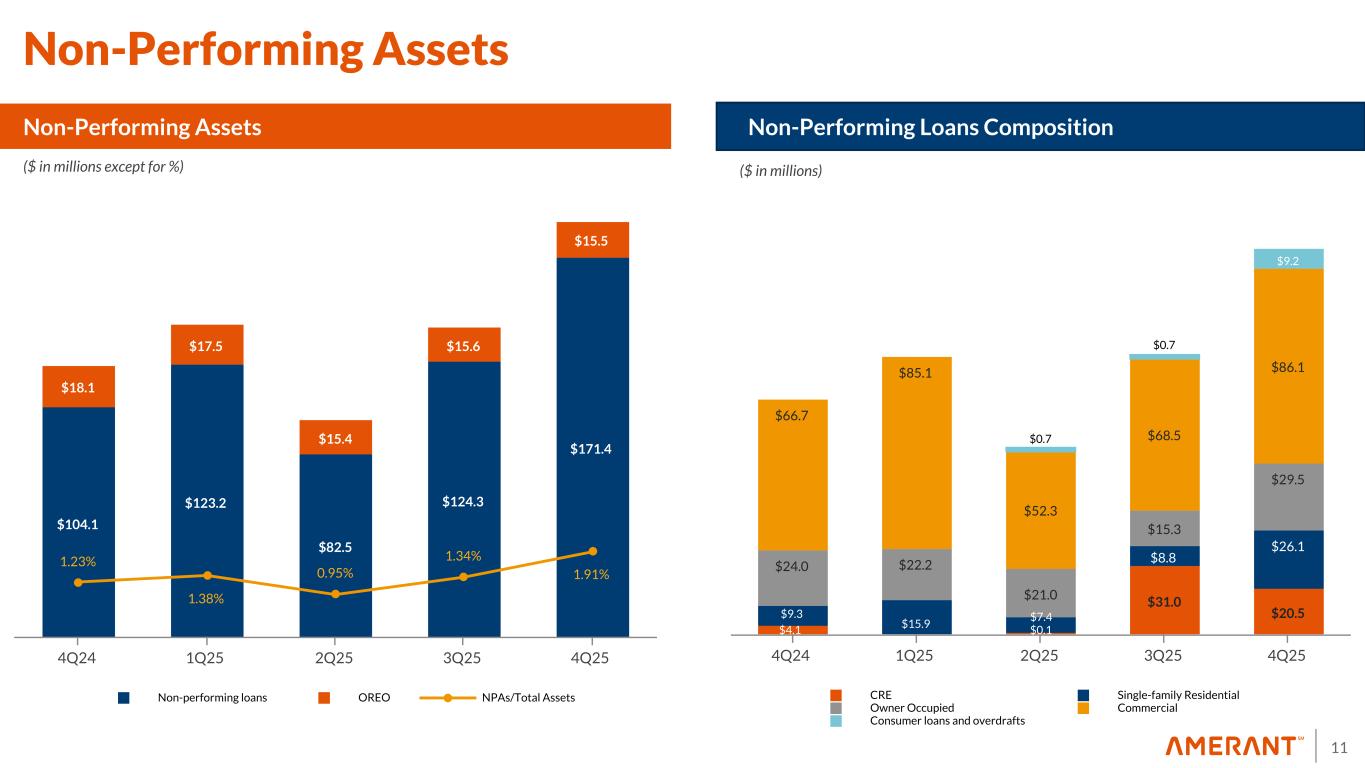
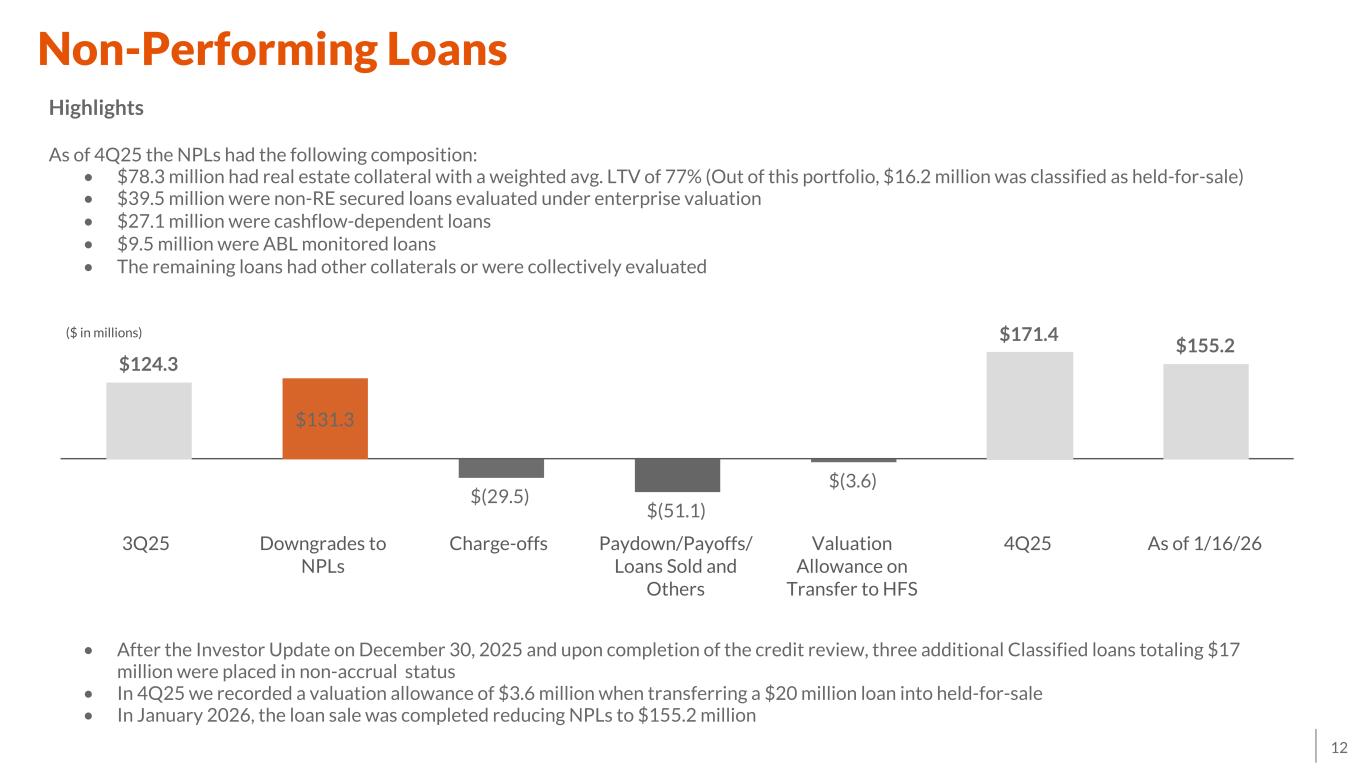
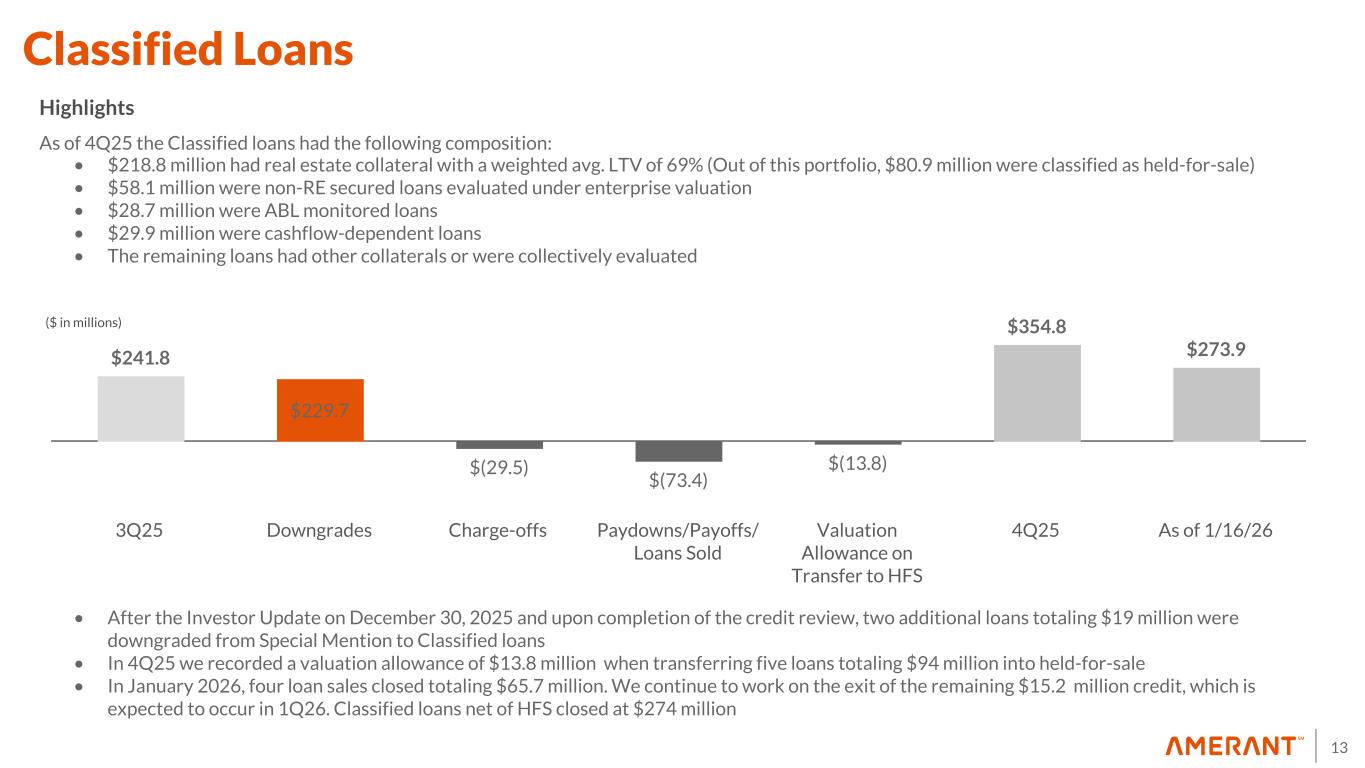
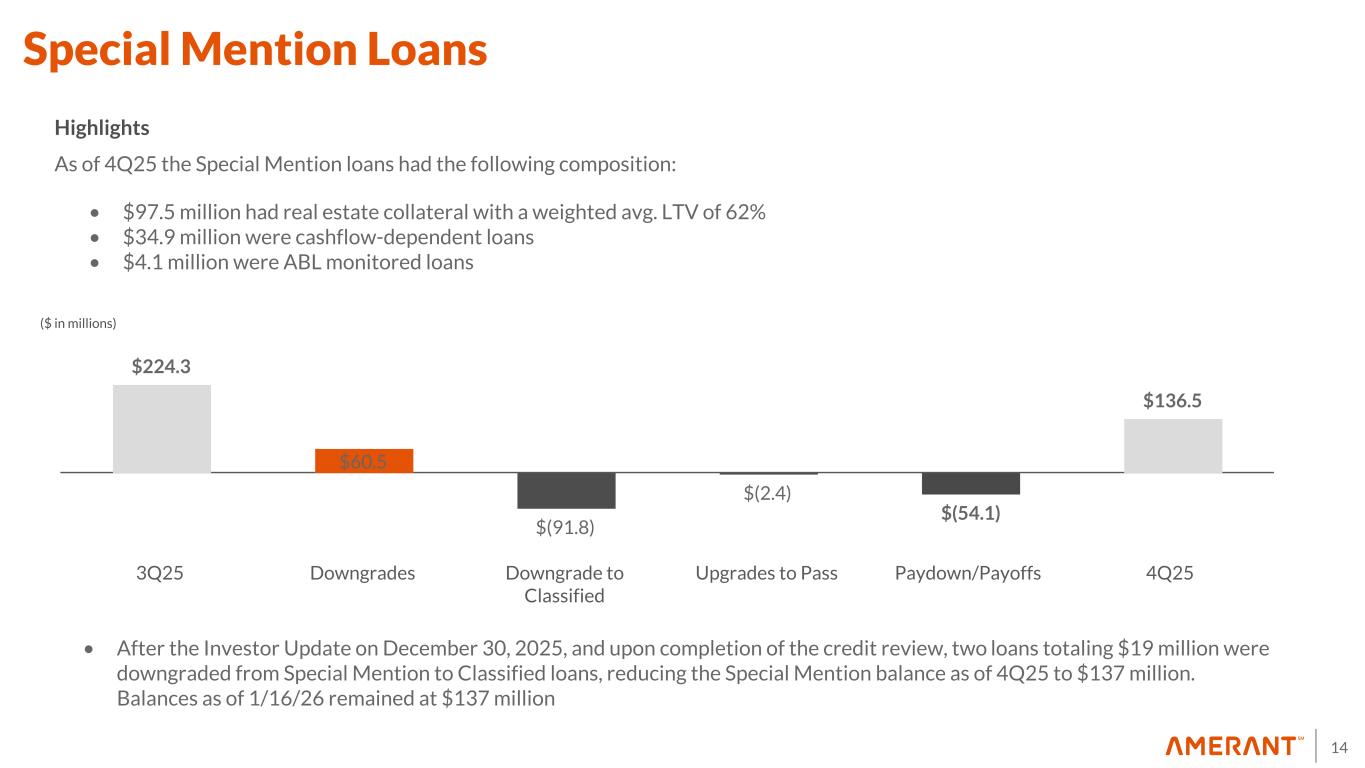
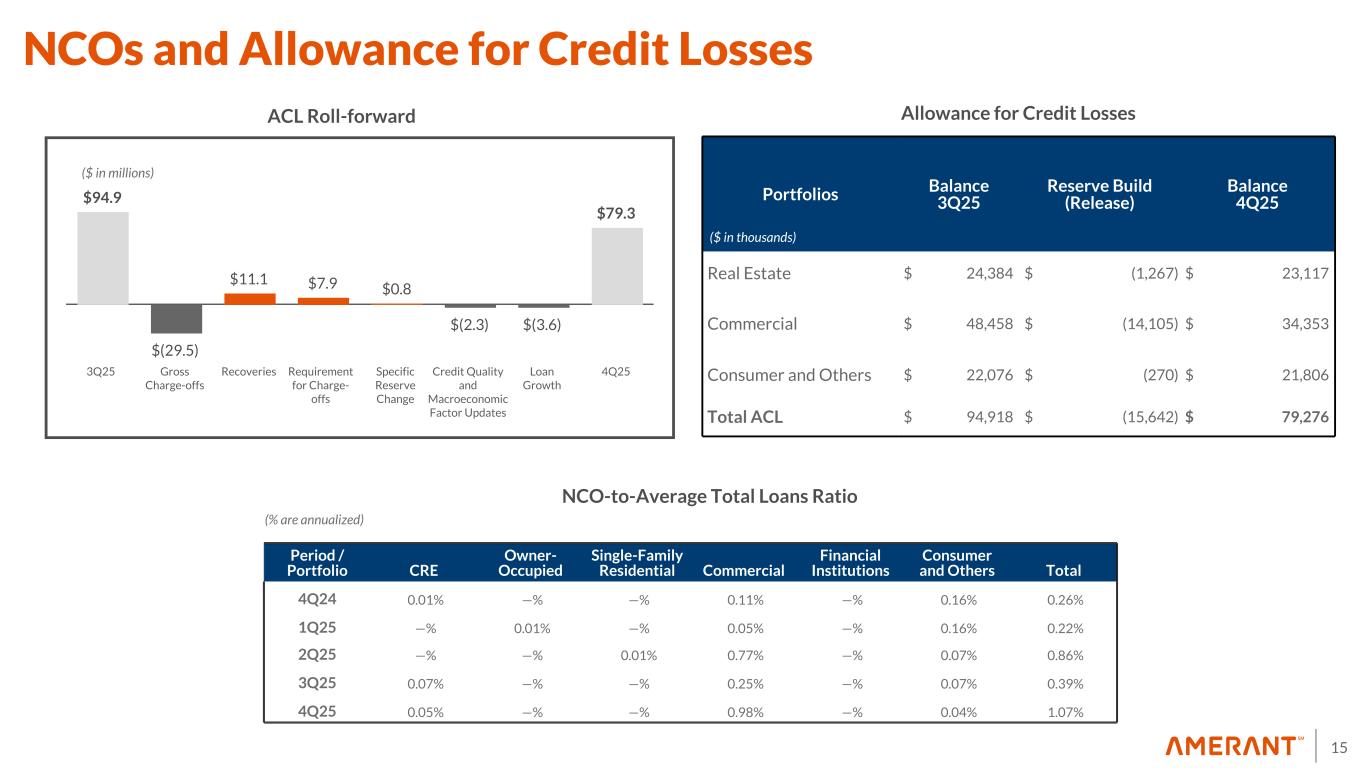
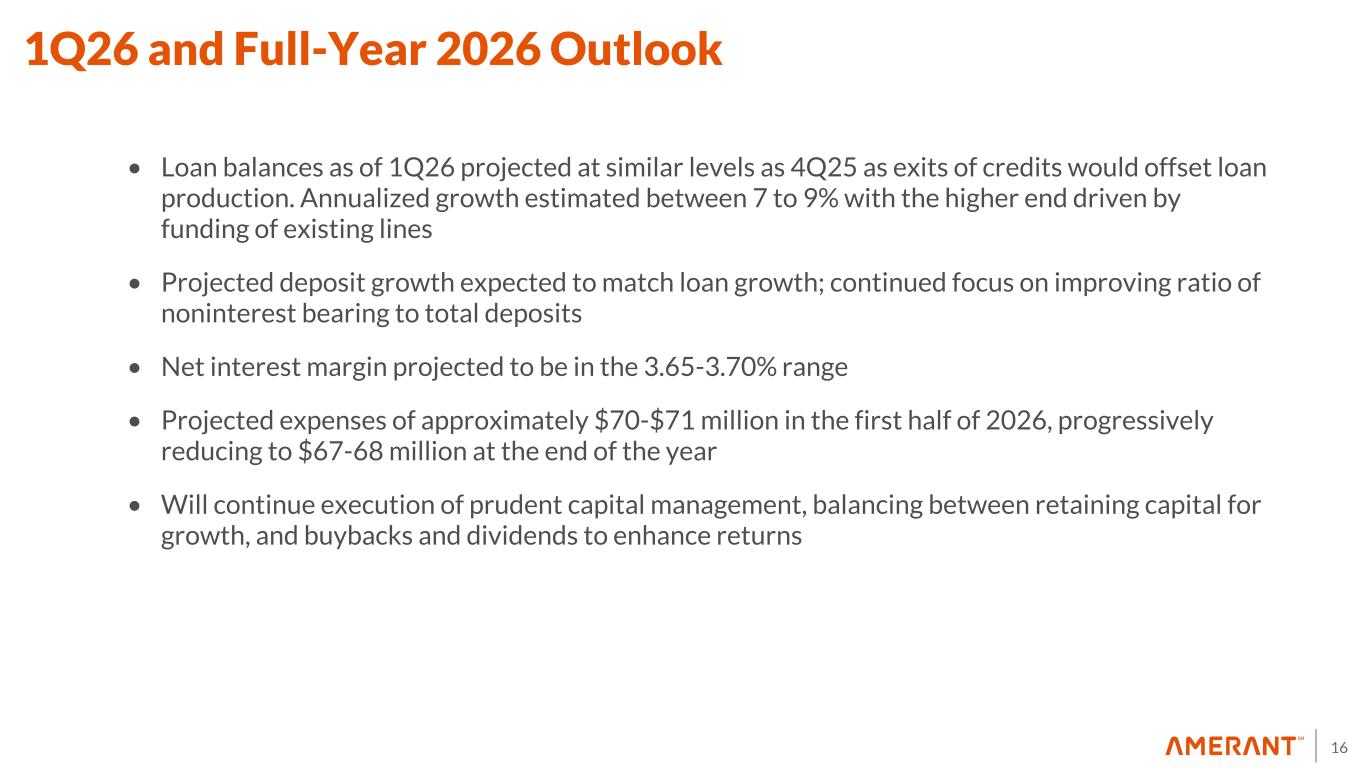
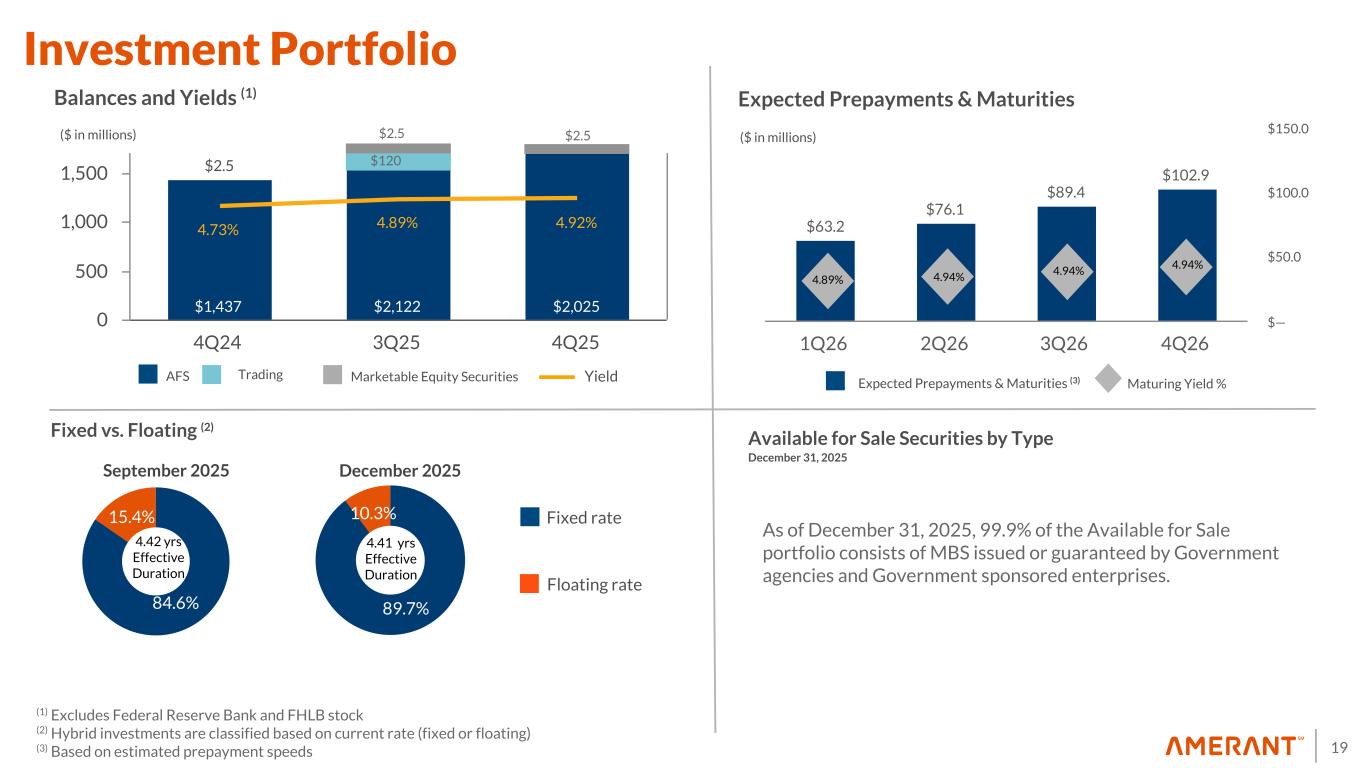
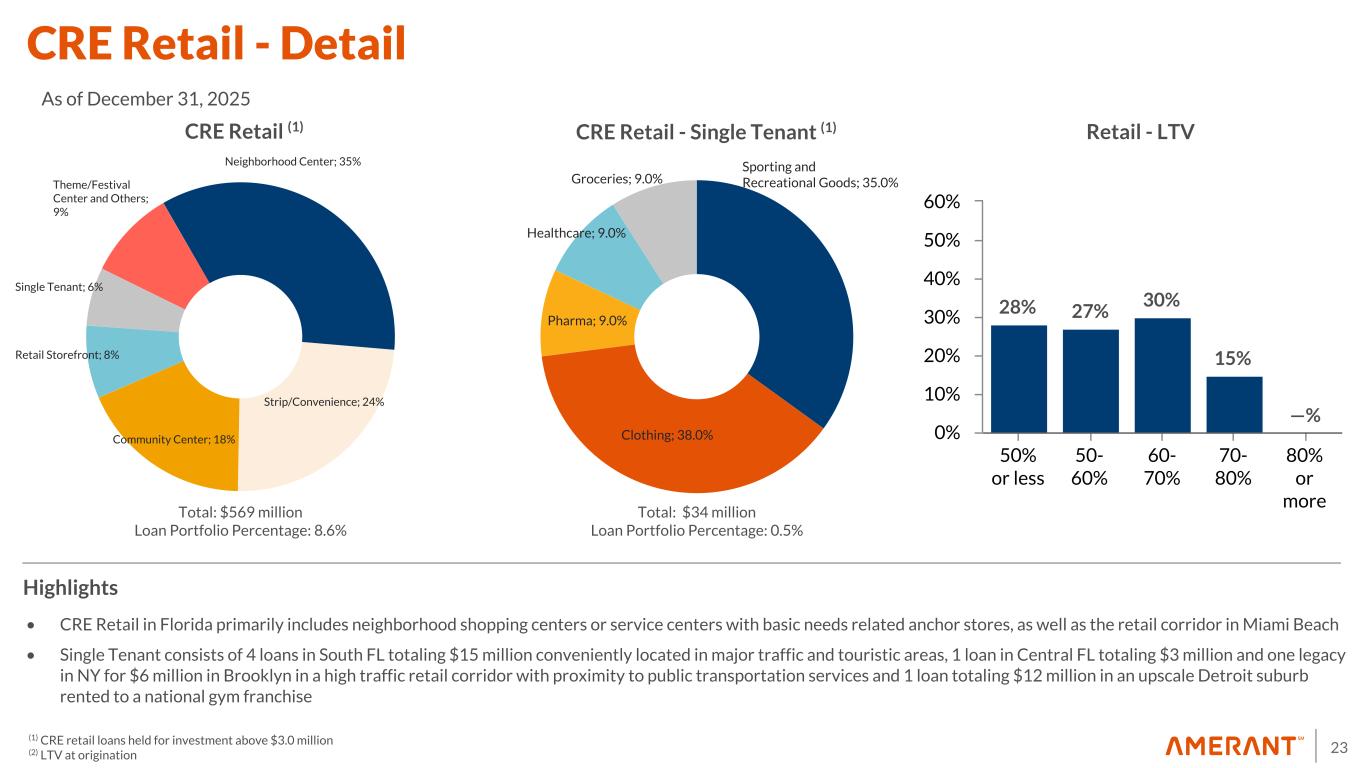
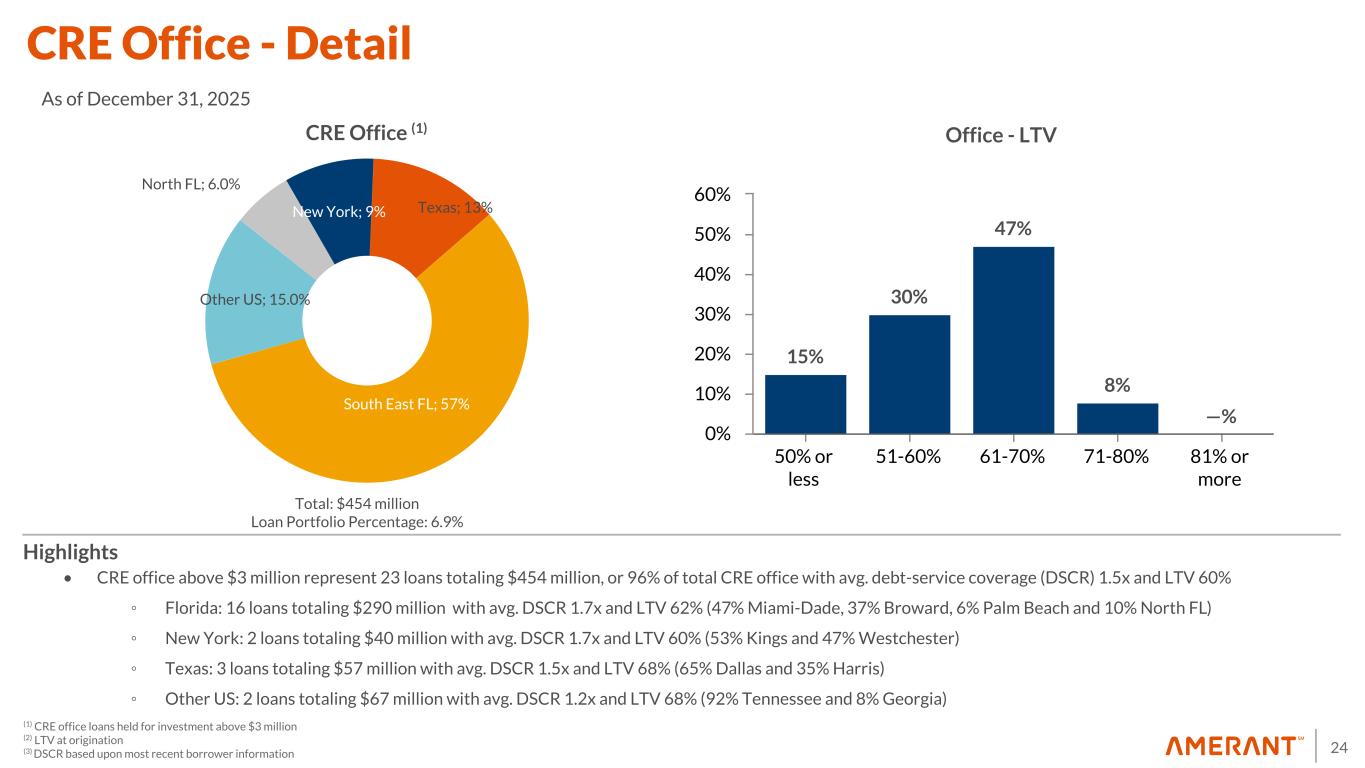
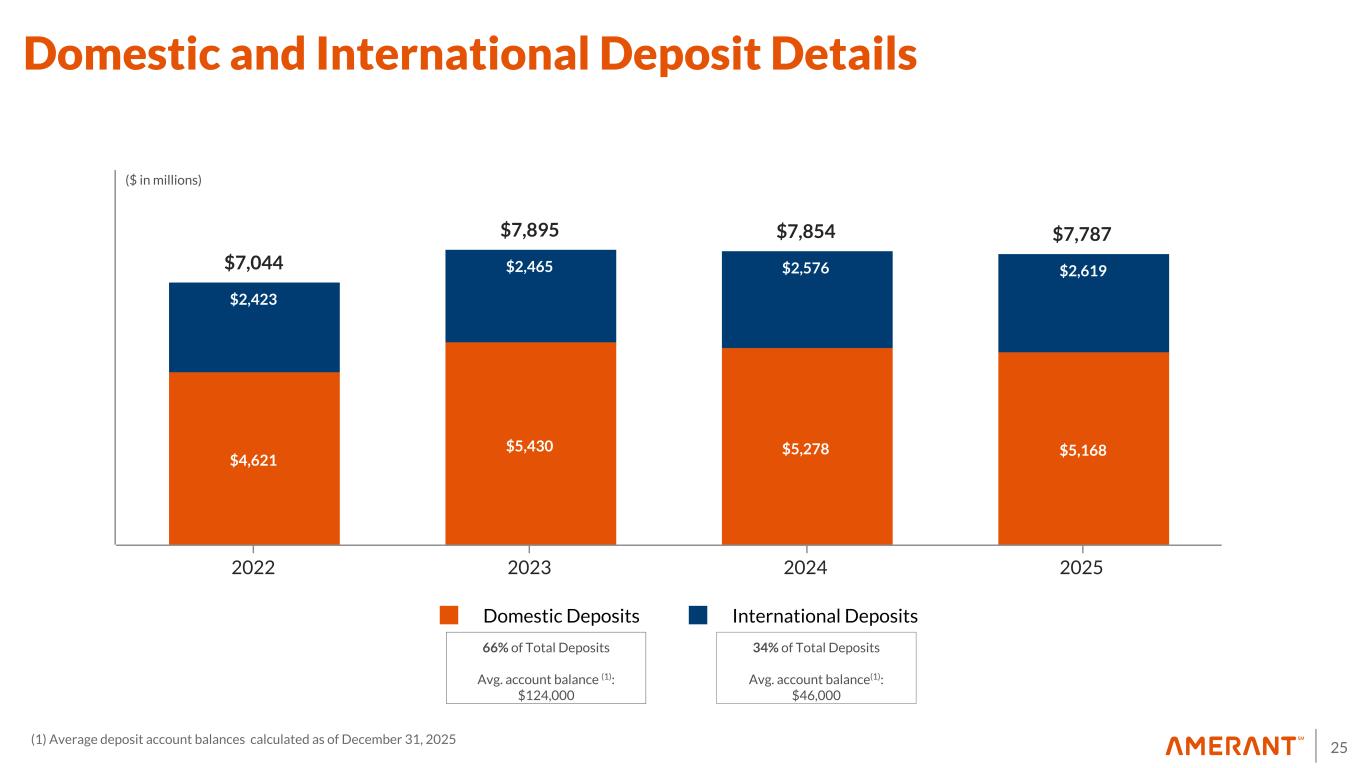
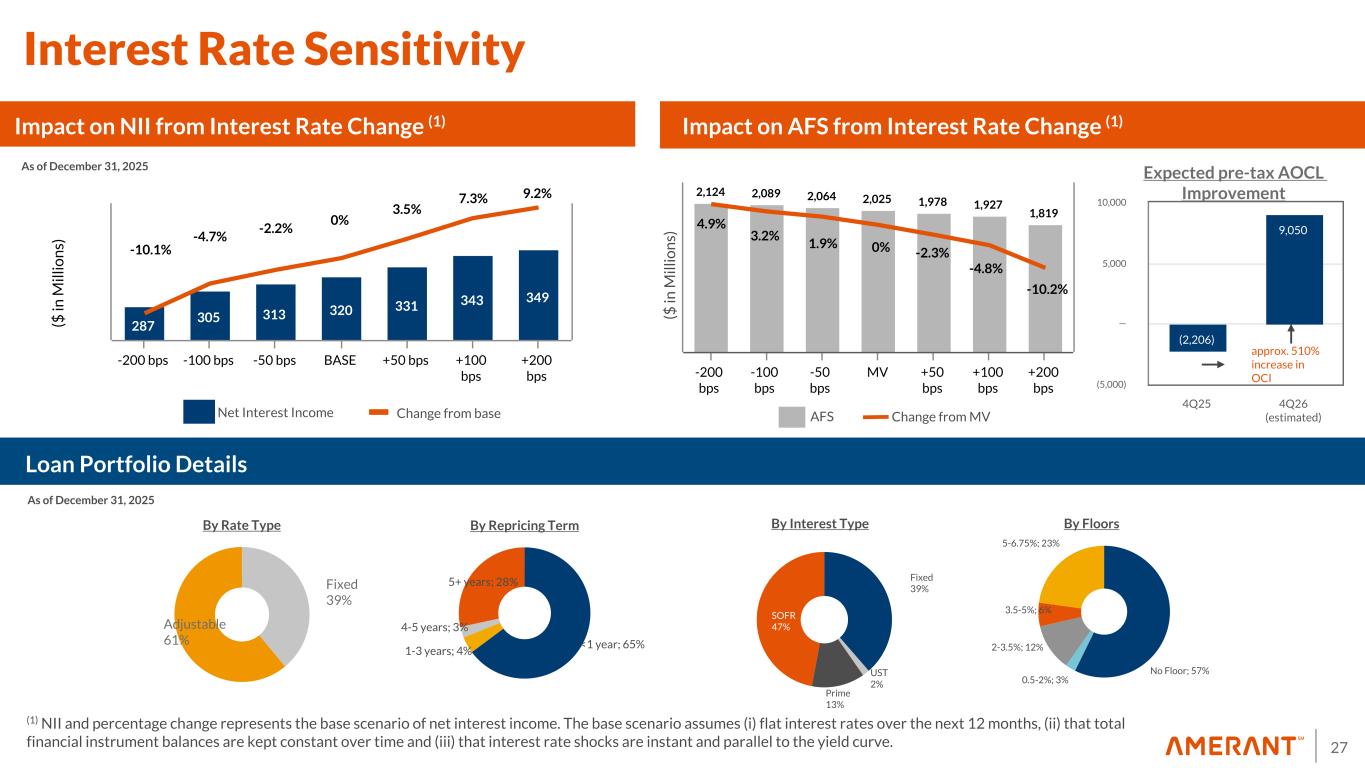
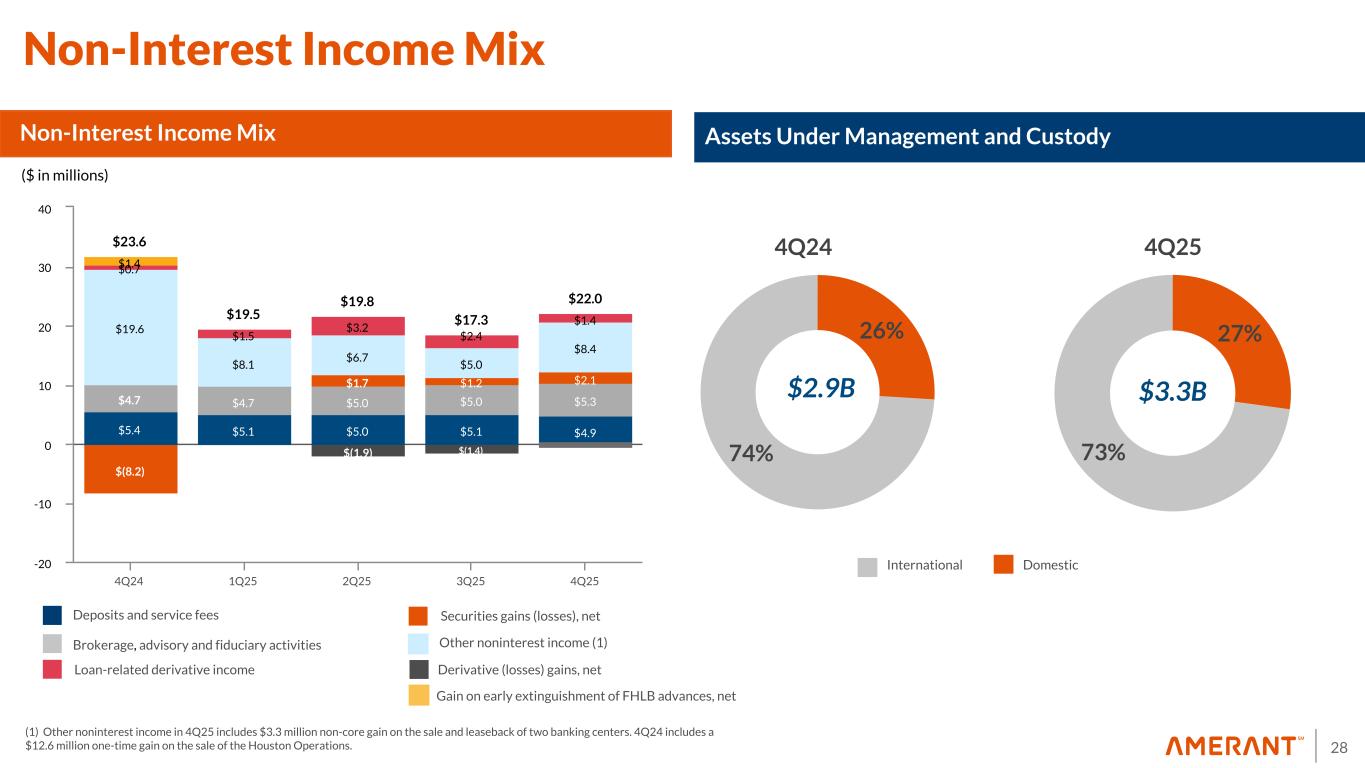
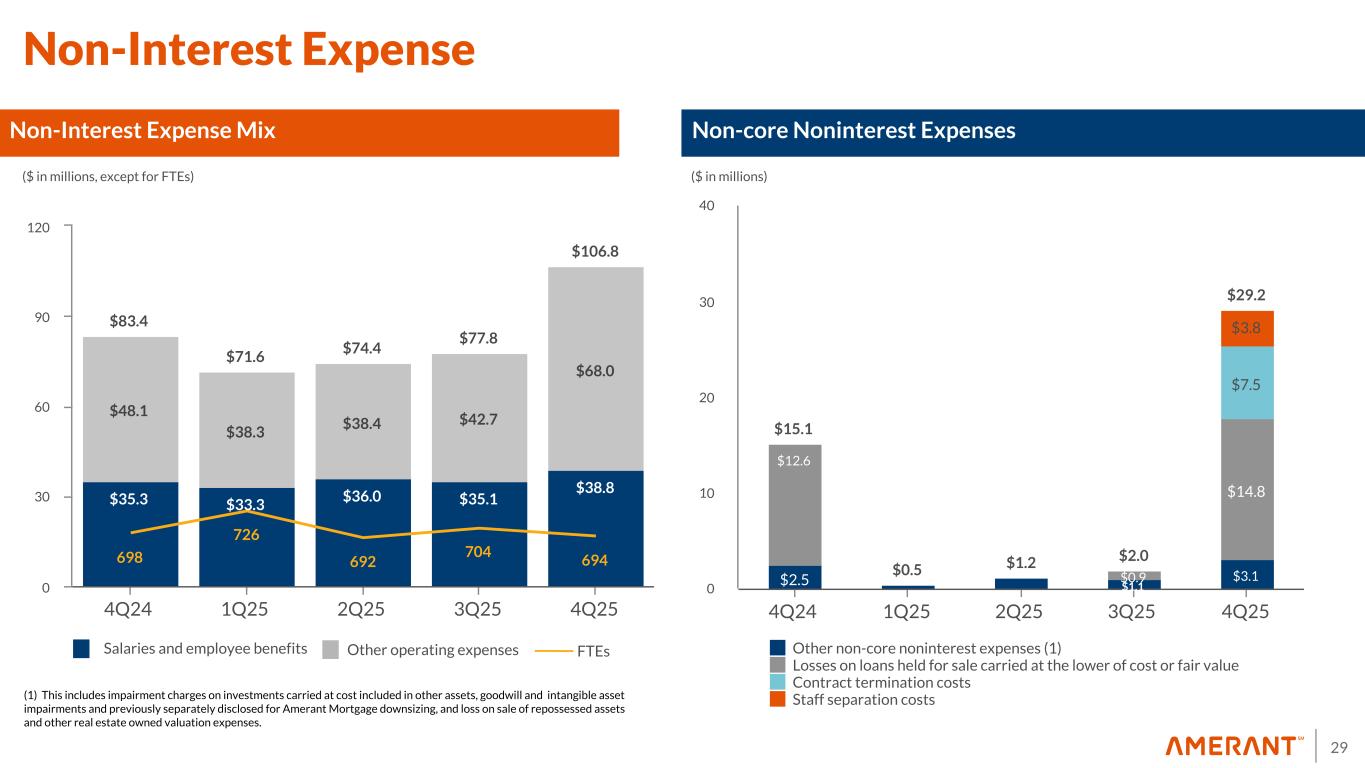
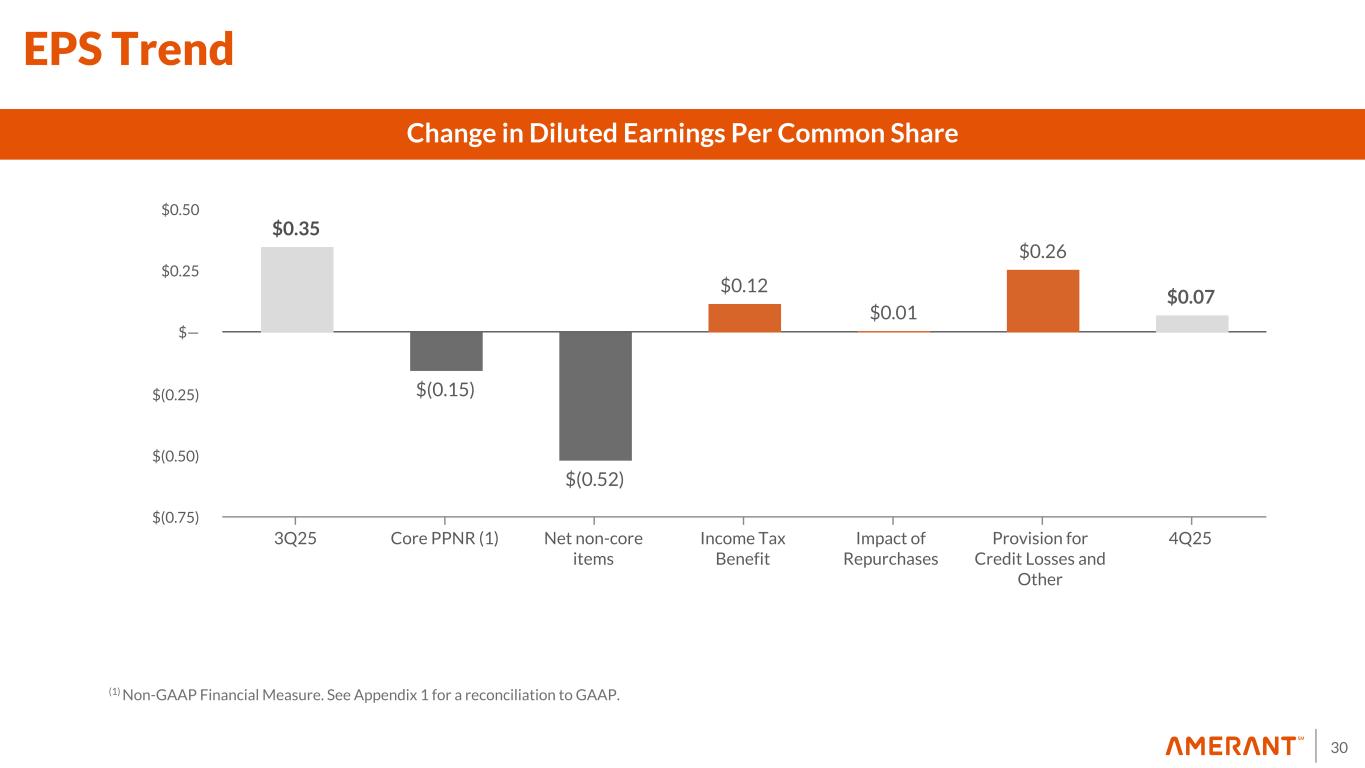
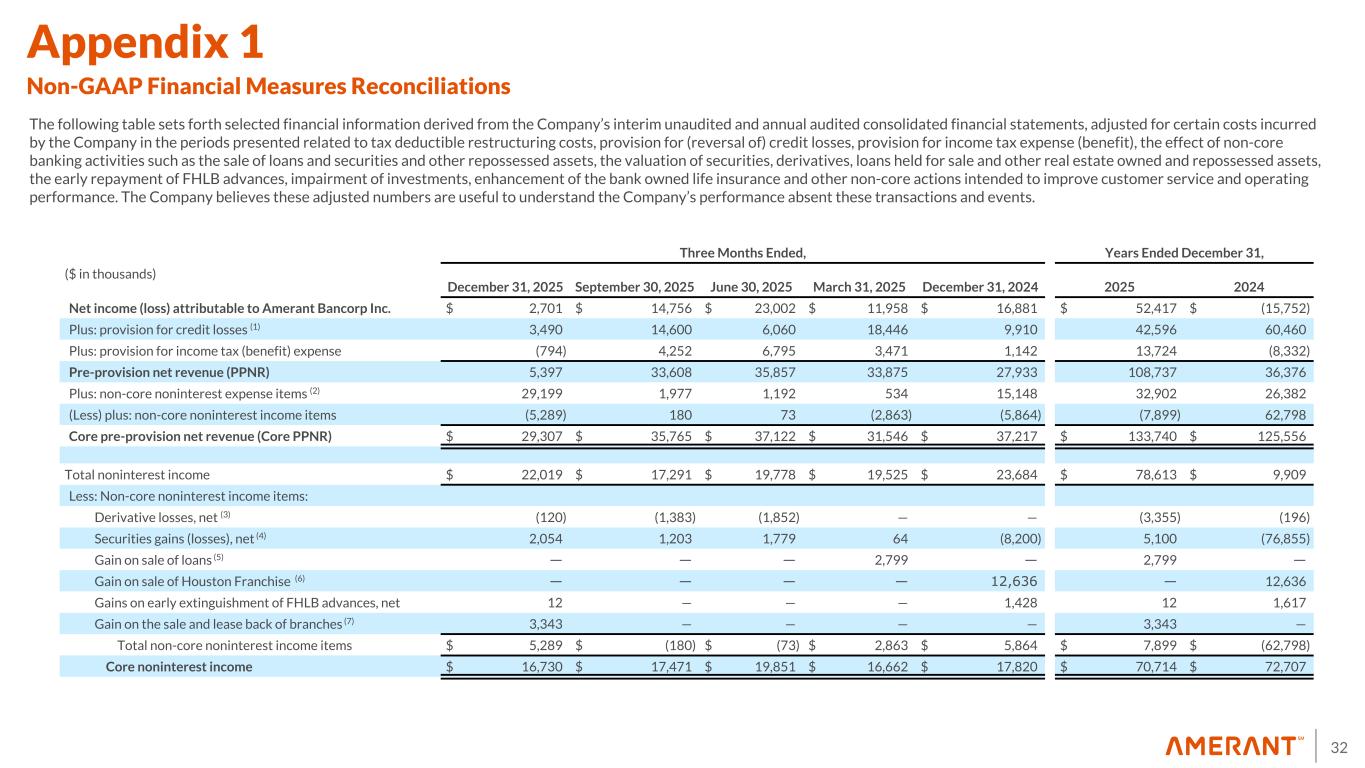
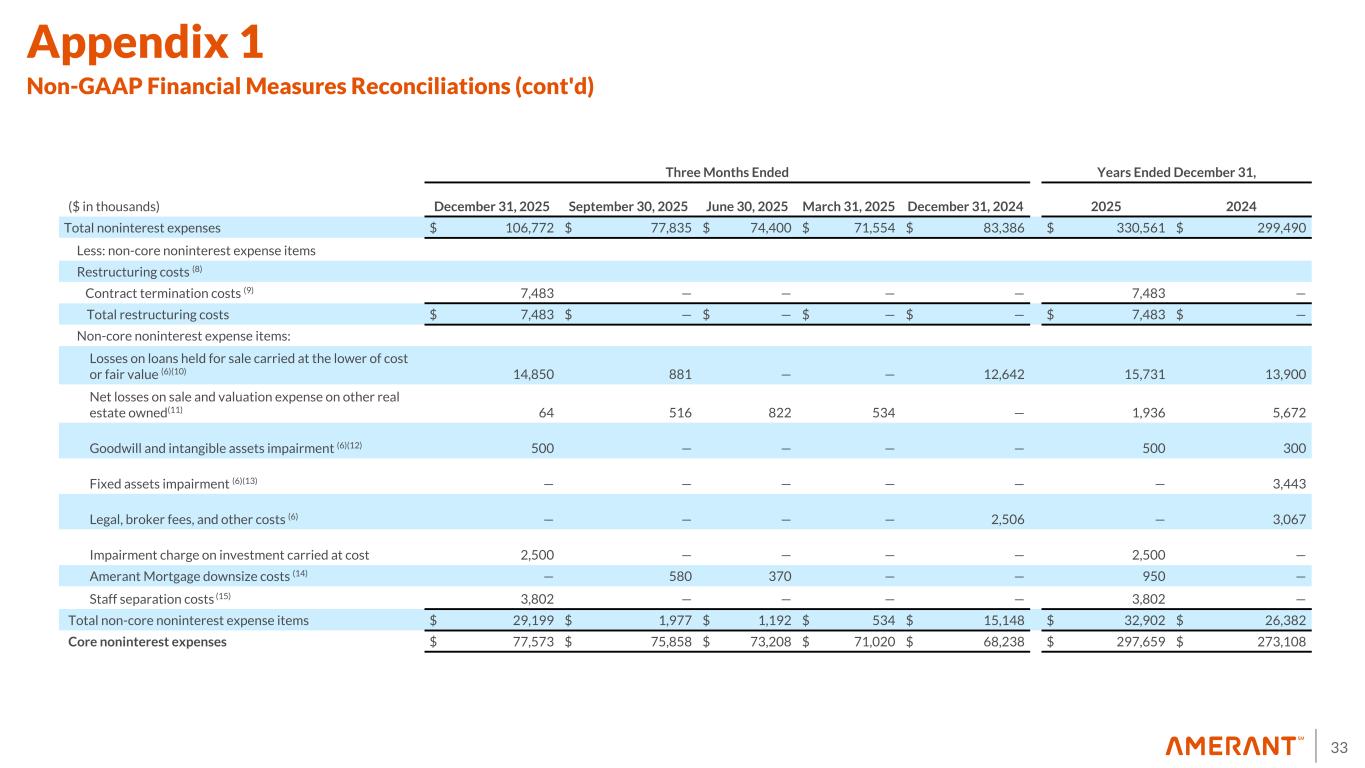
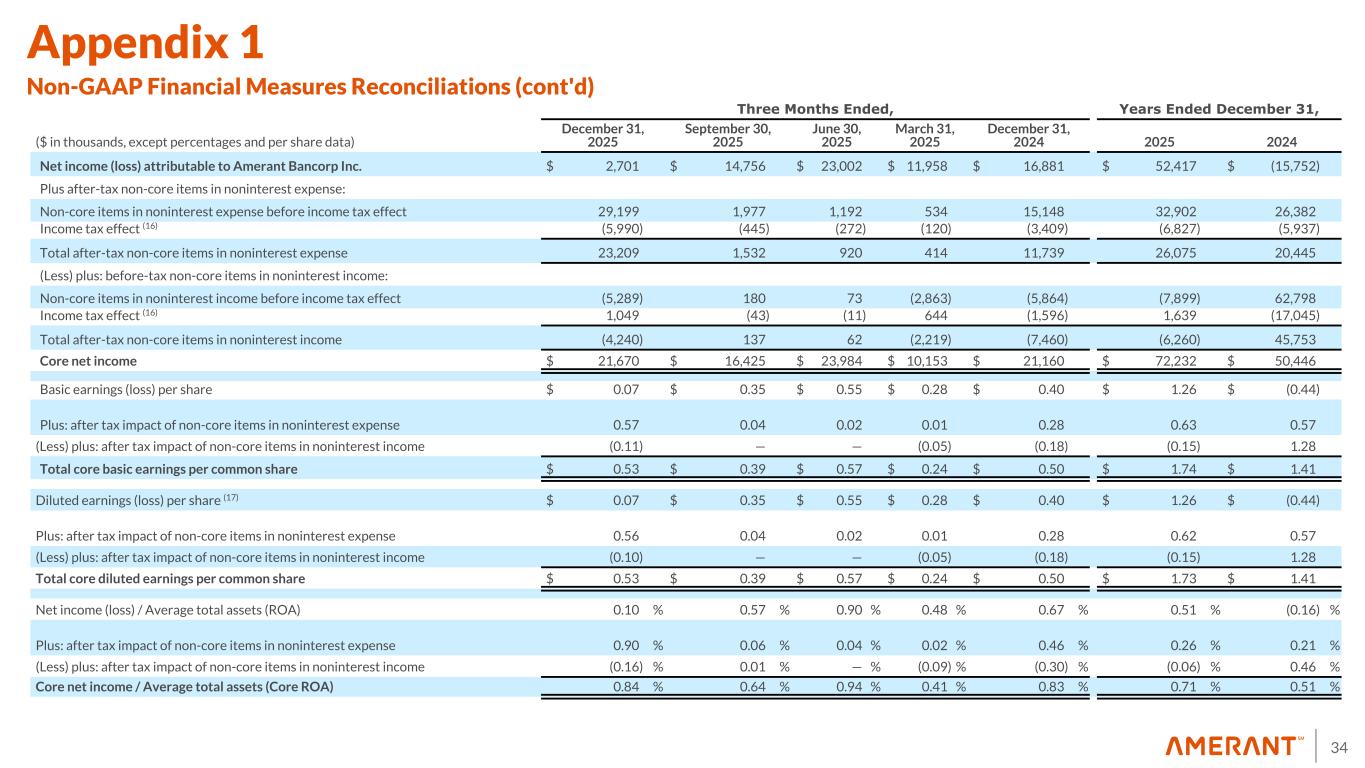
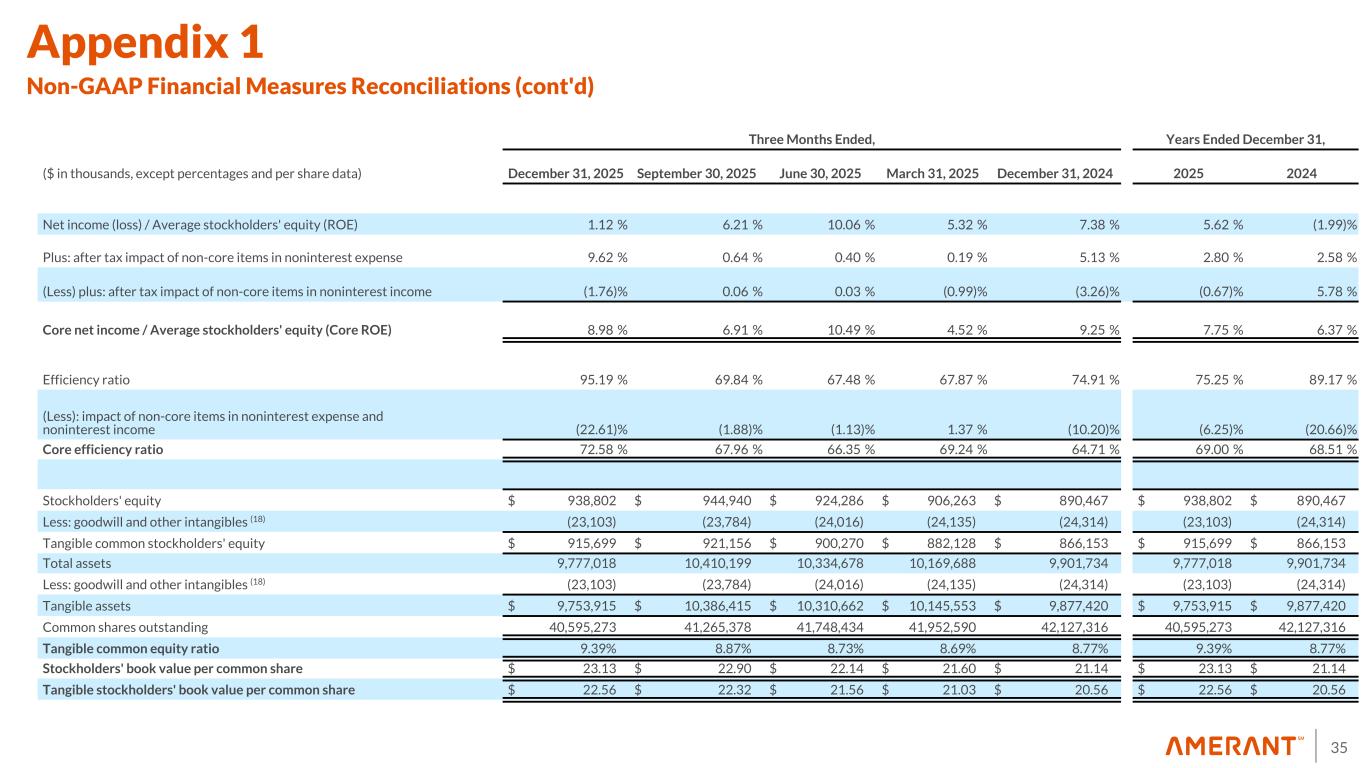
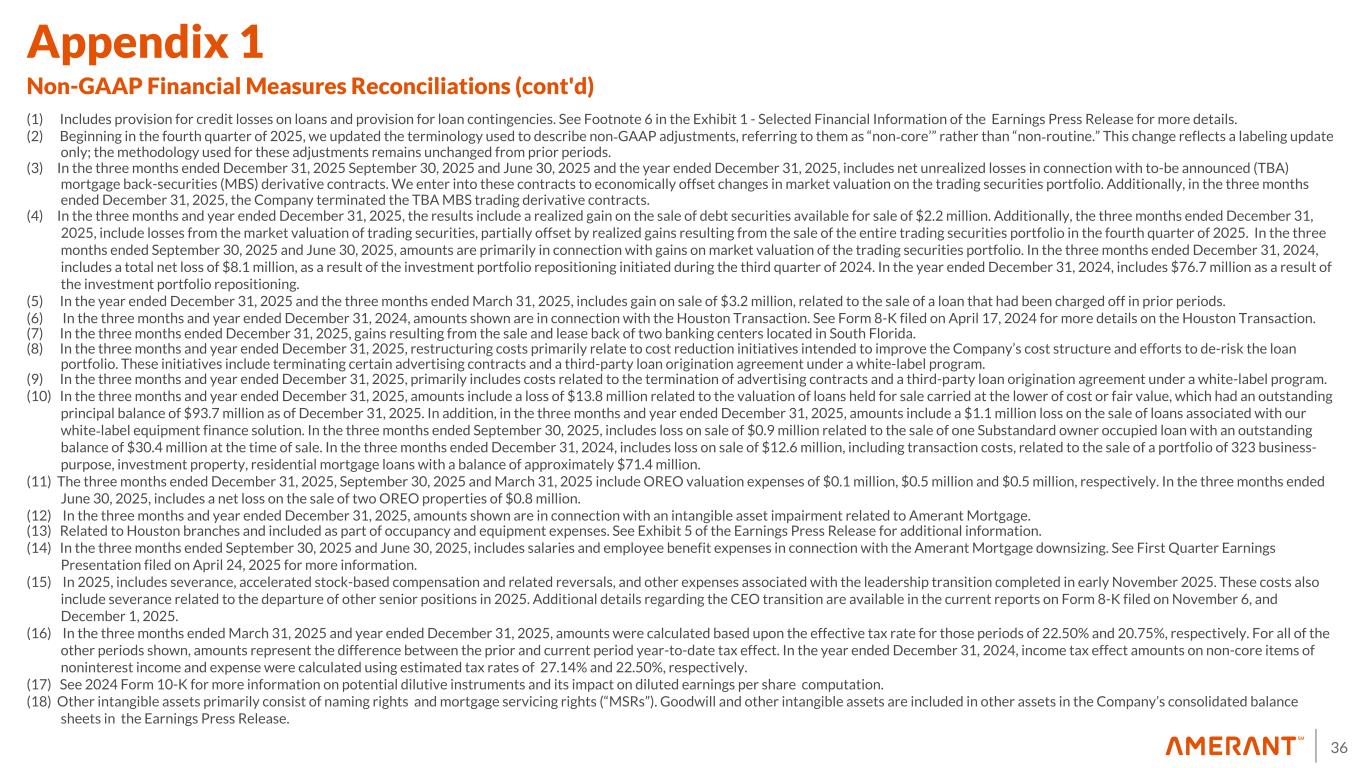
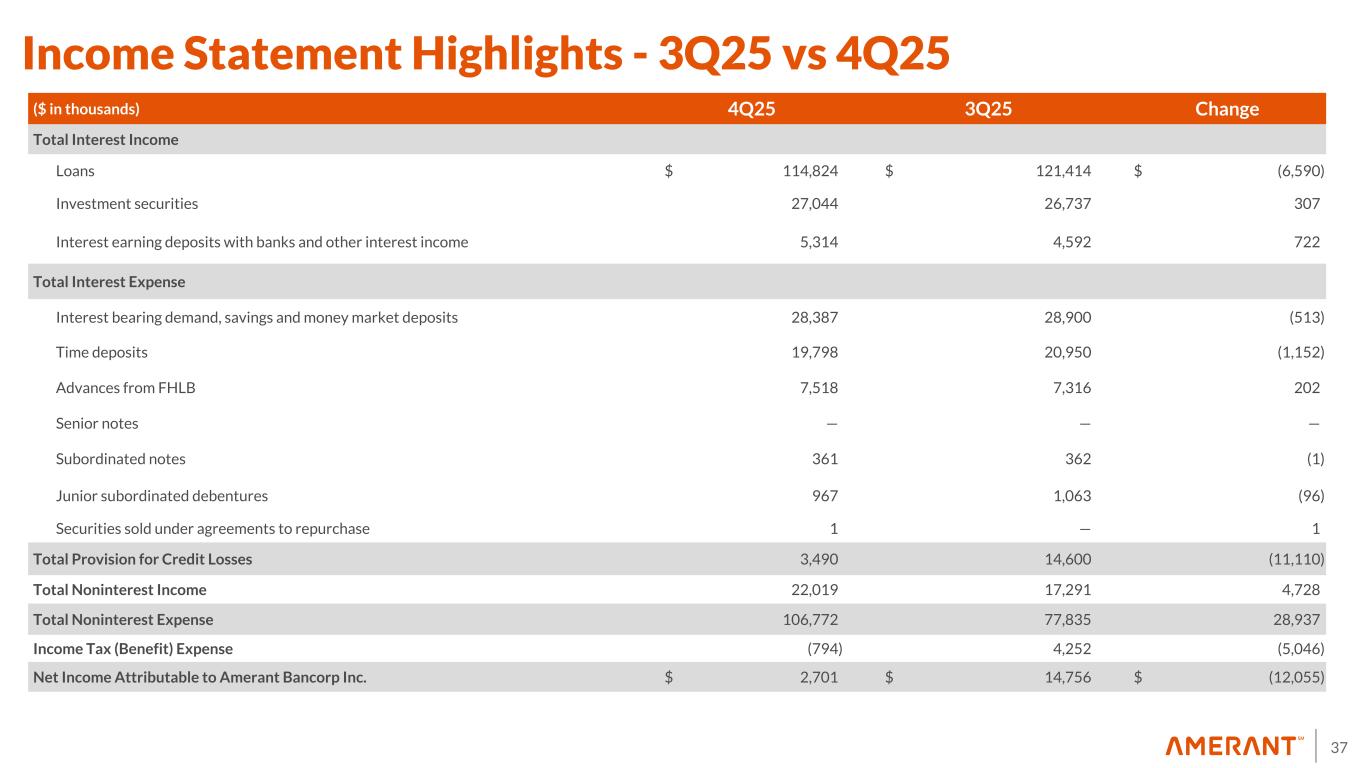
Thank you, Carlos, and good morning, everyone. Let's turn to Slide 4, where you will see the highlights of our balance sheet. Total assets were $9.8 billion as of the end of the fourth quarter, a decrease from $10.4 billion as of the end of the third quarter. The decrease was primarily driven by the reduction of wholesale funding through the use of our excess liquidity and sale of investments as well as the reduction of higher cost deposits. Cash and cash equivalents decreased $160.7 million to $470.2 million compared to $630.9 million in the third quarter. Total investments were $2.1 billion, down from $2.3 billion in the third quarter. Total gross loans decreased by $244.6 million to $6.7 billion from $6.9 billion in the third quarter as a result of higher prepayments and repayments compared to the loan production in the quarter as we focused on credit quality improvement efforts. On the deposit side, total deposits decreased by $514 million to $7.8 billion compared to $8.3 billion in the third quarter, although this is a result of our efforts to reduce higher cost deposits and broker deposits. Broker deposits continued to decrease from $550.2 million in the third quarter to $435.7 million as of the fourth quarter. We decreased FHLB advances by repaying $119.7 million in long-term advances as we continue to execute on prudent asset liability management and use excess liquidity at hand to optimize our balance sheet. Our assets under management increased $87.2 million to $3.3 billion, primarily driven by higher market valuations and net new assets. As we've shared in past calls, we continue to see this as an area of opportunity for us to grow fee income going forward. Let's turn to Slide 5. Looking at the income statement, you will see that diluted income per share for the fourth quarter was $0.07 compared to $0.35 in the third quarter. Net interest income was $90.2 million, down $4 million from $94.2 million in 3Q '25, primarily driven by a smaller balance sheet size, the timing of repricing of assets versus liabilities after the interest rate cuts, and lower impact versus prior quarter due to collection efforts over previously classified loans. The net interest margin decreased to 3.78% from 3.92% in the third quarter. Provision for credit losses was $3.5 million, down $11.1 million from $14.6 million in the third quarter. Noninterest income was $22 million, up from $17.3 million in the third quarter, driven by the gain on sale and leaseback of two of our banking centers, higher gains from available-for-sale securities sold, and lower derivative losses. Core noninterest income, excluding non-core items, was $16.7 million. Noninterest expense was $106.8 million, up $28.9 million from the third quarter, primarily due to valuation expenses on loans held for sale, contract termination costs, staff separation costs, impairment charges on an investment carried at cost, and intangible assets related to the mortgage company's wind down. Excluding non-core items, core noninterest expense was $77.6 million. You can also see that ROA and ROE this quarter were 0.10% and 1.12% compared to 0.57% and 6.21%, respectively, and our efficiency ratio was 95.19% compared to 69.84%. These ratios were primarily impacted by the decrease in net income and the increase in expenses this quarter. Turning on to Slide 6, you can see our non-GAAP metrics. Pre-provision net revenue was $5.4 million compared to $33.6 million in 3Q '25. Excluding non-core items in noninterest income and expense, core PPNR was $29.3 million compared to $35.8 million in 3Q '25. The decrease in core PPNR was primarily driven by higher non-core expenses in the fourth quarter, which were partially offset by higher non-core income items in the same period. A reconciliation of core PPNR and the impact on key ratios is shown in Appendix 1 included in this presentation. We had the following non-core items during the fourth quarter. Noninterest income of $5.3 million, which included a $3.3 million gain on the sale and leaseback of the two banking centers located in South Florida, non-core noninterest expenses of $29.2 million which included $14.9 million in losses on loans held for sale, which includes $13.8 million related to a year-end valuation allowance on loans classified for sale carried at the lower of cost or fair value, $7.5 million in contract termination costs as part of our restructuring costs aimed at improving the company's cost structure. These initiatives include terminating certain rights and benefits associated with existing advertising contracts and a third-party loan origination agreement under a white-label program, $3.8 million in separation costs, primarily in connection with the leadership transition in the fourth quarter; $2.5 million in impairment charge on an investment carried at cost and $500,000 in an intangible asset impairment related to the downsizing of Amerant Mortgage. Adjusting for these non-core items, our core efficiency ratio was 72.58%, core ROA was 0.84%, and core ROE was 8.98%. Turning to Slide 7, which shows the quarter-over-quarter comparison of some of our capital ratios. Our CET1 was 11.8% compared to 11.54% last quarter, mainly driven by lower risk-weighted assets and from net income during the quarter, while partially offset by $13 million in share repurchases and $3.7 million in shareholder dividends. We paid our quarterly cash dividend of $0.09 per share of common stock on November 28, 2025, and our Board of Directors just approved a quarterly dividend of $0.09 per share payable on February 27 of this year. During the fourth quarter, we also repurchased 737,334 shares at a weighted average price of $17.63 per share compared to the tangible book value of $22.56 as of December 31, 2025. This represented 78% of tangible book value. Turning now to Slide 8, where we show our well-diversified deposit mix along with the composition of our loan portfolio. Total deposits for the quarter were $7.8 billion, down $514 million or 6.2% compared to $8.3 billion in the previous quarter. We had decreases in every category as we reduced higher cost deposits, but had a slight increase in customer CDs. Total loans, on the other hand, were $6.7 billion, a decrease of $244.6 million or 3.5% compared to $6.9 billion, primarily due to decreases in CRE and owner-occupied loans. Next, on Slide 9, you will see additional information related to net interest income and net interest margin. This quarter, we continued to reprice our interest-bearing deposits to maintain a healthy NIM and saw the cumulative beta at 0.4% since the rates down period started. Moving on to asset quality. As you can see on Slide 11, nonperforming assets increased to $187 million or 1.9% of total assets compared to $140 million or 1.3% of total assets in the prior quarter. The increase in nonperforming assets is the result of rigorous efforts by portfolio management, credit administration, and credit review, complemented by an independent third-party firm brought in to ensure timely reviews of updated financial information and risk rating, including the identification of any possible deteriorated conditions to allow us to be more proactive in expediting resolution. As disclosed before year-end, these reviews covered approximately $5.3 billion or 85% of the commercial loan portfolio through covenant testing, annual reviews, or limited financial reviews. The remaining portfolio not covered by the reviews consists primarily of small balance loans that are evaluated through payment performance, recent originations in 2025, and loans secured with cash or investments as collateral. We will continue our scheduled review process throughout 2026, and we prioritize efforts on proactive credit quality and portfolio management measures. Now moving into criticized loans. On the next three slides, we provide details for nonperforming classified and special mention loan movements during the quarter. In the first slide, we show the composition of our nonperforming loans at the end of the fourth quarter. We have included details of the sufficiency of collateral coverage and the type of individual evaluation performed over them. During 4Q '25, downgrades into nonperforming loans were primarily in the commercial Florida portfolio and certain other loans that have tangible collateral. You will also see the results of efforts to exit these credits via paydowns, payoffs, and loan sales with balances declining now in January to $155 million as a result of this work. In the next slide, we have included similar information as it relates to the classified portfolio. During 4Q '25, downgrades into classified loans were primarily driven by CRE loans in Florida and Texas, commercial Florida loans and certain other loans that have tangible collateral. In this slide, you will also see the results of the efforts to reduce the loan balances in this bucket by now in January 2026 when four loan sales closed totaling $66 million. We continue to work on the exit of the remaining $15 million credit, which is expected to occur during the first quarter of 2026. Classified loans net of held-for-sale loans closed at $274 million. In the next slide, we cover special mention loans and the characteristics as it relates to collateral coverage. During 4Q 2025, downgrades to special mention were driven by one CRE Texas loan and one CRE relationship with collateral diversified in different geographies. Overall, this composition reflects a disciplined approach to credit monitoring, valuation, and resolution as we continue to proactively manage risk across the portfolio. Now moving on to Slide 15. Here, we show the drivers of the provision recorded this quarter and impact to the allowance for credit losses. The provision for credit losses was $3.5 million in the fourth quarter and was comprised of $7.9 million in additional reserves for charge-offs, $800,000 in net change in specific reserve allocations, offset by releases of $3.6 million due to credit quality and macroeconomic factors, and $2.3 million due to the reduction in loan balances. In addition, we recorded $700,000 for unfunded loan commitments. During the fourth quarter of 2025, gross charge-offs totaled $29.5 million related to five commercial loans totaling $22.3 million, indirect consumer loans totaling $1.5 million, one CRE loan totaling $900,000, and multiple commercial loans totaling $4.8 million. These charge-offs were offset by $11.1 million due to recoveries, mainly the recovery of $8 million that we had previously disclosed in the 3Q '25 10-Q. Lastly, the allowance for credit losses coverage ratio was down to 1.20% from 1.37% last quarter, primarily due to charge-offs of specific reserves. Excluding specific reserves, the coverage ratio decreased slightly from 1.23% to 1.20%. In Slide 16, we provide the following regarding financial expectations. In the short term for 1Q '26, we are projecting loan balances at similar levels as of 4Q '25 as exits of credits would offset loan production. However, growth for the year is estimated between 7% to 9%, with the higher end driven by funding of existing lines. Our projected deposit growth is expected to match loan growth. We continue to focus on improving the ratio of noninterest bearing to total deposits and the overall cost of funds. Net interest margin is projected to be in the 3.65% to 3.70% range. We are projecting expenses of approximately $70 million to $71 million in the first half of 2026, progressively reducing to $67 million to $68 million at the end of the year. We intend to continue executing on prudent capital management, balancing between retaining capital for growth and buybacks and dividends to enhance returns. And with that, I pass it back to Carlos for additional comments and closing remarks.
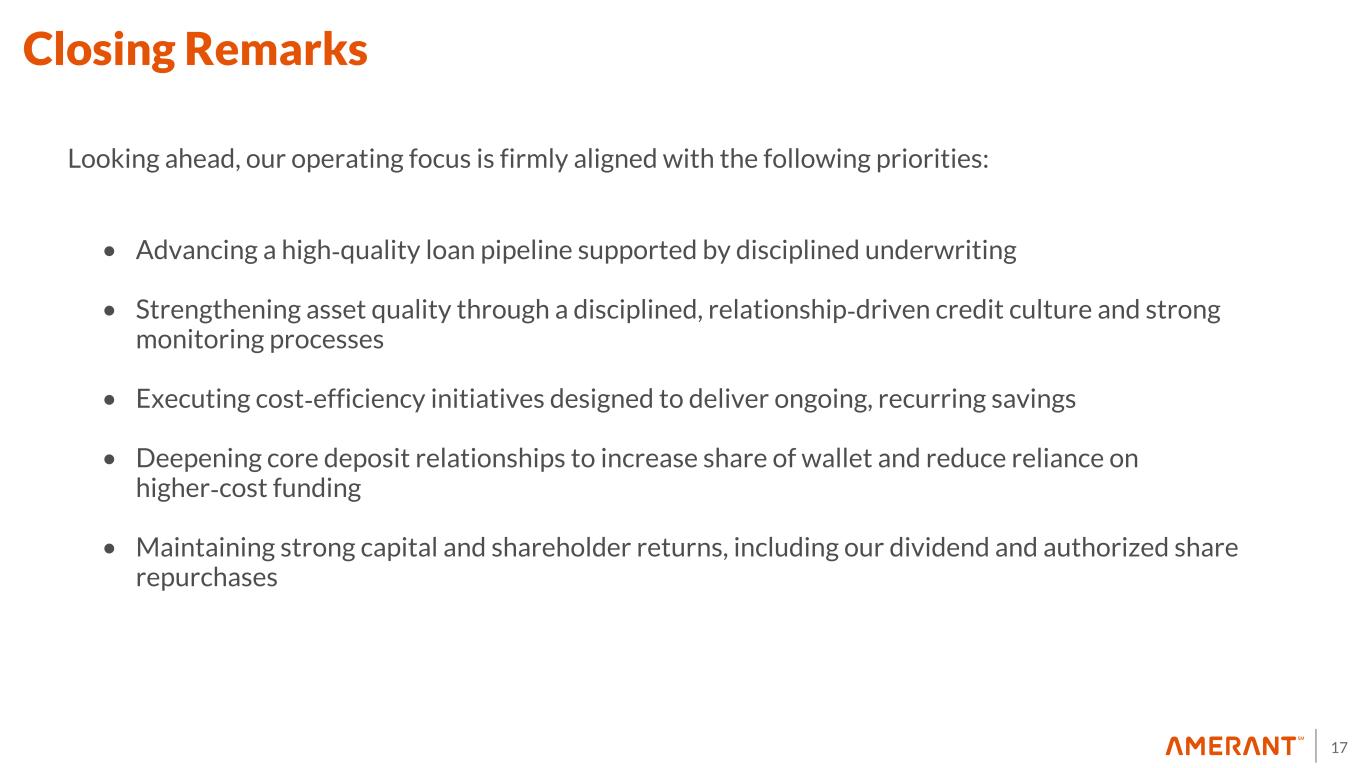
Thank you, Shary. As we close today's call, let me point out Slide 17, where I would like to reaffirm the priorities shaping our strategic execution and the fundamental advantages that continue to differentiate Amerant. Our capital levels remain strong. Our net interest margin continues to stand out, and we see meaningful potential to expand fee income as asset management and treasury management continue to grow. We're also driving greater efficiencies across the organization with disciplined expense management. Central to all this is an elevated focus on improving the predictability of credit quality and enhancing asset quality to support sustainable performance. During the quarter, we took focused, deliberate action to reinforce risk management and strengthen our credit processes. These enhancements demonstrate our commitment to resolution, allocating resources where they matter the most and ensuring the portfolio remains resilient. Although these measures influence results this period, they position us well, and we remain confident in both the durability of our franchise and the opportunities ahead. Looking ahead, our operating focus is firmly aligned with priorities we have shared, advancing a high-quality loan pipeline supported by disciplined underwriting, strengthening asset quality through a disciplined relationship-driven credit culture and strong monitoring processes, executing cost efficiency initiatives designed to deliver ongoing and recurrent savings, deepening core deposit relationships to increase the share of wallet, maintaining strong capital and shareholder returns, including our dividend and authorized share repurchases. Thank you for your continued support as we execute on these commitments. So with that, I will stop. Shary and I will take questions. And Kevin, please open the line for Q&A.
Operator
Our first question is coming from Michael Rose from Raymond James.
Speaker 4
I guess the main question here is, and I really appreciate all the insights you provided on the call, regarding your 3-year program, what metrics can we use to measure progress from an outside perspective? I understand there are many moving parts and significant work involved, but as analysts and shareholders, what indicators can we look for at the end of year 1, year 2, or the full 3 years to determine if your strategy has been successful following previous efforts over the last couple of years?
Thank you, Michael, for your question. One of the key issues we are focusing on this quarter is credit quality. The improvements in metrics related to migration and key credit indicators will be vital in determining our success. Regaining confidence in migration and risk rating accuracy is essential, and much of our work in the third and fourth quarters has been aimed at achieving this goal. Looking ahead, a primary measure of success for Amerant, after several quarters of not meeting guidance and estimates regarding credit quality, will be restoring that confidence. Therefore, when we discuss specific aspects of credit quality, we aim to meet the set objectives. In my view, this is a crucial target. Additionally, maintaining a disciplined approach to loan origination is also critical. These two focuses are interconnected; enhancing our loan origination discipline will improve consistency in our approval process and underwriting, which will, in turn, provide better predictability for our credit metrics. Shary, would you like to add anything?
No, yes. Carlos, I think that's right on point. To complement what Carlos was saying, and Michael, to your point, at the strategic plan, we have long-term initiatives. But as we think about the immediate-term initiatives, I think we can summarize them into two buckets. Number one, credit; number two, operational efficiencies. In terms of credit, we have to do four steps: continue the path to reduce the size of the criticized bucket or ensure that flows are greater than inflows, if any. Third, continue to strengthen portfolio management and credit administration to make sure that we have a very healthy risk rating process. And fourth, that Carlos mentioned as well, we have to be selective with onboarding into our balance sheet. We have to stay disciplined and within our risk appetite. And then as it relates to operational efficiencies, I think it goes back to ROI and being selective on the items that really move the needle. But at the same time, we have to balance with investments that are foundational for us as we continue our growth plan. So we have ways to measure that on the credit side, for sure, looking at the criticized buckets. And then as it relates to operational efficiencies, it would be efficiency ratio and ROA.
Speaker 4
I would like to follow up by asking when you anticipate that these next couple of quarters will focus on stabilization, improving asset quality, and beginning to rebuild the balance sheet. As we look towards year two and year three, have you established any financial targets, such as return on assets or efficiency ratio, that could give us a clearer understanding of the path forward? Given the extensive turnaround efforts over the past few years, it would be helpful to share some of those targets and your progress toward achieving them. I understand it's still early in the transition, but this information could certainly boost investor confidence, especially following the fluctuations in the stock over the last 60 to 90 days.
Yes. No, definitely. So when it comes to key financial metrics, our strategic plan has, I guess, four key topics and then each of one has different types of KPIs. Return on asset is definitely one that we really want to accomplish by year-end, getting as close as possible to the 1%. That's something that we constantly are discussing internally, and we are looking at how to move the different levers to get into that specific number. When it comes to efficiency ratio, our goal and with all the actions that you have seen in Q4, we're precisely geared towards accomplishing the 60% or getting as close as possible to 60% at year-end. I believe this has been two topics that we have been discussing for a while. I believe there have been several earnings calls where we've been hovering around these two numbers, but it's been very difficult to land the plane. We are looking at everything that we can in terms of what it will take us there. In my mind, those will be the critical measures, at least for 2026 to accomplish. Evidently, as we navigate into the strategic plan, our 3-year goals aim to compare Amerant to other peers that have a significant price to book and that will get us into a lower 60% in the long term and a higher of 1% in 2027 and 2028. Those are ultimately goals we are targeting. I believe a way to think about this is immediately for 2026, aspirational goals are getting to the 1% and 60%, and for 2027, it's even better than 1% and improving the 60% and reaching that, I believe, aspirationally what everyone wants is to break the 60% and get into the 55% to 58% in the long term. Those are our aspirational goals, and those are the key metrics that we'll be focusing on closely.
Operator
Next question is coming from Russell Gunther from Stephens.
Speaker 5
I wanted to follow up on the expense conversation. I appreciate the glide path that you guys provided for '26. Can you give some color on the specific drivers that are going to get us from point A to point B? And then as we think about 2027, how should we think about sort of an annualized 4Q '26 number and a good growth rate off of that, if any?
Sure. Russell, I think as I was mentioning a little bit earlier, it goes back to ROI and the contributions that they provide to the company. If we want to look at buckets of where we're seeing all of these opportunities or where we have been executing on these opportunities, I would say, first, we're reducing higher cost deposits that not only impact the NIM, but that could also have higher earnings credit. So this is an impact to noninterest expenses, and we see definitely room for opportunities to improve that. But also, when we looked at the marketing and advertising spend, we definitely saw opportunities to optimize our cost structure for 2026 and going forward. What this will allow us is while some of these expenses will still be noted in the first half of 2026, we will see an improvement in the second half of the year, which is why we're identifying a progressive reduction of expenses going forward. The other thing is, from a hiring perspective, we certainly continue to hire. But what we're doing is we're being very strategic and making sure we're disciplined in our hiring to make sure that everything is aligned to our strategic plan. I think you had a second question related to what the normalized expense would be. I think we gave some guidance as to the $67 million to $68 million for 4Q. That's, I guess, what I would call a little bit of a normalized expense level. The other way to see it is, as Carlos was mentioning, we're targeting to hit the 60% efficiency ratio and cope that improve that metric. So I guess that's doing the math backwards; that's what we're seeing from a normalized expense standpoint.
Thank you, Shary. And I believe it's important to also make the point that once we reach the $67 million to $68 million, the expectation is that those expenses for 2027 and 2028, per our strategic plan, will grow, but they won't exceed the rule we are stipulating on the efficiency ratio. So in 2028, if we accomplish the 55% to 60% efficiency ratio for those years, you can expect to see around $70 million per quarter, but that would be once we cross 2026 and go into 2027 and 2028. So those are the types of things that we have been discussing. When it comes to expenses specifically, you see the actions we took at the end of the quarter in 2025, and those contract terminations and all those actions will set the stage for a leaner cost structure, especially in the marketing space. We believe we needed to rationalize certain partnerships and reduce the activation component. I believe the brand awareness that we needed to accomplish was already done, and we see already the impact of that. There is no need to overlap certain partnerships; we have to stick to core partnerships and monetize them instead of creating an overlap or diminishing the impact of additional partnerships. Only by doing that going forward, just for 2026, will imply savings of more than $6 million in marketing expenses. This gives you a sense of where the cost reductions are coming from.
Speaker 5
I want to shift the conversation to asset quality. I appreciate the insights you've shared so far. As we examine non-performing loans and classified levels during the quarter, they are higher than what we observed at the end of the third quarter. How do you anticipate this trend will evolve as we conclude the first quarter and the year? Do you expect this to be a consistent pattern? Additionally, what level of provisioning do you believe will be needed to cover potential losses and support the anticipated high single-digit loan growth?
Sure, Russell. So as it relates to migration during the fourth quarter, this was the result of the significant coverage that we had over the portfolio as it relates to credit reviews, whether it was done through the first line or whether it was done through credit reviews, the penetration over the portfolio as it relates to risk rating was very significant. After that, the result of that is now we have a full understanding of the characteristics of these loans. It allows us to get to a resolution and expedite resolution and address the buckets both of criticized, and I think importantly, being proactive in avoiding loans getting into those criticized buckets. As we think about it now shifting into 2026, what we're seeing is outflows outweighing any type of inflow or any type of migration that we can see into those buckets. We do project an improvement in the criticized portfolio. You had a question as it relates to provision. Provision has multiple components that we're thinking about in the full year. There's a portion related to growth. I know that in the first quarter, we're projecting to be overall flat, but we do have annualized growth. We have to build the reserves for that loan growth. Also, we also have some weight as to the composition of that growth. To the extent we have a higher composition of C&I, typically, those loans require a higher coverage level. We're expecting that to be seen in provision. We could be seeing something in the 40 to 45 basis points from a P&L perspective...
And I have to complement, Shary, I think most of the effort that, if you think of the progression of the efforts that we have been doing, is risk identification, trying to be upfront with the different credit buckets and thereafter trying to exit things that could potentially migrate into this bucket. Our idea is that we're trying to prevent that further items will fall into this bucket; we have to become more proactive with the credit risk management process, and we are working towards that.
Speaker 5
If I could sneak one more in. I appreciate your prepared remarks around events in Venezuela. So it looks like international deposit levels were flat this quarter. Wondering if you could share how that has trended so far year-to-date. Also, if you could touch upon how recent current events are likely to impact your international deposit gathering efforts specifically. And then big picture, it sounded like you view for events as a potential tailwind to Amerant. Is there anything that would be cause for concern?
Yes, that's a good question. Historically, we have been well positioned to utilize our international capabilities. The bank is vertically integrated, particularly on the personal side, allowing us to meet customers' banking and investment needs under one roof, which is a significant advantage for us. Our international customers have been using our platforms consistently throughout the year. While it's still early to draw conclusions, we are seeing positive signs and rapid progress. We have engaged with economists and various advisors to understand the situation in that region, and the outlook seems promising. Developments are happening quickly. We see substantial opportunity, although we cannot fully assess it yet. However, it is clear that oil production in the country is likely to increase, which could present opportunities for restoring wealth and facilitating Amerant's growth in international deposits. We are monitoring this closely. Though it's premature to gauge the overall impact, we believe that once it begins, it could positively affect our international deposit base.
And Carlos, to complement that, too, in the fourth quarter, we did see an increase in the personal account balances on the international side, offset with some commercial reductions. The commercial reductions are typically occurring, and that's part of the business as usual for the companies. So nothing extraordinary that we're seeing there. But I think the important piece, as Carlos was highlighting, is we see a lot of opportunities, although it's early to tell. We see opportunities on the deposit and AUM side, but we continue our plan of focusing on the deposit and AUMs and not looking into the lending strategy at all.
Operator
Our next question is coming from Wood Lay from KBW.
Speaker 6
I wanted to start with deposits and core deposits were down about $4 million. And I was just wondering how much of that was intentional runoff. And now that assets came below $10 billion at the end of the year, do you expect bringing those deposits back on balance sheet?
That's a great question. We made comments during the presentation about optimizing our balance sheet composition. We analyzed our balance sheet at the end of the quarter and began discussing whether we truly operate as a $10 billion institution. By examining our excess liquidity and the sources of our deposits, we concluded that there was no need to maintain the status of a $10 billion financial institution at quarter-end if those deposits were not organic or aligned with our core business. Therefore, we decided to let go of certain deposits to ensure we stayed below the $10 billion mark. When we do declare Amerant to exceed $10 billion again, we want it to be based on solid fundamentals, not merely for the sake of reaching that number. This involves rationalizing and understanding the real drivers of growth, rather than just aiming to be a $10 billion institution.
Speaker 6
And then you still have elevated brokered deposits and healthy borrowing. Is the intention to continue to remix that in '26 and likely stay $10 billion?
Yes, we will use brokered deposits as an asset-liability management tool. If there is an opportunity to secure long interest rates at favorable levels for the bank, we will utilize that strategy for hedging, but we do not plan to use it as a means to increase the balance sheet. Therefore, you can expect low levels going forward.
Speaker 6
And then just a quick follow-up on expenses. Do you expect any elevated restructuring charges in 2026? Or do you feel like you have all of that behind you now in the fourth quarter?
That's a great question. We've been discussing moving away from using non-GAAP metrics as much as possible. There's been too much reliance on non-GAAP metrics to evaluate the company's performance, which leads to unnecessary complexity and distractions. We're shifting towards using GAAP metrics that we can track through our financials without the need for extra explanations. Our efforts in Q4 were focused on ensuring a clear and straightforward approach for 2026.
Operator
Thank you. That does conclude today's teleconference webcast. You may disconnect your lines at this time, and have a wonderful day. We thank you for your participation today.