Aquestive Therapeutics, Inc. Q3 FY2025 Earnings Call
Aquestive Therapeutics, Inc. (AQST)
Call artefacts
Call audio is not captured yet.
A slide deck is not captured yet.
Transcript
Auto-generated speakersGood day, and thank you for standing by. Welcome to the Q3 2025 Aquestive Therapeutics, Inc. Earnings Conference Call. Please be advised that today's conference is being recorded. I would now like to hand the conference over to your speaker today, Brian Korb. Please go ahead, sir.
Thank you, operator. Good morning, and welcome to today's call. On today's call, I'm joined by Dan Barber, Chief Executive Officer; and Ernie Toth, Chief Financial Officer, who are going to provide an overview of the company's recent business developments and performance for the third quarter of 2025, followed by a Q&A session. During the Q&A session, the team will be joined by Dr. Gary Slatko, Interim Chief Medical Officer; Sherry Korczynski, Chief Commercial Officer; Lori Braender, Chief Legal Officer; and Peter Boyd, Chief People Officer. As a reminder, the company's remarks today corresponded with the earnings release that was issued after market close yesterday. In addition, a recording of today's call will be made available on Aquestive's website within the Investors section shortly following the conclusion of this call. To remind you, the Aquestive team will be discussing some non-GAAP financial measures this morning as part of its review of third quarter 2021 results. A description of these measures, along with a reconciliation to GAAP, can be found in the earnings release issued yesterday, which is posted on the Investors section of Aquestive website. During the call, the company will be making forward-looking statements. We remind you of the company's safe harbor language as outlined in yesterday's earnings release as well as the risks and uncertainties affecting the company as described in the Risk Factors section and other sections included in the company's annual report on Form 10-K, quarterly reports on Form 10-Q and current reports on Form 8-K filed with the U.S. Securities and Exchange Commission. As with any pharmaceutical company with product candidates under development and products being commercialized, there are significant risks and uncertainties with respect to the company's business and the development, regulatory approval and commercialization of its products and other matters related to its operations. Given these uncertainties, you should not place undue reliance on these forward-looking statements, which speak only as of the date made. Actual results may differ materially from these statements. All forward-looking statements attributable to Aquestive or any person acting on its behalf are expressly qualified in their entirety by this cautionary statement and the cautionary statements contained in the earnings release issued yesterday. The company assumes no obligation to update its forward-looking statements after the date of this conference call, whether as a result of new information, future events or otherwise, except as required under applicable law. Now I would like to turn the call over to Dan.
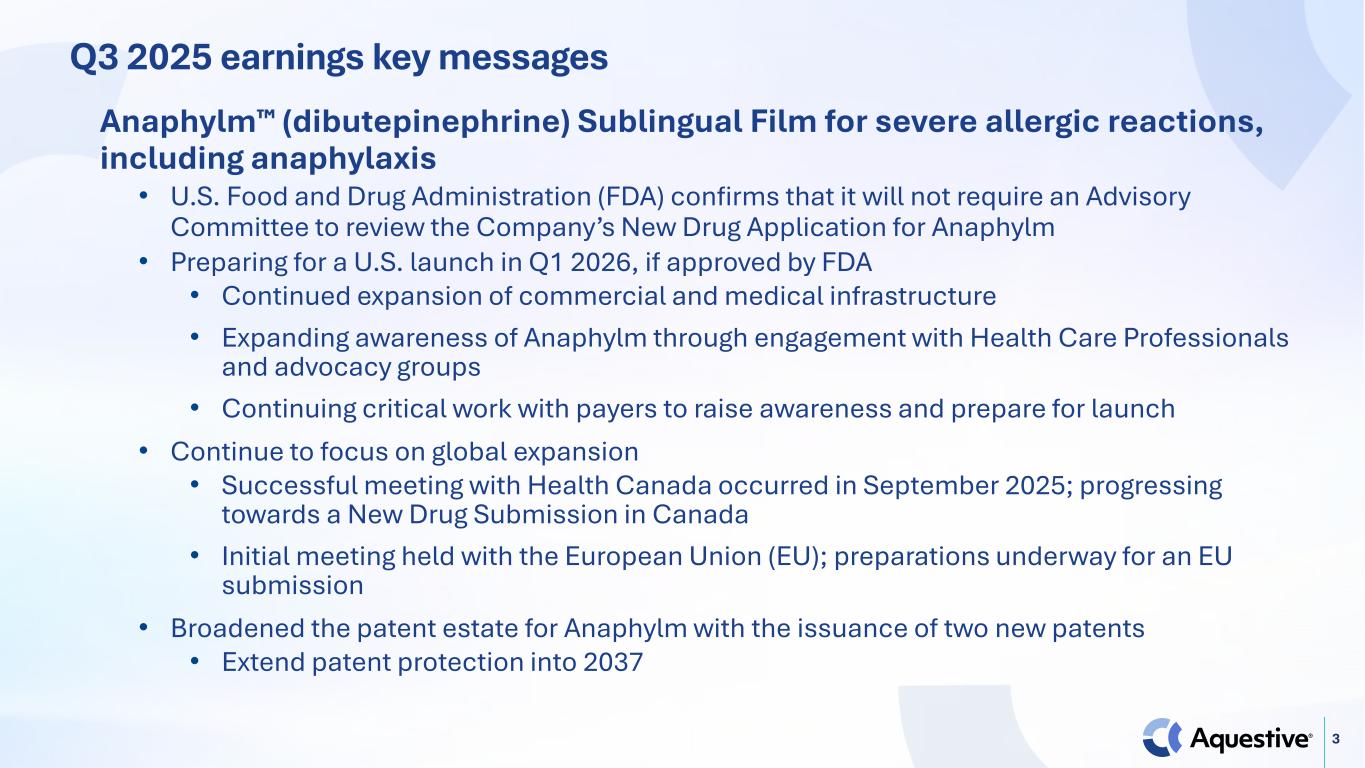
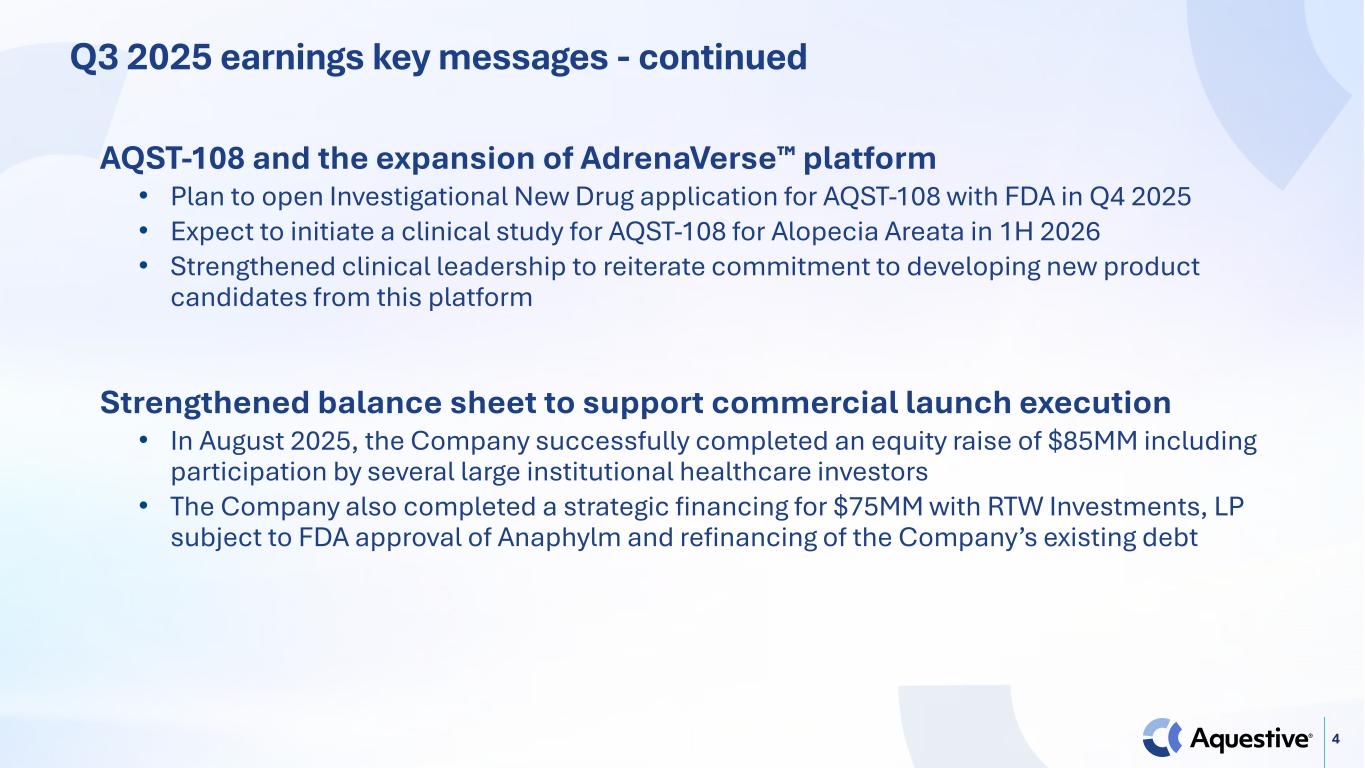
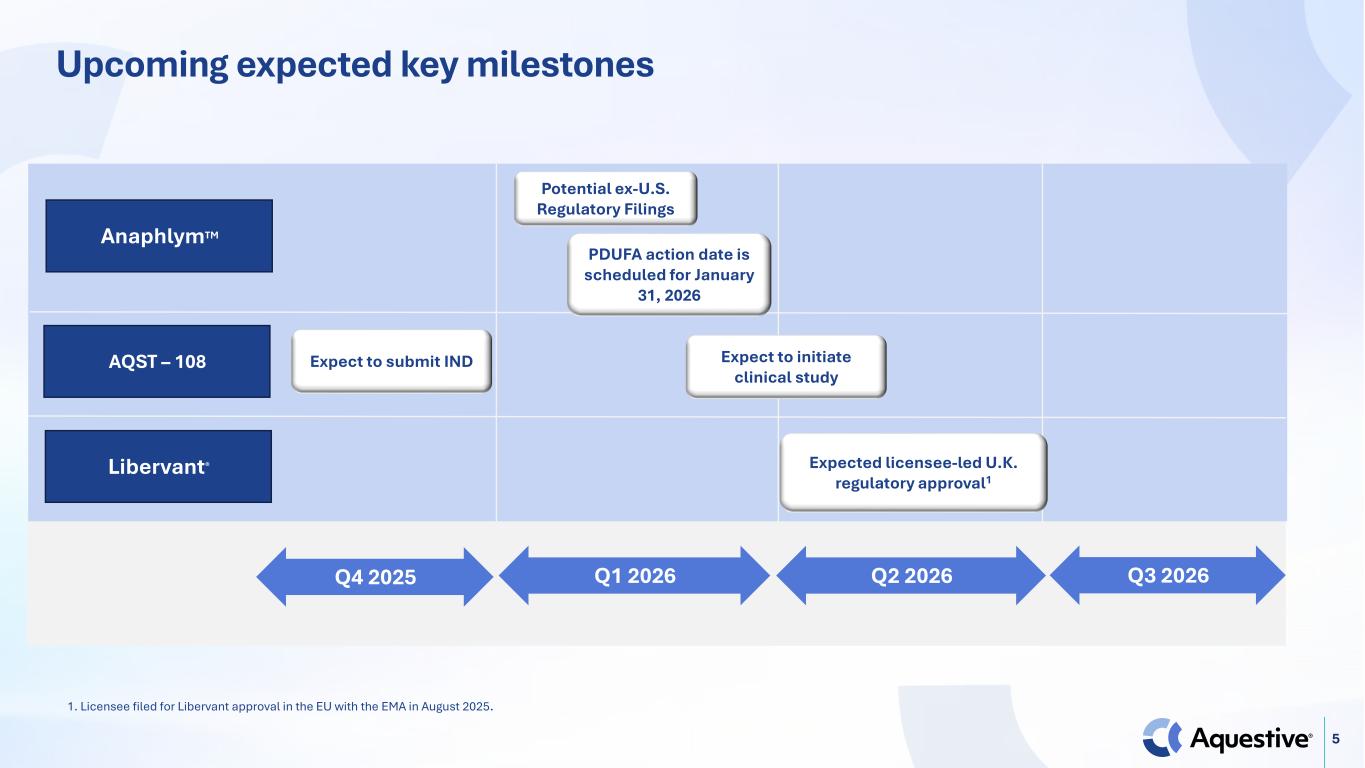
Thanks, Brian. Good morning, everyone, and thank you for joining us today. This morning, we are holding our earnings call from the American College of Asthma, Allergy and Immunology Annual Conference here in Orlando, Florida. This is one of the largest allergy-focused conferences in the U.S., and we are proud to be here supporting the college at their annual gathering. We have almost 20 colleagues on site this week and a host of events, including multiple poster presentations, a fully staffed medical affairs booth on the exhibition floor and multiple engagements with investigators. This truly is an exciting week for the Aquestive team. This is also emblematic of the increased awareness of our Anaphylm dibutepinephrine sublingual film program within the allergy community. In fact, our latest data suggests most allergists are now aware of our sublingual film program and over 25% have even completed our continuous medical education, or CME presentation offered through Medscape, the leading provider of CME materials for physicians. As we approach our FDA scheduled action date of January 31 for Anaphylm, we are well positioned from an allergist awareness perspective. In case anyone hasn't been paying attention, Anaphylm, if approved by the FDA, will be the first and only oral medication for the treatment of severe allergic reactions including anaphylaxis. Today, health care providers, caregivers and patients must choose between two types of medical devices: auto-injectors and nasal sprays. We believe our portability, low barrier to use and fast absorption profile creates a transformational offering for the allergy community. Following our equity raise and strategic financing agreement that we announced this past August, our prelaunch activities have accelerated and remain on track for a first quarter 2026 launch if Anaphylm receives FDA approval. Our marketing materials are ready to go and are only awaiting a final label. We are in the process of hiring our district managers and will hire sales reps upon FDA approval. Our market access team is in full swing and interacting with payers under acceptable preapproval guidelines. Our supply chain is prepared to rapidly produce material once final labeling has been provided by the FDA. And importantly, our medical affairs team is fully deployed, as you heard from my opening statements, regarding this week conference. Simply put, we are ready to go. Now let's turn to the FDA. Given the government shutdown, we requested the FDA to provide us with a status update on the review timing of our filings. I am pleased to say that as of this last update, the FDA confirmed they are aiming for an on-time review of our application. As we reported to you in September, the FDA has informed us that we will not have an Advisory Committee meeting. However, we remain ready to provide further information if necessary to the FDA reviewers. We will keep everyone appropriately updated as we learn more and as we get closer to our action date. As we begin looking towards 2026, there are 2 very important priorities in our business: one, putting together the best possible launch of Anaphylm; and two, exploiting the science behind our Adrenaverse platform. If you recall, we made the strategic choice to slow down our Adrenaverse pipeline initiatives in the first half of 2025 while we work on fully funding our launch. Now it is time to get going. To better accomplish these goals, I announced several leadership changes earlier this week. First, to better support Anaphylm, I've asked Dr. Gary Slatko to become our interim Chief Medical Officer. Gary has the perfect blend of medical affairs expertise and a deep understanding of our Anaphylm development program. Some of you may recall, Gary was previously our Chief Medical Officer from 2018 to 2023. I have also promoted Peter Boyd to Chief People Officer. This is a critical role as we expand our organization to include a full commercial team. On the Adrenaverse side, I am very excited to announce the addition of Dr. Matthew Davis as our Chief Development Officer. Matthew and his team will be very focused in 2026 on kick-starting our R&D efforts and driving clinical proof points that show the value our Adrenaverse platform can create. While Anaphylm is transformational to the allergy community and to Aquestive, it is just the beginning of our story. Through the efforts of Matthew and his team, I am confident there are multiple significant programs yet to come. The first of these programs is our AQST-108 development program for the treatment of alopecia areata. We have completed the pre-IND meeting process with the FDA and we'll be submitting our IND shortly. We expect to be in the clinic with our next study, a safety study in men starting in January, and expect this study to complete rapidly. With the funding just received by the company, we will look to advance our progress on this front. Our international efforts for Anaphylm as well continue to gather steam. We had a positive interaction with Health Canada in the third quarter and are excited to share that no further studies are required for filing our application. We anticipate filing in Canada in the first half of 2026. We have also continued our interactions with the European Medicines Agency, or EMA, and expect to have full feedback regarding the application process by early in the first quarter of 2026. We will continue to advance our regulatory interactions as we work towards the appropriate partnerships in these territories. Our base business continues to be an important provider of cash flow and capabilities and we expect this to continue in 2026. We continue to see stable demand from Indivior, our largest base customer. We have also seen significant growth in our South American partnership focused on the Brazilian market. Our manufacturing team is prepared to take a leading role in supply of Anaphylm to our commercial team and eventually around the world. Finally, from a financing perspective, we are now well positioned to fully fund our business through the commercial launch of Anaphylm, if approved by the FDA. As Ernie will discuss with you in a moment, one of the last pieces to the puzzle in locking in our finances is refinancing our existing debt. We are well on our way with this effort. And as of today, I expect this to close before the end of the year. So to summarize, as we look forward, you should expect the following: We will be ready to launch in the first quarter if Anaphylm is approved on time by the FDA. We will begin to make rapid progress on our broader Adrenaverse platform and advance our pipeline. We will continue to actively progress our regulatory applications for Anaphylm outside the U.S. And our base business along with our financing from August have us financially well positioned for 2026 and beyond. Now I will turn the call over to Ernie.
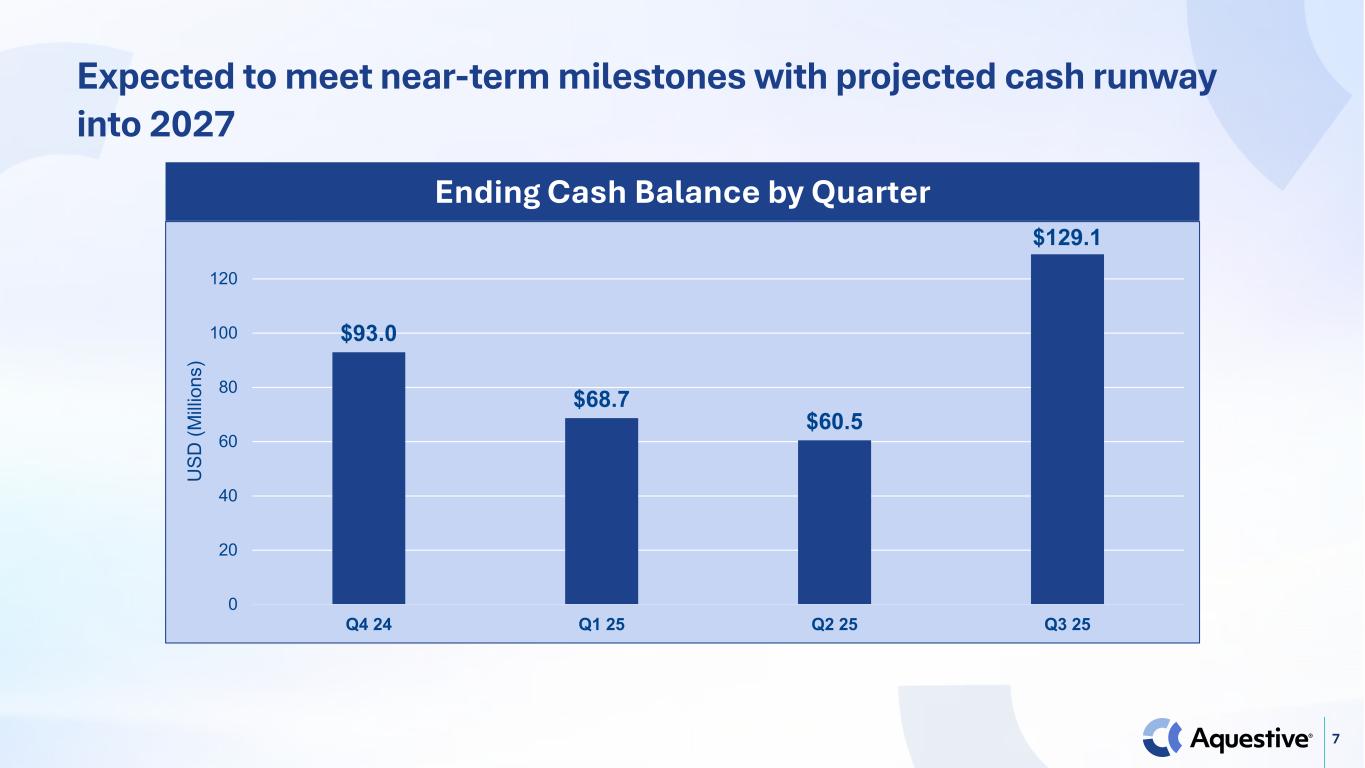
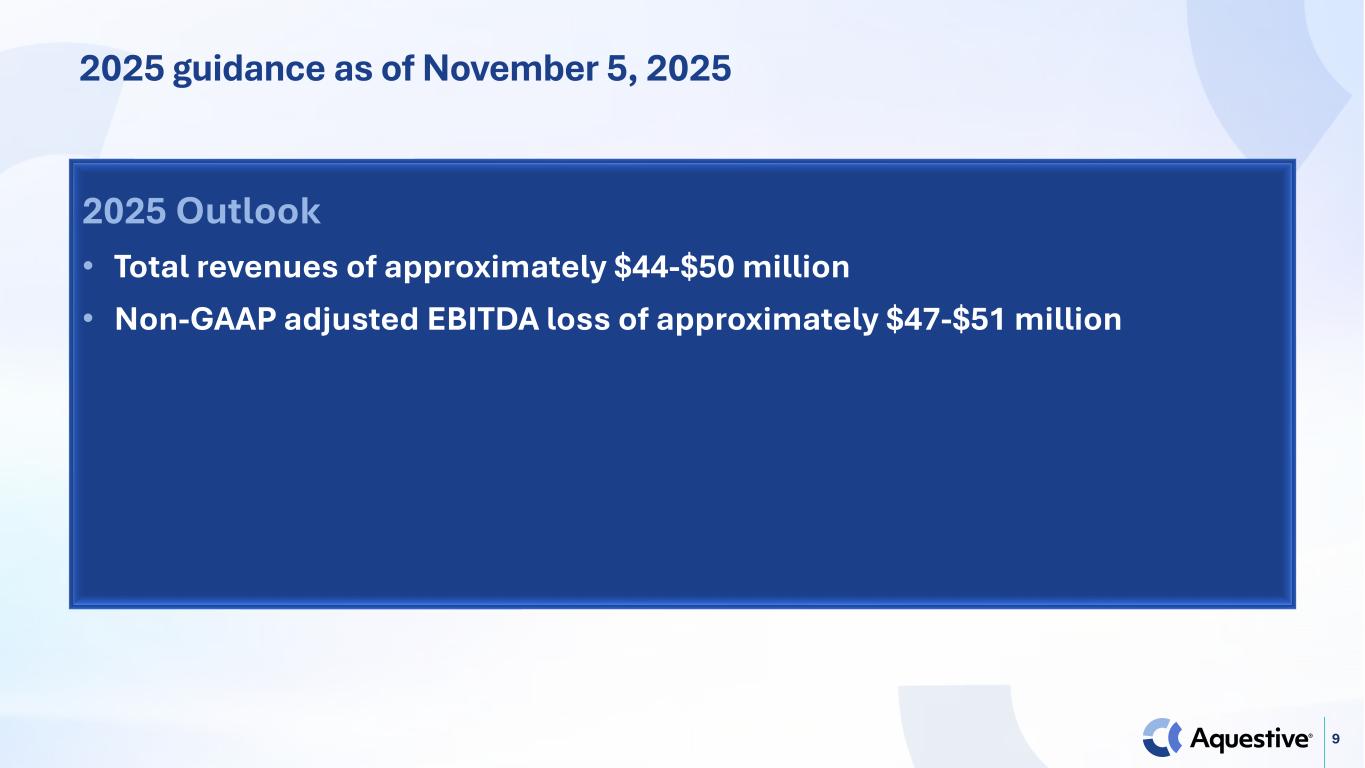
Thank you, Dan, and good morning, everyone. By now, you have seen our financial results in our earnings release that was issued last evening. As we typically do, we will address most of the discussion related to the third quarter 2025 results into Q&A. During the third quarter, we continued to execute on our strategy to support the continued development of Anaphylm, our lead epinephrine product candidate that has no needle, is not a device, is orally administered and is easy to carry. This includes the completion of the pediatric trial and supporting pre-approval launch activities for Anaphylm to increase awareness among physicians, payers and the advocacy community as we approach the PDUFA action date scheduled for January 31, 2026. To support the Anaphylm launch, we completed 2 financings during the third quarter. First, we completed an equity raise for $85 million, led by RTW Investments and included participation from Samsara BioCapital, EcoR1 Capital, Perceptive Advisors, Sio Capital Management, Capital Management and Nantahala Capital. Secondly, we completed a commercial launch financing of $75 million with RTW Investments that is subject to FDA approval of Anaphylm and satisfaction of certain refinancing and other customary conditions related to the company's existing debt. Under the terms of the agreement, RTW will receive a tiered single-digit percentage of annual net sales of Anaphylm in the U.S. for the treatment of type 1 allergic reactions including anaphylaxis, subject to a stated cap. These two financings provide critical capital that will support the company through 2027, enabling us to successfully bring Anaphylm to market if approved by the FDA and delivering new treatment options for patients in need. As required by the commercial launch financing, we are pursuing a refinancing of our existing debt. We have found the debt capital markets to be robust for our financing and hope to be in a position to announce a new debt partner in the near future. Aquestive's manufacturing business remains steady with a gradual decline of our licensee products, Suboxone, which accounts for the substantial part of our current operating revenue, being offset by growth across newer collaborations, including for the licensed products Ondif and Sympazan. In addition, the company being a U.S.-based manufacturer with intellectual property domiciled in the U.S. has a supply chain, which currently remains largely unaffected by both implemented and proposed tariffs, providing continued reliability and stability in production and global distribution for the near term. Now let's turn to the third quarter results. Excluding the impact of one-time recognition of deferred revenue in the third quarter of 2024, total revenues increased by $0.5 million or 4% year-over-year to $12.8 million in the third quarter of 2025. As a reminder, the one-time recognition of deferred revenue in the prior year was due to the termination of a licensing and supply agreement. Including the deferred revenue recognized in the prior year, total revenues decreased to $12.8 million in the third quarter 2025 from $13.5 million in the third quarter of 2024. Manufacturer and supply revenue increased to $11.5 million in the third quarter of 2025 from $10.7 million in the third quarter of 2024, primarily due to increases in Sympazan and Suboxone revenues. Total revenues decreased to $31.5 million for the 9 months ended September 30, 2025, from $45.7 million for the 9 months ended September 30, 2024, due to the one-time recognition of deferred revenue in the prior year. Excluding this one-time recognition of deferred revenue, total revenues decreased by $2.6 million or 8% year-over-year. Manufacturer and supply revenue decreased to $28.2 million for the 9 months ended September 30, 2025, from $29.3 million for the 9 months ended September 30, 2024, primarily due to decreases in Suboxone revenues, partially offset by increases in Ondif revenues. Research and development expenses decreased to $4.5 million in the third quarter of 2025 from $5.3 million in the third quarter of 2024. The decrease in research and development expenses was primarily due to lower clinical trial costs associated with the Anaphylm program, partially offset by increases in share-based compensation. Research and development expenses decreased to $14 million for the 9 months ended September 30, 2025, from $15.4 million for the 9 months ended September 30, 2024. The decrease in research and development expenses was primarily due to a decrease in clinical trial costs associated with the Anaphylm program, partially offset by increases in share-based compensation, increases in product research expenses and increases in personnel costs. Selling, general and administrative expenses increased to $15.3 million in the third quarter of 2025 from $12.1 million in the third quarter of 2024. The increase primarily represents higher pre-commercial spending of approximately $1.8 million, higher legal fees of approximately $1 million, higher regulatory expenses related to Anaphylm of approximately $0.6 million, higher personnel costs of approximately $0.2 million, higher share-based compensation expenses of approximately $0.2 million, partially offset by lower regulatory and licensing fees of $0.5 million and lower consulting fees of approximately $0.2 million. Selling, general and administrative expenses increased to $47 million for the 9 months ended September 30, 2025, from $34.2 million for the 9 months ended September 30, 2024. The increase primarily represents higher commercial spending on prelaunch activities for Anaphylm of approximately $6 million, higher regulatory fees related to the Anaphylm PDUFA fee of approximately $4.3 million, higher personnel costs of approximately $1.1 million, higher regulatory expenses related to Anaphylm of approximately $1 million, higher share-based compensation expenses of approximately $0.7 million, higher legal fees of approximately $0.6 million and higher regulatory and licensing fees of approximately $0.6 million, partially offset by decreases in severance costs of approximately $1.1 million and lower insurance expenses of approximately $0.6 million. Aquestive's net loss for the third quarter of 2025 was $15.4 million or $0.14 for both basic and diluted loss per share compared to the net loss in the third quarter of 2024, of $11.5 million or $0.13 for both basic and diluted loss per share. Excluding the impact of one-time recognition of deferred revenue, the net loss in the third quarter 2024 was $12.7 million. Aquestive net loss for the 9 months ended September 30, 2025, was $51.9 million or $0.51 for both basic and diluted loss per share compared to the net loss for the 9 months ended September 30, 2024 of $27.1 million or $0.32 for both basic and diluted loss per share. Excluding the impact of one-time recognition of deferred revenue, the net loss for the 9 months ended September 30, 2024 was $38.6 million. Non-GAAP adjusted EBITDA loss was $8.6 million in the third quarter of 2025 compared to non-GAAP adjusted EBITDA loss of $6.6 million in the third quarter of 2024. Excluding the impact of one-time recognition of deferred revenue, non-GAAP adjusted EBITDA in the third quarter 2024 was a loss of $7.8 million. Non-GAAP adjusted EBITDA loss was $35.5 million for the 9 months ended September 30, 2025, compared to non-GAAP adjusted EBITDA loss of $11.9 million for the 9 months ended September 30, 2024. Excluding the impact of one-time recognition of deferred revenue, non-GAAP adjusted EBITDA for the 9 months ended September 30, 2024 was a loss of $23.4 million. Cash and cash equivalents were $129.1 million as of September 30, 2025. Aquestive's full year 2025 financial guidance remains unchanged. The company expects total revenue of $44 million to $50 million and non-GAAP adjusted EBITDA loss of $47 million to $51 million. As a reminder, our revenue guidance for 2025 no longer includes revenue for Libervant for ARS patients aged between 2 and 5 years, and our 2024 revenue included one-time nonrecurring recognition of deferred revenue related to termination of certain licensing and supply agreements. Our non-GAAP adjusted EBITDA loss guidance for 2025 includes significant preapproval launch spending for Anaphylm, costs associated with the submission of the Anaphylm NDA and related filing fee, completion of the Anaphylm pediatric clinical trial and costs associated with the preparation for the potential Advisory Committee meeting that is no longer required by the FDA for approval of Anaphylm. With that, I will now turn the line back to the operator to open the line for questions.
Our first question will come from David Amsellem with Piper Sandler.
Just a couple for me. First, any new comments on your competitors' citizens petition and how that may or may not impact the timing of the FDA decision? And also, have you responded to the citizens petition? Just kind of latest thoughts there. And then secondly, I wanted to ask you about pricing and access just given whatever learnings you might have had from the experience of your competitor in its launch. How are you thinking about pricing relative to the nasal spray and the generic EpiPen? And also how does that play into your strategy on access? Yes.
David, let me start with a general overview before addressing your specific question. We're currently with our team in Orlando, Florida, at the ACAAI conference. It's exciting to see everything coming together. The components of our goals are starting to connect. The FDA review is progressing well, which I'll touch on shortly. Our financing is secured, the market grew nearly 9% last quarter, we've broadened our patent coverage, and we're assembling the right team. Our prelaunch activities are also in strong shape, as Sherry will highlight during the Q&A. We're genuinely thrilled with our current position. Now, regarding the competitor's citizens petition directed at the FDA, which you mentioned, consider the effort that went into it. A costly law firm from Washington D.C. was engaged to create, compile, review, and submit that document to the FDA. In my view, this required a substantial allocation of resources, suggesting the competitor is motivated by concern over our market introduction and its potential impact on them. They wouldn't go to such lengths without a reason, and likely felt compelled due to their worries about our offering. To emphasize their reason for concern, our recent survey of 35 pertinent individuals showed that 33 preferred our film over the nasal spray, one preferred the nasal spray, and another was indifferent. This feedback aligns with the reasoning behind the competitor's petition. We have thoroughly reviewed the content of their petition, which contains several factual inaccuracies and misleading information, potentially damaging their credibility with the FDA. We anticipate no effect on our review from this. Now, let me shift to your second question regarding pricing and access, which I'll pass on to Sherry.
David, thank you for your question. While we haven't shared our WAC price, we believe there is considerable value in our innovation. As you know, the branded epinephrine market has been defined by the currently available product. With that in mind, we recognize the challenges and intend to price responsibly with a focus on patients. We are exploring various options to ensure broad access, including cash pay and co-pay savings programs, and we are actively collaborating with payers for coverage. Our goal is to provide a range of options for patients to access Anaphylm. However, as you know, getting Anaphylm or any product into a patient's hands requires a lot of effort, making access and patient support essential. We are dedicating time and resources to engaging with payers, sharing preapproval information with our clinical team and the payers’ clinical teams. We believe our value proposition is strong, and our strategy benefits patients. We will return to you at the appropriate time with our pricing details, but I think you can look around us for some insights.
Our next question comes from the line of Kristen Kluska with Cantor Fitzgerald.
This is Rick Miller on for Kristen. We'll have one here and then a follow-up on potential partnerships ex U.S., you're moving forward with these regulatory interactions. So how do you think about the optimal timing from a value perspective as to when to partner out ex U.S.? And maybe give a sense of what those potential partner conversations have been like at this stage? And then we'll have another follow-up.
We see Anaphylm as a global product that can be widely distributed in various markets. We have begun our efforts to enter major markets outside the U.S., specifically targeting areas like the EMA, Canada, the U.K., and Japan, which hold significant value. However, the global need is apparent. We have made it clear that we do not intend to establish our own international presence, so we will pursue licensing opportunities outside the U.S. Regarding the timing for partnerships, discussions are ongoing. The closer we get to approval, the more valuable the product and potential partnership become. From my view, it's important to advance our regulatory engagements. In Canada, we anticipate filing in the first half, and in Europe, we will soon determine if any further work is needed before our filing. As we progress, we believe this will create a pivotal moment for the active conversations to result in meaningful partnerships for the organization.
And maybe then you mentioned being at the conference right now. What are some of the takeaways you're hearing around the conference, especially around your medical affairs booth as it relates to excitement for new potential additional needless epinephrine options?
Sure, sure. Well, I have to say that the main part of the conference is ahead of us. So the medical booth and the exhibition hall and all of those things starts tomorrow. So we're all here getting ready and excited about it tonight. We'll actually have a bunch of our investigators together to talk about our program and what they're excited about. I will tell you that as I walk the halls with people who are getting ready for the conference here, one, the amount of comments that are around the excitement of our product coming is palpable. And two, the desire to know and learn more is real. So to me, those are two really good signs that we've hit a need that is meaningful, and we'll obviously be continuing those conversations throughout the weekend.
Our next question comes from the line of Raghuram Selvaraju with H.C. Wainwright & Co.
Firstly, with respect to the Anaphylm outlook, I was wondering if you could, a, perhaps give us a sense of how you are thinking about the parameters you anticipate sharing with the investment community as and when Anaphylm gets to the market and what specific takeaways you are planning to get from the neffy commercial introduction, in particular with respect to factors that might educate how you position Anaphylm in the market upon launch. And also if you could comment on the MSN pricing situation and how this affects your approach to thinking about pricing in ex U.S. markets.
Sure, I'll address a few points. Regarding our market entry, our PDUFA date is January 31, and we still expect to launch in the first quarter. By launch, we mean having our sales representatives trained and ready, as well as ensuring our supply chain is prepared to provide product to distributors for fulfilling prescriptions. Concerning the most favored nation pricing, we are monitoring it closely. Currently, we don't anticipate any impact on our potential partnerships outside of the U.S. or on pricing domestically. However, we will remain vigilant as legislation or executive actions develop to ensure we protect the U.S. market from any emerging issues. On positioning, before I pass it to Sherry, I’d like to make a few global observations. Firstly, we clearly have a distinct offering compared to existing medical devices, and I’m sure Sherry will elaborate on this. Secondly, the market is growing, especially in the auto-injector segment, where 95% of prescriptions are for auto-injectors. This is where we will focus our efforts moving forward. Now, I'll let Sherry discuss our positioning further.
Thank you, Ram, for the question. As we plan our launch, we are adopting a unique, focused, patient-centered strategy supported by a disciplined commercial approach, which positions us well for a successful rollout. We recognize that patients desire options, which they have lacked for many years. Our market research confirms that the allergy community, including patients, caregivers, advocacy groups, and healthcare providers, is overwhelmingly positive about our product. Patients want choice, and mothers, who often take charge of health decisions at home, have informed us that Anaphylm is a great choice because it is portable, easy to use, and fast-acting. For the millions at risk of anaphylaxis who have previously avoided epinephrine due to concerns about devices, bulkiness, and needle anxiety, Anaphylm's non-device form is crucial. It effectively removes the last hurdle for individuals needing to carry and have quick access to epinephrine. Guidelines advise having two forms of epinephrine, whether two auto-injectors or two nasal devices. Anaphylm simplifies this by fitting conveniently in a phone case or small wallet. Additionally, Anaphylm's outstanding stability allows it to function effectively in varied real-world conditions. We believe there is significant differentiation between Anaphylm and traditional devices, as confirmed by input from patients, caregivers, and healthcare providers. We plan to communicate this differentiation as we launch in the first quarter.
Very helpful. And just very quickly on the Adrenaverse platform. I was wondering if you could comment on what the alternative routes of administration and formulations are starting to look like beyond AQST-108, if there are other topical gels or if you're looking at deploying the Adrenaverse platform via alternative routes of administration beyond the topical arena? And then lastly, just very quickly for Ernie. I was wondering, if you look at the debt refinancing initiatives, what you are prioritizing most, is it the longest possible maturity date? Or is it the lowest possible coupon? Just give us a sense of what you're looking to accomplish there.
Why don't I have Ernie take the second part and then I'll address Adrenaverse.
Ram, so what we're looking for most of all, besides the things that you talked about, we're always looking for a coupon and the lowest interest rate and the flexibility, is really finding a partner that we can grow with as the company grows and someone that we feel we can work with as we move forward to grow the company. And we've been very fortunate as we've gone through this process. The number of lenders, potential lenders that we've spoken to that have wanted to partner with us and to meet those qualifications. So we feel we're in a good place. And as I said in my script, we hope to be able to announce that new debt partner in the very near future.
Thank you for your question, Ram. I appreciate you highlighting that. Right now, we have limitless possibilities for the types of delivery systems we can use with our Adrenaverse platform. With the creation of the Chief Development Officer role and having someone like Matthew Davis focused on our pipeline, we will continue our work with cream gel foam. Additionally, we see potential for various routes of administration, including film, capsules, and even injectables if needed. We're not restricting ourselves to one delivery method. Our primary focus remains on what is best for the patient and the solution we aim to provide, as we have done with Anaphylm.
Our next question comes from the line of Andreas Argyrides with Oppenheimer & Co.
We'll go with a couple from us, not just the one that you guys suggested. So how are the current launch dynamics with neffy informing your initial commercialization strategy? Particularly, what are some of the tools you can use to create awareness? Are you considering DTC? And then in your dialogue with the FDA, can you remind us what components of the data they are focused on and key considerations for approval? And then lastly, given the product profile, how should we think of scripts per patient per year? Is it multipack? I'll stop there.
Sure, Andreas. And I'll have to find out the question that we recommended to you. I'm kind of curious to know what that was. But having said that...
It was restricting you to one question for each analyst.
I understand. I thought we were allowing you to ask questions. That was surprising to me. I believe that was more about managing our time. But Andreas, I'm happy to answer your questions and spend some time with you. Let me address a couple of them. Regarding awareness, I will pass that to Sherry shortly. As for the FDA’s focus, just a reminder, we have six FDA approvals in our history. The FDA approval process has a rhythm and pace, and you'll notice various questions arising. We're observing that the different functions within the FDA are performing their roles, completing their checklists, and asking us the anticipated questions. That feels positive. When I think of DTC, I typically envision large television ads like those during the World Series or the Super Bowl and flashy campaigns. Sherry and I completely agree that we won’t be pursuing that in 2026. In 2027 or 2028, who knows? But before I turn it over to Sherry, I can assure you that you won't see those kinds of campaigns, and we'll be operating efficiently. Now, let me let Sherry share her insights on awareness.
Thank you for the question. One advantage of being in second place is that we can learn from the experiences of those ahead of us. Our teams are continuously evaluating and gathering insights from the latest launch to shape our commercialization plans. However, I want to emphasize that our strategy is quite unique because we plan to be focused, disciplined, and patient-centric in our launch. While our competitors may use broad sales and marketing tactics, we are adopting a disciplined approach to concentrate on encouraging adoption among the most productive prescribers at launch. As I've mentioned before, the epinephrine market is vast but shallow. Prescribers vary widely, from primary care physicians who write only one or two prescriptions a year to allergists who prescribe over 200. The allergists represent the most productive segment, which is why we are taking a careful approach with them during our launch. As we achieve results and improve market access and payer coverage, we will be in a position to scale effectively. This is a distinct strategy that we're implementing. Regarding direct-to-consumer initiatives, Dan and I often joke about what DTC really means. Ultimately, we are applying the same disciplined approach to our DTC efforts. Our pre-launch activities have concentrated on healthcare professionals. Dan mentioned our CME initiatives, and we've been active with non-CME programs, publications, congresses, and collaborations with community key opinion leaders and state allergy associations. After the launch, our primary goal is to build awareness, especially among allergists, and prepare them to prescribe for patients who will benefit from Anaphylm. This is crucial. Over time, we will introduce a strong consumer and caregiver awareness campaign with a structured and timely plan. You will see DTC activities from us, but not in the form of major television ads in our first year; instead, we will engage in various digital and print efforts aimed at consumers.
Andreas, I'll address your question regarding part D. In terms of the number of scripts, we believe there is a strong desire among patients to have multiple scripts. They want access to the product in various locations, like at grandma's house, in their child's bag, at the nurse's office, and even on the back of their phone. We are aware of the pricing and market access challenges that we all face, not just Aquestive. Our goal remains to enable individuals to have as many scripts as they need.
Our next question comes from the line of François Brisebois with LifeSci Capital.
Can you elaborate more on the targeted approach regarding allergists? Specifically, how many allergists are there and are they prioritized for targeting? Additionally, how many representatives would be needed to reach that objective?
Yes, that's a great question. Thank you for bringing it up. As I mentioned, allergists represent the most productive segment, with an average of 200 prescriptions written each year. That amounts to a significant number of prescriptions. Therefore, our sales representatives will concentrate on engaging with all allergists. Within this group of allergists, some are certainly more productive than others. However, based on my experience, particularly from my time managing the EpiPen brand team where we grew the market from approximately 1.5 million to 3 million prescriptions, it is clear that the allergist segment is crucial. We anticipate launching our sales force with around 50 to 60 representatives and managers aimed at this prescriber base of about 5,000.
Yes, Frank. To provide more precise information regarding the script data we can access, we observed an 8.8% growth in Q3 and a 7.5% growth year-to-date in this space. When analyzing the sources of growth, the majority comes from auto-injectors. This indicates that as awareness in the market increases, it benefits all players involved. The second largest category in terms of growth is nasal spray scripts. We believe these two factors are at play: a transition from one product to another and the overall market expansion. We see this as a very positive development. Currently, 95% of scripts are auto-injectors, which will remain our focus.
Our next question will come from the line of Jason Butler with Citizens.
When speaking to physicians and conducting market research, aside from the benefits of the administration route and its convenience, what specific aspects of the product profile are physicians concentrating on? How much emphasis do they place on the pharmacokinetic profile compared to safety and tolerability, or any other factors? Additionally, regarding your comments on the Adrenaverse platform, does this initiative include the application of prodrug technology to any other molecules beyond epinephrine?
Yes. Jason, so I'll give my initial thought, but I'll ask Dr. Gary Slatko to give his view on what will be most important from physicians from an efficacy or safety profile perspective. So what I've seen is that you have a product with EpiPen that's been in the market for 45 years, right? So the HCPs want to make sure that the product we're bringing to market has the same ability to help patients that the product that's been out there for 45 years has done. And I think we have a really compelling package that does that. And I'll let Gary add his thoughts.
I believe that many products in the epinephrine category are designed to stabilize the cardiovascular system during anaphylaxis and counteract the mast cell degranulation that underlies the allergic reaction. The blood levels and pharmacodynamic effects we've observed are quite consistent with those of comparator products. Anaphylm exhibits some interesting characteristics that could lead to clinical benefits, but further studies are necessary to confirm this. Notably, its rapid increase in blood levels and early peak concentration, along with its sustained effects, could be advantageous for patients requiring prompt intervention. Another concern for clinicians is regarding the administration and safety of the product. We have conducted a comprehensive human factors program that has thoroughly evaluated various administration conditions, including self-administration, and all findings indicate that patients can effectively use this product in the field. Moreover, the safety profile aligns with that of all existing epinephrine products. Overall, I believe we have a comparable profile with some intriguing potential benefits.
Yes. Let me address your second question regarding Adrenaverse. Prodrugs are not particularly unique in our field. Our unique intellectual property is specifically focused on epinephrine in prodrug form, which is the gap we identified and developed. In the near term, our focus will be exclusively on epinephrine. However, with the considerable resources and expertise we are investing in our development area, we are constantly exploring other technologies or ways to expand our technology to provide better products for patients.
Our next question comes from Denis Reznik with Raymond James.
This is Denis Reznik on for Gary Nachman. So you recently announced two new patents for Anaphylm. Can you just talk more about them and how important these two specifically are for the overall patent portfolio? And then on supply chain, assuming an on-time approval, how quickly could you get drug into channel? And then how quickly can you get the first prescription filled? And then if I could just squeeze in one more. Regarding the uncertainty at the FDA that we've been hearing about recently, can you just mention if there's been any high-level individuals that are involved in your review that have been either replaced or have moved on?
Sure. Thanks, Denis. We recently had two new patents issued that focus on enhancing the absorption and quick release of epinephrine by enzymatically breaking it down back to its original form. We consider these patents to be significant and expect them to be listed in the Orange Book. Once approved, they will greatly strengthen our product's position. On the supply chain front, there are some tasks that need to be completed upon approval, such as finalizing the label and assembling all components. Our supply chain is a core part of our business, and we manufacture in-house, which prepares us well to ensure product availability in the first quarter. Regarding the FDA uncertainty, I appreciate you bringing it up, Denis. I was somewhat surprised it took this long for that question to arise. The FDA is indeed facing challenges, but our review group has remained constant. As mentioned in my opening remarks, our project manager confirmed that our application is unaffected by these changes. While we noticed the Head of CDER departed recently, we view leadership changes there more as administrative sign-off on our application rather than affecting the review process. Therefore, we remain optimistic about our position in this area.
Our next question comes from the line of James Molloy with Alliance Global Partners.
Let me follow up on the manufacturing capacity. Can you supply the entire market with the approved capacity? Also, where is Anaphylm manufactured? Additionally, have you received any feedback from doctors about Anaphylm? It seems like the responses have been quite positive so far.
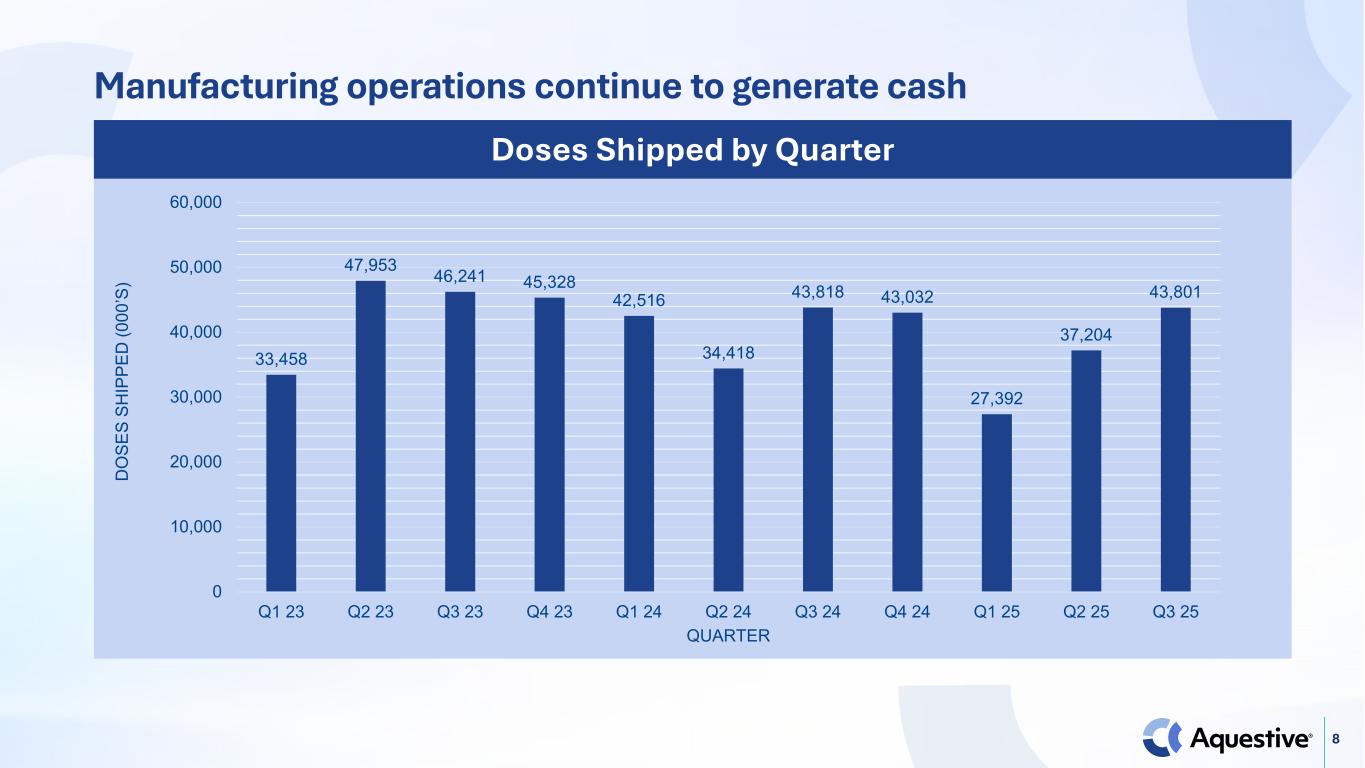
Sure. So I think I heard your first question, right, Jim. Good to hear your voice. Manufactured capacity and where is it manufactured? Capacity-wise, so we, this year, will make 150 million doses of film for all of our other partnerships and arrangements. So when you look at the entire epinephrine market being less than 10 million doses, that means we have plenty of space to make this product. In terms of where it's manufactured, our manufacturing is in Indiana. We do have some component manufacturers that go into our products that are all U.S.-based. So we are a completely U.S.-based manufacturer. And from Anaphylm, I think your question was what are we hearing from physicians that may be a little bit of pushback or need to be convinced. And I would go back to what Gary said before. With any new product, the first thing you need physicians to feel comfortable with is the safety and efficacy of the product. So that's foundational. We understand that. You heard the depth that Gary brought to how he thinks about it. That's what our medical affairs team is doing every day. And we're prepared to make sure we do a really good job with that piece.
Great. And then maybe just a quick follow-up on 108. Can you talk a little bit on Phase II time you said first half '26 and then sort of the size and the duration of that trial should it get started?
Yes, thank you. I appreciate questions about AQST-108, our alopecia areata program. I look forward to having Matthew Davis here in future calls to discuss it in detail. However, since it’s only day four, I thought it would be unfair to have him present. The first study we will conduct is a small safety study involving a few men who are bald, ensuring we gather the necessary safety data to meet FDA requirements. We will then promptly transition into our Phase IIa study, which we plan to design as a 24-week study. We will collect data throughout, focusing on hair follicle growth over various time periods. As for the participant size, we are still determining that, but I anticipate it will be between 40 and 60 individuals.
Thank you. And I would now like to hand the conference back over to Dan Barber for closing remarks.
Thanks, Michelle. And thank you again to everyone for joining us this morning. We really enjoyed the robust interaction from all the Q&A. And as I said earlier in the call, this is a really exciting time where we really feel everything coming together for the company. We have the right financing, the right people and the positive FDA interactions as of today to remain excited about not just our near-term prospects but our long-term prospects. We look forward to interacting with you again in the near future. And with that, we hope you have a wonderful day.
This concludes today's conference call. Thank you for participating. You may now disconnect.