Operator
Greetings and welcome to the Aurora Innovations Fourth Quarter 2024 Business Review Call. All participants are currently in listen-only mode. A question-and-answer session will occur after the formal presentation. This conference is being recorded. It is now my pleasure to introduce Stacy Feit. Thank you, Stacy. You may begin.
Thanks, Julian. Good afternoon, everyone and welcome to our fourth quarter 2024 business review call. We announced our results earlier this afternoon. Our shareholder letter and a presentation to accompany this call are available on our Investor Relations website @ir.aurora.tech. The shareholder letter was also furnished with our Form 8-K filed today with the SEC. On the call with me today are Chris Urmson, Co-Founder and CEO; and David Maday, CFO. Chris will provide an update on the progress we have made across the key pillars of our business and David will recap our fourth quarter and full year financial results. We will then open the call to Q&A. A recording of this conference call will be available on our Investor Relations website shortly after this call has ended. I’d like to take this opportunity to remind you that during the call, we will be making forward-looking statements. This includes statements relating to our future financial and operating performance and our financial outlook and guidance, including expected revenue for the 2025 fiscal year, our ability to reduce costs and general expectations beyond that year, the safety benefits of our technology and product, the achievement of certain milestones around and realization of the potential benefits of the development, manufacturing, scaling and commercialization of the Aurora Driver and related services, including relationships and anticipated benefits with partners and customers and on the timeframe we expect or at all the market opportunity, our product's ability to reduce fuel use and emissions, the expected future market size, our expected market share, the efficiency of our validation process, our remote assistance efficiency for driverless operations and profitability of our products and services, regulatory tailwinds and framework in which we operate, expected cash runway and overall future prospects. These statements are subject to known and unknown risks and uncertainties that could cause actual results to differ materially from those projected or implied during this call. In particular, those described in our risk factors included in our annual report on Form 10-K for the year ended December 31, 2023 filed with the SEC as amended as well as current uncertainty and unpredictability in our business, the markets and economy. Additional information will also be set forth in our quarterly report on Form 10-Q for the quarter ended December 31, 2024. You should not rely on our forward-looking statements as predictions of future events. All forward-looking statements that we make on this call are based on assumptions and beliefs as of the date hereof and Aurora disclaims any obligation to update any forward-looking statements, except as required by law. Our discussion today may include non-GAAP financial measures. These non-GAAP measures should be considered in addition to and not as a substitute for or in isolation from our GAAP results. Information regarding our non-GAAP financial results, including a reconciliation of our historical GAAP to non-GAAP results, may be found in our shareholder letter, which was furnished with our Form 8-K filed today with the SEC and may also be found on our Investor Relations website. With that, I’ll now turn the call over to Chris.
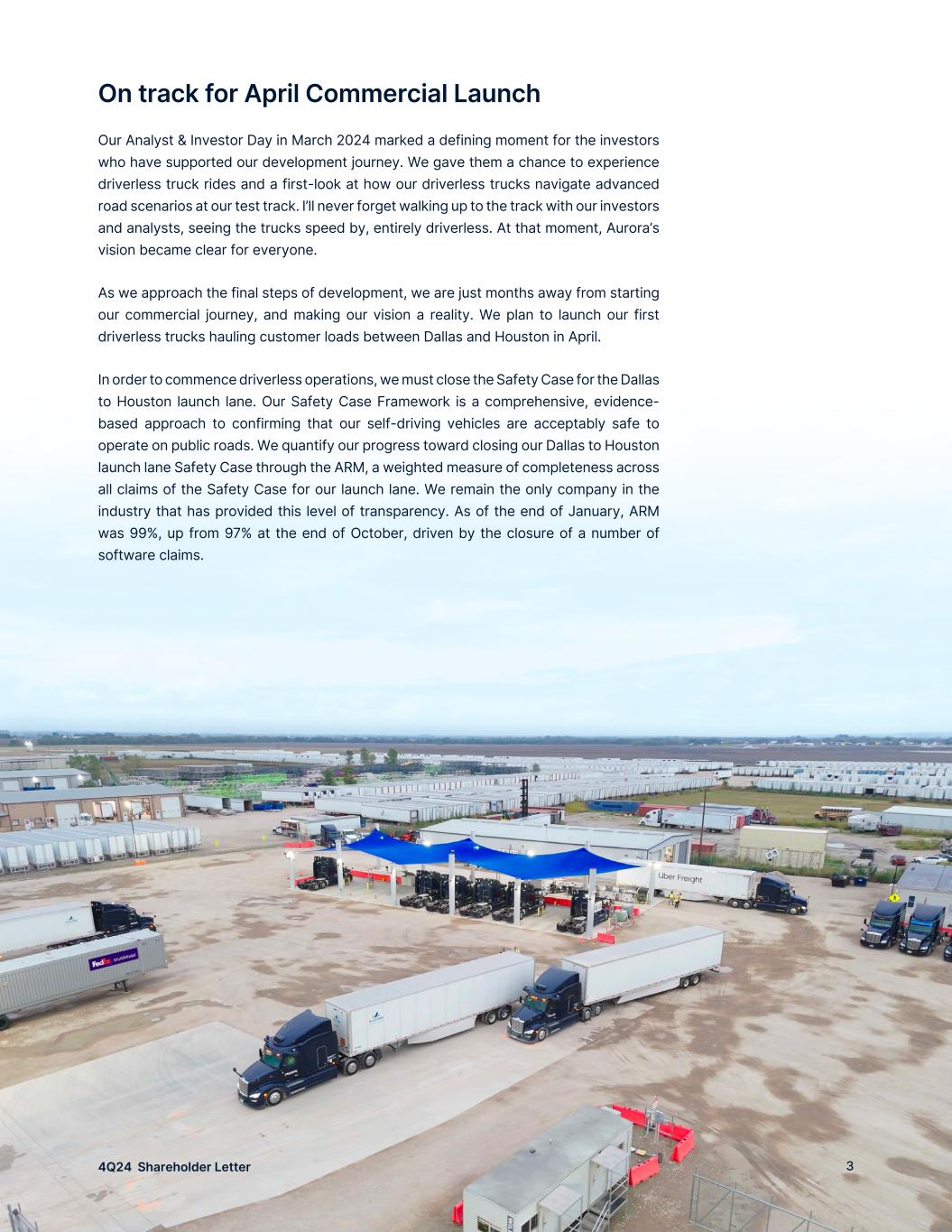
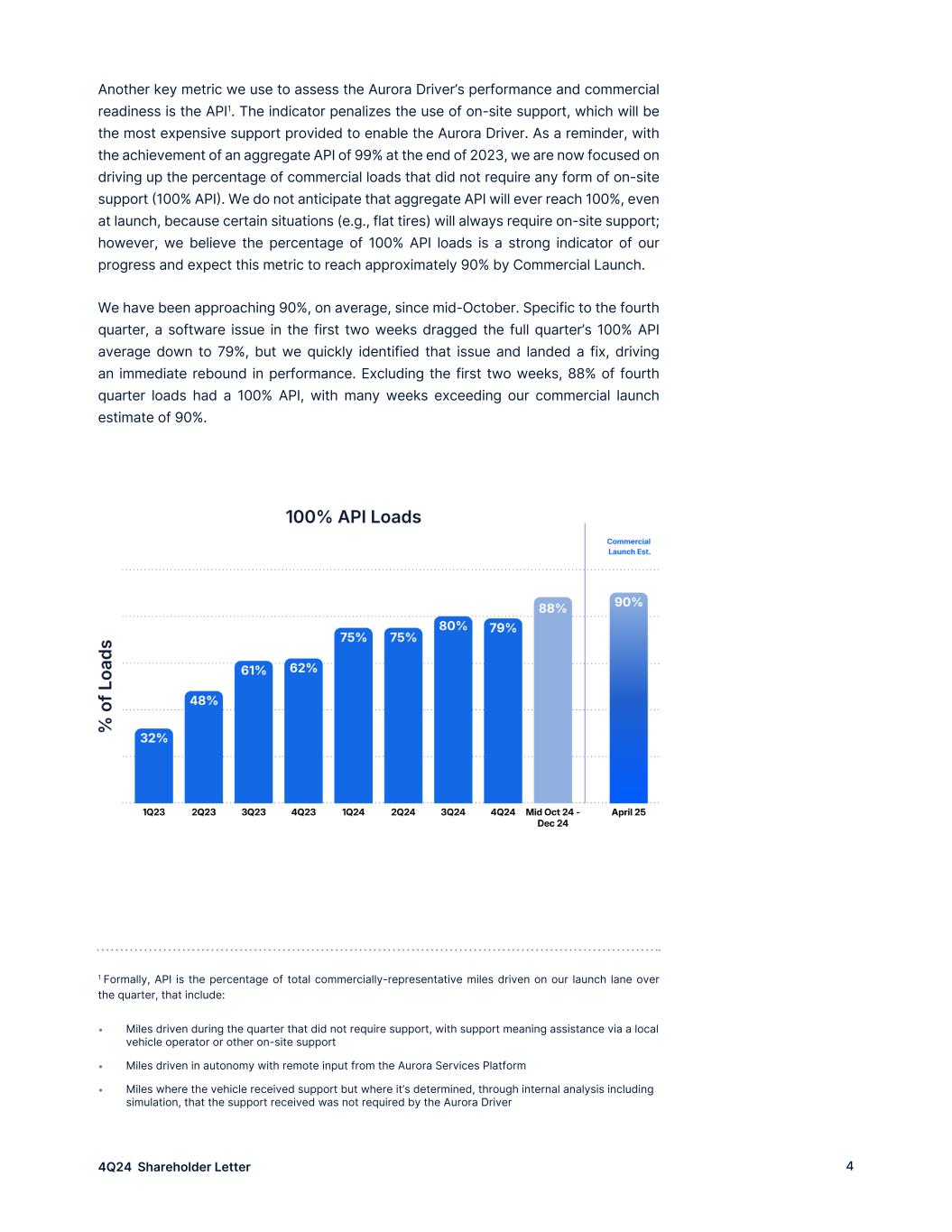
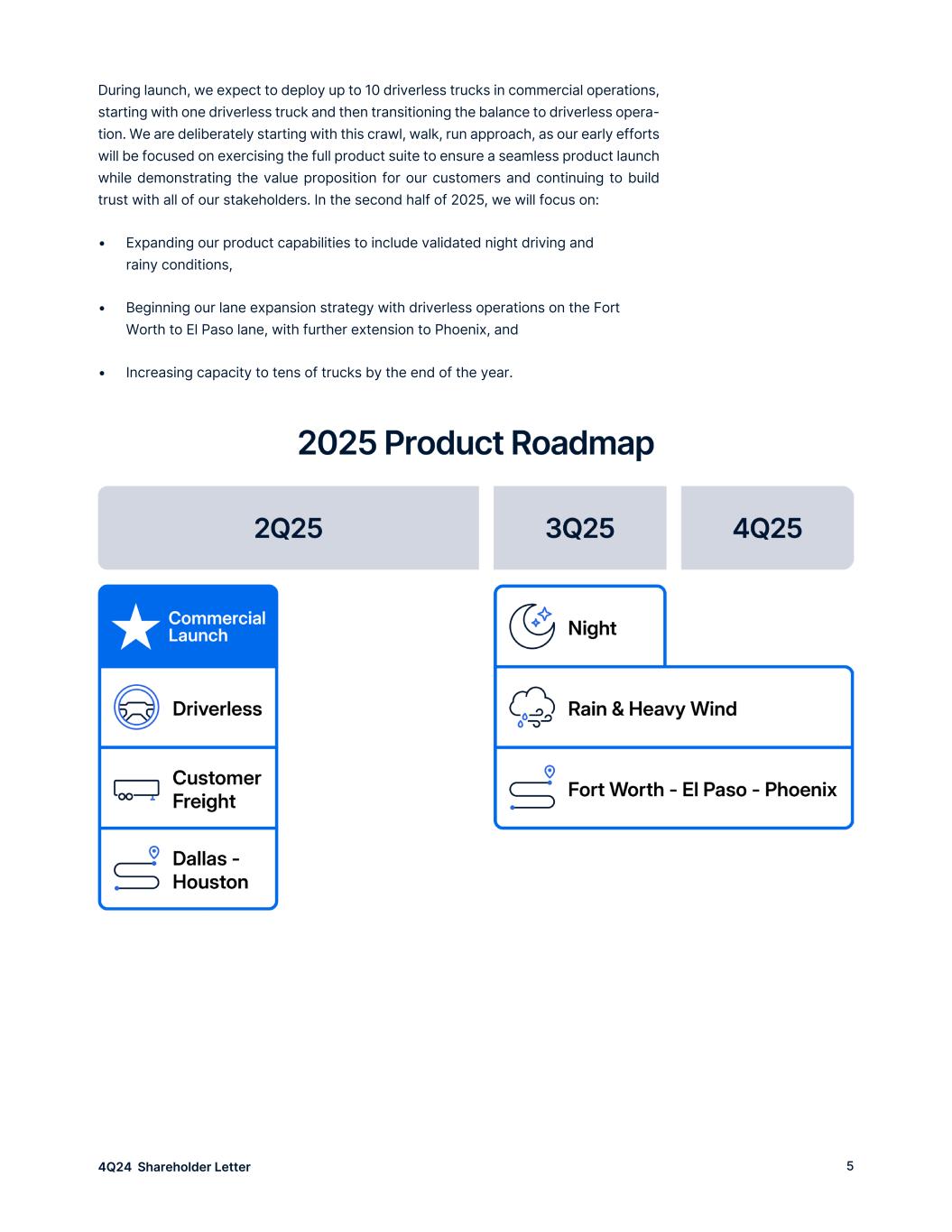
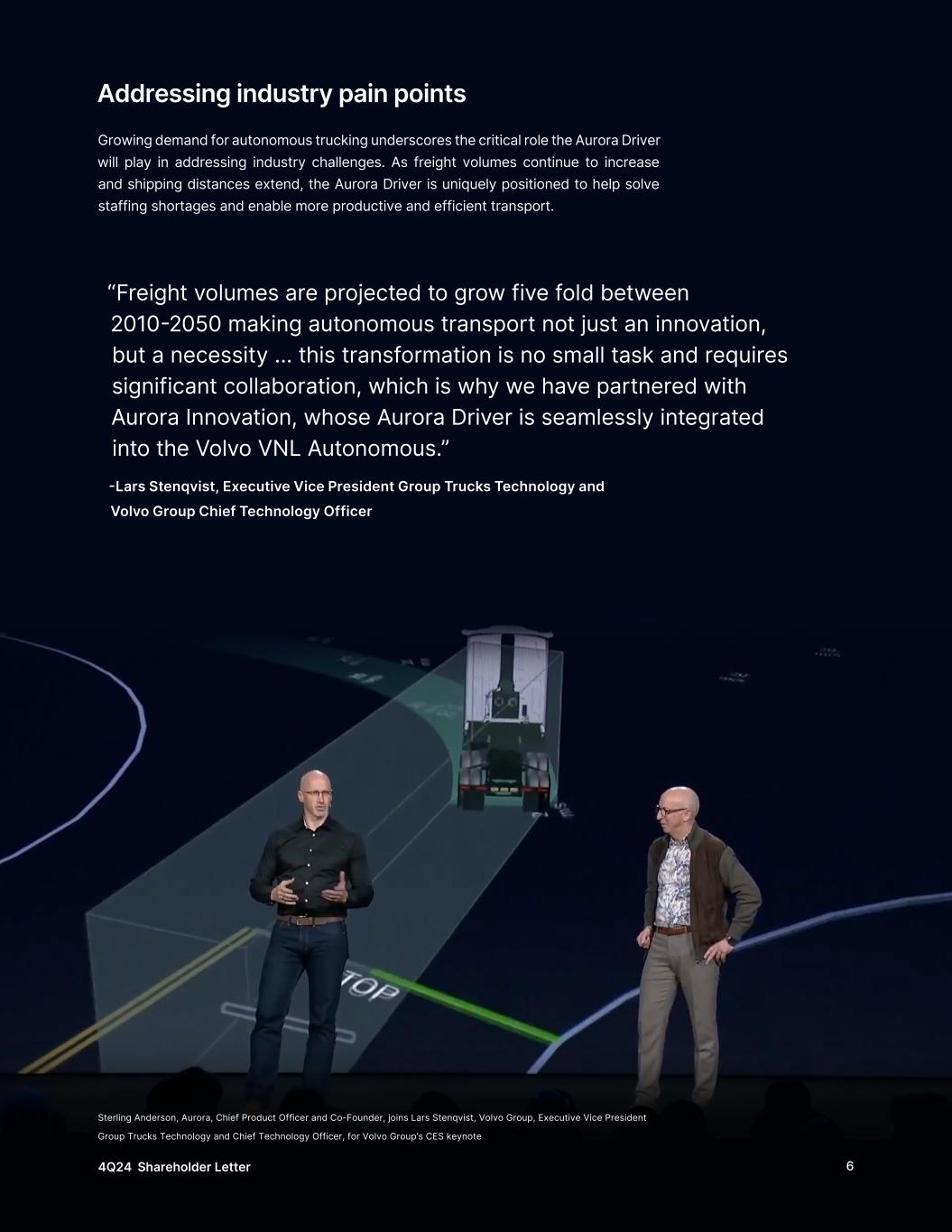
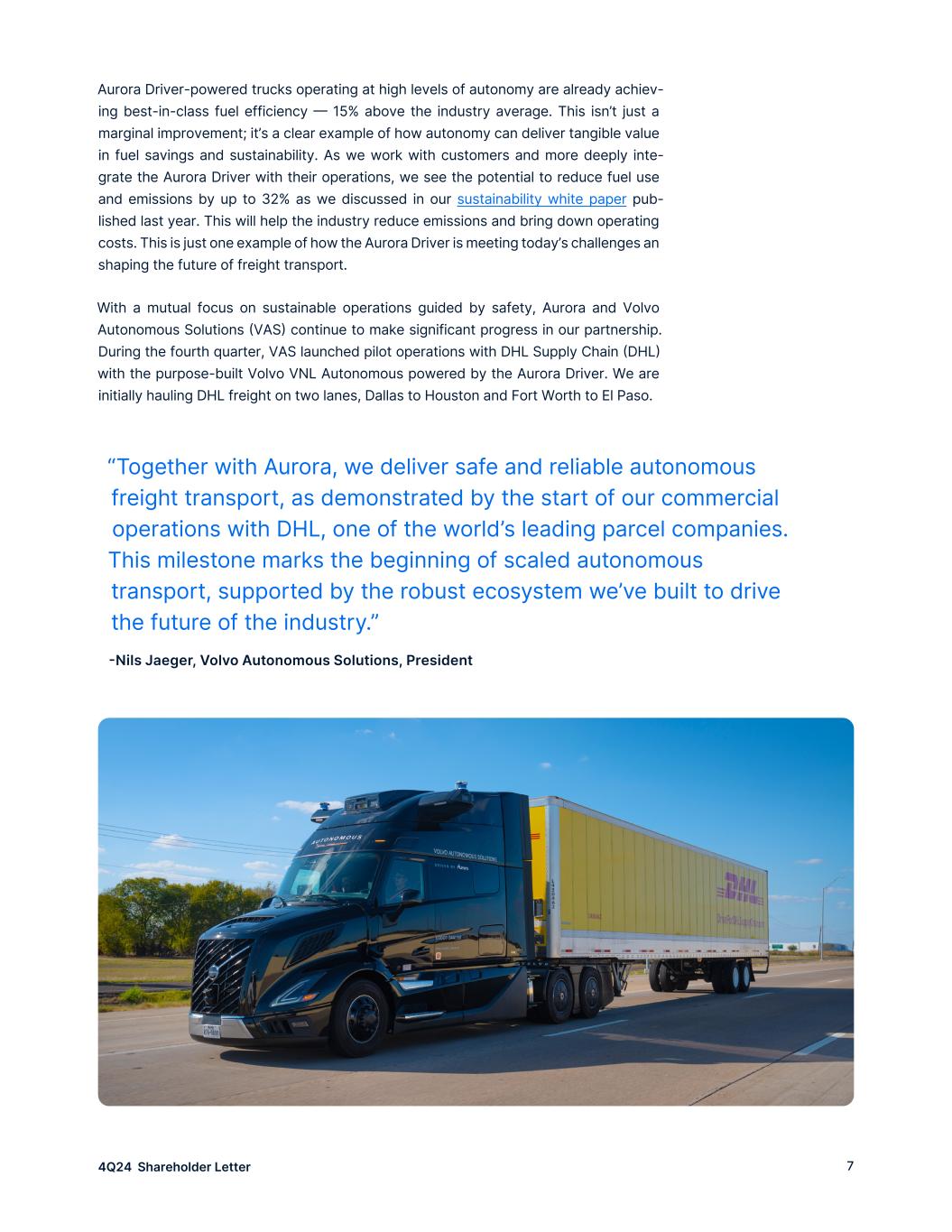
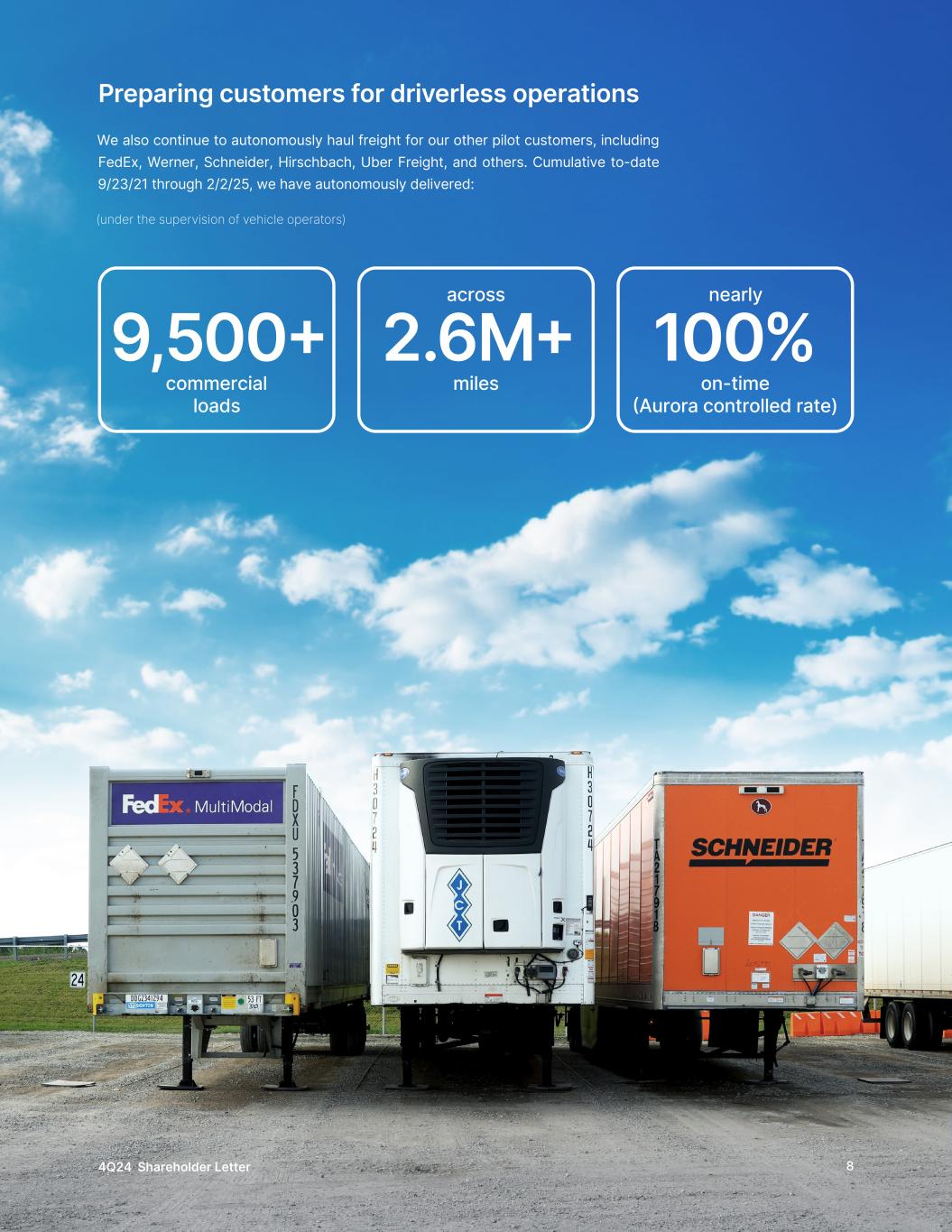
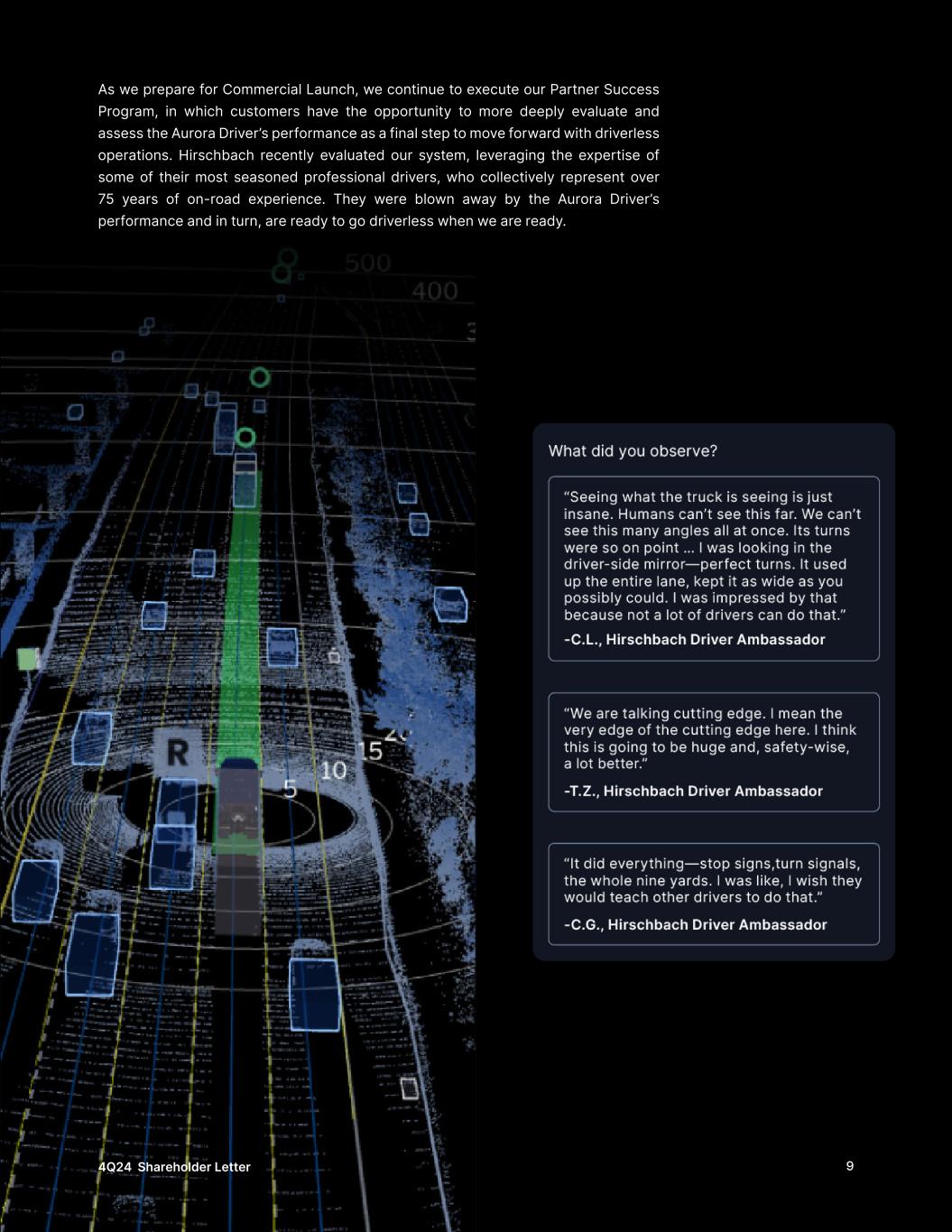
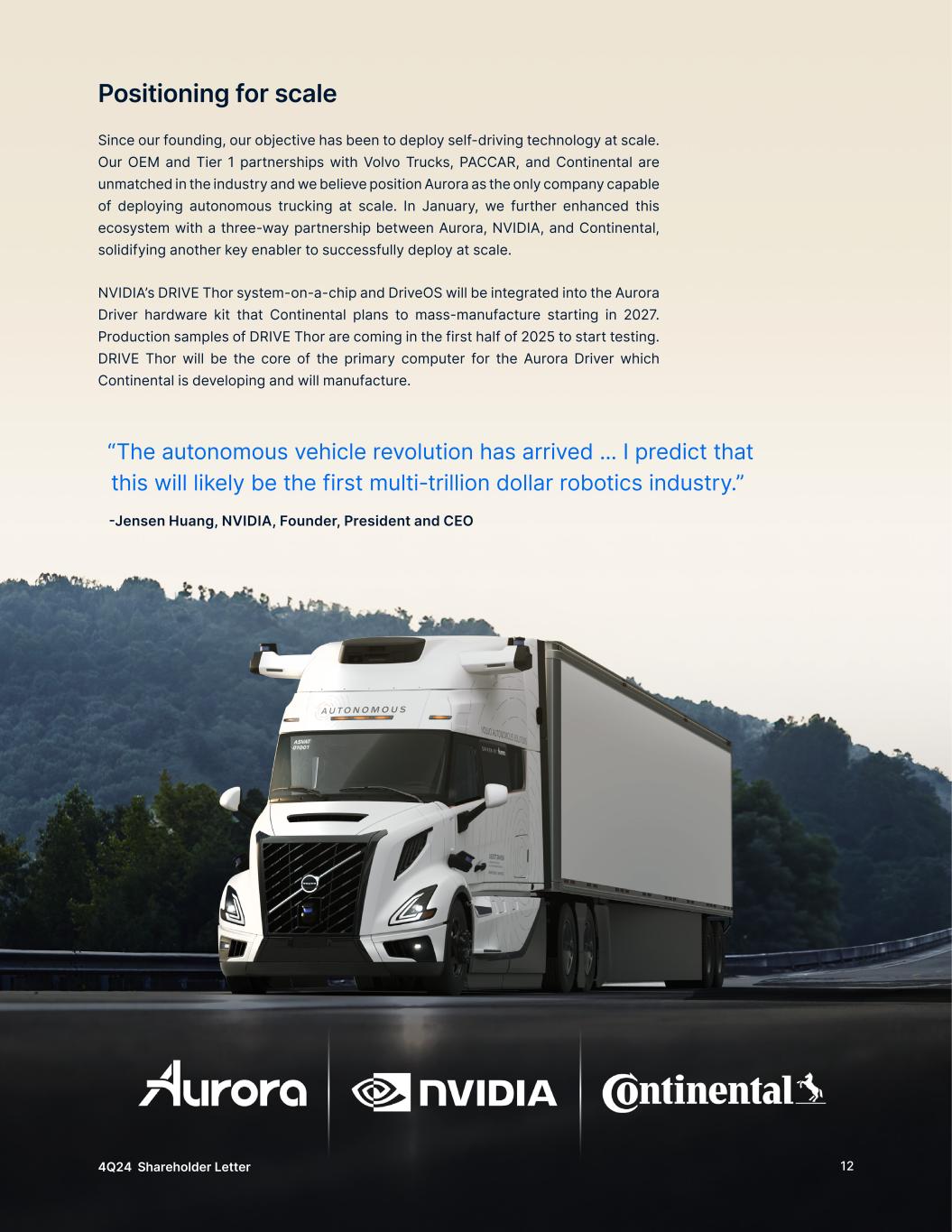
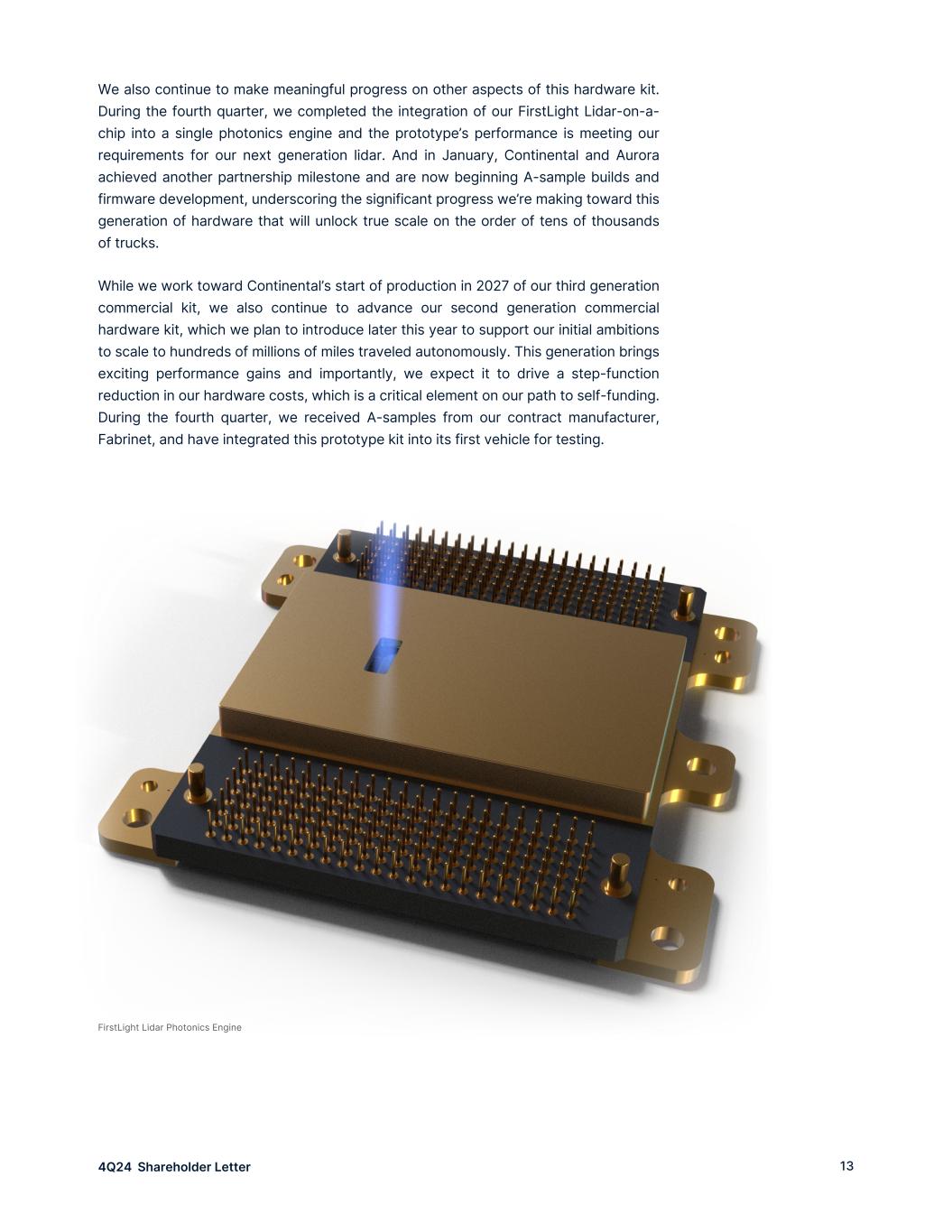
Thank you, Stacy. Reflecting on 2024 and the start of 2025 it's been a monumental time at Aurora as we near the culmination of years of innovation and preparation for our commercial launch planned in April. The word Aurora means the dawn, and we're standing at the dawn of a new era in transportation, one defined by greater safety, mobility and efficiency. Our focused strategy, grounded in safety, positioned for scale and enabled by financial discipline, continues to differentiate Aurora as the leader in autonomous trucking. We've made tremendous technological progress. We're approaching closure of the safety case for the Dallas to Houston launch lane with our ARM reaching 99%, and we've also been approaching our targeted 100% API loads commercial launch estimate since mid-October. On the financial front, we've consistently demonstrated strong financial discipline, managing our cash use under budget. We also further strengthened our liquidity position with a successful capital raise last summer, ensuring we have the resources necessary to fund the initial phase of our scaling strategy. At the start of this year, we announced a 3-way partnership between Aurora, NVIDIA and Continental, solidifying another key enabler to successfully deploy at scale. Our industry is also fortunate to have a supportive regulatory environment. Today, driverless deployment in the U.S. is already allowed by the federal government. At the state level, under existing laws and regulations, autonomous trucks can be deployed in the vast majority of U.S. states, including our Texas launch market. We're also optimistic that the new Presidential administration's enthusiasm for innovation, safety and a nationwide framework for self-driving vehicles could further support this favorable regulatory environment for driverless deployment in the U.S. With nearly all the pieces in place, Aurora is poised for an extraordinary year ahead. Our Analyst and Investor Day in March 2024 marked a defining moment for the investors who have supported our development journey. We gave them a chance to experience driverless truck rides and a first look at how our driverless trucks navigate advanced road scenarios at our test track. I'll never forget walking up to the track with our investors and analysts, seeing the truck speed by entirely driverless. At that moment, Aurora's vision became clear for everyone. As we approach the final steps of development, we're just months away from starting our commercial journey and making our vision a reality. We plan to launch our first driverless trucks hauling customer loads between Dallas and Houston in April. In order to commence driverless operations, we must first close the safety case for the Dallas and Houston launch lane. Our safety case framework is a comprehensive evidence-based approach to confirming that our self-driving vehicles are acceptably safe to operate on public roads. We quantify our progress toward closing our Dallas-Houston launch lane safety case through the ARM, a weighted measure of completeness across all claims of the safety case for our launch lane. We remain the only company in the industry that has provided this level of transparency. As of the end of January, ARM was 99%, up from 97% at the end of October, driven by the closure of a number of software claims. We've made meaningful progress on final behavior refinement and validation and expect to complete the remaining elements of our safety case over the next several weeks. Let's take a look at our rare surface street scenario we just recently encountered in Houston. In the video, on Page 5 of our presentation, the Aurora Driver comes upon a large funeral procession, an unpredictable and complex scenario. As the truck approaches the intersection, the Aurora Driver detects a police motorcycle directing traffic at an uncontrolled intersection, which could potentially block the truck's lane. It slows its speed as it prepares to stop and requests input from a remote assistance specialist. Importantly, given our system architecture and strict security protocols, our trucks cannot be operated by remote assistance specialists. All driving tasks can only be executed on board. Within seconds, the remote assistance specialist sees the police officers blocking cross traffic and not the truck's lane and confirms the Aurora Driver should proceed. With the detection of the active police motorcycle at sufficient distance and rapid remote systems response, the Aurora Driver-powered truck was able to continue on its journey without stopping. Adeptly handling scenarios like this helps reinforce our confidence that the Aurora Driver will behave appropriately even in the rarest surface street scenarios and the successful interaction with our remote assistance specialist underscores the power of the complete systems performance. Turning to rare construction scenarios, the Aurora Driver is also delivering impressive performance. In the video on Page 6, an Aurora Driver-powered truck encounters an upcoming construction zone warning. It lane changes to the left to prepare for the lane closure ahead and then seamlessly navigates a highly complex traffic crossover. As you'll see, this type of configuration redirects traffic to the opposite side of the road, bypassing the work zone with lanes separated by barriers and marked with cones. This is a great example of truly skillful performance of known construction zones. Once fully clear of the construction zone, the Aurora Driver returns to its preferred right-hand lane and continues its journey. Strong performance in these types of scenarios supports our solid API results. API is another key metric we use to assess the Aurora Driver's performance and commercial readiness. The indicator penalizes the use of on-site support, which will be the most expensive support provided to enable the Aurora Driver. We're focused on driving up the percentage of commercial loads that did not require any form of on-site support, which we refer to as 100% API loads. As a reminder, we do not anticipate that aggregate API will ever reach 100% even at launch because certain situations will always require on-site support. However, we believe the percentage of 100% API loads is a strong indicator of our progress and expect this metric to reach approximately 90% by commercial launch. We've been approaching 90% since mid-October, specific to the fourth quarter, excluding the first two weeks, 88% of loads at 100% API with many weeks exceeding our commercial launch estimate of 90%. This puts us in a strong position for our planned launch in April. During launch, we expect to operate up to 10 trucks commercially, starting with one driverless truck and then transitioning to balanced driverless operation. We're deliberately starting with this crawl-walk-run approach as our early efforts will be focused on exercising the full product suite to ensure a seamless launch while demonstrating the value proposition for our customers and continuing to build trust with all of our stakeholders. In the second half of 2025, we'll focus on expanding our product capabilities to include night driving and rainy conditions, beginning our lane expansion strategy with driverless operations on the Fort Worth to El Paso lane with further extension to Phoenix and increasing capacity to tens of trucks by the end of the year. Growing demand for autonomous trucking underscores the critical role the Aurora Driver will play in addressing industry challenges. As freight volumes continue to increase and shipping distance expands, the Aurora Driver is uniquely positioned to help solve staffing shortages and enable more productive and efficient transport. Aurora Driver-powered trucks operating at high levels of autonomy are already achieving best-in-class fuel efficiency, 15% above the industry average. This isn't just a marginal improvement; it's a clear example of how autonomy can deliver tangible value in fuel saving and sustainability. As we work with customers and more deeply integrate the Aurora Driver with their operations, we see the potential to reduce fuel use and emissions by up to 32%, as we discussed in our sustainability white paper published last year. This will help the industry reduce emissions and bring down operating costs. This is just one example of how the Aurora Driver is meeting today's challenges and shaping the future of freight transport. With a mutual focus on sustainable operations guided by safety, Aurora and Volvo Autonomous Solutions, or VAS, continue to make significant progress in our partnership. During the fourth quarter, together with VAS, we launched pilot operations with DHL Supply Chain with the purpose-built Volvo VNL Autonomous powered by the Aurora Driver. We're initially hauling DHL Freight on two lanes, Dallas to Houston and Fort Worth to El Paso. We also continue to autonomously haul freight for our other pilot customers, including FedEx, Werner, Schneider, Hirschbach, Uber Freight and others. Cumulative to date, we have autonomously delivered under the supervision of vehicle operators more than 9,500 loads, driving over 2.6 million commercial miles with nearly 100% on-time performance for our pilot customers. We're also excited to have recently executed an MOU with JB Hunt. As we prepare for commercial launch, we continue to run our Partner Success program, which gives customers the opportunity to more deeply evaluate and assess the Aurora Driver's performance as a final step to move forward with driverless operations. Hirschbach recently evaluated our system, leveraging the expertise of some of their most seasoned professional drivers who collectively represent over 75 years of on-road experience. These drivers have logged millions of miles and have seen everything the road can throw at them. So understandably, they came into the program with a bit of skepticism. But during their rides, they were blown away by the Aurora Driver's performance and in turn, Hirschbach is ready to go driverless when we are. For me, it was awesome to hear how experienced truck drivers get it about what this technology can mean for their industry. You can hear from these drivers firsthand in the video on Page 8 of our presentation. Their shared belief in how autonomous and traditional trucks can work hand-in-hand to improve road safety and transform freight transportation is a true testament to Aurora's mission. Since our founding, our objective has been to deploy self-driving technology at scale. Our OEM and Tier 1 partnerships with Volvo Trucks, PACCAR and Continental are unmatched in the industry, and we believe position Aurora as the only company capable of deploying autonomous trucking at scale. As I mentioned at the beginning of the call, in January, we further enhanced this ecosystem with a 3-way partnership between Aurora, NVIDIA, and Continental, solidifying another key enabler to successfully deploy at scale. NVIDIA's DRIVE Thor system-on-a-chip will be integrated into the Aurora Driver hardware kit that Continental plans to mass manufacture starting in 2027, with production samples of DRIVE Thor coming in the first half of 2025 to start testing. DRIVE Thor will be the core of the primary computer for the Aurora Driver, which we're developing with Continental who will manufacture it. We also continue to make meaningful progress on other aspects of this generation of the hardware kit. During the fourth quarter, we completed the integration of our FirstLight LiDAR chip into a single photonics engine. Notably, the prototype performance is meeting our requirements for our next-generation LiDAR. In January, Continental and Euro achieved another partnership milestone and are now beginning sample builds and firmware development. The significant progress we're making towards this generation of hardware is critical as it will unlock true scale on the order of tens of thousands of trucks. While we work toward Continental's start of production in 2027, our third-generation commercial kit, we also continue to advance our second-generation commercial hardware kit. We plan to introduce this kit later this year to support our ambitions to scale to hundreds of millions of miles traveled autonomously. This generation brings exciting performance gains. Importantly, we expect it to drive a step function reduction in our hardware costs, which is a critical element on our path to self-funding. During the fourth quarter, we received eight samples from our contract manufacturer, Fabrinet and have integrated this prototype kit into its first vehicle for testing. Aurora has always been a mission-driven company with an immensely capable team, bold enough to dream big and skilled enough to make those dreams a reality. We're on the cusp of our planned commercial launch, a pivotal step toward realizing our mission, and our team is more focused and energized than ever, with a team like ours, impossible becomes achievable. Our extraordinary progress would not be possible without the unwavering commitment from our team, partners, and investors. Thank you for your trust. We believe 2025 will be a defining year for Aurora as we begin to reshape the future of freight. With that, I'll now pass it over to Dave who will review our financial results.
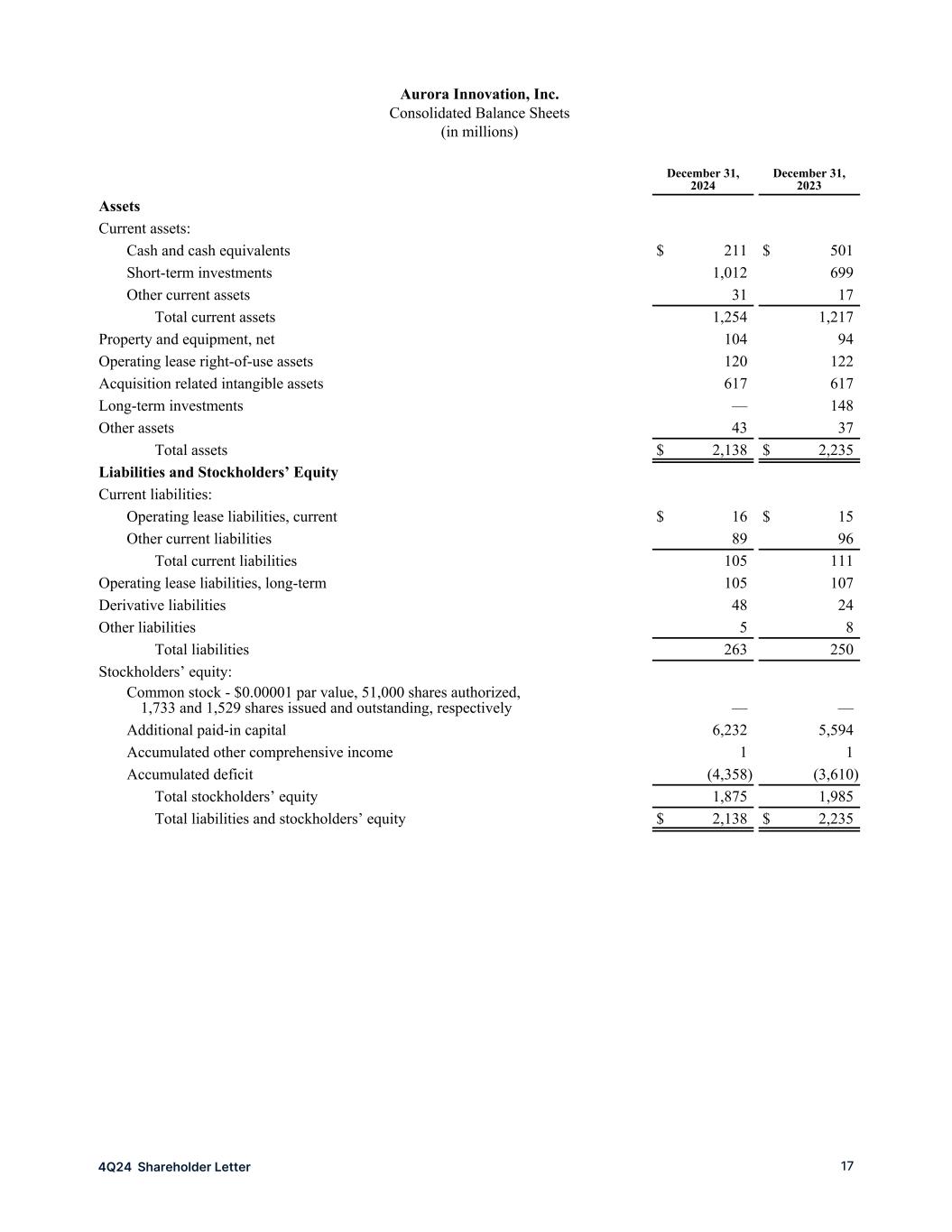
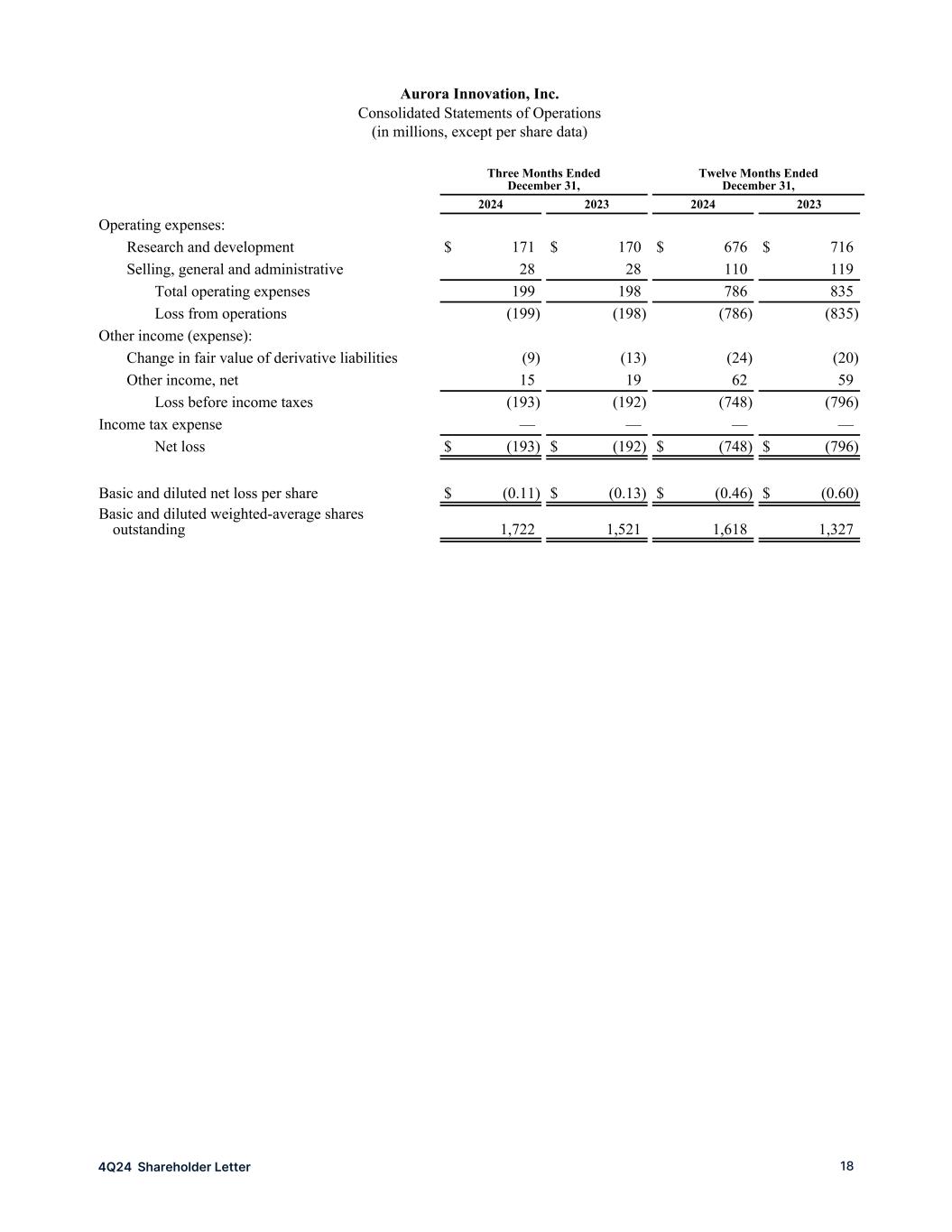
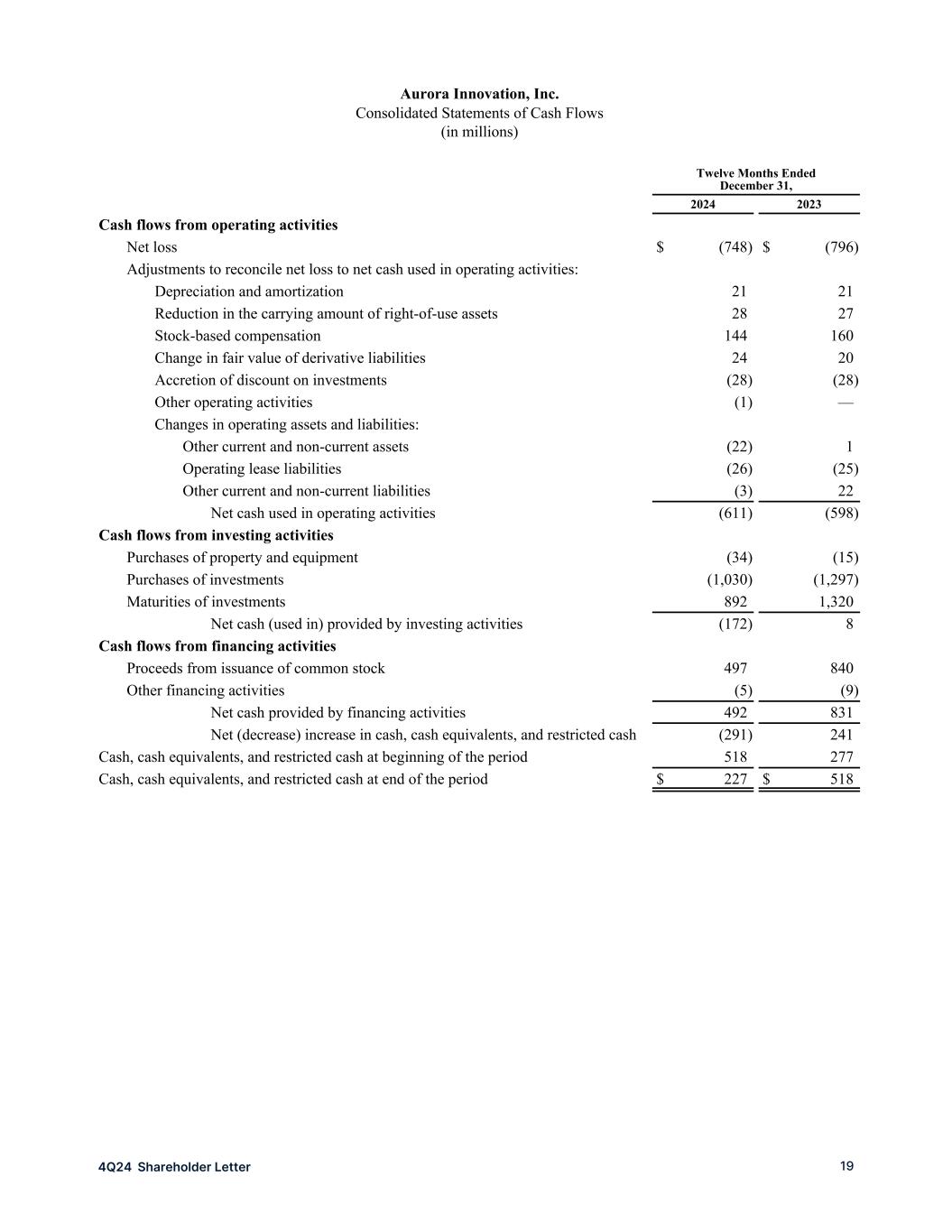
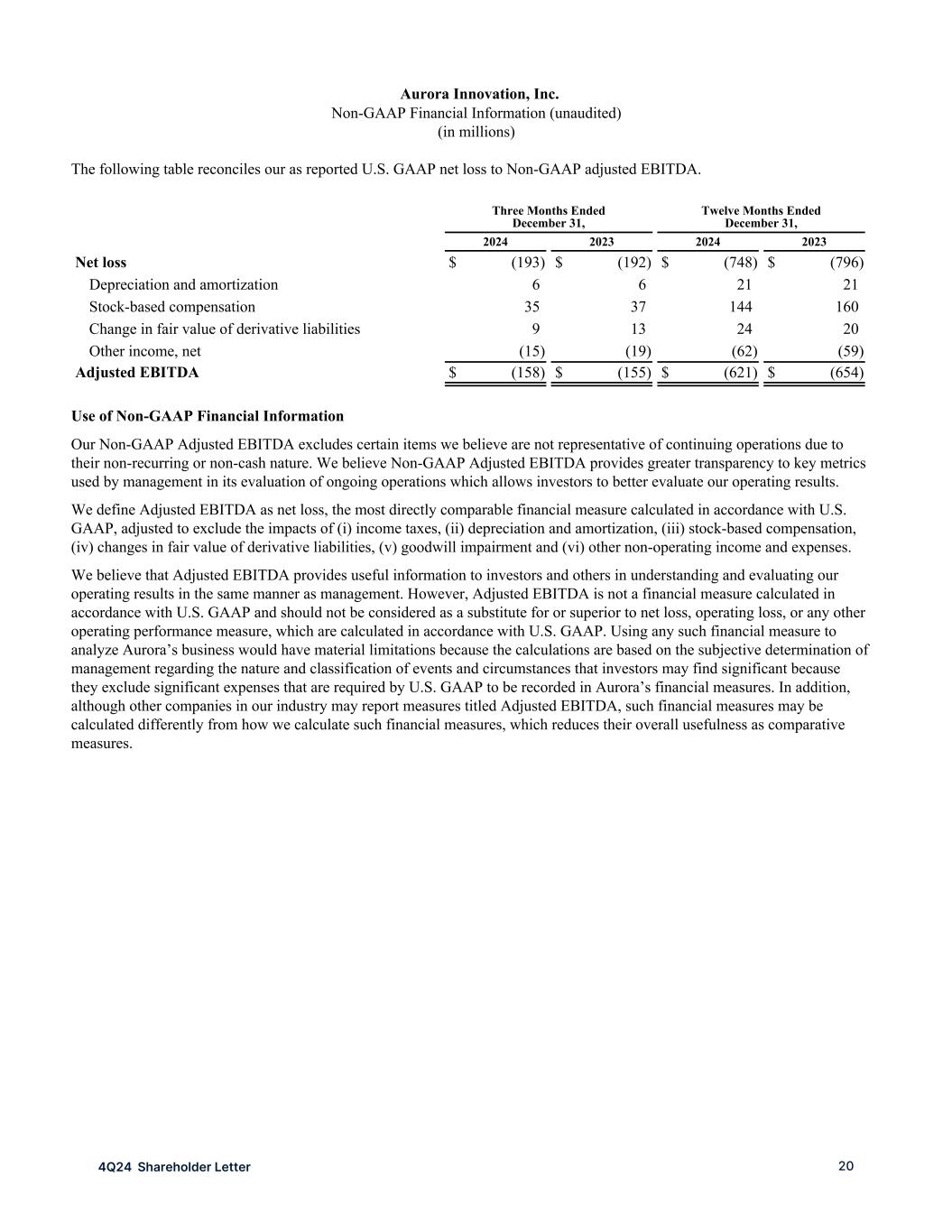
Thank you, Chris. Let's discuss our financial results. We have provided a summary on Page 13 of the slide deck for reference. During the fourth quarter of 2024, we continue to demonstrate strong fiscal discipline. Fourth quarter 2024 operating expenses, including stock-based compensation, totaled $199 million. Excluding stock-based compensation, operating expenses totaled $164 million. Within operating expenses, our R&D expenses, excluding stock-based compensation, totaled $142 million. This amount includes $714,000 in pilot revenue, which we record as a contra R&D expense. 2024 pilot revenue of $2.8 million increased 59% year-over-year. SG&A expenses, excluding stock-based compensation, were $22 million. We used approximately $142 million and $611 million, respectively, in operating cash during the fourth quarter and fiscal 2024. Capital expenditures totaled $8 million and $34 million, respectively, during the fourth quarter and fiscal 2024. This cash spend was below our externally communicated target for both the quarter and the year, reflecting our continued commitment to fiscal prudence. We ended the year with a very strong balance sheet, including over $1.2 billion in cash and short-term investments. Given efficiencies we found in the business and cash preservation decisions we have made, we now expect this liquidity to support our planned commercial launch and fund our operations into the second half of 2026. In 2025, we expect quarterly cash use to be within the $175 million to $185 million average range. This accounts for an increase in capital expenditures and continued development of our new hardware programs as we prepare to scale our business. At commercial launch, we will begin recognizing revenue. This will include driverless revenue as well as continued pilot revenue, which up to this point has been recorded as contra R&D expense. With our deliberate approach to launch, we expect our 2025 revenue to be modest in the mid-single-digit millions. For modeling purposes, we expect revenue to build sequentially throughout the year. Revenue recognition associated with our driver's launch will be a meaningful milestone for Aurora but will have a negligible impact on our overall financials during our launch year. Our focus in 2025 will be on expanding our driverless operations to prove the promise of the Aurora Driver technology. In addition, our team will be focused on key cost reduction levers, including the introduction of our next-generation hardware kit to support achieving our initial scaling cost reduction initiatives. With that, we'll now open the call to Q&A.
Operator
And our first question comes from George Gianarikas with Canaccord Genuity. Please proceed with your question.
Speaker 4
Hi, good afternoon, everyone, and thank you for taking my questions. I’d like to be optimistic and look beyond the April commercial launch to gain some insights on how comfortable you feel about scaling. This question has multiple parts. First, can you share your confidence in lane scaling, particularly regarding the operational remote assistance specialists you mentioned in one of your examples? Also, from a hardware perspective, especially in relation to NVIDIA, could you provide more detail on the cost reductions you can achieve as you scale the operation?
Yes, I'm happy to answer your question, George. Regarding lane scaling, I’m very optimistic. One reason we are pursuing the trucking application is the high self-similarity of the freeway network in the United States. Essentially, one part of the freeway looks similar to another, which means if you can operate in one area, you should be able to do so in another. We have observed this in practice. Last quarter, we provided an update on our efficient mapping of the route between El Paso and Phoenix, achieving performance levels comparable to what we see elsewhere. We anticipate this to roll out fairly quickly, and expect to see evidence of this development in 2025 throughout the year. One point I want to emphasize is that launching new lanes will become progressively easier. Once we successfully establish the first lane between Dallas and Houston, we’ve built a strong foundation for driving. Introducing a new lane will only require adding a few incremental capabilities to our existing competencies. For instance, managing the Fort Worth to El Paso route necessitates operating through a specific border patrol station, which we already do, and we just need to ensure that our processes are validated. This is a manageable task compared to what we've accomplished over the past few quarters, so I am very optimistic and confident in our ability to execute. On the hardware side, we have devised a strategy to initially launch our first commercial hardware generation, which we currently have and can produce in limited quantities. We do not want to become a manufacturing operation; rather, we prefer to focus on our strengths. We excel at designing and integrating hardware. Hence, we have partnered with Fabrinet, and we are currently integrating early components from this partnership onto trucks to develop the necessary processes. This will help us scale from a limited number of units to small thousands. Additionally, we have been planning ahead with our partnership with Continental, which will enable us to reach automotive-scale production. They understand the processes and manufacturing needs and can fit seamlessly into the just-in-time manufacturing systems of our OEM partners. Given the careful planning behind our partnership with Continental and our work with Fabrinet, I am confident in our ability to supply the necessary hardware for our business. As production increases, the costs generally decrease because the investments in engineering and manufacturing are distributed over a larger number of units. We have a strong expectation of cost reductions and already have detailed numbers indicating positive trends. With the Continental hardware, we aim to achieve the healthy margins that we have discussed for years. Overall, I feel very confident about our software scalability and our ability to expand across lanes, as well as our capacity to deliver the hardware needed to support this growth at a price that enables us to meet our goals. I apologize for the lengthy response.
Speaker 4
No, that's great. Just a follow-up on the NVIDIA partnership. At CES, there were a number of companies that talked about their NVIDIA partnership. So maybe if you can go into a bit more detail about how proprietary your hardware is compared to others that might be using the same GPU?
Yes. The GPU we are discussing is part of an integrated system on a chip from NVIDIA. This SoC is a standard product and plays a critical role in our offering. However, the true innovation lies in how we integrate and design it for manufacturability, reliability, and scalability, ensuring it meets performance standards for a safe product. That integration is where Continental adds value beyond what NVIDIA provides. While the component itself isn’t particularly unique, our method of utilizing it and the value we create around it is what sets us apart.
George, I just heard from someone via e-mail that there was a bit of a cutoff in the connection on our side and maybe there was a loss in the hearing. Could you hear the answer? I'm not sure if it may have break?
Speaker 4
I heard the whole thing.
Okay. Great. Thank you for confirming.
And to whoever it got cut out with, we apologize for that.
Operator
And our next question comes from Andres Sheppard with Cantor Fitzgerald. Please proceed with your question.
Speaker 5
Hey everyone, good afternoon. Congratulations on the quarter and all of the recent developments. Maybe just to start off, regarding your commercialization strategy, I'm wondering if you can maybe flesh out a bit more your crawl, then walk, then run approach. So obviously, starting with 1 driverless truck and then ramping up to tens of trucks by end of the year. Just wondering what is the best way to think about Q3 and Q4 of this year in terms of those trucks in operation. And also, is there a certain number that you might be targeting for commercial loads and cumulative miles driven by your April date?
Yes, I'll start with the first part and then let Dave discuss the numbers. For us, the crawl walk run strategy is about recognizing that this represents a significant shift in transportation, and we want to ensure that we bring stakeholders along with us. As we wrap up the safety case for the Dallas to Houston route, we are confident in our ability to operate multiple trucks in that area. However, stakeholders generally expect a gradual progression. While this will be an important milestone in delivering this technology, it won’t significantly affect our financials over the next year. So, we believe it’s best to operate in a manner that aligns with local stakeholders and regulators, gradually building trust in our approach and collaborative spirit. We plan to start with one truck and then gradually increase to ten, with the expectation that by the end of the year, we will be operating tens of trucks.
Yes. And thanks, Andrew, for the question. Let me talk about the last part. It may not be the message you want to hear. But I think for us, what Chris said is important; for us, it's about ensuring that we have a great product that delivers on the value that we've promised to our customers and working closely with our partners and our regulators. So for us, we're really focused in on one, demonstrating that we have a commercial driverless product that everybody is going to love. The second thing is continuing to expand the technological areas where we can operate in. So going into nights, going into range, going into new lanes, those for us are more important thresholds than the absolute number of miles that we drive because we really want to have a great product first and the miles are going to come naturally. The other thing is that we also want to make sure that we get to our next-generation hardware kit. So we don't want to abnormally drive a ton of volume into the first-generation hardware kit as we're waiting for the second. So for us, it's a very deliberate approach. We want to make sure that our customers are completely satisfied with the product we're delivering to our expectations. And for us, technology proof points, we think in '25 is more valuable than a mileage guidance.
Speaker 5
Wonderful. That's super helpful. I appreciate all that color. Maybe just as a quick follow-up. So for 2025, you disclosed, you expect your quarterly cash use to be in the range of $175 million to $185 million. I'm wondering if you can maybe give us a bit more granularity as to how to think about CapEx specifically for this year, CapEx was about $8 million in Q4 and $34 million for the year. Just trying to figure out what's the best way to model it for this year?
Yes. So I don't expect a substantial increase in CapEx. There certainly will be some increases in CapEx, but I think overall, let me try to describe it in the OpEx. I think we have all the necessary people and operations in place to scale a business. We'll have some slight increases in OpEx as we bring in our new programs like our new hardware programs. But I think for both of those, they're going to be pretty modest increases. I would expect to see a modest increase in the OpEx cost and the remainder that fills to that $175 million to $185 million to be in CapEx. So I think that should be pretty helpful for you for your modeling purposes.
Speaker 5
Very helpful, indeed. Appreciate all the color. Congrats again on the quarter. I'll pass it on.
Operator
And our next question comes from Scott Group with Wolfe Research. Please proceed with your question.
Speaker 6
Hey, thanks. Afternoon, guys. I am wondering, anything specific you guys still need to accomplish in order to be ready for April?
No, there's just a few tasks left to complete. We previously mentioned the need to finalize the last set of items, and there's not much remaining. We've progressed ARM to 99%, which shows the minimal work left to finalize the safety case. The API is nearing the target we've established for launching. We feel very positive about this, reflected in our road performance and experience quality. Honestly, I'm pretty excited right now. Everything is unfolding as we anticipated.
Speaker 6
I completely understand that this year is not focused on the number of miles and trucks, which makes sense. However, when can we expect to see a significant increase, like finishing the year with dozens of trucks and potentially reaching hundreds next year? Will next year be a turning point, or will the growth continue to be gradual into 2026, with the more substantial increase coming later?
Yes. Scott, let me take a shot and then maybe Chris, you can add on to it is going to be a step function here in terms of kind of metrics that you guys are more used to seen. Again, once we have confirmed with and started our rollout and we have demonstrated that we've got a really reliable and great product. And then we're continuing to launch on lanes. As Chris mentioned, we'll be able to launch even more lanes in the subsequent years, we expect to have a step function change in just how many trucks we're operating and how many miles we're driving. And the miles driven is going to increase, not just based on the number of trucks that are out there but the utilization of those trucks, right? We expect to, in 2026, really be able to demonstrate a substantial utilization increase versus what people are used to. So we're going to do it both from utilization and truck, but to us is that step function year in terms of really seeing solid financials. I think we've mentioned before, one of our objectives is to demonstrate positive gross profit in 2026. We're still working towards that. That's not a guidance or affirmation at this point, but that's what we've talked about at our Analyst and Investor Day last time, and that still is an objective of ours. To be able to do that, we have to have a step function in our mileage that we're driving.
And just to add to what Dave said, I really think about '25 as accelerating our advantage. Right, that when we launch commercially, we'll have turned the crank the whole way around for the first time and the momentum starts to build as we close that out, we launch the next lane as we launch new capabilities and features. It will get the team and the company into the rhythm of deploying the extensions of the product that we need to support our customers and support the scale that we need. It will allow us to definitively answer the questions that George led with today where we have high confidence today. We've got early signal of it, but we'll really be able to put those questions to bed and be able to demonstrate the scalability of this into a market where the technology and the product are desperately needed. It's just an exciting and fun time here at the company, and I'm really looking forward to it.
Speaker 6
And then maybe just one last one. When do you think you'll start having, we'll start seeing deliveries of trucks to third parties, meaning not an Aurora-owned truck, but a customer owning it?
Yes. The hardware kit being produced by Continental is expected to be installed on-site with our OEM partners, directly reaching customers. There is a possibility of this happening a bit earlier. However, the timeline will largely depend on specific customer needs and use cases. At the latest, we anticipate substantial delivery of all driver as a service to customers by 2027, with a gradual migration occurring before that, tailored to individual customers.
And I think this is going to be on us, right, that as we roll out that second generation of commercial hardware at the end of this year, as we are able to demonstrate to customers that this can go to places they need that it does it at a level of performance in practice, not just in theory that they're expecting. It's going to become obvious that it's transformational. For the customers who get that earlier, they'll begin to build an advantage through the experience gained early on in this next phase of transportation. I think that's going to perhaps drive earlier acquisition and adoption of the hardware.
Operator
Our next question comes from Jeff Osborne with TD Cowen. Please proceed.
Speaker 7
Thank you. Good evening. Just had a couple of questions on my side. I was wondering how should investors categorize or characterize success with the April launch and the months thereafter recognizing you're not giving guidance as it relates to miles, but just as you were to look back maybe in the fall of '25 over the prior 4 or 6 months that you had been commercialized? How should we give you a report card, so to speak?
Yes. I believe there is a significant turning point ahead, which involves trucks operating on the road without any drivers. When I consider this from an investor's perspective, I think about the main risks and questions regarding our business. One question is whether the technology can function without a driver. Another is whether we can offer the product at a profitable price. Lastly, we need to determine if we can scale it effectively to ensure the business becomes self-sustaining and realizes the potential we all believe it has. By the end of this year, we expect to resolve the first question, demonstrating that we can have trucks driving without drivers. Towards the end of the year, we anticipate receiving strong indications that we can scale this product. While we won’t be operating at a level where the business is self-sufficient yet, we expect to show progress in deploying lanes and that the expansion is functioning as hoped. We should also begin to see the initial hardware that will lead to profitability. So, it should be an exciting year.
Speaker 7
Just two other quick ones. How would you characterize the competitive landscape?
It's ours to win, right? As we look out at the landscape, we look at the partnerships we have, we look at the technology and team we have. We think we're well ahead of the competition and accelerating. That is just incredibly exciting. When we think about an opportunity where freight in the U.S. is a trillion-dollar market and we have the opportunity to win for ourselves, for our customers, a big piece of that. I feel very bullish about our position.
Speaker 7
Good to hear. And the last one, there was a lot of questions on the cost reduction potential. You've obviously talked about Fabrinet here in '25 and '26 at the lower volumes and then Continental longer term. Are there any other one or two key variables that you would highlight that are initiatives for '24? Or sorry, for '25 that we should be monitoring as it relates to cost-out plans?
We've previously discussed the main economic factors affecting our costs, including hardware expenses and their depreciation over the trucks' lifetimes. We also noted the costs associated with on-site support, as any need for a technician to service a truck on the road can be quite costly. This is why we've been focusing on our 100% API trip measure. Additionally, we consider the expenses related to remote support, specifically how frequently a remote agent needs to assist the truck. Lastly, we factor in the costs for insuring these vehicles. Regarding hardware, we provided insights on how we plan to reduce those costs during this call. As we enhance our product and increase its reliability, we expect improvements in remote on-site support. Our transition from in-house hardware to that produced by contract manufacturers like Continental should further boost hardware reliability. In our previous Analyst and Investor Day, we outlined our expectations for remote support. By 2025, we anticipate achieving better than a 10:1 operator-to-truck ratio. Concerning insurance, we remain confident that the insurance market will behave rationally and, as we show better safety and fewer losses, we expect pricing to improve. Overall, we recognize the main drivers to lower costs in delivering our product, and we are making satisfactory progress in all areas. Thank you for your insightful question, Jeff.
Operator
Our next question comes from Mark Delaney with Goldman Sachs Asset Management.
Speaker 8
Given the news in research out on DeepSeek, I'm curious, Chris, if you think there are new training techniques that Aurora could adopt. More generally, if you think there are ways for Aurora to materially reduce its AI training cost in the future?
Yes, it's been intriguing to observe the discussions surrounding the rapid development of these large models and their implications. This highlights a point we've emphasized for years: the importance of data quality over quantity. For instance, although this isn’t specifically about DeepSeek, a report from Stanford demonstrated that a model's performance could be replicated using a smaller, low-cost model fed just 1,000 high-quality reasoning examples, achieving 80% to 90% of the original model's performance. The report highlighted that this larger model was trained for just $50. This reinforces our long-standing belief that it’s not solely about having vast amounts of data; what truly matters is ensuring that the data is relevant, high-quality, and meets the specific needs we aim to address. This has been our strategy from the beginning. While there are certainly other compelling aspects of these large models that we are considering to enhance our work, I remain quite optimistic about it overall.
Speaker 8
Very interesting. Dave, you said your objective is to have a positive gross margin in 2026, but no guidance. You talked about one of the key variables being around utilization and getting more miles in 2026. Maybe you talk about some of the other factors, though, in particular, an update around how pricing is trending in some of the commercial contracts and then how you think input costs and operations are progressing toward that positive gross margin target for next year?
Yes. Some of the key drivers related to gross margin can be understood by examining the cost of goods sold. The elements mentioned by Chris are significant contributors to that. Additionally, we should consider how efficiently we operate at terminals, how quickly we can dispatch trucks, and the number of personnel needed to support those operations. Aurora has been conducting pilot operations for three years, which has provided us with valuable insights and allowed us to bring in experts who excel at getting trucks on the road efficiently. This expertise gives us confidence in maintaining low terminal operation costs. On the revenue side, a higher quality product will give us greater pricing potential. While I can't forecast the overall market pricing, I expect to deliver a product that is safer, more fuel-efficient, and more reliable, which should enhance our pricing power once it's proven. Our focus will be on controlling what we can, providing a premium product, and managing our costs effectively. I believe we have a clear path to achieve our goals, though there is considerable work ahead. Nonetheless, I am confident that we have the right team in place to accomplish this.
I'll just add to what Dave said that we continue to believe that the human labor cost is really the pricing umbrella that we have for operating the trucks. This is a super important job. The cost of operating or the cost of the driver operating the truck continues to go up as it should, given the risks and challenges these folks face. This is going to be the next best alternative to the Aurora Driver of these trucks. We continue to believe that this is too.
Speaker 8
That's helpful. If I could ask one last one in. In the shareholder letter, you spoke about the FMCSA ruling and how that didn't go your way. You did speak though about some workaround; you mentioned operational one in the near term. I don't know if you could elaborate a bit more on what exactly that means and you also refer to a potential longer-term workaround even if the law doesn't change and what that might look like?
Yes. The FMCSA rejected our petition to allow trucks to use flashing lights to indicate when they are stopped on the side of the road, similar to how tow trucks and emergency vehicles operate. This rejection is concerning because the traditional method requires truck drivers to place triangles behind their vehicles, which is hazardous as it involves walking along the freeway. We believe the decision to reject our application was incorrect, and we are encouraging the federal government to reevaluate this matter. With the new administration, we are hopeful that this decision could be reversed. However, this rejection does not hinder our ability to launch commercially. We have identified operational methods and technical solutions that will enable us to comply with the law. I can't provide more details on that, sorry, Mark.
Speaker 8
I'll pass it on.
Yes. Thanks very much for the question.
Operator
Our next question comes from David Vernon with Bernstein. Please proceed.
Speaker 9
Hi there. This is Justine Weiss speaking on behalf of David Vernon. So if you look at Slide 13, there are still a few areas where we know driverless operations and autonomous trucking are prohibited. So I'm wondering if you've had conversations with regulators about the potential for more sweeping regulation under this new administration that could make it easier for you to enter into these currently restricted markets?
Yes. I think we approach this with two ways to think about it. One is that I think the biggest lever we have is demonstrating the value in other states and helping that grow and impact their economy and that and see the safety benefits of it on the roadway. Other states, I think, will want that. We also do expect that there's a real chance that the new federal administration will actually push for a nationwide standard for this, and that would help mitigate the somewhat patchwork set of regulations we operate within across the United States. The reason why we have some optimism for that is that Transportation Secretary, Duffy, in his remarks before Congress actually spent a fair bit of time talking about automated vehicles and talked about the importance of the technology for safety but also for America to be a leader in this space. So we're optimistic that this administration will continue to be a strong supporter of the technology.
Speaker 9
That's great to hear. And then I guess another question I'm wondering about is how are things progressing with a shift towards single operators other than two vehicle operators? Like what percentage is single operator? And how should that change by end of 2025?
Yes. Well, I think the missions that are going to matter by the end of 2025 are going to be no vehicle operator. I think that's going to be really exciting. A lot of our testing will continue to be a blend of a single and dual operator. It's really about the mission and making sure that we could operate the missioning question in a way that is thoughtful and safe on the roadway. We actually don't even internally track the percentage of missions. So unfortunately, I can't share a number on that. But it's really about, again, operational efficiency internally without impacting safety.
Speaker 9
Okay. Great. And then just one more if I could throw it in. So you speak about increasing capacity to tens of trucks by the end of the year. So could you maybe help us frame the upper bound of what tens of trucks could actually look like? What's the bear and bull case maybe on that?
Yes. I don't know that we have anything additional, Justin to share on that right now. I think, again, I would focus us on the sequential growth in the mid-single-digit millions for revenue. I think that that's kind of a more important thing. For us, again, we're really focused in on the execution in the early stage. As we continue to launch more lanes, the demand for trucks is going to be really high, and we're going to have to fill that demand with our partners.
Operator
And that was our final question. And with that, that does conclude today's teleconference. We thank you for your participation, and you may disconnect your lines at this time.