Operator
Greetings, and welcome to the Aurora Second Quarter 2025 Business Review Call. As a reminder, this conference is being recorded. It is now my pleasure to introduce your host, Stacy Feit, Vice President of Investor Relations. Thank you. You may begin.
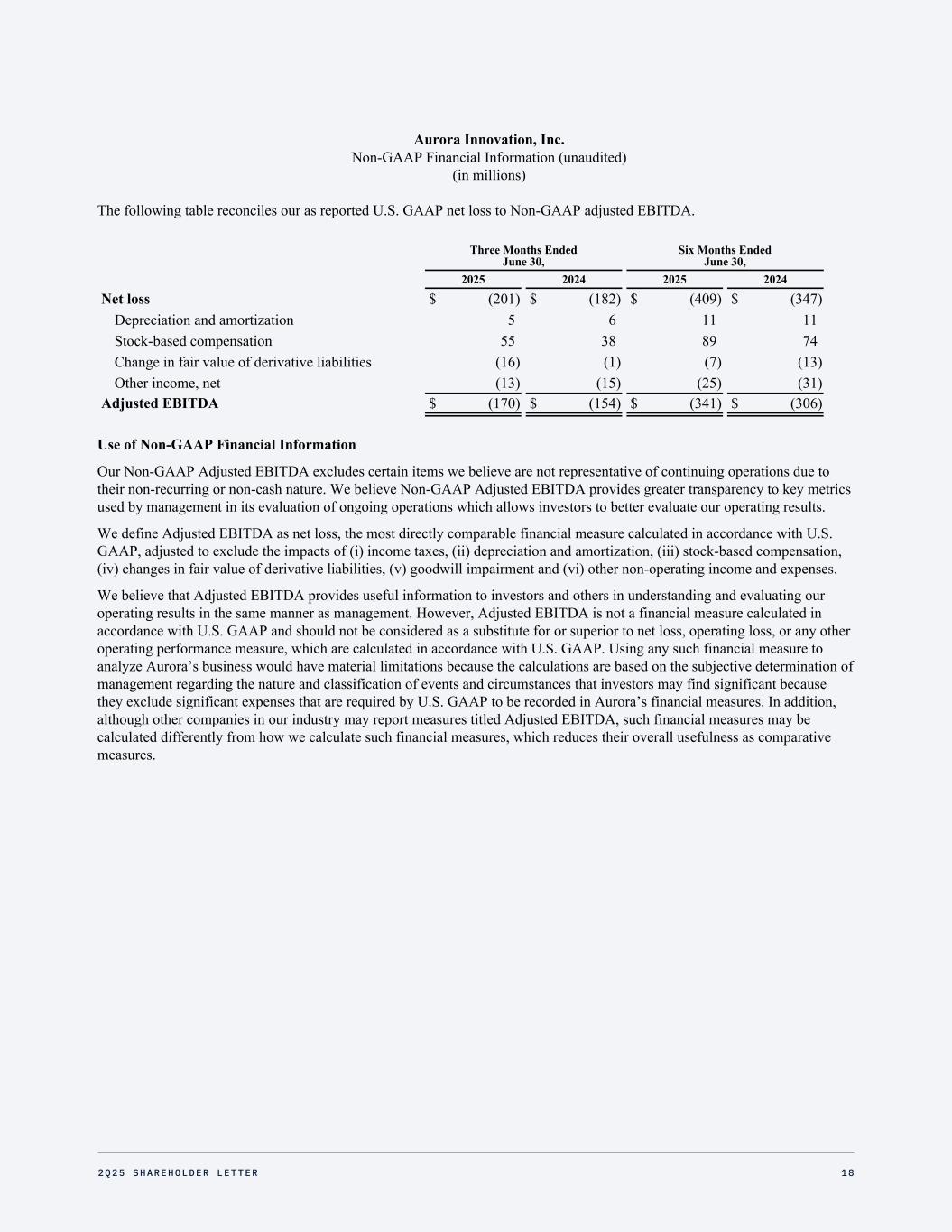
Thanks, Latonia. Good afternoon, everyone, and welcome to our second quarter 2025 Business Review Call. We announced our results earlier this afternoon. Our shareholder letter and a presentation to accompany this call are available on our Investor Relations website at ir.aurora.tech. The shareholder letter was also furnished with our Form 8-K filed today with the SEC. On the call with me today are Chris Urmson, Co-Founder and CEO; and David Maday, CFO. Chris will provide an update on the progress we have made across the key pillars of our business, and David will recap our second quarter financial results. We'll then open the call for Q&A. A recording of this conference call will be available on our Investor Relations website at ir.aurora.tech shortly after this call has ended. I'd like to take an opportunity to remind you that during the call, we will be making forward-looking statements. These statements are subject to known and unknown risks and uncertainties that could cause actual results to differ materially from those expressed, projected or implied during this call. In particular, those described in our risk factors included in our annual report on Form 10-K for the year ended December 31, 2024, and other documents filed with the SEC as well as the current uncertainty and unpredictability in our business, the markets and economy. Additional information will also be set forth in our quarterly report on Form 10-Q for the quarter ended June 30, 2025. You should not rely on our forward-looking statements as predictions of future events. All forward-looking statements that we make on this call are based on assumptions and beliefs as of the date hereof, and Aurora disclaims any obligation to update any forward-looking statements, except as required by law. Our discussion today may include non-GAAP financial measures. These non-GAAP measures should be considered in addition to and not as a substitute for or in isolation from our GAAP results. Information regarding our non-GAAP financial results, including a reconciliation of our historical GAAP to non-GAAP results, may be found in our shareholder letter which was furnished with our Form 8-K filed today with the SEC and may also be found on our Investor Relations website. Our discussion today may also include reference to forward-looking free cash flow, a non-GAAP financial measure. To the extent that these forward-looking financial measures provide is presented on a non-GAAP basis without a reconciliation due to the inherent difficulty in forecasting and quantifying certain amounts that are necessary for such reconciliation. With that, I'll now turn the call over to Chris.
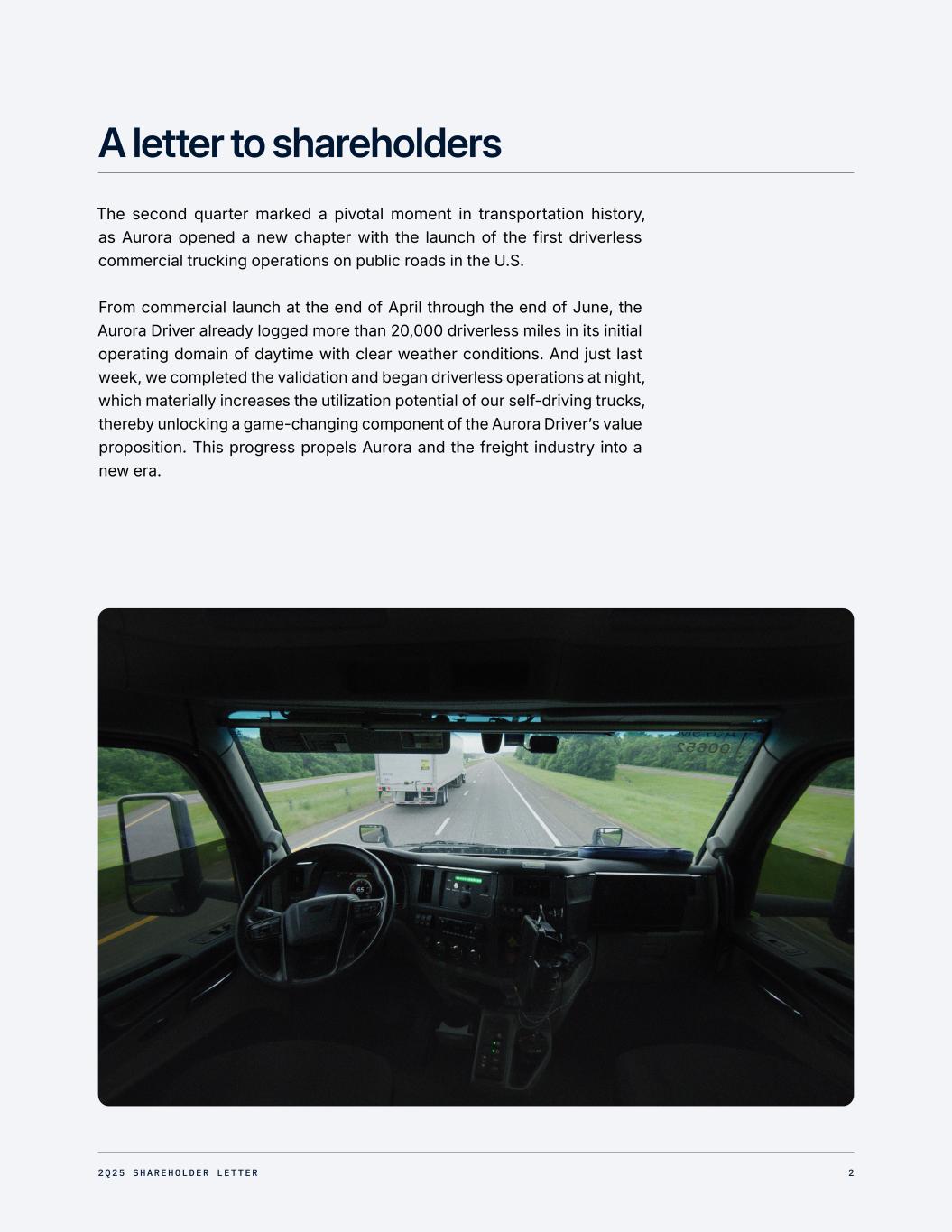
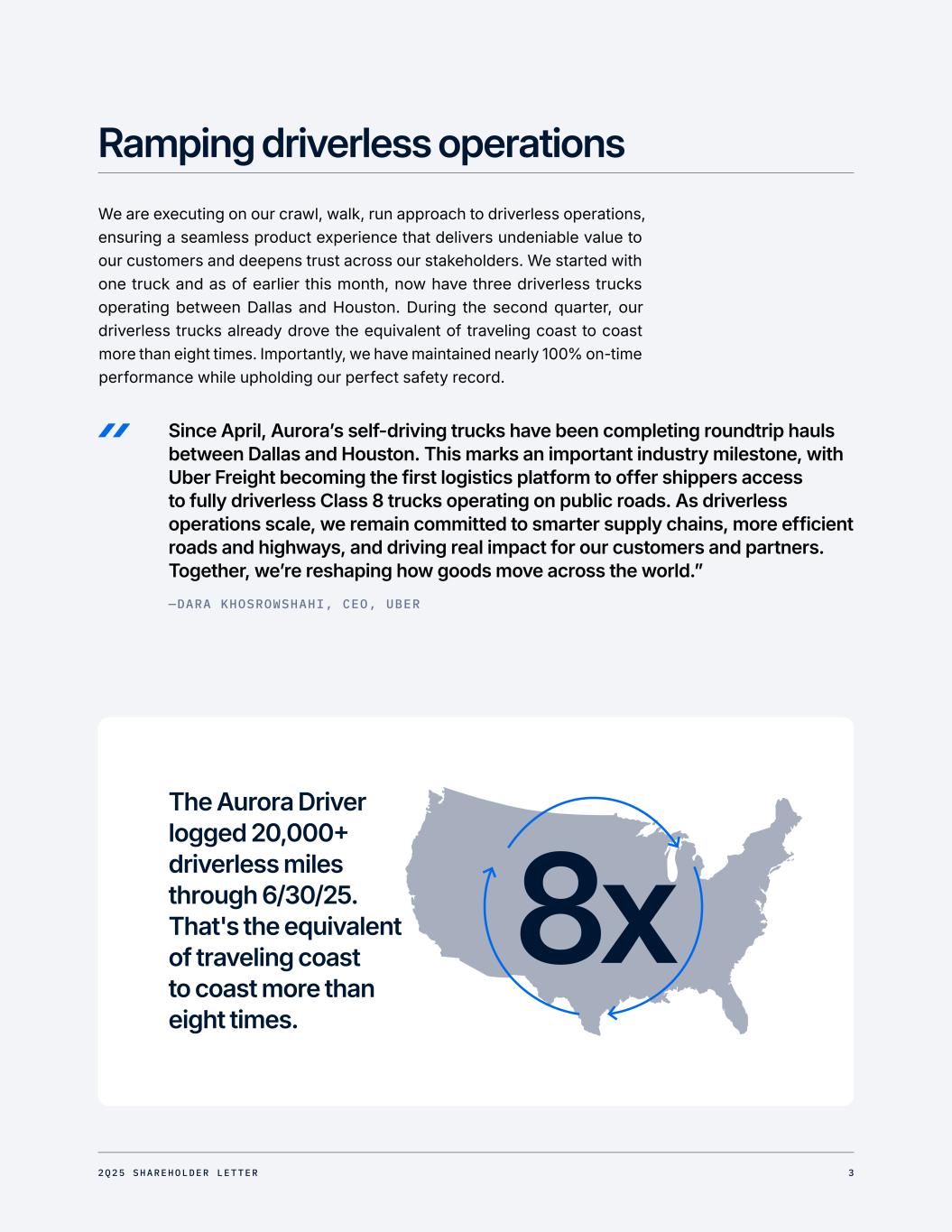
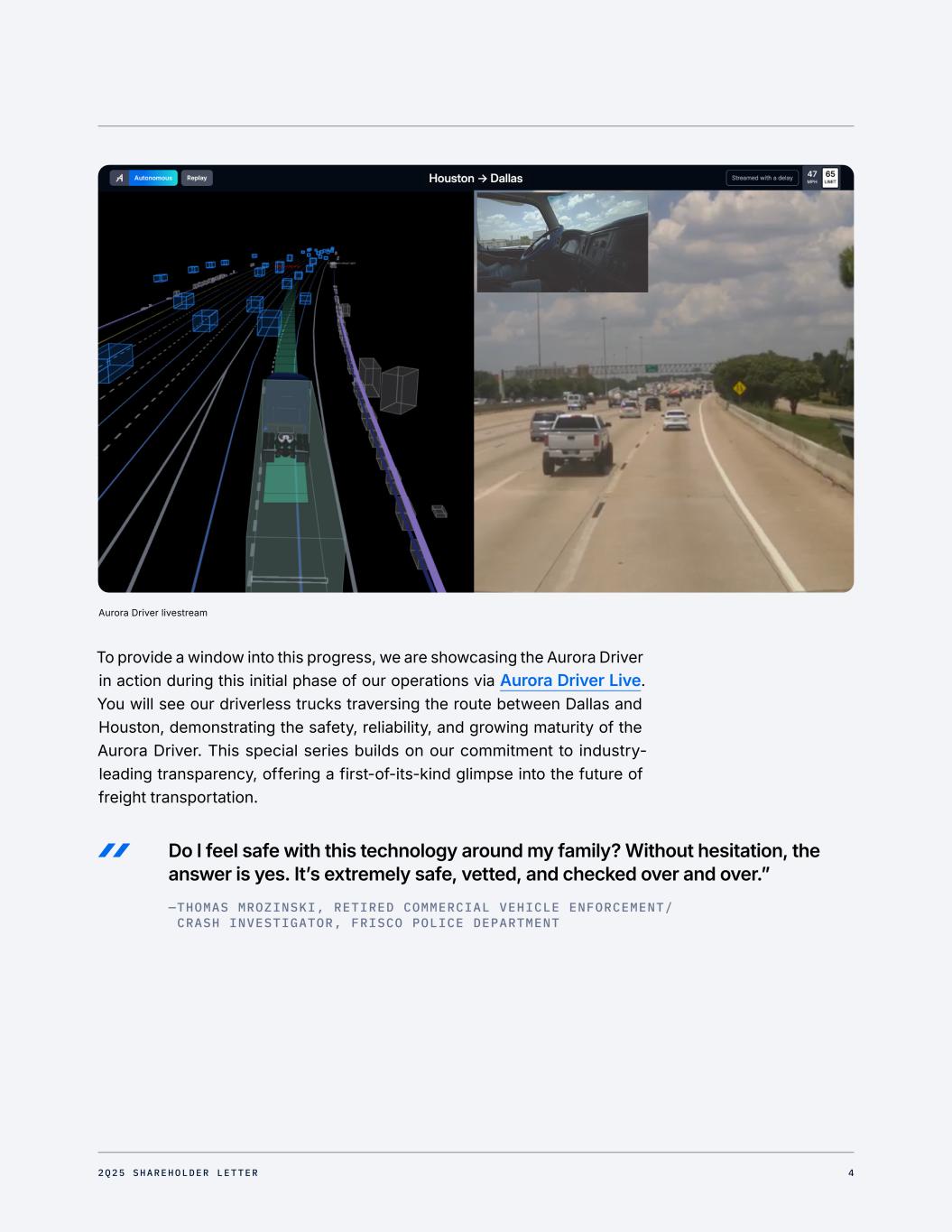
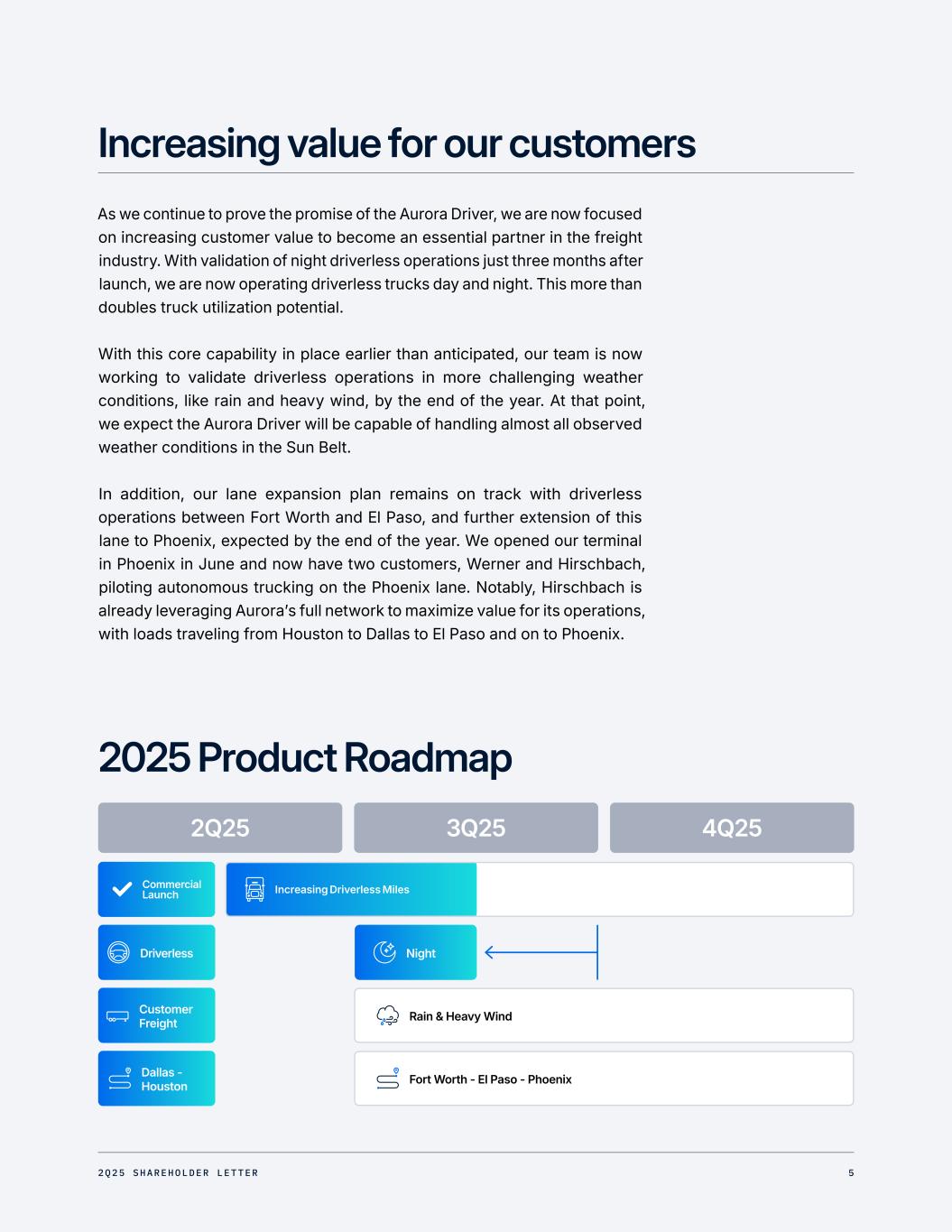
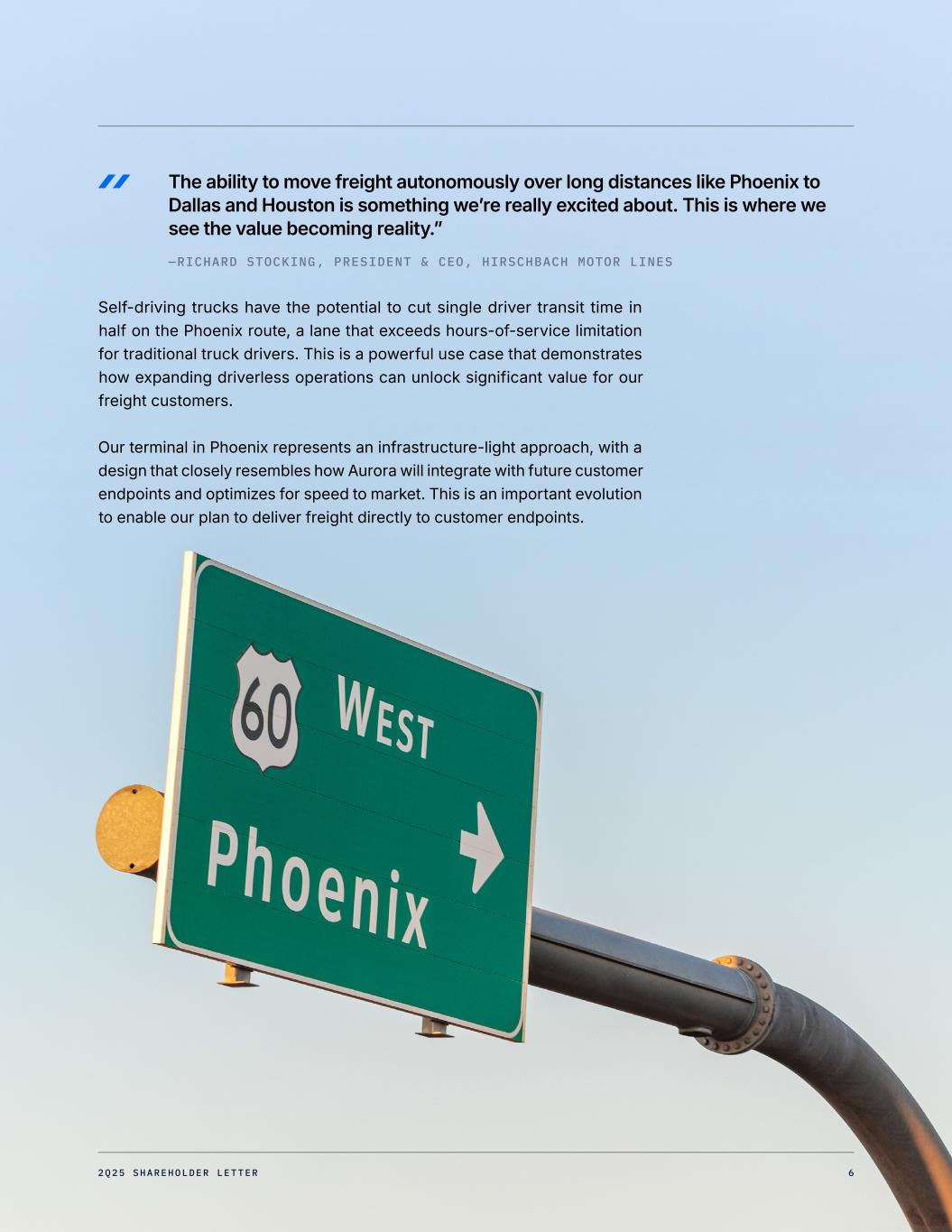
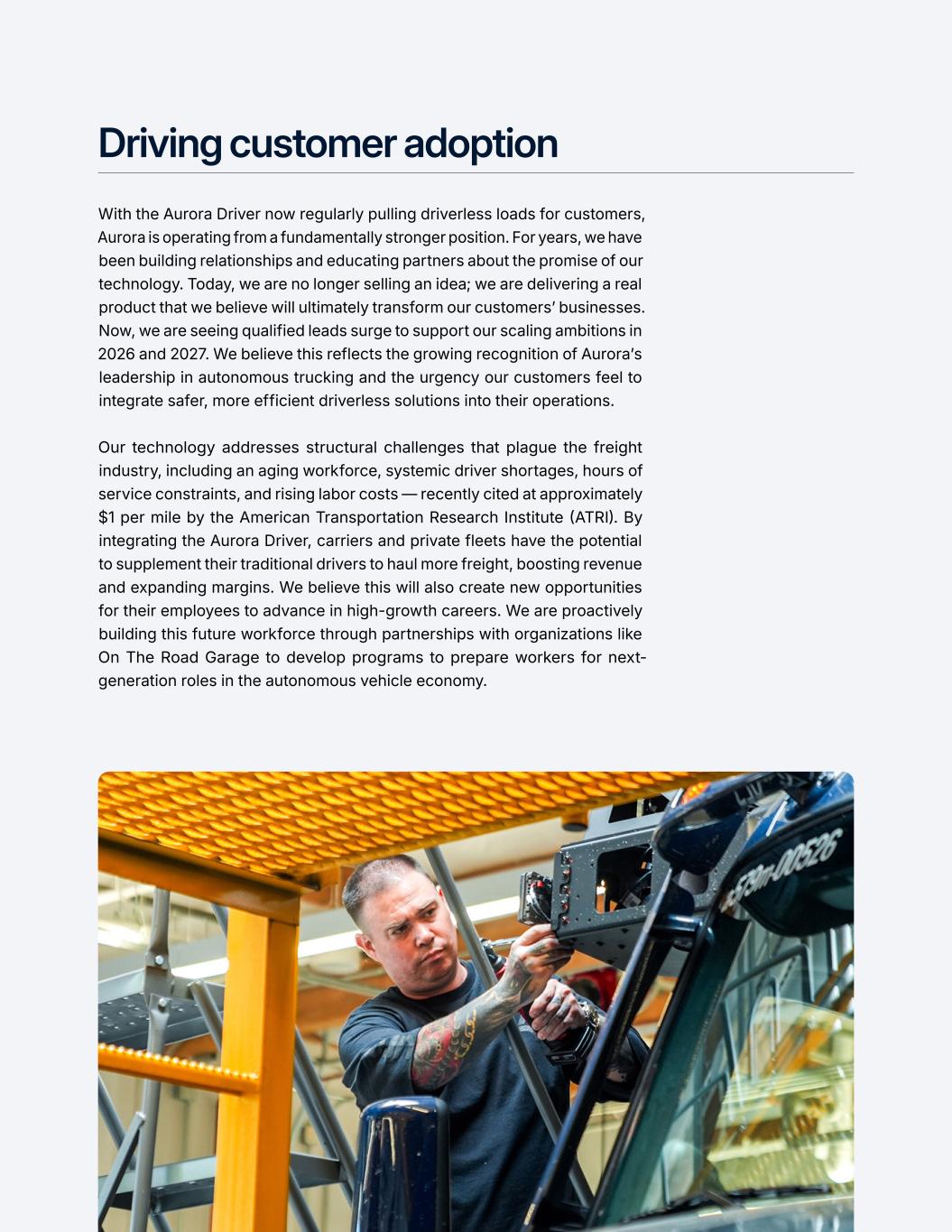
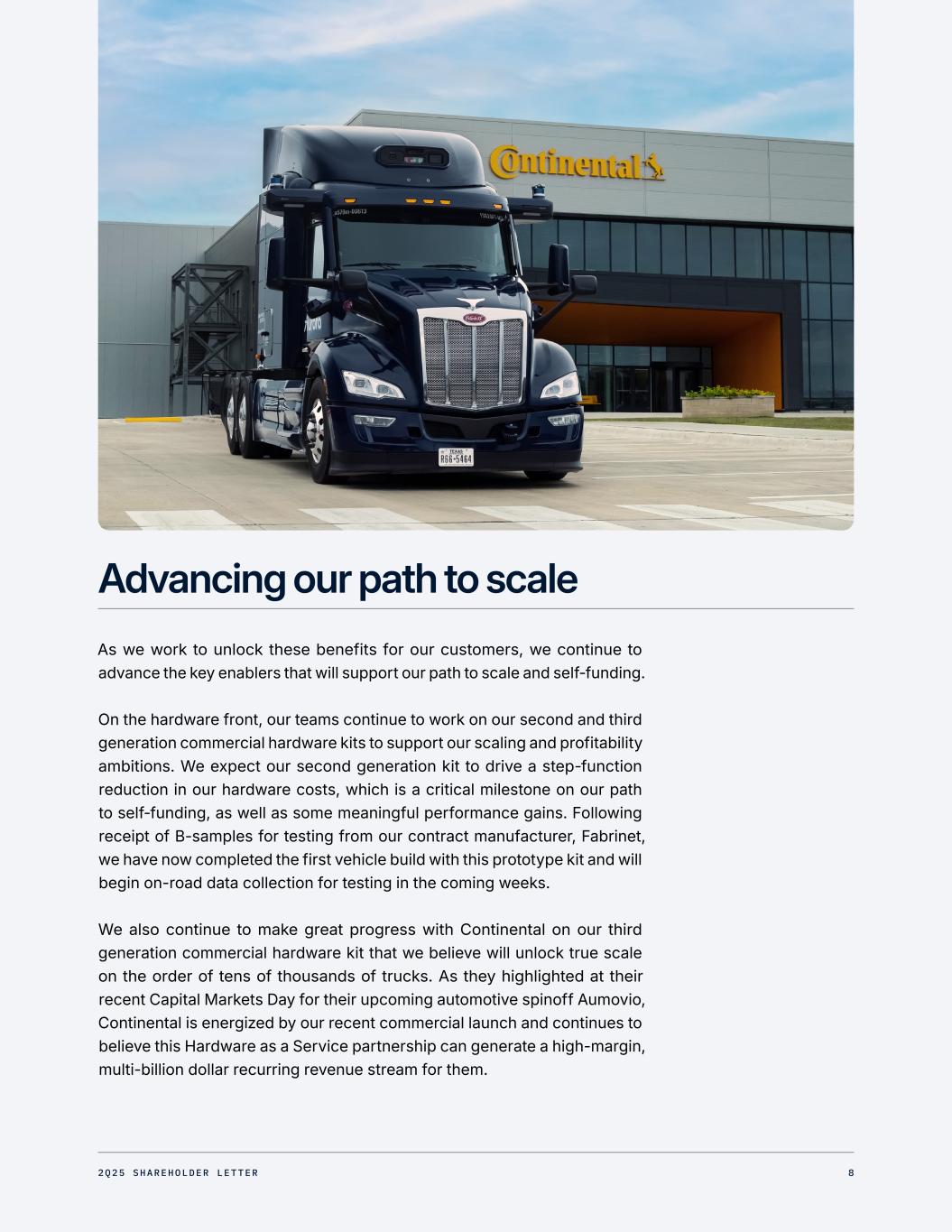
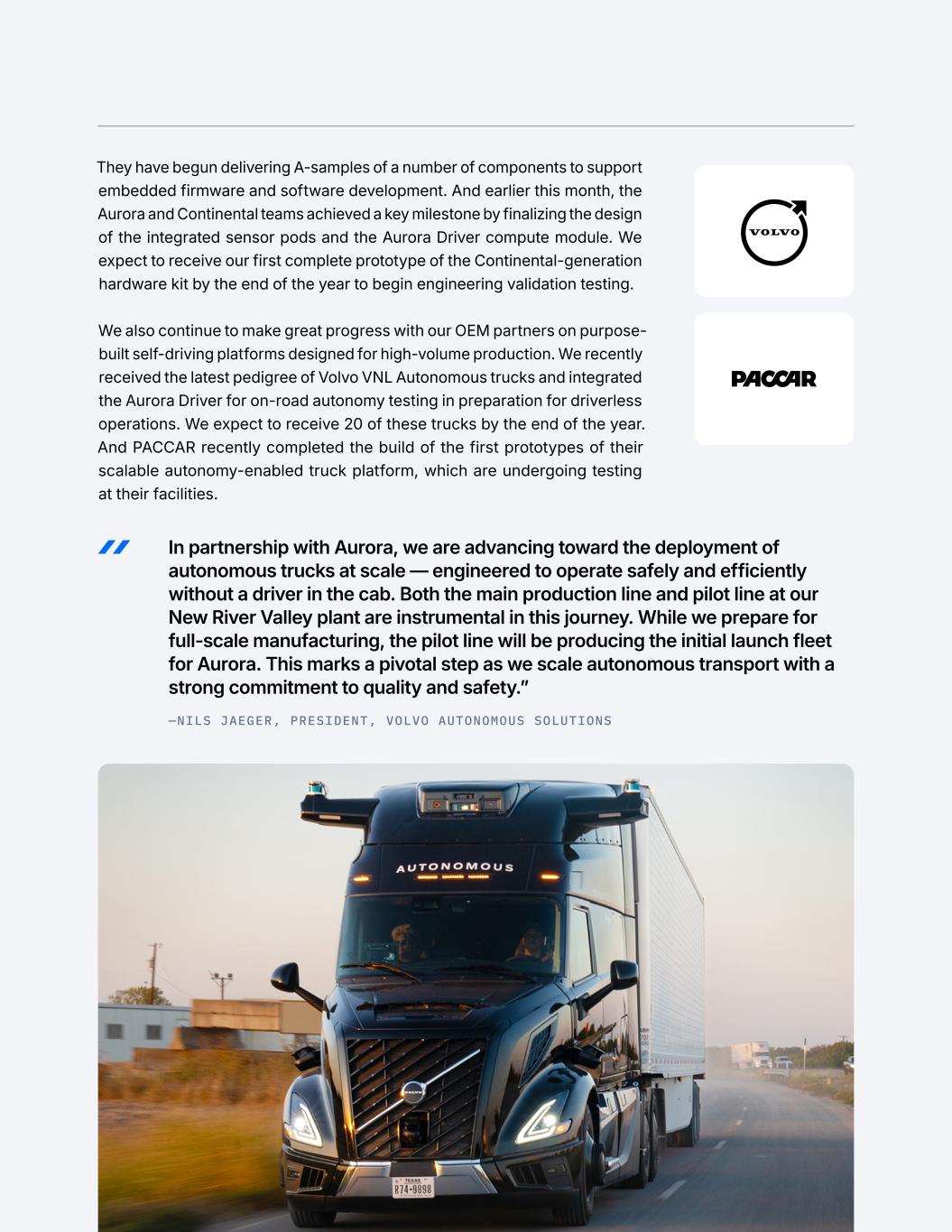
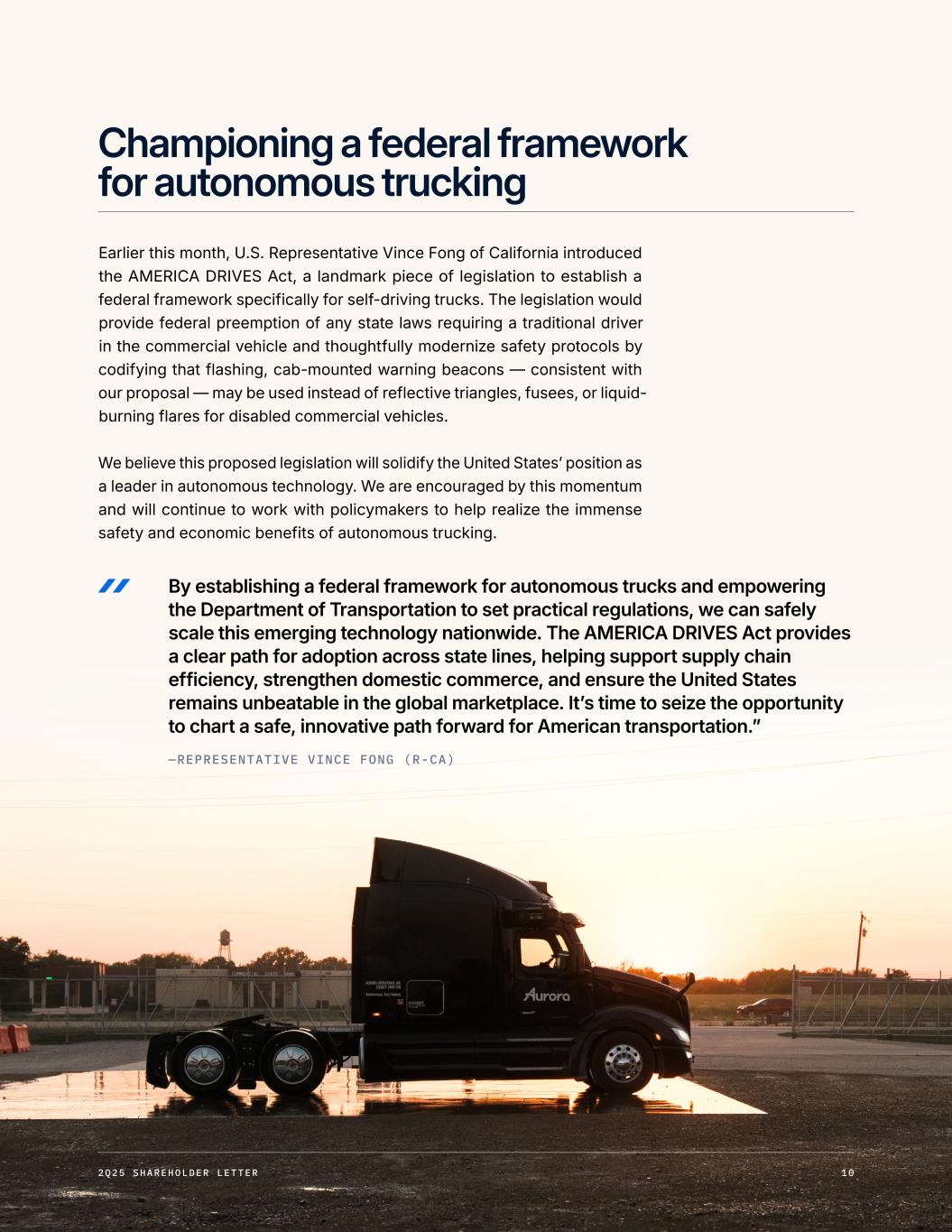
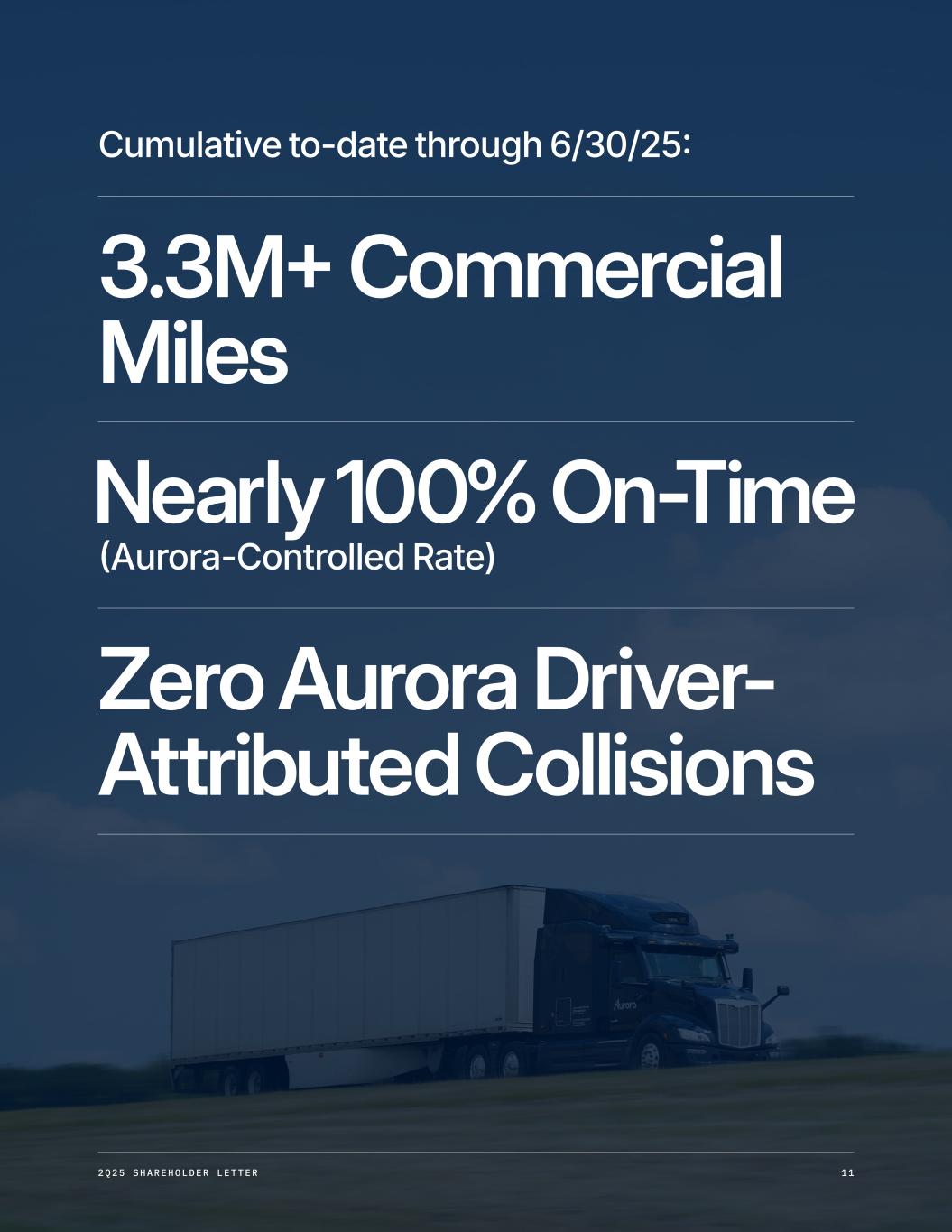
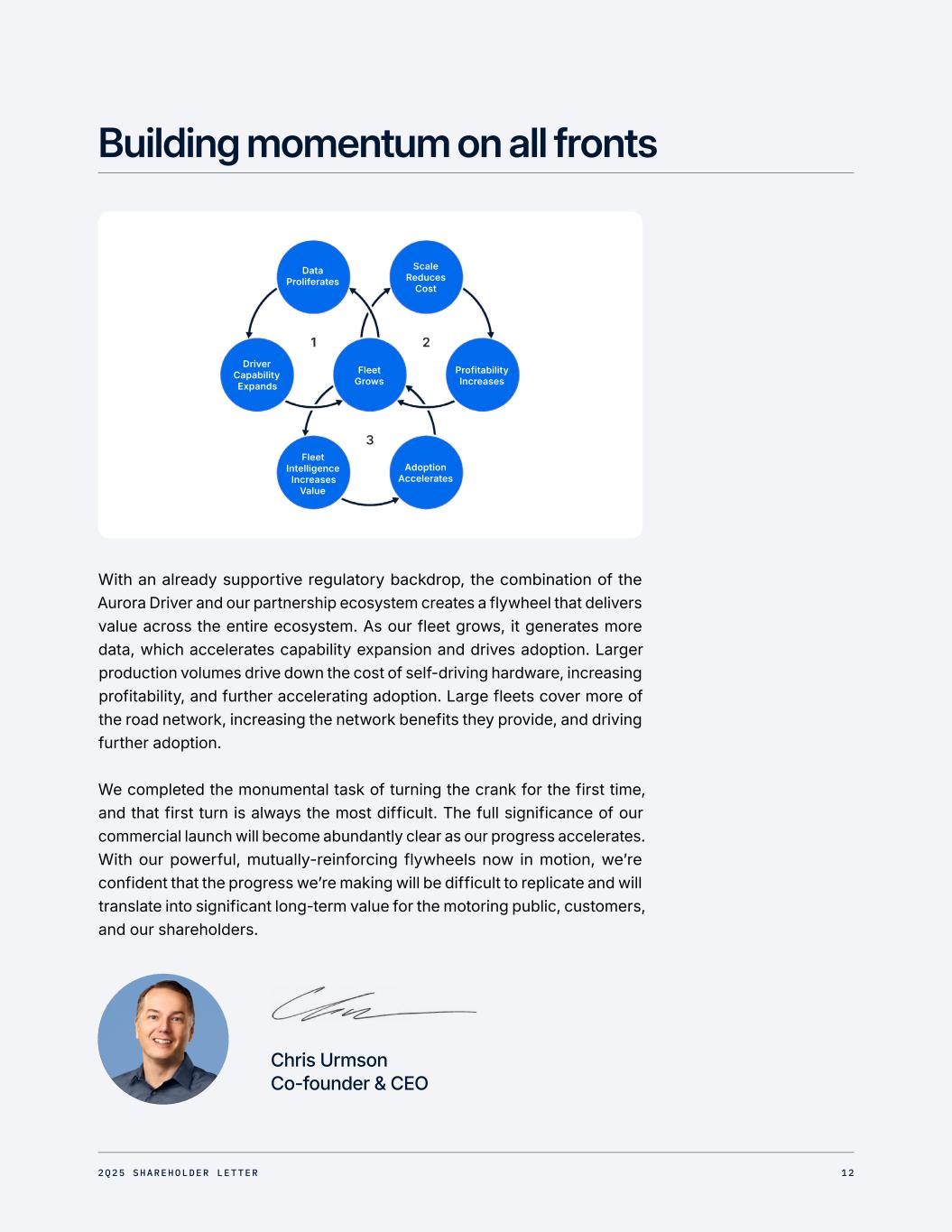
Thanks, Stacy. The second quarter marked a pivotal moment in transportation history. Aurora opened a new chapter with the launch of the first driverless commercial trucking operations on public roads in the U.S. From commercial launch at the end of April through the end of June, the Aurora Driver already locked more than 20,000 safe driverless miles. And just last week, we completed the validation and began driverless operation at night, which materially increases utilization potential of our self-driving trucks. This unlocks a game-changing component of the Aurora Driver's value proposition. This progress propels Aurora and the freight industry into a new era. We're executing our crawl, walk, run approach to driverless operations, ensuring a seamless product experience that delivers undeniable value to our customers and deepens trust across our stakeholders. We started with 1 truck and as earlier this month, now have 3 driverless trucks operating between Dallas and Houston. During the second quarter, our driverless trucks had already driven the equivalent of more than 8 coast-to-coast trips. Importantly, we've maintained nearly 100% on-time performance, operating courteously with the flow of traffic while upholding our perfect safety record. And while we added a front seat observer at the request of a partner, given certain prototype parts in their base vehicle, it's crucial to note that the Aurora Driver remains fully responsible for all driving tasks with no interventions needed. This performance continues to prove the advanced capabilities and safety of the Aurora Driver. To provide a window into this progress, we'll be showcasing the Aurora Driver in action during this initial phase of our operations via Aurora Driver Live. You can access the live stream via the link on Page 4 of our presentation or via the live tab on our YouTube channel at Aurora Driver. There, you'll see our driverless trucks traversing the route between Dallas and Houston, demonstrating the safety, reliability and growing maturity of the Aurora Driver. This special series builds on our commitment to industry-leading transparency offering a first-of-its-kind glimpse into the future of freight transportation. As we continue to prove the promise of the Aurora Driver, we're now focused on increasing customer value to become an essential partner in the freight industry. With validation of night driverless operations just 3 months after launch, we're now operating driverless trucks day and night. This more than doubles truck utilization potential. Check out the video on Page 7, which showcases the Aurora Driver's superhuman perception and distinct safety advantage during nighttime operations. With this core capability in place earlier than anticipated, our team is now working to validate driverless operations in more challenging weather conditions by the end of the year. And at that point, we expect the Aurora Driver will be capable of handling almost all observed weather conditions in the Sunbelt. In addition, our lane expansion plan remains on track. We expect to validate driverless operations between Fort Worth and El Paso and further extension of this lane to Phoenix by the end of the year. We opened our terminal in Phoenix in June and now have 2 customers: Werner and Hirschbach, piloting autonomous trucking on the Fort Worth, Phoenix Lane. Notably, Hirschbach is already leveraging our full network to maximize value for its operations with loads traveling from Houston to Dallas to El Paso and on to Phoenix. Self-driving trucks have the potential to cut single-driver transit time in half on the Fort Worth-Phoenix route, a lane that exceeds hours of service limitations for traditional truck drivers. This is a powerful use case that demonstrates how expanding driverless operations can unlock significant value for our freight customers. We've included a case study on Page 10 of the presentation to quantify the significant revenue and profit growth a carrier could generate through the adoption of the Aurora Driver on the Fort Worth to Phoenix Lane. Also note, our terminal in Phoenix represents an infrastructure-light approach with a design that closely resembles how Aurora will integrate with future customer endpoints and optimize for speed to market. This is an important evolution to enable our plan to deliver freight directly to customer endpoints. With the Aurora Driver now regularly pulling driverless loads for customers, we're operating from a fundamentally stronger position. For years, we've been building relationships and educating partners about the promise of our technology. Today, we're no longer selling an idea; we're delivering a real product that will ultimately transform our customers' businesses. We're seeing qualified leads surge to support our scaling ambitions in 2026 and 2027. We believe this reflects the growing recognition of Aurora's leadership in autonomous trucking and the urgency our customers feel to integrate safer, more efficient driverless trucks into their operations. Our technology addresses structural challenges that plague the freight industry, including an aging workforce, systemic driver shortages, hours of service constraints, and rising labor costs, which were recently cited at approximately $1 per mile by the American Transportation Research Institute. By integrating the Aurora Driver, carriers and private fleets have the potential to supplement their traditional drivers to haul more freight, boosting revenue and expanding margins. We believe this will also create new opportunities for their employees to advance in high-growth careers. We are proactively building this future workforce through partnerships with organizations like On The Road Garage, a leader in workforce development. Together, we've launched an apprenticeship and upscaling initiative designed to prepare technicians for the unique demands of autonomous vehicles. Trainees gain expertise in AV terminal operations, advanced diagnostics, calibration and maintenance of complex systems like LiDAR, radar and redundant vehicle controls. Initiatives like this will create pathways to future-ready careers and help support the long-term operational demands of autonomous freight. Rising insurance costs, which have increased 7.5% annually over the last 5 years, present another structural challenge. The prevalence of nuclear verdicts in the freight industry are a key contributor to this trend. The Aurora Driver offers a powerful way to derisk operations in this environment. The Aurora Driver never gets distracted or fatigued and has superhuman capabilities with a 360-degree view of its surroundings and unlimited span of attention. Furthermore, the Aurora Driver's rich data can support more accurate fault attribution and accelerate claims resolution. We believe this will be groundbreaking for an industry grappling with persistently rising insurance costs and will pave the way for safer roads as well as a more resilient cost-effective freight network. As we work to unlock these benefits for our customers, we continue to advance the key enablers that will support our path to scale and self-funding. On the hardware front, our teams continue to work on our second and third generation commercial hardware kits to support our scaling and profitability ambitions. We expect our second-generation kit to drive a step function reduction in our hardware costs, which is a critical milestone on our path to self-funding. Following receipt of B-samples for testing from our contract manufacturer, Fabrinet, we have now completed the first vehicle build with this prototype kit and will begin on-road data collection for testing in the coming weeks. We also continue to make great progress with Continental on our third-generation commercial hardware kit that we believe will unlock true scale on the order of tens of thousands of trucks. As they highlighted at the recent Capital Markets Day, Continental is energized by our commercial launch and continues to believe this hardware-as-a-service partnership can generate a high-margin multibillion-dollar recurring revenue stream for them. They have begun delivering A-samples of a number of hardware components to support embedded firmware and software development. And earlier this month, the Aurora and Continental teams achieved a key milestone by finalizing the design of the integrated sensor pods and the Aurora Driver compute module. We expect to receive our first complete prototype of the Continental generation hardware kit by the end of the year to begin engineering validation testing. We also continue to make great progress with our OEM partners on purpose-built self-driving platforms designed for high-volume production. We recently received the latest pedigree of Volvo VNL Autonomous trucks and integrated the Aurora Driver for on-road autonomy testing in preparation for driverless operations. We expect to receive 20 of these trucks by the end of the year. And PACCAR recently completed the build of the first prototypes of their scalable autonomy-enabled truck platform. These trucks are now undergoing testing at their facilities. On the regulatory front, earlier this month, U.S. Representative Vince Fong of California introduced the AMERICA DRIVES Act, a landmark piece of legislation to establish a federal framework specifically for self-driving trucks. The legislation would provide federal preemption of any state laws requiring a traditional driver in the commercial vehicle. It would also modernize safety protocols by codifying that a flashing, cab-mounted warning beacon may be used instead of traditional warning devices like reflective triangles for disabled commercial vehicles. This is consistent with our proposal. We believe this proposed legislation will solidify the United States position as a leader in autonomous technology. We're encouraged by this momentum, and we'll continue to work with policymakers to help realize the immense safety and economic benefits of autonomous trucking. With an already supportive regulatory backdrop, the combination of the Aurora Driver and our partnerships creates a flywheel that delivers value across the entire ecosystem. As you can see on Page 13 of the presentation, as our fleet grows, it generates more data, which accelerates capability expansion and drives adoption. Larger production volumes drive down the cost of self-driving hardware, increasing profitability and further accelerate adoption. Large fleets cover more of the road network, increasing the network benefit they provide, thereby driving further adoption. We completed the monumental task of turning the crank for the first time, and that first turn is always the most difficult. The full significance of our commercial launch will become abundantly clear as our progress accelerates. With our powerful mutually reinforcing flywheels now in motion, we're confident that the progress we're making will be difficult to replicate and will translate into significant long-term value for the motoring public, customers and our shareholders. With that, I'll now pass it to Dave who will review our financial results.
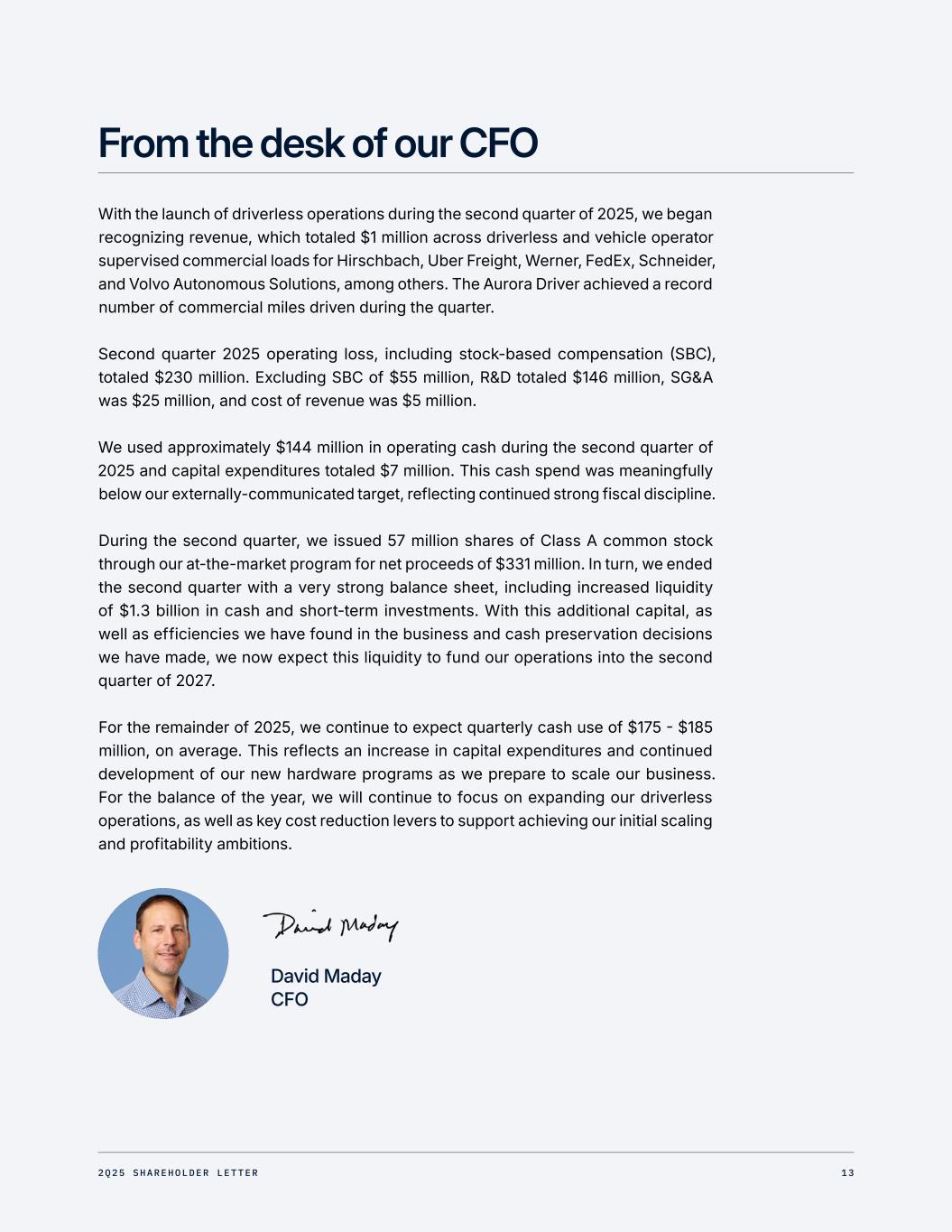
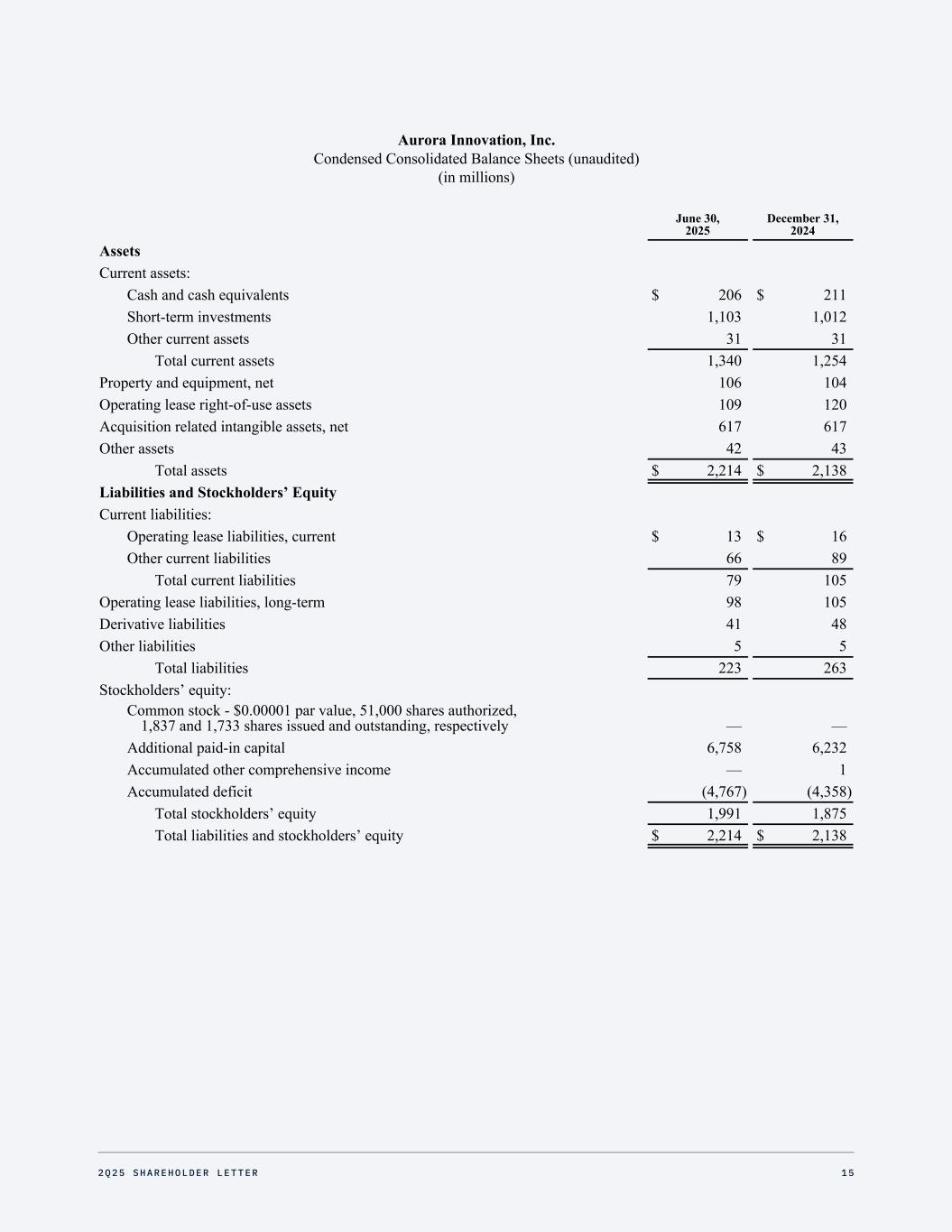
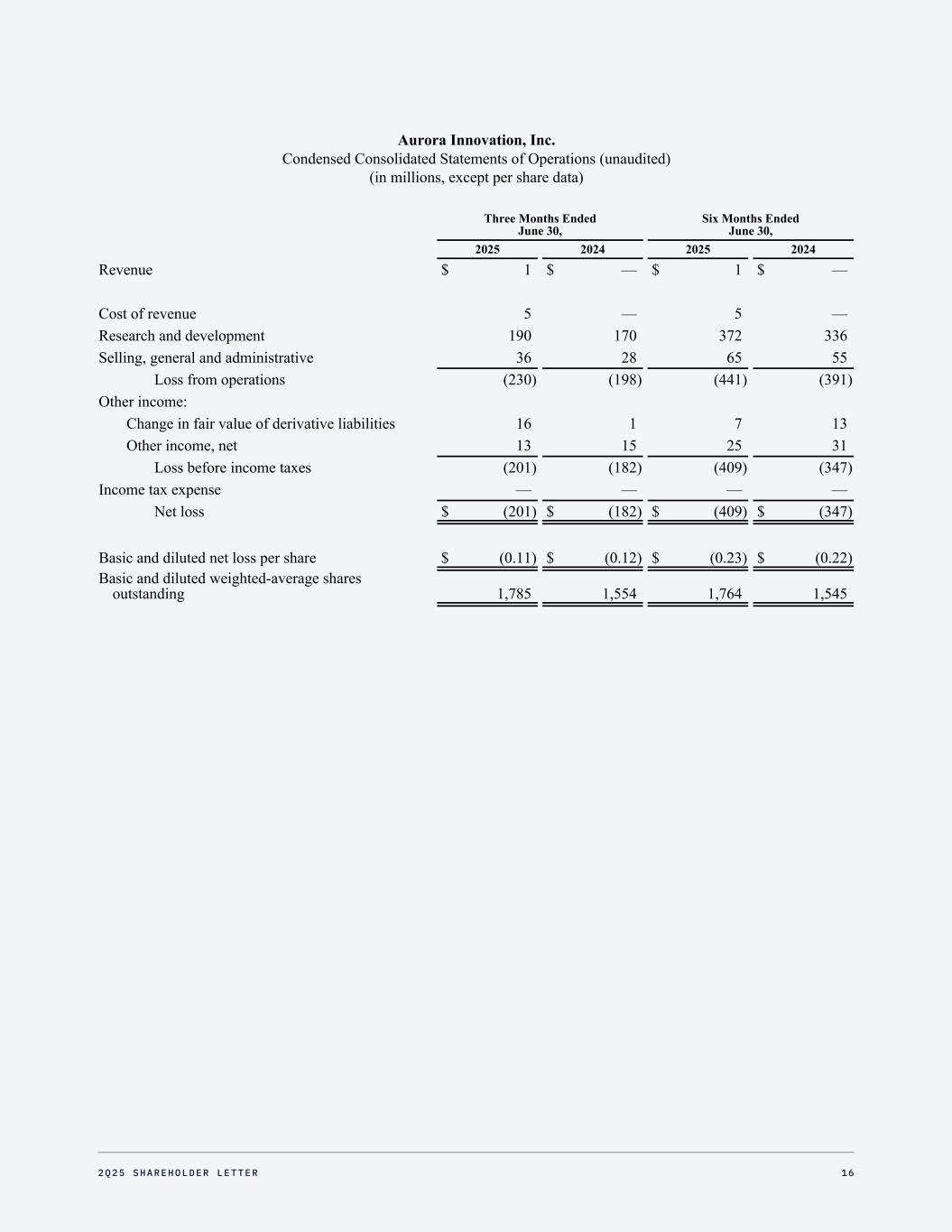
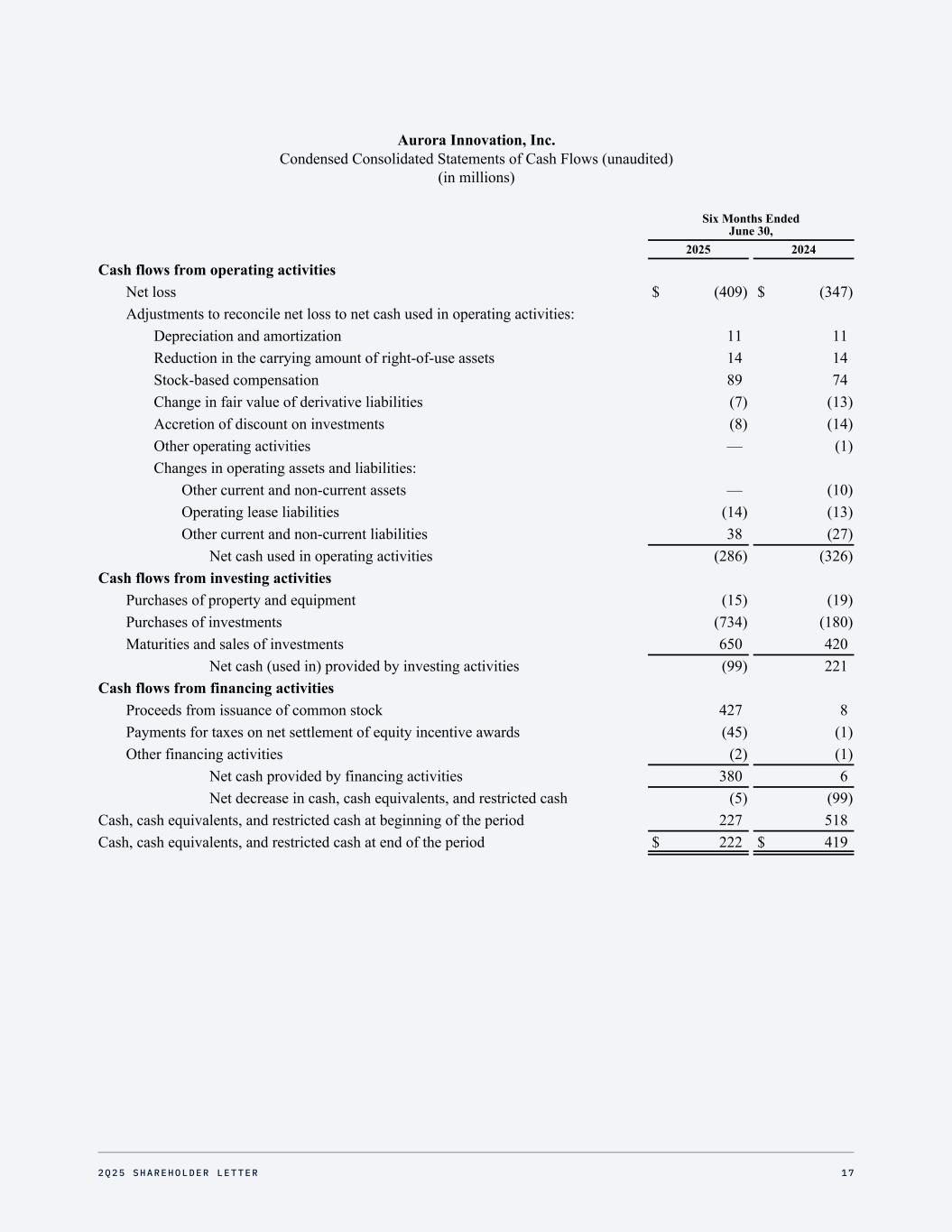
Thank you, Chris. Let's discuss our financial results for which we have provided a summary on Page 10 of the slide deck for reference. With the launch of driverless operations during the second quarter of 2025, we began recognizing revenue, which totaled $1 million across driverless and vehicle operator supervised commercial loads for Hirschbach, Uber Freight, Werner, FedEx, Schneider and Volvo Autonomous Solutions, among others. The Aurora Driver achieved a record number of commercial miles driven during the quarter. Second quarter 2025 operating loss, including stock-based compensation, totaled $230 million, excluding stock-based compensation of $55 million. R&D totaled $146 million, SG&A was $25 million, and the cost of revenue was $5 million. We used approximately $144 million in operating cash during the second quarter. Capital expenditures totaled $7 million. This cash spend was meaningfully below our externally communicated target, reflecting continued strong fiscal discipline. During the second quarter, we issued 57 million shares of Class A common stock through our at-the-market program for net proceeds of $331 million. We used $44 million of the net proceeds to fund the tax liability associated with the vesting of our employees' restricted stock units during the second quarter. In turn, we ended the second quarter with a very strong balance sheet, including increased liquidity of $1.3 billion in cash and short-term investments. With this additional capital as well as efficiencies we found in the business and cash preservation decisions we have made, we now expect this liquidity to fund our operations into the second quarter of 2027. In our continued opportunistic approach to fundraising, we are expanding our at-the-market program as it has proven to be an effective and efficient mechanism. The additional capacity can support future fundraising as well as funding of tax liabilities associated with the vesting of our employee RSUs over time. For the remainder of 2025, we continue to expect quarterly cash use of $175 million to $185 million on average. This reflects an increase in capital expenditures and continued development of our new hardware programs, as we prepare to scale our business. For the balance of the year, we will continue to focus on expanding our driverless operations as well as key cost reduction levers to support achieving our initial scaling and profitability ambitions. With that, we'll now open the call to Q&A.
Operator
Our first question comes from George Gianarikas of Canaccord Genuity.
Speaker 4
I wanted to ask about the Volvo Trucks. In your press release, you said you expect to receive 20 of the trucks by the end of the year. Do you expect to be operating those trucks, and do you expect them to have an observer in them when they launch?
Yes. Thanks, George. So yes, we expect those trucks to be here by the end of the year. We're going to initially use those for development and bring up. So no, we don't expect to be operating those without an observer by the end of the year. We'll be working closely with Volvo, and we'll wait for them to be comfortable announcing the timeline for us to launch initially with them driverlessly.
Speaker 4
And maybe just as a follow-up on commercial momentum. I mean since your launch a couple of months ago, have you seen additional incoming interest from other commercial partners that may be interested in expanding their service with you or maybe even launching?
Yes. It's actually been really exciting. I talk about it as we've gone from selling the promise and the belief into selling the real thing and that's shown up in our sales funnel. We're having lots of exciting conversations with carriers and fleet operators. And so we don't have more we can share today, but the excitement is real, and I think people get the transformational impact this can have on their business, whether it's improving the safety of their fleet or improving both the bottom line and top line. So yes, I think people get it.
Operator
The next question comes from Colin Rusch with Oppenheimer.
Speaker 5
Can you talk a little bit about the early returns around the wind and rain performance, and how you're tracking and evolving that functionality? And what we can be looking at as you guys continue to work on that part of the business?
Yes. Thanks, Colin. I think just candidly, if we put you in the truck today driving in the rain, you'd ask us why we haven't launched it yet, right? The operation and capability of it is very good. It behaves well on the road. And really, it's about the fact that we just put safety first and foremost that we want to go through the process of really thoroughly validating and refining anything that we identify through that validation process and just having the utmost confidence that when we declare something driverless and operate it as such, that I would put my family out on the road and you'd feel comfortable with your family out on the road around it. So it works well today. We're continuing to work towards the timeframe we've laid out by the end of the year. And it's exciting to see the crank that we've talked about this machine for validating and releasing software turning over in the way we'd hoped and continue to be able to do that faster and faster.
Speaker 5
And then looking at the FMCW technology and the manufacturing of it, can you talk a little bit about where you're at with yields with your manufacturing partners? And how we should think about the potential cadence for cost reduction on that, as you guys get closer to a higher volume launch?
Yes. So as we've talked about, there are two different dimensions. One is we see significant steps in cost as we move from building and manufacturing and assembling in-house to moving to Fabrinet as our contract manufacturer and then moving to the hardware-as-a-service partnership we have with Continental. Each one of those generations is going to drive discrete cost reductions. One of the big reasons why we're so excited about working with Continental for the long term is that they really understand how to deliver automotive-quality hardware at scale, on time and do that with high-quality yields. That process is all moving along well. In the specific case of the FMCW LiDAR, we've talked in the past about moving from discrete optical components, which is what our systems have today, to LiDAR on a chip, which is what we're bringing up already. This is a place where we've been investing for the last several years, not just in the design of the optics, but also in the deposition process, the fab process to do this efficiently and effectively. I don't have yield numbers I can share today, but what I can tell you is that development program is on track. We see that as a meaningful cost-down opportunity in the FirstLight technology.
Operator
Our next question comes from Andres Sheppard with Cantor Fitzgerald.
Speaker 6
Congratulations on the quarter. Congratulations on the first revenues.
Thank you. It's nice to have at least an R to go with our L. It may not be a P yet.
Speaker 6
It's only going to grow from here.
Speaker 6
Just a quick question on maybe the near-term ramp-up of trucks in operation. So right, you disclosed today, you now have 3, I believe, trucks in operations. As we get closer to year-end and towards the tens of trucks, just curious if you can give us a sense of how you're thinking about that ramp-up in terms of vehicles operational in maybe Q3 and Q4? Any color or direction there would be...
Yes. We continue to follow our crawl, walk, run model. And right now, just given the fleet size that we have, we're balancing the growth of driverless operations with the bandwidth for development and testing that we want to really unlock the capabilities that enable the expansion across the Sunbelt next year. And so as we said, really, this year is primarily focused on that capability expansion and unlock, proving out the process for releasing software rapidly as we believe we're starting to, and making sure we're set up for scale next year. So it's really going to be driven by how we maximize the probability of success on that capability expansion points while continuing to build and grow traction with our customers. I don't know, Dave, if there's more you'd add to that?
No, I think that's right. The only other thing I'd say, Andres, is like we're going to measure and try to report and think about our success of driving more in terms of mileage than it is in trucks because one of the things that we can do is, obviously, as we can operate now day and night on driverless, we can take one truck and operate it on multiple runs around a day. So for us, we want to build the mileage, we want to build the proof point. And again, 2025 is all about delivering the technology promise. So for us, success is being able to operate in almost all conditions that you'd see at this Sunbelt and demonstrate that we are able to do that effectively.
Speaker 6
I understand. That information is very helpful, and I appreciate both of you. I’d like to follow up by revisiting the preparations for rain and heavy winds. It's reassuring to know that you feel confident enough in the vehicle's capabilities to handle those conditions already. Without delving too deeply into technical details, I'm curious about the lessons you've learned regarding rain and heavy wind. Ultimately, this seems to highlight how much more effective LiDAR can be compared to non-LiDAR systems. Do you have any insights or lessons learned to share about that process and the progress made so far?
Yes, yes. Like I said, I just want to be careful. We are not ready to launch in rain today. But I think as someone riding in the truck, you would wonder why because if you got in the truck today, it would behave very similarly to the way that it does in the daylight or at night in that it would be super boring and just kind of drive down the road naturally. Areas where we expect some of the most challenging things to validate and ensure we're getting performance are particular things like the same places that we've talked about in the past with daytime driving. So, for instance, pedestrians lying in the road, right? It turns out that doesn't happen very often. In fact, I don't think I've ever seen one in my driving lifetime. But if it does, we want to make sure we handle it well and appropriately. That was one of the last capabilities that we were able to get to go with in daytime, incrementally more challenging at night, and then you can imagine with rain that's incrementally more challenging again. You're right that when we operate in more challenging environments, whether it's in the rain or whether it's in dust that having a complementary set of sensors is very powerful because they can each see through different conditions and provide different kinds of data. We believe that's an important aspect of building a robust and safe system. We're not interested in building something that we can just give a demo for; we're building a technology that will ultimately transform freight and transportation. That means it needs to work, and it should be able to turn your back and trust it. That's the bar we're holding to for the driverless releases that we're putting out today.
Operator
The next question comes from Ravi Shanker with Morgan Stanley.
Speaker 7
It would be helpful to hear about other catalysts set for the third quarter and the latter half of the year, specifically the timing of the second route and the next major milestones on your partnerships with both Volvo and PACCAR.
Yes. And I don't think we're going to provide more resolution than we have already. What we're pushing for through the end of the year is unlocking the ability so that in '26, we're able to rapidly enroll routes across the Sunbelt. By the end of the year, we hope to operate in day and night in the rain. We intend to unlock the Fort Worth to El Paso, El Paso to Phoenix and Fort Worth to Phoenix as routes. To do that, there's some discrete capabilities that we know we need. We've talked in the past about the custom border patrol station between El Paso and Fort Worth. That's the thing that we handle autonomously today, but we'll want to validate performance for that. And then there are surprising little things that are really from learning from our experience with customers. For example, many of you may not be familiar with freight transportation; it's something called a super single tire. Instead of putting two tires in tandem on an axle, you put one larger one that has various trade-offs and economics and fuel efficiency and whatnot. It turns out that for some of our customers, this was important, a fact that we didn't understand prior to launch. As we've been beginning to operate driverlessly, we found out that it actually is more significant. Part of what we'll be doing in the near future is finalizing the validation for what happens when running super single tires and ensuring we can detect and respond to that appropriately. It's great to have a clear roadmap for where we're going. Because we have vehicles in operation, we're able to receive feedback from customers to adjust the near-term milestones so that we maximize the value for them.
Speaker 7
That's all really helpful. And then if I could squeeze in one more question? It'd be helpful if you could give us a little bit of insight into your relationship with Uber, post their debt offering against your stake and some of the other autonomous bets. How critical are they to deployment?
Uber has been a great partner and continues to be. Dara has been on the Board and we continue to have a close working and personal relationship. Uber is focused on ride hailing, and we're focused on trucking. In the near term, I think the importance there is relatively disconnected. Of course, Uber Freight is one of our pilot customers, a large customer for driverless operations, and we continue to work with them and grow business there. Over the long term, we see the capability we've built to safely operate vehicles on public roads as something that will ultimately unlock automated passenger vehicles as well. At some point, we will engage in that space, but right now, we're really focused on delivering the promise of trucking and building that business.
Operator
The next question comes from Chris Pierce with Needham.
Speaker 8
For clarity, I'd like to ask about the PACCAR earnings call, where they emphasized the significance of validated production. In your letter and comments, you mentioned production of prototype parts for the new trucks, and there's considerable information about your production with your contract manufacturer and Continental. Can you elaborate on this relationship? Are any of these developments unexpected for you? Are you advancing your production timeline? Is everything progressing as you anticipated regarding your production partners? I'd like to understand more about this relationship and how you are managing production.
First, let me begin by saying we continue to really value the relationship we have with PACCAR and continue to push forward there. It's wonderful to see them moving forward with their autonomy-enabled truck platform. The right way to think about this is there's a truck and there's a driver, and we work with our OEM partners to specify and then they develop and design the platform, the vehicle itself, the truck. That has a variety of components in it. The vehicles we're operating today still have some prototype parts from our OEM partners in them. In contrast, the driver parts that we operate and are building with Fabrinet and ultimately would be building with Continental are around the development process of that driver. The driver, of course, works across multiple different OEMs. Today, we work with PACCAR and Volvo. In the future, of course, we hope to work with other OEMs as well. I apologize for the confusion, if there is any there. We're tracking and supporting our OEM partners as they mature their platforms. In parallel, we're advancing the development of the Aurora Driver and bringing that to production with the second generation coming online next year and then working with Continental to bring that third generation online in '27.
Speaker 8
Okay. Perfect. And then you sort of hit on my next question. You want to work with other OEM partners in the future. How do you see this autonomous trucking developing? Do you see an OEM having multiple autonomous partners and then the logistics customer makes a choice? How do you see the business developing over time given this is an industry that's had a lot of dual sourcing from all sides?
Yes. I think our aspiration is to drive every truck that's out there. We'll continue to advance as quickly and rapidly as we can to accomplish that by building the best technology, the best product and providing the best service for customers. That said, it’s a $1 trillion market, and everyone is going to want and hope for another player in the space, and we look forward to competing with them. Today, Aurora is the only company in the world that can drive trucks on the road at freeway speed and do that safely, driverlessly. We'll continue to accelerate based on the tools we put in place to validate and release new software, and we'll welcome the competition when it gets there.
Operator
The next question comes from Doug Dutton with Evercore ISI.
Speaker 9
Just wanted to first ask on the ramp from the 2 trucks to the 10-plus by year-end, is the idea that each of those trucks has a dedicated customer, whether those are customers with 2 or 3 or customers with one? Or how is that rollout sort of happening?
Thank you for the question, Doug. The short answer is no, at this time we don't plan to assign a specific truck to a specific customer. Instead, we will facilitate the movement of goods from one point to another for various customers, and we will allocate trucks as needed as we progress.
Speaker 9
Okay. Understood. That's helpful. And then diving deeper, just on the math here. If you have 2 trucks on the road right now per quarter running each day 200 miles, we'll call it. You got about 60 days, so it's 12,000 miles per quarter per truck. Is that the type of math that you would start to share in the future or that makes sense to sort of calculate the miles driven in the future?
Yes, it's good to hear from you. Generally speaking, when considering an individual lane, that's accurate. We approach it a bit differently. For instance, with daytime having an 8-hour restriction and not being able to drive in the rain, there's a limit to how much we can operate. When conditions are favorable and it isn't raining, we can complete a round trip of approximately 400 miles for a truck. Unlocking nighttime capabilities allows us to double that distance, and with longer lanes, we can extend even further. It really depends on the specific lane and our ability there. Our primary focus has been to increase the number of driverless miles each quarter, which we will continue to prove, while also ensuring we can technically operate in almost all conditions typical of the Sunbelt. Once we can exceed the hours of service regulations and drive day and night in various weather conditions, we will start considering broader usage. We anticipate that our trucks will be utilized more efficiently than average as soon as we can operate continuously, even in the rain. We will keep demonstrating that. Thus, we believe measuring mileage rather than just the number of trucks is more appropriate.
Operator
The next question comes from Mark Delaney with Goldman Sachs.
Speaker 10
This is Aman Gupta on for Mark Delaney. Maybe going back to the safety kind of observer in the vehicle, kind of what needs to happen for both the Aurora and then PACCAR to feel comfortable kind of removing that person? Is there some sort of timeline that you can share on when you guys expect that to happen?
Yes. From Aurora's perspective, we are comfortable today, and that observer is in the vehicle really out of respect and appreciation for our partnership with PACCAR. From PACCAR, they'll speak for themselves, but I think what they've shared and what I can share is that it's really about their process and the fact that these trucks have prototype parts. For them to ultimately bring these trucks to production and operate them driverlessly, we expect that to correlate with when they launch their autonomy-enabled truck platform.
Speaker 10
Understood. That's helpful. And then maybe one on the financial side. One of the slides quoted like $1.84 per mile for cost with the Aurora system. Is that ballpark a good assumption for revenue? Does that change if there's still the safety observer in the vehicle or as the ODD continues to expand; does that get larger? How should we think about that?
Yes. I think you're looking at the carrier perspective example, which focused on driving beyond the usual hours of service limitations. From a revenue standpoint, we relied on average revenue data available. In terms of costs, we utilized a lot of ATRI data and included some discounts based on what we can offer. This isn't a model tailored specifically to our costs, but generally, we do expect to reduce operational costs for our carriers in the near term through improved fuel efficiency with our autonomous trucks. We will also be able to lower driver costs. Current driver costs are approximately $1 per mile, which indicates an opportunity for us to reduce total cost of ownership. However, the most crucial factor is utilization; it's also a matter of revenue generation. You're able to use a truck to generate more revenue daily and annually. That's a way to approach predictions. I wouldn't use those specific figures in a model as they relate closely to individual lanes.
And just around the part about the observer on board, this is both a temporary element, and the cost for us in practice is minimal; we're running a small number of trucks. It is what it is, and it's not that significant. It has no impact on our roadmap or plans for growth or anything.
Operator
The next question comes from Scott Group with Wolfe Research.
Speaker 11
This is Cole on for Scott. It's good to see progress with the next generation of hardware in the press release. Is there any way to frame up how we're progressing relative to your original expectations, either from the Fabrinet perspective or the Continental generation?
Yes. At the high order level, we haven't shifted our expectations. I think we've been fairly consistent about talking about that second generation of hardware coming online in '26 and the Continental generation, the third generation hardware-as-a-service components coming online in '27. We're working with these systems on a daily basis. The fact we have the samples from Fabrinet in a truck, and we're in the process of bringing up validation there is really exciting and aligned with what we would hope. The partnership with Continental is just moving forward. We've gone through the norming and forming and are solidly into the storming phase of that partnership.
Speaker 11
That's helpful. And maybe just on the prototype trucks that you've called out, which hardware generation is going to go into those? Can you expand on how you see that actually playing out over the next 12 months?
Yes. Depending on exactly when and which truck, some of it will be our existing first-generation hardware, which we're using to do kind of bring up a validation of the interface. Some of it will be with the second-generation hardware and some will ultimately have components or kits from the third-generation hardware set. It's really driven by internal engineering execution and need.
Operator
Thank you. Ladies and gentlemen, at this time, this does conclude today's teleconference. You may disconnect your lines at this time. Thank you for your participation, and have a great day.