Operator
Greetings, and welcome to the Aurora's Third Quarter 2025 Business Review Call. As a reminder, this conference is being recorded. It is now my pleasure to introduce your host, Stacy Feit, Vice President, Investor Relations.
Thank you, Alicia. Good afternoon, everyone, and welcome to our third quarter 2025 business review call. We announced our results earlier this afternoon. Our shareholder letter and a presentation to accompany this call are available on our Investor Relations website at ir.aurora.tech. The shareholder letter was also furnished with our Form 8-K filed today with the SEC. On the call with me today are Chris Urmson, Co-Founder and CEO and David Maday, CFO. Chris will provide an update on our progress we have made across the key pillars of our business, and David will recap our third quarter financial results. We will then open the call to Q&A. A recording of this conference call will be available on our Investor Relations website at ir.aurora.tech shortly after this call has ended. I'd like to take this opportunity to remind you that during the call, we will be making forward-looking statements. These statements are subject to known and unknown risks and uncertainties that could cause actual results to differ materially from those expressed, projected or implied during the call. In particular, those described in our risk factors, including in our annual report on Form 10-K for the year ended December 31, 2024, and other documents filed with the SEC as well as the current uncertainty and unpredictability in our business, the markets and economy. Additional information will also be set forth in our quarterly report on Form 10-Q for the quarter ended September 30, 2025. You should not rely on our forward-looking statements as predictions of future events. All forward-looking statements that we make on this call are based on assumptions and beliefs as of the date hereof, and Aurora disclaims any obligation to update any forward-looking statements, except as required by law. Our discussion today may include non-GAAP financial measures. These non-GAAP measures should be considered in addition to and not as a substitute for or in isolation from our GAAP results. Information regarding our non-GAAP financial results, including a reconciliation of our historical GAAP to non-GAAP results, may be found in the shareholder letter, which was furnished with our Form 8-K filed today with the SEC and may also be found on our Investor Relations website. Our discussion today may also include reference to forward-looking free cash flow, a non-GAAP financial measure. To the extent that this forward-looking financial measure is provided, it's presented on a non-GAAP basis without a reconciliation due to the inherent difficulty in forecasting and quantifying certain amounts that are necessary for such reconciliation. With that, I will now turn the call over to Chris.
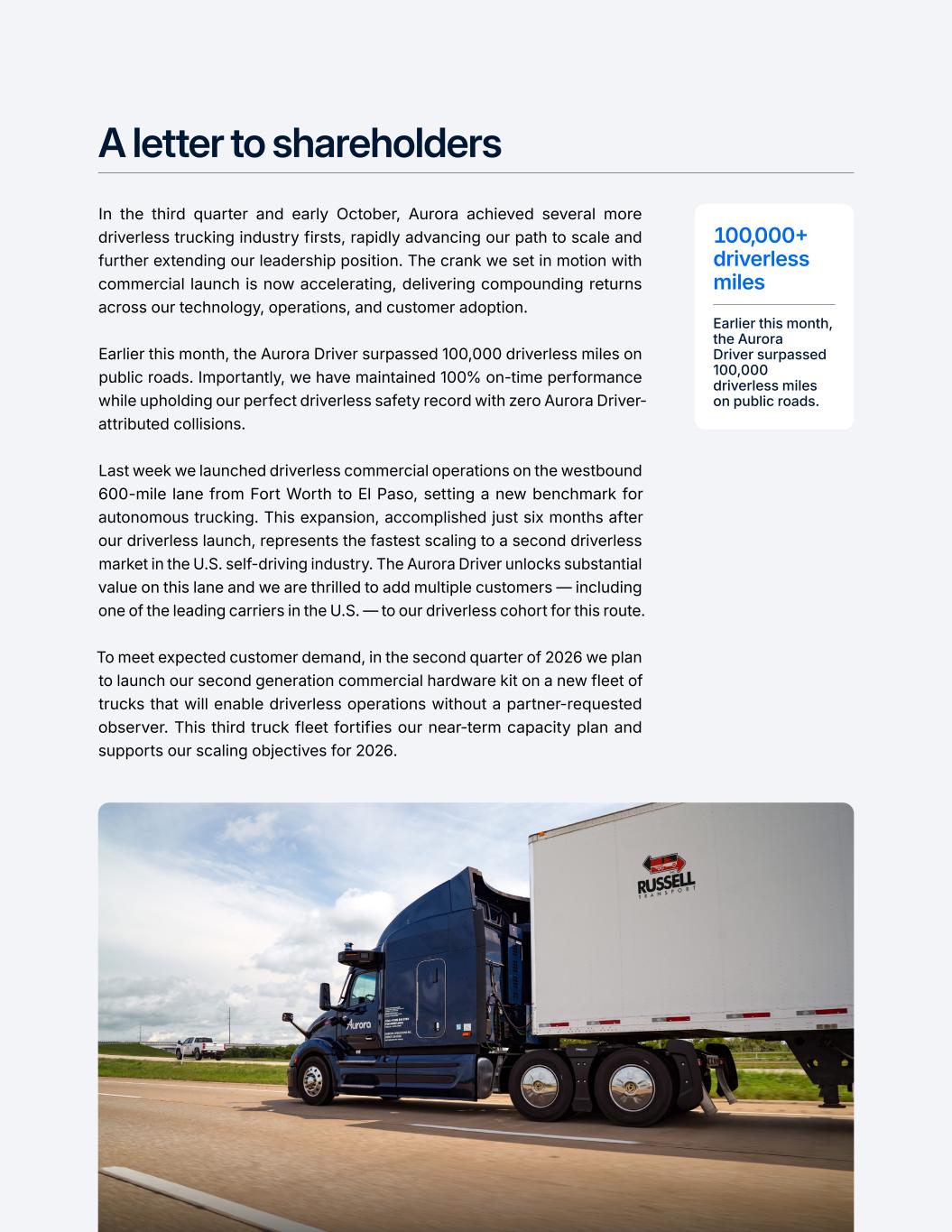
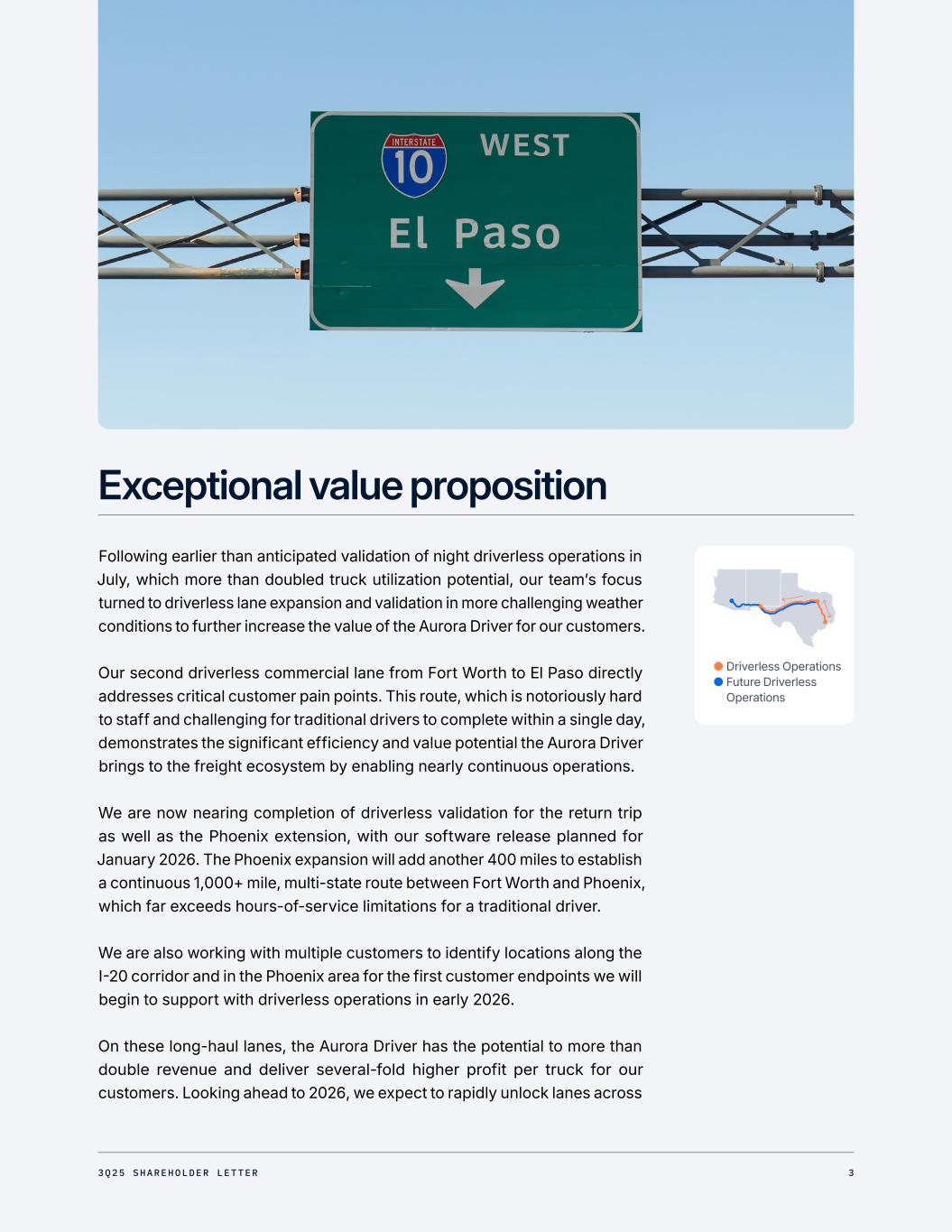
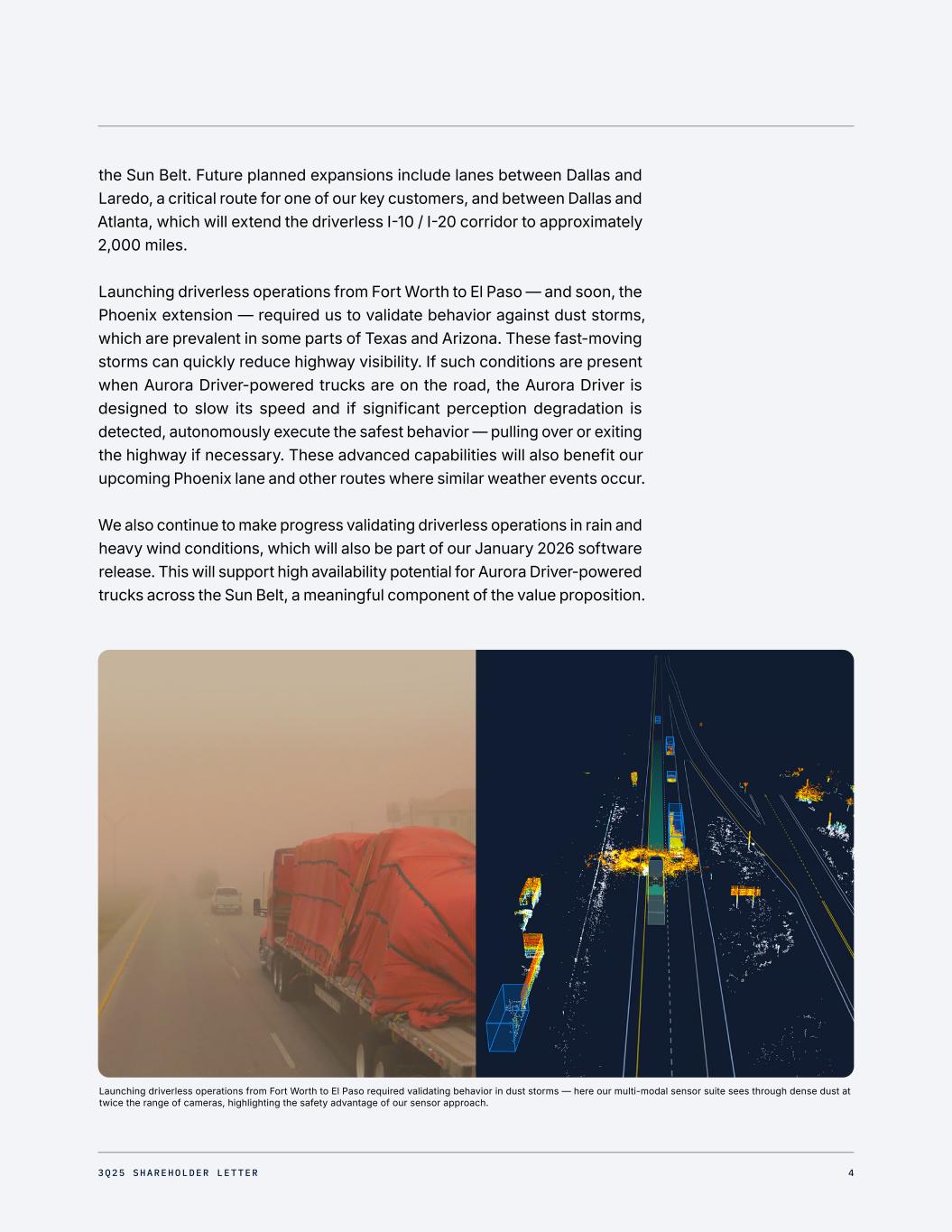
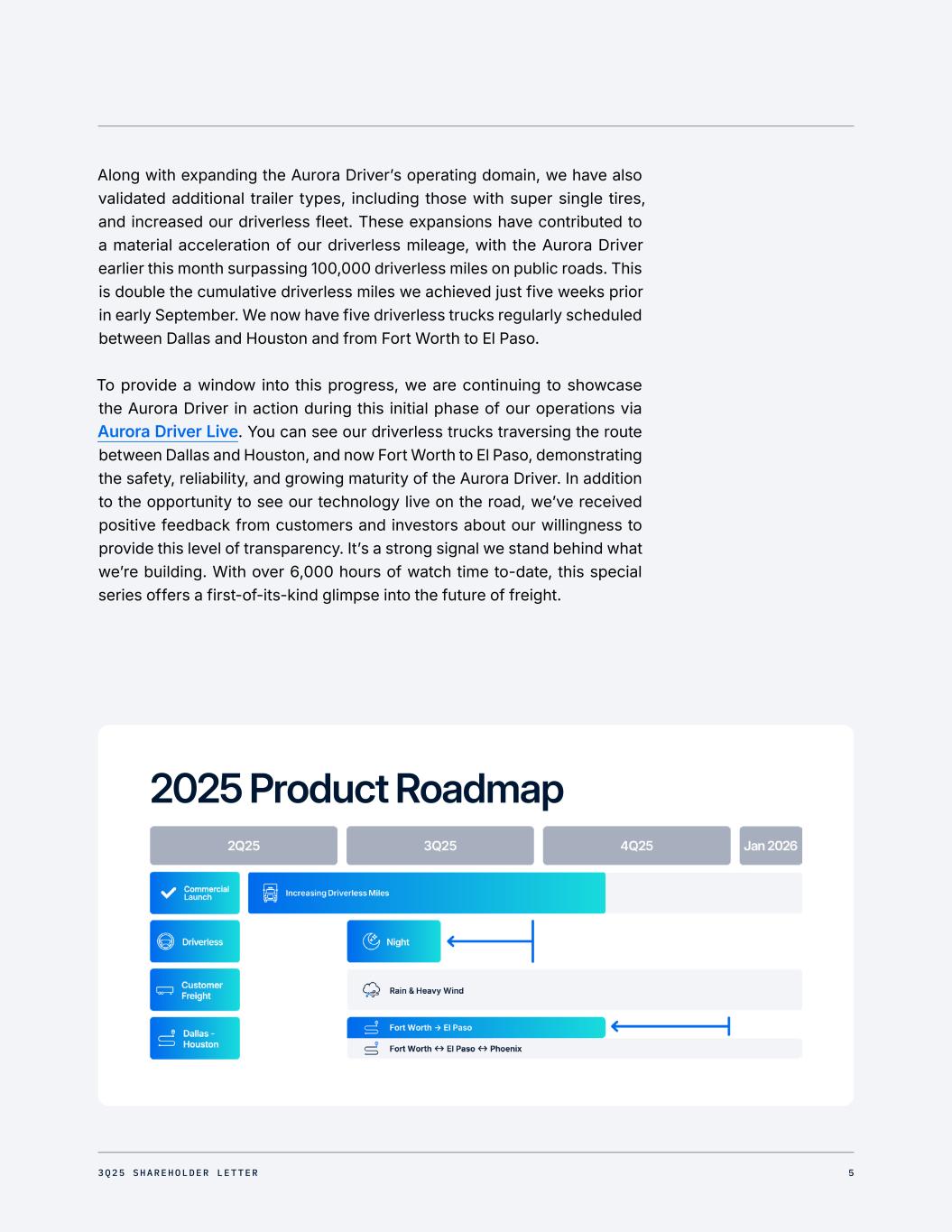
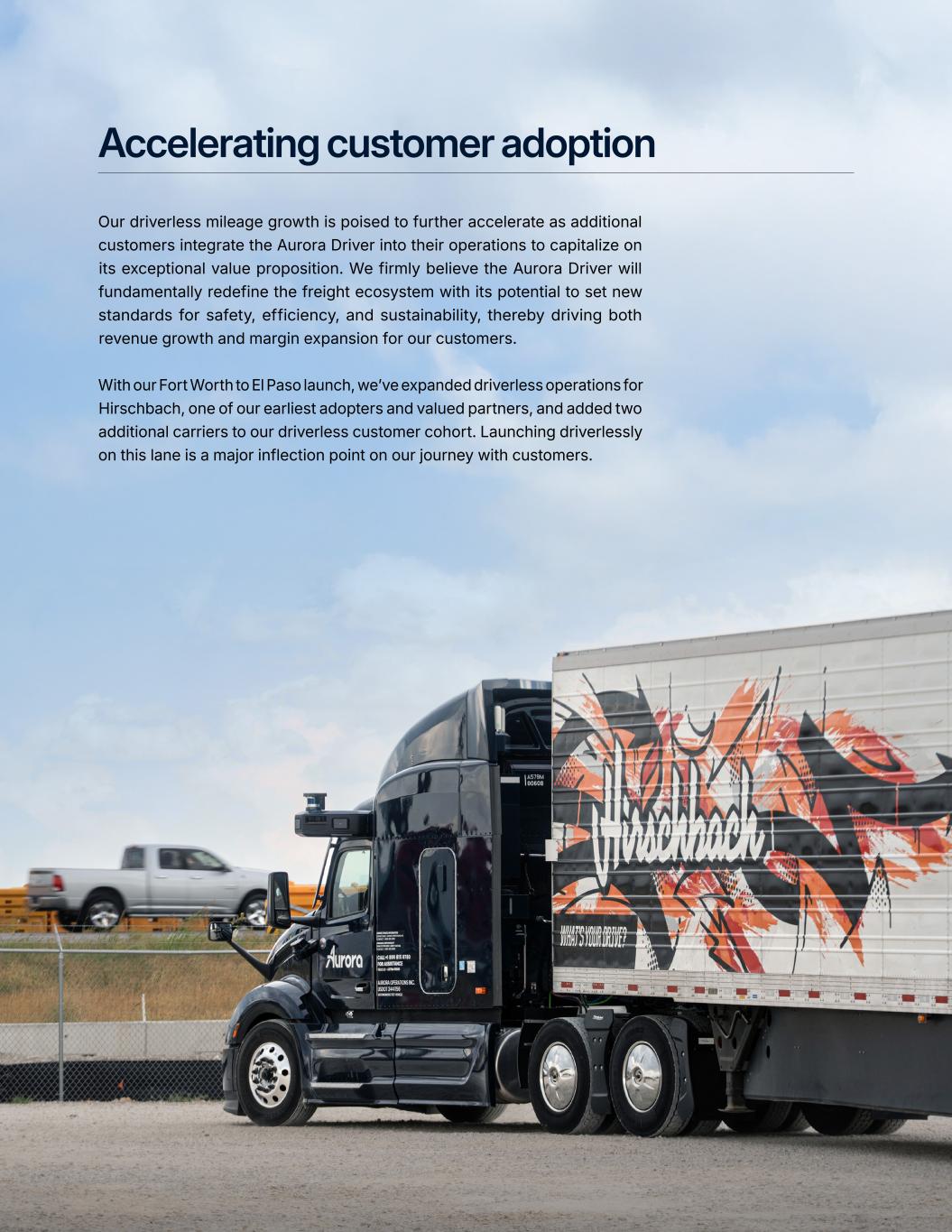
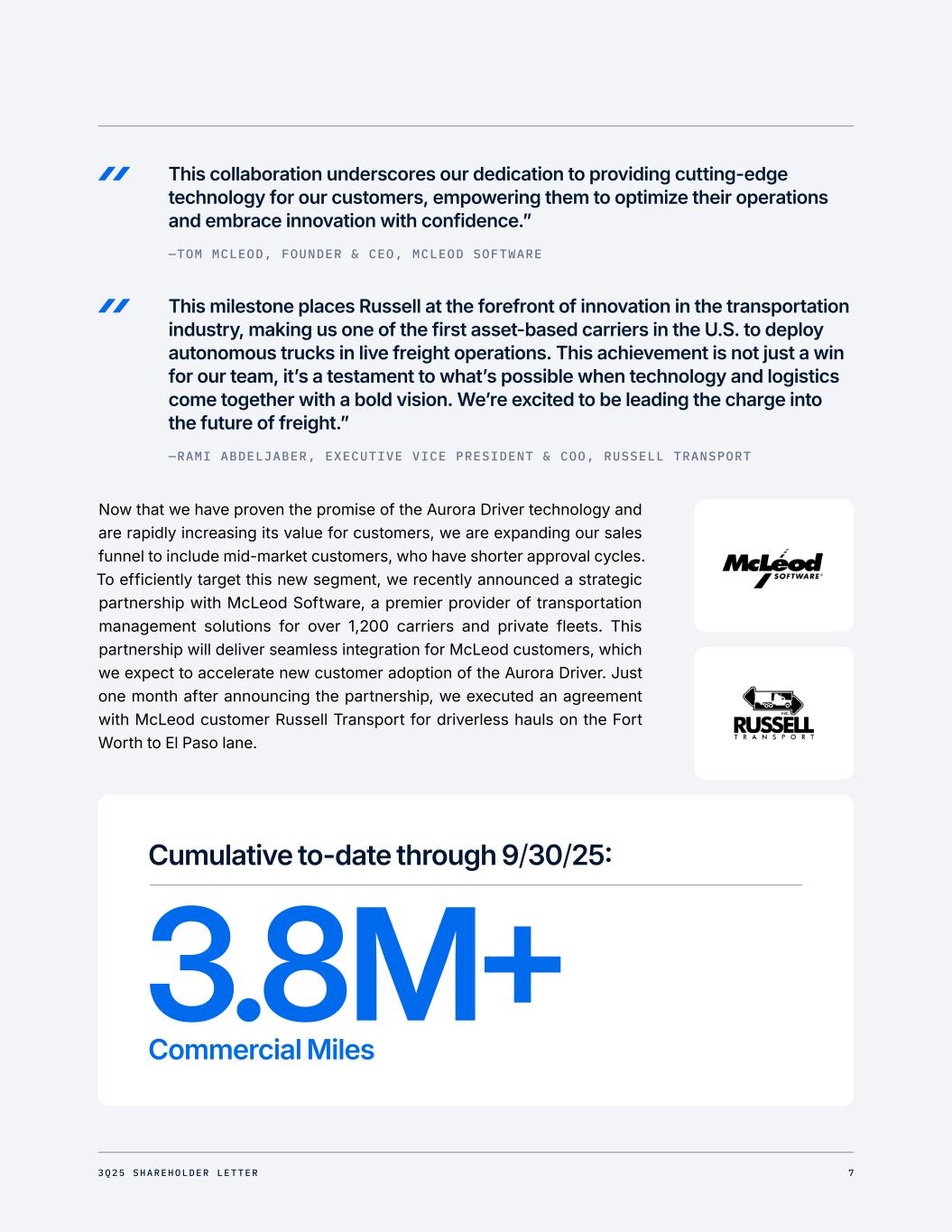
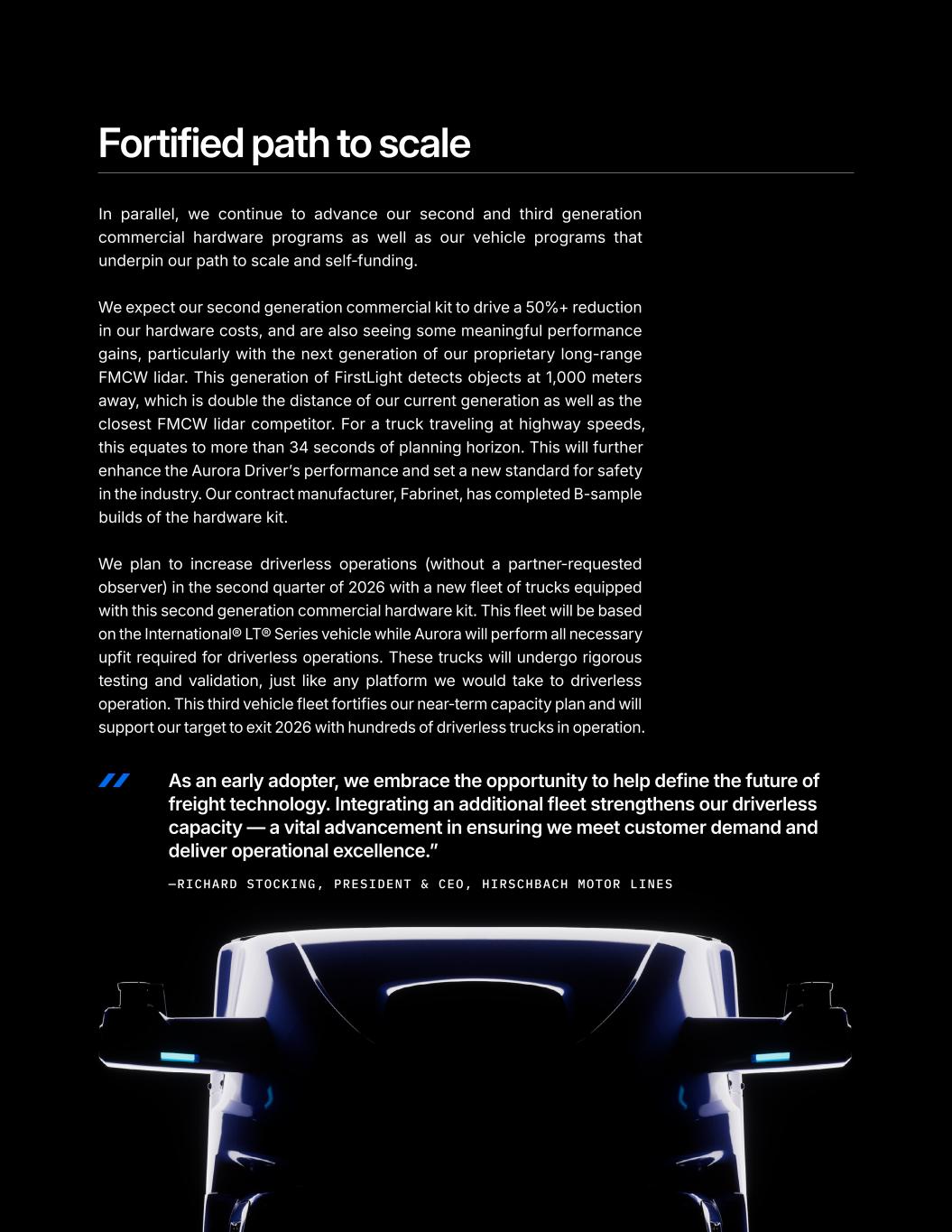
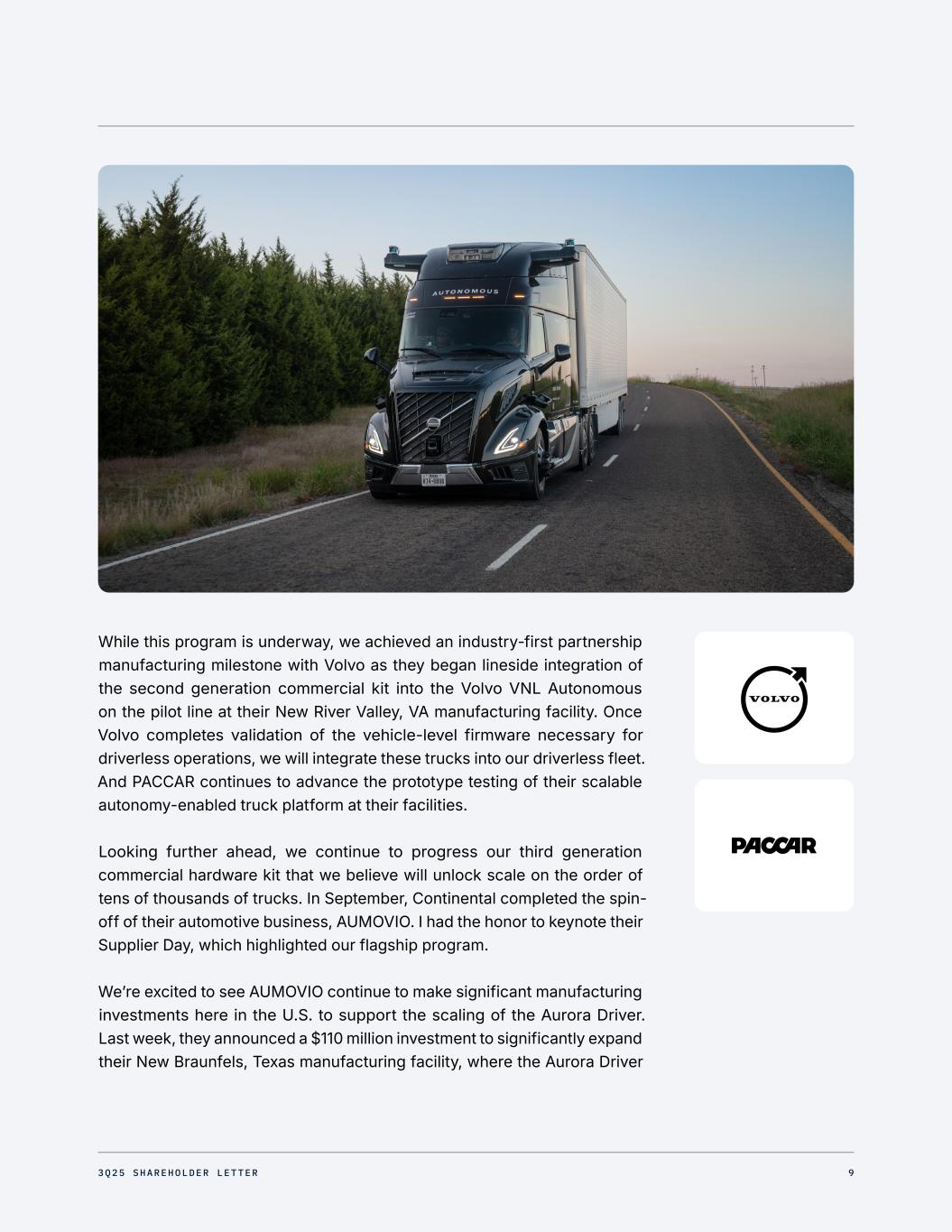
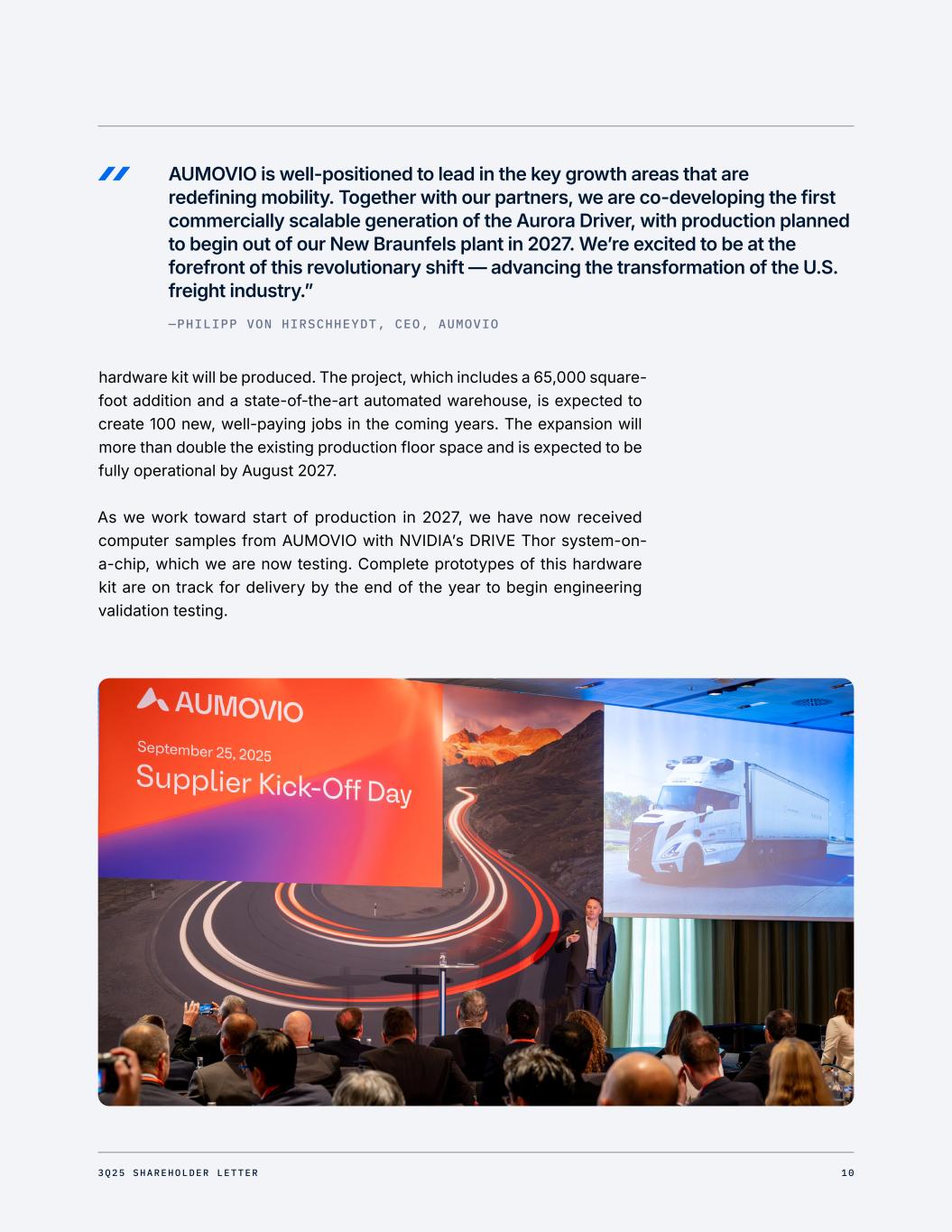
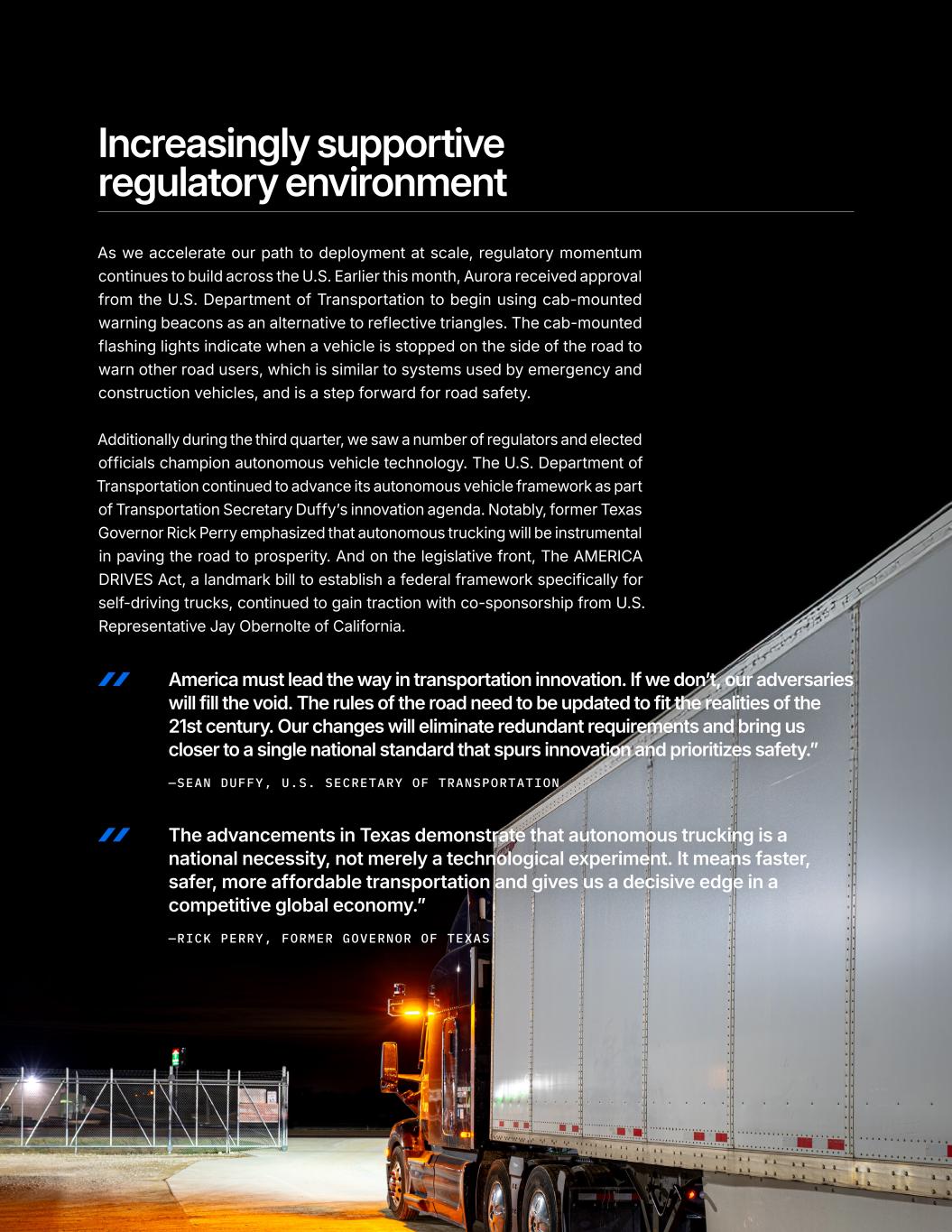
Thanks, Stacy. In the third quarter and early October, Aurora achieved several more driverless trucking industry firsts, rapidly advancing our path to scale and further extending our leadership position. The momentum we set in motion with our commercial launch is now accelerating, delivering compounding returns across our technology, operations, and customer adoption. Earlier this month, the Aurora Driver surpassed 100,000 driverless miles on public roads. Importantly, we've maintained 100% on-time performance while upholding our perfect driverless safety record. Last week, we launched driverless commercial operations on the westbound 600-mile lane from Fort Worth to El Paso, setting a new benchmark for autonomous trucking. This expansion was accomplished just 6 months after our driverless launch, which is faster than any other self-driving company has scaled to a second U.S. market. The Aurora Driver unlocks substantial value on this lane, and we're thrilled to add multiple customers, including one of the leading carriers in the U.S., to our driverless cohort for this route. To meet expected customer demand in the second quarter of 2026, we plan to launch our second-generation commercial hardware kit on a new fleet of trucks that will enable driverless operation without a partner-requested observer. This third vehicle fleet fortifies our near-term capacity plan and supports our scaling objectives for 2026. Let's dig into what we've been up to. Following earlier-than-anticipated validation of night driverless operations in July, we're already seeing the utilization potential of our self-driving trucks. Our highest mileage driverless truck logged nearly 18,000 miles in a single month, demonstrating the confidence we have to operate trucks at an annual run rate that doubles the industry average. Our team's focus has since turned to driverless lane expansion and validation in more challenging weather conditions to further increase the value of the Aurora Driver for our customers. Our second driverless commercial lane from Fort Worth to El Paso directly addresses critical customer pain points. This route is notoriously hard to staff and challenging for traditional drivers to complete within a single day. Launching driverless operations on this lane demonstrates the significant efficiency and value potential the Aurora Driver brings to the freight ecosystem by enabling nearly continuous operations. We're now nearing completion of driverless validation for the return trip as well as the Phoenix extension, with our software release planned for January 2026. The Phoenix expansion will add another 400 miles to establish a continuous 1,000-plus mile multistate route between Fort Worth and Phoenix, which far exceeds hours-of-service limitations for a traditional driver. We're also working with multiple customers to identify locations along the I-20 corridor and in the Phoenix area for the first customer endpoints we plan to support with driverless operations in early 2026. As you can see in the case study on Page 16 of the presentation, on these long-haul lanes, the Aurora Driver has the potential to more than double revenue and deliver several-fold higher profit per truck for our customers. Looking ahead to 2026, we expect to rapidly unlock lanes across the Sun Belt. Future planned expansions include lanes between Dallas and Laredo, a critical route for one of our key customers, and between Dallas and Atlanta, which will extend the driverless I-10, I-20 corridor to approximately 2,000 miles. Launching driverless operations from Fort Worth to El Paso and soon in the Phoenix extension required us to validate behavior against dust storms, which are prevalent in some parts of Texas and Arizona. These fast-moving storms can quickly reduce highway visibility. If such conditions are present when the Aurora Driver-powered trucks are on the road, the Aurora Driver is designed to slow its speed, and if significant perception degradation is detected, autonomously execute the safest behavior, pulling over or exiting the highway when possible. This advanced capability is powered by our multimodal sensor suite, including Lidar, camera, and radar. As you can see on Page 10 of the presentation, in a dust storm on the Fort Worth to El Paso lane just outside of Midland, Texas, our perception system leveraged radar and our proprietary FirstLight Lidar, which we're able to see through the dense dust at twice the range of cameras alone. This provided the crucial data needed to make safe decisions long before visibility was completely compromised. These advanced capabilities will also benefit our upcoming Phoenix lane and other routes where similar weather events occur. We also continue to make progress validating driverless operations in rain and heavy wind conditions, which will also be part of our January 2026 software release. This will support high availability potential for Aurora Driver-powered trucks across the Sun Belt, a meaningful component of the value proposition. Along with expanding the Aurora Driver's operating domain, we've also validated additional trailer types, including those with super single tires, and increased our driverless fleet. These expansions have contributed to a material acceleration of our driverless mileage, with the Aurora Driver earlier this month surpassing 100,000 driverless miles on public roads. That's double the cumulative driverless miles we achieved just 5 weeks prior in early September. We now have 5 driverless trucks regularly scheduled between Dallas and Houston and from Fort Worth to El Paso. To provide a window into this progress, we are continuing to showcase the Aurora Driver in action during this initial phase of our operations via Aurora Driver Live. You can access the live stream via the link on Page 4 of our presentation or the live tab on our YouTube channel at Aurora Driver. You can see our driverless trucks traversing routes between Dallas and Houston and now Fort Worth to El Paso, demonstrating the safety, reliability, and growing maturity of the Aurora Driver. In addition to the opportunity to see our technology live on the road, we've received positive feedback from customers and investors about our willingness to provide this level of transparency. It's a strong signal we stand behind what we're building. With over 6,000 hours of watch time to date, this special series offers industry-leading transparency into autonomous driving performance and the future of freight. Our driverless mileage growth is poised to further accelerate as additional customers integrate the Aurora Driver into their operations to capitalize on its exceptional value proposition. We firmly believe the Aurora Driver will fundamentally redefine the freight ecosystem with its potential to set new standards for safety, efficiency, and sustainability, thereby driving both revenue growth and margin expansion for our customers. A member of Werner's safety team and one of their most seasoned drivers recently came down to Texas to assess the Aurora Driver's performance. Their reactions spoke volumes about the Aurora Driver's core advantages: superior perception, unwavering focus, and the ability to safely navigate long monotonous lanes, which are particularly difficult to staff and have hours-of-service constraints for traditional drivers. I'm inspired when I hear industry veterans affirm the transformational role our technology will play in the freight industry. You can hear firsthand from the Werner representatives in the video on Page 5 of our presentation. With our Fort Worth to El Paso driverless launch, we've expanded driverless operations for Hirschbach, one of our earliest adopters and value partners, and added 2 additional carriers to our growing driverless customer cohort. Launching driverlessly on this lane is a major inflection point on our journey with customers and the expansion of our driverless cohort validates our technology, rigorous safety approach, and the value we deliver. Now that we've proven the promise of the Aurora Driver and are rapidly increasing its value for customers, we're expanding our sales funnel to include mid-market customers, who offer shorter approval cycles. To efficiently target this new segment, we recently announced a strategic partnership with McLeod Software, a premier provider of transportation management solutions for over 1,200 carriers and private fleets. This partnership will deliver seamless integration for our cloud customers, which we expect to accelerate new customer adoption of the Aurora Driver. Just one month after announcing the partnership, we executed an agreement with customer McLeod customer Russell Transport for driverless hauls on the Fort Worth to El Paso lane. In parallel, we continue to advance our second and third-generation commercial hardware programs as well as our vehicle programs that underpin our path to scale and self-funding. Designed to deliver customer value for 1 million miles, we expect our second-generation commercial kit to drive a 50% plus reduction in our hardware costs. And we're also seeing some meaningful performance gains, particularly with the next generation of our proprietary long-range FMCW lidar. FirstLight is now detecting objects at 1,000 meters away, which is double the distance of our current generation as well as the closest FMCW lidar competitor. For a truck traveling at highway speeds, this equates to more than 34 seconds of planning horizon. This will further enhance the Aurora Driver's performance and set a new standard for safety in the industry. We plan to increase driverless operations without a partner-requested observer in the second quarter of 2026 with a new fleet of trucks equipped with the second-generation commercial hardware kit. This fleet will be based on the international LT Series truck, with Aurora performing all necessary upfit required for driverless operations. These trucks will undergo rigorous testing and validation, just like any platform we would take to driverless operation. This third truck fleet fortifies our near-term capacity plan and will support our target to exit 2026 with hundreds of driverless trucks in operation. While this program is underway, we achieved an industry-first partnership manufacturing milestone with Volvo as they began the lineside integration of the second-generation Aurora Driver commercial hardware kit into the Volvo VNL autonomous on the pilot line at their New River Valley, Virginia manufacturing facility. Once Volvo completes validation of the vehicle-level firmware necessary for driverless operations, we will integrate these trucks into our driverless fleet. In addition, PACCAR continues to advance the prototype testing of their scalable autonomy-enabled truck platform at their facilities. Looking further ahead, we continue to progress our third-generation commercial hardware kit that we believe will unlock scale on the order of tens of thousands of trucks. In September, Continental completed the spin-off of their automotive business, AUMOVIO. I had the honor to keynote their Supplier Day, which highlighted our flagship program, which has a planned start of production in 2027. We're excited to see AUMOVIO continue to make significant manufacturing investments here in the U.S. to support the scaling of the Aurora Driver. Earlier this month, they announced a $110 million investment to significantly expand their New Braunfels, Texas manufacturing facility, where the Aurora Driver hardware kit will be produced. The project, which includes a 65,000 square foot addition and a state-of-the-art automated warehouse is expected to create new well-paying jobs in the coming years. The expansion will more than double the existing production floor space and is expected to be fully operational by August 2027. We've now received and begun testing computer samples from AUMOVIO, which include NVIDIA's DRIVE Thor system on a chip. Complete prototypes of this hardware kit are on track for delivery by the end of the year to begin engineering validation testing. As we accelerate our path to deployment at scale, favorable regulatory momentum continues to build across the U.S. Earlier this month, we received approval from the U.S. Department of Transportation to begin using cab-mounted warning beacons as an alternative to reflective triangles. The cab-mounted flashing lights indicate when a vehicle is stopped on the side of the road to warn other road users, which is similar to systems used by emergency and construction vehicles and is a step forward for road safety. And on the legislative front, the AMERICA DRIVES Act, a landmark bill to establish a federal framework specifically for self-driving trucks, continues to gain traction with co-sponsorship from U.S. Representative, Jay Obernolte of California. In closing, we've made unprecedented progress since commercial launch and continue to be the only company with driverless trucks on public roads in the U.S. We've proven that the technology works and are now channeling our momentum to support lasting customer value and our path to scale. Insights from our real-world driverless miles reinforce there are no shortcuts to safety, trust, and scale in autonomous trucking. Our strategic investments have built powerful flywheels that are now accelerating, driving us forward with increasing efficiency. Our industry-leading technology, coupled with a world-class ecosystem of partners, customers, and shareholders, uniquely positions Aurora to set the standard for autonomous trucking. Thank you for your partnership as we continue to build the future of transportation. With that, I'll now pass it over to Dave, who will review our financial results.
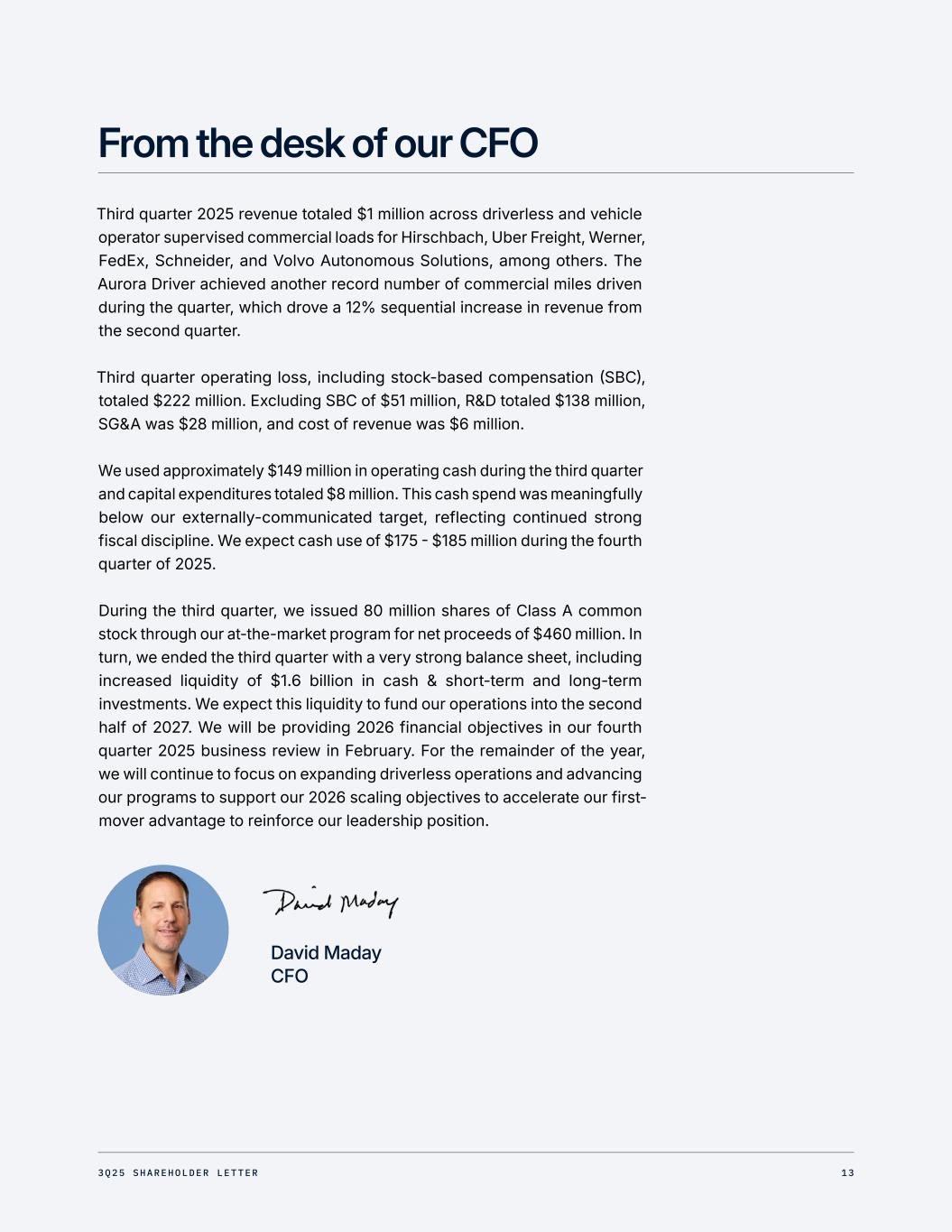
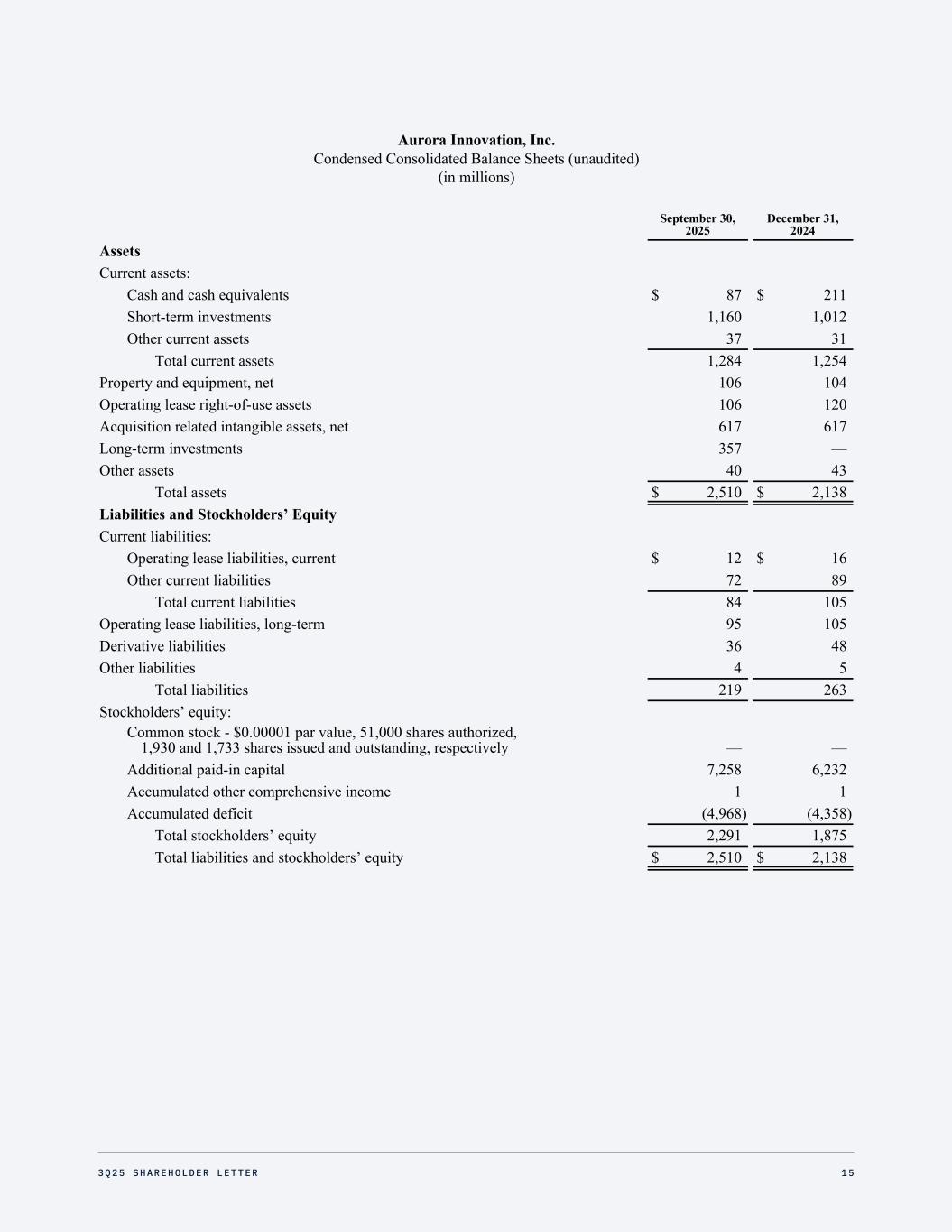
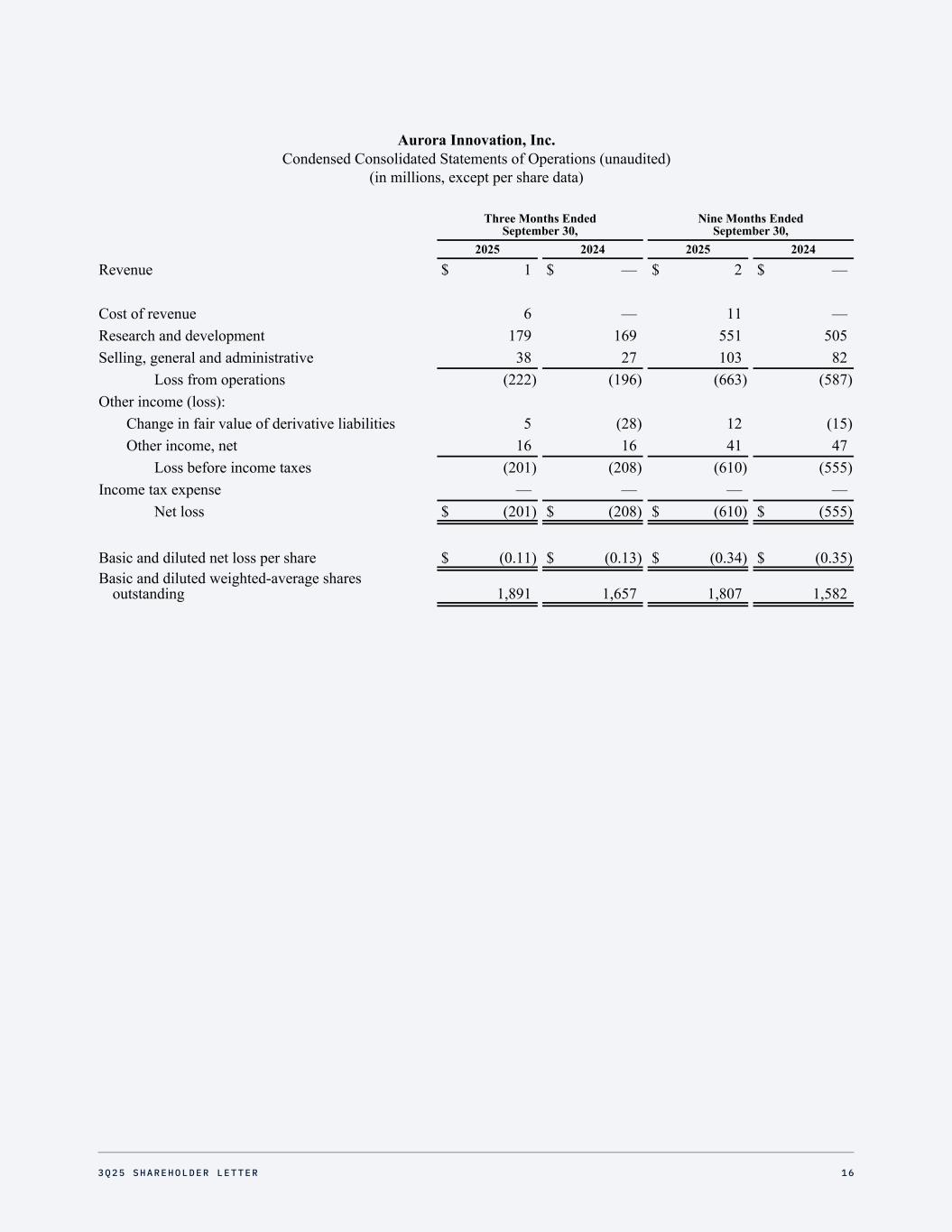
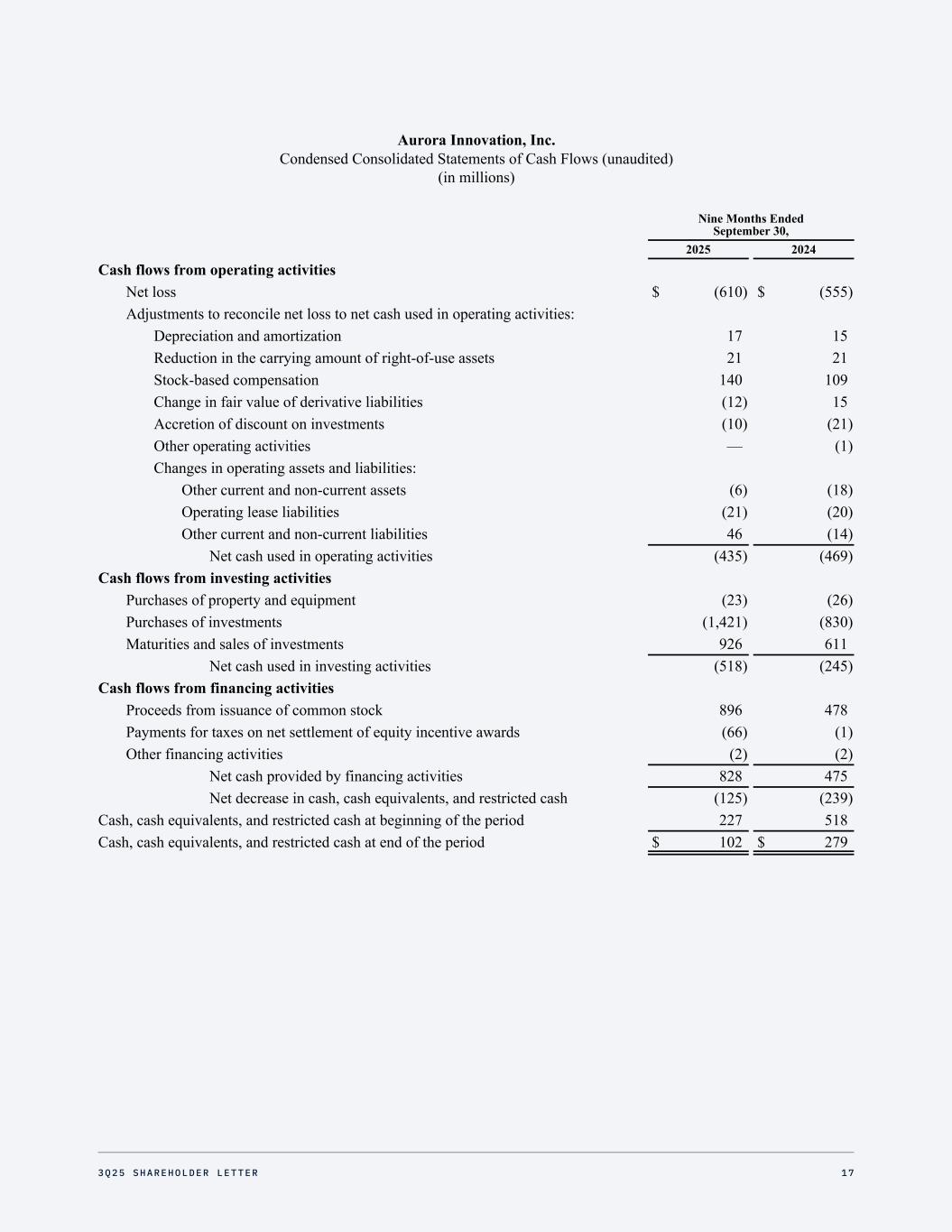
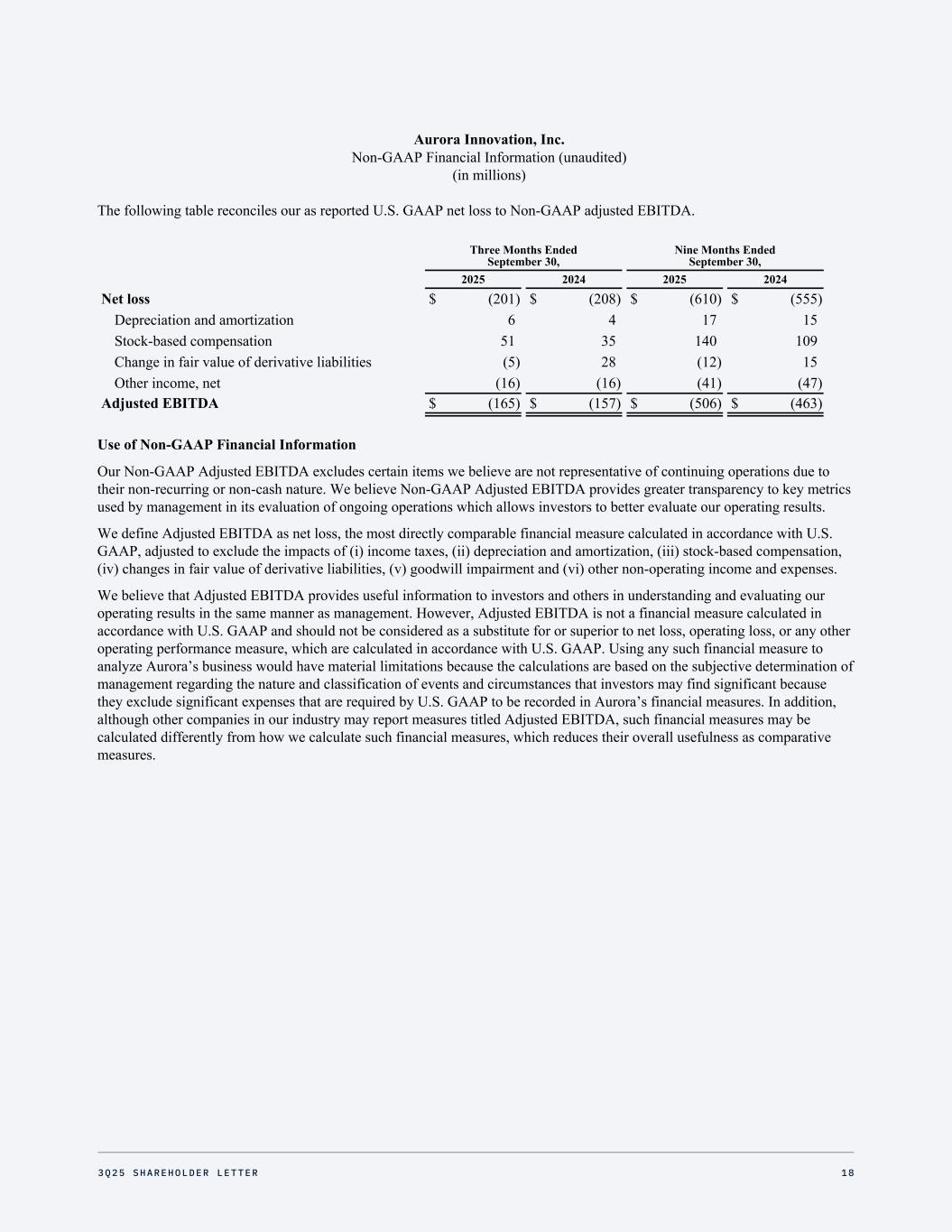
Thank you, Chris. Let's discuss our financial results for which we have provided a summary on Page 17 of the slide deck for reference. Third quarter 2025 revenue totaled $1 million across driverless and vehicle operator supervised commercial loads for Hirschbach, Uber Freight, Werner, FedEx, Schneider, and Volvo Autonomous Solutions, among others. The Aurora Driver achieved another record number of commercial miles driven during the quarter, which drove a 12% sequential increase in revenue from the second quarter. Third quarter operating losses, including stock-based compensation, totaled $222 million. Excluding stock-based compensation of $51 million, R&D totaled $138 million, SG&A was $28 million, and the cost of revenue was $6 million. We used approximately $149 million in operating cash during the third quarter and capital expenditures totaled $8 million. This cash spend was meaningfully below our externally communicated target, reflecting continued strong fiscal discipline. We expect cash use of $175 million to $185 million during the fourth quarter of 2025. During the third quarter, we issued 80 million shares of Class A common stock through our at-the-market program for net proceeds of $460 million. We used $21 million of the net proceeds to fund the tax liability associated with the vesting of our employees' restricted stock units during the third quarter. In turn, we ended the third quarter with a very strong balance sheet, including increased liquidity of $1.6 billion in cash and short-term and long-term investments. We expect this liquidity to fund our operations into the second half of 2027. We will be providing 2026 financial objectives in the fourth quarter 2025 business review in February. For the remainder of the year, we will continue to focus on expanding driverless operations and advancing our program to support our 2026 scaling objectives to accelerate our first-mover advantage to reinforce our leadership position. With that, we'll now open the call to Q&A.
Operator
Our next question comes from George Gianarikas with Canaccord Genuity.
Speaker 4
Maybe first, I'd like to ask if you could sort of give us form and shape to your plans for moving from terminal to endpoint shipments.
Yes, thanks, George. It's great to take a question from you. One common misconception is that this situation is a big deal, but it really isn't. For instance, when we operate to our Houston terminal, we drive about 5 miles through various industrial park surface streets to reach it. We have a capable system that works well for this purpose. It's simply a matter of timing and sequencing the volumes to make it relevant for our customers. We plan to roll this out to customers throughout the next year. Dave?
Yes, I would like to mention a couple of additional points. First, regarding misconceptions, about 80% of customer endpoints are located within a 5-mile distance from a highway, making this a manageable technical challenge. It's also crucial to highlight that our technology rollout follows a specific approach: crawl, walk, run. We began with a small fleet of trucks and are continuing to expand it. Importantly, we need to operate in all weather conditions. We have already initiated nighttime operations and are broadening our routes, but we also aim to function effectively in rain and strong winds. Once we can operate in these conditions, we will be able to deploy a larger number of vehicles to serve our customer endpoints. Therefore, it is essential that we develop a reliable product that performs well between these endpoints. This is a carefully planned strategy that we are implementing.
Speaker 4
And maybe as a follow-up in 2 parts. So in your press release, you say that you want to deploy hundreds of trucks next year; that feels like a little bit of an acceleration. Is that true? And the second part of the question is, is that being enabled by your partnership with International, which I think is new? Did you have a partnership with International before this?
Yes. This aligns with what we've been discussing for some time. We aim to acquire more than ten trucks this year and hundreds next year. We are focused on achieving our goals. Regarding the partnership with International, it is a new collaboration. We are purchasing trucks from them and handling the upfitting ourselves. We continue to collaborate with Volvo and PACCAR and look forward to our plans with them. This approach allows us to control the timing, ensuring we can deliver and support our volumes for next year in response to the customer interest we are currently experiencing.
Operator
Our next question comes from the line of Ravi Shanker with Morgan Stanley.
Speaker 5
If I can just quickly follow up on the discussion on International. I just wanted to confirm, are you just buying the trucks off a lot and kind of rolling that out as a third fleet? Or is this an actual OEM relationship like you have with PACCAR and Volvo, in which case, is there a time to commercial launch of that as well?
Ravi, it's Dave. So we are buying stock trucks. We're not actually buying necessarily off a lot. We are ordering them through International, but there is no co-development partnership associated with those. So it's important to understand that we've got tremendous experience in how to integrate the Aurora Driver into platforms. We've done it on roughly 8 platforms. So we understand all the necessary capabilities to launch a safe product. In this particular case, we've got 2 partnerships with co-developments already. We felt this was a great opportunity for us to continue to meet customer demand and work and offer the Aurora Driver on a third platform.
And to answer the second half of your question, Ravi, we expect to have the International truck on the road driverless in Q2 of '26. So we're excited to add that to our growing fleet.
Speaker 5
Understood. That's helpful. And as a follow-up, as you guys get closer to launching Gen 2 and specifying the Gen 3 hardware, when do you get a sense of the bill of materials and the cost of the system involved? And when do you expect to have conversations with your OEM partners and launch actual pricing of the truck and the system for your customers?
Yes. As for the bill of materials for the Aurora Driver, we have very good insight into that today. We track it as part of our development process. We know what that bill of material cost is. It's important to understand that as we look at that cost, it doesn't get borne upfront as part of the purchase of a truck. That is paid through the subscription that customers will pay for the Aurora Driver, this Driver as a Service model. We have factored that into the cost and into the revenue stream and profitability of the business going forward.
Operator
Our next question comes from the line of Colin Rusch with Oppenheimer.
Speaker 6
You've talked a lot about the simulation expertise that you have. Can you talk a little bit about any sort of acceleration that you're seeing or any sort of transitions that may see hiccups, as you move to the new hardware?
Yes. First, we think simulation is an important tool. It's something we've invested in, and I appreciate you recognizing that. No, we don't really see any hiccups. One of the things that a lot of folks don't really understand is that the automated driving system is a complicated, difficult thing to build. The tools, processes, and rigor you have to put in place to have conviction that the thing is safe to put out on the road and operate at 70 miles an hour down the freeway is at least as hard, if not harder. As we've been building our processes for validation and release, we've designed them with an eye towards scalability to accelerate our release process over time to meet the needs for the second-generation and third-generation hardware. So we're feeling pretty good about this.
Speaker 6
Okay. Yes, I'll follow up offline. The second one is really around customer comfort with the technology. Now that you're accumulating a fair amount of experience on the road without the driver, how quickly are customers getting comfortable with taking a safety driver out of the cab and thinking about actually starting to deploy without a driver?
Yes. I think that, one, it's dangerous to characterize all customers in one bucket. There's obviously a spectrum of them. But what we're seeing is enthusiasm. The conversation has moved from, 'Hey, maybe this will happen' to, 'Oh, it's happening. I can see why this will benefit my business. I would like to have access to that.' We mentioned Russell Transport. That's a customer that just signed up with us and signed up on day one to operate driverlessly. We expect that to be the flavor of many of the customer relationships that we will put in place going forward.
Operator
Our next question comes from the line of Andres Sheppard with Cantor Fitzgerald.
Speaker 7
Congrats on all the great progress. I think some of our questions have been asked. But Chris, I'm hoping maybe if you can help us give some granularity as to how we should think about the truck deployments for Q4 and maybe early next year. So you have 5 in operation as of now. To get to more than 10, presumably, that means deploying 6 additional trucks before year-end. So how should we think about Q4 deployments and maybe ASPs? Any granularity you might be able to give us there? I know we'll get more color on Q4 for next year, but helpful.
Yes. We expect to get to 10 trucks operating driverlessly at the end of this year. We'll ramp them through Q4. You're probably sick of us saying crawl, walk, run, but we very much believe in that. We want to ensure that customers are comfortable, regulators are comfortable, and are building out at a rate that enables us to do something useful in the world. For us right now, it's a balance between increasing driverless operation and utilizing the fleet that we have to advance capability to deliver that value to customers. So we're investing time in lane expansion work and weather validation so that as those trucks begin operating driverlessly, they're maximizing utility for customers.
Speaker 7
Got it. Okay. That's helpful. And I guess as maybe a quick follow-up. In your presentation, you mentioned having positive gross profit by the end of '26 or early '27. How should we think about that? Is there a certain number of trucks in operation that you think you'd need to get to that point? Or is there a better way to think about that ramp-up?
Yes. It's a bit of truck volume and a bit of continuing our capabilities that we're focusing on today. We've tried to describe 4 key enablers. The first one is to launch our second-generation hardware kit. We are well on the way to that, and that will be launched with the introduction of our new fleet of trucks in April. We're really excited about that. There is an element of continued progress on remote assistance. We've said before that remote assistance, while not operating the vehicles, supports them if there's any need for help, like detecting different signs and things like that that we want to clear. We're well on our path towards that, and we think we're going to be able to have one person operating and supporting multiple vehicles, going from a few to many. We believe that path is clear. The last one is, obviously, you need a sufficient scale because we do have some structural cost elements, whether we operate at our terminals or our insurance costs, etc. Just purely the mileage accumulation is really important. We initially established a target for ourselves to be gross profit positive by the end of '26, but we launched a little later for commercial launch. So we expect that may flow into early '27, but we still feel confident that's a good target, and we're not putting any formal guidance out yet for '26 profitability.
Just to add on to what Dave was saying, take, for example, the Aurora Driver hardware kit. We just look at the BOM cost, and we see roughly half the price of what our current system is. Then, you add to that the increased durability, so you can amortize that over a longer distance or a longer amount of driving. That's a big mover, and we see that coming online in '26 or in Q2 '26.
Operator
Our next question comes from the line of Chris Pierce with Needham & Company.
Speaker 8
If we just go back to the international truck announcement, I just want to understand, will customers be able to buy international trucks that you upfit? Or is this just something you're doing to sort of pull forward or accumulate more proof points with the Aurora Driver technology?
Today, we're operating in what we call Transportation-as-a-Service mode, where we're operating trucks for our customers. Initially, we expect that's how this will operate. We'll own these trucks. They'll be out there generating revenue, generating value for customers. Maybe at some point in the future, we consider that. But initially, this will be trucks we own and operate and get paid for.
Speaker 8
Should we think about, if it goes well, is this something where you've talked about launching with other OEM partners in the past? Do you see a world where OEMs have multiple autonomous platforms and the end user, the truck fleet chooses which one they want based on metrics or price? Or how do you see the market shaking out?
We've made no secret that we intend to have the Aurora Driver available on all OEM platforms. We love the opportunity to compete. We think the Aurora Driver is going to be the best product in the market. Yes, we would love to have and hope to have a long-term relationship here.
Speaker 8
Just lastly for me, not to put you on the spot, but there were some headlines from NVIDIA all across mobility today with OEM partners, eVTOL partners and with International in the trucking space. What's the right way to frame this announcement, if you saw it, versus your relationship with NVIDIA? I just want to understand what is new, not new, and how we should think about that broadly.
We've obviously been working with NVIDIA and AUMOVIO on the third-generation Aurora commercial hardware kit for some time now. We think it's great hardware. This will continue to build our business, and we're not surprised others are using them.
Operator
Our next question comes from the line of David Vernon with Bernstein.
Speaker 9
First question for you on the equipment side. You mentioned in the presentation that the second generation should be getting a 50% reduction in the hardware cost. Is there a scale number to think about that you need to hit to get to that level? What is the actual life cycle of this stuff? How often do you envision needing to upgrade the hardware on a truck?
As we talk about the price point of the bill of material savings, that's across this production run of 1,000-plus units. We have the vehicles we have today with our first-generation hardware. We knew we could build that in tens and not more. That's why we have the second-generation hardware where our contract manufacturing partner, Fabrinet, is producing those, and that gets us to 1,000 plus. True large automotive scale comes with the AUMOVIO partnership, when we can get to tens of thousands of units. This fits as a bridge between tens and tens of thousands. The price numbers are across that 1,000-plus scale, and we have commitments and alignment on that. In terms of the life cycle, we expect this hardware to be lasting 1 million miles. That aligns well with the kind of useful first ownership for many of these trucks and meets our objectives for the profitability and financials here.
Speaker 9
That's helpful. My second question would be for you on your illustrative end-to-end case study, looking at Page 16 of your presentation there for Fort Worth to Phoenix. I believe a fully loaded Class A tractor can go 1,000 to 1,200 miles on a full tank of gas. With the driverless option, couldn't this truck make the trip in a day as opposed to the 2 to 3 that a normal trucker would quote for? And if that's right, then why sell it at 205 a mile?
Yes. We can drive the same distance for fuel economy. We're actually probably slightly better for fuel economy and we can go all that distance in a single day. I think the 205 is also illustrative for us because each lane is going to be a little bit different in terms of pricing environment and the customers. For us, we've always said that in the Transportation-as-a-Service element, that pricing is based on industry data, like what a carrier would be paid to haul those loads on that lane. We'll get more specific on pricing when we get a little bit further along.
Just because Dave doesn't have the slide in front of him, the revenue per mile mentioned there is not necessarily to Aurora. This is an end-to-end in a Driver as a Service business model, based on industry data sourced from DAT. We're showing how much more revenue and margin we can drive for the customer based on the Driver as a Service model in which they are paying us the driver fee. We can actually walk through the math offline, but I just wanted to clarify that one piece.
I do think there is potentially an opportunity for premium pricing here because of the speed at which you can move these goods. But we're still exploring when and if that's an appropriate lever to pull.
Speaker 9
Is the software subject to any hours of service or not?
No, the software is not subject to hours of service because the reason for those limitations is that a person gets tired. Our software has the superhuman ability to not get tired.
Operator
Our next question comes from the line of Mark Delaney with Goldman Sachs.
Speaker 10
First, just hoping to better understand some of the progress the company has been making with Volvo. In the last earnings call, you spoke about hoping to have 20 trucks from them by the end of the year. Where do you stand with that? If I understood the press release today, you also are working to integrate at lineside. If you could share some timelines for that as well, I'd appreciate it.
Yes, Mark. We had said this last time as well that we are starting to get their second set and now we're actually in the process of building their third set of trucks. They call them B-Sample and C-Sample, which are development trucks that have all the representative hardware. There are updates needed associated with the firmware and the software to have them fully validated for driverless operations on their truck platform. We're deploying those trucks, and we use them in delivering commercial loads to support Volvo Autonomous Solutions business as well as development testing and integrating them into our second-generation hardware. We are making tremendous progress across both fronts.
Speaker 10
Very helpful, David. And just the time frame to be done with the testing and validation with Volvo, do you have an estimate you can share?
We're making tremendous progress, but we try not to talk about our customers' and partners' timing. We let them do that, but things are advancing really well for us.
Speaker 10
Okay. My last question was just on the news with International. Please talk a bit more about how that's evolved and how that supports your driver out timeframes that you described in the prepared remarks.
With International, we're excited and have strongly seen demand on the Aurora Driver. We're making great progress technically and want to fulfill that promise of being able to deploy these trucks across the Sun Belt. By using International trucks, we can upfit stock trucks and install the Aurora Driver. We aim to deploy those driverlessly, without an observer, in the second quarter of 2026. This is a great opportunity for us to meet demand and demonstrate our leadership position. Our focus is on continuing to build momentum across the board.
Operator
Our last question comes from the line of Itay Michaeli with TD Cowen.
Speaker 11
Just 2 questions on the product roadmap. First, Chris, you mentioned solving for some of the dust storms. I'm curious as you solve for that, how much of that was accomplished by your Lidar versus Radar? And secondly, I guess, a slight delay in the rain and heavy wind update. Was that tied to solving for the dust storms first, or anything you could share would be helpful?
On the dust storm part, as we've said for a long time, we see real value in having a complementary set of sensors that have different strengths and weaknesses. We don't just use lidar or just use radar. We build a perception model and AI model that takes data from different sources and produces the best possible outcome. We lean into the special properties that come along with FirstLight, our FMCW lidar, and radar. Given its relatively longer wavelengths, it is less impacted by dust. Between the two of them, we do a nice job of seeing what's on the road in front of us. Regarding the rain pushout, we look at this as just not a thing, whether it's late December or early January. We value transparency and decided to share that.
It's important to point out that we also pulled ahead the Fort Worth to El Paso lane. We're going to continue to drive towards moving quickly on this. As Chris mentioned earlier, we will give people a breather during the holidays.
Operator
Thank you. At this time, this concludes today's teleconference. You may disconnect your lines at this time. Thank you for your participation.