Operator
Good morning, and thank you for standing by. Welcome to Booz Allen Hamilton Holding Corporation's earnings call covering fourth quarter fiscal year 2025 results. At this time, all participants are in a listen-only mode. Later, there will be an opportunity for questions. I'd now like to turn the call over to the Head of Investor Relations, Dustin Darensbourg. Thank you.
Speaker 1
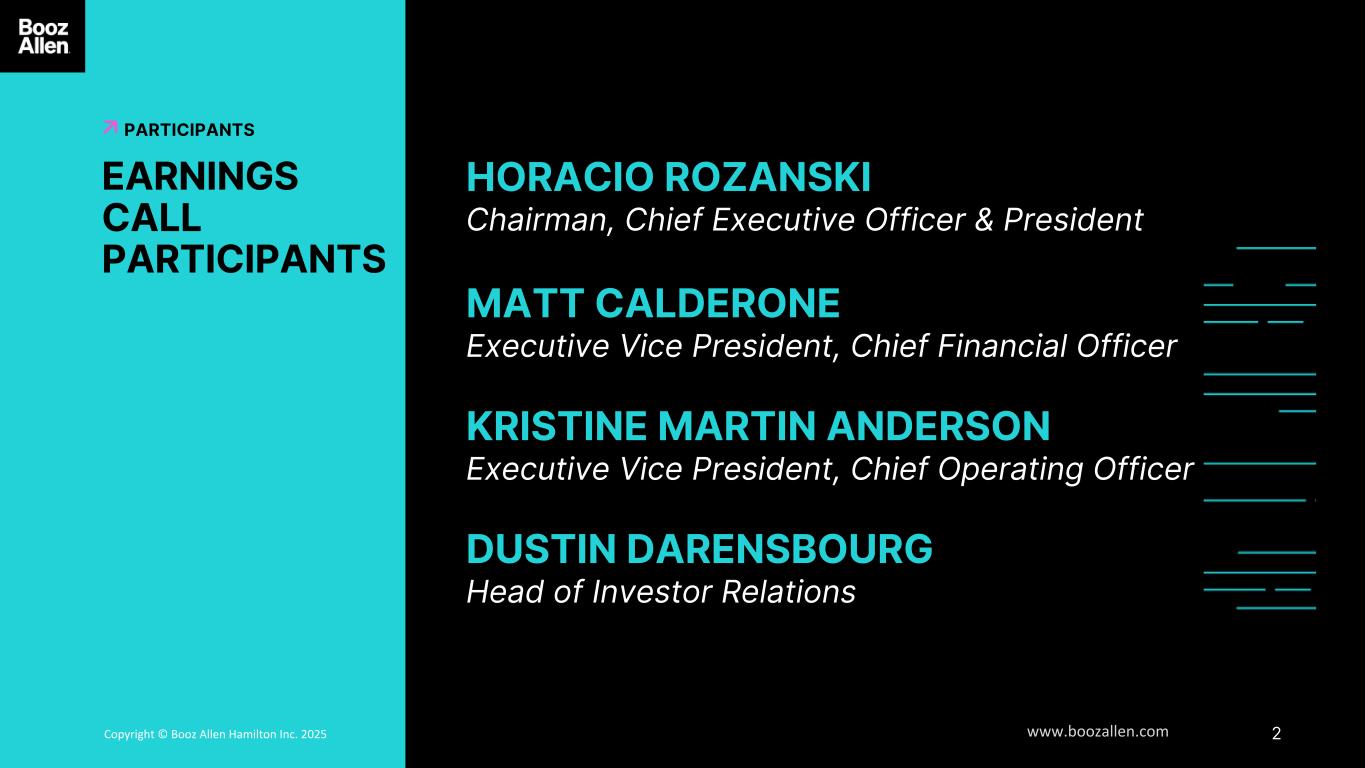
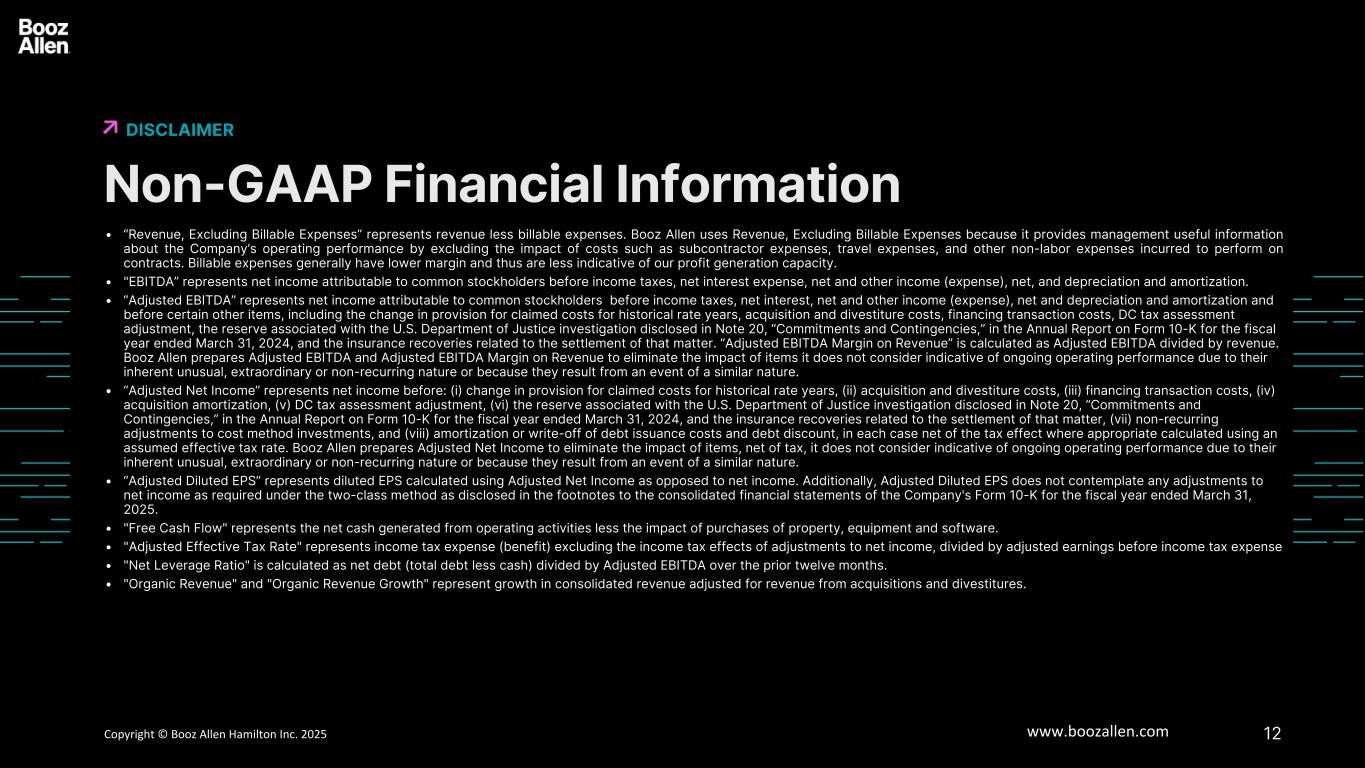
Good morning, and thank you for joining us for Booz Allen Hamilton Holding Corporation's fourth quarter fiscal year 2025 earnings call. We hope you've had an opportunity to read the press release we issued earlier this morning. We have also provided presentation slides on our website and are now on slide two. With me today to talk about our business and financial results are Horacio Rozanski, our Chairman, Chief Executive Officer, and President, Matt Calderone, Executive Vice President and Chief Financial Officer, and Christine Martin Anderson, Executive Vice President and Chief Operating Officer. As shown in the disclaimer on slide three, please keep in mind that some of the items we will discuss this morning are forward-looking and may relate to future events or our future financial performance and involve known and unknown risks, uncertainties, and other factors that may cause our actual results to differ materially from forecasted results. Discussed in our SEC filings and on this call, all forward-looking statements are expressly qualified in their entirety by the foregoing cautionary statements and speak only as of the date made. Except as required by law, we undertake no obligation to update or revise publicly any forward-looking statements, whether as a result of new information, future events, or otherwise. During today's call, we will also discuss some non-GAAP financial measures and other metrics which we believe provide useful information for investors. We include an explanation of adjustments and other reconciliations of our non-GAAP measures to the most comparable GAAP measures in our fourth quarter fiscal year 2025 earnings release and slides. Numbers presented may be rounded and as such may vary slightly from those in our public disclosure. It is now my pleasure to turn the call over to our Chairman, CEO, and President, Horacio Rozanski.
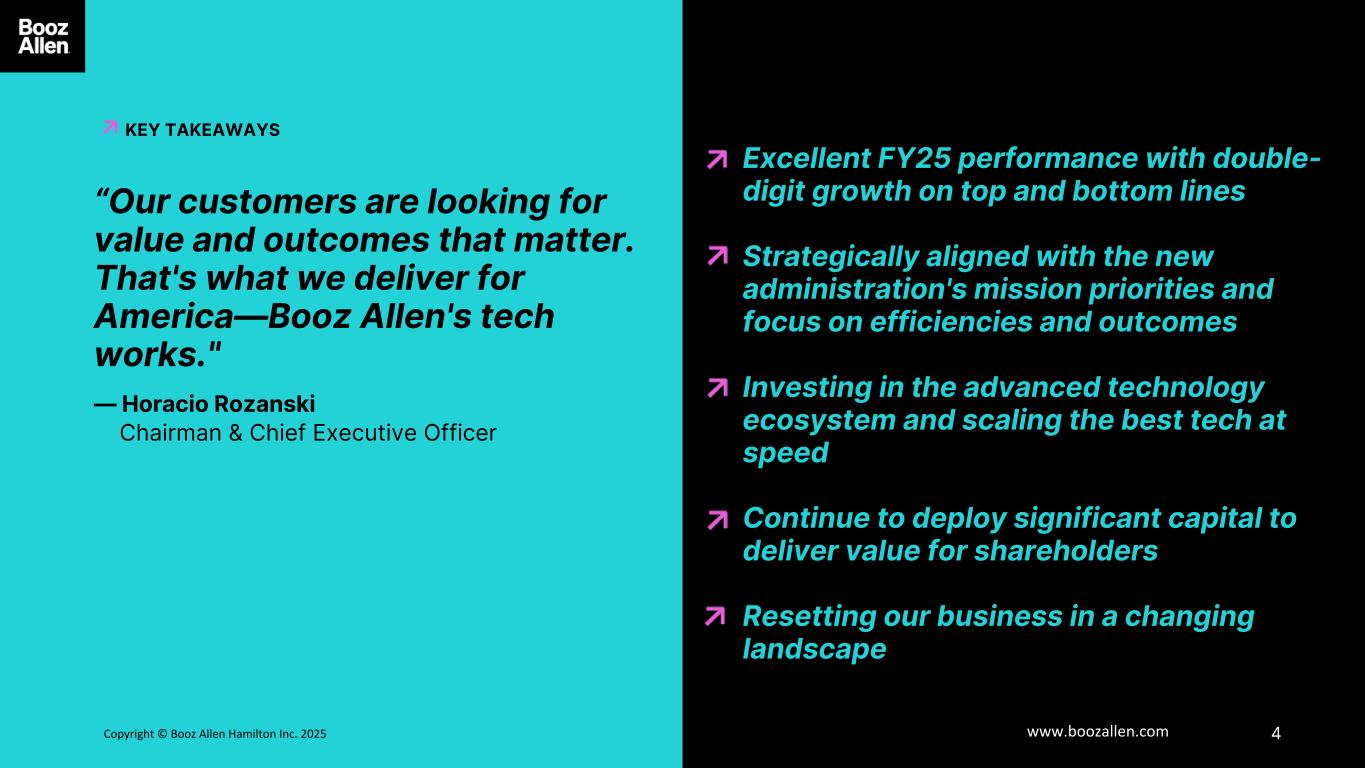
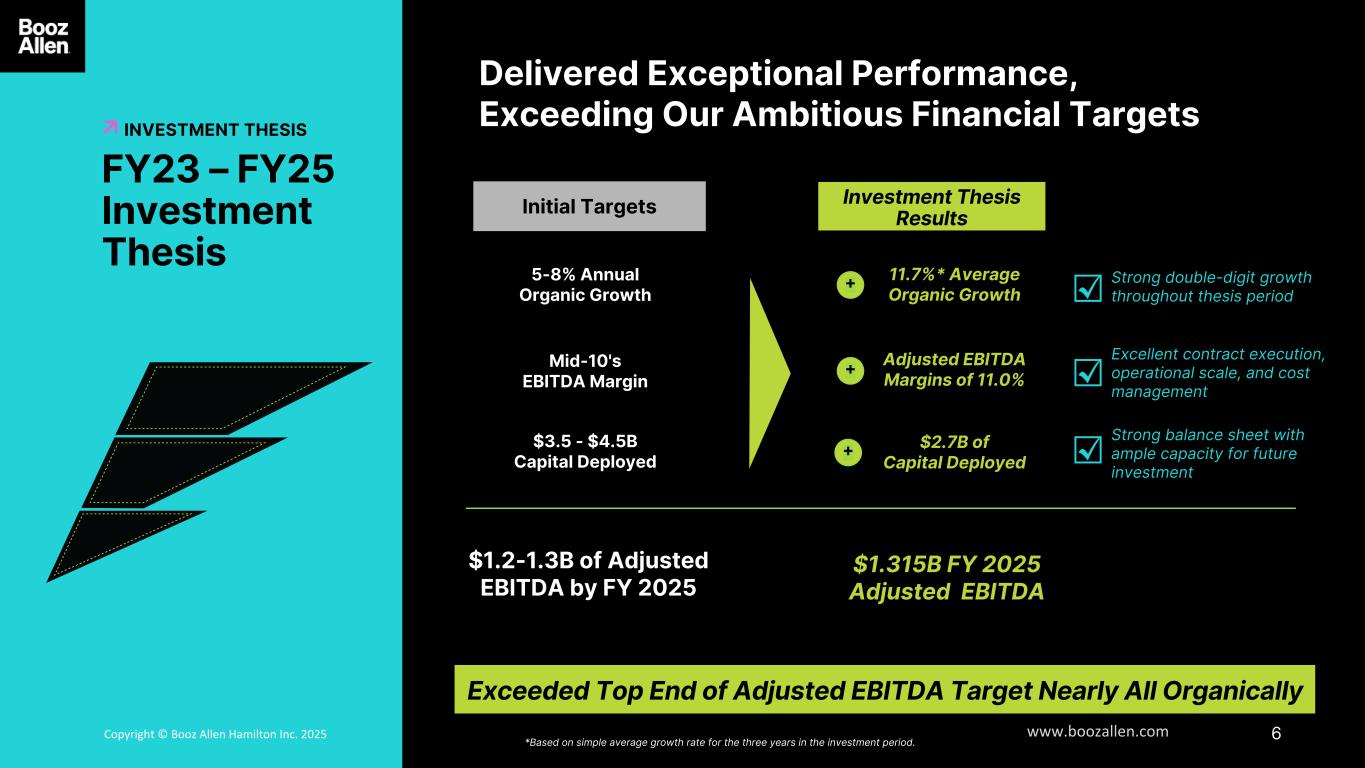
Thank you, Dustin. Welcome, everyone. And thank you for joining the call today. Christine, Matt, and I are proud to share strong financial results for fiscal year 2025, as well as our outlook for fiscal year 2026 and beyond. Booz Allen Hamilton Holding Corporation delivered a strong year of top-line and bottom-line growth in FY 2025. We also reached $1.315 billion of adjusted EBITDA. This exceeded the top end of our ambitious target range we set at our investor day in October 2021 and represents 12% compounded EBITDA growth, nearly all organic, over our investment thesis period. I am incredibly proud of the people of Booz Allen Hamilton Holding Corporation for their dedication and hard work over the past three years. These results are a credit to them. Through a change in landscape, they remain focused on delivering outcomes and bringing their passion and commitment to America's most essential missions. A heartfelt thank you to our colleagues for all you do for our company and for our nation. To frame the conversation about fiscal year 2026, let me reiterate what I mentioned on the October earnings call. All presidential transitions create some degree of near-term disruption followed by opportunity. Half a year later, we now see that these dynamics are indeed in play at a rate and speed that is beyond what we originally expected. As the current administration focuses on reducing government spending, increasing efficiency, and reimagining agency missions, Booz Allen Hamilton Holding Corporation must once again adapt and accelerate. Let me begin by describing the current environment as we experience it. The federal government is rethinking agency missions, finding ways to accomplish those missions differently, and looking for ways to reduce spending and increase efficiency. To get there, we are seeing agency reorganizations, reductions in government personnel and spending levels, as well as contract reviews. These are especially acute in civilian agencies. As a result, we are seeing a decrease in the pace of awards in civil, as well as run rate changes in some of our contracts. At the same time, the government is leading initiatives to improve procurement regulations and practices, such as the revision of the Federal Acquisitions Regulation or FAR, and we expect to see more contracts move to fixed price and outcome-based. We also see a focus on massively upgrading legacy systems and rapidly injecting advanced technology into revised missions. These present great opportunities for more impact and increased value to the government, as well as stronger financial performance for Booz Allen Hamilton Holding Corporation. In combination, these dynamics are currently impacting Booz Allen Hamilton Holding Corporation's view of FY 2026. We believe that our defense and national security portfolio will continue to grow this year as we accelerate the injection of AI and commercial technology into missions. In contrast, we expect our civil business to decline this year. Diving more into civil, our largest contracts have been reviewed. We are proud that our solutions stood up well and our contracts are mostly intact. The work is excellent, and the missions are critical. However, the run rate on five large technology contracts has been reduced significantly in support of the administration's desire to reduce spending overall. This slowdown coincided with the ending of a large technology contract at the VA. Together, this led to a significant number of employees needing to be redeployed simultaneously. Under normal circumstances and as our history shows, the dynamism of our business typically allows us to move our highly skilled talent quickly to new opportunities. But at a time when procurements are moving much slower than normal, this has been challenging. As we proactively anticipate continued market and budget dynamics, we have made the decision to restructure and reset our civil business. We are making targeted cost and headcount reductions to match anticipated demand. These are a combination of reductions in bench, delayering of management, and adjusting our infrastructure to align with business needs. These decisions are difficult and not taken lightly. Our actions are very targeted, and we believe that they will preserve and enhance our ability to invest both in our business and our people. Matt will cover all the details of our FY 2026 outlook in a few minutes. Now let me talk more about the opportunities on the horizon, especially those being created through our close collaboration with the General Services Administration or GSA. GSA wanted to explore ways they could transform and centralize government procurement. They began a contract review exercise looking for efficiencies, cost savings, and opportunities to bring in new technology like AI. We were in the first group of companies to take part in that exercise, which has since expanded to include many more companies in our industry. I'm proud to say that GSA and Booz Allen Hamilton Holding Corporation have built a very productive relationship. I want to highlight two specific outcomes of our efforts. First, GSA got to know us better. They now understand the value we deliver across a full range of missions. This is important because GSA and the Federal Acquisition Service or FAS will be driving an efficiency agenda across government for the foreseeable future, including the consolidation of services and acquisition processes. Second, we have a unique opportunity to offer FAS our thoughts on how to accelerate the move to outcome-based procurement and bring AgentiKai capabilities to enable these conversions. For years, I have argued that the move to outcomes was necessary for the federal government. GSA and FAS understand this and are leading the way. We are optimistic that a process that could have taken a decade or more will be accelerated during this administration. We believe more efficient government will buy differently, more commercial technology, more outcomes, streamlined processes, and greater speed. Looking ahead, anticipate these procurement improvements will set a foundation for a new kind of growth. We are committed to moving quickly in those directions so that we can help these initiatives succeed and be successful ourselves. We're optimistic about the opportunities ahead because our vault strategy, which stands for velocity, leadership, and technology, is aligned with the changes we are seeing across government. We have a leading position in the major technologies that will drive mission acceleration and efficiency, especially AI. We have a track record of building successful partnerships with technology firms, from startups to hyperscalers. We have strong positions and are working non-stop to create value in the areas that matter most, from reducing duplication and cost to increasing readiness and lethality for the warfighters defending our nation. Let me provide some color in each area. Starting with artificial intelligence, there is significant demand, and that demand is only increasing. In FY 2025, our AI business grew over 30% year over year to approximately $800 million. As AI becomes increasingly foundational to how government operates, agencies are investing more and moving towards enterprise-scale implementation. In defense and intelligence, AI is now embedded in mission workflows, enabling faster imagery analysis through computer vision, enhancing decision-making through tailored generative models, and delivering autonomous solutions at the tip of the spear. With more than a decade of investment and hands-on implementation experience, Booz Allen Hamilton Holding Corporation is well-positioned to lead the next phase of AI transformation across the federal enterprise. Next, we are strengthening private sector partnerships and are a proud leader in the advanced technology ecosystem. We are building on a proven track record of accelerating the adoption of technologies that produce impactful mission outcomes. We recently announced we are combining our expertise in AI with NVIDIA's transformative technologies to accelerate the delivery of edge applications. We continue to invest in early-stage technology companies through Booz Allen Ventures. We believe that we are stronger together, which is why we will continue developing our technologies and combine our strengths with others. Lastly, we are continuing to share our big ideas, working in partnership with our customers and the private sector. For example, we are talking to multiple agencies about cloud migration and consolidation. We have big ideas for transitioning thousands of data centers to a cloud-based architecture to make data more accessible. The private sector has already done this, and we've seen that it's more efficient, cheaper, and more secure, all of which aligns with the administration's vision. Importantly, making data more readily available is also crucial for our warfighters because it allows us to apply advanced AI tools to increase their readiness and lethality. One way we're doing this is by collaborating with the United States Army. We are building an AI-enabled tactical software system to more quickly recognize targets and generate call-for-fire missions. The prototype can reduce the time to respond to threats from fifteen minutes to one minute. The bottom line is this: we understand our customer's mission needs, and we have the technical expertise to deliver solutions that not only meet those needs but also anticipate what's next. That gives me great confidence in Booz Allen Hamilton Holding Corporation's ability to maximize the opportunities ahead and provide the advanced technologies America needs to thrive. In this period of transformation for Booz Allen Hamilton Holding Corporation and our nation, we will accelerate by focusing on the following operating priorities for FY 2026. We are resetting and restructuring our civil business so it returns to growth rapidly after an adjustment period in the coming months. We are positioning ourselves to lead the way and capture major outcome-based opportunities. This includes reimagining how we deliver our work, such as using AI to accelerate software development, increase our value, and reduce costs to the government. We are directing significant resources to the areas that will best position us for growth, including missions in Indo-PACOM and space, as well as critical technologies like agent tech AI, Quantum, and software-defined communications. We are rapidly advancing our partnerships with established technology firms and new entrants. This entails going to market together to provide novel solutions, as well as becoming their scaling partner as they capture demand across their broader markets. Finally, we are continuing to create efficiencies in our own business so we can move faster, invest more, and realize greater shareholder value even in a volatile environment. To wrap things up, I hope that you will take three things away from my remarks this morning. First and foremost, Booz Allen Hamilton Holding Corporation is not standing still to see what happens next. We are moving aggressively to lead the way in a changing market. Second, we are strategically advantaged. We have been investing ahead of these changes both in our own positions and in the critical partnerships that will be required. Third, we're on the side of change. We are committed to America's priority missions and to enabling a more nimble and efficient federal government. For all these reasons, and while recognizing there are challenges ahead, the people of Booz Allen Hamilton Holding Corporation are energized, optimistic, and ready to meet this moment. And with that, Matt, over to you.
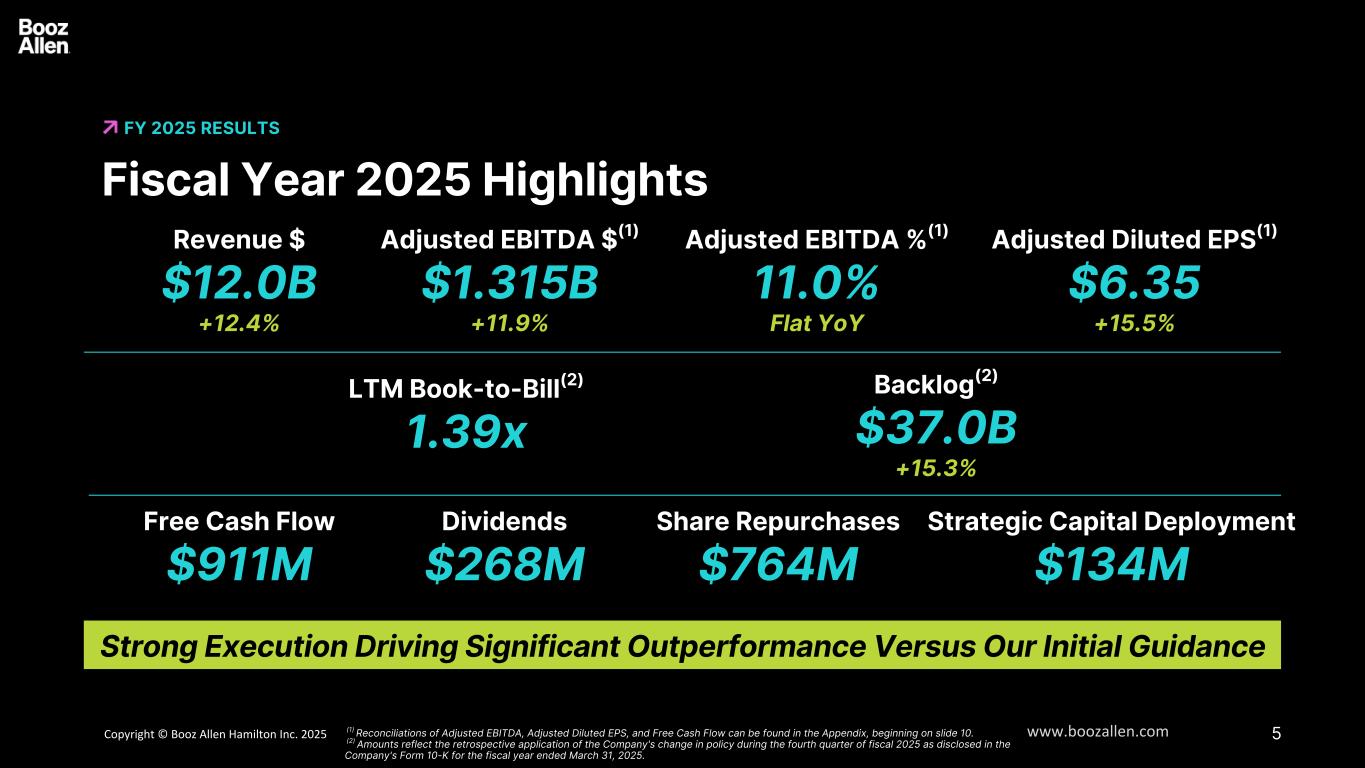
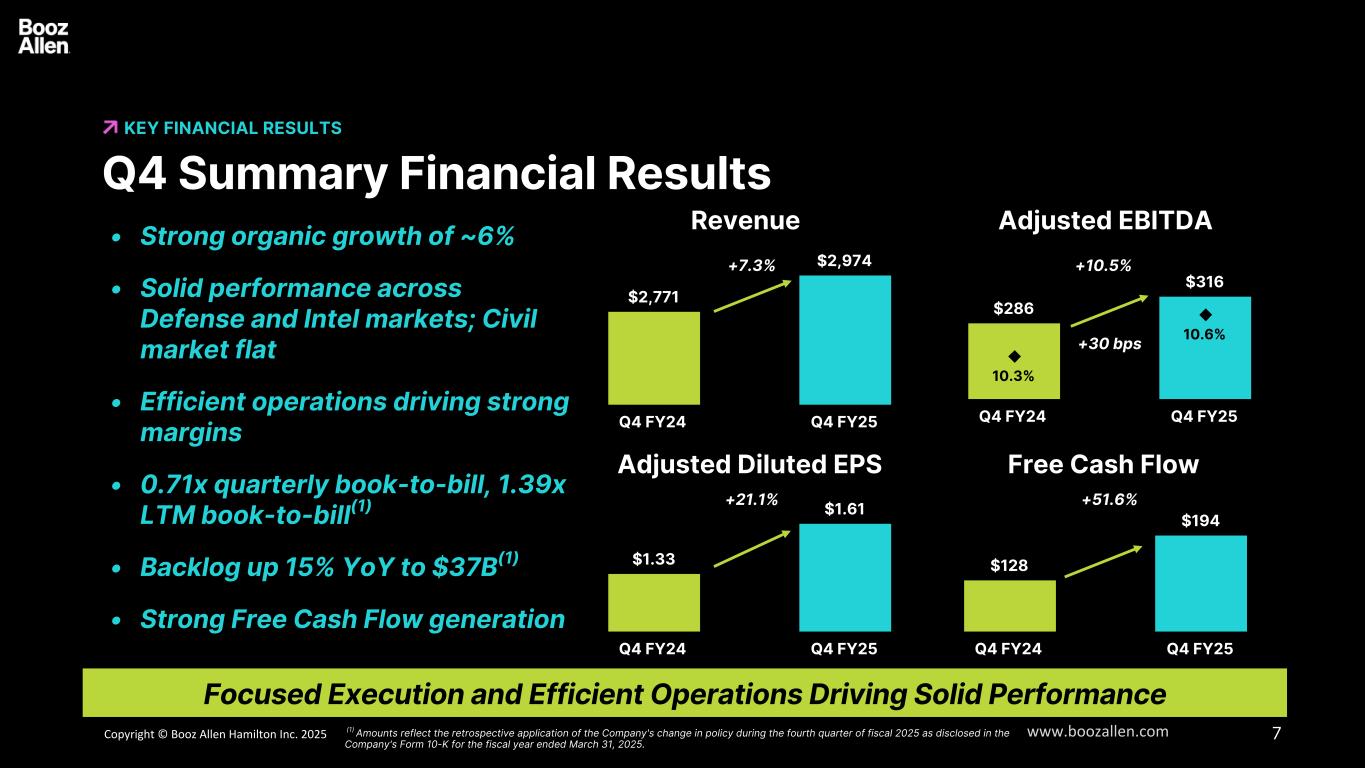
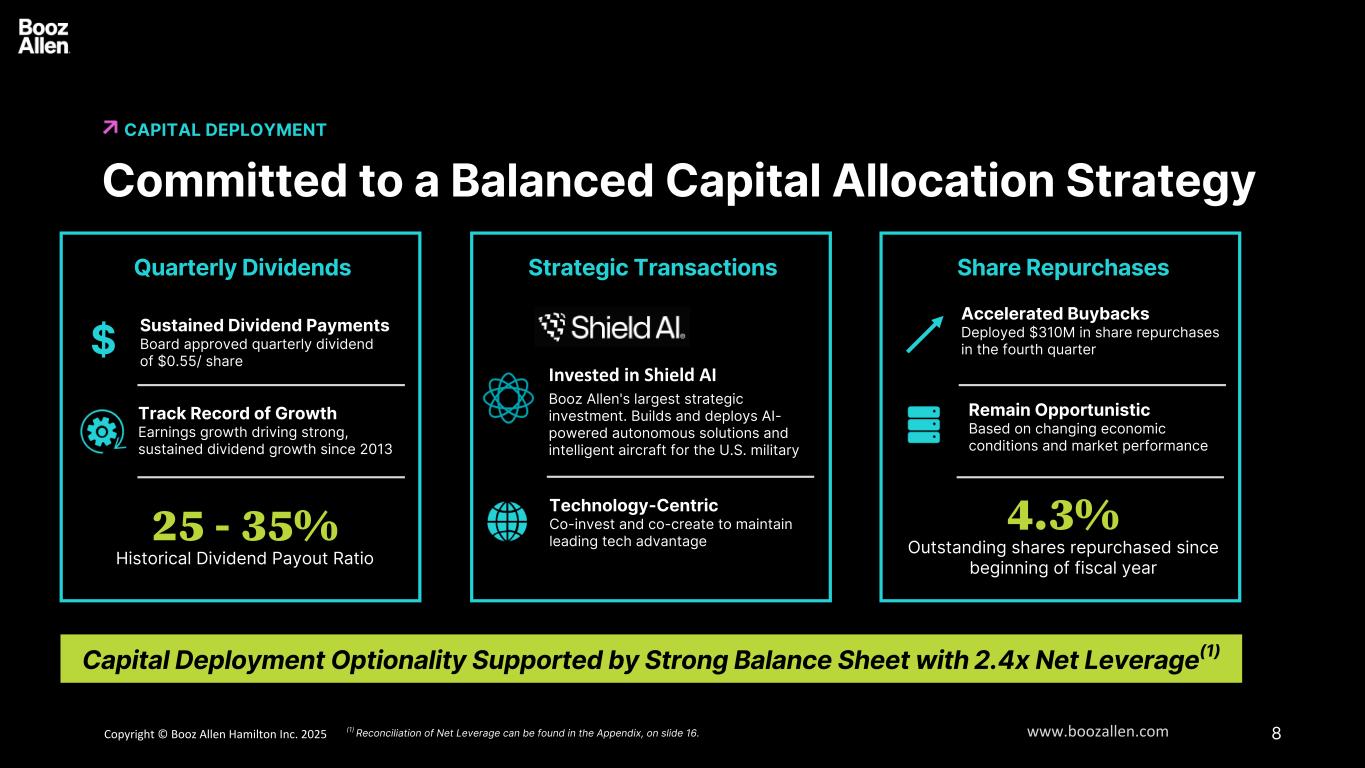
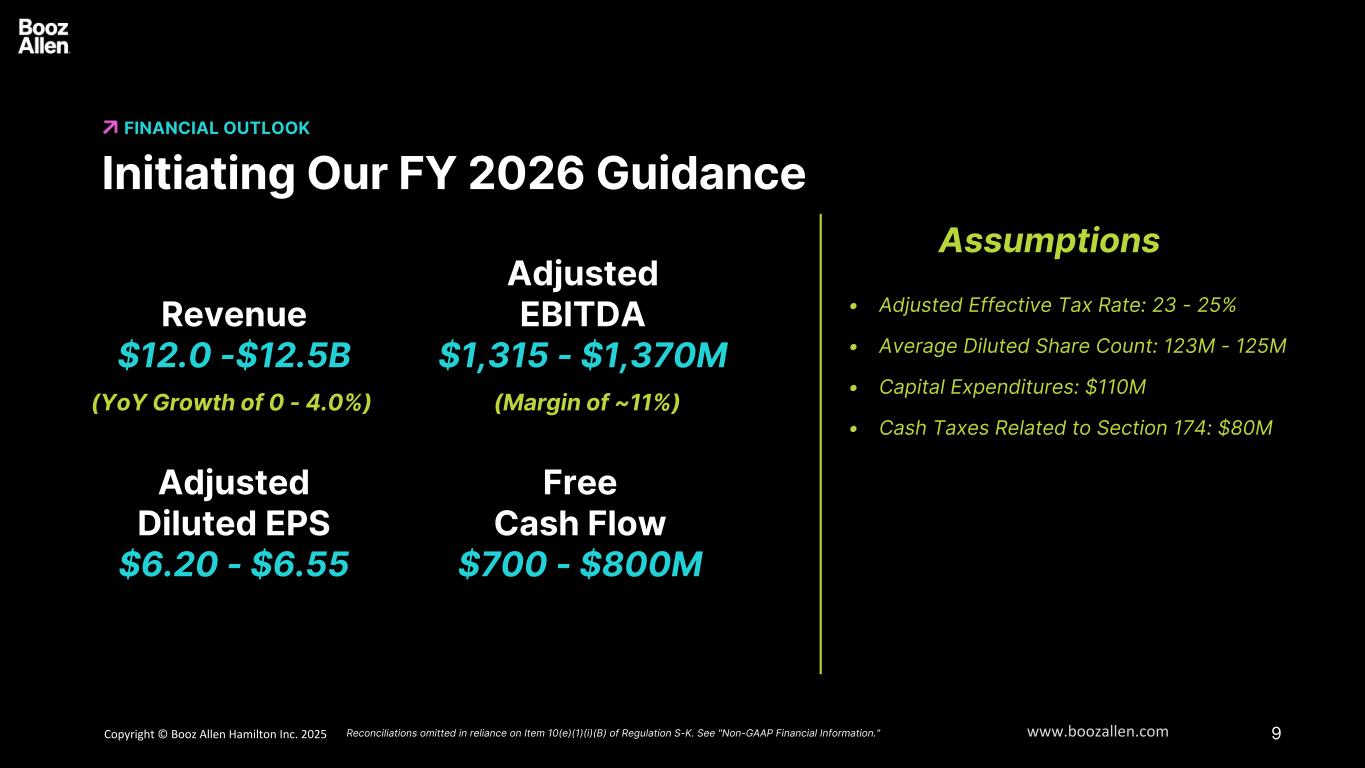
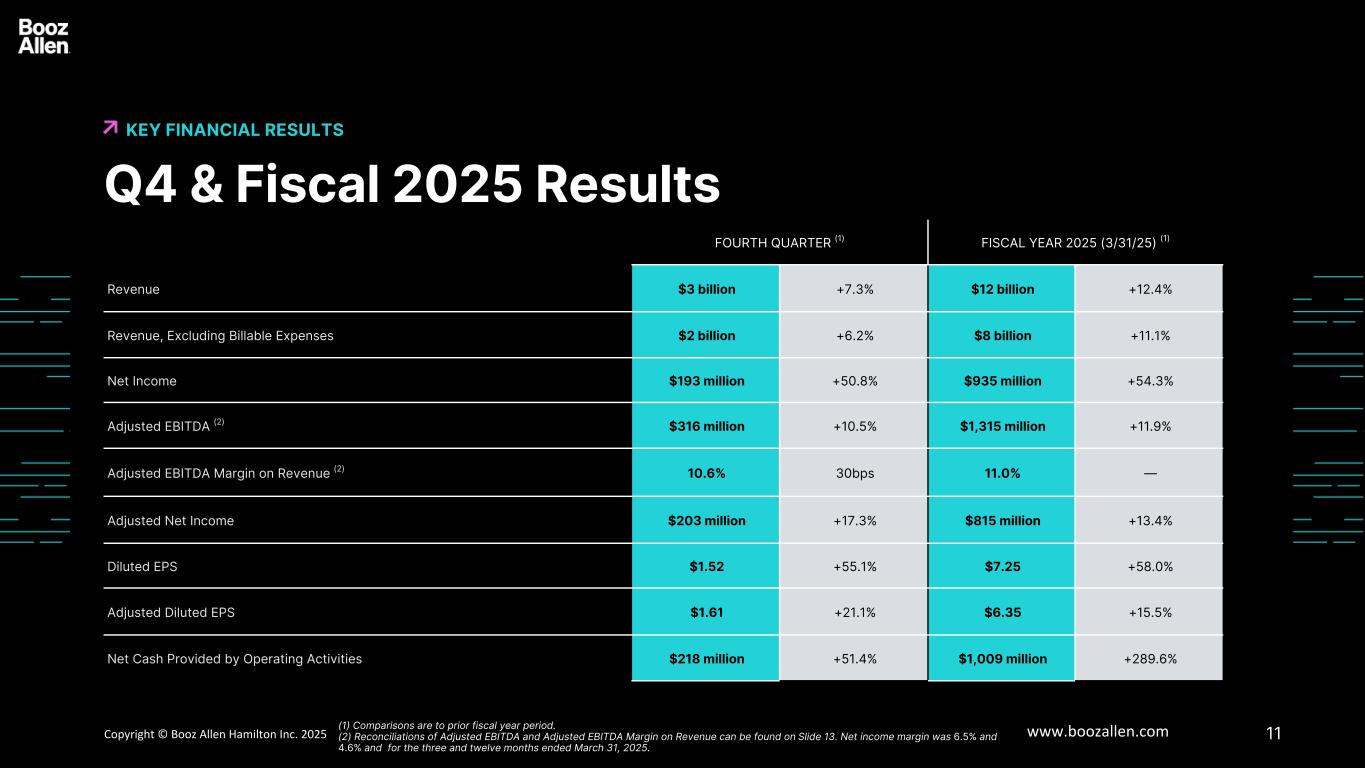
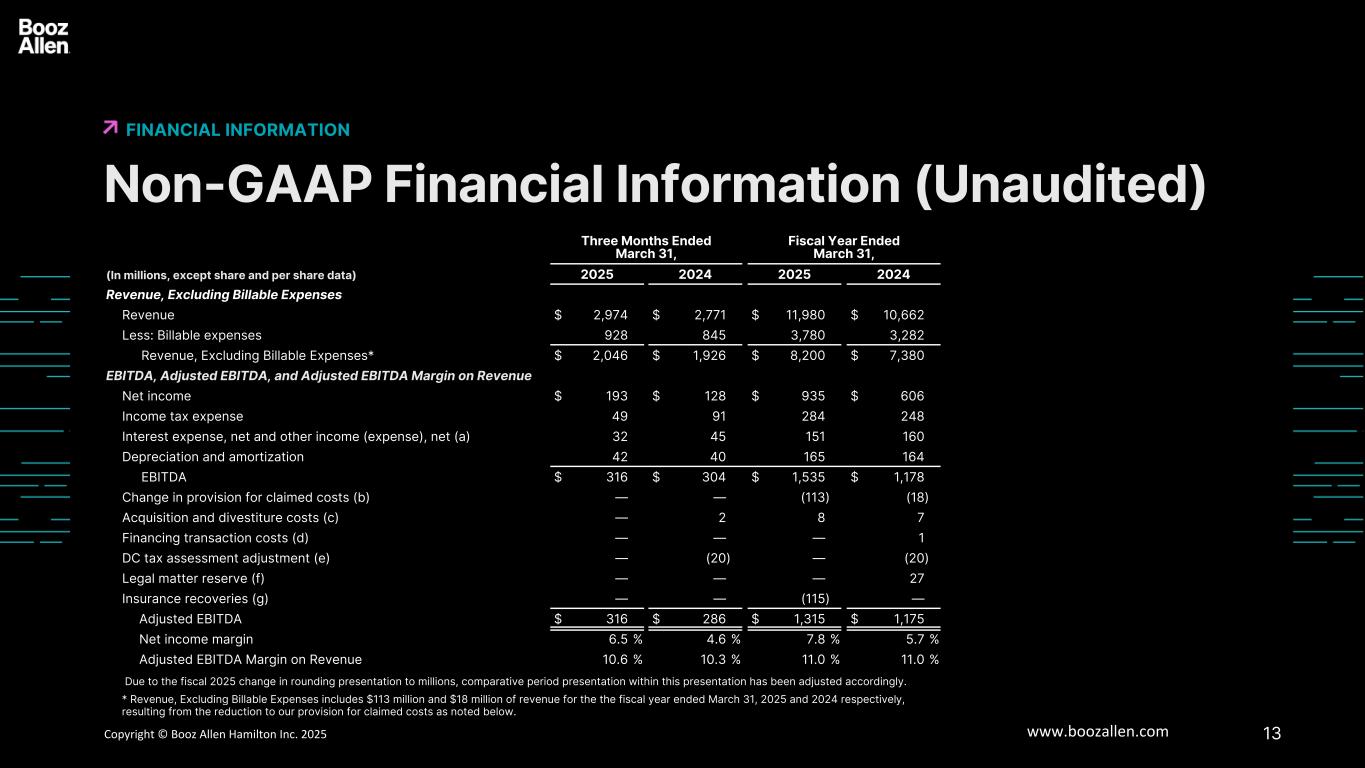
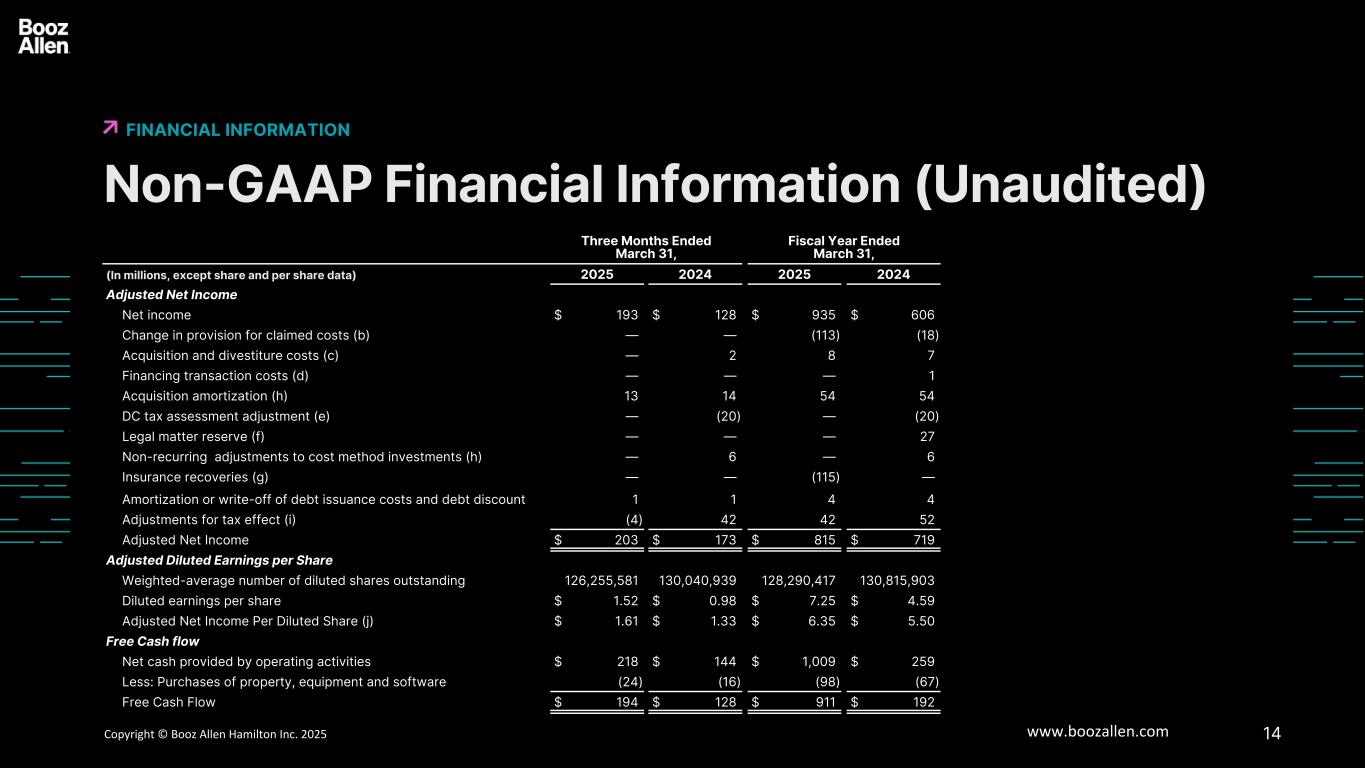
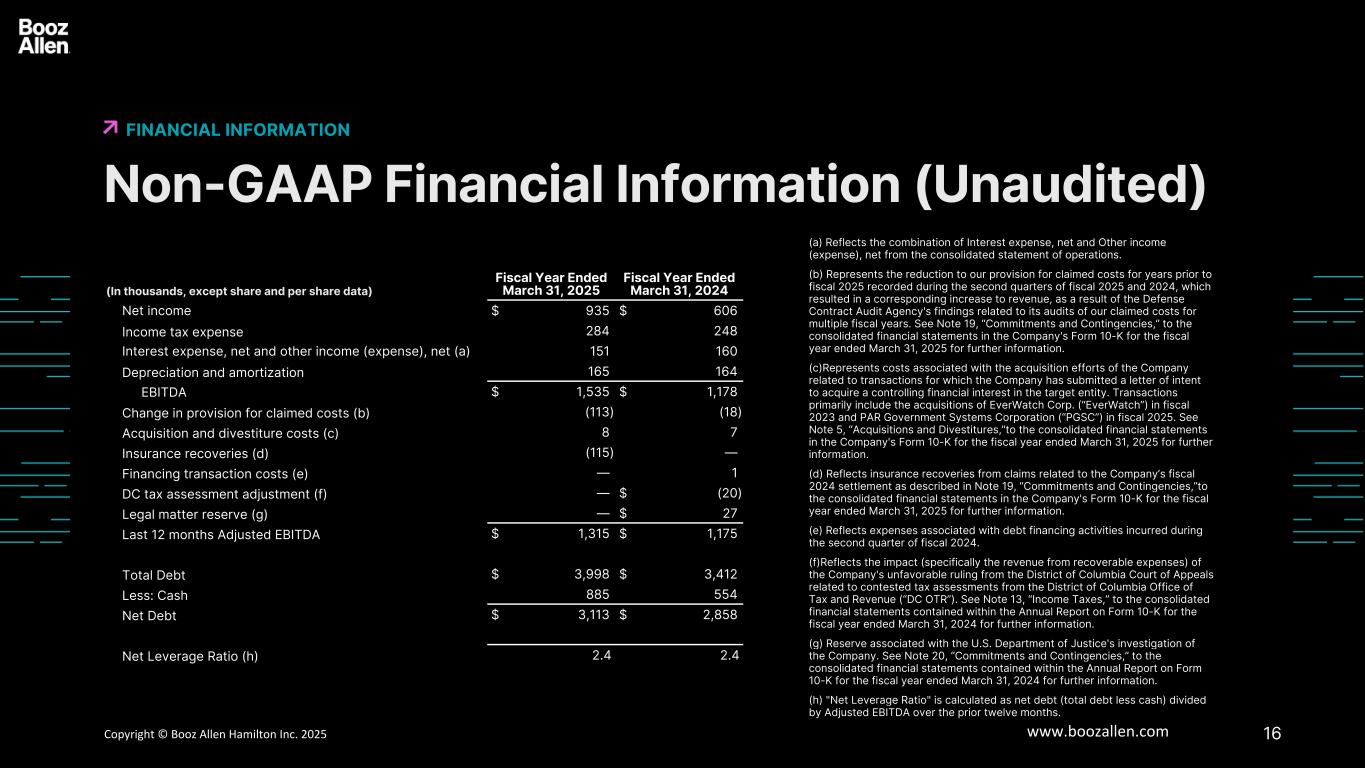
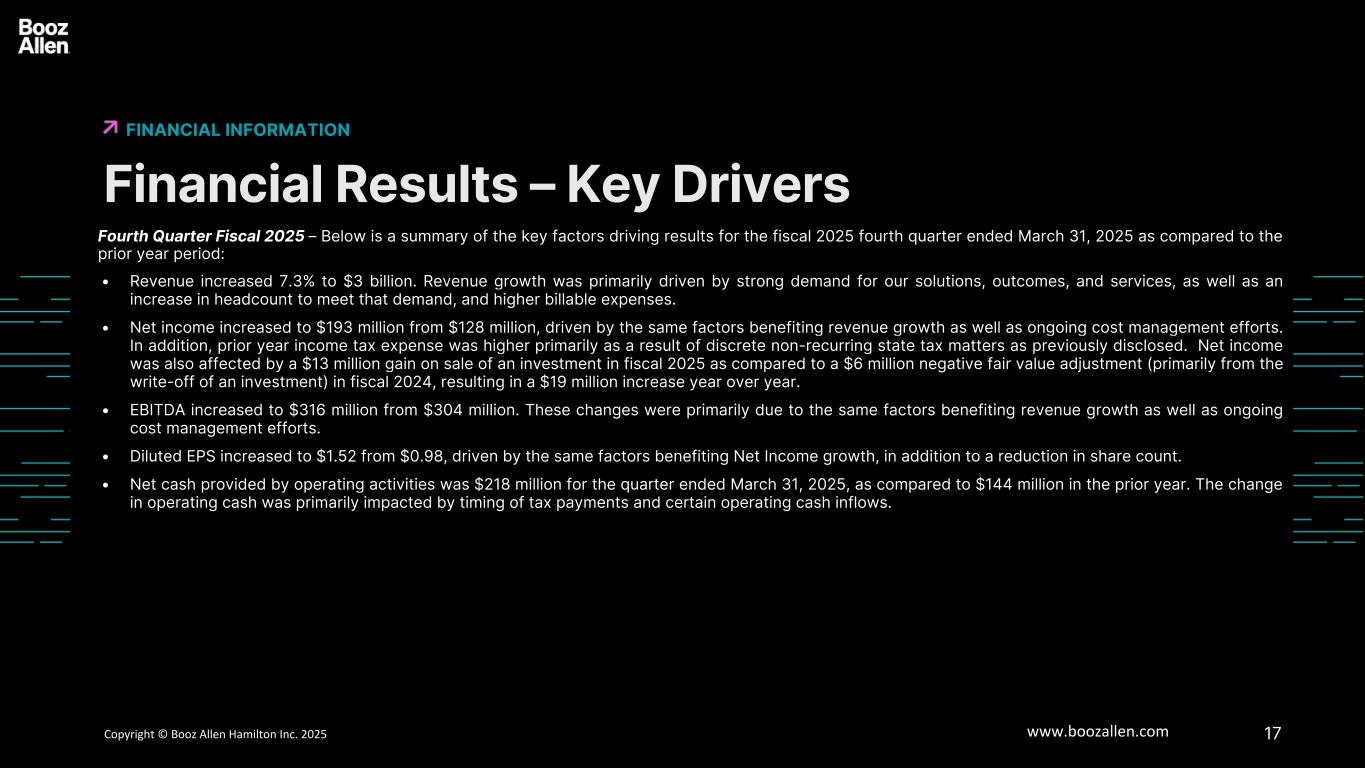
Thank you, Horacio. Good morning, everyone. I also want to take a moment to express my sincere appreciation for the hard work and dedication of Booz Allen Hamilton Holding Corporation's people. We are in a period of rapid change; technology is changing, our missions are changing, and our customers are changing. Booz Allen Hamilton Holding Corporation's people continue to lean into this change. They are rising to the challenge of transforming Booz Allen Hamilton Holding Corporation and delivering the technology and mission outcomes that this country needs. I am confident that Booz Allen Hamilton Holding Corporation will continue to deliver significant value to our customers, our nation, and our shareholders. We said on our most recent earnings call that we anticipated a period of short-term disruption, a slowdown in the procurement environment, particularly in our civil business, and that this would be closely followed by meaningful new growth opportunities. In his remarks, Horacio described both the disruption and the ample opportunity we are experiencing. You will see the impact of the two dynamics, which are beginning to overlap and are not playing out evenly across our markets in both our results for the fourth quarter of fiscal year 2025 and our guidance for fiscal year 2026. Before we dive into the quarter, I'd like to cover the highlights of our overall performance for fiscal year 2025. Please turn to page five. For the full fiscal year, we delivered over 12% revenue growth, nearly all of it organic. We ran the business efficiently, enabling us to deliver another year of double-digit profit growth. Our adjusted EBITDA increased 12% to $1.315 billion, yielding an adjusted EBITDA margin of 11%. Adjusted diluted earnings per share grew over 15% driven by increased profitability and a lower share count. We generated robust free cash flow of $911 million. We deployed a total of $1.2 billion of capital to generate shareholder value, including repurchasing about 4.3% of our shares outstanding since the beginning of the fiscal year. We did this while maintaining a net debt to adjusted EBITDA ratio of 2.4 times. As Horacio noted, with this performance, we exceeded the ambitious multiyear investment thesis targets put out at our 2021 Investor Day. This was done almost entirely through organic performance and leaves us ample balance sheet capacity to generate incremental shareholder returns in the future. In summary, we delivered yet another excellent fiscal year. I will now turn to our fourth quarter performance. In the fourth quarter, we delivered solid results. For the quarter, top-line revenue grew 7% year over year to $3 billion. Almost all of this was organic. Revenue excluding billable expenses was up 6% year over year. For the fourth quarter, growth was driven by strong performance in our defense and intel businesses, where revenue was up 14% and 5% respectively versus the prior year. Our defense business continues to deliver cutting-edge technical and mission outcomes that are critical to the warfighter and to our nation's efforts to deter our adversaries. Our intel business continues to gain momentum as we are solving some of the nation's most challenging technical and intelligence problems. We anticipate that both our defense and intel businesses will continue to exhibit strong organic growth in fiscal year 2026. For the past few quarters, we have described a slowdown in the civil procurement and spending environment. Over the last few months, these trends accelerated. Since the beginning of April, we have seen a reduction in the run rate on five of our large civil technology projects that we believe will collectively create about a 3% headwind to firm-wide revenue for fiscal year 2026. As Horacio noted, these forces have limited our ability to redeploy staff in the near term, particularly including talent rolling off one of our civil contracts that ended last fiscal year. This slowdown has led to a significant number of affected employees. The impact of the loss of previously disclosed recompete at the VA now represents an additional approximately 3% headwind to our consolidated top line for FY 2026. As a result of these factors, year-over-year revenue in civil was flat in the fourth quarter, and we now anticipate that our civil business will see a revenue decline in the low double digits in FY 2026. However, we do anticipate our civil business will rebound as a number of big transformation and efficiency initiatives for our civil customers are already beginning to take shape. Pivoting now to demand: bookings for the quarter totaled $2.1 billion, resulting in a quarterly book-to-bill of 0.71 times, in line with historical averages. This brought our trailing twelve-month book-to-bill to 1.39 times, above our trailing five-year average of 1.28 times. We ended the year with a record year-end backlog of $37 billion, up 15% year over year. Our qualified pipeline for fiscal year 2026 is $53.4 billion. This is below our record qualified pipeline for fiscal year 2025, but importantly, is higher than our pipeline for fiscal year 2024. Given market dynamics, in the short term, we anticipate more variability converting bookings to revenue than we have seen in previous years. However, we believe we have the backlog, the pipeline, and the big ideas for customer transformation needed to support our medium and long-term growth aspirations. On the talent front, Booz Allen Hamilton Holding Corporation closed the fiscal year with nearly 36,000 employees. Our customer-facing staff grew 4.2% year over year. Due to the contract impacts that we've described, we anticipate approximately a 7% reduction in Booz Allen Hamilton Holding Corporation's staff in the first quarter. This is heavily concentrated in our civil business. We are moving aggressively to right-size our talent base to match immediate contract-level demand and to reshape our workforce for the future. This decision was painful, but by taking this action, we have ensured we have both the capacity to invest in growth and the right talent to deliver against future mission needs. Turning now to profitability, adjusted EBITDA grew to $316 million, up 10.5% over the prior year quarter. This translated to an adjusted EBITDA margin of 10.6%, up 30 basis points over the prior year's quarter. Working down the P&L, our net income was $193 million, up 51% year-over-year. Adjusted net income was $203 million, up 17% from this time last fiscal year. Diluted earnings per share was $1.52 per share, a 55% increase from the prior year period. Adjusted diluted earnings per share was $1.61 per share, up 21% year over year. The increase in fourth quarter EPS was driven by our overall profitability, a reduction in share count, and a gain from the close of the sale of Snap Attack. This was slightly offset by higher net interest expense. Transitioning to the balance sheet, we ended the fiscal year with $885 million of cash on hand, net debt of $3.1 billion, and a net leverage ratio of 2.4 times adjusted EBITDA for the trailing twelve months. During Q4, we executed a $650 million bond issuance. This transaction was well received by the credit markets and provides us with additional liquidity and the capacity to opportunistically deploy capital. Free cash flow for the quarter was $194 million, resulting from $218 million of cash from operations less $24 million of CapEx. Moving now to capital deployment: during the quarter, we deployed a total of $403 million to generate value for shareholders. This included $310 million in share repurchases at an average price of $118.96 per share. We also made $23 million in strategic investments, including our recently announced investment in Shield AI. Finally, we paid $70 million in quarterly dividends. Today, we are pleased to announce that our Board of Directors has approved a quarterly dividend of $0.55 per share, which will be payable on June 27th, to stockholders of record as of June 11th. We continue to have a very strong balance sheet, giving us flexibility in how we operate our business and the ability to deploy capital in response to the evolving environment in ways that generate additional value for shareholders. Now please turn to page nine for our outlook for fiscal year 2026. As Horacio acknowledged, today's environment is extremely dynamic. We have less visibility into the forces that will shape business performance than we typically have at this point in our fiscal year. Our fiscal year 2026 outlook is informed by our current assessment of the many factors that will drive performance. This includes anticipated growth in our defense and intel businesses and a near-term reset of our civil portfolio. Our fiscal year 2026 guidance is as follows: we expect to deliver revenue between $12 billion and $12.5 billion. We expect to generate adjusted EBITDA dollars in the range of $1.315 billion to $1.37 billion, which implies a full-year adjusted EBITDA margin of about 11%, on par with fiscal year 2025. We expect adjusted EPS to be in the range of $6.20 per share to $6.55 per share. This assumes an adjusted effective tax rate between 23% and 25% as well as a marginally higher interest expense. It does not assume any impact from our venture investments. Lastly, we expect free cash flow to be between $700 million and $800 million. As we forecast our growth cadence for the full year, we anticipate that revenue and profit growth will be comparatively lower in the first half, particularly in our second quarter given the strong prior year comps and the impact of the one-time actions we've described today. We then anticipate a meaningful reacceleration in the second half. This is based on the strength of our backlog, the size of significant recent wins in our opportunity pipeline, and the expectation of a meaningful uptick in hiring. In closing, we could not be prouder of how we finished fiscal year 2025, the final year of our investment thesis. Our results show our relentless focus on the mission, on operational excellence, and on generating shareholder value. Booz Allen Hamilton Holding Corporation continues to transform. While cognizant of the uncertainty in our environment, we are excited about our strategic direction, our alignment with the government's mission priorities, and our central position in the evolving technology ecosystem. We remain very optimistic about the future. With that, operator, let's open the line for questions.
Operator
And thank you. As a reminder, to ask a question, simply press star one one on your telephone and wait for your name to be announced. To remove yourself, press star one one again. Any comments from the line of Gavin Parsons with UBS. Please proceed.
Speaker 4
Hey, thanks, guys. Good morning.
In this environment of unpredictable descoping and cancellations, how do you get comfortable that you've got your arms around the impact and that there's not potentially more to come throughout the year? Hey, Gavin. Thanks for the question. Let me try and frame the entirety of what we see and try and answer your question from that perspective. I'll start by saying I'm very proud of the last year and the last three years. Our ability to demonstrate significant shareholder value creation through what was already a changing environment. As we look at the world now, we are seeing two sets of overlapping dynamics. One set of dynamics is, as we said in the prepared remarks, our civil business is going through what we hope will be a one-time reset where most of the reviews have been concluded very positively regarding our technology and our work. However, we're facing this deceleration at a time where procurements are still somewhat frozen. On the other side of the dynamic is continued strength in our defense business and growing strength in our intelligence business. So that's sort of one set of dynamics. The other dynamic is while we have seen, especially in civil, some of these resets, which, by the way, were mostly due to the slowdown in spending against a few technology contracts. There have been relatively few outright cancellations, tracking to what is really a legacy consulting-type work. On the other side of it, we are still winning work against a strong procurement environment in defense and intel. Even in civil, we're beginning to see opportunities take shape that we will take advantage of. Our approach has been to take significant restructuring in our civil business now so that we are positioned to grow and can invest across the portfolio. Because the environment in defense and intel is so dynamic, the procurement activity is still strong, and we are in a position to absorb things there as well and continue a strong growth vector as we see it right now. From a strategy standpoint, we believe we are well aligned and positioned against both the key missions, the key technologies, and major opportunities we see on the horizon.
Speaker 4
Thank you. I'll leave it at one. Appreciate it.
Operator
Our next question comes from the line of Collin Kenfield with Cantor Fitzgerald. Please proceed.
Speaker 5
Hey. Maybe if we could talk about some of the comments you made around kind of reset and what your expectation is on the multiyear growth environment. Maybe just kind of digging into how you think about defense and civil and where we stand on the reality of FY 2025 supplemental requests. Kind of what they're hearing from congressional folks. And then Matt, if you could talk about kind of how you think about repurchases and what the vote is for the year? Thanks.
So why don't I start with the macro level and then maybe Christine can talk a little bit about each one of our markets, and then Matt will cover your second question. I guess the way we see the environment very much matches the budgetary environment. The bill that is making its way to the senate as we speak has a significant plus up for defense. At the same time, they have stated a priority about reducing spending on some of the civil agencies. Our civil business has already gone through the majority of its reviews, and in defense and intel, this is what we're seeing: doubling down on priorities around the Indo Pacific region, where Booz Allen Hamilton Holding Corporation has a strong footprint and a lot of growth opportunity in space, including programs already underway where we have strong places and opportunities for Golden Dome where we believe we have unique technology and capability to bring to bear. Then, on the defense of the homeland, there is focus on the integration of various intelligence analyses and the civil agencies that are responsible. What they're trying to do is inject technology, a lot of commercial technology such as AgentTech AI. The discussion has really moved away from whether AI is important to national security to how quickly we can implement AI in that space. Booz Allen Hamilton Holding Corporation has a tremendous track record in that regard.
Speaker 6
I would say, for our civil business in particular, while there have been some slowdowns in contracts, it really reflects the administration's desire to tackle big challenges and to advance technology even faster. We have been excited about the opportunity to present our ideas. We have developed and are in discussions with the government on many big ideas, and we are getting really positive responses. It's exciting to be asked to extend some successful tech solutions in one mission to others, and we were ready for that. We had already been piloting AI-assisted coding and Agentic AI on large software programs that have insatiable requirements. We are able to lean into the call for efficiencies and move past the pilot to full production across the program. This is a win-win-win for us, the government, and the Americans that are served by that program. In defense and intel, the business remains strong and is well aligned with the administration's priorities to counter China and protect the homeland. We anticipate that our counter-terrorism expertise will position us well against sophisticated threats, and we have also presented bold ideas in those discussions.
Gavin, I'll take your balance sheet capital deployment question. Obviously, the balance sheet continues to be a strength of ours. We deployed a billion two last year, and we've maintained leverage. The strength of our organic growth over the past couple of years allowed us to deploy a lot of capital to generate value for shareholders. We've demonstrated our ability to consistently deploy capital, but also to be flexible across various modalities of capital deployment where we believe we can generate the most value. We will buy back our shares because we believe it's good value for shareholders. We're still committed to M&A, leaning more towards tuck-in acquisitions given how rapidly the technology market is changing. We also plan to invest more in the venture side, seeing tremendous value from both a financial and strategic perspective. We remain committed to being a commercial technology accelerator.
Speaker 5
Got it. Thank you for the color.
Operator
Thank you. One moment for our next question. And it comes from Sheila Kahyaoglu with Jefferies. Please proceed. Good morning.
Speaker 7
Hi. I see Matt and Christine. Thank you. So maybe if we could start with two questions for you guys, and you could hear me okay?
Can you speak a little louder? It's a little quiet in the room.
Speaker 7
Oh, sorry about that. Maybe we could talk about the low double-digit decline for civil and fiscal 2026. How do we think about the catalyst for that stability in the business? We're talking about second half improving. In terms of maybe a few points of that, how do we think about other program specifics that are driving it? And when do you think about the improvement in civil again?
Speaker 6
Yeah. The vast majority, as Horacio mentioned, of our civil programs have already been reviewed. I would remark that we weren't targeted in those reviews. What we saw was agencies and departments looking at their full portfolio with targets in mind and whether it was on or off the GSA list. This is really agency driven. Our tech and our talent fared well in those reviews; however, there has been a short-term slowdown in the actual burn rates as they start to position for some of the transformation objectives that they have in bringing new tech in. Our view overall is that to win in that environment, three things must be true: One, the tech needs to be excellent, and we have received high marks for our technical work and quality of our people. Two, you have to have a vision around how that tech will evolve in a direction that makes sense to commercial tech leaders, coming from outside government. For example, our cloud, AI-assisted coding, and Agentic AI have been recognized, and that's already leading to new opportunities. Third, you have to be willing to convert your contracts to outcome-based, particularly in civil. We've been advocates for that shift because we prefer that agility and flexibility in the tech and staffing.
Yeah. The only thing I'd add is that we intended to do a one-time reset and restructuring of our civil business so it can regain a growth trajectory quickly. Because of the timing, it may take through next quarter to work itself through the financials, but we are beginning to see opportunities, as Christine said. With any new administration, the procurement environment slowed down significantly, almost froze in several agencies as people waited to see what the specific agendas were. Now that those are beginning to get fleshed out, we're getting strong indications that our technology aligns well with what they are trying to do, and we'll see growth in the second half.
Speaker 7
Got it. And then maybe if we could just talk about your typical revenue algorithm. It's usually based on headcount and salary composition. So how do we think about the down 7% in Q1 for headcount? I think that was total company. How do we bridge that to the revenue of flat to up low single digits?
I'll start. You are correct. The 7% was total company, but it is very heavily concentrated in our civil business. Our business is changing, and there are three dynamics where the traditional algorithm may look a little different than what we've experienced in the past. First, we referenced in the prepared remarks, we're actually winning a lot of work. Our book-to-bill last quarter was 0.7 times, very much in line with historical averages, winning over two billion dollars in work particularly in our defense and intel spaces. We anticipate our book-to-bill this quarter will be in line, if not better than historic norms. The second factor is the move to outcome-based contracting, which we've advocated for years. Over time, you would expect that to be accretive to margins. Finally, the third factor is what you referenced, which is the traditional headcount math. We mentioned that most of our business is not fixed price. Typically, the algorithm is headcount growth plus 3%. Since the reductions we are seeing are primarily in civil, which is more fixed price, the traditional formulas might not apply here as strictly. That said, particularly in our defense and intel business, account tends to be the best predictor in the near term of what revenue looks like. When you add it all up, particularly given the strong prior year's comps, we expect our first half this year to be under pressure, but expect acceleration in the back half.
Speaker 6
I would add that we're always hiring; we add hundreds of employees every month. We expect to add significant headcount in the second half of the year, and we have really matured our AI-enabled advanced tech solution that we use for recruiting and deployment of staff. We're looking to be even more effective at that this year.
Speaker 7
Got it. Thank you.
Operator
Thank you. One moment for our next question. And it's from Ronald Epstein with Bank of America. Please proceed.
Speaker 8
Yeah, hey, guys. I'm on for Mariana today. She's traveling.
Speaker 8
Just a couple of things. You alluded to it earlier. If the government is looking for more commercial terms even in defense, how do you invest in the right things to do that? How are you set up to do that? It does seem like in the defense market, the government is looking at different ways of contracting, and there is a bigger push for commercial terms. So how do you think about it, and how does that impact your business?
Hey, Ron. Yeah. I'll start. The trend you're pointing out is one we have been tracking for a while, and it is accelerating. We have built partnerships and made investments all the way from hyperscalers to startups, and we've been doing that for some time. It's fair to say that we are the preferred player in helping commercial solutions be missionized in a way that makes sense. We've created the capacity to co-create with them. For example, even edge cloud solutions that have been created for commercial markets assume a degree of connectivity that doesn't happen in space or underwater. We have built our own tech to solve those kinds of problems and are recognized for that. This trend toward utilizing commercial tech for defense is a net positive for Booz Allen Hamilton Holding Corporation, as we're partnering to create those solutions.
Speaker 8
Got it. Got it. And then, as a follow on, and I think Sheila was getting at this, but maybe softer, but I'll be more direct. It does seem like, perceptually, you guys have a branding issue. Every kind of article we saw about consulting and government contractors, Booz Allen Hamilton Holding Corporation pops up all over the place. Seemingly, from my vantage point, that seems unfair. But that being said, why do you think that's the case? And what do you do about pivoting into a better spotlight in government?
You know, I think a couple of things about this. First, when you are the market leader, you're the most interesting to write about, and we have the distinct pleasure of being written about frequently. We tend to be humble and relatively quiet about our communications; we've always wanted our customers to take credit for their wins because it's ultimately their decisions supported by our technology. We find ourselves in that reality, and what we do about it is that we've gotten better at telling our story, and I think it's resonated. Some of what you've seen is that we're in the media more, clarifying our position as an advanced technology company. The number of conversations we are having across the administration and the relationships we're building are critical. Once people interact with the technology we've built, that speaks louder than any article. I believe our brand will be strengthened as a result of all this scrutiny.
Speaker 8
Got it. Alright. Thank you.
Operator
Thank you. Our next question is from Louie DiPalma with William Blair.
Speaker 9
Horacio, Matt, Christine, and Dustin, good morning.
Hey, Louie. Good morning.
Speaker 9
You have several large AI contracts including the joint warfighter national mission initiative, EMAP 2.0 and Advana. It seems these programs have experienced tremendous success over the years and very wide adoption. Are you still excited about the future of these programs? I think you mentioned how your AI business has grown to over $800 million, but with a lot of the scrutiny, has there been any changes to your optimism for your AI business, particularly with the Department of Defense?
I think AI is a strength of Booz Allen Hamilton Holding Corporation. I believe people recognize it, and it is increasingly embedded in everything we do. We are not seeing AI as a question of whether it's good for the mission or if the Department of Defense will adopt AI. The question is now how quickly we can bring the right technologies and make commercial technology safe, reliable, and secure for use in these missions. We have a track record that is unmatched. Additionally, the move to Agentic AI is going to be transformational for the global economy and security missions. Booz Allen Hamilton Holding Corporation has a leading position in this area. We've conducted research that is breakthrough in physical AI, which is key to autonomy and digital twins. There is significant potential for Booz Allen Hamilton Holding Corporation.
Speaker 9
Great. And I guess drilling a little deeper with Advana, do you expect to continue to be the main delivery partner with Advana? Similarly, with Thunderdome, you just mentioned cybersecurity and Zero Trust, and you're partnering with several commercial vendors there. For these big programs, do you expect to continue to add value for the DOD?
In both cases, along with many other large technology programs, we believe the reason these programs have been so successful is that we've not started from scratch. We took the best commercial technology and work we've done to create complete solutions addressing mission needs. We are bullish about our ability to continue working there, incorporating new commercial technologies into these missions that will run more efficiently and effectively.
It's under them, in particular, but also a number of other large technology programs we are actively working to convert to outcome-based contracts. These programs are ripe for such a shift, and we look forward to continuing to work with our customers to drive this transformation across our large technology projects.
Speaker 9
Great. Thanks, everyone.
Operator
Thank you. Our next question is from Scott Mikus with Melius Research. Please proceed.
Speaker 10
Morning. Horacio, in the wake of the Budget Control Act, 2011, and sequestration, there was a lot of consolidation in the industry. It seems if the government wants to drive efficiencies, they probably need to consolidate contracts. Do you expect this to drive a push or another wave of consolidation among government services providers?
Let me start by saying that when you look at this industry, it is actually quite fragmented. If you aggregate it, the top number of players collectively represent a single-digit share of the available market. In processes like this, there are companies that take share and others that lose it, leading to changes in the industry. We are seeing new defense tech companies entering the field, creating solutions that weren't there before, and we look strongly to align with them. I believe Booz Allen Hamilton Holding Corporation is being aggressive. We have a strong balance sheet, and we are not standing still; we will continue to position ourselves to drive shareholder value.
Speaker 10
Okay. And then thinking about the non-client facing headcount, I think it was down a hundred people quarter over quarter. You called out the 7% headcount reduction in Q1 largely in your civil business. Your margin guide is flat year over year. Is there upside to the margin or EBITDA guidance if you reduce that non-client facing headcount more? Do you keep those savings, or do they end up being passed back to the customer?
We have been aggressively managing our total cost structure. Historically, our civil business has been more profitable than average, and we're pleased with our ability to maintain margins even while resetting our civil business. We are also able to invest and grow because we're continuing to invest ahead in building new technologies and acquiring new technical talent. We've been getting leaner over the past few years, leading to scale in the business, and we anticipate continuing this trend. However, I would not expect near-term upside in the margins. We anticipate increased potential in the long-term as we shift to outcome-based contracts.
Speaker 10
Okay. Thanks for taking the questions, and enjoy the long weekend.
Operator
And this concludes our Q&A session. I will turn it back to Horacio Rozanski for final remarks.
Thank you, Carmen, and thank you all for your questions and for being here with us this morning. I hope that Matt, Christine, and I conveyed both a sense of our near-term priorities and also our optimism about what's ahead for our people, for our customers, and for our investors. We are on the positive side of change, strategically positioned for an era of tech-driven growth, and we're doubling down on what Booz Allen Hamilton Holding Corporation does best: using advanced technology to keep America strong and safe. I appreciate all of you being part of how we do that.
Speaker 1
Thank you for joining us today.
Operator
Thank you all for participating, and you may now disconnect.