Operator
Hello, and welcome to BCP Investment Corporation's fourth quarter and full year ended December 31st, 2025 earnings conference call. An earnings press release was distributed yesterday, March 5th, after market close. A copy of the release along with an earnings presentation is available on the company's website at www.bcpinvestmentcorporation.com in the investor relations section and should be reviewed in conjunction with the company's Form 10-K filed yesterday with the SEC. As a reminder, this conference call is being recorded for replay purposes. Please note that today's conference call may contain forward-looking statements which are not guaranteed future performance or results and involve a number of risks and uncertainties. Actual results may differ materially from those in the forward-looking statements as a result of a number of factors, including those described in the companies filing with the SEC. BCP Investment Corporation assumes no obligation to update any such forward-looking statements unless required by law. Speaking on today's call will be Ted Goldthorpe, Chief Executive Officer, President and Director of BCP Investment Corporation, Brandon Saturn, Chief Financial Officer, and Patrick Schaefer, Chief Investment Officer. With that, I would now like to turn the call over to Ted Goldthorpe, Chief Executive Officer of BCP Investment Corp. Please go ahead, Ted.
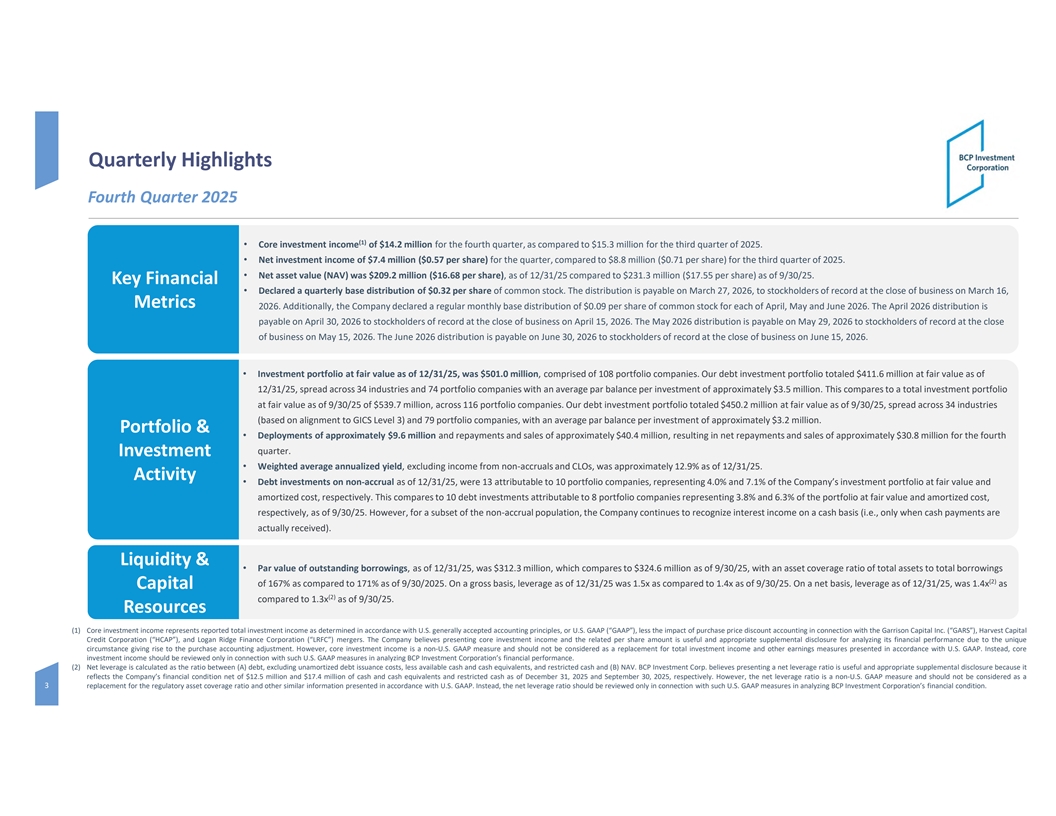
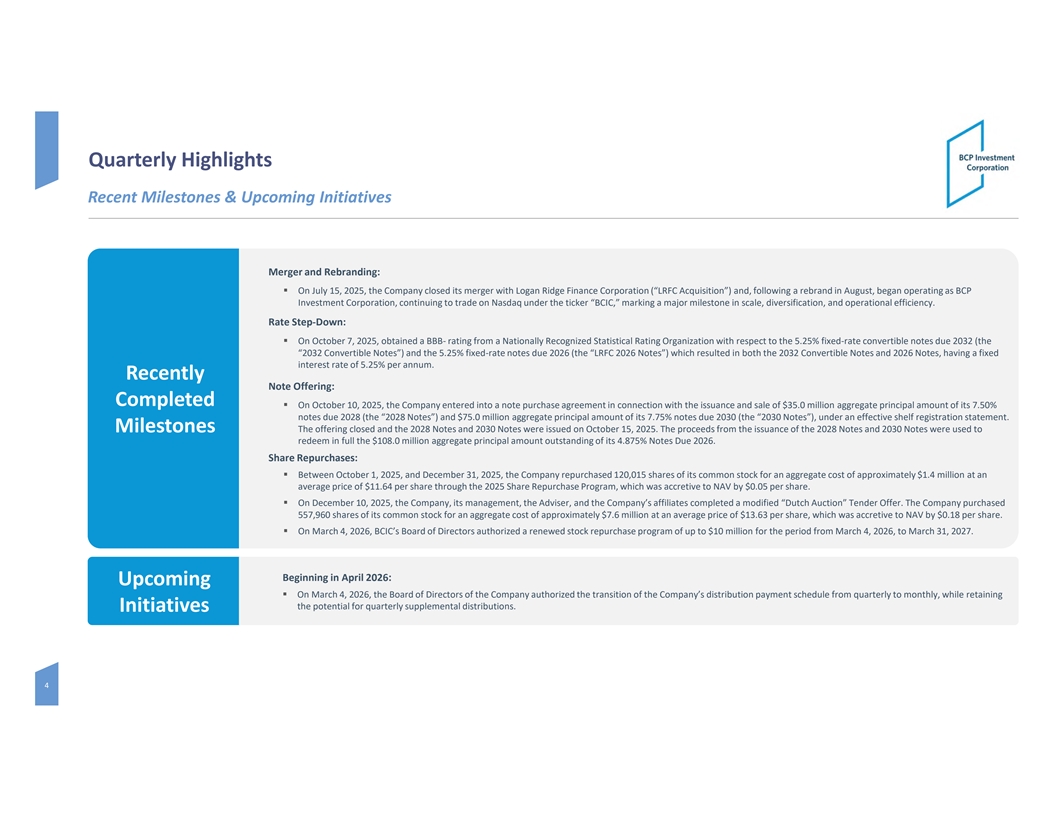
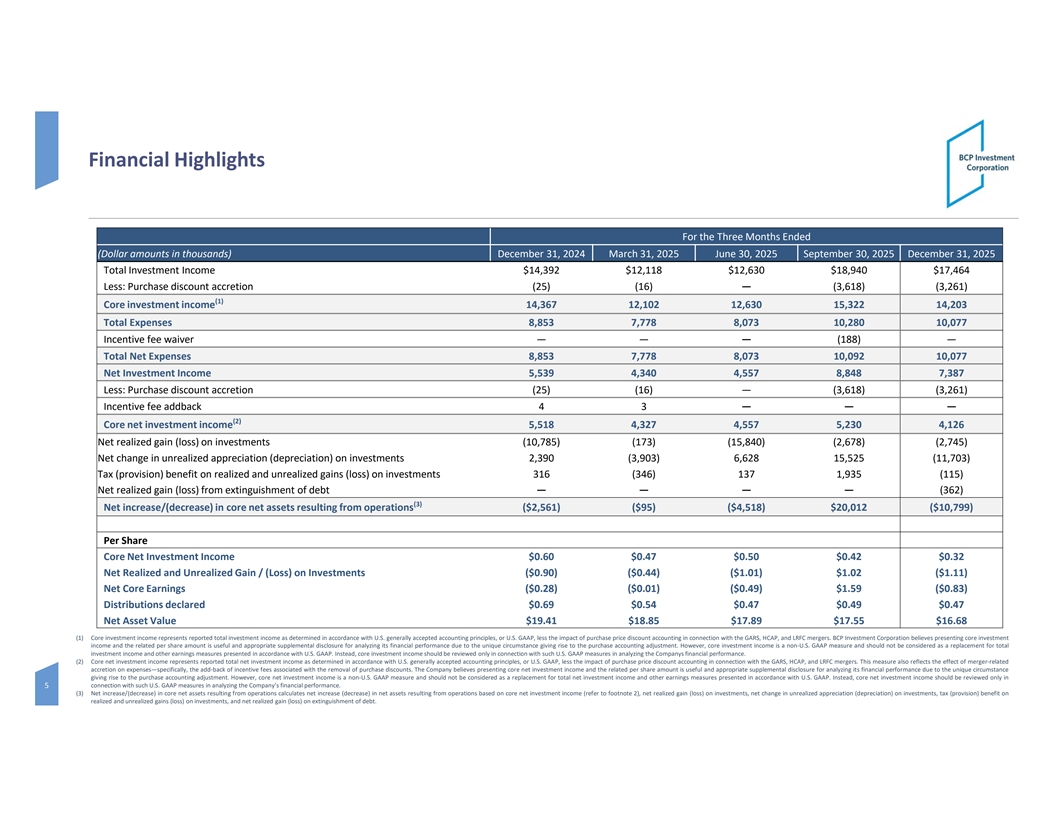
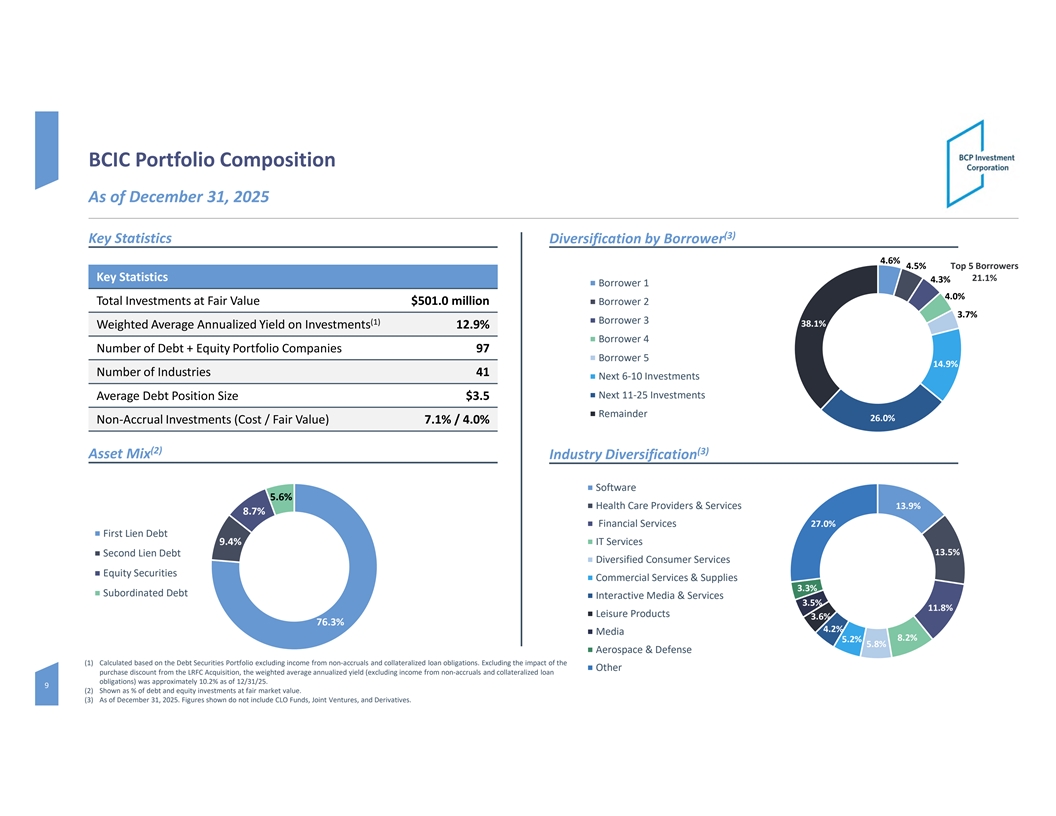
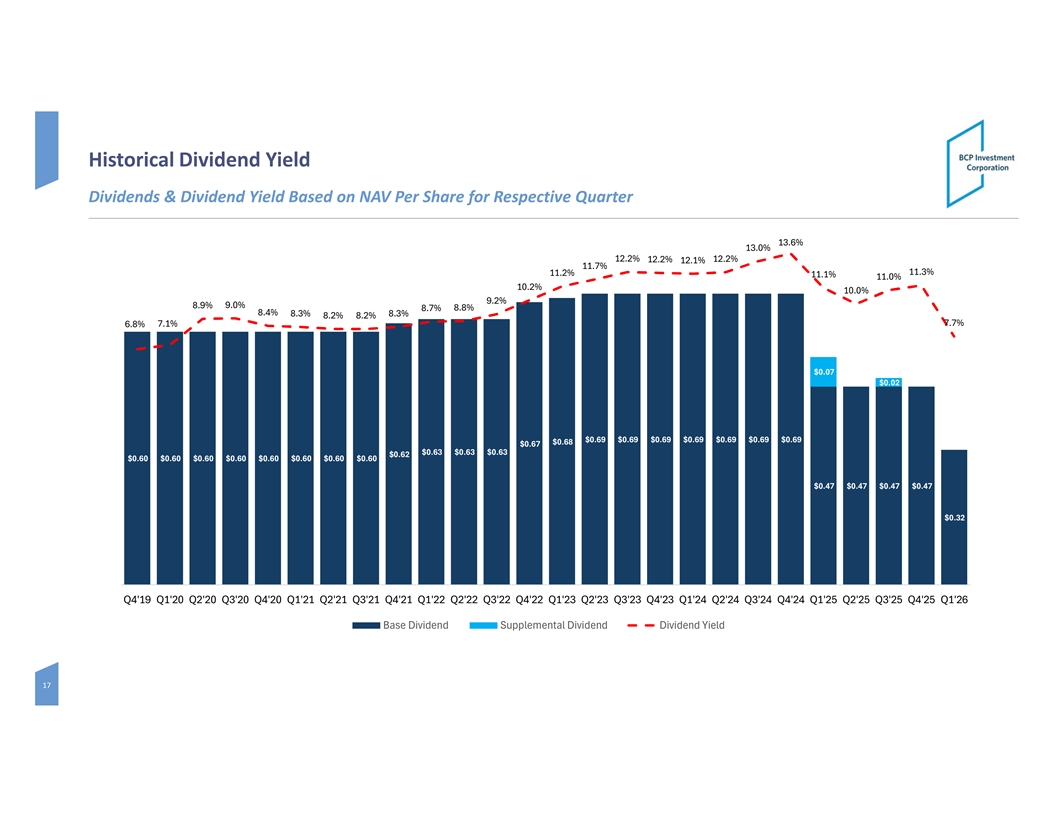
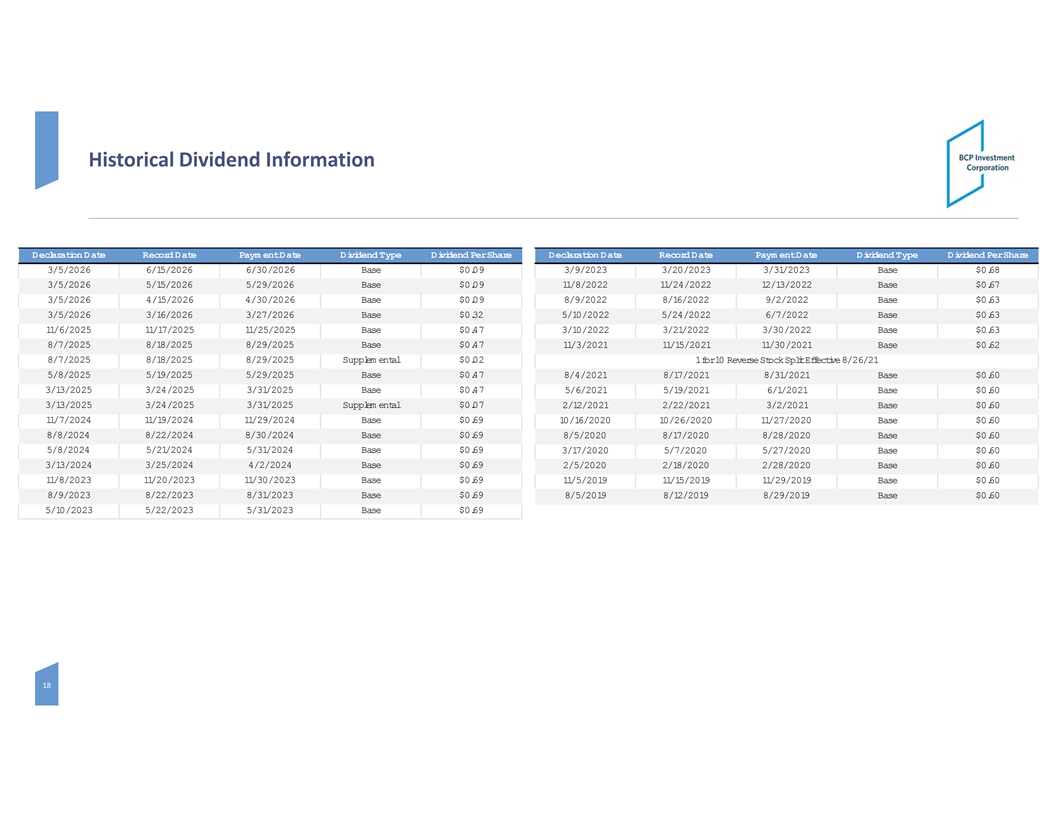
Ted Goldthorpe Good morning. Welcome to our fourth quarter and full year 2025 earnings call. I'm joined today by our Chief Financial Officer, Brandon Satoran, our Chief Investment Officer, Patrick Schaefer, and the rest of the team. Following my open remarks on the company's performance activities during the fourth quarter and full year, Patrick will provide commentary on our investment portfolio and our markets, and Brandon will discuss our operating results and financial condition in greater detail. I'd like to start by discussing some highlights, as 2025 was a transformational year for the company. In July, we completed our merger with Logan Ridge, and in August, we successfully completed a rebranding and name change. The merger meaningfully strengthened our platform, expanded our scale and broadened our portfolio diversification. At the same time, our rebranding better reflects our affiliation with the broader BC Partners credit platform and is a representation of our long-term vision as we position the company for its next phase of growth. In December, we completed our tender offer by purchasing roughly 558,000 shares at an aggregate cost of approximately $7.6 million, which was accretive to NAV by 18 cents a share. Consistent with our diligent capital market management strategy, during the year, we also proactively extended and laddered our unsecured debt maturities, issuing $75 million of seven and three-quarters notes due October 2030 and $35 million of 7.5% notes due October 2028, while also redeeming our four and seven-eighths notes due 2026. These actions further diversified our funding base and provide us with enhanced financial flexibility. As a result of this year's performance and the successful execution of multiple strategic initiatives, the Board of Directors approved a quarterly base distribution of $0.32 a share for the quarter headed March 31, 2026. Additionally, the Board also approved the transition of the company's base dividend payment schedule from quarterly to monthly beginning in the month of April 2026 while retaining the potential for quarterly supplemental distributions. We believe this change better aligns our distribution schedule with shareholder interests. The Board approved a regular monthly base distribution of nine cents per share for each of the months of April, May, and June, 2026. Also consistent with previous years, on March 4th, 2026, the Board authorized a renewed stock purchase program of up to $10 million for approximately a one-year period. All these initiatives I've discussed are designed to enhance shareholder value and reaffirm our commitment to shareholders. During the quarter, we generated net investment income of $7.4 million or $0.57 a share, compared to $8.8 million or $0.71 per share in the prior quarter. For the year, we generated $25.1 million or $2.28 per share, compared to $24 million or $2.59 per share for 2024. We remain focused on executing our strategic initiatives, managing expenses, optimizing portfolio positioning for earnings and distribution coverage over time. Before handing the call over, I'd like to take a moment to address recent developments in the broader credit markets, specifically regarding the software segment. Over the last several weeks, we've seen a notable risk-off move in public software valuations, driven largely by uncertainty and speculation around how quickly AI adoption might change competitive dynamics, rather than broad-based fundamental deterioration across the sector. As a reminder, BCIC remains broadly diversified with investments across 34 industries and software representing approximately 12.5% of the portfolio's fair market value. We are proactive in evaluating our software-related exposure through AI disruption lens. Based on our internal review, the overwhelming majority of software exposure we track is assessed as low to medium AI impact and only a small portion is viewed as high impact. We also believe the market will increasingly differentiate between companies that are mission critical and embedded in customer workflows, often supported by proprietary data, higher switching costs, and customers operating in regulated industries, versus simpler point solutions that may be more vulnerable if they fail to incorporate AI into their products and operations. As a result, our focus remains on sale activity and credit quality structure, with underwriting and monitoring that emphasizes revenue, durability, retention, pricing power, and downside protection. Looking ahead, while macroeconomic headwinds persist, we believe current market dynamics continue to create compelling opportunities for our discipline strategy. We anticipate that 2026 will bring increased activity in the M&A market and expect to capitalize on opportunities in our portfolio. With a larger, more diversified platform and a stronger balance sheet heading into the year we believe we are well positioned to drive continued earnings growth and long-term value creation with that i will turn over the call to patrick schaefer our chief investment officer for a review of our investment activity thanks ted during the fourth corner we were
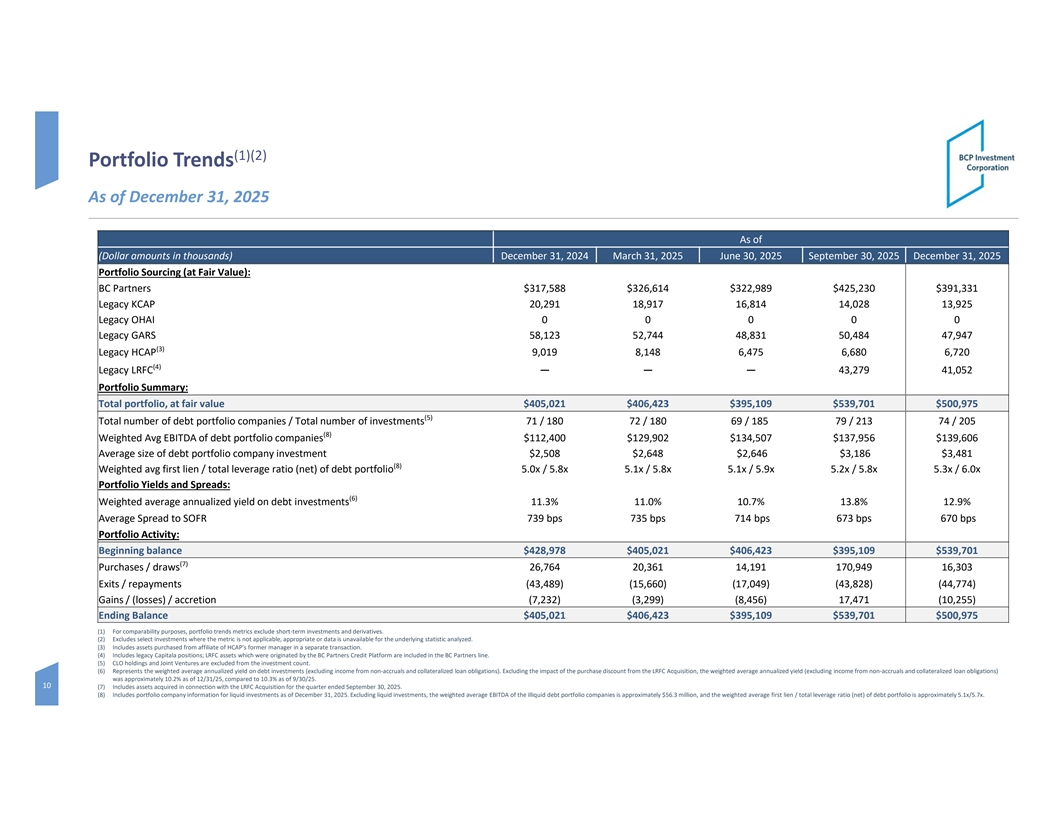
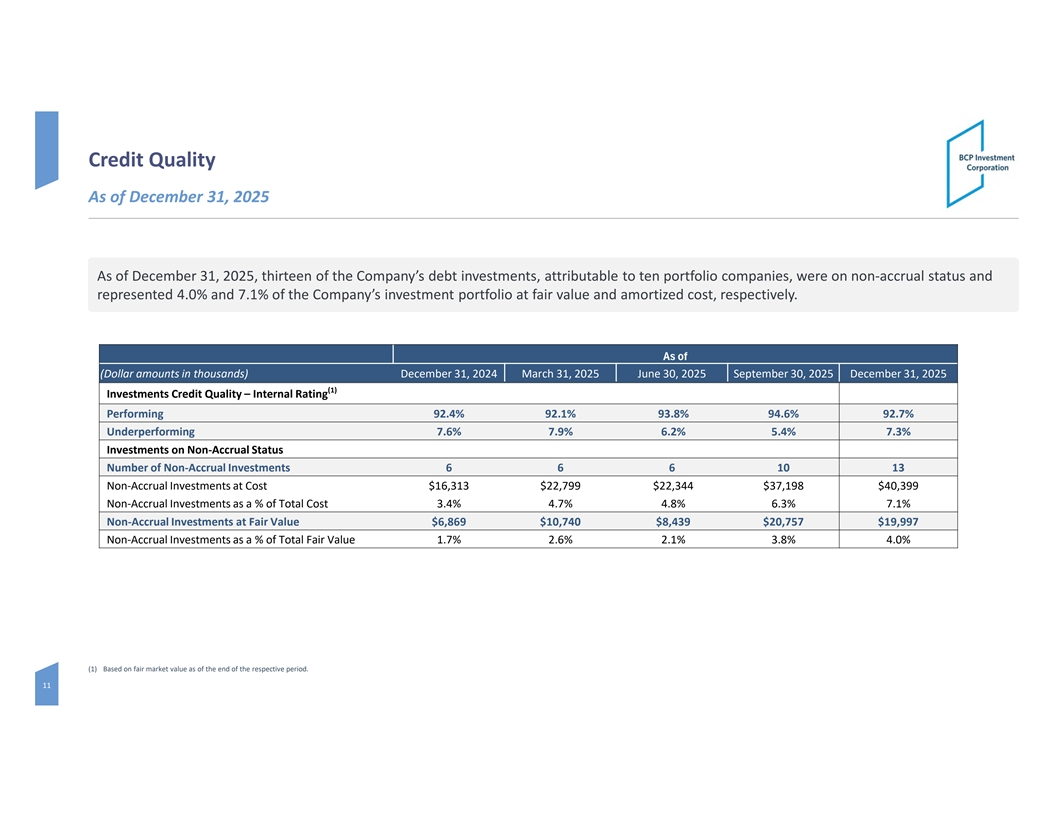
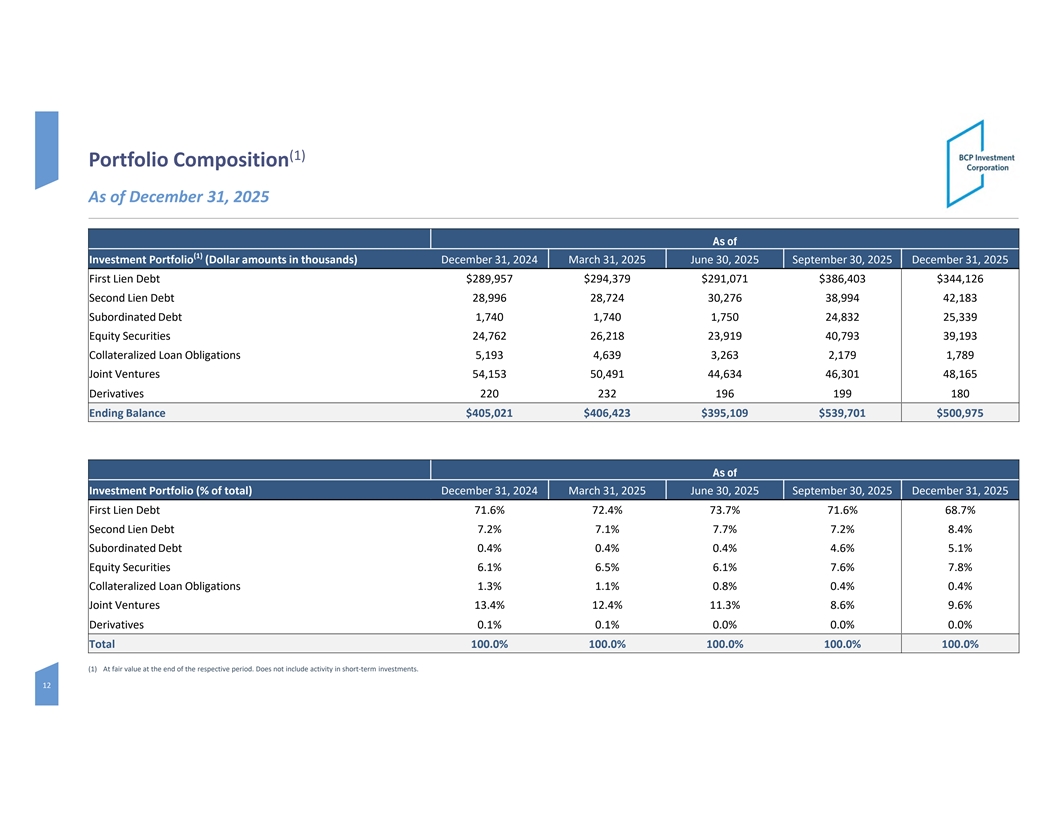
intentionally prudent in new investment deployment as we executed on several key capital initiatives including our debt refinancing and tender offer we view this as disciplined capital management and we are looking to deploy into attractive opportunities as conditions warrant Competition remains elevated across sponsored backtrack lending, particularly for higher quality assets, and we continue to see lenders competing not only on spreads, but also on terms and certainty of execution. In environments like these, we continue to stay disciplined, prioritizing transactions where we can achieve appropriate economics alongside strong documentation and downside protections. When pricing returns aren't compelling, they are comfortable stepping back and continue to be selective from a credit quality perspective to focus on maximizing risk-adjusted returns for our shareholders. Turning to slide 10, originations for the fourth quarter were $9.6 million and repayments and sales were $40.4 million, resulting in net repayments and sales of approximately $30.8 million. Overall yield on par value of new debt investments during the quarter was 11.8%. This compares to a 12.9% weighted average annualized yield, excluding income from non-accruals and collateralized loan obligations, as of December 31st, 2025. Our investment portfolio at year-end remained highly diversified. At the end of the year with the debt investment portfolio, when excluding our investments in CLO funds, equities, and joint ventures, spread across 74 different portfolio companies and 34 different industries, with an average par balance of $3.5 million per investment. During slide 11, at the end of 2025, we had 13 investments on non-accrual status, which were attributable to 10 portfolio companies, representing 4.0% and 7.1% of the portfolio at fair value and cost respectively. This compares to 10 investments attributable to eight portfolio companies on non-accrual status as of September 30, 2025, representing 3.8% and 6.3% of the portfolio at fair value and cost respectively. On slide 12, excluding our non-accural investments, we have an aggregate debt investment portfolio of $391.7 million at fair value, which represents a blended price of 92.7% of par value and is 81.5% comprised of first-name loans at par value. Assuming of our recovery, our December 31, 2025 fair values reflect a potential of $30.9 million of incremental NAV value, or a 14.8% increase to NAV. When applying an illustrative 10% default rate and 70% recovery rate, our debt portfolio would generate an incremental $1.46 per share of NAV, or an 8.7% increase as it rotates. I'll now throw the call over to Brandon to further discuss our financial results for
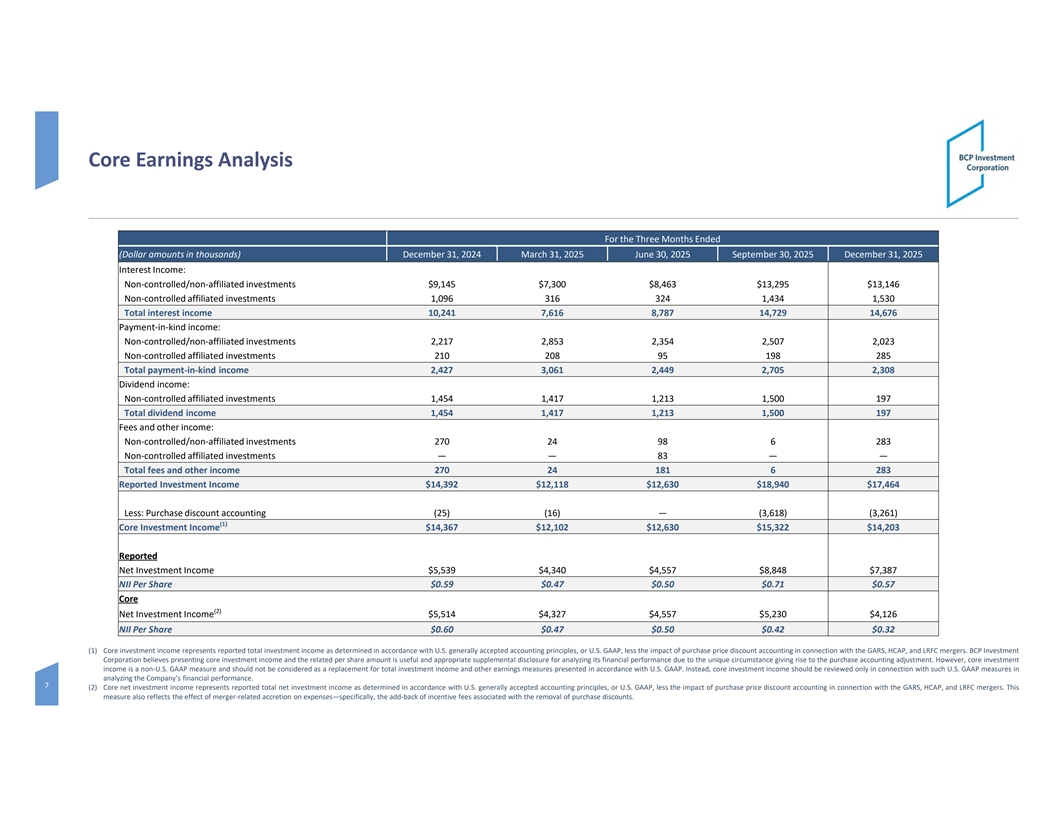
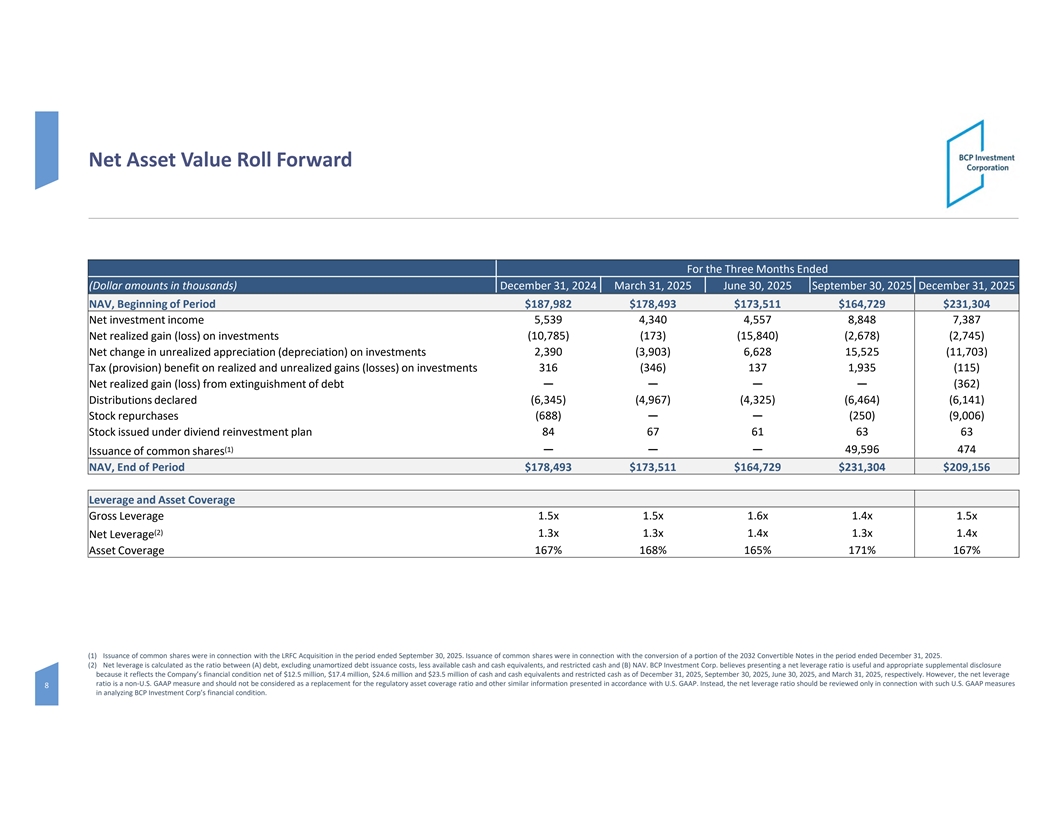
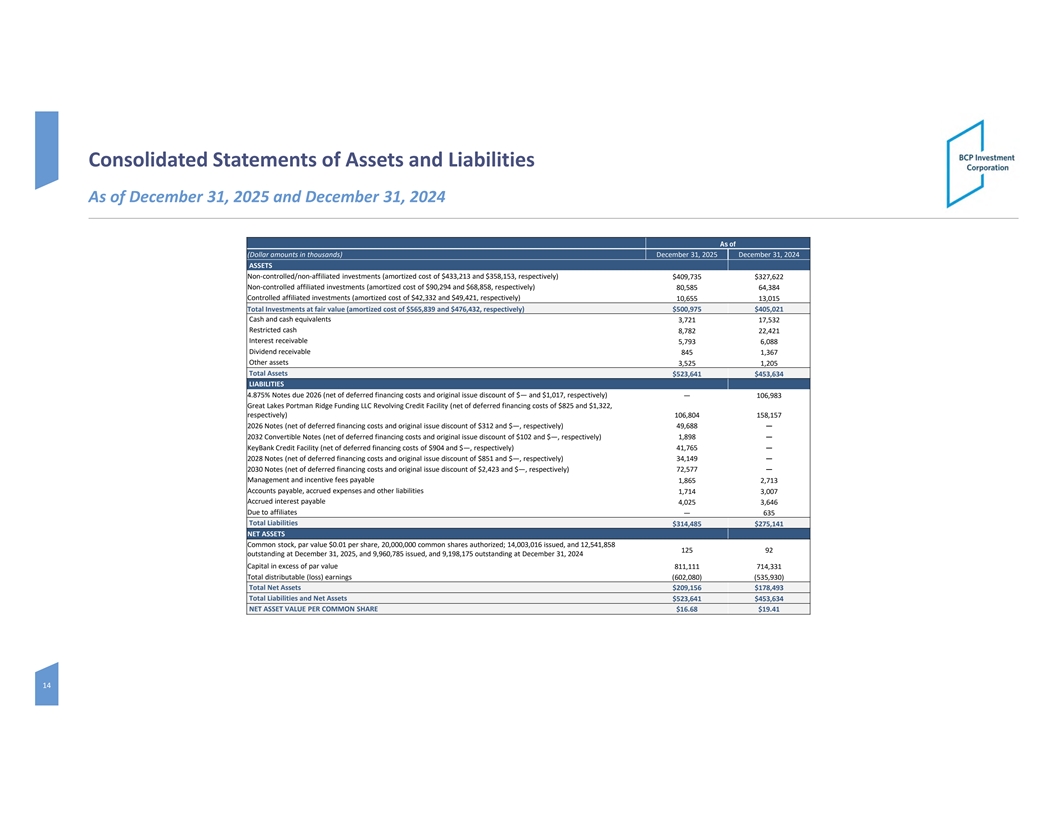
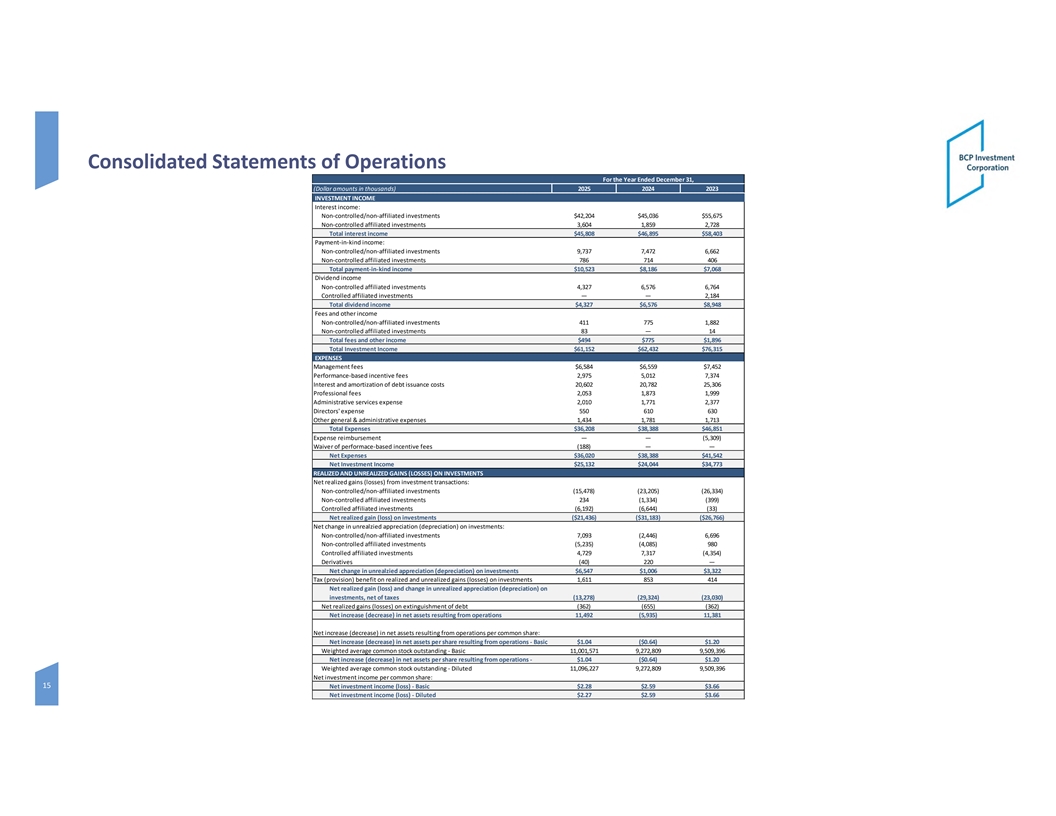
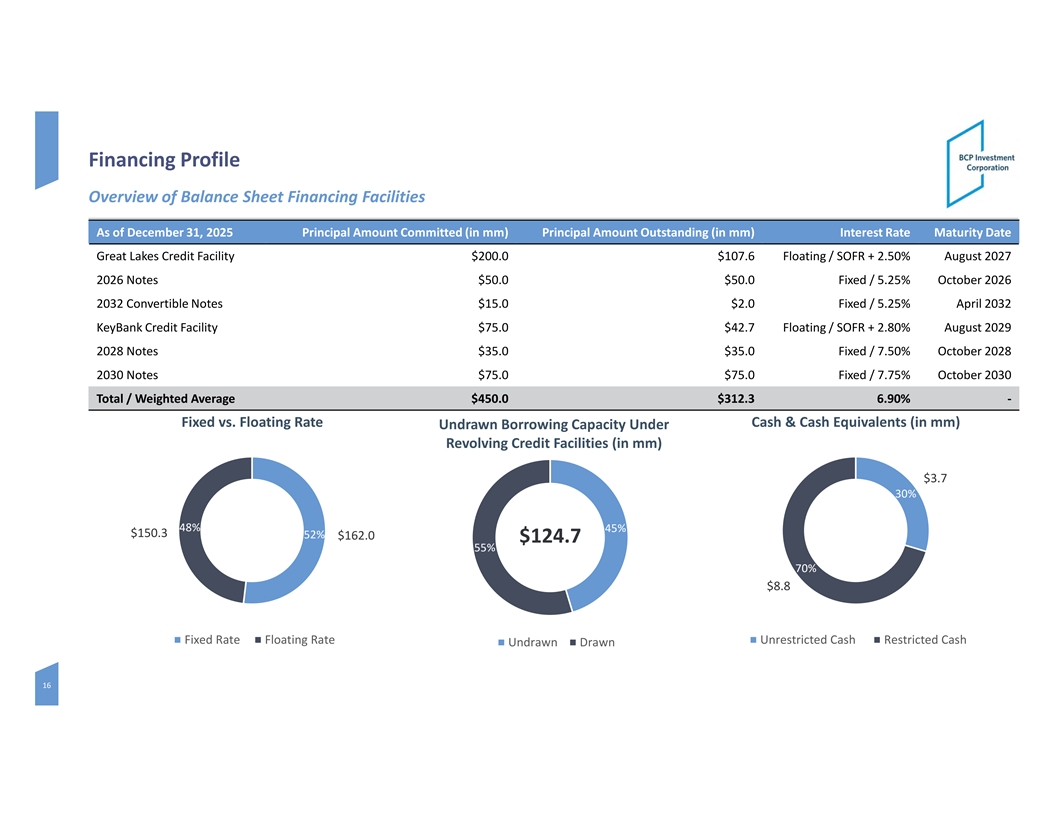
Thanks, Patrick. For the quarter ended December 31, 2025, the company generated $17.5 million in investment income, a decrease of $1.4 million as compared to $18.9 million reported for the quarter ended September 30, 2025. The decrease in investment income was primarily driven by the distribution from our Great Lakes joint venture coming in $1.3 million lower than the prior quarter and historical levels as a result of a non-recurring IDO, as well as the impact of two additional investments on non-accrual and decreases in base rates. For the year, total investment income was $61.2 million compared to $62.4 million in 2024. For the quarter ended December 31st, 2025, total expenses were $10.1 million, which represents a $0.2 million decrease as compared to $10.3 million reported for the prior quarter. The decrease in expenses was primarily driven by lower incentive fees and general and administrative rate of expenses, partially offset by higher financing costs associated with 30 days of duplicative interest expense associated with calling the company's April 2026 notes, which amounted to $0.5 million. For the year, total expenses were $36.2 million, or a $2.2 million decrease as compared to $38.4 million in 2024. The decrease in expenses compared to the prior year was primarily driven by lower incentive fees. Accordingly, our net investment income for the fourth quarter of 2025 was $7.4 million or 57 cents per share, which constitutes a million and a half dollar decrease or 14 cents per share from $8.9 million or 71 cents per share reported for the prior quarter. Core net investment income for the quarter was $4.1 million, or $0.32 per share, compared to $5.2 million, or $0.42 per share, in the third quarter of 2025. For the year, net investment income was $25.1 million, or $2.28 per share, compared to $24 million, or $2.59 per share, in 2024. As of December 31st, 2025, our net asset value totaled $209.2 million, a decrease of $22.1 million, or 9.6% from the prior quarter's NAV of $231.3 million. On a per share basis, NAV was $16.68 per share as of December 31st, 2025, representing an an 87-cent decrease, or 5%, as compared to the company's prior quarter NAV per share of $17.55. Notably, the difference between the 9.6% decrease and 5% is the accretive impact of the tender offer and our buyback program. Broadly speaking, the decline in NAV was due to $14.5 million in net realized and change and underlies losses on the portfolio, as well as core NII not covering the dividend paid during the quarter by approximately $2 million. As it relates to the right side of our balance sheet, we ended the year with gross and net leverage ratios of 1.5 and 1.4 times respectively, which compares to gross and net leverage ratios of 1.4 times and 1.3 times respectively for the prior quarter. Specifically, as of December 31st, 2025, we had a total of $312.3 million of borrowings outstanding with a current weighted average contractual interest rate of 6.9%. This compares to $324.6 million in borrowings outstanding as of the prior quarter with a weighted average contractual interest rate of 6.1%. The company finished the year with $124.7 million of available borrowing capacity under the senior secured revolving credit facilities, which are subject to borrowing-based restrictions. Finally, I'm pleased to share that during the quarter, the company refinanced its $108 million of unsecured notes maturing in April 2026 by issuing $75 million of 7.75 notes due October 2030 and $35 million of 7.5% notes due October 2028. These actions reduced near-term refinancing risk and better ladder the company's debt capital structure by staggering the company's maturities, which improves the company's balance sheet. With that, I will turn the call back over to Ted.
Thank you, Brandon. Ahead of questions, I'd like to reemphasize our commitment to our shareholders. Our focus remains on disciplined capital allocation, maintaining a high-quality portfolio, and delivering attractive, risk-adjusted returns. To a large, more diversified platform and a strengthened balance sheet, we believe we are well-positioned to drive continued earnings growth and value creation in the quarter. Thank you once again to all our shareholders, employees, and partners for ongoing support. This concludes our prepared remarks, and I'll turn the call over for questions.
Operator
Thank you. Quick reminder before we start the Q&A, if you'd like to ask a question, please press star and the number one on your telephone keypad to raise your hand and enter the queue. If you'd like to enjoy our question or your question has been answered, please press star one again. Thank you. We will take our first question from Eric Zwick from Lucid Capital Markets. Please go ahead.
Thanks. Good morning, everyone. You know, Chad, in your prepared comments, you mentioned, you know, the actions that you took in 2025 reflect the long-term vision as you position the company for its next phase of growth. So I'm curious just kind of, you know, from your perspective, if you think about the next year or two, what do you think the mix of growth looks like from, you know, organic and acquisition mix? And I guess I'm kind of curious on that, you know, latter potential source of growth, the acquisitions, you know, what the pipeline looks like in terms of, you know, opportunities. And I guess if I add another piece in there, you know, are there any other initiatives for growth that you're considering at this point as well?
Yeah, it's a great question. So, you know, I don't see us pursuing organic growth. I mean, of anything, given where our stock trades, it makes sense for us to continue to buy back stock. So the tender plus-share buybacks, obviously, were a pretty nice tailwind to NAV for us, or NAV for share. In terms of, like, all this recent choppiness in the market and all the recent headlines, our M&A pipeline is probably bigger than it's ever been. And that includes both public entities and unlisted entities. So we expect to be able to grow our platform, and we had to get Logan Portman done, and that sets us up to do continued M&A. So as you know, we've kind of rolled up a number of BDCs over the last couple of years, and it's a key part to our strategy to basically continue to do that, optimize the portfolios, and continue to buy back stock.
That's helpful. And then so I guess, you know, thinking about the pipeline for organic growth and maybe the size of the portfolio, it sounds like, you know, you still consider that the buyback a pretty attractive use of capital. Is that the right read on your comments there?
Yeah, I mean, you can see our originations, you know, like our repayments and sales are way higher than originations. And the reason for that is it's more creative for us to basically take the liquidations and buy back stock. So that's what we'll be doing. On a go-forward basis, you know, we're very, very, very cautious in terms of new deployment. So we're really, really looking for areas where we can deploy capital at very widespread. And, again, you know, those opportunities are just few and far between. So we think there's a little bit of a disconnect between actual risk and the way risk has been priced. And so we are being pretty judicious on deploying new capital.
That's great, Collar. And last one, maybe for Brandon. And then just looking at the dividend income that you recognized in the quarter, I think it was around $200,000 or so, maybe $197,000. And that was quite a bit below the prior kind of four-quarter average, closer to like $1.9 million. So just curious if there's something noteworthy that changed in the fourth quarter and what the run rate of dividend income might look like going forward.
Yeah, so that's right, Eric. That's – the decrease was driven by the much lower Great Lakes – our Great Lakes Joint Ventures distribution this quarter. There was a non-recurring item associated with – it's an evergreen product, and every three years it rolls into a new series that occurred in the prior quarter, and that impacted the Great Lakes distribution this quarter. It's, you know, very much a non-recurring item. You know, the product is sensitive to rates. So where it was previously earning and distributing is probably higher than what we're modeling going forward, but it still should generate, call it, you know, low-teens return on a near-term basis going forward.
And I'd also make the distinction that the non-recording item was just the difference between ROC versus income. So it wasn't necessarily a cash distribution question. It was sort of how we kind of had to or are we supposed to recognize the cash in terms of ROC for CINCO. That's right.
Thank you for taking my questions this morning, guys.
Operator
Thank you. Thank you. Our next question comes from the line of Christopher Nola from Lady Bird of Tolman. Please go ahead.
Hey, guys. The declining dividend, And should we use that as a proxy for the earnings run rate going forward in the second half of the year?
No. That was the non-recurring item that Eric had just asked about, Chris. So, you know, next quarter we would expect that to return to more normalized historical levels.
Okay. And then the driver on the realized loss?
So the largest driver on the realized was a portfolio company called CP Flex. Patrick, do you want to give some color down?
Yeah, I mean, to be honest, Chris, so we – it was a company that was going through a sale process. The sale process has been going on some time. We had a bid that was fully covering PAR plus accrued interest, and we're working towards And to be entirely honest, in the last, like, couple weeks of the transaction, there were some junior lenders in the capital structure that basically created a massive amount of hold-up value, and we were kind of – the lenders were forced into this discussion of whether we should, like, file a company for a prepack and then – and get these guys out and move on. And, again, we were a small part of the syndication, but there was just an overall view that between the cost associated with the prepack and the risk that the buyer would move away from us, that lenders were kind of willing to accept, you know, again, what amounted to a good amount of hold up value at the end of the day. And so the difference effectively between, you know, what we added on the books at and what we ended up realizing was sort of that last little bit of
a couple of folks holding us hostage. Got it. And then I guess for unrealized depreciation, were there any particularly big drivers there? Unrealized depreciation?
Yes, please. Yeah, yeah, yeah. Sorry. I thought it appreciation um as well as i answered the question um the biggest one is called htc hostway um again kind of a a similar story but um we were working through they were working through lois and and they have two different business units and selling two different business units um they ultimately completed the sale of one of the business units but the other one uh effectively the buyer came back and and retrace like 50 cents discount or something like that which obviously didn't make any sense if we're going to take. We sort of said no. They came back at a higher valuation, but still not something that the company was comfortable with. And there's a large lender that's leading the process there. So ultimately, the conclusion was to sell the first business where we kind of continued, where we got a reasonable cash offer and paid down some debt. And then we'll kind of take the second business back to market at some point this year would be I guess. But for valuation purposes, we're using that sort of like lower retraded valuation for purpose of that. So that is kind of the driver of the unrealized depreciation. And that's the
biggest, and that's the big needle mover there. Got it. And then I guess strategically, but you know, on your comments in terms of the growth drivers acquisitions, Are there a lot of potential BDC sellers out there, and, you know, is the pricing for these things going down? I mean, what sort of color can you provide?
I would say that there's a lot of permanent capital vehicles for sale. I think the choppiness is going to just exasperate it. I mean, scale matters, and I think there's a lot of subscale vehicles that are in a hard time with originations, costs, you know, and kind of growth and fundraising. So, as I said, our pipeline is really robust, and it's a mix of both private and public entities. So, actually, we're pretty excited about the M&A market, and we think it's a really good way to create value for our shareholders.
Interesting. Okay, great. Thanks, guys. Thank you, Chris.
Operator
Thank you. Our next question comes from the line of Angelo Gorino from – or a private investor. Please go ahead.
Operator
Thanks for taking my call.
So this is going to be a little bit of a tough talk, big picture tough talk. I'm really trying to understand where you guys are focused on. So here's a couple data points. June 30, 2019, a couple quarters after you took KCAP. NEV per share split-adjusted, $37 a share. Over that time, you've distributed $16 per share split-adjusted to shareholders. And now we're sitting $20 a share NEV. And, you know, I've been a big supporter of you. I've been a big supporter of management, been a big supporter of the strategy and growing. But you keep on using terms like, you know, risk-adjusted returns, shareholder value, continued growth in shareholder value. I'm trying to understand why it seems to me that quarter after quarter your hair isn't on fire about the drip, drip, drip of the base value of our investment, which is NAV. I mean, you have to agree that BDCs are rare that are going to trade at huge multiples at NAV. And why aren't I seeing or hearing you talk about being your hair on fire about what's been happening to NAV ever since you took TICAP?
Okay. I'll answer my question. I mean, I don't necessarily subscribe to everything you said. but the reality is, I mean, we probably bought back more stock than any BDC as a percentage of our business. So when we say things like that, we're trying to be, you know, judicious about how we allocate capital. So, you know, we've obviously inherited a series of portfolios that were at the relative tail end of winding those down. So you look at a lot of the headwinds to our NAV, a lot of it's come from inherited positions. But again, when we took those on, And we obviously have been working those out over the last, you know, I can't remember the start date you used was, but it's still for the last seven years. And in the meantime, you know, we bought back stock, we've refinanced the capital structure, and we've done a number of actions that we think are shareholder-friendly. So, you know, we – I totally hear what you're saying, and the math is the math. But when you say our hair is on fire, I wouldn't necessarily say that. I mean, I would say we have a good commandment.
I guess what I'm saying is I want your hair to be on fire. I don't hear a lot of discussion about – I don't know what increasing shareholder value means. If quarter after quarter, year after year, NAV is just going down, down, down, and it doesn't – I don't hear you just addressing it and in a way that is clear of where that turning point is going to be. we're going to be seeing at least stable NAV, you know, at the same time. It doesn't, you know, sure, you did the stock buybacks. It was a good deal. But even in the face of stock buybacks, we had a decrease of NAV of 80 cents in just one quarter. And that's just not a – that's not just a one-off. This has been going quarter after quarter after quarter. So I guess what I'm trying to ask – I'm asking you, as someone who is a supporter and has been very supportive since you bought KCAP, because I'm a KCAP – I was a KCAP holder, so I've been here for this whole ride. Why aren't I hearing what I think I need to hear that tells me when this is going to – when this drip is going to stop and this thing is going to turn? So, I mean, just saying that I've bought that stock at a good deal, fine. But over six and a half years, I've lost $20 in NAV, and I've gotten $16 in distributions. I had to pay taxes on that distribution. So it would have been better off to just liquidate KCAP and give it to me six and a half years ago and let me put them in treasuries. I'm trying to understand where this is going and when and why I'm not hearing you address in these conference calls where this turn is going to occur. Is that a better way of putting it?
I mean, listen, I think we're very open-minded to having a broad discussion. Maybe we should just take this offline and we're happy to sit down with you and take you through it and, you know, maybe optimize our communication next quarter. So why don't we take it offline? And we're happy to listen to you, of course, and listen to all of our shareholders. and, you know, happy to have that conversation.
Operator
Our next question comes from the line of Paul Johnson from KBW. Please go ahead.
Yeah, thanks for taking my questions. I just wanted to echo that a little bit. I mean, I just want to understand as well, you know, kind of where you really can provide value for shareholders just And given where we're at, in my opinion, at least at this point, I don't think that you've necessarily demonstrated that mergers have been positive for shareholders, you know, that this has been, that any of these has worked out. And it's clear that, you know, buying some of these assets at NAV has not necessarily been a good deal. So it sounds like that is still the consideration in the plan going forward, but to me it hasn't been a great way to increase shareholder NAB for you guys. So what other ways can we, you know, I guess stabilize what's, you know, in the portfolio today and you can provide shareholders, you know, aside from, you know, trying to scale up through mergers going forward?
Yes. I mean, we used to provide a lot of disclosure about where we bought the assets versus where we monetized them, And we should put that back in the presentation and walk people through why we think a number of the actions we've taken were the right and prudent actions. So, again, we'll provide additional – we've historically disclosed that in a lot of detail, and obviously, you know, we should just continue to do that. And just lay out the roadmap for why we think that makes sense.
Thank you. That's all for me.
Operator
Thank you. There are no further questions in the queue. I will now turn the call back over to our CEO, Tal Goldthorpe, for closing remarks.
Well, thank you all for attending our call. And, as always, please feel to reach out to us with any questions, which we're happy to discuss. We look forward to speaking with you again in May when we announce our first quarter of 2026 results. Thank you.
Operator
The meeting has now concluded. Thank you all for joining. You may now disconnect.