
Biddance AI Systems, Inc 20-F for FY2023
Biddance AI Systems, Inc. (BDAI)
About this 20-F
Biddance AI Systems, Inc filed this 20-F on April 5, 2024, covering the fiscal year ended December 31, 2023 (FY2023).
Headline figures
Fiscal year ended December 31, 2023, as reported in this filing, compared with the same period a year earlier where the filing states it.
- Revenue
- $4.56M
- down 29.0% from $6.43M a year earlier
- Net income
- $1.05M
- down 26.0% from net income of $1.42M a year earlier
- Diluted EPS
- $0.08
- down 38.5% from $0.13 a year earlier
UNITED STATES
SECURITIES AND EXCHANGE COMMISSION
WASHINGTON, D.C. 20549
FORM
OR
For the fiscal year ended
OR
For the transition period from _________ to _________.
OR
Date of event requiring this shell company report:
Commission file number:
(Exact name of Registrant as Specified in its Charter)
N/A
(Translation of Registrant’s Name into English)
(Jurisdiction of Incorporation or Organization)
+86 592-5395967
(Address of Principal Executive Offices)
(Name, Telephone, E-mail and/or Facsimile Number and Address of Company Contact Person)
Securities registered or to be registered pursuant to Section 12(b) of the Act:
| Title of Each Class | Trading Symbol | Name of Each Exchange On Which Registered | ||
Securities registered or to be registered pursuant to Section 12(g) of the Act:
None
(Title of Class)
Securities for which there is a reporting obligation pursuant to Section 15(d) of the Act:
None
(Title of Class)
An aggregate of
Indicate by check mark if the registrant is a well-known seasoned issuer, as defined in Rule 405 of the Securities Act.
Yes ☐
If this report is an annual or transition report, indicate by check mark if the registrant is not required to file reports pursuant to Section 13 or 15(d) of the Securities Exchange Act of 1934.
Yes ☐
Indicate by check mark whether the registrant (1) has filed all reports required to be filed by Section 13 or 15(d) of the Securities Exchange Act of 1934 during the preceding 12 months (or for such shorter period that the registrant was required to file such reports), and (2) has been subject to such filing requirements for the past 90 days.
Indicate by check mark whether the registrant has submitted electronically every Interactive Data File required to be submitted pursuant to Rule 405 of Regulation S-T (§ 232.405 of this chapter) during the preceding 12 months (or for such shorter period that the registrant was required to submit such files).
Indicate by check mark whether the registrant is a large accelerated filer, an accelerated filer, or a non-accelerated filer. See definition of “accelerated filer and large accelerated filer” in Rule 12b-2 of the Exchange Act. (Check one):
| Large accelerated filer ☐ | Accelerated filer ☐ | Emerging growth company |
If an emerging growth company that prepares its
financial statements in accordance with U.S. GAAP, indicate by check mark if the registrant has elected not to use the extended transition
period for complying with any new or revised financial accounting standards† provided pursuant to Section 13(a) of the Exchange
Act.
Indicate by check mark whether the registrant
has filed a report on and attestation to its management’s assessment of the effectiveness of its internal control over financial
reporting under Section 404(b) of the Sarbanes-Oxley Act (15 U.S.C. 7262(b)) by the registered public accounting firm that prepared or
issued its audit report.
If the securities are registered pursuant to Section
12(b) of the Act, indicate by check mark whether the financial statements of the registrant included in the filing reflect the correction
of an error to previously issued financial statements.
Indicate by check mark whether any of those error corrections are restatements that required a recovery analysis of incentive-based compensation received by any of the registrant’s executive officers during the relevant recovery period pursuant to §240.10D-1(b). ☐
Indicate by check mark which basis of accounting the registrant has used to prepare the financial statements included in this filing:
| ☒ | ☐ | International Financial Reporting Standards as issued by the International Accounting Standards Board | ☐ | Other |
If “Other” has been checked in response to the previous question, indicate by check mark which financial statement item the registrant has elected to follow:
Item 17 ☐ Item 18 ☐
If this is an annual report, indicate by check mark whether the registrant is a shell company (as defined in Rule 12b-2 of the Exchange Act).
Yes ☐ No
TABLE OF CONTENTS
i
INTRODUCTORY NOTES
Except as otherwise indicated by the context and for the purposes of this annual report only, references in this annual report to:
| ● | “affiliated entities” are to our subsidiaries and variable interest entities (“VIE”); |
| ● | “China” or the “PRC” are to the People’s Republic of China, excluding Taiwan for the purposes of this annual report only; | |
| ● | “Class A Ordinary Shares” are to the Class A Ordinary Shares of Hitek Global Inc., par value $0.0001 per share. | |
| ● | “Class B Ordinary Shares” are to the Class B Ordinary Shares of Hitek Global Inc., par value $0.0001 per share. |
| ● | “Haitian Weilai” are to Xiamen Haitian Weilai Technology Co., Ltd., a limited liability company organized under the laws of the PRC that is fully owned by Tian Dahai; |
| ● | “HiTek HK” are to the Company’s wholly owned subsidiary, HiTek Hong Kong Ltd., a Hong Kong corporation; |
| ● | “HiTek”, or “VIE entity”, are to Xiamen Hengda HiTek Computer Network Co., Ltd., a limited liability company organized under the laws of the PRC, that we control via a series of contractual arrangements between WFOE and HiTek; |
| ● | “Huasheng” are to Xiamen Huasheng HiTek Computer Network Co., Ltd., a limited liability company organized under the laws of the PRC that function as HiTek’s operating subsidiary; |
| ● | “Huoerguosi” are to Huoerguosi Hengda Information Technology Co., Ltd., a limited liability company organized under the laws of the PRC that function as HiTek’s operating subsidiary; |
| ● | “Ordinary Shares” are to the Class A Ordinary Shares and Class B Ordinary Shares. |
| ● | “we”, “us” or the “Company” are to Hitek Global Inc.; |
| ● | “WFOE” are to Tian Dahai (Xiamen) Information Technology Co. Ltd. (“Tian Dahai”), a limited liability company organized under the laws of the People’s Republic of China (the “PRC”), which is wholly-owned by us through HiTek HK; and |
Our business is conducted via HiTek, a VIE entity in the PRC, using RMB, the currency of China. Our consolidated financial statements are presented in United States dollars (“USD”). In this annual report, we refer to assets, obligations, commitments and liabilities in our consolidated financial statements (“CFS”) in USD. These dollar references are based on the exchange rate of RMB to USD, determined as of a specific date or for a specific period. Changes in the exchange rate will affect the amount of our obligations and the value of our assets in terms of USD which may result in an increase or decrease in the amount of our obligations (expressed in dollars) and the value of our assets.
ii
FORWARD-LOOKING STATEMENTS
This annual report on Form 20-F contains forward-looking statements that reflect our current expectations and views of future events. These statements are made under the “safe harbor” provisions of the U.S. Private Securities Litigation Reform Act of 1995. You can identify these forward-looking statements by terminology such as “may,” “will,” “expect,” “anticipate,” “aim,” “estimate,” “intend,” “plan,” “believe,” “is/are likely to,” “potential,” “continue” or other similar expressions. We have based these forward-looking statements largely on our current expectations and projections about future events and financial trends that we believe may affect our financial condition, results of operations, business strategy and financial needs. These forward-looking statements include, but are not limited to:
| ● | the adverse effects of the COVID-19 pandemic on our business or the market price of our Class A Ordinary Shares; |
| ● | our goals and strategies; |
| ● | our future business development, financial condition and results of operations; |
| ● | our expectations regarding the market for our concrete products; |
| ● | our expectations regarding demand for and market acceptance of our nutraceutical and dietary supplements products; |
| ● | our plans to establish partnerships and develop new businesses; |
| ● | our plans to invest in our business; |
| ● | our relationships with our partners; |
| ● | our future business development, results of operations and financial condition; |
| ● | market conditions affecting our equity capital; |
| ● | change in macroeconomic conditions; |
| ● | competition in our industry; and |
| ● | relevant government policies and regulations relating to our industry. |
We would like to caution you not to place undue reliance on these forward-looking statements and you should read these statements in conjunction with the risk factors disclosed in “Item 3. Key Information—D. Key Information—Risk Factors.” Those risks are not exhaustive. We operate in an evolving environment. New risks emerge from time to time and it is impossible for our management to predict all risk factors, nor can we assess the impact of all factors on our business or the extent to which any factor, or combination of factors, may cause actual results to differ from those contained in any forward-looking statement. We do not undertake any obligation to update or revise the forward-looking statements except as required under applicable law. You should read this annual report and the documents that we reference in this annual report completely and with the understanding that our actual future results may be materially different from what we expect.
iii
PART I
ITEM 1. IDENTITY OF DIRECTORS, SENIOR MANAGEMENT AND ADVISERS
Not applicable.
ITEM 2. OFFER STATISTICS AND EXPECTED TIMETABLE
Not applicable.
ITEM 3. KEY INFORMATION
Our Corporate Structure
We are an offshore holding company incorporated in the Cayman Islands. As a holding company with no material operations, our operations were conducted in China by (i) Haitian Weilai, our indirect subsidiary, (ii) the VIE, Hitek and the VIE’s subsidiaries, Huasheng and Huoerguosi. Neither we nor our subsidiaries own any equity interests in the VIE. WFOE, the VIE and the shareholders of the VIE entered into a series of contractual arrangements, also known as the “VIE Agreements”, pursuant to which we are able to consolidate the financial results of the VIE in our consolidated financial statements because we are deemed as the primary beneficial of the VIE under generally accepted accounting principles in the U.S. (“U.S. GAAP”), and this structure involves unique risks to investors.
The following diagram illustrates our corporate structure as of the date of this annual report. All percentages in the following diagram reflect the voting ownership interests instead of the equity interests held by each of our shareholders given that each holder of Class B Ordinary Shares will be entitled to 15 votes per one Class B Ordinary Share and each holder of Class A Ordinary Shares will be entitled to one vote per one Class A Ordinary Share:

| (1) | The equity of HiTek is 44.74% owned by Xiaoyang Huang, our Chief Executive Officer; 29.83% owned by Shenping Yin, our Chairman of the Board; 2.35% owned by Bo Shi, our Chief Technology Officer; 0.78% owned by Zhishuang Wang; 0.78% owned by Liuqing Huang; 3.02% owned by Jingru Li; 4.99% owned by Mian Tang; 2.0% owned by Ce Tian; 2.0% owned by Xianfeng Lin; 7.55% owned by Inner Mongolia Guangxin Investment Co., Ltd., a Chinese company of which its equity is 80% owned by Wei Cui, 10% owned by Yi Cui and 10 % owned by Lei Gao; 1.96% owned by Baotou Zhongzhe Hengtong Technology Co., Ltd., a Chinese company of which its equity is 95% owned by Jing Kong and 5% owned by Qingxia Kong. |
1
The VIE Agreements
The VIE Agreements by and among Tian Dahai (Xiamen) Information Technology Co. Ltd. (the “WFOE”), HiTek, and HiTek’s shareholders include (i) certain power of attorney agreements and equity interest pledge agreement, pursuant to which shareholders of HiTek pledged all of their equity interests in HiTek to WFOE guarantee the performance of HiTek’s obligations under the exclusive technical consulting and service agreement; (ii) an exclusive technical consulting and service agreement which allows WFOE to receive substantially all of the economic benefits from HiTek; and (iii) certain exclusive equity interest purchase agreements which provide WFOE with an exclusive option to purchase all or part of the equity interests in and/or assets of HiTek when and to the extent permitted by PRC laws. Through the VIE Agreements among WFOE, HiTek and HiTek’s shareholders, we are deemed to have a controlling financial interest in, and be the primary beneficiary of, the VIE for accounting purposes only and must consolidate the VIE because it met the conditions under U.S. GAAP to consolidate the VIE.
Each of the VIE Agreements is described in detail below:
Exclusive Technical Consulting and Service Agreement
Pursuant to the Exclusive Technical Consulting and Service Agreement between HiTek and WFOE, WFOE provides HiTek with technical support, consulting services and other management services relating to its day-to-day business operations and management, on an exclusive basis. The Exclusive Technical Consulting and Service Agreement came into effect as of March 31, 2018. For services rendered to HiTek by WFOE under this agreement, WFOE is entitled to collect a service fee that shall be paid per quarter of 100% of HiTek’s quarterly profit. The term of the Exclusive Technical Consulting and Service Agreement is ten years unless it is terminated by WFOE with 30-day prior notice.
Equity Interest Pledge Agreement
WFOE, HiTek and HiTek shareholders entered into an Equity Interest Pledge Agreement, pursuant to which HiTek shareholders pledged all of their equity interests in HiTek to WFOE in order to guarantee the performance of HiTek’s obligations under the Exclusive Technical Consulting and Service Agreement as described above. The Equity Interest Pledge Agreement came into effect as of March 31, 2018. During the term of the pledge, WFOE is entitled to receive any dividends declared on the pledged equity interests of HiTek. The Equity Interest Pledge Agreement ends when all contractual obligations under the Exclusive Technical Consulting and Service Agreement have been fully performed.
Exclusive Equity Interests Purchase Agreement
Under the Exclusive Equity Interests Purchase Agreement, the HiTek Shareholders granted WFOE (or its designee) an exclusive option to purchase, to the extent permitted under PRC law, part or all of their equity interests in HiTek. The option price is equal to the capital paid in by the HiTek Shareholders subject to any appraisal or restrictions required by applicable PRC laws and regulations. The Exclusive Equity Interests Purchase Agreement remains effective for a term of ten years and may be extended for another ten years at WFOE’s election.
Power of Attorney
Pursuant to the Power of Attorney, each HiTek Shareholder authorizes WFOE to act on their behalf as their exclusive agent and attorney with respect to all rights as shareholders, including but not limited to: (a) the attendance of the shareholder’s meeting and the execution of relative shareholder resolution(s) of HiTek; (b) exercising all the shareholder’s rights, including voting, that shareholders are entitled to under the laws of China and the articles of association, including but not limited to the sale or transfer or pledge or disposition of shares in part or in whole; and (c) designating and appointing on behalf of shareholders the legal representative, the executive director, supervisor, the chief executive officer and other senior management members of HiTek.
Although it is not explicitly stipulated in the Powers of Attorney, the term of the Powers of Attorney shall be the same as the term of that of the Exclusive Equity Interests Purchase Agreement.
The Powers of Attorney are coupled with an interest and shall be irrevocable and continuously valid from the date of their execution, so long as the relevant HiTek Shareholder is a shareholder of Company.
2
Risks Associated with Our Corporate Structure and the VIE Agreements
However, the VIE structure cannot completely replicate a foreign investment in China-based companies, as the shareholders will not and may never hold equity interests in the Chinese operating entities. Instead, the VIE structure provides contractual exposure to foreign investment in us. Because we do not hold equity interests in the VIE, we are subject to risks due to uncertainty of the interpretation and the application of the PRC laws and regulations, including but not limited to limitation on foreign ownership of internet technology companies, regulatory review of oversea listing of PRC companies through a special purpose vehicle, and the validity and enforcement of the VIE Agreements as they have not been tested in a court of law. The VIE Agreements may not be effective in providing control over HiTek. See “Risk Factors — Risks Relating to Our Corporate Structure” starting on page 14 of this annual report, “Risk Factors — Risks Relating to Doing Business in the PRC” starting on page 19 of this annual report for more information.
We are subject to the risks of uncertainty about any future actions of the PRC government in this regard that could disallow the VIE structure, which would likely result in a material change in our operations and the value of Class A Ordinary Shares may depreciate significantly or become worthless. We are also subject to certain legal and operational risks associated with the VIE’s operations in China. PRC laws and regulations governing our current business operations are sometimes vague and uncertain, and therefore, these risks may result in a material change in the VIE’s operations, significant depreciation of the value of our Class A Ordinary Shares, or a complete hindrance of our ability to continue to offer our securities to investors. Recently, the PRC government initiated a series of regulatory actions and statements to regulate business operations in China with little advance notice, including cracking down on illegal activities in the securities market, enhancing supervision over China-based companies listed overseas using variable interest entity structure, adopting new measures to extend the scope of cybersecurity reviews, and expanding the efforts in anti-monopoly enforcement.
Pursuant to the PRC Cybersecurity Law, which was promulgated by the Standing Committee of the National People’s Congress on November 7, 2016 and took effect on June 1, 2017, personal information and important data collected and generated by a critical information infrastructure operator in the course of its operations in China must be stored in China, and if a critical information infrastructure operator purchases internet products and services that affects or may affect national security, it should be subject to cybersecurity review by the Cyberspace Administration of China (“CAC”). On July 30, 2021, the State Council issued Regulation on Protecting the Security of Critical Information Infrastructure, clarifying the definition of critical information infrastructure as “any of network facilities and information systems in important industries and fields—such as public communication and information services, energy, transportation, water conservancy, finance, public services, e-government, and science, technology and industry for national defense—that may seriously endanger national security, national economy and people's livelihood, and public interests in the event that they are damaged or lose their functions or their data are leaked.” On December 28, 2021, the CAC and other relevant PRC governmental authorities jointly promulgated the Cybersecurity Review Measures (the “CAC Revised Measures”) to replace the original Cybersecurity Review Measures. The CAC Revised Measures took effect on February 15, 2022. Pursuant to the CAC Revised Measures, if critical information infrastructure operators purchase network products and services, or network platform operators conduct data processing activities that affect or may affect national security, they will be subject to cybersecurity review. On November 14, 2021, CAC published the Administration Measures for Cyber Data Security (Draft for Public Comments), or the “Cyber Data Security Measure (Draft)”, which requires cyberspace operators with personal information of more than 1 million users who want to list abroad to file a cybersecurity review with the Office of Cybersecurity Review. The cybersecurity review will evaluate, among others, the risk of critical information infrastructure, core data, important data, or a large amount of personal information being influenced, controlled or maliciously used by foreign governments and risk of network data security after going public overseas. As confirmed by our PRC counsel, Jingtian & Gongcheng, we are not subject to cybersecurity review with the CAC in accordance with the CAC Revised Measures, because (i) we are not in possession of or otherwise holding personal information of over one million users and it is also very unlikely that it will reach such threshold in the near future; and (ii) as of the date of this annual report, we have not received any notice or determination from applicable PRC governmental authorities identifying it as a critical information infrastructure operator. However, since these statements and regulatory actions are new, it is uncertain how soon legislative or administrative regulation making bodies will respond and what existing or new laws or regulations or detailed implementations and interpretations will be modified or promulgated, if any, and the potential impact such modified or new laws and regulations will have on our daily business operation, the ability to accept foreign investments and list on an U.S. exchange.
3
On February 17, 2023, the CSRC promulgated the Trial Administrative Measures of Overseas Securities Offering and Listing by Domestic Companies, or the Trial Measures, and five supporting guidelines, which came into effect on March 31, 2023. Pursuant to the Trial Measures, domestic companies that seek to offer or list securities overseas, both directly and indirectly, shall complete filing procedures with the CSRC pursuant to the requirements of the Trial Measures within three working days following its submission of initial public offerings or listing application. If a PRC company fails to complete required filing procedures or conceals any material fact or falsifies any major content in its filing documents, such PRC company may be subject to administrative penalties, such as order to rectify, warnings, fines, and its controlling shareholders, actual controllers, the person directly in charge and other directly liable persons may also be subject to administrative penalties, such as warnings and fines. In addition, on February 24, 2023, the CSRC, together with Ministry of Finance of the PRC, National Administration of State Secrets Protection and National Archives Administration of China, revised the Provisions on Strengthening Confidentiality and Archives Administration for Overseas Securities Offering and Listing which was issued by the CSRC, National Administration of State Secrets Protection and National Archives Administration of China in 2009, or the Provisions. The revised Provisions is issued under the title the Provisions on Strengthening Confidentiality and Archives Administration of Overseas Securities Offering and Listing by Domestic Companies, and came into effect on March 31, 2023 together with the Trial Measures. One of the major revisions to the revised Provisions is expanding its application to cover indirect overseas offering and listing, as is consistent with the Trial Measures. The revised Provisions require that, including but not limited to (a) a domestic company that plans to, either directly or indirectly through its overseas listed entity, publicly disclose or provide to relevant individuals or entities including securities companies, securities service providers and overseas regulators, any documents and materials that contain state secrets or working secrets of government agencies, shall first obtain approval from competent authorities according to law, and file with the secrecy administrative department at the same level; and (b) domestic company that plans to, either directly or indirectly through its overseas listed entity, publicly disclose or provide to relevant individuals and entities including securities companies, securities service providers and overseas regulators, any other documents and materials that, if leaked, will be detrimental to national security or public interest, shall strictly fulfill relevant procedures stipulated by applicable national regulations. As of the date of this annual report, as advised by Jingtian & Gongcheng, our PRC counsel, as our post-effective amendment to the registration statement on Form F-1 relating to our initial public offering (“IPO”) was declared effective on March 30, 2023 and we completed our initial public offering and listing prior to September 30, 2023, we are not required to complete the filing procedures pursuant to the Trial Measures for our IPO. If in the future we are going to conduct any offering or financing in the U.S., we will complete filing procedures with the CSRC pursuant to the requirements of the Trial Measures. In addition, we have not received any formal inquiry, notice, warning, sanction, or objection from the CSRC with respect our listing on the Nasdaq Capital Market. However, there remains significant uncertainty as to the enactment, interpretation and implementation of regulatory requirements related to overseas securities offerings and other capital markets activities. Any failure or perceived failure of us to fully comply with such new regulatory requirements could significantly limit or completely hinder our ability to continue to offer securities to investors, cause significant disruption to our business operations, and severely damage our reputation, which could materially and adversely affect our financial condition and results of operations and could cause the value of our securities to significantly decline or be worthless.
Furthermore, as an auditor of companies that are registered with the SEC and publicly traded in the U.S. and a firm registered with the PCAOB, our auditor, Wei, Wei & Co. LLP, is headquartered in the U.S. and is required under the laws of the U.S. to undergo regular inspections by the U.S. Public Company Accounting Oversight Board (“PCAOB”) to assess their compliance with the laws of the U.S. and professional standards. Although we operate through HiTek in mainland China, a jurisdiction where the PCAOB is currently unable to conduct inspections without the approval of the Chinese government authorities, our auditor is currently inspected fully by the PCAOB. Inspections of other auditors conducted by the PCAOB outside mainland China have at times identified deficiencies in those auditors’ audit procedures and quality control procedures, which may be addressed as part of the inspection process to improve future audit quality.
Even though our auditor is based in U.S. and under full inspection by the PCAOB and is not currently subject to the determinations announced by the PCAOB on December 16, 2021, if any PRC law relating to the access of the PCAOB to auditor files were to apply to a company such as HiTek or its auditor, the PCAOB may be unable to fully inspect our auditor, which may result in our securities being delisted or prohibited from being traded “over-the-counter” pursuant to the Holding Foreign Companies Accountable Act (the “HFCA Act”) and materially and adversely affect the value and/or liquidity of your investment. On August 26, 2022, the China Securities Regulatory Commission, the Ministry of Finance of the PRC (the “MOF”), and the PCAOB signed a Statement of Protocol (the “Protocol”), governing inspections and investigations of audit firms based in mainland China and Hong Kong, taking the first step toward opening access for the PCAOB to inspect and investigate registered public accounting firms headquartered in mainland China and Hong Kong. Pursuant to the fact sheet with respect to the Protocol disclosed by the U.S. Securities and Exchange Commission (the “SEC”), the PCAOB shall have independent discretion to select any issuer audits for inspection or investigation and has the unfettered ability to transfer information to the SEC. On December 15, 2022, the PCAOB Board determined the PCAOB was able to secure complete access to inspect and investigate registered public accounting firms headquartered in mainland China and Hong Kong and voted to vacate its previous determinations to the contrary. However, should PRC authorities obstruct or otherwise fail to facilitate the PCAOB’s access in the future, the PCAOB Board will consider the need to issue a new determination. See “Risk Factors—Risks Related to Doing Business in the PRC” starting on page 19 of this annual report for a detailed description of risks related to the PRC. On December 29, 2022, a legislation entitled “Consolidated Appropriations Act, 2023” (the “Consolidated Appropriations Act”), was signed into law by President Biden, which amended the HFCA Act by reducing the number of consecutive non-inspection years required for triggering the prohibitions under the HFCA Act from three years to two. There are risks and uncertainties which we cannot foresee for the time being, and rules and regulations in the PRC can change quickly with little or no advance notice. The PRC government may intervene or influence HiTek’s future operations in the PRC at any time, or may exert more control over offerings conducted overseas and/or foreign investment in companies like us. The PRC government may intervene or influence HiTek’s future operations in the PRC at any time, or may exert more control over offerings conducted overseas and/or foreign investment in companies like us. In the event it is later determined that the PCAOB is unable to inspect or investigate completely our auditor, then such lack of inspection could cause trading in our securities to be prohibited under the HFCA Act, and ultimately result in a determination by a securities exchange to delist our securities.
4
Our management monitors the cash position of each entity within our organization regularly and prepare budgets on a monthly basis to ensure each entity has the necessary funds to fulfill its obligation for the foreseeable future and to ensure adequate liquidity. As a holding company, we may rely on dividends and other distributions on equity paid by our subsidiary in Hong Kong, Hitek HK, and the consolidated VIE in mainland China, HiTek, for our cash and financing requirements. According to the Companies Ordinance of Hong Kong, a Hong Kong company may only make a distribution out of profits available for distribution. In order for us to pay dividends to our shareholders, we will rely on payments made from HiTek to WFOE, pursuant to VIE Agreements between them, and the distribution of such payments to HiTek HK as dividends from WFOE. Certain payments from our HiTek to WFOE are subject to PRC taxes, including business taxes and VAT. We intend to keep any future earnings to re-invest in and finance the expansion of our business, and we do not anticipate that any cash dividends will be paid or any assets will be transferred in the foreseeable future. As of the date of this annual report, there has been no distribution of dividends or assets among the holding company, the subsidiary or the consolidated VIE. In the future, cash proceeds raised from overseas financing activities may be transferred by us to the consolidated VIE via capital contribution or shareholder loans, as the case may be. Other than the above, we did not adopt or maintain any cash management policies and procedures as of the date of this annual report.
Dividend Distributions or Assets Transfer among the Holding Company, its Subsidiaries and the VIE
We intend to keep any future earnings to re-invest in and finance the expansion of our business, and we do not anticipate that any cash dividends will be paid or any assets will be transferred in the foreseeable future. As of the date of this annual report, there has been no distribution of dividends or assets among the holding company, the subsidiary or the consolidated VIE. Under Cayman Islands law, a Cayman Islands company may pay a dividend on its shares out of either profit or share premium amount, provided that in no circumstances may a dividend be paid if this would result in the company being unable to pay its debts due in the ordinary course of business. If we determine to pay dividends on any of our Class A Ordinary Shares in the future, as a holding company, we will be dependent on receipt of funds from our Hong Kong subsidiary, HiTek HK.
Current PRC regulations permit our indirect PRC subsidiaries to pay dividends to the Company only out of their accumulated profits, if any, determined in accordance with Chinese accounting standards and regulations. In addition, each of our subsidiaries in China is required to set aside at least 10% of its after-tax profits each year, if any, to fund a statutory reserve until such reserve reaches 50% of its registered capital. Each of such entity in China is also required to further set aside a portion of its after-tax profits to fund the employee welfare fund, although the amount to be set aside, if any, is determined at the discretion of its board of directors. Although the statutory reserves can be used, among other ways, to increase the registered capital and eliminate future losses in excess of retained earnings of the respective companies, the reserve funds are not distributable as cash dividends except in the event of liquidation.
The PRC government also imposes controls on the conversion of RMB into foreign currencies and the remittance of currencies out of the PRC. Therefore, we may experience difficulties in completing the administrative procedures necessary to obtain and remit foreign currency for the payment of dividends from our profits, if any. Furthermore, if our subsidiaries in the PRC incur debt on their own in the future, the instruments governing the debt may restrict their ability to pay dividends or make other payments. If we or our subsidiaries are unable to receive all of the revenues from our operations through the current VIE Agreements, we may be unable to pay dividends on our Class A Ordinary Shares.
5
Cash dividends, if any, on our Class A Ordinary Shares will be paid in U.S. dollars. If we are considered a PRC tax resident enterprise for tax purposes, any dividends we pay to our overseas shareholders may be regarded as China-sourced income and as a result may be subject to PRC withholding tax at a rate of up to 10.0%.
To pay dividends to our shareholders, we will rely on payments made from HiTek to WFOE, pursuant to VIE Agreements between them, and the distribution of such payments to HiTek HK as dividends from WFOE. Certain payments from our HiTek to WFOE are subject to PRC taxes, including business taxes and VAT.
Pursuant to the Arrangement between Mainland China and the Hong Kong Special Administrative Region for the Avoidance of Double Taxation and Tax Evasion on Income, or the Double Tax Avoidance Arrangement, the 10% withholding tax rate may be lowered to 5% if a Hong Kong resident enterprise owns no less than 25% of a PRC project. However, the 5% withholding tax rate does not automatically apply and certain requirements must be satisfied, including without limitation that (a) the Hong Kong project must be the beneficial owner of the relevant dividends; and (b) the Hong Kong project must directly hold no less than 25% share ownership in the PRC project during the 12 consecutive months preceding its receipt of the dividends. In current practice, a Hong Kong project must obtain a tax resident certificate from the Hong Kong tax authority to apply for the 5% lower PRC withholding tax rate. As the Hong Kong tax authority will issue such a tax resident certificate on a case-by-case basis, we cannot assure you that we will be able to obtain the tax resident certificate from the relevant Hong Kong tax authority and enjoy the preferential withholding tax rate of 5% under the Double Taxation Arrangement with respect to dividends to be paid by our PRC subsidiary to its immediate holding company, HiTek HK. As of the date of this annual report, we have not applied for the tax resident certificate from the relevant Hong Kong tax authority. HiTek HK intends to apply for the tax resident certificate when WFOE plans to declare and pay dividends to HiTek HK. See “Risk Factors - There are significant uncertainties under the EIT Law relating to the withholding tax liabilities of our PRC subsidiary, and dividends payable by our PRC subsidiary to our offshore subsidiaries may not qualify to enjoy certain treaty benefits.”
Permission or Approval Required from the PRC Authorities for The VIE’s Operation
To operate the general business activities currently conducted in China, the consolidated VIE is required to obtain a business license from the State Administration for Market Regulation (“SAMR”). HiTek has obtained a valid business license from the SAMR, and no application for any such license has been denied.
We are aware, however, recently, the PRC government initiated a series of regulatory actions and statements to regulate business operations in China with little advance notice, including cracking down on illegal activities in the securities market, enhancing supervision over China-based companies listed overseas using variable interest entity structure, adopting new measures to extend the scope of cybersecurity reviews, and expanding the efforts in anti-monopoly enforcement.
On July 6, 2021, the General Office of the Central Committee of the Communist Party of China and the General Office of the State Council jointly issued the “Opinions on Severely Cracking Down on Illegal Securities Activities According to Law,” or the Opinions. The Opinions emphasized the need to strengthen the administration over illegal securities activities, and the need to strengthen the supervision over overseas listings by Chinese companies. Effective measures, such as promoting the construction of relevant regulatory systems will be taken to deal with the risks and incidents of China-concept overseas listed companies, and cybersecurity and data privacy protection requirements and similar matters. The Opinions and any related implementing rules to be enacted may subject us to compliance requirement in the future. Given the current regulatory environment in the PRC, we are still subject to the uncertainty of different interpretation and enforcement of the rules and regulations in the PRC adverse to us, which may take place quickly with little advance notice.
6
On December 28, 2021, the CAC published the CAC Revised Measures, which further restates and expands the applicable scope of the cybersecurity review. The CAC Revised Measures took effect on February 15, 2022. Pursuant to the CAC Revised Measures, if a network platform operator holding personal information of over one million users seeks for “foreign” listing, it must apply for the cybersecurity review. In addition, operators of critical information infrastructure purchasing network products and services are also obligated to apply for the cybersecurity review for such purchasing activities. Although the CAC Revised Measures provides no further explanation on the extent of “network platform operator” and “foreign” listing, we do not believe we are obligated to apply for a cybersecurity review pursuant to the CAC Revised Measures, considering that (i) we are not in possession of or otherwise holding personal information of over one million users and it is also very unlikely that we will reach such threshold in the near future; (ii) as of the date of this annual report, we have not received any notice or determination from applicable PRC governmental authorities identifying it as a critical information infrastructure operator.
That being said, the CAC Revised Measures empowers the cybersecurity review office to initiate cybersecurity review when they believe any particular data processing activities “affect or may affect national security”. In addition, on November 14, 2021, the CAC promulgated the Regulations on the Administration of Cyber Data Security (Draft for Comments) (the “Draft CAC Regulations”), and according to the Draft CAC Regulations, any data processors shall, in accordance with relevant state provisions, apply for a cybersecurity review when carrying out, among other things, “other data processing activities that affect or may affect national security”. However, neither the CAC Revised Measures nor the Draft CAC Regulations provides for any further explanation or interpretation over what constitutes activities that “affect or may affect national security”. Therefore, if any competent government authorities deem that HiTek’s data processing activities may affect national security, we may be subject cybersecurity review, and in that scenario, failure to pass such cybersecurity review and/or to comply with the data privacy and data security requirements raised during such cybersecurity review could subject HiTek to penalties, damage its reputation and brand, and harm its business and results of operations. See risk factor titled “in light of recent events indicating greater oversight by the CAC over data security, particularly for companies seeking to list on a foreign exchange, we are subject to a variety of laws and other obligations regarding cybersecurity and data protection, and any failure to comply with applicable laws and obligations could have a material and adverse effect on our business, our listing on Nasdaq, financial condition, results of operations, and the offering” starting on page 26 of this annual report for more information.
In summary, we, our subsidiaries, or the VIE are not required to obtain permission or approval from the PRC authorities including CSRC or CAC for the VIE’s operation, nor have we, our subsidiaries, or VIE received any denial for the VIE’s operation. We are subject to the risks of uncertainty of any future actions of the PRC government in this regard including the risk that we inadvertently conclude that the permission or approvals discussed here are not required, that applicable laws, regulations or interpretations change such that we or HiTek is required to obtain approvals in the future, or that the PRC government could disallow our holding company structure, which would likely result in a material change in our operations, including our ability to continue our existing holding company structure, carry on our current business, accept foreign investments, and continue to offer securities to our investors. These adverse actions could cause the value of our Class A Ordinary Shares to significantly decline or become worthless. We may also be subject to penalties and sanctions imposed by the PRC regulatory agencies, including the CSRC, if we fail to comply with such rules and regulations, which would likely adversely affect the ability of our securities to be listed on the U.S. exchange, which would likely cause the value of our securities to significantly decline or become worthless.
A. [RESERVED]
B. Capitalization and indebtedness.
Not applicable.
C. Reasons for the offer and use of proceeds.
Not applicable.
7
D. Risk factors.
An investment in our Class A Ordinary Shares involves a high degree of risk. You should carefully consider the risks and uncertainties described below together with all other information contained in this annual report, including the matters discussed under the headings “Forward-Looking Statements” and “Operating and Financial Review and Prospects” before you decide to invest in our Class A Ordinary Shares. We are a holding company with substantial operations in China and are subject to a legal and regulatory environment that in many respects differs from the United States. If any of the following risks, or any other risks and uncertainties that are not presently foreseeable to us, actually occur, our business, financial condition, results of operations, liquidity and our future growth prospects could be materially and adversely affected.
Risks Related to Our Business Operations
We face risks related to health epidemics such as the COVID-19, and other outbreaks, which could significantly disrupt our operations and adversely affect our business, financial condition and results of operations.
Our business could be materially and adversely affected by health epidemics such as the COVID-19 and other outbreaks affecting the PRC. Health epidemics may give rise to severe interruptions to public transportation and usual business operations, which could severely disrupt our operations. Our business operations depend on overall economy and demand for IT consulting and solutions service in Xiamen area, which could be disrupted by health epidemics. For example, our office had to shut down from February 3, 2020 to February 23, 2020. Public transportation services in Xiamen city were curtailed over COVID-19 concerns. For our Tax Devices and Services sector, we have to collect the service fee on-site from those customers who have not used our online payment platform, which may lead to a delay in collection. The number of our new customers decreased in February 2020. The COVID-19 outbreak may have the same impact on our IT services sector. As of the date of this annual report, there is no clear sign of slow-down in our hardware and software sales. In early December 2022, China announced a nationwide loosening of its zero-COVID policy, and the country may face a wave in infections after the lifting of these restrictions. The impact of COVID-19 pandemic still depends on the future developments of the pandemic, including new information concerning the global severity of and actions taken to contain the pandemic, or the appearance of new or more severe strains of the virus, which are highly uncertain and unpredictable. Therefore, while we do not expect the COVID-19 pandemic to negatively impacting our business, results of operations, and financial position, the related financial impact cannot be reasonably estimated at this time.
Our future revenues and growth prospects depend on the ACTCS pricing model mandated by the PRC government. If the PRC government continues to reduce the annual fee per user we are allowed to charge, our operations and revenues may be negatively impacted.
We sell ACTCS tax devices and provide ACTCS supporting services to our clients. The prices of GTD and annual service fees are regulated and subject to the State Tax Administration’s pricing mandates. In the past 20 years, the annual service fee has undergone three major adjustments -- from RMB 450 per year per user to RMB 370 per year per user, and then further reduced to RMB 330 per year per user. Most recently, the ACTCS annual service fee was again reduced to RMB 280 per year per user, according to the “Notice of the National Development and Reform Commission on Relevant Issues Concerning the Reduction of ACTCS Products and Maintenance Service Fee” (Development and Reform Commission Case [2017] No. 1243). According to relevant notice, the small-scale taxpayers for which sales amount did not exceed RMB 100,000 ($14,000) for each month are exempt from ACTCS or GTD technical service fee since 2019. Besides, the Company provides tax invoicing management services and charges service fee on an annual basis. The tax invoicing management service period is usually one year for RMB299. Tax invoicing management services is to host customers’ tax devices, provide training service on using Nuonuo, complete tax declaration automatically and back up data online. Since we do not control the pricing of the ACTCS services, we cannot guarantee our profit margin will be stable or we will make a profit on such services at all. We cannot guarantee that the annual service fee will not be further reduced, and therefore our revenues to be derived from ACTCS supporting services may be subject to significant fluctuation.
8
Our future revenues and growth prospects depend on the growth of new business entities in the Xiamen metropolitan areas, which is not within our control and the growth rate may decrease. As such, our operations and revenues may be negatively impacted.
The willingness of people to establish business entities in the Xiamen metropolitan areas is beyond our control. There are multiple reasons people may find appealing to establish a particular business in the Xiamen metropolitan areas, such as people’s personal belief and volatility in the Chinese capital markets. To the extent that people are unwilling to establish new businesses in the Xiamen metropolitan area either due to political or economic climate, we will not be able to acquire new customers to our ACTCS services. Thus, our ability to generate revenue or operate profitably may be negatively impacted.
Increased use of electronic invoice will reduce the number of customers using our ACTCS services.
From 2018, the Chinese tax regulators have been rolling out the electronic invoicing system. Currently, electronic invoices are mostly used by businesses in the Fast Moving Consumer Goods (“FMCG”) industry such as fast food restaurants and coffee shops. The electronic invoices enable FMCG companies to apply for, issue, transfer and check the invoices through the unified online electronic invoice management system of Chinese tax authorities. Electronic invoices are very useful in helping business entities reduce operating costs and streamline service process, since they do not involve printing, storage and postage procedures. Businesses who use electronic invoices still need to purchase tax reporting devices such as GTD. But they will not need maintenance services. Currently, approximately 1.5% of our SME clients are FMCG business entities. According to relevant notice, small-scale taxpayers with sales amount not in excess of RMB 100,000 for each month are exempt from ACTCS or GTD technical service fee since 2019. From January 2021, new taxpayers in Xiamen could receive free tax Ukeys from the Tax authorities. The increased use of electronic invoices, the exemption of ACTCS technical service fee for small-scale taxpayers and free tax Ukeys for new tax payers will reduce our annual service fee revenue and thus negatively affect our total revenue.
Future inflation in China may inhibit our ability to conduct business in China.
During the past ten years, the Chinese economy has experienced periods of rapid expansion and highly fluctuating rates of inflation. During the past ten years, the rate of inflation in China has been as high as 3.3% and as low as 1.1%. These factors have led to the adoption by the Chinese government, from time to time, of various corrective measures designed to restrict the availability of credit or regulate growth and contain inflation. High inflation may in the future cause the Chinese government to impose controls on credit and/or prices, or to take other action, which could inhibit economic activity in China, and thereby harm the market for our products and our company.
The war in Ukraine and the Israel-Hamas war could materially and adversely affect our business and results of operations.
The war in Ukraine and the Israel-Hamas war have already affected global economic markets, including a dramatic increase in the price of oil and gas, and the uncertain resolution of this conflict could result in protracted and/or severe damage to the global economy. Russia’s war in Ukraine and the Israel-Hamas war have led to, and may lead to, additional sanctions being levied by the United States, European Union and other countries against Russia and the Hamas-aligned fundraising network. Russia’s military incursion, the escalation of the Israel-Hamas war and the resulting sanctions could adversely affect global energy and financial markets and thus could affect our customers’ businesses and our business, even though we do not have any direct exposure to Russia, Israel, Palestine or the adjoining geographic regions. The extent and duration of the wars, sanctions and resulting market disruptions are impossible to predict, but could be substantial. Any such disruptions caused by these wars or resulting sanctions may magnify the impact of other risks described herein. We cannot predict the progress or outcome of the situation in Ukraine, Israel, Palestine or the adjoining geographic regions, as the conflicts and governmental reactions are rapidly developing and beyond their control. Prolonged unrest, intensified military activities or more extensive sanctions impacting these regions could have a material adverse effect on the global economy, and such effect could in turn have a material adverse effect on our business, financial condition, results of operations and prospects.
9
Increasing competition within our industry could have an impact on our business prospects.
While the VAT reporting service industry in China is a heavily regulated industry where new players must obtain approval by the relevant PRC government agencies before entering this industry, it is still highly possible that new competitors will enter into the market and have significantly greater financial and other resources than we have and may offer services that is more attractive and more advanced that we can provide for large business companies and SMEs. Thus, we anticipate increasing competition, which may have a negative impact on both our revenues and our profit margins.
Our IT services and hardware and software sales rely on evolving information technologies to maintain our competitiveness, and any failure to adapt to technological developments or industry trends could harm our business.
We depend upon the use of sophisticated information technologies and systems, including technologies and systems utilized for communications, procurement and administrative systems. As our operations grow in both size and scope, we continuously need to improve and upgrade our systems and infrastructure to offer an increasing number of clients enhanced products, services, features and functionality, while maintaining the reliability and integrity of our systems and infrastructure. Our future success in IT services and hardware and software sales also depends on our ability to adapt to rapidly changing technologies, particularly the increasing use of internet-based products and services, to change our services and infrastructure so they address evolving industry standards and to improve the performance, features and reliability of our services in response to competitive service and product offerings in the Chinese software markets and the evolving demands of the IT service markets. If there are technological impediments to introducing new technological products or maintaining current technologies or other products and services, or if these products and services do not meet the requirements of our clients’ evolving needs, our business, financial condition or results of operations may be adversely affected.
In addition, the emergence of competitors which may be able to optimize products, services or strategies that use advanced computing such as cloud computing, as well as other technological changes and developing technologies, such as machine learning and artificial intelligence, have, and will mandate us to make new and costly investments. Transitioning to new technologies may be disruptive to resources and the services we provide, and may increase our reliance on third party service providers. We may not be successful, or may be less successful than our current or new competitors, in developing technology that operates effectively across multiple devices and platforms and that is appealing to our customers, either of which would negatively affect our business and financial performance.
It is possible that, if we are not able to maintain existing systems, obtain new technologies and systems, or replace or introduce new technologies and systems as quickly as our competitors or in a cost-effective manner, our business and operations could be materially adversely affected. Also, we may not achieve the benefits anticipated or required from any new technology or system, or be able to devote financial resources to new technologies and systems in the future.
We are dependent upon software, equipment and services provided by third parties.
We are dependent upon software, equipment and services provided and/or managed by third parties in the operation of our business. In the event that the performance of such software, equipment or services provided and/or managed by third parties deteriorates or our arrangements with any of these third parties related to the provision and/or management of software, equipment or services are terminated, we may not be able to find alternative services, equipment or software on a timely basis or on commercially reasonable terms, or at all, or be able to do so without significant cost or disruptions to our business, and our relationships with our customers may be adversely impacted.
10
A significant portion of our revenue is concentrated on a few large customers, and we do not have long-term service agreements with our key customers and rely upon our longstanding relationship with them. If we lose one or more of our customers, our results of operations may be adversely and materially impacted.
For the year ended December 31, 2023, one customer accounted for 18% of total HiTek’s revenues. For the year ended December 31, 2022, two customers accounted for 49% of total HiTek’s revenues, the largest of which was 36%. Since we do not have long-term customer supply agreements with such large customers and rely primarily upon our goodwill and reputation to sustain the business relationship, our results of operations may be adversely and materially impacted if one or more of these customers stop purchasing from us.
Extended payment terms may cause deferred payments or bad debts, which could negatively affect our business operations.
The Company gave a two-year credit period to large customers such as large-scale oil and coal mining groups. Their collection period is usually longer than other medium or small-sized companies. An extended credit period will have a potential risk of causing deferred payments or bad debts, which could negatively affect our business operations.
We source our retail hardware primarily from a limited number of suppliers. If we lose one or more of the suppliers, our operation may be disrupted, and our results of operations may be adversely and materially impacted.
For the year ended December 31, 2023, one supplier accounted for 12% of the total purchases. For the year ended December 31, 2022, four suppliers accounted for 16%, 15%, 13% and 11% of the total purchases, respectively. If we lose suppliers and are unable to swiftly engage new suppliers, our operations may be disrupted or suspended, and we may not be able to deliver hardware products to our customers on time. We may also have to pay a higher price to source from a different supplier on short notice. While we are actively searching for and negotiating with new suppliers, there is no guarantee that we will be able to locate appropriate new suppliers or supplier merger targets in our desired timeline. As such, our results of operations may be adversely and materially impacted.
We face the risk that a third party borrower may not repay the loans we made to it. An event of default could have a material adverse effect on our cash flow, results of operations and financial condition.
On January 21, 2022, March 28, 2022, and June 14, 2022, Hitek and HiTek, Beijing Baihengda Petroleum Technology Co., Ltd. (“Beijing Baihengda,” together with HiTek, the “Lenders”) and Guangxi Beihengda Mining Co., Ltd. (“Guangxi Beihengda,” or the “Borrower”) entered into three loan agreements with similar terms, pursuant to which the Lenders loaned RMB 40 million (approximately US$5.98 million with an exchange rate of 0.1494 as of June 30, 2022) (collectively, the “Loans”) to the Borrower at monthly interest of 1%. Each of HiTek and Baihengda funded RMB 20 million of the Loans (approximately US$2.99 million with an exchange rate of 0.1494 as of June 30, 2022). As of the date of this annual report, the aggregate outstanding principal amount of the Loans is RMB 37 million (approximately US $5.2 million with an exchange rate of 0.1409 as of December 31, 2023). All of the Loans have a two-year term. The Borrower can pre-pay the outstanding loan amount after 12 months without penalty. Pursuant to a mining right pledge agreement dated August 5, 2022 between HiTek, as representative of the Lenders, and the Borrower, the Loans are secured by the Borrower’s coal mining permit, issued by Bobai County Natural Resources Bureau, which grants the Borrower a 20-year mining rights for certain building granite mine in Daguang Village, Shuiming Town, Bobai County, Guangxi Province, for a production of 1.306 million cubic meters per year.
In the event the Borrower is unable to make full and timely payments of interest and principal on the Loans when due, our cash flow, results of operations and financial conditions may be adversely affected. In addition, there is risk that the mining property may decrease in value during the term of the Loans. In the event the underlying collateral value is less than the loan amount at the time of default, we will suffer a loss.
11
We may need additional capital to fund our future operations and, if it is not available when needed, we may need to reduce our planned expansion and marketing efforts, which may reduce our revenue.
We believe that our existing working capital and cash available from operations will enable us to meet our working capital requirements for at least the next 12 months. However, if cash from future operations is insufficient, or if cash is used for acquisitions or other currently unanticipated uses, we may need additional capital. As a result, we could be required to raise additional capital. To the extent we raise additional capital through the sale of equity or convertible debt securities, the issuance of such securities could result in dilution of the shares held by existing shareholders. If additional funds are raised through the issuance of debt or equity securities, such securities may provide the holders certain rights, preferences, and privileges senior to those of shareholders holding Class A Ordinary Shares, and the terms of any such debt securities could impose restrictions on our operations. We cannot assure you that additional capital, if required, will be available on acceptable terms, or at all. If we are unable to obtain sufficient amounts of additional capital, we may be required to reduce the scope of our planned product development and marketing efforts, which could harm our business, financial condition and operating results.
If we are unable to manage our anticipated growth effectively, our business could be adversely affected.
To develop our business, we need to hire and retain key managers and executives in all areas of our operations. Our future operating results depend to a large extent on our ability to develop and manage expansion and growth successfully. For us to manage such growth, we must put in place legal and accounting systems, and implement human resource management and other tools. We have taken preliminary steps to put this structure in place. However, there is no assurance that we will be able to expand our business or successfully manage any growth that may result. Failure to expand our operations or manage our growth effectively could materially and adversely affect our ability to market our services in multiple venues.
Because we rely upon a third party to perform the payment processing for our clients, the failure or inability of the third party to provide these services could impair our ability to operate.
Because we do not possess an internal payment method, all payments by participants or customers are processed by third parties such as Alipay and WeChat Pay. The payment processing business is highly regulated, and it is subject to a number of risks that could materially and adversely affect their abilities to provide payment processing and escrow services to us, including:
| ● | increased regulatory focus and the requirement that it comply with numerous complex and evolving laws, rules and regulations; | |
| ● | increases in the costs to the third party, including fees charged by banks to process funds through the third parties, which could result in increased costs to us and to our participants; | |
| ● | dissatisfaction with the third parties’ services; | |
| ● | a decline in the use of the third parties’ services generally which could result in increases in costs to users such as us and our participants; | |
| ● | the ability of the third parties to maintain adequate security procedures to prevent the hacking or other unauthorized access to account and other information provided by us and the participants who use the system; | |
| ● | system failures or failure to effectively scale the system to handle large and growing transaction volumes; | |
| ● | the failure or inability of the third parties to manage funds accurately or the loss of funds by the third parties, whether due to employee fraud, security breaches, technical errors or otherwise; and | |
| ● | the failure or inability of these third parties to adequately manage business and regulatory risks. |
12
We rely on the convenience and ease of use that third party’s payment methods provide to our users. If the quality, utility, convenience or attractiveness of these payment services declines for any reason, the attractiveness of our services could be materially impaired. If we need to migrate to other third-party payment services for any reason, the transition could require considerable time and management resources, and the third-party payment services may not be as effective, efficient or well-received by our clients. Further, our clients may be reluctant to use a different payment system.
Our success depends substantially on the continued retention of certain key personnel and our ability to hire and retain qualified personnel in the future to support our growth and execute our business strategy.
If one or more of our senior executives or other key personnel are unable or unwilling to continue in their present positions, our business may be disrupted and our financial condition and results of operations may be materially and adversely affected. While we depend on the abilities and participation of our current management team generally, we rely particularly upon Mr. Shenping Yin, Chairman of the Board and Ms. Xiaoyang Huang, our Chief Executive Officer who is responsible for the development and implementation of our business plan. The loss of the services of Mr. Yin for any reason could significantly adversely impact our business and results of operations. Competition for senior management and senior technology personnel in the PRC is intense and the pool of qualified candidates is very limited. We cannot assure you that the services of our senior executives and other key personnel will continue to be available to us, or that we will be able to find a suitable replacement for them if they were to leave.
We may not be able to adequately protect our intellectual property rights, and our competitors may be able to offer similar products and services, which would harm our competitive position.
Our success depends in part upon our intellectual property rights. We rely primarily on copyright, trade secret laws, confidentiality procedures, license agreements and contractual provisions to establish and protect our proprietary rights over our products, procedures and services. Other persons could copy or otherwise obtain and use our technology without authorization, or develop similar IP independently. We may also pursue the registration of our domain names, trademarks, and service marks in other jurisdictions, including the United States. However, the intellectual property laws in China are not considered as strong as comparable laws in the United States or the European Union. We cannot assure you that we will be able to protect our proprietary rights. Further, our competitors may be able to independently develop similar or more advanced technology, duplicate our products and services or design around any intellectual property rights we hold. Further, our intellectual property rights may be subject to termination or expirations. The loss of intellectual property protections or the inability to timely regain intellectual property protections could harm our business and ability to compete.
We have engaged in transactions with related parties, and such transactions present possible conflicts of interest that could have an adverse effect on our business and results of operations.
We entered into a number of transactions with related parties, including our significant shareholder and director. For example, we entered into several transactions with Beijing Zhongzhe Yuantong Technology Co., Ltd. which is under common control with one minority shareholder of HiTek or business entities affiliated with or owned by Chairman, Shenping Yin, where we have sales revenues or have advances from these entities. See “Related Party Transactions”. We may in the future enter into additional transactions with entities in which members of our board of directors and other related parties hold ownership interests.
13
Transactions with related parties present potential for conflicts of interest, as the interests of related party may not align with the interests of our shareholders. Although we believe these transactions were in our best interests, we cannot assure you that these transactions were entered into on terms as favorable to us as those that could have been obtained in an arms-length transaction. We may also engage in transactions with related parties in the future. Conflicts of interests arise when we transact business with related parties. These transactions, individually or in the aggregate, may have an adverse effect on our business and results of operations or may result in government enforcement actions or other litigation.
Risks Relating to Our Corporate Structure
We do not have direct ownership of our operating entities in China, but have control rights and the rights to the assets, property, and revenue of HiTek and its subsidiaries through VIE Agreements, which may not be effective in providing control over HiTek.
We do not have direct ownership of our operating entities in China, but have control rights and the rights to the assets, property, and revenue of HiTek and its subsidiaries through VIE Agreements. All of our current revenue and net income is derived from HiTek, the VIE in China. Foreign ownership of internet technology businesses, such as distribution of online information, is subject to restrictions under current PRC laws and regulations. For example, foreign investors are not allowed to own more than 50% of the equity interests in a value-added telecommunication service provider (except e-commerce) and any such foreign investor must have experience in providing value-added telecommunications services overseas and maintain a good track record in accordance with the Special Administrative Measures for Entrance of Foreign Investment (Negative List) (2020 Version) promulgated on June 23, 2020 and effective on July 23, 2020, respectively, and other applicable laws and regulations.
To comply with PRC laws and regulations, we do not intend to have an equity ownership interest in HiTek but rely on VIE Agreements with HiTek to control and operate its business. However, as discussed above, these VIE Agreements may not be effective under PRC laws in providing us with the necessary control over HiTek and its operations. Any deficiency in these VIE Agreements may result in our loss of control over the management and operations of HiTek, which will result in a significant loss in the value of an investment in our company. Because of the practical restrictions on direct foreign equity ownership imposed by the Fujian provincial government authorities, we must rely on contractual rights through the VIE structure to effect control over and management of HiTek, which exposes us to the risk of potential breach of contract by the shareholders of HiTek. In addition, as our Chairman of the Board Mr. Yin and his wife Ms. Xiaoyang Huang, our Chief Executive Officer, holds 29.83% and 44.74% of HiTek’s outstanding equity, it may be difficult for us to change our corporate structure if such shareholders refuse to cooperate with us.
Because we are an offshore holding company and our business was conducted through VIE Agreements with HiTek, the VIE in China, if we fail to comply with applicable PRC law, we could be subject to severe penalties and our business could be adversely affected.
We are an offshore holding company incorporated in the Cayman Islands. As a holding company with no material operations, our operations were conducted in China by our subsidiaries and through VIE Agreements with HiTek, the VIE in China, the equity of which is owned by Xiaoyang Huang, Shenping Yin, Bo Shi, Zhishuang Wang, Liuqing Huang, Jingru Li, Mian Tang, Ce Tian, Xianfeng Lin, Inner Mongolia Guangxin Investment Co., Ltd. and Baotou Zhongzhe Hengtong Technology Co., Ltd. through VIE Agreements, as a result of which, under United States generally accepted accounting principles, the assets and liabilities of HiTek are treated as our assets and liabilities and the results of operations of HiTek are treated in all respects as if they were the results of our operations. There are uncertainties regarding the interpretation and application of PRC laws, rules and regulations, including but not limited to the laws, rules and regulations governing the validity and enforcement of the VIE Agreements between WFOE and HiTek.
The Provisions Regarding Mergers and Acquisitions of Domestic Projects by Foreign Investors (the “M&A Rules”) requires an overseas special purpose vehicle that are controlled by PRC companies or individuals formed for the purpose of seeking a public listing on an overseas stock exchange through acquisitions of PRC domestic companies using shares of such special purpose vehicle or held by its shareholders as considerations to obtain the approval of the China Securities Regulatory Commission, or the CSRC, prior to the listing and trading of such special purpose vehicle’s securities on an overseas stock exchange. However, the application of the M&A Rules remains unclear. If CSRC approval is required for future public offerings in the U.S., it is uncertain whether it would be possible for us to obtain such approval. Any failure to obtain or delay in obtaining CSRC approval for future public offerings in the U.S. would subject us to sanctions imposed by the CSRC and other PRC regulatory agencies.
14
Furthermore, regulatory requirements on cybersecurity, data security and data privacy in China are evolving and are subject to varying interpretations or significant changes, resulting in uncertainties about the scope of HiTek’s responsibilities in that regard. On June 10, 2021, the Standing Committee of the National People’s Congress promulgated the PRC Data Security Law, which took effect September 1, 2021. The Data Security Law provides for a security review procedure for the data activities that may affect national security. Furthermore, Measures for Cybersecurity Review, which became effective on June 1, 2020, set forth the cybersecurity review mechanism for critical information infrastructure operators, and provided that critical information infrastructure operators who intend to purchase internet products and services that affect or may affect national security shall be subject to a cybersecurity review. On December 28, 2021, the CAC published the CAC Revised Measures which further restates and expands the applicable scope of the cybersecurity review. The CAC Revised Measures took effect on February 15, 2022. Pursuant to the CAC Revised Measures, if a network platform operator holding personal information of over one million users seeks for “foreign” listing, it must apply for the cybersecurity review, and operators of critical information infrastructure purchasing network products and services are also obligated to apply for the cybersecurity review for such purchasing activities. Although the CAC Revised Measures provides no further explanation on the extent of “network platform operator” and “foreign” listing, we do not believe we are obligated to apply for a cybersecurity review pursuant to the CAC Revised Measures, considering that (i) we are not in possession of or otherwise holding personal information of over one million users and it is also very unlikely that we will reach such threshold in the near future; and (ii) as of the date of this annual report, we have not received any notice or determination from applicable PRC governmental authorities identifying it as a critical information infrastructure operator. That being said, considering that the CAC Revised Measures empowers the cybersecurity review office to initiate cybersecurity review when they believe any particular data processing activities “affect or may affect national security”, and it is uncertain whether the competent government authorities will deem that HiTek’s data processing activities may affect national security and thus initiating the cybersecurity review against HiTek’s businesses. Failure of cybersecurity, data privacy and data security compliance could subject HiTek to penalties, damage its reputation and brand, and harm its business and results of operations.
If WFOE, HiTek or their ownership structure or the VIE Agreements are determined to be in violation of any existing or future PRC laws, rules or regulations, or WFOE or HiTek fails to obtain or maintain any of the required governmental permits or approvals, the relevant PRC regulatory authorities would have broad discretion in dealing with such violations, including:
| ● | revoking the business and operating licenses of WFOE or HiTek; |
| ● | discontinuing or restricting the operations of WFOE or HiTek; |
| ● | imposing conditions or requirements with which we, WFOE, or HiTek may not be able to comply; |
| ● | requiring us, WFOE, or HiTek to restructure the relevant ownership structure or operations which may significantly impair the rights of the holders of our Class A Ordinary Shares in the equity of HiTek; |
| ● | restricting or prohibiting our use of the proceeds from our initial public offering to finance our business and operations in China; and |
| ● | imposing fines. |
We cannot assure you that the PRC courts or regulatory authorities may not determine that our corporate structure and VIE Agreements violate PRC laws, rules or regulations. If the PRC courts or regulatory authorities determine that our contractual arrangements are in violation of applicable PRC laws, rules or regulations, the VIE Agreements will become invalid or unenforceable, and HiTek will not be treated as a VIE entity and we will not be entitled to treat HiTek’s assets, liabilities and results of operations as our assets, liabilities and results of operations, which could effectively eliminate the assets, revenue and net income of HiTek from our balance sheet, which would most likely require us to cease conducting our business and would result in the delisting of our Class A Ordinary Shares from Nasdaq Capital Market and a significant impairment in the market value of our Class A Ordinary Shares.
We may have difficulty in enforcing any rights we may have under the VIE Agreements in PRC.
As all of the VIE Agreements with HiTek are governed by the PRC laws and provide for the resolution of disputes through arbitration in the PRC, they would be interpreted in accordance with PRC law and any disputes would be resolved in accordance with PRC legal procedures. The legal environment in the PRC is not as developed as in the United States. As a result, uncertainties in the PRC legal system could further limit our ability to enforce these VIE Agreements. Furthermore, these VIE Agreements may not be enforceable in China if PRC government authorities or courts take a view that such VIE Agreements contravene PRC laws and regulations or are otherwise not enforceable for public policy reasons. In the event we are unable to enforce these VIE Agreements, we may not be able to exert effective control over HiTek, and our ability to conduct our business may be materially and adversely affected.
15
The approval of the China Securities Regulatory Commission and other compliance procedures may be required in connection with the offering of our securities in the U.S., and, if required, we cannot predict whether we will be able to obtain such approval. As a result, both you and us face uncertainty about future actions by PRC regulatory authorities that could significantly affect the operating company’s financial performance and the enforceability of the VIE Agreements.
The Provisions Regarding Mergers and Acquisitions of Domestic Projects by Foreign Investors (the “M&A Rules”) require an overseas special purpose vehicle that are controlled by PRC companies or individuals formed for the purpose of seeking a public listing on an overseas stock exchange through acquisitions of PRC domestic companies using shares of such special purpose vehicle or held by its shareholders as considerations to obtain the approval of the China Securities Regulatory Commission, or the CSRC, prior to the listing and trading of such special purpose vehicle’s securities on an overseas stock exchange. However, the application of the M&A Rules remains unclear. If CSRC approval is required for any of our future offerings in the U.S., it is uncertain whether it would be possible for us to obtain the approval. Any failure to obtain or delay in obtaining CSRC approval for our future offerings in the U.S. would subject us to sanctions imposed by the CSRC and other PRC regulatory agencies.
The General Office of the Central Committee of the Communist Party of China and the General Office of the State Council jointly issued the Opinions on Severe and Lawful Crackdown on Illegal Securities Activities, which was available to the public on July 6, 2021. These opinions emphasized the need to strengthen the administration over illegal securities activities and the supervision on overseas listings by China-based companies. These opinions proposed to take effective measures, such as promoting the construction of relevant regulatory systems, to deal with the risks and incidents facing China-based overseas-listed companies and the demand for cybersecurity and data privacy protection. The aforementioned policies and any related implementation rules to be enacted may subject us to additional compliance requirement in the future. As of the date of this annual report, we have not received or denied any permission from the PRC authorities regarding our listing on the Nasdaq Capital Market. As these opinions were recently issued, official guidance and interpretation of the opinions remain unclear in several respects at this time. Therefore, we cannot assure you that we will remain fully compliant with all new regulatory requirements of these opinions or any future implementation rules on a timely basis, or at all. We face uncertainty about future actions by the PRC government that could significantly affect the operating company’s financial performance and the enforceability of the VIE Agreements.
On February 17, 2023, the CSRC promulgated the Trial Administrative Measures of Overseas Securities Offering and Listing by Domestic Companies, or the Trial Measures, and five supporting guidelines, which came into effect on March 31, 2023. Pursuant to the Trial Measures, domestic companies that seek to offer or list securities overseas, both directly and indirectly, shall complete filing procedures with the CSRC pursuant to the requirements of the Trial Measures within three working days following its submission of initial public offerings or listing application. If a domestic company fails to complete required filing procedures or conceals any material fact or falsifies any major content in its filing documents, such domestic company may be subject to administrative penalties, such as order to rectify, warnings, fines, and its controlling shareholders, actual controllers, the person directly in charge and other directly liable persons may also be subject to administrative penalties, such as warnings and fines. See “Regulations—M&A Rules and Overseas Listings.”
On February 24, 2023, the CSRC, together with Ministry of Finance of the PRC, National Administration of State Secrets Protection and National Archives Administration of China, revised the Provisions on Strengthening Confidentiality and Archives Administration for Overseas Securities Offering and Listing which was issued by the CSRC, National Administration of State Secrets Protection and National Archives Administration of China in 2009, or the Provisions. The revised Provisions is issued under the title the Provisions on Strengthening Confidentiality and Archives Administration of Overseas Securities Offering and Listing by Domestic Companies, and came into effect on March 31, 2023 together with the Trial Measures. One of the major revisions to the revised Provisions is expanding its application to cover indirect overseas offering and listing, as is consistent with the Trial Measures. The revised Provisions require that, including but not limited to (a) a domestic company that plans to, either directly or indirectly through its overseas listed entity, publicly disclose or provide to relevant individuals or entities including securities companies, securities service providers and overseas regulators, any documents and materials that contain state secrets or working secrets of government agencies, shall first obtain approval from competent authorities according to law, and file with the secrecy administrative department at the same level; and (b) domestic company that plans to, either directly or indirectly through its overseas listed entity, publicly disclose or provide to relevant individuals and entities including securities companies, securities service providers and overseas regulators, any other documents and materials that, if leaked, will be detrimental to national security or public interest, shall strictly fulfill relevant procedures stipulated by applicable national regulations.
16
Any failure or perceived failure by the Company, the Company’s subsidiaries in China or the VIE to comply with the above confidentiality and archives administration requirements under the revised Provisions and other PRC laws and regulations may result in that the relevant entities would be held legally liable by competent authorities, and referred to the judicial organ to be investigated for criminal liability if suspected of committing a crime. As there are still uncertainties regarding the interpretation and implementation of such regulatory guidance, we cannot assure you that we will be able to comply with new regulatory requirements relating to our future overseas capital-raising activities. Notwithstanding the foregoing, as of the date of this annual report, we are not aware of any Chinese laws or regulations in effect requiring that we obtain permission from any Chinese authority to issue securities to foreign investors, and we have not received any inquiry, notice, warning, sanction or any regulatory objection to our initial public offering from the CSRC.
As advised by Jingtian & Gongcheng, our PRC counsel, as our post-effective amendment to the registration statement on Form F-1 for our IPO was declared effective on March 30, 2023 and we completed our IPO and listing prior to September 30, 2023, we are not required to complete the filing procedures pursuant to the Trial Measures for our initial public offering. If in the future we are going to conduct any offering or financing in the U.S., we will complete filing procedures with the CSRC pursuant to the requirements of the Trial Measures. Based on the above and our understanding of the Chinese laws and regulations currently in effect as of the date of this annual report, we are not aware of any PRC laws or regulations in effect requiring that we obtain permission or approval from any PRC authorities for our subsidiaries or the VIE’s operations and to issue securities to foreign investors, and we have not received any inquiry, notice, warning, sanction, or any regulatory objection to our offerings from the CSRC, the CAC, or any other PRC authorities that have jurisdiction over our operations. However, there remains uncertainty as to the enactment, interpretation and implementation of regulatory requirements related to overseas securities offerings and other capital markets activities. Any failure to obtain or delay in obtaining such approval, complete required filing or procedures, or a rescission of any such approval or filing obtained by us, would subject us to sanctions by the CSRC or other PRC regulatory authorities. These regulatory agencies may impose fines and penalties on our operations in mainland China, limit our ability to pay dividends outside of China, limit our operations in China, delay or restrict the repatriation of the proceeds from our initial public offering into mainland China or take other actions that could have a material adverse effect on our business, financial condition, results of operations and prospects, as well as the trading price of the Class A Ordinary Shares. In addition, if the CSRC, or other regulatory agencies later promulgate new rules requiring that we obtain their approvals for our initial public offering, we may be unable to obtain a waiver of such approval requirements, if and when procedures are established to obtain such a waiver. Any uncertainties and/or negative publicity regarding such an approval requirement could have a material adverse effect on the trading price of the Class A Ordinary Shares.
PRC laws and regulations governing our current business operations are sometimes vague and uncertain and any changes in such laws and regulations may impair our ability to operate profitable.
There are uncertainties regarding the interpretation and application of PRC laws and regulations including, but not limited to, the laws and regulations governing our business and the enforcement and performance of our arrangements with customers in certain circumstances. The laws and regulations are sometimes vague and may be subject to future changes, and their official interpretation and enforcement may involve substantial uncertainty. The effectiveness and interpretation of newly enacted laws or regulations, including amendments to existing laws and regulations, may be delayed, and our business may be affected if we rely on laws and regulations which are subsequently adopted or interpreted in a manner different from our understanding of these laws and regulations. New laws and regulations that affect existing and proposed future businesses may also be applied retroactively. We cannot predict what effect the interpretation of existing or new PRC laws or regulations may have on our business.
On July 6, 2021, the General Office of the Communist Party of China Central Committee and the General Office of the State Council jointly issued a document to crack down on illegal activities in the securities market and promote the high-quality development of the capital market, which, among other things, requires the relevant governmental authorities to strengthen cross-border oversight of law-enforcement and judicial cooperation, to enhance supervision over China-based companies listed overseas, and to establish and improve the system of extraterritorial application of the PRC securities laws. Since this document is relatively new, uncertainties still exist in relation to how soon legislative or administrative regulation making bodies will respond and what existing or new laws or regulations or detailed implementations and interpretations will be modified or promulgated, if any, and the potential impact such modified or new laws and regulations will have on companies like us.
17
Regulations relating to offshore investment activities by PRC residents may limit our ability to acquire PRC companies and could adversely affect our business.
In July 2014, State Administration of Foreign Exchange, or SAFE, promulgated the Circular on Issues Concerning Foreign Exchange Administration Over the Overseas Investment and Financing and Roundtrip Investment by Domestic Residents Via Special Purpose Vehicles, or Circular 37, which replaced Relevant Issues Concerning Foreign Exchange Control on Domestic Residents’ Corporate Financing and Roundtrip Investment through Offshore Special Purpose Vehicles, or Circular 75. Circular 37 requires PRC residents to register with local branches of SAFE in connection with their direct establishment or indirect control of an offshore entity, referred to in Circular 37 as a “special purpose vehicle” for the purpose of holding domestic or offshore assets or interests. Circular 37 further requires amendment to a PRC resident’s registration in the event of any significant changes with respect to the special purpose vehicle, such as an increase or decrease in the capital contributed by PRC individuals, share transfer or exchange, merger, division or other material event. Under these regulations, PRC residents’ failure to comply with specified registration procedures may result in restrictions being imposed on the foreign exchange activities of the relevant PRC entity, including the payment of dividends and other distributions to its offshore parent, as well as restrictions on capital inflows from the offshore entity to the PRC entity, including restrictions on its ability to contribute additional capital to Company’s subsidiaries in China or the VIE. Further, failure to comply with the SAFE registration requirements could result in penalties under PRC law for evasion of foreign exchange regulations.
Mr. Shenping Yin and Ms. Xiaoyang Huang, together with ten other PRC residents, who are our beneficial owners, filed applications for Circular 37 registration, and our PRC counsel believes there is no substantial legal impediment to the registration of the aforementioned beneficial owners’ Circular 37 registration. As the promulgation of Circular 37 is relatively recent, it is unclear how these regulations will be interpreted and implemented. We cannot assure you that our ultimate shareholders who are PRC residents will in the future provide sufficient supporting documents required by the SAFE or complete the required registration with the SAFE in a timely manner, or at all. Any failure by any of our shareholders who is a PRC resident, or is controlled by a PRC resident, to comply with relevant requirements under these regulations could subject us to fines or sanctions imposed by the PRC government, including restrictions on our overseas or cross-border investment activities, restrictions on WFOE’s ability to pay dividends or make distributions to us and on our ability to increase our investment in WFOE.
Although we believe that our agreements relating to our structure are in compliance with current PRC regulations, we cannot assure you that the PRC government would agree that these VIE Agreements comply with PRC licensing, registration or other regulatory requirements, with existing policies or with requirements or policies that may be adopted in the future.
Uncertainties exist with respect to the interpretation and implementation of the Foreign Investment Law and how it may impact the viability of our current corporate structure, corporate governance and business operations.
On March 15, 2019, the National People’s Congress approved the Foreign Investment Law (“FIL”), which came into effect on January 1, 2020 and replaced the trio of existing laws regulating foreign investment in China, namely, the Sino-foreign Equity Joint Venture Enterprise Law, the Sino-foreign Cooperative Joint Venture Enterprise Law and the Wholly Foreign-invested Enterprise Law, together with their implementation rules and ancillary regulations. The FIL embodies an expected PRC regulatory trend to rationalize its foreign investment regulatory regime in line with prevailing international practice and the legislative efforts to unify the corporate legal requirements for both foreign and domestic investments. However, since it is relatively new, uncertainties exist in relation to its interpretation and implementation. For instance, under the FIL, “foreign investment’’ refers to the investment activities directly or indirectly conducted by foreign individuals, companies or other entities in China. Though it does not explicitly classify VIE Agreements as a form of foreign investment, there is no assurance that operations conducted by foreign investors or foreign-invested companies via contractual arrangement would not be interpreted as a type of indirect foreign investment activities under the definition in the future. In addition, the definition contains a catch-all provision which includes investments made by foreign investors through means stipulated in laws or administrative regulations or other methods prescribed by the State Council. Therefore, it still leaves leeway for future laws, administrative regulations or provisions promulgated by the Stale Council to provide for VIE Agreements as a form of foreign investment. In any of these cases, it will be uncertain whether the VIE Agreements will be deemed to be in violation of the market access requirements for foreign investment under the PRC laws and regulations. Furthermore, if future laws, administrative regulations or provisions prescribed by the State Council mandate further actions to be taken by companies with respect to existing VIE Agreements, we may face substantial uncertainties as to whether we can complete such actions in a timely manner, or at all. Failure to take timely and appropriate measures to cope with any of these or similar regulatory compliance challenges could materially and adversely affect our current corporate structure, corporate governance and business operations
18
Risks Relating to Doing Business in the PRC
Although the audit report included in this annual report is prepared by U.S. auditors which are currently inspected by the PCAOB, there is no guarantee that future audit reports will be prepared by auditors inspected by the PCAOB and, as such, in the future investors may be deprived of the benefits of such inspection. Furthermore, trading in our securities may be prohibited under the HFCA Act, as Amended, if the SEC subsequently determines our audit work is performed by auditors that the PCAOB is unable to inspect or investigate completely for two consecutive years, and as a result, U.S. national securities exchanges, such as the Nasdaq, may determine to delist our securities.
As an auditor of companies that are registered with the SEC and publicly traded in the U.S. and a firm registered with the PCAOB, our auditor is required under the laws of the U.S. to undergo regular inspections by the PCAOB to assess their compliance with the laws of the U.S. and professional standards.
Our auditor, the independent registered public accounting firm that issues the audit report included elsewhere in this annual report, as an auditor of companies that are traded publicly in the U.S. and a firm registered with the PCAOB, is subject to laws in the U.S. pursuant to which the PCAOB conducts regular inspections to assess its compliance with the applicable professional standards. Our auditor is currently subject to PCAOB inspections and PCAOB is able to inspect our auditor. However, we cannot assure you whether Nasdaq or regulatory authorities would apply additional and more stringent criteria to us after considering the effectiveness of our auditor’s audit procedures and quality control procedures, adequacy of personnel and training, or sufficiency of resources, geographic reach or experience as it relates to the audit of our financial statements
On May 20, 2020, the U.S. Senate passed the HFCA Act, which includes requirements for the SEC to identify issuers whose audit work is performed by auditors that the PCAOB is unable to inspect or investigate completely because of a restriction imposed by a non-U.S. authority in the auditor’s local jurisdiction. The U.S. House of Representatives passed the HFCA Act on December 2, 2020, and the HFCA Act was signed into law on December 18, 2020.
On March 24, 2021, the SEC adopted interim final rules relating to the implementation of certain disclosure and documentation requirements of the HFCA Act. We would be required to comply with these rules if the SEC identifies us as having a “non-inspection” year (as defined in the interim final rules) under a process to be subsequently established by the SEC. The SEC was assessing how to implement other requirements of the HFCA Act, including the listing and trading prohibition requirements described above.
On September 22, 2021, the PCAOB adopted a final rule implementing the HFCA Act, which provides a framework for the PCAOB to use when determining, as contemplated under the HFCA Act, whether the Board is unable to inspect or investigate completely registered public accounting firms located in a foreign jurisdiction because of a position taken by one or more authorities in that jurisdiction.
19
On December 2, 2021, the SEC issued amendments to finalize rules implementing the submission and disclosure requirements in the HFCA Act. The rules apply to registrants that the SEC identifies as having filed an annual report with an audit report issued by a registered public accounting firm located in a foreign jurisdiction and that PCAOB is unable to inspect or investigate completely because of a position taken by an authority in foreign jurisdictions.
On December 16, 2021, SEC announced that the PCAOB designated China and Hong Kong as the jurisdictions where the PCAOB is not allowed to conduct full and complete audit inspections as mandated under the HFCA Act.
On August 26, 2022, the CSRC, the MOF, and the PCAOB signed the Protocol, governing inspections and investigations of audit firms based
in mainland China and Hong Kong, taking the first step toward opening access for the PCAOB to inspect and investigate registered public
accounting firms headquartered in mainland China and Hong Kong. Pursuant to the fact sheet with respect to the Protocol disclosed by
the SEC the PCAOB shall have independent discretion to select any issuer audits for inspection or investigation and has the unfettered
ability to transfer information to the SEC.
On December 15, 2022, the PCAOB Board determined the PCAOB was able to secure complete access to inspect and investigate registered public accounting firms headquartered in mainland China and Hong Kong and voted to vacate its previous determinations to the contrary.
On December 29, 2022, the Consolidated Appropriations Act was signed into law by President Biden, which amended the HFCA Act by requiring the SEC to prohibit an issuer’s securities from trading on any U.S. stock exchanges if its auditor is not subject to PCAOB inspections for two consecutive years instead of three, thus reducing the time period for triggering the prohibition on trading.
However, should PRC authorities obstruct or otherwise fail to facilitate the PCAOB’s access in the future, the PCAOB Board will consider the need to issue a new determination. Delisting of our Class A Ordinary Shares would force holders of our Class A Ordinary Shares to sell their Class A Ordinary Shares. The market price of our Class A Ordinary Shares could be adversely affected as a result of anticipated negative impacts of these executive or legislative actions upon, as well as negative investor sentiment towards, companies with significant operations in China that are listed in the U.S., regardless of whether these executive or legislative actions are implemented and regardless of our actual operating performance.
The recent joint statement by the SEC, proposed rule changes submitted by Nasdaq, and an act passed by the U.S. Senate and the U.S. House of Representatives, all call for additional and more stringent criteria to be applied to emerging market companies. These developments could add uncertainties to our offering, business operations, share price and reputation.
U.S. public companies that have substantially all of their operations in China have been the subject of intense scrutiny, criticism and negative publicity by investors, financial commentators and regulatory agencies, such as the SEC. Much of the scrutiny, criticism and negative publicity has centered on financial and accounting irregularities and mistakes, a lack of effective internal controls over financial accounting, inadequate corporate governance policies or a lack of adherence thereto and, in many cases, allegations of fraud.
On December 7, 2018, the SEC and the PCAOB issued a joint statement highlighting continued challenges faced by the U.S. regulators in their oversight of financial statement audits of U.S.-listed companies with significant operations in China. On April 21, 2020, SEC Chairman Jay Clayton and PCAOB Chairman William D. Duhnke III, along with other senior SEC staff, released a joint statement highlighting the risks associated with investing in companies based in or have substantial operations in emerging markets including China, reiterating past SEC and PCAOB statements on matters including the difficulty associated with inspecting accounting firms and audit work papers in China and higher risks of fraud in emerging markets and the difficulty of bringing and enforcing SEC, Department of Justice and other U.S. regulatory actions, including in instances of fraud, in emerging markets generally.
20
On May 20, 2020, the U.S. Senate passed the HFCA Act requiring a foreign company to certify it is not owned or controlled by a foreign government if the PCAOB is unable to audit specified reports because the company uses a foreign auditor not subject to PCAOB inspection. If the PCAOB is unable to inspect the company’s auditors for three consecutive years, the issuer’s securities are prohibited to trade on a national exchange. On December 2, 2020, the U.S. House of Representatives approved the Holding Foreign Companies Accountable Act.
On May 21, 2021, Nasdaq filed three proposals with the SEC to (i) apply minimum offering size requirement for companies primarily operating in a “Restrictive Market”, (ii) prohibit Restrictive Market companies from directly listing on Nasdaq Capital Market, and only permit them to list on Nasdaq Global Select or Nasdaq Global Market in connection with a direct listing and (iii) apply additional and more stringent criteria to an applicant or listed company based on the qualifications of the company’s auditors.
As discussed in the previous risk factor, our Class A Ordinary Shares are subject to the risk of being delisted under the HFCA Act and the Consolidated Appropriations Act, in the event that PCAOB determines it is unable to inspect or investigate completely our auditor because of a position taken by an authority in a foreign jurisdiction for two consecutive years. The PCAOB Board determined, on December 15, 2022, that it was able to secure complete access to inspect and investigate registered public accounting firms headquartered in mainland China and Hong Kong and voted to vacate its previous determinations to the contrary. However, should PRC authorities obstruct or otherwise fail to facilitate the PCAOB’s access in the future, the PCAOB Board will consider the need to issue a new determination.
As a result of this scrutiny, criticism and negative publicity, the publicly traded stock of many U.S. listed Chinese companies sharply decreased in value and, in some cases, became virtually worthless. Many of these companies are now subject to shareholder lawsuits and SEC enforcement actions and are conducting internal and external investigations into the allegations. It is not clear what effect this sector-wide scrutiny, criticism and negative publicity will have on us, our offering, business and our share price. If we become the subject of any unfavorable allegations, whether such allegations are proven to be true or untrue, we will have to expend significant resources to investigate such allegations and/or defend our company. This situation will be costly and time consuming and distract our management from developing our growth. If such allegations are not proven to be groundless, we and our business operations will be severely affected and you could sustain a significant decline in the value of our share.
Nasdaq may apply additional and more stringent criteria for our continued listing because we plan to have a small public offering and our insiders will hold a large portion of our listed securities.
Nasdaq Listing Rule 5101 provides Nasdaq with broad discretionary authority over the initial and continued listing of securities in Nasdaq and Nasdaq may use such discretion to deny initial listing, apply additional or more stringent criteria for the initial or continued listing of particular securities, or suspend or delist particular securities based on any event, condition, or circumstance that exists or occurs that makes initial or continued listing of the securities on Nasdaq inadvisable or unwarranted in the opinion of Nasdaq, even though the securities meet all enumerated criteria for initial or continued listing on Nasdaq. In addition, Nasdaq has used its discretion to deny initial or continued listing or to apply additional and more stringent criteria in the instances, including but not limited to: (i) where the company engaged an auditor that has not been subject to an inspection by PCAOB, an auditor that PCAOB cannot inspect, or an auditor that has not demonstrated sufficient resources, geographic reach, or experience to adequately perform the company’s audit; (ii) where the company planned a small public offering, which would result in insiders holding a large portion of the company’s listed securities. Nasdaq was concerned that the offering size was insufficient to establish the company’s initial valuation, and there would not be sufficient liquidity to support a public market for the company; and (iii) where the company did not demonstrate sufficient nexus to the U.S. capital market, including having no U.S. shareholders, operations, or members of the board of directors or management. Our public float is relatively small and the insiders of our Company hold a large portion of the company’s listed securities. Therefore, we may be subject to the additional and more stringent criteria of Nasdaq for our continued listing.
It may be difficult for overseas shareholders and/or regulators to conduct investigation or collect evidence within China.
Shareholder claims or regulatory investigation that are common in the U.S. generally are difficult to pursue as a matter of law or practicality in China. For example, in China, there are significant legal and other obstacles to providing information needed for regulatory investigations or litigation initiated outside China. Although the authorities in China may establish a regulatory cooperation mechanism with the securities regulatory authorities of another country or region to implement cross-border supervision and administration, such cooperation with the securities regulatory authorities in the U.S. may not be efficient in the absence of mutual and practical cooperation mechanism. Furthermore, according to Article 177 of the PRC Securities Law, or Article 177, which became effective in March 2020, no overseas securities regulator is allowed to directly conduct investigation or evidence collection activities within the territory of the PRC. While detailed interpretation of or implementation rules under Article 177 have yet to be promulgated, the inability for an overseas securities regulator to directly conduct investigation or evidence collection activities within China may further increase difficulties faced by you in protecting your interests.
21
Our principal business operation is conducted in the PRC. If U.S. regulators carry out an investigation of us and there is a need to conduct investigation or collect evidence within the territory of the PRC, the U.S. regulators may not be able to carry out such investigation or evidence collection directly in the PRC under the PRC laws. The U.S. regulators may consider cross-border cooperation with securities regulatory authority of the PRC by way of judicial assistance, diplomatic channels or regulatory cooperation mechanism established with the securities regulatory authority of the PRC.
Because we are a Cayman Islands corporation and all of our business is conducted in the PRC, you may be unable to bring an action against us or our officers and directors or to enforce any judgment you may obtain.
We are a company incorporated under the laws of the Cayman Islands, we conduct substantially all of our operations in China, and substantially all of our assets are located in China. In addition, all our senior executive officers reside within China for a significant portion of the time and are all PRC nationals. As a result, it may be difficult for our shareholders to effect service of process upon us or those persons in the Cayman Islands or in China. In addition, China does not have treaties providing for the reciprocal recognition and enforcement of judgments of courts with the Cayman Islands and many other countries and regions. Therefore, recognition and enforcement in China of judgments of a court in any of these non-PRC jurisdictions in relation to any matter not subject to a binding arbitration provision may be difficult or impossible. See “Enforceability of Civil Liabilities.”
Shareholder claims that are common in the U.S. including securities law class actions and fraud claims, generally are difficult to pursue as a matter of law or practicality in China. For example, in China, there are significant legal and other obstacles to obtaining information needed for shareholder investigations or litigation outside China or otherwise with respect to foreign entities. Although the local authorities in China may establish a regulatory cooperation mechanism with the securities regulatory authorities of another country or region to implement cross-border supervision and administration, such regulatory cooperation with the securities regulatory authorities in the Unities States have not been efficient in the absence of mutual and practical cooperation mechanism. According to Article 177 of the PRC Securities Law which became effective in March 2020, no overseas securities regulator is allowed to directly conduct investigation or evidence collection activities within the territory of the PRC.
In addition, our corporate affairs are governed by our amended and restated memorandum and articles of association, the Companies Act or the common law of the Cayman Islands. The rights of shareholders to take action against the directors, actions by minority shareholders and the fiduciary responsibilities of our directors to us under Cayman Islands law are to a large extent governed by the common law of the Cayman Islands. The common law of the Cayman Islands is derived in part from comparatively limited judicial precedent in the Cayman Islands as well as from English common law, the decisions of whose courts are of persuasive authority, but are not binding on a court in the Cayman Islands. The rights of our shareholders and the fiduciary responsibilities of our directors under Cayman Islands law are different from statutes or judicial precedent in some jurisdictions in the U.S.. In particular, the Cayman Islands has a different body of securities laws as compared to the U.S.. In addition, Cayman Islands companies may not have standing to initiate a shareholder derivative action in a Federal court of the U.S..
We have been advised by our Cayman Islands legal counsel, Maples and Calder (Cayman) LLP, that the courts of the Cayman Islands are unlikely (i) to recognize or enforce against us judgments of courts of the U.S. predicated upon the civil liability provisions of the federal securities laws of the U.S. or any state; and (ii) in original actions brought in the Cayman Islands, to impose liabilities against us predicated upon the civil liability provisions of the federal securities laws of the U.S. or any state, so far as the liabilities imposed by those provisions are penal in nature. In those circumstances, although there is no statutory enforcement in the Cayman Islands of judgments obtained in the U.S., the courts of the Cayman Islands will recognize and enforce a foreign money judgment of a foreign court of competent jurisdiction without retrial on the merits based on the principle that a judgment of a competent foreign court imposes upon the judgment debtor an obligation to pay the sum for which judgment has been given provided certain conditions are met. For a foreign judgment to be enforced in the Cayman Islands, such judgment must be final and conclusive and for a liquidated sum, and must not be in respect of taxes or a fine or penalty, inconsistent with a Cayman Islands judgment in respect of the same matter, impeachable on the grounds of fraud or obtained in a manner, and or be of a kind the enforcement of which is, contrary to natural justice or the public policy of the Cayman Islands (awards of punitive or multiple damages may well be held to be contrary to public policy). A Cayman Islands Court may stay enforcement proceedings if concurrent proceedings are being brought elsewhere.
As a result of all of the above, public shareholders may have more difficulty in protecting their interests in the face of actions taken by management, members of the board of directors or controlling shareholders than they would as public shareholders of a U.S. company.
22
Economic conditions in China could impact our business and results of operations in both lines of our business
The VIE entity and its subsidiaries’ business and operating results are impacted by Chinese economic conditions, such as a potential general reduction in net disposable income as a result of fiscal measures adopted by Chinese government to address high levels of budgetary indebtedness, which may adversely affect our business, results of operations and financial condition. The most recent global financial crisis and recession resulted in large-scale business failures and tightened credit markets in China, which directly impacts the Chinese IT service market and VAT reporting service industry. Future adverse economic developments in areas such as employment levels, business conditions, interest rates, tax rates, fuel and energy costs and other matters could reduce discretionary spending and cause the industries where we operate to contract.
There may be changes in the regulations of PRC government bodies and agencies relating to VAT collection procedure and ACTCS business
PRC laws, regulations and policies concerning VAT collection procedures and ACTCS business are evolving and the PRC government authorities may promulgate new laws, regulations and policies in the future. We cannot assure you that our practices would not be deemed to violate any PRC laws, regulations or policies either now or in the future.
Moreover, developments in the ACTCS service industry may lead to changes in PRC laws, regulations and policies or in the interpretation and application of existing laws, regulations and policies, which may limit or restrict the ACTCS hardware and services we offer. Furthermore, we cannot rule out the possibility that the PRC government will institute a new licensing regime covering services we provide in the future. If such a licensing regime were introduced, we cannot assure you that we would be able to obtain any newly required license in a timely manner, or at all, which could materially and adversely affect our business and impede our ability to continue our operations.
Changes in the policies of the PRC government could have a significant impact upon our ability to operate profitably in the PRC.
We conduct all of our operations and all of our revenue is generated in the PRC. Accordingly, economic, political and legal developments in the PRC will significantly affect our business, financial condition, results of operations and prospects. Policies of the PRC government can have significant effects on economic conditions in the PRC and the ability of businesses to operate profitably. Our ability to operate profitably in the PRC may be adversely affected by changes in policies by the PRC government, including changes in laws, regulations or their interpretation, particularly those dealing with the Internet, including censorship and other restriction on material which can be transmitted over the Internet, security, intellectual property, money laundering, taxation and other laws that affect our ability to operate our website.
China’s economic, political and social conditions, laws and regulations, as well as possible interventions and influences of any government policies and actions are uncertain and could have a material adverse effect on our business and the value of our Class A Ordinary Shares.
China’s economy differs from the economies of most developed countries in many respects, including the amount of government involvement, level of development, growth rate, control of foreign exchange and allocation of resources. While the PRC economy has experienced significant growth in the past two to three decades, growth has been uneven, both geographically and among various sectors of the economy. Although China’s economy has been transitioning from a planned economy to a more market oriented economy since the late 1970s, the PRC government continues to play a significant role in regulating industry development by imposing industrial policies. The PRC government also exercises significant control over China’s economic growth through allocating resources, controlling the incurrence and payment of foreign currency-denominated obligations, setting monetary policy and providing preferential treatment to particular industries or companies. Changes in any of these policies, laws and regulations could adversely affect the economy in China and could have a material adverse effect on our business.
The PRC government has implemented various measures to encourage foreign investment and sustainable economic growth and to guide the allocation of financial and other resources. However, we cannot assure you that the PRC government will not repeal or alter these measures or introduce new measures that will have a negative effect on us, or more specifically, we cannot assure you that the PRC government will not initiate possible governmental actions or scrutiny to us, which could substantially affect our operation and the value of our Class A Ordinary Shares may depreciate quickly. China’s economic, political and social conditions, as well as interventions and influences of any government policies, laws and regulations are uncertain and could have a material adverse effect on our business.
23
Because our business is dependent upon government policies that encourage a market-based economy, change in the political or economic climate in the PRC may impair our ability to operate profitably, if at all.
Although the PRC government has been pursuing a number of economic reform policies for more than two decades, the PRC government continues to exercise significant control over economic growth in the PRC. Because of the nature of our business, we are dependent upon the PRC government pursuing policies that encourage private ownership of businesses. Restrictions on private ownership of businesses would affect the VAT filing and collection in general and businesses using ACTCS in particular. We cannot assure you that the PRC government will pursue policies favoring a market-oriented economy or that existing policies will not be significantly altered, especially in the event of a change in leadership, social or political disruption, or other circumstances affecting political, economic and social life in the PRC.
Because our business is conducted in RMB and the price of our Class A Ordinary Shares is quoted in United States dollars, changes in currency conversion rates may affect the value of your investments.
Our business is conducted in the PRC, our books and records are maintained in RMB, which is the currency of the PRC, and the financial statements that we file with the SEC and provide to our shareholders are presented in USD. Changes in the exchange rate between the RMB and dollar affect the value of our assets and the results of our operations in USD. The value of the RMB against the USD and other currencies may fluctuate and is affected by, among other things, changes in the PRC’s political and economic conditions and perceived changes in the economy of the PRC and the U.S.. Any significant revaluation of the RMB may materially and adversely affect our cash flows, revenue and financial condition. Further, since our Class A Ordinary Shares to be offered by our potential future financing activities will be offered in USD, we will need to convert the net proceeds we receive into RMB in order to use the funds for our business. Changes in the conversion rate between the U.S. dollar and the RMB will affect that amount of proceeds we will have available for our business.
Under the PRC Enterprise Income Tax Law, or the EIT Law, we may be classified as a “resident enterprise” of China, which could result in unfavorable tax consequences to us and our non-PRC shareholders.
The EIT Law and its implementing rules provide that enterprises established outside of China whose “de facto management bodies” are located in China are considered “resident enterprises” under PRC tax laws. The implementing rules promulgated under the EIT Law define the term “de facto management bodies” as a management body which substantially manages, or has control over the business, personnel, finance and assets of an enterprise. In April 2009, the State Administration of Taxation, or SAT, issued a circular, known as Circular 82, which provides certain specific criteria for determining whether the “de facto management bodies” of a PRC-controlled enterprise that is incorporated offshore is located in China. However, there are no further detailed rules or precedents governing the procedures and specific criteria for determining “de facto management body.” Although our board of directors and management are located in the PRC, it is unclear if the PRC tax authorities would determine that we should be classified as a PRC “resident enterprise.”
If we are deemed a PRC “resident enterprise,” we will be subject to PRC enterprise income tax on our worldwide income at a uniform tax rate of 25%, although dividends distributed to us from our existing subsidiaries in China or the VIE and any other subsidiaries in China or the VIE which we may establish from time to time could be exempt from the PRC dividend withholding tax due to our PRC “resident recipient” status. This could have a material and adverse effect on our overall effective tax rate, our income tax expenses and our net income. Furthermore, dividends, if any, paid to our shareholders may be decreased as a result of the decrease in distributable profits. In addition, if we were considered a PRC “resident enterprise”, any dividends we pay to our non-PRC investors, and the gains realized from the transfer of our Class A Ordinary Shares may be considered income derived from sources within the PRC and be subject to PRC tax, at a rate of 10% in the case of non-PRC enterprises or 20% in the case of non-PRC individuals (in each case, subject to the provisions of any applicable tax treaty). It is unclear whether holders of our Class A Ordinary Shares would be able to claim the benefits of any tax treaties between their country of tax residence and the PRC in the event that we are treated as a PRC resident enterprise. This could have a material and adverse effect on the value of your investment in us and the price of our Class A Ordinary Shares.
24
There are significant uncertainties under the EIT Law relating to the withholding tax liabilities of our PRC subsidiary, and dividends payable by our PRC subsidiary to our offshore subsidiaries may not qualify to enjoy certain treaty benefits.
Under the PRC EIT Law and its implementation rules, the profits of a foreign invested enterprise generated through operations, which are distributed to its immediate holding company outside the PRC, will be subject to a withholding tax rate of 10%. Pursuant to a special arrangement between Hong Kong and the PRC, such rate may be reduced to 5% if a Hong Kong resident enterprise owns more than 25% of the equity interest in the PRC company. Our PRC subsidiary is wholly-owned by our Hong Kong subsidiary. Moreover, under the Notice of the State Administration of Taxation on Issues regarding the Administration of the Dividend Provision in Tax Treaties promulgated on February 20, 2009, the taxpayer needs to satisfy certain conditions to enjoy the benefits under a tax treaty. These conditions include: (1) the taxpayer must be the beneficial owner of the relevant dividends, and (2) the corporate shareholder to receive dividends from the PRC subsidiary must have continuously met the direct ownership thresholds during the 12 consecutive months preceding the receipt of the dividends. Further, the State Administration of Taxation promulgated the Notice on How to Understand and Recognize the “Beneficial Owner” in Tax Treaties on October 27, 2009, which limits the “beneficial owner” to individuals, projects or other organizations normally engaged in substantive operations, and sets forth certain detailed factors in determining the “beneficial owner” status. In current practice, a Hong Kong enterprise must obtain a tax resident certificate from the relevant Hong Kong tax authority to apply for the 5% lower PRC withholding tax rate. As the Hong Kong tax authority will issue such a tax resident certificate on a case-by-case basis, we cannot assure you that we will be able to obtain the tax resident certificate from the relevant Hong Kong tax authority. As of the date of this annual report, we have not commenced the application process for a Hong Kong tax resident certificate from the relevant Hong Kong tax authority, and there is no assurance that we will be granted such a Hong Kong tax resident certificate.
Even after we obtain the Hong Kong tax resident certificate, we are required by applicable tax laws and regulations to file required forms and materials with relevant PRC tax authorities to prove we can enjoy the 5% lower PRC withholding tax rate. HiTek HK intends to obtain the required materials and file with the relevant tax authorities when it plans to declare and pay dividends, but there is no assurance that the PRC tax authorities will approve the 5% withholding tax rate on dividends received from HiTek HK.
The disclosures in our reports and other filings with the SEC and our other public pronouncements are not subject to the scrutiny of any regulatory bodies in the PRC.
We are regulated by the SEC and our reports and other filings with the SEC are subject to SEC review in accordance with the rules and regulations promulgated by the SEC under the Securities Act and the Exchange Act. Our SEC reports and other disclosure and public pronouncements are not subject to the review or scrutiny of any PRC regulatory authority. For example, the disclosure in our SEC reports and other filings are not subject to the review by CSRC, a PRC regulator that is responsible for oversight of the capital markets in China. Accordingly, you should review our SEC reports, filings and our other public pronouncements with the understanding that no local regulator has done any review of us, our SEC reports, other filings or any of our other public pronouncements.
We operate in an emerging and evolving market. If our market does not grow as we expect, or if we fail to adapt and respond effectively to rapidly changing technology, evolving industry standards, changing regulations, and changing customer needs, requirements or preferences, our products and solutions may become less competitive.
There are uncertainties over the size and rate at which the IT service market will grow, as well as whether our solutions and products will be widely adopted. Moreover, the ACTCS industry is subject to rapid technological change, evolving industry standards, changing regulations, as well as changing customer needs, requirements and preferences. The success of our business will depend, in part, on our ability to adapt and respond effectively to these changes on a timely basis. If we are unable to develop new solutions and products that satisfy our customers and provide enhancements and new features for our existing products that keep pace with rapid technological and industry change, our business, results of operations and financial condition could be adversely affected. If new technologies emerge that are able to deliver competitive products and services at lower prices, more efficiently, more conveniently or more securely, such technologies could adversely impact our ability to compete effectively.
Our platform must also integrate with a variety of network, hardware, software platforms and technologies, and we need to continuously modify and enhance our products and platform to adapt to changes and innovation. For example, if customers adopt new software platforms or infrastructure, we may be required to develop new versions of our products to be compatible with those new software platforms or infrastructure. This development effort may require significant resources, which would adversely affect our business, results of operations and financial condition. Any failure of our products and platform to operate effectively with evolving or new software platforms and technologies could reduce the demand for our products. If we are unable to respond to these changes in a cost-effective manner, our products may become less marketable and less competitive or obsolete, and our business, results of operations and financial condition could be adversely affected.
25
In light of recent events indicating greater oversight by the Cyberspace Administration of China, or CAC, over data security, particularly for companies seeking to list on a foreign exchange, we are subject to a variety of laws and other obligations regarding cybersecurity and data protection, and any failure to comply with applicable laws and obligations could have a material and adverse effect on our business, our listing on Nasdaq, financial condition, results of operations, and the offering.
We are subject to various risks and costs associated with to the collection, use, sharing, retention, security, and transfer of confidential and private information, such as personal information and other data. This data is wide ranging and relates to our investors, employees, contractors and other counterparties and third parties. Our compliance obligations include those relating to the Data Protection Act (As Revised) of the Cayman Islands and the relevant PRC laws in this regard. These PRC laws apply not only to third-party transactions, but also to transfers of information between us, our WFOE, the VIE, and the VIE’s subsidiaries, and among us, our WFOE, the VIE, and the VIE’s subsidiaries, and other parties with which we have commercial relations. These laws continue to develop, and the PRC government may adopt other rules and restrictions in the future. Non-compliance could result in penalties or other significant legal liabilities.
Pursuant to the PRC Cybersecurity Law, promulgated by the Standing Committee of the National People’s Congress on November 7, 2016 and took effect on June 1, 2017, personal information and important data collected and generated by a critical information infrastructure operator in the course of its operations in China must be stored in China, and if a critical information infrastructure operator purchases internet products and services that affects or may affect national security, it should be subject to cybersecurity review by the CAC. On July 30, 2021, the State Council issued Regulation on Protecting the Security of Critical Information Infrastructure, clarifying the definition of critical information infrastructure as “any of network facilities and information systems in important industries and fields—such as public communication and information services, energy, transportation, water conservancy, finance, public services, e-government, and science, technology and industry for national defense—that may seriously endanger national security, national economy and people's livelihood, and public interests in the event that they are damaged or lose their functions or their data are leaked.” On December 28, 2021, the CAC published the CAC Revised Measures which further restates and expands the applicable scope of the cybersecurity review. The CAC Revised Measures took effect on February 15, 2022. Pursuant to the CAC Revised Measures, if a network platform operator holding personal information of over one million users seeks for “foreign” listing, it must apply for the cybersecurity review. In addition, operators of critical information infrastructure purchasing network products and services are also obligated to apply for the cybersecurity review for such purchasing activities. Although the CAC Revised Measures provides no further explanation on the extent of “network platform operator” and “foreign” listing, as confirmed by our PRC counsel, Jingtian & Gongcheng, we are not subject to cybersecurity review with the CAC , because (i) we are not in possession of or otherwise holding personal information of over one million users and it is also very unlikely that it will reach such threshold in the near future; and (ii) as of the date of this annual report, we have not received any notice or determination from applicable PRC governmental authorities identifying it as a critical information infrastructure operator. However, we cannot guarantee that we will not be subject to cybersecurity review in the future as we offer IT services and sell hardware and software in China. During such review, we may be required to suspend our operation experience other disruptions to our operations. Cybersecurity review could also result in negative publicity with respect to our company and diversion of our managerial and financial resources.
Furthermore, if we were found to be in violation of applicable laws and regulations in China during such review, we could be subject to administrative penalties, such as warnings, fines, or service suspension. Therefore, cybersecurity review could materially and adversely affect our business, financial condition, and results of operations.
In addition, the PRC Data Security Law, promulgated by the Standing Committee of the National People’s Congress on June 10, 2021 and took effect on September 1, 2021, requires data collection to be conducted in a legitimate and proper manner, and stipulates that, for the purpose of data protection, data processing activities must be conducted based on data classification and hierarchical protection system for data security. As the Data Security Law was recently promulgated, we may be required to make further adjustments to our business practices to comply with this law. If our data processing activities were found to be not in compliance with this law, we could be ordered to make corrections, and under certain serious circumstances, such as severe data divulgence, we could be subject to penalties, including the revocation of our business licenses or other permits. Furthermore, the recently issued Opinions on Strictly Cracking Down Illegal Securities Activities in Accordance with the Law require (i) speeding up the revision of the provisions on strengthening the confidentiality and archives management relating to overseas issuance and listing of securities and (ii) improving the laws and regulations relating to data security, cross-border data flow, and management of confidential information. As there remain uncertainties regarding the further interpretation and implementation of those laws and regulations, we cannot assure you that we will be compliant such new regulations in all respects, and we may be ordered to rectify and terminate any actions that are deemed illegal by the regulatory authorities and become subject to fines and other sanctions. As a result, we may be required to suspend our relevant businesses, shut down our website, take down our operating applications, or face other penalties, which may materially and adversely affect our business, financial condition, and results of operations.
26
On August 20, 2021, the Standing Committee of the National People’s Congress of China promulgated the Personal Information Protection Law of the PRC, or the PIPL, which took effect in November 2021. As the first systematic and comprehensive law specifically for the protection of personal information in the PRC, the PIPL provides, among others, that (i) an individual’s consent shall be obtained to use sensitive personal information, such as biometric characteristics and individual location tracking, (ii) personal information operators using sensitive personal information shall notify individuals of the necessity of such use and impact on the individual’s rights, and (iii) where personal information operators reject an individual’s request to exercise his or her rights, the individual may file a lawsuit with a People’s Court. As uncertainties remain regarding the interpretation and implementation of the PIPL, we cannot assure you that we will comply with the PIPL in all respects, we may become subject to fines and/or other penalties which may have material adverse effect on our business, operations and financial condition.
While we take measures to comply with all applicable data privacy and protection laws and regulations, we cannot guarantee the effectiveness of the measures undertaken by us and our business partners. However, compliance with any additional laws could be expensive, and may place restrictions on our business operations and the manner in which we interact with our users. In addition, any failure to comply with applicable cybersecurity, privacy, and data protection laws and regulations could result in proceedings against us by government authorities or others, including notification for rectification, confiscation of illegal earnings, fines, or other penalties and legal liabilities against us, which could materially and adversely affect our business, financial condition, results of operations and the value of our Class A Ordinary Shares. In addition, any negative publicity on our website or platform’s safety or privacy protection mechanism and policy could harm our public image and reputation and materially and adversely affect our business, financial condition, and results of operations.
We are subject to anti-corruption, anti-bribery, and similar laws, and noncompliance with such laws can subject us to criminal penalties or significant fines and harm our business and reputation.
We are subject to the U.S. Foreign Corrupt Practices Act of 1977, and other anti-corruption, anti-bribery, anti-money laundering, and similar laws in China and the U.S.. Anti-corruption and anti-bribery laws, which have been enforced aggressively and are interpreted broadly, prohibit companies and their employees and agents from promising, authorizing, making, or offering improper payments or other benefits to government officials and others in the public sector. We leverage our business partners, including channel partners, to sell our products and solutions and host many of our facilities for our network. We may also rely on our business partners to conduct our business abroad. We and our business partners may have direct or indirect interactions with officials and employees of government agencies or state-owned or affiliated entities and we may be held liable for the corrupt or other illegal activities of our business partners and intermediaries, our employees, representatives, contractors, channel partners and agents, even if we do not explicitly authorize such activities.
We cannot assure you that all of our employees and agents have complied with, or in the future will comply with, our policies and applicable law. The investigation of possible violations of these laws, including internal investigations and compliance reviews that we may conduct from time to time, could have a material adverse effect on our business. Noncompliance with these laws could subject us to investigations, severe criminal or civil sanctions, settlements, prosecution, loss of export privileges, suspension or debarment from Chinese government contracts and other contracts, other enforcement actions, the appointment of a monitor, disgorgement of profits, significant fines, damages, other civil and criminal penalties or injunctions, whistleblower complaints, adverse media coverage and other consequences. Other internal and government investigations, regulatory proceedings, or litigation, including private litigation filed by our shareholders, may also follow as a consequence. Any investigations, actions, or sanctions could materially harm our reputation, business, results of operations, and financial condition. Further, the promulgation of new laws, rules or regulations or new interpretations of current laws, rules or regulations could impact the way we do business in other countries, including requiring us to change certain aspects of our business to ensure compliance, which could reduce revenues, increase costs, or subject us to additional liabilities.
Failure to comply with laws and regulations applicable to our business in China could subject us to fines and penalties and could also cause us to lose customers or otherwise harm our business.
Our business is subject to regulation by various governmental agencies in China, including agencies responsible for monitoring and enforcing compliance with various legal obligations, such as value-added telecommunication laws and regulations, privacy and data protection-related laws and regulations, intellectual property laws, employment and labor laws, workplace safety, environmental laws, consumer protection laws, governmental trade laws, import and export controls, anti-corruption and anti-bribery laws, and tax laws and regulations. In certain jurisdictions, these regulatory requirements may be more stringent than in China. These laws and regulations impose added costs on our business. Noncompliance with applicable regulations or requirements could subject us to:
| ● | investigations, enforcement actions, and sanctions; |
| ● | mandatory changes to our network and products; |
27
| ● | disgorgement of profits, fines, and damages; |
| ● | civil and criminal penalties or injunctions; |
| ● | claims for damages by our customers or channel partners; |
| ● | termination of contracts; |
| ● | loss of intellectual property rights; |
| ● | failure to obtain, maintain or renew certain licenses, approvals, permits, registrations or filings necessary to conduct our operations; and |
| ● | temporary or permanent debarment from sales to public service organizations. |
If any governmental sanctions are imposed, or if we do not prevail in any possible civil or criminal litigation, our business, results of operations, and financial condition could be adversely affected. In addition, responding to any action will likely result in a significant diversion of our management’s attention and resources and an increase in professional fees. Enforcement actions and sanctions could materially harm our business, results of operations, and financial condition.
Additionally, companies in the technology industry have recently experienced increased regulatory scrutiny. Any reviews by regulatory agencies or legislatures may result in substantial regulatory fines, changes to our business practices, and other penalties, which could negatively affect our business and results of operations. Changes in social, political, and regulatory conditions or in laws and policies governing a wide range of topics may cause us to change our business practices. Further, our expansion into a variety of new fields also could raise a number of new regulatory issues. These factors could negatively affect our business and results of operations in material ways.
Moreover, we are exposed to the risk of misconduct, errors and failure to functions by our management, employees and parties that we collaborate with, who may from time to time be subject to litigation and regulatory investigations and proceedings or otherwise face potential liability and penalties in relation to noncompliance with applicable laws and regulations, which could harm our reputation and business.
We face exposure to foreign currency exchange rate fluctuations, and such fluctuations could adversely affect our business, results of operations and financial condition.
The conversion of Renminbi into foreign currencies, including the USD, is based on rates set by the People’s Bank of China. The Renminbi has fluctuated against the USD and other currencies, at times significantly and unpredictably. The value of Renminbi against the USD and other currencies is affected by changes in China’s political and economic conditions and by China’s foreign exchange policies, among other things. We cannot assure you that Renminbi will not appreciate or depreciate significantly in value against the USD and other currencies in the future. It is difficult to predict how market forces or PRC or U.S. government policy may impact the exchange rate between Renminbi and USD in the future.
Significant revaluation of the Renminbi may have a material and adverse effect on your investment. For example, to the extent we need to convert USD we received from our IPO into Renminbi for our operations, appreciation of the Renminbi against the USD would have an adverse effect on the Renminbi amount we would receive from the conversion. Conversely, if we decide to convert our Renminbi into USD for the purpose of making payments for dividends on our Class A Ordinary Shares or for other business purposes, appreciation of the USD against the Renminbi would have a negative effect on the USD amount available to us.
Very limited hedging options are available in China to reduce our exposure to exchange rate fluctuations. As of the date of this annual report, we have not entered into any hedging transactions in an effort to reduce our exposure to foreign currency exchange risk. While we may decide to enter into hedging transactions in the future, the availability and effectiveness of these hedges may be limited and we may not be able to adequately hedge our exposure, or at all. In addition, our currency exchange losses may be magnified by PRC exchange control regulations that restrict our ability to convert Renminbi into foreign currency.
Substantially all of our revenues and costs are denominated in Renminbi. We are a holding company and we rely on dividends paid by our operating subsidiaries in China for our cash needs. Any significant revaluation of Renminbi may materially and adversely affect our results of operations and financial position reported in Renminbi when translated into USD. To the extent that we need to convert USD we received from our IPO into Renminbi for our operations, appreciation of the Renminbi against the USD would have an adverse effect on the Renminbi amount we would receive. Conversely, if we decide to convert our Renminbi into USD for the purpose of making payments for dividends on our Class A Ordinary Shares or for other business purposes, appreciation of the USD against the Renminbi would have a negative effect on the USD amount.
28
Increases in labor costs in the PRC may adversely affect our business and results of operations.
China’s economy has experienced increases in labor costs in recent years. China’s overall economy and the average wage in China are expected to continue to grow. The average wage level for our employees has also increased in recent years. We expect that our staff costs, including wages and employee benefits, will continue to increase. Unless we are able to pass on these increased labor costs to our customers by increasing prices for our products or services, our profitability and results of operations may be materially and adversely affected.
In addition, we have been subject to stricter regulatory requirements in terms of entering into labor contracts with our employees and paying various statutory employee benefits, including housing, pension, medical insurance and unemployment insurance programs to designated government agencies for the benefit of our employees. Compared with its predecessors, the current Labor Contract Law of the PRC imposes stricter requirements on employers in terms of signing labor contracts, minimum wages, paying remuneration, determining the term of employees’ probation and unilaterally terminating labor contracts, further increasing our labor-related costs such as by limiting our ability to terminate some of our employees or otherwise change our employment or labor practices in a cost-effective manner. In addition, as the interpretation and implementation of labor-related laws and regulations are still developing, we cannot assure you that our employment practices have been or will at all times be deemed in compliance with the labor-related laws and regulations in China. If we are subject to severe penalties in connection with labor disputes or government investigations, our business, financial condition and results of operations will be adversely affected.
The Chinese government exerts substantial influence over the manner in which we must conduct our business activities. Any actions by Chinese government, including any decision to intervene or influence our operations or to exert control over any offering of securities conducted overseas and/or foreign investment in China-based issuers, may cause us to make material changes to our operation, may limit or completely hinder our ability to offer or continue to offer securities to investors, and may cause the value of such securities to significantly decline or be worthless.
The Chinese government has exercised and continues to exercise substantial control over virtually every sector of the Chinese economy through regulation and state ownership. Substantially all of our operations are located in China. Our ability to operate in China may be harmed by changes in its laws and regulations, including those relating to taxation, environmental regulations, land use rights, property and other matters. The central or local governments of these jurisdictions may impose new, stricter regulations or interpretations of existing regulations that would require additional expenditures and efforts on our part to ensure our compliance with such regulations or interpretations. Accordingly, government actions in the future, including any decision not to continue to support recent economic reforms and to return to a more centrally planned economy or regional or local variations in the implementation of economic policies, could have a significant effect on economic conditions in China or particular regions thereof, and could require us to divest ourselves of any interest we then hold in Chinese properties.
As such, our business may be subject to various government and regulatory interference in the provinces in which we operate. We could be subject to regulation by various political and regulatory entities, including various local and municipal agencies and government sub-divisions. We may incur increased costs necessary to comply with existing and newly adopted laws and regulations or penalties for any failure to comply.
Furthermore, it is uncertain when and whether we will be required to obtain permission from the PRC government to offering securities in the U.S. in the future, and even when such permission is obtained, whether we will be denied or rescinded. Although we are currently not required to obtain permission from any of the PRC regulatory authorities to obtain such permission and has not received any denial regarding our listing on the Nasdaq Capital Market and the entry into the VIE Agreements, our operations could be adversely affected, directly or indirectly, by existing or future laws and regulations relating to our business or industry.
29
PRC laws and regulations governing our current business operations are sometimes vague and uncertain and any changes in such laws and regulations may impair our ability to operate profitably.
There are uncertainties regarding the interpretation and application of PRC laws and regulations including, but not limited to, the laws and regulations governing our business and the enforcement and performance of our arrangements with customers in certain circumstances. The laws and regulations are sometimes vague and may be subject to future changes, and their official interpretation and enforcement may involve substantial uncertainty. The effectiveness and interpretation of newly enacted laws or regulations, including amendments to existing laws and regulations, may be delayed, and our business may be affected if we rely on laws and regulations which are subsequently adopted or interpreted in a manner different from our understanding of these laws and regulations. New laws and regulations that affect existing and proposed future businesses may also be applied retroactively. We cannot predict what effect the interpretation of existing or new PRC laws or regulations may have on our business.
The PRC legal system is a civil law system based on written statutes. Unlike the common law system, prior court decisions under the civil law system may be cited for reference but have limited precedential value. Since these laws and regulations are relatively new and the PRC legal system continues to rapidly evolve, the interpretations of many laws, regulations and rules are not always uniform and the enforcement of these laws, regulations and rules involves uncertainties.
In 1979, the PRC government began to promulgate a comprehensive system of laws and regulations governing economic matters in general. The overall effect of legislation over the past three decades has significantly enhanced the protections afforded to various forms of foreign investments in China. However, China has not developed a fully integrated legal system, and recently enacted laws and regulations may not sufficiently cover all aspects of economic activities in China. In particular, the interpretation and enforcement of these laws and regulations involve uncertainties. Since PRC administrative and court authorities have significant discretion in interpreting and implementing statutory provisions and contractual terms, it may be difficult to evaluate the outcome of administrative and court proceedings and the level of legal protection we enjoy. These uncertainties may affect our judgment on the relevance of legal requirements and our ability to enforce our contractual rights or tort claims. In addition, the regulatory uncertainties may be exploited through unmerited or frivolous legal actions or threats in attempts to extract payments or benefits from us.
Furthermore, the PRC legal system is based in part on government policies and internal rules, some of which are not published on a timely basis or at all and may have retroactive effect. As a result, we may not be aware of our violation of any of these policies and rules until sometime after the violation. In addition, any administrative and court proceedings in China may be protracted, resulting in substantial costs and diversion of resources and management attention.
From time to time, we may have to resort to administrative and court proceedings to enforce our legal rights. However, since PRC administrative and court authorities have significant discretion in interpreting and implementing statutory and contractual terms, it may be more difficult to evaluate the outcome of administrative and court proceedings and the level of legal protection we enjoy than in more developed legal systems. Furthermore, the PRC legal system is based in part on government policies and internal rules (some of which are not published in a timely manner or at all) that may have retroactive effect. As a result, we may not be aware of our violation of these policies and rules until sometime after the violation. Such uncertainties, including uncertainty over the scope and effect of our contractual, property (including intellectual property) and procedural rights, and any failure to respond to changes in the regulatory environment in China could materially and adversely affect our business and impede our ability to continue our operations.
Recently, the General Office of the Central Committee of the Communist Party of China and the General Office of the State Council jointly issued the “Opinions on Severely Cracking Down on Illegal Securities Activities According to Law,” or the Opinions, which was made available to the public on July 6, 2021. The Opinions emphasized the need to strengthen the administration over illegal securities activities, and the need to strengthen the supervision over overseas listings by Chinese companies. Effective measures, such as promoting the construction of relevant regulatory systems will be taken to deal with the risks and incidents of China-concept overseas listed companies, and cybersecurity and data privacy protection requirements and similar matters. The Opinions and any related implementing rules to be enacted may subject us to compliance requirement in the future.
30
Risks Relating to Our Class A Ordinary Shares
We do not intend to pay dividends for the foreseeable future.
We currently intend to retain any future earnings to finance the operation and expansion of our business, and we do not expect to declare or pay any dividends in the foreseeable future. As a result, you may only receive a return on your investment in our Class A Ordinary Shares if the market price of our Class A Ordinary Shares increases.
If securities or industry analysts do not publish research or reports about our business, or if the publish a negative report regarding our Class A Ordinary Shares, the price of our Class A Ordinary Shares and trading volume could decline.
The trading market for our Class A Ordinary Shares may depend in part on the research and reports that industry or securities analysts publish about us or our business. We do not have any control over these analysts. If one or more of the analysts who cover us downgrade us, the price of our Class A Ordinary Shares would likely decline. If one or more of these analysts cease coverage of our company or fail to regularly publish reports on us, we could lose visibility in the financial markets, which could cause the price of our Class A Ordinary Shares and the trading volume to decline.
The estimates of market opportunity, forecasts of market growth included in this annual report may prove to be inaccurate, and any real or perceived inaccuracies may harm our reputation and negatively affect our business. Even if the market in which we compete achieves the forecasted growth, our business could fail to grow at similar rates, if at all.
Market opportunity estimates and growth forecasts included in this annual report are subject to significant uncertainty and are based on assumptions and estimates that may not prove to be accurate. The variables that go into the calculation of our market opportunities are subject to change over time, and there is no guarantee that any particular number or percentage of addressable companies covered by our market opportunities estimates will purchase our products and solutions at all or generate any particular level of revenues for us. Even if the market in which we compete meets the size estimates and growth forecasted in this annual report, our business could fail to grow for a variety of reasons, including reasons outside of our control, such as competition in our industry.
The market price of our Class A Ordinary Shares may be volatile or may decline regardless of our operating performance, and you may not be able to resell your shares at or above the initial public offering price.
The IPO price for our Class A Ordinary Shares was determined through negotiations between the underwriters and us and may vary from the market price of our Class A Ordinary Shares following our IPO. If you purchase our Class A Ordinary Shares in our IPO, you may not be able to resell those shares at or above the IPO price. We cannot assure you that the IPO price of our Class A Ordinary Shares, or the market price following our IPO, will equal or exceed prices in privately negotiated transactions of our shares that have occurred from time to time prior to our IPO. The market price of our Class A Ordinary Shares may fluctuate significantly in response to numerous factors, many of which are beyond our control, including:
| ● | actual or anticipated fluctuations in our revenue and other operating results; | |
| ● | the financial projections we may provide to the public, any changes in these projections or our failure to meet these projections; | |
| ● | actions of securities analysts who initiate or maintain coverage of us, changes in financial estimates by any securities analysts who follow our company, or our failure to meet these estimates or the expectations of investors; | |
| ● | announcements by us or our competitors of significant products or features, technical innovations, acquisitions, strategic partnerships, joint ventures, or capital commitments; | |
| ● | price and volume fluctuations in the overall stock market, including as a result of trends in the economy as a whole; | |
| ● | lawsuits threatened or filed against us; and | |
| ● | other events or factors, including those resulting from war or incidents of terrorism, or responses to these events. |
In addition, the stock markets have experienced extreme price and volume fluctuations that have affected and continue to affect the market prices of equity securities of many companies. Share prices of many companies have fluctuated in a manner unrelated or disproportionate to the operating performance of those companies. In the past, shareholders have filed securities class action litigation following periods of market volatility. If we were to become involved in securities litigation, it could subject us to substantial costs, divert resources and the attention of management from our business, and adversely affect our business.
31
The dual-class structure of our ordinary shares has the effect of concentrating voting control with our Chairman and our chief executive officer, and their interest may not be aligned with the interests of our other shareholders.
We have a dual-class voting structure consisting of Class A Ordinary Shares and Class B Ordinary Shares. Under this structure, holders of Class A Ordinary Shares are entitled to one vote per one Class A Ordinary Share, and holders of Class B Ordinary Shares are entitled to 15 votes per one Class B Ordinary Share, which may cause the holders of Class B Ordinary Shares to have an unbalanced, higher concentration of voting power. As of the date of this annual report, Mr. Shenping Yin, our Chairman of the Board, and his wife, Ms. Xiaoyang Huang, our chief executive officer, beneficially owns 8,192,000, or 100%, of our issued Class B Ordinary Shares, representing approximately 95.20% of the voting rights in our Company. As a result, until such time as Mr. Shenping Yin’s and Ms. Xiaoyang Huang’s voting power is below 50%, Mr. Shenping Yin and Ms. Xiaoyang Huang as the controlling shareholders have substantial influence over our business, including decisions regarding mergers, consolidations and the sale of all or substantially all of our assets, election of directors, and other significant corporate actions. They may take actions that are not in the best interests of us or our other shareholders. These corporate actions may be taken even if they are opposed by our other shareholders. Further, such concentration of voting power may discourage, prevent, or delay the consummation of change of control transactions that shareholders may consider favorable, including transactions in which shareholders might otherwise receive a premium for their shares. Future issuances of Class B Ordinary Shares may also be dilutive to the holders of Class A Ordinary Shares. As a result, the market price of our Class A Ordinary Shares could be adversely affected.
The dual-class structure of our ordinary shares may adversely affect the trading market for our Class A Ordinary Shares.
Several shareholder advisory firms have announced their opposition to the use of multiple class structures. As a result, the dual-class structure of our ordinary shares may cause shareholder advisory firms to publish negative commentary about our corporate governance practices or otherwise seek to cause us to change our capital structure. Any actions or publications by shareholder advisory firms critical of our corporate governance practices or capital structure could also adversely affect the value of our Class A Ordinary Shares.
Our management has broad discretion to determine how to use the funds raised in the offering and may use them in ways that may not enhance our results of operations or the price of our Class A Ordinary Shares.
We anticipate that we will use the net proceeds from the our IPO for working capital and other corporate purposes. Our management will have significant discretion as to the use of the net proceeds to us from the IPO and could spend the proceeds in ways that do not improve our results of operations or enhance the market price of our Class A Ordinary Shares.
Our lack of effective internal controls over financial reporting may affect our ability to accurately report our financial results or prevent fraud which may affect the market for and price of our Class A Ordinary Share.
To implement Section 404 of the Sarbanes-Oxley Act of 2002, the SEC adopted rules requiring public companies to include a report of management on the company’s internal control over financial reporting (“ICFR”). We are subject to the requirement that we maintain internal controls and that management perform periodic evaluation of the effectiveness of the internal controls. Effective ICFR is important to prevent fraud. As a result, our business, financial condition, results of operations and prospects, as well as the market for and trading price of our Class A Ordinary Shares, may be materially and adversely affected if we do not have effective internal controls. We do not presently have the financial resources or personnel to develop or implement systems that would provide us with the necessary information on a timely basis so as to be able to implement financial controls. As a result, we may not discover any problems in a timely manner and current and potential shareholders could lose confidence in our financial reporting, which would harm our business and the trading price of our Class A Ordinary Shares. The absence of internal controls over financial reporting may inhibit investors from purchasing our shares and may make it more difficult for us to raise funds in a debt or equity financing.
Because we are an “emerging growth company,” we may not be subject to requirements that other public companies are subject to, which could affect investor confidence in us and our Class A Ordinary Shares.
As we are an “emerging growth company,” we may not be subject to requirements that other public companies are subject to, which could other requirements applicable to other public companies that are not emerging growth companies including, most significantly, not being required to comply with the auditor attestation requirements of Section 404 of the Sarbanes-Oxley Act for so long as we are an emerging growth company and a smaller reporting company. As a result, if we elect not to comply with such auditor attestation requirements, our investors may not have access to certain information they may deem important.
We will incur increased costs as a result of being a public company, particularly after we cease to qualify as an “emerging growth company.”
We became a public company after completion of our IPO and expect to incur significant legal, accounting and other expenses that we did not incur as a private company. The Sarbanes-Oxley Act of 2002, as well as rules subsequently implemented by the SEC and the Nasdaq Capital Market, impose various requirements on the corporate governance practices of public companies. As an “emerging growth company” pursuant to the JOBS Act, we may take advantage of specified reduced reporting and other requirements that are otherwise applicable generally to public companies. We expect these rules and regulations to increase our legal and financial compliance costs and to make some corporate activities more time-consuming and costlier. After we are no longer an “emerging growth company,” we expect to incur significant additional expenses and devote substantial management effort toward ensuring compliance increased disclosure requirements.
32
Since Mr. Shenping Yin, Chairman of the Board, and his wife, Ms. Xiaoyang Huang, chief executive officer, are able to exercise more than 95% of the total voting power of our issued and outstanding share capital, Mr. Yin will have the ability to elect directors and approve matters requiring shareholder approval.
Mr. Shenping Yin, our Chairman of the Board, and his wife, Ms. Xiaoyang Huang, the chief executive officer, are currently the beneficial owners of 8,192,000 Class B Ordinary Shares, approximately 95.20% of the voting rights in our Company, which are directly held by Fortune Enterprise Holdings Limited, an entity 100% owned by Mr. Yin and Ms. Huang. As a result, Mr. Yin and Ms. Huang are able to exert significant voting influence over fundamental and significant corporate matters and transactions. Depending on the percentage, they may have the power to elect all directors and approve all matters requiring shareholder approval without the votes of any other shareholder. They have significant influence over a decision to enter into any corporate transaction and have the ability to prevent any transaction that requires the approval of shareholders, regardless of whether or not our other shareholders believe that such transaction is in our best interests. Such concentration of voting power could have the effect of delaying, deterring, or preventing a change of control or other business combination, which could, in turn, have an adverse effect on the market price of our Class A Ordinary Shares or prevent our shareholders from realizing a premium over the then-prevailing market price for their Class A Ordinary Shares.
We are a “controlled company” within the meaning of the NASDAQ Stock Market Rules and, as a result, may rely on exemptions from certain corporate governance requirements that provide protection to shareholders of other companies.
We are a “controlled company” as defined under the NASDAQ Stock Market Rules because two of our principal shareholders, Shenping Yin, our Chairman of the Board, and Xiaoyang Huang our CEO, who are husband and wife, beneficially own more than 50% of voting power for the election of directors. For so long as we are a controlled company under that definition, we are permitted to elect to rely, and may rely, on certain exemptions from corporate governance rules, including:
| ● | an exemption from the rule that a majority of our board of directors must be independent directors; |
| ● | an exemption from the rule that the compensation of our chief executive officer must be determined or recommended solely by independent directors; and |
| ● | an exemption from the rule that our director nominees must be selected or recommended solely by independent directors. |
As a result, you will not have the same protection afforded to shareholders of companies that are subject to these corporate governance requirements.
If we cease to qualify as a foreign private issuer, we would be required to comply fully with the reporting requirements of the Exchange Act applicable to U.S. domestic issuers, and we would incur significant additional legal, accounting and other expenses that we would not incur as a foreign private issuer.
As a foreign private issuer, we are exempt from the rules under the Exchange Act prescribing the furnishing and content of proxy statements, and our officers, directors and principal shareholders are exempt from the reporting and short-swing profit recovery provisions contained in Section 16 of the Exchange Act. In addition, we are not required under the Exchange Act to file periodic reports and financial statements with the SEC as frequently or as promptly as U.S. domestic issuers, and we are not required to disclose in our periodic reports all of the information that U.S. domestic issuers are required to disclose. While we currently expect to qualify as a foreign private issuer, we may cease to qualify as a foreign private issuer in the future.
Anti-takeover provisions in our memorandum and articles of association may discourage, delay or prevent a change in control.
Some provisions of our memorandum and articles of association may discourage, delay or prevent a change in control of our company or management that shareholders may consider favorable, including, among other things, the following:
| ● | provisions that authorize our board of directors (“BOD”) to issue shares with preferred, deferred or other special rights or restrictions without any further vote or action by our shareholders; and |
| ● | provisions that restrict the ability of our shareholders to call meetings and to propose special matters for consideration at shareholder meetings |
33
Our board of directors may decline to register transfers of Class A Ordinary Shares in certain circumstances.
Our BOD may, in its sole discretion, decline to register any transfer of any Class A Ordinary Share which is not fully paid up or on which we have a lien. Our directors may also decline to register any transfer of any share unless (i) the instrument of transfer is lodged with us, accompanied by the certificate for the shares to which it relates and such other evidence as our BOD may reasonably require to show the right of the transferor to make the transfer; (ii) the instrument of transfer is in respect of only one class of shares; (iii) the instrument of transfer is properly stamped, if required; (iv) in the case of a transfer to joint holders, the number of joint holders to whom the share is to be transferred does not exceed four; (v) the shares conceded are free of any lien in favor of us; or (vi) a fee of such maximum sum as Nasdaq Capital Market may determine to be payable, or such lesser sum as our BOD may from time to time require, is paid to us in respect thereof.
If our directors refuse to register a transfer they shall, within one month after the date on which the instrument of transfer was lodged, send to each of the transferor and the transferee notice of such refusal. The registration of transfers may, on 14 days’ notice being given by advertisement in such one or more newspapers or by electronic means, be suspended and the register closed at such times and for such periods as our BOD may from time to time determine, provided, however, that the registration of transfers shall not be suspended nor the register closed for more than 30 days in any year.
You may be unable to present proposals before general meetings or extraordinary general meetings not called by shareholders.
Cayman Islands law provides shareholders with only limited rights to requisition a general meeting, and does not provide shareholders with any right to put any proposal before a general meeting. However, these rights may be provided in a company’s articles of association. Our articles of association allow sour shareholders holding shares representing in aggregate not less than ten per cent in par value of the issued Shares which as at that date carry the right to vote at general meetings, to requisition an extraordinary general meeting of our shareholders, in which case our directors are obliged to call such meeting and to put the resolutions so requisitioned to a vote at such meeting. Although our articles of association does not provide our shareholders with any right to put any proposals before annual general meetings or extraordinary general meetings not called by such shareholders, any shareholder may submit a proposal to our BOD for consideration of inclusion in a proxy statement. Advance notice of at least fifteen calendar days is required for the convening of our annual general shareholders’ meeting and any other general meeting of our shareholders. A quorum required for a meeting of shareholders consists of at least one shareholder present or by proxy, representing not less than one-third in nominal value of the total issued voting shares in our company.
If we are classified as a passive foreign investment company, United States taxpayers who own our Class A Ordinary Shares may have adverse United States federal income tax consequences.
A non-U.S. corporation such as ourselves will be classified as a passive foreign investment company, which is known as a PFIC, for any taxable year if, for such year, either
| ● | At least 75% of our gross income for the year is passive income; or |
| ● | The average percentage of our assets (determined at the end of each quarter) during the taxable year which produce passive income or which are held for the production of passive income is at least 50%. |
Passive income generally includes dividends, interest, rents and royalties (other than rents or royalties derived from the active conduct of a trade or business) and gains from the disposition of passive assets.
If we are determined to be a PFIC for any taxable year (or portion thereof) that is included in the holding period of a U.S. taxpayer who holds our Class A Ordinary Shares, the U.S. taxpayer may be subject to increased U.S. federal income tax liability and may be subject to additional reporting requirements.
34
Based on our operations and the composition of our assets we do not expect to be treated as a PFIC under the current PFIC rules. We must make a separate determination each year as to whether we are a PFIC, however, and there can be no assurance with respect to our status as a PFIC for our current taxable year or any future taxable year. Although the law in this regard is unclear, we are treating HiTek as being owned by us for U.S. federal income tax purposes, not only because we control their management decisions, but also because we are entitled to the economic benefits associated with HiTek, and as a result, we are treating HiTek as our wholly-owned subsidiary for U.S. federal income tax purposes. For purposes of the PFIC analysis, in general, a non-U.S. corporation is deemed to own its pro rata share of the gross income and assets of any entity in which it is considered to own at least 25% of the equity by value. Therefore, the income and assets of HiTek should be included in the determination of whether or not we are a PFIC in any taxable year.
For a more detailed discussion of the application of the PFIC rules to us and the consequences to U.S. taxpayers if we were determined to be a PFIC, see “Taxation — U.S. Federal Income Taxation — Passive Foreign Investment Company.”
Our Class A Ordinary Shares may trade under $5.00 per share and thus will be a penny stock. Trading in penny stocks has certain restrictions and these restrictions could negatively affect the price and liquidity of our shares.
Our Class A Ordinary Shares may trade below $5.00 per share after listing. As a result, our Class A Ordinary Shares would be known as a “penny stock”, which is subject to various regulations involving disclosures to be given to you prior to the purchase of any penny stock. The SEC has regulations which generally define a “penny stock” to be any equity security that has a market price of less than $5.00 per share, subject to certain exceptions. Depending on market fluctuations, our Class A Ordinary Shares could be considered to be a “penny stock”. A penny stock is subject to rules that impose additional sales practice requirements on broker/dealers who sell these securities to persons other than established Members and accredited investors. For transactions covered by these rules, the broker/dealer must make a special suitability determination for the purchase of these securities. In addition, the broker/dealer must receive the purchaser’s written consent to the transaction prior to the purchase. The broker/dealer must also provide certain written disclosures to the purchaser. Consequently, the “penny stock” rules may restrict the ability of broker/dealers to sell our securities, and may negatively affect the ability of holders of our Class A Ordinary Shares to resell them. These disclosures require you to acknowledge that you understand the risks associated with buying penny stocks and that you can absorb the loss of your entire investment. Penny stocks generally do not have a very high trading volume. Consequently, the price of the stock is often volatile and you may not be able to buy or sell the stock when you want to.
Item 4. INFORMATION ON THE COMPANY
A. History and development of the Company
We were incorporated in the Cayman Islands on November 3, 2017. HiTek Hong Kong Limited (“HiTek HK”), our wholly-owned subsidiary, was incorporated in Hong Kong on November 20, 2017. Tian Dahai (Xiamen) Information Technology Co. Ltd. (“WFOE”), HiTek HK’s wholly owned subsidiary, was organized pursuant to PRC laws on March 15, 2018. In April 2021, Xiamen Haitian Weilai Technology Co., Ltd. (“Haitian Weilai”), a wholly-owned subsidiary of WFOE was incorporated under the laws of the PRC. The variable interest entity, Xiamen Hengda HiTek Computer Network Co., Ltd., which we refer to as HiTek, was established on January 18, 1996 in Xiamen, Fujian Province, PRC pursuant to PRC laws. HiTek’s shareholders include certain PRC residents and corporate entities controlled by PRC residents.
Our Ordinary Shares started to trade on the Nasdaq Capital Market under the ticker symbol “HKIT” on March 31, 2023 and on April 4, 2023, the Company completed its IPO of 3,200,000 Ordinary Shares at a public offering price of $5.00 per share. The total net proceeds to the Company from the IPO, after deducting discounts, expense allowance, and expenses, were approximately $13,523,140.
35
On February 5, 2024, our shareholders approved the re-designation and re-classification of Ordinary Shares of the Company beneficially held by Mr. Shenping Yin, our Chairman of the Board, and his wife, Ms. Xiaoyang Huang, our chief executive officer, into 8,192,000 Class B Ordinary Shares, each with 15 votes per share, and the Ordinary Shares held by other shareholders into 6,200,364 Class A Ordinary Shares, each with one vote per share, on a one for one basis.
Our current registered office in Cayman Islands is at the offices of Maples Corporate Services Limited, PO Box 309, Ugland House, Grand Cayman, KY1-1104, Cayman Islands. Our principal executive offices are located at Unit 304, No. 30 Guanri Road, Siming District, Xiamen City, Fujian Province, PRC, and our phone number is +86 592-5395967. We maintain a corporate website at http://www.xmhitek.com/. The information contained in, or accessible from, our website or any other website does not constitute a part of this annual report. The SEC maintains an Internet site that contains reports, proxy and information statements, and other information regarding issuers that file electronically with the SEC and state the address of that site (http://www.sec.gov).
Selected Condensed Consolidating Financial Statements of Parent, Subsidiaries, VIE and its Subsidiaries
The following tables present Selected condensed consolidating financial data of the Parent (HiTek Global Inc.), HiTek HK (HiTek Hong Kong Limited), WFOE and its subsidiaries (Tian Dahai (Xiamen) Information Technology Co. Ltd. and Xiamen Haitian Weilai Technology Co., Ltd.), the VIE (Xiamen Hengda HiTek Computer Network Co., Ltd.) and its subsidiaries (Xiamen Huasheng HiTek Computer Network Co., Ltd and Huoerguosi Hengda Information Technology Co., Ltd). Such financial data include condensed consolidating balance sheets data as of December 31, 2023 and 2022 and the related condensed consolidating statements of operations and cash flows data for the years ended December 31, 2023, 2022 and 2021. The Parent records its investments in its subsidiaries under the equity method of accounting. Such investments are presented in the selected condensed consolidating balance sheets of the Parent as “investments in non-VIE subsidiaries” and net assets of the VIE and its subsidiaries through the VIE agreements” and the profit of the subsidiaries is presented as “Income for Non-VIE subsidiaries” and “Income for VIE and its subsidiaries” in the selected condensed consolidating statements of operations.
SELECTED CONDENSED CONSOLIDATING STATEMENTS OF OPERATIONS
| For the Year Ended December 31, 2023 | ||||||||||||||||||||||||
| Parent | HiTek HK | WFOE and its Subsidiaries | VIE and its Subsidiaries | Eliminations | Consolidated | |||||||||||||||||||
| Revenues | $ | 36,402 | $ | - | $ | 191,738 | $ | 4,335,591 | $ | - | $ | 4,563,731 | ||||||||||||
| Cost of revenues | $ | - | $ | - | $ | (46,768 | ) | $ | (2,595,723 | ) | $ | - | $ | (2,642,491 | ) | |||||||||
| Income for Non-VIE subsidiaries | $ | 1,222,415 | $ | 1,224,590 | $ | - | $ | - | $ | (2,447,005 | ) | $ | - | |||||||||||
| Income for VIE and its subsidiaries (1) | $ | - | $ | - | $ | 1,098,946 | $ | - | $ | (1,098,946 | ) | $ | - | |||||||||||
| Net income | $ | 1,047,641 | $ | 1,222,415 | $ | 1,224,590 | $ | 1,098,946 | $ | (3,545,951 | ) | $ | 1,047,641 | |||||||||||
| Comprehensive income | $ | 1,047,641 | $ | 1,222,415 | $ | 1,222,759 | $ | 770,661 | $ | (3,545,951 | ) | $ | 717,525 | |||||||||||
| For the Year Ended December 31, 2022 | ||||||||||||||||||||||||
| Parent | HiTek HK | WFOE and its Subsidiaries | VIE and its Subsidiaries | Eliminations | Consolidated | |||||||||||||||||||
| Revenues | $ | - | $ | - | $ | 353,836 | $ | 6,228,595 | $ | (153,823 | ) | $ | 6,428,608 | |||||||||||
| Cost of revenues | $ | - | $ | - | $ | (212,995 | ) | $ | (2,832,393 | ) | $ | 153,823 | $ | (2,891,565 | ) | |||||||||
| Income for Non-VIE subsidiaries | $ | 1,798,894 | $ | 1,801,042 | $ | - | $ | - | $ | (3,599,936 | ) | $ | - | |||||||||||
| Income for VIE and its subsidiaries (1) | $ | - | $ | - | $ | 1,684,992 | $ | - | $ | (1,684,992 | ) | $ | - | |||||||||||
| Net income | $ | 1,415,745 | $ | 1,798,894 | $ | 1,801,042 | $ | 1,684,992 | $ | (5,284,928 | ) | $ | 1,415,745 | |||||||||||
| Comprehensive income | $ | 1,415,745 | $ | 1,798,894 | $ | 1,803,198 | $ | 667,389 | $ | (5,284,928 | ) | $ | 400,298 | |||||||||||
| For the Year Ended December 31, 2021 | ||||||||||||||||||||||||
| Parent | HiTek HK | WFOE and its Subsidiaries | VIE and its Subsidiaries | Eliminations |
Consolidated | |||||||||||||||||||
| Revenues | $ | - | $ | - | $ | 53,344 | $ | 6,473,638 | $ | (65,819 | ) | $ | 6,461,163 | |||||||||||
| Cost of revenues | $ | - | $ | - | $ | (104,115 | ) | $ | (2,542,922 | ) | $ | 65,819 | $ | (2,581,218 | ) | |||||||||
| Income for Non-VIE subsidiaries | $ | 1,994,595 | $ | 1,997,821 | $ | - | $ | - | $ | (3,992,416 | ) | $ | - | |||||||||||
| Income for VIE and its subsidiaries (1) | $ | - | $ | - | $ | 2,061,517 | $ | - | $ | (2,061,517 | ) | $ | - | |||||||||||
| Net income | $ | 1,669,357 | $ | 1,994,595 | $ | 1,997,821 | $ | 2,061,517 | $ | (6,053,933 | ) | $ | 1,669,357 | |||||||||||
| Comprehensive income | $ | 1,669,357 | $ | 1,994,595 | $ | 1,996,896 | $ | 2,352,849 | $ | (6,053,933 | ) | $ | 1,959,764 | |||||||||||
Note:
| (1) | It represents the technical consultation and service (“Consulting Fees”) income received from the VIE and its subsidiaries pursuant to the Exclusive Technical Consulting and Service (the “Agreement”). |
36
SELECTED CONDENSED CONSOLIDATING BALANCE SHEETS
| As of December 31, 2023 | ||||||||||||||||||||||||
| Parent | HiTek HK | WFOE and its Subsidiaries | VIE and its Subsidiaries | Eliminations |
Consolidated | |||||||||||||||||||
| Cash and cash equivalents | $ | 8,236,065 | $ | 4,282 | $ | 29,281 | $ | 1,041,909 | $ | - | $ | 9,311,537 | ||||||||||||
| Due from inter companies (1) | - | - | 10,846,775 | - | (10,846,775 | ) | - | |||||||||||||||||
| Total current assets | $ | 14,077,640 | $ | 4,282 | $ | 147,902 | $ | 11,941,416 | $ | (1,384,641 | ) | $ | 24,786,599 | |||||||||||
| Investments in non-VIE subsidiaries | $ | 14,621,943 | $ | 14,686,108 | $ | - | $ | - | $ | (29,308,051 | ) | $ | - | |||||||||||
| Net assets of the VIE and its subsidiaries through the VIE Agreements | $ | - | $ | - | $ | 14,509,197 | $ | - | $ | (14,509,197 | ) | $ | - | |||||||||||
| Total non-current assets | $ | 15,621,943 | $ | 14,686,108 | $ | 14,509,493 | $ | 9,641,441 | $ | (43,817,544 | ) | $ | 10,641,441 | |||||||||||
| Total Assets | $ | 29,699,583 | $ | 14,690,390 | $ | 14,657,395 | $ | 21,582,857 | $ | (45,202,185 | ) | $ | 35,428,040 | |||||||||||
| Due to inter companies (1) | - | - | - | 10,846,775 | (10,846,775 | ) | - | |||||||||||||||||
| Total Liabilities | $ | 1,361,997 | $ | 20,000 | $ | (28,713 | ) | $ | 7,073,660 | $ | (1,336,490 | ) | $ | 7,090,454 | ||||||||||
| Total Shareholders’ Equity | $ | 28,337,586 | $ | 14,670,390 | $ | 14,686,108 | $ | 14,509,197 | $ | (43,865,695 | ) | $ | 28,337,586 | |||||||||||
| Total Liabilities and Shareholders’ Equity | $ | 29,699,583 | $ | 14,690,390 | $ | 14,657,395 | $ | 21,582,857 | $ | (45,202,185 | ) | $ | 35,428,040 | |||||||||||
| As of December 31, 2022 | ||||||||||||||||||||||||
| Parent | HiTek HK | WFOE and its Subsidiaries | VIE and its Subsidiaries | Eliminations |
Consolidated | |||||||||||||||||||
| Cash and cash equivalents | $ | 226,578 | $ | 6,457 | $ | 126,420 | $ | 843,705 | $ | - | $ | 1,203,160 | ||||||||||||
| Due from inter companies (1) | 10,000 | - | 9,747,829 | 1,383,988 | (11,141,817 | ) | - | |||||||||||||||||
| Total current assets | $ | 586,420 | $ | 6,457 | $ | 242,429 | $ | 12,747,913 | $ | (1,481,061 | ) | $ | 12,102,158 | |||||||||||
| Investments in non-VIE subsidiaries | $ | 14,299,036 | $ | 14,399,652 | $ | - | $ | - | $ | (28,698,688 | ) | $ | - | |||||||||||
| Net assets of the VIE and its subsidiaries through the VIE Agreements | $ | - | $ | - | $ | 14,346,554 | $ | - | $ | (14,346,554 | ) | $ | - | |||||||||||
| Total non-current assets | $ | 14,299,036 | $ | 14,399,652 | $ | 14,350,741 | $ | 9,102,933 | $ | (43,049,429 | ) | $ | 9,102,933 | |||||||||||
| Total Assets | $ | 14,885,456 | $ | 14,406,109 | $ | 14,593,170 | $ | 21,850,846 | $ | (44,530,490 | ) | $ | 21,205,091 | |||||||||||
| Due to inter companies (1) | 1,358,930 | 20,000 | 15,058 | 9,747,829 | (11,141,817 | ) | - | |||||||||||||||||
| Total Liabilities | $ | 1,358,930 | $ | 20,000 | $ | 193,518 | $ | 7,504,292 | $ | (1,398,175 | ) | $ | 7,678,565 | |||||||||||
| Total Shareholders’ Equity | $ | 13,526,526 | $ | 14,386,109 | $ | 14,399,652 | $ | 14,346,554 | $ | (43,132,315 | ) | $ | 13,526,526 | |||||||||||
| Total Liabilities and Shareholders’ Equity | $ | 14,885,456 | $ | 14,406,109 | $ | 14,593,170 | $ | 21,850,846 | $ | (44,530,490 | ) | $ | 21,205,091 | |||||||||||
Note:
| (1) | As of December 31, 2023 and 2022, VIE and its subsidiaries owed WFOE and its subsidiaries technical consulting and service fees of $10,846,775 and $9,747,829, respectively. For the fiscal years ended December 31, 2023, 2022 and 2021, VIE and its subsidiaries owed WFOE and its subsidiaries Consulting Fees of $1,098,946, $1,684,992 and $2,061,517 million, respectively. The Consulting Fees have not been paid since 2018, and are planned to be paid in the fiscal year 2024. |
SELECTED CONDENSED CONSOLIDATING STATEMENTS OF CASH FLOWS
For the Year Ended December 31, 2023 | ||||||||||||||||||||||||
| Parent | HiTek HK | WFOE and its Subsidiaries | VIE and its Subsidiaries | Eliminations | Consolidated | |||||||||||||||||||
| Net cash (used in) provided by operating activities | $ | (862,825 | ) | $ | (2,175 | ) | $ | (94,106 | ) | $ | 897,257 | $ | (63 | ) | $ | (61,912 | ) | |||||||
| Net cash used in investing activities | $ | (6,270,591 | ) | $ | - | $ | - | $ | (675,964 | ) | $ | - | $ | (6,946,555 | ) | |||||||||
| Net cash provided by financing activities | $ | 15,142,902 | $ | - | $ | - | $ | - | $ | - | $ | 15,142,902 | ||||||||||||
| For the Year Ended December 31, 2022 | ||||||||||||||||||||||||
| Parent | HiTek HK | WFOE and its Subsidiaries | VIE and its Subsidiaries |
Eliminations | Consolidated | |||||||||||||||||||
| Net cash (used in) provided by operating activities | $ | (283,149 | ) | $ | (2,148 | ) | $ | 47,909 | $ | 4,061,438 | $ | - | $ | 3,824,050 | ||||||||||
| Net cash (used in) provided by investing activities | $ | - | $ | - | $ | - | $ | (7,349,231 | ) | $ | - | $ | (7,349,231 | ) | ||||||||||
| Net cash provided by financing activities | $ | - | $ | - | $ | - | $ | 2,749,498 | $ | - | $ | 2,749,498 | ||||||||||||
37
| For the Year Ended December 31, 2021 | ||||||||||||||||||||||||
| Parent | HiTek HK | WFOE and its Subsidiaries | VIE and its Subsidiaries | Eliminations | Consolidated | |||||||||||||||||||
| Net cash (used in) provided by operating activities | $ | (276,777 | ) | $ | (3,226 | ) | $ | 69,801 | $ | (278,773 | ) | $ | 274,400 | $ | (214,575 | ) | ||||||||
| Net cash (used in) provided by investing activities | $ | (10,000 | ) | $ | - | $ | - | $ | 392,254 | $ | 17,752 | $ | 400,006 | |||||||||||
| Net cash provided by financing activities | $ | 280,300 | $ | 10,000 | $ | 7,752 | $ | - | $ | (298,052 | ) | $ | - | |||||||||||
For the year ended December 31, 2023 and 2022, net cash provided by financing activities of HiTek Global Inc., or the “parent”, was $15,142,902 and $nil, which was mainly because that parent received fund from issuance of ordinary shares and sales collection dominated in USD on behalf of the VIE and its subsidiaries.
LONG-TERM INVESTMENTS ROLL-FORWARD
| Investments in Non-VIE subsidiaries and VIE and its subsidiaries | ||||
| As of December 31, 2021 | $ | 13,515,589 | ||
| Equity pick-up during the year | 1,798,894 | |||
| Foreign currency translation adjustment | (1,015,447 | ) | ||
| As of December 31, 2022 | 14,299,036 | |||
| Equity pick-up during the year | 1,222,415 | |||
| Deferred offering cost | (569,392 | ) | ||
| Foreign currency translation adjustment | (330,116 | ) | ||
| As of December 31, 2023 | $ | 14,621,943 | ||
38
B. Our Business
We are an information technology (“IT”) consulting and solutions service provider focusing on delivering services to business in various industry sectors in China. As of the date of this annual report, we have two lines of businesses— 1) services to small and medium businesses (“SMEs”), which consists of Anti-Counterfeiting Tax Control System (“ACTCS”) tax devices, including Golden Tax Disk (“GTD”) and printers, ACTCS services, and IT services, and 2) services to large businesses, which consists of hardware sales and software sales. We expect to actively develop our system integration services and online service platform in the near future. Our vision is to become a one-stop consulting destination for holistic IT and other business consulting services in China.
Value added tax (“VAT”) reporting is mandatory for all business companies in China. The ACTCS is one of the two major VAT control systems that a business entity may choose to comply with the VAT reporting requirements. Developed by the PRC government, ACTCS was intended to effectively eliminate counterfeit invoices, providing accurate and complete tax information for the regional and national audit system. We provide our customers with the necessary ACTCS for their value added tax (“VAT”) reporting, collection and processing. The VIE entity, HiTek, is authorized to carry out the sales of GTD. We are authorized by the State Taxation Bureau, Xiamen Branch, as one of the first ACTCS service providers in the Xiamen metropolitan area. GTD is an ACTCS device necessary for normal operation of ACTCS software. The purchase of GTD is allowed only in conjunction with the use of the ACTCS software and its supporting services. Currently, there are three ACTCS services providers for Xiamen business companies, and we are one of them.
While we are confident that our competitive strengths will continue improving our business, we are aware of the challenges that our business faces, especially the challenges in our services to SMEs which are exempted from the ACTCS services. The services provided to the SMEs are restricted in the Xiamen metropolitan areas since authorization by the State Taxation Bureau, Xiamen Branch to provide ACTCS services is required. Prices of GTD and ACTCS annual service fees are regulated and subject to the State Tax Administration’s pricing mandates. We are not able to adjust such pricing and as such our profit margin is limited. The Chinese tax regulators have been rolling out electronic invoicing starting from 2018. The electronic invoices enable companies to apply for, issue, transfer and check the invoices through the unified online electronic invoice management system of the Chinese Tax authority. Electronic invoices are very useful in helping business entities reduce operating costs and streamline service process, since they do not involve printing, storage and postage procedures. From January 21, 2021, new taxpayers can receive electronic tax control ukey for free from the Tax authority. Increased use of electronic invoices and the free distribution of GTD will reduce our annual service fee revenue and thus negatively affect our total revenue. Our client base growth may be limited in spite of our marketing efforts, since it is beyond our control how many new SMEs will open each year in the Xiamen metropolitan area.
Complementing our physical service center, we started our developing online service platform in 2018 to enable businesses in the Xiamen metropolitan area to securely process VAT reporting and payment from their desktop virtually anytime and anywhere. Currently, our customers range from small, medium to large companies across industries in the Xiamen metropolitan area. We plan to offer business management service, such as agent accounting services and online IT outsourcing services, to the SME clients using our ACTCS services. We also plan to expand our service to large businesses to other geographic regions.
In April 2021, WFOE established a wholly-owned subsidiary, Haitian Weilai under the laws of the PRC to integrate tax invoicing management services from Hitek to Haitian Weilai.
As part of the services provided to large businesses, HiTek currently sells Communication Interface System (“CIS”), its self-developed software which provides embedded system interface solutions for large businesses. CIS is a universal embedded interface system used in petrochemical and coal businesses to collect industrial, electricity, facility pressure and temperature statistics and convert to readable format for analytical purposes.
39
As part of our services to large businesses, Huasheng sold hardware such as laptops, printers, desktop computers and associated accessories, together with certain internet servers, cameras and monitors. After we launched CIS sales, we also introduced our hardware products to our CIS users. Our major business strategy in the market is to connect and source through exclusive relationships with manufacturers so that Huasheng can offer competitively priced hardware. From the beginning of 2022, Huasheng transferred the above business to the VIE. We plan to market large scale hardware integration systems such as router for commercial use, industrial switch, server, large internet firewall etc. in the future. We established the online support system in the beginning of 2018. The online system further enhances our customer experience, which is complemented by highly trained professionals and attractive physical store environment.
Services
For the year ended December 31, 2023, HiTek’s two business lines operated three revenue streams. The first business line, services to large businesses, include hardware sales, representing 53% of total revenue, and the software sales, representing 17% of total revenue; and the second business line, ACTCS devices and services, represented 30% of total revenue.
For the year ended December 31, 2022, HiTek’s two business lines operated three revenue streams. Within the first business line, the services to large businesses, including the hardware sales, represented 39% of the total revenue, and the software sales represented 33% of total revenue. The second business line, ACTCS devices and services, represented 28% of total revenue.
In recent years, the Chinese tax regulators have been rolling out an electronic invoicing system. Electronic invoices enable companies to apply for, issue, transfer and check invoices through the unified online electronic invoice management system of Chinese Tax authority. Electronic invoices are very useful in helping business entities reduce operating costs and streamline service process, since they do not involve printing, storage and postage procedures. From January 21, 2021, new taxpayers can receive electronic tax control ukey for free from the Tax authority. Increased use of electronic invoices and the free distribution of GTD will reduce our annual service fee revenue and thus negatively affect our total revenue. Our client base growth may be limited in spite of our diligent marketing efforts, since it is beyond our control how many new SMEs will open each year in the Xiamen metropolitan area.
ACTCS Device and Services
For ACTCS supporting services, we charge fees on a yearly basis. This service guarantees smooth functions of ACTCS software covers any technical breakdowns related to the ACTCS software. For tax control system risk investigation service, we charge a one-time service charge for each investigation request.
Our ACTCS device consist primarily of selling GTD. For ACTCS devices sales, we charge one a piece-by-piece basis.
Revenue generated from our ACTCS device and services was 28.0% and 30.2%, respectively, of the total revenue derived from our businesses for the fiscal years ended December 31, 2022 and 2023.
In January 2019, we began to operate new service areas such as online agent accounting platforms and online IT outsourcing platforms. We intend to actively grow such general business management services.
Software Sales
For our software sales, we sell our self-developed Communication Interface System (“CIS”). This software provides embedded system interface solutions for large businesses. CIS is a universal embedded interface system used in petrochemical and coal businesses to collect industrial, electricity, facility pressure and temperature statistics and convert to readable format for analytical purposes. Currently, almost all of the software sales revenue comes from sales of CIS. We do not resell any software developed by any third party.
Revenue generated from our software sales was 33% and 17%, respectively, of total revenue derived from our businesses for the years ended December 31, 2022 and 2023.
40
Hardware Sales
We also generate revenue from our hardware sales, which includes sales of computer hardware such as laptops, printers, desktop computers and associated accessories, together with certain internet servers, cameras and monitors. We have established a carefully designed sales network in the Xiamen metropolitan area that combines online platforms developed in the beginning of 2018 and our retail storefront. We have developed our hardware sale client base over time via our marketing from our physical store. After we launched CIS sales, we also introduced our hardware products to our CIS users. We plan to market large scale hardware integration systems such as router for commercial use, industrial switch, server, large internet firewall etc. to large businesses in the future.
Revenue generated from our hardware sales was 39% and 53%, respectively, of total revenue derived from our businesses for the years ended December 31, 2022 and 2023.
Our Technology
We provide effective information technology services and secured tax solutions to business companies across a variety of monetization models. We have a dedicated team of three highly skilled in-house IT specialists, which includes three full-time IT professionals responsible for research and development. The following is a list of our self-developed software.
| Technology | Completion Date | Certificate Date | General Functions | |||
| Mobile Invoice System (“MIS”) | October 15, 2013 | June 15, 2015 | MIS enables our clients to generate invoices anywhere, anytime. | |||
| Micro Service System (“MSS”) | July 30, 2014 | June 16, 2015 | MSS resolves service issues between service providers and our customers. | |||
| Secured Coordination System (“SCS”) | April 10, 2013 | June 16, 2015 | SCS provides real-time backup for the invoicing information generated by the users. | |||
| Communication Interface System (“CIS”) | April 17, 2014 | June 15, 2015 | CIS is based on LINUX, which is a general embedded interface system used in petrochemical and coal companies. The system can be used to communicate the RCTX-X module and collect data from work diagrams, electricity diagrams, pressure diagrams and temperature diagrams. It can generate the data from the txt, and then copy and import it to the software of the windows platform to display analysis. | |||
| Universal Invoice System (“UIS”) | February 13, 2014 | June 16, 2015 | AIS facilitates data transmission between users’ management and financial systems and ACTCS software. | |||
| Invoice Query Management System (“IQMS”) | October 30, 2013 | June 15, 2015 | IQMS facilitates users’ invoice inquiries and verification process. | |||
| Micro-App System (“MAS”) | August 10, 2017 | December 1, 2017 | MAS diagnoses and resolves user-end application issues. | |||
| WeChat Cloud Business System (“WCBS”) | May 10, 2017 | December 1, 2017 | WCBS facilitates online transactions between the Company and its clients. | |||
| Collaborative Management System (“CMS”) | October 10, 2017 | December 1, 2017 | CMS facilitates our clients’ business and data management process amongst multiple operating systems. | |||
| HiTek APP application software | November 25, 2018 | December 10, 2018 | It is another name of “enterprise service platform”. It worked as HiTek’s online service platform, including IT services, sales and financial and tax services, etc. | |||
| HiTek network background management system | November 25, 2018 | December 10, 2018 | It is used for backstage unified management of HiTek’s app and HiTek online service platform. | |||
| Remote monitoring system | October 19, 2018 | October 19, 2018 | It is used for remote monitoring, debugging and early warning of the App. |
41
Customers
We rely upon several of our large customers from whom we generated substantial revenue each year, and the composition of our largest customers has changed from year to year. For the year ended December 31, 2023, one customer accounted for 18% of total HiTek’s revenues. For the year ended December 31, 2022, two customers accounted for 49% of total HiTek’s revenues, the largest of which was 36%. While we believe that one or more of our major customers could account for a significant portion of our sales for at least the year 2022, we anticipate that our customer base will continue to expand and that in the future we will be less dependent on major customers.
Suppliers
Aside from a set number of suppliers from whom we purchase general hardware for our resale business, we are required by the government to purchase our ACTCS devices from specific suppliers. For the year ended December 31, 2023, one supplier accounted for 12% of total purchases. For the year ended December 31, 2022, four suppliers accounted for 55% of total purchases.
We enter into procurement agreements in the ordinary course of business with our suppliers, pursuant to a form of supply order typically on a “deal by deal” basis.
Marketing and Sales
Since inception, our user base in both the services to large businesses and service to SMEs has grown primarily through word of mouth recommendations, digital advertising, and social media advertising. We accumulated a loyal customer base to our hardware sales via our physical store. In general, we focus on delivering a superior user experience through better products and services, which we believe can expand our user base and enhance our brand. We do not have a specific budget for advertising since we have built our brand with very low marketing costs.
While we have benefited from the effects of word of mouth recommendation, digital advertising, and social media advertising, we are considering cooperating with professional advertising companies to initiate campaigns designed to further promote our brand and services.
With respect to the services to SMEs, given the geographic limitation of our ACTCS services, we plan to focus on marketing and promotion of the business management service, which will include agent accounting services, online IT outsourcing services, IT internet operation and maintenance service and equipment purchasing and delivery Door-to-Door service to the SMEs. On the services to large business side, we plan to focus on marketing and promotion of hardware integration system going forward.
Intellectual Property
Protection of our intellectual property is a strategic priority for our business. We rely on a combination of copyright, trademark and trade secret laws, as well as confidentiality agreements, to establish and protect our proprietary rights. Except for Chinese government developed ACTCS software used in connection with our day-to-day operations, we generally do not rely on third-party licenses of intellectual property for use in our business.
Our research and development activities (“R&D”) are project based and the number of projects we work on varies annually. As of December 31, 2023, we had three full-time R&D professionals. We were successful in developing 12 software products and had obtained 6 Registration of Computer Software Copyright Certificates (the “Certificates”) in 2015, 3 Certificates in 2017 and 3 Certificates in 2018. Our Certificates last indefinitely. In the beginning of 2018, we established 3 joint IT research collaborative syndicates with other Internet technology companies for innovative Internet service projects such as the Tax Service Mobile APP, WeChat Cloud Charging System and Remote monitoring system. In addition to the foregoing protections, we generally control access to and use of our proprietary and other confidential information through the use of internal and external controls, such as use of confidentiality agreements with our employees and outside consultants.
Corporate Information
Our principal executive offices are located at Unit 304, No. 30 Guanri Road, Siming District, Xiamen City, Fujian Province, PRC, and our phone number is +86 592-5395967. We maintain a corporate website at http://www.xmhitek.com/. The information contained in, or accessible from, our website or any other website does not constitute a part of this annual report.
42
C. Organizational Structure
The following diagram illustrates our corporate structure as of the date of this annual report. All percentages in the following diagram reflect the voting ownership interests instead of the equity interests held by each of our shareholders given that each holder of Class B Ordinary Shares will be entitled to 15 votes per one Class B Ordinary Share and each holder of Class A Ordinary Shares will be entitled to one vote per one Class A Ordinary Share:
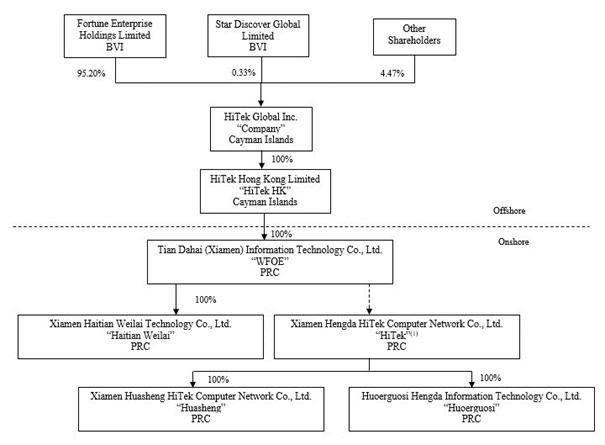
| (1) | The equity of HiTek is 44.74% owned by Xiaoyang Huang, our Chief Executive Officer; 29.83% owned by Shenping Yin, our Chairman of the Board; 2.35% owned by Bo Shi, our Chief Technology Officer; 0.78% owned by Zhishuang Wang; 0.78% owned by Liuqing Huang; 3.02% owned by Jingru Li; 4.99% owned by Mian Tang; 2.0% owned by Ce Tian; 2.0% owned by Xianfeng Lin; 7.55% owned by Inner Mongolia Guangxin Investment Co., Ltd., a Chinese company of which its equity is 80% owned by Wei Cui, 10% owned by Yi Cui and 10 % owned by Lei Gao; 1.96% owned by Baotou Zhongzhe Hengtong Technology Co., Ltd., a Chinese company of which its equity is 95% owned by Jing Kong and 5% owned by Qingxia Kong. |
D. Property
Our headquarters are located at Unit 304, No. 30 Guanri Road, Siming District, Xiamen City, Fujian Province, PRC, where we own the office building with a floor area of 495 square meters. This includes our sales and marketing, communication and business development personnel and our management and operations facilities and customer services.
Item 4A. Unresolved Staff Comments
Not required.
Item 5. Operating and Financial Review and Prospects
A. Operating Results
The following discussion and analysis should be read in conjunction with our consolidated financial statements and the related notes.
43
CAUTIONARY STATEMENT REGARDING FORWARD-LOOKING STATEMENTS
This annual report contains certain statements that may be deemed “forward-looking statements” within the meaning of U.S. of America securities laws. All statements, other than statements of historical fact, that address activities, events or developments that we intend, expect, project, believe or anticipate and similar expressions or future conditional verbs such as will, should, would, could or may occur in the future are forward-looking statements. Such statements are based upon certain assumptions and assessments made by our management in light of their experience and their perception of historical trends, current conditions, expected future developments and other factors they believe to be appropriate.
These statements include, without limitation, statements about our anticipated expenditures, including those related to general and administrative expenses; the potential size of the market for our services, future development and/or expansion of our services in our markets, our ability to generate revenues, our ability to obtain regulatory clearance and expectations as to our future financial performance. Our actual results will likely differ, perhaps materially, from those anticipated in these forward-looking statements as a result of various factors, including: our need and ability to raise additional cash. The forward-looking statements included in this annual report are subject to a number of additional material risks and uncertainties, including but not limited to the risks described in our filings with the SEC.
The following discussion and analysis of our financial condition and results of operations should be read together with our financial statements and the related notes to those statements included in this annual report. In addition to historical financial information, this discussion may contain forward-looking statements reflecting our current plans, estimates, beliefs and expectations that involve risks and uncertainties. As a result of many important factors, our actual results and the timing of events may differ materially from those anticipated in these forward-looking statements.
Overview
We are an offshore holding company incorporated in the Cayman Islands. As a holding company with no material operations, our operations were conducted in China by our subsidiaries and through VIE Agreements, with HiTek and its subsidiaries. Neither we nor our subsidiaries own any equity interests in the VIE. The VIE Agreements are designed so that the operations of the VIE are solely for the benefit of the Company. As such, through the VIE Agreements among WFOE, HiTek and HiTek’s shareholders, we are deemed to have a controlling financial interest in, and be the primary beneficiary of, the VIE for accounting purposes only and must consolidate the VIE because it met the conditions under U.S. GAAP to consolidate the VIE. However, the VIE agreements have not been tested in a court of law, and the VIE structure cannot completely replicate a foreign investment in China-based companies, as the investors will not and may never hold equity interests in the Chinese operating entities. Instead, the VIE structure provides contractual exposure to foreign investment in us. See “Business — Contractual Arrangements between WFOE and HiTek” for a summary of these VIE Agreements.
44
We are an IT consulting and solutions service provider focusing on delivering services to business in various industry sectors in China. As of the date of this annual report, we have two lines of businesses— 1) services to small and medium businesses (“SMEs”), which consists of Anti-Counterfeiting Tax Control System (“ACTCS”) tax devices, ACTCS services, and 2) services to large businesses, which consists of hardware sales and software sales. We expect to actively develop our system integration services and online service platform in the near future. Our vision is to become a one-stop consulting destination for holistic IT and other business consulting services in China.
VAT reporting is mandatory for all business companies in China. The ACTCS is one of the two major VAT control systems that a business entity may choose to comply with the VAT reporting requirements. Developed by the government-owned entity China Aerospace Science and Technology Corporation (“CASTC”), ACTCS was intended to effectively eliminate counterfeit invoices, providing accurate and complete tax information for the regional and national audit system. The VIE entity, HiTek, is authorized to carry out the sales of GTD. We provide our customers with the necessary ACTCS for their VAT reporting, collection and processing. We are authorized by the State Taxation Bureau, Xiamen Branch, as one of the first ACTCS service providers in the Xiamen metropolitan area. GTD is an ACTCS hardware necessary for normal operation of ACTCS software. The purchase of GTD is allowed only in conjunction with the use of the ACTCS software and its supporting services. Currently, there are three ACTCS services providers for Xiamen business companies, and we are one of them.
While we are confident our competitive strengths will continue improving our business, we are keenly aware of the challenges that our business faces, especially the challenges in our services to SMEs which are stemmed from the ACTCS services. The services provided to the SMEs are restricted in the Xiamen metropolitan areas since authorization by the State Taxation Bureau, Xiamen Branch to provide ACTCS services is required which is the cornerstone of our services to the SMEs. Prices of GTD and ACTCS annual service fees are regulated and subject to the State Tax Administration’s pricing mandates. We are not able to adjust such pricing and as such our profit margin is limited. The Chinese tax regulators have been rolling out the electronic invoicing system starting from 2018. The electronic invoices enable companies to apply for, issue, transfer and check the invoices through the unified online electronic invoice management system of Chinese Tax authority. Electronic invoices are very useful in helping business entities reduce operating costs and streamline service process, since they do not involve printing, storage and postage procedures. From January 21, 2021, new taxpayers can receive electronic tax control ukey for free from the Tax authority. Increased use of electronic invoices and the free distribution of GTD will reduce our annual service fee revenue and thus negatively affect our total revenue. Our client base growth may be limited in spite of our diligent marketing efforts, since it is beyond our control how many new SMEs will open each year in the Xiamen metropolitan area.
Complementing our physical service center, we started developing online service platform in 2018. As of January 2019, the online service platform enables tens of thousands of businesses in the Xiamen metropolitan area to securely process. We plan to offer business management service, such as agent accounting services and online IT outsourcing services, to the SME clients using our ACTCS services. We also plan to expand our service to large businesses to other geographic regions.
In April 2021, WFOE established a wholly-owned subsidiary, Haitian Weilai under the laws of the PRC. The strategy purpose of establishing the new subsidiary is for the integration of tax invoicing management services from Hitek to Haitian Weilai.
45
As part of the services to large businesses, HiTek currently sells Communication Interface System (“CIS”), its self-developed software which provides embedded system interface solutions for large businesses. CIS is a universal embedded interface system used in petrochemical and coal businesses to collect industrial, electricity, facility pressure and temperature statistics and convert to readable format for analytical purposes.
As part of our services provided to large businesses, Huasheng sold hardware such as laptops, printers, desktop computers and associated accessories, together with certain internet servers, cameras and monitors. After we launched CIS sales, we also introduced our hardware products to our CIS users. Our major business strategy in the market is to connect and source through exclusive relationships with manufacturers so that Huasheng can offer competitively priced hardware. From the beginning of 2022, Huasheng transferred the above business to the VIE. We plan to market large scale hardware integration systems such as router for commercial use, industrial switch, server, large internet firewall etc. in the future. We have established the online support system in the beginning of 2018. The online system further enhances our customer experience, which is complemented by highly trained professionals and attractive physical store environment.
For the year ended December 31, 2023, HiTek’s two business lines operated three revenue streams. The first business line, services to large businesses, including hardware sales, representing 53% of total revenue, and the software sales, representing 17% of total revenue; and the second business line, ACTCS devices and services, represented 30% of total revenue. For the year ended December 31, 2022, HiTek’s two business lines operated three revenue streams. The first business line, services to large businesses, including hardware sales, represented 39% of total revenue, and the software sales, represented 33% of total revenue, and the second business line, ACTCS devices and services, represented 28% of total revenue. In recent years, the Chinese tax regulators have been rolling out the electronic invoicing system.
Holding Company Structure
Overview
We are a holding company with no material operations of our own. We conduct substantially all of our business in China through contractual arrangements with Xiamen Hengda HiTek Computer Network Co., Ltd., the VIE, and its subsidiaries. See “Business — Contractual Agreements between WFOE and HiTek” for a summary of these VIE arrangements. As of December 31, 2023, the VIE and its subsidiaries (the “VIEs”) accounted for 57% and 100% of the Company’s total assets and total liabilities, respectively. As of December 31, 2022, the VIEs accounted for 96% and 98% of our total assets and total liabilities, respectively. As of December 31, 2021, the VIEs accounted for 93% and 100% of our total assets and total liabilities, respectively. As of December 31, 2023, 2022, and 2021, $1,041,909, $843,705 and $1,486,311 of cash was denominated in RMB, respectively.
Conducting our operations through contractual arrangements with the variable interest entities entails a risk that we may lose the power to direct the activities that most significantly affect the economic performance of the variable interest entities, which may result in our being unable to consolidate their financial results with our results and may impair our access to their cash flow from operations and thereby reduce our liquidity. See “Risk Factors — Risks Relating to Doing Business in the PRC” for more information, including the risk factors titled “Our contractual arrangements with HiTek and its shareholders may not be effective in providing control over HiTek” and “Because we conduct our business through HiTek, a VIE, if we fail to comply with applicable law, we could be subject to severe penalties and our business could be adversely affected.”
In addition, any transfer of funds from us to any of our subsidiaries in China or VIEs, either as a shareholder loan or as an increase in registered capital, is subject to certain statutory limit requirements and registration or approval of the relevant PRC governmental authorities, including the relevant administration of foreign exchange and/or the relevant examining and approval authority. Our subsidiaries in China and VIEs are not permitted under PRC law to directly lend money to one another.
Therefore, it is difficult to change our capital expenditure plans once the relevant funds are remitted from our company to our subsidiaries in China or VIEs. These limitations on the free flow of funds between us and our subsidiaries in China and VIEs could restrict our ability to act in response to changing market conditions and reallocate funds internally in a timely manner.
46
Dividend Distributions
We intend to keep any future earnings to re-invest in and finance the expansion of our business, and we do not anticipate that any cash dividends will be paid in the foreseeable future. Under Cayman Islands law, a Cayman Islands company may pay a dividend on its shares out of either profit or share premium amount, provided that in no circumstances may a dividend be paid if this would result in the company being unable to pay its debts due in the ordinary course of business. If we determine to pay dividends on any of our Class A Ordinary Shares or Class B Ordinary Shares in the future, as a holding company, we will be dependent on receipt of funds from our Hong Kong subsidiary, HiTek HK.
Current PRC regulations permit our indirect subsidiaries in China to pay dividends to the Company only out of their accumulated profits, if any, determined in accordance with Chinese accounting standards and regulations. In addition, each of our subsidiaries in China is required to set aside at least 10% of its after-tax profits each year, if any, to fund a statutory reserve until such reserve reaches 50% of its registered capital. Each of such entity in China is also required to further set aside a portion of its after-tax profits to fund the employee welfare fund, although the amount to be set aside, if any, is determined at the discretion of its board of directors. Although the statutory reserves can be used, among other ways, to increase the registered capital and eliminate future losses in excess of retained earnings of the respective companies, the reserve funds are not distributable as cash dividends except in the event of liquidation.
The PRC government also imposes controls on the conversion of RMB into foreign currencies and the remittance of currencies out of the PRC. Therefore, we may experience difficulties in completing the administrative procedures necessary to obtain and remit foreign currency for the payment of dividends from our profits, if any. Furthermore, if our subsidiaries in the PRC incur debt on their own in the future, the instruments governing the debt may restrict their ability to pay dividends or make other payments. If we or our subsidiaries are unable to receive all of the revenues from our operations through the current VIE Agreements, we may be unable to pay dividends on our Class A Ordinary Shares or Class B Ordinary Shares.
Cash dividends, if any, on our Class A Ordinary Shares or Class B Ordinary Shares will be paid in U.S. dollars. If we are considered a PRC tax resident enterprise for tax purposes, any dividends we pay to our overseas shareholders may be regarded as China-sourced income and as a result may be subject to PRC withholding tax at a rate of up to 10.0%.
In order for us to pay dividends to our shareholders, we will rely on payments made from HiTek to WFOE, pursuant to VIE Agreements between them, and the distribution of such payments to HiTek HK as dividends from WFOE. Certain payments from our HiTek to WFOE are subject to PRC taxes, including business taxes and VAT.
Pursuant to the Arrangement between Mainland China and the Hong Kong Special Administrative Region for the Avoidance of Double Taxation and Tax Evasion on Income, or the Double Tax Avoidance Arrangement, the 10% withholding tax rate may be lowered to 5% if a Hong Kong resident enterprise owns no less than 25% of a PRC project. However, the 5% withholding tax rate does not automatically apply and certain requirements must be satisfied, including without limitation that (a) the Hong Kong project must be the beneficial owner of the relevant dividends; and (b) the Hong Kong project must directly hold no less than 25% share ownership in the PRC project during the 12 consecutive months preceding its receipt of the dividends. In current practice, a Hong Kong project must obtain a tax resident certificate from the Hong Kong tax authority to apply for the 5% lower PRC withholding tax rate. As the Hong Kong tax authority will issue such a tax resident certificate on a case-by-case basis, we cannot assure you that we will be able to obtain the tax resident certificate from the relevant Hong Kong tax authority and enjoy the preferential withholding tax rate of 5% under the Double Taxation Arrangement with respect to dividends to be paid by our PRC subsidiary to its immediate holding company, HiTek HK. As of the date of this annual report, we have not applied for the tax resident certificate from the relevant Hong Kong tax authority. HiTek HK intends to apply for the tax resident certificate when WFOE plans to declare and pay dividends to HiTek HK. See “Risk Factors - There are significant uncertainties under the EIT Law relating to the withholding tax liabilities of our PRC subsidiary, and dividends payable by our PRC subsidiary to our offshore subsidiaries may not qualify to enjoy certain treaty benefits.”
47
Risks in relation to the VIE structure
The VIE structure through contractual arrangements has been adopted by many PRC-based companies, including us, to obtain necessary licenses and permits in the industries that are currently subject to foreign investment restrictions in China. The MOFCOM published a discussion draft of the proposed PRC Foreign Investment Law (“FIL”) in January 2015, or the 2015 Draft FIL, according to which, variable interest entities that are controlled via contractual arrangements would also be deemed as foreign-invested entities, if they are ultimately “controlled” by foreign investors. In March 2019, the PRC National People’s Congress promulgated the PRC FIL, and in December 2019, the State Council promulgated the Implementing Rules of PRC FIL, or the Implementing Rules, to further clarify and elaborate the relevant provisions of the PRC FIL. The PRC FIL and the Implementing Rules both became effective from January 1, 2020 and replaced the major previous laws and regulations governing foreign investments in the PRC. Pursuant to the PRC FIL, “foreign investments” refer to investment activities conducted by foreign investors (including foreign natural persons, foreign companies or other foreign organizations) directly or indirectly in the PRC, which include any of the following circumstances: (i) foreign investors setting up foreign-invested companies in the PRC solely or jointly with other investors, (ii) foreign investors obtaining shares, equity interests, property portions or other similar rights and interests of companies within the PRC, (iii) foreign investors investing in new projects in the PRC solely or jointly with other investors, and (iv) investment in other methods as specified in laws, administrative regulations, or as stipulated by the State Council. The PRC FIL and the Implementing Rules do not introduce the concept of “control” in determining whether a company would be considered as a foreign-invested enterprise, nor do they explicitly provide whether the VIE structure would be deemed as a method of foreign investment. However, the PRC FIL has a catch-all provision that includes into the definition of “foreign investments” made by foreign investors in China in other methods as specified in laws, administrative regulations, or as stipulated by the State Council, and as the PRC FIL and the Implementing Rules are newly adopted and relevant government authorities may promulgate more laws, regulations or rules on the interpretation and implementation of the PRC FIL, the possibility cannot be ruled out that the concept of “control” as stated in the 2015 Draft FIL may be embodied in, or the VIE structure adopted by us may be deemed as a method of foreign investment by, any of such future laws, regulations and rules. If our consolidated VIE was deemed as a foreign-invested enterprise under any of such future laws, regulations and rules, and any of the businesses that we operate would be in any “negative list” for foreign investment and therefore be subject to any foreign investment restrictions or prohibitions, further actions required to be taken by us under such laws, regulations and rules may materially and adversely affect our business, financial condition and results of operations. Furthermore, if future laws, administrative regulations or provisions mandate further actions to be taken by companies with respect to existing contractual arrangements, we may face substantial uncertainties as to whether we can complete such actions in a timely manner, or at all. Failure to take timely and appropriate measures to cope with any of these or similar regulatory compliance challenges could materially and adversely affect our current corporate structure, business, financial condition and results of operations.
Tabular Disclosure of Contractual Obligations
Below is a table setting forth all of our contractual obligations as of December 31, 2023:
| Payment Due by Period | ||||||||||||||||||||
| Less than | More than | |||||||||||||||||||
| Contractual Obligations | Total | 1 year | 1 – 3 years | 3 – 5 years | 5 years | |||||||||||||||
| Operating lease obligations | $ | 3,382 | $ | 3,382 | $ | - | $ | - | $ | - | ||||||||||
| Loan Obligations | ||||||||||||||||||||
| Principal | 2,606,698 | 493,159 | 2,113,539 | - | - | |||||||||||||||
| Interest | 278,283 | 278,283 | - | - | - | |||||||||||||||
| Total | $ | 2,888,363 | $ | 774,824 | $ | 2,113,539 | $ | - | $ | - | ||||||||||
Below is a table setting forth all of our contractual obligations as of December 31, 2022:
| Payment Due by Period | ||||||||||||||||||||
| Less than | More than | |||||||||||||||||||
| Contractual Obligations | Total | 1 year | 1 – 3 years | 3 – 5 years | 5 years | |||||||||||||||
| Operating lease obligations | $ | 6,948 | $ | 3,474 | $ | 3,474 | $ | - | $ | - | ||||||||||
| Loan Obligations | ||||||||||||||||||||
| Principal | 2,677,628 | 506,578 | 2,171,050 | - | - | |||||||||||||||
| Interest | 285,855 | 285,855 | - | - | - | |||||||||||||||
| Total | $ | 2,970,431 | $ | 795,907 | $ | 2,174,524 | $ | - | $ | - | ||||||||||
48
Consolidation
The Company provides substantially all of its services to large businesses and SMEs in China via the VIE and its subsidiaries, due to PRC legal restrictions of foreign ownership in certain sectors. Substantially all of the Company’s revenues, costs and net income in China are directly or indirectly generated through the VIE and its subsidiaries. The Company has signed various agreements with the VIE and legal shareholders of the VIE to allow the transfer of economic benefits from the VIE to the Company and to direct the activities of the VIE.
Total assets and liabilities presented on the Company’s consolidated balance sheets and revenue, expense, net income presented on consolidated statement of operations and comprehensive income as well as the cash flow from operating, investing and financing activities presented on the consolidated statement of cash flows are substantially the financial position, operation and cash flow of the Company’s VIE and VIE’s subsidiaries. The Company has not provided any financial support to the VIE and the VIE’s subsidiaries for the years ended December 31, 2023, 2022 and 2021. As of December 31, 2023, the VIEs accounted for 57% and 100% of the Company’s total assets and total liabilities, respectively. As of December 31, 2022, the VIE and its subsidiaries accounted for 96% and 98% of our total assets and total liabilities, respectively. As of December 31, 2021, the VIE and its subsidiaries accounted for 93% and 100% of our total assets and total liabilities, respectively. As of December 31, 2023, 2022, and 2021, $1,041,909, $843,705 and $1,486,311 of cash was denominated in RMB, respectively. The following table sets forth the assets, liabilities, results of operations and changes in cash, cash equivalents the VIE and its subsidiaries taken as a whole, which were included in the Company’s consolidated balance sheets and statements of comprehensive income and statements of cash flows with intercompany transactions eliminated:
| As of December 31, | ||||||||
| 2023 | 2022 | |||||||
| Current assets | $ | 10,571,775 | $ | 11,276,852 | ||||
| Total non-current assets | $ | 9,641,441 | $ | 9,102,933 | ||||
| Total Assets | $ | 20,213,216 | $ | 20,379,785 | ||||
| Total liabilities | $ | 7,073,660 | $ | 5,329,843 | ||||
| Years Ended December 31, | ||||||||||||
| 2023 | 2022 | 2021 | ||||||||||
| Revenues | $ | 4,335,591 | $ | 6,228,595 | $ | 6,473,638 | ||||||
| Net income | $ | 1,098,947 | $ | 1,684,991 | $ | 2,061,517 | ||||||
| Years Ended December 31, | ||||||||||||
| 2023 | 2022 | 2021 | ||||||||||
| Net cash provided by (used in) operating activities | $ | 834,596 | $ | 4,016,852 | $ | (757,861 | ) | |||||
| Net cash (used in) provided by investing activities | $ | (675,964 | ) | $ | (7,349,231 | ) | $ | 400,006 | ||||
| Net cash provided by financing activities | $ | - | $ | 2,749,498 | $ | - | ||||||
Revenue Recognition
The Company follows ASU 2014-09, Topic 606, “Revenue from Contracts with Customers” and its related amendments (collectively referred to as “ASC 606”) for its revenue recognition accounting policy that depicts the transfer of promised goods or services to customers in an amount that reflects the consideration to which the Company expects to be entitled in exchange for those goods or services. In accordance with ASC 606, revenue is recognized when all of the following five steps are met: (i) identify the contract(s) with the customer; (ii) identify the performance obligations in the contract; (iii) determine the transaction price; (iv) allocate the transaction price to the performance obligations; (v) recognize revenue when (or as) each performance obligation is satisfied.
49
The Company generates its revenues primarily from three sources: (1) hardware sales, (2) software sales, and (3) tax devices and services. The Company recognizes revenue when performance obligations under the terms of a contract with its customers are satisfied. This occurs when the control of the goods and services have been transferred to the customer.
| ● | Hardware sales |
Hardware revenues are generated primarily from the sale of computer and network hardware to end users. The products include computers, printers, internet cables, certain internet servers, cameras and monitors. Sales of hardware have a single performance obligation. The Company usually recognizes the revenue when ownership is transferred to end customers. The Company’s revenue from sales of hardware is reported on a gross basis since the Company is primarily obligated in the transaction, bears inventory and credit risk and has discretion to establish the prices. Hardware sales are classified as “Revenue” in the Company’s consolidated statements of operations.
| ● | Software sales |
HiTek also does business in software sales and focuses on the perpetual licenses sales for one of the self-developed software Communication Interface System (“CIS”). CIS is based on LINUX, which is a general embedded interface system used in petrochemical and coal companies. The system is used to communicate the RCTX-X module, collect the work diagram, the electricity diagram, the pressure temperature and other measures, and can extract the data and import it to the software of the windows platform to display analysis.
Performance Obligations - Software contracts with customers include multiple performance obligations such as sale of software license, installation of software, operation training service and warranty. The installation and operation training are essential to the functionality of the software which are provided to the clients prior to the acceptance of the software. The Company provides one-year warranty which mainly telephone supports. The Company estimates that costs associated with warranty are de minimis to the overall contract. Therefore, the Company does not further allocate transaction price.
The Company recognizes revenue when the software is accepted by the customer. Revenues from software sales contracts are classified as “Revenue” on the Company’s consolidated statements of operations.
| ● | Tax Devices and Services |
Before January 21, 2021, all VAT general taxpayer businesses in China are required to purchase the Anti-Counterfeiting Tax Control System (“ACTCS” or Golden Tax Disk or GTD) tax devices to issue the VAT Invoice and for quarterly VAT filing. HiTek is authorized to carry out the implementation of ACTCS specialty hardware retailing. The price of GTD and related supporting services are determined by the National Development and Reform Commission. From January 21, 2021, new taxpayers can receive electronic tax control ukey for free from the Tax authority. HiTek could provide supporting services to the new taxpayers.
Performance Obligations - Tax devices and services contracts with customers include multiple performance obligations such as delivery of products, installation and after-sales supporting services, tax control system risk investigation service, and tax invoicing management service, such as training service on issuing electronic invoice, complete tax declaration automatically and back up data online.
Revenue from the sales of GTD devices is recognized when ownership is transferred to end customers. The Company provides the tax device after-sales supporting services and tax invoicing management service, charging the service fee on an annual basis because the service period is usually one year. Revenue from its service is recognized as the services are performed and amounts are earned, using the straight-line method over the term of the related services agreement. The Company also charges a one-time service charge for each investigation request. Revenue from tax control system risk investigation service is recognized when the services are performed. Revenue is recognized based on each performance obligation’s standalone selling price that is sold separately and charged to customers at contract inception.
50
The Company’s revenue from its gross billings is reported on a gross basis since the Company is primarily obligated in the transaction, is subject to inventory and credit risk and has several but not all of the indications that revenue should be recorded on the gross basis.
Revenue was comprised of the following.
| Years Ended December 31, | ||||||||||||
| 2023 | 2022 | 2021 | ||||||||||
| Revenues | ||||||||||||
| Hardware | $ | 2,428,592 | $ | 2,504,426 | $ | 2,434,694 | ||||||
| Tax devices and service | 1,376,323 | 1,803,650 | 1,970,363 | |||||||||
| Software | 758,816 | 2,120,532 | 2,056,106 | |||||||||
| Total revenues | $ | 4,563,731 | $ | 6,428,608 | $ | 6,461,163 | ||||||
| ● | Contract balances |
Prepayments received from customers before the services are performed are recorded as deferred revenue. Deferred revenue consists of the annual service fees for Golden Tax Disk and tax invoicing management service received from customers while the services have not yet been performed. The Company recognizes service fees as revenue on a straight-line basis in accordance with the service periods.
| ● | Practical expedients and exemptions |
The Company generally expenses sales commissions as incurred because the amortization period would have been one year or less.
Expected Credit Losses
On January 1, 2023, the Company adopted ASC 326, Credit Losses (“ASC 326”), which replaced previously issued guidance regarding the impairment of financial instruments with an expected loss methodology that will result in more timely recognition of credit losses. The Company used a modified retrospective approach and did not restate the comparable prior periods. The adoption did not have a material impact on the Company’s consolidated financial statements (“CFS”).
Upon adoption of ASC 326, the Company maintains an allowance for credit losses in accordance with ASC 326 and records the allowance for credit losses as an offset to assets such as accounts receivable, etc., and the estimated credit losses charged to the allowance are classified as general and administrative expenses in the consolidated statements of operations and comprehensive income (loss). The Company assesses collectability by reviewing receivables on a collective basis where similar characteristics exist, primarily based on the size and nature of specific customers’ receivables. In determining the amount of the allowance for credit losses, the Company considers historical collectability based on past due status, the age of the receivable balances, credit quality of the Company’s customers based on ongoing credit evaluations, current economic conditions, reasonable and supportable forecasts of future economic conditions, and other factors that may affect the Company’s ability to collect from customers. Bad debts are written off as incurred.
Inventories
Inventories are stated at the lower of cost (weighted average basis) or net realizable value. The methods of determining inventory costs are used consistently from year to year. Allowance for inventory obsolescence is provided when the market value of certain inventory items is lower than the cost.
51
Leases
On December 31, 2022, the Company adopted Accounting Standards Update (“ASU”) 2016-02, Leases (as amended by ASU 2018-01, 2018-10, 2018-11, 2018-20, and 2019-01, collectively “ASC 842”), using the modified retrospective method. The Company elected the transition method which allows entities to initially apply the requirements by recognizing a cumulative-effect adjustment to the opening balance of retained earnings in the period of adoption. As a result of electing this transition method, previously reported financial information has not been restated to reflect the application of the new standard to the comparative periods presented. The Company elected the package of practical expedients permitted under the transition guidance within ASC 842, which among other things, allows the Company to carry forward certain historical conclusions reached under ASC Topic 840 regarding lease identification, classification, and the accounting treatment of initial direct costs. The Company elected not to record assets and liabilities on its consolidated balance sheet for new or existing lease arrangements with terms of 12 months or less. The Company recognizes lease expenses for such lease on a straight-line basis over the lease term.
The most significant impact upon adoption relates to the recognition of Right-of-use (“ROU”) assets and lease liabilities on the Company’s consolidated balance sheets for office and warehouse space leases. At the commencement date of a lease, the Company recognizes a lease liability for future fixed lease payments and a right-of-use (“ROU”) asset representing the right to use the underlying asset during the lease term. The lease liability is initially measured as the present value of the future fixed lease payments that will be made over the lease term. The lease term includes periods for which it is reasonably certain that the renewal options will be exercised and periods for which it’s reasonably certain that the termination options will not be exercised. The future fixed lease payments are discounted using the rate implicit in the lease, if available, or the incremental borrowing rate (“IBR”). The Company will evaluate the carrying value of ROU assets if there are indicators of impairment and review the recoverability of the related asset group. If the carrying value of the asset group is determined to not be recoverable and is in excess of the estimated fair value, the Company will record an impairment loss in other expenses in the consolidated statements of operations.
Recently issued accounting pronouncements
In December 2023, the FASB issued ASU 2023-09, Improvements to Income Tax Disclosures, which requires disaggregated information about an entity’s effective tax rate reconciliation and additional discloses on income taxes paid. The new requirements are effective for annual periods beginning after December 15, 2024. The guidance is to be applied prospectively, with an option for retrospective application. The Company is currently evaluating the impact of this new guidance on disclosures within its CFS.
The Company does not believe other recently issued but not yet effective accounting standards, if currently adopted, would have a material effect on our CFS.
Results of Operations
The following consolidated results of operations include the results of operations of the Company, its wholly owned subsidiary and consolidated VIEs.
Our historical reporting results are not necessarily indicative of the results to be expected for any future period.
Year Ended December 31, 2023 Compared to Year Ended December 31, 2022
Revenue
| Increase / | Percentage | |||||||||||||||
| 2023 | 2022 | (Decrease) | Change | |||||||||||||
| Hardware | $ | 2,428,592 | $ | 2,504,426 | $ | (75,834 | ) | (3.0 | )% | |||||||
| CIS software | 758,816 | 2,120,532 | (1,361,716 | ) | (64.2 | )% | ||||||||||
| Tax devices and service | 1,376,323 | 1,803,650 | (427,327 | ) | (23.7 | )% | ||||||||||
| Total revenues | $ | 4,563,731 | $ | 6,428,608 | $ | (1,864,877 | ) | (29.0 | )% | |||||||
We have the following three revenue streams – hardware sales, CIS software sales, and tax devices and services sales. The hardware sales increase was mainly due to the increase in sales to large customers. CIS software sales consist of software sales and services. CIS software sales decreased mainly due to the decrease of software sales to large customers, for these large customers reduced their procurement. Tax devices and service sales decreased due to new policies from January 2021 that new taxpayers in Xiamen could get free tax Ukeys from the Tax authorization. We expect the tax devices and service sales will be affected in the future. Our total revenues for the year ended December 31, 2023 were $4,563,731, a decrease of $1,864,877 or 29.0% from $6,428,608 for the year ended December 31, 2022. The decrease was due primarily to the Company’s decreased software sales to large customers for their slow repayment. The Company expects to expand tax control system risk investigation service for SMEs and also increase orders for software and hardware sales from major customers in 2024.
52
Cost and Margin
| Increase / | Percentage | |||||||||||||||
| 2023 | 2022 | (Decrease) | Change | |||||||||||||
| Total revenues | $ | 4,563,731 | $ | 6,428,608 | $ | (1,864,877 | ) | (29.0 | )% | |||||||
| Cost of revenues | 2,642,491 | 2,891,565 | (249,074 | ) | (8.6 | )% | ||||||||||
| Gross profit | $ | 1,921,240 | $ | 3,537,043 | $ | (1,615,803 | ) | (45.7 | )% | |||||||
| Margin % | 42.1 | % | 55.0 | % | (12.9 | )% | ||||||||||
Cost of revenue is comprised of (i) the direct cost of our hardware products purchased from third parties; (ii) logistics-related costs, which primarily include product packaging and freight-in charges; (iii) third-party royalties paid related to the Golden Tax Disk (“GTD”), an Anti-Counterfeiting Tax Control System (“ACTCS”) tax device; (iv) compensation for the employees who handle the products and perform Tax invoicing management services and other costs that are necessary for us to provide the services to our customers; and (v) outsourcing costs, which primarily include software outsourcing service cost to the third parties.
Cost of revenues decreased to $2,642,491 for the year ended December 31, 2023 from $2,891,565 for 2022, a decrease of $249,074 or 8.6%. This decrease was mainly due to the change in revenue mix, with less revenues generated in 2023 from software sales that have a higher gross profit, which resulted in the decrease of cost of sales as a percentage of sales in 2023 compared to 2022.
Gross Profit. Our gross profit decreased to $1,921,240 for the year ended December 31, 2023 from $3,537,043 for 2022. Our gross profit as a percentage of revenue decreased to 42.1% for the year ended December 31, 2023 from 55.0% for 2022. This was mainly due to the change in revenue mix, with fewer revenues being generated in 2023 from CIS software sales that have a higher profit margin. The Company expects to continue to focus on projects with high gross profit, such as services for SMEs, and at the same time, increase the hardware and software sales of large customers.
Operating Expenses
| Increase / | Percentage | |||||||||||||||
| 2023 | 2022 | (Decrease) | Change | |||||||||||||
| Selling expenses | $ | 648 | $ | 437,185 | $ | (436,537 | ) | (99.9 | )% | |||||||
| % of revenue | 0.0 | % | 6.8 | % | (6.8 | )% | - | |||||||||
| General and administrative expenses | 1,819,531 | 1,472,648 | 346,883 | 23.6 | % | |||||||||||
| % of revenue | 39.9 | % | 22.9 | % | 17 | % | - | |||||||||
| Operating expenses | $ | 1,820,179 | $ | 1,909,833 | $ | (89,654 | ) | (4.7 | )% | |||||||
Selling Expenses. Selling expenses consist primarily of shipping and handling costs for products sold and advertising and marketing expenses for the promotion of our products. Selling expenses decreased by 99.9% or $436,537 to $648 for the year ended December 31, 2023 from $437,185 in 2022. The decrease was mainly attributable to the decrease in the Company’s sales commissions to obtain new orders in 2023. Selling expenses were 0.01% of total revenue for the year ended December 31, 2023 and 6.8% of total revenue in 2022.
General and Administrative Expenses. General and administrative expenses consist primarily of salary and welfare for our general administrative and management staff, facilities costs, depreciation expenses, professional fees, accounting fees, directors and officers liability insurance, and other miscellaneous expenses incurred in connection with general operations. General and administrative expenses increased by 23.6% or $346,883 to $1,819,531 for the year ended December 31, 2023 from $1,472,648 in 2022. The increase was mainly due to (1) the increase of professional service fee of $233,458 resulting from financial and legal consulting in 2023, (2) other fees of $36,728 related to the Company’s IPO in March 2023, and (3) rent of $78,246. The increase was offset by a decrease in salary expense of $133,492 resulting from the reduction of employees for cost-effectiveness consideration. General and administrative expenses were 39.9% of total revenue for the year ended December 31, 2023 and 22.9% of total revenue in 2022.
53
Net Income
| Increase / | Percentage | |||||||||||||||
| 2023 | 2022 | (Decrease) | Change | |||||||||||||
| Operating income | $ | 101,061 | $ | 1,627,210 | $ | (1,526,149 | ) | (93.8 | )% | |||||||
| Total other income | 1,493,465 | 241,753 | 1,251,712 | 517.8 | % | |||||||||||
| Income before income taxes | 1,594,526 | 1,868,963 | (274,437 | ) | (14.7 | )% | ||||||||||
| Income tax expense | (546,885 | ) | (453,218 | ) | (93,667 | ) | 20.7 | % | ||||||||
| Net income | $ | 1,047,641 | $ | 1,415,745 | $ | (368,104 | ) | (26.0 | )% | |||||||
| Effective tax rate | 34.3 | % | 24.2 | % | (10.1 | )% | ||||||||||
Operating income. Operating income was $101,061 for the year ended December 31, 2023, compared to $1,627,210 for 2022. The decrease in operating income in 2022 was primarily due to the decrease in CIS software sales.
Other income. Other income includes government subsidy income, net investment income (loss), and interest income and expenses. Other income was $1,493,465 and $241,753 for years ended December 31, 2023 and 2022, respectively. The increase was primarily due to the increase in investment income of $349,915, government subsidies of $560,090 and interest income of $366,320.
Income tax expense. Income tax expense was $546,885 for the year ended December 31, 2023, compared to $453,218 for 2022. The increase in income tax expense was due primarily to the increase in deferred tax liability resulting from the increased unbilled revenue from large customers.
Effective tax rate. Effective tax rate was 34.3% for the year ended December 31, 2023, compared to 24.2% for 2022. The increase was due primarily to one PRC subsidiary with a preferential tax policy recording a loss in 2023, whereas it recorded a profit in 2022.
Net income. As a result of the factors described above, net income was $1,047,641 for the year ended December 31, 2023, a decrease of $368,104 from $1,415,745 for 2022.
Year Ended December 31, 2022 Compared to Year Ended December 31, 2021
Revenue
| Increase / | Percentage | |||||||||||||||
| 2022 | 2021 | (Decrease) | Change | |||||||||||||
| Hardware | $ | 2,504,426 | $ | 2,434,694 | $ | 69,732 | 2.9 | % | ||||||||
| CIS Software | 2,120,532 | 2,056,106 | 64,426 | 3.1 | % | |||||||||||
| Tax devices and service | 1,803,650 | 1,970,363 | (166,713 | ) | (8.5 | )% | ||||||||||
| Total revenues | $ | 6,428,608 | $ | 6,461,163 | $ | (32,555 | ) | (0.5 | )% | |||||||
We have the following three streams - hardware retail and wholesale, software sales, and ACTCS sales and services. The Hardware sales slightly increase was mainly from small retail sales. The Software sales consist of software sales and software services. The sales of software slightly increased was due to increase of maintenance service revenue. Tax Devices and service sales were decreased due to the new policies carried from January 2021 that the new taxpayers in Xiamen could get free tax Ukeys from the Tax authorization. We expect the tax devices and service sales will be affected in the future. Our total revenues for the year ended December 31, 2022 were $6,428,608, a decrease of $32,555 or 0.5% from $6,461,163 for the year ended December 31, 2021. The overall decrease in revenue was mainly resulted from the decrease of tax device and service due to the new policy carried from January 2021.
The Company expects to expand tax control system risk investigation service for SMEs and also increase orders for software and hardware sales from major customers in 2023.
54
Cost and Margin
| Increase / | Percentage | |||||||||||||||
| 2022 | 2021 | (Decrease) | Change | |||||||||||||
| Total revenues | $ | 6,428,608 | $ | 6,461,163 | $ | (32,555 | ) | (0.5 | )% | |||||||
| Cost of revenues | 2,891,565 | 2,581,218 | 310,347 | 12.0 | % | |||||||||||
| Gross profit | 3,537,043 | 3,879,945 | (342,902 | ) | (8.8 | )% | ||||||||||
| Margin % | 55.0 | % | 60.1 | % | (5.1 | )% | ||||||||||
Cost of revenue is comprised of (i) the direct cost of our hardware products purchased from third parties; (ii) logistics-related costs, which primarily include product packaging and freight-in charges; (iii) third-party royalties paid related to the GTD (iv) compensation for the employees who handle the products and perform Tax invoicing management services and other costs that are necessary for us to provide the services to our customers; and (v) outsourcing costs, which primarily include software outsourcing service cost to the third parties.
Cost of revenues increased to $2,891,565 for the year ended December 31, 2022 from $2,581,218 for 2021. An increase of $310,347 or 12.0%. This increase was mainly due to cost of sales of software increased in 2022 compared to 2021.
Gross Profit. Our gross profit decreased to $3,537,043 for the year ended December 31, 2022 from $3,879.945 for 2021. Our gross profit as a percentage of revenue decreased to 55.0% for the year ended December 31, 2022 from 60.1% for 2021. This was mainly due to the increase of cost of software, for the software maintenance service from March 20, 2021 to July 31, 2021 is provided by Huoerguosi itself, which resulting in a reduction in costs and a higher GP% in 2021. The Company expects to continue to focus on projects with high gross profit such as services for SMEs, and at the same time, increase the hardware and software sales of large customers.
Operating Expenses
| Increase / | Percentage | |||||||||||||||
| 2022 | 2021 | (Decrease) | Change | |||||||||||||
| Selling expenses | $ | 437,185 | $ | 76,477 | $ | 360,708 | 471.7 | % | ||||||||
| % of revenue | 6.8 | % | 1.2 | % | 5.6 | % | - | |||||||||
| General and administrative expenses | 1,472,648 | 1,699,934 | (227,286 | ) | (13.4 | )% | ||||||||||
| % of revenue | 22.9 | % | 26.3 | % | (3.4 | )% | - | |||||||||
| Operating expenses | $ | 1,909,833 | $ | 1,776,411 | $ | 133,422 | 7.5 | % | ||||||||
Selling Expenses. Selling expenses consist primarily of shipping and handling costs for products sold and advertisement and marketing expenses for promotion of our products. Selling expenses increased by 471.7% or $360,708 to $437,185 in the year ended December 31, 2022 from $76,477 in 2021. The increase was mainly because of the increase of the Company’s sales commission in connection with obtaining new orders. Selling expenses were 6.8% of total revenue for the year ended December 31, 2022 and 1.2% of total revenue in 2021. The Company expects to maintain the current ratio of selling expenses to revenue in 2023.
General and Administrative Expenses. General and administrative expenses consist primarily of costs in salary and welfare expenses for our general administrative and management staff, facilities costs, depreciation expenses, professional fees, accounting fees, and other miscellaneous expenses incurred in connection with general operations. General and administrative expenses decreased in 13.4% or $227,286 to $1,472,648 for the year ended December 31, 2022 from $1,699,934 in 2021. The decrease was mainly due to the decrease of bad debt recovery of $124,847, and offset with the decrease of depreciation expense of $333,857. General and administrative expenses were 22.9% of total revenue for the year ended December 31, 2022 and 26.3% of total revenue in 2021. The Company expects to maintain the current ratio of general and administrative expenses to revenue in 2023.
55
Net Income
| Increase / | Percentage | |||||||||||||||
| 2022 | 2021 | (Decrease) | Change | |||||||||||||
| Operating income | $ | 1,627,210 | $ | 2,103,534 | $ | (476,324 | ) | (22.6 | )% | |||||||
| Total other income | 241,753 | 108,676 | 133,077 | 122.5 | % | |||||||||||
| Income before income taxes | 1,868,963 | 2,212,210 | (343,247 | ) | (15.5 | )% | ||||||||||
| Income tax expense | (453,218 | ) | (542,853 | ) | 89,635 | (16.5 | )% | |||||||||
| Net income | $ | 1,415,745 | $ | 1,669,357 | $ | (253,612 | ) | (15.2 | )% | |||||||
| Effective tax rate | 24.2 | % | 24.5 | % | 0.3 | % | ||||||||||
Operating income. Operating income was $1,627,210 for the year ended December 31, 2022, compared to $2,103,534 for 2021. The decrease in operating income in 2022 was primary due to the decrease in gross profit.
Other income. Other income includes government subsidy income, net investment income (loss), and interest income and expenses. Other income was $241,753 and $108,676 for the years ended December 31, 2022 and 2021, respectively. The increase was primarily due to the increase of interest income related to the loan receivables in the amount of $570,707 offset by the increase of interest expense for the borrowings of $285,353.
Income tax expense. Income tax expense was $453,218 for the year ended December 31, 2022, compared to $542,853 for 2021. The decrease in income tax expense was due primarily to the decrease in gross profit.
Effective tax rate. Effective tax rate was 24.2% for the year ended December 31, 2022, compared to 24.5% for 2021.
Net income. As a result of the factors described above, net income was $1,415,745 for the year ended December 31, 2022, a decrease of $253,612 from net income $1,669,357 for 2021.
Liquidity and Capital Resources
Year Ended December 31, 2023 Compared to Year Ended December 31, 2022
Our principal sources of liquidity come from cash generated from operating activities, equity financing and loans. As of December 31, 2023 and 2022, we had cash of $9,311,537 and $1,203,160, respectively.
Working Capital. Working capital as of December 31, 2023 was $21,413,847 compared to $6,981,017 as of December 31, 2022. The increase was mainly due to an increase in the current portion of short-term investments of $4,547,097, loan receivable of $2,595,132, and prepaid expenses and other current assets of $257,994, which was offset by a decrease in accounts receivable of $1,551,945, inventories of $211,165 and advance to suppliers of $143,603. Current liabilities were $3,372,752 as of December 31, 2023, compared to $4,203,695 as of December 31, 2022. This increase in liabilities was attributable mainly to an increase in deferred revenue of $810,294. In addition, in April 2023, the Company received approximately $15.1 million from the public offering. We believe our current cash and anticipated cash flow from operations will be sufficient to meet our anticipated cash needs, including our cash needs for working capital and capital expenditures, for at least the next 12 months.
Capital Resources and Capital Needs. To date, we have financed our operations primarily through cash flows from operations, third-party loans and stock offering. With the uncertainty of the current market, our management believes it is necessary to enhance the collection of outstanding accounts receivable and other receivables, and to be cautious on operational decisions and project selection. Our management believes our current operations can satisfy our daily working capital needs. We expect to incur additional capital expenditures for research and development of software, recruiting additional employees, and enhancing our information technology system. We intend to fund these planned expenditures with our operating cash flow and our cash balance, as well as net proceeds received from our initial public offering in April 2023.
56
The Company engages an external vendor to develop software APP. As of December 31, 2023, the Company paid product development costs of $410,509 and the total contract amount was $422,708. In March 2021, the Company signed a supplementary agreement to postpone the official launch of the software APP after the closing of the Company’s initial public offering. In August, 2023, the Company signed a supplementary agreement with another external vendor who took over the unfulfilled contractual obligations from previous external vendor who was deregistered in May, 2023. This software development project was restarted after August, 2023. And the Company plans to conduct close beta in 2024. In 2023, the Company signed a software upgrade and development contract (for internal use) (Interface System), which obligated the software company to perform certain specific software upgrade and development activities from May to September 2023. The development is finished and will be accepted by the Company in April 2024. As of December 31, 2023, the Company paid the software upgrade and development costs of $338,166 and the total contract amount was $676,333.
On January 21, 2022, March 28, 2022 and June 14, 2022, the Company made three loans of RMB30,000,000 ($4,272,079), RMB3,000,000 ($422,708) and RMB7,000,000 ($986,318) to a third party, which were restricted for its operating activities, carrying interest at 12%. The RMB30,000,000 loan is extended for one year and will mature on January 21, 2025. The RMB7,000,00 will mature on June 13, 2024. The RMB3,000,000 loan was repaid in August 2022 with an interest of RMB120,000 ($17,368).
In 2023, the Company provided loans with interest of 1.5% per month to another third party for its operating activities. The loans are secured by their respective pledge contracts using their underlying assets. Such loans will mature within nine months from the date of issue, with loan principal, interest and handling fees to be settled immediately after the maturity date. From April to December 2023, total loans to such a third party amounted to $9.8 million, of which $7.3 million of the principal was repaid prior to December 31, 2023.
The Company reviews accounts receivable on a periodic basis and records credit losses when there is doubt as to the collectability of balances. Our management is confident in collecting account receivables and other receivables. The accounts receivable, net and the accounts receivable from related party, net balance was $2,118,738 and nil as of December 31, 2023, respectively.
The Company gives customers different credit periods, depending on the scale of the customer and past credit experience. For large customers such as large-scale oil and coal mine customers, the Company gives a two-year credit period from March 2019 because of these customers’ long repayment cycle. Net balance of the accounts receivable was $6,451,813 as of December 31, 2023, of which $1,902,185 was collected as of the date of this annual report.
For IT outsourcing customers, the Company gives an 18 months credit period. The accounts receivable, net balance was $nil as of December 31, 2023.
For small and medium customers, the Company gives a six months credit period. The accounts receivable, net balance was $264,139 as of December 31, 2023.
Off-Balance Sheet Arrangements.
We have not entered into any financial guarantees or other commitments to guarantee the payment obligations of any third parties. In addition, we have not entered into any derivative contracts that are indexed to our own shares and classified as shareholders’ equity, or that are not reflected in our financial statements. Furthermore, we do not have any retained or contingent interest in assets transferred to an unconsolidated entity that serves as credit, liquidity or market risk support to such entity. Moreover, we do not have any variable interest in an unconsolidated entity that provides financing, liquidity, market risk or credit support to us or engages in leasing, hedging or research and development services with us.
57
Cash Flows Analysis
| (a) | Operating Activities |
| (1) |
Net cash used in operating activities was $61,912 for the year ended December 31, 2023, while net cash provided by operating activities was $3,824,050 for the year ended December 31, 2022. The increase of $3,885,962 in net cash used in operating activities for the year ended December 31, 2023 was mainly due to (1) an increase of $4,115,220 in cash used in short-term investments in 2023; (2) an increase of $1,048,918 in cash used in deferred revenue, for the tax devices and service sales decreased due to the new policies carried from January 2021 that the new taxpayers in Xiamen could get free tax Ukeys from the Tax authorization. The deferred revenue from after-sales supporting services and tax invoicing management service decreased correspondingly; (3) an increase of $504,017 in cash used in accrued expenses and other liabilities, for the Company paid annual bonus of previous years; (4) an increase of $371,840 in cash used in accounts payable, for the Company paid to our vendors timely; (5) an increase of $190,134 in cash used in deferred offering cost, for the Company paid offering expenses in 2023; and (6) an increase of $102,611 in cash used in prepaid expenses and other current assets. These were partially offset by (1) an increase of $3,058,205 in cash provided by accounts receivable; (2) an increase of $252,771 in cash provided by inventory; (3) a decrease of $196,841 in cash provided by taxes payable; and (4) a decrease of $109,736 in cash provided by accounts receivable from related parties. |
| (b) | Investing Activities |
| (2) |
Net cash used in investing activities was $6,946,555 and $7,349,231 for the years ended December 31, 2023 and 2022, respectively. The increase of $402,676 in net cash used in investing activities for the year ended December 31, 2023 was mainly due to (1) an increase of $9,067,920 in purchase of held-to-maturity investments; (2) an increase of $5,761,545 in loans lent to third parties; (3) an increase of $221,692 in advance payment for software development, (4) an increase of $186,499 for purchases of property, plant and equipment, and (5) an increase of $150,156 for office renovation. These were partially offset by an increase of $8,631,470 in repayment from third-party loans.
On January 21, 2022, March 28, 2022 and June 14, 2022, the Company made three loans of RMB30,000,000 ($4,272,079), RMB3,000,000 ($422,708) and RMB7,000,000 ($986,318) to a third party, which were restricted for its operating activities, carrying interest at 12%. The RMB30,000,000 loan is extended for one year and will mature on January 21, 2025. The RMB7,000,000 will mature on June 13, 2024. The RMB3,000,000 loan was repaid in August 2022 with an interest of RMB120,000 ($17,368). The change in the carrying value of these outstanding loans from $5,355,257 in 2022 to $5,213,397 in 2023 was due mainly to currency translation. Pursuant to a mining right pledge agreement dated August 5, 2022 between HiTek, as representative of the Lenders, and the Borrower, these three loans are secured by the Borrower’s coal mining permit issued by Bobai County Natural Resources Bureau, which grants the Borrower a 20-year mining right for certain building granite mine in Daguang Village, Shuiming Town, Bobai County, Guangxi Province, for production of 1.306 million cubic meters per year.
In 2023, the Company provided loans with interest of 1.5% per month to another third party for its operating activities. The loans are secured by their respective pledge contracts using their underlying assets. Such loans will mature within nine months from the date of issue, with loan principal, interest, and handling fees to be settled immediately after the maturity date. From April to December 2023, total loans to such a third party were $9.8 million, of which $7.3 million of the principal was repaid prior to December 31, 2023. |
| (c) | Financing Activities |
Net cash provided by financing activities was $15,142,902 and $2,749,498 for the years ended December 31, 2023 and 2022, respectively. For the year ended December 31, 2023, we had $15,142,902 cash inflow from insurance of Ordinary Shares. For the year ended December 31, 2022, we had $2,749,498 cash inflow from borrowing from third parties.
58
Year Ended December 31, 2022 Compared to Year Ended December 31, 2021
As of December 31, 2022 and 2021, we had cash of $1,203,160 and $2,091,308 respectively.
Working Capital. Working capital as of December 31, 2022 was $7,898,463 compared to $10,178,635 as of December 31, 2021. The decrease was mainly due to a decrease in short-term investments of $906,667, advances to suppliers of $629,154 and deferred offering cost of $109,121 which offset by an increase in accounts receivable of $914,104, loan receivable of $808,716 and inventory of $21,649. Current liabilities were $4,203,695 as of December 31, 2022, compared to $2,788,504 as of December 31, 2021. This increase of liabilities was attributable mainly to an increase in accounts payable of $177,995, deferred revenue of $192,524, loan payable of $506,578 and tax payable of $372,175.
Capital Resources and Capital Needs. To date, we have financed our operations primarily through cash flows from operations and third-party loans. With the uncertainty of the current market, our management believes it is necessary to enhance collection of outstanding accounts receivable and other receivables, and to be cautious on operational decisions and project selection. Our management believes that our current operations can satisfy our daily working capital needs.
During 2020, the Company engages an external vendor to develop software APP. As of December 31, 2022, the Company paid product development costs of $421,679 and the total contract amount was $434,210. In March 2021, the Company signed a supplementary agreement to postpone the official launch after closing of the Company’s initial public offering. The Company had made a payment of $119,405 (VAT included) in January 2022 for the development costs and will make the final payment of $12,531 in 2023.
On January 21, March 28 and June 14, 2022, the Company entered into three borrowing agreements of RMB15,000,000 ($2,171,050 with an exchange rate of 0.1447 as of December 31, 2022), RMB1,500,000 ($217,205 with an exchange rate of 0.1447 as of December 31, 2022) and RMB3,500,000 ($506,578 with an exchange rate of 0.1447 as of December 31, 2022) from another third party in a normal course of business. The loan is a credit loan. The loan is due by January 20, 2024, July 27, 2022 and June 13, 2023, at 12%. RMB1,500,000 ($217,205) of the principal was paid as of December 31, 2022.
The Company reviews the accounts receivable on a periodic basis and makes general and specific allowances when there is doubt as to the collectability of individual balances. Our management is confident in collecting account receivables and other receivables. The accounts receivable, net and the accounts receivable of related party, net balance was $7,480,764 and $399,465 as of December 31, 2022, respectively. Subsequent to the filling of the annual report on Form 20-F with the SEC on April 27, 2023, the Company collected receivables of $1,145,325.
The Company gives customers different credit periods considering the scale of the customer and past credit experience. For large customers such as large-scale oil and coal mine customers, the Company gives a two-year credit period starting from March 2019 because of these customers’ long repayment cycle. Net balance of the accounts receivable was $6,802,306 and $6,171,410 as of December 31, 2022 and 2021, respectively. Subsequent to the filling of the annual report on Form 20-F with the SEC on April 27, 2023, the Company has collected receivables of $978,411.
For IT outsourcing customers, the Company gives 18 months credit period. The accounts receivable, net balance was $nil and $64,478 as of December 31, 2022 and 2021, respectively.
For small and medium customers, the Company gives six months credit period. The accounts receivable, net balance was $1,077,923 and $218,621 as of December 31, 2022 and 2021, respectively.
Off-Balance Sheet Arrangements.
We have not entered into any financial guarantees or other commitments to guarantee the payment obligations of any third parties. In addition, we have not entered into any derivative contracts that are indexed to our own shares and classified as shareholders’ equity, or that are not reflected in our financial statements. Furthermore, we do not have any retained or contingent interest in assets transferred to an unconsolidated entity that serves as credit, liquidity or market risk support to such entity. Moreover, we do not have any variable interest in an unconsolidated entity that provides financing, liquidity, market risk or credit support to us or engages in leasing, hedging or research and development services with us.
59
Cash Flows Analysis
| (a) | Operating Activities |
| (1) | Net cash provided by operating activities was $3,824,050 for the year ended December 31, 2022, while, net cash used in operating activities was $214,575 for the year ended December 31, 2021. The increase of $4,038,625 in net cash provided by operating activities for the year ended December 31, 2022 was mainly due to (1) an increase of $5,043,891 in short-term investments, (2) an increase of $744,721 in advances to suppliers, (3) an increase of $218,773 in inventory, (4) an increase of $97,776 in accounts payable, (5) an increase of $249,767 in deferred revenue, and (6) an increase of $160,612 in taxes payable. These were partially offset by a decrease of $1,390,669 in account receivable, $680,330 in prepaid expenses and other current assets. |
| (b) | Investing Activities |
| (2) |
Net cash used in investing activities was $7,349,231 for the year ended December 31, 2022, while, net cash provided by investing activities was $400,006 for the year ended December 31, 2021. The increase of $7,749,237 in net cash used in investing activities for the year ended December 31, 2022 was mainly due to (1) an increase of $5,142,402 in loans lent to third parties, (2) an increase of $1,705,453 in redemption of held-to-maturity investments, (3) an increase of $691,751 in purchase of held-to-maturity investments, (4) an increase of $117,596 in recovery of third-party loans and (5) an increase of $92,035 in advance payment for software development.
On January 21, 2022, March 28, 2022, and June 14, 2022, HiTek, Beijing Baihengda Petroleum Technology Co., Ltd. (“Beijing Baihengda,” together with HiTek, the Lenders) and Guangxi Beihengda Mining Co., Ltd. (“Guangxi Beihengda,” or the Borrower) entered into three loan agreements with similar terms, pursuant to which the Lenders loaned of RMB 40 million ($5.79 million with an exchange rate of 0.1447 as of December 31, 2022) (collectively, the “Loans”) to the Borrower at a monthly interest rate of 1%. Each of HiTek and Baihengda funded RMB 20 million of the Loans ($2.89 million with an exchange rate of 0.1447 as of December 31, 2022). As of the date of this annual report, the outstanding principal of the Loans is RMB37 million ($5.36 million with an exchange rate of 0.1447 as of December 31, 2022). The RMB30 million ($4.34 million with an exchange rate of 0.1447 as of December 31, 2022) loan was extended for one year and matures on January 21, 2025. The RMB7 million ($1.02 million with an exchange rate of 0.1447 as of December 31, 2022) matures on June 13, 2024. The Borrower can pre-pay the outstanding loan amount after twelve months without penalty. |
| (c) | Financing Activities |
Net cash provided by financing activities was $2,749,498 and $nil for the years ended December 31, 2022 and 2021. For the year ended December 31, 2022, we had $2,749,498 cash inflow from borrowing from third parties.
Research and Development, Patents and Licenses, etc.
We have a dedicated team of three highly skilled in-house IT specialists, which includes three full-time IT professionals responsible for controlling the direction of outsourced R&D projects. Among all the software we have developed, CIS is the only software product we are currently marketing and generated revenue.
Trend information.
Other than as disclosed elsewhere in this annual report, we are not aware of any material recent trends in production, sales and inventory, the state of the order book and costs and selling prices since our last fiscal year. We are also unaware of any known trends, uncertainties, demands, commitments or events for the year ended December 31, 2023 that are reasonably likely to have a material adverse effect on our revenues, net income, profitability, liquidity or capital resources, or that would cause reported financial information not necessarily to be indicative of future operating results or financial conditions.
Critical Accounting Estimates
Our CFS are prepared in accordance with accounting principles generally accepted in the U.S., which require us to make estimates and assumptions that affect the reported amounts of assets and liabilities. On an ongoing basis, we evaluate our estimates, including those estimates that may have a significant effect on our financial condition and results of operations. Our significant accounting policies are disclosed in Note 2 to our CFS. The following discussion of critical accounting policies addresses those policies that are both important to the portrayal of our financial condition and results of operations and require significant judgment and estimates. We base our estimates and judgment on historical experience and on various other factors that are believed to be reasonable under the circumstances. Actual results may differ from these estimates under different assumptions or conditions.
60
Item 6. Directors, Senior Management and Employees
A. Directors and Senior Management
Our directors and executive officers are as follows:
| Name | Age | Position(s) | ||
| Shenping Yin | 54 | Chairman of the Board | ||
| Xiaoyang Huang | 55 | Chief Executive Officer and Director | ||
| Tianyu Xia | 34 | Chief Financial Officer | ||
| Bo Shi | 50 | Chief Technology Officer | ||
| Weijun Wang | 52 | Independent Director | ||
| Shuiqing Huang | 59 | Independent Director | ||
| Lawrence Venick | 51 | Independent Director |
Below is a summary of the business experience of each of our executive officers and directors:
Shenping Yin
Mr. Shenping Yin has been our Chairman since our inception. Mr. Yin has been the Chief Executive Officer and a director of Recon Technology, Ltd. (NASDAQ: RCON) since 2007. In 2003, Mr. Yin founded Nanjing Recon, a Chinese company that provides services to automate and enhance the extraction of petroleum in China, and has been the Chief Executive Officer since that time. Mr. Yin has founded and operated a number of companies engaged in the IT industry including: Xiamen Hengda Haitian Computer Network Co., Ltd. (1994), Baotou Hengda Haitian Computer Network Co., Ltd. (1997), Beijing Jingke Haitian Electronic Technology Development Co., Ltd. (1999), and Jingsu Huasheng Information Technology Co., Ltd. (2000). Mr. Yin received his bachelor’s degree in 1991 from Nanjing Agricultural University in Information Systems.
Xiaoyang Huang
Ms. Xiaoyang Huang has been our CEO since our inception. Ms. Huang was appointed as our director upon closing of our initial public offering on April 4, 2023. She has been the Chief Executive Officer of HiTek, the VIE since 2000. Ms. Huang graduated from Nanjing Agricultural University and majored in Agricultural Information. She also went through a one-year accounting program in Renmin University of China from 2010 to 2011.
Tianyu Xia
Ms. Tianyu Xia has been our CFO since August 15, 2018. From April 2014 to December 2015, she worked as an Investor Relations Manager at Recon Technology Ltd. From December 2015 to October 2017, she worked as an Investor Relations Manager at Smartisan Technology Co., Ltd. Ms. Xia graduated from Saint Louis University, John Cook School of Business in 2012 and received her bachelor’s degree in Accounting. She also minored in Information Technology Management. Ms. Xia received her Master’s degree in Investor Relations from Fordham University, Graduate School of Business in 2013. She received her Master’s degree in Business Administration from Cheung Kong Graduate School of Business in 2018.
Bo Shi
Mr. Bo Shi has been our CTO since our inception. From July 1996 to March 1998, he worked as a maintenance engineer at Xiamen Automotive Friction and Sealing Material Co., Ltd. He has been working for HiTek since March 1998 and has undertaken various responsibilities such as maintenance engineer, technical manager, technical director, deputy general manager and general manager. He is now the general manager of HiTek. Mr. Shi graduated from Wuhan University of Technology (formerly known as “Wuhan Automotive University”) in July 1996, with a bachelor’s degree in Computer Science and Application.
61
Weijun Wang
Mr. Weijun Wang has served as the vice general manager of Shanghai UDH Technologies Co., Ltd since May 2022. He worked for GOLDTECH Group Company for more than eight years, including working as a technical engineer, the director of the Nanchang and Wuhan office, and the vice general manager of the Fuzhou branch from May 1994 to July 2002. From August 2002 to August 2003, he served as the manager of the marketing and sales department of Shanghai ShiWei Network System Engineering Co., Ltd. From September 2003 to October 2007, he served as the account manager of Cisco Systems (China) Research & Development Co Ltd., Shanghai branch. From November 2007 to April 2009, he served as the development business manager of Shanghai Kingsway Co., Ltd. From May 2009 to July 2016, he served as the account manager of Cisco Systems (China) Research & Development Co Ltd., Shanghai and Fuzhou branch. From August 2016 to April 2022, he served as the manager of different departments of Cisco China Company, Limited. Mr. Wang holds a bachelor’s degree in Agriculture Information at Nanjing Agricultural University.
Shuiqing Huang
Mr. Shuiqing Huang has been working at Nanjing Agricultural University for more than 35 years, including working as an associate professor and professor of the Department of Information Management, the director of the Department of Humanities and Social Sciences, the dean of the School of Information Technology, and a doctoral supervisor, since February 1988. Mr. Huang holds a bachelor’s degree in Literature and a master’s Degree in Science at Peking University.
Lawrence Venick
Mr. Lawrence Venick has been our independent director since April 4, 2023. Mr. Venick has been a Partner at Loeb & Loeb LLP since 2007. He is a corporate and securities lawyer focusing his practice on United States capital market transactions and corporate governance matters involving U.S. listed companies. Over the course of his career, Mr. Venick has represented a number of publicly traded companies listed on NASDAQ and The NYSE. Mr. Venick currently splits his time between Loeb & Loeb LLP’s Hong Kong and Beijing offices. He serves as the Managing Partner of the Hong Kong office and is the Chief Legal Representative of the Beijing office. From 2004 to 2012, Mr. Venick worked as a corporate lawyer in Loeb & Loeb LLP’s Los Angeles office. Prior to that time, Mr. Venick worked as a corporate lawyer in Wilson Sonsini Goodrich & Rosati PC’s Palo Alto office. Mr. Venick holds a B.A. from the University of California at Santa Barbra and a J.D. from Loyola Law School.
B. Compensation
Executive Compensation
The following table shows compensation earned by our executive officers in the fiscal years ended December 31, 2023 and 2022:
Summary Compensation Table
| Name and Principal Position | Year | Salary ($) | Bonus ($) | Share Awards ($) | Option Awards ($) | Non-Equity Incentive Plan Compensation | Deferred Compensation Earnings | Other | Total ($) | |||||||||||||||||||||||||||
| Xiaoyang Huang, | 2022 | 12,484 | 56,476 | - | - | - | - | - | 68,960 | |||||||||||||||||||||||||||
| Chief Executive Officer | 2023 | 102,335 | 10,145 | - | - | - | - | - | 112,480 | |||||||||||||||||||||||||||
| Bo Shi, | 2022 | 28,706 | 29,724 | 58,430 | ||||||||||||||||||||||||||||||||
| Chief Technology Officer | 2023 | 26,779 | 5,072 | - | - | - | - | - | 31,851 | |||||||||||||||||||||||||||
| Tianyu Xia, | 2022 | 53,504 | - | - | - | - | - | - | 53,504 | |||||||||||||||||||||||||||
| Chief Financial Officer | 2023 | 65,481 | - | - | - | - | - | - | 65,481 | |||||||||||||||||||||||||||
62
Grants of Plan Based Awards
None.
Employment Agreements
We entered into employment agreements with our CEO and CTO on July 1, 2018, and with our CFO on September 2, 2018. Each of our executive officers is employed for a specified time period, which will be renewed upon both parties’ agreement thirty days before the end of the current employment term. We may terminate the employment for cause, at any time, without notice or remuneration, for certain acts of the executive officer, including but not limited to the commitments of any serious or persistent breach or non-observance of the terms and conditions of the employment, conviction of a criminal offense, willful disobedience of a lawful and reasonable order, fraud or dishonesty, receipt of bribery, or severe neglect of his or her duties. An executive officer may terminate his or her employment at any time with a one-month prior written notice. Each executive officer has agreed to hold, both during and after the employment agreement expires, in strict confidence and not to use or disclose to any person, corporation or other entity without written consent, any confidential information. In addition, each executive officer has agreed to be bound by non-competition and non-solicitation restrictions during the term of his employment and for one year following termination of the employment.
Our employment agreement with Xiaoyang Huang, our CEO, provides her term of one year with an annual salary of $70,000. Unless terminated pursuant to the terms thereof, the employment agreement will be renewed automatically for an additional one-year term. As of the date of this annual report, the employment agreement with Xiaoyang Huang has been renewed and is currently in effect.
Our employment agreement with Bo Shi, our CTO, provides his term of one year with an annual salary of $55,000. Unless terminated pursuant to the terms thereof, the employment agreement will be renewed automatically for an additional one-year term. As of the date of this annual report, the employment agreement with Bo Shi has been renewed and is currently in effect.
Our employment agreement with Tianyu Xia, our CFO, provides her term of three years with an annual salary of $60,000. Unless terminated pursuant to the terms thereof, the employment agreement will be renewed automatically for an additional one-year term. As of the date of this annual report, the employment agreement with Tianyu Xia has been renewed and is currently in effect.
Outstanding Equity Awards at Fiscal Year-End; Option Exercises and Stock Vested
None.
Pension Benefits
None of the named executives currently participates in or has account balances in qualified or nonqualified defined benefit plans sponsored by us.
Nonqualified Deferred Compensation
None of the named executives currently participates in or has account balances in nonqualified defined contribution plans or other deferred compensation plans maintained by us.
Other than as disclosed above, we have not entered into any agreements or arrangements with our executive officers or directors, and have not made any agreements to provide benefits upon termination of employment.
63
C. Board Practices
Committees of the Board of Directors
We have three committees under the BOD: an Audit Committee, a Compensation Committee and a Nominating and Corporate Governance Committee. Even though we are exempted from corporate governance standards because we are a Foreign Private Issuer (“FPI”), we have voluntarily adopted a charter for each of the three committees. Each committee’s members and functions are described below.
Audit Committee. Our audit committee consists of Mr. Weijun Wang, Mr. Shuiqing Huang and Mr. Lawrence Venick. Mr. Weijun Wang is the chairman of our audit committee. We have determined that Mr. Wang, Mr. Huang and Mr. Venick satisfy the “independence” requirements of Section 5605(a)(2) of the Nasdaq Listing Rules and Rule 10A-3 under the Securities Exchange Act. Our board also determined that Mr. Wang qualifies as an audit committee financial expert within the meaning of the SEC rules or possesses financial sophistication within the meaning of the Nasdaq Listing Rules. The audit committee oversees our accounting and financial reporting processes and the audits of the financial statements of our company. The audit committee is responsible for, among other things:
| ● | appointing the independent auditors and pre-approving all auditing and non-auditing services permitted to be performed by the independent auditors; |
| ● | reviewing with the independent auditors any audit problems or difficulties and management’s response; |
| ● | discussing the annual audited financial statements with management and the independent auditors; |
| ● | reviewing the adequacy and effectiveness of our accounting and internal control policies and procedures and any steps taken to monitor and control major financial risk exposures; |
| ● | reviewing and approving all proposed related party transactions; |
| ● | meeting separately and periodically with management and the independent auditors; and |
| ● | monitoring compliance with our code of business conduct and ethics, including reviewing the adequacy and effectiveness of our procedures to ensure proper compliance. |
Compensation Committee. Our compensation committee consists of Mr. Weijun Wang, Mr. Shuiqing Huang and Mr. Lawrence Venick. Mr. Huang is the chairman of our compensation committee. We have determined that Mr. Wang, Mr. Huang and Mr. Venick satisfy the “independence” requirements of Section 5605(a)(2) of the NASDAQ Listing Rules and Rule 10A-3 under the Securities Exchange Act. The compensation committee assists the board in reviewing and approving the compensation structure, including all forms of compensation, relating to our directors and executive officers. Our chief executive officer may not be present at any committee meeting during which his compensation is deliberated. The compensation committee is responsible for, among other things:
| ● | reviewing and approving to the board with respect to the total compensation package for our most senior executive officers; |
| ● | approving and overseeing the total compensation package for our executives other than the most senior executive officers; |
| ● | reviewing and recommending to the board with respect to the compensation of our directors; |
| ● | reviewing periodically and approving any long-term incentive compensation or equity plans; |
| ● | selecting compensation consultants, legal counsel or other advisors after taking into consideration all factors relevant to that person’s independence from management; and |
| ● | programs or similar arrangements, annual bonuses, employee pension and welfare benefit plans. |
Nominating and Corporate Governance Committee. Our nominating and corporate governance committee consists of Mr. Weijun Wang, Mr. Shuiqing Huang and Mr. Lawrence Venick upon the effectiveness of their appointments. Mr. Venick is the chairperson of our nominating and corporate governance committee. Mr. Wang, Mr. Huang and Mr. Venick satisfy the “independence” requirements of Section 5605(a)(2) of the NASDAQ Listing Rules and Rule 10A-3 under the Securities Exchange Act. The nominating and corporate governance committee assists the board of directors in selecting individuals qualified to become our directors and in determining the composition of the board and its committees. The nominating and corporate governance committee is responsible for, among other things:
| ● | identifying and recommending nominees for election or re-election to our board of directors or for appointment to fill any vacancy; |
64
| ● | reviewing annually with our board of directors its current composition in light of the characteristics of independence, age, skills, experience and availability of service to us; |
| ● | identifying and recommending to our BOD to serve as members of committees; |
| ● | advising the board periodically with respect to significant developments in the law and practice of corporate governance as well as our compliance with applicable laws and regulations, and making recommendations to our board of directors on all matters of corporate governance and on any corrective action to be taken; and |
| ● | monitoring compliance with our code of business conduct and ethics, including reviewing the adequacy and effectiveness of our procedures to ensure proper compliance. |
Board Diversity
The table below provides certain information regarding the diversity of our BOD as of the date of this annual report.
| Board Diversity Matrix | ||||
| Country of Principal Executive Offices: | China | |||
| Foreign Private Issuer | Yes | |||
| Disclosure Prohibited under Home Country Law | No | |||
| Total Number of Directors | 5 | |||
| Female | Male |
Non- |
Did Not Disclose Gender | |
| Part I: Gender Identity | ||||
| Directors | 1 | 4 | 0 | 0 |
| Part II: Demographic Background | ||||
| Underrepresented Individual in Home Country Jurisdiction | 0 | |||
| LGBTQ+ | 0 | |||
| Did Not Disclose Demographic Background | 0 | |||
Family Relationships
None of our directors or executive officers has a family relationship as defined in Item 401 of Regulation S-K.
Compensation Recovery Policy
We have a compensation recovery policy to provide for the recovery of erroneously-awarded incentive compensation, as required by the Dodd-Frank Wall Street Reform and Consumer Protection Act, final SEC rules, and applicable listing standards.
D. Employees
We had 48, 60 and 66 employees as of December 31, 2023, 2022 and 2021, respectively. The following table sets forth the numbers of our employees categorized by function as of December 31, 2023:
| Function: | ||||
| Management Department (HiTek) | 7 | |||
| Financial Department (HiTek) | 5 | |||
| Technical Service Department (HiTek) | 9 | |||
| Sales Training Department (HiTek) | 4 | |||
| Hotline Service Department (HiTek) | 5 | |||
| Research and Development Department (HiTek) | 4 | |||
| Operation and Maintenance Department (HiTek) | 1 | |||
| Financial Department (Huasheng) | 1 | |||
| Technical Service Department (Huasheng) | 1 | |||
| Management Department (Huoerguosi) | 3 | |||
| Operation and Maintenance Department (Huoerguosi) | 1 | |||
| Technical Service Department (weilai) | 5 | |||
| Financial Department (weilai) | 2 | |||
| Total | 48 | |||
65
As of December 31, 2023, our employees were located in Xiamen, Fujian province and Huoerguosi, Xinjiang, China.
As required by PRC laws and regulations, we participate in various employee social security plans that are organized by municipal and provincial governments, including housing, pension, medical insurance and unemployment insurance programs. We are required under Chinese law to make contributions to employee benefit plans at specified percentages of the salaries, bonuses and certain allowances of our employees, up to a maximum amount specified by the local government from time to time.
We believe that we maintain a good working relationship with our employees, and we have not experienced any labor disputes.
E. Share ownership
The following table sets forth information regarding the beneficial of our Class A Ordinary Shares and Class B Ordinary Shares as of the date of this annual report for:
| ● | each person known by us to be the beneficial owner of more than 5% of our outstanding Class A Ordinary Shares or Class B Ordinary Shares; |
| ● | each of our executive officers and directors; and |
| ● | all our executive officers and directors as a group. |
Beneficial ownership includes voting or investment power with respect to the securities. Except as indicated below, and subject to applicable community property laws, the persons named in the table have sole voting and investment power with respect to all Class A Ordinary Shares or Class B Ordinary Shares shown as beneficially owned by them. Percentage of beneficial ownership of each listed person is based on 6,200,364 Class A Ordinary Shares outstanding and 8,192,000 Class B Ordinary Shares outstanding as of the date of this annual report.
The beneficial ownership of Class A Ordinary Shares or Class B Ordinary Shares is determined in accordance with the rules of the SEC and generally includes any Class A Ordinary Shares or Class B Ordinary Shares over which a person exercises sole or shared voting or investment power. For purposes of the table below, we deem shares subject to options, warrants or other exercisable or convertible securities that are exercisable or convertible currently or within 60 days of the date of this annual report, to be outstanding and to be beneficially owned by the person holding the options, warrants or other currently exercisable or convertible securities for the purposes of computing the percentage ownership of that person but we do not treat them as outstanding for the purpose of computing the percentage ownership of any other person. Unless otherwise indicated below, to our knowledge, all persons named in the table have sole voting and investment power with respect to their shares, except to the extent authority is shared by spouses under community property laws.
| Class A Number | Class B Number | Percent of Class A | Percentage of Class B | Percent of Total Voting Power* | ||||||||||||||||
| Directors And Executive Officers: | ||||||||||||||||||||
| Shenping Yin | — | 8,192,000 | (1)(2) | — | 100 | % | 95.20 | % | ||||||||||||
| Xiaoyang Huang | — | 8,192,000 | (1)(2) | — | 100 | % | 95.20 | % | ||||||||||||
| Tianyu Xia | — | — | — | — | — | |||||||||||||||
| Bo Shi | 431,000 | (3) | — | 6.95 | % | — | 0.33 | % | ||||||||||||
| Weijun Wang | — | — | — | — | — | |||||||||||||||
| Shuiqing Huang | — | — | — | — | — | |||||||||||||||
| Lawrence Venick | — | — | — | — | — | |||||||||||||||
| Directors and Executive Officers as a group (7 individuals): | 431,000 | 8,192,000 | 6.95 | % | 100 | % | 95.53 | % | ||||||||||||
| 5% Shareholders: | ||||||||||||||||||||
| Fortune Enterprise Holdings Limited | — | 8,192,000 | (1)(2) | — | 100 | % | 95.20 | % | ||||||||||||
| Bo Shi | 431,000 | (3) | — | 6.95 | % | — | 0.33 | % | ||||||||||||
| * | Holders of Class A Ordinary Shares are entitled to one vote per one Class A Ordinary Share. Holders of Class B Ordinary Shares are entitled to 15 votes per one Class B Ordinary Share. |
| (1) | These Class B Ordinary Shares are deemed as beneficially owned by Shenping Yin and Xiaoyang Huang as they are husband and wife. |
| (2) | These Class B Ordinary Shares are held by Fortune Enterprise Holdings Limited, a British Virgin Islands company. Since Mr. Yin and Ms. Huang are the shareholders and directors of Fortune Enterprise Holdings Limited, they are deemed as the beneficial owners of these securities. |
| (3) | Represents 431,000 Class A Ordinary Shares held by Star Discover Global Limited, a British Virgin Islands company which Bo Shi owns and controls 60% equity interest and voting power. |
66
F. Disclosure of A Registrant’s Action to Recover Erroneously Awarded Compensation
None.
Item 7. Major Shareholders and Related Party Transaction
A. Major shareholder
Please refer to Item 6 “Directors, Senior Management and Employees—E. Share Ownership.”
B. Related party transactions.
Contractual Arrangements with WFOE, HiTek and Its Shareholders
To comply with PRC laws restricting foreign ownership in the IT business in China, we conduct our IT business through HiTek, a VIE entity that we control through a series of contractual arrangements between our PRC subsidiary WFOE, HiTek and its shareholders, Xiaoyang Huang, Shenping Yin, Bo Shi, Zhishuang Wang, Liuqing Huang, Jingru Li, Mian Tang, Ce Tian, Xianfeng Lin, Inner Mongolia Guangxin Investment Co., Ltd. and Baotou Zhongzhe Hengtong Technology Co., Ltd. Such contractual arrangements provide us (i) the power over HiTek, (ii) the exposure or rights to variable returns from our involvement with HiTek, and (iii) the ability to affect those returns through use of our power over HiTek to affect the amount of our returns. Therefore, we control HiTek. For a description of these contractual arrangements, see “Business — Our History and Corporate Structure”.
B. Related Party Transactions
Advances from Related Parties
As of December 31, 2022, Company had outstanding advances owed to Fengqi (Beijing) Zhineng Technology Co., Ltd., 3.04% owned by HiTek’s Chairman Mr. Shenping Yin, of $598. The advances are due on demand and non-interest bearing. As of December 31, 2023, it was repaid by the Company.
Accounts receivables from related parties
As of December 31, 2022, accounts receivable from Beijing Zhongzhe Yuantong Technology Co., Ltd. was $399,465. As of December 31, 2023, it was collected by the Company.
Cost of revenues from related parties
The Company purchased from Fengqi (Beijing) Zhineng Technology Co., Ltd., 3.04% owned by HiTek’s Chairman Mr. Shenping Yin, in hardware of $8,480, $11,830 and $52,961 for the fiscal years ended December 31, 2023, 2022 and 2021.
Employment Agreements
See “Item 6.B — Compensation — Employment Agreements”.
C. Interests of experts and counsel.
Not applicable.
67
ITEM 8. FINANCIAL INFORMATION
A. Consolidated Statements and Other Financial Information
Financial Statements
We have appended CFS filed as part of this annual report. See Item 18 “Financial Statements.”
Legal Proceedings
We are currently not a party to any material legal or administrative proceedings. We may from time to time be subject to various legal or administrative claims and proceedings arising in the ordinary course of business. Litigation or any other legal or administrative proceeding, regardless of the outcome, is likely to result in substantial cost and diversion of our resources, including our management’s time and attention.
Dividends
We have not paid dividends on our Class A Ordinary Shares or Class B Ordinary Shares and do not anticipate paying such dividends in the foreseeable future.
B. Significant Changes
Except as disclosed elsewhere in this annual report, we have not experienced any significant changes since the date of our audited consolidated financial statements included in this annual report.
ITEM 9. THE OFFER AND LISTING
A. Offer and Listing Details
Our Class A Ordinary Shares are listed on the Nasdaq Capital Market under the symbol “HKIT”.
B. Plan of Distributions
Not applicable.
C. Markets
Our Class A Ordinary Shares are listed on the Nasdaq Capital Market under the symbol “HKIT”.
D. Selling Shareholders
Not applicable.
E. Dilution
Note applicable.
F. Expenses of the Issue.
Note applicable.
ITEM 10. ADDITIONAL INFORMATION
A. Share Capital
Not applicable.
68
B. Memorandum and Articles of Association
The following description of our memorandum and articles of association, as amended and restated from time to time, are summaries and do not purport to be complete.
As of the date of this annual report, our authorized share capital consists of $50,000 divided into 500,000,000 shares, par value US$0.0001 per share, comprised of 431,808,000 Class A Ordinary Shares, 58,192,000 Class B Ordinary Shares, and 10,000,000 preference shares.
Our directors may, in their absolute discretion and without the approval of our shareholders, create and designate out of the unissued preference shares of our company one or more classes or series of preference shares, comprising such number of preference shares, and having such designations, powers, preferences, privileges and other rights, including dividend rights, voting rights, conversion rights, terms of redemption and liquidation preferences, as our directors may determine. As of the date hereof, there are 6,200,364 Class A Ordinary Shares and 8,192,000 Class B Ordinary Shares issued and outstanding. The following are summaries of material provisions of our amended and restated memorandum and articles of association and the Companies Act insofar as they relate to the material terms of our Class A Ordinary Shares and Class B Ordinary Shares.
Ordinary shares
Dividends. Subject to any rights and restrictions of any other class or series of shares, our board of directors may, from time to time, declare dividends on the shares issued and authorize payment of the dividends out of our lawfully available funds. No dividends shall be declared by the board out of our company except the following:
| ● | profits; or |
| ● | “share premium account,” which represents the excess of the price paid to our company on issue of its shares over the par or “nominal” value of those shares, which is similar to the U.S. concept of additional paid in capital. |
However, no dividend shall bear interest against the Company.
Voting Rights. Holders of Class A Ordinary Shares and Class B Ordinary Shares have the same rights except for voting and conversion rights as set forth in our memorandum and articles of association. In respect of matters requiring a vote of all shareholders, each holder of Class A Ordinary Shares will be entitled to one vote per one Class A Ordinary Share and each holder of Class B Ordinary Shares will be entitled to 15 votes per one Class B Ordinary Share. The Class B Ordinary Shares are convertible into Class A Ordinary Shares at any time after issuance at the option of the holder on a one-to-one basis.
On a show of hands, every shareholder who is present in person and every person representing a shareholder by proxy shall have one vote for each Class A Ordinary Share and 15 votes for each Class B Ordinary Share of which he or the person represented by proxy is the holder. On a poll, a Class A Ordinary shareholder shall have one vote for each Class A Ordinary Share he holds whereas a Class B Ordinary shareholder shall have 15 votes for each Class B Ordinary Share he holds, unless any share carries special voting rights. In addition, all shareholders holding shares of a particular class are entitled to vote at a meeting of the holders of that class of shares. Votes may be given either personally or by proxy.
Any ordinary resolution to be made by the shareholders requires the affirmative vote of a simple majority of the votes cast in a general meeting, while a special resolution requires the affirmative vote of no less than two-thirds of the votes cast.
Under Cayman Islands law, some matters, such as amending the memorandum and articles of association, changing the name or resolving to be registered by way of continuation in a jurisdiction outside the Cayman Islands, require approval of shareholders by a special resolution.
There are no limitations on non-residents or foreign shareholders in the memorandum and articles of association to hold or exercise voting rights on the Class A Ordinary Shares or Class B Ordinary Shares imposed by foreign law or by the charter or other constituent document of our company. However, no person will be entitled to vote at any general meeting or at any separate meeting of the holders of the Class A Ordinary Shares or Class B Ordinary Shares unless the person is registered as of the record date for such meeting and unless all calls or other sums presently payable by the person in respect of Class A Ordinary Shares or Class B Ordinary Shares in the Company have been paid.
Winding Up; Liquidation. Upon the winding up of our company, after the full amount that holders of any issued shares ranking senior to the Class A Ordinary Shares or Class B Ordinary Shares as to distribution on liquidation or winding up are entitled to receive has been paid or set aside for payment, the holders of our Class A Ordinary Shares or Class B Ordinary Shares are entitled to receive any remaining assets of the Company available for distribution as determined by the liquidator. The assets received by the holders of our Class A Ordinary Shares or Class B Ordinary Shares in a liquidation may consist in whole or in part of property, which is not required to be of the same kind for all shareholders.
Calls on Ordinary Shares and Forfeiture of Ordinary Shares. Our board of directors may from time to time make calls upon shareholders for any amounts unpaid on their Class A Ordinary Shares or Class B Ordinary Shares in a notice served to such shareholders at least 14 days prior to the specified time and place of payment. Any Class A Ordinary Shares or Class B Ordinary Shares that have been called upon and remain unpaid are subject to forfeiture.
69
Redemption of Ordinary Shares. We may issue shares that are, or at its option or at the option of the holders are, subject to redemption on such terms and in such manner as it may, before the issue of the shares, determine. Under the Companies Act, shares of a Cayman Islands company may be redeemed or repurchased out of profits of the company, out of the proceeds of a fresh issue of shares made for that purpose or out of capital, provided the memorandum and articles of association authorize this and it has the ability to pay its debts as they come due in the ordinary course of business.
No Preemptive Rights. Holders of Class A Ordinary Shares or Class B Ordinary Shares will have no preemptive or preferential right to purchase any securities of our company.
Variation of Rights Attaching to Shares. If at any time the share capital is divided into different classes of shares, the rights attaching to any class (unless otherwise provided by the terms of issue of the shares of that class) may, subject to the memorandum and articles of association, be varied or abrogated with the consent in writing of the holders of three-fourth of the issued shares of that class or with the sanction of a special resolution passed at a general meeting of the holders of the shares of that class.
Anti-Takeover Provisions. Some provisions of our current memorandum and articles of association may discourage, delay or prevent a change of control of our company or management that shareholders may consider favorable, including provisions that authorize our board of directors to issue preference shares in one or more series and to designate the price, rights, preferences, privileges and restrictions of such preference shares without any further vote or action by our shareholders.
Exempted Company. We are an exempted company with limited liability under the Companies Act. The Companies Act distinguishes between ordinary resident companies and exempted companies. Any company that is registered in the Cayman Islands but conducts business mainly outside of the Cayman Islands may apply to be registered as an exempted company. The requirements for an exempted company are essentially the same as for an ordinary company except that an exempted company:
| ● | does not have to file an annual return of its shareholders with the Registrar of Companies; | |
| ● | is not required to open its register of members for inspection; | |
| ● | does not have to hold an annual general meeting; | |
| ● | may issue shares with no par value; | |
| ● | may obtain an undertaking against the imposition of any future taxation (such undertakings are usually given for 20 years in the first instance); | |
| ● | may register by way of continuation in another jurisdiction and be deregistered in the Cayman Islands; | |
| ● | may register as a limited duration company; and | |
| ● | may register as a segregated portfolio company. |
“Limited liability” means that the liability of each shareholder is limited to the amount unpaid by the shareholder on the shares of the company.
Register of Members
Under Cayman Islands law, we must keep a register of members and there shall be entered therein:
| (a) | the names and addresses of the members, a statement of the shares held by each member, and of the amount paid or agreed to be considered as paid, on the shares of each member; |
| (b) | the date on which the name of any person was entered on the register as a member; and |
| (c) | the date on which any person ceased to be a member. |
Under Cayman Islands law, the register of members of our company is prima facie evidence of the matters set out therein (i.e. the register of members will raise a presumption of fact on the matters referred to above unless rebutted) and a member registered in the register of members shall be deemed as a matter of Cayman Islands law to have legal title to the shares as set against its name in the register of members. Upon the closing of this public offering, the register of members shall be immediately updated to reflect the issue of shares by us. Once our register of members has been updated, the shareholders recorded in the register of members shall be deemed to have legal title to the shares set against their name.
70
However, there are certain limited circumstances where an application may be made to a Cayman Islands court for a determination on whether the register of members reflects the correct legal position. Further, the Cayman Islands court has the power to order that the register of members maintained by a company should be rectified where it considers that the register of members does not reflect the correct legal position. If an application for an order for rectification of the register of members were made in respect of our Class A Ordinary Shares or Class B Ordinary Shares, then the validity of such shares may be subject to re-examination by a Cayman Islands court.
Preference shares
Our amended and restated memorandum and articles of association authorizes the issuance of 10,000,000 preference shares with such designation, rights and preferences as may be determined from time to time by our board of directors. Accordingly, our board of directors is empowered, without shareholder approval, to issue preference shares with dividend, liquidation, redemption, voting or other rights which could adversely affect the voting power or other rights of the holders of our Class A Ordinary Shares and Class B Ordinary Shares. We may issue some or all of the preference shares to effect a business combination. In addition, the preference shares could be utilized as a method of discouraging, delaying or preventing a change in control of us. Although we do not currently intend to issue any preference shares, we cannot assure you that we will not do so in the future.
Certain Differences in Corporate Law
Cayman Islands companies are governed by the Companies Act. The Companies Act is modeled on English Law but does not follow recent English Law statutory enactments, and differs from laws applicable to United States corporations and their shareholders. Set forth below is a summary of the material differences between the provisions of the Companies Act applicable to us and the laws applicable to companies incorporated in the United States and their shareholders.
Mergers and Similar Arrangements.
In certain circumstances, the Companies Act allows for mergers or consolidations between two Cayman Islands companies, or between a Cayman Islands company and a company incorporated in another jurisdiction (provided that is facilitated by the laws of that other jurisdiction).
Where the merger or consolidation is between two Cayman Islands companies, the directors of each company must approve a written plan of merger or consolidation containing certain prescribed information. That plan or merger or consolidation must then be authorized by either (a) a special resolution (usually a majority of 66.6% in value) of the shareholders of each company; or (b) such other authorization, if any, as may be specified in such constituent company’s articles of association. No shareholder resolution is required for a merger between a parent company (i.e., a company that owns at least 90% of the issued shares of each class in a subsidiary company) and its subsidiary company. The consent of each holder of a fixed or floating security interest of a constituent company must be obtained, unless the court waives such requirement. If the Cayman Islands Registrar of Companies is satisfied that the requirements of the Companies Act (which includes certain other formalities) have been complied with, the Registrar of Companies will register the plan of merger or consolidation.
Where the merger or consolidation involves a foreign company, the procedure is similar, save that with respect to the foreign company, the director of the Cayman Islands company is required to make a declaration to the effect that, having made due enquiry, he is of the opinion that the requirements set out below have been met: (i) that the merger or consolidation is permitted or not prohibited by the constitutional documents of the foreign company and by the laws of the jurisdiction in which the foreign company is incorporated, and that those laws and any requirements of those constitutional documents have been or will be complied with; (ii) that no petition or other similar proceeding has been filed and remains outstanding or order made or resolution adopted to wind up or liquidate the foreign company in any jurisdictions; (iii) that no receiver, trustee, administrator or other similar person has been appointed in any jurisdiction and is acting in respect of the foreign company, its affairs or its property or any part thereof; (iv) that no scheme, order, compromise or other similar arrangement has been entered into or made in any jurisdiction whereby the rights of creditors of the foreign company are and continue to be suspended or restricted.
Where the surviving company is the Cayman Islands company, the director of the Cayman Islands company is further required to make a declaration to the effect that, having made due enquiry, he is of the opinion that the requirements set out below have been met: (i) that the foreign company is able to pay its debts as they fall due and that the merger or consolidated is bona fide and not intended to defraud unsecured creditors of the foreign company; (ii) that in respect of the transfer of any security interest granted by the foreign company to the surviving or consolidated company (a) consent or approval to the transfer has been obtained, released or waived; (b) the transfer is permitted by and has been approved in accordance with the constitutional documents of the foreign company; and (c) the laws of the jurisdiction of the foreign company with respect to the transfer have been or will be complied with; (iii) that the foreign company will, upon the merger or consolidation becoming effective, cease to be incorporated, registered or exist under the laws of the relevant foreign jurisdiction; and (iv) that there is no other reason why it would be against the public interest to permit the merger or consolidation.
71
Where the above procedures are adopted, the Companies Act provides for a right of dissenting shareholders to be paid a payment of the fair value of his shares upon their dissenting to the merger or consolidation if they follow a prescribed procedure. In essence, that procedure is as follows (a) the shareholder must give his written objection to the merger or consolidation to the constituent company before the vote on the merger or consolidation, including a statement that the shareholder proposes to demand payment for his shares if the merger or consolidation is authorized by the vote; (b) within 20 days following the date on which the merger or consolidation is approved by the shareholders, the constituent company must give written notice to each shareholder who made a written objection; (c) a shareholder must within 20 days following receipt of such notice from the constituent company, give the constituent company a written notice of his intention to dissent including, among other details, a demand for payment of the fair value of his shares; (d) within seven days following the date of the expiration of the period set out in paragraph (b) above or seven days following the date on which the plan of merger or consolidation is filed, whichever is later, the constituent company, the surviving company or the consolidated company must make a written offer to each dissenting shareholder to purchase his shares at a price that the company determines is the fair value and if the company and the shareholder agree the price within 30 days following the date on which the offer was made, the company must pay the shareholder such amount; (e) if the company and the shareholder fail to agree a price within such 30 day period, within 20 days following the date on which such 30 day period expires, the company (and any dissenting shareholder) must file a petition with the Cayman Islands Grand Court to determine the fair value and such petition must be accompanied by a list of the names and addresses of the dissenting shareholders with whom agreements as to the fair value of their shares have not been reached by the company. At the hearing of that petition, the court has the power to determine the fair value of the shares together with a fair rate of interest, if any, to be paid by the company upon the amount determined to be the fair value. Any dissenting shareholder whose name appears on the list filed by the company may participate fully in all proceedings until the determination of fair value is reached. These rights of a dissenting shareholder are not be available in certain circumstances, for example, to dissenters holding shares of any class in respect of which an open market exists on a recognized stock exchange or recognized interdealer quotation system at the relevant date or where the consideration for such shares to be contributed are shares of any company listed on a national securities exchange or shares of the surviving or consolidated company.
Moreover, Cayman Islands law also has separate statutory provisions that facilitate the reconstruction or amalgamation of companies in certain circumstances, schemes of arrangement will generally be more suited for complex mergers or other transactions involving widely held companies, commonly referred to in the Cayman Islands as a “scheme of arrangement” which may be tantamount to a merger. In the event that a merger was sought pursuant to a scheme of arrangement (the procedure of which are more rigorous and take longer to complete than the procedures typically required to consummate a merger in the United States), the arrangement in question must be approved by a majority in number of each class of shareholders and creditors with whom the arrangement is to be made and who must in addition represent three-fourths in value of each such class of shareholders or creditors, as the case may be, that are present and voting either in person or by proxy at a meeting, or meeting summoned for that purpose. The convening of the meetings and subsequently the terms of the arrangement must be sanctioned by the Grand Court of the Cayman Islands. While a dissenting shareholder would have the right to express to the court the view that the transaction should not be approved, the court can be expected to approve the arrangement if it satisfies itself that:
| ● | we are not proposing to act illegally or beyond the scope of our corporate authority and the statutory provisions as to majority vote have been complied with; |
| ● | the shareholders have been fairly represented at the meeting in question; |
| ● | the arrangement is such as a businessman would reasonably approve; and |
| ● | the arrangement is not one that would more properly be sanctioned under some other provision of the Companies Act or that would amount to a “fraud on the minority.” |
If a scheme of arrangement or takeover offer (as described below) is approved, any dissenting shareholder would have no rights comparable to appraisal rights, which would otherwise ordinarily be available to dissenting shareholders of United States corporations, providing rights to receive payment in cash for the judicially determined value of the shares.
72
Squeeze-out Provisions.
When a takeover offer is made and accepted by holders of 90% of the shares to whom the offer relates within four months, the offeror may, within a two-month period, require the holders of the remaining shares to transfer such shares on the terms of the offer. An objection can be made to the Grand Court of the Cayman Islands but this is unlikely to succeed unless there is evidence of fraud, bad faith, collusion or inequitable treatment of the shareholders.
Further, transactions similar to a merger, reconstruction and/or an amalgamation may in some circumstances be achieved through other means to these statutory provisions, such as a share capital exchange, asset acquisition or control, through contractual arrangements, of an operating business.
Shareholders’ Suits.
Our Cayman Islands counsel is not aware of any reported class action having been brought in a Cayman Islands court. Derivative actions have been brought in the Cayman Islands courts, and the Cayman Islands courts have confirmed the availability for such actions. In most cases, we will be the proper plaintiff in any claim based on a breach of duty owed to us, and a claim against (for example) our officers or directors usually may not be brought by a shareholder. However, based both on Cayman Islands authorities and on English authorities, which would in all likelihood be of persuasive authority and be applied by a court in the Cayman Islands, exceptions to the foregoing principle apply in circumstances in which:
| ● | a company is acting, or proposing to act, illegally or beyond the scope of its authority; |
| ● | the act complained of, although not beyond the scope of the authority, could be effected if duly authorized by more than the number of votes which have actually been obtained; or |
| ● | those who control the company are perpetrating a “fraud on the minority.” |
A shareholder may have a direct right of action against us where the individual rights of that shareholder have been infringed or are about to be infringed.
Enforcement of civil liabilities.
The Cayman Islands has a different body of securities laws as compared to the United States and may provide less protection to investors. Additionally, Cayman Islands companies may not have standing to sue before the Federal courts of the United States.
We were advised by our Cayman Islands legal counsel that the courts of the Cayman Islands are unlikely (i) to recognize or enforce against us judgments of courts of the U.S. predicated upon the civil liability provisions of the federal securities laws of the U.S. or any state; and (ii) in original actions brought in the Cayman Islands, to impose liabilities against us predicated upon the civil liability provisions of the federal securities laws of the U.S. or any state, so far as the liabilities imposed by those provisions are penal in nature. In those circumstances, although there is no statutory enforcement in the Cayman Islands of judgments obtained in the U.S., the courts of the Cayman Islands will recognize and enforce a foreign money judgment of a foreign court of competent jurisdiction without retrial on the merits based on the principle that a judgment of a competent foreign court imposes upon the judgment debtor an obligation to pay the sum for which judgment has been given provided certain conditions are met. For a foreign judgment to be enforced in the Cayman Islands, such judgment must be final and conclusive and for a liquidated sum, and must not be in respect of taxes or a fine or penalty, inconsistent with a Cayman Islands judgment in respect of the same matter, impeachable on the grounds of fraud or obtained in a manner, and or be of a kind the enforcement of which is, contrary to natural justice or the public policy of the Cayman Islands (awards of punitive or multiple damages may well be held to be contrary to public policy). A Cayman Islands Court may stay enforcement proceedings if concurrent proceedings are being brought elsewhere.
Special Considerations for Exempted Companies.
We are an exempted company with limited liability under the Companies Act. The Companies Act distinguishes between ordinary resident companies and exempted companies. Any company that is registered in the Cayman Islands but conducts business mainly outside of the Cayman Islands may apply to be registered as an exempted company. The requirements for an exempted company are essentially the same as for an ordinary company except for the exemptions and privileges listed below:
| ● | annual reporting requirements are minimal and consist mainly of a statement that the company has conducted its operations mainly outside of the Cayman Islands and has complied with the provisions of the Companies Act; |
73
| ● | an exempted company’s register of members is not open to inspection; |
| ● | an exempted company does not have to hold an annual general meeting; |
| ● | an exempted company may issue negotiable or bearer shares or shares with no par value; |
| ● | an exempted company may obtain an undertaking against the imposition of any future taxation (such undertakings are usually given for 20 years in the first instance); |
| ● | an exempted company may register by way of continuation in another jurisdiction and be deregistered in the Cayman Islands; |
| ● | an exempted company may register as a limited duration company; and |
| ● | an exempted company may register as a segregated portfolio company. |
VStock Transfer, LLC is the transfer agent and registrar for our Class A Ordinary Shares and Class B Ordinary Shares as its principal office at 18 Lafayette Place, Woodmere, New York 11598.
C. Material Contracts
We have not entered into any material contracts other than in the ordinary course of business and other than those described in “Item 4. Information on the Company,” “Item 7. Major Shareholders and Related Party Transactions—B. Related Party Transactions,” or elsewhere in this annual report on Form 20-F.
D. Exchange Controls
Cayman Islands
There are currently no exchange control regulations in the Cayman Islands applicable to us or our shareholders.
The PRC
China regulates foreign currency exchanges primarily through the following rules and regulations:
| ● | Foreign Currency Administration Rules of 1996, as amended; and |
| ● | Administrative Rules of the Settlement, Sale and Payment of Foreign Exchange of 1996. |
Renminbi is not a freely convertible currency at present. Under the current PRC regulations, conversion of Renminbi is permitted in China for routine current-account foreign exchange transactions, including trade and service related foreign exchange transactions, payment of dividends and service of foreign debts. Conversion of Renminbi for most capital-account items, such as direct investments, investments in PRC securities markets and repatriation of investments, however, is still subject to the approval of SAFE.
Pursuant to the above-mentioned administrative rules, foreign-invested companies may buy, sell and/or remit foreign currencies for current account transactions at banks in China with authority to conduct foreign exchange business by complying with certain procedural requirements, such as presentment of valid commercial documents. For capital-account transactions involving foreign direct investment, foreign debts and outbound investment in securities and derivatives, approval from SAFE is a pre-condition. Capital investments by foreign-invested companies outside China are subject to limitations and requirements in China, such as prior approvals from the PRC Ministry of Commerce or SAFE.
74
E. Taxation
The following summary of the material Cayman Islands, PRC and U.S. tax consequences of an investment in our Class A Ordinary Shares is based upon laws and relevant interpretations thereof in effect as of the date hereof, all of which are subject to change, possibly with retroactive effect. This summary is not intended to be, nor should it be construed as, legal or tax advice and is not exhaustive of all possible tax considerations. This summary also does not deal with all possible tax consequences relating to an investment in our Class A Ordinary Shares, such as the tax consequences under state, local, non-U.S., non-PRC, and non-Cayman Islands tax laws. Investors should consult their own tax advisors with respect to the tax consequences of the acquisition, ownership and disposition of our Class A Ordinary Shares.
People’s Republic of China Enterprise Taxation
The following brief description of Chinese enterprise laws is designed to highlight the enterprise-level taxation on our earnings, which will affect the amount of dividends, if any, we are ultimately able to pay to our shareholders. See “Dividend Policy.”
We are a holding company incorporated in the Cayman Islands and we gain substantial income by way of dividends paid to us from our subsidiaries in China. The EIT Law and its implementation rules provide that China-sourced income of foreign companies, such as dividends paid by a PRC subsidiary to its equity holders that are non-resident companies, will normally be subject to PRC withholding tax at a rate of 10%, unless any such foreign investor’s jurisdiction of incorporation has a tax treaty with China that provides for a preferential tax rate or a tax exemption.
Under the EIT Law, an enterprise established outside of China with a “de facto management body” within China is considered a “resident enterprise,” which means that it is treated in a manner similar to a Chinese enterprise for enterprise income tax purposes. Although the implementation rules of the EIT Law define “de facto management body” as a managing body that actually, comprehensively manage and control the production and operation, staff, accounting, property and other aspects of an enterprise, the only official guidance for this definition currently available is set forth in SAT Notice 82, which provides guidance on the determination of the tax residence status of a Chinese-controlled offshore incorporated enterprise, defined as an enterprise that is incorporated under the laws of a foreign country or territory and that has a PRC enterprise or enterprise group as its primary controlling shareholder. Although Hitek Global Inc. does not have a PRC enterprise or enterprise group as our primary controlling shareholder and is therefore not a Chinese-controlled offshore incorporated enterprise within the meaning of SAT Notice 82, in the absence of guidance specifically applicable to us, we have applied the guidance set forth in SAT Notice 82 to evaluate the tax residence status of Hitek Global Inc. and its subsidiaries organized outside the PRC.
According to SAT Notice 82, a Chinese-controlled offshore incorporated enterprise will be regarded as a PRC tax resident by virtue of having a “de facto management body” in China and will be subject to PRC enterprise income tax on its worldwide income only if all of the following criteria are met: (i) the places where senior management and senior management departments that are responsible for daily production, operation and management of the enterprise perform their duties are mainly located within the territory of China; (ii) financial decisions (such as money borrowing, lending, financing and financial risk management) and personnel decisions (such as appointment, dismissal and salary and wages) are decided or need to be decided by organizations or persons located within the territory of China; (iii) main property, accounting books, corporate seal, the board of directors and files of the minutes of shareholders’ meetings of the enterprise are located or preserved within the territory of China; and (iv) one half (or more) of the directors or senior management staff having the right to vote habitually reside within the territory of China.
We believe that we do not meet some of the conditions outlined in the immediately preceding paragraph. For example, as a holding company, the key assets and records of Hitek Global Inc., including the resolutions and meeting minutes of our board of directors and the resolutions and meeting minutes of our shareholders, are located and maintained outside the PRC. In addition, we are not aware of any offshore holding companies with a corporate structure similar to ours that has been deemed a PRC “resident enterprise” by the PRC tax authorities. Accordingly, we believe that Hitek Global Inc. and its offshore subsidiaries should not be treated as a “resident enterprise” for PRC tax purposes if the criteria for “de facto management body” as set forth in SAT Notice 82 were deemed applicable to us. However, as the tax residency status of an enterprise is subject to determination by the PRC tax authorities and uncertainties remain with respect to the interpretation of the term “de facto management body” as applicable to our offshore entities, we will continue to monitor our tax status.
75
The implementation rules of the EIT Law provide that, (i) if the enterprise that distributes dividends is domiciled in the PRC or (ii) if gains are realized from transferring equity interests of companies domiciled in the PRC, then such dividends or gains are treated as China-sourced income. It is not clear how “domicile” may be interpreted under the EIT Law, and it may be interpreted as the jurisdiction where the enterprise is a tax resident. Therefore, if we are considered as a PRC tax resident enterprise for PRC tax purposes, any dividends we pay to our overseas shareholders which are non-resident companies as well as gains realized by such shareholders from the transfer of our shares may be regarded as China-sourced income and as a result become subject to PRC withholding tax at a rate of up to 10%. We are unable to provide a “will” opinion because Jingtian& Gongcheng, our PRC counsel, believes that it is possible but highly unlikely that the Company and its offshore subsidiaries would be treated as a “resident enterprise” for PRC tax purposes because they do not meet some of the conditions outlined in SAT Notice 82. In addition, we are not aware of any offshore holding companies with a corporate structure similar to ours that has been deemed a PRC “resident enterprise” by the PRC tax authorities as of the date of this annual report. Therefore, it is possible but highly unlikely that the income received by our overseas shareholders will be regarded as China-sourced income.
Cayman Islands Tax Considerations
The following is a discussion on certain Cayman Islands income tax consequences of an investment in the securities of the Company. The discussion is a general summary of present law, which is subject to prospective and retroactive change. It is not intended as tax advice, does not consider any investor’s particular circumstances, and does not consider tax consequences other than those arising under Cayman Islands law.
Under Existing Cayman Islands Laws:
Payments of dividends and capital in respect of our securities will not be subject to taxation in the Cayman Islands and no withholding will be required on the payment of a dividend or capital to any holder of the securities nor will gains derived from the disposal of the securities be subject to Cayman Islands income or corporation tax. The Cayman Islands currently have no income, corporation or capital gains tax and no estate duty, inheritance tax or gift tax.
No stamp duty is payable in respect of the issue of the warrants. An instrument of transfer in respect of a warrant is stampable if executed in or brought into the Cayman Islands.
No stamp duty is payable in respect of the issue of our Class A Ordinary Shares or on an instrument of transfer in respect of such shares.
The Company has been incorporated under the laws of the Cayman Islands as an exempted company with limited liability and, as such, has applied for and received an undertaking from the Financial Secretary of the Cayman Islands in the following form:
The Tax Concessions Act (2018 Revision)
Undertaking as to Tax Concessions
In accordance with the provision of Section 6 of The Tax Concessions Act (2018 Revision), the Financial Secretary undertakes with Hitek Global Inc. (“the Company”):
| 1. | That no law which is hereafter enacted in the Islands imposing any tax to be levied on profits, income, gains or appreciations shall apply to the Company or its operations; and |
| 2. | In addition, that no tax to be levied on profits, income, gains or appreciations or which is in the nature of estate duty or inheritance tax shall be payable: |
| a. | On or in respect of the shares, debentures or other obligations of the Company; or |
| b. | by way of the withholding in whole or part, of any relevant payment as defined in Section 6(3) of the Tax Concessions Act (2018 Revision). |
These concessions shall be for a period of twenty years from the date hereof.
76
United States Federal Income Taxation
The following does not address the tax consequences to any particular investor or to persons in special tax situations such as:
| ● | banks; | |
| ● | financial institutions; | |
| ● | insurance companies; | |
| ● | regulated investment companies; |
| ● | real estate investment trusts; | |
| ● | broker-dealers; | |
| ● | traders that elect to mark-to-market; | |
| ● | U.S. expatriates; | |
| ● | tax-exempt entities; | |
| ● | persons liable for alternative minimum tax; | |
| ● | persons holding our Class A Ordinary Shares as part of a straddle, hedging, conversion or integrated transaction; | |
| ● | persons that actually or constructively own 10% or more of our voting shares; | |
| ● | persons who acquired our Class A Ordinary Shares pursuant to the exercise of any employee share option or otherwise as consideration; or | |
| ● | persons holding our Class A Ordinary Shares through partnerships or other pass-through entities. |
Prospective purchasers are urged to consult their own tax advisors about the application of the U.S. Federal tax rules to their particular circumstances as well as the state, local, foreign and other tax consequences to them of the purchase, ownership and disposition of our Class A Ordinary Shares.
Taxation of Dividends and Other Distributions on our Class A Ordinary Shares
Subject to the passive foreign investment company rules discussed below, the gross amount of distributions made by us to you with respect to the Class A Ordinary Shares (including the amount of any taxes withheld therefrom) will generally be includable in your gross income as dividend income on the date of receipt by you, but only to the extent that the distribution is paid out of our current or accumulated earnings and profits (as determined under U.S. federal income tax principles). With respect to corporate U.S. Holders, the dividends will not be eligible for the dividends-received deduction allowed to corporations in respect of dividends received from other U.S. corporations.
With respect to non-corporate U.S. Holders, including individual U.S. Holders, dividends will be taxed at the lower capital gains rate applicable to qualified dividend income, provided that (1) the Class A Ordinary Shares are readily tradable on an established securities market in the U.S., or we are eligible for the benefits of an approved qualifying income tax treaty with the U.S. that includes an exchange of information program, (2) we are not a passive foreign investment company (as discussed below) for either our taxable year in which the dividend is paid or the preceding taxable year, and (3) certain holding period requirements are met. Under U.S. Internal Revenue Service authority, Class A Ordinary Shares are considered for purpose of clause (1) above to be readily tradable on an established securities market in the U.S. because they are listed on the Nasdaq Capital Market. You are urged to consult your tax advisors regarding the availability of the lower rate for dividends paid with respect to our Class A Ordinary Shares, including the effects of any change in law after the date of this annual report.
77
Dividends will constitute foreign source income for foreign tax credit limitation purposes. If the dividends are taxed as qualified dividend income (as discussed above), the amount of the dividend taken into account for purposes of calculating the foreign tax credit limitation will be limited to the gross amount of the dividend, multiplied by the reduced rate divided by the highest rate of tax normally applicable to dividends. The limitation on foreign taxes eligible for credit is calculated separately with respect to specific classes of income. For this purpose, dividends distributed by us with respect to our Class A Ordinary Shares will constitute “passive category income” but could, in the case of certain U.S. Holders, constitute “general category income.”
For the year ended December 31, 2023, we have not declared any dividends on our Class A Ordinary Shares or Class B Ordinary Shares. To the extent the distribution exceeds our current and accumulated earnings and profits (as determined under U.S. federal income tax principles), it will be treated first as a tax-free return of your tax basis in your Class A Ordinary Shares, and to the extent the distribution exceeds your tax basis, the excess will be taxed as capital gain. We do not intend to calculate our earnings and profits under U.S. federal income tax principles. Therefore, a U.S. Holder should expect that a distribution will be treated as a dividend even if that distribution would otherwise be treated as a non-taxable return of capital or as capital gain under the rules described above.
Taxation of Dispositions of Class A Ordinary Shares
Subject to the passive foreign investment company rules discussed below, you will recognize taxable gain or loss on any sale, exchange or other taxable disposition of a share equal to the difference between the amount realized (in U.S. dollars) for the share and your tax basis (in U.S. dollars) in the Class A Ordinary Shares. The gain or loss will be capital gain or loss. If you are a non-corporate U.S. Holder, including an individual U.S. Holder, who has held the Class A Ordinary Shares for more than one year, you will be eligible for (a) reduced tax rates of 0% (for individuals in the 10% or 15% tax brackets), (b) higher tax rates of 20% (for individuals in the 39.6% tax bracket) or (c) 15% for all other individuals. The deductibility of capital losses is subject to limitations. Any such gain or loss that you recognize will generally be treated as United States source income or loss for foreign tax credit limitation purposes.
Passive Foreign Investment Company (PFIC) Consequences
Based on our current and anticipated operations and the composition of our assets, we do not expect to be treated as a passive foreign investment company, or PFIC, for U.S. federal income tax purposes for our current taxable year. PFIC status is a factual determination for each taxable year which cannot be made until the close of the taxable year. A non-U.S. corporation is considered a PFIC for any taxable year if either:
| ● | at least 75% of its gross income is passive income; or | |
| ● | at least 50% of the value of its assets (based on an average of the quarterly values of the assets during a taxable year) is attributable to assets that produce or are held for the production of passive income (the “asset test”). |
We will be treated as owning our proportionate share of the assets and earning our proportionate share of the income of any other corporation in which we own, directly or indirectly, at least 25% (by value) of the stock.
We must make a separate determination each year as to whether we are a PFIC. As a result, our PFIC status may change from no to yes. In particular, because the value of our assets for purposes of the asset test will generally be determined based on the market price of our Class A Ordinary Shares, our PFIC status will depend in large part on the market price of our Class A Ordinary Shares. Accordingly, fluctuations in the market price of the Class A Ordinary Shares may cause us to become a PFIC. In addition, the application of the PFIC rules is subject to uncertainty in several respects and the composition of our income and assets will be affected by how, and how quickly, we spend the cash we raise in our initial public offering. If we are a PFIC for any year during which you hold Class A Ordinary Shares, we will continue to be treated as a PFIC for all succeeding years during which you hold Class A Ordinary Shares. However, if we cease to be a PFIC, you may avoid some of the adverse effects of the PFIC regime by making a “deemed sale” election with respect to the Class A Ordinary Shares.
78
If we are a PFIC for any taxable year during which you hold Class A Ordinary Shares, you will be subject to special tax rules with respect to any “excess distribution” that you receive and any gain you realize from a sale or other disposition (including a pledge) of the Class A Ordinary Shares, unless you make a “mark-to-market” election as discussed below. Distributions you receive in a taxable year that are greater than 125% of the average annual distributions you received during the shorter of the three preceding taxable years or your holding period for the Class A Ordinary Shares will be treated as an excess distribution. Under these special tax rules:
| ● | the excess distribution or gain will be allocated ratably over your holding period for the Class A Ordinary Shares; |
| ● | the amount allocated to the current taxable year, and any taxable year prior to the first taxable year in which we were a PFIC, will be treated as ordinary income, and |
| ● | the amount allocated to each other year will be subject to the highest tax rate in effect for that year and the interest charge generally applicable to underpayments of tax will be imposed on the resulting tax attributable to each such year. |
The tax liability for amounts allocated to years prior to the year of disposition or “excess distribution” cannot be offset by any net operating losses for such years, and gains (but not losses) realized on the sale of the Class A Ordinary Shares cannot be treated as capital, even if you hold the Class A Ordinary Shares as capital assets.
A U.S. Holder of “marketable stock” (as defined below) in a PFIC may make a mark-to-market election for such stock to elect out of the tax treatment discussed above. If you make a mark-to-market election for the Class A Ordinary Shares, you will include in income each year an amount equal to the excess, if any, of the fair market value of the Class A Ordinary Shares as of the close of your taxable year over your adjusted basis in such Class A Ordinary Shares. You are allowed a deduction for the excess, if any, of the adjusted basis of the Class A Ordinary Shares over their fair market value as of the close of the taxable year. However, deductions are allowable only to the extent of any net mark-to-market gains on the Class A Ordinary Shares included in your income for prior taxable years. Amounts included in your income under a mark-to-market election, as well as gain on the actual sale or other disposition of the Class A Ordinary Shares, are treated as ordinary income. Ordinary loss treatment also applies to the deductible portion of any mark-to-market loss on the Class A Ordinary Shares, as well as to any loss realized on the actual sale or disposition of the Class A Ordinary Shares, to the extent that the amount of such loss does not exceed the net mark-to-market gains previously included for such Class A Ordinary Shares. Your basis in the Class A Ordinary Shares will be adjusted to reflect any such income or loss amounts. If you make a valid mark-to-market election, the tax rules that apply to distributions by corporations which are not PFICs would apply to distributions by us, except that the lower applicable capital gains rate for qualified dividend income discussed above under “— Taxation of Dividends and Other Distributions on our Class A Ordinary Shares” generally would not apply.
The mark-to-market election is available only for “marketable stock”, which is stock that is traded in other than de minimis quantities on at least 15 days during each calendar quarter (“regularly traded”) on a qualified exchange or other market (as defined in applicable U.S. Treasury regulations), including the Nasdaq Capital Market. Our Class A Ordinary Shares started trading on the Nasdaq Capital Market on March 31, 2023. If the Class A Ordinary Shares are regularly traded on the Nasdaq Capital Market and if you are a holder of Class A Ordinary Shares, the mark-to-market election would be available to you were we to be or become a PFIC.
Alternatively, a U.S. Holder of stock in a PFIC may make a “qualified electing fund” election with respect to such PFIC to elect out of the tax treatment discussed above. A U.S. Holder who makes a valid qualified electing fund election with respect to a PFIC will generally include in gross income for a taxable year such holder’s pro rata share of the corporation’s earnings and profits for the taxable year. However, the qualified electing fund election is available only if such PFIC provides such U.S. Holder with certain information regarding its earnings and profits as required under applicable U.S. Treasury regulations. We do not currently intend to prepare or provide the information that would enable you to make a qualified electing fund election. If you hold Class A Ordinary Shares in any year in which we are a PFIC, you will be required to file U.S. Internal Revenue Service Form 8621 regarding distributions received on the Class A Ordinary Shares and any gain realized on the disposition of the Class A Ordinary Shares.
You are urged to consult your tax advisors regarding the application of the PFIC rules to your investment in our Class A Ordinary Shares and the elections discussed above.
79
Information Reporting and Backup Withholding
Dividend payments with respect to our Class A Ordinary Shares and proceeds from the sale, exchange or redemption of our Class A Ordinary Shares may be subject to information reporting to the U.S. Internal Revenue Service and possible U.S. backup withholding at a current rate of 24%. Backup withholding will not apply, however, to a U.S. Holder who furnishes a correct taxpayer identification number and makes any other required certification on U.S. Internal Revenue Service Form W-9 or who is otherwise exempt from backup withholding. U.S. Holders who are required to establish their exempt status generally must provide such certification on U.S. Internal Revenue Service Form W-9. U.S. Holders are urged to consult their tax advisors regarding the application of the U.S. information reporting and backup withholding rules.
Backup withholding is not an additional tax. Amounts withheld as backup withholding may be credited against your U.S. federal income tax liability, and you may obtain a refund of any excess amounts withheld under the backup withholding rules by filing the appropriate claim for refund with the U.S. Internal Revenue Service and furnishing any required information. We do not intend to withhold taxes for individual shareholders.
Under the Hiring Incentives to Restore Employment Act of 2010, certain U.S. Holders are required to report information relating to Class A Ordinary Shares, subject to certain exceptions (including an exception for Class A Ordinary Shares held in accounts maintained by certain financial institutions), by attaching a complete Internal Revenue Service Form 8938, Statement of Specified Foreign Financial Assets, with their tax return for each year in which they hold Class A Ordinary Shares. U.S. Holders are urged to consult their tax advisors regarding the application of the U.S. information reporting and backup withholding rules.
F. Dividends and Paying Agents
Not applicable.
G. Statement by Experts
Not applicable.
H. Documents on Display
The Company is subject to the informational requirements of the Securities Exchange Act of 1934, as amended, and will file reports, registration statements and other information with the SEC. The Company’s reports, registration statements and other information can be inspected on the SEC’s website at www.sec.gov. You may also visit us on the World Wide Web at http http://www.xmhitek.com/. However, information contained on our website does not constitute a part of this annual report.
I. Subsidiary Information
Not applicable.
80
ITEM 11. QUANTITATIVE AND QUALITATIVE DISCLOSURES ABOUT MARKET RISK
Interest Rate Risk
We deposit surplus funds with Chinese banks earning daily interest. We do not invest in any instruments for trading purposes. Most of our outstanding debt instruments carry loan prime rates plus basis points of interest. Our operations generally are not directly sensitive to fluctuations in interest rates and we currently do not have any long-term debt outstanding. Management monitors the banks’ prime rates in conjunction with our cash requirements to determine the appropriate level of debt balances relative to other sources of funds. We have not entered into any hedging transactions in an effort to reduce our exposure to interest rate risk.
Foreign Exchange Risk
While our reporting currency is the USD, substantially all of our consolidated revenues and consolidated costs and expenses are denominated in RMB. Substantially all of our assets are denominated in RMB. As a result, we are exposed to foreign exchange risk as our revenues and results of operations may be affected by fluctuations in the exchange rate between the USD and the RMB. If the RMB depreciates against the USD, the value of our RMB revenues, earnings and assets as expressed in our USD financial statements will decline. Assets and liabilities are translated at exchange rates at the balance sheet dates and revenue and expenses are translated at the average exchange rates and equity is translated at historical exchange rates. Any resulting translation adjustments are not included in determining net income but are included in determining other comprehensive income, a component of equity. The depreciation of the RMB against the USD in 2023 increased our comprehensive loss to $609,367 based on our outstanding revenues, costs and expenses, assets and liabilities denominated in RMB as of December 31, 2023. As of December 31, 2023. We have not entered into any hedging transactions in an effort to reduce our exposure to foreign exchange risk.
The value of RMB against the USD and other currencies is affected by, among other things, changes in China’s political and economic conditions. Since July 2005, RMB has not been pegged to the U.S. dollar. Although the People’s Bank of China regularly intervenes in the foreign exchange market to prevent significant short-term fluctuations in the exchange rate, RMB may appreciate or depreciate significantly in value against the U.S. dollar in the medium to long term. Moreover, it is possible that in the future, PRC authorities may lift restrictions on fluctuations in RMB exchange rate and lessen intervention in the foreign exchange market.
Inflation
Inflationary factors such as increases in the cost of our product and overhead costs may adversely affect our operating results. Although we do not believe that inflation has had a material impact on our financial position or results of operations to date, a high rate of inflation in the future may have an adverse effect on our ability to maintain current levels of gross margin and selling, general and administrative expenses as a percentage of net revenues if the selling prices of our products do not increase with these increased costs.
ITEM 12. DESCRIPTION OF SECURITIES OTHER THAN EQUITY SECURITIES
A. Debt Securities.
Not applicable.
B. Warrants and Rights
Not applicable.
C. Other Securities
Not applicable.
D. American Depositary Shares.
Not applicable.
81
PART II
ITEM 13. DEFAULTS, DIVIDEND ARREARAGES AND DELINQUENCIES
None.
ITEM 14. MATERIAL MODIFICATIONS TO THE RIGHTS OF SECURITY HOLDERS AND USE OF PROCEEDS
On February 5, 2024, our shareholders approved the re-designation and re-classification of Ordinary Shares of the Company that among the issued 14,392,364 Ordinary Shares, 8,192,000 Ordinary Shares beneficially held by Mr. Shenping Yin, our Chairman of the Board, and his wife, Ms. Xiaoyang Huang, our chief executive officer, be re-designated and re-classified into 8,192,000 Class B Ordinary Shares, each with 15 votes per share, and 6,200,364 Ordinary Shares held by other shareholders be re-designated and re-classified into 6,200,364 Class A Ordinary Shares, each with one vote per share, on a one for one basis. These matters have previously been disclosed in our current reports on Form 6-K filed with the SEC on January 11, 2024 and February 9, 2024, which are incorporated herein by reference. See “Item 10. Additional Information” for a description of the rights of securities holders.
Use of Proceeds
The following “Use of Proceeds” information relates to the post-effective amendment to the registration statement on Form F-1, as amended (File Number 333-228498) for our IPO, which was declared effective by the SEC on March 30, 2023 (the “Registration Statement”). In April 2023, we completed our IPO in which we issued and sold 3,200,000 Ordinary Shares, at a price of $5.00 per share for $16 million.
We incurred approximately $2,476,860 in expenses in connection with our IPO, which included approximately $1,360,000 in underwriting discounts, approximately $250,000 in expenses paid to or for underwriters, and approximately $866,860 in other expenses. None of the transaction expenses included payments to directors or officers of our company or their associates, persons owning more than 10% or more of our equity securities or our affiliates. None of the net proceeds we received from the IPO were paid, directly or indirectly, to any of our directors or officers or their associates, persons owning 10% or more of our equity securities or our affiliates.
The net proceeds raised from the IPO were $13,523,140 after deducting underwriting discounts and the offering expenses payable by us. As of December 31, 2023, the Company applied all the net proceeds of the IPO as disclosed in the Registration Statement.
ITEM 15. CONTROLS AND PROCEDURES
Evaluation of Disclosure Controls and Procedures
Our management, with the participation of our chief executive officer and chief financial officer, performed an evaluation of the effectiveness of our disclosure controls and procedures (as defined in Rule 13a-15(e) under the Exchange Act) as of the end of the period covered by this annual report, as required by Rule 13a-15(b) under the Exchange Act. Based on the foregoing evaluation, our principal executive officer and principal financial officer concluded that, as of December 31, 2023, our disclosure controls and procedures were not effective at the reasonable assurance level due to the material weaknesses described below.
Management’s Report on Internal Control over Financial Reporting
Our management is responsible for establishing and maintaining adequate internal control over financial reporting (“ICFR”), as defined in Rules 13a-15 (f) under the Exchange Act. Our management, with the participation of our chief executive officer and our chief financial officer, evaluated the effectiveness of our ICFR based on criteria established in the framework in Internal Control—Integrated Framework (2013) issued by the Committee of Sponsoring Organizations of the Treadway Commission. Based on this evaluation under the 2013 Framework, our principal executive officer and principal financial officer have concluded that our ICFR was not effective as of December 31, 2023 due to the following material weaknesses:
| ● | We have a small accounting team and it does not have sufficient knowledge of U.S. GAAP and SEC reporting requirements to properly address complex U.S. GAAP accounting issues; |
| ● | We do not have sufficient systems and procedures in place to ensure effective supervision and monitoring of our annual financial statements preparation process; |
A material weakness is a deficiency, or a combination of deficiencies, within the meaning of PCAOB Auditing Standard AS 2201, in internal control over financial reporting, such that there is a reasonable possibility that a material misstatement of the Company’s annual or interim financial statements will not be prevented or detected on a timely basis.
We plan to address the weaknesses identified above by implementing the following measures:
| (1) | recruiting qualified professionals with appropriate levels of knowledge and experience to assist in resolving accounting issues in non-routine or complex transactions; |
| (2) | investing in technology infrastructure to support our financial reporting function; and |
| (3) | improving the communication between management, BOD and chief financial officer. |
82
Attestation Report of the Registered Public Accounting Firm
Because the Company is a non-accelerated filer, this annual report does not include an attestation report of our registered public accounting firm regarding ICFR.
Changes in Internal Control Over Financial Reporting
There were no changes in our ICFR that occurred during the period covered by this annual report on Form 20-F that have materially affected, or are reasonably likely to materially affect, our ICFR.
ITEM 16. [RESERVED]
ITEM 16A. AUDIT COMMITTEE FINANCIAL EXPERT
Mr. Weijun Wang qualifies as an “audit committee financial expert” as defined in Item 16A of Form 20-F. Mr. Wang also is an independent director as defined by the rules of the NASDAQ Stock Market as well as qualifies as an audit committee financial expert as defined by the rules of the NASDAQ Stock Market, Inc. and Rule 10A-3 under the Exchange Act.
ITEM 16B. CODE OF ETHICS
On July 9, 2019, we adopted a code of ethics applicable to our directors, officers, and employees in accordance with applicable federal securities law and NASDAQ rules.
ITEM 16C. PRINCIPAL ACCOUNTANT FEES AND SERVICES
The following table sets forth the aggregate fees by categories specified below in connection with certain professional services rendered by UHY LLP, our former independent registered public accounting firm, for the year ended December 31, 2021, and Wei, Wei & Co., LLP for the years ended December 31, 2023 and 2022. We did not pay any other fees to our independent registered public accounting firm during the periods indicated below.
| For the Fiscal Years Ended December 30, | ||||||||||||
| 2023 | 2022 | 2021 | ||||||||||
| Audit fees(1) | $ | 180,000 | $ | 180,000 | $ | 181,380 | ||||||
| Audit-Related fees(2) | - | - | - | |||||||||
| Tax fees(3) | - | - | - | |||||||||
| All other fees(4) | - | - | - | |||||||||
| Total | $ | 180,000 | $ | 180,000 | $ | 181,380 | ||||||
| (1) | “Audit fees” means the aggregate fees billed or to be billed for each of the fiscal years for professional services rendered by our principal accountant for the audit of our annual financial statements or services that are normally provided by the accountant in connection with statutory and regulatory filings or engagements for those fiscal years. |
| (2) | “Audit related fees” means the aggregate fees billed or to be billed for each of the fiscal years for assurance and related services by our principal accountant that are reasonably related to the performance of the audit or review of our financial statements and are not reported under paragraph (1). |
| (3) | “Tax Fees” represents the aggregate fees billed or to be billed in each of the fiscal years listed for the professional tax services rendered by our principal auditors. |
| (4) | “All Other Fees” represents the aggregate fees billed or to be billed in each of the fiscal years listed for services rendered by our principal auditors other than services reported under “Audit fees,” “Audit-related fees” and “Tax fees.” |
The policy of our audit committee and our BOD is to pre-approve all audit and non-audit services provided by our principal auditors, including audit services, audit-related services, and other services as described above, other than those for de minimis services which are approved by the audit committee or our board of directors prior to the completion of the services.
ITEM 16D. EXEMPTIONS FROM THE LISTING STANDARDS FOR AUDIT COMMITTEES
Not applicable.
ITEM 16E. PURCHASES OF EQUITY SECURITIES BY THE ISSUER AND AFFILIATED PURCHASERS
None.
83
ITEM 16F. CHANGE IN REGISTRANT’S CERTIFYING ACCOUNTANTS
On December 2, 2022, UHY LLP (“UHY”) notified the Company of its intention to resign as the Company’s auditor on January 1, 2023. The auditor’s report of UHY on the Company’s CFS as of and for the year ended December 31, 2021 did not contain an adverse opinion or a disclaimer of opinion, and was not qualified or modified as to uncertainty, audit scope or accounting principles. Furthermore, during the fiscal year ended December 31, 2021, and the subsequent interim period through January 1, 2023, there has been: (1) no disagreement (as described under Item 16F(a)(1)(iv) of Form 20-F and the related instructions thereto) with UHY on any matter of accounting principles or practices, financial statement disclosure, or auditing scope or procedure, which disagreements, if not resolved to UHY’s satisfaction, would have caused UHY to make reference to the subject matter of the disagreement in connection with its reports on the Company’s CFS for such years, and (2) no “reportable events” (as defined under Item 16F(a)(1)(v) of the instructions to Form 20-F), except the material weaknesses in the Company’s internal control over financial reporting previously reported in Item 15 “Controls and Procedures” in the Company’s Annual Reports on Form 20-F for the year ended December 31, 2021. The material weaknesses previously reports were: (i) the Company had insufficient financial reporting and accounting personnel with appropriate knowledge of U.S. GAAP and SEC reporting requirements to properly address complex U.S. GAAP accounting issues; and (ii) the Company did not have sufficient systems and procedures in place to ensure effective supervision and monitoring of our annual financial statements preparation process.
On February 15, 2023, the Company engaged Wei, Wei & Co., LLP (“WW&C”) to serve as the independent registered public accounting firm of the Company. During the two most recent fiscal years and through the subsequent interim period preceding WW&C’s engagement, the Company has not consulted with WW&C regarding (i) the application of accounting principles to a specified transaction, either completed or proposed; or the type of audit opinion that might be rendered on the Company’s financial statements, and neither a written report was provided to the Company nor oral advice was provided that WW&C concluded was an important factor considered by the Company in reaching a decision as to the accounting, auditing or financial reporting issue, or (ii) any matter that was either the subject of a disagreement (as defined in Item 304(a)(1)(iv) of Regulation S-K and the related instructions to Item 304 of Regulation S-K) or a reportable event (as described in Item 304(a)(1)(v) of Regulation S-K).
The Company provided UHY with a copy of the above disclosure and requested that UHY furnish the Company with a letter addressed to the Commission stating whether or not it agrees with the above statement. A copy of UHY’s letter is filed as Exhibit 16.1 to the Form 6-K filed on February 21, 2023, and is incorporated by reference herein.
ITEM 16G. CORPORATE GOVERNANCE
Other than as described in this section, our corporate governance practices do not differ from those followed by domestic companies listed on the NASDAQ Capital Market. NASDAQ Listing Rule 5635 generally provides that shareholder approval is required of U.S. domestic companies listed on the NASDAQ Capital Market prior to issuance (or potential issuance) of securities (i) equaling 20% or more of the company’s Ordinary Shares or voting power for less than the greater of market or book value (ii) resulting in a change of control of the company; and (iii) which is being issued pursuant to a stock option or purchase plan to be established or materially amended or other equity compensation arrangement made or materially amended. Notwithstanding this general requirement, NASDAQ Listing Rule 5615(a)(3)(A) permits foreign private issuers to follow their home country practice rather than these shareholder approval requirements. The Cayman Islands does not require shareholder approval prior to any of the foregoing types of issuances. The Company, therefore, is not required to obtain such shareholder approval prior to entering into a transaction with the potential to issue securities as described above. The Board of Directors of the Company has elected to follow the Company’s home country rules as to such issuances and will not be required to seek shareholder approval prior to entering into such a transaction.
Nasdaq Listing Rule 5605(b)(1) requires listed companies to have, among other things, a majority of its board members be independent. As a foreign private issuer, however, we are permitted to, and we may follow home country practice in lieu of the above requirements. The corporate governance practice in our home country, the Cayman Islands, does not require a majority of our board to consist of independent directors. Currently, a majority of our board members are independent. However, if we change our board composition such that independent directors do not constitute a majority of our board of directors, our shareholders may be afforded less protection than they would otherwise enjoy under Nasdaq’s corporate governance requirements applicable to U.S. domestic issuers.
84
Pursuant to the home country rule exemption set forth under Nasdaq Listing Rule 5640, we elected to be exempt from the requirement under Nasdaq Listing Rule 5640, which provides that voting rights of existing shareholders cannot be disparately reduced or restricted through any corporate action or issuance. As a result of such exemption, we completed the re-designation and re-classification of Ordinary Shares into Class A Ordinary Shares and Class B Ordinary Shares in February 2024. See “Item 4. Information on the Company—A. History and Development of the Company.”
ITEM 16H. MINE SAFETY DISCLOSURE
Not applicable.
ITEM 16I. DISCLOSURE REGARDING FOREIGN JURISDICTIONS THAT PREVENT INSPECTIONS
Not applicable.
ITEM 16J. INSIDER TRADING POLICIES
Our board of directors has
Our board of directors has also adopted a compensation recovery policy required by the Nasdaq Listing Rule 5608, the form of which is attached as Exhibit 97.1 to this annual report.
ITEM 16K. CYBERSECURITY
Pursuant to the applicable SEC transition guidance, the disclosure required by Item 16K will be applicable to the Company from the fiscal year ended December 31, 2024.
85
PART III
ITEM 17. FINANCIAL STATEMENTS
We have elected to provide financial statements pursuant to Item 18.
ITEM 18. FINANCIAL STATEMENTS
Results of Operations and Financial Condition
Following are the audited financial results for the fiscal years ended December 31, 2023, 2022 and 2021 of Hitek Global Inc.
86
INDEX TO FINANCIAL STATEMENTS
HITEK GLOBAL INC. AND SUBSIDIARIES
F-1

 |
REPORT OF INDEPENDENT REGISTERED PUBLIC ACCOUNTING FIRM
To the Board of Directors and Shareholders of
Hitek Global Inc.
Opinion on the Financial Statements
We have audited the accompanying consolidated balance sheets of Hitek Global Inc. and Subsidiaries (the “Company”) as of December 31, 2023 and 2022, and the related consolidated statements of operations and comprehensive income, changes in shareholders’ equity, and cash flows for each of the years in the two-year period ended December 31, 2023, and the related notes (collectively referred to as the financial statements). In our opinion, the financial statements present fairly, in all material respects, the financial position of the Company as of December 31, 2023 and 2022, and the results of its operations and its cash flows for each of the years in the two-year period ended December 31, 2023, in conformity with accounting principles generally accepted in the United States of America.
Basis for Opinion
These financial statements are the responsibility of the Company’s management. Our responsibility is to express an opinion on the Company’s financial statements based on our audits. We are a public accounting firm registered with the Public Company Accounting Oversight Board (United States) (PCAOB) and are required to be independent with respect to the Company in accordance with the U.S. federal securities laws and the applicable rules and regulations of the Securities and Exchange Commission and the PCAOB.
We conducted our audits in accordance with the standards of the PCAOB. Those standards require that we plan and perform the audit to obtain reasonable assurance about whether the financial statements are free of material misstatement, whether due to error or fraud. The Company is not required to have, nor were we engaged to perform, an audit of its internal control over financial reporting. As part of our audits, we are required to obtain an understanding of internal control over financial reporting, but not for the purpose of expressing an opinion on the effectiveness of the Company’s internal control over financial reporting. Accordingly, we express no such opinion.
Our audits included performing procedures to assess the risks of material misstatement of the financial statements, whether due to error or fraud, and performing procedures that respond to those risks. Such procedures included examining, on a test basis, evidence regarding the amounts and disclosures in the financial statements. Our audits also included evaluating the accounting principles used and significant estimates made by management, as well as evaluating the overall presentation of the financial statements. We believe that our audits provide a reasonable basis for our opinion.
/s/ Wei, Wei & Co., LLP
Flushing, New York
April 5, 2024
We have served as the Company’s auditor since 2023.
|
F-2

REPORT OF INDEPENDENT REGISTERED PUBLIC ACCOUNTING FIRM
To the Board of Directors and Shareholders of Hitek Global Inc.
Opinion on the Financial Statements
We have audited the accompanying consolidated statements of operations and comprehensive income, changes in shareholders’ equity, and cash flows of Hitek Global Inc. (the “Company”) for the year ended December 31, 2021, and the related notes (collectively referred to as the consolidated financial statements). In our opinion, the consolidated financial statements present fairly, in all material respects, the results of their operations and their cash flows of the Company for the year ended December 31, 2021, in conformity with accounting principles generally accepted in the United States of America.
Basis for Opinions
These consolidated financial statements are the responsibility of the Company’s management. Our responsibility is to express an opinion on the Company’s consolidated financial statements based on our audit. We are a public accounting firm registered with the Public Company Accounting Oversight Board (United States) (PCAOB) and are required to be independent with respect to the Company in accordance with the U.S. federal securities laws and the applicable rules and regulations of the Securities and Exchange Commission and the PCAOB.
We conducted our audit in accordance with the standards of the PCAOB. Those standards require that we plan and perform the audit to obtain reasonable assurance about whether the consolidated financial statements are free of material misstatement, whether due to error or fraud. The Company is not required to have, nor were we engaged to perform, an audit of its internal control over financial reporting. As part of our audit, we are required to obtain an understanding of internal control over financial reporting, but not for the purpose of expressing an opinion on the effectiveness of the Company’s internal control over financial reporting. Accordingly, we express no such opinion.
Our audit included performing procedures to assess the risks of material misstatement of the consolidated financial statements, whether due to error or fraud, and performing procedures that respond to those risks. Such procedures included examining, on a test basis, evidence regarding the amounts and disclosures in the consolidated financial statements. Our audit also included evaluating the accounting principles used and significant estimates made by management, as well as evaluating the overall presentation of the consolidated financial statements. We believe that our audit provide a reasonable basis for our opinion.
| /s/ |
| We have served as the Company’s auditor from 2017 to 2022. |
| May 13, 2022 |
F-3
HITEK GLOBAL INC. AND SUBSIDIARIES
CONSOLIDATED BALANCE SHEETS
| December 31, | ||||||||
| 2023 | 2022 | |||||||
| Assets | ||||||||
| Current assets | ||||||||
| Cash | $ | $ | ||||||
| Short-term investments | ||||||||
| Accounts receivable, net | ||||||||
| Accounts receivable - related party, net | ||||||||
| Advances to suppliers, net | ||||||||
| Inventories, net | ||||||||
| Loans receivable | ||||||||
| Prepaid expenses and other current assets | ||||||||
| Total current assets | ||||||||
| Non-current assets | ||||||||
| Non-current accounts receivable | ||||||||
| Non-current advance to a third party | ||||||||
| Non-current loan receivable | ||||||||
| Property, equipment and software, net | ||||||||
| Deferred offering cost | ||||||||
| Operating lease right-of-use assets | ||||||||
| Long-term investments | ||||||||
| Total non-current assets | ||||||||
| Total Assets | $ | $ | ||||||
| Liabilities and Shareholders’ Equity | ||||||||
| Current liabilities | ||||||||
| Accounts payable | $ | $ | ||||||
| Advances from customers | ||||||||
| Loan payable | ||||||||
| Deferred revenue | ||||||||
| Taxes payable | ||||||||
| Due to related parties | ||||||||
| Accrued expenses and other current liabilities | ||||||||
| Operating lease liabilities | ||||||||
| Total current liabilities | ||||||||
| Non-current Liabilities | ||||||||
| Loan payable, non-current | ||||||||
| Deferred income tax liabilities, non-current | ||||||||
| Operating lease liabilities, non-current | ||||||||
| Total non-current liabilities | ||||||||
| Total Liabilities | ||||||||
| Commitments and Contingencies | ||||||||
| Shareholders’ Equity | ||||||||
| Ordinary Shares, par value $ | ||||||||
| Additional paid-in capital | ||||||||
| Statutory reserve | ||||||||
| Retained earnings | ||||||||
| Accumulated other comprehensive loss | ( | ) | ( | ) | ||||
| Total Shareholders’ Equity | ||||||||
| Total Liabilities and Shareholders’ Equity | $ | $ | ||||||
The accompanying notes are an integral part of these consolidated financial statements.
F-4
HITEK GLOBAL INC. AND SUBSIDIARIES
CONSOLIDATED STATEMENTS OF OPERATIONS AND COMPREHENSIVE INCOME
| Years Ended December 31, | ||||||||||||
| 2023 | 2022 | 2021 | ||||||||||
| Revenues | $ | $ | $ | |||||||||
| Cost of revenues | ( | ) | ( | ) | ( | ) | ||||||
| Gross profit | ||||||||||||
| Operating expenses: | ||||||||||||
| General and administrative | ||||||||||||
| Selling | ||||||||||||
| Total operating expenses | ||||||||||||
| Operating income | ||||||||||||
| Other income (expense) | ||||||||||||
| Government subsidies | ||||||||||||
| Net investment income (loss) | ( | ) | ||||||||||
| Interest income | ||||||||||||
| Interest expense | ( | ) | ( | ) | ||||||||
| Other expense, net | ( | ) | ( | ) | ( | ) | ||||||
| Total other income | ||||||||||||
| Income before provision for income taxes | ||||||||||||
| Income tax expense | ||||||||||||
| Net income | $ | $ | $ | |||||||||
| Comprehensive income | ||||||||||||
| Net income | $ | $ | $ | |||||||||
| Foreign currency translation (loss) gain | ( | ) | ( | ) | ||||||||
| Comprehensive income | $ | $ | $ | |||||||||
| Earnings per ordinary share | ||||||||||||
| $ | $ | $ | ||||||||||
| Weighted average number of ordinary shares outstanding | ||||||||||||
The accompanying notes are an integral part of these consolidated financial statements.
F-5
HITEK GLOBAL INC. AND SUBSIDIARIES
CONSOLIDATED STATEMENTS OF CHANGES IN SHAREHOLDERS’ EQUITY
Years Ended December 31, 2023, 2022 and 2021
| Ordinary Shares | Additional | Accumulated other |
Total | |||||||||||||||||||||||||
| Number of shares |
Amount | paid-in capital |
Statutory reserve |
Retained earnings |
comprehensive income (loss) |
Shareholders’ Equity | ||||||||||||||||||||||
| Balance as of January 1, 2021 | $ | $ | $ | $ | $ | $ | ||||||||||||||||||||||
| Foreign currency translation adjustment | - | |||||||||||||||||||||||||||
| Net income | - | |||||||||||||||||||||||||||
| Appropriation of Statutory reserve | - | ( |
) | |||||||||||||||||||||||||
| Balance as of December 31, 2021 | ||||||||||||||||||||||||||||
| Foreign currency translation adjustment | - | ( |
) | ( |
) | |||||||||||||||||||||||
| Net income | - | |||||||||||||||||||||||||||
| Appropriation of Statutory reserve | - | ( |
) | |||||||||||||||||||||||||
| Balance as of December 31, 2022 | ( |
) | ||||||||||||||||||||||||||
| Shares issued | ||||||||||||||||||||||||||||
| Foreign currency translation adjustment | - | ( |
) | ( |
) | |||||||||||||||||||||||
| Net income | - | |||||||||||||||||||||||||||
| Balance as of December 31, 2023 | $ | $ | $ | $ | $ | ( |
) | $ | ||||||||||||||||||||
The accompanying notes are an integral part of these consolidated financial statements.
F-6
HITEK GLOBAL INC. AND SUBSIDIARIES
CONSOLIDATED STATEMENTS OF CASH FLOWS
| Years Ended December31, | ||||||||||||
| 2023 | 2022 | 2021 | ||||||||||
| Operating Activities | ||||||||||||
| Net income | $ | $ | $ | |||||||||
| Adjustments to reconcile net income to net cash provided by (used in) operating activities: | ||||||||||||
| Depreciation | ||||||||||||
| Amortization of right of use assets | ||||||||||||
| Loss on disposal of property, plant and equipment | ||||||||||||
| Accrued interest income from loans, net | ( | ) | ( | ) | ( | ) | ||||||
| Net investment (gain) loss | ( | ) | ( | ) | ||||||||
| (Reversal of) credit losses of receivables and advances to suppliers | ( | ) | ( | ) | ( | ) | ||||||
| Provision for (reversal of ) allowance for obsolete inventories | ( | ) | ||||||||||
| Deferred income tax | ||||||||||||
| Changes in operating assets and liabilities: | ||||||||||||
| Short-term investments – trading securities | ( | ) | ( | ) | ||||||||
| Accounts receivable | ( | ) | ( | ) | ||||||||
| Accounts receivable – related party | ||||||||||||
| Advances to suppliers | ( | ) | ||||||||||
| Deferred offering cost | ( | ) | ||||||||||
| Inventories | ( | ) | ( | ) | ||||||||
| Prepaid expenses and other current assets | ( | ) | ||||||||||
| Accounts payable | ( | ) | ||||||||||
| Advances from customers | ||||||||||||
| Deferred revenue | ( | ) | ||||||||||
| Taxes payable | ||||||||||||
| Operating lease liabilities | ( | ) | ||||||||||
| Due to related parties | ( | ) | ( | ) | ||||||||
| Accrued expenses and other current liabilities | ( | ) | ( | ) | ||||||||
| Net cash (used in) provided by operating activities | ( | ) | ( | ) | ||||||||
| Investing Activities | ||||||||||||
| Advance payment for software development | ( | ) | ( | ) | ( | ) | ||||||
| Loans to third parties | ( | ) | ( | ) | ( | ) | ||||||
| Repayment from third-party loans | ||||||||||||
| Prepayment for office renovation | ( | ) | ||||||||||
| Purchases of property, plant and equipment | ( | ) | ||||||||||
| Purchases of held-to-maturity investments | ( | ) | ( | ) | ( | ) | ||||||
| Redemption of held-to-maturity Investments | ||||||||||||
| Net cash (used in) provided by investing activities | ( | ) | ( | ) | ||||||||
| Financing activities: | ||||||||||||
| Borrowing from third parties | ||||||||||||
| Proceeds from issuance of ordinary shares | ||||||||||||
| Net cash provided by financing activities | ||||||||||||
| Effect of exchange rate changes on cash | ( | ) | ( | ) | ||||||||
| Net increase (decrease) in cash | ( | ) | ||||||||||
| Cash at beginning of year | ||||||||||||
| Cash at end of year | $ | $ | $ | |||||||||
| Supplemental disclosures of cash flow information: | ||||||||||||
| Cash paid for income taxes | $ | $ | $ | |||||||||
| Non-cash transactions: | ||||||||||||
| Deferred offering cost | $ | $ | $ | |||||||||
| Operating right-of-use assets recognized for related operating lease liabilities | $ | $ | $ | |||||||||
The accompanying notes are an integral part of these consolidated financial statements.
F-7
HITEK GLOBAL INC. AND SUBSIDIARIES
Notes to CONSOLIDATED Financial Statements
December 31, 2023 and 2022
NOTE 1 – NATURE OF OPERATIONS
HiTek Global Inc. (“HiTek Global”) was incorporated under the laws of the Cayman Islands on November 3, 2017 in anticipation of an initial public offering. HiTek Global, through its variable interest entity (“VIE”) and VIE’s subsidiaries (collectively, the “Company”) provides hardware sales, software sales, information technology (“IT”) maintenance services and tax devices and services in the People’s Republic of China (the “PRC”).
On November 20, 2017, HiTek Global formed its wholly-owned subsidiary, HiTek Hong Kong Limited (“HiTek HK”) in Hong Kong. On March 15, 2018, HiTek HK formed its wholly-owned subsidiary, Tian Dahai (Xiamen) Information Technology Co. Ltd. (“WFOE”) in PRC.
Xiamen Hengda HiTek Computer Network Co., Ltd.
(“HiTek”), was established in January 1996 by Shenping Yin, Xiaoyang Huang (the spouse of Shenping Yin) and nine other shareholders,
who held
In September 1999, Xiamen Huasheng HiTek Computer Network Co., Ltd (“Huasheng”), a wholly owned subsidiary of HiTek was incorporated under the laws of the PRC.
In September 2017, Huoerguosi Hengda Information Technology Co., Ltd (“Huoerguosi”), a wholly owned subsidiary of HiTek was established in XinJiang Province, PRC.
In April 2021, Xiamen Haitian Weilai Technology Co., Ltd. (“Haitian Weilai”), a wholly owned subsidiary of WFOE was incorporated under the laws of the PRC.
The Company’s current corporate structure is as follows:

As all the above mentioned companies presented were under common control, the series of contractual arrangements between HiTek Global and HiTek in March 2018 constituted a reorganization under common control and was retrospectively applied to the consolidated financial statements (“CFS”) at their historical amounts. The CFS are prepared as if the existing corporate structure had been in existence throughout all periods. This includes a retrospective presentation for all equity related disclosures, including share and per share, which have been revised to reflect the effects of the reorganization.
F-8
NOTE 2 – BASIS OF PRESENTATION AND SUMMARY OF SIGNIFICANT ACCOUNTING POLICIES
Basis of Financial Information
Principles of Consolidation
The accompanying CFS include financial information related to the Company and its wholly-owned subsidiaries and those variable interest entities (“VIEs”) where the Company is the primary beneficiary.
In preparing the CFS, all significant inter-company accounts and transactions were eliminated.
VIE Agreements with HiTek
Due to PRC legal restrictions of foreign ownership in certain sectors, neither we nor our subsidiaries own any equity interest in HiTek. Instead, WFOE, HiTek and HiTek’s shareholders entered into a series of contractual arrangements (“VIE Agreements”) on March 31, 2018, which have not been tested in a court of law. The VIE Agreements by and among WFOE, HiTek, and HiTek’s shareholders include (i) certain power of attorney agreements and equity interest pledge agreement, which provide WFOE effective control over HiTek; (ii) an exclusive technical consulting and service agreement which allows WFOE to receive substantially all of the economic benefits from HiTek; and (iii) certain exclusive equity interest purchase agreements which provide WFOE with an exclusive option to purchase all or part of the equity interests in and/or assets of HiTek when and to the extent permitted by PRC laws. Accordingly, the Company is considered the primary beneficiary of VIE for accounting purpose and has consolidated the VIE and the VIE’s subsidiaries’ assets, liabilities, results of operations, and cash flows in the accompanying consolidated financial statements.
Each of the VIE Agreements is described in detail below:
Exclusive Technical Consulting and Service Agreement
Pursuant
to the Exclusive Technical Consulting and Service Agreement between HiTek and WFOE, WFOE provides HiTek with technical support, consulting
services and other management services relating to its day-to-day business operations and management, on an exclusive basis. The Exclusive
Technical Consulting and Service Agreement came into effect as of March 31, 2018. For services rendered to HiTek by WFOE under this agreement,
WFOE is entitled to collect a service fee that shall be paid per quarter of
Equity Interest Pledge Agreement
WFOE, HiTek and HiTek shareholders entered into an Equity Interest Pledge Agreement, pursuant to which HiTek shareholders pledged all of their equity interests in HiTek to WFOE in order to guarantee the performance of HiTek’s obligations under the Exclusive Technical Consulting and Service Agreement as described above. The Equity Interest Pledge Agreement came into effect as of March 31, 2018. During the term of the pledge, WFOE is entitled to receive any dividends declared on the pledged equity interests of HiTek. The Equity Interest Pledge Agreement ends when all contractual obligations under the Exclusive Technical Consulting and Service Agreement have been fully performed.
Exclusive Equity Interests Purchase Agreement
Under the Exclusive Equity Interests Purchase Agreement, the HiTek Shareholders granted WFOE (or its designee) an exclusive option to purchase, to the extent permitted under PRC law, part or all of their equity interests in HiTek. The option price is equal to the capital paid in by the HiTek Shareholders subject to any appraisal or restrictions required by applicable PRC laws and regulations. The Exclusive Equity Interests Purchase Agreement remains effective for a term of ten years and may be renewed at WFOE’s election.
Power of Attorney
Each shareholder of the HiTek has executed an irrevocable power of attorney in favor of WFOE. Pursuant to this power of attorney, WFOE has full power and authority to exercise all of such shareholders’ rights with respect to their equity interest in the VIE Companies, including HiTek, Huasheng and Huoerguosi. The power of attorney will remain in force for so long as the shareholder remains a shareholder of HiTek.
During the
years ended December 31, 2023, 2022 and 2021, there were no transactions in HiTek Global Inc. and HiTek HK besides minimal capital
transactions, professional fee payments and interest income. As of December 31, 2023, the VIEs accounted for
F-9
Use of Estimates and Assumptions
The preparation of the CFS in conformity with U.S. GAAP requires management to make estimates and assumptions that affect the reported amounts of assets and liabilities and disclosure of contingent assets and liabilities at the date of the CFS and the reported amounts of revenues and expenses during the reporting period.
Significant accounting estimates reflected in the Company’s CFS include allowance for doubtful accounts, inventory obsolescence, deferred taxes, and the useful lives of property and equipment. Since the use of estimates is an integral component of the financial reporting process, actual results could differ from those estimates.
Fair Values of Financial Instruments
The U.S. GAAP regarding fair value (“FV”) of financial instruments and related FV measurements define FV, establish a three-level valuation hierarchy that requires an entity to maximize the use of observable inputs and minimize the use of unobservable inputs when measuring FV.
The three levels of inputs are defined as follows:
| ● | Level 1 inputs to the valuation methodology are quoted prices (unadjusted) for identical assets or liabilities in active markets. |
| ● | Level 2 inputs to the valuation methodology include quoted prices for similar assets and liabilities in active markets, and inputs that are observable for the asset or liability, either directly or indirectly, for substantially the full term of the financial instrument. |
| ● | Level 3 inputs to the valuation methodology are unobservable. |
ASC 825-10 “Financial Instruments”, allows entities to choose to measure certain financial assets and liabilities at FV (FV option). The FV option may be elected on an instrument-by-instrument basis and is irrevocable, unless a new election date occurs. If the FV option is elected for an instrument, unrealized gains and losses for that instrument should be reported in earnings at each subsequent reporting date. The Company did not elect to apply the FV option to any outstanding instruments.
The carrying amounts in the consolidated balance sheets for cash, accounts receivable, accounts receivable – related party, advances to suppliers, deferred offering costs, prepaid expenses and other, accounts payable and accrued liabilities, income taxes payable, VAT and other taxes payable, and due to related parties approximate their FV based on the short-term maturity of these instruments.
Earnings Per Share (“EPS”)
Basic EPS is computed by dividing net income by the weighted-average number of ordinary shares outstanding during the period. Diluted EPS is computed by dividing net income by the weighted-average number of ordinary shares and dilutive potential ordinary shares outstanding during the year.
For the years ended December 31, 2023, 2022 and 2021, there were no other contracts to issue ordinary shares, such as options, warrants or conversion rights, which would have a dilutive effect on EPS.
Cash
Cash consists of cash on hand and in banks. The Company considers all highly liquid investments with an original maturity of three months or less when purchased to be cash equivalents. The Company maintains cash with various financial institutions in the PRC. As of December 31, 2023 and 2022, cash balances held in PRC banks were uninsured. The Company has not experienced any losses in bank accounts during the years ended December 31, 2023 and 2022.
F-10
Concentrations of Credit Risk
Currently, all of the Company’s operations are carried out in the PRC. Accordingly, the Company’s business, financial condition and results of operations may be influenced by the political, economic, and legal environment in the PRC, and by the general state of the PRC’s economy. The Company’s operations in the PRC are subject to specific considerations and significant risks not typically associated with companies in the United States of America. The Company’s results may be adversely affected by changes in governmental policies with respect to laws and regulations, anti-inflationary measures, currency conversion and remittance abroad, and rates and methods of taxation, among other things.
Financial instruments which potentially subject the Company to concentrations of credit risk consist principally of cash, short-term investments, trade accounts receivable, and accounts receivable from related parties and advances to suppliers. A portion of the Company’s sales are credit sales which are to the customers whose ability to pay is dependent upon the industry economics prevailing in these areas; however, concentrations of credit risk with respect to trade accounts receivables is limited due to generally short payment terms. The Company also performs ongoing credit evaluations of its customers to help further reduce credit risk.
Investments
Short-term investments consist of trading stock and debt securities, which include mutual funds and wealth management products issued by commercial banks with maturity within one year. Considering the Company’s short-term investments are highly liquid in nature, changes in the FV and related transactions of short-term investments are presented as operating activities in the Company’s consolidated statements of cash flows. Long-term investments include mutual funds and wealth management products with a maturity of over one year. The Company accounts for investment in accordance with FASB ASC Topic 320 “Investments — Debt and Equity Securities.” Dividend and interest income, including amortization of the premium and discount arising at acquisition, for all categories of investments in securities is included in Consolidated Statements of Operations. Net realized and unrealized holding gains and losses for investments are included in Consolidated Statements of Operations.
If a security is acquired with the intent of selling it within hours or days, the security is classified as a trading security. The Company classifies investments in trading stock and mutual funds as trading securities. Unrealized holding gains and losses for trading securities are included in earnings.
If the Company has positive intent and ability to hold to maturity, the security is classified as a held-to-maturity security. The Company classifies investments in wealth management products as held-to-maturity securities as the Company intends to hold these investments until maturity. The investments in wealth management products are valued at carrying value, which approximates the amortized cost. For individual securities classified as held-to-maturity securities, the Company evaluates whether a decline in FV below the amortized cost basis is other-than-temporary, in accordance with ASC 320. Other-than-temporary impairment loss is recognized in earnings equal to the entire excess of the debt security’s amortized cost basis over its FV at the balance sheet date of the reporting period for which the assessment is made.
Expected Credit Losses
On January 1, 2023, the Company adopted ASC 326, Credit Losses (“ASC 326”), which replaced previously issued guidance regarding the impairment of financial instruments with an expected loss methodology that will result in more timely recognition of credit losses. The Company used a modified retrospective approach and did not restate the comparable prior periods. The adoption did not have a material impact on the Company’s CFS.
Upon adoption of ASC 326, the Company maintains an allowance for credit losses in accordance with ASC 326 and records the allowance for credit losses as an offset to assets such as accounts receivable, etc., and the estimated credit losses charged to the allowance are classified as general and administrative expenses in the consolidated statements of operations and comprehensive income (loss). The Company assesses collectability by reviewing receivables on a collective basis where similar characteristics exist, primarily based on the size and nature of specific customers’ receivables. In determining the amount of the allowance for credit losses, the Company considers historical collectability based on past due status, the age of the receivable balances, credit quality of the Company’s customers based on ongoing credit evaluations, current economic conditions, reasonable and supportable forecasts of future economic conditions, and other factors that may affect the Company’s ability to collect from customers. Bad debts are written off as incurred.
Advances to Suppliers
Advances to suppliers are amounts prepaid to suppliers for purchases of inventories and outsourced software services. In evaluating the recoverability of such advances, the Company mainly considers the age of the balance and the ability of the suppliers to perform the related obligations.
Deferred Offering Cost
The Company complies with ASC 340-10-S99-1 and SEC Staff Accounting Bulletin (“SAB”) Topic 5A — “Expenses of Offering”. Deferred offering cost consisted of underwriting, legal, accounting and other expenses incurred through the balance sheet date that were directly related to the Initial Public Offering (IPO), and it was charged to shareholders’ equity upon the completion of the IPO.
F-11
Inventories
Inventories are stated at the lower of cost (weighted average basis) or net realizable value. The methods of determining inventory costs are used consistently from year to year. Allowance for inventory obsolescence is provided when the market value of certain inventory items is lower than the cost.
Property, Equipment and Software
Property, equipment and software are carried at cost and are depreciated on a straight-line basis over the estimated useful lives of the assets. The cost of repairs and maintenance is expensed as incurred; major replacements and improvements are capitalized. When assets are retired or disposed of, the cost and accumulated depreciation and amortization are removed from the accounts, and any resulting gains or losses are included in the statement of operations in the year of disposition. The Company examines the possibility of decreases in the value of property, equipment and software, when events or changes in circumstances reflect the fact that their recorded value may not be recoverable.
| Classification | Estimated useful life | |
| Furniture and office equipment | ||
| Computer equipment | ||
| Transportation equipment | ||
| Buildings and improvements | ||
| Software |
Impairment of Long-lived Assets
In accordance with ASC Topic 360, the Company reviews long-lived assets for impairment whenever events or changes in circumstances indicate that the carrying amount of the assets may not be fully recoverable. The Company recognizes an impairment loss when the sum of expected undiscounted future cash flows is less than the carrying amount of the asset. The amount of impairment is measured as the difference between the asset’s estimated FV and its book value. The Company did not record any impairment charge for the years ended December 31, 2023, 2022 and 2021.
Revenue Recognition
The Company follows ASU 2014-09, Topic 606, “Revenue from Contracts with Customers” and its related amendments (collectively referred to as “ASC 606”) for its revenue recognition accounting policy that depicts the transfer of promised goods or services to customers in an amount that reflects the consideration to which the Company expects to be entitled in exchange for those goods or services. In accordance with ASC 606, revenue is recognized when all of the following five steps are met: (i) identify the contract(s) with the customer; (ii) identify the performance obligations in the contract; (iii) determine the transaction price; (iv) allocate the transaction price to the performance obligations; (v) recognize revenue when (or as) each performance obligation is satisfied.
The Company generates its revenues primarily from three sources: (1) hardware sales, (2) software sales, and (3) tax devices and services. The Company recognizes revenue when performance obligations under the terms of a contract with its customers are satisfied. This occurs when the control of the goods and services have been transferred to the customer.
F-12
| ● | Hardware sales |
Hardware revenues are generated primarily from the sale of computer and network hardware to end users. The products include computers, printers, internet cables, certain internet servers, cameras and monitors. Sales of hardware have a single performance obligation. The Company recognizes the revenue when ownership is transferred to end customers. The Company’s revenue from sales of hardware is reported on a gross basis since the Company is primarily obligated in the transaction, bears inventory and credit risk and has discretion to establish the prices.
| ● | Software sales |
HiTek also does business in software sales and focuses on the perpetual licenses sales for one of the self-developed software Communication Interface System (“CIS”). CIS is based on LINUX, which is a general embedded interface system used in petrochemical and coal companies. The system is used to communicate the RCTX-X module, collect the work diagram, the electricity diagram, the pressure temperature and other measures, and can extract the data and import it to the software of the windows platform to display analysis.
Performance Obligations - Software contracts with customers include multiple performance obligations such as sale of software license, installation of software, operation training service and warranty. The installation and operation training are essential to the functionality of the software which are provided to the clients prior to the acceptance of the software. The Company provides one-year warranty which mainly telephone supports. The Company estimates that costs associated with warranty are de minimis to the overall contract. Therefore, the Company does not further allocate transaction price.
The Company recognizes revenue from software sales when the software is accepted by the customer.
| ● | Tax Devices and Services |
Before January 21, 2021, all VAT general taxpayer businesses in China were required to purchase the Anti-Counterfeiting Tax Control System (“ACTCS” or Golden Tax Disk or GTD) tax devices to issue the VAT Invoice and for quarterly VAT filing. HiTek is authorized to carry out the implementation of ACTCS specialty hardware retailing. The price of GTD and related supporting services are determined by the National Development and Reform Commission. From January 21, 2021, new taxpayers can receive electronic tax control Ukey for free from the tax authority. HiTek could provide supporting services to the new taxpayers.
Performance Obligations - Tax devices and services contracts with customers include multiple performance obligations such as delivery of products, installation and after-sales supporting services, tax control system risk investigation service, and tax invoicing management service, such as training service on issuing electronic invoice, complete tax declaration automatically and back up data online.
Revenue from the sales of GTD devices is recognized when ownership is transferred to end customers. The Company provides the tax device after-sales supporting services and tax invoicing management service, charging the service fee on an annual basis because the service period is usually one year. Revenue from its service is recognized as the services are performed and amounts are earned, using the straight-line method over the term of the related services agreement. The Company also charges a one-time service charge for each investigation request. Revenue from tax control system risk investigation service is recognized when the services are performed. Revenue is recognized based on each performance obligation’s standalone selling price that is sold separately and charged to customers at contract inception.
The Company’s revenue from its gross billings is reported on a gross basis since the Company is primarily obligated in the transaction, is subject to inventory and credit risk.
F-13
| Years Ended December 31, | ||||||||||||
| 2023 | 2022 | 2021 | ||||||||||
| Revenues | ||||||||||||
| Hardware | $ | $ | $ | |||||||||
| Tax devices and service | ||||||||||||
| Software | ||||||||||||
| Total revenues | $ | $ | $ | |||||||||
| ● | Contract balances |
Prepayments received from customers prior to the services being performed are recorded as deferred revenue. Deferred revenue consists of the annual service fees for GTD and tax invoicing management service received from customers while the services have not yet been performed. The Company recognizes the service fees as revenue on a straight-line basis in accordance with the service periods.
| ● | Practical expedients and exemptions |
The Company generally expenses sales commissions as incurred because the amortization period would have been one year or less.
Deferred Revenue
Deferred revenue consists of the annual service
fees for GTD received from customers but the services have not yet been performed. The Company recognizes the service amount as revenue
on a straight-line basis in accordance with the service periods. For the years ended December 31, 2023, 2022 and 2021, the Company recognized
revenue of $
Cost of Revenue
Cost of revenue is comprised of (i) the direct cost of our hardware products purchased from third parties; (ii) logistics-related costs, which primarily include product packaging and freight-in charges; (iii) third-party royalties paid for the GTD; and (iv) compensation for the employees who handle the products and other costs that are necessary for us to provide the services to our customers.
Selling Expenses
Selling expenses consists of primarily shipping and handling costs for products sold and advertising and marketing expenses for promotion of our products.
General and Administrative Expenses
General and administrative expenses consist primarily of costs of salary and welfare for our general administrative and management staff, facilities costs, depreciation and amortization expenses, professional fees, accounting fees, meals and entertainment, utilities, additional expenses for public offering, and other miscellaneous expenses incurred in connection with general operations. All depreciation and amortization was recorded in general and administrative expenses because fixed assets are mainly for sales and administrative purposes.
Government Subsidies
Subsidies are given by the government to mainly support the Company for the increase in production and social insurance compensation for rural laborers. Subsidies are recognized as government subsidies income in the consolidated statements of operations when received.
F-14
Research and Development Expenses
The Company follows FASB ASC 985-20, Cost of Software to Be Sold, Leased or Marketed, regarding software development costs to be sold, leased, or otherwise marketed. FASB ASC 985-20-25 requires research and development (“R&D”) costs for software development to be expensed as incurred until the software model is technologically feasible. Technological feasibility is established when the enterprise has completed all planning, designing, coding, testing, and identification of risks activities necessary to establish that the product can be produced to meet its design specifications, features, functions, technical performance requirements. Some judgment and estimation is required to assess when technological feasibility Is established, as well as the ongoing assessment of the recoverability of capitalized costs. The Company’s products reach technological feasibility shortly before the products are released and sold to the public. Therefore, R&D costs are generally expensed as incurred.
The Company expenses R&D expenses as incurred
and they are included as part of general and administrative expenses. R&D expenses for the years ended December 31, 2023, 2022 and
2021 were $
The Company defers certain costs for the software development activities associated with certain software, which the Company determined has future economic benefit. Management periodically reviews and revises, when necessary, its estimate of the future benefit of these costs and expenses if it deems there no longer is a future benefit. The Company has two software (for internal use) (Finance and Taxation Service Platform Mobile Application and Corporate Full-Service Platform Mobile Application) and they were fully amortized as of December 31, 2022.
Income Taxes
The Company is governed by the Income Tax Law of the PRC. The Company accounts for income taxes using the asset/liability method prescribed by ASC 740, “Accounting for Income Taxes.” Under this method, deferred tax assets and liabilities are determined based on the difference between the financial reporting and tax bases of assets and liabilities using enacted tax rates that will be in effect in the period in which the differences are expected to reverse. The Company records a valuation allowance to offset deferred tax assets if, based on the weight of available evidence, it is more-likely-than-not that some portion, or all, of the deferred tax assets will not be realized. The effect on deferred taxes of a change in tax rates is recognized as income or loss in the period that includes the enactment date.
The Company applies the provisions of ASC 740-10-50, “Accounting for Uncertainty in Income Taxes,” which provides clarification related to the process associated with accounting for uncertain tax positions recognized in the Company’s CFS. Audit periods remain open for review until the statute of limitations has passed. The completion of review or the expiration of the statute of limitations for a given audit period could result in an adjustment to the Company’s liability for income taxes. Any such adjustment could be material to the Company’s results of operations for any given quarterly or annual period based, in part, upon the results of operations for the given period.
Value Added Taxes (“VAT”)
VAT is reported as a deduction of revenue when incurred. Entities that are VAT general taxpayers are allowed to offset qualified input VAT paid to suppliers against their output VAT liabilities. Net VAT balance between input VAT and output VAT is recorded in taxes payable.
Foreign Currency Translation
The functional currency of the Company’s operations in the PRC is the Chinese Yuan or Renminbi (“RMB”). The CFS are translated to U.S. dollars using the period end rates of exchange for assets and liabilities, equity is translated at historical exchange rates, and average rates of exchange (for the period) are used for revenues and expenses and cash flows. As a result, amounts relating to assets and liabilities reported on the statements of cash flows may not necessarily agree with the changes in the corresponding balances on the balance sheets. Translation adjustments resulting from the process of translating the local currency financial statements into U.S. dollars are included in determining comprehensive income / loss. Transactions denominated in foreign currencies are translated into the functional currency at the exchange rates prevailing on the transaction dates. Assets and liabilities denominated in foreign currencies are translated into the functional currency at the exchange rates prevailing at the balance sheet date with any transaction gains and losses that arise from exchange rate fluctuations on transactions denominated in a currency other than the functional currency are included in the results of operations as incurred.
All of the Company’s revenue transactions are transacted in its functional currency. The Company does not enter into any material transaction in foreign currencies. Transaction gains or losses have not had, and are not expected to have, a material effect on the results of operations of the Company.
F-15
| December 31, | Years Ended December 31, | |||||||||||||||
| 2023 | 2022 | 2023 | 2022 | |||||||||||||
| Foreign currency | Balance Sheet | Balance Sheet | Profits/Loss | Profits/Loss | ||||||||||||
| RMB:1USD | ||||||||||||||||
Comprehensive Income
Comprehensive income is comprised of net income and all changes to the statements of shareholders’ equity, except those due to investments by shareholders and changes in paid-in capital. For the Company, comprehensive income for the years ended December 31, 2023, 2022 and 2021 consisted of net income and unrealized gain (loss) from foreign currency translation adjustment.
Related Parties
A party is considered related to the Company if the party directly or indirectly or through one or more intermediaries, controls, is controlled by, or is under common control with the Company. Related parties also include principal owners of the Company, its management, members of the immediate families of principal owners of the Company and its management and other parties with which the Company may deal if one party controls or can significantly influence the management or operating policies of the other to an extent that one of the transacting parties might be prevented from fully pursuing its own separate interests. A party which can significantly influence the management or operating policies of the transacting parties or if it has an ownership interest in one of the transacting parties and can significantly influence the other to an extent that one or more of the transacting parties might be prevented from fully pursuing its own separate interests is also a related party.
Leases
On December 31, 2022, the Company adopted Accounting Standards Update (“ASU”) 2016-02, Leases (as amended by ASU 2018-01, 2018-10, 2018-11, 2018-20, and 2019-01, collectively “ASC 842”), using the modified retrospective method. The Company elected the transition method which allows entities to initially apply the requirements by recognizing a cumulative-effect adjustment to the opening balance of retained earnings in the period of adoption. As a result of electing this transition method, previously reported financial information has not been restated to reflect the application of the new standard to the comparative periods presented. The Company elected the package of practical expedients permitted under the transition guidance within ASC 842, which among other things, allows the Company to carry forward certain historical conclusions reached under ASC Topic 840 regarding lease identification, classification, and the accounting treatment of initial direct costs. The Company elected not to record assets and liabilities on its consolidated balance sheet for new or existing lease arrangements with terms of 12 months or less. The Company recognizes lease expenses for such lease on a straight-line basis over the lease term.
The most significant impact upon adoption is for the recognition of Right-of-use (“ROU”) assets and lease liabilities on the Company’s consolidated balance sheets for office and warehouse space leases. At the commencement date of a lease, the Company recognizes a lease liability for future fixed lease payments and a ROU asset representing the right to use the underlying asset during the lease term. The lease liability is initially measured as the present value of the future fixed lease payments that will be made over the lease term. The lease term includes periods for which it’s reasonably certain that the renewal options will be exercised and periods for which it’s reasonably certain the termination options will not be exercised. The future fixed lease payments are discounted using the rate implicit in the lease, if available, or the incremental borrowing rate (“IBR”). The Company will evaluate the carrying value of ROU assets if there are indicators of impairment and review the recoverability of the related asset group. If the carrying value of the asset group is determined to not be recoverable and is in excess of the estimated fair value, the Company will record an impairment loss in other expenses in the consolidated statements of operations.
F-16
Recent Accounting Pronouncements
In December 2023, the FASB issued ASU 2023-09, Improvements to Income Tax Disclosures, which requires disaggregated information about an entity’s effective tax rate reconciliation and additional discloses on income taxes paid. The new requirements are effective for annual periods beginning after December 15, 2024. The guidance is to be applied prospectively, with an option for retrospective application. The Company is currently evaluating the impact of this new guidance on disclosures within its CFS.
The Company does not believe other recently issued but not yet effective accounting standards, if currently adopted, would have a material effect on its CFS.
NOTE 3 – INVESTMENTS
Short-term investments consist of trading stock
and debt securities, which include mutual funds and wealth management products issued by commercial banks with maturity within one year.
Long-term investments consist of wealth management products with maturity over one year.
| Quoted | Significant | Significant | ||||||||||||||
| Prices in | Other | Other | ||||||||||||||
| Active | Observable | Unobservable | ||||||||||||||
| December 31, | Markets | Inputs | Inputs | |||||||||||||
| 2023 | (Level 1) | (Level 2) | (Level 3) | |||||||||||||
| Short-term investments | ||||||||||||||||
| Trading securities | $ | $ | $ | $ | ||||||||||||
| Held-to-maturity debt securities | ||||||||||||||||
| Long-term investment | ||||||||||||||||
| Held-to-maturity debt securities | ||||||||||||||||
| Total | $ | $ | $ | $ | ||||||||||||
| Quoted | Significant | Significant | ||||||||||||||
| Prices in | Other | Other | ||||||||||||||
| Active | Observable | Unobservable | ||||||||||||||
| December 31, | Markets | Inputs | Inputs | |||||||||||||
| 2022 | (Level 1) | (Level 2) | (Level 3) | |||||||||||||
| Short-term investment | ||||||||||||||||
| Trading securities | $ | $ | $ | $ | ||||||||||||
| Held-to-maturity debt securities | ||||||||||||||||
| Total | $ | $ | $ | $ | ||||||||||||
| December 31, | ||||||||||||
| 2023 | 2022 | 2021 | ||||||||||
| Gain (loss) from sales of short-term investments: | ||||||||||||
| Trading securities | $ | $ | ( | ) | $ | |||||||
| Held-to-maturity debt securities | ||||||||||||
| Unrealized holding income (loss) of short-term investments: | ||||||||||||
| Trading securities | ( | ) | ||||||||||
| Held-to-maturity debt securities | ||||||||||||
| Unrealized holding income of long-term investments: | ||||||||||||
| Held-to-maturity debt securities | ||||||||||||
| Net investment income (loss) | $ | $ | ( | ) | $ | |||||||
F-17
NOTE 4 – accounts receivable, Net
| 2023 | 2022 | |||||||
| Accounts receivable | $ | $ | ||||||
| Less: allowance for credit losses | ( | ) | $ | ( | ) | |||
| Accounts receivable, net | $ | $ | ||||||
| Accounts receivable – related party, net | $ | $ | ||||||
| Non-current accounts receivable | $ | $ | ||||||
| 2023 | 2022 | 2021 | ||||||||||
| Balance at January 1 | $ | $ | $ | |||||||||
| Provision for (reversal of) doubtful accounts | ( | ) | ( | ) | ||||||||
| Foreign exchange difference | ( | ) | ( | ) | ||||||||
| Balance at December 31 | $ | $ | $ | |||||||||
The Company reviews the outstanding receivable on a periodic basis and makes general and specific allowances when there is doubt as to the collectability of individual balances.
NOTE 5 – ADVANCES TO SUPPLIERS, Net
As of December 31, 2023 and 2022, advances to suppliers consisted of the following:
| 2023 | 2022 | |||||||
| Advances to suppliers - Inventories | $ | $ | ||||||
| Advances to suppliers – Services (1) | ||||||||
| Less: reserve for amount not recoverable | ( | ) | ||||||
| Total | $ | $ | ||||||
| (1) |
NOTE 6 – INVENTORIES, NET
| 2023 | 2022 | |||||||
| Inventory | $ | $ | ||||||
| Less: reserve for obsolete inventories | ( | ) | ( | ) | ||||
| Total | $ | $ | ||||||
Inventories include computer, network hardware, and GTDs. The Company reviews its inventories periodically to determine if any reserves are necessary for potential obsolescence or if a write-down is necessary if the carrying value exceeds net realizable value.
F-18
NOTE 7 – PREPAID EXPENSES AND OTHER CURRENT ASSETS
| 2023 | 2022 | |||||||
| Interest receivable (1) | $ | $ | ||||||
| Prepaid expenses (2) | ||||||||
| Other receivables, net (3) | ||||||||
| Total | $ | $ | ||||||
| (1) |
| (2) |
| (3) |
NOTE 8 – LOAN RECEIVABLE
| 2023 | 2022 | |||||||
| Guangxi Beihengda Mining Co., Ltd. (1) | $ | $ | ||||||
| Hongkong Sanyou Petroleum Co., Ltd (2) | ||||||||
| Total loan receivable | ||||||||
| Less: current portion | ||||||||
| Loan receivable - non current | $ | $ | ||||||
| (1) |
| (2) |
Interest income for the loans for the years ended December 31, 2023,
2022 and 2021 was $
F-19
NOTE 9 – NON-CURRENT ADVANCE TO A THIRD PARTY
In 2020, the Company signed a software development contract with a
third party software development company to develop a Corporate Full-Service Platform Mobile Application for internal use. The ownership
of the final product belongs to the Company and the copyrights will be shared with the software development company. In August 2023, the
Company signed a supplemental agreement with an external vendor who took over the software development project. As of December 31, 2023,
approximately $
NOTE 10 – PROPERTY, equipment AND SOFTWARE, net
| 2023 | 2022 | |||||||
| Office furniture | $ | $ | ||||||
| Computer equipment | ||||||||
| Transportation equipment | ||||||||
| Buildings and improvements | ||||||||
| Software | ||||||||
| Less: accumulated depreciation and amortization | ( | ) | ( | ) | ||||
| $ | $ | |||||||
For the years ended December 31, 2023 and 2022,
depreciation expenses were $
NOTE 11 – Taxes payable
| 2023 | 2022 | |||||||
| Value-added tax | $ | $ | ||||||
| Income tax | ||||||||
| Other taxes | ||||||||
| Total | $ | $ | ||||||
NOTE 12 – RELATED PARTY TRANSACTIONS
| 2023 | 2022 | |||||||
| Accounts receivable | ||||||||
| Beijing Zhongzhe Yuantong Technology Co., Ltd.(1) | $ | $ | ||||||
| $ | $ | |||||||
| 2023 | 2022 | |||||||
| Due to related parties | ||||||||
| Fengqi (Beijing) Zhineng Technology Co., Ltd.(2) | $ | $ | ||||||
| $ | $ | |||||||
F-20
The following are related party transactions for the years ended December 31, 2023, 2022 and 2021.
| 2023 | 2022 | 2021 | ||||||||||
| Cost of revenues | ||||||||||||
| Fengqi (Beijing) Zhineng Technology Co., Ltd.(2) | $ | $ | $ | |||||||||
| $ | $ | $ | ||||||||||
| (1) |
| (2) |
NOTE 13 – LEASES
| Operating lease ROU assets | $ | |||
| Operating lease liabilities-current | $ | |||
| Total operating lease liabilities | $ | |||
| Weighted average remaining lease term | ||||
| Weighted average discount rate | % |
| 12 months ending December 31, | ||||
| 2024 | ||||
| Total lease payments | ||||
| Less: interest | ( | ) | ||
| Present value of lease liabilities | $ | |||
NOTE 14 – ACCRUED EXPENSES AND OTHER CURRENT LIABILITIES
| 2023 | 2022 | |||||||
| Payroll | $ | $ | ||||||
| Interest payable | ||||||||
| Other | ||||||||
| Total | $ | $ | ||||||
NOTE 15 – LOAN PAYABLES
| 2023 | 2022 | |||||||
| Short-term borrowings | $ | $ | ||||||
| Long-term borrowings | ||||||||
| Total | $ | $ | ||||||
F-21
On January 21, March 28 and June 14, 2022, the
Company entered into three loans of RMB
The interest expense for the years ended December
31, 2023, 2022 and 2021 was $
NOTE 16 – ORDINARY SHARES
In April 2023, the Company issued
On February 5, 2024, the 2024 annual general meeting
of shareholders adopted the resolutions that the issued
NOTE 17 – INCOME TAXES
The entities within the Company file separate tax returns in the respective tax jurisdictions in which they operate.
Cayman Islands
The Company is a tax-exempt entity incorporated in Cayman Islands.
Hong Kong
HiTek Hong Kong Limited was incorporated in Hong Kong and does not conduct any substantial operations of its own. No provision for Hong Kong profits tax has been made in the CFS as HiTek Hong Kong Limited has no assessable profits for the years ended December 31, 2023, 2022 and 2021.
PRC
The Company’s PRC operating subsidiary and
VIEs, being incorporated in the PRC, are governed by the income tax law of the PRC and is subject to PRC enterprise income tax (“EIT”).
The EIT rate of PRC is
F-22
| 2023 | 2022 | 2021 | ||||||||||
| Non-PRC operations | $ | ( | ) | $ | ( | ) | $ | ( | ) | |||
| PRC operations | ||||||||||||
| Total income before income taxes | $ | $ | $ | |||||||||
| 2023 | 2022 | 2021 | ||||||||||
| Current tax expense | $ | $ | $ | |||||||||
| Deferred tax expense | ||||||||||||
| Total income tax expense | $ | $ | $ | |||||||||
Deferred income taxes reflect the net tax effects
of temporary differences between the carrying amounts of assets and liabilities for financial reporting purposes and the amounts used
for income tax purposes.
| 2023 | 2022 | |||||||
| Deferred tax assets | ||||||||
| Net operating loss | $ | $ | ||||||
| Deferred revenue | ||||||||
| Unbilled cost | ||||||||
| Unbilled interest expenses | ||||||||
| Software amortization | ||||||||
| Allowance for doubtful accounts | ||||||||
| Inventories obsolescence | ( | ) | ||||||
| Unrealized losses on trading securities | ||||||||
| Accrued Bonus | ||||||||
| Other | ||||||||
| Total deferred tax assets | ||||||||
| Deferred tax liabilities | ||||||||
| Unbilled revenue | ( | ) | ( | ) | ||||
| Unbilled interest income | ( | ) | ( | ) | ||||
| Deferred government subsidiary income | ( | ) | ( | ) | ||||
| Unrealized gain on short-term investment | ( | ) | ( | ) | ||||
| Other | ( | ) | ( | ) | ||||
| Total deferred tax liabilities | ( | ) | ( | ) | ||||
| Valuation allowance | ( | ) | ( | ) | ||||
| Net deferred tax liabilities | $ | ( | ) | $ | ( | ) | ||
| 2023 | 2022 | 2021 | ||||||||||
| PRC statutory tax rate | % | % | % | |||||||||
| Effect of different tax rates in different jurisdictions | % | % | % | |||||||||
| Permanent difference | % | ( | )% | % | ||||||||
| Tax holiday effect (1) | % | ( | )% | ( | )% | |||||||
| Effective tax rate | % | % | % | |||||||||
| (1) |
F-23
Uncertain Tax Positions
The Company had no significant unrecognized uncertain tax positions or unrecognized liabilities, interest or penalties associated with unrecognized tax benefit as of and for the years ended December 31, 2023 and 2022.
NOTE 18 – CONCENTRATIONS
Major Customers
| Years Ended December 31, | ||||||||||||||||||||||||
| 2023 | 2022 | 2021 | ||||||||||||||||||||||
| Customer A | $ | % | $ | % | $ | % | ||||||||||||||||||
| Customer B | % | % | % | |||||||||||||||||||||
| Total | $ | % | $ | % | $ | % | ||||||||||||||||||
| December 31, | ||||||||||||||||||||||||
| 2023 | 2022 | 2021 | ||||||||||||||||||||||
| Customer A | $ | % | $ | % | $ | % | ||||||||||||||||||
| Customer B | % | % | % | |||||||||||||||||||||
| Customer C | % | % | % | |||||||||||||||||||||
| Total | $ | % | $ | % | $ | % | ||||||||||||||||||
Major Suppliers
| Years Ended December 31, | ||||||||||||||||||||||||
| 2023 | 2022 | 2021 | ||||||||||||||||||||||
| Supplier A | $ | % | $ | % | $ | % | ||||||||||||||||||
| Supplier B | % | % | % | |||||||||||||||||||||
| Supplier C | % | % | % | |||||||||||||||||||||
| Supplier D | % | % | % | |||||||||||||||||||||
| Supplier E | % | % | % | |||||||||||||||||||||
| Supplier F | % | % | % | |||||||||||||||||||||
| Total | $ | % | $ | % | $ | % | ||||||||||||||||||
| December 31, | ||||||||||||||||||||||||
| 2023 | 2022 | 2021 | ||||||||||||||||||||||
| Supplier C | $ | % | $ | % | $ | % | ||||||||||||||||||
| Supplier E | % | % | % | |||||||||||||||||||||
| Supplier G | % | % | % | |||||||||||||||||||||
| Supplier H | % | % | % | |||||||||||||||||||||
| Supplier I | % | % | % | |||||||||||||||||||||
| Supplier J | % | % | % | |||||||||||||||||||||
| Total | $ | % | $ | % | $ | % | ||||||||||||||||||
F-24
NOTE 19 – COMMITMENTS AND CONTINGENCY
Contingencies
The Company may be involved in various legal proceedings, claims and other disputes arising from the commercial operations, projects, employees and other matters which, in general, are subject to uncertainties and in which the outcomes are not predictable. The Company determines whether an estimated loss from a contingency should be accrued by assessing whether a loss is deemed probable and can be reasonably estimated. As of December 31, 2023, the Company was not aware of any litigation or proceedings against it.
Risks in relation to the VIE structure
It is possible the Company’s operations and businesses through its VIE could be found by PRC authorities to violate PRC law and regulations prohibiting or restricting foreign ownership of companies that engage in such operations and businesses. While the Company’s management considers the possibility of such a finding by PRC regulatory authorities under current law and regulations to be remote, on January 19, 2015, the Ministry of Commerce of the PRC, or (the “MOFCOM”) released on its Website for public comment a proposed PRC law (the “Draft FIE Law”) that appears to include VIEs within the scope of entities that could be considered foreign invested companies (or “FIEs”) that would be subject to restrictions under existing PRC law on foreign investment in certain categories of industry. Specifically, the Draft FIE Law introduces the concept of “actual control” for determining whether an entity is considered to be an FIE. In addition to control through direct or indirect ownership or equity, the Draft FIE Law includes control through contractual arrangements within the definition of “actual control.” If the Draft FIE Law is passed by the People’s Congress of the PRC and goes into effect in its current form, these provisions regarding control through contractual arrangements could be construed to reach the Company’s VIE arrangements, and as a result, the Company’s VIE could become subject to the current restrictions on foreign investment in certain categories of industry. If a finding were made by PRC authorities, under existing law and regulations or under the Draft FIE Law if it becomes effective, about the Company’s operation of certain of its operations and businesses through its VIEs, regulatory authorities with jurisdiction over the licensing and operation of such operations and businesses would have broad discretion in dealing with such a violation, including levying fines, confiscating the Company’s income, revoking the business or operating licenses of the affected businesses, requiring the Company to restructure its ownership structure or operations, or requiring the Company to discontinue all or any portion of its operations. Any of these actions could cause significant disruption to the Company’s business operations and have a severe adverse impact on the Company’s cash flows, financial position and operating performance.
In addition, it is possible the contracts among WFOE, HiTek and HiTek’s shareholders would not be enforceable in China if PRC government authorities or courts found that such contracts contravene PRC laws and regulations or are otherwise not enforceable for public policy reasons. If the Company was unable to enforce these contractual arrangements, the Company would not be able to exert effective control over the VIEs. Consequently, the VIEs’ results of operations, assets and liabilities would not be included in the Company’s CFS. If such were the case, the Company’s cash flows, financial position, and operating performance would be materially adversely affected. The Company’s contractual arrangements WFOE, HiTek and HiTek’s shareholders are approved and in place. Management believes such contracts are enforceable, and considers the possibility remote that PRC regulatory authorities with jurisdiction over the Company’s operations and contractual relationships would find the contracts to be unenforceable.
The Company’s operations and businesses rely on the operations and businesses of its VIEs, which hold certain recognized revenue-producing assets. The VIEs also have an assembled workforce, focused primarily on R&D, whose costs are expensed as incurred. The Company’s operations and businesses may be adversely impacted if the Company loses the ability to use and enjoy assets held by its VIE.
VIEs are generally entities that lack sufficient equity to finance their activities without additional financial support from other parties or whose equity holders lack adequate decision-making ability. All VIEs and their subsidiaries of the Company must be evaluated to determine the primary beneficiary of the risks and rewards of the VIE. The primary beneficiary is required to consolidate the VIE for financial reporting purposes.
F-25
| As of December 31, | ||||||||
| 2023 | 2022 | |||||||
| Total current assets | $ | $ | ||||||
| Total non-current assets | $ | $ | ||||||
| Total Assets | $ | $ | ||||||
| Total Liabilities | $ | $ | ||||||
| Years Ended December 31, | ||||||||||||
| 2023 | 2022 | 2021 | ||||||||||
| Revenues | $ | $ | $ | |||||||||
| Net income | $ | $ | $ | |||||||||
| Years Ended December 31, | ||||||||||||
| 2023 | 2022 | 2021 | ||||||||||
| Net cash provided by (used in) operating activities | $ | $ | $ | ( | ) | |||||||
| Net cash (used in) provided by investing activities | $ | ( | ) | $ | ( | ) | $ | |||||
| Net cash provided by financing activities | $ | $ | $ | |||||||||
NOTE 20 – SUBSEQUENT EVENTS
The Company performed an evaluation of events and transactions for potential recognition or disclosure through the date of this report. The Company is not aware of any material subsequent event other than the item disclosed below.
In January 2024, the Company signed a
supplementary agreement with Beijing Baihengda Petroleum Technology Co., Ltd. (“Beijing Baihengda,” together with HiTek,
the Lenders) and Guangxi Beihengda Mining Co., Ltd. (“Guangxi Beihengda,” or the Borrower) to extend RMB
On February 5, 2024, the 2024 annual general meeting
of shareholders adopted the resolutions that the issued
NOTE 21- CONDENSED FINANCIAL INFORMATION OF THE PARENT COMPANY
Pursuant to Rules 12-04(a), 5-04(c), and 4-08(e)(3)
of Regulation S-X, the condensed financial information of the parent company shall be filed when the restricted net assets of consolidated
subsidiaries exceed
F-26
| December 31, | ||||||||
| 2023 | 2022 | |||||||
| Assets | ||||||||
| Current assets | ||||||||
| Cash | $ | $ | ||||||
| Short-term investments | ||||||||
| Intercompany receivables | ||||||||
| Loan receivable | - | |||||||
| Prepaid expenses and other current assets | ||||||||
| Total current assets | ||||||||
| Non-current assets | ||||||||
| Non-current deferred offering cost | ||||||||
| Long-term investments | ||||||||
| Investments in non-VIE subsidiaries | ||||||||
| Total non-current assets | ||||||||
| Total Assets | $ | $ | ||||||
| Liabilities and Shareholders’ Equity | ||||||||
| Current liabilities | ||||||||
| Intercompany payable | $ | $ | ||||||
| Total current liabilities | ||||||||
| Total Liabilities | ||||||||
| Commitments and Contingencies | ||||||||
| Shareholders’ Equity | ||||||||
| Ordinary Shares, par value $ |
||||||||
| Additional paid-in capital | ||||||||
| Statutory reserve | ||||||||
| Retained earnings | ||||||||
| Accumulated other comprehensive loss | ( |
) | ( |
) | ||||
| Total Shareholders’ Equity | ||||||||
| Total Liabilities and Shareholders’ Equity | $ | $ | ||||||
F-27
| Years Ended December 31, | ||||||||
| 2023 | 2022 | |||||||
| Revenues | $ | $ | ||||||
| Gross profit | ||||||||
| Operating expenses: | ||||||||
| General and administrative | ||||||||
| Total operating expenses | ||||||||
| Operating loss | ( | ) | ( | ) | ||||
| Other income (expense) | ||||||||
| Net investment income | ||||||||
| Interest income | ||||||||
| Other expense, net | ( | ) | ( | ) | ||||
| Total other income (loss) | ( | ) | ||||||
| Share of income from subsidiaries | ||||||||
| Income before provision for income taxes | ||||||||
| Net income | $ | $ | ||||||
| Comprehensive income | ||||||||
| Net income | $ | $ | ||||||
| Comprehensive income | $ | $ | ||||||
| Earnings per ordinary share | ||||||||
| $ | $ | |||||||
| Weighted average number of ordinary shares outstanding | ||||||||
F-28
| Years Ended December 31, | ||||||||
| 2023 | 2022 | |||||||
| Operating Activities | ||||||||
| Net income | $ | $ | ||||||
| Adjustments to reconcile net income to net cash used in operating activities: | ||||||||
| Accrued interest income from loans | ( | ) | ||||||
| Net investment gain | ( | ) | ( | ) | ||||
| Changes in operating assets and liabilities: | ||||||||
| Deferred offering cost | ( | ) | ||||||
| Due from intercompany | ( | ) | ||||||
| Due to intercompany | ||||||||
| Prepaid expenses and other current assets | ||||||||
| Net cash used in operating activities | ( | ) | ( | ) | ||||
| Investing Activities | ||||||||
| Loans to third parties | ( | ) | ||||||
| Repayment from third-party loans | ||||||||
| Purchases of held-to-maturity investments | ( | ) | ||||||
| Redemption of held-to-maturity investments | ||||||||
| Net cash used in investing activities | ( | ) | ||||||
| Financing activities: | ||||||||
| Proceeds from issuance of ordinary shares | ||||||||
| Net cash provided by financing activities | ||||||||
| Net increase (decrease) in cash | ( | ) | ||||||
| Cash and equivalents at beginning of year | ||||||||
| Cash and equivalents at end of year | $ | $ | ||||||
F-29
ITEM 19. EXHIBITS
EXHIBIT INDEX
| * | Furnished herewith. |
87
SIGNATURES
The registrant hereby certifies that it meets all of the requirements for filing on Form 20-F and that it has duly caused and authorized the undersigned to sign this annual report on its behalf.
| HiTek Global Inc. | ||
| By: | /s/ Xiaoyang Huang | |
| Name: | Xiaoyang Huang | |
| Title: | Chief Executive Officer | |
| (Principal Executive Officer) | ||
| Dated: | April 5, 2024 | |
88
Exhibit 1.3
THE COMPANIES ACT (AS REVISED)
OF THE CAYMAN ISLANDS
COMPANY LIMITED BY SHARES
SECOND AMENDED AND RESTATED
MEMORANDUM AND ARTICLES OF ASSOCIATION
OF
Hitek Global Inc.
海天网络国际有限公司
(adopted by special resolution effective on 5 FEBRUARY 2024)
THE COMPANIES ACT (AS REVISED)
OF THE CAYMAN ISLANDS
COMPANY LIMITED BY SHARES
SECOND AMENDED AND RESTATED
MEMORANDUM OF ASSOCIATION
OF
Hitek Global Inc.
海天网络国际有限公司
(adopted by special resolution effective on 5 FEBRUARY 2024)
| 1 | The name of the Company is Hitek Global Inc. 海天网络国际有限公司 |
| 2 | The Registered Office of the Company shall be at the offices of Maples Corporate Services Limited, PO Box 309, Ugland House, Grand Cayman, KY1-1104, Cayman Islands, or at such other place within the Cayman Islands as the Directors may decide. |
| 3 | The objects for which the Company is established are unrestricted and the Company shall have full power and authority to carry out any object not prohibited by the laws of the Cayman Islands. |
| 4 | The liability of each Member is limited to the amount unpaid on such Member’s shares. |
| 5 | The share capital of the Company is US$50,000 divided into 431,808,000 Class A ordinary shares of a par value of US$0.0001 each, 58,192,000 Class B ordinary shares of a par value of US$0.0001 each and 10,000,000 preference shares of a par value of US$0.0001 each. |
| 6 | The Company has power to register by way of continuation as a body corporate limited by shares under the laws of any jurisdiction outside the Cayman Islands and to be deregistered in the Cayman Islands. |
| 7 | Capitalised terms that are not defined in this Memorandum of Association bear the respective meanings
given to them in the Articles of Association of the Company. |
2
THE COMPANIES ACT (AS REVISED)
OF THE CAYMAN ISLANDS
COMPANY LIMITED BY SHARES
SECOND AMENDED AND RESTATED
ARTICLES OF ASSOCIATION
OF
Hitek Global Inc.
海天网络国际有限公司
(adopted by special resolution effective on 5 FEBRUARY 2024)
| 1 | Interpretation |
| 1.1 | In the Articles Table A in the First Schedule to the Statute does not apply and, unless there is something in the subject or context inconsistent therewith: |
|
“Applicable Law” |
means, with respect to any person, all provisions of laws, statutes, ordinances, rules, regulations, permits, certificates, judgments, decisions, decrees or orders of any governmental authority applicable to such person. |
| “Articles” | means these second amended and restated articles of association of the Company. |
| “Audit Committee” | means the audit committee of the board of directors of the Company established pursuant to the Articles, or any successor committee. |
| “Auditor” | means the person for the time being performing the duties of auditor of the Company (if any). |
| “Class A Ordinary Share” | means a Class A ordinary share of a par value of US$0.0001 in the share capital of the Company. |
| “Class B Ordinary Share” | means a Class B ordinary share of a par value of US$0.0001 in the share capital of the Company. |
| “Clearing House” | means a clearing house recognised by the laws of the jurisdiction in which the Shares (or depositary receipts therefor) are listed or quoted on a stock exchange or interdealer quotation system in such jurisdiction. |
| “Company” | means the above named company. |
3
| “Company’s Website” | means the website of the Company and/or its web-address or domain name. |
| “Compensation Committee” | means the compensation committee of the board of directors of the Company established pursuant to the Articles, or any successor committee. |
| “Designated Stock Exchange” | means any U.S. national securities exchange including The NASDAQ Capital Market or NASDAQ or the New York Stock Exchange or NYSE. |
| “Directors” | means the directors for the time being of the Company. |
| “Dividend” | means any dividend (whether interim or final) resolved to be paid on Shares pursuant to the Articles. |
| “Electronic Communication” | means a communication sent by electronic means, including electronic posting to the Company’s Website, transmission to any number, address or internet website (including the website of the Securities and Exchange Commission) or other electronic delivery methods as otherwise decided and approved by the Directors. |
| “Electronic Record” | has the same meaning as in the Electronic Transactions Act. |
| “Electronic Transactions Act” | means the Electronic Transactions Act (As Revised) of the Cayman Islands. |
| “Exchange Act” | means the United States Securities Exchange Act of 1934, as amended or any similar U.S. federal statute and the rules and regulations of the Securities and Exchange Commission thereunder, all as the same shall be in effect at the time. |
| “Independent Director” | has the same meaning as in the rules and regulations of the Designated Stock Exchange or in Rule 10A-3 under the Exchange Act, as the case may be. |
| “IPO” | means the Company’s initial public offering of securities. |
| “Member” | has the same meaning as in the Statute. |
| “Memorandum” | means the second amended and restated memorandum of association of the Company. |
| “Officer” | means a person appointed to hold an office in the Company. |
4
| “Ordinary Resolution” | means a resolution passed by a simple majority of the Members as, being entitled to do so, vote in person or, where proxies are allowed, by proxy at a general meeting, and includes a unanimous written resolution. In computing the majority when a poll is demanded regard shall be had to the number of votes to which each Member is entitled by the Articles. |
| “Nominating and Corporate Governance Committee” | means the nominating and corporate governance committee of the board of directors of the Company established pursuant to the Articles, or any successor committee. |
| “Preference Share” | means a preference share of a par value of US$0.0001 in the share capital of the Company. |
| “Register of Members” | means the register of Members maintained in accordance with the Statute and includes (except where otherwise stated) any branch or duplicate register of Members. |
| “Registered Office” | means the registered office for the time being of the Company. |
| “Seal” | means the common seal of the Company and includes every duplicate seal. |
| “Securities and Exchange Commission” | means the United States Securities and Exchange Commission. |
| “Share” | means a Class A Ordinary Share, a Class B Ordinary Share or a Preference Share and includes a fraction of a share in the Company. |
| “Special Resolution” | has the same meaning as in the Statute, and includes a unanimous written resolution. |
| “Statute” | means the Companies Act (As Revised) of the Cayman Islands. |
| “Treasury Share” | means a Share held in the name of the Company as a treasury share in accordance with the Statute. |
| 1.2 | In the Articles: |
| (a) | words importing the singular number include the plural number and vice versa; |
| (b) | words importing the masculine gender include the feminine gender; |
5
| (c) | words importing persons include corporations as well as any other legal or natural person; |
| (d) | “written” and “in writing” include all modes of representing or reproducing words in visible form, including in the form of an Electronic Record; |
| (e) | “shall” shall be construed as imperative and “may” shall be construed as permissive; |
| (f) | references to provisions of any law or regulation shall be construed as references to those provisions as amended, modified, re-enacted or replaced; |
| (g) | any phrase introduced by the terms “including”, “include”, “in particular” or any similar expression shall be construed as illustrative and shall not limit the sense of the words preceding those terms; |
| (h) | the term “and/or” is used herein to mean both “and” as well as “or.” The use of “and/or” in certain contexts in no respects qualifies or modifies the use of the terms “and” or “or” in others. The term “or” shall not be interpreted to be exclusive and the term “and” shall not be interpreted to require the conjunctive (in each case, unless the context otherwise requires); |
| (i) | headings are inserted for reference only and shall be ignored in construing the Articles; |
| (j) | any requirements as to delivery under the Articles include delivery in the form of an Electronic Record; |
| (k) | any requirements as to execution or signature under the Articles including the execution of the Articles themselves can be satisfied in the form of an electronic signature as defined in the Electronic Transactions Act; |
| (l) | sections 8 and 19(3) of the Electronic Transactions Act shall not apply; |
| (m) | the term “clear days” in relation to the period of a notice means that period excluding the day when the notice is received or deemed to be received and the day for which it is given or on which it is to take effect; and |
| (n) | the term “holder” in relation to a Share means a person whose name is entered in the Register of Members as the holder of such Share. |
| 2 | Commencement of Business |
| 2.1 | The business of the Company may be commenced as soon after incorporation of the Company as the Directors shall see fit. |
6
| 2.2 | The Directors may pay, out of the capital or any other monies of the Company, all expenses incurred in or about the formation and establishment of the Company, including the expenses of registration. |
| 3 | Issue of Shares |
| 3.1 | Subject to the provisions, if any, in the Memorandum (and to any direction that may be given by the Company in general meeting) and, where applicable, the rules and regulations of the Designated Stock Exchange, the Securities and Exchange Commission and/or any other competent regulatory authority or otherwise under Applicable Law, and without prejudice to any rights attached to any existing Shares, the Directors may allot, issue, grant options over or otherwise dispose of Shares (including fractions of a Share) with or without preferred, deferred or other rights or restrictions, whether in regard to Dividends or other distributions, voting, return of capital or otherwise and to such persons, at such times and on such other terms as they think proper, and may also (subject to the Statute and the Articles) vary such rights. |
| 3.2 | The Company may issue rights, options, warrants or convertible securities or securities of similar nature conferring the right upon the holders thereof to subscribe for, purchase or receive any class of Shares or other securities in the Company on such terms as the Directors may from time to time determine. |
| 3.3 | The Company may issue securities in the Company, which may be comprised of whole or fractional Shares, rights, options, warrants or convertible securities or securities of similar nature conferring the right upon the holders thereof to subscribe for, purchase or receive any class of Shares or other securities in the Company, upon such terms as the Directors may from time to time determine. |
| 3.4 | The Company shall not issue Shares to bearer. |
| 3.5 | Conversion of Class B Ordinary Shares. |
| (a) | Class B Ordinary Shares shall automatically convert into Class A Ordinary Shares on a one-for-one basis at any time and from time to time at the option of the holders thereof. |
| (b) | References in this Article to “converted”, “conversion” or “exchange” shall mean the repurchase without notice of Class B Ordinary Shares of any Member and, on behalf of such Members, automatic application of such repurchase proceeds in paying for such new Class A Ordinary Shares into which the Class B Shares have been converted or exchanged at a price per Class B Ordinary Share necessary to give effect to a conversion or exchange calculated on the basis that the Class A Ordinary Shares to be issued as part of the conversion or exchange will be issued at par. The Class A Ordinary Shares to be issued on an exchange or conversion shall be registered in the name of such Member or in such name as the Member may direct. |
7
| 4 | Register of Members |
| 4.1 | The Company shall maintain or cause to be maintained the Register of Members in accordance with the Statute. |
| 4.2 | The Directors may determine that the Company shall maintain one or more branch registers of Members in accordance with the Statute. The Directors may also determine which register of Members shall constitute the principal register and which shall constitute the branch register or registers, and to vary such determination from time to time. |
| 5 | Closing Register of Members or Fixing Record Date |
| 5.1 | For the purpose of determining Members entitled to notice of, or to vote at any meeting of Members or any adjournment thereof, or Members entitled to receive payment of any Dividend or other distribution, or in order to make a determination of Members for any other purpose, the Directors may, after notice has been given by advertisement in an appointed newspaper or any other newspaper or by any other means in accordance with the rules and regulations of the Designated Stock Exchange, the Securities and Exchange Commission and/or any other competent regulatory authority or otherwise under Applicable Law, provide that the Register of Members shall be closed for transfers for a stated period which shall not in any case exceed forty days. |
| 5.2 | In lieu of, or apart from, closing the Register of Members, the Directors may fix in advance or arrears a date as the record date for any such determination of Members entitled to notice of, or to vote at any meeting of the Members or any adjournment thereof, or for the purpose of determining the Members entitled to receive payment of any Dividend or other distribution, or in order to make a determination of Members for any other purpose. |
| 5.3 | If the Register of Members is not so closed and no record date is fixed for the determination of Members entitled to notice of, or to vote at, a meeting of Members or Members entitled to receive payment of a Dividend or other distribution, the date on which notice of the meeting is sent or the date on which the resolution of the Directors resolving to pay such Dividend or other distribution is passed, as the case may be, shall be the record date for such determination of Members. When a determination of Members entitled to vote at any meeting of Members has been made as provided in this Article, such determination shall apply to any adjournment thereof. |
| 6 | Certificates for Shares |
| 6.1 | A Member shall only be entitled to a share certificate if the Directors resolve that share certificates shall be issued. Share certificates representing Shares, if any, shall be in such form as the Directors may determine. Share certificates shall be signed by one or more Directors or other person authorised by the Directors. The Directors may authorise certificates to be issued with the authorised signature(s) affixed by mechanical process. All certificates for Shares shall be consecutively numbered or otherwise identified and shall specify the Shares to which they relate. All certificates surrendered to the Company for transfer shall be cancelled and, subject to the Articles, no new certificate shall be issued until the former certificate representing a like number of relevant Shares shall have been surrendered and cancelled. |
8
| 6.2 | The Company shall not be bound to issue more than one certificate for Shares held jointly by more than one person and delivery of a certificate to one joint holder shall be a sufficient delivery to all of them. |
| 6.3 | If a share certificate is defaced, worn out, lost or destroyed, it may be renewed on such terms (if any) as to evidence and indemnity and on the payment of such expenses reasonably incurred by the Company in investigating evidence, as the Directors may prescribe, and (in the case of defacement or wearing out) upon delivery of the old certificate. |
| 6.4 | Every share certificate sent in accordance with the Articles will be sent at the risk of the Member or other person entitled to the certificate. The Company will not be responsible for any share certificate lost or delayed in the course of delivery. |
| 6.5 | Share certificates shall be issued within the relevant time limit as prescribed by the Statute, if applicable, or as the rules and regulations of the Designated Stock Exchange, the Securities and Exchange Commission and/or any other competent regulatory authority or otherwise under Applicable Law may from time to time determine, whichever is shorter, after the allotment or, except in the case of a Share transfer which the Company is for the time being entitled to refuse to register and does not register, after lodgement of a Share transfer with the Company. |
| 7 | Transfer of Shares |
| 7.1 | Subject to the terms of the Articles, any Member may transfer all or any of his Shares by an instrument of transfer provided that such transfer complies with the rules and regulations of the Designated Stock Exchange, the Securities and Exchange Commission and/or any other competent regulatory authority or otherwise under Applicable Law. If the Shares in question were issued in conjunction with rights, options or warrants issued pursuant to the Articles on terms that one cannot be transferred without the other, the Directors shall refuse to register the transfer of any such Share without evidence satisfactory to them of the like transfer of such option or warrant. |
| 7.2 | The instrument of transfer of any Share shall be in writing in the usual or common form or in a form prescribed by the rules and regulations of the Designated Stock Exchange, the Securities and Exchange Commission and/or any other competent regulatory authority or otherwise under Applicable Law or in any other form approved by the Directors and shall be executed by or on behalf of the transferor (and if the Directors so require, signed by or on behalf of the transferee) and may be under hand or, if the transferor or transferee is a Clearing House or its nominee(s), by hand or by machine imprinted signature or by such other manner of execution as the Directors may approve from time to time. The transferor shall be deemed to remain the holder of a Share until the name of the transferee is entered in the Register of Members. |
9
| 8 | Redemption, Repurchase and Surrender of Shares |
| 8.1 | Subject to the provisions of the Statute, and, where applicable, the rules and regulations of the Designated Stock Exchange, the Securities and Exchange Commission and/or any other competent regulatory authority or otherwise under Applicable Law, the Company may issue Shares that are to be redeemed or are liable to be redeemed at the option of the Member or the Company. The redemption of such Shares shall be effected in such manner and upon such other terms as the Company may, by Special Resolution, determine before the issue of the Shares. |
| 8.2 | Subject to the provisions of the Statute, and, where applicable, the rules and regulations of the Designated Stock Exchange, the Securities and Exchange Commission and/or any other competent regulatory authority or otherwise under Applicable Law, the Company may purchase its own Shares (including any redeemable Shares) in such manner and on such other terms as the Directors may agree with the relevant Member. |
| 8.3 | The Company may make a payment in respect of the redemption or purchase of its own Shares in any manner permitted by the Statute, including out of capital. |
| 8.4 | The Directors may accept the surrender for no consideration of any fully paid Share. |
| 9 | Treasury Shares |
| 9.1 | The Directors may, prior to the purchase, redemption or surrender of any Share, determine that such Share shall be held as a Treasury Share. |
| 9.2 | The Directors may determine to cancel a Treasury Share or transfer a Treasury Share on such terms as they think proper (including, without limitation, for nil consideration). |
| 10 | Variation of Rights of Shares |
| 10.1 | Subject to Article 3.1, if at any time the share capital of the Company is divided into different classes of Shares, all or any of the rights attached to any class (unless otherwise provided by the terms of issue of the Shares of that class) may, whether or not the Company is being wound up, be varied without the consent of the holders of the issued Shares of that class where such variation is considered by the Directors not to have a material adverse effect upon such rights; otherwise, any such variation shall be made only with the consent in writing of the holders of not less than two thirds of the issued Shares of that class, or with the approval of a resolution passed by a majority of not less than two thirds of the votes cast at a separate meeting of the holders of the Shares of that class. For the avoidance of doubt, the Directors reserve the right, notwithstanding that any such variation may not have a material adverse effect, to obtain consent from the holders of Shares of the relevant class. To any such meeting all the provisions of the Articles relating to general meetings shall apply mutatis mutandis, except that the necessary quorum shall be one person holding or representing by proxy at least one third of the issued Shares of the class and that any holder of Shares of the class present in person or by proxy may demand a poll. |
10
| 10.2 | For the purposes of a separate class meeting, the Directors may treat two or more or all the classes of Shares as forming one class of Shares if the Directors consider that such class of Shares would be affected in the same way by the proposals under consideration, but in any other case shall treat them as separate classes of Shares. |
| 10.3 | The rights conferred upon the holders of the Shares of any class issued with preferred or other rights shall not, unless otherwise expressly provided by the terms of issue of the Shares of that class, be deemed to be varied by the creation or issue of further Shares ranking pari passu therewith or Shares issued with preferred or other rights. |
| 11 | Commission on Sale of Shares |
The Company may, in so far as the Statute permits, pay a commission to any person in consideration of his subscribing or agreeing to subscribe (whether absolutely or conditionally) or procuring or agreeing to procure subscriptions (whether absolutely or conditionally) for any Shares. Such commissions may be satisfied by the payment of cash and/or the issue of fully or partly paid-up Shares. The Company may also on any issue of Shares pay such brokerage as may be lawful.
| 12 | Non Recognition of Trusts |
The Company shall not be bound by or compelled to recognise in any way (even when notified) any equitable, contingent, future or partial interest in any Share, or (except only as is otherwise provided by the Articles or the Statute) any other rights in respect of any Share other than an absolute right to the entirety thereof in the holder.
| 13 | Lien on Shares |
| 13.1 | The Company shall have a first and paramount lien on all Shares (whether fully paid-up or not) registered in the name of a Member (whether solely or jointly with others) for all debts, liabilities or engagements to or with the Company (whether presently payable or not) by such Member or his estate, either alone or jointly with any other person, whether a Member or not, but the Directors may at any time declare any Share to be wholly or in part exempt from the provisions of this Article. The registration of a transfer of any such Share shall operate as a waiver of the Company’s lien thereon. The Company’s lien on a Share shall also extend to any amount payable in respect of that Share. |
| 13.2 | The Company may sell, in such manner as the Directors think fit, any Shares on which the Company has a lien, if a sum in respect of which the lien exists is presently payable, and is not paid within fourteen clear days after notice has been received or deemed to have been received by the holder of the Shares, or to the person entitled to it in consequence of the death or bankruptcy of the holder, demanding payment and stating that if the notice is not complied with the Shares may be sold. |
| 13.3 | To give effect to any such sale the Directors may authorise any person to execute an instrument of transfer of the Shares sold to, or in accordance with the directions of, the purchaser. The purchaser or his nominee shall be registered as the holder of the Shares comprised in any such transfer, and he shall not be bound to see to the application of the purchase money, nor shall his title to the Shares be affected by any irregularity or invalidity in the sale or the exercise of the Company’s power of sale under the Articles. |
11
| 13.4 | The net proceeds of such sale after payment of costs, shall be applied in payment of such part of the amount in respect of which the lien exists as is presently payable and any balance shall (subject to a like lien for sums not presently payable as existed upon the Shares before the sale) be paid to the person entitled to the Shares at the date of the sale. |
| 14 | Call on Shares |
| 14.1 | Subject to the terms of the allotment and issue of any Shares, the Directors may make calls upon the Members in respect of any monies unpaid on their Shares (whether in respect of par value or premium), and each Member shall (subject to receiving at least fourteen clear days’ notice specifying the time or times of payment) pay to the Company at the time or times so specified the amount called on the Shares. A call may be revoked or postponed, in whole or in part, as the Directors may determine. A call may be required to be paid by instalments. A person upon whom a call is made shall remain liable for calls made upon him notwithstanding the subsequent transfer of the Shares in respect of which the call was made. |
| 14.2 | A call shall be deemed to have been made at the time when the resolution of the Directors authorising such call was passed. |
| 14.3 | The joint holders of a Share shall be jointly and severally liable to pay all calls in respect thereof. |
| 14.4 | If a call remains unpaid after it has become due and payable, the person from whom it is due shall pay interest on the amount unpaid from the day it became due and payable until it is paid at such rate as the Directors may determine (and in addition all expenses that have been incurred by the Company by reason of such non-payment), but the Directors may waive payment of the interest or expenses wholly or in part. |
| 14.5 | An amount payable in respect of a Share on issue or allotment or at any fixed date, whether on account of the par value of the Share or premium or otherwise, shall be deemed to be a call and if it is not paid all the provisions of the Articles shall apply as if that amount had become due and payable by virtue of a call. |
| 14.6 | The Directors may issue Shares with different terms as to the amount and times of payment of calls, or the interest to be paid. |
| 14.7 | The Directors may, if they think fit, receive an amount from any Member willing to advance all or any part of the monies uncalled and unpaid upon any Shares held by him, and may (until the amount would otherwise become payable) pay interest at such rate as may be agreed upon between the Directors and the Member paying such amount in advance. |
12
| 14.8 | No such amount paid in advance of calls shall entitle the Member paying such amount to any portion of a Dividend or other distribution payable in respect of any period prior to the date upon which such amount would, but for such payment, become payable. |
| 15 | Forfeiture of Shares |
| 15.1 | If a call or instalment of a call remains unpaid after it has become due and payable the Directors may give to the person from whom it is due not less than fourteen clear days’ notice requiring payment of the amount unpaid together with any interest which may have accrued and any expenses incurred by the Company by reason of such non-payment. The notice shall specify where payment is to be made and shall state that if the notice is not complied with the Shares in respect of which the call was made will be liable to be forfeited. |
| 15.2 | If the notice is not complied with, any Share in respect of which it was given may, before the payment required by the notice has been made, be forfeited by a resolution of the Directors. Such forfeiture shall include all Dividends, other distributions or other monies payable in respect of the forfeited Share and not paid before the forfeiture. |
| 15.3 | A forfeited Share may be sold, re-allotted or otherwise disposed of on such terms and in such manner as the Directors think fit and at any time before a sale, re-allotment or disposition the forfeiture may be cancelled on such terms as the Directors think fit. Where for the purposes of its disposal a forfeited Share is to be transferred to any person the Directors may authorise some person to execute an instrument of transfer of the Share in favour of that person. |
| 15.4 | A person any of whose Shares have been forfeited shall cease to be a Member in respect of them and shall surrender to the Company for cancellation the certificate for the Shares forfeited and shall remain liable to pay to the Company all monies which at the date of forfeiture were payable by him to the Company in respect of those Shares together with interest at such rate as the Directors may determine, but his liability shall cease if and when the Company shall have received payment in full of all monies due and payable by him in respect of those Shares. |
| 15.5 | A certificate in writing under the hand of one Director or Officer that a Share has been forfeited on a specified date shall be conclusive evidence of the facts stated in it as against all persons claiming to be entitled to the Share. The certificate shall (subject to the execution of an instrument of transfer) constitute a good title to the Share and the person to whom the Share is sold or otherwise disposed of shall not be bound to see to the application of the purchase money, if any, nor shall his title to the Share be affected by any irregularity or invalidity in the proceedings in reference to the forfeiture, sale or disposal of the Share. |
| 15.6 | The provisions of the Articles as to forfeiture shall apply in the case of non payment of any sum which, by the terms of issue of a Share, becomes payable at a fixed time, whether on account of the par value of the Share or by way of premium as if it had been payable by virtue of a call duly made and notified. |
13
| 16 | Transmission of Shares |
| 16.1 | If a Member dies, the survivor or survivors (where he was a joint holder), or his legal personal representatives (where he was a sole holder), shall be the only persons recognised by the Company as having any title to his Shares. The estate of a deceased Member is not thereby released from any liability in respect of any Share, for which he was a joint or sole holder. |
| 16.2 | Any person becoming entitled to a Share in consequence of the death or bankruptcy or liquidation or dissolution of a Member (or in any other way than by transfer) may, upon such evidence being produced as may be required by the Directors, elect, by a notice in writing sent by him to the Company, either to become the holder of such Share or to have some person nominated by him registered as the holder of such Share. If he elects to have another person registered as the holder of such Share he shall sign an instrument of transfer of that Share to that person. The Directors shall, in either case, have the same right to decline or suspend registration as they would have had in the case of a transfer of the Share by the relevant Member before his death or bankruptcy or liquidation or dissolution, as the case may be. |
| 16.3 | A person becoming entitled to a Share by reason of the death or bankruptcy or liquidation or dissolution of a Member (or in any other case than by transfer) shall be entitled to the same Dividends, other distributions and other advantages to which he would be entitled if he were the holder of such Share. However, he shall not, before becoming a Member in respect of a Share, be entitled in respect of it to exercise any right conferred by membership in relation to general meetings of the Company and the Directors may at any time give notice requiring any such person to elect either to be registered himself or to have some person nominated by him be registered as the holder of the Share (but the Directors shall, in either case, have the same right to decline or suspend registration as they would have had in the case of a transfer of the Share by the relevant Member before his death or bankruptcy or liquidation or dissolution or any other case than by transfer, as the case may be). If the notice is not complied with within ninety days of being received or deemed to be received (as determined pursuant to the Articles), the Directors may thereafter withhold payment of all Dividends, other distributions, bonuses or other monies payable in respect of the Share until the requirements of the notice have been complied with. |
| 17 | Amendments of Memorandum and Articles of Association and Alteration of Capital |
| 17.1 | The Company may by Ordinary Resolution: |
| (a) | increase its share capital by such sum as the Ordinary Resolution shall prescribe and with such rights, priorities and privileges annexed thereto, as the Company in general meeting may determine; |
| (b) | consolidate and divide all or any of its share capital into Shares of larger amount than its existing Shares; |
| (c) | convert all or any of its paid-up Shares into stock, and reconvert that stock into paid-up Shares of any denomination; |
14
| (d) | by subdivision of its existing Shares or any of them divide the whole or any part of its share capital into Shares of smaller amount than is fixed by the Memorandum or into Shares without par value; and |
| (e) | cancel any Shares that at the date of the passing of the Ordinary Resolution have not been taken or agreed to be taken by any person and diminish the amount of its share capital by the amount of the Shares so cancelled. |
| 17.2 | All new Shares created in accordance with the provisions of the preceding Article shall be subject to the same provisions of the Articles with reference to the payment of calls, liens, transfer, transmission, forfeiture and otherwise as the Shares in the original share capital. |
| 17.3 | Subject to the provisions of the Statute and the provisions of the Articles as regards the matters to be dealt with by Ordinary Resolution, the Company may by Special Resolution: |
| (a) | change its name; |
| (b) | alter or add to the Articles; |
| (c) | alter or add to the Memorandum with respect to any objects, powers or other matters specified therein; and |
| (d) | reduce its share capital or any capital redemption reserve fund. |
| 18 | Offices and Places of Business |
Subject to the provisions of the Statute, the Company may by resolution of the Directors change the location of its Registered Office. The Company may, in addition to its Registered Office, maintain such other offices or places of business as the Directors determine.
| 19 | General Meetings |
| 19.1 | All general meetings other than annual general meetings shall be called extraordinary general meetings. |
| 19.2 | The Company may, but shall not (unless required by the Statute) be obliged to, in each year hold a general meeting as its annual general meeting, and shall specify the meeting as such in the notices calling it. Any annual general meeting shall be held at such time and place as the Directors shall appoint and if no other time and place is prescribed by them, it shall be held at the Registered Office on the second Wednesday in December of each year at ten o’clock in the morning. At these meetings the report of the Directors (if any) shall be presented. |
| 19.3 | The Directors, the chief executive officer or the chairman of the board of Directors may call general meetings, and they shall on a Members’ requisition forthwith proceed to convene an extraordinary general meeting of the Company. |
15
| 19.4 | A Members’ requisition is a requisition of Members holding at the date of deposit of the requisition not less than twenty per cent in par value of the issued Shares which as at that date carry the right to vote at general meetings of the Company. |
| 19.5 | The Members’ requisition must state the objects of the meeting and must be signed by the requisitionists and deposited at the Registered Office, and may consist of several documents in like form each signed by one or more requisitionists. |
| 19.6 | If there are no Directors as at the date of the deposit of the Members’ requisition or if the Directors do not within twenty-one days from the date of the deposit of the Members’ requisition duly proceed to convene a general meeting to be held within a further twenty-one days, the requisitionists, or any of them representing more than one-half of the total voting rights of all of the requisitionists, may themselves convene a general meeting, but any meeting so convened shall be held no later than the day which falls three months after the expiration of the said twenty-one day period. |
| 19.7 | A general meeting convened as aforesaid by requisitionists shall be convened in the same manner as nearly as possible as that in which general meetings are to be convened by Directors. |
| 19.8 | Members seeking to bring business before the annual general meeting or to nominate candidates for appointment as Directors at the annual general meeting must deliver notice to the principal executive offices of the Company not later than the close of business on the 90th day nor earlier than the close of business on the 120th day prior to the scheduled date of the annual general meeting. |
| 20 | Notice of General Meetings |
| 20.1 | At least fifteen clear days’ notice shall be given of any general meeting. Every notice shall specify the place, the day and the hour of the meeting and the general nature of the business to be conducted at the general meeting and shall be given in the manner hereinafter mentioned or in such other manner if any as may be prescribed by the Company, provided that a general meeting of the Company shall, whether or not the notice specified in this Article has been given and whether or not the provisions of the Articles regarding general meetings have been complied with, be deemed to have been duly convened if it is so agreed: |
| (a) | in the case of an annual general meeting, by all of the Members entitled to attend and vote thereat; and |
| (b) | in the case of an extraordinary general meeting, by a majority in number of the Members having a right to attend and vote at the meeting, together holding not less than fifty per cent in par value of the Shares giving that right. |
| 20.2 | The accidental omission to give notice of a general meeting to, or the non receipt of notice of a general meeting by, any person entitled to receive such notice shall not invalidate the proceedings of that general meeting. |
16
| 21 | Proceedings at General Meetings |
| 21.1 | No business shall be transacted at any general meeting unless a quorum is present. The holders of a majority of the Shares being individuals present in person or by proxy or if a corporation or other non-natural person by its duly authorised representative or proxy shall be a quorum. |
| 21.2 | A person may participate at a general meeting by conference telephone or other communications equipment by means of which all the persons participating in the meeting can communicate with each other. Participation by a person in a general meeting in this manner is treated as presence in person at that meeting. |
| 21.3 | A resolution (including a Special Resolution) in writing (in one or more counterparts) signed by or on behalf of all of the Members for the time being entitled to receive notice of and to attend and vote at general meetings (or, being corporations or other non-natural persons, signed by their duly authorised representatives) shall be as valid and effective as if the resolution had been passed at a general meeting of the Company duly convened and held. |
| 21.4 | If a quorum is not present within half an hour from the time appointed for the meeting to commence or if during such a meeting a quorum ceases to be present, the meeting, if convened upon a Members’ requisition, shall be dissolved and in any other case it shall stand adjourned to the same day in the next week at the same time and/or place or to such other day, time and/or place as the Directors may determine, and if at the adjourned meeting a quorum is not present within half an hour from the time appointed for the meeting to commence, the Members present shall be a quorum. |
| 21.5 | The Directors may, at any time prior to the time appointed for the meeting to commence, appoint any person to act as chairman of a general meeting of the Company or, if the Directors do not make any such appointment, the chairman, if any, of the board of Directors shall preside as chairman at such general meeting. If there is no such chairman, or if he shall not be present within fifteen minutes after the time appointed for the meeting to commence, or is unwilling to act, the Directors present shall elect one of their number to be chairman of the meeting. |
| 21.6 | If no Director is willing to act as chairman or if no Director is present within fifteen minutes after the time appointed for the meeting to commence, the Members present shall choose one of their number to be chairman of the meeting. |
| 21.7 | The chairman may, with the consent of a meeting at which a quorum is present (and shall if so directed by the meeting) adjourn the meeting from time to time and from place to place, but no business shall be transacted at any adjourned meeting other than the business left unfinished at the meeting from which the adjournment took place. |
| 21.8 | When a general meeting is adjourned for thirty days or more, notice of the adjourned meeting shall be given as in the case of an original meeting. Otherwise it shall not be necessary to give any such notice of an adjourned meeting. |
17
| 21.9 | A resolution put to the vote of the meeting shall be decided on a poll. |
| 21.10 | A poll shall be taken as the chairman directs, and the result of the poll shall be deemed to be the resolution of the general meeting at which the poll was demanded. |
| 21.11 | A poll demanded on the election of a chairman or on a question of adjournment shall be taken forthwith. A poll demanded on any other question shall be taken at such date, time and place as the chairman of the general meeting directs, and any business other than that upon which a poll has been demanded or is contingent thereon may proceed pending the taking of the poll. |
| 21.12 | In the case of an equality of votes the chairman shall be entitled to a second or casting vote. |
| 22 | Votes of Members |
| 22.1 | Subject to any rights or restrictions attached to any Shares, the holder of: |
| (a) | a Class A Ordinary Share shall (in respect of such Class A Ordinary Share) have one vote for every Class A Ordinary Share of which he is the holder; and |
| (b) | a Class B Ordinary Share shall (in respect of such Class B Ordinary Share) have 15 votes for every Class B Ordinary Share of which he is the holder. |
| 22.2 | In the case of joint holders the vote of the senior holder who tenders a vote, whether in person or by proxy (or, in the case of a corporation or other non-natural person, by its duly authorised representative or proxy), shall be accepted to the exclusion of the votes of the other joint holders, and seniority shall be determined by the order in which the names of the holders stand in the Register of Members. |
| 22.3 | A Member of unsound mind, or in respect of whom an order has been made by any court, having jurisdiction in lunacy, may vote by his committee, receiver, curator bonis, or other person on such Member’s behalf appointed by that court, and any such committee, receiver, curator bonis or other person may vote by proxy. |
| 22.4 | No person shall be entitled to vote at any general meeting unless he is registered as a Member on the record date for such meeting nor unless all calls or other monies then payable by him in respect of Shares have been paid. |
| 22.5 | No objection shall be raised as to the qualification of any voter except at the general meeting or adjourned general meeting at which the vote objected to is given or tendered and every vote not disallowed at the meeting shall be valid. Any objection made in due time in accordance with this Article shall be referred to the chairman whose decision shall be final and conclusive. |
| 22.6 | Votes may be cast either personally or by proxy (or in the case of a corporation or other non-natural person by its duly authorised representative or proxy). A Member may appoint more than one proxy or the same proxy under one or more instruments to attend and vote at a meeting. Where a Member appoints more than one proxy the instrument of proxy shall specify the number of Shares in respect of which each proxy is entitled to exercise the related votes. |
18
| 22.7 | A Member holding more than one Share need not cast the votes in respect of his Shares in the same way on any resolution and therefore may vote a Share or some or all such Shares either for or against a resolution and/or abstain from voting a Share or some or all of the Shares and, subject to the terms of the instrument appointing him, a proxy appointed under one or more instruments may vote a Share or some or all of the Shares in respect of which he is appointed either for or against a resolution and/or abstain from voting a Share or some or all of the Shares in respect of which he is appointed. |
| 23 | Proxies |
| 23.1 | The instrument appointing a proxy shall be in writing and shall be executed under the hand of the appointor or of his attorney duly authorised in writing, or, if the appointor is a corporation or other non natural person, under the hand of its duly authorised representative. A proxy need not be a Member. |
| 23.2 | The Directors may, in the notice convening any meeting or adjourned meeting, or in an instrument of proxy sent out by the Company, specify the manner by which the instrument appointing a proxy shall be deposited and the place and the time (being not later than the time appointed for the commencement of the meeting or adjourned meeting to which the proxy relates) at which the instrument appointing a proxy shall be deposited. In the absence of any such direction from the Directors in the notice convening any meeting or adjourned meeting or in an instrument of proxy sent out by the Company, the instrument appointing a proxy shall be deposited physically at the Registered Office not less than 48 hours before the time appointed for the meeting or adjourned meeting to commence at which the person named in the instrument proposes to vote. |
| 23.3 | The chairman may in any event at his discretion declare that an instrument of proxy shall be deemed to have been duly deposited. An instrument of proxy that is not deposited in the manner permitted, or which has not been declared to have been duly deposited by the chairman, shall be invalid. |
| 23.4 | The instrument appointing a proxy may be in any usual or common form (or such other form as the Directors may approve) and may be expressed to be for a particular meeting or any adjournment thereof or generally until revoked. An instrument appointing a proxy shall be deemed to include the power to demand or join or concur in demanding a poll. |
| 23.5 | Votes given in accordance with the terms of an instrument of proxy shall be valid notwithstanding the previous death or insanity of the principal or revocation of the proxy or of the authority under which the proxy was executed, or the transfer of the Share in respect of which the proxy is given unless notice in writing of such death, insanity, revocation or transfer was received by the Company at the Registered Office before the commencement of the general meeting, or adjourned meeting at which it is sought to use the proxy. |
19
| 24 | Corporate Members |
| 24.1 | Any corporation or other non-natural person which is a Member may in accordance with its constitutional documents, or in the absence of such provision by resolution of its directors or other governing body, authorise such person as it thinks fit to act as its representative at any meeting of the Company or of any class of Members, and the person so authorised shall be entitled to exercise the same powers on behalf of the corporation which he represents as the corporation could exercise if it were an individual Member. |
| 24.2 | If a Clearing House (or its nominee(s)), being a corporation, is a Member, it may authorise such persons as it sees fit to act as its representative at any meeting of the Company or at any meeting of any class of Members provided that the authorisation shall specify the number and class of Shares in respect of which each such representative is so authorised. Each person so authorised under the provisions of this Article shall be deemed to have been duly authorised without further evidence of the facts and be entitled to exercise the same rights and powers on behalf of the Clearing House (or its nominee(s)) as if such person was the registered holder of such Shares held by the Clearing House (or its nominee(s)). |
| 25 | Shares that May Not be Voted |
Shares in the Company that are beneficially owned by the Company shall not be voted, directly or indirectly, at any meeting and shall not be counted in determining the total number of outstanding Shares at any given time.
| 26 | Directors |
There shall be a board of Directors consisting of not less than one person (exclusive of alternate Directors) provided however that the Company may by Ordinary Resolution increase or reduce the limits in the number of Directors. For so long as Shares are listed on a Designated Stock Exchange, the Directors shall include such number of Independent Directors as applicable law, the rules of the Designated Stock Exchange and/or the rules of any competent regulatory authority require, unless the Directors resolve to follow any available exceptions or exemptions.
| 27 | Powers of Directors |
| 27.1 | Subject to the provisions of the Statute, the Memorandum and the Articles and to any directions given by Special Resolution, the business of the Company shall be managed by the Directors who may exercise all the powers of the Company. No alteration of the Memorandum or Articles and no such direction shall invalidate any prior act of the Directors which would have been valid if that alteration had not been made or that direction had not been given. A duly convened meeting of Directors at which a quorum is present may exercise all powers exercisable by the Directors. |
| 27.2 | All cheques, promissory notes, drafts, bills of exchange and other negotiable or transferable instruments and all receipts for monies paid to the Company shall be signed, drawn, accepted, endorsed or otherwise executed as the case may be in such manner as the Directors shall determine by resolution. |
20
| 27.3 | The Directors on behalf of the Company may pay a gratuity or pension or allowance on retirement to any Director who has held any other salaried office or place of profit with the Company or to his widow or dependants and may make contributions to any fund and pay premiums for the purchase or provision of any such gratuity, pension or allowance. |
| 27.4 | The Directors may exercise all the powers of the Company to borrow money and to mortgage or charge its undertaking, property and assets (present and future) and uncalled capital or any part thereof and to issue debentures, debenture stock, mortgages, bonds and other such securities whether outright or as security for any debt, liability or obligation of the Company or of any third party. |
| 28 | Appointment and Removal of Directors |
| 28.1 | The Company may by Ordinary Resolution appoint any person to be a Director or may by Ordinary Resolution remove any Director. |
| 28.2 | The Directors may appoint any person to be a Director, either to fill a vacancy or as an additional Director provided that the appointment does not cause the number of Directors to exceed any number fixed by or in accordance with the Articles as the maximum number of Directors. |
| 28.3 | Each Director (including, for the avoidance of doubt, any Director appointed prior to the date of adoption of the Articles) shall be appointed for a term expiring at the next-following annual general meeting of the Company. At any such annual general meeting, Directors will be appointed by Ordinary Resolution. At each annual general meeting of the Company, each Director appointed at such general meeting shall be appointed to hold office for a one-year term expiring at: (a) the next-following annual general meeting of the Company; or (b) their earlier resignation, removal or vacation of office. Each Director whose term expires at an annual general meeting of the Company shall be entitled to be re-nominated as a Director. |
| 29 | Vacation of Office of Director |
The office of a Director shall be vacated if:
| (a) | the Director gives notice in writing to the Company that he resigns the office of Director; or |
| (b) | the Director absents himself (for the avoidance of doubt, without being represented by proxy) from three consecutive meetings of the board of Directors without special leave of absence from the Directors, and the Directors pass a resolution that he has by reason of such absence vacated office; or |
| (c) | the Director dies, becomes bankrupt or makes any arrangement or composition with his creditors generally; or |
| (d) | the Director is found to be or becomes of unsound mind; or |
21
| (e) | all of the other Directors (being not less than two in number) determine that he should be removed as a Director, either by a resolution passed by all of the other Directors at a meeting of the Directors duly convened and held in accordance with the Articles or by a resolution in writing signed by all of the other Directors; or |
| (f) | the Director becomes prohibited from being a Director under applicable law, the rules of the Designated Stock Exchange and/or the rules of any competent regulatory authority. |
| 30 | Proceedings of Directors |
| 30.1 | The quorum for the transaction of the business of the Directors may be fixed by the Directors, and unless so fixed shall be two if there are two or more Directors, and shall be one if there is only one Director. |
| 30.2 | Subject to the provisions of the Articles, the Directors may regulate their proceedings as they think fit. Questions arising at any meeting shall be decided by a majority of votes. In the case of an equality of votes, the chairman shall have a second or casting vote. |
| 30.3 | A person may participate in a meeting of the Directors or any committee of Directors by conference telephone or other communications equipment by means of which all the persons participating in the meeting can communicate with each other at the same time. Participation by a person in a meeting in this manner is treated as presence in person at that meeting. Unless otherwise determined by the Directors, the meeting shall be deemed to be held at the place where the chairman is located at the start of the meeting. |
| 30.4 | A resolution in writing (in one or more counterparts) signed by all the Directors or all the members of a committee of the Directors or, in the case of a resolution in writing relating to the removal of any Director or the vacation of office by any Director, all of the Directors other than the Director who is the subject of such resolution shall be as valid and effectual as if it had been passed at a meeting of the Directors, or committee of Directors as the case may be, duly convened and held. |
| 30.5 | A Director may, or other Officer on the direction of a Director shall, call a meeting of the Directors by at least two days’ notice in writing to every Director which notice shall set forth the general nature of the business to be considered unless notice is waived by all the Directors either at, before or after the meeting is held. To any such notice of a meeting of the Directors all the provisions of the Articles relating to the giving of notices by the Company to the Members shall apply mutatis mutandis. |
| 30.6 | The continuing Directors (or a sole continuing Director, as the case may be) may act notwithstanding any vacancy in their body, but if and so long as their number is reduced below the number fixed by or pursuant to the Articles as the necessary quorum of Directors the continuing Directors or Director may act for the purpose of increasing the number of Directors to be equal to such fixed number, or of summoning a general meeting of the Company, but for no other purpose. |
22
| 30.7 | The Directors may elect a chairman of their board and determine the period for which he is to hold office; but if no such chairman is elected, or if at any meeting the chairman is not present within five minutes after the time appointed for the meeting to commence, the Directors present may choose one of their number to be chairman of the meeting. |
| 30.8 | All acts done by any meeting of the Directors or of a committee of the Directors shall, notwithstanding that it is afterwards discovered that there was some defect in the appointment of any Director, and/or that they or any of them were disqualified, and/or had vacated their office and/or were not entitled to vote, be as valid as if every such person had been duly appointed and/or not disqualified to be a Director and/or had not vacated their office and/or had been entitled to vote, as the case may be. |
| 30.9 | A Director may be represented at any meetings of the board of Directors by a proxy appointed in writing by him. The proxy shall count towards the quorum and the vote of the proxy shall for all purposes be deemed to be that of the appointing Director. |
| 31 | Presumption of Assent |
A Director who is present at a meeting of the board of Directors at which action on any Company matter is taken shall be presumed to have assented to the action taken unless his dissent shall be entered in the minutes of the meeting or unless he shall file his written dissent from such action with the person acting as the chairman or secretary of the meeting before the adjournment thereof or shall forward such dissent by registered post to such person immediately after the adjournment of the meeting. Such right to dissent shall not apply to a Director who voted in favour of such action.
| 32 | Directors’ Interests |
| 32.1 | A Director may hold any other office or place of profit under the Company (other than the office of Auditor) in conjunction with his office of Director for such period and on such terms as to remuneration and otherwise as the Directors may determine. |
| 32.2 | A Director may act by himself or by, through or on behalf of his firm in a professional capacity for the Company and he or his firm shall be entitled to remuneration for professional services as if he were not a Director. |
| 32.3 | A Director may be or become a director or other officer of or otherwise interested in any company promoted by the Company or in which the Company may be interested as a shareholder, a contracting party or otherwise, and no such Director shall be accountable to the Company for any remuneration or other benefits received by him as a director or officer of, or from his interest in, such other company. |
| 32.4 | No person shall be disqualified from the office of Director or prevented by such office from contracting with the Company, either as vendor, purchaser or otherwise, nor shall any such contract or any contract or transaction entered into by or on behalf of the Company in which any Director shall be in any way interested be or be liable to be avoided, nor shall any Director so contracting or being so interested be liable to account to the Company for any profit realised by or arising in connection with any such contract or transaction by reason of such Director holding office or of the fiduciary relationship thereby established. A Director shall be at liberty to vote in respect of any contract or transaction in which he is interested provided that the nature of the interest of any Director in any such contract or transaction shall be disclosed by him at or prior to its consideration and any vote thereon. |
23
| 32.5 | A general notice that a Director is a shareholder, director, officer or employee of any specified firm or company and is to be regarded as interested in any transaction with such firm or company shall be sufficient disclosure for the purposes of voting on a resolution in respect of a contract or transaction in which he has an interest, and after such general notice it shall not be necessary to give special notice relating to any particular transaction. |
| 32.6 | Notwithstanding the foregoing, no Independent Director shall, without the consent of the Audit Committee, take any of the foregoing actions or any other action that would reasonably be likely to affect such Director’s status as an “Independent Director” of the Company. |
| 33 | Minutes |
The Directors shall cause minutes to be made in books kept for the purpose of recording all appointments of Officers made by the Directors, all proceedings at meetings of the Company or the holders of any class of Shares and of the Directors, and of committees of the Directors, including the names of the Directors present at each meeting.
| 34 | Delegation of Directors’ Powers |
| 34.1 | The Directors may delegate any of their powers, authorities and discretions, including the power to sub-delegate, to any committee consisting of one or more Directors (including, without limitation, the Audit Committee, the Compensation Committee and the Nominating and Corporate Governance Committee). Any such delegation may be made subject to any conditions the Directors may impose and either collaterally with or to the exclusion of their own powers and any such delegation may be revoked or altered by the Directors. Subject to any such conditions, the proceedings of a committee of Directors shall be governed by the Articles regulating the proceedings of Directors, so far as they are capable of applying. |
| 34.2 | The Directors may establish any committees, local boards or agencies or appoint any person to be a manager or agent for managing the affairs of the Company and may appoint any person to be a member of such committees, local boards or agencies. Any such appointment may be made subject to any conditions the Directors may impose, and either collaterally with or to the exclusion of their own powers and any such appointment may be revoked or altered by the Directors. Subject to any such conditions, the proceedings of any such committee, local board or agency shall be governed by the Articles regulating the proceedings of Directors, so far as they are capable of applying. |
| 34.3 | The Directors may adopt formal written charters for committees and, if so adopted, shall review and assess the adequacy of such formal written charters on an annual basis. Each of these committees shall be empowered to do all things necessary to exercise the rights of such committee set forth in the Articles and shall have such powers as the Directors may delegate pursuant to the Articles and as required by the rules and regulations of the Designated Stock Exchange, the Securities and Exchange Commission and/or any other competent regulatory authority or otherwise under Applicable Law. Each of the Audit Committee, the Compensation Committee and the Nominating and Corporate Governance Committee, if established, shall consist of such number of Directors as the Directors shall from time to time determine (or such minimum number as may be required from time to time by the rules and regulations of the Designated Stock Exchange, the Securities and Exchange Commission and/or any other competent regulatory authority or otherwise under Applicable Law). |
24
| 34.4 | The Directors may by power of attorney or otherwise appoint any person to be the agent of the Company on such conditions as the Directors may determine, provided that the delegation is not to the exclusion of their own powers and may be revoked by the Directors at any time. |
| 34.5 | The Directors may by power of attorney or otherwise appoint any company, firm, person or body of persons, whether nominated directly or indirectly by the Directors, to be the attorney or authorised signatory of the Company for such purpose and with such powers, authorities and discretions (not exceeding those vested in or exercisable by the Directors under the Articles) and for such period and subject to such conditions as they may think fit, and any such powers of attorney or other appointment may contain such provisions for the protection and convenience of persons dealing with any such attorneys or authorised signatories as the Directors may think fit and may also authorise any such attorney or authorised signatory to delegate all or any of the powers, authorities and discretions vested in him. |
| 34.6 | The Directors may appoint such Officers as they consider necessary on such terms, at such remuneration and to perform such duties, and subject to such provisions as to disqualification and removal as the Directors may think fit. Unless otherwise specified in the terms of his appointment an Officer may be removed by resolution of the Directors or Members. An Officer may vacate his office at any time if he gives notice in writing to the Company that he resigns his office. |
| 35 | No Minimum Shareholding |
The Company in general meeting may fix a minimum shareholding required to be held by a Director, but unless and until such a shareholding qualification is fixed a Director is not required to hold Shares.
| 36 | Remuneration of Directors |
| 36.1 | The remuneration to be paid to the Directors, if any, shall be such remuneration as the Directors shall determine. The Directors shall also be entitled to be paid all travelling, hotel and other expenses properly incurred by them in connection with their attendance at meetings of Directors or committees of Directors, or general meetings of the Company, or separate meetings of the holders of any class of Shares or debentures of the Company, or otherwise in connection with the business of the Company or the discharge of their duties as a Director, or to receive a fixed allowance in respect thereof as may be determined by the Directors, or a combination partly of one such method and partly the other. |
25
| 36.2 | The Directors may by resolution approve additional remuneration to any Director for any services which in the opinion of the Directors go beyond his ordinary routine work as a Director. Any fees paid to a Director who is also counsel, attorney or solicitor to the Company, or otherwise serves it in a professional capacity shall be in addition to his remuneration as a Director. |
| 37 | Seal |
| 37.1 | The Company may, if the Directors so determine, have a Seal. The Seal shall only be used by the authority of the Directors or of a committee of the Directors authorised by the Directors. Every instrument to which the Seal has been affixed shall be signed by at least one person who shall be either a Director or some Officer or other person appointed by the Directors for the purpose. |
| 37.2 | The Company may have for use in any place or places outside the Cayman Islands a duplicate Seal or Seals each of which shall be a facsimile of the common Seal of the Company and, if the Directors so determine, with the addition on its face of the name of every place where it is to be used. |
| 37.3 | A Director or Officer, representative or attorney of the Company may without further authority of the Directors affix the Seal over his signature alone to any document of the Company required to be authenticated by him under seal or to be filed with the Registrar of Companies in the Cayman Islands or elsewhere wheresoever. |
| 38 | Dividends, Distributions and Reserve |
| 38.1 | Subject to the Statute and this Article and except as otherwise provided by the rights attached to any Shares, the Directors may resolve to pay Dividends and other distributions on Shares in issue and authorise payment of the Dividends or other distributions out of the funds of the Company lawfully available therefor. A Dividend shall be deemed to be an interim Dividend unless the terms of the resolution pursuant to which the Directors resolve to pay such Dividend specifically state that such Dividend shall be a final Dividend. No Dividend or other distribution shall be paid except out of the realised or unrealised profits of the Company, out of the share premium account or as otherwise permitted by law. |
| 38.2 | Except as otherwise provided by the rights attached to any Shares, all Dividends and other distributions shall be paid according to the par value of the Shares that a Member holds. If any Share is issued on terms providing that it shall rank for Dividend as from a particular date, that Share shall rank for Dividend accordingly. |
| 38.3 | The Directors may deduct from any Dividend or other distribution payable to any Member all sums of money (if any) then payable by him to the Company on account of calls or otherwise. |
26
| 38.4 | The Directors may resolve that any Dividend or other distribution be paid wholly or partly by the distribution of specific assets and in particular (but without limitation) by the distribution of shares, debentures, or securities of any other company or in any one or more of such ways and where any difficulty arises in regard to such distribution, the Directors may settle the same as they think expedient and in particular may issue fractional Shares and may fix the value for distribution of such specific assets or any part thereof and may determine that cash payments shall be made to any Members upon the basis of the value so fixed in order to adjust the rights of all Members and may vest any such specific assets in trustees in such manner as may seem expedient to the Directors. |
| 38.5 | Except as otherwise provided by the rights attached to any Shares, Dividends and other distributions may be paid in any currency. The Directors may determine the basis of conversion for any currency conversions that may be required and how any costs involved are to be met. |
| 38.6 | The Directors may, before resolving to pay any Dividend or other distribution, set aside such sums as they think proper as a reserve or reserves which shall, at the discretion of the Directors, be applicable for any purpose of the Company and pending such application may, at the discretion of the Directors, be employed in the business of the Company. |
| 38.7 | Any Dividend, other distribution, interest or other monies payable in cash in respect of Shares may be paid by wire transfer to the holder or by cheque or warrant sent through the post directed to the registered address of the holder or, in the case of joint holders, to the registered address of the holder who is first named on the Register of Members or to such person and to such address as such holder or joint holders may in writing direct. Every such cheque or warrant shall be made payable to the order of the person to whom it is sent. Any one of two or more joint holders may give effectual receipts for any Dividends, other distributions, bonuses, or other monies payable in respect of the Share held by them as joint holders. |
| 38.8 | No Dividend or other distribution shall bear interest against the Company. |
| 38.9 | Any Dividend or other distribution which cannot be paid to a Member and/or which remains unclaimed after six months from the date on which such Dividend or other distribution becomes payable may, in the discretion of the Directors, be paid into a separate account in the Company’s name, provided that the Company shall not be constituted as a trustee in respect of that account and the Dividend or other distribution shall remain as a debt due to the Member. Any Dividend or other distribution which remains unclaimed after a period of six years from the date on which such Dividend or other distribution becomes payable shall be forfeited and shall revert to the Company. |
| 39 | Capitalisation |
The Directors may at any time capitalise any sum standing to the credit of any of the Company’s reserve accounts or funds (including the share premium account and capital redemption reserve fund) or any sum standing to the credit of the profit and loss account or otherwise available for distribution; appropriate such sum to Members in the proportions in which such sum would have been divisible amongst such Members had the same been a distribution of profits by way of Dividend or other distribution; and apply such sum on their behalf in paying up in full unissued Shares for allotment and distribution credited as fully paid-up to and amongst them in the proportion aforesaid. In such event the Directors shall do all acts and things required to give effect to such capitalisation, with full power given to the Directors to make such provisions as they think fit in the case of Shares becoming distributable in fractions (including provisions whereby the benefit of fractional entitlements accrue to the Company rather than to the Members concerned). The Directors may authorise any person to enter on behalf of all of the Members interested into an agreement with the Company providing for such capitalisation and matters incidental or relating thereto and any agreement made under such authority shall be effective and binding on all such Members and the Company.
27
| 40 | Books of Account |
| 40.1 | The Directors shall cause proper books of account (including, where applicable, material underlying documentation including contracts and invoices) to be kept with respect to all sums of money received and expended by the Company and the matters in respect of which the receipt or expenditure takes place, all sales and purchases of goods by the Company and the assets and liabilities of the Company. Such books of account must be retained for a minimum period of five years from the date on which they are prepared. Proper books shall not be deemed to be kept if there are not kept such books of account as are necessary to give a true and fair view of the state of the Company’s affairs and to explain its transactions. |
| 40.2 | The Directors shall determine whether and to what extent and at what times and places and under what conditions or regulations the accounts and books of the Company or any of them shall be open to the inspection of Members not being Directors and no Member (not being a Director) shall have any right of inspecting any account or book or document of the Company except as conferred by Statute or authorised by the Directors or by the Company in general meeting. |
| 40.3 | The Directors may cause to be prepared and to be laid before the Company in general meeting profit and loss accounts, balance sheets, group accounts (if any) and such other reports and accounts as may be required by law. |
| 41 | Audit |
| 41.1 | The Directors may appoint an Auditor of the Company who shall hold office on such terms as the Directors determine. |
| 41.2 | Without prejudice to the freedom of the Directors to establish any other committee, if the Shares (or depositary receipts therefor) are listed or quoted on the Designated Stock Exchange, and if required by the rules and regulations of the Designated Stock Exchange, the Securities and Exchange Commission and/or any other competent regulatory authority or otherwise under Applicable Law, the Directors shall establish and maintain an Audit Committee as a committee of the Directors and shall adopt a formal written Audit Committee charter and review and assess the adequacy of the formal written charter on an annual basis. The composition and responsibilities of the Audit Committee shall comply with the rules and regulations of the Designated Stock Exchange, the Securities and Exchange Commission and/or any other competent regulatory authority or otherwise under Applicable Law. The Audit Committee shall meet at least once every financial quarter, or more frequently as circumstances dictate. |
28
| 41.3 | If the Shares (or depositary receipts therefor) are listed or quoted on the Designated Stock Exchange, the Company shall conduct an appropriate review of all related party transactions on an ongoing basis and shall utilise the Audit Committee for the review and approval of potential conflicts of interest. |
| 41.4 | The remuneration of the Auditor shall be fixed by the Audit Committee (if one exists). |
| 41.5 | If the office of Auditor becomes vacant by resignation or death of the Auditor, or by his becoming incapable of acting by reason of illness or other disability at a time when his services are required, the Directors shall fill the vacancy and determine the remuneration of such Auditor. |
| 41.6 | Every Auditor of the Company shall have a right of access at all times to the books and accounts and vouchers of the Company and shall be entitled to require from the Directors and Officers such information and explanation as may be necessary for the performance of the duties of the Auditor. |
| 41.7 | Auditors shall, if so required by the Directors, make a report on the accounts of the Company during their tenure of office at the next annual general meeting following their appointment in the case of a company which is registered with the Registrar of Companies as an ordinary company, and at the next extraordinary general meeting following their appointment in the case of a company which is registered with the Registrar of Companies as an exempted company, and at any other time during their term of office, upon request of the Directors or any general meeting of the Members. |
| 42 | Notices |
| 42.1 | Notices shall be in writing and may be given by the Company to any Member either personally or by sending it by courier, post, cable, telex, fax or e-mail to him or to his address as shown in the Register of Members (or where the notice is given by e-mail by sending it to the e-mail address provided by such Member). Notice may also be served by Electronic Communication in accordance with the rules and regulations of the Designated Stock Exchange, the Securities and Exchange Commission and/or any other competent regulatory authority or by placing it on the Company’s Website. |
| 42.2 | Where a notice is sent by: |
| (a) | courier; service of the notice shall be deemed to be effected by delivery of the notice to a courier company, and shall be deemed to have been received on the third day (not including Saturdays or Sundays or public holidays) following the day on which the notice was delivered to the courier; |
29
| (b) | post; service of the notice shall be deemed to be effected by properly addressing, pre paying and posting a letter containing the notice, and shall be deemed to have been received on the fifth day (not including Saturdays or Sundays or public holidays in the Cayman Islands) following the day on which the notice was posted; |
| (c) | cable, telex or fax; service of the notice shall be deemed to be effected by properly addressing and sending such notice and shall be deemed to have been received on the same day that it was transmitted; |
| (d) | e-mail or other Electronic Communication; service of the notice shall be deemed to be effected by transmitting the e-mail to the e-mail address provided by the intended recipient and shall be deemed to have been received on the same day that it was sent, and it shall not be necessary for the receipt of the e-mail to be acknowledged by the recipient; and |
| (e) | placing it on the Company’s Website; service of the notice shall be deemed to have been effected one hour after the notice or document was placed on the Company’s Website. |
| 42.3 | A notice may be given by the Company to the person or persons which the Company has been advised are entitled to a Share or Shares in consequence of the death or bankruptcy of a Member in the same manner as other notices which are required to be given under the Articles and shall be addressed to them by name, or by the title of representatives of the deceased, or trustee of the bankrupt, or by any like description at the address supplied for that purpose by the persons claiming to be so entitled, or at the option of the Company by giving the notice in any manner in which the same might have been given if the death or bankruptcy had not occurred. |
| 42.4 | Notice of every general meeting shall be given in any manner authorised by the Articles to every holder of Shares carrying an entitlement to receive such notice on the record date for such meeting except that in the case of joint holders the notice shall be sufficient if given to the joint holder first named in the Register of Members and every person upon whom the ownership of a Share devolves by reason of his being a legal personal representative or a trustee in bankruptcy of a Member where the Member but for his death or bankruptcy would be entitled to receive notice of the meeting, and no other person shall be entitled to receive notices of general meetings. |
| 43 | Winding Up |
| 43.1 | If the Company shall be wound up, the liquidator shall apply the assets of the Company in satisfaction of creditors’ claims in such manner and order as such liquidator thinks fit. Subject to the rights attaching to any Shares, in a winding up: |
| (a) | if the assets available for distribution amongst the Members shall be insufficient to repay the whole of the Company’s issued share capital, such assets shall be distributed so that, as nearly as may be, the losses shall be borne by the Members in proportion to the par value of the Shares held by them; or |
30
| (b) | if the assets available for distribution amongst the Members shall be more than sufficient to repay the whole of the Company’s issued share capital at the commencement of the winding up, the surplus shall be distributed amongst the Members in proportion to the par value of the Shares held by them at the commencement of the winding up subject to a deduction from those Shares in respect of which there are monies due, of all monies payable to the Company for unpaid calls or otherwise. |
| 43.2 | If the Company shall be wound up the liquidator may, subject to the rights attaching to any Shares and with the approval of a Special Resolution of the Company and any other approval required by the Statute, divide amongst the Members in kind the whole or any part of the assets of the Company (whether such assets shall consist of property of the same kind or not) and may for that purpose value any assets and determine how the division shall be carried out as between the Members or different classes of Members. The liquidator may, with the like approval, vest the whole or any part of such assets in trustees upon such trusts for the benefit of the Members as the liquidator, with the like approval, shall think fit, but so that no Member shall be compelled to accept any asset upon which there is a liability. |
| 44 | Indemnity and Insurance |
| 44.1 | Every Director and Officer (which for the avoidance of doubt, shall not include auditors of the Company), together with every former Director and former Officer (each an “Indemnified Person”) shall be indemnified out of the assets of the Company against any liability, action, proceeding, claim, demand, costs, damages or expenses, including legal expenses, whatsoever which they or any of them may incur as a result of any act or failure to act in carrying out their functions other than such liability (if any) that they may incur by reason of their own actual fraud or wilful default. No Indemnified Person shall be liable to the Company for any loss or damage incurred by the Company as a result (whether direct or indirect) of the carrying out of their functions unless that liability arises through the actual fraud or wilful default of such Indemnified Person. No person shall be found to have committed actual fraud or wilful default under this Article unless or until a court of competent jurisdiction shall have made a finding to that effect. |
| 44.2 | The Company shall advance to each Indemnified Person reasonable attorneys’ fees and other costs and expenses incurred in connection with the defence of any action, suit, proceeding or investigation involving such Indemnified Person for which indemnity will or could be sought. In connection with any advance of any expenses hereunder, the Indemnified Person shall execute an undertaking to repay the advanced amount to the Company if it shall be determined by final judgment or other final adjudication that such Indemnified Person was not entitled to indemnification pursuant to this Article. If it shall be determined by a final judgment or other final adjudication that such Indemnified Person was not entitled to indemnification with respect to such judgment, costs or expenses, then such party shall not be indemnified with respect to such judgment, costs or expenses and any advancement shall be returned to the Company (without interest) by the Indemnified Person. |
| 44.3 | The Directors, on behalf of the Company, may purchase and maintain insurance for the benefit of any Director or other Officer against any liability which, by virtue of any rule of law, would otherwise attach to such person in respect of any negligence, default, breach of duty or breach of trust of which such person may be guilty in relation to the Company. |
31
| 45 | Financial Year |
Unless the Directors otherwise prescribe, the financial year of the Company shall end on 31st December in each year and, following the year of incorporation, shall begin on 1st January in each year.
| 46 | Transfer by Way of Continuation |
If the Company is exempted as defined in the Statute, it shall, subject to the provisions of the Statute and with the approval of a Special Resolution, have the power to register by way of continuation as a body corporate under the laws of any jurisdiction outside the Cayman Islands and to be deregistered in the Cayman Islands.
| 47 | Mergers and Consolidations |
The Company shall have the power to merge or consolidate with one or more other constituent companies (as defined in the Statute) upon such terms as the Directors may determine and (to the extent required by the Statute) with the approval of a Special Resolution.
32
Exhibit 2.1

Exhibit 2.2
Description of Rights of Each Class of Securities
Registered under Section 12 of the Securities Exchange Act of 1934, as Amended (the “Exchange Act”)
Class A ordinary shares, par value $0.0001 per share (“Class A Ordinary Shares”), of Hitek Global Inc. (“we,” “our,” “our company,” or “us”) are listed and traded on the Nasdaq Capital Market, and in connection with this listing (but not for trading), its Class A Ordinary Shares are registered under Section 12(b) of the Exchange Act. This exhibit contains a description of the rights of the holders of Class A Ordinary Shares.
Description of Class A Ordinary Shares
The following is a summary of material provisions of our currently effective amended and restated memorandum of association and articles of association (the “Memorandum and Articles of Association”), as well as the Companies Act (Revised) of the Cayman Islands (the “Cayman Companies Act”) insofar as they relate to the material terms of our Class A Ordinary Shares. Notwithstanding this, because it is a summary, it may not contain all the information that you may otherwise deem important. For more complete information, you should read the entire Memorandum and Articles of Association, which are attached as Exhibit 1.3 to our annual report for the fiscal year ended December 31, 2023.
Type and Class of Securities
Each Class A Ordinary Share has a par value of $0.0001 each. The number of Class A Ordinary Shares that have been issued as of the last day of the fiscal year ended December 31, 2023 is provided on the cover of the annual report on Form 20-F for that fiscal year. Our Class A Ordinary Shares may be held in either certificated or uncertificated form.
Preemptive Rights
Our Class A Ordinary Shares are not subject to any pre-emptive or similar rights under the Cayman Companies Act or pursuant to the Memorandum and Articles of Association.
Limitations or Qualifications
We have a dual-class voting structure such that our ordinary shares consist of Class A Ordinary Shares and Class B ordinary shares (“Class B Ordinary Shares”). In respect of matters requiring a shareholder vote, each holder of Class A Ordinary Shares will be entitled to one vote per one Class A Ordinary Share and each holder of Class B Ordinary Shares will be entitled to 15 votes per one Class B Ordinary Share. The Class B Ordinary Shares are convertible into Class A Ordinary Shares at any time after issuance at the option of the holder on a one-to-one basis. Due to the super voting power of holders of Class B Ordinary Shares, the voting power of the Class A Ordinary Shares may be materially limited.
Rights of Other Types of Securities
Not Applicable.
Rights of Each Class of the Shares
Our authorized share capital is US$50,000 divided into 500,000,000 shares, par value US$0.0001 per share, comprised of 431,808,000 Class A Ordinary Shares, 58,192,000 Class B Ordinary Shares, and 10,000,000 preference shares. Holders of Class A Ordinary Shares and Class B Ordinary Shares have the same rights except for voting and conversion rights as set forth in our Memorandum and Articles of Association. In respect of matters requiring a vote of all shareholders, each holder of Class A Ordinary Shares will be entitled to one vote per one Class A Ordinary Share and each holder of Class B Ordinary Shares will be entitled to 15 votes per one Class B Ordinary Share. The Class B Ordinary Shares are convertible into Class A Ordinary Shares at any time after issuance at the option of the holder on a one-to-one basis.
Dividends. Subject to any rights and restrictions of any other class or series of shares, our board of directors may, from time to time, declare dividends on the shares issued and authorize payment of the dividends out of our lawfully available funds. No dividends shall be declared by the board out of our company except the following:
| ● | profits; or |
| ● | “share premium account,” which represents the excess of the price paid to our company on issue of its shares over the par or “nominal” value of those shares, which is similar to the U.S. concept of additional paid in capital. |
However, no dividend shall bear interest against the Company.
Voting Rights. On a show of hands, every shareholder who is present in person and every person representing a shareholder by proxy shall have one vote for each Class A Ordinary Share and 15 votes for each Class B Ordinary Share of which he or the person represented by proxy is the holder. On a poll, a Class A Ordinary shareholder shall have one vote for each Class A Ordinary Share he holds whereas a Class B Ordinary shareholder shall have 15 votes for each Class B Ordinary Share he holds, unless any share carries special voting rights. In addition, all shareholders holding shares of a particular class are entitled to vote at a meeting of the holders of that class of shares. Votes may be given either personally or by proxy. At any general meeting a resolution put to the vote of the meeting shall be decided by poll.
Any ordinary resolution to be made by the shareholders requires the affirmative vote of a simple majority of the votes cast in a general meeting, while a special resolution requires the affirmative vote of no less than two-thirds of the votes cast.
Under Cayman Islands law, some matters, such as amending the memorandum and articles of association, changing the name or resolving to be registered by way of continuation in a jurisdiction outside the Cayman Islands, require approval of shareholders by a special resolution.
There are no limitations on non-residents or foreign shareholders in the Memorandum and Articles of Association to hold or exercise voting rights on ordinary shares imposed by foreign law or by the charter or other constituent document of our company. However, no person will be entitled to vote at any general meeting or at any separate meeting of the holders of the ordinary shares unless the person is registered as of the record date for such meeting and unless all calls or other sums presently payable by the person in respect of ordinary shares in the Company have been paid.
Winding Up; Liquidation. Upon the winding up of our company, after the full amount that holders of any issued shares ranking senior to the ordinary shares as to distribution on liquidation or winding up are entitled to receive has been paid or set aside for payment, the holders of our ordinary shares are entitled to receive any remaining assets of the Company available for distribution as determined by the liquidator. The assets received by the holders of our ordinary shares in a liquidation may consist in whole or in part of property, which is not required to be of the same kind for all shareholders.
Calls on Ordinary Shares and Forfeiture of Ordinary Shares. Our board of directors may from time to time make calls upon shareholders for any amounts unpaid on their ordinary shares in a notice served to such shareholders at least 14 days prior to the specified time and place of payment. Any ordinary shares that have been called upon and remain unpaid are subject to forfeiture.
Redemption of Ordinary Shares. We may issue shares that are, or at its option or at the option of the holders are, subject to redemption on such terms and in such manner as it may, before the issue of the shares, determine. Under the Companies Law, shares of a Cayman Islands company may be redeemed or repurchased out of profits of the company, out of the proceeds of a fresh issue of shares made for that purpose or out of capital, provided the Memorandum and Articles of Association authorize this and it has the ability to pay its debts as they come due in the ordinary course of business.
2
No Preemptive Rights. Holders of ordinary shares will have no preemptive or preferential right to purchase any securities of our company.
Requirements to Change the Rights of Holders of Ordinary Shares
Variation of Rights Attaching to Shares. If at any time the share capital is divided into different classes of shares, the rights attaching to any class (unless otherwise provided by the terms of issue of the shares of that class) may, subject to the Memorandum and Articles of Association, be varied or abrogated with the consent in writing of the holders of three-fourth of the issued shares of that class or with the sanction of a special resolution passed at a general meeting of the holders of the shares of that class.
Limitations on the Rights to Own Ordinary Shares
There are no limitations under the laws of the Cayman Islands or under the Memorandum and Articles of Association that limit the right of non-resident or foreign owners to hold or vote ordinary shares.
Provisions Affecting Any Change of Control
Anti-Takeover Provisions. Some provisions of our current Memorandum and Articles of Association may discourage, delay or prevent a change in control of our company or management that shareholders may consider favorable, including provisions that authorize our board of directors to issue preference shares in one or more series and to designate the price, rights, preferences, privileges and restrictions of such preference shares without any further vote or action by our shareholders.
Ownership Threshold
There are no provisions under the Cayman Companies Act or under the Memorandum and Articles of Association that govern the ownership threshold above which shareholder ownership must be disclosed.
Differences Between the Law of Different Jurisdictions
Cayman Islands companies are governed by the Companies Law. The Companies Law is modeled on English Law but does not follow recent English Law statutory enactments, and differs from laws applicable to United States corporations and their shareholders. Set forth below is a summary of the material differences between the provisions of the Companies Law applicable to us and the laws applicable to companies incorporated in the United States and their shareholders.
Mergers and Similar Arrangements
In certain circumstances, the Companies Law allows for mergers or consolidations between two Cayman Islands companies, or between a Cayman Islands company and a company incorporated in another jurisdiction (provided that is facilitated by the laws of that other jurisdiction).
Where the merger or consolidation is between two Cayman Islands companies, the directors of each company must approve a written plan of merger or consolidation containing certain prescribed information. That plan or merger or consolidation must then be authorized by either (a) a special resolution (usually a majority of 66.6% in value) of the shareholders of each company; or (b) such other authorization, if any, as may be specified in such constituent company’s articles of association. No shareholder resolution is required for a merger between a parent company (i.e., a company that owns at least 90% of the issued shares of each class in a subsidiary company) and its subsidiary company. The consent of each holder of a fixed or floating security interest of a constituent company must be obtained, unless the court waives such requirement. If the Cayman Islands Registrar of Companies is satisfied that the requirements of the Companies Law (which includes certain other formalities) have been complied with, the Registrar of Companies will register the plan of merger or consolidation.
3
Where the merger or consolidation involves a foreign company, the procedure is similar, save that with respect to the foreign company, the director of the Cayman Islands company is required to make a declaration to the effect that, having made due enquiry, he is of the opinion that the requirements set out below have been met: (i) that the merger or consolidation is permitted or not prohibited by the constitutional documents of the foreign company and by the laws of the jurisdiction in which the foreign company is incorporated, and that those laws and any requirements of those constitutional documents have been or will be complied with; (ii) that no petition or other similar proceeding has been filed and remains outstanding or order made or resolution adopted to wind up or liquidate the foreign company in any jurisdictions; (iii) that no receiver, trustee, administrator or other similar person has been appointed in any jurisdiction and is acting in respect of the foreign company, its affairs or its property or any part thereof; (iv) that no scheme, order, compromise or other similar arrangement has been entered into or made in any jurisdiction whereby the rights of creditors of the foreign company are and continue to be suspended or restricted.
Where the surviving company is the Cayman Islands company, the director of the Cayman Islands company is further required to make a declaration to the effect that, having made due enquiry, he is of the opinion that the requirements set out below have been met: (i) that the foreign company is able to pay its debts as they fall due and that the merger or consolidated is bona fide and not intended to defraud unsecured creditors of the foreign company; (ii) that in respect of the transfer of any security interest granted by the foreign company to the surviving or consolidated company (a) consent or approval to the transfer has been obtained, released or waived; (b) the transfer is permitted by and has been approved in accordance with the constitutional documents of the foreign company; and (c) the laws of the jurisdiction of the foreign company with respect to the transfer have been or will be complied with; (iii) that the foreign company will, upon the merger or consolidation becoming effective, cease to be incorporated, registered or exist under the laws of the relevant foreign jurisdiction; and (iv) that there is no other reason why it would be against the public interest to permit the merger or consolidation.
Where the above procedures are adopted, the Companies Law provides for a right of dissenting shareholders to be paid a payment of the fair value of his shares upon their dissenting to the merger or consolidation if they follow a prescribed procedure. In essence, that procedure is as follows (a) the shareholder must give his written objection to the merger or consolidation to the constituent company before the vote on the merger or consolidation, including a statement that the shareholder proposes to demand payment for his shares if the merger or consolidation is authorized by the vote; (b) within 20 days following the date on which the merger or consolidation is approved by the shareholders, the constituent company must give written notice to each shareholder who made a written objection; (c) a shareholder must within 20 days following receipt of such notice from the constituent company, give the constituent company a written notice of his intention to dissent including, among other details, a demand for payment of the fair value of his shares; (d) within seven days following the date of the expiration of the period set out in paragraph (b) above or seven days following the date on which the plan of merger or consolidation is filed, whichever is later, the constituent company, the surviving company or the consolidated company must make a written offer to each dissenting shareholder to purchase his shares at a price that the company determines is the fair value and if the company and the shareholder agree the price within 30 days following the date on which the offer was made, the company must pay the shareholder such amount; (e) if the company and the shareholder fail to agree a price within such 30 day period, within 20 days following the date on which such 30 day period expires, the company (and any dissenting shareholder) must file a petition with the Cayman Islands Grand Court to determine the fair value and such petition must be accompanied by a list of the names and addresses of the dissenting shareholders with whom agreements as to the fair value of their shares have not been reached by the company. At the hearing of that petition, the court has the power to determine the fair value of the shares together with a fair rate of interest, if any, to be paid by the company upon the amount determined to be the fair value. Any dissenting shareholder whose name appears on the list filed by the company may participate fully in all proceedings until the determination of fair value is reached. These rights of a dissenting shareholder are not be available in certain circumstances, for example, to dissenters holding shares of any class in respect of which an open market exists on a recognized stock exchange or recognized interdealer quotation system at the relevant date or where the consideration for such shares to be contributed are shares of any company listed on a national securities exchange or shares of the surviving or consolidated company.
4
Moreover, Cayman Islands law also has separate statutory provisions that facilitate the reconstruction or amalgamation of companies in certain circumstances, schemes of arrangement will generally be more suited for complex mergers or other transactions involving widely held companies, commonly referred to in the Cayman Islands as a “scheme of arrangement” which may be tantamount to a merger. In the event that a merger was sought pursuant to a scheme of arrangement (the procedure of which are more rigorous and take longer to complete than the procedures typically required to consummate a merger in the United States), the arrangement in question must be approved by a majority in number of each class of shareholders and creditors with whom the arrangement is to be made and who must in addition represent three-fourths in value of each such class of shareholders or creditors, as the case may be, that are present and voting either in person or by proxy at a meeting, or meeting summoned for that purpose. The convening of the meetings and subsequently the terms of the arrangement must be sanctioned by the Grand Court of the Cayman Islands. While a dissenting shareholder would have the right to express to the court the view that the transaction should not be approved, the court can be expected to approve the arrangement if it satisfies itself that:
| ● | we are not proposing to act illegally or beyond the scope of our corporate authority and the statutory provisions as to majority vote have been complied with; |
| ● | the shareholders have been fairly represented at the meeting in question; |
| ● | the arrangement is such as a businessman would reasonably approve; and |
| ● | the arrangement is not one that would more properly be sanctioned under some other provision of the Companies Law or that would amount to a “fraud on the minority.” |
If a scheme of arrangement or takeover offer (as described below) is approved, any dissenting shareholder would have no rights comparable to appraisal rights, which would otherwise ordinarily be available to dissenting shareholders of United States corporations, providing rights to receive payment in cash for the judicially determined value of the shares.
Squeeze-out Provisions
When a takeover offer is made and accepted by holders of 90% of the shares to whom the offer relates within four months, the offeror may, within a two-month period, require the holders of the remaining shares to transfer such shares on the terms of the offer. An objection can be made to the Grand Court of the Cayman Islands but this is unlikely to succeed unless there is evidence of fraud, bad faith, collusion or inequitable treatment of the shareholders.
Further, transactions similar to a merger, reconstruction and/or an amalgamation may in some circumstances be achieved through other means to these statutory provisions, such as a share capital exchange, asset acquisition or control, through contractual arrangements, of an operating business.
Shareholders’ Suits
Our Cayman Islands counsel is not aware of any reported class action having been brought in a Cayman Islands court. Derivative actions have been brought in the Cayman Islands courts, and the Cayman Islands courts have confirmed the availability for such actions. In most cases, we will be the proper plaintiff in any claim based on a breach of duty owed to us, and a claim against (for example) our officers or directors usually may not be brought by a shareholder. However, based both on Cayman Islands authorities and on English authorities, which would in all likelihood be of persuasive authority and be applied by a court in the Cayman Islands, exceptions to the foregoing principle apply in circumstances in which:
| ● | a company is acting, or proposing to act, illegally or beyond the scope of its authority; |
| ● | the act complained of, although not beyond the scope of the authority, could be effected if duly authorized by more than the number of votes which have actually been obtained; or |
| ● | those who control the company are perpetrating a “fraud on the minority.” |
A shareholder may have a direct right of action against us where the individual rights of that shareholder have been infringed or are about to be infringed.
5
Enforcement of Civil Liabilities
The Cayman Islands has a different body of securities laws as compared to the United States and may provide less protection to investors. Additionally, Cayman Islands companies may not have standing to sue before the Federal courts of the United States.
We have been advised by our Cayman Islands legal counsel that the courts of the Cayman Islands are unlikely (i) to recognize or enforce against us judgments of courts of the United States predicated upon the civil liability provisions of the federal securities laws of the United States or any state; and (ii) in original actions brought in the Cayman Islands, to impose liabilities against us predicated upon the civil liability provisions of the federal securities laws of the United States or any state, so far as the liabilities imposed by those provisions are penal in nature. In those circumstances, although there is no statutory enforcement in the Cayman Islands of judgments obtained in the United States, the courts of the Cayman Islands will recognize and enforce a foreign money judgment of a foreign court of competent jurisdiction without retrial on the merits based on the principle that a judgment of a competent foreign court imposes upon the judgment debtor an obligation to pay the sum for which judgment has been given provided certain conditions are met. For a foreign judgment to be enforced in the Cayman Islands, such judgment must be final and conclusive and for a liquidated sum, and must not be in respect of taxes or a fine or penalty, inconsistent with a Cayman Islands judgment in respect of the same matter, impeachable on the grounds of fraud or obtained in a manner, and or be of a kind the enforcement of which is, contrary to natural justice or the public policy of the Cayman Islands (awards of punitive or multiple damages may well be held to be contrary to public policy). A Cayman Islands Court may stay enforcement proceedings if concurrent proceedings are being brought elsewhere.
Changes in Capital
Subject to the Cayman Companies Act, we may, by ordinary resolution:
| (a) | increase our share capital by new shares of the amount fixed by that ordinary resolution and with the attached rights, priorities and privileges set out in that ordinary resolution; |
| (b) | consolidate and divide all or any of our share capital into shares of larger amount than our existing shares; |
| (c) | convert all or any of our paid up shares into stock, and reconvert that stock into paid up shares of any denomination; |
| (d) | sub-divide our shares or any of them into shares of an amount smaller than that fixed, so, however, that in the sub-division, the proportion between the amount paid and the amount, if any, unpaid on each reduced share shall be the same as it was in case of the share from which the reduced share is derived; and |
| (e) | cancel shares which, at the date of the passing of that ordinary resolution, have not been taken or agreed to be taken by any person and diminish the amount of our share capital by the amount of the shares so cancelled or, in the case of shares without nominal par value, diminish the number of shares into which our capital is divided. |
Subject to the Cayman Companies Act and to any rights for the time being conferred on the shareholders holding a particular class of shares, we may, by special resolution, reduce our share capital in any way.
Debt Securities
Not applicable.
Warrants and Rights
Not applicable.
Other Securities
Not applicable.
Description of American Depositary Shares
Not applicable.
6
Exhibit 11.2
Insider Trading Compliance Manual
HiTek Global Inc.
Adopted [●], 2024
In order to take on an active role in the prevention of insider trading violations by its officers, directors, employees, consultants, advisors, and other related individuals, the Board of Directors (the “Board”) of HiTek Global Inc., an exempted company with limited liability under the laws of the Cayman Islands (the “Company”), has adopted the policies and procedures described in this Insider Trading Compliance Manual.
I. Adoption of Insider Trading Policy.
Effective as of the date written above, the Company has adopted the Insider Trading Policy (the “Policy”), which prohibits trading based on material, non-public information regarding the Company and its subsidiaries (“Inside Information”). The Policy covers all officers and directors of the Company and its subsidiaries, all other employees of the Company and its subsidiaries, all secretaries and assistants supporting such officers, directors, or employees and consultants or advisors to the Company or its subsidiaries who have or may have access to Inside Information and members of the immediate family or household of any such person. The Policy (and/or a summary thereof) is to be delivered to all new officers, directors, employees, consultants, advisors and related individuals who are within the categories of covered persons upon the commencement of their relationships with the Company, and is to be circulated to all covered personnel at least annually.
II. Designation of Certain Persons.
A. Insiders Section 16 of the Securities Exchange Act of 1934, as amended (the “Exchange Act”), prohibits “short-swing” profits by all directors and executive officers of the Company, and any direct or indirect beneficial owner of 10% or more of any of the Company’s equity security of any class (collectively, the “Insiders”) and such Insiders, in addition to any beneficial owners of 5% or more of the Company’s registered securities of any class, are subject to the reporting and liability provisions of Section 13(d) of the Exchange Act and the rules and regulations promulgated thereunder (collectively, the “Section 13(d) Individuals”). Rule 3a12-3 under the Exchange Act exempts securities registered by a Foreign Private Issuer, or FPI from Section 16 of the Exchange Act. Accordingly, Section 13(d) Individuals of an FPI are not subject to the short-swing profit limits set forth in Section 16(b), nor are they required to comply with the Section 16(a) reporting requirements.
Under Sections 13(d) and 13(g) of the Exchange Act, and the U.S. Securities and Exchange Commission (“SEC”) related rules, subject to certain exemptions, any person who after acquiring, directly or indirectly the beneficial ownership of a certain class of equity securities, becomes, either directly or indirectly, the beneficial owner of more than 5% of such class must deliver a statement to the issuer of the security and to each exchange where the security is traded. Delivery to each exchange can be satisfied by making a filing on EDGAR (as defined below). In addition, Section 13(d) Individuals must file with the SEC a statement containing certain information, as well as any additional information that the SEC may deem necessary or appropriate in the public interest or for the protection of investors. Attached hereto as Exhibit A is a separate memorandum which discusses the relevant terms of Section 13.
1
B. Other Persons Subject to Policy. In addition, certain employees, consultants, and advisors of the Company as described in Section I above have, or are likely to have, from time to time access to Inside Information and together with the Insiders, are subject to the Policy.
III. Appointment of Chief Compliance Officer.
The Company has appointed Tianyu Xia as the Company’s Chief Compliance Officer (the “Compliance Officer”).
IV. Duties of the Compliance Officer.
The Compliance Officer has been designated by the Board to handle any and all matters relating to the Company’s Insider Trading Compliance Program. Certain duties may be delegated to outside counsel with special expertise in securities issues and relevant law. The duties of the Compliance Officer shall include the following:
A. Pre-clearing all transactions involving the Company’s securities by the Insiders and those individuals having regular access to Inside Information, defined for these purposes to include all officers, directors, and employees of the Company and its subsidiaries and members of the immediate family or household of any such person, in order to determine compliance with the Policy, insider trading laws, Section 13 and Section 16 of the Exchange Act and Rule 144 promulgated under the Securities Act of 1933, as amended. Attached hereto as Exhibit C is a Pre-Clearance Checklist to assist the Compliance Officer in the performance of his or her duties hereunder.
B. Assisting in the preparation and filing of Section 13(d) reports for all Section 13(d) Individuals although the filings are their individual obligations.
C. Serving as the designated recipient at the Company of copies of reports filed with the SEC by Section 13(d) Individuals under Section 13(d) of the Exchange Act.
D. Performing periodic reviews of available materials, which may include Schedule 13D, Schedule 13G, Form 144, officers’ and directors’ questionnaires, as applicable, and reports received from the Company’s stock administrator and transfer agent, to determine trading activity by officers, directors and others who have, or may have, access to Inside Information.
E. Circulating the Policy (and/or a summary thereof) to all covered employees, including the Insiders, on an annual basis, and providing the Policy and other appropriate materials to new officers, directors and others who have, or may have, access to Inside Information.
F. Assisting the Board in implementing the Policy and Sections I and II of this memorandum.
G. Coordinating with Company counsel regarding all securities compliance matters.
H. Retaining copies of all appropriate securities reports, and maintaining records of his or her activities as Compliance Officer.
2
HiTek Global Inc.
Insider Trading Policy
and Guidelines with Respect to Certain Transactions in the Company’s Securities
Section I
APPLICABILITY OF POLICY
This Policy applies to all transactions in the Company’s securities, including ordinary shares, options and warrants to purchase ordinary shares, and any other securities the Company may issue from time to time, such as preferred shares, and convertible debentures, as well as derivative securities relating to the Company’s shares, whether issued by the Company, such as exchange-traded options. It applies to all officers and directors of the Company, all other employees of the Company and its subsidiaries, all secretaries and assistants supporting such directors, officers, and employees, and consultants or advisors to the Company or its subsidiaries who have or may have access to Material Non-public Information (as defined below) regarding the Company and members of the immediate family or household of any such person. This group of people is sometimes referred to in this Policy as “Insiders.” This Policy also applies to any person who receives Material Non-public Information from any Insider.
Any person who possesses Material Non-public Information regarding the Company is an Insider for so long as such information is not publicly known.
Section II
DEFINITION OF MATERIAL NON-PUBLIC INFORMATION
It is not possible to define all categories of material information. However, information should be regarded as “material” if there is a reasonable likelihood that it would be considered important to an investor in making an investment decision regarding the purchase or sale of the Company’s securities. Material information may be positive or negative. “Non-public Information” is information that has not been previously disclosed to the general public and is otherwise not available to the general public.
While it may be difficult to determine whether any particular information is material, there are various categories of information that are particularly sensitive and, as a general rule, should always be considered material. Examples of such information may include:
| ● | Financial results; |
| ● | Entry into a material agreement or discussions regarding entry into a material agreement; |
| ● | Projections of future earnings or losses; |
| ● | Major contract awards, cancellations or write-offs; |
| ● | Joint ventures or commercial ventures with third parties; |
| ● | News of a pending or proposed merger or acquisition; |
A-1
| ● | News of the disposition of material assets; |
| ● | Impending bankruptcy or financial liquidity problems; |
| ● | Gain or loss of a significant line of credit; |
| ● | Significant breach of a material agreement; |
| ● | New business or services announcements of a significant nature; |
| ● | Share splits; |
| ● | New equity or debt offerings; |
| ● | Significant litigation exposure due to actual or threatened litigation; |
| ● | Changes in senior management or the Board; |
| ● | Capital investment plans; and |
| ● | Changes in dividend policy. |
All of the foregoing categories of information and any similar information should be considered “Material Non-public Information” for purposes of this Policy. If there are any questions regarding whether a particular item of information is Material Non-public Information, please consult the Compliance Officer or the Company’s legal counsel before taking any action with respect to such information.
Section III
CERTAIN EXCEPTIONS
For purposes of this Policy, the Company considers that the exercise of stock options under the Company’s stock option plan (but not the sale of any such shares) is exempt from this Policy, since the other party to the transaction involving only the Company itself and the price does not vary with the market but is fixed by the terms of the option agreement or the plan.
Section IV
STATEMENT OF POLICY
General Policy
It is the policy of the Company to prohibit the unauthorized disclosure of any non-public information acquired in the workplace and the misuse of Material Non-public Information in securities trading.
Specific Policies
1. Trading on Material Non-public Information. With certain exceptions, no officer or director of the Company, no employee of the Company or its subsidiaries and no consultant or advisor to the Company or any of its subsidiaries and no members of the immediate family or household of any such person, shall engage in any transaction involving a purchase or sale of the Company’s securities, including any offer to purchase or offer to sell, during any period commencing with the date that he or she possesses Material Non-public Information concerning the Company, and ending at the close of business on the second Trading Day (as defined below) following the date of public disclosure of that information, or at such time as such non-public information is no longer material. However, see “Permitted Trading Period” below for a full discussion of trading pursuant to a pre-established plan or by delegation.
A-2
As used herein, the term “Trading Day” shall mean a day on which national stock exchanges are open for trading.
2. Tipping. No Insider shall disclose (“tip”) Material Non-public Information to any other person (including family members) where such information may be used by such person to his or her profit by trading in the securities of companies to which such information relates, nor shall such Insider or related person make recommendations or express opinions on the basis of Material Non-public Information as to trading in the Company’s securities.
Regulation FD (Fair Disclosure) (“Disclosure Regulation”) is an issuer disclosure rule implemented by the SEC that addresses selective disclosure. The Disclosure Regulation provides that when the Company, or person acting on its behalf, discloses Material Non-public Information to certain enumerated persons (in general, securities market professionals and holders of the Company’s securities who may well trade on the basis of the information), it must make public disclosure of that information. The timing of the required public disclosure depends on whether the selective disclosure was intentional or unintentional; for an intentional selective disclosure, the Company must make public disclosures simultaneously; for a non-intentional disclosure, the Company must make public disclosure promptly. Under the Disclosure Regulation, the required public disclosure may be made by filing or furnishing a Form 6-K, or by another method or combination of methods that is reasonably designed to effect broad, non-exclusionary distribution of the information to the public.
It is the Company’s policy that all communications with the press be handled through our Chief Executive Officer (CEO) or investor/public relations firm. Please refer all press, analyst or similar requests for information to the Company’s CEO and do not respond to any inquiries without prior authorization from the Company’s CEO. If the Company’s CEO is unavailable, the Company’s Chief Financial Officer will fill this role.
3. Confidentiality of Non-public Information. Non-public information relating to the Company is the property of the Company and the unauthorized disclosure of such information (including, without limitation, via email or by posting on Internet message boards or blogs, anonymously or otherwise) is strictly forbidden.
4. Duty to Report Inappropriate and Irregular Conduct. All employees, and particularly executives, managers and/or supervisors, have a responsibility for maintaining financial integrity within the Company, and being consistent with generally accepted accounting principles and both federal and state securities laws. Any employee who becomes aware of any incidents involving financial or accounting manipulation or irregularities, whether by witnessing the incident or being told of it, must report it to their immediate supervisor and to the chairman of the Company’s Audit Committee of the Board (or to the Chairman of the Board, if an Audit Committee has not been established). For a more complete understanding of this issue, employees should consult their employee manual and or seek the advice of the Company’s general counsel or outside counsel. Our outside securities counsel is Hunter Taubman Fischer & Li LLC, attention: Ying Li, Esq. at (212) 530-2206, email yli@htflawyers.com.
A-3
Section V
POTENTIAL CRIMINAL AND CIVIL LIABILITY
AND/OR DISCIPLINARY ACTION
1. Liability for Insider Trading. Insiders may be subject to penalties of up to $5,000,000 and up to twenty (20) years in jail for engaging in transactions in the Company’s securities at a time when they possess Material Non-public Information regarding the Company, regardless of whether such transactions were profitable. In addition, the SEC has the authority to seek a civil monetary penalty of up to three times the amount of profit gained or loss avoided by illegal insider trading. “Profit gained” or “loss avoided” generally means the difference between the purchase or sale price of the Company’s shares and its value as measured by the trading price of the shares a reasonable period after public dissemination of the non-public information.
2. Liability for Tipping. Insiders may also be liable for improper transactions by any person (commonly referred to as a “tippee”) to whom they have disclosed Material Non-public Information regarding the Company or to whom they have made recommendations or expressed opinions on the basis of such information as to trading in the Company’s securities. The SEC has imposed large penalties even when the disclosing person did not profit from the trading. The SEC, the stock exchanges and the Financial Industry Regulatory Authority, Inc. use sophisticated electronic surveillance techniques to monitor all trades and uncover insider trading.
3. Possible Disciplinary Actions. Individuals subject to the Policy who violate this Policy shall also be subject to disciplinary action by the Company, which may include suspension, forfeiture of perquisites and ineligibility for future participation in the Company’s equity incentive plans and/or termination of employment.
Section VI
PERMITTED TRADING PERIOD
1. Black-Out Period and Trading Window.
To ensure compliance with this Policy and applicable federal and state securities laws, the Company requires that all officers, directors, employees, and all members of the immediate family or household of any such person refrain from conducting any transactions involving the purchase or sale of the Company’s securities, other than during the period in any half year commencing at the close of business on the second Trading Day following the date of public disclosure of the financial results for the prior interim period or fiscal year and ending on the twenty-fifth day of the sixth month of the half year (the “Trading Window”). Notwithstanding the foregoing, persons subject to this Policy may submit a request to the Company to purchase or sell the Company’s securities outside the Trading Window on the basis that they do not possess any Material Non-public Information. The Compliance Officer shall review all such requests and may grant such requests on a case-by-case basis if he or she determines that the person making such request does not possess any Material Non-public Information at that time.
A-4
If such public disclosure occurs on a Trading Day before the markets close, then such date of disclosure shall be considered the first Trading Day following such public disclosure. For example, if such public disclosure occurs at 1:00 p.m. EST on June 10, then June 10 shall be considered the first Trading Day following such disclosure.
Please be advised that these guidelines are merely estimates. The actual trading window may be different because the Company’s interim report or annual report may be filed earlier or later. The filing date of an interim report or annual report may fall on a weekend or the Company may delay filing an annual report due to an extension. Please check with the Compliance Officer to confirm whether the trading window is open.
The safest period for trading in the Company’s securities, assuming the absence of Material Non-public Information, is generally the first ten Trading Days of the Trading Window. It is the Company’s policy that the period when the Trading Window is “closed” is a particularly sensitive period of time for transactions in the Company’s securities from the perspective of compliance with applicable securities laws. This is because the officers, directors and certain other employees are, as any half-year period progresses, increasingly likely to possess Material Non-public Information about the expected financial results for the period. The purpose of the Trading Window is to avoid any unlawful or improper transactions or even the appearance of any such transactions.
It should be noted that even during the Trading Window any person possessing Material Non-public Information concerning the Company shall not engage in any transactions involving the Company’s securities until such information has been known publicly for at least two Trading Days. The Company has adopted the policy of delaying trading for “at least two Trading Days” because the securities laws require that the public be informed effectively of previously undisclosed material information before Insiders trade in the Company’s shares. Public disclosure may occur through a widely disseminated press release or through filings, such as Form 6-K, with the SEC. Furthermore, in order for the public to be effectively informed, the public must be given time to evaluate the information disclosed by the Company. Although the amount of time necessary for the public to evaluate the information may vary depending on the complexity of the information, generally two Trading Days is sufficient.
From time to time, the Company may also require that directors, officers, selected employees, and others suspend trading because of developments known to the Company and not yet disclosed to the public. In such event, such persons may not engage in any transaction involving the purchase or sale of the Company’s securities during such period and may not disclose to others the fact of such suspension of trading.
Although the Company may from time to time require during a Trading Window that directors, officers, selected employees, and others suspend trading because of developments known to the Company and not yet disclosed to the public, each person is individually responsible at all times for compliance with the prohibitions against insider trading. Trading in the Company’s securities during the Trading Window should not be considered a “safe harbor,” and all directors, officers and other persons should use good judgment at all times.
A-5
Notwithstanding these general rules, Insiders may trade outside of the Trading Window provided that such trades are made pursuant to a pre-established plan or by delegation. These alternatives are discussed in the next section.
2. Trading According to a Pre-established Plan or by Delegation.
Trading which is not “on the basis of” Material Non-public Information may not give rise to insider trading liability. The SEC has adopted Rule 10b5-1 under which insider trading liability can be avoided if Insiders follow very specific procedures. In general, such procedures involve trading according to pre-established instructions (a “Pre-established Trade”).
Pre-established Trades must:
(a) Be documented by a contract, written plan, or formal instruction which provides that the trade take place in the future. For example, an Insider can contract to sell his or her shares on a specific date, or simply delegate such decisions to an investment manager, 401(k) plan administrator or a similar third party. This documentation must be provided to the Compliance Officer;
(b) Include in its documentation the specific amount, price and timing of the trade, or the formula for determining the amount, price and timing. For example, the Insider can buy or sell shares in a specific amount and on a specific date each month, or according to a pre-established percentage (of the Insider’s salary, for example) each time that the share price falls or rises to pre-established levels. In the case where trading decisions have been delegated, the specific amount, price and timing need not be provided;
(c) Include additional representation in its documentation for Directors and Officers. If the person who entered into the pre-established contract, written plan, or formal instruction (discussed in Section VI.2(a) above) is a director or officer of the Company, such director or officer shall include a representation certifying that, on the date of adoption of the pre-established contract, plan, or instruction, (i) he or she is not aware of any material nonpublic information about the Company or its securities, and (ii) he or she is adopting the pre-established contract, plan, or instruction in good faith and not as part of a plan or scheme to evade prohibitions on inside trading;
A-6
(c) Be implemented at a time when the Insider does not possess Material Non-public Information and Upon the Expiration of a Cooling-Off Period. As a practical matter, this means that the Insider may set up Pre-established Trades, or delegate trading discretion, only during a “Trading Window” (discussed in Section VI.1 above); provided that (i) any director or officer of the Company may not conduct a Pre-established Trade until the expiration of a cooling-off period, consisting of the later of (A) 90 days after the adoption or modification of the pre-established contract, plan, or instruction, and (B) two business days following the disclosure of the Company’s financial results in a Form 20-F or Form 6-K (but, in any event, this required cooling period is subject to a maximum of 120 days after adoption of the pre-established contract, plan, or instruction), and (ii) any other persons, who are covered by the Policy (as discussed in Section I above) and are not directors or officers, may not conduct a Pre-established Trade until the expiration of a cooling-off period that is 30 days after the adoption of the pre-established contract, plan, or instruction; and,
(d) Remain beyond the scope of the Insider’s influence after implementation. In general, the Insider must allow the Pre-established Trade to be executed without changes to the accompanying instructions, and the Insider cannot later execute a hedge transaction that modifies the effect of the Pre-established Trade. An Insider wishing to change the amount, price or timing of a Pre-established Trade, or terminate a Pre-established Trade, can do so only during a “Trading Window” (discussed in Section 1, above). If the Insider has delegated decision-making authority to a third party, the Insider cannot subsequently influence the third party in any way and such third party must not possess material non-public information at the time of any of the trades.
Prior to implementing a pre-established plan for trading, all officers and directors must receive the approval for such plan from the Compliance Officer. In addition, Insiders are generally prohibited from having more than one pre-established contract, plan, or instruction covering the same time period for open market purchase of sales of the Company’s securities, unless one of the exceptions under 17 C.F.R 240.10b5-1(c)(1)(ii)(D) is met. Furthermore, Issuers are prohibited from entering into more than one pre-established contract, plan, or instruction, which is designed to effect open-market purchase or sale of the Company’s securities as a single transaction, for any given 12-month period.
3. Pre-Clearance of Trades.
Even during a Trading Window, all officers, directors, employees, as well as members of the immediate family or household of such individuals, must comply with the Company’s “pre-clearance” process prior to trading in the Company’s securities, implementing a pre-established plan for trading, or delegating decision-making authority over the Insider’s trades. To do so, each officer and director must contact the Compliance Officer prior to initiating any of these actions. Trades executed pursuant to a properly implemented Pre-Established Trade approved by the Compliance Officer do not need to be pre-cleared. The Company may also find it necessary, from time to time, to require compliance with the pre-clearance process from certain individuals other than those mentioned above.
A-7
4. Individual Responsibility.
As Insiders, every person subject to this Policy has the individual responsibility to comply with this Policy against insider trading, regardless of whether the Company has established a Trading Window applicable to that Insider or any other Insiders of the Company. Each individual, and not necessarily the Company, is responsible for his or her own actions and will be individually responsible for the consequences of their actions. Therefore, appropriate judgment, diligence and caution should be exercised in connection with any trade in the Company’s securities. An Insider may, from time to time, have to forego a proposed transaction in the Company’s securities even if he or she planned to make the transaction before learning of the Material Non-public Information and even though the Insider believes he or she may suffer an economic loss or forego anticipated profit by waiting.
5. Exceptions to the Policy.
Any exceptions to this Policy may only be made by advance written approval of each of: (i) the CEO, (ii) the Compliance Officer and (iii) the Chairman of the Audit Committee of the Board (or the Chairman of the Board if an Audit Committee has not been established). Any such exceptions shall be immediately reported to the remaining members of the Board.
Section VII
APPLICABILITY OF POLICY TO INSIDE INFORMATION
REGARDING OTHER COMPANIES
This Policy and the guidelines described herein also apply to Material Non-public Information relating to other companies, including the Company’s customers, vendors or suppliers or potential acquisition targets (“business partners”), when that information is obtained in the course of employment or performance of other services on behalf of the Company. Civil and criminal penalties, as well as the termination of employment, may result from trading on inside information regarding the Company’s business partners. All employees should treat Material Non-public Information about the Company’s business partners with the same care as is required with respect to the information relating directly to the Company.
A-8
Section VIII
PROHIBITION AGAINST BUYING AND SELLING
COMPANY ORDINARY SHARES WITHIN A SIX-MONTH PERIOD
Insiders
Generally, purchases and sales (or sales and purchases) of Company ordinary shares occurring within any six-month period in which a mathematical profit is realized result in illegal “short-swing profits”. The prohibition against short-swing profits is found in Section 16 of the Exchange Act. Section 16 was drafted as a rather arbitrary prohibition against profitable “insider trading” in a company’s securities within any six-month period regardless of the presence or absence of Material Non-public Information that may affect the market price of those securities. Each executive officer, director and 10% or greater shareholder of the Company is subject to the prohibition against short-swing profits under Section 16. The measure of damages is the profit computed from any purchase and sale or any sale and purchase within the short-swing (i.e., six-month) period, without regard to any setoffs for losses, any first-in or first-out rules, or the identity of the ordinary shares. This approach sometimes has been called the “lowest price in, highest price out” rule and can result in a realization of “profits” for Section 16 purposes even when the Insider has suffered a net loss on his or her trades. Rule 3a12-3 under the Exchange Act exempts securities registered by an FPI from Section 16 of the Exchange Act. Accordingly, Section 13(d) Individuals of an FPI are not subject to the short-swing profit limits set forth in Section 16(b), nor are they required to comply with the Section 16(a) reporting requirements.
Section IX
INQUIRIES
Please direct your questions as to any of the matters discussed in this Policy to the Compliance Officer.
A-9
Exhibit A
Section 13 Memorandum
| To: | All Officers, Directors and 5% or greater Shareholders (“Insider”) |
| Re: | Overview of Section 13 Under the Exchange Act of 1934, as amended |
A. Introduction.
This Memorandum provides an overview of Section 13 of the Exchange Act of 1934, as amended (the “Exchange Act”), and the related rules promulgated by the SEC.
Each executive officer, director and 5% or greater shareholder (commonly called an “Insider”) of HiTek Global Inc. (the “Company”) is personally responsible for complying with the provisions of Section 13, and failure by an Insider to comply strictly with his or her reporting requirements will result in an obligation by the Company to publicly disclose such failure. Moreover, Congress has granted the SEC authority to seek monetary court-imposed fines on Insiders who fail to timely comply with their reporting obligations.
Under Section 13 of the Exchange Act, reports made to the SEC are filed on Schedule 13D, Schedule 13G, Form 13F, and Form 13H. A securities firm (and, in some cases, its parent company or other control persons) generally will have a Section 13 reporting obligation if the firm directly or indirectly:
| ● | beneficially owns, in the aggregate, more than 5% of a class of the voting, equity securities (the “Section 13(d) Securities”): |
| ● | registered under Section 12 of the Exchange Act, |
| ● | issued by any closed-end investment company registered under the Investment Company Act of 1940, as amended (the “Investment Company Act”), or |
| ● | issued by any insurance company that would have been required to register its securities under Section 12 of the Exchange Act but for the exemption under Section 12(g)(2)(G) thereof (see Schedules 13D and 13G: Reporting Significant Acquisition and Ownership Positions below); |
| ● | manages discretionary accounts that, in the aggregate, hold equity securities trading on a national securities exchange with an aggregate fair market value of $100 million or more; or |
| ● | manages discretionary accounts that, in the aggregate, purchase or sell any NMS securities (generally exchange-listed equity securities and standardized options) in an aggregate amount equal to or greater than (i) 2 million shares or shares with a fair market value of over $20 million during a day, or (ii) 20 million shares or shares with a fair market value of over $200 million during a calendar month. |
B-1
B. Reporting Requirements Under Section 13(d) and 13(g).
1. General. Sections 13(d) and 13(g) of the Exchange Act require any person or group of persons1 who directly or indirectly acquires or has beneficial ownership2 of more than 5% of a class of an issuer’s Section 13(d) Securities (the “5% threshold”) to report such beneficial ownership on Schedule 13D or Schedule 13G, as appropriate. Both Schedule 13D and Schedule 13G require background information about the reporting persons and the Section 13(d) Securities listed on the schedule, including the name, address, and citizenship or place of organization of each reporting person, the amount of the securities beneficially owned and aggregate beneficial ownership percentage, and whether voting and investment power is held solely by the reporting persons or shared with others. Reporting persons that must report on Schedule 13D are also required to disclose a significant amount of additional information, including certain disciplinary events, the source and amount of funds or other consideration used to purchase the Section 13(d) Securities, the purpose of the acquisition, any plans to change or influence the control of the issuer, and a list of any transactions in the securities effected in the last 60 days. A reporting person may use the less burdensome Schedule 13G if it meets certain criteria described below.
In general, Schedule 13G is available to any reporting person that falls within one of the following three categories:
| ● | Exempt Investors. A reporting person is an “Exempt Investor” if the reporting person beneficially owns more than 5% of a class of an issuer’s Section 13(d) Securities at the end of a calendar year, but its acquisition of the securities is exempt under Section 13(d)(6) of the Exchange Act. For example, a person that acquired all of its Section 13(d) Securities prior to the issuer’s registration of such securities (or class of securities) under the Exchange Act, or acquired no more than 2% of the Section 13(d) Securities within a 12-month period, is considered to be an Exempt Investor and would be eligible to file reports on Schedule 13G. |
| 1 | A “group” is defined in Rule 13d-5 as “two or more persons [that] agree to act together for the purpose of acquiring, holding, voting or disposing of equity securities of an issuer.” See, for example, the persons described above in Reporting Obligations of “Control Persons”. An agreement to act together does not need to be in writing and may be inferred by the SEC or a court from the concerted actions or common objective of the group members. |
| 2 | Under Rule 13d-3, “beneficial ownership” of a security exists if a person, directly or indirectly, through any contract, arrangement, understanding, or relationship or otherwise, has or shares voting power and/or investment power over a security. “Voting power” means the power to vote or direct the voting of a security. “Investment power” means the power to dispose of or direct the disposition of a security. Under current SEC rules, a person holding securities-based swaps or other derivative contracts may be deemed to beneficially own the underlying securities if the swap or derivative contract provides the holder with voting or investment power over the underlying securities. Please contact us if you would like guidance regarding the application of Section 13 to securities-based swaps or other derivative contracts. |
B-2
| ● | Qualified Institutions. Along with certain other institutions listed under the Exchange Act3, a reporting person that is a registered investment adviser or broker-dealer may file a Schedule 13G as a “Qualified Institution” if it (a) acquired its position in a class of an issuer’s Section 13(d) Securities in the ordinary course of its business, (b) did not acquire such securities with the purpose or effect of changing or influencing control of the issuer, nor in connection with any transaction with such purpose or effect (such purpose or effect, an “activist intent”), and (c) promptly notifies any discretionary account owner on whose behalf the firm holds more than 5% of the Section 13(d) Securities of such account owner’s potential reporting obligation. |
| ● | Passive Investors. A reporting person is a “Passive Investor” if it beneficially owns more than 5% but less than 20% of a class of an issuer’s Section 13(d) Securities and (a) the securities were not acquired or held with an activist intent, and (b) the securities were not acquired in connection with any transaction having an activist intent. There is no requirement that a Passive Investor limit its acquisition of Section 13(d) Securities to purchases made in the ordinary course of its business. In addition, a Passive Investor does not have an obligation to notify discretionary account owners on whose behalf the firm holds more than 5% of such Section 13(d) Securities of such account owner’s potential reporting obligation. |
2. Method of Filing.
(a) An Insider must file Section 13 schedules in electronic format via the Commission’s Electronic Data Gathering Analysis and Retrieval System (“EDGAR”) in accordance with EDGAR rules set forth in Regulation S-T.
(b) Filing Date. Schedules are deemed filed with the SEC or the applicable exchange on the date recognized by EDGAR. For Section 13 purposes, filings may be made up to 10 p.m. EST. In the event that a due date falls on a weekend or SEC holiday, the filing will be deemed timely filed if it is filed on EDGAR by the next business day after such weekend or holiday. An Insider must first obtain several different identification codes from the SEC before the filings can be submitted. In order to receive such filing codes, the Insider first submits a Form ID to the SEC. The Form ID must be signed, notarized, and submitted electronically through the SEC’s Filer Management website, which can be accessed at https://www.filermanagement.edgarfiling.sec.gov. The Insider is required to retain a manually signed hard copy of all EDGAR filings (and related documents like powers of attorney) in its records available for SEC inspection for a period of five years after the date of filing.
| 3 | Under Rule 13d-1, a reporting person also qualifies as a Qualified Institution if it is a bank as defined in Section 3(a)(6) of the Exchange Act, an insurance company as defined in Section 3(a)(19) of the Exchange Act, an investment company registered under the Investment Company Act, or an employee benefit plan, savings association, or church plan. The term “Qualified Institution” also includes a non-U.S. institution that is the functional equivalent of any of the foregoing entities and the control persons and parent holding companies of an entity that qualifies as a Qualified Institution. |
B-3
(c) Company. In addition, the rules under Section 13 require that a copy of the applicable filing be sent to the issuer of the security at its principal executive office by registered or certified mail. A copy of Schedules filed pursuant to §§ 240.13d-1(a) and 240.13d-2(a) shall also be sent to each national securities exchange where the security is traded.
(d) Securities to be Reported. A person who is subject to Section 13 must only report as beneficially owned those securities in which he or she has a pecuniary interest. See the discussion of “beneficial ownership” below at Section D.
3. Initial Report of Ownership – Schedule 13D or 13G. Under Section 13, Insiders are required to make an initial report on Schedule 13D or Schedule 13G to the SEC of their holdings of all equity securities of the corporation (whether or not such equity securities are registered under the Exchange Act). This would include all traditional types of securities, such as ordinary shares, preferred shares and junior shares, as well as all types of derivative securities, such as warrants to purchase shares, options to purchase shares, puts and calls. Even Insiders who do not beneficially own any equity securities of the Company must file a report to that effect.
(a) Initial Filing Deadline. An Insider who is not eligible to use Schedule 13G must file a Schedule 13D within 10 days of such reporting person’s direct or indirect acquisition of beneficial ownership of more than 5% of a class of an issuer’s Section 13(d) Securities.
| ● | A reporting person that is an Exempt Investor is required to file its initial Schedule 13G within 45 days of the end of the calendar year in which the person exceeds the 5% threshold. |
| ● | A reporting person that is a Qualified Institution also is required to file its initial Schedule 13G within 45 days of the end of the calendar year in which the person exceeds the 5% threshold. Since the 5% threshold for a Qualified Institution is calculated as of the end of a calendar year, a Qualified Institution that acquires directly or indirectly more than 5% of a class of an issuer’s Section 13(d) Securities during a calendar year, but as of December 31 has reduced its interest below the 5% threshold, will not be required to file an initial Schedule 13G. However, a Qualified Institution that acquires direct or indirect beneficial ownership of more than 10% of a class of an issuer’s Section 13(d) Securities prior to the end of a calendar year must file an initial Schedule 13G within 10 days after the first month in which the person exceeds the 10% threshold. |
| ● | A reporting person that is a Passive Investor must file its initial Schedule 13G within 10 days of the date on which it exceeds the 5% threshold. |
(b) Switching from Schedule 13G to Schedule 13D. If an Insider that previously filed a Schedule 13G no longer satisfies the conditions to be an Exempt Investor, Qualified Institution, or Passive Investor, the person must switch to reporting its beneficial ownership of a class of an issuer’s Section 13(d) Securities on a Schedule 13D (assuming that the person continues to exceed the 5% threshold). This could occur in the case of (1) an Insider that changes from acquiring or holding Section 13(d) Securities for passive investment to acquiring or holding such securities with an activist intent, (2) an Insider that is a Qualified Institution that deregisters as an investment adviser pursuant to an exemption under the Investment Advisers Act of 1940, as amended, or applicable state law, or (3) an Insider that is a Passive Investor that acquires 20% or more of a class of an issuer’s Section 13(d) Securities. In each case, the Insider must file a Schedule 13D within 10 days of the event that caused it to no longer satisfy the necessary conditions (except that, if a former Qualified Institution is able to qualify as a Passive Investor, such person may simply amend its Schedule 13G within 10 days to switch its status).
B-4
An Insider who is required to switch to reporting on a Schedule 13D will be subject to a “cooling off” period from the date of the event giving rise to a Schedule 13D obligation (such as the change to an activist intent or acquiring 20% of a class of an issuer’s Section 13(d) Securities) until 10 calendar days after the filing of Schedule 13D. During the “cooling off” period, the reporting person may not vote or direct the voting of the Section 13(d) Securities or acquire additional beneficial ownership of such securities. Consequently, a person should file a Schedule 13D as soon as possible once he is obligated to switch from a Schedule 13G to reduce the duration of the “cooling off” period.
The Insider will thereafter be subject to the Schedule 13D reporting requirements with respect to the Section 13(d) Securities until such time as the former Schedule 13G reporting person once again qualifies as a Qualified Institution or Passive Investor with respect to the Section 13(d) Securities or has reduced its beneficial ownership interest below the 5% threshold. However, only a reporting person that was originally eligible to file a Schedule 13G and was later required to file a Schedule 13D may switch to reporting on Schedule 13G.4
4. Changes in Ownership – Amendments to Schedule 13D or 13G.
Amendments to Schedule 13D. If there has been any material change to the information in a Schedule 13D previously filed by an Insider5, the person must promptly file an amendment to such Schedule 13D. A material change includes, without limitation, a reporting person’s acquisition or disposition of 1% or more of a class of the issuer’s Section 13(d) Securities, including as a result of an issuer’s repurchase of its securities. An acquisition or disposition of less than 1% may be considered a material change depending on the circumstances. A disposition that reduces a reporting person’s beneficial ownership interest below the 5% threshold, but is less than a 1% reduction, is not necessarily a material change that triggers an amendment to Schedule 13D. However, an amendment in such a circumstance is recommended to eliminate the reporting person’s filing obligations if the reporting person does not in the near term again expect to increase its ownership above 5%. “Promptly” is generally considered to be within 2 to 5 calendar days of the material change, depending on the facts and circumstances.
| 4 | See Question 103.07 (September 14, 2009), Regulation 13D-G C&DIs. |
| 5 | This includes a change in the previously reported ownership percentage of a reporting person even if such change results solely from an increase or decrease in the aggregate number of outstanding securities of the issuer. |
B-5
Amendments to Schedule 13G.
| ● | Annual. If a reporting person previously filed a Schedule 13G and there has been any change to the information reported in such Schedule 13G as of the end of a calendar year, then an amendment to such Schedule 13G must be filed within 45 days of the calendar year end. A reporting person is not required to make an annual amendment to Schedule 13G if there has been no change since the previously filed Schedule 13G or if the only change results from a change in the person’s ownership percentage as a result of a change in the aggregate number of Section 13(d) Securities outstanding (e.g., due to an issuer’s repurchase of its securities). |
| ● | Other than Annual (Qualified Institutions). A reporting person that previously filed a Schedule 13G as a Qualified Institution reporting beneficial ownership of less than 10% of a class of an issuer’s Section 13(d) Securities, must file an amendment to its Schedule 13G within 10 days of the end of the first month such Qualified Institution is the direct or indirect beneficial owner of more than 10% of a class of the issuer’s Section 13(d) Securities. Thereafter, within 10 days after the end of any month in which the person’s direct or indirect beneficial ownership of such securities increases or decreases by more than 5% of the class of securities (computed as of the end of the month), the person must file an amendment to Schedule 13G. |
| ● | Other than Annual (Passive Investors). A reporting person that previously filed a Schedule 13G as a Passive Investor must promptly file an amendment any time it directly or indirectly acquires more than 10% of a class of an issuer’s Section 13(d) Securities. Thereafter, the reporting person must file an amendment to Schedule 13G promptly after its direct or indirect beneficial ownership of such securities increases or decreases by more than 5%. |
5. Reporting Identifying Information for Large Traders - Form 13H. Rule 13h-1 of the Exchange Act requires a Form 13H to be filed with the SEC by any individual or entity (each, a “Large Trader”) that, directly or indirectly, exercises investment discretion over one or more accounts and effects transactions in NMS Securities (as defined below) for those accounts through one or more registered broker-dealers that, in the aggregate, equal or exceed (a) 2 million shares or $20 million in fair market value during any calendar day, or (b) 20 million shares or $200 million in fair market value during any calendar month (each, an “identifying activity level”). Under Regulation NMS, an “NMS Security” is defined to include any U.S. exchange-listed equity securities and any standardized options, but does not include any exchange-listed debt securities, securities futures, or shares of open-end mutual funds that are not currently reported pursuant to an effective transaction reporting plan under the Exchange Act. A Large Trader must file an initial Form 13H promptly after effecting aggregate transactions equal to or greater than one of the identifying activity levels. The SEC has indicated that filing within 10 days will be deemed a prompt filing. Amendments to Form 13H must be filed within 45 days after the end of each full calendar year and then promptly following the end of a calendar quarter if any of the information on Form 13H becomes inaccurate.
B-6
Form 13H requires that a Large Trader, reporting for itself and for any affiliate that exercises investment discretion over NMS securities, list the broker-dealers at which the Large Trader and its affiliates have accounts and designate each broker-dealer as a “prime broker,” an “executing broker,” and/or a “clearing broker.” Form 13H filings with the SEC are confidential and exempt from disclosure under the United States Freedom of Information Act. The information is, however, subject to disclosure to Congress and other federal agencies and when ordered by a court. If a securities firm has multiple affiliates in its organization that qualify as Large Traders, Rule 13h-1 permits the Large Traders to delegate their reporting obligation to a control person that would file a consolidated Form 13H for all of the Large Traders it controls. Otherwise, each Large Trader in the organization will be required to file a separate Form 13H.
6. Reporting Obligations of Control Persons and Clients.
The Firm’s Obligations. As discussed above, a securities firm is deemed to be the beneficial owner of Section 13(d) Securities in all accounts over which it exercises voting and/or investment power. Therefore, a firm will be a reporting person if it directly or indirectly acquires or has beneficial ownership of more than 5% of a class of an issuer’s Section 13(d) Securities. Unless a securities firm has an activist intent with respect to the issuer of the Section 13(d) Securities, the firm generally will be able to report on Schedule 13G as either a Qualified Institution or as a Passive Investor.
Obligations of a Firm’s Control Persons. Any control person (as defined below) of a securities firm, by virtue of its ability to direct the voting and/or investment power exercised by the firm, may be considered an indirect beneficial owner of the Section 13(d) Securities. Consequently, the direct or indirect control persons of a securities firm may also be reporting persons with respect to a class of an issuer’s Section 13(d) Securities. The following persons are likely to be considered “control persons” of a firm:
| ● | any general partner, managing member, trustee, or controlling shareholder of the firm; and |
| ● | the direct or indirect parent company of the firm and any other person that indirectly controls the firm (e.g., a general partner, managing member, trustee, or controlling shareholder of the direct or indirect parent company). |
If a securities firm (or parent company) is directly or indirectly owned by two partners, members, trustees, or shareholders, generally each such partner, member, trustee, or shareholder is deemed to be a control person. For example, if a private fund that beneficially owns more than 5% of a class of an issuer’s Section 13(d) Securities is managed by a securities firm that is a limited partnership, the general partner of which is a limited liability company that in turn is owned in roughly equal proportions by two managing members, then each of the private fund, the securities firm, the firm’s general partner, and the two managing members of the general partner likely will have an independent Section 13 reporting obligation.
B-7
Availability of Filing on Schedule 13G by Control Persons. Any direct and indirect control person of a securities firm may file a Schedule 13G as an Exempt Investor, a Qualified Institution or as a Passive Investor to the same extent as any other reporting person as described above. In order for a control person to file a Schedule 13G as a Qualified Institution, however, no more than 1% of a class of an issuer’s Section 13(d) Securities may be held (i) directly by the control person or (ii) directly or indirectly by any of its subsidiaries or affiliates that are not Qualified Institutions. For example, a direct or indirect control person of a securities firm will not qualify as a Qualified Institution if more than 1% of a class of an issuer’s Section 13(d) Securities is held by a private fund managed by the firm or other affiliate because a private fund is not among the institutions listed as a Qualified Institution under the Exchange Act.
A securities firm that has one of its control persons serving on an issuer’s board of directors may not be eligible to qualify as a Passive Investor with respect to such issuer. Even though the securities firm may not otherwise have an activist intent, the staff of the SEC has stated “the fact that officers and directors have the ability to directly or indirectly influence the management and policies of an issuer will generally render officers and directors unable to certify to the requirements” necessary to file as a Passive Investor.6
Obligations of a Firm’s Clients. If a client of a securities firm (including a private or registered fund or a separate account client) by itself beneficially owns more than 5% of a class of an issuer’s Section 13(d) Securities, the client has its own independent Section 13 reporting obligation.
Availability of Joint Filings by Reporting Persons. As discussed above, each reporting person has an independent reporting obligation under Section 13 of the Exchange Act. The direct and indirect beneficial owners of the same Section 13(d) Securities may satisfy their reporting obligations by making a joint Schedule 13D or Schedule 13G filing, provided that:
| ● | each reporting person is eligible to file on the Schedule used to make the Section 13 report (e.g., each person filing on a Schedule 13G is a Qualified Institution, Exempt Investor, or Passive Investor); |
| ● | each reporting person is responsible for the timely filing of the Schedule 13D or Schedule 13G and for the completeness and accuracy of its information in such filing7; and |
| 6 | See Question 103.04 (September 14, 2009), Exchange Act Sections 13(d) and 13(g) and Regulation 13D-G Beneficial Ownership Reporting Compliance and Disclosure Interpretations of the Division of Corporation Finance of the SEC (the “Regulation 13D-G C&DIs”). |
| 7 | If the reporting persons are eligible to file jointly on Schedule 13G under separate categories (e.g., a private fund as a Passive Investor and its control persons as Qualified Institutions), then the reporting persons must comply with the earliest filing deadlines applicable to the group in filing any joint Schedule 13G. In the example above, the reporting persons would be required to file a Schedule 13G initially within 10 days of exceeding the 5% threshold and thereafter promptly upon any transaction triggering an amendment (i.e., the filing deadlines applicable to a Passive Investor) and not the later deadlines applicable to a Qualified Institution. |
B-8
| ● | the Schedule 13D or Schedule 13G filed with the SEC (i) contains all of the required information with respect to each reporting person; (ii) is signed by each reporting person in his, her, or its individual capacity (including through a power of attorney); and (iii) has a joint filing agreement attached. |
C. Determining Beneficial Ownership.
In determining whether a securities firm has crossed the 5% threshold with respect to a class of an issuer’s Section 13(d) Securities8, it must include the positions held in any proprietary accounts and the positions held in all discretionary client accounts that it manages (including any private or registered funds, accounts managed by or for principals and employees, and accounts managed for no compensation), and positions held in any accounts managed by the firm’s control persons (which may include certain officers and directors) for themselves, their spouses, and dependent children (including IRA and most trust accounts).
1. Determining Who is a Five Percent Holder. Beneficial ownership in the Section 13 context is determined by reference to Rule 13d-3, which provides that a person is the beneficial owner of securities if that person has or shares voting or disposition power with respect to such securities, or can acquire such power within 60 days through the exercise or conversion of derivative securities.
2. Determining Beneficial Ownership for Reporting and Short-Swing Profit Liability. For all Section 13 purposes other than determining who is a five percent holder, beneficial ownership means a direct or indirect pecuniary interest in the subject securities through any contract, arrangement, understanding, relationship or otherwise. “Pecuniary interest” means the opportunity, directly or indirectly, to profit or share in any profit derived from a transaction in the subject securities. Discussed below are several of the situations that may give rise to an indirect pecuniary interest.
(a) Family Holdings. An Insider is deemed to have an indirect pecuniary interest in securities held by members of the Insider’s immediate family sharing the same household. Immediate family includes grandparents, parents (and step-parents), spouses, siblings, children (and step-children) and grandchildren, as well as parents-in-laws, siblings-in-laws, children-in-law and all adoptive relationships. An Insider may disclaim beneficial ownership of shares held by members of his or her immediate family, but the burden of proof will be on the Insider to uphold the lack of a pecuniary interest.
| 8 | In calculating the 5% test, a person is permitted to rely upon the issuer’s most recent interim or annual report for purposes of determining the amount of outstanding voting securities of the issuer, unless the person knows or has reason to believe that such information is inaccurate. |
B-9
(b) Partnership Holdings. Beneficial ownership of a partnership’s securities is attributed to the general partner of a limited partnership in proportion of such person’s partnership interest. Such interest is measured by the greater of the general partner’s share of partnership profits or of the general partner’s capital account (including any limited partnership interest held by the general partner).
(c) Corporate Holdings. Beneficial ownership of securities held by a corporation will not be attributed to its shareholders who are not controlling shareholders and who do not have or share investment control over the corporation’s portfolio securities.
(d) Derivative Securities. Ownership of derivative securities (warrants, share appreciation rights, convertible securities, options and the like) is treated as indirect ownership of the underlying equity securities. Acquisition of derivative securities must be reported. If the derivative securities are acquired pursuant to an employee plan, the timing of such reporting depends upon the Rule 16b-3 status of the employee plan under which the grant was made.
D. Delinquent Filings.
1. Correcting Late Filings. In the case of an Insider that has failed to make required amendments to its Schedule 13D or Schedule 13G in a timely manner (i.e., any material changes), the Insider must immediately amend its schedule to disclose the required information. The SEC Staff has explained that, “[r]egardless of the approach taken, the security holder must ensure that the filings contain the information that it should have disclosed in each required amendment, including the dates and details of each event that necessitated a required amendment.” However, the SEC Staff has also affirmed that, irrespective of whether a security holder takes any of these actions, a security holder may still face liability under the federal securities laws for failing to promptly file a required amendment to a Schedule 13D or Schedule 13G.
2. Potential Liability. The SEC may bring an enforcement action, in the context of a Schedule 13D or Schedule 13G filing, for violations of Section 13(d), Section 13(g), Rule 10b-5 and Section 10(b), provided that the SEC specifically shows: (1) a material misrepresentation or omission made by the defendant; (2) scienter on the part of the defendant; and (3) a connection between a misrepresentation or omission and purchase or sale of a security regarding the Rule 10b-5 claim it brings. The SEC may seek civil remedies in the form of injunctive relief, a cease-and-desist order, monetary penalties, and other forms of equitable relief (e.g., disgorgement of profits). Under Section 32 of the Exchange Act, criminal sanctions may also extend to the willful violation of Section 13(d) and Section 13(g). The U.S. Department of Justice, which prosecutes criminal offenses under the Exchange Act, may seek numerous penalties against any person that violates the Exchange Act and any rules thereunder, including a monetary fine of up to $5,000,000, imprisonment for up to 20 years and/or disgorgement.
B-10
Exhibit B
HiTek Global Inc.
Insider Trading Compliance Program - Pre-Clearance Checklist
Individual Proposing to Trade:_________________________
Number of Shares covered by Proposed Trade:_________________________
Date:_________________________
| ☐ | Trading Window. Confirm that the trade will be made during the Company’s “trading window.” |
| ☐ | Section 13 Compliance. Confirm, if the individual is subject to Section 13, that the proposed trade will not give rise to any potential liability under Section 13 as a result of matched past (or intended future) transactions. Also, ensure that an amendment to Schedule 13D or 13G has been or will be completed and will be timely filed. |
| ☐ | Prohibited Trades. Confirm, if the individual is subject to Section 13, that the proposed transaction is not a “short sale,” put, call or other prohibited or strongly discouraged transaction. |
| ☐ | Rule 144 Compliance. Confirm that: |
| ☐ | Current public information requirement has been met; |
| ☐ | Shares are not restricted or, if restricted, the six-month holding period has been met; |
| ☐ | Volume limitations are not exceeded (confirm that the individual is not part of an aggregated group); |
| ☐ | The manner of sale requirements has been met; and |
| ☐ | The Notice of Form 144 Sale has been completed and filed. |
| ☐ | Rule 10b-5 Concerns. Confirm that (i) the individual has been reminded that trading is prohibited when in possession of any material information regarding the Company that has not been adequately disclosed to the public, and (ii) the Compliance Officer has discussed with the individual any information known to the individual or the Compliance Officer which might be considered material, so that the individual has made an informed judgment as to the presence of inside information. |
| Signature of Compliance Officer |
B-11
Transactions Report
Officer or Director: ____________________________________________________________________________
| I. | TRANSACTIONS: |
| ☐ No transactions. | ☐ The transactions described below. |
| Owner of Record | Transaction Date (1) | Transaction Code (2) | Security (Common, Preferred) | Number of Securities Acquired | Number of Securities Disposed of | Purchase/ Sale Unit Price | ||||||
| (1) | (a) | Brokerage transactions - trade date | (d) | Acquisitions under stock bonus plan - date of grant | |
| (b) | Other purchases and sales - date firm commitment is made | (e) | Conversion - date of surrender of convertible security | ||
| (c) | Option and SAR exercises - date of exercise | (f) | Gifts - date on which gift is made | ||
| (2) | Transaction Codes: | ||||
| (P) | Pre-established Purchase or Sale | (Q) | Transfer pursuant to marital settlement | ||
| (N) | Purchase or Sale (not “Pre-established”) | (U) | Tender of shares | ||
| (G) | Gift | (W) | Acquisition or disposition of will | ||
| (M) | Option exercise (in-the-money option) | (J) | Other acquisition or disposition (specify) | ||
| II. | SECURITIES OWNERSHIP FOLLOWING TRANSACTION |
A. Company Securities Directly or Indirectly Owned (other than stock options noted below):
| Title of Security (e.g., Preferred, Common, etc.) | Number of Shares/Units | Record Holder (if not Reporting Person) | Relationship to Reporting Person | |||
B. Stock Option Ownership:
| Date of Grant | Number of Shares | Exercise Price | Vesting Dates | Expiration Date | Exercises to Date (Date, No. of Shares) | |||||
Exhibit C
HiTek Global Inc.
Transaction Reminder
| TO: | [Name of Officer or Director] |
| FROM: |
| DATED: |
| RE: | Amendment to Schedule 13D filing |
This is to remind you that if there is a change in your beneficial ownership of ordinary shares or other securities of HiTek Global Inc. (the “Company”), you must file an amendment to Schedule 13D with the Securities and Exchange Commission (the “SEC”) within 2-5 business days following the transaction.
Our records indicate that on __________ (specify date) you had the transactions in the Company’s securities indicated on the attached exhibit.
| 1. | Please advise us whether the information on the attached exhibit is correct: |
| ☐ | The information is complete and correct. |
| ☐ | This information is not complete and correct. I have marked the correct information on the attached exhibit. |
| 2. | Please advise us if we should assist you by preparing the amendment to Schedule 13D for your signature and filing it for you with the SEC based upon the information you provided to us, or if you will prepare and file the amendment to Schedule 13D yourself. (Please note that we have prepared and attached for your convenience an amendment to Schedule 13D reflecting the information we have, which (if it is complete and correct), you may sign and return in the envelope enclosed.) |
| ☐ | The Company should prepare and file the amendment to Schedule 13D on my behalf after receiving my signature on the form. |
| ☐ | I shall prepare and file the amendment to Schedule 13D myself. |
| Signed | |
| Dated |
If you have any questions, contact Tianyu Xia, the Company’s Compliance Officer.
I understand that my amendment to Schedule 13D must be filed as follows: (i) on EDGAR (the SEC Electronic Data-Gathering, Analysis and Retrieval system) and (ii) one copy with the Company’s Compliance Officer.
Exhibit 12.1
CERTIFICATION OF THE CHIEF EXECUTIVE OFFICER PURSUANT TO SECTION 302 OF THE
SARBANES-OXLEY ACT OF 2002
I, Xiaoyang Huang, certify that:
1. I have reviewed this annual report on Form 20-F of Hitek Global Inc. (the “Company”);
2. Based on my knowledge, this report does not contain any untrue statement of a material fact or omit to state a material fact necessary to make the statements made, in light of the circumstances under which such statements were made, not misleading with respect to the period covered by this report;
3. Based on my knowledge, the financial statements, and other financial information included in this report, fairly present in all material respects the financial condition, results of operations and cash flows of the Company as of, and for, the periods presented in this report;
4. The Company’s other certifying officer and I are responsible for establishing and maintaining disclosure controls and procedures (as defined in Exchange Act Rules 13a-15(e) and 15d-15(e)) and internal control over financial reporting (as defined in Exchange Act Rules 13a-15(f) and 15d-15(f)) for the Company and have:
(a) Designed such disclosure controls and procedures, or caused such disclosure controls and procedures to be designed under our supervision, to ensure that material information relating to the Company, including its consolidated subsidiaries, is made known to us by others within those entities, particularly during the period in which this report is being prepared;
(b) Designed such internal control over financial reporting, or caused such internal control over financial reporting to be designed under our supervision, to provide reasonable assurance regarding the reliability of financial reporting and the preparation of financial statements for external purposes in accordance with generally accepted accounting principles;
(c) Evaluated the effectiveness of the Company’s disclosure controls and procedures and presented in this report our conclusions about the effectiveness of the disclosure controls and procedures, as of the end of the period covered by this report based on such evaluation; and
(d) Disclosed in this report any change in the Company’s internal control over financial reporting that occurred during the period covered by the annual report that has materially affected, or is reasonably likely to materially affect, the Company’s internal control over financial reporting; and
5. The Company’s other certifying officer and I have disclosed, based on our most recent evaluation of internal control over financial reporting, to the Company’s auditors and the audit committee of the Company’s board of directors (or persons performing the equivalent functions):
(a) All significant deficiencies and material weaknesses in the design or operation of internal control over financial reporting which are reasonably likely to adversely affect the Company’s ability to record, process, summarize and report financial information; and
(b) Any fraud, whether or not material, that involves management or other employees who have a significant role in the Company’s internal control over financial reporting.
Date: April 5, 2024
| By: | /s/ Xiaoyang Huang | ||
| Name: | Xiaoyang Huang | ||
| Title: | Chief Executive Officer | ||
Exhibit 12.2
CERTIFICATION OF THE CHIEF FINANCIAL OFFICER PURSUANT TO SECTION 302 OF THE
SARBANES-OXLEY ACT OF 2002
I, Tianyu Xia, certify that:
1. I have reviewed this annual report on Form 20-F of Hitek Global Inc. (the “Company”);
2. Based on my knowledge, this report does not contain any untrue statement of a material fact or omit to state a material fact necessary to make the statements made, in light of the circumstances under which such statements were made, not misleading with respect to the period covered by this report;
3. Based on my knowledge, the financial statements, and other financial information included in this report, fairly present in all material respects the financial condition, results of operations and cash flows of the Company as of, and for, the periods presented in this report;
4. The Company’s other certifying officer and I are responsible for establishing and maintaining disclosure controls and procedures (as defined in Exchange Act Rules 13a-15(e) and 15d-15(e)) and internal control over financial reporting (as defined in Exchange Act Rules 13a-15(f) and 15d-15(f)) for the Company and have:
(a) Designed such disclosure controls and procedures, or caused such disclosure controls and procedures to be designed under our supervision, to ensure that material information relating to the Company, including its consolidated subsidiaries, is made known to us by others within those entities, particularly during the period in which this report is being prepared;
(b) Designed such internal control over financial reporting, or caused such internal control over financial reporting to be designed under our supervision, to provide reasonable assurance regarding the reliability of financial reporting and the preparation of financial statements for external purposes in accordance with generally accepted accounting principles;
(c) Evaluated the effectiveness of the Company’s disclosure controls and procedures and presented in this report our conclusions about the effectiveness of the disclosure controls and procedures, as of the end of the period covered by this report based on such evaluation; and
(d) Disclosed in this report any change in the Company’s internal control over financial reporting that occurred during the period covered by the annual report that has materially affected, or is reasonably likely to materially affect, the Company’s internal control over financial reporting; and
5. The Company’s other certifying officer and I have disclosed, based on our most recent evaluation of internal control over financial reporting, to the Company’s auditors and the audit committee of the Company’s board of directors (or persons performing the equivalent function):
(a) All significant deficiencies and material weaknesses in the design or operation of internal control over financial reporting which are reasonably likely to adversely affect the Company’s ability to record, process, summarize and report financial information; and
(b) Any fraud, whether or not material, that involves management or other employees who have a significant role in the Company’s internal control over financial reporting.
Date: April 5, 2024
| By: | /s/ Tianyu Xia | ||
| Name: | Tianyu Xia | ||
| Title: | Chief Financial Officer | ||
Exhibit 13.1
CERTIFICATION OF THE CHIEF EXECUTIVE OFFICER PURSUANT TO SECTION 906 OF
THE SARBANES-OXLEY ACT OF 2002
In connection with the Annual Report of Hitek Global Inc. (the “Company”) on Form 20-F for the year ended December 31, 2023, as filed with the Securities and Exchange Commission on the date hereof (the “Report”), I, Xiaoyang Huang, Chief Executive Officer of the Company, certify, pursuant to 18 U.S.C. Section 1350, as adopted pursuant to Section 906 of the Sarbanes-Oxley Act of 2002, that to my knowledge:
(1) The Report fully complies with the requirements of Section 13(a) or 15(d) of the Securities Exchange Act of 1934; and
(2) The information contained in the Report fairly presents, in all material respects, the financial condition and results of operations of the Company.
Date: April 5, 2024
| By: | /s/ Xiaoyang Huang | ||
| Name: | Xiaoyang Huang | ||
| Title: | Chief Executive Officer | ||
Exhibit 13.2
CERTIFICATION OF THE CHIEF FINANCIAL OFFICER PURSUANT TO SECTION 906 OF
THE SARBANES-OXLEY ACT OF 2002
In connection with the Annual Report of Hitek Global Inc. (the “Company”) on Form 20-F for the year ended December 31, 2023, as filed with the Securities and Exchange Commission on the date hereof (the “Report”), I, Tianyu Xia, Chief Financial Officer of the Company, certify, pursuant to 18 U.S.C. Section 1350, as adopted pursuant to Section 906 of the Sarbanes-Oxley Act of 2002, that to my knowledge:
(1) The Report fully complies with the requirements of Section 13(a) or 15(d) of the Securities Exchange Act of 1934; and
(2) The information contained in the Report fairly presents, in all material respects, the financial condition and results of operations of the Company.
Date: April 5, 2024
| By: | /s/ Tianyu Xia | ||
| Name: | Tianyu Xia | ||
| Title: | Chief Financial Officer | ||
Exhibit 15.1


Consent of Jingtian & Gongcheng LLP
Jingtian & GongCheng LLP
34/F, Tower 3, China Central Place
77 Jianguo Road, Beijing 100025
People’s Republic of China
April 5, 2024
Dear Sir/Madam:
We consent to the references to our firm under the mentions of “PRC Counsel” in connection with the annual report on Form 20-F of HiTek Global Inc. (the “Company”) for the fiscal year ended December 31, 2023 (the “Annual Report”), filed by the Company with the Securities and Exchange Commission (the “SEC”) on April 5, 2024 under the U.S. Securities Act of 1933 (as amended). We also consent to the filing with the SEC of this consent letter as an exhibit to the Annual Report.
In giving such consent, we do not thereby admit that we come within the category of persons whose consent is required under Section 7 of the Securities Act of 1933, or under the Securities Exchange Act of 1934, in each case, as amended, or the regulations promulgated thereunder.
Sincerely yours,
| /s/ Jingtian & Gongcheng LLP | |
| Jingtian & Gongcheng LLP |
Exhibit 97.1
HITEK GLOBAL INC.
COMPENSATION RECOVERY POLICY
Effective [*], 2023
In accordance with Section 10D of the Securities Exchange Act of 1934, as amended (the “Exchange Act”), Exchange Act Rule 10D-1, and the listing standards of the national securities exchange (the “Exchange”) on which the securities of Hitek Global Inc. (the “Company”) are listed, the Company’s Board of Directors (the “Board”) has adopted this Compensation Recovery Policy (the “Policy”).
Capitalized terms used in the Policy are defined in Section I below. The application of the Policy to Executive Officers is not discretionary, except to the limited extent provided in Section G below, and applies without regard to whether an Executive Officer was at fault.
A. Persons Covered by the Policy
The Policy is binding and enforceable against all Executive Officers. Each Executive Officer will be required to sign and return to the Company an acknowledgement that such Executive Officer will be bound by the terms and comply with the Policy. The failure to obtain such acknowledgement will have no impact on the applicability or enforceability of the Policy.
B. Administration of the Policy
The Compensation Committee of the Board (the “Committee”) has full-delegated authority to administer the Policy. The Committee is authorized to interpret and construe the Policy and to make all determinations necessary, appropriate, or advisable for the administration of the Policy. In addition, if determined in the discretion of the Board, the Policy may be administered by the independent members of the Board or another committee of the Board made up of independent members of the Board, in which case all references to the Committee will be deemed to refer to such independent members of the Board or such other Board committee. All determinations of the Committee will be final and binding and will be given the maximum deference permitted by law.
C. Accounting Restatements Requiring Application of the Policy
If the Company is required to prepare an accounting restatement due to the material noncompliance of the Company with any financial reporting requirement under the securities laws, including any required accounting restatement to correct an error in previously issued financial statements that is material to the previously issued financial statements, or that would result in a material misstatement if the error were corrected in the current period or left uncorrected in the current period (an “Accounting Restatement”), then the Committee must determine the excess compensation, if any, that must be recovered (the “Excess Compensation”). The Company’s obligation to recover Excess Compensation is not dependent on if or when the restated financial statements are filed.
D. Compensation Covered by the Policy
The Policy applies to all Incentive-Based Compensation Received by an Executive Officer:
| (a) | after beginning service as an Executive Officer; |
| (b) | who served as an Executive Officer at any time during the performance period for that Incentive-Based Compensation; |
| (c) | while the Company has a class of securities listed on the Exchange; |
| (d) | during the three completed fiscal years immediately preceding the Accounting Restatement Determination Date. In addition to these last three completed fiscal years, the Policy must apply to any transition period (that results from a change in the Company’s fiscal year) within or immediately following those three completed fiscal years. However, a transition period between the last day of the Company’s previous fiscal year end and the first day of the Company’s new fiscal year that comprises a period of nine to 12 months would be deemed a completed fiscal year; and |
| (e) | on or after October 2, 2023. |
| E. | Excess Compensation Subject to Recovery of the Policy |
Excess Compensation is the amount of Incentive-Based Compensation Received that exceeds the amount of Incentive-Based Compensation that otherwise would have been Received had such Incentive-Based Compensation been determined based on the restated amounts (this is referred to in the listings standards as “erroneously awarded incentive-based compensation”) and must be computed without regard to any taxes paid.
To determine the amount of Excess Compensation for Incentive-Based Compensation based on stock price or total shareholder return, where it is not subject to mathematical recalculation directly from the information in an Accounting Restatement, the amount must be based on a reasonable estimate of the effect of the Accounting Restatement on the stock price or total shareholder return upon which the Incentive-Based Compensation was Received and the Company must maintain documentation of the determination of that reasonable estimate and provide the documentation to the Exchange.
F. Repayment of Excess Compensation
The Company must recover Excess Compensation reasonably promptly and Executive Officers are required to repay Excess Compensation to the Company. Subject to applicable law, the Company may recover Excess Compensation by requiring the Executive Officer to repay such amount to the Company by direct payment to the Company or such other means or combination of means as the Committee determines to be appropriate (these determinations do not need to be identical as to each Executive Officer). These means may include:
| (a) | requiring reimbursement of cash Incentive-Based Compensation previously paid; |
| (b) | seeking recovery of any gain realized on the vesting, exercise, settlement, sale, transfer, or other disposition of any equity-based awards; |
| (c) | offsetting the amount to be recovered from any unpaid or future compensation to be paid by the Company or any affiliate of the Company to the Executive Officer; |
| (d) | cancelling outstanding vested or unvested equity awards; and/or |
2
| (e) | taking any other remedial and recovery action permitted by law, as determined by the Committee. |
The repayment of Excess Compensation must be made by an Executive Officer notwithstanding any Executive Officer’s belief (whether or not legitimate) that the Excess Compensation had been previously earned under applicable law and therefore is not subject to recovery.
In addition to its rights to recovery under the Policy, the Company or any affiliate of the Company may take any legal actions it determines appropriate to enforce an Executive Officer’s obligations to the Company or its affiliate or to discipline an Executive Officer, including (without limitation) termination of employment, institution of civil proceedings, reporting of misconduct to appropriate governmental authorities, reduction of future compensation opportunities, or change in role. The decision to take any actions described in the preceding sentence will not be subject to the approval of the Committee and can be made by the Board, any committee of the Board, or any duly authorized officer of the Company or of any applicable affiliate of the Company.
G. Limited Exceptions to the Policy
The Company must recover Excess Compensation in accordance with the Policy except to the limited extent that any of the conditions set forth below are met, and the Committee determines that recovery of the Excess Compensation would be impracticable:
| (a) | The direct expense paid to a third party to assist in enforcing the Policy would exceed the amount to be recovered. Before reaching this conclusion, the Company must make a reasonable attempt to recover the Excess Compensation, document the reasonable attempt(s) taken to so recover, and provide that documentation to the Exchange; |
| (b) | Recovery would violate home country law where that law was adopted prior to November 28, 2022. Before reaching this conclusion, the Company must obtain an opinion of home country counsel, acceptable to the Exchange, that recovery would result in such a violation, and must provide such opinion to the Exchange; or |
| (c) | Recovery would likely cause an otherwise tax-qualified retirement plan, under which benefits are broadly available to employees of the Company, to fail to meet the legal requirements as such; |
H. Other Important Information in the Policy
Notwithstanding the terms of any of the Company’s organizational documents (including, but not limited to, the Company’s bylaws), any corporate policy or any contract (including, but not limited to, any indemnification agreement), neither the Company nor any affiliate of the Company will indemnify or provide advancement for any Executive Officer against any loss of Excess Compensation, or any claims relating to the Company’s enforcement of its rights under the Policy. Neither the Company nor any affiliate of the Company will pay for or reimburse insurance premiums for an insurance policy that covers potential recovery obligations. In the event that pursuant to the Policy the Company is required to recover Excess Compensation from an Executive Officer who is no longer an employee, the Company will be entitled to seek recovery in order to comply with applicable law, regardless of the terms of any release of claims or separation agreement such individual may have signed. Neither the Company nor any affiliate of the Company will enter into any agreement that exempts any Incentive-Based Compensation that is granted, paid, or awarded to an Executive Officer from the application of the Policy or that waives the Company’s right to recovery of any Excess Compensation, and the Policy shall supersede any such agreement (whether entered into before, on, or after the adoption of the Policy).
3
The Committee or Board may review and modify the Policy from time to time.
If any provision of the Policy or the application of any such provision to any Executive Officer is adjudicated to be invalid, illegal, or unenforceable in any respect, such invalidity, illegality, or unenforceability will not affect any other provisions of the Policy or the application of such provision to another Executive Officer, and the invalid, illegal or unenforceable provisions will be deemed amended to the minimum extent necessary to render any such provision or application enforceable.
The Policy will terminate and no longer be enforceable when the Company ceases to be a listed issuer within the meaning of Section 10D of the Exchange Act.
I. Definitions
“Accounting Restatement Determination Date” means the earlier to occur of: (a) the date the Board, a committee of the Board, or one or more of the officers of the Company authorized to take such action if Board action is not required, concludes, or reasonably should have concluded, that the Company is required to prepare an Accounting Restatement; and (b) the date a court, regulator, or other legally authorized body directs the Company to prepare an Accounting Restatement.
“Executive Officer” means each individual who is or was ever designated as an “officer” by the Board in accordance with Exchange Act Rule 16a-1(f).
“Financial Reporting Measures” means measures that are determined and presented in accordance with the accounting principles used in preparing the Company’s financial statements, and any measures that are derived wholly or in part from such measures. Stock price and total shareholder return are also Financial Reporting Measures. A Financial Reporting Measure need not be presented within the financial statements or included in a filing with the Securities and Exchange Commission.
“Incentive-Based Compensation” means any compensation that is granted, earned, or vested based wholly or in part upon the attainment of a Financial Reporting Measure (for the avoidance of doubt, no compensation that is potentially subject to recovery under the Policy will be earned until the Company’s right to recover under the Policy has lapsed) and excludes the following: salaries, bonuses paid solely at the discretion of the Committee or Board that are not paid from a bonus pool that is determined by satisfying a Financial Reporting Measure, bonuses paid solely upon satisfying one or more subjective standards and/or completion of a specified employment period, non-equity incentive plan awards earned solely upon satisfying one or more strategic measures or operational measures, and equity awards for which the grant is not contingent upon achieving any Financial Reporting Measure performance goal and vesting is contingent solely upon completion of a specified employment period (e.g., time-based vesting equity awards) and/or attaining one or more non-Financial Reporting Measures.
“Received” means, with respect to any Incentive-based Compensation, actual or deemed receipt, and Incentive-Based Compensation is “Received” under the Policy in the Company’s fiscal period during which the Financial Reporting Measure specified in the Incentive-Based Compensation award is attained, even if the payment or grant of the Incentive-Based Compensation occurs after the end of that period. For the avoidance of doubt, the Policy does not apply to Incentive-Based Compensation for which the Financial Reporting Measure is attained prior to October 2, 2023.
4
ACKNOWLEDGEMENT
I acknowledge that I have received and read the Compensation Recovery Policy (the “Policy”) of Hitek Global Inc. (the “Company”).
I understand and acknowledge that the Policy applies to me, and all of my beneficiaries, heirs, executors, administrators, or other legal representatives and that the Company’s right to recovery in order to comply with applicable law will apply, regardless of the terms of any release of claims or separation agreement I have signed or will sign in the future.
I agree to be bound by and to comply with the Policy and understand that determinations of the Committee (as such term is used in the Policy) will be final and binding and will be given the maximum deference permitted by law.
I understand and agree that my current indemnification rights, whether in an individual agreement or the Company’s organizational documents, exclude the right to be indemnified for amounts required to be recovered under the Policy.
I understand that my failure to comply in all respects with the Policy is a basis for termination of my employment with the Company and any affiliate of the Company, as well as any other appropriate discipline.
I understand that neither the Policy, nor the application of the Policy to me, gives rise to a resignation for good reason (or similar concept) by me under any applicable employment agreement or arrangement.
I acknowledge that if I have questions concerning the meaning or application of the Policy, it is my responsibility to seek guidance from the Company’s legal department or my own personal advisers.
I acknowledge that neither this Acknowledgement nor the Policy is meant to constitute an employment contract.
Please review, sign, and return this form to the Company.
| [*], 2023 | |
| (print name and title) | |
| (signature) |