Operator
Hello, everybody, and welcome to the Popular Incorporated fourth quarter 2025 earnings call. My name is Elliot, and I'll be coordinating your call today. If you would like to register a question during today's event, please press star 1 on your telephone keypad. I'd like to hand over to Paul Caldillo. Please go ahead.
Speaker 11
Good morning, and thank you for joining us. With me on the call today is our president and CEO, Javier Ferrer, our CFO, Jorge Garcia, and our CRO, Lidio Soriano. They will review our results for the full year and fourth quarter and then answer your questions. Other members of our management team will also be available during the Q&A session. Before we begin, I would like to remind you that during today's call, we may make forward-looking statements regarding Popular, such as projections of revenue, earnings, credit quality, expenses, taxes, and capital, as well as statements regarding Popular's plans and objectives. These statements are based on management's current expectations and are subject to risks and uncertainties factors that could cause actual results to differ materially from these forward looking statements are set forth within today's earnings release and our sec filings you may find today's press release and our sec filings on our webpage at popular.com i will now turn the call over to our president and ceo javier ferrer thank you paul and good morning everyone please turn to slide four.
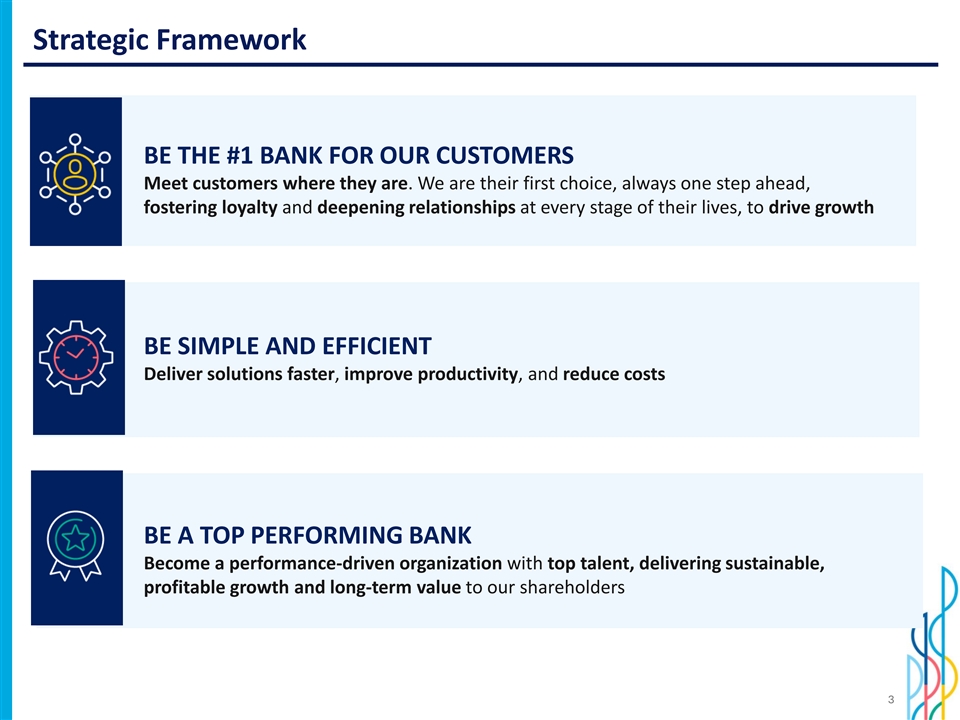
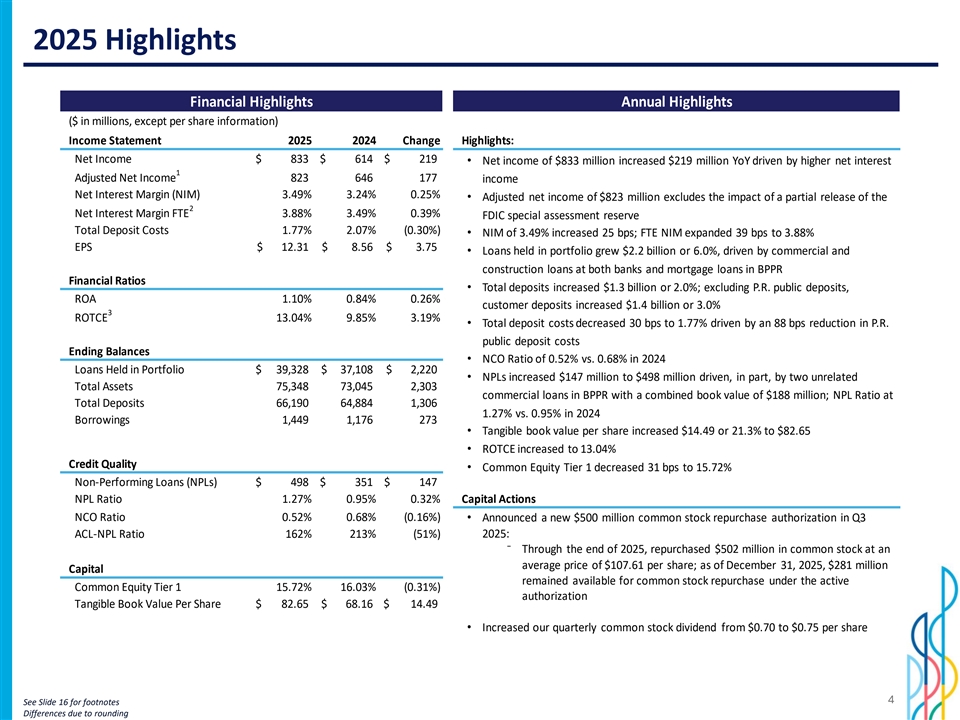
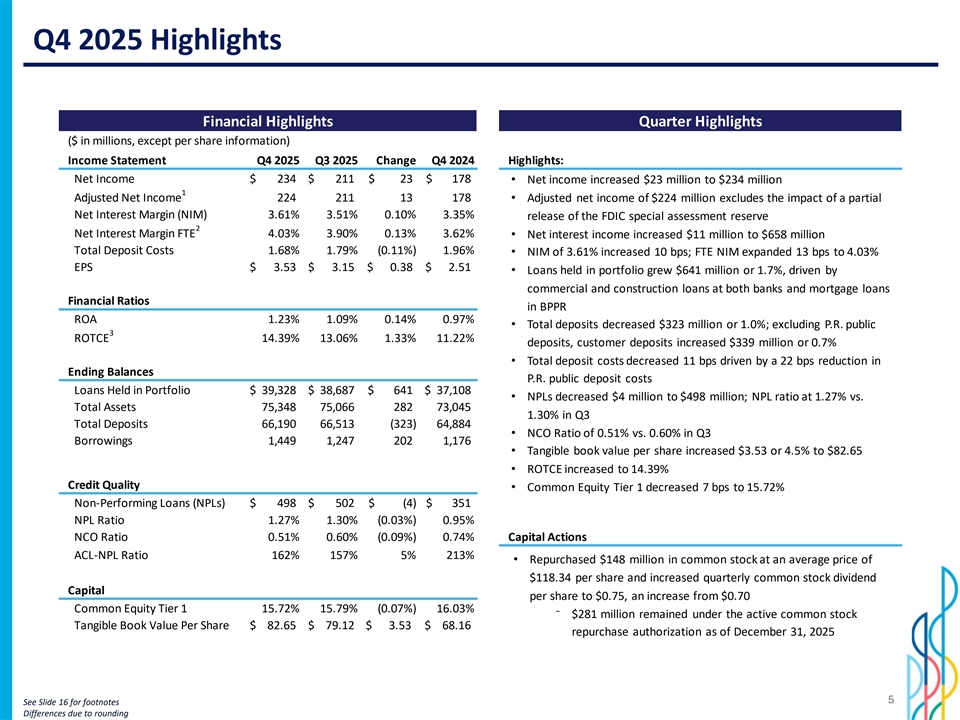
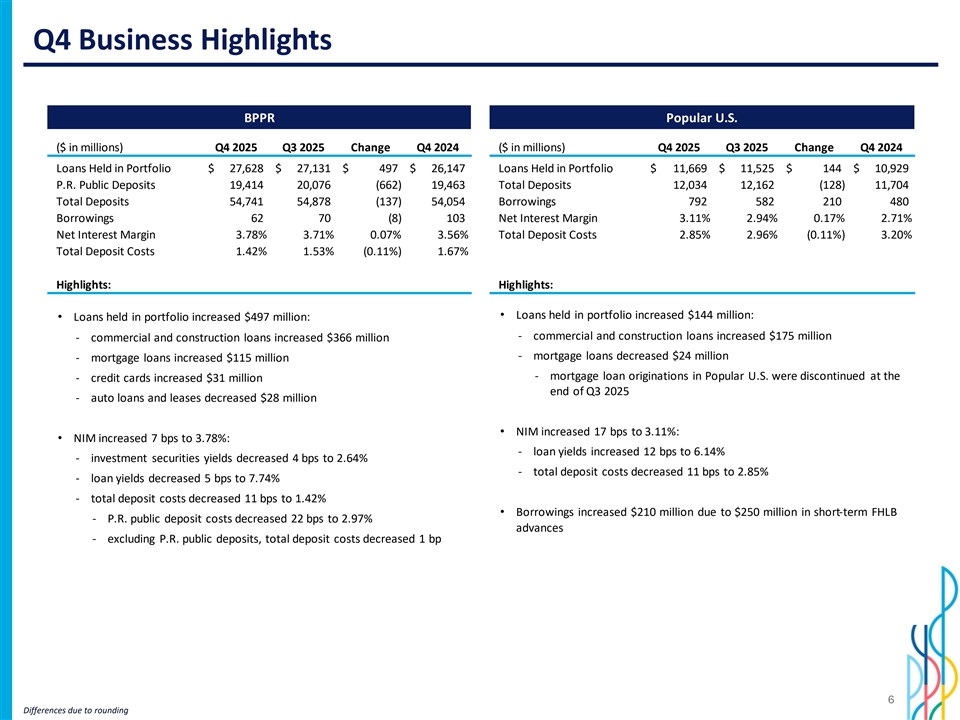
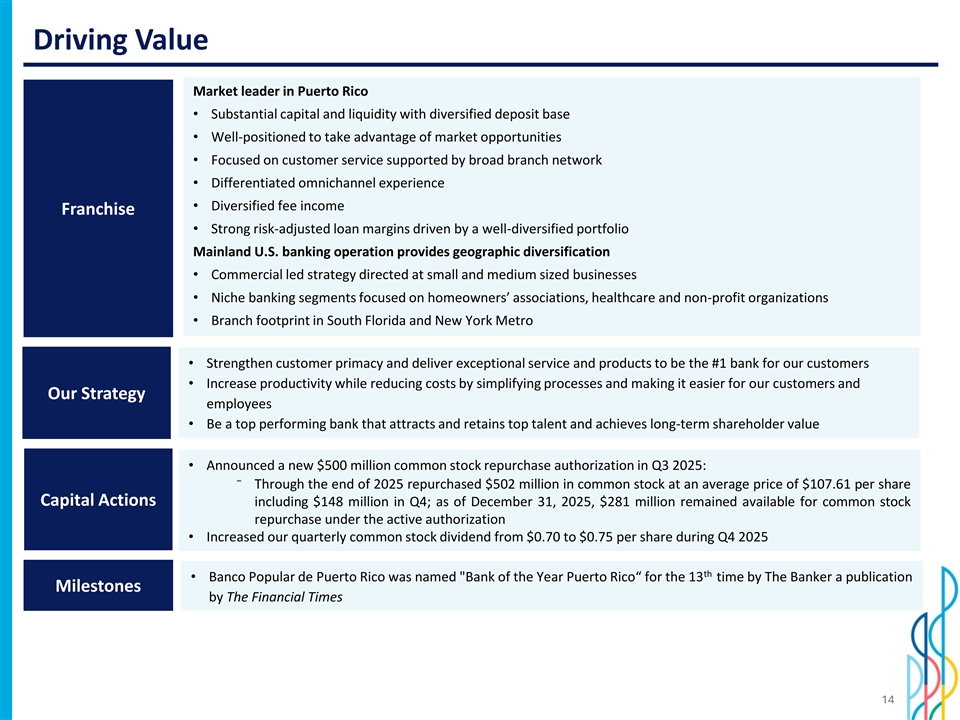
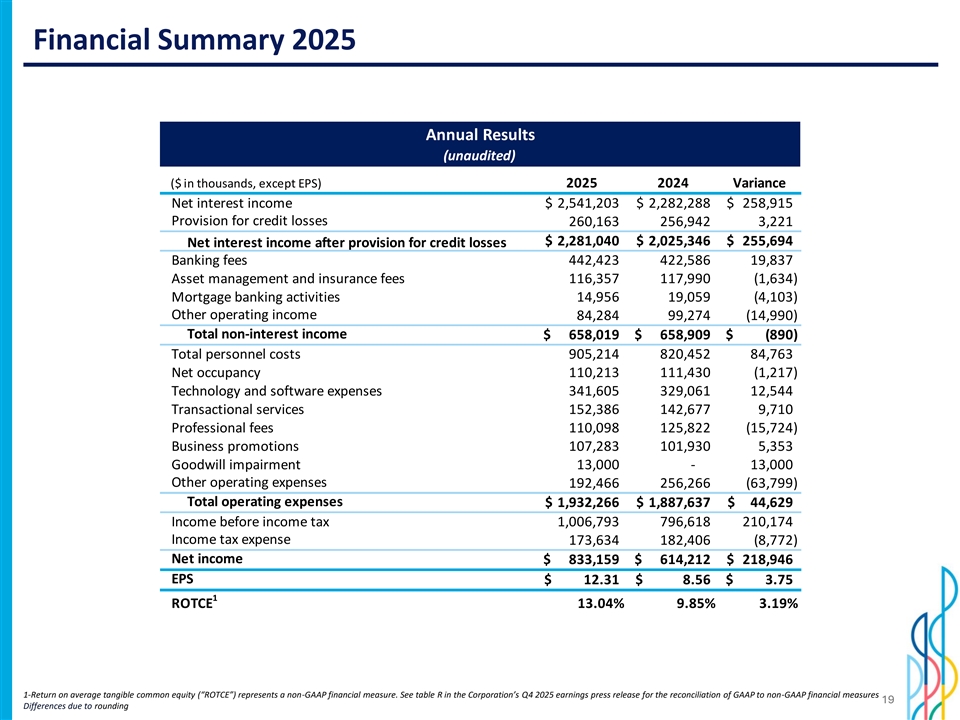
In 2025 we delivered results that reflect the strength of our franchise and the continuous stability of the Puerto Rico economy. Our annual net income of $833 million increased by $219 million or 36 percent compared to 2024. Our strong fourth quarter loan growth helped bring our total growth for the year to $2.2 billion, an increase of 6%. Banco Popular generated loan growth across most business segments, led by commercial loans. Popular Bank achieved growth in commercial and construction loans. Credit quality generally remained stable throughout 2025, aside from a couple of isolated commercial credit relationships in the third quarter. For the year, net charge-offs decreased by 16 basis points to 52 basis points. Our capital levels are strong, ending the year with a common equity Tier 1 ratio of 15.7%. Our tangible book value per share of $82.65 increased by 21% year-over-year, primarily due to lower unrealized losses on investment securities and net income for the year, offset in part by dividends and our share repurchase activity. We repurchased approximately $500 million in common stock during 2025. Since resumming buybacks in the third quarter of 2024, we have repurchased approximately $720 million worth of common stock. We continue to believe that our shares are attractive at current prices. Additionally, in the fourth quarter, we increased our quarterly common stock dividend by 5 cents to 75 cents per share. Please turn to slide 5, where we share highlights that reflect our strong operating performance in the fourth quarter. We reported net income of $234 million, an EPS of $3.53, an increase of $23.038 per share respectively. Our results were driven by higher net interest income, an expanding net interest margin, strong loan growth, and importantly lower operating expenses. Our credit metrics were stable in the quarter with lower MPLs and net charge-offs. We are very pleased to have exceeded a 14% ROTC for the quarter and a 13% ROTC for the full year. We demonstrated significant progress in our efforts to improve our sustainable returns towards our 14 percent objective. Please turn to slide 6. As of the end of the fourth quarter, business activity in Puerto Rico continued to be solid, as reflected by favorable trends in total employment, consumer spending, construction, tourism, and other key economic data. The unemployment rate of 5.7 percent remain stable near all-time lows. Consumer spending remains healthy. Combined credit and debit card sales for Banco Popular customers increased by approximately 5% compared to the fourth quarter of 2024. We also continue to see healthy demand for homes in Puerto Rico. Mortgage balances at Banco Popular increased by $115 million during the quarter. The construction The production sector continues to show positive momentum, with public and private investment fueling higher employment levels and driving cement sales to the highest levels since 2021. We are optimistic that these trends will persist, given the backlog of obligated federal disaster recovery funds, publicly announced real estate and tourism development projects, and the renewed focus on reshoring by global manufacturing companies. The tourism and hospitality sector continues to be a source of strength for the local economy. In 2025, airport passenger traffic reached a record of 13.6 million, increasing by 3% compared to 2024. During the fourth quarter, passenger traffic remained stable at around 3 million passengers. And, according to Discover Puerto Rico, in the fourth quarter, hotel demand reached nearly 250,000 room nights, marking 11% year-over-year growth and driving a 4% increase in total revenue. We are executing on our strategic framework to be the number one bank for our customers by strengthening relationships and providing exceptional service and products to our customers. We are also focused on delivering solutions faster and improving productivity while reducing costs. Ultimately, our goal is to be a top performing bank. In addition to the rollout of a commercial cash management platform, we also deployed a new consumer credit origination platform in Puerto Rico and the Virgin Islands. This platform provides a fully digital origination process for personal loans and credit cards. We saw an upward trend in online originations during the fourth quarter and have originated approximately $36 million since launch in the third quarter. We have continued to invest in our physical retail network to blend the speed and convenience self-service with in-person support. Our branches continue to be an advantage in Puerto Rico and the Virgin Islands. As we continue to modernize our channels and platforms, we are creating a more seamless experience to provide our customers with the flexibility to connect with Popular through the channel that best fits their needs without compromising the quality of our service. We are also seeing the results of our focus on being simple and efficient. We have sustained and continued to simplify our commercial credit origination and portfolio risk management. We are seeing faster cycle times, higher banker productivity, a more seamless customer journey, and long growth in our small and middle market segments. During the year, we also executed a series of sustainable efficiency initiatives, including exiting our mortgage business in the United States, optimizing our mortgage servicing business in Puerto Rico, and transforming our ERP solution to a modern cloud platform that significantly improves agility and performance. Currently, more than 800 of our colleagues are working on these projects. We are very proud of the progress that we have made. I will now turn the call over to Jorge for more details on our financial results. Jorge?
Speaker 10
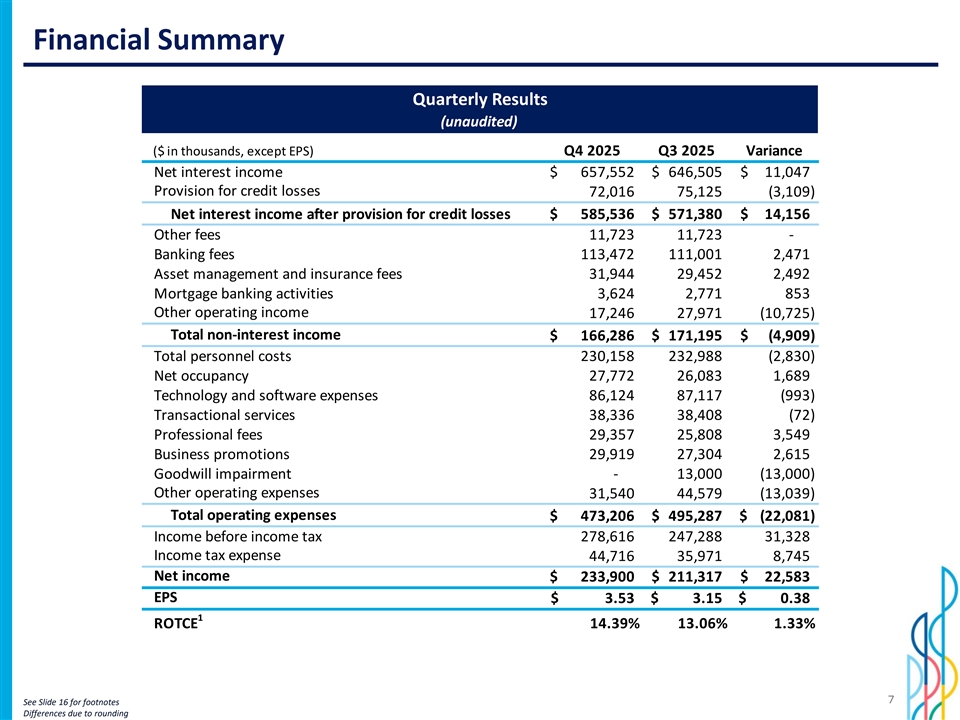
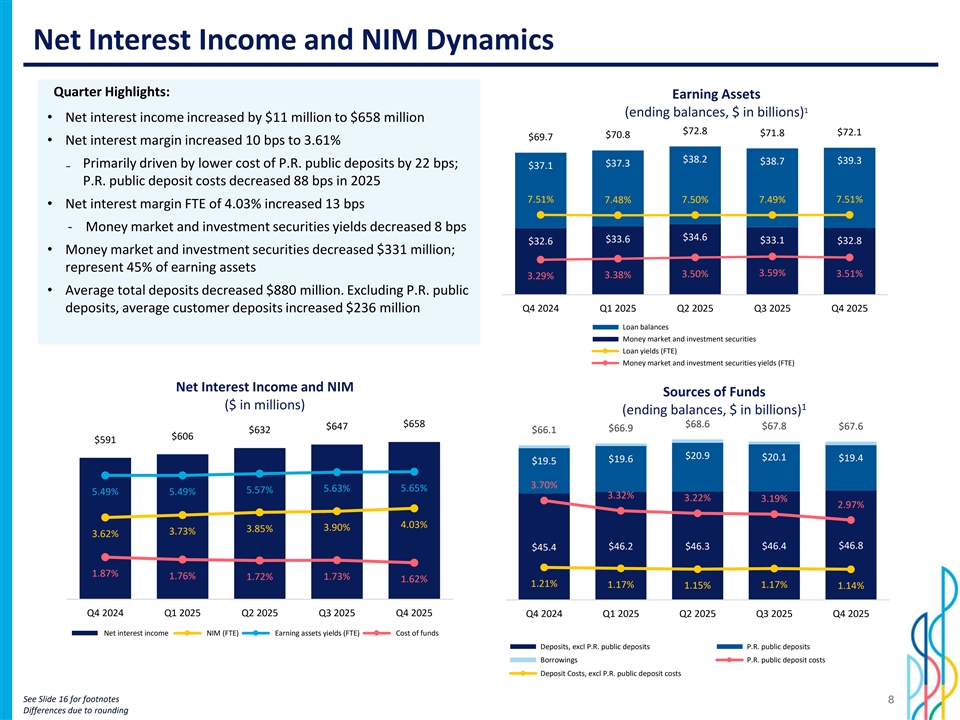
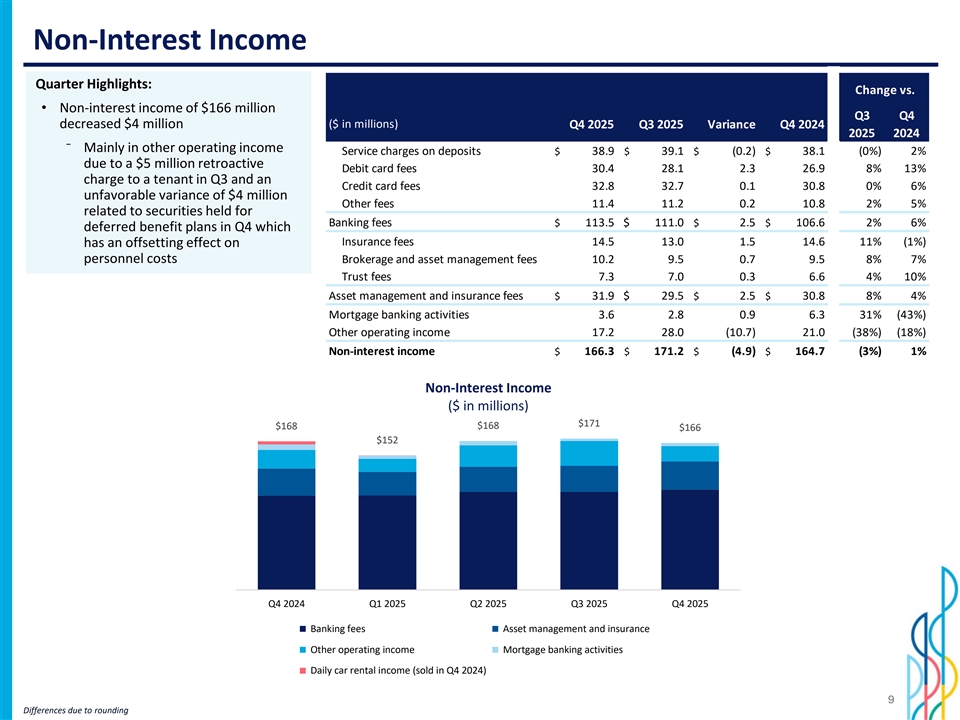
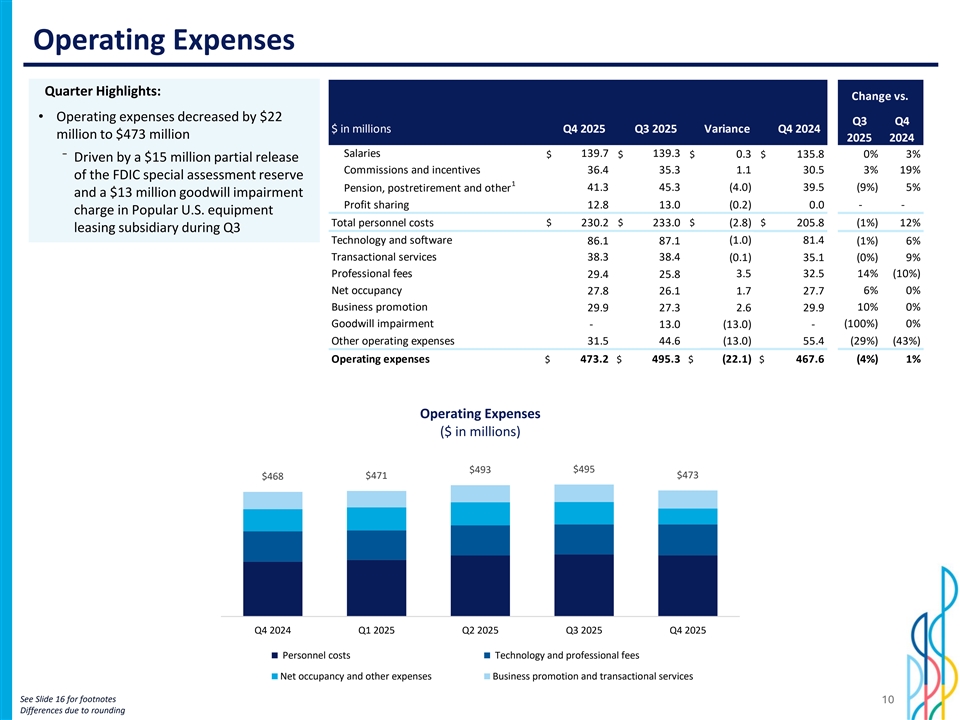
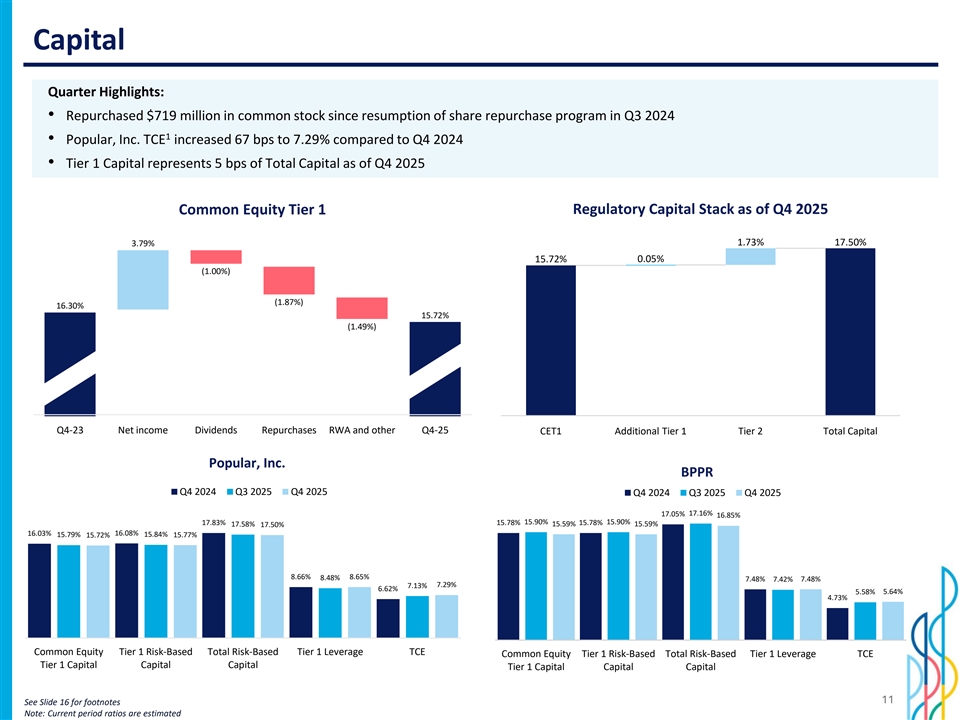
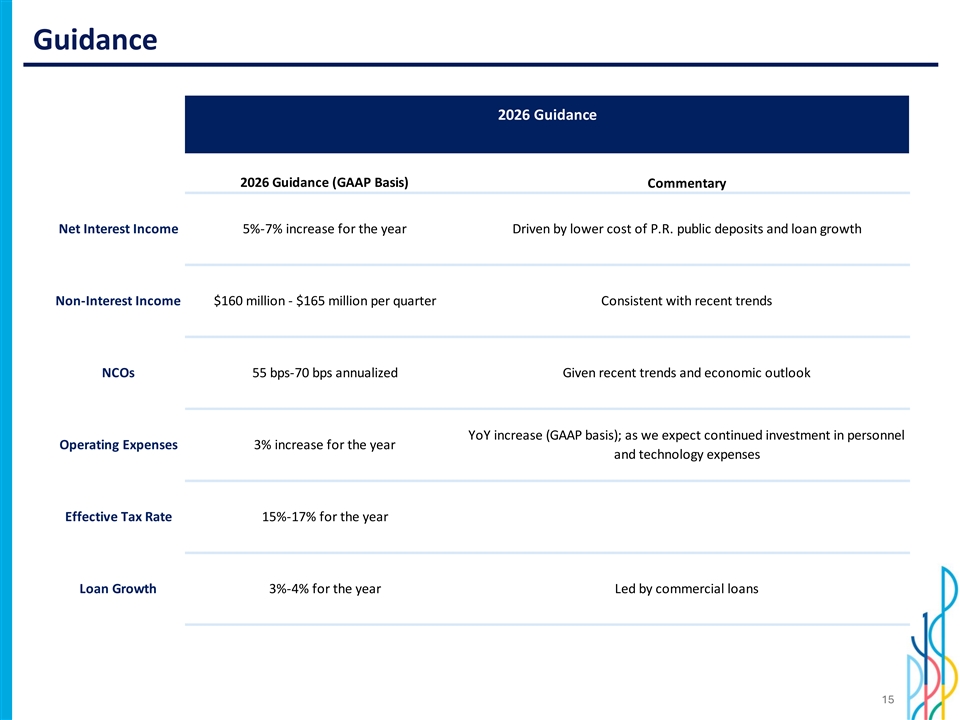
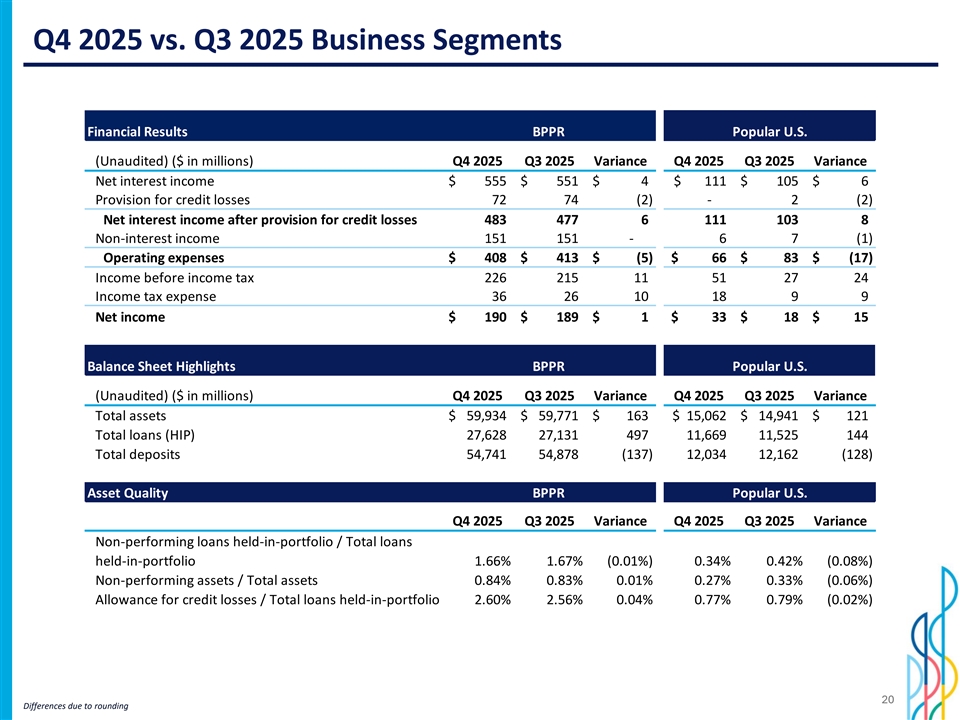
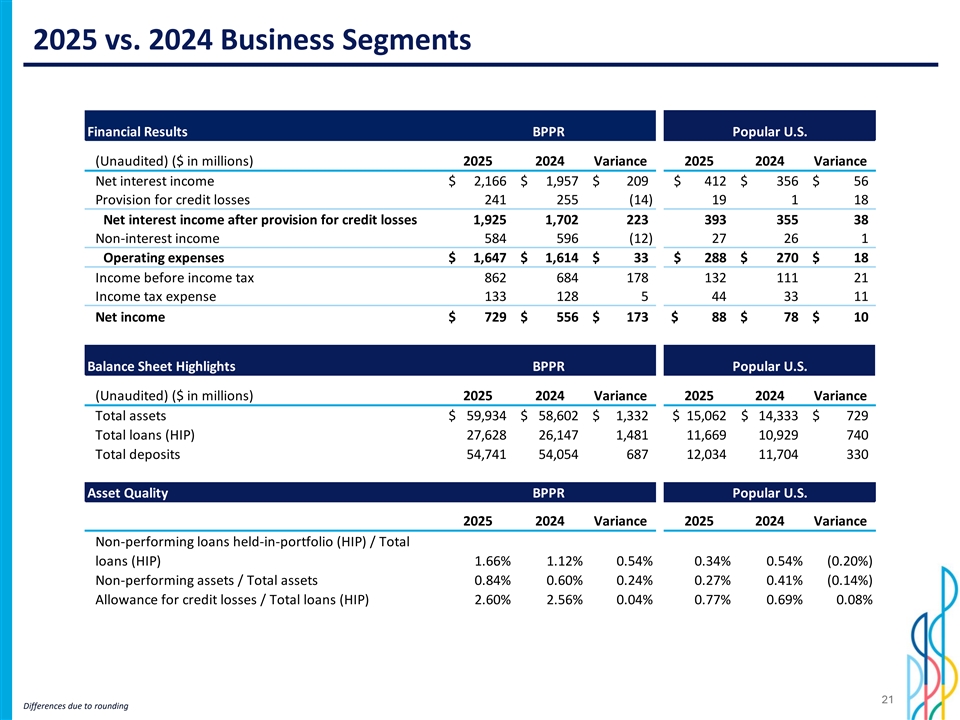
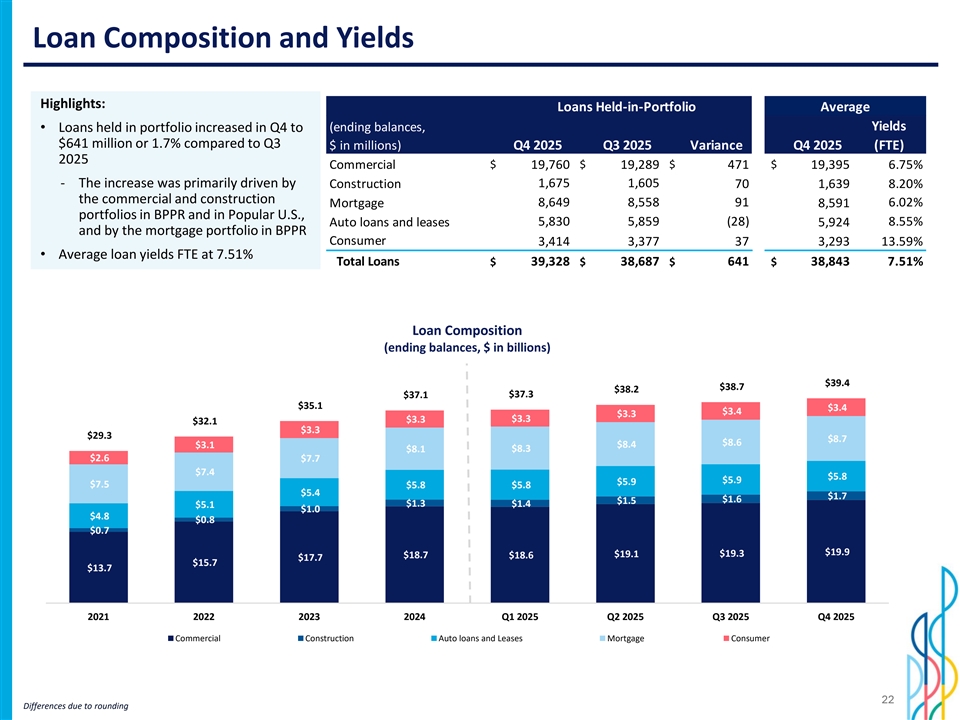
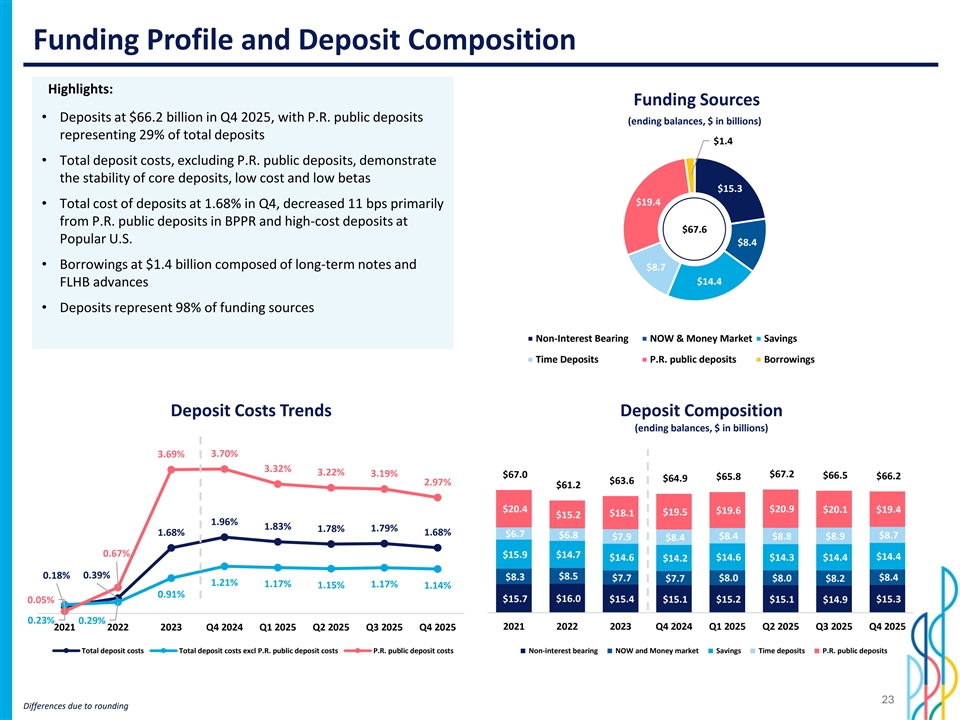
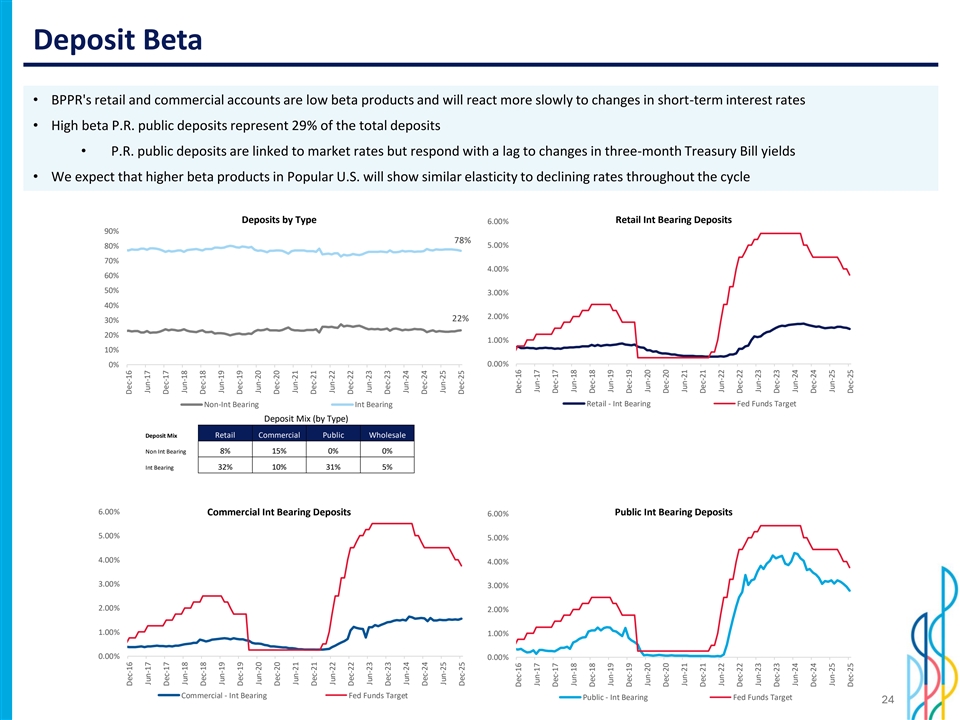
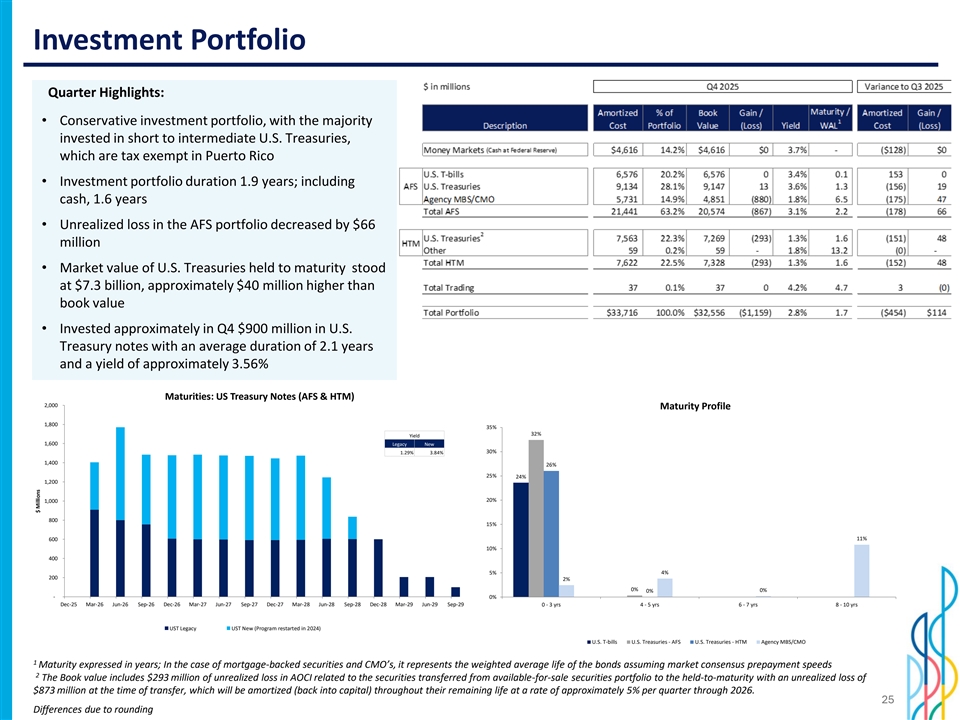
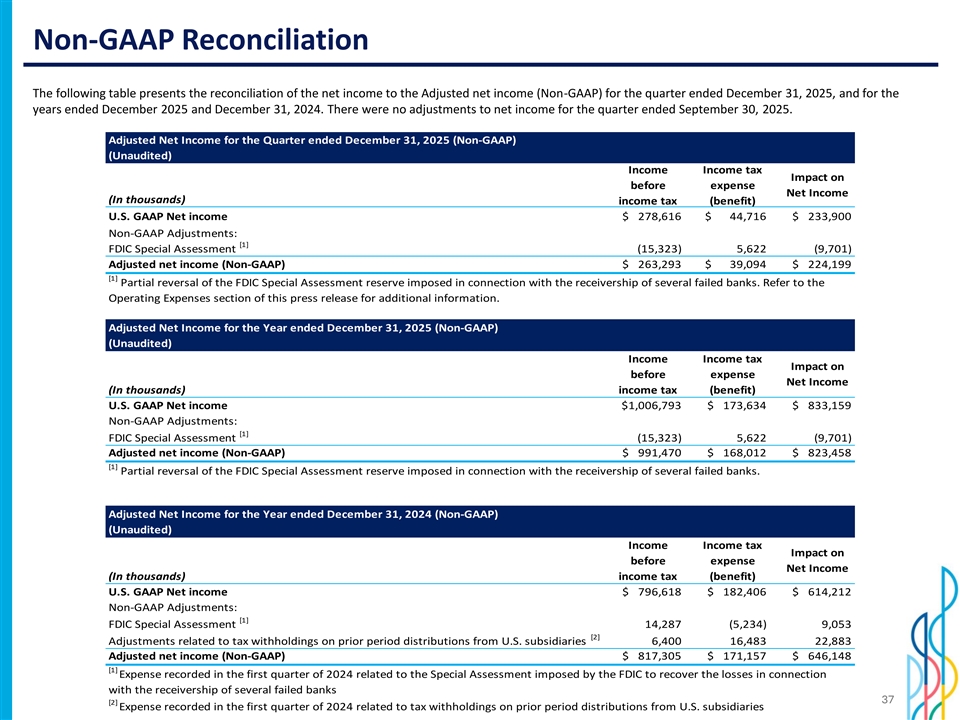
Thank you, Javier. Good morning and thank you all for joining the call today. As Javier mentioned, our quarterly net income increased by $23 million to $234 million and our EPS improved by $0.38 to $3.53. Excluding the partial reversal of the FDIC special assessment, adjusted net income for the quarter was $224 million, an improvement of $13 million from Q3. These results were driven by better NII and lower expenses. As we have mentioned before, our objective is to deliver sustainable financial results. While we benefited from the FDIC reversal, we are pleased to have exceeded 14% ROCSE for the period and 13% ROCSE for the full year. In 2025, we executed targeted initiatives to improve profitability by growing the top line and capturing sustainable cost efficiencies, both of which are key drivers of the ROCSE numerator. Looking ahead for 2026 and beyond, we will build on this progress and continue to drive improvement in operating leverage and profitability. At the same time, we see capital levels as a meaningful driver to improve Roxy. Our current objective remains a sustainable 14% Roxy. We'll continue to use all available levers to position the company as a top-performing bank when compared to mainland peers. Please turn to slide eight. Our net interest income of $658 million increased by $11 million and was driven by higher loan balances. fixed-rate asset repricing in our investment portfolio, and lower deposit costs in both of our banks. For the year, NII increased by $259 million, or 11%. During the quarter, our net interest margin expanded by 10 basis points to 3.61% on a gap basis. Our fully tax-equivalent margin improved by 13 basis points to 4.03%, driven by higher loan balances and lower interest expense primarily due to lower balances and costs of Puerto Rico public deposits. Loan growth of $641 million a quarter was strong with both banks contributing to that increase. At BBPR we saw loan growth of $497 million driven primarily by commercial and mortgage lending. At Popular Bank we saw loan growth of $144 million mainly driven by commercial lending. For 2026, we expect consolidated loan growth of three to four percent. In our investment portfolio, we continue to reinvest proceeds from bond maturities into U.S. Treasury notes and bills. During the quarter, we purchased approximately 900 million of Treasury notes with a duration of 2.1 years and an average yield of around 3.56 percent. We expect to maintain a two to three year duration in the investment portfolio. Ending deposit balances decreased by $323 million and average deposit balances decreased by $880 million. This decline was mostly driven by anticipated outflows from Puerto Rico public deposits, which ended the quarter at $19.4 billion, a decrease of $662 million compared to Q3. We continue to expect public deposits to be in the range of $18 to $20 billion. At BPPR, excluding Puerto Rico public deposits, ending balances increased by $525 million, driven by growth of $430 million in commercial demand deposits. Average deposits increased by $192 million. Total deposit costs decreased by 11 basis points at each bank. At BPPR, the decrease is mostly a result of Puerto Rico public deposits repricing lower by 22 basis points due to recent interest rate cuts by the fed while non-public customer deposit costs decreased by one basis point. At PV the reduction was mainly related to lower online savings deposit costs and repricing of time deposits. We anticipate 2026 NII will increase five to seven percent given by continued reinvestment of lower yielding securities and loan originations in the current rate environment as well as lower costs of Puerto Rico public deposits and online deposits at Popular Bank. Please turn to slide nine. Non-interest income was $166 million, a decrease of $5 million compared to Q3 and in line with the high end of our guidance. We continue to see solid performance across most of our fee generating segments including robust customer transaction activity during the holiday season. In 2026, we expect quarterly non-interest income to continue to be in a range of $160-165 million. Please turn to slide 10. Total operating expenses were $473 million, a decrease of $22 million when compared to Q3. Excluding the FDIC reversal, operating expenses were $489 million. Aside from the reversal, the largest quarter-over-quarter variance was related to a 13 million non-cash goodwill impairment taken in the third quarter for the year gap operating expenses increased by roughly two and a half percent which was below our original four percent guidance as we executed on a series of sustainable efficiency initiatives and also benefited from the delay of some expenditures that will occur in 2026. in 2026 we expect total full year gap expenses to increase by approximately 3% compared to 2025 as we continue to invest in our people and technology. Our effective tax rate in the fourth quarter was 16% compared to approximately 15% in Q3. In 2025, our effective tax rate was 17% compared to 23% last year, driven by a higher proportion of exempt income. In 2026, we expect the effective tax rate for the year to be in a range of 15 to 17 percent. Please turn to slide 11. Tangible book value per share at the end of the quarter was $82.65 an increase of $3.53 per share given by our net income and lower unrealized losses in our investment portfolio offset in part by our capital return activity in the quarter. During the fourth quarter we paid a quarterly common stock dividend of $0.75 per share, an increase of $0.05 from Q3. As Javier noted earlier, we're pushing our teams to enhance profitability through ongoing incremental revenue initiatives and expense discipline. While we've made progress over the past two years in reducing our CET1 ratio, there's more we can do. In Q4, we repurchased approximately $148 million in common stock. we believe this is a good run rate for the pace of buybacks going forward subject to market conditions as of december 31st we had 281 million remaining on our active share repurchase authorization in addition to the common stock repurchases we'll continue to use capital for loan growth and we also expect to pursue a dividend increase later this year finally Additionally, we carry less additional Tier 1 capital than peers and see that as another opportunity to optimize our capital structure in the future. We believe that these actions, which are subject to market conditions and board approval, will help us achieve our long-term stated CT1 goal of having levels consistent with mainline bank peers plus a buffer for our geographic concentration. With that, I turn the call over to Lidia.
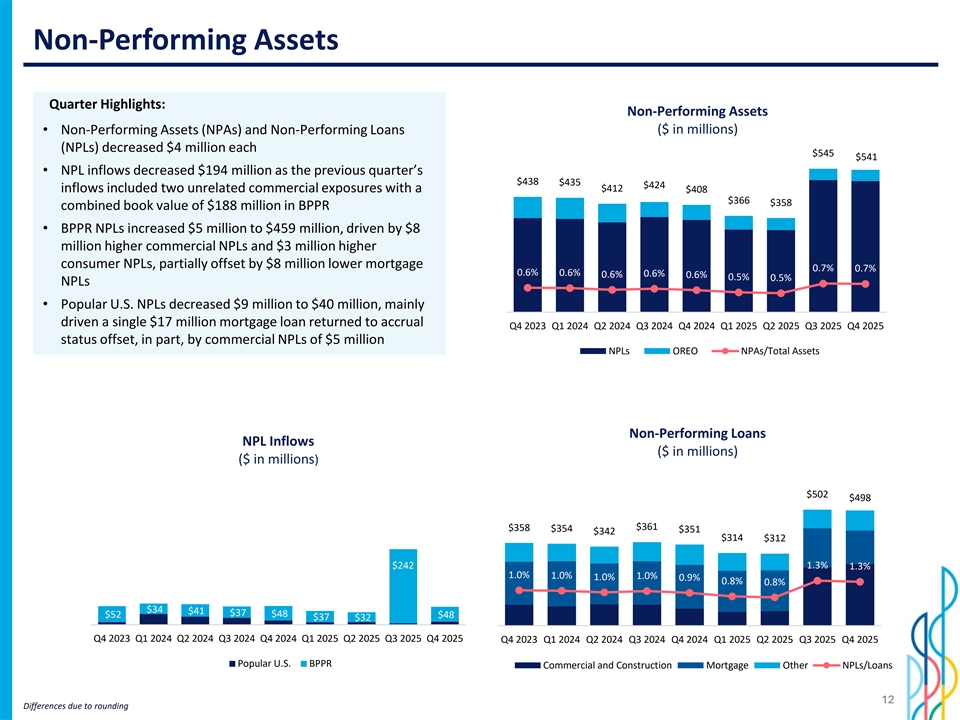
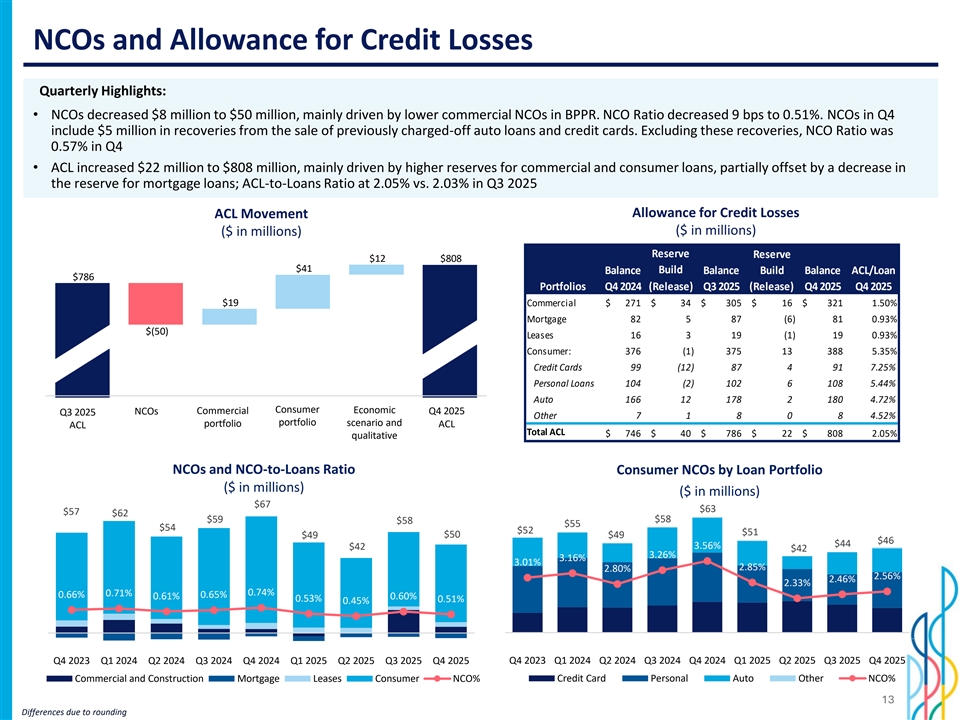
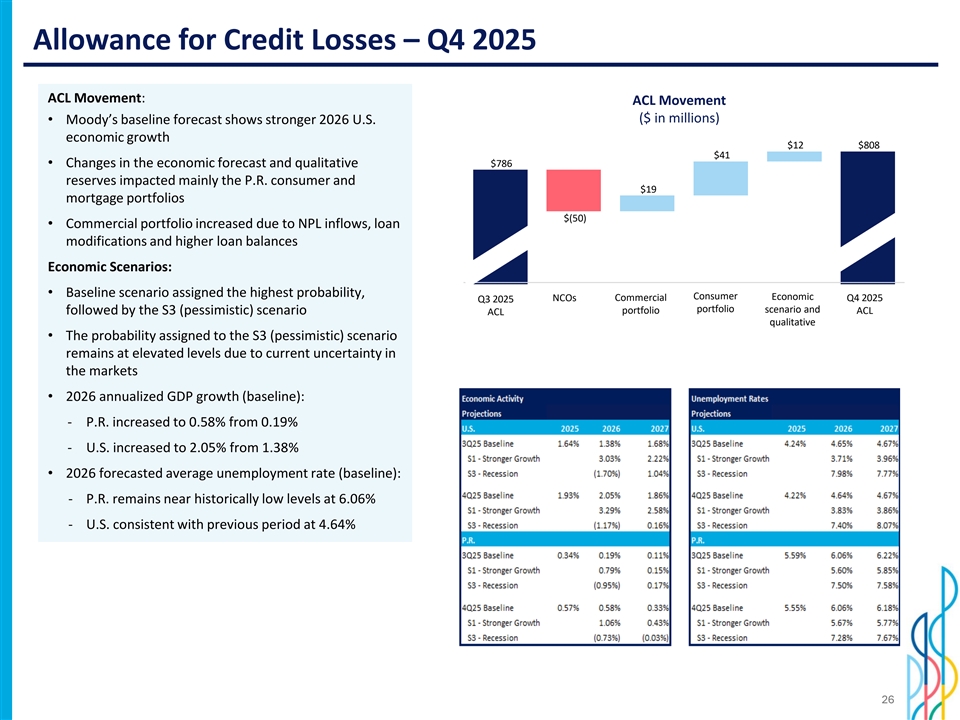
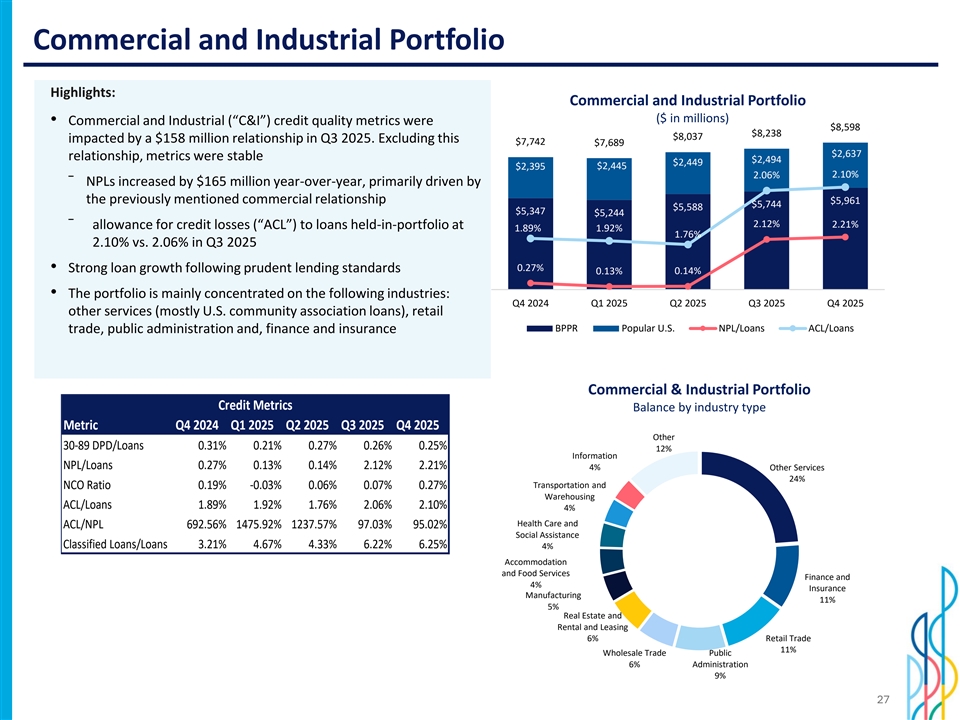
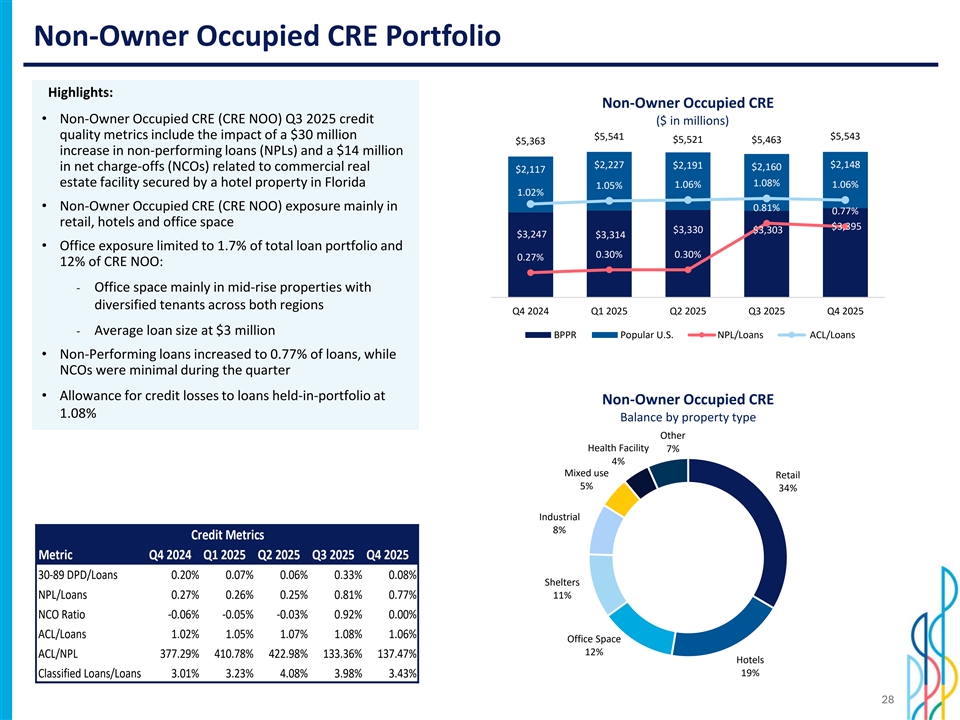
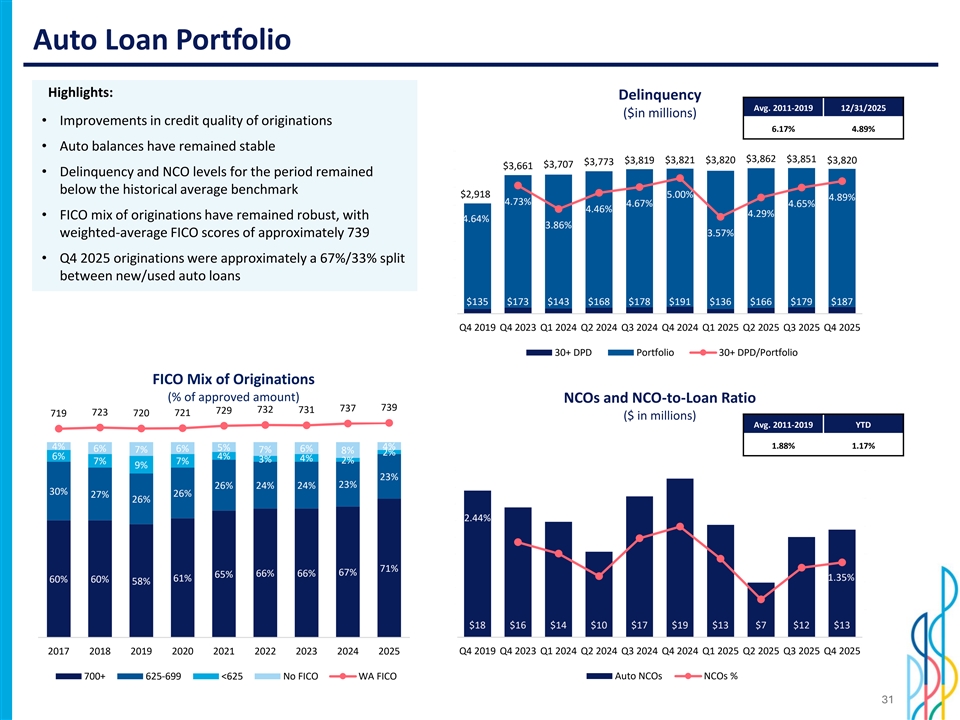
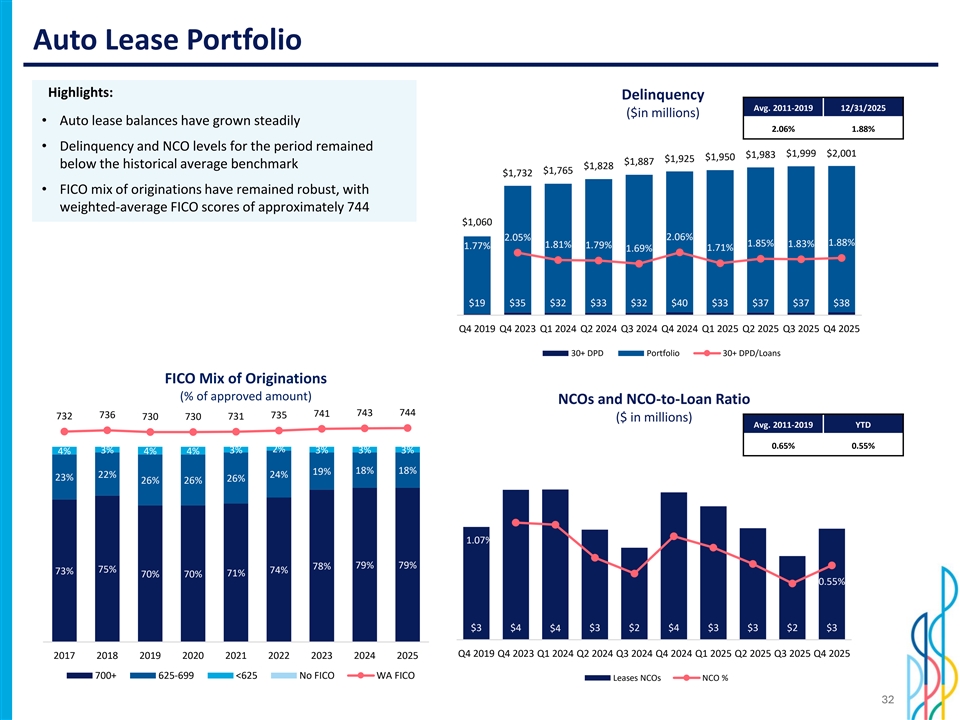
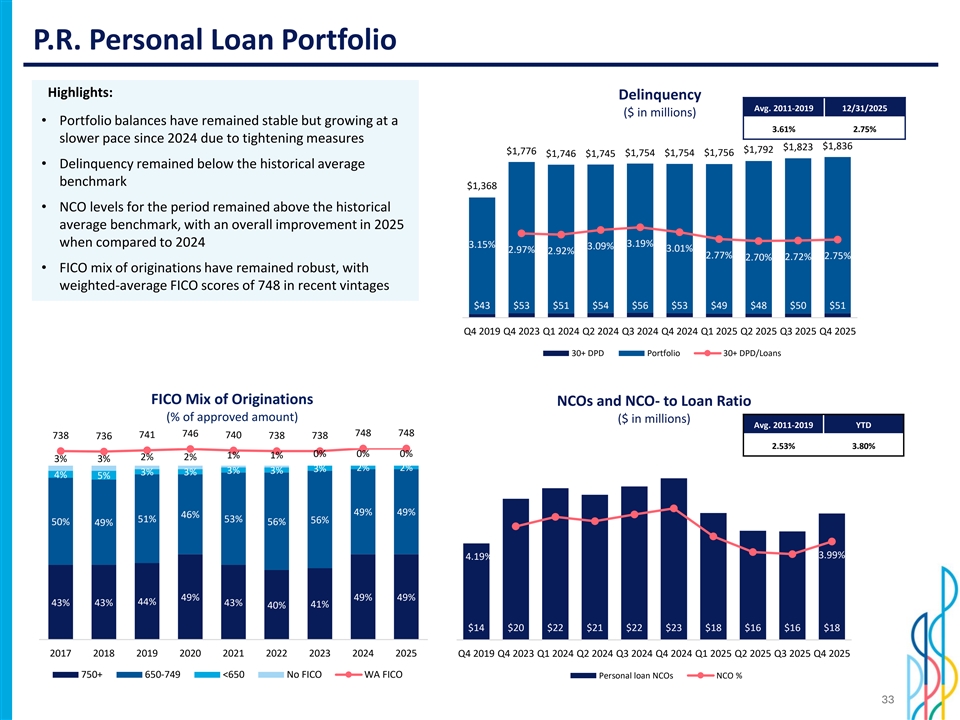
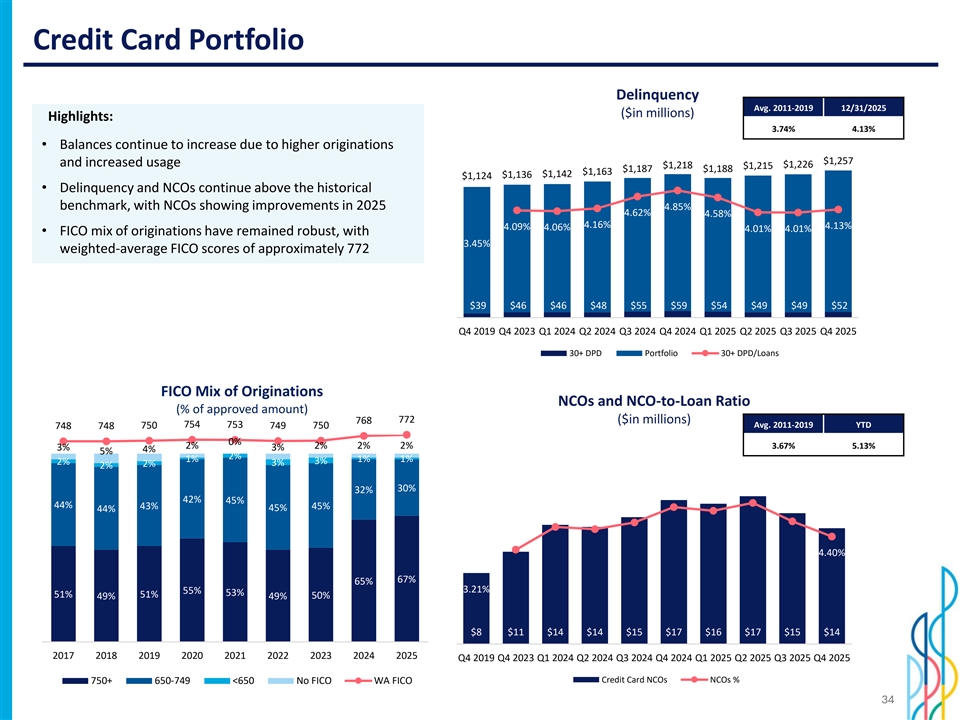
Thank you, Jorge, and thank you all for being with us. Turning to slide number 12, credit quality matrix remains stable during the fourth quarter with lower NPLs and lower net charge-off. Non-performing assets and loans decreased by $4 million this quarter, mainly due to popular banks. U.S. NPLs decreased by $14 million as a $17 million mortgage relationship return to accrual status. Offset in part by higher commercial NPLs. BEPR NPLs increased 5 million with commercial up 8 million and consumer up 3 million. Offset in part by 8 million decrease in mortgage NPLs. Influence of NPLs declined by 194 million. Primarily in BEPR as the previous quarter included that inflows from two unrelated commercial relationships totaling 188 million. The ratio of NPL to total loans held in portfolio decreased three basis points to 1.27%. Turning to slide number 13, net charge-off amounted to 50 million or annualized 51 basis points compared to 58 million or 60 basis points in the prior quarter. This quarter results include $5 million in recoveries from the sales of previously charged off auto loans and credit cards. Excluding this, the net charge-off ratio was 57 basis points. The net charge-off in BPR decreased by $7 million, driven by a decrease in commercial net charge-off as the prior quarter included a $14 million charge-off related to a single borrower. In 2025, net charge-off were 52 basis points, an improvement of 16 basis points from last year, driven by lower consumer net charge-offs. For 2026, based on current trends and macroeconomic outlook, we expect annual net charge-off of 55 to 70 basis points. The allowance for credit losses increased by $22 million to $108 million, mostly in BDPR, due to higher reserves for the commercial portfolio, driven by higher balances, specific reserves, and loan modifications, coupled with higher reserves for consumer loans due to changes in FICOMEX. The cooperation ratio of the ACL to loan-shorting portfolio remains stable at 2.05%, while the ratio of the ACL to NPLs was 162%, compared to 157% in the previous quarter. The provision for loan losses was $71 million, down $3 million from $75 million in the prior For the BDPR segment, the provision was $72 million compared to $74 million in the previous With that, I would like to turn the call over to Mr. Ferrer for his concrete remarks.
Well, thank you, Lidio and Jorge, for your updates. Our fourth quarter results closed up the year on a high note. We are very pleased with our financial performance in 2025. We increased revenues, maintained expense discipline, generated strong loan growth, and improved customer deposit trends. I'm urging our teams to remain focused on deposit growth, loan generation, and particularly on our expense discipline. Our strategy is grounded in customer primacy. We are focused on deepening relationships, delivering value across channels, and simplifying how we operate. Most importantly, it is focused on translating these efforts into tangible financial results and generating value for our shareholders. In closing, I want to recognize our colleagues and their contribution to our results. I see what they do every day in our branches, call centers, and centralized offices. We are pushing ourselves to deliver more for our clients every day, and I am deeply grateful for their commitment and dedication. We are now ready to answer your questions.
Operator
Thank you. If you would like to ask a question, please press star followed by one on your telephone keypad. If you would like to withdraw your question, please press star followed by two. When preparing to ask your question, please ensure your device is unmuted locally. First question comes from Brett Rabatan with Hope Group. Your line is open. Please go ahead.
Hey, good morning, everyone. How are you doing? Good morning, Brett. I wanted to start on the guidance and just thinking about the NII guide. And if I'm reading it correctly, it kind of would suggest maybe slightly slower average balance sheet growth during 26 and 5 to 10 basis points of margin expansion.
Speaker 10
And I know you guys don't like to give explicit margin guidance, but would that be within the realm of what you're looking at? and then just wanted to ask around the rot see goal you know why with operating leverage that that might not increase a bit from here okay thank you brad good morning um first on the on the nii first we were very pleased with the 11 growth this year the 11 growth in nii was driven by expanding the margin being able to reinvest fixed rate investments in our portfolio into higher yielding assets, loan growth, and lower cost of deposits. We believe all those three factors will continue into 2026, albeit at a smaller magnitude. We will see a slowdown, for example, of the yield uptake that we will get on the reinvestment of the portfolio. But we're very comfortable with that 5% to 7% guide. We are expecting margin to continue to expand throughout 2026. I think when you look at that range, if you're looking at what drives one for the other, really always revolves around low cost deposit levels and our ability to reduce deposits in the U.S. market. In terms of the ROTC, we talked in the past that we want ROTC to be driven by the improvement in performance and net income, right? And again, we are very pleased with the results this year. We have a lot of momentum going into to 2026. We expect that momentum to continue. We want that above 14% to be sustainable. There's enough uncertainty in the world and we want to make sure that we are absorbing any ups and downs through the cycle. So we're not quite there yet. We do feel that we have a lot of momentum and like the starting point where we're at, but that is something that we want to continue to focus on.
And I think this year we try to be more intent or deliberate it and how we're managing capital levels as well um and um you know as i discussed in my in my prepared remarks okay um and then the other question i had was just around you know loan growth which which which was better than i expected and and pretty strong and commercial you know when i think about that guidance for the coming year i mean you've had six percent ish growth the past two years 4q was seven percent you know is the slowness or slower level anticipated in 26 um you know is that just conservatism around consumer or any thoughts
Speaker 10
uh around that and then as it relates to on-shoring uh you guys seen any opportunities related to to that okay so let's start first on on the long growth um you know we as you said we have uh seen long growth around six percent for the last couple of years led by uh growth in puerto rico that growth in puerto rico was across all of our portfolio right you know commercial mortgage and consumer as we look into 2026 we expect to continue to see commercial to lead the way and mortgage in puerto rico but we do see a softening on on the consumer particularly around auto so that That is one part of the guide. The other growth engine for us has been in the U.S. We are in good markets in the U.S. We like those markets, but we want to make sure that we are pricing for relationships and for profitable loan growth. There's some of that embedded, as well as bread, as you can imagine, there's always timing as loan transactions are focused on larger clients. When those things close in terms of funding that you advance or when things slow down expected payoff that has an impact on those kind of year-over-year kind of changes but we were confident on on the three to four percent guide and the momentum that we've had over the last couple of years in both Puerto Rico and our US markets okay that's helpful congrats on strong gear guys thank you thank you we now turn to Jared Shaw with Barclays your line is open please go ahead hey good morning good morning um maybe i guess just sticking to the the theme of of growth outlook when you look at fees um where where do you see potential softness i guess in in fees and that growth rate um you've had you've had some pretty good trends during the course of the year yeah remember jared one of the things that the 25 results included you know roughly 10 million of kind of unusual items you know the recovery for prior periods of a tenant and then we also had some refunds of federal taxes that were recognized in fee income so that 10 million really if you look at the guide you're making up for that 10 million next year so there's a little bit more growth embedded in that guide than probably you know jumps out at you um and then on on capital
nice to see the buyback and and the commentary around um you know sort of the willingness to bring capital ratios down? How should we think about M&A with that backdrop? And you certainly have the capital and the growth to do something, I guess, in terms of potential sizes or anything like that. Any thoughts you could share with us?
Sure. This is Javier. Well, our primary focus continues to be our transformation program. That said, in the U.S., we're always open to opportunities to add on profitable niche businesses, teams, and assets. So whole bank M&A is not a priority. However, it would be responsible for us to say that we would not evaluate opportunities to enhance shareholder value over the long term. I think we said this before. There is a high threshold for any transaction that we may consider. We'll evaluate opportunities to grow inorganically as long as they meet the following criteria to complement our U.S. business. First, it needs to be compelling enough for us to consider reallocating resources away from our transformation initiatives. We have a little bit over 800 employees who are currently focused on these efforts. We would need to reallocate to whatever effort related to an M&A, due diligence, integration, conversion. Number two, core deposits. Any transaction we need to strengthen our deposit franchise and lower cost deposits. Number three, it needs to be commercial-led, which is our key strategy in the United States. It needs to enhance our commercial-led and niche business strategy and also provide some CRE diversification. Four, it needs to be geographically consistent. So create greater market penetration in our existing footprint, increasing opportunities for value creation through cost synergies, or need to extend presence to adjacent markets or geographies. And I think also it needs to have the scale, in terms of scale, it needs to be right size for us business i have a preference for uh not for um moes uh you know i i don't you know i don't think highly of those not that they can't work but that's just my my bias and i think the last the last item would be cultural fit and it's last but but it's really top of mind I mean, whatever target needs to align to our culture of performance and employee well-being. So we are very mindful that not all customer demographics will make sense. I think, you know, very specifically, that's how we think today about M&A.
Okay, thanks. That's great. Great insight. Just maybe finally for me, do you just have the spot deposit costs and asset yields at the end of the year?
Speaker 10
We don't usually provide the spot rates, Jared.
Operator
All right, thanks. We now turn to Ben Gerlinger with Citi. Your line is open. Please go ahead. Good morning.
I was wondering if we could set space on expense. Good morning. So on the expense guide, I know you guys always give a gap basis, so that's inclusive of investment and things like that. I know that last year you were also investing, and this year I'm assuming 27URS will or are going to because your size investment is almost like a core. So I was kind of curious, is this year on an investment basis kind of smaller or larger or anything you could frame in terms of timing and any expectations on that relative to kind of what we've seen previously or potentially starting new projects that are multi-year in nature?
Speaker 10
I mean, I think the run rate that we're going is not changing much. It gets to a point, Ben, where we only have so much capacity and resources to be able to do so much at once. I think certainly in 25, we were running at that capacity level. As things roll off and we go live, you know, For example, Javier talked about that we went live on a new ERP in January 1st that releases some resources, but then a lot of those resources get reallocated to the next big project on the next thing going on. You know, so I think we all feel fairly comfortable with the level and focus of the teams. You know, we can always certainly do more, but there is a reality that you can only have so much, you know, resources and management focus on these implementations.
I know we've talked about the pace of loan growth and then also the reinvestment of the securities higher i'm just kind of looking at like just the average earning asset mix where it is today and obviously if you could get securities into a loan it's probably the best case scenario but i'm just kind of curious is today's mix uh within kind of the guardrails that you want if you potentially see more loans down the road just kind of curious on just how you think about average earning asset mix down two or three four or five years from now given and then you also have the public deposits.
Speaker 10
Yeah, I mean, certainly we would prefer to make loans, not so much necessarily in a yield perspective, but we'd rather have those relationships, right? And we feel that we can have a deeper profit base with a lending relationship than we can just buying portfolio assets. But there is a reality that we have around 30% of our deposits in Puerto Rico that are required to be collateralized. and that will keep us in the portfolio business of buying investment security. So if we go forward, we would like to see a higher loan-to-deposit ratio, but it will depend on the composition of our balance sheet. But as I said before, we do expect NIMH to continue to grow and expand this year. And even as we go forward and we start combining maturities between our recent purchases and more legacy pre-2023 investments, we still have a good upside for pickup of yield in that investment portfolio. At current rates, the more recent purchases, we still see that as a strong.
Operator
We now turn to Kelly Motter with KBW. Your line is open. Please go ahead.
Hey, good morning. Thanks for the question. Maybe turning back to capital, I want to make sure – good morning. I wanted to make sure where I heard you correctly. It seems like you alluded to maybe additional tier one being lower than peers. Wondering if from a high level you can discuss, you know, it seems like maybe then leverage would be your guiding ratio, how you're thinking about that as we move ahead, given that the importance of capital return to the profitability improvement story. Thank you.
Speaker 10
Sure. Thank you, Kelly. So, we often talk with you all about CEP1 and a lot of focus on CEP1, and we talked about our goal of getting that lower plus a buffer. One of the things that we don't very often talk about is that we have somewhat an inefficient capital stack in that we really have very little additional tier one, right? We have around five basis points, and when we look at peers, they have anywhere between 50 and 100 basis points of additional tier one. So we look at this as another level that's an opportunity that we're evaluating and looking at. Perhaps there's an opportunity for something that's accretive without necessarily impacting the total tier one or total regulatory capital and being able to balance lowering CT1 with management and board's intent to be more deliberate and reducing that capital over a prolonged period of time.
Okay. All right. Fair enough. And maybe I think we've hit on this a bit, but turning to loans and yields, I was surprised your loan yields have held in really nicely, even with the rate cuts. Can you remind us how much of your book floats? And I don't believe you usually provide it, but I'll try. Any new production rates would be really helpful here.
Speaker 10
So a couple of things on loan yields. we've still seen loan growth in Puerto Rico on the consumer side to be, you know, flat or above and with the exception of credit cards. But in the quarter, we still saw an improvement in auto yield and flat in personnel, I'm sorry, in personal loans. And, you know, we've talked about in the past that, you know, we just have the low beta on the way up, you know, we didn't pass through all the increases in the loan pricing. And we're seeing kind of the benefits, a little bit of the opposite behavior that we see in our deposit basin in Puerto Rico. I don't, you know, I think last quarter we talked about where I don't know how long that's going to continue. You know, as I said in talking about loan growth, we do see a softening in consumer demand, particularly around auto. So it would seem logical to me that we start seeing some lower pricing there as people compete for the production. In terms of variable, it's around 25 percent of our total loans are variable or floating. Most of that is commercial loans. I think both portfolios, around 40% of commercial loans are floating. And then remember, we do have the credit card, we have the construction portfolio that floats. And in terms of new yields, we don't provide that.
Okay, fair enough. Last one, if I can slip it in. I apologize if this was addressed already. But with the charge-off, 55 to 75 basis points is certainly lower than, you know, historically what we've seen in Puerto Rico, but a step up from 2025. I would imagine that's mostly on the consumer side, but can you kind of piece together the outlook here of what you're seeing and how you came to that 55 to 75 basis point range? any movement between now and, you know, what gets you to that higher range in 26.
A small correction, Kelly. I mean, we provided for 55 to 70 basis points. So, the high end was a little bit lower than 25, 70 basis points. I mean, generally, before going into the details, I mean, we see we have a very stable outlook. We think the Puerto Rico economy continues to be stable with moderate growth, and that's the outlook that we have for next year. Under that context, we believe that generally our consumer portfolio will continue to behave as they have in 2025. We do our accounting for potentially some charge-off of some of larger commercial relationships that we have reserved for so that is embedded in the in the range that we have provided to you that explains a little bit our rationale thank you so much step back we now turn to aaron saiganovich with truest your line is open please go ahead thank you um maybe you talk a little bit about whether or not you're seeing any kind of deposit competition uh in puerto rico and um in your
expectations for deposit gross in in the year well i think um i think uh clearly there is competition in the market no um you can see from our numbers that we've grown deposit balances um and we expect to to do the same um this year but um um there's a few banks in the market and also credit unions. So, but we are not seeing any irrationality in the pricing. So on this cycle. So I would say that it's pretty steady and we will not, however, we said this before, we won't lose good clients to pricing, deposit pricing. So again, we're going to be, we're going to defend our position and particularly good relationships in all segments, but hopefully not do anything that's crazy.
And then maybe just kind of thinking a broader picture, the U.S. is military in the Caribbean and wondering if you're seeing any, you know, increasing presence and whether or not that's a positive from an economic standpoint to Puerto Rico?
Well, I would say that it's a net positive. We have seen some increased activity, but it's mostly, I wouldn't say in our branches, I'm going to say it's in geographies adjacent to military bases or installations. You know, we've seen customers that are benefiting from relationships with the military throughout Puerto Rico, and we're seeing there are reports of the military entering into lease agreements for, you may imagine, you know, ports and airports, and again, know of customers, clients of ours that, you know, smaller or middle market clients that have entered into contracts with the military. So that's why we believe it's net positive. Obviously, we're monitoring it. If military presence were to grow, that can only increase. So that's why I started by saying that it's a net positive. We'll see, because it's dependent on, as you know, geopolitical forces and decisions out of the White House.
Operator
As another reminder, if you'd like to ask a question, please press star, followed by one on the telephone keypad. We now turn to Jared Cassidy with RBC. Your line is open. Please go ahead.
Good morning, Jorge. Good morning, Javier. Good morning, Jorge. Good morning. And at the risk of being called a curmudgeon again, as it was on a call with one of your peers, I have to ask the question. I mean, the outlook for you folks and your peers is quite good for 2026. The economy is healthy. Credit, as you guys pointed out, is resilient. We have a steeper positive slope yield curve. maybe it gets even more positive sloped. We've got loan growth, as you pointed out as well. When you look around corners, aside from the geopolitical risk that we're all aware of, when you guys have to look around corners, what are you watching out for so that we don't get a surprise this year that nobody's obviously expecting?
Well, that's a very good question. And, of course, we think about it all the time. I think that one of the themes that's in the States, as in Puerto Rico, is affordability, I mean, we think about that and how it may impact certain segments of our clients, right? And it's something that obviously impacts home creation, let's say, and it may impact our customers if inflation would escalate. So that's something that we think about. And the other item that we can't control, but it obviously has an impact to our economy, is the PREPA situation. The fact that the electric power authority bankruptcy is still pending. So anything having to do with the generation of electricity is a concern because it's essentially a tax on economic growth. Now, we're also benefiting from the fact that gasoline is at very good levels, so we're benefiting from that. But I think those will also be the two items that are kind of lurking, you know, and may bite us. But, you know, we're hoping that this is the year where the PREPA bankruptcy gets dealt with and clearly everybody recognizes that you know developing the grid and and fixing this is critical for Puerto Rico future so we think that that you know clear heads will prevail and get to a resolution that's that's rational for all the parties involved and then as a follow-up stepping back for a moment you guys touched on some of the economic statistics for Puerto Rico.
Can you remind us and give us some color the onshoring of America and, you know, the building of manufacturing plants that's taking place on the mainland? I believe Puerto Rico is seeing some of those benefits as well. Can you give us some color of what you're seeing on the ground? Is there progress being made there and and what that future might look like for the economy for Puerto Rico?
Yeah, well, we can comment on what's public and maybe offer some thoughts on maybe stuff that we're listening through the grapevine, but you're absolutely right. Global manufacturers are increasingly prioritized in reshoring initiatives, and Puerto Rico is very well positioned to benefit from this trend. So during last year, multiple companies announced new investments or expansions in Puerto Rico of all sizes, and that representing about $2.2 billion in total capital investment and that creation of more than, you know, yeah, yeah, $2,500, well, actually, I thought it was $4,600. jobs. And I think we called it the whale. I mean, there's, again, all prices, but the whale we call the L.A. Lili's announcement, which is a $1.2 billion commitment to modernize and expand its pharma manufacturing facilities in Carolina, and that's close to 1,200 new jobs. And Amgen's $650 million investment to expand its bio farm operations in juncos and that's another 750. Now that said we expect and this is a rate by now that that's what that's what happened last year we and it's close to 17 you know entities that that that announced uh new investments in Puerto Rico uh through the unshoring or reshoring but grapevine tells us that you know we ought to expect more announcements in 2026 and a few will be will be large so but that's just great line so we think that that trend will continue um and of course that will fuel uh our economy uh it's not only the direct job but as you know this has a multi multiplier effect and any such investment will generate three times what it typically generates in indirect investment so looking forward to more announcements from the government in 2016. And of course, once that happens, you'll know right away.
Very good. And now, will there be any benefits from the halftime show at the Super Bowl? We'll see. More record sales. Okay. Thank you.
I don't know if you've seen the ads. The ads are fantastic. Yeah, the ads are fantastic.
That's good for Puerto Rico. So, okay.
Operator
We now turn to Manuel Navas with Kuiper Sandler. Your line is open. Please go ahead.
Speaker 13
Hey, most of my questions have been asked, but I just wanted to check in on what are the market conditions that would impact your buyback? Just is that valuation, pricing? Are you targeting some sort of total return target? Just any kind of color more on the buyback pace, please.
Speaker 10
First, Manuela, I just want to welcome you to the call and thank you for picking up coverage for all the banks in Puerto Rico and supporting our island, so I appreciate it. In terms of market conditions, I mean, you know, we tend to do these on 10B51 plans and certainly changes in market prices that, you know, could impact the grids that we use, so that's certainly something that is something unexpected, could be an accelerator or decelerator from the target number. But also, you know, global, political, macroeconomic environment, and these are all things that impact our perception, you know, of what's happening and how quickly we want to execute on the repurchases. But I will reiterate what Javier said. We believe that we find that our current share price are very attractive.
Speaker 13
And the current share number in this quarter was nice and you like that pace correct we like the total volume the total dollar that we that we spent to be uh a good uh baseline perfect i appreciate that thank you guys we now turn to team brazella with wells fargo your line is open please go ahead hi good morning I'm trying to put a finer point on auto expectations.
Can you just give us a little bit of color here as to what current demand looks like? And as you start looking out throughout the course of 2026, do you see this being a tough comp year kind of throughout the year, or do trends start getting better maybe post-April once you kind of lapse through some of the pull forward when when Paris first got announced last year.
I'll give you a little bit. This is Tim or this is video. I'll give you a little bit of perspective in terms of the auto industry and maybe a little bit of perspective in terms of the outlook for 2026. I mean, if you look historically prior to COVID, I mean, new auto sales in Puerto Rico, when you had a year above 100,000, that was a great year for the industry. Over the recent years, after COVID, numbers have been higher than that. I mean, we had years of 120,000 was the record year for the industry. This year, we are ending up the year around 111,000, which is 9% down from the previous year. And the expectation for the industry is to be slightly down 5% from the numbers that we have. But I will say still, I mean, a year that it is above $110,000, close to $110,000, that is a great year for the industry in Puerto Rico.
Got it. And then maybe asking the expense question a different way, I think historically you've broken it down kind of into three different phases, with the first phase being to kind of change the mindset of the employee base and focusing on the customer. Phase two being simplify the franchise, improve efficiency, and then finally becoming a top-performing bank. I'm guessing between – or I'm questioning, I guess, between phase one and phase two, the costs kind of associated with those, are they similar? and your comment that you had to delay some technology expenditures in 25 that are running in 26, like, are those costs similar as well, or is one of those phases implicitly more expensive maybe than some of these others?
Speaker 10
I think the one thing that I would encourage us to think differently is it's not really phase-driven. I mean, this is an arm race. Every day, you know, So, you know, whether it is other banks, fintechs, other competitors that are competing, everybody's competing for a user experience that's very unique and omni-channel, et cetera. We can come up with all the different, you know, buzzwords. You know, we're happy with the level of investment that we're at. We know that there's more to do, and we're going to wake up tomorrow and have another new challenge that we'll have to evaluate and put on the queue for something else. you know, I think that what's important is that we're very much focused on it. We have a strong investment discipline in terms of the projects that we're greenlighting with our customer in mind, but also our employees. I think it's that combination that creates the operating leverage that we're looking for. But I think we need to really kind of think of this as a steady state and how do we focus and shift to adding value from our decisions but but timor there's a lot of things here that just become table stakes that um that we've got to do or or risk falling behind yeah and i don't i include that i don't i don't see it as faces i see it as a strategic framework which would have us uh towards point do our job our jobs every day better faster and quicker to tackle competition, which, you know, it's not going to let down.
As you know, everything's going quicker, faster. So, you know, we have a great position in Puerto Rico. We need to defend it, but also grow it. And that's exactly what we're trying to do every day.
Operator
We now turn to Brandon Berman with Bank of America. Your line is open. Please go ahead.
Thank you. Good morning, everyone. Very nice quarter. Sure. I just wanted to build off of the last question on expenses. If we pull out the profit sharing incurred last year, it implies a little bit faster of a growth rate, and I was just hoping you'd be able to dissect the drivers of that.
Speaker 10
Is it the planned investments that were delayed that's causing the 100 basis point difference in the growth rate, or is it something else? any breakdown would be helpful thank you yeah thanks for the for the question you know first I think if you look at where we ended up 2025 versus our original guy and even our guide guidance in the third quarter call we did I think outpace or over perform in 2025 the teams have done a really good job to be focused on efficiency we've done and implemented a lot of a lot of opportunities that are sustainable and will continue to generate savings, but we also had some wins that resulted in maybe a benefit that we see in 25 that we won't see repeat in 26, or we will see a lower level in 26 versus 25. And then when you add that to the continuous investments in technology, I think we've talked in the past how as projects go near live you start doubling up on expenses as you're supporting two platforms um and kind of incurring uh you know the the the cost of licensing on the old platform and the cost of development and the new platform etc that tends to have some some peaks and valleys and that's part of of kind of the noise that you're seeing and comparing the run rate but we we will continue to invest in technology and continue to invest in our in our people and making sure that we're tracking talent. And those are the two biggest drivers when we look at year over year and our expectation of expense growth.
Operator
Thank you very much. Have a good day. We have a follow-up from Kelly Motta with KBW. Your line is open. Please go ahead.
Hey, thanks for letting me circle back. I apologize. I forgot there are so many people on this call. Just to dig down a bit into the NII guide and parsing that with your commentary for margin expansion. Thinking through the funding side, mainly deposits, you had some declines in brokered. You gave the range for government. Embedded in your NAI guide, do you have any thoughts around or, I guess, opportunity to run off some higher cost funding given the strong cash flows you're generating off the securities portfolio and overall outlook for you know, core deposits in Puerto Rico here. Thank you.
Speaker 10
You know, of course, our objective is not only to retain, you know, planning deposits, but, you know, also increase them, right? So we have been seeing good momentum in our retail network across all segments, you know, affluent, mass affluent, and mass. We've seen strong deposit growth in commercial really led by corporate and small business. So we expect some of those trends to continue. I think the opportunity on that NII is, you know, can we reduce the cost of the U.S. deposits? And those are driven both by the competitive nature of online direct deposits, which are an important funding source for our U.S. business, but we're also seeing strong competition in New York and the Florida markets. You know, the reality is that kind of for that incremental money and clients that are more rate sensitive, it's still very competitive out there, and our team's goal is we're very much focused on relationship growth, and if that begins with a loan relationship in the U.S., making sure that that's translated into deposit relationships, that, you know, maybe impacts our loan growth guidance as we want our team to be more focused on those relationship on that profitability. But at the end, no secret in banking that the deposits and low-cost transactional accounts and primacy with those clients are going to be the driver of that guide. And when we look at the outperformance this year, it was really driven by the growth and deposits in both of our markets.
Got it. Thank you so much.
Operator
This concludes our Q&A. I'll now hand back to Javier Ferrer for any final remarks.
Well, thanks again for joining us and for your questions. We look forward to updating you on our first quarter results in April. Have a good day.
Operator
Ladies and gentlemen, today's call is now concluded. We'd like to thank you for your participation. You may now disconnect your line.