Operator
Good day, and welcome to the Blackstone Fourth Quarter and Full Year 2024 Investor Call. Today's call is being recorded. At this time, all participants are in a listen-only mode. Please follow the instructions provided. At this time, I'd like to turn the conference over to Weston Tucker, Head of Shareholder Relations. Please go ahead.
Speaker 1
Great. Thanks, Katie, and good morning, and welcome to Blackstone's fourth quarter conference call. Joining today are Steve Schwarzman, Chairman and CEO; Jon Gray, President and Chief Operating Officer; and Michael Chae, Vice Chairman and Chief Financial Officer. Earlier this morning, we issued a press release and slide presentation, which are available on our website. We expect to file our 10-K report later next month. I'd like to remind you that today's call may include forward-looking statements, which are uncertain and may differ from actual results materially. We do not undertake any duty to update these statements. For a discussion of some of the factors that could affect results, please see the risk factors section of our 10-K. We'll also refer to non-GAAP measures, and you'll find reconciliations in the press release on the shareholders page of our website. Also note that nothing on this call constitutes an offer to sell or a solicitation of an offer to purchase an interest in any Blackstone fund. This audio cast is copyrighted material of Blackstone and may not be duplicated without consent. Quickly on results. We reported GAAP net income for the quarter of $1.3 billion. Distributable earnings were $2.2 billion or $1.69 per common share, and we declared a dividend of $1.44 per share, which will be paid to holders of record as of February 10. With that, I'll turn the call over to Steve.
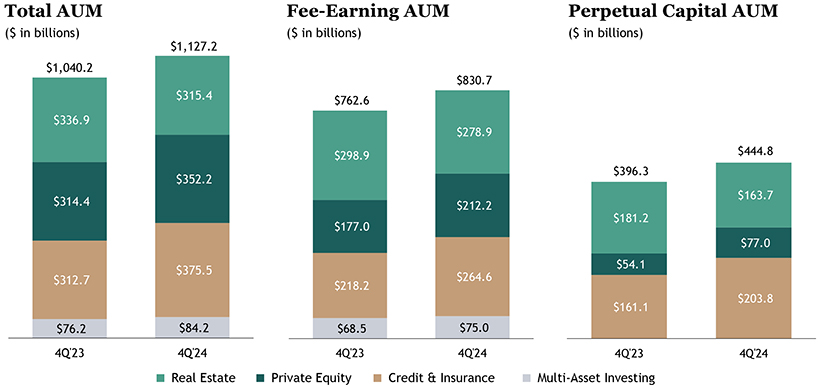
Thank you, Weston, and good morning, and thank you for joining our call. Blackstone just reported one of the best quarters in our history. Distributable earnings increased 56% year-over-year to $2.2 billion, as Weston mentioned, underpinned by record FRE. Our limited partners entrusted us with $57 billion of inflows just in the fourth quarter and $171 billion for the year, reflecting strong momentum with the institutional, insurance and private wealth channels. Of particular note, we raised $28 billion in private wealth in 2024, including $23 billion in the potential strategies, nearly double what we raised from individuals in these strategies in the prior year. All signs point to further acceleration in 2025. After quarter end, in January, we raised an additional $3.7 billion for our private wealth perpetuals. We launched our new infrastructure vehicles, representing a powerful affirmation of our unique position in this channel. We believe our $260 billion private wealth business is multiples the size of our next largest competitor. The largest single contributor to the firm's financial results in the fourth quarter was our dedicated infrastructure strategy, BIP, which generated $1.2 billion of fee revenues. BIP has delivered remarkable investment performance since inception only six years ago, including 17% net returns annually for the co-mingled strategy. This performance has fueled exceptional growth with AUM today of $55 billion, up 34% just in the past year alone. BIP anchors a broader infrastructure platform as a firm that exceeds $120 billion across equity, credit and real estate. In a relatively short period of time, we've established one of the world's largest infrastructure businesses. Our success in this area is a powerful illustration of how we build an enduring leading business at Blackstone. It reflects the same blueprint for how we've been able to grow from $400,000 in startup capital in 1985 to more than $1.1 trillion of AUM today, the largest alternative asset manager in the world and why I believe we will continue to achieve strong growth in the future. It starts with innovation as a core competency of the firm as we're always working to identify the next paradigm shift in the market. We evaluate whether we can create something truly differentiated for our limited partners, but the opportunity can be scaled significantly with the right team to lead it, drawing upon the firm's deep well of talent. Importantly, any new area also adds to the firm's intellectual capital and creates synergies with our other businesses to make the rest of the firm better. We have carefully considered infrastructure as a stand-alone business for a number of years. We've been investing successfully in energy infrastructure projects for over a decade, alongside other private equity and credit funds, which along with our extraordinary real estate franchise made infrastructure a natural extension as a new business line. In 2017, we saw a historic investment opportunity emerging in the U.S. and around the world and made the decision to launch a dedicated strategy. We identified a talented individual in our private equity energy area, our partner Sean Klimczak, to lead the new business. We began raising capital in 2018, supported by an anchor commitment from an important limited partner. Today, with $55 billion in outstanding investment performance, BIP has exceeded our initial and predictably very high expectations. The team has done an exceptional job in portfolio construction focused on compelling thematic areas, including digital infrastructure, energy and power and critical transportation infrastructure. We see enormous runway ahead, as massive funding needs for projects globally mean there are more opportunities available for capital. We envision a growth path for our infrastructure business that parallels that of our real estate business, including geographic expansion, new client channels, and moving across the capital structure and risk-return spectrum. We started raising the European infrastructure perpetual vehicle last fall and earlier this month launched a vehicle designed to give individual investors access to the full breadth of our infrastructure platform. Over time, we also see opportunities in Asia and the potential for sector-specific strategies. The growth of our infrastructure business was greatly helped by the other businesses at Blackstone and the firm's resources around the globe. These advantages include sourcing opportunities from and investing alongside our other funds. For example, BIP joined our real estate team in 2021 to privatize the QTS data center business, which has become the largest and fastest growing data center platform in the world. Our leadership position in data centers is creating additional synergies across the firm, enabling us to address many new opportunities. As BIP has continued to scale, it has in turn enhanced the firm's intellectual capital, relationships and deal flow, supporting our growth in other areas, including our $90 billion infrastructure and asset-based credit platform, our infrastructure secondaries business, and our dedicated energy and energy transition focused funds. What I'm outlining this morning is just one compelling proof point of the power of the Blackstone platform. We designed the firm from the beginning to work this way, with each business making the other stronger. This network effect sets Blackstone apart in the asset management area, underpins the strength of our brand, and acts as an accelerant for the firm's overall growth. When our clients have a positive experience in one area, they're much more likely to invest in additional Blackstone products and support our expansion. Building things organically from the ground up is a challenging fixed time, which involves upfront costs. However, we think our approach ultimately creates a stronger, more integrated firm as well as significant economic benefits as compared to a strategy focused on acquisitions. This also reserves and perpetuates our unique culture, which is foundational for the firm's success. As we head into the new year, we're moving into an environment where we see consequential tailwinds for our overall business. Market participants have recently focused on volatility in U.S. treasury yields, which reflects persistent inflation concerns in the context of resilient U.S. economic growth as well as policy uncertainty. Regarding inflation, based on our expansive portfolio and proprietary data, we see that the U.S. is continuing on the path of disinflation, albeit at a more moderate pace than before. With respect to policy, there are different factors to consider, but I believe the direction of travel fundamentally is towards policies that are pro-growth and pro-deregulation, which should ultimately be quite positive for our business. To close, the power of Blackstone's platform will continue to drive us forward. Our positioning has never been stronger, nor have our prospects been brighter. I couldn't be prouder of our people and their dedication to serving our investors. With that, I’ll turn the ball over to Jon.
Thank you, Steve, and good morning, everyone. This was an outstanding quarter for Blackstone. Steve highlighted the power of our platform and I'll take you through three areas where that power was on full display. First, our large-scale deployment; secondly, our continued momentum in credit and insurance; and third, the acceleration in our fundraising, including both private wealth and the institutional channel. Starting with deployment, over the past 12 months we’ve been talking about a strengthening transaction environment and our desire to invest significant capital in anticipation of improving markets. We're pleased to say that we deployed $134 billion in 2024, up 81% year-over-year, planting the seeds of future value at what we believe is a favorable time. The combination of a healthy U.S. economy, historically tight financing spreads, greater debt availability, the prospects of a more business-friendly regulatory climate, and importantly, accelerating technological innovations have given us confidence to deploy capital at scale. We invested or committed $62 billion in Q4, our most active pace in 2.5 years. New commitments in the quarter included fast-growing franchise business Jersey Mike’s, the privatization of a grocery-anchored retail REIT, our third cake private equity and real estate in 2024, and a luxury mixed-use complex in Tokyo, representing the largest ever real estate transaction in the country by a non-Japanese investor. In credit, we reported record deployment for both the quarter and full year, including a $3.5 billion financing for EQT Corp, one of the largest natural gas producers in the United States. This venture is an excellent illustration of the scale of what we're doing today in the investment-grade private credit space and our position as a trusted solutions provider to many of the world's leading corporations. We leveraged the full breadth of our platform to design a custom solution across the capital structure for the borrowers, secured by the long-term contractual cash flows of their critical pipeline infrastructure. For our clients, we provided access to a high-quality, directly originated investment, and we executed the transaction, as always, without taking on balance sheet risk. We see a significant opportunity for more corporate partnerships over time, given the scale of our platform and our reputation. Stepping back, our credit insurance business continues to see huge momentum following a remarkable 2024. We built a private credit juggernaut and the largest third-party business of its kind in the world, with over $450 billion of total assets across corporate and real estate credit. Inflows for the combined platform exceeded $100 billion in 2024, comprising 60% of the firm's total inflows. Our non-investment grade private credit and real estate credit drawdown strategies appreciated 16% and 18%, respectively, for the year. These are extraordinary results for performing credit underpinning robust investor interest in these areas. We're also seeing strong traction for our investment-grade private credit offerings, as I noted, and we now manage over $100 billion in that area, up nearly 40% year-over-year, virtually all on behalf of insurance clients, but we are now seeing receptivity from pensions and other LPs as well. In the insurance channel specifically, our business has reached nearly $230 billion, up 19% year-over-year, invested across IG private credit liquid credit and other strategies. Today, we have 23 SMA clients in addition to our four large strategic relationships, and we replaced or originated $46 billion of A-minus rated credits on average for our private IG focused clients in 2024, up 38% year-over-year, which generated nearly 200 basis points of excess spread over comparably rated liquid credits. We've achieved these results while remaining true to our capital-like brand-heavy open architecture model designed to serve a multitude of insurance clients without taking on any liabilities. Resolution Life, one of our four strategic relationships, is a perfect validation of our model. Last month, Nippon Life, the largest Japanese life insurer and an existing resolution shareholder, announced it would acquire the remainder of the company it didn't already own at a $10.6 billion valuation. Blackstone had taken a small 6% stake in resolution in 2023, alongside other limited partners in connection with becoming the company's asset manager for private and structured credit. Nippon's investment will monetize our stake, deliver an attractive gain to our limited partners and the firm, all while positioning resolution to accelerate growth under an extremely well-capitalized and capable parent. Importantly, we will remain resolution’s investment manager going forward, and we are excited to partner with Nippon on this next stage of the company's development. Turning to private wealth, where our momentum accelerated significantly in 2024. 2025 is also off to a terrific start. We are uniquely positioned in the wealth channel, given the breadth of our product lineup, our performance and the power of our brand. Sales in the channel exceeded $28 billion in 2024, as Steve noted. BCRED led the way, raising over $12 billion for the year, driving 36% year-over-year growth in NAV. Our private equity strategy, DXP, has already grown to over $8 billion in its first year, including January sales. And for BREIT, flows trended favorably with net repurchase requests in December down 97% from the peak. We raised an additional $3.7 billion for the private wealth perpetuals in January, as Steve highlighted, marking their best month of fundraising from individuals in over two and a half years. This included more than $1 billion each from BCRED, BXPE, and our new infrastructure strategy. The launch of the infrastructure strategy marked the largest ever first close for a vehicle of its kind and was 5x to 6x the size of competitors' product launches. To give you a sense of the strength of our brand in this channel, over 90% of advisers who allocated to this strategy had previously allocated to another Blackstone perpetual vehicle, and over 50% allocated to all four of our perpetual flagships. BREIT's exceptional performance, 9.5% net annual return since inception for its largest share class to a real estate superstorm, has helped us here a lot. We're now in the process of launching our multi-asset credit product, as discussed previously, targeting the first half of this year. We see enormous opportunity ahead in the $85 trillion private wealth market. Our drawdown fund area is also benefiting from robust client engagement today, with the tenor of discussions feeling far better than it had in several years. We held major raise events in Q4 for our real estate credit flagship, bringing it to $7.1 billion so far; European real estate has raised $9.5 billion to date and our private equity energy transition strategy has raised $5.2 billion, all of which will soon complete fundraising. We raised additional capital for our opportunistic credit strategy, bringing it to over $4 billion, and held initial closings of $1.6 billion for our new Life Sciences flagship, targeting at least the size of the prior $5 billion fund. We will also soon begin raising the new vintages of a number of other highly successful strategies, including private equity Asia, for which we expect very significant closings in the coming months, along with private equity Secondaries, GP stakes, and tactical opportunities. Overall, the fundraising outlook is quite positive for the firm. Investor affinity for Blackstone is as high today as ever, and it all ties back to investment performance. Our LPs have benefited significantly from the way we've positioned the firm and their capital, including building the largest third-party credit complex, the largest data center business, one of the largest energy infrastructure platforms, a leading life science business, and what we believe is the largest alternatives platform in India. These areas have continued to outperform, and we believe will drive outstanding future results for our clients as well. In real estate, however, our equity-oriented funds were down in the fourth quarter as the portfolio absorbed the 80 basis point increase in the 10-year treasury yield, and our non-U.S. holdings were also impacted by the stronger U.S. dollar. We wouldn't expect to see a move of this magnitude in treasury yields going forward given the underlying inflation data. While disappointing in the near term, our portfolio is in excellent shape, with cash flows growing solidly across virtually all our real estate strategies. One year ago, we said that real estate values were bottoming, but that the recovery would take time and was unlikely to be a straight line. That's exactly what happened. We remain firm believers that a sustained commercial real estate recovery is underway. Debt markets have vastly improved as borrowing spreads tightened by approximately 50% from the 2023 highs, and CMBS issuance was up nearly threefold in 2024. At the same time, new construction starts are down dramatically across virtually all types of real estate, dropping by two-thirds from '22 levels in U.S. logistics and apartments, our largest sectors. Meanwhile, demand is resilient, with the potential for acceleration in the context of a stronger U.S. economy. Given our conviction, we deployed $25 billion in real estate in 2024, up nearly 70% year-over-year, and we expect to continue to deploy at scale. Real estate is a cyclical asset class that has been through a cyclical downturn, and we believe Blackstone is the best-positioned firm in the world to benefit from the recovery. In closing, the firm is in terrific shape by any measure. We expect to achieve great things on behalf of all of our investors. With that, I will turn things over to Michael Chae.
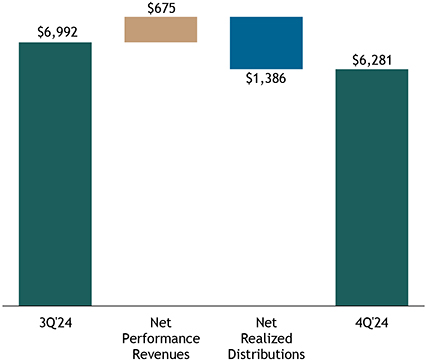
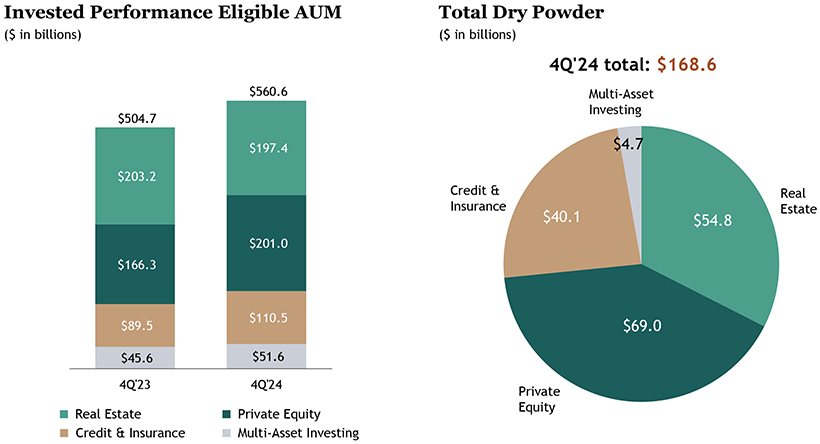
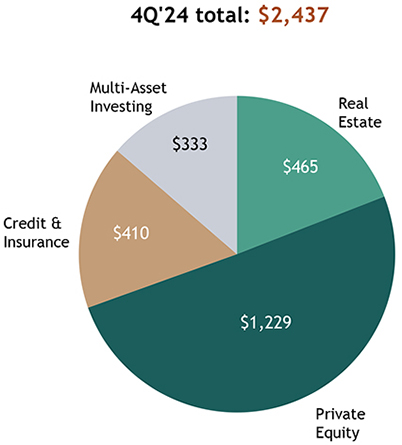
Thanks, Jon, and good morning, everyone. Our fourth quarter results represented an exceptional finish to an outstanding year, and we entered 2025 in a position of significant strength. I'll first review financial results and then discuss investment performance and the outlook. Starting with results, we reported the best quarter of fee-related earnings in the firm's history and one of the two best quarters of distributable earnings. We saw the full benefit of multiple drawdown funds that were activated throughout the year. Key perpetual strategies continue to scale significantly, including the very notable contribution from BIP infrastructure business, and we believe net realizations have begun to move off cyclical lows. First, with respect to fee-related earnings. In the fourth quarter, FRE grew a remarkable 76% year-over-year to a record $1.8 billion or $1.50 per share. Management fees rose 12% to a record $1.9 billion, including the 60th straight quarter of year-over-year base management fee growth at the firm. We activated the investment period for multiple major drawdown funds in 2024, which contributed full fees in Q4. Alongside that, key perpetual strategies, BIP, BCRED, and BXPE continue to grow in scale and contribution to the firm's financials, with their combined NAV up nearly 50% year-over-year. Fee-related performance revenues increased more than eightfold year-over-year in Q4 to $1.4 billion, driven by BIP's major scheduled crystallization event with respect to three years of substantial accrued gains, BXPE's first significant crystallization event with respect to full year 2024 gains, and the steadily growing contribution for BCRED and our direct lending platform overall, with a 47% year-over-year increase in these revenues for the credit insurance segment. In terms of distributable earnings, DE grew 56% year-over-year to $2.2 billion in the fourth quarter or $1.69 per common share. In addition to the strong growth in FRE, net realizations increased 42% year-over-year to $601 million, which is the highest level in 10 quarters. We executed a number of realizations across both the public and private portfolios in the quarter, concentrated in corporate private equity. These included the sale of public energy positions along with the IPO and sale of a portion of our stock in an India-based company at a multiple of invested capital of over 5x, with the stock trading up further since then. In addition, our multi-asset investing segment, BXMA, generated outstanding investment performance in 2024, including the best year for the absolute return composite in 15 years. The BXMA crystallized incentive fees for most of its open-ended strategies annually in Q4, and the segment's performance revenues increased 144% year-over-year to $338 million. Now turning to the full year. The firm delivered strong results amid a complex external environment in 2024 with robust growth across all key financial and operating metrics. Distributable earnings grew 18% to $6 billion. Fee-related earnings increased 21% to a full year record of $5.3 billion. Net realizations rose 12% to $1.4 billion, supported by the strong performance in BXMA and yet another example of the benefits of our diverse business mix. The firm's expansive breadth of growth engines lifted total AUM up 8% to more than $1.1 trillion, another record, with $171 billion of inflows for the year. Inflows, deployment, and overall fund appreciation all accelerated meaningfully in 2024 expanding the foundation of future value. We achieved these results against a backdrop where the market for large-scale realizations was very challenged for much of the year, and the significant underlying earnings power of our real estate business has yet to reemerge, reflecting the breadth and power of our platform that Steve and Jon described. Moving to investment performance, the firm delivered strong returns in almost every area in the fourth quarter. Our corporate private equity funds appreciated 4.9% and 17% for the full year. Our operating companies overall reported stable mid-single-digit year-over-year revenue growth in the quarter, along with continued notable margin strength. Our infrastructure business reported a 4.8% appreciation in the fourth quarter and 21% for the year. In credit, our non-investment grade private credit strategies generated a gross return of 3.1% in the fourth quarter and 16% for 2024. We continue to see resilient fundamentals across the credit portfolio, and the LTM default rate across our 2,000-plus non-investment-grade credits remained under 50 basis points. BXMA reported a 3.7% gross return for the absolute return composite, the 19th consecutive quarter of positive performance and 13% for the year. BXMA has generated compelling all-weather returns in liquid markets, helping to insulate our LPs from the volatility of the past several years. Indeed, since the start of 2021, BXMA's cumulative absolute return composite, net of fees is 34% or nearly double the traditional 60-40 portfolio. In real estate, the opportunistic funds declined 5.1% in the fourth quarter and 4% for the full year, while the core plus funds declined 0.8% in the quarter and were stable for the year. As Jon discussed, the fourth quarter was impacted by the sharp increase in treasury yields and the stronger U.S. dollar. Outside of our major reported business lines, the growth and performance of other key strategies further highlights the firm's ability to innovate and build businesses. Our dedicated life sciences platform delivered standout performance in 2024, with the funds appreciating 11.3% in the fourth quarter and 33% for the full year, driven by the achievement of positive milestones for multiple treatments under development. Our real estate credit high-yield drawdown funds appreciated 4.4% in Q4 and 18% for the year, underpinned by resilient credit performance in its real estate loan portfolio. Our GP Stakes business appreciated 4.1% in the fourth quarter and 28% for the year, reflecting its focus on top-performing managers in private markets. The resiliency and strength of the firm's investment performance continues to power our growth. Turning to the outlook, the firm is advancing with strong momentum across multiple drivers. First, in our drawdown fund area, in 2025 we will see the full year benefit from funds that were activated throughout 2024. Second, our platform and perpetual strategies have continued to expand overall, now comprising 46% of the firm's fee-earning AUM, setting a higher baseline for management fees as we enter 2025. Additionally, BXPE is now eligible to generate fee-related performance revenues on a quarterly basis, and our infrastructure strategy for individual investors in its first year will be eligible in Q4 of 2025 with respect to full year 2025 gains. While BIP's significant Q4 crystallization event will not recur in 2025, we expect smaller crystallizations periodically starting in the second quarter of this year. Third, there is significant underlying momentum in our credit insurance business, as you've heard this morning. Both segments FRE and DE grew 26% and 24%, respectively, in 2024, and with robust inflows and record deployment, the business is exceptionally well-positioned to deliver strong financial performance again in 2025. Finally, regarding realizations, we anticipate a much more constructive environment for realizations in 2025. In the near term, we would expect disposition activity to be concentrated in our private equity strategies, while real estate exit markets strengthen over time, and for overall activity levels to be meaningfully higher in the second half of the year. Meanwhile, net accrued performance revenue on the firm's balance sheet stood at $6.3 billion at year-end or $5.14 per share. Performance revenue eligible AUM reached a record $561 billion. These are strong indicators of our future realization potential. In closing, we are highly confident in the multiyear picture of growth at Blackstone. The power of our platform has driven extraordinary results for our investors, and we believe it will continue to do so in the future. With that, we thank you for joining the call. I would like to open it up now for questions.
Operator
Thank you. We'll take our first question from Dan Fannon with Jefferies.
Speaker 5
Thanks, good morning. Jon, I was hoping you could expand on some of the fundamentals you're seeing in the real estate market that gives you the confidence in the recovery. And while the recovery has been slow, as you highlighted in 2024, how do you see that ramping in terms of 2025?
Good question. I would say when we think about the conditions for real estate recovery, you look for a number of things. First, you obviously want demand, which is tied to economic growth. We've got a pretty healthy U.S. economy, which leads to demand for logistics, apartments, and hotels. So I think if the economy accelerates further, that's certainly a positive. Then, of course, supply, which I think is the key element here. We've seen a decline from 3%-plus new supply starts back in 2022 in logistics and rental housing, our biggest areas. That's declined now to 1%, which is a two-thirds decline, and that is very helpful. We think cash flows, as we move over time, will be pretty good. They actually have been strong throughout this challenging period the last few years. However, what has really hit real estate has been the cost of capital. There, what we see is spreads have tightened quite a bit. Overall borrowing costs have decreased from about 9% to 6%. That's obviously helpful. The availability of capital has improved. CMBS last year was up threefold, and that's obviously critical for transaction activity. In the near term, the 80 basis point move had a negative impact, but that's now been absorbed by the market. I think the combination of favorable cash flows and a more stable rate environment going forward gets us on this path. Ultimately, hard assets have to revert to replacement costs. With a growing economy, you need more real estate. Therefore, rents and ultimately values have to grow. So the path of travel is clear; the slope may be a little different, but the reason we're leaning in is that we see that we're firmly on this recovery path for real estate.
Operator
We'll take our next question from Craig Siegenthaler with Bank of America.
Speaker 6
Good morning, Steve and Jon. Hope you are both doing well. We wanted to circle back on Michael's monetization commentary and the expected ramp in transaction activity. Blackstone is still a net buyer of assets, but given the macro setup with the high stock market valuations and anticipated rise in IPOs, when do you expect to inflect and be a net seller of assets in corporate private equity? And then on Michael's prepared comments again, how far behind is the real estate cycle relative to private equity?
Craig, I think a few things. The environment is looking better. Again, the strength of the economy, the health of the equity market, the S&P being up 60%, and the IPO market; the pipeline for IPOs now is double where it was a year ago. Those are very constructive facts. We think large profitable companies can go public, and the improving debt markets are certainly helpful, with both investment-grade and high-yield spreads at essentially record types. Base rates are still a bit elevated, but the debt market is looking very constructive. We've got a regulatory climate for M&A that is far better for us. Strategics can now start to buy again, and some of those dialogues are picking up. You also have a desire for people to engage in transactions after being on the sidelines for three years. So we see the ingredients for a very positive M&A cycle coming together. We did observe a little slowdown in the fourth quarter given the election and some volatility around rates, but I believe it will build during the year. To your question regarding Michael's comments, private equity will definitely be stronger. We have a number of things where we'll see realizations earlier on, while for real estate, we need this recovery to take a little more time. Therefore, we expect that to be more back half of the year; certainly not at the beginning of the year, just given the nature of the market healing over time. Overall, I think we can expect a better environment in '25 and '24, but more back-end weighted, focusing on private equity in the first half.
Operator
We'll take our next question from Michael Cyprys with Morgan Stanley.
Speaker 7
Great. Thanks so much. Good morning. Just a question on AI and data centers. Just curious how you're thinking about the evolving investment opportunity around AI, particularly in the infrastructure layer with data centers and power. We've seen a lot of capital flow into the space, and you guys at Blackstone have been quite active in this area specifically. But just given some of the recent developments, like DeepSeek over the weekend, which suggest that AI models may become less capital and energy-intensive, just curious how attractive you see the infrastructure layer here moving forward? How much more capital investment do you guys foresee being needed across the industry? And how are you thinking about potential shifts for investment opportunities across into the application layer?
So Mike, we've obviously spent a lot of time over the last week looking at the impact of DeepSeek. I'd start with our data center business, which is the largest in the world. We have $80 billion of leased data centers. The good news in that business is these are long-term leased data centers with some of the biggest companies in the world. We do not build data centers speculatively anywhere in the world, so we have a very prudent approach when we think about data centers. The real question, and the heart of your question, is what is demand going forward? On that front, I would echo what you're hearing from many commentators: the cost of computing is coming down dramatically. But at the same time, that's going to lead to more usage and more adoption. So what does that mean for the physical infrastructure side? I'd go to calls last night for both Meta and Microsoft, where they talked about the importance of physical infrastructure. Mark Zuckerberg said that he thought it was a strategic advantage for them, but they acknowledged that some of this may need to be more fungible. Maybe there's a little less training that is done as a result of less intensity, but at the same time, there will be more inference, maybe more cloud, and more to do with enterprise. So we have a sense in talking to our clients that there's a belief that as usage goes up significantly, there'll still be a vital need for data centers. The form of that use may change. The good news for our investors is we're not doing things speculatively; it's based on the demand signals from our tenants. That's when we go out and spend the big dollars to build these things. Therefore, we still think there's a very important segment, and there’s a way to run. We're watching what's happening closely.
Speaker 7
Great. Thank you.
Operator
We'll take our next question from Kyle Voigt with KBW.
Speaker 8
Hi. Good morning, everyone. Maybe a question on BXPE. The last few quarters have been in a healthy $1 billion to $2 billion zone in terms of quarterly fundraising. I guess, first, can you remind us where you're at in terms of distribution of the product, whether that's number of platforms or international breadth? And what does the runway look like to expand that? And then with respect to the $1 billion to $2 billion quarterly inflow range, is that the pace that you are really comfortable growing with the type of product, or now with having some investment track record and entering the second year of the product, is there comfort in ramping the flows above that range if there is demand?
Well, we've been steadily building out our partnerships and distributors on BXPE. This is always the way you start with a smaller number as you work your way through the first two or three years, you steadily expand within the USA and geographically, and we're on that path. I don't know if we quote exactly how many distributors we use, but the number continues to grow. We've had some good success in places like Canada recently. The key for these products is investment performance, and BXPE did a terrific job in its first year. That first year is the hardest year because you're starting with the product from a standing start. We delivered very strong performance, which speaks to, I think, the unique scale we have. We have large-scale corporate private equity, we do it in the U.S., Europe, and Asia: core private equity, tactical opportunities, growth, and life sciences. The breadth of that platform has allowed us to deploy the capital in real time. As for where we go from here, we had a terrific month in terms of fundraising for BXPE in January. It will be driven by performance. We have the capabilities to deploy more at scale; I feel confidence in that. However, we need to deliver performance in order to ensure clients become more comfortable. We will open with more distributors, and the product will continue to grow. We've done this in the past with both BREIT and BCRED, and we think this is a similar model. But again, we have to deliver for our customers and deploy capital effectively. Given our strength in the channel and our brand strength, it's really powerful. The fact that 50% of our financial advisors who invested in BXINFRA invested in all four of our products speaks volumes regarding that powerful network effect. Financial advisors and their underlying clients know, trust, and value the Blackstone name, and that is so important. We are dedicated to delivering for them. If we do that, this can grow a lot, just like our other products in this space.
Speaker 8
Great. Thank you.
Operator
We'll take our next question from Bill Katz with TD Cowen.
Speaker 9
Thank you very much for the commentary. You didn't talk at all about retirement. I know it's an area that the whole industry is focused on, but you mentioned a more favorable regulatory backdrop. How do you see the evolution of the commentary coming out of your conversations with the regulators as that takes shape into 2025 on the Trump administration? What should we be looking for, for that opportunity set to potentially open up from a real estate perspective?
Where we start is the way defined contributions and retirement businesses have evolved. I think it's created a bit of a have-not environment. If you think about it, wealthy individuals can access our products through financial advisors and benefit from strong long-term returns and compounding. If you were an employee at a major corporate pre-2005, you probably have the benefit of a pension fund where people are working hard every day to deliver these returns, allocating to alternatives. If you work at a state pension fund today, you're also getting the same benefit. However, for the vast majority of private sector workers in the U.S., they're in a 401(k) plan where, because of the litigation environment, they focus on the lowest fees and it's not about long-term performance. It seems highly logical to us that at some point, for instance, in target date funds with the right gatekeepers and controls, picking the right managers, you would put private assets into this marketplace. In essence, all individual investors could benefit for retirement. For us, our brand, performance, breadth of offerings, and the range of perpetual products we’ve created position us uniquely to take advantage of this. I believe we will see this happen; it's just a question of when. And when it does, as I said, we’ll be in a good spot. It seems logical given the market's evolution over time, and we really want to democratize access to these products to generate higher returns, so people can invest more for their retirement.
Operator
Thank you. We'll take our next question from Glenn Schorr with Evercore ISI.
Speaker 10
This is Kaimon Chung in for Glenn Schorr. Some insurance companies seem to be looking to do more on their own in private markets. I'm just curious what you're seeing and your expectations for further growth with your insurance partnerships. I also heard your comments about Nippon Life; just want to get your thoughts on growth opportunities for insurance and credit in Asia and what else you’re doing in that region.
I think the biggest change we've seen in the insurance industry over the last few years is that moving beyond just commercial mortgages into broader private investment-grade credit has gone from something people saw as a novelty to a necessity. If you're competing in the annuity space or in the life space, even P&C companies are now looking at this. If you can get comparably rated A- credits and gain 200 basis points higher spread, that makes you more competitive with your sales organization. That's why we've seen insurance partnerships grow nearly 20% to $230 billion, and we expect this dynamic to continue. The number of conversations and the scale of those conversations seems to be accelerating. Another positive is the fact that we operate under an open architecture model; we aren’t an insurance company with significant liabilities and we aren’t out there selling these products. We are merely a third-party manager, akin to liquid managers managing liquid credit on behalf of insurers. They see us as an attractive place to allocate capital. The scale is important because no insurer desires overconcentration due to their inherent risk-averse nature. We are finding a desire to engage on a larger strategic basis. Our clients are appreciative of what we deliver, and I think you'll see this business grow meaningfully. There's interest in investment-grade private credit from pension and sovereign wealth funds as well. It’s still early days, but overall, insurance seems to be an excellent growth area for us, particularly at Blackstone.
Operator
Thank you. We'll take our next question from Alex Blostein with Goldman Sachs.
Speaker 11
Hi. Good morning, everybody. Thank you for the question. Staying on credit for a second, the fundraising was really strong across the platform, and it was well balanced, which is obviously great to see as well. Can you give us a sense of the amount of capital that's sitting on the platform now that's not earning fees yet that will turn on upon deployment? In that context, can you discuss your expectations for credit deployment over the next 12 months or so, including some of the partnerships Jon highlighted earlier?
As the business grows and broadens, especially as we continue to move beyond to more opportunistic direct lending, we're entering the asset-based arena, where both our penetration and that of the industry are quite small. We believe this area will experience significant growth. You’ll see us partnering more and more with banks, often on a white label basis where there may not be a big announcement, but they want to move some things off their balance sheets as they seek to drive higher ROEs. Looking ahead, we see several of these corporate solutions transactions unfolding, similar to the EQT example, and I expect to see more of those. The investment pace will continue to rise in tandem with the capital influx. The private investment-grade area and asset-based credit will be tied closely to economic activity, consumer finance, and fundamental sectors like commercial and residential real estate, essentially the core elements of the U.S. economy. So, as capital comes in, I see this continuing to ramp up. We're not giving a percentage figure, but I expect it will keep pace with the inflows.
Yes, Alex, it's Michael. Out of our AUM base of $375 billion, our total AUM is $265 billion of fee-earning AUM, and about $40 billion is eligible for management fees but not yet earning it. To put that in perspective, there's another $9 billion or so in the bread's business within real estate.
Operator
We'll take our next question from Brian Bedell with Deutsche Bank. Please go ahead.
Speaker 12
Great. Thanks. Good morning, folks. Thanks for taking my questions. To Michael, on the FRE margin outlook for '25. You're highly likely to get back to solid double-digit base fee growth, not even considering FRPR. I'm just wondering what your outlook for the FRE margin might be in '25, even just not considering the fee-related performance revenue. And then, I guess, on top of that, I mean that can certainly create a lot of delta to the margin given the compensation on performance—fee-related performance revenue—but then I guess if that creates a lot of uncertainty into that outlook, to what extent is that compensation fungible across the firm so that you can, therefore, scale that margin and improve that this year versus last year?
So I'll just step back on the question margins. You've heard me remind you before, but I'll say it again, it's early in the year, so we don't want to get too granular, and we encourage you to look at it on a full-year basis. We did throughout last year. I think that approach hopefully was validated when you look at the full-year performance. There are different variables to consider. You've touched on at least one. But I'd just start by saying we continue to feel really good about our margin position fundamentally; margin stability is our starting point this year. A few items I'll note in terms of those variables. First, on management fees and OpEx in terms of baseline. On management fees, we have this embedded ramp for the full-year benefit in '25 from flagship vehicles activated in 2024, which lifted our base management fees in Q4 to see 10% year-over-year after more like single-digit growth throughout the course of the year. We consider that growth rate a reasonable starting point as we enter 2025. On the OpEx side, we've talked about this in prior quarters; we anticipated Q4 would come in that low double-digit area, and it came in at 11%, which is a reasonable starting point as we enter 2025. So your point regarding the relationship between management fee growth and OpEx growth is a good thing. Second, we've said before there is a level of sensitivity to fee-related performance revenues, with core plus and BREIT FRPR generally carrying higher incremental margins since these are direct lending platforms. So that is of note. To your question, we manage compensation holistically across the firm, so that's in play, but I think it’s worth noting that sensitivity. Third, as you've heard this morning, we continue to build out significant new initiatives that are in investment mode today, which will be meaningfully additive over time. We're investing to grow and scale these new products, which will add significant profitability in the long run. So I'd say those are some of the key pillars around this. But again, stepping back, we've got a robust underlying margin position, multiple growth engines, and ultimately a high degree of control over our cost structure. This ability to scale products is key over time, whether in private wealth or any other space as being subscale doesn’t lead to compelling profitability.
Speaker 12
Great. Thank you.
Operator
We'll take our next question from Mike Brown with Wells Fargo Securities.
Speaker 13
Okay. Great. Good morning, everyone. I wanted to ask about the new multi-asset credit fund that is set to launch, which I think you said in the first half of this year. I'm hoping to compare and contrast that fund versus BCRED. It sounds like it will have broad exposure to your credit business. I'm curious how that will be marketed to ensure it doesn't cannibalize BCRED. Given it's an interval fund, does that mean it has the potential to be distributed differently into a wider array of distributors?
I'm looking at my General Counsel and considering how best to answer this question. What I can say is the product will encompass the breadth of what we do in credit, as opposed to focusing solely on direct lending. It will include various other strategies we undertake related to asset-backed finance and real estate finance on a global basis. It will be a different structure that we believe will be more accessible to investors.
Speaker 13
Thank you for that call. Thank you, Jon.
Operator
We'll take our next question from Brennan Hawken with UBS.
Speaker 14
Good morning. Thanks for taking my question. I have a couple of questions on FRPR, specifically within credit: one on the fourth quarter and one more forward-looking. There was a nice uplift here in the quarter. Is it possible to quantify what impact you saw from spread tightening working through the FRPR line here this quarter? And then how should we think about the impact of base rates and tighter spreads on excess return and therefore FRPR generation going forward?
There has been some excess spread coming out of the credit business over the last 18 months. You've seen it broadly across investment-grade and non-investment-grade credit spreads tightening. We've seen base rates come down. However, our vehicles have continued to produce very strong results. The key thing to remember for investors is that while they may not be able to produce mid-teens returns in private credit on a go-forward basis, the relative returns and the spread premium to fixed-income liquid credit remains sustained. This provides us with confidence that we'll continue generating favorable returns for our customers. Our farm-to-table model, where we bring investors directly to borrowers to avoid origination costs, is going to continue, and that's foundational for us, which is why we think this private credit area has so much room to run, both non-investment-grade and investment-grade. While the overall level of yields is declining as spreads tighten, I think this bigger trend is critical for growing that business.
On the math, I would say an approximate impact of 50 basis points decline in base rates affects our fee-related performance revenues on a run-rate basis by about 4%. This is a low single-digit number, and we’ve absorbed quite a bit of that in the last 12 months while overall in BCRED grew by 18%. That's resulting from NAV appreciation and growth in inflows.
Speaker 14
Great. Thanks for taking my question.
Operator
We'll take our next question from Ken Worthington with JPMorgan.
Speaker 15
Hi, good morning. I wanted to dig a bit deeper into the big four insurance relationships, if I could. Setting the stage for the $230 billion you called out a couple of times in insurance assets, about how much comes from the Big 4? As we think about '25, what are the contractual commitment obligations expected from the Big 4? Given the acquisition of Resolution by Nippon Life that you mentioned, I think that the IMA remains intact. Does the transaction affect the remainder of the $60 billion of resolution flows expected over the next few years?
At the end of '24, across the Big 4, we had $156 billion of AUM.
What I would say is that we've been allocated more capital than what's been in there, faster than the capital that was contractually obligated. Our partners are extremely pleased with our performance. The relationship with Corebridge is rock solid, with Resolution, Fidelity Guaranty, and Everlake, the former Allstate Life & Retirement business. I think it's interesting by making these vehicles more competitive with our work, they will continue to grow. Having Resolution now owned by Nippon with their capital and expertise will be a very positive development for the future. We view these partnerships and our model as extremely powerful. As you're seeing in Resolution, we’ll return capital to them. It’s a good example of how we recycle capital. We continue to stay with these partners long-term as they grow their asset bases, making them more competitive. We expect to see accelerating growth with our strategic partners, given what we are delivering for them.
Speaker 15
Okay, great. Thank you.
Operator
We'll take our next question from Steven Chubak with Wolfe Research.
Speaker 16
Hi. Good morning. I wanted to ask a question on BREIT. The second derivative on BREIT growth in net flows appears to be improving. That being said, given stickier rates at the long end, I wanted to better understand the catalyst for retail allocations into BREIT to increase from here. What feedback have you received from retail partners? How do you see BREIT flows evolving over the medium term relative to history, given your outlook?
It's all tied to performance. I think we did an excellent job navigating the difficult period for real estate and providing liquidity to customers. We've been providing full liquidity for the last 11 months, and we've witnessed a 97% decline in net redemptions. The key question is when it flips and becomes a growth vehicle. That, in our perspective, ties back to performance. As BREIT begins to show good performance, customers will have had a favorable experience. They’re waiting to see a few months of positive NAV growth in a meaningful direction. If that occurs, we believe growth will follow. It might take a bit of time, but we're optimistic it will build. BREIT owns a terrific rental housing portfolio where there's a structural shortage in the U.S., alongside great exposure to logistics, more e-commerce movement, and a data center investment that has added significant value recently. All of this provides confidence. Cash flow continues to grow, and rates settling down, combined with a lack of new supply, leads us to believe BREIT will again, at some point, become a growth vehicle. Our investors greatly value their experience with Blackstone and Blackstone real estate, but we do expect they will need to observe steady months of solid performance.
Operator
Thank you. We'll take our next question from Ben Budish with Barclays.
Speaker 17
Hi. Good morning, and thank you for taking the question. I was wondering if you could talk a little bit more about the trajectory — the potential trajectory for BIP, FRPR. I understand you said that they should start to pick up in Q2. Looking back over the last few years, there's been a considerable amount of fundraising quarterly since the beginning of 2022. I'm curious if there's anything else you can share in terms of what FRPR looks like given the size of that fundraising and the performance? Any other nuances we should be aware of regarding the FRPR margin side? It seems like it came in maybe a bit better than expected, but it has to do with perhaps the timing of BXPE; I'm wondering if we could see something like that in Q4 next year?
The momentum in our BIP infrastructure business is extraordinary. When you deliver 17% net in an open-ended format where capital is invested on the ground and build the kind of portfolio that they have in digital infrastructure, energy, and transportation, you create a lot of satisfied customers. The fundraising momentum keeps pace quite well. Michael, I'll hand it to you.
On the sequencing of incentives moving forward, as I mentioned earlier, in Q2, we will realize a more modest but material amount of incentive fees. You can expect over the next four quarters in 2025 that infrastructure incentive fees and FRPR won't be present in the first and fourth quarters, but there will be modest amounts in the second and third quarters. As for margins on that, as we outlined last year, given the development mode we're in, the effective FRPR margin for infrastructure would be a bit lower than the overall firm. That's obviously been the case given the significant dollars at play.
Speaker 17
Understood, thank you very much.
Operator
Thank you. We'll take our next question from Patrick Davitt with Autonomous Research.
Speaker 18
Hi. Good morning, everyone. Thank you. I know there's still a lot of uncertainty on the direction of the new administration's policies, but surely you guys have been running different scenarios internally, as others have said they are. Through that lens, I'd be curious if you have any initial thoughts on how the in-ground portfolio could be impacted—positively or negatively—by more significant tariffs or a trade war. Moreover, could you provide an update on invested capital exposure to Europe, Asia, and China?
Speaker 19
So what I’d say at the headline level, Patrick, is we don’t have a lot of businesses who export physical goods at scale to the United States. So that's the area at most risk. The other thing I’d say is we have to wait and see where this settles. Clearly, tariffs are going to be higher, but we don’t know which countries, which industries, and what the level is; there seems to be a lot of negotiation. This tariff diplomacy, as we saw in Colombia a week ago, can move dramatically in a short period of time. The good news overall is very few of our businesses are reliant on exporting goods into the United States, and we don't foresee it having a major impact in Europe and Asia.
On the geographic dimension, Patrick, if we step back to look at the firm, these are gross numbers. While we're international and global, about three-quarters of our portfolio is in the U.S., with about 15% in Europe and a modest single-digit amount in Asia. So we’re a global firm, but the nature of our business leaves us with a manageable exposure to non-U.S. markets.
Operator
Thank you. We'll take our last question from Crispin Love with Piper Sandler.
Speaker 20
Thank you and good morning, everyone. Can you just discuss your outlook on interest rates? As Steve stated, you are seeing disinflation based on your data, but there are worries on inflation broadly, as shown by recent treasury yields. Would you expect more cuts than currently priced in or perhaps a rally in rates? I'm curious how that could impact PE activity and real estate performance in 2025 based on your in-house views.
Predicting interest rates is always a dangerous game. What I can tell you is our confidence comes from our portfolio regarding inflation data. We are major owners of rental housing, with shelter being the biggest component of CPI—it’s 36% today. Fed data suggests it's around 4.6%, but we believe it's closer to 1%. The government data is gradually catching up to what’s happening in the real world. If you take that 36% weighting and slowly bring it down, it provides the Fed some breathing room. Also, in the labor market, we survey our CEOs, and they’ve indicated it’s the easiest time to hire since the post-COVID period. Hourly wages are down to 3.7%. Things could change with a resurgence in economic activity, but at present, the labor market is in balance. That should be helpful too. Also, the Fed has the luxury of being patient given the economy’s strength. They want to observe the upcoming policies from the administration before acting. I believe the inflation data will generally support token measures, showing inflation's continued decline, albeit at a slower pace.
Operator
Thank you. We will take our final question from Arnaud Giblat with BNP Paribas.
Speaker 21
Yes, good morning. If we were to look at perpetual products five years out, assuming continued acceleration in flows in these products in the U.S. and in global private wealth channels, how might we perceive your distribution evolving? Specifically, how much AUM are you currently positioned to distribute today? Do you require a lot of investment in distribution over the next 2, 3, 5 years? I'm inquiring about the shape of that evolution.
There’s significant optimism in the forecasts. We foresee considerable growth. The good news is we've made substantial investments in this area ahead of others. We really started this nearly 15 years ago. We have teams globally, more than 300 people, dedicated to our private wealth area. We’re very proud of the track records we’ve built, which are pretty differentiated. The opportunity to distribute these products more broadly in different formats is on the rise. The Blackstone brand's power is critical. Sometimes it’s tough to quantify our financial models. However, our ability to launch new products and establish different distribution channels will be advantageous. We believe it’s still early days. If you consider that there’s roughly $90 trillion of wealth globally among individuals with over $1 million in savings, most of that is allocated about 1% to private assets. In contrast, institutional partners are at 30%. Having navigated a tough environment in the past few years due to capital cost shocks, individuals are starting to show up again, and their risk appetites are rising. There’s a diminishing focus on deposits as short-term rates decline. At Blackstone, with all we've to offer and the track record we've earned, we think we are well positioned. I wouldn’t be shocked if, five years from now, this is significantly larger than it is today.
Operator
Thank you. With no additional questions in queue, I'd like to turn the call back over to Mr. Tucker, Weston for any additional or closing remarks.
Speaker 1
Thanks so much for joining us today, and we look forward to following up after the call.