Operator
Good day and thank you for standing by. Welcome to Instacart’s First Quarter 2025 Financial Results Conference Call. Please be advised that today’s conference is being recorded. I would now like to hand the conference over to Rebecca Yoshiyama, VP of Investor Relations, Capital Markets and Treasury. Please go ahead.
Thank you, operator and welcome everyone to Instacart’s first quarter 2025 earnings call. On the call with me today are Fidji Simo, our Chief Executive Officer; and Emily Reuter, our Chief Financial Officer. During today’s call, we will make forward-looking statements related to our business plans and strategy, impacts from macroeconomic conditions and our future performance and prospects, including our expectations regarding our financial results. These forward-looking statements are subject to risks and uncertainties, which could cause actual results to differ materially from those anticipated. You can find more information about these risks and uncertainties in our SEC filings, including our last Form 10-K. We assume no obligation to update these statements after today’s call, except as required by law. In addition, we will also discuss certain non-GAAP financial measures, which have limitations and should not be considered in isolation from, or as a substitute for, our GAAP results. A reconciliation between these GAAP and non-GAAP financial measures is included in our shareholder letter, which can be found on our Investor Relations website. Now, I’ll turn over the call to Fidji for her opening remarks.
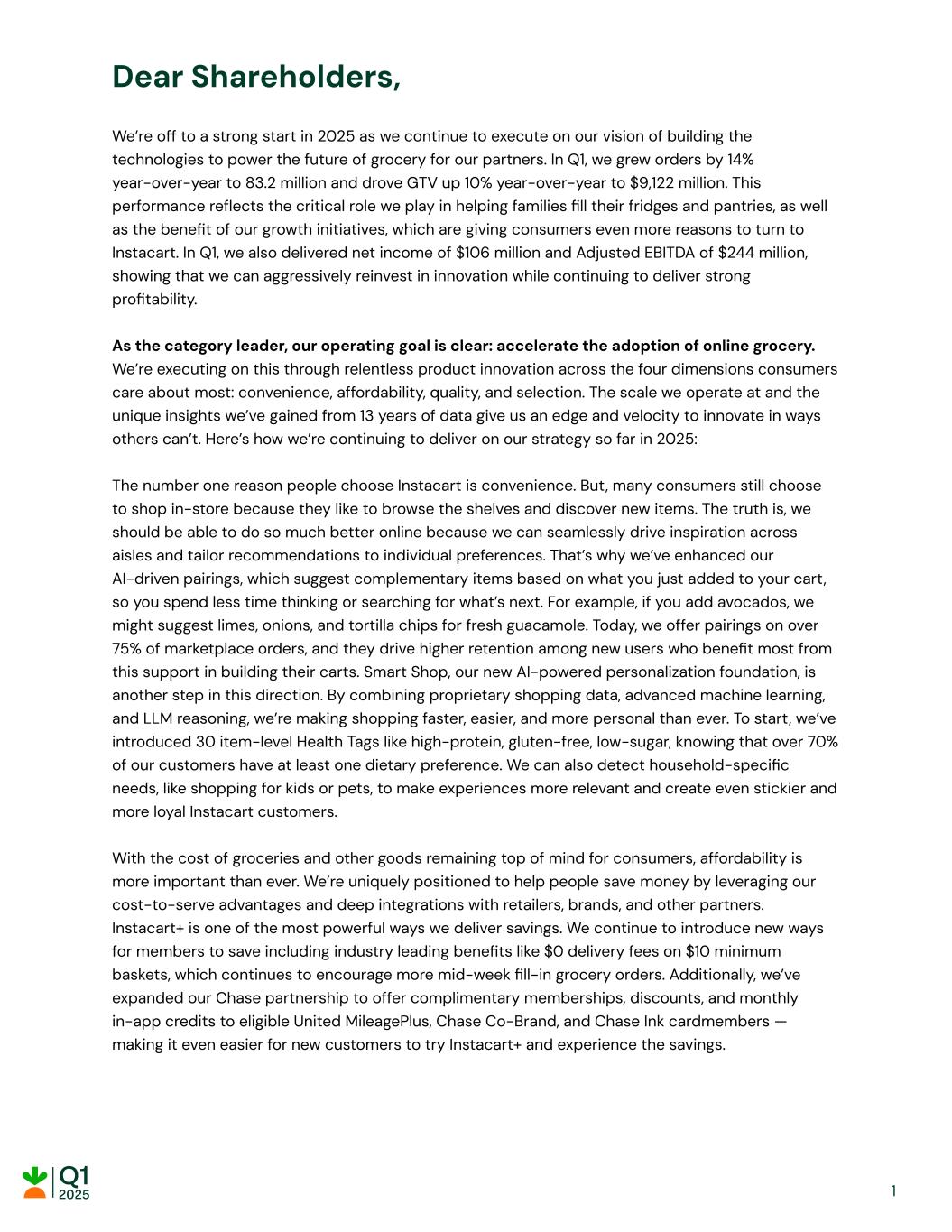
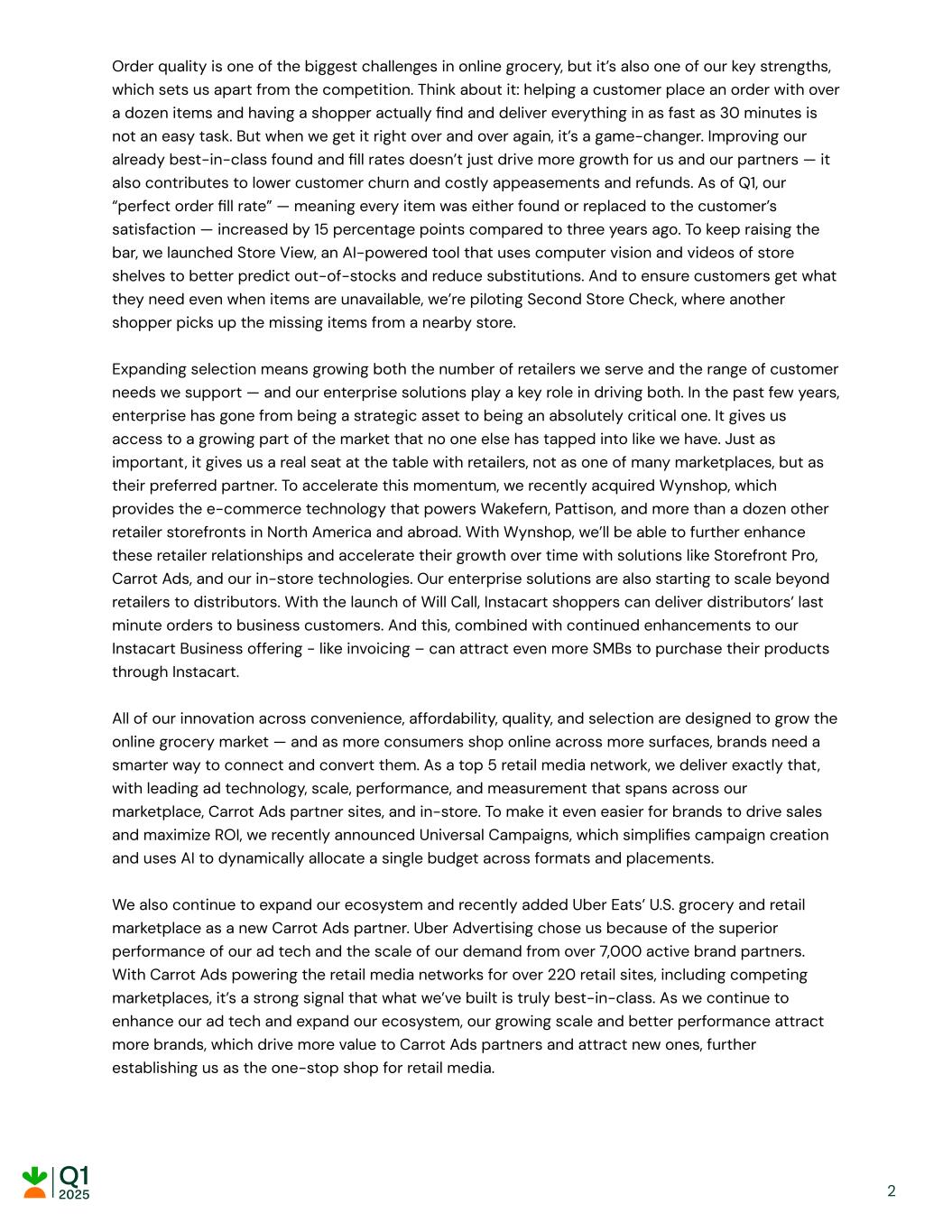
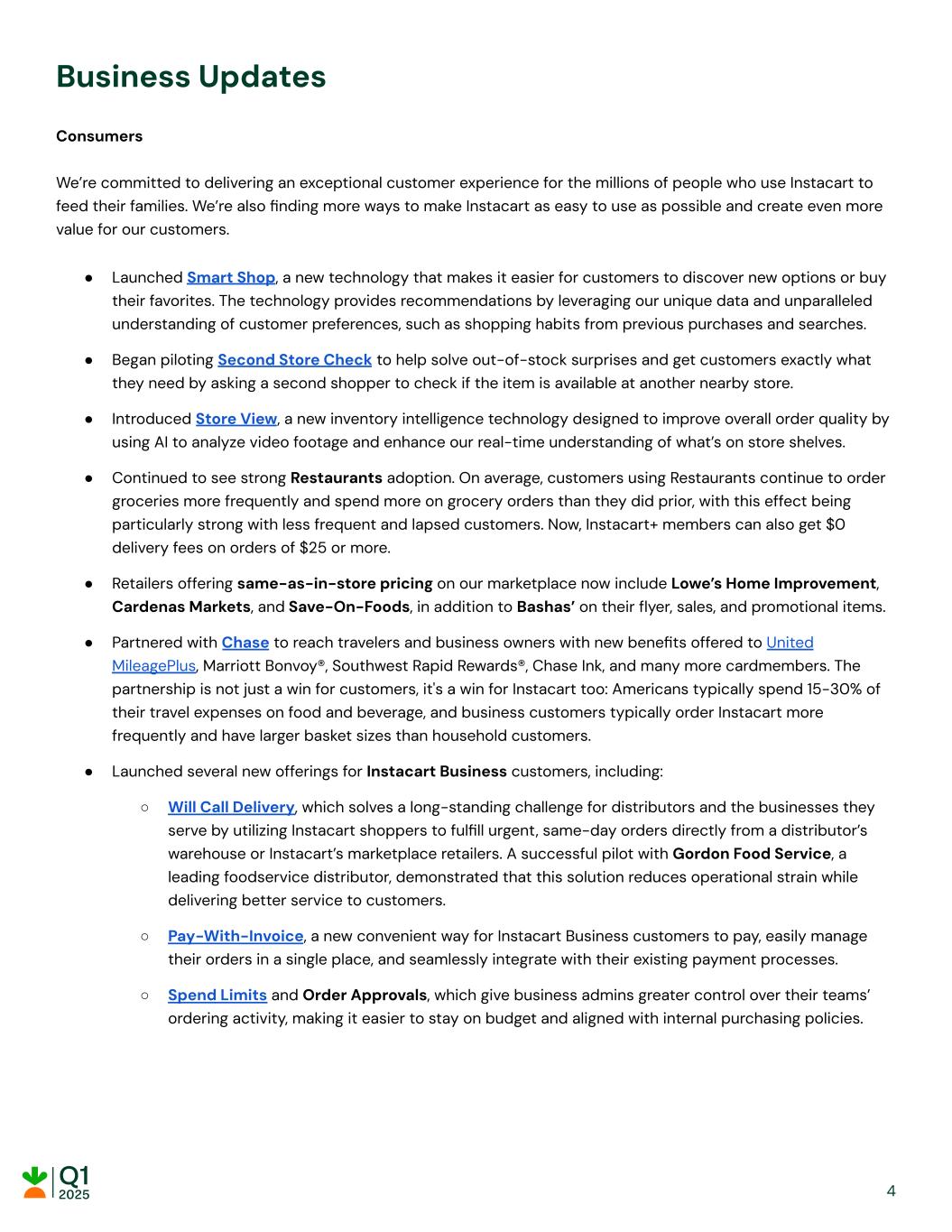
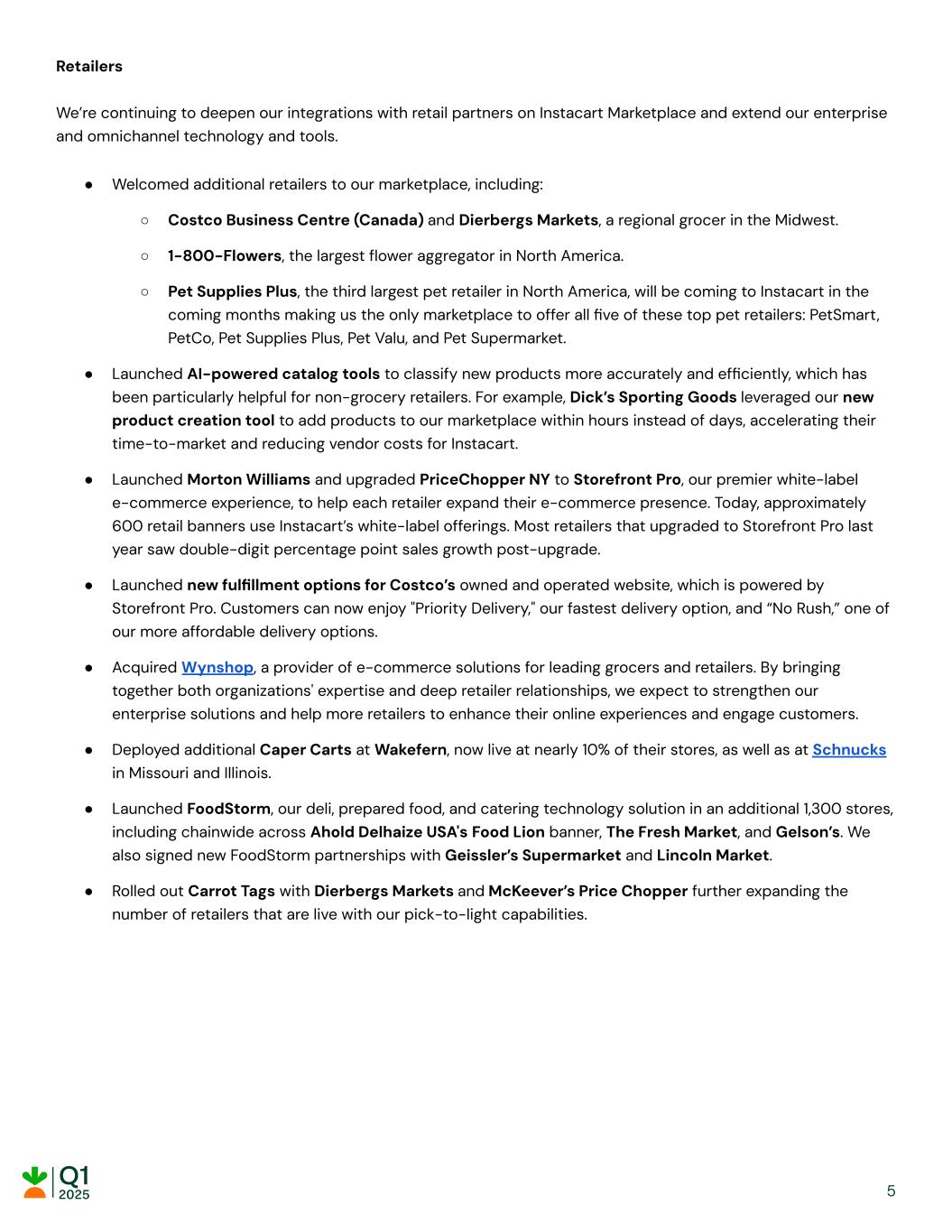
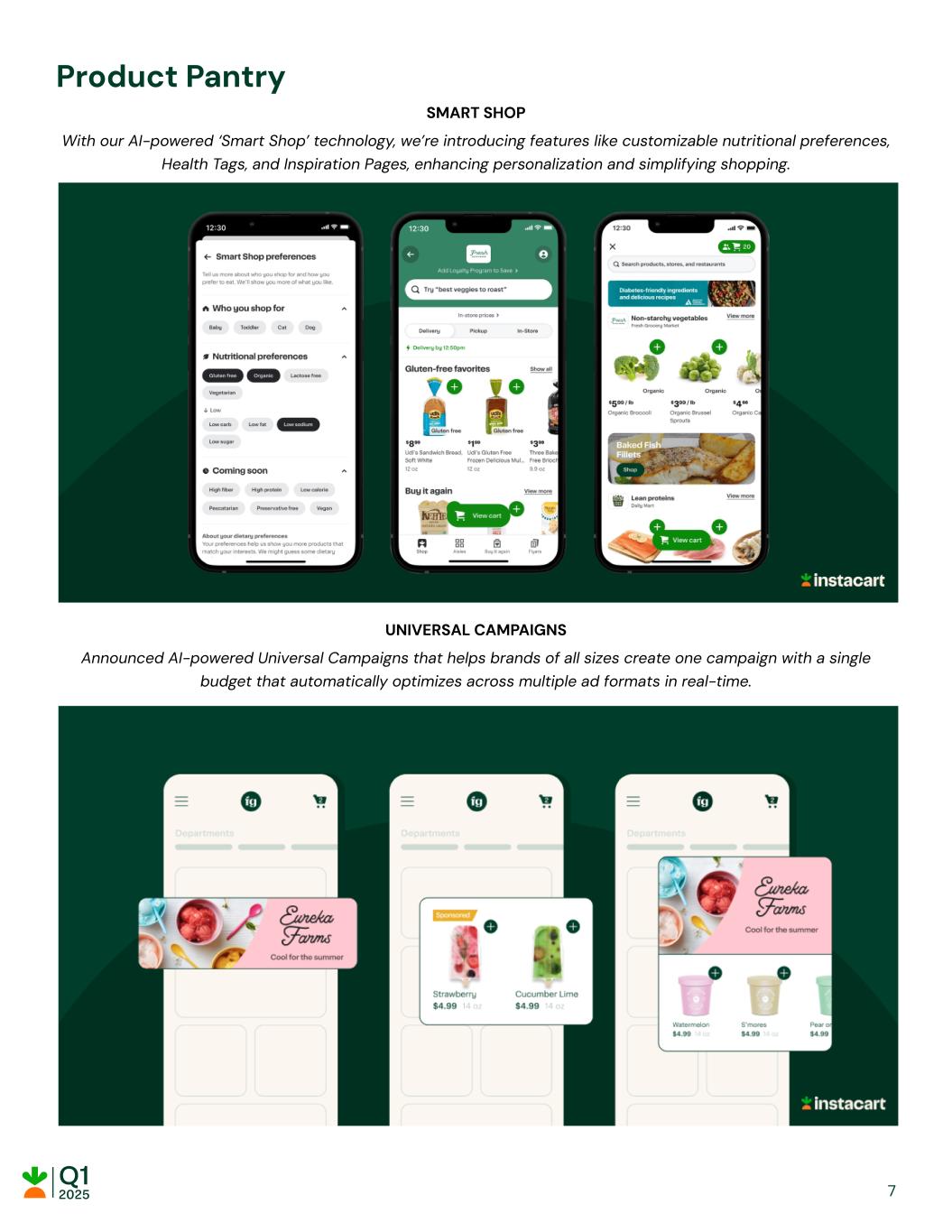
Thank you, Rebecca and good afternoon everyone. I hope you’ve had a chance to review my shareholder letter, where I highlighted how we’ve had a good start to the year and how we are innovating to accelerate online grocery adoption. Our operating fundamentals are strong and we are well positioned to drive growth for both our business and our partners. Groceries are essential and we operate in a massive market that’s still significantly underpenetrated online. Consumers today care deeply about convenience, affordability, quality and selection and that’s exactly what we deliver. Whether it’s saving time, helping them stick to a budget, or offering the largest selection of retailers, we are making life simpler for millions of households every week. That focus has established Instacart as a clear category leader among digital first players in both small and large baskets. And by doubling down on what we do best, we are consistently driving user growth, order frequency and Instacart+ adoption. In terms of recent trends, we look at a lot of data across our business. And even though macro uncertainty remains, we have not seen any unexpected changes in consumer behaviors to April. We reached 98% of households in North America and customer engagement remains consistent across geographies and income levels. Customers are continuing to shop at premium and discount retailers, although price parity retailers are collectively growing faster on our marketplace, a trend we’ve highlighted before. Demand is robust across our many use cases, from weekly grocery trips and stock-up orders, to higher frequency restaurant and shopping orders. Average item prices on our platform continue to track in line with inflation and basket sizes remain resilient as customers generally shop with a budget. A key reason our business can be so resilient is that we have deep retailer partnerships that go beyond surface-level integrations. For more than a decade, we have built deep technical partnerships that enable everything from loyalty and promotions to inventory accuracy and fulfillment. Whether it’s through our marketplace, white-label storefront or in-store innovation like keeper costs, our solutions are helping retailers modernize faster, operate more efficiently and better serve our customers. These partnerships also strengthen our platform by expanding value for customers through better prices and selection, improving efficiency across our operations, and giving us access to growing parts of the market that no one else has tapped into like we have. And today, we announced the acquisition of Wynshop, which will allow us to power storefronts for even more retailers and double down on our enterprise strategy. Our retail media offering is another area where we are uniquely positioned. We provide a one-stop shop for brands looking for highly measurable, highly performing campaigns, reaching customers at the point of purchase with precision and scale. This value was reflected in our strong Q1 advertising performance as well as the fact that more and more large partners like Uber Eats and Hy-Vee are choosing Carrot Ads to monetize their own properties with our ad platform. While we continue to see strength in our advertising trends to date, we unsurprisingly have started to hear concerns from brands about how uncertainty around trade policies and other regulations could impact their ability to spend on marketing. And even though no advertising platform will be immune to macroeconomic risks, our performance-driven ad model and the work we’ve done to diversify our advertising base over the past year, helps make our platform more resilient and very well positioned to remain a leader in the space. Finally, across every part of our business, we’re continuing to leverage AI to work smarter, move faster and further establish Instacart as a leader in AI-driven development. In Q1 alone, 87% of our code was developed with AI assistance, unlocking a level of speed, creativity and efficiencies that wasn’t possible before. Whether it’s Smart Shop which delivers a more personalized and seamless customer experience or new tools that benefit retailers, both on our marketplace and their own operated storefronts with universal campaigns, which gives brands a simplified and scalable way to connect with customers across our ad ecosystem. AI is a driving force behind it all. Ultimately, our purpose is clear: solve real needs for our customers, drive growth for our partners and execute towards our long-term vision. By continuing to lean into what makes us successful and making disciplined but aggressive investments, I’m confident in our ability to not only extend our lead, but help accelerate the future of grocery shopping in a way that benefits everyone. Now I’ll turn it over to Emily to talk about our financials.
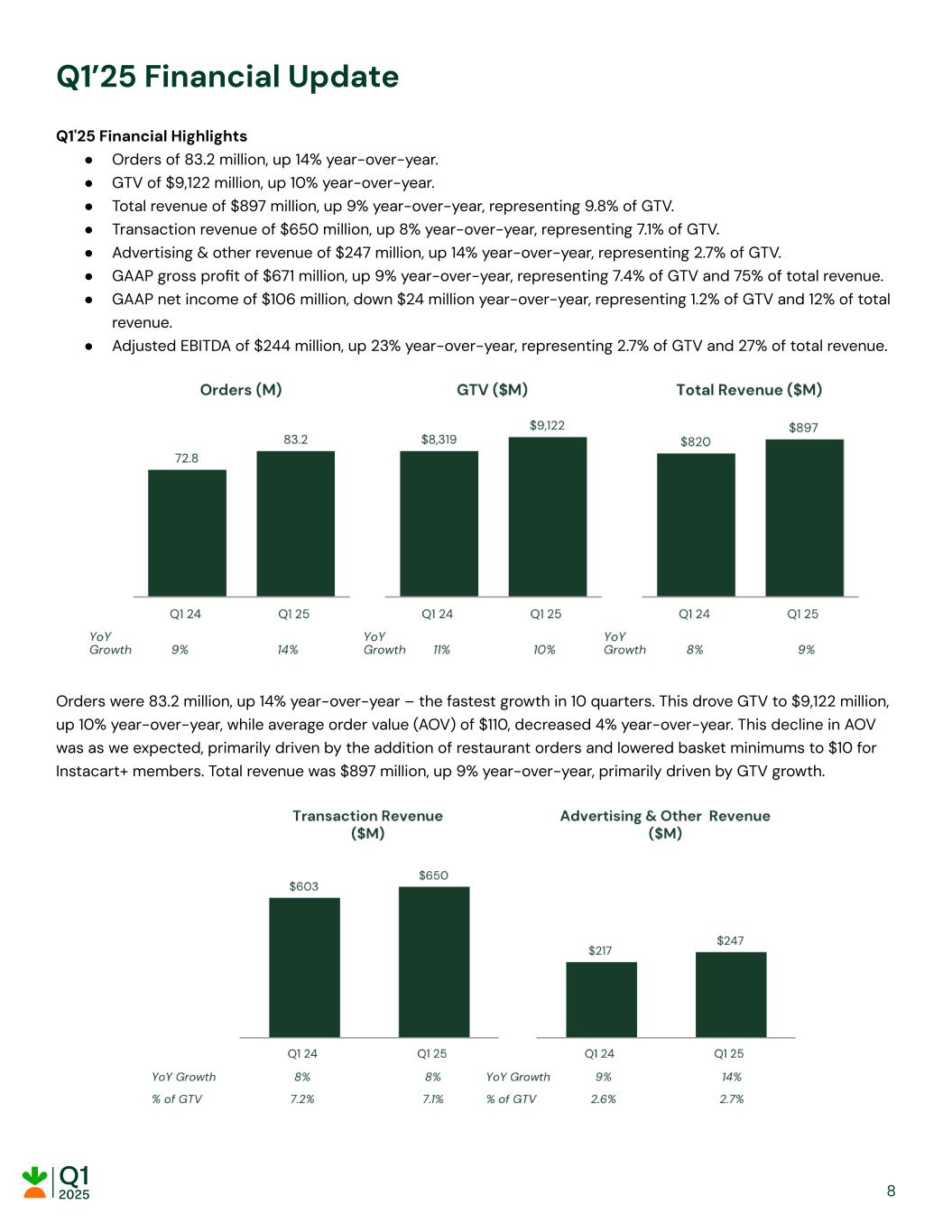
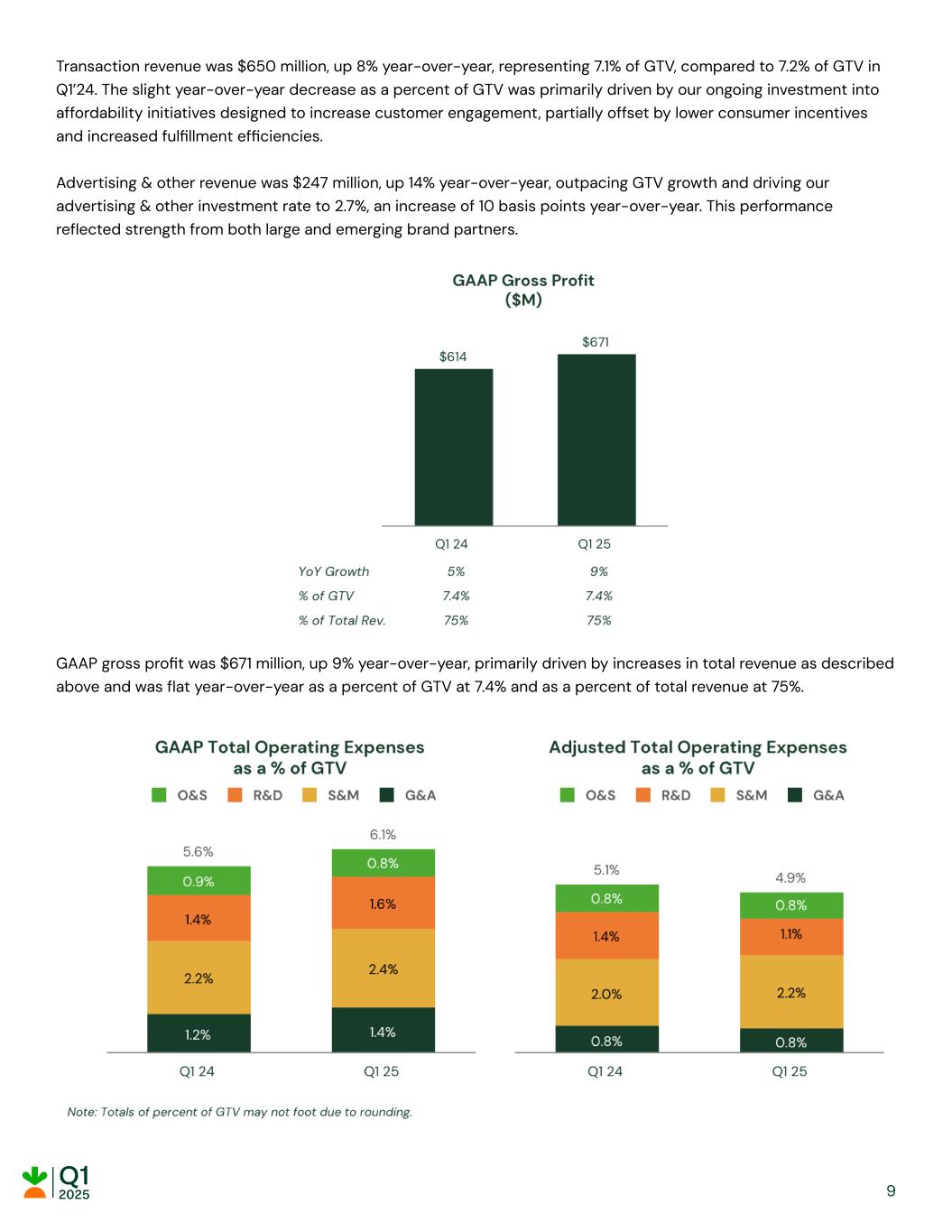
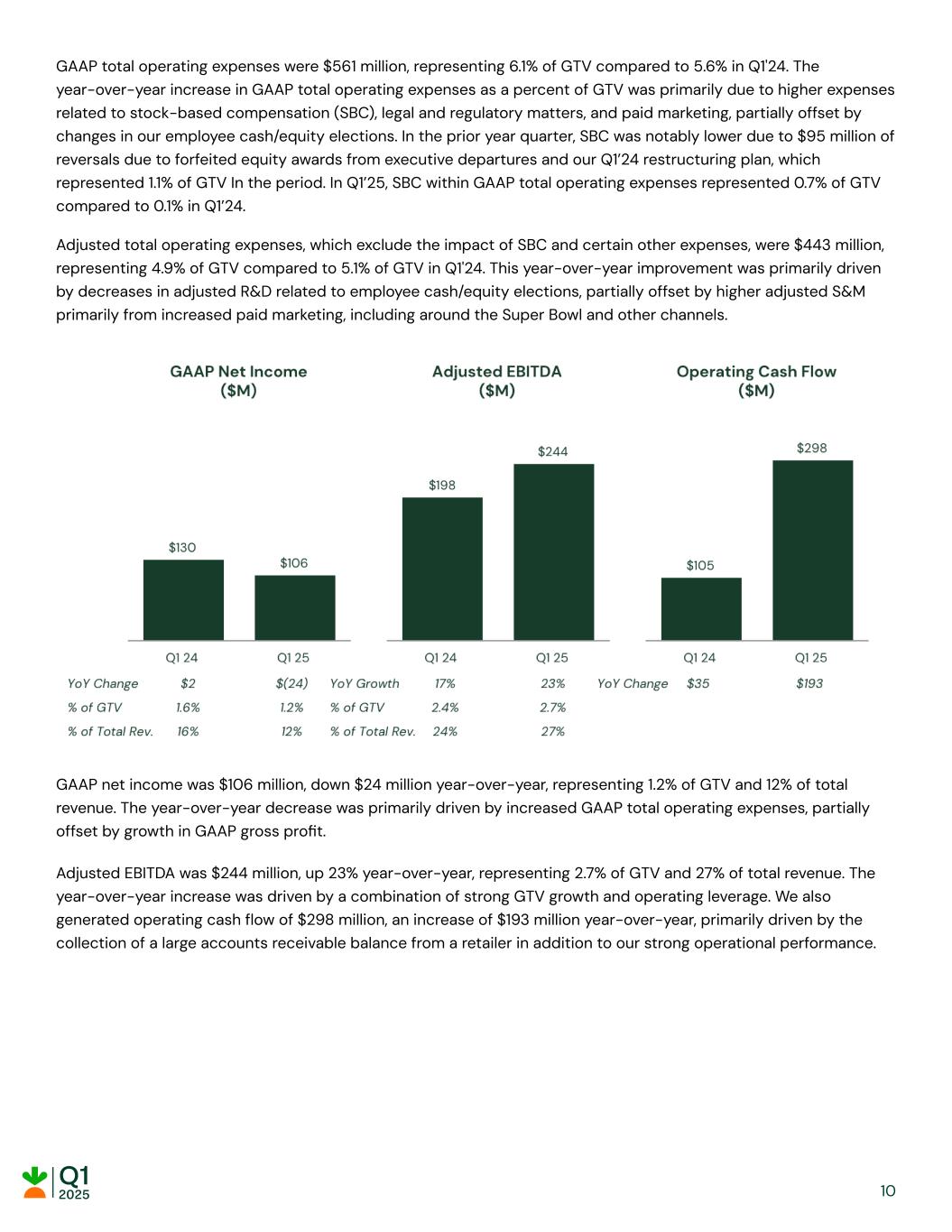
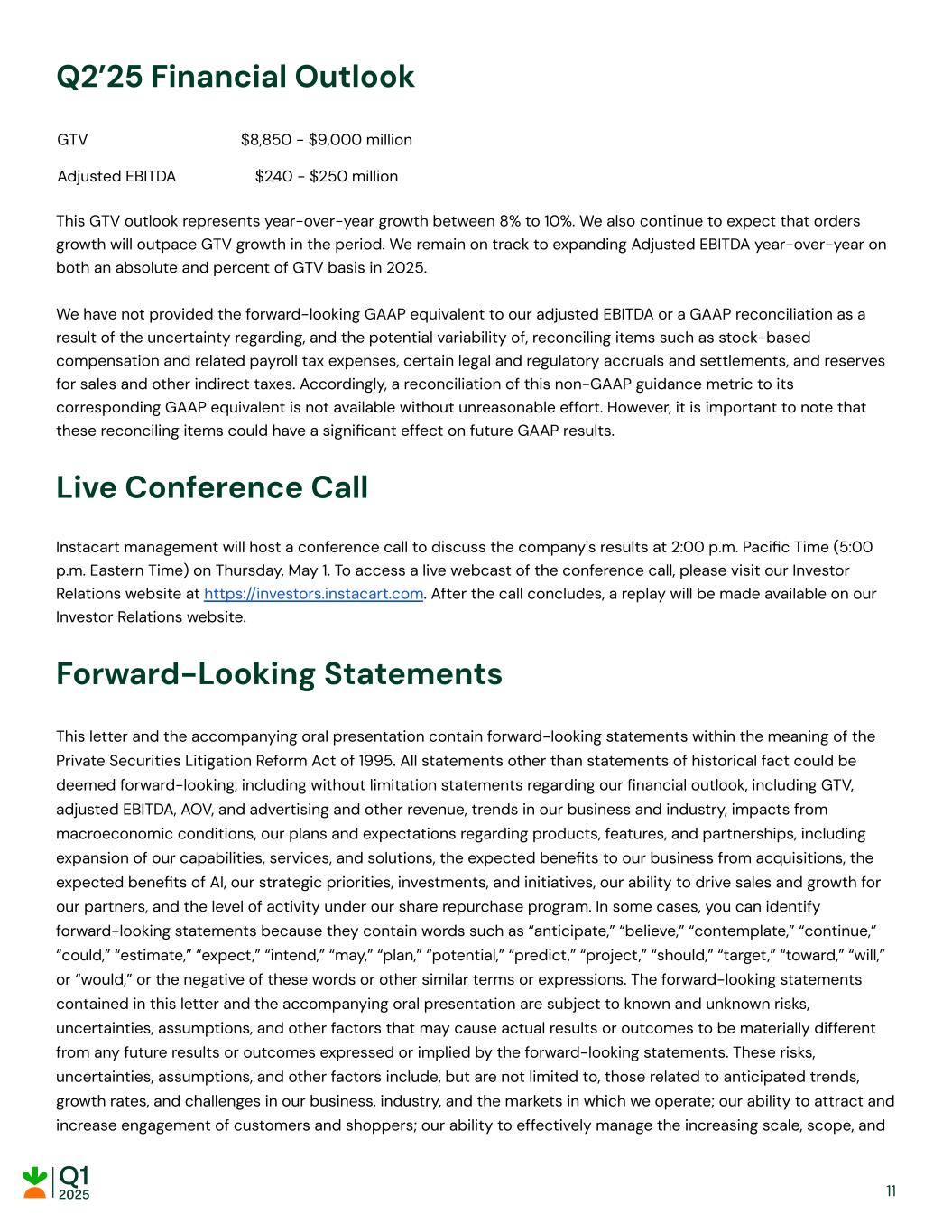
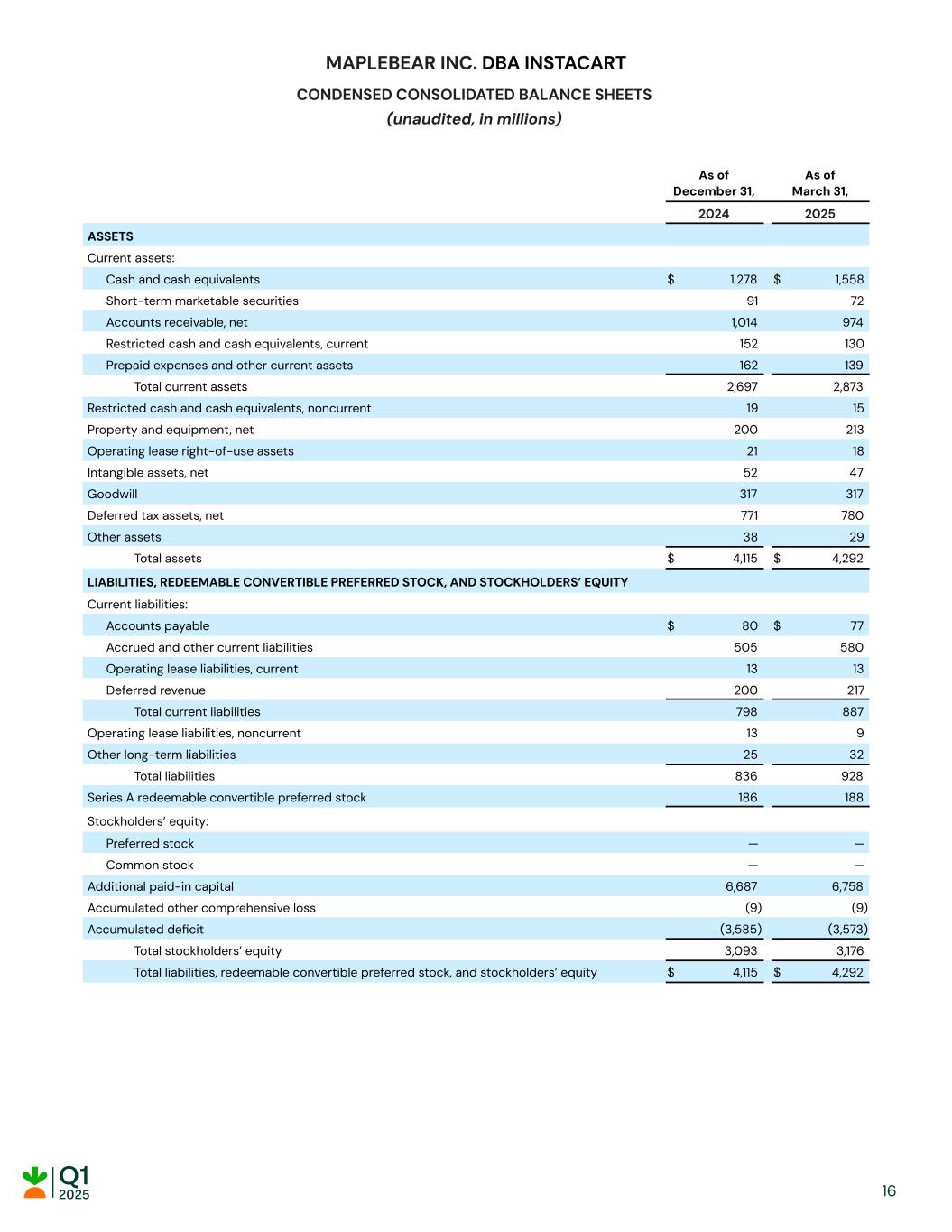
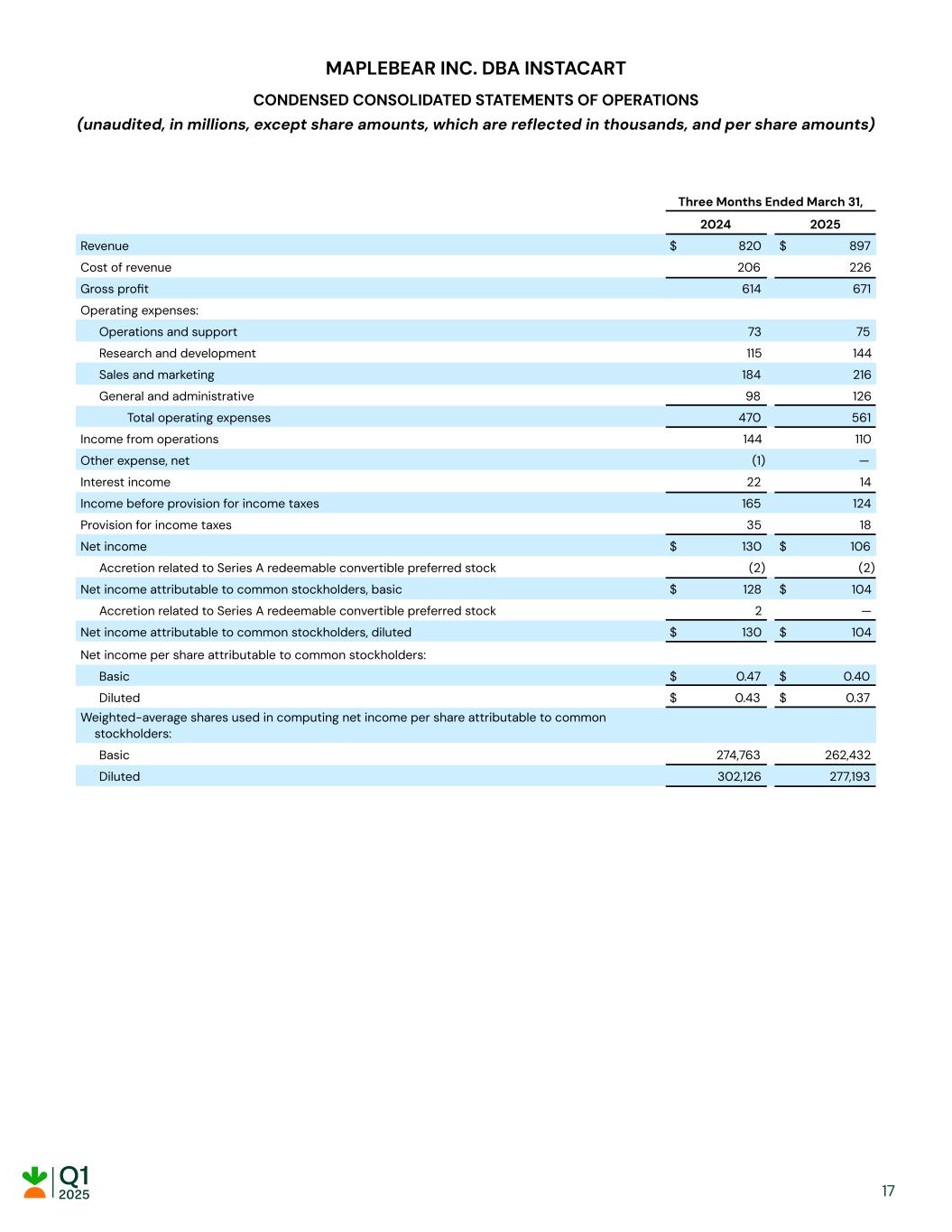
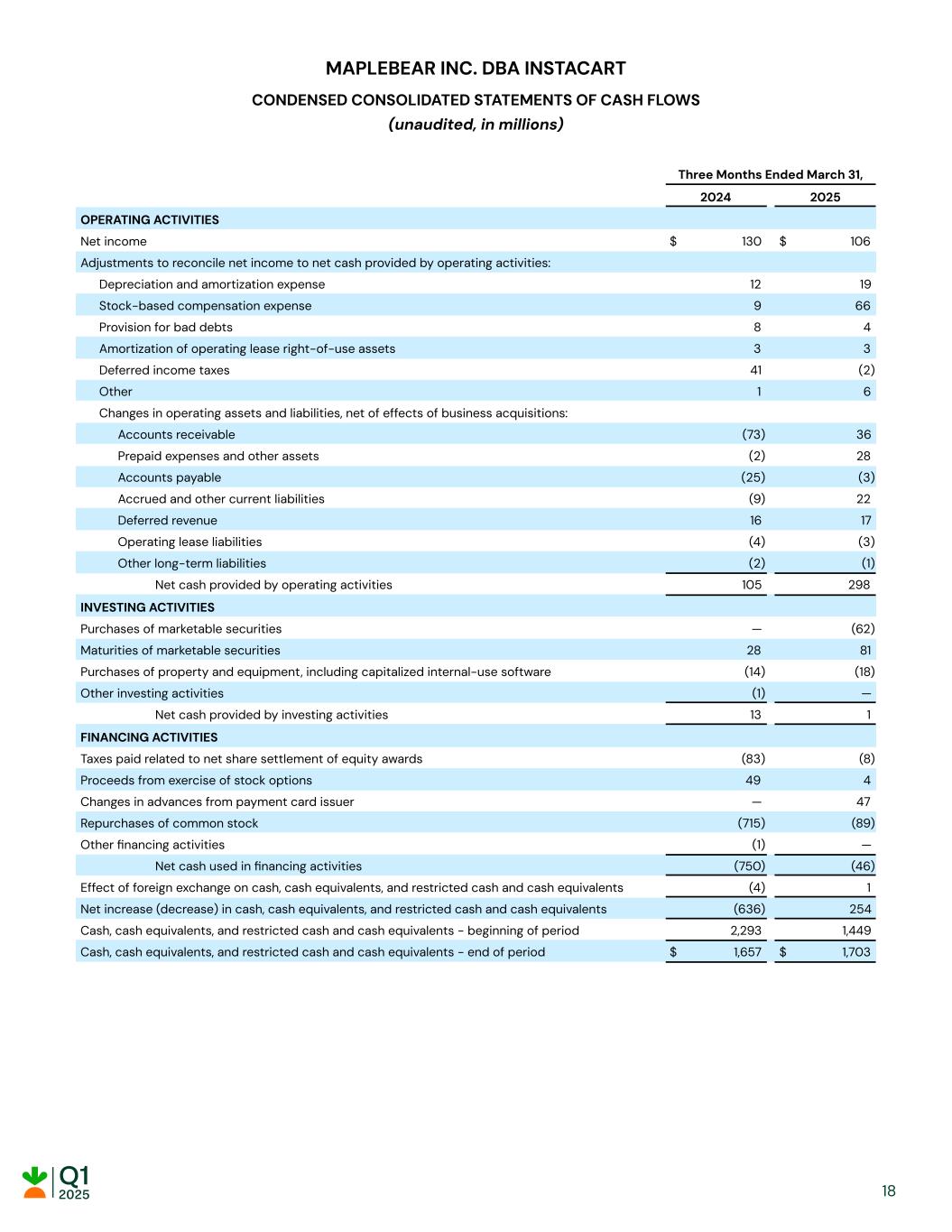
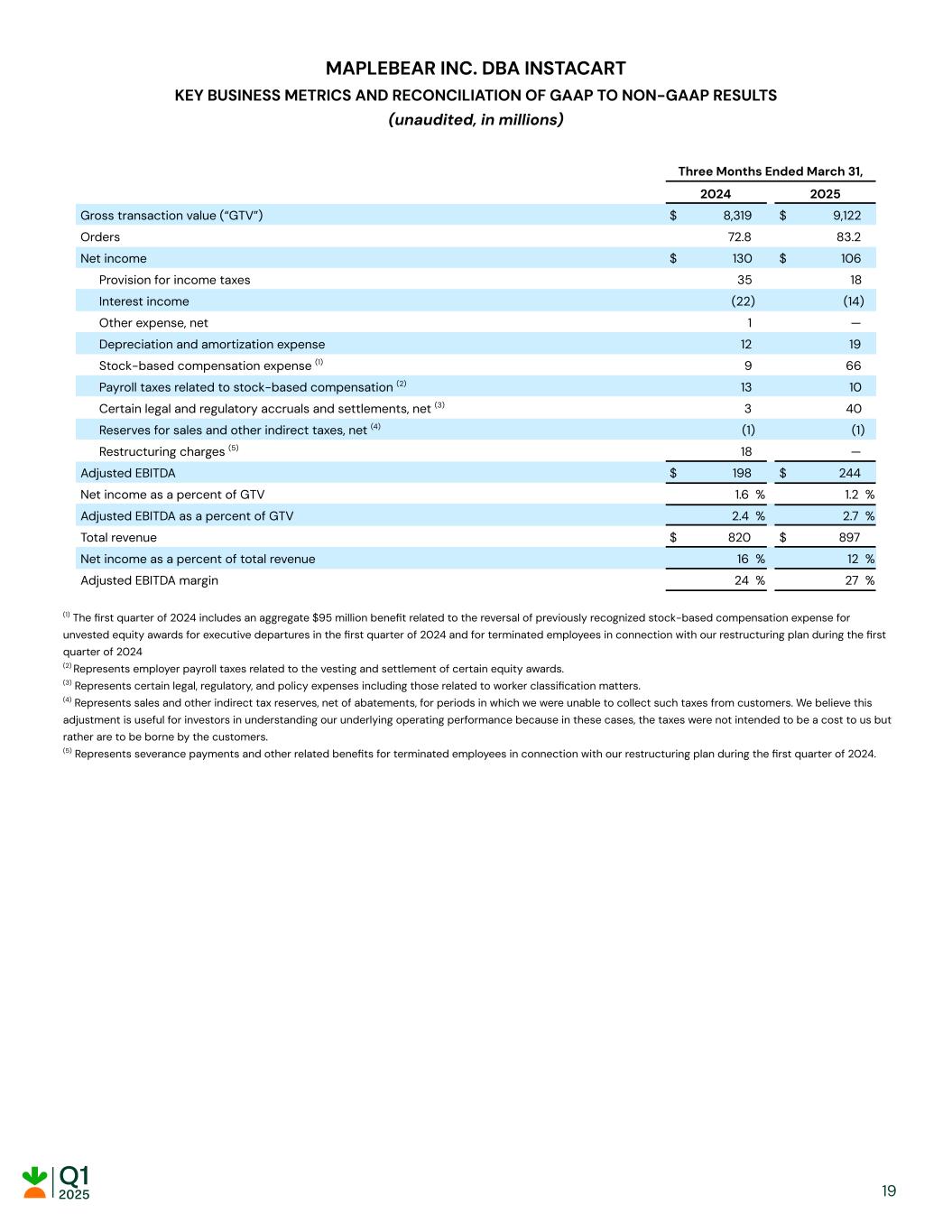
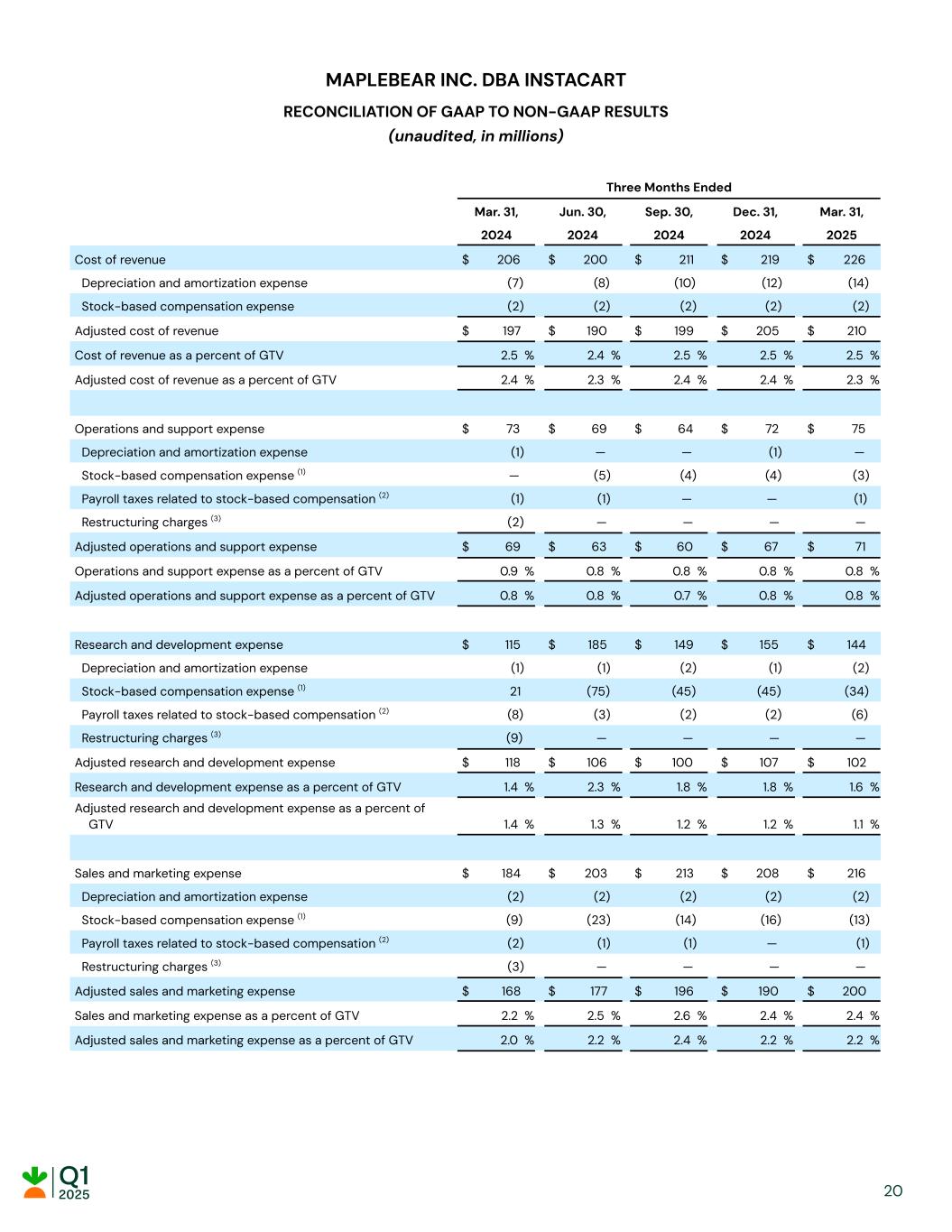
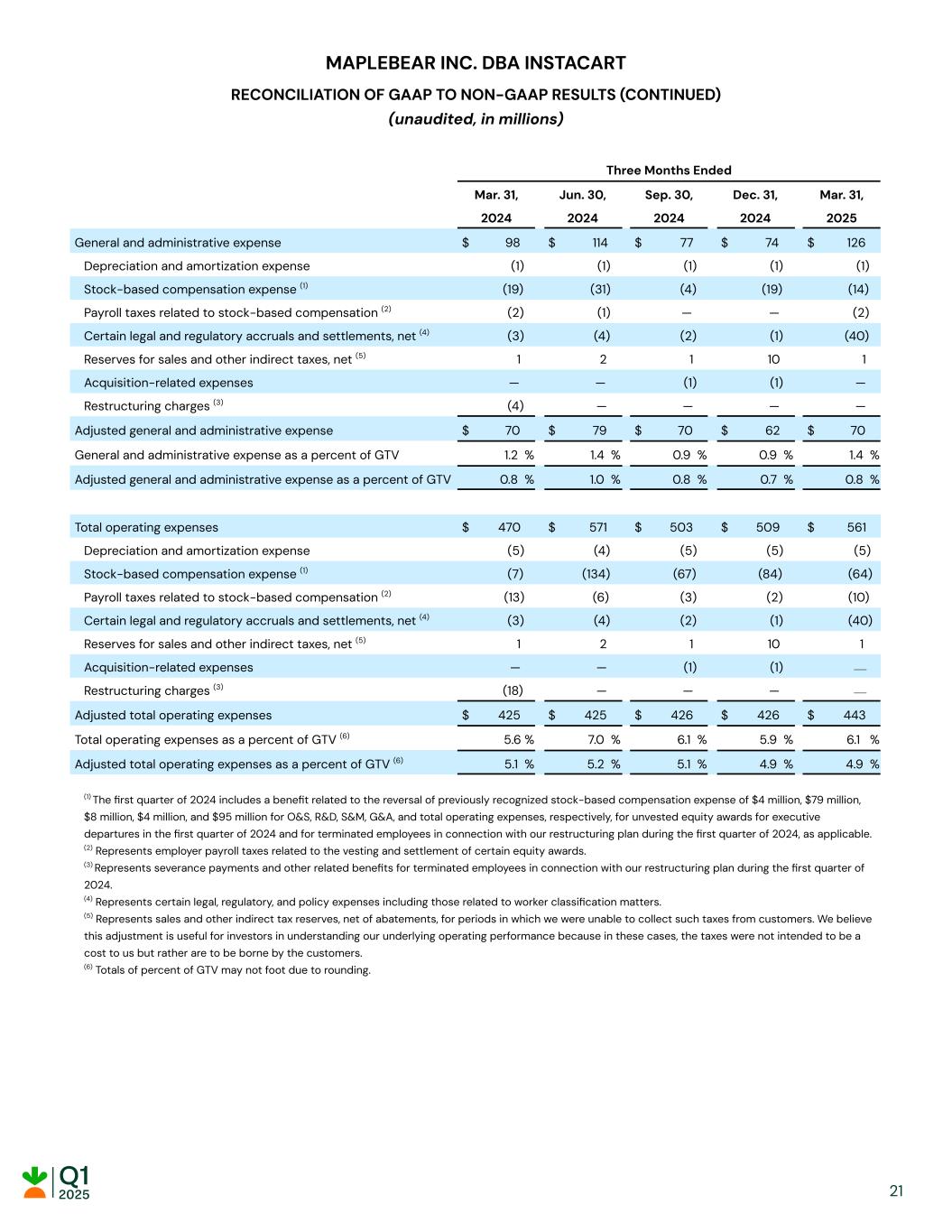
Thank you, Fidji. Q1 was a strong quarter for Instacart, and our solid operating fundamentals and growth strategies have us well positioned for continued progress in 2025 and beyond. Now let me provide a bit more color on our most recent financial results and outlook. In Q1, we delivered GTV at the top end of our guidance range, growing 10% year-over-year. This performance was driven by a 14% increase in orders, the strongest year-over-year order growth we’ve delivered in 10 quarters, driven by increases in both order frequency and users. As anticipated, we also saw average order value decrease by 4% year-over-year due to the addition of restaurant orders and reducing our minimum basket size to $10 for Instacart+ members, though this was partially offset by growth in basket sizes elsewhere. Transaction revenue grew 8% year-over-year and held steady at 7.1% of GTV quarter-over-quarter. Advertising and other revenue increased by 14% year-over-year, outpacing GTV growth and exceeding our expectations with strong contributions from both large and emerging brand partners. Profitability remained a highlight, reflecting our solid operating fundamentals and financial discipline as we continue to effectively manage multiple levers across our P&L to drive efficiencies. GAAP net income of $106 million decreased by $24 million year-over-year, primarily due to the lapping of $95 million of stock-based compensation reversals in Q1 of 2024. Q1 stock-based compensation of $66 million was slightly lower than we expected. And as a reminder, we continue to expect Q1 to be our lowest quarter of stock-based compensation in the calendar year, followed by a sizable step-up in stock-based comp in Q2 due to the timing of our annual refresh grants. Adjusted EBITDA of $244 million exceeded the high end of our guidance range, growing 23% year-over-year. Operating cash flow of $298 million increased by $193 million year-over-year, primarily driven by the collection of a large accounts receivable balance from a retailer in addition to our strong operational performance. In Q1, we also bought back $94 million worth of shares and finished the quarter with $218 million of remaining buyback capacity. We ended the quarter with approximately $1.8 billion in cash and similar assets on our balance sheet and recently used approximately $105 million in cash for our acquisition of Wynshop. Now for our Q2 outlook. Similar to prior quarters, our guidance is based on our closest to the pin estimates based on what we’ve seen in our business through today. However, we are operating in a period with a lot of macro uncertainty and in particular, we know this could lead to more volatility amongst our brand partners and their advertising budgets. Based on current course and speed, we expect Q2 GTV to be between $8.85 billion and $9 billion, representing year-over-year growth between 8% to 10%. We also continue to anticipate that orders growth will outpace GTV growth in the period. We are also guiding to Q2 adjusted EBITDA of $240 million to $250 million. We expect the year-over-year growth in adjusted EBITDA as a percentage of GTV to be primarily driven by ongoing adjusted operating expense leverage, and we expect advertising and other revenue growth to modestly outpace our anticipated GTV growth in the period. Overall, we’re pleased with our strong start to the year, and we’re well positioned to navigate current macro conditions. Instacart has proven that we can grow through uncertainty, and we’re laser-focused on helping our partners succeed no matter what lies ahead. Our operating fundamentals and balance sheet are strong, which gives us the ability to reinvest in growth initiatives while executing on our commitment to deliver annual adjusted EBITDA expansion, both in absolute terms and as a percentage of GTV in 2025. With that, we will open up the call for live questions. Operator, you may begin.
Operator
Certainly. Please hold for a moment for our first question, which will be coming from Colin Sebastian of Baird. Your line is open.
Speaker 4
Yes, good afternoon. Can you guys hear me okay?
Speaker 4
Great. So first question I have, I guess, is on the ads business. Hoping, given some of the progress there, you could unpack what you are seeing from both the core CPG advertisers and then maybe the contribution from the longer tail that you’ve been working to unlock here for some time? And then, Fidji, I mean, given some of the early shifts that we are seeing kind of broadly towards agentic commerce and the investments you guys are putting towards that, I wonder if you could expand on your vision for how Instacart fits in that paradigm of agents placing orders on behalf of consumers? Maybe some details you have on shopping behavior? You mentioned retention in the letter, but behavior changes that maybe influenced by things like the recipe-driven ordering and other things on that would be helpful? Thank you.
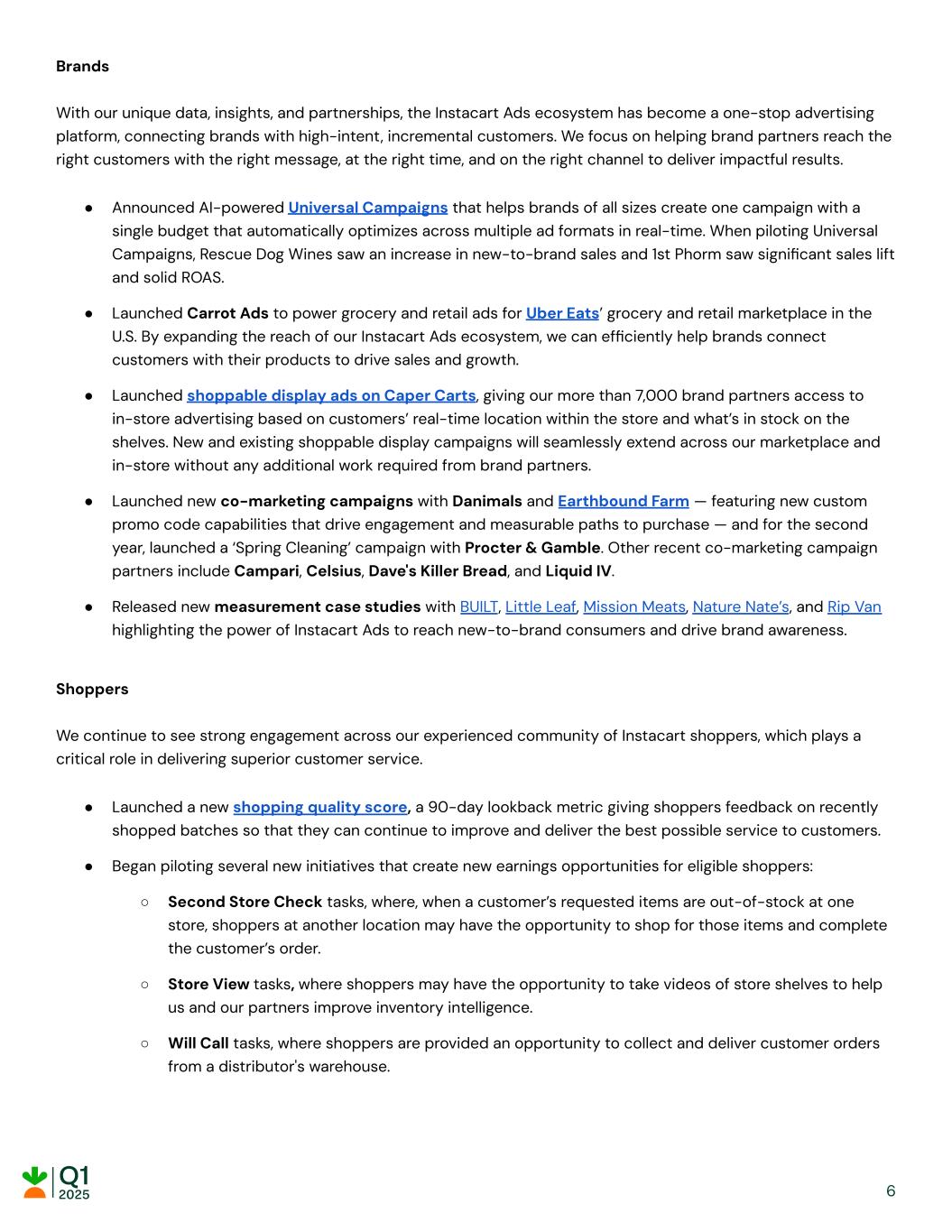
Great. Thanks, Colin. I’ll start with ads. So we had a very strong Q1, as you saw in the results, and it was driven by both large and emerging brands, which is really encouraging. And as mentioned in past calls, we have been very focused on diversifying our base of advertisers, and we now have 7,000 brands – more than 7,000 brands that are onboarded and spending with us. And so that diversification really is working. If you look at Q1, really to prove that the entire strategy is coming together because it has really been driven by high performance. We continue to be best-in-class in both ROAS as well as CTR among large multi-retailer platforms. We continue to have product innovation with new ad formats as well as continuing to increase our supply with some of the wins we’ve had in expanding our Carrot Ads, which are very meaningful and contribute to really a virtuous cycle of getting more supply, which drives more performance, attract more demand and as a result, gets more retailers interested in working with us. So it’s really a beautiful virtuous cycle that’s happening with Carrot Ads and really working now. So, that’s really what we saw, I would say, in Q1 and just saying like the strategy is working, and we continue to see strength. In terms of the shift towards agentic commerce, I would say it’s still very early, but our strategy is to really embrace new technologies when they happen and be really the first to bring these technologies to people, because fundamentally, we believe that if we make it super easy for people to order groceries online, that’s going to accelerate market adoption. And as a category leader, we can get more than our fair share of that as people move online because we have the superior experience, a superior selection. And so you have seen us work, for example, with OpenAI on the operator products where we integrate with them for that. We have our own efforts of figuring out how we can include agentic experiences directly inside Instacart, especially for things like planning and really helping you with kind of all of your family needs when it comes to putting food on the table. And again, very early, but we think this is something that has a lot of potential, and we want to lean into very early to make sure that we extend our lead in this market.
Speaker 4
Great. Thanks, Fidji.
Operator
And our next question will be coming from Doug Anmuth of JPMorgan. Your line is open.
Speaker 5
Hi, this is Neeraj on for Doug. Just wanted to understand, what are the changes you guys need on the shop and to economically execute the $10 minimum basket as well as the store check? Do you need to incentivize the shoppers or create a different order flow? I just want to understand like how much batching is required to do these orders economically?
Yes. Thanks for the question. So the reason we’re able to do these orders at the economics we like is because we have a very high density of orders in every store. And in fact, by launching a $10 minimum basket, we’re increasing that order density; it’s giving us more orders that we can potentially match. And so we like the economics we have today. And then once we launch, we continue to optimize those economics and we can increase batching to today more – the vast majority of our orders are already batched, but we can go even higher with the density of a $10 minimum basket. For example, batching orders like four at a time, instead of three at a time, batching priority orders in the future. And so these are all things that can continue to improve the economics as our order growth continues. It’s also worth mentioning that these orders, the $10 minimum basket orders, these small basket orders tend to skew towards snacks and beverages and therefore categories that are also good for advertising. And given our strength in ads, it’s also an advantage to get the economics there to be in a good place. You mentioned Store View and Second Store Check, on Second Store Check it’s very much a similar thing. We have shoppers who visit large-format stores on average 14 times a day. And so that means that we have shoppers inside these stores very frequently. And therefore, if a product is not available at a store, it’s very easy for us to check if it’s available at a store nearby because in all likelihood, we already have a shopper that’s nearby that can go check that out. And then same thing for Store View, which is scanning aisles with a phone to capture videos of inventory; it’s a similar thing. We have a lot of shoppers that are already near the store waiting, or at the store, waiting for an order to come in. So that’s really an incremental earning opportunity for them to be able to just scan the aisle and give us access to this incredibly rich data that allows us to improve our inventory accuracy while also giving shoppers more earning opportunities. So it’s really leveraging our scale, our order density and the density of shoppers we have at any given store at same-store scale.
Speaker 5
Got it. And just on ads, I just wanted to understand, great to see the ad acceleration, but how much – is there any upside that was driven by the launch of ads on Caper Carts?
I would say the launch of ads of Caper Carts is extremely minimal right now in terms of impact on revenue. The thing that we are excited about when it comes to ads on Caper is the fact that we are seeing a level of engagement with those ads that is equivalent to online engagement, which gives us a lot of confidence in our ability to monetize those costs well in the future. But I would say, given the scale of Caper right now, it’s still fairly minimal to our overall ads revenue.
Speaker 5
Got it. Thanks so much, Fidji.
Operator
And our next question will be coming from Nikhil Devnani of Bernstein. Your line is open.
Speaker 6
Hi, thank you for taking my questions. I wanted to ask a longer-term question on advertising. How do you ensure that your ad platform continues to work very well for the long tail of ad buyers that maybe don’t have as much organic brand recognition and search? Are their needs very different from those of your big CPG partners? So how do you kind of solve and optimize for that?
This is such an excellent question and something we spend a lot of time thinking about and in fact, you do build a fairly different ad product for emerging brands than you do for large ones. For the reasons you mentioned, but also they orient much more towards self-serve tools. So we’ve done a lot of work to make our tools a lot more self-serve. They have much less time and much fewer resources to analyze insights. So we have made it so that with AI, we can deliver insights to them and tell them what to do next to optimize their campaign in a much easier way. So, all of these things are things that we definitely do build very differently. But on your specific point on like how do we create discovery for them? This is exactly why we are launching things like our inspiration ads, which are all about being discovered outside of the aisle that you usually are in. So to give a concrete example, we sponsored recipes. That’s a good opportunity for buying one particular ingredient if we show you, oh, look at the sponsored recipes to make you discover a lot of other products as part of that. And we just released a case study with Nature Made Honey, which generated 36% – 37% new-to-brand sales and a 2x to 4x rollout throughout the campaign. And then when we looked at several campaigns from sponsored recipe, we saw that 70% of ad impressions came out of the aisle of the initial thing that the customer was looking at, which is really good for discovery. Same thing when it comes to other ad formats like bundles and occasions, which are all about upselling you to different products that you might be interested in based on what you just put in your cart. So that’s working really well. And then the last thing I’ll add is we launched this quarter universal campaigns. And universal campaigns is basically a way to make sure that if you set up one campaign, we can really automatically, through AI, distribute across a bunch of different places. And that helps a lot when it comes to emerging brands because sometimes if they just do sponsored products, they might not, to your point, get all of the traffic that they would want. So we would want to actively redirect those budgets towards display ads where they are going to be discovered in other places and not necessarily in search. And so that allows us to dynamically move budget to make sure that we can maximize the advertiser’s goals, maximize discovery, and do that dynamically without the brand having to do a lot of work to figure that out themselves. So we are seeing all of that work, and that’s reflected in the strength that we continue to have from emerging brands’ budgets that are really coming strong into the system.
Speaker 6
Thanks, Fidji. And if I could just follow up on the small basket orders, now that you’ve had a bit more time for that program to ramp, are you still confident that these are predominantly incremental orders and any signs of better Instacart+ retention or conversion rates because of these changed delivery thresholds? Thank you.
Yes, it’s a strong yes on both. We are seeing higher GTV increased order frequency, stronger Instacart+ adoption. And so these are things, as you can imagine, that we track very closely and we have not seen cannibalization of large baskets. We have seen very clear incremental GTV. And that’s coming both from existing users, but also from new users and resurrected users. So it’s really having a lot of benefits across the board, which is why we feel very good about it. And when I mentioned that it increased order frequency that really means that it’s really increasing order frequency at every stage. So, we are moving yearly active orders to be quarterly active more frequently, quarterly active to monthly active and then monthly active to weekly active, all increasing and going in the right direction. So we are really excited about what we are seeing. We are also seeing in terms of qualitative use case that it’s driving more midweek filling grocery orders and we are seeing that being particularly strong in dense urban areas, where customers are more likely to not have a vehicle. And so it’s really fulfilling the promise and the hypothesis that we had when we launched and that’s why we’re really committed to it.
Speaker 6
Thanks a lot, Fidji.
Operator
Thank you. And our next question will be coming from Bernie McTernan of Needham & Company. Your line is open, Bernie.
Speaker 7
Great. Thanks for taking the question. Just given the acquisition of Wynshop, I was hoping we could just take a step back and Fidji if you could just remind us of your enterprise strategy and if these are discrete revenue opportunities, or more so indirect where you have the opportunity to get more data and integration with your grocery partners and what hole specifically is Wynshop filling for you guys?
Absolutely. So to take a step back, our enterprise strategy is both a big driver of GTV and revenue because it allows us to tap into a part of the market that no one else is able to tap into. And so that makes us really be able to tap into the part of the markets that retailers own. And that means that when retailers want to lean into online, they usually decide to put marketing budget behind their own properties. And because we power that, that benefits us a great deal. We have approximately 600 storefronts. So that’s imagine 600 retail banners really putting their weight behind other parts of the market. So that’s a big source of GTV and revenue for us. But it is also a strategic asset to your point that is all about creating a deeper integration with retailers, being a strategic partner and not just one of the many marketplaces that they sit on. And that allows us to be first to market with a lot of capabilities. So to give you an example, when we went to retailers and told them, hey, it would be really great to implement SNAP together. A lot of retailers want to start by implementing SNAP on their own and operated properties, obviously. And so we do that for them and automatically get that for our marketplace. Similarly, with loyalty integration, when we build loyalty integration for their storefronts, we get that for our marketplace. And so it really allows us to have a strategic relationship, be integrated into their IT roadmaps and really based on these limited IT resources that retailers have and take all of the innovation that we have in enterprise and bring it to marketplace and vice-versa take all of the innovation of the marketplace and bring it to enterprise. So we feel very strongly about that strategy. And that’s why it becomes easy then to make acquisitions like Wynshop. And also, if you look at our track record of acquisition, a lot of them have been in the enterprise space, whether that’s Caper, Goodstorm, Rosie, Eversight, because these acquisitions directly build on top of a really strong product suite and fit directly into our strategy. So with Wynshop, for example, that is allowing us to power the storefronts for more retailers, go deeper with the ones that we had a relationship with, where we have a very strong relationship with them. We already power Caper in 10% of their stores. But now with Wynshop, we are going to be able to power that storefront as well as develop relationships with new retailers, Partisan is a great example where Wynshop is powering their storefront, and that’s allowing us to tap into that relationship. And then in terms of monetization opportunities, there are obviously the SaaS revenue that Wynshop charges to date, but really the ultimate goal is to upsell to more revenue-generating opportunities whether that’s our fulfillment technologies that retailers are asking for and we are going to be available on Wynshop or Carrot Ads, a lot of Wynshop retailers wanted a retail media solution and with Carrot Ads we are going to be able to do that. Caper is another example that can integrate directly with our storefront to provide an omnichannel experience. So we have a lot of opportunities to upsell now, and that means that there is a lot of upcoming synergies that make this acquisition be a no-brainer.
Speaker 7
That’s great. Thank you very much for that answer. And just one follow-up, I know that the shareholder letter talks about AOV declines primarily driven by the lower minimum delivery thresholds in restaurant. But I guess I just wanted to ask directly if you’re seeing any trade down or smaller basket sizes within the larger basket, any evidence of that on the platform or not?
Yes. So, as we talked about, we saw the 4% year-over-year decline in AOV and that was driven by restaurants first and then by the $10 reduction in the minimum basket for Instacart+. What we are actually seeing is that’s been slightly offset by a continued increase in the remaining basket. So we are seeing continued strength and that is a result of sort of exactly what you pointed out, which is we are not seeing trade-down. We are seeing this as sort of truly incremental spend. And as Fidji talked about, we see that in terms of the types of orders that we are seeing on the platform, so hence, why we continue to feel quite good about this update.
Speaker 7
Very helpful. Thank you both.
Operator
Thank you. Our next question will come from Deepak Mathivanan of Cantor Fitzgerald. Your line is open.
Speaker 8
Great. Thanks for taking the question. So first, on the small basket orders, you have talked about the incrementality of these orders. Are you seeing any common theme on maybe the type of retailers you are seeing these orders go towards and perhaps that’s helping you gain more scale with some of the retailers with fewer SKUs or so? Is there any theme in terms of diversifying this retailer side that you’re observing? And then on Uber Eats, now that you’ve had it for over 6 months, can you update on kind of the attach rates, penetration gains you’re seeing? How has that also helped core grocery business in terms of increasing frequency or perhaps new users coming in primarily through the restaurant orders?
Yes, thanks for the question. So, on small baskets, we haven’t seen really a big difference between retailers that have run the most from a $10 minimum basket. We have seen that to be, I would say, pretty widespread, so nothing really specific to call out here. We are seeing that the types of items purchased are more snacks and beverages. Fresh vegetables, frozen desserts, alcohol, dairy, so widespread, but still what you would expect from kind of midweek shell-in orders, so feeling really good about the fact that this change created the kind of use case that we were expecting it to create. On your second question on Uber and restaurant adoption, we continue to see restaurant adoption deepen and there are still lots of runway to go. On average, customers using restaurants order groceries more frequently and spend more on the grocery orders than they did prior. And this effect is particularly strong with less frequent and lapsed customers, where we obviously have even more room to grow. We are seeing high customer engagement, especially with Instacart+ members who are really liking the restaurant offering. And as we have mentioned in the past, we are seeing larger order values in restaurants on average than on other restaurant platforms, which really reflects the families and the strength we have with families on the platform. So, we are feeling very good about restaurants. And as a reminder, as the core hypothesis with restaurants was really that it would reinforce groceries and create a virtuous cycle, and we are certainly seeing that with a very strong positive impact on grocery.
Speaker 8
Great. Thank you, Fidji.
Operator
Your next question will be coming from Shweta Khajuria of Wolfe Research. Your line is open.
Speaker 9
Can you hear me?
Speaker 9
I apologize about the prior technical issue. My question is on advertising revenue. So, it’s a follow-up on one of the prior questions already. But when you speak with advertisers, and about forward spend or commitment, are they viewing – I am assuming they are viewing you as a bottom-of-the-funnel sort of spend bucket. And so what is top of mind for them ahead of what’s going on? And do you fall under performance spend for them? And does that give you some level of confidence as we think about perhaps the next few months ahead? Thank you.
Yes. Thanks for the question. So, we feel very good about our ability to attract more than our fair share of ad dollars under any macroeconomic conditions. And that’s exactly for the reason we mentioned – you mentioned, we are a very performance-driven platform. We have very high performance, as I mentioned. And for that reason, even when in a context where advertisers might be a little bit more uncertain about the macro in general, they usually decide to focus their dollars on a platform that can drive that performance and can do that at scale. And that’s why the fact that we are a one-stop shop, that we operate across not just for FC, but also more than 220 other retailer websites and really act as an aggregator for retail media, gives us a lot of advantages in this market where brands are going to look for a few large-scale high-performing partners. So, that’s really what we are hearing. In terms of the feedback on the macro, I want to be clear that we have unsurprisingly had caution, but it is not drastic, not widespread. It’s really in pockets. And it’s brands staring at not just tariffs, but also other potential regulations, whether there could be changes to SNAP eligibility, changes to our regulations around which ingredients and food guys are allowed. And more broadly, changes to consumer behavior in general. We are seeing, for example, a move from sugary cereals to high-protein yogurt. We are seeing moves from alcohol to non-alcoholic beverages from younger audiences. And so across all of these changes, that’s creating a more complex environment for brands to navigate. But within that, we are always looking for the same thing, performance and scale. And to the extent that we deliver both, which we have proven that we can, we think that we are incredibly well positioned to navigate the next year.
Speaker 9
Okay. Thank you, Fidji. That was really helpful.
Operator
And one moment for our next question. And our next question will be coming from Justin Patterson of KeyBanc. And that will be our last question. Your line is open.
Speaker 10
Great. Thanks for taking the question. This is Miles Jakubiak on for Justin. Just a couple of quick ones. First, a follow-up on universal campaigns, I know it’s still early, but just curious if there are any early learnings you can share with that product, and maybe any characteristics of the brands that are adopting that product? And then a similar question on Smart Shop. Just curious since you launched this suite of tools, if you have seen any changes in consumer behavior around this, whether it’s with basket sizes or purchase conversion or anything around that would be helpful. Thanks.
Of course, so we recently announced our AI-powered universal campaigns, and the goal is really to allow brands of all sizes to create one campaign with a single budget that automatically optimizes across multiple ad formats in real-time. It’s still really early, so I don’t have specific results to share, but I will echo what I said earlier, which is that emerging brands, in particular, are very likely to benefit disproportionately from something like that because it really gives them the ability to set up one campaign and let us optimize across ad formats and that placement based on their goal and really optimize for the right budget allocation for them. Whereas a lot of brands sometimes prefer having a little bit more control over that. When piloting universal campaigns, we saw a brand like Rescue Dog Wines, so a big increase in new-to-brand sales. We saw a brand like First Form, which is nutrition supplements, see really significant sales increases and really good ROAS. So, we feel very good about how this is working. On Smart Shop, to make sure everyone understands, this was our launch that was really about personalizing the experience even further so that we understand your implicit preferences like, for example, your family is getting low on curb, or if you have any sort of dietary preference. In fact, 70% of customers have at least one dietary preference. And with Smart Shop, we are better able to understand that and then match you to products that meet that preference with 30 new health tags that we are applying to about half a million products. That’s allowing us to create an experience that is stickier and more relevant. And we are seeing that just more broadly whenever we do more socialization changes. I think there is still a long way to go because we still hear that people who prefer going to the grocery store instead of shopping online often do that because they discover more new things at the grocery store. But I think that online, we should be so much better positioned to personalize the experience and make them discover new products that they wouldn’t have discovered before. We are seeing that not just with Smart Shop, but also with AI pairings, where we pair an item with complementary items. This is something that we offer on 75% of marketplace orders and that is driving higher retention, especially among new users who benefit most from this support when they are building their carts for the first few times. So, really bullish on personalization in general, and that’s one more way in which we are going to convince more people to move their shopping online because it’s going to be such a much better experience.
Speaker 10
Great. Thank you.
Operator
And this concludes today’s conference call. Thank you for participating. You may now disconnect.