Operator
Ladies and gentlemen, thank you for standing by. Welcome to Instacart's third quarter 2025 Financial Results Conference Call. At this time, all participants are in a listen-only mode. After the speaker's presentation, there will be a question and answer session. To ask a question during the session, you would need to press star 1-1 on your telephone. You will then hear an automated message advising your hand is raised. And we ask to please limit yourself to one question, one follow-up, so that we will have enough time to address everyone's question. And to withdraw your question, please press star 1-1 again. Please be advised that today's conference is being recorded. I would now like to turn the conference over to Rebecca Yoshiyama, Vice President of Investor Relations, Capital Markets, and Treasury. Please go ahead.
Thank you, Michelle, and welcome everyone to Instacart's third quarter 2025 earnings On the call with me today are Chris Rogers, our Chief Executive Officer, and Emily Reuter, our Chief Financial Officer. During today's call, we will make forward-looking statements related to our business plans and strategy, developments in the grocery industry, and our future performance and prospects, including our expectations regarding our financial results and shareholder purchases. These forward-looking statements are subject to risks and uncertainties which could cause actual results to differ materially from those anticipated. You can find more information about these risks and uncertainties in our SEC filings, including our last Form 10-Q. We assume no obligation to update these statements after today's call except as required by law. In addition, we will also discuss certain non-GAAP financial measures which have limitations and should not be considered in isolation from or as a substitute for our GAAP results. A reconciliation between these GAAP and non-GAAP financial measures is included in our shareholder letter, which can be found on our Investor Relations website. Now, I'll turn the call over to Chris for his opening remarks.
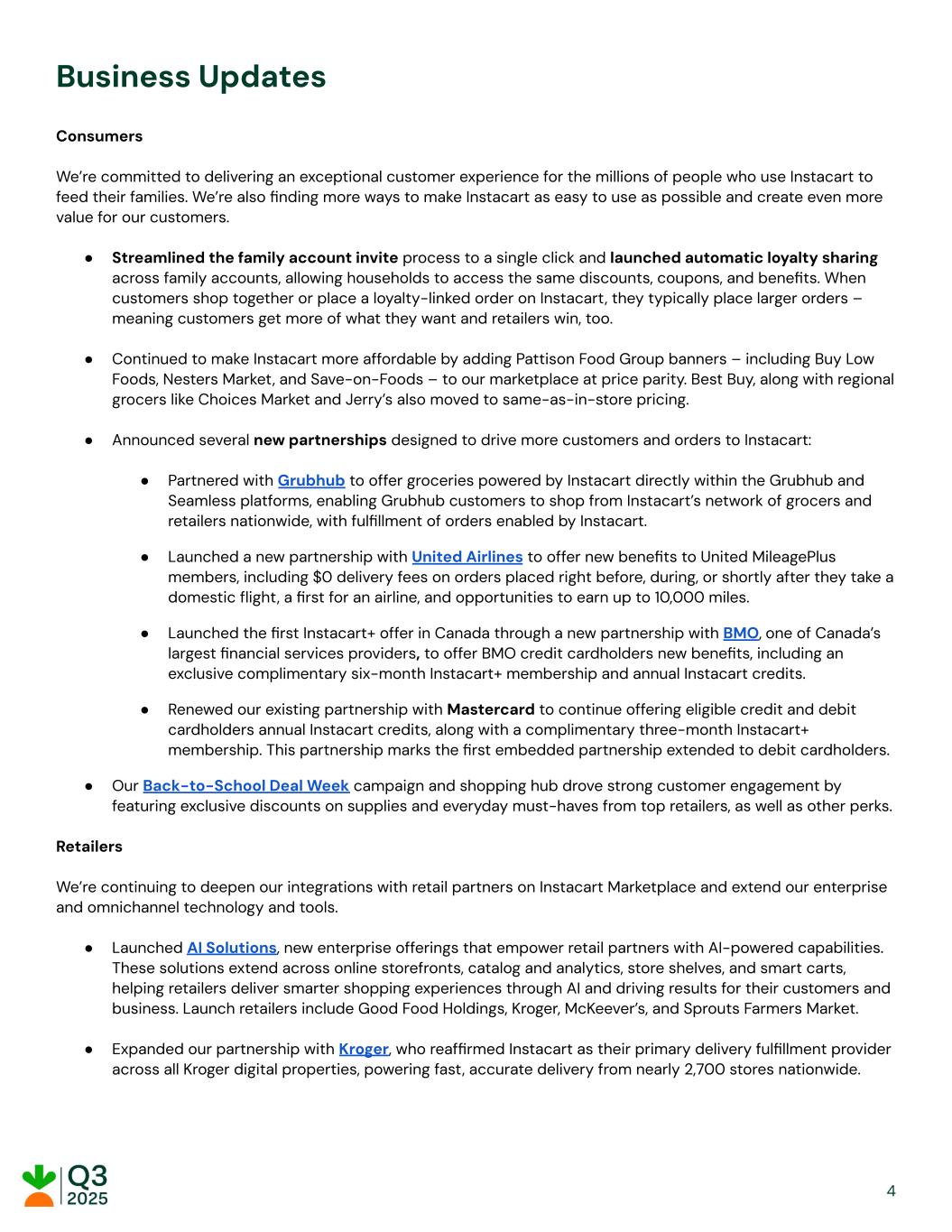
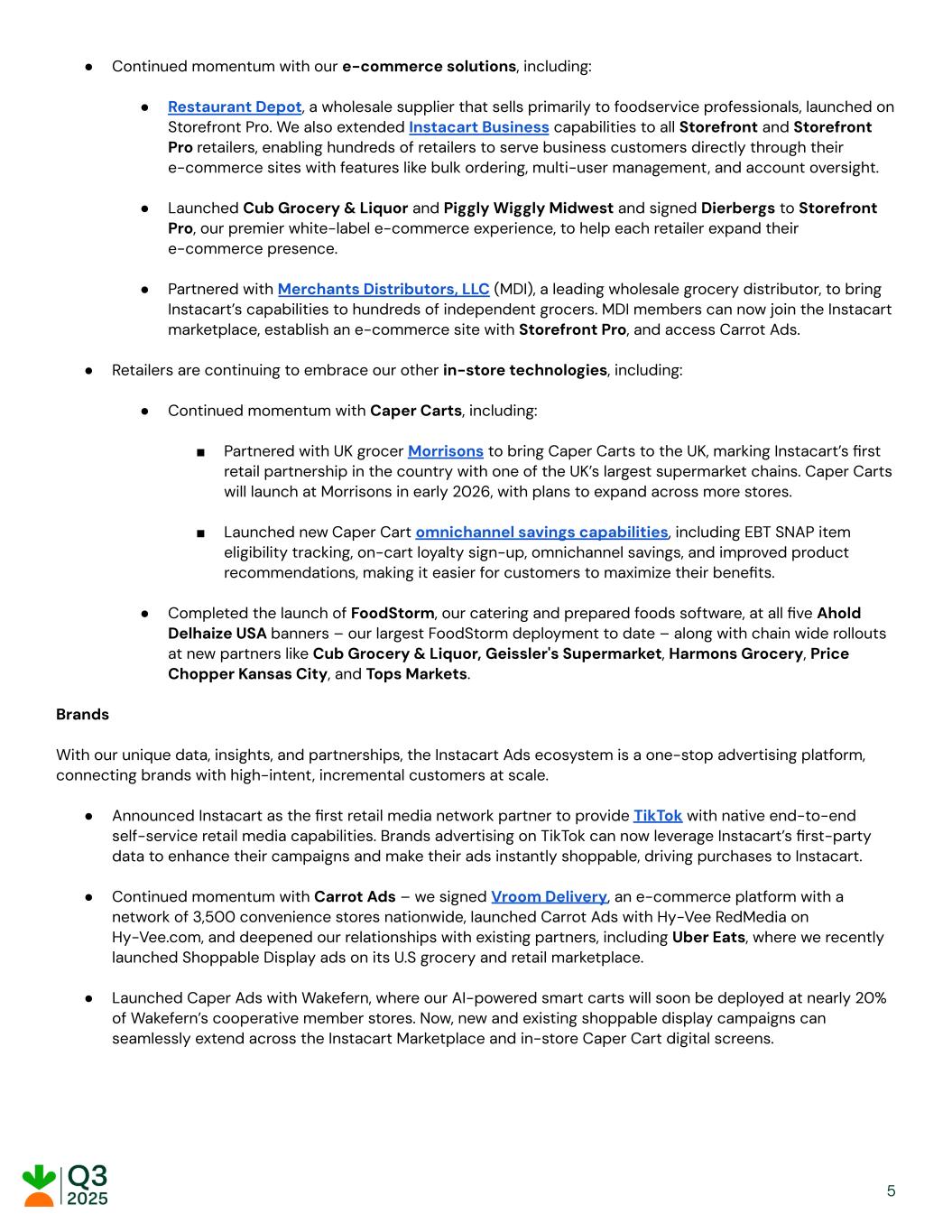
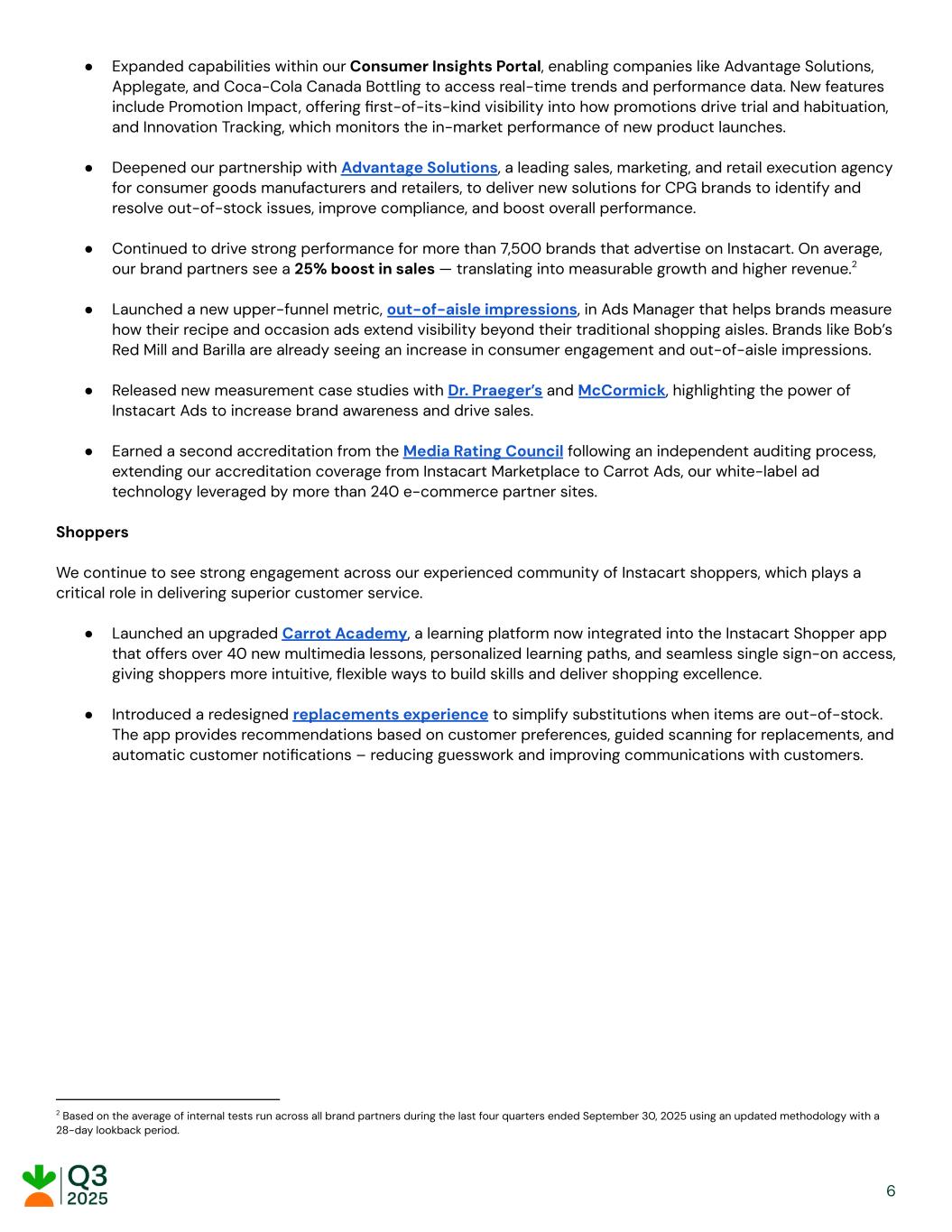
Thank you, Rebecca. Good morning, everybody. It's great to be here as my first call as CEO, and I appreciate you taking the time to join us. Over the past six years, I've had the privilege to build many of the capabilities and partnerships that make Instacart so distinct. That experience gives me a unique perspective on our business, where we are today, what makes Instacart truly differentiated, and why I'm so confident in our ability to extend our lead and win in this market. Our business is operating from a position of real strength. We have the leading online grocery marketplace, a best-in-class suite of enterprise technologies for retailers, and a growing advertising ecosystem that all work better together and have helped us complete more than 1.5 billion lifetime orders. We're also unlocking new growth opportunities that build on that powerful foundation. I'll start by discussing our marketplace, which continues to make up the majority of our business and serves as the backbone of our platform. We've built the best end-to-end online grocery marketplace in North America by staying focused on what matters to customers. Great selection, high quality, affordable prices, and the kind of experience that makes everyday life easier. Every quarter, we build on those strengths, expanding how people use our service, improving delivery speed and reliability, and making shopping even more seamless across every touch Because of that focus, we've built a growing and loyal customer base. We're attracting new customers to Instacart. We're retaining customers at higher rates year over year and increasing their order frequency, moving more customers from occasional use to regular, monthly, and weekly shopping. And what we see is the longer that customers stay with us, the more frequently they shop and the more that they spend across multiple vectors through even larger grocery baskets, more top-off orders, and additional use cases like other retail categories and restaurants. Our most active customers are Instacart Plus members also continue to grow in number and deepen their engagement. All of this gives us confidence that our strategy is working and it shows that demand for our service remains strong. And all of this growth continues to add to our scale, and that scale makes us more efficient and more profitable over time. To put a finer point on this, our unit economics are positive and continue to strengthen across all basket sizes. We achieve this by relentlessly improving our technology through things like routing and batching and replacements to make orders faster and more accurate. That creates a flywheel, better earning opportunities for shoppers, better experiences for customers, and a lower cost to serve for us. That, in turn, allows us to reinvest to make the service more affordable and to spend more on marketing to acquire and engage customers while staying disciplined within our guardrails. So our marketplace is healthy and growing, and then we do what nobody else does. We take all of the innovation and scale and learnings that we've built on our marketplace and we put that directly in the hands of retailers through our enterprise platform. That's what truly differentiates Instacart. We are not just a marketplace. We are a technology and enablement partner for the grocery industry. Through our enterprise platform, our technologies empower retailers to win on their owned and operated sites and in their physical stores. I want to spend a few minutes on this today because it is a key growth driver for us and honestly, it's one of the most underappreciated parts of our business. Our enterprise platform is built around five key pillars. First, our storefront or white label e-commerce technologies now powers more than 350 retailer e-commerce storefronts on retailers' own websites from large retailers like Costco, Publix, and Sprouts to specialty stores and local independents. Grocery tech is very complex and every retailer is unique in how they operate and how they serve of customers, which is exactly why this matters. We've built the best grocery-specific platform that can handle that complexity at scale and make it simple for retailers to grow online with us. Second, we offer highly versatile and high-quality fulfillment services, where we enable the picking and packing and delivery for retailers like Kroger and Wegmans, and other retailers like Aldi and Sprouts put our picking technology directly in the hands of their employees. our partners use our best-in-class technology and our flexible labor network to serve their customers more efficiently. Third is our carrot ads technology, which brings all of our advertising formats, our tools, our capabilities that we've built on the Instacart marketplace, as well as all of the advertising demand from the more than 7,500 brand partners, and uses that to power ads on more than 240 partner websites. That includes major retailers like Sprouts and Hy-Vee, as well as other marketplaces like Uber Eats Grocery and Retail in the U.S., Thrive Market, and more. Fourth, our in-store technology brings the power of our data, technology, and innovation into the physical grocery store, where most shopping still happens. We're doing this with our caper carts, which will soon be available in nearly 20% of Wakefurn stores, as well as with retailers including Kroger and Sprouts and Wegmans. In addition, FoodStorm, which provides retailers with technology to digitize the perimeter aisles of their stores, like the deli and bakery and prepared foods, continues to build momentum with retailers like Apple, Delhaize, Sprouts, and the fresh market. Finally, our newest pillar, AI Solutions. Just last week, we launched a suite of AI products that will help retailers use generative and agentic AI to gain a real competitive advantage across online store shelves, smart carts, and more. Every single retailer that I've talked to so far has been highly interested in partnering with us on AI. They already see us as their grocery technology partner, and these tools come at the exact moment that retailers need us most, as AI transforms how people shop for groceries and feed their families. That's our enterprise platform. It's designed to help retailers of all sizes compete and grow by powering every aspect of their digital strategy. It's built on the same innovation scale and learning that come from running North America's largest online grocery marketplace. place. That gives retailers a clear advantage. They get access to world-class technology and engineering resources that would be impossible to build at the same quality pace or price. And retailers can customize their approach, picking and choosing products to solve their specific goals and needs, while also benefiting from the simplicity of integrating with a single trusted technology partner. Our enterprise platform is also a highly strategic growth lever for Instacart. Each time we land a new enterprise solution with a retailer, we get access to a growing and durable part of their business, and we have the opportunity to expand from there. And because the market is still so underpenetrated, we have years of runway ahead of us to deepen these relationships and layer on additional solutions. These enterprise relationships make us a true technology enablement partner, deeply embedded in retailers' operations to drive durable, long-term growth together. And the benefits are self-reinforcing. Every innovation that we build at scale on enterprise, strengthens our marketplace, and vice versa. As you'll see in my shareholder letter, we shared a chart that clearly illustrates the power of our enterprise platform and why exclusivity isn't critical to our strategy. When we partner deeply with retailers across both the marketplace and the enterprise platform, we grow faster together. That's why we're not concerned when a retailer like Kroger works with other marketplaces. What matters is the depth of our relationships. Kroger announced last week that they're doubling down with us as their primary delivery fulfillment partner across all of their digital properties. That's a great example, a strong vote of confidence in the value that we bring. Moving on to advertising, our advertising ecosystem enhances our entire platform. When brands advertise with us, they get access to over 1,800 retail banners on our marketplace, more than 240 partner websites through carrot ads, dynamic in-store advertising capabilities, and increasingly valuable off-platform insights that help them drive performance across other channels. This has been a foundational year for our advertising capabilities. On our platform, we've added new formats unique to the digital IELTS world, including occasions and recipes and bundles. We've added AI tools like AI-generated landing pages, one-click recommendations, and universal campaigns that make it easier and more effective for brands, especially emerging ones, to advertise with us. And all of this has helped us diversify our advertising base and deepen our partnership with more than 7,500 brands. And we're proud that across those brands, we're driving real results. On average, our brand partners see a 25% boost in sales when they advertise on Instacart, translating into measurable growth and higher revenue. We've also expanded our supply with more care to add partners, entirely new in-store services on caper carts, and we've established off-platform partnerships with TikTok and Pinterest, as well as Google, Meta, the Trade Desk, and more. These partnerships allow us to help brands optimize their campaigns using the power of our data. Last but not least, we also launched the Consumer Insights Portal to give subscribers another tool to help them make strategic decisions based on our rich data. All of this lays the foundation for a powerful ads and data ecosystem that delivered over $1 billion of ads and other revenue over the past 12 months. Now, while it's not an easy operating environment for many food and beverage CPGs right now, we're confident that by improving our offering, expanding our reach, and continuing to diversify our advertising partners, we're positioned well to meaningfully grow our advertising platform over time. When you think about the power of our platform and you really see us as a grocery technology enablement company, you can fully appreciate how scalable our core advantages are, And you can imagine the growth opportunities that open up for us in new categories and regions. Let me give you a couple of examples of what I mean by this. Our capabilities extend beyond individual customers to businesses and from grocers to B2B distributors. Over the past few years, we've built a suite of products tailored to business needs, including features like invoicing and will-call delivery, where we leverage our shopper network to complete urgent fill-in orders from a distributor's warehouse. And now we're rolling out business features beyond our marketplace to our storefront technology as well, so more retailers can benefit from these capabilities and reach more business customers on their own website. This also means our enterprise products are relevant for partners further up the supply chain. We're partnering with distributors like Gordon Food Services on Will Call, and we recently launched Storefront Pro with Restaurant Depot, a wholesale supplier that sells primarily to food service professionals. Another example is international expansion. Today, the vast majority of our success is in just North America, but we see tremendous opportunity to grow internationally with an enterprise-led strategy primarily focused on storefront, CAPER, and Foodstorm. We know that there's demand for our technologies because we've already started to make inroads in Europe and Australia with Windshop and with CAPER, and we're in active conversations with more retailers who face the same challenges that we know how to solve. Overall, we are closing out the year with strong fundamentals, and we have multiple growth engines for the future. We're building momentum across our marketplace, enterprise, and ad platform, and we're leveraging this foundation to expand to new categories. This gives us confidence in our ability to drive sustainable growth in the short, medium, and long term, and we're doing this while remaining committed to driving long-term profit and cash flow per share expansion. I'll say this one more time because I think it's so important we're not just a marketplace we're the leading technology and enablement partner for the grocery industry transforming and empowering the entire grocery ecosystem to succeed we're just getting started and we believe deeply in the strength of this business and the opportunities ahead that's why we increased our share repurchase program by 1.5 billion our largest increase yet to underscore our confidence and our path forward. We're leading from a position of strength. We're focused on execution and we're building a company designed to create lasting value for our customers, our partners, and our shareholders. With that, I'm going to hand it over to Emily to walk through our quarterly
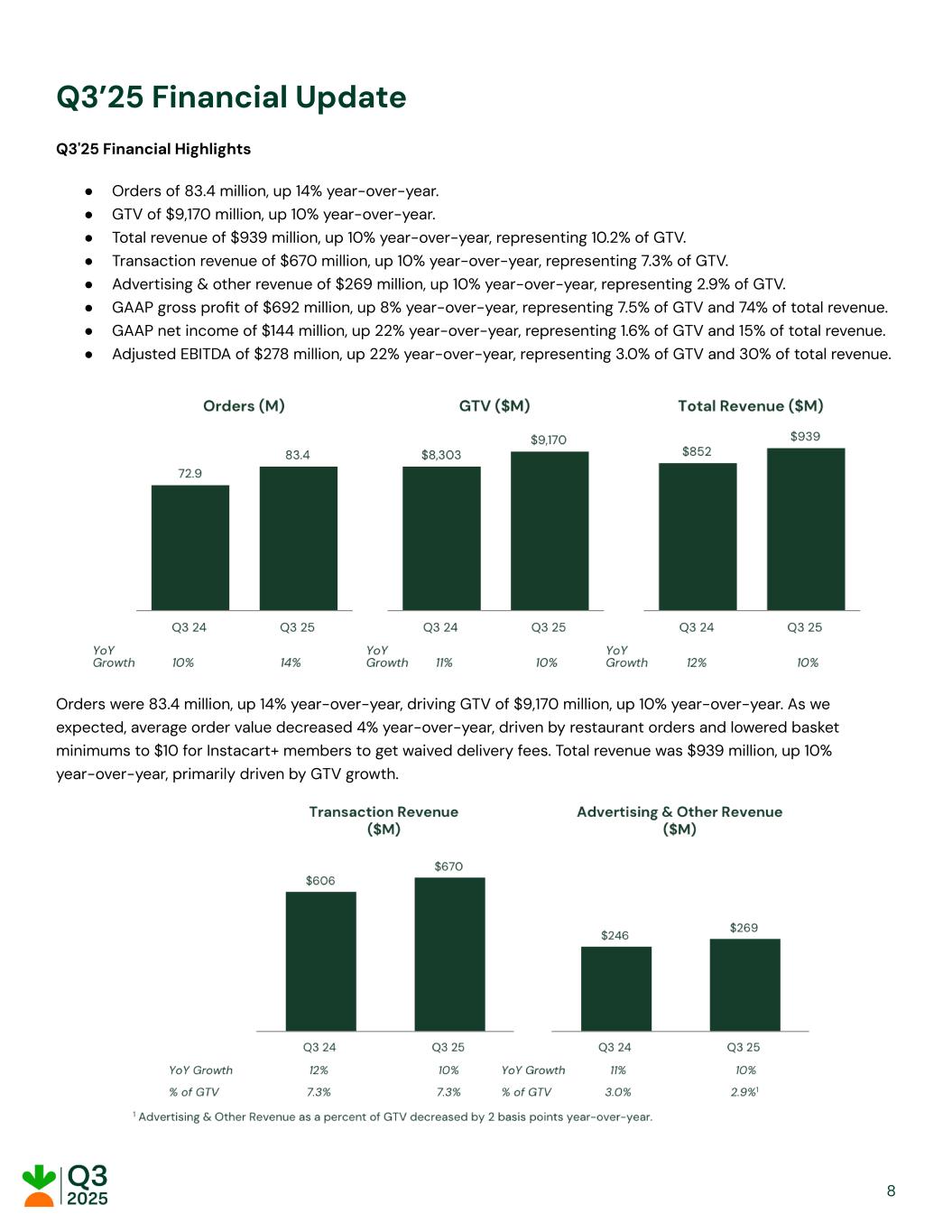
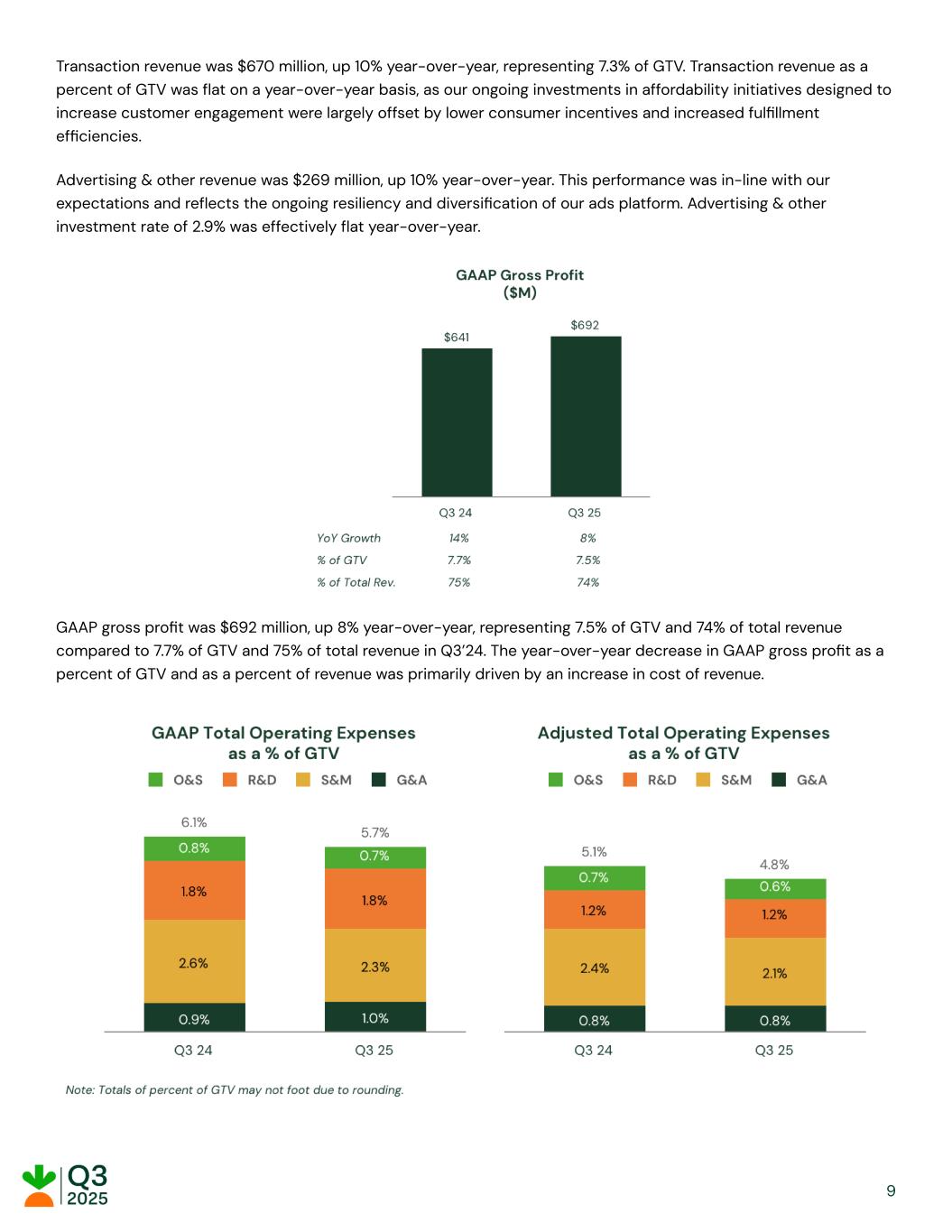
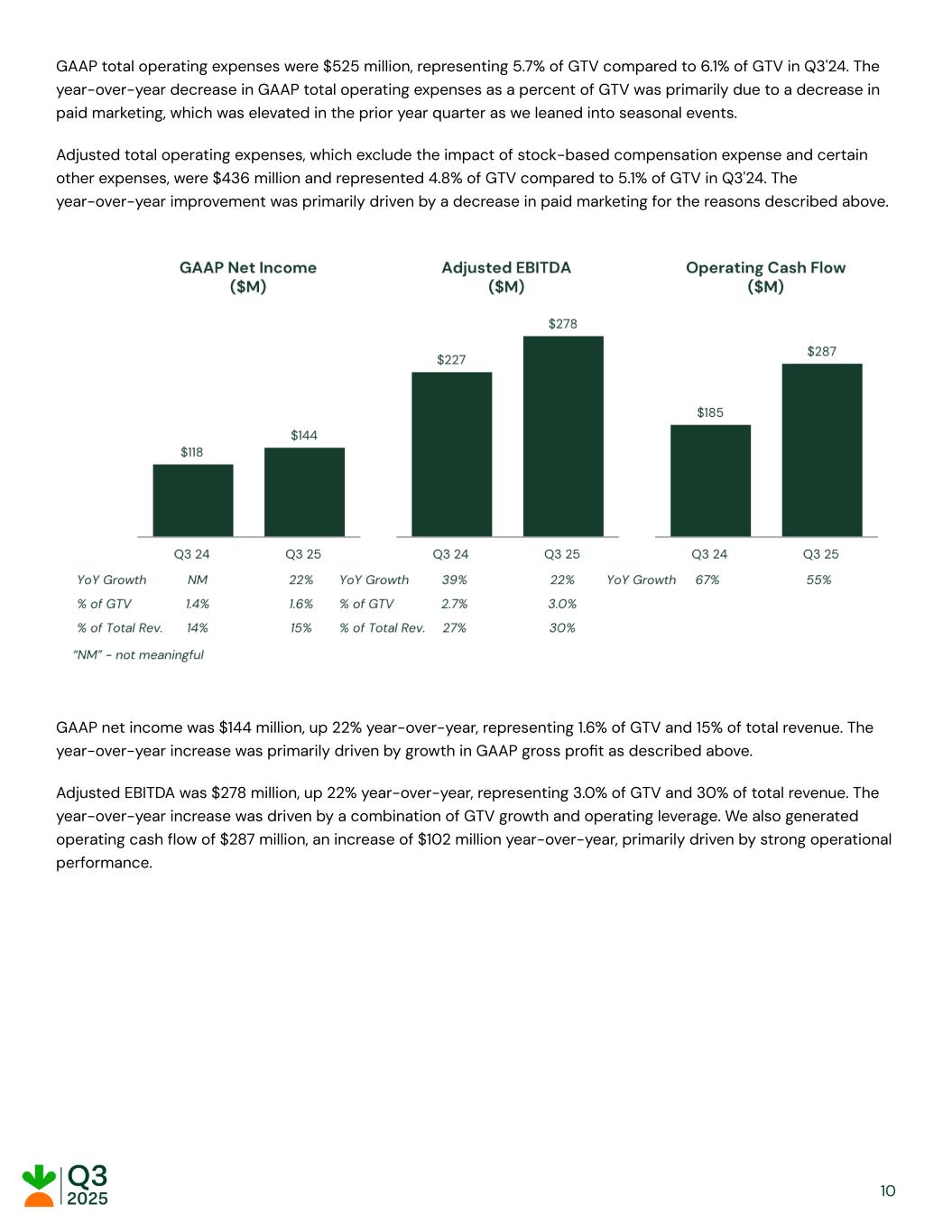
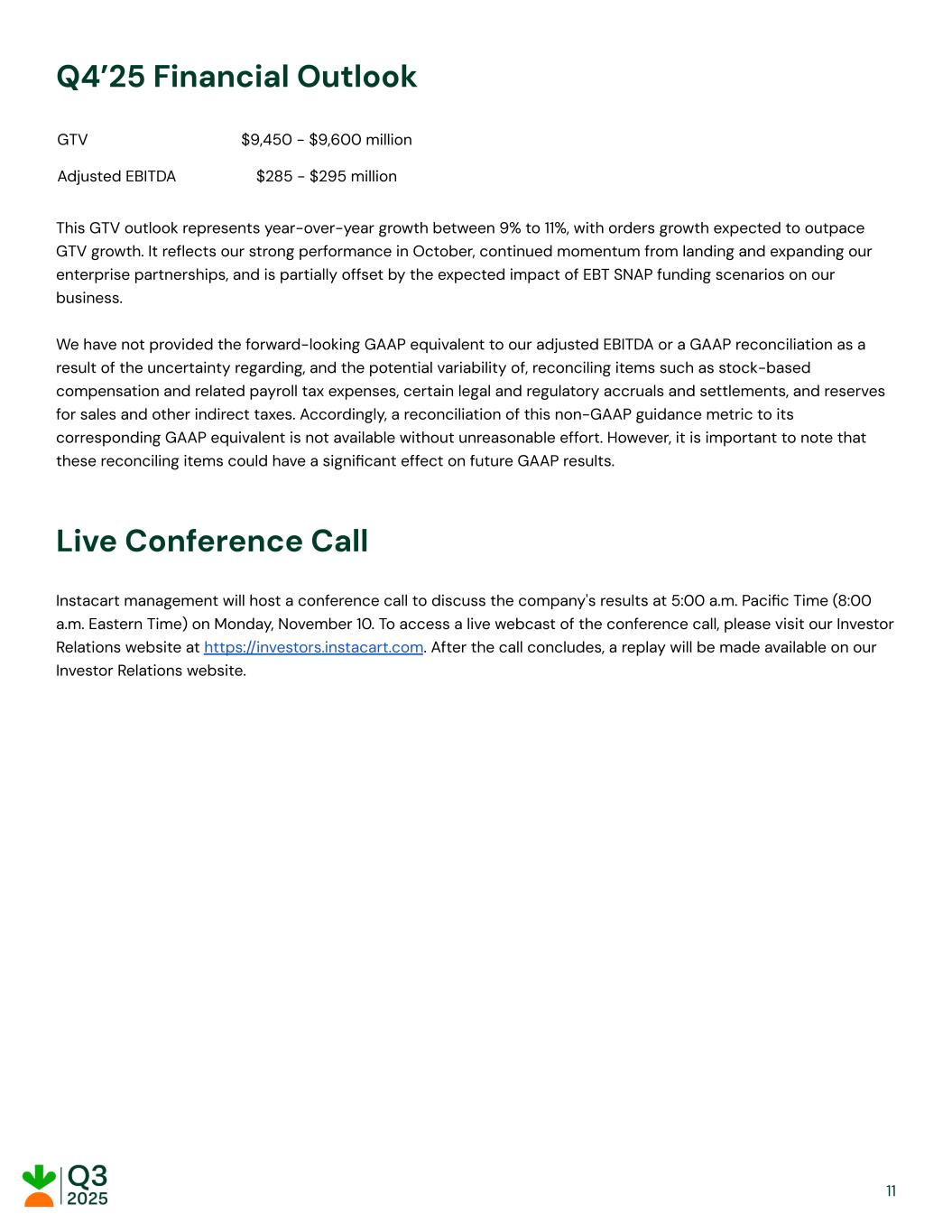
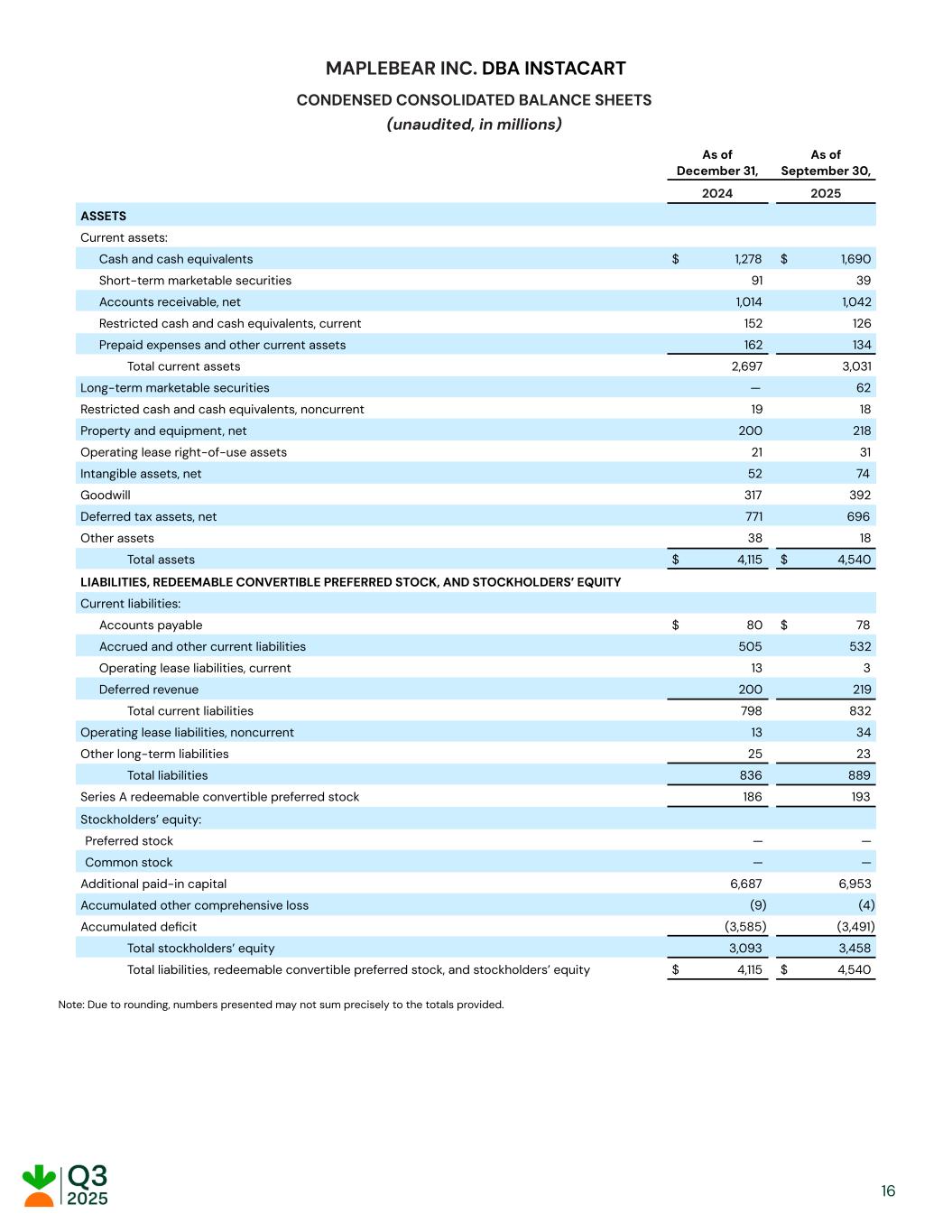
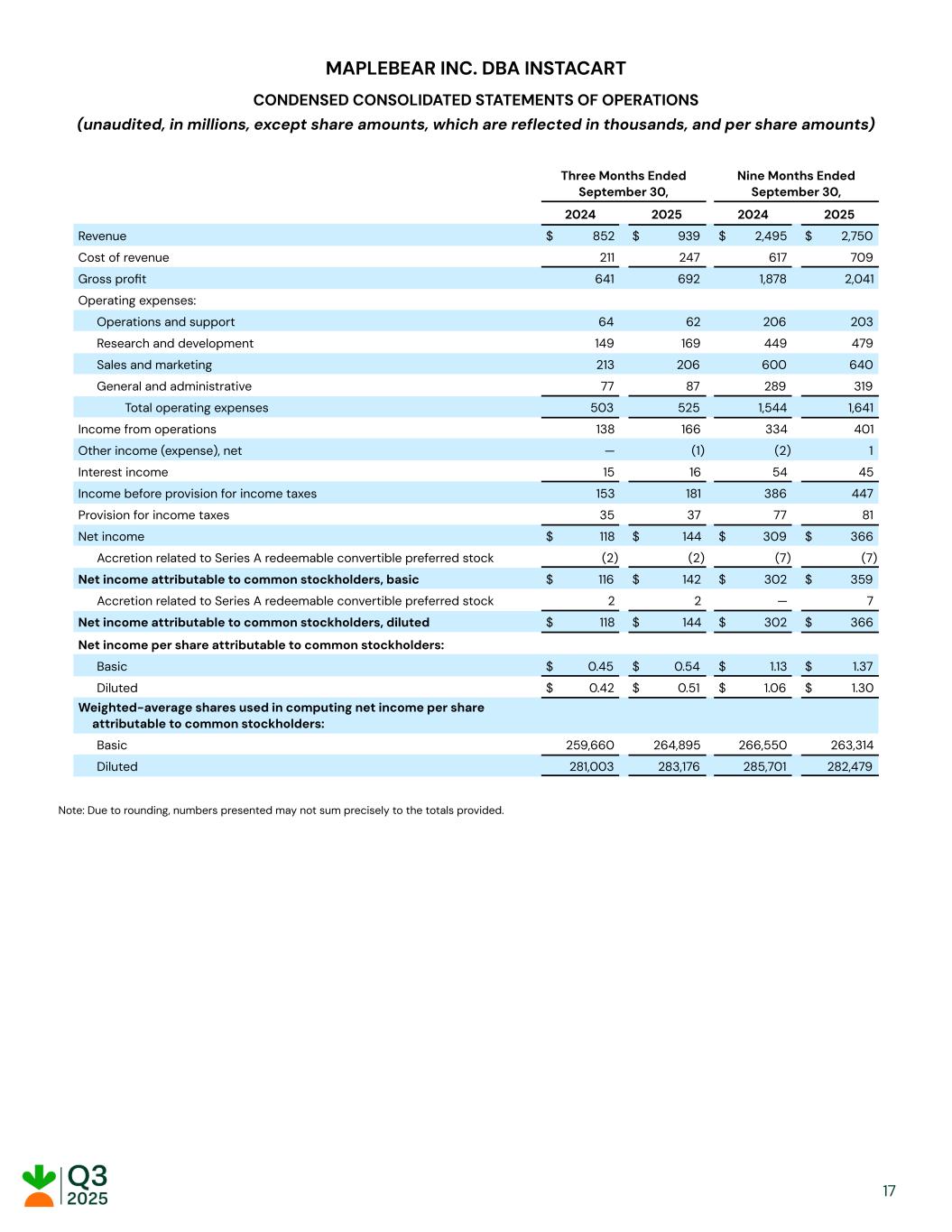
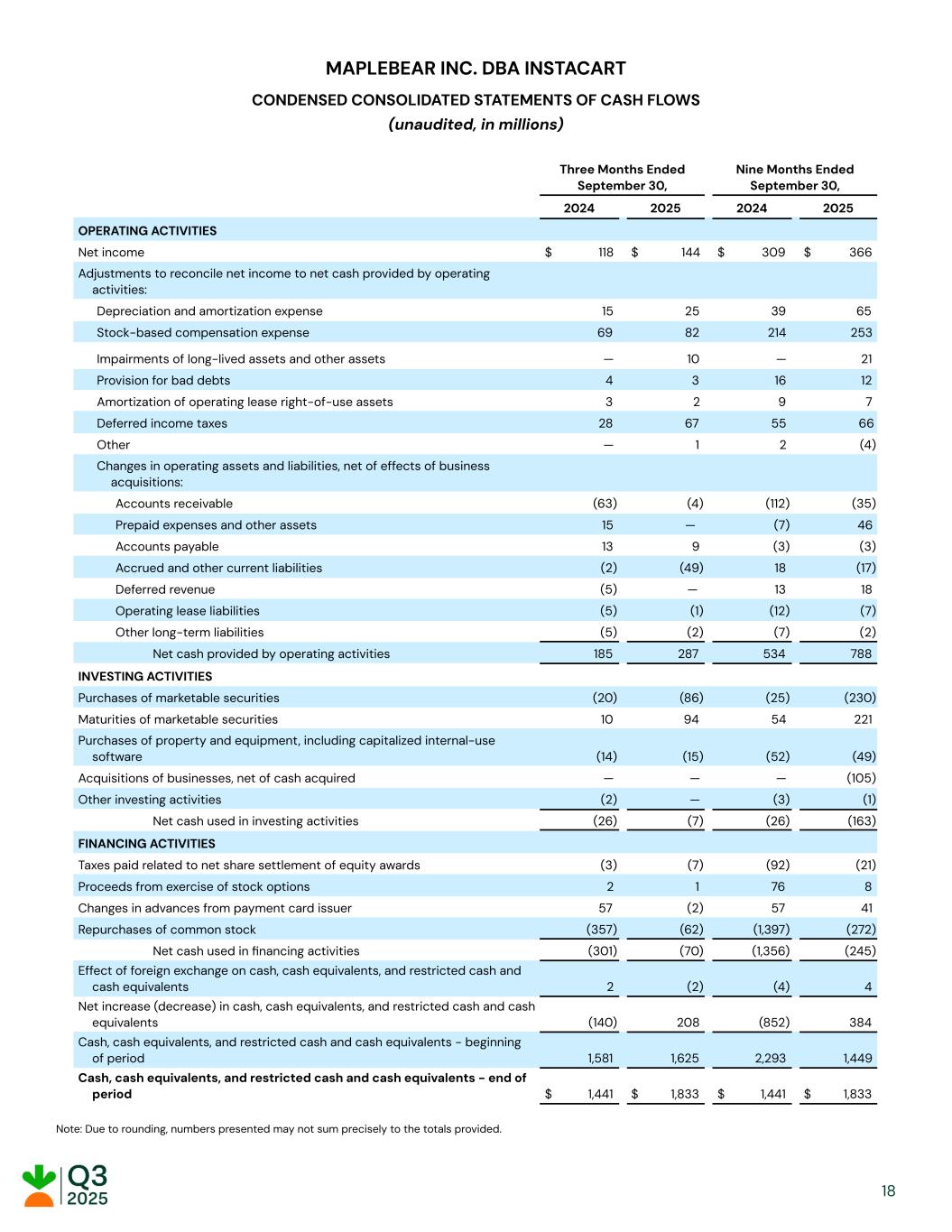
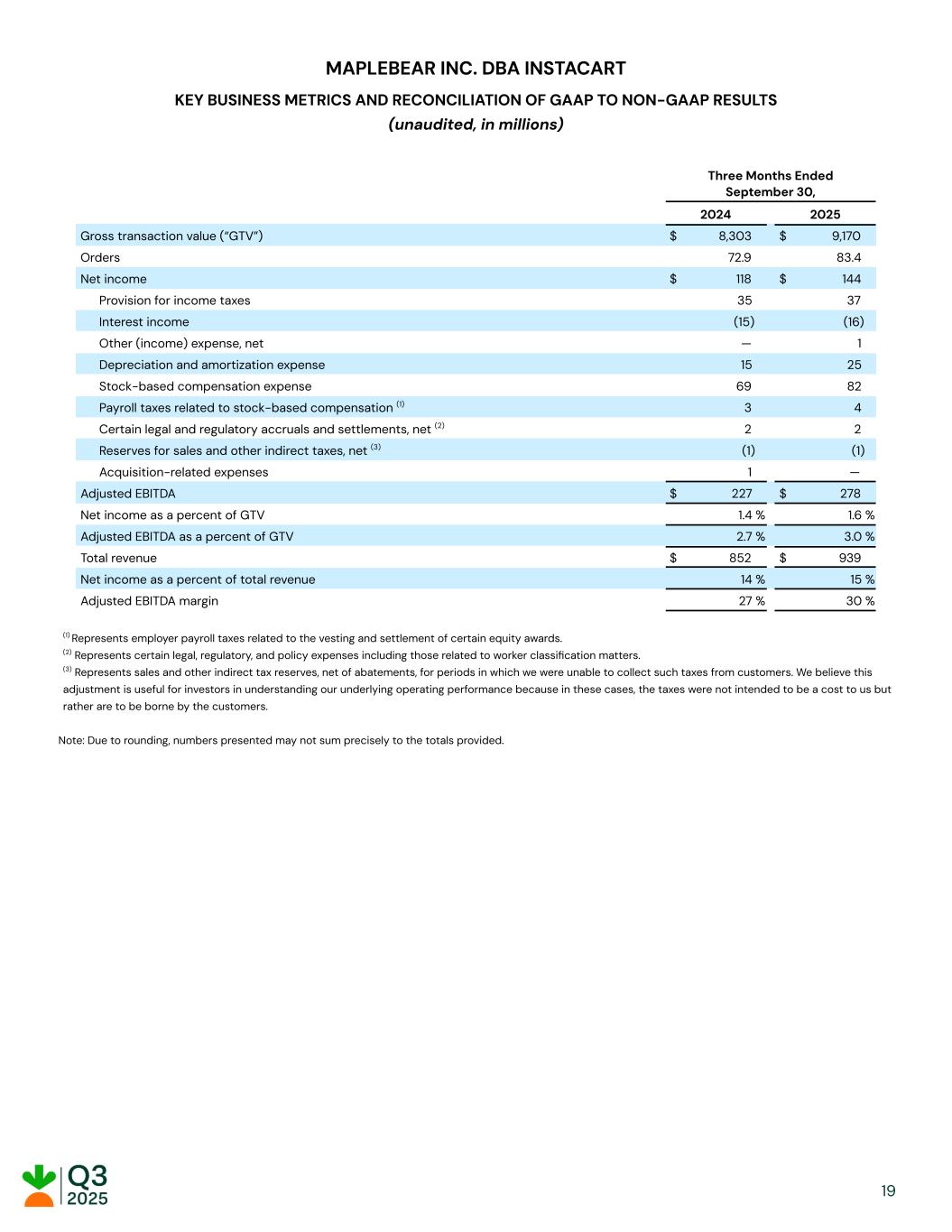
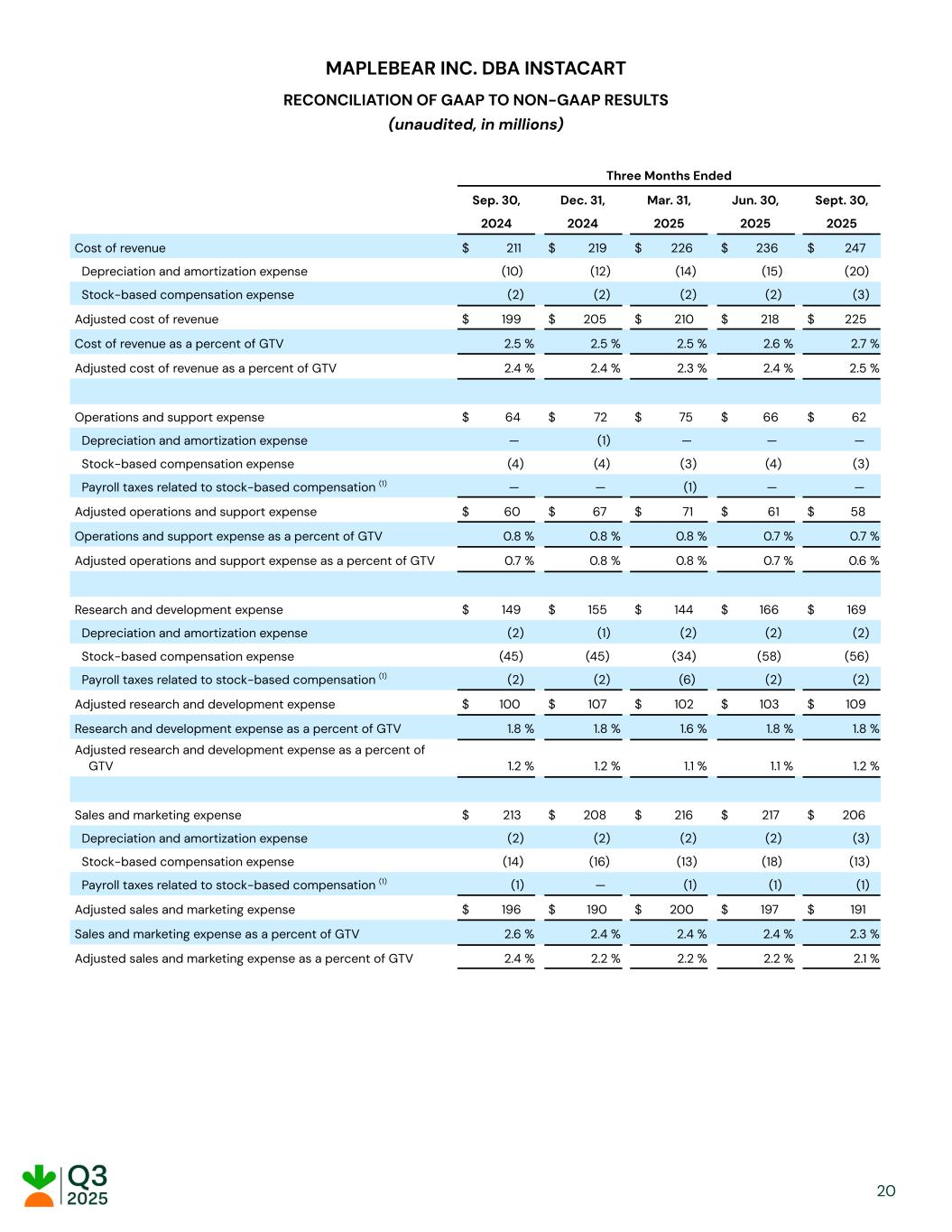
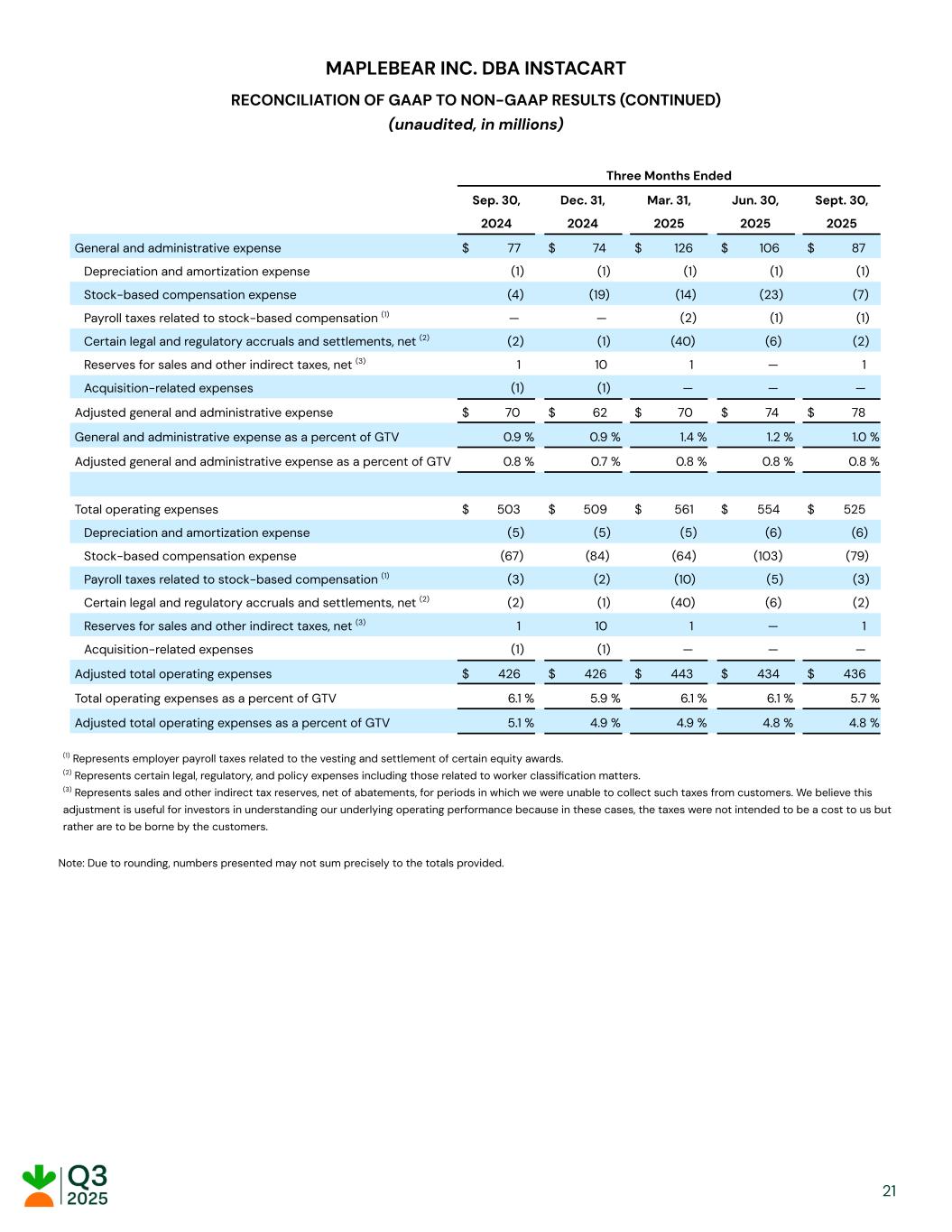
results. Thank you, Chris. This is an incredibly exciting time for Instacart. We're executing on a robust strategic roadmap supported by a strong financial foundation. This enables us to confidently reinvest in the business while continuing to drive more profitable growth over time. Now let's dive into our financial results and outlook. We delivered another strong quarter in Q3. Orders reached 83.4 million, up 14% year-over-year, driving GTV of $9.17 billion, up 10% year-over-year. This performance reflects strong operating fundamentals, fueled by growth in both users and order frequency. As expected, our average order value decreased 4% year-over-year. This was primarily driven by growth in restaurant orders and introduction of a $10 basket minimum for Instacart Plus members, partially offset by growth in basket sizes elsewhere. Transaction revenue grew 10% year-over-year and represented 7.3% of GTV, which was flat year-over-year. This was driven by improved shopper efficiencies and lower consumer incentives, which allowed us to reinvest in affordability initiatives aimed at increasing customer engagement. As a reminder, we manage multiple levers across our P&L, so transaction revenue may fluctuate quarter to quarter as we strategically reinvest in growth. Advertising and other revenue grew 10% year-over-year, reflecting the strength of our ads platform. Advertising and other revenue represented 2.9% of GTV, which was effectively flat year-over-year, even as restaurant orders contributed to overall GTV growth while not being advertising addressable. We continue to demonstrate strong financial discipline and operating leverage. Gap net income was $144 million, up 22% year-over-year, and adjusted EBITDA also grew 22% year-over-year to $278 million. We generated operating cash flow of $287 million, which increased by $102 million year-over-year, primarily driven by strong operational performance. In Q3, we repurchased $67 million worth of shares and ended the quarter with approximately $1.9 billion in cash and similar assets on our balance sheet. Stock-based compensation in Q3 was $82 million, down $24 million quarter-over-quarter, largely due to just over $20 million in expected reversals tied to executive departures in the period. In Q4, we expect stock-based compensation to normalize and be more in line with Q2 2025 levels. Now for our Q4 outlook. We anticipate GTV to range between $9.45 to $9.6 billion. This represents year-over-year growth between 9% to 11% with orders growth expected to outpace GTV growth. It also reflects strong customer demand in October, continued momentum from landing and expanding enterprise partnerships, and is partially offset by the impact of a variety of EBT-SNAP funding scenarios. We expect advertising and other revenue to grow 6% to 9% year-over-year. This reflects ongoing strength from emerging and mid-sized brands, partially offset by some large partners adjusting spend as they manage macro uncertainty and changing consumer trends. While this creates near-term pressure, the fundamentals of our ad ecosystem remain stronger than ever. With our performance, reach, and diversification, we are confident in returning advertising and other revenue to double-digit growth in 2026 and meaningfully growing this part of our business over time. We are also guiding to Q4 adjusted EBITDA of $285 to $295 million, reflecting our commitment to disciplined execution and steadily increasing profitability. In summary, we delivered a great Q3 and our momentum continues to build as we look to finish 2025 strong. As a clear category leader operating at tremendous scale and driving efficiencies, we're taking a disciplined but aggressive approach to investing to further accelerate our growth and advance the broader industry. To underscore our confidence in long-term value creation, we authorize a $1.5 billion increase to our share repurchase program, bringing our total capacity to $1.65 billion as of this morning. We plan to enter into a $250 million accelerated share repurchase program while continuing to opportunistically repurchase shares. With that, we will open up the call for live questions. Operator, you may begin.
Operator
Thank you. As a reminder to ask a question, please press star 1-1 on your telephone and wait for your name to be announced. And as a reminder, please limit yourself to one question and one follow-up so that we will have enough time to address everyone's questions. And the first question is going to come from Eric Sheridan with Goldman Sachs. Your line is open.
Thank you so much for taking the question. and maybe just to dovetail with the comments and all the details in the material so far today, if you had to isolate what you see as some of the biggest strategic investments you want to make across your technology stack, growing supply, or aggregating demand, how should we think about what those key investments are to build the types of growth narratives you're talking about today? Thank you.
Yeah, thank you, Eric, for the question. As you can see from our Q3 results, the business is in good shape. We have momentum. we've been driving consistent growth, seven quarters of double-digit growth with consistent EBITDA expansion. So, you know, considering the strength of the core business, I'm not coming in and rewriting our entire playbook or making dramatic changes to our underlying vision and strategy. It's going to be fairly consistent. That said, I have started to outline various focus areas that I strongly believe can help us accelerate into the next chapter. There's three of them. One of them is affordability. We know that affordability is the number one reason why people turn off of the platform. We also think it's a barrier to customers placing their first order. So we've made some significant traction with some of our largest affordability issues, like loyalty integrations with retailers, the weekly flyer integrations that we've been doing. But we do believe that there's more we can do with retailers, including working with retailers on their own pricing strategy, including having conversations about price parity on the platform. The second area you're going to see us continue to invest in is to accelerate enterprise even more. I continue to see significant opportunity to accelerate our enterprise platform based on everything I hear when I talk to retailers. And even though we're already over 350 e-commerce storefronts, there is more room here for us to sign and launch a lot more retailers across North America, and I also see this opportunity to expand outside of North America for the first time in a real way. And once we've landed with a retail partner, there's an opportunity for us to cross-sell with other partners like with Kapor Carts and with Foodstorm. And the final area that I want to highlight is ads and data. Our ads business is very strong and highly performant, and I plan to continue to invest to build an ads ecosystem that really innovates on platform with our high-performing and strong measurement off platforms through partnerships with Google and Meta and the trade desk and now Pinterest and tick-tock and then of course with care dance where we're now powering 240 ad partners so I feel strongly that these are going to accelerate our business and then as a tech company operating in the grocery space we believe that we can do incredible things with AI together both on our platform and together with our retail partners to accelerate even
Operator
further. Thank you. Thank you. And our next question will come from Colin Sebastian with
Bayard. Your line is open. Yeah, thanks and good morning. I guess two questions, one and a follow up. On the AI solutions, Chris, I guess how should we think about the monetization model here and how are you using those deeper relationships to expand the marketplace side where there are an increasing number of options for consumers? And in terms of the acceleration you're expecting next year within advertising, Emily, was maybe just hoping for a little more context around how much of that depends on the macro environment versus platform-specific initiatives and maybe opportunities with partners like TikTok and Uber Eats. Thanks.
Yeah, thank you, Colin. For the first part of the question about AI, I mean, it's still early days. We announced our launch last week. Again, we have seen – I have personally experienced that 100% of the retailers that I've spoken to so far are excited about this. So we do believe we're on to something. And, you know, I just think that it's basically going to be a collection of enterprise offerings that brings AI power capabilities to our retail partners, all of our retail partners, regardless of size, and it's going to connect every part of the shopping journey from how products are discovered online to how shelves are stocked in stores. And so for retailers, and why we believe there's a monetization opportunity for us here, because it means things like smarter operations. It means better product visibility with the in-store view that we're creating and in-store intelligence. It means more personalized shopping experience for their customers. So early days, very promising start out of the gate, and we do believe that this is going to be something we can monetize over time. And for the second part of the question on advertising, look, I'll start by saying, given the somewhat challenging macro that we're seeing, We are very proud of our Q3 results of plus 10%, which was in line with our expectation. And as we think about our guide for Q4 of 6% to 9% and over 10% for the full year, we are awaiting several puts and takes across our brand partners. So on the one hand, we're seeing real ongoing strength from mid-market and emerging brands. We have seen strong growth from this cohort all year. And then on the other hand, some of our large brand partners are moderating their spend as they navigate a tougher macro environment. In addition, in Q4, we're up against some brands that leaned in heavily towards the end of last year. All of that said, I'm not satisfied with where we're guiding for Q4, and I'm focused on re-accelerating as another. I'm confident that we can return to double-digit growth next year, and I'm confident in our ability to achieve our long-term target of 4% to 5% of GTV. And this is because of the foundation that we've been laying over the past year with multiple irons in the fire. And I really believe it's a combination of things that are going to get us there. As a starting point, we are consistently innovating on platform, on site, on Instacart, where we can attract larger and larger budgets by innovating and by being laser focused on driving performance for brands. We have new formats like the ones I mentioned, shoppable recipes and bundles, but we're also doing enhanced optimizations, including ad relevant systems with LLMs driving stronger sponsored product engagement and higher click-through rates. But in addition to everything that we're doing on-site, we're making significant progress across this ads ecosystem that I referenced. We're up to 240-karat ad partners. Again, that's where we power ad tech on our retailer websites like Hy-Vee, who recently launched, and on third-party marketplaces like Uber, grocery, and retail in the U.S. But we've also signed Room Delivery, which is a convenience marketplace. And we just signed Bottle Caps, which is an alcohol marketplace. And we have a robust pipeline of other potential partners, which we think can contribute to long-term growth. We also recently launched ads on our caper carts with Wakefirm, where carts will soon be deployed at 20% of their stores. And we're also just very pleased with our off-platform partnerships. This is a foundational year for us on our off-platform with our newest partners, Pinterest, which we announced in Q2, and then TikTok in Q3, where we're the first end-to-end retail media partner to enable targeting and closed-loop measurement. So when you stack all of these pieces together, combining our high performance on our platform and then extending that high performance onto all of this new supply, we see real growth opportunity over the long term.
Operator
And the next question will come from Shweta Kajaria with Wolf Research. Your line is open.
Okay, thank you for taking my questions. Let me try two, please, one for Chris and one for Emily. The new partnerships as well as international growth plans, can you please talk to both of those? One is how impactful do you think that the new partnerships can be in the near to midterm as well as where are you focused on for international growth and what is your go-to-market strategy versus how should we be thinking about your plans for near to midterm? And then finally, the guidance for the fourth quarter, could you please provide a little bit more color in terms of framing the impact of potential EBT SNAP headwinds versus the incrementality of enterprise and the ongoing strength and older growth? Thanks a lot.
Thank you for the question. On new partnerships, look, we see potential in so many of our partnerships across the broader business. If you're asking about enterprise specifically, we have, again, 350 storefronts, but we continue to launch more storefronts. We launched 40 new storefronts in the first half alone. We just launched Restaurant Depot, which is our first wholesaler that supplies food service. We just launched Cub last week, another retailer. So we do believe that this is a very important part of our strategy, and you're going to see us continue to lean into this. Our partnerships on the ad fronts with Off Platform are also going to be critical. Again, this was a foundational year where we struck many partnerships, and we're working through integrations and what our go-to-market motion is going to look like as we talk to brand advertisers about those capabilities. And then when it comes to international, first of all, I want to say I'm very excited about our plan to take our technology to new markets. We have already spent some time in other countries. We've spoken to retailers. And again, they're trying to solve the same problems as the retailers that I talked to in North America. How to build scalable e-commerce solutions, ads, and in-store digital solutions for customers. And that said, while I believe that this is going to be a very promising growth lever for us, I'm also focused on ensuring that we're disciplined on expenses in the way that we do this in a way that's aligned with our profitability objectives and our ability to deliver to annual EBITDA progression. So it is probably worth sharing a little bit more about our approach here. So we're exploring the major markets like Europe, but we're doing that with our existing products like Storefront Pro and Caper and Foodstorm. We're not building a new suite of technology specific to these markets. So we will be investing some. There will be resources applied to this effort, obviously, to do the selling and to localize our products. But again, I intend to be super disciplined and extremely focused on how we do that. And truthfully, this is, I think, another great example where our internal adoption of AI with our tech teams can help us accelerate and accomplish our goals in North America at the same time as abroad.
Great, and I can jump in on your question around framing the impact of EBD SNAP. So the way that I think about it is that, first of all, EBT is a relatively small part of our overall business. Obviously, as a company, we're very focused on making sure that we can help families get food on the table. But what we've looked at in terms of our modeling is a variety of funding scenarios because there has been continued uncertainty about how the rest of the year will play out. And ultimately, we believe that we can achieve our guidance in any of those scenarios. Now, what does that mean? It means that we have strong fundamentals in terms of how the business is performing. We did have strong performance in October. That's reflected in our guidance. And as Chris mentioned earlier, we also are seeing continued momentum from our land and expand strategy with our enterprise partnerships. So, for example, we are deepening relationships with retailers like Wakefront and Cub. As Chris mentioned, we launched 40 net new retailer sites in H1 alone, and so we're starting to see the benefit of that. We launched Restaurant Depot, and that is off to a great start. Our embedded marketplace on Grubhub, so a lot of little things that are all coming together to drive overall strength in the business.
Operator
Thank you. And the next question will come from Nicole Devnani with Bernstein. Your line is open.
Hi there. Thank you for taking the question. Chris, you've spoken a lot about affordability. Can you maybe level set for us where we are today? What is the direction of travel been on markups over the past year or two? And where are we today versus your desired end goal on this objective? And then when you think about pushing towards price parity or reduced markups, it all makes a lot of sense. But there obviously is some tension with merchant partners that worry about their margins on third-party platforms. So how do you get the partner base to buy into the strategy longer term? And does anything have to evolve or change about the Instacart model or structure as more retailers adopt this? Thank you.
Thank you, Nikhil, for the question. So I think we all know, including our retail partners, how important it is to work on affordability, especially with the competitive environment and the fact that people are increasingly comparing prices online. Oftentimes, actually, it's the retailer that brings this up with me. And as a result, we're working with almost all of our retail partners on our strategy, and this can take many forms, including surfacing deals more aggressively or reducing the markup or offering sale pricing or going all the way to the same-as-in-store pricing, which I think is what you're getting at with the question. On same-as-in-store pricing specifically, we know it's going to have a positive impact. We can see it in the data. Price parity retailers are growing 10 percentage points faster versus marked-up retailers. We know they retain better, and that's why many retailers have moved. In the first half, we announced that Heritage Grocers has moved to price parity. Schnucks went full price parity. And now we have several banners testing their way into it in major markets like Nashville and Chicago and Dallas and Tucson. So I don't know exactly where it's going to net out, but I do think that that trend is going to continue. We don't break it out, Nikhil, because it's simply not binary. How would we capture a retailer that reduces their market markup from 6% to 4%, which just happened? It's good news for the customer, but it wouldn't get recorded if we were tracking price parity full stop. or retailers that offer price parity but only for loyalty-linked members, as an example. All that said, I will likely report out on a quarterly basis any retailers that have moved to price parity so that you can see any movement. And then for the third part of your question around our approach, for the most part we're taking a consultative approach and we're sharing the data with what they might expect to see on Instacart from a sales list perspective and a retention perspective. We're also sharing longer-term share and sales trends of digital overall, including where a retailer might be losing share to some of the largest players that are going after digital baskets. And to the extent that we would invest, there are many financial puts and takes with retailers, given the breadth of products and services that we have with most of them. So depending on the broader context, we might put some small dollars towards this, but for the most part, it's the retailers that need to lean in and make the decision and decide how to price their products.
Thanks, Chris. Appreciate it.
Operator
Thank you. The next question will come from Ron Josie with City. Your line is open.
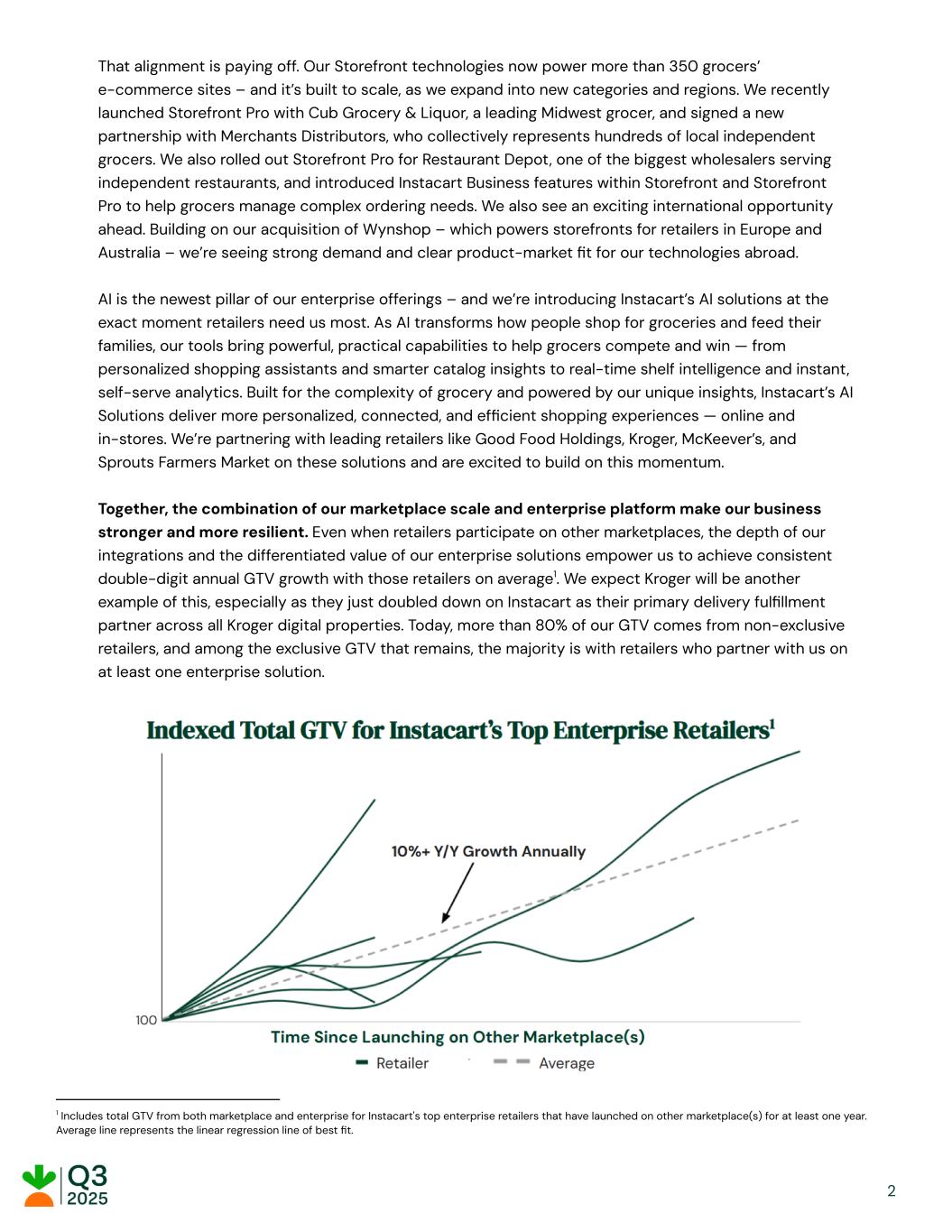
Great. Thanks for taking the question. Maybe Chris is a follow-up to that one, and I wanted to ask about the chart and the letter around CART's top enterprise partners and the cadence here. It looks for those retailers, the six retailers that were highlighted on the multiple platforms. Maybe there's the exception of two. Most had a dip and then flattish growth before returning that 10% average. So talk to us about the evolution here as competition ramps up or as the exclusivity sort of dissipates here. Thank you.
Yeah, sure. Hey, Ron, this is Emily. I can start. You know, I think just to sort of level set on sort of why we included the chart and what we thought was interesting about it, obviously we've had a lot of questions around loss of exclusivity and about how, you know, our enterprise relationships really solidify us for the future. And so what we looked at here was for retailers where we had an enterprise relationship, what happens to the business when we go non-exclusive. And, of course, we're quite pleased to see that in those cases, we're able to continue very strong growth across all of the retailers. And as you likely know, the vast majority, over 80% of our business, is non-exclusive today. And of the remaining that is exclusive, the majority of those have an enterprise relationship with us. And so, again, just wanted to underscore why we feel confident in our ability to continue to grow our business. Now, fluctuations in the chart can be, you know, there's nothing specific I would call out outside of things like seasonality or launches with individual retailers. So that's what is going to drive some of the fluctuations you see in the chart.
Operator
Thank you. And the next question will come from Ross Sandler with Barclays. Your line is open.
Yeah, great. Just following up on the price parity topic from a couple questions back, has Amazon's big push changed the nature of the conversation between you guys and your merchants around price parity? That'd be question one. And then the second question is, you know, the new AI offerings look super interesting. Could you just elaborate on how some of this might speed up adoption of merchants migrating to a solution like Instacart, or is this just more like kind of offering another service that just, you know, adds to the plethora of services that you guys already provide? Is this, you know, the materiality of the AI offering, I guess, is the question.
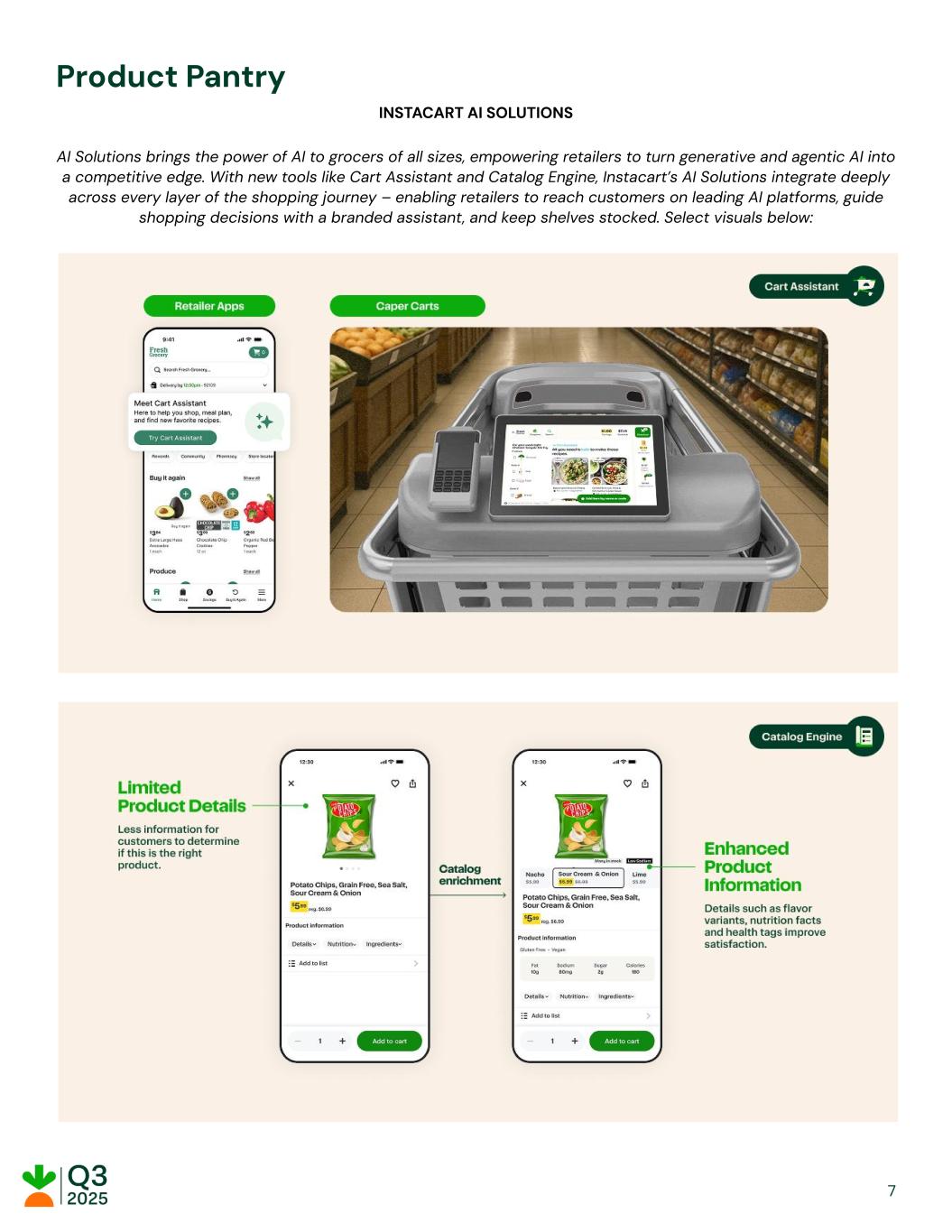
Yeah, thanks for the question, Ross. On the first one, as it relates to, you know, the competitive environment with Amazon and how retailers are thinking about this and how we're thinking about it, we have assessed the top markets that overlap with where Amazon's rolled out, including the top 30. And we continue to grow in those markets and grow overall, as you can see from our results in guide. And our mix looks good. We're not seeing a shift in basket composition between small and large baskets. We're not seeing anything meaningful in our ALV. That said, third-party data is showing that the largest source of Amazon.com grocery customers has been the in-store customers. And so we are using this as a rallying cry with retailers where we're already deeply embedded and who need omni-channel strategies to compete. This can show up in a bunch of different ways. It could show up as us more actively and aggressively engaging in our existing roadmap, depending on what we're working on with that retailer. It might mean that we're moving faster with in-store technologies like caper carts. And as part of this, we are discussing pricing strategies. And as mentioned, some of our large retailers are testing price parity pilots right now in some of the major cities that I outlined. But I do think that retailers are keenly aware of what's happening in the competitive dynamic. We're helping bring them solutions in order to address that and compete and win. On the second one, as it relates to AI solutions specifically and how it might speed up adoption of merchants, look, I do believe that this is going to speed up the entire industry. And the way that we're going about this is very similar to the way that we go about all of our enterprise technology. We're going to be innovating directly on Instacart, and then we're going to take that technology to retailers. And when we do these types of things, what we see is technology accelerates across the grocery ecosystem. So on Instacart, we're going to be building out agentic experiences directly. We have incredible data from our 1.5 billion orders to date. We have a rich catalog from 17 million unique items. We understand people's preferences, and we have the best UX. And as a result, we do think we can deliver the most relevant agentic experience for grocery with a great user interface directly on Instacart. And then with what we called cart assistant last week, you know, we will be bringing these conversational capabilities to our retail partners so that they're going to have similar capabilities at the same pace and scale that we're building out directly on our marketplace. And this is going to, we think, enhance the grocery experience in several ways. You could interact with an assistant up front or you could interact with a digital assistant throughout the journey. So, for example, you could give Cart Assistant a prompt around a party for 10 people, and it would help you build a cart based on your past preferences and any other context that you provide about the other guests. Or you can shop normally and engage as needed. So, for example, at the end of the shop, you could say, check my entire basket for any gluten, as an example. And so we're going to take that technology, we're going to make it available to our retail partners in the form of this AI solution, and that means that we're going to be building agentic experiences on retailers' owned and operated websites like the ones that we've already highlighted, Sprouts and Kroger.
Operator
Thank you. And the next question will come from Justin Post, Bank of America. Your line is open.
Great. A couple questions. I wonder if you could help us understand the enterprise solutions contribution, maybe to revenues or just overall to your business besides just retention of retailers, just financially, how you think about it? And then second, you did mention that October is off to a strong start. I know there's some kind of concerns out there, but are you seeing any changes from new competition in October?
Okay, Justin, I'll start. I'm glad you're asking about the enterprise business because, again, we think it's one of our biggest critical advantages. From an economic perspective, there are some non-direct benefits. It increases our order density. It gives us cost and serve advantages. It allows us to reinvest back into the business. But we don't break out growth or unit economics on enterprise or marketplace because it differs retailer by retailer. And we're constantly working with retailers to launch a host of new services. But what I can tell you is that both Marketplace and Enterprise are growing parts of our business, both add to our bottom line, both reinforce each other in a virtuous cycle. We're an investment in one. If we make an investment on Marketplace, it helps us with our investment in Enterprise.
Yeah, I think the only thing that I would add to that is just that Enterprise is not a new part of our business. We're obviously talking about the opportunity for growth, but if you recall back at the time of, you know, the S1, at that time we talked about how enterprise was about 20% of our business. So I just wanted to call out that, you know, the enterprise economics has been included to date, and so I thought that might be a helpful ad.
And on the second part of your question, Justin, around competition, you know, look, it's an attractive market. Fortunately, competition isn't new to us, and we're not at all surprised by the evolving competitive landscape given the mass of TAM and the market penetration is relatively small relative to other e-commerce categories. But when I take a step back here, it's clear that we're playing a different game. We're leading in areas of the market that our competitors don't really touch, such as big baskets, so over $75, which still represents 75% of the online grocery market, and on retailers owned and operated sites, which as I've already said, we're an enterprise platform. And because of these key differences, we continue to be the clear leader in online grocery among digital first players. We're leading in share sales by far. We're three times higher than the next largest digital player. We're leading in new activation GTV. We're multiples higher in large basket activation. We're multiples more effective at converting small basket activations to large baskets. So in my mind, we've proven that we can compete and win in a highly competitive space, and we haven't seen anything in the short term that would change that.
Operator
Thank you. And the next question is going to come from Deepak Mathivana with Cantor Fitzgerald. Your line is open.
Great. Thanks for taking the question. So, Chris, the new AI tools are very interesting. Can you talk about the strategy to kind of merchandise the tools more extensively in front of consumers and perhaps aim to make Instacart a bigger part of the meal planning service for consumers, you know, just beyond the weekly grocery delivery service? and how much of this experience needs, you know, is dependent on sort of like a retailer integrations versus some of the data and tools that you have. And then maybe one for Emily. I think Chris noted that the unit economics is positive for all types of orders. Can you talk about the factors that help small basket orders reach profitability and do you think there's a runway to kind of improve the incremental margins of these over time? Thank you so much.
Thank you, Divac. I'll take the first one around AI tools. So we are actively using AI directly on Instacart in order to enhance the experience, and we're looking for ways constantly to merchandise those. We're focused on better personalization, the most relevant digital shelf, better recommendations, better replacements, and we want to use our rich data set to really capitalize on the rise of Gen AI. Our product catalog spans 2 billion product instances refined into 17 million unique items. We've completed over 1.5 billion lifetime orders, and that gives us a real advantage to put personalized experience at the forefront of the consumer experience going forward,
including the things like meals which you've called out.
We will have the ability to create customized meal plans based on inputs from consumers in the future, and that's all coming. um there's also you know you can start to see some of the things that we're doing on our site already from a merchandising perspective with things like smart shop which is our ai-powered personalized shopping experience which analyzes customer behavior from and dietary preferences to surface that the most relevant products faster so we've created virtual aisles today which are live which are tailored to specific household needs so if you have a baby or if you have a pet or a dietary need. And we were also doing personalized replacements, which is showing up today to consumers. That includes incorporating, again, dietary needs as well as pricing and past preferences. So we've really started to surface AI-driven experiences, and you're just going to see that continue to accelerate into the future.
On unit economics for various basket sizes, so one of the most important things that drives our ability to create unit economics that we like is really about the density of orders at the same place at the same time, because that allows us ultimately to batch orders. And what you've seen is that, you know, the number of orders that we have per batch has increased by double digits over the last four years. So that's been, you know, a key focus of ours. Additionally, we started to talk about how we were able to batch priority orders, which was something that was new for us over the last several quarters. And we're now batching about a quarter of priority orders, and that again allows us to really take advantage of that overall density. The other thing that we focus on is just time to fulfill an order, and again, the time it takes for a shopper to fulfill an order has gone down by 25% over the last four years. So it's these kind of things that we're really focused on. Again, it's really about shaving off seconds or minutes of an order that allows us to get to a place where, you know, when we launched the minimum basket size sort of end of last year into early this year, you know, we said we could do it at Economics We Like. That said, if I look at the sort of economics of basket sizes since that launch, I'm really, really pleased with our ability to improve the overall profile and really seeing, you of our ability to be profitable across any basket size. So that allows us ultimately to be the provider that can service any of the consumer needs. Now we've talked about our strength in big baskets, and of course we think that's critical to being able to serve the primary use case for groceries for families, but the fact that we're able to do that across small baskets as well means that we can be there for you regardless of the use case.
Great, thank you so much.
Operator
Thank you. And the next question comes from Ken Goroski with Wells Fargo. Your line is open.
Thank you. Two, if I may, please. First, as digital grocery delivery becomes more ubiquitous, are you seeing any changes to shopper behavior? Are basket sizes becoming smaller and maybe shopping occasions becoming more frequent? Do you see any of this in kind of any of your customer cohorts? And if so, what does it mean for Instacart? That's question one. Second question, please. Just any updates you might have on the New York City delivery minimum wage changes expected in early 26 and in any ways you anticipate to mitigate those impacts. Thanks so much.
Sure. Yes, I can start with the shopping behavior. So, no, we're really not seeing what I would describe as change in, I'll say consumer, because when I think of shoppers, I think of the person executing the basket in the store. So on the consumer side, which I think where your question was, but correct me if wrong, what we're seeing actually is that large basket growth remains consistent. So it is continuing to be the majority of the market. It's 75% of the market. And so really what we're seeing is that by reducing the basket size, what we're adding is incremental use cases. And so overall, I think about it more as capturing the full set of needs of the consumer. But in terms of what we're seeing in terms of just general behavior, we continue to see large baskets playing a critical role.
And for the second one on New York, I'll speak to you at a high level, and then Emily can speak to you how we're thinking about it financially. So what we know is that New York City Council passed a bill that establishes a minimum earning standard for grocery delivery workers. Mayor Adams did veto the bill, but the council ultimately overrode it. The bill extends existing earnings standards that restaurant delivery platforms have been operating under since 2014 to grocery delivery workers. And now we're working with the city during the rulemaking process. So it's a little early to determine the impact, but look, our mission is to help families put food on the table. And the reason we don't support these types of extreme regulations is that they do the opposite. it. We know that this is going to come at the detriment of Cuff New York City. Customers could see increased fees, shoppers could see fewer earning opportunities, and they may lose the flexibility to achieve when and where they shop. Retailers will likely see few orders given the cost increase to consumers. But we have dealt with many regulatory changes over the course of Instacart's history, and we're confident we're going to be able to navigate this one and still deliver on our profitability objectives. To be clear, this is not an outcome that we want or believe is good for stakeholders in New York City.
Yeah, I think the only thing I would add there is just that, you know, for us, New York represents a pretty small percentage of overall GTV, so agree with everything Chris said in terms of navigating the potential to see, you know, increased fees on the consumer side, but not something we haven't seen before and certainly able to navigate at a total company Thank you.
Operator
Thank you. And the next question is going to come from Stephen Fox with Fox Advisors. Your line is open.
I just had one question. I was curious if you could talk a little bit more of the reasons behind even pursuing any international expansion at this point, as opposed to doubling down on your advantages that you've talked about in the U.S. from two aspects. one, just a here and now that I just mentioned, and secondly, the fact that as you have moderate success there, it's going to lead to bigger and bigger investments, which maybe your investors
are less inclined to accept. Thanks. Yeah, thank you, Stephen. I mean, we think this is the right moment in time for us to start exploring markets outside of North America. For the last few years, we've been working with retailers throughout North America, and we've established a very strong base. We know, we understand retailers and the types of challenges that they're trying to solve locally in the U.S. and Canada. And we believe, based on all of our conversations, that it's the exact same challenges that they're trying to solve in these other markets. And so the opportunity feels right. Again, we're going with our existing set of products, Storefront Pro and Caper and Foodstorm. These are built. So yes, we're going to need to invest in a go-to-market motion. But for the most part, we're taking our existing technology and we're extending that to retailers beyond just North America so that we can continue to grow our business in new markets.
Yeah, I think the one thing I would just add just to clarify, you know, the difference that Chris just mentioned is, you know, we're building on products that already exist today. What we didn't mention was, you know, trying to build a marketplace solution, which I think has a different investment profile, as you mentioned, Stephen, than, you know, going with what are sort of effectively, you know, enterprise-led solutions.
That's helpful. Thank you.
Operator
thank you and our next question will come from andrew boone with citizens your line is now open
thanks so much for taking the questions um chris you mentioned in an earlier response the path to four to five percent take rates for ads can you just walk us through the path there is that on platform or the carrot ads need to grow larger for you guys to be able to reach that target any help there would be great and then is there any update you guys can provide in terms of Instacart Plus. We haven't talked about that this quarter. What's new? What's changing?
What's the plan to grow penetration? Thank you. Yeah, thank you for the question, Andrew.
Again, I want to reiterate that we do believe we're very confident in our ability to achieve our long-term targets of 4% to 5%, but I do think it's going to come from a combination of things that are going to get us there. As a starting point, we're consistently innovating on platform with new formats, optimizations. We're building out new tooling like one-click recommendations, which is now out to 3,000 brands. We just launched AI landing pages, which are now broadly available to brands. And then what's going to build on top of that, everything that we're doing on our own platform, is just the ad ecosystem that we're building and the foundation that we've been building throughout the last couple of years. Carrot ads is going to be a big part of our growth engine longer term. Again, we're up to 240-karat ad partners today. So we're extending our existing tech and demand onto all of these retailers' sites, and we're continuing to launch more. And then ads on CAPER is, we believe, very promising. Again, we've just launched ads on CAPER at Wakefern, where we're at 20% of stores having CAPER carts. And we believe that that's going to be a very exciting use case, in-store use case. Actually, I think it's one of the most exciting omni-channel advertising use cases that exists today because we have the ability to target customers and work with retailers to deliver personalized ads in the store. And so that is an exciting vector for us. And then, again, we're really pleased with the foundation that we've made with off-platform partnerships this year and extending that to more partners, including Pinterest and TikTok. So, again, when you take all of these, it's not just one thing. when you take all of these strategic pieces together, that's what's going to drive our long-term growth. We're going to extend our high performance on platform that brands trust. They trust our performance. They trust our measurement. And then we're taking all of that performance to all of these new surface areas where we see real growth potential over the long term.
In terms of Instacart Plus, so this continues to be a really critical part of our overall strategy. We are focused on doubling down on Instacart Plus because these are our best customers. In terms of where we are today, paid Instacart Plus members continue to grow. The engagement of those users as a percentage of our monthly users continues to deepen. So that's something we like to see. It has been and continues to represent a majority of activity on the platform. And then last but not least, I think I would just say that they are more engaged and have higher retention than non-Instacart Plus. And that's why we continue to look for ways to make the Instacart Plus membership even more valuable. You've seen us add subscriptions like New York Times Cooking. You've seen us add restaurants, free delivery on restaurants over the course of the last year. So you can expect us to continue to find ways to make the membership even more valuable and drive continued penetration of the membership.
Operator
Thank you. Thank you. And the next question comes from Jason Helstein with Oppenheimer. Your line is open.
Thanks. Two questions kind of related. So, I mean, as you're thinking about adding new Instacart Plus members, how much of the growth at this point is still, like, Greenfield, meaning, like, these are people who don't have, let's say, another subscription program, you know, and again, you can kind of answer that question however you want. And then second, it seemed like this earnings season we heard more commentary from some competitors about de-emphasizing large baskets and focusing more on small baskets, which seems like it would be positive for Instacart, but just if you want to elaborate maybe on some of the competitive dynamics you're seeing in the market around baskets, I think.
Sure. In terms of Instacart Plus, sorry, I think the first question was just around whether we think there's greenfield opportunity. I mean, I think, look, the reality is we're focused on sort of our own product and service and what we're able to bring to the table. And we know that our membership brings the best of grocery capabilities to users as well as, through our partnership with Uber Eats, a leading grocery selection. And so we've seen that be a really powerful combination. And we haven't seen specifically any competitive impacts in terms of our ability to grow those users. So, again, it's really about focusing on the suite of services we provide, which is far and away best-in-class grocery across selection, affordability, quality, and convenience, layering on the restaurant's capability, and then additional partnerships. The other things that we try to do is continue to make that membership more valuable, things like we extended family accounts to three members. We have partnerships extended with programs like Chase United, their co-brand cards, the Chase Inc. cards with in-app monthly credits. So again, we're continuing to find new ways to make these more valuable, but we do think there's continued opportunity to grow our InterCart Plus membership base, and again, ultimately that will drive growth for us.
And on your second question around small baskets versus large baskets and whether or not there's a trend, we aren't seeing an overall shift toward smaller baskets. 75% of the market is still in large baskets, $75 and above, and as I mentioned, we're not seeing a shift in basket composition between the two. we're not seeing meaningful change in our AOV what I think it's possible that new entrants and new use cases are driving incremental small baskets online and I think those baskets are coming from the physical store which is what we're seeing with that with the Amazon baskets I'll also just point out that you know although we're exceptionally strong in large baskets we do also participate in small baskets as well you know we want to meet the needs of our customers regardless of where they shop that's why we introduced things like $10 minimum basket for example and we're successful in small baskets as Emily mentioned we drive efficiencies we're also converting small basket users to large basket users at multiples times higher than others and and so yes we're not seeing an overall trend towards small basket but it is an area that we
Operator
also do well in thank you thank you and due to the time this does conclude our question and answer session for today and I do want to thank you for participating and this will conclude today's conference call. You may now disconnect.