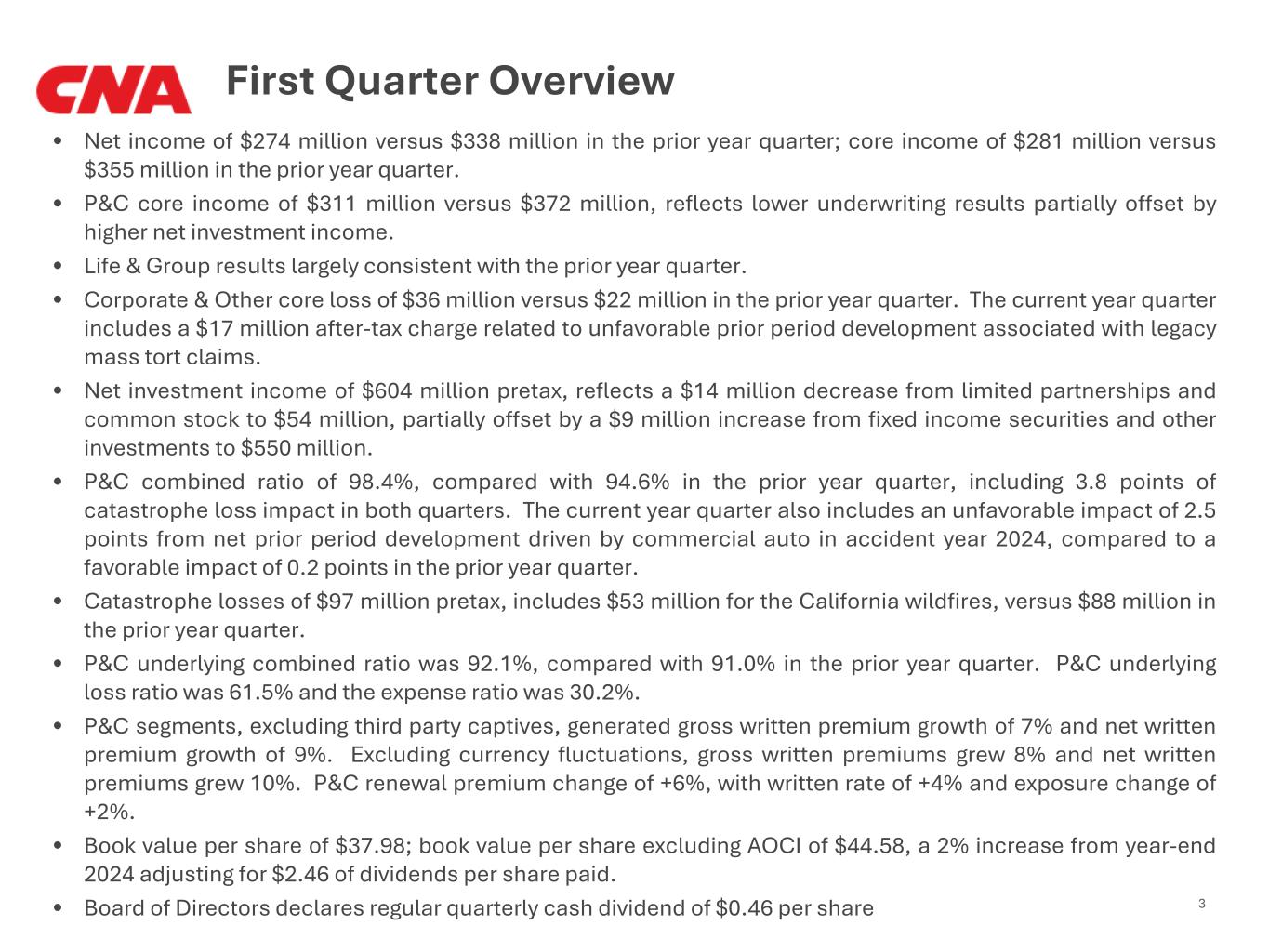
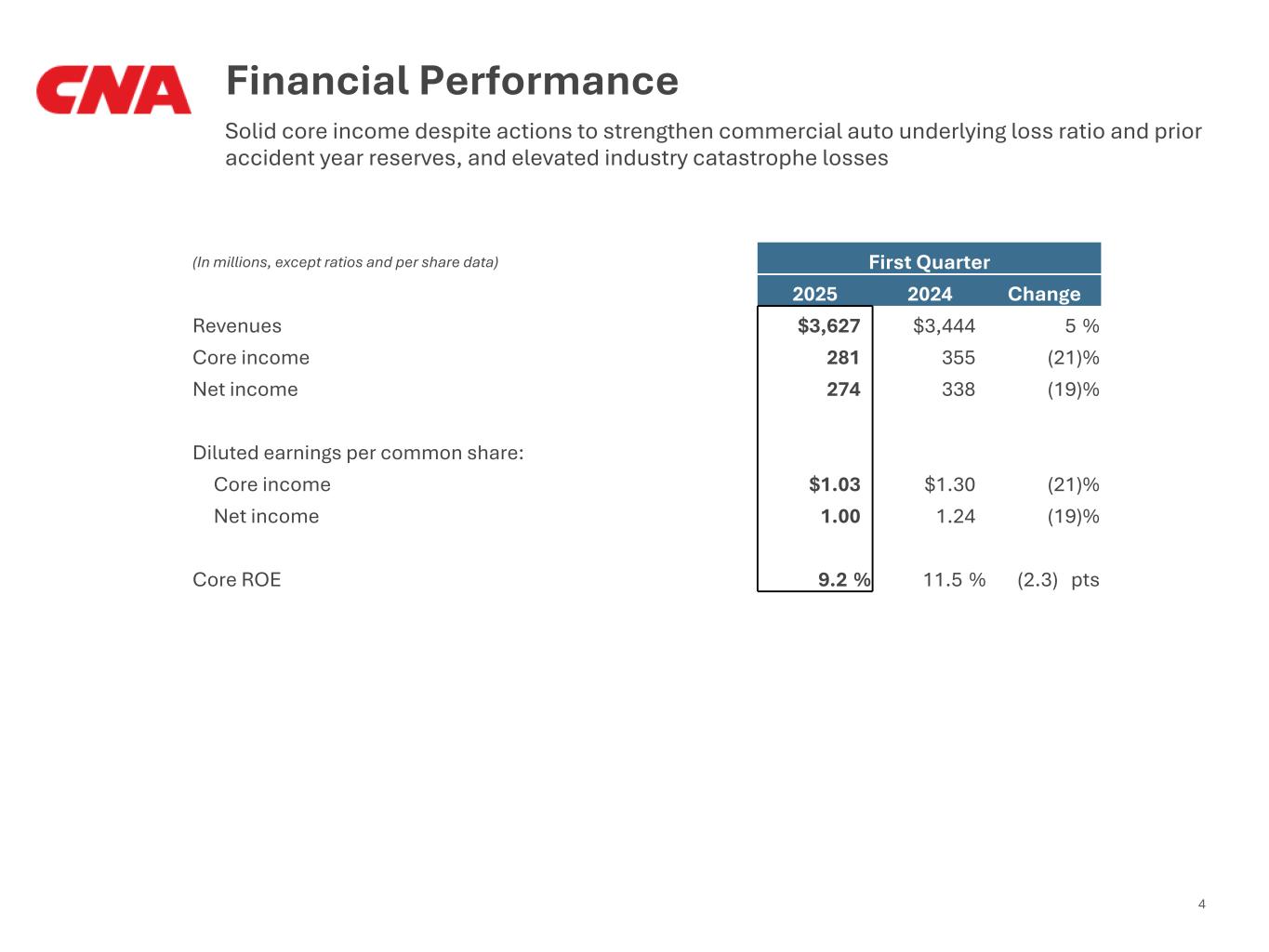
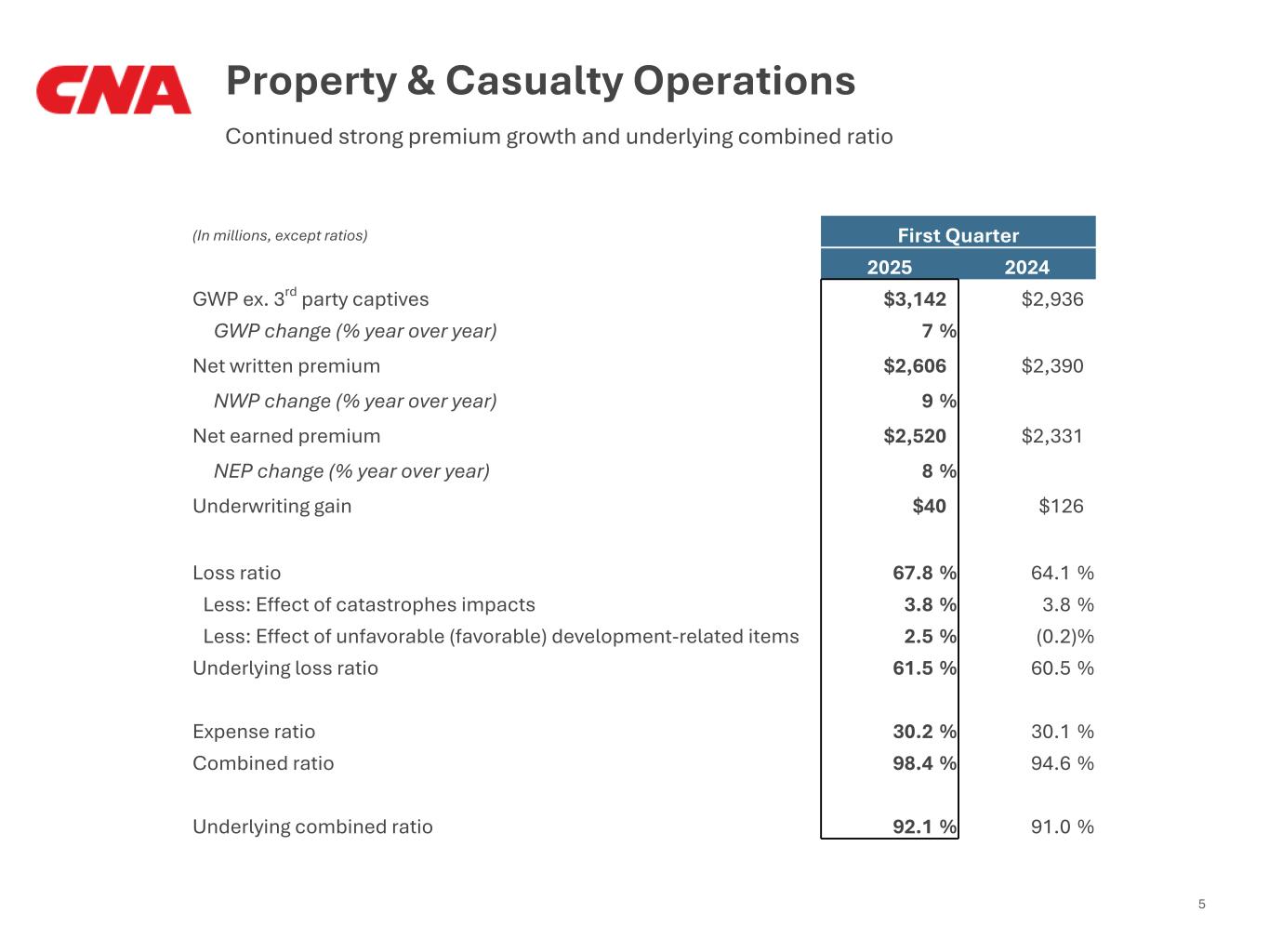
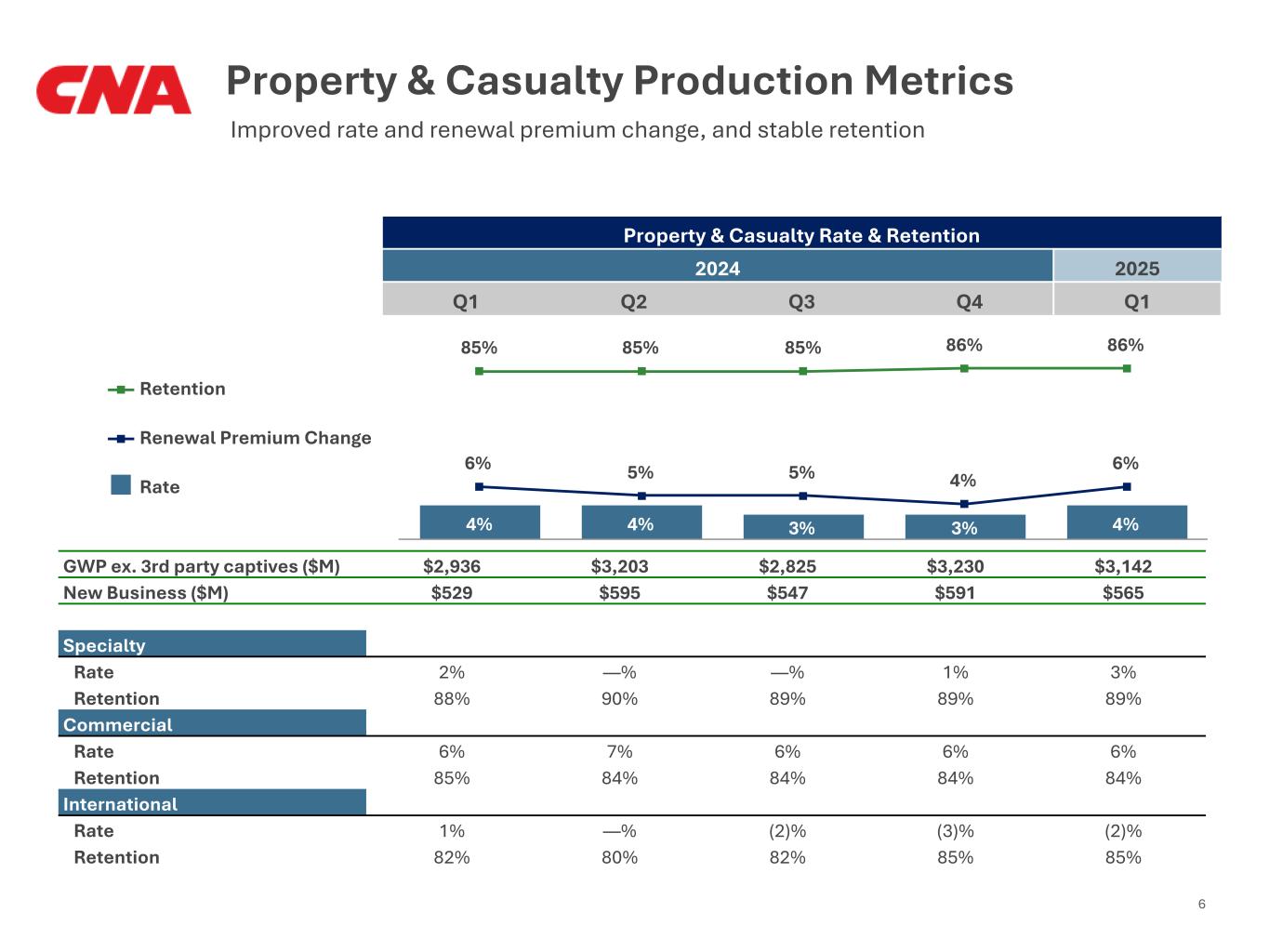
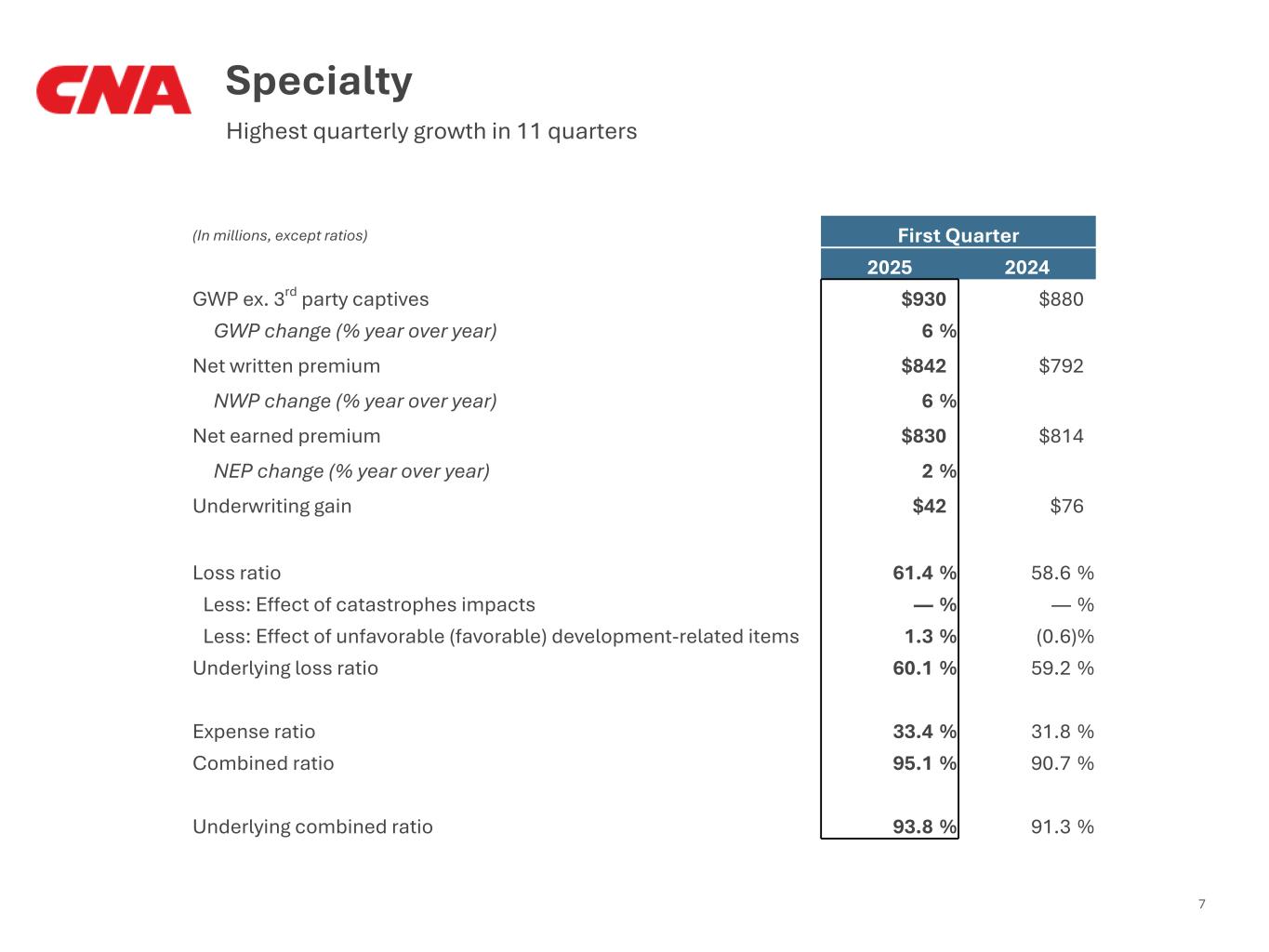
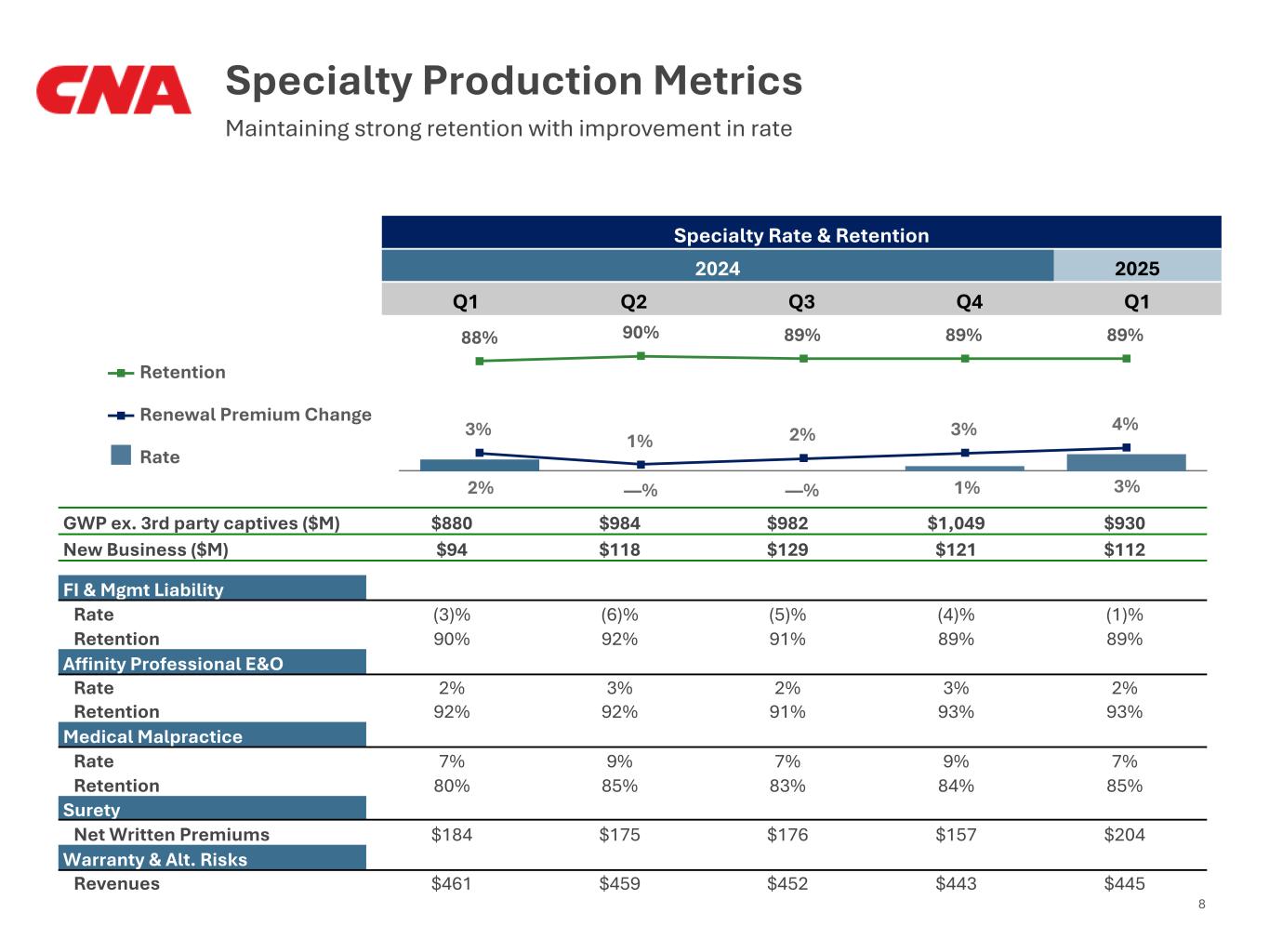
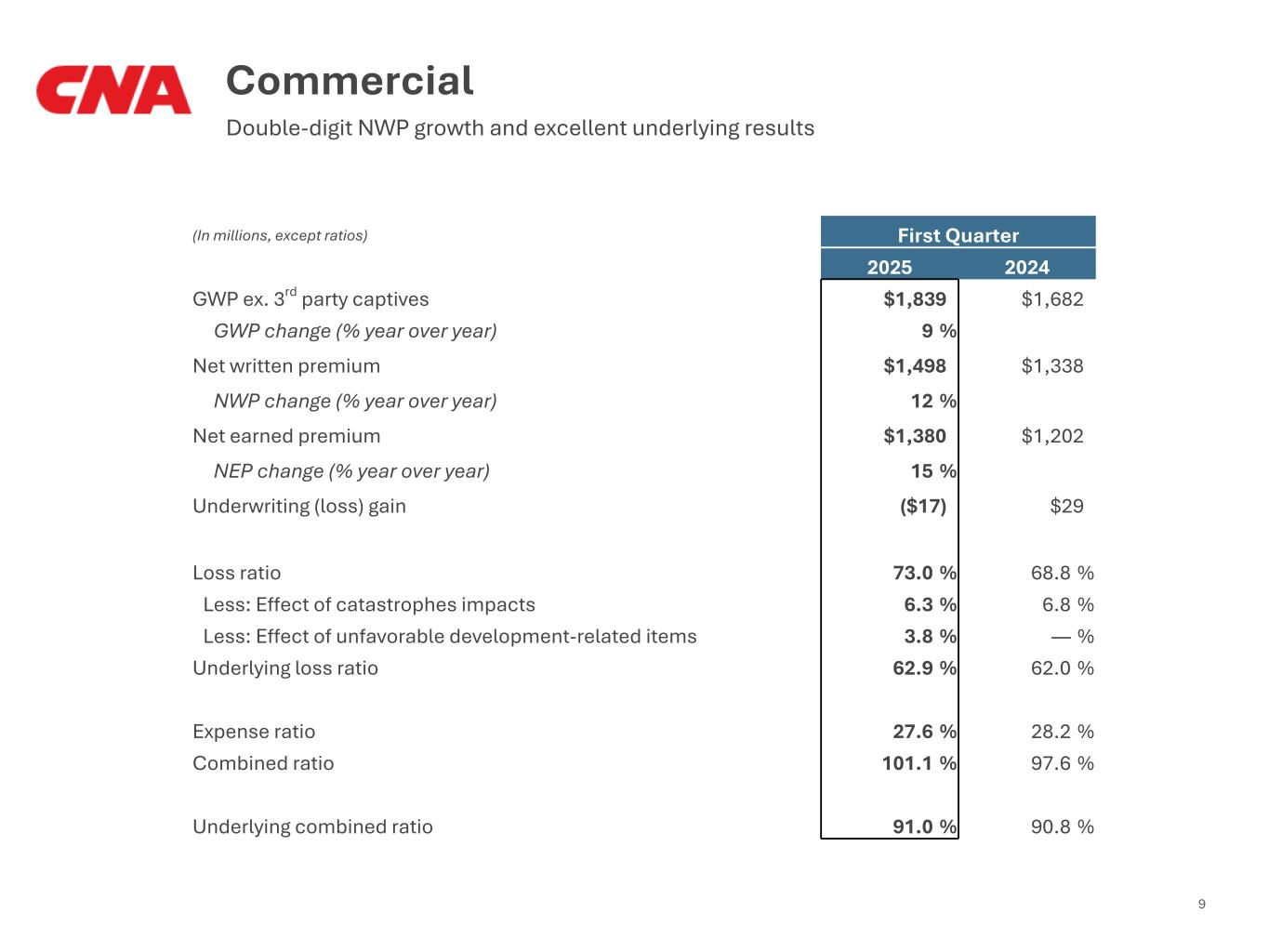
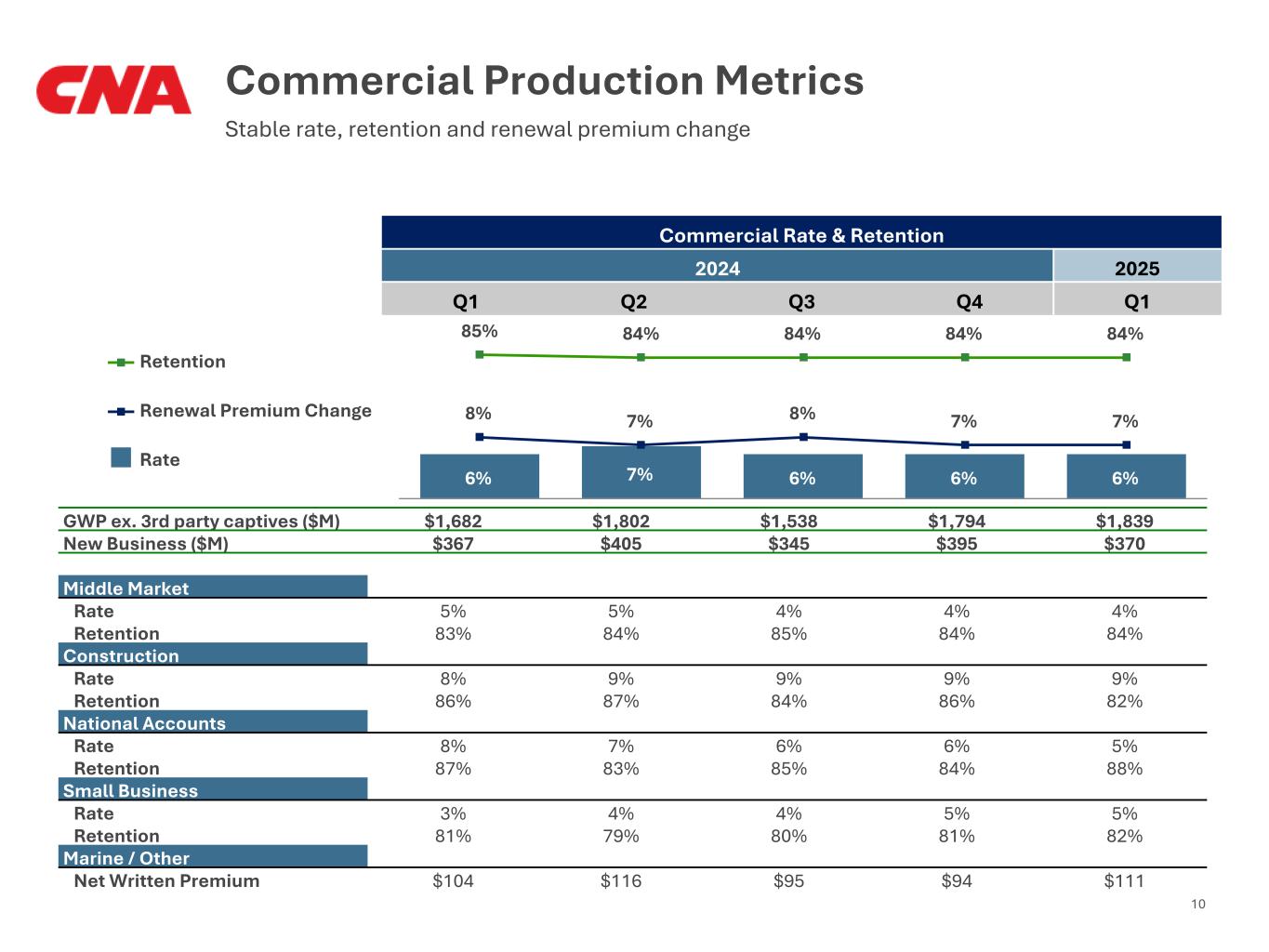
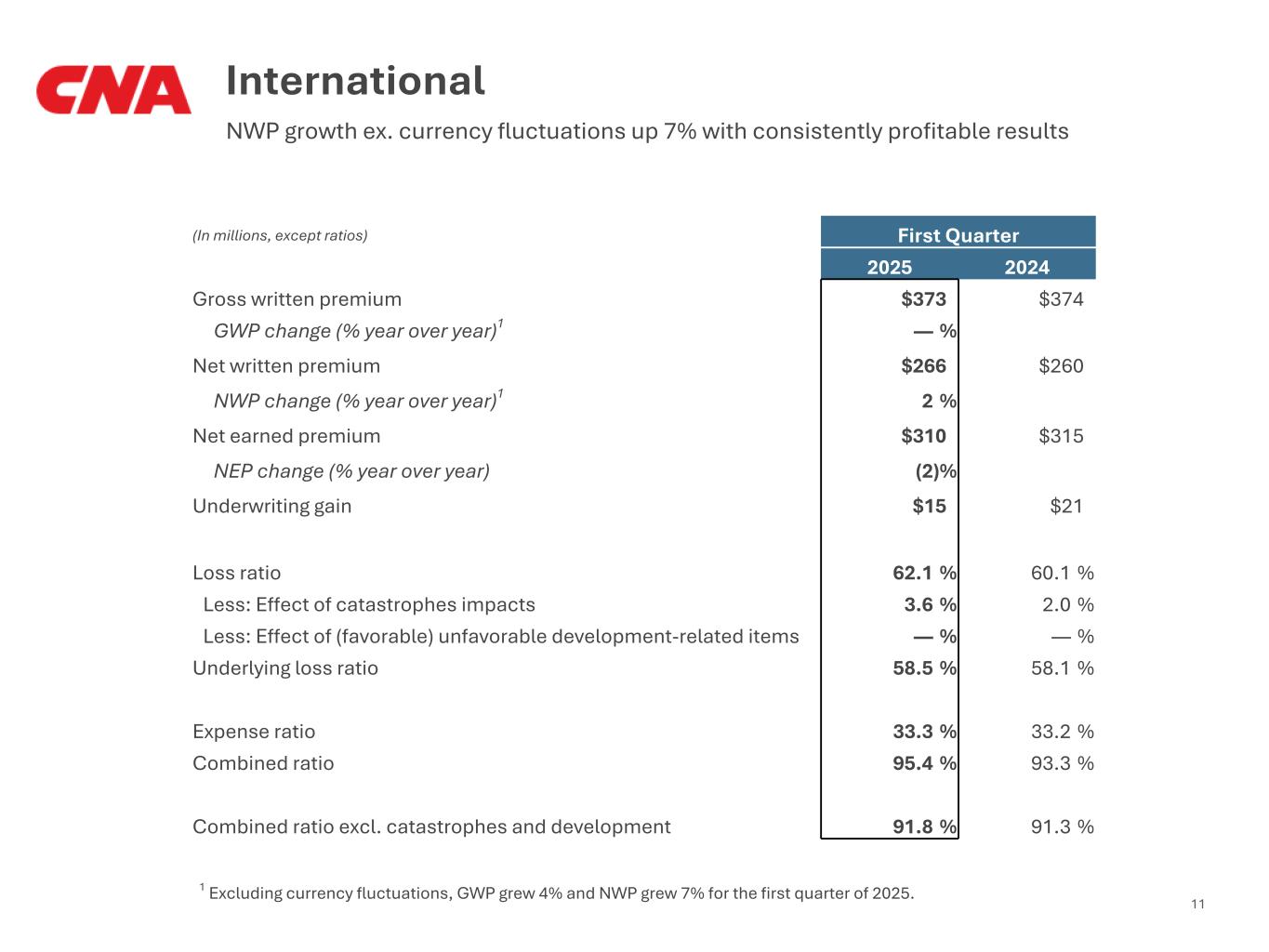
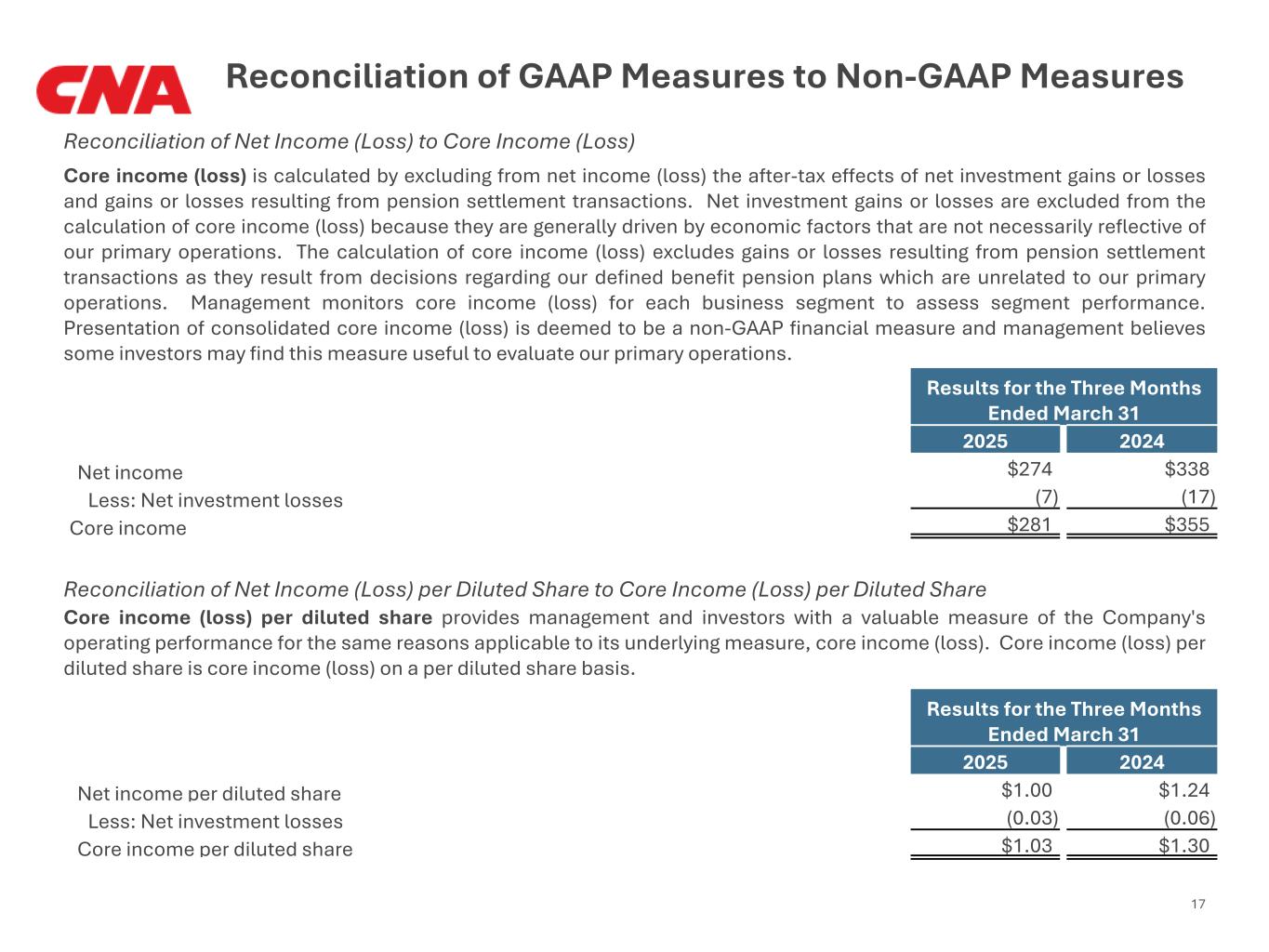
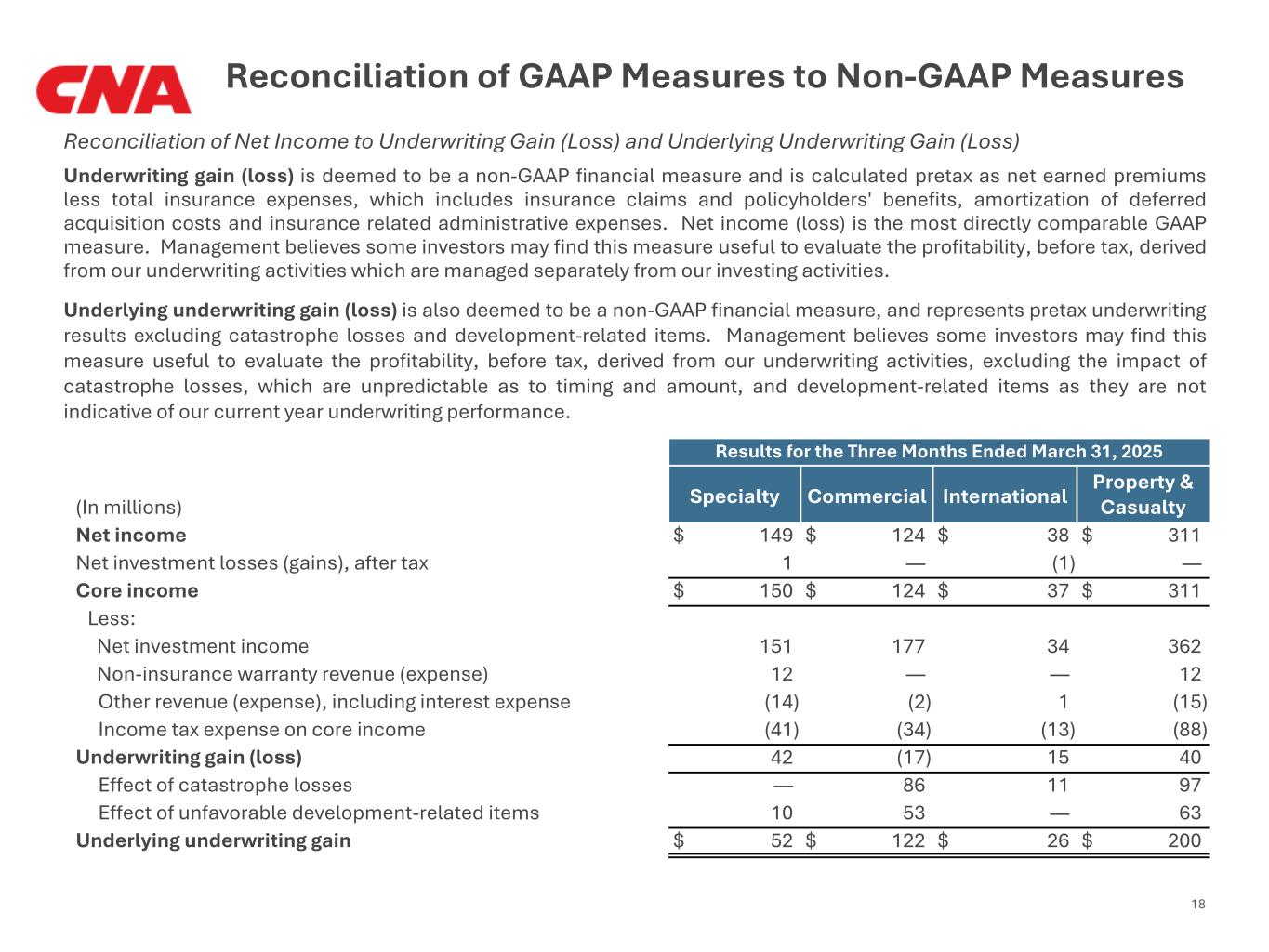
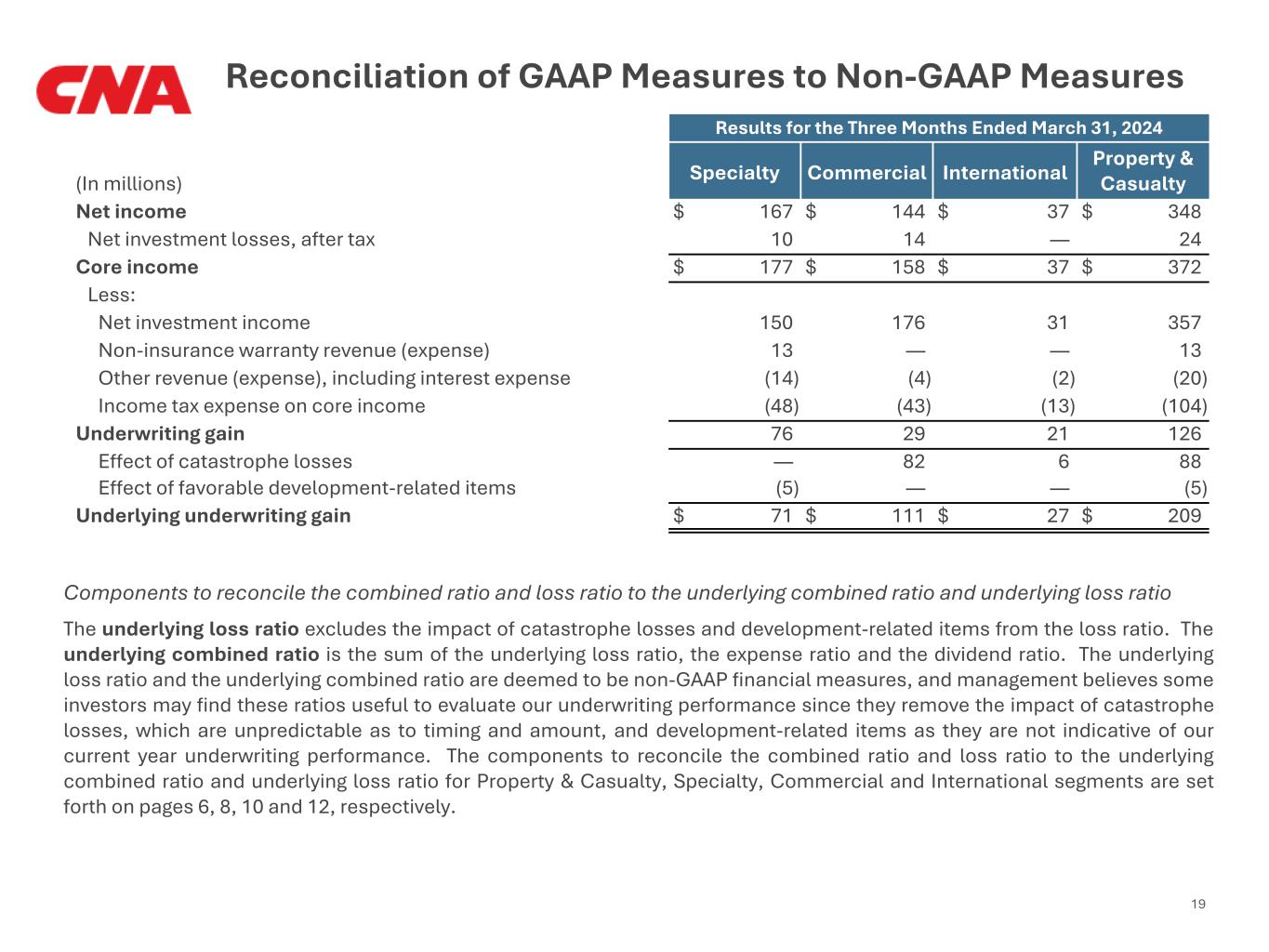
In a quarter characterized by significantly high industry catastrophe losses, we achieved robust core income while also securing an overall underwriting gain. The ongoing strength of our underlying portfolio resulted in our eighth consecutive quarter with a pre-tax underlying underwriting gain of $200 million or more, and we are maintaining strong growth in our top-line. Core income for the quarter reached $281 million, with pretax net investment income of $604 million, consistent with the same quarter last year. Growth in fixed income was offset by lower yet still strong returns in our limited partnership and common stock portfolios. The all-in combined ratio for property and casualty was 98.4% this quarter, which includes $97 million, or 3.8 points, attributed to catastrophe losses. This figure encompasses $53 million for the California wildfires, aligning with our earlier estimate, as well as $44 million for other events, predominantly related to severe storms in March. The prior period development for property and casualty was unfavorable by $63 million, accounting for 2.5 points of the combined ratio, driven by the 2024 accident year in our commercial auto and auto warranty sectors. The underlying combined ratio for property and casualty was 92.1%, with an underlying loss ratio of 61.5% and an expense ratio of 30.2%. Gross written premiums, excluding captives, rose by 7%, or 8% when excluding currency fluctuations. Net written premium growth remained strong at 9% and 10% excluding currency fluctuations. New business increased by 7% in the quarter to $565 million, reflecting positive growth across all three operating segments. The rate increase for the quarter was 4%, up one point from the fourth quarter, while the renewal premium change rose by two points to 6%. In the U.S., which has felt a more substantial impact from social inflation, rates climbed by one point to 5%, the highest in six quarters. This increase was driven by excess casualty rates rising three points compared to the fourth quarter and commercial auto rates increasing by one point. Retention remained robust at 86%, consistent with the fourth quarter even in light of higher rate increases. Focusing on our three operating segments, the combined ratio for Commercial stood at 101.1%. Catastrophe losses of $86 million this quarter contributed an additional 6.3 points to the combined ratio, reflective of the California wildfires and other storm activities during the period. Unfavorable prior period development of $53 million added 3.8 points to the combined ratio, mainly influenced by commercial auto claims and linked to the 2024 accident year in our construction business unit. The underlying combined ratio was 91.0%, up 0.2 points compared to the same quarter last year. The expense ratio improved by 0.6 points to 27.6%. The underlying loss ratio was 62.9%, reflecting a 0.9 point increase over the first quarter of 2024 and a 0.4 point increase compared to the latter half of 2024. We continue to see elevated bodily injury loss cost trends in commercial auto recently, and this higher claim severity has primarily driven both the unfavorable prior year reserve development and the increase in the underlying loss ratio for the Commercial segment, which more than offset improvements in the underlying loss ratio for the rest of the casualty portfolio compared to the previous year’s quarter. In response to these trends, we are advocating for higher rates and achieved an 18% increase in the first quarter. Additionally, we are continuously refining our underwriting guidelines and other terms and conditions across different geographies. While we raised our long-run loss cost trend for commercial auto this quarter, other variations in long-run loss cost trends were noted across our Specialty, Commercial, and International segments. Nonetheless, the overall long-run loss cost trend remains approximately 6.5% across all of CNA's business classes. In Commercial, gross written premiums excluding captives increased by 9% this quarter, with net written premium growth at 12%. New business saw a 1% rise as we wrote less in our national accounts portfolio due to competitive pressures and exercised caution on commercial auto amid the aforementioned challenges in that class. Rate increase registered at 6% during the quarter, with renewal premium change at 7%, both consistent with the fourth quarter. Excluding workers' compensation, the rate increase was 8%, and renewal premium change was 9%. As previously noted, rates for excess casualty rose by three points to 14%, while the aggregate rates for commercial casualty classes went up by one point this quarter, continuing to exceed our higher long-run loss cost trend assumptions. Retention in Commercial remains steady at 84%. In Specialty, the all-in combined ratio was 95.1%. Unfavorable prior period development of $10 million contributed an additional 1.3 points to the combined ratio, primarily driven by auto warranty claims linked to the 2024 accident year. Since the pandemic, vehicle owners have been keeping their vehicles for longer, which has recently led to a higher frequency of warranty claims, coupled with sustained elevated severity levels from replacement part costs and labor rates. We have swiftly addressed this situation by increasing our reserves for the 2024 accident year accordingly. The underlying combined ratio in Specialty was 93.8%, consistent with the fourth quarter. The expense ratio stood at 33.4% with an underlying loss ratio of 60.1%. While the underlying loss ratio was steady compared to last quarter, it was up 0.9 points relative to the first quarter of 2024, for reasons similar to those discussed regarding the latter half of 2024. Although rates improved in financial and management liability lines this quarter, in aggregate they remain negative, and the extended period of rates lagging below mid single-digit long-run loss cost trends suggests margin compression. Consequently, we have proactively adjusted our approach toward current accident year loss ratios instead of waiting to observe longer-term trends. Within Specialty, both gross written premiums and net written premiums, excluding captives, increased by 6% this quarter, marking the strongest quarterly growth in almost three years. New business growth reached 19%, the highest in three years, as we seized opportunities in our affinity business and healthcare portfolios. The rate increase achieved in Specialty was 3% this quarter, reflecting a two-point rise compared to the previous quarter and representing the strongest quarterly increase since 2022. This improvement is largely attributable to rising rate levels in the financial and management liability lines. After several quarters of declines, the rates for public D&O and cyber insurance have turned slightly positive this quarter. Retention in Specialty remains strong and consistent at 89%. For International, the all-in combined ratio was 95.4% this quarter, including $11 million or 3.6 points from catastrophe losses compared to 2.0 points for the same quarter last year. The underlying combined ratio was 91.8%. The expense ratio was 33.3%, and the underlying loss ratio was 58.5%. Gross written premiums were flat for the quarter but increased by 4% when excluding currency fluctuations. Net written premiums saw growth of 2% for the quarter, and 7% excluding currency fluctuations. Despite heavy competition affecting rates, our retention remained robust at 85%, with new business growing by 22%.
Speaker 1
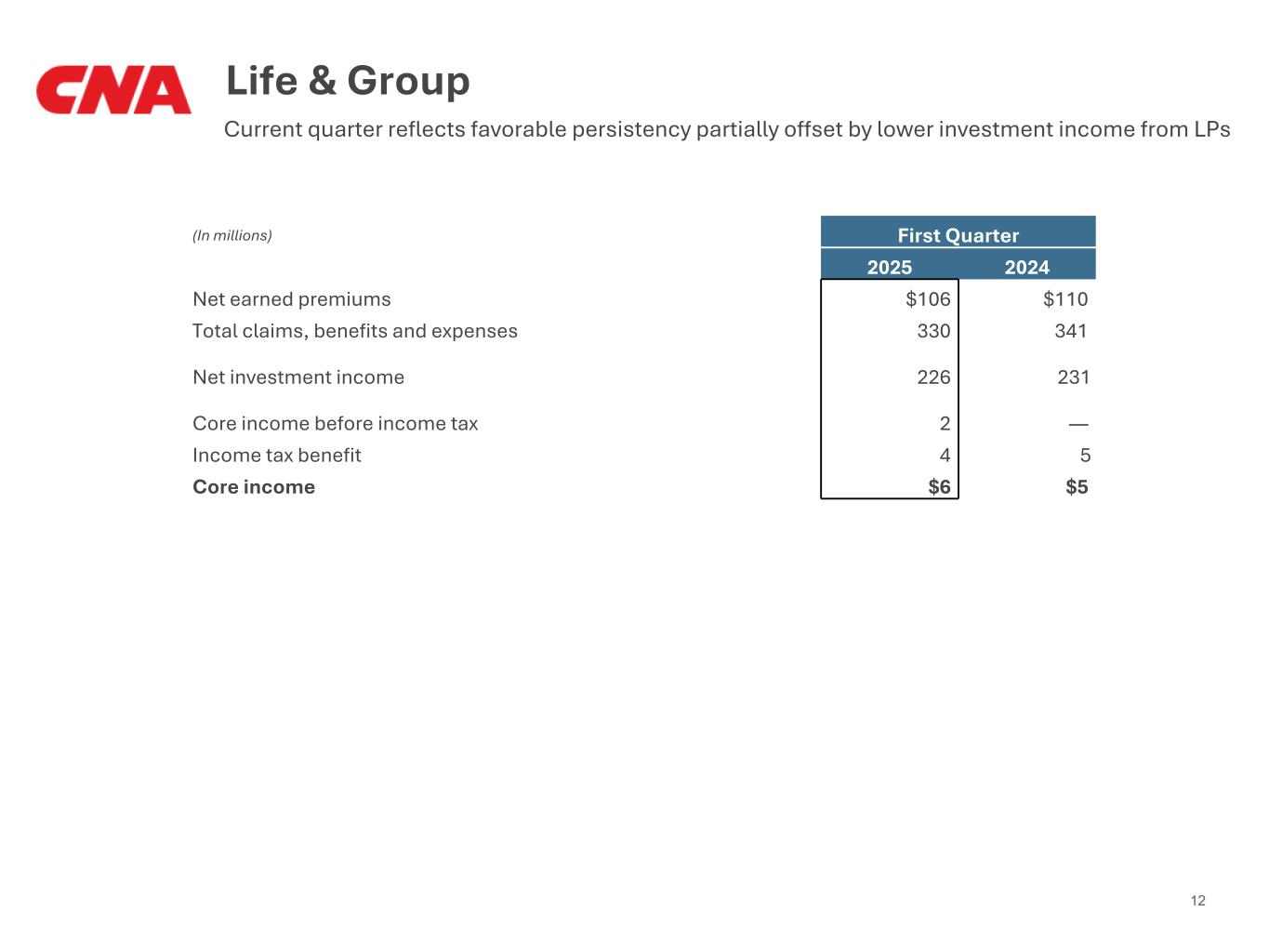
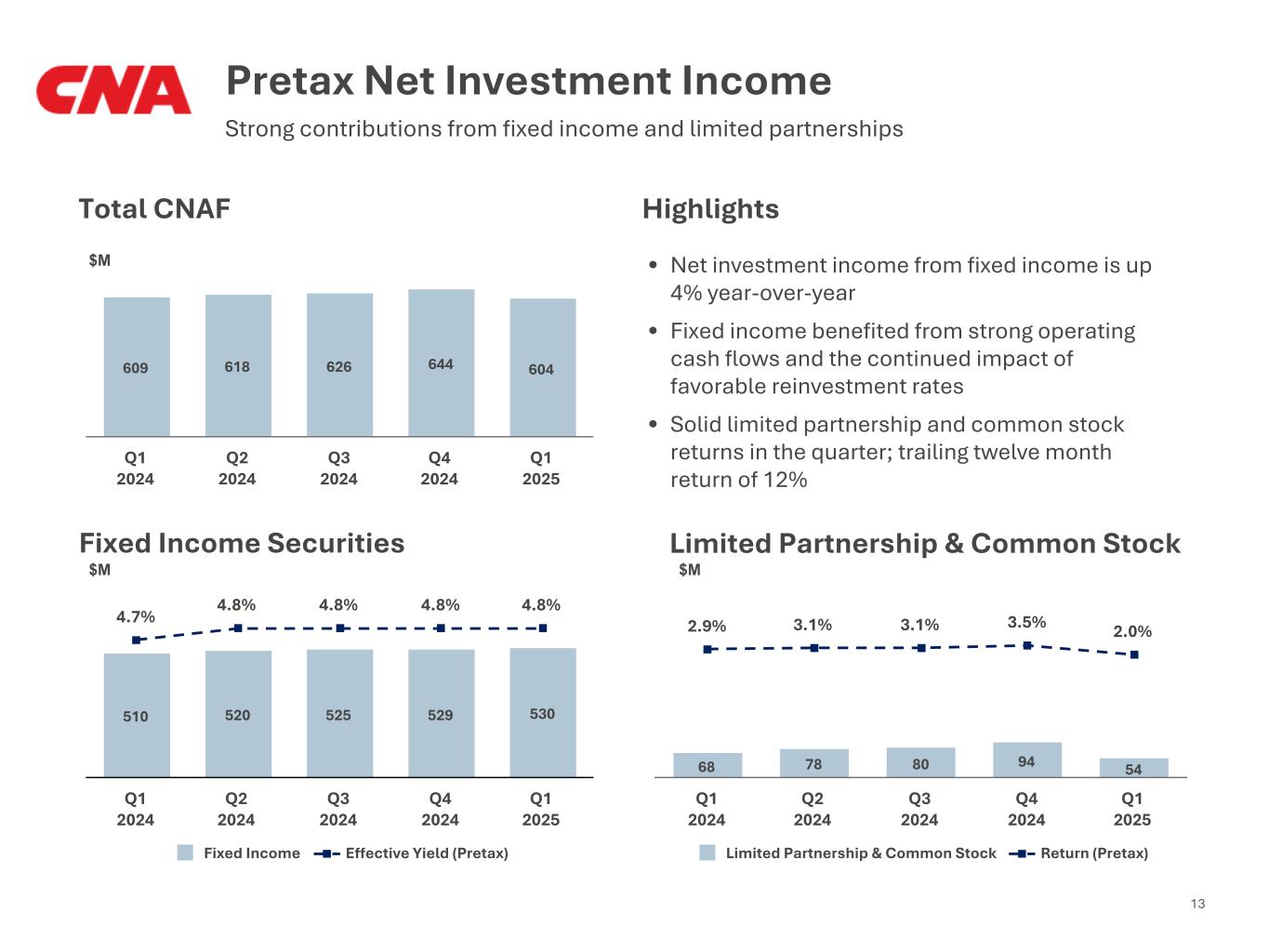
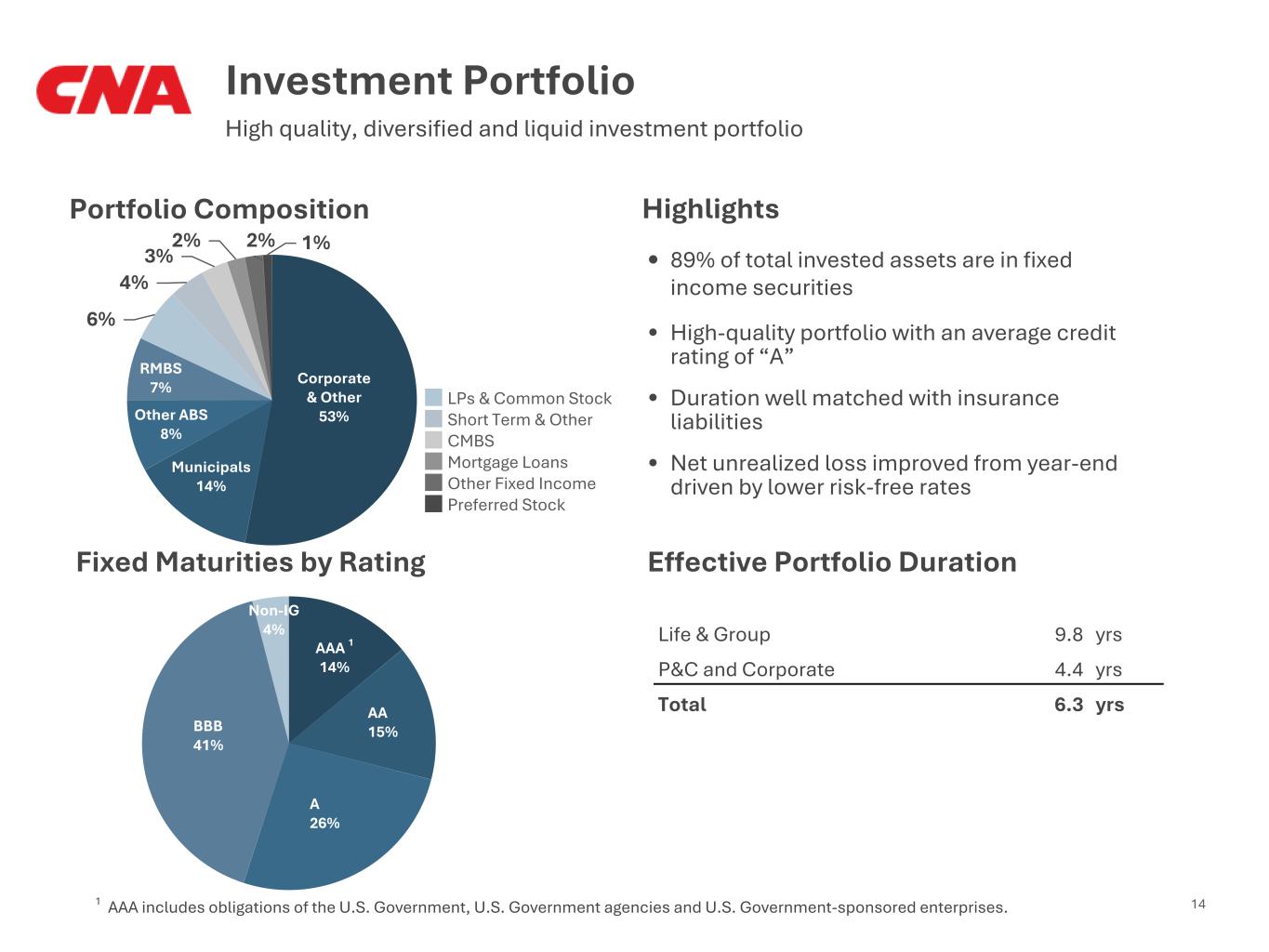
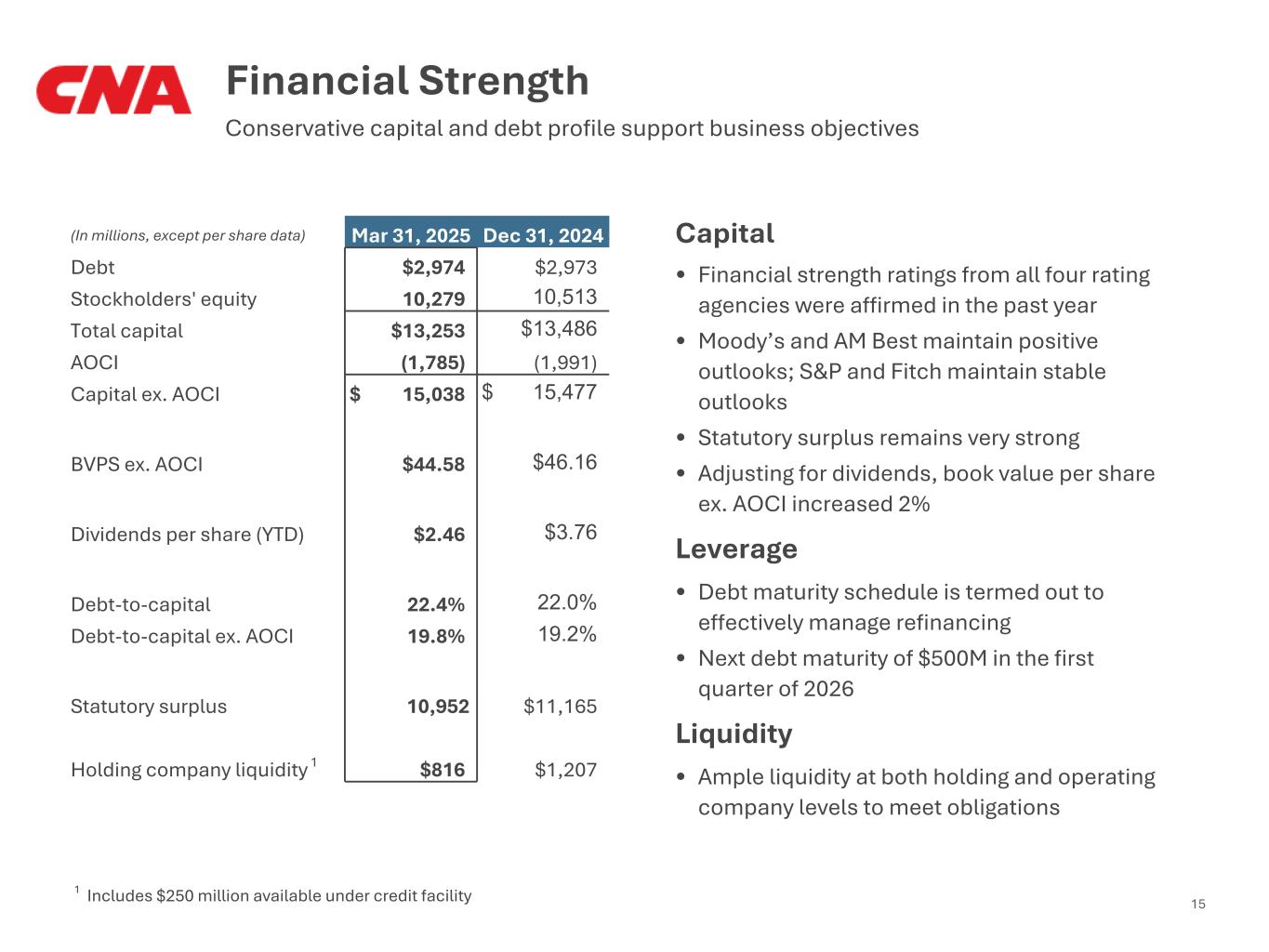
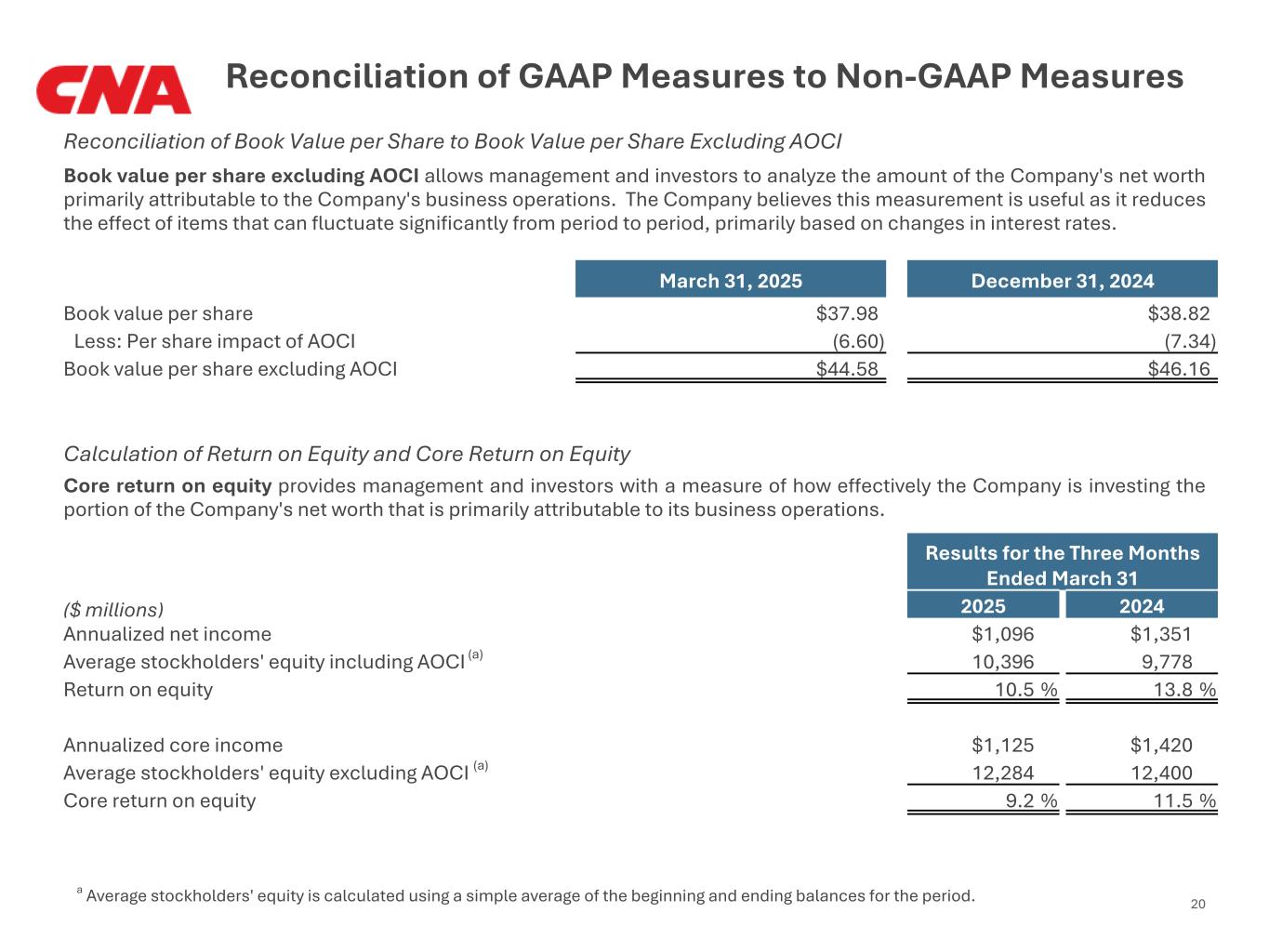
CNA's first quarter core income of $281 million is down 21% compared to the first quarter of last year leading to a trailing twelve-month core return on equity of 10.2%. Our P&C expense ratio for the first quarter was 30.2%, which is about flat with last year. We tend to have a certain amount of variability quarter to quarter in this ratio, but for the full year 2025 we currently expect an expense ratio of about 30.5%. For Life & Group, core income of $6 million for the first quarter is about flat with the prior year quarter, reflecting modestly favorable persistency compared to expectations, offset by $5 million lower investment income, primarily from limited partnership investments. Our Corporate segment produced a core loss of $36 million in the first quarter compared to a $22 million loss in the prior year quarter. The Corporate segment results this quarter include a $17 million after-tax charge related to unfavorable development for legacy mass tort abuse claims. As we have noted in prior quarters, a comprehensive review of legacy mass tort exposures is undertaken in the second quarter of each year, consistent with the recent historical timing of such review. However, we will review and react to developing facts and circumstances in the interim quarters. Net investment income was $604 million in the first quarter compared with $609 million in the prior year quarter. The slight decrease reflects the largely offsetting impacts of lower common stock returns and higher income from fixed income securities as compared to the prior year quarter. Fixed income and other investments generated $550 million of income, up 2% compared to the prior year quarter. Our A-rated fixed income portfolio continues to provide consistent contributions to core income, which have been steadily increasing because of favorable reinvestment rates and strong cash flow from operations. The effective income yield of our consolidated fixed income portfolio was 4.8% in the first quarter, up from 4.7% in the prior year quarter. Reinvestment rates continue to be above our P&C portfolio effective income yield of 4.3% and are slightly above our Life & Group portfolio effective income yield of 5.7%. Other investment income was lower compared to the prior year quarter due to lower interest income on short-term investments and cash. Looking ahead, based on the current interest rate environment we expect income from fixed income and other investments to be about $555 million in the second quarter. For the full year, we expect income from fixed income and other investments to be about $2,225 million, or a 2% increase as compared to the full year 2024. Our limited partnership and common stock portfolio returned a $54 million gain, or 2.0%, in the current quarter compared to a $68 million gain, or 2.9%, in the prior year quarter. The lower return was primarily due to our common stock portfolio results, which were down relative to the prior year quarter and in line with the broader public equity market performance. As a reminder, private equity funds, which represent 85% of our limited partnership portfolio, generally report to us on a quarter lag, so results this quarter were primarily reflective of performance from the fourth quarter of 2024. Given the recent volatility in public equity markets, we believe we may see similar volatility in our limited partnership and common stock portfolio results in the near term. During the quarter we reduced the limited partnership allocation in our Life & Group portfolio by $300 million. These investments were redeployed to our P&C portfolio in exchange for high quality, long duration fixed income securities with attractive yields surpassing our reserving assumptions that will further aid our asset-liability management objectives. At quarter-end, our balance sheet continues to be very solid with stockholders' equity excluding accumulated other comprehensive income (AOCI) of $12.1 billion, or $44.58 per share, an increase of 2% from year-end 2024 adjusting for dividends. Stockholders' equity including AOCI was $10.3 billion or $37.98 per share. With the decline in interest rates during the first quarter, the net unrealized investment loss in our fixed income portfolio decreased to $2.0 billion as of quarter-end. Finally, we ended the quarter with statutory capital and surplus in the combined Continental Casualty Companies of $11.0 billion. Operating cash flow was strong once again at $638 million for the quarter compared to $504 million in the prior year first quarter. The current quarter result reflects lower reinsurance ceded premium payments as compared to the prior year quarter, whereas such ceded premium payments will occur in this year's second quarter. Even after adjusting for the timing of reinsurance payments, operating cash flow was improved from last year's first quarter from growing underwriting and investing cash flows. Turning to taxes, the effective tax rate on core income for the first quarter was 21.4%, which is generally in line with our full year 2025 expectation of 21%. Finally, we are pleased to announce our regular quarterly dividend of $0.46 per share to be paid on June 5, 2025 to shareholders of record on May 19, 2025.
In the quarter we delivered solid core income of $281 million, an overall underwriting gain, strong operating cash flow, and we produced an underlying underwriting gain of $200 million or more for the eighth straight quarter. We achieved all of this despite elevated industry catastrophes and actions taken to strengthen prior year reserves, and to increase the current accident year loss ratio reflective of the current tort environment and pricing levels. We had strong growth in all three operating segments where we continue to see ample opportunities in our target specializations. Our retention remains consistently high even as we achieved a point higher rate increase in the quarter. We are encouraged by the opportunities to continue to grow profitably in 2025.
Operator
We invite shareholders and analysts to submit questions for management in advance of each quarter's earnings release. Below we address some questions we have received as well as some timely and topical focus areas for CNA and our industry.
Speaker 3
Did you perform a reserve review on workers' compensation this quarter?
Operator
In general, we review each line of business twice per year, though we will take action if we see activity that differs from our expectations on the off-cycle quarters that we feel we need to react to. This quarter, we did not review workers' compensation. Workers' compensation is scheduled to be reviewed in the second and fourth quarters of 2025 along with several other classes of business. The $1 million of unfavorable development we reported in workers' compensation this quarter was associated with small changes in the tabular discount.
Speaker 3
Can you comment on the potential impact of tariffs on your business?
Operator
The U.S. tariff policy dynamics are creating significant macroeconomic uncertainty. The most immediate effect we expect from increased tariffs is higher loss costs in areas significantly affected by cost of goods sold inflation, such as commercial property and auto physical damage. The extent of this impact will depend on the mix of claims costs related to labor and materials. We also anticipate some offsetting effects; for instance, we expect property valuations to rise in response, similar to trends observed during previous periods of higher economic inflation. We believe we are well-equipped to manage the forthcoming impacts related to tariffs.
Speaker 3
Can you provide more color on what you are seeing in commercial auto in your construction book?
Operator
The commercial auto business within construction is comprised of heavier vehicles that generate a higher proportion of the types of bodily injury claims that have been particularly susceptible to the effects of social inflation in recent periods, resulting in elevated loss cost trends.