Operator
good morning ladies and gentlemen and welcome to the core natural resources inc fourth quarter 2025 earnings call at this time all lines are in a listen only mode following the presentation we will conduct a question and answer session if at any time during this call you require immediate assistance please press star zero for the operator this call is being recorded on thursday february 12, 2026. I would now like to turn the call over to Dex Sloan.
Operator
Please go ahead.
Good morning from Cannonsburg, Pennsylvania, everyone, and thanks for joining us today. Before we begin, let me remind you that certain statements made during this call, including statements relating to our expected future business and financial performance, may be considered forward-looking statements according to the Private Securities Litigation Reform Act. Forward-looking statements by their nature address matters that are, to different degrees, uncertain. These uncertainties, which are described in more detail in the annual and quarterly reports that we file with the SEC, may cause our actual future results to be materially different than those expressed in our forward-looking statements. We do not undertake to update our forward-looking statements, whether as a result of new information, future events, or otherwise, except as may be required by law. I'd also like to remind you that you can find a reconciliation of the non-GAAP financial measures that we plan to discuss this morning at the end of our press release, a copy of which we have posted in the investor section of our website at corenaturalresources.com. Also participating on this morning's call will be Jimmy Brock, our chairman and CEO, Matesh Dakar, our president and CFO, and Bob Braithwaite, our senior vice president of marketing and sales. After some formal remarks from Jimmy and Mitesh, we will be happy to take questions. With that, I'll now turn the call over to Jimmy. Jimmy.
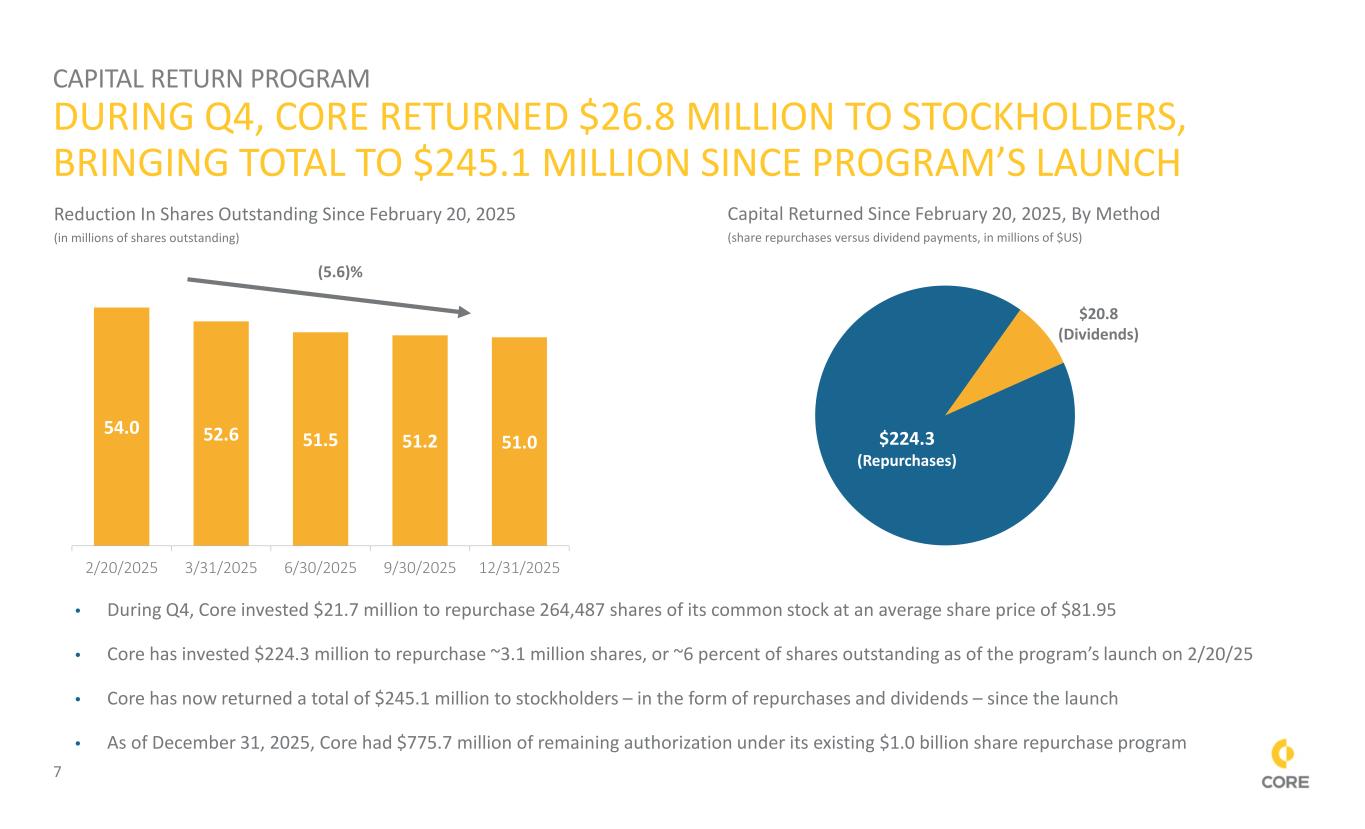
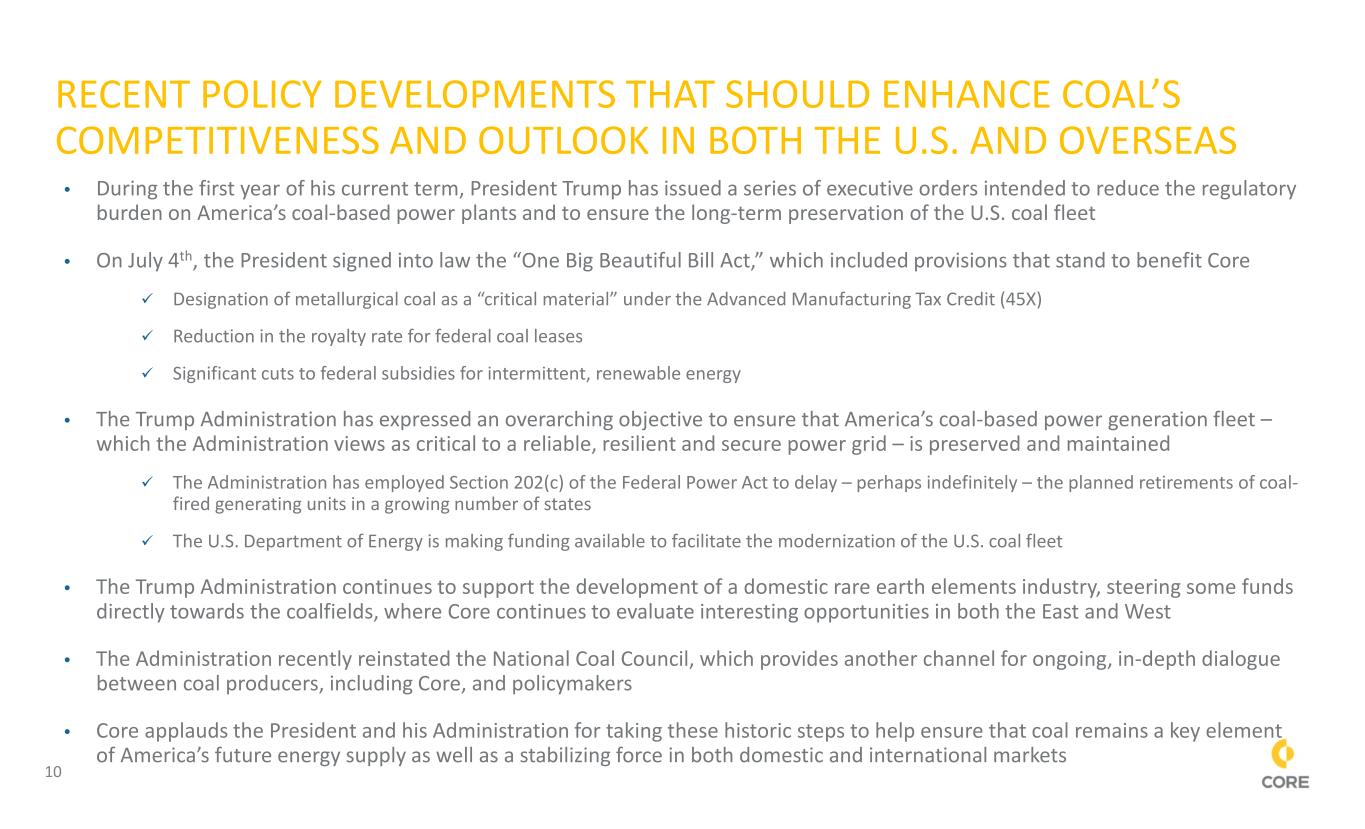
Thank you, Dick, and good morning, everyone. 2025 was a momentous year at Core Natural Resources. On January 14th, we completed the transformational merger that formed Core and immediately turned our full focus on establishing a strong and fully integrated platform for long-term growth and success above all we directed our attention to three priorities capturing the tremendous value-driving synergies created by the combination laying the foundation for operational excellence across our three major operating segments and establishing a unified safety driven culture I'm pleased to report that we have made significant progress on all fronts the integration process is nearly complete we are operating as a single cohesive unit and we have set the stage for a step change in our operational execution in short here at the outset of our second year as a combined company I am confident that we are now ready to deliver on course potential now let me spend a few minutes on two key developments that are pivotal to our dramatically improved 2026 operational outlook. The first of these developments is the resumption of longwall mining at Lear South. As you know, Lear South experienced a combustion event early in 2025, an event that prevented the longwall from operating for nearly the entire year and resulted in approximately $100 million in fire suppression and idling cost i'm pleased to report that since restarting the wall in mid-december lear south has returned to normal operations during the first month of the year the mine achieved its production target and we are now focused on achieving even stronger execution going forward as anticipated mining conditions in the current district are highly favorable and i fully expect Lear South to begin to showcase its status as a premier world-class longwall mine. The second development of note is the completion of the transition to the B seam at West Elk. If you recall, in recent years, West Elk had been mining in the last remaining panels of the E seam where mining conditions were suboptimal. In 2025, we began transitioning to the B seam where conditions are significantly more advantageous and experienced a slower than expected startup in that new seam as we addressed elevated methane levels and an influx of water. As of December, these issues are behind us and West Elk has began running at very high productivity levels. The conditions in the B-seam are exactly as advertised, and we are expecting a very strong operational performance in 2026. Our focus now is expanding the customer base for this high-quality coal, given the step-up in the mine's production capabilities. Despite the just-discussed operational challenges and soft-market environment, CORE still displayed some of the value-driving attributes that makes the company's outlook so compelling. As you will recall, in February, the CORE board deployed a capital return framework targeting the return of approximately 75% of free cash flow, with a significant majority of that return directed to share repurchases. complemented by sustaining quarterly dividend of 10 cents per share. During 2025, Core returned a total of $245 million to stockholders via this program, which constituted nearly 100% of free cash flow generation. Roughly 224 million of that total was directed to share repurchases, an effort that resulted in the buyback of around 6% of the company's shares outstanding. Again, given the headwinds we have already discussed, that's an impressive achievement and underscores CORE's great cash-generating potential, even in less than ideal circumstances. Needless to say, we believe there is great upside for even more substantial returns now the operating platform is at full sprint and given the recent signs of strengthening market environment. Now, I'd like to discuss some of the many highlights on the public policy front. where the Trump administration continues to champion coal as a baseload fuel and critical mineral. The One Big Beautiful Bill Act, which was signed in July, contained numerous provisions supporting coal's critical role in the U.S. energy equation and seeking to ensure the long-term health of the coal industry. Among those provisions, the new law established a production tax credit for coal that is suitable for use in the production of steel. markedly reduced the royalty rates for federally leased coal and eliminated some of the financial support for intermittent resources that have done little to fortify America's need for 24 7 base load pair in addition to the one big beautiful bill the Trump administration has employed section 202 C of the federal power act to delay perhaps indefinitely the planned retirements of coal-fired generation units in a growing number of states including Michigan Colorado Indiana and Washington given the upsurge in power demand precipitated by the AI data center build-out we view the administration's effort on this front as far-sighted and prudent the Trump administration also launched a comprehensive effort to address the slew of regulations put in place by the previous administrations in an effort to force the closure of coal-fired plants. In addition, the U.S. Department of Energy is making funding available to facilitate the modernization of the U.S. coal fleet to ensure that coal plays a center, stabilizing role in the U.S. power markets for a long time into the future. We're hopeful that the current transfer funding is the first to many additionally we're also enthusiastic about the administration's effort to support the development of a domestic rare earth elements industry with some federal funding directed toward opportunities in the coal fields we continue to monitor how such programs can apply to court finally the administration recently reinstated the National Coal Council which provides another channel for ongoing in-depth dialogue between coal producers including core and policymakers I am serving as vice chair of the council and plan to devote significant time and attention to this important role going forward now let me turn the call over to my test to provide the marketing and financial updates thank you Jimmy and good morning everyone let me start by providing an update on our financial performance.
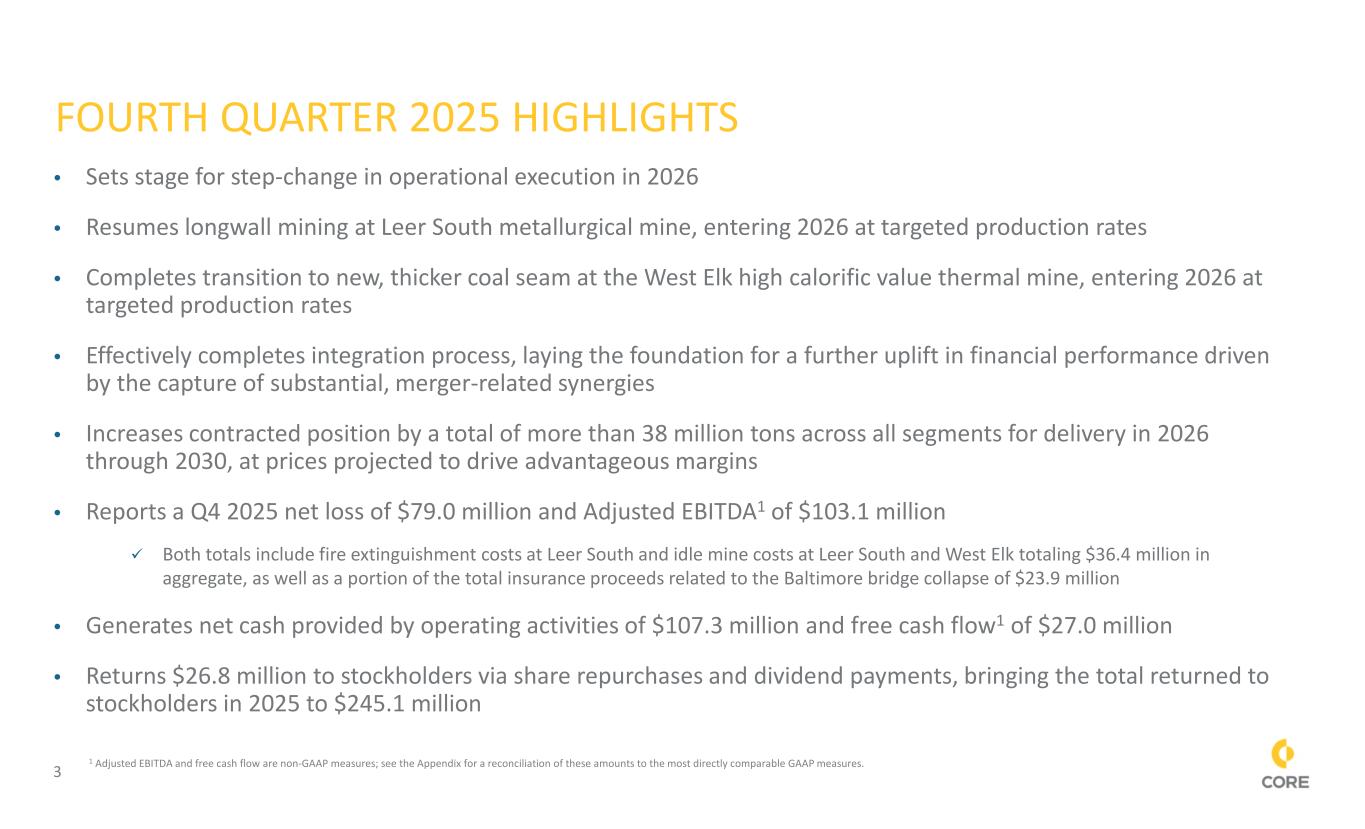
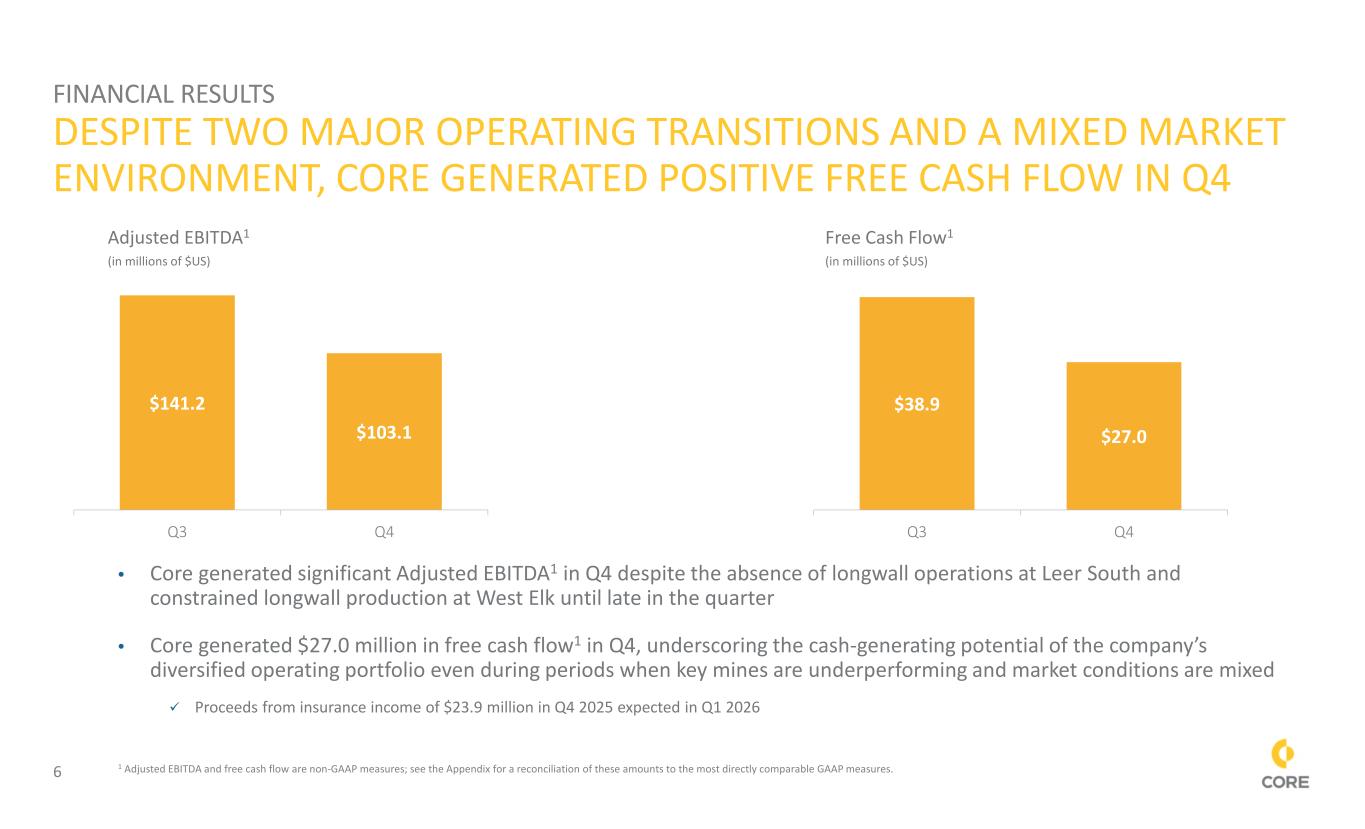
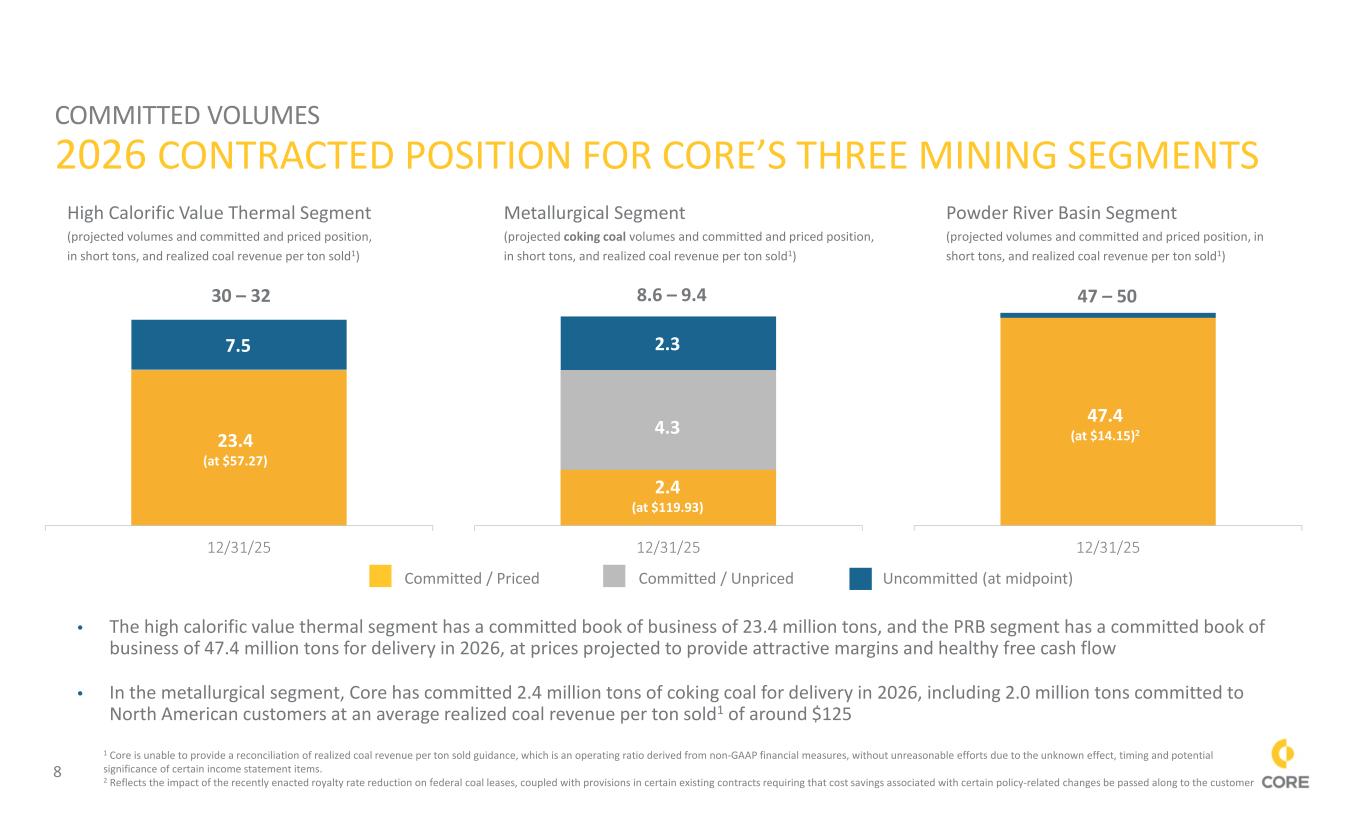
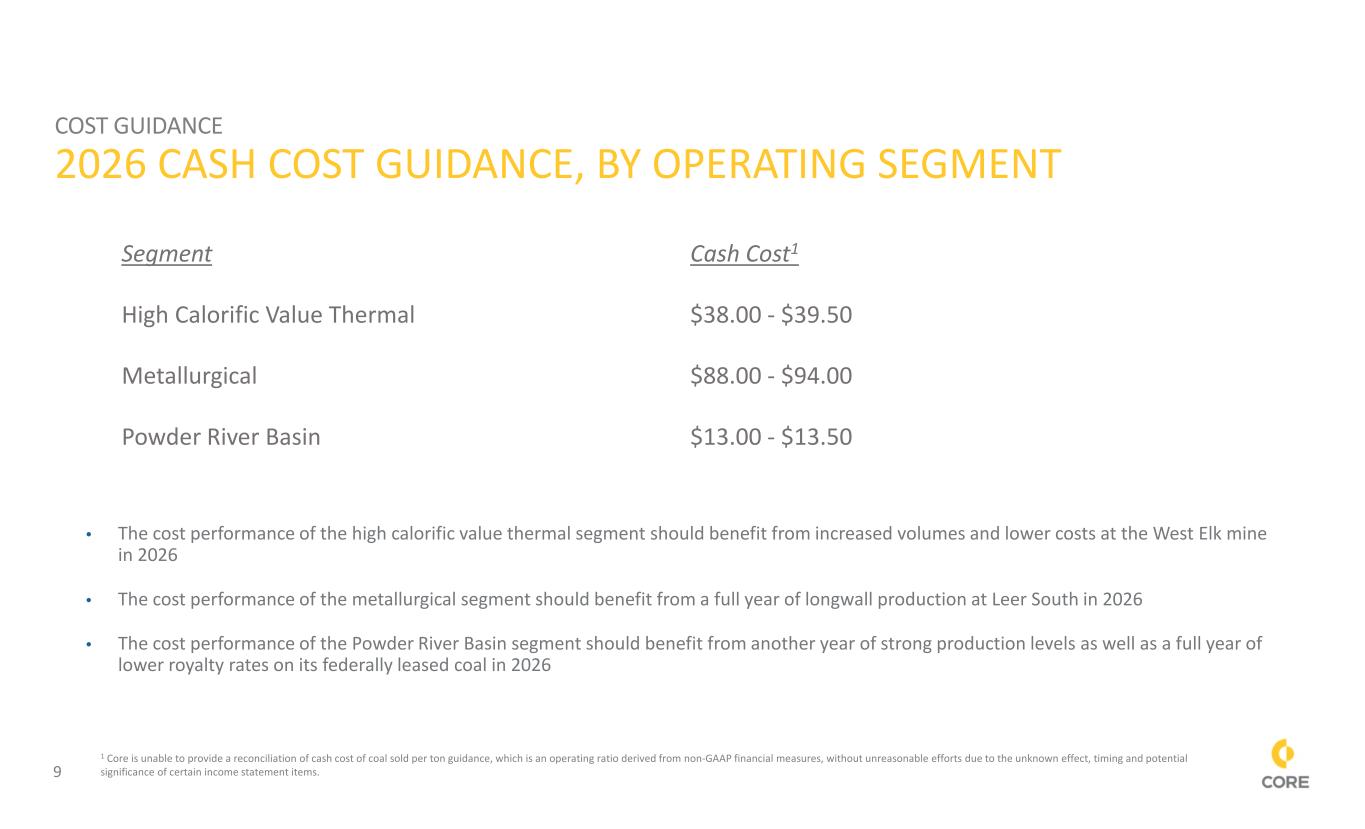
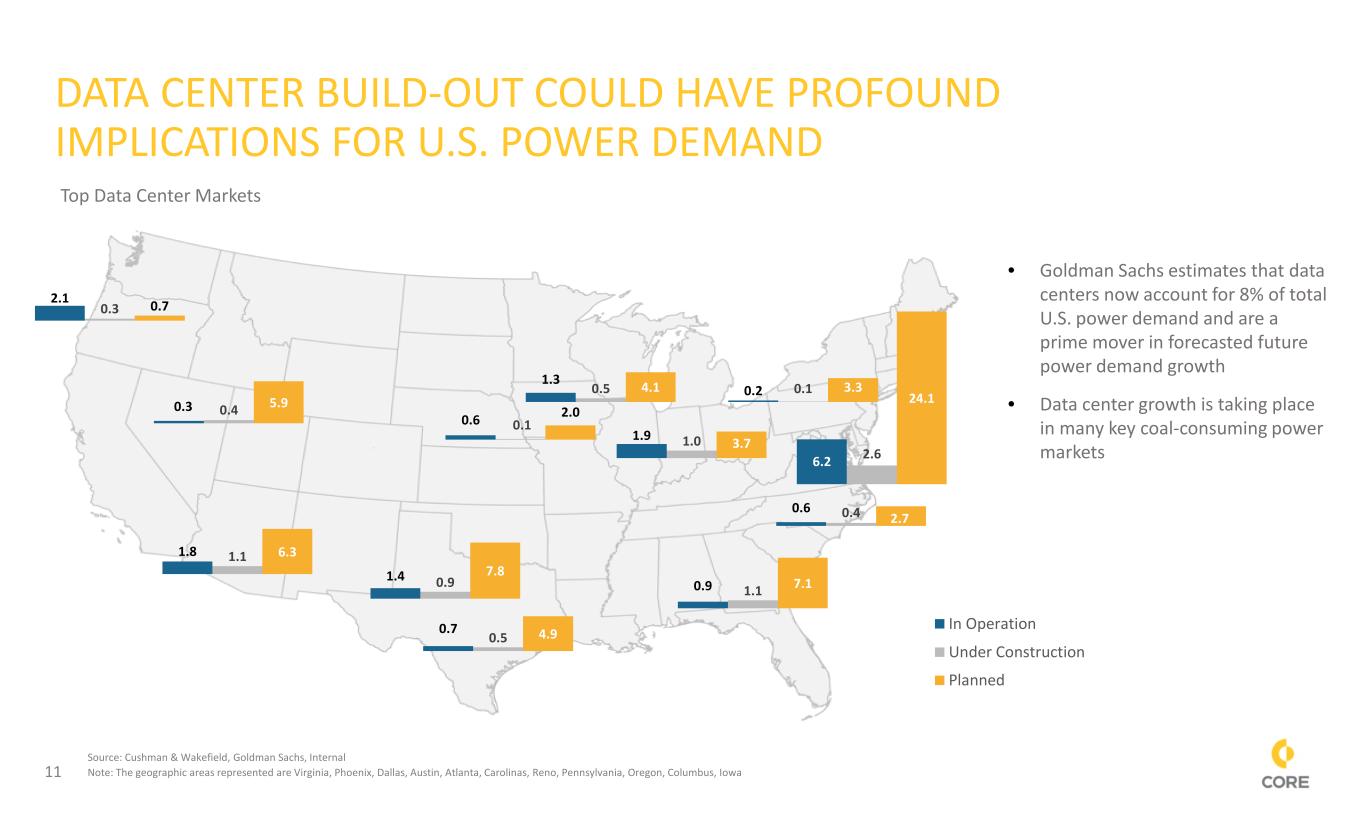
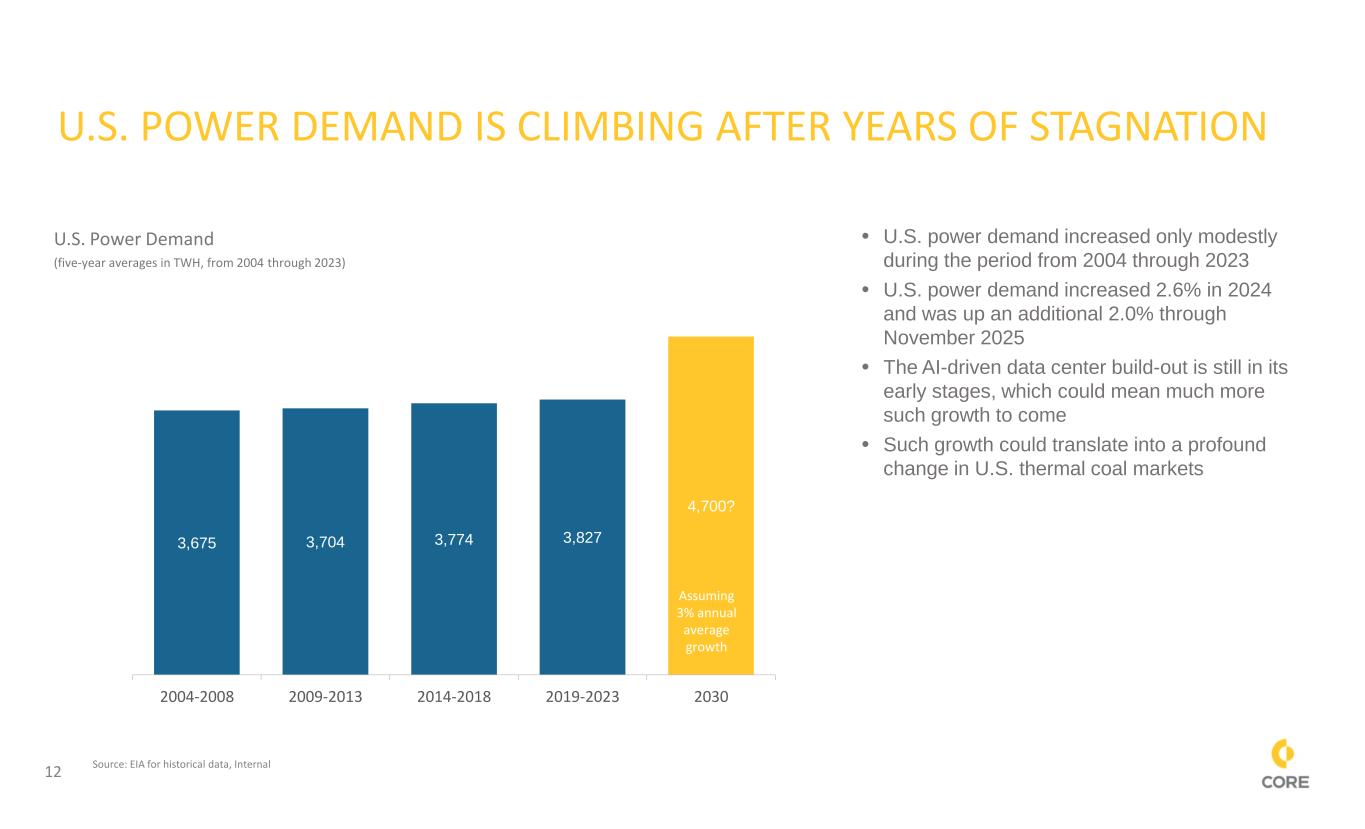
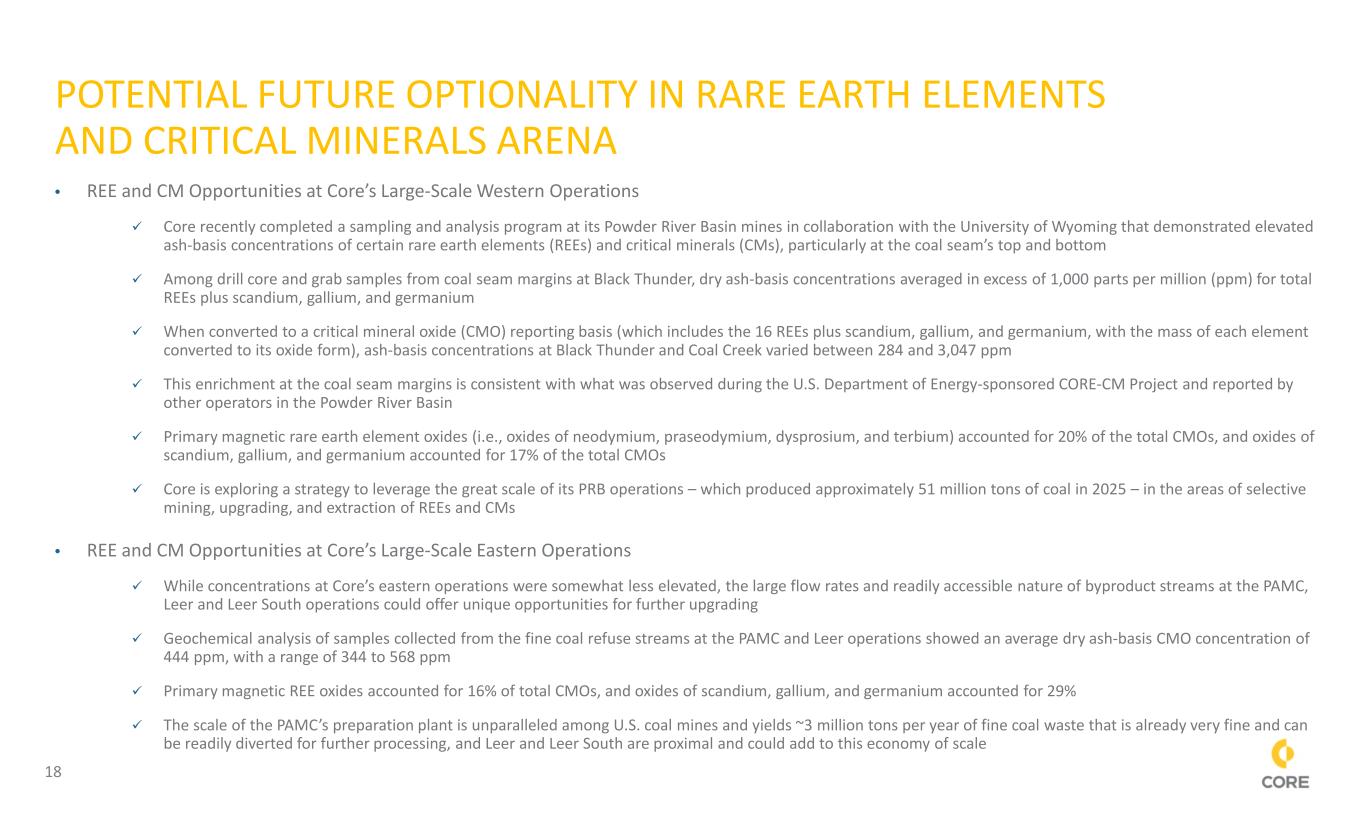
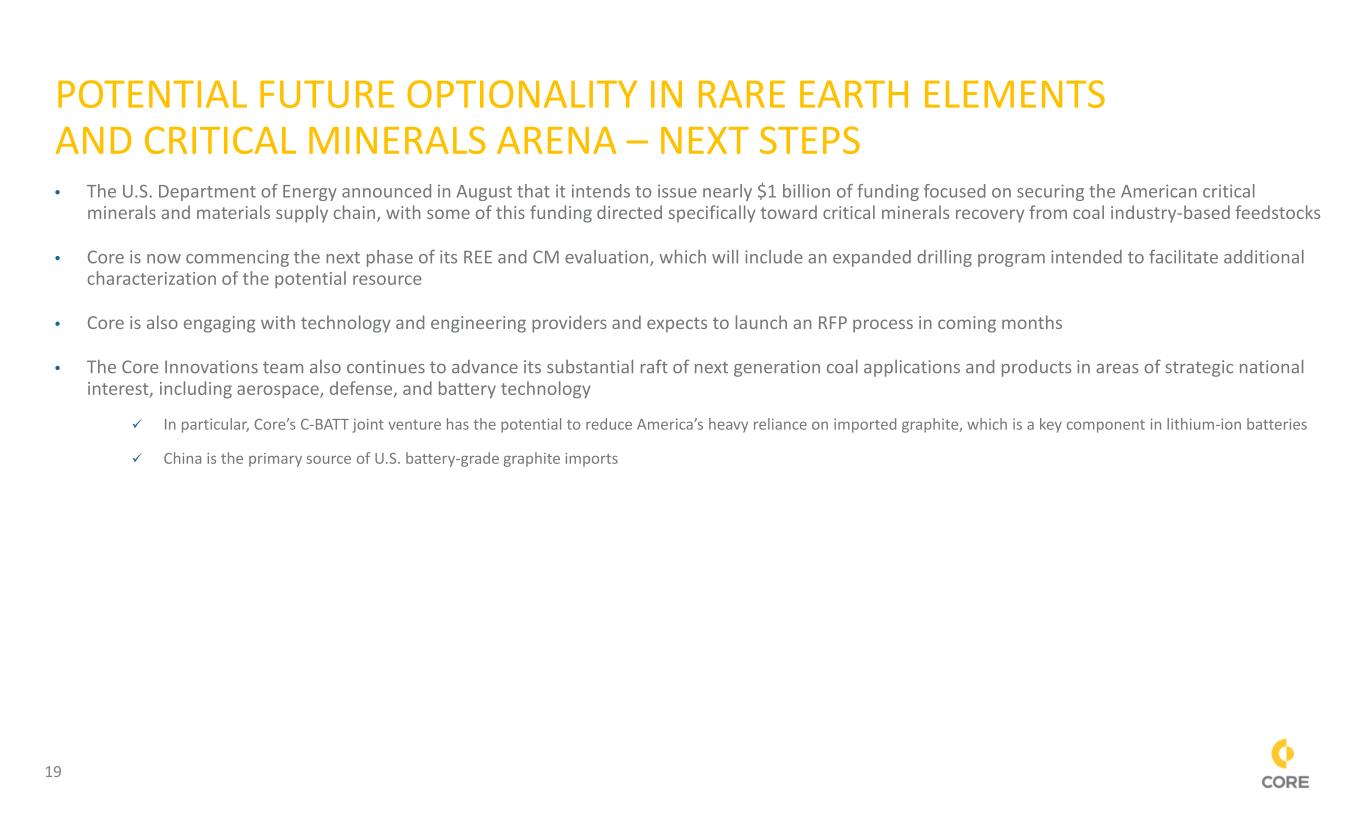
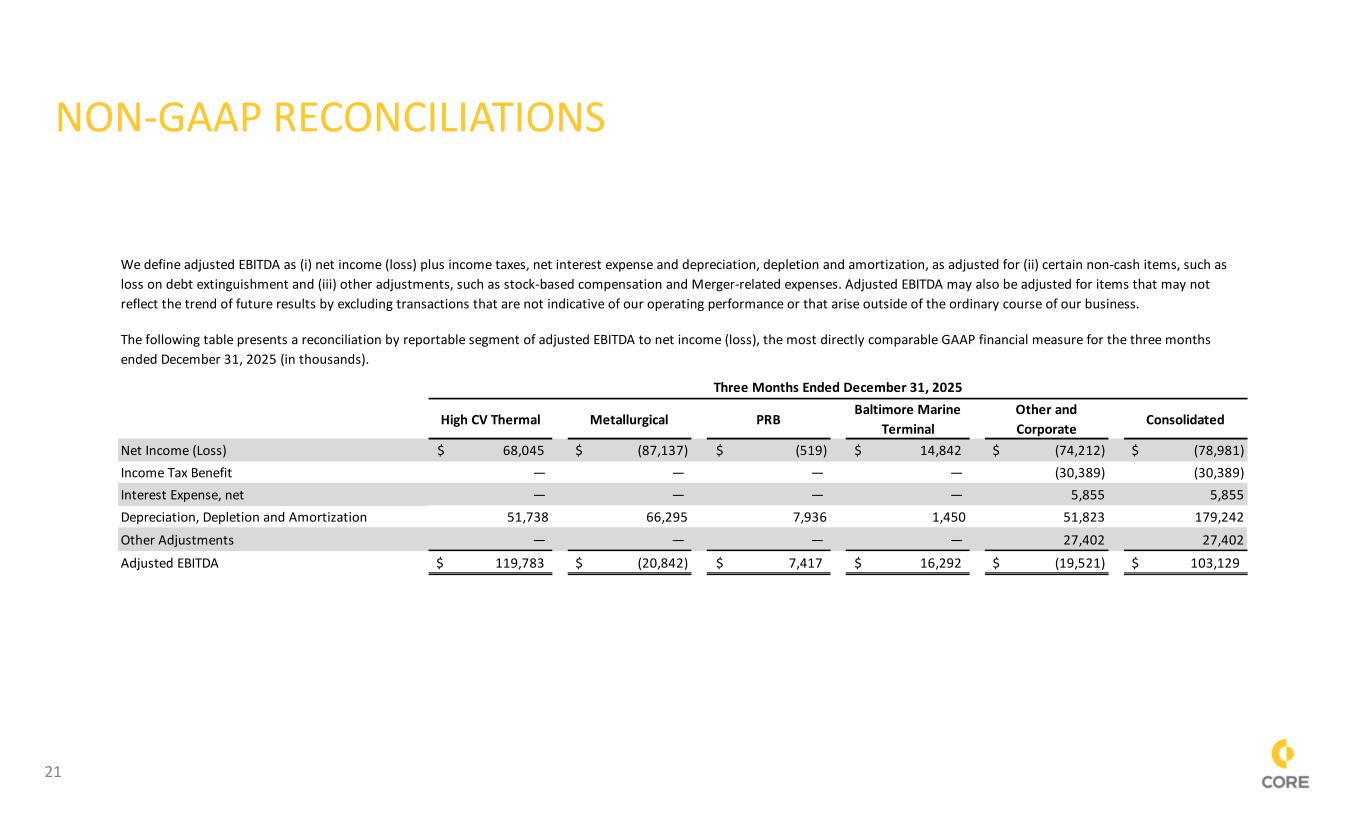
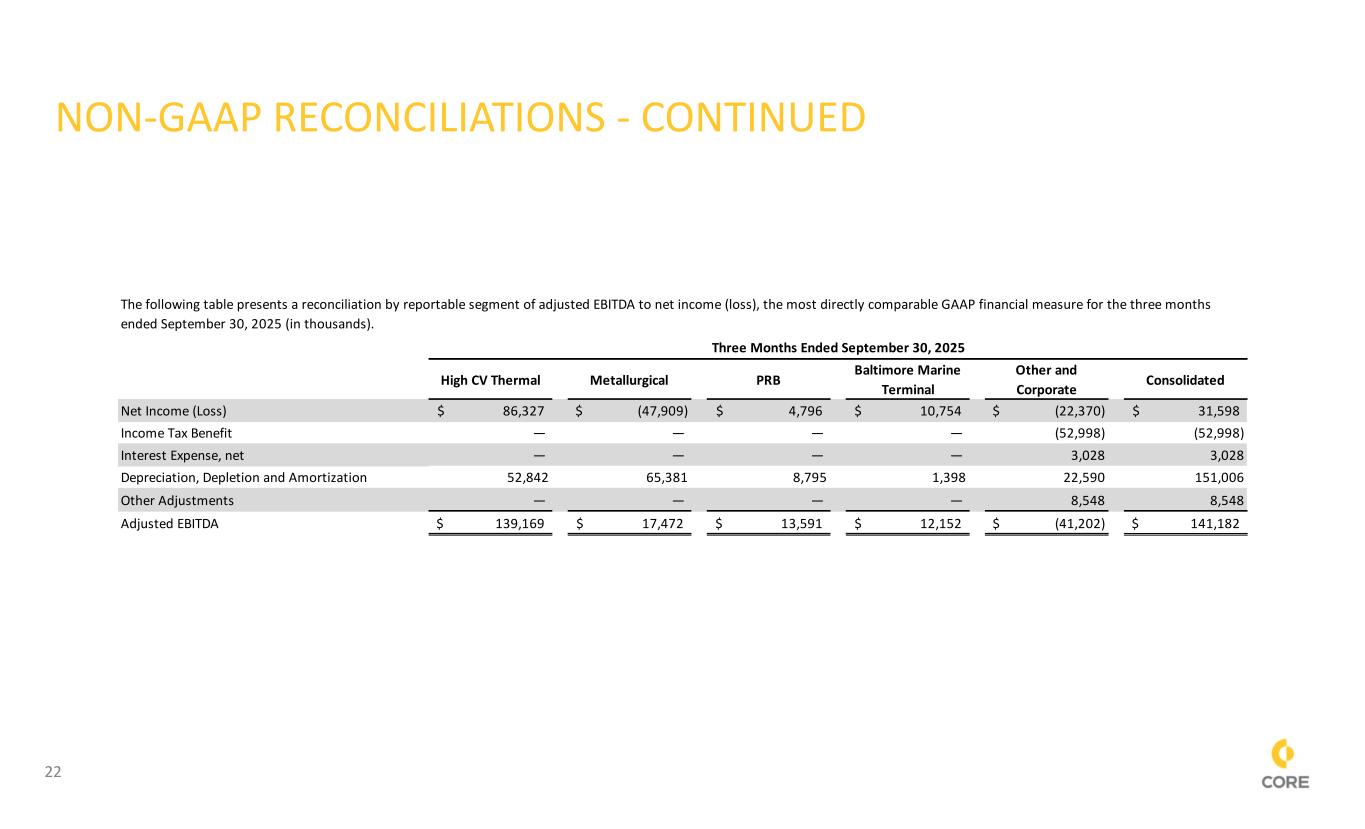
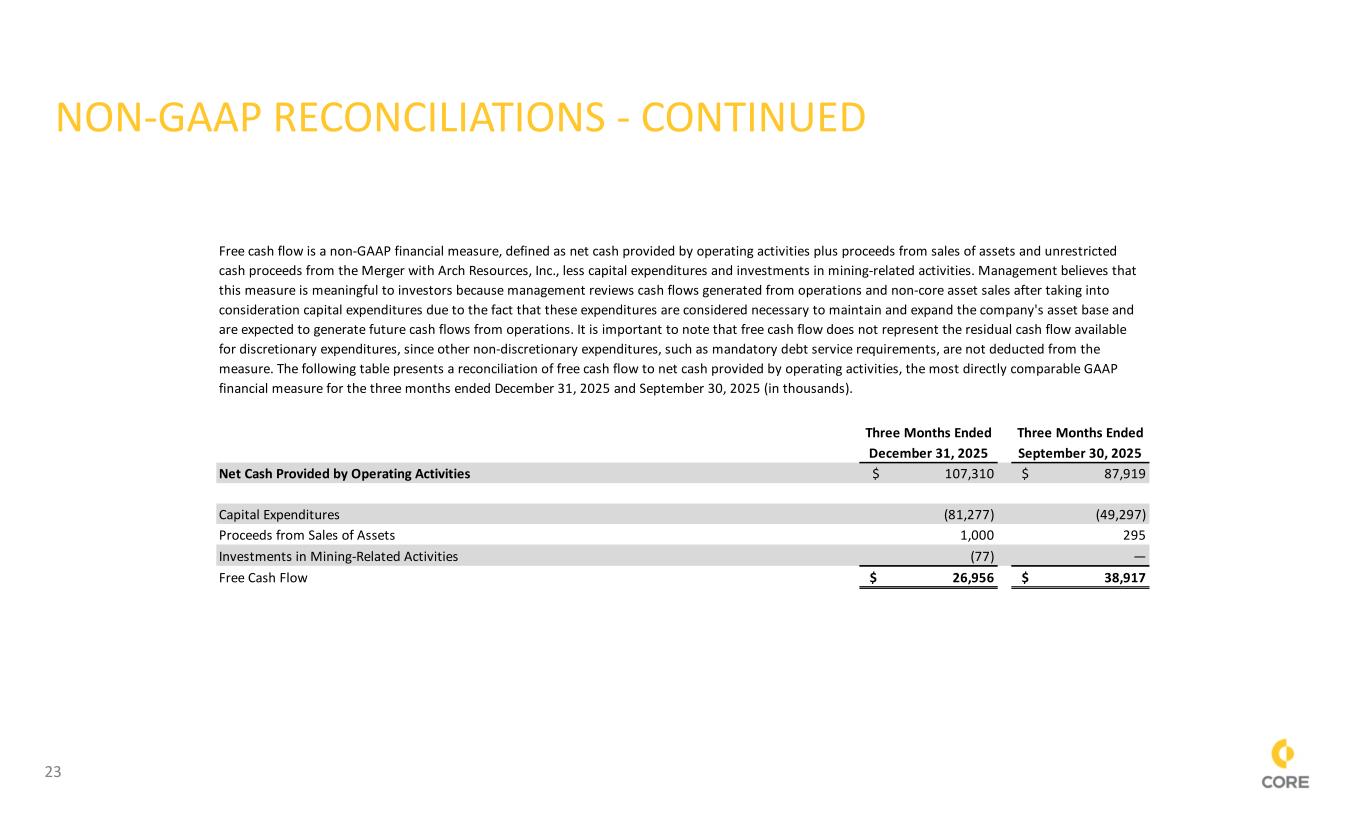
This morning, we reported our 4Q25 and full year 2025 financial results. For 4Q25, we reported a net loss of $79 million, or $1.54 per dilutive share, and adjusted EBITDA of $103 million. The reported 4Q25 adjusted EBITDA includes $25 million of LearSouth fire and idle costs and $11 million of West Al-Qaeda costs, partially offset by $24 million of insurance recovery related to the FSK bridge collapse. In the quarter, we spent $81 million on capital expenditures and generated $27 million in free cash flow. For 2025, we reported a net loss of $153 million, or $2.98 per dilutive share, and adjusted EBITDA of $512 million. A reported adjusted EBITDA includes the impact of $101 million related to Lear South fire and idle cost and $11 million related to West Elk idle cost, partially offset by insurance recovery of $43 million. 2025 was a milestone year for CORE, being the first operating year as a combined company. As Jimmy mentioned earlier, we managed through this challenging year both on the operational and price in front while still being able to return capital to our shareholders. We also had several accomplishments that were massed amongst those challenges. For instance, we had tremendous success in integrating the two companies, streamlining the management teams, and exceeding the synergy targets. We also leveraged a strong partnership with our financing partners to create a sustainable and robust capital structure that allows for strong capital returns and growth optionality. now let me update you on the marketing front in the domestic market the current administration has supported several cold focused initiatives as Jimmy mentioned these policy chefs have laid the groundwork for a stable regulatory and demand landscape allowing ongoing investments in coal fired power plants and delayed retirements in 2025 there were approximately 16 gigawatt of coal capacity announced for retirement however we estimate only about 4 gigawatts were actually retired on the usage side for 2025 we estimate the total US utility coal consumption was of 12% compared to 2024 in the PJM and Mysore area specifically we estimate coal-fired generation to have risen over 19% and 15% respectively when compared to 2024 according to the PJM resource adequacy planning department over the next 10 years, the net energy load is projected to grow at an average rate of 5.3% per year compared to expectations of less than 1% in 2022. This forecast, as well as favorable support from the administration, provides an attractive backdrop for domestic coal demand for years to come. One of the areas of growth that we have mentioned over several years is the upsurge in power demand stemming from the build-out of new data centers. By 2030, it is expected that global data centers will see a 14% compound annual growth rate, resulting in approximately 100 gigawatt of new data centers. Of this global demand, the Americas are expected to account for approximately 50% of data center capacity and to experience an expected compound annual growth rate of 17% to 2030. This data center boom is stemming in large part from AI, which is estimated to represent over half of the data center's workload. On the international coking front, heavy rainfall disrupted the Australian metallurgical coal Starting in early January and continuing into February, both production and shipments were negatively impacted by flooding, which has caused a decrease in metallurgical supply in the export market. As such, we have seen an increase in PLV benchmark prices since the beginning of December, with PLV prices up by approximately 25% to around $250 per metric ton. Globally, according to the IEA, estimated global coal demand rose again in 2025 by approximately half of a percent to 8.9 billion metric tons. The uptick in global coal demand last year is now part of a multi-year pattern. This market landscape lays the backdrop for our contracting progress. Since 3Q25, our marketing team has further expanded our contract book for 2026. We added approximately 7 million tons each to our sold positions in the high-CV thermal and PRB segments, bringing our contracted positions to 24 million tons and 47 million tons respectively. Our metallurgical segment has nearly 7 million coking tons contracted for 2026 with approximately 2.4 million tons priced. Of our priced coking coal tons, approximately 2 million tons are in the domestic market, the vast majority of which were high wall. Now let me provide our outlook for 2026. Starting with the high-CV thermal segment, we are expecting 30 to 32 million sales tons of which 76% are contracted at the midpoint. Of those committed and crawled tons, we project coal revenue to be over $57 per ton. We expect the average cash cost of coal sold for 2026 to be $38 to $39.50 per ton, an improvement versus 2025 levels. For the metallurgical segment, we are expecting coking sales between 8.6 and 9.4 million tons. On the committed tons that are priced, we are expecting average coal revenue of approximately $120 per ton. As the metallurgical market strengthens due to the reduced Australian supply, we are encouraged by our ability to take advantage of this uptick in pricing for our committed and open tons. We expect an average cash cost of coal sold of $88 to $94 per ton, reflecting normalized performance at Lear South versus 2025 levels. within this guidance we layered in our expected benefits from the one big beautiful bill that Jimmy discussed earlier our cash cost guidance range for our high CV thermal and metallurgical segment includes the benefit of the 45x tax credit it should be noted that this credit is applied in the year that the product is sold but the cash benefit is received during the year in which the tax return is filed as such we anticipate recognizing the benefits of the credits in 2026 cash costs, but will not receive the cash effect until 2027. For the PRB segment, we are expecting sales of between 47 and 50 million tons with 47.4 million tons contracted at an average coal revenue of approximately $14.15 per ton. We expect an average cash cost range of $13 to $13.50 per ton. On the capital expenditures front, for 2026, we expect a range of $325 to $375 million. This capital expenditure range includes approximately $300 to $350 million tied to maintenance-related expending, while the balance is earmarked for various growth initiatives, including investments in critical minerals, battery technology, aerospace and defense, and other innovative coal-related products. Lastly, we expect cash-based SG&A to be between $85 to $100 million. As stated at the time of the merger announcement, we anticipated longer-term cash-based SG&A to be approximately $90 million, which aligns with the current midpoint of our guidance. In summary, when comparing 2026 versus 2025, there are several positives to look forward to from a financial perspective. First, we do not expect to incur any idling cost across the high-CV thermal and metallurgical segments after incurring $112 million of such costs in aggregate in 2025. Second, we anticipate receiving additional insurance proceeds for Lear South during 2026, which is expected to outpace 2025 levels. Third, we expect to only incur approximately $10 million in merger-related expenses in 2026 compared to 66 million dollars in 2025. Finally, and most importantly, we anticipate strong operational performance at Lear South and West Elk mines, which was not the case in 2025. With that, let me provide a quick update on rare earth elements and critical materials. Since our last earnings call, our innovations group has continued to advance our efforts on the rare earth elements and critical materials front in the PRB we have drilled additional core holes at strategically selected locations initial lab results are consistent with our previous findings showing enriched ash bases rare earth elements concentrations near the cold seam margins in northern app we have been working with Virginia Tech and L3 process technologies to develop a concentration upgrading and extraction strategy for the PMC and we recently entered into an exclusive option to license Virginia Tech's technology we expect to have additional updates on our efforts in the eastern and western United States in the coming months we continue to make further progress on the coal-based battery materials front as well as on our aerospace and defense tooling and parts initiatives our innovations team is rapidly building a platform focused on disruptive solutions for our nation's most pressing national security now let Let me pass it back to Jimmy for some quick closing remarks before we open the call for Q&A. Thank you, Mitesh.
In closing, for 2026, we will be focused on a few key areas. The first and most important priority for us in 2026 is regaining and strengthening our operating excellence and performance. We will continue to focus on running every operation safely and efficiently while reducing and costs across the board as implied by our guidance. As we put the Lear South incident and the West Elk delay behind us, we will migrate our focus to finding additional areas to optimize and drive efficiency improvements across the operations. Second, as the test laid out, we expect to see strong positive momentum from an earnings perspective related to 2025, underpinned by a strong operating performance as well as significant reduction in margin-related expenses and an increase in insurance recovery compared to 2025. Third, we will continue to support the Trump administration in its efforts to preserve and upgrade the U.S. coal fleet, expand U.S. coal exports, and ensure the long-term health and viability of the U.S. coal industry. We will continue to advance our efforts in the growth areas of rare earths and critical materials with a prudent capital allocation strategy last but not least our employees throughout the organization in 2025 we effectively worked together to mitigate the effect of the lear south incident as much as possible the team successfully managed cost and ensured each operation did its part in running as efficiently and safely as possible I am grateful for our team members dedication and pleased with how this challenging year was managed I want to thank all our employees for their dedication and hard work which carried us through a very turbulent 2025 I specifically want to thank all our corporate employees who worked hard and spent countless hours streamlining policies procedures and systems even as they grappled with the loss of their departing colleagues with that I will hand the call back over to the operator to begin the Q&A portion of our call operator can you please provide the instructions to our callers yes sir thank you ladies and gentlemen we will now begin the question-and-answer session and if you wish to ask a question please press star and one on your touchstone phone and wait for your name to be announced once again star and
Operator
one if you wish to ask a question. And we now have the first question. This comes from Nick Childs from V-Riley Securities. Your line is now open. Please go ahead.
Yeah, thank you so much, operator. Good morning, guys. My first question, just on the high CV committed and priced, $57 there, you know, a few parts, but could you break this out just for the PAMC portion, maybe for a comparison to legacy results, and then where are you seeing domestic netbacks today for PAMC coal, and how do you think about upside on the back of these positive developments? Thanks a lot.
Sure, Nick. Right now, we have roughly about 20.5 of the 23.5 million tons that are committed or contracted for high-CV, 20.5 are for PAMC. We – right now about 12 million of those, I'll say, are domestic 8.5 export. About 4 million of those are linked to API2, and again, the reason why we gave a fixed price versus a range is we have less variable contracts in 2026, but of the 4 million tons that are linked to API2, we used about a $97 API2 price when we put in that guidance. So, you know, January was over 99, we're over 100 today, so there's certainly some upside Our sensitivity, give or take, is roughly about 10 cents a ton, both on the up and down. That leaves us, call it, you know, five and a half, six million tons left to sell PMC. Very excited about what we're seeing now. It's not only domestic. We are seeing some opportunities domestically as well on a spot basis due to the recent and cold weather we experienced in January plus, as Mitesh and Jimmy both mentioned, the growth in power demand due to data centers. But I'm also encouraged by what we're seeing on the export front, specifically in India. You know, a month ago, CFR India prices were in that 115, 120 range. Today they're 125 to 130. So we have been seeing some improvement there and been able to capture some of that upside on some of these open tons.
So, Nick, I would add that, you know, in addition to all those comments, look, last year that 45 million ton increase in coal consumption really did pretty much chew up the latent capacity that was out there. So, look, you know, your question of where things might go, look, it could start to get If we see another year, another significant uptick in demand and coal consumption, you know, you could start to see some upward momentum on those prices. Haven't seen it fully yet, but expect that could come.
Guys, I appreciate all that color. Maybe just as a follow-up on that, you've spoken about it before, but where are you seeing things in the outer years for the order book? I mean, has it really been a duration benefit? Are you seeing any, you know, upside potential in pricing in some of those outer years?
If you look at our release this morning, you know, we contracted over 38 million tons last quarter forward and you know some of those contracts when it's far out as 2030 so our book is very well positioned and and I'll just tell you in general in general terms our pricing is in contango as we move out to the forward years great my second question was more turning to Mitesh you outlined some of the moving pieces in the financials whether it's you know insurance recoveries or now the 45x credits so just hoping you could touch on what this all means for shareholder returns I mean should we think about shareholder returns as being a little bit more lumpy in nature and
then I had one more on the capex side there was a bit of a step up there year on year so curious what was driving that thanks yeah so let me address the capex front first on the capex front remember we have a little child fully up and running now right so there's maintenance capex title your south that's going to to show up as well, and as we laid out in our press release, we are spending a little bit more, and I covered it in my prepared remarks too, we are going to spend a little bit more on some of the rare earth and innovations types project as well that is included in that guidance. I think about $25 million out of our total guidance on the capex spending front is tied to rare earth efficiency improvement and some of the critical minerals efforts, including coal-to-products included in that number. On the cash flow side, obviously, insurance is a – we expect insurance proceeds to be higher next year versus this year. Just providing some perspective, we have two insurance claim events, the Baltimore Bridge related claim and Lear South related claim. We settled the Baltimore Bridge claim for a net of $40 million, of which $10 million was received in the first quarter of 2025, and $24 million was booked in fourth quarter of 2025. We still have about $6 million that is going to be booked in 1Q26 for the Baltimore side. And on the Lear South side, we have so far booked about $19 million in 2025, and we expect another ten million dollars to be booked in 1Q26 associated with the firefighting expenses we also believe there's going to be a lost income claim of around a more than a hundred million dollars so I think that that's going to play out as well so we feel good about how cash flow is going to look like on a year-over-year basis including the fact that we are not going to have almost a hundred and twelve million dollars of idling cost that we had in 2025 and as As we have said in the past, I think we'll continue to make sure that from a capital allocation standpoint, we continue to prioritize share buybacks.
And Nick, as far as the shareholder return, as you well know, we had the formula of whereas we returned 75% of our free cash flow to shareholders. If you look at 2025, not the best of years for us, we still return probably 100% of our free cash flow or really close to it to shareholders. So we should have an opportunity here in 2026 as we hit our targets and going forward to even provide more. And we certainly will stick with the form that we have in place today, which is 75% of our free cash flow or better.
Got it. Well, guys, that's very good to hear. I appreciate all the detail and continue. Best of luck. Thanks, Nick.
Operator
Thank you. And the next question comes from Chris LaFemina from Jeffries. Jeffries, your line is now open. Please go ahead.
Thanks, operator. Thanks for taking my question. So I'm just trying to understand the progression on the unit cost. So if we look at the unit cost guidance for 2026, it's kind of in line with where you were in the first half of 2025. I mean, obviously, Lear South was down in the second quarter, but there's not really evidence of costs being significantly lower in 2026 than they were right when the merger first was completed. and you've guided to $150 million or more synergies, and in addition to that, you have 45X tax credits. I understand that you're not – that's being offset by lower prices in those contracts, but I would have thought that the trend on cost would have been more downward than we're seeing. And so my first question is, you know, where are those synergies kind of showing up in the P&L here, and are they in – is there a significant portion of synergies in 2026 guidance, or is it that, you know, cost as the year progresses will go down, the synergies will be a bigger factor each subsequent quarter? And then the second question I have is, well, actually, let me ask you that one first, just in terms of synergies and where they're showing up in the P&L and why are we not seeing bigger cost reductions for next year?
So, Chris, I'll take the synergy side, and Jimmy's going to address the cost side as well. So, on the synergy side, I think if you look at what we have said in the past from from a synergy perspective what the key buckets are so one one of the key buckets on the synergy side has been headcount related which a lot of that shows up on the SG&A front and based on our guidance for cash basis SG&A that we have provided and what you would what you have seen us do you can come up with a reasonable conclusion of almost a 40% improvement on that front I think I think the other part of the synergies was on the marketing and logistics side, so that shows up in some of the byproduct credits, byproduct sales price that we have disclosed in our earnings release as well. I think it's the last page of the earnings release. You will see a number that is $47 on byproduct credits that is related to blending. If you look at, think about Legacy Arch, when they didn't have other products to blend, I think that they were selling it in the high 20s and low 30s. So there is a significant $10-plus uplift on that. So that flows into the realization bucket. Now, part of the reason you might not be seeing the full power of that marketing and blending synergies is because the overall market has been down since the merger, whether it comes to metallurgical coal or whether it comes to thermal coal pricing as well. So when they come down, the blending-related synergies kind of decline a little bit. And then the third bucket is of financing and insurance-related synergies that we have talked about in the past, realigning the balance sheet, improving liquidity, all sorts of things, Finally, on the operations side, supply chain is one part of the synergies. The cross-current to that was some of the impact related to tariffs that was not envisioned at the time of the announcement of the merger, right? So, that's a little bit of a wash there, too.
Yeah, I was asking about whether part of those synergies is being offset by inflation, which I assume would have been a factor, right? Okay, but if we're thinking about costs into 2027, I know you haven't given guidance yet, but would you expect all else equal, you know, costs to be low in the first half of 2027 than they will be in the first half of 2026? In other words, is the impact of all these benefits going to increase over time, or should we see most of it through the first half of 2026 and the flatline from there?
I think overall, just in synergy in general, I think we still have a lot of some of the IT systems that are not fully integrated. So I think first half versus second half, I would expect second half to be better than the first half. So there's going to be a ramp up as those systems roll off. And so I think that is that part of it too. And always remember in the first half, particularly in the first quarter, you always have weather impacts logistics, whether it's railroads, whether it's terminal operations, all of those. So there is a little bit of that as well. So it could be a little bit more of a ramp up from the first quarter.
And Chris, when you look at the cost, the unit cost, particularly with our guidance that we put out here in 2026, you know, we've got it, it certainly implies that we believe we'll have cost improvement in 2026 versus 2025. One of the things that I personally am going to do, along with our chief operating officer and all of our operating folks, is get laser focused on unit costs. Now that we have all of our assets up and running at full speed, we're excited about where we can get to. Now, with that being said, you know, there was some maintenance costs associated with the longwall moves pulling forward. There was some fixed costs associated with, you know, just the assortment of less tons. But as we move into 2026, I think within the guidance that we give here, we will be focused to get those numbers and even beat those. So as we move forward, I would expect a more steady cost, unit cost, and those should improve quarter by quarter as long as we stay in the same where we're mining. Now, we do have, you know, as you know, it's been advertised that Lear mine was in the best yield, the thickest seam they had. We're moving into a new district. We don't know exactly what that yield is going to be yet, but it's still going to be a great producing wall. We expect it to produce at much lower unit cost than we have. So pretty excited about 2026. I know 2025 had a lot of noise, a lot of calculations for cost. But I'm really excited about where these units can get to. you know, PMC as well as the PRB and the Lear Compact as well on the MET side.
That's really helpful. And just one more quick one on the markets, maybe a question for Dec, actually. What are you seeing in the high-violet market now with Lear South ramping back up? I mean, that market is obviously really dislocated from the premium low-violet market. And, you know, what's your expectation as to how those spreads will change over time and what are you seeing right now in the market? Thank you for the answers. I appreciate it.
Actually, Chris, maybe Bobby will start with where we are at the moment, and then maybe I'll give a few thoughts on the macro.
I mean, as far as, you know, we announced this morning 6.7 million tons. We already have contracted. You know, the exciting part about that is we do have some linkage to PLV, which I think you're indicating there are some widespread between where PLV indexes and U.S. East Coast indexes are. We are seeing additional appetite in the Asian markets. You know, they typically contract on a fiscal year basis, so April through March. We are in active negotiations today for some significant volumes. So I do feel good about our ability to contract those, especially against PLV prices. So when you look at what we have left to sell at our midpoint, call it 2.3 million tons. Majority of that is high vol, call it 1.8, about 500,000 tons of that slow vol. I would anticipate most of that high vol being contracted into the Asian market. And I also would say, you know, if we see these U.S. utilization rates continue to climb, they've been hovering at 75% to 79%, but we have seen some recent upticks, you know, that could open up some opportunity for us domestically as well. So do feel good about where our book is. The spreads, I think, will continue to shrink as we move forward, although right now we're certainly doing what we can to take advantage of the spread and link more toward PLV.
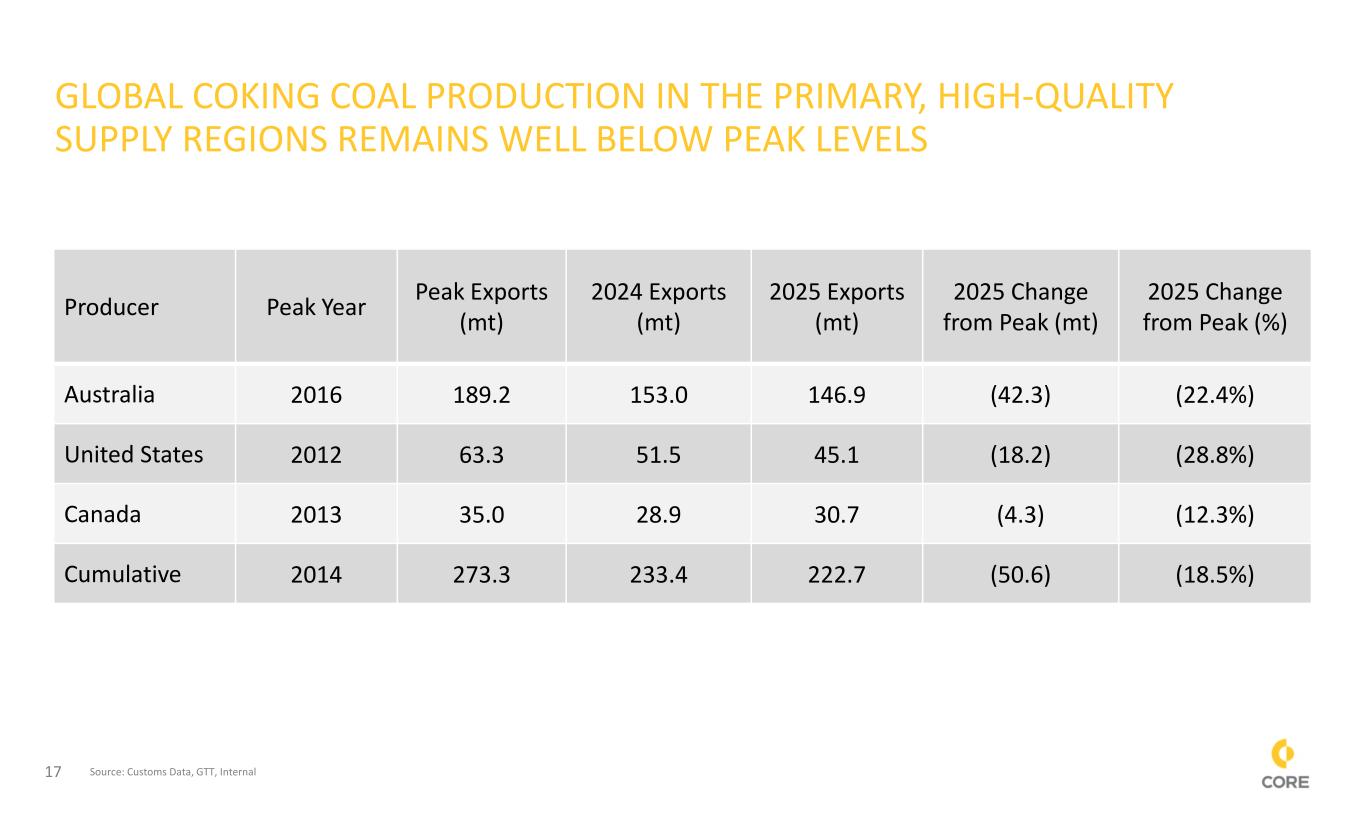
You know, Chris, maybe a point on that, on the spreads, look, you know, if you look historically 2017 through mid 2024, the average spread between PLV and HVA was about $10. So it's obviously blown out in a very significant way, in a way that you can't say, you know, value and use doesn't explain, you know, a $90 spread between PLV and HVA. So as Bobby said, look, we'll try to take full advantage of that by committing as many tons against PLV as we can, but, you know, there is an opportunity here. We expect that spread to shrink significantly. Look, I think there's been some concern about additional Hive OLA coming into the market or coming back into the market, which, you know, is valid. You do have some mines that are returning, and right now everything else is running well. Always the caveat, you know, there will be mines that go out. You know, typically you have five to 10 percent of the global, you know, mining fleet that is, you know, experiencing some sort of operational difficulty. So it's not like, you know, that capacity comes back and everything else runs like a Swiss watch. We don't expect that. But it's also true that if you look in 2025, you had production down six million tons in Australia, down six million tons, or exports, rather, down six million tons in Australia, six million tons in the US. So that's a real counterbalance against some capacity coming back online. So, look, we feel like there is balance returning, you know, Indian imports of coking coal were up nearly 10 million tons in 2025, so, look, lots of positive signs here. So, we expect this market to normalize here in the not-too-distant future, but clearly, we've been under some pressure, you know, through 2025 and are only now getting sort of, you know, back towards, you know, some positive signs.
Operator
Thank you, guys. Thank you.
Operator
Thank you. And the next question comes from Nathan Martin from the Benchmark Company. Please go ahead.
Thanks, Operator. Good morning, everyone. Good morning. Bob, question for you. You mentioned earlier sensitivity to API2 price for the high-CV thermal segment. Any sensitivity you could provide for PGM West power prices or even Pepco that you could Yeah, so for PGM, it's fairly irrelevant right now.
Our new contract with that specific customer, we negotiated a fixed price. We certainly seen a much higher, I'll call it base, than what we received on the netback. We did have some volume carry into Q1, so sensitivity there, Nate, is, I don't want to say it's irrelevant, but it doesn't become very relevant as we move forward in 2026 and 2027. In terms of what we're seeing on the Petcoak side, just as an example, you know, recently Petcoak prices have improved to close – the CFR Petcoak price improved around 125, 130. That's netting back roughly a six-handle back to the mine, where previously, you know, we were contracting in December when Petcoak prices were closer to that 115, 120. We were, you know, low 50. So, we've seen at least a 10% to 15% improvement in our overall net back with the improvement in pet cook prices.
Okay, I appreciate that, Bob. Maybe one other one for you. You know, thinking about West Elk, you know, can you talk a little about the marketing efforts for that, Cole, given the potential for, you know, additional production now that you guys are in the bee seam?
Yeah, so, you know, a couple things. We've really, you know, once we enter the V-seam, the quality has significantly improved, especially from a heating standpoint. So the team has been doing a really good job in developing that coal into utilities, mainly into the east. You know, the coal traditionally has gone into the industrial markets out in the west and also into the export markets. We still have that business, but now that we're focusing on getting to five-plus million tons out of West Elk, the incremental volume we're certainly looking to develop into the east we've already been successful in securing four utility customers in the east two that we currently have under contract two I would say we're in a process of doing trials so again look very look forward to our ability to secure meaningful volumes into the utility business into the east and just for reference this is a business that is being developed six twelve months ago we we didn't have any utility business in the east for West Elk coal I think with
the demand growth that we are seeing everywhere in terms of data center and AI I think there's a lot of potential to benefit from that growth in the east and we're very optimistic that we'll be able to capture that some of that growth out of West Elk all right very helpful guys appreciate the time best luck thank Thank you, and the next question comes from George Ada from UBS.
Operator
Your line is now open. Please go ahead.
Yeah, hi, Jen. Sorry, my line dropped out, but maybe just quick information. Sorry if this has been asked, but the 45X credit confirm all PAMC is eligible and also West Elk and maybe the timing of the $100 million insurance to come still. Is that waiting until late in the year, would you expect?
So, on the 45X credit, George, I think both the metallurgical segment and high CV thermal segment are going to benefit from it, and we have modeled it in our guidance. And then on the insurance proceeds, I think what the way we'll file all our claims here in the first half, now there is going to be a cadence, we're going to start receiving, As I mentioned earlier on, we started receiving some stuff in Q1, which I already mentioned. From a modeling perspective, I would assume that it's more second to fourth quarter loaded rather than first quarter, but we are getting some stuff. It's just timing and, you know, they go through the claim process and there's some back and So, again, we're trying to push as hard as we can, but sometimes, as you know, the insurance company also go through their own due diligence process.
Thanks, Mitesh, and then probably for Jimmy more so, but I mean 2025 wasn't the best year operationally with Lear South and West Elk in the more challenging scene, but like what tangible things have you guys done to give us more incremental confidence in the operational delivery for 2026? I mean volumes this year look good, there's some tailwinds helping on the cash cost front, but how do we gain conviction in delivery this year? And maybe a reminder as well, or any operations in any challenging parts of the mine plan besides layer?
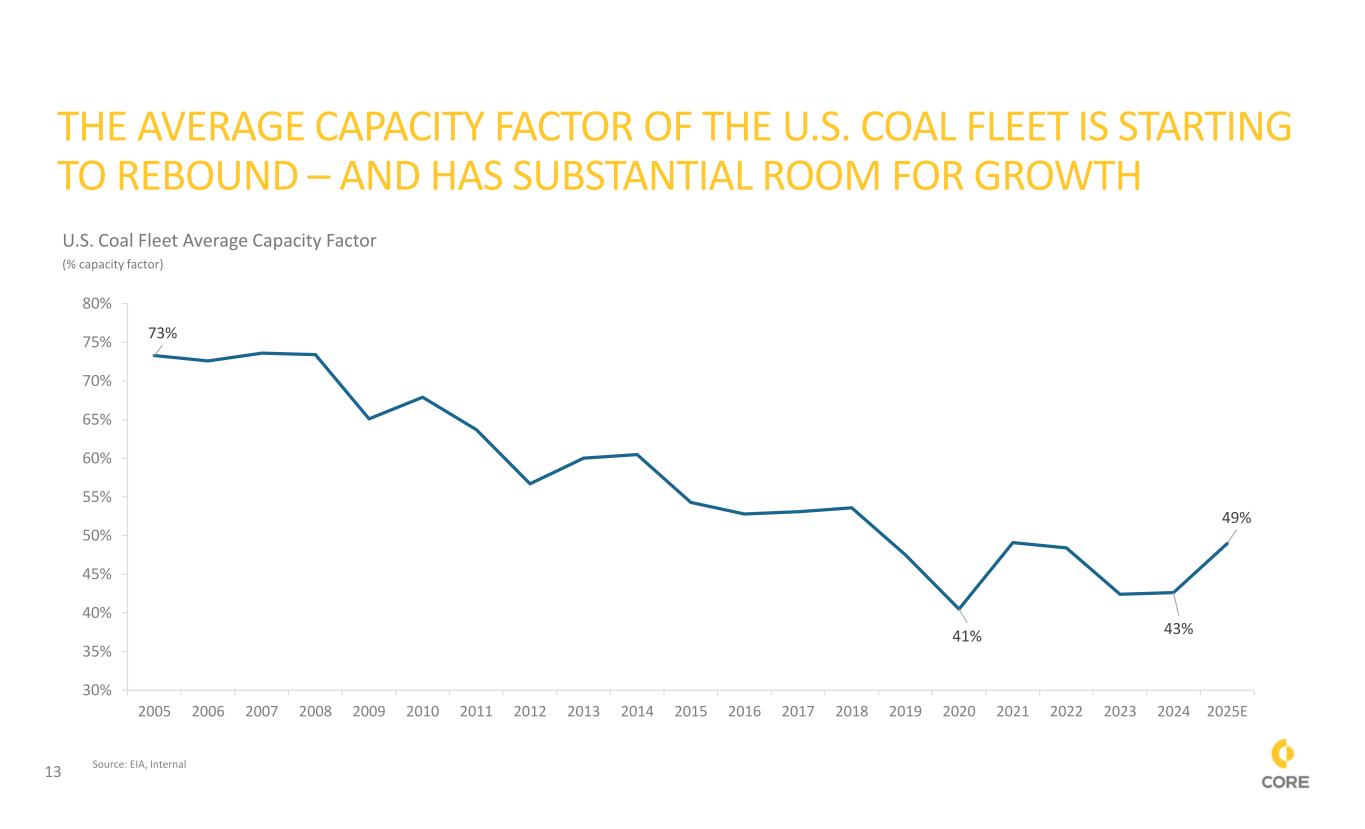
No, I think that's what gives us so much excitement about 2026. As I said earlier, you know, we have all of our assets up and running now. We've done some things that we think is gonna really help our costs going forward, such as schedule change, such as looking at how we're producing on certain walls. That's what we did in prior years. And quite frankly, we're in great conditions at West Elk, really excited about that there. I think we can, it's going to depend on the market, you know, on transportation for West Elk, but we're certainly in a position at the mine to produce at high productivity levels. You know, we'll have Lear South back up and running now. I think they're going to do great things there. Of course, mining's mining. You always have incidents come up here and there, but as a whole, I feel really, really good about CORE in 2026 and beyond. I think we're going continue to work on you know cost structures and things will help us you know Lear moving over into the north district there you know we'll probably have a little better geology maybe a little less yield coming out of that but the team is laser focused on doing that and you know getting our longwall moves in the right cadence to whereas we can move and produce to our guidance or above that i think is going to be what you see in 2026. yeah i know that's clear and then maybe the U.S. coal flake capacity factor like this is getting a lot of attention and interest, but we haven't really seen it annualized much higher than 50%.
We've had patches in the 70s with the weather and gas prices bouncing. But how do you guys think about this on a sustainable six-month year? Like, would we see 60% U.S. coal flake capacity? Is that a fair assumption for potential second half, or is that still too aggressive?
You know, so, George, as we said, look, it's running, we're running about 49% at this point. and it's DAC. And look, actually, you know, you only have to go back to the aughts, to the early part of the century to, you know, to see when they were running at 70 to 72 percent capacity factors. And even then, that was with cycling down, right? So they definitely can run at much higher levels than the 49 percent. Quite frankly, we saw them running at 61 percent in January and February of 2025. So, you know, that demonstrates that they, you know, that they sort of proved it in winter and, you know, earlier in 2025, they demonstrated that. And again, still with a lot of cycling down. So look, we're highly supportive of the Trump administration's efforts to, you know, induce additional investment and to try to, you know, make these plants young again in that way. But even now, we think they can operate at much higher capacity factors than they are You know, we've seen that. And look, the math is pretty simple. I mean, if you go from a 49% capacity factor to a, you know, a 65% capacity factor, if you increase, you know, if you increase that capacity factor by 50%, you know, the consumption can increase by 50%. You know, that suggests another 200 million tons of coal consumption without really doing anything much to the fleet at all. So, again, we're enthused about where that's leading.
Yeah, and George, one last thing I'll just add. I would say it's very encouraging is, you know, talking to a lot of our utility customers, investments are happening. And I think Dec mentioned that at the last point of his comments there is that these utilities are investing in their coal fleet, so they can continue to run at these higher capacity factors as this additional load comes on online. So that's very encouraging.
And I'd add one final point, George, the Trump administration also, you know, really focused on not allowing additional coal-fired plants to close. They've used their 202C authority under the Federal Power Act, you know, to ensure that plants that, you know, maybe a year ago, two years ago, three years ago were viewed as inessential, nonessential, are now being preserved. And I think it's going to become very clear very quickly that those plants, you know, are in fact needed with the power demand growth we're seeing. You know, we talked about the overall growth, but, you know, if, in fact, we're going to see 3.5%, 4% power demand growth, you're going to need all that base load capacity and more.
But just on that, like, do you think if I put in my U.S. thermal coal model, like, 60% for second half, 26% or first half, 20, 27%, like, does that sound too aggressive to you for a half?
Probably not that fast. That's probably too fast to jump up to that level, but I think we get there. I think that's just over the next several years.
I think it's going to depend, you know, there are several factors for that, you know, the price of gas, what the demand is, all of those things. So, I would say it'll take a little longer than the second half of the year to get to 60. Right, okay, yeah.
But, like, if gas prices and energy prices sort of in the high threes even, like, is U.S. power, coal demand sort of high 400s in 27, say, a reasonable thought, or is that, again, still a bit optimistic in your view of those guys yeah George another thing I think we have to consider too is like cold production right like as you probably saw from the earnings releases that have come out so far there hasn't been a significant push to increase production and you know one of the variable here is going to be you know how fast can the industry ramp up if the industry decides to ramp up right and to to see that happening happen you need to see strong pricing signals as well so I think from a cycle perspective I think the price need to go much higher than where it is today to be able to backfill into some of that demand growth you could run into a situation where the utilities do want to run more but there's not enough coal so they will have to pay up for it so to speak right and that's gonna happen it's just a matter of timing and and then you come come back to that question is is the pricing signal is strong enough for the core producers to invest for capacity expansion or de-bottlenecking or whatever.
All right. No, thanks, Mitesh. I'm guessing West Elk going to sort of 6 million tons, maybe slightly higher, is really the only lever you guys could pull in terms of that volume, perhaps?
Well, I think West Elk, as I said, it ran at a really high productivity level in January. worry it's going to depend on what the market is about I've always said we will run to the market but I think the capability of West Elk is certainly there you know it's going to depend on customers and rails but it's a great mind it's ready to go we have a good team there that's ready to produce and they certainly could produce that six million times if the markets there for it thank you thank you George thank you George thank you and there are no further questions that came through and this concludes our conference call for today
Operator
thank you all for participating you may now disconnect